Advertisement

Huawei Whole House Smart Host turns the entire house to a truly smart home

At Huawei‘s product launch conference held on Thursday last week, the company officially announced a new product dubbed Huawei Whole House Smart Host. The product was announced alongside the Smart Screen V series and other smart TV series the company rolled out on that day. Huawei Whole House Smart Host
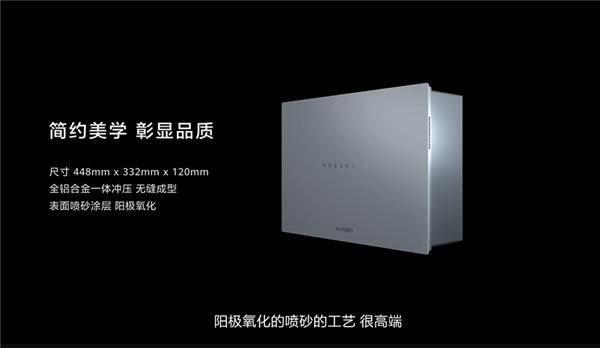
The Whole House Smart Host operates in line with a concept which Huawei dubbed 1+2+N aimed at providing consumers with more choices and possibilities with a brand-new smart life experience. Under this working pattern, 1 refers to the whole house AI while 2 refers to the PLC (Programmable Logic Controller) and WiFi 6+ control systems.Huawei Whole House Smart Host
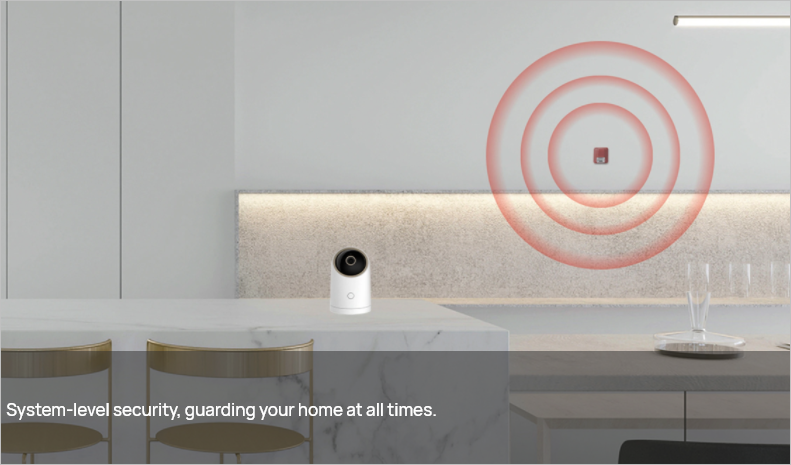
Finally, N represents a variety of ecological products belonging to Huawei’s ecological chain such as intelligent lighting control system, safety protection system, environmental intelligent control system, water intelligent control system, audio-visual entertainment system, sleep assistance system, intelligent home appliance system, sunshade intelligent control system, etc. It extends beyond Huawei-branded products to other gadgets running Harmony OS and this includes brands such as Midea and others. Huawei Whole House Smart Host
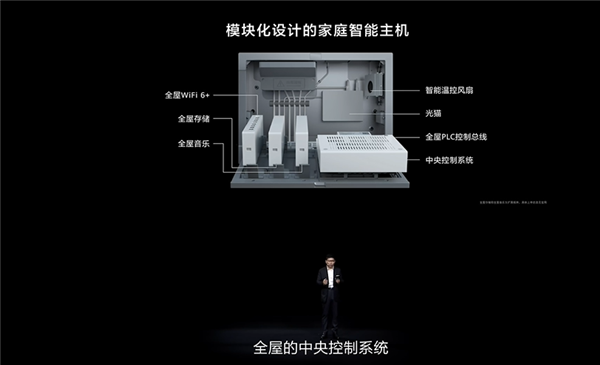
The Huawei Whole House Smart Host adopts a modular design and is equipped with a HarmonyOS-powered central control system. It can be directly placed in the location of the former smart hub as the small size ensures it doesn’t take up too much space. The host uses an all-aluminum alloy one-piece stamping design with a sandblasted surface coating, treated by anodization.

Apart from the central controller, the Whole House Smart Host houses a Wi-Fi 6+ modem and a PLC control bus. The PLC can load control signals and data onto the power line for transmission, realizing a stable and reliable connection when there is electricity and the network is available. Huawei’s Whole House PLC technology reportedly hit a transmission distance of 2000 meters, which can cover large houses up to 500 square meters and can connect up to 384 devices.

The  Wi-Fi 6+ main route includes an IPTV, an uplink connection optical modem, a connection PLC, 5 multi-room AP extensions, and a total of 8 network ports. These all ensure the entire house has adequate WiFi coverage. Huawei Whole House Smart Host

The Huawei Whole House Smart Host arrives in two price ranges—one designed for three bedrooms and two living rooms (about 100 square meters) and it start at 99,999 yuan (~$15,260). The second model is designed for five bedrooms and two living rooms (about 200 square meters) and it starts at 149,999 yuan ($22,890). The product will go on sale in August. Huawei has promised to open experience stores for the smart host across 50 cities in China.
RELATED:

Upcoming Moto G series phone for India to feature 108MP main camera and 32MP selfie snapper

Motorola has recently launched the Moto G10 and Moto G30 smartphones in India. Last week, tipster Mukul Sharma claimed that the company is planning to launch two new G-series phones in India. Through a new tweet yesterday, Sharma revealed key details of one of the upcoming G-series smartphones.

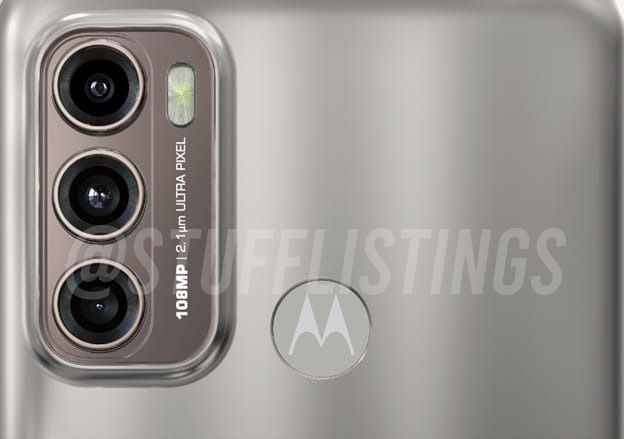
According to the tipster, one of the forthcoming G-series handsets will have a quad-camera setup headlined by a 108-megapixel camera. It will have a 32-megapixel front-facing camera. He further mentioned that the device will actually feature three rear-mounted cameras and one of the lenses might have two functions. The leak has no information on other upcoming G-series phones for India.

Upcoming Moto G series leaked shot
Leaked render of the upcoming Moto G series | Source: Mukul Sharma

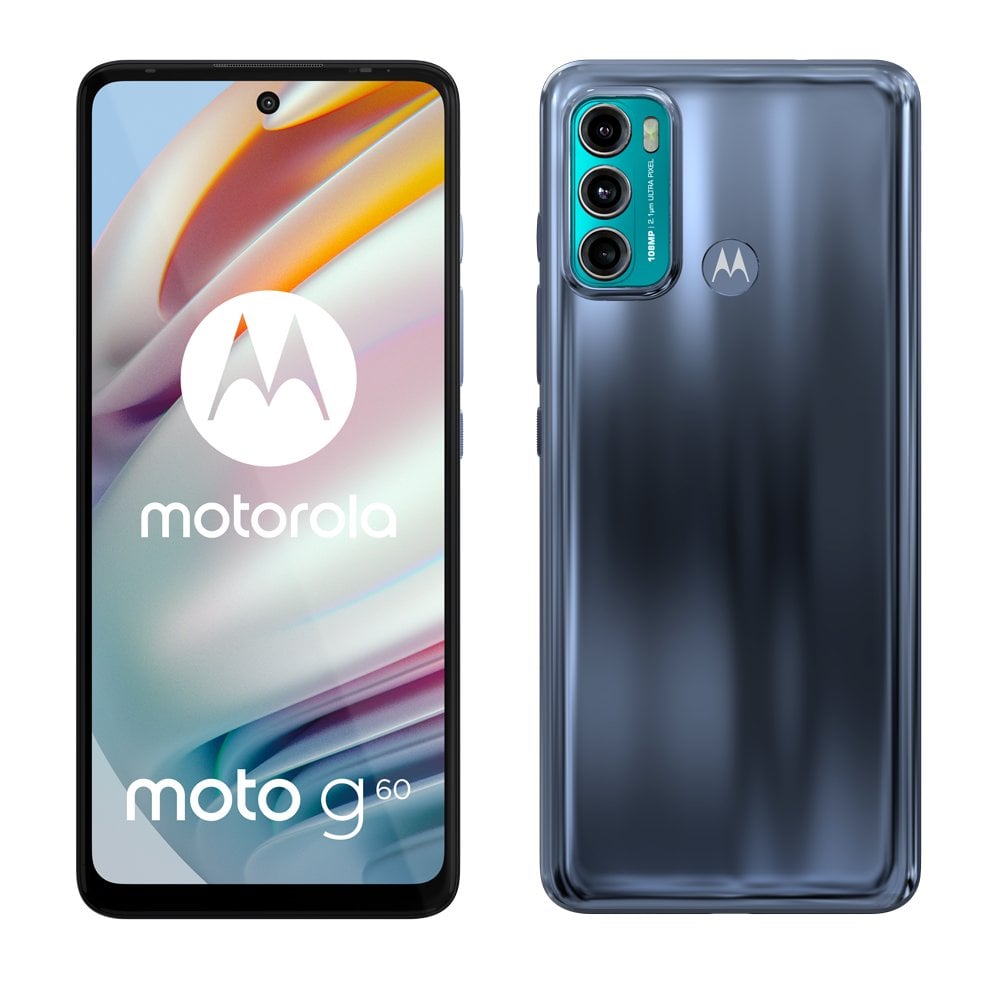
Recent reports have revealed that Motorola is working on a named Moto G60. The leaked shot shared by the tipster seems to match with the recently seen render of the G60.

It is expected to arrive with a 6.78-inch FHD+ display that offers a 120Hz refresh rate support, Snapdragon 732G chipset, 6 GB of RAM, 128 G of UFS 2.1 storage, and a 6,000mAh battery. It could be coming with a front camera of 32-megapixel and its rear camera setup will include a 108-megapixel Samsung HM2 primary camera, an 8-megapixel lens, and a 2-megapixel sensor.

Moto G60 render
Moto G60 render

There is another variant of the same phone named Moto G40 Fusion. It has the same display, processor, and battery and it is expected to arrive in two variants such as 4 GB RAM + 64 GB storage and 6 GB RAM + 128 GB storage. It may feature a 16-megapixel selfie camera and a 64-megapixel + 8-megapixel + 2-megapixel triple camera system.

Reports have claimed that the Moto G60 will be heading to Europe, and G40 Fusion will release in India and Brazil. It is advisable to wait for further reports to see whether both phones will arrive in India.

RELATED:

LG Wing to be available for Rs 29,999 (~$401) from tomorrow in India

LG has recently shut down its mobile business. While it will continue to support its smartphones, it will not be launching any new phones. The LG Wing has been one of the ambitious smartphones from the brand as it is a dual-display phone featuring a rotatable main screen. The base model of the device was introduced with a price tag of Rs 69,990 (~$940) in India. Starting from tomorrow (April 13), this device will be available for as low as Rs 29,999 in the country.

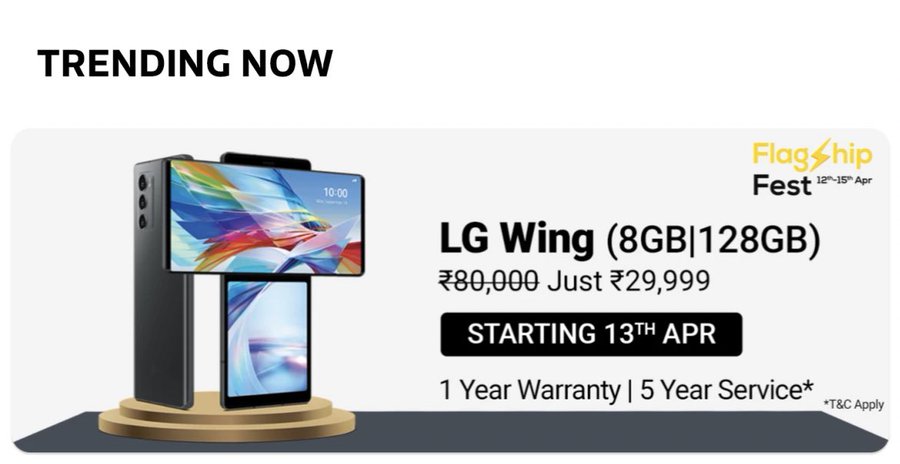
LG Wing new price

The LG Wing with 8 GB of RAM and 128 GB will be sold at a significantly low price of Rs 29,999 (~$401) through Flipkart starting from tomorrow. Apart from a 1-year warranty, the company will be providing 5 years of service to the buyers of LG Wing. At present, there is no clear information on the “5-year service” that will be available for the purchasers of the LG Wing.

A recently released statement by LG confirmed that it will provide OS updates to its premium phones released in 2019 or later. Hence, the G series, V series, VELVET, and Wing are guaranteed to receive three years of OS upgrades. The LG Wing arrived with Android 10 OS onboard. Hence, it is expected to receive Android 11, 12, and 13 OS versions.

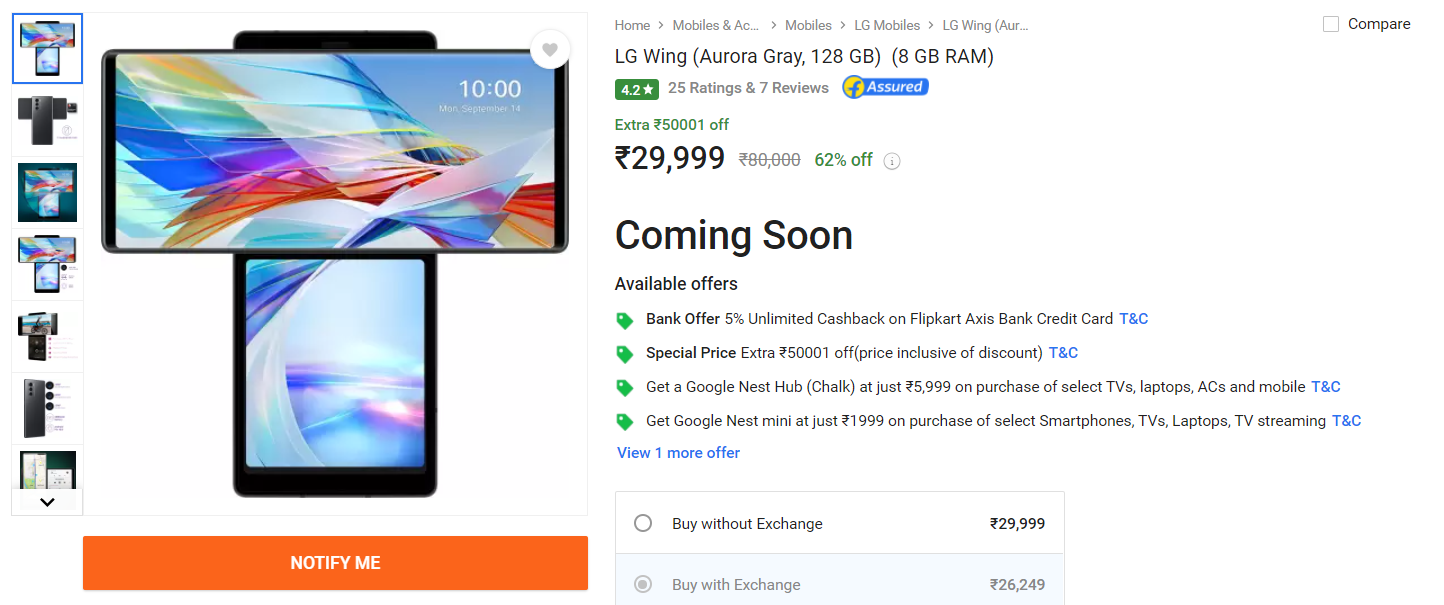
LG Wing Flipkart listing
A screenshot of the LG Wing’s Flipkart listing with revised pricing

LG Wing specifications and features

The LG Wing has a 6.81-inch P-OLED FHD+ display that offers a 20.5:9 aspect ratio. Its 3.9-inch secondary G-OLED screen supports a 1.15:1 aspect ratio and a Full HD+ resolution of 1080 x 1240 pixels. The Snapdragon 765G chipset is present under the hood of the device with LPDDR4x RAM.

For snapping selfies, it is equipped with a 32-megapixel pop-up selfie camera. Its rear camera setup has a 64-megapixel primary camera, a 13-megapixel ultrawide lens, and a 12-megapixel gimbal motion camera. The latter is equipped with 6 motion sensors and stabilization software. The secondary screen can be used as a joystick for functions like pan and tilt.

The LG Wing has a 4,000mAh battery that supports 25W Quick Charge 4.0 and 10W wireless charging. It also features an under-display fingerprint scanner.

(via)

RELATED:

Xiaomi to launch three new tablets including one with a Snapdragon 860 chip

With Huawei’s market share up for grabs, competitors are trying to outdo themselves with new products every week, and it is already yielding results, at least for smartphones. However, things are slower with regards to the tablet market which is another area Huawei had a grip on in China but that is about to be snatched by players such as Lenovo and Xiaomi. The two manufacturers have multiple new tablets lined up to launch this year. Now, new details have surfaced of Xiaomi’s upcoming tablets.

Xiaomi took a break from making tablets for a few years but this year it plans to make a comeback with not one but three new tablets. According to a new report, Xiaomi’s three new tablets will be powered by Qualcomm’s Snapdragon 800 series chipsets.

The info comes from the Twitter account @xiaomiui and it revealed in a tweet that there are three models codenamed “Enuma”, “Elish”, and “Nabu” with model numbers K81, K81A, and K82 respectively.

The tablets will have IPS displays with a 2560 x 800 resolution and a 120Hz refresh rate. These displays will have a brightness level of 410 nits. The source also adds that the tablet codenamed “Enuma” will have a 48MP primary rear camera while the other two will have a 12MP primary rear camera. All three will have four rear cameras that include an ultrawide camera, a macro camera, and a depth camera.

With respect to processors, the Snapdragon 870 will power “Enuma” and “Elish” while “Nabu” will have a Snapdragon 860 processor. Based on these specs, it means Nabu should be the cheapest of them all. It is also stated that the tablets will have NFC, quad speakers, wireless charging, and ultra-fast charging.

All three tablets should launch under the Mi Pad line, run MIUI based on Android out of the box, and should launch first in China before a global release.


RELATED:

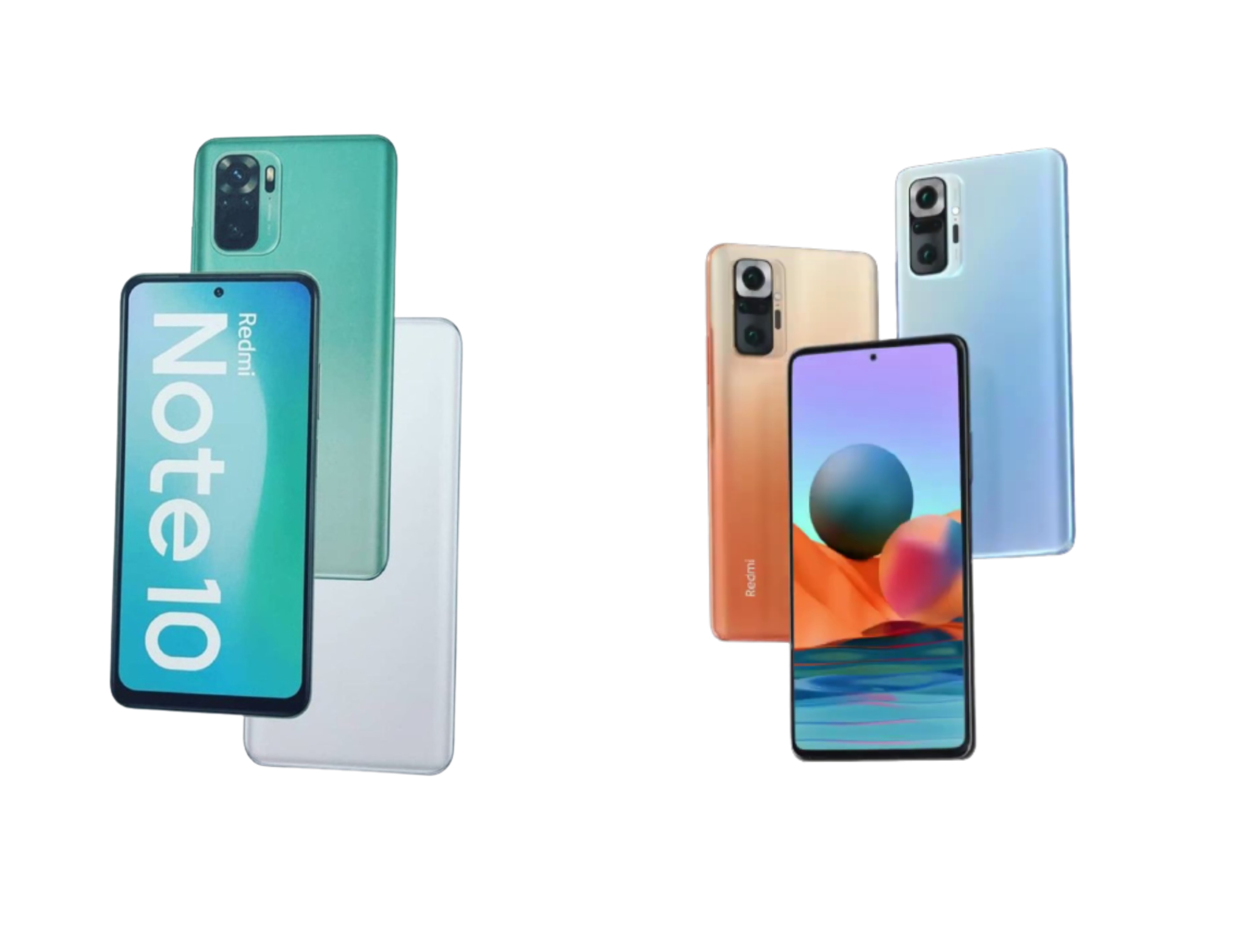
Xiaomi India acknowledges display problems with Redmi Note 10 series, working on a quick fix

Several users of Xiaomi‘s latest Redmi Note 10 series have, in the last few days, reported problems with the display of their devices freezing occasionally. Xiaomi has now come out with an official statement acknowledging the complaints and reassuring its customers that they have nothing to panic about, as the problem was reported by a very small proportion of the users of the Redmi Note 10 Series.Redmi Note 10 series global

The official statement from Mi India indicated that the brand will continue to pursue excellence and customer satisfaction in meeting consumer expectations always.

The company stressed that its products go through a rigorous process to ensure that they meet the highest quality standards. An inquiry is now being carried out on why some customers, even though very few, experienced display issues with their smartphones. The company says it is looking into the matter critically and expresses its regrets for the inconvenience caused to its consumers.

The main complaint from multiple Redmi Note 10 users was that the display of their devices becomes unresponsive on several occasions. Tweets by several users established the authenticity of the claims thereby drawing a response from the product’s manufacturer. Some users also tweeted of noticing a flickering screen on their devices, while another user observed that the flickering became more visible in dark mode.


The Redmi Note 10 Series was launched with fanfare in March 2021 in the Indian market. The series is a significant improvement from its predecessors, and came with several upgrades, across several segments. The series feature an AMOLED display with a 60Hz or 120Hz refresh rate for the various variants.

Xiaomi has had a pretty excellent performance in India this year. A recent national survey conducted on exclusive smartphone stores placed Xiaomi’s Mi Home stores as the best in a field containing several global tech brands.

RELATED;

(via)


Former Tencent staff fined ¥1.1m (~$167K) for joining ByteDance in breach of non-compete pact

A former Tencent employee Chen Shuo has been fined about $167,000 by a Beijing court for breaching the non-compete agreement he signed with Tencent. The Beijing Number 1 Intermediate People’s Court ruled that Chen was guilty of interacting in a manner that indicated he could have joined TikTok-owner ByteDance less than six months after leaving Tencent. The Beijing Court then ordered Shuo to pay 1.1 million yuan (about $167,000) to his former employer for the breach.ByteDance Logo

A growing rivalry has been observed between Tencent and ByteDance in recent years, as both companies continue to battle for market superiority in various areas of their businesses. Chen was a former Senior Editor in Tencent who left the company in March 2019. He was spotted in ByteDance premises on several occasions in August 2019 that indicated he could have joined the company before the expiration of the mandatory period of the non-compete agreement.

Tencent insisted that Chen’s presence in ByteDance premises was different from an ordinary visit, and the company also tendered evidence of email communication between Chen and ByteDance.

Chen, in his defense, claimed that he did not sign a new employment contract directly with ByteDance, and therefore could not have been deemed to have breached the agreement. He also claims that Tencent had no proof that the video evidence tendered to the court was during the non-compete agreement period. He also said that he was filmed without his content, and Tencent had violated his privacy.Tencent Logo

However, the court ruled that Chen should pay a fine totaling more than 1.1 million yuan in compensation and also refund Tencent’s 158,900 yuan payment that came with the signing of the non-compete agreement.

ByteDance presently has a case against Tencent in court, alleging that the company violated Chinese antitrust laws by restricting access to content from Douyin, ByteDance’s local version of TikTok its platforms, and is requesting damages of 90 million yuan. Chen joins the growing list of former Tencent employees who had been fined for breach of its non-compete agreement.

RELATED;

(source)


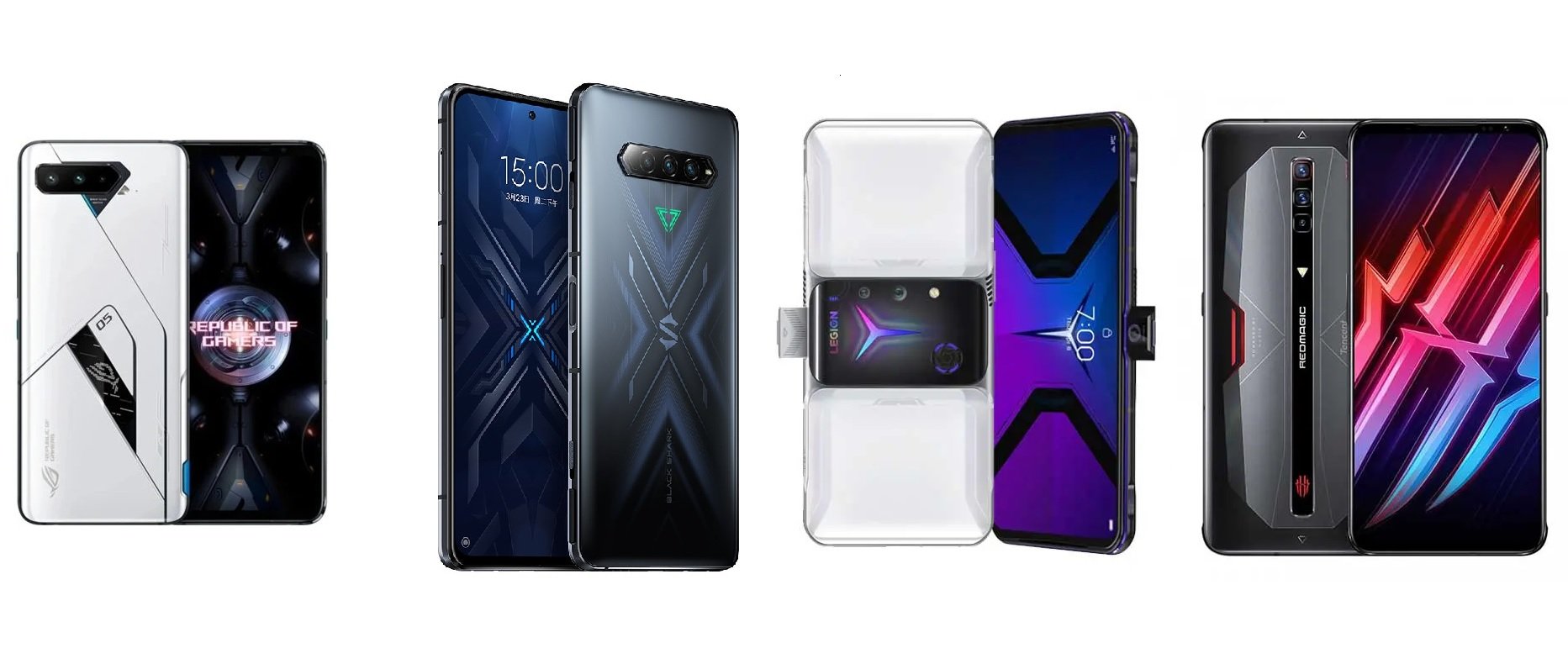
Poll of The Week: Choose your fighter (gaming phone)!

We are already in the second quarter of the year and there are already a handful of new gaming phones available on the market to choose from. Manufacturers such as ASUS, Black Shark, Lenovo, and Nubia’s Red Magic have announced new models for their gaming line of smartphones.

All of these new gaming phones have unique selling points that make them appeal to buyers and give them an edge over the competition. So for this week’s poll, we want you to choose your fighter (read gaming phone) and also tell us why you prefer one over the other.

Gaming Phones Poll

Do you like the Lenovo Legion Pro 2 because of its dual cooling fans and double charging ports that offer a combined charging speed of 90W? Or is it the Red Magic 6 Pro‘s 165Hz refresh rate and 120W fast charging that does it for you or the Black Shark 4 Pro‘s retractable trigger buttons? Do let us know.

[yop_poll id=”81″]


RELATED:

Beijing Tokyo Manufacturing Co. launches Electric clothes drying rack with UV sterilization

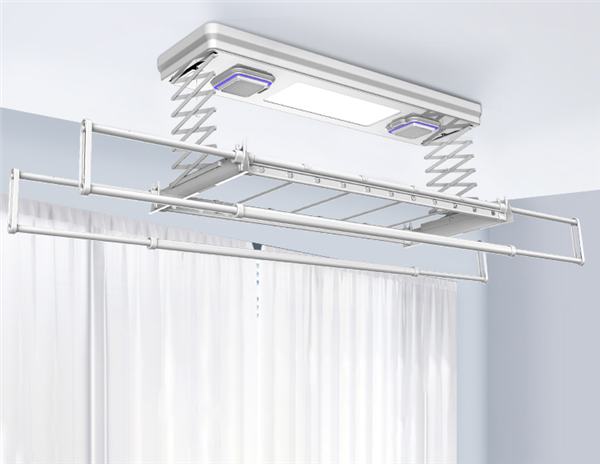
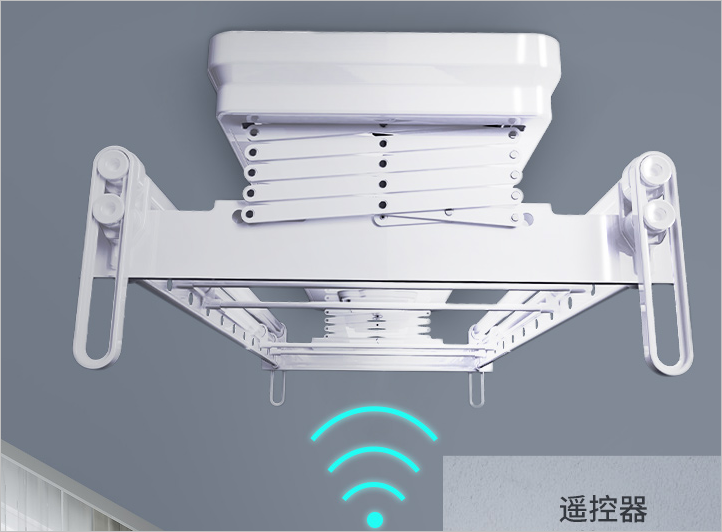
The Beijing-Tokyo Manufacturing Co. Ltd has launched electric clothes drying rack.  The product is priced at 1,299 yuan (~$198) and is already listed on Jingdong (JD.com) but you can online register to be notified when it goes on sale.Electric Clothes drying rack

The product utilizes an aviation-grade aluminum-alloy body and also integrates a silent German DC motor. It uses a self-developed integrated rope winding electric lift system that can drop down up to 1.1 meters. The lift has an operational noise of fewer than 50 decibels. The smart dryer also features an ultra-light and thick magnesium-aluminum alloy scissors frame, 304 stainless steel wire rope. It supports 1200W powerful drying, disinfection, and sterilization, and is equipped with maternal and child crossbars.Electric Clothes drying rack

After the smart clothes drying rack unfolded, it has a large 4-pole telescopic drying space. the poles can stretch between 1.2 meters and 2 meters. It can be laid flat to prevent the clothes from folding and to create more drying space on the rack. jingdong Electric Clothes drying rack

With this design, the clothes dryer can fit into any space that meets its minimum installation size which is 140*90*180cm. The product itself has a dimension of 120*45*30cm when folded. It weighs just 13.1kg and has a carrying capacity of 14kg. It adopts a three-safety system which includes a photoelectric switch limit, anti-loosening protection, as well as a silent and uniform speed lifting that stops when it encounters obstacles.Electric Clothes drying rack

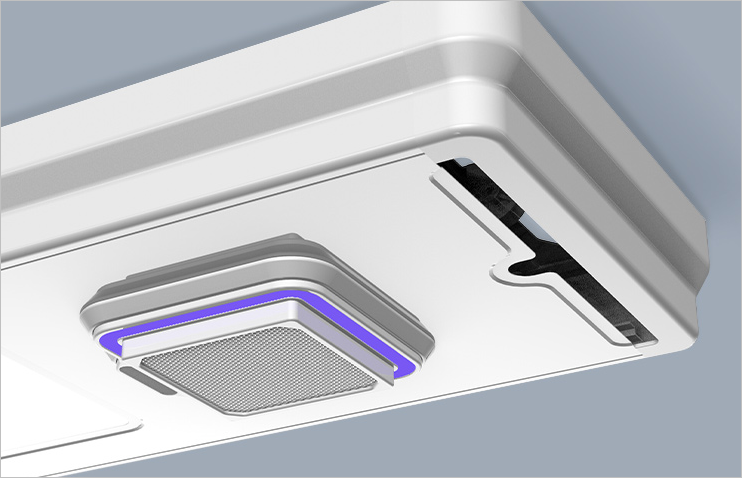
The smart clothes dryer is equipped with a 14W lighting power LED lamp to reduce the problem of excessive light-blocking due to clothes during the drying process. The device also features Positive Temperature Coefficient (PTC) heaters with a power rating of 1200W. PTC heaters are self-regulating, ensuring that it doesn’t get overheated. The rack also supports ultraviolet sterilization and the sterilization rate is as high as 99%.

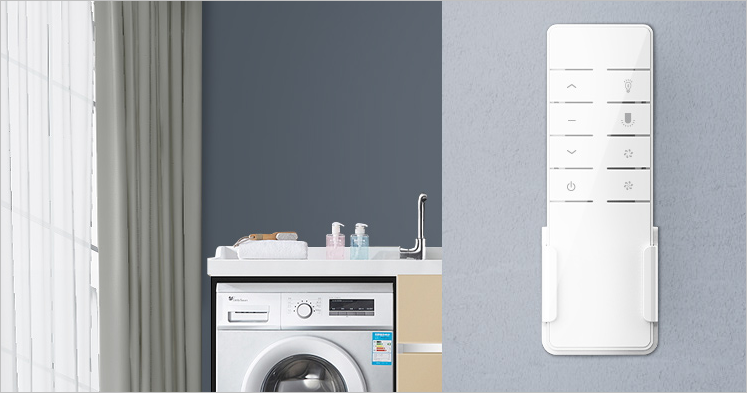
The device also comes with a portable remote controller which can be attached to the wall for easy access.

RELATED:

Next Week in Tech: Sony Xperia 1 III is coming, New TCL 20 phones, ZTE’s Axon 30 series, OnePlus 9R heading to China

Mark your calendars as there are new phones launching next week from Sony, TCL, and ZTE. Here are the announcements scheduled for the second/third-ish week of April.

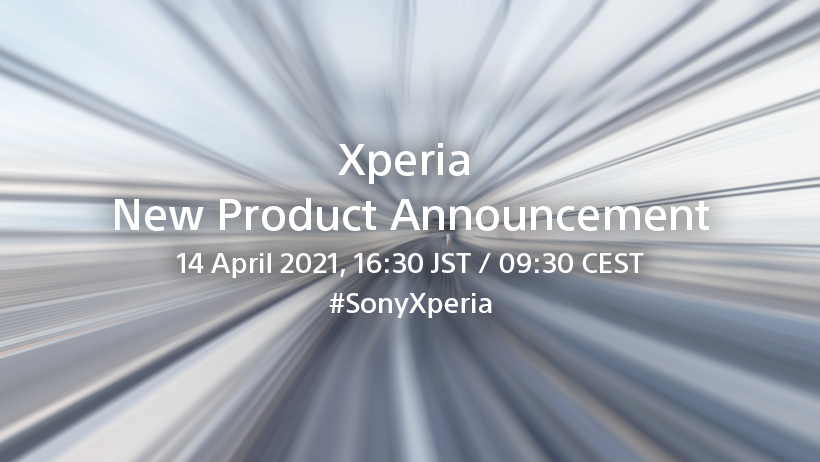
Sony Xperia 1 III

Sony has an event set for April 14. The Japanese tech giant will announce the Xperia III, its flagship phone of 2021. There should also be a mid-range smartphone that should launch as the Xperia 10 III.


TCL April 14 launch

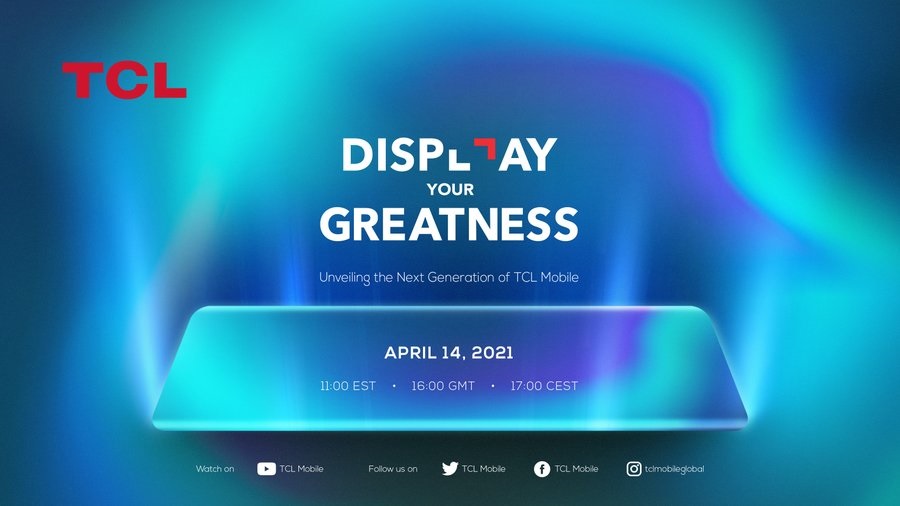
TCL launch – more TCL 20 phones

TCL will announce new smartphones on April 14. These phones are new models of the TCL 20 series that made its debut at CES 2021 in Janaury. We expect at least three new phones will be announced alongside some other products.


OnePlus 9R

OnePlus 9R heading to China

The OnePlus 9R launched last month as an Indian-exclusive model in the OnePlus 9 series. On April 15, OnePlus will announce the Snapdragon 870-powered smartphone in China. It is expected to cost less than in India.


ZTE Axon 30 Series

ZTE will unveil the Axon 30 series in China on April 15. The Chinese manufacturer is expected to announce three phones – the Axon 30, the Axon 30 Pro, and the Axon 30 Pro+. The Axon 30 Pro will have three 64MP rear cameras, an OLED screen with an under-display camera, and a Snapdragon 888 processor.


RELATED:

First look at the Samsung Galaxy S21 FE: a strikingly familiar but different design

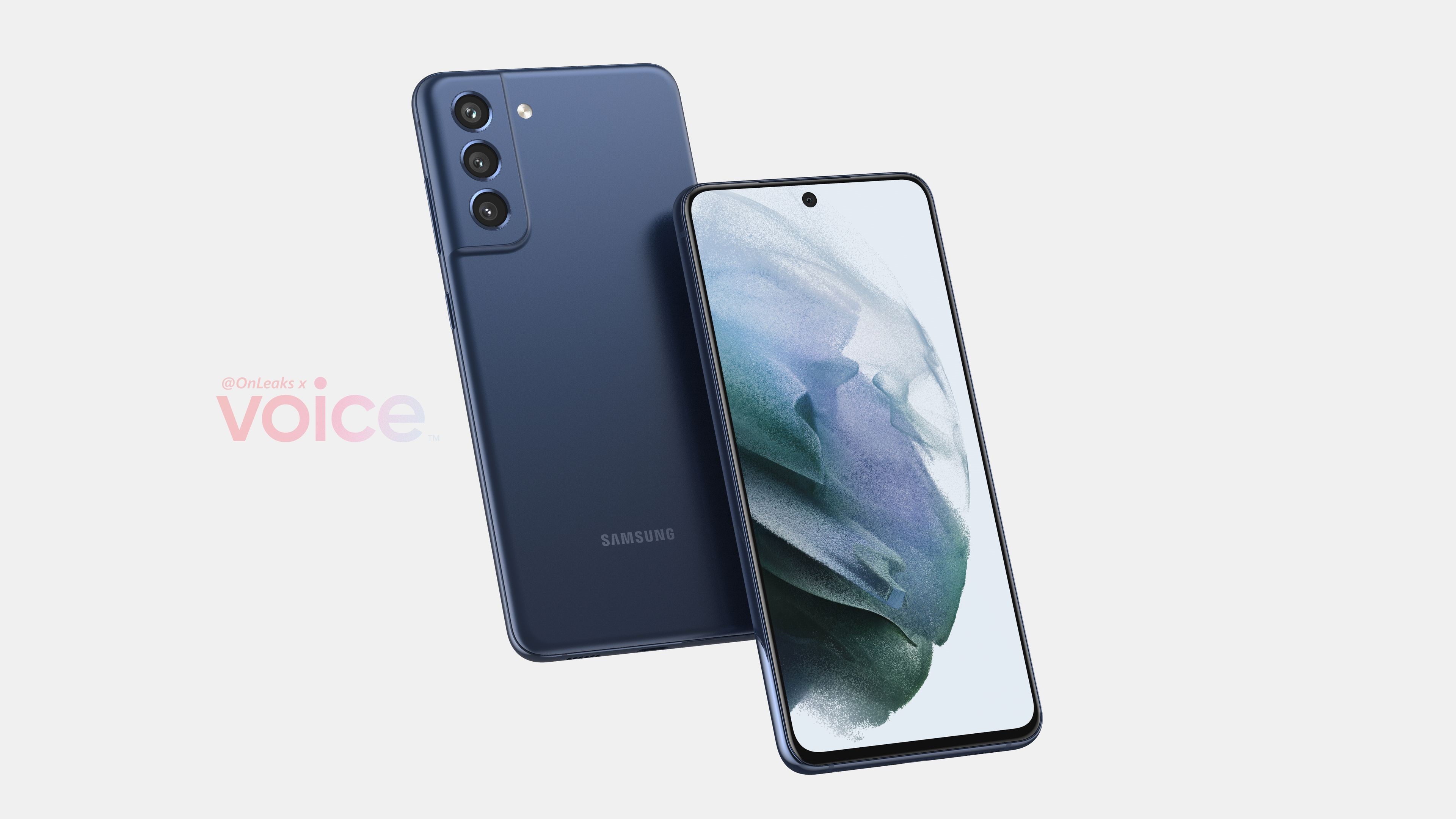
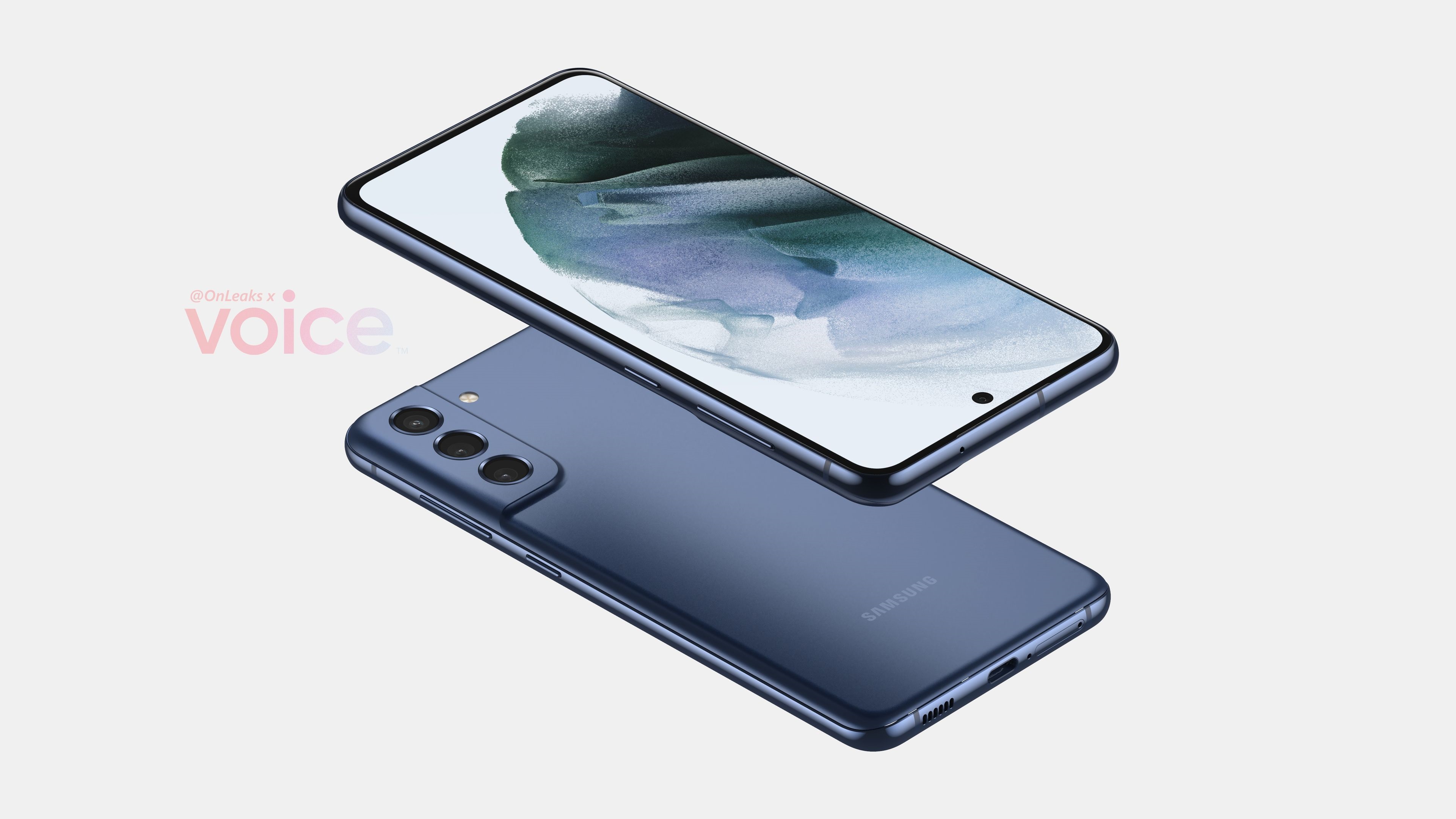
Keeping to its words of launching an FE phone every year, Samsung will be announcing an FE version of the Galaxy S21 series. Now, we have our first look at the upcoming smartphone which should launch as the Galaxy S21 FE. These renders show a device that appears to be a replica of the Galaxy S21, but on closer look, it is actually different but gorgeous nonetheless.

Galaxy S21 FE render

Our first look at the Galaxy S21 FE comes from renders posted by the reliable leaker, Steve Hemmerstoffer a.k.a. OnLeaks on the Voice. The images show the phone has a Cloud Navy paint job which we hope is one of the colors the device will come in when it is eventually announced.

On the front, the Galaxy S21 FE has a flat display with a centered punch hole just like the Galaxy S21. Even the back has the same number of rear cameras and keeps the LED flash in the same position. However, the difference is in the design of the camera housing.

Unlike on the Galaxy S21 where the camera housing is an extension of the middle frame, the Galaxy S21 FE’s housing is not connected to the frame but mimics the design with just the back panel. Samsung pulled it off well such that if you were looking at the back of the device directly without seeing the sides, you would think it is the Galaxy S21.

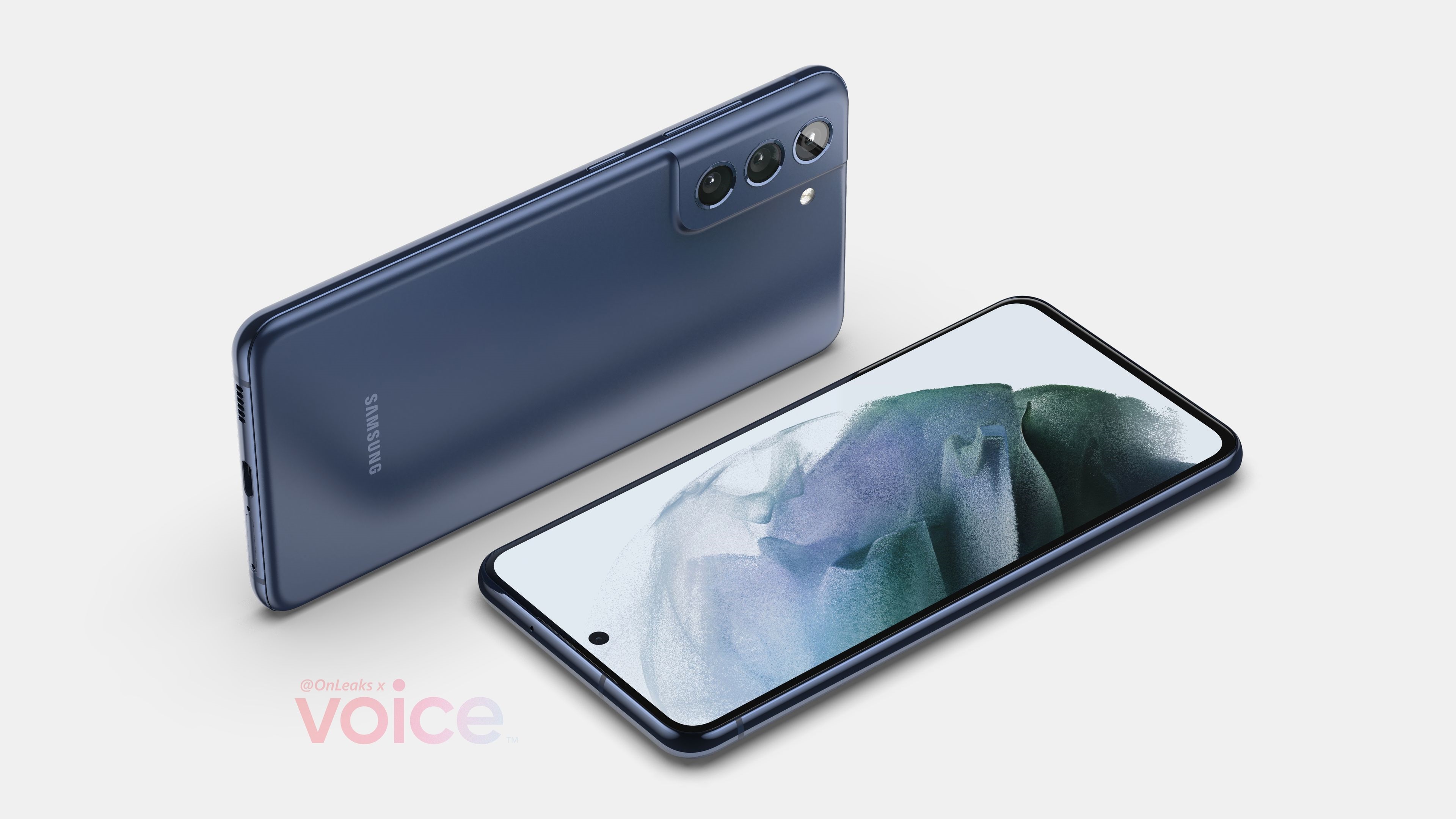
The Galaxy S21 FE most likely has a back panel made of “glasstic” but the frame is metal as antenna bands are visible around it. There is a speaker grille at the bottom along with a USB-C port and the SIM card tray. The power button and volume rocker are on the right while the left side of the phone is devoid of buttons.

OnLeaks says the Galaxy S21 FE has a screen size of about 6.4-inches. That is bigger than the S21’s 6.2-inch display and this is because the Fan Edition is a bit wider at 7.45mm and longer at 155.7mm as against the Galaxy S21’s 71.2mm width and 151.7 height. The thickness is the same (7.9mm) on both devices.

There is no mention of when to expect the phone to launch but we don’t expect it will be announced until the third quarter at the earliest.

What do you think of the Galaxy S21 FE? Has Samsung got another winner here? Let us know in the comment box.


RELATED:

This power bank has a built-in wall plug and charging cable but no ports

When you buy a power bank, it usually comes with a charging cable in the box, but what you won’t find is a power brick/charger to charge the power bank when it is low. If you don’t have a charger, you will have to buy one to charge the power bank. Even those who have one (for their phone) usually end up buying an extra they can use to charge their power bank. A company called Bull has a nifty power bank that doesn’t need a separate power brick to charge.

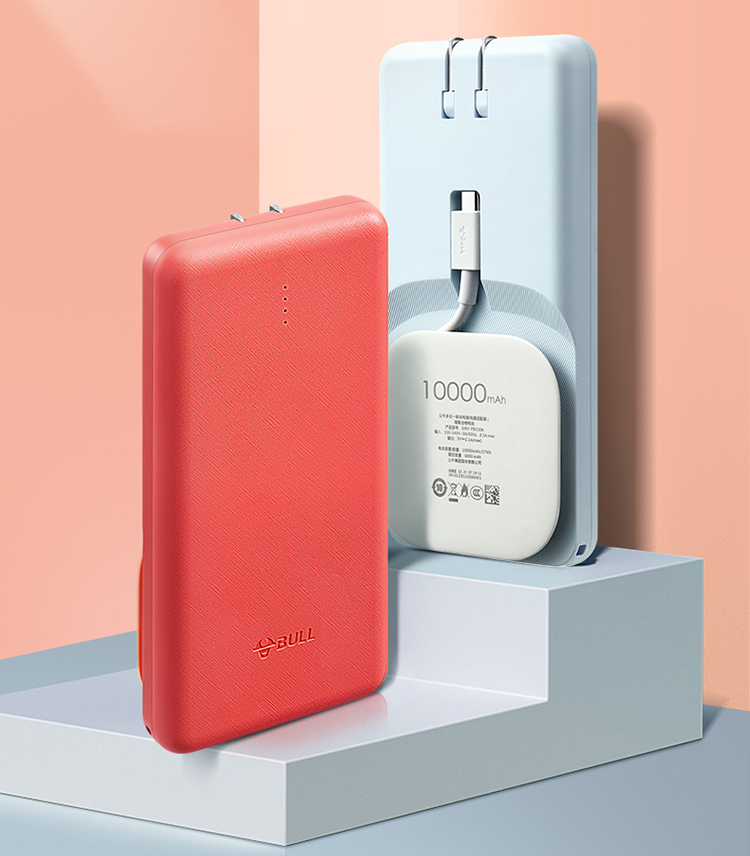
Bull All-in-One Power Bank

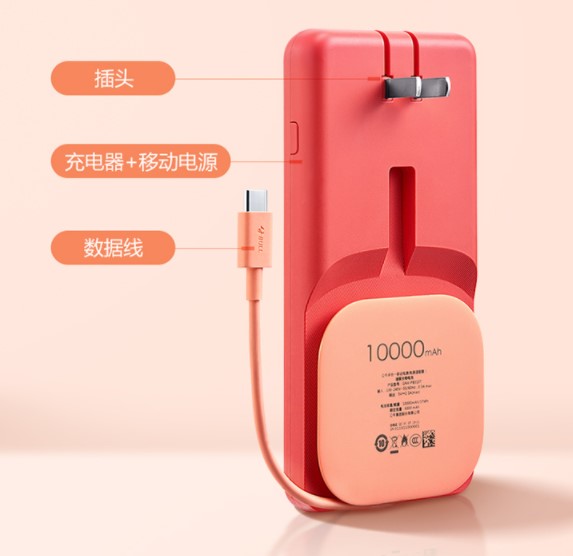
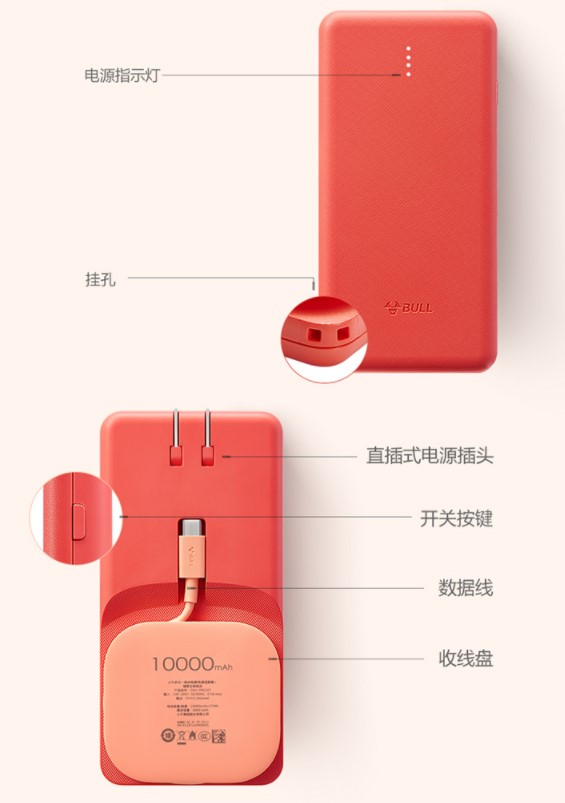
The latest Bull power bank not only has a built-in cable for charging your device but also has a built-in power brick. To charge the power bank, all you have to do is unfold the plug and connect it to a wall socket, and it begins to charge. This design means that the power bank doesn’t have any ports. There is no output port since it already has a charging cable. There is also no need for an input port since it has a built-in charger.

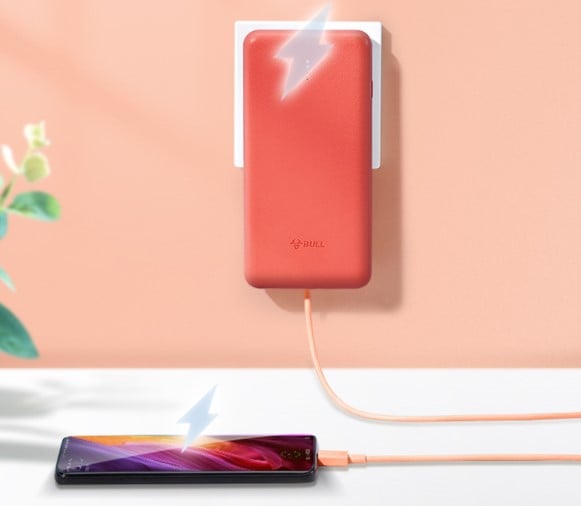
With a cable and charger built into the power bank, you don’t need to take a charging cable and a wall adapter with you when going on a trip. You can also plug in your phone while the power bank is connected to a wall outlet and the built-in charger will simultaneously charge your phone and the power bank.

Another neat feature the Bull power bank has is a cable winder that holds the built-in cable in place. Owners will be able to unwind the required length they need without the rest getting in the way. The power bank has four LEDs to show the remaining power level. It also has a power button on the side and a lanyard hole at the bottom corner.

The Bull power bank has a 10000mAh battery capacity and comes in Coral and Gray. Buyers can choose between a model with a USB-C cable or one with a MicroUSB cable. Sorry iPhone owners, there is no version with a lightning cable. Regardless of the version you choose, the price tag is ¥152 (~$23). You can pick up a unit on JD.com.


RELATED:

Leaker reaffirms Xiaomi Mi MIX 4 will have an under-display camera, and likely have a curved display too

Unlike last year that Xiaomi did not release a Mi MIX phone, it plans to release two this year. It has already released the first, the Mi MIX Fold, which is also its first-commercially available foldable phone. However, it is expected to release a second one later this year that will arrive as the Mi MIX 4. More details of the phone have surfaced, some which reaffirm what we already know.

According to the popular Chinese leaker, Ice Universe, the Mi MIX 4 will have an under-display camera, a first for a Xiaomi phone. ZTE and Vinsmart are two of the phone manufacturers with phones with an under-display camera and more including Xiaomi are expected to join them this year.

The leaker also mentioned that there is a possibility the phone will also have a curved display. This feature is one folks have a divided opinion on. There are some who like curved displays and others who don’t. However, if the Mi 11 and its siblings, the Mi 11 Pro and Mi 11 Ultra are taken into consideration, we don’t expect a display as curved as that of the Huawei Mate 40 Pro+.

The Mi MIX 4 should have a Snapdragon 888 processor under its hood. It has also been reported that its display will have a QHD+ resolution and a 120Hz refresh rate. Just like the Mi 11, its in-display fingerprint scanner should also double as a heart rate scanner. While its battery capacity is not known, the phone should support ultra fast wired and wireless charging.


RELATED:

Nokia G10 vs Nokia G20: Specs Comparison

HMD Global just renewed its whole lineup of smartphones by launching a total of six devices from three different series. The X series is the highest-end one, the G series is the intermediate one and the C series is composed of entry-level phones. But if we compare these phones to other brands, we find out that all of them are entry-level devices. That is why it may be very confusing for a lot of people to realize which phone is the best to go for. In this comparison, we will talk about the G series. HMD Global came up with two devices from this lineup: Nokia G10 and Nokia G20. Here are the differences between them.

Nokia G10 vs Nokia G20

Nokia G10 Nokia G20
DIMENSIONS AND WEIGHT 164.9 x 76 x 9.2 mm, 194 g 164.9 x 76 x 9.2 mm, 197 grams
DISPLAY  6.52 inches, 720 x 1600p (HD+), IPS LCD  6.52 inches, 720 x 1600p (HD+), IPS LCD
PROCESSOR MediaTek Helio G25, octa-core 2 GHz MediaTek Helio G25, octa-core 2 GHz
MEMORY 3 GB RAM, 32 GB – 4 GB RAM, 32 GB – micro SD dedicated slot 4 GB RAM, 64 GB – 4 GB RAM, 128 GB – micro SD  dedicated Slot
SOFTWARE  Android 11  Android 11
CONNECTIVITY  Wi-Fi 802.11 b/g/n/ac, Bluetooth 5.0, GPS Wi-Fi 802.11 b/g/n, Bluetooth 5.0, GPS
CAMERA Triple 13 + 2 + 2 MP
8 MP front camera
Quad 48 + 8 + 5 + 2 MP, f/1.8
8 MP front camera
BATTERY  5050 mAh 5050 mAh
ADDITIONAL FEATURES Dual SIM slot, splash resistant Dual SIM slot, splash resistant

Design

Nokia G10 and Nokia G20 have exactly the same design. They come with a borderless display including a waterdrop notch and a rear side with a circular camera module in the middle. They feature a side-mounted fingerprint reader and they are entirely made of polycarbonate. Further, despite they do not have any kind of IP certification, they are splash resistant. The only different thing is the color variants. The Nokia G10 is available in Dusk and Night color variants, while for the Nokia G20 you can choose between Glacier and Night.


Display

Just like the design, even the display of these two handsets is exactly the same. We are talking about a below-average IPS panel with a diagonal of 6.52 inches and an HD+ resolution with 720 x 1600 pixels. The display is decent in terms of image quality, but it is an entry-level display and it does not offer a high definition, nor a very accurate color reproduction. However, it is nice for daily use.


Specs & Software

Nokia G10 is powered by the MediaTek Helio G25 chipset paired with 3 or 4 GB of RAM depending on the chosen configuration and 32 GB of internal storage you can furtherly expand with a micro SD. The Nokia G20 has a MediaTek Helio G35 SoC, 4 GB of RAM, and 64 or 128 GB of internal storage. If you use your phone just for surfing the web and messaging, then Nokia G10 should be enough for you. But if you want more speed and you want to use heavier apps, go for the Nokia G20. The software support is the main advantage of these two handsets: they will offer two years of major Android updates and three years of security updates. Given that they ship with Android 11, despite they are entry-level phones, Nokia G10 and Nokia G20 will be updated up to Android 13. The handsets ship with a stock Android version: as always, HMD Global decided not to go for a customized UI, but according to rumors, it is developing a custom UI to get rid of Android One.


Camera

The Nokia G10 has an entry-level camera: you should go for it only if you want sufficient shots for social networks and so. With the Nokia G20, you get a way better 48 MP main sensor paired with a 5 MP ultrawide camera and a pair of 2 MP sensors for macros and depth calculation. Nokia G10 lacks an ultrawide sensor. Both Nokia G10 and Nokia G20 have the same 8 MP selfie snapper.


Battery

The Nokia G10 and the Nokia G20 are equipped with the same battery sporting a capacity of 5050 mAh. It is a huge battery for an entry-level phone and it is able to reach three days of battery life. The battery can be charged through a USB Type-C port, but unfortunately, the phones do not support fast charging.


Price

The Nokia G10 hitten the European market with a price tag of €139/$165 for the base variant with 3 GB of RAM and 32 GB of native storage. The Nokia G20 starts from €159/$189 for the version with 4 GB of RAM and 64 GB of internal storage. In terms of specifications, you can actually find better phones from other brands in the same price range. But with the Nokia G10 and Nokia G20, you get very long software support for an entry-level phone including two major Android versions and three years of security updates, which is not guaranteed with other brands. Given the price difference of just €20 in their price, we recommend you to go for the Nokia G20 in order to get a better chipset and a better camera setup.


Nokia G10 vs Nokia G20: PRO and CONS

Nokia G10

PRO

  • More affordable
  • Same display as the G20
  • Same battery as the G20

CONS

  • Inferior cameras


Nokia G20

PRO

  • Better rear camera
  • More internal storage
  • Better chipset
  • NFC
  • More affordable

CONS

  • Higher price


RELATED

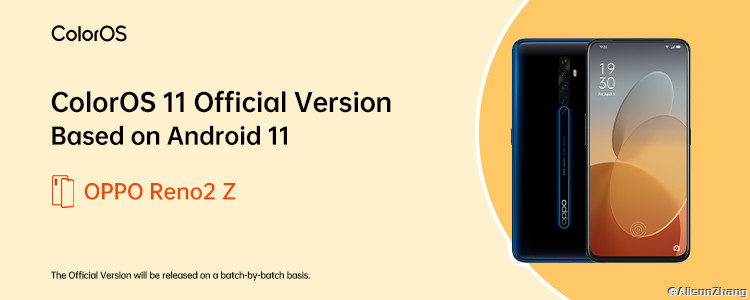
OPPO Reno2 Z, Reno3 A, A91 start getting ColorOS 11 (Android 11) update

OPPO recently shared its ColorOS 11 update rollout plan for April 2021. Accordingly, it has started rolling out the update to devices like OPPO A91, Reno2 Z, Reno3 A.

In community posts, the company has confirmed the arrival of OPPO A91 and OPPO Reno2 Z smartphones. Originally, the devices were supposed to get it starting April 9 and April 14 respectively. If you recall, OPPO had began the Beta registrations for the Reno2 Z in mid-March.

The Reno2 Z seems to be getting the update a few days early. Anyway, the OPPO A91 users in Indonesia will get the update with firmware version F.11 and the company says that the devices should have previous firmware as C.51/C.53 to detect the new update.

Similarly, the OPPO Reno2 Z, which is getting the ColorOS 11 stable update in India, should be on the C.47 version to detect the incoming F.02 firmware version. That’s not all as the OPPO Reno3 A is also getting the Android 11 update in Japan as Piunikaweb report says.

The device is getting the firmware version CPH2013_11_C.16 in Japan according to screenshots shared by a few users on Twitter. OPPO Reno3 A launched in japan with ColorOS 7.1 based on Android 10 back in June 2020. With this, it is getting the first major update in the country.

The Reno2 Z, on the other hand, gets second major update as it launched with Android 9.0 Pie-based ColorOS 6 in 2019 and got the Android 10 update last year. The OPPO A91, which has been on the ColorOS 11 beta since February, also gets its second major update in Indonesia.

Anyway, the update will be rolled out in batches and if you are impatient, you can navigate to settings-software updates and tick the I agree in official version application in settings. That being said, the wider rollout should begin in the coming days.

RELATED:


(source 1,2)

Boston Dynamics’ Spot deployed by the French Army in combat drill for reconnaissance

The French Army has recently deployed a group of robots in the simulation of a combat mission held in a military school. The robotic dog named Spot, produced by US robotics manufacturer Boston Dynamics was among several robots deployed for offensive and defensive missions in collaboration with military school students. According to the school’s commandant, Jean-Baptiste Cavalier, the two-day training exercise provided an opportunity for the organizers to measure the added value that robots introduce into combat actions. The combat exercises saw Spot carrying out reconnaissance missions.Boston Dynamics

The robots used for the combat exercise were given to the French Army by Shark Robotics and Nexter Group. Boston Dynamics has said that it was aware that its robot Spot was being used for military exercises but was unaware of the present combat exercise’s details. The combat drills consisted of various offensive and defensive missions that were simulated by the students first without using robots and then using the robots.

The combat exercise analysis showed that the robots were a bit slower on their tasks than the students, and Spot was reported to have run out of battery life in the middle of a mission. However, the robots kept the troops safer, thus justifying their possible deployment in actual combat operations. The current exercise reflects the growing use of robots for military applications, bound to enhance and modify the way the military operates in actual combat situations.

We have read stories of Spot being deployed for other activities but this is the first time we are coming across a combat deployment. Boston Dynamics had previously produced several robots used in military applications, though, both offensive and defensive. The company has, however, gradually transformed into a robotics manufacturer of non-military-grade robots. It recently launched its proprietary and easy-to-deploy robot with a versatile robotic hand and mobility for packing and unpacking loads in warehouses. The robot has the ability to work on its batteries for several hours on a full charge.

RELATED;


LG will reportedly supply OLED TV panels to rival Samsung starting from Q2 2021

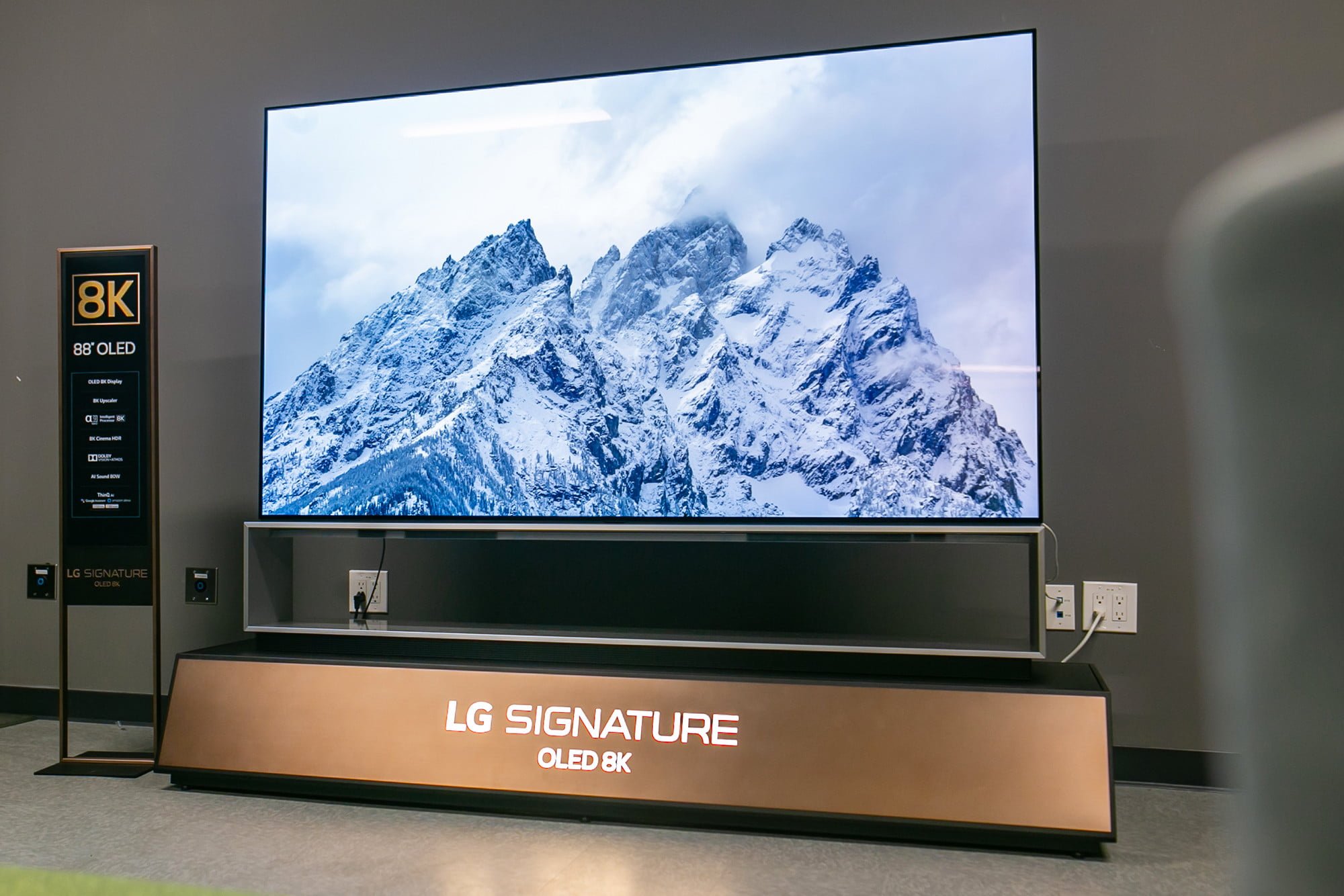
In the most unambiguous indication yet of the unfolding shift away from LCD technology for its TV panels, reports say Samsung has agreed on terms with LG to supply OLED TV panels. Multiple independent reports monitored in South Korea indicate that Samsung will buy one million OLED TV panels from its rival and market leader, LG’s display subsidiary beginning from the second quarter of 2021.LG

Officials from both companies reportedly met recently to finalize the deal that could see up to four million OLED TV panels supplied to Samsung by 2022. While LG has been having some challenges coping in some areas of its business model, outsourcing, and even shedding off some businesses, it continues to wax strong in the Display business. Sony, Hisense, and Vizio are some of its famous customers. The growing demand for its OLED TV panels has seen it expand its production capacity, with up to 8 million units expected to come out of its plants this year.

The past few years have seen Samsung scaling down its LCD panels’ production for most of the current Samsung TVs. It has had to maintain sustainability amidst the growing popularity of cheaper brands with comparable quality. Besides, since Samsung exited the OLED display market a few years back, it has continued to develop alternative technologies, some of which adorn some recent high-end TV products launched by the South Korean electronics giant. These include Quantum Dot OLED (QD-OLED) and MicroLED TV panels, although the prototype TV using the QD-OLED technology reportedly had low brightness issues.

Even though multiple independent sources have reported on the new deal between Samsung and LG, both companies are yet to confirm the story at this time. Samsung has dismissed the reports as unfounded.

RELATED:

(source)


Samsung Galaxy SmartTag+ with BLE & UWB technology hits the global market

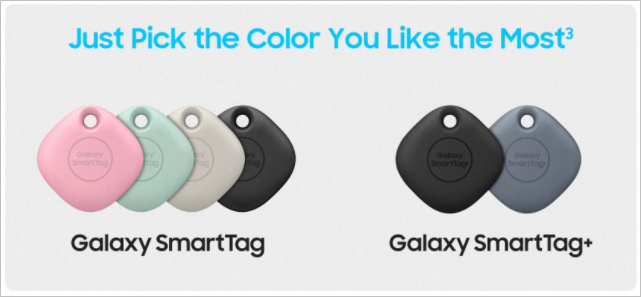
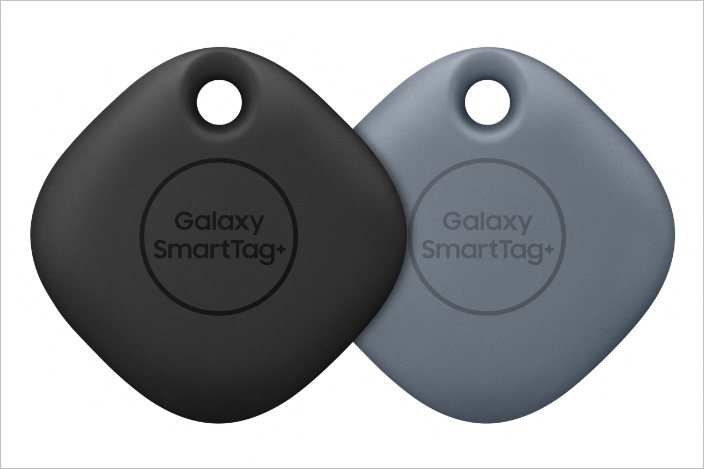
Samsung has again provided an intelligent solution to finding lost items with the launch of the Galaxy SmartTag+ for the global market. The device was announced in January this year alongside the Galaxy SmartTag but the launch was revealed to be later in the year while the SmartTag went on sale immediately. Earlier this month, the device was listed for pre-order in the US by retailer B&H Photo. Samsung Galaxy SmartTag+

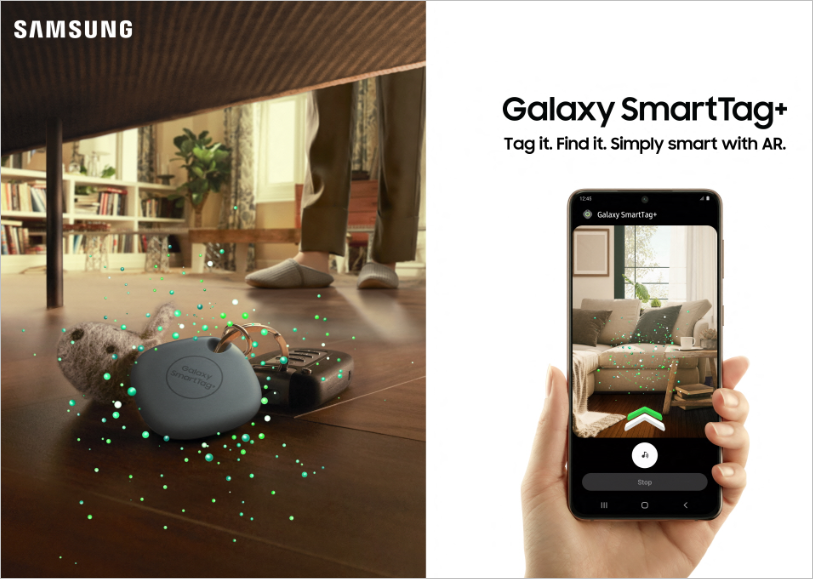
The Galaxy SmartTag+ features advanced technology to assist users in locating tagged objects without any hassles quickly. The device can be attached to items prone to be misplaced, like your bunch of keys and several other everyday things, and you’re sure of locating the item quickly whenever you’re searching for them, using the SmartThings Find service on your smartphone.Samsung Galaxy SmartTag+

The Galaxy SmartTag+ uses both Bluetooth Low Energy (BLE) and ultra-wideband (UWB) technology to precisely map the tagged object’s location. It then deploys augmented reality (AR) technology to visually guide the user to the object’s location using the smartphone’s camera. The AR Finder on the smartphone gives you the distance from your tagged object and gives you directions until you are close to the object. A buzzer can be activated on the SmartTag+ to notify you when you are at a touching distance from the object.Samsung Galaxy SmartTag+

The UWB technology implemented on the Samsung Galaxy SmartTag+ has set the current tag ahead of its predecessors, as it can precisely pinpoint the location of things and reduce the stress of still searching for the object even when you’re in its vicinity. The Executive Vice President of Samsung’s Mobile Communications arm, K. J. Kim, notes that Samsung will continue to explore UWB technology throughout the Galaxy ecosystem and find new ways to leverage the technology to improve people’s everyday lives in comfort and convenience.Samsung Galaxy SmartTag+

The Galaxy SmartTag+ will also help you locate your lost item even when it’s far away. Using the app, you can easily find the missing object. Samsung has provided an exciting approach to help you get back your device, using the resources of nearby tags and the Samsung server.

The Bluetooth range is about 120m, although this is greatly limited when there are obstacles ahead of the object. The SmartTag+ will only work on Android 8.0 or above and a minimum RAM capacity of 2.0GB. Also, location tracking must be activated through the SmartThings Find service of the app, and the SmartTag+ can only work with Galaxy devices with UWB technology.

The Galaxy SmartTag+ will be available from April 16 in select markets globally but it would be available in the US in the coming weeks.

RELATED;


MIUI 12.5 update confirmed for Xiaomi Mi 8 series, MIX 3, and MIX 2S

Xiaomi began the rollout of stable MIUI 12.5 for flagship devices in China recently and it is expected to expand up to 28 devices soon. Meanwhile, Xiaomi executive has confirmed that the MIUI 12.5 will also arrive on older devices like Xiaomi Mi 8 series, MIX 2S, and MIX 3.

Xiaomi rolled out the MIUI 12 update for the Xiaomi Mi MIX 2S and MIX 3 back in August 2020. The devices, which didn’t make the cut in the Android 11 eligible devices list, are said to get the MIUI 12.5 update as per the Xiaomi executive Zhang Guoquan’s post on Weibo.

He says that the MIX 2S has Snapdragon 845 chipset and the engineers have worked on the MIUI 12.5 on its update together with MIX 3. Speaking of which, the MIX 3, which also has Snapdragon 845 chipset, launched with MIUI 10 while the MIX 2S came with MIUI 9 out of the box.

Hence, the MIUI 12.5 will be the fourth MIUI update for the MIX 2S while the MIX 3 will get it as a third major update. It is appreciable of Xiaomi to support older flagships despite them going past the software support period.

Moving on, Zhang said that along with the MIX devices, the Xiaomi Mi 8, Mi 8 Explorer Edition will also get the MIUI 12.5 update. These devices got their last major MIUI 12 update in July and August 2020 respectively.

That said, Zhang hasn’t mentioned the 5G version of the Mi MIX 3 5G which got the direct update to MIUI 12 in September. But, we can expect it to be on the roster. What is uncertain is the update rollout date for the above-mentioned devices.

Zhang says that the update will come a little later after the company finishes the pending projects and ensures the test build is free of bugs. So, don’t expect the intermediate MIUI 12.5 on them anytime soon.

RELATED:

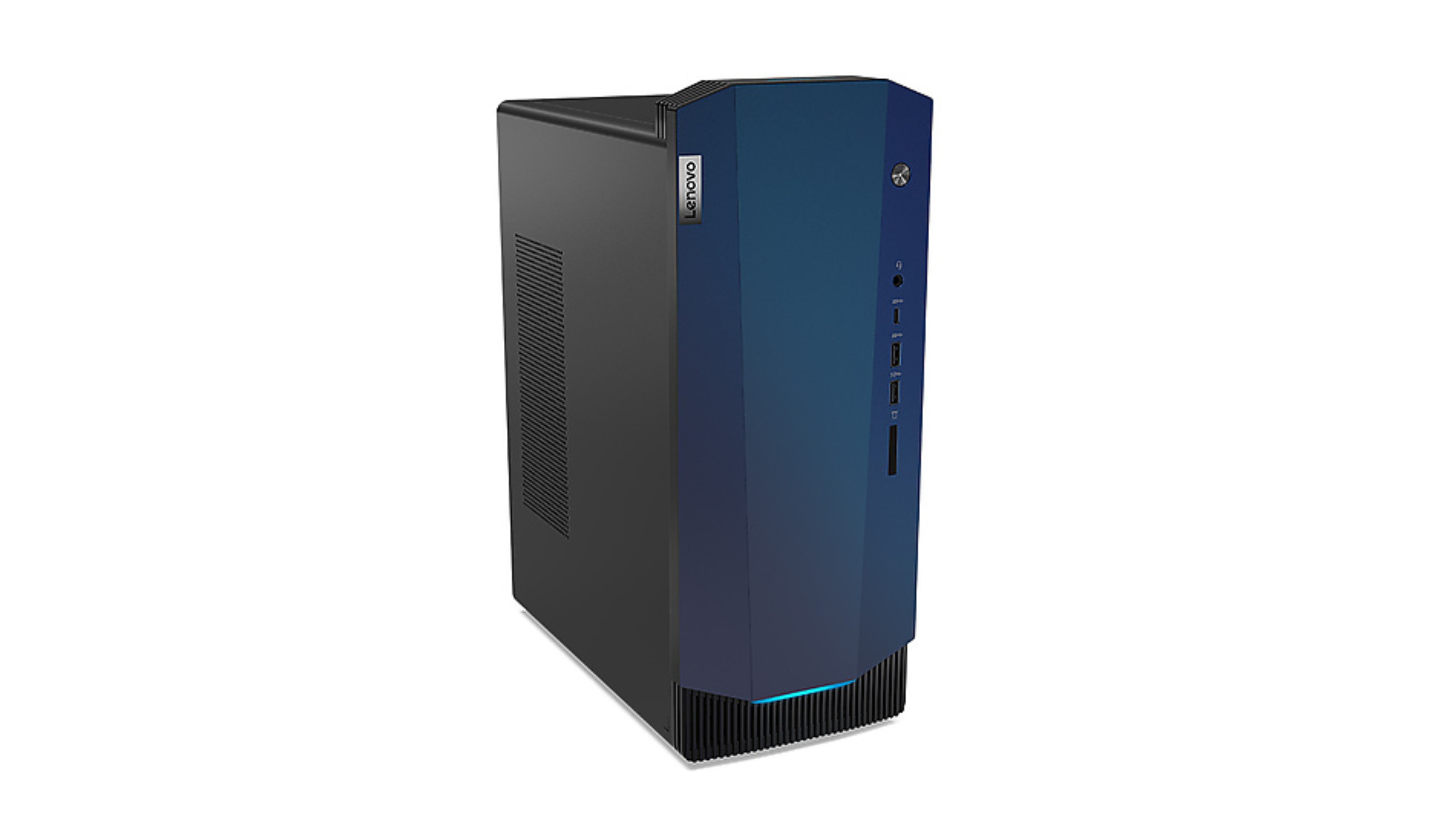
Lenovo GeekPro 2021 launched with up to Intel i7-11700F CPU and NVIDIA GTX 1660 SUPER GPU

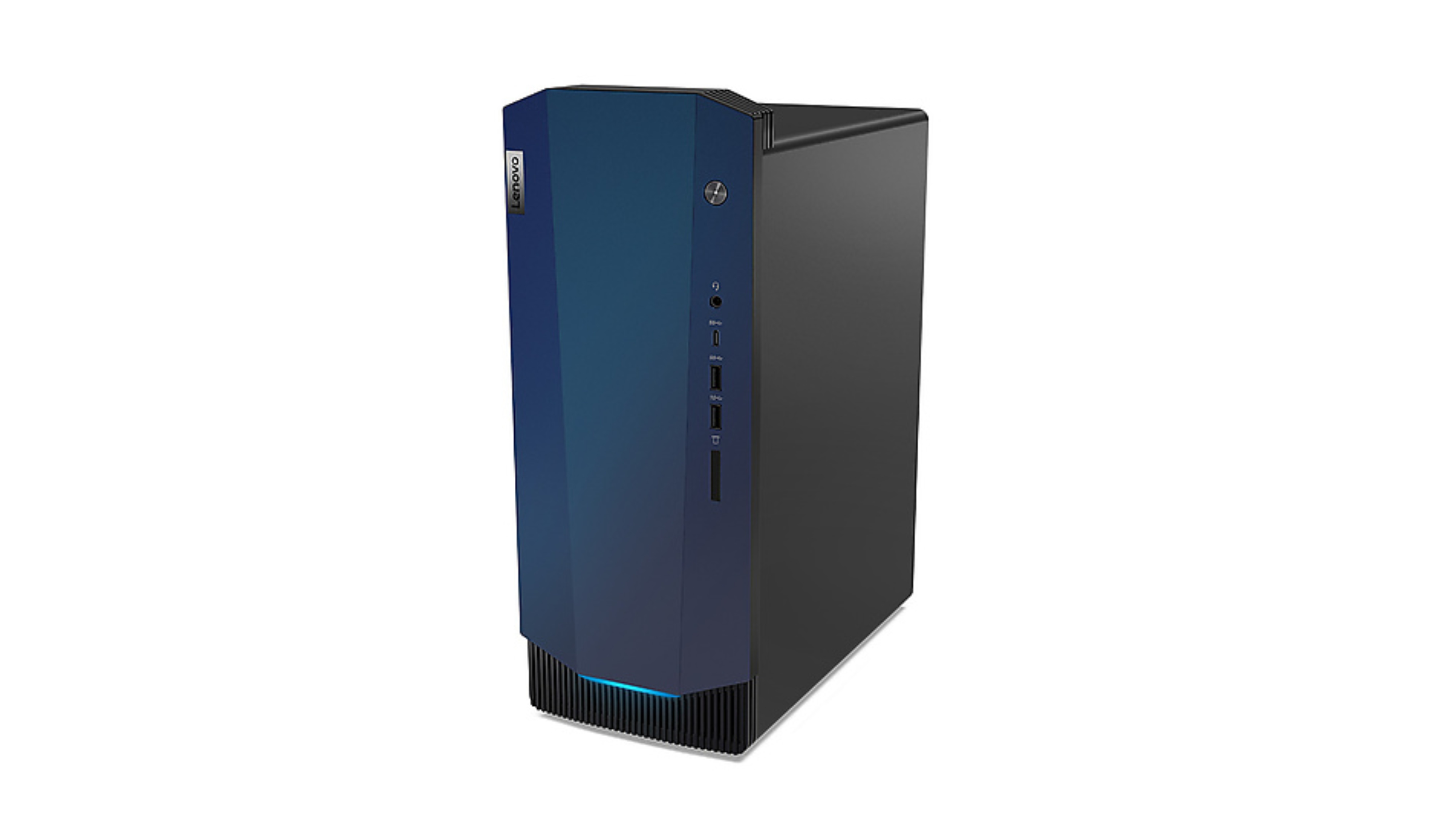
Lenovo has launched the GeekPro 2021 gaming desktop in China. The latest edition comes with a similar cabinet as its predecessor GeekPro 2020 but with upgraded internals. Let us take a look at its specs, features, price, and availability.

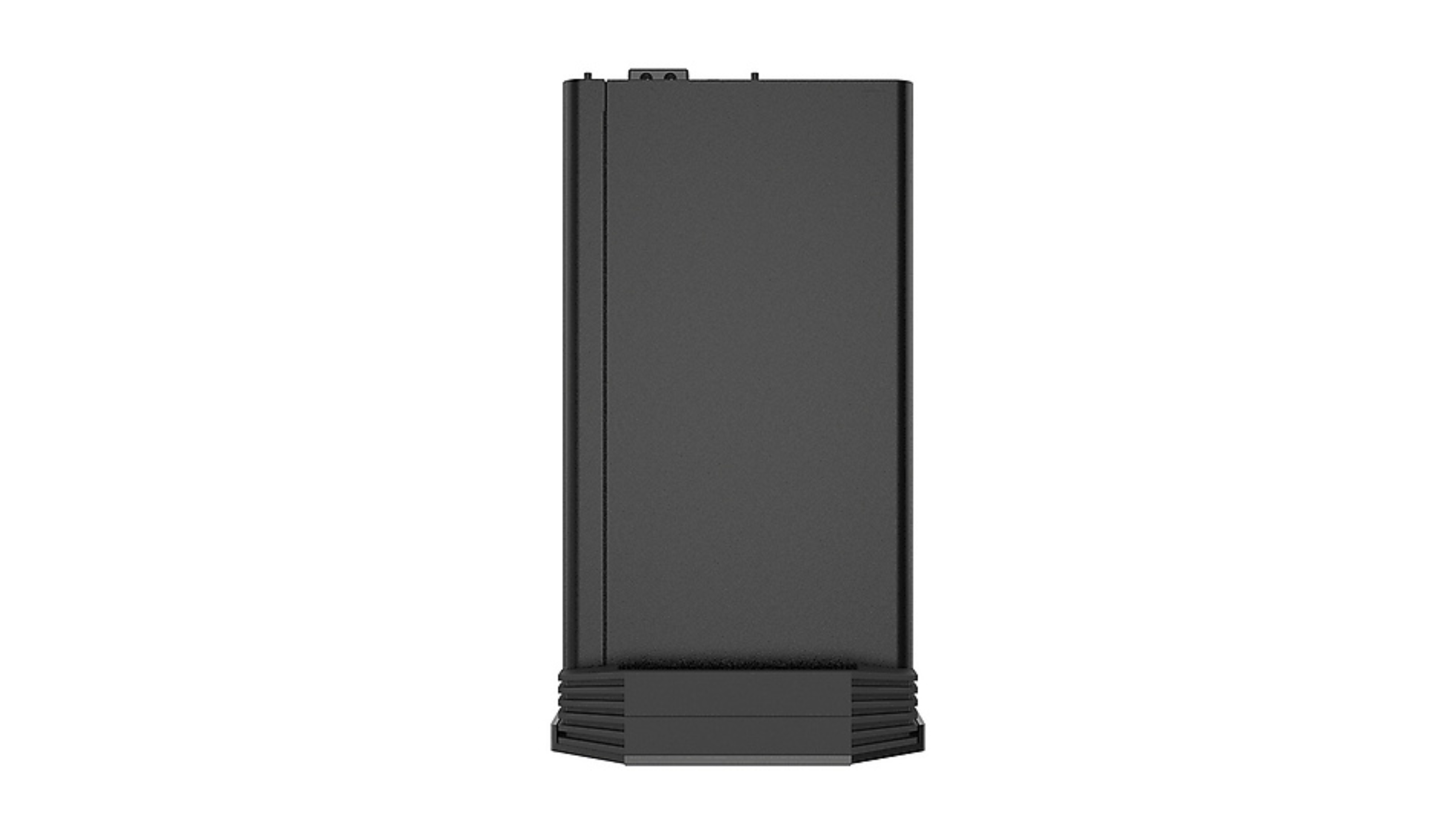
Lenovo GeekPro 2021 Featured 01

Lenovo GeekPro 2021 Specifications and Features

The newly released Lenovo GeekPro 2021 looks identical to its forerunner, however, it features new internals. Unlike the previous model, which is available in three variants, this one only comes in two variants.

The cheaper version houses an Intel Core i5-11400F processor paired with a 4GB NVIDIA GeForce GTX 1650 SUPER GPU. On the other hand, the costlier variant features an Intel Core i7-11700F processor coupled with a 6GB NVIDIA GeForce GTX 1660 SUPER GPU.

Apart from the above-mentioned dissimilarities, both the variants have the exact same specs. They come with 16GB DDR4-2933 RAM, 256GB NVMe PCIe SSD, and 1TB 7200RPM HDD.

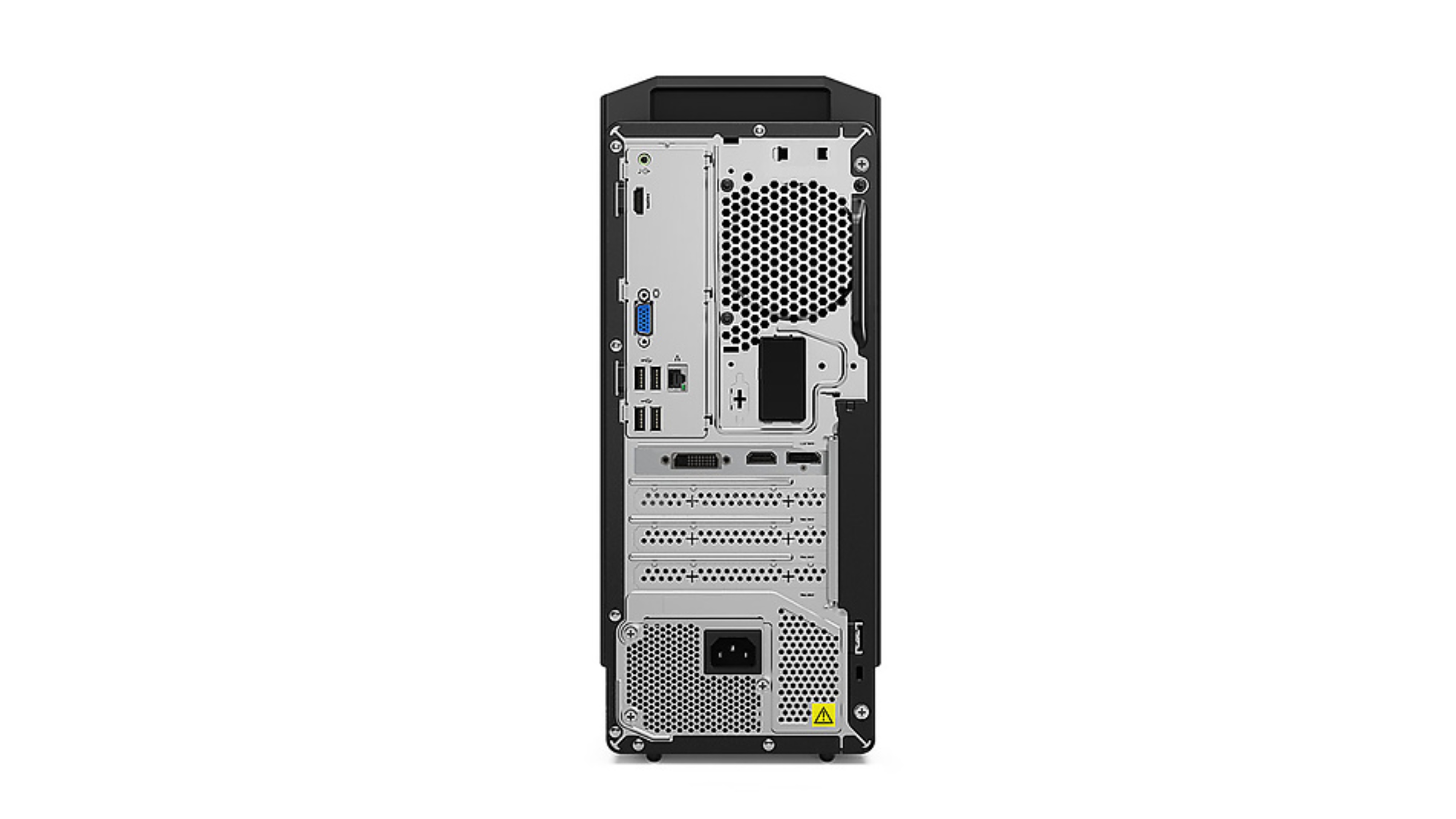
On the connectivity front, they support dual-band WiFi 5 and Bluetooth 5.0. As for ports, they sport a headphone and microphone combo jack, 1 x USB 3.2 Gen1 Type, 1 x USB 3.2 Gen1 Type-A, and 1 x USB 3.2 Gen2 Type-A on the front.

Whereas, on the back, they sport a headphone jack, 1 x HDMI, 1 x VGA, 1 x Gigabit Ethernet, and 4 x USB 2.0 Type-A. Additionally, the GPU on the i5 variant has 2 x DisplayPort (DP) and HDMI, whereas the GPU of the i7 variant includes a DisplayPort (DP), Digital Visual Interface (DVI), and HDMI.

Lastly, both the variants of Lenovo GeekPro 2021 come with RGB on the front, Microsoft Windows 10 Home Chinese Edition, 310W ES power supply, 3-year warranty, and door-to-door service.

Lenovo GeekPro 2021 Price and Availability

The Lenovo GeekPro 2021 retails for the following price tags in China.

  • i5-11400F + GTX 1650 SUPER – ¥5,199 ($793)
  • i7-11700F + GTX 1660 SUPER – ¥6,999 ($1,068)

Unfortunately, there’s no official word on international availability.


RELATED:


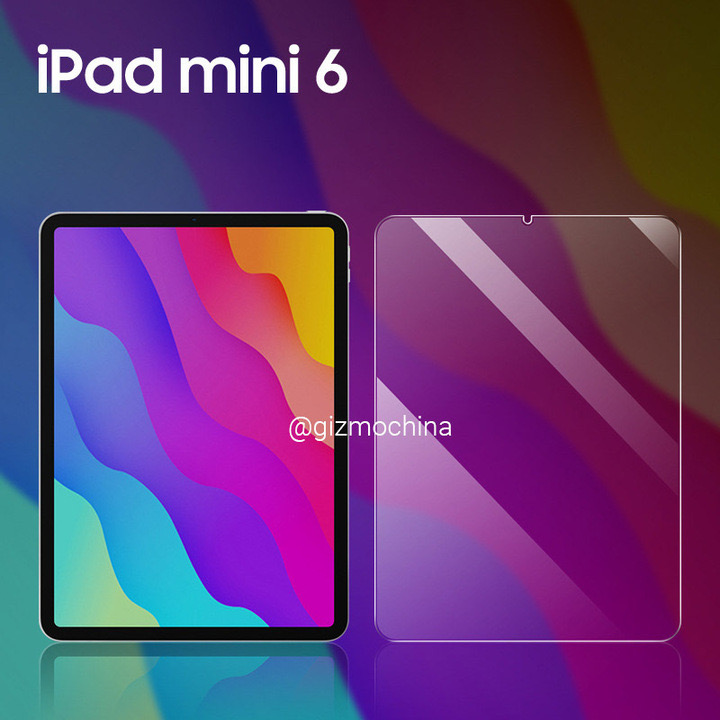
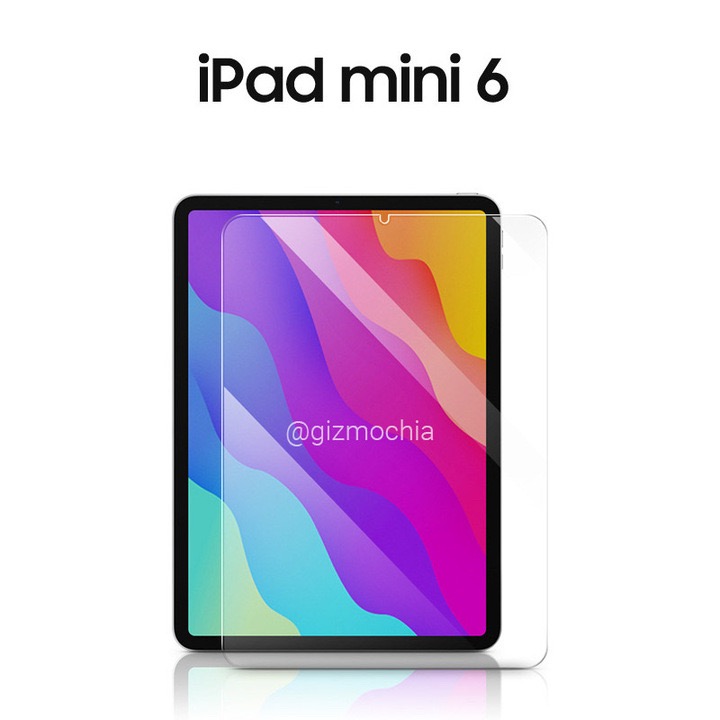
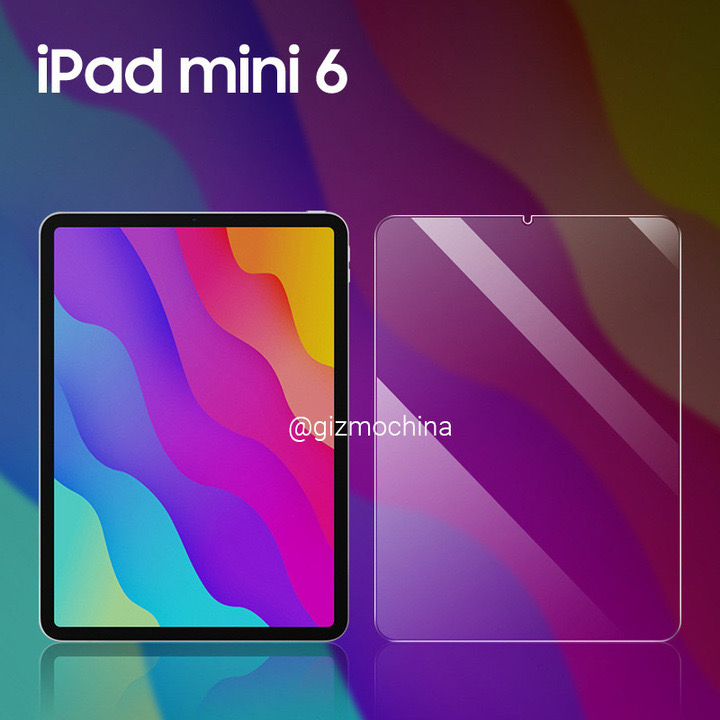
Alleged new renders of Apple iPad mini 6 leaked

Yesterday, we saw alleged dummy images of the upcoming iPad mini model. It showed that the display had thick bezels, a physical Home button, and a design similar to the predecessor. However, we have received new renders of the iPad mini 6 and the renders tell us a whole new story.

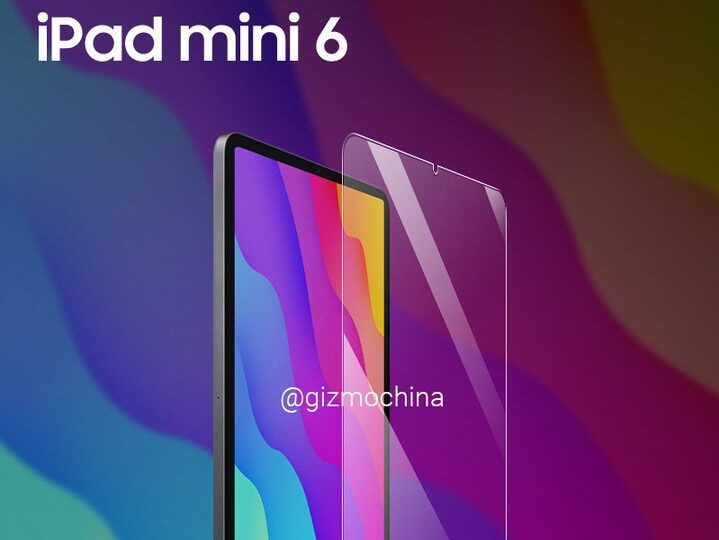
Alleged iPad mini 6 render

The renders of the Apple iPad mini 6 we received were from an anonymous source so we aren’t sure if it’s 100% legit. Anyway, talking about them, the alleged images seem to be listings for a screen protector of the iPad mini 6.

Unlike the images leaked before, we see construction that has a more boxy design with somewhat sharp edges and not curvy edges on the back. Also, these resemble the iPad Pro 2020 and the latest iPhone 12 series design language.

We see a Power button at the top, volume buttons to the right. Upfront, the selfie camera is tucked inside the bezels and not present underneath the display inside the punch-hole. Speaking of which, the renders are quite different from the one we saw in January.

That older report said that the iPad mini 6 would have punch-hole display upfront and host an in-display fingerprint sensor(Touch ID on display). Contrary to this, a report by a Japanese website Mac Otakara said that iPad mini will emanate iPad Air 3 design, continue to have Touch ID on the home button which is clearly missing on the new renders.

So far, reports say that the iPad mini 6 will feature either 8.5-inch or 9-inch display out of which 8.4-inch seems to be most likely. Either way, it will be an upgrade from the 7.9-inch screen on the iPad mini 5. And unlike the ‘Pro’ version, Apple will probably release this model with the lightning port in 2021.

Apple brought the Touch ID on the power button with the iPad Air 4 last year and it is still unclear which of the options Apple would choose for iPad mini 6. Lastly, analyst Ming-Chi Kuo believes that an iPad mini, alongside a new ‘Pro’ model, is coming with a mini-LED display but there are no further reports on the same.

RELATED: