Advertisement

POCO M3 Review: The Phone to beat in the Budget segment

POCO’s latest budget flagship comes with a redesigned back and a Snapdragon processor. We have already posted our hands-on with the POCO M3, taking a look a quick look at its design and specs. But today, let’s take a deeper look into the POCO M3 and see whether it meets our expectations as a budget smartphone. 

Buy Xiaomi Poco M3 on AliExpress: BUY NOW

POCO M3 Review: Design & Display

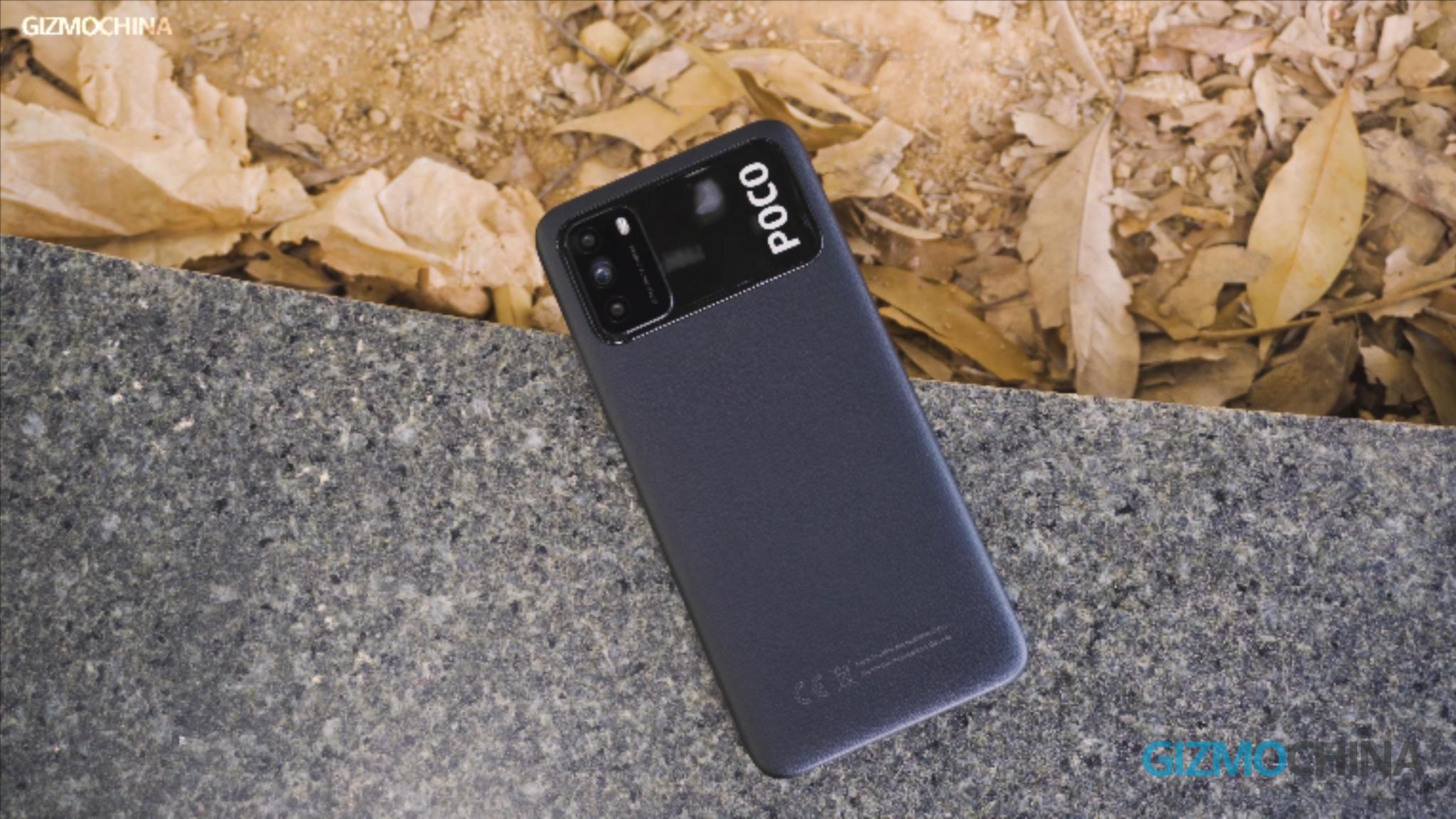
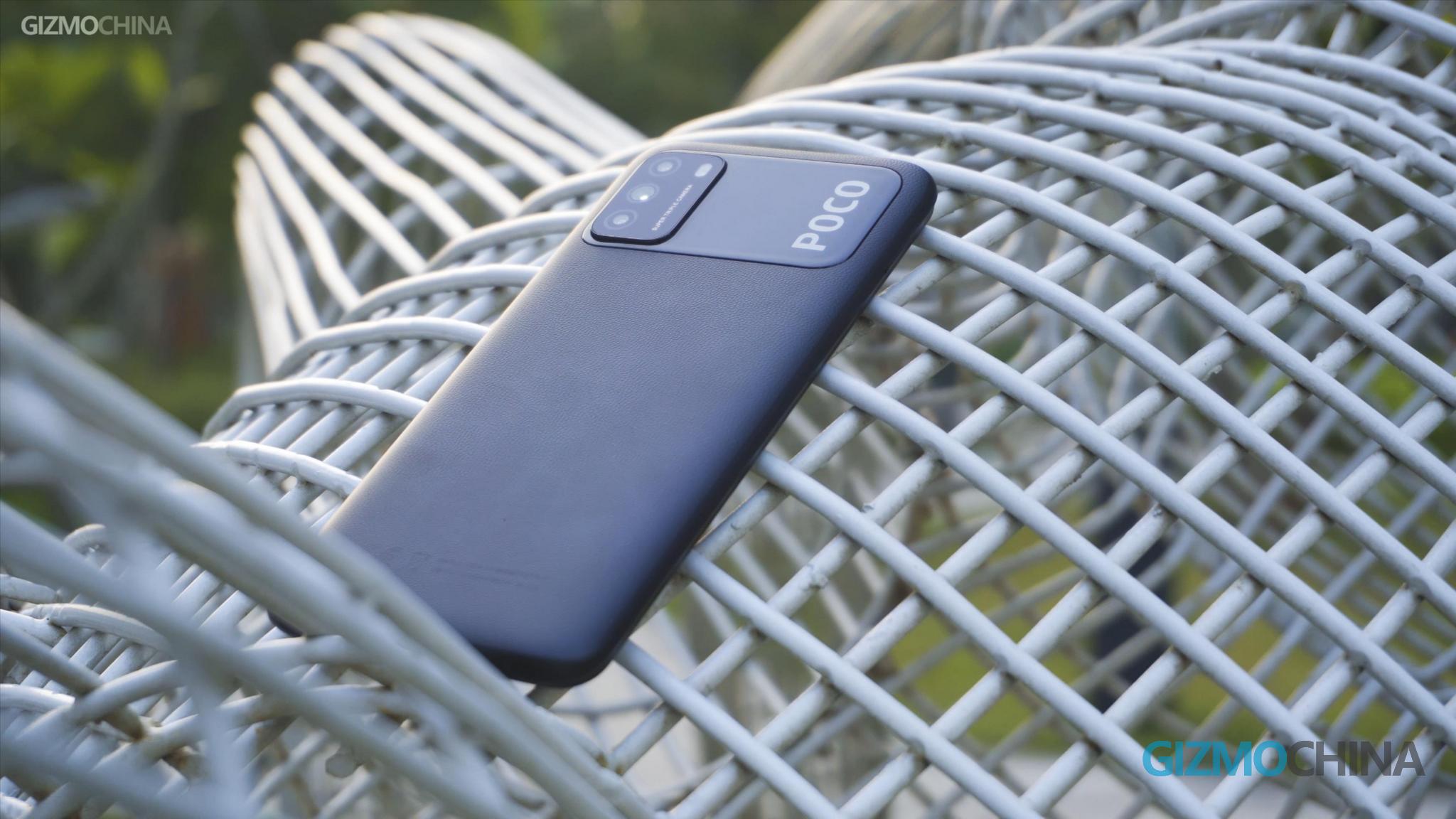
First, let’s look at its design. When compared to most budget phones, the M3’s design definitely deserves the word ‘VALUE FOR MONEY’ and features excellent build quality. We’ve seen a lot of budget models that share very similar designs. But the rear design of the M3 is much more unique and recognizable. Although the back cover isn’t glossy or made out of metal, it does not feel cheap at all. The textured leather cover finish is a nice touch, which at first glance makes the phone stand out from boring budget model designs.
Poco M3 review 01

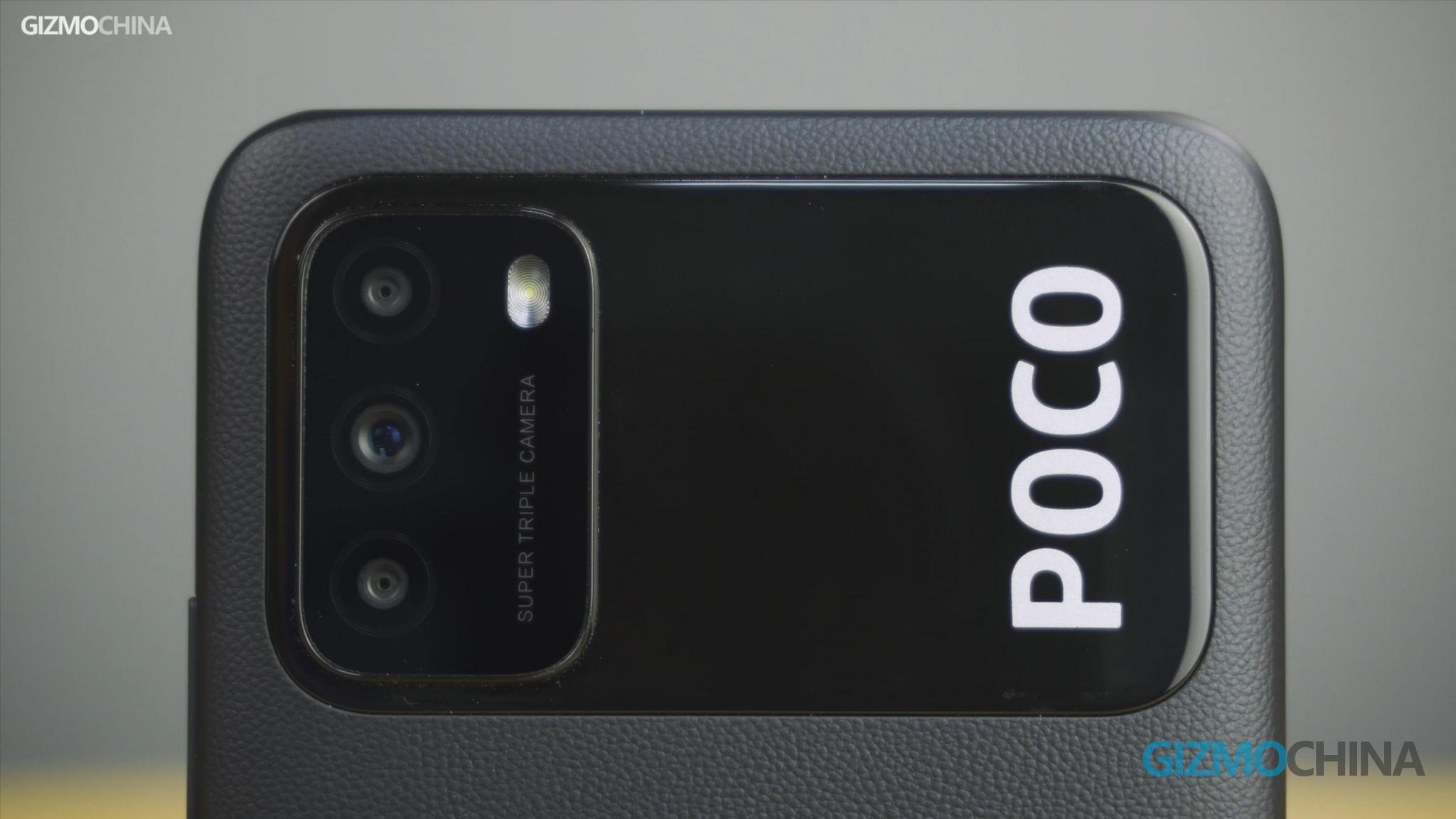
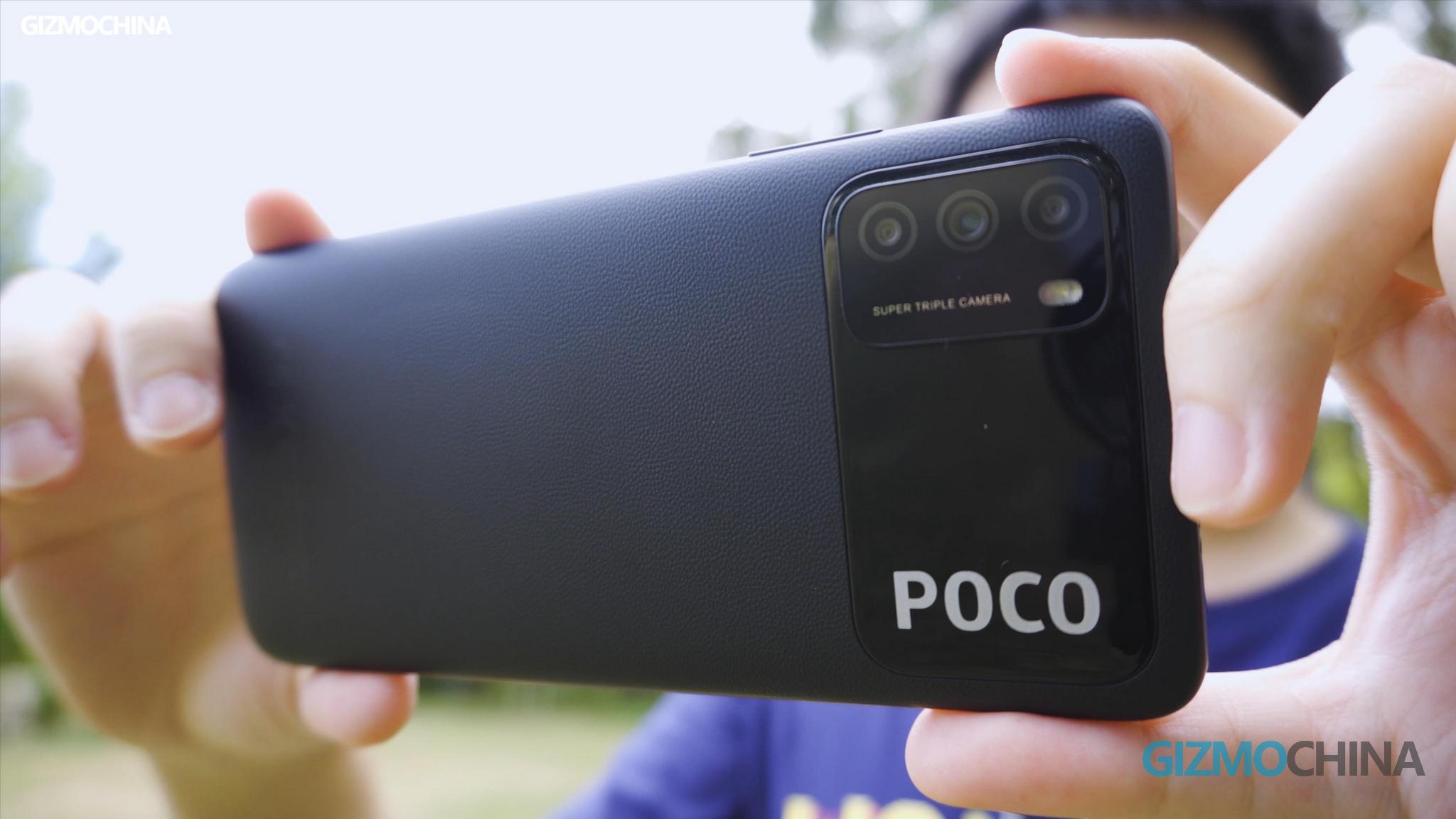
And the camera module is arranged on the left side of the upper embedded glass. To achieve visual balance, Poco’s logo is shown on the opposite side. The model in our hand is the black edition. Thanks to the One-piece molding of the back cover and the frame, the elegant black appearance brings a sense of unity.
Poco M3 review 05

When you turn the phone around, the front face reminds us of its budget placement – featuring a water-drop 1080P LCD display. Of course, the display isn’t really crisp but for an affordable phone, we are not complaining.

Poco M3 review 09

The consolation is that the screen-to-body-ratio is well controlled without leaving an unpleasant chin. To be honest, we were a bit worried about the display quality at the beginning, but the moment that we turned on the phone, its good color representation restored our faith in the M3.

POCO M3 Review: Hardware & Specs

In this price segment, hardware compromises are common due to cost reduction. Although the Snapdragon 662 SOC running inside the Poco M3 is not a power-packed performance choice, users still can have a complete and fluid experience using the global version of Xiaomi Mi UI 12 OS. Besides, the Snapdragon 662 is an upgraded chipset from Snapdragon 660 and has been optimized for better camera performance.

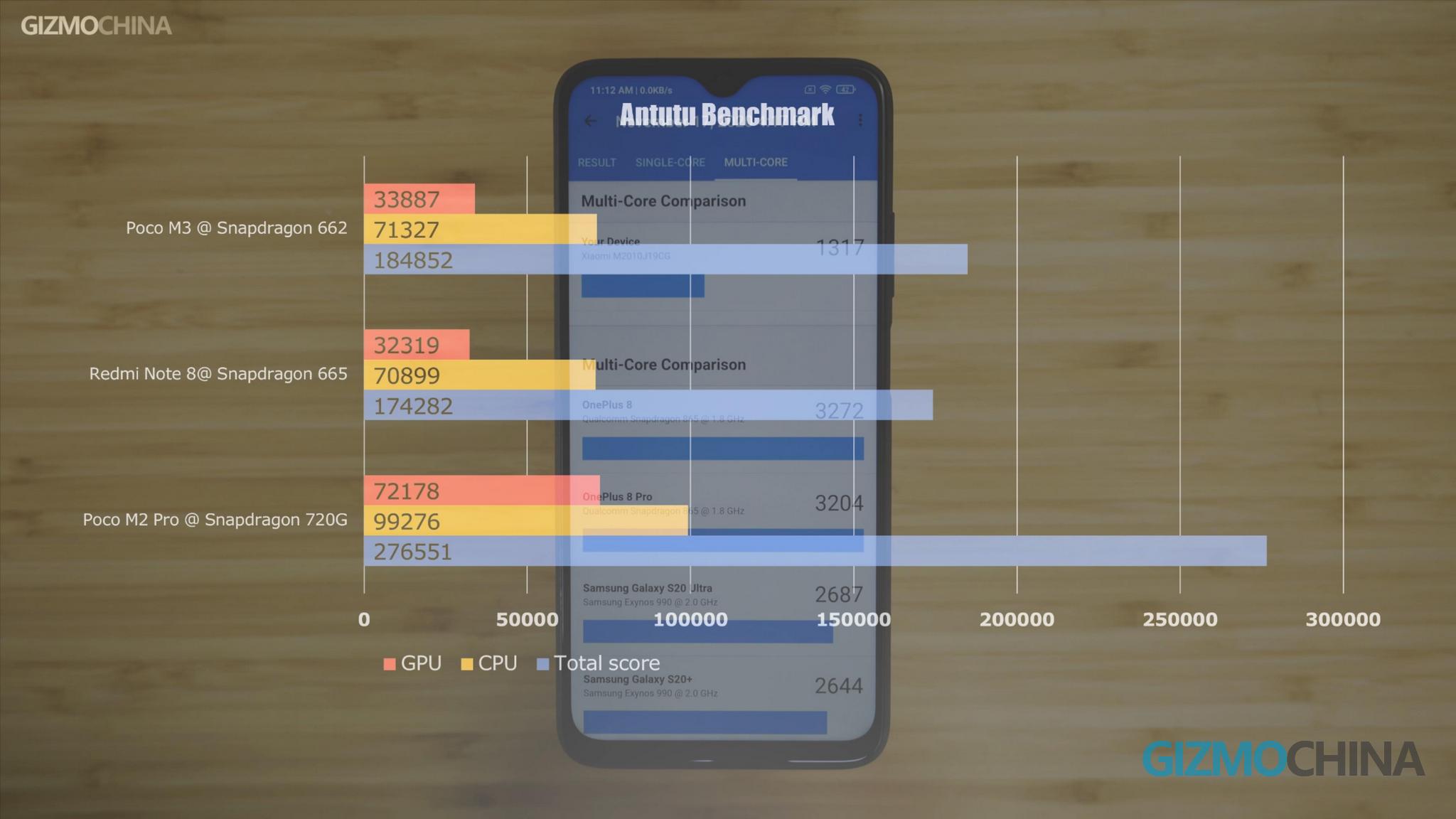
According to the benchmark results on Geekbench 5 and Antutu, the Poco M3’s CPU performance is almost equal to some models running the snapdragon 665. So we can at least say that the software optimization of this chipset is pretty good. Another detail that’s worth noting is the multi-core performance, which is relatively impressive when compared to its single-core performance.
Poco M3 review 12

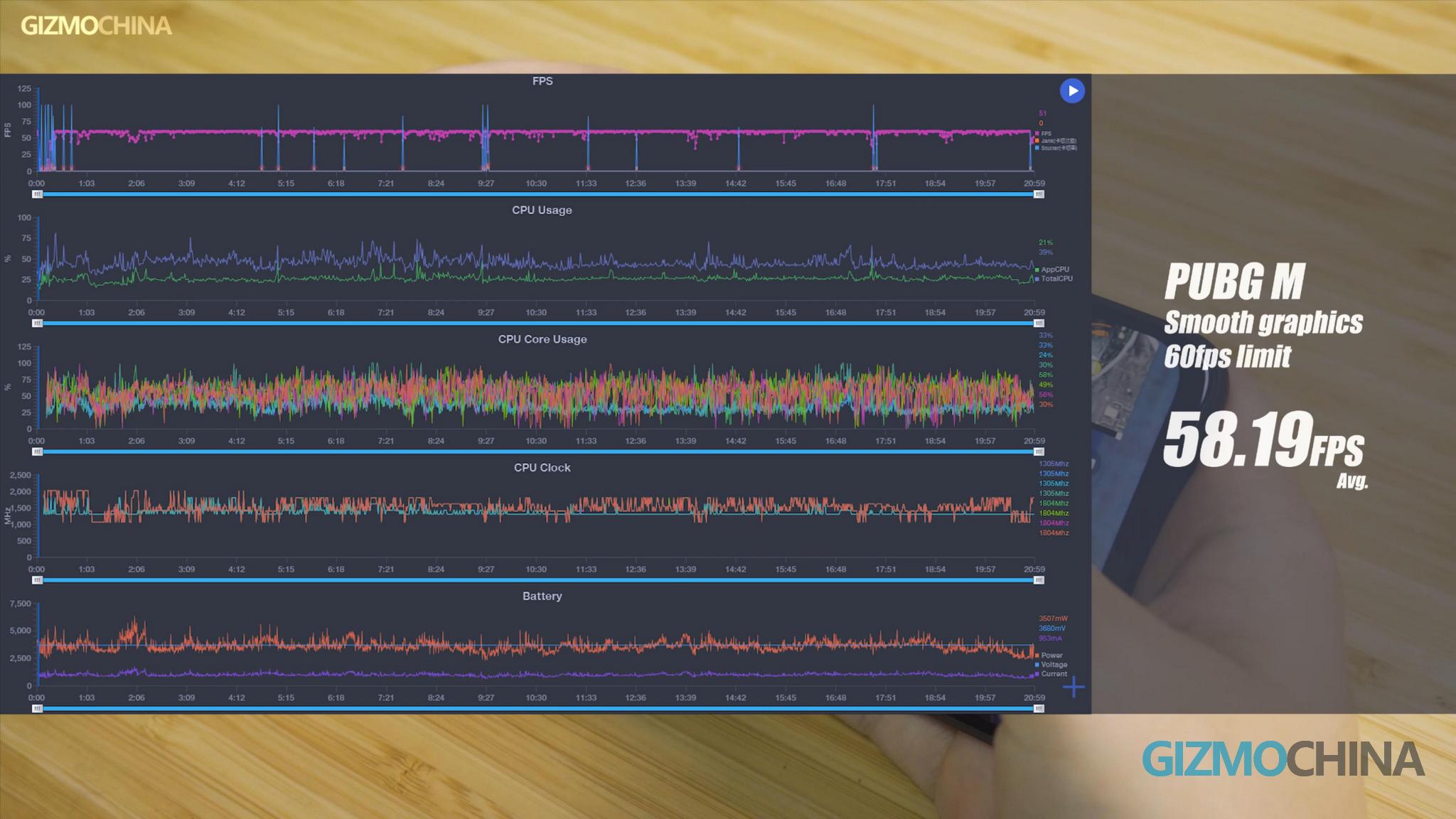
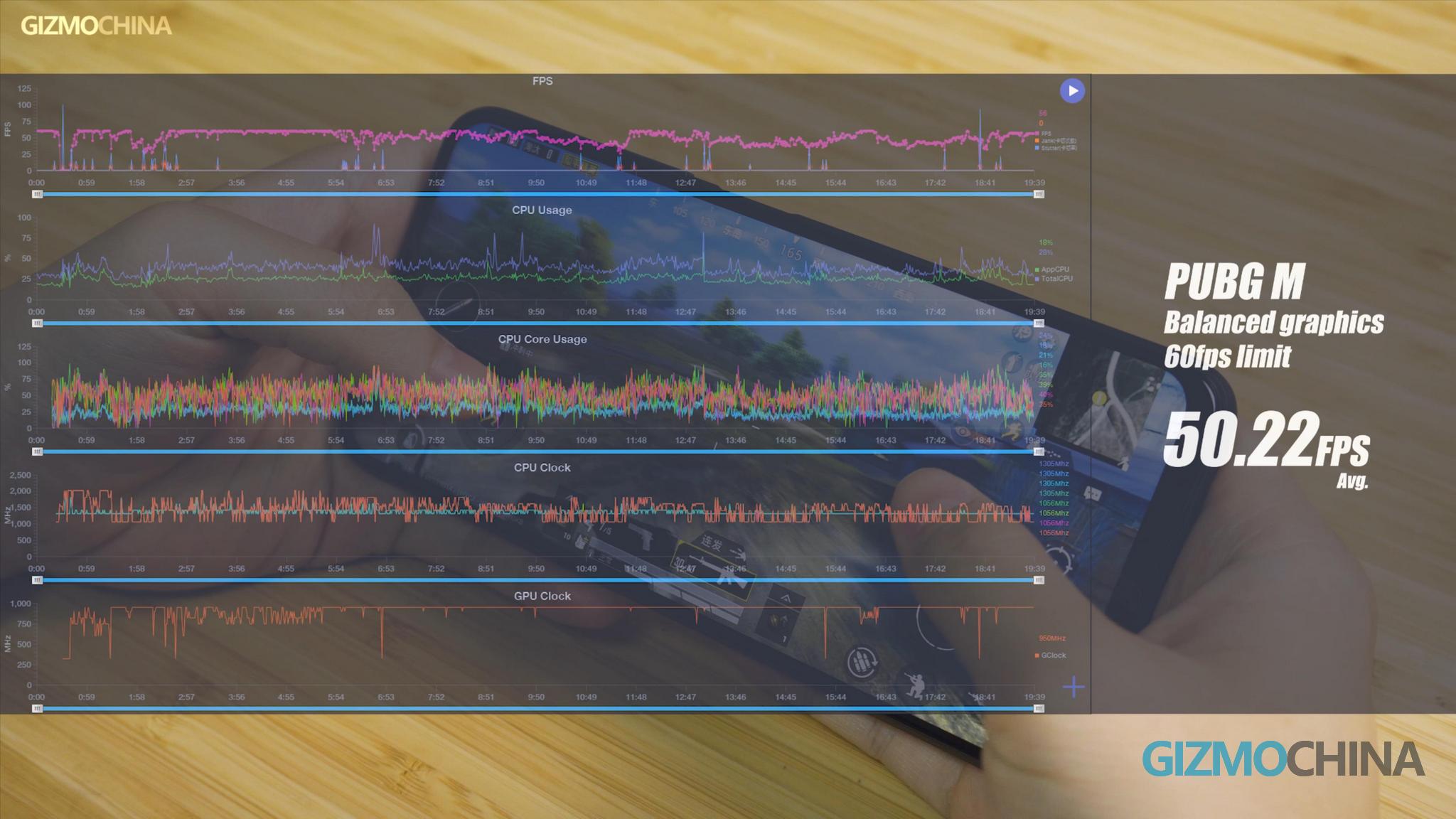
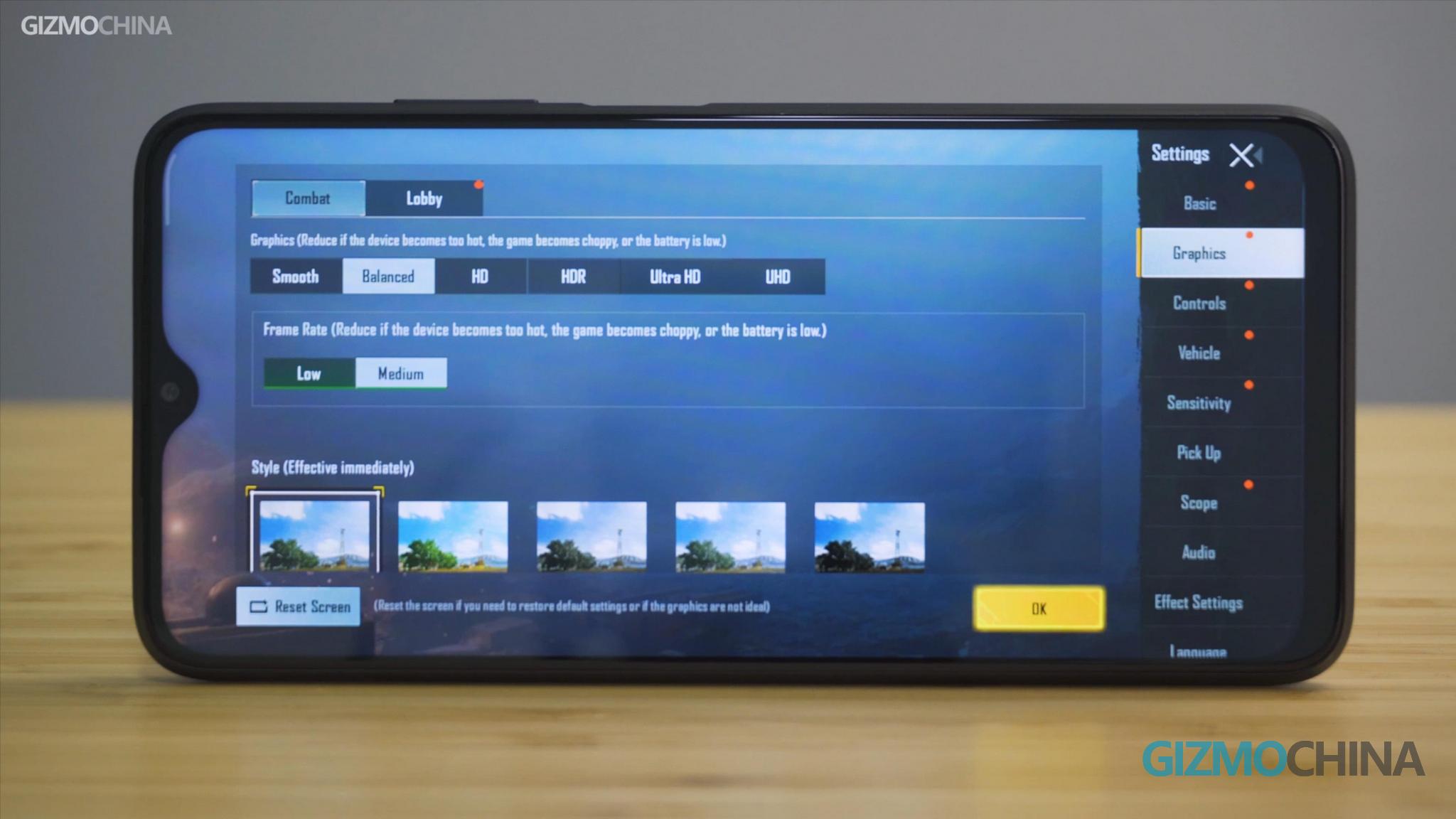
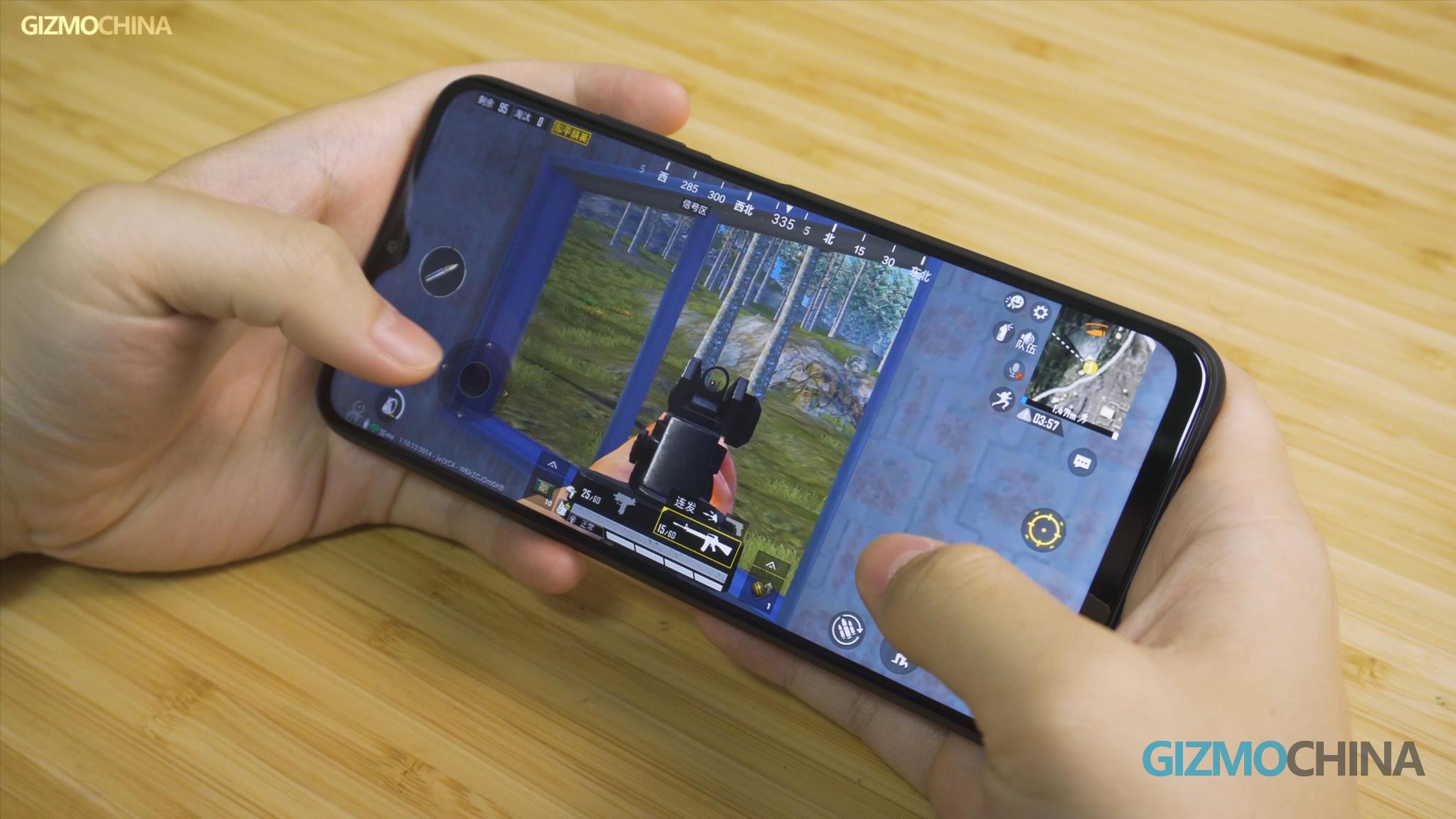
Given this chipset, we were curious whether the phone could fluently run popular games like PubG Mobile. When running PubG, the game doesn’t allow players to turn on HD or higher graphics on this phone — it only can run at a Medium-frame-rate option under balanced graphics. But the frame rate can go higher under smooth graphics settings. In order to access its highest performance, we broke through the frame limit in the PUBG China version to 60fps with a third-party tool. Under balanced graphics mode, although the running is not completely smooth, we still were able to get a good gaming experience with an average framerate at 50.22fps. When we shifted to smooth graphics, the M3 could smoothly run the game at above 50fps with less fluctuation. And surprisingly the average framerate of 58.19 is better than what we expected before.
POCO M3 Review: Camera 

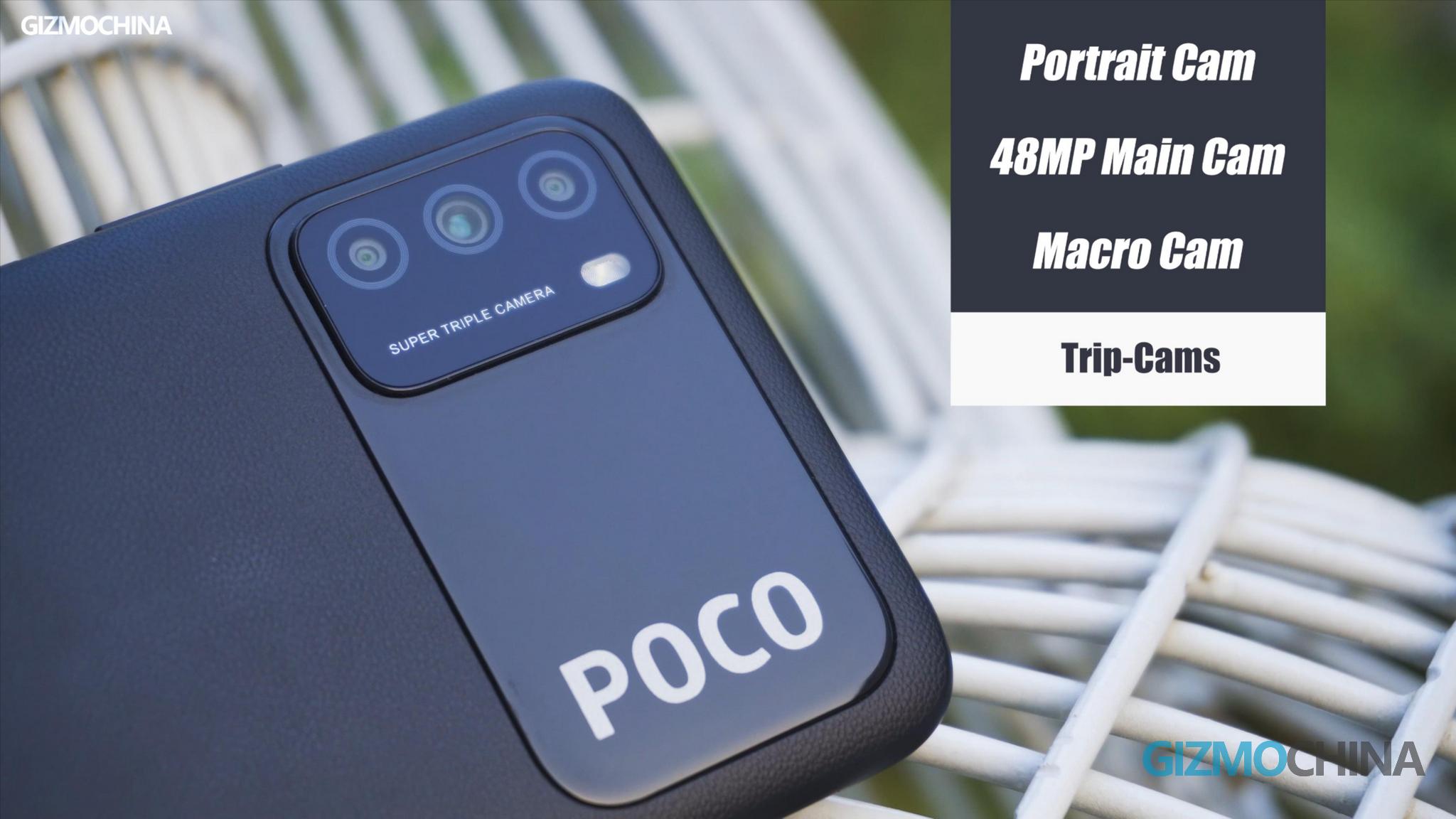
And now let’s look at its camera performance. Likely to keep the cost down, the ultra-wide-angle lens was sacrificed for a better-quality 48MP primary lens. Although somehow, it’s a kind of compromise, in light of past experience, we do prefer a more practical camera module led by a better main camera rather than a relatively useless wide-angle camera with poor quality.
Poco M3 review 18

The other two cameras, the macro lens and the portrait depth of field lens complete the camera setup on the phone.

Among these three cameras, the main camera is the one that gave us the biggest surprise. From the samples shot from the main camera, we can see that under good lighting conditions, the images presented decent colors with good dynamic range. And thanks to the 48MP original resolution, the main camera could shoot high-resolution photos with rich details, and even for normal modes, most samples also had good clarity.
Poco M3 review 03

But due to the lack of OIS anti-shaking, users have to be careful to hold the phone firmly when shooting photos in low lighting conditions. Another problem is that sometimes the exposure strategy is too aggressive in some complicated scenes, which could lead to detail loss of some extreme brightness in the corners.


Most of the time, the main camera has stable performance in capturing good night photos with its useful night mode. Most of the night shots showed good control with a balanced exposure.  

But when we moved to extreme dark scenes, the drawbacks of this sensor were exposed. For example, to offer more detail in extremely dark conditions, the exposure is so aggressive that the whole image turned out to be much noisier.


But overall, we did admire Poco’s efforts in optimizing the camera software as it has already shown a lot more potential than what we expected from the hardware.  

As for the macro lens and the portrait one, their performance is not as impressive as the main camera, although they did make macro and portrait shooting much easier. The macro samples have close focus and good color presentation but didn’t present satisfactory clarity. In portrait mode, the phone allows users to edit the original photo with the reselected focus and aperture. But from the samples, we found that the edge detection was not accurate, especially when you look closely at the samples. 

POCO M3 Review: Battery

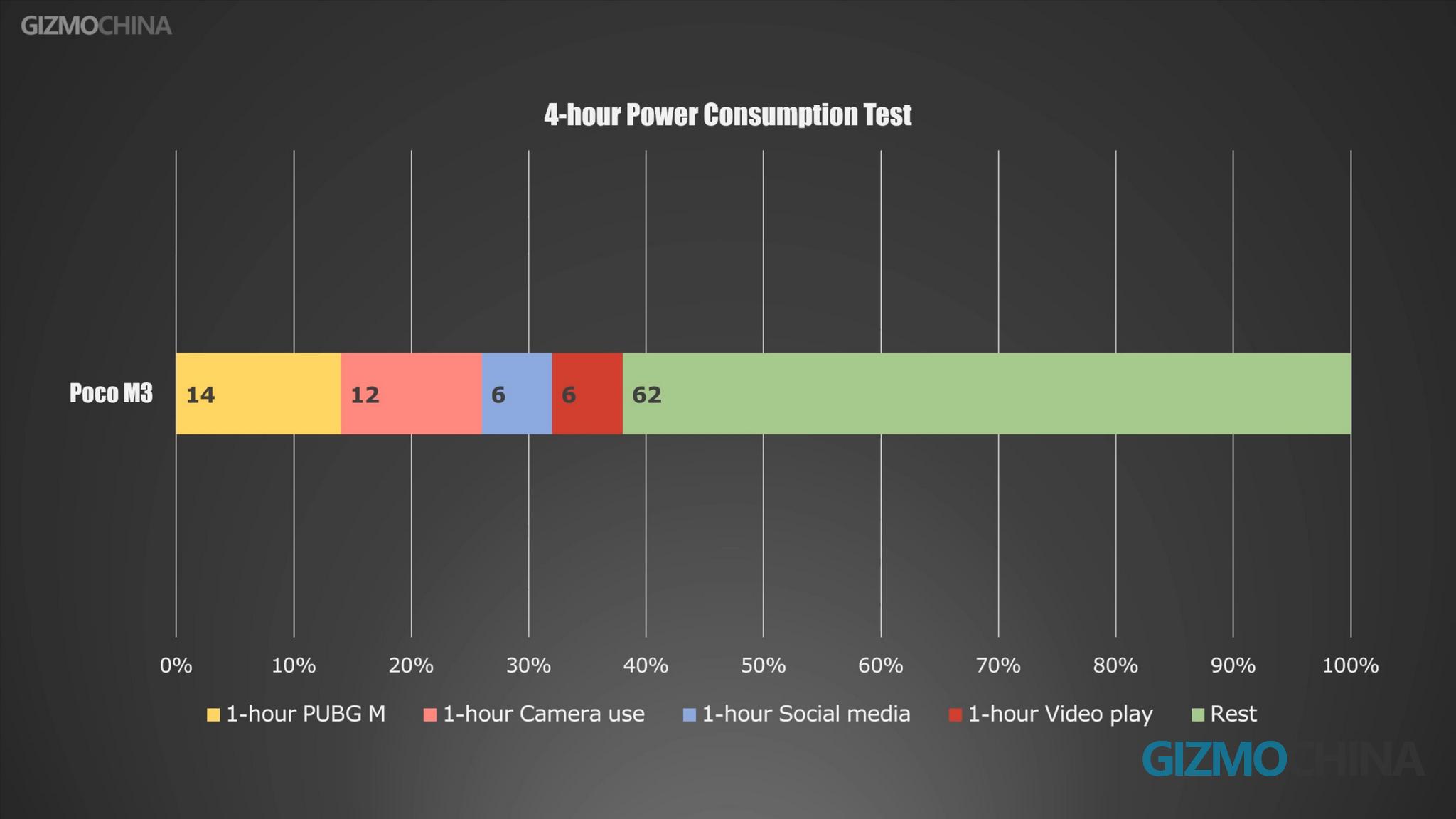
The 6000mAh battery of the M3 far exceeded our expectations for an affordable device. To check its battery life in daily use, we did a power-consumption test to simulate our daily use.
Poco M3 review 20

In one-hour of PUBG gaming, it consumed 14% of power. Another 12% power dropped after an hour of camera use; 6% after one hour of social media use and a further 6% drop in the battery after one-hour of video playback. After the test, there was 62% of power left.
Poco M3 review 19

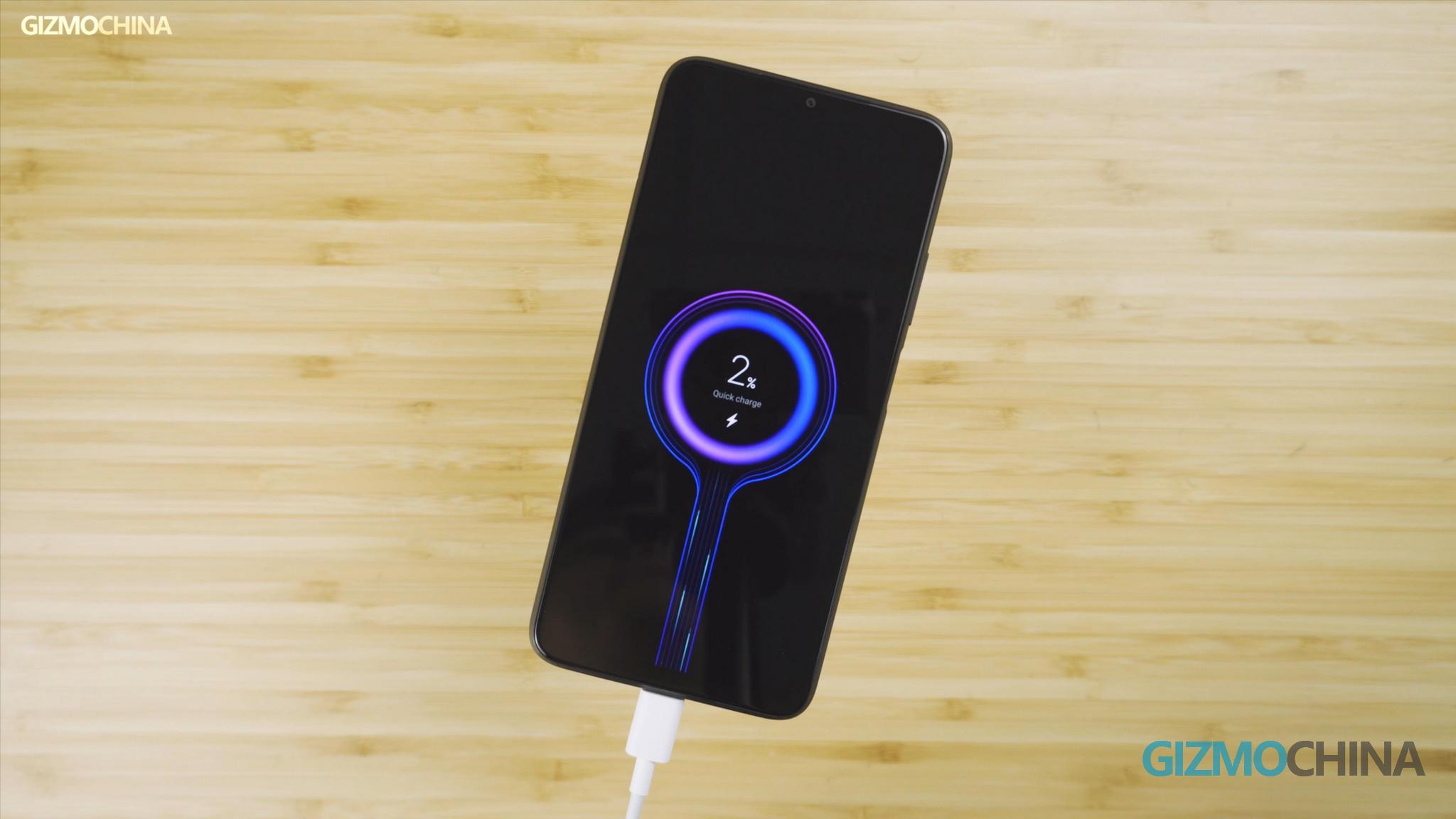
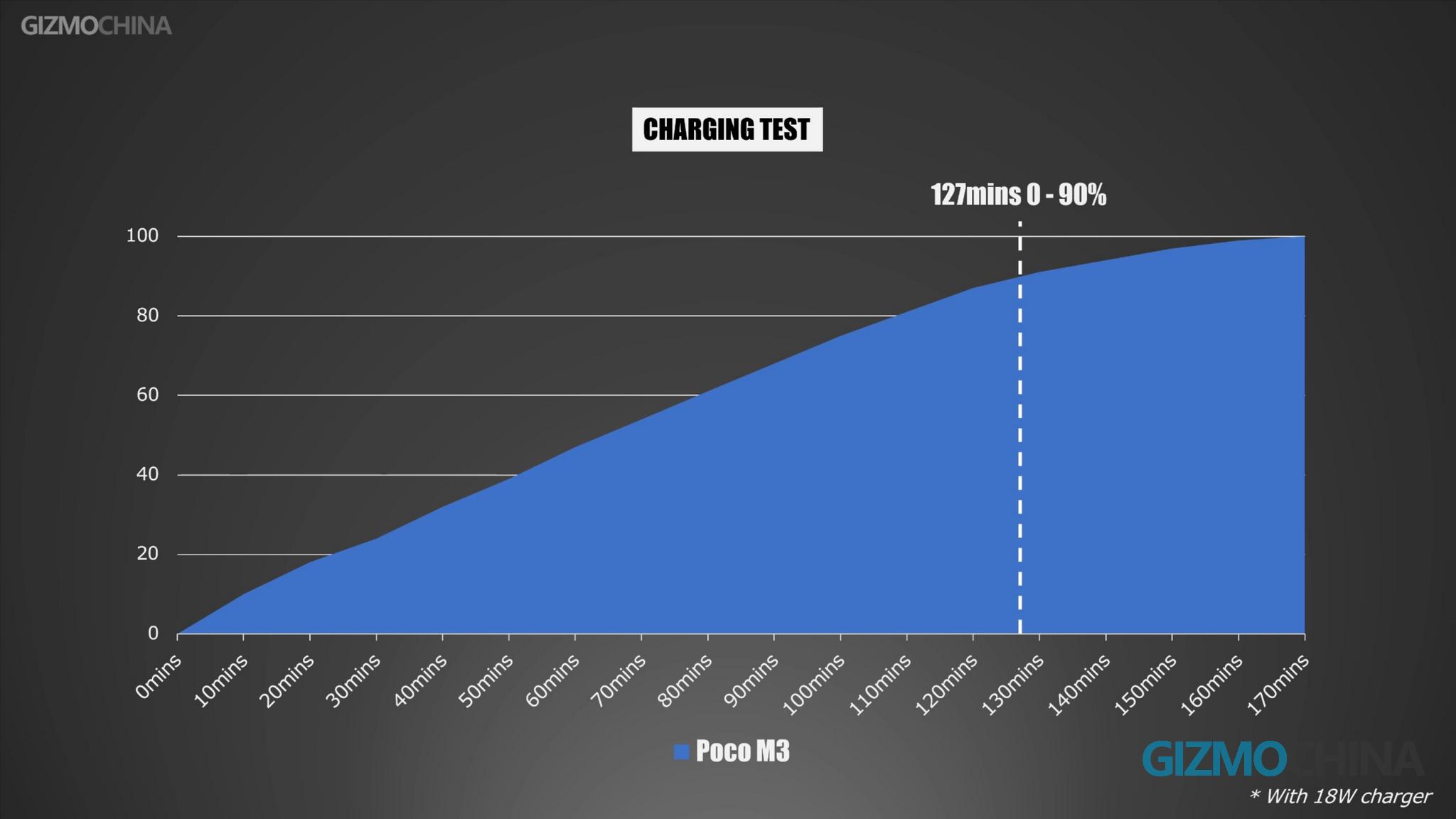
The Poco M3 is equipped with 18W charging efficiency, which is not really a remarkable fast charging solution for an Android phone. It took us over 2 hours to fully charge the phone, which doesn’t really match its super large battery capacity. But considering the latest iPhone is also using an 18W fast charging solution, we are not gonna complain about this affordable model.
Poco M3 review 21

POCO M3 Review: Verdict

Overall, after all the tests we’ve done on the Poco M3, we can definitely recommend this phone in its price segment. Although the phone could not be praised for its performance and charging, some features like its excellent build quality, good camera performance, and long battery life, makes it stand out from the boring budget phones.
Poco M3 review 19

So this was our review of the Poco M3. What else do you want to know about the phone? Please let us know and leave your comment below.

Poco M3 is available for $129 on AliExpress on November 27, grab it before it restores to regular price.


Redmi M2010J19SG gets IMDA certification; could launch as Redmi Note 10 4G Globally

Xiaomi is gearing up for the launch of the Redmi Note 9 series in China tomorrow. The company will likely unveil the following three models- Redmi Note 9 5G, Redmi Note 9 Pro 5G, and Redmi Note 9 4G. The 4G variant has already launched as the POCO M3 globally yesterday. While one of the 5G variants is likely to darn the Redmi Note 9T 5G naming Globally, the 4G variant has now visited Singapore’s IMDA certification under ‘Redmi’ branding suggesting a global launch.

Redmi Note 9 4G

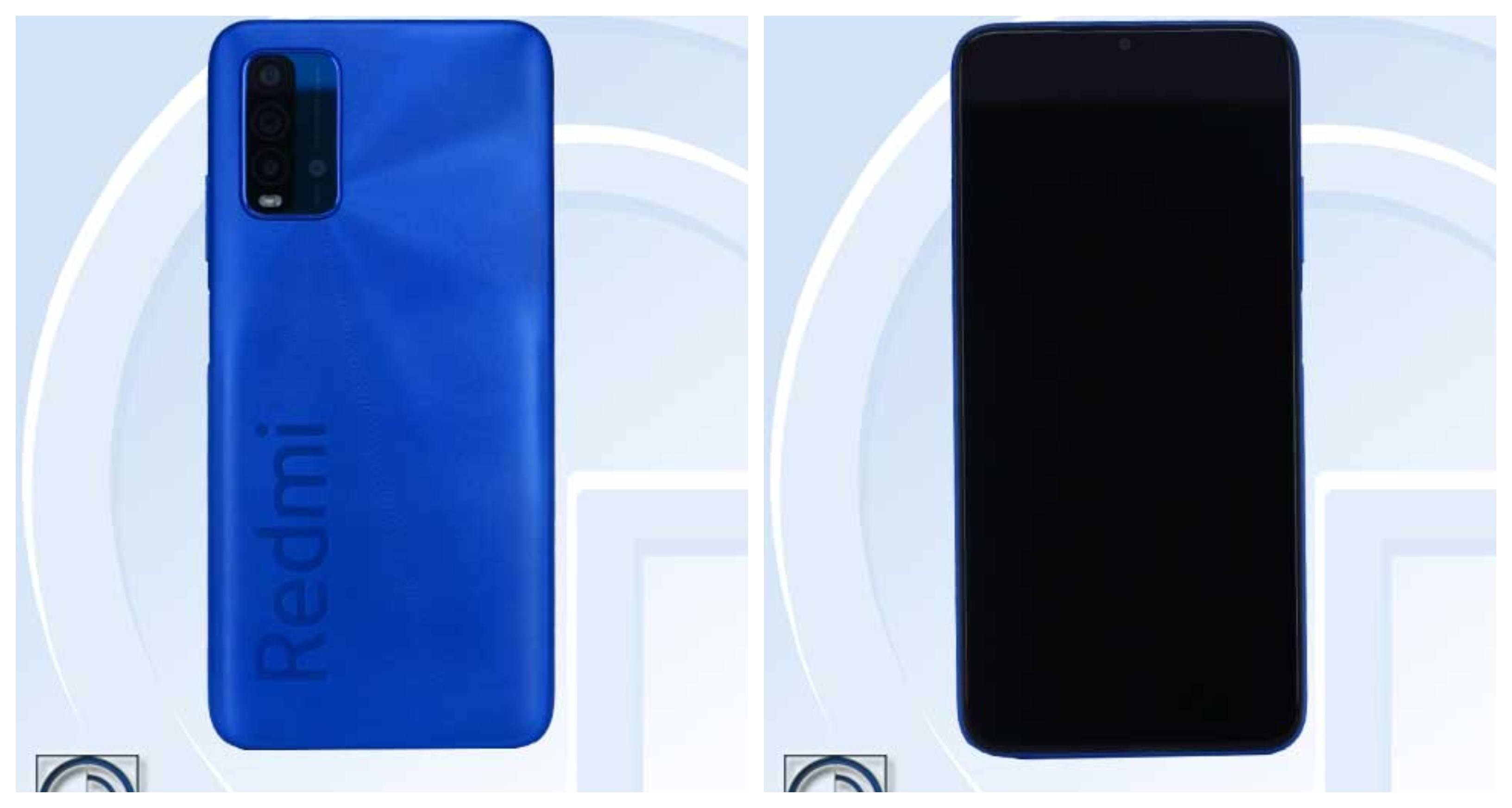
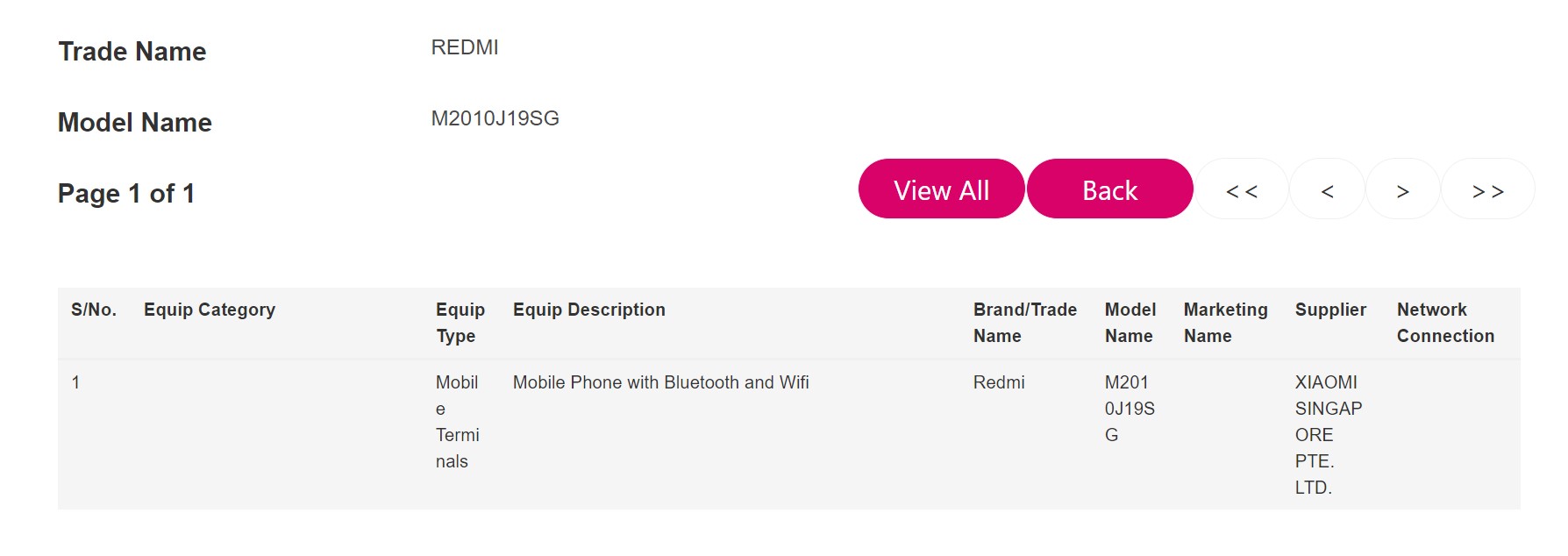
The latest tip comes from Mukul Sharma. As he says, a Redmi Mobile Phone with model number M2010J19SG appears on the IMDA database. Now, if you recall, a device with a similar model number(M2010J19SC) visited TENAA recently. This is believed to be the Redmi Note 9 4G in China. Additionally, a device with similar model number M2010J19CG turned out to be the POCO M3 for Global markets.

That said, the 4G device under Redmi branding appears at a time when the 5G variant has also received Malaysia and Singapore’s certifications. It is likely to come under Redmi Note 9T 5G moniker with MediaTek’s Dimensity 800U SoC. Anyway, talking about the 4G variant, it’s TENAA renders in China show a lot of similarities to the POCO M3.

Redmi Note 10 4G Specifications(Expected)

However, it doesn’t have the big camera shade and leather-like finish at least looking from the images on TENAA. It features a 6.53-inch display with 2400×1080 resolution. From the launch of POCO M3, it’s clear that the 2.0GHz CPU listed on TENAA is the Snapdragon 662 SoC. For cameras, you get a 48MP main lens, two 2MP sensor on the rear, and an 8MP selfie shooter up front.

Other features expected are a 6,000mAh battery with 22.5W fast charging, 4G, Wi-Fi, Bluetooth, GPS, 4/6GB RAM, 64/128GB storage, side-mounted fingerprint sensor, MIUI 12 based on Android 10, and more. Let’s wait for the official launch in China tomorrow to know more about the device.

TSMC edges closer to 3nm chip production

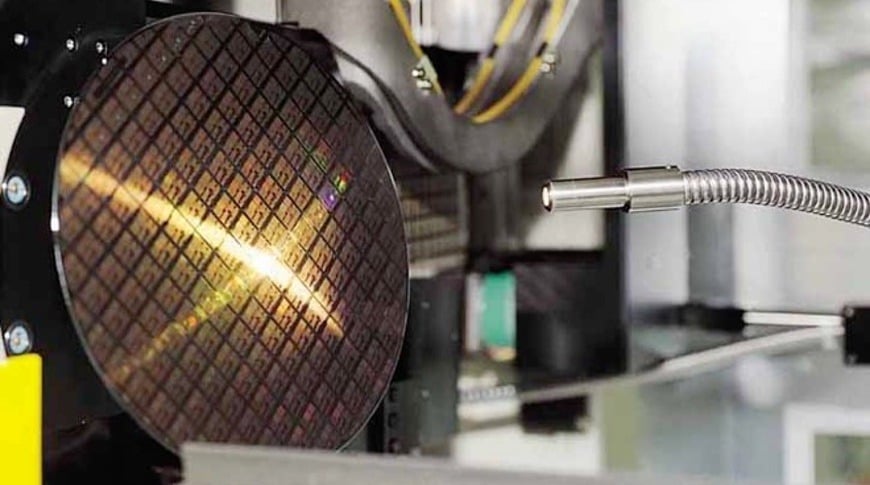
TSMC (Taiwan Semiconductor Manufacturing Company) recently held a ceremony, which marked the completion of its plant structure for its 3nm fab at the Southern Taiwan Science Park (STSP). This brings it closer to start production of 3nm process based chips.

This foundry house is expected to begin commercial mass production through the 3nm fab by the year 2022. Furthermore, with quotes for processing memory application going up in the semiconductor backend sector, the material costs have also risen. Notably, the world’s largest contract chip maker had also signed an agreement with Arm, which will have Taiwanese academic and research based firms enjoy free access to the latter’s processor IPs for research purposes, as per a DigiTimes report.

TSMC

Previously, we had also reported on the chip maker being on track with its schedule for the 3nm process. But soon after, the company announced a delay that shifted its risk production to next year and its mass production stage to 2022, as stated above. At the moment, TSMC stands at the forefront of the 3nm process, with other semiconductor giants like Samsung struggling to catch up with its progress. We’ll provide updates when more information is available so stay tuned.


Samsung is reported to manufacture only 6 million Galaxy S21 series phones initially

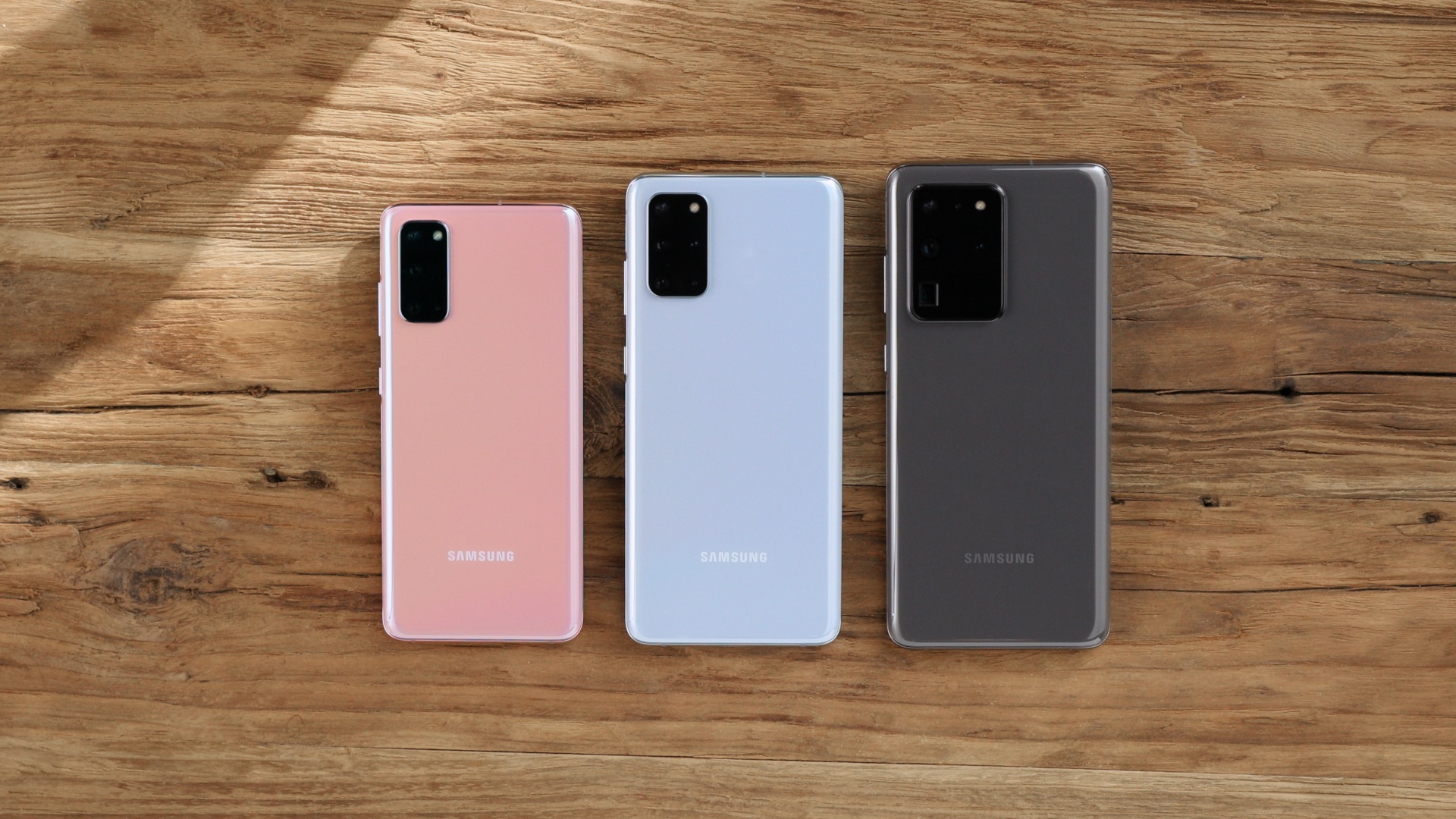
The Galaxy S20 series of flagship smartphones did not sell well as a result of the global pandemic and higher price tags. Hence, Samsung launched Galaxy S20 FE in the second of 2020 at a much affordable price tag. Though the smartphone market has now improved, the South Korean tech giant is reported to produce only 6 million units of Galaxy S21 series initially.

Samsung Galaxy S20 Galaxy S20 Plus Galaxy S20 Ultra Featured
Galaxy S20 (left), Galaxy S20+ (center), and Galaxy S20 Ultra (right)

Yesterday, a report by The Elec said that Samsung has postponed the launch of Galaxy Z Flip2 (tentative branding), the successor to the popular Galaxy Z Flip. This is said to help the company to prevent cannibalizing the sales of the Galaxy S21 series.

The same report also revealed some more details of the next-gen Galaxy S series phones. First and foremost, Samsung is said to start manufacturing the Galaxy S21 series next month (December) itself and the initial production batch will only include 6 million units. The firm is expected to produce more units based on demand.


Further, the Galaxy S21 will be available in four colors namely gray, pink, violet, and white. Whereas, the Galaxy S21+ will come in three colors – black, silver & violet. And finally, the Galaxy S21 Ultra will only sell in two colors – Black and Silver respectively. Anyway, Samsung may introduce new colors (limited to certain regions) after the launch of these phones just like every year.

Last but not least, the report also says that Samsung will be manufacturing 1.5 million units of Galaxy Buds 2 (tentative branding) codenamed Attic in December and January respectively. The company’s next-gen TWS will be initially made in Vietnam but the production will be further extended to Brazil in February.

The Galaxy S21 series is expected to launch in January. Samsung is yet to confirm the exact date, which the company may reveal in December.


Huawei starts placing 4G smartphone and component orders with suppliers: Report

Huawei is apparently focusing on 4G smartphones again. A new report suggests that the company is planning on restarting 4G handset production and has begun placing orders with its suppliers for related components.

Huawei Logo MWC 2019

A source from the Chinese tech giant revealed this information, as per a Yicai report. Apparently, Huawei is stocking up on components for 4G smartphones at the moment and “Currently, small batches of rolling orders are placed, and there is no way to estimate the specific order volume.”

The source also stated that at the pace of market order shipments, the first finished smartphones are expected to hit the market in the first half of next year, with the earliest being within the first quarter of 2021. Notably, the source added that some of the component makers within Huawei’s supply chain will be receiving a notice from the company stating that they will resume purchasing motherboard and other components products this month.

Huawei logo Mate featured 07

Interestingly, this would be in line with our previous reports as Qualcomm was recently given the green light to supply the company with mobile processors. Although, the chip maker would only be able to supply Huawei with 4G chips and not 5G SoC. Unfortunately, Huawei has yet to respond to this matter. So, we have no means of confirming the report at the moment and will have to wait for an official company announcement to know for sure.


NVIDIA RTX 30 series mobile GPUs to arrive in January with AMD CPU support

NVIDIA is apparently gearing up to launch its latest GeForce RTX 3080 graphics cards for gaming laptops. A new report suggests that these laptops will arrive sometime in January 2021 and will be paired with AMD Ryzen CPUs.

Nvidia
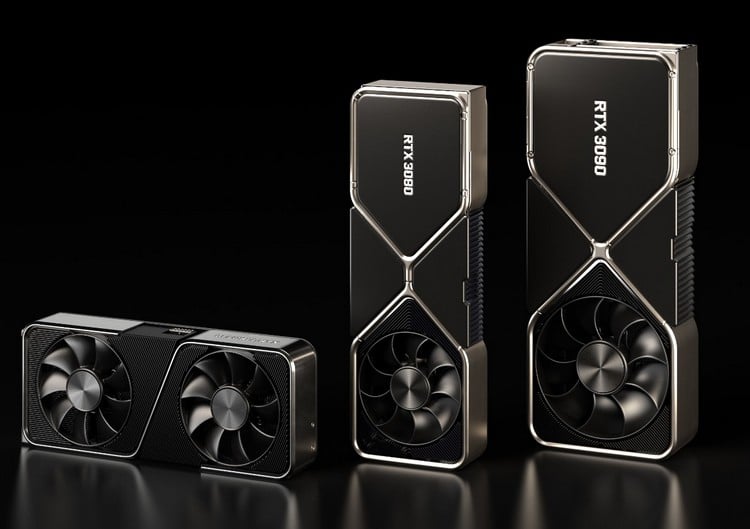
The RTX 30 series cards

According to a WCCFTech report, the new mobile range of the NVIDIA RTX 30 series will arrive in laptops soon. This will include mobile versions of the RTX 3080. RTX 3070, and even the yet unannounced RTX 3060 GPUs. The RTX 3080 and RTX 3070 laptops will launch first in January, with partners like ASUS and MSI, as per the report. While the pricing of these laptops are currently unknown we can expect the RTX 3060 powered laptops to start from 999 US Dollars.

Similarly, a laptop with an RTX 3070 would likely start from around 1,299 US Dollars while the high end RTX 3080 gaming laptops could be around 1,999 US Dollars. Furthermore, these mobile GPUs would also arrive in their Max-Q and Max-P variants as well, with the former running on lower clocks for thin and light laptops and the latter offering performance near to a full sized desktop variant. Although, the report also states that the RTX 3080 will be the sole exception to this and will only arrive in a Max-Q variant, which is likely due to its high power draw requirements.

NVIDIA

Unfortunately, this is still an unconfirmed report and NVIDIA has yet to announce any such plans at the moment. But with the launch of the first RTX 30 series card being a couple of months old, their mobile GPU counterparts should be just around the corner. Additionally, AMD Ryzen 4000 series chips on laptops had been held back by entry to mid range cards like RTX 2060. So, we can expect the Zen 2 chips to have more to offer with higher performing cards from this generation. But, we may also see the upcoming AMD Cezanne mobile CPUs, making their way to these laptops under the Ryzen 5000 series branding as well. So stay tuned for more updates.


Samsung delays shutting down its LCD business till March 2021

Samsung Electronics has decided to postpone its plans to shut its LCD business to March 2021. The company had been planning to shut down its business for a while now, with plans to end operations by year end.

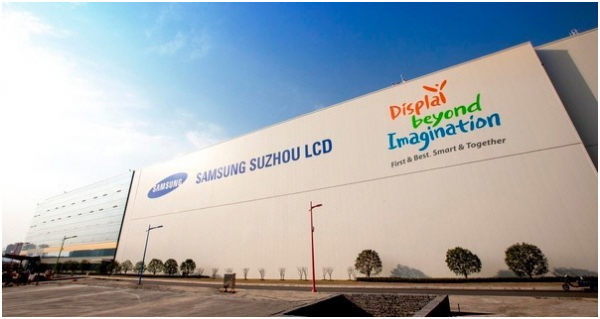
Samsung Suzhou LCD Plant

The reason for the delay in shutting down its LCD operations is to continue production at its L8 fab in the Asan plant for at least the next three months. According to an AndroidHeadlines report, the primary reason for the delay in shut down is due to the rise in demand for LCD panels caused by the ongoing Coronavirus pandemic. With various governments enforcing work from home policies and staying indoors has become encouraged, entertainment, workloads, and more has shifted to homes.

Thus, the South Korean tech giant has reportedly informed all related firms regarding its change of plans due to recent developments. For those unaware, Samsung has been producing LCD panels at its Asan Plant in its home country and its Suzhou plant in China. The company has already struck a deal with CSOT (China Star Optoelectronics Technology) for the sale of its Suzhou plant and has apparently also sold some equipment from its Asan plant to another Chinese firm as well.

Samsung

The company is also in talks with two additional Chinese companies to sell the remaining equipment and is hoping to strike a deal by February 2021 and is hoping to shut down the LCD production by March. Samsung has been making LCDs since the early 1990s but had decided to shut production to make room for OLED panels, which have increasingly grown in popularity and demand in recent years.


OnePlus 7 and OnePlus 7 Pro get November 2020 security patch update

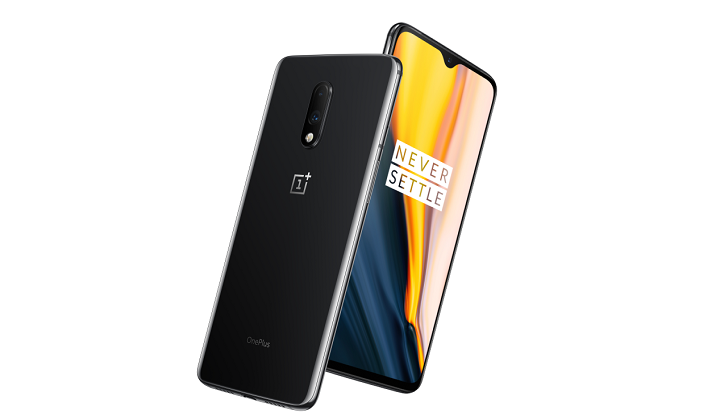
OnePlus launched the OnePlus 7 and OnePlus 7 Pro as its flagships smartphones for the first half of 2019. The handsets debuted with Android Pie (OxygenOS 9) and were later updated to Android 10 (OxygenOS 10). They are also expected to get Android 11 (OxygenOS 11) next month. Ahead of it, the duo is receiving a new system update with November 2020 security patch.

OnePlus 7
OnePlus 7

The OnePlus 7 got two stable updates and a single Open Beta update last month. However, none of the stable builds bring October 2020 security patch. But now, with the new stable build that has been released in late November, the security patch level has been promoted directly from September 2020 to November 2020.

That’s not all, the GMS (Google Mobile Services) package has also been updated to October 2020. Apart from these two changes, the latest build also optimizes the status bar in the call scene to reduce mistouches and fixes a small probability flashback issue with the Phone app.

The new update comes with build number OxygenOS 10.3.7 for the Indian and Global versions of OnePlus 7 and OnePlus 7 Pro. On the other hand, the same update bears the build number OxygenOS 10.0.10 for the European (EU) variant of these smartphones.

OnePlus 7 / 7 Pro OxygenOS 10.3.7 / 10.0.10 Official Changelog

  • System
  • Optimized the user experience of the status bar in the call scene to reduce mistouches
  • Updated GMS package to 2020.08
  • Updated Android Security Patch to 2020.11
  • Fixed small probability flashback issue with the Phone app

As always, the update is being rolled out in batches. Hence, it may take time to reach your device.


Huawei Global Smartphone Market Share to fall to 4% in 2021: Report

Huawei, the known consumer electronics maker, is expected to see a sharp decline in its global smartphone market share in 2021. A new report has revealed that the company might have its market share fall to just 4 percent next year.

Huawei Logo MWC 2019

For those unaware, the Chinese tech giant is one of the most popular smartphone manufacturers in the world. However due to recent obstacles, the company is expected to only account for 14 percent of the global market share this year, which will drop to less than a third of that by 2021, as per a BusinessStandard report. Researchers at TrendForce stated earlier this week that a sustained campaign of sanctions against the company is the primary reason for such a sizeable decline.

Furthermore, Huawei had been facing troubles with the US, with the worst actions arriving a couple of months prior when the US Commerce Department reinforced restrictions against the company, which had already lost its primary chip supplier TSMC and disrupt its supply chain even further. The reinforced regulations also stripped away its key software, and technological edge. Notably, Huawei recently had to sell its budget smartphone business, Honor, after supply constraints and component shortages were affected its subbrand as well.

Huawei

The TrendForce projection also points at other Chinese smartphone manufacturers like Xiaomi, Oppo, and others that would take advantage of Huawei’s current predicament to fill in the market gap. Additionally, Honor and the other Chinese OEMs would also likely raise their production targets and compete for the vacant space more aggressively next year. While this does paint a bleak year for Huawei, it remains to be seen how the company navigates its way through the rough situation at hand.


OPPO A12, OPPO F17, and OPPO Reno3 Pro receive permanent price cuts in India

Recently, Chinese smartphone maker OPPO slashed the price of the OPPO A15 budget handset in India. Turns out that the company also permanently dropped the price of three more devices namely OPPO A12, OPPO F17, and OPPO Reno3 Pro respectively. The price cut for these phones is applicable to both online as well as offline channels.

OPPO Reno 3 Pro Featured
OPPO Reno3 Pro

OPPO A12 Price Cut India 

The OPPO A12 launched in the month of June in India priced at ₹9,990 for the 3GB + 32GB variant and ₹11,490 for the 4GB + 64GB version respectively. The price of the base variant was slashed by ₹500 sometime between the last five months. Hence, it was being sold for ₹9,490 and ₹10,990 for the past few weeks/months

Now, five months after its launch, the base 3GB + 32GB version’s price has been once again dropped by ₹500. Therefore, it is now available for ₹8,990. On the other hand, the higher 4GB + 64GB variant is still being sold for ₹11,490.

OPPO F17 Price Cut India

The OPPO F17 debuted in India in the month of September. The 6GB + 128GB variant of the device was priced at ₹17,990, whereas the 8GB + 128GB version launched for ₹19,990. The smartphone received a ₹1,000 price cut recently and its price was dropped to ₹16,990 and ₹18,990 respectively.

Now, the higher 8GB + 128GB variant’s price has been once again slashed by ₹500. Hence, it can be now bought for ₹18,490.

OPPO Reno3 Pro Price Cut India

OPPO Reno3 Pro Launched in early March in India. It was priced at ₹29,999 and ₹32,999 for 8GB + 128GB and 8GB + 256GB storage variants respectively. The handset’s price was soon hiked in April due to the new GST on mobile phones. And then, over the course of eight months, it received multiple price cuts bringing down the price to ₹25,990 and ₹29,990 respectively.

Now, in late November, OPPO has slashed the price once again by ₹1,000 and ₹2,000 for the two storage configurations.Thus, the device now retails for ₹24,990 (8GB + 128GB) and ₹27,999 (8GB + 256GB) respectively.


(Via)

Apple iPhone 12 Pro, M1 MacBooks, and new iPad Air demands surpass expectations: Kuo

Known analyst Ming-Chi Kuo has recently released a new report, which talked about the performance of the recently launched Apple products. This included the new iPhone 12 Pro, M1 chip based MacBooks, and even the new iPad Air that are all seeing a higher than expected demands.

Apple
iPhone 12 Pro

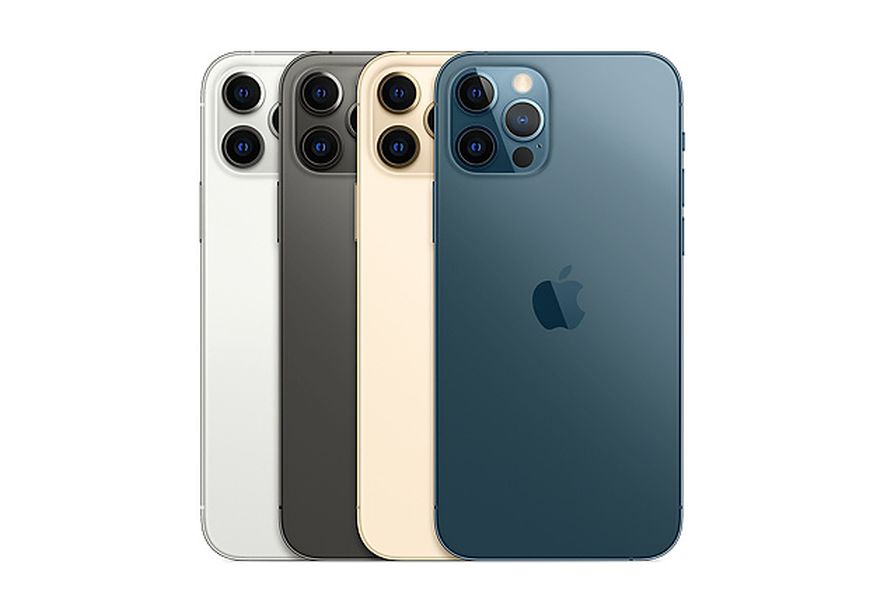
Despite initial projections, the iPhone 12 series have seen a robust demand that beat previous estimations. Furthermore, the iPhone 12 Pro and iPhone 12 Pro Max demands are higher than anticipated, while the iPhone 12 and iPhone 12 Mini demand was rather tame and under performing in comparison. All in all, the 2020 iPhone series is seeing strong sales, with the momentum only seeking to be carried forward due to the holiday season that would continue on to 2021, as per a GSMArena report.

Similarly, the latest iPad Air is also facing demands that were higher than expected, which is also projected to carry forward into 2021. This also arrived as rumors and reports have pointed towards Apple launching new iPads with miniLED displays, 5G support, and a new lower priced iteration as well sometime in the second half of next year. Even the Apple Watch Series 6 and Apple Watch SE are both seeing healthy sales as well.

Apple
13-inch MacBook Air with M1 Chip (Gold)

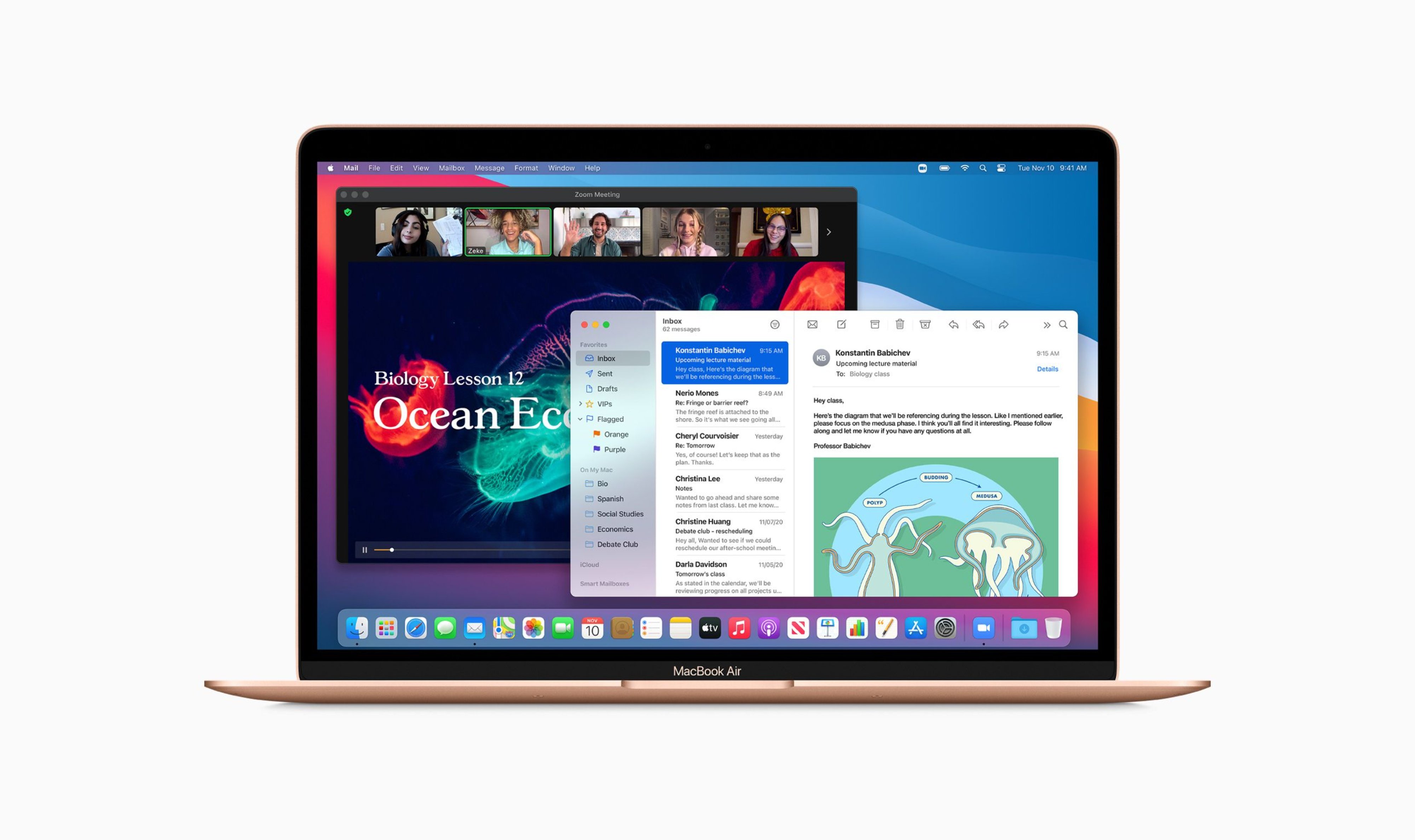
Lastly, the newly launched MacBook lineup with the company’s in house ARM based M1 Chip are also seeing demands that surpass expectations. The new MacBooks are the first to feature Apple Silicon, with 2021 expected to have the company launch newer models with new designs as well. These new models will reportedly arrive sometime in the second half of next year.


Motorola “Nio” flagship may sport an unusual 105Hz screen

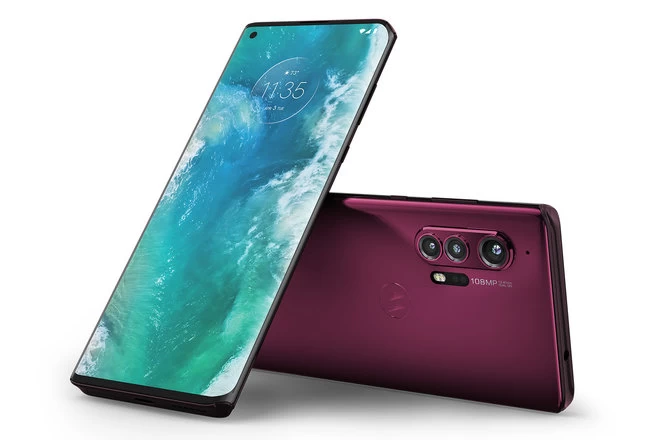
A German publication recently revealed that Motorola will be unleashing its first flagship of the year 2021 by Q1. The device is codenamed “Nio” and its final marketing name is yet to surface. The publication also shared the key specs of the Motorola Nio. The report claimed that the phone is equipped with a 90Hz refresh rate screen. A tweet by XDA Developers Mishaal Rahmaan that the Motorola Nio may support an unusual refresh rate of 105Hz.

Before the ROG Phone 3 gaming smartphone went official, ASUS was found testing a 160Hz refresh rate mode on the device. However, the final device came with support for a 144Hz refresh rate. Rahmaan revealed that the Lenovo-owned brand is testing a default peak refresh rate of 105Hz for the Motorola Nio. He has speculated that the company could be simply testing a higher refresh rate as ASUS did on the ROG Phone 3. The final handset may come equipped with a 90Hz refresh rate.


Motorola Edge+
Motorola Edge+

Motorola Nio specifications (Rumored)

The Motorola Nio’s display produces a Full HD+ resolution of 1080 x 2520 pixels. While the size of the screen is not known, it is revealed that it has a punch-hole cutout for its dual front-facing cameras. The dual selfie camera system of the phone has a main camera of 16-megapixel and an 8-megapixel second lens.

There is a triple camera system on the backside of the Motorola Nio. It features a 64-megapixel primary shooter, a 16-megapixel ultrawide lens, and a 2-megapixel depth assist lens. The smartphone is loaded with Android 11 OS and it is backed by a 5,000mAh battery.

The Snapdragon 865 mobile platform is present under the hood of the mysterious flagship phone. It is expected to arrive with 8 GB of RAM and 128 GB of storage. There could be a second model featuring 12 GB of RAM and 256 GB of storage. The model number of the handset is XT2125.


Apple MacBook Pro might see significant gains with next M1 chip

Apple is currently in the phase of shifting its entire notebook offering from Intel based processors to its custom built ARM chips. The company launched its latest lineup of MacBooks, which featured the new M1 chip, earlier this month and, now, a new report suggests that the 2021 MacBook Pro might see a significant performance uplift through a new successor to the M1 chip.

MacBook Pro with M1 chip
2020 MacBook Pro with M1 chip

According to a TechRadar report, the Cupertino based giant is now readying to launch its upcoming 2021 MacBook Pro 16 inch with the new M1X chip. There were many reasons Apple had decided to shift to its own in house chips, like having a higher degree of optimization, lesser reliance on Intel’s update cycle for next gen chips, and others. The latest MacBook Air and MacBook Pro 13 inch have arrived with the new M1 chip and would be the first of many future launches to feature the company’s custom chips.

A tweet from known leakster LeaksApplePro on Twitter revealed a few crucial details regarding the next gen Apple Silicon. As per the tweet, the Apple M1X chip will feature 12 cores, comprising of 8 performance cores and 4 high efficiency cores. It would arrive on the 16 inch MacBook Pro and will soon be unveiled in a press release. Notably, a source that had used a prototype even added that, “if you think M1 is fast, you haven’t seen M1X.”

Unfortunately, this is still an unconfirmed report and it is still too soon to provide any concrete statements. At the moment, the name of the upcoming chip and the exact performance uplifts it would offer is also unknown. We would have to wait for an official announcement or the press release from the company to know for sure. So, stay tuned for more updates.


Scientists build ‘anti-laser’ device to charge devices from across the room

Charging technology for smartphones has been improving and finally, some companies have introduced super-fast wireless charging technologies, which had been quite slow until now. In line with that development, it seems that charging a smartphone from across the device could also be possible.

Scientists have developed a new device named “anti-laser” which is claimed to be able to perfectly beam energy across any room. This invisible beam energy can power a phone or laptop across the room without plugging it in.

Panasonic Eluga X1 Pro wireless charging

EDITOR’S PICK: DxOMark Speaker: Google Nest Audio smart speaker scores 112; Yamaha MusicCast 50 scores 136

Similar to how a laser emits light particles or photons one after another in an orderly row, this new anti-laser device works exactly the opposite of that. It sucks up photons one after another in reverse order.

In a demonstration of this technology, scientists showcased anti-lasers receivers being able to receive around 99.996 percent of the sent power, even during situations like electronics moving around, objects getting in the way, and more.

The method, which is being termed as Coherent Perfect Absorption (CPA), uses one machine to send power and another to receive it. However, there’s one major limitation to this. It requires time-reversal symmetry which only happens in systems without much entropy. This new CPA method used magnetic fields to jostle photos so aggressively that the time-reversal symmetry was lost.


Redmi Watch is launching tomorrow in China

Redmi fans are eagerly waiting for the arrival of the company’s first smartwatch. Past reports have revealed that the alleged Redmi Watch will be a rebranded version of the forthcoming Xiaomi Mi Watch Lite. Tomorrow at 8 PM (local time) in China, Redmi will be taking off covers from the Redmi Note 9 5G smartphones. The company has confirmed that it will be unleashing a smartwatch at the same event.

The poster released by Redmi showcases the upcoming smartwatch with a square-shaped screen. The company has claimed that it is a lightweight device.

The Mi Watch Lite’s FCC certification from last month revealed that is its model number is REDMIWT02. A device with REDMIWT01 model number was approved by the MIIT authority of China in August. Hence, it appears that REDMIWT02 and REDMIWT01 could be identical devices.

Redmi Watch teaser

The FCC listing of the device had revealed that it has a 1.4-inch square-shaped color display. It houses a 230mAh battery with 5W charging support. The device is compatible with Android 4.4 or higher and iQS 10 or above devices.

The smartwatch will offer users multiple fitness models and 24-hour heart rate tracking. The 50ATM water-resistant device has a swimming stroke recognition feature. Other features of the wearable tech include Bluetooth and built-in standalone GPS.  The other specifications of the device are under wraps.

Right at the beginning of this year, a Redmi smartwatch was spotted in a listing at the Bureau of Indian Standards (BIS). Hence, it is likely that the smartwatch may also go official in India in the forthcoming months.

In related news, the Redmi Note 9 5G series launch event will see the arrival of two Redmi Note 9 series phones with 5G support and a 4G-ready Note  9 smartphone.


Eluktronics launches world’s first gaming laptops with 1440p 165Hz display

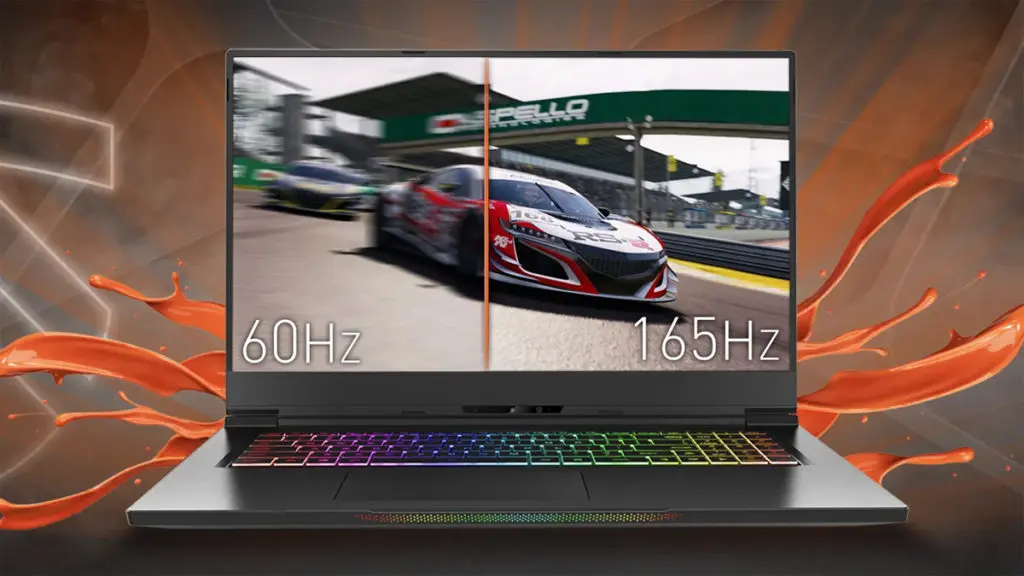
Eluktronics has launched a new laptop in the market which the company claims is the world’s first to come equipped with a high-quality IPS 1440p display that offers a 165Hz refresh rate. It has also been confirmed that the display panel of this new laptop has been built by China-based BOE.

This display panel offers a maximum brightness of 318 nits and also offers 100 percent sRGB coverage and 87 percent Adobe RGB coverage. Thanks to the high refresh rate, the screen response time is 2.5ms, making it suitable for high paced games.

Eluktronics 165Hz Laptops

The company has introduced three variants, all of which are powered by the Intel Core i7-10870H processor. Similar to all the new Eluktronics laptops launched recently, this one too comes packed with NVIDIA RTX 2070 SUPER graphics processor.

Here are the details of the three different models launched by the company.

Eluktronics MECH-15 G3 QHD Edition

  • 15.6-inch 1440p 165Hz Display
  • Intel Core i7-10870H CPU with Liquid Metal
  • NVIDIA GeForce RTX 2070 Super GPU
  • 16GB DDR4 RAM
  • 1TB PCIe
  • Mechanical Per-Key RGB Keyboard
  • Massive 94WHr Battery

EDITOR’S PICK: Apple’s new Mac devices powered by the M1 chipset face Bluetooth connectivity issues

Eluktronics MAX-15 QHD Edition

  • 15.6-inch 1440p 165Hz Display
  • Intel Core i7-10870H CPU with Liquid Metal
  • NVIDIA GeForce RTX 2070 Super GPU
  • 16GB DDR4 RAM
  • 1TB PCIe
  • Weighs 3.82Lbs

Eluktronics MAX-17 QHD Edition

  • 17.3-inch 1440p 165Hz Display
  • Intel Core i7-10870H CPU with Liquid Metal
  • NVIDIA GeForce RTX 2070 Super GPU
  • 16GB DDR4 RAM
  • 1TB PCIe SSD
  • Weighs 4.81Lbs
  • Massive 91WHr Battery

Pricing for these laptops range from $2199 to $2299 and the company is currently offering a promotion of a $300 discount with coupon code BFQHD. It remains to be seen if the company is planning to launch AMD-powered variants of these devices.


COUMI ANC-860 ANC Wireless Earbuds Review: Decent Sound with Noise-canceling

By now, most of us have become familiar with ANC TWS earbuds. And almost all of the popular manufacturers have come out with their own flagship ANC wireless earbuds in the market. While they each have their own features, one thing is common among these earbuds — they’re expensive. And even the cheapest Xiaomi Mi Air2 Pro featuring ANC will set you back around 699 RMB ($105). But what if you don’t want to pay a hefty premium for ANC earbuds? Then you can take a look at some niche brands like COUMI which has launched cheap wireless earbuds called ANC-860.

Coumi TWS review 01

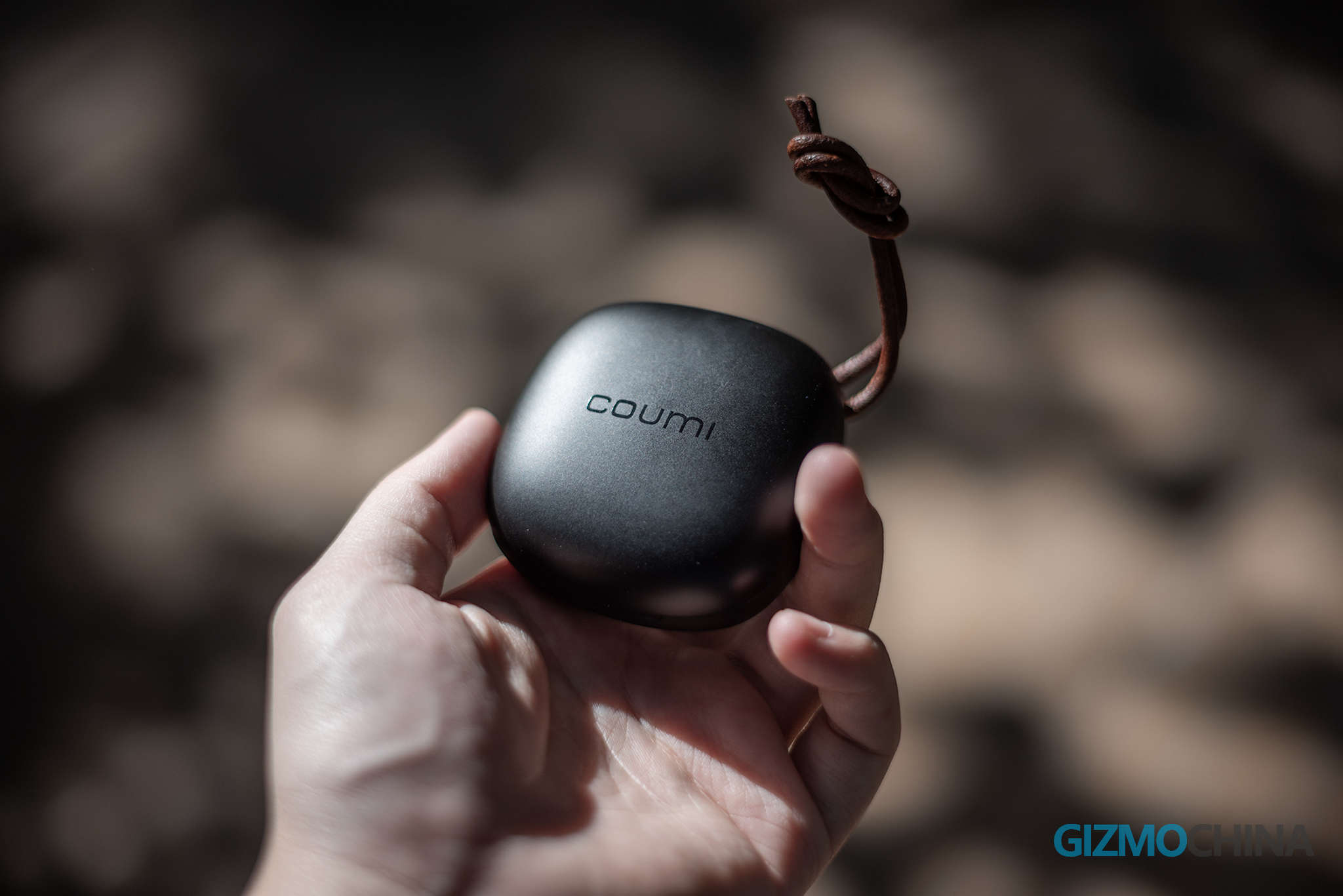
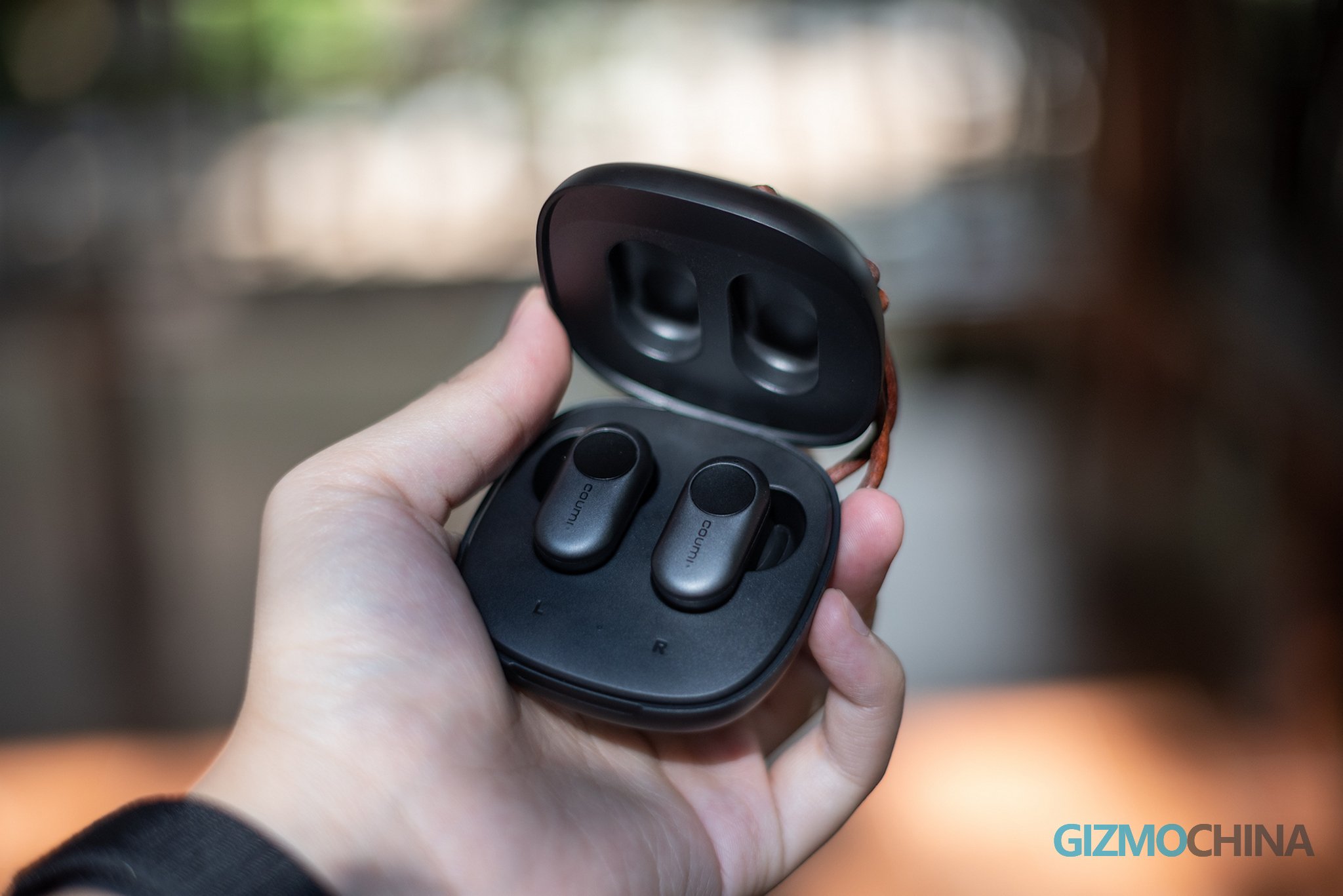
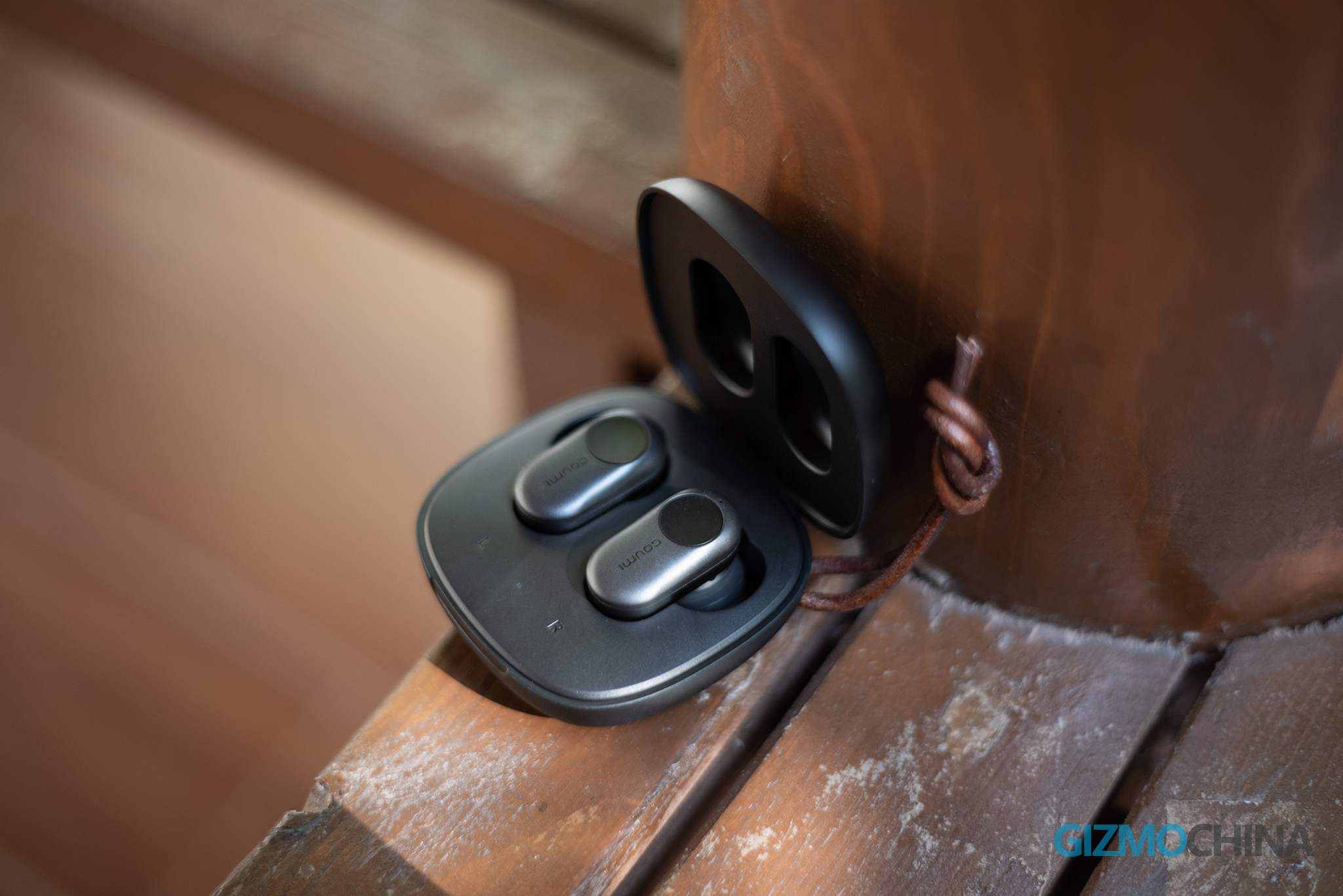
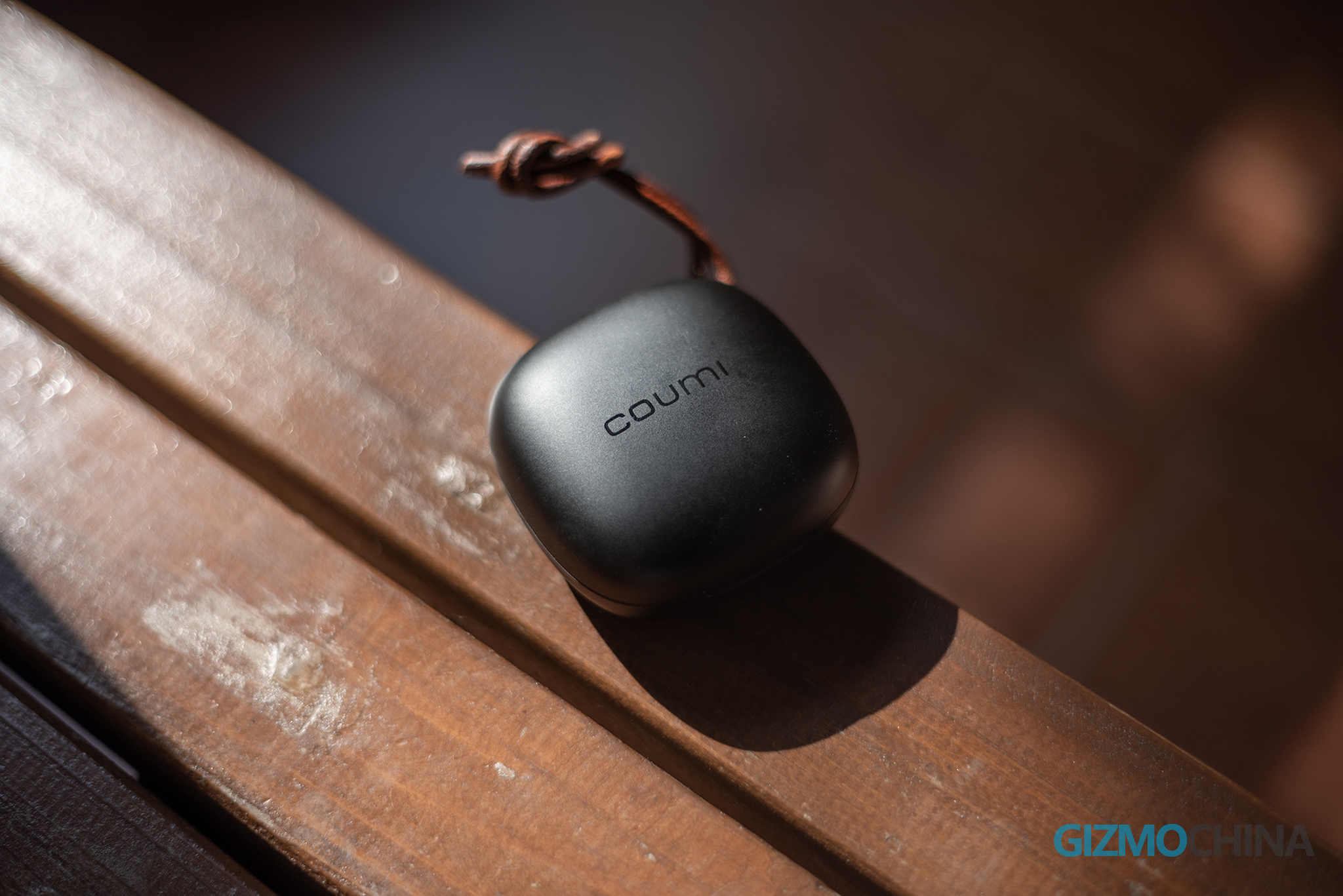
As usual, let’s start with the design. At first glance, there’s no doubt that the COUMI ANC-860 box is big. But its not just regular big, it’s kind of huge for its product segment. Its bigger than the case of the Xiaomi Air2 pro we’ve tested before and if you remember, we called that case bulky. Plus unlike other earbuds, the COUMI ANC-860 doesn’t have a magnetic case. So you have to manually pull up the case lid, making it nearly hard to open it with one hand.

Coumi TWS review 03

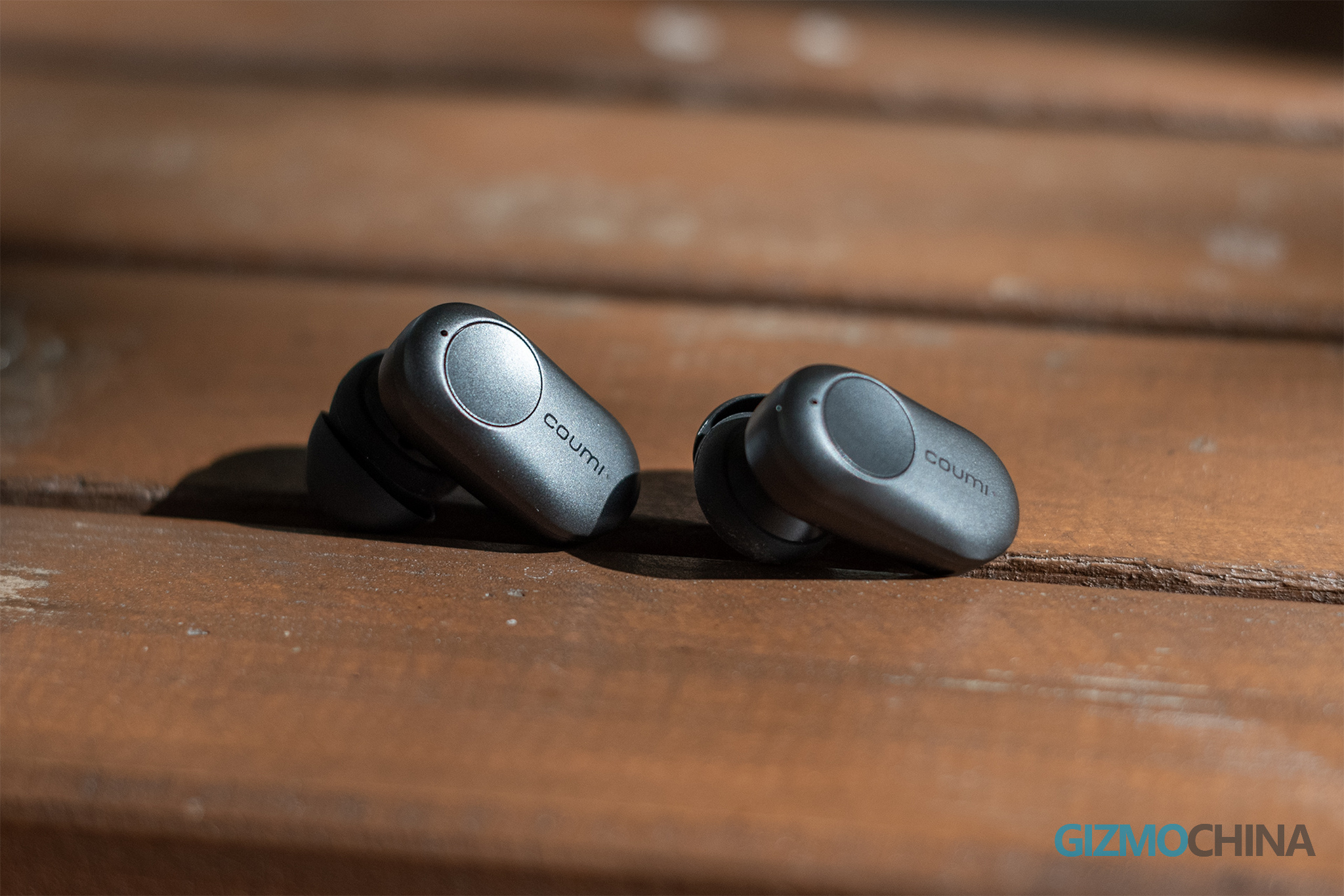
The oval shape of the COUMI earbuds makes it look like Sony’s WF-1000XM3, but it’s actually very different from WF-1000XM3’s design. First of all, in this model, when you wear the earbuds, the oval exterior of the earbuds stays vertical, unlike in Sony’s model where it’s horizontal. Secondly, it wears fixed in a different way. The ANC-860 hangs against the ear canal. The same way as the half-in-ear earbuds is fixed. Yeah, it can take off its in-earbuds cover, and you can see that the earbuds are actually half in-ear design. And people who don’t like in-ear earbuds can remove the cover and use them as half in-ear earbuds without any problem. Except maybe a little lower volume.

Coumi TWS review 04

Because of the oval design of the earbuds, so the noise-canceling function is just average performance. Also, the large oval design tends to be heavy and sometimes falls off when worn outside. So the best use case scenario for this pair of earbuds is not outdoors, but indoors.

Coumi TWS review 06

It has no app controls, and all your earbuds control needs to be done on the earbuds. You can double click on the left ear to switch modes between Noise canceling on, Transparency mode, and Noise-canceling off. Single left or right earbud tap increases or decreases the volume or answers/hangs up calls. Double click on the right earbud to play or pause music. Long press left or right earbud for two seconds to play the previous song or the next one, or you can reject calls with this gesture. Left or right ear long press for one second to wake up the Smart voice assistant.

Wait, doesn’t this feel like an overload of instructions? When it comes to functionality it meets all your requirements, but the learning curve is long. So don’t bother memorizing all the controls. Just remember the important controls, that should be enough.

In the noise-canceling mode, the earbuds last for about 5.5 hours, which is good for mainstream noise-canceling earbuds. Incidentally, it doesn’t have the ability to automatically pause when you take off the earbuds.

Coumi TWS review 02
Coumi TWS review 02

The COUMI earbuds support AAC codec.The sound quality is good in this protocol. And the low and mid frequencies are relatively strong. But the latency of this protocol is quite high. Maybe around 0.8s delay while gaming, so these earbuds are not recommended for gaming on AAC. If you switch back to SBC, it will reduce the latency a lot, and then you can play games with minimal lag.

Coumi TWS review 07

So we cannot recommend the COUMI ANC-860 as noise canceling ANC earbuds. But as normal earbuds, it’s not bad. You can use it as in-ear earbuds or as half-in-ear earbuds with a noise-canceling mode bundled with it. It sells for around $60 on Amazon. There is a 10% coupon along with 40% OFF code LYRAT7J3 to grab it with 50% off on Amazon.  So if you’re using the earbuds at home or in an office where you don’t need to exercise, and the noise isn’t very loud, it’s still capable of meeting your requirements.

Alleged OPPO Reno5 Pro key specs appear at TENAA; Mysterious PEMM00 with MT6833 spotted at Geekbench

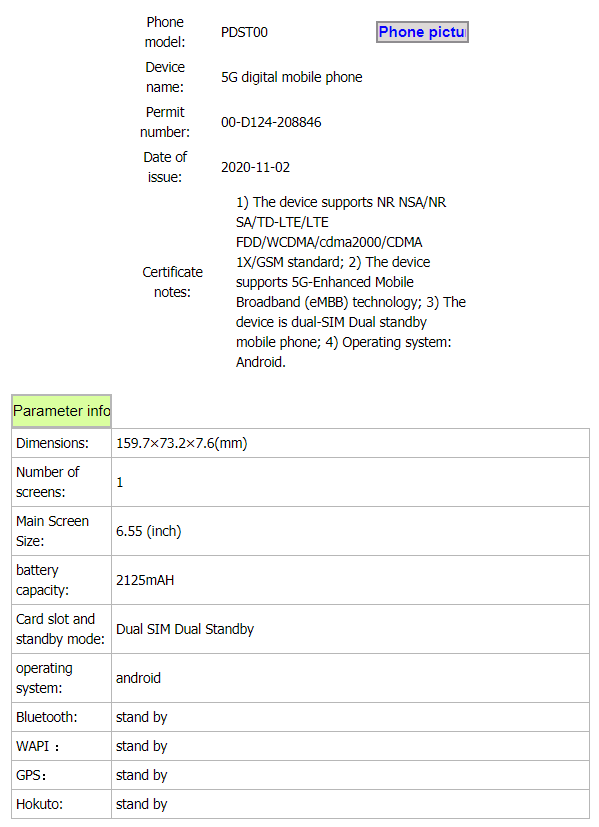
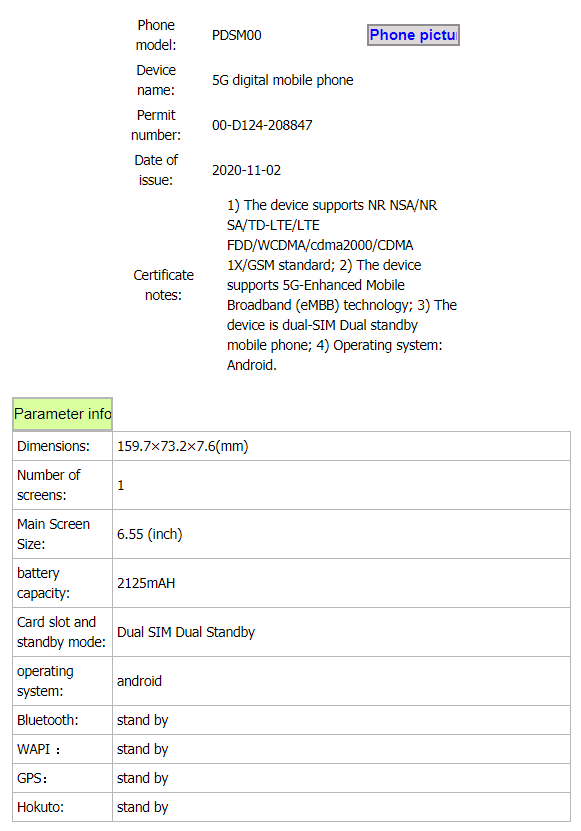
Recent reports have revealed that the PEGM00 / PEGT00 TENAA certified OPPO phone is the upcoming Reno5 Pro. A new OPPO phone with model number PDSM00 / PDST00 has appeared in the database of TENAA. It is speculated that it could be the Reno5 Pro.

Recently, the PDSM00 / PDST00 phone was spotted at the Geekbench benchmarking platform with Dimensity 1000+, 8 GB of RAM, and Android 11 OS. Rumors have it that it is equipped with support for 65W fast charging.

At present, the TENAA listing of the OPPO PDSM00 / PDST00 has only a few details such as 159.7 x 73.2 x 7.6mm dimensions, a 6.55-inch display, a 2,215mAh dual-cell battery, and 5G support. The alleged Reno5 Pro’s TENAA listing is expected to get populated with its image and specifications soon.

It is speculated that the OPPO PDRM00 could be the Snapdragon 865 mobile platform powered Reno5 series flagship. Its 3C appearance revealed that it may ship with a 65W fast charger.

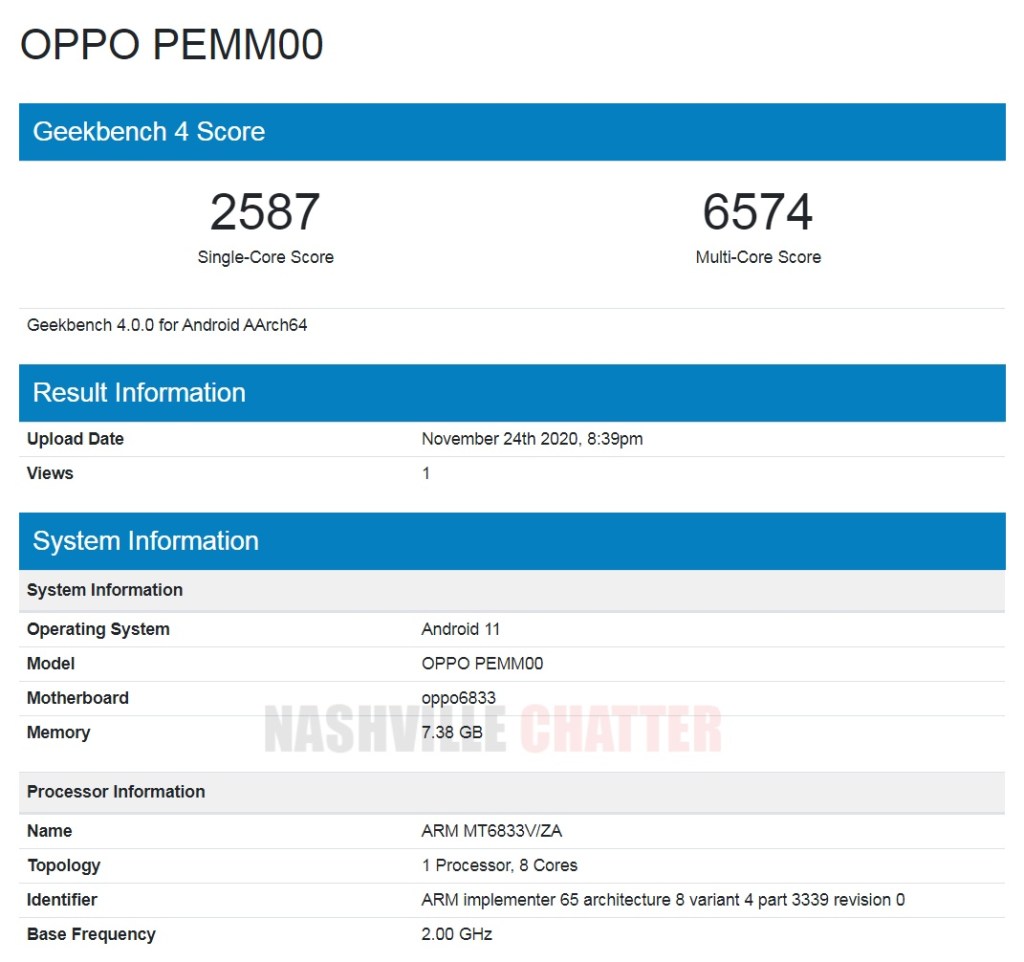
In related news, the Chinese brand could be working on a new smartphone that has a model number of PEMM00. The device has appeared on Geekbench with an unknown MediaTek chipset.

At Geekbench (via), the OPPO PEMM00 smartphone has appeared with a new MediaTek chipset that is mentioned as MT6833. It is unclear whether the SoC carries support for 5G connectivity. There are speculations that it could be a 12nm SoC. The listing reveals a base frequency of 2.0GHz. The mysterious device has scored 2857 in the single-core test and 6574 in the multi-core test.

Oppo-PEMM00-Geekbench The listing reveals that the MT6833 chipset is coupled with 8 GB of RAM. Also, the device is loaded with the latest Android 11 OS. There is no information on the final marketing name of the OPPO PEMM00 smartphone. Hopefully, newer reports will reveal its identity.

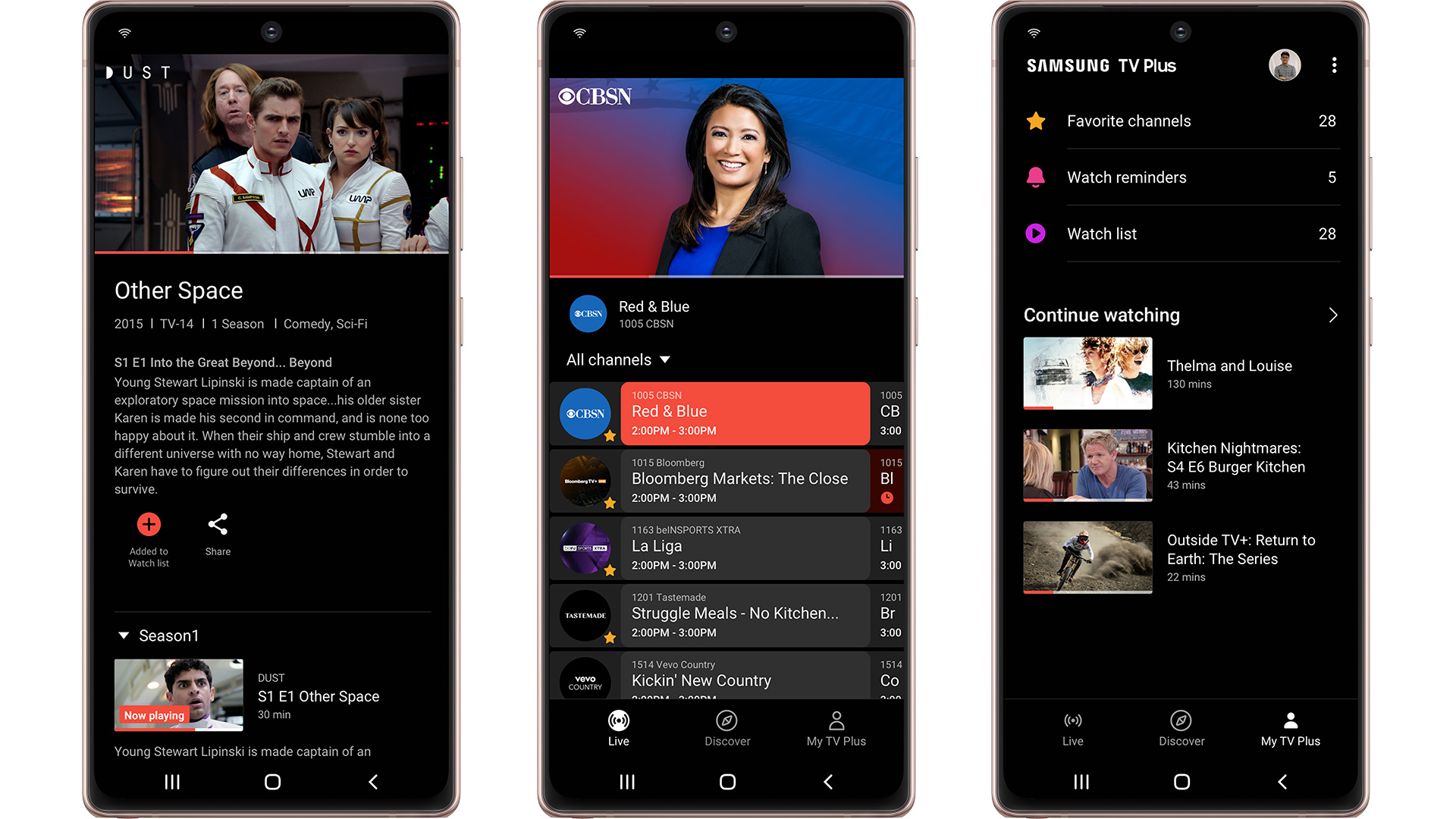
 

Samsung rolls out the free TV Plus app for more Galaxy phones including the A series

Samsung first launched the TV Plus as a video rental service in the U.S. in 2016, while at the same time experimenting with ad-supported videos in its homeland of South Korea. The service was first made available for the firm’s smart TVs from 2016 upwards but has been expanded to its smartphones.

Samsung is now rolling out the free TV service to all three Samsung foldable devices which include the Galaxy Fold, Galaxy Z Fold 2, and the Galaxy Z Flip. The service will also roll out to the Galaxy S9, Galaxy Note 9, and some Galaxy A series handsets. An explicit list of supported devices is yet to be posted by Samsung on its website but the Galaxy Store and Google Play Store listings of the Samsung TV Plus app shows that the Galaxy A51, Galaxy A51 5G, and Galaxy A71 5G are the three Galaxy A series phones gaining support for the app. Also among the supported devices is the rugged Galaxy Xcover Pro.

Samsung TV Plus has already been made available to the latest Galaxy S series models including the Galaxy S20, Galaxy S10, Galaxy Note 20, and Galaxy Note 10 series devices earlier in September. The latest addition expands the free TV Plus service to most of the galaxy flagship and into the mid-range segment.Samsung TV Plus

Samsung TV Plus is a free TV service which gives users access to thousands of shows ranging from news to documentarie, entertainment and others across a selection of over 150 channels. The Samsung TV Plus smartphone app is currently only available in the US. You can download the app from the Galaxy Store or the Google Play Store.

UP NEXT: Oppo X 2021 unveiled as the world’s first smartphone concept with an extending display


Apple’s new Mac devices powered by the M1 chipset faces connectivity issues

Apple recently launched its new M1 chipset as a part of Apple Silicon which is based on ARM architecture. It also launched three devices powered by the same — MacBook Air, MacBook Pro, and Mac Mini, officially kicking off the transition from Intel to Apple Silicon.

It has been about a week since the devices are available in the market and now some users are complaining about Bluetooth connectivity issues, which range from sporadic disconnections with peripherals to complete failures.

Apple m1 chip

EDITOR’S PICK: Xiaomi Q3 2020 financial report reveals that the company recorded 46.6 million shipments

If the reports coming from users on Reddit are to be believed, then the devices powered by the new Apple M1 chipset faces intermittent connectivity issues with both first- and third-party peripherals, including mice, keyboards, and headphones. Analyst Patrick Moorhead has also shared these issues on Twitter.

As of now, there’s information about how many M1-powered devices are impacted by this issue. Also, Apple is yet to confirm this Bluetooth-related connectivity issue.

Another set of users are also complaining about battery life, disputing the claim made by Apple. At the time of launch, the company had said that the new MacBook Pro powered by the M1 chipset can offer up to 20 hours of battery life.

Some users are saying that they are only getting around five hours of usage before the battery life drops to 10 percent. However, we will have to wait for more reports related to such issues to determine if the problem is limited to specific devices or not.