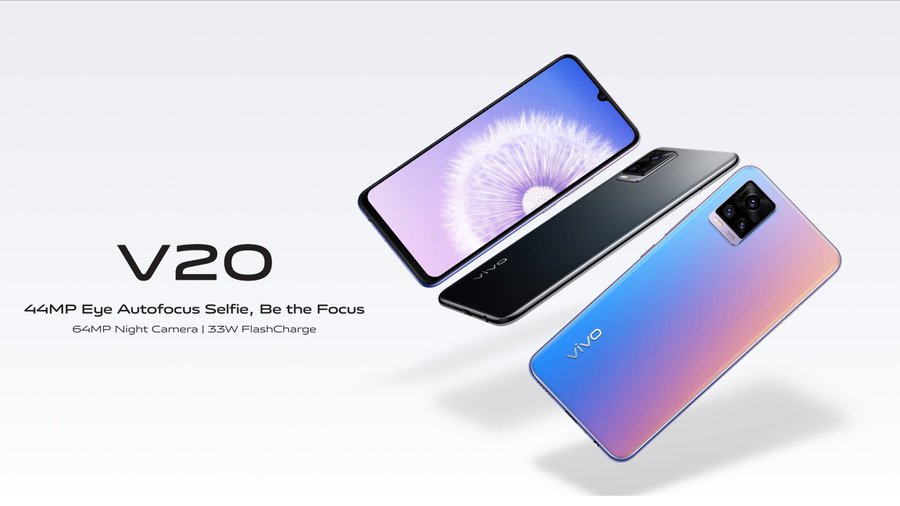
Earlier this week, a promo page appeared on Flipkart that confirmed that the Vivo V20 will go official in India on Oct. 13. The Vivo V20 series has recently launched in a couple of Southeast Asian markets. The lineup includes three devices such as the Vivo V20, Vivo V20 Pro, and Vivo V20 SE. However, it appears that the Chinese firm will be launching only the Vivo V20 in India on Oct. 13 and the other V20 series phones may arrive later. Popular tipster Ishan Agarwal has speculated on the pricing of the Vivo V20 for India.
According to the tipster, the Vivo V20 might be priced at Rs 24,990 (~$343). The handset will be replacing the Vivo V19 phone that will be replacing the Vivo V19 handset that had arrived in May with a price tag of Rs 27,990 (~$383).
The Vivo V20 has a 6.44-inch AMOLED screen with a waterdrop notch. The 20:9 aspect ratio supporting display produces a full HD+ resolution of 1080 x 2400 pixels. The Snapdragon 720G chipset is present under the hood of the device. It comes with 8 GB of RAM, 128 GB of internal storage, and a microSD card slot.
The smartphone comes preinstalled with FunTouch OS 11 based Android 11 OS. It has impressive eye autofocus enabled 44-megapixel selfie camera. The rear camera setup of the Vivo V20 has a 64-megapixel main camera, an 8-megapixel ultrawide shooter, and a 2-megpaixel mono lens.
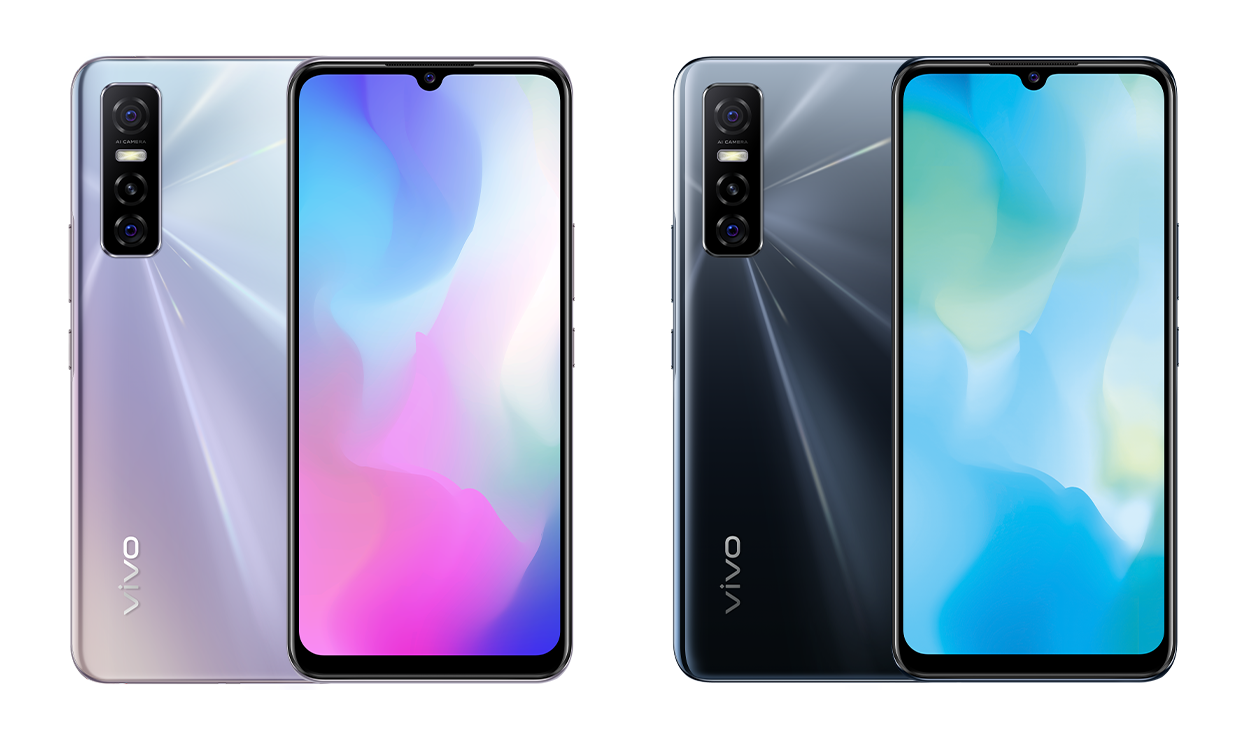
The Vivo V20 has a 4,000mAh battery with 33W fast charging support. It also features an in-display fingerprint scanner. The above poster shows the phone in black and gradient blue color options. It will be available for purchase through Flipkart in the country.
Earlier this week, Samsung unveiled the Galaxy F41 smartphone in India. Priced at Rs 16,999 (~$233), the F41 is exclusively available for purchase through Flipkart in India. Samsung is gearing up to begin with the sales of the upcoming Galaxy M31 Prime Edition through Amazon India in the country. The promo page for the phone is now live on the retailer site. The updated page now reveals that the Galaxy M31 Prime Edition has a starting price of Rs 16,499 (~$226). The handset is expected to go on sale in India.
Samsung Galaxy M31 Prime Edition price in India
The Galaxy M31 Prime Edition has a starting price of Rs 16,499 which belongs to the 6 GB RAM + 64 GB storage edition. The promo page mentions that the phone will also come in 128 GB storage version. At present, there is no word on the pricing of the 128 GB variant.
The Prime Edition phone comes with a complimentary 3 months membership of Amazon Prime. The above-shown image shows that the phone gives one-swipe access to Amazon app. The listing still mentions that it is “coming soon.” The phone is expected to go on sale in India through the Great Indian Sale that is set to begin on Oct. 17 in India through Amazon India. Prime users will have early access from Oct. 16.
The entire specs of the Galaxy M31 Prime Edition are known yet. It has an Infinity-U notch enabled S-AMOLED display and a rear-facing fingerprint scanner. It has a front camera of 32-megapixel and a 64-megapixel + 8-megapixel (ultrawide) + 5-megapixel (macro) + 5-megpaixel (depth) quad-camera setup with 4K video recording support.
The Exynos 9611 chipset fuels the Galaxy M31 Prime Edition with LPPDR4x RAM. The phone houses a 6,000mAh battery with 15W fast charging support. It is expected to arrive in three colors such as Ocean Blue, Space Black, and Iceberg Blue.
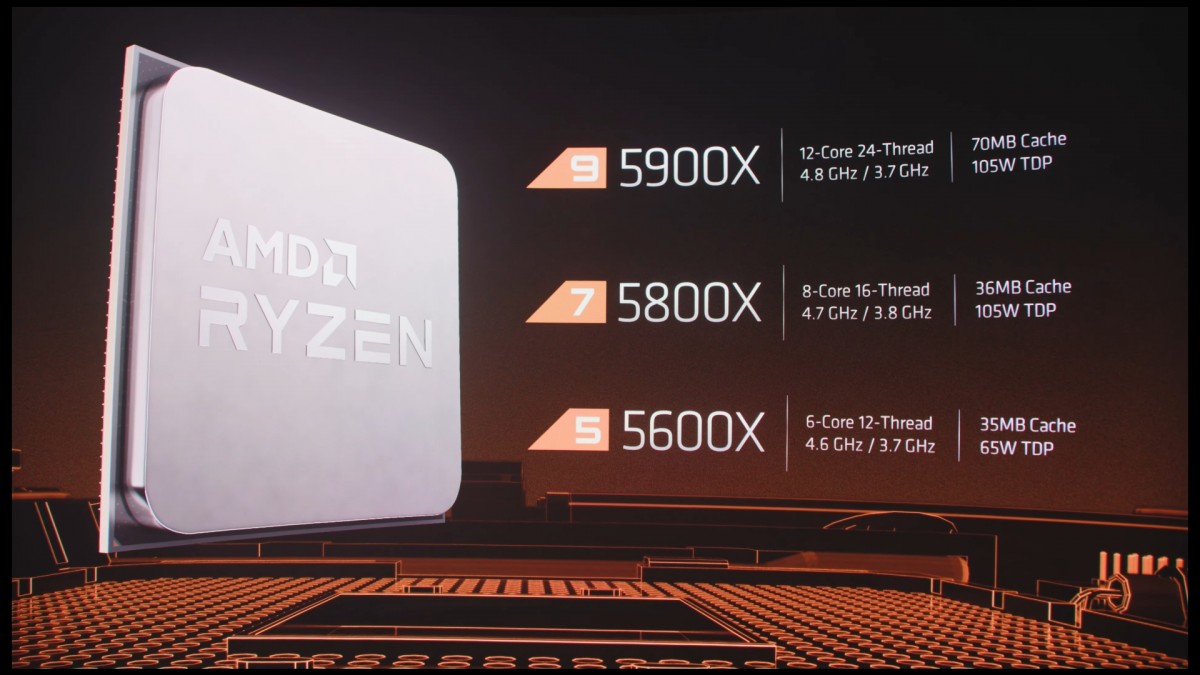
Desktop PCs were thought to have outlived their relevance but in recent times,a number of products have come to dismantle such opinions. One of such products is AMD‘s latest desktop processors. The Ryzen 5000 series of CPUs was announced by the company yesterday, and it is manufactured based on its latest Zen 3 architecture. A totla of four new models were outed with the prices ranging from $299 to $799, effectively putting an end to the idea of AMD processors being cheaper alternatives.
At the the helm is the new Ryzen 9 5950X featuring 16 cores and 32 threads. The 5950X has a base clock frequency of 3.4GHz and a boost clock speed of 4.9GHz. The company claims this SoC possesses the highest single and multi-threaded performance of any mainstream desktop CPU. The L3 cache spread across its two chipsets is up to 64MB and it equally has a TDP of 105W.
The 5950X is a successor of the previous-gen Ryzen 3950X and is priced at $799. The price is just $40 higher than that of the 3950X which is priced at $749. It is well suited to take on the 18-core Intel Core i9-10980XE.
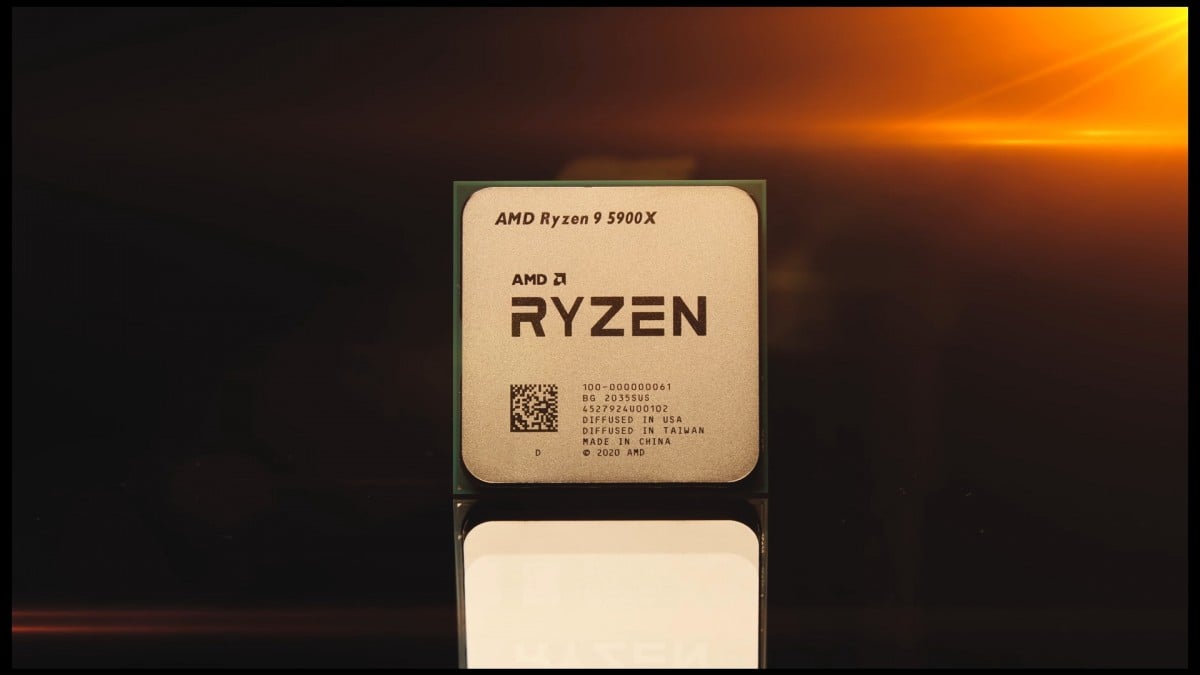
The second model is the Ryzen 9 5900X. The new processor comes with a 12-core architecture with 24 threads. The chipset has abase clock spoeed of 3.7GHz and a boost clock speed of 4.8GHz. The chipmaker touts this CPU as the best gaming CPU on the market. The Ryzen 5900X equally has 64MB of L3 cache spread across two chiplets and a TDP of 105W, just like the 5950X.
However, the Ryzen 9 5900X which replaces the $499 Ryzen 3900X, comes in at a lower price of $549. It will take on the 10-core Intel Core i9-10900K.
The third model in the series is the Ryzen 7 5800X, equipped with 8 cores and 16 threads. The 5800X can achieve a base clock of 3.8GHz and a boost clock of 4.7GHz. The CPU utilises a single chiplet design with the 8 cores and full 32MB cache on the single CCX. It also has a TDP of 105W.
AMD’s Ryzen 7 5800X comes with a price tag of $449 and will take on the 8-core Intel Core i7-10700K.
The last but not the least, is the Ryzen 5 5600X, which has 6 cores and 12 threads. The desktop CPU which is the cheapest among the lot, has a base clock of 3.7GHz and a boost clock of 4.6GHz. It also utilises a single chiplet design and has 32MB of L3 cache but the TDP is reduced to 65W. The 5600X is the only one out of the lot that will come with a stock cooler in the box.
The Ryzen 5 5600X is priced at $299 and will take on the 6-core Intel Core i5-10600K.
The new Ryzen 5000 series will be on store shelves from November 5. The CPUs will all be compatible with all motherboards running B550 and X570 chipsets at launch.
A budget-friendly Vivo smartphone named the Vivo Y73s 5G has gone official in China. The model number of the device is V2031A and it was seen in the database of China’s TENAA regulatory body last month. The Vivo Y73s is Vivo’s first smartphone to be driven by the Dimensity 720 chipset. Some of its highlights include a tall aspect ratio screen, 48-megapixel triple rear shooters, and a decent battery with 18W fast charging support.
Vivo Y73s 5G specifications and price
The Vivo Y73s 5G has a 6.44-inch AMOLED display with a waterdrop notch. It supports 1080 x 2400 pixels full HD+ resolution, a 20:9 aspect ratio, 103 percent NTSC color gamut, HDR10, and an in-screen fingerprint sensor. The phone offers a screen-to-body ratio of 90.1 percent.
The Dimensity 720 chipset with 8GB of LPDDR4x RAM and 128GB of UFS 2.1 storage drives the Vivo Y73s 5G. The device lacks support for a microSD card slot. The Android 10 OS along with FunTouchOS 10 comes preinstalled on the Vivo Y73s 5G.
The Vivo Y73s 5G has a front-facing camera of 16-megapixel with f/2.0 aperture. The backside of the phone has a 48-megapixel main camera with f/1.79 aperture, an 8-megapixel superwide lens with a 120-degree field-of-view with f/2.4 aperture, and a 2-megapixel portrait shooter with f/2.4 aperture. The phone supports photography feature such as night mode, macro shots, 10x digital zoom, EIS, and 4K video shooting,
The handset houses a 4,100mAh battery that supports 18W dual-engine fast charging through USB-C. It offers connectivity options such as dual SIM slot, 5G, Bluetooth 5.1, GPS, and a 3.5mm audio jack.
Vivo Y73s 5G pricing and availability
There is no information on whether the Vivo Y73s 5Gwill be heading to markets outside of China. In the homeland, the Vivo Y73s 5G is priced at 1,998 Yuan (~$298). It can be bought in two colors such as Silver Moon and Black Mirror.
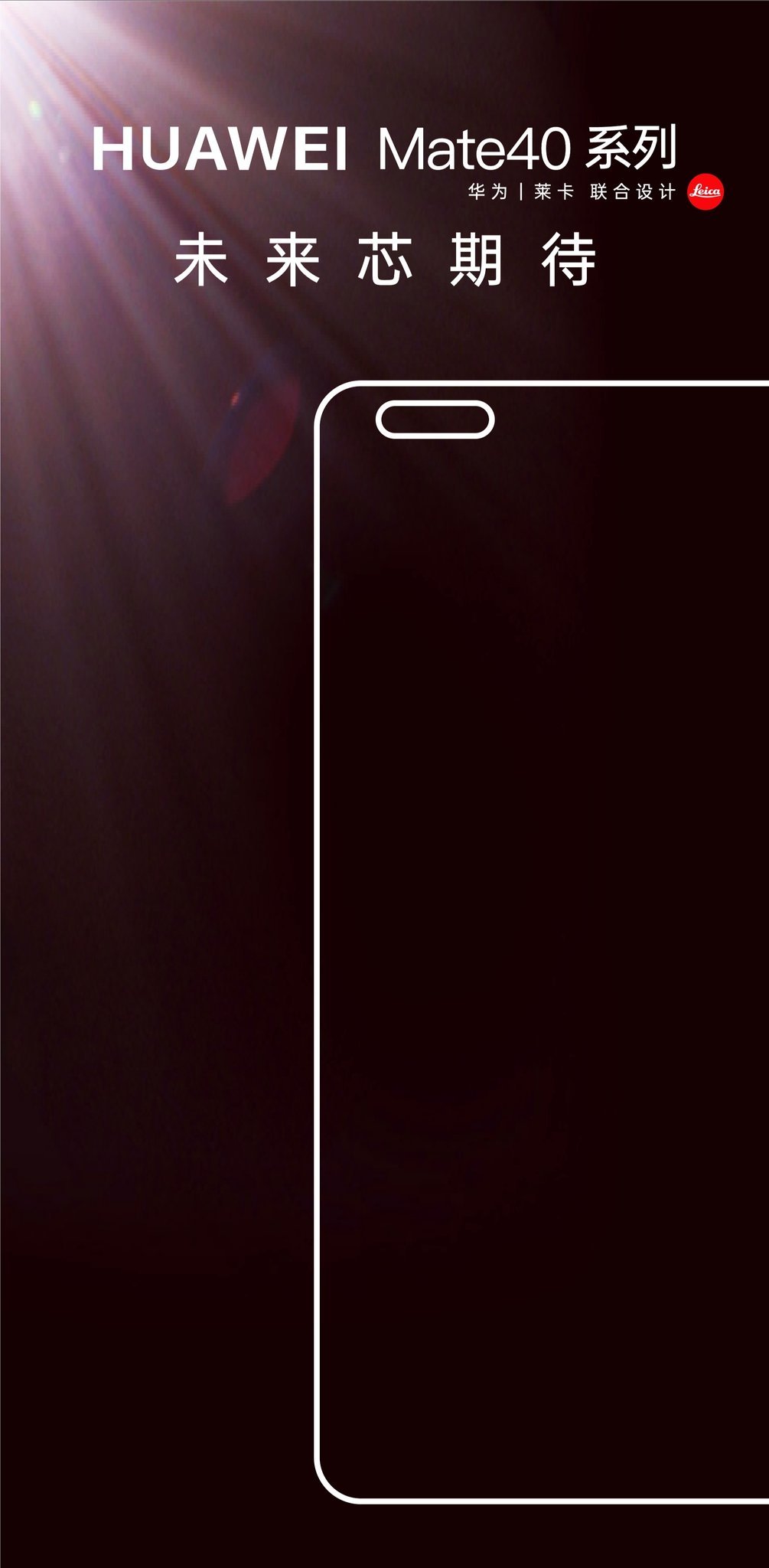
After a delay of a few weeks than previous years, Huawei has finally announced the launch date for its next Mate series smartphones dubbed as HUAWEI Mate40 series. These handsets will be officially unveiled on October 22 at 14:00 CEST. The livestream for the event should be available on Youtube, Facebook, and Twitter.
The HUAWEI Mate series has been rumored for months just like the iPhone 12 series. Also, similar to Apple, the Chinese telecom giant is expected to launch four models and they are as listed below.
HUAWEI Mate40
HUAWEI Mate40 Pro
HUAWEI Mate40 Pro+
PORSCHE DESIGN HUAWEI Mate40 RS
These phones are reported to be powered by 5nm HiSilicon Kirin chipset and hence, the slogan for the HUAWEI Mate40 series is “Leap Further Ahead”.
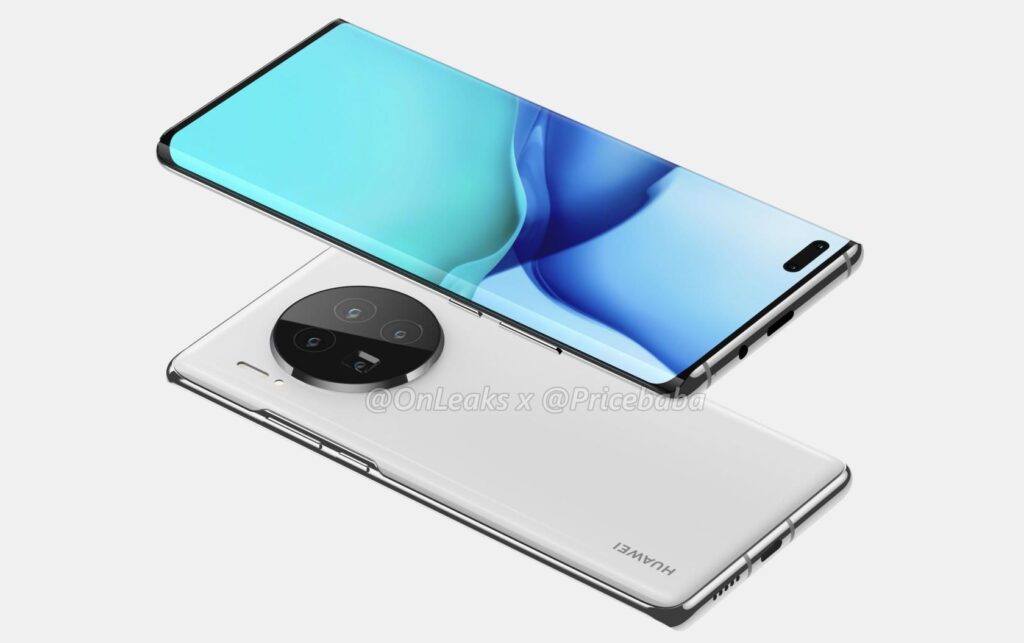
According to numerous rumors and leaks, these devices are expected to sport a similar display design as the HUAWEI P40 Pro series from earlier this year. That means these smartphones will come equipped with curved OLED display possessing a pill-shaped cutout for selfie camera as well as TOF 3D sensor for face unlock.
HUAWEI Mate40 Pro CAD Renders
Further, as per 3C and an EMUI 11 promotional video, the Mate40 series (at least the Pro models) will support 66W HUAWEI SuperCharge fast charging technology. Also, interestingly, the standard HUAWEI Mate40 may ship with EMUI 10.1 instead of the latest version.
Apart from focusing on smartphones, of late, Elephone has also been converging onto categories like smartwatches and earphones. Their latest introduction is from the latter category and is being launched by the name- Elephone ElePods X.
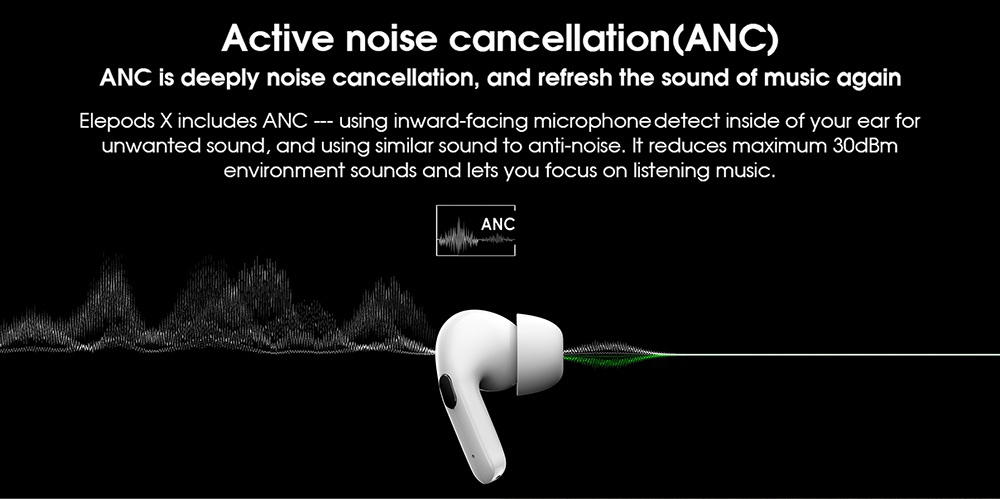
Elephone ElePods X will feature active noise cancellation (ANC) mode that lets you immerse into the world of music. ANC comes in handy when an individual needs to tune out of the surrounding noise pollution and concentrate on a task. For those who don’t know, the feature detects ambient sounds around the user to create a type of “anti-noise,” which, via interference, cancels out any exterior sound to offer optimal peace. The noise-canceling feature in headsets also helps in reducing noise-induced hearing loss (NIHL) that is an increasingly common problem caused due to the prevalence of high-intensity sound of music. Along with ANC, these earbuds will allow you to choose the noise control level that will aid in selective hearing. This attribute may also help increase the quality of your voice calls.
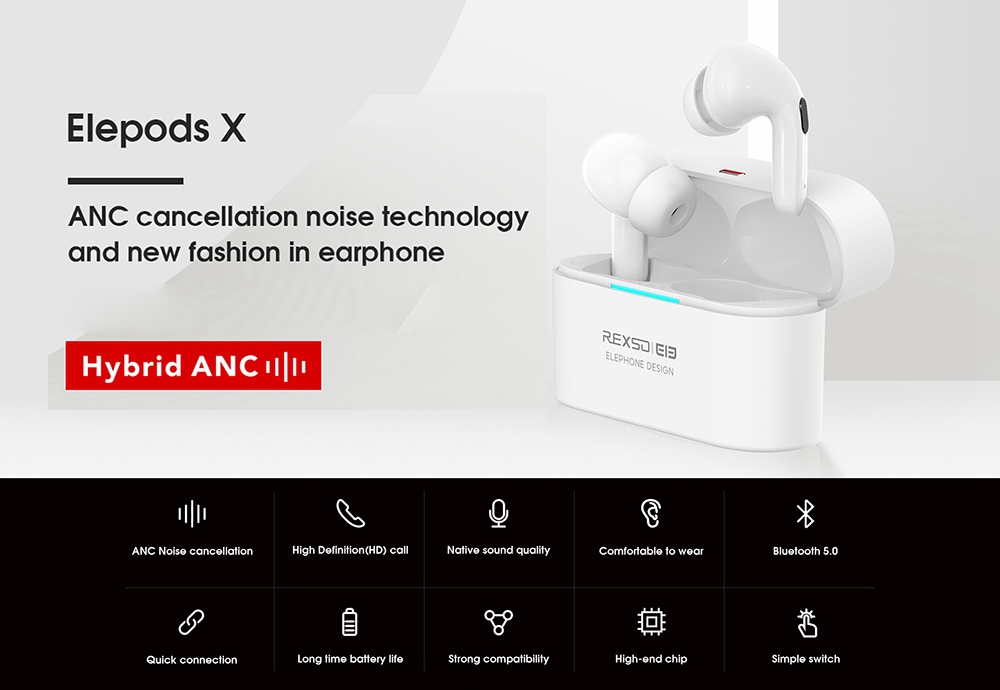
ANC is a top-notch feature and mostly comes with a hefty price range. But now, it is transitioning into budget-friendly earbuds to make it accessible for all. Zeaplus is one such brand that introduced Zeaplus Earbuds with ANC at a very reasonable price. Apart from the budget, the Elephone ElePods X will also come with a Bluetooth 5.0 connection with up to 7 hours of battery life. It will be IPX5 sweatproof as well.
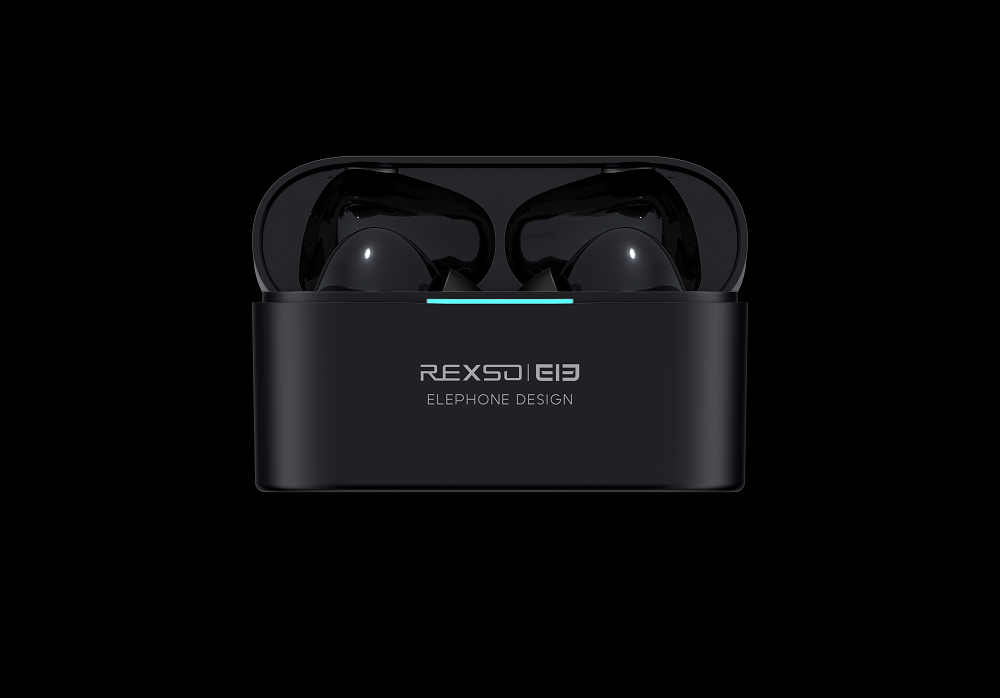
Elephone ElePods X features a straightforward and sleek design similar to other earbuds in the market. From the renders available, we can see that it comes in both black and white variants. You can check out more about the Elephone ElePods from the official website.
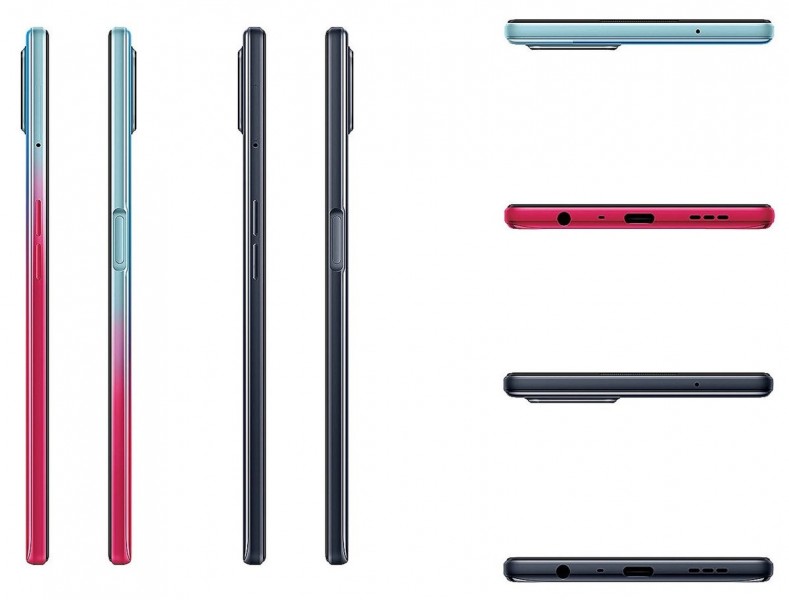
Earlier this week, OPPO silently launched the A73 which happens to be a rebadged OPPO F17. The F17 was equally launched in India last month. A 5G variant of the OPPO A73 has been spotted online, an indication that the company may soon release the 5G variant.
The specs, price and images of the device have appeared online, thanks to Twitter tipster @Sudanshu1414. It is noteworthy that the A73 5G features a different design from the non-5G variant. Also, the internal components have a few differences.
First, the OPPO A73 is powered by a Qualcomm Snapdragon 662 chipset while this 5G variant is listed as packing a MediaTek Dimensity 720 chipset. The display size is also different as this rumoured 5G variant features a 6.5-inch FullHD+ LCD screen with a waterdrop notch at the top. Surprisingly, the non-5G version packs 6.44-inch FullHD+ AMOLED screen. However, the A73 5G’s display has a 90Hz refresh rate and a hole punch situated at the upper-left corner which houses an 8MP selfie shooter as against 16MP on the A73.
OPPO A73 5G press renders and specs for Europe -Neon and Black colors -Will cost €299 pic.twitter.com/dPJEB7hC1m
At the rear aspect, the phone sports a triple camera setup as opposed to four sensors on the 4G version. As a sensor is removed, the LED flash is moved inside the camera module. Under the hood, the A73 5G packs a 4,040 mAh with support for 18W fast charge. It really doesn’t make sense to reduce the charging speed on the 5G version from 30W to 18W.
Other leaked specs of the A73 5G include ColorOS 7.2 based on Android 10, 8GB RAM and 128GB storage. There is also a side-mounted fingerprint reader, 3.5mm headphone jack, USB-C port, and NFC.
As for the expected price, the OPPO A73 5G is expected to retail for €299 ($350) in Europe. Buyers will have the opportunity to choose from two colour options – Neon and Black.
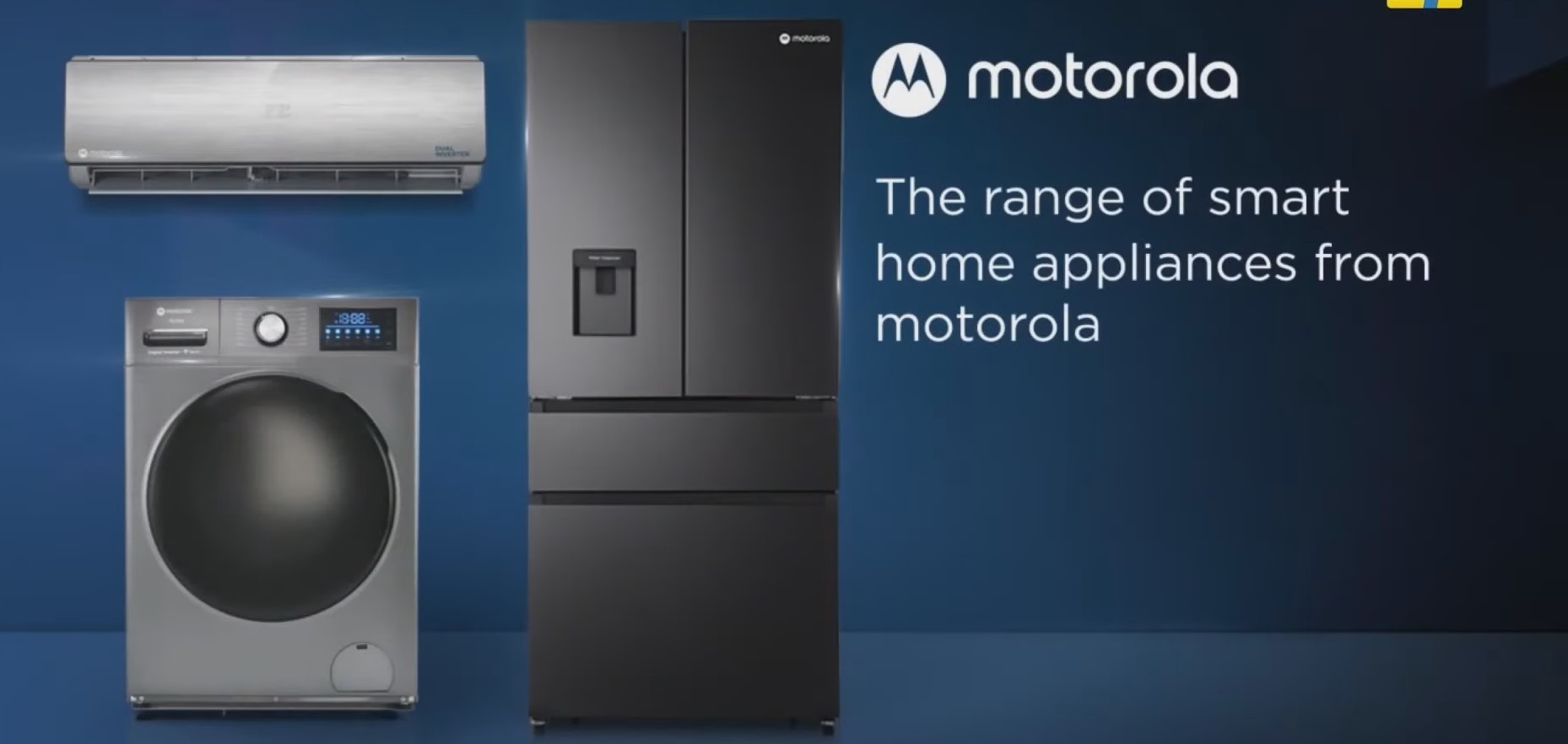
As reported, Motorola has launched its new Smart Home Appliances alongside its new Smart TVs today in India. The latest launch includes products like ACs, Refrigerators, and Washing Machines. All the appliances have TruWi-Fi technology and a plethora of features at aggressive prices. They will go on sale on the occasion of Flipkart Big Billion Days.
Credit: Flipkart
Motorola Air Conditioners
Starting with the Air Conditioners(AC), Motorola launched(via Gadgets360) five models in total. They feature a twin rotary compressor, 5-speed fan with a 4-way swing. Also, it has features like TruWiFi, Surroundcoolx, Dual-Inverter, Geo-Fencing. They have modes like dehumidify, auto, sleep, self-cleaning, and operate around 16-31-degree Celsius.
TruWiFi helps users to control ACs via a smartphone app to set modes, change temp, schedule, and share it across devices. Smart Geo-Fencing helps AC to detect if a person holding a phone is inside or outside of a room. It will turn on/off accordingly. Motorola says, the Dual Inverter Technology will help ACs operate 27% efficiently, and 20% silently than other ACs. Surroundcoolx will help cool the room to 18-degrees in just 30 seconds. Its prices are below:
There are three models in 507, 533, and 592L capacities. There is an LED touch panel and a water dispenser. Also, they feature TruSmart sensors, modes like Super Freeze, SuperCool, Drinks, and Holiday.
Just like the ACs, Refrigerators can be controlled via smartphone through TruWiFi to change temperature, convert zones, change modes. And, get notifications on malfunctions. Its Surroundcoolx multi-directional 360-degree air vents and metal cooling wall is for uniform cold airflow. Additionally, Motorola says the Adaptive Inverter Tech is 40% more efficient than conventional compressors with copper winding. The prices are listed below:
Model(Refrigerator)
Price(in ₹)
592L Side by Side
51,990
507L Cross Four Door
63,990
533L French Door Refrigerator
69,990
Motorola Smart Washing Machines
Motorola launched five models of Washing Machines in total. Again, with TruWiFi, users can control options like wash modes, signal strength notifications, and get fault alerts. The company says clothes are washed at up to 80-degree Celsius to make them 99.9% bacteria-free.
The TruSmart Sensors here will aid the tri-stage watching by managing the heater throughout. Further, it has other features like foam level sensors to control foam, Oxyfresh to keep clothes free, 25-stain wash to remove stains. Digital Inverter Motor’s power saving is 50% efficient than conventional machines. The prices are listed below:
Model(Front Load Washing Machine)
Price(in ₹)
6.5 Kg
23,499
8 Kg
28,999
10.5 Kg
33,999
8 Kg/5 Kg Washer Dryer
35,999
10.5 Kg/6 Kg Washer Dryer
39,999
Availability
In addition to this, Motorola also launched Revou, and ZX2 Android TVs ranging in HD, FHD, and 4K, and starting at ₹13,999. That said, all the Home appliances will go on sale from October 16 via Flipkart as a part of Big Billion Days. However, Flipkart Plus members can access it from October 15, 12 PM IST.
We already know that the Huawei Mate 40 series launch is around the corner but what we don’t know is the exact date. A tipster who has dished out reliable info thus far has now revealed that the Mate 40 will be launched on October 22. Apparently, this is the global launch while the launch in China will happen on October 30.
The tipster @RODENT950 on Twitter, apart from indicating that the models will launch in China on October 30, also gave a possible timeline on the device’s progress with pre-launch teasers tipped to start emerging on October 12. The models will go on presale in China on October 22. Sadly, it is still unclear when Mate 40’s global sales will commence. From all indications, most regions will have to wait until next year to get the Mate 40 series.
Let's make it clear
•October 12 is next Monday, warm-up starts then
•October 22 is actual launch date of Mate 40 series ( pre sale start in China)
The tipster had earlier disclosed that the Mate 40 series will comprise of the Mate 40, Mate 40 Pro, Mate 40 Pro+ and Mate 40 Pro+ Porsche design variant. All the models will vary in their display sizes but will all be powered by the Hisilicon Kirin 9000 chipset built on TSMC’s 5nm node. As usual, we expect the Mate 40 series to feature a topnotch camera setup which should rank as the best around when launched. Expect the Mate 40’s camera to upset the current DXOMark camera ranking.
There is still no official word from Huawei about the launch but if these details are anything to go by, we should start seeing some pre-launch teasers from next week Monday.
Xiaomi‘s MIJIA brand last launched an anti-blu-ray glasses in April last year. A little over a year after, the brand has now introduced the MIJIA Anti-Blu-ray Glasses. It is presently on sale on Xiaomi Youpin for 199 yuan ($29).
The MIJIA Anti-Blu-ray Glasses is equipped with high-definition nylon lenses with blue light blocking rate greater than 80%. The glass adopts a minimalist retro shape and is equipped with ultra-lightweight beta titanium metal temples. The lens and frame weigh about 15.5g. The light transmittance of the nylon lenses is greater than 93%. The lens adopts a 16-layer coating which makes it oil-proof on both sides.
The lenses come with blue light factor and anti-blue light coating which is capable of absorbing and reflecting the blue light in the wavelength of 415-445nm which is easy to cause eye discomfort while retaining the 455-500nm blue light which is helpful for adjusting the biological rhythm.
The glasses come in two different colours – Black and Rose Gold and is suitable for both the male and female folks.
Xiaomi officially announced the appointment of a new Vice-President and Chief Financial Officer in the person of Alain Lam in August this year. The company has now disclosed that the new CFO has officially resumed duty at its Beijing headquarters.
Mr. Lam will reportedly be in charge of coordinating and managing the Group’s financial work. He will report directly to CEO Lei Jun and President Wang Xiang.
The 46-year-old Alain Lam holds a master’s degree in engineering from the University of Oxford. The Chinese exec has experience spanning over 20 years in investment banking. He has also worked previously as a managing director and the head of technology, media, and telecom in the reputable Credit Suisse in the Asia Pacific. Before his stint at Credit Suisse, Mr. Lam was a managing director at Morgan Stanley covering equity capital markets for technology, media, and telecom in the Asia Pacific.
The position of Chief Financial Officer at Xiaomi became vacant in November 2019 when the Chinese tech giant announced the elevation of its Executive Director, Senior Vice President, and former CFO Mr. Chew Shou Zi to the role of President of Xiaomi International while he will continue to serve in his capacity as an Executive Director and Senior Vice President. Xiaomi’s President Wang Xiang then took the role of Chief Financial Officer in an acting capacity since April 10, 2020. He held the position until a suitable candidate to serve as the CFO was recruited by the company’s CFO Search Committee.
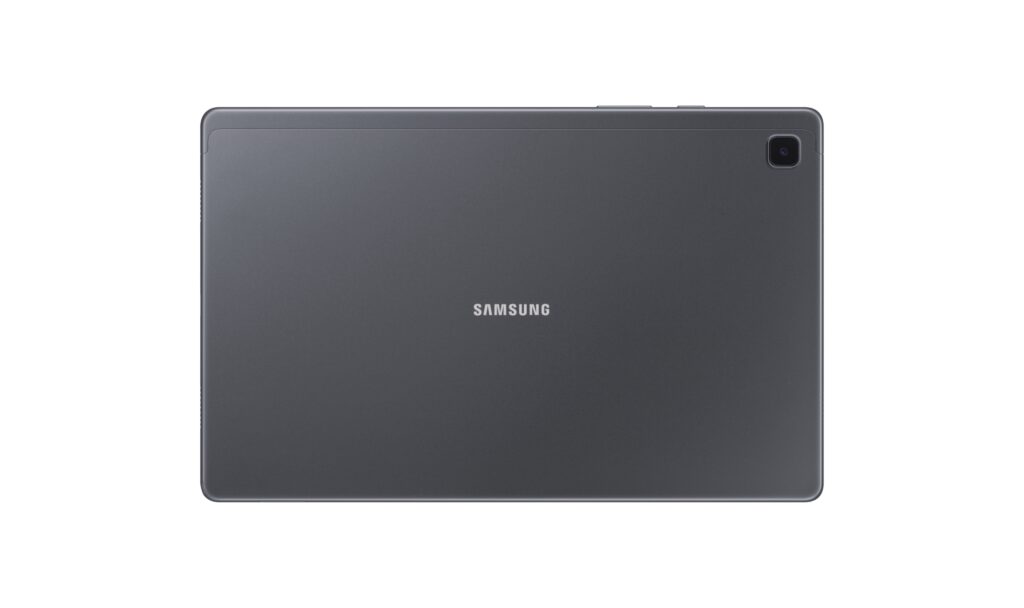
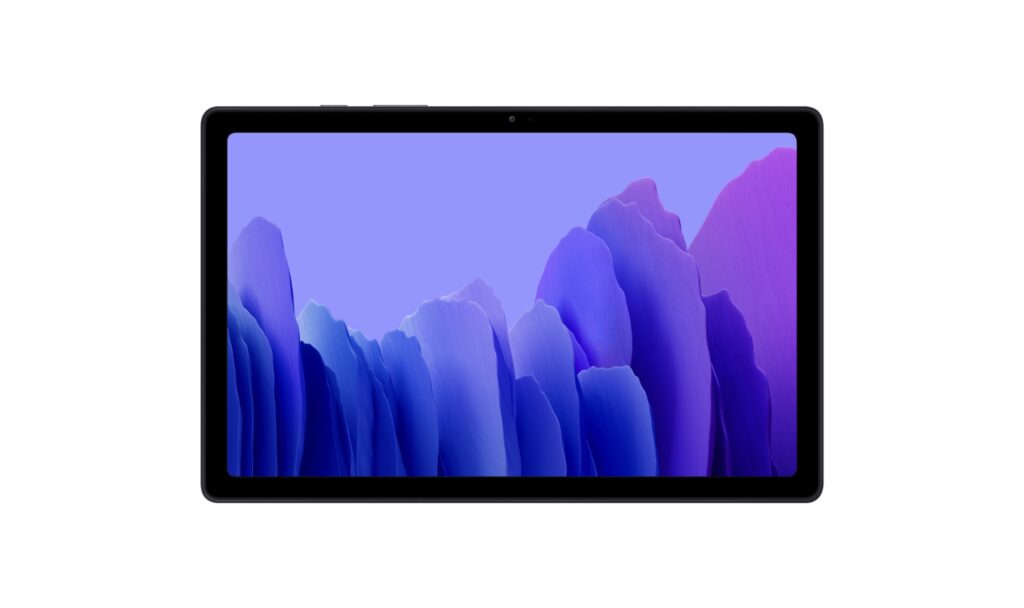
Samsung announced the Galaxy Tab A7 as its latest budget tablet in early September. The device was initially made available in Europe and it even made its way to India late last month. Now, it has finally hit the US shores as well in 32GB and 64GB storage configurations. Interestingly, it is cheaper in America than other regions.
The Galaxy Tab A7 is one of the few devices from Samsung’s portfolio to come with a Qualcomm chipset worldwide.It is powered by 11nm Snapdragon 662 chip paired with 3GB RAM. This combo is more than enough to handle multimedia and some light gaming.
The tablet sports a 10.4-inch TFT LCD panel on the front with a resolution of 2000 x1200 pixels and around 80% screen-to-body ratio. It features a metal unibody design like most tablets in the market and houses an 8MP rear-facing camera as well as a 5MP front-facing camera for video calls and selfies.
A 7,040mAh battery runs the show and it charges via USB Type-C port. It also comes with a 3.5mm headphone jack, which is surprisingly not present in the cheaper $199.99 TCL TAB by Verizon Wireless.
That said, the new budget tablet from Samsung runs One UI 2.1 based on Android 10 and features dual-band WiFi 5, Bluetooth 5.0, quad-speaker, and a microSD card slot to expand the storage if needed.
The Galaxy Tab A7 is only available in WiFi version in the US and customers can pick it up in either Dark Gray, Silver or Gold color variant. The base 32GB model is priced at $229.99, whereas the higher 64GB costs $279.99. That means the tablet is more affordable than in both Europe and India.
A couple of days back, Redmi GM hinted at a launch of a new Redmi smartphone in China. The company will likely unveil the new models of the Redmi K30 series and new Redmi Note 10 in China. Also, the Redmi Note 10 is rumored to be a rebrand of the Mi 10T Lite from Europe. And now, a tipster on Weibo hints that the device might have different cameras for China.
Tipster Digital Chat Station(Weibo: @数码闲聊站) says that the device with ‘J17’ model number on it will be equipped with a 108MP camera. Along with this, it will likely have “Telephoto” and “Macro” lenses. Now, if we recall, the Mi 10T Lite that passed through FCC before the launch, had a model number M2007J17G. Usually, ‘G’ represents the Global version and hence, M2007J17C should be the Chinese variant of the device. That said, the Mi 10T Lite debuted with a 120Hz LCD display, Snapdragon 750G SoC, 4,820mAh battery. But the Global variant has a 64MP sensor, ultra-wide and macro lens on the camera setup.
Further, the tipster has mentioned the specs of a blank device yesterday which falls in-line with the current leak. As per the post, a device will have 120Hz LCD, SM7225 SoC(Snapdragon 750G), 108MP camera, 4800mAh battery with 33W fast charging. This strengthens the rumor that Redmi Note 10 will be a tweaked version of Mi 10T Lite in China. Also, this resonates with the earlier XDA report that Chinese variants will both have 108MP sensors.
Further, looking at the SoC, it looks like Xiaomi is indeed living up to the promise of launching more 5G devices in 2020. And if the reports are true, this will be the first Redmi smartphone to sport a 108MP sensor. Previously, Xiaomi skipped the Redmi Note 9 series for China but launched the Redmi 10X series. That said, the new Redmi Note smartphone will definitely be a showstopper if it launches at the rumored price tag of CNY 1,000 ($149).
Today, Samsung launched the first device from a brand new series. The Galaxy F41 is indeed the first device from the Galaxy F lineup and it is a 4G mid-ranger. This means it will compete with some of the handsets with the highest value for money in the Indian market. While we are waiting for info regarding its commercialization in other regions, we think it is time to compare it with other affordable mid-rangers out there in order to understand if it is a good deal as Samsung advertises it. For this comparison, we chose two among the most wanted mid-rangers of the second half of 2020: POCO X3 NFC and Realme 7 Pro.
Samsung Galaxy F41 vs POCO X3 vs Realme 7 Pro
Samsung Galaxy F41
Xiaomi POCO X3 NFC
Oppo Realme 7 Pro
DIMENSIONS AND WEIGHT
159.2 x 75.1 x 8.9 mm, 191 grams
165.3 x 76.8 x 9.4 mm, 215 grams
160.9 x 74.3 x 8.7 mm, 182 grams
DISPLAY
6.4 inches, 1080 x 2340p (Full HD+), 403 ppi, Super AMOLED
6.67 inches, 1080 x 2400p (Full HD+), IPS LCD
6.4 inches, 1080 x 2400p (Full HD+), 411 ppi, Super AMOLED
Quad 64 + 8 + 2 + 2 MP f/1.8, f/2.3, f/2.4 and f/2.4
32 MP f/2.5 front camera
BATTERY
6000 mAh, fast charging 15W
5160 mAh, fast charging 33W
4500 mAh, fast charging 65W
ADDITIONAL FEATURES
Dual SIM slot
Dual SIM slot, splash proof
Dual SIM slot, splash resistant
Design
If you want the most elegant device, you should go either for the Realme 7 Pro or the POCO X3 NFC. The former is the sleekest one with its thin body and it is even lighter, while the latter is built with better materials, including aluminum for the frame. Realme 7 Pro has a water-repellent coating, so you can use it under the rain without so many problems. And so you can with the POCO X3 NFC which boasts the IP53 certification. The Samsung Galaxy F41 is entirely built of plastic, it has a rear-mounted fingerprint reader (unlike the Realme 7 Pro which has it built in the display) and a waterdrop notch instead of a punch-hole design.
Display
If you desire the best display quality, then Samsung Galaxy F41 and Realme 7 Pro are better options for your needs because they are equipped with AMOLED panels providing more brilliant colors and deeper blacks. Instead, if you are a gamer, you might prefer the POCO X3 NFC because it has a higher refresh rate (120 Hz), and it is even HDR10-compliant. Note that POCO X3 NFC has a wider panel than Realme 7 Pro and Samsung Galaxy F41 (6.67 inches vs 6.4 inches). As mentioned above, despite having an AMOLED display, the Samsung Galaxy F41 does not have an in-display fingerprint scanner, unlike the Realme 7 Pro.
Specs & Software
The strongest device in terms of hardware and performance is the POCO X3 NFC thanks to a better processor: the Snapdragon 732G which is an upgrade of the Snapdragon 730G. Right after, we got the Realme 7 Pro boasting a Snapdragon 720G, but you should consider that you can get max 6 GB of RAM with POCO X3 NFC, while Realme 7 Pro has 8 GB of RAM. Samsung Galaxy F41 takes the last position due to its weaker Exynos 9611 built at 10 nm. Samsung Galaxy F41, POCO X3 NFC, and Realme 7 Pro run Android 10 and customized UIs.
Camera
When it comes to the rear cameras, you should notice only marginal differences between these three devices. The main camera sensor is a 64 MP lens in each case, but the POCO X3 NFC has a better ultrawide camera with a 13 MP resolution. The Samsung Galaxy F41 has a superior 5 MP macro shooter and even the best front camera with a 32 MP resolution and an f/2.0 focal aperture.
Battery
The Samsung Galaxy F41 will provide the longest battery life thanks to its huge 6000 mAh battery. The silver medal does not necessarily go to the POCO X3 NFC despite its bigger battery than Realme 7 Pro: it depends on the usage scenario because the POCO X3 NFC has an IPS panel with a 120 Hz refresh rate which is more energy-demanding. Realme 7 Pro wins the fast charging comparison with an astonishing 65W power.
Price
Samsung Galaxy F41 is priced at about Rs. 16,999 ($232) in India, Poco X3 NFC costs Rs. 16,999 too, and Realme 7 Pro carries a listing price of Rs. 20,999 ($370). There is no definitive winner in this comparison: Samsung Galaxy F41 is the battery king, POCO X3 NFC has better hardware, Realme 7 Pro supports faster charging speeds and an in-display fingerprint scanner. For the rest, they are not so different. Which is your favorite one?
Infinix has launched a watered-down variant, Infinix Zero 8i alongside the Zero 8 in Pakistan. The new smartphone comes at a lesser price tag than the former while not compromising on specs like 90Hz display, 48MP cameras, and more.
Infinix Zero 8i Specifications
From the official renders, looks like the Zero 8i has a similar gem-cut design, specifications, storage but differs in rear and front cameras. To be precise, it has a 6.85-inch FHD+ display similar to the Zero 8. It also retains the 180Hz touch sampling and 90Hz refresh rate which is first ever on an Infinix device. Under the hood, Mediatek Helio G90T powers the Zero 8i. This is paired with 8GB RAM and 128GB storage exactly like the Zero 8 and also has a MicroSD slot for expansion. Still, the difference lies in cameras.
The Infinix Zero 8i houses a 48MP instead of 64MP as the main lens, an 8MP ultra-wide, two 2MP depth and AI lenses, and an LED flash. On the front, the pill-shaped punch-hole features a 16MP instead of 48MP as the main sensor, and an 8MP ultra-wide lens for selfies. All this is backed up by a 4,500mAh battery with support for 33W fast charging. Other features include 10-layer heat dissipation cooling material, TUV Rheinland certification for high-performance gaming, Smart Turbo V1.0 acceleration engine.
Price, and Availability
The Infinix Zero 8i runs on Android 10 with XOS 7 UI on top. It comes in Black Diamond, Green Diamond, and Silver Diamond color options. The single 8GB RAM, 128GB storage is priced at PKR 34,999($214) compared to PKR 39,999($244) for Zero 8. Pre-orders will begin from October 11, and the device will be sold from October 15.
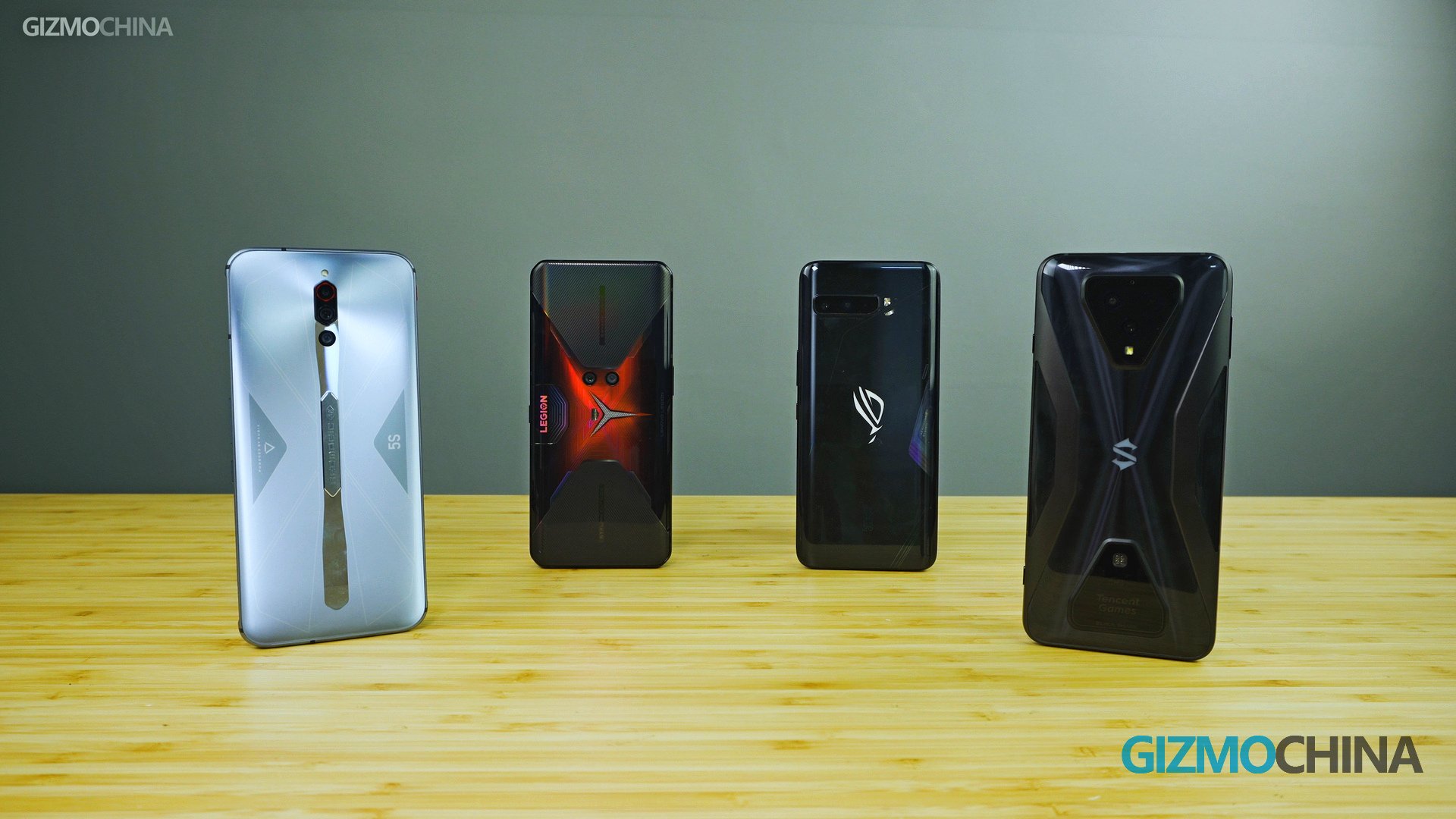
We at Gizmochina have been testing gaming smartphones for the past few years. We’ve played with and tested almost all the gaming phones released in 2020. And we don’t think there are any big gaming phones headed our way, in the final three months of the year. So, we decided to bring you guys a full comparison of the best 2020 gaming smartphones. The 4 candidates we selected are from the brands of Asus ROG, Black Shark, RedMagic, and Lenovo Legion. This is still a niche market, with only a handful of brands focused on the mobile-gaming segment.
ROG Phone 3 vs Black Shark 3S vs RedMagic 5S vs Legion Pro
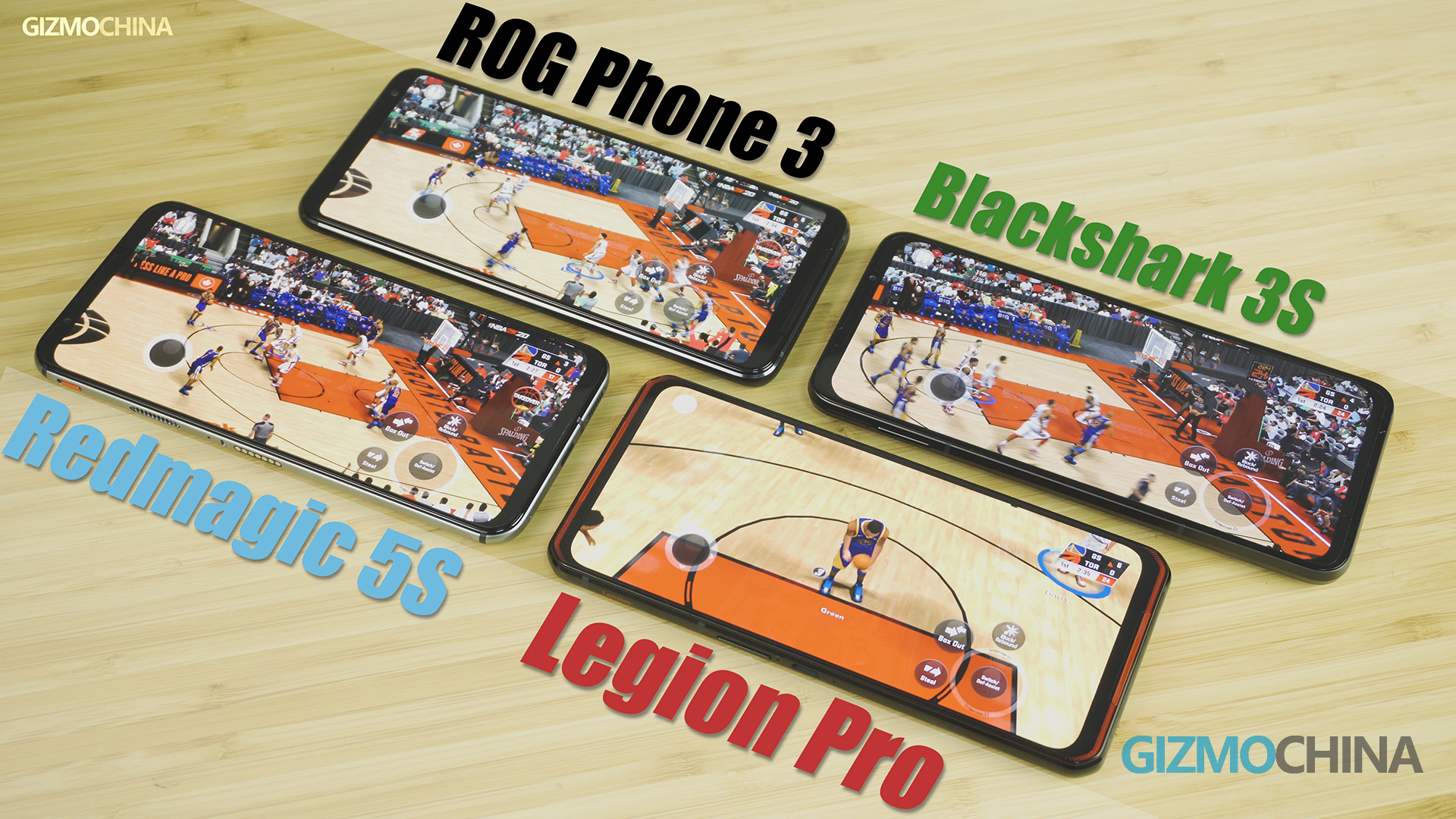
The devices we selected are all the latest models from these brands: the ASUS ROG 3 vs Lenovo Legion Pro vs RedMagic 5S vs Black Shark 3S. Thanks to Snapdragon 865 platform, they’re all excellent game phones in 2020 with superb performance. But so far we haven’t brought all the latest models together to pit against each other. Let’s change that today and let’s check out which one sits on the throne of smartphone gaming in 2020.
ASUS ROG vs RedMagic vs Black Shark vs Lenovo Legion: Design
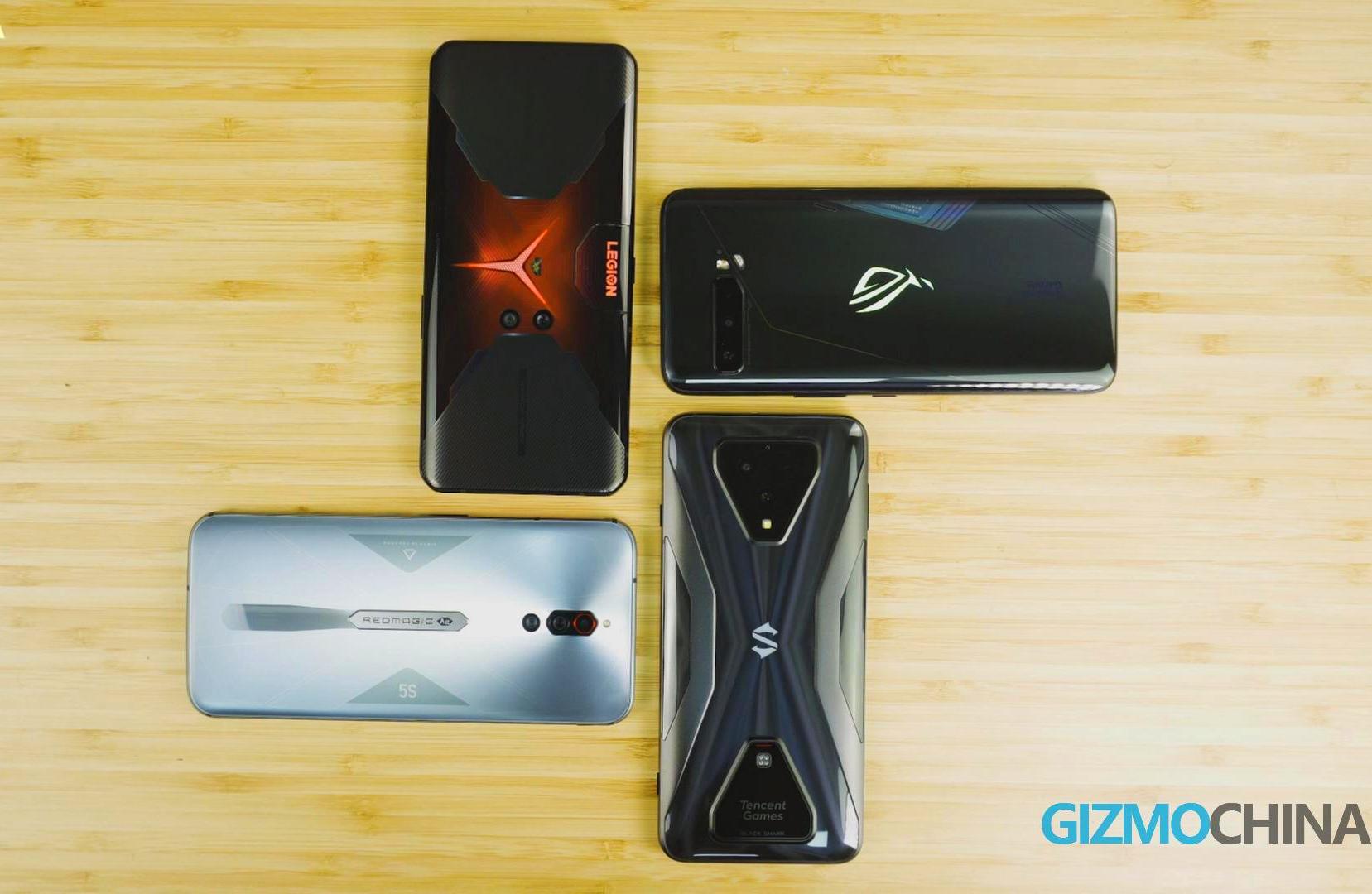
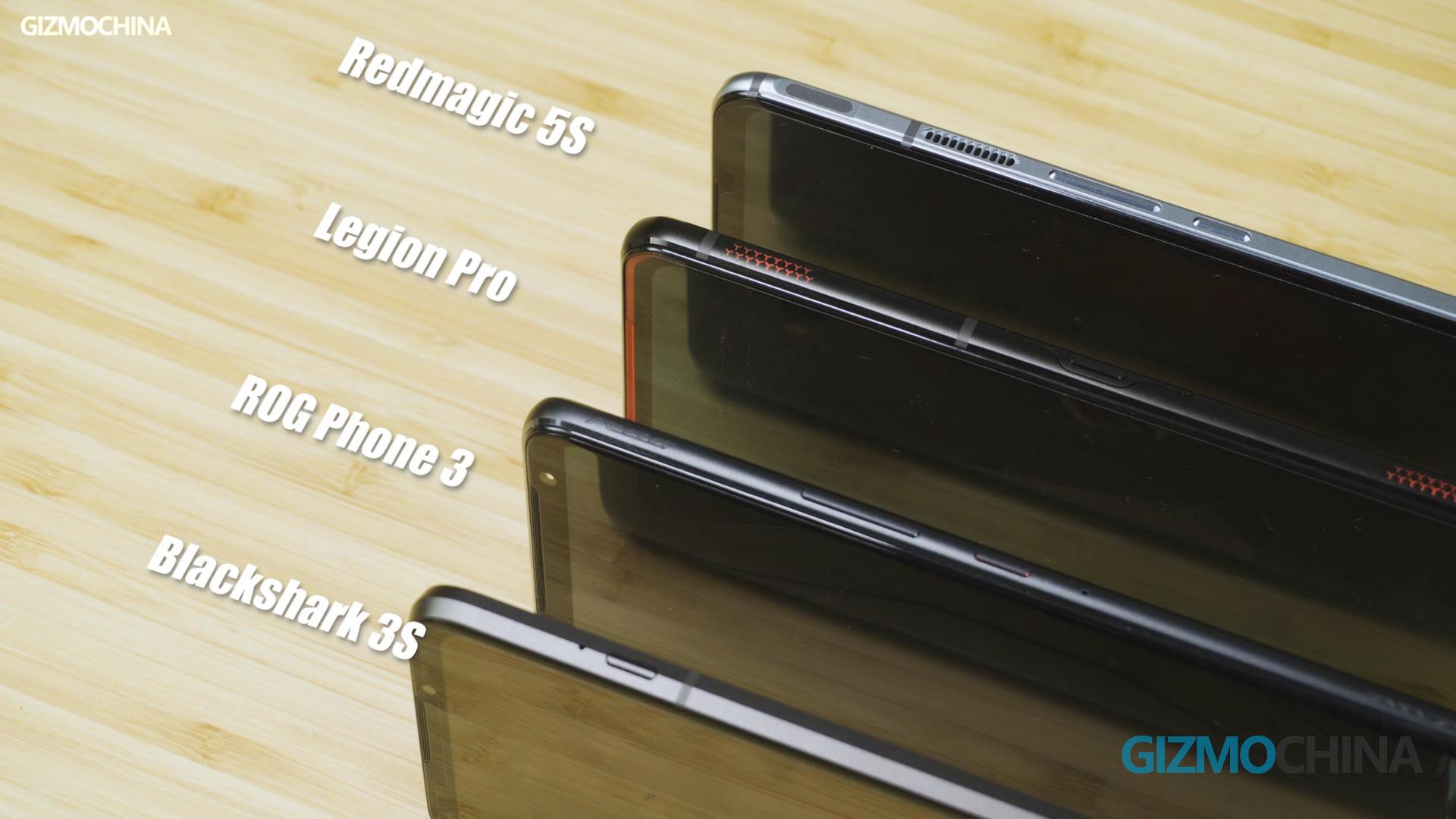
Let’s start with their designs. All the models have distinct rear designs inherited from PC-gaming hardware such as customized RGB Logo and straight-line metal shells, which set them apart from those ordinary flagships.
The Black Shark 3S, the ROG Phone 3, and the RedMagic all inherit the brands’ identifiable design from their respective predecessors, while the Legion Phone is Lenovo’s first gaming model, which has a very special design. Unlike the three others, the motherboard and main hardware including camera setups were placed in the middle. Although it looks a bit strange, the Legion Phone is the most effective model to solve the heating problem while holding the phone. And it creatively applies dual-battery and dual-charging design to top up its 5000mAh with the superb charging efficiency of up to 90W.
ROG Phone 3 vs Black Shark 3S vs RedMagic 5S vs Legion Pro
Display
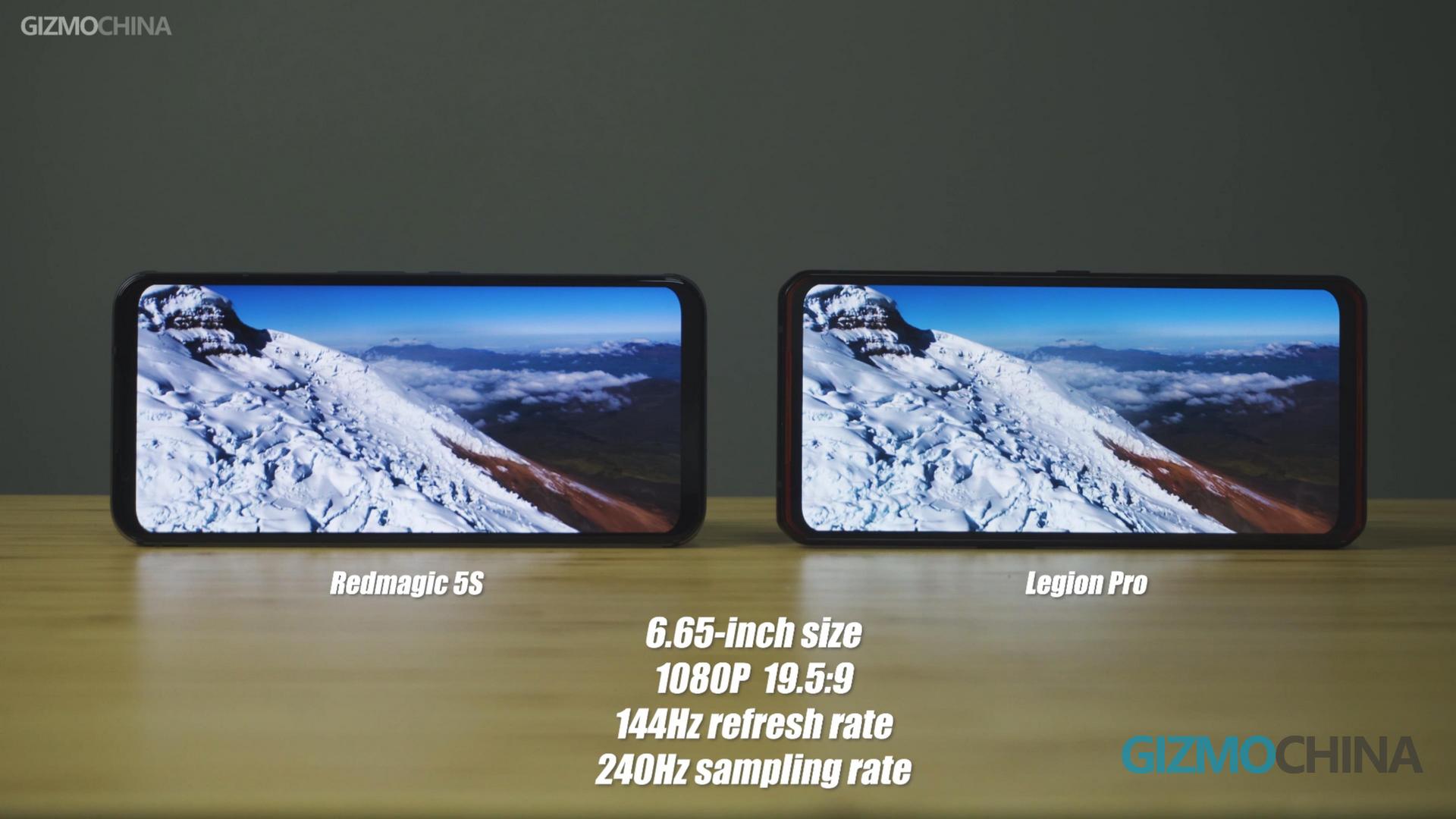
And looking at their front displays, they all are equipped with an e-sports friendly large display. The sizes of their displays range from 6.6 to 6.7 inches. For the RedMagic 5S and the Legion Pro, their 6.65-inch displays share a lot of common features. They have the same 1080P resolution with the same 19.5:9 aspect ratio, both feature a 144Hz refresh rate and a 240Hz sampling rate and have very similar color reproduction. On the other hand, the Black Shark 3S is the only one featuring a 6.67-inch 120Hz display with a special 20:9 ratio and also features MEMC Frequency Doubling Technique to boost the framerate of regular streaming content at the hardware level. This means that the Black Shark model can provide a smoother visual experience for video playback. But we found that the effect is not always stable even in the same video. The MEMC technology can handle some simple images but is not very useful for highly dynamic images.
redmagic & legion -display
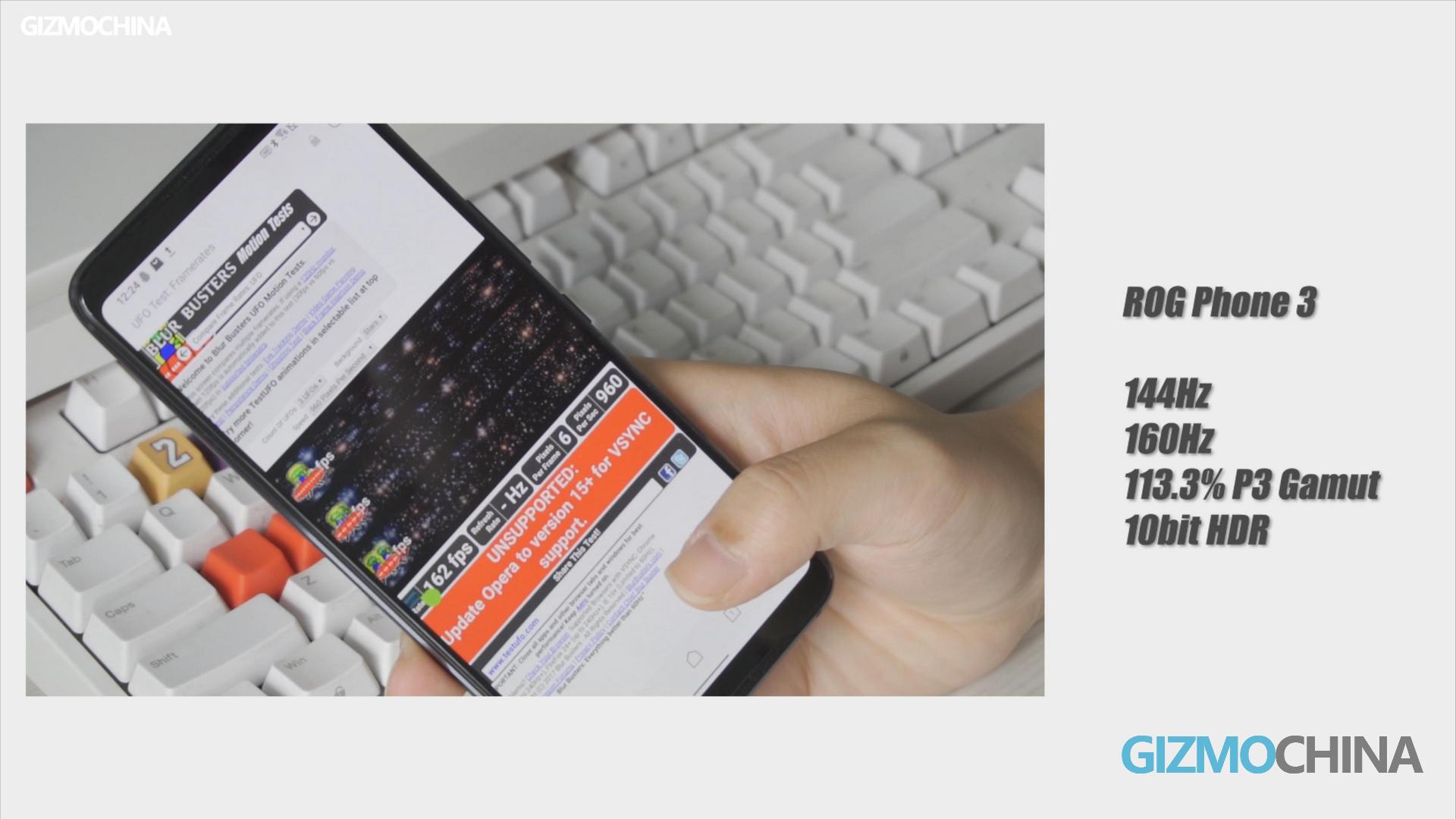
However, among all the gaming phones, we think the ROG Phone’s display is the best one. It’s the only one supporting 10-bit HDR and covering up to 113.3% of P3 color Gamut. And more importantly, the display can boost the refresh rate up to 160Hz using a developer tool, which is the highest refresh rate that we have on a smartphone so far. But pay attention here – under 160Hz mode, the color accuracy could be damaged. And its 270Hz sampling rate is also the highest option in the market, which also, unsurprisingly, made it the best model providing superb touch operation in our actual gaming tests.
rog display
ASUS ROG 3 vs RedMagic 5S vs Black Shark 3S vs Lenovo Legion Pro: Shoulder Buttons
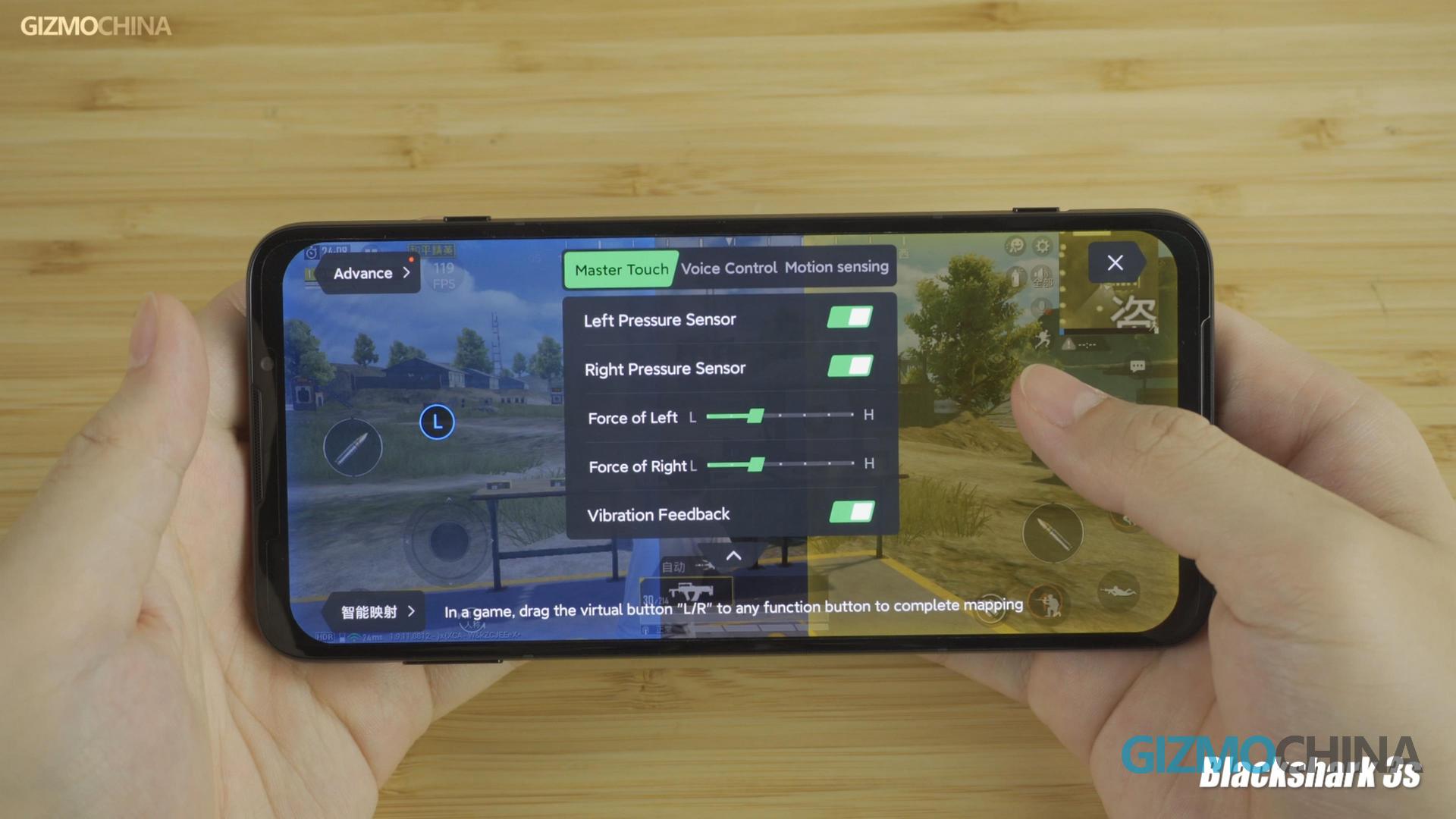
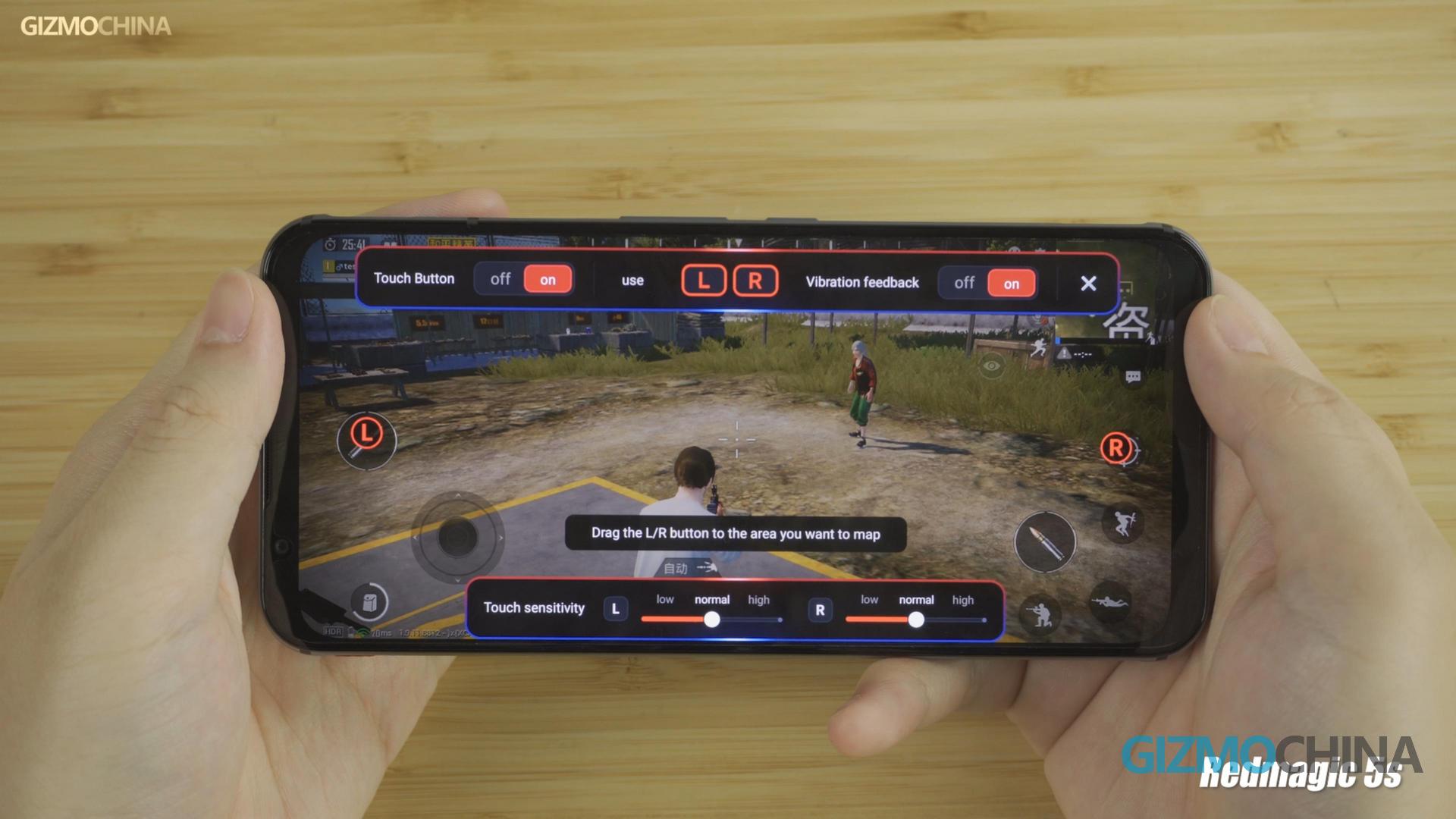
Talking about their optimizations for gaming, three of them come with shoulder buttons. But for the Black Shark 3S, the special button operation is composed of only two pressure-sensitive areas. This complete shift to pressure-sensitive buttons is a bit surprising given how we felt the best shoulder-button design ever was on its predecessor, the Black Shark 3 Pro that featured a pair of mechanical pop-up shoulder buttons. It gave users a similar experience as what we had on a gamepad. So, we are very confused as to why Black Shark didn’t retain the physical button design on the new 3S model.
shoulder buttons
Anyway, let’s look back at the Master-Touch pressure sensors, which is also an iconic design for every Black Shark model. However, compared to the shoulder buttons on the other models, the pressure touch buttons require a larger learning curve to get used to it. It will take some time to adjust to the sensors and sometimes it may come in between your gaming experience, especially in the initial period.
Blackshark 3s-mastertouch
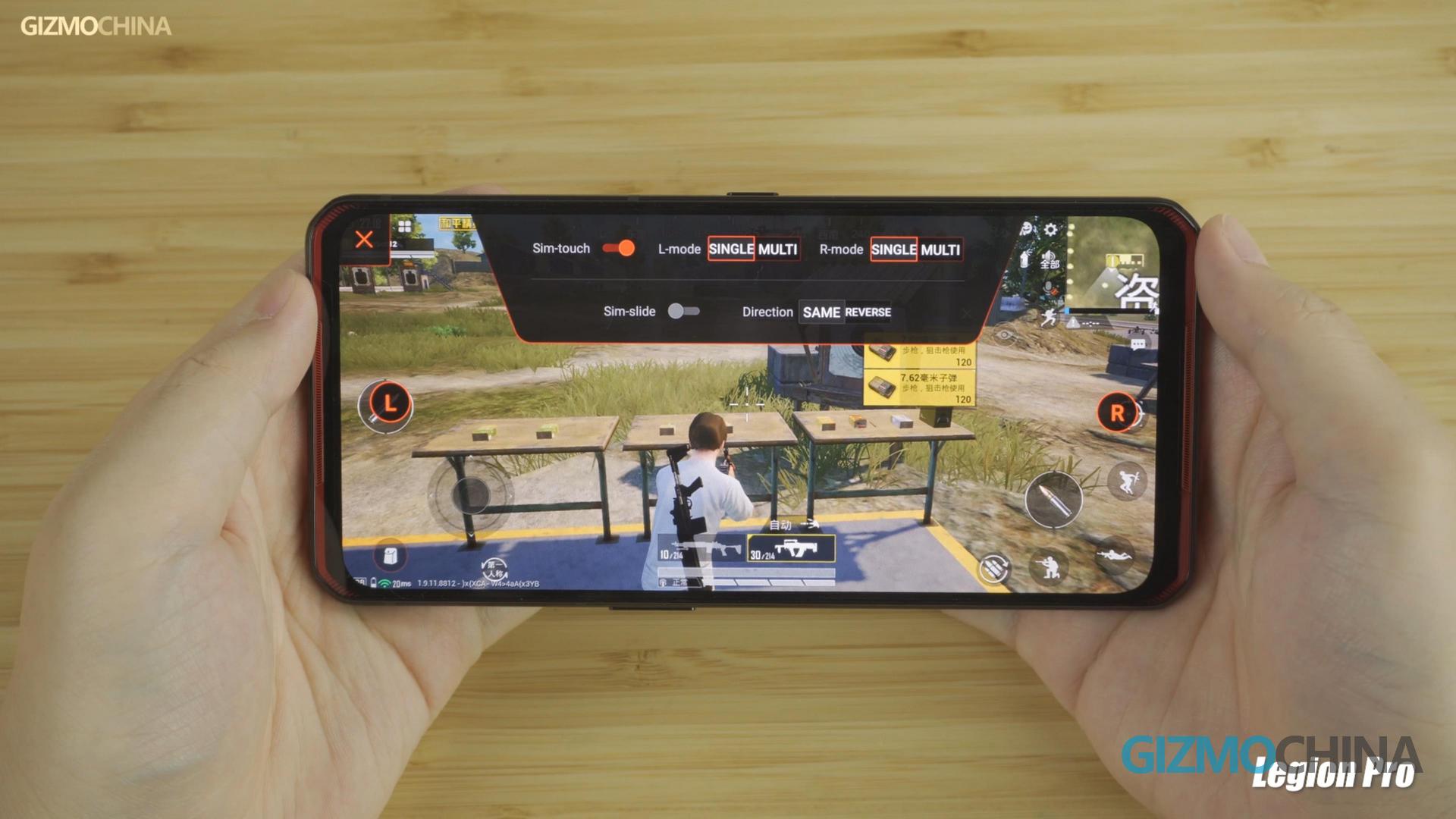
On the other hand, it’s much easier to get used to the shoulder buttons on the other models. But the experience over these three models is a bit different. For example, the RedMagic 5S shoulder buttons feature a super-high sampling rate of 320Hz, which is even higher than its 240Hz display sampling rate. And compared with other models, the position of the shoulder buttons on the RedMagic model is also more comfortable for our fingers. While for the Legion Phone, the buttons are not really in the right position for comfortable holding, and sometimes it was frustrating when we failed to touch on the designated area to activate the button while gaming.
1 of 2
legion pro-shoulder buttons
redmagic 5s-shoulder buttons
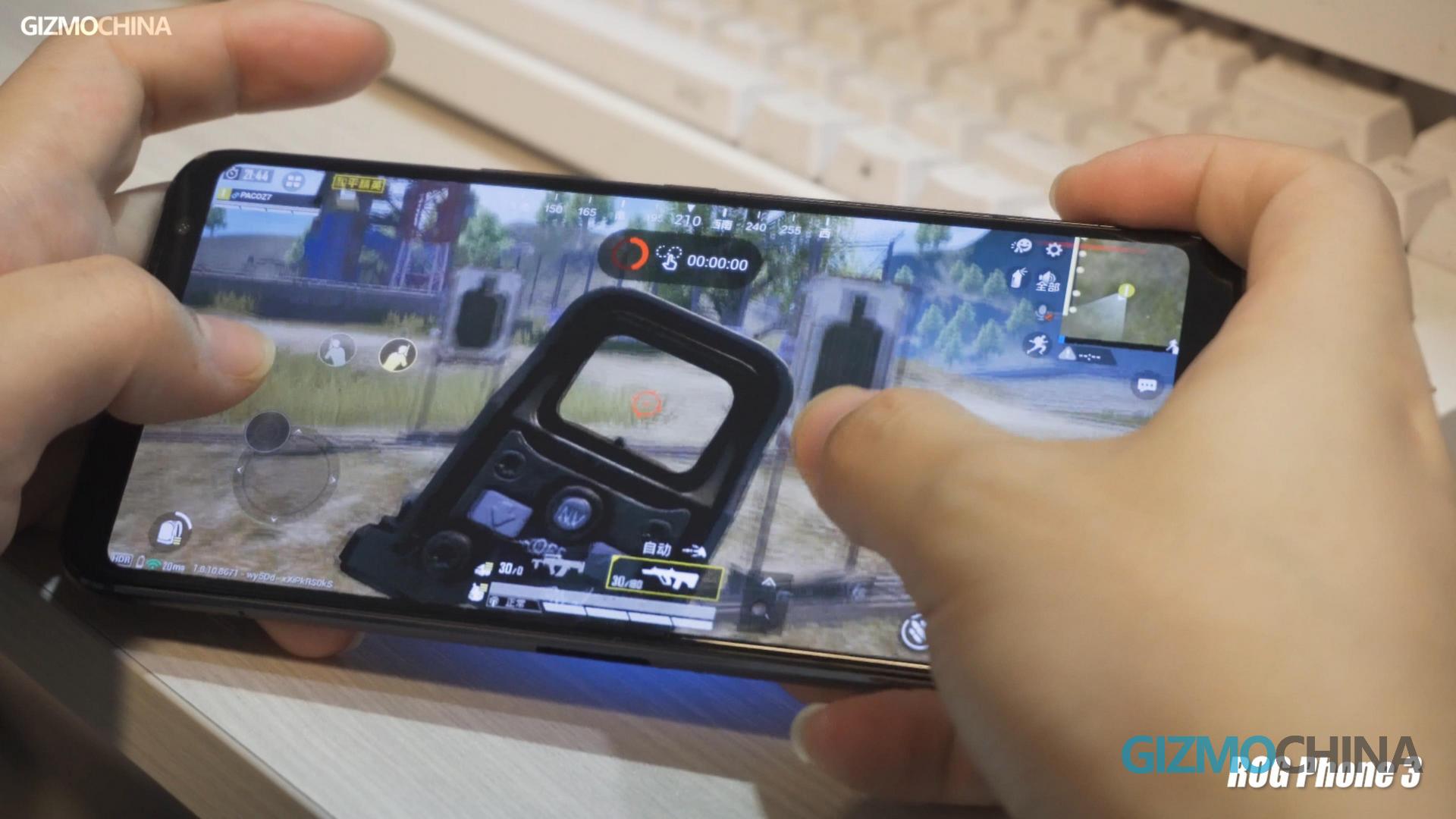
Well for the ROG Phone, the buttons have more options for operations. For example, you can assign each of them into two shoulder buttons, or set them for sliding actions, or even reset each of them for Macro play. But to be honest, most of them were too complicated to use in most games. The reason we want more buttons is to simplify our operation beyond touching the small display when holding the phone, but it seems that these complicated options help little and not really lead to a good gaming experience.
rog phone 3-macro for shoulder buttons
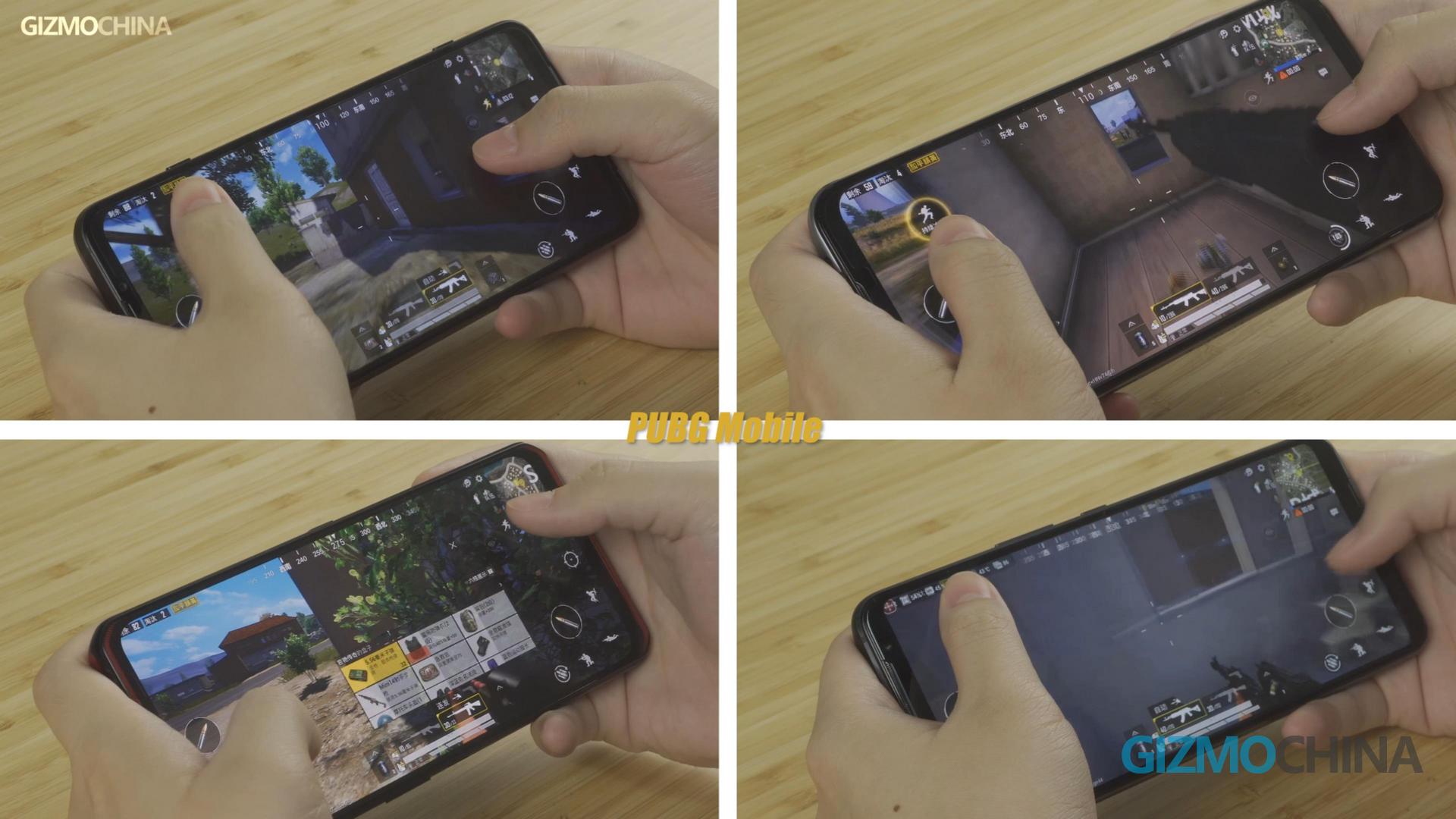
Let’s take PUBG Mobile as an example. No doubt that ROG Phone has the best display operation as it has the highest sampling rate. Operating delay on the ROG model is almost imperceptible, which means that you may have the opportunity for a faster response, possibly knocking down the enemies faster than others in a gunfight. The experience of the RedMagic 5S is also not bad. The good and fast feedback of the shoulder buttons makes sure that your mapping operations like aiming and shooting can accurately locate enemies with a comfortable holding.
PUBG Gaming
However, on the Legion Phone and the Black Shark 3S, the operation is not so comfortable. The additional buttons may cause miss touches. You have to be careful with the pressure level when setting the pressure sensing buttons on the display, or you may get confused between holding the pressure-touch and the normal display touch in intense fighting. On the Legion model, your fingers would easily get tired when holding the uncomfortable shoulder buttons or you could even miss the shooting and aiming operations by touching the wrong area of the buttons.
ASUS ROG vs RedMagic vs Black Shark vs Lenovo Legion: Performance
As for performance, all these 4 models are equipped with the Snapdragon 865 platform. But only the ROG Phone and the Legion Phone upgrade the chipset to the Plus version. But it brings little difference in daily use and even in most games. Especially, so far, considering heating issues, almost all the brands are pretty cautious about giving users access to the full power of the 865 platform. For example, the Black Shark 3S and the RedMagic 5S would warn you about heating when you turn on the best-performance mode, while the ROG Phone would even check whether you have attached a cooling fan when you try to turn on the best-performance mode for games. If you were not playing with a cooling fan attached, the ROG Phone would close it and automatically switch it to level 2 of the performance mode.
In the performance comparison, we are going to compare their highest performance as a single model without any accessories. First, let’s see how they performed in some benchmarks.
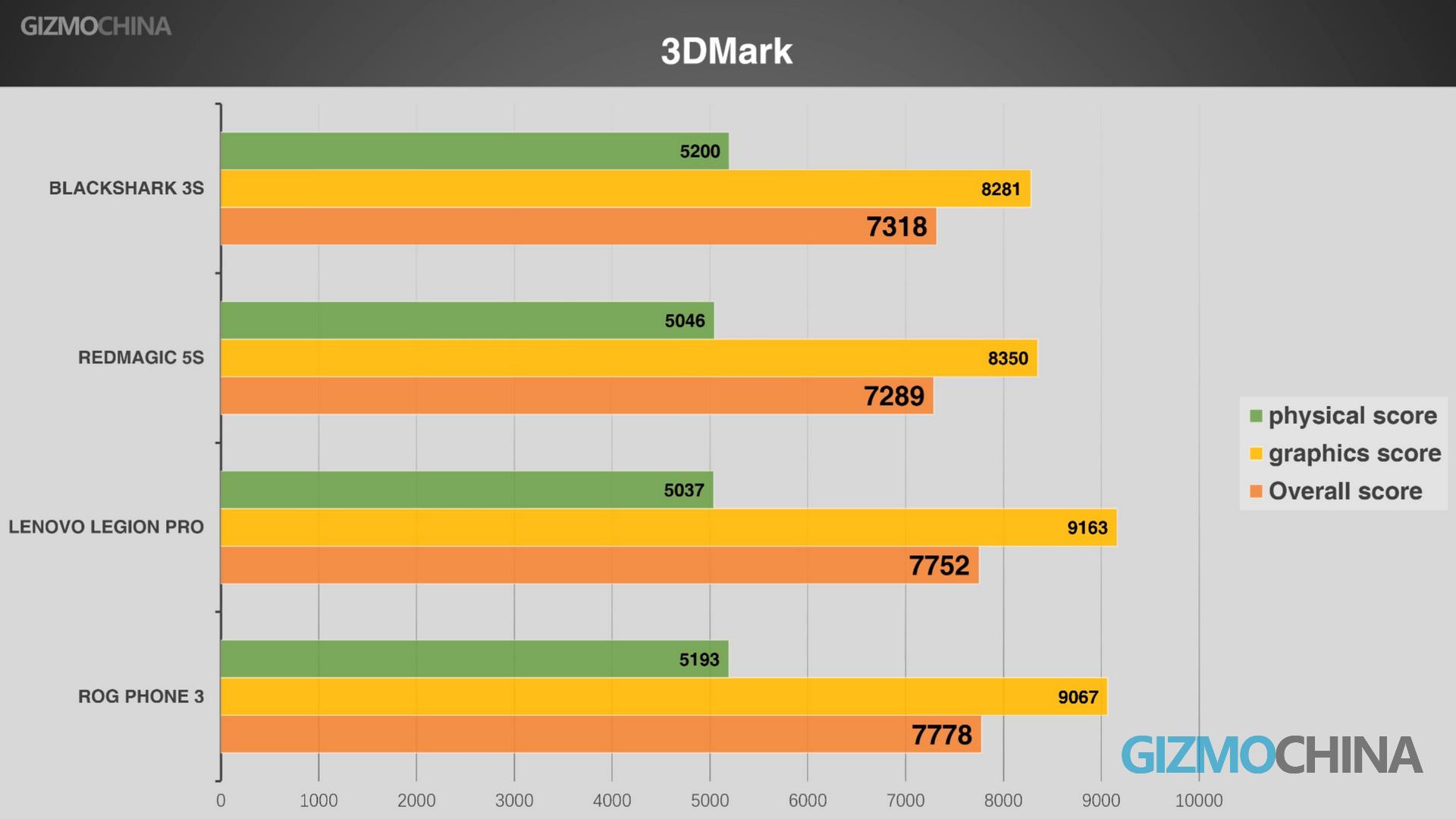
3DMark
In 3Dmark, although the two equipping the 865-Plus chipset did not reach the 10% improvement as claimed, they still achieved a 6% higher performance compared to the other two models running the 865 chipset.
Snapdragon 865 vs 865 Plus 3dmark
GeekBench 5
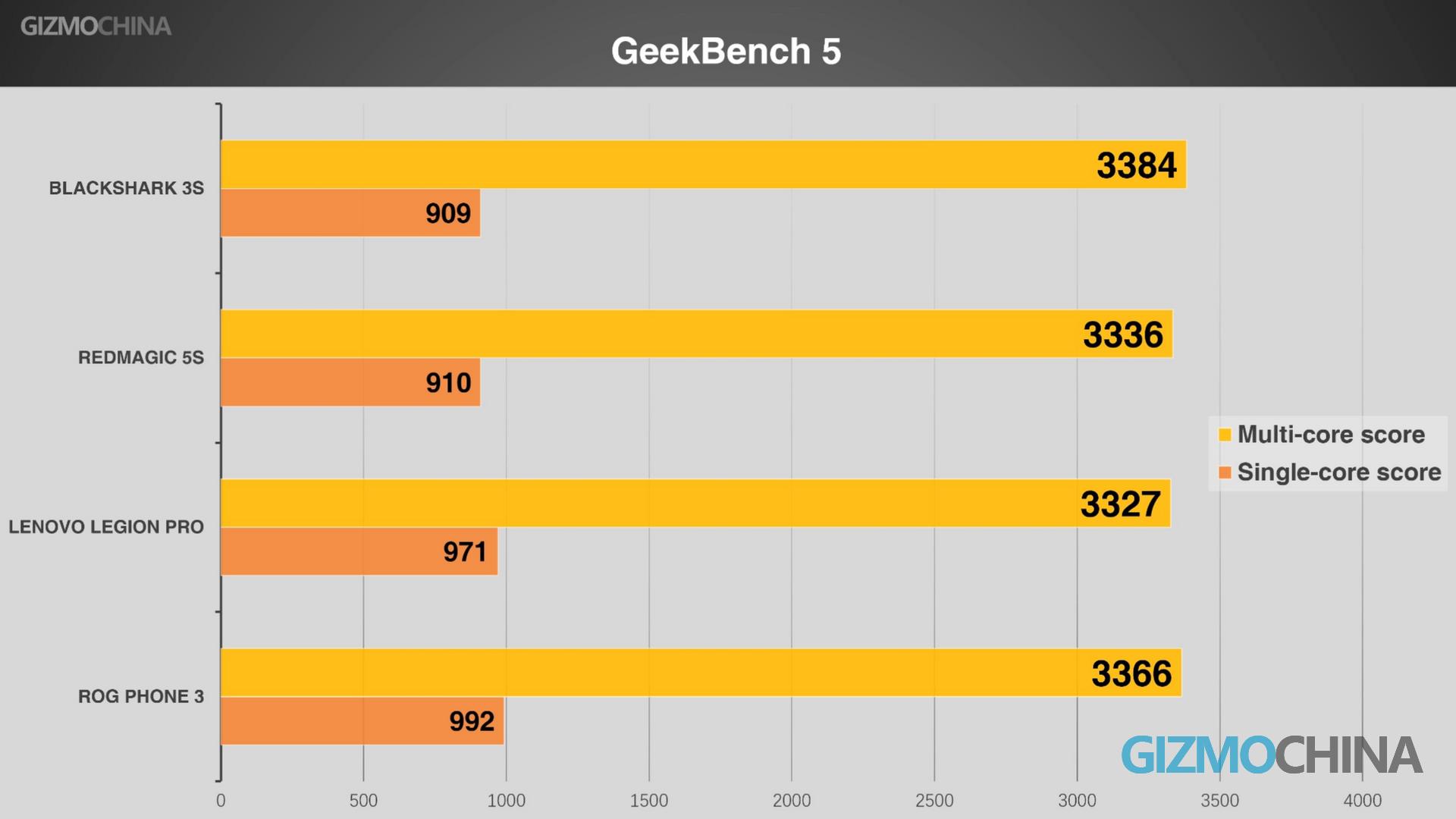
In Geekbench 5, the improvement of the 865 Plus is mainly reflected on the single-core results. And the improvement is much closer to the claimed 10%. Specifically, the ROG phone still won the single-core race, while over the multi-core test, the results of the 4 models are pretty close. And what’s interesting is that the highest multi-core score belongs to the Black Shark 3S but not one of the two models with the 865 Plus chipset.
Snapdragon 865 vs 865 Plus Geekbench 5
AnTuTu
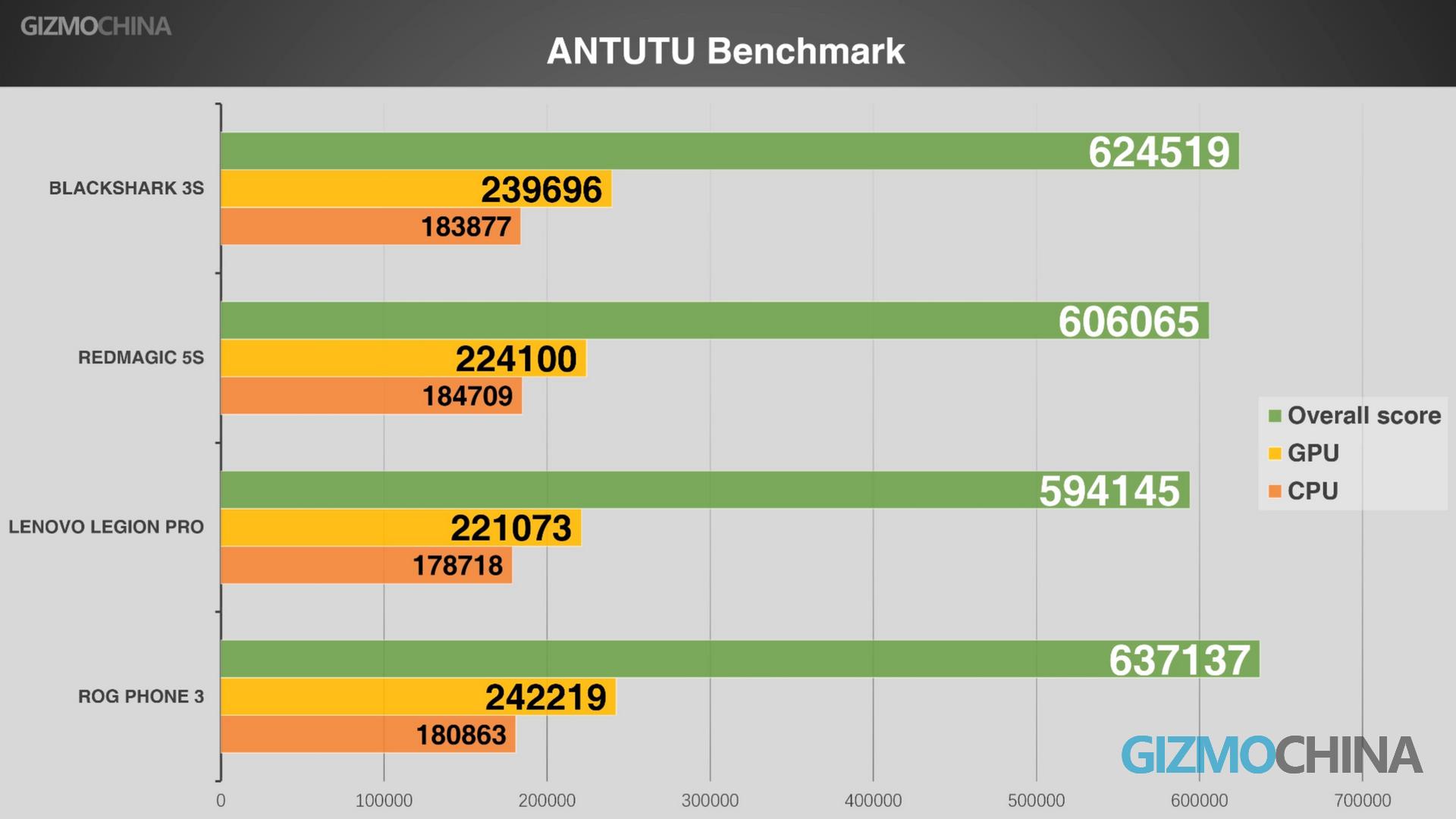
In the Antutu benchmark, the ROG Phone still won the test. And the results were also similar to what we got in 3Dmark.
Snapdragon 865 vs 865 Plus AnTuTu
And then let’s check out their gaming performance.
ASUS ROG 3 vs RedMagic 5S vs Black Shark 3S vs Lenovo Legion Pro: Gaming
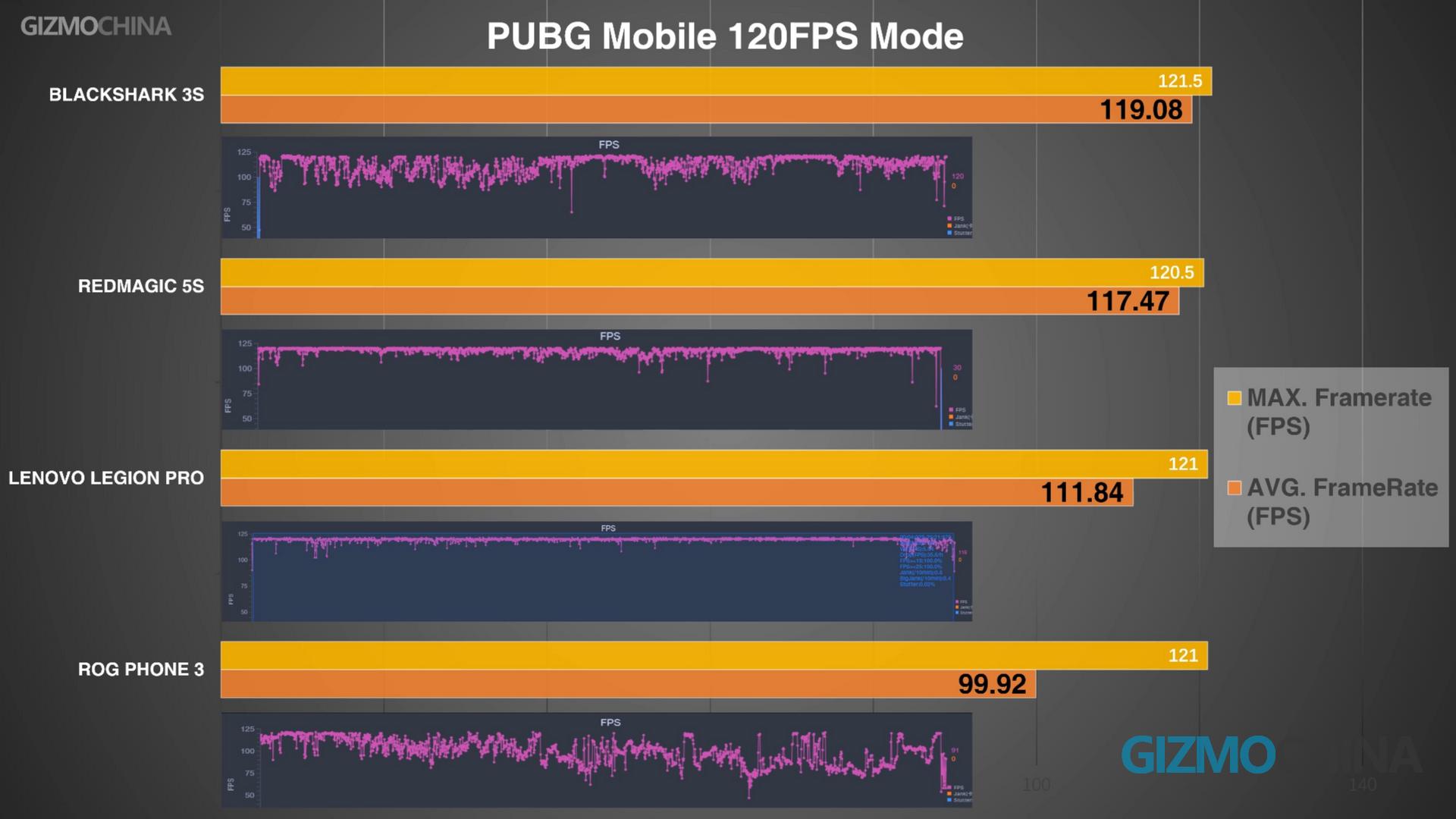
In PUBG mobile, as we tested at 120fps framerate, except for the ROG model, the other three can reach an excellent framerate at over 110fps. Especially for the Legion model, it remained at the most stable level without much fluctuation. However, another model running the 865 plus chipset, the ROG model was disappointing as it could only run at 99.9fps on an average without the ROG cooling fan. When we tested it last month, the framerate level was similar to what we got on the Legion model, but after a recent software update, things changed.
PUBG
PUBG Mobile-fps
In terms of the heating issue, we were not allowed to turn on the level 3 of performance mode on the ROG model without the cooling fan, and it seems that ASUS is forcing their users to buy the official accessory for the best performance of the phone.
NBA 2K20
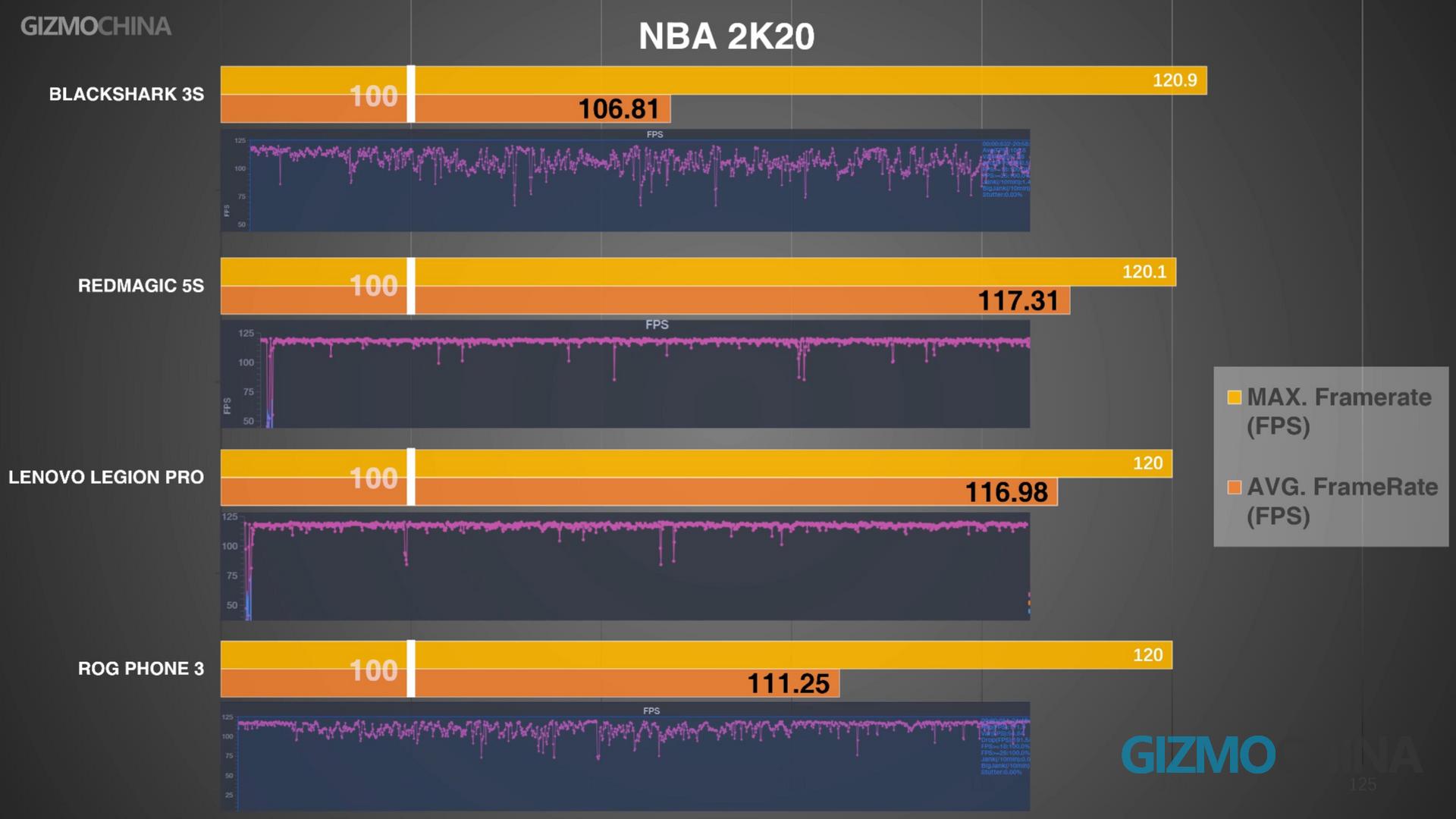
While in 2k20, things got a bit better for the ROG model, which went up one place to NO.3, followed by the Black Shark 3S at the bottom, while the Legion phone and RedMagic 5S maintained their leading places. Especially for the RedMagic model, it amazingly reached at 117.3fps, but at the same time, heated up in a few minutes. But we will talk about the heating test later.
nba 2k 20-fps
Nimian Legend
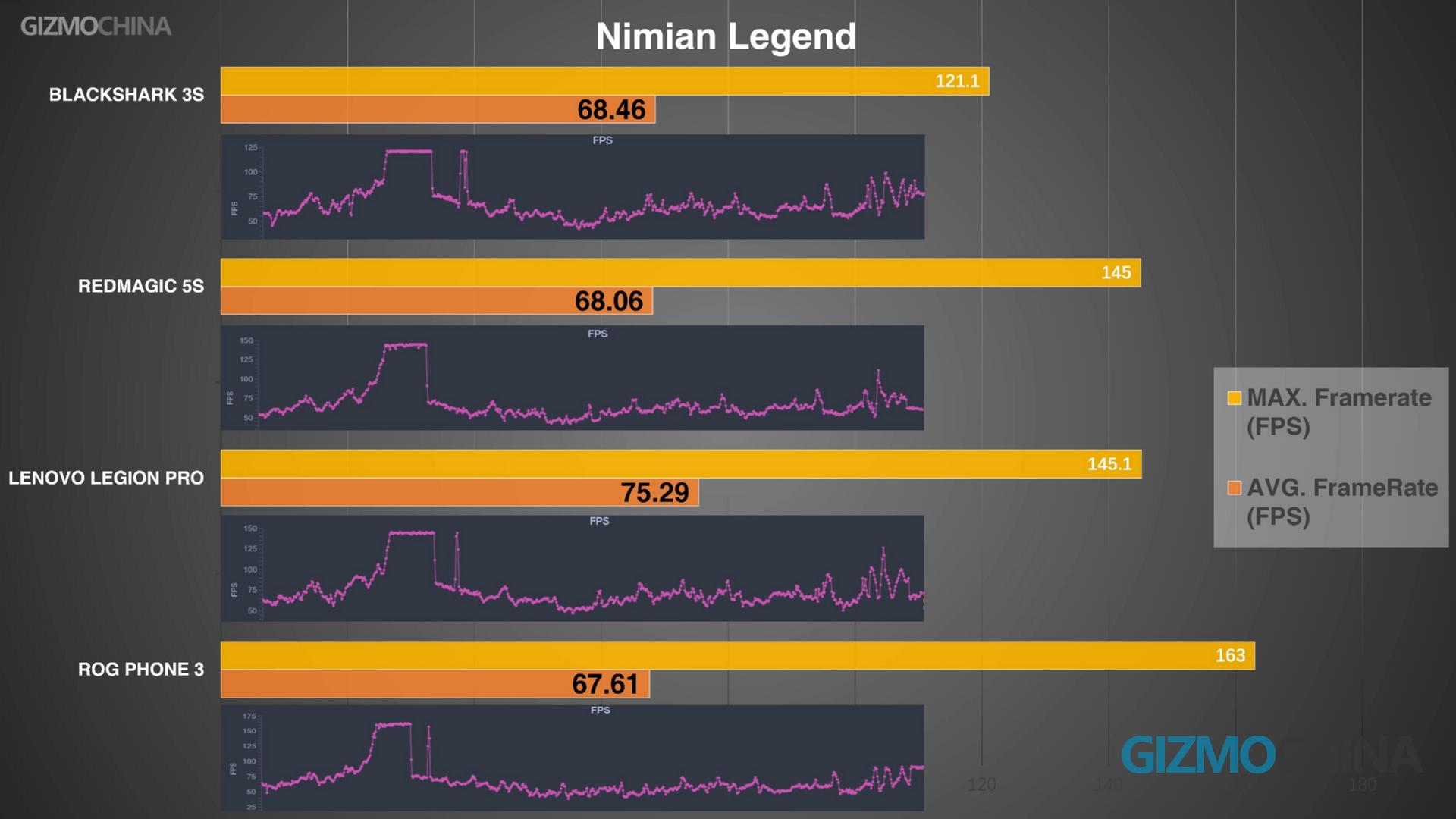
And then we ran the Nimian legend as a stress test. The Legion phone was dominant over all the other models with the framerate of 75.29. The Black Shark 3S caught up with the RedMagic model and ranked in second place. The ROG model without the fan accessory was still a bit left behind with a framerate of 67.6.
nimian legends-fps
ASUS ROG 3 vs Red Magic 5S vs Black Shark 3S vs Lenovo Legion Pro: Battery Life
As an e-sports smartphone, battery life and charging performance are also what gamers are concerned with. They are all equipped with large batteries and fast charging. Especially for the Legion Phone, along with the 5000mAh dual-battery, it surprisingly features dual-USB-C charging channels and the charging can be up to 90W.
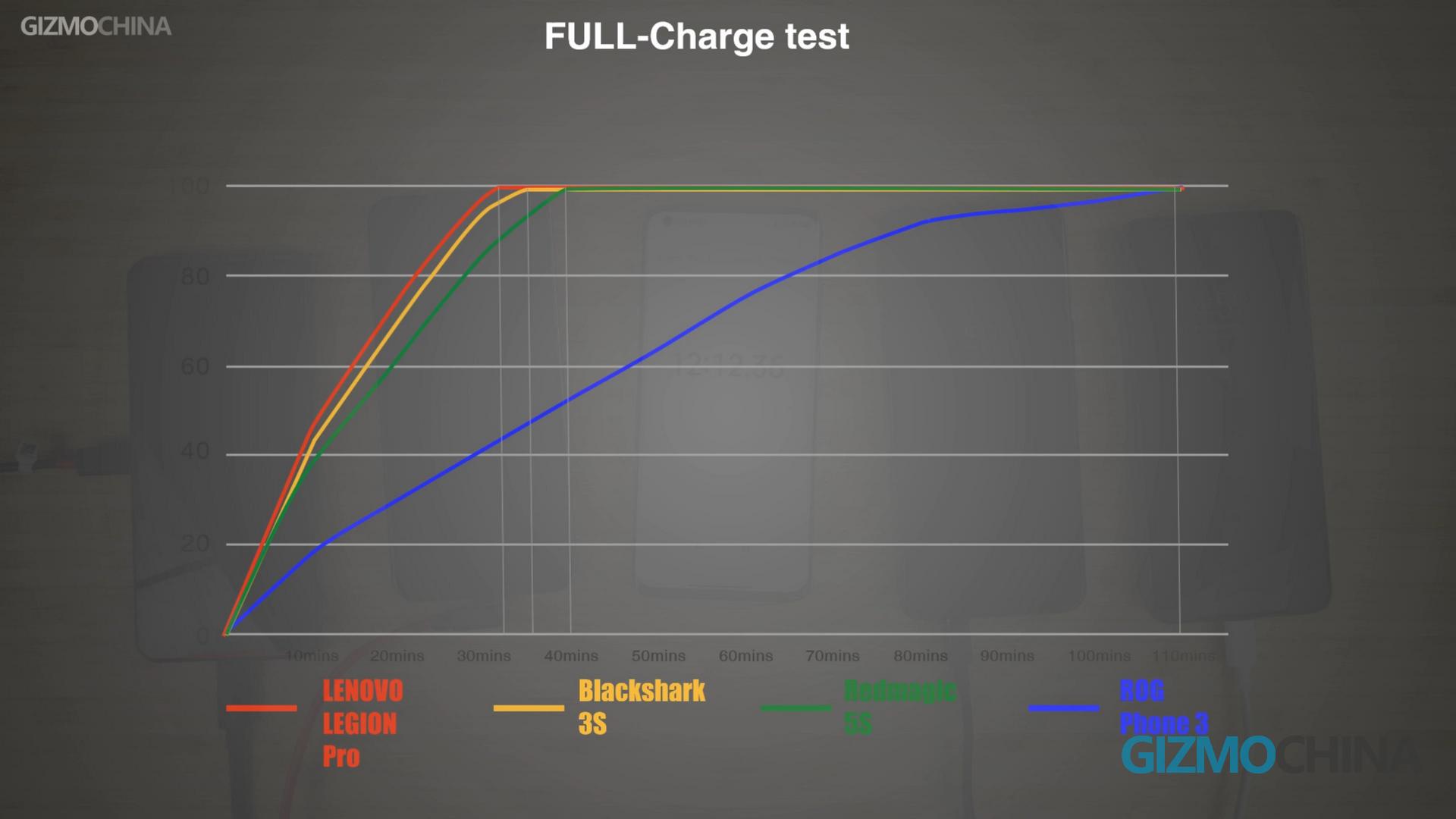
Although the ROG Phone sports the largest 6000mAh battery, it only supports up to 30W PD fast-charging. The other two models also had great charging performance with over 50W charging efficiency. In the race to full charge, the Legion no doubt took the lead. The Black Shark model and the RedMagic models were only 4 mins and 9 mins behind the Legion Pro, respectively, but unlike the Legion Phone, they only require one charging port. As for the ROG model, the whole charging test took us over 1hour and 40mins, which is too slow for a gaming phone.
full-charge test
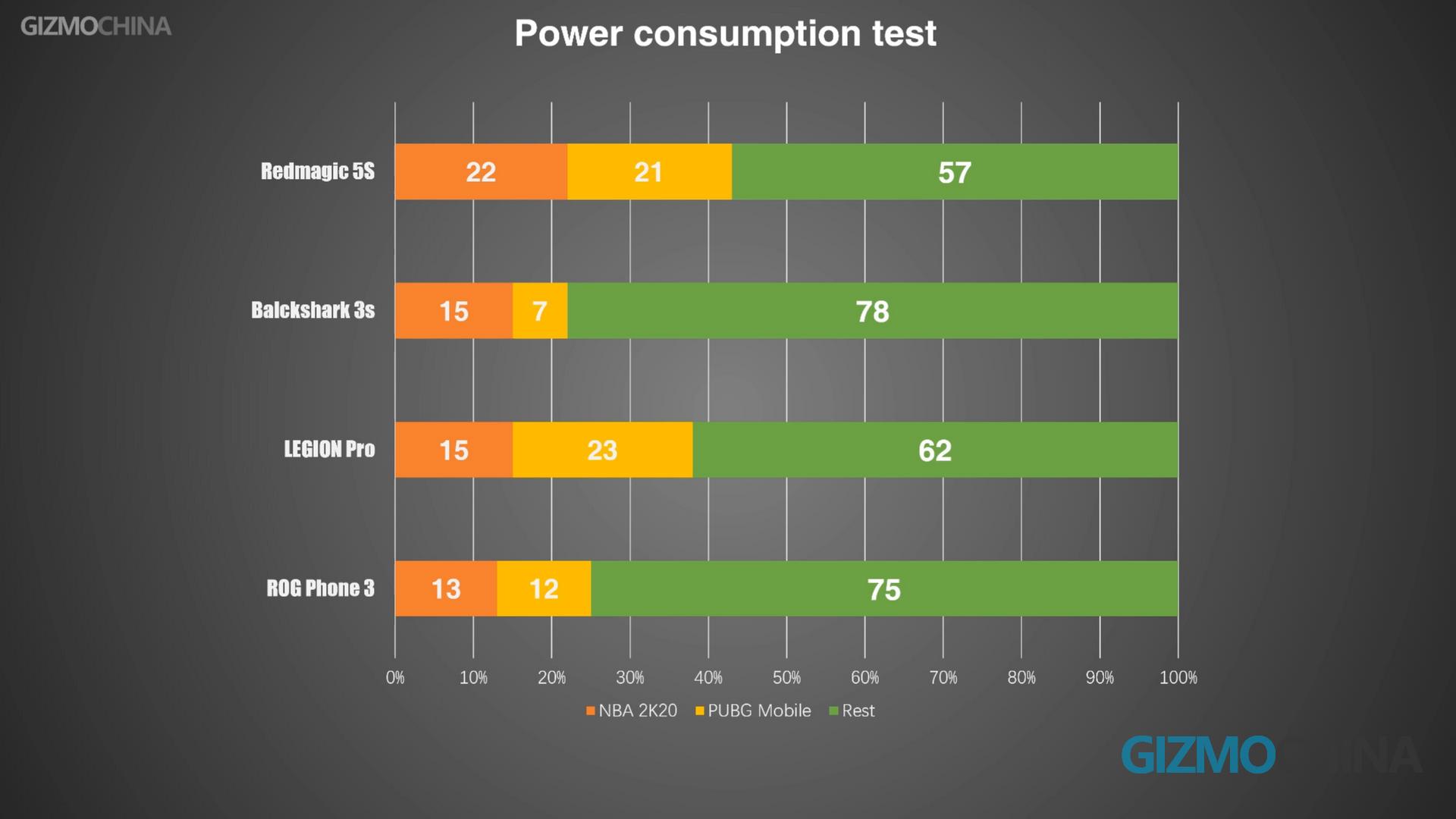
And then we did a test about their power consumption for gaming. After 30mins of NBA 2K20 gaming and another 30mins PUBG Mobile gaming, the Black Shark 3S won the competition consuming only 22% of power, even though it didn’t have the largest battery. So it was pretty efficient. The ROG model’s largest battery also performed well with 75% power left. Well, the RedMagic model was in the bottom place with an unbelievable 42% of power consumption, which is really unacceptable.
power consumption test
So overall, if you are a gamer who cares about battery and charging, just forget about the RedMagic model and make your choice between the ROG and Black Shark. Especially for Black Shark 3S, we really liked the phone and would pick it as our first choice.
Over Heating TEST
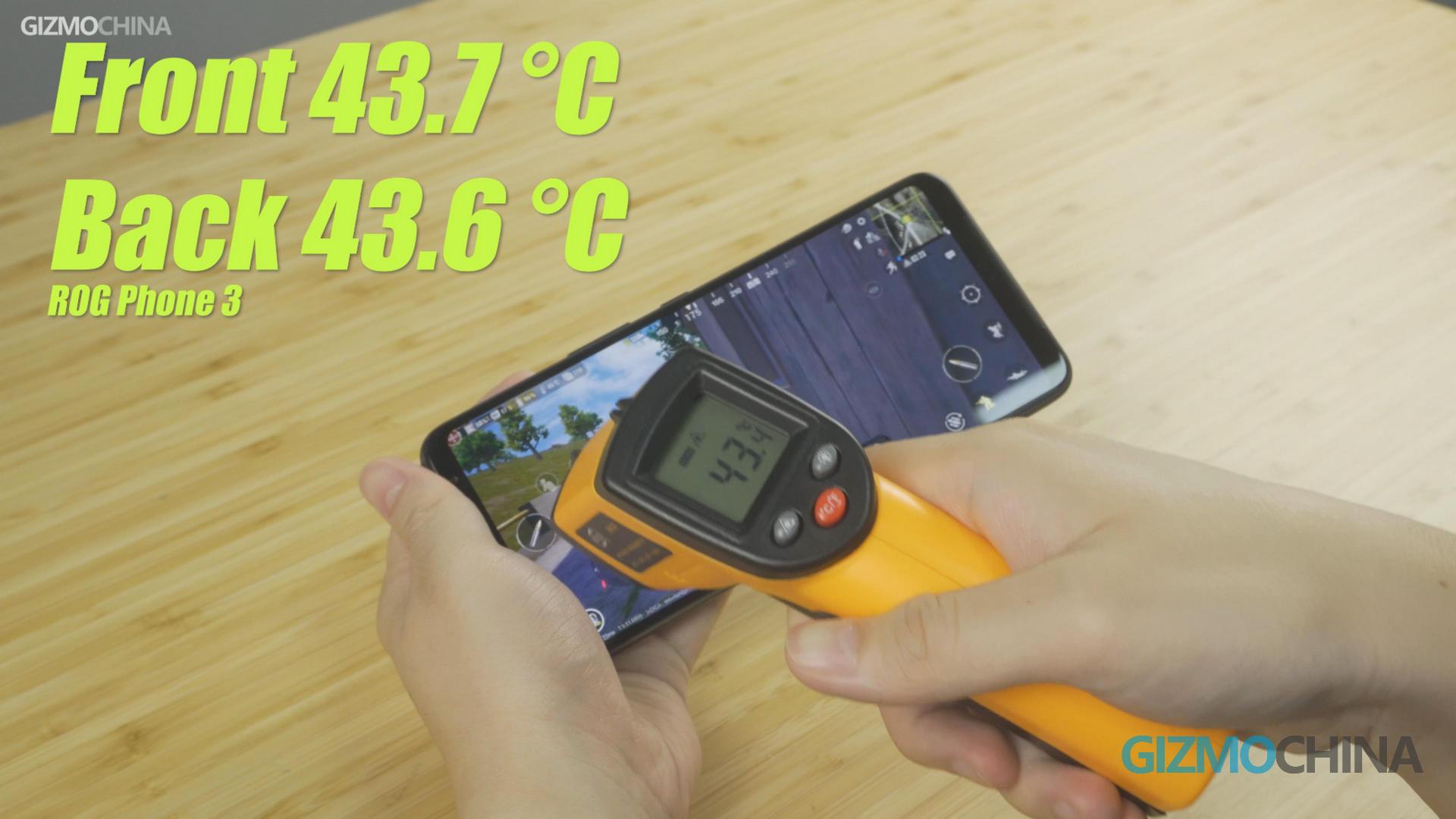
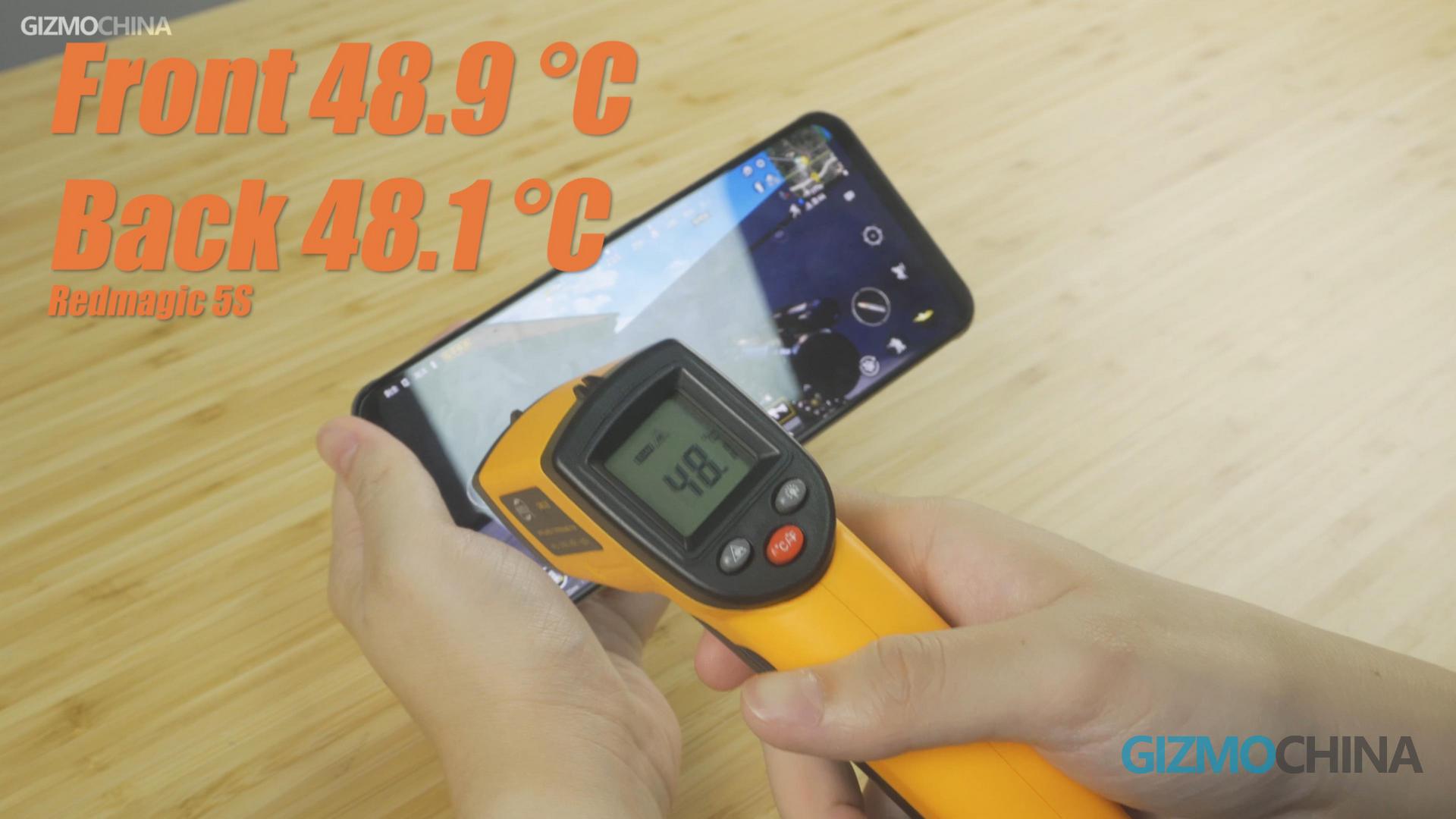
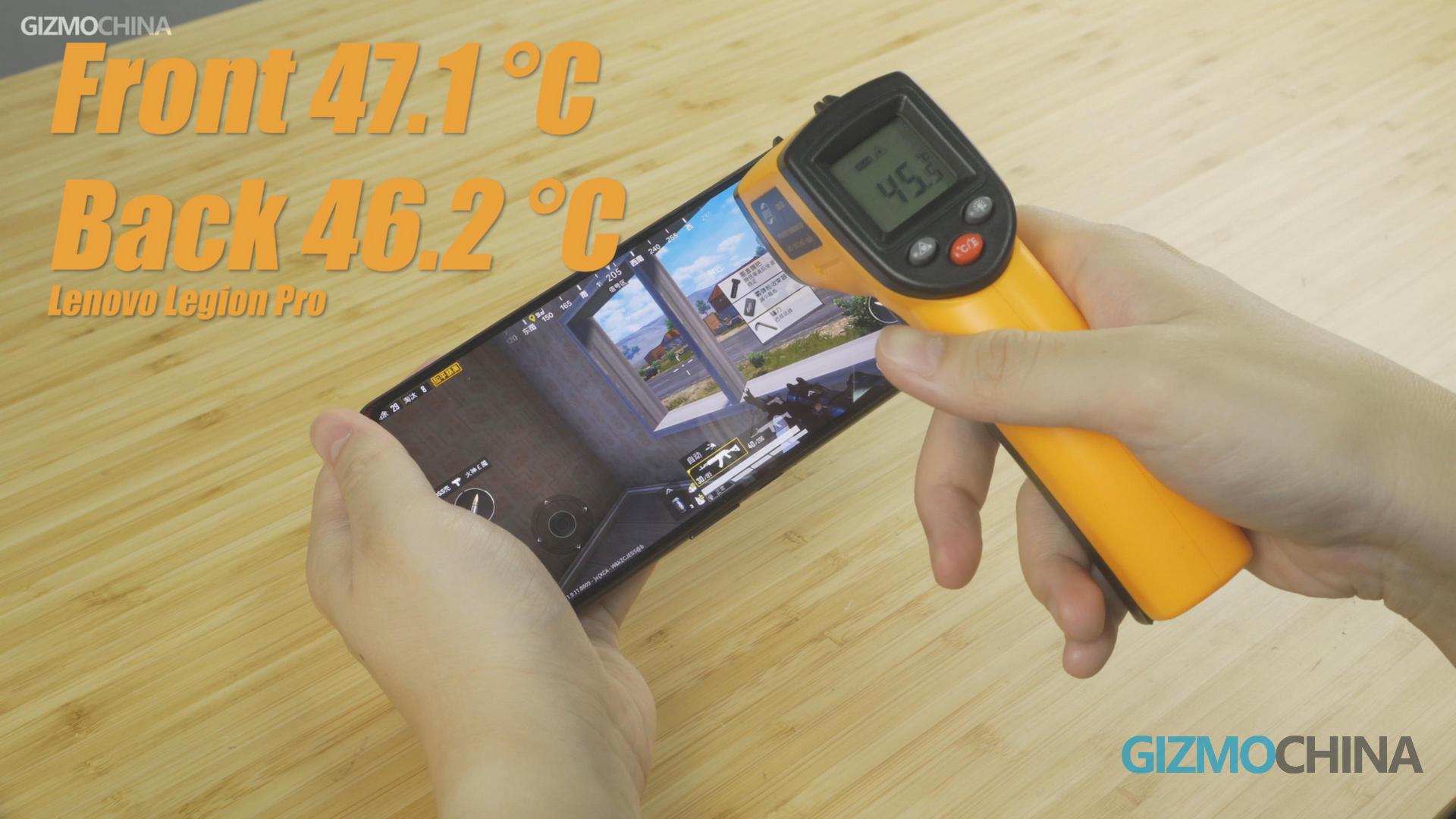
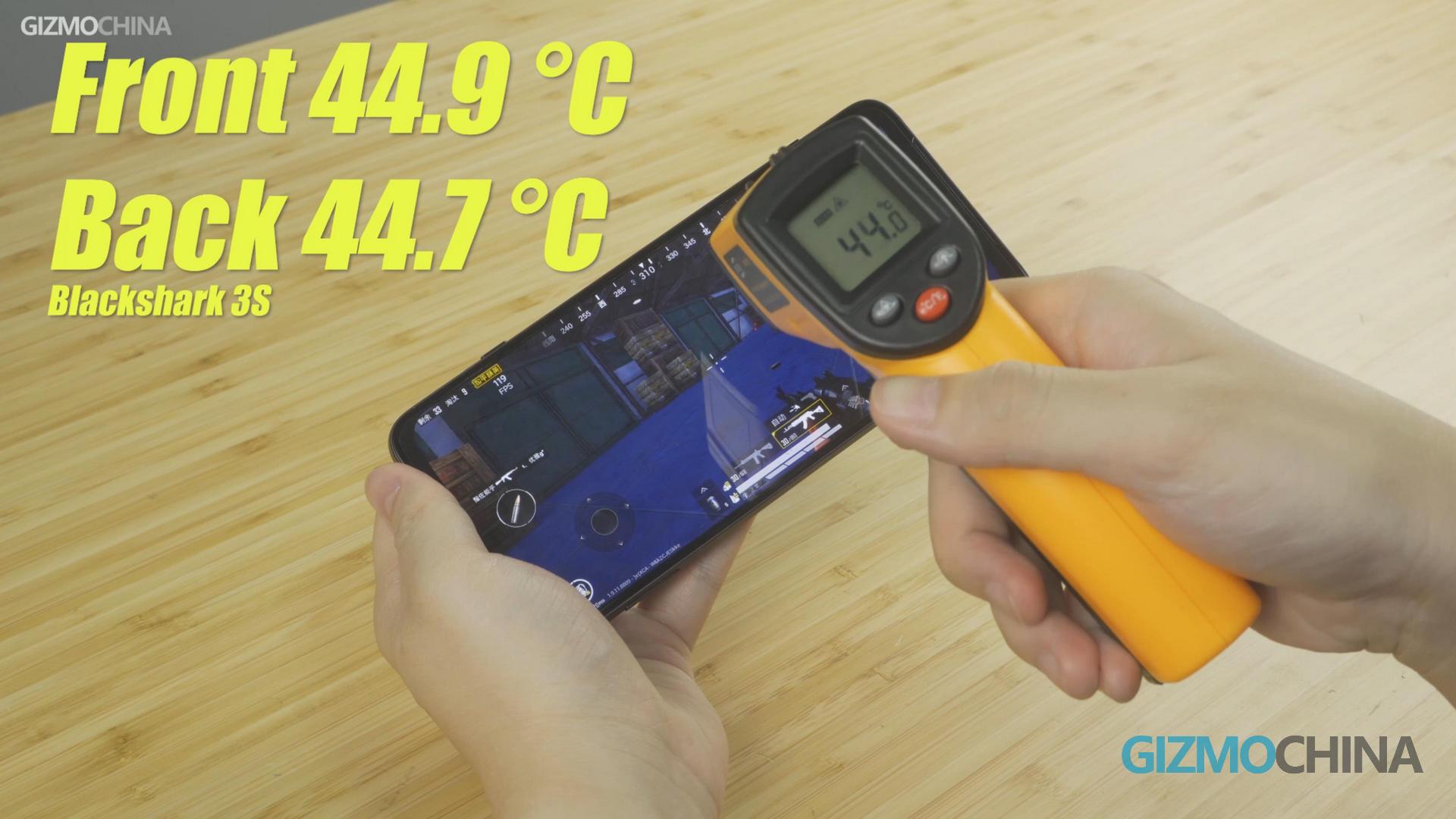
In addition, we were also curious about the heating issue of the Snapdragon chipset. So we recorded all of the four model’s temperatures after 30mins gaming. We could see that both the ROG and the Black Shark models had good temp-control, while the other two models easily got heated up at over 46℃. But on the Legion Phone, we didn’t really feel the heat when holding it as the internals are placed smartly to avoid radiating heat to your hands.
1 of 4
temp test-ROG
temp test-redmagic
temp test-legion
temp test-blackshark
ASUS ROG 3 vs RedMagic 5S vs Black Shark 3S vs Lenovo Legion Pro: Verdict
So overall, we believe that the Legion Phone can work independently unleashing its max performance among the four, while the ROG phone also has the potential to challenge the Legion phone but you need to attach the cooling fan. But if you care more about operating optimization, the ROG and RedMagic models should be the better choices. The RedMagic model has excellent performance for a gaming phone but it does heat up very quickly.
The Black Shark model provided a balanced performance, even though it didn’t come out on top in most of our tests. As you can see, each of the four models have their own set of positives and drawbacks. Picking up the best gaming phone among these four would require you to focus on what’s most important to you.
We hope this ASUS ROG 3 vs RedMagic 5S vs Black Shark 3S vs Lenovo Legion Pro comparison and review will help you to find the perfect gaming smartphone. If you want more such in-depth comparisons between specific models, feel free to mention them in the comments section down below.
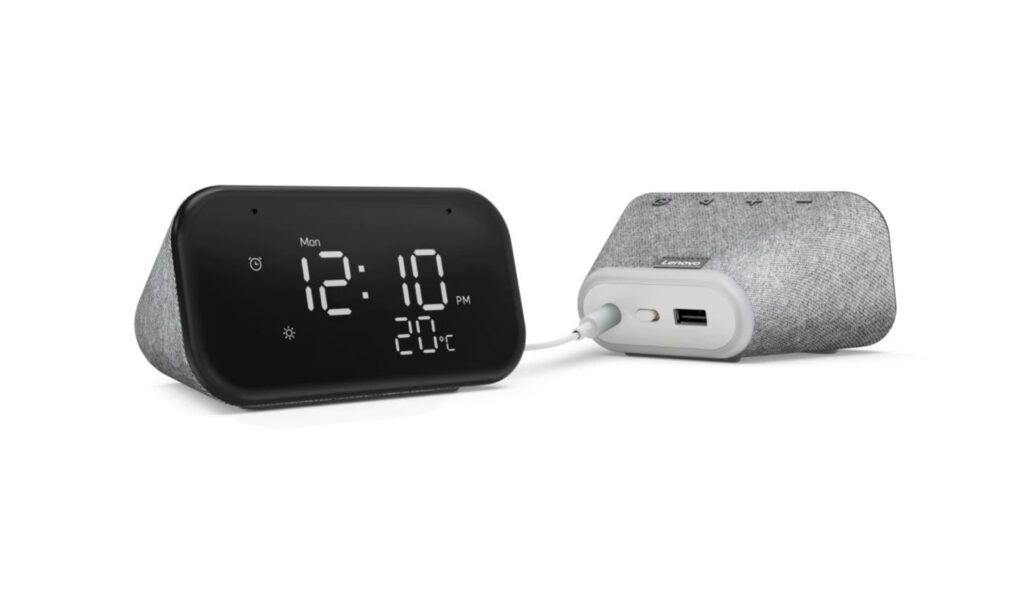
At the end of August, Lenovo announced a number of products and one of them was Smart Clock Essential. This clock is a toned-down version of the company’s Smart Clock that launched in 2019. It is priced at $49.99 and €59.99 in the US and Europe respectively. The Chinese computer maker said that it will be available starting October and keeping its word, the company has now put it on sale across multiple retailers in the US.
The new Lenovo Smart Clock Essential is a slightly different product than the original Lenovo Smart Clock launched last year. Unlike the older model that has an LCD panel, this one features a 4-inch LED display to only show time, day, and weather along with an option to set timers.
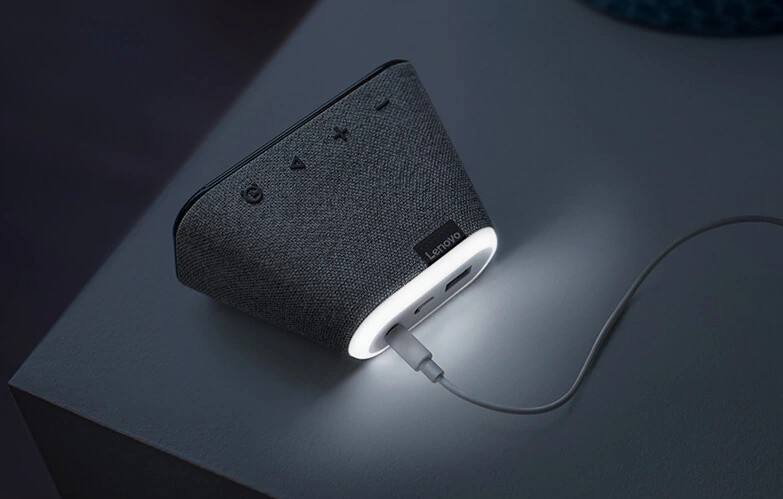
Being a smart cock powered by Google Assistant, it comes with a 1.5-inch 3W speaker and 2 x far-field microphones. Additionally, it also features a nightlight with a maximum brightness of 31 lumens and a USB Type-A output port to charge smartphones and other gadgets at the back.
Talking about the design, the new clock is similar to the costlier model with fabric cover all over its body and buttons for volume control, play/pause, and alarm at top. Also, it sports a microphone mute toggle at the behind alongside power-in port.
Last but not least, the Lenovo Smart Clock Essential comes in a single Soft Touch Grey color option and includes Amlogic A113X chipset, 4GB RAM, 4GB eMMC storage, dual-band WiFi 5, and Bluetooth 5.0.
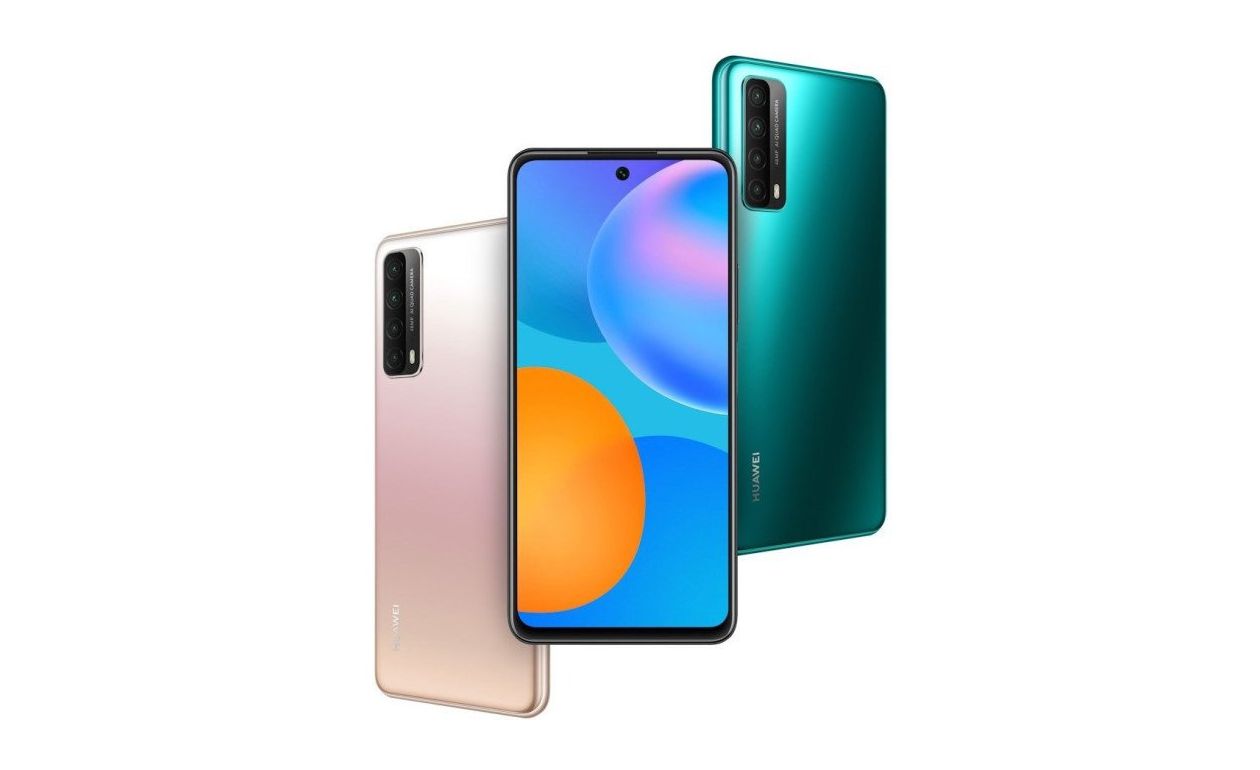
Shortly after heading to countries like Austria, Croatia, Estonia, and Slovenia in Europe, Huawei’s P Smart 2021 smartphone has landed in the UK. The device, which is a direct successor to P Smart 2020, comes with EMUI 10.1 UI and Huawei’s AppGallery pre-installed.
Huawei P Smart 2021
Huawei P Smart 2021: Price, and Availability
The Huawei Smart P 2021 smartphone comes in three colors- Crush Green, Blush Gold, and Midnight Black. Priced at £199.99, it will be available for purchase starting October 22 from the Huawei store, and select operators, retailers.
Huawei’s P Smart 2021 weighs 206g and measures 9.26mm thickness. It has a side-mounted fingerprint sensor, USB-C, and 3.5mm audio jack. It features a 6.67-inch FHD+ display with centered punch-hole and a resolution of 2400×1080 pixels. The display is TÜV Rheinland-certified, has an aspect ratio of 20:9, and 90.3% screen-body ratio.
It is powered by Huawei’s Kirin 710A SoC paired with 4GB RAM, 128GB storage. And has a MicroSD slot for expansion up to 512GB. Turning back, we have a quad-camera system housing a 48MP f/1.8 main lens, an 8MP f/2.4 ultra-wide with 120° FOV, two 2Mp macro, and depth sensors. The front punch-hole has an 8MP selfie shooter. Camera features include night mode, bokeh effects on the back. And, AI-beautification, low-light selfies on the front.
The device is backed up by a 5,000mAh battery with 22.5W Huawei SuperCharge. Huawei says a 10-minute charge gives two hours of video streaming. Other features include Dual-SIM, 4G VoLTE, Wi-Fi 802.11 b/g/n, Bluetooth 5.1, NFC, and GPS. The device runs Huawei’s EMUI 10.1 UI and comes with HMS(Huawei Mobile Services) and AppGallery pre-installed.
Chinese smartphone makers have recently started launching smartphones with curved displays. On the other hand, Samsung, the pioneer in this design reverted back to flat panels on its premium handsets. When we think about waterfall displays (super curved), OPPO and vivo are the two companies that come into mind. Now, another design patent for such a smartphone with an under-screen camera by the former firm comes into light.
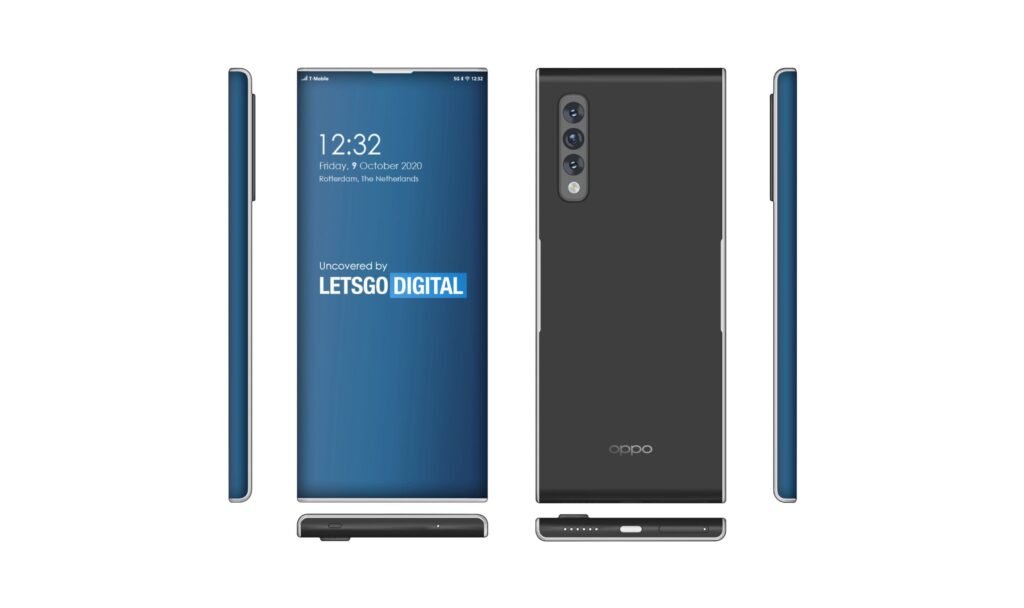
Like always, the new OPPO design patent for a super curved display smartphone was unearthed by LetsGoDigital. According to the publication, Guangdong Oppo Mobile Telecommunications filed this patent with the CNIPA (China National Intellectual Property Office) at the end of 2019. However, it got approved and published only on October 9.
According to the documents of this patent, OPPO has patented four different smartphone designs with minor differences in their display curves. But only one of them is showcased in color renders. Hence, LetsGoDigital says that it could be the potential design if the company ever plans to release a phone with such a design.
That said, as per this design if this smartphone ever comes into life, the display on it may have 21:9 cinematic aspect ratio like the Xperia 1 II and Xperia 5 II by Sony. Also, since the sides will be engulfed by the screen, the volume buttons will be situated at the back near the end of the display curvature on either side.
Further, the rear panel of the handset will sport a vertically aligned triple camera setup at the top left corner. Whereas, the top side of the phone will house the power key as well as a microphone and the bottom side will include a speaker, USB Type-C port, and a SIM card slot. Interestingly, it may also feature an under-screen camera.
Having said that, we don’t think OPPO will ever launch a super curved display phone with this design since the cameras and the overall design look outdated. That doesn’t mean they will never release such a handset; they may do but perhaps with a slightly different design.
OnePlus debuted the OnePlus Nord, a mid-range smartphone after a big gap from OnePlus X. However, the device is available only in select areas like Europe and India. A few days back, the brand officially teased the arrival of a new Nord smartphone. Now, Steve from Onleaks has broken the launch date of the device.
According to Steve, OnePlus will unveil two more Nord smartphones, the Nord N10 5G, and Nord N100 on October 26, at 12 PM GMT. However, he has mentioned N10 as a 5G device but hasn’t included it on N100. This could be an indication that the N100 might be a budget device that got leaked earlier with Snapdragon 460 SoC or a Snapdragon 6 series SoC. But OnePlus hasn’t confirmed anything yet.
That said, Steve has neither revealed the launch place and specs nor the availability. If we recall, an earlier report by Android central broke the news that Nord N10 would be a 5G smartphone. And will launch in the US under $400. As per the report, the device will feature a 6.49-inch FHD+ display with a 90Hz refresh rate. And Snapdragon 690 5G SoC, 6GB RAM,128GB storage, 64MP camera. The N100 could feature a 6.52-inch HD+ display, Snapdragon 460 SoC, 13MP main camera, and 6,000mAh battery.
It all started with a Geekbench score that showed a new OnePlus codenamed BE2028. Later, an XDA finding and a tip by Max J. revealed alleged renders of two new devices under “Billie” with a punch-hole display.
Following that, another Geekbench report hinted an OnePlus phone with the codename “Clover” with an alleged Snapdragon 660/662 SoC could be in the works. Later, an OnePlus device with Snapdragon 460 SoC was spotted on a proprietary source code hinting at the possibility of another device. Additionally, we also saw an 18W charger of OnePlus getting certified by TUV Rheinland.
Looking at all leaks and rumors, we feel Nord N10 will be a 5G device. And N100 could be a 4G device aimed at a cheaper price tag. We can expect more details from OnePlus post the OnePlus 8T launch.
We use cookies on our website to give you the most relevant experience by remembering your preferences and repeat visits. By clicking “Accept”, you consent to the use of ALL the cookies.
This website uses cookies to improve your experience while you navigate through the website. Out of these, the cookies that are categorized as necessary are stored on your browser as they are essential for the working of basic functionalities of the website. We also use third-party cookies that help us analyze and understand how you use this website. These cookies will be stored in your browser only with your consent. You also have the option to opt-out of these cookies. But opting out of some of these cookies may affect your browsing experience.
Necessary cookies are absolutely essential for the website to function properly. This category only includes cookies that ensures basic functionalities and security features of the website. These cookies do not store any personal information.
Any cookies that may not be particularly necessary for the website to function and is used specifically to collect user personal data via analytics, ads, other embedded contents are termed as non-necessary cookies. It is mandatory to procure user consent prior to running these cookies on your website.