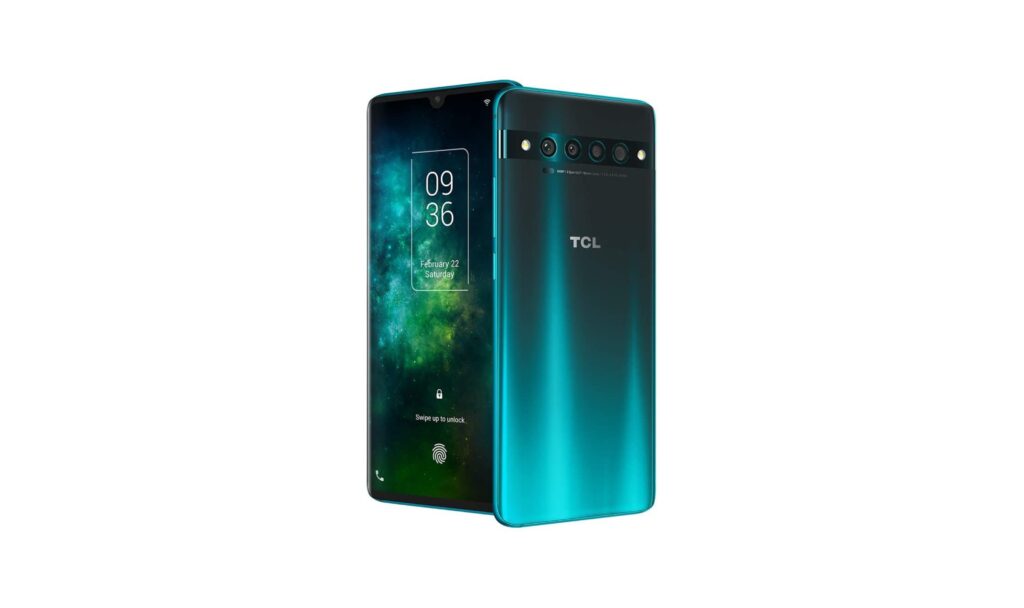
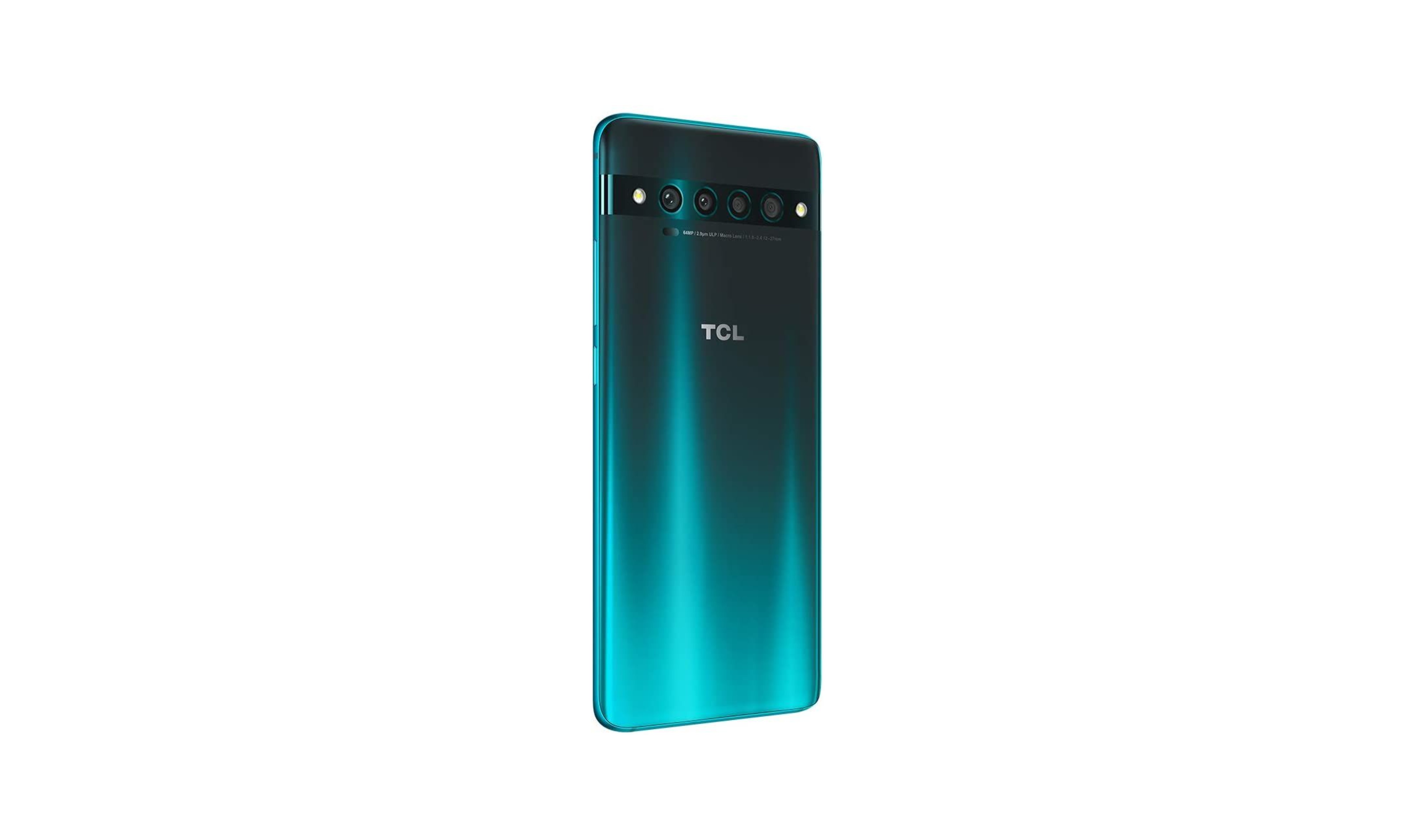
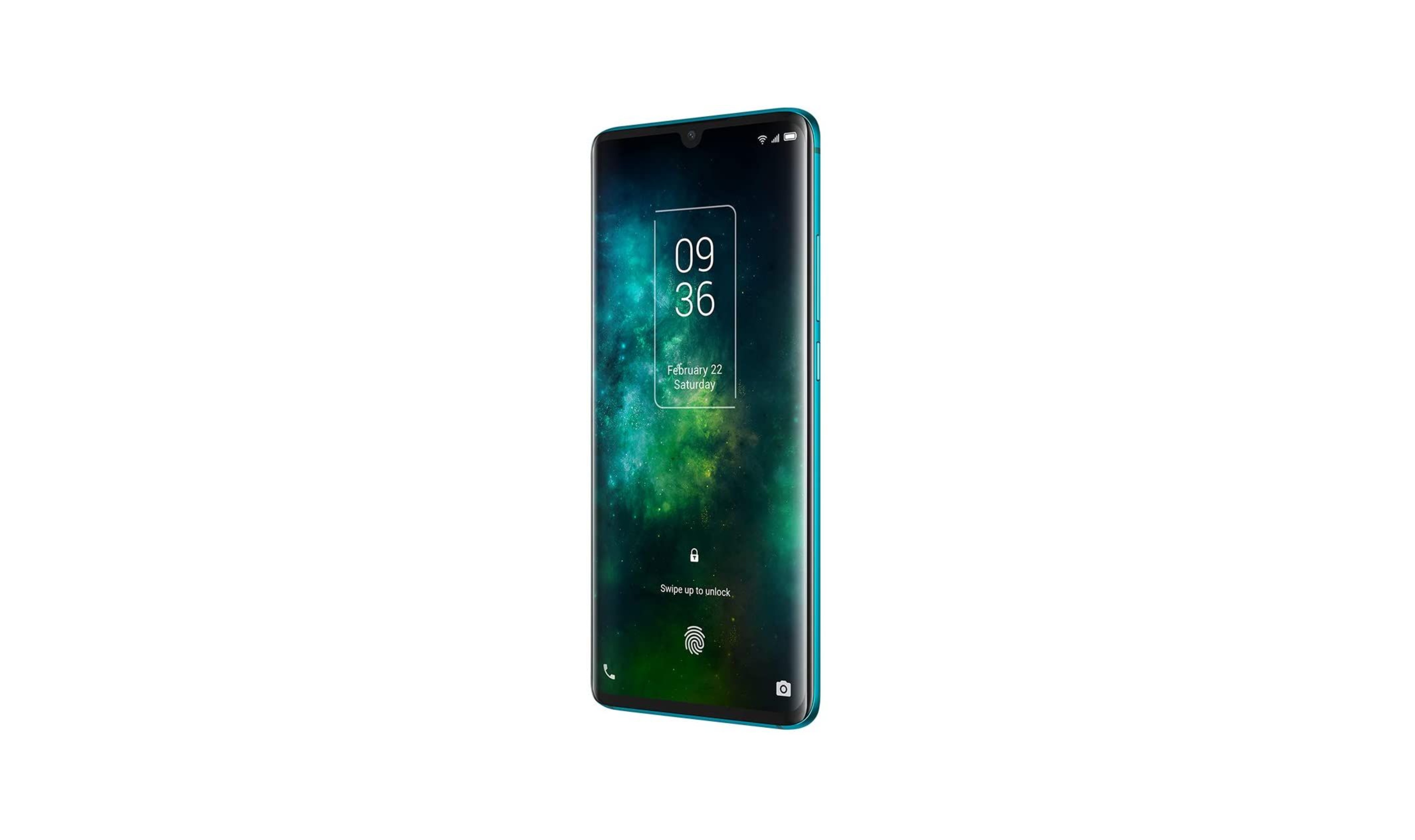
TCL 10 Pro was launched earlier this year alongside TCL 10 5G and TCL 10L. Months after its release, the smartphone now gets a new color variant called Forest Mist Green. This version of the handset is already on sale in the US on Amazon. Although the phone costs $449.99, buyers can get it for $379.99 by applying a mentioned coupon in the listing.
TCL, a well-known Chinese TV manufacturer started launching smartphones with its own branding from late last year. This year, the company expanded its portfolio by releasing newer models as mentioned listed as well as others like TCL 10 Plus and TCL 10 SE.
Out of all the phones launched by the company, the TCL 10 Pro can be considered as its flagship smartphone, although it is powered by Qualcomm Snapdragon 675 paired with 6GB RAM and 128GB internal storage with support for microSD card up to 256GB.
Being a display producer, the firm has fitted a 6.47-inch curved AMOLED panel with a resolution of 2340 x 1080 pixels (FHD+), 398 ppi, dew-drop notch, 19:5:9 aspect ratio, 2,000,000:1 contrast ratio, 93% screen-to-body ratio, a dedicated display engine, and real-time SDR to HDR conversion.
The back of the handset houses a quad-camera setup consisting of a 64MP (GW1) primary sensor, a 16MP (3P9) sensor with an ultra-wide-angle lens, a 5MP (GC5035) sensor with a macro lens, and a 2MP (OV02K10) depth sensor. Whereas, on the front, it sports a 24MP (OV24B) selfie camera.
1 of 2
Other features of TCL 10 Pro include WiFi 5, Bluetooth 5.0, GNSS (GLONASS, GALILEO), NFC, in-display fingerprint sensor, 3.5mm headphone jack, WCD9370 audio chipset, NXP TFA9890 audio amplifier, a programmable key, USB Type-C port, 4,500mAh battery, 18W fast charging (Qualcomm Quick Charge 3.0), and Android 10.
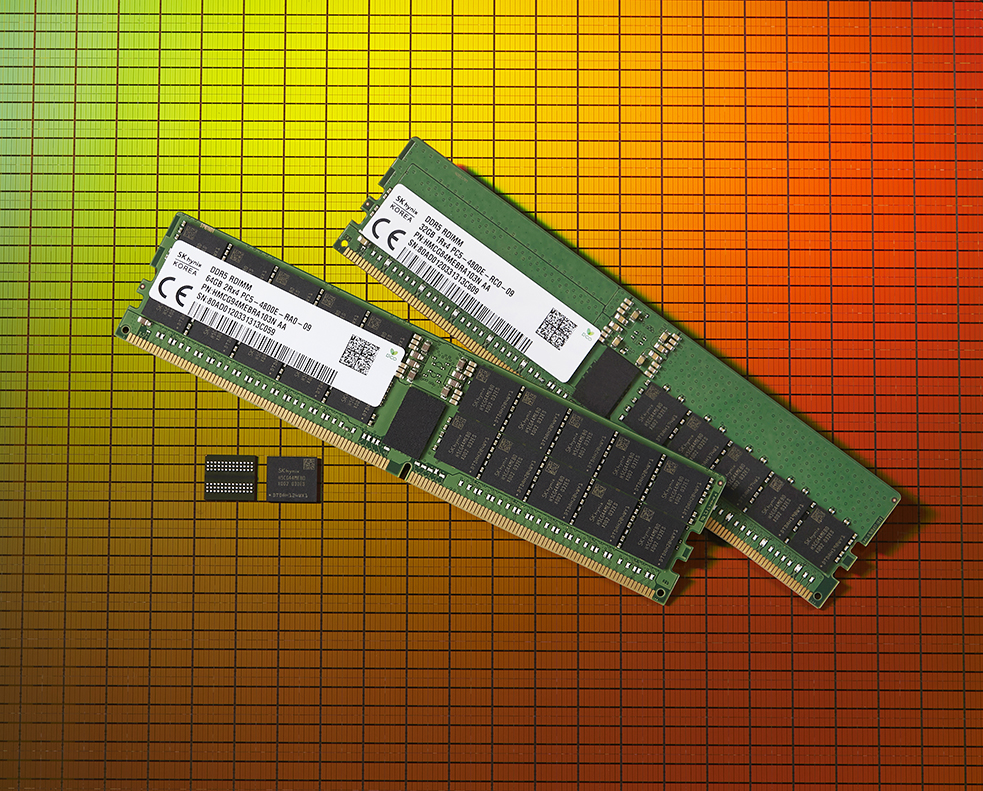
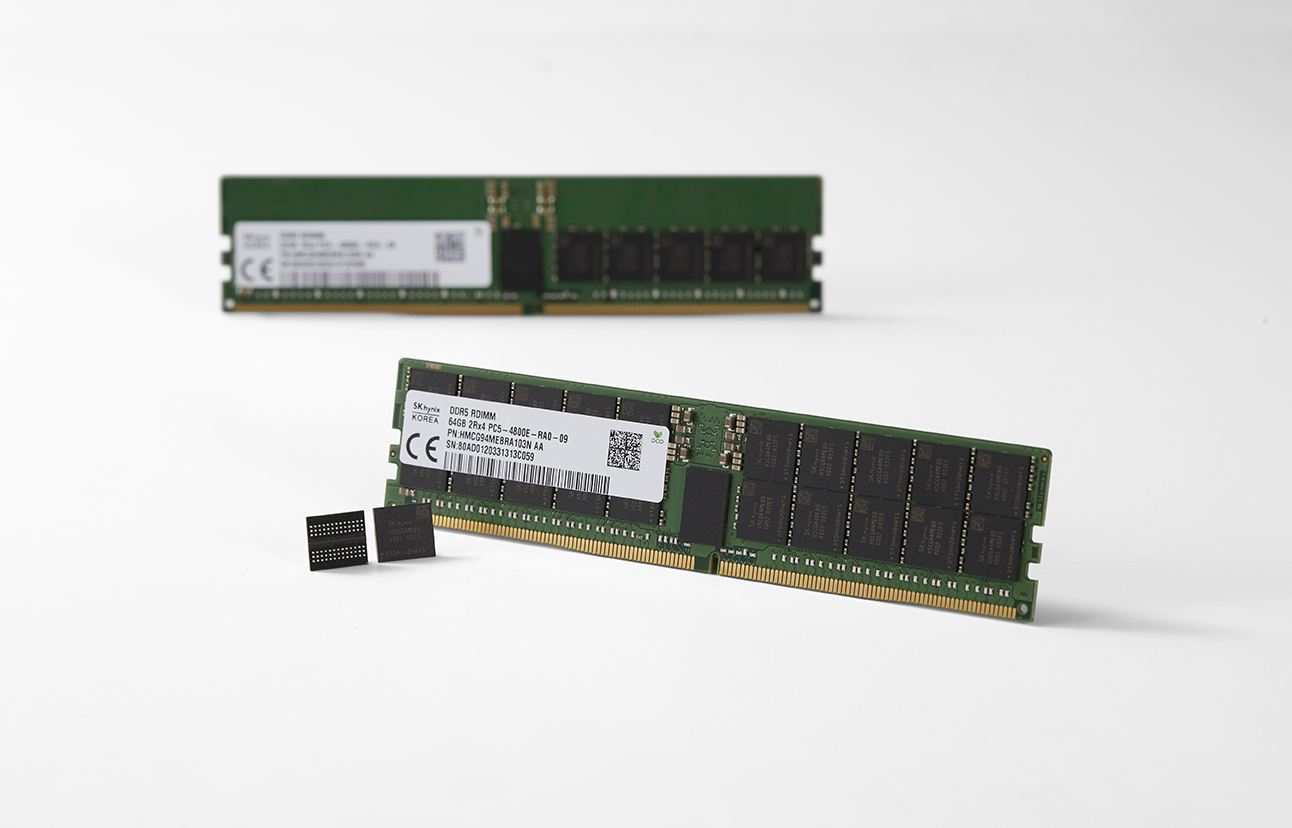
SK Hynix, the second largest memory chipmaker after Samsung, has just announced earlier today (6th October 2020) that it is the world’s first to release DDR5 DRAM (Double Data Rate dynamic random access memory) chips.
The new DDR5 DRAM chips boast performance upgrades up to 1.8 times faster than the previous DDR4 generation of memory. The South Korean company said that it has completed various tests and has even provided partner companies with its samples for verification. One such partner includes Intel. DDR5 is the next generation of DRAM standard, which will have a broad application ranging from big data, artificial intelligence, machine learning technologies, and more.
According to SK Hynix, the new DDR5 DRAM supports a transfer rate of 4,800 to 5,600 Mbps, which is 1.8 times faster than the 3,200 Mbps offered by DDR4. Notably, the fastest transfer rate of 5,600 Mbps allows users to transmit about nine FHD movies with a size of 5GB each in just one second. Despite the higher transfer rates, the new DRAM chips are also more energy efficient with operating voltages being lowered from 1.2 volts to 1.1 volts, allowing for 20 percent less power consumption.
The new DDR5 chips are also loaded with error correcting code (ECC) that is capable of correcting DRAM cell’s 1-bit-level errors by itself. Furthermore, the new technology also has increased the reliability of the DDR5 application system by 20 times and allowed a reduction in power consumption and operating costs of data centers. For those unaware, the company had first announced its 16 gigabit DDR5 DRAM back in 2018.
Karnataka, India has been the country’s IT Hub and is also known as the home to EV startups has pitched Bengaluru as a potential site to Tesla for its Gigafactory, which manufactures its electric cars and batteries, as per state officials.
Tesla Model S
According to an ETreport, the known electric vehicles maker has already held preliminary talks with the state for a research and innovation unit in the city. For those unaware, Bengaluru is also home to local EV startups like Ola Mobility, Ather Energy, Mahindra Electric, and more. This move from the local government aims on bringing the world’s most valuable carmaker to the Indian market.
Gaurav Gupta, principal secretary of Karnataka’s commerce and industries department said, “We have offered them all support to set up a research and development center as well as the manufacturing unit.” He further added that Bengaluru has a favorable ecosystem for electric vehicles and Tesla can leverage on that.” At the moment, the talks are just in the early conceptual stages and it is going to be a long drawn process.
Gupta also said that “We have briefed them about how Bengaluru is home to promising EV startups and also component makers and the advantages we offer.” Unfortunately, Tesla has yet to respond to any queries regarding this matter at the moment. But the automobile giant having plans on setting up an R&D center in India would imply an entry into the Indian market, which its CEO, Elon Musk has shown great interest in.
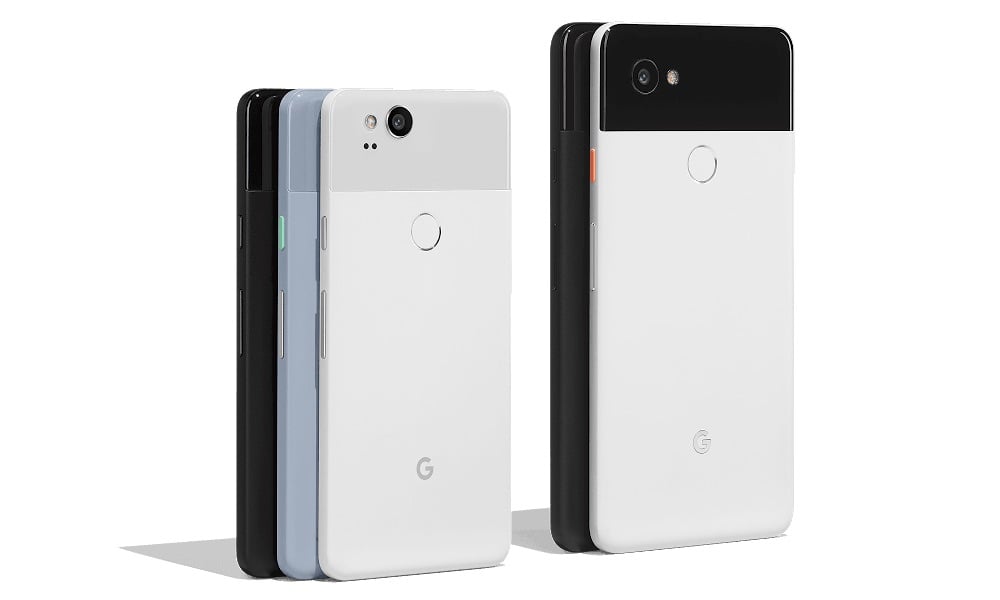
Back in September, the Google Pixel 2 and Pixel 2 XL received the Android 11 updates, and have received a security update earlier this week as well. But now, it seems its patch cycles are coming to an end with the last update arriving in December 2020.
Pixel 2 and Pixel 2 XL
The Pixel 2 and Pixel 2 XL have officially reached the end of its three years’ worth of Android version update and security update as of 5th October 2020. Although, the company has promised another update this December, which will be the final patch that will be received by the flagship launches from 2017. Similar to the original Pixel, the Pixel 2 series will also skip the update in November but will receive the December patch, which will include the November update as well.
The most recent update on the device was the security patch, which brought in the October Security patch and also addressed other issues like boot locks, call notification being disabled, auto rotate icon in the wrong orientation, and swipe gestures not responding. The Pixel 2 series was launched back in 2017, with the smaller variant being made by HTC, while the larger version was made by LG.
Under the hood, both variants were powered by a Qualcomm Snapdragon 835 SoC along with 4GB of RAM and either 64 or 128GB of internal storage. The Google Pixel 2 devices were known for their photographic prowess, and “ushered in a new era for computational photography,” as per 9to5Google. These were flagship grade handsets and had lived up to their expectations.
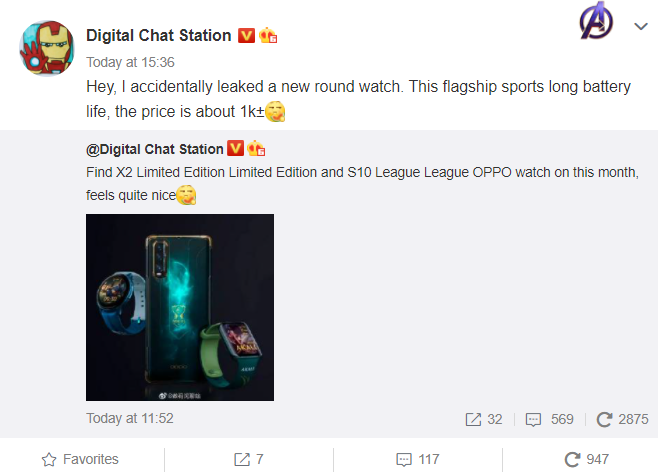
A new report has revealed that OPPO, the known smartphone manufacturer, is planning on launch a special edition for its Find X2 smartphone and its Watch lineup, which will be based around the popular MOBA title League of Legends.
According to leaks from @数码闲聊站 and @科技喵 on Weibo, a Chinese microblogging website, the company is gearing up for the launch of the OPPO Find X2 League of Legends S10 Limited Edition and two OPPO Watch League of Legends limited editions as well. The Chinese tech giant has yet to confirm the news, although, the official promotional image was also leaked prior to the launch, giving us a first look at the new special variants of the devices.
The Find X2 League of Legends S10 Limited Edition features a design overhaul with its rear panel featuring a distinctive from the popular competitive video game. The “S10” in the name stands for the 10th competitive season of the game, with the rear panel also sporting the World’s championship branding as well. Similarly, the Watches also adopt a new theme and wrist band variations for the special edition.
As per the report, the company will be launching all three devices on 12th October 2020, which is also when the group stage ends for the first day. In other words, OPPO has partnered with League of Legends with this unique launch. Unfortunately, it is currently unknown if the differences within the special edition also affect the internal specs or are just limited to the aesthetics of the device, so stay tuned for more updates.
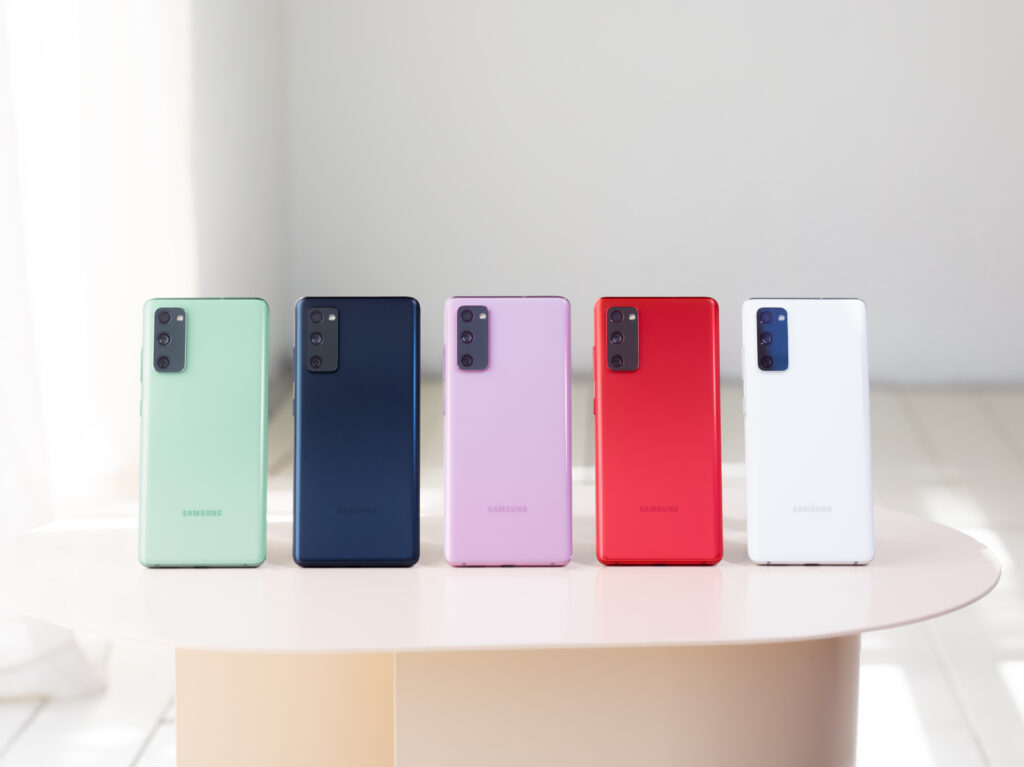
As confirmed yesterday, Samsung officially launches Galaxy S20 FE in India. The smartphone will be available in a single 8GB + 128GB storage configuration priced at ₹49,999 ($681). Interested customers can pre-book the handset starting October 9.
They will be able to pick it up in either of the five colors namely Cloud Red, Cloud Lavender, Cloud Mint, Cloud Navy and Cloud White. The company is also offering benefits worth up to ₹8,000 as part of the launch offer – ₹4,000 Samsung e-store benefit and ₹4,000 cashback via HDFC cards or ₹3,000 upgrade bonus.
The Galaxy S20 FE is the most affordable Galaxy S series smartphone released this year. The company says that his handset is a direct result of the pandemic, however, it has confirmed to launch more Fan Edition (FE) phones in the future.
This device inherits all the loved features front its bigger siblings like 120Hz refresh rate, 15W wireless charging, 4.5W reverse wireless charging, IP68 dust & water resistance, 8K video recording, and Samsung DeX.
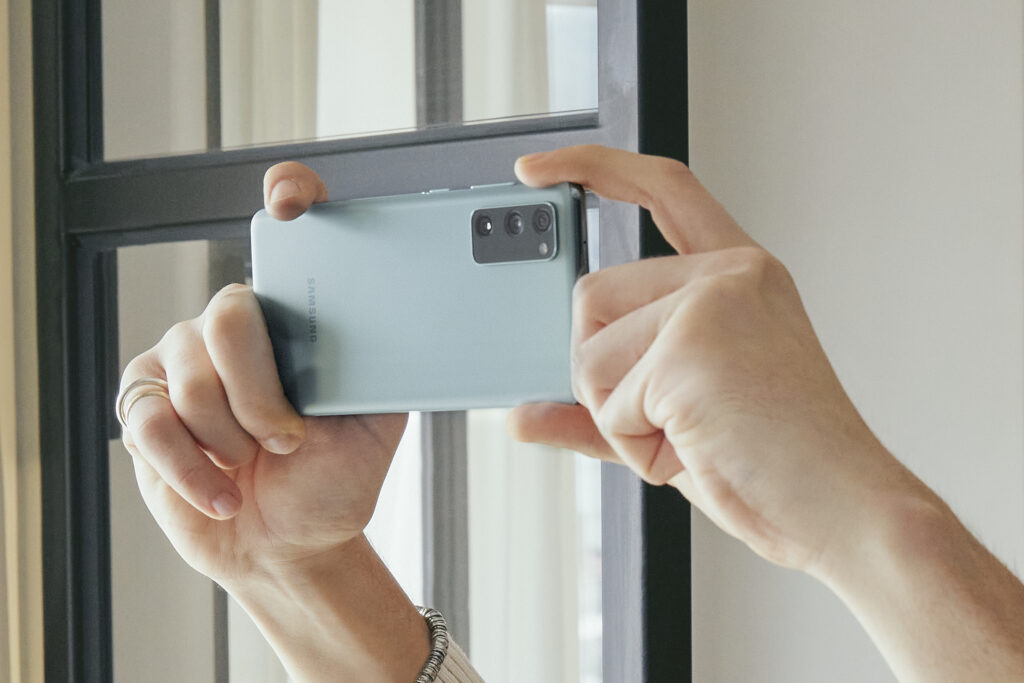
It sports a 6.5-inch FHD+ AMOLED display on the front with a top-centered 32MP punch-hole selfie camera. The sides of this phone are made of metal but the rear panel is polycarbonate, just like the Galaxy Note20.
The vertically-aligned triple camera setup on the back of the handset includes a 12 MP primary sensor, an 8MP sensor with a 3x telephoto lens, and another 12MP sensor with a 123˚ ultra-wide lens.
Other features of the Galaxy S20 FE for India include Exynos 990, One UI 2.5 based on Android 10, dual-SIM, 4G, in-display fingerprint sensor (optical), WiFi 6, Bluetooth 5.0, GNSS (GPS, GLONASS, BDS, GALILEO), NFC, Samsung Pay, accelerometer, gyro, proximity, compass, barometer, stereo speakers, USB Type-C port, and microSD card slot.
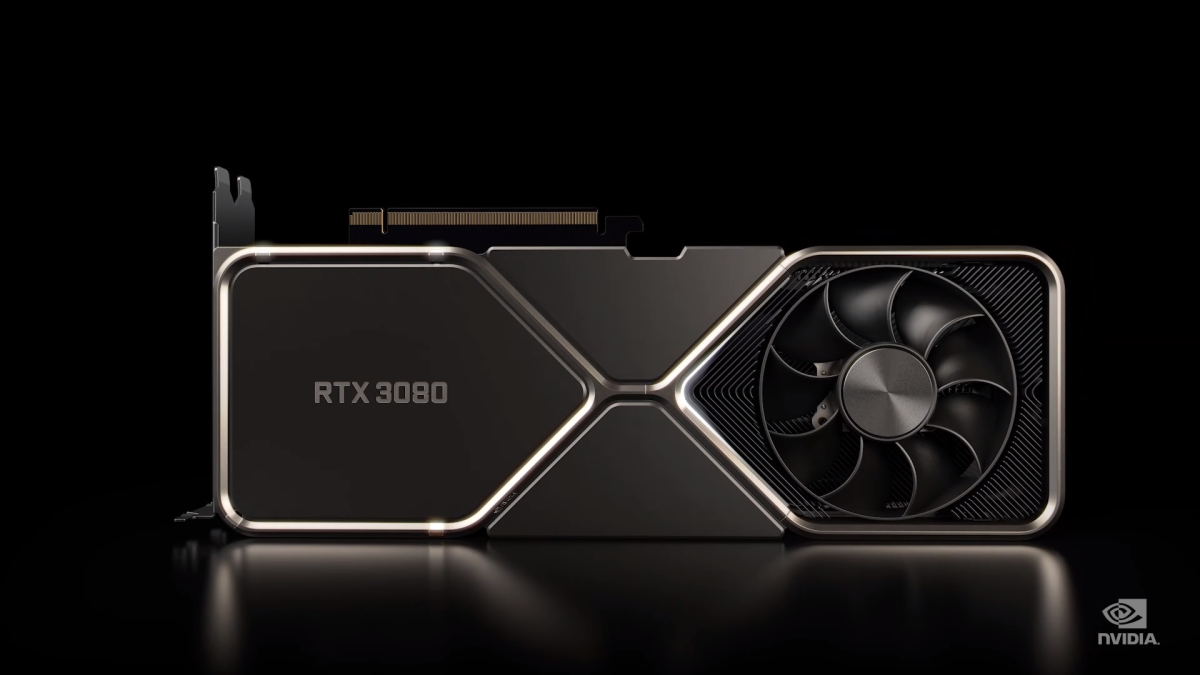
Jensen Huang, Nvidia CEO, has just revealed some very bad news. If you were one of the people looking forward to upgrading to the company’s RTX 3000 series of graphics cards, you might have to wait till 2021.
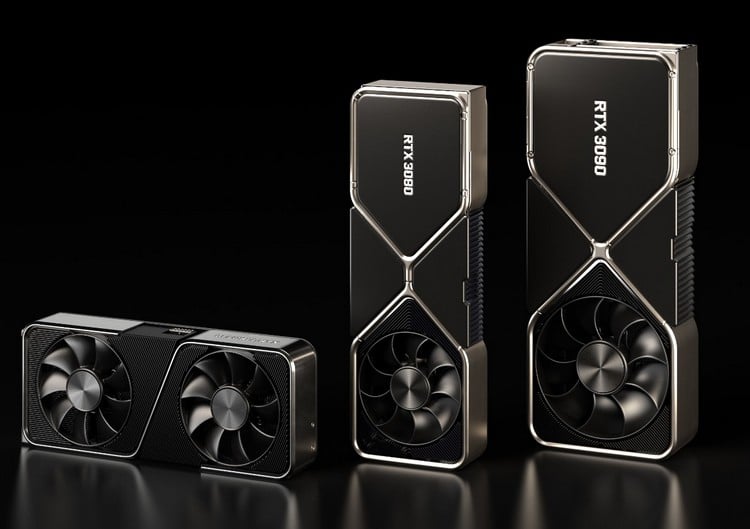
According to a TheVergereport, the senior executive recently responded to questions regarding the GPU shortages and he stated that ” believe that demand will outstrip all of our supply through the year.” For those unaware, the company’s newly launched RTX 3080 and 3090 have had rough launches, with both cards selling out almost immediately after launch. Although, Huang believes the issue isn’t with the supply but demand of the GPU itself.
He further added that “Even if we knew about all the demand, I don’t think it’s possible to have ramped that fast. We’re ramping really really hard. Yields are great, the product’s shipping fantastically, it’s just getting sold out instantly.” The company has already apologized to the initial launch of the RTX 3080, which was one of the most chaotic released in Nvidia’s history. Furthermore, another more affordable card is also launching in the series, the RX 3070, which is the more affordable and will likely have the highest demand as well.
Since it was claimed that the card could rival previous gen’s top end $1,100 at a price of just $499, one would expect a huge demand. However, Nvidia has since apparently learned from its mistake and has shifted the launch date back to October 29, which is just a day after AMD‘s Big Navi reveal on 28th. So, we can expect the season to be quite a competitive one, with many notable launches.
Most of the major smartphone manufacturers have entered the smartwatch segment and now Chinese maker Meizu is also all set to launch its own smartwatch. And going by the recent development, it seems that there will be more than one wearable device from Meizu.
Meizu has registered a new Weibo account named Meizu Smartwatch or “Flyme for Watch”, which has also been certified and validated on the platform. The company has also confirmed that the first product will be launched in the fourth quarter of this year.
Earlier, it was reported that the company had applied for trademarking two names in July this year — Meizu Watch and Flyme for Watch. Flyme is the company’s own custom skin for the Android smartphones used on the company’s mobile phones.
Additionally, a smartwatch was hinted by the company in the eighth-anniversary poster of the Flyme OS but nothing much is known about the same at this time. However, we expect to know more about this in the coming weeks, as the launch date nears.
Notably, the company has already entered the wearable devices market with the launch of a hybrid smartwatch called ‘Meizu Smart Watch Mix’ aka ‘Meizu Light Smartwatch’. But the said Meizu Watch will be the company’s first actual smartwatch.
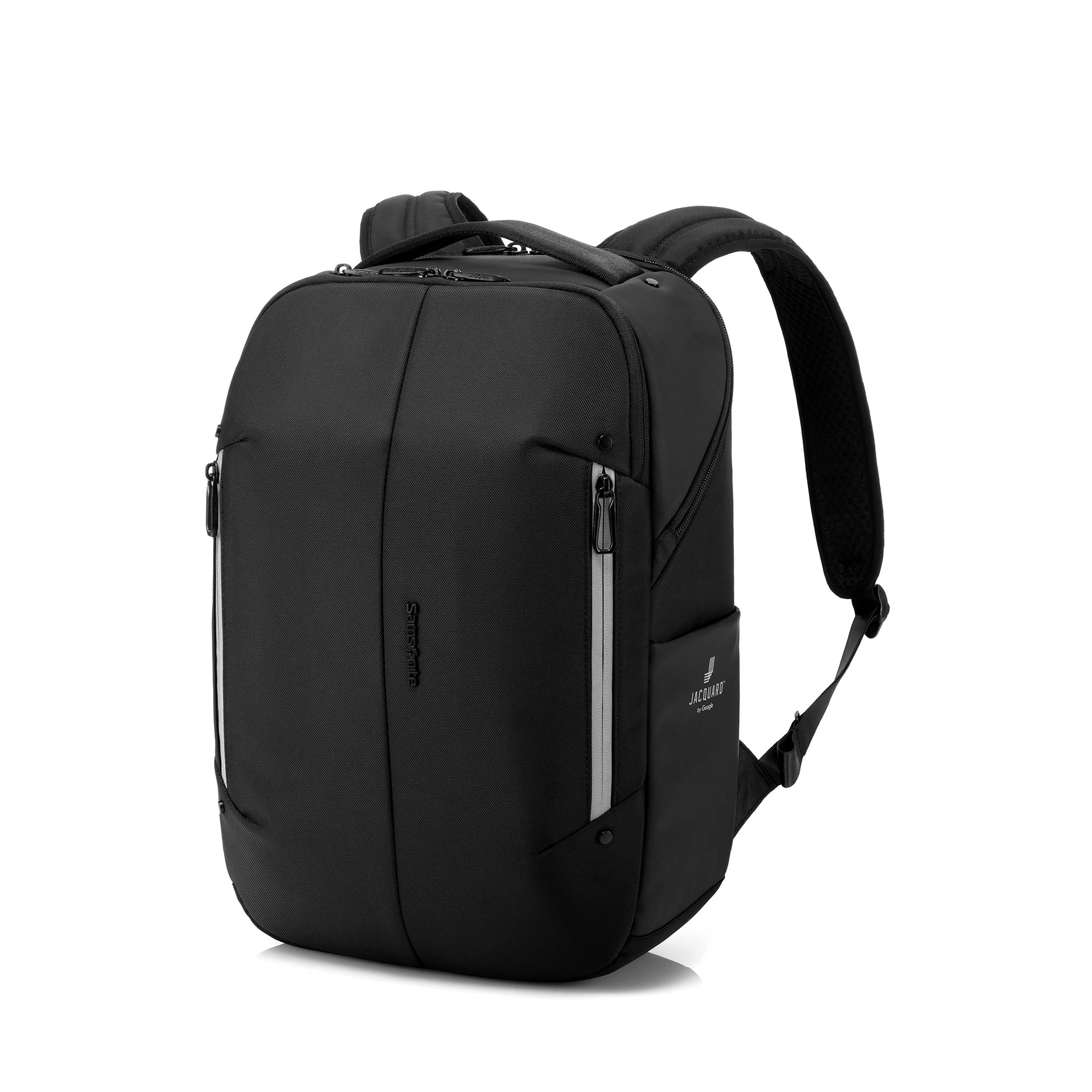
Google ATAP has been trying to offer Jacquard to more and more products and in line with that, the technology is now available in Samsonite Konnect-i Backback, pricing of which starts at $199.99.
This is quite an interesting price point for the backpack, and very affordable when compared to the first expansion of this Jacquard technology on a backpack that costs $895, making it unaffordable for most people.
For those who are unaware, Jacquard is a fabric-based input technology. Google describes that Jacquard “weaves new digital experiences into the things you love, wear, and use every day to give you the power to do more and be more.”
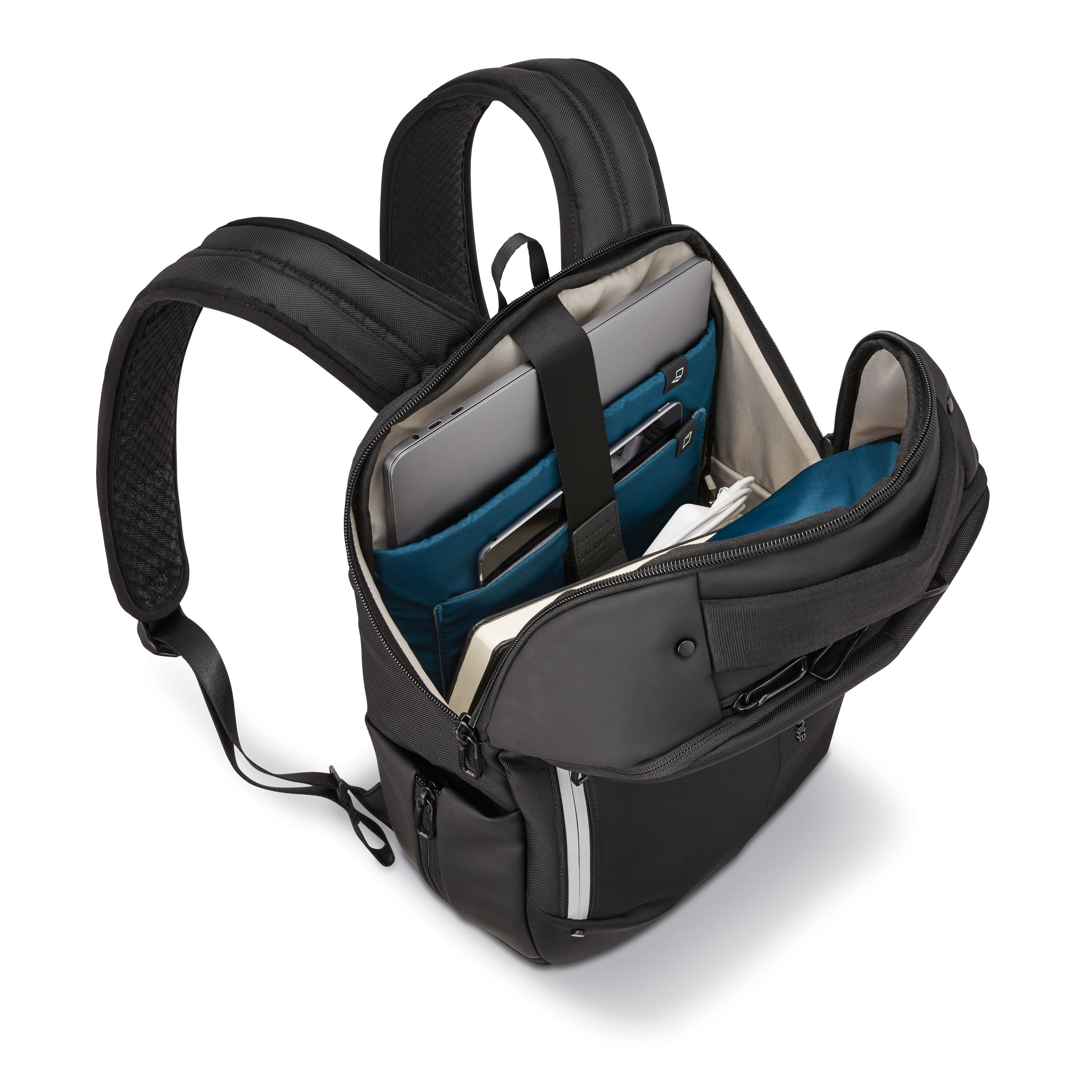
In this Samsonite Konnect-i Backback, the technology is embedded on the left shoulder strap. It comes with support for four gestures — brush down, brush up, double-tap, and cover. There’s also an indicator light that provides “custom alerts” to the users.
The company has launched two backpacks — Samsonite Konnect-i Slim and Samsonite Konnect-i Standard, costing $199.99 and $219.99 respectively. Both of them come with multiple storage pockets and a padded compartment for 15.6-inch laptops. It features a water repellent fabric, while the Jacquard Tag on the product is IP54 rated.
It comes with support for actions like playing or pausing the music, controlling audio, getting notified for calls or text, accept or decline calls, get turn-by-turn directions, or take a selfie. This can be configured through the Jacquard app.
Google has used this Jacquard technology on several products, including Trucker Jacket from Levi’s, Cit-e Backpack from Saint Lauren, Commuter Trucker Jacket from Levi’s, and Adidas GMR insole for shoes.
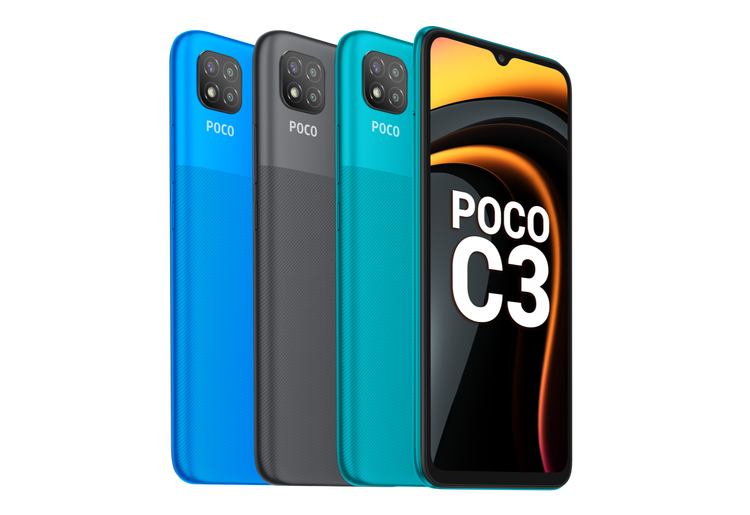
POCO India has unveiled the POCO C3 smartphone in India. As recent reports had revealed, the POCO C3 has arrived as a rebranded version of the Redmi 9C with some aesthetic changes. With a starting price of Rs 7,499 (~$102), the POCO C3 offers users with a large-sized display, gaming-focused Helio G35 chipset, 13-megapixel triple rear cameras, and a 5,000mAh battery. The smartphone has arrived to rival with the existing Realme C-series smartphones such as Realme C11, Realme C12, and Realme C15.
POCO C3 specifications and features
The polycarbonate-bodied POCO C3 comes with a P2i nano-coating for splash-resistance. The smartphone flaunts an IPS LCD screen of 6.53 inches that produces an HD+ resolution of 720 x 1600 pixels and an aspect ratio of 20:9. The TUV Rheinland certified screen can effectively filter the harmful blue rays.
The POCO has a front-facing camera of 5-megapixel. The backside of the phone has a square-shaped camera module that is equipped with a 13-megapixel main lens with f/2.2 aperture, a 2-megapixel depth sensor with f/2.4 aperture, a 2-megapixel depth assist lens with f/2.4 aperture, and an LED flash.
The MediaTek Helio G35 chipset drives the smartphone with 3 GB / 4 GB of LPPDR4x RAM. The phone comes in 32 GB and 64 GB storage choices and it has a dedicated slot for adding a microSD card. Like the other recently released POCO phones, this one also ships with POCO Launcher and MIUI 12 based Android 10 OS.
The POCO C3 is backed by a massive battery of 5,000mAh. Sadly, the phone comes with support for 10W charging only. The device comes with usual connectivity features like dual SIM slot, 4G VoLTE, Wi-Fi, Bluetooth 5.0, GPS, microUSB, and a 3.5mm audio jack. The POCO C3 does not have a fingerprint reader, while the Redmi 9C features it on its back.
POCO C3 price in India and release date
The POCO C3 will be up for buying from Oct. 16 through Flipkart in India. The 3GB RAM + 32 GB storage and 4 GB RAM + 64 GB storage editions of the POCO C3 are priced at Rs 7,499 (~$102) and Rs 8,999 (~$125). The color variants of the smartphone are Lime Green, Arctic Blue, and Matte Black.
Last week, Huami launched Amazfit Neo retro-style smartwatch in India for an affordable price tag of ₹2,499. Now, within a few days from its release, Amazon India is teasing another Huami wearable called Amazfit Bip U revealing everything about it, including design and specifications.
Huami (say Amazfit India) and Amazon India are yet to announce the launch date of the upcoming Amazfit Bip U. But the latter has shared the features and specs on a dedicated teaser page.
According to this page, the new Amazfit Bip U will sport a larger 1.43-inch TFT LCD panel with a resolution of 320 x 302 pixels, compared to the smaller 1.28-inch screen on Bip S and Bip S Lite. This panel is further protected by a 2.D glass with anti-fingerprint coating.
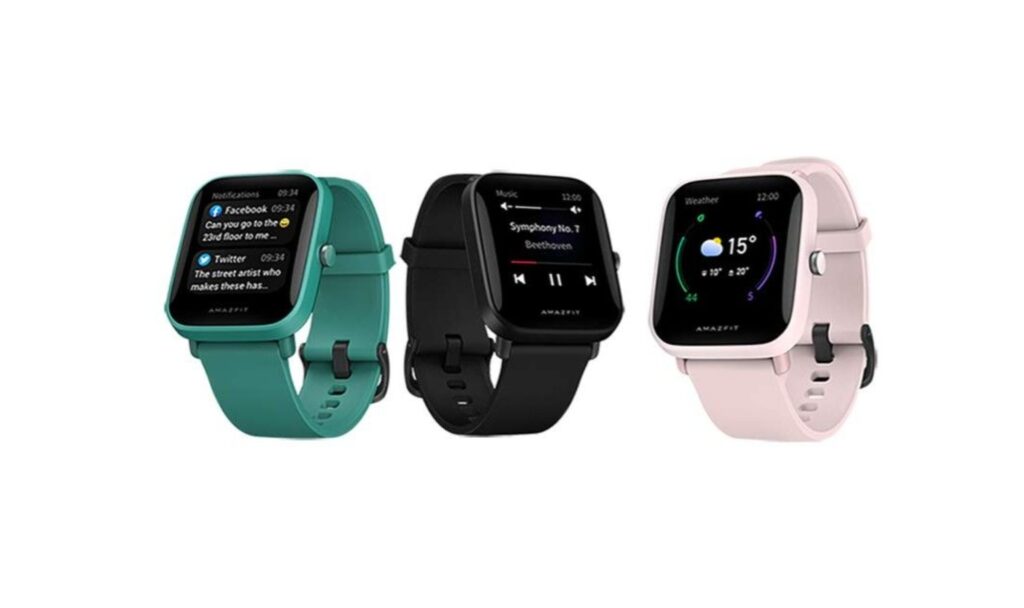
Like other budget Amazfit smartwatches, this one will also feature a polycarbonate body and a silicon rubber strap. It will be available in three colors (black, green, pink) and will weigh only 31g along with the strap. Also, the wearable will be water-resistant up to 5ATM pressure.
The Amazfit Bip U will run RTOS and will come equipped with Huami’s BioTracker 2™ PPG Biological Optical Sensor and 6-axis accelerometer to provide functions like RealBeats™ (24×7 heart rate monitoring), OxygenBeats™ (blood oxygen level monitoring), SomnusCare™ (sleep tracking), ExerSense™ (automatic exercise detection), and huami-PAI™ (PAI score), stress monitoring, and menstrual cycle monitoring.
The wearable will also include other common features like app notifications, clock, alarm, find my phone, music playback control, stopwatch, countdown, weather, and 50 default watch faces.
All of the above-mentioned features are possible because of the 225mAh battery that runs this smartwatch. The company claims a maximum of 9-day battery life and 2-hour charging time (pogo-pin charging dock).
Last but not least, the Amazfit Bip U comes with Bluetooth 5.0 and can be paired with both Android and iOS devices via Zepp App (formerly Amazfit App).
Xiaomi is gearing up to launch its latest truly wireless earphones in its home market China — Mi Air 2 Pro. Ahead of the launch, almost the entire specifications of the headsets have leaked online and now a hands-on video of the same has surfaced.
The leaked video hints that there’s no need for a smartphone to enable the noise cancellation mode of the Mi Air 2 Pro. Just pressing and holding the back of the earphones will enable the noise cancellation mode.
The report is also hinting that there will be three noise reduction modes on the device, which include Active Noise Cancellation, Passive Noise Cancellation, and Ambient Noise Cancellation.
Further, it adds that the infrared detection will automatically enable the transparent mode or ambient mode when only one earbud is worn. This means that the Active Noise Cancellation mode can be enabled only when both the earbuds are worn.
In terms of design, the earlier leak says that it will adopt Apple’s AirPods Pro design with an angled earpiece with silicone tips. It will reportedly weigh 6.5 grams and boast in-ear design with three microphones.
The highlighting feature is the ANC (Active Noise Cancellation) and additionally, the TWS earphones will also have hybrid digital noise reduction, similar to AirPods Pro from Apple. The Mi Air 2 Pro is likely to have a 12mm coil with an LCP composite diaphragm, along with the noise reduction intensity of 35dB.
The earphones reportedly support features like Wireless charging, wake-up, auto-connect, etc. As for the battery life, and is claimed to offer seven hours of usage on a single charge and 28 hours with the charging case.
Ever since the Trump administration announced a ban on ByteDance-backed TikTok and Tencent’s WeChat apps in the United States, there has been an on-going legal battle that has so far prevented the ban to go into effect.
Now, China is claiming that the ban on these two apps by the United States is in violation of the World Trade Organization’s rules, reports Reuters. And it’s not just the US, China has also accused India of the same for banning TikTok and several other Chinese apps.
At the Council for Trade in Services meeting at the World Trade Organization, China took the floor to accuse the USA and India of taking measures that are “inconsistent with WTO rules, restrict cross-border trading services and violate the basic principles and objectives of the multilateral trading system.”
During the lengthy exchange at the council, China said that there was no evidence to support the claims by the United States and India regarding data collection and it added that TikTok’s data collection is standard practice by thousands of apps worldwide. It also described the failure of the U.S. for providing concrete evidence of the reasons for its measures a “clear abuse” of rules.
Last month, the Trump administrator ordered to ban the downloads of TikTok and WeChat in the United States and stop all the transactions with those two companies. It has also ordered ByteDance to sell TikTok to a US-based company by 14th November in order to avoid a ban in the US.
However, a U.S. judge has questioned the government’s claim of national security and has agreed to temporarily block the ban on the app. In order to avoid getting banned in the United States, ByteDance has agreed to set up a new entity called TikTok Global with 80 percent of the stake. The remaining stake will be acquired by Oracle and Walmart.
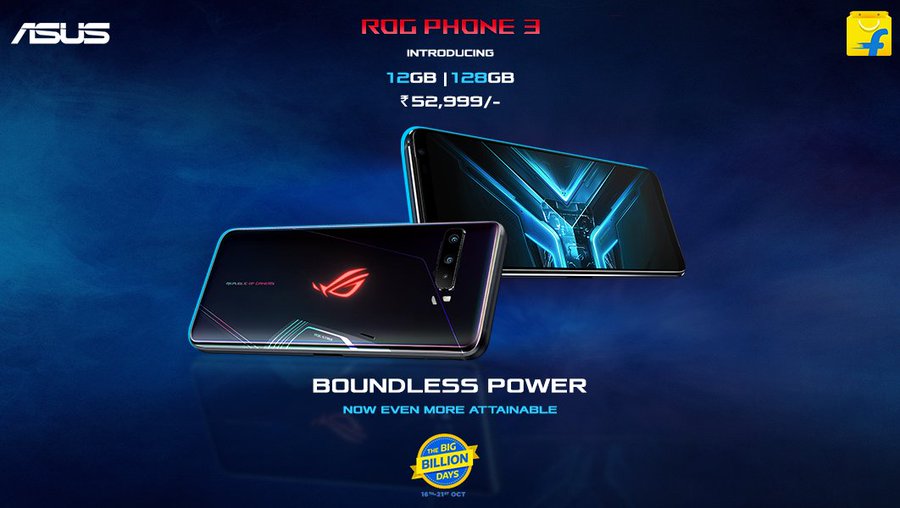
On July 22, ASUS announced the ROG Phone 3 gaming smartphone in India. The phone was made available in two variants such as 8 GB RAM + 128 GB storage and 12 GB RAM + 256 GB storage. Today, the Taiwanese firm announced a new model of the ROG Phone 3 that features 12 GB of RAM and 128 GB of storage.
The 12 GB RAM + 128 GB storage variant has arrived with a price tag of Rs 52,999 (~$723). The new variant will be up for purchase through from Oct. 16 through Flipkart’s Big Billion Days sale. The existing 8 GB RAM + 128 GB storage and 12 GB RAM + 256 GB storage variants are priced at Rs 49,999 (~$682) and Rs 57,999 (~$792), respectively.
The ASUS ROG Phone 3 sports a 6.59-inch IPS LCD panel that offers full HD+ resolution and 19.5:9 aspect ratio. The 144Hz screen is integrated with a fingerprint scanner and it comes with Gorilla Glass 6 protection.
The ROG Phone 3 is one of the few smartphones available in the market that ships with the advanced 3.1GHz Snapdragon 865+ mobile platform. The device comes with LPPDR5 RAM and UFS 3.1 storage. The device is flanked with two USB-C ports and DTS X: stereo speakers with two dedicated amplifiers.
The ASUS gaming phone is backed by a massive 6,000mAh battery that supports 30W fast charging. For shooting selfies, the smartphone possesses a 24-megapixel front camera. Its rear is fitted with a triple camera system that includes a Sony IMX686 64-megapixel main camera, a 13-megapixel ultrawide lens, and a 5-megapixel macro shooter. It lacks support for a 3.5mm audio jack and external storage.
China-based display manufacturer BOE Technology will lead China Star Optoelectronics Technology (CSOT) by more than 10pp in capacity share for large-size LCD panels, reports DigiTimes Research.
The development comes after the company outbid its rival to take over the control of two fabs — one 8.5G and another 8.6G from CEC-Panda LCD Technology.
As per the report, the difference in capacity is there even though CSOT has signed a deal to over the control of Samsung Display‘s 8.5G line in Suzhou, China. This is because the combined capacity of CEC-Panda’s two fabs is higher than that of Samsung’s fab.
The two fabs of CEC-Panda has a total production capacity of 12.71 million square meters for the LCD panels per year, which is higher than the capacity of 8.58 million square meters of Samsung Display’s plant in China.
Samsung Display sold its line to CSOT because the South Korean giant is withdrawing from the LCD panels segment. On the other hand, CEC-Panda was forced to sell its two plants because of the heavy losses.
These two Chinese companies are claimed to be the only two companies out of the world’s top six LCD panel suppliers to have witnessed growth in revenue in H1 2020. With the newly-added capacity, the companies are now expected to take up the leading spot for the supply of large-size LCD panels next year.
BOE Technology held a sizeable 21.1 percent of the global large-sized panel capacity in the market, which would be further boosted by the recent acquisitions. By the end of 2021, the company is expected to hold more than a quarter of the world’s large-sized panel capacity, coming in at 28 percent.
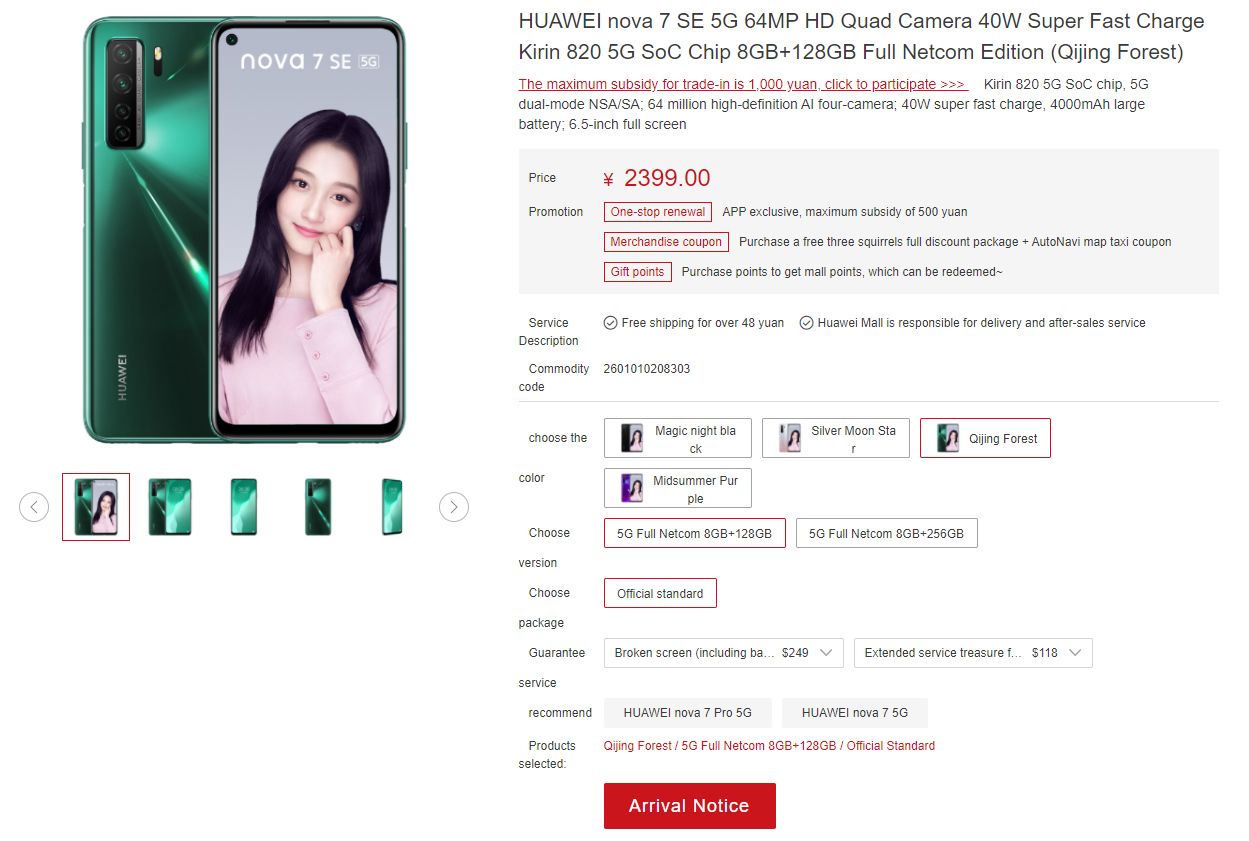
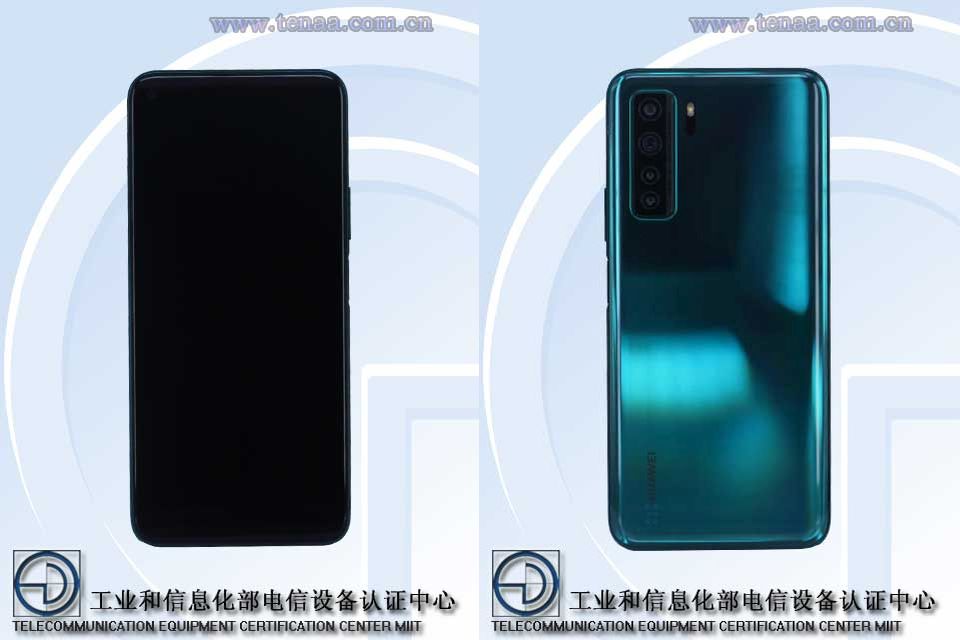
Recent reports have revealed that Huawei is working on a new edition of the Huawei Nova 7 SE smartphone. It is believed that the CDN-AN00 smartphone that received approval from the TENAA authority in August could be debuting in the Chinese markets as the Huawei Nova 7 SE Vitality Edition. Some reports have dubbed the device as Nova 7 SE Life. A Weibo user revealed that the Nova 7 SE has gone out of stock on Vmall. This could mean that the company is gearing up to launch Nova 7 SE Vitality Edition.
Reports have revealed that the Nova 7 SE Vitality Edition will be equipped with a Dimensity 800U chipset instead of the Kirin 820 that fueled the Nova 7 SE. The rest of the specs of the Nova 7 SE Vitality Edition is likely to remain unchanged. The Weibo user has claimed that the Dimensity powered Nova 7 SE Life will be arriving with a cheaper price tag.
Huawei Nova 7 SE Vitality Edition specifications (Rumored)
The TENAA listing of the Nova 7 SE Vitality Edition revealed that I will be sporting a punch-hole display of 6.5 inches. The screen will deliver a 20:9 aspect ratio and a full HD+ resolution. Its Dimensity 800U SoC could be accompanied by 8 GB of RAM. The phone may offer users with an internal storage of 128 GB.
The Android 10 OS with the latest EMUI skin will arrive preinstalled on the Nova 7 SE Vitality Edition. It has a 3,900mAh minimum rated battery. The 3C certification of the device has revealed that it may ship with a 40W rapid charger.
The Nova 7 SE Vitality Edition has a 16-megapixel front-facing camera. Its rear features a 64-megapixel + 8-megapixel + 2-megapixel + 2-megapixel quadruple-camera setup. It is fitted with a side-facing fingerprint rear and it lacks support for external storage. It may arrive in multiple hues such as green, purple, silver, and black in China.
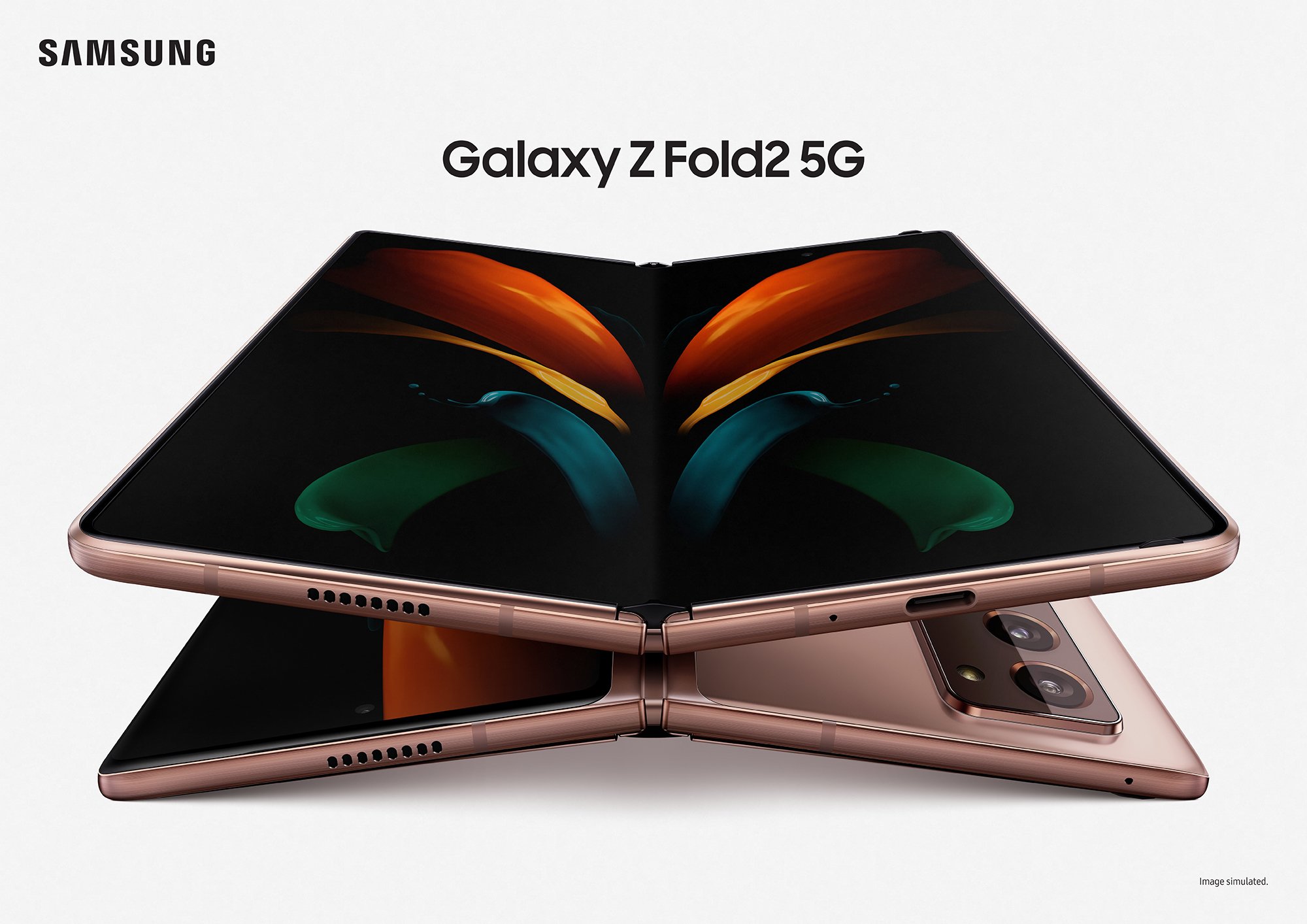
The Samsung Galaxy Z Fold 2 that went official in September arrived as a significant upgrade over the original Galaxy Fold that debuted in 2019. The outer and inner displays of the Galaxy Z Fold 2 offer larger screen space. Fresh information shared by The Elec, a South Korean publication, (viaAndroid Authority) reveals that the Galaxy Z Fold 3 arriving next year could be Samsung’s first phone to arrive with under-display camera technology. If this rumor turns out to be true, the Galaxy Z Fold 3 will certainly offer users a full-screen experience.
Early rumors had claimed that the next Galaxy S series phone that is being referred to as the Galaxy S30 or S21 by the rumor mill could be the first Samsung device with under-display camera technology. However, the new report reveals that Samsung has encountered low production yields of the under-screen camera tech because of which the Galaxy S30 will not be arriving with the said technology.
Instead, the Galaxy Z Fold 3 arriving in the second half of 2021 is likely to feature the under-display camera technology. As far as the Galaxy S30 series is concerned, it is likely to continue to sport the punch-hole design like the Galaxy S20 and Galaxy Note 20 series.
The Galaxy Fold that arrived last year as the company’s first foldable phone came with thick bezels for the front display and a camera notch on its inner display. Samsung offers a higher screen real estate on the Galaxy Z Fold 2 as the front and inner displays both sport punch-hole design. The Galaxy Z Fold 3 coming in 2021 with no punch-hole thanks to the inclusion of under-display camera technology is expected to deliver an all-screen experience.
The ZTE Axon 20 5G that debuted last month is the first smartphone ever to arrive with under-display camera technology. The technology has been also available on phones like Vinsmart Vsmart Axis Pro that is available in Vietnam and the Rakuten BIG phone meant for the Japanese markets.
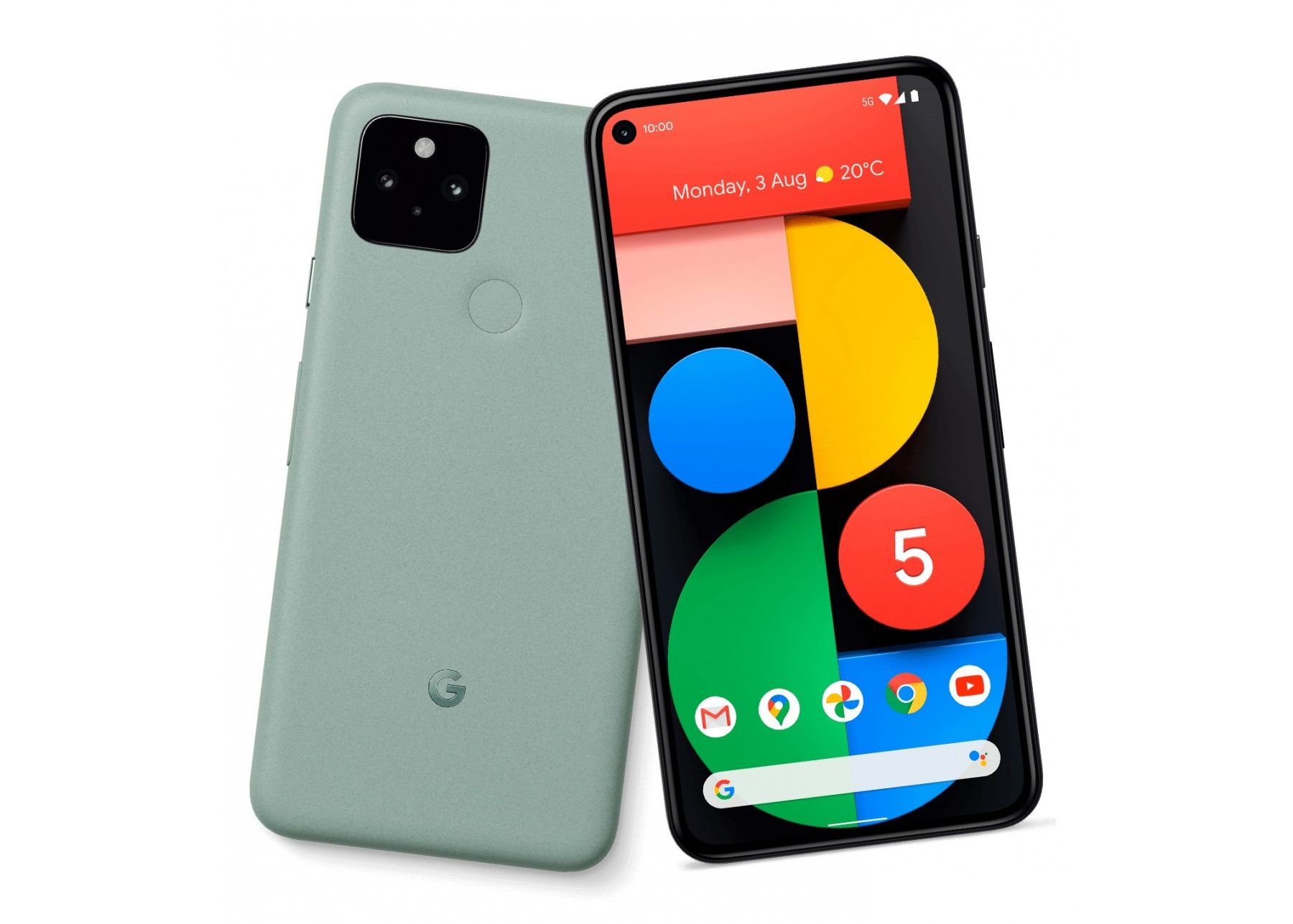
Google recently announced the Pixel 5 and Pixel 4a 5G smartphones. Unlike its predecessor i.e. the Google Pixel 4, Pixel 5 is not a flagship phone. Also, it does not come with features such as Soli radar, Pixel Neural Core, and Active Edge that were made available on the previous generation phone. The Pixel 5 will be available for purchase in limited countries with 5G support. The sales of the smartphone are scheduled to begin in markets like the U.S., the U.K, Australia, and Japan on Oct. 15. A UK-based YouTuber has released a hands-on video of the Pixel 5. The video reveals that the device is equipped with an under-display speaker positioned at the top side of the display.
YouTuber totallydubbedHD has two videos of the Google Pixel 5. While the first one includes camera tests and 5G benchmarks on the handset, the second one is a hands-on video that answers all the questions related to it. It can be clearly seen in the second video that Pixel 5 does not have visible speakers on the front. The reason behind it is that its speaker is embedded under the top portion of the OLED panel.
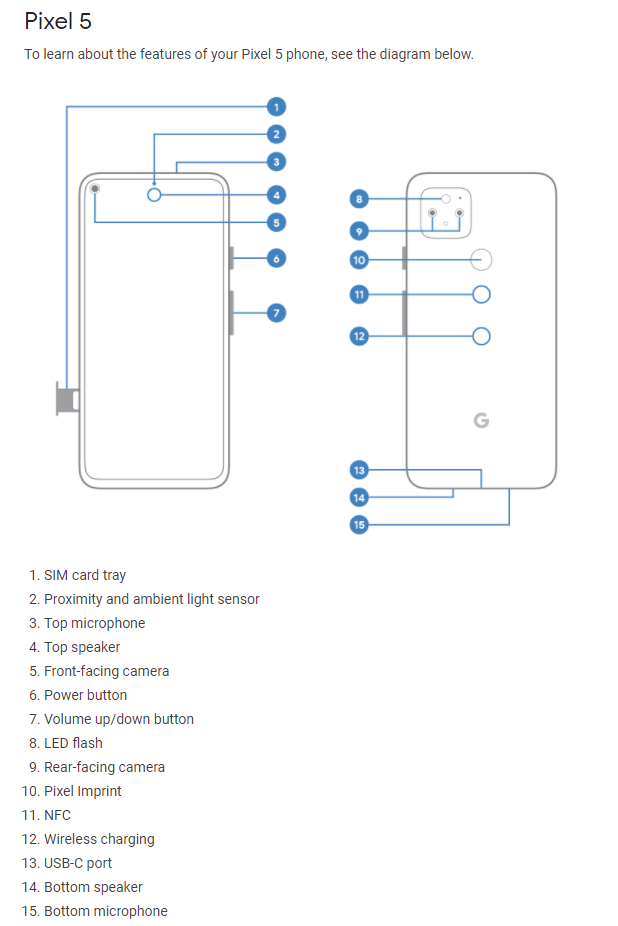
Recently, a schematic of the Pixel 5 had appeared on Reddit which revealed the presence of an under-display speaker. The official renders of the phone also do not show the presence of front-facing speakers. Both the videos posted by the YouTuber are quite informative for people who are looking forward to purchasing the Pixel 5.
Google Pixel 5 is an IP68 rated smartphone that sports a 6-inch OLED panel with a punch-hole design. It supports a full HD+ resolution and a 90Hz refresh rate. The screen is protected by Gorilla Glass 6. The Snapdragon 765G chipset with 8 GB of LPDDR4 RAM powers the smartphone. It has 128 GBG of internal storage. The Android 11 OS comes preinstalled on the smartphone.
Google Pixel 5
It has a 12-megapixel + 16-megapixel (ultrawide) dual-camera system on its back. It has a front camera of 8-megapixel. The phone is fitted with a 4,080mAh battery that supports 18W fast charging, wireless charging, and reverse charging. It lacks a 3.5mm audio jack and it offers connectivity features like 5G, Wi-Fi 802.11ac, Bluetooth 5.0, GPS, NFC, and USB-C. It is priced at $699 and its color variants are Sorta Sage and Just Black.
If you are looking for a mid-range device but you do not want to spend a lot of money, you should consider Redmi Note 9 Pro, POCO X3, and Realme 7 Pro due to their amazing specifications offered at a very affordable price. It is hard to find a smartphone with so high value for money and these devices look surprising from every point of view. But which one is the best choice for your needs? It is not easy to understand it only by looking at the specs sheet of each device. That is the reason why we decided to make an in-depth comparison between the specs of Note 9 Pro, POCO X3, and Realme 7 Pro.
Xiaomi Redmi Note 9 Pro vs Xiaomi Poco X3 vs Realme 7 Pro
Quad 64 + 8 + 2 + 2 MP f/1.8, f/2.3, f/2.4 and f/2.4
32 MP f/2.5 front camera
BATTERY
5020 mAh, fast charging 30W
5160 mAh, fast charging 33W
4500 mAh, fast charging 65W
ADDITIONAL FEATURES
Dual SIM slot
Dual SIM slot, splash proof
Dual SIM slot, splash resistant
Design
With the Redmi Note 9 Pro and the POCO X3, you do not get the most beautiful design. Or at least the big protruding camera module of the POCO X3 and the square-shaped central module of the Redmi Note 9 Pro do not convince me. The Realme 7 Pro looks more beautiful with its less invasive camera module and a more compact design. On the other hand, POCO X3 and Redmi Note 9 Pro are built with better materials: the former has an aluminum frame and a plastic back, while the latter has a plastic frame and a glass back. Unfortunately, the Realme 7 Pro has a full plastic design.
Display
If you want the best display in terms of image quality, then you should go for the Realme 7 Pro without thinking twice. It has a smaller display and a standard refresh rate, but the Super AMOLED technology guarantees more brilliant colors. Further, the Realme 7 Pro has an in-display fingerprint scanner. Right after, almost at the same level, we got the POCO X3 with the HDR10 certification and a 120 Hz refresh rate. Redmi Note 9 Pro is disappointing: it has a Full HD+ panel, but it is an IPS display with a standard refresh rate.
Specs & Software
The most advanced hardware department belongs to the POCO X3 which is powered by a stronger chipset: the Snapdragon 732G is an upgrade of the Snapdragon 730G and it is paired with 6 GB of RAM. You can get more RAM with the 7 Pro (up to 8 GB), but the chipset is weaker: we are talking about the Snapdragon 720G that is the same chipset found on the Redmi Note 9 Pro. All of these devices run Android 10 out of the box with a highly-customized user interface on top.
Camera
On the paper, the POCO X3 NFC is a better camera phone. POCO X3 NFC, Redmi Note 9 Pro, and Realme 7 Pro all come with a 64 MP main sensor, but the POCO X3 NFC has a better ultrawide secondary camera. The Realme 7 Pro is actually better at shooting selfies thanks to its great 32 MP front camera. Redmi Note 9 Pro is inferior to both the devices (overall) but you should note that it has a better macro sensor than Realme 7 Pro and POCO X3 NFC. However, given that macro sensors are often useless, the ultrawide lens of the POCO X3 NFC makes more sense.
Battery
The POCO X3 NFC has the biggest battery with a 5160 mAh capacity, but not the longest battery life. Given that Redmi Note 9 Pro has a standard refresh rate instead of 120 Hz, it lasts more on a single charge with its 5020 mAh battery, unless you disable the 120 Hz refresh rate on the POCO X3 NFC. While Note 9 Pro and POCO X3 NFC are superior battery phones, Realme’s mid-ranger wins the fast charging comparison thanks to its amazing 65W fast charging technology bringing the battery from 0 to 100 percent in just 34 minutes.
Price
In the global market, you can find POCO X3 NFC and Redmi Note 9 Pro at less than €200/$235 thanks to online street prices. Realme 7 Pro will go global on October 7 and its global price is yet to be revealed. POCO X3 NFC is the best device of this comparison in terms of hardware, while Realme 7 Pro has an AMOLED display and way faster charging. Which one would you pick?
When the Nokia 1.3 launched in March, it came with a new camera app called Camera Go that is specially designed for Android Go devices. Today, the app is getting a Night Mode feature that allows supported Android Go devices to take better images in low-light without flash.
A minute and a half video released by Google via the official Android Twitter account today reveals that the Night Mode feature for the Camera Go combines several photos (burst photography) “to produce a bright, sharp photo”.
Low light, camera, action 📷! With Night Mode on Camera Go, take high-quality photos on your Android phone, no matter what time of day it is. pic.twitter.com/UooQhAm9tF
The video also reveals that the camera app has been built for specific camera modules on affordable phones. So it is not just software but a combination of software and hardware. This also explains why it is not available for all existing Android Go phones.
It was also revealed that Camera Go will get an HDR mode later this year that will increase the quality of photos taken on these budget devices at any time of the day. Evidence of an HDR Mode was found in the Camera Go app as far back as April. We believe the pandemic is responsible for the delay in rolling out the feature.
Night Mode on Camera Go has begun rolling out to the Nokia 1.3, Wiko Y61, and Wiko Y81 smartphones.
We use cookies on our website to give you the most relevant experience by remembering your preferences and repeat visits. By clicking “Accept”, you consent to the use of ALL the cookies.
This website uses cookies to improve your experience while you navigate through the website. Out of these, the cookies that are categorized as necessary are stored on your browser as they are essential for the working of basic functionalities of the website. We also use third-party cookies that help us analyze and understand how you use this website. These cookies will be stored in your browser only with your consent. You also have the option to opt-out of these cookies. But opting out of some of these cookies may affect your browsing experience.
Necessary cookies are absolutely essential for the website to function properly. This category only includes cookies that ensures basic functionalities and security features of the website. These cookies do not store any personal information.
Any cookies that may not be particularly necessary for the website to function and is used specifically to collect user personal data via analytics, ads, other embedded contents are termed as non-necessary cookies. It is mandatory to procure user consent prior to running these cookies on your website.









 Reports have revealed that the Nova 7 SE Vitality Edition will be