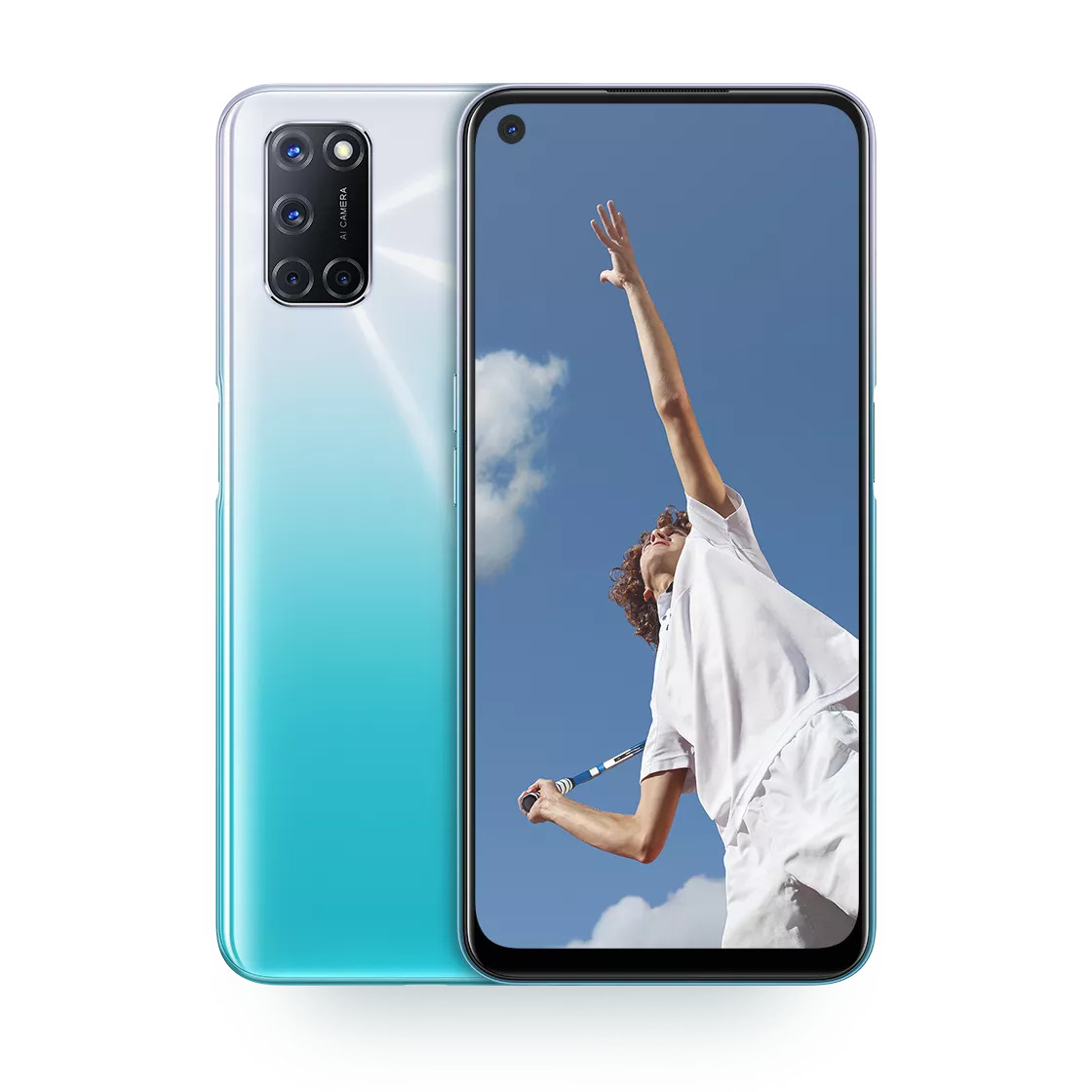
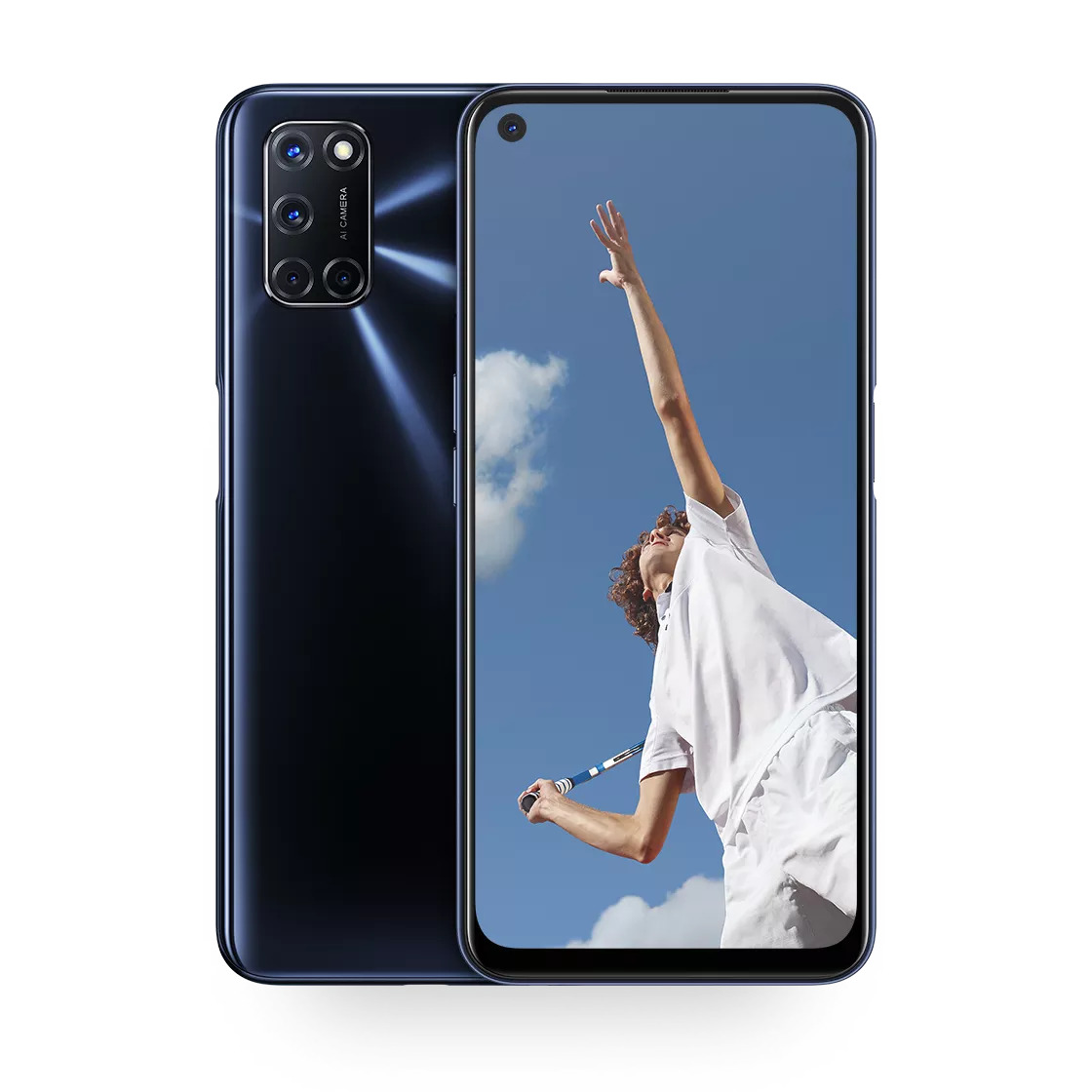
Last year, in December, Xiaomi’s sub-brand Redmi launched its Redmi K30 smartphone which recently got a Pro variant. Amid rumors of a new variant coming soon, the company has today shared that it is holding a limited-time sale of Redmi K30 at a discounted rate.
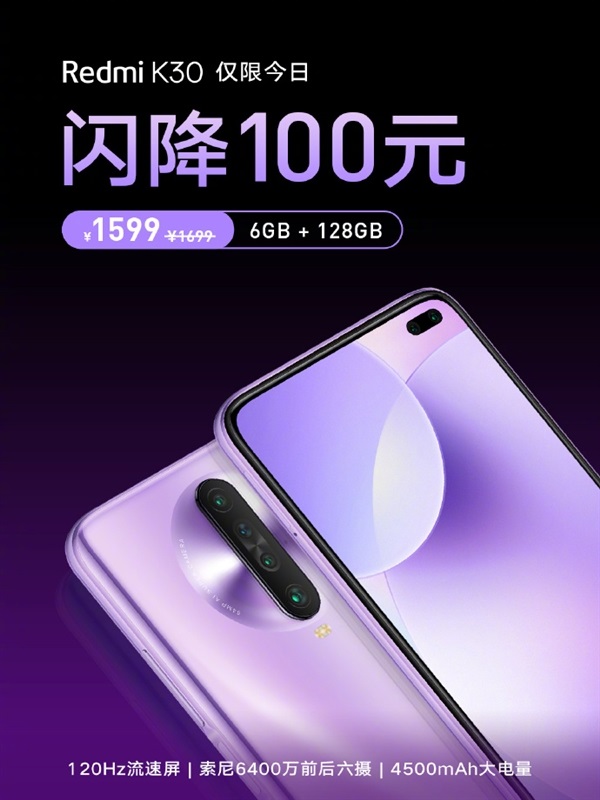
The poster reveals that the Redmi K30 6GB RAM and 128GB storage model will be available for a discount of 100 yuan for a limited time, which brings down the smartphone’s pricing to 1,599 yuan, roughly $226. While the company’s says it’s a limited time sale, there’s has been no mention on sale end date.
The Redmi K30 comes in four models — 6GB + 64GB priced at 1,599 yuan, 6GB + 128GB costing 1,699 yuan, 8GB + 128GB which is on sale for 1,899 yuan, and the top-end 8GB + 256GB which costs 2,199 yuan.
To remind you of the specifications, the phone features a 6.67-inch IPS Full HD+ 120Hz display and comes with a punch-hole cutout on the screen at the top-right corner for dual cameras. Under the hood, the device is powered by the Qualcomm Snapdragon 730G octa-core processor with Adreno 618 GPU.
In the camera department, there’s a quad-camera setup on the back, consisting of Sony IMX686 64-megapixel primary sensor, an 8-megapixel ultra-wide sensor, a 2-megapixel depth assist lens, and a 2-megapixel macro lens. On the front side, it comes with a 20-megapixel primary sensor and a 2-megapixel secondary sensor.
The phone runs the latest Android 10 operating system out-of-the-box with the company’s own MIUI 11 on top. The device is powered by a 4,500mAh battery with support for 27W fast charging technology.
The development comes at a time when the company is reportedly planning to discontinue Redmi K30 4G model in favor of the 5G variant. The only major difference in the Redmi K30 5G compared to the 4G model is the chipset, minor camera specs change, and battery charging speed. The 5G model is powered by Snapdragon 765G SoC and the 2MP depth sensor has been replaced by a 5MP sensor. The phone also has 30W fast charging.
In addition to this, the company is also rumoured to launch a new variant in this lineup — Redmi K30i. It is said that it could come powered by MediaTek Dimensity 800 SoC and will have 5G support. The device is expected to be priced around 1,799 yuan, which is approximately $245.
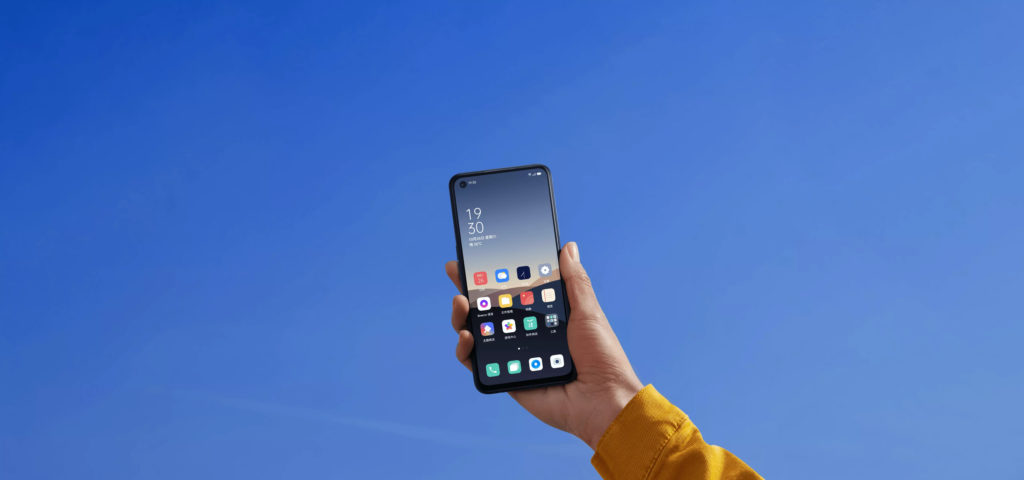
Lately, Oppo has been pushing stable ColorOS 7 update based on Android 10 to the eligible devices in China after being delayed due to COVID-19 pandemic. Now, the global versions of these devices are getting a similar treatment. The handsets that are currently receiving the OTA update are listed along with their respective builds in a table below.
Since the update is being rolled out through OTA (over the air), it is being seeded out to units in batches. Hence, it might take time to reach every user. In order to check whether your device has received the update, head over to Settings -> Software Updates section.
Here’s the official changelog of ColorOS 7 stable update provided by the company for the above-mentioned handsets.
Visuals
Brand new borderless design makes visuals more attractive and operation more efficient.
Added OPPO Sans as the default font. The new font delivers a refreshing feel and fits well with OPPO’s pursuit of blending beauty and technology.
Smart Sidebar
Optimised user interfaces and improved one-handed operation.
Drag an app out of Smart Sidebar to open it in Split-screen mode.
Added two settings: Assistive Ball Opacity and Hide Assistive Ball on Fullscreen App.
Optimised the Floating Window feature for more apps.
Added a bubble: A bubble is displayed when you open an app in a floating window from the Smart Sidebar. Tap the bubble to collapse and open the app.
Screenshot
Optimised 3-Finger Screenshot: Use 3 fingers to touch and hold the screen and swipe your fingers to adjust the screenshot size. Use 3 fingers to touch and hold the screen and swipe your fingers outwards to capture a long screenshot.
Added screenshot settings: You can adjust the position of the screenshot preview floating window and set the screenshot sound.
Optimised screenshot preview floating window: After taking a screenshot, drag it up and release to share it, or drag it down and release to take a long screenshot.
Navigation Gestures 3.0
New gesture: Swipe inward from both sides of the screen and then hold to switch to the previous app.
Optimised gestures: All gestures are supported in landscape mode.
System
Added Dark Mode: Protects your eyes while reducing power consumption.
Added Focus Mode: Shields you from outside distractions when you are learning or working.
Added all new charging animation.
Optimised the Quick Settings user interface for easier one-handed operation.
Swipe left or right to ignore banner notifications.
Added a pause function for screen recording.
Added a floating window and settings for screen recording.
New sounds added for file deletion, calculator key touches, and compass pointer.
Optimised system pre-loaded ringtones.
Added TalkBack floating prompts for Accessibility.
Colour Accessibility Mode added to improve the user experience for visually impaired users.
New management function for recent tasks: You can view memory information about recent tasks and lock apps.
Games
Optimised visual interaction for Game Space.
Optimised the startup animation for Game Space.
Home Screen
More live wallpapers.
Added Art+ static wallpapers.
Customise whether to open Global Search or the notification drawer when swiping down on the Home screen.
Customise the size, shape, and style of app icons on the Home screen.
Swipe up on the Lock screen to switch unlock methods.
Optimised the graphic design of password unlocks to facilitate one-handed operations.
Supported live wallpapers on the Lock screen.
More screen-off clock styles.
Added a simple Home screen mode, featuring larger fonts and icons and a clearer layout.
Security
Connect your phone to Wi-Fi networks using a random MAC address to avoid targeted ads and protect your privacy.
Tools
In Quick Settings or Smart Sidebar, you can open Calculator in a floating
Added the trim feature in Recordings.
Added the Weather (dynamic) ringtone, which automatically adapts to the current weather.
Added weather-adaptive animations in Weather.
Camera
Optimised the Camera UI for better user experience.
Optimised the Timer UI and sound.
Photos
Optimised the Album UI for a clear hierarchy and quick lookup of photos.
Added Album Recommendations that recognises more than 80 different scenes.
Communications
OPPO Share now supports sharing files with vivo and Xiaomi devices.
Optimised the Contacts UI for a more efficient experience.
Settings
Search Settings now supports fuzzy match and contains a search history.
Applications
Soloop Video Editor: Create your video with one tap.
Added DocVault, an app for easy management and use of your digital ID cards (available only on phones sold in India).
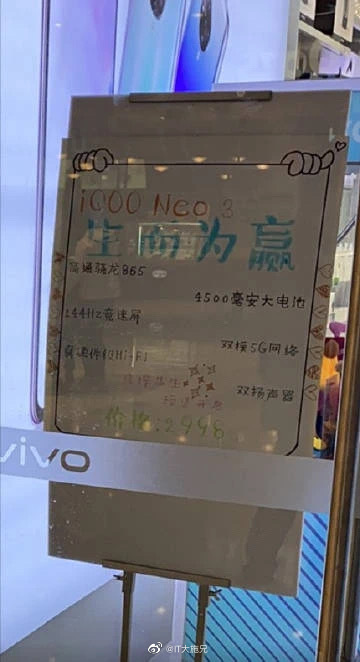
On April 23,iQOO will be announcing the iQOO Neo3 5G flagship phone. An advertisement that surfaced last week had revealed that the smartphone will be priced at 2,998 Yuan (~$423) in China. A snapshot of the phone’s poster at retailer store was shared by a Chinese tipster on Weibo yesterday. It reiterated that the Neo3 will be priced at 2,998 Yuan.
The poster has all the key features of the iQOO Neo3 mentioned on it along with the pricing. It states that the phone has Snapdragon 865 chipset with dual-mode 5G support, 144Hz refresh rate supporting display, a 4,500mAh battery, Hi-Fi audio chip and stereo speakers.
The Chinese firm has already revealed that the iQOO Neo3 is equipped with UFS 3.1 storage. The AnTuTu listing of the smartphone had revealed that it will be arriving with 8 GB of RAM and 256 GB of storage. A previous leak had also revealed the existence of a lower model with 6 GB of RAM and 128 GB storage. On AnTuTu, the handset managed to breach 608K+ benchmark scores.
The iQOO Neo3’s 144Hz display is an LCD panel with a punch-hole positioned at the top-right corner. It has a side-mounted fingerprint sensor. The back panel of the device has a triple camera setup. The handset had recently appeared at the database of China’s 3C authority to confirm that it may ship with a 44W fast charger.
The Redmi K30 Pro 5G is selling with a starting price of 2,999 Yuan in China. The upcoming iQOO Neo3 appears to a worthy rival for the K30 Pro.
Oukitel WP6 was launched on March 20. The international brand known for offering high-end smartphones aimed at redefining outdoor communication with the WP series, while the C series was touted to offer the most affordable cutting-edge smartphone.
The last C series was launched back in 2019 and it sold out like hot cakes on AliExpress. Oukitel is expecting the long-awaited successor to follow suit and garner huge popularity among smartphone lovers. The C18 Pro was made available to the public on April 20.
The recently unveiled smartphone has gone up for sale through AliExpress. More importantly, the Alibaba owned online retail service is offering the C18 Pro for a considerably lowered price.
The Oukitel C18 Pro comes with 4GB of RAM and offers 64GB of internal storage space would normally set you back $166.65, but you can now get it for a lowered price of just $99.99, which translates to a 40 percent reduction in the phone’s original asking price. This model is available in black, as well as a purple color option.
Alternatively, you can go for the standard package that comprises black, as well as purple color options with a Xiaomi earphone. This variant would normally set you back $179.98, but can now be yours for an unbeatable price of just $107.99. This is a 40 percent reduction in the phone’s selling price.
Likewise, you can get a 40 percent discount on the standard package that comes with a 32GB TF card. While it normally retails for $183.32, you can now purchase it for a considerably lowered price of only $109.99 from AliExpress. This 40 percent off is valid for the black and purple color options.
There’s a 40 percent off on another standard package that ships with a 64GB TF card. This variant carries a $191.65, but AliExpress is offering it for just $114.99, which means, you can avail of a 40 percent off on the aforesaid model.
On top of that, those placing their first order with AliExpress can save more money by applying a $3 Off New User Coupon during the checkout process. Moreover, you can get an extra $1 off if your order value exceeds $119.
The irresistible Oukitel C18 Pro smartphone features a 6.55 inches HD display with 1600×720 pixels resolution. It packs a powerful MTK6757 processor coupled with 4GB of RAM under the hood.
In the optics department, the C18 Pro houses a 16MP, a 2MP, an 8MP and a 5MP camera at the back. Upfront, it has an 8MP snapper for selfies and video calling. It is backed by a 4000mAh battery and runs Android 9.0 OS., but the hardware supports the latest Android 10.
You can head straight to this link to check out more details about the Oukitel C18 Pro and place your order. Note that you can add a free gift with your order during the activity period. Regrettably, the promo is slated to end this weekend.
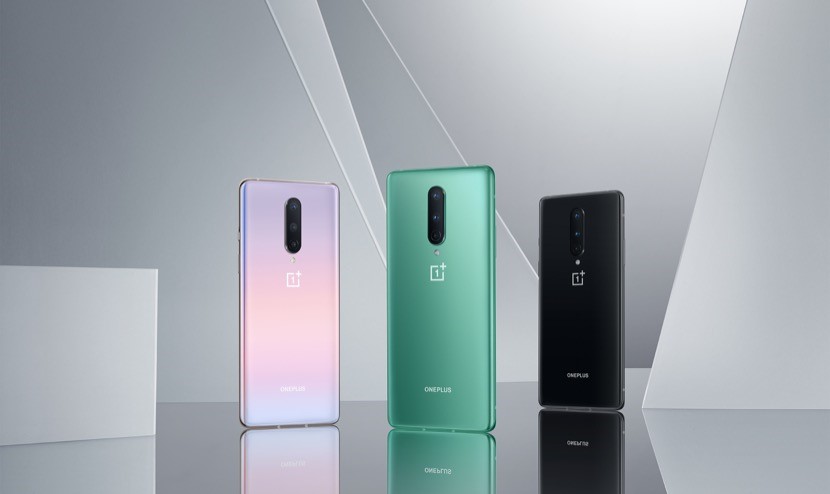
Last week, OnePlus held an unveil event to announce the OnePlus 8 and OnePlus 8 Pro smartphones. Due to the COVID-19 lockdown situation in India, the sales of the OnePlus 8 phones are expected to begin at some point in May. The Chinese firm has also confirmed on the pricing of both phones for India. With the arrival of the OnePlus 8 series, the OnePlus 7T and OnePlus 7T Pro were expected to receive a price cut. The OnePlus 7T series have received up to Rs. 6,000 (~$78) price cut on OnePlus.in and Croma.com.
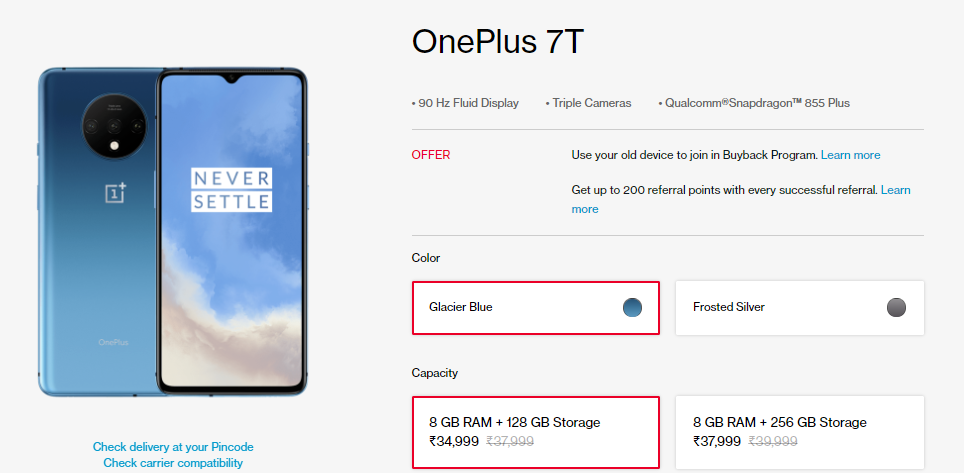
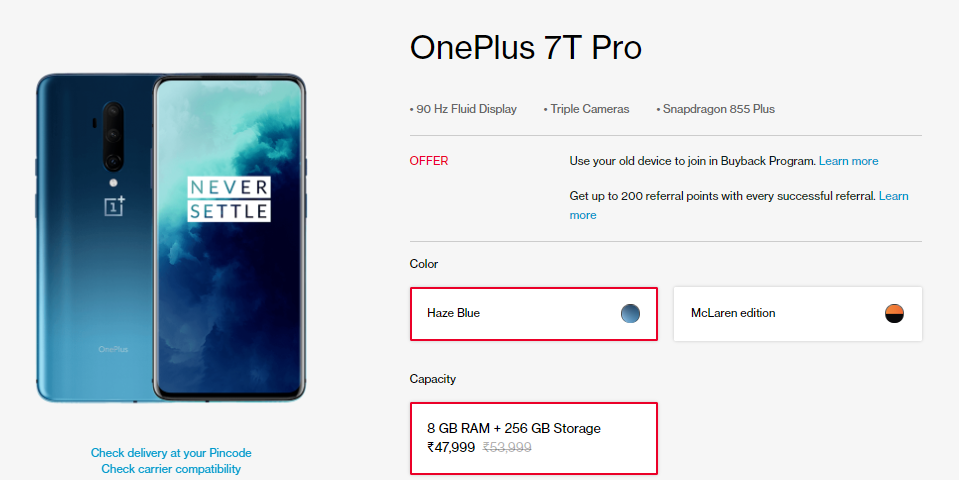
The 128 GB and 256 GB OnePlus 7T models were introduced for Rs. 37,999 (~$495) and Rs. 39,999 (~$521), respectively in India in September 2019. The OnePlus 7T Pro came with a pricing of Rs. 53,999 (~$703) for its 8 GB RAM + 256 GB storage version. The OnePlus 7T Pro McLaren Edition with 12 GB RAM + 256 GB storage was priced at Rs. 58,999 (~$768).
The OnePlus 7T Pro (8GB + 256GB) is listed with a revised pricing of Rs. 47,999 (~$625) after an impressive price reduction of Rs. 6,000 (~$78). The 128 GB and 256 GB OnePlus 7T models are now priced at 34,999 (~$456) and Rs. 37,999 (~$495), respectively. Both models have received Rs. 3,000 (~$39) and Rs. 2,000 (~$26) price cuts, respectively. There is no change in the pricing of the McLaren Edition.
The OnePlus 8 smartphone will be heading to India in three variant such as 6 GB RAM + 128 GB storage, 8 GB RAM + 128 GB storage and 12 GB RAM + 256 GB storage. They are priced at Rs. 41,999 (~$547), Rs. 44,999 (~$586) and Rs. 49,999 (~$651), respectively.
The OnePlus 8 Pro will be arriving in India in two options such as 8 GB RAM + 128 GB storage and 12 GB RAM + 256 GB storage. They are priced at Rs. 54,999 (~$716) and Rs. 59,999 (~$781), respectively.
Samsung is expected to unleash the Galaxy Fold 2 in the second half of the year. Some reports have claimed that the South Korean may announce it along with the Galaxy Note 20 series in Q3, but there is no concrete evidence to support this claim. Today, the CEO of Display Supply Chain Consultants, Ross Young shared key information on the specs of the Galaxy Fold 2.
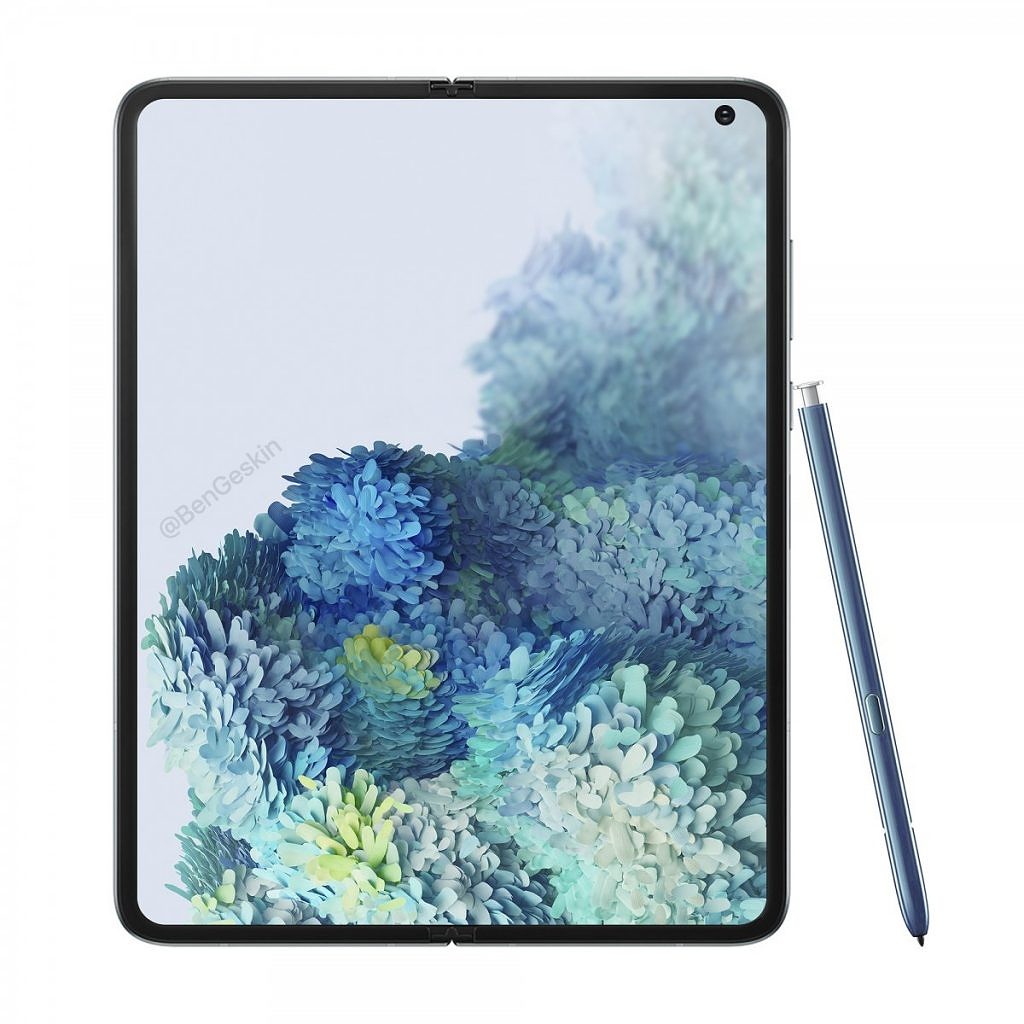
While Young revealed that the Galaxy Fold 2 is codenamed as Project Champ, a report on XDA Developers that the device could be also referred to as Project Winner 2 internally. Young further revealed that the main flexible Dynamic AMOLED display of the Fold 2 measures 7.59 inches. It supports 2213 x 1689 pixels resolution, a pixel density of 372 ppi and 120Hz refresh rate.
Samsung Galaxy Fold 2 render by Benjamin Geskin
Samsung wanted to make use of in-screen selfie camera technology on the Galaxy Fold 2. However, due to issues related to shipments timing, the company decided to add a punch-hole cutout on the display for the selfie snapper. Like the Galaxy Z Flip clamshell device, the Fold 2 said to come with Ultra Thin Glass on the flexible screen. Its punch-hole could be on the top-right corner.
Samsung Galaxy Fold 2 render by Benjamin Geskin
The Galaxy Fold 2 is rumored to house a larger outer Dynamic AMOLED LTPS display of 6.23 inches. The 60Hz panel that will also feature a punch-hole cutout is said to support 819 x 2267 pixels. In comparison, the original Galaxy Fold has a 4.6-inch outer screen and an inner flexible display of 7.3 inches. The outer display of Fold 2 may have the punch-hole at the top-center position. Shown in this post are two Galaxy Fold 2 renders made by Benjamin Geskin based on the rumors surrounding it.
According to XDA, the Galaxy Fold 2 will come in 4G and 5G flavors. Both could be powered by Snapdragon 865 or Snapdragon 865+ SoC. The Fold 2 is also expected to arrive with S Pen stylus. The usage of the harder plastic called Ultra Thin Glass will protect the Fold 2’s screen from getting scratched with the usage of S Pen.
The Galaxy Fold 2 may arrive in 256 GB and 512 GB storage editions. It could be available in Martian Green and Astro Blue colors. There could be another variant of the device with ceramic and stainless steel build. The Fold 2 may borrow the cameras that are available on the Galaxy S20+. At front, it may have a 10-megapixel or a 40-megapixel camera. The Galaxy Fold 2 may house a 4,500mAh battery with 25W superfast charging. It will also have wireless and reverse wireless charging support.
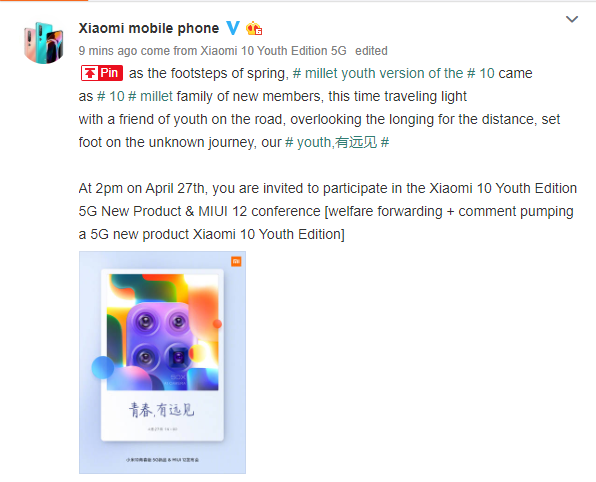
A new discussion thread for an unannounced smartphone called Xiaomi Mi 10 Lite was found in the Mi Community in China. Hence, it was speculated that Xiaomi may soon launch the handset in the home market. Today, the company confirmed through a Weibo post that the Xiaomi Mi 10 Youth Edition (aka Mi 10 Lite) 5G phone will break cover on April 27 at 2 PM (local time). The company will be also announcing MIUI 12 alongside the smartphone.
The Xiaomi Mi 10 Lite’s poster shows that it will be flaunting a square-shaped camera setup. A careful look at the camera setup reveals that it includes a periscope zoom lens that will enable up to 50x zoom on the device.
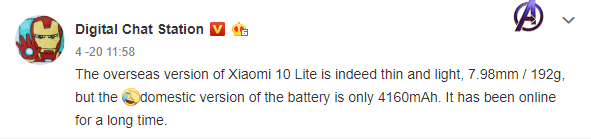
A reliable tipster from China had claimed that the Mi 10 Lite 5G for China weighs 192grams and its thickness is 7.98mm. He also revealed that the device has a battery of 4,160mAh battery. These details with the Xiaomi Mi 10 Lite 5G phone that was announced at March end in Europe.
It appears the Europe’s Mi 10 Lite 5G will be made official in China on April 27. Interesting thing to note that the European edition does not have a periscope zoom lens. Hence, it seems that the Mi 10 Lite for China could be coming with an enhanced camera setup. Last month, a 5G-capable Xiaomi phone with M2002J9E model number was spotted with 22.5W fast charger. It is likely that the M2002J9E phone could be the upcoming Mi 10 Lite 5G.
The Xiaomi Mi 10 Lite 5G that debuted in Europe carries a pricing of 349 euros. The handset is equipped with a 6.57-inch AMOLED display with in-screen fingerprint reader. It is powered by Snapdragon 765G processor and 6 GB of LPDDR4X RAM. The phone arrived in 64 GB and 128 GB UFS 2.1 storage choices in China. The rear camera setup of the phone features a 48-megapixel main lens, an 8-mgeapixel ultrawide shooter, a 5-megapixel macro lens and a 2-mgeapixel depth sensor. It has a front camera of 16-megapixel. Its 4,160mAh battery supports 20W fast charging.
As far as MIUI 12 is concerned, it is expected to offer users with refreshed UI, better navigation experience, new animations and improved battery performance. Dark Mode for all apps and style options in Recents are also rumored to arrive with MIUI 12.
The smartphone market changed a lot in the last decade. Most of the top brands who dominated the scene more than 10 years ago disappeared from the top smartphone manufacturers rankings and made way for new companies, especially Chinese ones. But a few old players are still in the scene. Once in a while, some of the old phone manufacturers release smartphone reboots to attract the customers’ attention, especially the nostalgic ones. In this article, we collected all the coolest smartphone reboots released in 2019 and 2020 which gave new life to old and iconic phone series.
Cool Smartphone Reboots 2019 and 2020
Motorola Razr
Apple iPhone SE 2020
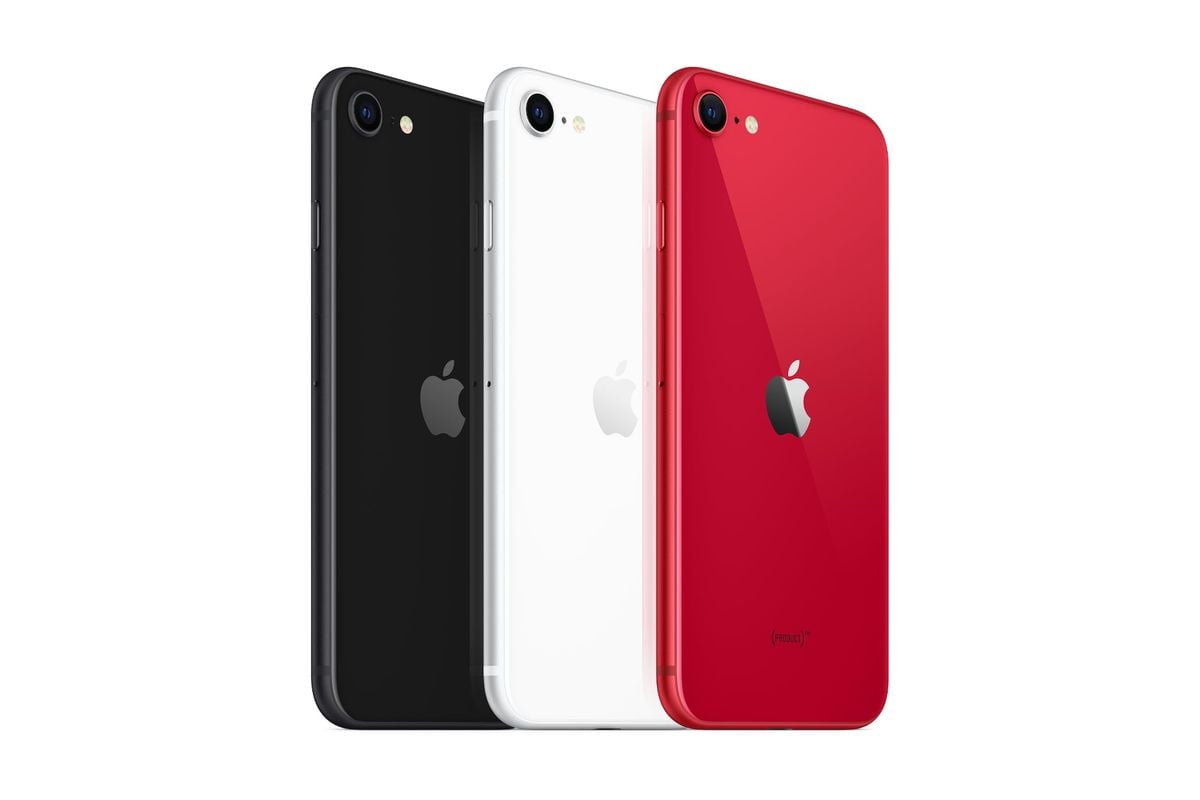
The latest smartphone reboot released in 2020 is the new iPhone SE. It is an upgraded version of the iPhone SE released back in 2016 and it is the most compact and affordable last-generation Apple phone. Unlike the original iPhone SE, it has the same design as the iPhone 8 released in 2017, the same dimensions and even the same weight. It is the only last-generation Apple device with thick bezels around the display and Touch ID. The handset comes with a very compact 4.7-inch display and it can be considered as the most compact modern flagship. But despite its old school design, it packs flagship-class hardware including the same processor as the iPhone 11 series: the Apple A13 Bionic. You even get the same main camera as the iPhone 11 lineup (but there are no secondary sensors). The only real downside is the battery which comes with the same 1821 mAh capacity of the iPhone 8.
Nokia 8110
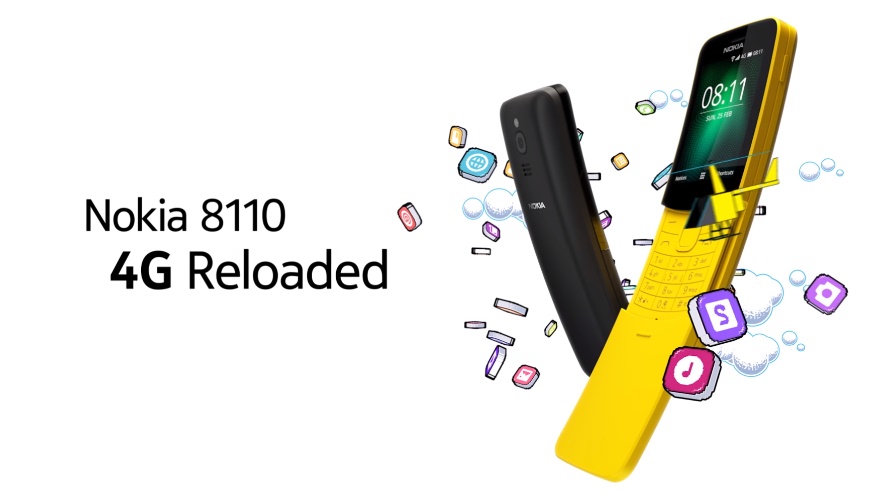
The new Nokia 8110 4G is a revival of the “banana phone”: the iconic 8110 released in 1996 and used in the famous movie “The Matrix” which debuted in 1999. The original Nokia 8110 had a monochromatic display and a slider protecting the keyboard which would activate the phone once opened. And you get the same slider with the new Nokia 8110 4G, but there is no monochromatic display anymore. You get a wider 2.4-inch color display with a resolution of 240 x 320 pixels. But this is not a real smartphone, neither it comes with touch screen. It works with a physical 3×4 keyboard. Despite not being a smartphone, it still comes with the support to 4G networks and a smart operating system. We are talking about KaiOS: a fork of Firefox OS which supports several apps including WhatsApp and Facebook.
Motorola Razr
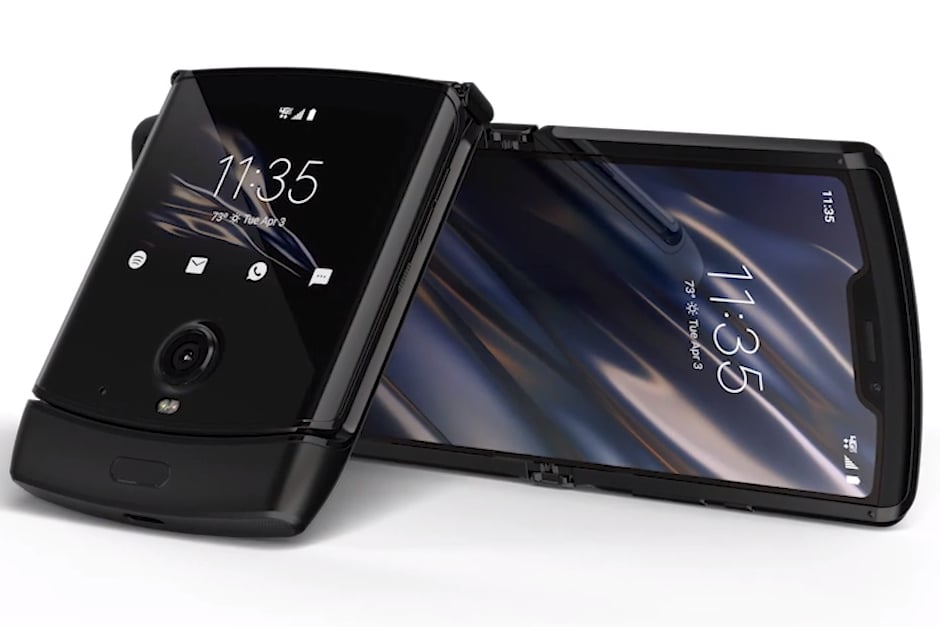
The most impressive smartphone reboot released in the last years is the new Motorola Razr. It is a revival of the Motorola Razr V3 clamshell phone from the early 2000s, as you can easily notice by looking it from the outside. But on the inside, it is a foldable phone with a foldable screen! The handset sports a foldable display with a 6.2-inch diagonal just like a typical smartphone, but it can fold in half and become extremely compact! It also comes with a smaller external display allowing the user to perform several operations such as checking notifications, shooting selfies, answering calls, and more. The Razr is based on the mid-range Snapdragon 710 mobile platform and it costs $1,500/€1,500.
Nokia 5310
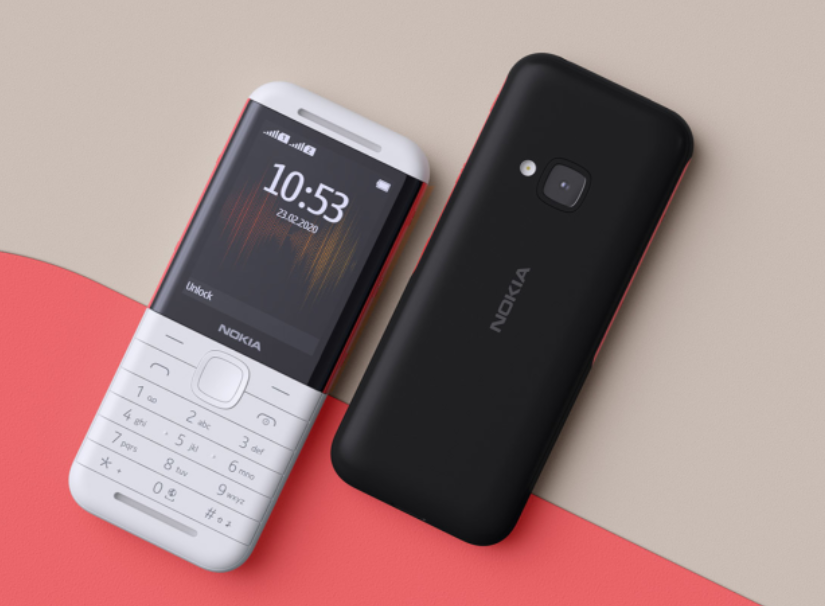
One of the most interesting retro phones brought back to life is the Nokia 5310: a revival of the Nokia 5310 XpressMusic from 2007. Just like its old sibling, the new phone brings the same black/red and white/red paint jobs, as well as hose amazing side-mounted keys to control the music player. The Nokia 5310 (2020) is a feature phone with the Series 30+ operating system, a physical 3×4 keyboard, and a 2.4-inch display. It offers a 16 MB internal storage with a micro SD slot allowing to expand it up to 32 GB, front-facing stereo speakers, Bluetooth and a 3.5 mm jack. Further, it packs a 1,200 mAh battery lasting up to 7.5 hours of talk time and up to 30 days in standby. It only supports 2G and it costs €39. Besides the Nokia 5310, it is impossible for us not to mention the Nokia 2720 Flip, a clamshell phone which runs KaiOS just like the Nokia 8110, packs a GPS + GLONASS receiver and features LTE connectivity. A clamshell feature phone offering smartphone features and providing an even better experience than 8110.
HTC Wildfire X
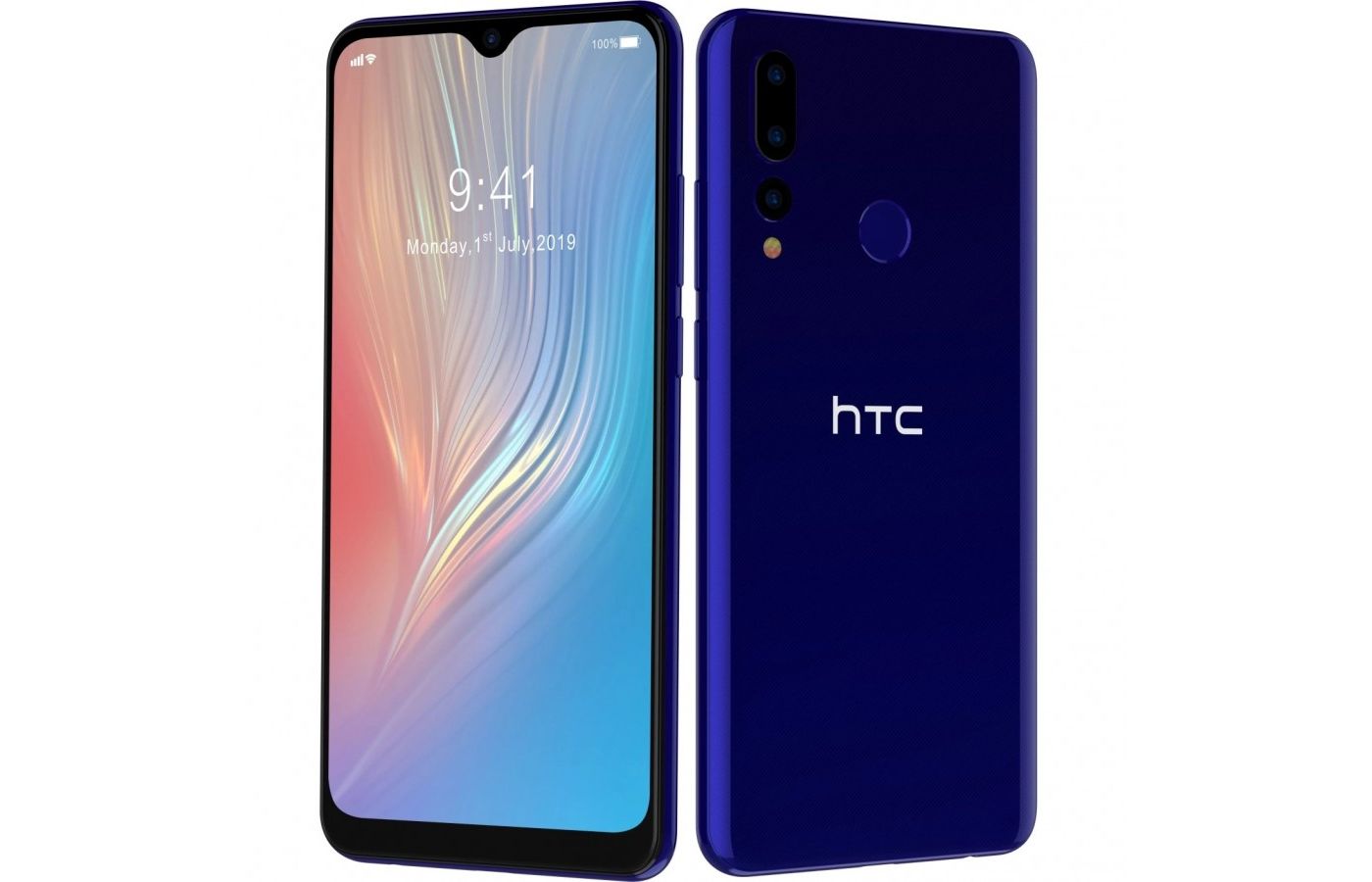
Another classic reborn was launched by HTC in the second half of 2019: the company resurrected the famous Wildfire series which made its success at the beginning of the last decade by launching the Wildfire X. The phone is not manufactured by HTC but it is made by a Chinese company named InOne Smart Technology which licensed the brand for the Indian market. The handset packs entry-level specifications, including a 6.2-inch HD+ display, an Helio P22 chipset and up to 4 GB of RAM paired with up to 128 GB of internal storage. But it has a modern design with a waterdrop notch and narrow bezels.
Nokia 9 PureView
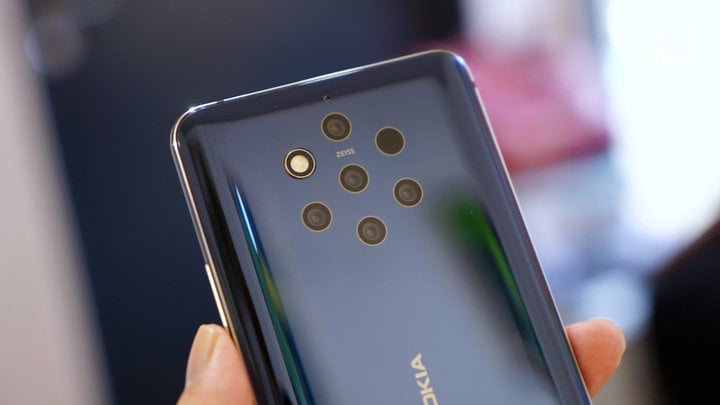
The Nokia 808 PureView was a smartphone released in 2012 which offered astonishing camera specifications. One of the first phones with a camera sensor sporting a resolution above 40 Megapixels and naturally one of the most innovative devices when it came to cameras. In the Windows Phone era, it was followed by the Nokia 1040 PureView, another device known for its amazing 41 MP camera. The Nokia 9 PureView is not a smartphone reboot, but it brings the PureView series back to life with innovative cameras once again. Nokia 9 PureView is the last top-tier flagship released by Nokia and it is made for photography enthusiasts. It sports a 12 MP Penta-camera with 2 RGB sensors and 3 monochromatic cameras (plus a TOF 3D sensor) working simultaneously to capture the best shots. It also packs a powerful Snapdragon 845 chipset and a Quad HD+ P-OLED display.
We think the whole Realme brand deserves a spot among the honorable mentions. A lot of people think Realme is just a name copied from Redmi, but it is not so. The brand already existed in 2010: do you remember the Oppo Real series? It included a device advertised as RealMe.
After 8 years, Oppo re-launched the brand and it quickly entered the top 7 in the ranking of the best global smartphone manufacturers. It is not exactly a smartphone reboot, but we also want to mention the Xiaomi Mi Note 10. If we consider when Xiaomi is born (2010), the Mi Note 10 is indeed a revival of the Mi Note series which was discontinued in 2016.
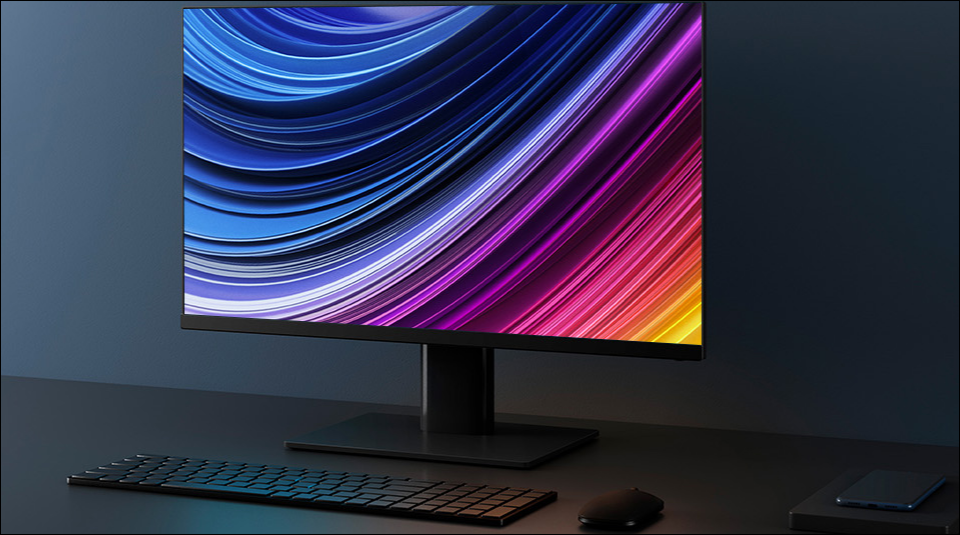
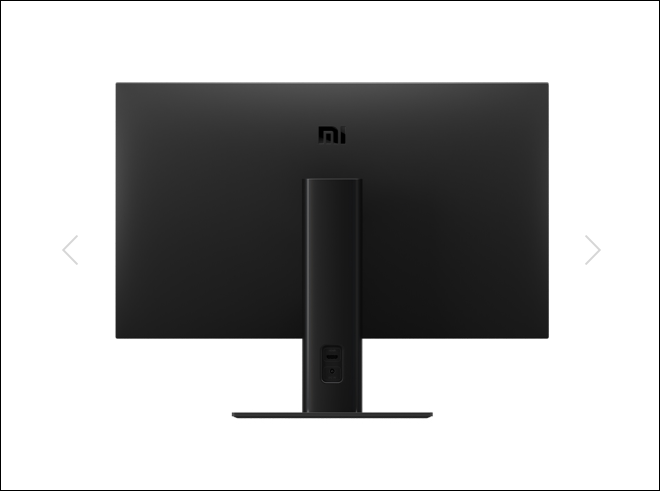
Xiaomi has launched the Mi Display 1A and it is now available on Xiaomi Mall. The display screen is similar to the Mi Display in many aspects including design and even has the same 699 yuan ($98) price tag. In case you are wondering the difference between the two, the original version is manufactured by Gaochuang, and 1A is manufactured by Shenzhen Zhaochi. Users can buy with confidence.
In fact, Xiaomi had already released two display products as early as the end of last year. The two products are the Xiaomi display equipped with a 23.8-inch IPS flat screen and the Xiaomi curved display equipped with a 34-inch curved screen. Compared with the old manufacturers’ monitors at the same price, Xiaomi’s monitors are really good in terms of cost performance. There are basically no competing products at the same price and specifications.
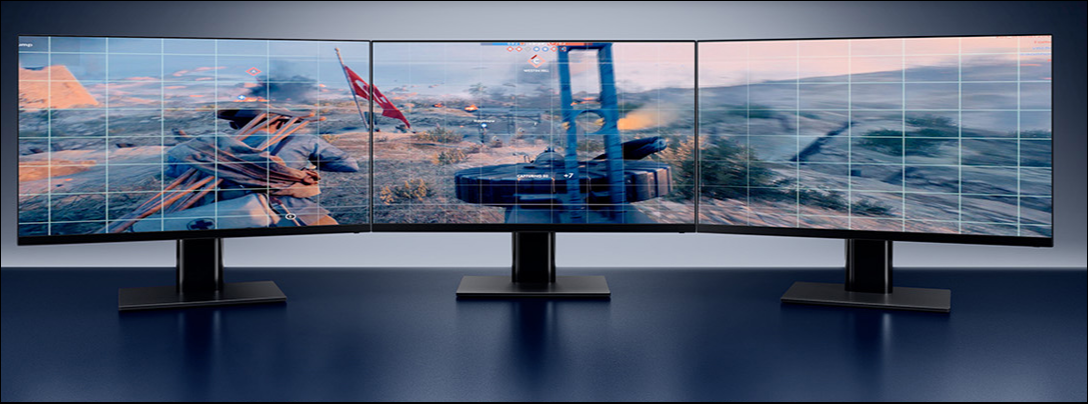
The Mi Display 1A is equipped with a 23.8-inch IPS flat screen with a resolution of 1920 x 1080 pixels. The display uses the 16:9 aspect ratio and has a viewing angle of up to 178 °. The panel has a common design with three sides having narrow bezels and the bottom bezel coming in wider. The display isn’t a high-end one suitable for gaming as it only supports 60Hz refresh rate.
MIJIA Smart Socket 27W Fast Charge version
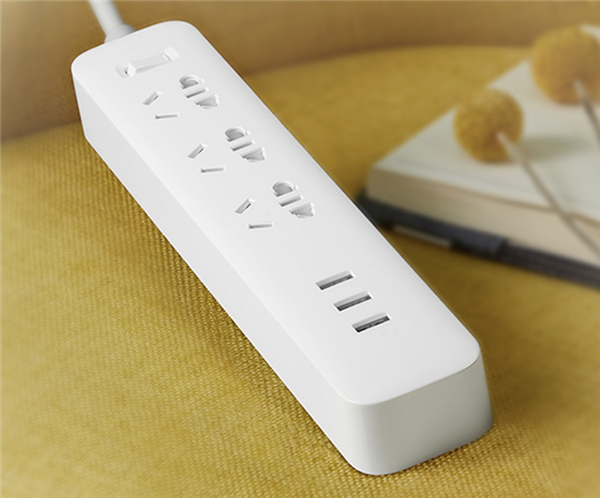
The MIJIA 27W Fast Charge Smart Socket was also launched on Mi Mall but under crowdfunding. The product carries a crowdfunding price of 69 yuan (~$9) but will retail for 79 yuan (~$11) after the exercise.
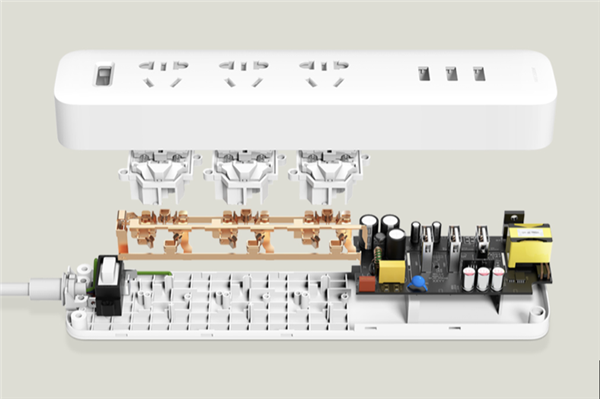
The smart socket comes with three USB-A ports with each having a maximum output power of 27W. However, when te three ports are put to use, the maximum output power drops slightly to 21W Max. The USB ports also support Quick Charge 3.0 fast charging protocol. The ports can be used to charge mobile phones, tablets, smartwatches and other gadgets. There is a built-in smart charging chip onboard which matches the output power according to different models but not more than 27W.
The MIJIA Plug-in board 27W Fast charge version also features three standard sockets and has 10A overload protection. If the electrical load exceeds the standard, the power will be automatically cut off, effectively avoiding the dangers caused by overload short circuit and accidental fire. After troubleshooting, you can turn it on again by simply pressing the power switch.
In addition, the internal copper strip adopts a higher-security one-piece non-breakpoint connection technology and high-quality tin-phosphor bronze structural materials. There is a safety door which shuts automatically when nothing is plugged into any of the sockets.
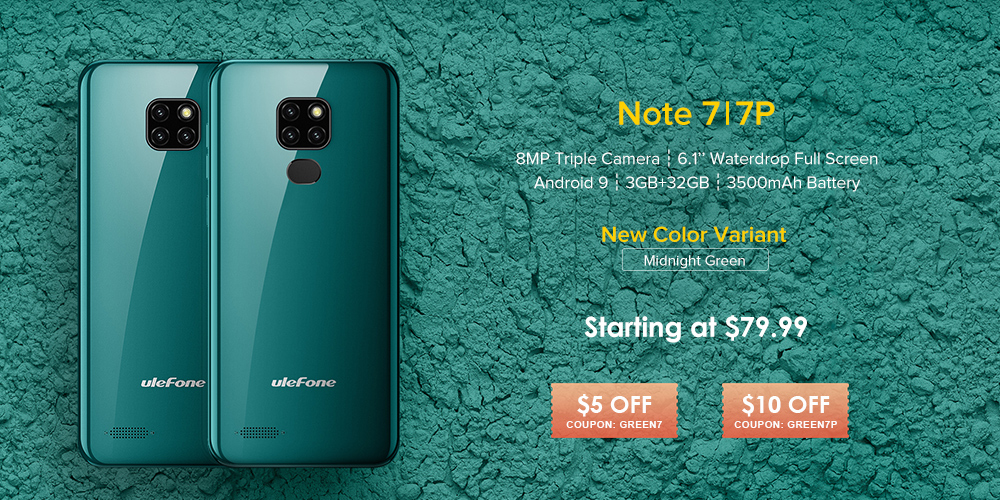
Ulefone and its rugged smartphones are quite popular around the globe. The company last year launched Ulefone Note 7 series comprising entry-level smartphones with a compelling price tag. Both the Ulefone Note 7 and Note 7P models are well received by the users. However, to renew the Note 7 age and to give the users another option, the company has released a new Midnight-Green color variant for both the variants. The new color variant is now on sale for the same price.
Surprisingly, the new Midnight-Green color option is available with two storage variants of 2GB RAM + 16GB Internal storage on Note 7 and 3GB RAM + 32 GB internal storage on Note 7P.
There are a few minor differences between both the Ulefone Note 7 and Note 7P devices. The Ulefone Note 7 runs on Android 8.1 Oreo whereas, the Note 7P comes with Android 9.0 Pie. Similarly, there’s a slight upgrade in CPU corner also, Ulefone Note 7P comes powered with Quad Core 2.0 GHz, and the Note 7 hosts Quad-COre 1.3Ghz processor. These are some other differences:
Ulefone Note 7
Ulefone Note 7P
CPU
Mediatek MT6580
Mediatek Helio A22
Diagonal size
6.1 “
6.1 “
Resolution
1280×600
1280×600
Multi-touch (number of touches)
2
5
RAM
1 Gb
3 Gb
ROM
16 GB
32 GB
External memory
MicroSD (TF), supports cards up to 32Gb
MicroSD (TF), supports cards up to 128Gb
Rear camera
8 Mp
8 Mp
Camera
Triple Camera
Triple Camera
Front (selfie) camera
5 Mp
5 Mp
Battery
3500 mAh
3500 mAh
Network
3 G
4 G
Sim cards
nanoSIM + nanoSIM or microSD (TF)
nanoSIM + nanoSIM or microSD (TF)
Navigation (Positioning)
GPS, A-GPS
GPS, A-GPS, GLONAS
Fingerprint’s scanner
Yes
Yes
Operating system (OS)
Android 8.1
Android 9.0
Material
Plastic
Plastic
Weight
177 g
177 g
Dimensions
156.1 x 73.7 x 9.7 mm
156.1 x 73.7 x 9.7 mm
Ulefone Note 7 is available for $79.99, but you can avail $5 off on Note 7 using the coupon code GREEN7. However, Ulefone Note 7P is available for $109.99 and you can get instant $10 off with coupon GREEN7P. Both the devices are available in three more colors – Black, Gold, and Twilight.
The interested users can grab the Ulefone Note 7 series smartphones from their official store.
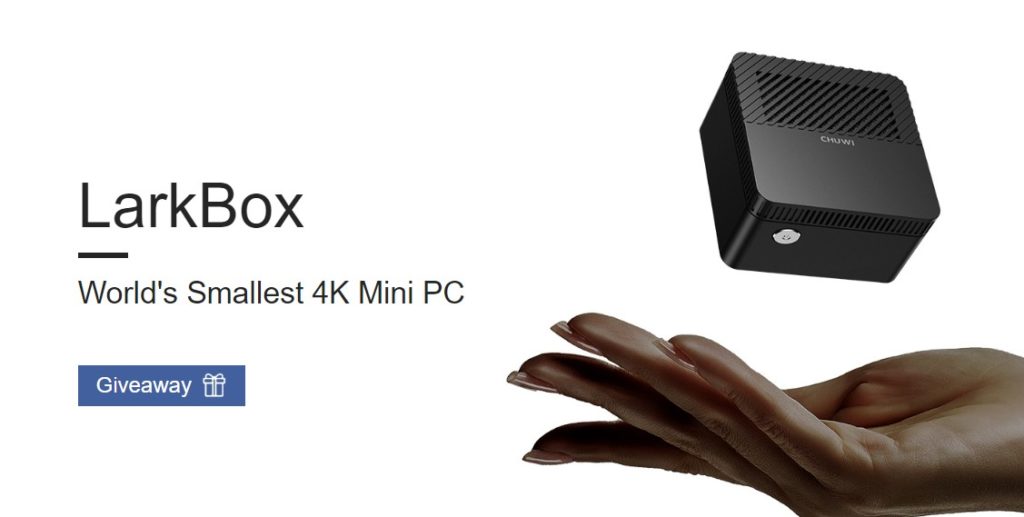
Chuwi is a Chinese consumer electronics manufacturer that is popular for laptops, tablets and convertible 2-in-1 laptops. However, from fully portable devices like laptops and tablets, the company is shifting towards Mini PCs. The company recently exposed the smallest 4K Mini PC like LarkBox and even revealed some of its specifications. It is so small that the user can easily hold it within the palm, or it is of the size of a regular apple.
LarkBox’s size is small but it comprises some compelling specifications within that miniature box. The smallest Mini PC measures 61mm x 61 mm x 43 mm and weighs over 127grams. It houses an Intel N4100 processor, 6GB RAM, and 128GB SSD. Its portability is another merit of the product and can be used with a display by simply connecting it to a power source.
Several more details about the device have been exposed by the company. LarkBox comes powered with Intel N4100 process coupled with UHD Graphics 600 Graphics card, 6GB RAM and 128GB SSSD. Moreover, you can expand the storage additionally up to 128GB via a MicroSD card. The hardware is efficient enough to decode 4K video smoothly. The processor is power efficient as it can remain on standby with only 5W power. The laptop’s aesthetic design keeps the processor cool even while performing power-intensive tasks.
Chuwi Larkbox offers compelling specification offering great performance and comprehensive design. It is a great option to have a small PC at your home for daily tasks. It tends to offer a high-quality experience for office work and entertainment. You can know more information about the device by heading to the official website.
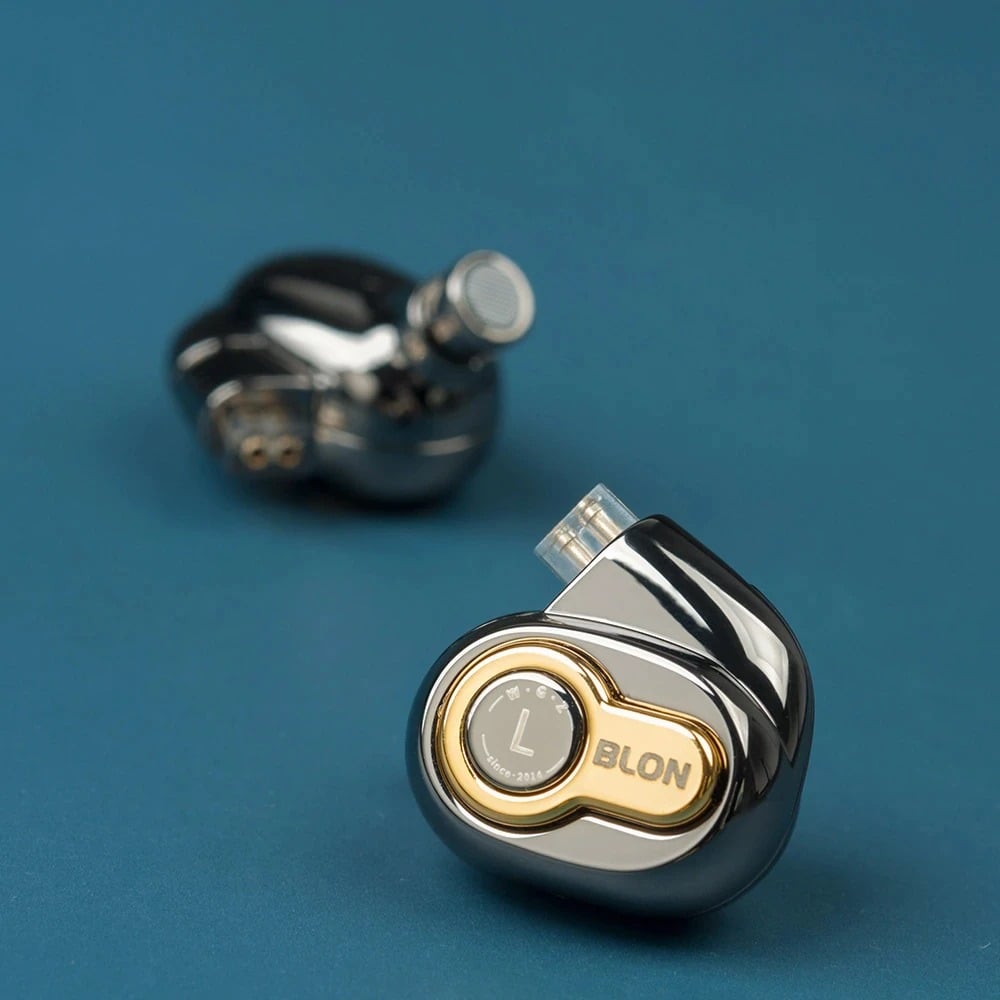
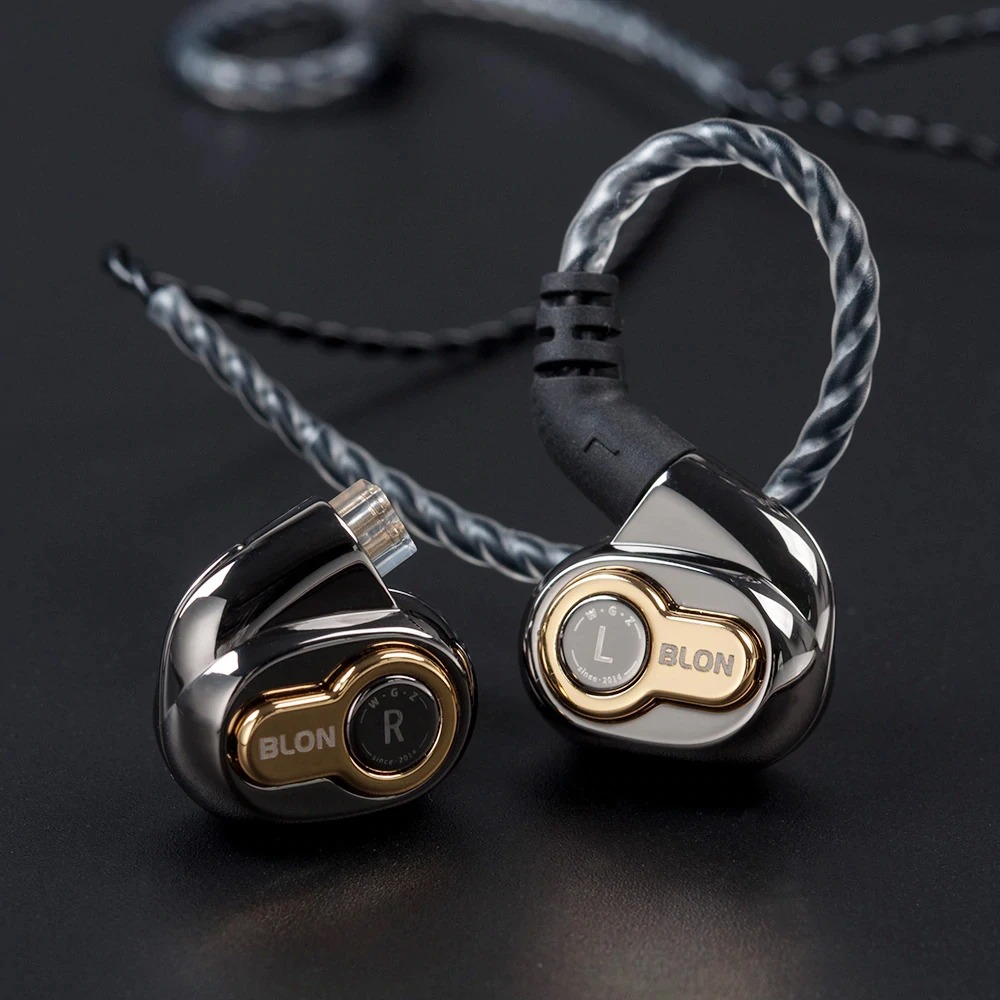
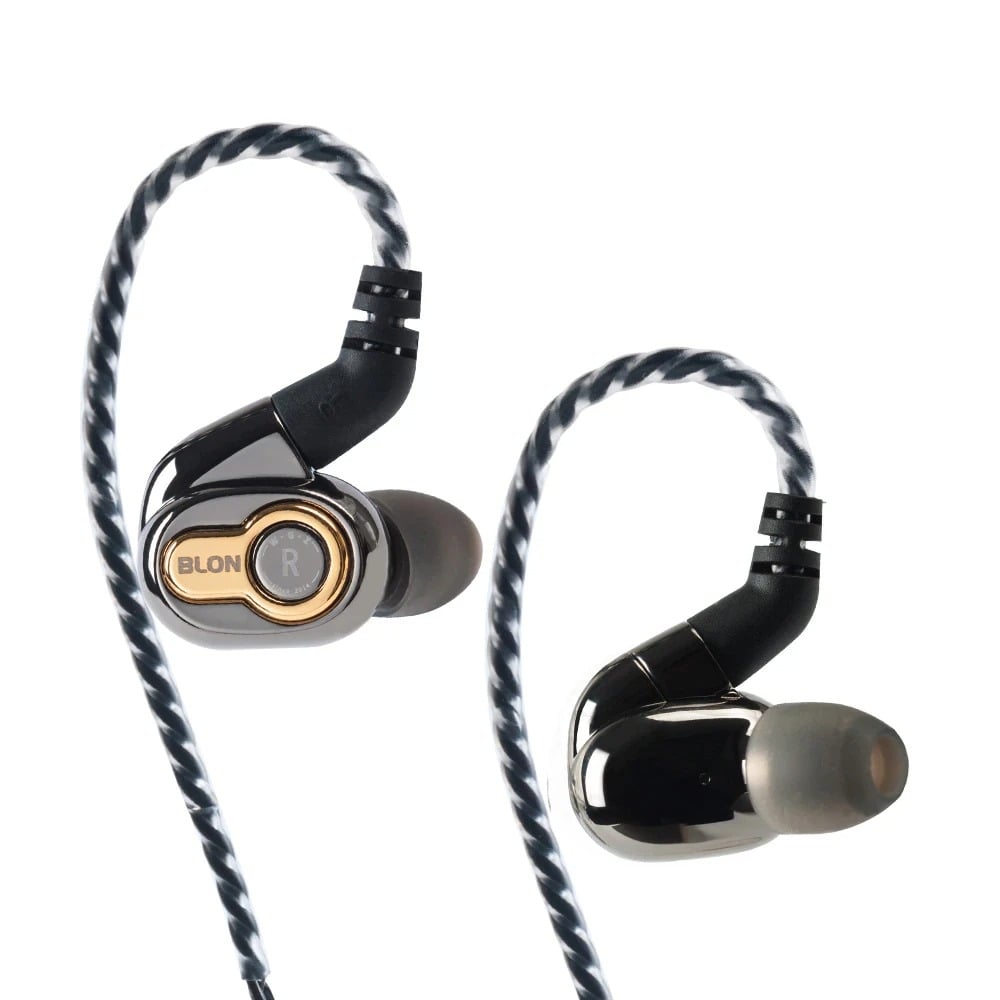
HiFiGo is finally here with a much improved Blon BL-O5 in-ear monitors after the magnanimous success of Blon BL-O3. The company has added various new functions and features to enhance the BLON BL-O5 IEM. The all-new shell design makes the new IEM better and optimized rather than its predecessor. HiFiGo Blon BL-O5 is available three new colors of gunmetal, silver and green. The company offers all new advancements for $42 without a mic cable. Whereas, if you’re interested in buying along with a mic cable then you can own it for $43 from here.
HiFiGo Blon BL-O5 features a 10mm Carbon Nanotube Diaphgram Dynamic Driver Unit having an Impedance of 32 Ohms. It supports sensitivity of 108dB with a frequency response range of 20Hz-20kHz. There’s a 0.78mm Two-Pin Cable with 3.5mm Termination Plug encased within Metal Housing Shells.
Splendid Sound Output:
The presence of premium metals and other materials help the Blon BL-O5 IMT to produce a beautiful sound. Its 10mm CNT diaphgram dynamic driver on each side produces a clear, versatile and deep bass response. The deep thumps bring originality in the music and give the user experience of lifelike vocals. The wide range of treble also makes the sounds more vivid and realistic.
Aesthetic Design
The beautifully designed shells carved out of metal with the golden color plate makes it look exceptionally better than BL-O3. It is designed to fit the user easily and comfortably which won’t let it fall off your ears on its own.
Easy to Use
Like its predecessor, BL-O5 is quite easy to use with easily available players and amplifiers. The new IMT has an impedance rating of 32ohms and a sensitivity of 108db. There’s no need for any expensive player or equipment to enjoy the music on the new in-ear monitors.
Different Variants
Blon BL-O5 comes in two different variants i.e one with a 0.78mm 2-pin detachable cable and another without it. The cable allows the user to connect cable and the earpiece.
Price and Availability
It is available for the price of $42 without the mic cable, however, if you need the cable then you need to shell out $43. You can order it from here and will be delivered by April 27, 2020.
There’s quite a little difference between the BL-O3 and BL-O5 IMTs. The BL-O3 is available for $28, whereas the BL-O5 sells for $42. Both the units support a 10mm CNT Dynamic Driver Unit.
The BL-O5 features a dual-tone design featuring golden elevated plater, meanwhile its predecessor just houses a single color shell.
It is now turning into a yearly ritual that Huawei would be busted each year trying to promote its smartphone’s camera prowess with images shot on DSLR cameras. The Chinese tech giant recently promoted a photography contest with a video featuring impressive pictures that Huawei claimed were “taken with Huawei smartphones.” However, some of the pictures weren’t actually captured by a Huawei phone camera but were shot on a DSLR camera.
The controversial images were among image featured in a promotional video for Huawei’s photography contest in China. However, Weibo user Jamie-hua, aka Huapeng Zhao who won second place in the 2018 iPhone Photography Awards with a photo taken with an iPhone 6 thought some of the photos looked like what he had seen before and decided to fact check. He then discovered that two of the photos were shot by a Nikon D850 DSLR camera valued at $3,000.
Credit for the two contentious photos was given to photographer Su Tie. The photographer has worked in partnership with Huawei in the past. We recall a similar controversy in January 2019 when the company released some samples shot in the artic by Su Tie that was purportedly from the Mate 20X’s shutter. Some of the pictures were later discovered to have been shot by a Nikon DSLR camera.
Huawei has since apologized on Weibo, saying that the photos were “wrongly marked” due to “an oversight by the editor.” It said the images were intended to encourage people to share their works on Huawei’s online gallery. The company has now updated the original video to remove the line that says the photos came from Huawei phones. It still says they were drawn from Huawei’s Next-Image community, though. When asked, a Huawei representative referred us to the contest rules in Chinese, which state that “you can publish photos taken with any equipment in the Next-Image community.
However, this incident brings to memory, Huawei’s infamous DSLR deceitful camera sample used in promoting the Huawei P9. Sometime around July 2016 when Huawei was promoting its P9 flagship, the company shared a photo on its Google+ page which was purportedly captured by the P9’s dual rear shutters. The photo was indeed stunning just like these ones, with crisp clear details downright impressive for a smartphone camera. Unfortunately, it turned out the shot wasn’t taken by a smartphone camera but was actually from a $4,500 Canon EOS 5D Mark III shutter. Huawei may not have any phone camera on the same level with a DSLR camera, but the company is edging closer to that standard employing an innovative camera and AI technology. The company’s new P40 Pro flagship ranks as the best phone in terms of camera, according to DXOMark.
The Oppo A52 finally goes official in China with a Qualcomm Snapdragon 665 chipset as leaked earlier on Google Play Console. The device’s entire specifications along with render and price leaked yesterday giving us a full picture. But now, the company launches it officially settling the dust once and for all. The handset only comes in an 8GB RAM + 128GB storage configuration and is already up for sale on Oppo’s official website for 1599 Yuan ($226).
Oppo A52 Specifications
The newly launched Oppo A52 sports a 6.5-inches FHD+ IPS LCD panel with 20:9 aspect ratio and a punch-hole at the top left corner for an 8MP selfie camera. The phone also comes with dual linear stereo speakers, which are Hi-Res certified and also have support for Dirac.
The above mention features along with a 5,000 mAh battery with support for 18W fast charging makes the Oppo A52 a killer multimedia device under $250. The Snapdragon 665 underneath it is enough to handle day to day activities without any hiccups as the handset features 8GB LPDDR4X RAM and 128GB UFS 2.1 storage.
For optics, the new budget Oppo smartphone comes equipped with a rectangular camera array on the shimmering back panel. The setup consists of four cameras namely a 12MP primary sensor, an 8MP ultra-wide shooter, a 2MP macro camera, and a 2MP depth sensor.
As for software, the new Oppo A52 runs ColorOS 7.1 based on Android 10 out of the box. Being a budget smartphone, it has a microSD card slot, a 3.5mm headphone jack and even a side-mounted fingerprint sensor as a bonus.
Oppo A52 Pricing and Availability
The Oppo A52 comes in two colour variants – Blue and Black respectively. It is priced at 1599 Yuan ($226) and is already on sale in China with a free pair of standard Oppo earphones.
Oppo A52 Blue
Oppo A52 Black
We are not sure when it will be announced in other markets. But as it was spotted on Google Play Console along with Oppo A92, which received a certification in Singapore and Indonesia. We can expect this phone to debut in these markets soon followed by India, another key market for Oppo.
Apple announced a new iPhone SE last week and it sort of broke the internet. Practically everyone was talking about it and you may have come across a number of tweets saying “I am getting this” or something along that line.
It is not unusual for a new iPhone to trend but the iPhone SE 2020 is an extraordinary device. It is practically the iPhone 8 with an improved camera, the same chipset inside the iPhone 11 series, and more RAM. However, rather than a price tag of $699 as the iPhone 8 when it launched in 2017, the new iPhone SE starts at $399!!! With a price tag like that, this phone is going to sell millions of units.
So, is the key to winning – relaunching an old phone with modern specs?
One of the main advantages of relaunching a phone is that the production cost is reduced since you do not have to redesign the phone from scratch. You also get to make use of old components that you either have in stock or the component’s manufacturer is willing to sell at a lower price. In the case of the new iPhone SE, the only additions are a new RAM, the A13 Bionic chipset, and the wireless charging coil.
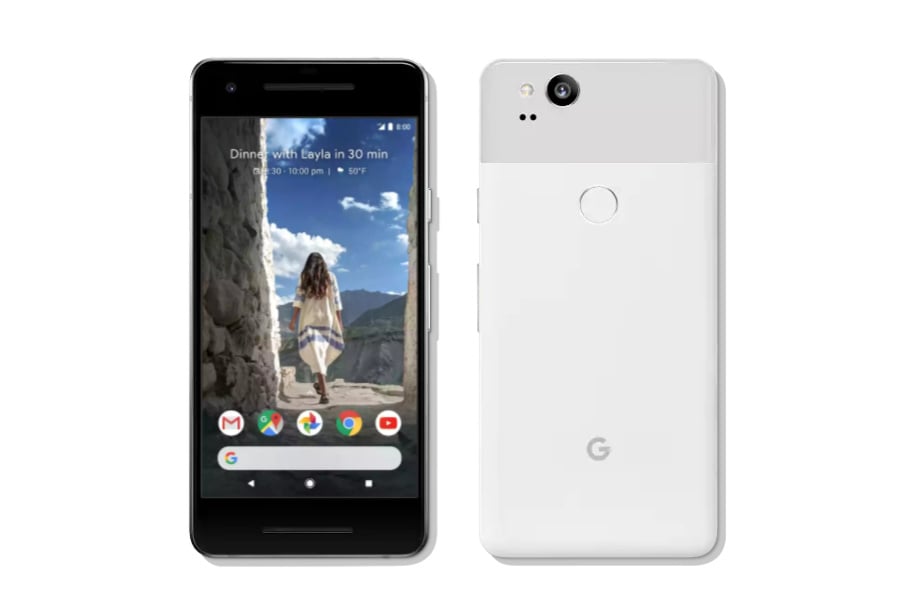
This got me thinking as to how Android (read Google) can launch a phone that rivals the iPhone SE 2020 and we arrived at the Pixel 2….or better still a Pixel 2 (2020).
Why the Pixel 2?
The Pixel 2 is the perfect choice for the following reasons. First, it launched the same year as the iPhone 8 which the new iPhone SE is based on. It also has that small form factor that practically all manufacturers have abandoned. The Pixel 2 also reinforced the “Pixel Camera is the best” when it launched, so you will be getting a phone with a very capable camera.
Another important point is the Pixel’s long software support which rivals that of several other manufacturers. The Pixel 2 launched with Android Oreo out of the box and still has one more OS upgrade in the pipeline. So, a new Pixel 2 should get software support for at least 3 years.
Last but not least is the Pixel brand itself. While there are other phones we could have come up with, a few are even mentioned at the end of this post, the Pixel is still the best option. Unlike other Android manufacturers that churn out several phones every year, there are only very few Pixel phones each year (three last year, two the year before) which helps the phones stay “relevant”, for lack of a better word.
The original Pixel 2 has a 5.0-inch FHD AMOLED screen with huge bezels and stereo front-facing speakers. It also has Gorilla Glass protection on both sides and a 3000mAh battery capacity. All these remain unchanged.
So what are the new additions? First, a newer and more powerful processor. For the SoC, we are throwing it open by making it a poll. So please, take the poll below and let us know which chipset should power the Pixel 2 (2020).
[yop_poll id=33]
Personally, the Snapdragon 855+ is my chipset of choice. It is a flagship chipset and should handle anything you throw at it and has a great ISP (Image Signal Processor). A phone featuring a chipset with a 5G modem will require a battery bigger than the 2700mAh battery inside the Pixel 2. However, support for 18W fast charging needs to be added as the 10.5W charging of the original won’t cut it in 2020.
The RAM and storage will also remain unchanged, so you get 4GB of RAM and 64GB or 128GB of UFS 2.1 storage. The rear camera also stays the same at 12.2MP but the aperture can go from f/1.8 to f/1.7 just like that of the Pixel 4. The phone will benefit from the new camera software features Google has come up with after the launch of the 2017 Pixel 2 and the more powerful image signal processor of the Snapdragon 855+.
The new Pixel 2 (2020) should also use the same 8MP selfie camera as the original and rear-mounted fingerprint scanner too. The original Pixel 2 has an IP67 rating and also dual SIM support (nano-SIM + eSIM), it makes sense for these features to remain on the 2020 version. Of course, we want it to run Android 10 out of the box and get OS upgrades for 3 years.
Price
To take on the iPhone SE 2020, the Google Pixel 2 (2020) will have to go for $399 for the base model while the 128GB version will have to sell for $449 and should ship with an 18W charger in the box, unlike the iPhone SE 2020 that has a 5W charger. Colors can be Kinda Blue, Just Black, and maybe even a new color called Happy Yellow.
Conclusion
While the chances of Google relaunching the Pixel 2 with more recent specifications are pretty low, the above device with such a price tag will surely be a hit amongst buyers looking for a small but powerful phone with great software support.
Nevertheless, if Google is not jumping on the train, there are other manufacturers that have great phones that I believe should jump on this. A few examples are the Xiaomi Mi 5 and the OnePlus X. These two phones were really popular back when they launched and nostalgia coupled with modern specs and a pretty affordable price tag can help them succeed if and when they are reborn.
OnePlus has gained a reputation over the years for launching premium smartphones at affordable prices. The brand emerged last year among the top 5 OEMs in the premium phone segment and also became the number one premium phone brand in India. However, OnePlus seems to have got other plans different from consolidating on the success of its sole high-end phone market. A recent rumour emanating from China’s Weibo tips the Chinese company of planning to effect major changes in its market strategy. The rumour quotes industry sources to have disclosed that OnePlus will release ODM orders this year (2020). The products are said to include 4G phones and 5G phones. This year’s OnePlus 8 series left some fans disappointed as a result of the high price tags of the models which many complained deviates from the brand’s cheap flagship strategy. Perhaps, to make up for this, the company will launch mid-range and low-end smartphones using an original design manufacturer.
An ODM is a company that designs and manufactures a product, as specified, that is eventually rebranded by another firm for sale. This business strategy is mainly used by Huawei and Xiaomi who deploy ODM companies such as Wentai, Huaqin, Longqi and Zhongnuo for the Honor brand. By 2018-2019, the ODM market had undergone great changes. Three of the most important mobile phone manufacturers have begun to invest heavily in ODM projects in China, that is, Samsung, Nokia and OPPO. In 2018, OPPO began to release ODM products while Samsung began ODM release in 2019 in China and other markets. This move is seen as a cost-saving strategy which enabled the Korean company to code down its factories in China.
OnePlus is yet to confirm this rumour so take it with a grain of salt.
A new leak has revealed that Motorola has two new phones scheduled to launch this quarter. According to Evan Blass (@evleaks), the phones will arrive as the Motorola One Fusion and the Motorola One Fusion+.
The famed leaker also revealed in his tweet that the Motorola One Fusion and Motorola One Fusion+ are codenamed “Titan” and “Liberty” respectively. In a separate leak, the Indian blog, 91 Mobiles, mentioned a few key specifications of the Fusion+.
Coming from Moto, end of Q2: Motorola One Fusion (codename: Titan) and Motorola One Fusion+ (codename: Liberty).
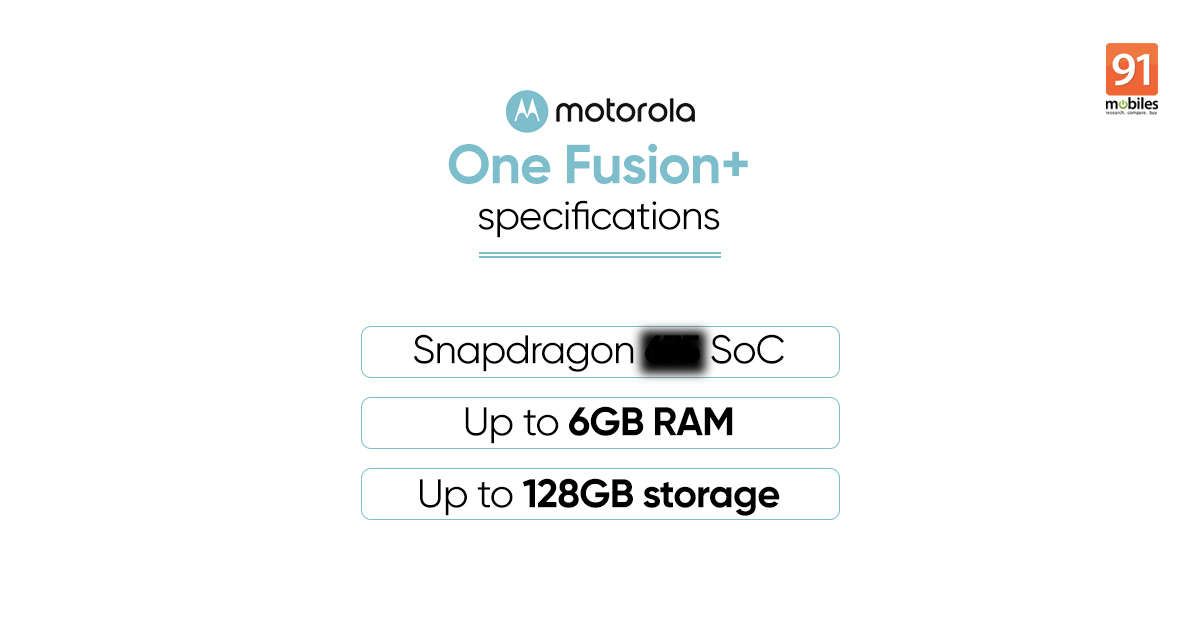
The site reports that the Motorola One Fusion+ will have a Snapdragon 675 processor powering it along with 4GB of RAM or 6GB of RAM and 64GB or 128GB of storage.
They also mention it will have a 12MP camera but do not mention the number of sensors it has in total. The phone will have support for two SIM cards and be available in Light Blue and Light Brown colorways. Sadly, there is no info on the design of the two phones.
Motorola is expected to launch both before the end of the quarter in the USA and India. They should come with the latest version of Android which is Android 10. Motorola may also launch the two phones in Europe and Latin America but there is no info on that yet.
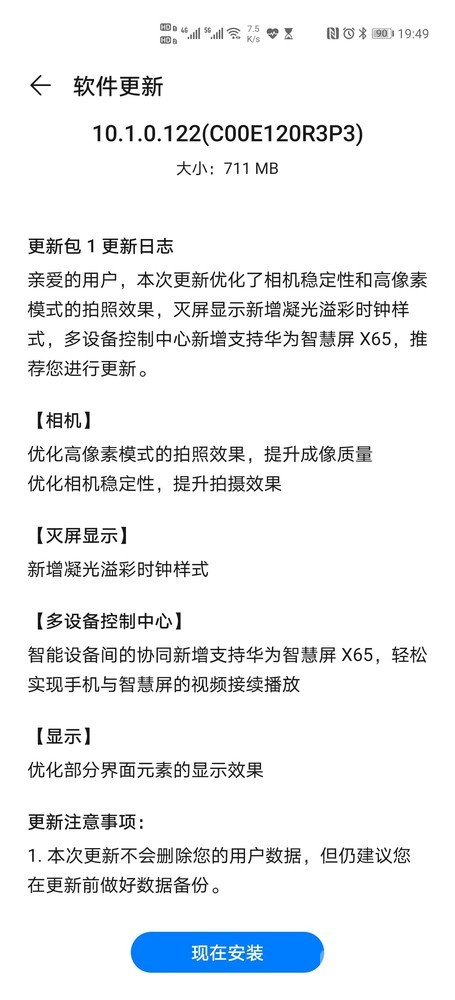
The recently launched Huawei P40 series is receiving a new software update in China. The update bumps up the phone’s build number to EMUI 10.1.0.122 and brings a number of new features including a new high megapixel mode in the camera app, new smart video playback option, and a new clock style for AOD.
The new EMUI 10.1.0.122 update for Huawei P40 series weighs 711MB in size. Although the update will nor erase anything, the company suggests creating a backup just in case. The official changelog for the update is as mentioned below (translated from Chinese).
Camera
Optimize the high-pixel mode photography effect, improve imaging quality, optimize camera stability, improve shooting effect.
Off-screen display
Added Condenser Clock Style.
Multi-device control center
Collaboration between smart devices adds support for Huawei Smart Screen X65 to easily realize continuous video playback from mobile phones and smart screens.
Display
Optimize the display effect of some interface elements.
As you can see from the changelog above, the new update brings a new 50MP AI high-quality mode, which you can have a look from the screenshot attached below. Further, the update adds a new AOD clock style and also brings support for smart video playback on Huawei’s new Vision Smart X65 OLED TV. Last but not least, the update also fixes some UI glitches.
As of now, the update is being currently rolled out to the Chinese version of the Huawei P40 series. It is uncertain when this update will hit the global editions of the handsets. Eligible devices are as below.
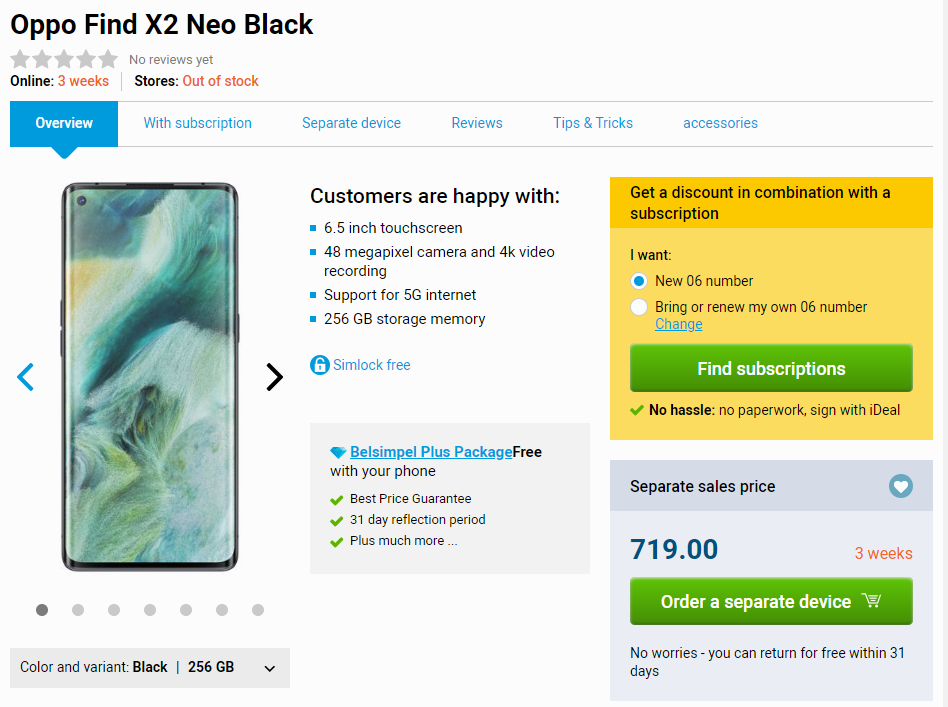
OPPO has been on an announcement spree for about a week. The manufacturer is also bringing some of its phones to Europe under new names. For example, the Find X2 Lite is actually a rebadged Reno3 Vitality Edition. Now, the Reno3 Pro 5G has been spotted on a Dutch website where it is listed as the Find X2 Neo.
The Find X2 Neo is listed on Belsimpel for €719. The phone has a 6.5-inch curved AMOLED display with a punch-hole at the top left corner of the screen and a 90Hz refresh rate. There is a Snapdragon 765G chipset inside along with 12GB of RAM and 256GB of storage.
The phone has four rear cameras – a 48MP f/1.7 primary camera, a 13MP f/2.2 telephoto camera, an 8MP ultrawide angle camera, and a 2MP monochrome camera. The dedicated spec page says it has a 44MP selfie camera while the description page says it has a 32MP sensor
The Find X2 Neo has a 4025mAh battery capacity with support for VOOC 4.0 (30W). There is an in-display fingerprint scanner, stereo speakers, single SIM support, and Bluetooth 5.1.
According to the product page, the phone will ship in 3 weeks. It is available in Blue and Black and comes with a 2-year warranty.
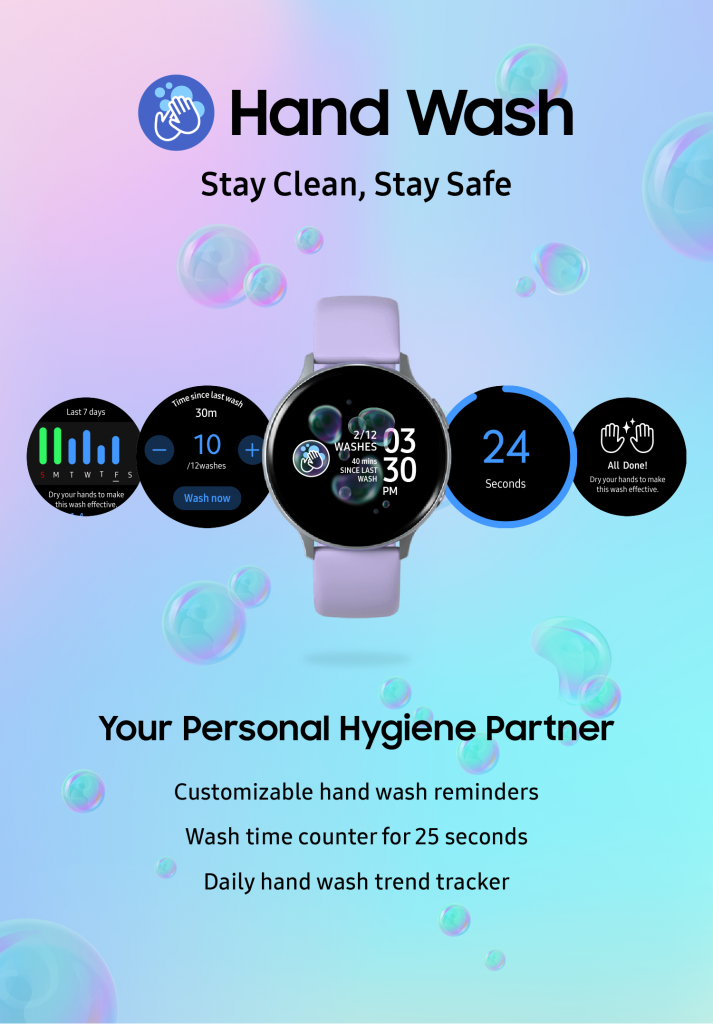
Samsung released an app for its Galaxy smartwatches to help wearers wash their hands on a regular basis. The app called ‘Hand Wash’ can be downloaded from the Galaxy App store.
Since there’s no cure for COVID-19, the only way to safeguard ourselves from the novel coronavirus is through prevention. As WHO (World Health Organization) notes, it can be only done by maintaining social distance and washing hands for at least 20 seconds from time to time.
And that’s what the world has been doing for the past few months. However, as days pass by, we tend to forget washing hands properly for the suggested time duration, which is essential to wash away potential viruses from our hands.
Thus, a small group of designers and developers from Samsung Research Institute-Bangalore or SRI-B’s UX and wearable teams have come up with an app called ‘Hand Wash’ for Galaxy smartwatches. The team developed the app within two weeks of time by working at their respective homes.
The app not only prompts the users to wash their hands but also helps in tracking their handwashing trends to build into a habit. Once initiated, the ‘Hand Wash’ timer will run for 25 seconds, which includes 5 seconds for turning on the tap and applying soap and 20 seconds for actual hand wash.
The reminders on ‘Hand Wash’ app are customizable, which means users can set as many as number of hand wash cycles per day as per their wish. Lastly, the app also comes with an elegant watch face that shows the time along with the number of hand washes completed as well as when it was last carried out.
We use cookies on our website to give you the most relevant experience by remembering your preferences and repeat visits. By clicking “Accept”, you consent to the use of ALL the cookies.
This website uses cookies to improve your experience while you navigate through the website. Out of these, the cookies that are categorized as necessary are stored on your browser as they are essential for the working of basic functionalities of the website. We also use third-party cookies that help us analyze and understand how you use this website. These cookies will be stored in your browser only with your consent. You also have the option to opt-out of these cookies. But opting out of some of these cookies may affect your browsing experience.
Necessary cookies are absolutely essential for the website to function properly. This category only includes cookies that ensures basic functionalities and security features of the website. These cookies do not store any personal information.
Any cookies that may not be particularly necessary for the website to function and is used specifically to collect user personal data via analytics, ads, other embedded contents are termed as non-necessary cookies. It is mandatory to procure user consent prior to running these cookies on your website.