Just a few days after singing joint venture with The9, Faraday Future teases its upcoming V9 flagship EV. Jia Yueting, CEO of Faraday Future posted a new poster revealing the design outline of V9. He even explained the whole design concept in a Weibo post saying “Thanks for your attention to our brand new flagship V9. The basic design principle would be a mobile smart product that combines design, artificial intelligence and seamless interconnectivity between vehicles and people.”
According to the new poster and earlier leaks, it will carry some similarities with FF91 in terms of appearance. The company plans to develop 300,000 units of the V9 yearly with pre-orders and offline sales commencing by 2020.
Keeping track of Faraday Future’s record with partners, The9 is careful with their money. The mobile gaming company will initially release $5 million payment and further funds escalation will depend on “satisfaction of funding conditions.”
The9 Limited, mobile gaming company recently signed a joint venture agreement to develop the Faraday Future’s flagship EV. According to the joint venture terms, The9 will constitute 50% share with the US $600 million of investment. Under the agreement, the joint venture will be responsible for “manufacture, market, distribute and sell Faraday Future’s new brand V9 model.”
Last week while speaking on the Joint venture with Faraday Future, Mr. Jun Zhu, CEO of The9 said “We are very pleased to see The9, an Internet company with more than a decade of industry experience, to partner with FF, a high-tech internet mobility company, to bring high-quality luxury electric vehicles to the Chinese marketplace.”
Furthermore, FF is on the verge to initialise the final production of ultra-luxury FF 91 in the US. Faraday Future terms the new ventures and agreements as the beginning of strategic actions for the company.
The landing page of Huawei P30 Pro on Amazon India states that its pricing will be declared on April 9. The smartphone will be arriving as the successor for the Huawei P20 Pro from last year that is now selling on Amazon.in with a price tag of Rs. 49,999. The Chinese manufacturer is also expected to announce Huawei P30 and P30 Lite alongside the P30 Pro handset.
The Huawei P30 Pro landing page on Amazon.in has confirmed its key features. The P30 Pro has been designed to deliver advanced photography experience. The USP of the phone is that it is equipped with a quad camera setup that includes f/1.6 aperture 40-megapixel primary sensor with OIS, an ultra wide-angle 20-megapixel lens with f/2.2 aperture, a periscope lens of 8-megapixel and ToF (Time of Flight) sensor. The quad cameras support 50x digital zoom, 10x hybrid zoom and 5x optical zoom. The waterdrop notch on the front of the phone houses an f/2.0 aperture 32-megapixel selfie camera. The smartphone is currently ranking number on in DxOMark smartphone photography benchmarks with a combined photography and videography score of 112.
The 7nm Kirin 980 chipset powers the Huawei P30 Pro along with 8 GB of RAM. It includes an inbuilt storage of 256 GB. The smartphone is equipped with graphene film cooling system for heat dissipation. It is fueled by a 4,2000mAh battery that carries support for 40W SuperCharge fast charging, 15W wireless charging and reverse charging.
The smartphone boasts a premium appeal with its curved OLED Dewdrop display of 6.47 inches that offers full HD+ resolution. The display of the phone is embedded with an in-display fingerprint reader. The smartphone cane emit sound through the display. Its offer features include EMU 9.1 based Android 9 Pie OS, AR measure, 3D motion controlled games and IP68 rated dust and water resistant chassis.
Last year’s Huawei P20 series included P20, P20 Pro and P20 Lite phones. Except for the Huawei P20 model, the other two smartphones were made available in India. Hence, there is a possibility that Huawei may only sell the Huawei P30 Pro and P30 Lite in India.
In Europe, the Huawei P30 Pro comes in 128 GB, 256 GB and 512 GB storage flavors. In China too, the smartphone will be available for purchase in three storage choices from April 11. The 256 GB P30 Pro phone is available in Europe for 1,099 euros (~$1,234; Rs, 84,960) and in China its likely to be priced at 6,298 Yuan (~$937; Rs. 64,500).
Looking for cost-effective smartwatches that don’t compromise on quality? You’ve come to the right place. Here are the top 5 smartwatches that you can buy from leading online stores at lowered prices.
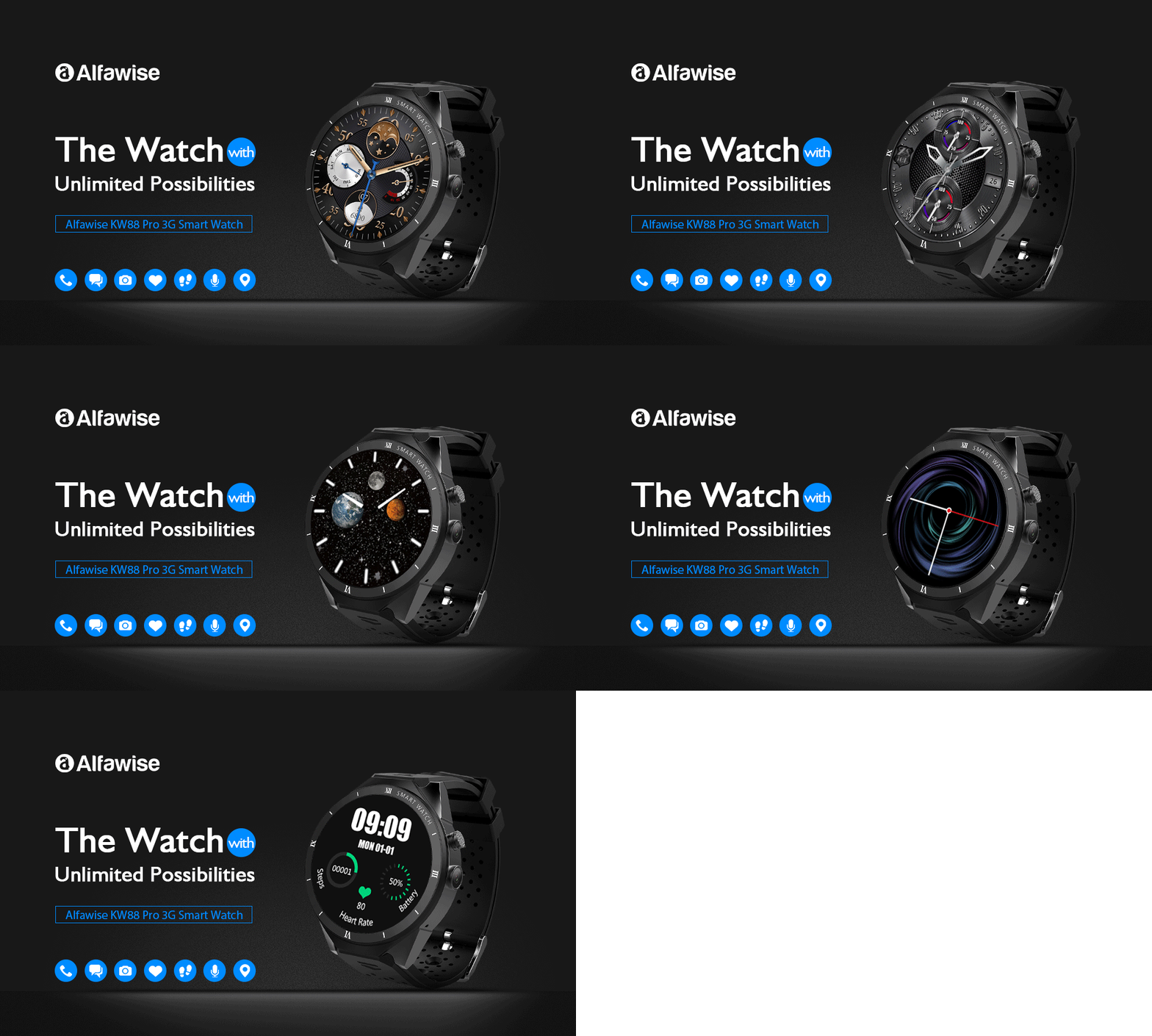
Alfawise KW88 Pro 3G Smart Watch on Gearbest
Equipped with multiple watch faces, the Alfawise KW88 Pro enables you to request a car, check out a new area and lots more. The original asking price of the device is $135.96, but you can now it for only $106.99 on Gearbest.
In order to avail this 21 percent discount, all you need to do is to follow this link without wasting time. It is worth mentioning here that there were only 188 pieces remaining for this promo, which is slated to end in just four days.
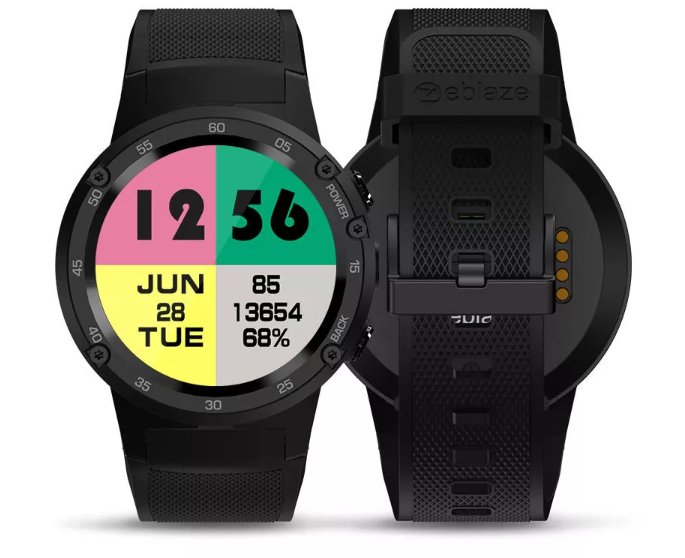
The Zeblaze THOR 4 adopts super AMOLED screen display-touch technology, coupled with the most amazing round screen that has no gaps. It offers vivid and delicate illustrations with high saturation for an immersive visual experience.
The Zeblaze THOR 4 usually retails for $199.99, but it has now gone up for sale bearing a dropped price of just $158.98 on Banggood. This is a 21 percent reduction in the device’s original asking price. But that’s not all. You can coupon code zeb10 and bring the retail price of the smartwatch down to just $109.99. Note that the coupon will specifically be valid only for the US and Canada-based buyers between April 4-April 30 for the first 10 units.
Alternatively, you can use coupon code zeb50 and reduce the original selling price of the THOR 4 to just $122.99. While this coupon is valid for all countries, it is slated to expire on April 30. The coupon will be valid for the first fifty units only. Visit this link for the discount.
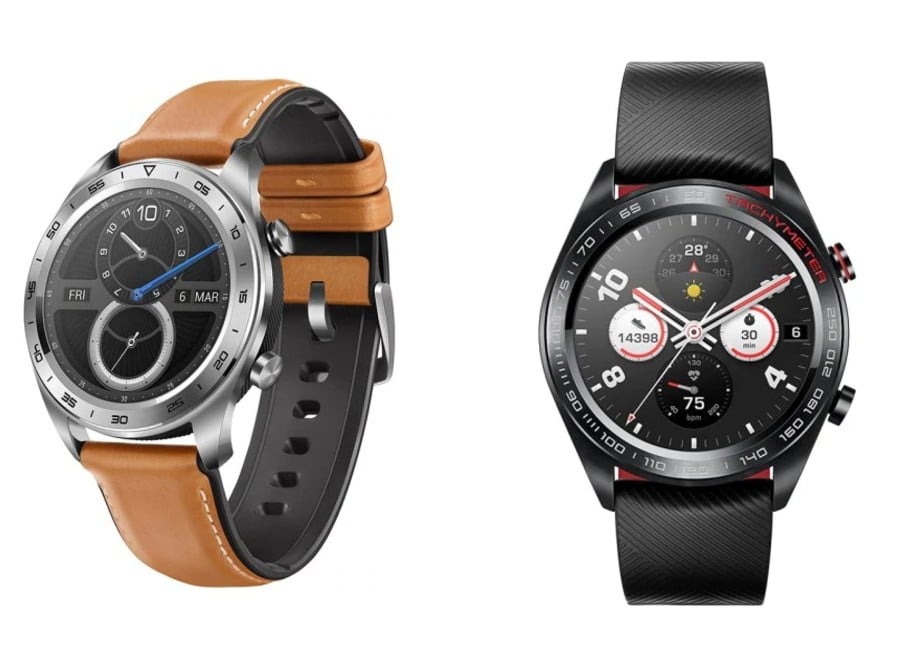
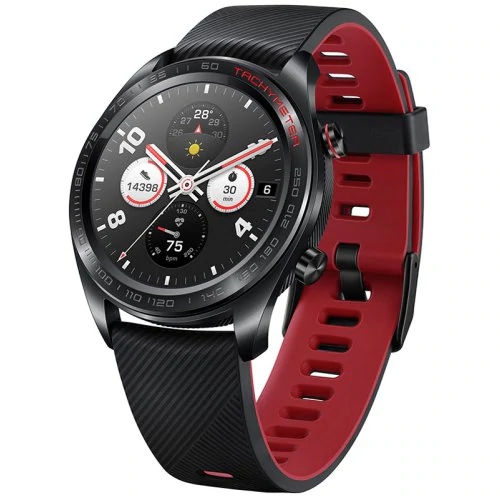
The uber slim Honor Magic smartwatch has a thickness of just 9.8mm. It sports an easily readable 1.2 Inch AMOLED display with a high resolution. Despite its bigger screen, the device perfectly fits the width of the wrist, offering a pleasant wearing experience even for a longer duration.
In order to get your hands on this feature-laden smartwatch, you’d normally end up shelling out $239.99, but you can now buy for only $134.99 on GeekBuying. Aside from getting this 44 percent discount, you can use coupon code YLUEOPSC. The aforesaid coupon helps you save $50 more by reducing the original asking price of the Honor Magic smartwatch to only $129.99 before you place your order. You can visit this link and avail the discount, which will be available for six days for the black color version of the smartwatch.
You can get a 28 percent off on the silver color version of the Honor Magic smartwatch, which sells for $249.99. Thanks to the discount, it is now up for sale carrying a $179.99 price tag.
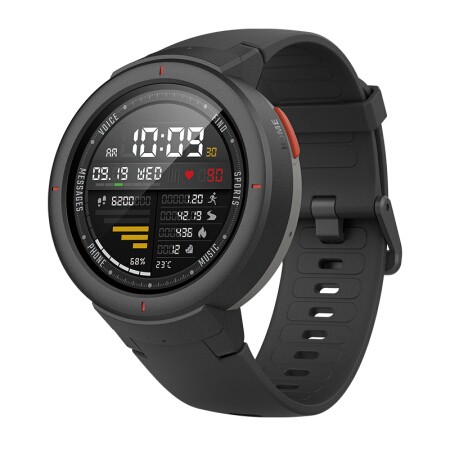
The well-received Huami Amazfit Verge features a 1.3-inch circular display with AMOLED colorful screen and Corning Gorilla Glass 3 on top for added protection. It comes with an IP68 waterproof rating so you can wear it while washing hands etc. without worrying about damaging the device. The Amazfit Verge smartwatch is available in three color versions including gray, dark blue and white on Giztop. In order to purchase your favorite color version, all you need to spend is only $139. You can follow this link and order your favorite color version of the device without emptying your pocket.
Huawei Honor Watch Dream Sport Smartwatch on GearVita
The Honor Watch Dream gives the wearer a chance to choose from numerous eye-catching watch faces. The display is well-placed inside a 316L stainless steel frame that has a thickness of 9.8mm (11mm with glass). The watch works with Android 4.4 (and above) and iOS 9.0 (and above) and can track various activities of its wearer.
The Honor Watch Dream has gone up for pre-order bearing a $189.99 price sticker on GearVita. Those who aren’t willing to shell out that kind of money can use coupon code 4GVhhDream and reduce the retail price of the watch to only $159.88.
You can visit this link to check out more details and get your tech greedy hands on the Honor Watch Dream sports smartwatch.
The market is brimming with all sorts of devices that come in handy in day to day life, handling arduous house chores like vacuuming, sweeping, dusting, washing dishes, etc. On the downside, these home essentials aren’t easy on the pocketbook.
In a bid to make top-end products that are necessary for the home at affordable prices, GeekBuying has launched a new promo dubbed ‘Home Essentials.’ As part of this recently kicked-off promo, the Chinese online store will be doling out up to 60 percent off on a wide selection of household essentials.
Aside from a slew of other top-branded products, the product page features Xiaomi JIMMY ETB301 Sonic Electric Toothbrush and Xiaomi JIMMY GY101 Portable Electric Clothes Dryer. Not only can you avail great discounts on the aforesaid products, but Gearbest users can also use specific coupons for additional discounts.
Xiaomi JIMMY ETB301 Sonic Electric Toothbrush
Do you care about your white teeth? You might want to give the Xiaomi JIMMY ETB301 Sonic electric toothbrush a test drive.
The ETB301 adopts Sonic technology and offers inductive charging for superior teeth brushing experience. Moreover, it comes with an IPX7 waterproof rating, coupled with soft bristles and three cleaning modes.
The ETB301 Sonic electric toothbrush would normally set you back $63.99, but much to the relief of cost-conscious consumers, you can now buy it for just $36.99 on GeekBuying. You can even extend this 42 percent discount by applying coupon code DUZMGAMY at checkout.
The aforesaid coupon helps you save $8 more by reducing the retail price of the product to only $34.99. You can follow this link to avail the discount and use the coupon, which is likely to expire soon. It is also worth mentioning here that the promo is slated to end in fifteen days.
Xiaomi JIMMY GY101 Portable Electric Clothes Dryer
Clothes are likely to become damp or slightly moldy during long trips and that’s exactly where the Xiaomi JIMMY GY101 Portable Electric Clothes Dryer comes into the picture. This portable clothes dryer is a unique device is an easy-to-operate combination of a hanger and electric dryer.
While you’d normally end up shelling out a lot of money on a product that offers comparable usability, these devices don’t come cheap. The GY101 Portable Electric Clothes Dryer, on the other hand, is now available for a reduced price of only $44.99 on GeekBuying. This is a noteworthy 40 percent drop in the device’s original asking price of $74.99. In addition to taking advantage of the discount, GeekBuying users can apply coupon code QRBPMHXY and save $11 more before placing their orders.
In other words, you can bring the already lowered asking price of the Xiaomi JIMMY GY101 Portable Electric Clothes Dryer further down to $44.99 simply by applying the above-mentioned coupon. You can visit this link without wasting time to avail the discount since the promo will end in only fifteen days.
China-based smartphone manufacturer Oppo’s all-new smartphone lineup — Oppo Reno is launching on 10th April in China. As per the reports, there are about five different variants of the smartphone.
The Reno standard edition powered by Snapdragon 710 chipset and the top-end model with Snapdragon 855 processor has already been leaked and confirmed to launch on 10th April. Now, the Oppo Reno 10X Zoom Edition has also surfaced online.
Ahead of the phone’s launch, Oppo’s Vice President has confirmed through a post on Weibo that the Oppo Reno 10X Zoom Edition will come with dual-frequency GPS support, a feature that we first saw on the Xiaomi Mi 8. It helps in reducing inaccuracies in GPS tracking caused due to interfaces like buildings and signal delays.
The dual-frequency GPS supports L1 + L5 dual-frequency positioning and the measured accuracy is said to be three to five time better. The satellite that supports the L5 band was officially launched in 2018 and its bandwidth has been increased by 10 times.
The Oppo Reno 10X Zoom Edition is expected to be powered by the Qualcomm’s latest and greatest Snapdragon 855 SoC and will feature triple rear camera setup. It will consist of a 13 MP telephoto lens, 48 MP main sensor and an 8 MP wide-angle lens. Further, it will offer 10X hybrid optical zoom support.
The leaked specifications of the phone suggest that it will be powered by 8GB of RAM and will have 256GB of internal storage. It will be running Android 9 Pie operating system out-of-the-box with the company’s own ColorOS 6.0 on top. The phone will have an OLED display with 93.1 percent screen-to-body ratio, as confirmed by the company.
Lenovo is all set to launch its flagship smartphone — Lenovo Z6 Pro next month, i.e. April 2019. Ahead of the phone’s launch, the company has been teasing the smartphone through its features, especially the camera part.
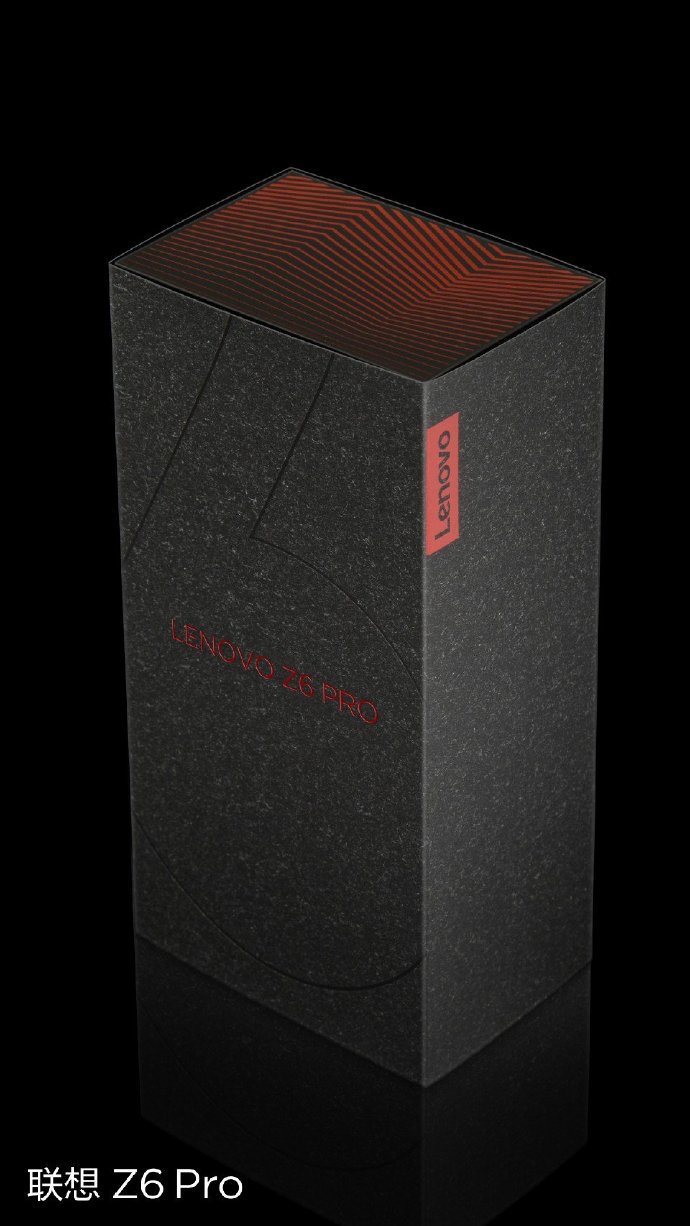
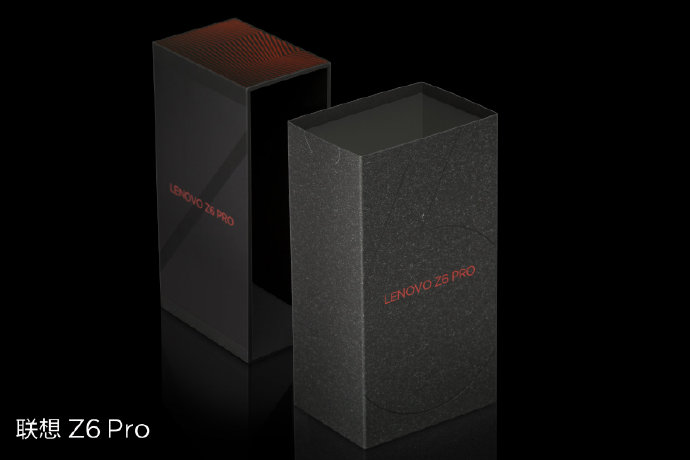
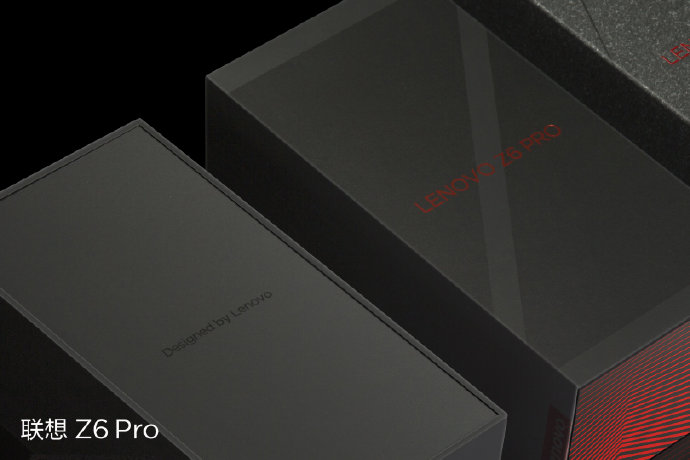
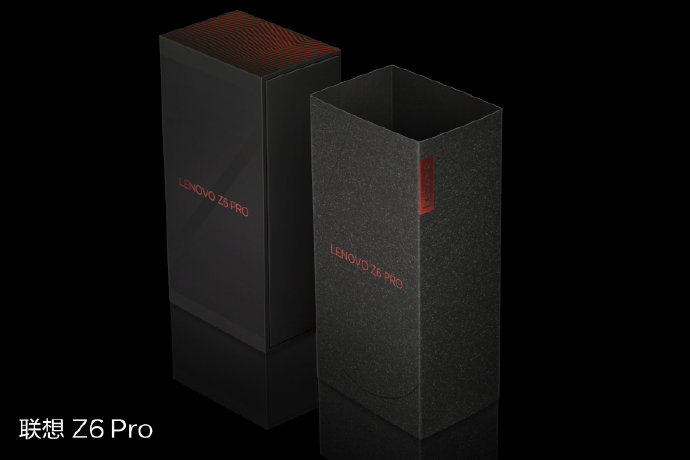
Today, the company revealed the retail box of the Z6 Pro smartphone has said that it has been designed by the Beijing Olympic games Xiangyun torch designer. Apart from this, the company has not revealed anything.
Earlier, the company had teased the phone’s launch during MWC 2019 last month but instead of launching the smartphone, the company just revealed that the phone will make its debut soon.
Lenovo has also confirmed that the smartphone will come with a feature called “Hyper Videos” but had not shared anything related to this, except that it will be the trend of the 5G era. It recently shared a video which was shot using the upcoming Z6 Pro flagship smartphone. The video shows the phone’s outstanding capabilities in terms of shooting low-light images and video.
While the video has a watermark of “Super Night Mode” in the bottom-left corner, Lenovo VP Chang Cheng says that there’s no Super Night Mode in the app and the video is recorded normally. He also said that it took over a year for the company to develop the Hyper Video feature.
Earlier, it was said that the phone will come with support for 100 MP camera and will feature an anti-shake function as well. It is also expected to have a super wide-angle lens, and something related to improve the night photography.
Previous teasers related to the smartphone implies that the device will come with an in-display fingerprint sensor and will be powered by Qualcomm Snapdragon 855 SoC. It will also come with support wireless charging. The Lenovo Z6 Pro is scheduled to make its debut next month.
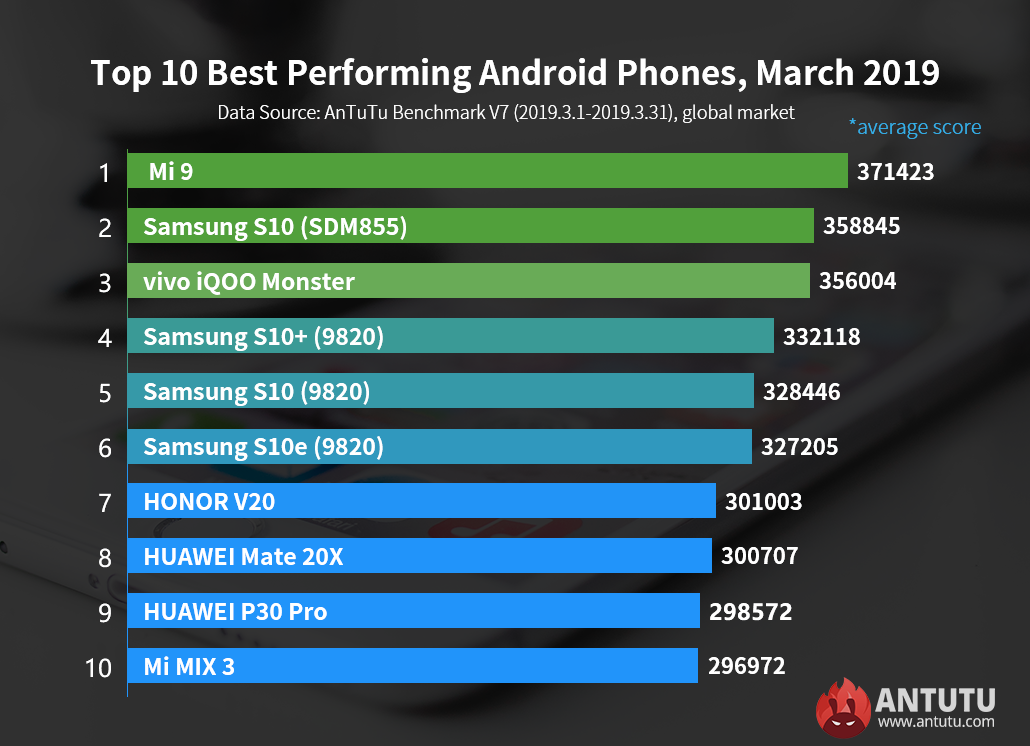
Popular smartphone benchmarking app AnTuTu has released the list of top 10 best performing Android smartphones in March 2019 for global markets. The February’s month list was led by Samsung Galaxy S10+, Honor V20 and Huawei Mate 20 X smartphones. The top three position for the month of March is led by Snapdragon 855 mobile platform driven phones followed by three Exynos 9820 SoC powered smartphones.
AnTuTu’s list of top 10 best performing Android smartphones in March 2019 for global markets has been compiled through data accumulated between March 1 and March 31 by testing at least 1000 units per model. The smartphones were benchmarked using the latest AnTuTu Benchmark V7 app. The scores mentioned for each phone are not their highest score, but average benchmarking score.
The Snapdragon 855 powered Xiaomi Mi 9 is leading the pack with 371,423 points. The second place goes to Snapdragon 855 edition of Samsung Galaxy S10 that has scored 358,845. The Vivo iQOO Monster edition which is also fueled by the same SoC is placed third with 356,004 score.
The Galaxy S10+ Exynos 9820 model is on the fourth position with 332,118 score. The Galaxy S10 with Exynos 9820 onboard is sitting on the fifth position with 328,446 score. The sixth position is held on by the Galaxy S10e which is also powered by the same Exynos SoC.
The Kirin 980 SoC powered Honor V20 from China has occupied by the seventh place with 301,003. The Mate 20 X smartphone that possesses Kirin 980 SoC has dropped to eighth spot with an AnTuTu score of 300,707. The third Kirin 980 powered phone – Huawei P30 Pro has entered the list for the first time on ninth position with an average benchmarking score of 298,572.
The last phone to make it to the top 10 list is the Snapdragon 845 powered Xiaomi Mi MIX 3 that has scored 296,972. In the coming months, the Mi MIX 3 will be squeezed out of the list and more phones fueled by SD855 will be seen on the list.
Vivo S1, the first phone in S-series of smartphones by Vivo was announced in the previous week in China. The new smartphone is now available for purchase in the home market. It is budget-friendly phone that comes with a notch-less display and triple rear cameras.
The Vivo S1 has arrived in two color variants in China such as Pink and Ice Lake Blue. The handset carries a price tag of 2,298 Yuan (~$305). Customers who purchase the device before April 6 will be provided with Bluetooth earbuds worth 159 Yuan for free.
Vivo S1 Specifications
In terms of specifications, the Vivo S1 does not differ much from the Vivo V15 phone that was unveiled in certain markets including India. The configurations for the main camera sensor and selfie snapper are the only major differences between the two phones. Also, the Vivo S1 features a negligibly small battery than the Vivo V15 phone.
The Vivo S1 has an IPS LCD display of 6.53 inches. It offers full HD+ resolution of 1080 x 2340 pixels and an aspect ratio of 19.5:9. The MediaTek Helio P70 SoC is present under the hood of the device along with 6 GB of RAM. The native storage available on the device is of 128 GB. It features a microSD card slot for additional storage.
The dual-LED flash enabled triple camera setup of the Vivo S1 includes a 12-megapixel primary sensor, an 8-megapixel wide-angle lens and a 5-megapixel depth sensor. The pop-up selfie camera module includes a 25-megapixel lens. The FunTouch OS 9 based Android 9 Pie OS comes preloaded on the device. A fingerprint reader is available on the rear shell of the device. The 3,940mAh battery of the phone carries support for dual-engine fast charging through microUSB 2.0.
Ever since Vivo showcased the Vivo APEX smartphone with a pop-up front-facing camera, smartphone manufacturers are now actively trying to innovate the smartphone design. The main reason behind this is to make the device stand out from the crowd and to offer a higher screen-to-body ratio.
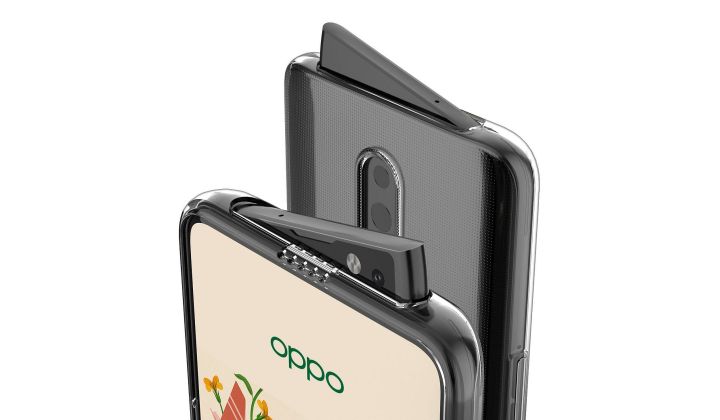
While we’ve already seen devices with pop-up front-facing camera and a sliding mechanism, Oppo has now gone a step ahead and patented a new smartphone design with the pop-up display. Yes, you read that right. The design suggests that a second screen comes out from the primary screen.
There could be a lot of different and unique use cases for the secondary display. For example, when viewing media content in full-screen on the main display, the secondary pop-up display can house the remote control.
The images attached with the patent shows that the phone will house the front-facing camera sensor and an earpiece in the top bezel of the primary display and there won’t be any kind of notches of punch-hole.
Along with the patent of the pop-up display design, Oppo has also patented a smartphone that has a sliding mechanism. However, unlike Oppo Find X which has a vertical sliding mechanism that houses camera sensors, the patent shows a smartphone with a horizontal slider that slides from the left.
The secondary slider screen can have a keyboard when using the smartphone in a landscape orientation and could also be helpful while playing games. We’ve already seen devices with such design, but the slider usually houses the sensors. However, Oppo has included a display in the slider part.
It’s noteworthy that the patent from the company only implies that Oppo is working on the idea and trying to explore it or figure it out. The patent does not mean that the phone with such designs will make it to the market.
Oppo is currently gearing up to launch its all-new Oppo Reno smartphone series on 10th April in China. The phone is expected to come in multiple variants — from budget device to the high-end phone to camera-centric smartphone.
In December, Realme had claimed that it would be rolling out the Android 9 Pie update for its smartphones in first or second quarter of 2019. Today, the company has confirmed through its official forums site that it will be releasing the Android 9 Pie update in June for its smartphones.
In April, the company will be releasing the April 2019 Android security patch for three smartphone such as Realme 1, Realme U1 and Realme 3. In May, the May 2019 Android security patch will be rolled out for phones like Realme 2, Realme 2 Pro and Realme C1.
In June, Realme will be releasing the ColorOS 6 based Android 9 Pie OS for multiple smartphones for Realme 1, Realme 2, Realme C1, Realme 2 Pro and Realme U1. It hasn’t exactly mentioned the order of releasing Pie update for these phones. Also, there is no exact timeline mentioned, but the company promises to release the updates as stated in the forums thread.
Since it is a staged rollout, the aforementioned Realme phones are unlikely to receive the update on the very first day or simultaneously. The company will be releasing the update when it is completely sure they are free from major bugs. It will be posting respective OTA threads with the links to manually download the firmware when they are available.
The recently launched Realme 3 smartphone comes preinstalled with ColorOS 6.0 based Android 9 Pie OS. Also, the upcoming Realme 3 Pro smartphone will come preloaded with it. The ColorOS 6.0 that was announced in November 2018 sports a minimalistic look with white and gradient color backgrounds. It is equipped with AI machine-learning capabilities for saving power and optimized memory usage by freezing background apps. It has been designed for phones with bezel-less design.
Redmi recently split from its parent brand Xiaomi to work independently. While the brand used to focus on entry-level and mid-range smartphones, the company is now working on flagship smartphones as well.
Earlier, it was rumored that Redmi was working on a smartphone powered by the latest Qualcomm Snapdragon 855 octa-core processor, which was later confirmed by the company’s executive, but not much was shared regarding the phone.
Now, a Redmi smartphone named Redmi Pro 2 has surfaced online on Weibo, which seems to have a pop-up front-facing camera — similar to what we’ve seen on the Vivo V15 Pro and Oppo F11 Pro. The upcoming OnePlus 7 is also expected to have the same type of pop-up camera for the selfie snapper.
The phone has a notch-less and hole-less display, which matches the description of the smartphone that was recently seen with the Xiaomi CEO Lei Jun. The render of the upcoming Redmi flagship smartphone shows a triple camera sensor on the back — a first for the Chinese company.
Previous reports have indicated the phone will come with a 48-megapixel camera sensor from Sony on the back side, along with two other sensors. This is the same camera sensor that is used in the Redmi Note 7 Pro smartphone.
According to the text in the leaked image, the Pro model of the smartphone will also come with an in-display fingerprint sensor, which has now become a trend. This could be the first device from the newly independent brand to have an in-display fingerprint sensor.
Apart from this leaked image, nothing more is known about this upcoming Redmi flagship smartphone powered by Snapdragon 855 SoC. But it’s known that the device won’t be making its debut anytime soon and could launch in the second half of this year.
The Mate 20 Pro was released in November last year. Following in the footsteps of its well-received predecessors, the Huawei-branded phablet became an instant hit among those who fancy using a big-screen mobile device. Taking its skyrocketing popularity into consideration, the Chinese consumer electronics manufacturer is now offering the global version of the Mate 20 Pro phablet at an unbeatable price in collaboration with Gearbest.
The Huawei Mate 20 Pro is an irresistible 4G phablet that boasts an impressive array of features and would normally set you back a pretty penny on online as well as offline stores. In fact, the global version that ships with 6GB of RAM and offer 128GB of internal storage capacity usually carries a steep $981.98 price tag.
Much to the delight of Gearbest users who have restlessly been waiting to get their hands on the Mate 20 Pro without spending a lot of money, the aforesaid model of the well-received phablet has now gone up for sale bearing a heavily discounted price of just $779.99. This is a considerable 21 percent reduction in the device’s original asking price. An absolute steal at this price, the Huawei Mate 20 Pro 4G phablet offers the following features.
6.39 inches OLED capacitive touchscreen with 1440 x 3120 pixels
Kirin 980 Octa Core 2.6GHz processor
Mali-G76 GPU
40.0MP + 20.0MP + 8.0MP triple camera set up at the back
24.0MP selfie shooter
6GB RAM, 128GB ROM
EMUI 9.0 based on Android 9.0 Pie OS
Built-in 4200mAh Li-ion battery
You can head straight to this page to check out the full specifications and avail the discount which will be valid for the emerald green color version of the phablet. With only 42 pieces left, the promo is slated to end in just four days.
A new Nokia smartphone with model number TA-1172 has received approval from China’s TENAA telecom authority. The TENAA listing has preliminary information of the smartphone and it also contains its images. The photos of the TA-1172 suggest that it is a Chinese version of the Nokia X71 smartphone that was recently announced in Taiwan.
Nokia TA-1172 TENAA Listing
The Nokia TA-1172 TENAA listing shows that it measures 156.89 x 76.15 x 7.98mm. The smartphone is fitted with a 6.39-inch display. A minimum capacity battery of 3,400mAh is present inside the phone. The TENAA images of the Nokia TA-1172 show that it is identical to the Nokia X71 since it is equipped with a punch-hole display and a rear-mounted triple camera module.
Could the Nokia TA-1172 arriving as Nokia 6.2 to China and other countries? Two entries of Nokia X71 and Nokia 6 (2019) (also known as Nokia 6.2) was recently spotted on OTA firmware with the same TAS codename on FIH servers. This suggested that the Nokia X71 could be hitting the Chinese markets as Nokia 6.2.
Nokia X71 Specifications and Price
The Nokia X71 is the first Nokia phone with a punch-hole display. The IPS LCD display supports full HD+ resolution of 1080 x 2316 pixels. The camera hole houses an f/2.0 aperture 16-megapixel selfie camera. The smartphone offers 93 percent screen-to-body ratio.
The Snapdragon 660 and 6 GB of RAM powers the smartphone. The handset includes an internal storage of 128 GB. There is an expansion memory slot on the device that supports up to 256 GB of microSD card. The Android One version of Android 9 Pie is loaded on the smartphone.
The Nokia X71 is packed with a 3,500mAh battery that offers 18W rapid charging. The triple camera module on the rear features a 48-megapixel ZEISS lens with f/1.8 aperture as primary sensor, an ultra wide-angle 8-megapixel lens and an f/2.4 aperture 5-megapixel depth sensor.
The Nokia X71 is up for pre-orders in Taiwan with a price tag of 11,990 NTD (~$389). The handset comes in a single color version of Eclipse Black. It will be hitting the Taiwanese markets on April 10.
What’s your opinion on the specs and pricing of the Nokia X71? Share us your views by posting your comments below.
OPPO Reno Snapdragon 710 edition is up for reservations through official online store of the company. The OPPOShop.cn has lifted the different variants of the phone. The listing also showcases the different color options of Oppo Reno Snapdragon 710 model.
OPPO Reno Variants and Color Options
The OPPO Reno smartphone will be coming to China in three models such as 6 GB RAM + 128 GB storage, 6 GB RAM + 256 GB storage and 8 GB RAM + 256 GB storage. The Chinese manufacturer seems to be selling these models in certain color options only.
The Nebula Purple comes only in 6 GB RAM + 128 GB storage option. The Mist Pink model also comes in single option of 6 GB RAM + 256 GB storage.
The Extreme Night Black comes in two models like 6 GB RAM + 128 GB storage and 6 GB RAM + 256 GB storage. The Fog Sea Green comes in 6 GB RAM + 256 GB storage and 8 GB RAM + 256 GB storage options. OPPO hasn’t revealed the prices of any of the aforementioned models.
OPPO Reno Specifications
The OPPO Reno Snapdragon 710 has already appeared on TENAA with full specifications. The smartphone measures 156.6 x 74.3 x 9mm and it weighs 185 grams. The smartphone features a 6.4-inch AMOLED display that supports full HD+ resolution. The notch-less display is embedded with an in-screen fingerprint reader.
The smartphone includes a 3,680mAh battery that is equipped with support for fast charging. The 2.2 GHz Snapdragon 710 mobile platform powers the different variants of the phone. The ColorOS 6.0 based Android 9.0 Pie runs on the device. The smartphone lacks support for microSD card slot.
The top edge of the phone includes a pop-up selfie camera module that can rise like a shark fin. It includes a 16-megapixel selfie camera and an LED flash. The rear side of the phone is fitted with a vertical dual camera setup that includes Sony IMX586 48-megapixel main sensor and 5-megapixel secondary sensor. It includes a 3.5mm audio jack.
The Chinese manufacturer will be announcing the OPPO Reno series on April 10. The series include two other models that are powered by Snapdragon 855 mobile platform. One of them is a 5G-ready device while the other one only supports 4G LTE.
Huawei’s Honor first unveiled the Honor 8X in China around September last year and then it hit India in October. Since then, the giant screen phone has been on sale with Honor silently rolling out the model in other markets. Huawei has now hinted that it has sold over 10 million units of the smartphone worldwide. As a result of this milestone, the tech giant has slashed the price of the 4GB+64GB variant by 100 yuan for a limited time. This brings the price down to 1299 yuan.
The Honor 8X is an affordable mid-range model and that is likely influential in the massive shipment which it enjoyed. The Honor 8X features a massive 6.5-inch notch display with a 91 percent screen-to-body ratio and an aspect ratio of 19.5:9. The device is powered by a Hisilicon Kirin 710 chipset paired with either 4GB and 6GB of RAM while there is 64/128GB of internal storage.
The phone comes with a 16MP f/2.0 aperture camera sitting at the front of the phone. The back panel of the handset is equipped with 20-megapixel + 2-megapixel vertical dual camera setup. Honor has packed some interesting photography features such as AI scene recognition, portrait mode, slow-motion video shooting and time-lapse photography. There is also a rear-mounted fingerprint sensor and a 3750mAh battery with fast charging support onboard.
Xiaomi makes its logo as “MI,” which stands for Mobile Internet since Xiaomi was originally started to be a mobile-first technology company.
The Beijing-based electronics company teams up with leading online stores from time to time in order to launch amazing promotional offers and offer great discounts. Here are a few ongoing activities that you can take advantage of.
Mi Fan Festival AliExpress
The Mi Fan Festival is slated to start on AliExpress shorty. The Alibaba-owned Chinese online retail service will be doling out great discounts on smartphones and a slew of other accessories from Xiaomi. As part of the upcoming event, AliExpress is offering the Xiaomi Mi Play for just $74.99. The 32GB, 64GB and 128GB ROM variants of the Redmi Note 7 will also go up for sale carrying unbeatable prices.
Aside from smartphones, the promotion page features the Mi Band 3, the Hybrid Pro HD earphones, the Mi Wi-Fi router, Mi Notebook 15.6-inch Pro and other coveted items from Xiaomi. More importantly, you can buy these items without burning a hole in your pocket.
In order to check out all the products and avail the discounts available on them, you just need to visit the promotion page by clicking here.
The MFF (MI Fan Festival) 2019 has kicked off on Gearbest. As part of the event, Xiaomi is offering great discounts on a wide selection of its products. The aforesaid items have been split into multiple categories including Cellphones & Tablets, Top Electronics, Smart Life & Energy, etc.
Aside from that, the first 100 pieces of Xiaomi Mi 9 and first 500 pieces of the Mi Play 4G phablets at lowered prices. The Mi 9 would normally set you back $516.87, but you can now buy it for just $499.99. Likewise, the Xiaomi Mi Play usually retails for $199.93, but you can buy it for just $159.99 from the promotion page.
You can check out the rest of the heavily-discounted products available on the promotion page by following this link.
Banggood users are being provided amazing privileges as part of the Mi Fan Festival. Keeping in line with that, the Chinese online will be randomly selecting twenty Mi 9 orders whose payments have been confirmed to win free Mi Band. Aside from that, first 100 Banggood users who shop for the Redmi Note 7 on 4.4-4.6, will be eligible for free AI assistants.
On top of that, the global version of the Xiaomi Redmi Note 7 that normally retails for $249.99 has gone up for sale bearing a reduced price tag of just $189.99. This discount will be available to first 500 sets through coupon code 4BGRN7.
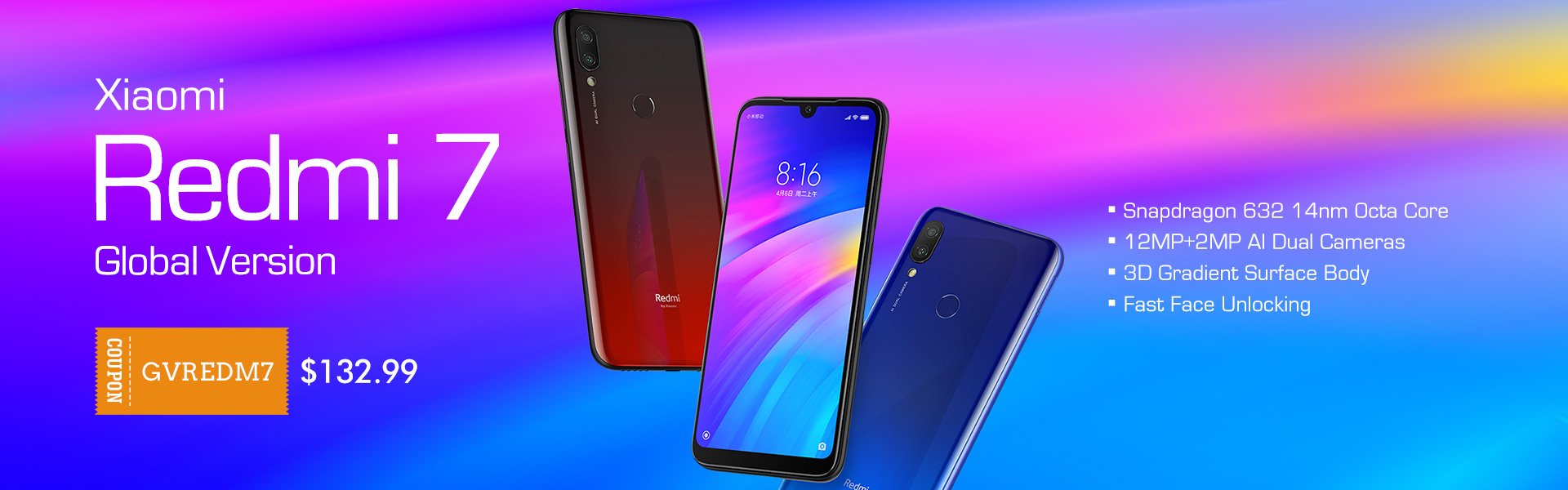
You can avail significant discounts on various variants of the global version of the Redmi 7 simply by applying specific coupons at checkout. For instance, you can use coupon code 4BGR716 to reduce the $145.99 original asking price of Redmi 7 with 16GB RAM to just $116.99.
Likewise, you can avail big discounts on other well-received variants of the Mi Play, Redmi 6, Mi 8 Lite and other Xiaomi-branded smartphones. You can visit the promotion page by the following this link to check out the rest of the products and use the time-limited coupons for discounts.
You can use coupon code MISALE10 in order to get an extra 10 percent off on all items available on Xiaomi’s official online store on GearVita. The aforesaid items have been split into multiple categories including Best Sellers, New Arrival, Recommend and lots more.
In addition from taking advantage of the 10% off coupon, GearVita is giving its loyal users a chance to get noteworthy discounts on Xiaomi Redmi Note 7 which usually sells for $269.99. Thanks to the discount, you can now buy for a reduced price of just $229.99. In order to avail this discount, all you need to do is apply coupon code GVRN7 before placing your order.
You can check out the official online store of Xiaomi on GearVita by clicking here.
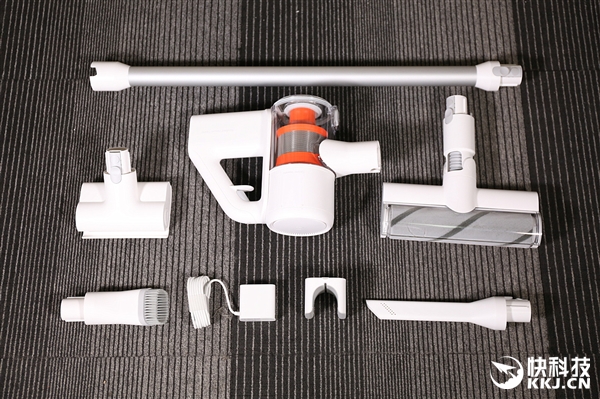
Xiaomi launched the MIJIA Handheld Vacuum Cleaner a couple of days back adopting an affordable 1,299 Yuan (~$193) pricing. With the gadget scheduled to go on sale on April 9 during the Mi Fan Festival, the handy Vacuum cleaner has just been unboxed by the guys at Chinese blog MyDrivers.
The packaging is no different from the simple packaging style adopted by earlier Mijia products just that the parts are detachable which makes them fit inside the box compactly. The Mijia Handheld Vacuum Cleaner uses a high-end 9-cone fan with cyclone design and 9 small fans responding to micron-sized particles to maintain constant suction. It also adopts a large suction force of 100AW and is equipped with a 100,000-rpm brushless variable frequency DC motor and a high standard static pressure of 23 kPa.
The vacuum cleaner comes with a 5-fold filter dust-removing system and pure purifier level discharge, which the company claims locks 99.97% of dust to avoid secondary pollution. Further, it is equipped with four brush heads, which can absorb dust from the ground, bed mattress, car interior, keyboard, among others. The device uses a built-in battery which XIaomi says provide up to 30 minutes of battery life. A fully charged vacuum cleaner can clean a larger apartment of around 60 sq. m. Check out more pictures of the device from below.
Reports from China indicate that the country’s Ministry of Human Resources and Social Security had on April 1 issued a notice of the official recognition of thirteen (13) new occupations. The new occupations include Artificial intelligence engineering and technical personnel, Internet of Things engineering and technical personnel, Internet of Things installation and debugging staff, big data engineering and technical personnel, cloud computing engineering technician, Digital manager, building information model technician, e-sportsman, e-sports operator, drone driver, agricultural manager, industrial robot system operator, industrial robot system operator.
The new occupations are said to be the first batch of new occupations released since the promulgation of the 2015 National Occupational Classification. Notably, most of them are related to emerging technologies, such as artificial intelligence, cloud computing, Internet of Things, industrial robots, drones, etc. There are also long-established occupations that are just now getting official recognition by the government such as e-sportsmen and e-sports operators. Esports (short for electronic sports) is a form of competition using video games. Most commonly, e-sports takes the form of organized, multiplayer video game competitions, particularly between professional players, individually or as teams.
China’s Ministry of Human Resources and Social Affairs pointed out that in recent years, e-sports have emerged as a huge industry with several international competitions annually. thus, the professionalization of e-sports operators and e-sportsmen was imperative. According to China’s Occupation Skill Testing Authority (OSTA), prospective professional gamers, also known as e-sports players, will participate in gaming competitions, work as training partners, provide data analysis for the industry, and design new games. Professional gaming operators’ (e-Sports operators) job description includes marketing new and existing game titles.
The Samsung Galaxy A9 (2018) launched as the first phone with four cameras on its rear. Only a few quad camera phones have been released after it such as the Galaxy S10+ 5G and the Huawei P30 Pro. A new leak has revealed Motorola may be joining the trend soon as 3D renders and a 360° video of an unknown model have just been released on the web.
The source of these CAD renders and video is OnLeaks and he has partnered with CashKaro.com this time around. The Motorola phone has four sensors on its back arranged in two rows and two columns. All four cameras are placed on a raised plate which also has a Motorola logo. A dual LED flash sits beside the setup.
Not much is known about the configuration of the cameras but we know the primary camera is a 48MP sensor as it is engraved beside the setup. We won’t be surprised if one of the remaining three is an ultra-wide angle sensor while another has a telephoto lens for optical zoom.
[envira-gallery id=”244763″]
The back of the phone is curved but doesn’t seem to be glass as it has a brushed metal appearance. There is no fingerprint scanner under the Motorola logo as the source says the phone has one under the display.
The front of the Motorola quad-camera phone is not as interesting. It has a waterdrop notch at the top but that doesn’t mean the bezels around the 6.2-inch AMOLED panel is devoid of bezels. The power button and volume rocker are on the right and the bottom of the phone is home to a 3.5mm audio jack and a USB type-C port. Surprisingly, there is no speaker grille at the bottom but there is one at the top.
The phone’s dimensions have also been provided. It will measure 158.7 x 75 x 8.8 millimeters. There is no info on its weight.
OLED panels have a lot of advantages. They have better color accuracy and contrasts (including better blacks) and are thinner and brighter than traditional LCD panels. So, it’s no surprise that smartphone manufacturers are shifting to OLED panels for their smartphones. Even the mid-range ones (like Mi 9 SE / Galaxy J6 Plus) have started getting this relatively expensive display panels. But there’s one disadvantage associated with OLED displays and it pertains to the way the panel handles low levels of brightness.
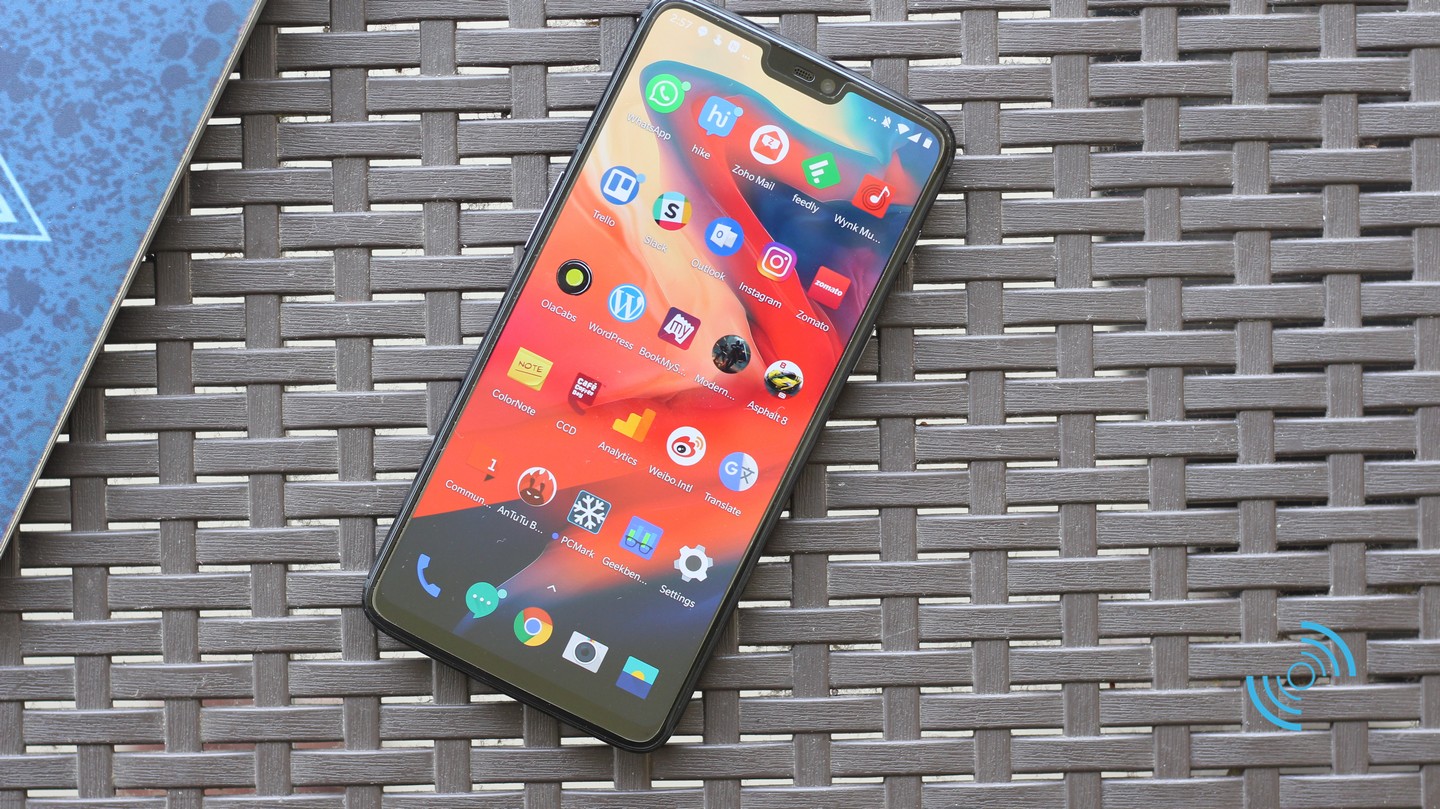
OnePlus 6 comes with an AMOLED screen
Most OLED panels use a technique called Pulse Width Modulation (PWM) for dimming its brightness. This is different from DC dimming, which has been used by LCD panels to control its brightness levels. Most users won’t be able to differentiate between PWM dimming vs DC dimming, however, there’s a very small section of the population who are affected by the former technique. As OLEDs trickle down to mid-rangers and sometimes even budget smartphones, its user base is growing quickly. With a significant increase in AMOLED consumption in the past few years, you would often end up seeing comments like this on the internet.
In order to understand DC dimming, we need to first learn about PWM dimming and how it can make some users uncomfortable.
How does PWM Dimming work?
PWM stands for Pulse Width Modulation. As the name suggests, in this technique, you vary the width of the light pulse to control the brightness of the display panel. Simply put, you play with the amount of time the screen stays on or off. When you lower the brightness, the screen stays off longer than it stays on, which is perceived as lower brightness.
After reading that, you must be wondering — Wait a second, the screen goes off when the brightness is low? I have never noticed that!
That’s because the frequency of pulses is very high (usually over 200Hz), so the human eye won’t be able to notice individual pulses. Instead, the human eye averages out the amount of light from these pulses. So, it’s the ratio of the panel’s on and off state that decides the perceived brightness.
This following diagram shows how PWM dimming works.
Source: OLED-info
At 100% brightness, you can see that the light is always on. When you lower the brightness to 50%, the panel alternates between on and off at equal intervals. However, when you further lower the brightness, the screen stays off for a longer time than it stays on. So, at extremely low levels of brightness, there’s a considerable flicker effect.
What’s so bad about PWM Dimming and its flickering?
Usually, even at low brightness levels, the average human eye won’t be able to see the flickering from PWM dimming. But that doesn’t mean it won’t affect you in any way. Some people are more sensitive to this flicker. And in these people, PWM dimming can lead to eye strain, headaches, and migraines if exposed for long periods of time. This is especially true when the ambient lighting is low.
What is DC Dimming?
DC dimming essentially controls the brightness by varying the power supplied to the circuit. Since Power = Voltage x Current, increasing or decreasing either of these inputs will vary the power supplied to the display panel, and thereby its brightness.
Sounds pretty simple right? So why aren’t manufacturers using DC dimming in your AMOLED smartphone?
Well, smartphone manufacturers have been using DC dimming on LCDs for years, but it was only recently that they started to add it on AMOLED smartphones. This is because DC dimming has a big drawback. At low levels of brightness, the colors often come out skewed on OLED panels. In OLED panels, a change in voltage could change the emitted colors. So, at lower levels of voltage, the perceived quality of the smartphone display could go down significantly.
So what is the solution?
Smartphone manufacturers have become increasingly aware of the possible health issues associated with PWM dimming. However, considering how only a selective group of people are actually affected by PWM flickering and the drawback associated with DC dimming on AMOLED panels, recent smartphone manufacturers are opting to provide it as an add on feature. OnePlus has already confirmed that it’s testing DC dimming on its smartphones. The feature could be added via a future update. In fact, Chinese smartphone companies seem to be all in for this feature. Xiaomi, Vivo, OPPO, and even Meizu have come forward and confirmed DC dimming on its existing or upcoming smartphones.
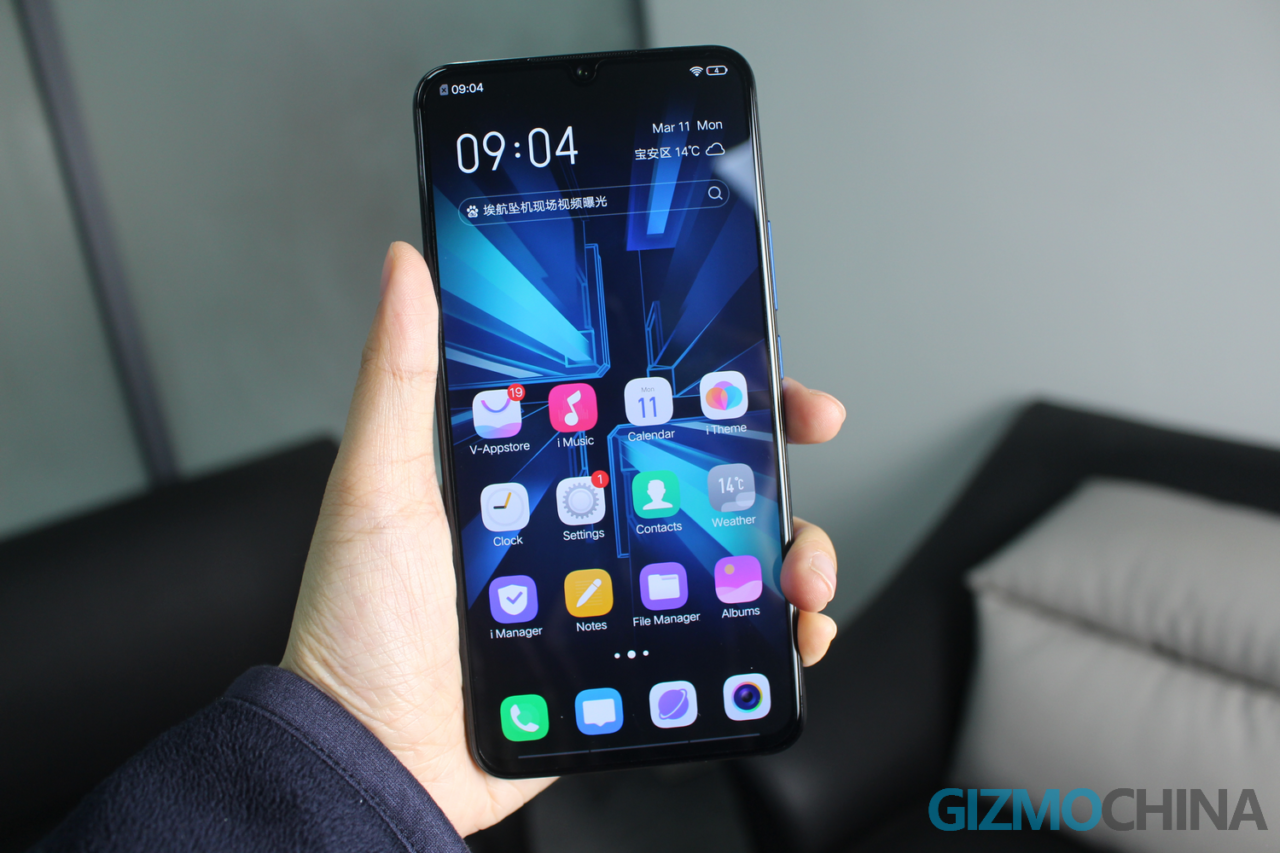
Vivo iQOO comes with an AMOLED panel and will feature DC Dimming via an update
Despite the fact that PWM dimming can cause discomfort in some users, most people won’t feel the difference. So, it’s very important to know that your sensitivity to the flicker effect decides how it will affect you.
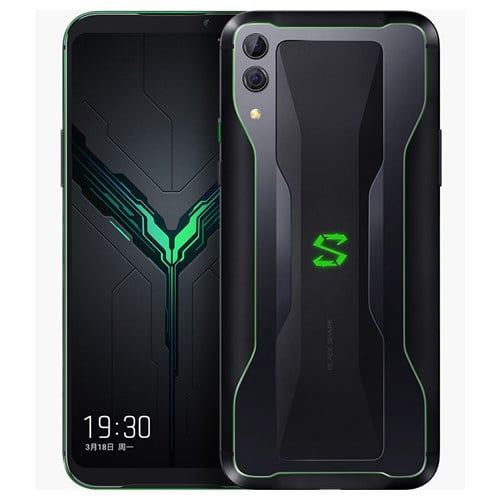
Xiaomi Black Shark 2 comes with DC Diming
Therefore, if you are having an eye strain or headache from being hooked on your smartphone screen for far too long, don’t blame PWM dimming just yet. Try to build good smartphone habits, which includes setting your display brightness to comfortable levels (instead of at 100% at all times) and keeping a decent distance between you and your smartphone screen.
We use cookies on our website to give you the most relevant experience by remembering your preferences and repeat visits. By clicking “Accept”, you consent to the use of ALL the cookies.
This website uses cookies to improve your experience while you navigate through the website. Out of these, the cookies that are categorized as necessary are stored on your browser as they are essential for the working of basic functionalities of the website. We also use third-party cookies that help us analyze and understand how you use this website. These cookies will be stored in your browser only with your consent. You also have the option to opt-out of these cookies. But opting out of some of these cookies may affect your browsing experience.
Necessary cookies are absolutely essential for the website to function properly. This category only includes cookies that ensures basic functionalities and security features of the website. These cookies do not store any personal information.
Any cookies that may not be particularly necessary for the website to function and is used specifically to collect user personal data via analytics, ads, other embedded contents are termed as non-necessary cookies. It is mandatory to procure user consent prior to running these cookies on your website.




 In order to avail this 21 percent discount, all you need to do is to follow
  You can coupon code zeb10 and bring the retail price of the smartwatch down to just $109.99. Note that the coupon will specifically be valid only for the US and Canada-based buyers between April 4-April 30 for the first 10 units.
 The aforesaid coupon helps you save $50 more by reducing the original asking price of the Honor Magic smartwatch to only $129.99 before you place your order. You can visit
  The Amazfit Verge smartwatch is available in three color versions including gray, dark blue and white on Giztop. In order to purchase your favorite color version, all you need to spend is only $139. You can follow
  The Honor Watch Dream has gone up for pre-order bearing a $189.99 price sticker on GearVita. Those who aren’t willing to shell out that kind of money can use coupon code 4GVhhDream and reduce the retail price of the watch to only $159.88.
 In a bid to make top-end products that are necessary for the home at affordable prices, GeekBuying has launched a new promo dubbed ‘Home Essentials.’ As part of this recently kicked-off promo, the Chinese online store will be doling out up to 60 percent off on a wide selection of household essentials.
 The ETB301 Sonic electric toothbrush would normally set you back $63.99, but much to the relief of cost-conscious consumers, you can now buy it for just $36.99 on GeekBuying. You can even extend this 42 percent discount by applying coupon code DUZMGAMY at checkout.
 This is a noteworthy 40 percent drop in the device’s original asking price of $74.99. In addition to taking advantage of the discount, GeekBuying users can apply coupon code QRBPMHXY and save $11 more before placing their orders.








 Taking its skyrocketing popularity into consideration, the Chinese consumer electronics manufacturer is now offering the global version of the Mate 20 Pro phablet at an unbeatable price in collaboration with Gearbest.
 This is a considerable 21 percent reduction in the device’s original asking price. An absolute steal at this price, the Huawei Mate 20 Pro 4G phablet offers the following features.








 Aside from that, the first 100 pieces of Xiaomi Mi 9 and first 500 pieces of the Mi Play 4G phablets at lowered prices. The Mi 9 would normally set you back $516.87, but you can now buy it for just $499.99. Likewise, the Xiaomi Mi Play usually retails for $199.93, but you can buy it for just $159.99 from the promotion page.
 In addition from taking advantage of the 10% off coupon, GearVita is giving its loyal users a chance to get noteworthy discounts on Xiaomi Redmi Note 7 which usually sells for $269.99. Thanks to the discount, you can now buy for a reduced price of just $229.99. In order to avail this discount, all you need to do is apply coupon code GVRN7 before placing your order.