Vivo is expected to announce the Vivo X200 on Oct. 14 in China. Ahead of the launch, Vivo’s Product Manager Han Boxiao for China released the first camera sample to showcase the capabilities of its telephoto camera. Additionally, a new Weibo by tipster Digital Chat Station spills information about the X200’s camera specifications.
Vivo X200 camera sample
According to Boxiao, the above camera sample has two highlights. First, it showcases the X200’s ability to capture with 10x zoom at night using the new telephoto lens. Secondly, it also gives a look at the new moon mode. Boxiao said that the moon shown in the image has been artistically modified.
Vivo X200 camera specifications
The above leak by tipster Digital Chat Station reveals that the Vivo X200’s triple camera setup will include a 50-megapixel Sony IMX921 primary camera with an f/1.57 aperture and a 1/1.56-inch camera sensor size. It is coupled with a 50-megapixel Samsung JN1 ultra-wide lens and a 50-megapixel Sony IMX882 (or LYT-600) periscope telephoto camera with an f/2.57 aperture and 70mm focal length. The leak claims that the phone supports a 10x fusion super-resolution algorithm, which probably hints at 10x hybrid zoom.
The tipster claimed in the leak’s comments section that this model will have a 6.78-inch OLED display. As is known, the device will be equipped with the Dimensity 9400 chipset, which is yet to go official. The device may have a 5,800mAh battery that can support 90W fast charging, but it is unlikely to be equipped with wireless charging support. It is expected to come preloaded with Origin OS 5-based Android 15.
As per reports, the series includes three other models, such as a smaller sized Vivo X200, the Vivo X200 Pro, and the Vivo X200 Ultra. The Ultra model featuring the Snapdragon 8 Gen 4 is likely to launch next year, whereas the other two models featuring the D9400 are expected to debut with the X200 next month.
Soundcore, a sub-brand of Anker, has launched the Select 4 Go, a compact and budget-friendly Bluetooth speaker. It’s designed to offer good sound quality, long battery life, and durability at an affordable price.
The speaker features a 1.75-inch full-range driver that delivers 5W of audio output for clear and balanced sound. It also comes with a customizable equalizer, so you can adjust the sound to suit your taste. It uses Bluetooth 5.4 for stable wireless streaming, with a range of up to 30 meters. You can also pair two speakers together for a wider sound experience using the true wireless stereo feature.
The speaker is built to withstand outdoor conditions as it comes with an IP67 water and dust resistance rating. The buttons are also quite durable, with a life span rated for up to 3,000 presses.
The battery is also a major plus point as the speaker can last up to 20 hours of playtime. The brand also claims that the battery will retain 95% of its capacity even after 300 charge cycles. The speaker comes with a 60 cm USB-A to C charging cable included inside the box, apart from a quick start guide.
Pricing & availability
The Select 4 Go is priced at $24.99 on Amazon in the US and £22.49 in the UK. It comes in blue, black, and white, with purple and green options expected soon.
In other news, Anker is preparing to launch a new premium headset, the Soundcore Space One Pro. This over-ear headset features Bluetooth 5.3 connectivity, a 350mAh battery with a two-hour charging time, and a claimed battery life of 60 hours. It will be available in Cream White and Jet Black for a speculated price of $200.
Casio America has added a new line of watches to their G SHOCK women’s collection with the launch of the GMAP2100ST. These watches combine practical features with a stylish, eco-friendly design, perfect for everyday wear.
Each watch in the GMAP2100ST series has a sleek look, featuring a soft, smooth finish thanks to a mix of matte and pearlescent coatings on the bezel and band. The way the light reflects off the surface adds a unique touch, while the matte dials and index marks give it a refined, understated feel.
The G SHOCK GMAP2100ST is available in three colors – pink, white, and beige, which can complement any outfit. The watch also has metallic accents on the bands.
The GMAP2100ST is made for smaller wrists and is a slimmer version of the popular GMAS2100, measuring slightly thinner and narrower for a more comfortable fit. The band is also adjusted to sit better on smaller wrists.
G SHOCK has also focused on sustainability with this collection. The watches are made from bio-based resin, a material sourced from renewable resources, used in both the bezel and band.
Despite its compact and sleek look, the GMAP2100ST is packed with useful features, including:
Shock resistance for durability
20-bar water resistance for everyday use
A hand shift feature for better visibility of the digital display
World time for 48 cities
A 1/100-second stopwatch
A countdown timer
Five daily alarms
A double LED light for better readability in low light
The GMAP2100ST-4A (pink), GMAP2100ST-7A (white), and GMAP2100ST-9A (beige) are available for $130 each. You can find them at select retailers, gshock.com, and the G SHOCK Soho store.
In other news, Casio has also introduced the WS-B1000 digital watch in markets across Malaysia, Europe (including the Netherlands, France, and Spain), and the US. The WS-B1000 comes with a sporty design and includes features like a step tracker synced with the Casio app, Bluetooth connectivity for time synchronization and phone tracking, a stopwatch, a countdown timer, and a two-year battery life.
Tecno has recently introduced the Phantom V Flip 2 5G smartphone to the global market. As the successor to the Phantom V Flip, the Flip2 5G is designed to provide a more budget-friendly yet feature-packed alternative to other flip phones, such as the Galaxy Z Flip 6. Here’s a closer comparison of the two devices.
In terms of design and build, the Samsung Galaxy Z Flip 6 stands out with its more compact dimensions. It is slightly smaller and lighter, weighing 187g compared to the Tecno Phantom V Flip 2’s 196g. The Galaxy Z Flip 6 has a premium feel with a combination of a glass back protected by Gorilla Glass Victus 2 and an aluminum frame, while the Tecno Phantom V Flip 2 offers a unique eco-leather back with a durable aluminum frame and steel hinge, providing a distinct aesthetic.
The display comparison shows both devices equipped with foldable AMOLED screens, supporting a 120Hz refresh rate. The Galaxy Z Flip 6 has a slightly smaller 6.7-inch display with a higher peak brightness of 2600 nits and features HDR10+ support. The Tecno Phantom V Flip 2 offers a larger 6.9-inch display but has a slightly lower pixel density (413 ppi versus Samsung’s 426 ppi), although it compensates with a bigger cover display at 3.64 inches, compared to Samsung’s 3.4 inches.
2. Performance
In terms of performance, the Galaxy Z Flip 6 is powered by the Qualcomm Snapdragon 8 Gen 3 chipset, making it a more powerful option for high-performance tasks, while the Tecno Phantom V Flip 2 runs on the Mediatek Dimensity 8020. Samsung offers more RAM, with configurations of 12GB, whereas Tecno provides 8GB RAM, which might affect multitasking performance. Both devices offer ample internal storage, with Samsung leading with up to 512GB, while Tecno sticks with 256GB.
3. Cameras
The Samsung Galaxy Z Flip 6 and Tecno Phantom V Flip 2 both offer impressive camera systems, each with its own strengths. The Z Flip 6 excels in low-light photography and video thanks to its OIS-equipped 50 MP primary sensor and 12 MP ultrawide lens. It also supports 4K@60fps video recording with HDR10+ and slow-motion capabilities up to 960fps.
On the other hand, the Tecno Phantom V Flip 2 boasts a dual 50 MP camera setup with a larger primary sensor for impressive low-light performance and a wider ultrawide lens. While it lacks HDR10+ support, it offers excellent video quality up to 4K@30fps.
For selfies, the Z Flip 6’s 10 MP camera provides good quality, but Tecno’s 32 MP selfie camera with PDAF and LED flash offers superior detail and low-light performance. Additionally, Tecno’s selfie camera supports higher frame rates up to 1080p@60fps for smoother video calls and vlogs.
4. Battery
Battery life and charging speed present a notable difference. The Tecno Phantom V Flip 2 boasts a larger 4720 mAh battery and faster 70W wired charging, allowing for a 50% charge in just 15 minutes. Samsung’s battery is smaller at 4000 mAh, with 25W wired charging that takes 30 minutes to reach 50%. However, Samsung includes wireless and reverse wireless charging options, which are absent on the Tecno.
5. Pricing & conclusion
The biggest disparity between the two devices is their price point. The c has a starting price of US$1,100, while the Phantom V Flip 2 has launched for US$700.
Please Note: When you buy something using the links in our articles, we may earn a small commission at no cost to you.
In conclusion, the Samsung Galaxy Z Flip 6 delivers more power, versatility in performance, and better video capabilities, while the Tecno Phantom V Flip 2 provides a larger battery, faster-wired charging, and an impressive camera setup. That said, it does not offer features like wireless charging, which isn’t necessarily a deal breaker, considering that it is $400 cheaper than the Z Flip 6.
A couple of months back, Xiaomi introduced the Robot Vacuum S20 on its global website. The brand has finally started selling the vacuum in the UK and European markets.
This new model offers a compact design, measuring only 325 mm in diameter, making it easy to maneuver around tight spaces. Powered by a 5,000Pa suction motor, the S20 provides efficient cleaning with three adjustable modes.
The S20 uses LDS laser navigation and obstacle avoidance sensors to navigate your home, following zigzag or Y-shaped patterns for a more thorough clean. It comes with a 400ml dustbin and a 270ml water tank, allowing for longer cleaning sessions without frequent emptying or refilling.
The vacuum can be controlled remotely using the Mi Home/Xiaomi Home app, where you can schedule cleaning sessions and receive software updates. It also supports voice commands through Google Assistant or Amazon Alexa.
The Xiaomi Robot Vacuum S20 is priced at £129.99/€169.99, making it an affordable option for those looking for an efficient cleaning device. It is available in black or white and can be purchased from Xiaomi or Amazon.
In other news, Xiaomi has also introduced the Mijia Body Fat Scale S400 Pro in China. This new scale tracks multiple health metrics, including body fat percentage, weight, heart rate, and muscle mass. The scale features an ITO-coated tempered glass surface, which increases the area for measurement, and a 3.5-inch color display with enhanced brightness and contrast. It connects to the Xiaomi Home app, enabling users to adjust settings and monitor their health data.
Samsung launched the Galaxy M05 just a couple of days ago. Now the company has added another pocket-friendly device in its F series, the Galaxy M05. The Galaxy F05 is said to be a variant of the Galaxy A05 and M05. The design of the phone is also very similar to the Galaxy M05 and Galaxy A05.
However, the latest addition to the F series offers an eco-leather material on the back. In contrast, the M05 and A05 offer plastic. This device targets users looking for a stylish smartphone with a leather pattern finish and a 50 MP camera setup.
Galaxy F05 specifications:
On the front, the phone packs a 6.7″ HD+ PLS LCD display that has a pixel density of 262 ppi. Being an entry-level device, it offers a wider chin as compared to the side and top bezel, along with a water-drop cutout for the selfie camera.
Speaking of cameras, it packs two sensors on the back – a 50MP main (with f/1.8 aperture) paired with a 2 MP depth sensor. In the front, the phone packs an 8 MP selfie camera. The camera specification is the same as the Galaxy M05 and A05. According to Samsung, the phone captures vibrant, detailed photos, even in low-light conditions.
In terms of performance, the phone packs the MediaTek Helio G85 (12nm) chip, which is paired with 64GB of eMMC 5.1 storage and 4GB RAM. The phone also supports the RAM Plus feature (which lets you use another 4GB of internal storage space as RAM) and expandable storage of up to 1TB. To power the system, the phone packs a “massive” 5000 mAh battery and supports 25W fast charging.
The Galaxy F05 comes with One UI Core 6.0 based on Android 14 out of the box. Samsung promises two generations of OS upgrades and four years of security updates for this phone.
Pricing and availability:
The phone comes with a 4GB+64GB configuration, is priced at INR 7999, and is expected to be released on September 20.
Xiaomi has launched its Mijia Natural Wind Pro 3-HP wall-mounted air conditioner in China today, priced at 5499 yuan (~$775) during crowdfunding, with a retail price of 5999 yuan (~$845).
This air conditioner is equipped with a dual-cylinder compressor and a double-row condenser that offers an air volume of 1500m³/h, which is suitable for living rooms, large bedrooms, shops, and restaurants.
According to the company, the product is designed with energy efficiency in mind which enables it to offer an APF (Annual performance factor) of 4.75. For those unfamiliar, APF indicates the average annual energy consumption efficiency of air conditioners. Specifically speaking, the newly launched Mijia Natural Wind Pro is estimated to save 629 kilowatt hours of electricity throughout the year.
The air conditioner comes with a built-in Lingyun Intelligent Control Engine (the company’s self-developed deep learning algorithm based on the cloud), which enables rapid temperature control, temperature range upper limit control, vibration suppression, and also intelligently switches between three different airflow modes based on the situation. You can see the dimension of the indoor and outdoor unit from the image below.
It also supports Xiaomi HyperOS Connect and Xiaomi Home app, which lets users conveniently control the temperature from their phones. It also supports Xiaomi’s Xiao Ai voice control.
With a large air deflector, wide-angle non-inductive air supply, and an aluminum alloy lining, the newly launched Mijia Natural Wind Pro 3-HP wall-mounted air conditioner ensures both durability and proper cooling.
This air conditioner also supports 30s quick cooling/60s quick heating, -35℃ heating/65℃ cooling, as well as 58℃ self-cleaning for the outdoor unit. The self-cleaning uses condensation water to flush dust on the surface of the heat exchanger, ensuring stable operation and better power efficiency of the air conditioner in the long run.
ASUS has launched the ZenBook 14 Air laptop which is now available for pre-order on JD.com for a price tag of 8999 Yuan (~$1268) and will go on sale at 0:00 on September 24. This is a thin and light laptop which is only 1.1cm thick and weighs 1.15kg. It also offers a minimalist aesthetics CNC milled one-piece metal body with a hidden hinge. As you can see from the images, the machine comes with two different color options: Snow White and Mountain Gray.
ASUS ZenBook 14 Air specifications:
Upon opening the lead, users will be looking at a 14-inch 2.8K (2880×1800) 120Hz Lumina OLED panel, which comes with a 120Hz refresh rate. For those interested, it offers a response speed of 0.2ms, has a peak brightness of 600 nits, a contrast ratio of 1,000,000:1, supports 10-bit color depth, and covers 100% DCI-P3 and 133% sRGB color gamut.
The display panel also passes TUV Rheinland hardware-level low blue light, flicker-free, and SGS Eye Care certification, which ensures eye comfort. The touchpad is measured at 5.9″ and the front camera has 1080p resolution.
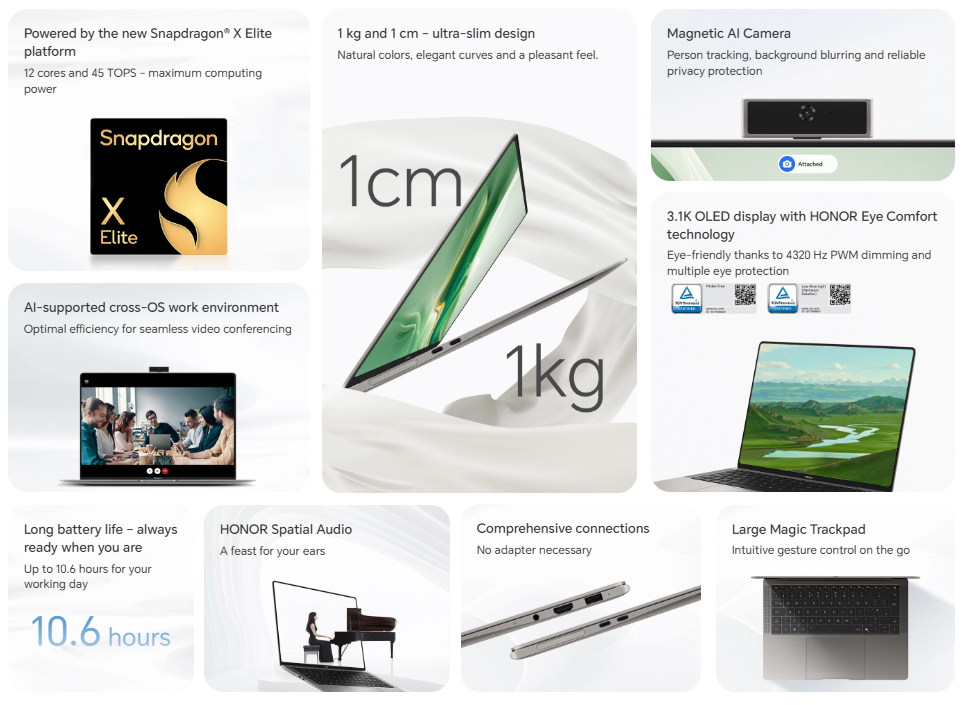
In terms of performance, the machine is equipped with an 8-core 8-thread Intel Core Ultra 7-258V processor with a maximum turbo frequency of 4.8GHz and built-in second-generation Xe core graphics. This chipset offers an AI performance of 115 TOPS, which is claimed to be the highest total AI computing power. For reference, the Qualcomm Snapdragon X Elite’s Hexagon NPU scores 45 TOPS.
This is paired with 32GB LPDDR5x 8533MT/s RAM and 1TB PCIe SSD. For cooling, this laptop uses dual fans, ultra-thin vapor chambers, and a geometric grille design, and comes with a TDP of 28W.
According to the official information, the laptop offers a quiet and efficient performance that “seamlessly adapts to any task”. The company claims that the machine maintains a noise level below 25dB during light workloads thanks to its smart cooling technology. The air vent is also reportedly designed to prevent dust particles from getting inside.
Notably, this 1.1cm thick laptop packs a 72Wh battery, that according to the company, offers a maximum battery life of approximately 22 hours. You can see all the ports the laptop offers in the image below.
Xiaomi has launched the Mijia Multi-Functional Portable Flashlight, priced at 89 yuan ($13) during crowdfunding, with a retail price of 129 yuan ($18). The flashlight will officially be available starting September 18.
The Mijia flashlight features a compact design, weighing just 125 grams and measuring 3 cm in diameter, making it easy to carry on the go. Its lightweight build allows it to fit seamlessly into a backpack or pocket without adding bulk. Sporting a sleek black design, the flashlight fits well in various settings, from outdoor camping trips to household usage.
The Mijia flashlight features a powerful main light with 1000 lumens, capable of illuminating up to 150 meters. It offers three adjustable brightness settings, providing high brightness for outdoor use, medium for close-range lighting, and low for indoor softer lighting.
It offers four lighting modes: high brightness, ambient light, candlelight, and emergency modes. The ambient light mode has adjustable color temperatures (4000K, 3300K, and 2700K) for outdoor or cozy indoor settings. The candlelight mode mimics a soft flickering candle, ideal for a calming nighttime light source.
The flashlight features a 3100mAh lithium battery, which delivers up to 30 hours of usage, ensuring you won’t run out of light on long trips. It also boasts an IP65 water and dust resistance rating, making it durable enough for use in harsh outdoor environments. The charging port is protected by a soft rubber seal, providing added durability against the elements.
Designed with outdoor functionality in mind, this flashlight comes with a hidden hook at the bottom, making it easy to hang during camping trips. It also includes an emergency SOS mode for added safety during nighttime adventures.
Samsung started rolling out the new One UI 6.1.1 update on September 16, 2024 to the Galaxy S23 series, Z Fold 5 / Z Flip 5 and many other devices. But the new update contains some problems. Users are already reporting on X (formerly Twitter) that the update reduces camera capability. We request Samsung to fix the camera issue in the Galaxy S23 series as soon as possible.
Galaxy S23 series faces a new camera problem
Samsung needs to test updates more carefully. The released One UI 6.1.1 update degrades the camera capability of the Galaxy S23 series and that’s not a good thing. This problem appeared in the update with build number CXH7. Specifically, Galaxy S23 Ultra users report that the camera app takes blurry photos when you zoom between 16x and 19.9x. Users want Samsung to fix the problem by releasing a new update as soon as possible.
Tarun Vats, who follows One UI builds, notes that the problem is solved when users set the optimization to medium or minimum in the camera settings. But why should users bother changing the camera settings? Also, the One UI 6.1.1 update comes with the August security patch, which is not a current security update. Samsung was originally supposed to release One UI 6.1.1 at the end of August and could have provided an additional camera fix update with a September security patch.
Users have been requesting the brand to release a new camera update for the Galaxy S23 series. The Galaxy S23 series comes with good camera hardware and Samsung’s mistake is not something to be overlooked. We’ll let you know if this issue has been resolved, so stay tuned.
Realme launched the NARZO 70x 5G in April earlier this year. It’s a perfect smartphone with decent specifications and features. As the festive season is approaching fast, almost every online retailer is coming up with some good deals. Amazon and Flipkart, India’s biggest online retailers, have already announced their festive sales, i.e., “Amazon’s Great India Festival sale” and “Flipkart’s Big Billion Days”. Both retailers will push their sale extravaganza from September 27.
Regarding the Realme Narzo 70x 5G offer, Amazon India is giving a discount of ₹2250 via a coupon. The offer is available on an 8GB RAM and 128GB internal storage variant. This makes the effective price to buy Realme Narzo 70x 5G for just ₹12,749 and it is the lowest price at which the smartphone has been available since its launch. Moreover, if you purchase the smartphone by using an Amazon Pay ICICI Bank credit card, then you will get an extra 5% cashback.
So, if you’re looking for a budget Android phone, then the Realme Narzo 70x 5G is a good option.
Please Note: When you buy something using the links in our articles, we may earn a small commission at no cost to you.
Realme Narzo 70x 5G Features and Specs
The smartphone is powered by a Dimensity 6100+ 5G chipset, which is built on a 6nm process, and for graphics, there is a Mali-G57 GPU. Realme Narzo 70x 5G has 6GB/8GB RAM and 128GB internal storage, which can be expanded up to 1TB via microSD card.
Talking about the display, the phone features a 6.67-inch AMOLED panel with a 92.65% screen-to-body ratio. It has a full HD+ 2400 x 1080 pixel resolution and 120 Hz refresh rate. Realme Narzo 70x 5G packs a dual-camera setup at the back; the primary lens is 50 MP with an aperture of f1.8 and a 2 MP depth sensor. For video calls and selfies, there is a 16MP camera.
The smartphone has a huge 5000 mAh battery that supports 45W SUPERVOOC fast charging and reverse charging capabilities. Realme Narzo 70x 5G has an IP54 rating for dust and water resistance. The phone runs on the Realme UI 5.0 system which is based on Android 14.
For more deals and offers on gadgets, you must follow our deals section.
Samsung has long been expected to release a Beta version of One UI 7. Rumors since the end of July now seem to be coming true. According to Sammobile, Samsung’s subsidiaries (such as Samsung India and Samsung UK) are testing the new update. We hope this information is true and, as a Samsung user, I am waiting for One UI 7 Beta.
Will we see One UI 7 Beta?
While many users are eagerly awaiting the new version of One UI, Samsung continues to test the new update. Recently, the company released One UI 6.1.1 and it’s only a matter of time before it releases the One UI 7 beta update. According to the emerging information, TM Roh is personally supervising the new software, and therefore the update has been delayed. This is actually a good thing because the company is clearly trying to provide a seamless experience with One UI 7.
One UI 6.1.1 introduced the new Galaxy AI features to users, and now the release of One UI 7 beta shows that we are not far from Samsung’s new interface. One UI 7 is said to offer improved animations, better battery life, and a more usable user interface. Maybe that’s why Samsung is so focused on the first beta of One UI 7 and can offer a smooth experience even in the first beta. Of course, the update is also likely to include some bugs. After all, it will be released in “Beta” status.
No one knows when the One UI 7 beta program will open, but the beta program is expected to open soon. If the update is not released by the end of this month, we may have to wait for the Samsung developer conference in October. Samsung’s developer conference will be held on October 3rd and there’s not much time left on that date. One UI 7 beta can be expected in a few weeks.
Samsung needs to be careful when releasing this update, since the new update is in beta, it could come with some issues and damage users’ devices. They are probably trying to optimize the new features. Don’t forget to take into attention the comments of other users when One UI 7 beta is released.
Xiaomi has introduced the latest addition to its smart home lineup, the Mijia No-Fog Humidifier 3, designed to provide rapid and efficient humidification for living spaces.
Crowdfunding for the device will start on September 18 at 10 AM (CST) on Xiaomi Youpin, with a discounted price of 599 yuan (approx. $84), compared to the retail price of 799 yuan (approx. $112). Let’s check out its key specs.
The Mijia No-Fog Humidifier 3 features an impressive 800mL/h humidification capacity, ensuring rapid moisture distribution across large areas like living rooms. Using natural evaporation, it avoids visible mist and white residue, making it safe to use with tap water. Even during dry seasons, such as autumn and winter, the humidifier maintains a comfortable environment with rain-fresh air.
It operates quietly at just 32dB(A), making it perfect for night-time use. In sleep mode, the humidification reduces to 280mL/h, and the screen automatically dims to ensure an undisturbed rest.
The Mijia No-Fog Humidifier 3 sports a 6L water tank, allowing for up to 18 hours of continuous humidification. The tank is constructed from silver ion materials, promoting a ≥99% antibacterial rate for clean, safe humidification. With such a large capacity, users can enjoy worry-free operation overnight without needing to refill frequently.
It also comes with a top-fill water tank, making it easy to refill without removing or bending down to access the tank. Simply tilt and pour water in, a process Xiaomi describes as being simpler than watering plants.
The humidifier integrates seamlessly with Xiaomi’s smart ecosystem. Through the Mijia App and Xiao Ai voice assistant, users can control the device remotely or check humidity levels with simple voice commands.
The Mijia No-Fog Humidifier 3 also supports Xiaomi HyperOS Connect, allowing it to synchronize with other smart devices like air conditioners and heaters, ensuring your home is comfortable even before you arrive.
The humidifier comes with a built-in smart ambient display that offers real-time updates on water levels and humidity. Its ring-shaped progress bar visually indicates the remaining water and the humidifier automatically shuts off when the tank is empty for added safety.
It comes with a 3D antibacterial filter, ensuring the air is purified while adding moisture. The filter, boasting a ≥99% antibacterial rate, can be hand- or machine-washed, making maintenance both easy and convenient. The suspended filter design enhances humidification efficiency, ensuring consistent performance.
Maintenance is further simplified with the open-style water tank and removable pump impeller, making cleaning hassle-free and ensuring long-term usability.
During the festive season in India, there are plenty of sales going around with consumer electronics getting heavy discounts. Samsung is one such brand preparing to offer great deals on its devices, including older flagship smartphones. The Galaxy S23 is getting hefty discounts during the festive sale in India, but is it worth buying? Read on to find out.
Samsung is one of the few that offers premium smartphones with a compact form factor and basically the only one in the Android segment. So it is almost the only one of its kind. It sports a 6.1-inch Dynamic AMOLED 2X display with a 120Hz refresh rate, FHD+ resolution, and 1,750 nits of peak brightness. This is a top notch display but much smaller than the average smartphone.
But despite all this, it measures 146.3 x 70.9 x 7.6mm in dimensions and weighs 168 grams. So you’re not just getting a comfortable-sized device, you also get a thin and lightweight body. Meaning, users who don’t prefer big phones or find them uncomfortable, this is a rare smartphone that you’d want to check out on a sale.
2. High End Specs & Features
Just because it’s the most affordable model from Samsung’s 2023 flagship lineup, doesn’t mean that it can’t pack a punch. The Galaxy S23 is equipped with the Qualcomm Snapdragon 8 Gen 2 SoC in all regions. So there is no Exynos variant and you get a top notch performance. This chipset is paired with up to 8GB of RAM and 512GB of internal storage.
Users also get up to 4 years of Android updates, so even if you buy it in 2027, you’re guaranteed to get the Android 17 OS update as well. The only drawback of the small form factor is the 3,900mAh battery pack, which is pretty lackluster compared to the competition. This cell is pretty small and only offers 25W wired fast charging and 15W wireless fast charging. But apart from this, every other aspect is still flagship grade. For optics, there rear features a 50MP (main) + 10MP (telephoto) + 12MP (ultra wide angle lens) camera setup, while the front houses a 12MP selfie shooter.
3. Galaxy S23 Sale During Indian Festive Sale
Samsung has teased a special deal for the Galaxy S23 during the festive sale. During the major sale period, Samsung is expected to make the Galaxy S23 available for a price tag below 40,000 INR. The exact figure is unclear but we know its within the 30,000 INR and 40,000 INR price range. There would likely be other special discounts as well.
4. Verdict
For under 40,000 INR, Samsung Galaxy S23 is a great deal for those looking for a compact flagship smartphone but do not want to buy an iPhone. There aren’t any viable options except the S23, so keep on a lookout for this deal during the festive sales.
Samsung tends to play it safe when it comes to major upgrades for its Galaxy S series. This conservative approach appears to extend to the upcoming Galaxy S25 lineup, with a recent leak revealing no significant changes in battery size for the Plus model.
According to the reliable source GalaxyClub, the Galaxy S25 Plus will pack the same battery as its predecessor, the S24 Plus. This translates to a rated capacity of 4,755mAh, with Samsung likely marketing it as a 4,900mAh battery (similar to the S24 Plus).
Leaks also suggest the base S25 and the top-tier S25 Ultra will retain their respective 4,000mAh and 5,000mAh batteries from the S24 generation.
While a stagnant battery size isn’t ideal news, it’s important to remember that capacity alone doesn’t dictate battery life. Other factors like the power efficiency of the chipset and the display technology play a crucial role. And here’s where things get a bit more interesting.
The rumored 3nm chipset powering the S25 series could potentially deliver improvements in efficiency compared to the 4nm chips in the S24 lineup. This, in turn, could translate to better battery life despite the unchanged capacities.
That said, the lack of a battery bump could put the S25 series at a slight disadvantage compared to some competitors. Phones like the OnePlus 12, Vivo X100 Pro, Asus Rog Phone 8, and Honor Magic 6 Pro all boast batteries exceeding 5,400mAh.
The competition is only getting fiercer, with rumors swirling about the next OnePlus flagship potentially sporting a monstrous 6,000mAh battery.
Ultimately, whether the S25 series can compete in the battery life department remains to be seen. We’ll have to wait for official specs and real-world testing to get a clearer picture. But from what we know so far, if you prioritize a phone with the absolute biggest battery, the S25 series might not be the best choice in 2025.
Xiaomi is gearing up for the HyperOS 2.0 launch, with a potential release set for October. Xiaomi fans are eagerly waiting for this update, but every device won’t make the cut. Only select models from Xiaomi and its sub-brands, Redmi and Poco, will receive the highly anticipated HyperOS 2.0 upgrade.
The Chinese brand hasn’t officially announced anything about HyperOS 2.0. It hasn’t even revealed that it’s working on a new version of HyperOS, although this was confirmed recently when traces of HyperOS 2.0 were found in the source code of Xiaomi’s official website.
If you have a Xiaomi device, review the list below to determine if it will get the next major upgrade, HyperOS 2.0.
Xiaomi Devices That Are Likely To Get HyperOS 2.0 Update
Folks at XiaomiTime have shared a list of Xiaomi, Redmi, and Poco devices that will most likely get the HyperOS 2.0. That include:
Poco M6, Poco M6 4G, Poco M6 Plus 5G, Poco M6 Pro, Poco M6 Pro 5G
This is an unofficial list prepared based on the device software update policy and past rollout patterns. If your device isn’t on the list, wait for the official list before you plan to upgrade to a new phone.
What To Expect from HyperOS 2.0?
Xiaomi has not revealed the changes we’ll see in HyperOS 2.0, but thanks to leaks, we already have some details. The new HyperOS version might allow users to detect hidden cameras using WLAN signals. If this is true, Xiaomi devices might have an edge in user privacy and personal safety over their competitors.
Some leaked screenshots have revealed that HyperOS 2.0 might get a redesigned Settings homepage. It could offer a card-like experience instead of the thin line-separated segments. Since Xiaomi has kept the same design for the Settings app for nearly a decade, this change would be much appreciated by Xiaomi fans.
The new Settings homepage in leaked images looks modern. It will not just provide better aesthetics but also ensure smoother navigation and fluency.
HyperOS 2.0 might allow up to 16GB of virtual memory, with the default being 6GB. Of course, not all Xiaomi devices can have 16GB of virtual RAM because of limited hardware. So, it’s likely coming to high-end phones with ample storage.
Xiaomi is also said to be working on allowing users to turn off the lock screen editor in HyperOS 2.0. For those uninitiated, the screen editor is activated when you long-press a blank space on the lock screen. Those who don’t like it will probably be able to switch it off via the Settings app in HyperOS 2.0.
Besides these changes, the upcoming HyperOS 2.0 is also expected to have smoother animations, better performance, and privacy. You can also expect to see new AI features as every other smartphone brand is working to bring the best of AI features, and Xiaomi wouldn’t want to miss out on that.
HyperOS 2.0 release is still a few weeks away. According to a recent leak, Xiaomi might start rolling it out to eligible devices in the second week of October. As you may already know, recent flagship devices will be the first to join the party, followed by midrange and budget devices.
Which Xiaomi device do you have, and what are your expectations from HyperOS 2.0? Share your thoughts in the comments below.
The rumor mill keeps churning for the upcoming Samsung Galaxy A16 5G. After popping up on certification websites and leaked renders, details about the phone’s design, specs, and launch window are now starting to solidify.
The folks at The Tech Outlook have got their hands on some marketing materials that reveal what to expect from Samsung’s next budget-friendly 5G device.
Visually, the Galaxy A16 5G appears to follow Samsung’s current design language for the A-series. The back has three vertically stacked cameras, accompanied by an LED flash. The panel, however, is made of glass with a glossy sheen, unlike the plastic back on its predecessor.
On the side, you get what Samsung calls a “key island” which houses the volume rocker and power button (likely housing the fingerprint sensor).
Up front, there’s a waterdrop notch that disrupts the display for the selfie camera. Color options are rumored to include Light Green, Blue Black, and Gold.
Under the hood, the Galaxy A16 5G is expected to pack a 6.7-inch SA Infinity U display with FHD+ resolution, a smooth 90Hz refresh rate, and a peak brightness of 800 nits. Interestingly, the leak suggests two possible processor options: the Exynos 1330 and the MediaTek Dimensity 6300.
The source claims the Indian variant will specifically come with the MediaTek chip, so it’s unclear where Samsung plans to launch the Exynos version.
What stood out to us the most is the mention of six major Android updates and six years of security patch support. That’s more than what brands like OnePlus and Vivo offer for their flagship models. RAM and storage configurations are rumored to range from 4GB/128GB to 8GB/256GB.
Modern essentials like a USB Type-C port and an IP54 dust and water resistance rating are also expected. The phone is said to measure 164.4 x 77.9 x 7.9mm and weigh around 192-200 grams depending on the variant. While the exact launch date remains under wraps, the leak suggests a potential launch timeframe in December 2024.
OnePlus has finally unveiled its budget TWS earbuds that offer some impressive specs. The Nord Buds 3 was just released in India with upgraded ANC (Active Noise Cancellation), longer battery life, and an affordable price tag. So here’s everything you need to know.
OnePlus Nord Buds 3 Specs
The company launched the Nord Buds 3 with a pebble shaped case that has a glossy or matte finish depending on the color variant. It has a stem design with silicon ear tips. These are equipped with 12.4mm dynamic drivers with Basswave Enhancement. OnePlus’ new budget hearables connect via Bluetooth 5.4 and SBS and AAC codecs. There is also dual microphones for Clear Call (AI call noise reduction).
OnePlus Nord Buds 3
The Nord Buds 2 launched with 25dB ANC, but the Nord Buds 3 offers 32dB ANC. So buyers get an upgraded noise cancellation. The brand promises up to 43 hours of total audio playback on a single full charge, with the earbuds offering 12 hours with ANC off and 8 hours with ANC on. It even supports Flash Charge, which offers 11 hours of playback with just 10 minutes of charging. Other notable features include an IP55 rating for water and dust resistance and touch controls.
Pricing and Availability
The OnePlus Nord Buds 3 arrives in two color options, namely Melodic White and Harmonic Gray. It will be available for purchase via Amazon India, Flipkart, the official OnePlus website, OnePlus Stores, and offline retails like Reliance Digital, Vijay Sales, Croma, and others. It carries a 2,299 INR price tag with its first sale kicking off on 20th September 2024. OnePlus is offering an instant bank discount of 200 INR on ICICI and OneCard Credit card holders. Meanwhile, students can also avail an additional discount of 200 INR from OnePlus’ website and stores.
Android’s Circle to Search feature has so far been exclusive to Samsung and Pixel phones, but that’s about to change.
Xiaomi is set to launch the Xiaomi 14T series on September 26, and a new leak of the phone’s promo material reveals that these devices will include the Circle to Search feature.
Circle to Search lets users quickly access information about anything on their screen by simply circling it.
The phone will also come with other Gemini-powered features like AI Notes, AI Interpreter, AI subtitles, and AI Voice Recorder.
The leaked promo material further details the phone’s hardware. The Xiaomi 14T appears to be powered by the MediaTek Dimensity 8300 Ultra chipset.
The phone is expected to offer 12GB of RAM and up to 512GB of storage, expandable via microSD card (sacrificing a second SIM slot).
Fueling the smartphone will be a 5,000mAh capacity with support for Xiaomi’s 45W HyperCharge technology. It will charge the phone from 0 to 100% in just 45 minutes.
Camera specifications also appear competitive. The rear is rumored to house a triple-camera system headlined by a 50MP Sony IMX906 sensor with optical image stabilization (OIS). This sensor will be joined by a 50MP telephoto lens and a 12MP ultrawide sensors. A 32MP selfie camera rounds out the package.
Moreover, the display is tipped to be a 6.67-inch OLED panel with a resolution of 2712 x 1120 pixels. The phone will reportedly run Xiaomi’s HyperOS user interface based on Android 14 and boasts IP68 water and dust resistance.
Samsung is gearing up to unveil its new generation of flagship tablets soon. While there is still no official date for the announcement, a massive leak just surfaced sharing all the key details regarding the Galaxy Tab S10+ and Galaxy Tab S10 Ultra. So let’s check it out.
Samsung Galaxy Tab S10 Series Specs
The leak arrives from a TechOutlook report and confirms the specs of both tablet models. Samsung will reportedly offer a tall 14.6-inch Dynamic AMOLED 2X display with a 120Hz refresh rate, 2960 x 1848 resolution, Anti reflection coating, and 930 nits of peak brightness on the Galaxy Tab S10 Ultra. The Tab S10+ will offer similar specs but with a smaller 12.4-inch panel with 2800 x 152 resolution and 650 nits of peak brightness. Both models are ultra slim as well, measuring 5.4mm and 5.6mm respectively.
Under the hood, the Galaxy Tab S10 series is equipped with the MediaTek Dimensity 9300+ SoC, which is paired with up to 12GB of RAM and 512GB of internal storage (256GB on the S10+). Users can even bump the storage by up to 1.5TB via a microSD card slot. A massive 11,200mAh battery pack powers the Galaxy Tab S10 Ultra, while the Plus model houses a 10,090mAh cell. The duo are expected to support 45W wired fast charging.
For audio, there is a quad speaker setup on both premium tablets. Samsung is expected to launch the Galaxy Tab S10 lineup with an IP68 rating for water and dust resistance and an Armor Aluminum frame. In a recent report, we covered the pricing details and possible launch timeline for these tablets. The brand may unveil the Galaxy Tab S10 series on 26th September 2024, with a starting price tag of 1,119 Euros and 1,339 Euros (Galaxy Tab S10+ & Galaxy Tab S10 Ultra respectively).
We use cookies on our website to give you the most relevant experience by remembering your preferences and repeat visits. By clicking “Accept”, you consent to the use of ALL the cookies.
This website uses cookies to improve your experience while you navigate through the website. Out of these, the cookies that are categorized as necessary are stored on your browser as they are essential for the working of basic functionalities of the website. We also use third-party cookies that help us analyze and understand how you use this website. These cookies will be stored in your browser only with your consent. You also have the option to opt-out of these cookies. But opting out of some of these cookies may affect your browsing experience.
Necessary cookies are absolutely essential for the website to function properly. This category only includes cookies that ensures basic functionalities and security features of the website. These cookies do not store any personal information.
Any cookies that may not be particularly necessary for the website to function and is used specifically to collect user personal data via analytics, ads, other embedded contents are termed as non-necessary cookies. It is mandatory to procure user consent prior to running these cookies on your website.