Advertisement

OnePlus 12R spotted on IMDA certification platform

OnePlus is gearing up for the launch of its next flagship smartphone, the OnePlus 12. However, that’s not the only device on the company’s radar. The OnePlus 12R, a more affordable variant of the OnePlus 12, is also in the works and is expected to launch in India in late January.

OnePlus 12R IMDA certification

The OnePlus 12R has been spotted on the IMDA certification platform of Singapore, revealing its model number (CPH2609) and confirming its support for 5G, WiFi, Bluetooth, and NFC connectivity. While the listing doesn’t reveal much else, it does hint at an imminent global launch.

A recent global marketing campaign has inadvertently leaked the launch date of the OnePlus 12R, suggesting a January 23rd release in India. While this date is not officially confirmed, tipster Max Jambor also indicates a launch in the latter half of January.

Details about the OnePlus 12R’s specifications are still scarce, but it’s expected to be a rebranded version of the OnePlus Ace 3. Design-wise, it should resemble the OnePlus 11R with some notable improvements.

Under the hood, the OnePlus 12R is rumored to pack a Snapdragon 8 Gen 2 processor and run Android 14-based OxygenOS 14 out of the box. It is also expected to feature a 6.7-inch AMOLED display with a 1.5K resolution and a 120Hz refresh rate.

The rear camera setup is likely to include a 50MP OIS main sensor, an 8MP ultrawide sensor, and a 32MP telephoto sensor. A 16MP front camera is also expected for selfies.

Rounding off the package is a 5400mAh battery with support for 100W wired fast charging.

Related:

(Via)

Huawei’s new Luxeed S9 SUV spotted testing in China

The Luxeed S9 all-electric fastback SUV from Huawei and Chery was recently spotted undergoing road tests in China. The S9 is the second model in the Luxeed lineup, following the recently launched Luxeed S7 sedan. It is expected to hit the Chinese market in Q2 2024.

Internally codenamed EHY, the Luxeed S9 rides on Chery’s E0X electric platform and features a Huawei-made electric motor on the rear axle. The motor produces 215 kW (292 hp) of power. A 4WD version of the S9 is also available, which features an additional electric motor on the front axle that produces 150 kW (204 hp).

Reportedly, the S9 will be offered with three battery options: LFP for 62 kWh, M3P (NMC+LFP) for 82 kWh, and NMC for 100 kWh. The range of the S9 will vary depending on the battery option chosen.

The SUV’s exterior styling is similar to the S7 sedan. It has thin LED headlights, a sloped bonnet line, and retractable door handles. The spotted prototype sports a LiDAR sensor on the roof, while the rear of the S9 has slanted rear pillars, a ducktail spoiler, and a single LED taillight unit.

The interior of the S9 is also similar to the S7. It has a small, oval-shaped three-spoke steering wheel. The front seats have integrated headrests and a sporty shape.

The center console of the S9 has a large floating touchscreen. It also has an LCD instrument panel, a Face ID sensor on the front pillar, and a center tunnel with two cup holders and wireless charging pads.

In terms of pricing, the S9 is anticipated to align with the Tesla Model Y in China, given its position as a direct competitor to the Luxeed S9 SUV. The Model Y’s starting price in China is 266,400 yuan (37,440 USD).

Related:

(Source)

GTA 6 gameplay footage and map details leak online

Anticipation for the long-awaited Grand Theft Auto 6 is reaching a fever pitch. Now, just days ahead of the official reveal, a new leak has surfaced, revealing the alleged gameplay footage and details of the GTA 6 map.

GTA 6 leak: A glimpse into Vice City

The leaked footage, posted on TikTok by a user named azzarossi, appears to be from a development build of GTA 6. It showcases a metropolis area of Vice City, with the camera moving freely and developer notes visible on the screen.

While the footage doesn’t reveal much in terms of gameplay, it does provide another glimpse into the highly anticipated game. GTA fans have quickly compared the leaked footage to last year’s leaks and found similarities in terms of buildings and landmarks.

Adding to the intrigue surrounding the leak is the identity of the leaker. According to reliable GTA source GTA Base, azzarossi is the son of a Rockstar Games employee. 

In addition to the leaked footage, more details about GTA 6 have also been circulating online. According to these leaks, GTA 6 will feature a map that’s twice the size of GTA V’s Los Santos. The game is also said to include three major cities and four sub-cities, with a large lake in the center of the map.

The leaker claims that 70% of the buildings in GTA 6 will be enterable, and the game is reportedly set for a fall 2024 launch. Pre-orders for the game are expected to go live following the release of the first trailer this week.

GTA Base further clarified that while the evidence linking the leaker to the Rockstar employee is convincing, it’s also possible that the picture used as evidence could be fake or that a third party is impersonating the leaker.

Rockstar Games has yet to comment on the leak, so it’s important to treat the information as a rumor until official confirmation. However, the leak has undoubtedly fueled the excitement for GTA 6, adding another layer of anticipation to the upcoming reveal.

Related:

(Via 1, 2)

Alleged Xiaomi 14 Ultra battery size, wired and wireless charging speeds leaked

Xiaomi is expected to unveil the Xiaomi 14 Ultra in the second quarter of 2024. To be precise, it is expected to launch along with the Xiaomi Pad 7 series of flagship tablets in the coming April. In a recent Weibo post, tipster Digital Chat Station seems to have revealed the battery size and charging capabilities of the 14 Ultra.

Alleged Xiaomi 14 Ultra battery size, charging capabilities

Xiaomi-13-Ultra-Full-Review
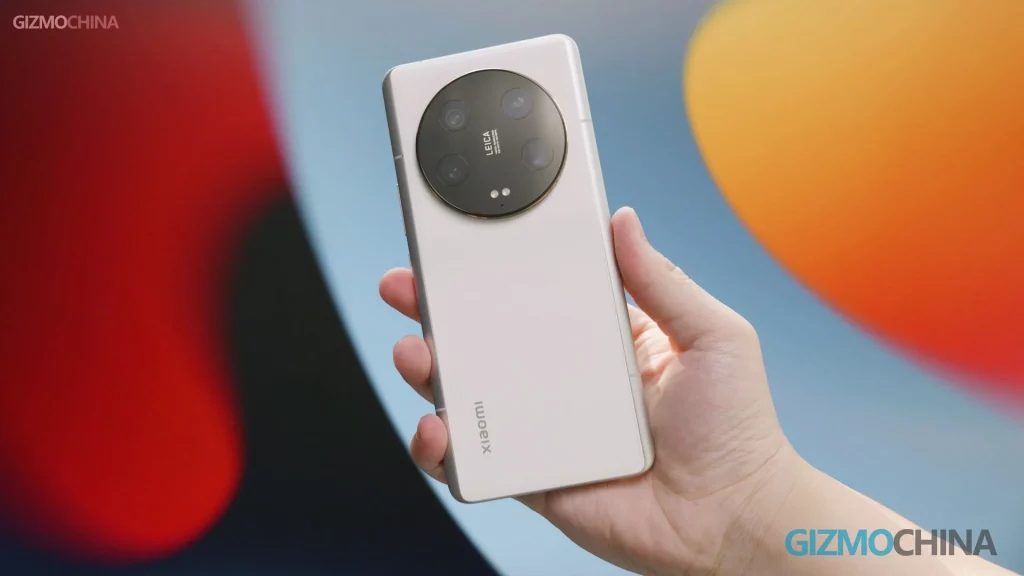
Xiaomi 13 Ultra

In a recent Weibo post, tipster DCS said a device dubbed Venti, which appears to be a codename, is equipped with a 5,180mAh battery. He also added that the device will arrive with support for 90W wired charging and 50W wireless charging.

While the leaker has not mentioned the name of the device explicitly, it is speculated that he could be talking about the Xiaomi 14 Ultra. In comparison, the Xiaomi 13 Ultra packs a 5,000mAh battery and comes with 90W wired and 50W wireless charging capabilities.

A recent leak by the same tipster revealed that it will arrive with four 50-megapixel cameras on the back. The main sensor, which is said to be the 1-inch Sony LYT-900 camera, is expected to support an f/1.6 – f/4.0 variable aperture. It is also said to offer native focal lengths of 0.5x, 1x, 3.2x, and 5x.

Like the Xiaomi 14 and 14 Pro, the Xiaomi 14 Ultra will arrive with the Snapdragon 8 Gen 3 onboard. It is also expected to run on HyperOS-based Android 14. It is speculated that the Xiaomi device with the 24030PN60G, which was approved by the EEC authority in October, could be the Xiaomi 14 Ultra.

The Xiaomi 14 Ultra is expected to compete with the likes of the Samsung Galaxy S24 Ultra, the Oppo Find X7 Pro, and the Vivo X100 Pro+ (or Ultra) in the Chinese market.

RELATED:

(source)

Realme GT 5 Pro to get three Android upgrades, arriving with USB 3.2, Realme UI 5, AI model

One of the major announcements this week will be the Realme GT 5 Pro in the Chinese market. The company has been consistently rolling out new teasers to reveal the key features of the device. Here is a look at the new details of the GT 5 Pro that have been officially confirmed.

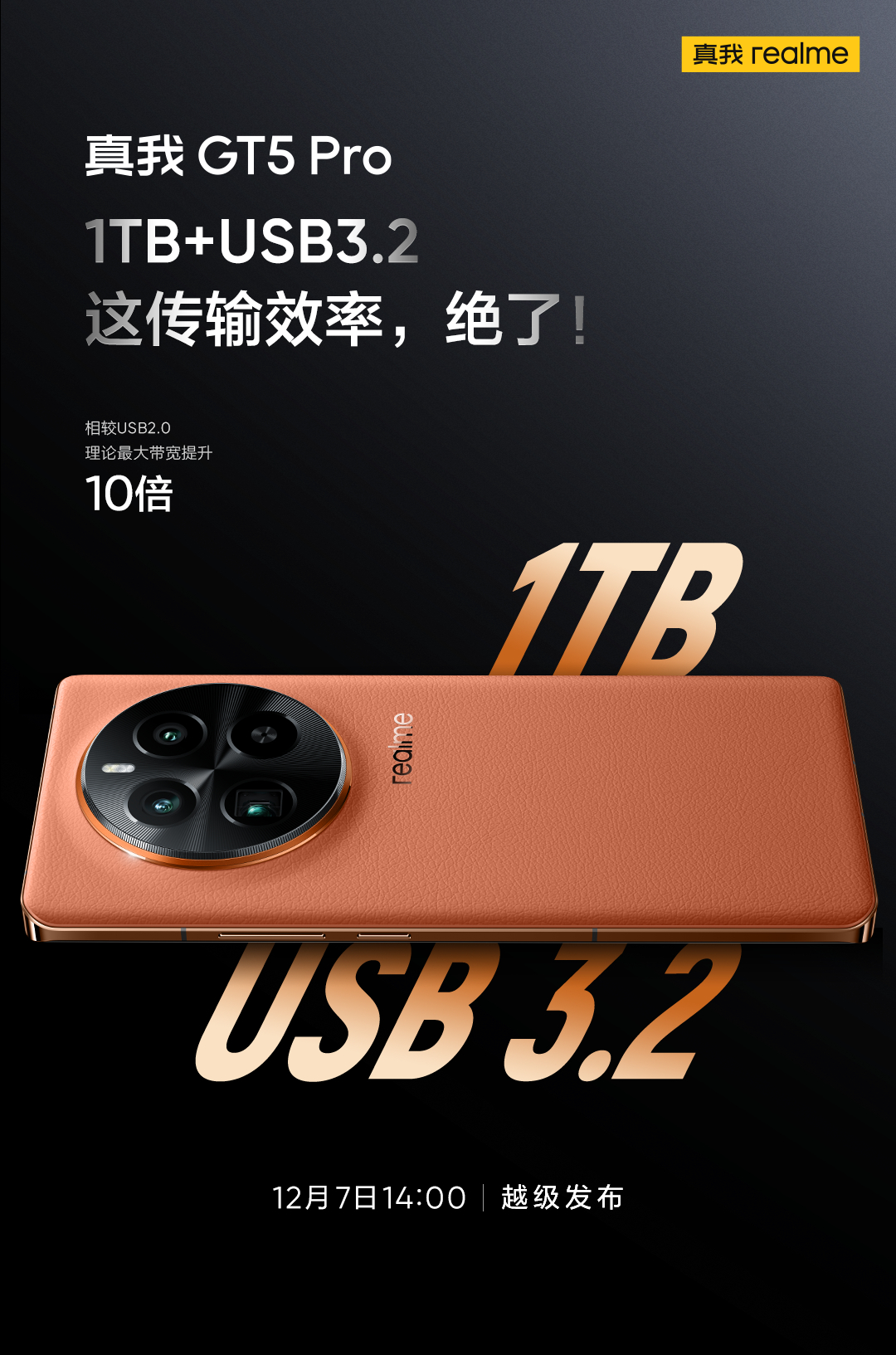
Realme has confirmed that the Realme GT 5Pro’s topmost variant will come equipped with 1 TB of storage. The first poster also states that the GT 5 Pro will have a USB-C with support for the USB 3.2 standard, meaning it will offer faster data transfer speeds of up to 10 GB/s than USB 2.0, which supports up to 480 Mbps.

In addition, the Realme GT 5 Pro will be the company’s first phone to run on Android 14 and Realme UI 5.0. It is promised to receive three Android OS upgrades and four years of security updates. The company also revealed that the GT 5 Pro will come with a significant AI upgrade. It will have an AI super assistant onboard that has support for intelligent speech generation and leverages an AI model with 7 billion parameters.

Realme GT 5 Pro specifications

As per reports, the Realme GT 5 Pro will arrive with a 6.78-inch curved-edge OLED display that offers a 1.5K resolution, a 144Hz refresh rate, up to 4,500 nits of brightness, and an in-screen fingerprint sensor. The Snapdragon 8 Gen 3-powered device will be equipped with LPDDR5x RAM, UFS 4.0 storage, and a 5,400mAh battery with 100W wired charging and 50W wireless charging.

The GT 5 Pro will have a 32-megapixel front-facing camera. Its rear camera setup has a 50-megapixel LYT-808 primary camera with OIS support, an 8-megapixel ultra-wide lens, and a 50-megapixel periscope telephoto camera with 3x optical zoom. It is likely to arrive with a starting price of 3,499 Yuan (~$499).

RELATED:

OnePlus 12 RAM, storage variants revealed via real-life images

On Tuesday, OnePlus is set to unveil the much-anticipated OnePlus 12. The company has already revealed the smartphone’s design and essential specifications. Additionally, President Li Jie has recently shared new images showcasing the device in real-world scenarios. At the same time, Weibo users have shared live shots of the phone. Notably, one of these images has disclosed details about the RAM and storage variants of the device.

OnePlus 12 variants

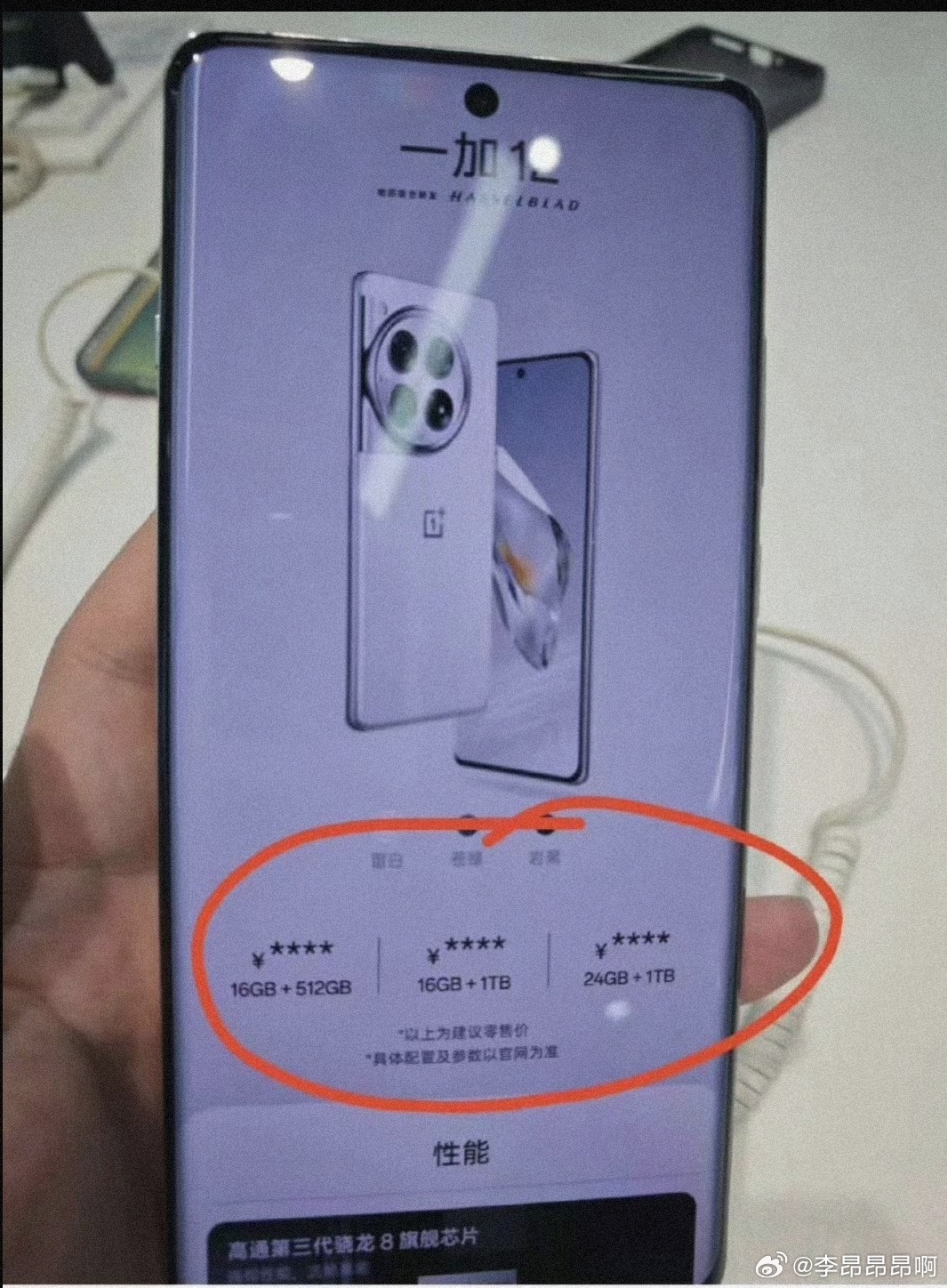
The OnePlus 12 images that are being circulated on Weibo show that it will arrive in three options: 16GB RAM + 512 GB storage, 16 GB RAM + 1 TB storage, and 24 GB RAM + 1 TB storage. As the company previously confirmed, it will be available in three colors, black, white, and green.

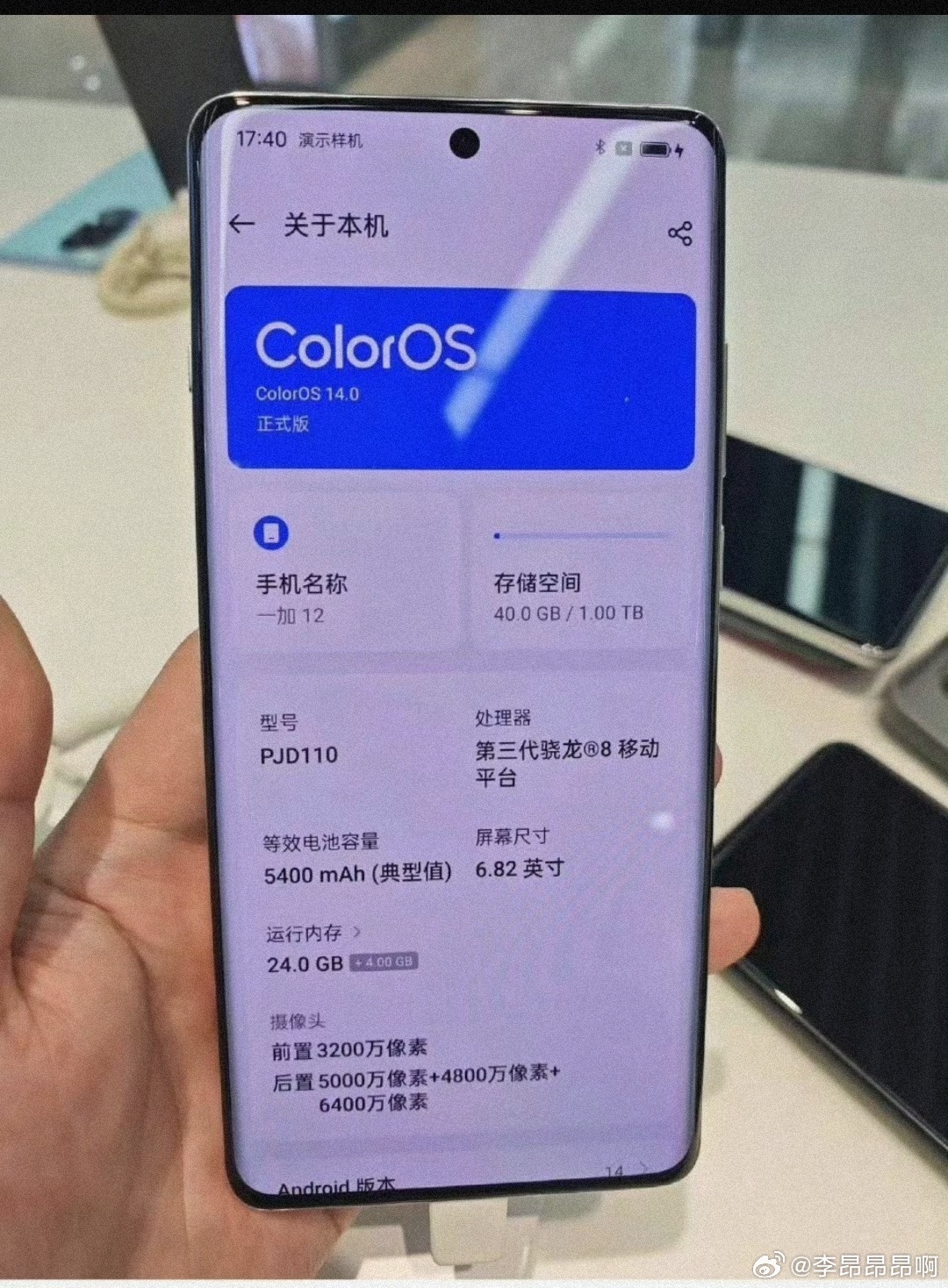
The About Phone image of the device confirms that it has a 6.82-inch display, a Snapdragon 8 Gen 3 chip, 24 GB of RAM, 1 TB of storage, a 32-megapixel front camera, a 50-megapixel + 48-megapixel + 64-megapixel triple camera unit, and ColorOS 14. It also mentions the model number of the device as PJD110.

OnePlus 12 design

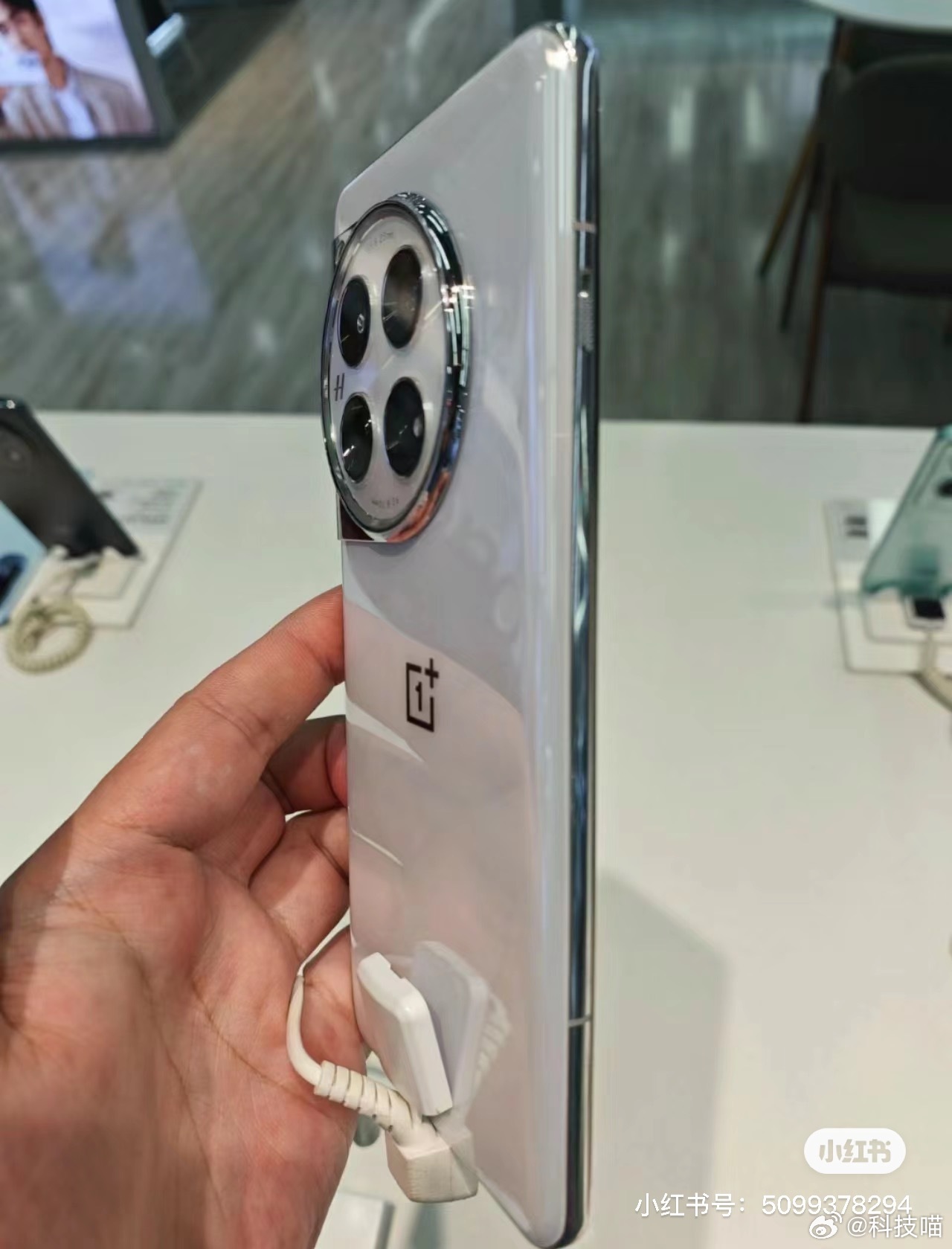
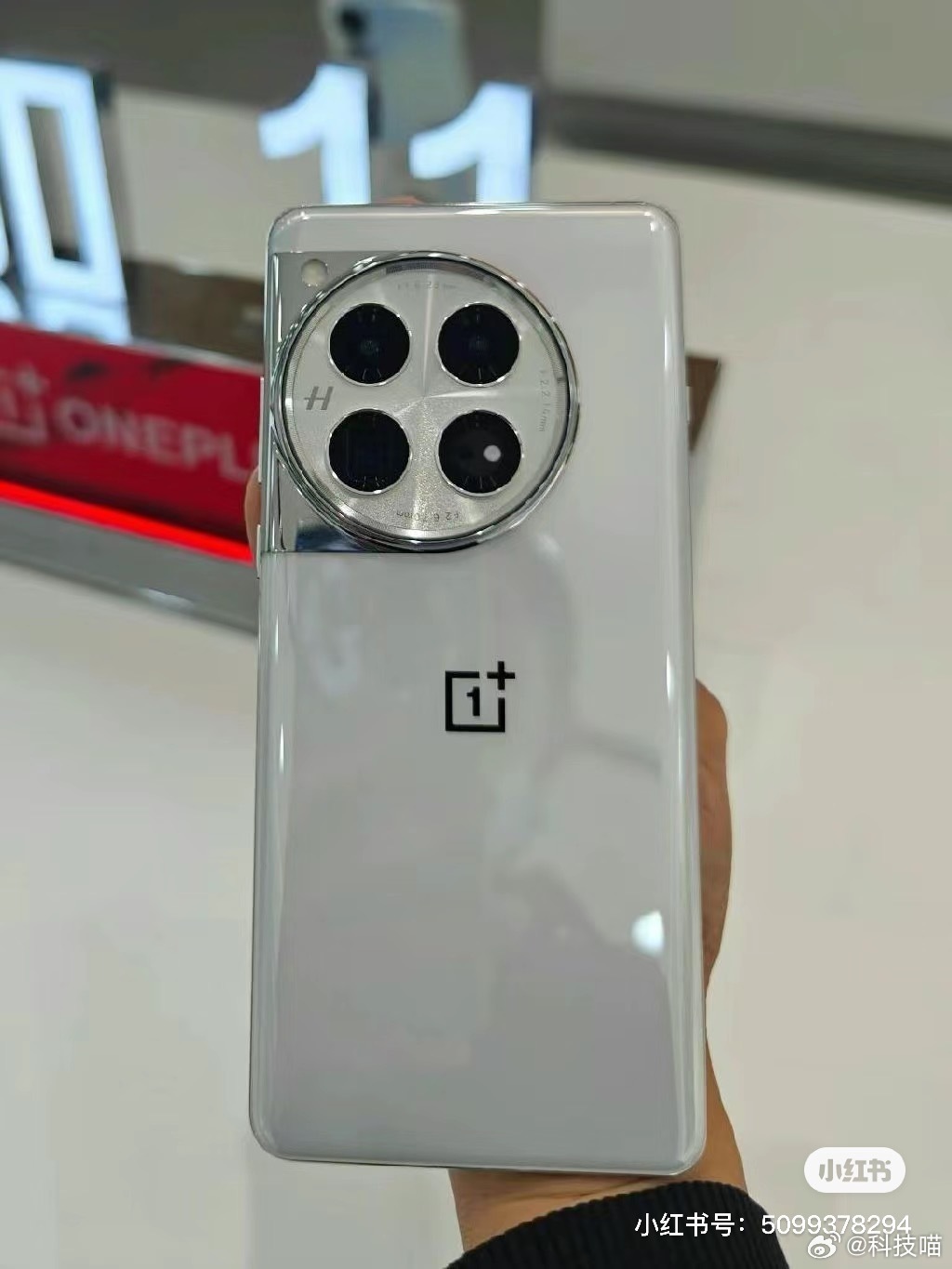
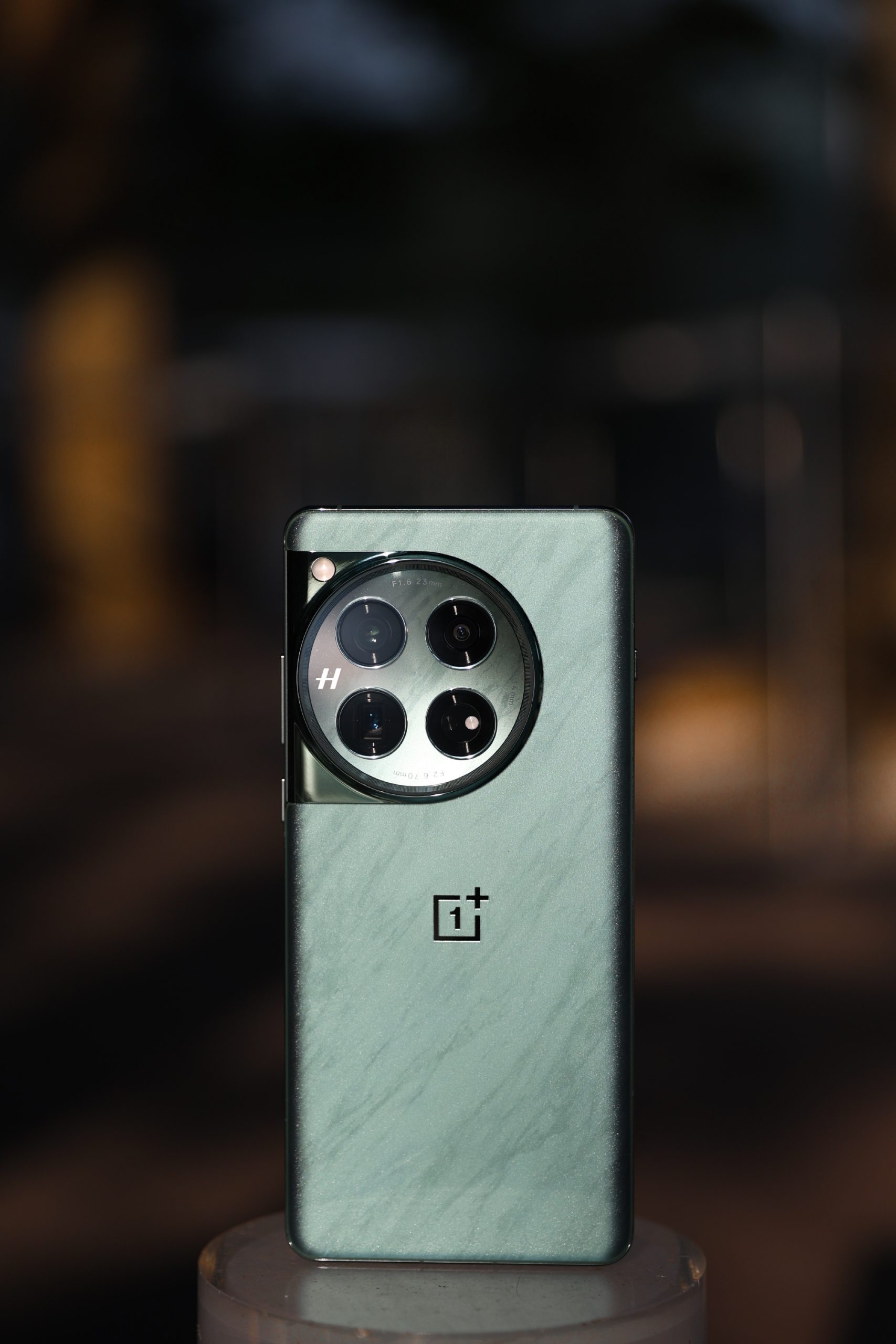
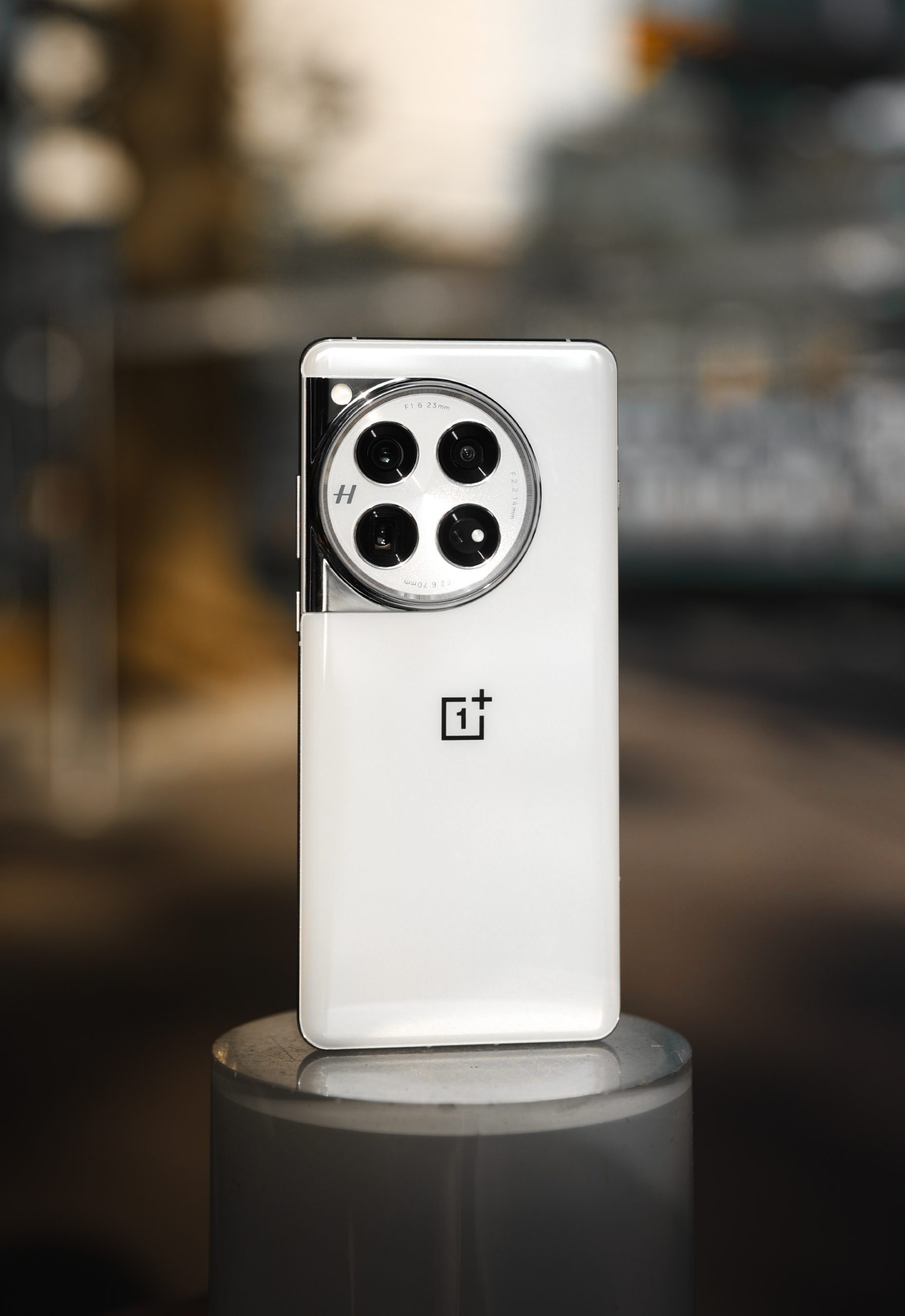
The new images offer a good view of the design for both the white and green versions of the OnePlus 12. The OP12 looks quite similar to the OnePlus 11 from last year, but there are some noticeable differences.

On the back, the camera module and LED flash have shifted down slightly. The camera island features an “H” logo for Hasselblad instead of the entire branding, includes a periscope telephoto camera for the first time, and the LED flash has been moved out of the module. On the front, the device has a display with slimmer bezels and a repositioned punch-hole that is now cantered. Additionally, it has slimmer bezels and a wider aspect ratio. Other changes include an IR blaster on the top, and the alert slider has been moved from the right to the left side.

RELATED:

(source 1, 2, 3 | via)

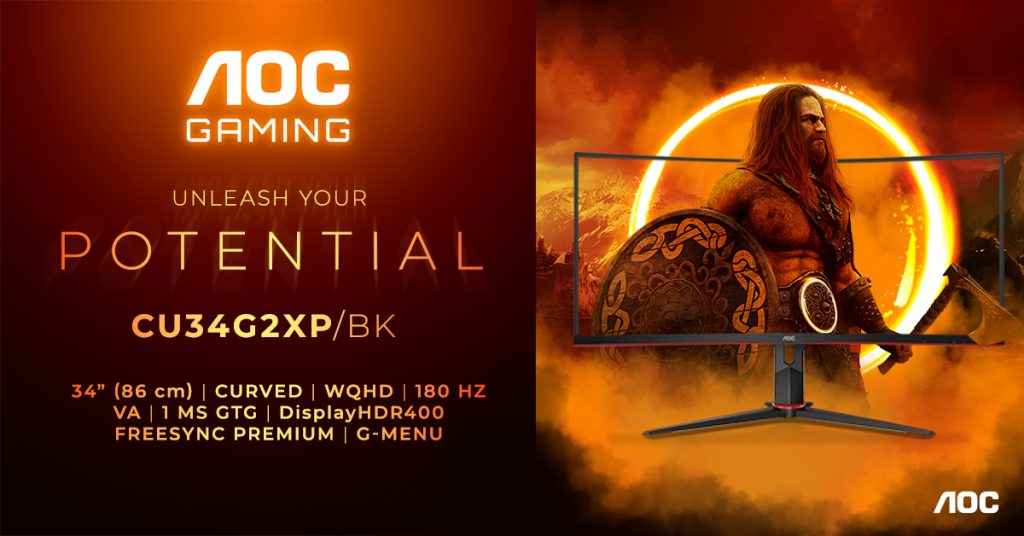
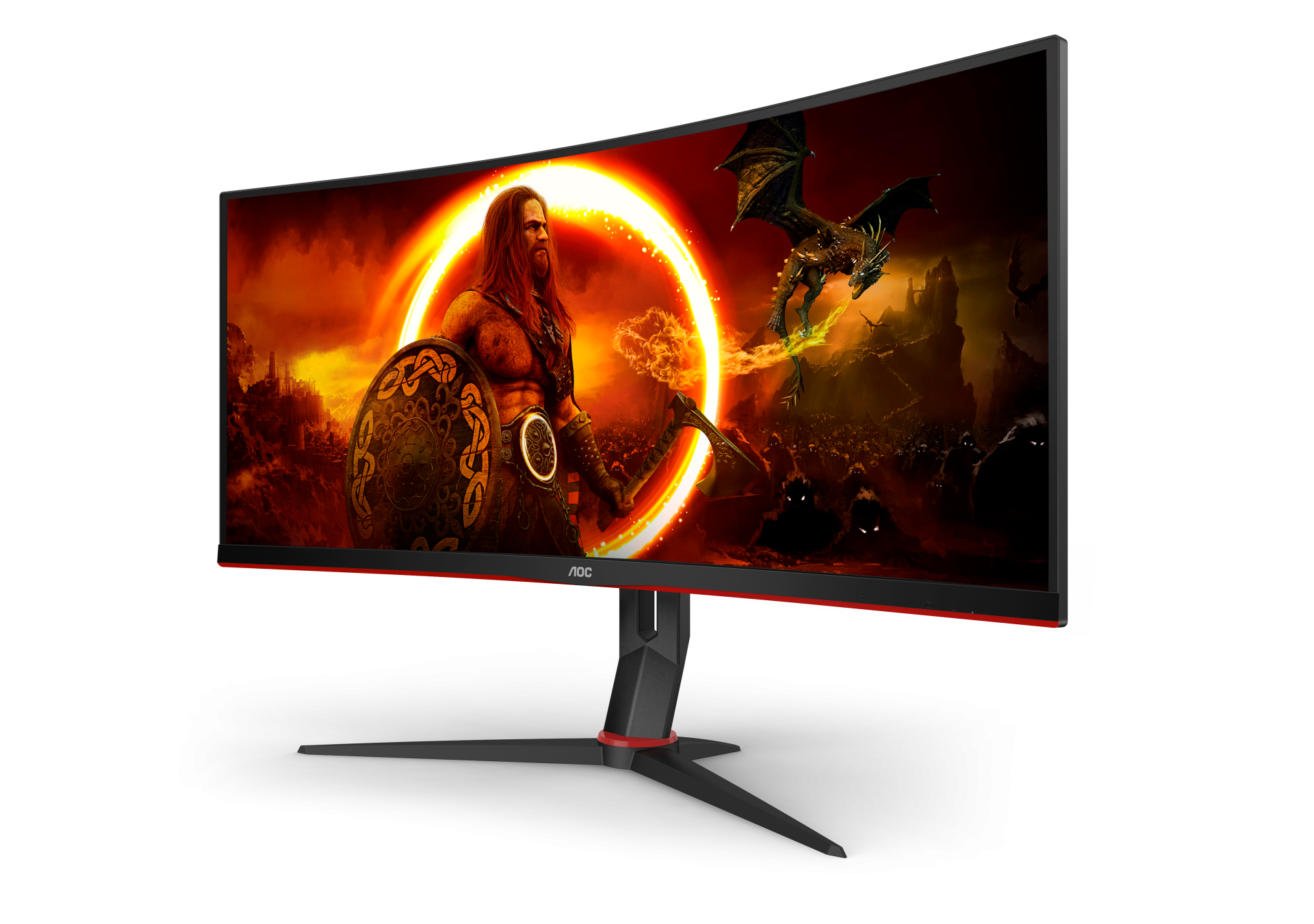
AOC Gaming CU34G2XP/BK 34″ curved monitor with WQHD 180Hz panel launched

AOC recently unveiled the Q27G3ZN gaming monitor featuring a 27″ panel QHD resolution and 260Hz refresh rate. The brand has now unveiled the AOC Gaming CU34G2XP/BK, a 34-inch curved gaming monitor with a high-resolution, high refresh rate panel.

AOC Gaming CU34G2XP/BK

AOC Gaming CU34G2XP/BK monitor specs:

The AOC Gaming CU34G2XP/BK is a 34-inch curved gaming monitor with a curvature radius of 1500R. The display features an antiglare (AG) panel treatment to reduce reflections. With a resolution of 3440×1440, it boasts an aspect ratio of 21:9 and utilizes a VA panel type with WLED backlighting. The impressive 180 Hz refresh rate and 1 ms response time (GTG and MPRT) contribute to smooth and responsive gaming. The monitor supports Adaptive Sync for variable refresh rates and is Vesa Certified DisplayHDR 400 for high dynamic range.

It offers PiP+PbP multiview functionality, and the SmartImage feature enhances picture quality. The display has a static contrast ratio of 4000:1, a dynamic contrast ratio of 80M:1, and a wide viewing angle of 178/178 degrees. It supports 10-bit color, producing 1.073 billion colors. The monitor has 2W x 2 speakers, a Kensington lock, and a quick-release function. The ergonomic design includes tilt adjustment from -3.5° to 21.5°, a height adjustment of 130mm, and swivel functionality from -30° to 30°. Connectivity options include HDMI 2.0 x 2, DisplayPort 1.4 x 2, four USB downstream ports, and one audio output.

Price & availability

Priced at £339, the AOC Gaming CU34G2XP/BK is set to be available for purchase in mid-December 2023.

RELATED:

(Source, via)

SOONNOOZ SOON Mini PC with Intel and Ryzen CPU options, detachable speaker, and unique design unveiled

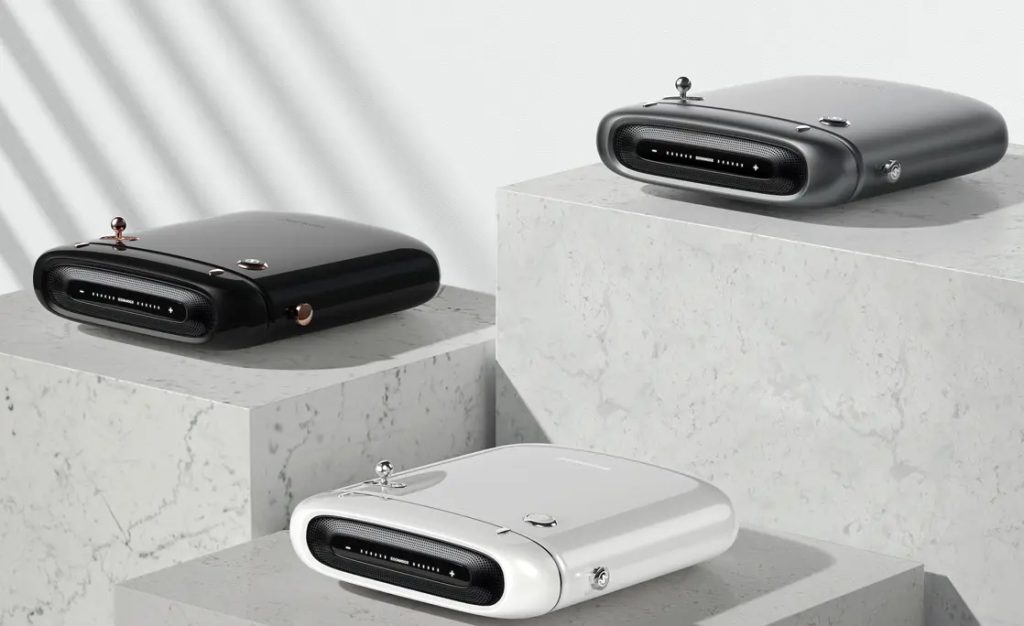
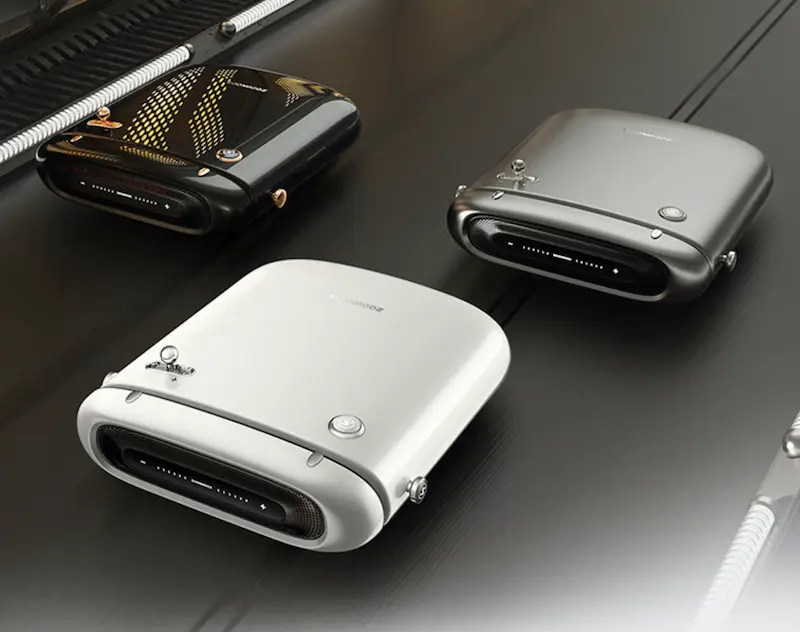
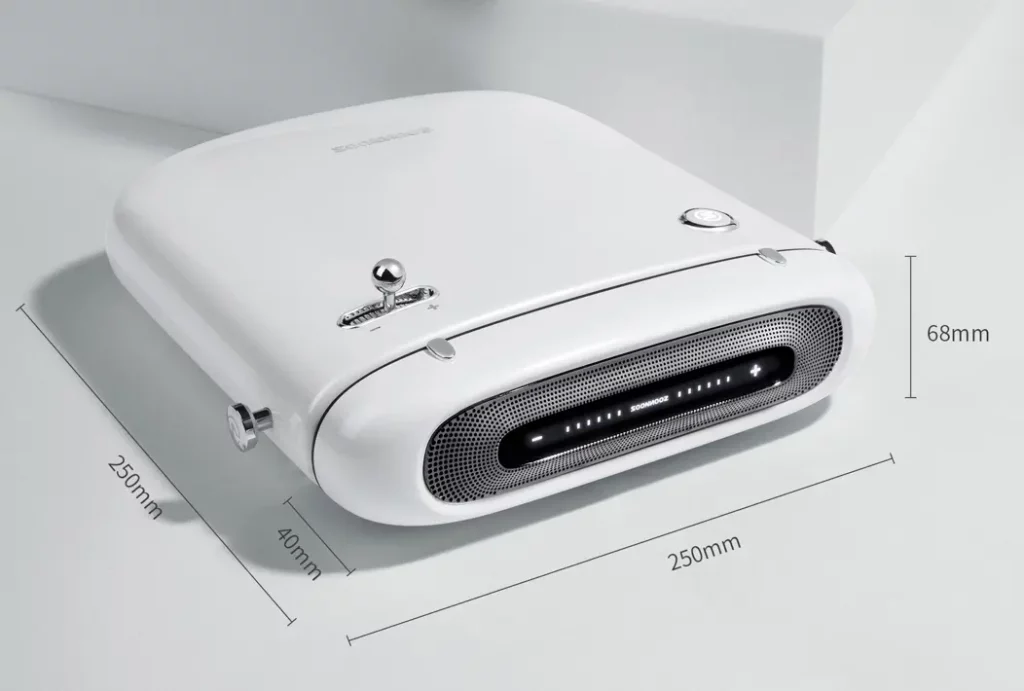
SOONNOOZ has announced the SOON Mini PC ahead of its release in the Chinese market. The SOON Mini PC is available in different Intel and Ryzen processor options and also features a detachable speaker setup. It sports a unique rounded design and can be carried using a shoulder strap.

SOONNOOZ SOON Mini PC

The SOON Mini PC is designed with rounded corners with a speaker grill on the front. It has a physical jog dial on the top and supports Bluetooth 5.2/ WiFi 6 connectivity. The new SOONNOOZ mini computer will be available with either Ryzen 7 7840HS, Ryzen 7 7735HS, or Intel N100 CPUs. There are two SODIMM slots for the Ryzen 7-based models for DDR5 memory. The mini computer is also equipped with a 2.5-inch SATA drive and M.2 2280 PCIe SSD for storage.

SOONNOOZ SOON Mini PC

The SOONNOOZ SOON Mini’s detachable Bluetooth speaker is one of the highlights of its unique design. It looks like an audio device with its jog dial and rounded corners. The upcoming SOONNOOZ mini PC has a 3.5mm audio jack, HDMI 2.0, USB 3.0 Type-A, and USB 3.1 Type-C ports. The SOON Mini with Intel N1000 CPU is offered for 1,499 yuan (~ $213). The more powerful Ryzen 7 7840HS model’s price has not been released while the Ryzen 7 7735HS variant will retail for 2,499 yuan (~ $354).

SOONNOOZ SOON Mini PC

The full specs and other information about the upcoming SOONNOOZ SOON Mini PC will be released ahead of its China release. There are however no indications at this time whether the model will be available in overseas markets. It is however noted that SOONNOOZ has already established its global presence, with its models still selling on the global marketplace.

RELATED:

The U.S. is Trying to Balance EV Growth and the International Trade

As electric vehicles try to break through problems associated with technology and international trade, the U.S. government’s recent decision to temporarily allow the use of Chinese-sourced critical minerals in batteries for electric vehicles eligible for federal tax credits has sparked a mix of reactions. It’s a bittersweet one too, since it seems like the best outcome in the situation right now.

The country is now allowing EVs with Chinese minerals to be eligible for tax credits

This move, part of the broader Inflation Reduction Act (IRA) aimed at addressing climate change through a $360 billion investment in renewable energy, highlights the complexity of the global EV supply chain. While the IRA initially sought to limit reliance on Chinese components, the reality is that the EV industry remains deeply intertwined with China for essential minerals and parts.

China US

The updated guidelines enable 200,000 EV buyers per manufacturer to benefit from a $7,500 tax credit. Starting in 2024, these rules will apply to completed batteries and extend to the minerals used in their production by 2025. However, companies associated with North Korea, Iran, Russia, and China – labeled as “foreign entities of concern” – are subject to scrutiny under these regulations.

General Motors has welcomed this decision, seeing it as a way to maintain consumer incentives for their EVs, citing their investment in U.S. operations and efforts to create resilient supply chains. However, the implications for the broader industry remain uncertain, with only a fraction of the current EV models qualifying for the tax credit under the new rules.

This decision has also sparked political debate. Many U.S. lawmakers, particularly Republicans, have criticized the temporary exemption for Chinese minerals, viewing it as prioritizing EV interests over national concerns. This controversy underscores the broader geostrategic competition for control over critical mineral supply chains, a contest increasingly defined by the urgency of transitioning to renewable energy sources.

RELATED:

(Via)

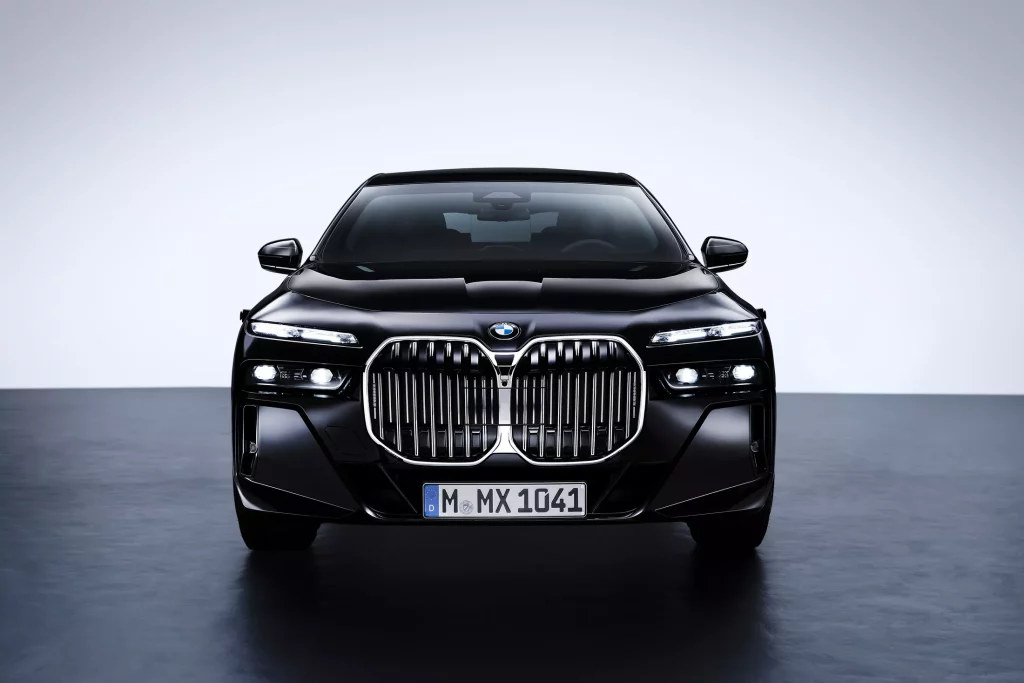
BMW M Division Rules Out ‘iM3’ Badge and Moves Towards an Electric Performance Future

BMW‘s M Division, renowned for its high-performance cars, has made it clear: there will be no ‘iM3’. Despite filing a trademark for the name ‘iM3’, which hinted at a fusion of BMW’s electric ‘i’ series and the performance-focused ‘M’ line, M boss Frank van Meel has firmly dismissed these speculations.

It seems that BMW wants to preserve the legacy of the M Badge

In an interview with Top Gear, van Meel emphasized the division’s philosophy, stating that the iconic ‘M’ badge will never blend with the ‘i’ of their electric series. “It’s a definite no,” he said. “For us, the ‘M’ represents a legacy of motorsports and emotion, not merely the type of drivetrain.” This stance points towards BMW’s commitment to preserving the distinct identity of its M Division, where performance and heritage take center stage.

But this doesn’t mean BMW is stepping back from the electric vehicle (EV) race. The company already boasts four M-branded EVs, including the iX M60 and i4 M50. Furthermore, in 2022, BMW showcased a quad-motor performance prototype, resembling the classic 3 Series, on its Neue Klasse electric platform. This move signals BMW’s readiness to dive deeper into the high-performance EV market.

While the idea of an ‘iM3’ might be off the table, it’s clear BMW is steering towards a future where electric power and M-badge performance coexist, albeit under different names. The company’s commitment to developing performance EVs on the Neue Klasse platform remains unwavering, ensuring that the thrill of M Division cars will evolve with the times.

RELATED:

(Via)

Google Brings Useful Feature Additions to the WearOS

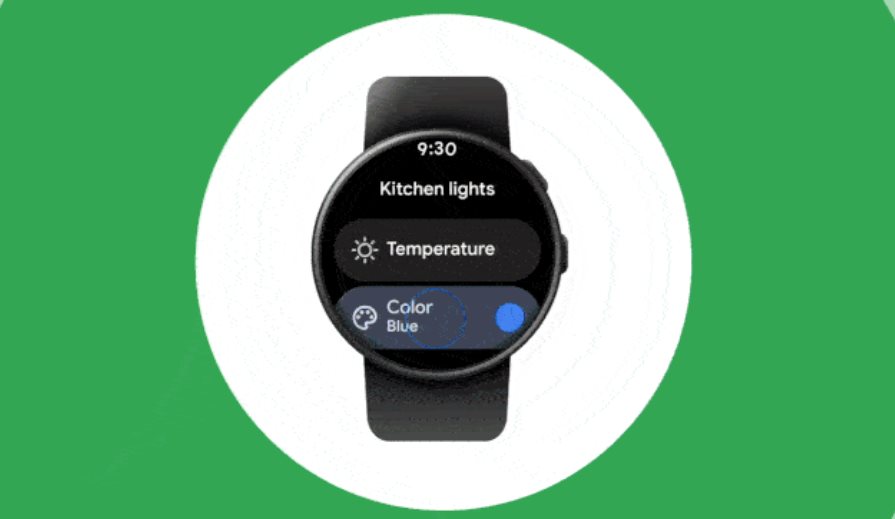
The search giant is here with some exciting new features for WearOS, Google Messages, and Google TV. All Android-based smartphones, Google TV devices, and WearOS-enabled wearables will benefit from these new features. Especially for WearOS devices, Gmail and Google Calendar apps are all getting new features. Further, users can set their Google Home status to Home or Away using WearOS smartwatches with the new update.

Must See: Samsung is Rolling out Wear OS 4 Update to the Galaxy Watch 5 & 5 Pro

In a bid to add Smart Home Control at your fingertips, the users can control and dock compatible smart appliances like vacuums and mops from smartwatches. The ability to start Assistant routines is another useful addition.

Among other changes, Google added 10+ new Free TV Channels for Google TV and added Emoji Kitchen Combinations. Further, all new Messages features are set to amaze the new generation and all new Home Controls on WearOS are like an icing on the cake. It has become ecstatic to control things around you from the wrist or with your voice, automation is becoming an integral part of our daily lives.

Below we have detailed new features on WearOS.

Recent Additions to the WearOS:

Wear OS Smart Home Controls:

  • Directly manage a variety of AI devices from WearOS watches.
  • Quickly build a suitable environment for various activities.

Wear OS Google Home Status:

  • Manage the status of Google Home (Home or Away) from the WearOS device.
  • Ensure smart home devices are in the appropriate state with a quick check.

Wear OS Assistant Routines:

  • Quickly initiate Assistant Routines via voice commands on the smartwatch.
  • Maximize the efficiency of daily tasks while you’re on the go.

These features represent a significant advancement for WearOS, offering users enhanced control and convenience in managing smart devices. As the integration of automation into daily lives continues, Google’s updates aim to make interactions with smart devices more intuitive and seamless.

In addition to 10 or more Free TV Channels for Google TV and Emoji Kitchen Combinations for Google Messages, this extensive update surpasses the capabilities of WearOS. Anticipate an enhanced and intelligent user experience forthcoming from Google TV, WearOS, and Google Messages.

Related:

(https://blog.google/products/android/new-android-features-november-2023/source)

Honor Tablet 9 appears on 3C certification with 35W charging

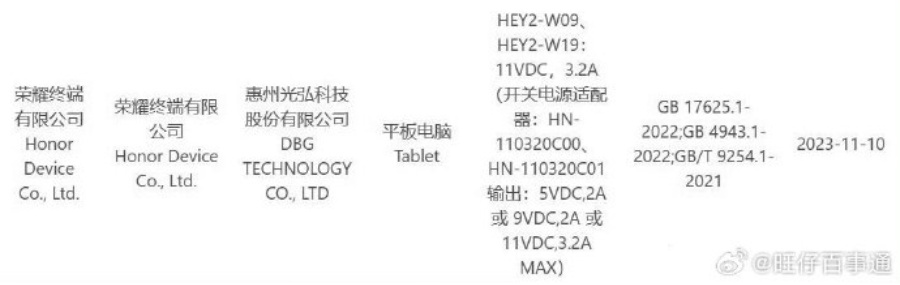
Honor is reportedly working on a new tablet, possibly the Honor Tablet 9. This information comes from China’s 3C certification database, where two versions of new Honor tablets have been listed with the model numbers HEY-W09 and W19. This is believed to be the Honor Tablet 9. 

Honor Tablet 9 3C certification

The certification confirms that both models will support 35W fast charging. While the listing doesn’t provide any other details, tipster Wangzhai on Weibo claims that the Honor Tablet 9 will be powered by the Snapdragon 6 Gen 1 processor.

This processor was announced in 2022 and is based on Qualcomm’s 4nm manufacturing process. It has a maximum clock speed of 2.2GHz and comes with Adreno 710 GPU.

Wangzhai also claims that the Honor Tablet 9 will have a large battery capacity, but he did not mention the exact size. The Honor Tablet 8, which was launched in July 2022, has a 7,250mAh battery.

Information regarding the Honor Tablet 9 is still limited. However, based on the 3C certification listings, we can expect the tablet to support 35W fast charging. This is a significant upgrade from the 22.5W fast charging that is supported by the Honor Tablet 8.

The Honor Tablet 8 also features a 12-inch 2K LCD screen with a 10:6 aspect ratio, over 1 billion colors, and a resolution of 2000 x 1200 pixels. It is powered by a Snapdragon 680 processor.

The Honor Tablet 8 was launched in July 2022, so a new model is overdue. We should learn more about the Honor Tablet 9 in the coming weeks.

Related:

(Source)

Google Messages Unveils Array of New Features with Latest Update

Google Messages recently rolled out several significant enhancements in a software update that extended the functionality of the messaging platform. To further improve the overall user experience, Google has incorporated eleven additional features into the Android operating system, which will roll out via respective app updates or Play System updates. Plenty of changes were already part of the Android 14 rollout, and the incremental updates via the Quarterly Releases further improve the overall Android experience.

Must See: Google Messages gains Ultra HDR Image support for RCS chats

Google Messages Brings Voice Moods, PhotoMoji and Much More

Google Messages adds several new changes and enhancements to elevate the overall user experience. Let’s discuss each in detail:

Voice Moods—Expression Enhancement:

Google Messages users can now exhibit a variety of emotions via Voice Moods, which adds expression to voice replies.

PhotoMoji Reactions:

PhotoMoji incorporates a creative element into messaging by enabling users to convert their preferred photographs into dynamic reactions through the utilization of on-device Google AI.

Screen effects:

The implementation of Screen Effects imparts messages with vivid animations, thereby enhancing the visual appeal through the conversion of text into dynamic visuals.

Custom Bubbles:

Custom Bubbles allows users to modify the conversation background and colors, thereby facilitating a customized messaging interface that is both personalized and aesthetically pleasing.

Reaction Effects: 

One may improve messaging with Reaction Effects, which introduce vibrancy and individuality into routine discussions.

Animated Emoji:

By incorporating an array of visual effects into each message, the Animated Emoji feature enhances the visual appeal of text-based communication.

Personalization Profiles:

By configuring the profile image and name linked to their phone number, individuals can now impart a unique personal identity to their messaging persona for other users. 

Google Messages users can anticipate major enhancements to the messaging experience with the introduction of these innovative features, which continue Google’s dedication to progress within the Android ecosystem.

Related:

(source)

Nothing Phone (2a) spotted on BIS certification site

The Nothing Phone (2a) has been spotted on the BIS certification site, which suggests that it could be launched soon. The device is expected to be a more affordable version of the Nothing Phone (2).

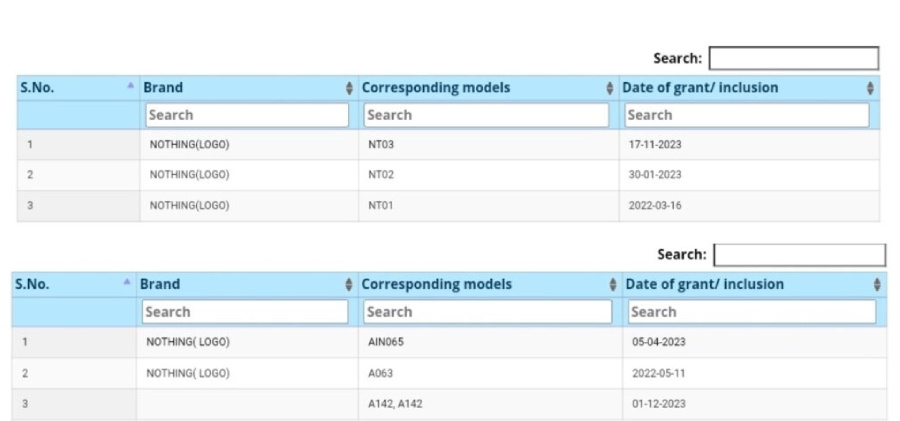
The BIS certification site lists the model number of the device as A142. This model number is different from the AIN142 model number that was leaked earlier this week. However, it is possible that the two model numbers represent different regional variants of the same device.

The BIS certification also reveals that the Nothing Phone (2a) will have a different battery than the Nothing Phone (2). The model number of the battery is NT03.

Rumors suggest that the Nothing Phone (2a) will retain the Glyph Interface on its back panel, a signature design element of the Nothing Phone (2). The phone is also expected to be equipped with a 6.7-inch AMOLED display with a center-aligned selfie camera. However, it is speculated that the display might not be an LTPO panel like the one found on the Nothing Phone (2).

Given its positioning as a more affordable alternative, the Nothing Phone (2a) is likely to feature a mid-range Snapdragon or MediaTek Dimensity processor. The phone’s battery capacity and pricing details remain unclear at this point.

It is still unclear when the Nothing Phone (2a) will be launched. However, the fact that it has been spotted on the BIS certification site suggests that it could be launched sooner rather than later.

Related:

(Via)

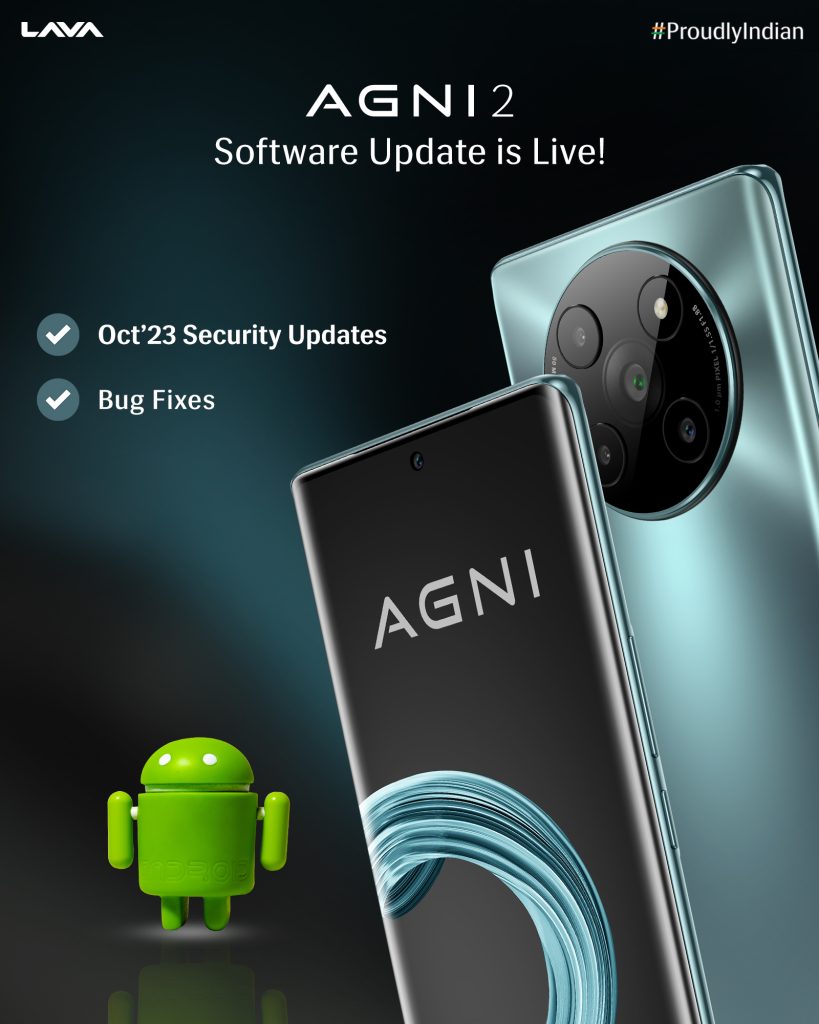
Lava Agni 2 5G gets the October security patch & bug fixes in a new update

After updating the Blaze 5G and Yuva 2 smartphones last week, Lava has now started pushing a new update for its most popular 5G smartphone, aka the Lava Agni 2.

Lava has officially announced the release of the latest security update for the Lava Agni 2 smartphone, aimed at enhancing the overall security of the device. This update incorporates the October 2023 security patch, addressing potential vulnerabilities and fortifying the device against security threats. It is crucial to update to this latest version as Google has fixed a total of 53 vulnerabilities with the October patch, two of which were actively being exploited.

Lava Agni 2 update

Additionally, the update includes fixes for certain bugs, contributing to an improved and more stable user experience. To ensure that your Lava Agni 2 is equipped with the latest security enhancements, you can easily initiate the update process by navigating to the Settings menu, followed by System, Advance, and finally, System Update. Keep your device up to date to benefit from the latest security measures and performance improvements.

Lava Agni 2 5G specs:

The Agni 2 5G sports a 6.78-inch Full HD+ AMOLED display with a 120Hz refresh rate, HDR10+, and a 105% NTSC color gamut. It is powered by the MediaTek Dimensity 7050 processor and runs on Android 13. Camera-wise, it features a 50MP quad-camera setup on the rear and a 16MP front camera. Connectivity options include 5G support, in-display fingerprint sensing, and a 66W fast-charging battery via the USB-C port.

In related news, Lava is said to be working on a new smartphone called the Lava Agni 2S. This device will offer similar specifications to the Agni 2 5G, however, it will have a different processor.

RELATED:

(Source)

Samsung Galaxy A55 Emerges In Leakead Renders Revealing Design From All Angles

Samsung is expected to launch its next-generation Galaxy A-series smartphones next year. So far, we have already gotten a look at the Galaxy A35 5G, Galaxy A15, and the Galaxy A25 5G in the form of leaked renders. Now, the Samsung Galaxy A55 has also surfaced in CAD-based leaked renders revealing its design from all angles. The device is expected to arrive as the successor to the Galaxy A54 that was announced in March this year. 

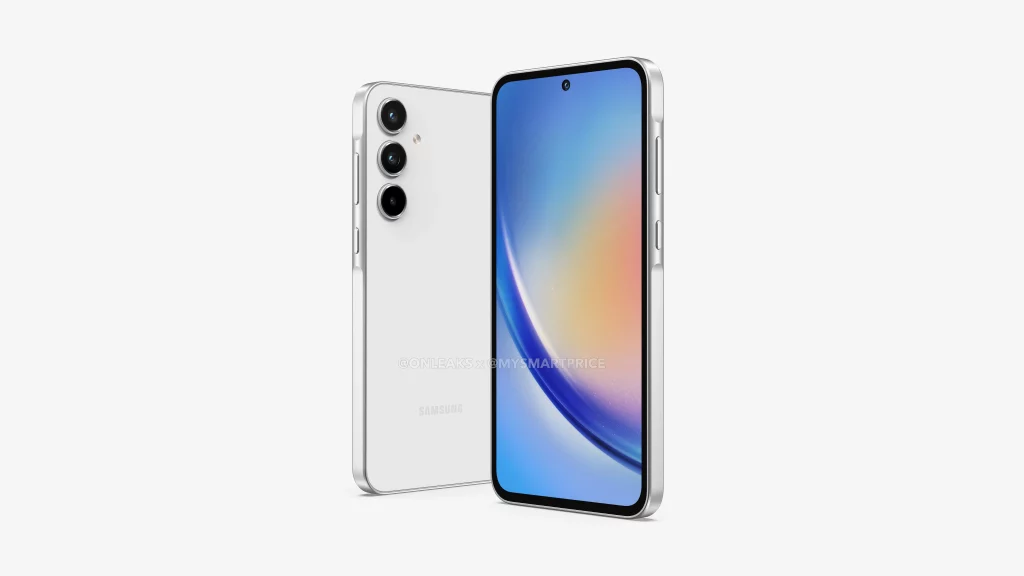
Samsung Galaxy A55 emerges in leaked renders

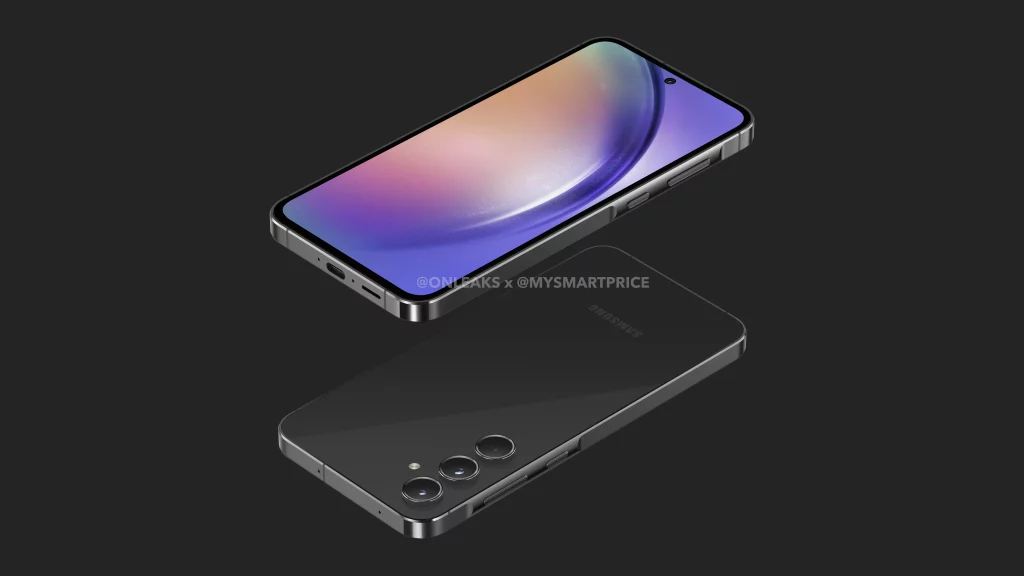
Right off the bat, the Samsung Galaxy A55 is seen with a boxy form factor. We can notice a protrusion on the right frame where the power and volume rocker buttons are located. It’s safe to say that the South Korean brand is making this design mainstream on the upcoming Galaxy A phones as it has also been spotted on the Galaxy A35 and A15. The back panel of the device has three vertically stacked triple rear cameras. 

The bottom port of the Samsung Galaxy A55  has a USB-C port and a speaker grille. There is a SIM card tray on the top edge. The renders do not reveal a 3.5mm jack. On the front, the smartphone has a centre-aligned punch-hole cutout display measuring 6.5 inches. The screen is surrounded by thin bezels. Dimension-wise, the Galaxy A55 will measure 161.1 x 77.3 / 77.9 x 8.2mm. The Galaxy A55 is seen in a Black color option. 

A report from earlier today revealed that the Samsung Galaxy A55 as well as the A35 will boast a metal unibody replacing the plastic ones from their predecessors. This will give both phones a premium look. Past reports suggest that the Galaxy A55 will be powered by the unannounced Exynos 1480 processor with support for AMD GPU. The 3C certification of the device revealed support for 25W fast charging.

Related:

Source

Poco X6 run Geekbench with Snapdragon 7s Gen 2

The Poco X6 series is expected to launch soon, with at least two phones in the lineup: the Poco X6 and the Poco X6 Pro. The phones have already been spotted on multiple certification websites, suggesting that a launch is imminent. The Poco X6 has now been listed on Geekbench, revealing some of its key specifications.

Poco X6 Geekbench listing

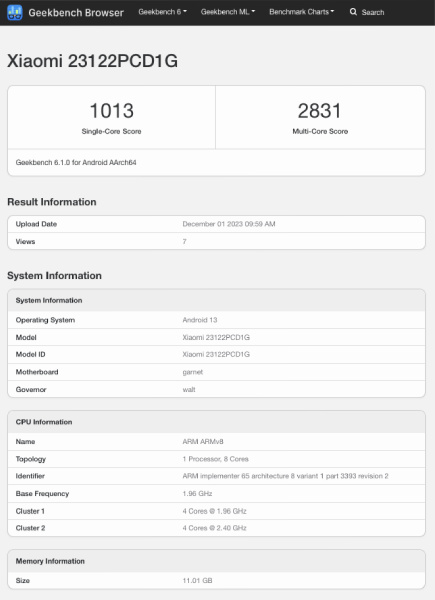
The Geekbench listing reveals that the Poco X6 scored 1013 in the single-core test and 2865 in the multi-core test. It also confirms that the phone will be powered by an octa-core processor with a maximum CPU clock speed of 2.40GHz. 

This is most likely the Snapdragon 7s Gen 2 chipset. The chipset is paired with Adreno TM 710 GPU. Additionally, the phone is running on Android 13 OS and packs 12GB of RAM.

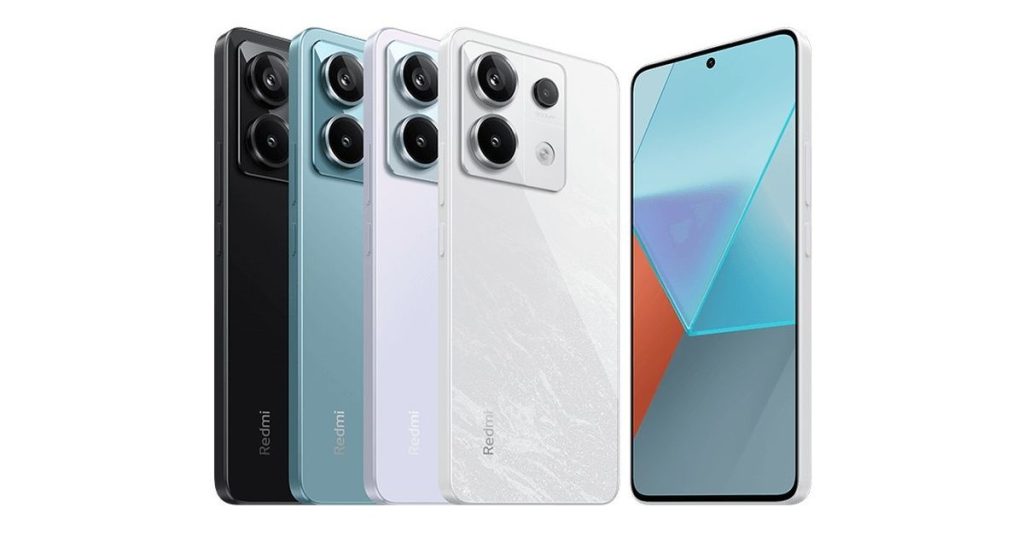
Interestingly, the smartphone’s codename, “Garnet,” is the same as the Redmi Note 13 Pro, further fueling the notion that the Poco X6 could be a rebranded version of the Redmi Note 13 Pro (China).

 If that’s the case, the smartphone will have a 6.67-inch OLED panel with a 1.5K resolution of 1220 x 2712 pixels resolution and a 120Hz refresh rate.

Redmi Note 13 Pro

The Poco X6 will likely have a triple camera system on the back, with a 200-megapixel (main, with OIS) + 8-megapixel (ultra-wide) + 2-megapixel (macro) setup. There could also be a 16-megapixel front camera. 

However, rumors suggest that the global model could have a 64-megapixel primary camera instead of the 200-megapixel sensor. Likewise, the phone will likely have a 5,100mAh battery with 67W fast charging.

The exact specifications and launch date of the Poco X6 series have not yet been announced by the company, but we expect to learn more soon.

Related:

(Source)

Oppo Find X7 Pro camera shown in leaked teaser image

Oppo is preparing to unveil its next flagship smartphone, the Find X7 Pro. Rumors about the device have been circulating for some time, and now a recent leak has revealed a teaser image showcasing the phone’s camera module.

While the leaker didn’t explicitly state that the image belongs to the Find X7 series, they alluded to it as Oppo’s upcoming flagship, leading us to believe it’s the Find X7 Pro. The teaser hints at a quad-camera setup and a continuation of Oppo’s partnership with Hasselblad for color calibration.

The leaked image suggests the Find X7 Pro will feature four camera sensors, one more than its predecessor, the Find X6 Pro. The presence of the Hasselblad logo indicates that Oppo will continue to collaborate with the renowned camera brand for color optimization.

Reports indicate that the Find X7 Pro’s rear camera setup will include an OIS-enabled 50-megapixel Sony LYT-900 primary camera, believed to be a modified version of the 1-inch Sony IMX989 sensor. It is likely to be accompanied by a 50-megapixel ultra-wide camera and two periscope telephoto cameras.

One periscope telephoto camera may employ a 50-megapixel IMX890 sensor with 2.7x optical zoom, while the other may utilize a 50-megapixel IMX858 sensor with 6x optical zoom.

While the device is expected to feature the Snapdragon 8 Gen 3 chipset, its other specifications remain undisclosed. The Find X7, the standard variant of the series, is expected to be powered by the Dimensity 9300 chipset.

The Oppo Find X7 series is anticipated to debut by the end of January or early February 2024. Stay tuned for more updates as they become available.

Related:

(Via)

Samsung Galaxy A55 and Galaxy A35 may get metal frames build

Samsung is set to give its Galaxy A55 and Galaxy A35 smartphones a premium makeover next year, with metal frames replacing the plastic ones used in previous models.

This is according to tipster Revegnus, who claims that the Galaxy A55 will feature a metallic frame, likely aluminum, while the Galaxy A35 will get the same upgrade. This is a pleasant surprise as no model in this lineup has ever featured a metallic frame.

In addition to the metal frame upgrade, the Galaxy A35 is also expected to get a design refresh. Renders of the phone have been leaked by tipster Onleaks, and they show a phone with a similar design to its predecessor. However, there are a few key changes, including a center-aligned punch-hole cutout on the front instead of a U-notch.

Leaked renders of the phone show a vertically stacked triple-camera setup with an LED flash on the rear. The phone is expected to measure 161.6 x 77.9 x 8.2 mm.

On the other hand, the Galaxy A55 is also expected to receive some internal upgrades. The phone has been reportedly spotted in testing with the unannounced Exynos 1480 chip. It is rumored that the Exynos 1480 will be supported by an AMD graphics unit.

Samsung is expected to launch the Galaxy S24 flagship lineup in January 2024. The Galaxy A35 and A55 are rumored to follow soon after. We’ll be sure to keep an eye out for more leaks and rumors about the Galaxy A35 and Galaxy A55 in the coming months.

Related:

(Via)

One UI Home v15.0.05.005 Crashing on One UI 6 Beta

Samsung is leaving no stone unturned by bringing the stable One UI 6 update to most compatible smartphones. Following the update on Galaxy S23, Galaxy A54, Galaxy S22, Galaxy Z Fold/Flip 5 Series, and other smartphones, the One UI 6 Open Beta program is still up for mid-range and low-end smartphones. The users on the beta build of One UI 6 are having some issues with the One UI Home Launcher.

Must See: One UI 6.0 Rollout Timeline revealed by Samsung official

Specifically, the One UI Home v15.05.005 is crashing on the One UI 6 Beta builds. As per the official thread on the Samsung Korea Community, “Users of the first beta version have recently released “One UI Home” If you download and install the app (Launcher 15.0.05.005), you will be unable to touch the home screen and run the app through the quick panel/edge panel.”

However, the officials suggest updating their devices to the official stable version of the One UI, as most smartphones have already received it. However, in the process, the users on the Beta build may need to update multiple times to get the official stable build of One UI 6.0.

One UI 6.0 Update Program and Features

The Samsung Galaxy Smartphones are receiving the One UI 6.0 update bundling several new features. The Korean giant pushed the One UI 6.0 update for Galaxy S23, Galaxy S22, Galaxy S21 in some countries, Galaxy Z Flip/Fold 5, and several other smartphones. It is even surfacing on the mid-range Galaxy A54 and Galaxy A34 5G smartphones.

Samsung One UI 6.0 improves user interaction via numerous changes. A modern emoji design lets users express themselves with new emoticons. Sharing is easier with picture and video previews in the Share panel and more options. Pop-up windows allow seamless transitions after leaving the Recents screen, boosting multitasking. A free-standing lock screen clock and streamlined app icon labels on the home screen provide users with more options. The latest weather upgrades include a widget, interactive map view, and improved visuals.

A redesigned widget, enhanced watermark alignment options, and rapid resolution settings improve camera performance. The update improves Calendar, Reminder, and Samsung Internet. Quick actions for apps in Finder search results, storage recommendations in My Files, smarter Airplane mode, an Auto Blocker to protect against unfamiliar programs, and configurable Bixby text call greetings are also available. New magnification and cursor thickness choices improve accessibility. Samsung One UI 6.0 improves both form and function.

Related: