Xiaomi has introduced a new smart air conditioner for global markets called the Mijia Air Conditioner GentleAir. Unveiled during the company’s Vienna launch event, the new model focuses on reducing the direct cold airflow that many users find uncomfortable with traditional AC units.
To achieve that, Xiaomi has equipped the GentleAir with redesigned air outlets featuring micro-hole flaps that spread airflow more evenly across the room. Rather than blowing a concentrated stream of cold air, the system is designed to create a softer and more diffused airflow pattern.
The air conditioner offers three airflow modes. Halo Flow circulates air around the room while minimizing direct drafts, Canopy Flow directs cool air from above for broader coverage, and Carpet Flow pushes warm air upward from near the floor when heating is enabled. Four-way swing support is also included.
Xiaomi says the unit can cool a room in as little as 30 seconds and provide heating in around 60 seconds under suitable conditions. A Turbo Mode is available as well for users who want maximum output.
On the efficiency side, the company claims its AI Energy Saving mode can reduce power consumption by up to 24.5%. The system adjusts operation based on environmental conditions and usage patterns collected over time, although actual results will vary slightly depending on factors such as room size, temperature, and installation conditions.
The GentleAir is available in four capacity options, including 2.6kW, 3.5kW, 5.2kW, and 7.0kW variants, allowing it to cover a range of room sizes.
Like most recent Xiaomi home appliances, the air conditioner connects to the Xiaomi Home app for remote controls, scheduling, and status monitoring. Google Assistant support is also available for voice commands.
Pricing starts at €569 in global markets. Availability has already begun through Xiaomi’s online stores and selected retail partners, though regional pricing and launch timelines may differ depending on the market.
Huawei has officially launched the Router X1 Pro Gaming Edition in China. The new router brings gaming-focused features, Wi-Fi 7+ connectivity, and smart home integration while retaining much of the hardware found in the standard Router X1 Pro.
The Huawei Router X1 Pro Gaming Edition is now available for pre-order at 666 yuan (~ $98).
Huawei Router X1 Pro Gaming Edition Specifications
The router supports Huawei’s Wi-Fi 7+ technology, which is designed to improve wall penetration, reduce latency, and enhance resistance to interference. Huawei says these improvements are made possible through weak-signal dual Wi-Fi acceleration and dynamic narrow-bandwidth technology.
It also supports Multi-Link Operation (MLO), a key Wi-Fi 7 feature that allows compatible devices to connect to both the 2.4 GHz and 5 GHz bands simultaneously. This helps deliver faster and more stable wireless connections for gaming and other bandwidth-intensive tasks.
In terms of design, the router features a cylindrical body and an 11-antenna array that provides 360-degree signal coverage. Powering the device is Huawei’s self-developed Lingxiao SoC, which includes an embedded CPU aimed at reducing network latency.
The router comes equipped with four 2.5G Ethernet ports, allowing users to connect gaming PCs, consoles, and other high-speed devices. Huawei says the ports are suitable for gigabit-class broadband connections and large file transfers.
The Router X1 Pro Gaming Edition also includes a built-in Star Flash gateway and supports Huawei’s HarmonyOS smart ecosystem. Running HarmonyOS 4, the router features Huawei’s Game Turbo engine and comes with a free 40-day NetEase UU Accelerator membership.
Huawei originally introduced the Router X1 Pro last year. The new gaming edition builds on the standard version, mostly with a new design.
For more daily updates, please visit our News Section.
If you’ve been keeping an eye on the headphone market lately, you’ve probably noticed the steady influx of open-ear earbuds. Baseus is adding to that list today with the global launch of the Bowie MC2, a pair of clip-on style earbuds that prioritize long-term wearability and high-res audio support at a relatively accessible price point.
Baseus Bowie MC2 Specifications
The earbuds come with a flexible titanium alloy bridge and a feature Baseus calls CloudComfort 2.0 to address the physical fatigue often caused by clip-on designs. Because clamping mechanisms can pinch after a few hours of wear, these earbuds use detachable silicone air cushions to distribute the pressure more evenly against your ear.
To help users find the right fit, the company includes three sizes of these cushions (medium, large, and extra-large) in the box. Each earbud weighs 5.1 grams, and the hardware carries an IP67 rating, meaning they are fully dustproof and can handle heavy sweat or rain.
On the audio side, the Bowie MC2 is equipped with 11mm dynamic drivers and supports the LDAC codec for higher-quality streaming on compatible devices. Open-ear designs inherently struggle with bass response because they don’t form a seal in your ear canal. Baseus says it is compensating for this by using directional vents to funnel audio directly into the ear, alongside built-in bass enhancement processing.
In terms of battery life, the earbuds are rated for up to 11.5 hours of continuous playback on a single charge. The charging case extends the total listening time to 55 hours, and a 10-minute quick charge provides an estimated three hours of battery.
For connectivity, the earbuds support Bluetooth 6.0 and include multipoint pairing, letting you connect to a phone and a computer simultaneously. They rely on a four-microphone setup for voice calls, using standard noise-reduction algorithms to filter out wind and background traffic. Baseus has also integrated a few AI-branded tools into its companion app, including voice note-taking and live translation across 135 languages.
The earbuds come in three color options: Cosmic Black, Stellar White, and Deepsea Blue.
Pricing and Availability
The Baseus Bowie MC2 are available starting today through Amazon in the US for $79.99, though Baseus is currently offering them at a discounted price of $59.99 on its official website. The European launch is scheduled for June 10, with pricing set at €89.99.
Baseus is also running a special launch promotion for Gizmochina readers. From June 1 through July 31, 2026, you can use the code MC2OWSPR on the Baseus Amazon Store to purchase the Bowie MC2 for a discounted price of $49.99.
In related news, Xiaomi recently launched its first clip-on earbuds with 11mm drivers, an IP57 rating and 38h battery life, while Honor introduced the Earbuds Clip-On Pro with LHDC 5.0, AI features, and up to 47 hours of playback.
For more daily updates, please visit our News Section.
Computex 2026 saw the arrival of two new handheld gaming consoles, the Acer Predator Atlas 8 and the MSI Claw EX AI+. The competition became even hotter when Asus announced the ROG Xbox Ally X20 at the same event. This is a limited-edition version launched to celebrate the 20th anniversary of the ROG brand.
The new model builds on previous Ally devices with a redesigned chassis, upgraded internals, and a refreshed display. Asus is also bundling the handheld with ROG Xreal R1 Edition 20 Gaming AR Glasses, making it one of the company’s most feature-packed portable gaming offerings to date.
ROG Xbox Ally X20 specifications and features
Asus ROG Xbox Ally X20
One of the biggest changes is the move to a 7.4-inch OLED panel, replacing the LCD screens seen on earlier Ally models. The display offers a Full HD resolution, a 120Hz refresh rate, a 0.2ms response time, and support for AMD FreeSync Premium Pro.
It is also VESA DisplayHDR 1000 certified, supports Dolby Vision, and can reach up to 1,400 nits of peak brightness in HDR mode. Protection comes from Gorilla Glass Victus and Gorilla Glass DXC coatings designed to reduce reflections.
Powering the handheld is AMD’s Ryzen AI Z2 Extreme processor with eight cores and 16 threads, paired with integrated Radeon graphics and an XDNA NPU capable of delivering up to 50 TOPS of AI performance. The device comes equipped with 24GB of LPDDR5X RAM and a 1TB PCIe 4.0 NVMe SSD. Asus has also redesigned the cooling system to better manage temperatures around the OLED display while maintaining performance during extended gaming sessions.
Asus ROG Xbox Ally X20 bundle
The ROG Xbox Ally X20 introduces several control enhancements, including a transformable D-pad that can switch between four-way and eight-way modes, TMR joysticks designed for greater precision, and redesigned face buttons.
Other features include Wi-Fi 6E, Bluetooth 5.4, dual USB Type-C ports, a microSD card slot, stereo speakers with Dolby Atmos support, and an 80Wh battery. The device runs Windows 11 Home and includes a dedicated Xbox mode along with support for Microsoft’s Auto Super Resolution technology.
ROG Xbox Ally X20 availability
The ROG Xbox Ally X20 handheld features a translucent black design with visible internal accents and a rubberized grip finish. Asus has confirmed that the device will be released later this year, although pricing details have not yet been announced. The retail package will also include three months of Xbox Game Pass Premium, depending on regional availability.
For more daily updates, please visit our News Section.
If you work from home, you probably know how annoying it is when the power flickers. Even if you have a home inverter, that split-second delay usually causes the Wi-Fi router to reboot, knocking you offline for a couple of minutes. Portronics recently released a device to fix this specific issue: the Kinetics 8K mini UPS.
Portronics Kinetics 8K Specifications
It’s basically a dedicated power bank for your router. Inside, it has an 8,000mAh battery capacity (utilizing two 4,000mAh EV-grade batteries), which Portronics says can keep a router running for about four to five hours. Of course, the actual time you get will depend on how much power your specific router uses, but it should be enough to get through a standard power cut. The main feature here is that it switches to battery power instantly when the electricity drops, so your router doesn’t restart and drop your connection.
The device itself is pretty simple. It’s a small, off-white box that sits next to your networking gear. Setup is just a matter of plugging your router’s power adapter into the UPS, and then connecting the UPS to the router. Portronics also added some ventilation holes to keep it from getting too hot if it runs for a long time, along with basic protections against overcharging and voltage drops.
While it’s meant for routers, it has a few different ports on the back to handle different setups. There are 12V, 9V, and 5V DC outputs, which means it can work with most standard routers and fiber modems. It also has standard USB-A and USB-C ports. They only output at 5V/2.1A, so they won’t fast-charge a modern smartphone, but they work fine if you just need to keep your phone or wireless earbuds from dying during a blackout.
Pricing and Availability
The Kinetics 8K has a listed MRP of Rs. 2,999, but it’s currently selling for a launch price of Rs. 1,699. It comes with a one-year warranty and is available on the Portronics website, Amazon, Flipkart, and in regular retail stores.
In related news, Portronics has recently introduced a compact tire inflator designed for cyclists and riders, alongside a new laptop stand that doubles as a 6-in-1 USB hub and mobile holder.
For more daily updates, please visit our News Section.
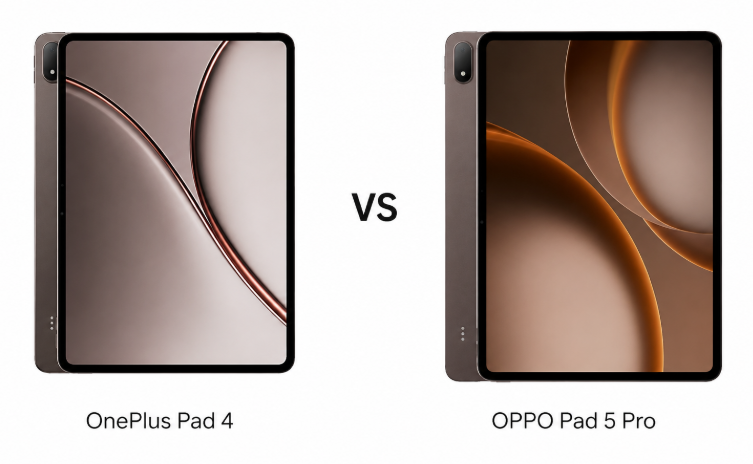
Large-screen Android tablets have become serious productivity and entertainment machines, and both the OnePlus Pad 4 and OPPO Pad 5 Pro target users who want flagship performance without stepping into laptop territory. While these tablets share the same Snapdragon 8 Elite Gen 5 chipset, several differences in display quality, charging speed, software experience, and ecosystem integration could influence your decision. Here’s a detailed comparison.
The OnePlus Pad 4 and OPPO Pad 5 Pro are almost identical in terms of physical design. Both feature slim 5.9mm bodies, weigh 672g, and use premium aluminum construction that feels solid and durable. The OnePlus model adds a glass front panel and retains stylus support, while OPPO includes both stylus and keyboard support as standard ecosystem features.
Despite their similarities, the OnePlus Pad 4 feels slightly more premium thanks to its cleaner OxygenOS-focused approach and refined finish. OPPO’s keyboard integration, however, may appeal more to productivity-focused buyers.
Display & Multimedia
Both tablets feature large 13.2-inch LCD panels with a 144Hz refresh rate and brightness levels reaching 1000 nits. However, the OnePlus Pad 4 gains a notable advantage with Dolby Vision support and a higher 2400 × 3392 resolution, delivering sharper visuals and better HDR content support.
Multimedia performance is excellent on both devices thanks to their eight-speaker audio systems, but OnePlus adds Hi-Res Audio certification, making movies and streaming content slightly more immersive.
Verdict
The hardware designs are nearly identical, but the OnePlus Pad 4 offers a superior display package thanks to its higher resolution, Dolby Vision support, and Hi-Res audio capabilities. For entertainment and content consumption, it holds a small but noticeable lead.
2. Performance and Software
Processor & UI Smoothness
Performance is effectively identical on both tablets. Each uses Qualcomm’s Snapdragon 8 Elite Gen 5 processor paired with the Adreno 840 GPU and UFS 4.1 storage. Everyday responsiveness, gaming performance, and heavy workloads are handled effortlessly.
High-refresh-rate displays combined with flagship silicon ensure smooth navigation and fast app launches. Whether editing videos, playing demanding games, or handling large documents, neither tablet struggles.
The main difference comes down to software preference. OnePlus ships OxygenOS 16, which is generally viewed as cleaner and less cluttered. OPPO’s ColorOS 16 offers more customization options and deeper feature integration for users already invested in OPPO products.
Productivity & Multitasking
Both tablets are well-suited for multitasking, offering large displays and flagship hardware. OPPO gains a slight edge with broader memory configurations, including a 16GB RAM variant, which may benefit power users running multiple apps simultaneously.
OnePlus counters with a more streamlined interface that often feels lighter during daily use.
Verdict
Raw performance is essentially tied. The decision comes down to software preference: OxygenOS feels cleaner and more focused, while ColorOS offers greater customization and an optional 16GB RAM configuration for demanding multitaskers.
3. Battery and Accessories
Battery Life
Battery capacity is identical at 13,380mAh, meaning both tablets are capable of lasting through long workdays, extended media sessions, and gaming marathons.
Efficiency should also be similar since both devices share the same processor and display size. Real-world endurance is expected to be excellent regardless of which tablet you choose.
The biggest difference appears when charging. The OnePlus Pad 4 supports 80W wired charging, while the OPPO Pad 5 Pro tops out at 67W. Although both recharge quickly, OnePlus users will spend slightly less time connected to a charger.
Stylus, Keyboard & Ecosystem
Both tablets support stylus accessories, making them useful for note-taking and creative work. OPPO places a stronger emphasis on productivity with official keyboard support and deeper integration within its ecosystem.
OnePlus benefits from its growing ecosystem but remains more focused on delivering a clean and straightforward tablet experience.
Verdict
Battery life is likely a draw, but the OnePlus Pad 4 wins on charging speed. OPPO earns points for productivity accessories and ecosystem features, making this section surprisingly close.
4. Camera & Media
Rear and Front Camera
Tablet cameras are rarely a buying priority, and these two devices prove that point. Both feature identical 13MP rear cameras and 8MP front-facing cameras.
For document scanning, video calls, and occasional photography, both perform adequately. Image quality should be very similar due to the matching hardware setup.
The front camera remains sufficient for online meetings, virtual classes, and casual video calls, while the rear camera is more useful for productivity tasks than serious photography.
Video & Audio Quality
Video recording capabilities are identical, with support for 4K recording at 30fps and gyro-EIS stabilization. Neither tablet offers a meaningful advantage in camera functionality.
Audio performance is more impressive. Both devices feature powerful eight-speaker systems capable of delivering loud and immersive sound. However, OnePlus gains a slight edge through Hi-Res Audio support and Dolby Vision-enhanced media playback.
For streaming services, movies, and gaming, OnePlus creates a slightly richer multimedia experience.
Verdict
Camera performance is effectively identical, but the OnePlus Pad 4 offers a marginally better media package thanks to Dolby Vision support and Hi-Res audio enhancements.
5. Pricing
The OnePlus Pad 4 is expected to cost approximately $700 (₹60,000), while the OPPO Pad 5 Pro is expected to launch around $650 (₹59,000).
For a relatively small price difference, buyers receive very similar hardware. OPPO offers more RAM options and productivity-focused features, while OnePlus provides a stronger display experience and faster charging.
Verdict
The OPPO Pad 5 Pro delivers slightly better value on paper thanks to its lower price and wider memory options. However, the OnePlus Pad 4 justifies its small premium through display upgrades, Dolby Vision support, and faster 80W charging.
6. Conclusion
OnePlus Pad 4
Higher-resolution display
Dolby Vision support
80W fast charging
Hi-Res Audio
Cleaner OxygenOS experience
OPPO Pad 5 Pro
Lower starting price
Up to 16GB RAM option
Strong keyboard ecosystem
More customization through ColorOS
Verdict
OnePlus Pad 4 is the better overall tablet for most buyers. Its sharper display, Dolby Vision support, faster charging, and cleaner software experience create a more polished flagship package.
OPPO Pad 5 Pro remains an excellent alternative for users who prioritize productivity accessories, higher RAM configurations, and slightly better value. However, for entertainment, everyday use, and long-term satisfaction, the OnePlus Pad 4 takes the win by a narrow margin.
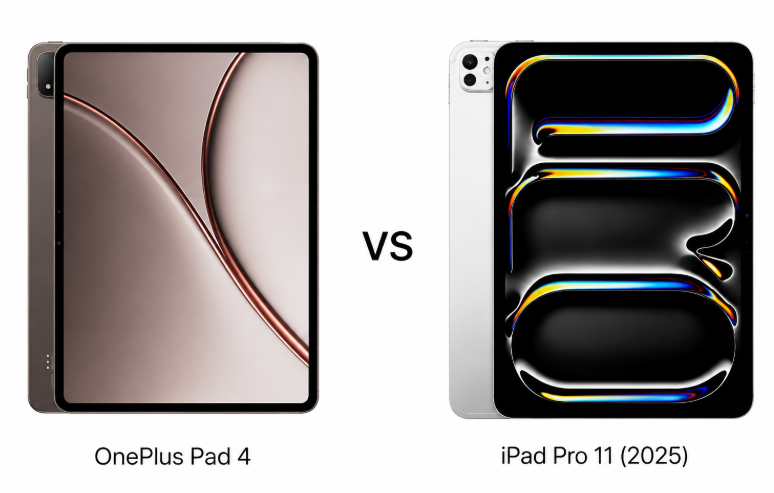
The premium tablet market is becoming more competitive, with OnePlus pushing into high-end territory while Apple continues to dominate the professional segment. The OnePlus Pad 4 focuses on delivering a massive display, flagship Snapdragon performance, and huge battery life at a lower price. Meanwhile, the iPad Pro 11 (2025) offers Apple’s latest M5 chip, a premium OLED display, and deep integration with the Apple ecosystem. Here’s how they compare.
Major Features:
Feature
OnePlus Pad 4
iPad Pro 11 (2025)
Winner
Design
Aluminum body, 5.9mm, 672g
Aluminum body, 5.3mm, 444g
iPad Pro 11 – Thinner and significantly lighter
Display Size
13.2-inch IPS LCD
11-inch Tandem OLED
OnePlus Pad 4 – Much larger workspace
Display Quality
144Hz, Dolby Vision, 1000 nits
Tandem OLED, 120Hz, HDR10, Dolby Vision, 1600 nits peak
iPad Pro 11 – Superior OLED visuals and HDR
Resolution
2400 × 3392 pixels
1668 × 2420 pixels
OnePlus Pad 4 – Higher resolution and sharper image
Refresh Rate
144Hz
120Hz
OnePlus Pad 4 – Smoother scrolling and gaming
Processor
Snapdragon 8 Elite Gen 5
Apple M5
iPad Pro 11 – Desktop-class performance
GPU Performance
Adreno 840
Apple 10-core GPU
iPad Pro 11 – Stronger graphics capabilities
RAM
8GB / 12GB
12GB / 16GB
iPad Pro 11 – More memory on higher-end models
Storage
256GB / 512GB
256GB / 512GB / 1TB / 2TB
iPad Pro 11 – More storage options
Software
Android 16, OxygenOS 16
iPadOS 26
iPad Pro 11 – Better tablet app ecosystem
Multitasking
Large screen Android multitasking
Stage Manager, pro apps
iPad Pro 11 – More polished productivity tools
Rear Camera
13MP
12MP + LiDAR
iPad Pro 11 – Better imaging system
Front Camera
8MP
12MP Ultrawide
iPad Pro 11 – Better video calling quality
Video Recording
Up to 4K 30fps
Up to 4K 60fps ProRes
iPad Pro 11 – More advanced video features
Speakers
8 Speakers
4 Speakers
OnePlus Pad 4 – More immersive audio setup
Battery Capacity
13,380mAh
8,160mAh
OnePlus Pad 4 – Much larger battery
Charging Speed
80W
50% in 30 min
OnePlus Pad 4 – Faster charging
Connectivity
USB-C 3.2, Wi-Fi 7
Thunderbolt 3, USB-C 4, Wi-Fi 7
iPad Pro 11 – Faster data and accessory support
Cellular Option
No
eSIM model available
iPad Pro 11 – Better mobility
Weight
672g
444g
iPad Pro 11 – Easier to carry
Price
~$700 / ₹60,000
~$1,000 / ₹100,000
OnePlus Pad 4 – Far better value
Disclaimer: Specs are based on available data. Actual performance may vary. Verify details from official sources before buying.
The OnePlus Pad 4 is built from aluminum with a glass front and feels every bit like a premium flagship tablet. However, its larger 13.2-inch form factor makes it noticeably bigger and heavier at 672g. It is designed more for desk use, productivity, and media consumption than for frequent handheld use.
Apple takes a different approach with the iPad Pro 11. Despite its premium aluminum construction, it remains incredibly thin at just 5.3mm and weighs only 444g. The compact size makes it easier to carry and more comfortable for extended handheld use. The availability of a cellular model with eSIM support also adds flexibility for professionals on the move.
Display & Multimedia
OnePlus counters with a huge 13.2-inch IPS LCD panel featuring a sharp 2400 × 3392 resolution, Dolby Vision support, and a fast 144Hz refresh rate. The larger canvas is excellent for multitasking, gaming, and video consumption, while the 8-speaker system delivers a more immersive audio experience.
Apple’s 11-inch Ultra Retina Tandem OLED display remains one of the best screens available on any tablet. It offers deeper blacks, superior HDR performance, up to 1600 nits peak brightness, and exceptional color accuracy. While the screen is smaller, the overall visual quality is clearly more premium.
Verdict
Users who prioritize screen size and cinematic entertainment will likely prefer the OnePlus Pad 4. However, Apple’s OLED panel, lighter design, and premium display technologies make the iPad Pro 11 the stronger overall display package.
Winner: iPad Pro 11 (2025)
2. Performance and Software
Processor & UI Smoothness
The OnePlus Pad 4 is powered by Qualcomm’s Snapdragon 8 Elite Gen 5 chipset paired with UFS 4.1 storage. Combined with OxygenOS 16 and Android 16, performance should be exceptional for gaming, multitasking, and demanding productivity workloads. The 144Hz display further enhances responsiveness throughout the interface.
Apple’s M5 chip operates on a different level. Derived from Apple’s desktop-class silicon, it delivers laptop-grade performance that few tablets can match. Whether editing 4K video, rendering graphics, or handling professional creative workloads, the M5 maintains a clear advantage. The higher-end variants with 16GB RAM further strengthen its position for power users.
Productivity & Multitasking
OnePlus has significantly improved multitasking features in OxygenOS, and the larger display naturally helps when working with multiple apps. Android’s flexibility also allows easier file management and customization.
The iPad Pro benefits from iPadOS 26, Stage Manager, and a mature ecosystem of professional applications. Creative professionals, designers, and video editors still have access to some of the most optimized tablet software available.
Verdict
The OnePlus Pad 4 delivers flagship Android performance and should satisfy nearly every user. However, Apple’s M5 chip and software ecosystem continue to set the benchmark for serious productivity and creative workloads.
Winner: iPad Pro 11 (2025)
3. Battery and Accessories
Battery Life
Battery capacity is one of the biggest strengths of the OnePlus Pad 4. Its massive 13,380mAh battery significantly exceeds the iPad Pro’s 8,160mAh cell and should provide excellent endurance for media consumption, gaming, and productivity sessions. The inclusion of 80W wired charging is another major advantage, allowing quick top-ups when needed.
Apple relies more on efficiency than battery size. Thanks to the M5 chipset and iPadOS optimization, battery life remains strong despite the smaller capacity. For most users, a full day of productivity is realistic, but charging speeds are noticeably slower.
Stylus, Keyboard & Ecosystem
Both tablets support stylus input and keyboard accessories. OnePlus continues improving its accessory lineup, offering a capable productivity experience for Android users.
Apple’s ecosystem remains the gold standard. Features such as seamless integration with Macs, iPhones, AirPods, and Apple Pencil create a workflow that is difficult for competitors to replicate. Professionals already invested in Apple’s ecosystem gain substantial benefits.
Verdict
The OnePlus Pad 4 wins on battery capacity and charging speed, making it the more practical choice for heavy daily use. Apple retains the ecosystem advantage, but pure battery value clearly favors OnePlus.
Winner: OnePlus Pad 4
4. Camera & Media
Rear and Front Camera
Tablet cameras are rarely a primary selling point, but Apple still delivers a stronger setup. The iPad Pro features a 12MP rear camera with dual-pixel PDAF and a LiDAR scanner, enabling better focus performance and advanced AR experiences. The 12MP ultrawide front camera also provides superior quality for video calls and content creation.
The OnePlus Pad 4 includes a basic 13MP rear camera and an 8MP front-facing camera. They are perfectly adequate for scanning documents, online meetings, and occasional photography, but they do not target professional use.
Video & Audio Quality
Apple supports ProRes recording, multiple frame-rate options, HDR video capture, and advanced stabilization features. Content creators benefit from a much more versatile camera system.
OnePlus responds with an impressive 8-speaker setup that delivers richer and more immersive sound than many competing tablets. Movie watchers and gamers may appreciate this advantage more than camera upgrades.
Verdict
Apple provides better cameras, stronger video capabilities, and more advanced imaging features. OnePlus wins on speaker count, but the overall media creation experience still belongs to the iPad Pro.
Winner: iPad Pro 11 (2025)
5. Pricing
The OnePlus Pad 4 starts at approximately $700 (₹60,000), while the iPad Pro 11 (2025) starts around $1,000 (₹100,000).
This creates a substantial price gap of roughly $300 (₹40,000). For many buyers, the OnePlus delivers flagship-level performance, a larger display, faster charging, and significantly better battery capacity while costing much less. The value proposition is difficult to ignore.
Apple justifies its premium through the M5 chip, OLED display technology, professional software ecosystem, superior cameras, and tighter hardware-software integration. However, not every user will fully utilize those advantages.
Verdict
For value-focused buyers, the OnePlus Pad 4 offers considerably more hardware per dollar. Apple remains the premium choice, but OnePlus delivers the stronger price-to-performance ratio.
Winner: OnePlus Pad 4
Disclaimer: Prices are approximate and may vary based on country, region, launch timing, and applicable taxes. Always check whether the listed price is for a China unit or a global/international variant when purchasing.
6. Conclusion
The OnePlus Pad 4 stands out with its massive 13.2-inch display, Snapdragon 8 Elite Gen 5 chipset, huge 13,380mAh battery, 80W fast charging, and immersive 8-speaker system. It is clearly designed for users who want maximum hardware value and entertainment capabilities.
The iPad Pro 11 (2025) distinguishes itself through the Apple M5 processor, Ultra Retina Tandem OLED display, professional-grade software ecosystem, advanced cameras, Thunderbolt connectivity, and exceptional portability. It remains one of the most capable tablets available for creative and professional work.
Verdict
If the goal is getting the most hardware and battery life for the money, the OnePlus Pad 4 is the smarter purchase. Its larger display, faster charging, and lower price make it incredibly appealing.
For professionals, creators, and users deeply invested in Apple’s ecosystem, the iPad Pro 11 (2025) remains the most complete premium tablet experience despite its higher cost.
Overall Winner: OnePlus Pad 4 for Value iPad Pro 11 (2025) for Ultimate Performance and Professional Use
Disclaimer: This comparison is based on the specifications provided and is intended for general informational purposes. Actual performance, camera results, battery life, and overall experience may vary depending on real-world usage, software updates, and individual preferences.
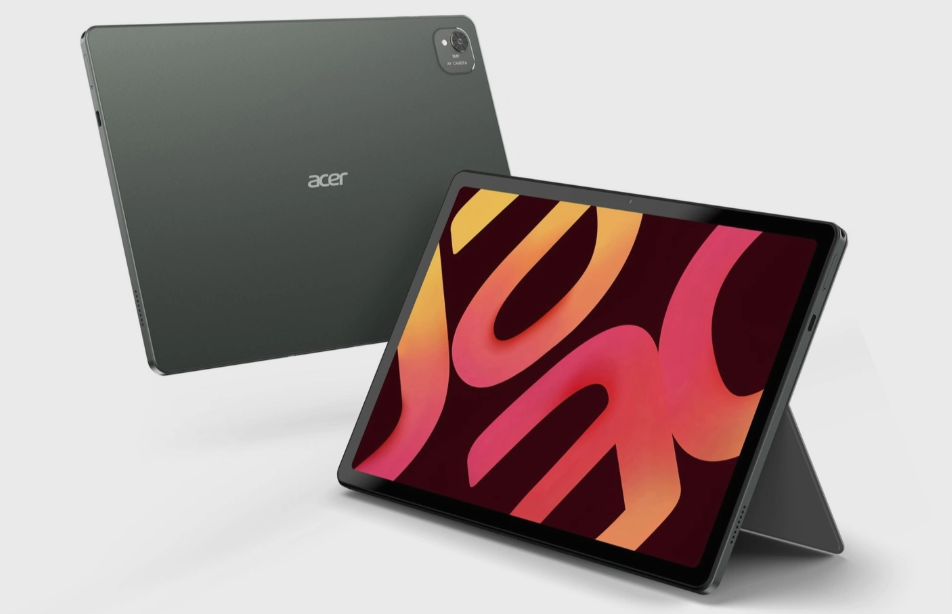
Acer has announced three new large-screen tablets aimed at users looking for productivity, entertainment, and everyday computing on bigger displays. The new lineup includes the Iconia Duo S14, Iconia Duo S12, and Iconia Duo D12, offering a range of specifications across different price segments.
The new models feature display sizes of up to 14.2 inches, MediaTek processors ranging from the Helio G99 to the Dimensity 8300, large batteries, and support for accessories such as active styluses. With the latest launch, Acer is targeting users who want laptop-like screen sizes without sacrificing portability.
Acer Iconia Duo S14: The Flagship Model
Leading the lineup is the Acer Iconia Duo S14, which comes with a large 14.2-inch OLED display featuring a 2880 × 1840 resolution and a 120Hz refresh rate. The panel covers 100% of the DCI-P3 color gamut, offers a 3:2 aspect ratio, and reaches up to 400 nits of brightness.
The tablet is powered by the MediaTek Dimensity 8300 processor and is available with up to 8GB RAM and 256GB of storage. Acer has equipped it with a 10,000mAh battery, making it the largest battery in the series.
For multimedia and productivity, the S14 includes four speakers, Wi-Fi 6E connectivity, dual USB-C ports, a microSD card slot, and optional active stylus support. Camera duties are handled by a 13MP rear camera and an 8MP front-facing camera.
Acer Iconia Duo S12: Premium Features in a Smaller Package
The Iconia Duo S12 brings many of the premium features of the S14 into a more compact form factor. It features a 12.2-inch OLED display with a 2800 × 1840 resolution, full DCI-P3 color coverage, and up to 600 nits brightness.
Under the hood is the MediaTek Dimensity 7400 processor paired with up to 8GB RAM and 256GB storage. The tablet houses an 8,000mAh battery and retains the same 13MP rear and 8MP front camera combination found on the S14.
Other features include Wi-Fi 6, dual speakers, USB-C connectivity, microSD expansion, and optional active stylus support.
Acer Iconia Duo D12: Affordable Option for Everyday Use
For buyers looking for a more affordable tablet, Acer has introduced the Iconia Duo D12. The device features a 12.2-inch display with a 2400 × 1600 resolution and a 90Hz refresh rate.
Power comes from the MediaTek Helio G99 processor, accompanied by up to 8GB RAM and 128GB of storage. Users can further expand storage through a microSD card slot.
The tablet packs an 8,000mAh battery and includes an 8MP rear camera alongside a 5MP front-facing camera. Connectivity features include Wi-Fi 6, USB-C, and dual speakers.
How the Three Acer Tablets Compare
While all three models share large displays and modern connectivity features, Acer has clearly positioned them for different audiences.
The Iconia Duo S14 is designed for users who want the best display, strongest performance, and longest battery life. The combination of a 14.2-inch OLED panel and Dimensity 8300 chipset makes it the most capable device in the lineup.
The Iconia Duo S12 offers a balance between premium features and portability. It delivers an OLED display and a modern Dimensity processor while remaining lighter and easier to carry.
Meanwhile, the Iconia Duo D12 focuses on affordability. Although it drops OLED technology and uses a less powerful processor, it still provides a large display, 90Hz refresh rate, and long battery life for everyday tasks.
Which Acer Tablet Should You Buy?
If performance and multitasking are priorities, the Iconia Duo S14 is the obvious choice thanks to its larger OLED display, Dimensity 8300 processor, and 10,000mAh battery.
For most users, however, the Iconia Duo S12 may be the sweet spot. It retains many premium features while offering a more manageable size and weight.
The Iconia Duo D12 is best suited for students, casual users, and those looking for a large-screen tablet without spending extra on flagship-level specifications.
Acer Iconia Duo Series:
Feature
Iconia Duo S14
Iconia Duo S12
Iconia Duo D12
Display
14.2-inch OLED, 120Hz, 2880×1840
12.2-inch OLED, 2800×1840
12.2-inch, 90Hz, 2400×1600
Processor
MediaTek Dimensity 8300
MediaTek Dimensity 7400
MediaTek Helio G99
RAM
Up to 8GB
Up to 8GB
Up to 8GB
Storage
Up to 256GB
Up to 256GB
Up to 128GB
Battery
10,000mAh
8,000mAh
8,000mAh
Rear Camera
13MP
13MP
8MP
Front Camera
8MP
8MP
5MP
Connectivity
Wi-Fi 6E
Wi-Fi 6
Wi-Fi 6
Speakers
Four
Dual
Dual
Weight
730g
580g
620g
Pricing and Availability
Acer has introduced the new Iconia Duo tablet series in China. Pricing details may vary by configuration and region. Buyers in global markets should note that imported pricing can be significantly higher than official Chinese pricing due to taxes, duties, shipping costs, and retailer markups.
The stable One UI 8.5 update has been rolling out since May 6, 2026, and it has already reached dozens of Galaxy devices. There may still be a few devices in the queue, but unfortunately, many older Galaxy devices will miss out on this big software upgrade.
Samsung has released the One UI 8.5 update to devices ranging from flagship to entry-level, launched in 2023 and later, but many devices launched before 2022 won’t be upgraded to the latest software, as per a report from Sammobile. The list also includes flagship phones such as the Galaxy S22, Galaxy Z Fold 4, and Galaxy Z Flip 4.
Many Samsung users believed that the One UI 8.5 update would roll out to every Galaxy phone and tablet running One UI 8.0, as both releases are based on Android 16. But the company may have opted for a different rollout strategy this year, and it’s likely that the Galaxy S22 series and many devices launched before 2023 won’t be upgraded to One UI 8.5.
Here’s a list of Galaxy devices that may not receive the One UI 8.5 update:
Galaxy S22, S22+, S22 Ultra
Galaxy S21 FE
Galaxy A73, A53, A33
Galaxy Z Fold 4, Z Flip 4
Galaxy Tab S8, Tab S8+, Tab S8 Ultra
Some other devices from 2022
It’s a little surprising that Samsung actually started developing One UI 8.5 for the Galaxy S22, as test builds were spotted on servers, but the company later halted development. There has been no new test build since early April. The same thing has happened to several Galaxy devices launched in 2022.
In a press release on Samsung’s Germany Newsroom, the company announced that the One UI 8.5 update would be available on flagship devices as far back as the Galaxy S23 and on the last three generations of Galaxy A-series phones. While it doesn’t include the list of eligible devices, it confirms that One UI 8.5 is not coming to older phones launched in 2022 or before, at least most of them.
Technically, Samsung has already fulfilled the promised number of OS upgrades for the Galaxy S22 and other older devices that may not receive the One UI 8.5 update. The S22 launched with Android 12 and promised four generations of Android OS upgrades. That means Android 16 was the final one. And the company doesn’t guarantee subsequent updates for such devices, even if the OS version remains the same.
Still, many users would expect to receive One UI 8.5, especially since it brings a host of new features and significant improvements. However, that might only lead to disappointment for older Galaxy users.
Samsung hasn’t revealed why it won’t release the One UI 8.5 update to many older Galaxy devices, but a strong possibility is optimization challenges. Previously, it was easy to port a new skin (let’s say One UI 6.1) to an older device simply because it shared the exact same core foundation as the previous build (such as One UI 6.0). But the same doesn’t apply to One UI 8.5.
One UI 8.5 is based on Android 16 QPR2, whereas One UI 8.0 uses the original Android 16 at its core. QPR2 is a new branch of Android 16 that introduces a number of underlying code changes, updated APIs, and newer developer tools. These platform changes and optimization challenges may be why Samsung may have decided not to upgrade all older devices to One UI 8.5.
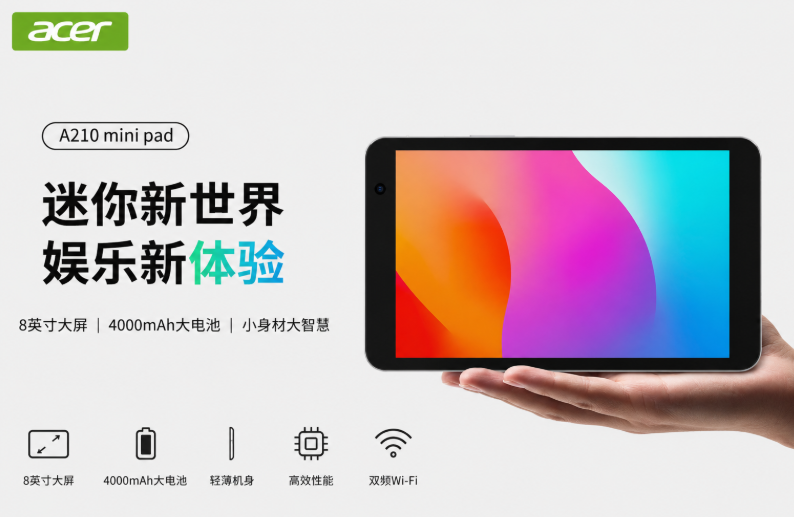
Acer has launched the new Acer A210 8-inch Eye-Care Tablet , an entry-level Android tablet aimed at students, casual users, and budget-conscious buyers. The tablet offers a compact design, Android 14 software, expandable storage, and an 8-inch display, all at a starting price of approximately $80.
Compact Design and Display
The Acer A210 features an 8-inch IPS LCD display with a resolution of 1280 × 800 pixels. The tablet measures 120 × 204 × 7.8 mm, making it easy to carry and suitable for reading, web browsing, online learning, and video streaming.
Android 14 and Expandable Storage
One of the biggest highlights of the tablet is Android 14 out of the box, something rarely seen in this price segment. The device is available in two configurations: 4GB RAM with 64GB storage and 6GB RAM with 128GB storage.
Users can further expand storage by up to 128GB through a microSD (TF) card slot, providing extra space for apps, photos, and videos.
Connectivity and Battery
The Acer A210 supports dual-band Wi-Fi and Bluetooth 5.0 for wireless connectivity. It also includes a USB Type-C port, a 3.5mm headphone jack, built-in speakers, and a microphone.
For photography and video calls, the tablet comes with a 5MP rear camera and a 2MP front camera. Keeping everything running is a 4,000mAh battery designed for everyday tasks and media consumption.
Acer is also offering subsidized pricing in select markets, reducing the prices to ¥398.05 and ¥498.75, respectively. These are China-market prices, and imported units may cost more in other regions due to taxes and import duties.
Who Is the Acer A210 For?
The Acer A210 is designed for students, first-time tablet buyers, and budget-conscious users who need a simple device for everyday tasks. Its combination of Android 14, expandable storage, dual-band Wi-Fi, and a low price makes it suitable for online classes, web browsing, reading, video streaming, and casual entertainment.
Acer A210 Specs:
Feature
Specification
Display
8-inch IPS LCD
Resolution
1280 × 800 pixels
Processor
Quad-core processor
OS
Android 14
RAM
4GB / 6GB
Storage
64GB / 128GB
Expandable Storage
Up to 128GB via microSD
Rear Camera
5MP
Front Camera
2MP
Battery
4,000mAh
Wi-Fi
Dual-band Wi-Fi
Bluetooth
Bluetooth 5.0
USB Port
USB Type-C
Audio Jack
3.5mm
Dimensions
120 × 204 × 7.8 mm
Starting Price
¥419 (~$58 / ₹4,900)
Disclaimer: Specs are based on available data. Actual performance may vary. Verify details from official sources before buying.
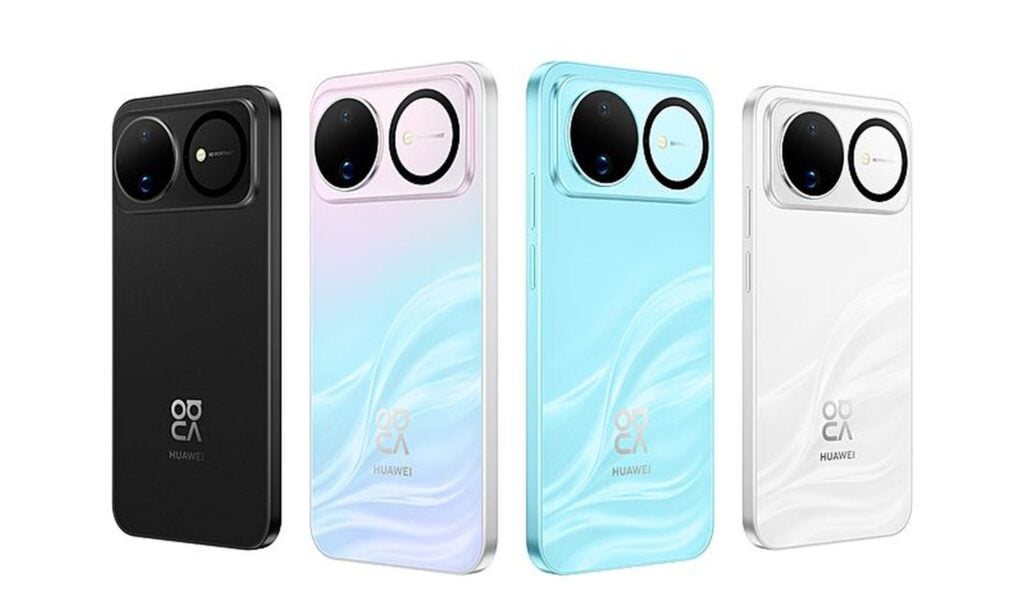
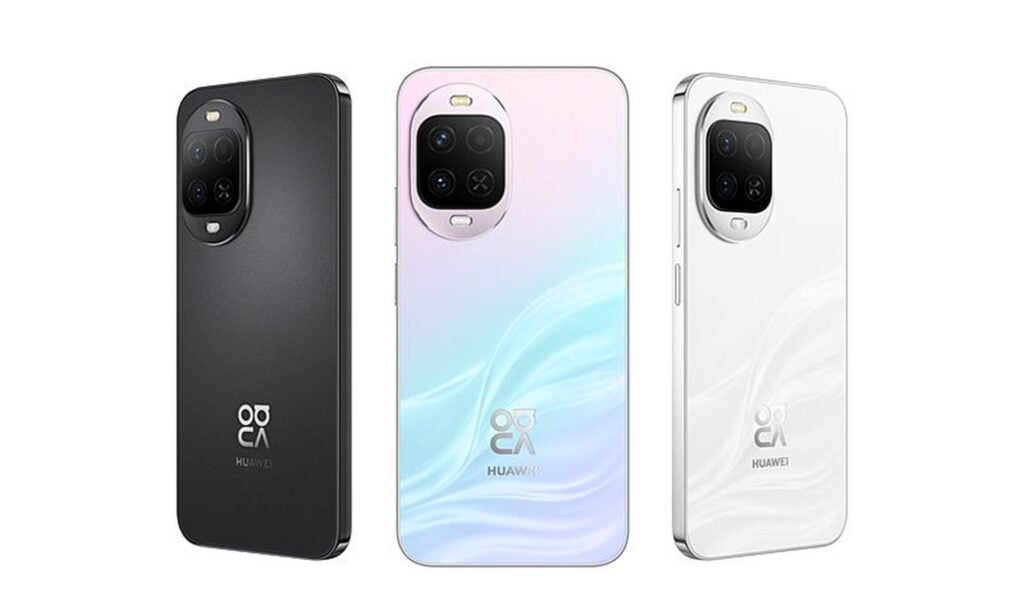
Apart from unveiling the Huawei Nova 16 Ultra and Nova 16 Pro today, Huawei has also taken off covers from the Nova 16z and Nova 16 in China. While the 16z is an entry-level offering in the series, the Nova 16 sits a step higher with a more powerful Kirin 9010S chipset, a larger 7,000mAh battery, and a 50-megapixel periscope telephoto camera that supports up to 100x digital zoom. Continue reading ahead to know everything about the specifications, features, and price of the Nova 16 and 16z.
Huawei Nova 16z and Nova 16 specifications and features
Huawei Nova 16
The Huawei Nova 16 is powered by the Kirin 9010S chipset and features a 6.68-inch OLED display with a 2800 x 1280 resolution, a 120Hz refresh rate, and 2160Hz PWM dimming. The phone houses a 7,000mAh battery with support for 100W wired charging.
Its camera setup includes a 50-megapixel primary sensor, a 50-megapixel RYYB periscope telephoto camera with OIS, and a Red Maple color sensor, while selfies are handled by a 50-megapixel front camera. The device also supports two-way BeiDou satellite messaging, Bluetooth 6.0, Wi-Fi 7, and IP65-rated protection.
Huawei Nova 16z
The Nova 16z is positioned slightly below the Nova 16 and uses the Kirin 8020 chipset. It sports a 6.7-inch OLED panel with FHD+ resolution, a 120Hz refresh rate and 2160Hz PWM dimming. Huawei has equipped it with a 6,000mAh battery paired with 100W charging. Photography duties are handled by a 50-megapixel main camera, a 12-megapixel RYYB telephoto portrait camera with OIS and a Red Maple colour sensor. A 50-megapixel front camera is available for selfies and video calls. Like its sibling, it ships with HarmonyOS 6.1 and includes AI-assisted photography tools, satellite messaging support, and stereo speakers.
Both phones offer AI-powered image editing features, AI-assisted composition, HDR Vivid video recording, infrared remote control, NFC, Star Flash connectivity, and side-mounted fingerprint sensors. Huawei has also included several on-device AI experiences through its Xiaoyi assistant ecosystem. Both devices come preloaded with HarmonyOS 6.1.
Huawei Nova 16z and Nova 16 price and availability
The Huawei Nova 16 is available in Sky Blue, White and Starry Black color options. It is priced at 2,999 CNY (~$418) for the 256GB variant, 3,499 CNY (~$488) for the 512GB model and 3,999 CNY (~$558) for the 1TB version.
The Huawei Nova 16z comes in White, Green and black shades. Pricing starts at 2,399 CNY (~$335) for the 256GB edition, while the 512GB variant costs 2,799 CNY (~$390). Huawei has not yet shared details regarding international availability for either smartphone.
For more daily updates, please visit our News Section.
Nvidia has announced a major step forward in humanoid robotics with the launch of the H2+ reference robot platform, developed in partnership with China’s Unitree Robotics and Singapore-based Sharpa. The announcement was made by Nvidia CEO Jensen Huang during his Computex 2026 keynote in Taipei.
The project is attracting industry attention because it combines advanced AI, robotics hardware, and software into a unified platform designed to speed up the development of real-world humanoid robots.
source:nvidianews.com
Rather than being a finished commercial robot, H2+ is a reference design that researchers, universities, and robotics companies can use as a blueprint to build and customize their own humanoid robots. Nvidia says the platform is designed to simplify every stage of robot development, from data collection and AI training to real-world deployment.
Combining Hardware and AI
The H2+ platform brings together several technologies into a single package. It uses Unitree’s H2 Plus humanoid robot body, Sharpa’s Wave robotic hands, and Nvidia’s Isaac GR00T AI models. Powering the system is Nvidia’s new Jetson AGX Thor T5000 computer, which is based on the Blackwell GPU architecture.
The robot stands nearly six feet tall and offers a total of 75 degrees of freedom, including highly dexterous robotic hands with 22 active joints. Nvidia says the Jetson AGX Thor T5000 delivers up to 2,070 FP4 TOPS of AI performance and includes 128GB of memory, allowing the robot to process complex tasks in real time.
Nvidia Introduces Cosmos 3
Alongside H2+, Nvidia also introduced Cosmos 3, a new physical AI world model designed to help robots better understand and learn from their environments.
According to Huang, one of the biggest challenges in robotics is collecting enough useful training data. Cosmos 3 can understand both third-person and first-person perspectives, helping generate robot-centric training data that can improve learning and decision-making.
Expansion Beyond China
Nvidia also revealed plans to expand its humanoid robot partnerships beyond China. The company is looking to work with robot makers in the United States, Europe, and South Korea, although partner names have not yet been announced.
The goal is to create standardized robot platforms with built-in security features such as Secure Boot and Confidential Computing, helping ensure that only verified software can run on the machines.
Growing Humanoid Robot Market
The announcement comes as interest in humanoid robots continues to grow. Analysts at Morgan Stanley expect China’s humanoid robot sales to exceed 28,000 units in 2026, potentially making it the world’s largest market for the technology.
With H2+, Cosmos 3, and new international partnerships, Nvidia is positioning itself at the center of the rapidly expanding humanoid robotics industry, supplying the AI hardware, software, and development tools that could power the next generation of intelligent machines.
Today, Huawei held a major launch event in China to announce multiple new products, including the Nova 16 lineup. The series includes four models, such as the Nova 16 Ultra, Nova 16 Pro, Nova 16, and Nova16z, bringing several premium features such as large batteries, advanced camera systems, and HarmonyOS 6.1. The lineup competes with the likes of the Honor 600 series, Oppo Reno 16 lineup, and Vivo S60 series in the home market.
While the Nova 16 Pro targets users looking for flagship-style features at a relatively lower price point, the Nova 16 Ultra sits at the top of the series with additional camera, connectivity, and durability enhancements. Read on to learn more about their specifications, features and pricing.
Huawei Nova 16 Pro and Nova 16 Ultra specifications and features
Huawei Nova 16 Pro
The Huawei Nova 16 Pro and Nova 16 Ultra share a 6.84-inch OLED display with a 2856 x 1320 resolution, 1-120Hz LTPO adaptive refresh rate, 2160Hz PWM dimming and Kunlun Glass protection. Both phones run HarmonyOS 6.1 and are powered by Huawei’s Kirin 9010S chipset. A 7,000mAh battery is included on both models, paired with 100W wired fast charging. The Ultra variant further adds 50W wireless charging and 7.5W reverse wireless charging support.
For photography, the Nova 16 Ultra features a 200-megapixel RYYB main camera with OIS, a 50-megapixel RYYB periscope telephoto camera with OIS, a 50-megapixel ultra-wide macro camera and a Red Maple colour sensor. On the front, it carries a 50-megapixel selfie camera along with a Red Maple color lens.
Huawei Nova 16 Ultra
The Nova 16 Pro uses a similar setup but with a 200-megapixel main camera, 50-megapixel periscope telephoto camera and 50-megapixel ultra-wide macro camera. Both devices support 4K video recording, AI-powered imaging tools, AI-assisted composition, portrait enhancements and telephoto image optimization.
The Ultra model also brings premium additions such as Tiantong satellite calling, satellite paging, two-way BeiDou satellite messaging, IP68 and IP69 protection, Bluetooth 6.0, Wi-Fi 7, infrared remote control and aluminium alloy construction. The Nova 16 Pro supports two-way BeiDou satellite messaging and carries an IP65 rating.
Huawei Nova 16 Pro and Nova 16 Ultra price and availability
The Huawei Nova 16 Ultra is available in Starry Black, Sky Blue and White colour options. It is priced at 4,699 CNY (~$655) for the 256GB model, 5,199 CNY (~$725) for the 512GB version and 5,799 CNY (~$810) for the 1TB variant.
The Huawei Nova 16 Pro comes in Starry Black, Sky Blue, White and Frost Purple shades. Pricing starts at 3,899 CNY (~$545) for the 256GB model, while the 512GB and 1TB variants cost 4,399 CNY (~$615) and 4,999 CNY (~$700), respectively. Huawei has not yet announced international availability for either smartphone.
For more daily updates, please visit our News Section.
The US government has given a new clarification that export restrictions on advanced AI chips apply not only to companies operating in China but also to Chinese-owned firms and subsidiaries located overseas. The move closes a potential loophole that may have allowed Chinese companies to access restricted AI hardware through operations in countries outside mainland China.
AI-Generated image for representation only
Why the US Made This Move
The clarification follows concerns in Washington that Chinese firms could obtain advanced AI processors through overseas subsidiaries despite existing export controls. Some policymakers argued that uncertainty created after the cancellation of the Biden-era AI Diffusion Framework may have opened a pathway for such purchases. The new guidance makes it clear that Chinese-headquartered companies remain subject to licensing requirements regardless of where they operate.
Pressure Grows on China’s AI Industry
The tighter enforcement is expected to make access to advanced US AI hardware more difficult for Chinese companies. NVIDIA’s most powerful Blackwell AI chips remain restricted, while purchases of other advanced processors continue to face regulatory scrutiny. As a result, Chinese technology firms are being pushed to rely more heavily on domestic alternatives.
China Accelerates Its Chip Strategy
In response to years of US restrictions, China has been rapidly expanding its domestic AI semiconductor industry. Companies including Huawei, Moore Threads, Biren Technology, Cambricon, and Alibaba have increased investments in AI processors designed for both training and deploying large AI models. Rather than focusing solely on replacing Nvidia products, many firms are now building complete AI hardware and software ecosystems.
Domestic Alternatives Gain Importance
Industry analysts expect Chinese AI companies to increasingly adopt locally developed accelerators as access to foreign chips becomes more limited. Huawei’s Ascend series and Alibaba’s custom AI processors are among the products attracting attention as China works to reduce dependence on US technology.
What to Expect Next
The latest US action is unlikely to slow China’s AI ambitions. Instead, it may further accelerate investment in domestic chips, software platforms, and AI infrastructure. The competition between the US and China is increasingly shifting from individual products to entire technology ecosystems. In the coming years, the key question may no longer be whether China can replace Nvidia, but how quickly it can build a self-sufficient AI industry capable of competing on a global scale.
Right after NVIDIA unveiled the new RTX Spark, Microsoft also announced the Surface Laptop Ultra powered by the new Arm-based processor.
Let’s start with the screen, because Microsoft is really proud of it. The Surface Laptop Ultra comes with a 15-inch mini-LED PixelSense Ultra touchscreen, peak HDR brightness of 2000 nits, and a pixel density of 262ppi. Microsoft says it’s the brightest display they’ve ever put on a Surface. It also gets the largest trackpad ever on a Surface.
As for ports, it has HDMI, USB-C, USB-A, an SD card slot, and a headphone jack. You likely won’t need a dongle here.
Under the hood, the RTX Spark brings up to 128GB of unified memory, and Microsoft is actually updating Windows to take better advantage of it. That means raising the memory ceiling available to the GPU, so you can load larger local AI models or work on more complex creative projects without hitting a wall.
Microsoft is making big Windows 11 changes alongside the Surface Laptop Ultra
Microsoft is also improving how Windows handles memory page sizes on unified memory systems. On the thermal side, Microsoft partnered with NVIDIA on something called the Microsoft Power and Thermal Framework (MPTF), which is designed to squeeze out better performance per watt and keep the machine cool even when it’s working hard.
For creative professionals, the app story is strong. Adobe Photoshop and Premiere run natively on ARM and have been specifically optimized for RTX Spark. Blender, DaVinci Resolve, Cinema4D, Redshift, Topaz Photo, CapCut, Cubase, and Affinity by Canva all run natively too. And for anyone still dependent on older x86 software, Microsoft’s Prism emulator now supports RTX Spark’s GPU, so you won’t be left stranded.
Gaming is still a work in progress, but the list is growing. League of Legends, Valorant, and PUBG are confirmed to be coming to the platform, alongside Alan Wake 2, Naraka: Bladepoint, War Thunder, and a few others.
Microsoft also took the Computex stage to talk about broader Windows 11 improvements coming this year. The OS is set to get smoother app interactions via the WinUI3 framework, a better Linux Subsystem experience, improved OS reliability, and more taskbar customization.
The Surface Laptop Ultra comes in Platinum and Nightfall, and it’s launching later this year. Pricing hasn’t been announced yet, but given the specs, don’t expect it to be cheap.
For more daily updates, please visit our News Section.
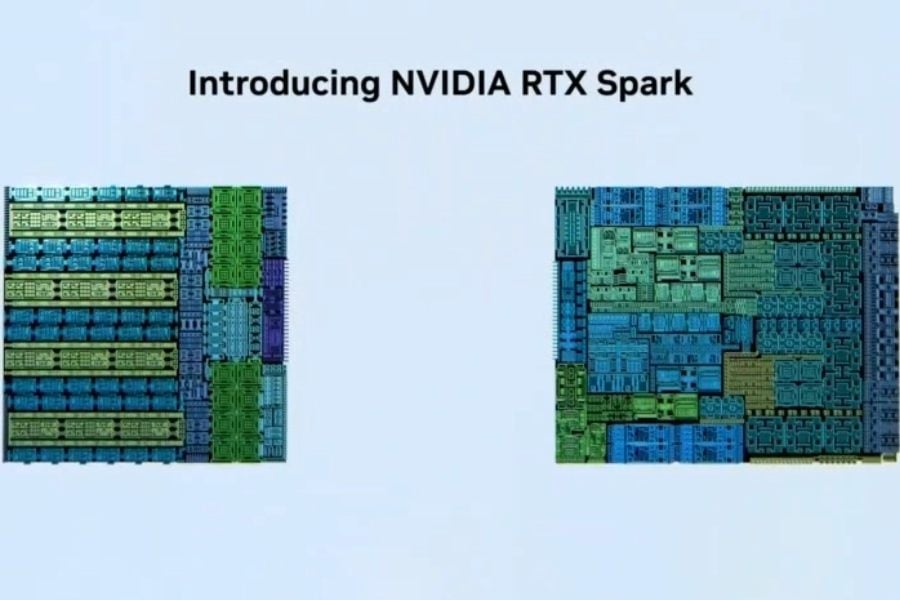
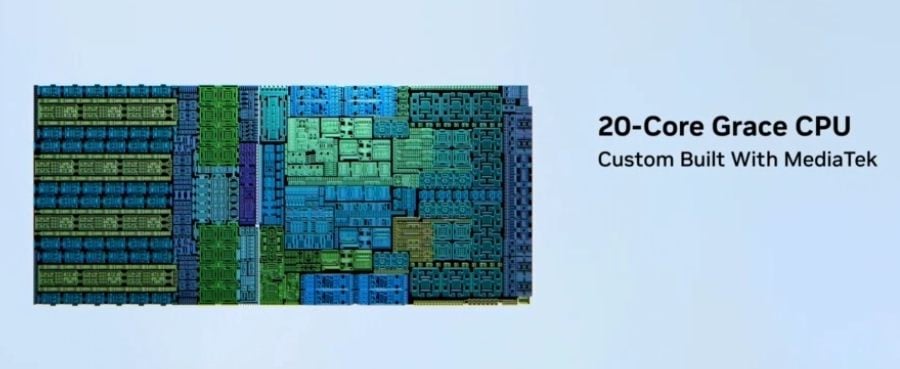
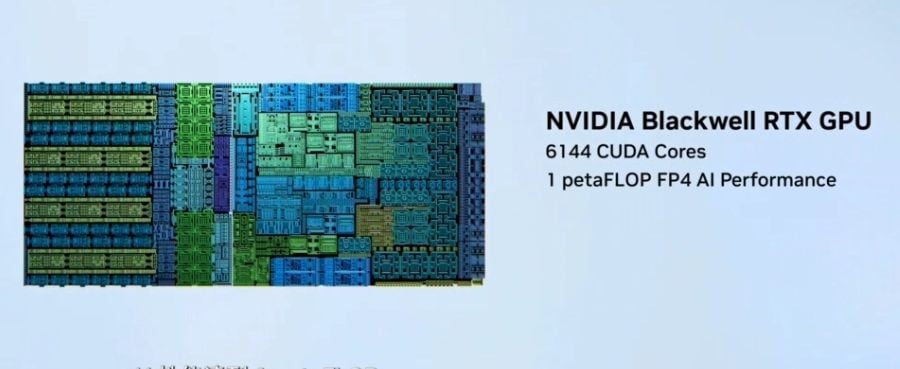
At Computex Taipei 2026, NVIDIA‘s CEO took the stage and officially unveiled the RTX Spark, the company’s first-ever processor built specifically for Windows PCs. It’s an Arm-based chip that packs a 20-core Grace CPU (built alongside MediaTek), a Blackwell RTX GPU with 6,144 CUDA cores, an NPU, and up to 128GB of unified LPDDR5X memory, all on a single TSMC 3nm package.
As a result, NVIDIA says the RTX Spark is capable of 1 petaFLOP of AI performance. That’s a lot of zeroes.
The chip, formerly rumored under the codename “N1X,” is clearly NVIDIA’s answer to Apple silicon, and a direct challenge to Qualcomm’s Snapdragon X series that’s been dominating the Windows on Arm conversation for the past year.
And NVIDIA isn’t just bringing its hardware here. The full software stack, including CUDA, TensorRT, DLSS 4.5, Reflex, G-SYNC, and RTX ray tracing, is all coming along for the ride.
NVIDIA RTX Spark has a 20-core CPU The Blackwell RTX GPU has 6144 CUDA cores and 1petaFLOP AI compute power
What is NVIDIA RTX Spark capable of?
So what can it actually do? NVIDIA says the RTX Spark can run 120 billion parameter AI models locally, handle 12K 4:2:2 video editing, render 3D scenes larger than 90GB, and push AAA games at 1440p above 100 frames per second. The latter is powered by DLSS 4.5 and Frame Generation, which NVIDIA has been shipping on its desktop cards for a while now.
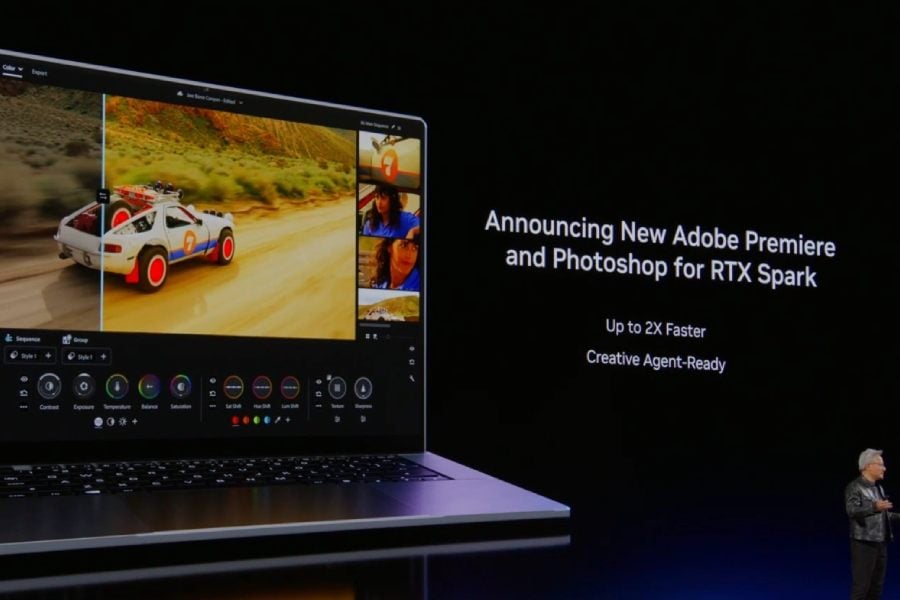
Adobe is on board too, and not in a half-hearted way. The company is doing a complete architectural overhaul of both Photoshop and Premiere to support RTX Spark, promising up to 2x improvements in AI and graphics performance. Blackmagic Design, Blender, CapCut, ComfyUI, and OTOY have also signed on.
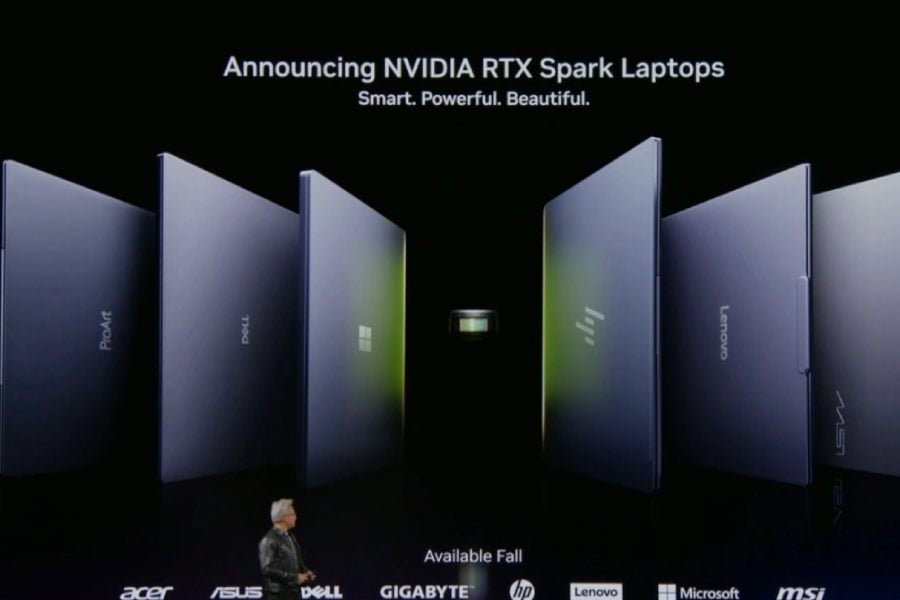
The laptops powered by the RTX Spark will be slim and trim. NVIDIA says 14mm of thickness, 3 pounds of weight, and availability in 14-inch and 16-inch sizes, with OLED displays and precision-machined aluminum chassis.
The first PCs with the new chip will launch this fall from brands like ASUS, Dell, HP, Lenovo, Microsoft Surface, and MSI.
One thing that’s missing is the actual benchmark numbers. It’s still a few months until fall, but we can expect leaks revealing some performance figures before that.
For more daily updates, please visit our News Section.
Last month, tipster Digital Chat Station claimed that the Oppo Find X10 Pro Max had been either delayed or cancelled. However, in a newer Weibo post, the tipster stated that the rumored Find X10 Pro Max project remains active and has not been cancelled, putting to rest recent speculation about its future.
Oppo Find X10 Pro Max’s telephoto camera tipped again
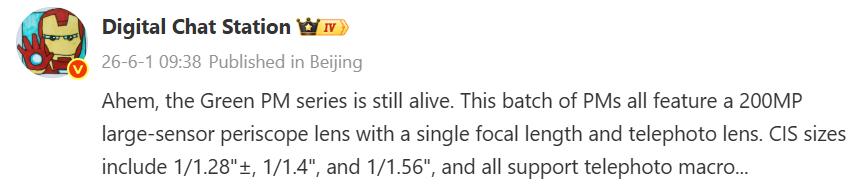
According to the tipster, current Pro Max engineering models are being tested with a single periscope telephoto camera rather than a dual telephoto setup. These devices are said to feature 200-megapixel large-sensor periscope cameras, with sensor sizes reportedly ranging between 1/1.28-inch, 1/1.4-inch, and 1/1.56-inch across different prototypes.
A previous leak from the same source revealed that the Find X10 Pro Max could be equipped with a Samsung HPC 200-megapixel camera featuring a 1/1.28-inch sensor. The 1/1.4-inch and 1/1.56-inch sensors mentioned by the tipster seemingly belong to the 200-megapixel cameras that could be used on the Vivo X500 Pro Max and Xiaomi 18 Pro Max, respectively.
Digital Chat Station further revealed in today’s leak that all of these Pro Max models will support telephoto macro photography, allowing users to capture close-up shots using the periscope camera.
Coming back to the Find X10 Pro Max, it is said to feature a 200-megapixel primary camera with a 1/1.3-inch sensor, a 200-megapixel or 50-megapixel ultra-wide lens, and a 200-megapixel periscope telephoto camera. The device is also tipped to feature a 6.89-inch 2K LTPO OLED panel, a Dimensity 9600-series chipset, and a massive battery with a capacity of around 7,000mAh.
For more daily updates, please visit our News Section.
Several reports have claimed that Vivo will announce the Vivo X Fold 6 foldable phone in June in China. Now that the month has begun, tipster Digital Chat Station has shared a new Weibo post revealing some details about the device.
Vivo X Fold 6 key specifications tipped
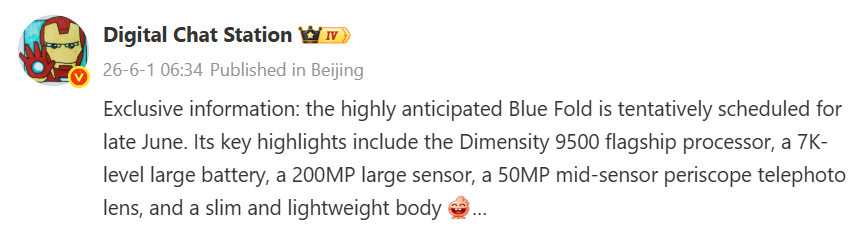
According to the tipster, the Vivo X Fold 6 is tentatively scheduled to launch in late June and will be powered by MediaTek’s Dimensity 9500 flagship chipset. The foldable is also tipped to pack a massive 7,000mAh-class battery, which would be one of the largest batteries seen on a foldable smartphone. Despite the large battery and upgraded camera hardware, the device is expected to retain a slim and lightweight design.
For photography, the Vivo X Fold 6 is said to feature a 200-megapixel large-sensor primary camera, accompanied by a 50-megapixel periscope telephoto camera with a medium-sized sensor. In a previous leak, the tipster also mentioned the inclusion of a 50-megapixel ultra-wide lens in the rear camera setup. For security, it will feature a side-mounted fingerprint sensor.
In the comments section, DCS added that the engineering prototype continues to use Vivo’s signature large circular camera module. The display is also said to feature more rounded corners, while white remains the preferred color option for the prototype units.
The other details of the Vivo X Fold 6 remain under wraps. In the Chinese market, it will compete with the likes of the Honor Magic V6, the Oppo Find N6, and the forthcoming Samsung Galaxy Z Fold 8. Readers are advised to wait for further reports to learn more about the X Fold 6.
For more daily updates, please visit our News Section.
Chinese tipster Digital Chat Station has shared fresh details on the upcoming OnePlus Turbo 6X Pro, and this time the leak comes with a hands-on tease as the tipster claims to have gotten hold of the device ahead of its launch.
According to the new information, the OnePlus Turbo 6X Pro will feature a Samsung 1.5K flat display with a 144Hz refresh rate.
A previous report revealed that the device will feature a 1.5K OLED screen. The new leak now points more specifically to an LTPS Samsung panel. The screen will also have eye-protection technology.
Moving on, the Turbo 6x Pro could feature an 8000mAh battery. Big enough, but it’s still 1000mAh less in capacity than the OnePlus Turbo 6 and Turbo 6v. The phone is also likely to carry an IP69X water resistance certification.
OnePlus Turbo 6x series could launch under 1000 yuan
Perhaps the most surprising detail is the pricing. The OnePlus Turbo 6X Pro is said to be a 1,000 yuan segment device, which works out to less than $150. For that price, the combination of a 144Hz Samsung display, an 8,000mAh battery, and IP69X protection is quite aggressive.
This follows the earlier leak that first revealed the Turbo 6X series, which tipped that the standard model would also get a 144Hz refresh rate, albeit on an LCD screen.
For context, the OnePlus Turbo 6 — launched earlier this year — comes with a Snapdragon 8s Gen 4 chip and a 9,000mAh battery, setting a high bar for the series. The Turbo 6X Pro is likely targeting a more budget-friendly crowd while still delivering strong key specs.
An official launch could be just days away.
For more daily updates, please visit our News Section.
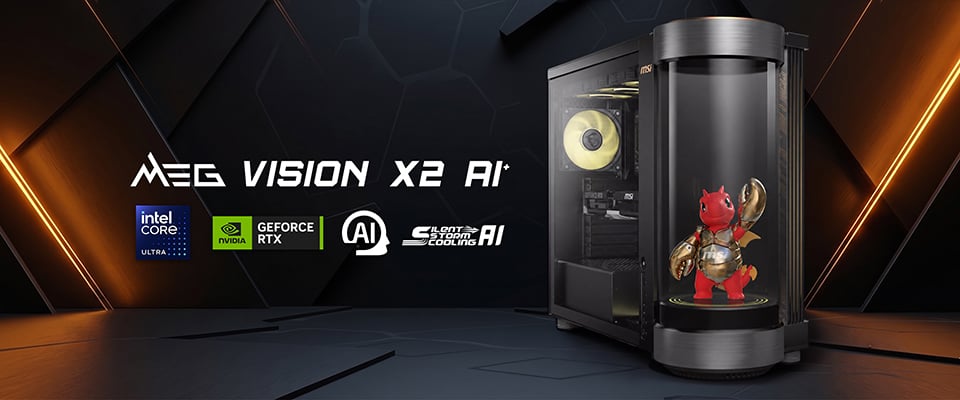
MSI’s newest gaming desktop, the MEG Vision X2 AI+, takes the current industry trend of adding AI to everything and makes it literal. Instead of just relying on software features or a dedicated keyboard button, MSI has built a secondary display directly into the front of the PC case to house a virtual assistant.
MSI MEG Vision X2 AI+ Specifications
The company calls this cylindrical screen the AI Holostage. It serves as a physical home for LuckyClaw, an AI companion that runs locally on the machine. According to MSI, you can use natural voice or text commands to ask LuckyClaw to adjust your system’s performance profiles, change monitor settings, or swap out your RGB lighting colors.
If you aren’t interested in using MSI’s default mascot, the software also supports custom third-party avatars. It is basically a voice-activated settings menu with a face. MSI says the software will get updates over time to add more features.
If you look past the built-in screen, the MEG Vision X2 AI+ is simply a very high-end gaming PC. It can be configured with Intel’s Core Ultra processors and up to an Nvidia RTX 5090 graphics card. The system can reach up to 3400 TOPS of total AI performance.
To keep the hardware cool, the desktop includes a 360mm liquid cooler. The interior design relies on MSI’s Project Zero motherboard standard, which moves all the power connectors to the back of the board. This hides the cable clutter and keeps the inside of the case looking neat behind the glass panel.
The rest of the specifications include modern standards like PCIe 5.0 storage, DDR5 memory, Wi-Fi 7, 5G Ethernet, and Thunderbolt 5 support.
MSI has not announced a release date or pricing details yet.
We use cookies on our website to give you the most relevant experience by remembering your preferences and repeat visits. By clicking “Accept”, you consent to the use of ALL the cookies.
This website uses cookies to improve your experience while you navigate through the website. Out of these, the cookies that are categorized as necessary are stored on your browser as they are essential for the working of basic functionalities of the website. We also use third-party cookies that help us analyze and understand how you use this website. These cookies will be stored in your browser only with your consent. You also have the option to opt-out of these cookies. But opting out of some of these cookies may affect your browsing experience.
Necessary cookies are absolutely essential for the website to function properly. This category only includes cookies that ensures basic functionalities and security features of the website. These cookies do not store any personal information.
Any cookies that may not be particularly necessary for the website to function and is used specifically to collect user personal data via analytics, ads, other embedded contents are termed as non-necessary cookies. It is mandatory to procure user consent prior to running these cookies on your website.