Advertisement

Microsoft may add Exclusive Call of Duty features for PS5 owners

Microsoft has stated that it plans to continue offer support for exclusive features on its popular Call of Duty franchise for the Sony PlayStation 5. This would mean that we can expect to see some beloved features being retained rather than the company making the experience worse on its rival platform.

For those unaware, the American tech giant had acquired Activision Blizzard, which is behind the massively successful franchise of Call of Duty. Call of Duty on the Sony console was capable of offering exclusive features like adaptive triggers and haptic feedback from the PS5 controllers. These are features that are not offered on the Microsoft Xbox Series S and Series X. But despite the brand acquiring the popular shooter title, the experience on the PS5 will apparently remain the same.

Microsoft

According to a new report, the company has no real reason to continue supporting these exclusive features but are still planning on maintaining the experience to avoid damaging future sales. In other words, rather than bringing both console platforms on a similar playing field, the company will seek to ensure that Call of Duty on the PS5 will run just as well to make sure the sales of the major gaming franchise doesn’t get impacted.

Interestingly enough, this is the exact opposite of what Sony is claiming. The Japanese tech giant has argued against this major acquisition, stating that Microsoft could technically release an inferior version of the Call of Duty games on its PlayStation platform. This could be through a buggy port or other issues to ensure that the games are best experienced through their own Xbox gaming consoles.

RELATED:

OnePlus 11 Special Edition teased with a Jupiter-inspired back design

OnePlus 11 is the brand’s most premium smartphone, and it recently made its debut in the global market in two beautiful colors – Eternal Green and Titan Black. These two colors were well-received by consumers, but it appears that OnePlus is looking to spice things up a little with a Space-inspired special edition of the handset.

Li Jie, president of OnePlus China, recently shared images of an upcoming special edition OnePlus 11. The smartphone is shown with the planet Jupiter suggesting it could debut with some kind of space-inspired design. It is claimed to feature “unprecedented materials and craftsmanship, making each mobile phone unique”.

OnePlus 11 Special edition

According to the trustworthy tipster Digital Chat Station, the upcoming special edition phone will sport a unique space material on its back that has never been used in the industry before. Unlike glass, the back panel will have a cool and cold sensation when touched. The tipster also clarified that this is not the same phone as the OnePlus 11 Concept, which was revealed at MWC Barcelona last month.

A Weibo user has suggested that the smartphone’s back panel could be made of marble, while some others speculate that it could have color-shifting capabilities similar to the Vivo V27. There’s no official confirmation from the brand yet but we hope to learn more in near future.
To remind you, the OnePlus 11 arrives with the latest Snapdragon 8 Gen 2 SoC under the hood and features a 120Hz 6.7-inch OLED display with a resolution of 3216 x 1440 pixels. The smartphone gets a 5,000mAh battery with support for 100W wired charging. There are three rear cameras, headlined by a 50MP main camera, a 32MP telephoto, and a 48MP ultra-wide-angle lens.

RELATED:

(Source 1,2) (Via)

Pure Advance electric scooter sports a revolutionary design that will shake the e-scooter market

Pure Electric has announced the Pure Advance e-scooter and it comes with a revolutionary concept. The Pure Advance e-scooter has become a regular sight during F1 races and the company hopes for a global expansion beyond F1.

Pure Advance electric scooter

Recent Formula One races have showcased at least one electric scooter during races. Such e-scooters have become the ultimate tool of convenience during the F1 weekend. The choice of an e-scooter solution is driven by environmental considerations. And Pure Electric CEO Adam Norris feels humans are polluting the environment too much and man should do what needs to be done to stem the tide. The clean solutions provided by e-scooters are therefore boosts for environmental protection.

Pure Electric began tinkering with designs for Pure Air in 2019. The company drew inspiration from Chinese high-volume, low-price models which were refined over time. Pure Electric only refined the design gradually unlike others who relied on an uncertain market to drive their sales.

The Pure Advance flagship model has a forward–facing riding position and two fold-up floorboards that places the rider’s feet parallel with the direction of travel. The lowered center of gravity of the e-scooter enhances control and stability. Safety is enhanced by the self-centering steering wheel. The e-scooter has a lightweight aluminum frame design that houses a 9.6Ah Lithium-ion battery with IP65 waterproof protection.

Pure Advance electric scooter

The Pure Advance has a 500W electric motor that delivers a top speed of 25km/h and a range of 40 km. The Pure Advance+ has a range of 50km, but with the same top speed as the base model and foldable flex variant. The lineup adopts a 60-lux headlamp, taillight, and integrated indicators on the bar ends of the foot pads.

The Advance e-scooter has three drive modes, Bluetooth connectivity, and support for its companion app (iOS- and Android-compatible). The models are also designed to be affordable. Pure Electric hopes to expand beyond its European reach and enter the US market by August 2023. The Middle East (Dubai and Saudi Arabia) is also slated for an entry of the Pure Air scooters later this year.

RELATED:

Samsung Exynos Connect U100 UWB chip for mobile, automobile, and IoT devices announced

Samsung has announced the Exynos Connect U100 ultra-wideband (UWB) chipset optimized for mobile, automobile, and internet of things (IoT) devices. It is the company’s first UWB chipset and offers excellent accuracy and precise location information. The Samsung Exynos Connect U100 builds on Samsung’s UWB applications for short-range wireless communication via Bluetooth and Wi-Fi. The new U100 UWB chipset is designed to facilitate improved hyperconnectivity across a wide range of devices.

Samsung

The Exynos Connect U100 uses the time of arrival (ToA) and 3D angle of arrival (AoA) measurements to deliver significantly improved accuracy of location and distance parameters. The accuracy of the chipset is within a single-digit centimeter and 5º. It comes in handy when tracking locations in challenging indoor circumstances where GPS is unavailable. It is also useful in AR and VR situations when tracking real-time, the movement of persons or objects. The U100 integrates RF, eFlash memory, and power management IP in the chip. This makes it possible to use the chip in compact devices.

The U100 has a power-saving mode that can maximize the battery life of the device. That means smart tracking devices with the U100 chip can run on limited battery power effectively. The U100 has a scrambled timestamp sequence function and a secure hardware encryption engine to prevent hacking. The chip has the FiRa Consortium’s certification for conformability with interoperability standards. There are other industry standards that the Samsung Exynos U100 UWB chipset is certified.

Smartphones that are equipped with the U100 can securely communicate digital key information with vehicles without compromising the security of the vehicle. There are no indications yet on the first devices to debut the new Samsung Exynos Connect U100 UWB chipset.

RELATED:

(source)

Xiaomi MIJIA 540L refrigerator with air-cooled frost-free preservation unveiled in China

Xiaomi has unveiled the MIJIA 540L ice crystal refrigerator with two doors and a 540L storage capacity. The new MIJIA refrigerator has an ice crystal glass panel and a natural ice crystal texture on the glass surface. It also features anti-fouling technology and substantially eliminates dirt buildup in the system.

Xiaomi MIJIA 540L refrigerator

The refrigerator has a 360-degree encircling three-dimensional air supply that avoids frost condensation and manual defrosting. The refrigerator’s design ensures air-cooled, frost-free preservation of food items inside the appliance.

The MIJIA 540L ice crystal refrigerator is equipped with four sensors and it has four cooling modes. The cooling modes enable the user to customize the cooling dependent on the type of food and other considerations. The cooling modes are Intelligent, Quick cooling, Quick freezing, and Holiday. The 540L capacity of the refrigerator is divided into two freezing compartments of 189L and 351L There are 20 smaller compartments and you can store different foods and ingredients including hot and raw foods without generating odors.

Xiaomi MIJIA 540L refrigerator

The refrigerator adopts the silver ion antibacterial technology to eliminate bacteria and prevent fouling. The silver ion technology has a bacterial removal rate of 99.99%. This creates a healthy and hygienic fresh storage environment at all times. The refrigerator has an inverter fan and inverter compressor for delivering customized and effective cooling. The refrigerator has an intelligent interconnection interface with an 8-inch touchscreen and Xiaoai voice assistant support. The refrigerator also accommodates OTA online upgrades.

Xiaomi MIJIA 540L refrigerator

The interface provides a rich list of functions including weather updates, a cooking countdown timer, and setting shelf-life reminders for ingredients.

The Xiaomi MIJIA 540L ice crystal refrigerator is currently retailing in China for 2,999 yuan (~$436). There are no indications yet on the availability of the gadget in other markets.

RELATED:

(source)

iQOO Z7x 5G Could also be on the way as it gets SIRIM certified

iQOO is on the roll. The brand has been launching smartphones back-to-back in the Indian market. It has only been a few days since the launch of the new iQOO Z7 and details about another Z series smartphone have started to appear. The product in question will likely be called iQOO Z7x 5G and it may launch very soon as it has recently bagged Malaysia’s SIRIM certification.

By itself, the SIRIM listing (Via Mukul Sharma) isn’t anything interesting. It’s for an upcoming smartphone, named iQOO Z7x 5G with the model number I2216. We assume from the moniker that the handset will debut as the successor of last year’s iQOO Z6x and will support 5G connectivity. While the listing did not reveal any of its specifications, it hinted at an imminent launch.

iQOO Z7x

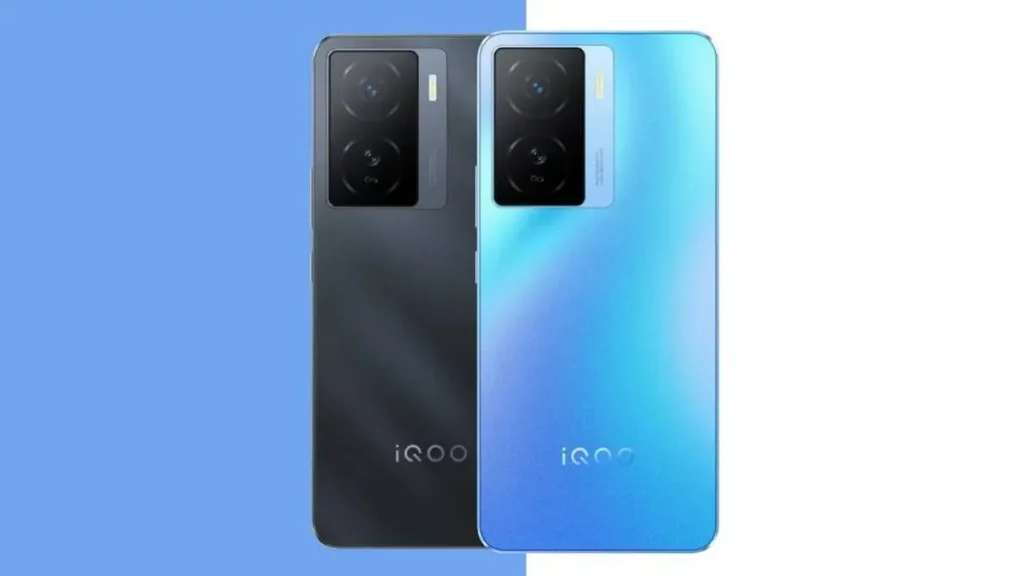
Currently, the details about the handset are scarce. It is expected to debut as a mid-range smartphone with a decent processor and cameras. The smartphone could share its design with the recently launched iQOO Z7, meaning we could see a rectangular camera island on the front with two cameras and an LED flash.

iQOO
iQOO Z7

iQOO Z7x should debut in the global market with a price tag of under $250. For reference, the iQOO Z7 carries a price tag of Rs 18,999 (~$230) for the 6 GB RAM + 128 GB storage version and Rs 19,999 (~$242) for the 8 GB RAM + 128 GB storage model. These prices are for the India-exclusive version.

As of now, there is no official announcement from the brand regarding the release of iQOO Z7x 5G. The information we have about the device is only initial, and we anticipate getting more details in the coming days. Stay tuned for the updates.

RELATED

(Source)

Microsoft introduces AI-powered Bing Image Creator, Visual Stories

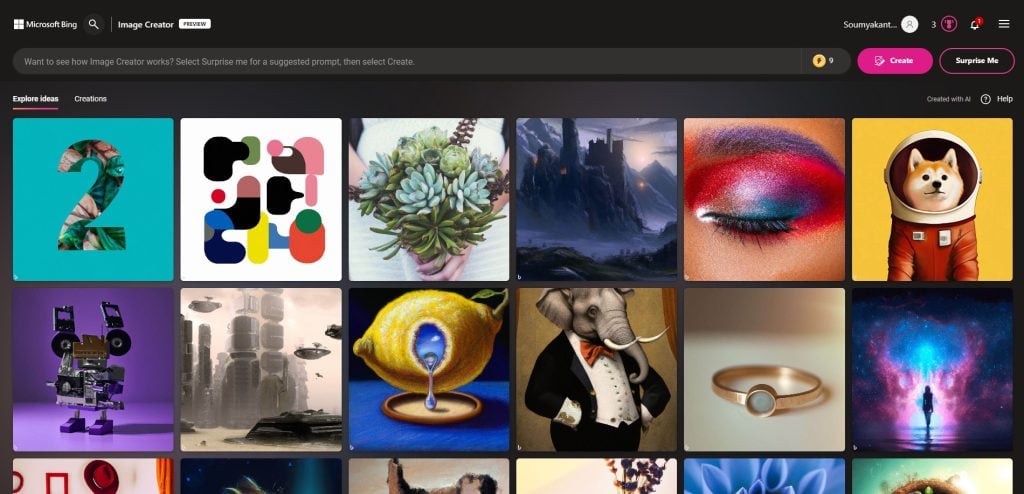
Microsoft has introduced new AI-powered Bing Image Creator to its search engine, Bing, and Microsoft Edge. This new tool uses an advanced version of the DALL∙E model from OpenAI, allowing users to create an image by describing it in their own words.

Bing Image Creator

The Bing Image Creator is fully integrated into the Bing chat experience, making it easy for users to generate both written and visual content in one place. By simply typing in a description of an image, adding contexts like location or activity, and selecting an art style, users can create an image from their imagination.

Bing Image Creator

To prevent misuse of the Image Creator, Microsoft has incorporated safeguards and additional protections from OpenAI, and the system includes controls that limit the generation of harmful images. When a potentially harmful prompt is detected, the system blocks it and warns the user.

In addition to the Bing Image Creator, Microsoft has also introduced updated Knowledge Cards and new AI-powered visual Stories to the preview. The Knowledge Cards 2.0 is an AI-powered infographic-inspired experience that provides fun facts and key information at a glance, and it has been updated to include interactive, dynamic content like charts, graphs, timelines, visual stories, and more.

Bing Knowledge Cards 2.0

Meanwhile, the new AI-powered visual Stories provide a more engaging way to search and interact with content, offering images and short videos. These updates aim to deliver more immersive experiences that make finding answers and exploring the web more interesting, useful, and fun.

Furthermore, Microsoft 365 Copilot, an AI assistant for workplace efficiency, has also been recently introduced. It helps users to manage their schedules, set reminders, and automate routine tasks.

Availability

Microsoft has announced that Bing Image Creator is now available for preview users on both desktop and mobile devices. Users who are not a part of the Bing preview can still experience Image Creator at bing.com/create in English, with additional language support to be added in the future.

In addition, Edge users can access Image Creator from the sidebar icon on both desktop and mobile devices, and the integration of Image Creator into Edge from the new Bing button in chat mode will also be coming soon.

RELATED:

Windows 11 Snipping Tool Has a Vulnerability That Can Expose Sensitive Data

A recent discovery involving Google’s Pixel phones has raised concerns about the security of sharing edited screenshots. This issue, known as “aCropalypse,” occurs when sensitive information is unintentionally revealed through screenshots even after the user has edited or blurred it out. As it turns out, Google isn’t the only one facing this problem – Microsoft’s Windows 11 Snipping Tool has been found to have a similar vulnerability, putting users’ private information at risk when they take screenshots. Here are the details…

Windows 11 Snipping Tool vulnerability can reveal sensitive information in screenshots

The aCropalypse vulnerability allows threat actors to undo edits made on a screenshot, revealing sensitive information that the user intended to crop out or blur. When editing a screenshot, users often save the edited image with the same name as the original file, inadvertently overwriting it. However, the Windows 11 Snipping Tool does not delete the original information from the file but merely appends it at the end, making it invisible to the average user. With some technical know-how, an attacker can retrieve the hidden information from the file and gain access to the edited-out content.

Windows 11 screenshot

Twitter user Chris Blume reported the vulnerability in the Windows 11 Snipping Tool, sparking further investigation. David Buchanan, who initially uncovered the aCropalypse vulnerability in Pixel phones, has since confirmed that the Windows 11 Snipping Tool works in a similar way, although it uses a different color model. The file size of edited screenshots can also provide clues about the vulnerability, as these images are often larger due to the inclusion of information from the original image.

This vulnerability poses a serious threat, as users frequently crop out or blur sensitive information in images before sharing them. For instance, a user might share a screenshot of an order confirmation page from Amazon, removing their address before posting. However, this vulnerability could allow an attacker to retrieve the cropped-out information, including addresses, credit card numbers, and other sensitive data.

With the vulnerability now public knowledge, it is expected that a fix will be issued soon. However, existing edited screenshots will still be affected, so users should reevaluate any images that might contain sensitive information. Attackers are likely searching for potential victims, so it’s crucial to stay vigilant and protect personal data.

The Windows 11 Snipping Tool’s vulnerability highlights the importance of being cautious when sharing edited images. As technology continues to advance, so too do the methods employed by cybercriminals. Users must remain vigilant and ensure that sensitive information is not inadvertently exposed through edited screenshots or other digital means. It is vital to stay informed about potential vulnerabilities in commonly used tools and adopt best practices for safeguarding personal information.

RELATED:

(via)

Infinix Hot 30i To Launch In India On March 27, Price, Key Specifications Teased

Earlier this month, we had shared an exclusive first look at the Infinix Hot 30i smartphone. Now it is confirmed to launch in India on March 27th. The upcoming offering will be available from Flipkart. The e-commerce platform has put up a microsite of the device revealing its key specifications. 

As per the Flipkart listing, the Infinix Hot 30i will feature a boxy form factor. The back panel has a geometric diamond pattern design and it houses two camera rings along with an LED flash. The upcoming offering is teased to come with a 6.6-inch display bearing an HD+ resolution and a waterdrop notch. It will offer a 90Hz refresh rate and 500 nits peak brightness. The Infinix Hot 30i is said to pack 16GB RAM but we assume this to be after including the virtual RAM. 

The Infinix Hot 30i is teased to be priced under the Rs 10,000 price segment. Apart from the Flipkart listing, Infinix has also put up a microsite of the upcoming offering on its official website. It reveals that the device will be available in 8GB RAM and a 128GB storage option. The smartphone will feature a side-mounted fingerprint scanner. It will be backed by a 5,000mAh battery unit and come with a 50MP primary camera. The Infinix Hot 30i will be offered in Black, White, and Blue colour options. 

We will learn more details about the smartphone in the coming days leading up to the launch event,

Related:

Next Gen Nintendo Switch’s Nvidia Tegra chip might be built on Samsung’s 5nm process

Nintendo has long been rumored to be working on a new and improved handheld console that will be the successor to its popular Switch. But while finer details are still at large, a new report has hinted that the chipset that power the device could be built by Samsung Foundry.

According to a tipster, the company is apparently planning on equipping its upcoming Switch console. There have already been various rumors regarding a new generation handheld console and the latest one talks about the chipset that will power this new Switch. Nintendo will reportedly feature a new and improved Nvidia Tegra chipset. While no details regarding its specifications or its performance, the leak claims that it will be built using Samsung’s 5nm 5LPP process (5nm Low Power Plus).

Nintendo

For those unaware, the company is working on either a higher end Switch Pro or a direct successor with the Switch 2. Furthermore, recent rumors that had also hinted at the next gen Nvidia Tegra chip will be based on the Ampere architecture. Although, this Nvidia platform is based on the 7nm TSMC or Samsung’s 8nm process. Keep in mind that this is still just an unconfirmed report so take this news with a pinch of salt for now.

Nintendo is also rumored to be planning on skipping the Switch Pro model entirely and simply build a true next gen console. Meaning, the upcoming handheld console could offer a better battery life and performance thanks to a more advanced fabrication process. So stick around for more as we will be providing updates when additional information is available regarding this matter.

RELATED:

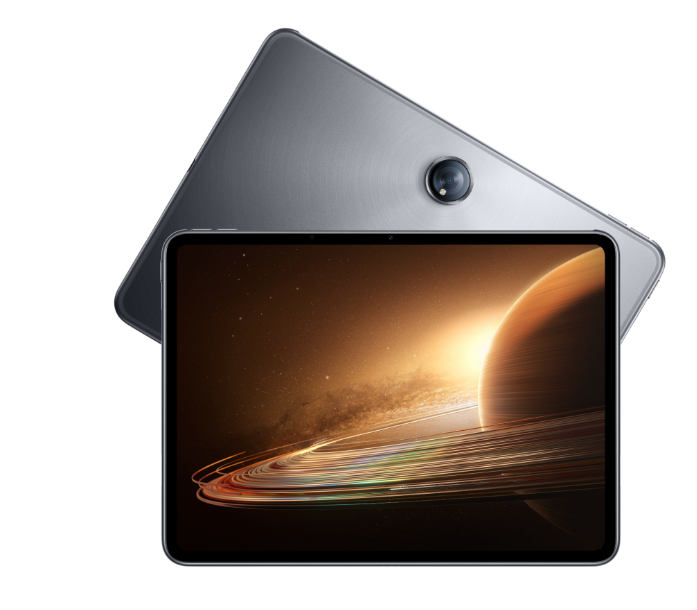
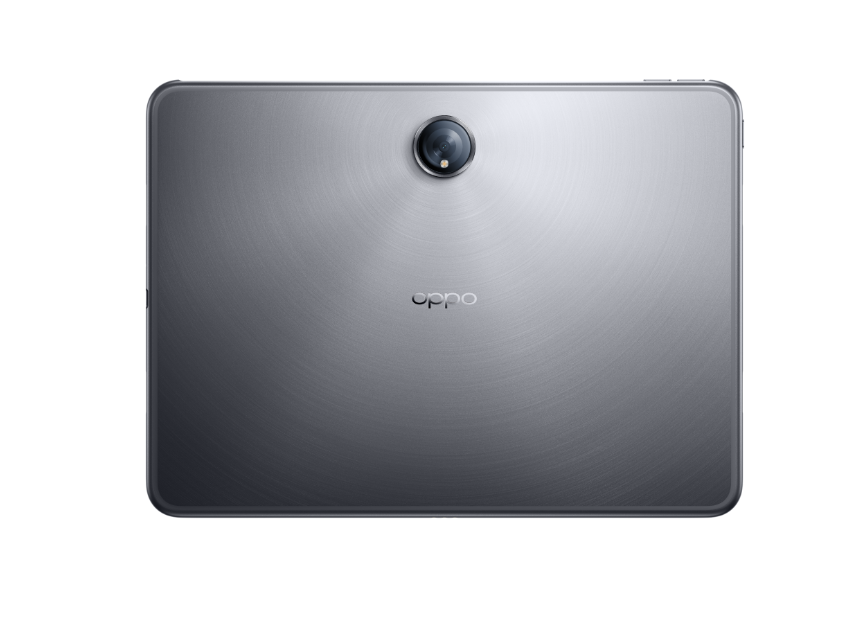
Get OPPO Pad 2 for $549 on Giztop: 11″display, 9150mAh battery, Dolby Atmos speakers

OPPO Pad 2 the latest tablet from OPPO is now available on Giztop. You can buy the 11-inch tablet for $549 only. 

WHERE TO BUY
OPPO Pad 2 at $549 @Giztop

OPPO Pad 2 features an 11.61-inch LCD display with a  2800 x 2000p resolution and a 144Hz refresh rate. The display has a 88% screen-to-body ratio and 10 bits colors which is perfect for readings texts, presentations, and PDFs, viewing videos and movies, and even playing games. 

The device is powered by MediaTek Dimensity 9000 chipset Octa-core processor which gives great computing performance and is perfect for gaming, imaging, multimedia, and connectivity. It comes with multiple memory options viz. 8GB/12GB LPDDR5 RAM and 256GB/512GB UFS 3.1 storage options. 

OPPO Pad 2 comes with an 8MP HD wide-angle front camera which is great for taking family and group video calls and a 13MP rear camera which is good for capturing images. The device is fitted with multi-layered graphite + silicone heat dissipation system, that offers a large heat dissipation area of ​​27413mm². This cooling solution makes sure that the device is able to give the best performance during long periods of heavy work. 

The tablet is fueled by a massive 9510mAh battery and supports 67W SuperVOOC charging. Other interesting features include Android 13 OS-based ColorOS 13, four-finger pinch, two-finger split-screen, parallel windows, multi-device cross-screen collaboration, Bluetooth 5.3, Dolby Atmos Quad speakers, and more. 

Available in Gray and Gold color variants, you can now buy OPPO Pad 2 for $549 only on Giztop. Please note that this price is applicable to the base variant only. 

For more information on such exciting deals and offers check out our deals hub.

Huawei 600kW EV charger leaks, outpacing Tesla’s Superchargers

Huawei, the Chinese tech giant known for its smartphones, has been making strides in the electric vehicle (EV) industry by partnering with car manufacturers to build better EVs and smart cars in China. However, a recent leak of their 600kW Huawei charger station shows that they are far ahead of the competition, including Tesla.

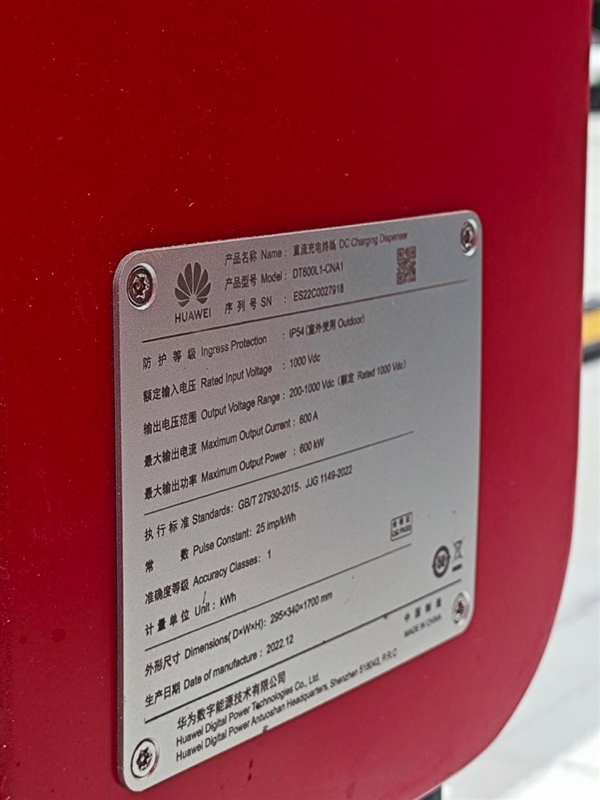
Huawei 600kW EV charger

Leaked images of the charging station show that it is a square-shaped unit with a cooling device at the bottom. The charger’s dimensions are 295 x 340 x 1700 mm, and it is painted in the signature red color of Huawei. The model number of this charger is DT600L1-CNA1, and it supports China’s national standard 2015 DC fast charging, single-gun output, and the output voltage range is 200-1000V. The maximum output current is 600A, and the maximum output power is 600kW.

Huawei 600kW EV charger

Named the “FusionCharge,” it is a liquid-cooled charger with a charging hub that ranges up to 3.5 meters. Industry experts suggest that Huawei initially planned to roll out these chargers in 2025, but the company is already testing them with limited users in advance, with some speculating that it could be an advance move to cover the upcoming Huawei AITO Wenji M9 model, which will launch later this year.

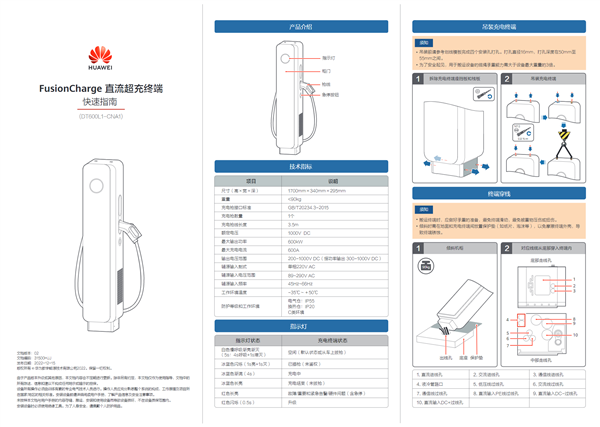
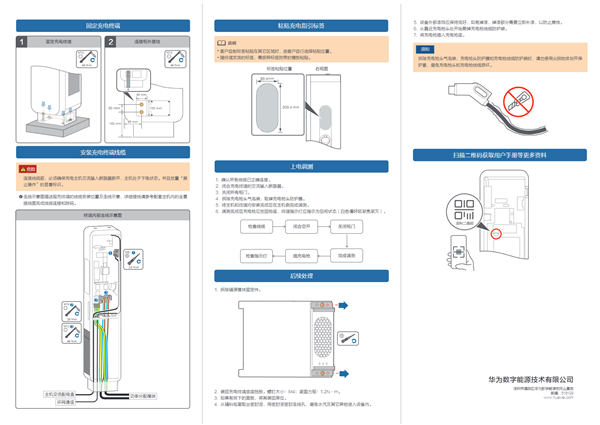
Huawei FusionCharge
Huawei FusionCharge

Huawei’s FusionCharge lineup includes a DC Supercharger, a DC Fast Charger, and a DC Split Charger, with the maximum power of the DC Supercharger at 600kW, rated voltage at 1000V, maximum current at 600A, and maximum power at 600kW. The DC Fast Charge is a double-split pile with a total power of 360kW, with each pile having a maximum power of 180kW and a charging cable length of 5 meters. The DC Split Charger has an output voltage range of 200-1000V, with a rated output power of 600kW.

In comparison, Tesla’s current V3 chargers can only provide 250kW power, and even the upcoming V4 supercharger is expected to max out at 350kW. Thus, the 600kW Huawei charger is faster than Tesla’s current offerings, but we will have to wait for the final release to know more about its specs.

It’s worth noting that achieving such a high charging power requires grid support, but the fact that Huawei is making such a bold move in terms of energy supplementation shows its commitment to the EV industry’s growth. With its superior charging technology, Huawei may soon emerge as a formidable player in the EV market.

RELATED:

(Via)

Adobe and Nvidia Introduce AI Imagery Systems to Address Copyright Concerns

Adobe has incorporated AI into popular software such as Adobe Photoshop and Adobe Illustrator, speeding up the image and text effects generation process. Creators whose work is utilized by these tools will be compensated. Nvidia unveiled “Picasso”, a service using AI to create images, videos, and 3D applications based on text descriptions. Nvidia trained Picasso on images licensed from Getty Images, Shutterstock, and Adobe, with plans to pay royalties.

Adobe, Nvidia AI imagery systems aim to resolve copyright questions

These developments represent a significant milestone in the ongoing debate between copyright holders and emerging technology. Image-generation technology is often trained on billions of images, but the legality of this usage is not always evident. Getty Images sued Stability AI earlier this year for copying over 12 million images without permission.

Getty Images CEO Craig Peters praised the collaboration with Nvidia as a testament to responsible AI development and the unique nature of Getty Images content. Peters emphasized the importance of using permissioned data, visuals, and respecting individual privacy. Adobe’s AI-enhanced feature, “Firefly,” allows users to generate images, illustrations, or videos using textual descriptions.

As the AI has been trained on Adobe Stock images, openly licensed content, and older content with expired copyrights, the generated creations are safe for commercial use. Adobe also supports a universal “do not train” tag, enabling photographers to request their content not be used in training models.

Adobe’s Ely Greenfield emphasized the importance of making the system creator-friendly. If users request an image in a specific artist’s style, the system will not replicate the style but offer the artist an opportunity to sell the right to use their style. Nvidia’s Picasso AI-image generator is part of a suite of AI-powered cloud products introduced at the GTC Developer Conference. Nvidia’s Greg Estes noted the importance of working with partners like Getty to ensure that generated images have a clear provenance.

Jun-Yan Zhu, assistant professor at Carnegie Mellon’s Robotics Institute, suggested that photographers and artists could potentially benefit from using AI technology to license their artistic styles. Getty’s Peters highlighted the importance of respecting intellectual property rights and fairly compensating artists for their work, especially for commercial purposes.

RELATED:

(via)

Xiaomi TV S75, S65 With 4K 144Hz Display Launched

Xiaomi has launched two new televisions in China. The latest offerings are the Xiaomi TV S75 and S65. As the names suggest, they feature 75 and 65-inch screen sizes. Both televisions pack the same specifications apart from different display sizes. Read on to know what the Xiaomi TV S75 and S65 offer out of the box. 

The Xiaomi TV S75 and S65 come with 75 and 65-inch screens respectively with thin bezels on all four sides. They offer a 4K display resolution of 3,840 x 2,160 pixels. The televisions feature 144Hz refresh rate, HDR10 support, 94 percent DCI-P3 colour gamut, and MEMC. 

On the audio front, the Xiaomi TV S75 and S65 are equipped with dual stereo speakers producing 25W sound output. They pack Dolby Vision Atmos and DTS: X. The TVs also feature far-field microphones that allow the users to control hands-free by giving voice commands. 

Under the hood, the Xiaomi TV S75 and S65 are equipped with a quad-core Cortex-A73 processor. They pack 3GB RAM and 32GB onboard storage. The televisions run on MIUI TV with various built-in app and the ability to control other smart home devices. The Xiaomi TV S75 and S65 come with variable refresh rate, auto-low latency mode, and AMD Freesync. 

Connectivity options on the Xiaomi TV S75 and S65 include WiFi-6, three HDMI 2.1 ports, two USB 3.0 ports, an Ethernet port, Bluetooth 5.2, IR Blaster, and NFC. 

The Xiaomi TV S75 carries a price tag of RMB 4,499 while the S65 variant costs RMB 3,499. Both televisions are up for pre-booking in China. 

Related:

Get Xiaomi Buds 3 Star Wars Edition for $99 on Giztop

Great news for Star Wars fans. The Xiaomi Buds 3 Star Wars Edition is now available on Giztoip. The special edition earbud with a stormtrooper logo on the charging case is available for $99 only. 

WHERE TO BUY
Xiaomi Buds 3 Star Wars Edition at $99 @Giztop

Xiaomi Buds 3 Star Wars edition features 40dB deep noise reduction, effectively blocking out almost all noise and sound in most common environments. The earbuds come with a transparency mode that lets outside noise in as and when you require. It features Hi-Fi (High Fidelity) sound quality that has low noise and distortion and is perfect for music lovers and audiophiles and comes with three built-in microphones with noise-reduction function that give you crystal-clear calls. 

Xiaomi Buds 3 Star Wars Edition delivers up to 7 hours of non-stop music on a single charge, and up to 32 hours with the charging case. The device supports a Type-C charging interface and  Qi wireless charging and is compatible with multiple devices like smartphones, tablets, laptops, etc. 

Xiaomi Buds 3 Star Wars Edition supports multi-functional touch control and is IP55-certified water and dust resistant. The earbuds are now available on Giztop for $99 only

For more information on such exciting deals and offers check out our deals hub.

Redmi Note 12S receives IMDA certification, launch imminent

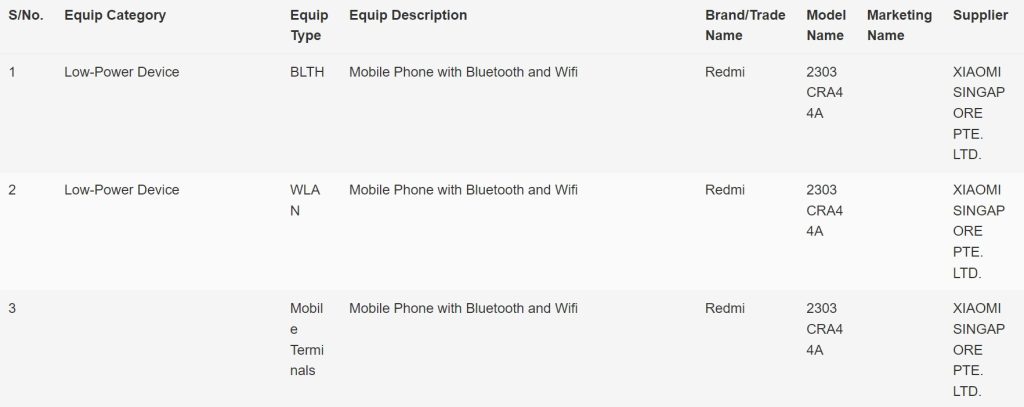
Xiaomi’s sub-brand Redmi is gearing up for the launch of its upcoming smartphone, the Redmi Note 12S in the global market. According to recent reports, the device with model number ‘2303CRA44A’ has received certifications from various authorities, including FCC, EEC, and IMDA, indicating that the launch could be just around the corner.

The recent IMDA certification by Singapore has revealed that the Redmi Note 12S will have Bluetooth and Wi-Fi connectivity. However, the certification has not revealed any major specifications of the device.

Redmi Note 12S IMDA Certification

Reports suggest that the Redmi Note 12S will be a rebranded version of the Note 11S launched last year. While the Note 11S supported 33W charging, the Note 12S is expected to come with even faster 67W charging.

As per rumors, the Redmi Note 12S will feature a 6.43-inch AMOLED display with Full HD+ resolution and a 90Hz refresh rate. Under the hood, it is likely to be powered by the Helio G96 chipset with up to 8GB of RAM and 128GB of storage. It may run on the latest Android 13 OS with MIUI 14 on top.

In terms of optics, the Redmi Note 12S is speculated to come with a quad-camera setup on the rear, consisting of a 108-megapixel primary sensor, an 8-megapixel ultra-wide lens, a 2-megapixel macro sensor, and a 2-megapixel depth sensor. On the front, it may house a 16-megapixel camera for selfies and video calls. Redmi’s Note series is known for its budget-friendly yet feature-packed smartphones, and the Redmi Note 12S seems to be no exception.

RELATED:

Apple Secures Patent for NFC-Enabled Watch Bands: A Step Forward or a Crackdown on Third-Party Accessories?

Apple is known for continually researching and developing new technologies and accessories for its products, and the Apple Watch is no exception. Earlier this year, a patent revealed the possibility of a color-changing Apple Watch band. Now, the US Patent and Trademark Office has granted Apple a patent for an Apple Watch band with an integrated NFC module. This could lead to numerous applications, both beneficial and controversial. Here are the details…

Apple granted patent for Apple Watch NFC tech that could warn users of ‘unauthorized’ bands

The patent, first discovered by Patently Apple, describes an Apple Watch band with an integrated NFC chip, enabling communication with the Apple Watch’s internal NFC chip. This connection would allow the Apple Watch to identify the connected band and use this information for various purposes.

Apple Watch

Some of the potential applications of this technology include dynamic user interface changes depending on the connected band. WatchOS could change watch faces or adapt the design of the current watch face to better match the color of the new band. Moreover, the Apple Watch could toggle different apps, such as the workouts app, when a specific band is connected.

The patent also suggests that this technology could be used to control unauthorized third-party Apple Watch bands. The patent states that a warning may be issued, or certain features may be disabled or modified if an unauthorized band is detected. Furthermore, specific bands may be associated with particular applications or services on the Apple Watch, activating or granting access to features related to those applications or services.

Apple Watch bands

The patent goes on to describe a system where Apple Watch bands could include components other than the NFC chip, such as environmental, biometric, gesture, or inertial sensors. This broadens the scope of potential features for the Apple Watch and its accessory ecosystem. It’s essential to note that just because a technology is patented, it doesn’t guarantee its implementation in an actual product. Apple is known to patent various ideas, and not all of them become reality.

While the NFC-enabled Apple Watch bands could provide exciting new features and customization options, there’s a possibility that the technology could be used to crack down on third-party accessory makers. This raises concerns among users who appreciate more affordable alternatives to Apple’s official bands. As with any technology, the ultimate impact will depend on how Apple decides to implement it.

RELATED:

(via)

Here’s how to watch the Huawei P60 series launch event & more

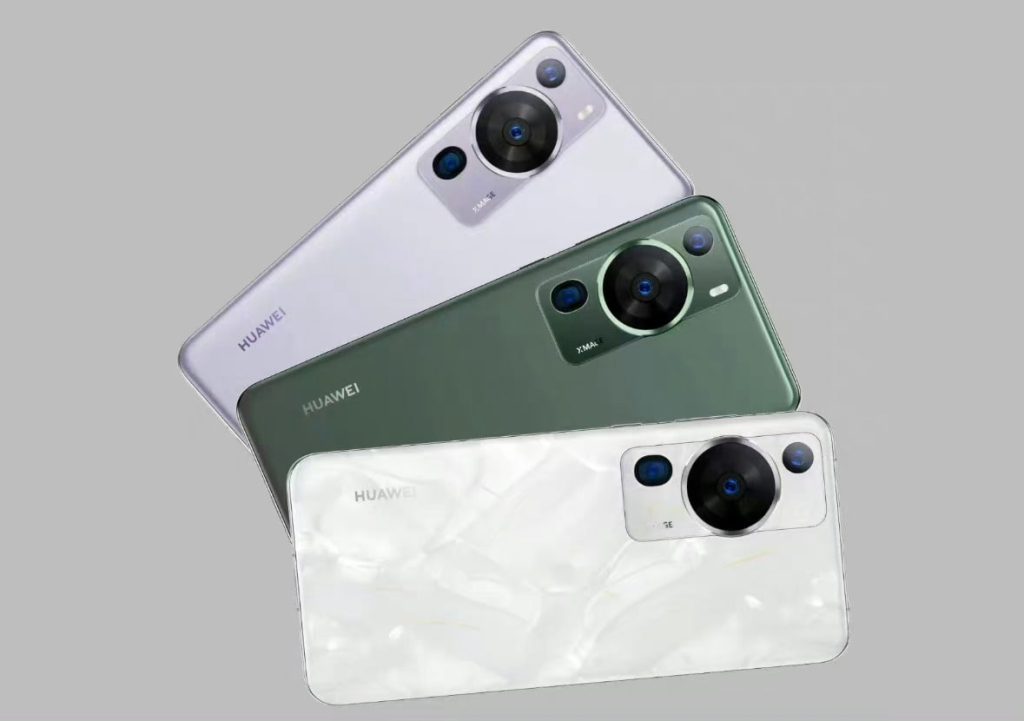
Huawei has a major launch event planned for tomorrow where the brand plans to introduce a bunch of new devices for its domestic Chinese market. These will include the Huawei P60 series, the Mate X3 foldable, the MatePad 11 (2023), and the FreeBuds 5 TWS earbuds. Read on to learn more about tomorrow’s event. 

Huawei P60 Series Poster

Huawei P60 series launch event: when and where to watch

Huawei is preparing to launch its P60 series in China tomorrow, on March 22nd. The event will be broadcasted live on the company’s official Weibo account at 2:30 pm local time. The live stream link and post will be shared by Huawei near the time of the launch event.

Hauwei P60 series: what to expect

The star of the show will be the Huawei P60 series smartphones. The Huawei P series smartphones are known to be the company’s flagship camera phones and are usually among the best camera phones of their generation. Therefore, it will be interesting to see what Huawei has in store for us this time around.

Huawei P60 series

So far, it is said that the Huawei P60 series will feature two models: the vanilla P60 and the P60 Pro. The Pro model is rumored to feature three cameras on the back including a 50MP main camera (Sony IMX888), a 50MP ultra-wide camera, and a 64MP telephoto camera. It is expected that the standard version of the P60 smartphone will feature two new sensors: IMX789 and IMX888. Both sensors have a 50MP resolution and are 1/1.4 inches in size. Reports suggest that the phones will come with variable apertures, similar to those found in last year’s Mate 50 Pro, as well as a 32MP front-facing camera. Additionally, both devices will incorporate XMAGE 2.0 technology.

Huawei Mate X3, MatePad 11 (2023): What to expect

huawei-Mate-x3-render

The successor of the current Mate X2 foldable will also make its debut tomorrow. The Mate X3 foldable will offer a 7.85 inch 2K display with Snapdragon 8+ Gen 1 (4G) SoC under the hood. The camera setup will also be quite competent with a 50MP Sony IMX766 camera, assisted by a Sony IMX688 ultra-wide lens, and an IMX351 periscope zoom camera.

Huawei Matepad 11 2023

On the other hand, the upcoming MatePad 11 tablet will come with an 11-inch 2560 X 1600 pixels LCD display with 120Hz refresh rate. The tablet is expected to operate on HarmonyOS 3.1 software and be powered by a 7250mAh battery with 22.5W fast charging support. The processor inside will likely be a Snapdragon 870.

RELATED:

BYD, World’s Largest EV Maker will Use Nvidia Chips to Power Autonomous Driving

BYD, the world’s leading manufacturer of electric vehicles, has announced an extended partnership with Nvidia, a frontrunner in artificial intelligence (AI) and computing. The collaboration will involve the use of Nvidia’s advanced centralized compute platform across various models in BYD’s forthcoming Dynasty and Ocean series of EVs. This joint venture aims to bring safe, intelligent, and software-defined vehicles to the market. Here are the details…

BYD and NVIDIA Partner to Revolutionize Electric Vehicles with Software-Defined Solutions

Rishi Dhall, Vice President of Automotive at Nvidia, applauded the ongoing partnership with BYD and the industry’s confidence in the centralized compute platform as a future-proof solution for intelligent vehicles. Both companies share the belief that future cars will transition from numerous embedded controllers to high-performance centralized computers, delivering and enhancing functionalities through software updates throughout a car’s life.

BYD Nvidia

The compute capabilities of the centralized compute platform are essential for diverse, real-time sensor processing. It provides automakers with the necessary resources to develop and support new software-driven services for the entire life of the vehicle. Since entering production last year, the platform has become the transportation industry’s go-to AI engine for EVs, robotaxis, shuttles, and trucks.

Designed to meet strict industry safety standards, the scalable compute platform can perform up to 254 trillion operations per second. This power enables it to run AI cockpits and automated driving functions simultaneously while operating numerous deep neural networks, ensuring the highest levels of safety and reliability.

In addition to adopting NVIDIA’s centralized compute platform for its EV fleets, BYD announced earlier this year its collaboration with NVIDIA to enhance the in-vehicle experience by integrating cloud gaming services into its vehicles. BYD has already made a significant impact in the industry with groundbreaking technologies like the Blade Battery, super hybrid technology, and the e-platform. As of February 2023, the company has sold more than 3.7 million EVs worldwide, creating an enhanced mobility experience for consumers.

To learn more about the latest technology breakthroughs in the automotive industry and beyond, watch the keynote speech by NVIDIA’s founder and CEO at the GTC conference. Register for the GTC event free of charge to attend a variety of sessions featuring NVIDIA and other mobility leaders.

RELATED:

(source)

Realme GT Neo 5 SE spotted on AnTuTu, scores over 1 million points

Realme has been working on a new GT Neo 5 SE model, which has been spotted on various benchmarking platforms. Now, the device has been spotted on a popular benchmarking website AnTuTu, so now we have its scores on this platform as well.

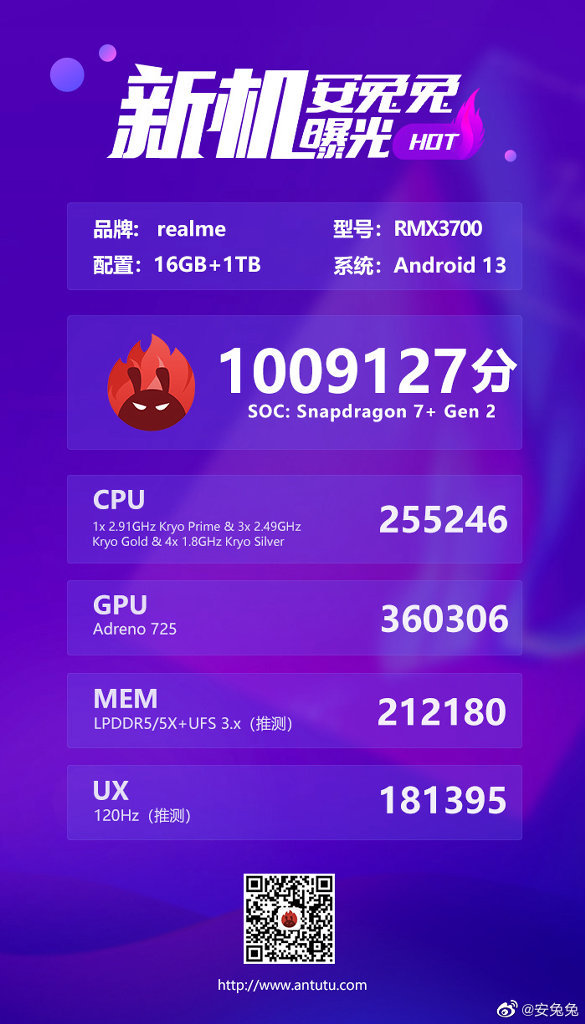
The Realme GT Neo 5 SE was previously spotted on MIIT, 3C, and TENAA certification platforms, which hints that its launch in China is just around the corner. Looking at the AnTuTu scores, the GT Neo 5 SE had achieved a score of 1,009,127 points. Apart from just its synthetic benchmark performance, the listing also revealed some of its key specifications. This includes the Qualcomm Snapdragon 7+ Gen 2 SoC that is paired with 16GB of LPDDR5x RAM, 1TB of UFS 3,1 storage, and Android 13 OS out of the box.

Realme

Furthermore, it will also sport a display with 120Hz refresh rate and 2772 x 1240 pixels resolution. Breaking things down, the Realme GT Neo 5 SE scored 255,246 points in the CPU test, 360,306 points in the GPU test, 212,810 points in the memory test, and 181,395 points in the AnTuTu UX tests. This was all the information spotted on the benchmarking platform. Based on what we know so far, the GT Neo 5 SE variant is an upcoming mid range device.

It is rumored to sport a 6.74 inch OLED display that and could be powered by a large 5,500mAh battery pack that supports an impressive 100W fast charging. The front will house a 16 megapixel selfie shooter, while the rear is believed to feature a triple camera setup that consists of a 64 megapixel primary sensor that is paired with an 8 megapixel ultra wide angle lens, and a 2 megapixel macro sensor.

RELATED:

(Via)