OPPO is gearing up to launch its next-generation Reno series smartphones, and now the company has finally confirmed the launch date for the Reno 10 and Reno 10 Pro.
The upcoming OPPO Reno 10 series smartphones will be officially launched in the Chinese market on 24th May. Ahead of the launch, the company has now started taking pre-orders for the devices.
As per the previous leaks, the OPPO Reno 10 will feature a 6.74-inch OLED curved-edge screen with a Full HD+ screen resolution of 2412 x 1080 pixels and a 120Hz refresh rate. It will be powered by the Qualcomm Snapdragon 778G processor along with 12GB of RAM. It packs 4,600mAh battery with support for 80W fast charging.
In the camera department, there will be a 64-megapixel OmniVision OV64B primary camera, an 8-megapixel IMX355 ultra-wide camera, and a 32-megapixel Sony IMX709 telephoto camera with 2x zoom. On the front side, there’s a 32-megapixel Sony IMX709 sensor for taking selfies and video calling.
On the other hand, the OPPO Reno 10 Pro is said to have a 6.73-inch AMOLED display with a screen resolution of 1220 x 2712 pixels and a 120Hz refresh rate. The phone will be powered by the MediaTek Dimensity 8200 SoC with 12GB or 16GB of RAM. It is said to be packs a 4,600mAh battery with 100W fast charging support.
The OPPO Reno 10 series smartphones will run the Android operating system with the company’s own ColorOS custom user interface on top. Reno 10 and 10 Pro will come in various color options, including Brilliant Gold, Colorful Blue, and Moon Sea Black. Renders of the OPPO Reno 10 and Reno 10 Pro smartphones have leaked online, showcasing the three color options.
At the Consumer Electronics Show (CES) 2023, Lenovo announced a slew of products, one of which was the YOGA AIO 9i desktop. The all-in-one PC came with a unique design including a 32-inch display. It also features a 13th-gen Intel Core procssor and NVIDIA RTX 4050 GPU. There are indications that Lenovo would launch the AIO desktop under a different, even more interesting name in China.
Lenovo Air 32 AIO desktop
Teaser posters released by the leading PC manufacturer show that the device will launch as the YOGA Air 32 AIO desktop in its home market. The teasers also suggest the device will be released soon. According to the teaser posters, the Lenoov YOGA Air 32 All-in-One machine will be powered by the Intel COre i9-13900H processor with NVIDIA RTX 4050 graphics card. The device wil also feature up to 32GB LPDDR5-6000 and 1TB SSD.
While no other information is revealed by the posters, we know already that the device will feature a 31.5-inch 4K IPS display panel with support for HDR600 and 97% DCI-P3 color gamut. The gadget features a slim panel with a metallic hinge, allowing the user to adjust the display to their preferred angle. Its sleek design includes a base with seven ports for versatile connectivity options, as well as air ventilation to ensure efficient heat dissipation. One standout feature is the built-in wireless charger in the base, enabling convenient device charging while working. With its compact form and space-saving design, this gadget offers a practical solution for those seeking both functionality and an aesthetically pleasing setup.
In addition, the Lenovo Air 32 AIO desktop is equipped with a Windows Hello infrared camera and four Harman Kardon speakers with Dolby Atmos. The all-in-one PC also features an HDMI 2.1 port as well as USB-C, USB4, and USB-A ports.
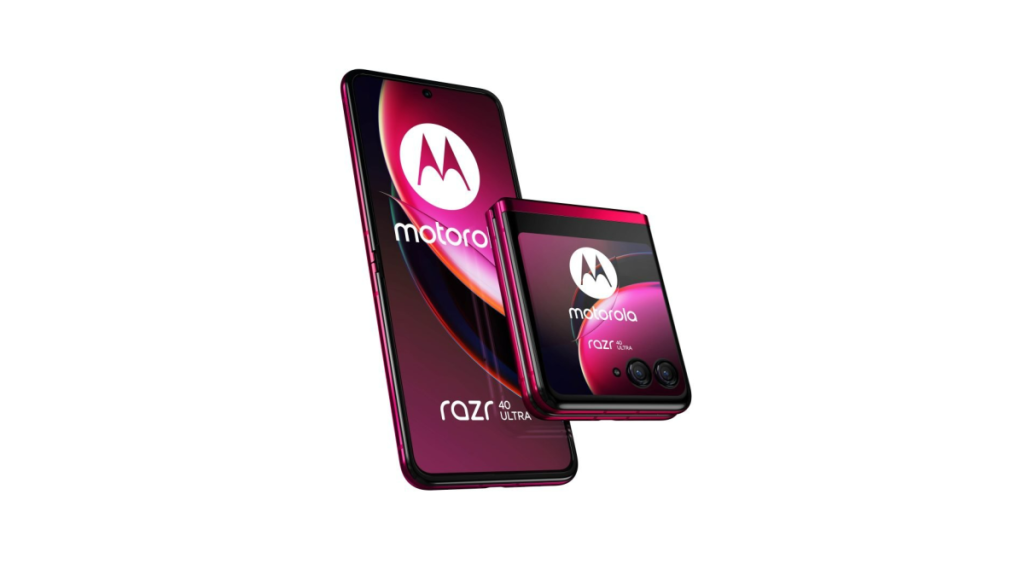
Motorola has officially confirmed that the Motorola Razr 40 Ultra flip phone will be unveiled globally on June 1. While the Ultra model will be packed with flagship specs, the company is also said to be working on a stripped-down variant of the device, which is dubbed the Motorola Razr 40. It is likely that the Razr 40 and Razr 40 Ultra may both debut together on June 1.
The brand’s tweet only confirms the launch date of its subsequent launch event. It also seems to tease not one, but two devices, which appear to be the Razr 40 and the Razr 40 Ultra.
The specifications of the Motorola Razr 40 are not yet known. However, recent reports have revealed that it will have a foldable screen with a centrally positioned punch-hole. The back panel of the device will have a dual-camera system with an LED flash and a smaller display that will be sufficient for showing time, date, and some notifications. It is expected to arrive in three shades, such as green, purple, and off-white.
Motorola Razr 40 Ultra specifications (rumored)
Motorola Razr 40 Ultra
The Motorola Razr 40 Ultra rumors have revealed that it will have a 6.9-inch FHD+ foldable OLED panel that offers a 165Hz refresh rate. It will have a 3.5-inch cover OLED screen on the back. For selfies, it will have a 32-megapixel front camera and a 12-megapixel (Sony IMX563, main) + 13-megapixel (SK Hynix H1336, ultra-wide) dual-camera system.
A 3,800mAh battery that supports 33W fast charging, the Snapdragon 8 Plus Gen 1 chipset, and up to 12 GB of RAM will power the Razr 40 Ultra. The device will arrive with up to 512 GB of internal storage. It will arrive in three colors namely, Barberry, Blue, and Black.
Truke is an Indian accessory brand that’s known for wireless earphones. The company also sells smartwatches.
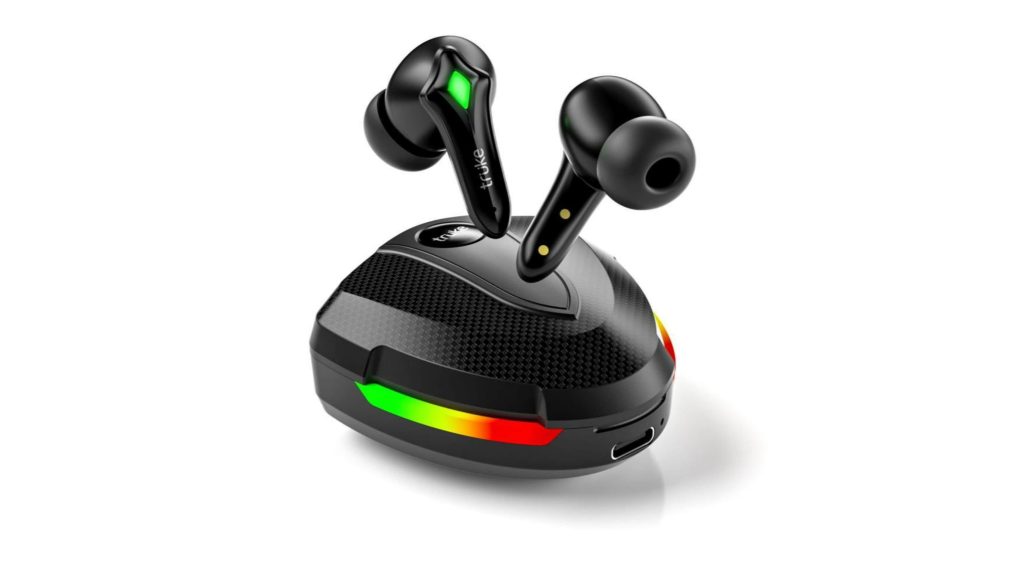
Today, the brand has launched a new pair of truly wireless earphones under its BTG label, which stands for ‘Born to Game’. The product is officially called Truke BTG Storm.
Just like the previous BTG series TWS from Truke, the Storm also arrives with RGB lights. The lights can be found on the sides of the charging case and on the buds as well. Unfortunately, they are still not customizable.
The case looks like a shield or a badge. The earbuds are in-ear type and use silicone tips. They feature 13mm drivers.
The accessory comes with Bluetooth 5.3 for connectivity. It supports SBC and AAC audio codecs. It also offers touch controls and ENC (Environmental Noise Cancellation) for calls.
The IPX4-rated buds arrive with a low latency mode for gaming. The latency reduces up to 40ms in this mode. Finally, there is a microphone on each bud.
The buds house a 40mAh battery each, while the case includes a 300mAh battery. The company claims that the buds can last around 8-10 hours on a full charge. With the charging case that charges via a USB Type-C port, the total endurance is rated at up to 50 hours.
The Trule BTG Storm earbuds are priced at ₹1,099. But for today (May 17) and tomorrow (May 18), it will be sold at a discounted price of ₹899.
The TWS product can be purchased from either Amazon, Flipkart, or Truke.in.
Google has recently released Android 13 QPR3 Beta 3.2, a minor update that brings important fixes and enhancements to the operating system. This update focuses on resolving critical issues to improve user experience and performance.
Users on the QPR3 Beta Build will get an OTA update to Beta 3.2
The following significant fixes are included in Android 13 QPR3 Beta 3.2:
Input Synchronization Issue: A bug causing windows to either stop receiving touch input or receive input in the wrong location has been successfully addressed (Issue #279560321).
Wi-Fi Calling Disconnections: The update fixes an issue that led to unexpected disconnections during Wi-Fi calls.
SIM Card Detection and Activation: Users will no longer experience difficulties with SIM card detection or activation during phone setup.
IMS Registration over Wi-Fi: The update ensures successful registration of IMS over Wi-Fi when transitioning from LTE coverage to Wi-Fi coverage.
Cellular Connectivity Stability: Various issues that caused unexpected dips in cellular connectivity speeds and reliability have been resolved.
Users who are already running a QPR3 beta build will receive an automatic over-the-air (OTA) update to Beta 3.2.
To obtain Android 13 QPR3 Beta 3.2, follow these simple steps:
OTA Update: Eligible devices will receive a notification for the OTA update. Simply follow the instructions to install the update seamlessly.
Google remains committed to refining the Android experience, prioritizing user satisfaction, and ensuring a smooth and reliable operating system. Pixel Users have already received the Android QPR3 Beta 3 update last month. Users are also encouraged to provide feedback to help further improve the system.
Earlier this month, Realme held a launch event in China to announce the Realme 11, Realme 11 Pro, and Realme 11 Pro+ smartphones. Recent reports have claimed that these devices will also be released in other markets, including India. The following tweet released by Realme India confirms that the Realme 11 Pro models will break cover in India in June.
Something "Pro" is happening in June. What kind of innovation do you think the #realme11ProSeries5G will have? Comment below to show your opinion. #realmeNumberSeries
As mentioned above, the Realme 11 lineup will also release in some other global markets in June. However, it is unclear whether the Realme 11 will debut alongside the Pro models or launch separately.
Realme 11 Pro, Realme 11 Pro+ specifications
The Realme 11 Pro and the Realme 11 Pro+ are equipped with a 6.74-inch OLED panel with curved edges. The screen offers an FHD+ resolution and a 120Hz refresh rate. Both phones run on the Realme UI 4.0-based Android 13 OS.
The Realme 11 Pro has a 16-megapixel front-facing camera, whereas the Pro+ features a 32-megapixel selfie snapper. The back panel of the Pro model features an OIS-enabled 100-megapixel primary camera and a 2-megapixel macro camera. On the other hand, the Pro+ has a 200-megapixel main camera with OIS support, an 8-megapixel ultra-wide lens, and a 2-megapixel macro snapper on the back.
The Realme 11 Pro series is powered by the Dimensity 7050, which also powers the recently unveiled Lava Agni 2 5G. Both house a 5,000mAh battery. The Realme 11 Pro and 11 Pro+ support 67W and 100W charging, respectively.
As per a recent report, the Realme 11 Pro will arrive in three options, such as 8 GB RAM + 128 GB storage, 8 GB RAM + 256 GB storage, and 12 GB RAM + 256 GB storage. On the other hand, the Realme 11 Pro+ will arrive in two configurations, such as 8 GB RAM + 256 GB storage and 12 GB RAM + 256 GB storage. Both phones are expected to arrive in three shades, such as Astral Black, Oasis Green, and Sunrise Beige. At present, there is no word on their prices for the Indian market.
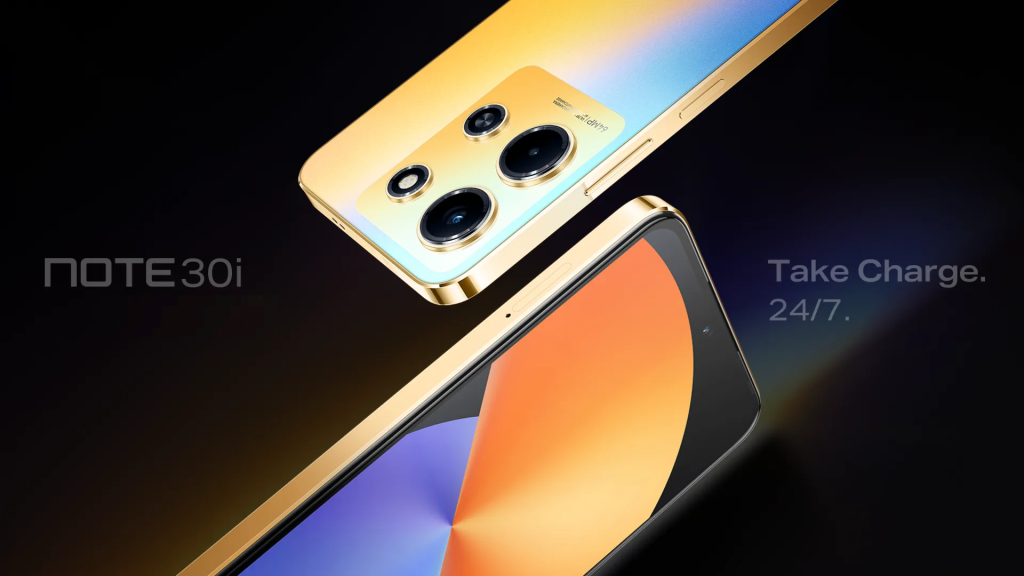
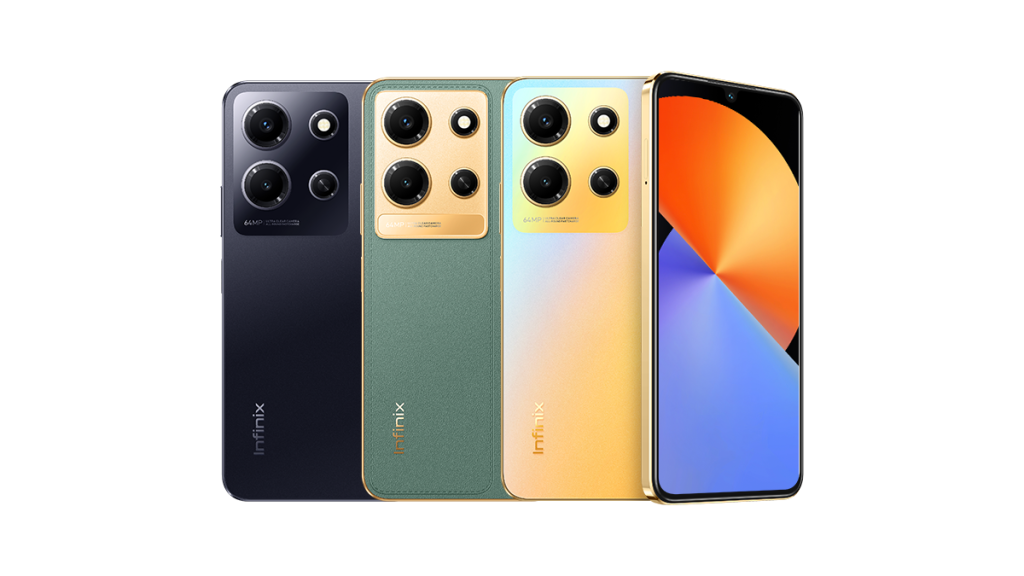
Infinix is expected to announce multiple Note 30-branded smartphones this month. In fact, the Infinix Note 30i has already gone official without any fanfare. The device is now listed on the company’s website with all its specifications and images. Unfortunately, there is no information available on the price or availability of the device.
Infinix Note 30i specifications and features
Infinix Note 30i
The Infinix Note 30i has a 6.6-inch AMOLED display with a centrally positioned punch-hole. The device offers an FHD+ resolution, a 180Hz touch sampling rate, and a 60Hz refresh rate. The phone offers a 92 percent screen-to-body ratio.
Under the hood, the Infinix Note 30i features the Helio G85 chipset and 8 GB of RAM. The device comes with up to 256 GB of internal storage. It comes preloaded with Android 13 OS, which is overlaid with Infinix’s XOS.
The Note 30i is equipped with dual stereo speakers powered by JBL. It houses a 5,000mAh battery with 33W rapid charging support. With the reverse charging feature, the Note 30i can be used to power up other devices.
Infinix Note 30i
The Note 30i is equipped with a 16-megapixel camera for shooting selfies. On the back, it has a 64-megapixel primary camera and two unknown cameras. For security, it has a side-facing fingerprint scanner. Lastly, it offers IP53-rated dust and splash resistance.
The Infinix Note 30i’s price is yet to be confirmed. When available, buyers will be able to get it in shades like Obsidian Black, Variable Gold, and Impression Green.
Reports have revealed that the Infinix Note 30 series includes multiple models, such as the Note 30, the Note 30 5G, and the Note 30 VIP. These models are said to be powered by the Helio G99, the Dimensity 6080, and the Dimensity 8050 chipsets, respectively.
Google recently announced that it will be implementing a new policy regarding inactive accounts, aiming to enhance security and optimize storage space. Starting later this year, old and unused accounts that have been inactive for at least two years will be deleted. This update affects personal Google Accounts and excludes accounts managed by businesses or schools. However, accounts with YouTube videos will not be deleted to preserve historical content.
Users have sufficient time to retrieve any important data
The deletion process will commence in December 2023 at the earliest, and Google plans to take a phased approach, beginning with GMail accounts that were created but never utilized. To ensure users are well-informed, multiple notifications will be sent to the account’s email address and the recovery email, if provided, in the months leading up to deletion. This careful rollout aims to give users sufficient time to take action or retrieve any important data before their accounts are permanently deleted.
To keep an account active, users need to sign in periodically or perform basic actions such as reading or sending emails, using Google Drive, watching YouTube videos, downloading apps from the Play Store, conducting Google searches, or signing in to third-party apps or services using “Sign in with Google.” Moreover, using a signed-in Android device is also considered activity, according to Google.
However, Google Photos already has a separate two-year sign-in and usage policy to ensure an account is deemed active. Accounts with active subscriptions on the Play Store, such as Google One or third-party apps, are also considered active.
The primary motivation behind this change is to bolster security. Inactive accounts, particularly those with old or reused passwords, are more susceptible to compromise. Google’s internal analysis reveals that abandoned accounts are at least 10 times less likely to have two-step verification enabled compared to active accounts. By deleting these inactive accounts, Google aims to mitigate the risks associated with identity theft, spam, and the dissemination of malicious content.
Furthermore, this approach helps limit the retention of unused personal information, aligning with industry standards. It’s worth noting that Google will not free up Gmail addresses for reuse when an account is deleted, distinguishing its policy from other services.
Google advises users to assign a recovery email and suggests utilizing the Inactive Account Manager to decide on appropriate actions when an account becomes inactive. Options available through this tool include sending files to trusted contacts, setting up a Gmail autoresponder, or initiating the deletion of the account.
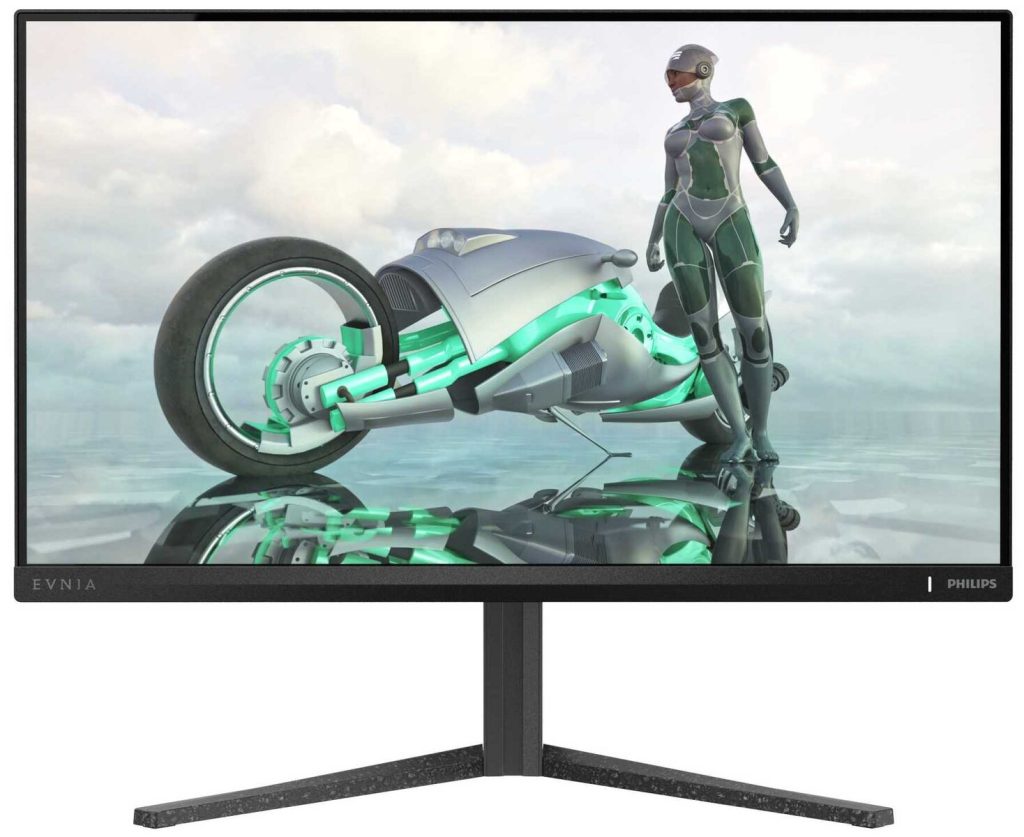
After launching its premium OLED monitors in China, Philips is set to introduce two new gaming monitors under its Evnia series, catering to gamers looking for immersive visual experiences. The Evnia 25M2N3200W and the Evnia 25M2N5200P offer impressive features and specifications designed to enhance gaming performance.
The Evnia 25M2N3200W boasts a 24.5-inch VA panel, delivering a resolution of 1,920 x 1,080 pixels with a pixel density of 90 PPI. Philips claims the monitor supports 10-bit color depth, although it utilizes 8-bit with FRC instead of true 10-bit. With a peak brightness of 300 nits and a 3,000:1 contrast ratio, this monitor aims to provide vivid and detailed visuals. HDR10 support and Flicker-Free technology contribute to an improved viewing experience.
Philips Evnia 25M2N3200W
However, the standout feature of the Evnia 25M2N3200W is its impressive 240 Hz refresh rate, offering ultra-smooth image rendering during fast-paced gaming. The monitor’s 1 ms GtG response time and Adaptive-Sync support further enhance motion clarity. Connectivity options include a 3.5 mm jack, DisplayPort 1.4, and two HDMI 2.0 ports.
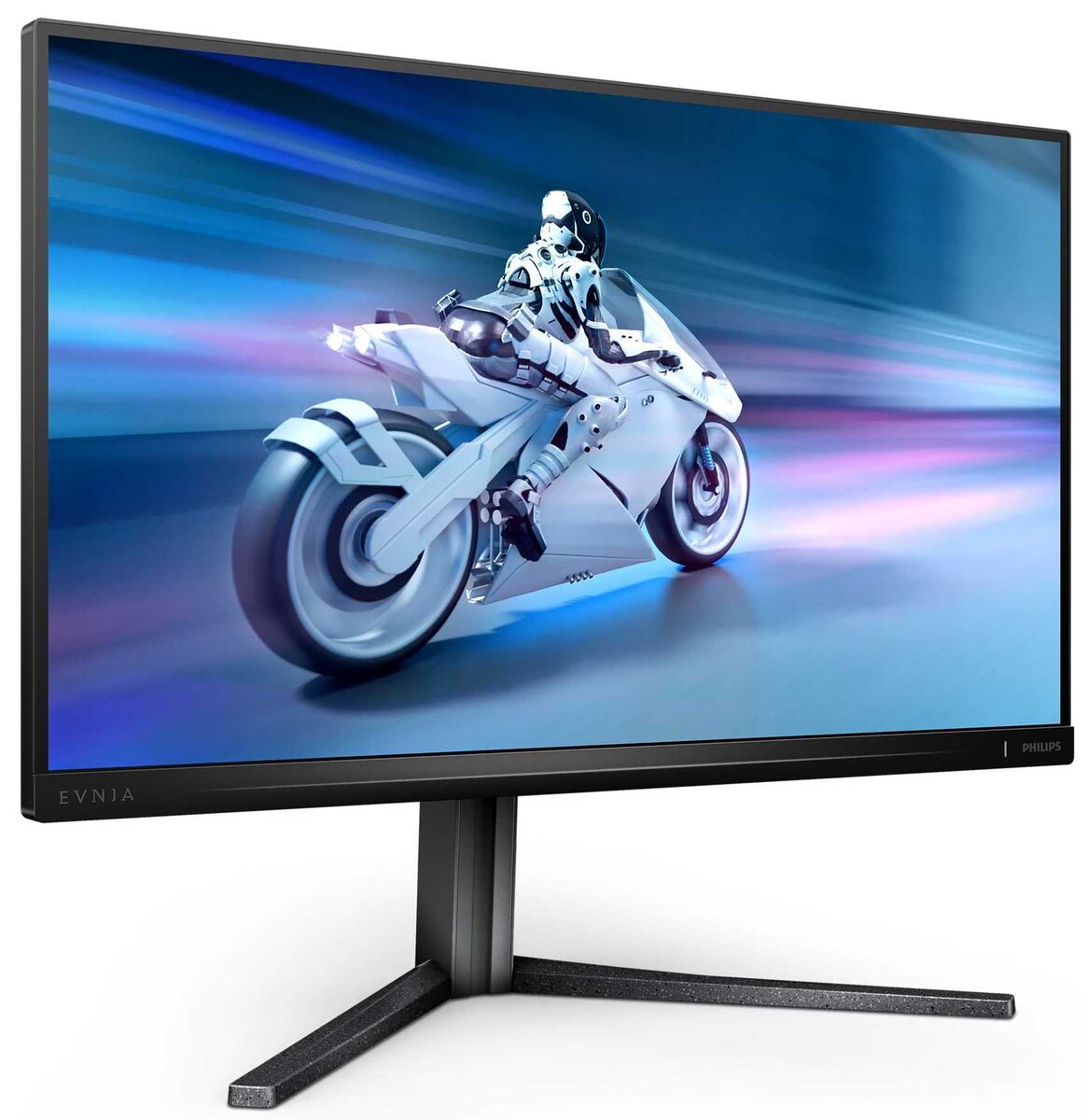
Philips plans to launch the Evnia 25M2N3200W alongside the Evnia 25M2N5200P, which offers additional features at a higher price point. The Evnia 25M2N5200P features a 24.5-inch IPS panel, providing a similar resolution to its counterpart. However, it offers a higher peak brightness of 400 nits and a 1,000:1 contrast ratio for richer visuals.
Philips Evnia 25M2N5200PPhilips Evnia 25M2N5200P
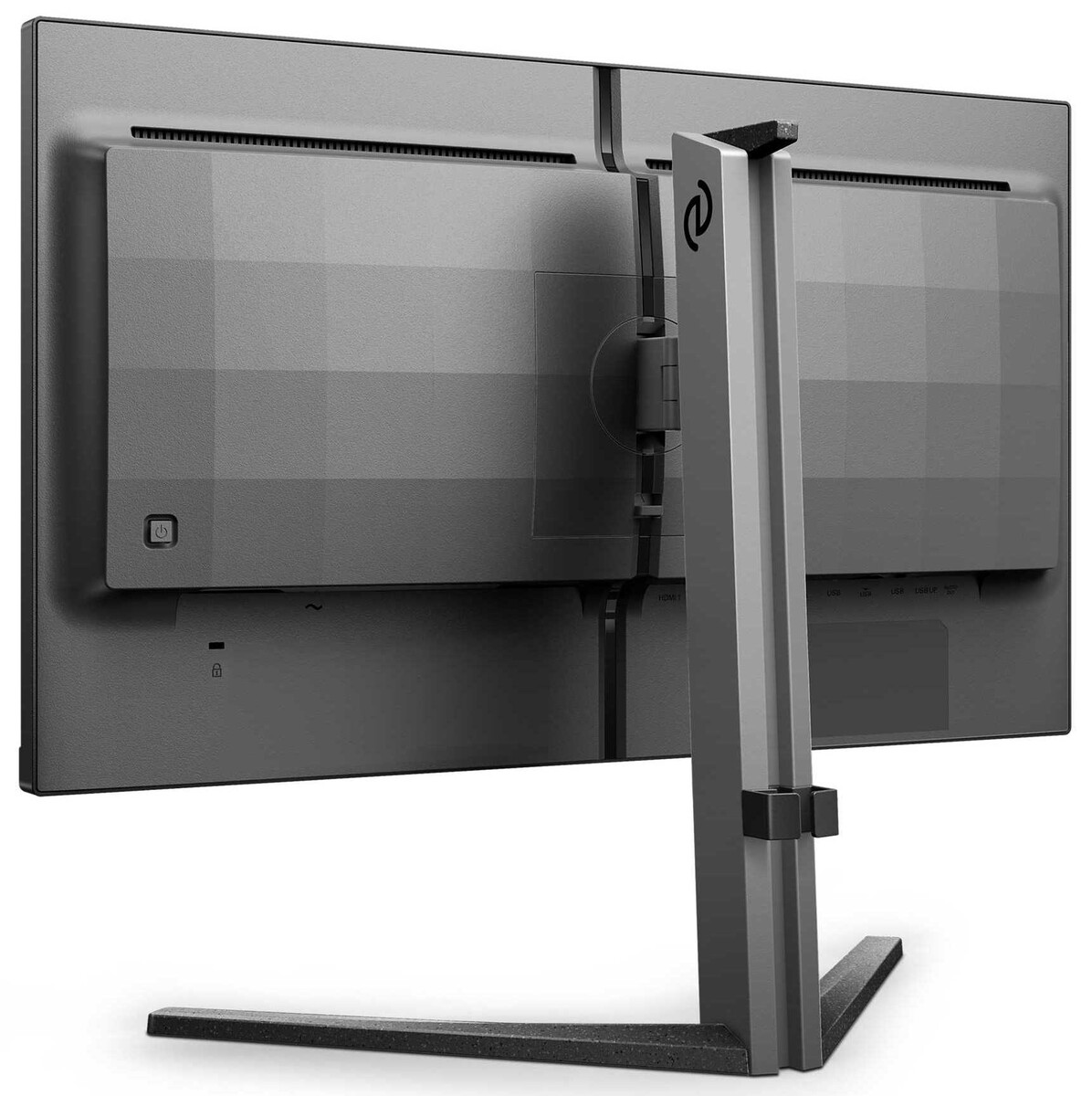
With 8-bit color depth and HDR10 coverage, the Evnia 25M2N5200P delivers stunning color reproduction. It boasts a 280 Hz refresh rate and 1 ms GtG response times, along with AMD FreeSync Premium support, ensuring smooth gameplay with reduced screen tearing. In terms of connectivity, the monitor includes a 3.5 mm jack, DisplayPort 1.4, two HDMI 2.0 ports, four USB 3.2 Gen1 Type-A ports, and a USB 3.2 Gen1 Type-B port.
Both monitors offer VESA 100 x 100 mm mounts for compatibility with third-party stands. While the Evnia 25M2N3200W lacks USB ports, the Evnia 25M2N5200P provides convenient USB connectivity options.
Pricing & availability
The Evnia 25M2N3200W is expected to be priced at £179.99 in the UK or €219 in the Eurozone. On the other hand, the Evnia 25M2N5200P will carry an MSRP of €309 in the Eurozone and £269.99 in the UK. Customers can find more details about these monitors on Philips’ official website.
In a remarkable demonstration of its commitment to inclusivity and accessibility, Apple has provided a sneak peek into its upcoming software features designed to empower individuals with disabilities. These cutting-edge updates encompass cognitive, vision, hearing, and mobility accessibility, as well as innovative tools for those who are nonspeaking or at risk of losing their ability to speak. Leveraging advancements in hardware and software, Apple ensures user privacy by utilizing on-device machine learning. These groundbreaking features are set to revolutionize the way people with disabilities interact with technology, embodying Apple’s longstanding philosophy of creating products that cater to everyone’s needs.
Personal Voice will let users synthesize a voice that sounds exactly like them in 15 Minutes
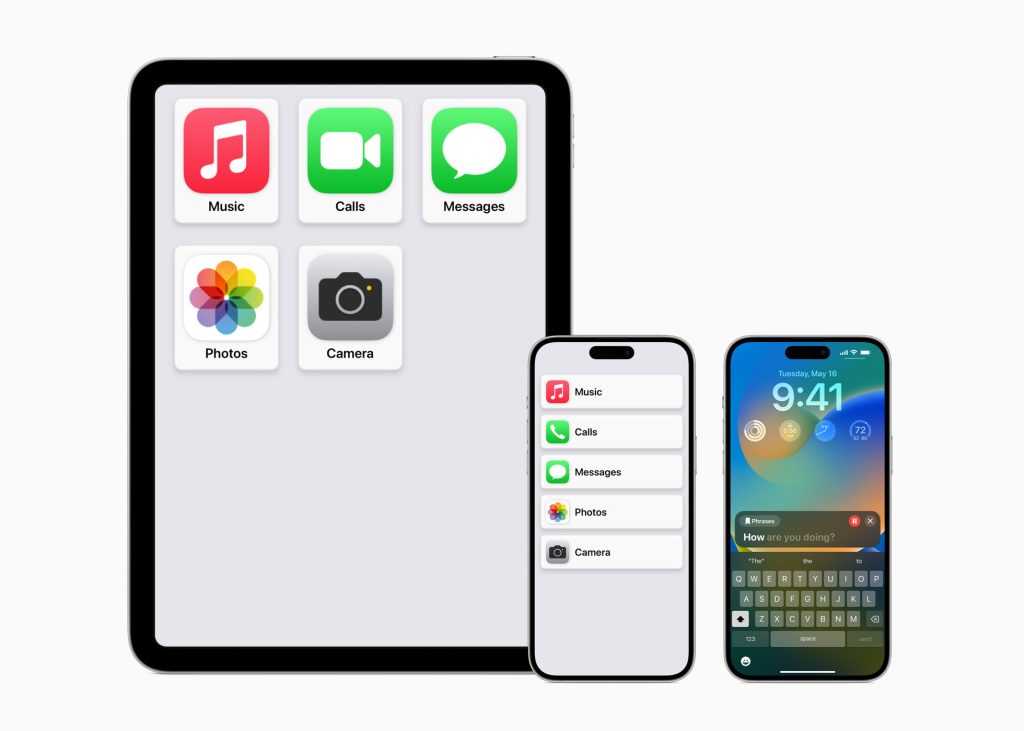
Apple’s relentless pursuit of inclusivity is exemplified by its close collaboration with community groups representing a diverse range of users with disabilities. The forthcoming updates, slated for release later this year, will introduce transformative accessibility options. Users with cognitive disabilities will benefit from Assistive Access, which simplifies apps and experiences to reduce cognitive load. By streamlining activities such as connecting with loved ones, capturing and enjoying photos, and listening to music, Assistive Access empowers individuals with cognitive disabilities to use their iPhones and iPads with greater ease and independence.
Moreover, Apple recognizes the challenges faced by nonspeaking individuals and those at risk of losing their ability to speak. To address this, Live Speech enables users to type their messages, which are then spoken aloud during phone calls, FaceTime conversations, and even in-person discussions. This breakthrough feature, available on iPhone, iPad, and Mac, accommodates millions of people worldwide who are unable to speak or have experienced speech loss over time.
Another remarkable innovation is Personal Voice, a secure and user-friendly solution for individuals at risk of losing their ability to speak, such as those with ALS or similar conditions. By recording 15 minutes of audio through a series of text prompts, users can create a synthesized voice that sounds like their own. Apple’s on-device machine learning technology ensures the privacy and security of users’ information. Personal Voice seamlessly integrates with Live Speech, allowing users to communicate with their unique synthesized voice when connecting with family and friends.
For users with vision disabilities, Apple introduces Point and Speak in the Magnifier app. Leveraging the camera, LiDAR Scanner, and on-device machine learning, this feature identifies and reads text labels aloud on physical objects like household appliances. Point and Speak empowers individuals with vision impairments to interact with their surroundings confidently, enabling greater independence and convenience.
In addition to these key updates, Apple introduces several other accessibility features to enhance the user experience for individuals with disabilities. Deaf or hard-of-hearing users can directly pair Made for iPhone hearing devices with their Mac and customize them for optimal comfort. Voice Control now includes phonetic suggestions for text editing, aiding users who rely on voice input. Switch Control allows users with physical and motor disabilities to transform any switch into a virtual game controller, providing an inclusive gaming experience. Apple has also improved Text Size adjustment across various Mac apps for users with low vision.
Furthermore, Apple addresses the needs of users who are sensitive to rapid animations by automatically pausing images with moving elements, such as GIFs, in Messages and Safari. VoiceOver users will enjoy more natural and expressive Siri voices, even at high rates of speech feedback, with the ability to customize Siri’s speaking rate.
Tim Cook, Apple’s CEO, emphasizes the company’s commitment to creating technology for all, stating, “At Apple, we’ve always believed that the best technology is technology built for everyone.” Sarah Herrlinger, Apple’s senior director of Global Accessibility Policy and Initiatives, highlights the invaluable contributions of the disability community in shaping these features, stating, “These groundbreaking features were designed with feedback from members of disability communities every step of the way, to support a diverse set of users and help people connect in new ways.”
Apple’s unwavering dedication to accessibility propels technology forward, fostering a world where individuals with disabilities can thrive and reach their full potential. With these innovative features on the horizon, Apple continues to lead the charge in creating a more inclusive digital landscape.
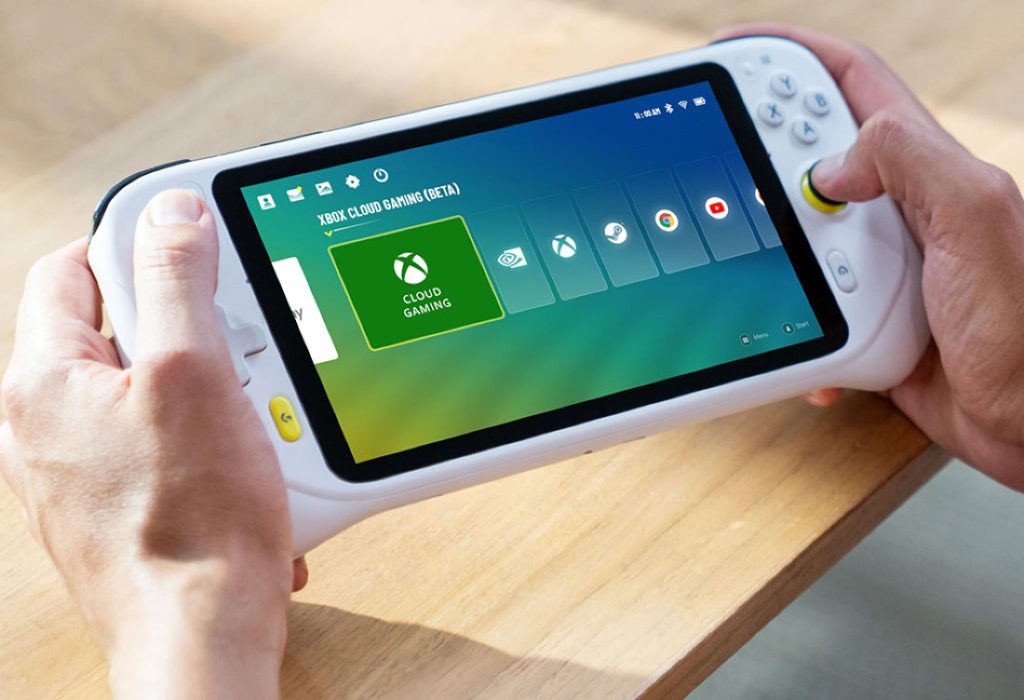
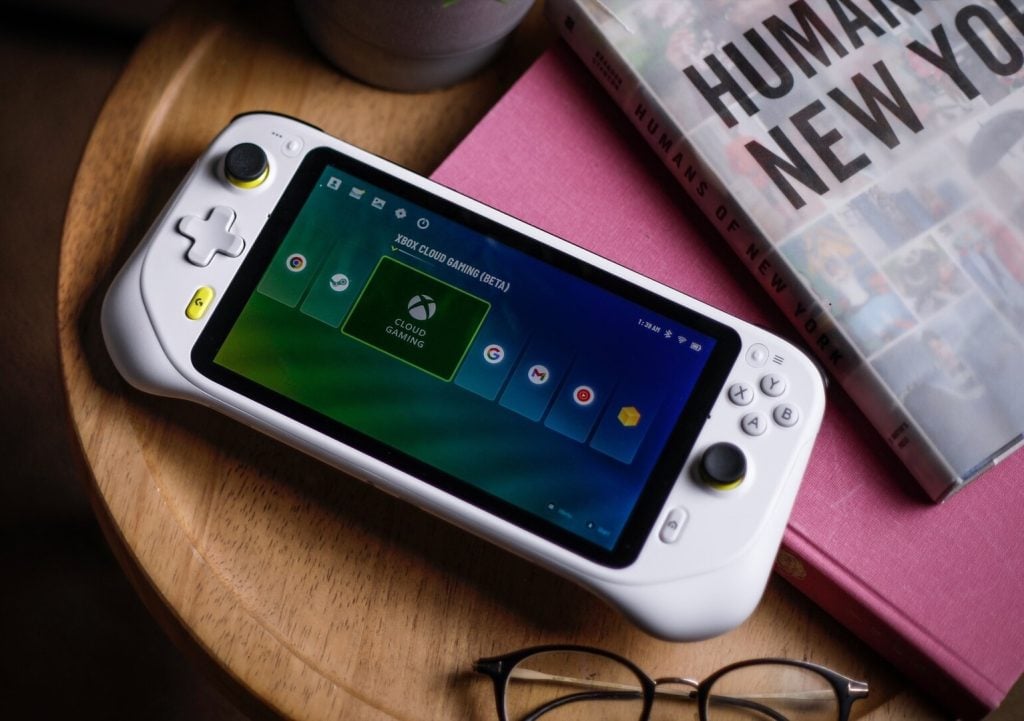
Back in September 2022, Logitech launched the G Cloud handheld gaming console in Canada and the US. Almost eight months after that, the handheld is now arriving in Europe and UK. You can check out the details about the console below.
Logitech G Cloud handheld console specs & features
The Logitech G Cloud handheld gaming console is a new device that allows users to play AAA titles on the go. The console is powered by the Qualcomm Snapdragon 720G chipset, paired with 4GB of RAM and 64GB of storage. It has a 7-inch 1080p touchscreen display, a stereo speaker system, and a built-in microphone. The console also features a gyroscope and remappable controls.
The Logitech G Cloud is a cloud gaming device, which means that games are streamed to the console from remote servers. This allows the console to play games that would otherwise be too demanding for its hardware. The console supports a variety of cloud gaming services, including Xbox Game Pass Ultimate, Nvidia GeForce NOW, and Steam Link.
Here are some additional details about the Logitech G Cloud handheld gaming console:
Dimensions: 240 x 100 x 20 mm
Weight: 463 g
Battery life: up to 12 hours
Operating system: Android 11
Processor: Qualcomm Snapdragon 720G
RAM: 4GB
Storage: 64GB
Display: 7-inch 1080p touchscreen
Speakers: Stereo speakers
Microphone: Built-in microphone
Connectivity: Wi-Fi 802.11a/b/g/n/ac, Bluetooth 5.1
Ports: USB-C, 3.5mm audio jack
Sensors: Gyroscope, accelerometer, compass
Cloud gaming services: Xbox Game Pass Ultimate, Nvidia GeForce NOW, Steam Link
Pricing & availability
Logitech has announced that the Logitech G Cloud will be priced at €359 in Europe and £329.99 in the UK. According to the company’s official statement, the console will be available in several European countries, including Germany, France, Italy, Spain, Norway, Denmark, Sweden, and Finland. However, it will not be released in all Eurozone countries.
As an added incentive, Logitech is offering a special promotion for early adopters. Customers who place their G Cloud orders before June 22 will receive a complimentary package that includes 6 months of Xbox Game Pass Ultimate, 1 month of NVIDIA GeForce NOW Priority, and 1 month of Shadow PC, providing them with a range of gaming options to enjoy on their new console.
Electric scooters have witnessed a remarkable surge in popularity in recent years. With their eco-friendly nature, ease of use, and efficient mobility, electric scooters have captured the attention of urban dwellers and commuters around the world. These sleek and agile vehicles offer a convenient solution to congested city streets, allowing riders to navigate through traffic with ease. The growing popularity of electric scooters can be attributed to their versatility, affordability, and the increasing emphasis on sustainable transportation options. The INMOTION RS is one such electric scooter, and it just went live on Kickstarter. This ultra-high-performance e-scooter introduces a range of innovative features and advanced technology that promise to transform the way commuters traverse their urban landscapes.
The INMOTION RS has a class-leading Top Speed of 110km/h (68mph)
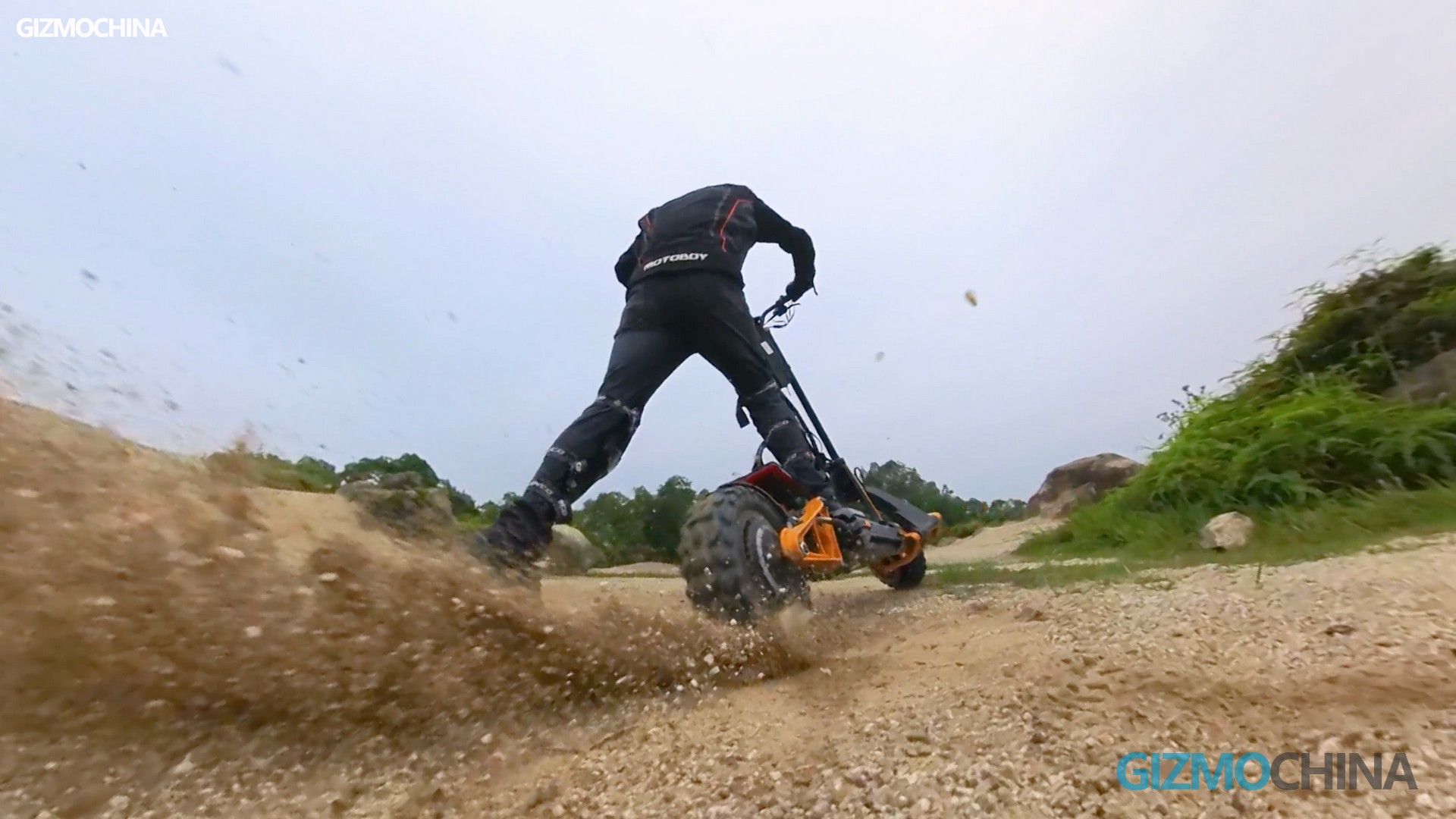
Equipped with dual 2000W motors and an impressive peak output of 8400W, the INMOTION RS boasts class-leading speed and power. This e-scooter can go from a standstill to 30.0mph (48km/h) in a matter of seconds, effortlessly conquering steep inclines of up to 50% grade. It outpaces most scooters in its price category, reaching a top speed of 68mph (110km/h), ensuring a thrilling ride for those seeking an adrenaline rush.
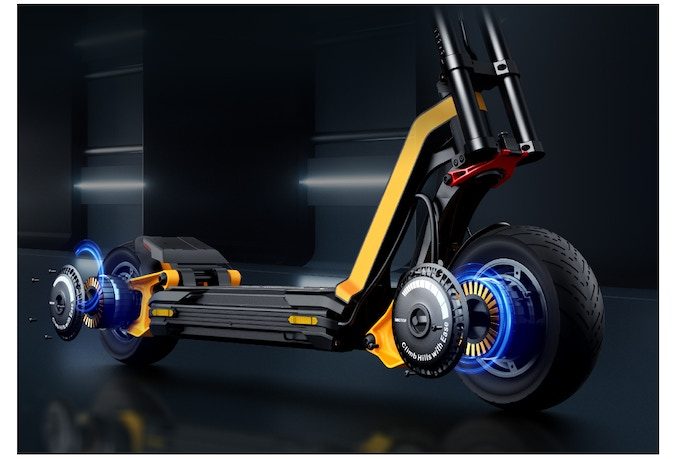
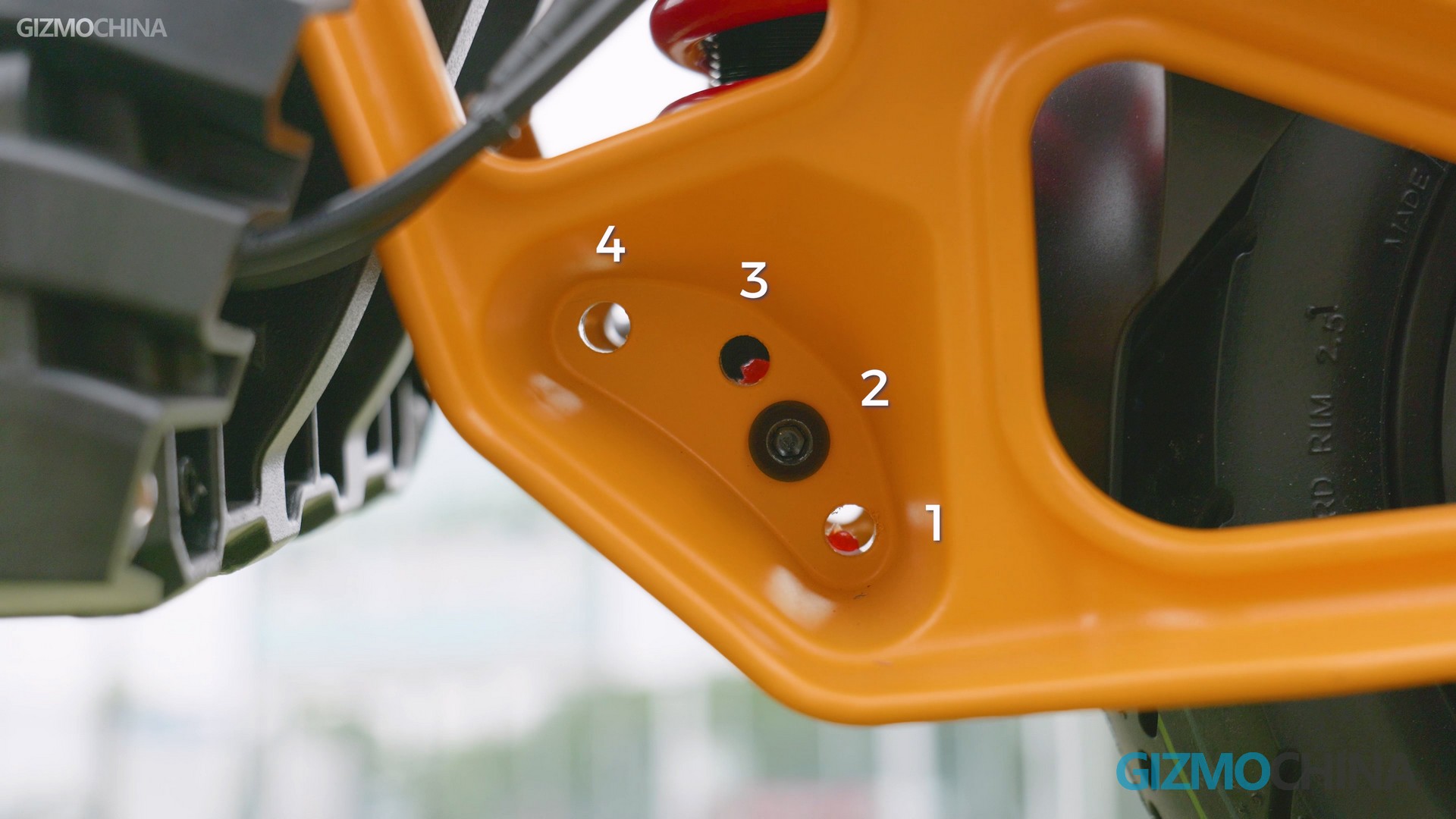
The defining feature of the INMOTION RS is its groundbreaking transforming system, inspired by the design of SUVs. This unique system offers riders four selectable pedal height settings, ranging from 183mm to 303mm. Each setting provides distinct shock absorption tailored to various terrain conditions. Whether you desire the exhilarating speed of a race car or the off-road capabilities of an SUV, the RS can effortlessly transform to suit your preference.
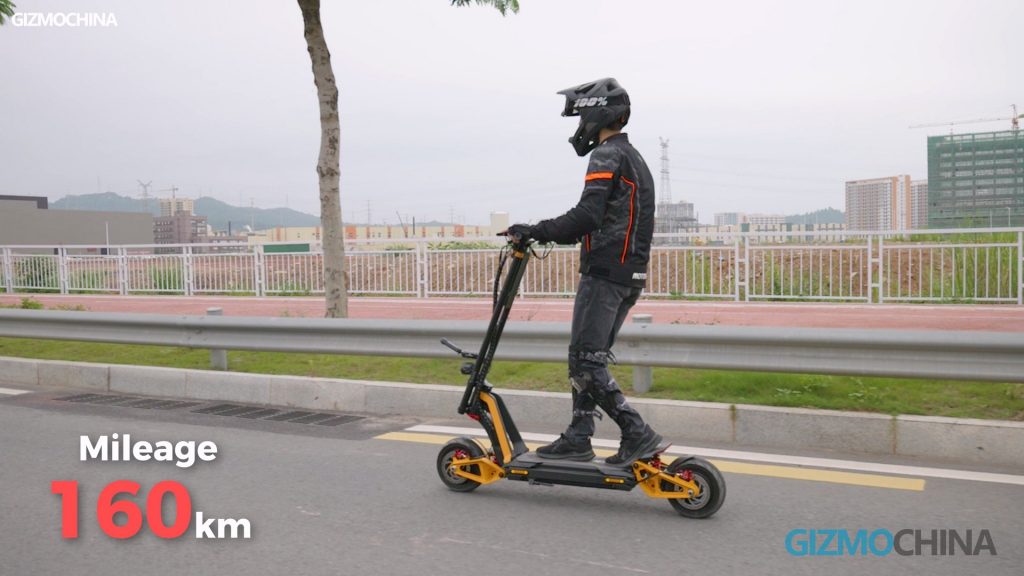
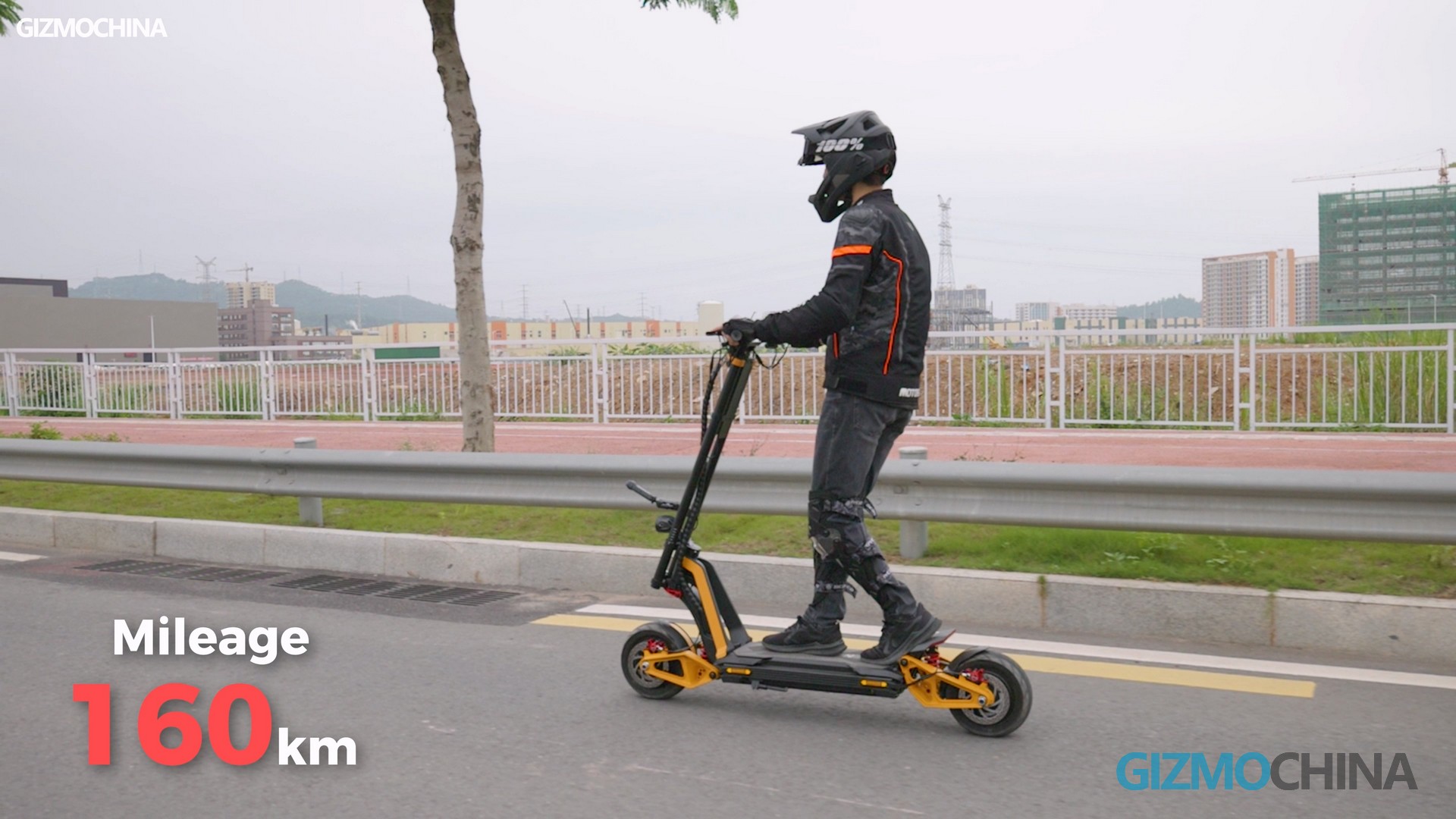
With a robust 72V 40AH battery housing advanced 21700 cells, the INMOTION RS offers an impressive travel range of 75-100 miles (120-160km) on a single charge. The incorporation of a Battery Management System (BMS) and Dual-Charging Capability ensures consistent power delivery, temperature control, and shorter charging times, granting riders the freedom to embark on longer journeys without worrying about running out of power.
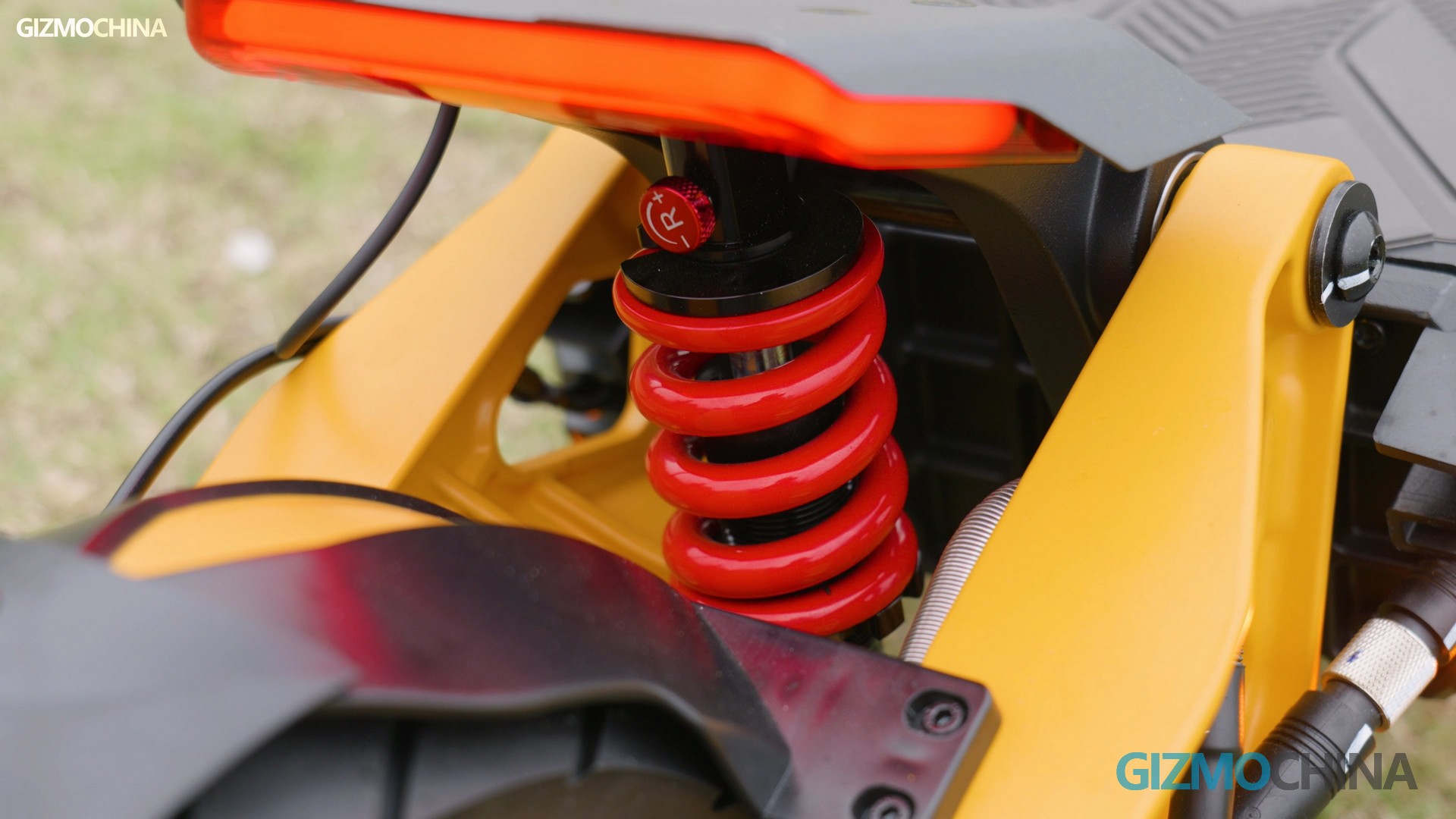
Designed for both performance and comfort, the INMOTION RS features a state-of-the-art C-shaped suspension absorber system with 11 stages of adjustable hydraulic damping for both the front and rear wheels. This innovative suspension setup delivers a tailored riding experience, optimizing comfort and performance. With a generous 96mm suspension travel range, the RS offers exceptional shock absorption, providing riders with a smooth and enjoyable journey across any terrain.
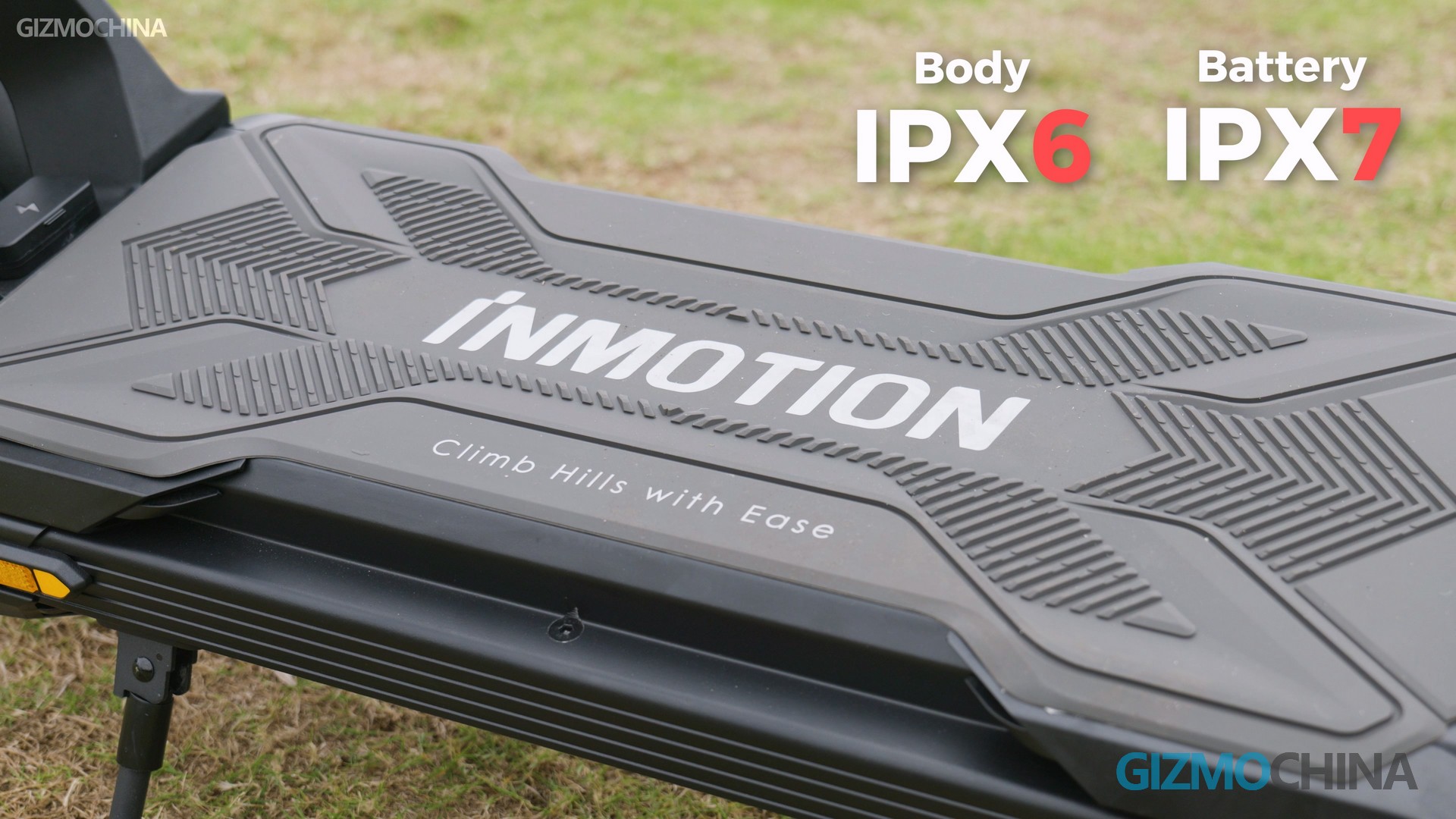
The e-scooter has dual 16cm full-hydraulic disc brakes and an enhanced regenerative braking system, hence, riders can rely on the RS to bring them to a swift and controlled stop, even at high speeds. This ensures maximum safety and control. The INMOTION RS also prioritizes visibility and safety with its front and rear lights, illuminating the rider’s path in low-light conditions. Additionally, the patterned multifunctional side lights serve as side markers, turn signals, and neon under-car lights. Moreover, the e-scooter has IPX6 body waterproofing technology and IPX7 Battery waterproofing for your off-road adventures, or to just push through a puddle.
The INMOTION App complements the RS, enabling riders to customize their driving mode, monitor real-time data such as speed, distance, and battery level, and track mileage from anywhere. The app also provides the convenience of remotely locking and unlocking the RS, adding an extra layer of security to the rider’s experience. The application is available on both iOS and Android.
As a globally-focused tech company specializing in electric vehicles for personal transportation, INMOTION has harnessed the expertise of its top talent in robotics and vehicle design to create the INMOTION RS. This e-scooter looks to be the culmination of years of research, engineering, and innovation, positioning INMOTION as a leader in the field of electric mobility. With their unwavering commitment to pushing the boundaries of what’s possible, INMOTION continues to redefine the future of personal transportation, and with this upcoming launch, those boundaries will be stretched even further.
INMOTION is a good brand. We have reviewed two of their electric scooters and their build quality is impressive. They have a very wide range of products. If you’re looking for an electric unicycle or scooter, INMOTION is sure to have a model designed for you. For those who like high-speed and off-road electric scooters, now INMOTION not only offers you a new choice, but a better one. INMOTION RS, the world’s first off-road electric scooter with a transforming system, is coming.
Design
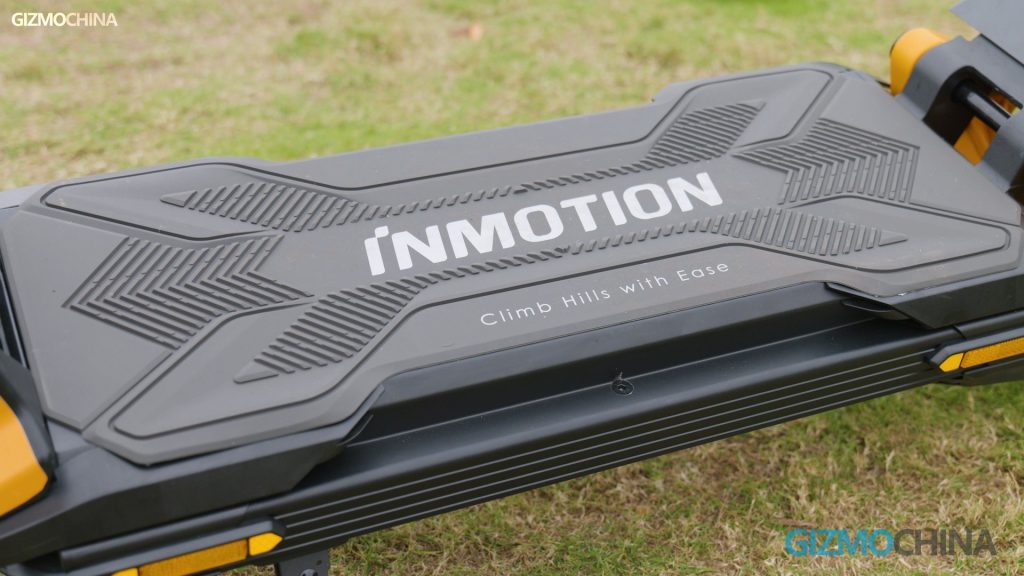
When we assembled the scooter, I could tell it was definitely a beast. The colors are still INMOTION’s favorite black and orange, but the difference is that the whole scooter is bigger from the size than both the S1 and Climber we tested before. The wide footrest deck plus the 150kg payload ensures that everyone can drive freely on the INMOTION RS.
Another advantage of the large size is that you can put down a larger battery. We’ll talk more about the RS’s battery later. Of course, the RS is also heavy. But when you decide to buy such a powerful electric scooter, you should be able to accept the weight. At least it can still be folded and won’t take up too much space.
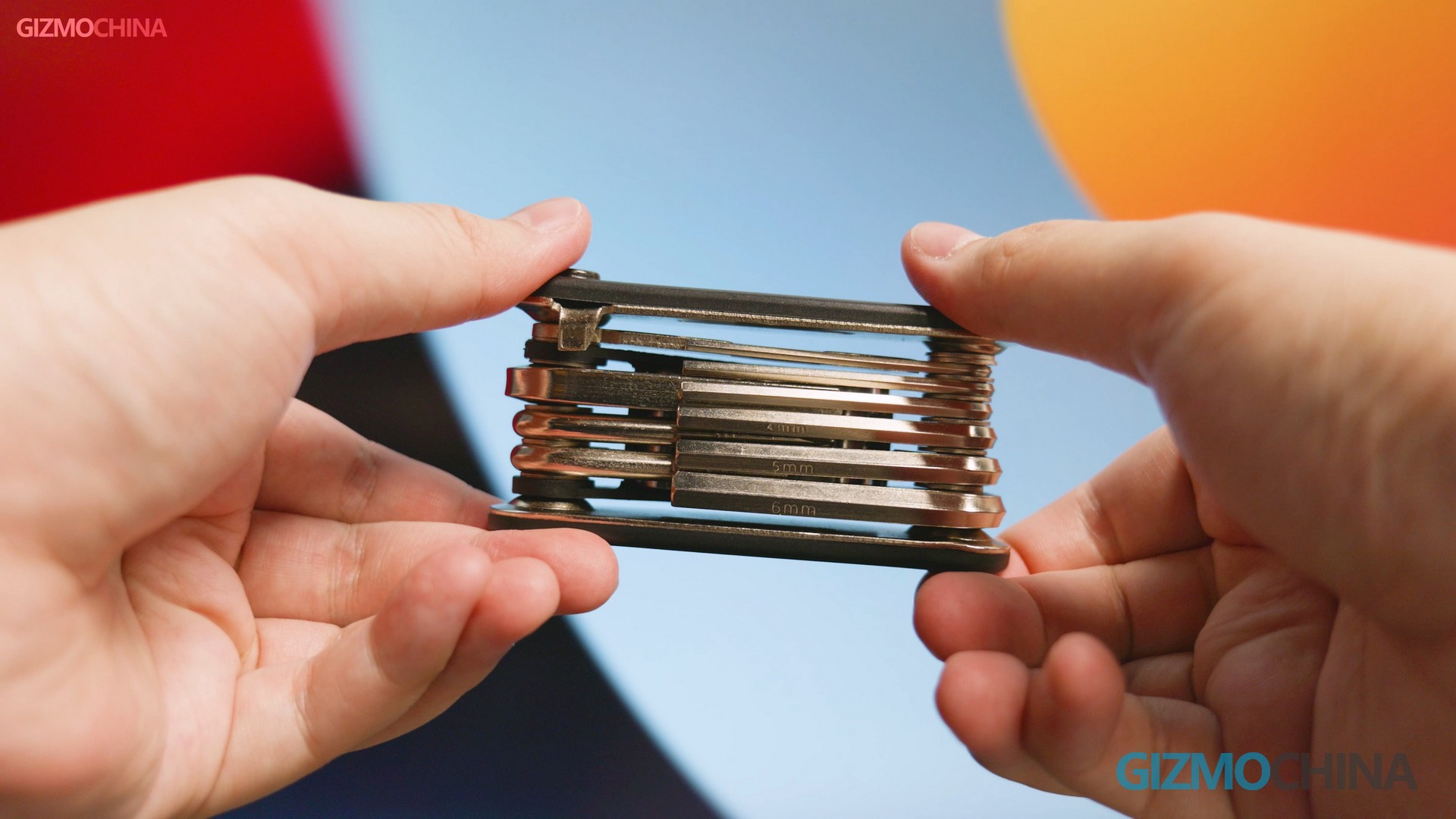
The RS body supports IPX6 waterproof, and the battery supports IPX7, which is one of the most basic specifications of an off-road electric scooter. By the way, I like the tool that comes in the package, I will definitely put it in my toolbox instead of throwing it away.
Transforming system
Let’s put our eyes on the tires, there’s a lot to introduce in this part. Since the biggest selling point of INMOTION RS is the transforming system, let’s talk about its suspension system first. The RS not only has a suspension for each front and rear wheel, but it is also height adjustable. INMOTION says they are drawing inspiration from SUV design. Offering four selectable ground clearance height settings from 183mm to 303mm.
Simply put, a higher chassis to go off-road, can easily pass the rugged road. Tune down the chassis to race, and lower the scooter’s center of gravity to avoid falling easily. The way to adjust the height is also very simple, you only need to use the screws to fix the suspension at different heights, and you can make the four height adjustments. With different heights of suspension to adapt to different environments, you have the equivalent of two different kinds of e-scooter.
Braking system
The 11-inch tires are clearly designed for all-terrain use, and its two 160mm full-hydraulic disc brakes will stop you in no time. What’s more, it also has a Regenerative braking system, which means it’s like some electric cars that can convert kinetic energy into electricity to achieve longer range. It can also significantly extend the life of the braking system as the mechanical parts will not wear out quickly.
Power System
Such a big, heavy electric scooter must need a super powerful motor. No, one is not enough, we need two. INMOTION for RS equipped with two 2000w motors, the peak output power can reach 8400w. This means from 0 to 30mph in 3.5 seconds. The top speed can reach 68mph and can climb 50% of the slope, which is about 26 degrees. While you may not need to drive that fast on a daily routine, and you may not climb that steep of a hill with it, it shows that the INMOTION RS really does do their best in terms of power. There’s no better choice than to use it to find excitement in the right situation. But I’ll remind you here, safety first.
Control
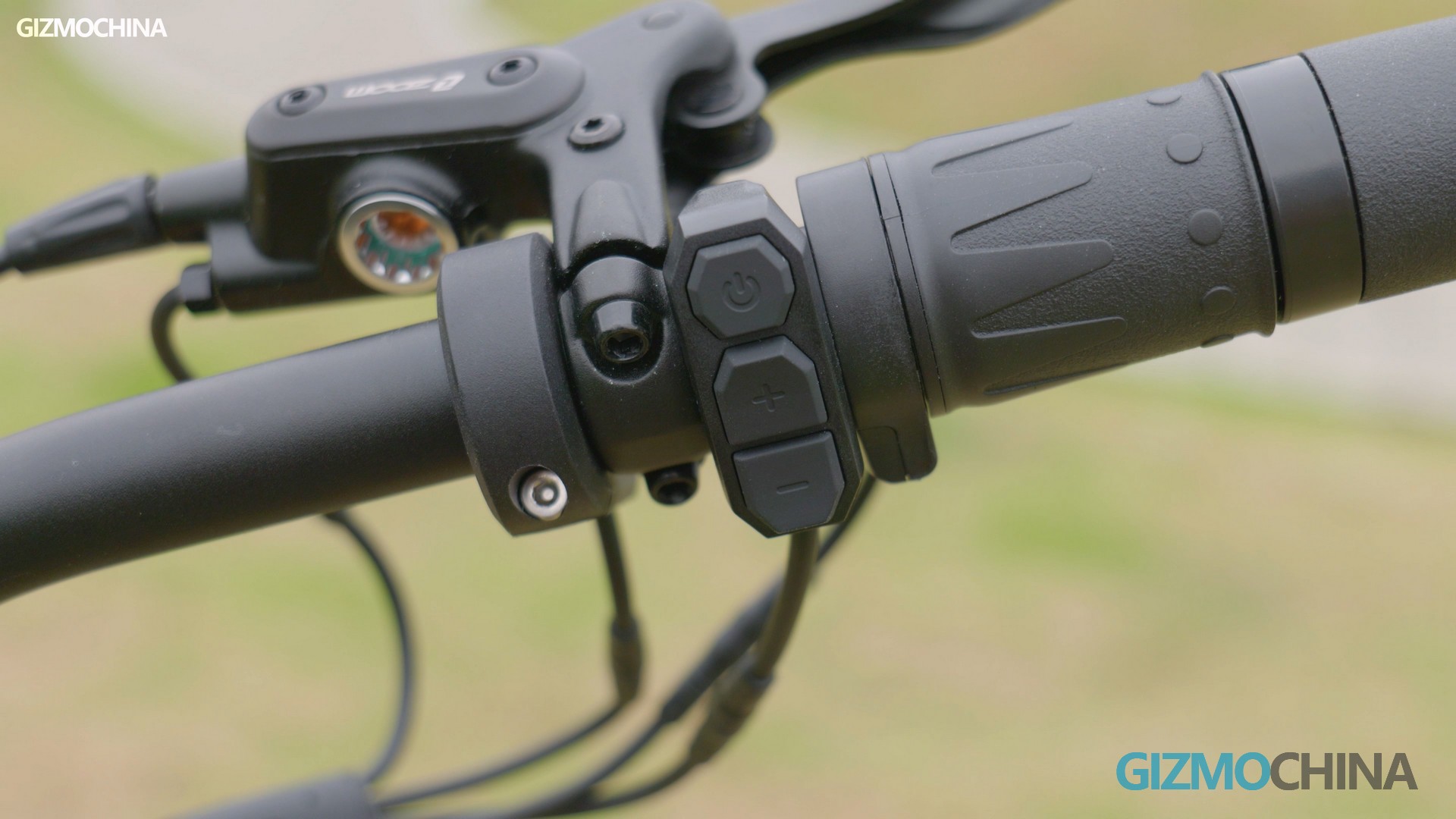
Let’s put our eyes on the handlebar. Because of its professionalism, it can be found that there are more buttons than the ordinary e-scooter. In addition to the brake lever and bell, RS has an operation panel on the left and right sides. The large one on the left mainly controls the turn signal, headlight, horn, and cruise control, and its drive mode can be set to front-wheel drive, back-wheel drive, or two-wheel drive. You can choose the drive mode according to your road conditions.
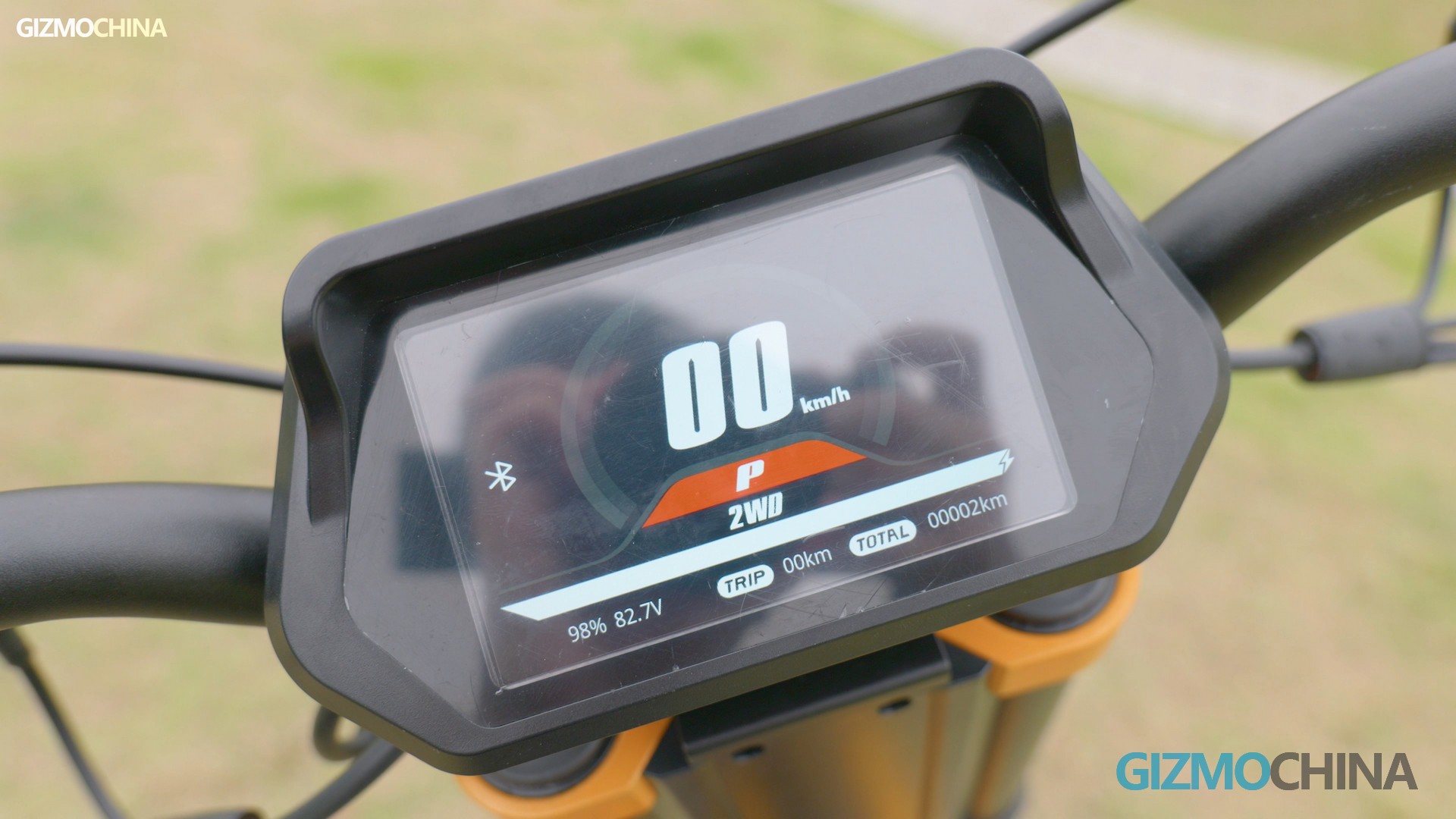
The control panel on the right is relatively simple, with only the power button and two ride mode switch buttons. The screen in the middle is also much larger, and it shows some basic information. For example, speed and remaining power. Like other INMOTION e-scooters, much data that are not available on the screen can be viewed from the app. It can also control some functions of the scooter, such as lights, ride mode, standby time, and so on.
Battery
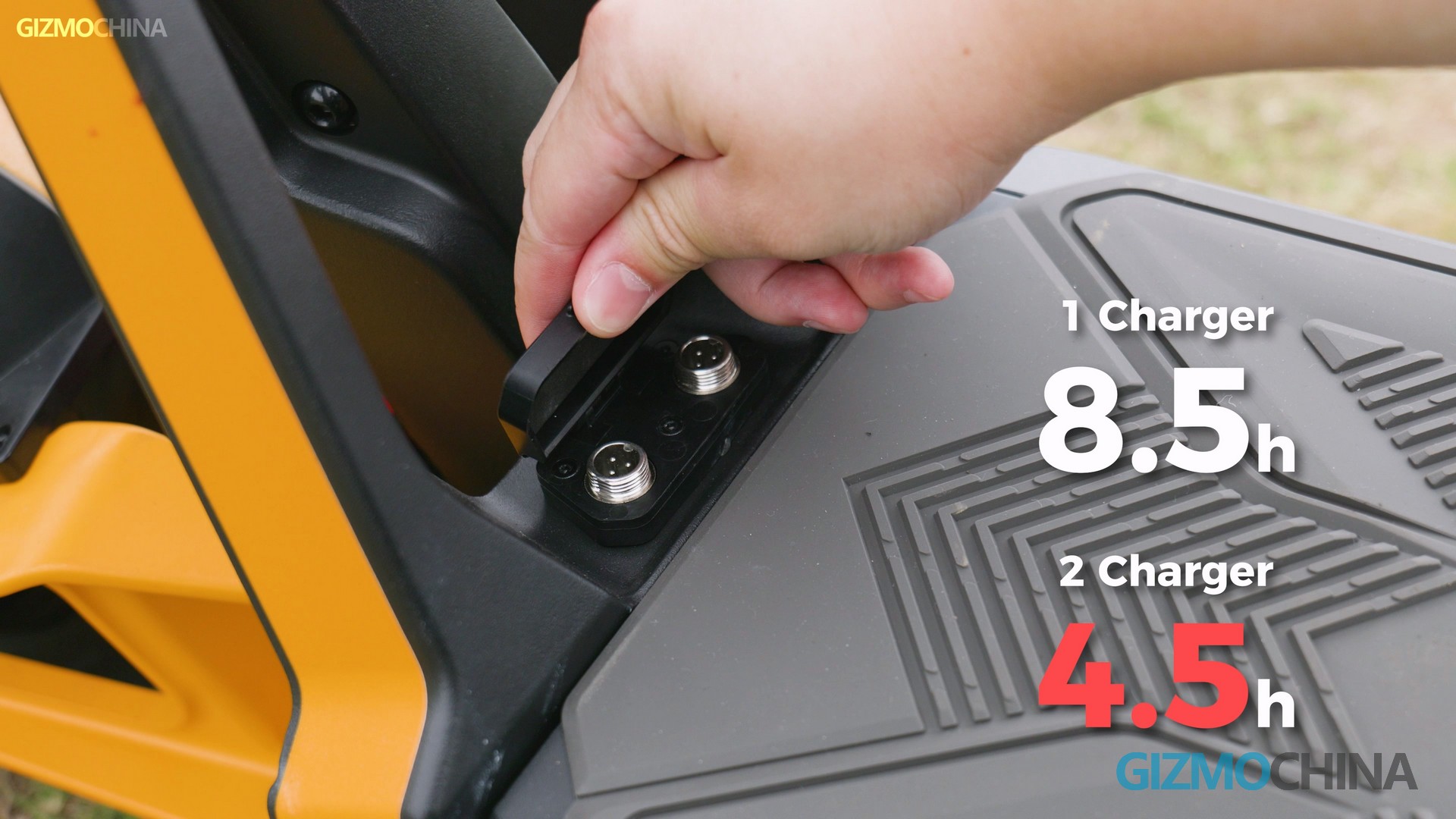
The battery of INMOTION RS is also very large. This 72V40Ah battery can get you up to 160km on a full charge. The Mileage is almost twice as long as a regular e-scooter. The price of a big battery is a long charging time, 8.5 hours is really long. INMOTION also knows this, so they let you use two chargers to charge the RS at the same time, the charging time will be cut in half.
As you can see, the INMOTION RS is a powerful electric scooter that can bring you both the joy of speed and the thrill of off-roading. Although it is really great, you have to think about whether you have the conditions to drive this beast. If it’s just for urban commuting, I recommend you buy INMOTION’s other e-scooter, which is also cheaper. But if you are a professional rider, I think this should be perfect for you. INMOTION RS will start crowdfunding on Kickstarter soon, don’t miss this money-saving opportunity.
Samsung and LG are the two main players in the display market. They make displays for a wide range of products, including smartphones, tablets, and televisions. For example both companies earn a substantial amount of money from every iPhone sold. However, it is a challenge to supply displays to the entire world. That is why in a major business deal, LG Display has agreed to supply OLED TV panels to Samsung Electronics. Here are the details…
LG Display will supply Samsung with 2 million OLED TV panels in 2023
According to the latest reports, LG Display will start supplying high-end TV panels to Samsung Electronics this quarter. The deal could provide a much-needed boost to LG Display, which has been struggling financially. Under the agreement, LG Display will supply Samsung with 2 million OLED TV panels in 2023. The number of panels is expected to increase to 3 million in 2024 and 5 million in 2025. The first batch of panels will be 77-inch and 83-inch white OLED (WOLED) panels.
The deal is a sign that Samsung is serious about expanding its presence in the high-end OLED TV market. OLED TVs are known for their superior image quality and have been gaining popularity in recent years. However, OLED panels are more expensive than traditional LCD panels, which has limited their adoption. With this deal, Samsung could surpass Sony to become the second-largest supplier of OLED TVs worldwide. This would be a significant shift in the global TV market.
The deal has been welcomed by investors, who have pushed up the share prices of both LG Display and Samsung Electronics. The news is a boost for LG Display, which has been struggling financially. The company has been operating at a loss for four consecutive quarters. The deal will help LG Display to fully utilize its manufacturing capacity and generate much-needed revenue.
Samsung Electronics is also likely to benefit from the deal. The company has its own display-making unit, Samsung Display, but it has struggled to compete with LG Display in the OLED TV market. The deal will give Samsung access to LG Display’s superior OLED panels, which will help it to improve its product offering and compete more effectively with LG Electronics and Sony.
The deal is a win-win for both companies and is likely to have a significant impact on the global TV market. It will be interesting to see how the market dynamics evolve in the coming years.
The 3nm process is the next big step in smartphone chip technology. It is expected to offer significant improvements in performance and power efficiency over the current 4nm process. This could lead to longer battery life and faster performance in upcoming products, such as the iPhone 15 and Galaxy S24. So, who will be the first manufacturer to use this technology and have an overwhelming advantage over its competitors? Apple is reportedly hoarding 90% of TSMC’s 3nm capacity this year. This could give it a significant advantage over its competitors. Here are the details…
What Does Apple’s 3nm Chip Hoarding Mean for Its Competitors?
Apple is reportedly hoarding 90% of TSMC‘s 3nm capacity this year, according to a new report from Taiwan. This means that the iPhone maker will have first dibs on the most advanced chip manufacturing process available, which could give it a significant advantage over its competitors. The 3nm process is expected to offer significant improvements in performance and power efficiency over the current 4nm process.
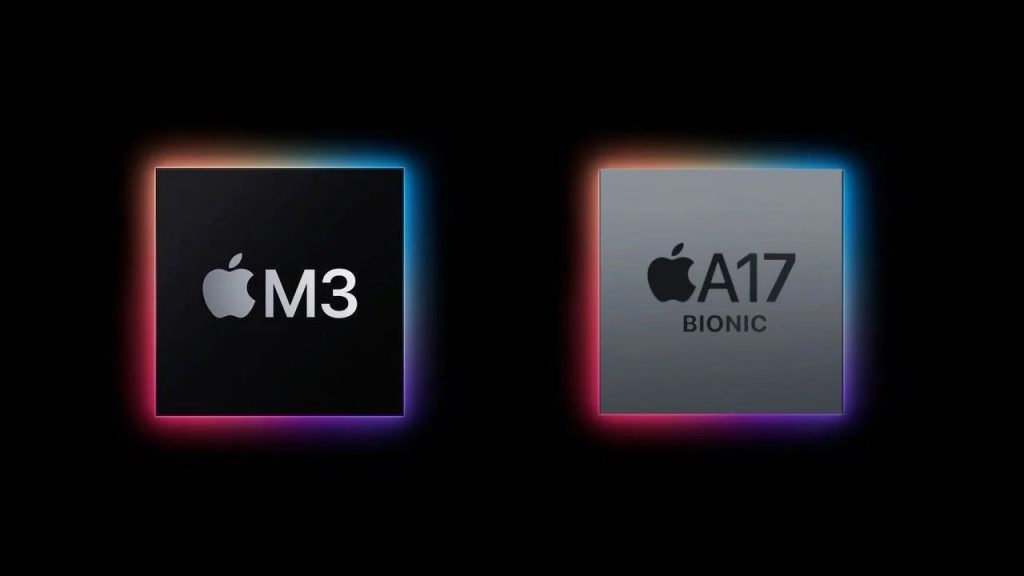
This could lead to longer battery life and faster performance in Apple’s upcoming products, such as the iPhone 15 and the M3 MacBook Air. The report also claims that Apple has been placing orders for 3nm chips since 2020, which suggests that the company is planning for the long term. This could mean that Apple is preparing to launch a new product category, such as a self-driving car, that requires the latest and greatest chip technology.
It is unclear what impact Apple’s hoarding of 3nm capacity will have on its competitors. Qualcomm, Samsung, and MediaTek are all expected to release 3nm chips in the coming years, but they may have to wait until 2024 or 2025 to get their hands on enough chips to meet demand. This could give Apple a significant advantage in the market.
It is also worth noting that TSMC is expected to increase its 3nm capacity in 2024. This could help to alleviate some of the supply constraints that Apple’s hoarding is causing. However, it is still unclear how much additional capacity TSMC will be able to add, and it is possible that Apple will still be able to secure a significant portion of it.
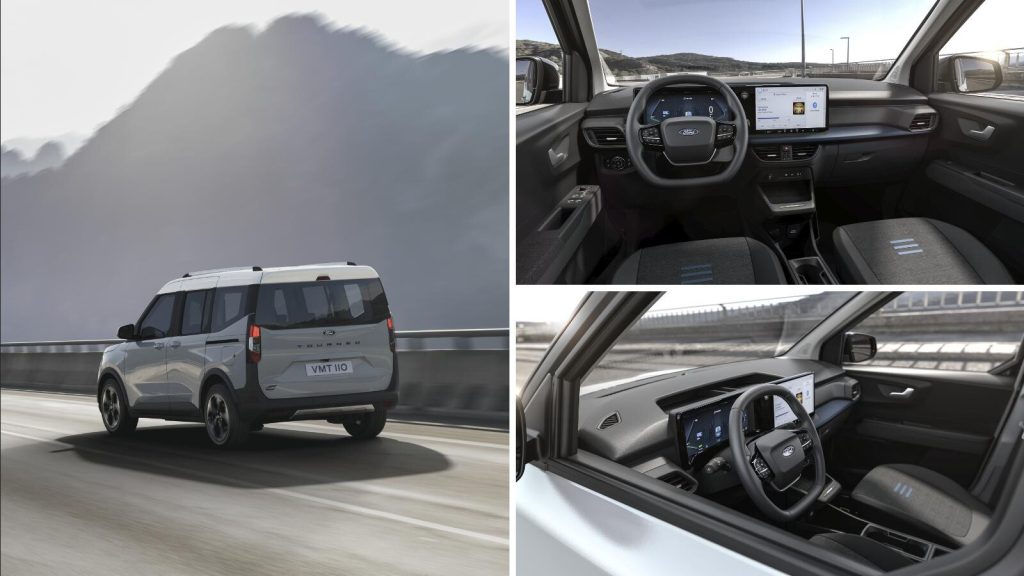
Ford has unveiled the E-Tourneo Courier electric minivan with a range of 230 miles (370km). The E-Tourneo looks like an SUV on the outside but is actually an electric minivan. It is equipped with a 100kW front-wheel drive motor. The EV is pitched as a multi-activity vehicle with SUV-inspired looks.
The E-Tourneo Courier is a five-seater EV and Ford seems to be re-inventing the practicality of the minivan. The new Ford electric minivan’s front bumper, matte black trim on the wheel and doors, and its taller outlook all bear semblance to an SUV. The car has two fewer seats than the Tourneo Connect and could serve as a middle ground for buyers. It combines the rugged SUV veneer and the expansive interior while maintaining maneuverability.
The Ford E-Tourneo Courier offers up to 614 litres of cargo space in addition to passengers occupying the rear seats. When the rear seats are flattened, the total storage space rises to 2,162 litres. The EV can thus offer massive storage space at par with some bigger models like the Ford Expedition SUV. It can also be equipped with a tow hitch but the limit is just 700kg. The car is also strong on mileage as it offers up to 370km on a single charge. The 100kW motor of the E-Tourneo Courier however seems to be a bit sub-par.
The Ford E-Tourneo Courie minivan is expected to berth in Europe in H2, 2024. There are no definitive estimates of the EV’s cost but some sources say it could be as high as €23,000 (~$25,000). The Ford E-Tourneo Courier could also be available in other regions outside Europe, such as North America. Recall that Honda recently launched the e:Ny1 electric vehicle with an impressive range of 412km.
Ford’s latest E-Tourneo Courier electric vehicle is an SUV disguised as a minivan
Chinese accessories manufacturer Baseus has launched the Bowie M2S and H1i TWS headphones in China. The two new Baseus audio products come with active noise cancellation and Hi-Res small gold standard certification. The two new headphones are capable of noise reduction depth up to 48dB and support Bluetooth 5.3 connectivity.
Baseus Bowie M2s
The Bowie M2S adopts a front-opening design and it supports spatial audio technology. It also supports noise reduction during calls and it has a battery that delivers up to 7 hours on a single charge. With the addition of the charging case, the Bowie M2S can operate for up to 30 hours. The Bowie M2S is available in black or white color options.
On its part, the Baseus H1i headset is designed for both wired and wireless use. It supports LHDC high bit rate, active noise cancellation, and up to 100 hours of battery life. When noise reduction is active with the headset, up to 70 hours of playback can be gotten.
Baeus H1i
In China, the Baseus Bowie M2S is priced at 269 yuan ($39) and can be purchased from JD.com. On the other hand, the Baseus H1i over the ear headset is now open for pre-orders at a launch price of 199 yuan (~$29). The original price of the H1i headset is 229 yuan (~$33). Baseus has not provided any information yet on the availability of the new Bowie M2S and H1i TWS headsets in overseas markets.
When it comes to purchasing a smartphone, specifications and features take the forefront of our minds. However, in the background, we also consider the need for repairs and replacements in case of hardware issues. After-sales support plays an important role and it seems Lava is taking that seriously with its newest Agni 2. The company has promised free in-home replacement of the handset in case of any hardware issues. Here are the details.
Lava Agni 2 After Sales Support
Lava has announced that its latest smartphone, the Agni 2, will come with extensive after-sales support. The company has said that customers will be able to get their phones replaced at home for free if they experience any hardware issues within one year of the warranty period. This means that customers will not have to take their phones to a repair shop and can instead have them replaced by a technician who comes to their homes.
While most major smartphone brands offer replacements for their devices in case of hardware issues, Lava is claiming to be the first in its segment to offer in-home replacements. The company also claims to provide a dedicated service manager.
To remind you, the Agni 2 features a 6.78-inch curved AMOLED display with FHD+ resolution and a 120Hz refresh rate. The handset gets the recently announced MediaTek Dimensity 7050 chipset under the hood. There’s a 50MP main camera with a 1.0µm pixel size sensor, an 8MP ultrawide module, and a pair of 2MP sensors.
The Agni 2 runs Android 13 with the Agni Shapath interface on top. Lava is promising at least two Android version updates along with quarterly security updates for three years. It is fueled by a 4,700mAh battery with 66W wired charging. More details here.
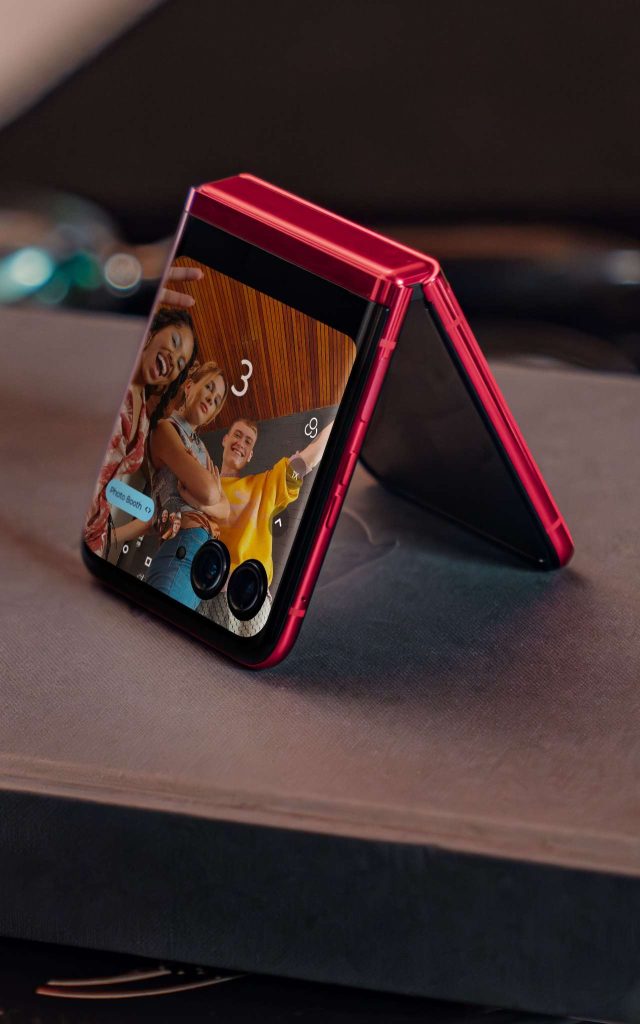
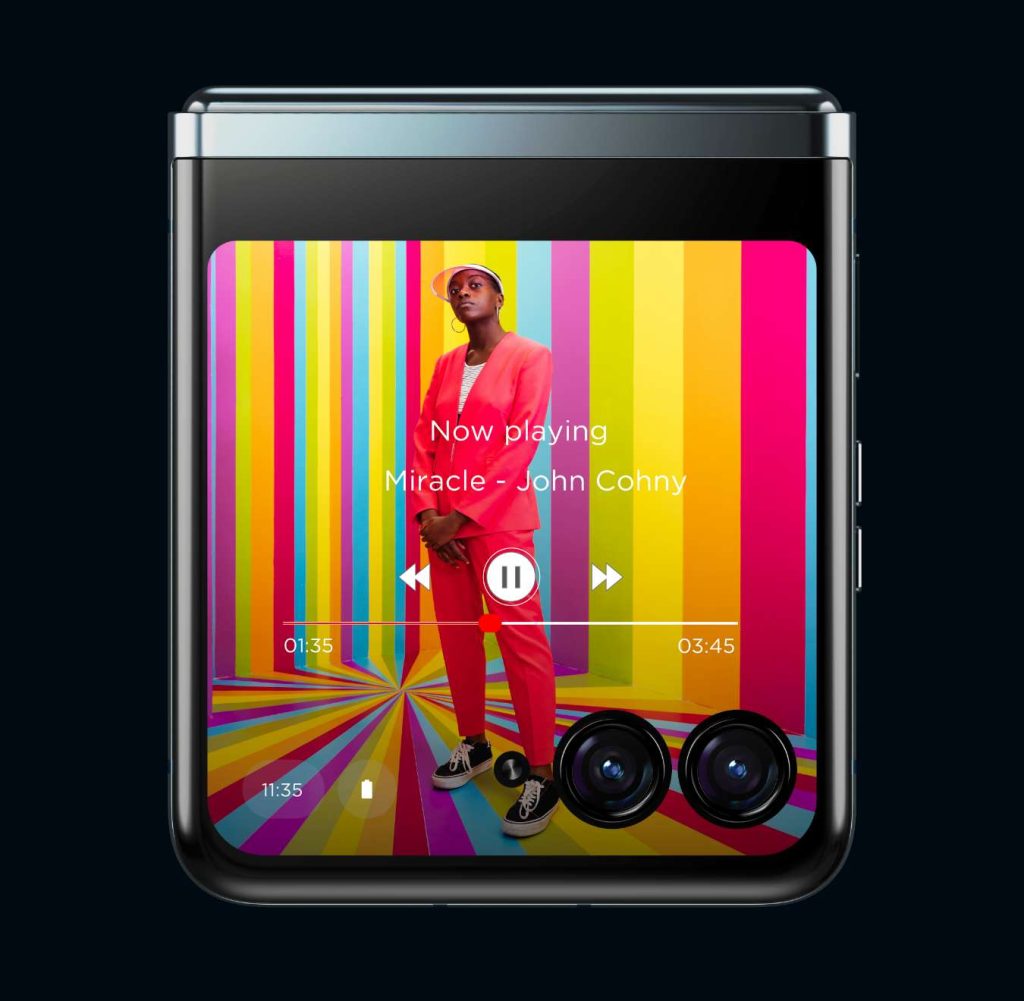
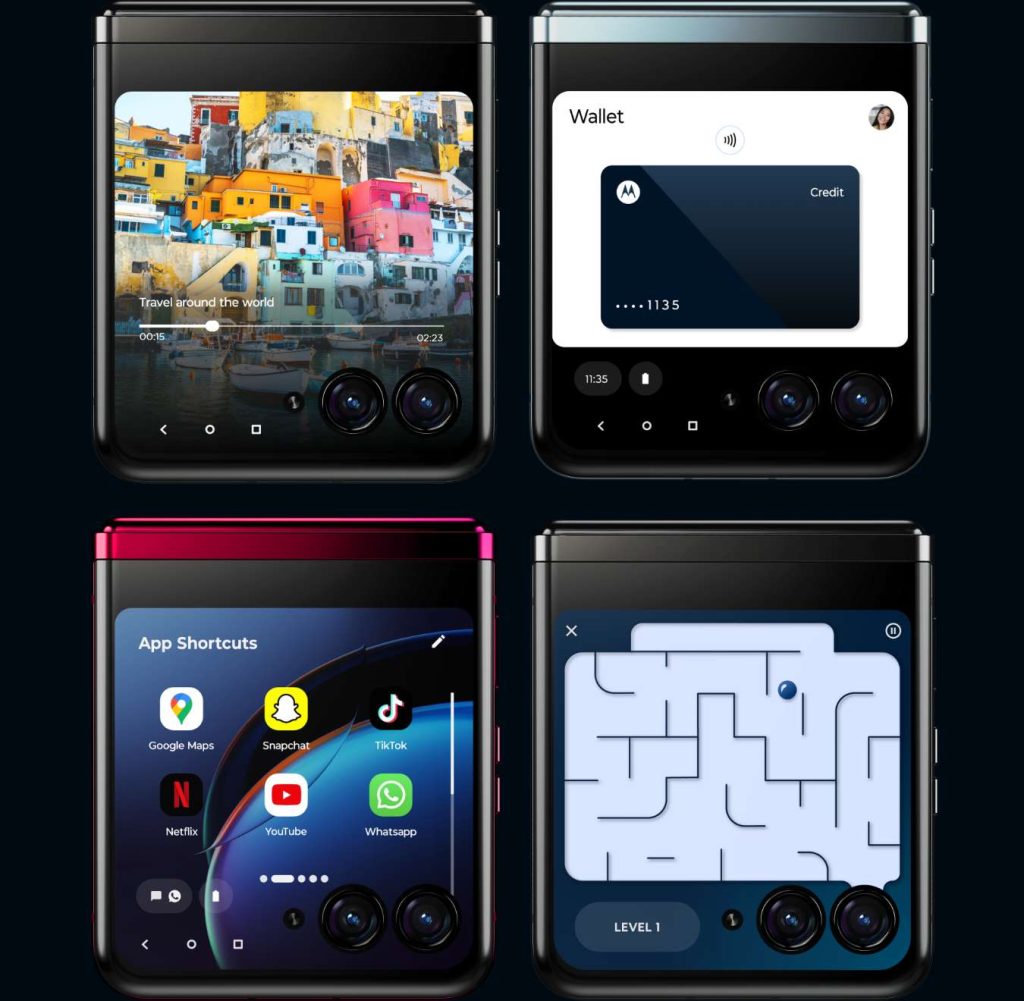
The leaked images showcase the front cover display features a dual rear camera setup accompanied by an LED flash. The images reveal a larger cover display, allowing users to manage notifications conveniently. Additionally, the foldable clamshell design is showcased, indicating that the device can be placed in standby mode, similar to Samsung’sfoldable phones.
The side of the smartphone houses volume and power buttons and the promo images also reveal the various themes available for the cover display. Users will have the ability to take selfies using the cover display.
On the front side of the device, a curved display is visible, featuring a hole punch cutout for the front camera. The promo images also display the available color variants: Magenta, Black, and White.
Motorola Razr 40 Ultra specifications (rumored)
Moving on to the specifications, the Motorola Razr 40 Ultra is expected to be equipped with a Snapdragon 8+ Gen 1 SoC. The main screen of the device will offer a resolution of 1080×2640, while the outer screen will provide a resolution of 1056×1066. The smartphone will have a refresh rate of either 120Hz or 144Hz. In terms of storage, a 512GB option is anticipated, accompanied by up to 12 GB of RAM. The device will house a 3640 mAh battery with support for fast charging up to 33W.
Regarding the camera capabilities, the Motorola Razr 40 Ultra will feature a 12 MP primary camera utilizing Sony’s IMX563 sensor. Additionally, it will include a 13 MP ultrawide camera equipped with SK Hynix’s Hi1336 sensor. For selfies, the smartphone will provide a 32 MP camera with the OmniVision OV32B40 sensor. Motorola Razr 40 Ultra is expected to run on Android 13 OS with the MyUX skin on top.
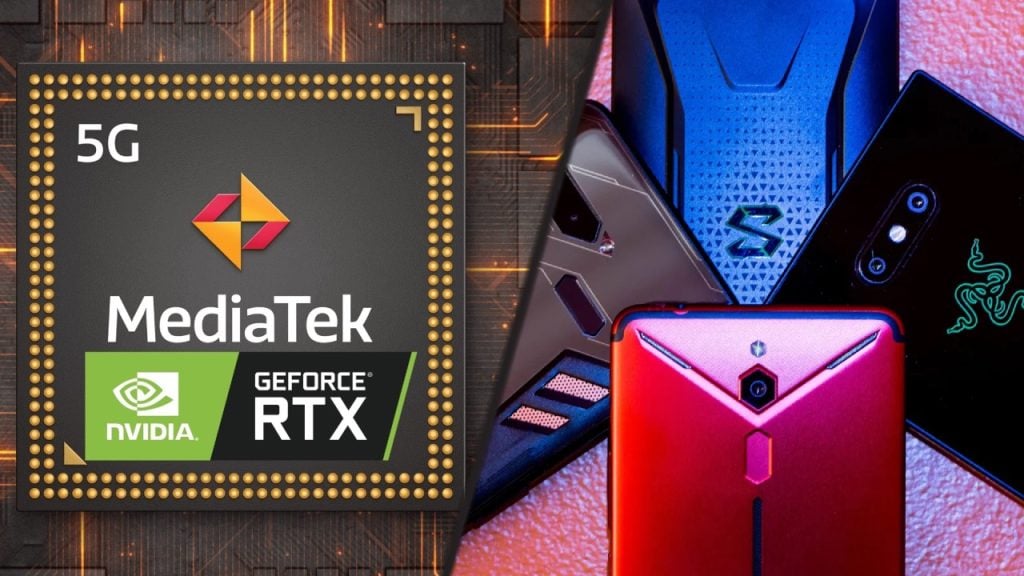
The competition in the mobile processor market continues at full speed. lthough MediaTek holds the lead in terms of sales volume, Qualcomm remains the first choice for performance enthusiasts. This is evident from the fact that flagship smartphones like the Samsung Galaxy S23 and Xiaomi 13 use the Snapdragon 8 Gen 2, while more “insignificant” models use Dimensity. MediaTek is looking to change this by striking a new deal with Nvidia. The deal will allow MediaTek to use Nvidia’s GPU technology in its mobile processors. This could give MediaTek a significant advantage over Qualcomm in terms of graphics performance. Here are the details…
Nvidia and MediaTek to Partner on Next-Generation Mobile Processors
Nvidia and MediaTek have announced a partnership to develop next-generation mobile processors. The new processors will be designed to support advanced artificial intelligence (AI) and gaming applications. As you know Nvidia is a leading provider of graphics processing units (GPUs), while MediaTek is a leading supplier of mobile processors. The partnership will combine Nvidia‘s GPU expertise with MediaTek’s mobile processor expertise to create a new generation of mobile devices that are more powerful, efficient, and immersive.
The new processors will be used in smartphones, tablets, and laptops. They will also be used in gaming consoles and other devices that require powerful graphics performance. The partnership between Nvidia and MediaTek is a significant development in the mobile processor market. It is a sign that the mobile processor market is becoming increasingly competitive, and it is likely to lead to better products for consumers. Here are some of the potential benefits of the partnership:
Improved performance: The new processors will be based on Nvidia’s Ampere architecture, which is one of the most powerful GPU architectures available. This will lead to significant improvements in performance for a variety of mobile applications, including gaming, AI, and video editing.
Improved efficiency: The new processors will also be designed to be more efficient than previous generations of mobile processors. This will help to extend battery life and improve performance per watt.
Wider adoption of AI: The new processors will support advanced AI applications. This will make it possible to run AI-powered applications on mobile devices, which will open up a new range of possibilities for mobile users.
If the deal is successful, it could have a major impact on the mobile processor market. MediaTek could become the go-to choice for performance enthusiasts, and Qualcomm could be forced to lower prices in order to compete. But for now we have to wait for all this to happen.
We use cookies on our website to give you the most relevant experience by remembering your preferences and repeat visits. By clicking “Accept”, you consent to the use of ALL the cookies.
This website uses cookies to improve your experience while you navigate through the website. Out of these, the cookies that are categorized as necessary are stored on your browser as they are essential for the working of basic functionalities of the website. We also use third-party cookies that help us analyze and understand how you use this website. These cookies will be stored in your browser only with your consent. You also have the option to opt-out of these cookies. But opting out of some of these cookies may affect your browsing experience.
Necessary cookies are absolutely essential for the website to function properly. This category only includes cookies that ensures basic functionalities and security features of the website. These cookies do not store any personal information.
Any cookies that may not be particularly necessary for the website to function and is used specifically to collect user personal data via analytics, ads, other embedded contents are termed as non-necessary cookies. It is mandatory to procure user consent prior to running these cookies on your website.