A new Motorola smartphone has emerged on the internet. The device is called Moto G22 and it has been benchmarked on Geekbench. The handset’s listing reveals some of its key features.
According to Geekbench, the upcoming Motorola Moto G22 will be powered by a MediaTek Helio P35 SoC. The variant that was benchmarked has 4GB RAM, however, there could be versions with lower or more RAM.
As far as performance is concerned, the phone can only score around 170 points and 912 points in single-core and multi-core tests respectively. Finally, it will boot Android 11.
That’s all the information we have on the forthcoming Motorola handset. We expect to learn more about the device in the coming days.
It is interesting to note that the Lenovo-owned Motorola-branded never released a Moto G21. Hence, this smartphone will be the direct successor of the Moto G20 from last year.
For the unaware, the Moto G20 was the second cheapest Moto G series phone released in 2021. It has features like a 6.5-inch HD+ 90Hz display (LCD), UNISOC T700 chipset, 48MP (wide) + 8MP (ultra-wide) + 2MP (macro) + 2MP (depth) quad-camera setup, 13MP front-facing camera, rear-mounted fingerprint sensor, Android 11, 5,000mAh battery, and 10W charging.
The yet-to-release Moto G22 may have a similar set of specs, however, we wouldn’t say for sure. Because Motorola has a habit of changing the feature set of the existing lineup every generation.
Earlier today (13th January 2022), Xiaomi’s budget smartphone making sub brand, Redmi, shared a new teaser poster on Twitter. In the tweet, the company hinted at a new Note 11 series launch in India, which might be the upcoming Note 11S.
The Chinese smartphone brand shared the teaser on its official Twitter handle, which also revealed the rear design of the upcoming handset. Looking at this image, we can see that the rear camera module has a large primary sensor, along with other smaller cameras being housed underneath it. While the company did not reveal any finer details, it did confirm that its a Note model.
Although, it is rumored that the primary sensor is a 108 megapixel camera and we can clearly see that the sides are flat. As of right now, the model of the smartphone is still unclear, although, it is believed to the the new Note 11S, which has recently been spotted on various certification websites. It has even been spotted on FCC with MIUI 13 and we had also covered a report that revealed certain key specs regarding the smartphone.
Reportedly, the Redmi Note 11S will feature a triple camera setup, with the primary camera being the 108 megapixel sensor, paired with an 8 megapixel ultra wide angle lens and a 2 megapixel macro sensor. On the front, it might feature a 13 megapixel selfie shooter. Unfortunately, this is still just a teaser so we will have to wait for more details or reports to surface to know more about this upcoming smartphone. So stay tuend for more updates.
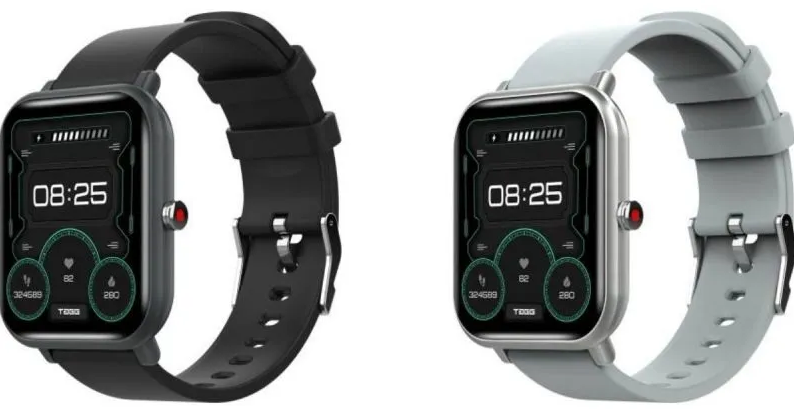
Tagg has just launched a new product in India. The new wearable is the Verve Active, which is a budget smartwatch that offers up to 8 days of battery life and will be available for purchase in India via Flipkart.
Talking about the smartwatch, it sports a 1.7 inch IPS LCD screen with 240 x 280 resolution, 80 percent screen to body ratio, and up to 500 nits of maximum brightness. Users can even customize their watch faces with multiple watch faces, which can be changed through the companion application. The watch features a button the side for navigation and also has interchangeable straps. Its also weighs just 38 grams and features IP68 water and dust resistance rating.
Arriving at its other features, it offers a blood oxygen monitor, heart rate sensor, body temperature tracking, and blood pressure mapping as well. Users can even track their deep sleep and light sleep cycles. For fitness, the Tagg Verve Active smartwatch supports 24 different sports modes including walking, running, climbing, yoga, basketball, cycling, football, badminton, football, badminton, skipping, and swimming.
The Verve Active also offers up to 8 days of battery life on a single full charge and around 4 days with heavy usage. The Tagg Verve Active is priced at 3,999 INR (roughly 54 US Dollars) and is available in four color options. This includes a Black, Green, Gold, Grey, and Purple color variant. It will be available for purchase via Flipkart in India starting from 14th January 2021.
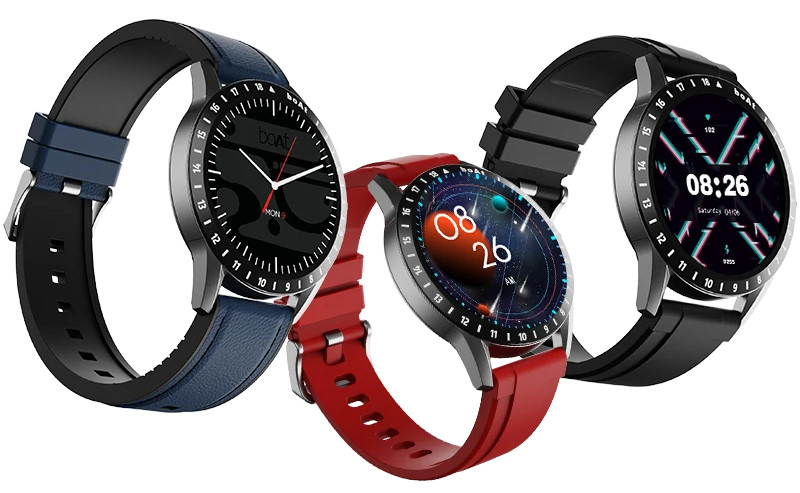
In recent times, boAt has been a major player in the wearable and hearables market in India. The electronics based startup has seen great success with its products and is now gearing up to launch its initial public offering at a valuation of over 1.4 billion US Dollars.
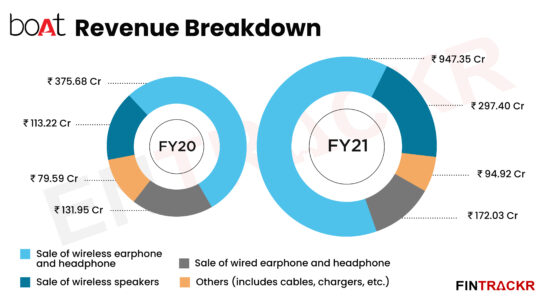
According to an Entrackrreport, the company has also generated revenue that has crossed more than 1,500 crore INR (roughly 203 million US Dollars) in the financial year of 2021. The company’s financial report revealed that its operating revenue surged during this period by around 2.2 times over the same period last year. In the financial year of 2020, the startup brought in just 700.44 crore INR (roughly 95 million US Dollars).
Out of all of its product lines, the wireless earphones and headphones segment were the largest in terms of sales. This category also accounted for 62.7 percent of all of its operating profits in the financial year of 2021. Furthermore, the sales also grew by around 2.5 times, hitting 947.4 crore INR (roughly 128 million US Dollars) in 2021 over just 375.7 crore INR (roughly 50 million US Dollars) from a year prior. Similarly, boAt wireless speakers saw the highest growth overall, with a rise of 2.6 times in 2021.
The wireless speaker category was also the second largest contributor to the brand’s revenue in the last financial year, accounting for 20 percent of its overall revenue. For those unaware, the Indian startup design its products within the country but its manufacturing and assembling is done in China. So, 73 percent of its expenditure is from the expense of procuring its stock. Despite its great performance, only 1 percent of its annual costs went to pay employees’ salaries since it doesn’t have a large team and outsources production and after sales services as well.
The sales of PC were expected to drop in 2021 because of the ongoing global chip shortage but instead of sales dropping, the year witnessed growth in terms of PC shipments globally, reaching 341 million units.
As per the latest report from Canalys, the PC shipments for the year 2021 increased 15 percent compared to 2020 and 27 percent when compared to shipments in 2019. Even though the Q4 2021 numbers were up just 1 percent over the previous year, 2021 was still the best year since 2012.
Ishan Dutt, a senior analyst as Canalys, says in the report: “For the market to post double-digit growth over an impressive 2020, despite the constant cloud of supply constraints, speaks volumes about how strong PC demand has been over the last 12 months.”
Lenovo emerged as the leading brand, capturing 24.1 percent market share while HP closely follows at the second position with a 21.7 percent market share. Dell grabbed the third spot with its 17.4 percent market share.
Apple stands fourth with an 8.5 percent market share but the Cupertino-based technology giant had the largest growth number year-on-year at 28.3 percent. Acer was second with 21.8 percent growth but stands at fifth in terms of shipments with a 7.1 percent share.
It is being reported that the education market may be saturated and the chip shortages are expected to continue into the new year, which could affect the growth. However, Canalys still believes that 2022 will be a strong year for PC sales.
Almost three weeks after it was shut down amid major protests by the employees, the Foxconn plant for Apple iPhone production located in Sriperumbudur near Chennai is now partially reopening.
For those who are returning to work, the company is conducting COVID-19 tests. As per the report, the factory reopened with one shift and 120 workers, adding it would take over two months for the Foxconn plant to produce at full capacity.
The production plant, which employs about 17,000 people and operates three shifts, was closed on 18th December 2021 after 250 workers fell sick with food poisoning, leading to workers organizing protests.
The workers alleged that the food at Foxconn’s dormitories was stale and sometimes crawled with worms. Further, the toilets were unhygienic and inadequate, without running water. Additionally, dozen of them were forced to share small rooms.
After the protests last month, Apple had put the Foxconn production plant on probation, demanding rapid action. The US-based tech giant has said that the plant remains on probation and that it would continue monitoring conditions at workers’ dormitories and dining halls, along with independent auditors.
The facility in question had recently started trial production of the latest iPhone 13 model but now it may get delayed as it is expected to take more than two months for the production to resume at its full capacity.
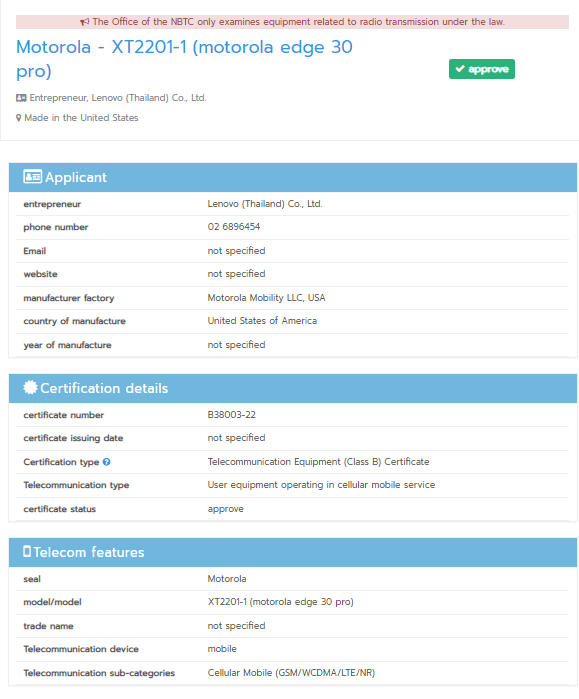
The Motorola Edge 30 Pro that has a model number of XT2201-1 model number has bagged approval from the NBTC authority of Thailand (via. MySmartPrice). To recollect, the Edge 30 that went official as the world’s first Snapdragon 8 Gen 1 powered smartphone in China in December 2021 carried the XT2201-2 model number. Hence, it appears that the Chinese Edge X30 may get rebranded as the Motorola Edge 30 Pro in global markets including Thailand.
The Motorola Edge 30 Pro was recently spotted at the Geekbench benchmarking portal with the Snapdragon 8 Gen 1 chip recently. The listing also revealed that it has Android 12 OS and 12 GB of RAM.
Motorola Edge 30 Pro specifications (expected)
Considering that Edge 30 Pro will be a rebranded version of China’s Edge X30, it is expected to arrive with a 6.7-inch OLED display that offers a Full HD+ resolution and a 144Hz refresh rate. For selfies, it may feature a 60-megapixel front-facing camera and a 50-megapixel (main) + 50-megapixel (ultrawide) + 2-megapixel (depth) triple camera unit.
The SD8G1 powered handset is expected to arrive with up to 12 GB of LPDDR5 RAM and up to 256 GB of UFS 3.1 storage. The device will run on Android 12 OS and My UI interface. It may come packed with a 5,000mAh battery that offers 68W fast charging. It is likely to feature a dedicated hardware key to access the Google Assistant.
A recent report claimed that the Edge 30 Pro will be also released in India. The device is expected to hit the Indian market in a month or two. At present, there is no information available on the pricing of the Edge 30 Pro for the global markets.
POCO M4 Pro 4G with 2201117PG model number has been certified by Thailand’s NBTC authority. It is a 4G LTE variant of its 5G edition, which debuted in November 2021. The NBTC certification of the 4G LTE model suggests that it may debut in some markets including Thailand.
The NBTC listing of the POCO M4 Pro (2201117PG) has no information on its major specs. It only tells that its cellular connectivity is limited to LTE. Last month, Xiaomiui shared key details of a Xiaomi phone with 2201117SI model number and Meil codename.
The leak revealed that the 2201117SI model will be featuring a 90Hz display and it will be driven by a MediaTek chipset. The rear camera setup of the device has a 64-megapixel OmniVision OV64B40, an 8-megapixel Sony IMX355 ultrawide camera, and a 2-megapixel OmniVision OV02A.
It is speculated that there is another variant of the device with “meil_pro” codename. This model is expected to feature a 108-megapixel Samsung HM2 primary camera, a 90Hz display, and a MediaTek chip. The 2201117SI model number suggests it is designed for the Indian market. It is likely to release in the country with a Redmi branding.
As far as the POCO M4 Pro 4G is concerned, it is likely to pack the same specs that will be available on the Redmi 2201117SI handset. Hopefully, newer reports will reveal more information about the device in the coming days.
POCO M4 Pro 5G
A recent report revealed that the alleged POCO X4 NFC has been certified by the FCC authority. At the same time, the global edition of the Redmi Note 11 Pro has also been approved by the FCC. Both phones are expected to arrive with identical specs such as a Snapdragon chip, 64-megapixel or 108-megapixel triple cameras, and 67W fast charging.
The OnePlus 9RT is scheduled to debut on Jan. 14 in India. The company will be also taking off covers from the Buds Z2 TWS earbuds alongside it. A tweet by tipster Yogesh Brar has revealed the pricing, color variants, and sale date of the OnePlus 9RT.
According to the tipster, the OnePlus 9RT will be arriving in India in two variants such as 8 GB RAM + 128 GB storage and 12 GB RAM + 256 GB storage. These models are tipped to cost Rs 42,999 (~$582) and Rs 46,999 (~$636), respectively.
The 9RT is expected to arrive in black and silver colors. As far as the sale date is concerned, the device is likely to go on sale during Amazon India’s Great Republic Day sale starting from Jan. 17.
OnePlus 9RT specifications
The OnePlus 9RT will be sporting a 6.62-inch AMOLED screen with a punch-hole design. It will offer an FHD+ resolution and a 120Hz refresh rate. For selfies, it will feature a 16-megapixel front-facing camera. Its rear-facing camera unit will include an OIS-assisted 50-megapixel main camera, a 16-megapixel ultrawide snapper, and a 2-megapixel macro shooter.
The 9RT is driven by the Snapdragon 888 mobile platform. It will come equipped with LPDDR5 RAM and UFS 3.1 storage. It is unclear whether the device will ship with the latest Android 12 OS or Android 11. It will include a 4,500mAh battery that supports Warp Charge 65T fast charging.
A recent report by Livemint, the OnePlus 9R may get discontinued after the launch of its successor – the 9RT. Currently, the 8 GB RAM + 128 GB storage and 12 GB RAM + 256 GB storage editions of the OnePlus 9R is priced at Rs 39,999 (~$542) and Rs 43,999 (~$595) in India. These variants are available for purchase through the OnePlus India and Amazon India websites.
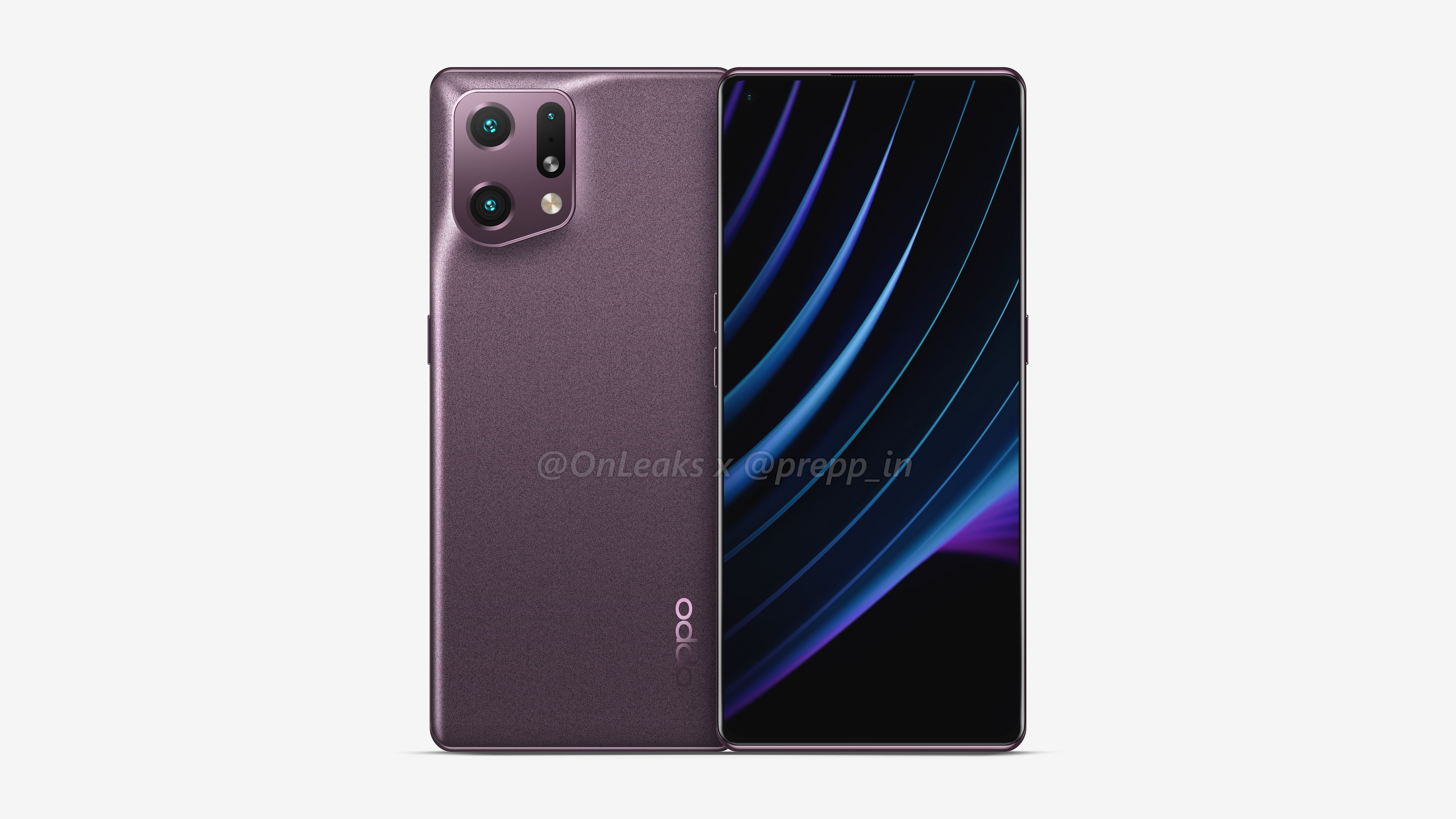
OPPO Find X5 Pro and Find X5 are likely to go official by March this year. Last week, a tipster had tipped the specs of the vanilla Find X5. Yesterday, reliable tipster Digital Chat Station shared the major specs of the Pro model. The Weibo post through which the tipster leaked the specs is no longer available. However, Abhishek Yadav has shared a screengrab of the leak.
OPPO Find X5 Pro specifications (rumored)
The leak states that the model number of the OPPO Find X5 Pro is PFEM10. It will feature a 6.7-inch AMOLED LTPO 2.0 display that offers a Quad HD+ resolution of 1440 x 3216 pixels and a 120Hz refresh rate. For selfies, the display punch-hole of the X5 Pro will house a 32-megapixel Sony IMX709 camera.
OPPO Find X5 / X5 Pro renders by OnLeaks / Prepp.in
The rear camera setup of the device is fitted with a 50-megapixel Sony IMX766 primary camera with OIS support. It is coupled with a 50-megapixel ultrawide lens and a 13-megapixel tertiary camera.
The Snapdragon 8 Gen 1 SoC will be powering the device along with OPPO’s MariSilicon X chip. It will be packed with a 5,000mAh battery that supports 80W fast charging and 50W wireless charging. The device is likely to run on the latest Android 12 O with ColorOS 12 on top. For security, it will feature Goodix G7 in-screen fingerprint scanner.
The CAD renders by OnLeaks that had surfaced in December 2021 revealed that the Find X5 / Find X5 Pro will be sporting a punch-hole design on the front and an unusual-shaped rear camera module. Rumors have it that the vanilla Find X5 may come with similar specs as the Pro model. However, it may feature the Dimensity 9000 chip.
Motorola was recently confirmed to have got a new tablet in the works. The device dubbed Motorola Tab G70 was recently spotted on Google Play Console database showing the device will pack a MediaTek Kompanio chip. The device had earlier also appeared on Flipkart with just the landing page and scanty details.
However, the Flipkart lisiting has now been expanded, giving us a clearidea of the main specifications. The listing shows that the slate will pack an 11-inch display with 2K resolution, 400 nits brightness and 15:9 aspect ratio. The display also comes with support for Widevine certification to watch high definition content from Netflix and Amazon. You also get four speakers with Dolby Atmos support for an immersive audio experience.
The Moto Tab G70 is also confirmed to pack a MediaTek Helio G90T which is a 12nm chip with an architecture consisting of two Cortex-A76 cores, and six Cortex-A55 cores while a Mali-G76 GPU fires the graphics. The processor pairs with 4GB RAM as per an earlier leak but we don’t know the exact memory configuration
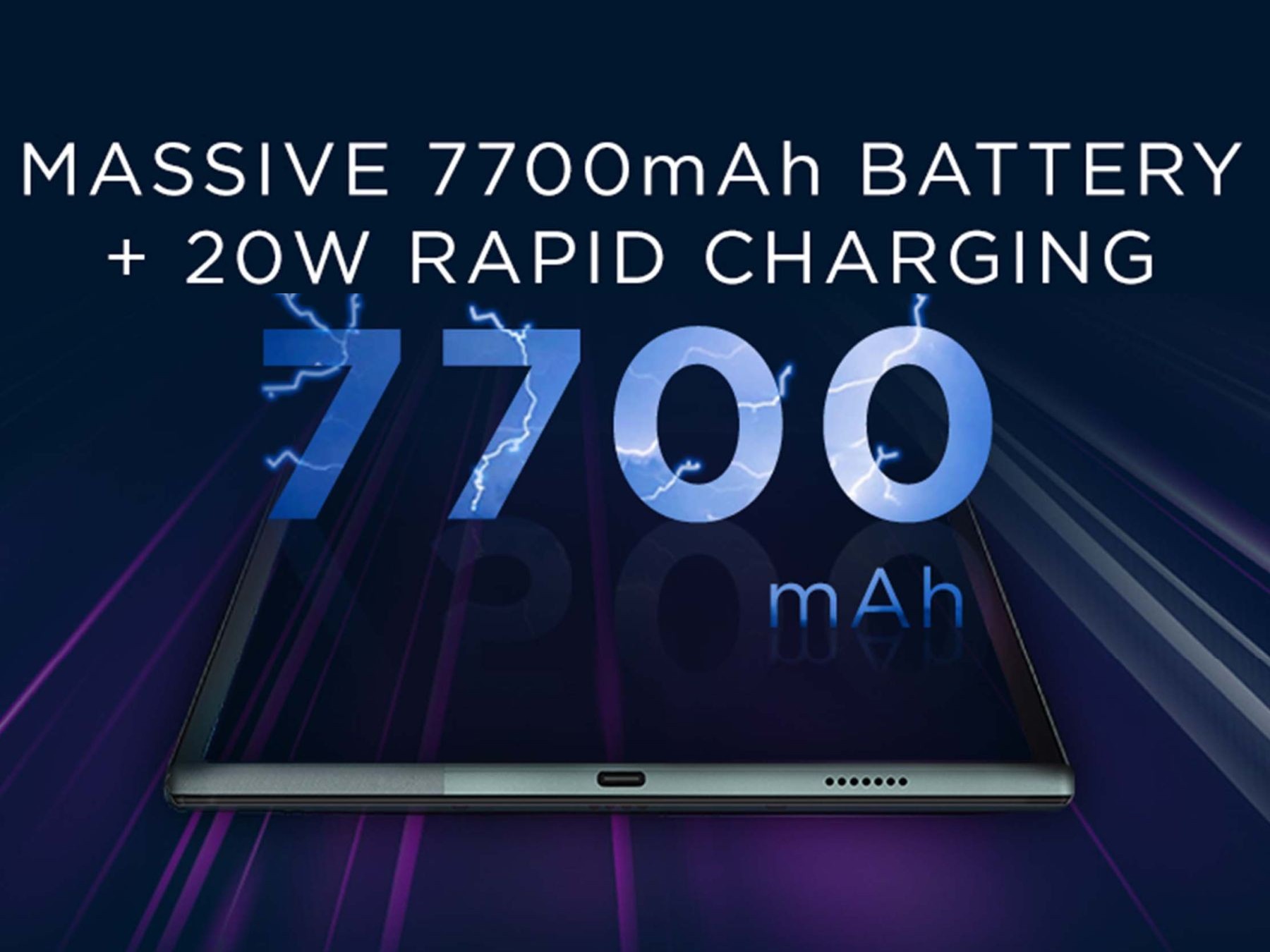
The device crams a mammoth 7.700 mAh battery with 20W fast charging support. It also present with an IP52 waterproof build.
The camera configuration is yet to be unveiled officially but the tipster hinted that it comes with a 13MP main shooter and an 8MP selfie shooter. Which ever it is, Amazon describes the cameras as “best in class”.
The Tab G70 is expected to launch in India on January 18 but we can’t confirm if the company will release the slate in other markets.
A couple of days ago, OnePlus officially launched its latest flagship smartphone — OnePlus 10 Pro in its home market in China much earlier than its usual timeline. It comes with top-of-the-line specifications and a revamped design.
Today, the OnePlus 10 Pro officially goes on sale in China. The base model with 8GB RAM and 128GB storage is priced at 4,699 yuan (~$739) while the 8GB RAM and 256GB storage model costs 4,999 yuan (~$786). The top-end model with 12GB RAM and 256GB internal storage is priced at 5,299 yuan, which is approximately $833.
The smartphone features a 6.7-inch second-generation LTPO AMOLED display with support for variable refresh rates from 1Hz to 120Hz. It offers a screen resolution of 3216 x 1440 pixels (QHD+), 525 PPI pixel density, 1300 nits peak brightness, 5000000:1 contrast ratio, 20.1:9 aspect ratio, 92.7% screen-to-body ratio, and Gorilla Glass Victus for protection.
It also comes with an under-display fingerprint sensor for added security. Under the hood, the device comes powered by the Qualcomm Snapdragon 8 Gen 1 chipset, coupled with LPDDR5 RAM and UFS 3.1 internal storage.
Coming to the camera configuration, the phone comes with a 48MP Sony IMX789 primary sensor with OIS, a 50MP Samsung ISOCELL JN1 sensor 150-degree ultra-wide unit, and an 8MP 3.3x telephoto shooter with OIS. On the front side, the device has a 32MP Sony IMX615 snapper for taking selfies and video calling. All these cameras are co-tuned by Hasselblad with features like Hasselblad Natural Color Optimization 2.0.
The phone is running the Android 12 operating system with ColorOS 12.1 custom interface on top. It is powered by a 5,000mAh battery and comes with support for 80W SuperVOOC fast charging, 50W AirVOOC fast wireless charging, and reverse wireless charging.
Apple is working on the next-generation iPhone models and there have been reports about some major changes coming to the upcoming smartphones, especially in terms of display and the phone’s design.
Till now, it was said that the iPhone 14 Pro models will get rid of the notch and will instead have a punch-hole cutout for the front-facing camera while the sensors for the Face ID feature could be hidden behind the screen. Now, reports claim that Apple has opted for a design with two cutouts on top of the screen.
Apple iPhone 14 Pro Render by Ian Zelbo
A new report coming from Ross Young of Display Supply Chain Consultants, who has a good track record with leaks, reveals that the Apple iPhone 14 Pro will have one pill-shaped cutout and another punch-hole cutout for the sensors.
This will be the first time Apple will get rid of the notch for the front-facing sensors since the launch of the iPhone X in 2017. Since then, the company did make some very minor changes to the notch. For instance, the notch on the newer iPhone 13 series is a bit shorter in length than its predecessors.
Apple is expected to launch four models in the lineup, including iPhone 14 with a 6.1-inch screen, iPhone 14 Max with a 6.7-inch display, iPhone 14 Pro with a 6.1-inch display, and iPhone 14 Pro Max with a 6.7-inch screen.
If the reports are to be believed, then the iPhone 14 Pro models will come with a punch-hole cutout for housing the front-facing camera instead of the notch on top of the screen. Apart from that, the devices are expected to come with upgraded camera configuration as well as display features and processing.
As for the pricing, recent rumors indicate that the iPhone 14 Pro will start at $1,099 while the Pro Max will have a starting price of $1,199. However, the standard iPhone 14 model is expected to have the same starting price of $799, similar to its predecessor.
2022 just started and two Chinese giants already released their new flagships. We are talking about Realme and OnePlus: the former came up with the Realme GT 2 Pro announced in China on January 4, while the latter unveiled the OnePlus 10 Pro yesterday, on January 10. We can say that these two handsets are definitely the most powerful smartphones released in 2022 until now. We naturally excluded the Xiaomi 12 Pro and the Motorola Edge X30 because they debuted in the last month of 2021. After comparing the OnePlus 10 Pro and the Xiaomi 12 Pro, we decided to publish a specs comparison between the OnePlus 10 Pro and the Realme GT 2 Pro in order to give you the most complete panorama about the fastest flagships out there.
OnePlus 10 Pro vs Realme GT 2 Pro
OnePlus 10 Pro
Realme GT 2 Pro
DIMENSIONS AND WEIGHT
163 x 73.9 x 8.6 mm,
200.5 g
163.2 x 74.7 x 8.2 mm,
189 g
DISPLAY
6.7 inches, 1440 x 3216 pixels (Quad HD+), AMOLED
6.7 inches, 1440 x 3216 pixels (Quad HD+), LTPO AMOLED
Triple 48 + 8 + 50 MP, f/1.8 + f/2.4 + f/2.2
32 MP f/2.2 front camera
Triple 50 + 50 + 3 MP, f/1.8 + f/2.2 + f/3.0
32 MP f/2.4 front camera
BATTERY
5000 mAh, fast charging 80W, fast wireless charging 50W
5000 mAh, Fast Charging 65W
ADDITIONAL FEATURES
5G, dual SIM, reverse wireless charging
5G, dual SIM
Design
There are two color options of the Realme GT 2 Pro which let it look a lot more interesting than the OnePlus 10 Pro in terms of design. We are talking about the Paper Green and the Paper White color options, which are made of a special bio-polymer resembling the touch and feel of the real paper. It is a sustainable material that reduces CO2 emissions and makes the phone look unique without saying goodbye to great durability. The OnePlus 10 Pro has an amazing curved screen, but the rear side is a traditional piece of glass with a huge camera module. It is protected by Gorilla Glass Victus by Corning but, unlike its predecessor, it is not a waterproof phone as it does not feature the IP68 certification.
Display
The displays of the OnePlus 10 Pro and the Realme GT 2 Pro have the same main specifications, so it is essentially a draw if we only compare the two panels. These AMOLED panels have a diagonal of 6.7 inches and sport the LTPO2 technology enabling an adaptive refresh rate from 1 to 120 Hz and lower energy consumption compared to the previous generation of LTPO panels. The displays come with a Quad HD+ resolution of 1440 x 3216 pixels, they can show up to one billion colors and they support the HDR10+ certification. There are also the Gorilla Glass Victus protection for the front glass and an in-display fingerprint reader. Great flagship-class display, nothing negative to say about them.
Specs & Software
Just like the displays, even the hardware departments are the same. The OnePlus 10 Pro and the Realme GT 2 Pro are powered by the best mobile platform in the smartphone market: the Snapdragon 8 Gen 1. It is an octa-core processor built at 4 nm with a max frequency of 3 GHz and a powerful Cortex-X2 CPU, paired with up to 12 GB of RAM. Note that the max amount of internal storage for the OnePlus 10 Pro is 256 GB, while the Realme GT 2 Pro goes up to 512 GB. The OnePlus 10 Pro runs Android 12 customized by ColorOS 12.1 and it will run OxygenOS 12 in the global market, while the Realme GT 2 Pro runs Android 12 and Realme UI 3.0 which is almost the same thing because the Realme UI 3.0 is based on ColorOS. But the Realme GT 2 Pro is supposed to receive just two years of major Android updates, while the OnePlus 10 Pro will get three major Android versions.
Camera
The OnePlus 10 Pro seems to have a more interesting camera setup for a single reason: it has a telephoto sensor with 3.3x optical zoom. Unfortunately, the Realme GT 2 Pro lacks a telephoto camera and it is replaced by a less impressive 3 MP microscope sensor with up to 40x magnification, similar to the one found on the OPPO Find X3 Pro.
The OnePlus 10 Pro and the Realme GT 2 Pro have the same battery capacity of 5000 mAh, but the OnePlus 10 Pro provides faster charging speeds thanks to its 80W fast charging technology. Further, it supports wireless charging (with a power of 50W), unlike its rival.
Price
OnePlus 10 Pro starts from €650/$744 in China, while Realme GT 2 Pro begins at €542/$620. The OnePlus 10 Pro wins the comparison thanks to its telephoto camera and wireless charging, but the Realme GT 2 Pro can let you save money with its affordable price.
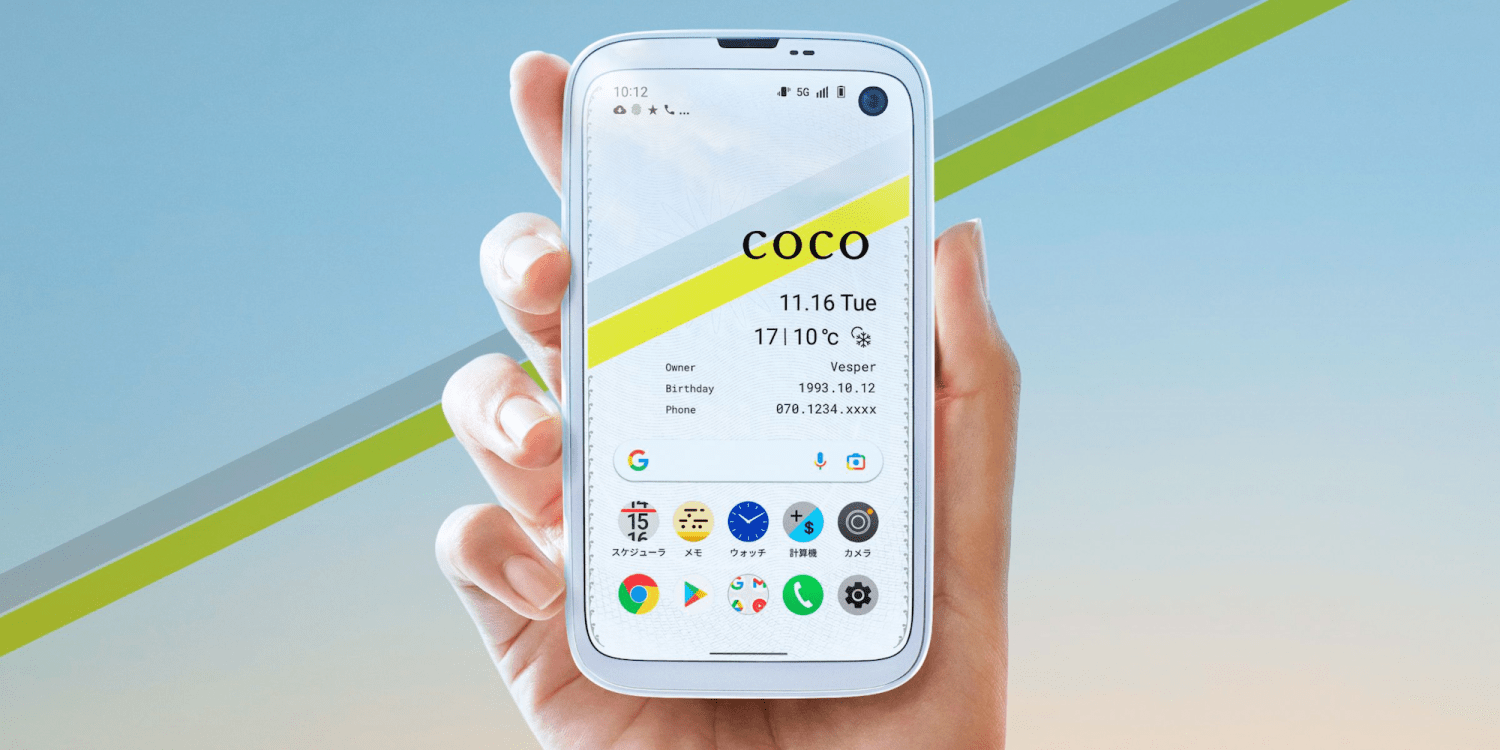
Remember the Balmuda phone that was released in November 2021? Well, not many people in Japan want the smartphone, it seems. The company has announced that it is discontinuing sales of the compact phone. According to Reuters, the company disclosed that the cessation of sales was due to issues that were not disclosed but are said to be related to compliance with Japan’s technical standards.
The company the stoppage of sale on Monday and by Tuesday, its shares saw a decline of as much as 10%. It could be recalled that the company’s shares had gained massively when it first announced an entry into the smartphone market. The shares had since dropped by half after the phone was released for a hefty 104,800 yen ($910) price tag.
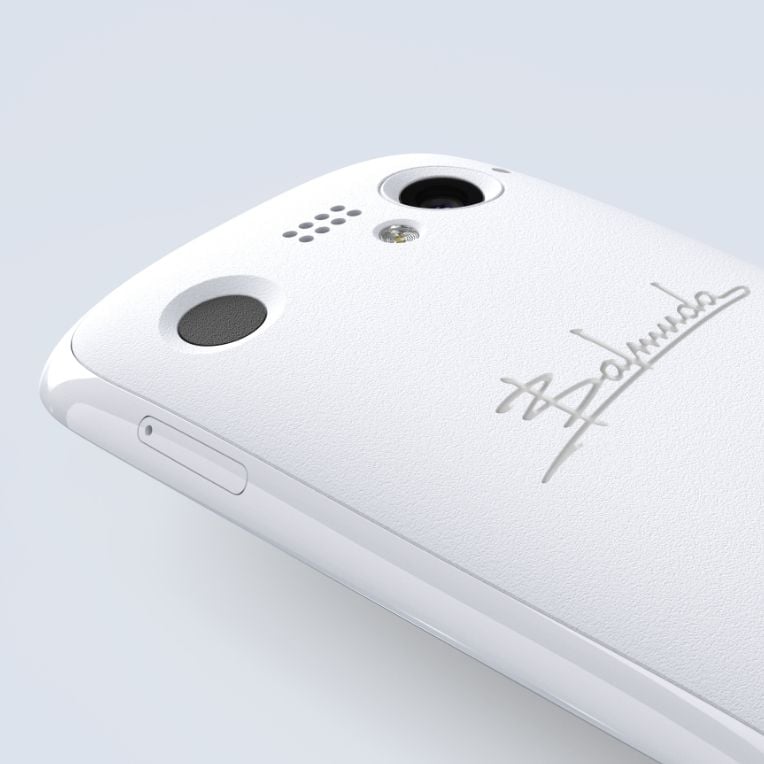
The Balmuda Phone is marketed as a premium, high-end smartphone with a compact design but in reality, it looks to have been priced way above its actual value. Apart from packing a smallish 4.9-inch display which some may still find interesting but in actual sense is not a lot of fun to use anymore. Secondly, the phone is powered by a Snapdragon 765 chipset which is nowhere near a flagship processor but a fast mid-range SoC.
Further, the Japanese market is largely dominated by Apple iPhones with just a few Japanese and Chinese brands like Sharp, Xiaomi getting a slice of the pie. Yet, the phone is more expensive than the cheaper iPhone 13 Mini. The reviews have also not been too favorable. Of course, we don’t expect anyone to review the phone as a flagship device and score it well, with that chipset at its heart, coupled with a plastic rear case. There is even just a single rear camera as well as a physical fingerprint scanner and a disappointing 3,500mAh battery under the hood.
We believe this would have been a huge hit if it was sold in the mid-range segment.
In this day and age, it is hard to imagine a smartphone without basic features like a GPS and Cameras. However, Benco has released the V80s, which omits these features claiming to make the device more privacy-centric.
The Benco V80s comes with a 6.5-inch 1600x720p display with a 20:9 aspect ratio and thick bezzles. Another unusual aspect of the phone is that it has a notched screen even though it’s missing a front camera.
The device houses a Unisoc SC9863A chipset and can be paired with up to 4GB RAM and 64GB internal storage. The storage of the device can be further expanded with a microSD card.
The device runs Android 11 and features a fingerprint sensor on the rear as an additional security measure. It supports 2G, 3G, and 4G network bands and also gets support for dual-band Wi-Fi.
The device is available in two color options namely silver and blue, however, its pricing has not been revealed yet.
It’s unclear as to how much of a difference the V80s will make in terms of privacy by omitting the GPS and cameras. However, depending on its price, the device could make for a pretty good auxiliary device for people who are looking for an inexpensive option.
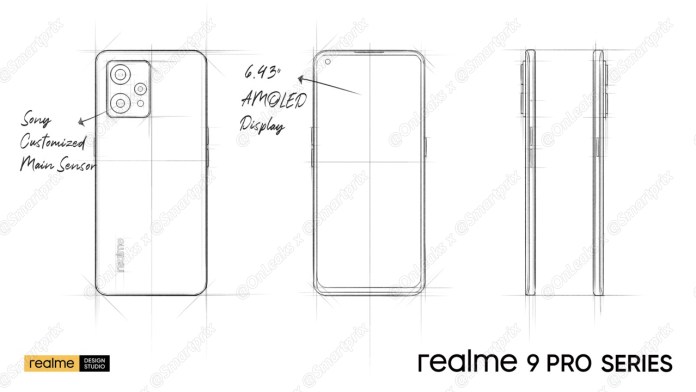
Last year, Realme released the 8 Pro smartphones in India which was quite popular. The brand is reportedly working on the next generation of this numbered series dubbed the Realme 9 Pro series.
Leaked render of the Realme 9 Pro+
A new report from SmartPrix in collaboration with popular tipster OnLeaks reveals Realme 9 Pro series design sketches. According to these sketches, one of the devices in the Realme 9 Pro series lineup will have a 6.43-inch AMOLED display with thin bezels. The rear panel of the device reveals a triple camera setup which is in line with the camera module design revealed by early render leaks.
The sketch also reveals that the main camera on the device will have a customized Sony sensor. The camera bump appears to be minimum and the device can be expected to be around 8mm thick. The drawing also reveals the volume rocker located on the left as well as the power button on the right side. The Realme branding is present on the bottom left of the rear panel of the device.
Other than this, the Realme 9 Pro and 9 Pro+ were recently tipped to debut in February this year. The phones are touted to get an initial European release followed by the rest of the markets.
Coming to the specs, the Realme 9 Pro and Realme 9 Pro+ are expected to come powered by a MediaTek Dimensity 810 SoC and Dimensity 920 SoC, respectively. As far as the Realme 9 Pro+ is concerned, it may come with specs like a 16-megapixel front-facing camera, a 50-megapixel triple camera unit, a 5000mAh battery, and 65W fast charging.
For now, these rumors remain unconfirmed and therefore we advise our readers to take them with a pinch of salt.
Podbike is going ahead with its plans to make the first deliveries of the Frikar, the company’s electric bike-car later in 2022. The Frikar is a four-wheeled enclosed electric bike that sports a unique design. The Norwegian mobility company Podbike is riding the waves after attracting up to 3.2 million Euros ($3.64 million) in funding together with substantial preorders of the Frikar.
The Frikar is being propped up as a vehicle that offers better protection from extreme weather situations and it has an improved aerodynamic design for an enhanced driving experience. The top of the Frikar is detachable, hence the versatile electric bike-car is also great for summer rides. The Frikar is a single-seater vehicle although an optional child passenger seat could be available to replace its 160-liter cargo space.
The Podbike Frikar already has over 3,400 preorders, which requires just a deposit of €300 from its €6,429 ($7,300) selling price. The first deliveries will be made in the company’s home market while subsequent orders from other parts of Europe and elsewhere will also be met. The Frikar is technically designated as an electric bicycle in Europe, meaning that it can ride in bicycle lanes in navigating city traffic.
The Frikar offers some pedaling effect through its pedals that can generate power for the locomotion of the bike-car. The impressive design and features of the Frikar indicate that it could be a success at least for the while. With a top speed of 25km/h which can be manually scaled when generating power via the pedals, the Frikar is indeed an innovative offering by Podbike.
The Indian smart wearable and audio accessory brand boAt has recently unveiled multiple new products, including boAt Rockerz 333 Pro, boAt Watch Iris and the Airdopes 601 ANC TWS earphones. Now, a new TWS by the brand dubbed the boAt Airdopes 181 have been listed on Amazon along with all its specs and features.
Boat Airdopes 181 specs and features
The Airdopes 181 TWS earbuds feature a stem-like design and feature the brand’s ENx technology to ensure a crystal clear calling experience.
The earbuds come with a 10mm driver setup carrying boAt’s signature tuning that is sure to please bass lovers. The earbuds use Bluetooth 5.2 for connectivity and offer playback up to 20 hours on a single with the charging case.
The earphones also come with a 65ms low latency setting dubbed “Beast mode” which provides a quick audio response during intense gaming. The device comes with ASAP charge support which provides 90 minutes of playback with just 10 minutes of charging. It offers a 0-100% charge time of 1.5 hours.
The buds are one of the lightest on the market, with each weighing 2.9 grams. Other features include the Instant Wake n Pair, touch controls, IPX4 water rating, Google Assistant and Siri support, and USB Type-C charging port.
The Airdopes 181 will come in four color variants namely Cool Grey, Spirit White, Bold Blue, and Carbon Black. Additionally, the Amazon listing indicates that the boAt Airdopes 181 will soon be released in India, so stay tuned.
Google is following up its 2019 release of the Google Nest Hub in India with the second generation iteration of the product with an Rs. 7,999 (~$108) price tag. The Google Nest Hub (2nd gen) is arriving in the subcontinent for the first time after its global release last year.
The Google Nest Hub (2nd gen) comes with some innovative technology that has incorporated machine learning capabilities on the device making it capable of taking some voice assistant tasks. Indeed, the machine learning chip in the new Nest Hub has enabled Google to transfer some duties carried out remotely by Google’s data centers to the device itself. This means a more seamless and faster experience with the reincarnated Nest Hub.
The Nest Hub (2nd gen) is designed with recycled materials, easy to clean and it has a 7-inch edgeless glass beautiful display. Its 43.5mm driver provides excellent sound through its speaker and it also has significant improvements over its predecessor in overall sound output. Three far-field microphones also are part of the sound system for an improved voice pickup performance than its first iteration. It has an ambient EQ light sensor at the top of the device which allows the screen to automatically adjust to match the ambient light.
It should be noted that the Indian version of the Google Nest Hub (2nd gen) does not have a camera and the gesture-sensing Soli tech for sleep tracking is also absent. The Google Nest Hub (2nd gen) is available in India via Flipkart, Tata Cliq, and a few other platforms, which will expand subsequently.
We use cookies on our website to give you the most relevant experience by remembering your preferences and repeat visits. By clicking “Accept”, you consent to the use of ALL the cookies.
This website uses cookies to improve your experience while you navigate through the website. Out of these, the cookies that are categorized as necessary are stored on your browser as they are essential for the working of basic functionalities of the website. We also use third-party cookies that help us analyze and understand how you use this website. These cookies will be stored in your browser only with your consent. You also have the option to opt-out of these cookies. But opting out of some of these cookies may affect your browsing experience.
Necessary cookies are absolutely essential for the website to function properly. This category only includes cookies that ensures basic functionalities and security features of the website. These cookies do not store any personal information.
Any cookies that may not be particularly necessary for the website to function and is used specifically to collect user personal data via analytics, ads, other embedded contents are termed as non-necessary cookies. It is mandatory to procure user consent prior to running these cookies on your website.