Since the launch of the OnePlus 6T, OnePlus has made it a tradition to launch its T-variant phones with the latest version of Android available at the time the device hits the market. For the OnePlus 9 RT, that may not be the case as we may see the phone launch with Android 11 instead of Android 12.
When we first learned about the OnePlus 9 RT, it was revealed that the phone will run a new version of OxygenOS based on Android 12 out of the box. However, according to the Chinese leaker that goes by @Digital Chat Station, the OnePlus 9 RT will come pre-installed with the new ColorOS 12 but based on Android 11! If the OnePlus 9 RT is launching with Android 11 in China, then it will run Android 11 in any other market it will be sold in. If you are wondering why it isn’t running Android 12 out of the box, here is a possible explanation.
Android 12 was announced yesterday but unlike previous releases of a new version of Android where the update rolls out to Google’s own phones as well as a few from other manufacturers on the same day, that didn’t happen with Android 12. Google says the Pixels will receive the update in a few weeks, which should be at least 2 weeks at the minimum.
One plausible reason for the delay is that Google wants the new version of Android to debut on its shiny new Pixel 6 and Pixel 6 Pro phones that are expected to be unveiled this month. After the launch, the update will then be released for older eligible Pixel phones and then eligible devices from other manufacturers.
Based on the reason stated above, we don’t see Google allowing any manufacturer to launch a device with Android 12 out of the box before the Pixel 6 series arrives or release a stable update before the older Pixel phones are updated.
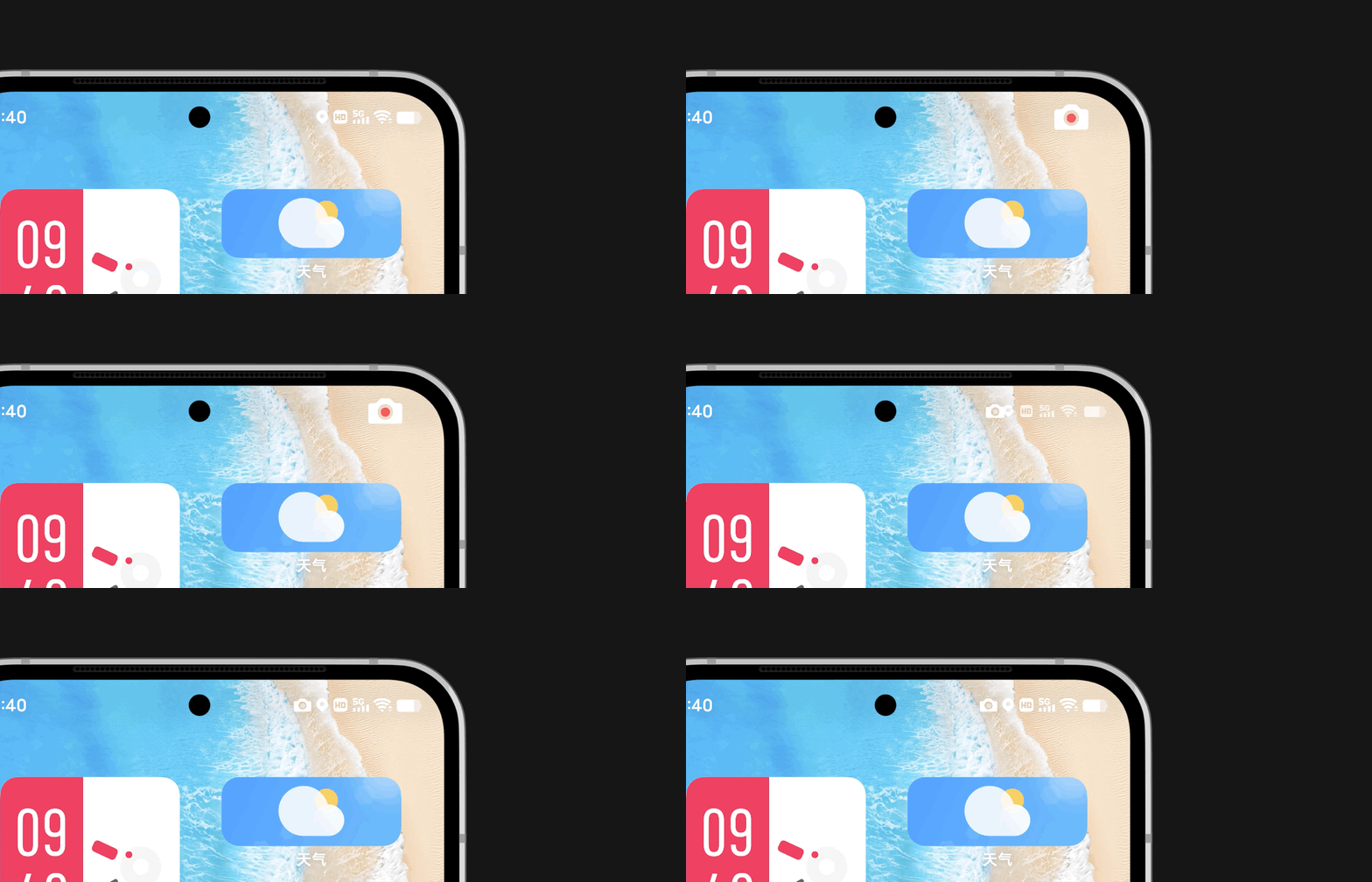
Apart from the fact that the OnePlus 9 RT will run Android 11 out of the box, the source also confirmed its other specifications. The phone will have an FHD+ display with a 120Hz refresh rate and a punch hole at the top left corner for the front-facing camera. It will also have a Snapdragon 888 processor, a 50MP Sony IMX766 main rear camera, a 4500mAh battery, and support for 65W fast charging.
Xiaomi CIVI is the company’s second attempt at lifestyle smartphones after the Mi CC9 series. The device grossed over ¥200 million in just 5 minutes of its first sale. Yesterday, one of the Xiaomi executives shared more insights into the sales of this phone.
Yesterday, Lu Weibing, who holds multiple positions at Xiaomi, has revealed that the sales turnover of Xiaomi CIVI on TMall has exceeded ¥200 million. The handset ranked first in the ¥2,300 – ¥3,000 price category.
Most importantly, over 60% of buyers turned out to be female. As per Xiaomi, the CIVI is target at this sex demographic. Going by the data, the company appears to have achieved its goal.
The Xiaomi CIVI is unlike other smartphones released by Xiaomi in 2021. The Mi 11 Lite and the Xiaomi 11 Lite NE can be considered as its closest siblings as all three are lifestyle smartphones.
However, the CIVI has a premium design all-around with a metal frame, curved display, and an AG glass. But unfortunately, its rear camera layout mimics that of vivo’s. Hene, it’s easy to confuse CIVI with vivo S series phones to be specific.
The China-exclusive Xiaomi CIVI retails at the following price tags in the company’s home turf.
The OnePlus 9 RT is the last flagship OnePlus has planned for this year and there are speculations it will be announced this month. The smartphone is a T-variant of the OnePlus 9R, the first device in its new line of entry-level flagship phones.
As we move closer to the launch of the device, more details have been pouring in, and the latest reveals the color variants it will come in when it is is announced.
The OnePlus 9R was announced in two colors at launch – Carbon Black and Lake Blue. However, OnePlus announced a third colorway – Qingyu Green – that is exclusive to China, the other country the phone is sold in other than India. For the OnePlus 9 RT, there will also be three color variants according to the Chinese Weibo leaker, Bald Panda.
According to the source, the phone will be available in “Blue Sky Enchantment”, “Hacker Silver”, and “Dark Matter”. These are translations of the Chinese names but we can deduce that the OnePlus 9 RT will be available in Blue, Silver, and Black.
We do not know if all three colorways will be announced at launch and if they will be available in all of the markets the phone will be sold. Since the green variant of the OnePlus 9R is exclusive to China, there is no saying OnePlus won’t make one of these colors exclusive to the region once again.
The OnePlus 9 RT is expected to launch in mid-October. It will have a 6.55-inch AMOLED display with a 1080p resolution and a 120Hz refresh rate. An earlier report said the phone will have a higher-binned version of the Snapdragon 870 processor but a Geekbench listing has revealed the phone has a Snapdragon 888 processor.
For several hours on Monday, October 4, millions of users of Facebook, Instagram, Messenger, WhatsApp, and OculusVR were cut out from these platforms for unknown reasons. It was suspected that Facebook could have been the subject of a hack. However, the company has now made a statement that the incidence was the result of a configuration change in its routers. It is still not very clear what happened, but the outage brings to the fore the vulnerability of the platforms and how connected they have become.
The configuration issue led to a disruption in network traffic, which subsequently affected the way Facebook’s network centers communicate. These issues all contributed to bringing Facebook’s services to a halt. Facebook’s CEO Mark Zuckerberg has issued an apology for the service blackout, stressing that the platforms were coming back online.
In what is seen as Facebook’s worst outage since 2019 when it went off for more than 24 hours, Monday’s incident is believed to have begun with a routine BGP update that was wrongly executed, and this led to the wiping out of the DNS routing information that is used to make Facebook accessible to other networks. The outage also coincides with the scheduled testimony of whistleblower, Frances Haugen to the United States Congress about her experience in the company. Haugen has released a trove of documents to support her claims that Facebook pays for its profit with user safety.
Even with the apology by CEO Zuckerberg, the six-hour outage will continue to be interpreted differently. It is hoped that Facebook will provide greater clarity and better disclosure of the details of what led to Monday’s blackout.
Android 12 introduced Material You – a brand new design language bringing along much-needed changes to modernize stock Android. Along with redesigned apps and system UI, it also brought along a dynamic theming that sets background and accent colors based on the wallpaper.
And now, Samsung has taken a bite from the Material You cake as well.
Image: SamMobile
The South Korean company today released One UI 4.0 beta 2 for devices part of the beta program (via: SamMobile). The Android 12-based iteration of the Android skin finally introduces Samsung phones to the world of Material You colors, thanks to the implementation of a dynamic theming system that picks colors from the wallpaper.
Because of this, users are presented with countless possibilities for the color schemes that can be used on the system UI. The system interface will now also look more consistent thanks to it using the same colors as the wallpaper.
However, there is one shortcoming. Screenshots by SamMobile suggest that the new theme engine is limited to accent colors alone, which is a step back from Google’s theming system that adjusts colors dynamically for both backgrounds along with elements making use of accent colors.
But given that this new theming system is brand new, Samsung may perhaps extend its scope to app and system backgrounds as well.
That said, there are reports of the personalized theme not getting applied occasionally using the new customization options from the same. This again can be attributed to the fact that Samsung’s implementation of Material You is currently in its early stages. But of course, most of these problems, if not all, should get resolved when One UI 4.0 hits stable.
Samsung has just started rolling out the second beta firmware. It’s going to be available to all users participating in the beta program soon.
In late August, Fossil announced the Gen 6 smartwatch, its latest Wear OS-powered wearable with a Snapdragon 4100+ processor. Nearly a month later, it launched the smartwatch in India. It has now followed it up with the Michael Kors Access Gen 6 Bradshaw which is practically a more premium version of the regular Gen 6.
The Michael Kors Access Gen 6 Bradshaw series have the same specifications as the Fossil Gen 6 but differ with respect to design. They are targeted at those who want a smartwatch with a more premium design. So unlike the Fossil Gen 6 that comes in both stainless and leather variants, the Michael Kors Access Gen 6 is available with only stainless steel bands.
The smartwatch comes in only one size – 44mm – which has a 1.28-inch AMOLED display with a 326 PPI pixel density. There is a Snapdragon Wear 4100+ under the hood along with 1GB of RAM and 8GB of storage. Just like on the Fossil Gen 6, users should experience faster app load times and a reduction in power consumption when compared to the last generation.
The smartwatch has a 24-hour heart rate monitor, a blood oxygen level sensor, sleep tracking, voice-activated Google Assistant, NFC, GPS, 5 ATM water resistance rating, music playback control, app notifications, support for Bluetooth calls, and support for fast charging.
Just like the Fossil Gen 6, it is modeled after, it too doesn’t run the new version of Wear OS but it should get the update when it begins to roll out.
The starting price is ₹25,996 for the Michael Kors Access Gen 6 Bradshaw and it goes up to ₹32,495
With Microsoft Windows 11 going live, various OEMs are rushing to launch their own PC offerings that support the latest version of the operating system. One of these brands include Acer, with its Aspire Vero.
While Windows 11 is undoubtedly one of its key features, the build quality and materials used is still a notable aspect. The laptop from the Taiwanese PC maker is the first to be focused around sustainability. The new notebook is built used post consumer recycled (PCR) plastics both for the chassis and keyboard caps. Furthermore, 30 percent of the entire chassis is made using the PCR plastics while the keyboard caps are use around 50 percent of PCR.
The brand is also using 100 percent recyclable packaging for the laptop, with 100 percent recyclable plastic also being used for the laptop sleeve and keyboard protection as well along with 85 percent recycled materials used for even the carton box. Under the hood, the new Aspire Vero features up to Intel’s 11th Gen Core i7 processor with Iris Xe graphics paired with 512GB of SSD storage. On the front, the display is a 15.6 inch FHD panel, while the laptop supports WiFi 6, USB Type C, two USB Type A ports, and an HDMI 2.0 port.
The laptop will be available for purchase starting from tomorrow with a price tag of 899.99 US Dollars for the i7 model, which is paired with 16GB of RAM and 512GB of SSD storage. The Core i5 variant is set to launch later this month and will arrive with 8GB of RAM and 256GB of SSD storage and will cost 699.99 US Dollars.
ColorOS 12 based on Android 12 went official in China last month. OPPO is also set to introduce the latest version of its mobile software in international markets next week. The first batch of eligible devices in the home country has already entered the public beta testing phase. The company has now announced close beta testing for the OPPO Find X2 series.
OPPO Find X2 Pro
According to an official announcement post (via ITHome) on OPPO Community China, the company has started recruiting ColorOS 12 Closed Beta testers for the OPPO Find X2 series in its home country. Users will the following models can enroll themselves in the program.
OPPO Find X2 Pro Automobili Lamborghini Edition
OPPO Find X2 Pro
OPPO Find X2 League of Legends S10 Limited Edition
OPPO Find X2
The registrations for the initiative went live at 11 AM (local time) today. They will be closed exactly 24 hours later, i.e. 11 AM (local time) tomorrow (October 6). Only 500 applicants will be selected.
The application review process is said to last for about 5 days. Selected users will be notified via SMS and will receive the Android 12-based ColorOS 12 Closed Beta build via OTA.
Next month, these phones will enter the public beta testing alongside the OPPO Reno6 series in China. At present, we are not sure when the international variants of these handsets will be treated with the latest version of ColorOS.
The Intel Arc Alchemist GPUs for desktop PCs might not be arriving anytime soon. A new report has suggested that the new graphics card may not be launched until the second quarter of next year.
According to a YouTube channel called Moore’s Law is Dead, team blue is referring to its laptop GPUs when it talked about the Q1 launch for its Xe HPG (high performance gaming) products. In other words, the Alchemist desktop graphics cards might not arrive until the second quarter. Apparently, the Alchemist laptop GPUs will also launch along with the Alder Lake mobile chips, which hints at capable gaming laptops launching next year, closely followed by the launch of the desktop GPUs soon after.
Although, the delay in release might also be related to the supply chain and other production issues. The YouTuber also shared some new images in the latest video, which showcased a mock up of what these new GPUs might look like. Keep in mind that these are still just renders and not the official model of the GPU itself from Intel. Although, these renders are based on new info from several sources, as per Moore’s Law is Dead.
Furthermore, the renders are based on early engineering sample shots that the leaker had already received in the past. Although, Moore’s Law is Dead did add that most current reference test boards look similar to this early on. So, we have no idea what the final model might look like for the commercial build.
The A15 chip from Apple was found to be 62% faster than the competition as per an independent test that measured parameters like performance, efficiency, and graphics core improvements. This is a 12% gain over Apple’s own claim of the A15 being 50% faster.
The review, performed by AnandTech (via: MacRumors), revealed that while Apple’s larger cores are more power-hungry, they’re still a lot more energy-efficient. Energy efficiency was found to be improved by 17% on the peak performance states versus the A14.
Image: AnandTech
AnandTech also noted that the system cache on the A15 has been boosted to 32MB, which is double when compared to the A14. This “dwarfs the competition” and is a “key factor in the power efficiency of the chip, being able to keep memory accesses on the same silicon rather than going out to slower, and more power inefficient DRAM,” the report said.
The L2 cache has gotten similar upgrades as well and now sports a memory of 12MB – a sizeable increase over last year’s 8MB. AnandTech has described this as “humungous” as its size is now the same as Apple’s M1 chips that are used in laptops. The 12MB figure also means that it’s twice as large as the L2 cache memory found on the Snapdragon 888.
These cache enhancements allow the A15 to squeeze out impressive gains from a performance core microarchitecture that isn’t all that different from last year’s A14. This is joined by an additional integer ALU and a faster memory subsystem in the efficiency cores that further add to the gains.
The GPU bundled with the A15 has also noted significant boosts in performance that are once again well above Apple’s claims. The only gripe about it is its bad thermal management that leads to throttling on at least the iPhone 13 Pro.
Despite this, the iPhone 13 models were still found to be “vastly faster and give out a better gaming experience than competitive phones.”
In conclusion, the substantial performance and efficiency improvements of the Apple A15 chip are the key to the vastly improved battery life seen on the iPhone 13 series.
The Cyrcle Phone 2.0 is one of the very few smartphones with an unusual shape. The smartphone comes with a circular display with an elliptical body. It joins a very small list of smartphones that have taken such odd-shaped designs as the Runcible and the Cyrcle Phone 2G (which is the predecessor of the Cyrcle Phone 2.0).
The Cyrcle Phone 2.0 has a length of 5.11 inches, a width of 4.06 inches, and a thickness of 0.87 inches. The display is just 3.45 inches in diameter, which seems odd as well. The smartphone is wider than most models in the market and it could be uncomfortable to use. The Cyrcle Phone 2.0 will run on Android 10, and how the circular display fits with the conventional rectangular display of Android still needs some fine-tuning.
The Cyrcle Phone 2.0 is priced at $700, offers 3GB of RAM and 32GB of internal storage. It remains to be seen how the unusual design of the smartphone will drive its demand, seeing that it does not come with some eye-catching specs. The smartphone also has two USB ports and two headphone jacks, which is indeed unusual for most current models. The must be some justification behind this design choice but we are yet to know them at this time.
The original Cyrcle phone was a round clamshell with a square display which was masked so that only a circular portion was visible. The phone’s enclosure is 3D printed and it is possible to also download the CAD files for the Cyrcle Phone 2.0 and 3D print the enclosure to a feel of the covering before giving it a go.
In the past couple of weeks, various reports have surfaced that suggest that Nvidia is working on new GPUs including a new RTX 3090 Super graphics card along with new RTX 3070 Ti and RTX 2060.
According to hongzing2020 (Via PCGamesn), the American graphics card maker is preparing to launch new RTX GPUs in January 2022. These GPUs would also include the new RTX 3090 Super flagship refresh, the 12GB variant of the RTX 2060. The tipster further added that these GPUs will also arrive alongside a new RTX 3070 Ti, which would feature a whopping 16GB of VRAM. In other words, this variant of the 3070 would have even more VRAM than the higher end RTX 3080.
Notably, the leak also skips over other recent reports that suggest that the company is working on a new RTX 3080 Super, RTX 3070 Super, and RTX 3060 Super. Meaning, the new cards are no longer a part of Nvidia’s future lineup. Although, the company could have more graphics card variants planned to release later, since offering a wide range of cards right now might be difficult considering the ongoing semiconductor shortage that has affected supply chains across the globe.
GeForce RTX 3080 Ti
Going by the trend of rising memory in these cards, Nvidia GPUs might soon arrive with a minimum of 8GB of VRAM. But keep in mind that this is still just a leak and not an official confirmation from the company. So, we will have to wait for an official announcement from team green to know for sure.
Android 12 was officially uploaded to AOSP without being released for eligible Google Pixel devices, in an odd move yesterday. This defied Google’s tradition of uploading the source code after stable builds go live for their Pixels. Because of this, Xiaomi has almost beaten Google at their own game and has already released ‘stable’ Android 12 builds for the global variants of the Mi 11i and Mi 11, albeit for select pilot testers.
The company also announced (via: IT Home) that the Xiaomi Mi 11 Ultra, Xiaomi Mi 11 Pro, Xiaomi Mi 11, Redmi K40 Pro, and Redmi K40 Pro+ will be getting Android 12 as part of the first batch, and that the internal testing for the same has commenced.
However, Wang Hua, General Manager of Xiaomi Public Relations posted on Weibo today reminding users that Android 12 has only been freshly adapted and will hence be plagued by bugs. Both Google and Xiaomi “still have a lot to do” and it’s advisable for testers to back up their data prior to performing the upgrade process.
This is in conjunction with the official Android 12 update release notes from the Xiaomi Mi 11i and Mi 11 that warn users about overheating and other performance issues. The notes also emphasize that “it might take some time for your device to adapt to the new version.”
Lastly, some third-party apps may not be compatible with Android 12 just yet.
If you are a Global Xiaomi Mi 11i or Mi 11 owner and think you have what it takes, then feel free to download the builds via the links given below.
The Pixel 6 series and Android 12 stable rollouts may almost be upon us but Google is not done with the good stuff for this year. Sources state that the Google Pixel Fold will be launched before the end of 2021, as Google’s very first foldable smartphone.
The device is expected to have the now-standard inward folding flexible screen. Based on this, Google’s patents, and the design language employed by the Pixel 6 series, LetsGoDigital in collaboration with designer Waqar Khan has provided some really good-looking renders of the purported foldable model.
1 of 3
Images: LetsGoDigital
The renders show a design that is not unlike the Samsung Galaxy Z Fold 3. The selfie camera is housed within a punch hole in the outside display on the top left corner. LetsGoDigital believes that the front display will have reasonably thick bezels, and has as such, reflected so on their renders as well.
Once unfolded, you get yet another selfie camera within the larger display inside. The device is equipped with a similar hide-away hinge Samsung uses on their Fold series.
Do keep in mind that the renders are only an artist’s imagination and may hence not reflect the actual look of the Google Pixel Fold.
Earlier, Google was granted a patent from the United States Patent and Trademark Office (USPTO) for a multi-axis soft hinge mechanism and a foldable device having the same. The 58-page documentation described an advanced hinge mechanism, designed in such a way that only a small crease is created when the device is folded.
The patent described a device with an inward folding display, not unlike the one shown in the Google Pixel Fold renders above, which can be unfolded into a device with a tablet-sized display. From this, it is safe to assume that Google will be using a similar design for their Pixel Fold.
Last but not the least, the foldable phone that has been codenamed “Passport” can be released as early as this year itself. Sources have given an “end of 2021” date.
The device was first tipped by a blogger back in 2019 and a more recent leak suggests that it will be using an LTPO OLED display. It may also come with an under-screen camera, although we wouldn’t want to get our hopes too high.
While memory leaks isn’t exactly a new issue on the Windows platform, it seems that the memory leak issue with the File Explorer has shipped with live build of Windows 11 that launched earlier today (5th October 2021).
For those unaware, memory leaks is basically an issue that occurs when the PC fails to release the cached memory space that it has been assigned. In other words, it doesn’t free up RAM even after the program that was initially using it has been closed. This, in turn, leads to RAM being horded up, which can cause your computer to slow down or even become unresponsive in extreme cases. Now, the file explorer memory leak that has surfaced a couple of months prior on Windows 11 Insider Preview has managed to make its way to the live build.
To replicate the issue, one can simply go to Task Manager and sort the processes by highest memory usage then spam ‘Win+E.’ After this, file explorer will rise up this list quickly. As of right now, the company has yet to officially acknowledge this issue, so its unknown if a fix is on its way. Restarting Windows File Explorer process manually will free up the cache from within the Task Manager (Via PCGamer).
Users with systems that do not have a lot of RAM or those that do not restart their PCs often could face major issues if this memory leak issue isn’t resolved quickly. So stay tuned for more, as we will provide more updates when additional information is available regarding this matter.
Amazon India under the Great Indian Festival is giving an amazing deal on the Sony WF-1000XM3 Earbuds. The earbuds which generally retails for ₹20000 is now available at a massively discounted price of ₹9990 only at Amazon India. This deal ends in 8 hours.
Industry-leading Digital Noise Cancellation technology – virtually soundproof experience
Proprietary technology for premium sound
Extended battery life – 6 hours on a single charge and 24 hours with the case
Quick charge – get 90 minutes of playtime with just 10 minutes of charge
Built-in Alexa – for voice free access and control
Smart touch controls
Quick attention mode, Ambient Sound mode
Wearing detection
Smart listening
Intelligent auto-power off through IR sensor which detects earbuds’ status
Location detector
Colors: Silver and Black
Generally retailing for ₹20000 you can now buy Sony WF-1000XM3 Earbuds at a heavily discounted price of ₹9990 only at Amazon India. Please note that this super deal ends in 8 hours and comes with additional bank discounts and offers. So place your order asap.
For more information on such exciting deals and offers check out ourdeals hub.
* Please Note: When you buy something using the links in our articles, we may earn a small commission at no cost to you.
Xiaomi has been rolling out MIUI 12.5 Enhanced Edition update for eligible devices for a while now. The latest version of MIUI was announced in August and the flagship Mi 11 Ultra got access to the update in China that month itself. However, the European variant of the smartphone has begun to receive the new version of MIUI only now.
Xiaomi Mi 11 Ultra
According to AdimorahBlog, Xiaomi has started seeding MIU 12.5 Enhanced Edition update for the EEA variant of Mi 11 Ultra. The latest system update arrives with build number V12.5.10.0.RKAEUXM and September 2021 security patches.
The EEA variant of the Xiaomi Mi 11 Ultra is only the third regional model of the handset to receive MIUI 12.5 Enhanced Edition. The other two are ‘China’ and ‘Indonesia’. The former got the update in August, while the latter received it in September.
This means only ‘Global’ and ‘India’ variants of the phone are left to get the new version of MIUI. These two models should also get access to the update soon.
As far as the EEA variant is concerned, Xiaomi has just started seeding the build. Hence, it will take some time to reach every unit due to batched rollout.
At the same time, Xiaomi is also testing Android 12 on Mi 11 Ultra globally along with other smartphones. Interested users can join the program to experience the latest version of Android.
Yesterday, Android 12 finally hit the stable milestone, which should mean it’s good to go. Or is it? Unfortunately, for Google Pixel owners, the OS version is still not available and will continue to stay that way at least for several more days. Android Developer blog has given an ETA of “within the next few weeks” for Pixel devices along with a “later this year” date for Samsung Galaxy, OnePlus, Oppo, Realme, Tecno, Vivo, and Xiaomi devices.
Of course, those that are part of the beta programs offered by participating OEMs can still try out the Android 12 update before it rolls out widely, but bugs are to be expected.
Regardless, this is still a really odd way for Google to announce a new Android version. New Android upgrades typically roll out to Pixels as soon as it hits AOSP. Thus, leaving aside developers, there is little for regular users to get excited about with this year’s announcement.
The delay in the Android 12 release can be attributed to the fact that it is one of the most significant upgrades in years, adding a fresh breath of life to the OS. This has been made possible through Material You – a brand new design language that favors large rounded elements for improved intuitivity and aesthetics. It is joined by a dynamic theme system that absorbs colors from the current wallpaper and splashes them across supported apps.
Also new is the inclusion of sophisticated animations across the system, as well as Google apps. This is joined by the implementation of new widgets that look better and are more interactive than ever before. They have the ability to make even the blandest of home screens look like a piece of art in seconds.
Not everything is a UI refresh with Android 12 though. There are also multiple enhancements to privacy, with the status bar, gaining new indicators for when the microphone and camera are being accessed.
The Android 12 update has also been claimed to bring along significant performance boosts, with a reduction in CPU time used by core system services by 22% and a decrease in the usage of big cores by 15%. This is paired with an increase in app launch speeds.
Can’t wait to get your hands on the update? We have listed the devices that have been confirmed to get Android 12 below.
Android 12 Eligible Devices
Google
Pixel 3
Pixel 3 XL
Pixel 3a
Pixel 3a XL
Pixel 4
Pixel 4 XL
Pixel 4a
Pixel 4a 5G
Pixel 5
Xiaomi
The following devices are undergoing internal beta testing and the list will be expanded.
Xiaomi MIX 4
Xiaomi 11T Pro
Xiaomi Pad 5 / Pad 5 Pro / Pad 5 Pro 5G
Mi 11 Lite 4G / 5G
Xiaomi 11 Lite 5G NE
Mi 10 / 10 Pro / 10 Ultra / 10 Lite 5G
Mi 10T / 10T Pro / Redmi K30S Ultra
Mi 10i / 10T Lite / Redmi Note 9 Pro 5G
Redmi K30 Pro / Zoom / Poco F2 Pro
Redmi K30 5G / 5G Racing / K30i 5G
Redmi Note 10
Redmi Note 10 Pro / Pro Max /
Redmi 10 5G
Redmi 10T
Redmi Note 8 (2021)
POCO X3 Pro
POCO F3 GT / Redmi K40 Gaming
POCO M3 Pro 5G
OnePlus
OnePlus 9
OnePlus 9 Pro
OnePlus 9R
OnePlus 8
OnePlus 8 Pro
OnePlus 8T
OnePlus 7
OnePlus 7 Pro
OnePlus 7T
OnePlus 7T Pro
OnePlus Nord 2
OnePlus Nord
OnePlus Nord CE
Oppo
Oppo Find X3 Pro
Oppo Find X3 Pro Mors Exploration Edition
Oppo Find X3 OnePlus 9 Pro 5G
Oppo Find X2 Pro
Oppo Find X2 Pro Lamborghini Edition
Oppo Find X2 Find X2 League of Legends S10 Limited Edition
Oppo Reno6 Pro+ 5G
Oppo Reno6 Pro+ 5G Detective Conon
Oppo Reno6 Pro 5G
Oppo Reno6 5G Limited Edition
Oppo Ace2
Oppo Ace2 EVA Limited Edition
Oppo RenoS Pro+ 5G
Oppo RenoS Pro+ Artist Limited Edition 5G
Oppo RenoS Pro 5G
Oppo RenoS 5G
Oppo Reno5
Oppo K 5G
Oppo K9 5G
Oppo A95 5G
Oppo A93 5G
Oppo Reno Ace
Oppo Reno Ace Gundam Edition
Oppo Reno 10x zoom version
Oppo Reno Barcelona Custom Edition
Oppo Reno4 Pro 5G
Oppo Reno4 Pro 5G 2020 Summer Custom
Oppo Reno4 Pro 5G Artist Limited Edition
Oppo Reno4 5G Edition
Oppo Reno4 SE 5G
Oppo Reno3 Pro 5G
Oppo Reno3 Pro 5G Classic Blue Custom
Oppo Reno3 5G Edition
Oppo Reno3 vitality version
Oppo K9 Pro 5G
Oppo K7
Oppo K7x
Oppo A93s 5G
Oppo A92s 5G
Oppo A72 5G
Oppo A55 5G
Oppo A53 5G
Tecno
Tecno Camon 17
Samsung
Samsung hasn’t confirmed which phones will get the Android 12 update. But SamMobile has curated an expected list, which you can check here.
Note that the list below isn’t final and more devices may be added or removed in the coming weeks.
Apple iPhone 13 Pro Max has just become the display leader on DxOMark rankings. The company’s high end flagship has beaten the previous leader, Huawei P50 Pro, with a score of 99 points.
According to the DxOMarktest, the overall score of 99 points is the highest ever given to a smartphone, making it the leader of the display rankings. The firm praised the smartphone for its smoothness and accuracy when browsing, excellent color reproduction, and “outstanding” HDR10 rendering to add to the very “enjoyable multimedia experience in all conditions.” For those unaware, the top end model features a 6.7 inch OLED display that has an aspect ratio of 19.5:9.
DxOMark called the device’s display “Simply Stunning” and added that it had excellent readability in nearly all conditions. This is also reflected with the color fidelity and viewing angles as well. The smartphone is reactive and smooth when browsing, while also offering excellent control of artifacts. However, DxOMark noticed that the display was not bright enough at its default settings for comfortable night reading. Furthermore, it had a strong orange cast when the blue light filter is on.
Another slight let down was the gaming experience, which they believed could be made even smoother. Regardless, the iPhone 13 Pro Max from the Cupertino based giant has beaten the likes of the Huawei P50 Pro and the Samsung Galaxy S21 Ultra to become the new leader. DxOMark also noted that Apple has demonstrated major improvements over its predecessor.
Chinese tech brand realme has confirmed to unveil realme UI 3.0 based on Android 12 on October 13. Ahead of that, the company has kicked off the ‘Android 12 Eary Access’ program for realme GT 5G in its home country
The realme GT 5G is the brand’s first and the only Snapdragon 888-powered smartphone released to date. Hence, it positions this device as its flagship phone. Hence, it is the first model to receive Android 12.
According to an official announcement post on realme Community China, only 700 users will be able to experience Android 12 on the realme GT 5G in China initially. The registrations for the initiative have been opened and they will be closed when the required number of users get selected.
The company says that user data will not be erased when upgrading from realme UI 2.0 to Android 12 Early Access. However, it still recommends users to back up the date and store it somewhere else to restore it if required.
The only requirement to join the program is that the phone should not be rooted. Whereas, the selection criteria will be based on a questionnaire.
Interestingly, realme does not call this software realme UI 3.0. But we believe it should be an early release of 3rd-gen realme UI with some missing features.
Having said that, we expect realme to shed more details on its latest software next week.
We use cookies on our website to give you the most relevant experience by remembering your preferences and repeat visits. By clicking “Accept”, you consent to the use of ALL the cookies.
This website uses cookies to improve your experience while you navigate through the website. Out of these, the cookies that are categorized as necessary are stored on your browser as they are essential for the working of basic functionalities of the website. We also use third-party cookies that help us analyze and understand how you use this website. These cookies will be stored in your browser only with your consent. You also have the option to opt-out of these cookies. But opting out of some of these cookies may affect your browsing experience.
Necessary cookies are absolutely essential for the website to function properly. This category only includes cookies that ensures basic functionalities and security features of the website. These cookies do not store any personal information.
Any cookies that may not be particularly necessary for the website to function and is used specifically to collect user personal data via analytics, ads, other embedded contents are termed as non-necessary cookies. It is mandatory to procure user consent prior to running these cookies on your website.