NVIDIA has sought European Union antitrust approval for the $40 billion acquisition of chip designing company ARM. This could kickstart an antitrust probe which may become an obstacle for the company’s plan to close the deal by early 2022.
According to the European Commission filing, the initial deadline to rule on the transaction has a deadline of 13th October. The regulators are likely to echo worries similar to those voiced by the UK watchdog last month.
The competition watchdog of the United Kingdom has warned that the deal could damage competition and weaken rivals, and required a further lengthy investigation. The acquisition also needs approval from the U.S. and China.
The deal must be completed by September of next year, or NVIDIA would have to pay SoftBank $1.25 billion.
In a statement related to this, NVIDIA said, “We are working through the regulatory process and we look forward to engaging with the European Commission to address any concerns they may have. This transaction will be beneficial to Arm, its licensees, competition, and the industry.”
With criticism surrounding the deal, the EU is likely to extend its review by at least another four months to examine potential competition concerns. The company had originally planned to complete the deal by March 2022, when the acquisition was announced.
For the uninitiated, NVIDIA, the world’s biggest graphics card and AI chips maker announced the acquisition of ARM last year. As a part of the deal, NVIDIA will be paying 12 billion US Dollars in cash, which includes 2 billion US Dollars payable at signing and giving out 21.5 billion US Dollars worth of NVIDIA’s stock to SoftBank.
SoftBank had acquired ARM back in 2016 for 31.4 billion US Dollars. ARM is a known chip designer with its architecture being one of the most popular designs used in most smartphone chips from companies like Qualcomm, Apple, and even certain Intel chips.
Companies like Qualcomm, Samsung, and Apple are opposing the acquisition while some other companies, including Broadcom, MediaTek, and Marvell are in support of the deal.
To ensure that the deal gets approval, NVIDIA has promised that it will maintain open licensing and that the deal will help ARM, its licensees, and the industry. Antitrust officials rarely approve “behavioral commitments” without a more careful review due to the difficulty of checking how a company will keep its promises.
Google has just released the final beta version of the Android 12 operating system and soon the company will officially release the stable version of the same. While the Android 12 stable version is yet to be rolled out, details about its successor have surfaced online.
It is being reported that the next version update for Android will be a minor update — Android 12.1. Further, the report adds that this new update should be rolled out pretty soon to the Pixel 6 series phones, once they get launched.
Android 12 Logo
This is an interesting development given that Google has stopped releasing minor version updates for the Android operating system which are called point updates. The last point update was Android 8.1 Oreo and since then, there haven’t been point updates from Google for the Android operating system.
Developers are being advised by Google to update their apps to target API level 31, which is the framework API that Android 12 delivers. The API level for Android 11 is 30 while its processor was 29. So, it’s being bumped with every Android version update.
Now, folks at XDA-Developers spotted evidence within AOSP Gerrit that suggests API level 32 corresponding to Android 12 “sc-v2” and not Android 13 “T.” In a new code change, a Googler changes the API level that a new NDK API will be first made available from 32 to 33. The reason could be because “there are currently no planned NDK APIs in sc-v2-dev.”
It looks like Google will be releasing an interim update between Android 12 and Android 13, with a change in the user-visible version number, resulting in the Android 12.1 point release. There’s also a possibility that the new API level won’t be accompanied by a new version number and could be targeted at another form factor.
Android 12 update comes with a major visual overhaul but it appears that Google’s own Pixel phones will be the ones to experience the full redesign. One of the highlights is support for a theming system, a redesigned lock screen, and quick settings menu, along with a new widget system, new animations, new privacy settings, and more.
Leaked information that appeared yesterday revealed Xiaomi will be soon launching the Mi 11 Lite 5G NE this month in India and some other markets. It is believed that the ‘NE’ letters in its moniker stand for New Edition. A fresh leak by tipster Snoopy has revealed all the major specifications of the Xiaomi 11 Lite 5G NE.
Xiaomi 11 Lite 5G NE specifications (Rumored)
As per the new leak, the Xiaomi 11 Lite 5G NE measures 160.5 x 75.7 x 6.8mm and weighs 159 grams. It features a front camera of 20-megapixel, and its rear panel has a 64-megapixel + 8-megapixel + 5-megapixel triple camera setup.
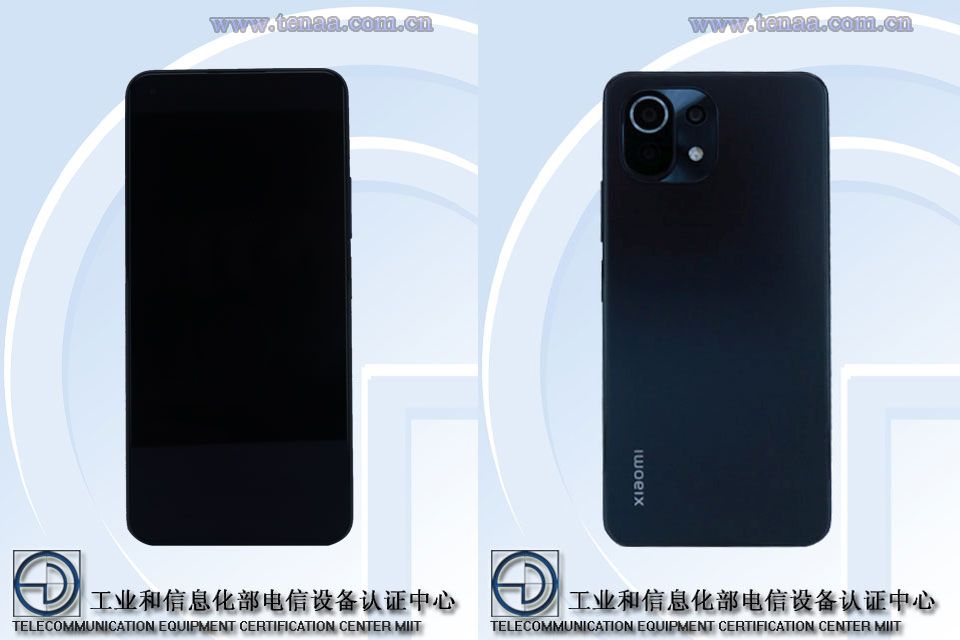
The Snapdragon 778G chip is present under the hood of the Xiaomi 11 Lite 5G NE. The device will offer 128 GB of internal storage and will come preloaded with Android 11 OS. The leaked render of the device reveals it will be sporting a punch-hole display. Unfortunately, its rear image is not available yet. The leak claims that the device will be priced at 329 euros in Europe.
Xiaomi 11 Lite 5G NE leaked render by Snoopy
Recently, a Xiaomi phone with model number 2017119DC was approved by the TENAA authority. The dimensions and specs of this device match with the Xiaomi 11 Lite 5G NE. This indicates that this device may go official this month in China. However, it is unclear whether it is expected to debut as the Xiaomi CC11 series phone.
TENAA images of the alleged Xiaomi CC11
The TENAA listing revealed that it has a 6.55-inch OLED FHD+ display, a 20-megapixel front, 64-megapixel triple cameras, up to 12 GB of RAM, up to 512 GB of storage, 2.4GHz octa-core processor (Snapdragon 778G likely), and a 4,150mAh rated battery. Snoopy’s leak suggests that the 11 Lite 5G will come at least in Black color. On the other side, TENAA listing hints that it may release in colors like black, white, blue, cyan, green, yellow, orange, red, and purple in the Chinese market.
Chinese electronics giant TCL last month unveiled the first batch of its smart TVs that are equipped with built-in Google TV. The company is further expanding the portfolio of its Google TV-equipped smart TV with the launch of the flagship TCL X9 mini-LED TV.
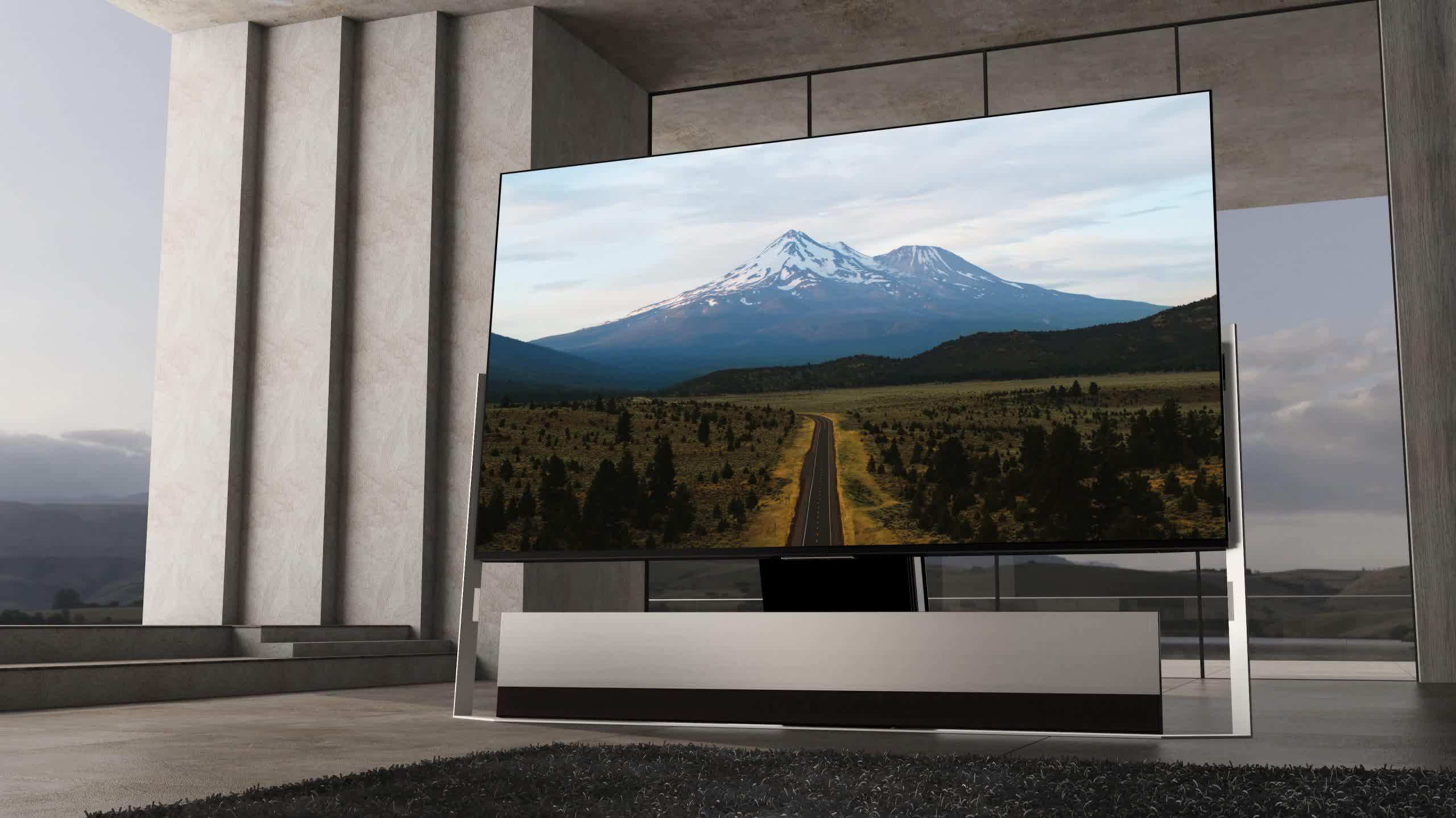
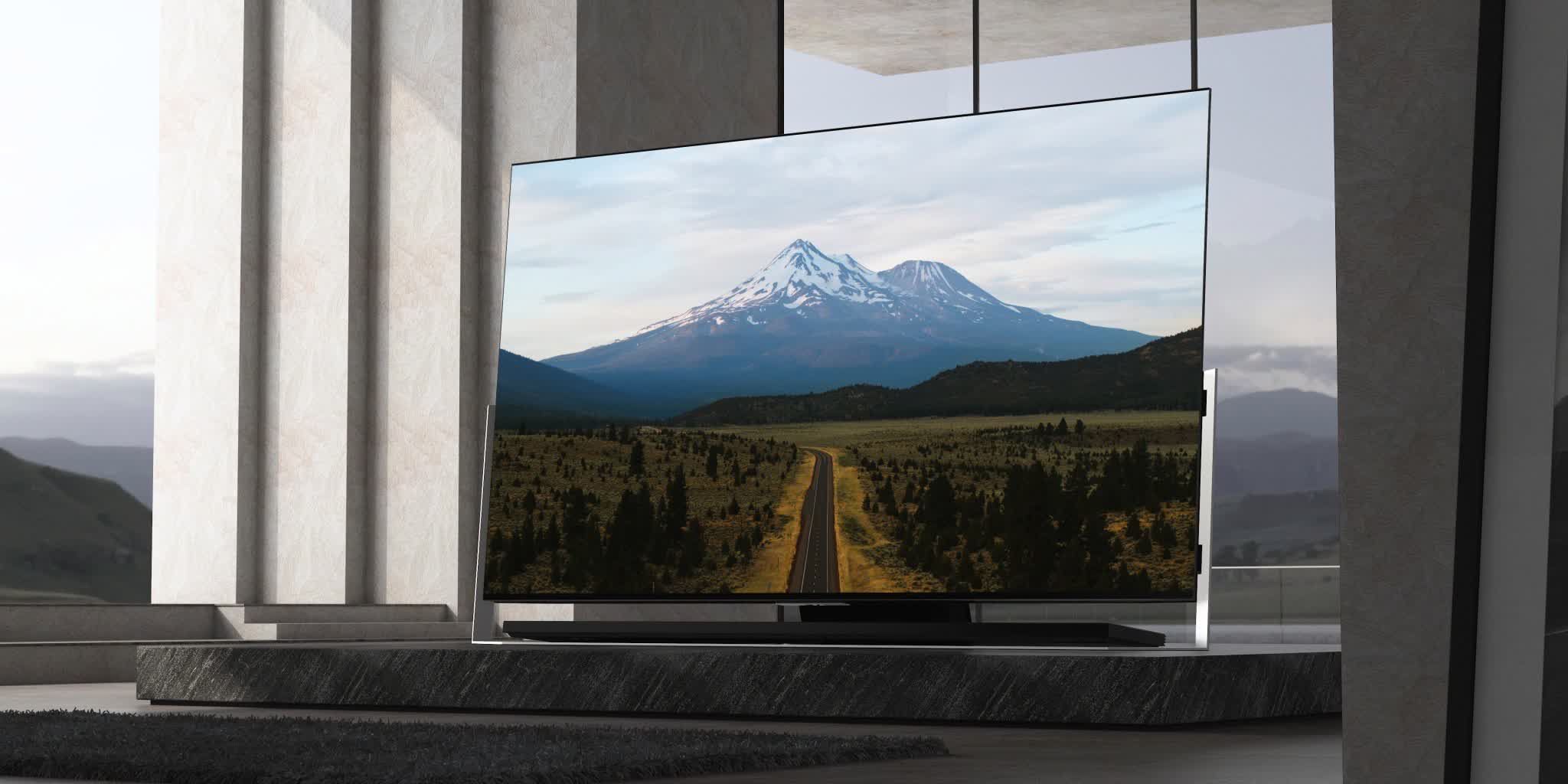
The TCL X9 doesn’t just stand out because of the Google TV built-in but mainly because of its design. The X9 packs a massive 85-inch mini-LED screen with Google TV, and other features and is priced at a whopping $9,999.
The 85-inch display is at the core of the smart TV. The screen supports an 8K resolution and utilizes a mini-LED backlight. Also, the panel also utilizes QLED technology to improve the color output. It equally supports variable refresh rates and packs two HDMI 2.1 ports and eARC support.
The X9 features an ultra-thin frame on which the panel is mounted. The frame deploys “OD Zero” technology to extremely cut down the distance between the mini-LED backlight and the LCD display layer. According to TCL, OD Zero Technology fuses TCL’s mini-LED tech with in-house development and expertise in display engineering. This in turn helps in reducing the thickness of the TV to a great extend. The smart TV also comes with ultra-thin bezels on all sides which looks almost non-existent.
As a result of the slim build, the TV features a separate 5.1.2 soundbar with Onkyo-tuned drivers. The package also includes a subwoofer. The soundbar is integrated with the TV stand. The smart TV also coles with a pop-up camera that can be deployed for video calls using Google Duo.
We reported yesterday that the iPhone 13 series will be announced on September 14 at a global event that will be live-streamed. Apple has now revealed the date the new phones will launch in China.
Image source: Weibo
The iPhone 13 series will be unveiled in China on Wednesday, September 15, a day after the global launch. The event will also be live-streamed on Apple.com.
Apple is currently the fifth biggest manufacturer in China, however, its market share should increase once the new iPhone 13 series goes on sale. Sales of the new phones should also see it retain its lead of the premium smartphone category which sits at 66% according to a Counterpoint report for the month of July.
Ahead of the release of the new iPhones, Apple already slashed the price of the iPhone 12 in China. The 128GB version received a price cut of ¥2000 (~$310) last week. We expect Apple will announce new prices for its older phones at the event next week.
Other than the iPhone 13 series, Apple will also announce the Apple Watch Series 7, new iPads, and the AirPods 3. There are also reports that new MacBooks will be unveiled at the event.
In the first half of this year, Xiaomi launched four models in the Mi 11 series namely, Mi 11, Mi 11 Lite (Mi 11 Youth Edition in China), Mi 11 Pro, and Mi 11 Ultra. Among them, Mi 11 Lite is positioned as a thin and light model, which is the only product in the Mi 11 series that is positioned at the mid-end. Xiaomi may soon expand the Mi 11 series with the addition of a thin and lightweight model dubbed Xiaomi 11 Lite 5G NE alongside the Mi 11T.
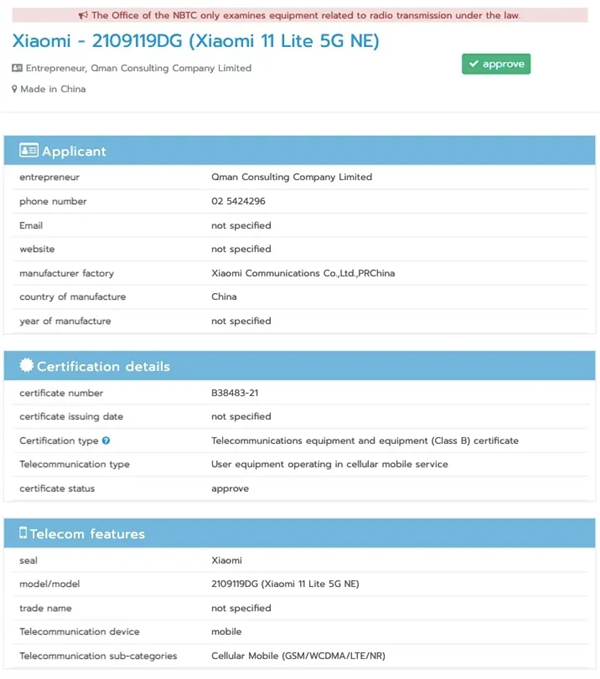
The Xiaomi 11 Lite 5G NE has now obtained NBTC certification in Thailand meaning the Chinese company will likely launch the smartphone in the region soon. It is not difficult to see from the naming that Xiaomi 11 Lite 5G NE is a derivative version of Xiaomi 11 Lite and it is expected to retain the lightweight and thin build for which the Mi 11 Lite is known.
In terms of specifications, Xiaomi 11 Lite 5G NE uses a 90Hz refresh rate OLED full screen, equipped with Qualcomm Snapdragon 7 series processors (maybe Snapdragon 780G, or Snapdragon 778G chip). It is worthy of note that a Xiaomi model equipped with the Snapdragon 778G chip recently received network approval from China’s Ministry of Industry and Information Technology (MIIT). The phone may be a new CC series product of which the corresponding overseas model may be the Xiaomi 11 Lite 5G NE.
IN a related development, a report carried by 91Mobiles claims Xiaomi is planning to launch the upcoming smartphone in India by this month. The report says that the company might start teasing the phone’s launch in the next few days. We can vouch for the credibility of the information and the exact launch date wasn’t given. So, as it stands, the date Xiaomi will release the model is still unknown. We’ll keep you informed when more details emerge.
If you have been waiting for the stable version of Android 12 to be released, there is still a bit of waiting to do as Google has revealed that it is just a few weeks away. However, owners of the new Pixel 5A 5G can get to experience Android 12 today with the new beta release.
The Pixel 5A launched a few weeks ago, so, unlike its siblings that already received the beta release, Google has just made the beta available for it. Google has also released beta 5 for the other eligible devices. This is the final beta before the official release in a few weeks.
Android 12 is bringing a new visual change to Android, though it appears Google’s own Pixel phones will be the ones to experience the redesign in full. There is now a theming system, a redesigned lock screen and quick settings menu, a new widget system, new animations, new privacy settings to mention a few.
While the update will arrive in a few weeks, we expect only a few non-Pixel devices will receive it on Day 1. However, we should see other manufacturers release a list of devices that will receive the update and when to expect it.
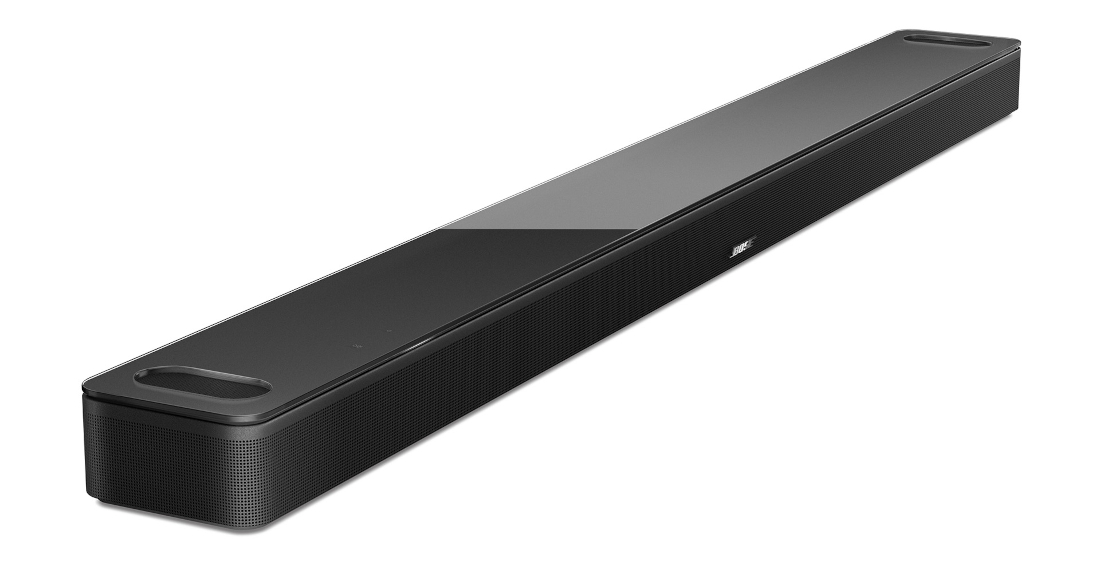
Bose is keeping the spotlight on it after its recent unveiling of the QuietComfort 45 headphones. It is introducing its first Dolby Atmos Soundbar – the Smart Soundbar 900. The flagship Soundbar is priced at $899.95.
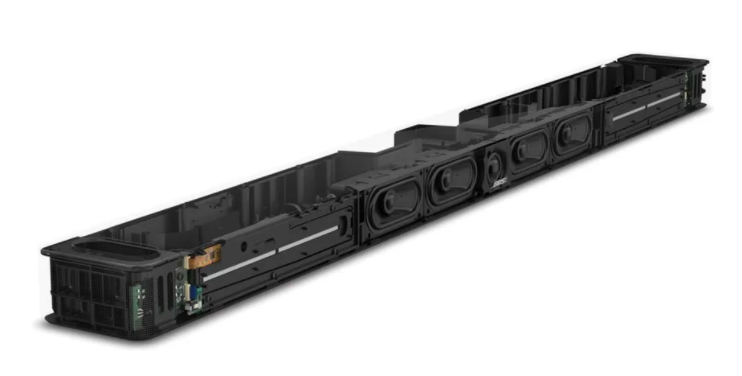
Bose Smart Soundbar 900 packs several impressive features and it’s bound to shift focus from Bose’s forte-home theater systems. It features Dolby Atmos, HDMI eARC, multi-room Wi-Fi music playback, and AirPlay 2. The Soundbar 900 is compatible with a few Voice Assistants like Amazon Alexa and Google Assistant.
It allows audio streaming via Bluetooth. The design philosophy of the Smart Soundbar 900 is embodied in its innovative features which place the device above some of its competitors, like the Sonos Arc, which lacks the Bluetooth audio streaming feature. The design is also impressive as it guarantees an overall immersive sound experience with the soundbar.
The Bose Smart Soundbar 900 will be available from September 23rd, while preorders can be made right now. The company, in unveiling the Soundbar, issued a press statement highlighting the excellent functionality and realism that the Smart Soundbar 900 offers. The device also performs excellently even when there is no Dolby Atmos content, as the horizontal spatial effects are quite effective. In addition, Bose TrueSpace technology takes over for the vertical experience, remixing signals even without adding a ceiling speaker.
There will be two color variants available for the Smart Soundbar 900 – black and white. There are a few other accessories that could be attached like rear speakers and subwoofers. However, if these additional compatible devices are factored in, then the price of the full package is bound to exceed its $900 price tag.
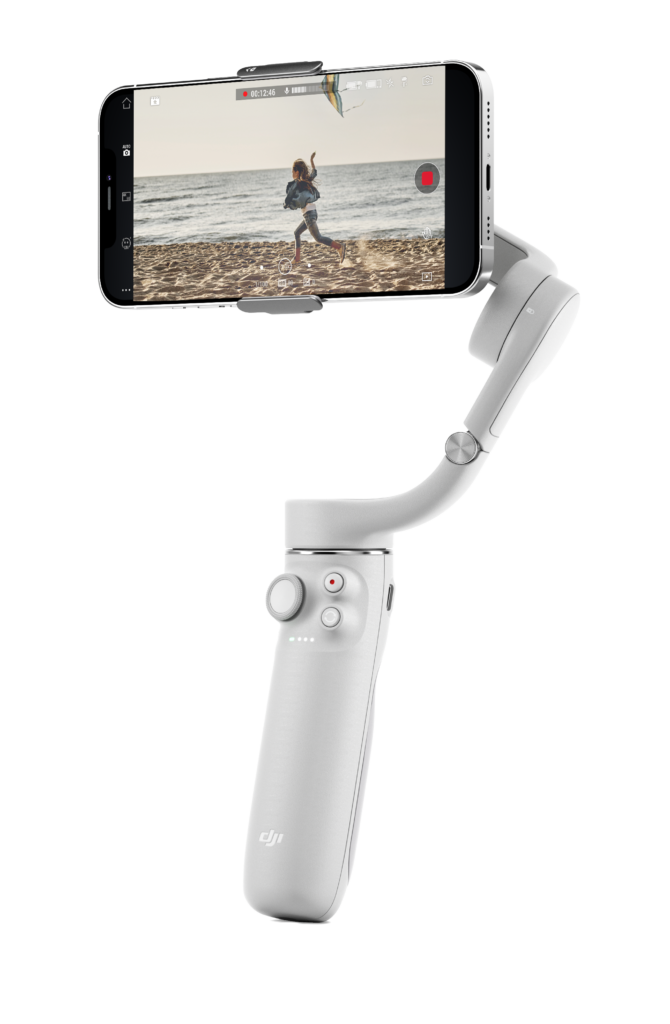
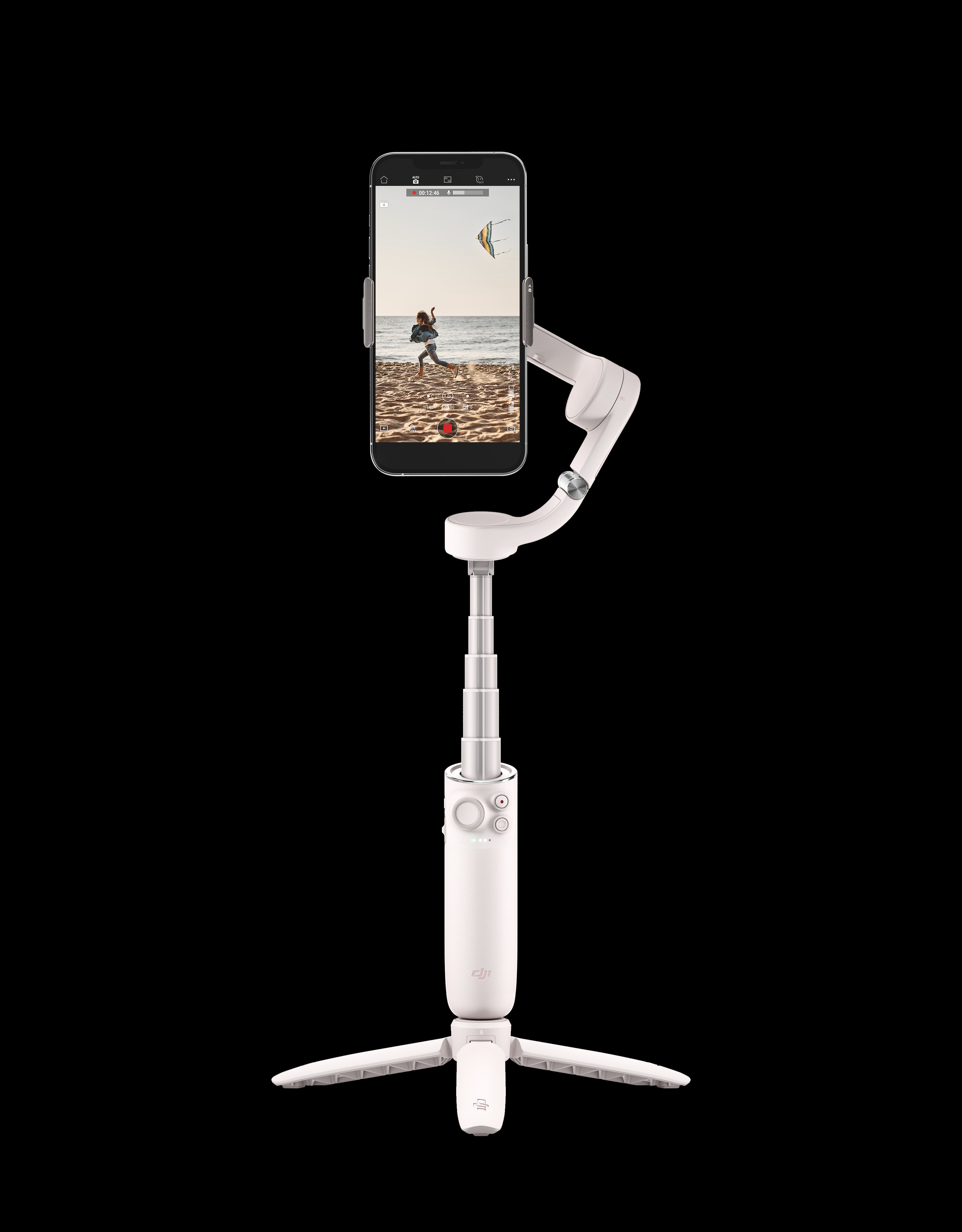
DJI has announced its new smartphone gimbal, the Osmo Mobile 5 (OM5). The new stabilizer comes with a refined design as well as tons of new features.
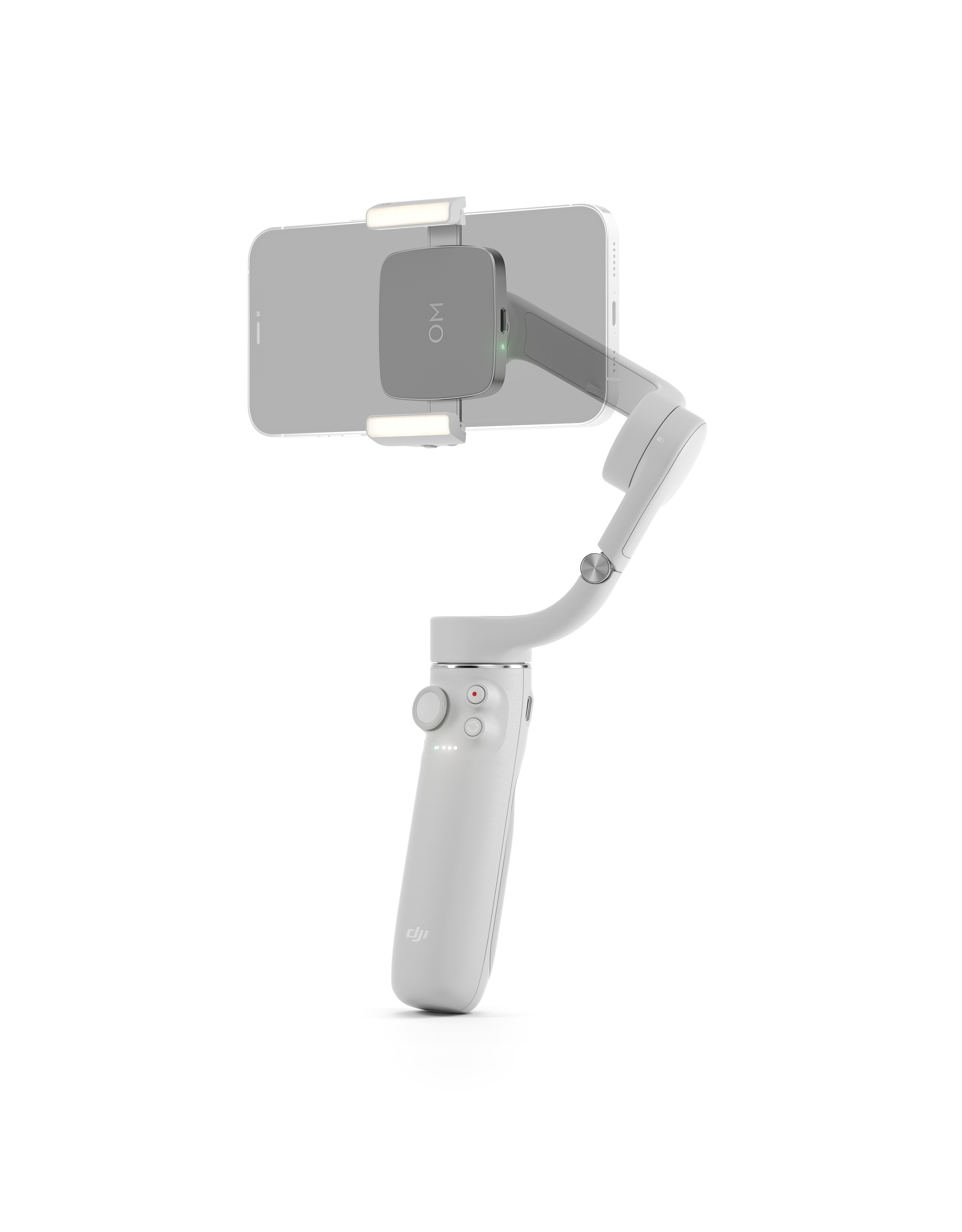
The design changes include a smaller form factor, and according to the press release, the OM5 is one-third smaller than its predecessor. DJI has also redesigned the clamp – it now goes over the phone’s case to provide a secure fit and make it compatible with a lot more devices. Last but not least is the addition of an extension rod, thus allowing users to transform the gimbal into a selfie stick. Yup, you read that right.
The DJI Osmo Mobile 5 has a 3-axis stabilization for recording smooth videos in different scenarios. There is a new feature called ShotGuides that provides up to 30 sets of shooting tutorials for newbies. ActiveTrack has been updated to version 4.0 and now supports tracking at up to 3x zoom at 5 m/s, it is also better at following subjects and keeping them in the center of the frame.
DJI has also added gesture control that allows users to start and stop video recording and take photos easily. Timelapse, Motionlapse, and Hyperlapse are available and they use electronic image stabilization along with the 3-axis gimbal for smoother videos. other features are spin shot gimbal movement which rotates the phone for a spinning effect; panoramas including CloneMe panorama for adding multiple versions of a subject into a single shot; story mode templates; and glamour effect which is automatically activated when you switch to the front camera.
1 of 4
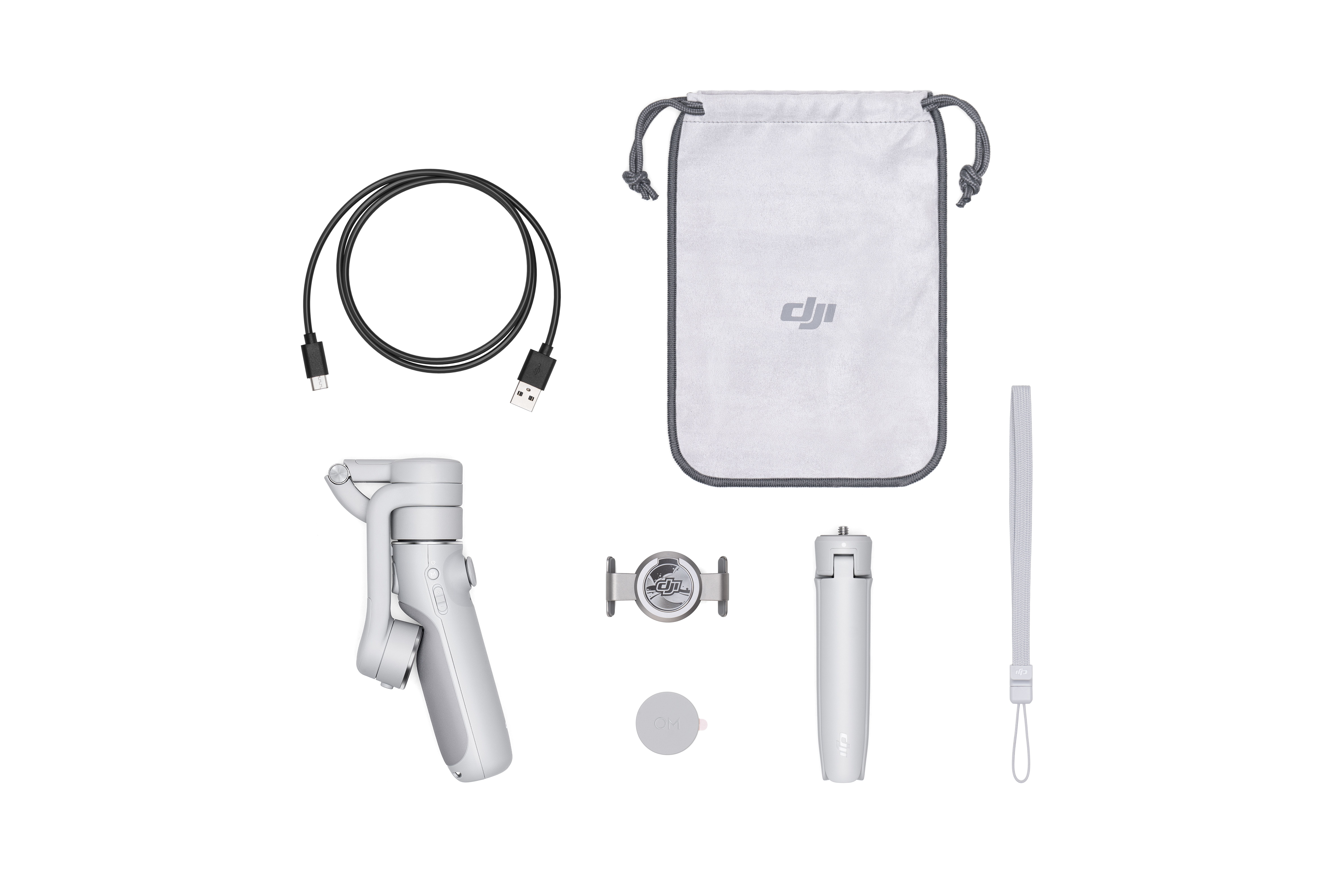
There are new accessories users can purchase to make the OM5 more useful such as the Fill Light Phone Clamp, a magnetic clamp that has lights built-in for that extra brightness when recording or taking photos. There is also a wrist strap and a pouch users can buy.
DJI has put a price tag of $159 on the OM5 while the Fill Light Pone Clamp is $59. It will also be available in Singapore on Lazada and Shopee for S$219 while the clamp will sell for S$65. The OM5 can be purchased in Athens Gray and Sunset White.
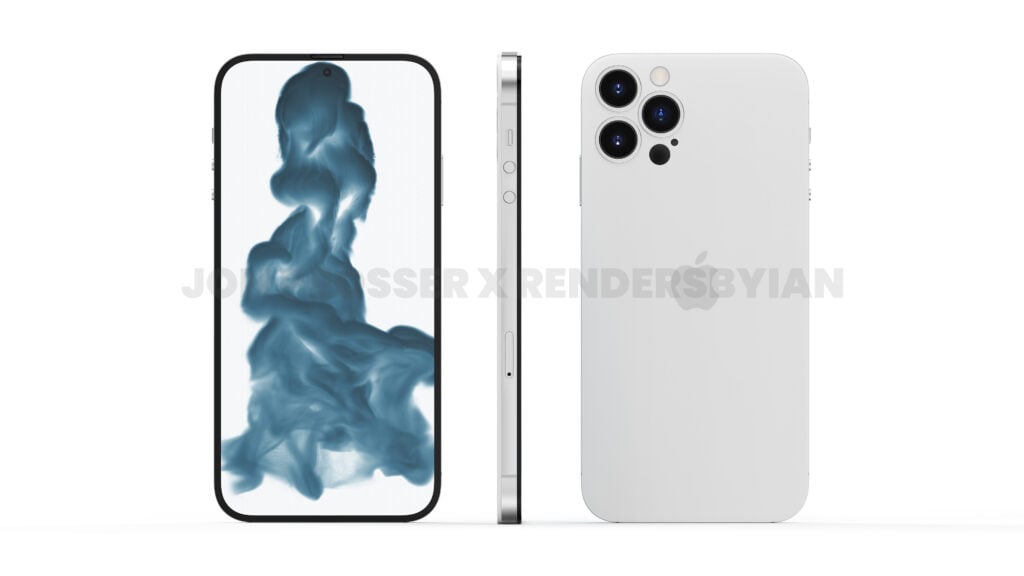
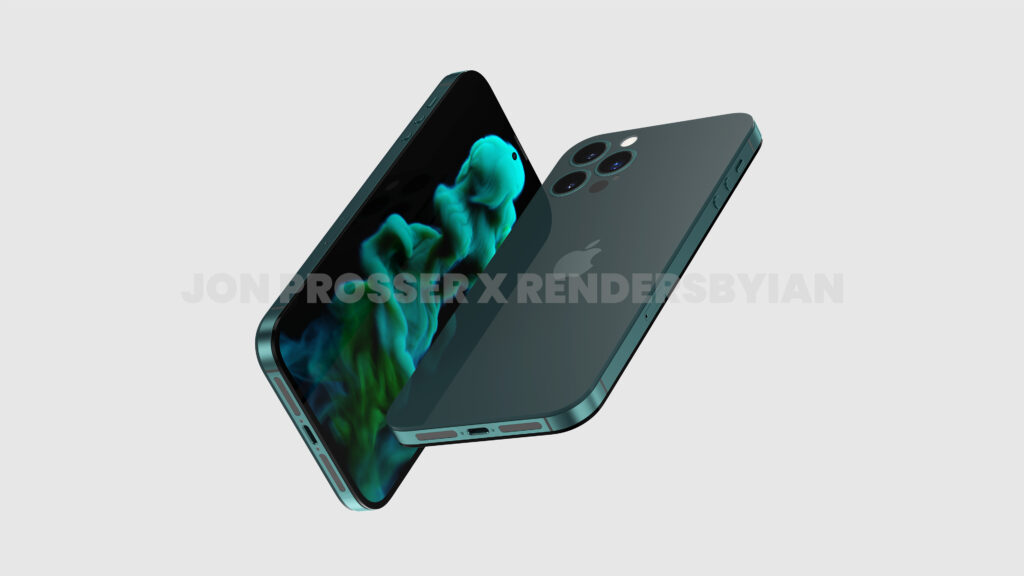
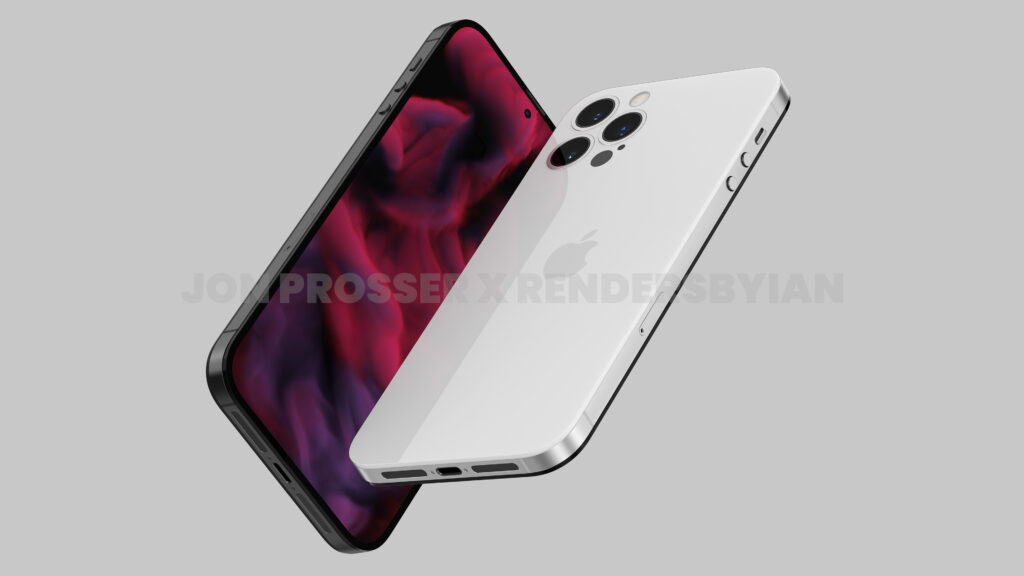
Yesterday, Apple sent out invites for an event scheduled for Tuesday, September 14. That launch is for the iPhone 13 series among other products it plans to unveil next week. While there are lots of folks excited about the next-gen iPhones, a fresh leak has revealed their excitement should be directed at next year’s iPhone 14. Yes, the iPhone 14 just leaked and it brings big changes.
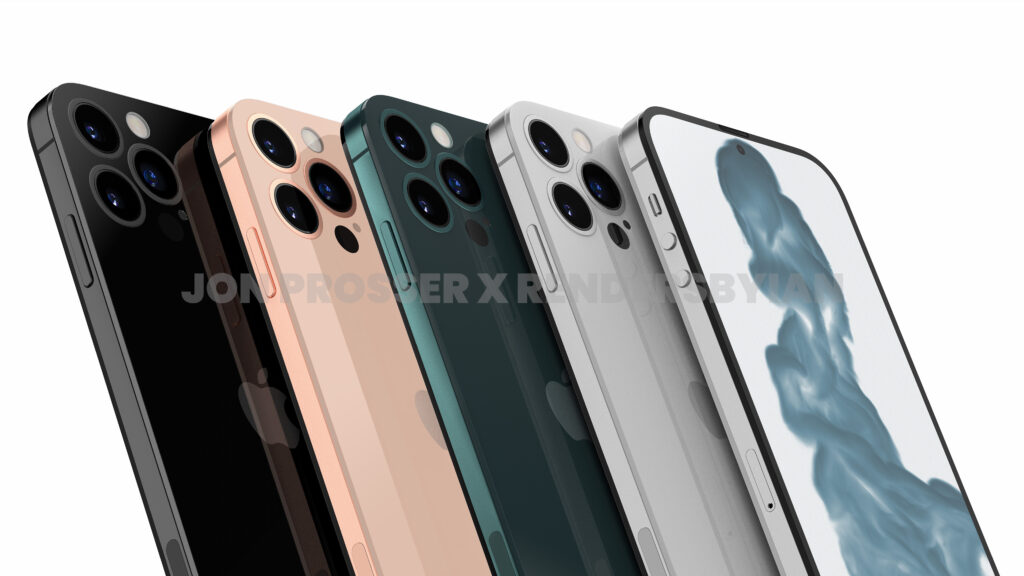
The leak comes from Jon Prosser of Front Page Tech(FPT) who revealed the design of the iPhone 14 on the latest episode of FPT. The renders are said to be based on design images provided by inside sources.
The big change the iPhone 14 Pro Max brings is the centered punch-hole display, bringing an end to the notch that has graced the front of Apple’s smartphones since the 2017 iPhone X. However, there is a possibility Apple will retain the notch for the other models. The punch hole is pretty small much like what a lot of Android phones offer. If you are wondering where Face ID is, Jon Prosser said the sensors most likely are now under the display. There is a slit above the punch hole for the earpiece.
Apple has also made a slight design change on the rear. While the camera arrangement is largely unchanged, the sensors are now flush with the rest of the body. Another big change that is more or less a return to an earlier design is the shape of the volume buttons. They are now round like those of the iPhone 4 instead of pill-shaped like the iPhone 12 series.
1 of 4
iPhone 14 render
iPhone 14
The iPhone 14 series will also feature a titanium frame which should make the phones more durable. The speaker grille is also like that of the iPhone 4 but longer. However, Apple is still sticking to a lightning port for next year.
This leak is really really early, thus we advise our readers to take it with a pinch of salt. Manufacturers can and do change designs, so while this may be correct now, the iPhone 14 series may not look like this when it arrives next year.
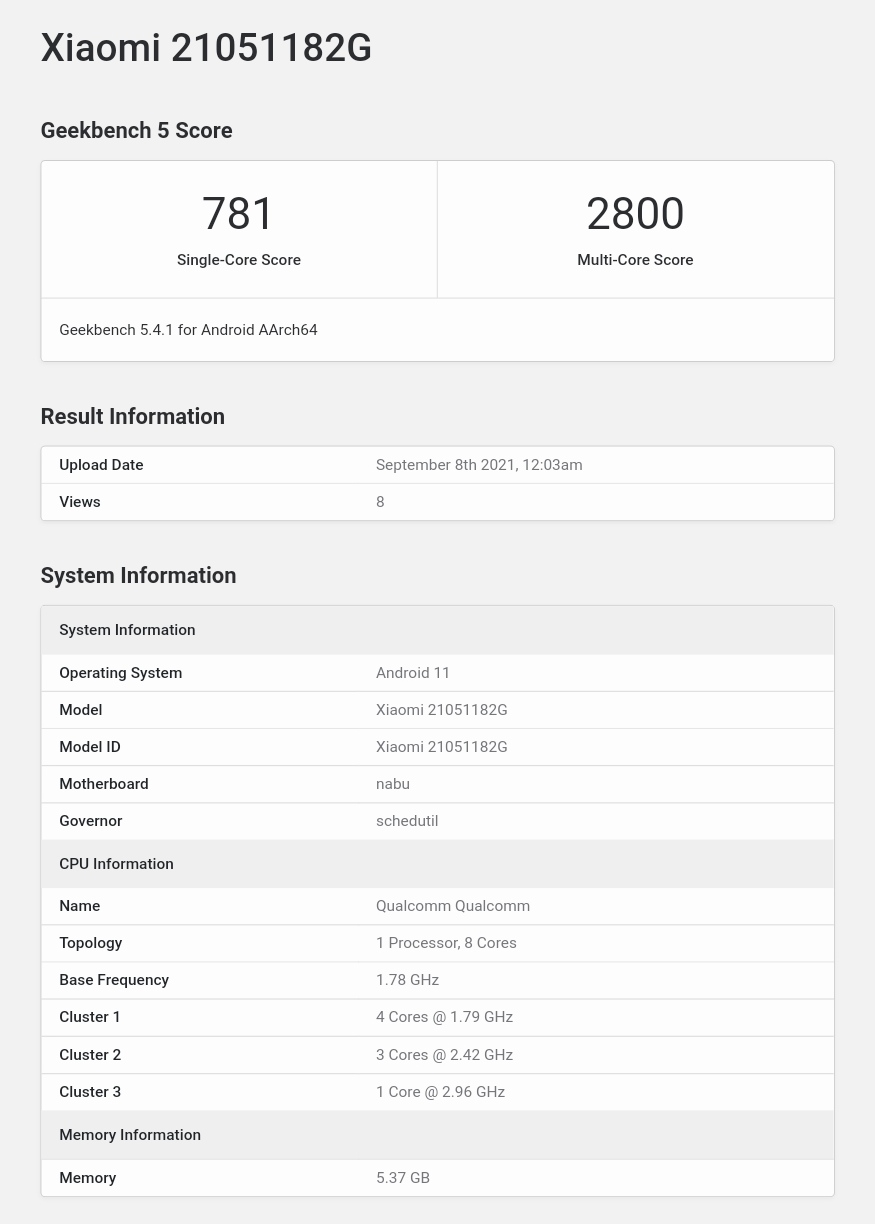
Xiaomi’s much-awaited Mi Pad 5 series of tablets were finally launched in China last month after a there years hiatus. The slate is expected to go official for the global market on September 15. Ahead of the global release, the Xiaomi Pad 5, as it may be called, has now been spotted on the GeekBench database.
The model hits GeekBench with the model number Xiaomi 21051182G. The Chinese version was also benchmarked on GeekBench, appearing with the model number M2105K81AC. This model is listed with a Qualcomm processor clocked at 3.19GHz. The motherboard is listed with the codename “Nabu” which is the codename of the Snapdragon 860-powered Mi Pad 5, according to an earlier FCC listing. The device will also come with 6GB RAM and will run on Android 11 but that will definitely get the recently unveiled MIUI for Pad overlay.
In the single-core test of Geekbench, the M2105K81AC tablet scored 781 points while in the multi-core test, it polled 2800 points. This is lower than the 997 points in the single-core test and 3181 points in the multi-core test scored on GeekBench by the Snapdragon 870-powered Mi Pad 5 Pro.
The Xiaomi Mi Pad 5 was launched alongside the Mi Pad 5 Pro. We don’t know for sure if Xiaomi will be introducing the Pro version to the global market. The tablet features an 11-inch display with WQHD+ resolution, a 120Hz refresh rate. The slate also comes with quad speakers and a dual-cell 8720mAh battery, among other impressive features.
Belarusian store NSV.by listed the tablet on its website recently with a price tag of BYN 1199 (~$479) for the 6GB of RAM and 128GB of storage variant. This is way higher than the 1999 yuan (~$310) price tag for the same variant in China. The official retail price may not be as high as that but we don’t expect it to be cheaper than in China.
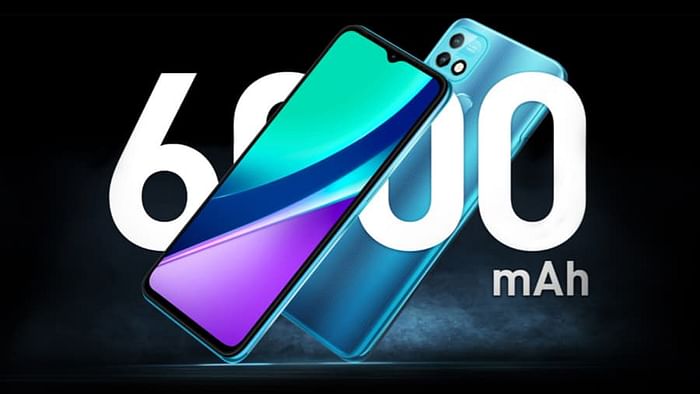
Transsion Holding subsidiary Infinix has launched the Hot 10i in the Philippines. The Infinix Hot 10i has been on the radar for some time. The device was first spotted on Google Play Console in March and later on in April, it was certified by the US FCC. The entry-level smartphone has now been unveiled for the first time packing lots of decent features.
Powered by MediaTek Helio P65 octa-core SoC, the Hot 10i offers 4GB of RAM and 128GB of internal memory, which can be expanded further. The 6,000mAh battery offers greater mileage in its usage and 18W fast charging is also available. The new smartphone has a 6.52-inch HD+ display, a 13MP main camera, a 5MP selfie cam, as well as an auxiliary QVGA sensor, and a quad-LED flash.
The internal setup of the Infinix Hot 10i means that it could be a wonderful gaming device with its Dar-link gaming optimization engine. This enables games to run seamlessly. The device will run on the Android 11 operating system and also has a rear-mounted fingerprint scanner. An added layer of safety for the Hot 10i is the Safe Charge technology that allows the device to cut off power immediately after the battery is fully charged.
In terms of connectivity, the Infinix Hot 10i has 4G LTE capability, GPS, Bluetooth, and WiFi connectivity. The Philippine model will come with four color variants namely: Morandi Green, Hear of Ocean, 95-degree Black, and 7-degree Purple. The 6,000mAh battery is non-removable, which guarantees better overall performance.
The new Infinix Hot 10i introduced to the Philippine market is expected to get a decent reception because of its extended features and affordability. The device is priced at Php 5,990 ($120) and can be purchased at Shopee for a limited-time discounted price of Php 5,190 ($104). This offer could be a boon for smartphone users on the lower end of the spectrum in the Philippines. We expect the device to hit the Indian market pretty soon.
Samsung is probably the only Android OEM known for offering longer software support. The recent devices from the company are not only confirmed to get at least four years of security patches but some of them are even guaranteed to receive three years of Android updates. But unfortunately, the new policy is not applicable to some very old handsets. Samsung cuts off the software support of two such phones.
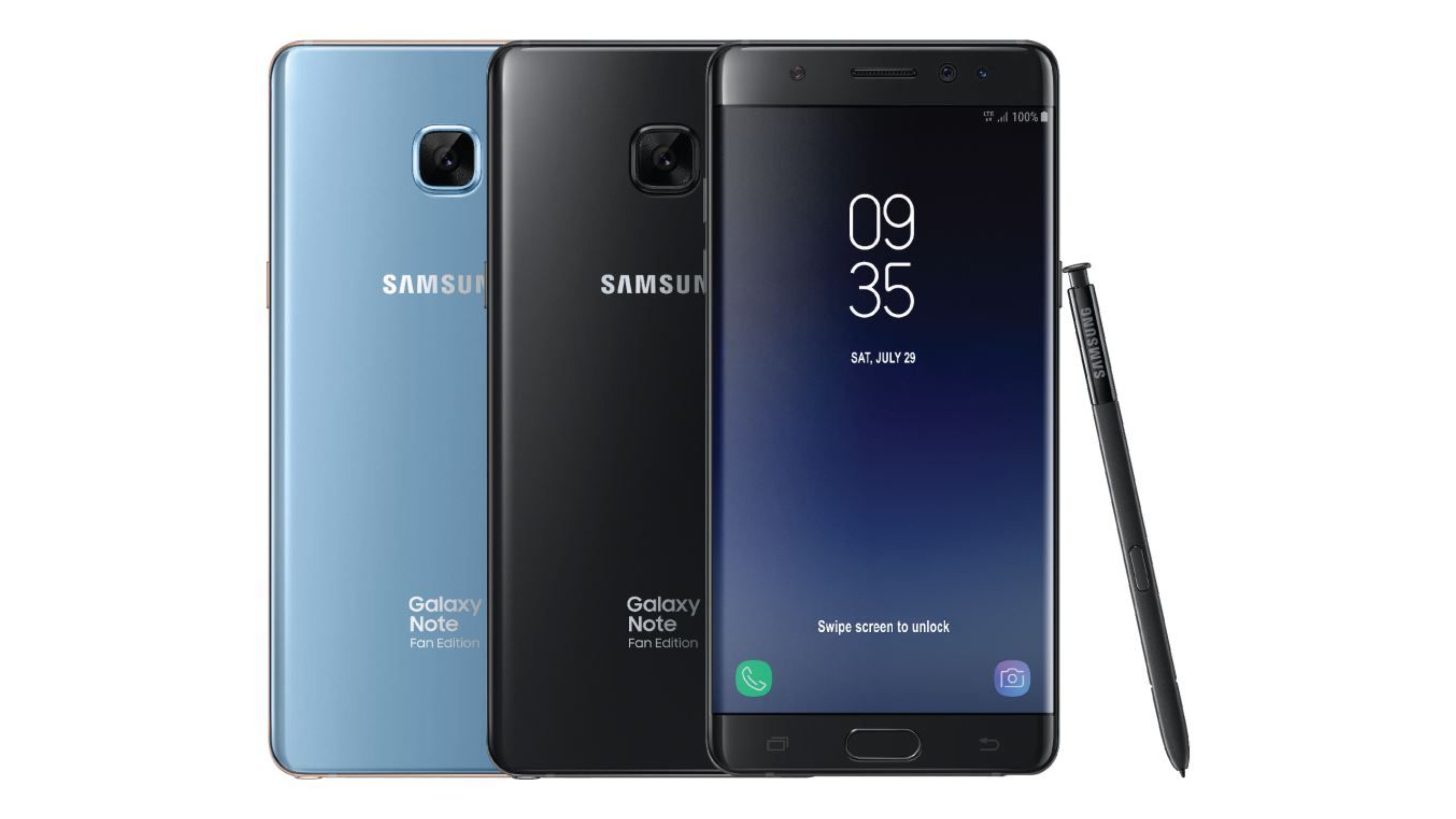
Samsung Galaxy Note Fan Edition
According to a report by SamMobile, Samsung has ended software support for Galaxy Note Fan Edition and Galaxy S Light Luxury. These two devices are no longer listed on Samsung’s Security Updates Scope page. At the same time, the Galaxy Note9 has been now dropped to quarterly updates instead of monthly.
The Galaxy Note FE was the first-ever ‘Fan Edition’ device from Samsung. It was nothing but a refurbished Galaxy Note7 with a safer and smaller battery. The handset was released a month ahead of the launch of the Galaxy Note8 in 2017.
It debuted with Android 7.1.1 Nougat and was updated up to One UI based on Android 9.0 Pie. Being an older flagship from Samsung, it only received two OS updates but four years of security updates.
On the other hand, the Galaxy S Light Luxury (aka Galaxy S8 Lite) was a China-exclusive smartphone. It was a toned-down version of the Galaxy S8. This phone was released in 2018 with Android 8.0 Oreo. It also got two OS updates up to Android 10-based One UI 2.x but only three years of security updates.
In July this year, a rumor emerged from popular tipster Digital Chat Station that Realme had teamed up with an established camera brand. It was later revealed by another tipster who had claimed that Realme collaborated with the well-known photography brand Kodak. Apparently, Realme’s sister brand OPPO is also in collabo with Kodak, going by a recent rumor.
Popular tipster, Digital Chat Station has disclosed via Weibo that Oppo’s next flagship will be using two of Sony’s new IMX766 sensors. The tipster further disclosed that the Chinese tech giant was teaming up with Kodak to produce a smartphone that reflects Kodak’s classic camera design.
The camera is said to have at its heart the Sony IMX766 50MP, 1/1.5″ sensor. The camera will have an ultrawide camera with a large sensor similar to that of the Find X3 Pro. The device is also tipped to feature a 13MP telephoto lens with 2x zoom and a 3MP microscope camera just like the Find X3 Pro.
The news comes as a surprise considering that Kodak has long abandoned its camera business. The company went bankrupt in 2012, a development that saw it shift its focus to hardware and software for printing solutions.
There is no official word yet about the OPPO flagship but we expect more details to emerge in the coming days.
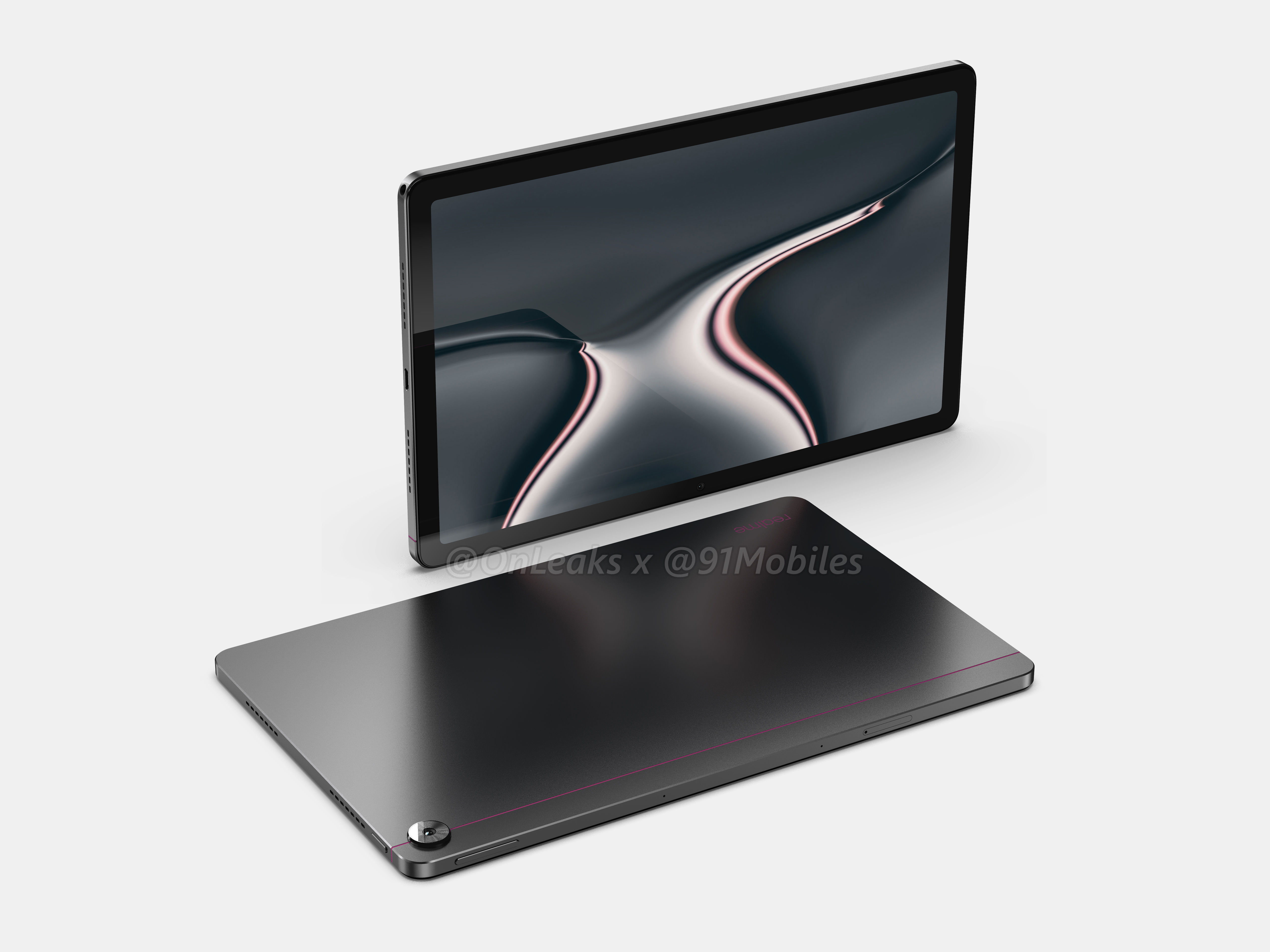
The world’s fastest-growing smartphone brand realme is all set to launch its first-ever tablet called realme Pad tomorrow (September 9). Ahead of that, we had already learned about this product’s specifications. Now, we also know how much it will cost in India.
According to popular tech influencer Mukul Sharma (@stufflistings), the 4G LTE + WiFi version of this device will start from ₹19,999. The first sale of the product will take place on September 16 at 12PM.
It is worth noting that the starting price of this tablet is mentioned with ‘Terms & Conditions Apply’ in the image shared by Sharma. Hence, the price listed in the picture could be with bank discounts. Also, there could be WiFi-only variants as well. These models will likely be cheaper than the cellular model.
In a nutshell, the realme Pad’s price leak only gives us a rough idea regarding the product’s actual price. This means we will have to wait until tomorrow to know about it. Anyway, the above-mentioned variant will probably cost ₹22,999, as per a tweet by Abhishek Yadav (@yabhishekhd).
How much do you think realme Pad will cost in India? Do you think the leaked price is justified for the set of features the tablet will be offering? Do let us know in the comment section below.
After entering the second half of the year, Qualcomm updated its top chipset, the Snapdragon 888 Plus with upgraded performance. ROG, as one of the top gaming brands, naturally was quick to bring this new chip to its gaming phone lineup.
ASUS officially released the ROG 5s series in August, which was also the first gaming phone featuring the new 888 Plus chipset in the second half of 2021.
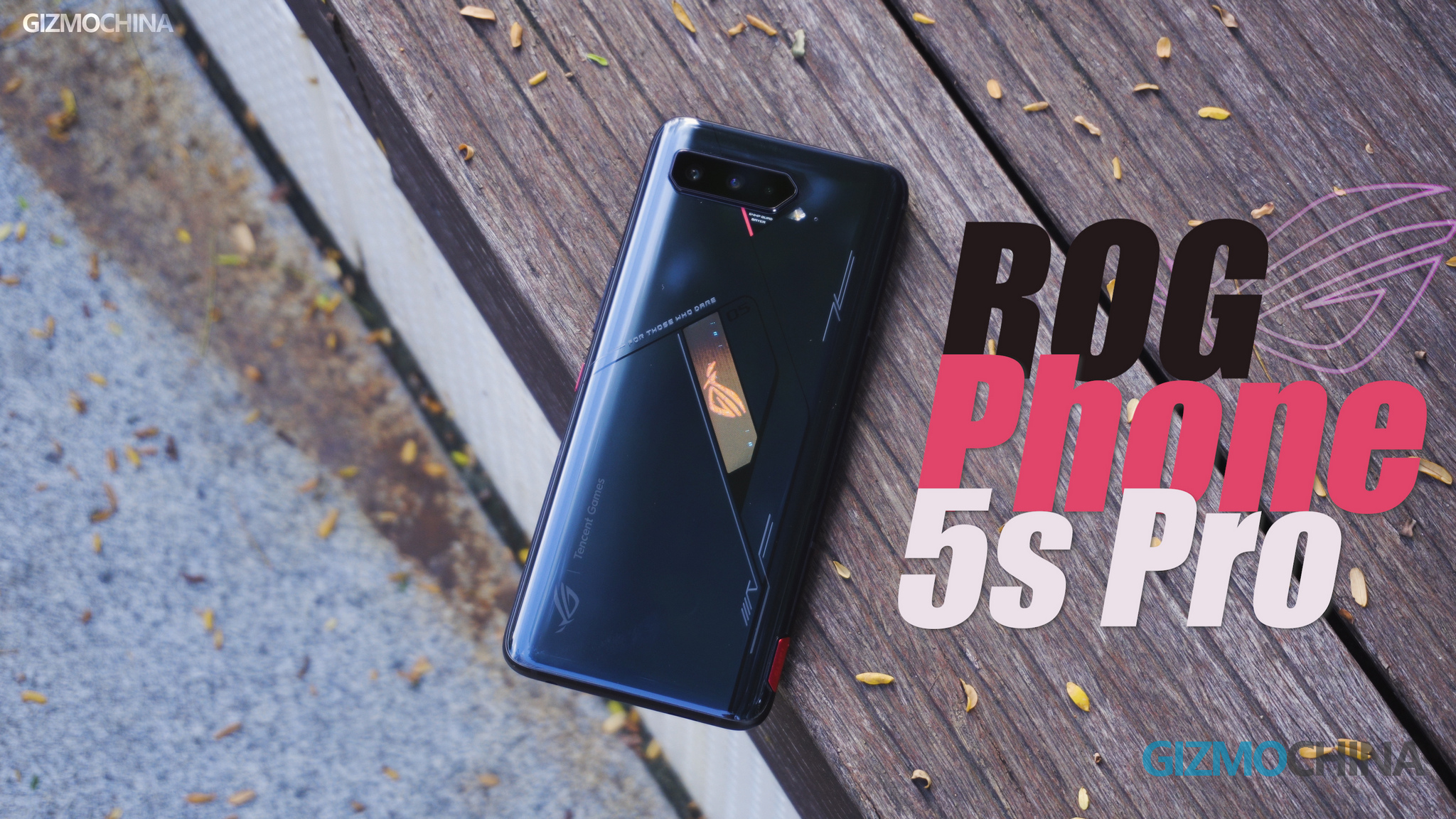
In July, we made a video about our pick of best gaming phones released in the first half of 2021. In that video, the ROG Phone 5 won the title with its stable performance and excellent gaming features. And now we are wondering whether the upgraded series has any significant improvements. So this time we bought in the top version of the ROG 5s series, the ROG 5s Pro, which comes with 18GB Ram and 512GB ROM.
I guess that is enough of an introduction, let’s check out the phone now.
ASUS ROG Phone 5S Pro Review: Unboxing
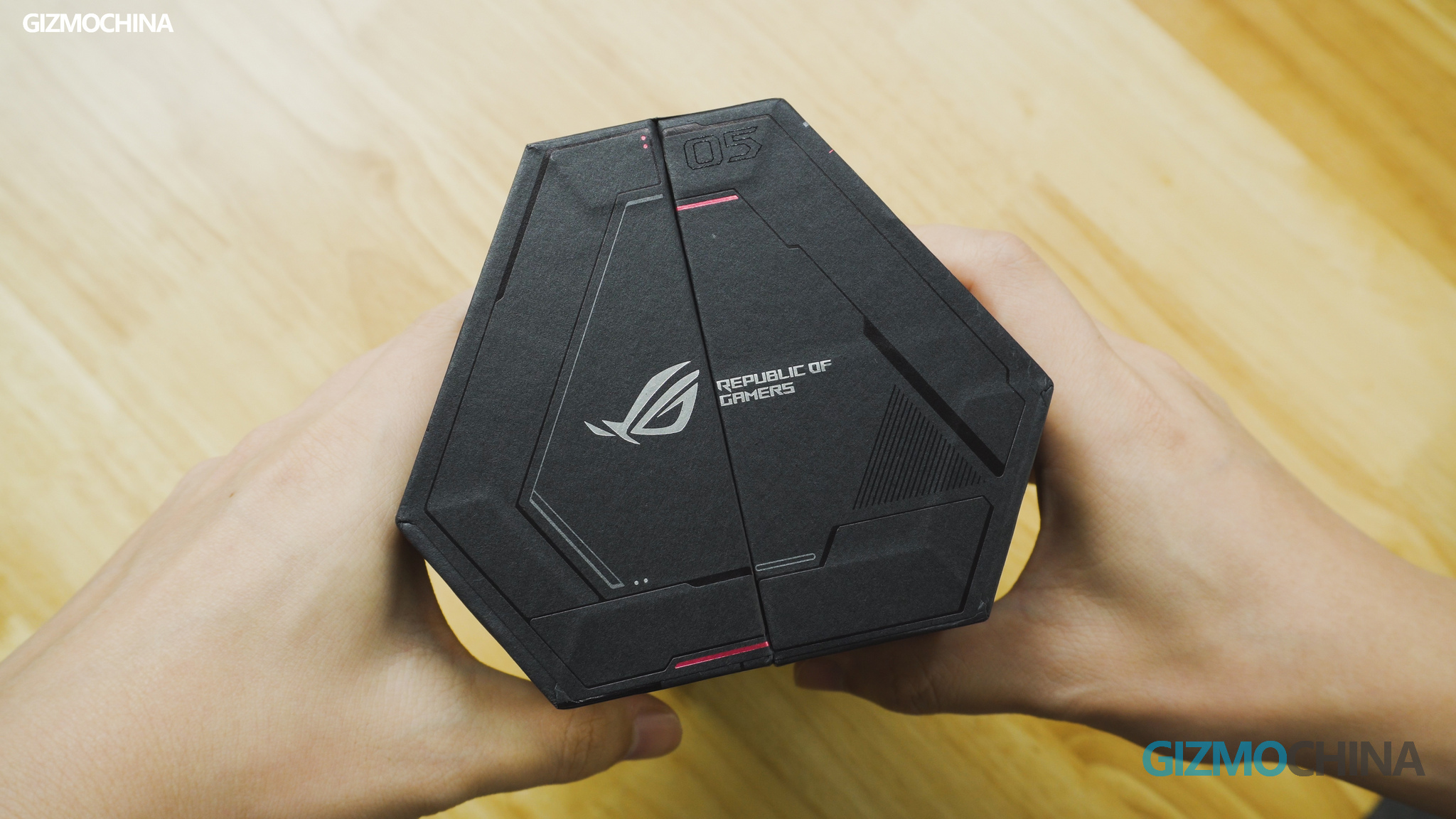
The package of the ROG Phone 5s Pro still continues ROG phone’s unique hexagonal column shape.
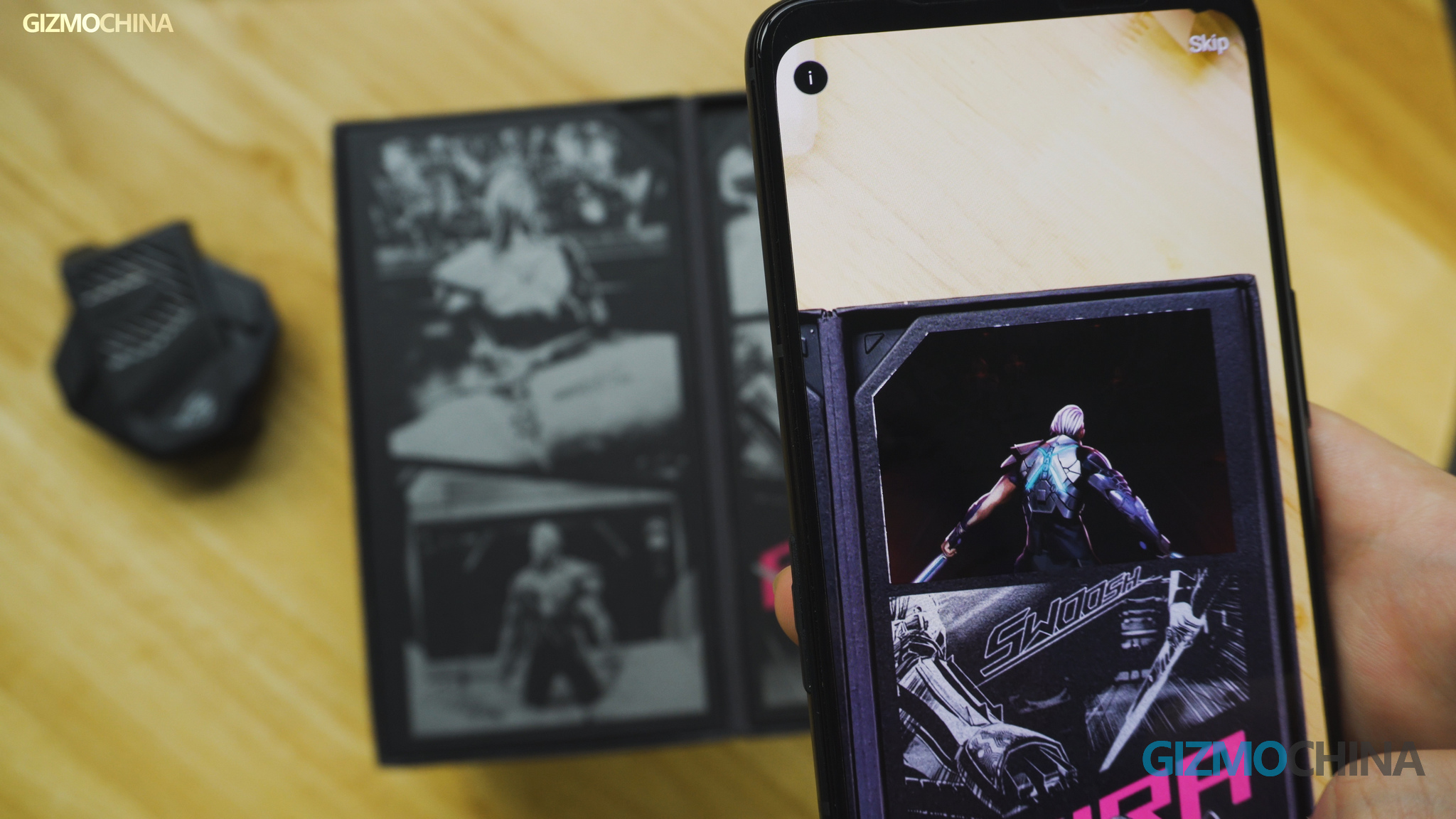
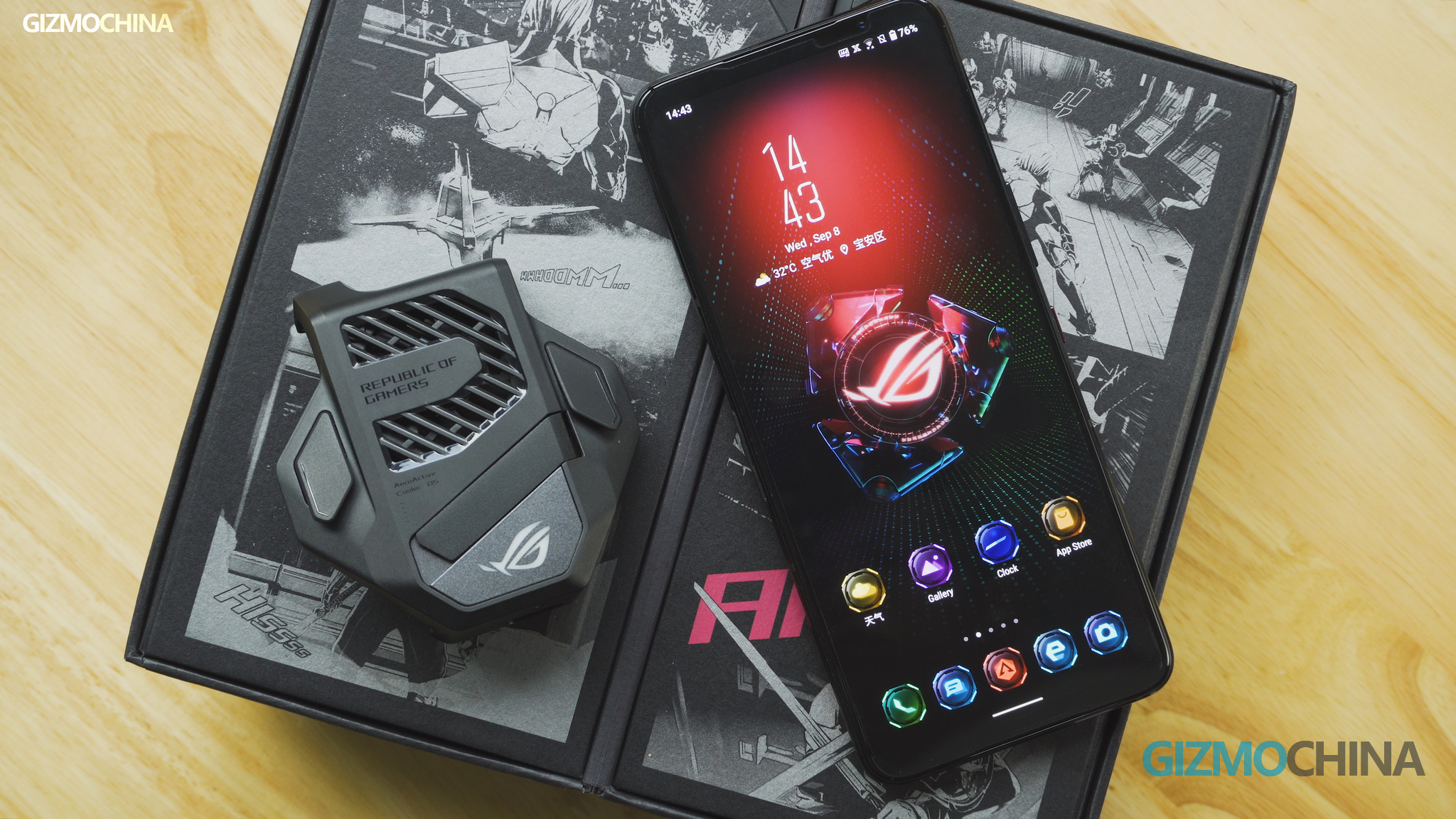
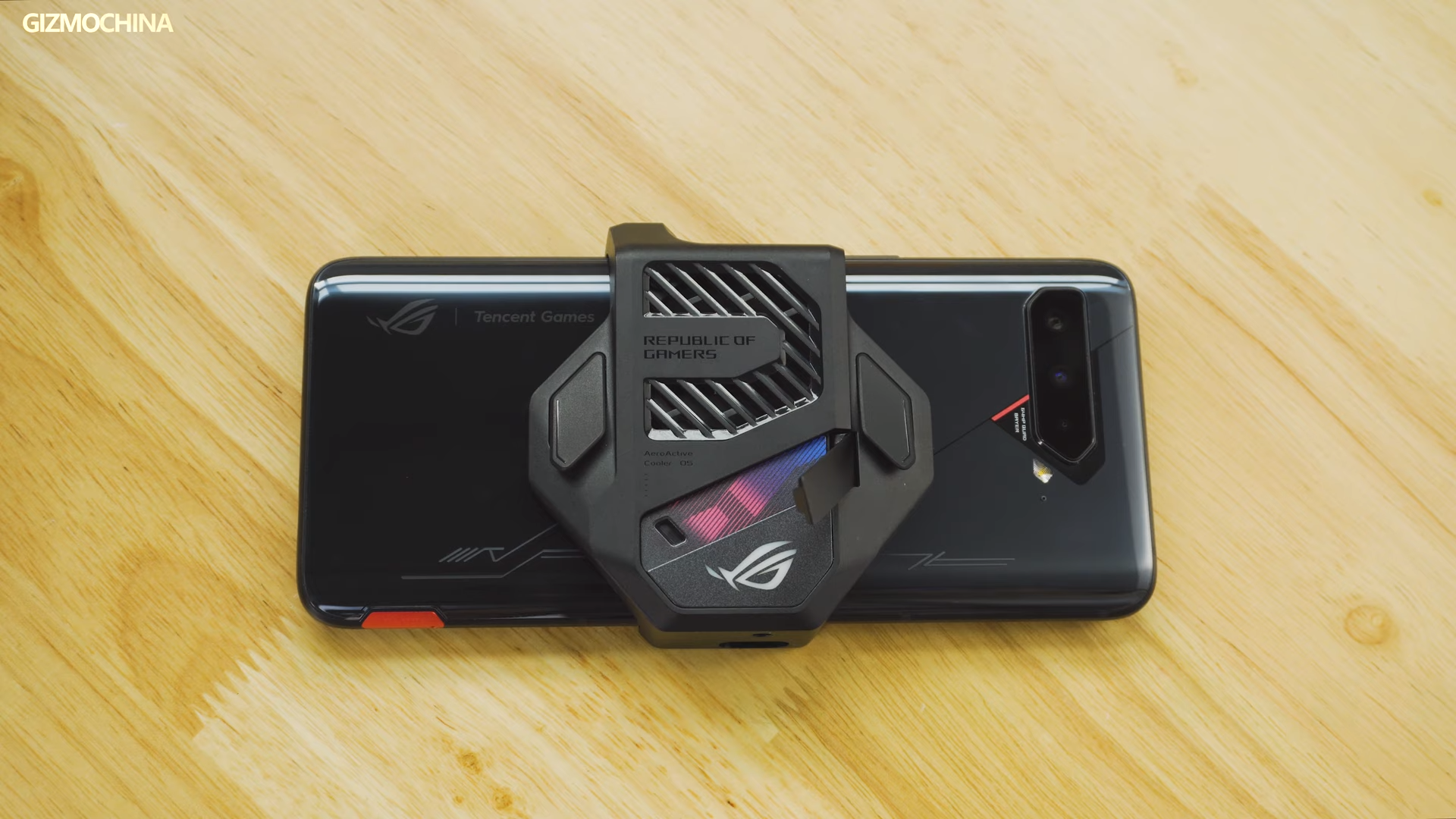
When you open the box, there is thesame AR comic for users to scan with the ROG Phone, when setting up the phone for the first time. Andunder this, the Phone is on the right side, and ROG attaches the aero-active cooler fan on the other side. Considering the high price and the thermal issue of the 888 platform, the included accessory seems to be reasonable and obviously necessary for heavy gamers with the ROG 5s Pro series. At the same time, it’s also a very useful operational accessory for gaming.
About its performance, we will talk it in detail in our performance test later. Let’s equip the fan accessory first.
ASUS ROG Phone 5S Pro Review: Design & Display
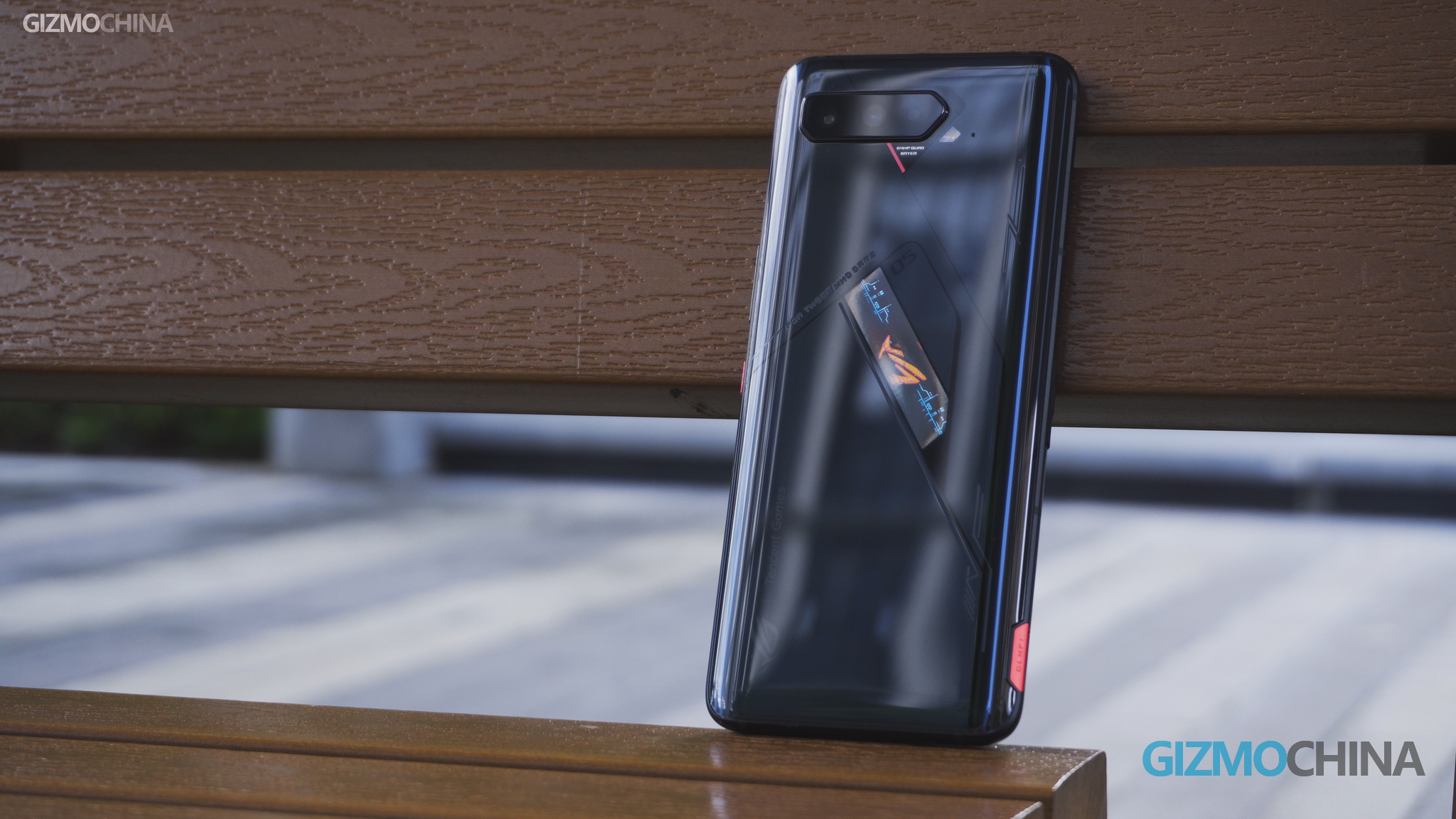
Looking back at the phone. When compared to the standard version of the ROG 5 and ROG 5s, the Pro model still has some premium features over its design. But, to be honest, there are not many surprises over the design of the ROG 5S Pro since it still utilizes the same design as its predecessor, the ROG 5 Pro.
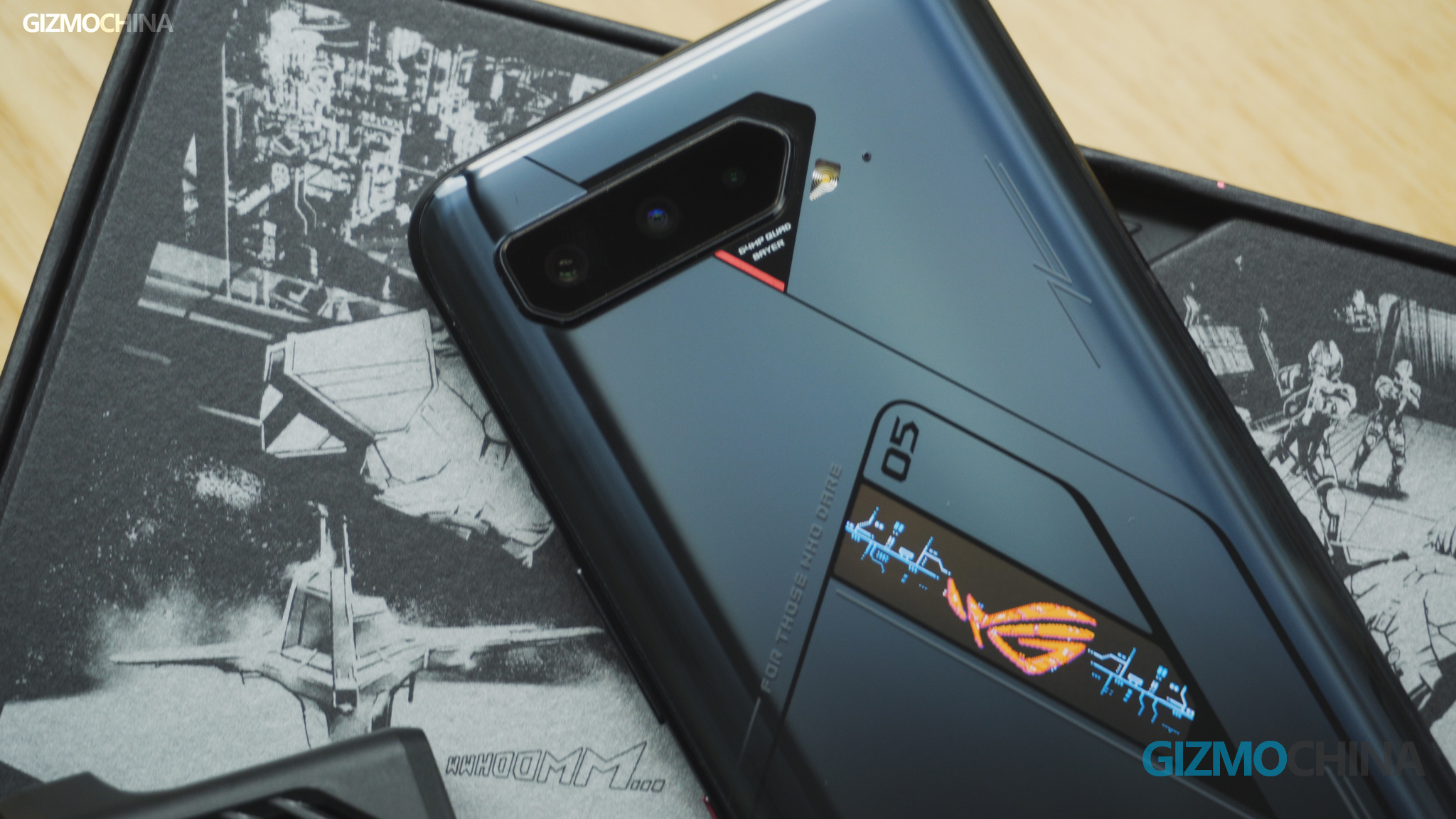
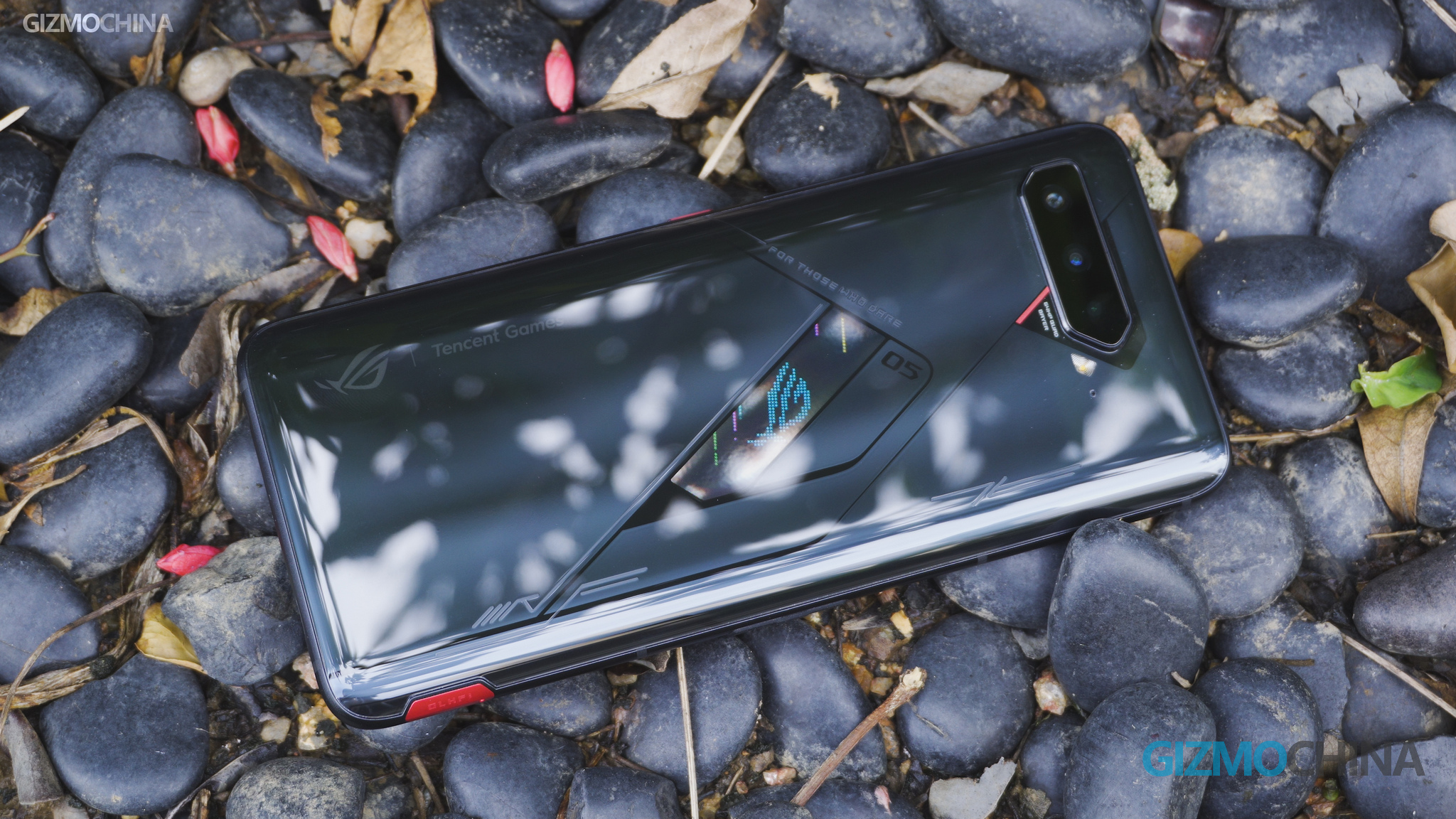
The most impressive detail of the 5S Pro’s design is the ROG Vision, a small display that shows a neon light effect. But the location of the window display is slightly different from the 5 Pro, which is closer to the central area of the back. It looks pretty cool, as it reminded me of the game Cyberpunk 2077. Apart from that, for now, it’s pretty useless as we couldn’t find more interesting customized content for the phone and also because it’s not useful when you are using the phone or playing games. Apart from this, from the design point of view, there’s almost no difference from its predecessor in the ROG 5S Pro.
For example, the new Asus ROG Phone Pro still follows the off-screen button design of its predecessor, including two shoulder buttons which could split into two-slide buttons respectively and two back slide buttons.
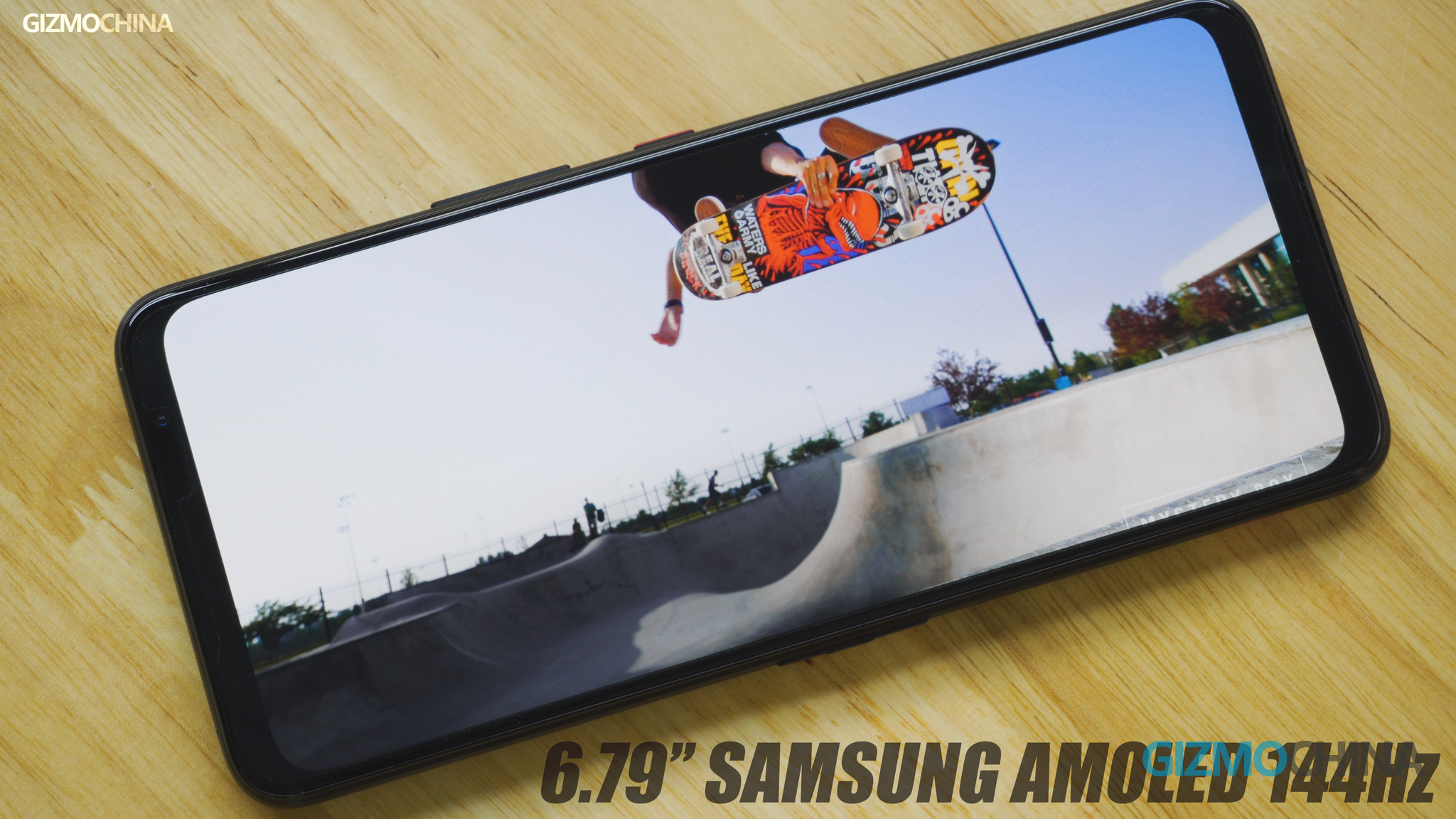
The display still uses a 6.79-inch Samsung AMOLED E4 panel with a 144Hz refresh rate, and the sampling rate is boosted up to 360Hz. It’s worth noting that the display is still the AMOLED display with the highest refresh rate. You don’t need to worry about the performance of the E4 display, which is almost the best display that you can have in the gaming phone market. The peak brightness for the full screen can reach up to 775 nits, while in the 20% window of the display, the figure even can go up to 1050, which made it look stunning when playing HDR content.
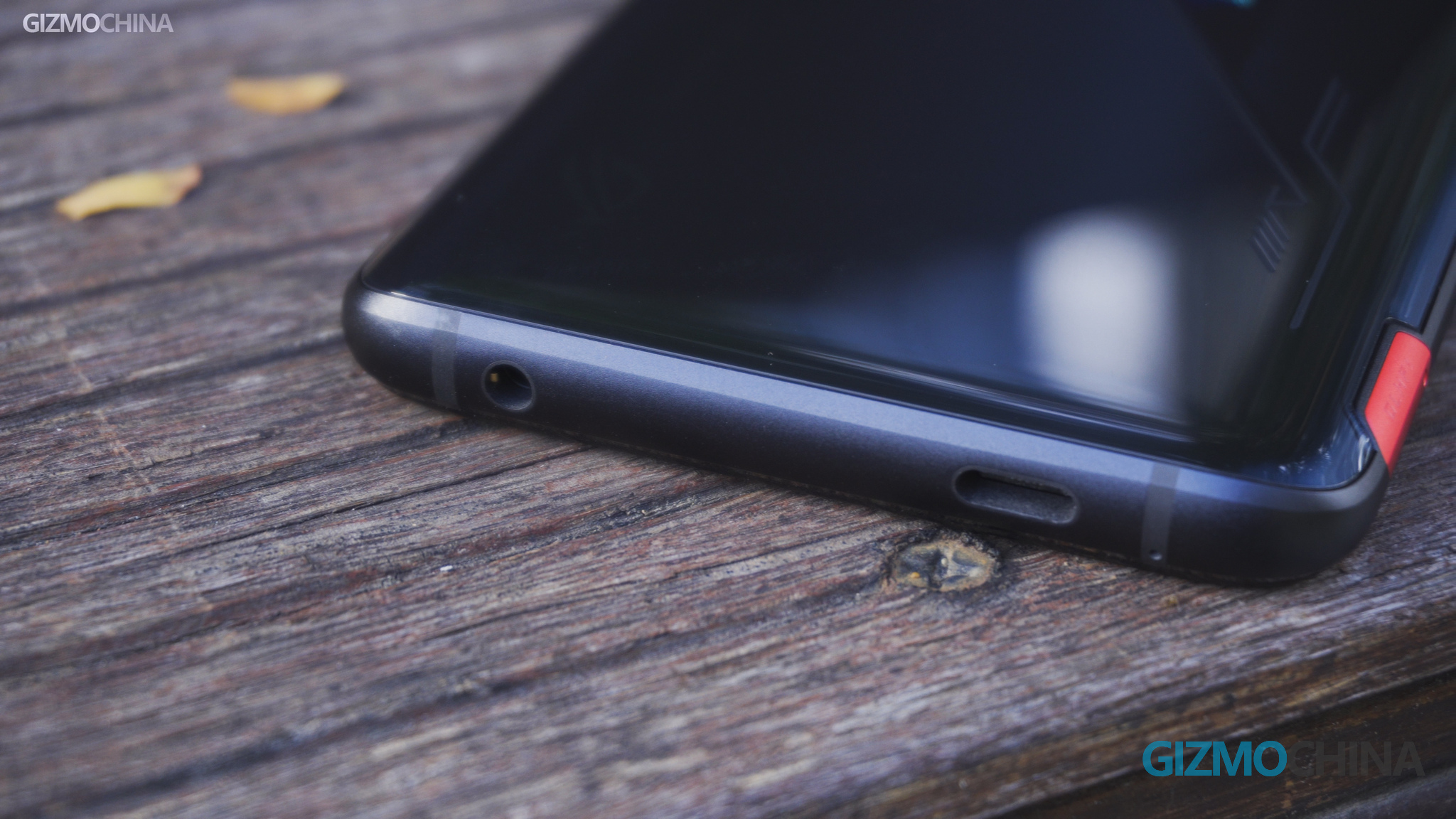
For audio, the ROG 5s Pro features dual symmetrical speakers to deliver stereo sounds, and it also reserves the 3.5mm earphone jack.
ASUS ROG Phone 5S Pro Review: Performance & Gaming
Before testing its performance, we were quite sure that the ROG Phone 5s Pro has the best performance on the Android platform, not just because of the upgraded 888 Plus chipset, but also because of its amazing 18GB LPDDR5 Ram. To be honest, there’s almost no scenario that requires such high configuration on the Android platform. But that’s not what the brand ROG would consider. After all, it’s one of the few brands that keeps seeking the ultimate in performance.
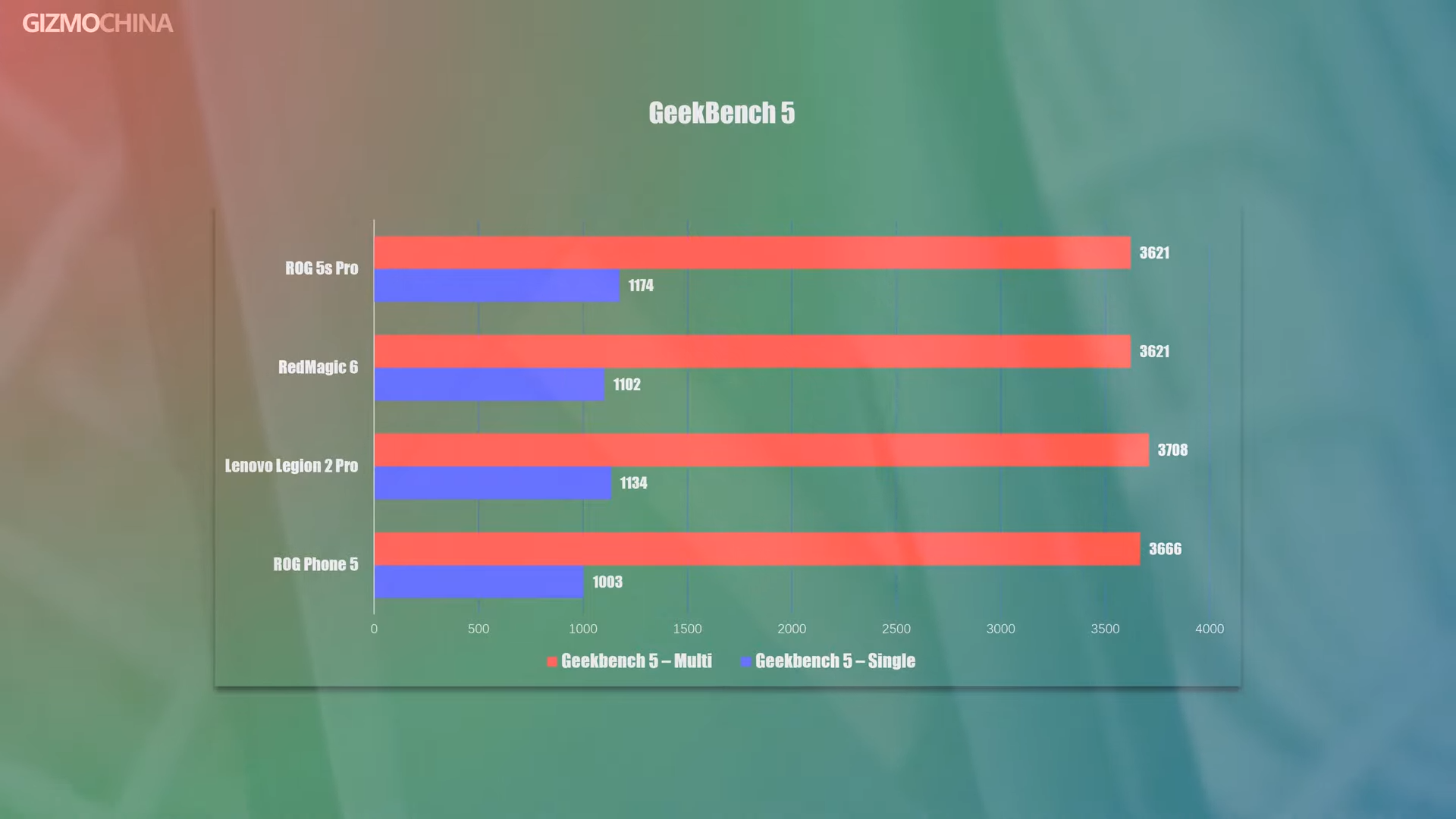
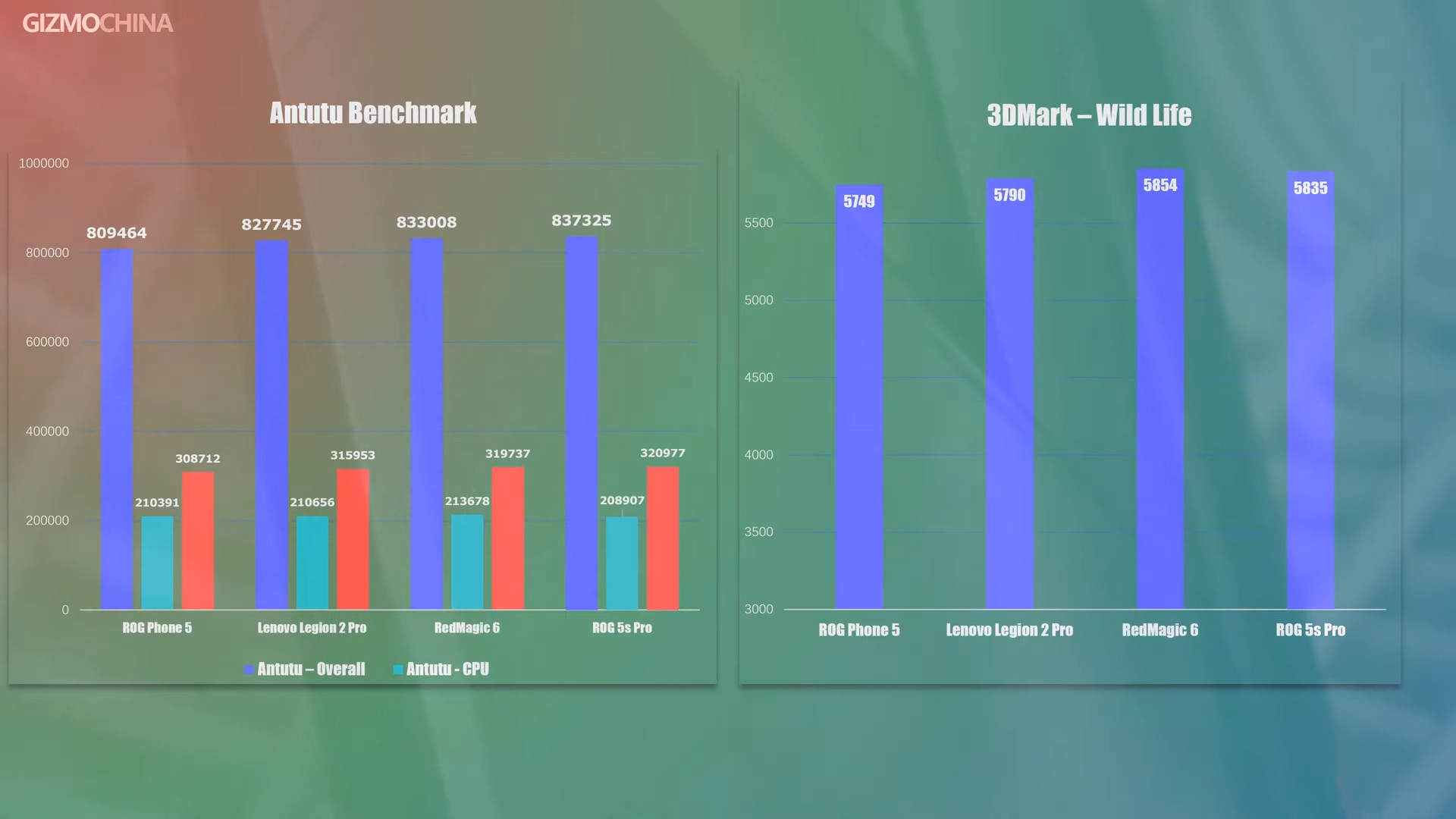
What we are really curious about is that how much improvement it brings compared to its predecessor. First, let’s look at the benchmark results.
Well, from the benchmarks, there’s almost no gap between the ROG 5 and the ROG 5s Pro. Even the results of the Lenovo Legion 2 Pro powered by the 888 chipset can compare to the ROG 5s Pro. So we cannot draw the conclusion about the actual improvement of the 888 Plus if based on these benchmark results.
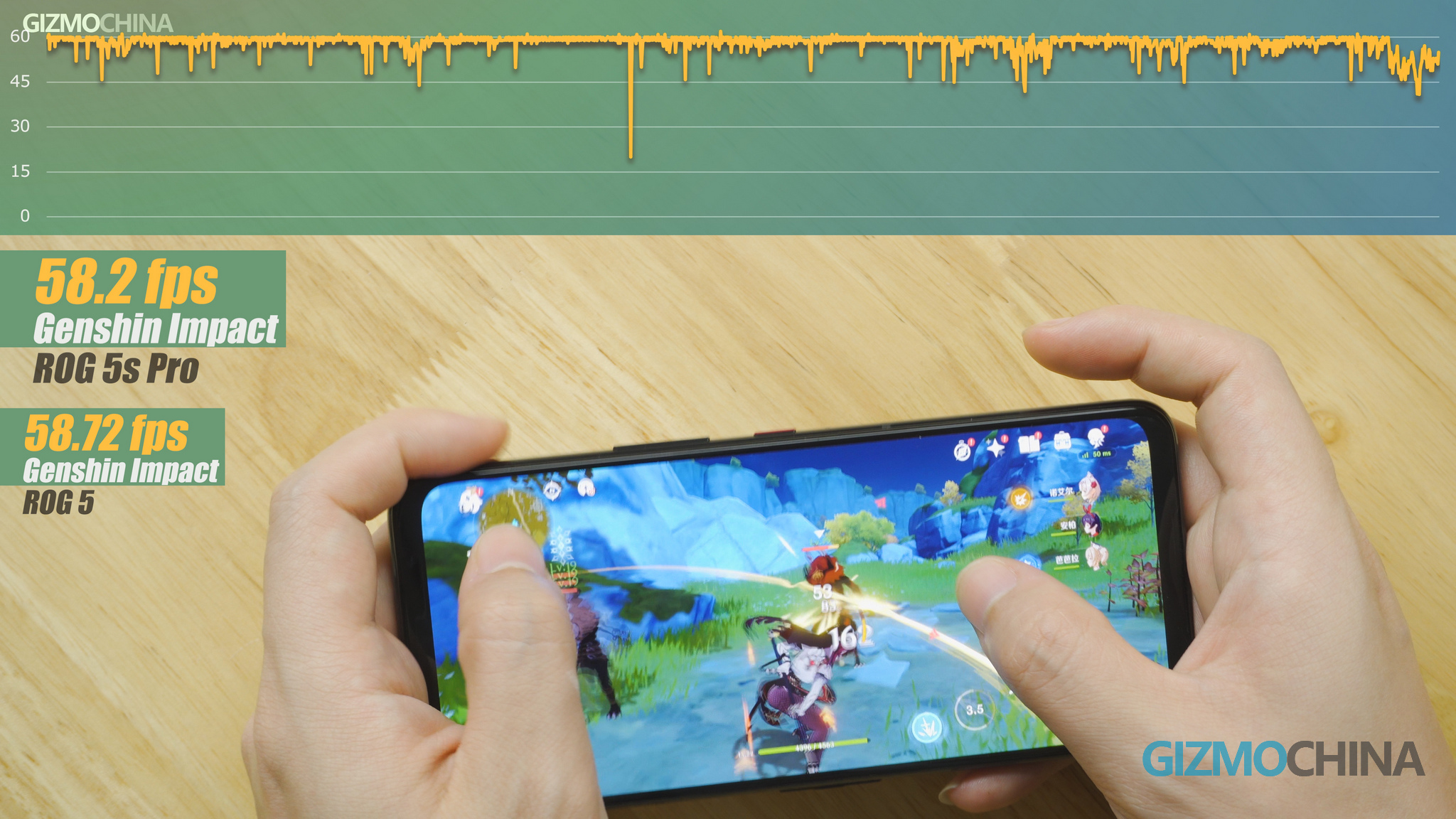
So let’s move to actual gaming. Well, the tests didn’t reveal any significant information about the improvement either. Because in the games like Genshin Impact and Nimian Legends, which are also the heaviest games that we can find on the Android platform, the ROG 5s didn’t achieve better frame rate results than the ROG 5. In fact, it’s slightly lower than the ROG 5 model. But it doesn’t mean that the 5s Pro got downgraded in actual gaming, since we didn’t run the games multiple times to reduce the errors. But we are still confident to say that the improvement is really unperceivable. Both of them are still the most powerful beasts in the gaming market.
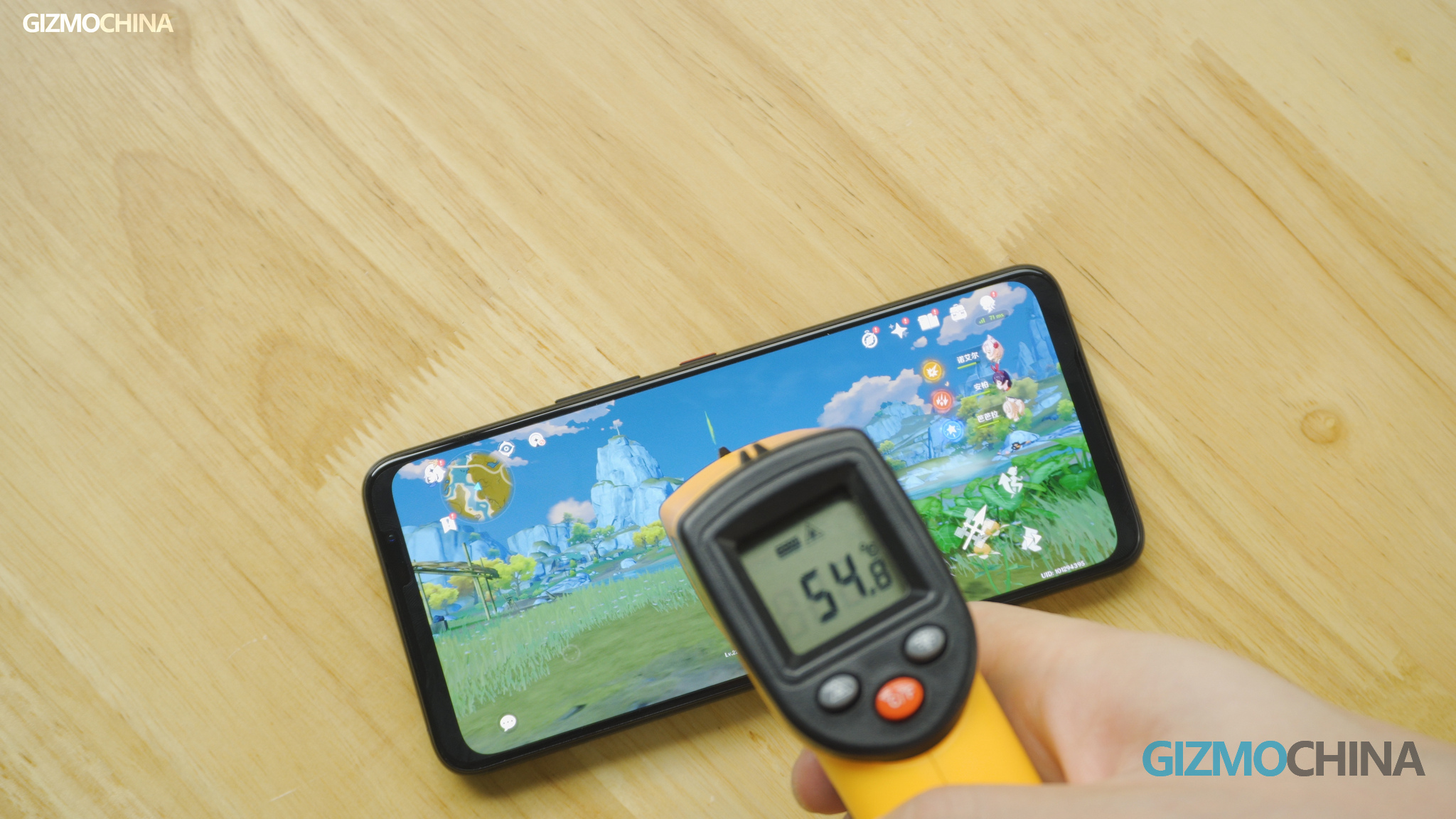
And their thermal performance is also close to each other. Under X gaming mode, both of them fully released the performance of the chipsets. And consequently, their surface temperature could go up to around 55℃. And to be honest, the ROG 5s Pro under the X gaming mode is the hottest model that we’ve tested in 2021. I couldn’t even hold it in the last 10 minutes. And this made us realize why ROG was so generous to include the cooling fan right inside the box. After attaching the cooler, the heating situation got much better, with an acceptable holding temperature, that reduced by around 8 degrees. So if you’re not going to attach the cooling fan while gaming, our suggestion is, not to turn on the X mode. It won’t make a difference in most games.
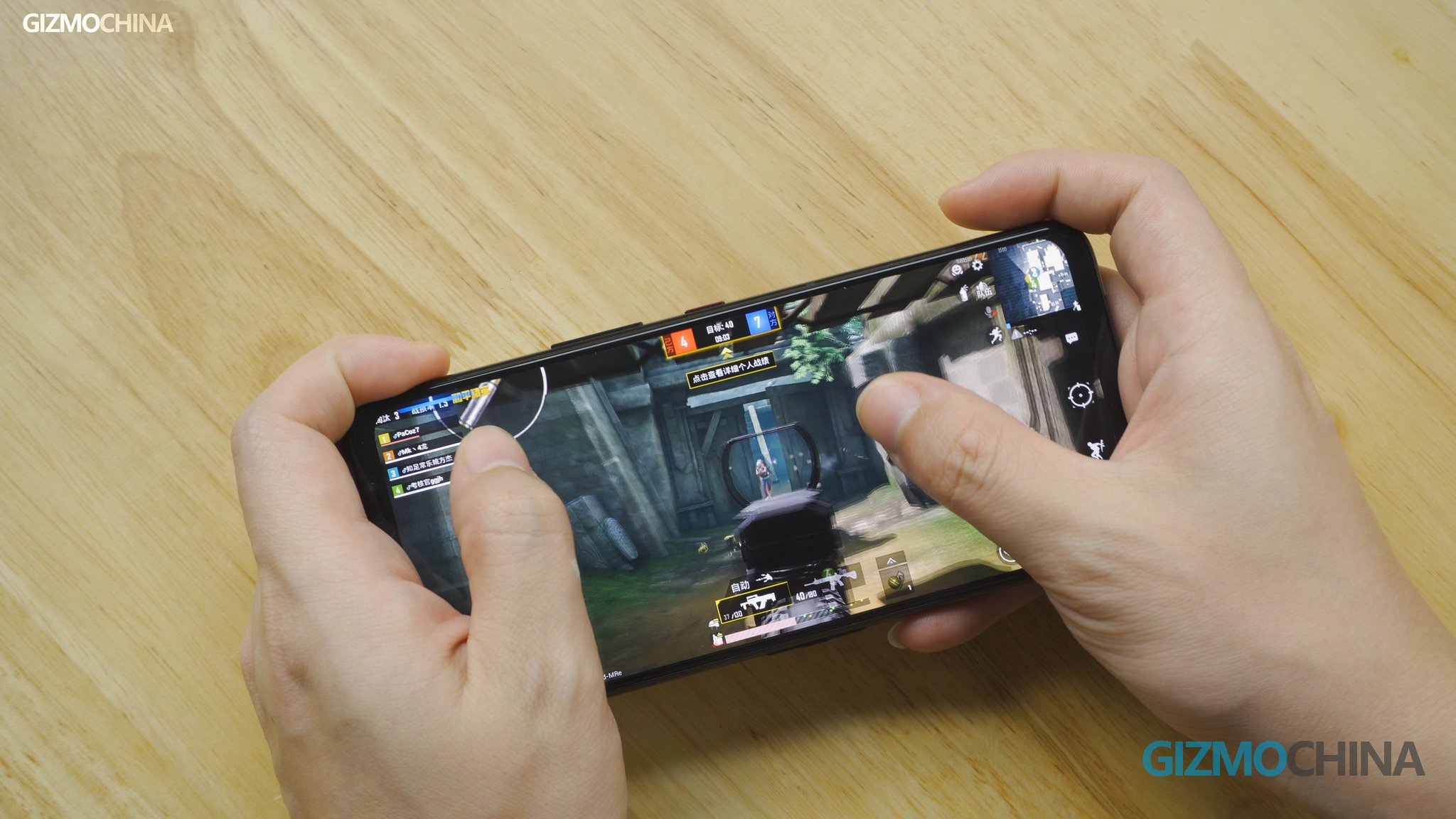
For the gaming operations, the ROG 5s Pro feels almost the same as its predecessor. When you attach the cooling fan to the phone, you are able to have a more complicated combo operation with 8 fingers. But it’s really a challenge to get used to those slide buttons.
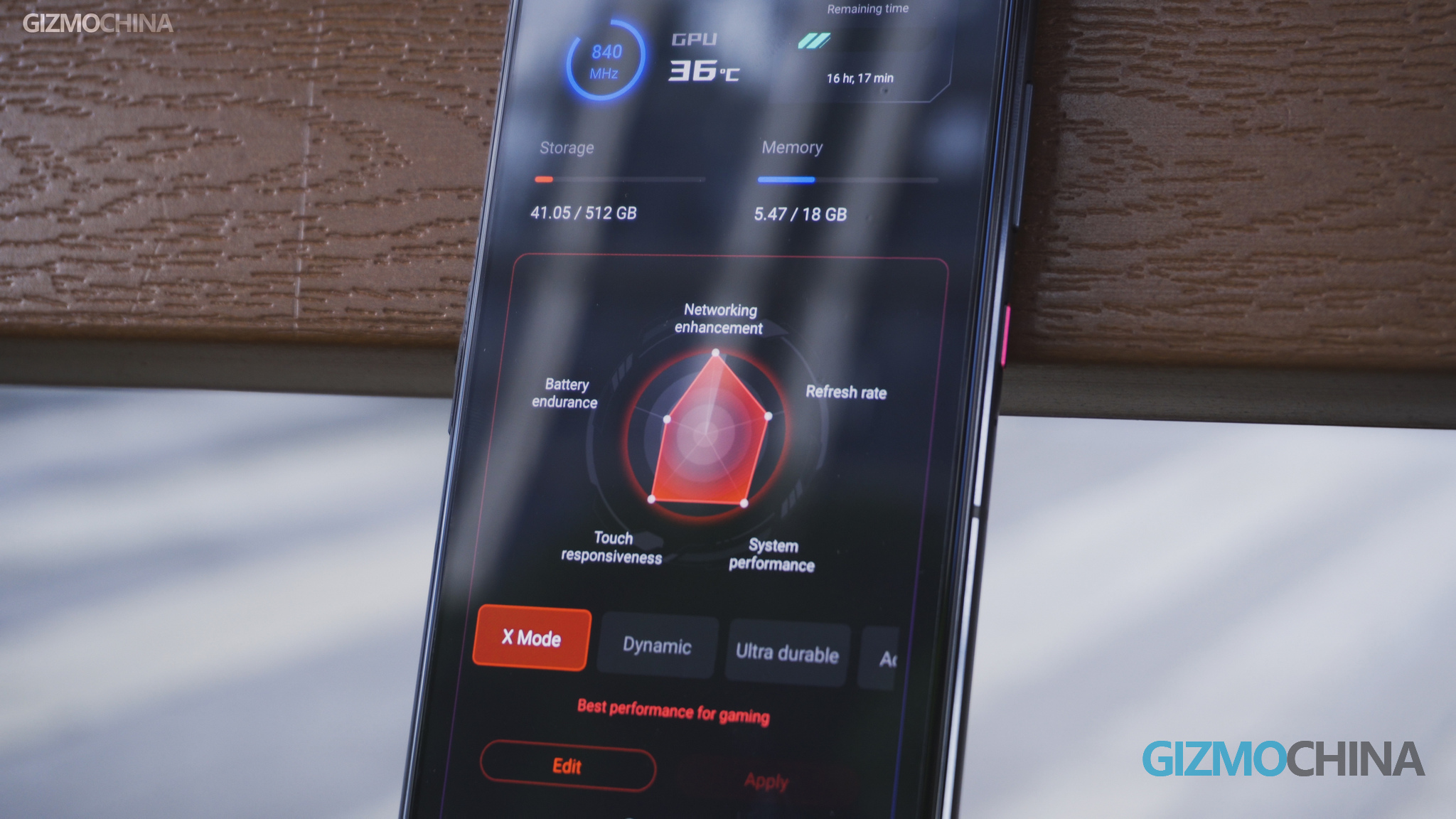
As for software support, to retain almost all the gaming features from the ROG 5 series, ROG has made them more detailed. For example, the brand not just provided with all the information about how the phone is performing, but you are also allowed to access more specific control over performance. There are several preset performance modes for users, and gamers can modify all the sub-options.
ASUS ROG Phone 5S Pro Review: Cameras
Another big surprise of the ROG 5s Pro came from the cameras. It’s the first time that we like the cameras on a gaming phone so much. No matter from its SONY IMX686 64MP main camera or the super wide-angle lens with 13MP resolution, we really saw its potential that even compared to some flagship killers. Especially for the main camera, the images are sharp and bright with a true color presentation.
While for the wide-angle camera, It’s probably the widest viewing angle that I’ve ever seen on a smartphone.
Main Camera
1 of 10
UltraWide Camera
1 of 9
Macro Camera
ASUS ROG Phone 5S Pro: Battery & Charging
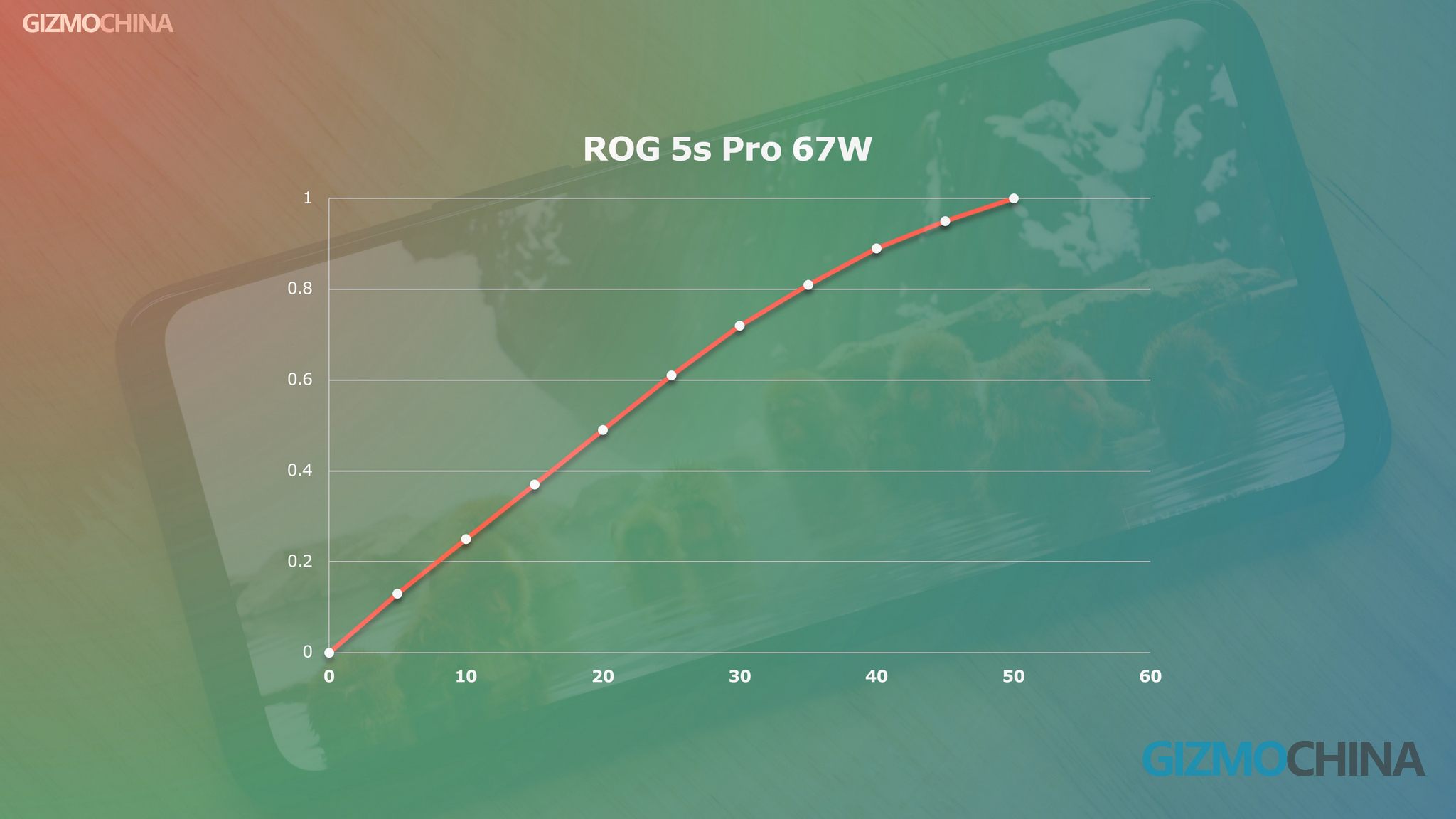
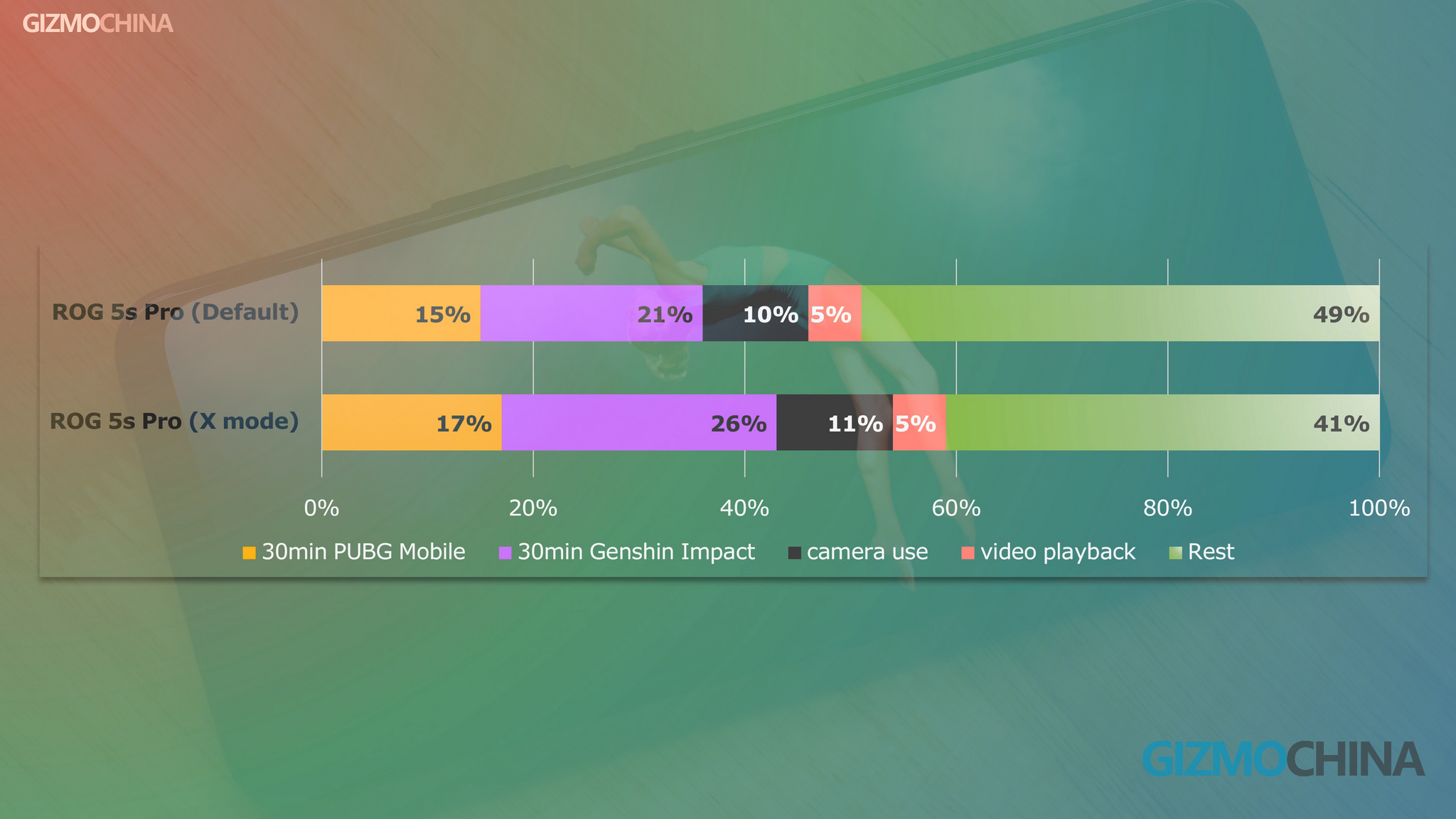
As for battery and charging, it’s obvious that ROG tried to support your long gaming sessions with a 6000mAh battery. However, in our power-consumption test, the 6000mAh battery didn’t show significant advantage in gaming battery life. Especially under X mode, the power dropped quickly with heavy games. And with the included 67W charger, it took around 50mins to finish our charging test.
ASUS ROG Phone 5S Pro Review: Verdict
So that’s all about the new ROG gaming phone. Well, probably most of you would be a bit disappointed, just like me, after seeing very little real-life performance upgrades. But we also believe that most gamers who have already bought the ROG 5 series wouldn’t really care about the upgraded version. However, no doubt, the ROG 5s Pro is still the best gaming phone that we would recommend if you are looking for a new model in the market.
So what do you think about the top version of the ROG 5s series?
Lenovo has just launched a bunch of new products at the Tech World 2021 event earlier this week. This includes a series of new ThinkVision monitors that are geared towards professionals and gamers.
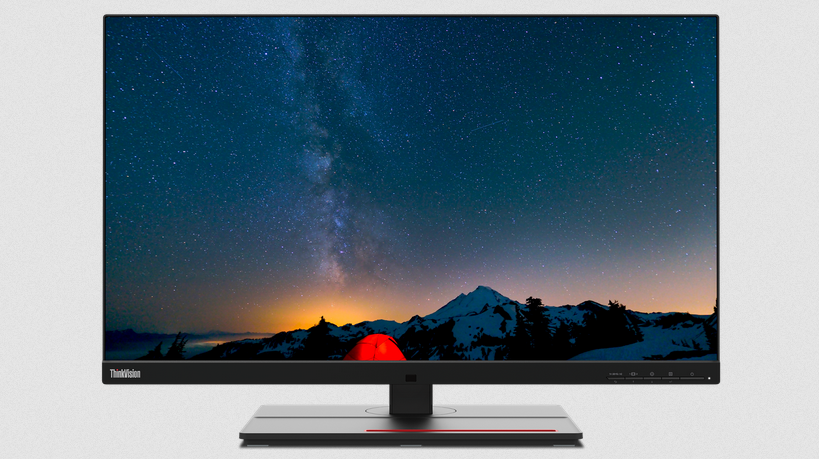
ThinkVision P27u-20
The new ThinkVision P27u-20 is the latest monitor from the Chinese tech giant that is targeted towards professionals. It offers dual wide color gamut, which includes 99.1 percent DCI P3 and 99.5 percent Adobe RGB with factory calibrated color accuracy. In other words, it is designed for content creators working in the photography, video, and graphics related fields. It sports a 27 inch IPS display with UHD display that features VESA Certified HDR400 support.
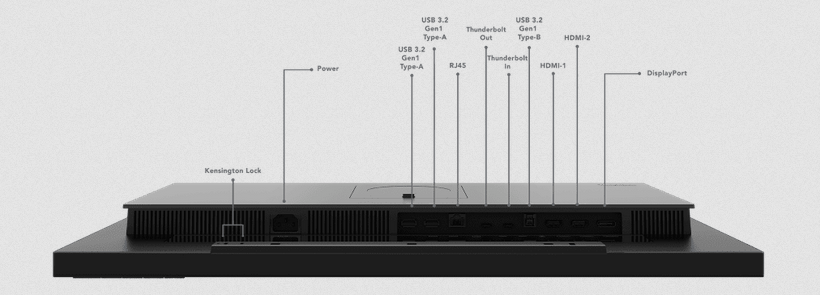
The new monitor is also Energy Star 8.0 and Thunderbolt 4.0 docking display port. Furthermore, the brand also built the monitor to act as a productive hub that acts as your workplace one cable docking solution with multiple USB 3.2 including the Thunderbolt 4.0 input and output that carries display and data of up to 40Gbps and powers your laptop up to 100W. Along with the new single cable dock, the new professional monitor also arrives with integrated speakers as well.
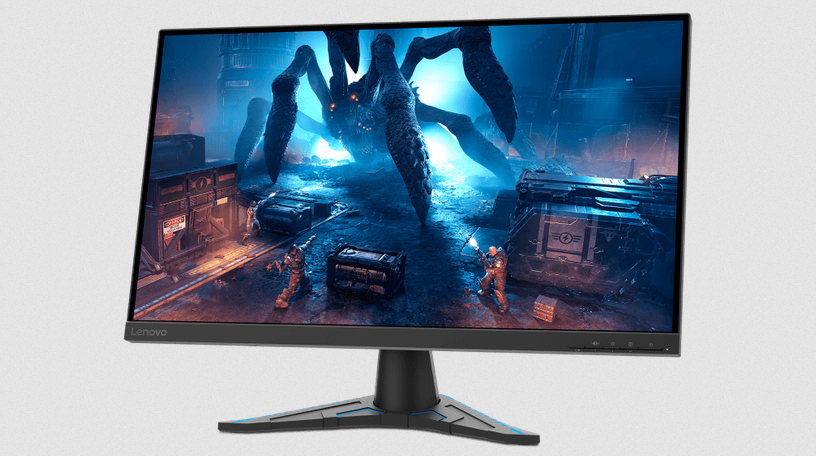
Lenovo G27e-20 & G24e-20
Apart from the professional display, Lenovo also launched two new monitors in its new line of consumer G series of gaming monitors. These are designed to offer gamers an immersive PC gaming experience that can also be used for remote working and online education. While it is a gaming display, it still offers high performance and quality for young professionals that want a capable monitor at a competitive price.
Both new gaming monitors feature AMD FreeSync Premium technology for a smooth, low latency, tear free gaming experience. The monitors also sport 100Hz high refresh rate panels (with support for 120Hz overclock) that are great for competitive games. As the name suggests, the G27e-20 sports a 27 inch display while the G24e-20 features a smaller 23.8 inch panel. Both offer 300 nits of brightness and 95 percent sRGB color gamut for increase color accuracy and are VA panels with FHD resolutions.
Pricing & Availability
The ThinkVision P27u-20 professional monitor is set to be released on December 2021 with a price tag of 769 US Dollars. On the other hand, the two news G series of gaming monitors are set to launch next month in October, with the 27 inch model going for 239 US Dollars and the 24 inch variant being priced at 209 US Dollars.
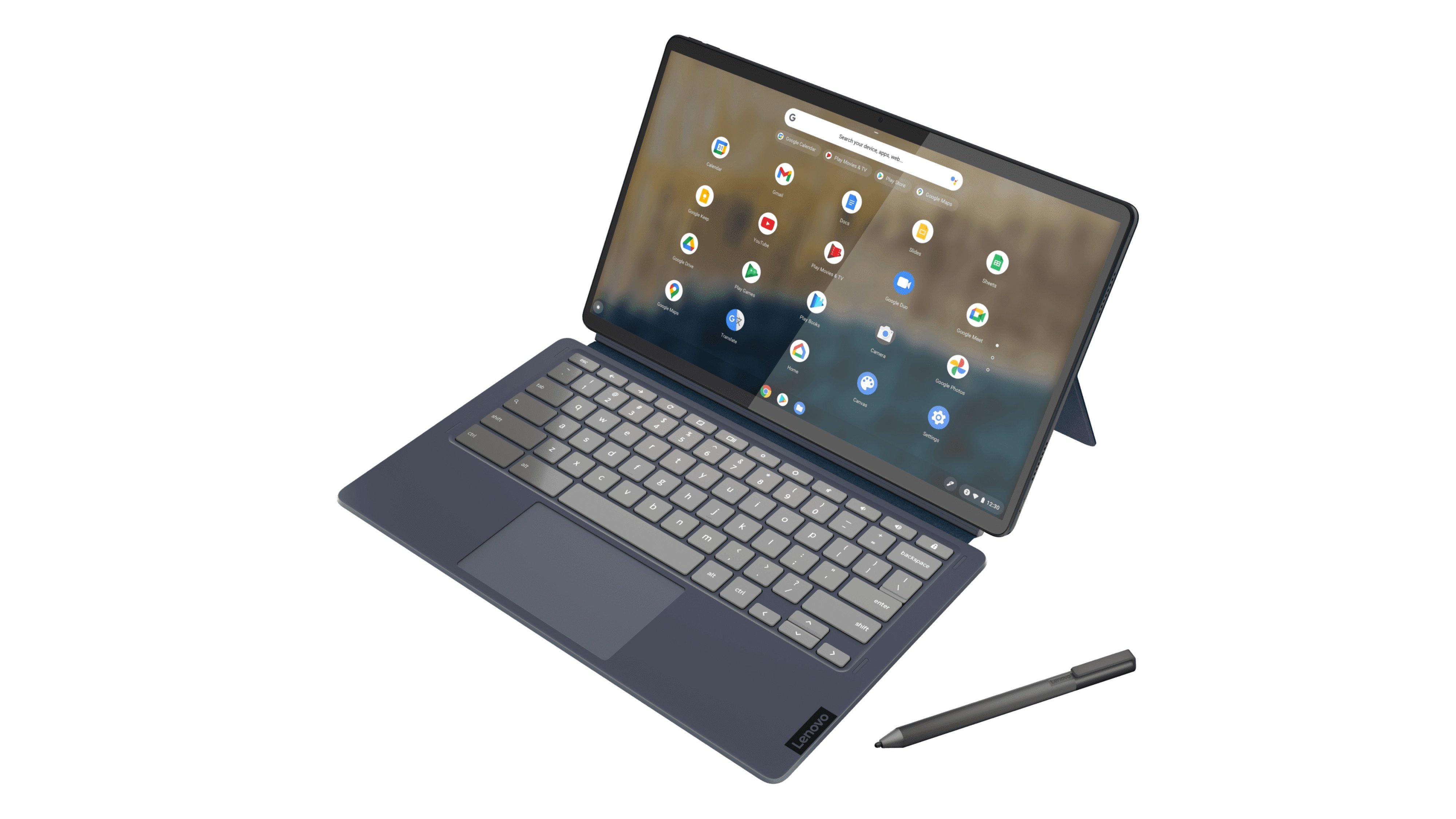
The Lenovo Ideapad Duet Chromebook is one of the best Chrome OS devices available in the market, which happens to be a tablet as well. More than a year after its release, the PC maker has announced its successor dubbed as Lenovo IdeaPad Duet 5 Chromebook. The new model brings upgrades in almost all aspects.
Lenovo IdeaPad Duet 5 Chromebook Specifications and Features
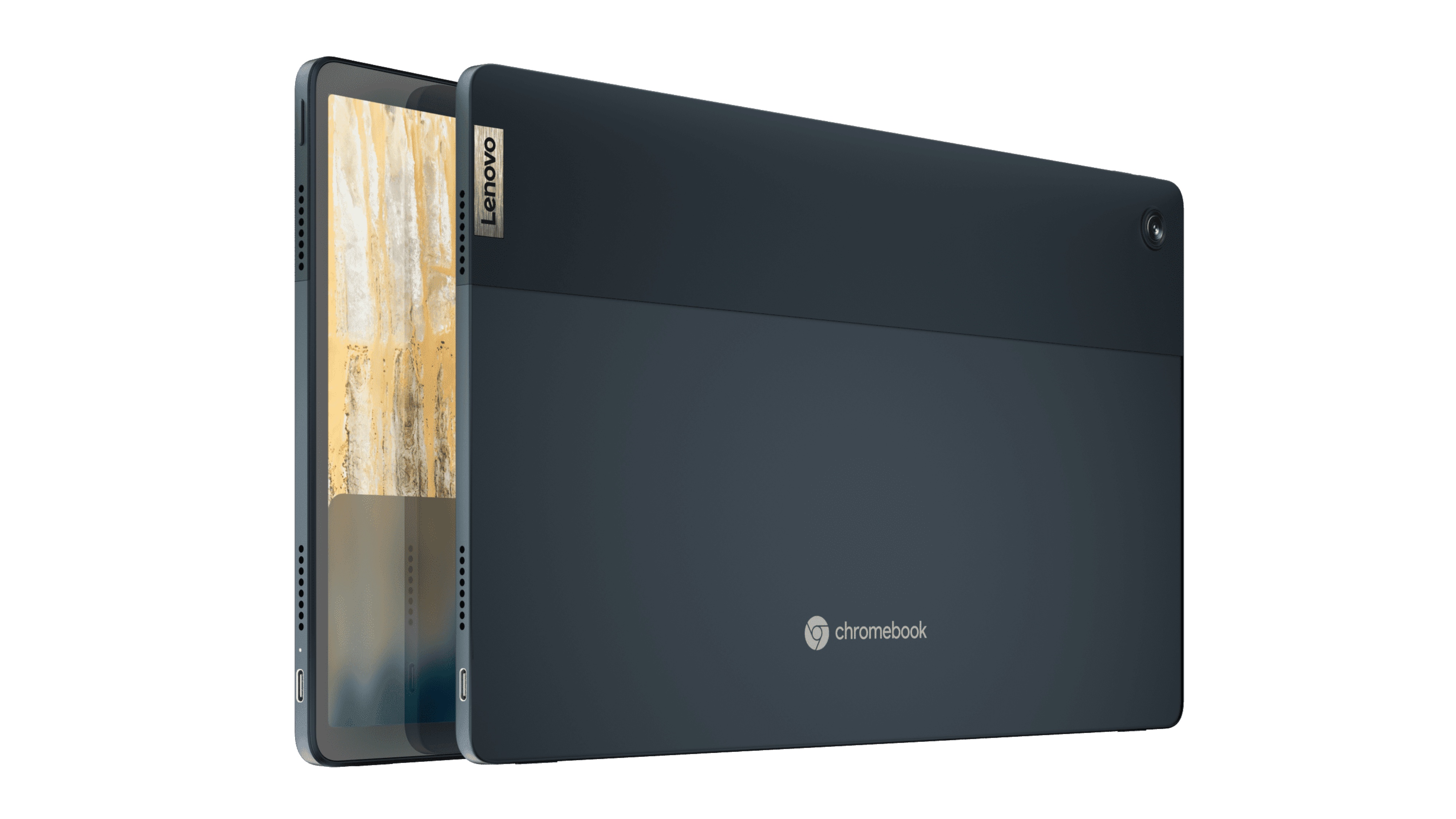
The new Chrome OS tablet from Lenovo features a two-tone finish like the last year’s model. It comes in two colors, namely Abyss Blue and Storm Grey. The device measures 305.86 x 186.74 x 7.25mm in dimensions and weighs 700g.
It sports a 13.3-inch OLED panel supplied by Samsung Display. This screen has a resolution of 1920 x 1080 pixels (FHD), 100% DCI-P3 color gamut, and 400 nits brightness. The screen also has TÜV Rheinland Eyesafe Display and SGS Eye Care Display certifications.
The product is powered by a Qualcomm Snapdragon 7c Gen 2 chipset coupled with 4GB/8GB LPDDR4x RAM and 64GB/128GB/256GB eMMC SSD. On the connectivity front, it supports dual-band WiFi 5, Bluetooth 5.1, 2 x USB 3.0 Gen 1 Type-C ports, and a pogo-pin connector.
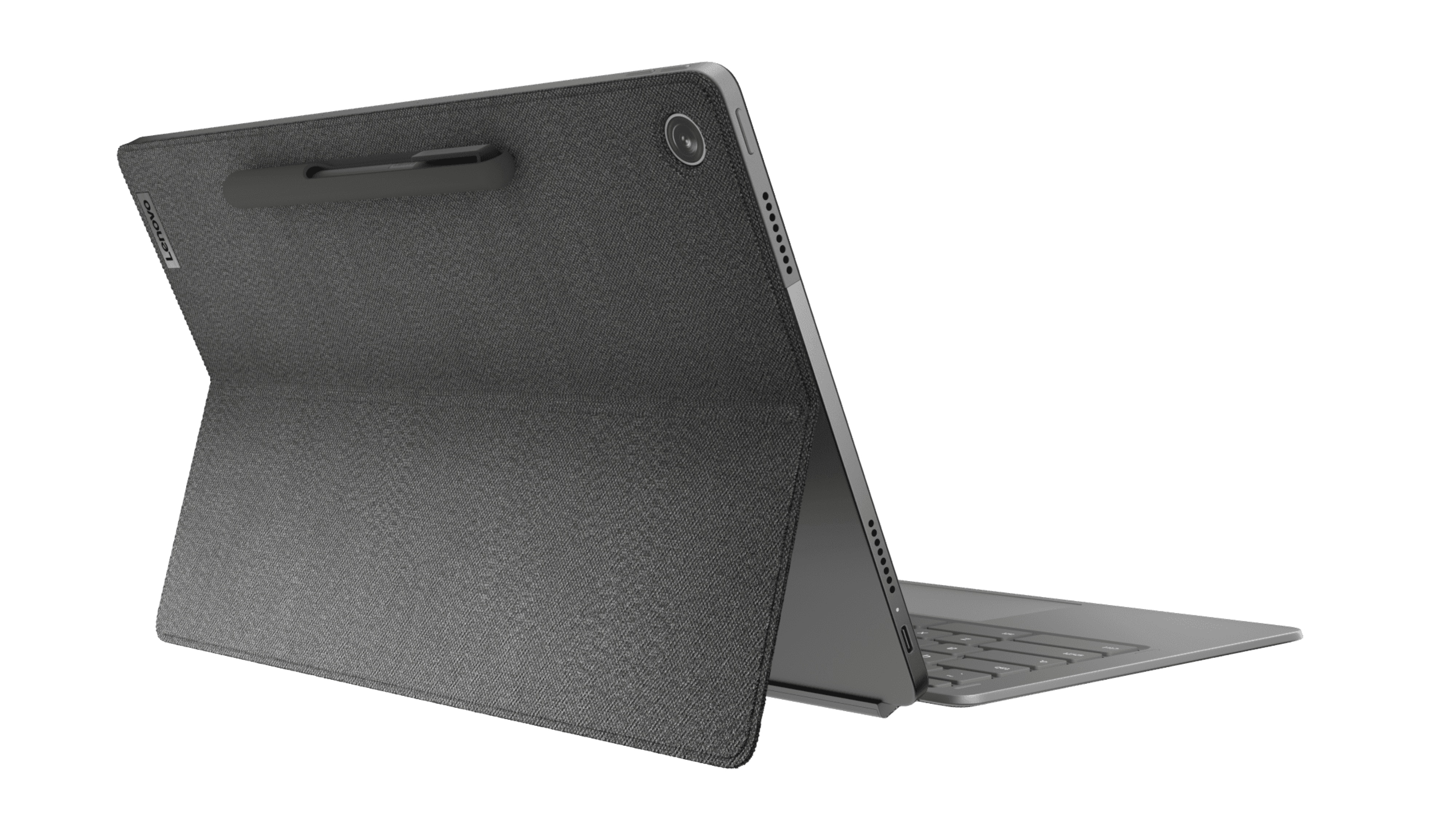
Just like its predecessor, this one also ships with a detachable keyboard accessory and a kickstand case. Additionally, the new model also comes with a USI stylus that can be magnetically attached to the back.
As far as audio is concerned, the tablet arrives with 4 x 1W stereo speakers but does not sport a 3.5mm headphone jack. It also has an 8MP rear camera and a 5MP front-facing camera. Last but not least, it is backed by a 42WHr battery, which is rated to last for up to 15 hours.
Lenovo IdeaPad Duet 5 Chromebook Price and Availability
The Lenovo IdeaPad Duet 5 Chromebook will start at $429.99 in North America where it will be lacking the ‘IdeaPad’ branding. It is expected to go on sale from October 2021.
The product will likely hit other markets, following its US release.
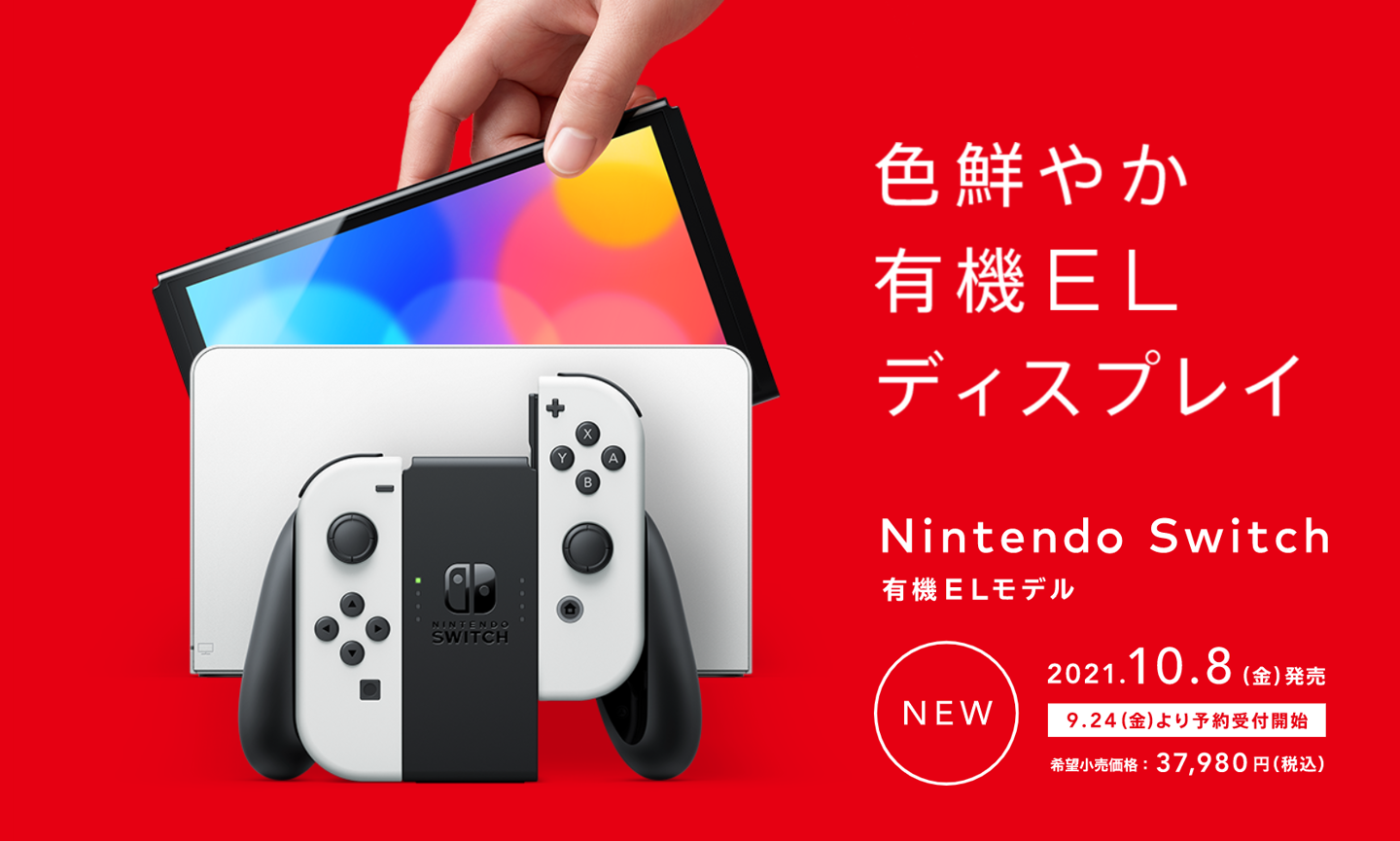
Earlier this year, Nintendo announced the OLED version of its popular Switch. This new variant of the company’s handheld gaming console is set to go on sale on October 8, and now, pre orders for the OLED Switch is set to start from September 24.
The Japanese tech giant announced earlier today (9th September 2021) that the OLED version of Switch will be available for pre orders later this month for a price of 37,980 Yen (roughly 345 US Dollars). Apart from the inclusion of a new OLED panel, the new version of the gaming console doesn’t arrive with any major changes. Although, it does feature slightly improved performance, while the battery life is still rated to last 9 hours similar to the original Switch.
Other slight changes include a slightly longer and heavier body compared to the original version, with the OLED variant weighing 320 grams over the 290 grams of the original. Meanwhile, notable specs include a 7 inch displayu, a new bracket design, with the angle being freely adjustable, an increase base storage capacity of 64GB and new speakers that offers better audio quality when used in handheld mode. As of right now, it appears that Nintendo doesn’t plan on launching a new gaming console anytime soon, so this might be the better variant of the Switch to buy for those interested.
In recent years, robotics have steadily been entering the consumer electronics market. Back in August, Xiaomi had revealed its CyberDog and now, Xpeng, another company from China is working on a rideable robotic unicorn for children.
The known Chinese electric vehicle manufacturer is apparently branching out from automobile for a new product. The new Xpeng Robot Unicorn is an upcoming quadruped robot that takes a shape of a horse but with a unicorn styled design. It is being built with the company’s expertise in autonomous driving and other AI functions that will help it navigate different terrains, recognize objects and obstacles, and also provide “emotional interactions” as well.
Furthermore, the new robot will also be built with machine deep learning so it could better interact with users while also ensuring safety and good quality. The company is also looking to bring in more people for this project from different regions in China and even the United States from varying fields like automobiles, AI systems, and others. Looking at the design of the robotic unicorn, it resembles a horse like design but with a face that is built specifically to improve human interaction. It is said to support voice recognition along with facial recognition as well.
As of right now, the Chinese brand has just teaser this rideable robotic unicorn and has yet to reveal finer details regarding this product. Unfortunately, the pricing of this robot is also currently unknown but it could easily cost somewhere around 3,000 US Dollars. This could eventually also lead to someday the company releasing adult sized version of the product depending on how it performs in the market, but that is just speculation at the moment.
We use cookies on our website to give you the most relevant experience by remembering your preferences and repeat visits. By clicking “Accept”, you consent to the use of ALL the cookies.
This website uses cookies to improve your experience while you navigate through the website. Out of these, the cookies that are categorized as necessary are stored on your browser as they are essential for the working of basic functionalities of the website. We also use third-party cookies that help us analyze and understand how you use this website. These cookies will be stored in your browser only with your consent. You also have the option to opt-out of these cookies. But opting out of some of these cookies may affect your browsing experience.
Necessary cookies are absolutely essential for the website to function properly. This category only includes cookies that ensures basic functionalities and security features of the website. These cookies do not store any personal information.
Any cookies that may not be particularly necessary for the website to function and is used specifically to collect user personal data via analytics, ads, other embedded contents are termed as non-necessary cookies. It is mandatory to procure user consent prior to running these cookies on your website.