Advertisement

iQOO U3 vs Redmi Note 9 5G vs Realme X7: Specs Comparison

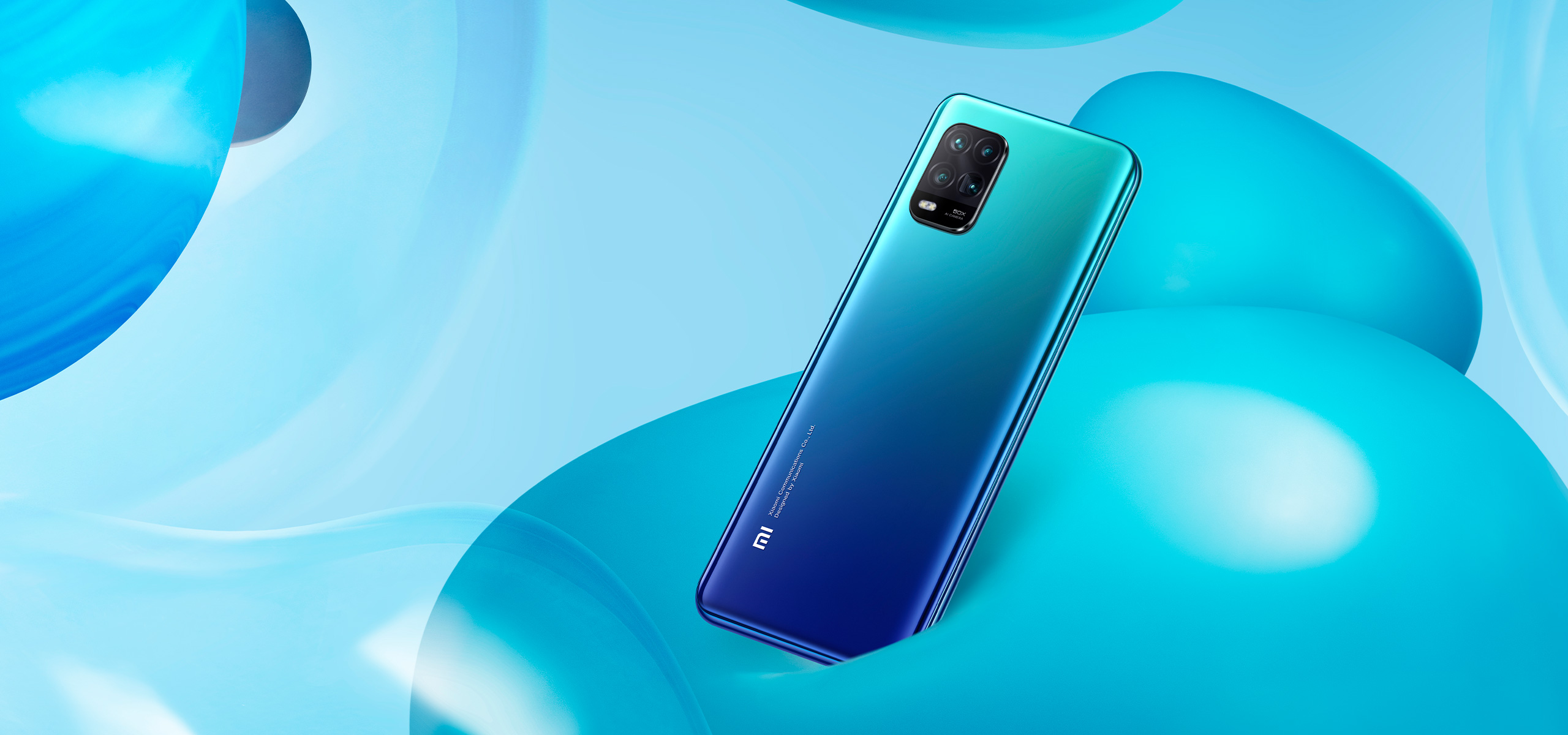
The Chinese market recently welcomed the new Redmi Note 9 5G: the first 5G phone from the Redmi Note series. But several other 5G mid-rangers hitten the Chinese market in the last period, that is why the Redmi Note 9 5G is not necessarily the best choice in its price range. With our comparison, we usually give our readers the chance to understand the differences between handsets released in the same price range. We believe the best actual rivals of the Redmi Note 9 5G are the iQOO U3 and the Realme X7. Through this specs comparison, we will try to tell you which one is the best for your needs.
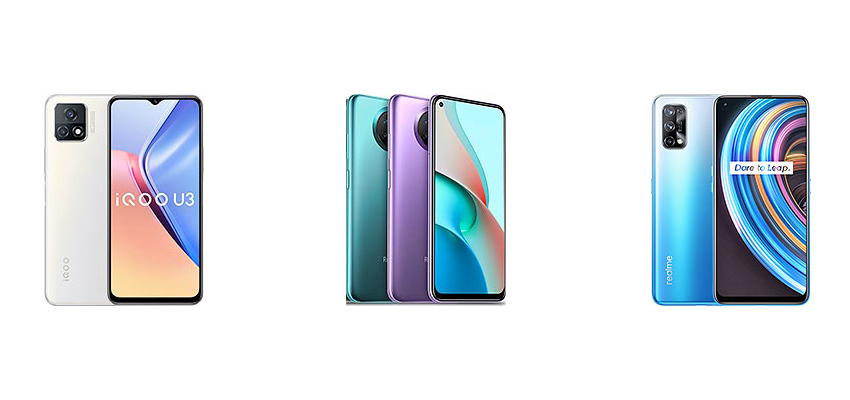
 

Vivo iQOO U3 vs Xiaomi Redmi Note 9 5G vs Realme X7

Vivo iQOO U3 Xiaomi Redmi Note 9 5G Realme X7
DIMENSIONS AND WEIGHT 164.2 x 75.4 x 8.4 mm, 185.5 grams 162 x 77.3 x 9.2 mm, 199 grams 160.9 x 74.4 x 8.1 mm, 175 grams
DISPLAY  6.58 inches, 1080 x 2400p (Full HD+), IPS LCD 6.53 inches, 1080 x 2340p (Full HD+), 395 ppi, 19.5:9 ratio, IPS LCD 6.4 inches, 1080 x 2400p (Full HD+), 411 ppi, 20:9 ratio, AMOLED
PROCESSOR Mediatek Dimensity 800U, octa-core 2.4 GHz Mediatek Dimensity 800U, octa-core 2.4 GHz Mediatek Dimensity 800U, octa-core 2.4 GHz
MEMORY  6 GB RAM, 128 GB – 8 GB RAM, 128 GB 6 GB RAM, 128 GB – 8 GB RAM, 128 GB – 8 GB RAM, 256 GB – micro SD dedicated slot 6 GB RAM, 128 GB – 8 GB RAM, 128 GB
SOFTWARE  Android 10, iQOO UI Android 10, MIUI Android 10, Realme UI
CONNECTIVITY  Wi-Fi 802.11 a/b/g/n/ac, Bluetooth 5.1, GPS Wi-Fi 802.11 a/b/g/n/ac, Bluetooth 5.1, GPS Wi-Fi 802.11 a/b/g/n/ac, Bluetooth 5.1, GPS
CAMERA  Dual 48 + 2 MP, f/1.8 + f/2.4
20 MP f/2.0 front camera
 Triple 48 + 8 + 2 MP  f/1.8, f/2.2 and f/2.4
13 MP f/2.3 front camera
Quad 64 + 8 + 2 + 2 MP f/1.8, f/2.3, f/2.4 and f/2.4
32 MP f/2.5 front camera
BATTERY 5000 mAh, fast charging 18W  5000 mAh
Fast charging 18W
4300 mAh, Fast charging 65W
ADDITIONAL FEATURES Dual SIM slot, 5G Dual SIM slot, 5G Dual SIM slot, 5G

Design

The design award goes to the Realme X7. It is thinner, it is lighter and it is even more compact than Redmi Note 9 5G and Vivo iQOO U3. Further, it has an in-display fingerprint reader making the overall design cleaner and an amazing look. iQOO U3 and Redmi Note 9 5G are bigger and thicker due to their bigger displays and batteries. The interesting pro of the Redmi Note 9 5G is its water-repellent coating. Further, note that the Redmi Note 9 5G has a punch-hole display, while iQOO U3 has a classic waterdrop notch.


Display

If you want the best display, you should go for the Realme X7 without thinking twice. Thanks to its AMOLED panel, the Realme X7 is able to provide more brilliant colors and deeper blacks. Further, as mentioned above, it sports an under-display fingerprint scanner. Unfortunately, both iQOO U3 and Redmi Note 9 5G feature an IPS panel. The iQOO U3 is more interesting because it supports a 90 Hz refresh rate, while Redmi Note 9 5G has a 60 Hz display. In both cases, you get a side-mounted fingerprint reader.


Hardware/Software

Vivo iQOO U3, Redmi Note 9 5G, and Realme X7 all pack an octa-core MediaTek Dimensity 800U chipset which supports 5G connectivity. It is a mid-range chipset more or less at the same level as the Snapdragon 765G. With the iQOO U3 and the Redmi Note 9 5G, you actually get a slightly faster internal storage thanks to the UFS 2.2 technology. But the Redmi Note 9 5G offers more space: up to 256 GB. Further, Redmi Note 9 5G features expandable storage, while its rivals do not. All the phones run Android 10 with heavy customizations.


Camera

The Realme X7 packs the most advanced camera department. On the rear side, it sports a 64 MP main camera, an ultrawide 8 MP sensor, and a pair of 2 MP sensors for macros and depth calculation. Further, the handset features a better 32 MP front camera. The second place goes to the Redmi Note 9 5G featuring a 48 MP triple camera. Unfortunately, iQOO U3 lacks an ultrawide sensor and it offers a 48 MP dual camera: a disappointing thing for a phone released in 2020.


Battery

Redmi Note 9 5G is the battery champion with its 5000 mAh capacity. The iQOO U3 has a 5000 mAh battery as well, but it should provide an inferior battery life due to its higher refresh rate. The Realme X7 has a smaller 4300 mAh battery, but thanks to 65W fast charging it reaches 100% in less than 35 minutes.


Price

Vivo iQOO U3 is priced at about €200/$245 in its base variant, just like the Redmi Note 9 5G. For the Realme X7, you need at least €220/$270. The Realme X7 is the winner of this comparison thanks to its AMOLED display and better camera department. Right after, we got the Redmi Note 9 5G offering a micro SD slot and slightly better cameras. The iQOO U3 is like a Redmi Note 9 5G with a higher refresh rate and inferior camera department.


Vivo iQOO U3 vs Xiaomi Redmi Note 9 5G vs Realme X7: PRO and CONS

Vivo iQOO U3

PROS

  • Huge battery
  • 90 Hz display
  • UFS 2.2 storage
  • Good price

CONS

  • No ultrawide camera


Xiaomi Redmi Note 9 5G

PROS

  • Big battery
  • Stereo speakers
  • Water-repellent
  • IR blaster
  • UFS 2.2 storage
  • Micro SD slot

CONS

  • Standard refresh rate


Realme X7

PROS

  • AMOLED display
  • More compact
  • Best cameras
  • Faster charging

CONS

  • Smaller battery
Xiaomi Mi 11 with Android 11, Snapdragon 888 spotted on GeekBench

Xiaomi is expected to launch the flagship Mi 11 on December 29 according to rumors. The flagship is expected to debut as the first Snapdragon 888-powered smartphone. Before now, a couple of leaks have emerged giving some hint of what to expect. The Mi 11 has now appeared on the GeekBench database.

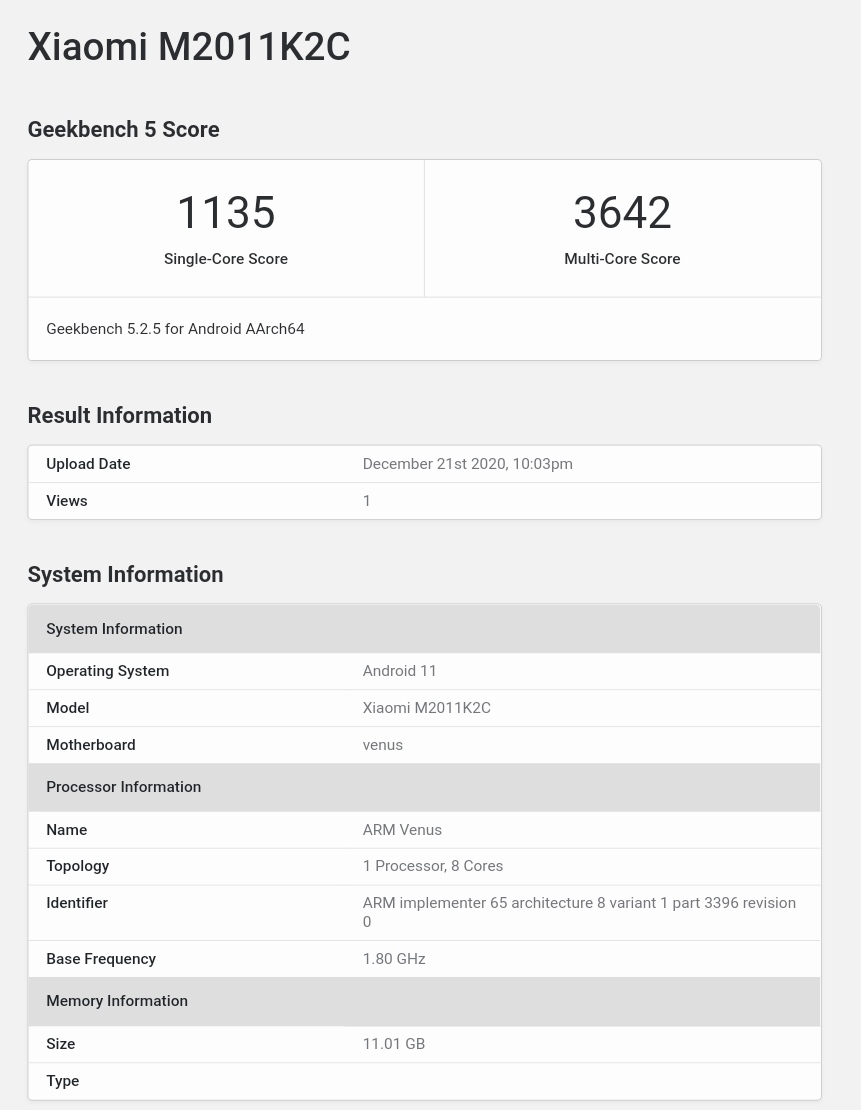
The device is listed on GeekBench with the model number Xiaomi M2011K2C which is the same model number with which it was listed on 3C and on China’s network certification website earlier this month. Xiaomi mi 11 GeekBench

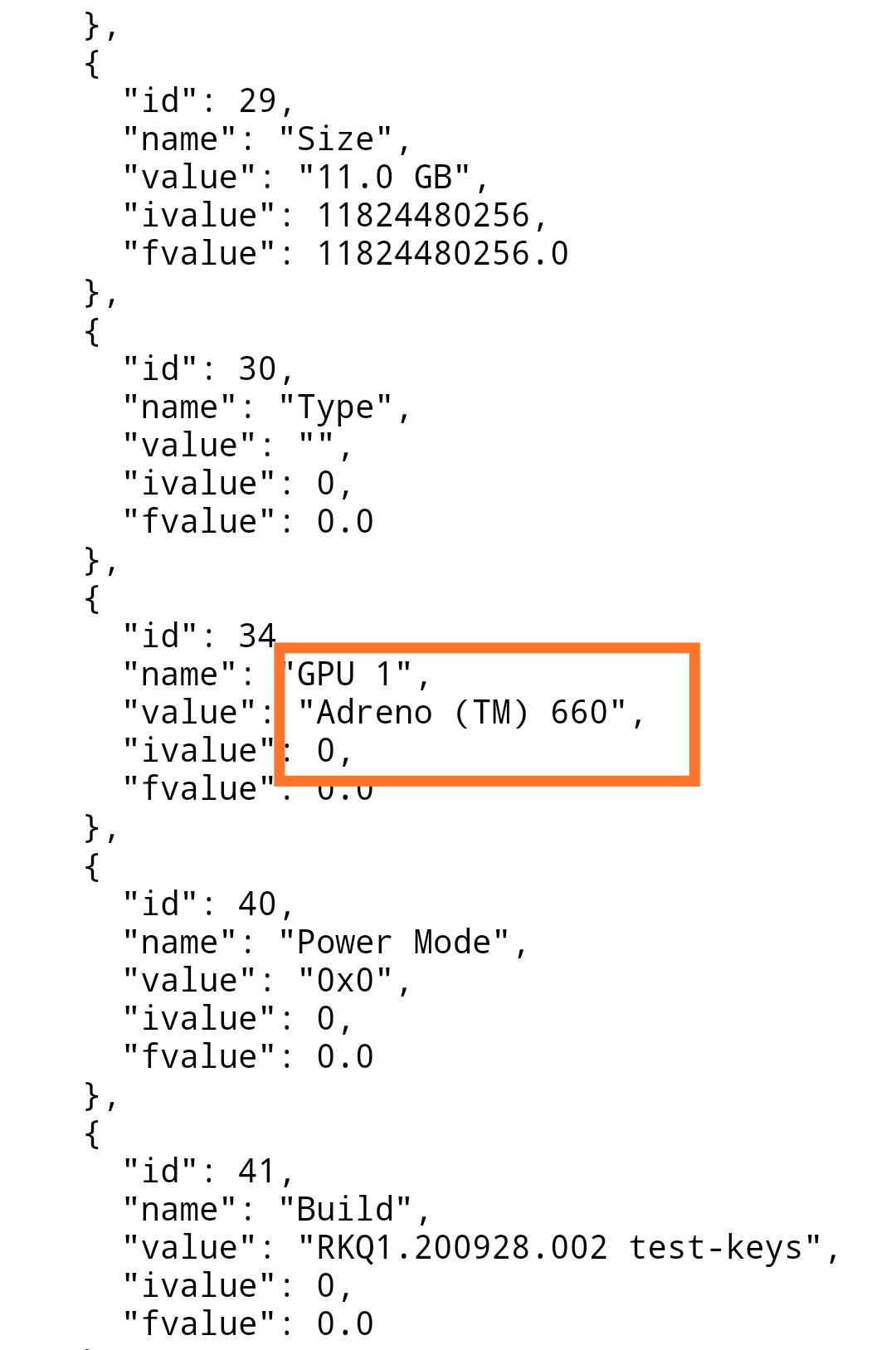
The Xiaomi Mi 11 GeekBench listing shows the device will run on Android 11 which will definitely be based on MIUI 12. The device will also be powered by a processor codenamed ARM venus which is the Snapdragon 888. The Adreno 660 GPU will fire up the graphics. The device is also listed with 12GB of RAM which should be the topmost variant in terms of memory configuration.

Although not listed, the high-end variant will likely have 512GB storage onboard. Rumour also has it that the high-end variant will feature a Samsung 2K AMOLED screen and have support for 120Hz refresh rate. The high-end version is also expected to support 120W ultra-fast flash charging.Xiaomi Mi 11

In terms of core configuration, in addition to the Snapdragon 888 flagship processor, the Mi 11 is also expected to get an 8GB RAM variant and will equally have support for 55W fast charging.

In terms of the camera, the device will have a triple camera setup on the back along with an LED flashlight. This is horizontally stacked inside a squircle housing. As per the concept renders, the layout will also have a Blue Gradient color with a chamfered bump. The triple-camera array will likely have a 108MP main camera, 13MP ultra-wide, and a 5MP macro sensor.

UP NEXT: OnePlus shows off a color-changing concept phone based on the OnePlus 8T


(source, via)


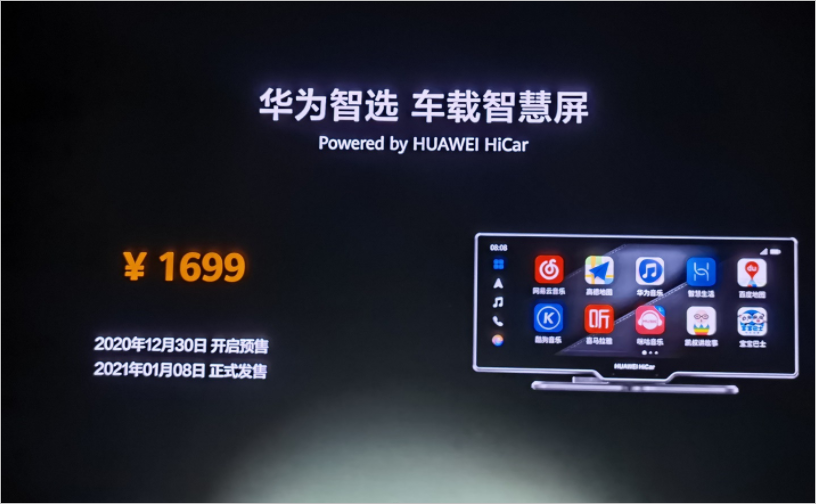
Huawei Smart Selection Car Smart Screen running Huawei HiCar launched

At Huawei‘s new product launch conference where the Smart Screen S and Smart Screen S Pro were unveiled, Huawei also announced the Huawei Smart Selection Car Smart Screen. The smart screen carries a price tag of 1699 yuan (~$259).

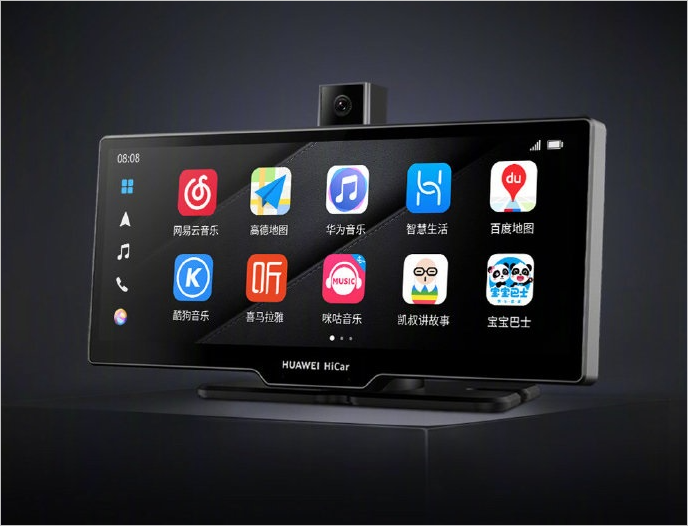
Huawei Smart Selection Car Smart Screen adopts an 8.9-inch ultra-clear touchscreen with a brightness of up to 700nit and a resolution of 1920×720 pixels. There is no fear of reflections, and it supports the cross-screen transfer of mobile applications. The device is pre-installed with over 30 supported apps including Baidu maps, Gaode maps, and other mainstream navigation apps as well as NetEase Cloud, Kugou, Himalaya, and other music applications.Huawei Smart Selection Car Smart Screen

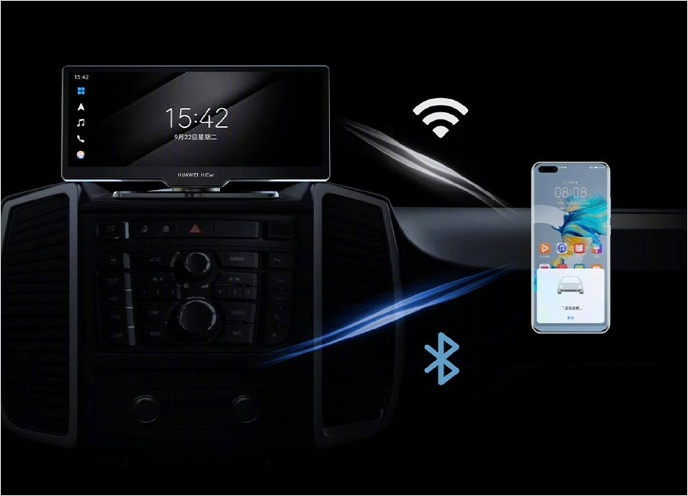
Huawei’s smart car smart screen is equipped with interactive front and rear pop-up cameras., The rear camera is a wide-angle camera for driving records. It also has a 360-degree adjustable base and supports full-interface voice control and air gesture control. It can be connected to the original car audio system. To realize cross-screen mobile phone applications, it can be paired with a smartphone via WiFi and Bluetooth connectivity. It also supports smart home linkage, cockpit games, etc.

Huawei Smart Selection Car Smart Screen

During the launch, Huawei’s Consumer Business head Yu Chengdong introduced that Huawei’s HiCar solution has currently cooperated with over 20 car manufacturers, and is compatible with over 150 models, as well as supports over 30 mainstream applications. The company plans to have the solution pre-installed in over 5 million cars by 2021. He also claims that the HiCar solution surpasses the in-vehicle systems of Apple and Android in application richness and experience.

The Huawei Smart Car Smart Screen is priced at 1,699 yuan (~$259) and will be officially launched for sale on January 8, 2021. The product will be open for pre-orders on December 30.

UP NEXT: Apple Glass might feature lenses that adjust to ambient lighting


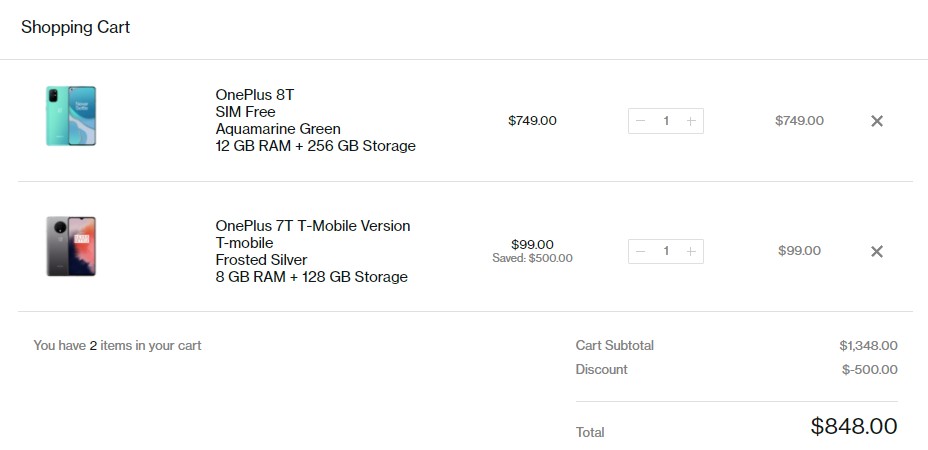
OnePlus US is offering a OnePlus 7T for $99 when you buy the OnePlus 8T

The OnePlus 7T may be over a year old already but it is still a great phone to pick up. OnePlus still has available units of the phone in some markets including the U.S.A. where it is running a promo that allows you to pick it up for just $99.

The manufacturer is offering those who purchase the OnePlus 8T the chance to pick up the OnePlus 7T for an extra $99. This means that you pay $848 ($749 for the 8T and $99 for the 7T) in total for both phones.

The promo runs from today till the last day of the year, so if you are yet to pick up a holiday gift for a friend and also need a new phone yourself, you should grab this deal. Do note that while the OnePlus 8T is unlocked, the OnePlus 7T available is the T-Mobile version. Nevertheless, there are ways to get the device unlocked.

OnePlus 8T + OnePlus 7T promo

The OnePlus 7T sold in the US has 8GB of RAM and 128GB of storage and is available in Frosted Silver. The phone has a  6.55-inch FHD+ AMOLED with a 90Hz refresh rate and a 2400 x 1080 resolution.

There is a Snapdragon 855+ processor under the hood along with a 3800mAh battery with support for 30W wired fast charging (Warp charge 30T). On the back of the phone is a 48MP+12MP+16MP triple camera setup while the selfie camera is a 16MP sensor that sits inside the waterdrop notch. The device also has stereo speakers, an in-display fingerprint scanner, and runs Android 10. OnePlus has confirmed that it will be updated to Android 11.

If you don’t want to grab a phone, OnePlus has another interesting deal. If you purchase the OnePlus Buds Z which costs $49.99, you can grab a Bullets Wireless Z for just $9.90 too. This is a limited-time deal that expires on December 31.


Huawei Smart Screen S and Smart Screen S Pro launched

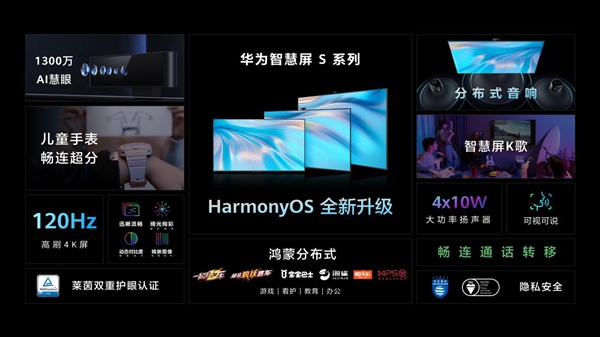
Huawei today held a press conference in China where the Huawei Smart Screen S and Smart Screen S Pro were both unveiled alongside a smart car screen. The new Smart Screen S series is the latest addition to the smart screen family. The two smart TV models are available in three screen sizes of 55 inches, 65 inches, and 75 inches.

The Huawei Smart Screen S series breaks through the limitations of traditional TV hardware and software upgrades and is committed to achieving smart interactions, cross-screen experience, and IoT.

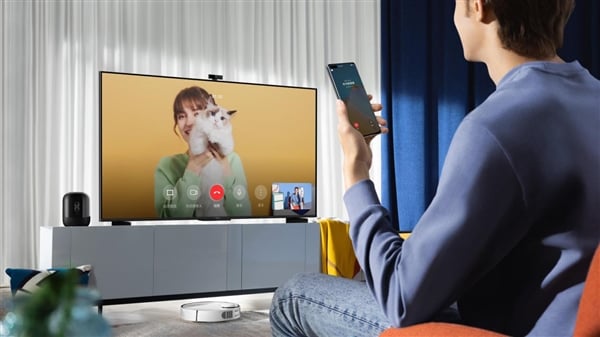
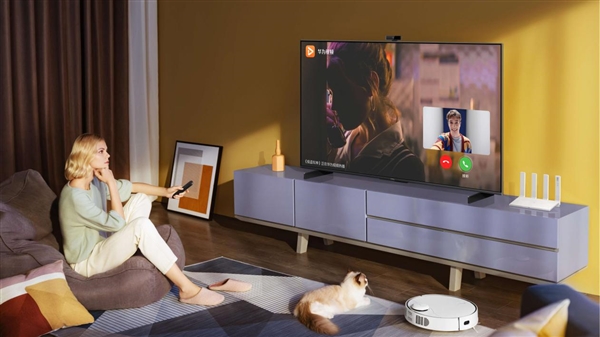
Huawei Smart Screen S series is equipped with a pop-up AI camera which supports 1920×1080 pixel resolution video call. It also supports large display screen call to other large screen TV as well as smart TV to mobile phone calls, mobile phone calls to smart TV calls. The transfer function can quickly transfer the smooth communication on the mobile phone to the smart screen under the same LAN, making it more comfortable to chat and communicateHuawei Smart Screen S

At the same time, support for smart screen and Huawei children’s watch to communicate smoothly (currently supported model: Huawei smart children’s watch 4X), and support for voice calls, so that the elderly and children can also chat without barriers. And it supports super-resolution processing of the video images returned by the children’s watch, and the SD second becomes HD, and the video call is clearer.Huawei Smart Screen S

It is worth mentioning that the Huawei Smart Screen S series also supports free 4-party 45-minute video calls. After 45 minutes, you can choose to call again an unlimited number of times. Users can join multi-party video calls through smart screens, mobile phones, PCs, and other series of terminals, which is convenient and fast, and the whole family can chat freely anytime, anywhere.

In addition, the Huawei Smart Screen S series has also added a remote housekeeping function. When the screen is off or on, the mobile phone can remotely call the smart screen camera to view the situation at home, so that family care is always online.Huawei Smart Screen S pro

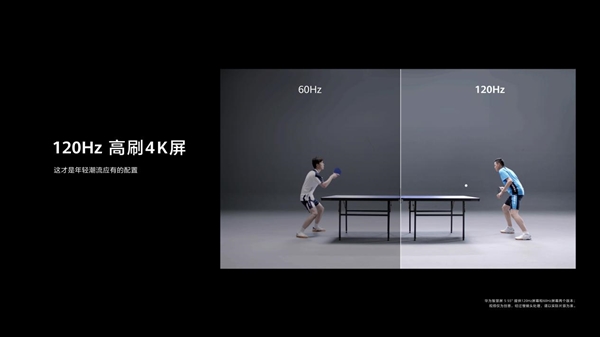
The upgrade of audio-visual entertainment functions is a highlight of Huawei’s smart screen S series. It is not only equipped with a 120Hz high refresh rate screen that is rarely configured for products in the same price range. It has a 92% DCI-P3 wide color gamut, dual eye protection with TUV Rheinland low blue light, and no flicker certification.

In terms of audio, the Huawei Smart Screen S series breaks through the traditional industry standard. It adopts a 4*10W speaker unit solution, equipped with 1L independent large sound cavity, including two 10W full-range speakers and two 10W tweeters, and two high-frequency speakers. Using a unique patented technology, high frequency, and human voice can be enhanced by 8dB so that when watching a movie, the dialogue between the characters will be heard more clearly.Huawei Smart Screen S

At the same time, the virtual sound field expansion technology patent can break through the physical limitations of the speakers, virtualize left and right surround channels on the left and right sides, and broaden the sound field, which greatly enhances the immersion of watching movies.

It is worth mentioning that, unlike traditional TVs that always apply a set of standard video and audio output effects, Huawei Smart Screen S series can intelligently judge the content currently being broadcast, and automatically adjust the audio and image quality to the optimal level according to the needs of the scene.

In addition to the optimization and upgrading of audio and image quality, Huawei’s smart screen S series also opened up a new field of smart screen entertainment, equipped with distributed games and smart screen K song functions.

Among them, distributed games support the use of mobile phones to replace gamepads. When playing racing games, users can control by calling the phone’s touch screen and gravity sensor or gyroscope. The game runs on a smart screen and the screen is clearer and smoother. Bring an immersive game experience.Huawei Smart Screen S

At the same time, Huawei Smart Screen S series cooperated with National K Song to develop new functions of Smart Screen K Song, which supports scanning code, song search, double chorus, intelligent scoring, singing mode, teaching mode, song recording, etc. and also supports Mobile phone sharing, you can exchange K song records and other information with the mobile phone’s Quanmin K song app.

Huawei Smart Screen S series also supports distributed connections with other devices, bringing a new upgrade of the multi-screen experience. For example, after connecting with the camera of Huawei Smart Selection, it can realize the ability of cry detection and automatic window reminder (the first-market version is not supported, and the subsequent OTA upgrade is supported);

After connecting the video doorbell, users can observe the situation outside the door through the smart screen even if they are sitting in the living room, and at the same time carry out voice conversations (the first release version is not supported, and the subsequent OTA upgrade is supported).

Huawei Smart Screen S series can also form a distributed sound system with more stereo surround effect with Huawei Sound, giving full play to the hardware capabilities of both to achieve sound effects comparable to home theater

Huawei Smart Screen S 55″ 60Hz starts at 3,299 yuan ($503), and will be available for pre-sale on December 21, 2020, on Huawei Mall and major e-commerce authorized platforms. It will be officially launched on December 26.

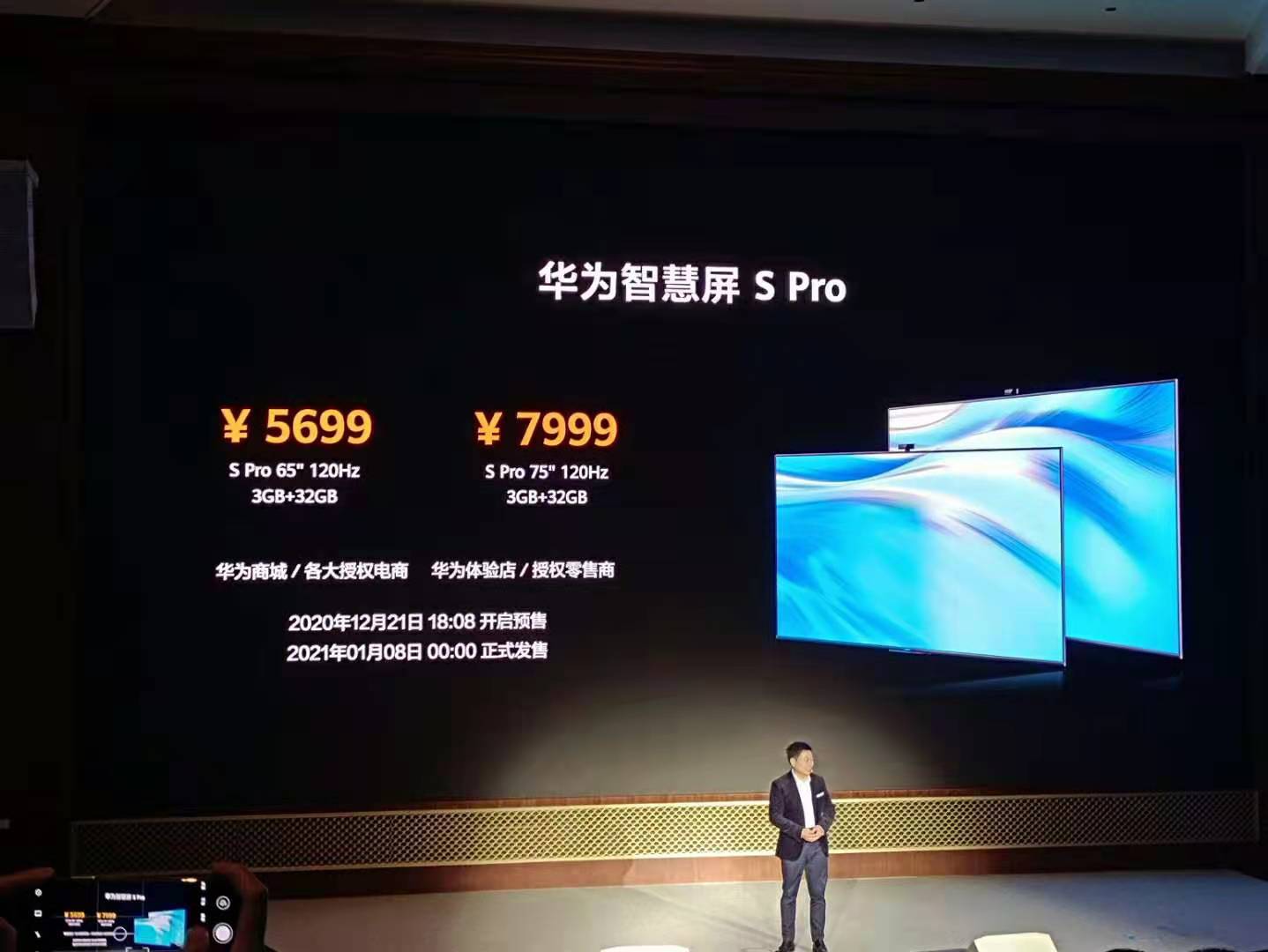
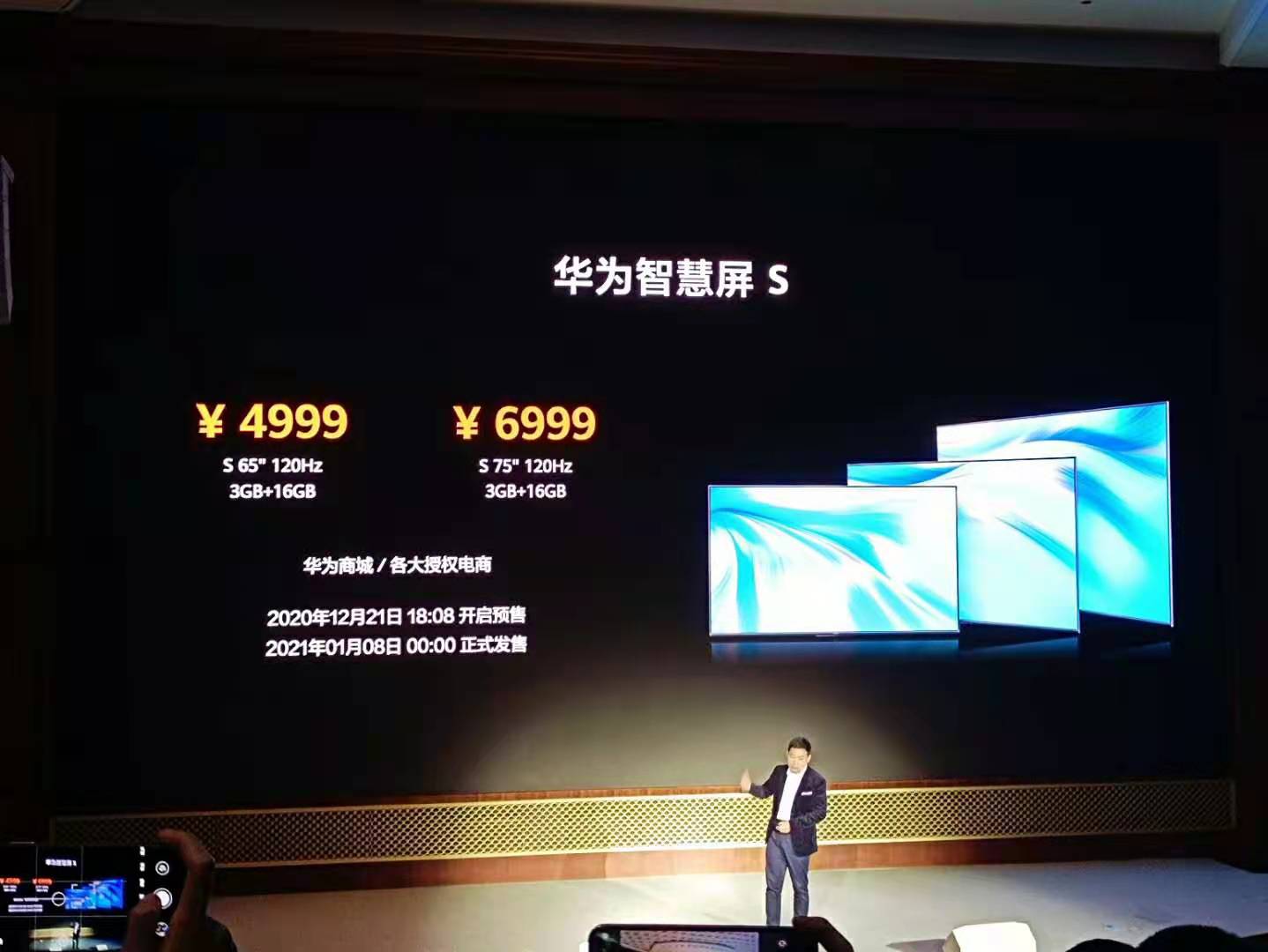
Huawei Smart Screen S 65″ is priced at 4999 yuan (~$763) while the Smart Screen S Pro 65″ is priced at 5699 yuan (~$870). Finally, the Smart Screen S 75″ is priced at 6999 yuan (~$1068) and the Smart Screen S Pro 75″ carries a price tag of 7999 yuan (~$1221). The large-size versions will officially go on sale for the first time on January 8, 2021.

UP NEXT: OnePlus shows off a color-changing concept phone based on the OnePlus 8T


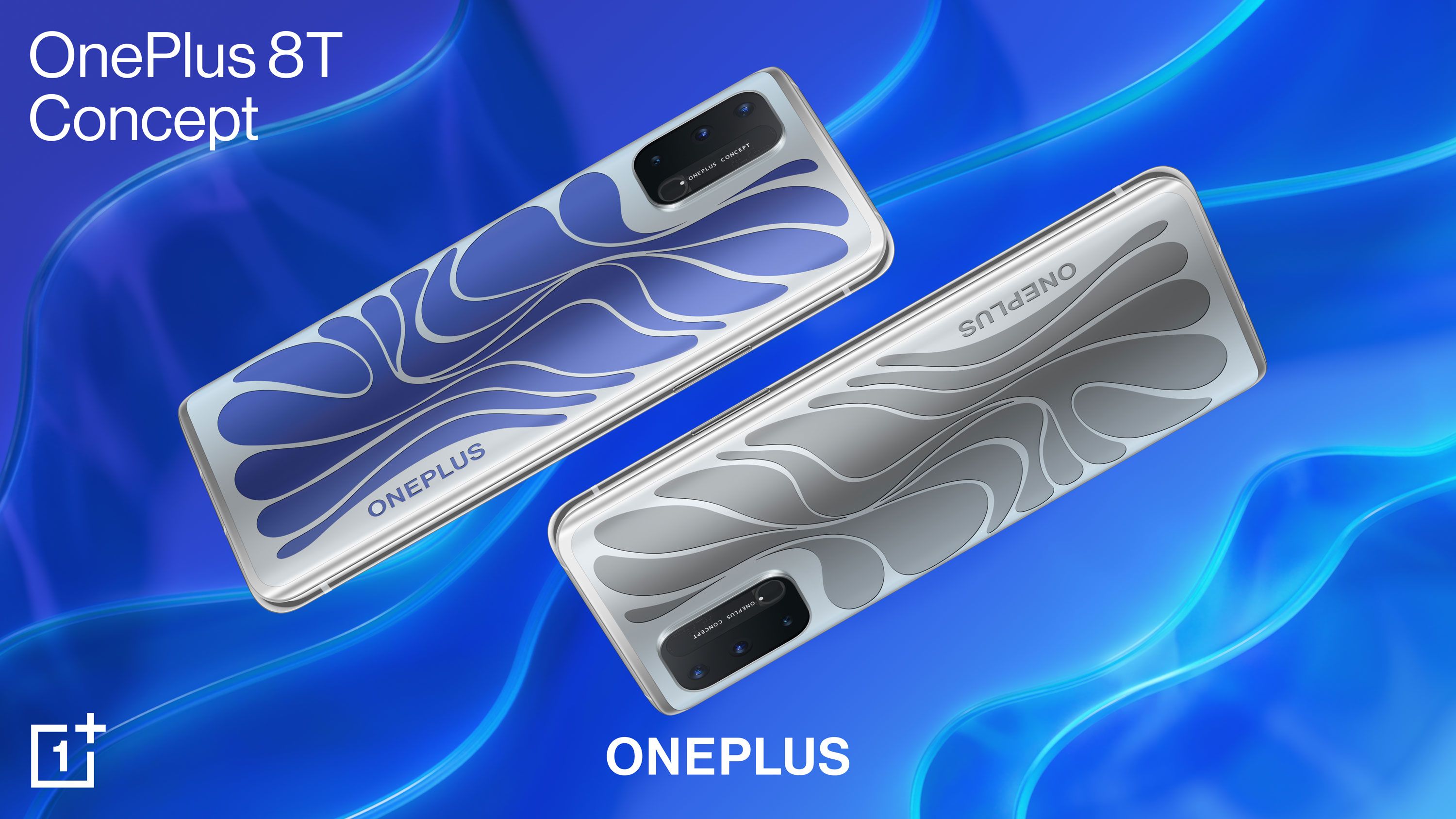
OnePlus shows off a color-changing concept phone based on the OnePlus 8T

At CES 2020, OnePlus announced a concept phone based on the OnePlus 7T Pro. The phone, which is officially known as the OnePlus Concept One, was made in collaboration with McLaren. The highlight of the phone is its “invisible” rear cameras which become visible when an electric current is passed through the piece of electrochromic glass covering the sensors. It is a pretty neat trick that gives the phone a very unique look. Now OnePlus is back with another concept smartphone called the OnePlus 8T Concept and it too has a really cool design trick too.

Just as the name says, this is a concept phone based on the latest OnePlus flagship, the OnePlus 8T. However, the rear panel of the OnePlus 8T Concept distinguishes it from the regular model and even the Cyberpunk 2077 Limited Edition.

OnePlus 8T Concept featured

The back of the phone is covered in a slab of glass but has a metal oxide film underneath that changes color when the voltage applied to it is varied. Yes, this is also electrochromic glass technology. The pattern of the color-changing film looks like globules of oil in water but OnePlus says that the inspiration for the design came from the hot springs of Pamukkale in Turkey. and OnePlus says the shift in color can be as a result of a new notification or incoming call. But that isn’t all it can do.

EDITOR’S PICK: Leaker reveals OnePlus will partner with Leica for OnePlus 9 series’ camera

The functions increase when paired with a radar module that is placed in the camera housing. The module is based on mmWave technology and according to OnePlus, it is “borrowed from 5G” but doesn’t have communication functions. The radar module transmits and receives electromagnetic waves. When it receives electromagnetic waves, “the DSP (digital signal processing) works with the CPU to perform signal and information processing, allowing the device to perceive, locate, and track objects” explains OnePlus. This means that it responds to gestures, so a user can pass their hand over it to reject a call when the back of the phone changes color to show that a call is coming in.

OnePlus says the radar can also sense your breathing and send the information back to the film so it switches between colors that sync with your breathing thus serving as a “biofeedback device”.

The film switches between just two colors – dark blue to light silver but it will be nice if there were more. Red will definitely be nice and we can already imagine the square OnePlus logo glowing red when you have a missed call or glowing green when you receive a WhatsApp message.

Just like the OnePlus Concept One, the OnePlus 8T Concept is not going to be available for purchase as revealed to The Verge but we hope OnePlus can integrate the technology even if it is on a much smaller level such as for the OnePlus logo example we cited above in future devices.


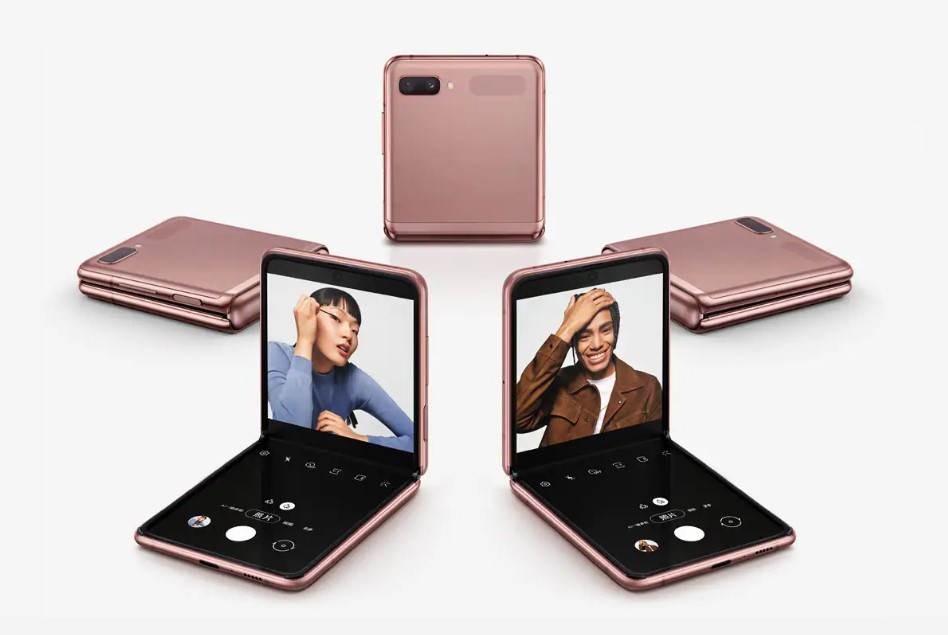
Samsung Galaxy Z Flip 5G starts getting One UI 3.0 (Android 11) update

Samsung is knocking every due date regarding the One UI 3.0 stable update out of the park. The company has already jumped its gun on the Galaxy S20 FE Android 11 update. Now, it’s doing the same for the foldable device Galaxy Z Flip 5G.

Galaxy Z Flip 5G featured

If we recall, Samsung’s timeline for the Galaxy Z Flip 5G, which launched in July, suggested that it would get the One UI 3.0 based on Android 11 update only next year. Precisely, the One UI 3.0 stable update timeline for Europe and India indicated at a January 2021 rollout.

However, as per a Sammobile report, the device has already started getting the stable update in Switzerland. Accordingly, the update with firmware F707BXXU1CTL6 is rolling out to the users of Galaxy Z Flip 5G. In addition to the Android 11 features, this update also seems to bring December 2020 Security patch along with it.

That said, as mentioned, the update currently seems to be limited to Switzerland. However, with only a few days remaining in 2020, we should start seeing it appear in other regions as well. In any case, if you are someone from Switzerland, you can check the OTA update by navigating to Settings->Software Update->Download and Install.

Well before the Android 11’s official launch, Samsung announced it’s One UI 3.0 beta(Android 11) back in August. After the initial developer build, it expanded the beta to a lot of devices. Recently, it has started the One UI 3.0 stable update with the Galaxy S20 series in early December.

And already expanded to the 2020 Note flagships. Coming back, With this update, Z Flip 5G becomes the first foldable to get stable Android 11. Also, it’s worth noting that this update belongs only to the Z Flip 5G with Snapdragon 865+ SoC. Hence, users of the Flip 4G LTE variant need to wait for a bit.

Apple Glass might feature lenses that adjust to ambient lighting

The long rumored Apple Glass has been spotted in yet another patent application. This time we see the company’s AR smart glasses arrive with lenses that are able to adjust to the ambient lighting.

According to a PhoneArena report, the Cupertino based giant has filed a new patent application USPTO (US Patent and Trademark Office). The patent is titled “Display System With Localized Optical Adjustments,” which is suggestive of the Apple Glass’ feature. Furthermore, the application also talks about “Localized Optical Adjustments,” which refers to the changes in the lenses in the Apple Glass. In simpler terms, the lens will automatically adjust based on the ambient lighting in the real world around the user.

Apple AR Glasses

So, Apple Glass would be able to adjust the lenses as per bright light or night time scenarios. In the patent, Apple states that “An adjustable lens system may be adjusted dynamically to accommodate different users and/or different operating situations. Adjustable light modulators may be used to selectively darken parts of a user’s field of view.”

Further adding that “a head-mounted display system is being used to display computer-generated content that overlaps real-world objects, the brightness of the real-world objects can be selectively decreased to enhance the visibility of the computer-generated content. In particular, a spatially addressable adjustable light modulator may be used to generate a dark region that overlaps a bright real-world object that is overlapped by computer-generated content in the upper right corner of a user’s field of view.”

Apple

This basically implies that Apple is trying to adjust the brightness of the real world, so it can make the information being displayed to the user more visible through the glasses. In other words, the view of the object and its brightness through the glasses is adjusted to match the brightness of the real world, with adjustments for each lens being individual.


Vivo V20 (2021) could launch as watered-down variant of V20 with Snapdragon 675 SoC

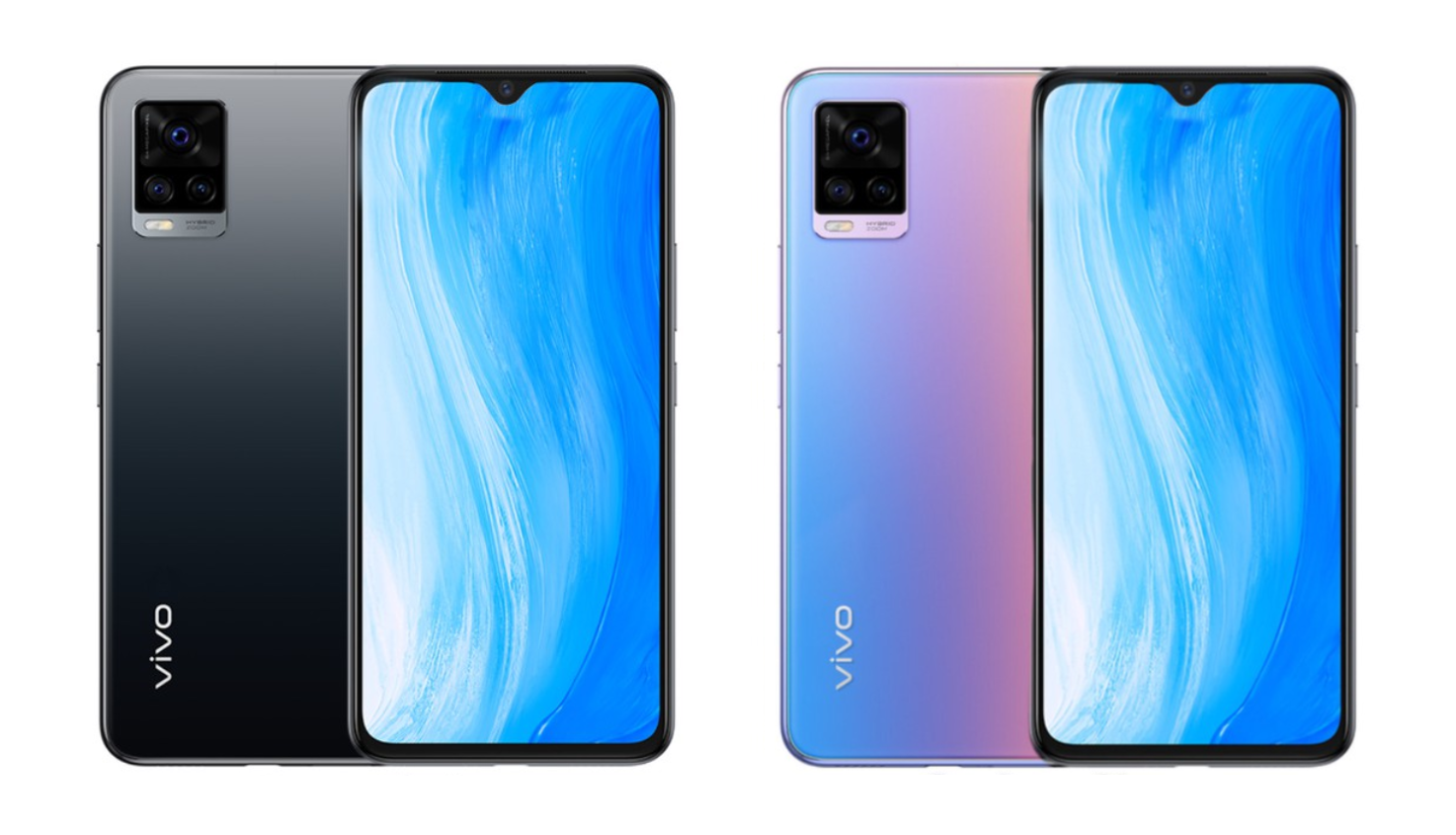
Vivo recently unveiled the Vivo V20 in countries like India and other Southeast Asian markets. However, it could get a sibling soon as a device with V20 2021 moniker appears on certification platforms and now Geekbench.

Vivo V20 in Starry Black and Gradient Blue colors

As 91mobile reports, a Vivo smartphone carrying model number V2040 appears on Geekbench benchmarking platform. The device scores 553 and 1765 single and multi-core scores respectively. Interestingly, the motherboard of the device in testing is ‘sm6150’ and is an Octa-Core processor with 1.8GHz frequency.

For the unaware, the port number of Snapdragon 675 SoC is ‘sm6150’. This suggests that the device is equipped with a chipset that launched two years ago. Anyway, the device in testing also runs Android 11 and has 8GB of RAM. While the Geekbench listing doesn’t shed any light on What could the device be, Indonesia’s SDPPI reveals the moniker.

Accordingly, the model number V2040 on SDPPI(Indonesia Telecom Certification) reveals that the device is “Vivo V20 2021“. Also, it has already got India’s BIS certification hinting that the device is coming to more than one market.

That said, nothing else is known about the device yet. However, considering it has a similar name to the Vivo V20, we can expect a few similarities in design, if not specs. And looking at the two-year-old Snapdragon 675, we feel that the device might be a watered-down variant of the already-selling V20.

The Vivo V20, which was the first device to get Android 11 pre-installed, came with a very slim body, triple cameras, and a display with water-drop notch. Hence, we can expect Vivo to retain it on the V20 2021. Additionally, the Android 11 listing suggests that the device might debut with Vivo’s recently launched OriginOS.

And since we are already at the end of 2020, Vivo should bring it somewhere in Q1 of next year. In any case, we are sure to get more leaks as the launch gets closer.


ZTE Axon 20 5G now available for purchase for $449 with a caveat

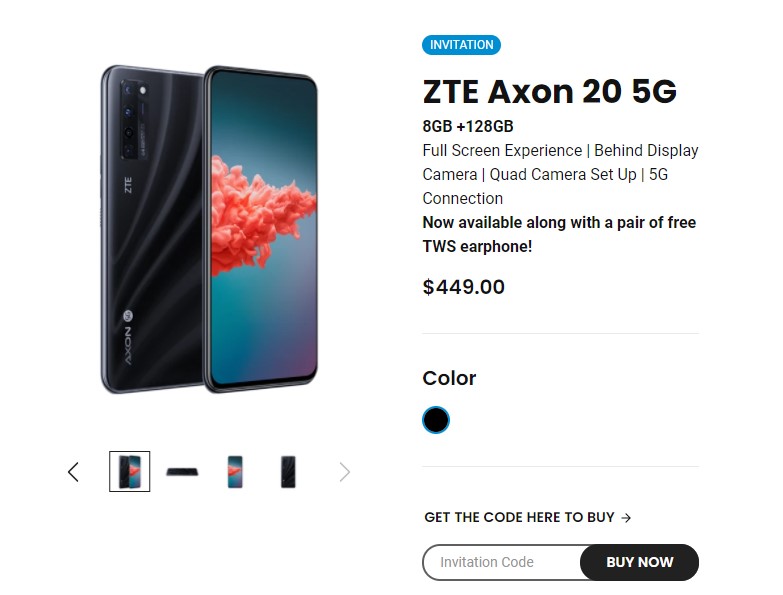
Earlier this month, ZTE’s first smartphone with an under-display camera, the Axon 20 5G was announced for the global market. However, details about the price and availability were not revealed but interested buyers in select countries could make their reservations. Today, the price has now been announced and it is available to purchase in a handful of regions.

ZTE Axon 20 5G purchase page

The Axon 20 5G is available for purchase in Europe, Asia, and Africa. The specific countries are listed below. ZTE is offering the phone in a single configuration and just one color variant. In China, the phone comes in three configurations 6+128GB, 8+128GB, and 8+256GB but global buyers can only purchase the 8+128GB version for a price tag of $449/€449/£419. It is also only available in black.

Purchasing the ZTE phone is not straightforward as interested buyers have to get an invite code (seriously, ZTE?) before they can purchase. To get the code, you have to join ZTE’s New Vision Club and take a quiz. The quiz’ page says “if you pass the test with flying colors, you will receive an invite code within 72 hours”.

The quiz asks a bunch of questions about the phone such as how the under-display camera technology was pulled off and your favorite feature of the phone. You should read the launch article to get answers to some of the questions.

EDITOR’S PICK:
VinSmart plans to launch its smartphones in overseas markets

These are the following countries where the Axon 20 5G is available for purchase:

  • Europe – Austria, Belgium, Bulgaria, Croatia, Cyprus, Czech Republic, Denmark, Estonia, Finland, France, Germany, Greece, Hungary, Ireland, Italy, Latvia, Lithuania, Luxembourg, Malta, Netherlands, Poland, Portugal, Romania, Slovakia, Slovenia, Spain, Sweden, Ukraine, and the UK.
  • Asia – Malaysia, Korea, Philippines, Saudi Arabia, Thailand, and UAE.
  • Africa – South Africa.

The Axon 20 5G has a 6.92-inch OLED display with a 2460 x 1080 resolution and a 90Hz refresh rate. It is powered by a Snapdragon 765G processor that draws juice from a 4220mAh battery with support for 30W wired fast charging and Quick Charge 4+.

The phone has four rear cameras – a 64MP primary camera, an 8MP ultrawide angle camera, a 2MP depth sensor, and a 2MP macro camera. The camera under the display is a 32MP sensor. The phone also has an in-display fingerprint scanner, an “under-screen speaker”, and runs Android 10 out of the box.


Meizu teases Android 11 for its smartphones

Meizu is one of the oldest Chinese smartphone makers. But unlike its competitors, it does not have a much presence outside its home country.  For those unaware, the brand’s handsets run Flyme, a heavy Android skin. This skin is known for first to adopt certain features, which are common today. But the company is infamous for updating the underlying Android version very late but thankfully that may change soon.

Meizu Flyme 8 Android 11 Teaser

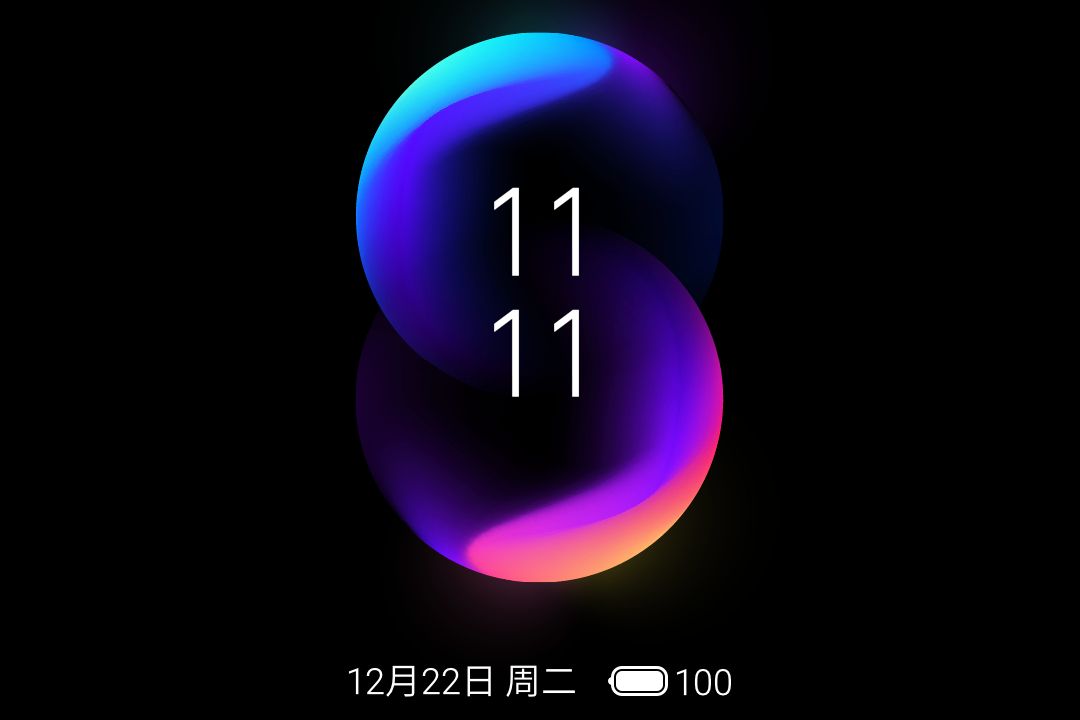
Earlier today, the official Weibo account of Flyme posted a certain teaser. According to the post, the company may reveal something about Android 11 for its smartphones tomorrow (December 22) at 11:11 AM local time.

We think the brand could announce the Android 11 Beta program for its flagship smartphones – Meizu 17 and Meizu 17 Pro. Maybe, the initiative could include other models as well. Because the beta program for the previous major update kicked off simultaneously for multiple devices.

Anyway, it is good to see that Meizu is improving its update delivery. Because the firm started rolling out Android 10 (Flyme 8.1) to its handsets only in late May. That’s eight months after Google officially released the Android 10 in September 2019.

Apart from the new Flyme version, we also expect Meizu to debut its first-ever proper smartwatch called ‘MEIZU Watch’ by the end of this month, which is reported to be under mass-production.


Mi 10 Youth Edition gets Android 11 update in China

Although Xiaomi announced the Mi 10 Youth Edition at the MIUI 12 event, the company shipped it with older MIUI 11 based on Android 10 out of the box. After many rounds of beta updates, today, according to a Telegram Channel, it is getting the Android 11 update in China.

Only recently, Xiaomi updated the stable MIUI 12 based on Android 11 for flagships like Mi 10, Redmi K30 Pro Zoom in China. The company, despite delays, is updating the devices with the latest Android as promised. Hence, the update for Mi 10 Youth Edition is a no-brainer.

Having said that, the update with the firmware V12.1.3.0.RJVCNXM is rolling out to the users in China. Weighing 3.6GB the update brings stable MIUI 12 based on Android 11 to the device. Previously, Xiaomi announced the latest MIUI 12 beta build soon after Google’s official Android 11 announcement.

Initially, Mi 10, Mi 10 Pro, Redmi’s K30 Pro were the lucky ones to taste the new features of Android 11. Later, Xiaomi started bundling the beta update for Mi 10 Youth Edition making it one of the early ones to get it.

That said, with the new stable update, users can enjoy Android 11 features like revamped notifications, chat bubbles(conversations), and more. That said, the device already got the latest MIUI 12 features with the MIUI 12 update back in June.

And considering this new update is rolling as an OTA update, it could take a few days before reaching everyone. The Mi 10 Youth Edition, which features a 6.57-inch Pentile AMOLED display, Snapdragon 765G SoC, a quad-camera system with a 50x Periscope Telephoto lens, recently got price cuts for 8/128GB and 8/256GB variants in China.


vivo Y31 key specs revealed via Google Play Console listing

Although vivo is gearing up to launch the vivo X60 series of flagship smartphones in China on December 29, the company may also unveil a budget smartphone called vivo Y31 in other markets ahead of it. This device was recently spotted on multiple certification bureaus and has been now listed on Google Play Console revealing its key specs and front design.

vivo Y31 Google Play Console Listing

The upcoming vivo Y31 will be yet another budget smartphone with model number V2036. According to the Google Play Console listing, it will run Android 11 out of the box. Thus, the latest Android version could be a key differentiator for this phone as most of the handsets in the segment still run Android 10.

However, its specifications aren’t out of the world as it will be powered by Qualcomm Snapdragon 662, which has now become common. The newly launched Redmi 9 Power also features the same chip.

Further, the phone will come equipped with 4GB RAM and sport an FHD+ (1080 x 2408 pixels) display with a dew-drop notch at the top. But the type of the panel is a mystery as of now.

Nothing else is known about the vivo Y31 apart from the above-mentioned specs. That said, since it has been certified by India’s BIS, Thailand’s NBTC, Singapore’s IMDA, and Russia’s EEC. we can expect this handset to launch at least in these markets.


Huawei Mate40 Pro+ sets a new record in Photo category in DXOMARK Camera test

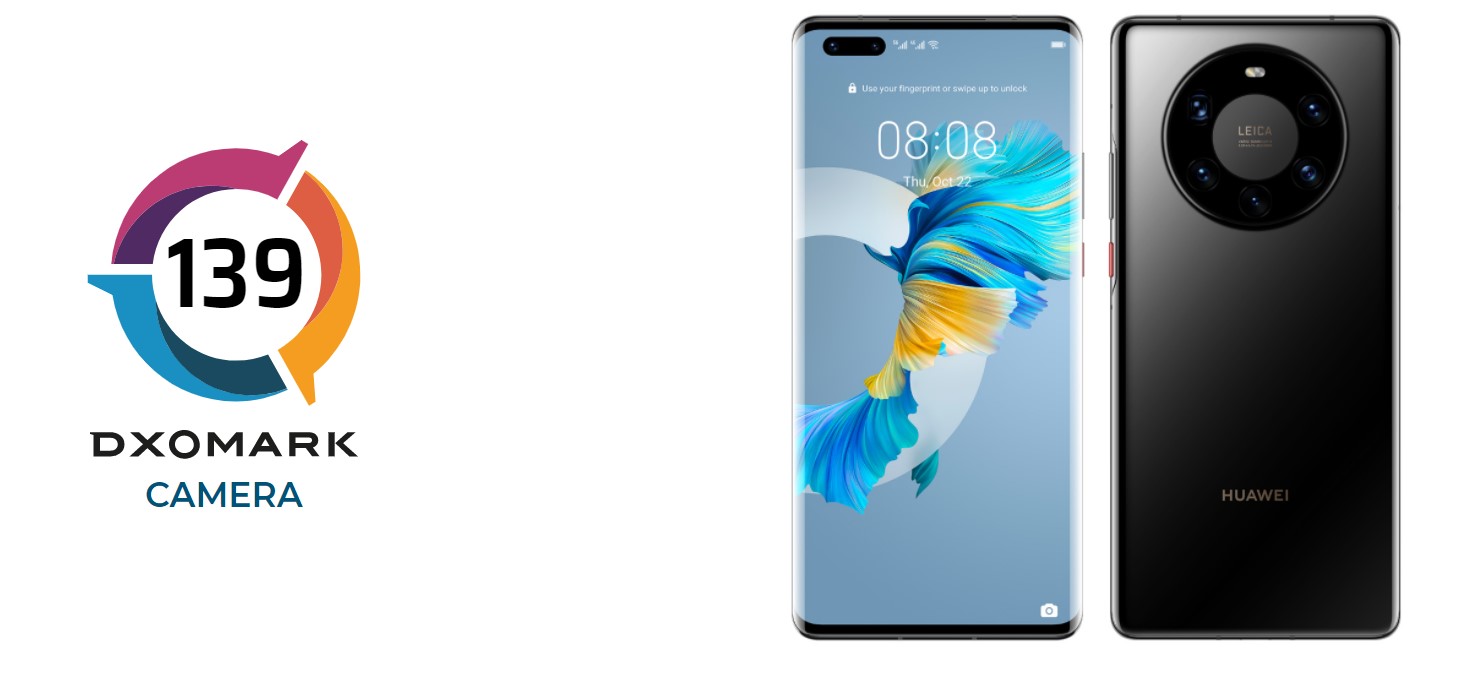
Huawei’s flagships have always topped the charts when it comes to the Cameras. Precisely, DXOMARK, which is known for camera reviews, has time and again spotted the nitty-gritty that Huawei includes in every generation. After reviewing the Mate40 Pro, it has released the rear camera review of the Mate40 Pro+. Accordingly, the device tops the charts beating its sibling by 3 points.


Huawei Mate40 Pro+ gets an overall DXOMARK camera score of 139 points. With this, it sets new a record in the Camera department. It scores a whopping 144 points in the Photo category. As the report says, this is the highest ever for still photos. However, it is three points short(98 points) of beating Mi 10 Ultra in the zoom category.

If you recall, the latter, which previously had the best camera, scores 101 points in the Zoom category. Besides, Mate40 Pro+ also misses the top spot in the Video category to its sibling Mate40 Pro. It scores a point lesser(115 points) than the latter(116 points). That said, Huawei has now captured three of the top 5 spots on the DXOMARK camera rankings and this is impressive to say the least.

In comparison to Mate40 Pro, it has an additional dual-Telephoto lens and 3D ToF sensors. Before we talk about the Pros and cons, let’s briefly take a look at the rear-camera setup on the Mate40 Pro+ below:

  • 50MP f/1.9 Primary
  • 20MP f/2.4 ultra-wide
  • 12MP f/2.4 Telephoto
  • 8MP f/2.4 Telephoto
  • 3D ToF sensor
  • Color Temperature Sensor
  • Video: supports 4K at 60fps
  • Features: OIS(Primary, Telephoto), EIS

The report says that Mate40 Pro+ takes still photos and videos with accurate Exposure, a wide dynamic range, and doesn’t miss out on the highlights. The images are almost similar to those on the Mate40 Pro. However, the extra Telephoto and wider lens(ultra-wide- 14mm FOV), and features like OIS helps take better pictures with wider range, noise reduction, and textures.

However, it has few minor cons like color quantization, ghosting artifacts, shallow depth of field, and less sharpness in video frames(low light). Strangely, the device’s autofocus fails at closer distance and its preview images seem to be different than captured ones.

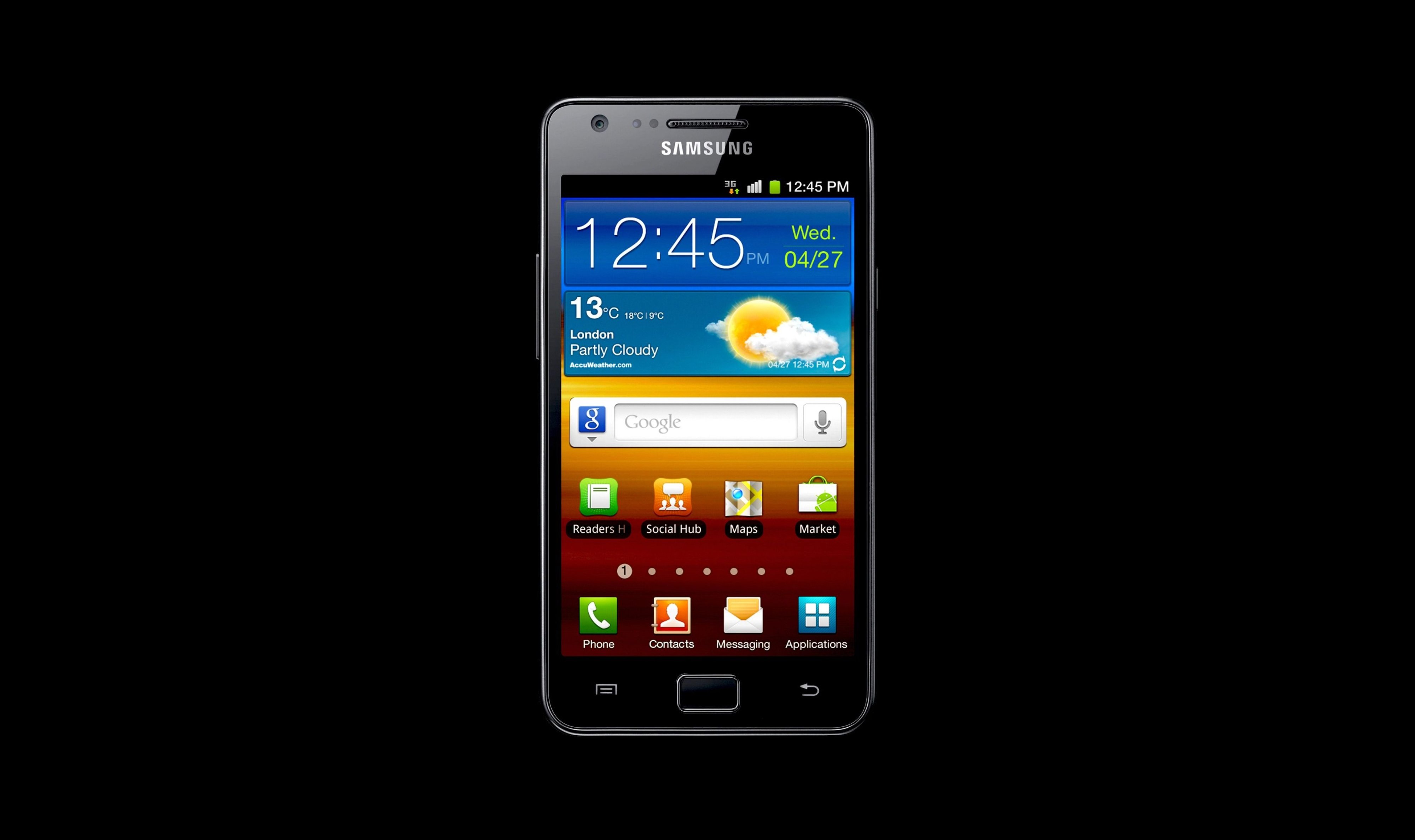
9-year-old Galaxy S2 gets Android 11 update unofficially

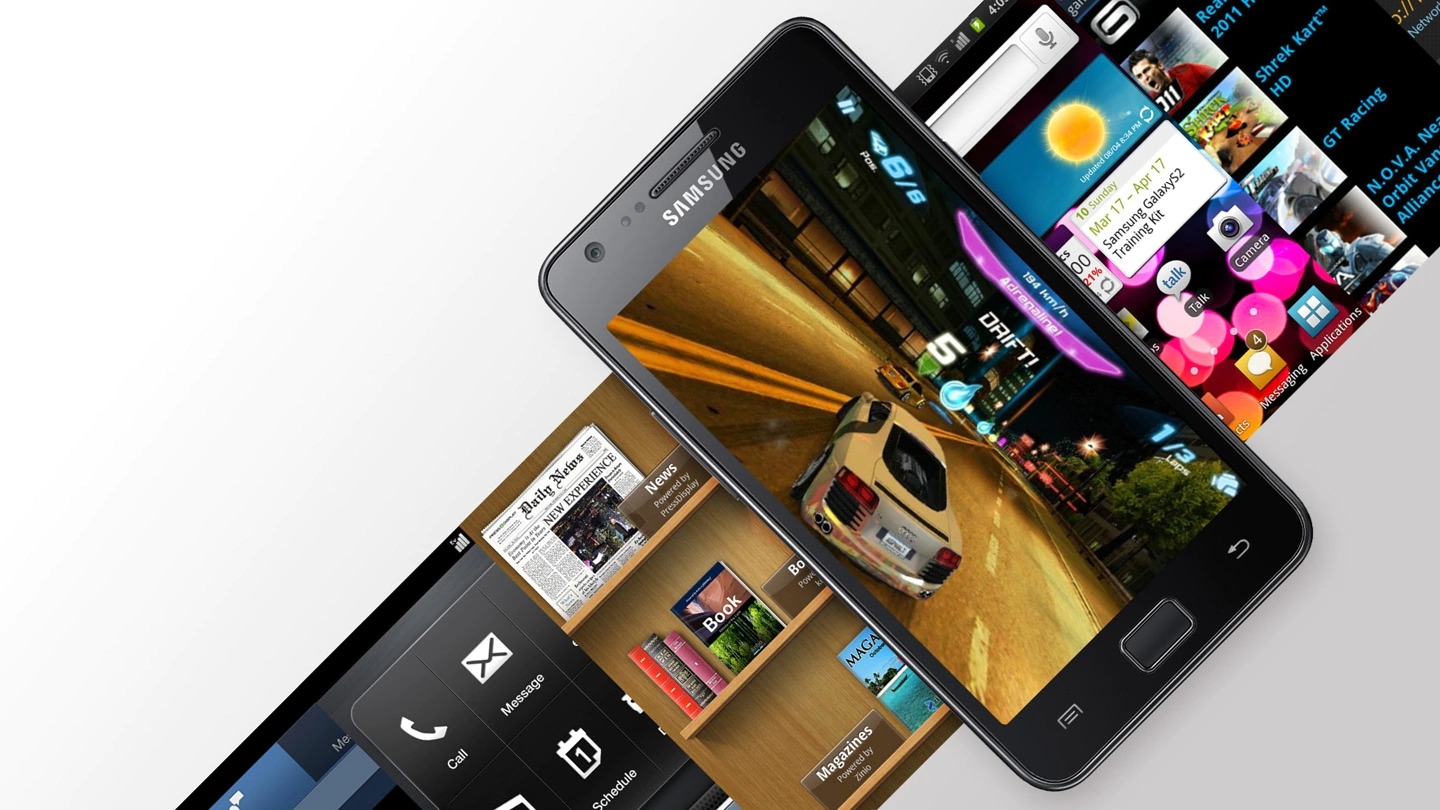
The Galaxy S2 (stylized as Galaxy S II) was the successor to the original Galaxy S. Samsung unveiled this smartphone at the Mobile World Congress in February 2011. The handset debuted with Android 2.3 Gingerbread and was updated up to Android 4.1.2 Jelly Bean. Because of its popularity in the developer community, over 9 years after its release, interested owners can now try Android 11 on this device.

Samsung Galaxy S2

Android fragmentation is a known issue for years. It has reduced to a certain level with the introduction of Project Treble but the problem is yet to be solved fully. Recently, Google and Qualcomm announced that certain high-end Snapdragon SoCs starting with Snapdragon 888 will support up to four years of software updates (3 years of Android updates and 4 years of security patches).

Though the announcement sounded big, actually it wasn’t. Because Samsung had already promised three generations of Android updates for select devices earlier this year and Google has been providing the same for Pixels since their inception. Anyway, the improvement is better than nothing.


Hence, learning that Galaxy S2 from 2011 can run Android 11 after 9 years from its launch is big news. Owners of this phone can try the latest version of Android, which is yet to hit many flagship smartphones released this year.

The Android 11 for Galaxy S2 comes as an unofficial port of LineageOS 18.1 by several XDA Senior Members such as rINanDO, ChronoMonochrome, and others. Since the ROM is compliant with Isolated Recovery (IsoRec), it can be directly flashed via Odin. However, users will have to re-partition and wipe the internal storage of their handset for the installation process.

Samsung Galaxy S2 Featured

Anyway, if you are still owning this phone, it may be mostly lying around somewhere without any use. Therefore, if you are interested in modding, flashing Android 11 on this smartphone is not a bad idea.

According to XDA Developers, this ROM port is only applicable for the Galaxy S2 with model number GT-I9100. As of now, the screen, Wi-Fi, camera, and audio are working properly. But RIL is still a work in progress as users can only receive calls and cannot make one. Similarly, GPS, FM Radio, screencasting, and other features don’t work yet.

You can find the steps to install Android 11 on the Samsung Galaxy S2 by visiting this link.


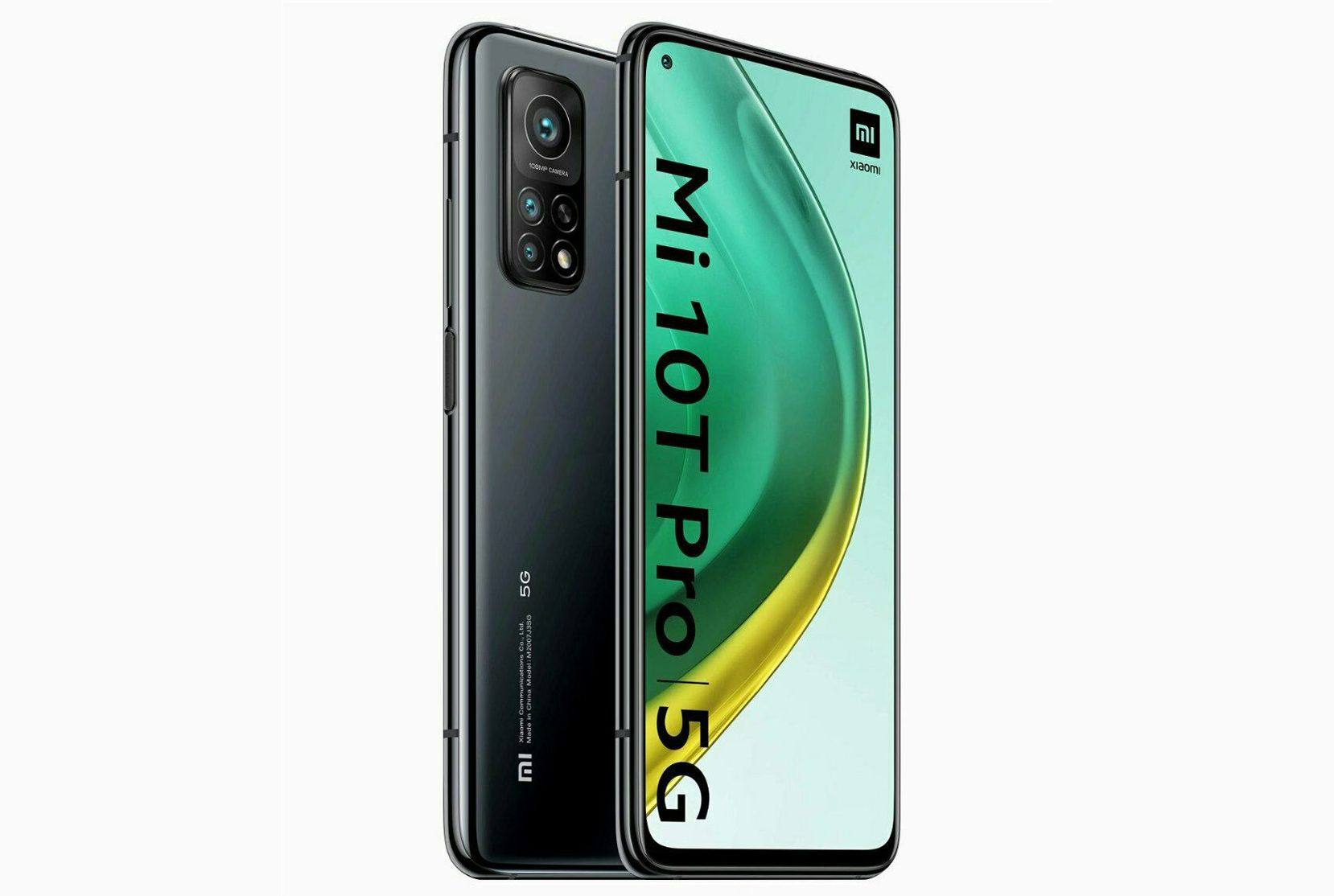
Xiaomi Mi 10T Pro’s dual SIM tray allegedly blocked with glue and plastic by Mexican carrier Telcel

A Xiaomi user has accused the Mexican telecom operator Telcel of physically blocking the dual SIM tray on his Xiaomi Mi 10T Pro. The user bought the smartphone and had planned on using its dual SIM support, but found that the tray was blocked both physically and through software locks.

According to a Xiaomiadictos (via NoteBookCheck) article, the user has accused the carrier Telcel of physically blocking the dual SIM tray on his handset. For those unaware, Telcel is owned by América Móvil and has over 280 million wireless subscribers. However, it has also been accused of subpar business practices on multiple occasions. On its official website, the Xiaomi Mi 10T Pro listing is without its dual SIM feature, although, the Chinese tech giant has clarified that its dual SIM support availability “may vary between markets.”

Xiaomi

Despite this, telecom operators should not be physically tampering with smartphone units without the knowledge of the end customers. The user named Foxhoundelta filed a complaint, the telecom operator has blocked the dual SIM tray port with plastic and glue. The Mi 10T Pro’s ROM also arrives with a software block that locks the feature even if one manages to use the SIM tray. Telcel has yet to respond to these accusations at the moment. Furthermore, it remains to be seen how the situation plays out. So stay tuned for more updates.


Honor V40 design leak reveals watch-like rear camera housing, dual punch-hole screen with curved edges

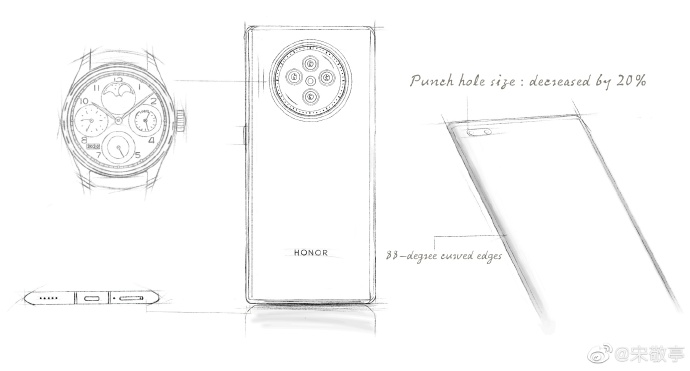
Last week, the Honor V40 had surfaced in the database of CMIIT certification with the YOK-AN10 model number. On Saturday, the device received 3C certification through which it was revealed that it may ship with a 66W fast charger. The handset was previously speculated to launch in December. However, a recent leak claimed that its arrival has been postponed to January 2021. A render and a schematic of the Honor V40 are now being circulated on social platforms. The images (via) show that the Honor V40’s rear camera setup could be inspired by a watch that has four sub-dials.

As it can be seen, the Honor 40 diagram shows that it has a dual punch-hole display. It seems that the size of the punch-hole has decreased by 20 percent as compared to the previous generation Honor V30 smartphone. The diagram states that the Honor V40’s display has 80-degree curved edges.

Honor V40 schematic The back panel of the phone has a round-shaped camera module. The four cameras arranged like the four sub-dials of a watch. The new leaks contradict previous claims that it could be housing a rectangle-shaped camera module.
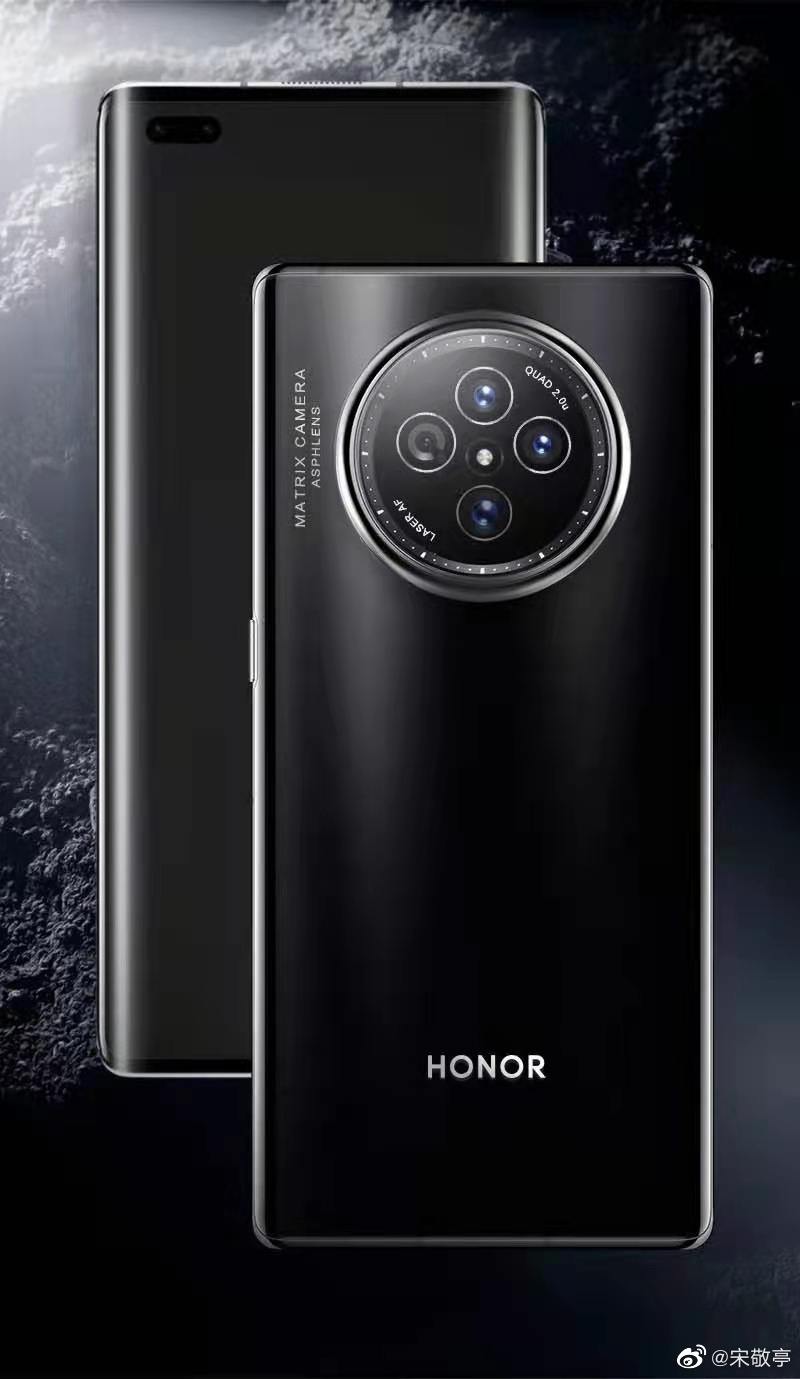
The Honor branding can be seen towards the bottom of the rear shell. The bottom edge of the phone has an external speaker, a USB-C port, a microphone, and what appears to be a SIM slot.

Honor V40 render

Past reports have claimed that the Honor V40 is powered by the Dimensity 1000+ chipset and it has a 6.7-inch FHD+ display with 120Hz refresh rate support. The rear camera setup of the phone may feature the 40-megapixel Sony IMX700 RYYB lens as the main camera. It may arrive with 40W wireless charging apart from 66W wired charging. The other details of the smartphone are under wraps.

It could not be confirmed whether the Honor V40 will be coming with the above-shown design. Hence, it is advisable to digest the leak with a grain of salt.


Apple Car could launch in 2021, two years ahead of its schedule

The Apple Car could be arriving soon, as a new report suggests that the company’s long rumored electric vehicle could possibly launch in the third quarter of 2021, two years ahead of its schedule.

Apple Apple

According to EconomicDailyNews from Taiwan, Apple might be launching its first automobile next year. The report claims that manufacturers and suppliers of the company in Taiwan are preparing to ramp up production of “Apple Care” components as early as the second quarter of next year, as per a MacRumors report. Apparently, the company has already begun testing dozens of prototypes on the road in California, US.

Back in 2017, Apple received a permit from California’s DMV to test its self driving cars. This was first spotted on SUV from another brand that was equipped with its LiDAR technology. While various reports had pinned the Apple Car launch date around 2023 and 2025, the latest report arrives a whole two years earlier than previous expectations. The Taiwanese agency cited an unnamed director from a major Taiwanese manufacturer as its source.

This director stated that Apple is targetting a September 2021 launch, although, this is still an unconfirmed report so take it with a pinch of salt for now. Notably, the schedule shifting earlier is highly unlikely considering the company faced delays due to the Coronavirus pandemic. So stay tuned for more, as we will be providing more updates on the matter.

iQOO 7 tipped to launch by mid-January

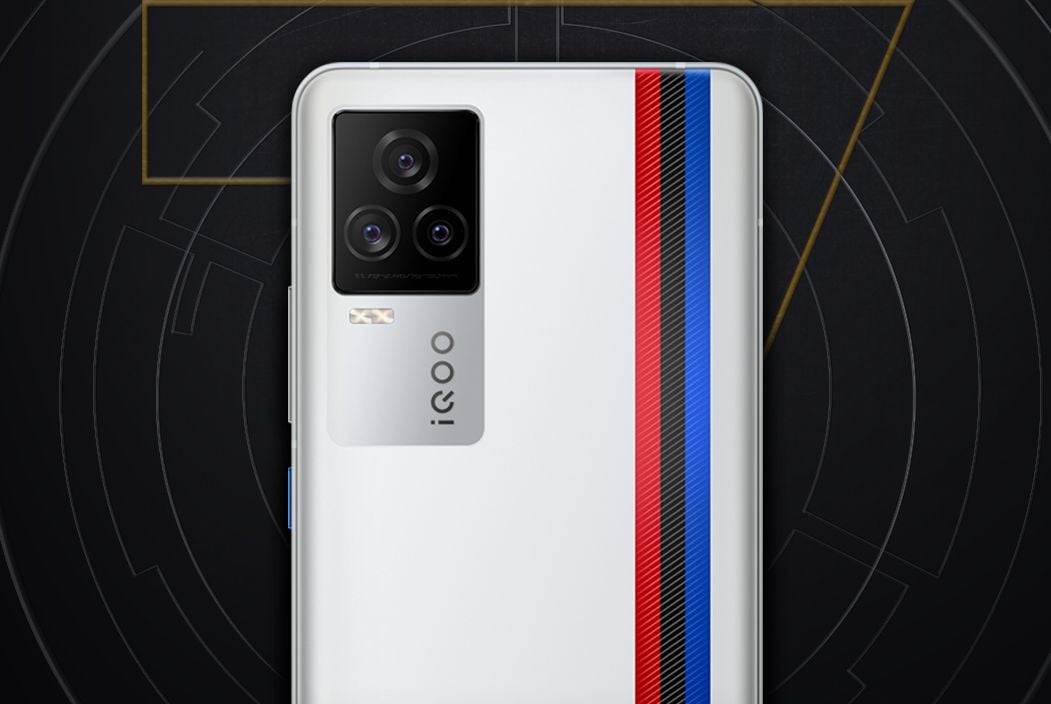
Last week, iQOO revealed the rear design of the upcoming iQOO 7 flagship smartphone. It showcased a special BMW edition of the phone featuring a white leather-like rear with blue and red stripes on the right. The handset was also seen sporting a triangle-patterned triple camera setup housed inside a rectangle module. A reliable tipster from China claimed that the iQOO 7 may launch by mid-January.

The tipster claimed that at least four Snapdragon 888 powered flagship phones will debut in China before the Spring Festival that will fall on Feb. 12. It can be said based on the recent reports that China may receive SD88 powered phones like the Samsung Galaxy S21 series, Xiaomi Mi 11 series, Vivo X50 Pro+, and iQOO 7 before the Spring Festival.

iQOO 7 BMW edition
iQOO 7 BMW edition

It is speculated that an iQOO phone with a V2049A model number that was recently approved by the 3C authority of China could be the forthcoming iQOO 7 phone. The listing had revealed that it may ship with a 120W fast charger.

The tipster who tipped the mid-January launch for the iQOO 7 had previously claimed that it will be arriving with a flat display and a battery that is slightly bigger than the iQOO 5 Pro It is likely that the iQOO 7 may feature a display with a top-centered selfie camera cutout like the upcoming Vivo X60 series.

At present, there is no concrete information on the camera specs of the iQOO 7. The iQOO 5 Pro came with a 50-megapixel Samsung GN1. The leakster claimed that the iQOO 7 may feature a different main camera.


United States to spend $1.9 billion for replacing Huawei and ZTE equipment

United States has banned Huawei from participating in its 5G infrastructure development and has pressured other countries to do the same, and many have complied. Now, the country is set to replace the existing infrastructure.

The lawmakers in the United States are set to back a $1.9 billion program that will provide funding to remove telecom network equipment which the government has classified as posing a national security risk.

Huawei Logo MWC 2019

Huawei and a few other Chinese companies, including ZTE, have been classified as a national security risk. The funding for this new program has been added as a part of a $900 billion COVID-19 relief bill, reports Reuters citing people aware of the development.

Earlier this month, Huawei had said that it was disappointed in the FCC’s decision “to force the removal of our products from telecommunications networks. This overreach puts U.S. citizens at risk in the largely underserved rural areas – during a pandemic – when reliable communication is essential.”

EDITOR’S PICK: Huawei allowed to build 5G in Germany, but with strict conditions

Recently, the United Kingdom also banned Huawei and asked telecom network carriers to remove the Chinese company’s infrastructure by 2027. It recently banned the installation of new 5G equipment from Huawei after September 2021.

The government is also working to create a new law, which once approved, will enable them to plan fines on telecom operators and can have them pay 10 percent of turnover or 100,000 Pounds per day if they fail to comply with the new regulations.