OPPO announced the OPPO A15 budget-friendly phone in India last month. At launch, it arrived in a sole variant of 3 GB RAM + 32 GB storage that was priced at Rs 10,990 (~$148). At the beginning of this month, the Chinese firm announced its 2 GB RAM + 32 GB storage variant with a price tag of Rs 9,490 (~$128). The smartphone is now received a price cut of up to Rs 1,000 (~$13).
With the new price cut, the 3 GB RAM variant of the OPPO A15 can now be bought for Rs 9,990 (~$135) through Amazon India. The pricing of the 2 GB RAM edition has also been slashed to Rs 8,990 (~$121). Buyers can also avail a 10 percent instant discount through Bank of Baroda credit cards, Federal Bank debit cards, and AU Bank debit cards. There is Rs 1,500 (~$20) instant discount on HSBC credit card EMI transactions. The smartphone can be purchased in two colors such as Dynamic Black and Mystery Blue.
The OPPO A15 smartphone has a 6.52-inch IPS LCD panel with a teardrop notch. The display delivers a 20:9 aspect ratio and an HD+ resolution of 720 x 1600 pixels. It has a rear-mounted fingerprint scanner.
The Helio P35 chipset is present under the hood of the device. The SoC is coupled with up to 3 GB of RAM. The handset comes with only 32 GB of RAM. For more storage, users can add a microSD card to the device.
The OPPO A15 draws power from a 4,230mAh battery that supports only 10W charging. The ColorOS 7.2 based Android 10 OS comes preinstalled on the smartphone. It has a selfie snapper of 5-megapixel and its rear-facing triple camera system has a 13-megapixel main camera, a 2-megapixel depth sensor, and a 2-megapixel macro lens.
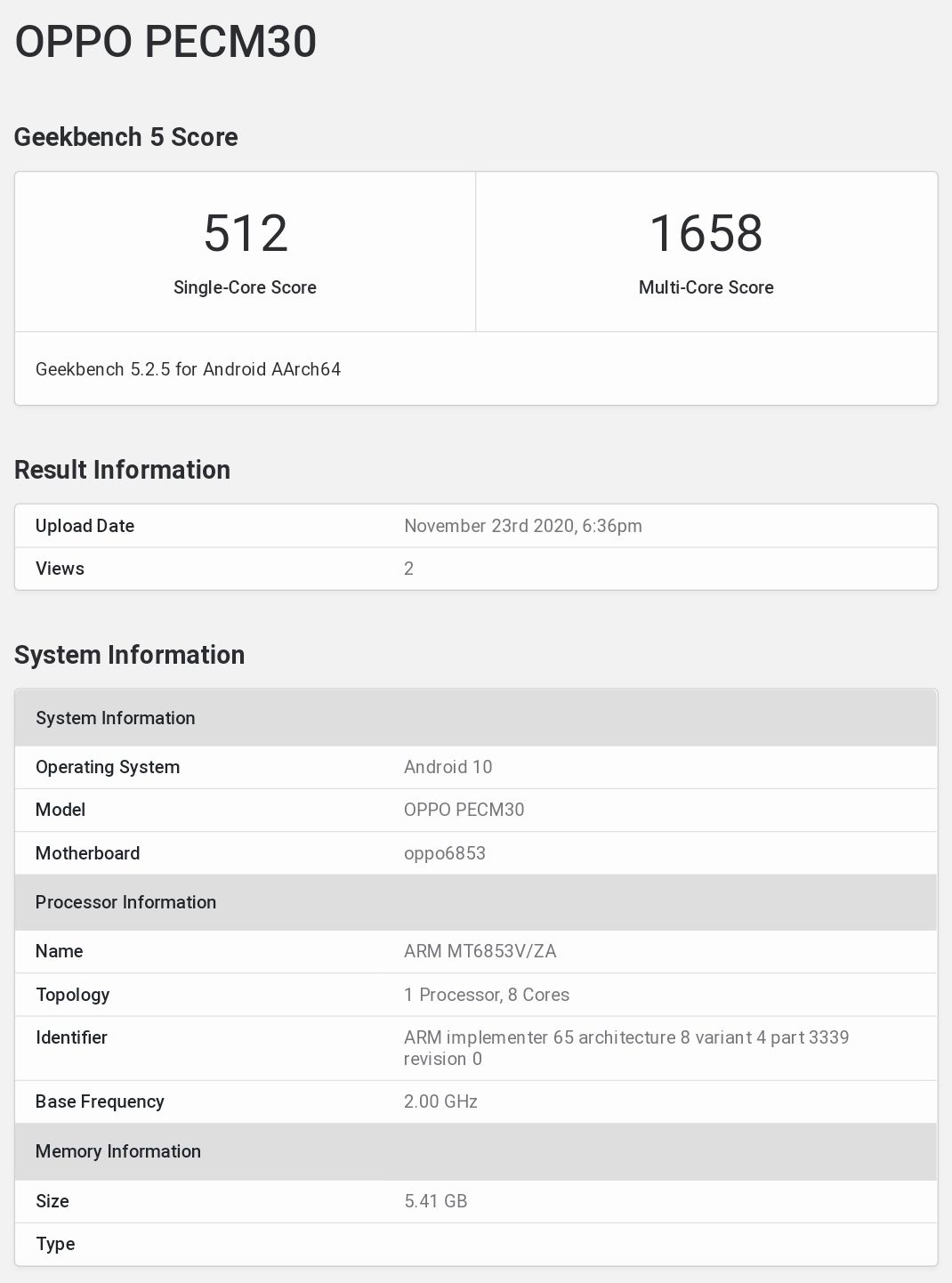
In July, OPPO announced the OPPO A72 5G smartphone (PECM10 / PECT10) in China. The Dimensity 720 powered phone arrived in the Chinese market with a price tag of 1,899 Yuan (~$288). A variant of the same phone with model number PECM30 / PECT30 was spotted at the TENAA certification platform last month along with the PERM00 smartphone. While the PERM00 phone debuted in the home market as the OPPO K7x at the beginning of this month, it is unclear with what moniker the PECM30 / PECT30 phone will go official. A Geekbench listing of the device has appeared to reveal its performance.
On Geekbench 5, the PECM30 phone scored 512 in the single-core test and 1658 in the multi-core test. The handset is fueled by the MediaTek MT6853 chipset i.e. the Dimensity 720 SoC. The SoC is coupled with 6 GB of RAM and the device is preloaded with Android OS.
The PECM30 / PECT30 OPPO phone measures 162.2 x 75 x 7.9mm and it weighs 175 grams. The device is equipped with a 6.5-inch LCD screen that has a punch-hole positioned at the top-left corner. It supports a Full HD+ resolution of 1080 x 2400 pixels and a 20:9 aspect ratio. The handset has a 3,945mAh rated battery and it has a side-facing fingerprint sensor.
The Dimensity 720 powered phone has 4 GB / 6 GB / 8 GB of RAM and it has 128 GB of storage. The device lacks support for external storage. It has a front camera of 8-megapixel and a 16-megapixel + 2-megapixel +2-megapixel triple camera module inside a square-shaped camera housing. The color variants of the phone listed at TENAA are black/white and purple/silver red. In comparison to the OPPO A72 5G, the PECM30 / PECT30 phone has a weaker triple camera system and a lesser amount of RAM.
A new Xiaomi charger with up to 55W fast charging support has received approval from the 3C authority of China. It appears that Xiaomi’s high-end phones arriving next year will come equipped with this new charger.
The new charger that has surfaced at 3C has an MDY-12-EQ model number. The chargers support charging rates such as 5V/2A, 9V/3A, 20V/2.5A, and 11V/5A. The leakster who spotted the 3C listing has claimed that the upcoming mid-to-high-end phones from Xiaomi will feature the 55W fast charger. Even Redmi phones arriving next year will feature the new rapid charger.
In February, Xiaomi launched the Xiaomi Mi 10 and Mi 10 Pro 5G smartphones. The vanilla model came with a 30W charger, whereas the Pro model came with a 50W charger. The Xiaomi Mi 10T series flagships that debuted in the second half of the year came with 33W fast charge support. The Mi 10 Ultra arrived with 120W superfast charging support.
There is a possibility that the newly spotted 55W fast charger could be first seen with the Xiaomi Mi 11 series. Rumors have it that Mi 11 series may go official as early as January 2021. It is expected to debut as China’s first phone powered by the upcoming Snapdragon 875 chipset.
Redmi is expected to unleash the Redmi K40 Pro flagship in Q1 2021. It will be succeeding the Redmi K30 Pro that came with 33W fast charging support. There is a possibility that the K40 Pro may accompany a 50W or 55W fast charger. Hopefully, the rumor mill will soon spill the charging capabilities of the upcoming Xiaomi and Redmi flagships.
Update: A report by MySmartPricethat cites information shared by tipster Sudhanshu Ambhore has revealed that the triple camera system of the POCO M3 has a 48-megapixel main lens with f/1.79 aperture, a 2-megapixel depth sensor with f/2.4 aperture, and a 2-megapixel macro camera with f/2.4 aperture. Other features that have been revealed by the publication include Widevine L1 support, 8-megapixel selfie camera, in-box 22.5W fast charger, LPPDR4x RAM, and UFS 2.1 / UFS 2.2. storage.
Original story continues…
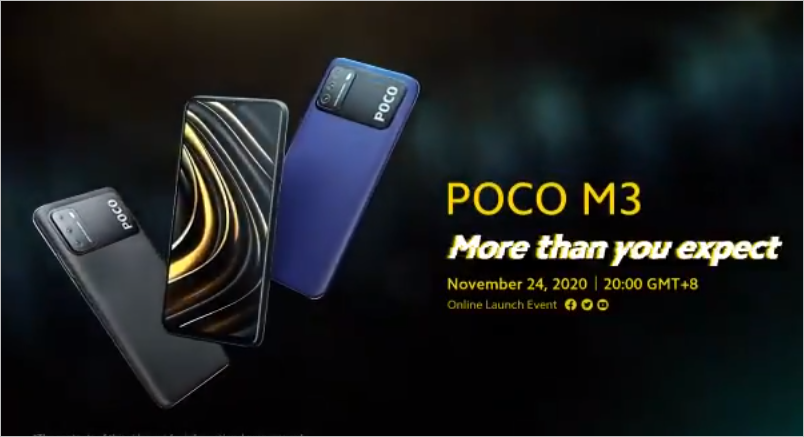
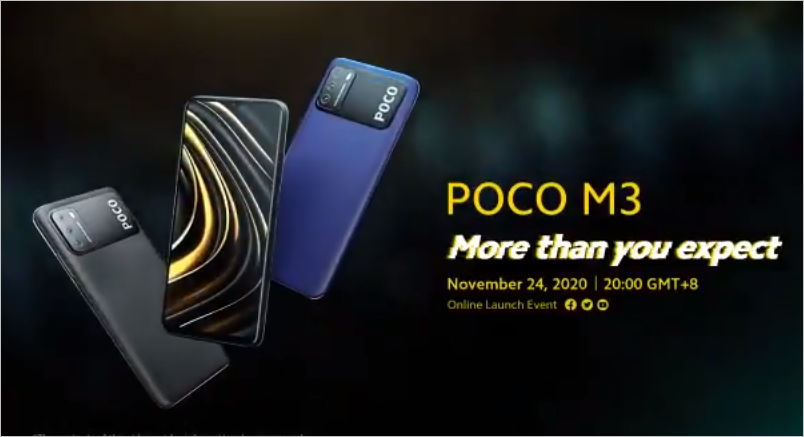
POCO will be launching the POCO M3 mid-range phone in Europe at 8 PM GMT today (Nov. 24). Before its official announcement, POCO has already revealed some of the key features of the smartphone. Now tipster Ishan Agarwal and 91mobileshave collaborated to share the leaked pricing of the POCO M3 hours ahead of its launch.
POCO M3 pricing (Rumored)
The POCO M3 will be available in two variants in Europe. The 4 GB RAM + 64 GB storage edition could be priced around 149 euros (~$176) to 150 euros (~$188). The higher 4 GB RAM + 128 GB storage variant could be priced around 169 euros (~$200) to 179 euros (~$179). The handset will be available in at least three colors such as black, blue, and yellow.
The POCO M3 smartphone will come with a 6.53-inch IPS LCD FHD+ display with a waterdrop notch. It will come preloaded with MIUI 12 based Android 10 OS. The Snapdragon 662 chipset will be present under the hood of the device along with 4 GB of RAM. Apart from up to 128 GB of internal storage, the M3 will have a microSD card slot for more storage.
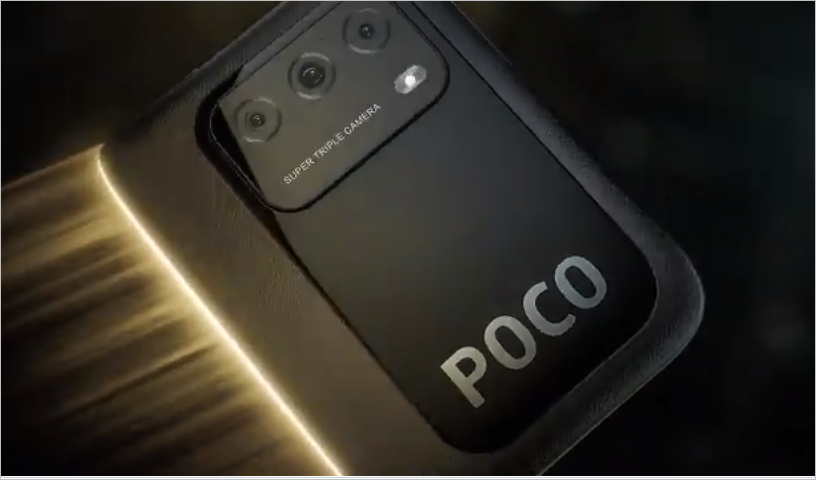
For photography, the handset has an 8-megapixel selfie camera and a triple rear camera setup that includes a 48-megapixel main camera. The unique thing about the POCO M3’s design is that it has a long rectangle-shaped camera module on its back. Towards the left end of the module are the triple cameras with LED flash and on the right the branding of the company. The POCO M3 will draw power from a 6,000mAh battery that carries support for 18W fast charging.
On Nov. 26, Redmi will be announcing the Redmi Note 9 5G series in China. The series will include two 5G-ready Note 9 models and a rebranded POCO M3 handset.
The Redmi Note 8 and Redmi Note 8 Pro both launched last year with Android 9 Pie out of the box. For a few months now, the two phones have begun receiving the MIUI 12 update which brings with it Android 10. Technically, this should be their last Android OS upgrade but new reports say that they may actually get an Android 11 update.
The info comes from a screenshot of a conversation shared by Abhishek Yadav (@yabhishekhd), an Indian leaker. The conversation is from an unofficial Xiaomi & MIUI news Telegram group, and it says that Xiaomi has begun Android 11 internal tests for the Redmi Note 8 and Redmi Note 8 Pro.
Seeing as it is not an official statement, we advise our readers to take it with a pinch of salt. So, until more details surface, and from an official source, don’t get your hopes up.
The possibility of Xiaomi (or Redmi) releasing Android 11 for the two phones seems low as Redmi Note phones usually get one Android OS upgrade but at least two MIUI upgrades. This means that Android 10 should be the only OS upgrade the Redmi Note 8 and Redmi Note 8 Pro will get but the image above says otherwise.
If it turns out to be true, we don’t expect the updates to arrive until much later next year. Xiaomi has several phones that are scheduled to get Android 11 as their first OS upgrade, so these devices will get priority over the Redmi Note 8 series.
If it turns out that the phones will not get Android 11, you can be rest assured that they will get MIUI 13 which should have some of the new features that Android 11 brings.
The Redmi Note 8 Pro has a 6.53-inch FHD+ screen, an Helio G90T processor, 64MP quad rear cameras, a 20MP selfie camera, and a 4500mAh battery with support for 18W fast charging. The standard Redmi Note 8 has a smaller 6.3-inch FHD+ screen, a Snapdragon 665 processor, 48MP quad rear cameras, a 13MP selfie camera, and a 4000mAh battery that also supports 18W fast charging.
Huami has had a really busy year and a successful one at that too. The wearable manufacturer kicked off 2020 with the Amazfit HomeStudio and Amazfit AirRun treadmills at CES 2020. It also made its entry into the TWS earbuds market with the Amazfit PowerBuds and Amazfit Zenbuds.
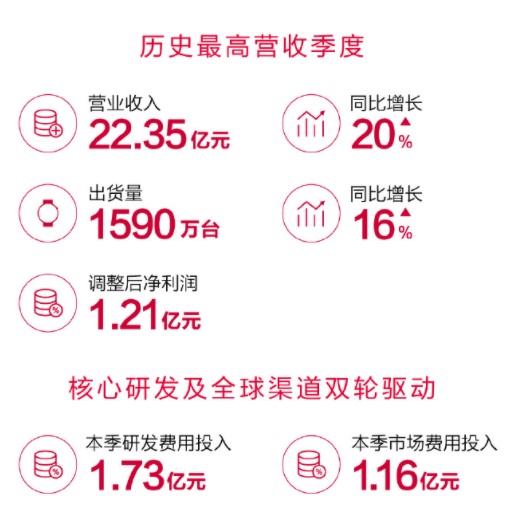
The Chinese manufacturer which is listed on the New York Stock Exchange took to Weibo to brag about its wins. According to the post, the company’s total revenue for the third quarter was RMB 2.235 billion (~$339.35 million), an increase of 20% from Q3 2019.
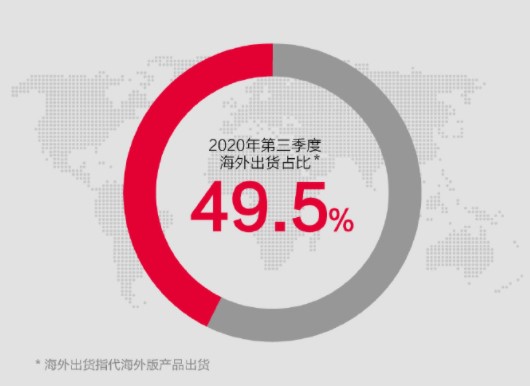
Its shipments were also up 16% from 13.7 million units in 2019 to 15.9 million units in Q3 2020, 49.5% of which was from overseas shipment. Huami says the increase in sales was mainly driven by Xiaomi’s Mi Band 5 along with new models of its Amazfit smartwatches and earbuds.
Overseas shipment made up 49.5% of Huami’s Q3 shipments
The Chinese manufacturer also revealed that its R&D expense for Q3 2020 is RMB 173 million (~$26.3 million), a 38.8% increase from that of Q3 2019. Its sales and marketing budget also increased by 104.2% for a total of RMB 115.6 million.
Huami also disclosed that it has expanded its overseas channels. Its products are now available on AliExpress, Walmart, Best Buy, Flipkart, MediaMarkt, and Reliance Digital.
While we still have a month to go before the year ends, we expect Huami still has a few announcements before wrapping up this year. We have found evidence of an Amazfit Bip U Pro, and the FCC has also certified new smartwatch models such as the Amazfit GTS 2e and Amazfit GTR 2e as well as the Amazfit GTS 2 Mini. However, there is a chance some of these new products may be delayed till early next year.
Renders of the OnePlus 9 Pro leaked over the weekend, revealing a phone with a similar design to the Galaxy S20 FE, albeit with a curved display that has a punch hole at the top left corner. Now, OnePlus’s CEO, Pete Lau has made a comment on the design.
The OnePlus 9 Pro may not look like this according to Pete Lau
The top executive of the Chinese brand took to Twitter to post a not-so-cryptic tweet which we can tell is related to the design of the OnePlus 9 Pro.
No design is ever set in stone. Because if it were, it wouldn't be a very lightweight smartphone.
The first part of Mr. Lau’s tweet’s “No design is ever set in stone” can be translated to mean that the OnePlus 9 Pro will probably not look like the renders have portrayed. Truth be told, the source of the leak, Steve Hemmerstoffer did say that the design may change, most especially the rear camera design.
The second part of the tweet mentions the weight of the smartphone. He even emphasizes that the phone will be very lightweight. The OnePlus 8 Pro weighs 199 grams, which means that its successor will definitely be lighter, probably less than or about 180 grams.
We are eager to see the final design of the OnePlus 9 Pro but with the recent leak, we won’t be surprised to learn that OnePlus has taken precautions to plug the source of the leak and keep the design a secret. We also won’t be surprised if OnePlus itself reveals the design of the phone. Lately, we have seen a number of manufacturers including OnePlus control the narrative when it comes to leaks.
The OnePlus 9 Pro and its standard version, the OnePlus 9, are expected to launch in March. The two phones will come with Qualcomm’s flagship processor, the Snapdragon 875. They will also run OxygenOS 11 based on Android 11 out of the box.
Charli D’Amelio is the first TikTok creator to hit the 100 million followers mark, by a mile. Only two other persons have exceeded 50 million. On TikTok, her feat dwarfs that of many global film and music stars including Will Smith, Kylie Jenner and Ariana Grande.
It also means she reached the milestone of 100 million subscribers in record time. Putting this record in perspective, it took a massive 14 years before any channel on YouTube hit 100 million. D’Amelio only started posting to TikTok in May 2019, and the app which came on stream August 2018. A year back, she had around 6 million followers on TikTok.
It’s a huge milestone for both her and the Tiktok app. However, she may have her eyes elsewhere. In recent months, she has launched a podcast, expanded further into YouTube, and announced the signing of a book deal, among several activities she has been involved with.
As observed with many creators, they often branch out into other social networks as well as traditional media settings once they achieve success on one platform. It allows them to broaden their followership, interact with fans in more outlets and activate a fallback plan when any of the platforms is altered in ways that hurt the creator’s ability to maintain relevance. YouTube creators, for example, have seen changes in the algorithm that seems to highlight and later downgrade certain vide genres.
The commercial aspects of remaining on a platform can also not be glossed over. The ability to make money is thus a driving force in the choice of the creator remaining or exiting the platform. As an incentive, TikTok has begun offering payouts to creators, but thus far, it would seem that the returns are not yet encouraging. Creators also don’t widely have the ability to sell merchandise directly via the app. That means the two main ways TikTok stars can make money are by recording advertisements or they may decide to exit the app for opportunities elsewhere.
The D’Amelio sisters have started a podcast together, and both have been experimenting with traditional YouTube templates to build up their followership. Heidi and Marc, their parents, have started growing their audience, too. They both have their own TikTok, and other social media handles and they feature prominently on the “D’Amelio Family” accounts on those same platforms.
California has long provided a conducive environment for autonomous vehicle testing in the US. However, the state has been prohibiting companies from using these vehicles for commercial activities via ride-hailing services until last week. This was when the California Public Utilities Commission (CPUC) approved two new schemes that allow autonomous vehicle operators to launch their own driverless ride-hailing programs in the state.
The CPUC – in charge of creating regulations for autonomous vehicles for drive-hailing and taxi services has released new rules in fleet services, which is the outcome of several years of rigorous work. The two new programs — the Driver Autonomous Vehicle Deployment Program and the Driverless Autonomous Vehicle Deployment Program provide opportunities to participants to offer passenger service, shared rides, and accept monetary compensation for rides in autonomous vehicles, the watchdog announced recently.
CPUC Commissioner Genevieve Shiroma stated that both programs are important first steps to support the study of the operations of autonomous vehicle fleets and how it can be leveraged to support the grid as a demand-side management resource. Going further, the efforts to incorporate transportation into the electric sector has been better served with the berthing of the two programs. Plans are underway to ban the sale of new combustion engines vehicles in California by 2035.
Interested companies in the two new programs are required to obtain the necessary license, either a charter-party carrier Class P permit or a Class A charter-party certificate in the “Drivered” AV Passenger Service pilot program, together with an AV testing permit from California’s Department of Motor Vehicles. The process is expected to be painstaking in order to address potential security issues and breaches. The process will take several months, hence we may still be far from seeing AVs in commercial operations, accepting passengers.
California has very strong rules for AV operators, among the most stringent in the US. It requires companies to obtain a permit for different types of testing, discloses AV accidents, lists the number of miles covered, and the disengagement number, which is the frequency at which human safety drivers were forced to take control of their autonomous vehicles.
As expected, AV companies do not find California’s requirements friendly, but considering the state is home to a large population of engineers and programmers who work on autonomous vehicles, they have little choice. Currently, 60 companies have active licenses to test AVs with a safety driver in the state. Five companies — Cruise, Waymo, Nuro, Zoox, and AutoX — have, in addition, a permit that authorizes them to test fully driverless vehicles without human safety drivers on public roads.
Companies intending to launch Robotaxi services are required to submit quarterly reports to the CPUC which provides “aggregated and anonymized information about the pick-up and drop-off locations for individual trips; the availability and volume of wheelchair accessible rides; the service levels to disadvantaged communities; the fuel type used by the vehicles and electric charging; the vehicle miles travelled and passenger miles travelled; and engagement with advocates for accessibility and disadvantaged communities,” the Watchdog stated.
There are presently few paid self-driving taxis services in the US, like Waymo, Lyft, Aptiv, and Motional. Thus, the majority of AVs on the road are either on goods deliveries or in a testing-only capacity.
Annabel Chang, head of state policy at Waymo, has praised the decision as an important step to get more autonomous vehicles on the road. “This long-awaited agency action will allow Waymo to bring our fully autonomous Waymo One ride-hailing service to our home state over time,” she stated. She also stressed that the CPUC’s decision comes at a key time as the company inches towards incorporating the latest technology to San Francisco and ultimately putting the Waymo Driver to use in service to Californians.
A new update is rolling out to the OnePlus 7T that brings November’s security patch to the phone. It is a small update and it has begun rolling out to the global version of the smartphone.
The update arrives as OxygenOS 10.0.15 and also comes with some fixes. The changelog for the update is below:
System
Optimized the user experience of the status bar in the call scene to reduce mis-touches
Fixed small probability flashback issue with the Phone app
Updated Android Security Patch to 2020.11
Updated GMS package to 2020.08
If you have not gotten the update yet, then you can do a manual download of the incremental update or the full ZIP from this XDA-Developers page.
There is no news yet regarding when the update will be available for other regions but it should not be far off. OnePlus has also not released the November security patch for the OnePlus 7T Pro and the OnePlus 7 series which are still on September 2020’s security patch.
The OnePlus 7T launched last year with Android 10 and is scheduled to get Android 11. It should also get Android 12 next year as its second major OS upgrade.
The phone has a 6.55-inch 1080 x 2400 display with a waterdrop notch. It is powered by the Snapdragon 855+ with 8GB of RAM and 128GB or 256GB of storage. It packs a 48MP + 12MP + 16MP triple rear camera system, a 16MP selfie camera, stereo speakers, a 3800mAh battery, and support for 30W fast charging.
If you are in search of a new phone and reside in the US, you can grab the OnePlus 7T for just $349 (T-Mobile) which is a sweet deal considering it launched for $599 last year. You also get a free pair of Bullets Wireless Z earphones.
OnePlus launched the OnePlus 8T with OxygenOS 11 based on Android 11 out of the box. Since then, the company has rolled out multiple updates to the device within a month. In fact, it recently rolled out an OxygenOS 11.3.4 update with a number of fixes earlier this month. To add to the tally, the latest OxygenOS 11.0.5.6 brings improvements to the Fingerprint, Network, Battery life and more.
The new OTA(Over The Air) update, as posted on OnePlus Official Forums(via XDADevelopers) has the following build numbers according to regions:
India(IN): 11.0.5.6.KB05DA
Europe(EU): 11.0.5.6.KB05BA
North America(NA): 11.0.5.6.KB05AA
That said, the new OxygenOS 11 update for the 8T includes fixes to fingerprint, Power consumption, battery life, Performance, Camera, Network, and more. Precisely, the update increases the success rate of fingerprint and reduces screen flickering. You can take a look at the entire changelog of the update below:
System
Increased the success rate when registering fingerprint and improved experience
Optimized the media file scanning feature to make searching faster
Further optimized system power consumption and increase battery life
Fixed the issue that the app cache has not been deleted correctly after the app uninstalled
Fixed the issue that the screen may flash when using fingerprint unlock
Optimized system performance and improve stability
Camera
Optimized camera white balance and improved imaging quality
Network
Continuously optimize network connection stability and improved gaming experience
Improve the stability of video calls
As always, the update is rolling out in Batches. OnePlus says the update will currently begin in India followed by Europe and North America soon. If we recall, an earlier OxygenOS 11.0.2.3 update for OnePlus 8T back in October after the first-ever update. It brought critical fixes to Bluetooth, 5G, Gallery App, and more.
Coming back, Since this is an incremental OTA update, it will roll out to a few users initially. After ensuring there are no critical bugs, a wider rollout will follow suit. In the meantime, you can check if your device has got the update by navigating to the System Update section in the settings.
The POCO M3 has been a regular in the rumour mills in recent times, giving us an idea of what to expect from the brand. However, POCO has in the last couple of days released several tweets which reveal the key specs of the device.
One of the teaser posters confirms that the POCO M3 will indeed pack a 6.53-inch display while a second teaser shows that it will be powered by a Qualcomm Snapdragon 662 processor. Xiaomi also confirmed the presence of a mammoth 6,000mAh battery on board the upcoming mobile phone.
1 of 4
Xiaomi has now released an official promotional video which contains renders of the device., The renders give us a clear view of the Poco M3’s front and rear designs. Apparently, the device won’t be a rebadged model of any Xiaomi phone. It adopts a spectacular design which includes a waterdrop notch at the front. At the rear aspect, the device packs a triple camera setup stacked vertically at the top left corner of the back panel. The sensors are housed inside a rectangular module. While Xiaomi has not officially revealed the sensors onboard the device, rumour has it that the M3 will pack a 48-megapixel main camera sensor while the selfie shooter will be an 8-megapixel camera.
The Poco M3 is also expected to come with a Full HD+ resolution, 4 GB of RAM, 18W fast charging support and MIUI 12-based Android 10 OS. Check out the promo video from the tweet above.
POCO is expected to announce the smartphone at noon GMT on November 24. We’ll bring you the full details of the smartphone when it goes official here on Gizmochina.
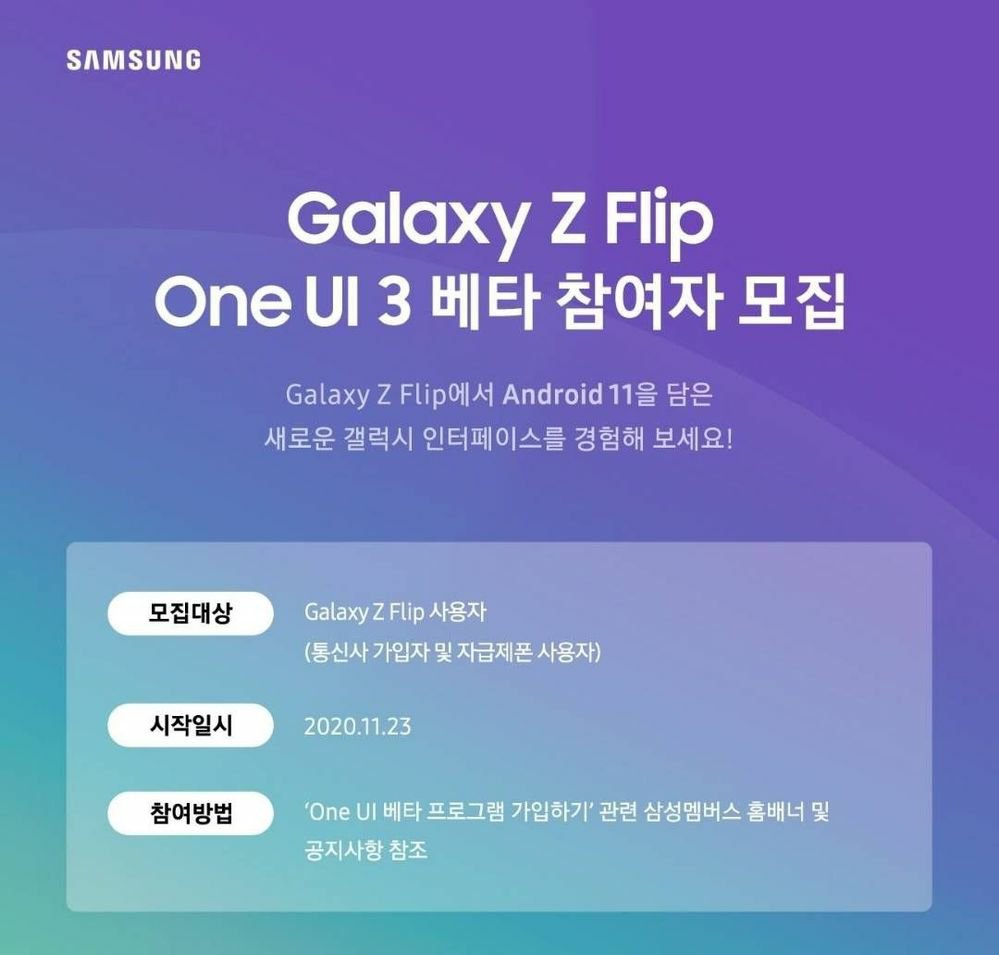
Samsung is finally rolling out the latest One UI 3.0 Beta for the Galaxy Z Flip. This update signals that Samsung has fixed the issues found on the recent beta and that it will resume the update cycle for other devices.
As reported by Tizenhelp, the announcement was reportedly made on the Samsung Members App. Accordingly, the update is currently rolling out to users of South Korea. It includes both the Galaxy Z Flip 5G and LTE variants. This is probably to test that the update doesn’t contain any major bugs before a wider rollout.
Additionally, a beta Operation Manager has reportedly informed the Community that other models of the designated list will start getting the Beta updates this week. This suggests that devices like Galaxy S10, S10+, S10e, Z Fold2, will get the latest One UI 3.0 based on Android 11. Plus, a moderator for Galaxy Note has reportedly confirmed that the next Beta for Galaxy Note 10 series is coming this week.
If we recall, Samsung postponed the update of One UI 3.0 Beta recently after finding a critical issue. The issue was primarily concerning the battery, performance, app crashes after the Galaxy Note 10 update. This meant that the yesteryear flagships including the foldables had to be left out of the Beta program shortly.
Samsung confirmed the OneUI 3.0 based on Android 11 back at the event on August 5. The beta program began after the initial developer build. And is already on course with Beta Program and a vision to bring it close to 90 devices. Anyway, the public final version will likely roll out before 2020 ends.
That said, with this news, Galaxy Z Flip becomes the first foldable phone to get One UI 3.0 Beta update. If you are a user in South Korea and have signed up for Beta Program already, you can head over to the Samsung Members App to see the notification.
You can also try out the new features of One UI 3.0 by installing the update through Settings->Software Updates->Download and Install. If you haven’t signed up for Beta, head over to Samsung Members App and click the One UI 3.0 banner. We suggest users in other regions to wait patiently as the update won’t take long to reach your device.
MSI (Micro-Star International Co., Ltd) is a well-known Taiwanese gaming brand. The company also sells products that are not targeted at gamers. Last week, the brand unveiled three new monitors called PRO MP242 series for everyday use. Let us take a look at the specs and features of these monitors.
MSI PRO MP242V
MSI PRO MP242 / MP242V / MP242P Specifications & Features
All the three models in the MSI PRO MP242 series feature the exact same set of specs and they only differ by the type of stand.
These monitors sport an identical 23.8-inch IPS LCD panel with a resolution of 1920 x 1080 pixels (FHD) and a 16:9 aspect ratio. It is a 6-bit color + FRC panel with support for 16.7M colors, 1000:1 typical contrast ratio, and 99.1% sRGB color gamut.
MSI PRO MP242P
The screen can provide a maximum brightness of 250 cd/m2, 5ms response time, and 178° horizontal/vertical viewing angle. As an added bonus, the display is TÜV Rheinland-certified for flicker-free as well as low blue light emission and features an anti-glare coating, built-in 2 x 2W speakers (4W), and Kensington lock.
As for input, the monitors sport 1 x HDMI 1.4 and 1x D-Sub (VGA) ports. The former can support up to 75Hz refresh rate, whereas the latter is limited to 60Hz.
MSI PRO MP242
Talking about differences, the PRO MP242 and the PRO MP242V come with the same stand, which enables users to tilt them (both have different tilting angles). On the other hand, the PRO MP242P can not only be tilted but also swiveled, pivoted, and heightened. Hence, with the help of its stand, users can also place this monitor in portrait mode (90°).
MSI PRO MP242 / MP242V / MP242P Pricing & Availability
MSI is yet to officially announce the price and availability of these monitors. We will update this article once the company reveals them.
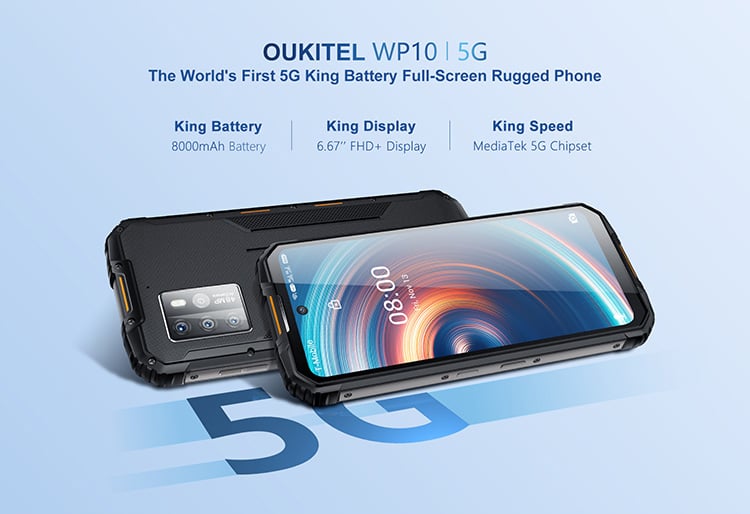
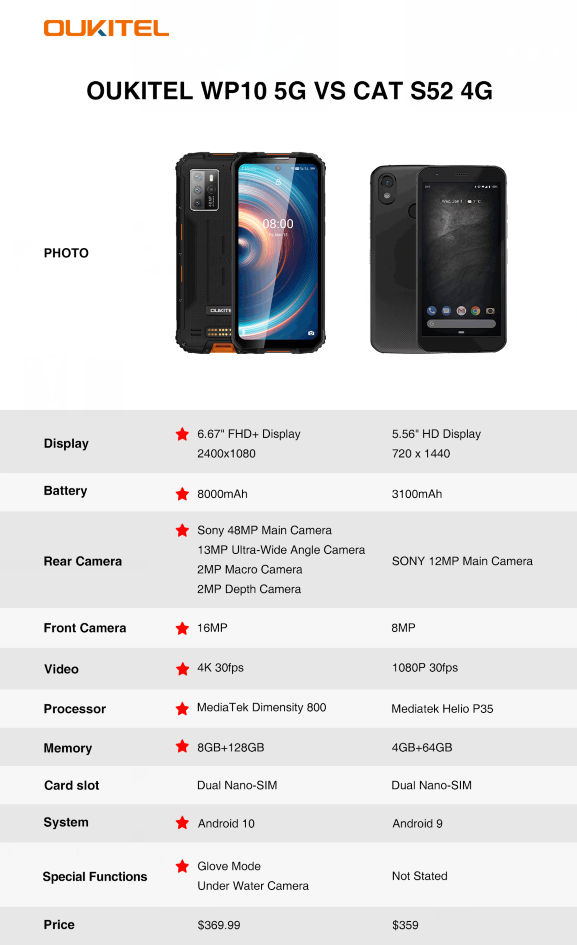
According to a recent tender, Oukitel announced its presale for the flagship Oukitel WP10 from the 23rd of November for just $369.99. This budget revolves more or less around the price of CAT S52 that was released by CAT around the same time last year. And since both of these phones share a similar price range, let’s compare them and see what each offers.
To begin with, let’s start with their similar attributes. WP10 and S52 are both produced for the global market and cover all the bands to offer versatility. Both the devices feature an IP68 and IP69K rating and have a MIL-STD-810G certification for resistance against dust, water and impact. They also support dual nano-SIM.
As for the differences, one of the biggest differences between these devices is that WP10 supports both SA and NSA modes while the CAT S52 features 4G network compatibility. WP10 is powered by MediaTek Dimensity 800 chipset having 7nm process technology with an integrated 5G modem and a 128GB of UFS 2.1 flash storage with 8GB of LPDDR4X RAM. S52, on the other hand, has a MediaTek Helio P35 8-core processor that runs at 2.3GHz with 4GB RAM and 64GB internal storage that can be expanded up to 256GB via MicroSD.
In terms of usage, Oukitel WP10 packs an 8000mAh battery that offers up to 48 hours of active operation, while the CAT S52’s 3100mAh battery 24 hours of use.
Oukitel flagship features a Sony 48MP quad rear camera, capable of shooting 4k videos at 30fps and a 16MP AI selfie camera for clicking decent quality pictures. The CAT S52 phone, on the contrary, boasts a 12MP primary rear camera that uses a Sony dual pixel sensor with an f/1.8 lens. It’s EIS (Electronic Image Stabilisation) feature offers improved low-light performance while the 8MP front camera is perfect for selfies and video calling.
The OUKITEL flagship- WP10 is currently up for presale at AliExpress OUKITEL Official store for just $369.99, making it one of the most budget-friendly devices in the market. And since CAT S52 launched much earlier, it is already up for sale on websites like Amazon. With all the differences and the similarities laid out, it all comes down to what the fans choose and prefer, considering both the devices have a similar price range.
Additionally, GizmoChina is conducting a WP10 giveaway where one lucky winner will get the device for free. To know more about it, click on the link below.
Vivo launched the entry-level Y1s in Cambodia back in August. Now, the company is likely to unveil the same device in India as a report from MySmartPrice says the Vivo might bring the device soon to grab a bite of its rivals’ share.
Vivo Y1s in Aurora Blue and Olive Black colors
As per the report, Indian retail sources say that Vivo will launch the Vivo Y1s soon in the country. And just like every other Y series device, this will be primarily focused on the offline market. If you recall, some of the latest Y series devices in India include Vivo Y20, Y20i, and Vivo Y30. The company is also expected to launch a slightly premium Vivo Y51 from Pakistan to India.
And looks like Vivo Y1s will also join the bandwagon. That said, the report has also got hold of the specs of the upcoming Vivo Y1s and it’s exactly the same as the one that launched in Cambodia.
First, the specification images shared from the retail sources show the Vivo is likely to target rivals like Samsung, Oppo. Precisely, it’s Vivo Y1s will compete against the likes of Samsung M01 and Oppo A1k. If you recall, the M01 launched in India back in June whereas the Oppo A1k launched even before in April 2019.
Anyway, the Vivo Y1s has a polycarbonate shell and comes in Olive Black and Aurora Blue colors. It features a 6.22-inch HD+(720x1520p) Halo Full view display with a NEG T2X-1 protection. Under the hood, it is powered by MediaTek Helio P35 SoC paired with 2GB RAM, 32GB storage. For cameras, you have a 13MP f/2.2 rear and a 5MP f/1.8 front camera.
Other features include 4G, Wi-Fi, Bluetooth, microSD up to 256GB, 4,030mAh battery, reverse charging, and 3.5mm headphone jack.
Vivo Y1s Expected Price India
Both the M01 and A1k retail for ₹7,499(3GB RAM/32GB Storage) and ₹7,999(2GB/32GB) respectively in India. Comparably, the Vivo Y1s in Cambodia launched with a price tag of $109 for the sole 2GB RAM, 32GB storage.
Thus, we can expect a similar price of ₹8,087 if not more in India. That said, Vivo Y1s runs Android 10 and you will get the company’s older Funtouch OS 10.5 UI on top.
Recently, Oukitel announced earlier this week that the Oukitel WP10 will be available for presale on the 23rd of November for $369.99. This price tag is in the same ballpark as the price of CAT S52 which was released by CAT around the same time last year.
Gizmochina along with Oukitel is conducting an Oukitel WP10 phone as a giveaway gift to a lucky reader. Like always, you just have to follow the steps mentioned on the Gleam widget to get a chance to win this amazing gift.
How to enter this giveaway? Just follow these steps:
Share this giveaway contest on Facebook, Twitter, and Reddit.
The winner will be posted on Gizmochina’s twitter and Gizmochina’s Facebook, so please follow us on Twitter and Facebook, so that you don’t miss the winner announcement.
Terms & Conditions:
1. The giveaway is an international giveaway. 2. We are not responsible for lost shipments. 3. We are not responsible for any duties, import taxes that you may incur. 4. We reserve all rights to make any changes to this giveaway. 5. The prize will be shipped in a month when the giveaway ends.
Just follow the steps mentioned in the Gleam widget to participate in the giveaway.
Earlier this year, Motorola launched a proper flagship smartphone after a long time in the form of Motorola Edge+. However, because of its higher price tag and shortcomings, it did not receive positive reviews from the media. Despite that, the company could soon launch another premium handset, as per a new leak.
According to TechnikNews in collaboration with Adam Conway, Motorola is working on a new high-end smartphone with model number XT2125. This device is codenamed ‘Nio’ and will be powered by Qualcomm Snapdragon 865 chipset just like the Motorola Edge+.
Further, the phone will come in a single 8GB + 128GB storage configuration. However, there could be a 12GB + 256GB variant as well but the publication is not sure about it yet. Whereas, for display, the handset will sport an FHD+ (1080 × 2520 pixels) panel with at least a 90Hz refresh rate.
Talking about cameras, this unknown phone will flaunt a triple camera setup on the back consisting of a 64MP OmniVision OV64B sensor with a wide-angle lens, a 16MP OmniVision OV16A10 sensor with an ultra-wide-angle lens, and a 2MP OmniVision OV02B1B depth sensor.
On the front, it will sport a dual-camera setup, which will include a 16 MP sensor OmniVision OV16A1Q sensor with a wide-angle lens and an 8MP Samsung S5K4H7 with an ultra-wide-angle lens.
Last but not least, the upcoming Motorola Nio flagship smartphone will support dual-SIM and will run Android 11 out of the box. The device is expected to launch in Q1 2021 and if it is indeed the successor to the Motorola Edge+, then it should also receive at least two Android updates just like its predecessor.
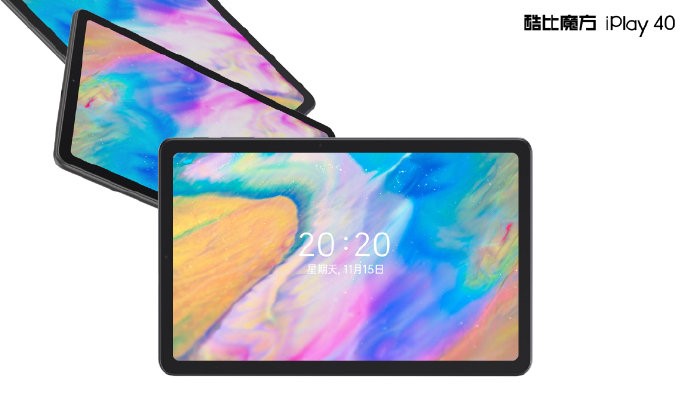
A couple of days back, Alldocube announced the next tablet, iPlay 40 in China. It comes with a UNISOC Tiger T618 SoC. Now, the company has announced additional specs and price of the flagship tablet.
Alldocube iPlay 40 Price, Availability
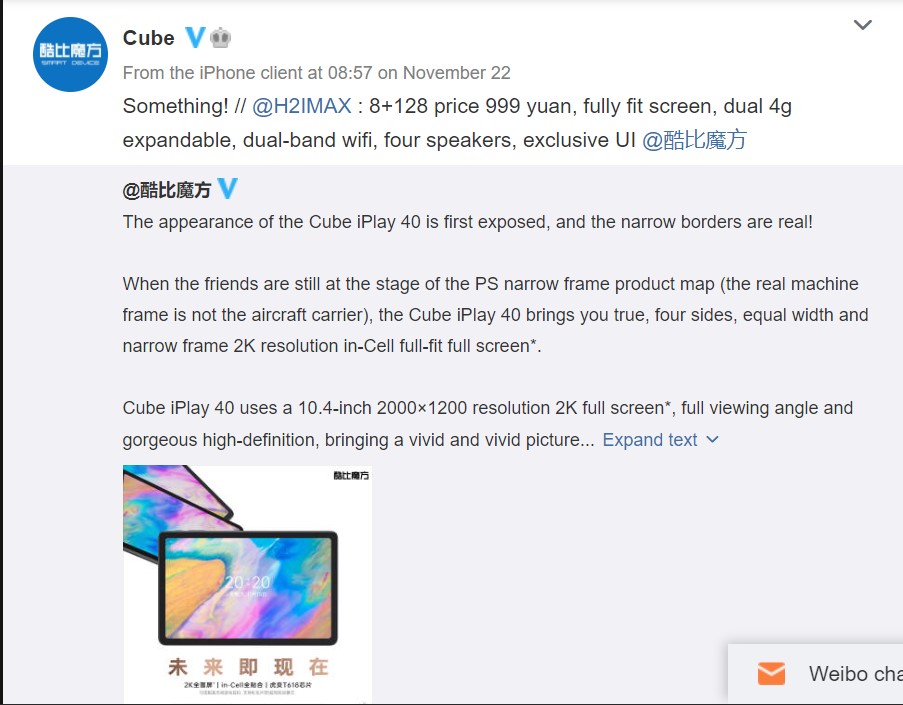
As per the official on Weibo(via ITHome), the Alldocube iPlay 40 is priced at 999 yuan($152). It comes in a single 8GB RAM, 128GB storage variant. That said, for 100 yuan more than iPlay 30, you get an upgraded CPU, GPU, Display, memory, and more. Anyway, the new tablet will go on sale in early December in China.
The Alldocube iPlay 40 features a 10.4-inch 2K display. It has a resolution of 2000×1200 pixels. The company calls it an in-Cell technology and is a full-fit display. This is probably due to the display having equal bezels on all sides. Talking about the design, official images show a grey color. Weighing in at 474 grams, the tablet is about 7.8mm thick.
That said, the company says the tablet has a micro-frame design and is built on Magnesium alloy. Under the hood, it is powered by the UNISOC Tiger T618 SoC. The chipset is UNISOC next-gen octa-core CPU built on a 12nm process. Regarding the cores, it has 2xCortex-A75 cores clocked at 2GHz, and 6xCortex-A55 clocked at 2GHz. It has a Mali G52 3EE game-level GPU.
As per the official poster, the flagship tablet scores 210,000+ in benchmarks. This, along with four BOX Audio speakers should ensure a great experience in gaming, and media consumption. Other features of the tablet include a new Customized UI, Memory expansion up to 2TB, Wi-Fi 802.11ac, Bluetooth 5.0, Dual-4G Network support.
For the unware, Alldocube is a Chinese digital brand and focuses on Android tablets, Windows 2-in1 PCs, MP3 & MP4 Players, E-books, and more. The earlier models of the iPlay series of tablets include iPlay 8 Pro, 10 Pro, iPlay 20, and the recently launched iPlay 30.
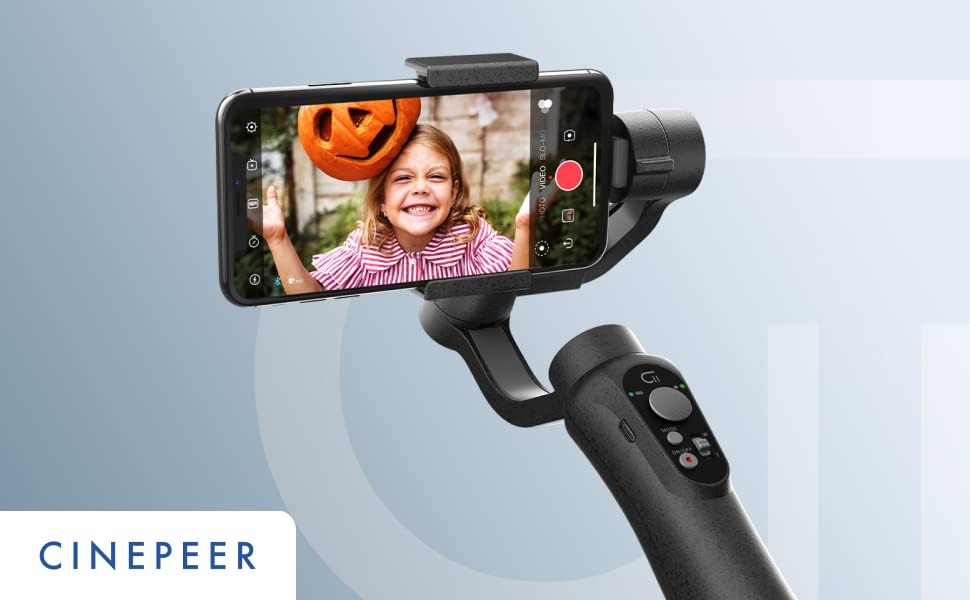
Much-awaited Black Friday week is here with plenty of exciting deals and discounts on almost every item. The users can own their favorite, TV, smartphone, or even a Gimbal this season at astounding reduced prices. Similarly, CinePeer 3-Axis Gimbal is now on sale for $89.99 $54.99 with a 30% discount offer. The buyer can use Coupon Code C11BKQMO (for Black color) and CYBERC11 (for Grey color) to brag additional discount.
CinePeer 3-Axis Gimbal is a perfect fit for iPhones and Android smartphones. The video makers or cinematography enthusiasts can benefit from the Cinpeer phone Gimbal. It offers advanced stability with a 3-Axis stabilizer system and enhances the video recording experience. Advanced features such as Panorama, Time-Lapse, Object Tracking, Motion-lapse are boon for vloggers, storytellers, and videographers.
It houses a powerful battery of 4000 mAh which can withstand 12-hours of continuous use. CinePeer Gimbal also supports reverse charging with 10W power output. It is a lightweight and useful gimbal offering 4 different modes to Pan, Lock, Follow, and POV for better creativity.
The users can flawlessly use the CinePeer device with iOS and Android app.
Technical Specifications
Rotation Range:
Tilt Mechanical Range: 320°
Roll Mechanical Range: 320°
Pan Mechanical Range: 300°
Ports & Mounting:
Micro-USB x 1 (Charging Gimbal)
USB-A x 1 (Charging Phones, 5V/2A Power Output)
Mounting: 1 x 1/4″-20 Femal
CinePeer 3-Axis Gimbal can be yours at an effective price of $46.74 if you use the above-mentioned coupon codes while purchasing. The ongoing offer is appliable between November 23-30, 2020.
We use cookies on our website to give you the most relevant experience by remembering your preferences and repeat visits. By clicking “Accept”, you consent to the use of ALL the cookies.
This website uses cookies to improve your experience while you navigate through the website. Out of these, the cookies that are categorized as necessary are stored on your browser as they are essential for the working of basic functionalities of the website. We also use third-party cookies that help us analyze and understand how you use this website. These cookies will be stored in your browser only with your consent. You also have the option to opt-out of these cookies. But opting out of some of these cookies may affect your browsing experience.
Necessary cookies are absolutely essential for the website to function properly. This category only includes cookies that ensures basic functionalities and security features of the website. These cookies do not store any personal information.
Any cookies that may not be particularly necessary for the website to function and is used specifically to collect user personal data via analytics, ads, other embedded contents are termed as non-necessary cookies. It is mandatory to procure user consent prior to running these cookies on your website.