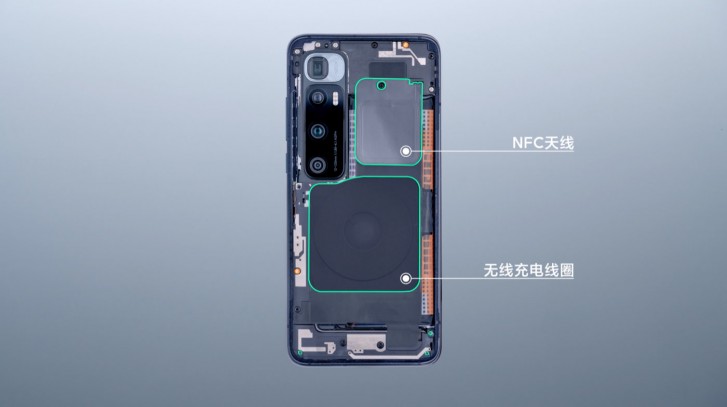
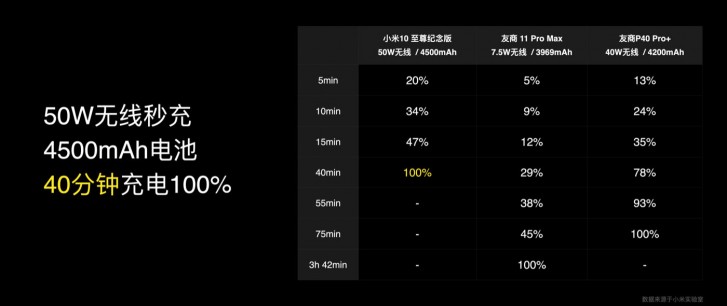
While the Xiaomi Mi 10 Ultra grabbed the spotlight for its whopping 120W wired fast charging support, it was equally if not more admirable that it reached up to 50W wireless fast charging rates as well. This is something most smartphones don’t support through wired charging. Now, the company has revealed a lengthy video explaining how they managed to achieve charging a 4,500mAh battery pack in just 40 minutes.
According to the video, the crucial aspect that allowed the Chinese tech giant to make this technology was to change the layout of the bits between the coil and the battery. In other words, the charging pumps, which are DC-DC converters that are used to increase or decrease voltage. Unlike a traditional layout of having them in series, Xiaomi set them up parallel to each other.
Another benefit of this layout was that the new parallel pump system had the new technology be more energy efficient. Conventional pumps are only 97 percent power efficient, so placing them in series (97% * 97% = 94%). But in the case of parallel pumps, the loss occurs only once with a 98.6 percent efficiency. The difference may not seem like a lot, but just a small change can greatly increase thermal performance.
The materials used in the connectors were also built with a highly conductive graphene-based material that also improved efficiency. Furthermore, the battery itself was split into two halves of 2,250mAh, to maximize charging rates. Xiaomi also focused heavily on the coils, with a multi strand winding technology being used to tightly weave wire in 5 layers. In simpler terms, a lot of clever technology hides beneath the company’s latest flagship handset.
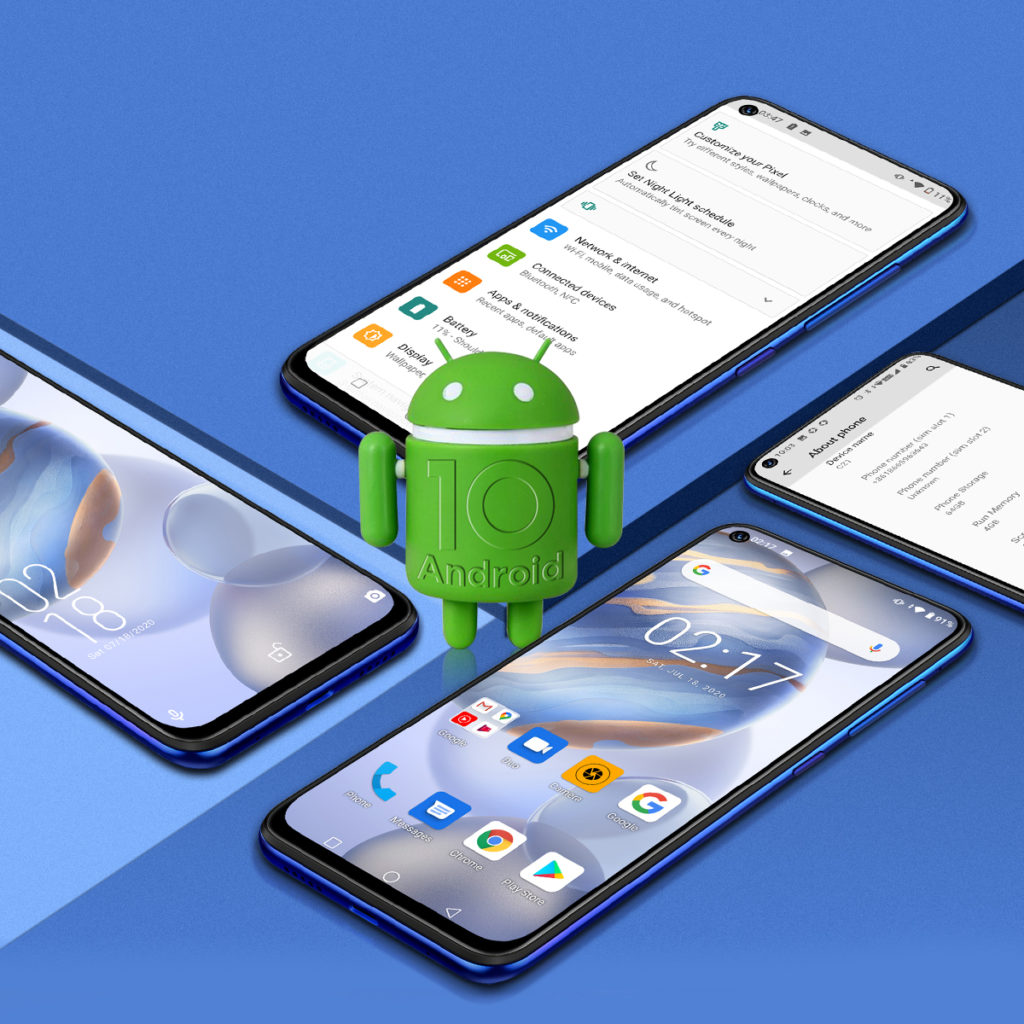
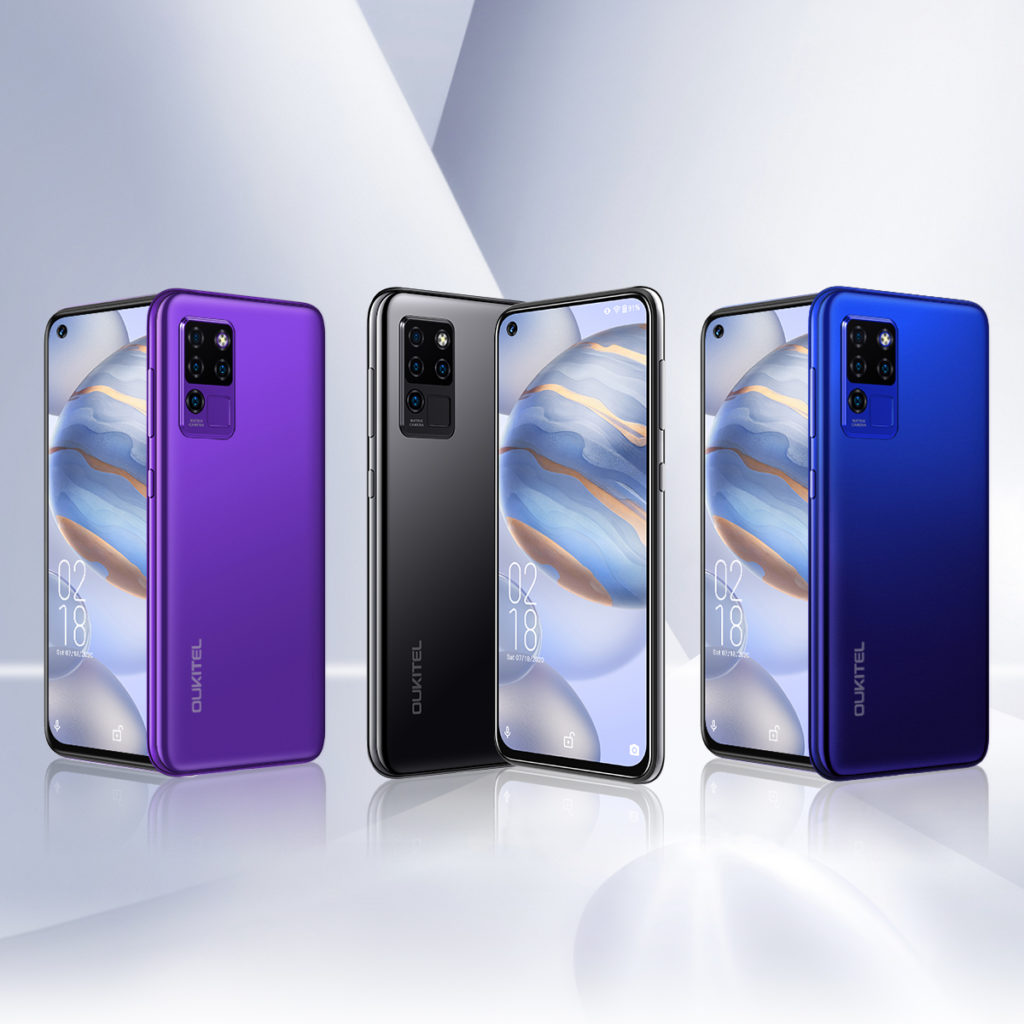
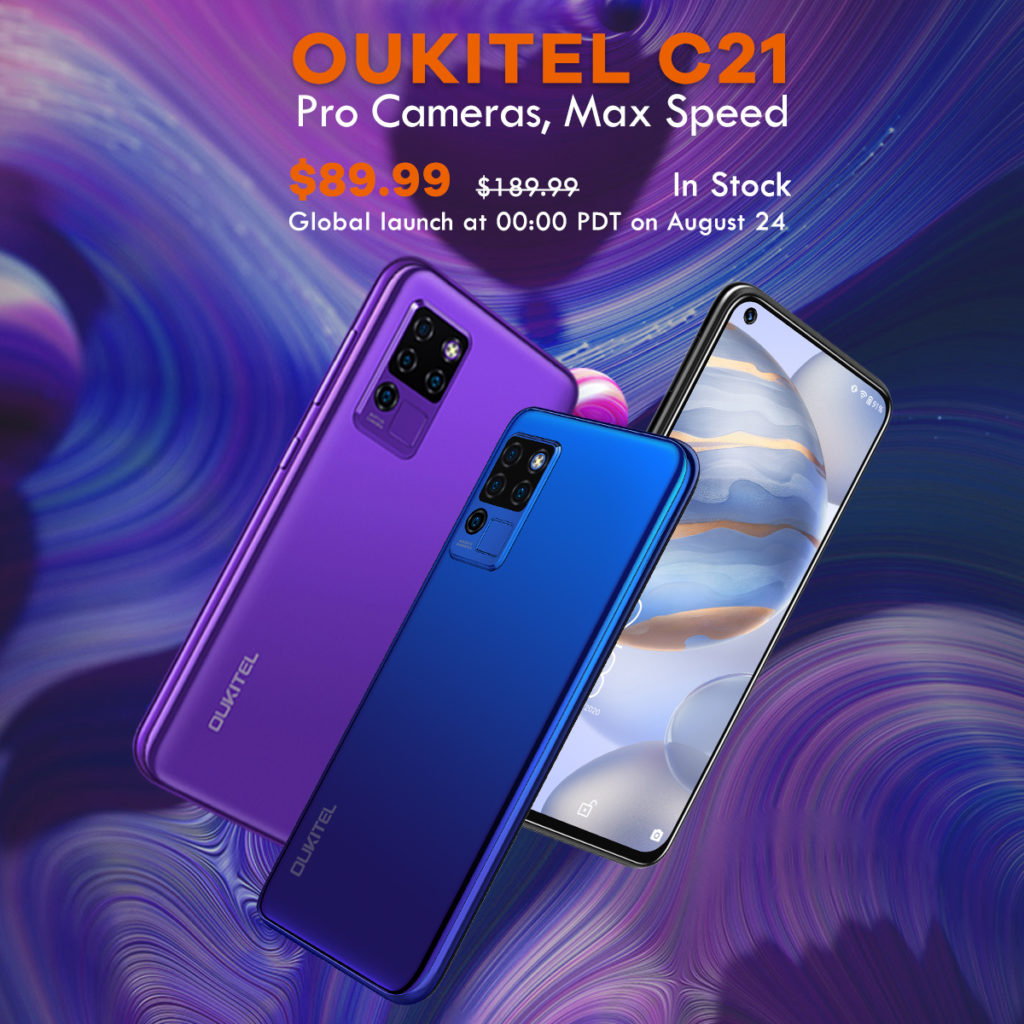
Oukitel recently launched the C21 affordable smartphone in the mid-range segment. The smartphone is scheduled to start retailing from August 24 at an incredible price of $89.99. Primarily, the smartphone houses a Full HD+ punch-hole display coupled with the Helio P60 processor and 16-megapixel quad-camera module. It is regarded as the best budget smartphone of 2020.
Oukitel C21 comes with a beautiful 6.4-inch punch-hole display featuring a Full HD resolution of 1080 x 2310 pixels and a 19.3:9 aspect ratio. It is quite an attractive feature for the devices under $100 price. The small bezels and punch-hole camera design make the screen-to-body ratio clocks to 93%. The is fully efficient to bring you breathtaking visuals and enjoy the content with a wider view. The smartphone features 398 PPI Pixel density for better clarity and sharpness.
The smartphone comes with a wonderful Helio P60 SoC coupled with an octa-core processor with a clocking speed of 2.0GHz and ARM Mali-G72 MP3 GPU. It is built on 12nm technology which makes the chipset highly efficient and optimized for today’s demand. It can easily handle CPU and graphics-intensive tasks easily.
Oukitel C21 features a quad-rear camera featuring a 16-megapixel main sensor, a 2-megapixel macro lens, a 2-megapixel blue lens, and a 2-megapixel auxiliary lens. There’s a 20-megapixel AI selfie camera on the front for quality selfies and video calling. Overall, it is a high0end smartphone that can even shoot quality photos in the low-light environment.
Oukitel C21 runs on stock Android 10 OS with all the new features such as improved dark mode, better privacy controls, and enhanced data security. It houses a 4000 mAh battery with 10W charging for uninterrupted 24 hours use. The smartphone support dual-band WiFi, Bluetooth 5.0, and dual LTE connect for better internet and network connectivity.
Considering the above splendid specifications, the Oukitel C21 is a very well-priced smartphone at $89.99. It is worth every cent and really is the best budget smartphone of 2020.
The interested users can gran the IOukitel C21 in three color options of Ocean Blue, Neon Purple, and Midnight Black from AliExpress official store. However, the company is also running a big giveaway for the new smartphone where the participants can win Oukitel C21. You can enter the giveaway can enjoy the new smartphone for free. You can know more about the smartphone by hearing to the official website.
Motorola has started teasing the arrival of a new smartphone in India. The company is currently mum on the name of the device. The microsite of the phone at Flipkart retailer site reveals that it will be made official on Aug. 24th.
The teaser released by the Lenovo-owned company suggests that the phone is built to deliver impressive performance and camera experience. The Motorola logo on the backside of the phone could be integrated with a fingerprint sensor.
The bottom edge of the mysterious phone has a USB-C port and a speaker grille. The right edge of the phone seems to be equipped with a dedicated button for accessing voice-assistant apart from the volume rocker and a power button.
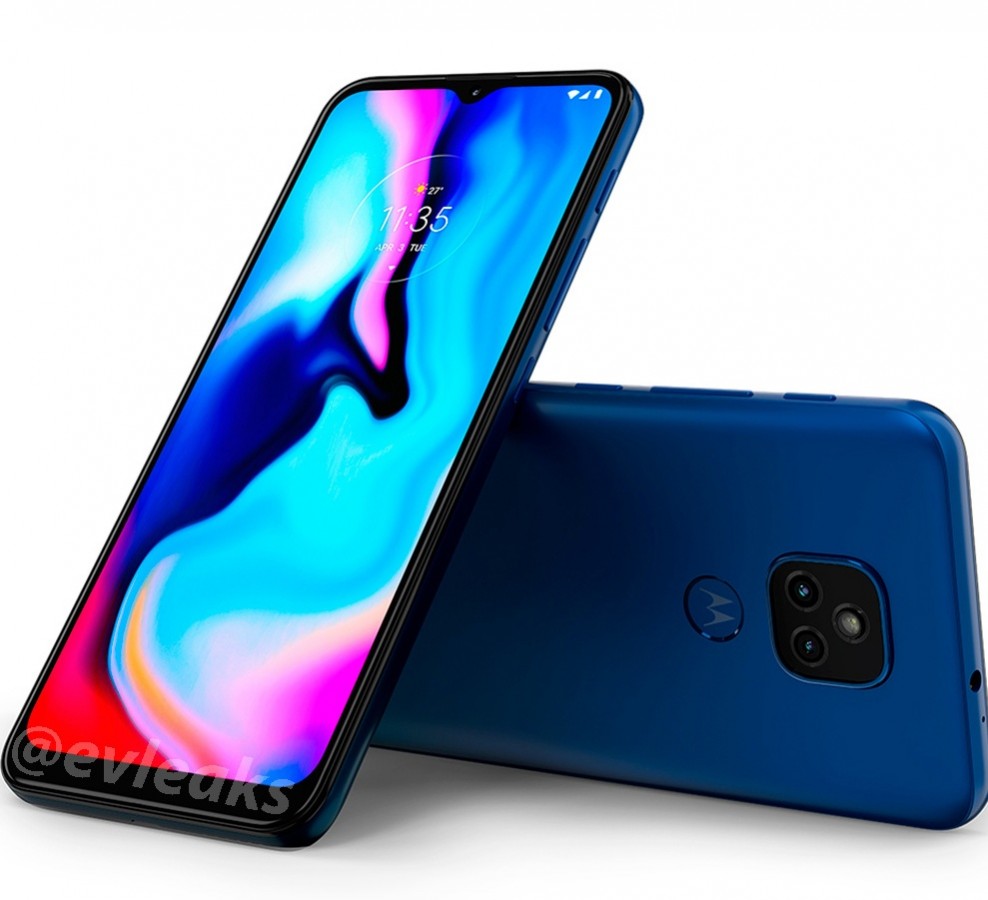
The handset has a waterdrop notch display. The top edge of the device has a 3.5mm audio jack and a microphone hole. A vague view suggest that the phone could be fitted with a square-shaped camera module on its back.
The teased phone seems to resemble the leaked render of the Moto E7 Plus that appeared yesterday. Hence, it appears that the Lenovo-owned firm may launch the Moto E7 Plus on Aug. 24 in India. There is a possibility that the teased phone could be something else, and not Moto E7 Plus. Hence, it is advisable for newer teasers to know more about the mysterious phone.
Moto E7 Plus specifications
So far, past reports have revealed that the Moto E7 Plus phone is fueled by the Snapdragon 460 chipset. It has 4 GB of RAM and 64 GB of storage. The Moto E6 Plus’s successor is equipped with a 5,000mAh battery and it is loaded with Android 10 OS. The backside of the phone has a 48-megapixel dual-camera system that will offer users with Night Vision mode for low-light photography.
Last year, OnePlus made its big move by expanding into the Smart TV category with its OnePlus TV Q1 series. The premium TV model offered an excellent OLED panel and high-end features at a high-end price. But in a segment dominated by veteran TV makers like LG and Samsung, OnePlus’ TV was always going to have a tough time.
Fast forward nine months and OnePlus is back with a couple of cheaper TV lineups – the OnePlus U series and the OnePlus Y series.
In a lot of aspects, the OnePlus U series is an embodiment of its origin philosophy – providing premium specs at an affordable price tag. The OnePlus U1 series, specifically its 55-inch model, offers sophisticated features at a relatively affordable price. Well, it’s not exactly cheap at ₹49,999, but at this price, you get a high-quality 4K LED panel, fluid and useful interface, a redesigned remote, and a number of smart connectivity features.
But these things are all on paper.
How’s the experience in real life? That’s what we’ll find out in this review of the OnePlus TV U1 55-inch.
OnePlus TV U1 55-inch Review: Installation
At the time of delivery, my apartment complex didn’t allow visitors or outsiders to enter the building premises (we had a COVID-19 case nearby). So I had to take the delivery in the lobby and carry the TV to the lift (with a little help from my security guard), and then to my apartment.
Naturally, the package is huge, and I thought I would have a tough time installing this huge TV. But to my surprise, the hardest part of installing the TV was lifting the TV to place it on my table.
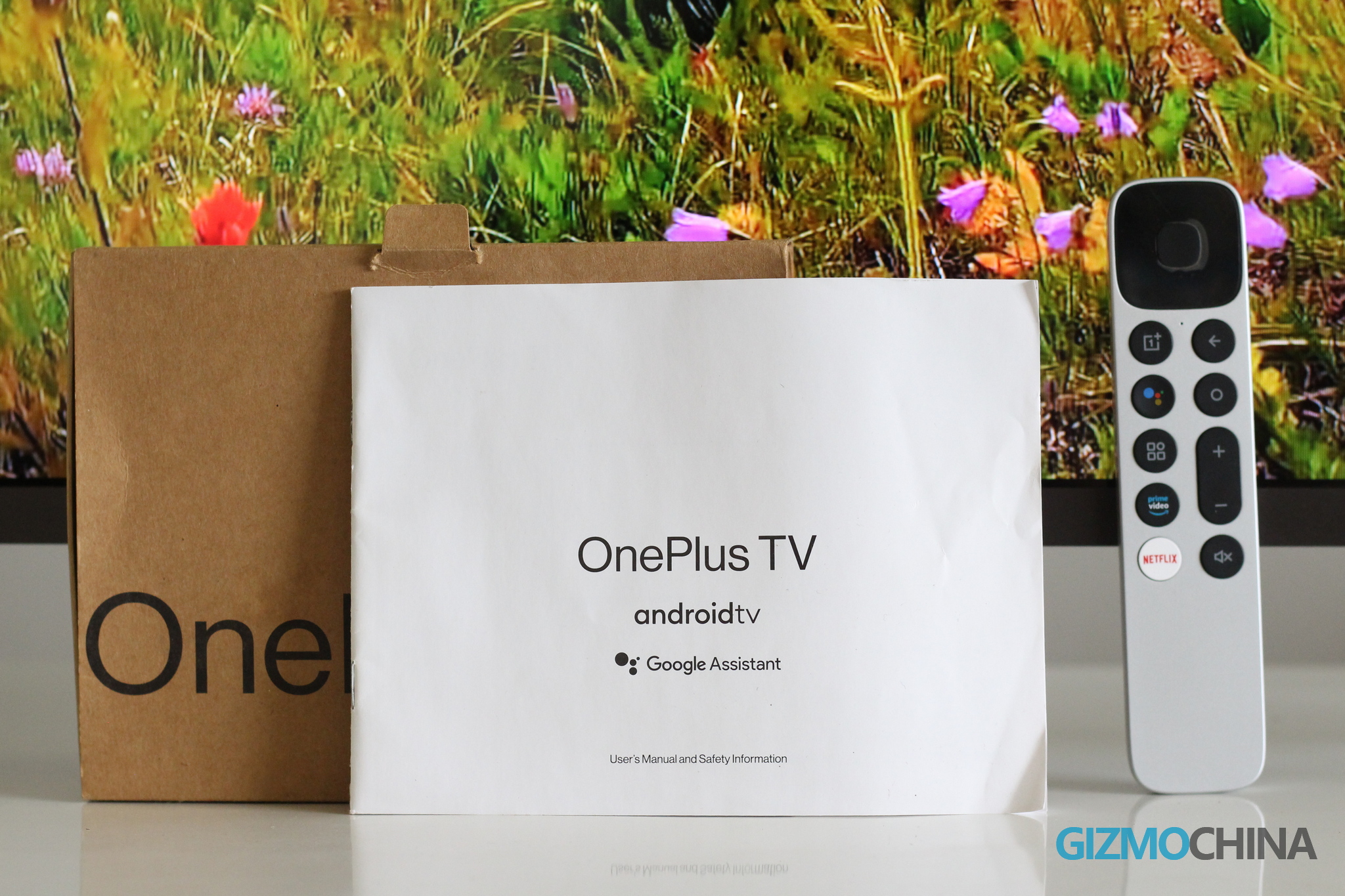
Inside the box, you get the 55-inch OnePLus U1 TV, a user manual, remote with two AAA batteries, a couple of cables, and two table stands that go on each side. Note that the TV is heavy and if you are installing it on your own for some reason, be very careful when you are lifting it up or attaching the table stand.
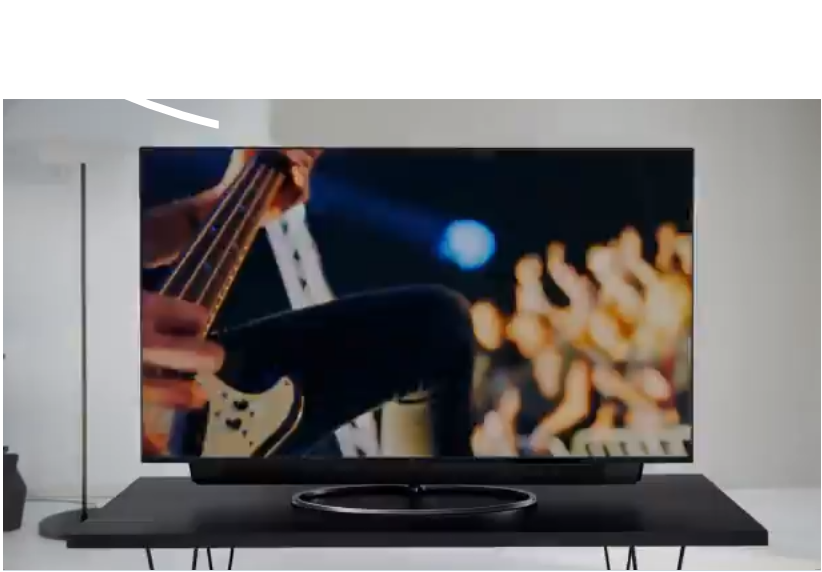
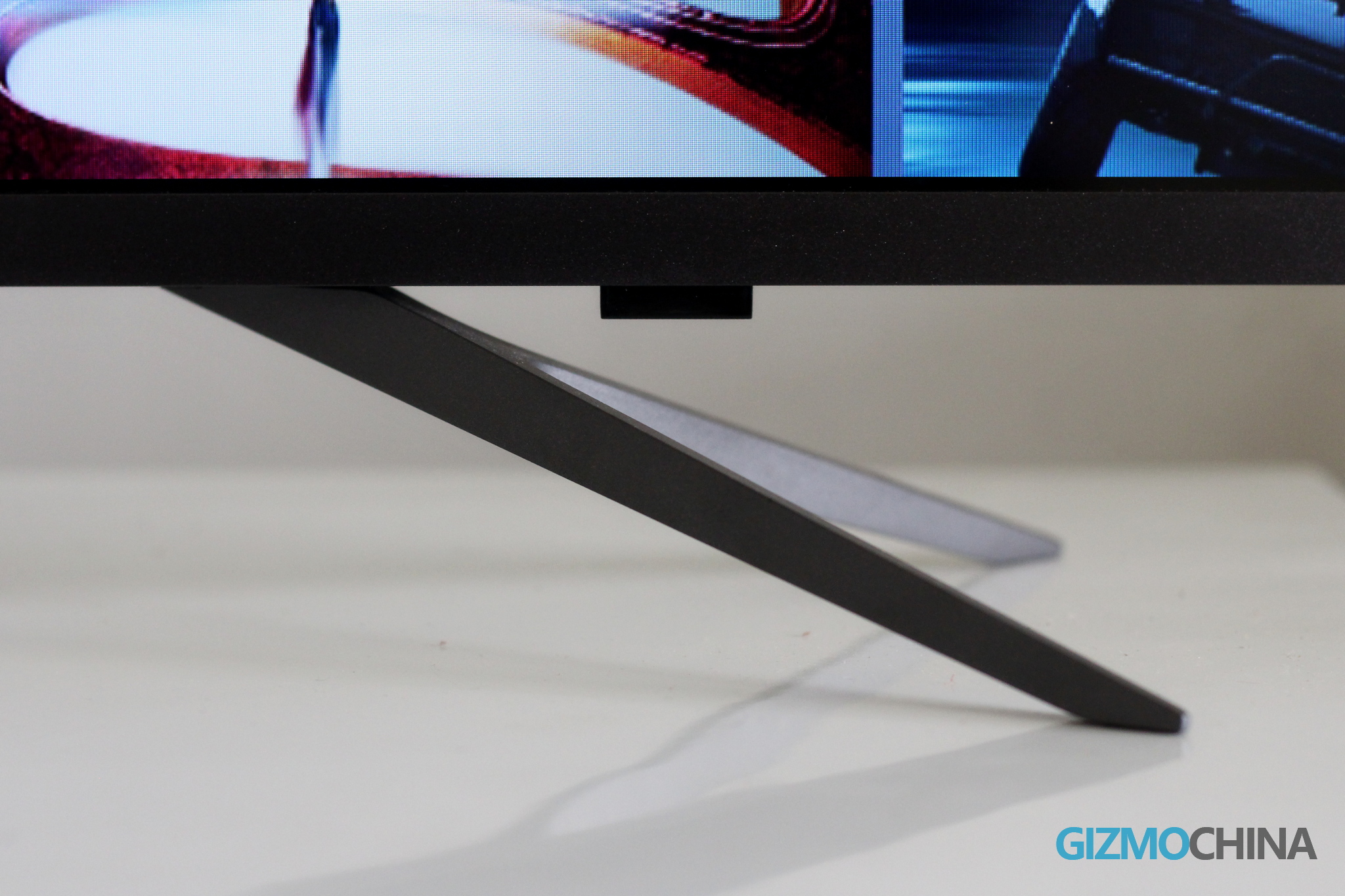
Installing the table stand was very easy. Ensure that you lay the TV on a safe surface and you just have to attach the stand to the TV with three screws on each side. It’s pretty straightforward and despite its thin profile, the stand does an outstanding job of keeping the TV sturdy on the table. This is a significantly better solution that the circular base found on its premium Q1 series.
OnePlus Q1 QLED TV comes with a circular base
The TV doesn’t come with a wall mount in the box. But OnePlus informed me that customers can request the wall mount at the time of delivery free of charge.
The OnePlus TV U1 runs on Android TV 9 Pie. Even if you have never used the Android TV platform before, note that it’s similar to Android’s setup screen and you’ll be able to finish up the installation process within minutes.
OnePlus TV U1 55-inch Review: Design
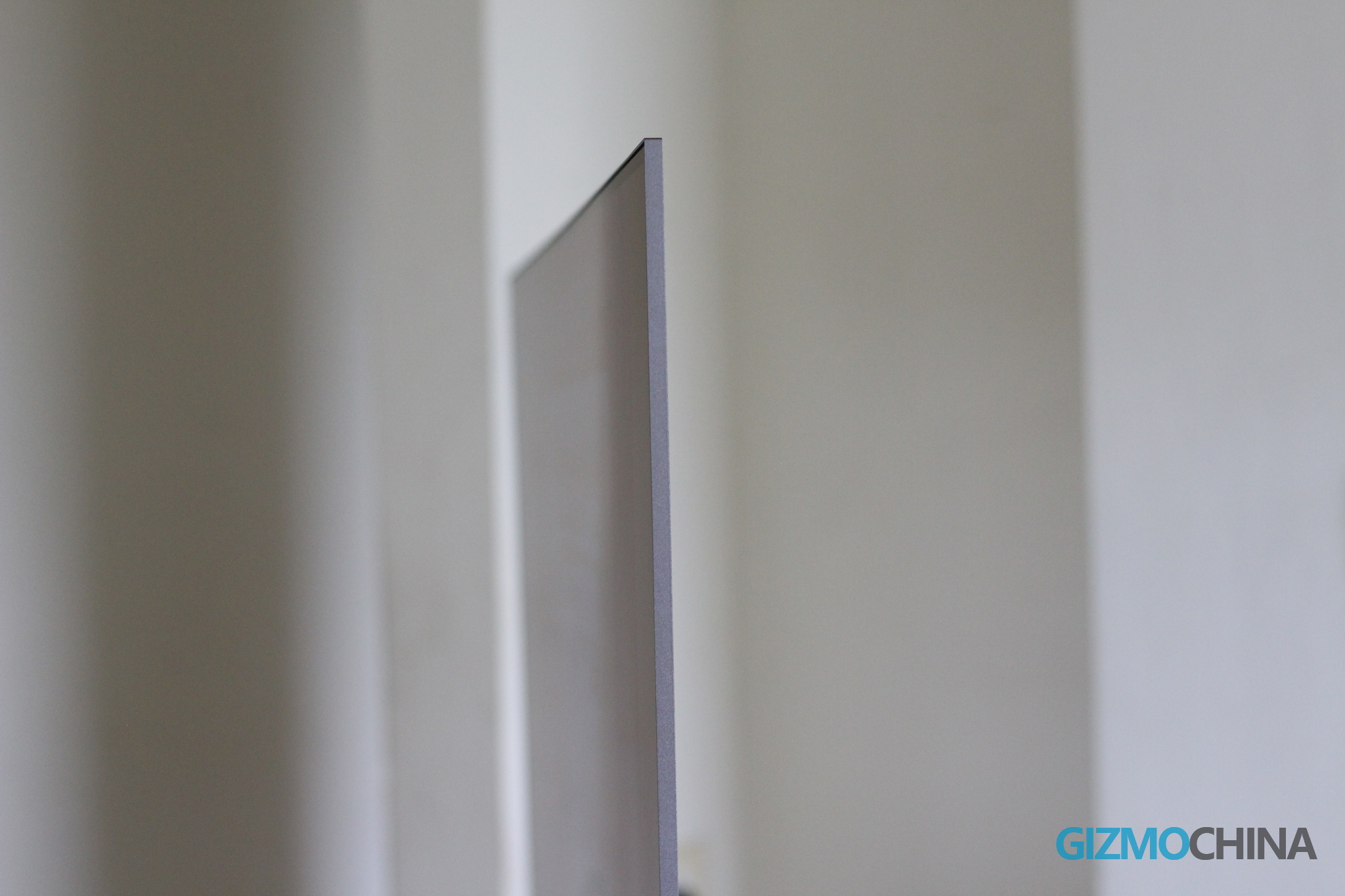
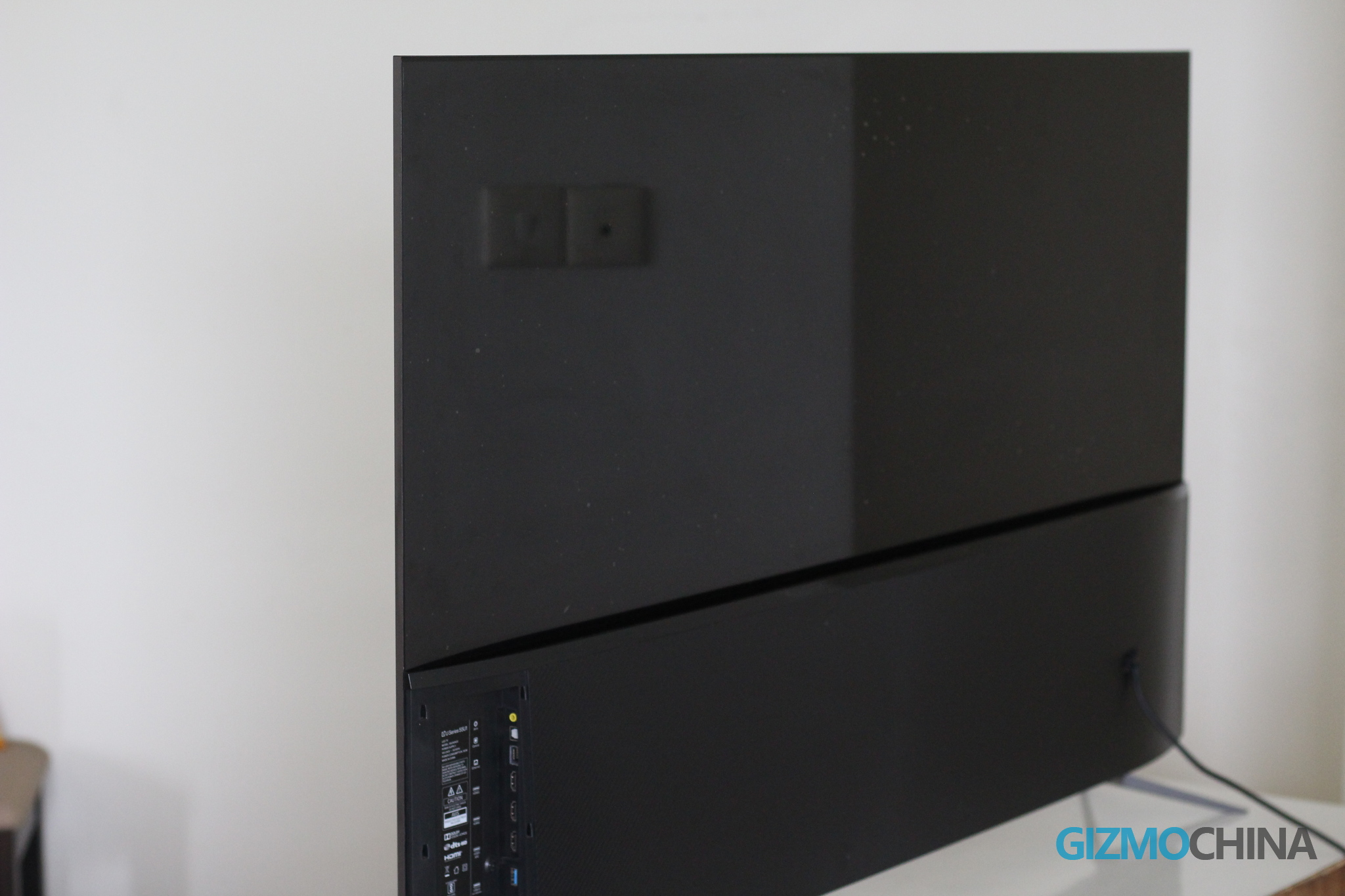
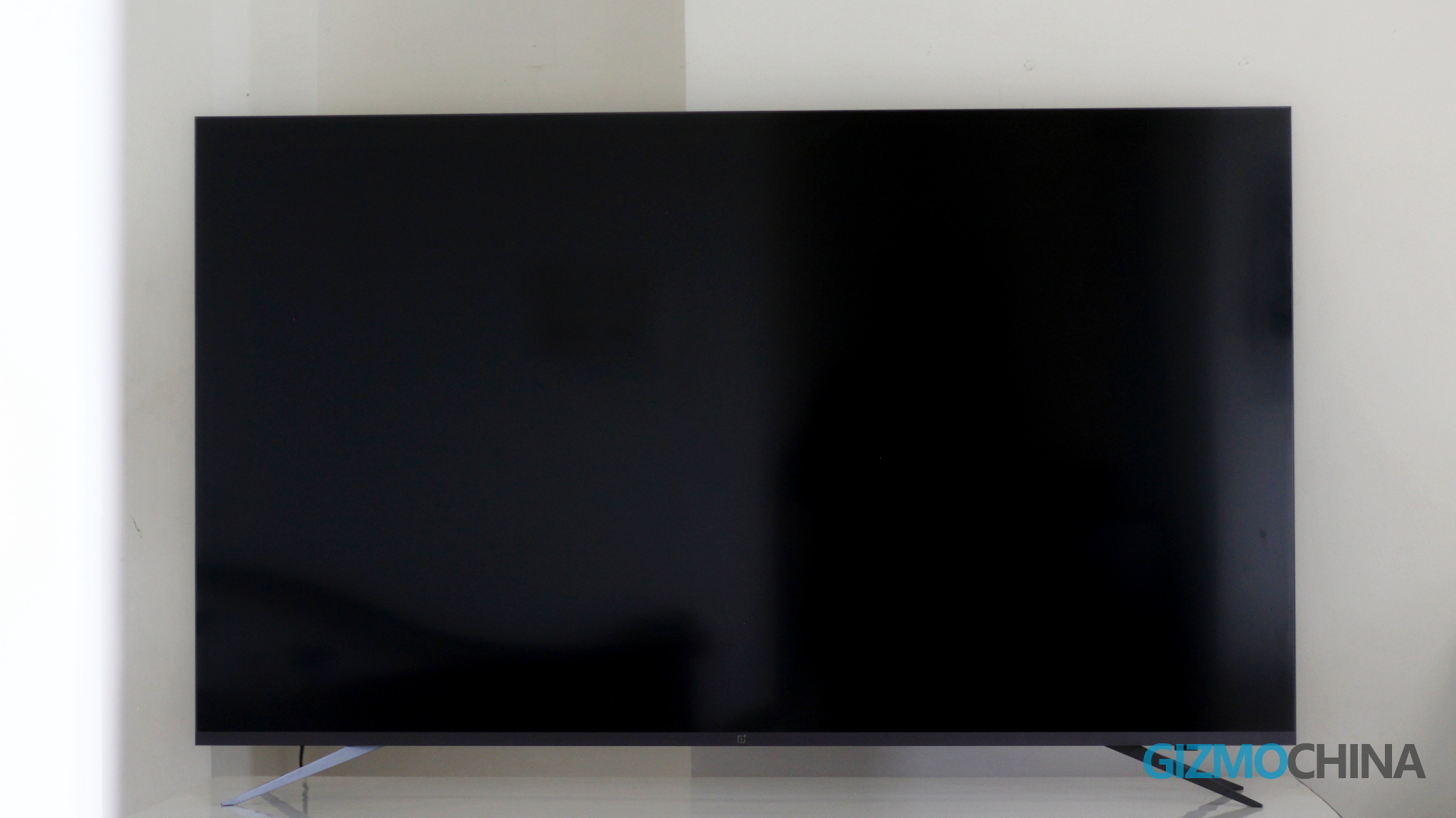
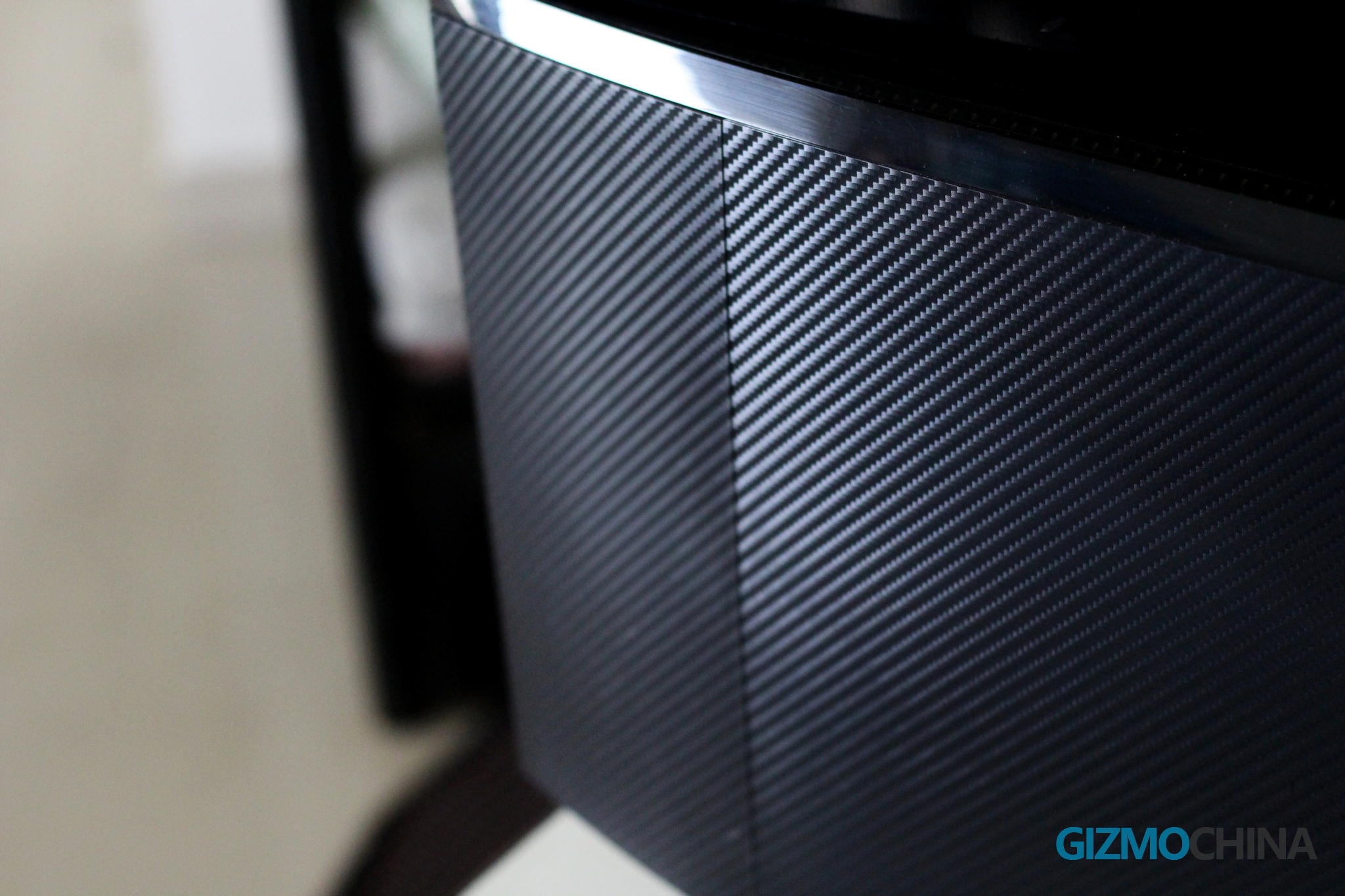
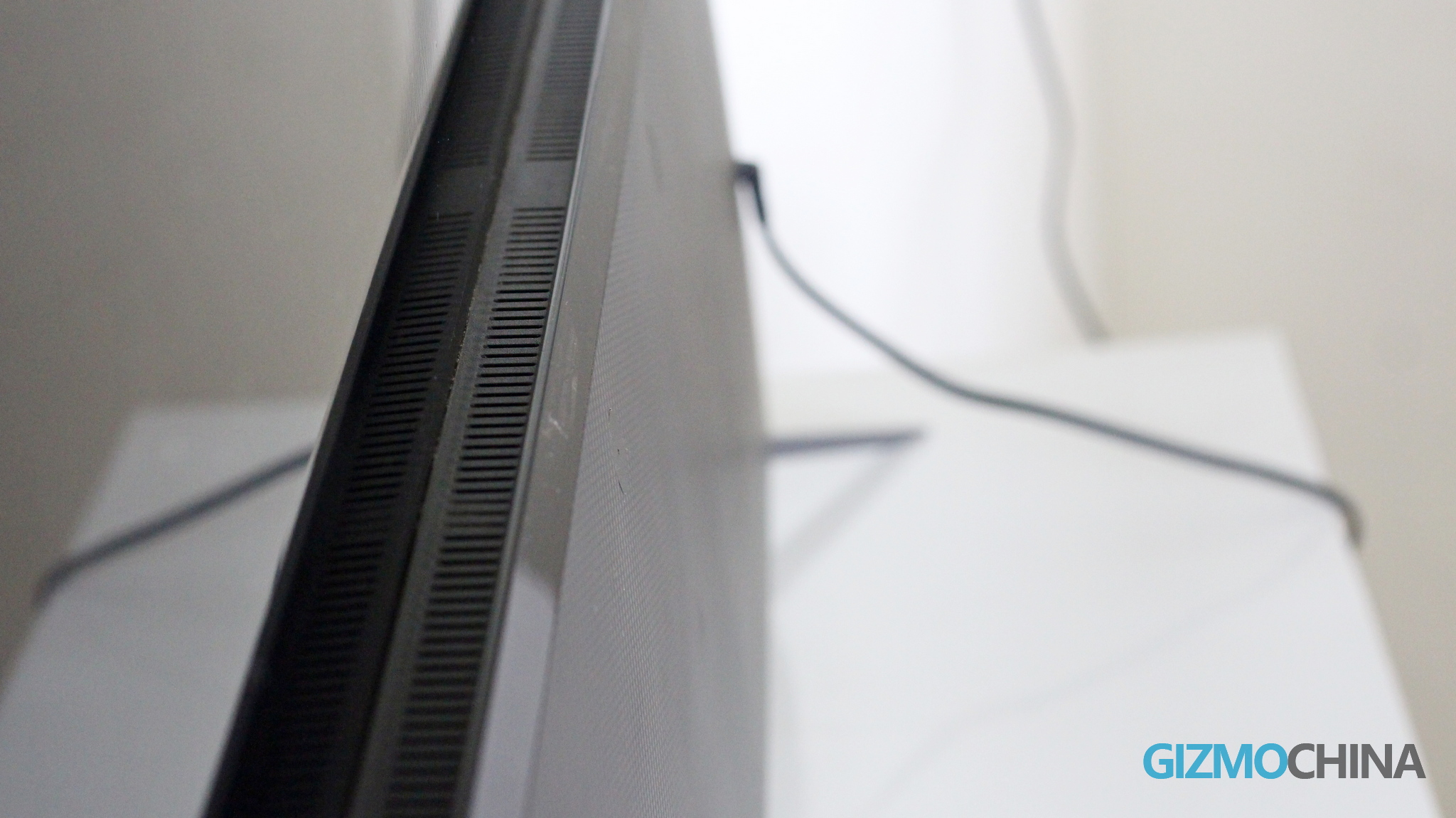
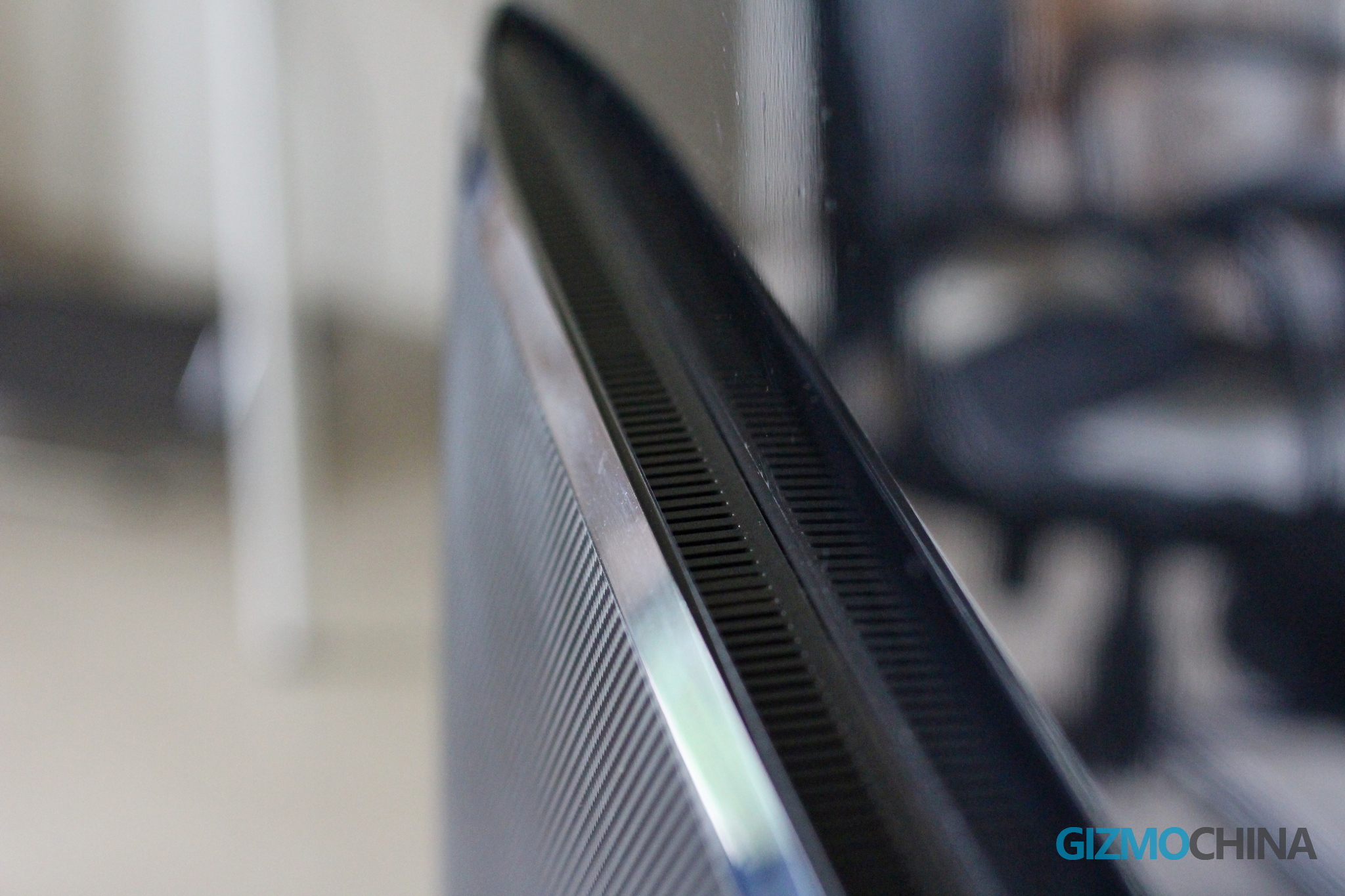
A 55-inch TV is so large that it’ll definitely stand out in your living room. And the OnePlus TV U1 55-inch stands out in a really good way. The TV is extremely slim, measuring just 6.9mm for almost two-thirds of its body. The thicker, lower third of the body, which houses all the components including the 30W speakers comes in a carbon fiber finish.
OnePlus TV U1 Super Slim Design
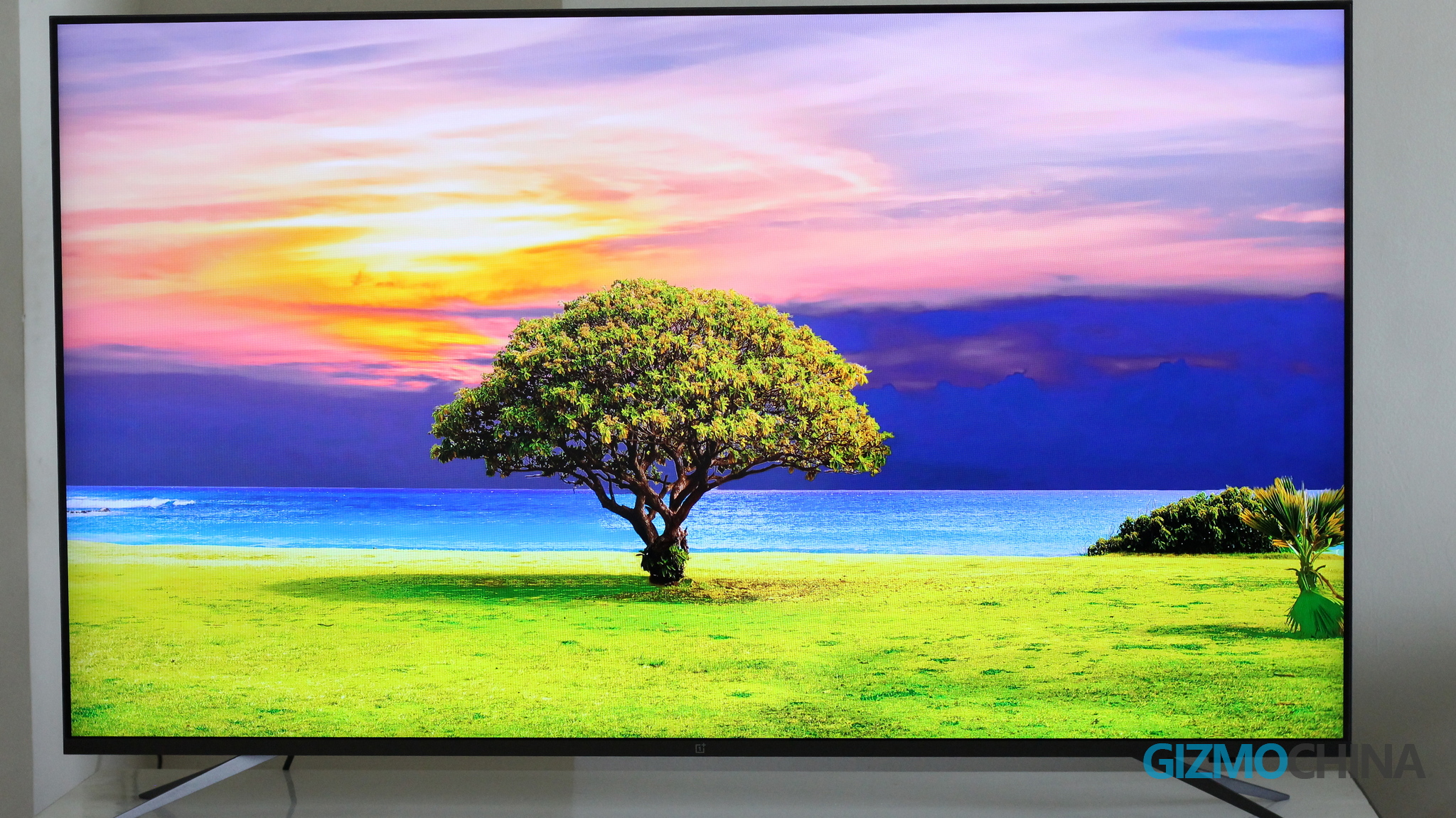
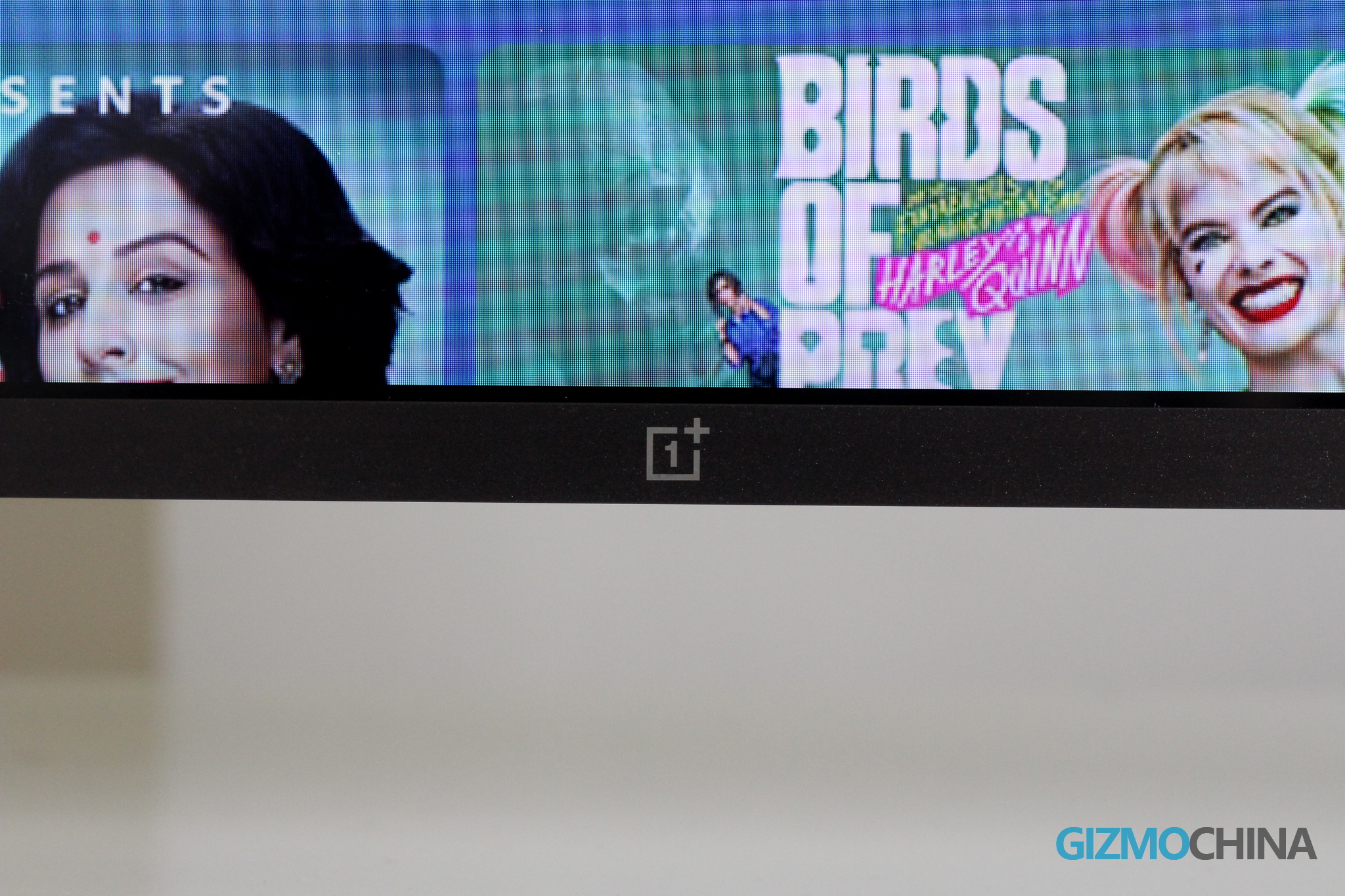
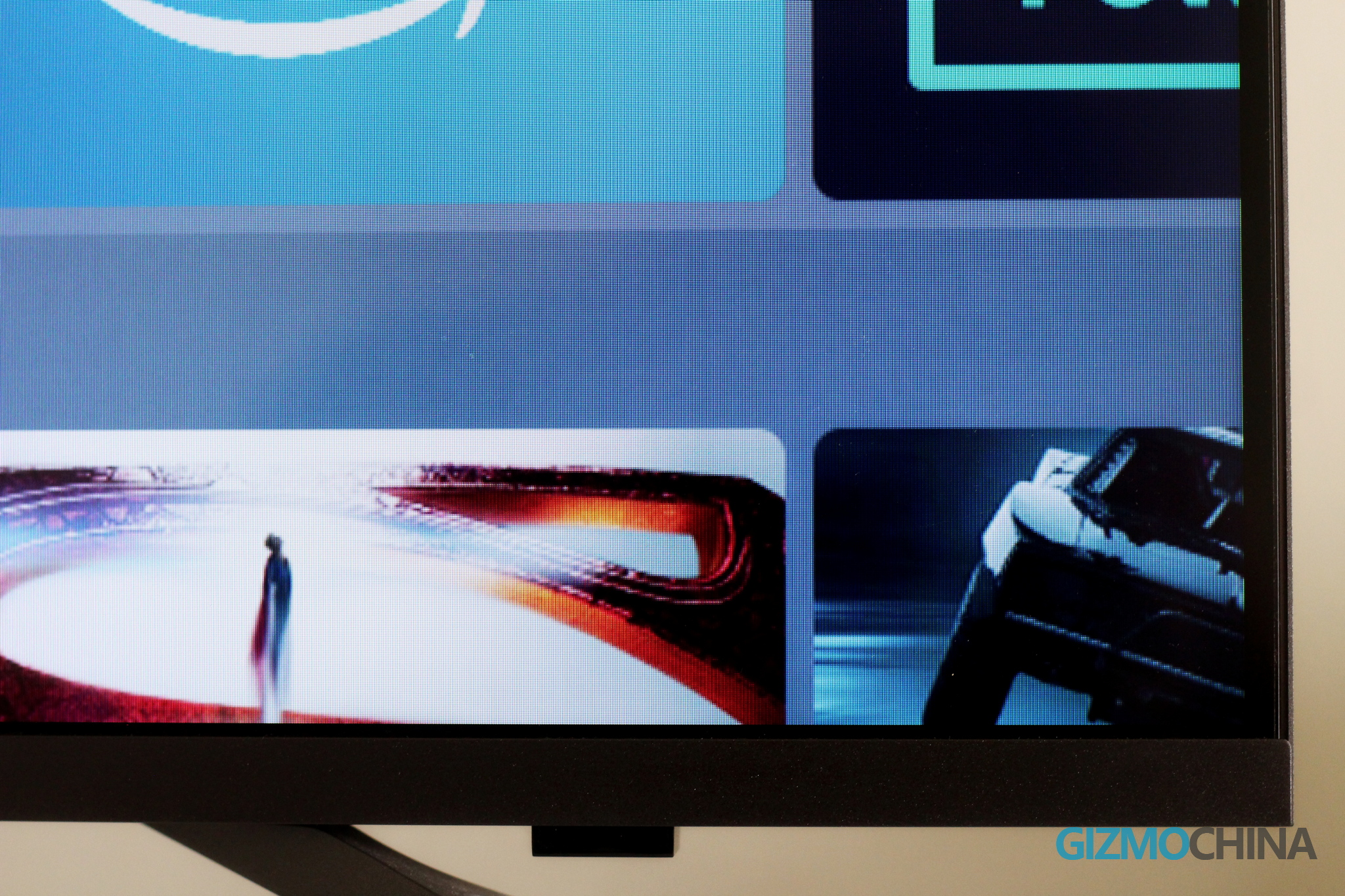
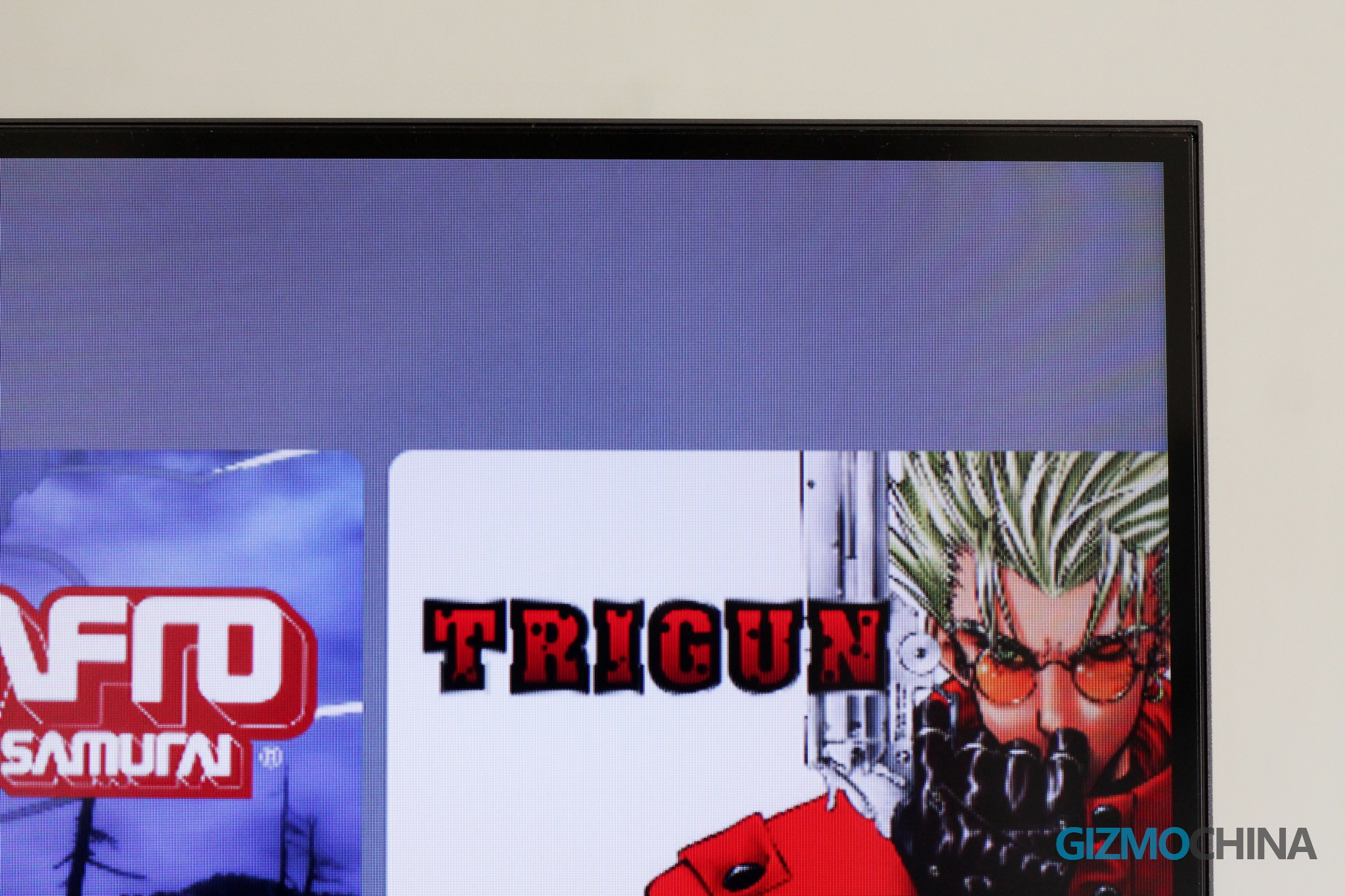
The front bezels are extremely thin and even the bottom bezel which houses the OnePlus logo is thin enough not to affect your viewing experience. OnePlus says that the screen occupies a substantial 95% of its body.
1 of 5
The bezels are extremely thin
OnePlus logo on yhr bottom bezels
OnePlus TV U1 Top Bezels
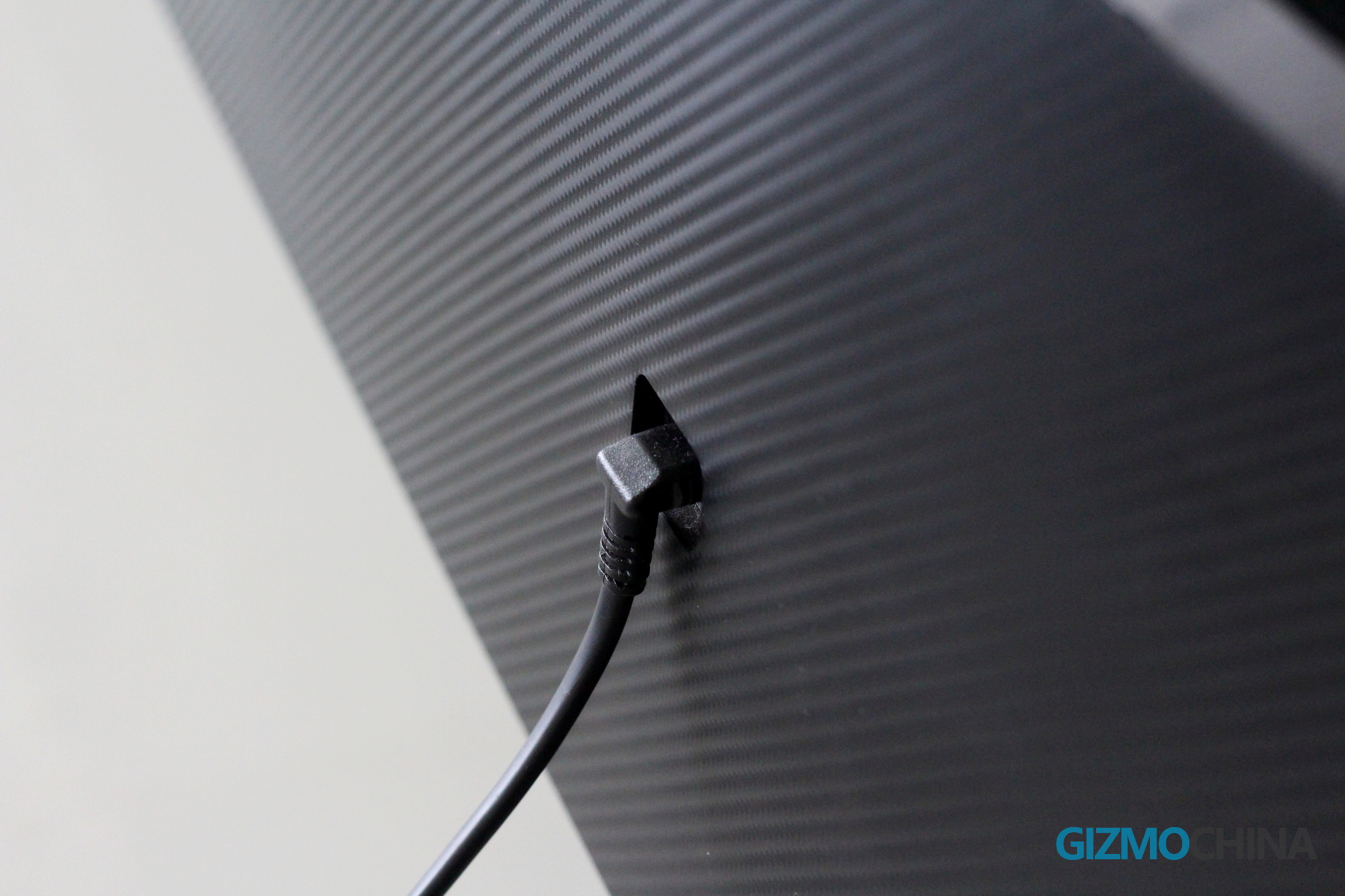
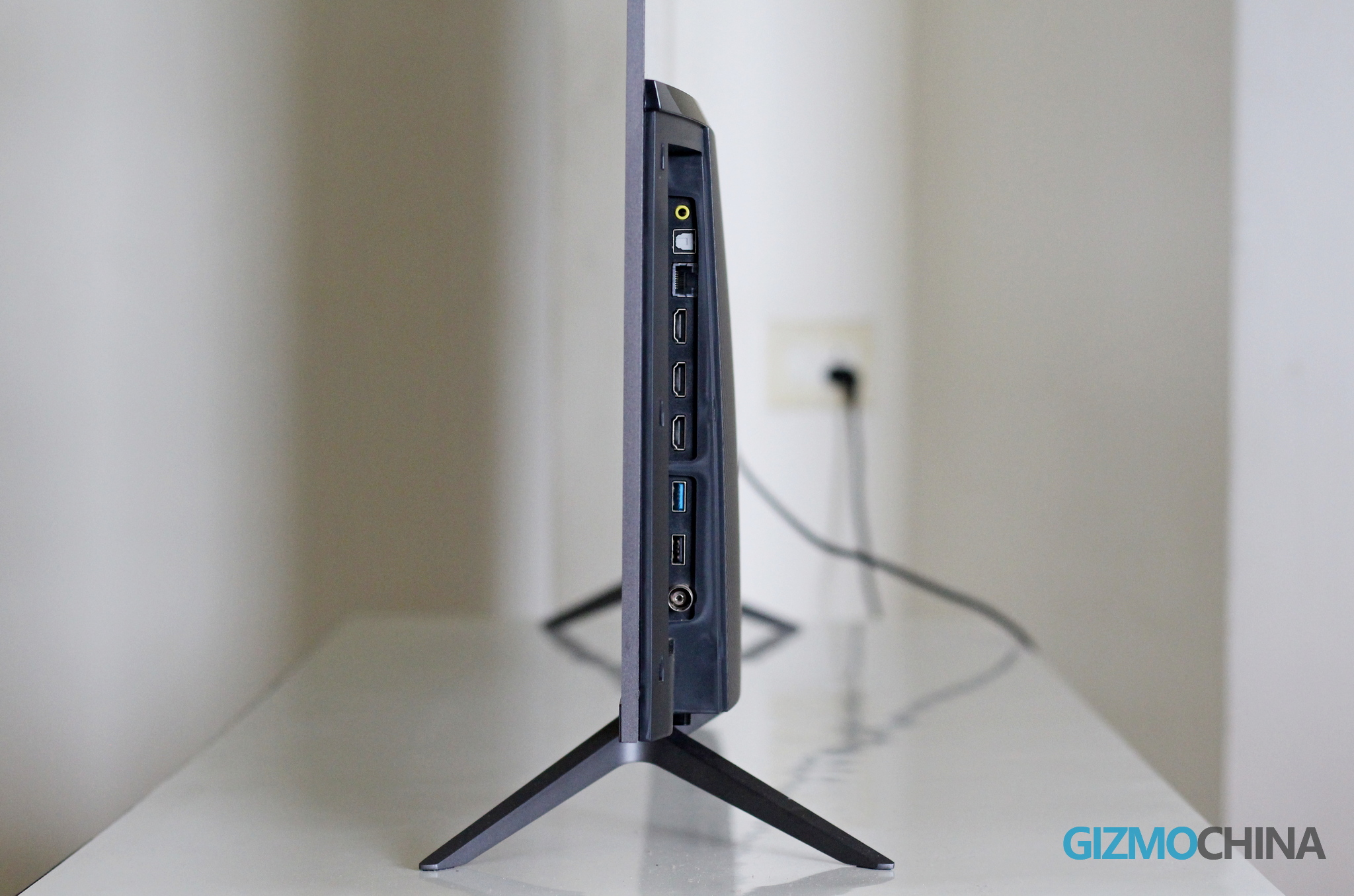
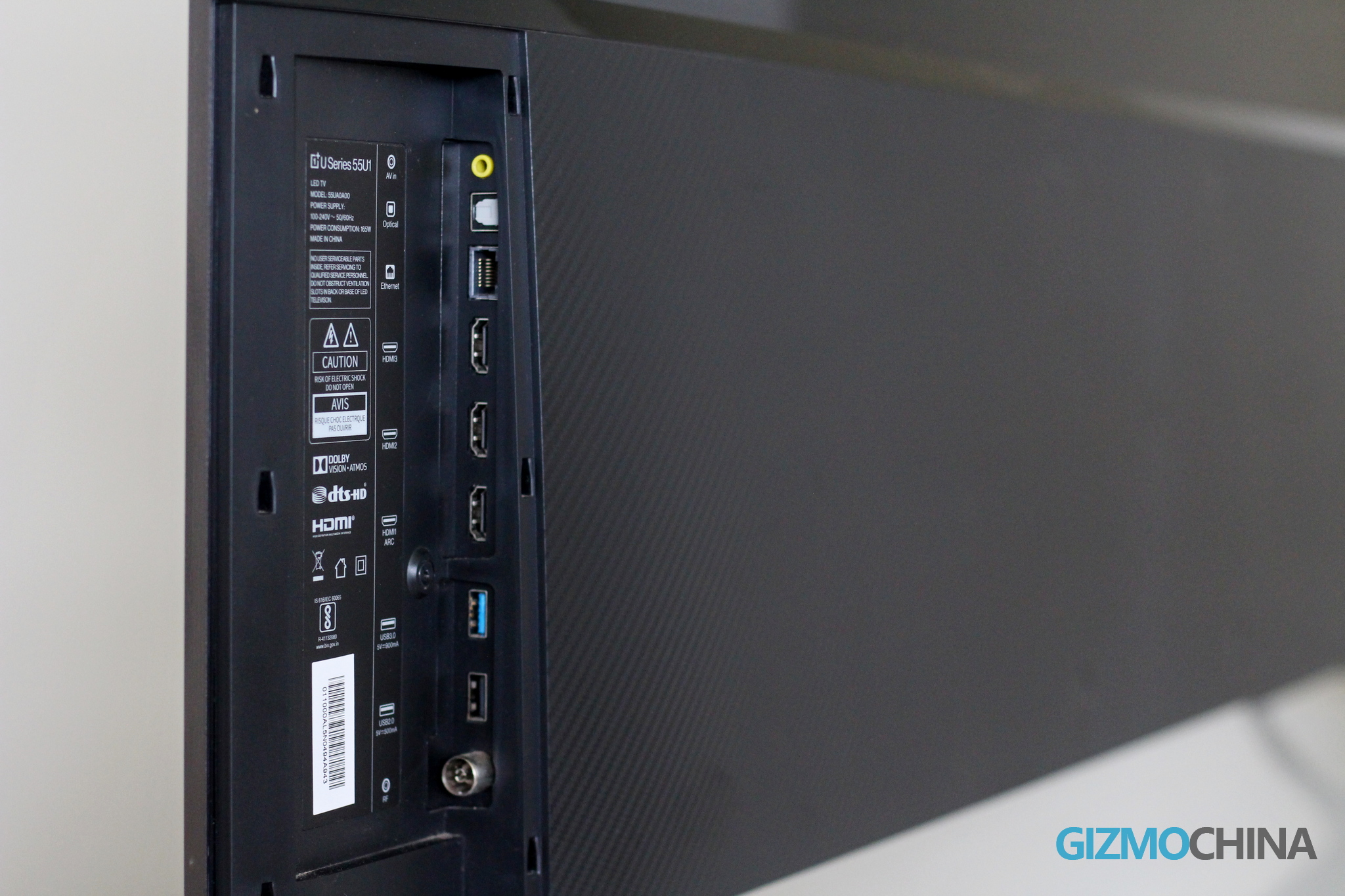
The carbon fiber finish is a nice touch on the back, even if it doesn’t come on the visible side of the TV. All the important ports are on the right side of the TV – situated at the back. The power port is on the left side. There’s a receiver at the bottom right corner of the TV with a white LED light indicating its power status.
1 of 6
OnePlus TV U1 Ports
OnePlus TV U1 Back Cover Closed
The TV hides all the ports under a removable cover, which also gets a carbon fiber finish. But I was surprised to find out that you can’t close this cover once you plug in the cables as it doesn’t have a cut out to route the wires out. I hope OnePlus finds a solution to this in the next model as I prefer covering up the cables at the back to maintain its clean look.
The bezels and the table stands have a gunmetal gray finish. This color, along with the near bezel-less screen of the TV gives it a premium look.
Another thing to note here is that the two table stands are placed pretty wide apart. So you’ll need a long table to keep this TV. Also, the table stand doesn’t raise it high enough to house an Xbox or a soundbar underneath. A few centimeters higher up and my Xbox would have snuggly fit under the TV. While I feel some soundbars and set up boxes (or even a PS4) might still be able to fit underneath, if the stand had lifted up the TV further by a few centimeters, it would have been perfect.
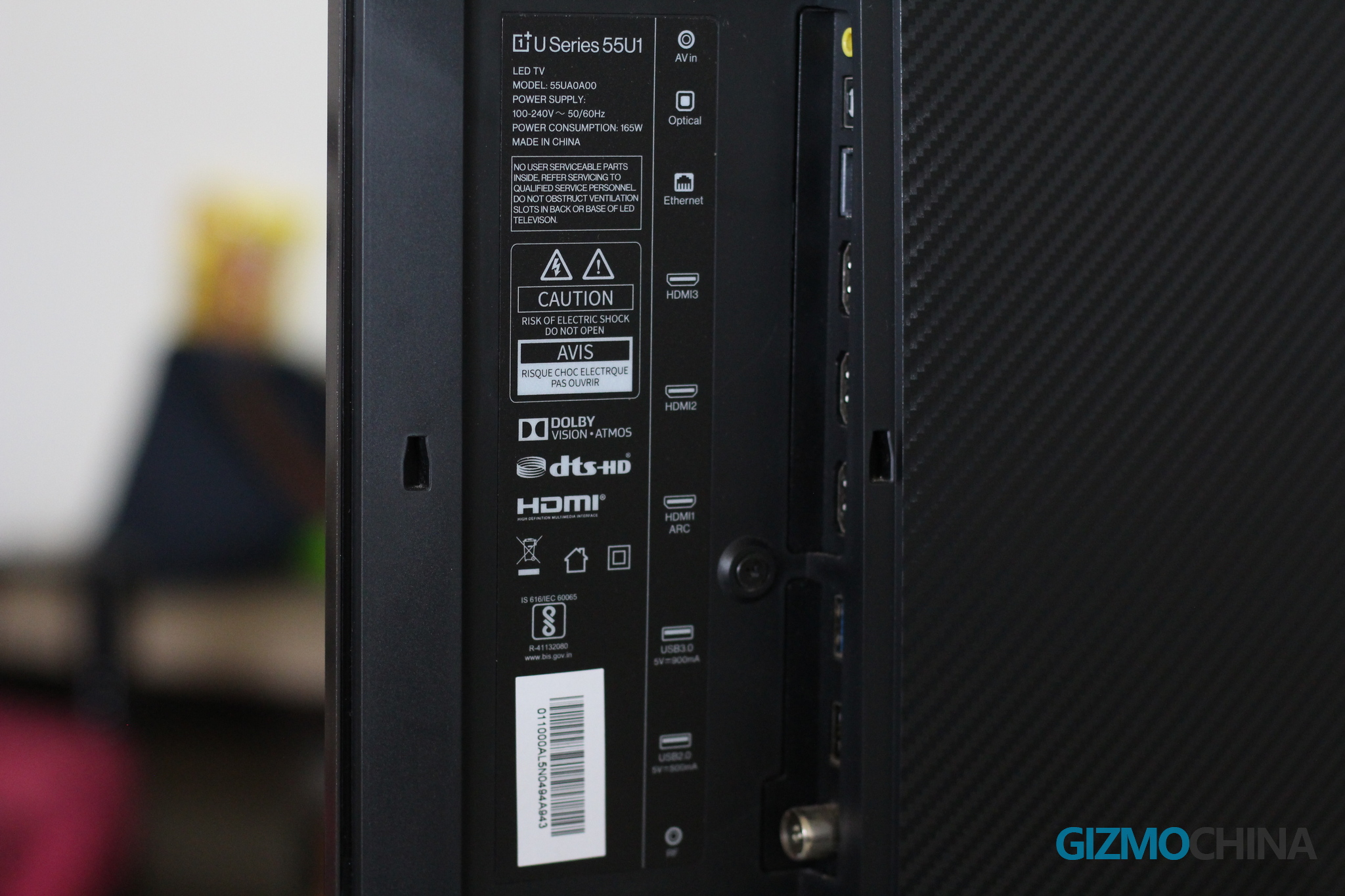
The OnePlus TV U1 55-inch gets a decent set of ports. You have three HDMI ports (HDMI1 supports arc), two USB-A ports (one with USB 3.0 support), an RF port for the antenna / cable, an AV-in composite port, an optical audio out for your speakers, and an ethernet port for plugging in your wired internet.
OnePlus TV U1 Ports
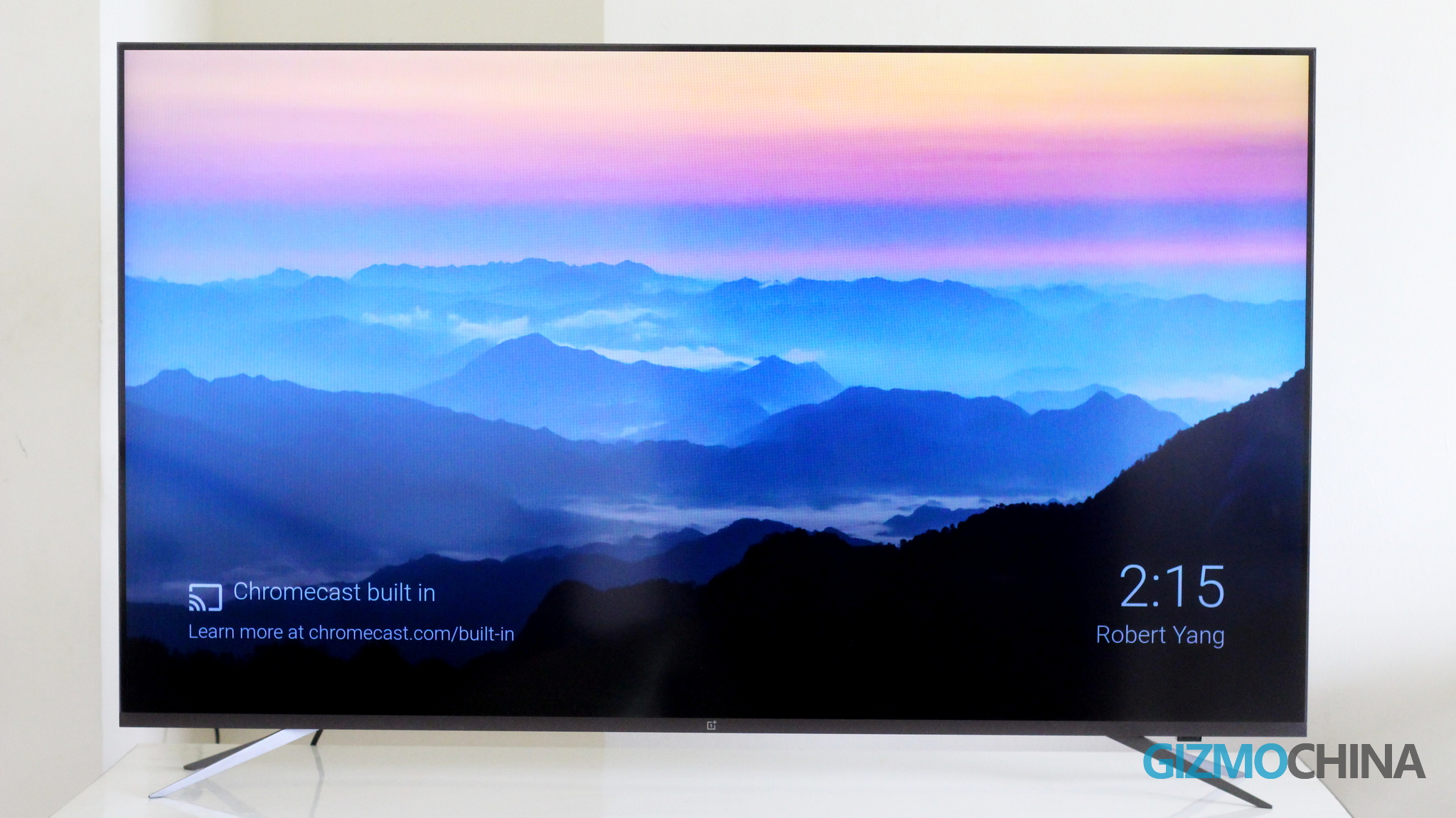
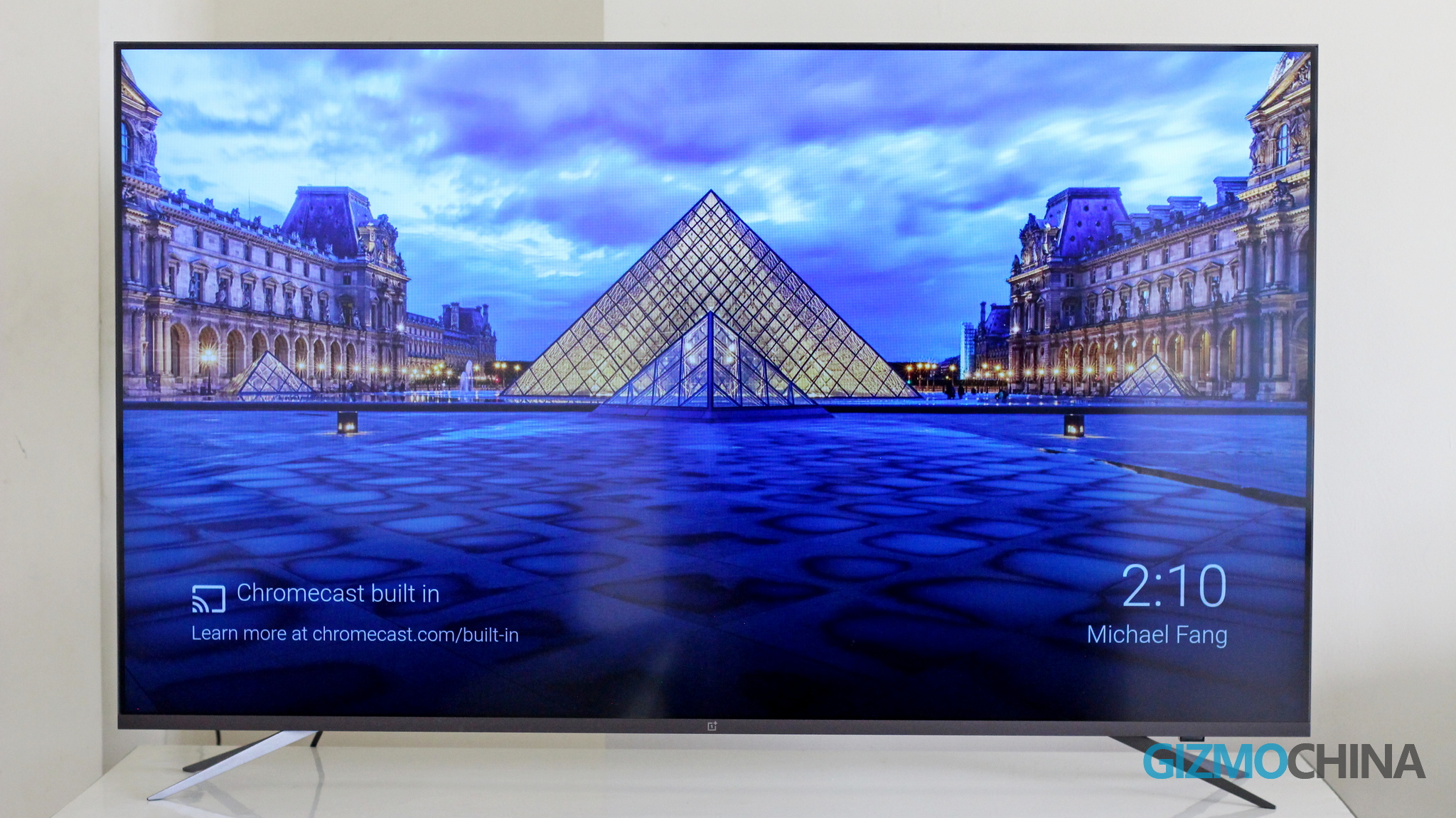
You don’t have a 3.5mm headphone jack. But you do get Bluetooth 5.0, Wi-Fi 802.11n, and Google Chromecast built-in.
As for the speakers, you have a total of four units with a rated sound output of 30W. The TV supports up to Dolby Atmos and DTS: HD formats. There’s also a Bluetooth Stereo mode that transforms your TV into a speaker.
OnePlus TV U1 Speakers 30W
OnePlus TV U1 55-inch Review: Display Quality
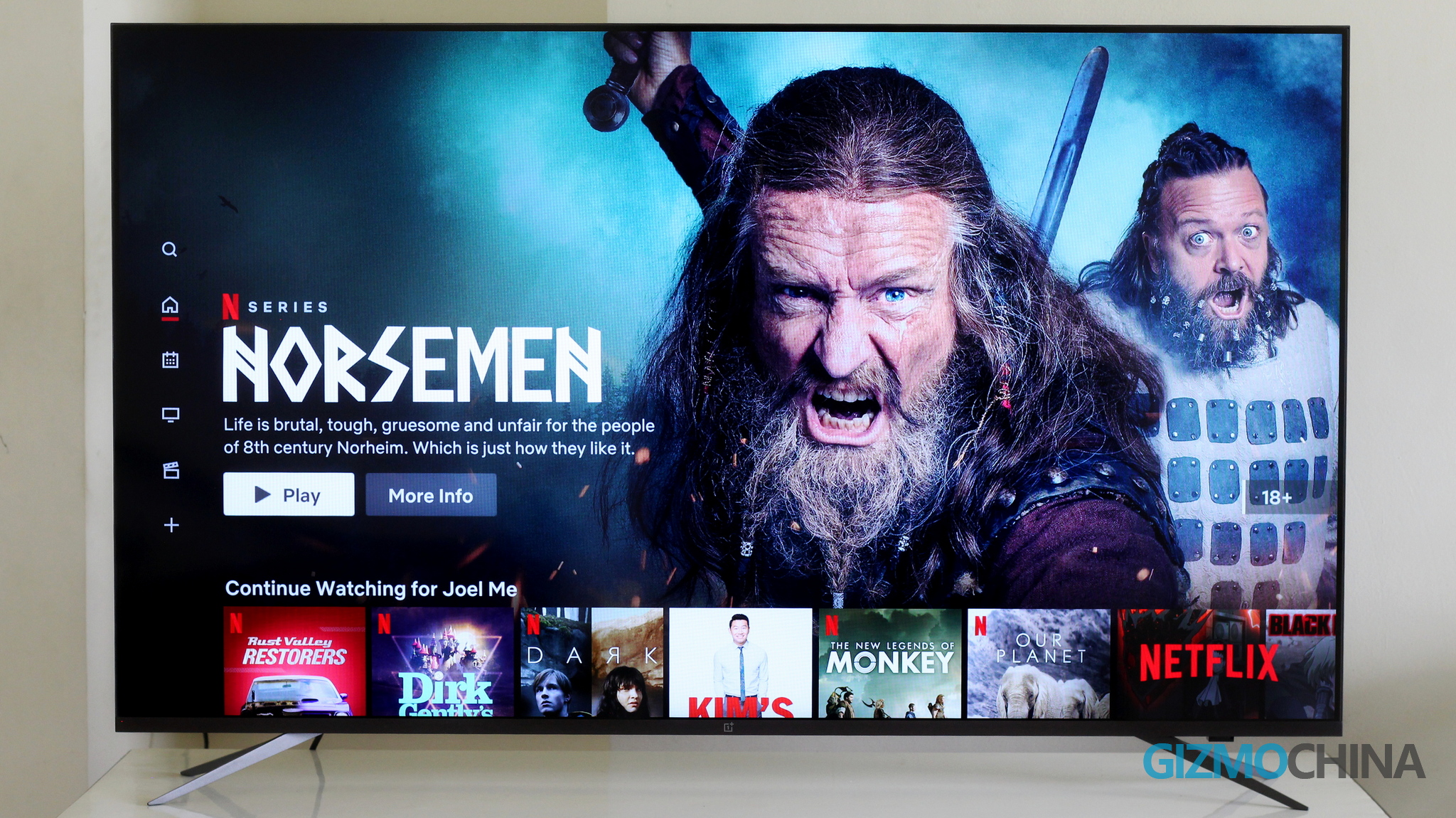
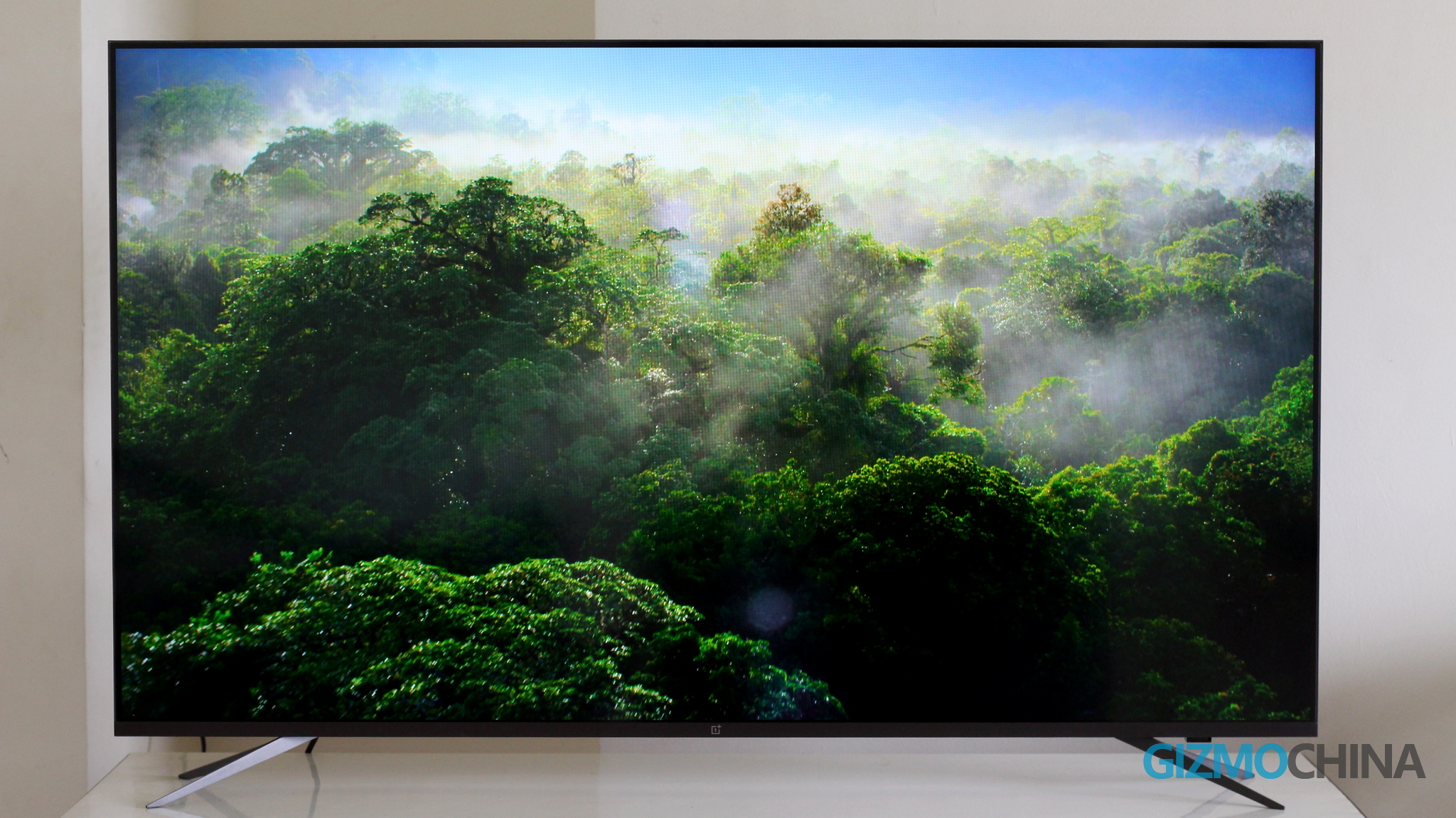
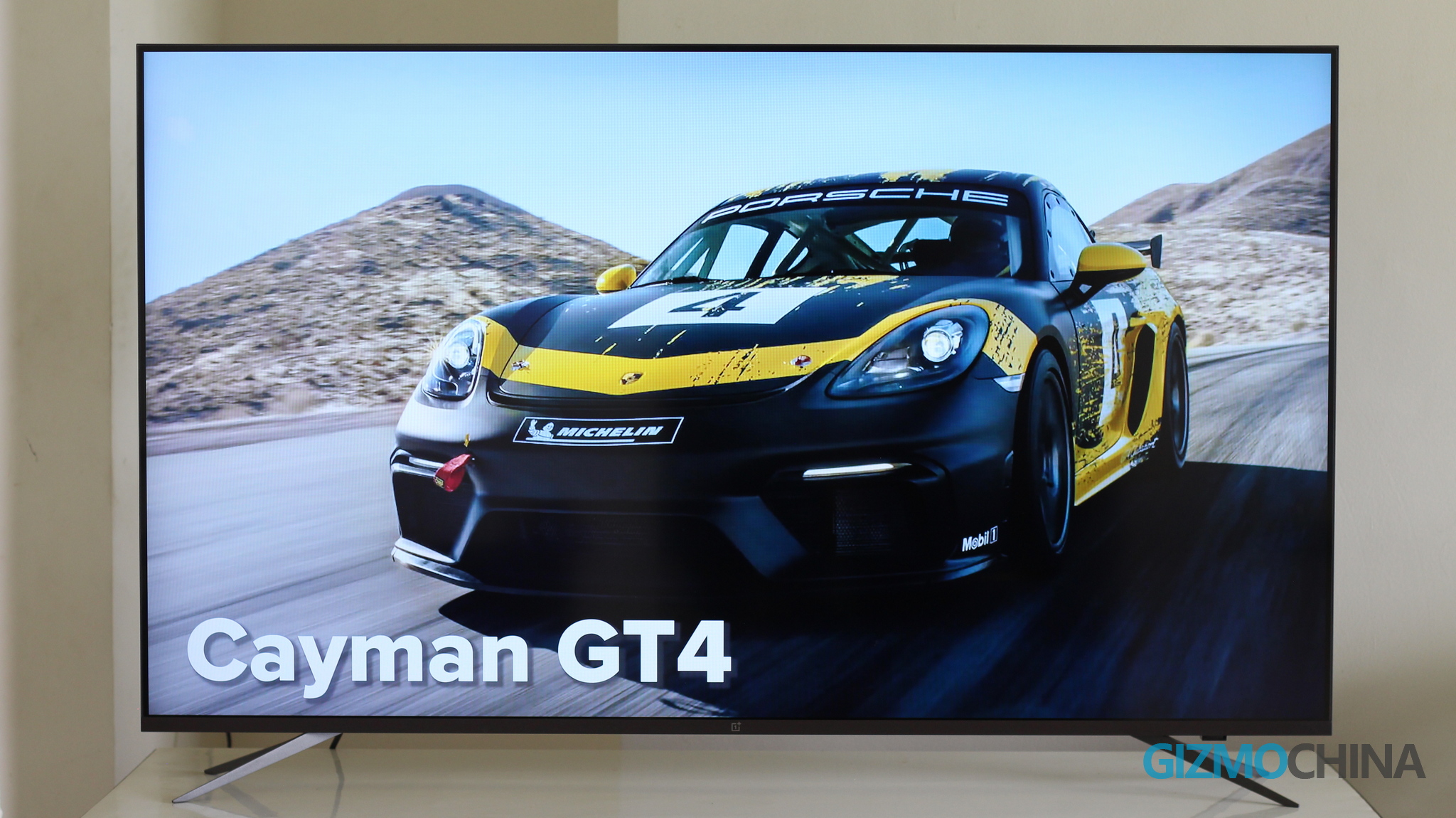
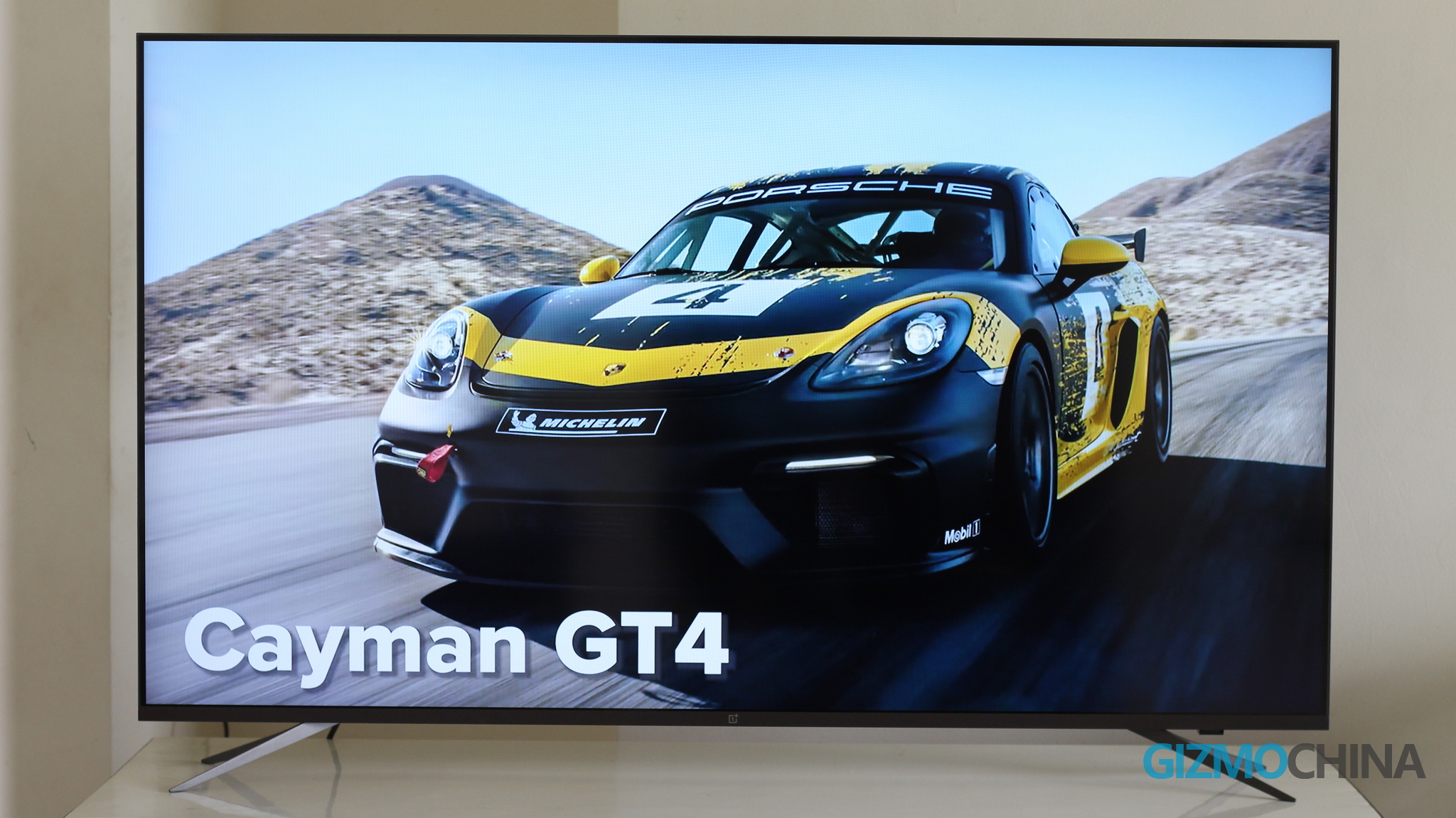
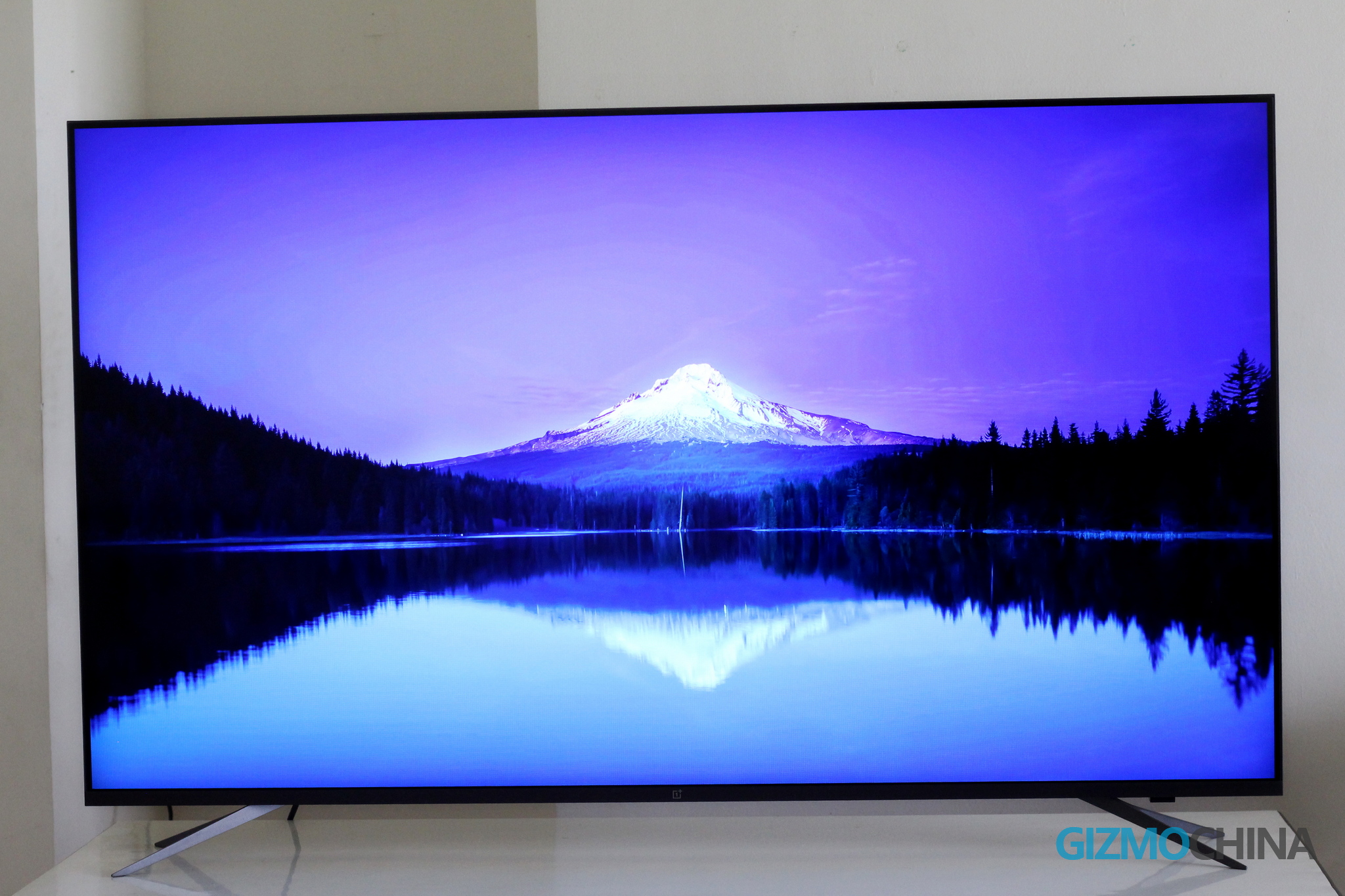
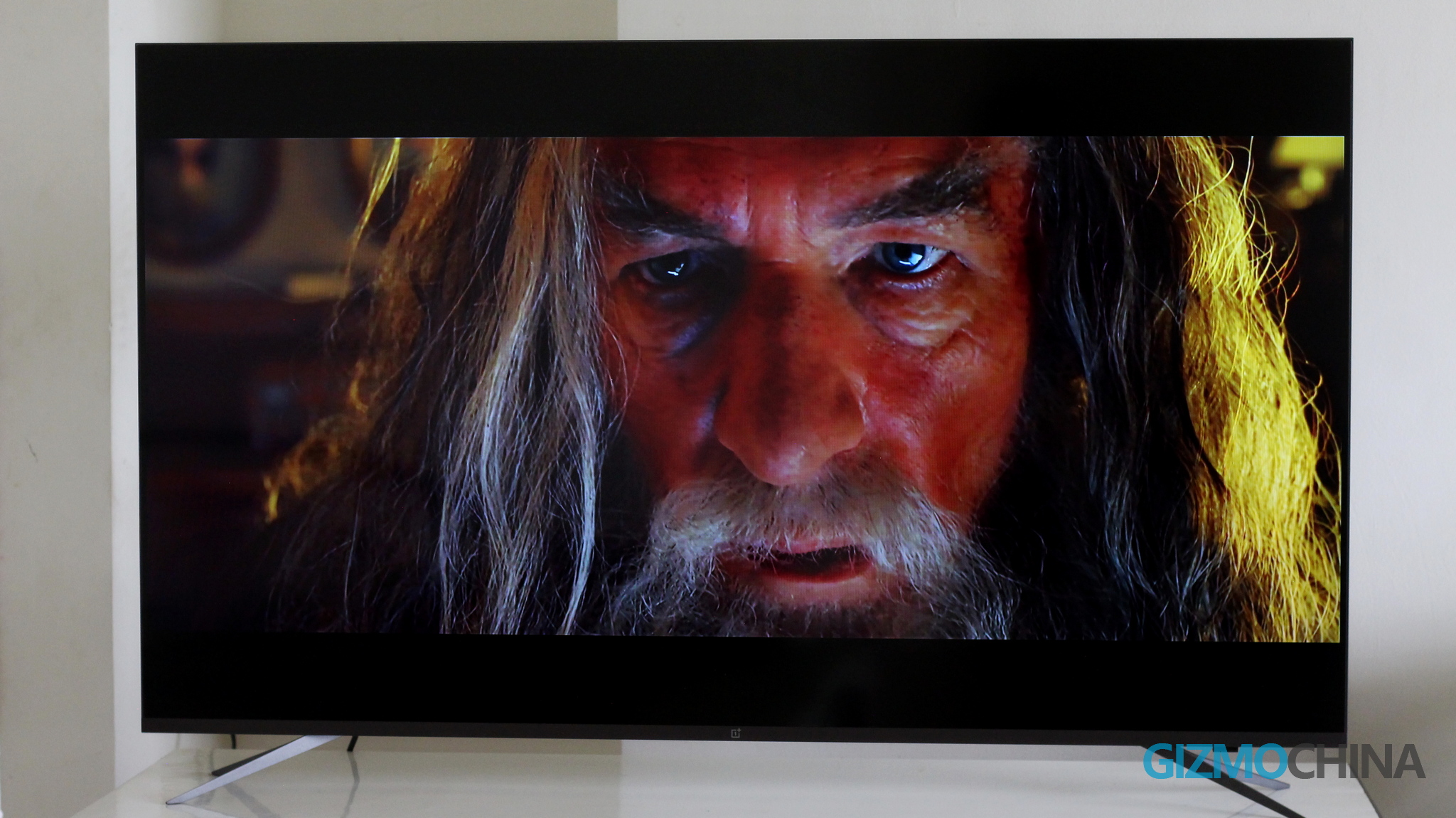
The OnePlus TV U1 has a LED-backlit VA panel with 4K 3840 x 2160 resolution and DCI-P3 93% color gamut. It supports Dolby Vision, HDR10, HDR10+, HLG HDR formats.
The OnePlus TV U1 does an excellent job of displaying vivid colors and sharp images. Watching Our Planet in Dolby Vision was a treat to the eyes.
The TV also managed to upscale 1080p and 720p content very well. I was actually surprised how well 1080p content looked on the big screen. Even for 720p content, the upscaling was pretty good. Of course it wasn’t nearly as sharp as 1080p or 4K but considering how the TV has nine times as many pixels as 720p, the results are pretty good.
720p upscaled
4K
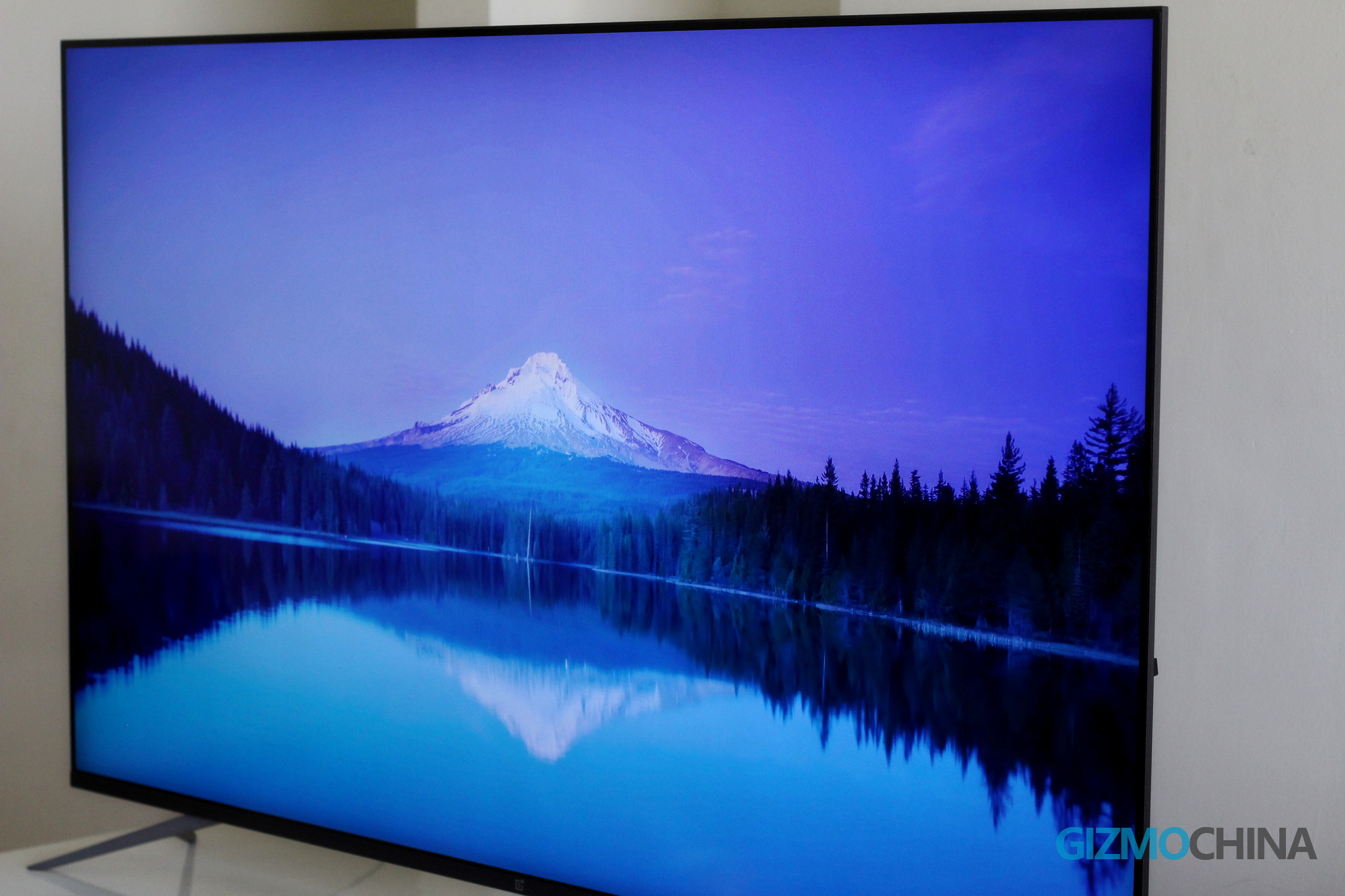
Being an LED VA panel, the TV screen is sufficiently bright. So even if you have a lot of ambient light in the room, the viewing experience will still be good. The viewing angles are also satisfactory with a slight color shift at very wide angles.
OnePlus TV U1 Side Viewing Angle
The OnePlus TV U1 panel comes with a contrast ratio of 4000:1 which is decent. In real life viewing experience, the image contrast is excellent, ensuring the darker zones don’t look washed out.
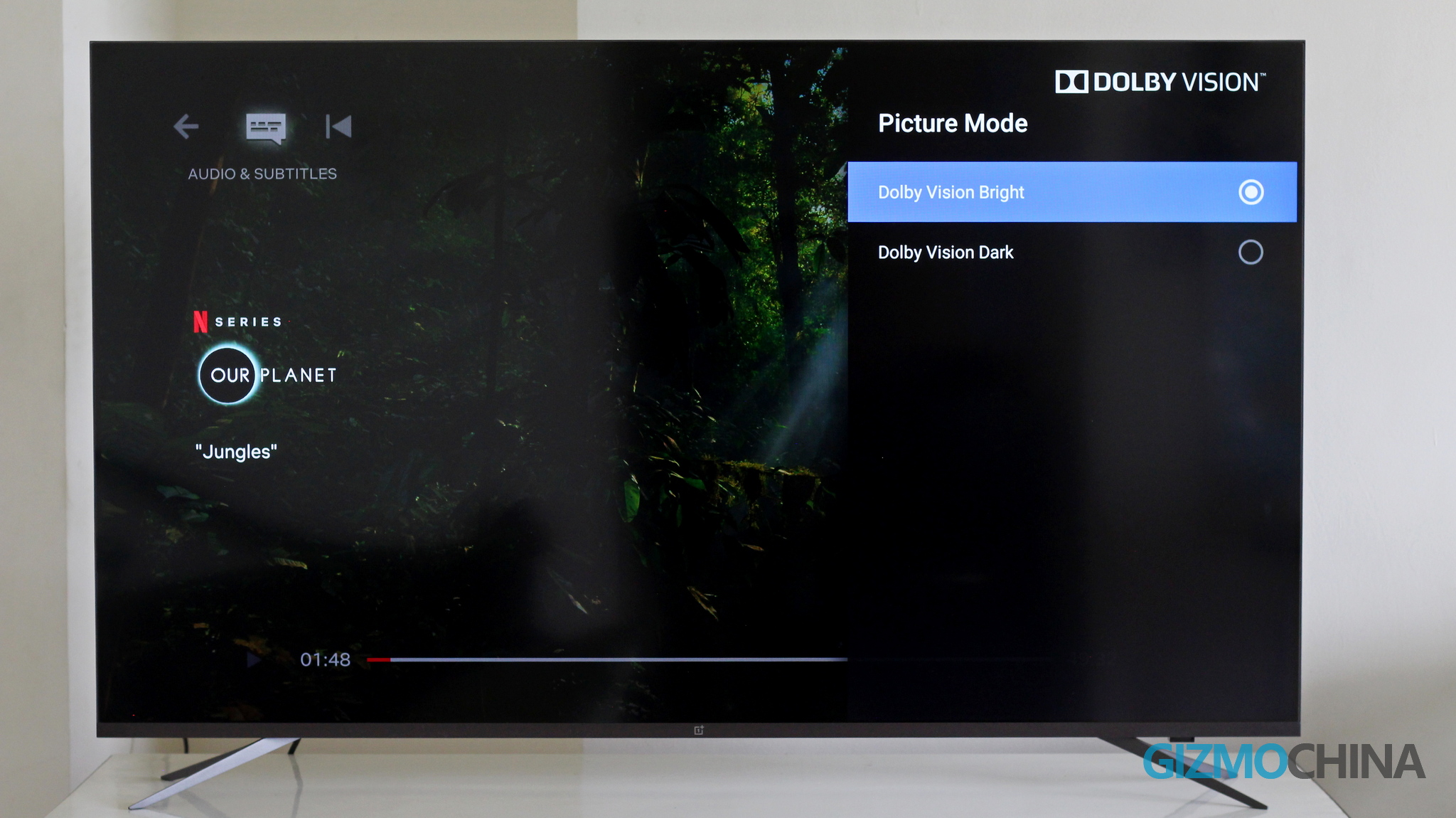
Dolby Vision, of course, brings a significant improvement in contrast and colors. You’ll see the Dolby Vision logo on the top right corner whenever you play supported content (this notification can be disabled in the settings).
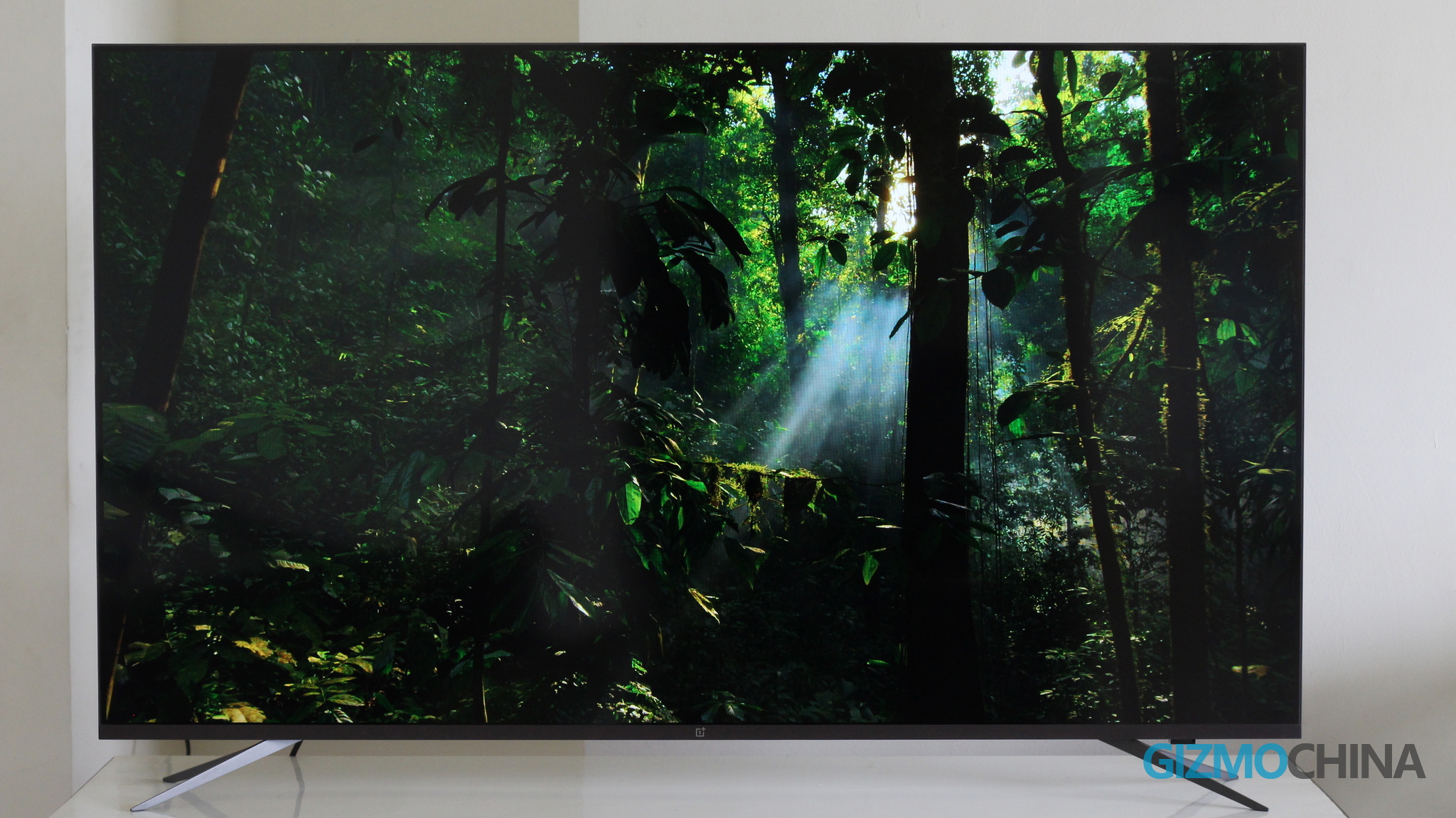
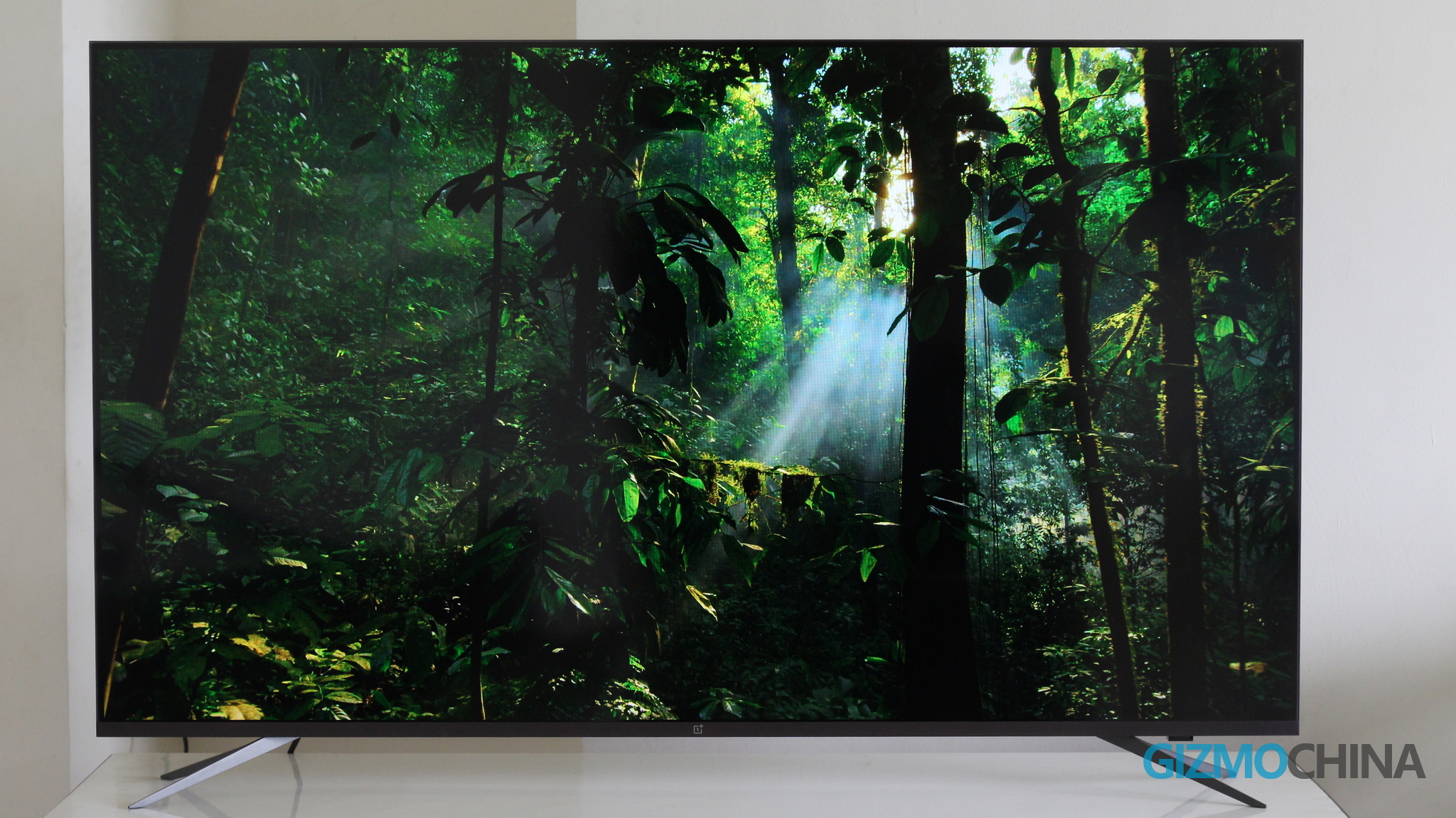
However note that whenever you are running Dolby Vision content, you can’t tweak the picture quality. You only get two options – Dolby Vision Dark and Dolby Vision Bright modes. The bright mode enhances darker scenes with better saturation and details, while the dark mode can bring out the details in scenes which are pretty bright.
1 of 3
OnePlus TV U1 Dolby Vision Bright and Dark
OnePlus TV U1 Dolby Vision Dark Mode
OnePlus TV U1 Dolby Vision Bright Mode
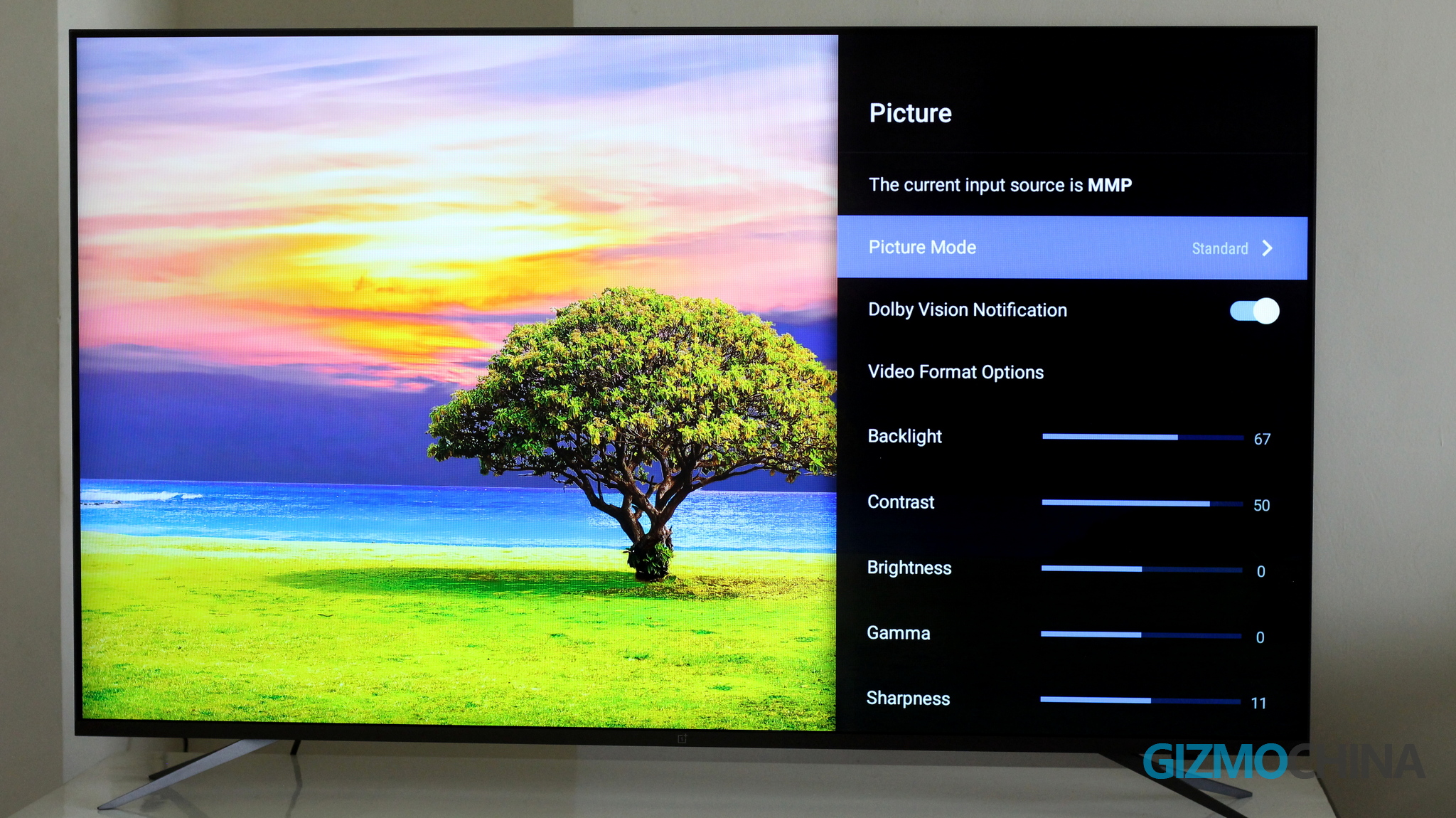
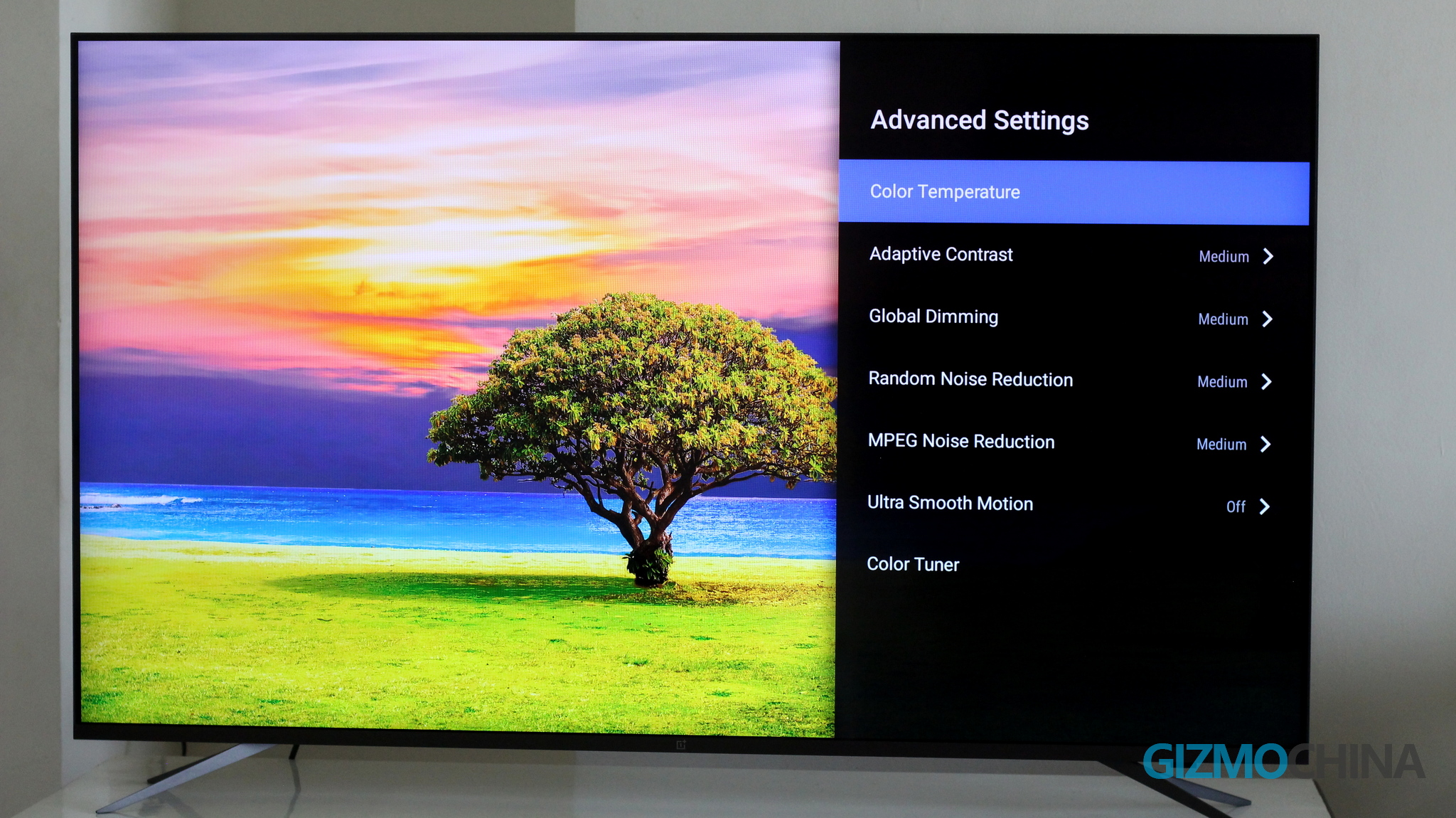
When not running Dolby Vision, the TV allows you to tweak the picture quality with a wide variety of inbuilt settings. There’s a special AI PQ mode that automatically detects the scene and optimizes the picture quality. In my experience, the AI mode has done a good job of selecting the right settings for the content so far. But there are other options too like Vivid mode, Eye Protection mode (filters out blue light), and custom brightness, sharpness, and contrast settings.
OnePlus TV U1 Picture Settings
OnePlus TV U1 Advanced Settings Picture
Note that the TV automatically recognizes and enters gaming mode (with low input lag – 22-second latency) whenever you are connected to a console. I’m not much of a heavy gamer but in the gaming mode, when my Xbox One S was connected, it automatically upscaled the content to 4K. I didn’t experience any significant issues while playing games like Fortnite or Forza Horizon. Overall, you should have no significant problems while gaming on the OnePlus TV U1.
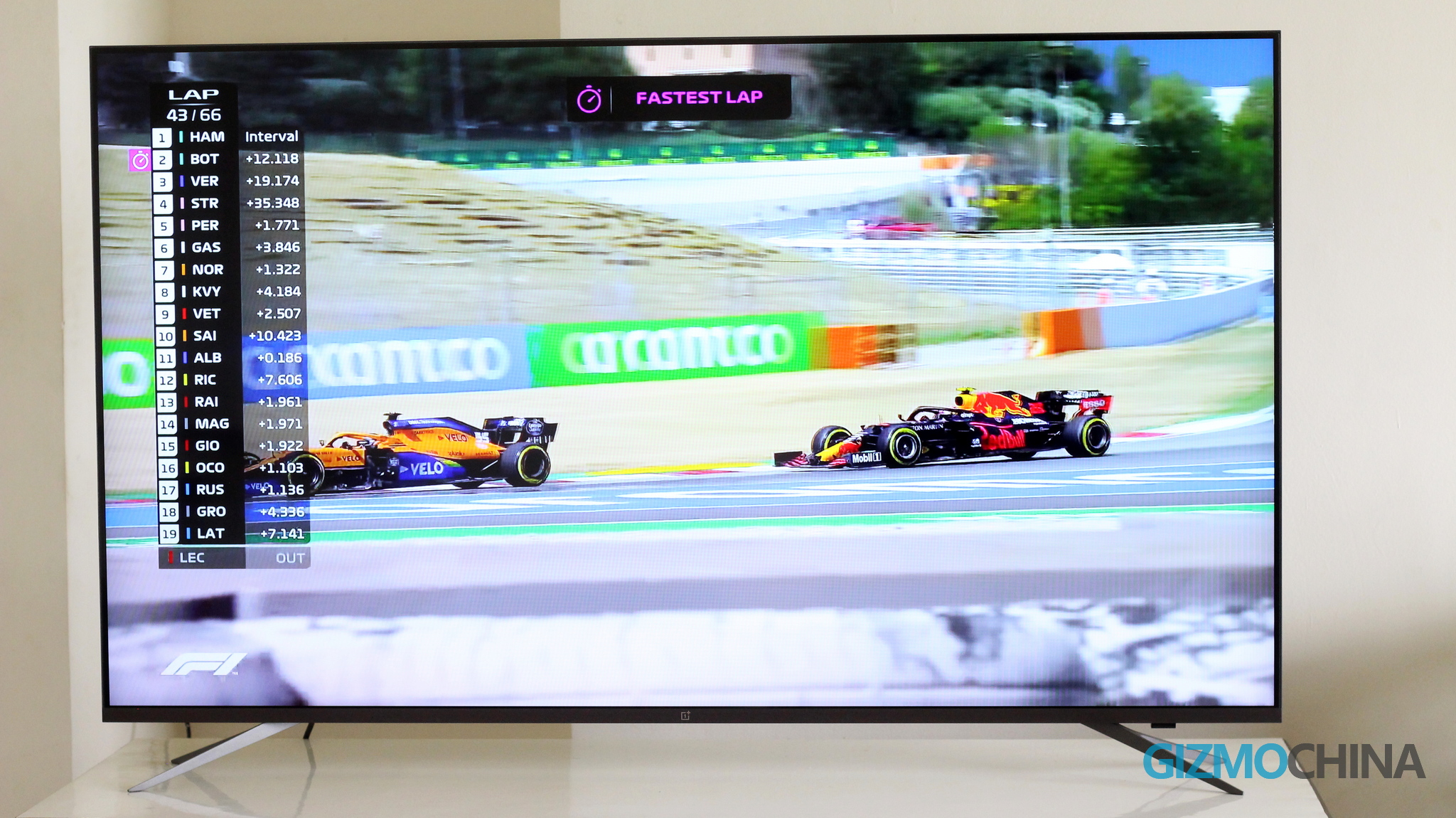
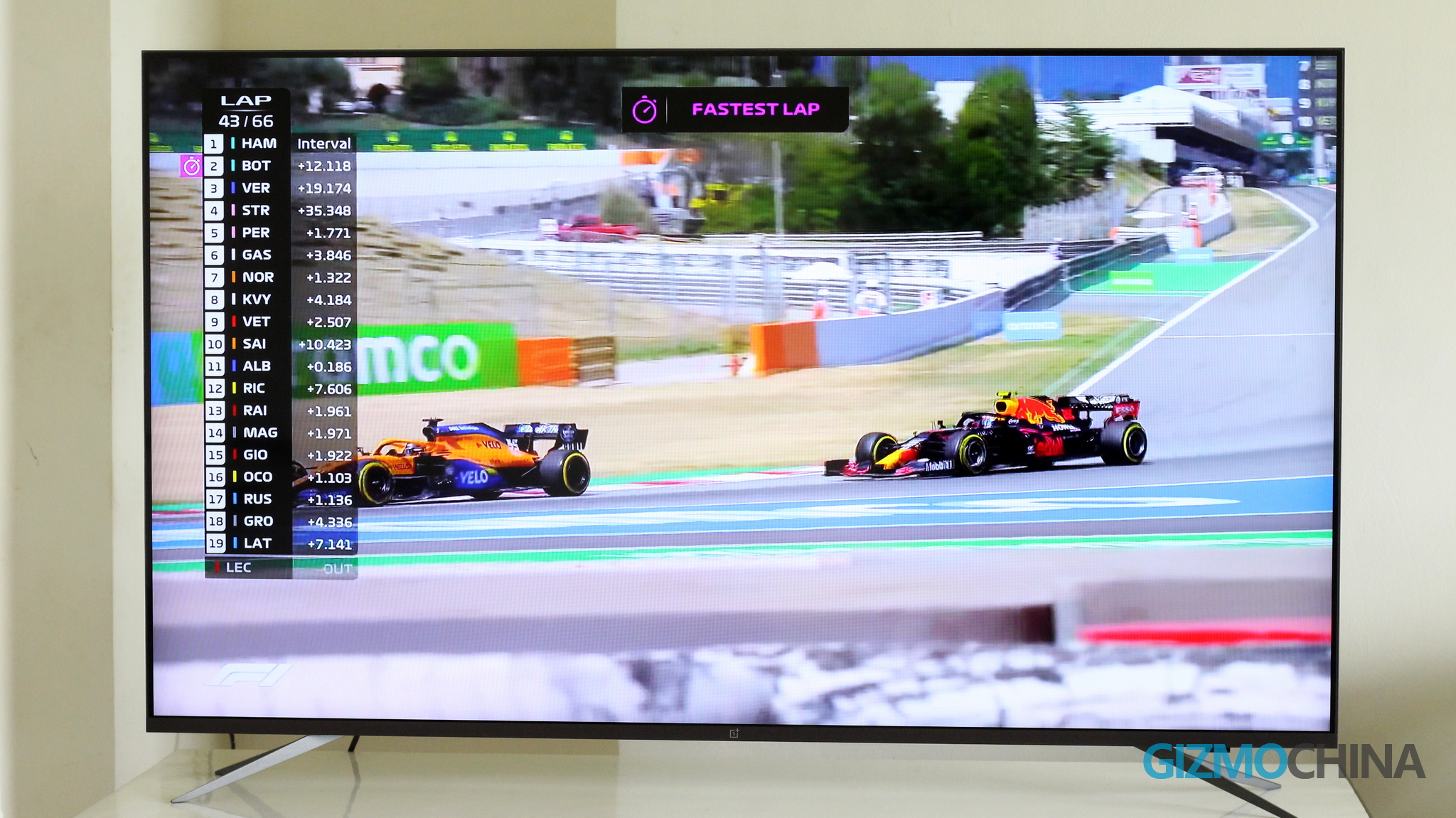
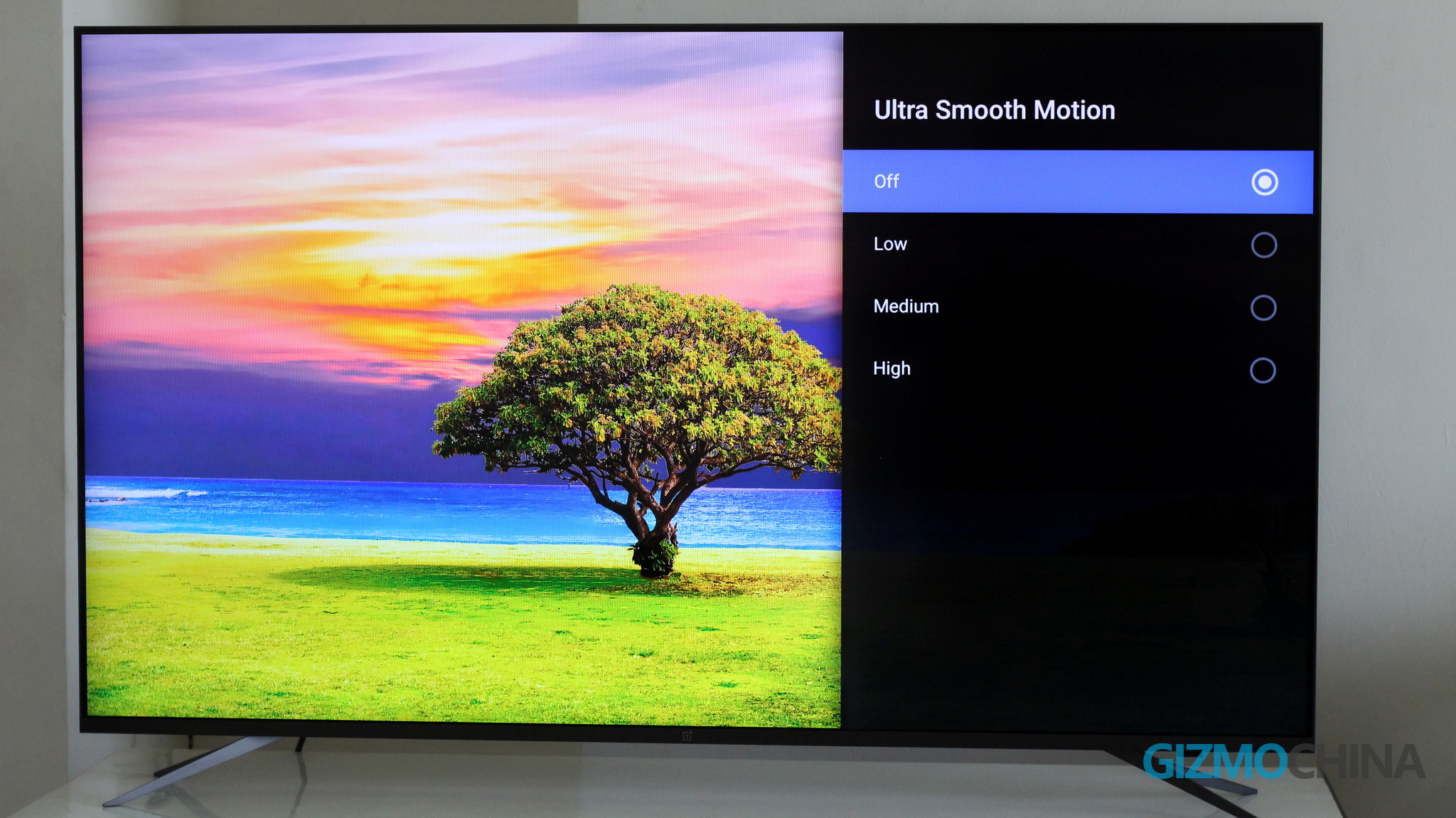
This OnePlus TV also offers MEMC (Motion Estimation Motion Compensation) which is very useful when watching content with fast-moving subjects – like F1 or football. And the TV does a good job of smoothening the fast-paced motion by interpolating the frames in each scene.
OnePlus TV U1 MEMC turned off
However, except for sports, I keep MEMC off or set to low. This feature is not really ideal for watching movies or TV shows as it has a tendency of over smoothening the scenes. If MEMC is turned on, you’ll find that the video looks a bit odd creating a “soap opera effect”. This is because you are used to watching movies and TV series at 24p (most of the high-quality content from Hollywood is shot at 24p). So when your TV interpolates the video to 60p, things look off and most of you will notice this difference. But you can switch off MEMC from Pictures> Advanced Settings> Ultra Smooth Motion.
OnePlus TV U1 MEMC aka Ultra Smooth Motion Settings
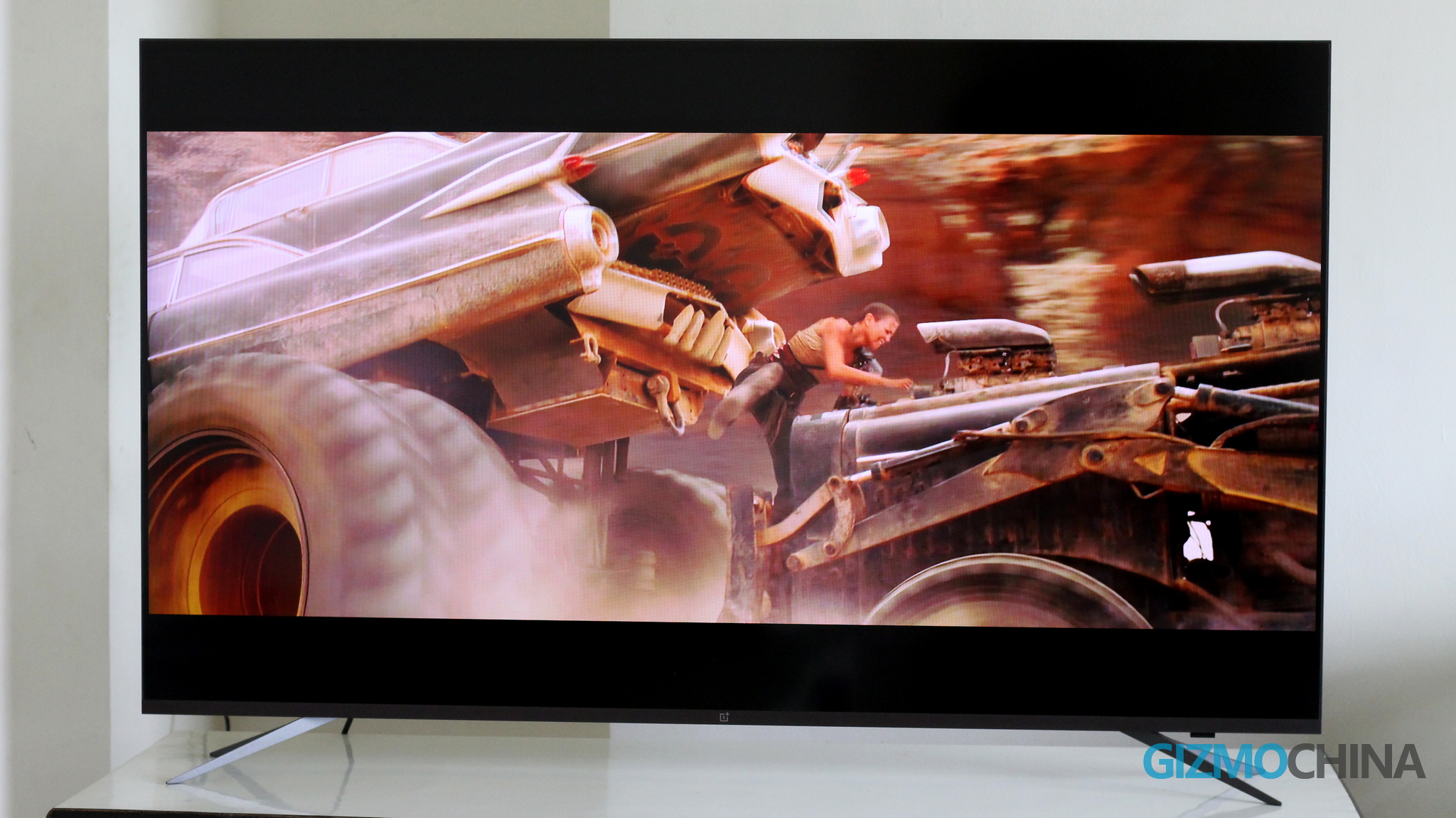
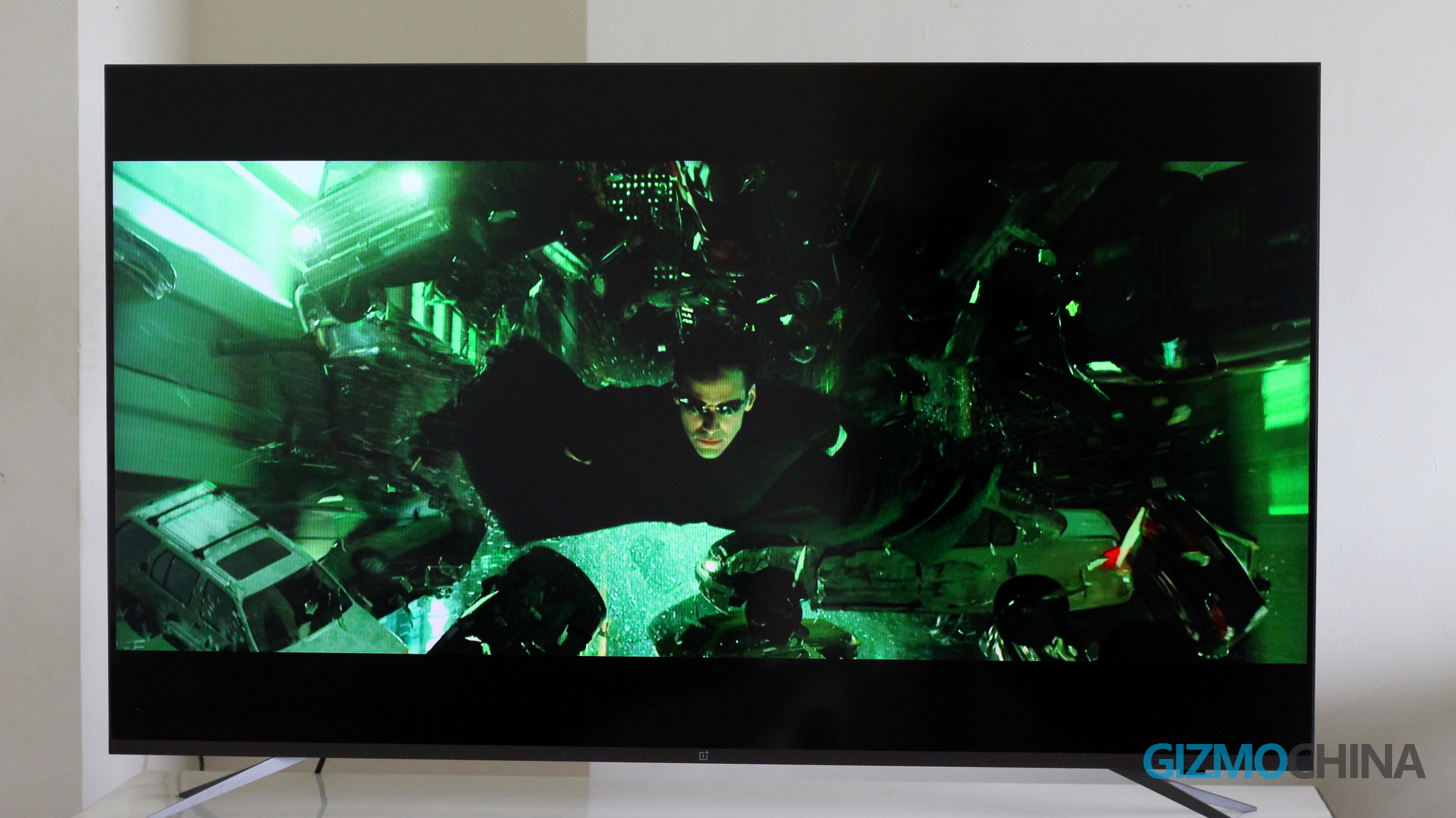
One drawback of this 4K panel would be that it lacks deep blacks. But that’s an inherent issue with LED-backlit panels. You won’t notice this drawback unless you are watching a movie or a TV show with an extremely dark background. For example, OnePlus U1 TV did pretty well in most scenes. However, in extremely dark scenes, you’ll notice that the blacks were not really black, but it was rather a dark grey. Note that the dark scenes look better if the content supports Dolby Vision (especially in Bright mode).
1 of 4
OnePlus TV U1 Dolby Vision Bright Mode
OnePlus TV U1 55-inch Review: Software, Interface & Performance
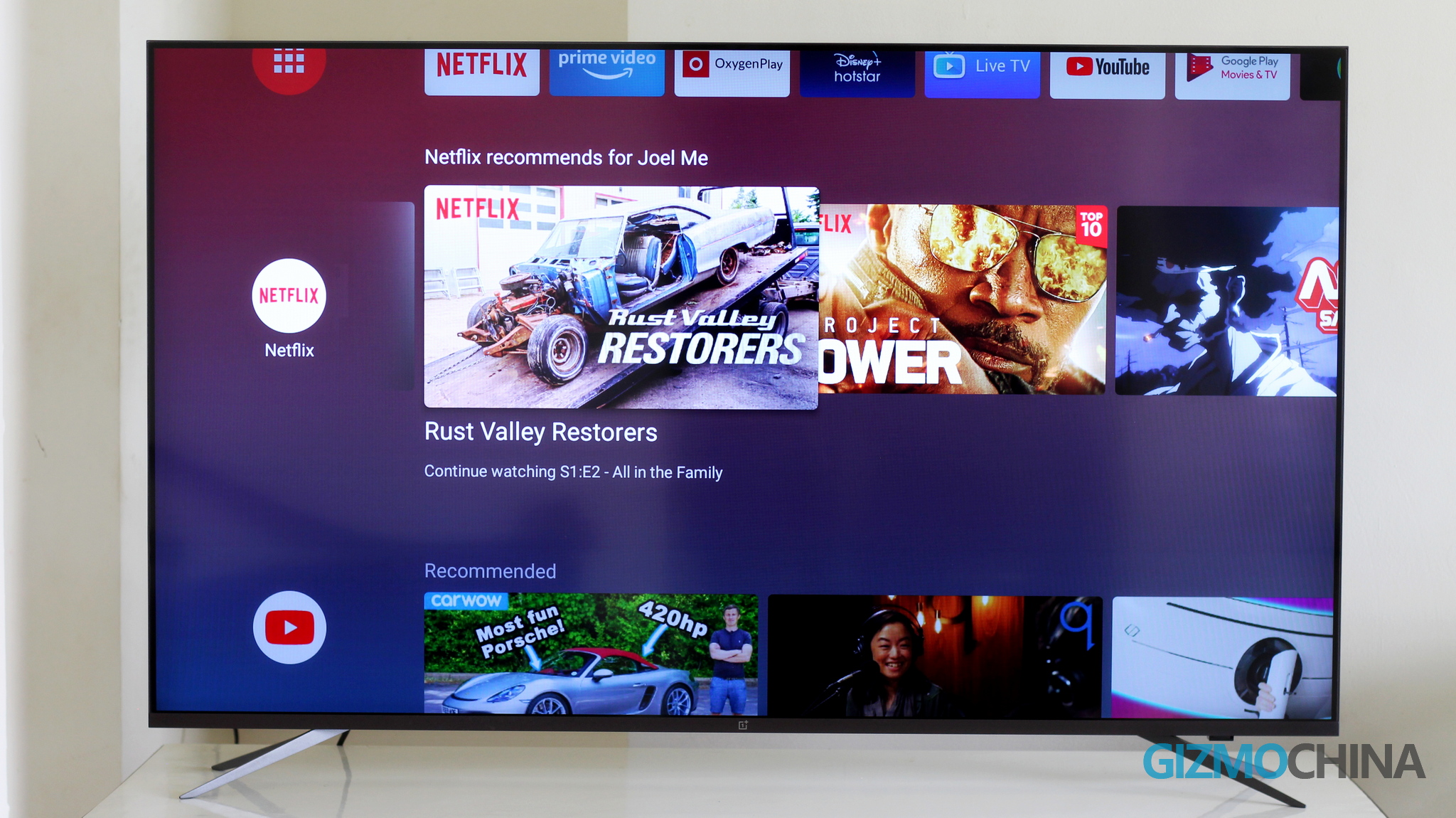
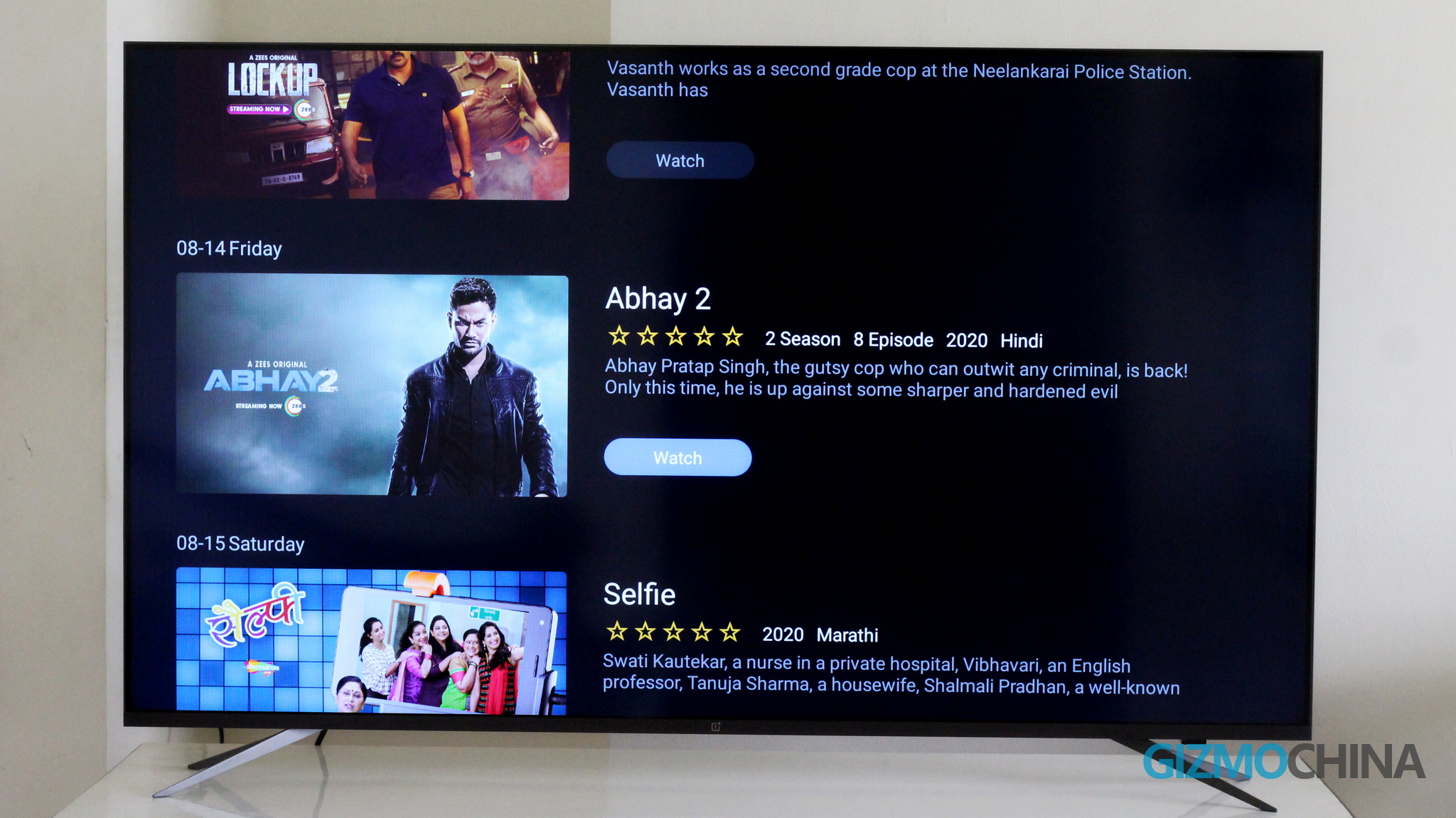
The OnePlus TV U1 runs on the Android TV 9 Pie platform with OxygenPlay launcher on top. So you have two homescreens on the TV, a traditional app-focused Android TV home screen and a content-focused one from OxygenPlay. You have two dedicated buttons on the remote to take you to either one of these homescreens – the OnePlus button takes you to OxygenPlay while the button with a single circle takes you to the Android TV home screen.
Oxygen Play is a content aggregator platform bringing in movies and TV shows from over 15 leading content providers in India, like Amazon Prime, SonyLiv, Voot, ZEE, HungamaPlay, etc. One notable omission seems to be Netflix, as I couldn’t find any movies or TV shows from the app in the platform.
I like that OxygenPlay segregates the content from all these platforms into practical categories like Movies, TV Shows, Music, Kids, and even Upcoming. You can further filter each of these sections based on languages like English, Hindi, Tamil, Marathi, and more. The All button on the home screen gives you a lot more options for languages and genres.
oxygenplay launcher calendar 2
The Upcoming section gives you the option to add reminders for upcoming TV shows and movies. It’s a cool feature if you don’t want to miss out on the latest content. However, once again, it’s a shame that I can’t find upcoming shows from Netflix – which is my most used streaming app.
But overall, I can see how OxygenPlay will be appealing to a lot of consumers, especially for content discovery. Bringing in TV shows and Movies from 15+ apps under one platform makes your life extremely easy to find something interesting to watch every single day.
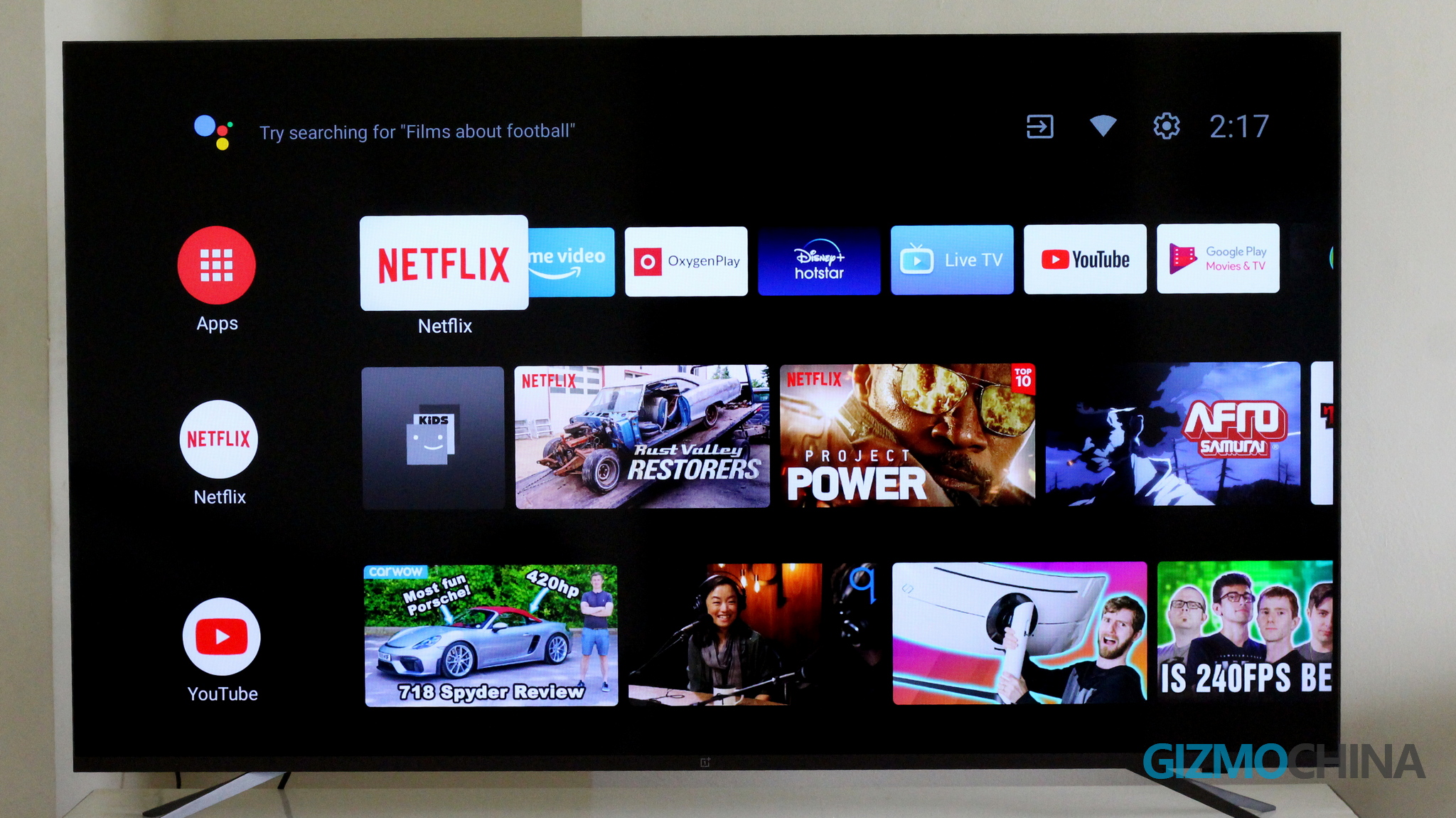
If you are someone who sticks to a couple of streaming apps, the Android TV Home screen makes more sense. It’s an app-centric platform, with the first row showing all the major streaming apps followed by each app with recently watched or recommended shows.
Here, Netflix, Prime Video, and YouTube get priority, but it has a section for OxygenPlay too. Personally, I prefer the Android TV home screen but that’s because I usually know what I want to watch on the TV.
The overall TV interface is fluid and responsive. I didn’t encounter any significant lags or stutters and I can be very rough while browsing. Apps take a second to load, which is normal for a TV, and the overall software experience feels refined. This isn’t surprising since the TV has the hardware for smooth performance. The OnePlus TV U1 runs on the Cortex-A53 quad-core MediaTek MT5887 chip with 3GB of RAM and 16GB of internal storage.
OnePlus TV U1 55-inch Review: Smart & Connected Features
It’s the year 2020 and when you are paying ₹50,000 for a 4K TV, you expected it to have smart as well as connected features. And in this regard, the OnePlus TV U1 doesn’t disappoint.
OnePlus TV U1 Remote Google Assistant
You can control the TV via Google Assistant as well as Amazon Alexa. Since the Google Assistant is built into the TV with a dedicated button on the remote, I often use it to search for content on the TV. There’s a second’s delay for voice search but it works well most of the time.
I also tried connecting Alexa to the OnePLus TV U1 and I could turn on / off the TV, search for a specific TV show or movie with just my voice via Alexa. Note that you have to install the OnePlus TV skill first on the Alexa app. Also, make sure that you are signed in with the same OnePlus account in the Alexa skill as the OnePlus TV. Then it’s pretty straightforward – add the TV to Alexa with the Discover device feature on the Alexa app and you are all set to control the TV with your Alexa smart speaker.
OnePlus TV U1 55-inch Review: Speakers & Sound Output
I’ll be honest, at first, I thought that the speakers on the OnePlus TV sounded terrible. But you get decent sound output from the 30W 4-speaker setup built-into the TV once you tweak the settings.
The standard sound mode produces underwhelming sound clarity. It was loud enough, but the speaker setup wasn’t clear or punchy.
Changing the sound setting to clarity has improved the overall sound quality. Dialogues are clearer and the sound quality is crisp too.
OnePlus TV U1 Speakers
The OnePlus TV speakers are decent for an inbuilt TV speaker setup, but if you are investing so much on a TV, it makes sense to get a good soundbar too for a premium entertainment experience. Simply put, the inbuilt 30W speaker doesn’t feel premium. It’s loud but the sound output is not rich.
OnePlus TV U1 Review: Remote
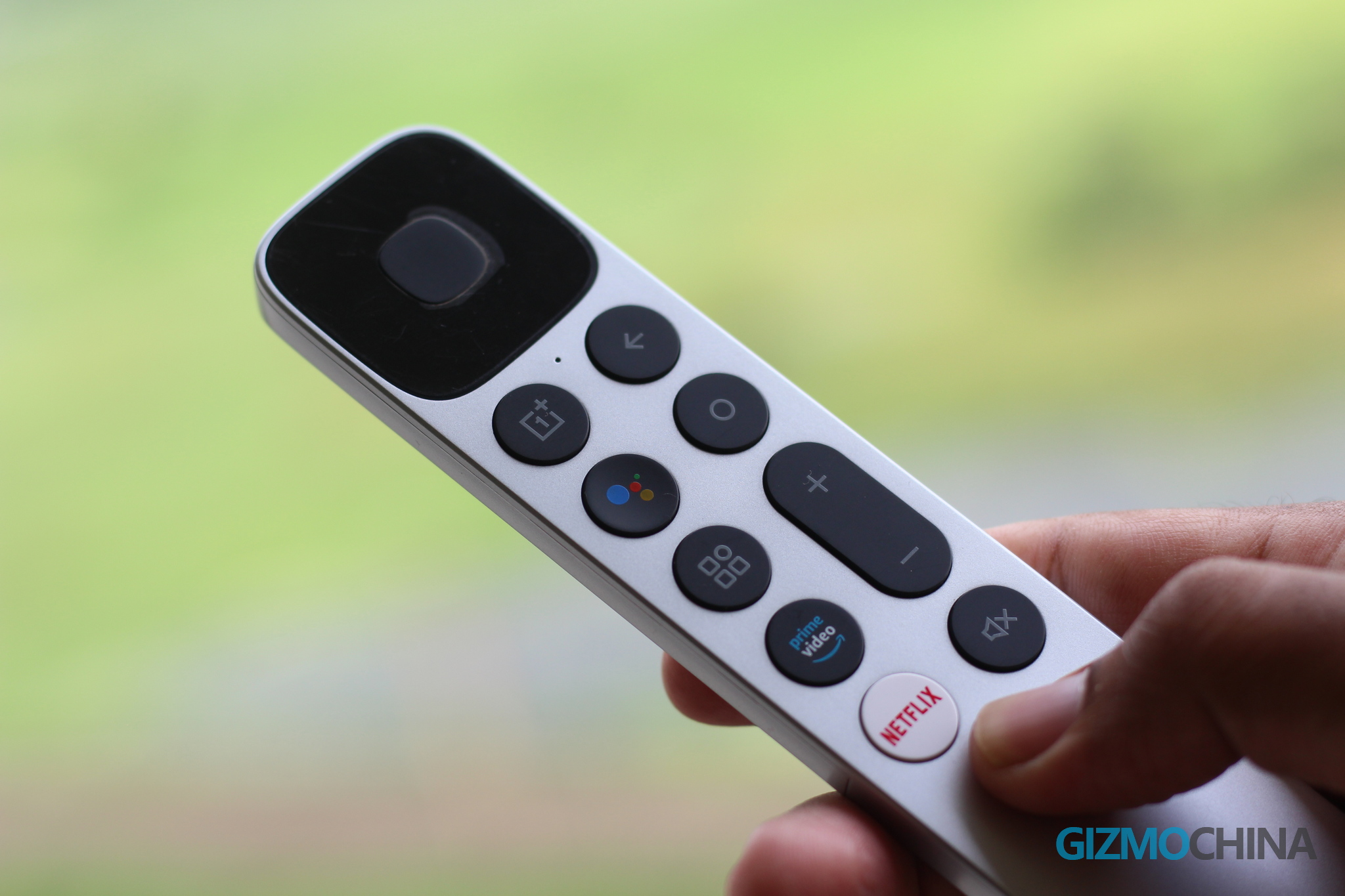
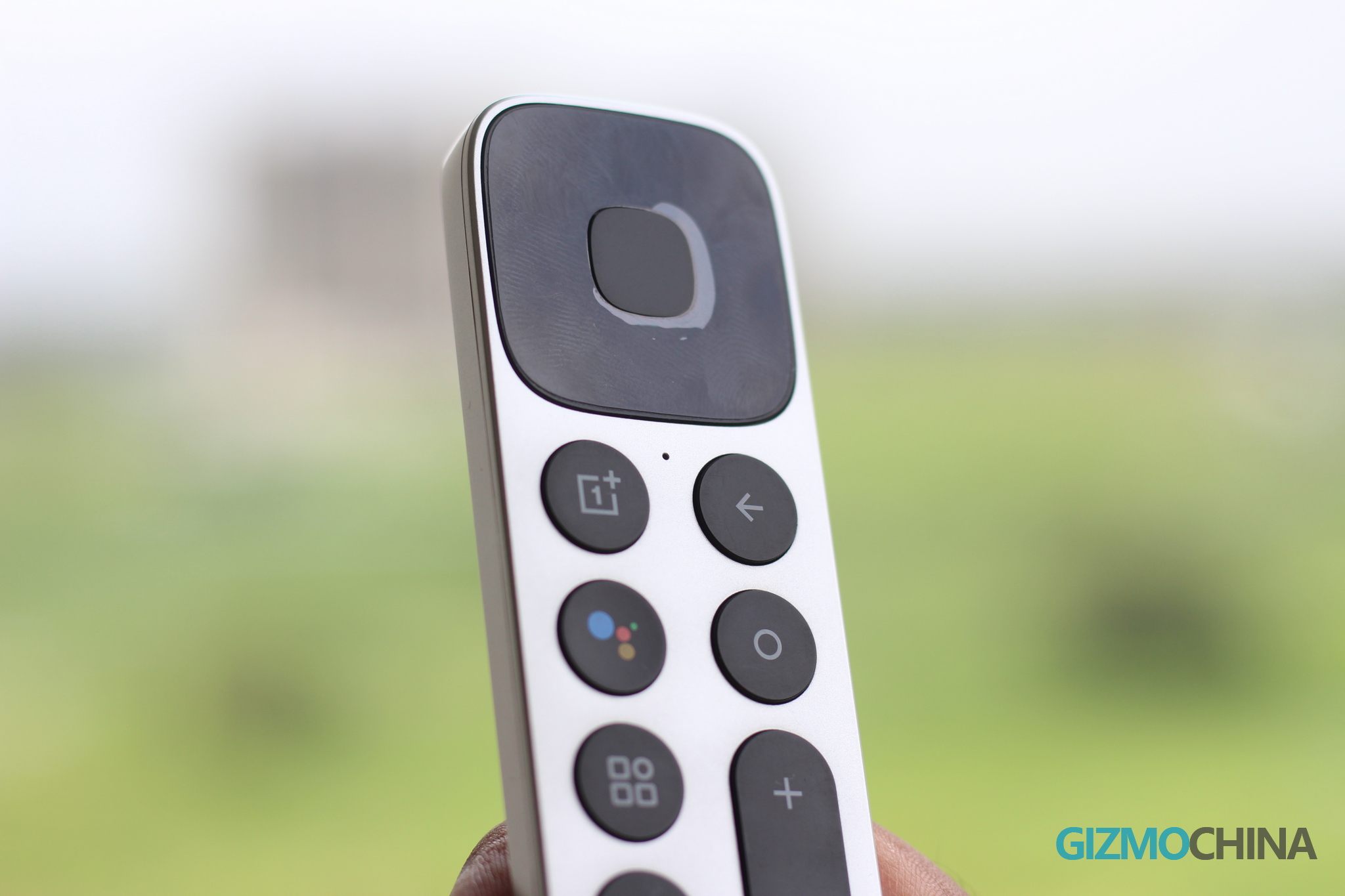
The OnePlus TV U1 Remote is thinner and smaller than other remotes in the market. The basic form factor remains the same as the original OnePlus U1 TV remote but the remote gets a redesigned layout for better user experience.
The remote is still plastic but feels good. The silver color finish gives it a premium look. Some of the major changes in the new remote include the new placement of the volume buttons (shifted from the side to the front). The remote is powered by two AAA batteries instead of having to charge it via USB-C port in the first-generation model.
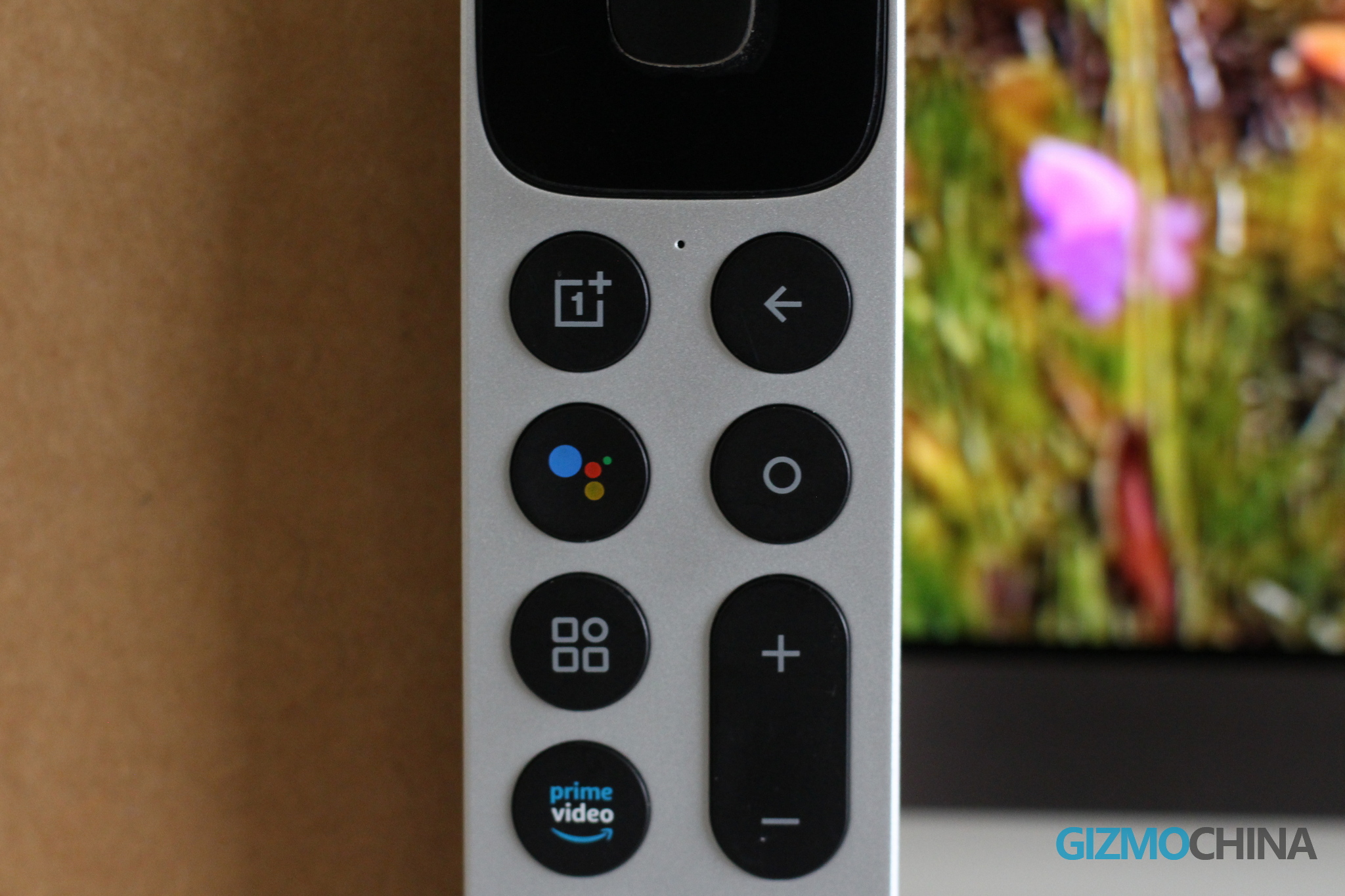
The placement of the buttons feel natural. The D-Pad lies on top followed by other buttons – the back button, OnePlus button (single press to launch OnePlus OxygenPlay launcher or long press to sleep/ switch off), Android TV button, Quick Settings, Google Assistant, Quick Setting, Prime and Netflix, and finally a mute button.
The placement of the back button is perfect. However, I would have preferred the D-Pad in the middle of the remote because that’s where your thumb rests naturally when u grab the remote.
OnePlus TV U1 Quick Settings
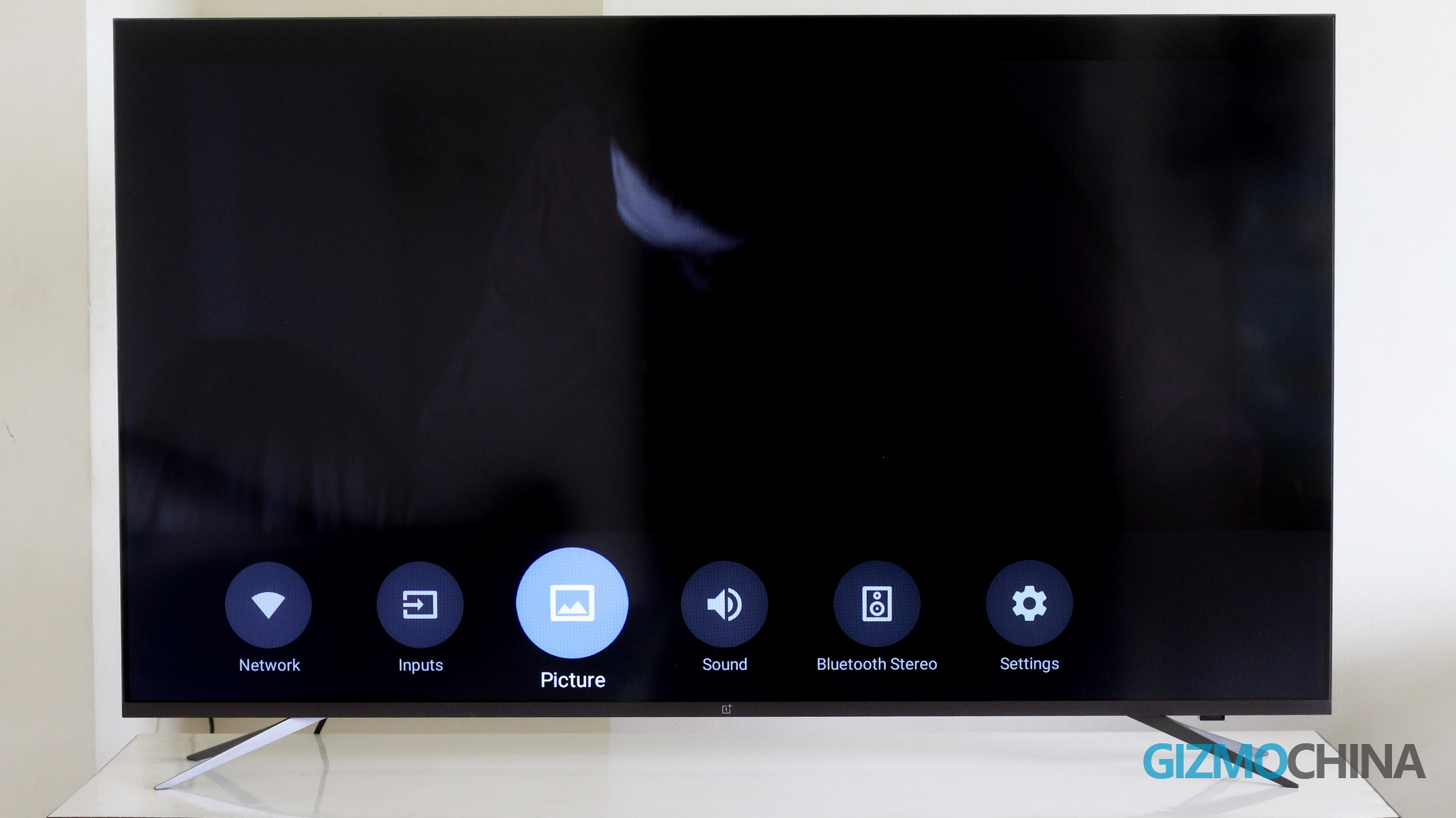
The Quick Settings button (the one with three squares and a circle) is also a handy addition as you can quickly tweak the settings without leaving the current screen. The quick settings panel gives you options to control the picture, sound, input, and other settings right from your movie or TV screen.
Overall, this is a much better design than the first-generation model.
OnePlus TV U1 Review: Verdict
The OnePlus TV U1 offers excellent value for your money. The vibrant 4K panel, stylish design, and a very useful Android TV / OxygenPlay interface ensures a high-quality user experience on the TV.
If you can look past the underwhelming speakers and the lack of deep blacks, the OnePlus TV U1 is very easy to recommend to anyone looking for a good quality TV under ₹50,000.
With various US sanctions seeking to pressurize Huawei and limit its supply chain, the company is facing various challenges. Due to the company not being able to manufacture its chips through TSMC, its chip designing subsidiary is losing its engineers as it plans on building 45nm chip fabrication lines.
According to reports from DigiTimes (1,2), “The mounting US trade sanctions are driving HiSilicon to the brink and many engineers have left the Huawei IC design arm’s team in Taiwan.”This will not just affect the company’s operations, but may also hamper its plans for the future. Another report also revealed that Huawei is planning on building its own 45nm fabs for the severely outdated 45nm chips.
So, the already Herculean task is further made difficult with the fact that the company is bleeding its talent at the moment. One of the reasons why the engineers might be abandoning ship could be related to recent news of the US not granting temporary licenses that allowed companies using American designed chips to continue trading to Huawei. Currently, Huawei is expecting the final batches of its chip orders from TSMC, which will end by 14th September 2020. So, the Huawei Mate 40 series may be the last flagship to feature the company’s custom HiSilicon Kirin chips.
The OPPO F15 debuted in India in January this year. While OPPO fans expected to see a Pro version, the company only sold the vanilla edition in the country. OPPO is now gearing up to launch a new F-series phone in the country. A fresh teaser released by the company confirms that the name of the device is OPPO F17 Pro and it will be selling with a price of under Rs. 25,000.
The teaser released by the company states that the OPPO F17 Pro will be “the sleekest phone of 2020.” The company has revealed that the F17 Pro is a lightweight smartphone that weighs only 164 grams. Also, its thickness is only 7.48mm.
As can be seen in the teaser image, the phone has a SIM card tray and volume up and down buttons on the left edge. The OPPO F15 had featured a vertical camera module with four cameras inside it. The side of the OPPO F17 Pro gives of two camera sensors. Hence, there is a possibility that the F17 Pro could be featuring a square-shaped camera module with four cameras inside. The disclaimer text at the bottom of the teaser has revealed that it will be costing less than Rs. 25,000.
The Chinese firm is yet to confirm the launch date of the OPPO F17 Pro for India. Tipster Mukul Sharma had claimed recently that OPPO may announce the F17 series in the first week of September. At present, there is no official information available on the specifications of the OPPO F17 Pro. it is unclear whether the company will be also announcing the OPPO F17 vanilla variant with the Pro model.
Samsung has launched its flagship smartphones for this year, including the Galaxy S20 lineup and the Galaxy Note20 series as well as the Galaxy Z Fold2. Now, the next major announcement from the company will be the Galaxy S21.
While the launch of the next-generation Galaxy S-series flagship smartphone is still several months away, details about the phone have already started surfacing online. Starting with the name, it is being said that the upcoming flagship will be called Samsung Galaxy S21.
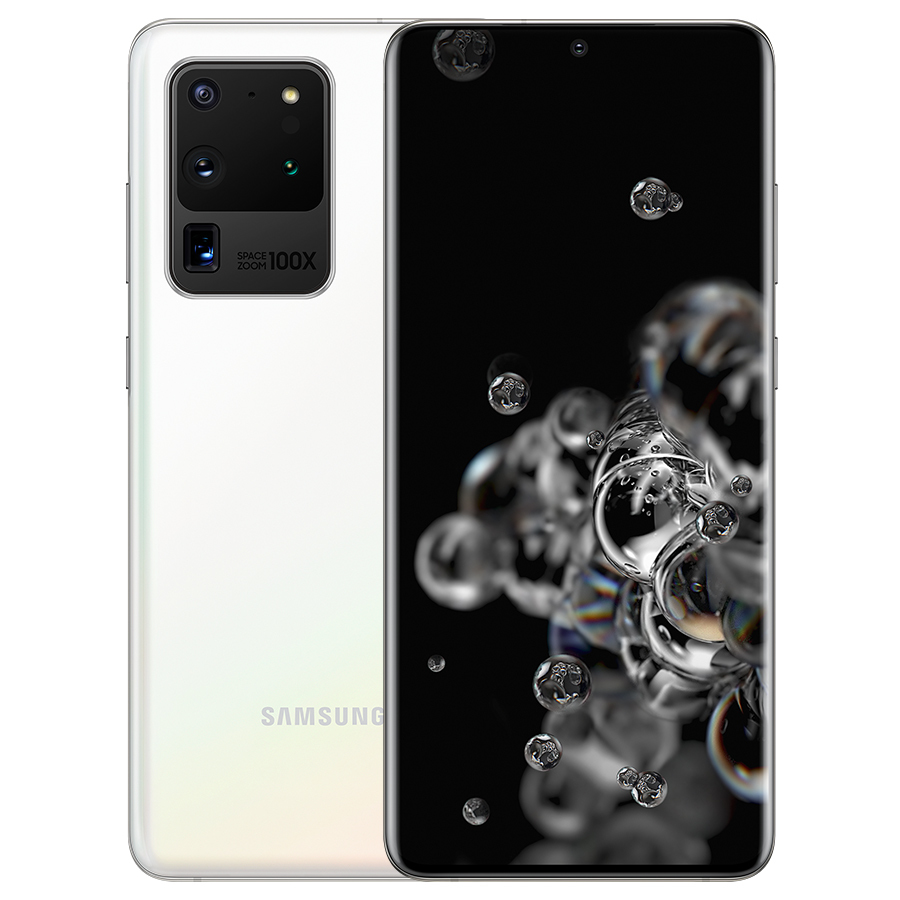
Samsung Galaxy S20 Ultra Cosmic White
Reports indicate that the Galaxy S21 series will include three smartphone models, just like the S20 series. Now, Ice Universe has revealed some details about the top-end model in the lineup — the Samsung Galaxy S21 Ultra.
It is being claimed that the smartphone will continue to feature a 108-megapixel primary camera but the sensor is a successor to the Samsung ISOCELL Bright HM1 sensor. It remains to be seen what improvements this update sensor will bring.
Coming to the configuration of the Galaxy S21, the smartphone is not expected to have major improvements compared to its predecessor. As per the report, Samsung is focusing on improving the product by incorporating user feedback. So, instead of getting a major upgrade, what we will get is an improved and fine-tuned Galaxy S20.
Some leaks indicate that the Galaxy S21 series smartphones will come powered by Samsung’s own Exynos 1000 SoC, made using a 5nm process, which will be as good as the Qualcomm Snapdragon 875 chipset, if not better. The phone will also reportedly skip the ToF sensor, similar to the Note20.
It is also being said that the device will have Qualcomm‘s new in-display fingerprint sensor which is expected to be 17 times bigger than the one found on the Galaxy S20 and it will also be much faster in use. In terms of fast charging support, reports indicate that the Galaxy S21 Ultra will have 60W fast charging. To know for sure what the upcoming devices will pack, we will have to wait for a few more weeks or months.
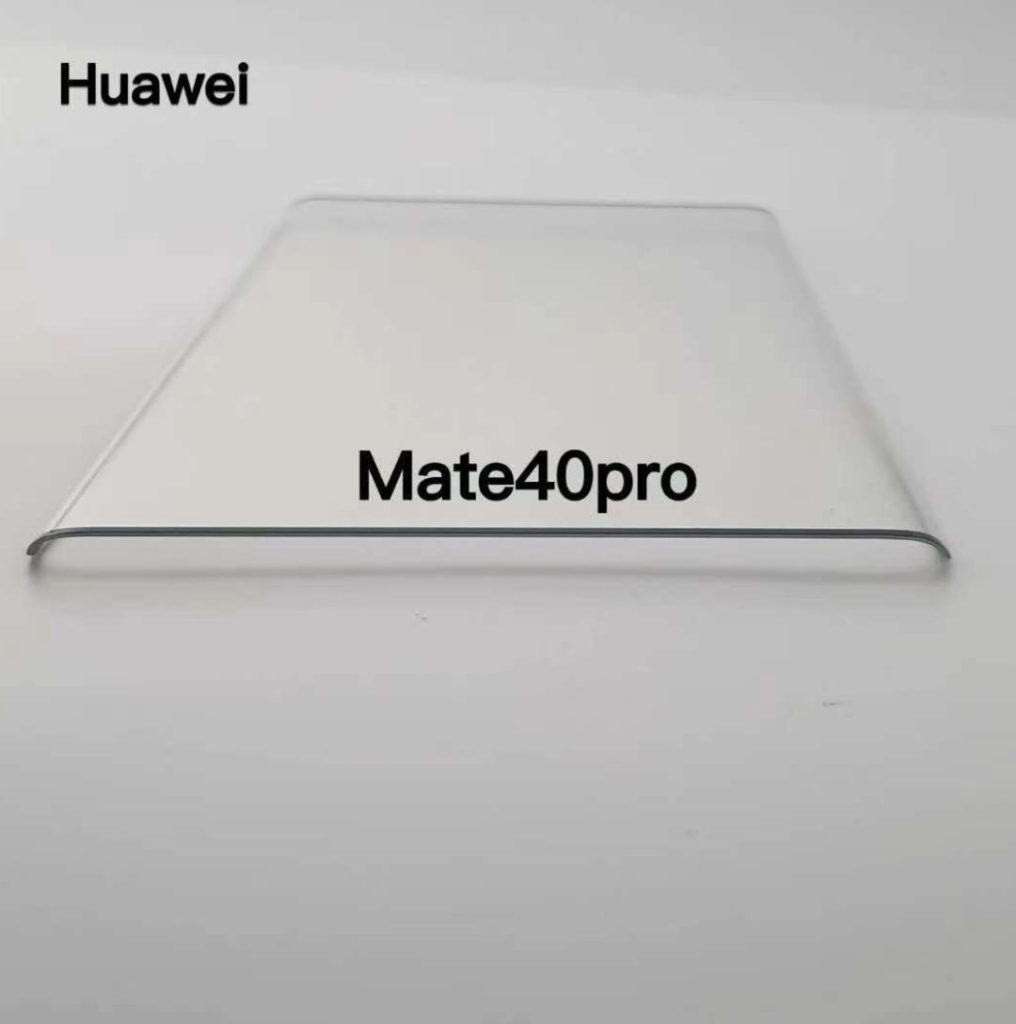
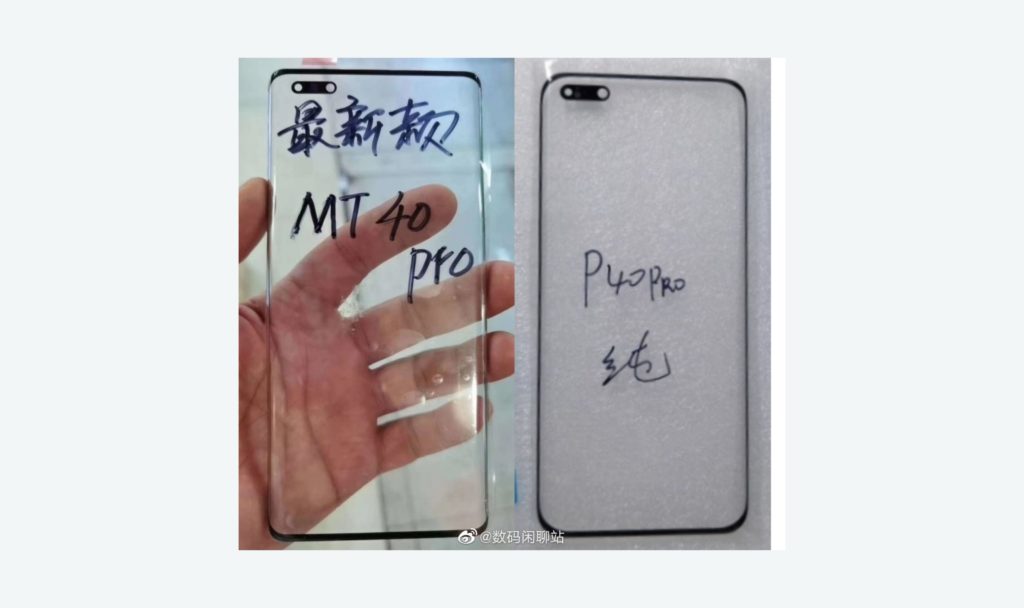
Another popular leakster, Ice Universe (i冰宇宙) shared a picture of Huawei Mate 40 Pro’s display glass. This once again confirms the return of waterfall display from its predecessor.
Original Story
The Huawei Mate 40 series is expected to launch in October. The two devices in the series – Mate 40 and Mate 40 Pro recently leaked in 3D CAD renders revealing their entire design. Now, tempered glass of the latter pops up on Weibo reiterating the display design from the previous leak.
Mate 40 series is said to include four models namely HUAWEI Mate40, HUAWEI Mate40 Pro, HUAWEI Mate40 Pro+, and PORSCHE DESIGN HUAWEI Mate40 RS. However, we are only aware of the design of the first two models, thanks to leakster @OnLeaks.
Corroborating his Mate 40 Pro renders, a picture of the handset’s tempered glass has been circulated on Chinese microblogging site Weibo. It came to light when the tipster Digital Chat Station (数码闲聊站) shared it asking his followers for the original source.
From the picture, we can see that Mate 40 Pro will feature a waterfall display just like its predecessor. But it will not have curved top and bottom sides like the HUAWEI P40 series. That said, it will do come with a dual punch-hole camera.
According to previous reports and leaks, the upcoming HUAWEI Mate40 Pro will feature a 5nm HiSilicon Kirin 90000 chipset, EMUI 11, liquid lens technology, and 90Hz refresh rate.
Despite the Samsung Galaxy Z Fold 2 being announced two weeks ago, the company has yet to officially be released like the Galaxy Note 20 series. Samsung has yet to unveil its finer details as well, but a new leaked hands on video might be a cause for concern regarding the upcoming device.
A new leaked video from a tipster on Twitter has revealed a hands on video of Samsung’s latest foldable handset. Unfortunately, the video showcases what seems to be a major crease in the middle of the device. This region is where the device folds from, or in other words, its hinge mechanism resides. Looking at the video, this portion can be clearly discerned, with the display on top of the region seemingly sunken inwards.
Apart from this major issue, the Galaxy Z Fold 2 is exactly as one would have imagined it during its official announcement. Its secondary outer display seems a lot more practical and useful now than the previous generation and the device seems to be utilizing both half the screens for various functionalities like camera apps and more. Similar to the video shared by Abhishek Yadav, another Tweet from Ben Geskin also revealed the device being folded and, unfortunately, we see that massive crease make a reappearance.
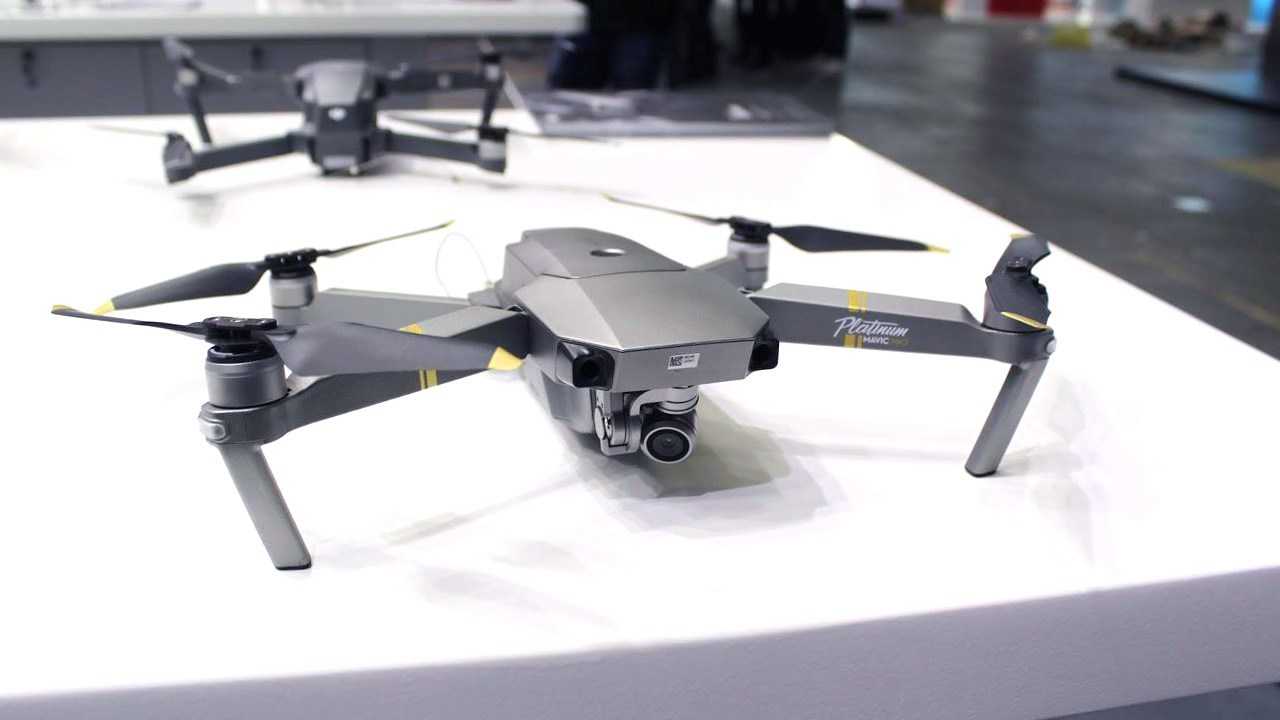
DJI, one of the leading drone manufacturers in the world, has announced that it is extending the warranty period for the core components of the drone to 12 months from the usual coverage of six months.
So now, the DJI drone offers 12 months of warranty for most of the parts, excluding removable batteries, retail accessories, and some structural parts. The components that have got extension period include Gimble Camera, Vision Module, Power System, Charging Butler, Battery, Gimble Handle, and PTZ Motor.
The company has said that during the warranty period if the product experiences difficulties or issues or if it gets damaged because of non-human error, then it will offer free maintenance or repair service.
The warranty period for this will be calculated from the day of purchase of the product. DJI has also added that this is applicable to all the devices purchased before making this announcement and the company will automatically determine the warranty status when the product is sent for repair.
Along with extending the product warranty period, DJI has also said that users can also purchase value-added services that aim to further extend the warranty period. The list of such services includes Accidental Damage Protection and Liability Insurance, among others.
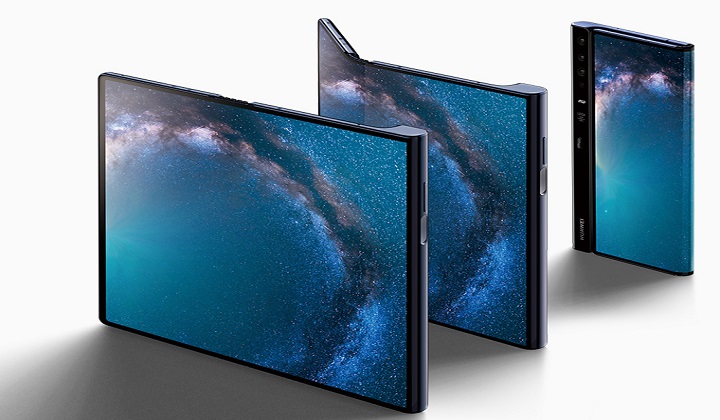
Huawei Mate X foldable smartphone was launched by the company last year and now the phone’s successor is among the most anticipated devices. Huawei is expected to bring Mate X2 smartphone with several new features and improvements.
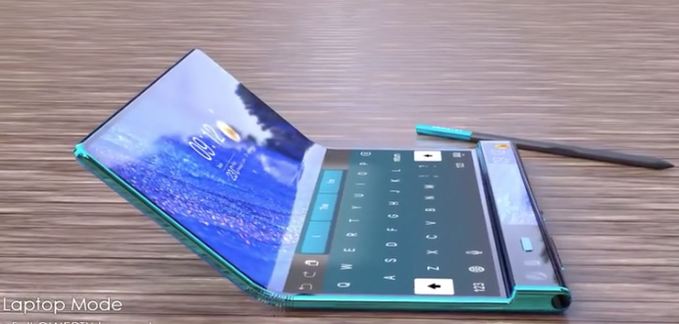
One of the major design change being reported for the Mate X2 foldable smartphone is that instead of the outward folding design in the original model, the next-generation model will come with an inward folding screen.
Now, in the latest development related to the Huawei Mate X2, the company is all set to start production of the display panel from September this year, i.e. next month. It has also been revealed that the screen size remains the same as its predecessor — 8.03-inch having 2480 x 2220 pixels resolution.
Reports indicate that Samsung Display will be providing the 8.3-inch CPI (Transparent Polymide) panels to Huawei in Q3 2020, with a sales target of 300,000 units.
Huawei Mate X2 foldable panel starts production in September. Still 8.03" 2480 x 2220 but now infolding…
From the leaked images, it seems that we could also get an additional display panel on the vertical strip that houses the camera sensors. While the company has not revealed anything related to this smartphone, some key details have leaked online.
As per the leak, the Mate X2 foldable smartphone will come with a quad-camera setup that includes a 40 MP primary sensor, a 40 MP ultra-wide sensor, a 12 MP telephoto lens, and a ToF sensor. It will have support for features like 3x optical zoom and OIS.
The device is expected to come in multiple memory variants such as 8GB RAM with 128GB storage, 12 GB RAM with 256GB storage, and 16GB RAM with 512GB storage. It is also said to be powered by a 6,000mAh battery with 65W fast charging support.
It seems that the legal trouble for Apple keeps on mounting. After Epic Games filed a lawsuit against the company for removing Fortnite game from the App Store and threatening to remove all its developer accounts, the company is now being sued for backlight display issues in MacBook Pro.
A new class-action lawsuit has been filed against Apple claiming that the company was aware of a design flaw in MacBook Pro that led to some of the units exhibit backlight display issues. The lawsuit is targeting the “stage light” or “flexgate” issue of MacBook Pro models manufactured in 2016 and 2017.
It seeks to get damages, court fees, and a judgment requiring Apple to identify and declare all defective MacBook Pro laptops, among some other relief measures, reveals a report from AppleInsider.
For those who are unaware, this is related to a problem with the display where the backlight to illuminate the screen would not work properly and damage the cable which then exhibited a “stage light” effect at the bottom of the display. The issue was related to a thin flex cable connecting motherboard and display wearing down over time.
Later, Apple launched a repair program that covered 2016 models of 13-in MacBook Pro but didn’t include 15-inch models and the models produced after 2016 that faced similar issues. The claim in the suit says that the company delayed issuing the repair program “despite the fact that it both knew and should have known” the root cause of the problem.
It further adds that “Apple was aware of the issues with the backlight screen and the defective flex cable, in light of the comments posted by consumers on Apple’s discussion forum and that those comments were deleted after they were posted.”
The class-action lawsuit is alleging violation of unfair competition laws in various states, the Song-Beverly Consumer Warranty Act, the Magnuson-Moss Warranty Act, and consumer fraud statutes in all 50 states and the District of Columbia. Further, the action is also asserting Breach of express warranty, breach of an implied warranty, fraudulent concealment, and unjust enrichment.
Huawei has been facing several difficulties when it comes to a smoothly operating business because of the new sanctions imposed by the United States. In the most recent development, the company is being forced to cease development of its high-end Kirin chipsets because of the restrictions put on manufacturing.
But, it seems that the impact of the new restrictions put on by the U.S. government will not be as bad as the smartphone business if we compare it to the company’s core telecom equipment business.
As per the latest report coming from Korea, Huawei has secured enough chipsets used in the telecom base station that it could last for years. The company had reportedly started stockpiling a large volume of semiconductors for the business-to-business operations since last year, anticipating such restrictions.
Given that the lifecycle of the chipsets used in the base stations is much longer than the chips used in smartphones, there won’t be any issues related to using the latest chipset, unlike the mobile phone business. The chipsets used in base stations are more focused on stability and reliability.
Last year, the company had announced the Tiangang chipset for 5G base stations which supports 3.5GHz and 2.6GHz spectrum. Manufactured using the 7nm process by TSMC in 2018, the company has been stockpiling it since last year.
Huawei and its 70 affiliates have been put on Entity List by the United States, which now requires special permission from the government to carry out business. Thus, Huawei’s contract chipset manufacturer TSMC has been prevented from taking new orders from the Chinese company and will completely halt HiSilicon chip production from 15th September.
In line with this development, Huawei CEO confirmed that the Kirin 9000 will be the last flagship chipset from the company, which will be powering the upcoming Mate40 series smartphones. However, it’s likely that mid-range chipsets will continue to be produced given that they are now being manufactured in China by SMIC.
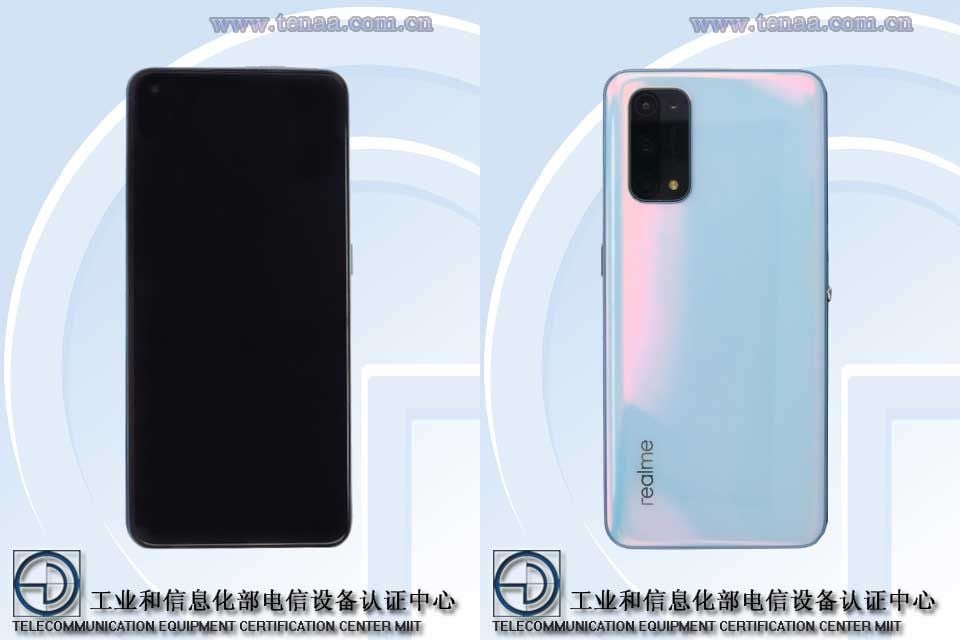
In June, the Realme RMX2121 appeared in the database of TENAA with its images and some specs like dimensions, rated battery capacity, and display size. Recent reports confirmed that the Realme RMX2121 is the upcoming Realme X7 Pro smartphone. Finally, the TENAA listing of the handset has been updated with all its specifications.
Realme X7 Pro specifications
The Realme X7 Pro has 160.8 x 75.2 x 8.5mm dimensions and it weighs 184 grams. TENAA listing states that the phone will be arriving in three color options such as black, white, and purple.
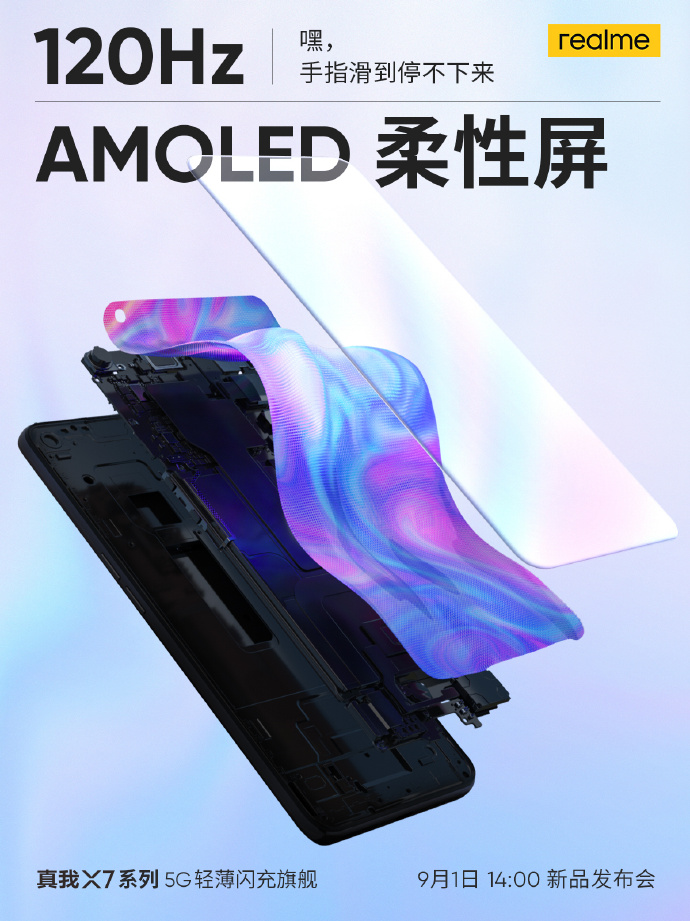
The Realme X7 Pro has a 6.55-inch display with a punch-hole positioned at the upper-left corner. The AMOLED screen has curved edges and it supports 1080 x 2400 pixels resolution. The Chinese firm has already confirmed that it will arrive with support for the 120Hz refresh rate. The screen is integrated with a fingerprint reader.
Realme RMX2121
It has a front camera of 32-megapixel and it has a 64-megapixel + 8-megapixel + 2-megapixel + 2-megapixel quad-camera system on its back. The Realme Ui based Android 10 OS will run on the device. The device will be available in China 6 GB and 8 GB RAM edition and storage capacities like 128 GB and 256 GB. The phone lacks support for externals storage.
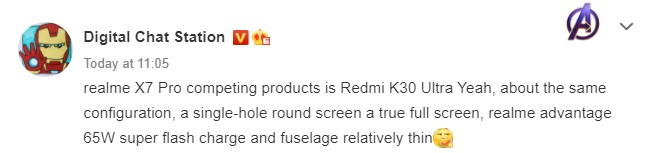
The listing mentions that the Realme X7 Pro is equipped with a 2.6GHz octa-core processor. The latter seems to be the Dimensity 1000+ 5G chipset. A leakster claimed that the Realme X7 Pro will be Realme’s weapon to take on the Redmi K30 Ultra that recently official in China.
The Realme X7 Pro and Redmi K30 Ultra have similar specs. However, one advantage that the Realme phone will have over the K30 Ultra is that it will come equipped with support for 65W fast charging. The Redmi phone supports only 33W fast charging.
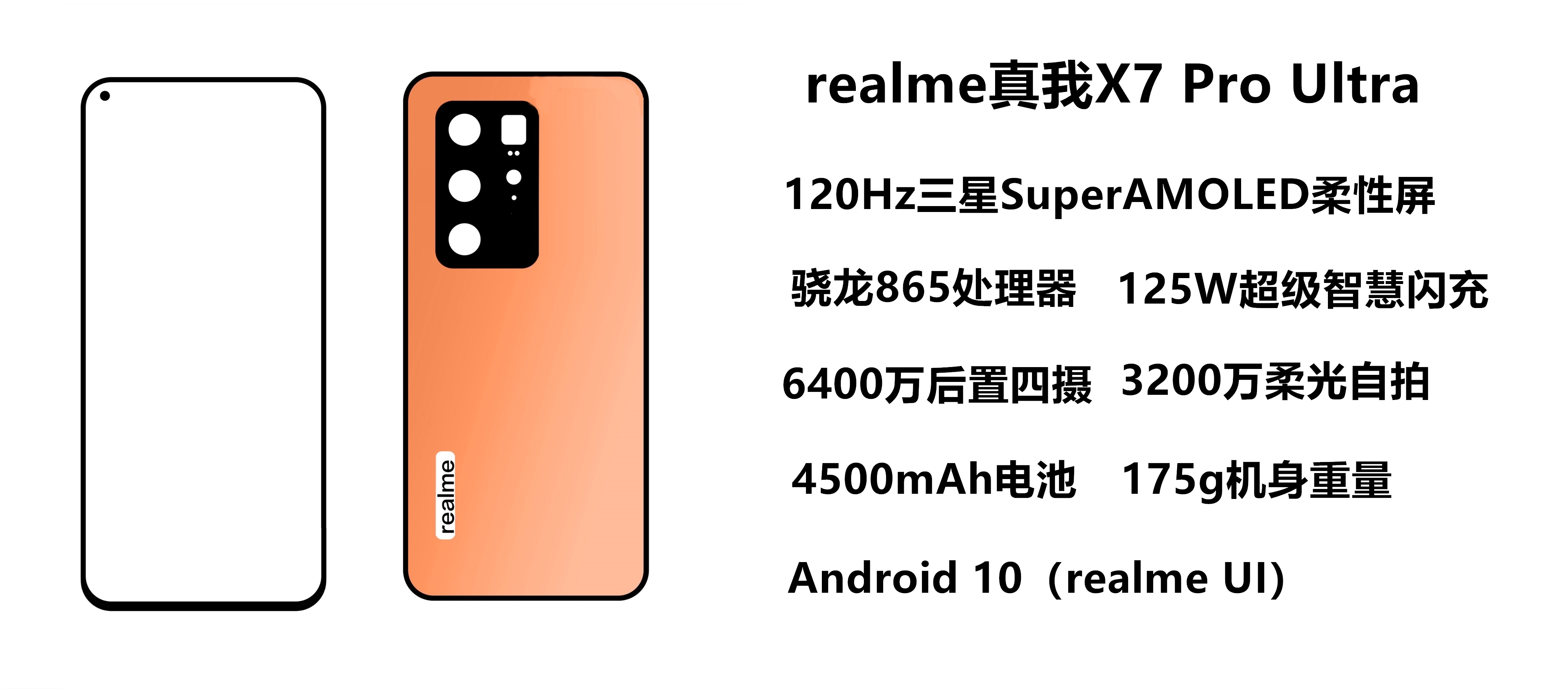
Realme will be launching the Realme X7 Pro on Sept. 1. A Realme X7 with RMX2176 model number will also go official alongside. Rumors have it that the company will also unleash Realme X7 Pro Ultra with topnotch specs like 120Hz display, Snapdragon 865, and 125W fast charging support.
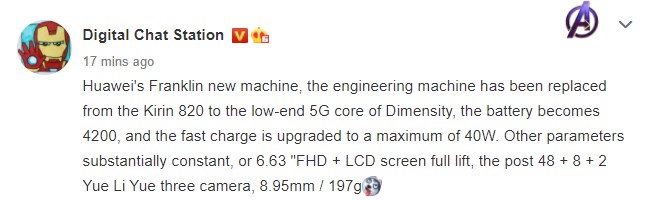
Recent reports have revealed that the FRA-AN00a / FRL-TN00 model number belongs to the upcoming Huawei Enjoy 20+ smartphone. The ‘FRA’ is the model number of the device is a short form of its ‘Franklin’ codename. Past reports had claimed that the Huawei Enjoy 20 Plus will be powered by the Kirin 820 chipset. However, a well-known tipster from China has claimed that Kirin SoC has been replaced by a MediaTek’s low-end 5G chipset.
MediaTek now has a couple of low-end 5G chipsets such as Dimensity 800, Dimensity 720, and the recently announced Dimensity 800U. It remains to be seen which of these will be powering the Enjoy 20+. As far as the other specs are concerned, the Enjoy 20+ is expected to arrive with a notch-less LCD panel with Full HD+ resolution support. It will feature an elevating selfie camera.
The leakster further stated that a 48-megapixel + 8-megapixel + 2-megapixel triple camera setup will be available on the rear shell of the Huawei Enjoy 20. The phone will draw power from a 4,200mAh battery that will support 40W fast charging. The handset measures 8.95 in thickness and weighs 197 grams.
Probably, the recently announced revision in the ban on Huawei may have caused it to swap Kirin SoC with the MediaTek chip on the Enjoy 20+. On Aug. 17, the Bureau of Industry and Security (BIS) that belongs to the U.S. Department of Commerce issued a revised ban on Huawei since it was found using evasive measures. In May, the US administration extended the ban on Huawei which prevented it from obtaining semiconductors without a special license. However, it was reportedly found that Huawei had been purchasing American components through third-party companies. The ban that was further revised on Aug. 17 brings a ban on 38 more companies affiliated with Huawei across 21 countries.
This further limits Huawei from accessing U.S chipset and prevents it from circumventing U.S. laws by alternative chip production and providing off-the-shelf (OTS) chips produced with tools obtains from the U.S. Probably, Huawei already knew that it would happen sooner or later as this could be the reason why it recently ordered 120 million chips from MediaTek. It is speculated that seven of the phones released this year by Huawei will be fueled by MediaTek chips.
The Realme X7 and Realme X7 Pro smartphones are all set to go official on Sept. 1. It is speculated that the Realme X7 Pro will be rivaling with the Redmi K30 Ultra in China. The K30 Ultra is powered by Dimensity 1000+ chipset. It is speculated that the Realme X7 Pro may feature the same chipset. While the rumor mill is busy leaking information on the X7 and X7 Pro phones, a fresh leak has revealed the existence of a premium flagship model called Realme X7 Pro Ultra.
A reliable tipster with a good track record has shared an image showcases the appearance and key specs of the Realme X7 Pro Ultra. The leak states that the phone will be announced on Sept. 1. However, there is no official word on the existence of the device yet.
The leak reveals that the Realme X7 Pro Ultra has an S-AMOLED display with punch-hole design and curved edges. The display supports a refresh rate of 120Hz. The screen will most likely be integrated by a fingerprint sensor. The smartphone is driven by the Snapdragon 865 mobile platform.
The punch-hole on the screen is the home for its 32-megapixel selfie snapper. The back panel of the smartphone has a quad-camera setup led by a 64-megapixel primary shooter. The image of the phone reveals that the camera setup includes a periscope zoom lens.
The Realme UI based Android 10 OS will come preloaded on the Realme X7 Pro Ultra. It is equipped with a 4,500mAh battery that supports 125W super flash charging technology. The 5G-ready device will weigh only 175 grams.
There is no word on the pricing of the Realme X7 Pro Ultra. Since the company is yet to confirm the existence of the device, it is advisable to take the report with a pinch of salt.
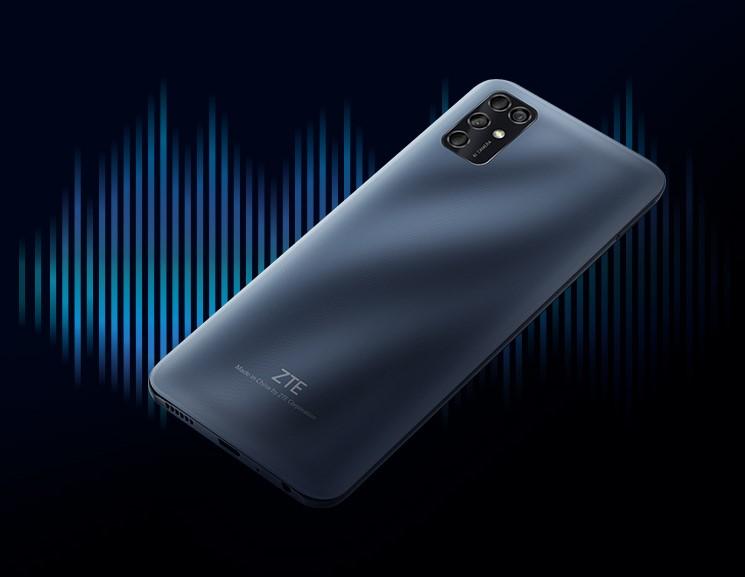
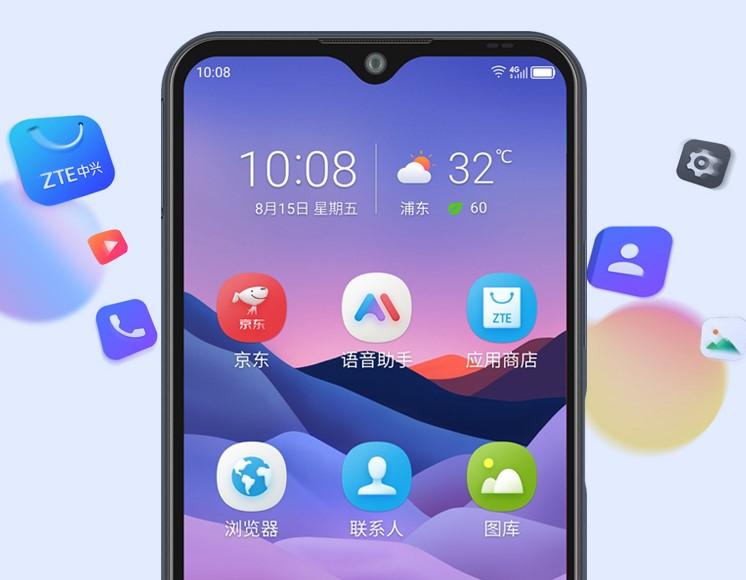
ZTE officially launched a budget smartphone under the Blade V series in China. ZTE Blade V2020 comes with a decent specs lineup while retaining the affordable pricing the series is now for.
The Blade V2020 smartphone sports a 6.82-inch screen with a FullHD+ resolution. The device is powered by a UNISOC SC9863A SoC. The chipset is an entry-level octa-core SoC with 8 ARM Cortex-A55 cores in two clusters and built with a 28nm HPC+ process technology. The chipset is a 4G processor that supports TD-LTE, LTE FDD, WCDMA, TD-SCDMA, GSM and other network standards. It is also bundled with an IMG8322 graphics processor.
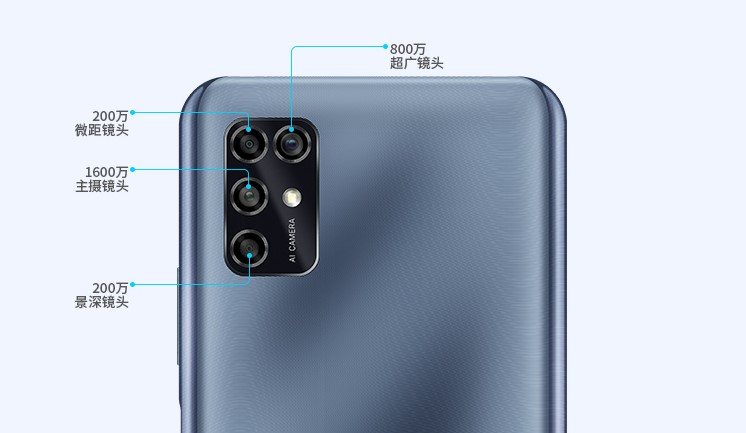
For photography, the ZTE V2020 adopts a Quad-camera setup at the rear consisting of a 16-megapixel main camera, an 8-megapixel ultra-wide-angle lens, a 2-megapixel macro lens, and a 2-megapixel depth-of-field lens.
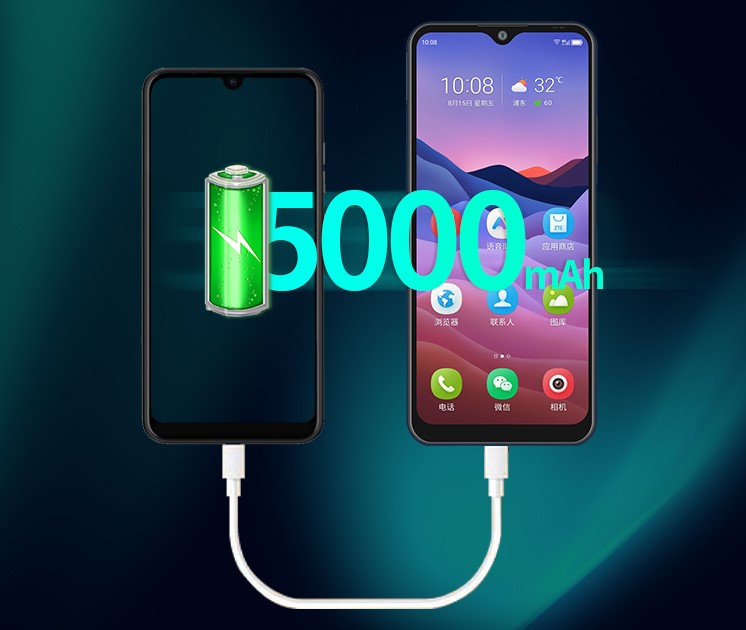
Keeping the lights on is a 5000mAh battery which not only guarantees longer usage time but also lets you charge other devices via OTG cable. On the software side, the Blade V2020 runs on stock Android 10 operating system. There is also a rear-mounted fingerprint sensor onboard.
As for the price, the ZTE Blade V2020 is available in a single 128GB version and it carries a price tag of 899 yuan (~$130).
China will be getting two new Realme phones on September 1. The phones are the Realme X7 and the Realme X7 Pro, and now the spec sheet of the latter has leaked.
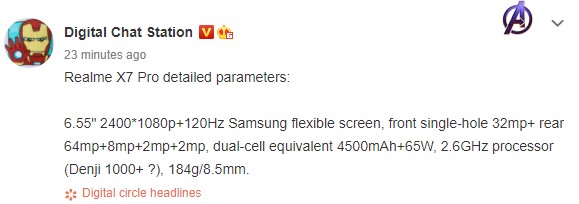
The source is the Chinese leaker Digital Chat Station and he took to Weibo to reveal the full spec sheet of the upcoming smartphone.
The Realme X7 Pro is said to have a 6.55-inch display with a 2400 x 1080 resolution. The panel is a flexible AMOLED panel supplied by Samsung that has a punch hole at the corner and a 120Hz refresh rate.
For the chipset inside the device, it is stated to have a 2.6GHz clock speed but its name is unknown. There are speculations that the processor is the Dimensity 1000+, the same one inside the Redmi K30 Ultra.
The hole in the display is home to a 32MP selfie camera while the back of the phone houses a quad-camera setup that includes a 64MP main camera, an 8MP ultrawide angle camera, and two 2MP sensors.
The Realme X7 Pro, according to the leaker, will have a dual-cell battery with a combined capacity of 4500mAh and will support Realme’s 65W SuperDart Flash Charge fast charging technology. The device will weight 184 grams and will have a thickness of 8.5 millimeters.
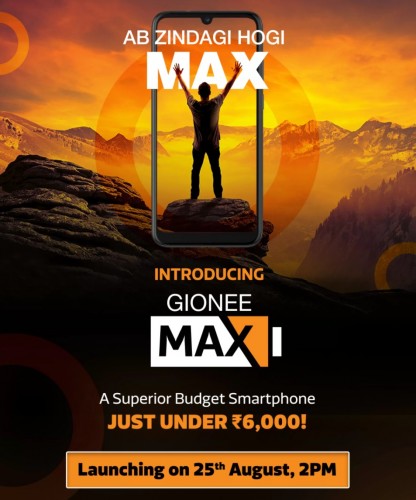
Gionee has been taking things pretty slowly since the brand returned to the market last year after filing for bankruptcy. The Chinese brand has been focusing on India in addition to its major market which is China. There are indications that a new Gionee smartphone may be launched soon in India.
The product page for a Gionee model which is dubbed Gionee Max has appeared on Flipkart. The teaser poster on the page shows that the Gionee Max will be launched on August 25 at 2 PM IST.
Although the full specs of the phone are yet to be released, the poster promotes the Max as a superior budget smartphone that would be priced less than Rs. 6000 ($80). The Max may likely return as a large display model and will equally pack a big battery. The battery capacity wasn’t revealed but Gionee recently got TENAA certification in China for a model packing a 10000mAh battery. We don’t expect this model to have such a large battery but the capacity may likely be up to 5000mAh.
The renders of the device also contained on the poster shows the model will have a waterdrop notch design at the top but the bottom bezel looks thick. The device also packs a 3.5mm audio jack.
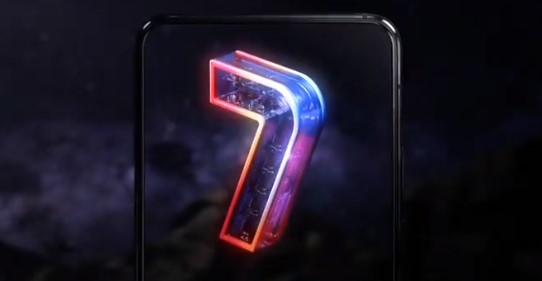
ASUS is launching the Zenfone 7 next week. A leak already revealed the price of the phone in Europe and it is cheaper than most of the phones from competitors. Another leak has now revealed the specs of the device and it shows that ASUS has made some tradeoffs to keep the price low.
The specs of the Zenfone 7 were found in the kernel source of the ROG Phone 3 by the tech blog ReaMeizu. They have reported that the flagship will feature an LCD display supplied by BOE. The screen size is put at 6.4-inches with a resolution of 2340 x 1080 and a refresh rate of 60Hz. The low refresh rate is pretty disappointing in a world where even mid-range phones with LCD panels have a high refresh rate.
Since it is an LCD panel, the fingerprint scanner is not buried under the display. The source says the scanner is supplied by Goodix and might be on the back of the phone or on the side where it doubles as the power button.
The code also revealed that the Zenfone 7 is powered by the Snapdragon 865 processor and not the Snapdragon 865 Plus as some sources have reported. It has support for a MicroSD card that is believed will sit in a triple card SIM tray.
Asus Zenfone 7 Specs. •6.4 inch LCD BOE FHD+ Display With 60Hz Refresh Rate •Goodix FP Scanner Present On Rear On Side Mounted •Snapdragon 865 5G •Triple Rear Flip Camera With Dual Led Flash 64MP Main Sony IMX686 + 12MP Ultra + Wide IMX363 + TOF Source https://t.co/YzrWBfrCEHpic.twitter.com/A7AGDKLwX8
Indian leaker, Abhishek Yadav, posted a tweet listing the aforementioned specifications. However, he adds that the Zenfone 7 will have triple rear cameras that consist of a 64MP Sony IMX686 main camera, a 12MP IMX363 ultrawide angle camera, and a ToF camera.
It has been reported in earlier leaks that the phone will have a 5000mAh battery. It should also run Android 10 out of the box and be eligible for two OS upgrades when it launches.
We use cookies on our website to give you the most relevant experience by remembering your preferences and repeat visits. By clicking “Accept”, you consent to the use of ALL the cookies.
This website uses cookies to improve your experience while you navigate through the website. Out of these, the cookies that are categorized as necessary are stored on your browser as they are essential for the working of basic functionalities of the website. We also use third-party cookies that help us analyze and understand how you use this website. These cookies will be stored in your browser only with your consent. You also have the option to opt-out of these cookies. But opting out of some of these cookies may affect your browsing experience.
Necessary cookies are absolutely essential for the website to function properly. This category only includes cookies that ensures basic functionalities and security features of the website. These cookies do not store any personal information.
Any cookies that may not be particularly necessary for the website to function and is used specifically to collect user personal data via analytics, ads, other embedded contents are termed as non-necessary cookies. It is mandatory to procure user consent prior to running these cookies on your website.

-1-1024x1024.jpg?x10805)