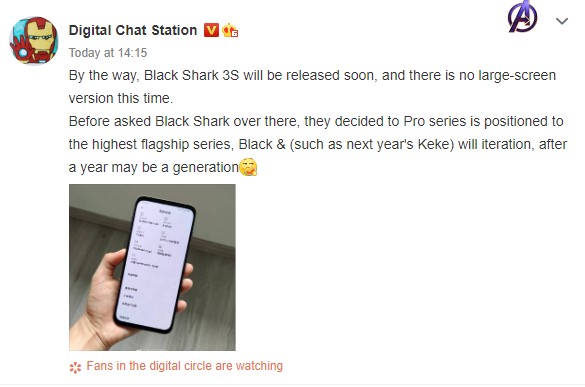
The Black Shark 3 launched early this year but unlike previous Black Shark phones, it came along with a Pro version called the Black Shark 3 Pro that has a bigger and sharper screen, bigger battery, and even takes the storage options to 512GB. Now, the Black Shark 3S is coming, and it has been reported that there will be no Pro version.
The Black Shark 3S is expected to launch soon with a Snapdragon 865 Plus processor powering it, however, there will be “no large-screen version” says a rough translation of a Weibo post by Chinese leaker, Digital Chat Station.
He adds that the Pro model will be for the flagship released at the beginning of the year which means the Black Shark 4/5 should have a Pro version.
Not a lot is known about the specifications of the Black Shark 3S. The CEO only teased the device a few days ago and has not revealed anything afterward. Nevertheless, we expect it will have an AMOLED display, a high-refresh-rate, stereo speakers, and nothing less than 65W fast charging.
As usual, Qualcomm‘s next-generation flagship platform Snapdragon 875 will be unveiled in the fourth quarter of this year but we’ll have o wait until Q1 2021 to find it inside a commercially available smartphone. Details have now emerged about the next-gen mobile platform. Tipster Roland Quandt has revealed that the Snapdragon 875 (SM8350)adopts the internal codename Lahaina. The name is originally that of a city in Maui, one of the seven Hawaiian Islands.
A previous leak tips the next-generation Qualcomm chipset to adopt the name Snapdragon 875G instead of Snapdragon 875. However, Qualcomm is yet to confirm the name yet so we’ll stick with SD875.
Pretty sure Qualcomm Snapdragon 875 (SM8350) is called "Lahaina" internally. Named after a city on the island of Maui, Hawaii.
The flagship processor will be built on the 5nm process. Qualcomm will reportedly introduce a super-large core architectural combination, which is Cortex X1+Cortex A78. ARM details the Cortex X1 core architecture to provide a maximum performance that is 30% higher than that of Cortex-A77 and 23% higher than the maximum performance of the Cortex-A78 core released at the same time. The machine learning capability is said to be twice that of Cortex-A78.
Furthermore, Qualcomm will no longer utilise an external baseband design on the Snapdragon 875G but the baseband chip will be integrated with the processor with improvement in the performance.
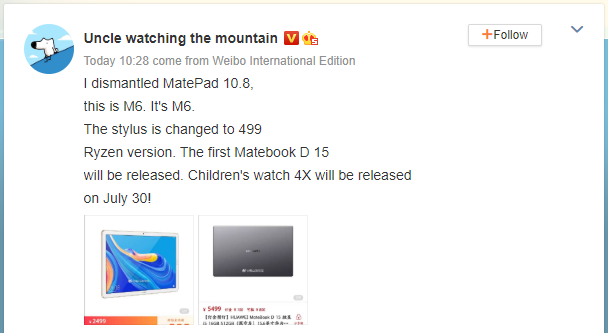
Huawei is set to launch Maimang 9, the company’s next 5G smartphone on July 27. According to a new tip by a blogger on Weibo, this handset will not be the only new product from the firm next week. Because the Chinese telecom giant is also expected to unveil MateBook D 15 2020 Ryzen Edition, the successor to MatePad M6 10.8, and Kids Watch 4X on July 30.
Huawei and its sub-brand Honor have been launching new products every month since the beginning of this year despite COVID-19 pandemic. Due to their aggressive launches, both the brands together ruled the Chinese smartphone market in H1 2020 with 40% market share.
If you are our regular reader, then you might be aware that Huawei and Honor have not only been releasing new smartphones but all sorts of products like laptops, tablets, routers, smartwatches, and others.
Looks like the Chinese tech giant will continue to do the same for H2 2020. It makes sense for the company to launch as many as products in its home country as its losing grounds in international markets.
Having said that, the tip about the launch of a variety of new products come from 看山的叔叔, a blogger on Weibo. As per him, Huawei will hold a press event to release MateBook D 15 2020 Ryzen Edition, which we expect to share features with the recently launched Honor MagicBook 15 2020 Ryzen Edition.
The company will not only unveil new laptops but it is also expected to launch the successor to the last year’s MatePad M6 10.8, and Kids Watch 4X. All of these products will go official on July 30 if the blogger is true.
Last week, TSMC confirmed that it stopped accepting new chip orders from Huawei from May 15 after the new US government regulations. But still, the Chinese telecom giant’s silicon division HiSilicon officially unveiled a new 28m ATV (Advanced Television) chip with support for in-house LiteOS on July 24.
Huawei is known for its HiSilicon chipsets, which power almost all the hardware the company makes like network equipment and smartphones to name a few. Also, most of the firm’s chips are manufactured by TSMC, the world’s largest semiconductor manufacturing company.
Unfortunately, the US cut off Huawei’s business with TSMC with new rules in May. Thus, the company is now left without a high-end chipmaker. It does have a domestic partner by the name of SMIC, which currently mass produces the 14nm Kirin 710F chipset.
We think the same company could be manufacturing the brand-new HiSilicon 28nm ATV chip. Just like its manufacturer, the details about this chipset is bleak as well.
According to ITHome, this new silicon from Huawei is targeted at non-smart TVs with 1080p (FHD) or lower resolution displays. It is said to be 20% powerful than other conventional chips that are mostly based on 40nm architecture.
Further, this HiSilicon chip also includes an integrated TCON (Timing Control) module to further reduce the overall cost of the TV. Additionally, it also supports the company’s real-time operating system called LiteOS.
For those unaware, this OS based on ultra-small kernel (< 10KB) requires low memory to operate and therefore, it is energy efficient. It boots up faster within certain milliseconds as well as supports multi-process synchronization, dynamic loading, access to different cloud platforms, and more. It is normally found on Huawei wearables and IoT products.
Also, this Huawei ATV chip supports various input ports such as analog, HDMI, VGA, CVBS, USB, and others. Last but not least, it also includes support for the company’s SWS (Super Wide Sound) sound effects to offer better audio experience.
Having said that, the availability of this new 28nm HiSilicon ATV chip is not known. Mostly, it will be limited to the Chinese market given the current situation.
Nubia is currently known for its Red Magic lineup of gaming smartphones but the brand also makes unique wearables. Last year, it launched Nubia Alpha as the world’s first commercially available wearable phone with a flexible display. For this year, the company has begun to tease a new wearable simply called Nubia Watch.
The teaser image only gives us a glimpse of Nubia Watch’s design but it does confirm it to feature a flexible OLED display and 316L stainless steel + aluminium body. Apart from these two things, we could not make anything else out of the picture except for a crown on the right side and a measurement scale for some reason.
The software on this smartwatch is a mystery. If we recall, the Nubia Alpha is powered by a custom OS based on Android. Maybe, the upcoming device will come with the same.
Anyway, we expect the brand to tease more features of the Nubia Watch before its launch next week just. Also, we think it may retail at a cheaper price than the Alpha.
Samsung will be launching the Galaxy M31s smartphone on July 30. The other Galaxy M-series phone that is expected to go official in August or September is the Galaxy M51. Recently, the M51 was seen receiving approval from the Bluetooth SIG authority. So far, the rumor mill has revealed only a few pieces of information on the specs of the Galaxy M51. A fresh report on Sammobilehas revealed some vital information about the cameras of the M51.
A previous report had revealed that the Galaxy M51 could be sporting a 64-megapixel camera. Today, the publication revealed that the main lens will be coupled with a 12-megapixel ultrawide sensor. It could be the same superwide lens that is available on the Galaxy A51 phone.
While it is being said that the Galaxy M51 could be featuring a quad-camera system on its rear, there are no details regarding the other two lenses. The upcoming Galaxy M31s has support for Single Take camera mode for its 64-megapixel lens. The Galaxy M51 which will be positioned higher than the M31s is also likely to arrive with Single Take feature.
Rumors surrounding the Samsung Galaxy M51 have revealed that the phone could be sporting a 6.7-inch S-AMOLED punch-hole display with an in-screen fingerprint reader. It could be powered by the Snapdragon 730 SoC. It will come preinstalled with One UI 2.x based Android 10 OS.
The Galaxy M51 may offer users with 128 GB of built-in storage. The phone is also speculated to house a gargantuan battery of around 7,000mAh capacity. The massive battery is likely to arrive with support for 25W fast charging through USB-C. There is no word on the pricing of the Galaxy M51.
On July 27, Huawei will be announcing the Maimang 9 5G smartphone. Some reports have revealed that Huawei Enjoy 20s is the other name of the Maimang 9 5G. Ahead of the launch, a listing of the smartphone has emerged on Tmall retailer site of China. The listing has revealed the color options, specifications, and the two variants of the Maimang 9 5G phone.
Huawei Maimang 9 5G specifications
The specifications of the Huawei Maimang 9 are already known as it has been spotted at TENAA and China Telecom product library recently. The Maimang 9 is a rebadged edition of the Honor Play4 with one noticeable difference. The Honor Play4 has an additional 2-megapixel lens in its 64-megapixel quad-camera setup whereas the Maimang 9 has a 64-megapixel triple camera setup.
The Maimang 9 has an IPS LCD display of 6.81 inches. The punch-hole display produces Full HD+ resolution and a 20:9 aspect ratio. It has a side-mounted fingerprint reader. The Dimensity 800 5G powers the device.
The Maimang 9 has a 4,300mAh battery that supports 22.5W fast charging. It has a front camera of 8-megapixel. The rear camera setup has a 64-megapixel main lens, an 8-megapixel ultrawide sensor, and a 2-megapixel lens. The EMUI 10.1.1 based Android 10 OS comes preinstalled on the Maimang 9.
The Huawei Maimang 9 is listed on Tmall in colors like Qijing Forest (gradient green), Sakura Snow Clear Sky (gradient white), and Magic Night Black. The handset will be available in variants such as 6 GB RAM + 128 GB storage and 8 GB RAM + 128 GB storage. The pricing of these variants will be confirmed through its July 27 unveiling event.
OPPO has silently announced the OPPO A72 5G smartphone in China. The handset is now listed on OPPO’s official online store as well as other retailer sites in China. It is the first smartphone to go official with the recently announced MediaTek Dimensity 720 5G. The other highlights of the OPPO A72 5G include 90Hz display, a big-sized battery with fast charging support, and a 16-megapixel triple camera setup.
OPPO A72 5G specifications
The OPPO A72 5G has a 6.5-inch punch-hole screen. The IPS LCD panel supports a Full HD+ resolution of 1080 x 2400 pixels, an aspect ratio of 20:9, and a refresh rate of 90Hz. It offers a screen-to-body ratio of 90.5 percent.
The 7nm Dimensity 720 5G chipset that supports dual-mode 5G drives the OPPO A72 5G with 8 GB of LPPDR4x RAM. The phone comes with a UFS 2.1 internal storage of 128 GB. The phone comes with support for 18W charging through USB-C for its 4,040mAh battery.
An 8-megapixel selfie camera is present on the front side of the OPPO A72 5G. The rear side of the device has a square-shaped camera module. It includes a main camera of 16-megapixel, an 8-megapixel ultrawide lens with 119-degree field-of-view, and a 2-megapixel black & white lens.
The Android 10 OS coupled with ColorOS 7.2 runs on the OPPO A72 5G. It lacks a microSD card slot. The handset has a side-facing fingerprint reader. The thickness of the OPPO A72 5G is only 7.9mm and it weighs 175 grams.
OPPO A72 5G price and availability
The OPPO A72 5G is priced at 1,899 Yuan (~$270) and it comes in color editions such as Simple Black, Neon, and Oxygen Violet. The phone is up for pre-sale on OPPO’s online store. OPPO will carry out its first sale on July 31 in China. There is no word on the global availability of the OPPO A72 5G.
POCO launched POCO F2 Pro as a rebranded Redmi K30 Pro for international markets in mid-May. The phone came with MIUI 11 based on Android 10 out of the box. Later, in June, the company released an optional Android 11 Beta for the device. Now, the handset is receiving MIUI 12 stable update worldwide.
In total, there are five types of MIUI builds for POCO F2 Pro and they are China (Redmi K30 Pro), Global, EEA (Europe), Indonesia and Russia. MIUI 12 stable is now available in all these flavours.
The original device Redmi K30 Pro received the update last month. In fact, it has even received another build after that with build number 12.0.2.0. Whereas, the global variant of the handset is currently getting MIUI 12.0.1.0.
Here are the exact latest builds of MIUI 12 stable for all the variants of POCO F2 Pro/Redmi K30 Pro as of writing this story.
Redmi K30 Pro
China – V12.0.2.0.QJKCNXM
POCO F2 Pro
Global – V12.0.1.0.QJKMIXM
EEA – V12.0.1.0.QJKEUXM
Indonesia – V12.0.1.0 QJKIDXM
Russia – V12.0.1.0.QJKRUXM
Having said that, it’s worth noting that the update is being rolled out in batches and hence, it might take time to reach every unit.
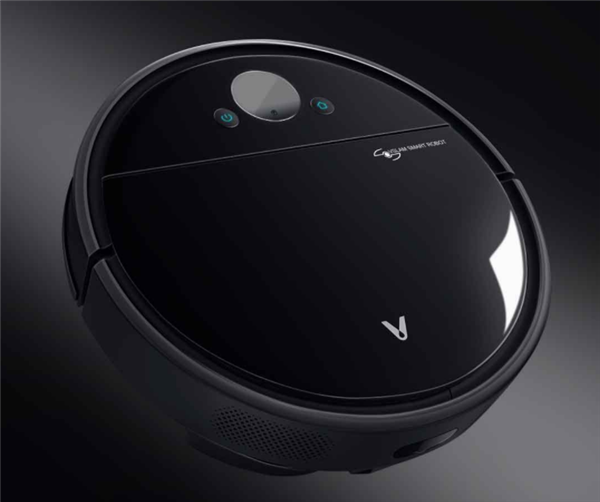
Xiaomi‘s ecological chain company Viomi has launched a new robot vacuum cleaner. The product dubbed Viomi VSLAM Smart Robot Vacuum Cleaner comes integrated with the VSLAM visual navigation system. It is originally priced at 1,599 yuan (~$228) but is presently on offer on Xiaomi Youpin for 1,099 yuan (~$157).
The Viomi VSLAM Smart Robot Vacuum Cleaner uses a Japanese imported NIDEC fan with a large suction power of 2600Pa, and 4-speed suction mode adjustment. The new-generation cleaning system which has extended bilateral brushes only collects dust and does not raise dust. With the V-shaped anti-winding roller brush, it can remove difficult-to-clean hairs in one go.
The robot vacuum cleaner supports three sweep and mop modes which include an integrated sweep and mop, single sweep, and a single mop mode. The vacuum cleaner has a slim body which is just 7.8cm thick, making it easy to penetrate under the bed and clean under the sofa.
Furthermore, it is equipped with HD wide-angle camera components which can quickly capture environmental information while on the move. The camera components can complete the collection of 40,000 feature points per second, and quickly build an environmental layout. With VSLAM intelligent algorithm, analog neural network algorithm, and 60 times/second path calculation rate, it can automatically select the best among multiple path planning schemes to efficiently complete the cleaning task.
Its built-in 3200mAh battery has a battery life of up to 2 hours and supports automatic recharging. With 12 different types of sensors crammed inside, the vacuum cleaner has the ability to detect and avoid obstacles up to 2cm.
The Viomi VSLAM Smart robot is up for pre-order in China on Xiaomi Youpin.
Among the mainstream flagships expected to rattle the mobile phone industry in the second half of the year, the Huawei Mate 40 series is one that cannot be ignored. Which each generation of the mate series, Huawei seems to be increasing the level of innovation. The model is expected to feature improvements in not just the processor which migrates to a 5nm node but also in the aspect of design, camera performance and more.
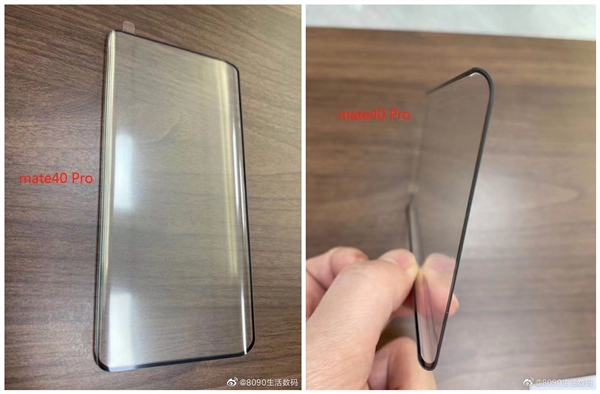
Huawei Mate 40 Pro tempered glass protector
Pictures of what is said to be the tempered glass for the Mate 40 Pro have now appeared on Weibo (via) giving us an idea of what the display will look like. The leaked shots show the Mate 40 Pro will utilise a curved waterfall screen but the curvature seems to be lower than that of the Mate 30 Pro.
Earlier this week, it was rumoured that the Mate 40 Pro’s screen will utilise a double hole-punch design located at the upper left corner. This will increase the display area and further enhance the immersive viewing experience for users.
Huawei Mate 40 Pro concept render
Of course, the design is just one of the aspects where the Mate 40 Pro will see improvements. The device is expected with a lot of highlights, such as enhanced fast charging, bigger battery capacity, improved camera setup in addition to a new Kirin 1020 chipset. O the software side of things, the Mate 40 pro will boot EMUI 11 out of the box bringing along several software features.
Huawei is expected to announce the Mate 40 series around September and October. We expect more details to leak before then.
OnePlus announced the much-touted Nord smartphone earlier this week. The device comes as the firm’s first mid-range model in a long while and even before the launch it had kept the media agog. Apparently, the phone still continues to command attention even before it hits store shelves.
OnePlus Nord in Gray and Cyan
It has now emerged that the OnePlus Nord clinched the record of being the most-anticipated phone ever on Amazon India. Soon after the launch, Amazon created a “Notify Me” page. Available statistics show the page has gotten over 4 million requests which is the largest a mobile phone has recorded on Amazon India yet.
Before now, the company opened pre-orders for the Nord as well as sales of invitations to the AR event. Both were sold out within hours. The smartphone will be will open for pre-booking on 28th July on Amazon.in. There no word on when the first sale will take place.
As a reminder, the OnePlus Nord packs a 6.44″ Fluid AMOLED Display with a 90 Hz refresh rate andFHD+ resolution. The phone is powered by a Snapdragon 765G chipset paired with 6GB RAM, 8GB RAM, or 12GB RAM. There are also 64GB, 128GB, or 256GB of UFS 2.1 storage options. You equally get a qual camera setup, in-display fingerprint sensor, NFC, Warp Charge 30T which refills the 4,115mAH battery from 0-70% in half an hour. The phone is available Blue Marble and Gray Onyx.
OnePlus Nord launched earlier this week as a mid-range 5G smartphone. The handset received its first software update on the launch day itself. Now, a couple of days later, it is getting another update with build number OxygenOS 10.5.2 carrying July 2020 security patch. It also brings support for OnePlus Buds among others.
The OnePlus Nord is currently only in the hands of media, YouTubers, and influencers. It is yet to go on sale for the first time, which is scheduled for August 5 for all the regions. But the device is already receiving its second software update (via XDA Developers). It’s not that other phones don’t get updates like this but the difference is that this information doesn’t make it to the public.
Having said that, apart from July security patch and OnePlus Buds support, OxygenOS 10.5.2 for OnePlus Nord weighing 143MB adds 90Hz support for Dailyhunt app, brings optimizations for accessing camera with gestures, and more.
OnePlus Nord OxygenOS 10.5.2 Official Changelog
System
Newly adapted OnePlus Buds firmware, easier to take advantage of wireless connection
Newly adapted Dailyhunt with 90Hz refresh rate (IN only)
Optimized the process of starting camera with gestures
Optimized video calling performance
Improved system stability and fixed general issues
Updated Android security patch to 2020.07
Camera
Optimized power efficiency for front camera video shooting at 4K 60fps
Improved camera experience and system stability
Though the review units have received two updates, retail units may come with any of thee two builds pre-installed. If not, buyers will have to update their device.
Today, Realme officially launched the affordable Realme 6i in India. The handset is already present in the global market but under another name: Realme 6s. So, keep in mind that it is not the same Realme 6i sold globally. Another device launched in India with a different name from the global market is the Redmi Note 9 Pro, also known as Redmi Note 9S in Europe. Here is a specs comparison with these two devices and another handset that carries amazing specifications if we compare them to its price: the Samsung Galaxy M31. Let’s discover together which device carries the highest value for money for Indian customers.
Xiaomi Redmi Note 9 Pro vs Realme 6i vs Samsung Galaxy M31
Quad 48 + 8 + 5 + 2 MP f/1.8, f/2.2, f/2.4 and f/2.4
16 MP f/2.5 front camera
Quad 64 + 8 + 5 + 5 MP f/1.8, f/2.2, f/2.4 and f/2.2
32 MP f/2.0 front camera
Quad 48 + 8 + 2 + 2 MP f/1.8, f/2.3, f/2.4 and f/2.4
16 MP f/2.0 front camera
BATTERY
5020 mAh, fast charging 18W
6000 mAh, fast charging 15W
4300 mAh, fast charging 30W
ADDITIONAL FEATURES
Dual SIM slot, splash resistant
Dual SIM slot
Dual SIM slot, splash resistant
Design
Do you prefer having a beautiful look or premium materials? If your answer is the first, then you should go for the Realme 6i as it offers a more minimalistic and elegant look, including a punch-hole display with narrow bezels and an elegant glass back with a smaller camera module. If you want the most premium materials, then choose the Redmi Note 9 Pro as it boasts a glass back instead of a full polycarbonate body. The Samsung Galaxy M31 has a plastic design just like the Realme 6i and an uglier design, imho.
Display
The most wonderful display belongs to the Samsung Galaxy M31. Since it is a Samsung device and Samsung makes AMOLED displays, the Galaxy M31 features a Super AMOLED panel, despite it is a very affordable device. So you get more brilliant color and deeper blacks. Redmi Note 9 Pro and Realme 6i both come with an IPS panel, but the Realme 6i comes with an additional feature: a 90 Hz refresh rate making the visual experience smoother. But a lot of people actually prefer having a 60 Hz AMOLED display rather than a 90 Hz IPS panel.
Specs & Software
If we look at the power of the chipsets found on these three devices, the Helio G90T found on the Realme 6i is the most powerful one. Snapdragon 720G is slightly inferior in terms of performance, but it is built at 8 nm and it has lower energy consumption. That is one of the reasons why it is actually more interesting, without mentioning Qualcomm’s reputation. Also note that you can get the Redmi Note 9 Pro in a configuration with 128 GB of internal storage, while Realme 6i stops at 64 GB. The SoC found on the Samsung Galaxy M31 is way inferior to Helio G90T and Snapdragon 720G in terms of performance. Redmi Note 9 Pro, Realme 6i and Samsung Galaxy M31 run Android 10 out of the box, with a customized user interface.
Camera
The camera award goes to the Samsung Galaxy M31 for offering a better main sensor on the rear side: a 64 MP lens with a f/1.8 aperture. It even comes with a better depth sensor than its rivals, sporting a 5 MP resolution. Last but not least, it has a superior 32 MP front camera which can shoot more detailed selfies and can also record 4K videos at 30 fps.
Battery
Samsung Galaxy M31 is the best even when it comes to the battery life. Thanks to its AMOLED display, a chipset built at 10 nm and a huge 6000 mAh battery, it can last more than two days even with intensive usage.
Price
Realme 6i is priced INR 12,999 in India, Samsung Galaxy M31 begins at INR 16,499, and Redmi Note 9 Pro starts at INR 13,999. If we exclude the hardware department, Samsung Galaxy M31 is actually a superior phone. It has a huge battery, better cameras and an AMOLED display.
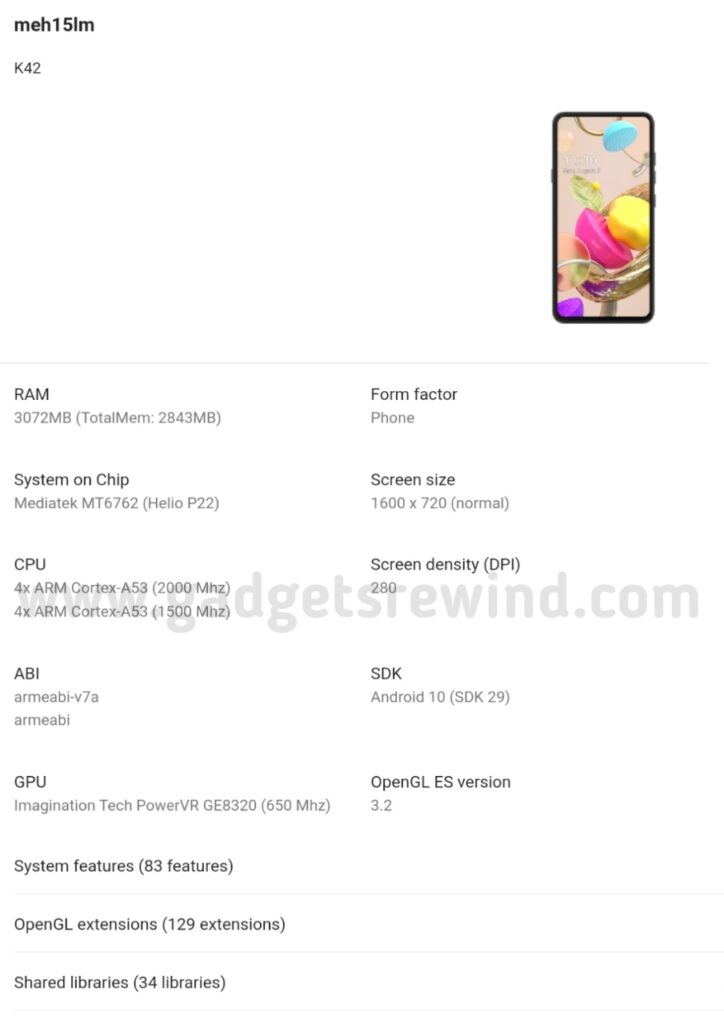
Looks like LG is planning to go on a release spree any time soon going by the rate at which its upcoming models appear on leaks. Recently, the Q92 5G was spotted on Google Play Console. Now, the LG K42 has also been listed on the website.
The K42 is a low-end model that is listed to pack a MediaTek MT6762 SoC which is the Helio P22 chipset. The processor pairs with 3GB of RAM. The display size is unknown but the phone will have an HD+ resolution of 1600 x 720 pixels.
The render of the phone uploaded on the Play Console (via) doesn’t contain a selfie camera cut out but we expect the device to feature a notch design. In addition, the phone is listed to get its interface from Android 10 OS.
For now, no other detail is known about the K42 but we expect more info to emerge as time goes on.
Samsung launched the Galaxy S20 series consisting of Galaxy S20, Galaxy S20+ (Plus), and Galaxy S20 Ultra earlier this year. Now, just after five months from their launch, the model numbers of their successors (Galaxy S21 series) have leaked even before the debut of Galaxy Note 20 series.
There used to be only one Galaxy S device per generation. Slowly, it increased to two, followed by three. According to an exclusive report by SamMobile, the company will continue launching three handsets for the third year in the row.
The sources of the publication have revealed the South Korean tech giant has begun to work on three models for the Galaxy S21 series. Their model numbers are said to be SM-G991, SM-G996, and SM-G998.
If Samsung does not change its branding, then these smartphones will end up as Galaxy S21, Galaxy S21+ (Plus), and Galaxy S21 Ultra respectively.
These phones are expected to support 5G, however, there could be 4G variants as well like the Galaxy S20 series but their existence is yet to be confirmed. Further, the sources also confirm these three devices to come in 128GB and 256GB storage variants.
There may be a 512GB or even 1TB variant like the Galaxy S10+ (Plus ) 5G but there’s no sign of them as of now. It is worth noting that Samsung skipped 1TB this year but it is strange to cross out 512GB as smartphones are now capable of recording 8K videos and other heavy-duty tasks.
Unfortunately, that’s all know about the upcoming Galaxy S21 series, which will mostly launch in the first quarter of 2021. Anyway, we can surely expect more leaks about these handsets in the coming months.
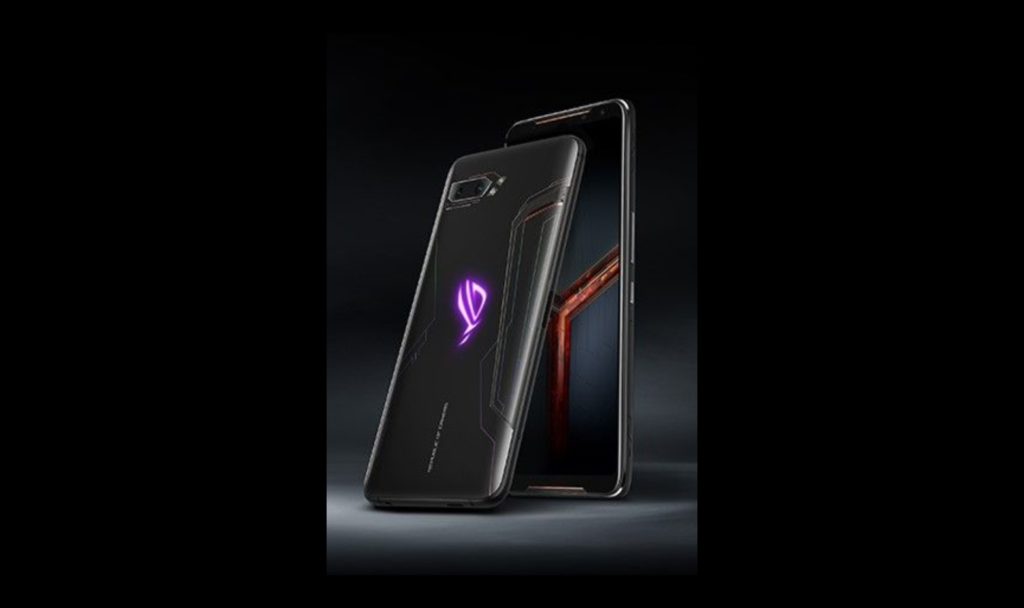
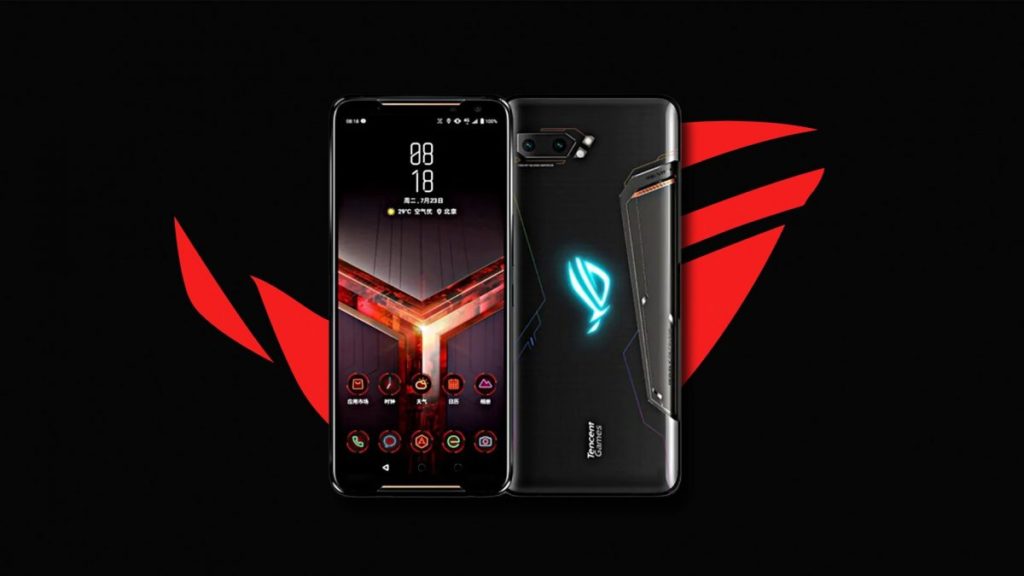
Recently, Asus launched ROG Phone 3 as its third-generation gaming smartphone worldwide. But the company did not announce all the variants of the handset for India. However, the firm’s Indian head has now confirmed to launch the 16GB + 512GB of the device based on demand. Unfortunately, he also revealed the company’s plans to discontinue ROG Phone 2 in the country.
Last year’s ROG Phone 2 was only available for a short period of time in India. It was out of stock most of the times on official online retailer Flipkart. The smartphone was briefly made available last month in the country with new updated price, thanks to increased GST (Goods & Services Tax) on phones.
At the moment, the device is listed as unavailable on Flipkart, whereas the ROG Phone 3 is noted as “Coming Soon” as it is set to go on sale starting August 6. But the ROG Phone 2 may be soon removed from the platform as per Dinesh Sharma, Mobile Business Head, Asus India (via HT Tech).
The executive confirmed the discontinuation of ROG Phone 2 in India to the publication. However, he did not mention when and hence, we believe it may be available for the last time during Flipkart sale around August 5-6 when Amazon India will be hosting Prime Day sale.
According to him, customers get a better package in ROG Phone 3 compared to ROG Phone 2 and thus it makes sense for them to remove it from the shelves. However, the price difference between the two is ₹10,000, which is more according to us.
Since India is a price-sensitive market, there is a high probability of people buying the older model, which may cannibalize the sales of the newer model. But Asus could have made use of this situation like OnePlus, which still continues to sell OnePlus 7T from 2019.
Further, the Asus executive also revealed they have no plans to launch ROG Phone 3 Strix Editon powered by Qualcomm Snapdragon 865 in India. However, they may bring the 16GB + 512GB variant of ROG Phone 3 to the country if there’s a “massive demand”.
He also hinted if it comes, it will be priced much higher and that’s the reason they stuck to only two options for the world’s second-largest smartphone market.
The Asus ROG Phone 3 will be available for the following prices starting August 6 in India.
As 5G connectivity expands, the demand for 5G smartphones will continue to rise. To this end, mobile phone manufacturers have continued to broaden their product offerings in the 5G market. Vivo has updated its portfolio with the launch of the Vivo Y51s in China.
Vivo Y51s is a midrange 5G phone with a premium design. The specs is similar to that of the Y70s which was announced recently, including an Exynos 880 SoC. The device packs a 6.53-inch LCD display with an FHD+ resolution of 2400 x 1080 pixels and 19.5:9 aspect ratio. This display features a hole-punch for the selfie camera located at the top left corner.
The phone is powered by an Exynos 880 chipset which integrates a 5G modem. The modem in this SoC is capable of supporting sub-6GHz 5G with a maximum downlink and uplink of 2.55Gbps and 1.28Gbps respectively. The processor is paired with 6GB RAM and there is 128GB of internal storage onboard.
On the camera side, the VivoY51s packs a triple camera setup aligned vertically at the top left corner. The main camera is a 48MP sensor paired with a 2MP depth sensor and a 2MP macro shooter. The rear camera supports video shoot up to 4K resolution. The device packs a single 8MP sensor under the hole-punch for selfies.
The smartphone is fired up by a 4,500 mAh battery and has support for 18W fast charge. It utilises a micro USB port and packs a side-mounted fingerprint sensor. In addition, the Y51s runs on Android 10-based Funtouch OS 10.5.
As for the price, the Vivo Y51s is priced at 1,798 yuan (~$256) in China. The phone which comes in black, blue and white colours will be on sale from July 29. Presently, it is up for reservations via Vivo’s website.
Apart from Huawei and Samsung that have their own independent chipset foundries, all other mobile phone manufacturers rely mostly on Qualcomm and MediaTek for their chip supplies. Before the 5G era, MediaTek was experiencing some difficulties but since 5G started gaining traction, the Taiwanese fabless chip maker has experienced a rebound.
Between April and now, some of the new smartphones packing a MediaTek SoC includes the OPPO A92s, iQOO Z1, Huawei Enjoy 20 Pro, ZTE AXON 11 SE, Redmi 10X series and many several others. The majority of the models have equipped with a Dimensity series 5G chips.
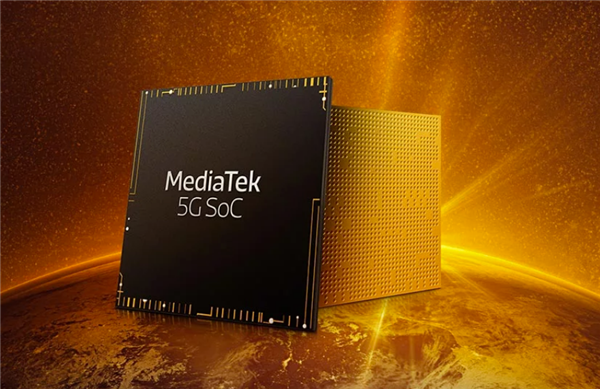
According to latest media reports, MediaTek will launch a new generation of 5G flagship mobile platform under the Dimensity series. The flagship processor will be unveiled in the second quarter of next year. The flagship chipset will reportedly be called Dimensity 2000, taking a cue from the Dimensity 1000 series. However, it will be built on a 5nm process, unlike the Dimensity 1000 series which utilised a 7nm silicon. There will also be a significant improvement in its performance.
At present, MediaTek has successively launched Dimensity 1000 series, Dimensity 800 and 700 series processors, occupying a key position in mid-to-high-end 5G mobile phones market. Just a few days back, the Dimensity 720 chipset was announced. Further, the company is rumoured to be working on the Dimensity 600 series as well as a Dimensity 400 series targeted at entry-level 5G smartphones, enabling cheap 5G phones.
OnePlus recently launched its third smartphone of 2020 and its first mid-range device in years in the form of OnePlus Nord. Now, it looks like the brand is gearing up to launch its next flagship models, possibly called OnePlus 8T and OnePlus 8T Pro. Either one of these phones or even both may also feature a 64MP camera according to strings of code in OnePlus Camera v5.4.23.
The Chinese smartphone maker OnePlus has been using 48MP shooter on its phones ever since it introduced it on the OnePlus 7 series. Now, finally, it will be making a switch to a 64MP sensor as per new findings by XDA Senior Member Some_Random_Username.
The OnePlus Camera app was recently updated to v5.4.23. A teardown was carried out by the person mentioned above and found out strings mentioning 64MP. This clearly suggests that OnePlus is preparing its stock camera app for its next smartphones with 64MP camera sensor
These strings reveal that there will be a dedicated 64MP mode and burst capture will not work in this mode. By default, the images will be captured at 16 megapixels like any other 64MP smartphone.
Having said that, there are no leaks on OnePlus 8T and OnePlus 8T Pro so far. Hence, it is not sure if both of them will come equipped with a 64MP camera sensor.
We use cookies on our website to give you the most relevant experience by remembering your preferences and repeat visits. By clicking “Accept”, you consent to the use of ALL the cookies.
This website uses cookies to improve your experience while you navigate through the website. Out of these, the cookies that are categorized as necessary are stored on your browser as they are essential for the working of basic functionalities of the website. We also use third-party cookies that help us analyze and understand how you use this website. These cookies will be stored in your browser only with your consent. You also have the option to opt-out of these cookies. But opting out of some of these cookies may affect your browsing experience.
Necessary cookies are absolutely essential for the website to function properly. This category only includes cookies that ensures basic functionalities and security features of the website. These cookies do not store any personal information.
Any cookies that may not be particularly necessary for the website to function and is used specifically to collect user personal data via analytics, ads, other embedded contents are termed as non-necessary cookies. It is mandatory to procure user consent prior to running these cookies on your website.