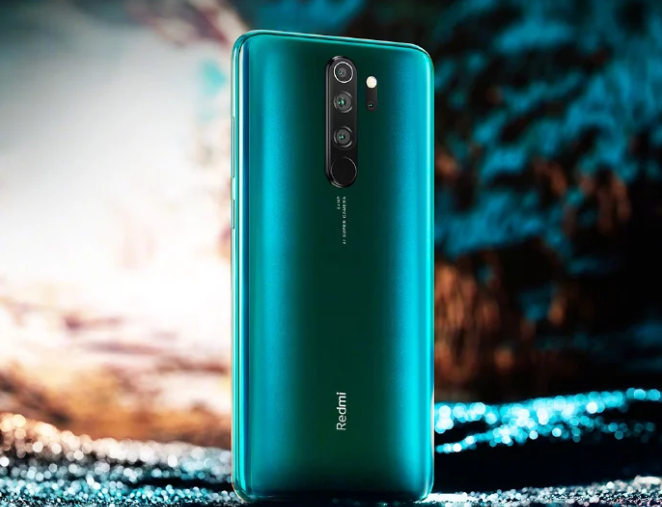
Xiaomi India announce the Redmi Note 9 Pro and Redmi Note 9 Pro Max smartphones in March in India. Since the COVID-19 lockdown has eased in certain regions of India, the Chinese firm once again started with the sales of the Redmi Note 9 Pro last week. The Redmi Note 9 Pro Max’s first sale was scheduled to take place on March 25 in the country, but it had to be canceled due to the Coronavirus outbreak. A fresh confirmation from the company reveals that the first sale of the Redmi Note 9 Pro Max will be carried out on May 12.
Redmi Note 9 Pro Max price in India
The first sale on May 12 will be held at noon (local time) on Amazon India. The shipments of the phone will be carried only in those areas that are marked as Green and Orange zones in India.
The phone comes in three choices such as 6 GB RAM + 64 GB storage, 6 GB RAM + 128 GB storage and 8 GB RAM + 128 GB storage. They are priced at Rs. 16,499 (~$219), Rs. 17,999 (~$238) and Rs. 19,999 (~$265), respectively. The phone can be bought in colors like Aurora Blue, Glacier White, and Interstellar Black.
The Redmi Note 9 Pro Max features a 6.67-inch Dot Display that produces a 20:9 aspect ratio and 1080 x 2400 pixels full HD+ resolution. The Snapdragon 720G is present under the hood of the device along with LPDDR4x RAM and UFS 2.1 storage. The MIUI 11 based Android 10 OS will come preloaded on the phone.
The back panel of the Redmi Note 9 Pro Max has a quad-camera system. It includes a 64-megapixel primary shooter, an 8-megapixel wide-angle sensor, a 5-megapixel macro shooter, and a 2-megapixel depth assist lens. It has a front-facing camera of 32-megapixel. The massive 5,020mAh battery of the Redmi Note 9 Pro Max comes with support for 33W fast charging.
Vivo India has finally released a confirmation that it will be unveiling the Vivo V19 smartphone in India on May 12. On the very same day, competitor brands are going to launch phones like Honor 9X Pro and POCO F2 Pro. The Chinese firm had previously planned to hold the Vivo V19 launch event in India on March 26. Not once, but twice it had to cancel the unveil event of the smartphone in the country due to the COVID-19 outbreak.
While Vivo V19 will be arriving as a new device in India on May 12, the handset already went official in global markets in April. Hence, the entire specs of the phone are already known. This phone is different from the Vivo V19 that debuted in Indonesia. The country that it received as V19 was the Vivo V17 that debuted in India in December 2019.
Vivo V19 price in India
A previous report had claimed that the Vivo V19 will arrive in India with a price tag of Rs. 24,990 (~$331). Due to the hike in the GST rate, the pricing could be costlier than the predecessor Vivo V17 phone. The V17 had debuted with Rs. 22,990 pricing. It may arrive in India in Sleek Silver and Gleam Black colors.
The Vivo V19 has a 6.44-inch S-AMOLED E3 display that supports full HD+ resolution. The Dual iView display design brings a pill-shaped cutout on the screen for its 32-megapixel + 8-megapixel dual selfie camera setup. The rear shell of the smartphone has a 48-megapixel + 8-megapixel + 2-megapixel + 2-megapixel quad-camera system.
The Snapdragon 712 chipset powers the device with 8 Gb of RAM. The phone ships with up to 256 GB UFS 2.1 storage and has a microSD card slot. The phone is backed by a 4,500mAh battery that supports 33W fast charging.
In June 2019, LG announced the LG Stylo 5 smartphone. Today, popular tipster Evan Blass shared a leaked press render of its successor model i.e. the LG Stylo 6 smartphone. The leaked render reveals that the Stylo 6 will be arriving with an improved design compared to the predecessor model.
LG Stylo 6 render
As can be seen through the render, the LG Stylo 6 has a waterdrop notch display with reduced top bezel and chin. In comparison, the Stylo 5 came with thick bezels at the top and bottom.
Stylo 5 had a single camera with an LED flash on its back. The leaked render of the Stylo 6 shows that it will be arriving with a trendy gradient colored back that features a horizontal camera strip that has three lenses and an LED flash. A fingerprint reader is available below the triple camera setup.
The right edge of the device has a power key. A SIM card slot is available on the left spine of the phone along with volume up and down buttons. There seems to be a dedicated button for accessing Google Assistant. The bottom edge of the phone has a USB-C port, a 3.5mm audio jack, a microphone, an external speaker, and a slot for the stylus. The top edge of the device has a secondary microphone.
Nothing is known on the specifications of the LG Stylo 6 smartphone. LG is also silent on the existence of the device. The May 18 date mentioned on the homescreen in the above-shown render seems to be the launch or release date of the Stylo 6.
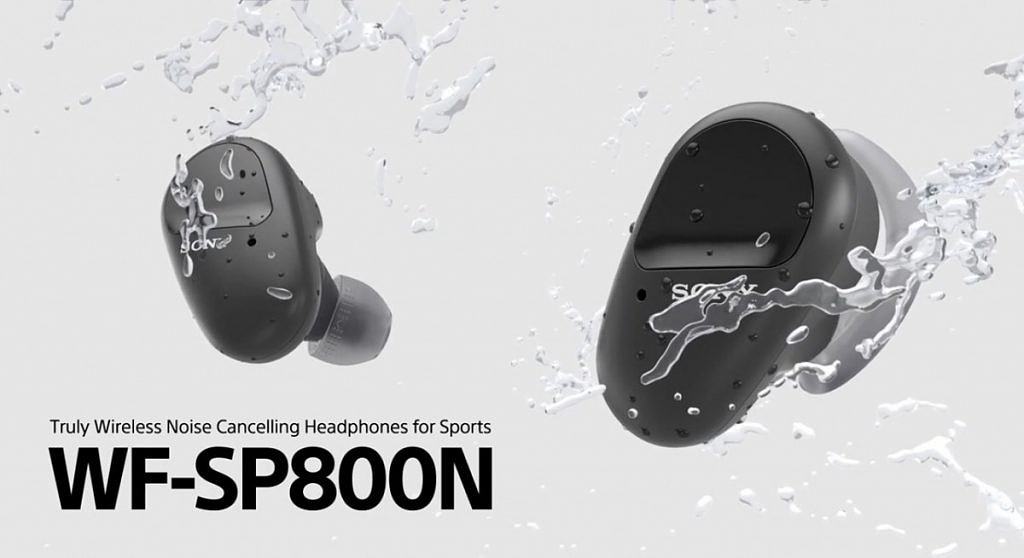
Sony is known for its lineup of TWS earbuds which have pretty great quality, but one infamous feature they have is their names which are not as simple as that of other brands. Where other brands go for simple names, Sony goes for names that are akin to model numbers and this applies to its latest earbuds which are marketed as the Sony WF-SP800N.
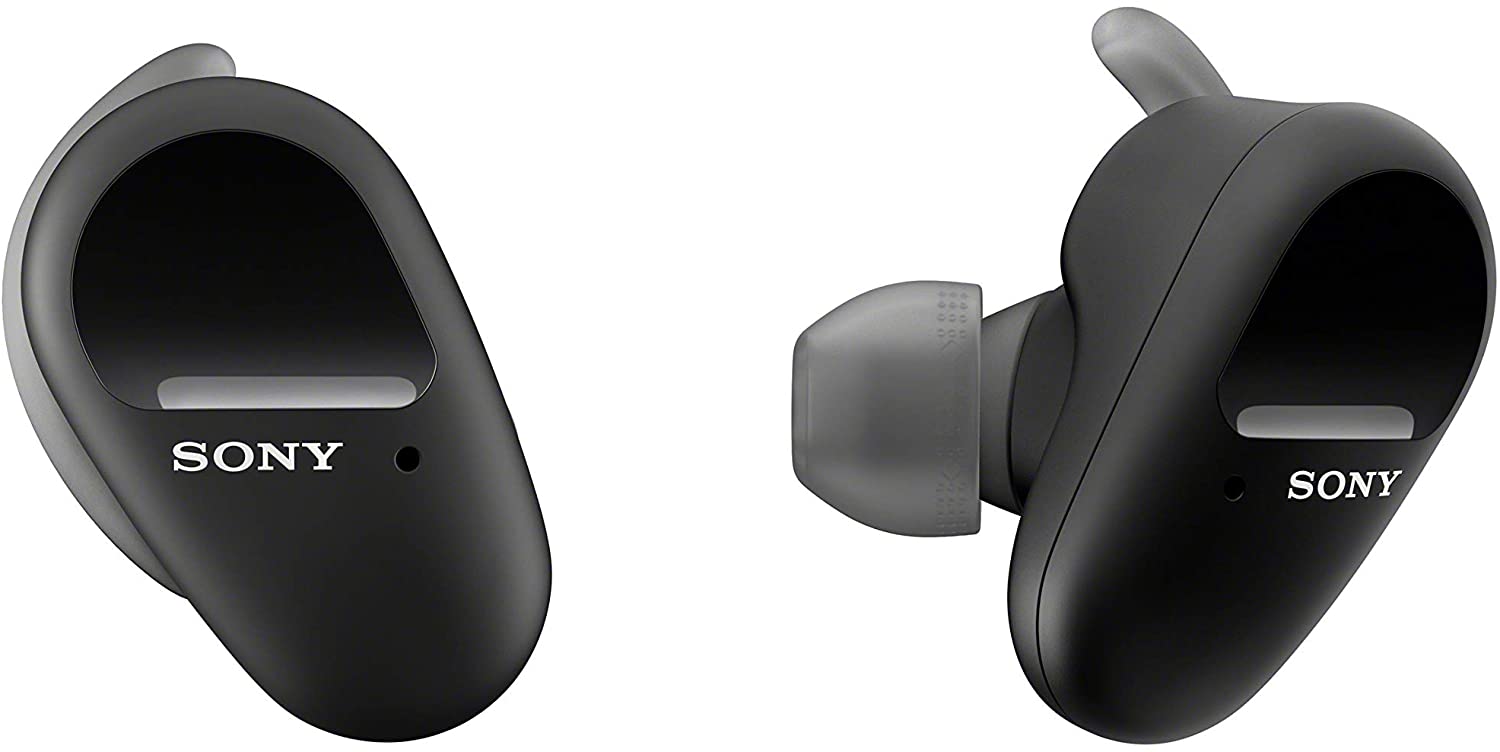
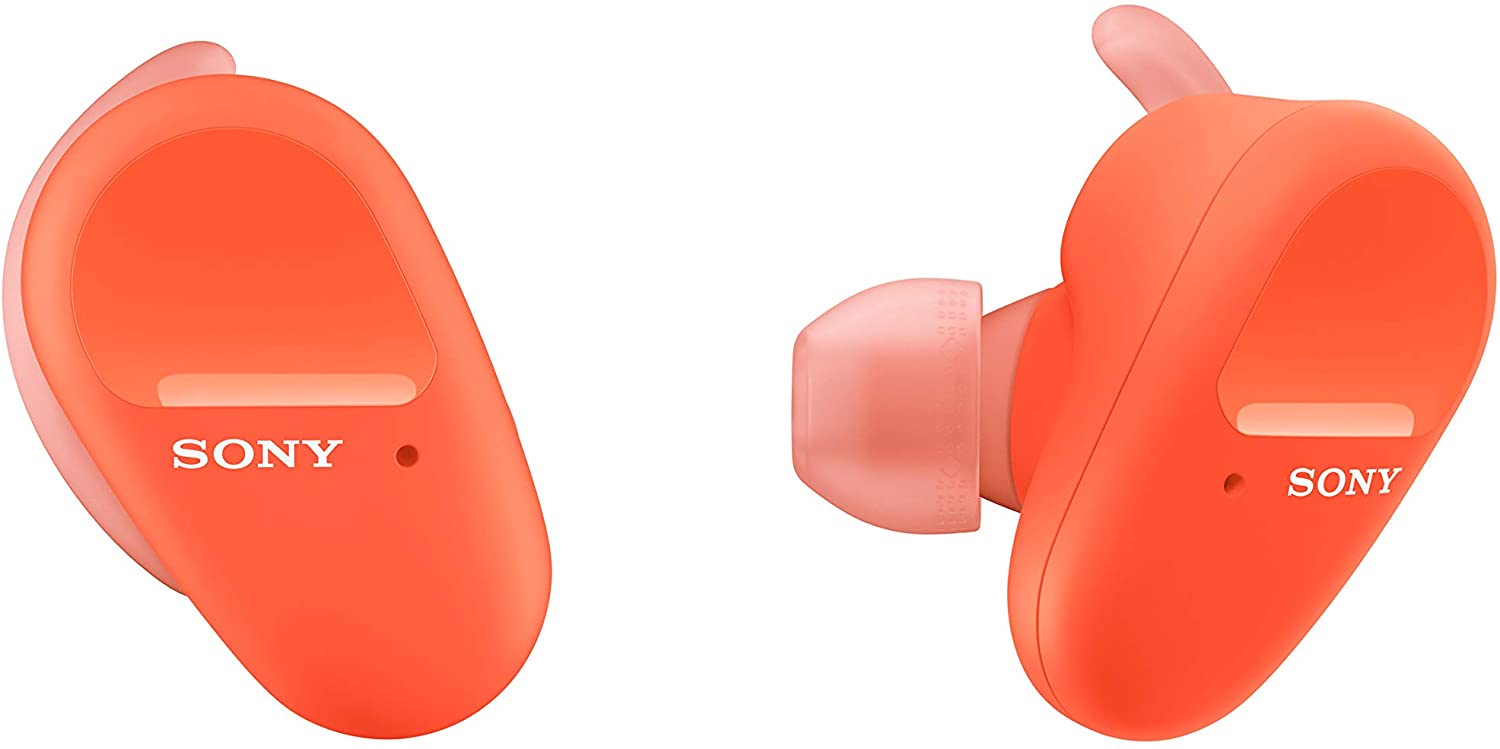
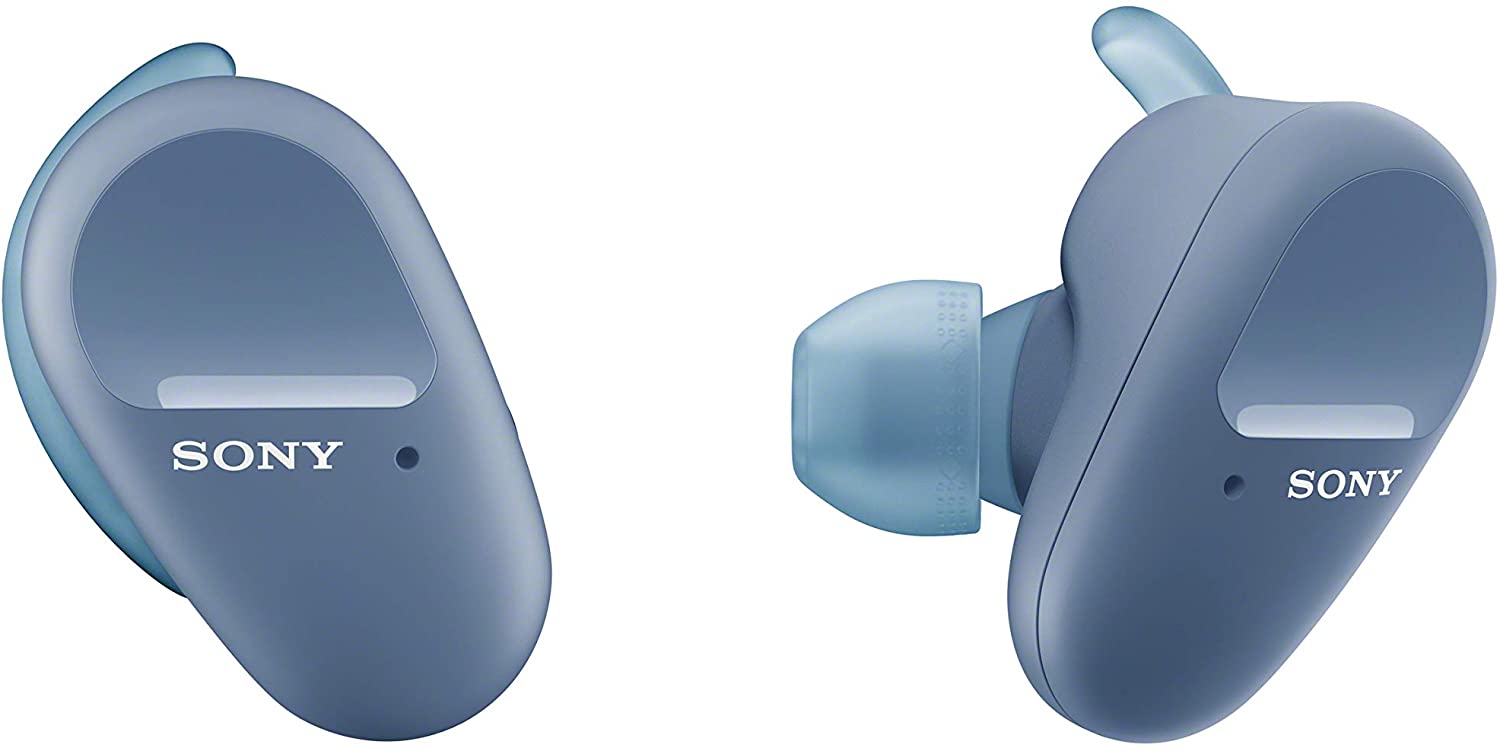
The Sony WF-SP800N are TWS earbuds with noise-canceling designed especially for sports. The earbuds have arc support for a comfortable fit, a recessed design on the outside, and an IP55 rating, which means they are resistant to sweat and splashes. The earbuds come in blue, black, and orange.
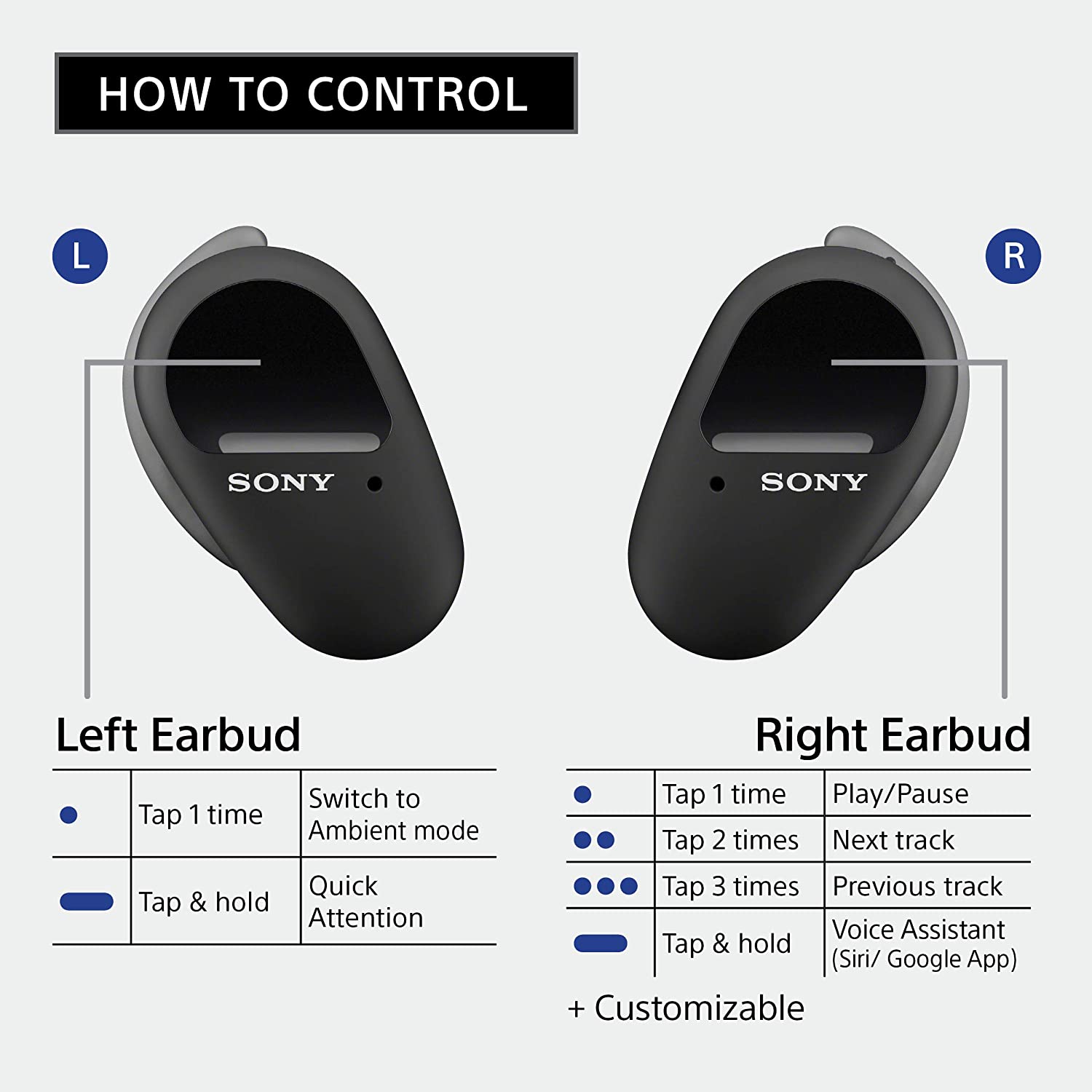
Sony says the WF-SP800N uses digital noise-canceling technology to reduce ambient noise when in the gym or your environment in general. There is also a feature called Quick Attention that allows you to temporarily reduce the volume of what you are listening to by holding down on one of the earbuds so you can hear background noise. The earbuds also have an adaptive sound control that automatically detects what you are up to and adjusts ambient sound settings. There is also an app, available for iOS and Android, that allows you to customize noise canceling and adjust equalizer settings.
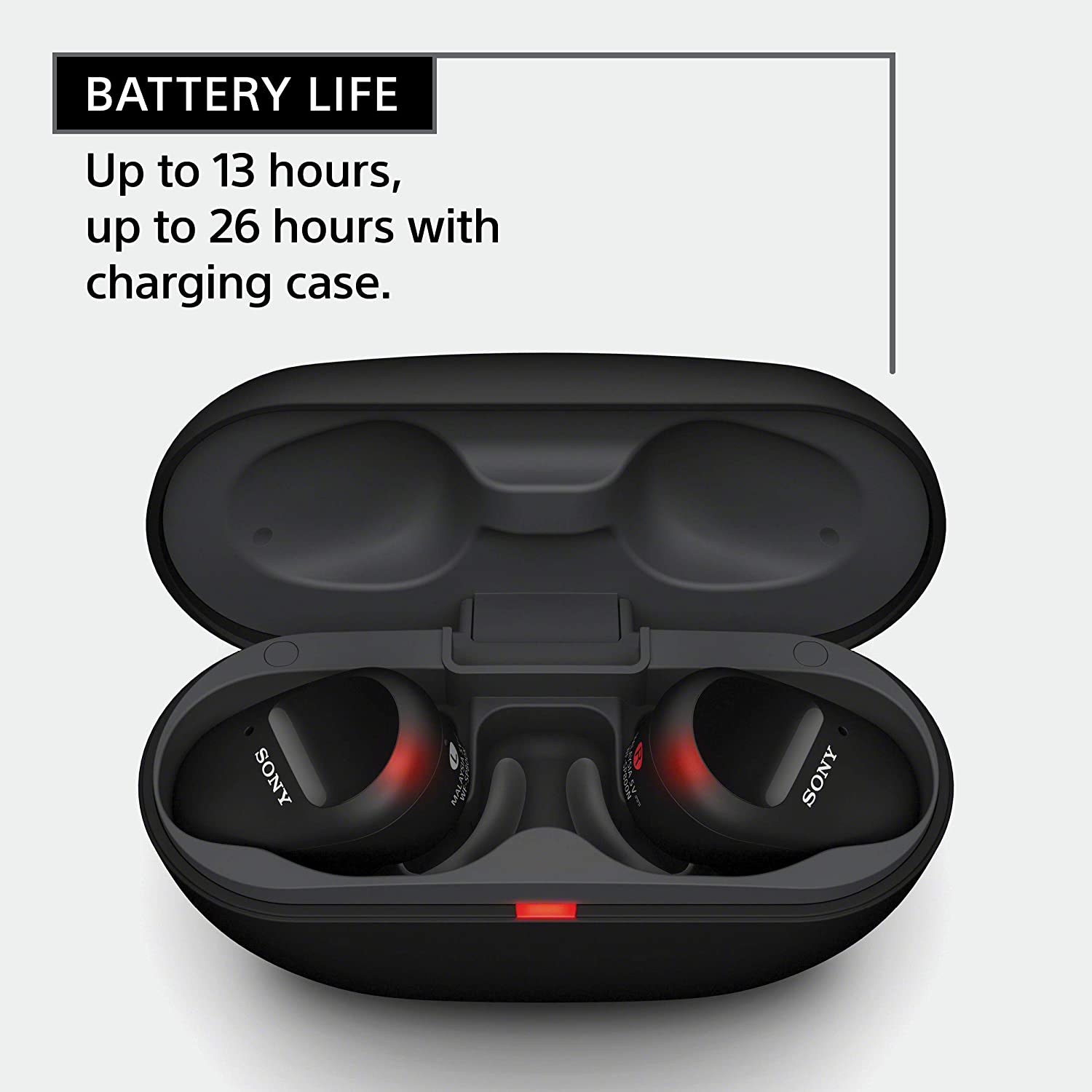
The Sony WF-SP800N has touch controls for answering calls, calling up the Google Assistant, and controlling playback. Sony says it also has Extra Bass. Battery life is 9 hours with noise-canceling on and 13 hours with noise-canceling off. With the case, battery life goes up to 18 hours and 26 hours respectively. There is also support for quick charge that provides 60 minutes of playback time after just 10 minutes of charging.
Sony ships the earbuds with three pairs of silicone tips of different sizes, a pair of arc supports, and a USB Type-C cable for charging. It is priced at $199.99 and available for purchase on Amazon and from Sony’s website.
Blue light penetrates all the way to the retina (the inner lining of the back of the eye) and laboratory studies have shown that too much exposure to blue light can damage light-sensitive cells in the retina. Thus, manufacturers of light-emitting products like smartphones, smart TV and computer displays and even indoor light bulbs, have always looked for ways to reduce the harmful blue light the user’s eyes get exposed to.
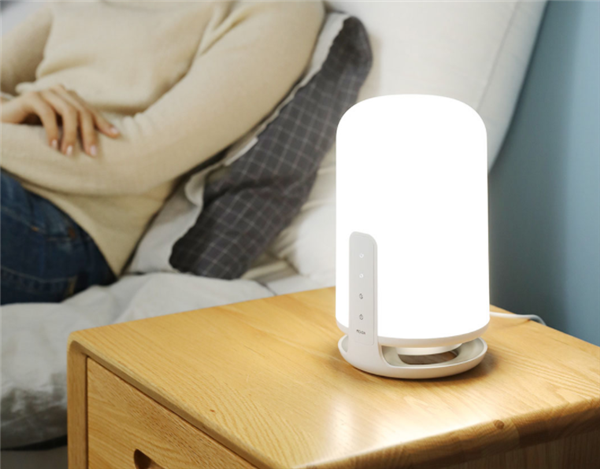
Xiaomi has provided a solution in that regard for the indoor lighting system by launching a bedside lamp that produces no blue light. The product is launched under the Youpin crowdfunding platform and is touted to be the world’s first zero-blue light bedside lamp. But you should be wary of Chinese manufacturers and the use of the term “world’s first”. Dubbed Midian Zero-blu-ray Bedside Sleep Aid Lamp, the product is on crowdfunding for 199 yuan (~$28) but the actual price is 329 yuan (~$46).
The bedside lamp features an LED light source and is developed by scientists from the Chinese Academy of Sciences of Nanchang University. The lamp uses a high-efficiency yellow LED as the core and red LED to achieve a phosphor-free, low colour temperature pure LED light source.
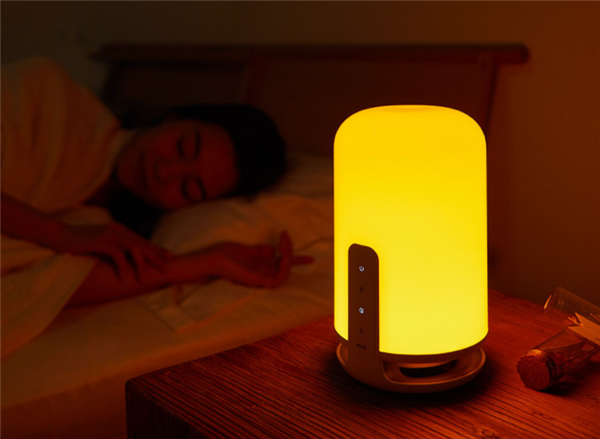
This design is said to be different from the blue light filtering method adopted by similar products on the market. Instead, the Midian Zero-blu-ray Bedside Sleep Aid Lamp eliminates the use of blue light from the source and is entirely blue light free. Thus, will not harm the human eye structure, even for babies.
The light source of the product belongs to the long-wavelength band in the spectrum. In this mode, the colour temperature is 1800K, without short-wave blue light, and the light colour is soft and comfortable, improving sleep quality.
Apart from the zero blue-light LED lamp which has a 2W rating, there are also 12 0.5W white LED lamp beads. In terms of appearance, the design team adopted a lightweight and elegant suspension design which has won several awards including the German Red Dot and iF design awards.
The lamp is a smart product that can be paired with the MIJIA app. This brings several functions including a “wake up” function. From the MIJIA app, you can set the daily wake-up time and even choose to have a piece of soft music played in the background. It also supports XiaoAI voice assistant.
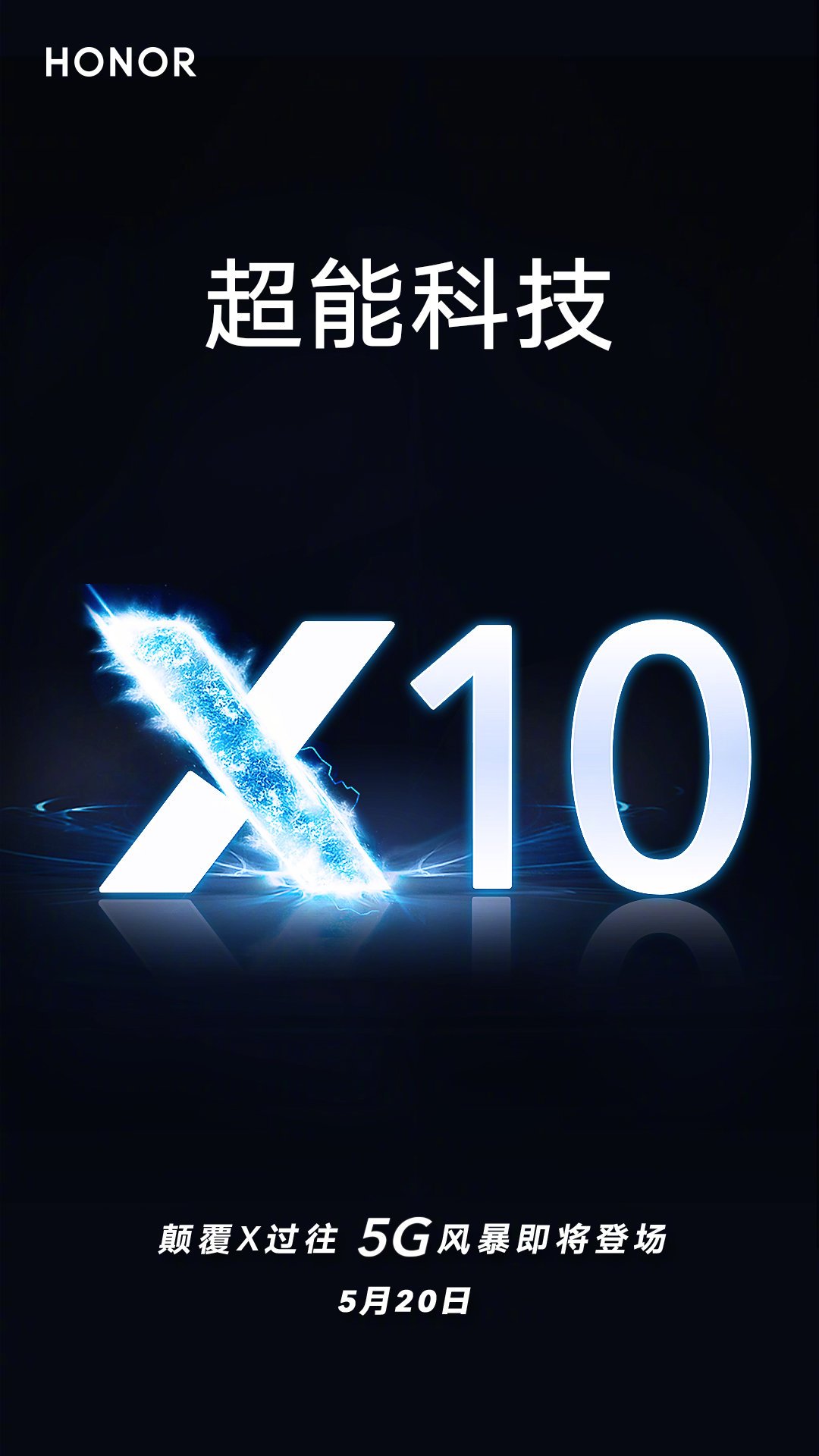
Honor has a new phone coming called the Honor X10 and ahead of the launch which is scheduled for May 20, the full specs and price of the phone alongside a Pro model have been posted online.
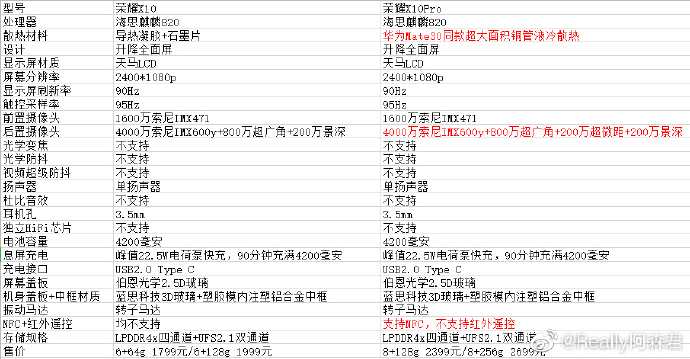
The source of the leak is @Really Assen, the same source that posted the spec sheet for the upcoming Huawei Enjoy 20 Plus. The spec sheet shows the two phones will share several features including the display type, processor, and battery capacity.
Honor X10 Specifications and Price
The spec sheet says the phone will pack a display with a 2400 x 1080 resolution and a 90Hz refresh rate. The Honor X10 will have a Kirin 820 processor which means it will have support for 5G. The chipset will be paired with 6GB of RAM and will be available in 64GB and 128GB variants.
The phone will come with a 16MP Sony IMX471 selfie camera while the back will house a triple camera setup that includes a 40MP Sony IMX600y primary camera, an 8MP ultrawide angle camera, and a 2MP depth sensor.
The Honor 10X will have a 4200mAh battery with support for 22.5W fast charge. It will also come with an audio jack and a USB Type-C port but will not have NFC.
With respect to price, the Honor 10X will sell for ¥1799 (~$254) for the base model with 64GB of storage while the 128GB version will sell for ¥1999 (~$283) when it goes on sale.
Honor X10 Pro Specifications and Price
The Honor X10 Pro will also have a 2400 x 1080 resolution and a 90Hz refresh rate but its screen size wasn’t revealed.
Just like the standard version, there is a Kirin 820 processor inside and the phone will feature a cooling technology similar to that of the Huawei Mate 30. The Honor X10 Pro will have 8GB of RAM and be available in 128GB and 256GB versions.
With respect to cameras, we have the same 40MP + 8MP + 2MP setup as the standard Honor X10 but there is an additional 2MP sensor for a quad camera setup.
The Honor X10 Pro will pack the same 4200mAh battery capacity with support for 22.5W fast charge. Huawei says a full charge will take 90 minutes. It also has an audio jack, a USB Type-C port, and NFC support.
The device will have a starting price of ¥2399 (~$339) and go up to ¥2699 (~$382) for those who want double the storage of the base model.
While some of the specifications check out based on previous leaks, we still implore you to take the info with a grain of salt.
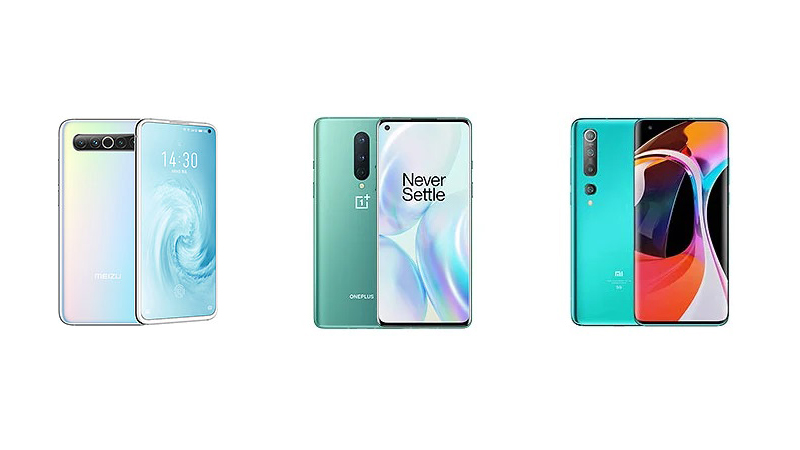
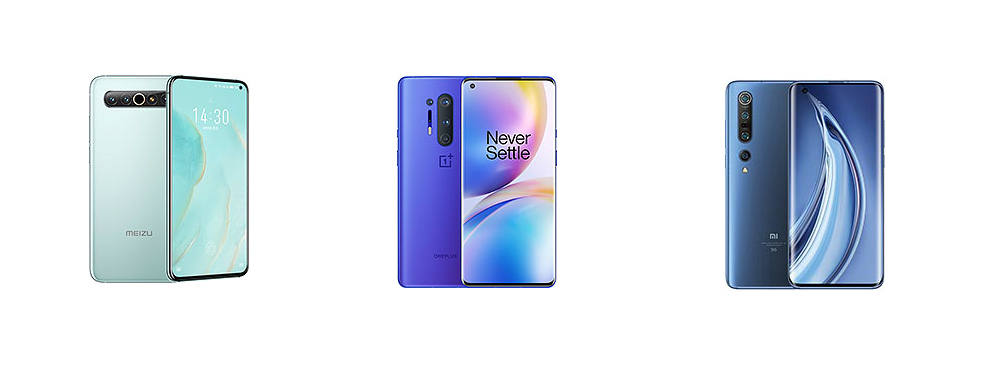
Yesterday, we compared Meizu 17 Pro, OnePlus 8 Pro and Xiaomi Mi 10 Pro for pretty obvious reasons. If you are interested in the comparison of the latest top-tier flagships released by Meizu, OnePlus and Xiaomi, head to this link. Today, we decided to compare the vanilla version: Meizu 17, OnePlus 8, and Xiaomi Mi 10. If you live in China and you are looking for the best affordable flagship, currently these handsets are among the best option you can choose. This comparison will highlight the differences between their specifications.
Meizu 17 vs OnePlus 8 vs Xiaomi Mi 10
Xiaomi Mi 10
OnePlus 8
Meizu 17
DIMENSIONS AND WEIGHT
162.6 x 74.8 x 9 mm, 208 g
160.2 x 72.9 x 8 mm, 180 g
160 x 77.2 x 8.5 mm, 199 g
DISPLAY
6.67 inches, 1080 x 2340p (Full HD+), Super AMOLED
6.55 inches, 1080 x 2400p (Full HD+), Fluid AMOLED
Triple 48 + 16 + 2 MP, f/1.8 + f/2.2 + f/2.4
16 MP f/2.0 front camera
Quad 64 + 12 + 8 + 5 MP f/1.8, f/1.9, f/2.2 and f/1.9
20 MP f/2.2 front camera
BATTERY
4780 mAh, fast charging 30W, Fast wireless charging 30W
4300 mAh, fast charging 30W
4500 mAh, fast charging 30W
ADDITIONAL FEATURES
Dual SIM slot, reverse wireless charging 10W, 5G
Dual SIM slot, 5G, IP68 waterproof
Dual SIM slot, 5G
Design
Due to its very high screen-to-body ratio, curved screen, non-invasive camera module, a more compact body, and the Gorilla Glass 5 protection for the front and back glasses, my favorite device when it comes to the aesthetics is the OnePlus 8. But this does not mean that its rivals are disappointing: the Xiaomi Mi 10 is a very elegant handset as well and Meizu 17 provides an original design with its horizontal camera module and very narrow bezels. But OnePlus 8 is smaller, thinner, and lighter, and this influences my preference.
Display
With Meizu 17, Xiaomi Mi 10, and OnePlus 8 Pro you get very nice displays: in each case, you get an HDR10+ compliant panel with a 90 Hz refresh rate, the AMOLED technology, a Full HD+ resolution, and high brightness. Given that Meizu 17 just went official, it is still too early and we can not test it in order to tell you which is the very best display. However, if you are evaluating these three handsets you should not focus on the displays because there are only marginal differences between their panels.
Hardware/Software
While Meizu 17 offers a faster UFS 3.1 internal storage, OnePlus 8 and Xiaomi Mi 10 are equipped with more RAM (up to 12 GB) in their most expensive versions. The processor is the same for all of these handsets (Qualcomm Snapdragon 865), so you would not notice big differences in their performances. The operating system is what makes the difference because these devices come with different Android customizations. OnePlus and Xiaomi Mi 10 have definitely more advanced customizations than Meizu 17. In each case, you get the support to 5G connectivity thanks to a Snapdragon X55 modem paired with the Snapdragon 865 mobile platform.
Camera
Meizu 17, Xiaomi Mi 10, and OnePlus 8 are very nice camera phones, but they are far from the best camera phones out there. The most interesting is the Xiaomi Mi 10 thanks to its 108 MP main sensor supporting OIS and 8K video recording. Unfortunately, you do not get a telephoto lens supporting optical zoom with any of these devices. If you want this feature, you should go for their Pro variants.
Battery
Xiaomi Mi 10 is equipped with a bigger battery than OnePlus 8 Pro and Meizu 17; it lasts more on a single charge. Further, unlike its two rivals, it supports both wireless charging and reverse wireless charging. You even get very fast wireless charging technology with a 30W power.
Price
The price of Xiaomi Mi 10’s base configuration in China is €554/$608, OnePlus 8 starts off at €515/$565, and Meizu 17 is priced €477/$523 in its base variant. You can get more advanced variants with up to 256 GB of internal storage. Due to its bigger battery, the support of wireless charging (and reverse charging), and a great 108 MP rear camera, Xiaomi Mi 10 looks slightly more attractive than OnePlus 8 and Meizu 17. That is why, at least considering the listing prices, Xiaomi Mi 10 wins this specs comparison. Which would your choice be?
Fabless semiconductor company MediaTek held an online event a few days back where the Dimensity 1000 Plus was unveiled. After the release, three of MediaTek’s top execs – Li Yanji, Deputy General Manager of MediaTek Wireless Communication Division, Li Junnan, Technical Planning Director of MediaTek Wireless Communication Division, and Nian Yucun, Product Marketing Department Manager of MediaTek Wireless Communication Division, granted an interview to Chinese tech website IT Home and some other media outfits.
IT Home’s report specifically centred on MediaTek’s response to questions about Qualcomm’splans to release the Snapdragon 875 chipset ahead of time and the brand’s effort to counter that. Li Yanji Deputy GM of the firm’s wireless communication division disclosed that MediaTek will not be absent from the flagship front and will have products coming out at an appropriate time.
In addition, when responding to a question on the impact of Qualcomm’s latest move to cut prices for its mid-range 5G chipsets for mobile phones, Li Yanji opined that market and price competition would always exist. That the Taiwanese firm’s response will be to launch 5G chips that are more competitive, have more performance advantages, and have more power consumption advantages than other competitors.
MediaTek has relatively been absent from the flagship segment for a long time, stifled by Qualcomm. However, the firm made a resurgence with the latest Dimensity series which has proven to be power SoCs on paper. The Helio G series is et another impressive mid-range 5G series of chipsets. Indeed, the company may have made the right decision to target 5G for re-entry into the premium market. Its products seem to score big with fans and OEMs but it is left to be seen if Qualcomm will not knock the firm out of reckoning yet again.
What is one common feature between Samsung, Huawei, and Apple? All three manufacturers make their own mobile processors. There are others too but not at the scale of the aforementioned companies. A new leak has revealed that Vivo is about to join the club.
A Weibo post by Digital Chat Station has revealed that Vivo is working on its own chipset(s) too. The leaker posted two images that reveal Vivo applied for trademarks for “Vivo Chip” and “Vivo SoC” as far back as September 2019.
[envira-gallery id=”321763″]
There are no specific details with respect to Vivo’s plans for its chipset business and it is hard to say when the first one will be announced. However, we are not too surprised that Vivo is entering into chip development.
Following Huawei’s US predicament, Chinese manufacturers have been investing more in developing local technology so that they can reduce reliance on foreign technology.
Vivo’s phones are currently powered by processors from Qualcomm, MediaTek, and even Samsung. This will likely continue to be the norm for years but with the likely addition of its own chipset. There is also a possibility that its chipsets may not be designed for use in mobile phones but for other smart devices it plans to release.
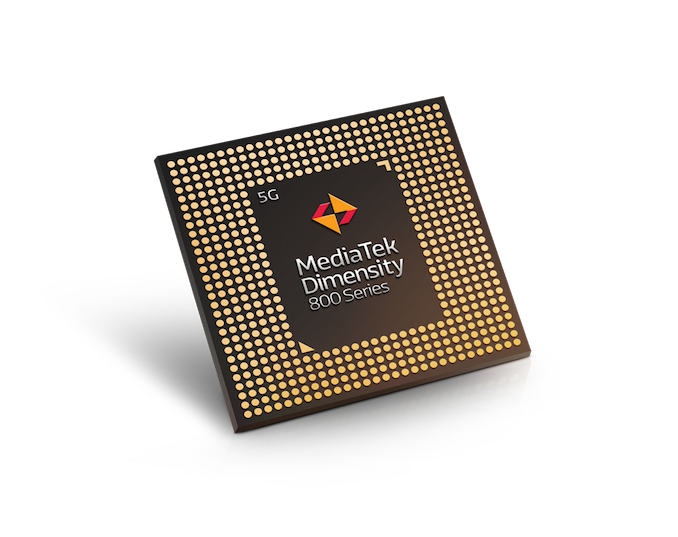
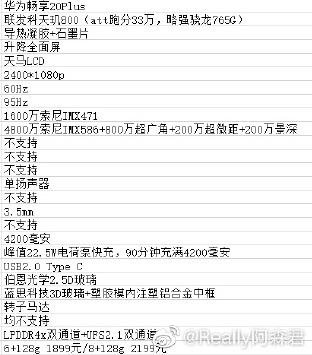
A month ago, we reported that Samsung and MediaTek were marketing their 5G chipsets to Huawei as alternatives to Qualcomm’s Snapdragon processors which Huawei can not use in its phones. While Huawei is not new to using MediaTek processors in its devices, there is none with a 5G processor. That may change soon according to a new spec leak of an upcoming phone called the Huawei Enjoy Plus 20 that has revealed that the phone is powered by the Dimensity 800 5G mobile processor.
The spec sheet was posted on Weibo by a user that goes by @Really Assen. The Dimensity 800 5G is MediaTek’s cheapest 5G processor and the 7nm chipset is currently found inside the OPPO A92s. It offers a performance that surpasses the Snapdragon 730G. However, Huawei’s own Kirin 820 5G processor is a more powerful chipset.
The spec sheet says the phone will have a 2400 x 1080 LCD display with a 60Hz refresh rate. There is no info on the screen size or the design. The processor will be paired with 6GB/8GB of LPDDR4X RAM and 128GB of UFS 2.1 expandable storage.
It will also have a 16MP Sony IMX471 selfie camera, a 48MP Sony IMX586 primary rear camera paired with an 8MP ultrawide angle camera, and two 2MP cameras for a quad-camera setup. The Huawei Enjoy 20 Plus is also reported to have a 4200mAh battery capacity with support for 22.5W fast charge over USB Type-C.
The spec sheet even reveals the price tag of the phone. The 6GB RAM version will sell for ¥1899 (~$268) and ¥2199 (~$311) for the 8GB RAM version.
There is no info on when Huawei will announce the Enjoy 20 Plus but it may not be far. The Huawei Enjoy 10 Plus was announced back in September 2019. It has been more than 6 months already which means a successor is due.
Counterpoint Research has released its report on premium smartphone (>₹30,000 / >$400) segment in India for Q1 2020. Samsung climbed the ladder to acquire the first position, whereas, Apple remained second, and OnePlus was pushed to third place.
The South Korean smartphone maker was successful because of new product launches like the Galaxy S10 Lite, Galaxy Note 10 Lite and the ultra-premium Galaxy S20 series. However, the former two models helped a lot, thanks to their much affordable price tags between $400 – $500 (₹30,000 – ₹45000)
Additionally, the firm’s various discounts and cashback offers on the Galaxy S20 series also helped in boosting the sales. Samsung captured 34% of the total premium smartphone segment of India in Q1 2020.
Although Apple was in second place in the premium segment, it acquired first place with 55% market share in the ultra-premium (>$600) category. The company witnessed a 326% YoY growth in this segment with 40% sales from online channels.
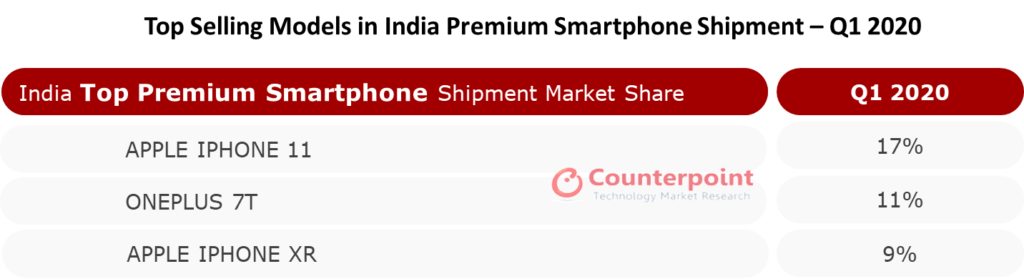
The new iPhone 11 replaced the iPhone XR as the best selling smartphone in the whole premium segment. It accounted for 17% of total shipments in this category. The iPhone XR still managed to capture third place with a 9% market share.
The OnePlus 7T was the second-highest selling smartphones in the premium segment with 11% market share. But OnePlus as a whole slipped to the third position. Mostly, because customers were waiting for the launch of next-generation OnePlus 8 series.
That said, the smartphone market in India will not be the same in the next quarter. The lockdown issued by the government severely affected sales in the last week of March itself.
The country’s MHA (Ministry of Home Affairs) just recently allowed to begin the sales of smartphones in early May. With almost no sales in the whole of April, OEMs will have to work hard to maintain their positions.
UP NEXT: Redmi Note 8 took second spot in the Global Top Smartphones list in Q1 2020, Apple iPhone 11 came first
Honor has scheduled ‘Honor Smart Life’ product launch event for May 18, two days ahead of Honor X10 launch event. The company is expected to announce a wide variety of products at this event like laptops, tablets, routers, smart TVs, and more. About a week ahead of it, a Huawei laptop with AMD Ryzen 7 4800H has been tipped on Twitter.
Huawei Laptop
> R7 4800H > 16GB DDR4 > 512GB Western Digital PC SN720 NVMe SSD > no dGPU (so far)
According to the tipster, this upcoming mysterious Huawei laptop will be powered by AMD Ryzen 7 4800H paired with 16GB of DDR4 RAM. Further, it will include a Western Digital PC SN720 NVMe SSD.
This new laptop will be more than enough for most users except for high-end gamers. Because the leakster found no proof of dedicated GPU. Nevertheless, the integrated Radeon RX Vega GPU is no slow either for low to mid-level editing tasks and gaming.
Anyway, we are not sure under which branding this laptop will be released. There’s no Huawei event as of now and hence there is a high probability of this notebook to release under Honor MagicBook branding on 18th May.
On the other hand, Honor’s president George Zhao also teased new MagicBook model with 10th Gen Intel processors. Maybe, we might see different laptops featuring AMD and Intel chips at the upcoming launch event.
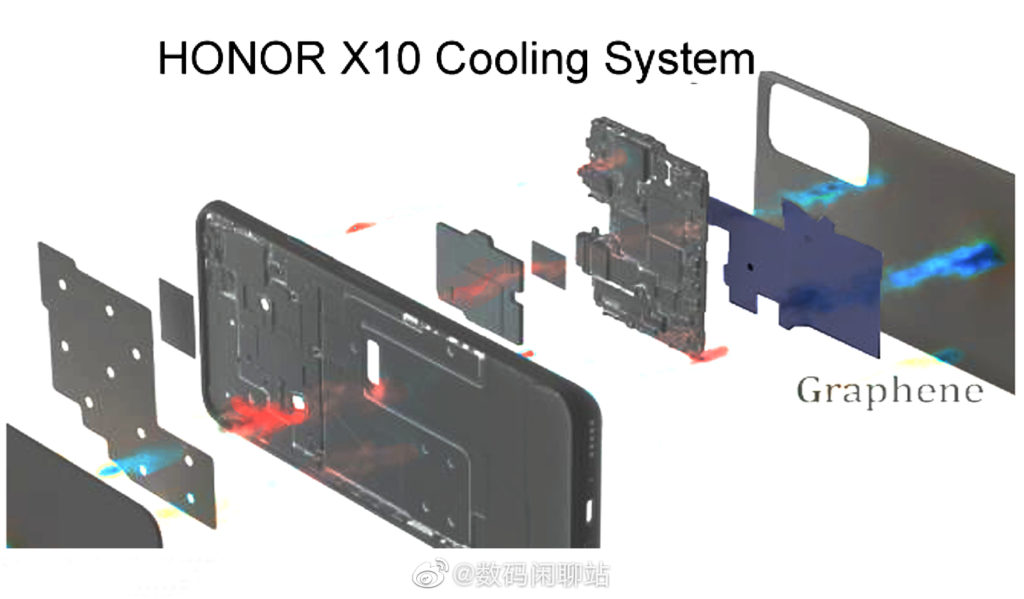
Honor’s George Zhao has confirmed to launch Hono X10 on May 20. The brand is yet to begin marketing for the handset with daily teasers, which we think will probably start next week. Ahead of it, we are exposed to a 3D CAD image showcasing cooling system of Honor X10.
We are aware of most of the specifications of the upcoming Honor X10. Now, we also know that it will feature a graphene cooling system, thanks to a picture shared by well-known tipster Digital Chat Station on Weibo. According to him, this could be the same kind of tech use in Huawei’s Mate series.
The Honor X10 is expected to be the cheapest 5G phone from Huawei. The handsets with 5G connectivity usually get warmer and consume more battery than normal 4G devices. Hence, a graphene-based cooling system can make a difference in the overall thermal performance of the phone.
As far as specs are concerned, the Honor X10 will sport a 6.63-inch FHD+ LCD screen with a 16MP pop-up camera. It will be powered by Kirin 820 5G chipset paired with up to 8GB RAM and 256GB internal storage.
It will feature a 40MP (primary) + 8MP (ultra-wide) + 2MP triple camera setup, out of which the primary unit is expected to be a Sony IMX600 RYYB sensor. Last but not least, the handset will be backed by a 4,200 mAh battery with support for 22.5W fast charging over USB Type-C.
Early last month, Xiaomi launched Mi Air 2S truly wireless earphones in China. Now, it is receiving its first firmware update with tons of fixes and optimizations.
The Mi Air 2S TWS brings a number of upgrades over its predecessors. It is powered by a dual-core processor and features binaural synchronous transmission technology. The buds last 5 hours on a full charge with an additional 24 hours from the case, which has support for wireless charging.
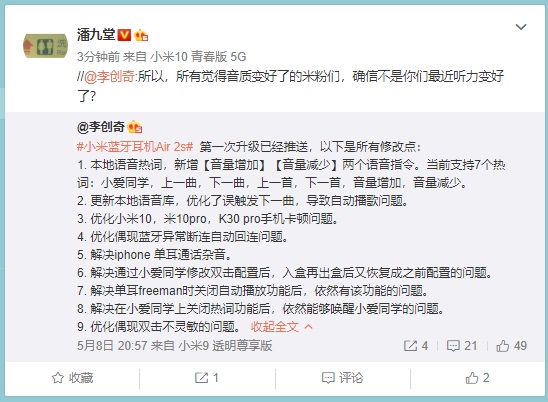
After a month from its announcement, the company is now seeding the first-ever firmware update to Mi Air TWS. The update brings the following fixes and features to the Xiaomi audio accessory.
Adds two hot words to increase and decrease volume. Now, supports 7 hot words in total, which covers all the playback controls for music as well as one to wake up Xiao AI voice assistant.
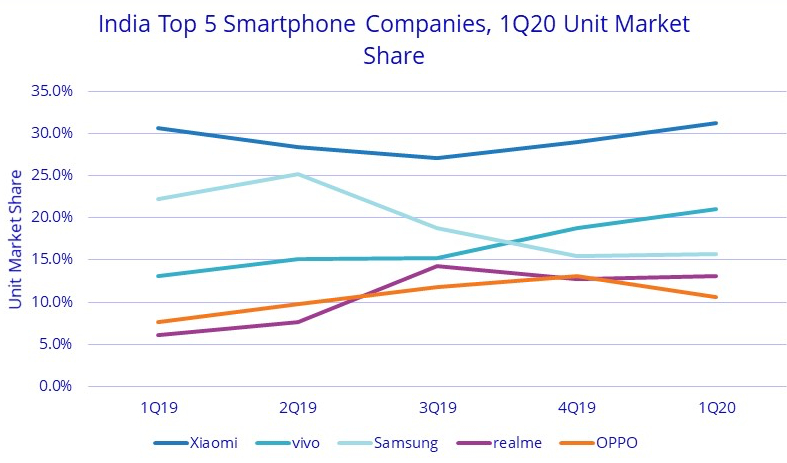
Research firm IDC has released its market data showing the performance of the Indian smartphone market in the first quarter of 2020. The data is coming with some positives at a time the global smartphone market is experiencing a downturn.
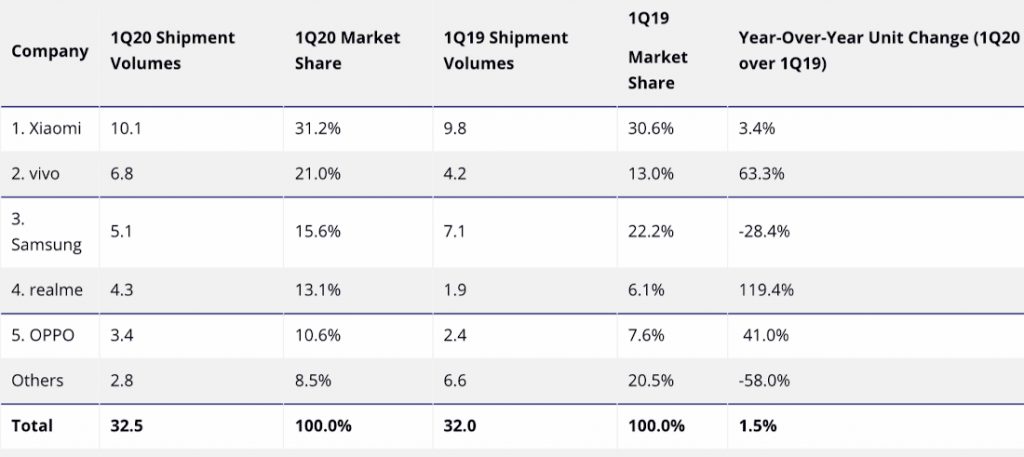
India recorded positive growth in the first quarter of 2020 with an estimated overall shipment of 32.4 million. This translates to a growth of 1.5% YoY as against the 20.3% and 16.0% Year-on-Year decline recorded by the Chinese and US markets respectively.
Some positives to take out is the increase in sales via online channels which saw a growth of 9.0% YoY in Q1 2020. Online sales recorded a market share of 43.1%. On the other hand, offline channel shipments declined by 3.5% YoY. Further, the feature phone market in India also saw a decline of 29.4%, with an estimated 22.8 million units shipment in Q1 2020.
In terms of ranking, Chinese smartphone giant Xiaomi maintained its lead of the market with an estimated 1Q 2020 shipment volume of 10.1 million units, achieving a growth of 3.4% YoY. Xiaomi’s most popular devices included the Redmi Note 8 series models.
Redmi Note 8 Pro
Vivo came in strongly in second place, registering a growth of 63.3% YoY. This was largely due to the success of their affordable Y series and S1/Pro series smartphones. Korean tech giant and global market leader Samsung suffered a decline of 28.4% YoY in Q1 2020, recording their lowest ever shipment numbers in the past 5 years. Pricing issues with the Galaxy M series and Galaxy A series of smartphones caused a low consumer interest and high channel inventory.
Realme leapt ahead of OPPO to emerge as the fourth largest brand in terms of shipment volume in the quarter. The OPPO sub-brand is said to have shipped 4.3 million units. Realme’s top-selling models for the quarter include the Realme 5i, 5s, C2/C3, and the Realme 6.
BBK subsidiary OPPO completes the top 5 with a 41% YoY growth. However, the brand’s latest Reno3 and F15 smartphones were no match for competing models which offered better pricing and features.
After months of silence, Meizu came up with a new flagship lineup. The most powerful handset of the new series celebrating Meizu’s 17th anniversary is the Meizu 17 Pro: a high value for money flagship with top-tier specifications. But is the new device strong enough to compete with the best smartphones from the most important Chinese manufacturers? We think there is no better way of understanding it than comparing the new Meizu 17 Pro with the other Chinese flagships. For this comparison, we chose Xiaomi Mi 10 Pro and OnePlus 8 Pro simply because they are the most advanced devices released by Xiaomi and OnePlus: the most important Chinese brands in the world alongside Oppo and Huawei.
Meizu 17 Pro vs OnePlus 8 Pro vs Xiaomi Mi 10 Pro
OnePlus 8 Pro
Meizu 17 Pro
Xiaomi Mi 10 Pro
DIMENSIONS AND WEIGHT
165.3 x 74.4 x 8.5 mm, 199 g
160 x 77.2 x 8.5 mm, 219 g
162.6 x 74.8 x 9 mm, 208 g
DISPLAY
6.78 inches, 1440 x 3168p (Quad HD+), Fluid AMOLED
6.6 inches, 1080 x 2340p (Full HD+), Super AMOLED
6.67 inches, 1080 x 2340p (Full HD+), Super AMOLED
All these handsets feature a very elegant and futuristic design. Which one should you choose? It mostly depends on your tastes. In my opinion, OnePlus 8 Pro has a slightly more interesting design and build quality: it boasts a higher screen-to-body ratio and it is the only waterproof phone with the IP68 certification. But Meizu 17 Pro is made of ceramic and some may prefer its unique materials as well as its more compact body, despite it does not come with a curved display, unlike OnePlus 8 Pro and Xiaomi Mi 10 Pro.
Display
OnePlus 8 Pro wins the display comparison because it boasts a lot better panel. It is an AMOLED display with HDR10+, a higher Quad HD+ resolution, and a higher 120 Hz refresh rate. Both Meizu 17 Pro and Xiaomi Mi 10 Pro have an AMOLED display with a Full HD+ resolution and a 90 Hz refresh rate. OnePlus 8 Pro also offers a wider panel with a 6.78-inch diagonal. Further, note that it has a 10 bit screen which can display one billion colors. There is simply no challenge: OnePlus 8 Pro is the king.
Hardware/Software
When it comes to the hardware department, you should not notice differences in daily use. Meizu 17 Pro, OnePlus 8 Pro, and Xiaomi Mi 10 Pro are all equipped with the Snapdragon 865 (supporting 5G connectivity) mobile platform paired with up to 12 GB of RAM and fast UFS storage (UFS 3.1 on Meizu 17 Pro, UFS 3.0 on OnePlus 8 Pro and Xiaomi Mi 10 Pro). The software department is what really makes the difference: there is no doubt about the fact that OxygenOS and MIUI are more advanced user interfaces than Meizu’s Flyme OS.
Camera
It is hard to establish which device will be the best camera phone of the trio not only because we still did not test all of them, but also because they are very close (on the paper). If we look at the specs on the paper, we find out that Xiaomi Mi 10 Pro looks more impressive with its 108 MP main sensor, up to 3.7x optical zoom, and the support to 8K video recording, as well as other interesting features. But its rivals are still amazing camera phones and they may surprise everyone soon.
Battery
Meizu 17 Pro, OnePlus 8 Pro, and Xiaomi Mi 10 Pro come with the same battery capacity (just 10 mAh more for the OP8 Pro), but the OnePlus 8 Pro has an inferior battery life due to its more energy-demanding display sporting a QHD+ resolution and a 120 Hz refresh rate. The fight will be between Xiaomi Mi 10 Pro and Meizu 17 Pro as we still do not know how much the latter will last on a single charge.
Price
Meizu 17 Pro debuted in China with prices starting from €560/$607, Xiaomi Mi 10 Pro costs €652/$706 in the same country, and OnePlus 8 Pro begins at €706/$765. The OnePlus 8 Pro wins the comparison thanks to its better display because it is waterproof and thanks to a few other interesting features. But Meizu 17 Pro wins the value for money award with its great price.
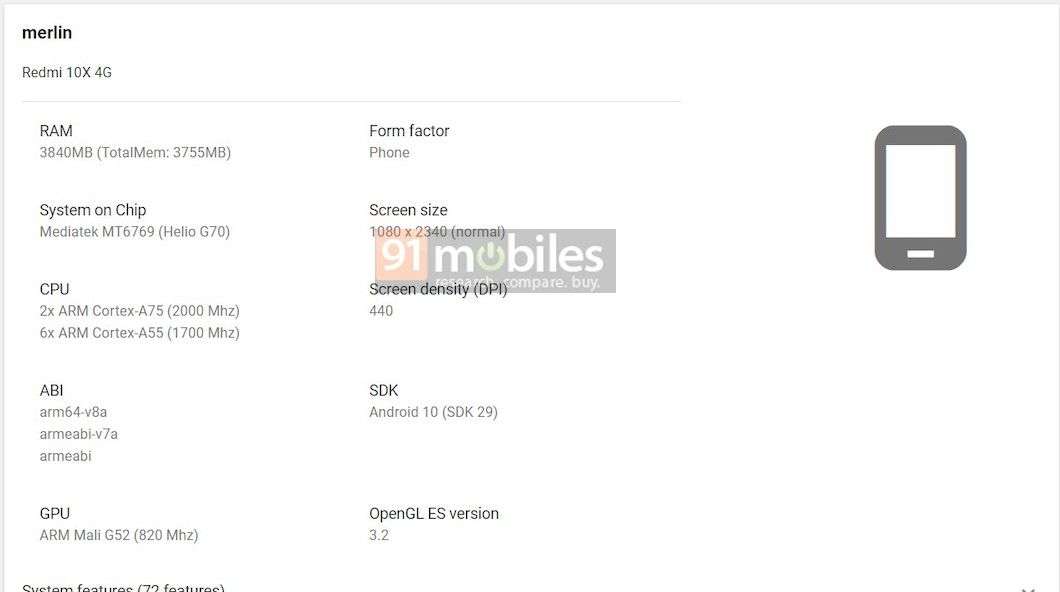
Just about the same time when the Redmi 9 was spotted on Xiaomi‘s RF Exposure website, the Redmi 10X also reportedly made an appearance on Google Play Console listing. The Redmi 10X has been considered an unusual name since we are having the Redmi 9 series this year. But the rumours have continued to gain ground with the phone said to be a rebranded Redmi Note 9 for the Chinese market. However, the Google Play Console listing suggests otherwise.
The listing shows that the Redmi 10X 4G would bear the codename Merlin and will feature a MediaTek Helio G70 processor instead of the Helio G85 chipset that’s powering the Redmi Note 9. The processor is bundled with a Mali G52 GPU firing up the graphics. The smartphone will also come with 3GB RAM but we expect other options.
This device can easily be confused with the Redmi 9 which is expected to pack a similar specs lineup. However, the presence of an FHD+ resolution of 1080×2340 pixels should do the trip in distinguishing them as separate entities. The device will run on Android 10.
However, we won’t put all our cards on this one since the source isn’t given. So take this with a grain of salt.
Xiaomi launched the Mi Mix 2 bezel-less (at that time) smartphone in 2017. Earlier today, Lei Jun, the company’s co-founder and CEO recalled it as his favorite Xiaomi phone. He thinks this handset feels like jade because of its ceramic unibody.
Xiaomi’s Mi Mix series of smartphones are known for offering a full-screen experience. The last commercial phone in the series was Mi Mix 3, whose 5G version, unfortunately, did not sell well. As a result, it is yet to receive MIU 11 and Android 10 update.
Recently, the Chinese smartphone maker registered a new Weibo account for the Mix series. Now, the CEO remembers an old Mi Mix device as his favorite Xiaomi phone. All of this somewhat indicate the arrival of the new Mix series smartphone.
Xiaomi did announce a new device in the series recently called Mi Mix Alpha. But it is a concept smartphone and is yet to go on sale though it has a price tag attached to it.
Considering the statement made by Lei Jun, we can expect the next Mi Mix device, probably called Mi Mix 4 to come with ceramic unibody design like its predecessor from 2017.
Phones with ceramic back are not unique to Xiaomi. The Meizu 17 Pro launched today also has a ceramic body and so does the Huawei P40 Pro Plus. There were multiple devices in the past with this design like the Samsung Galaxy S10 5G, Essential Phone, and LG V35 Signature Edition to name a few.
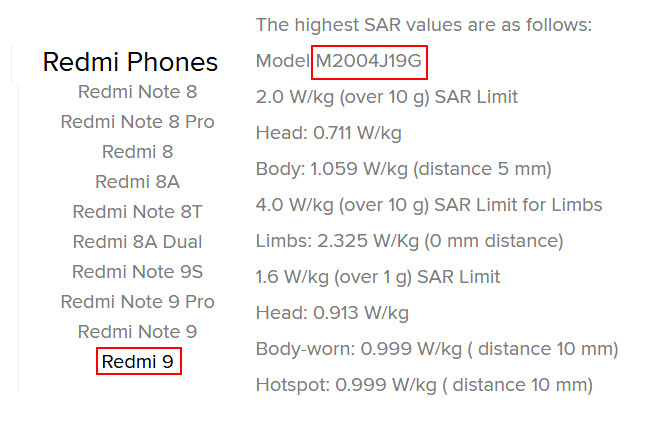
Xiaomi has already taken the wraps off all the models on the mid-range Redmi Note 9 series. What is left is for the entry-level Redmi 9 series to drop. There were rumours that the company will launch the Redmi 9 and 10X soon in China. That rumour may have some credibility as the Redmi 9 has been spotted on the RF Exposure page of Xiaomi’s website.
The web listing gives the model number for the phone as M2004J19G for the phone. It also gives the name as Redmi 9. Recall that the Redmi 9 had earlier appear for certification on China’s 3C website with a similar model number M2004J19C. Thus, this version should be the one meant for the global market. The 3C listed showed the device will ship with a 10W charger but will have support for 18W fast charging just like the Redmi 8. In addition, the model has also got EEC certification with model number M2004J19AG.
Earlier rumours tip the Redmi 9 to pack a MediaTek Helio G70 chipset as well as quad rear cameras, including a 13-megapixel main camera. Other sensors include an 8-megapixel ultra-wide camera, 5-megapixel macro and a 2-megapixel depth sensor. The Redmi 9 will also keep the physical fingerprint scanner at the back.
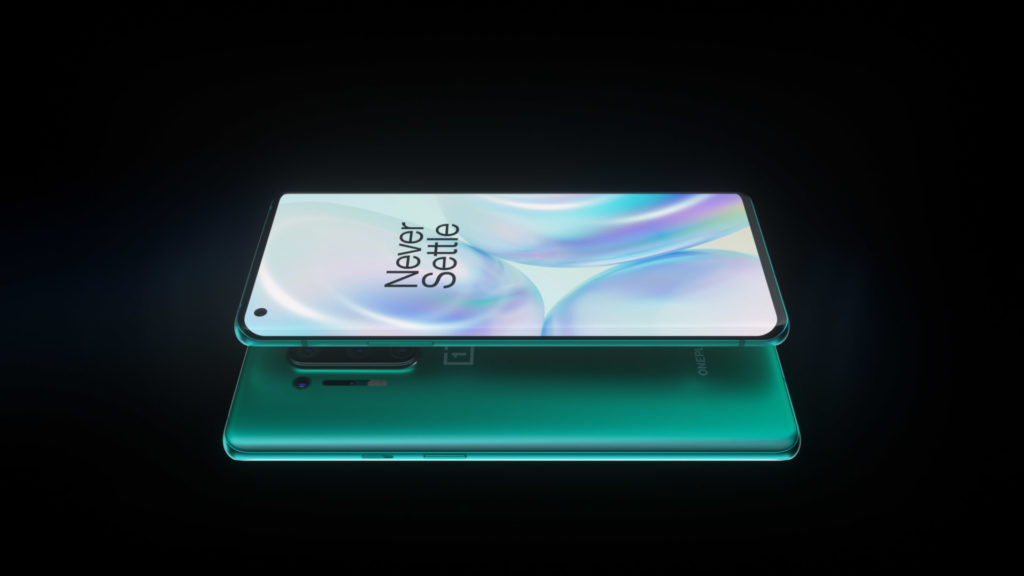
The OnePlus 8 and OnePlus 8 Pro went official last month. They are already on sale in various regions. Also, both the handsets in the series have received multiple updates fixing various bugs. Now, their kernel source code is out as well.
Normally, OnePlus is quick to release kernel source code for its devices. But the company took more time this year with the OnePlus 8 series. Anyway, it is out now and interested developers can already start fiddling with it.
On the other hand, the code names for these handsets are too boring.
OnePlus 8 – instantnoodle
OnePlus 8 Pro – instantnoodlep
Don’t know why OnePlus went with ‘instantnoodlep’ for the OnePlus 8 Pro. The previous generations had different and better codenames for each model.
That said, now as the kernel source code is out, we can expect developers to begin compiling custom recoveries like TWRP and more. Since OnePlus is popular in third-party development like Xiaomi, we will likely see a number of custom ROMs, kernels, and mods in the near future.
But there might be a delay this time around due to the COVID-19 global pandemic. OnePlus is yet to start sales in its biggest markets like India. Also, as most countries are under lockdown, there are fewer chances of developers receiving their units on time.
We use cookies on our website to give you the most relevant experience by remembering your preferences and repeat visits. By clicking “Accept”, you consent to the use of ALL the cookies.
This website uses cookies to improve your experience while you navigate through the website. Out of these, the cookies that are categorized as necessary are stored on your browser as they are essential for the working of basic functionalities of the website. We also use third-party cookies that help us analyze and understand how you use this website. These cookies will be stored in your browser only with your consent. You also have the option to opt-out of these cookies. But opting out of some of these cookies may affect your browsing experience.
Necessary cookies are absolutely essential for the website to function properly. This category only includes cookies that ensures basic functionalities and security features of the website. These cookies do not store any personal information.
Any cookies that may not be particularly necessary for the website to function and is used specifically to collect user personal data via analytics, ads, other embedded contents are termed as non-necessary cookies. It is mandatory to procure user consent prior to running these cookies on your website.