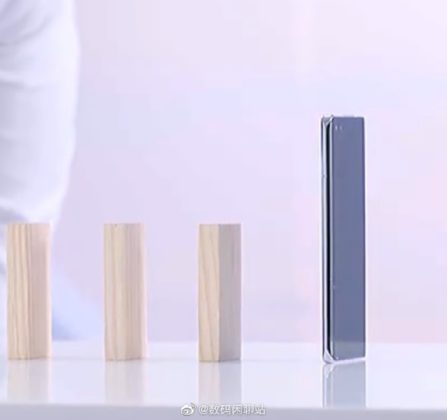
iQOO is now gearing up to launch the iQOO Neo3 5G smartphone. The handset is scheduled to go official on April 23. Today, the company took to Weibo to reveal some of the major highlights of the phone. While it was being said that the iQOO Neo3 will be arriving with a 120Hz refresh rate supporting screen, the Chinese firm today revealed that is equipped with a 144Hz refresh rate display.
The Red Magic 5G phone from Nubia that had gone official in March is the world’s first smartphone to flaunt a 144Hz display. All the iQOO phones that launched in the past had 60Hz refresh rate screens. However, the iQOO Neo3 5G will be the company’s first phone to support higher refresh rates.
The iQOO Neo3 is rumored to be equipped with an LCD panel that has a punch-hole for the front camera. The exact resolution of the phone’s screen is not known yet. It is likely to carry support for full HD+ resolution. There is no LCD display phone available in the market with in-screen fingerprint technology yet. Hence, the iQOO Neo3 could be coming with a side-mounted or a rear-facing fingerprint reader.
Editor’s Pick: Samsung’s deepfake AI can Create your Video from a Single Photo
The poster released by the company confirms that the iQOO Neo3 is driven by Snapdragon 865 mobile platform. The phone is also equipped with UFS 3.1 storage. Since the phone is scheduled to go official on April 23v, it appears that the company will continue to reveal some of its key feature before launch.
Past reports have revealed that the iQOO Neo3’s base model will have 6 GB of RAM and 128 GB of storage. The FunTouch OS 10 based Android 10 will come preinstalled on the device. It is expected to arrive with a 48-megapixel quad camera setup. It may house a 4,500mAh battery with 44W fast charging support.
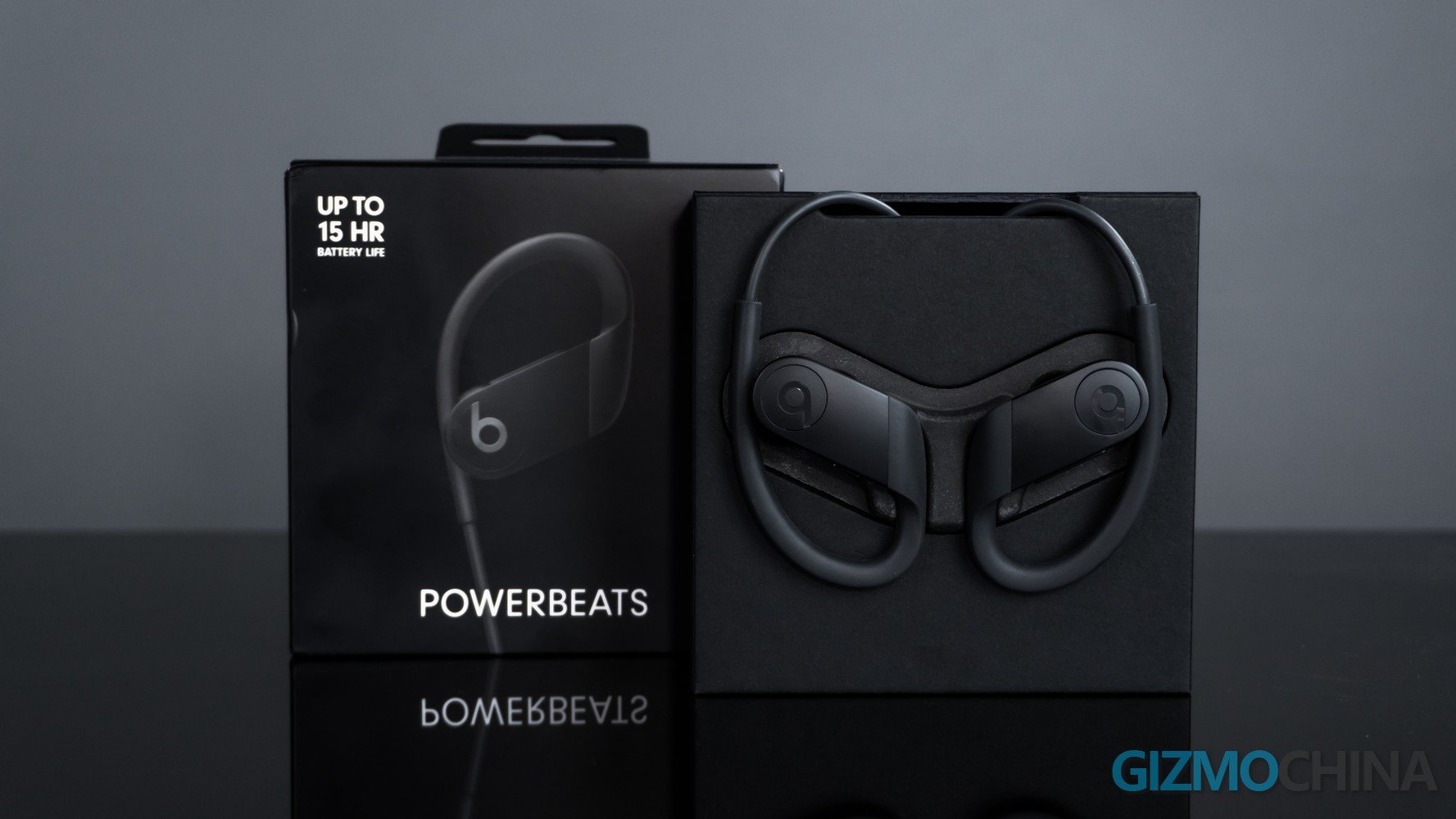
If every brand has their own personified image, the brand Beats is definitely a sportsman who has a fit appearance and fashionable taste. Such imagination is also what the brand wants you to believe. To construct such kind of imagination, what’s most important is good products. Powerbeats series targeting the sports market is becoming one of the most important pieces of the Beats picture.
Powerbeats
The earphone fashion now is not just about hearing enjoyment. As the market has been filled with those wireless earphones and gone widely beyond music lovers, it seems that attractive acoustical structure is no longer given top priority, no matter by mass users and manufacturers. However, the less the market pays attention to it, the more we are looking forward to those traditional audio producers doing something. Gizmochina Reviewed the new Powerbeats 2020 and found that the new Powerbeats 2020 could be one of the ‘something’, but more than just a ‘market-like’ earphone product.
Design & appearance
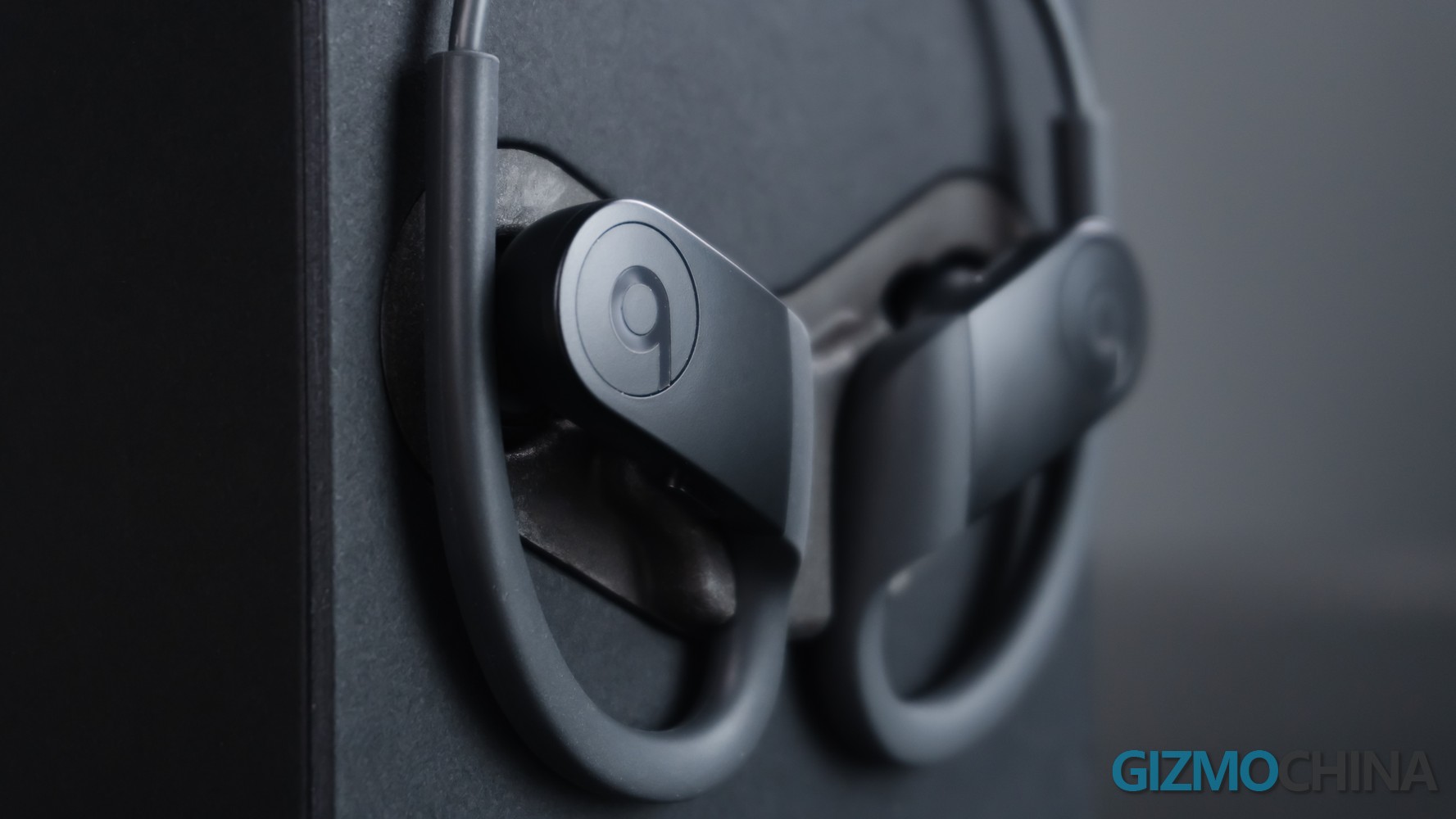
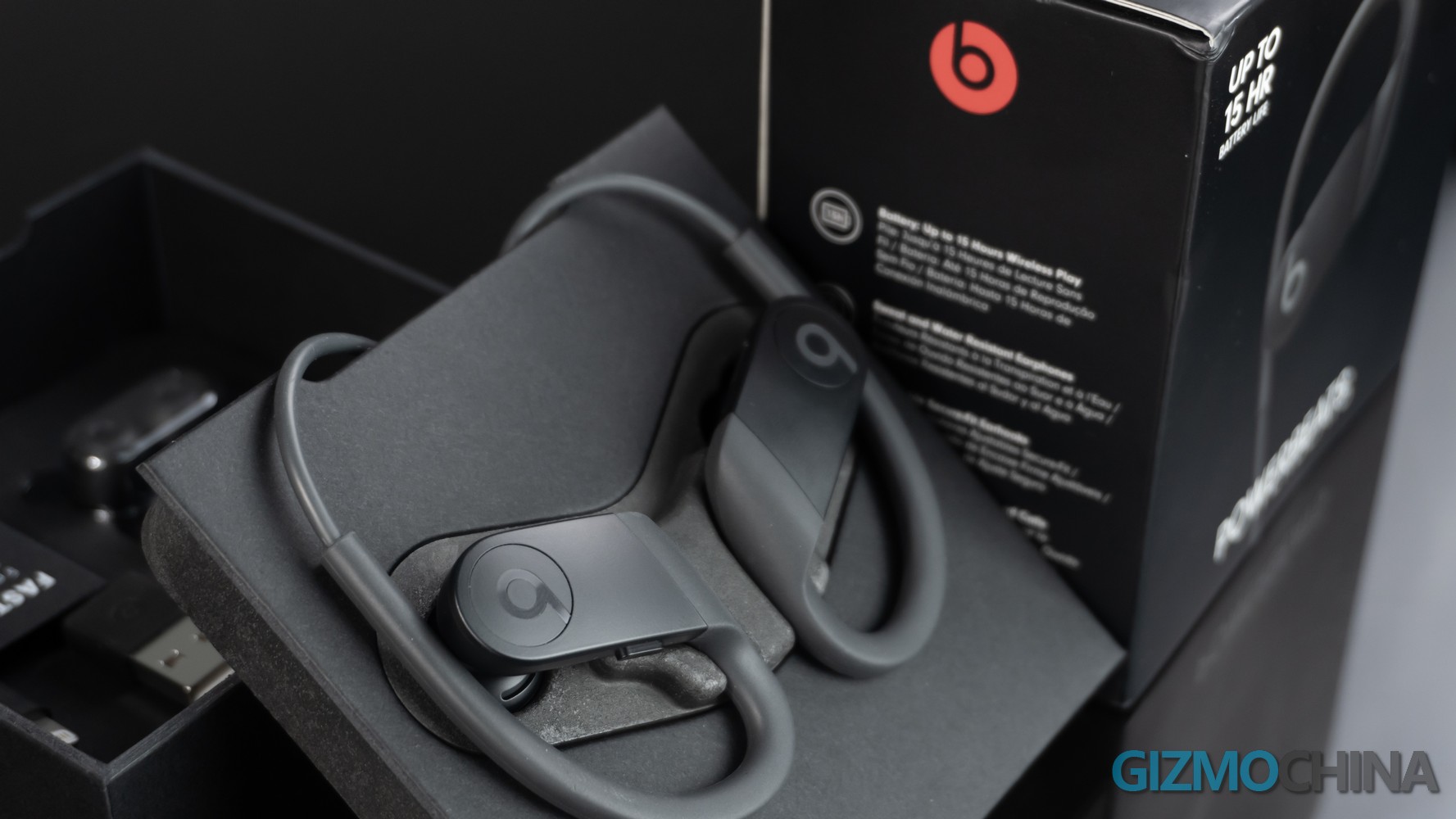
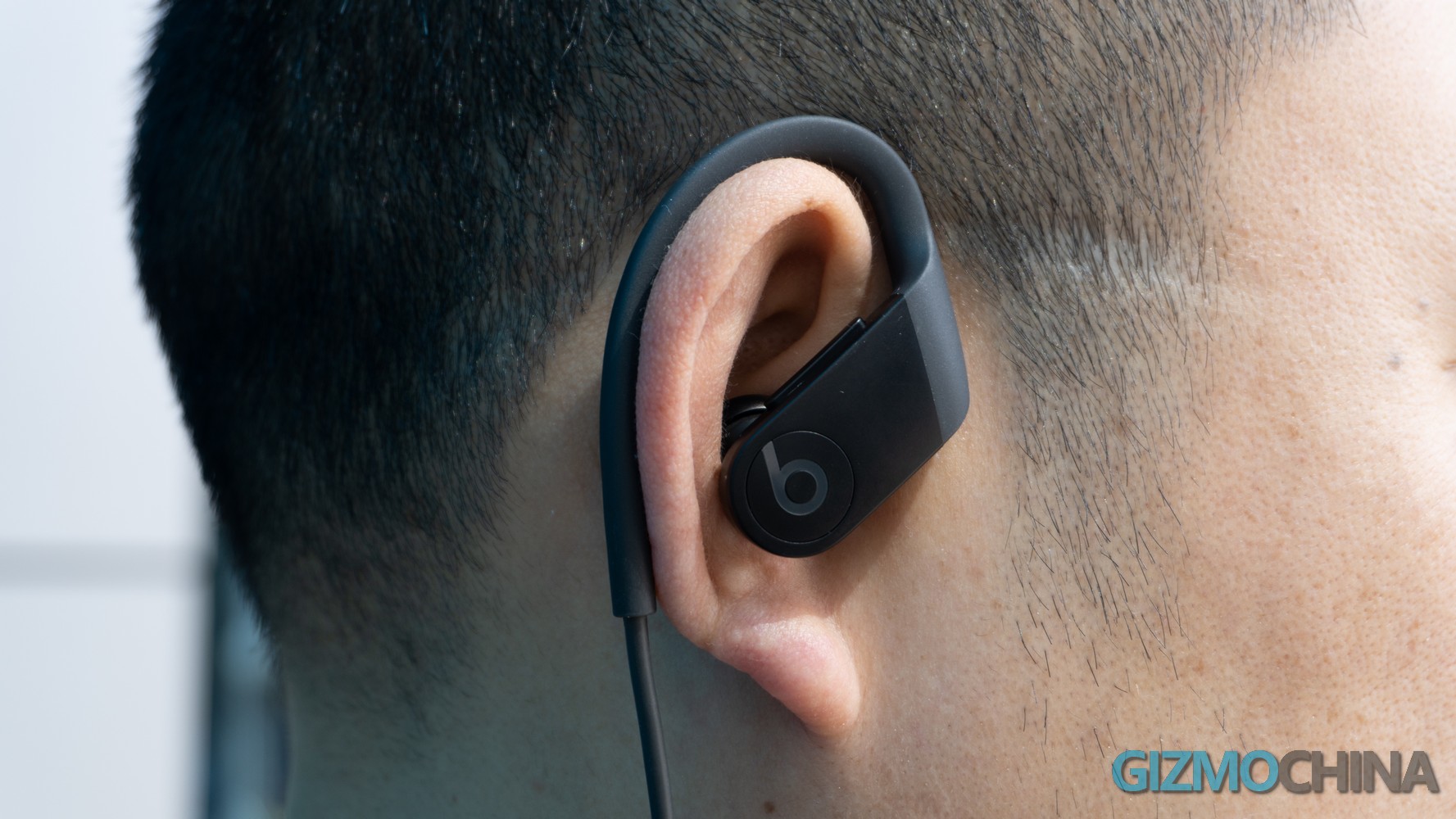
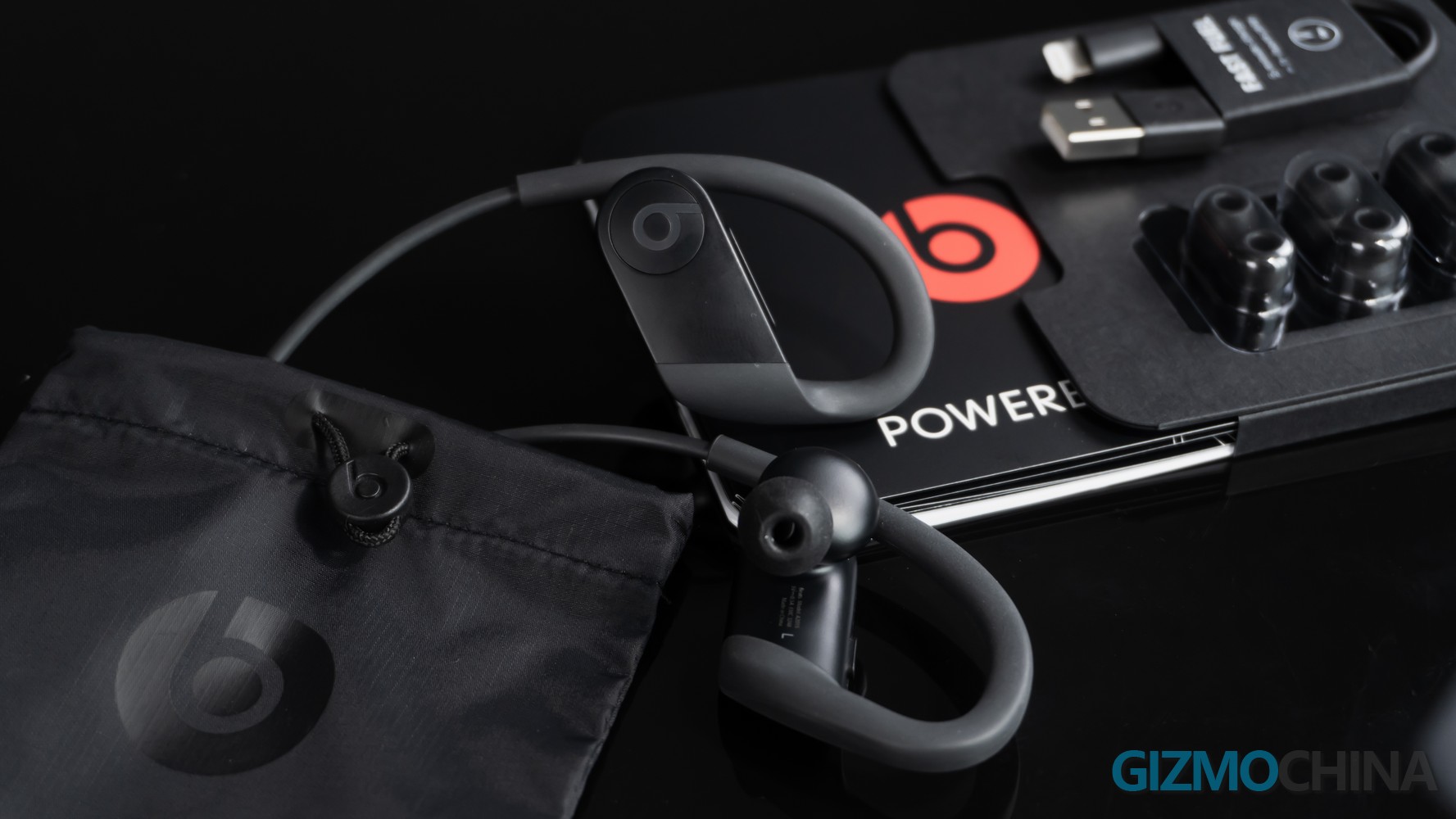
The new Powerbeats 2020 inherited the classic Beats design. Not just talking about the earphone body but also the solid packing. The process of unboxing was so delightful that we all agreed that the packing design of new Powerbeats 2020 is one of the best Sport-headset designs that we have seen.
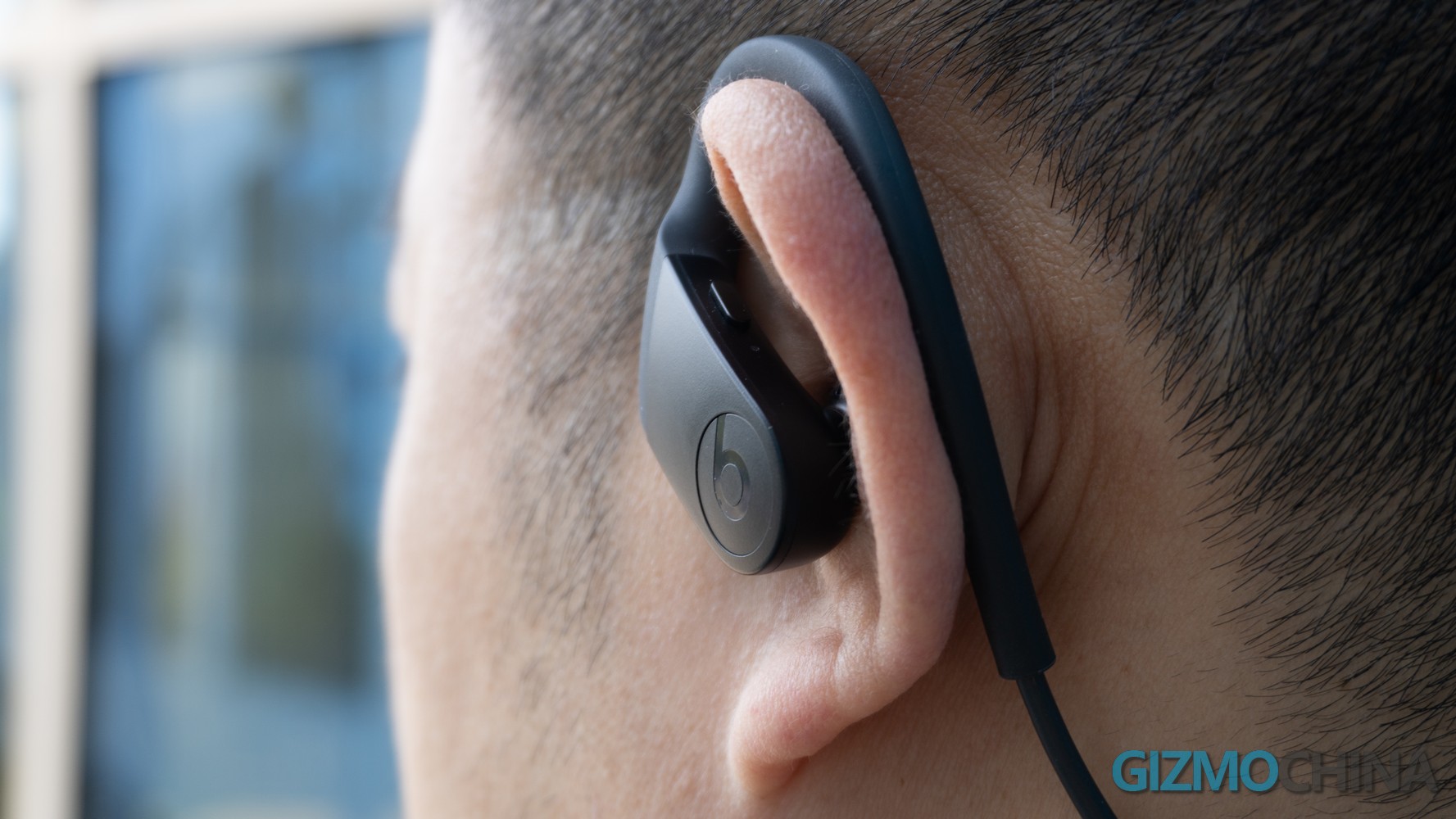
The familiar Beats shape was never outdated. Another new Beats product using the same design is the Powerbeats Pro. The connected wire makes the Powerbeats feel like a ‘wired-version’ of Powerbeats Pro. Although you may find that the Pro version is $50 more expensive than the Powerbeats, the Powerbeats probably is an all-round better choice except for the connected wire. Just think differently, then you would find out the wire of Powerbeats should be more practical as we could loosen our ears from the discomfort of sport earhook headphones rather than totally take them off. The wire would allow you to drape them around your neck as you feel the discomfort. Meanwhile, the wire with proper length does not size-up the Powerbeats and it is still portable enough.
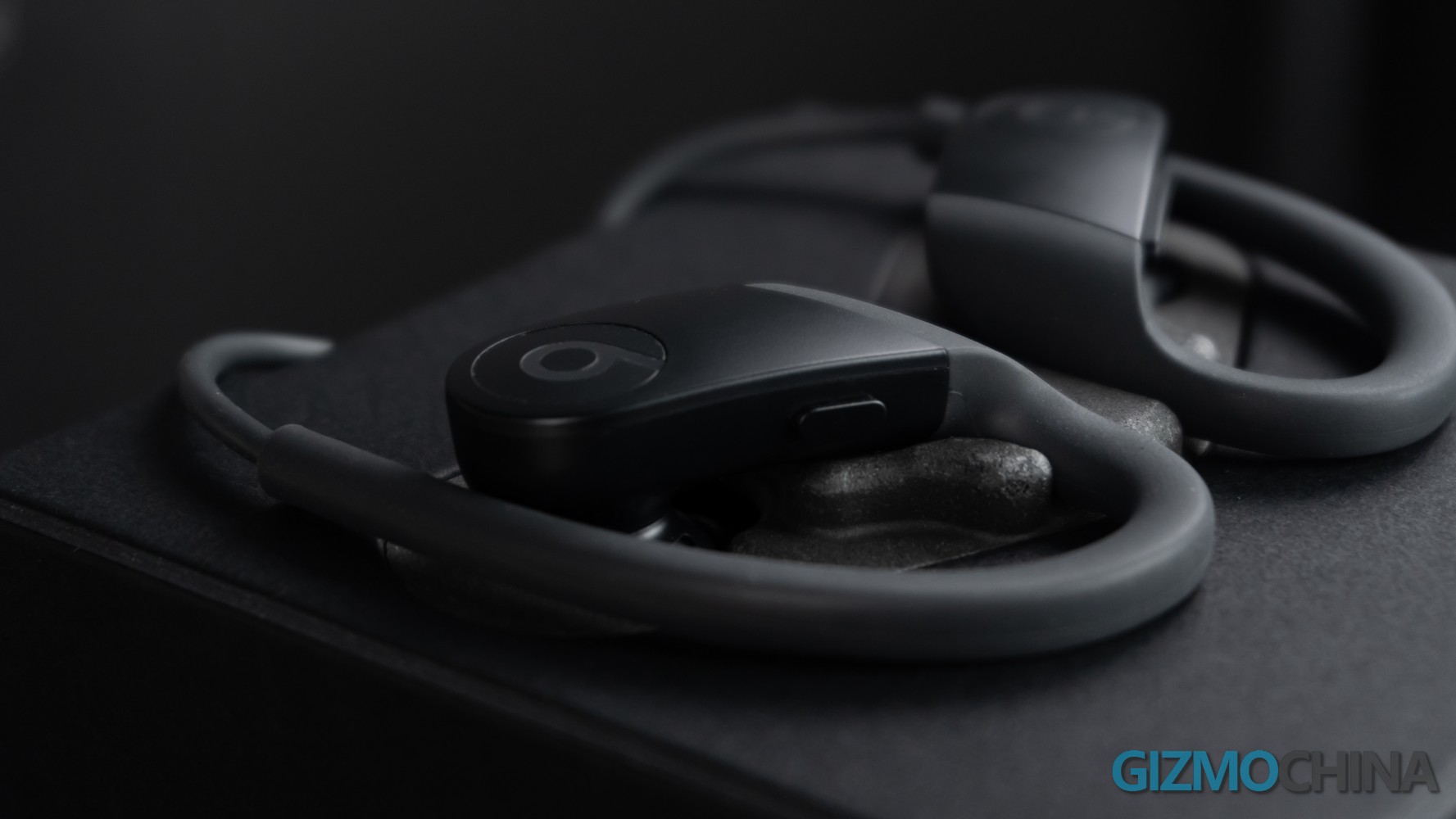
In addition, the Powerbeats 2020 is so light that it won’t cause too much discomfort. The special material of the earhook part naturally matches the body part with solid build and design. As I worked out with the Powerbeats, its sweatproof and waterproof design ensured that I could be at peace.
The ear-in design probably is the main reason that forced some consumers to give up on this earphones. But as a solid sporty headphone providing various-size eartips, the wearing experience of the Powerbeats 2020 has been already improved a lot. Indeed, for people who have not worn the design before, it may take some time to adjust for the first time. Another important point here is that the Powerbeats 2020 may not be so friendly for those who wear glasses.
Wearing & interactions
At the top left, there is a small power button, as well as a small power indicator. Long press it to start connect phones or other Bluetooth devices. Because the Powerbeats 2020 run an H1 chip, which is also the control chip for the Apple AirPods Pro, they worked so well with Apple products. The iPhones and iPad could easily detect the Powerbeats and fast establish the connection as soon as we power-on the earbuds. The experience is completely the same as the AirPods Pro:
The pairing card automatically pop up from the bottom of the display;
Click ‘connect’ and see battery information of the Powerbeats;
get it done with one click ‘complete’.
Thanks to the physical buttons on both sides, all the interaction can be done without much learning. Besides volume buttons and the power button, users can press the ‘Logo b’ for more interactions. For example, tap it once to play or pause music, or press twice to play the next song or three times for the last song. And it also allows you to call out Siri with a long press.
Sound
With the support of the Apple H1 chip, the sound quality of the Powerbeats 2020 is pretty close to the AirPods Pro or even better. Strong low and mid-frequencies of music came from the small buds and provided rich, immersive listening experience. What’s most impressive was their high frequencies performance. Singers’ voices and instruments were pure and clean. Rich detail of the music was clearly delivered from the buds to my ears without popping feeling in my ears.
Work-out equipment
In daily use, I generally wore it as I work out or stay outdoors. Since I kept dropping wireless TWS earbuds outdoors, the Powerbeats did bring me the confidence to have larger movements without worrying where I drop the small buds. More importantly, as a pair of sporty earphones, it met my expectations regarding wearing comfort even for a long time. Nevertheless, I still won’t recommend wearing it for a long time due to the potential damage to your hearing.
Another interesting application is the Audio Sharing function. It lets users wirelessly share audio (e.g. songs, podcasts, movies) with another pair of wireless headphones, including most wireless Beats headphones and Apple AirPods products. You will have more fun when you share the listening joy of sound with your families or friends rather instead of sharing a music file.
Charge & battery endurance
Another highlight of the Powerbeats 2020 is the Fast Fuel charge technology. A 5-minute charge was able to provide around 1-hour playback. Combined with the 15-hour battery endurance, the experience actually was better than most wireless earbuds with a charging case.
Conclusion
Rather than say the Powerbeats 2020 is a lower version of the Powerbeats Pro, it’s more like an upgraded version. The price of $150 is the reason that we consider it as an upgraded Powerbeats Pro. It lets consumers have a better choice by costing less but giving the same sound experience of the Powerbeats Pro, and even the AirPods Pro. If you like to enjoy music when working out, I think the Powerbeats is definitely designed for you.
The rumor mill has suddenly started revealing information on an upcoming OPPO midranger called OPPO A92s. The major highlight of the smartphone is that it is the company’s first A-series phone to sport a 120Hz refresh rate display. Also, it will be the first A-lineup phone to support 5G connectivity. Recent leaks have already revealed the specs of the smartphone. A new poster has surfaced to reveal the three color variants of the smartphone.
The newly leaked poster of the OPPO A92s shows that it will be arriving in three color variants such as black, white and pink. A previous leaked had revealed that the smartphone will be priced at 2,499 Yuan (~$355). The new poster reiterates the same pricing for the handset that will come with 8 GB of RAM and 128 GB of storage.
The OPPO A92s is expected to house an LCD panel of 6.57 inches. The screen has a dual punch-hole cutout at the upper-left corner. It is speculated that the handset will be arriving with a 16-megapixel + 2-megapixel dual selfie camera system.
The A92s features a square-shaped camera module at the top-left corner of its rear shell. It is said to be equipped with a 48-megapixel primary shooter, an 8-megapixel superwide lens and a pair of 2-megapixel sensors that will be probably present for capturing macro shots and images with depth effects. It is equipped with a side-facing fingerprint reader.
The OPPO A92s smartphone is rumored to house a 4,000mAh battery. It could be the world’s first smartphone to be driven by MediaTek’s Dimensity 800 5G chipset. The SoC could be coupled with LPDDR4x RAM and UFS 2.1 storage. As of this writing, there is no word on the launch date of the OPPO A92s.
OPPO Ace2 will go official on April 13. Ahead of the launch, the Chinese firm has been revealing some of the key features of the smartphone. The official videos revealed vital information on the capabilities of the punch-hole display of the OPPO Ace2.
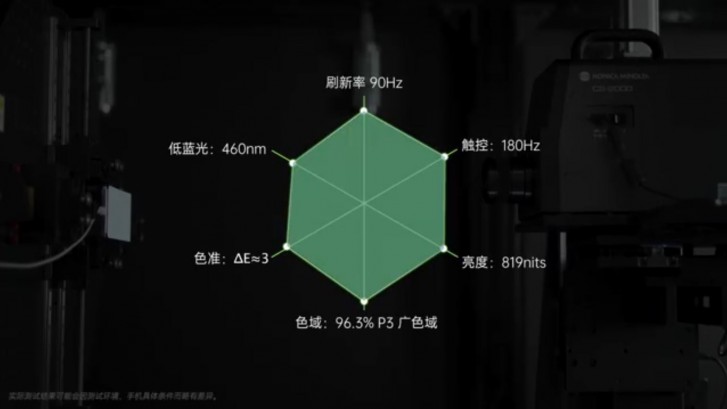
The above shown video shows that the OPPO Ace2’s screen will carry support for up to 90Hz refresh rate along with 180Hz touch sampling rate. The display will offer 96.3 percent DCI-P3 color space. With deltaE value as low as 3, the Ace2 promises to deliver impeccable color accuracy. The screen will deliver maximum brightness of up to 819 nits. Also, the 460nm blue light curve will put less strain of the eyes of Ace2 users.
It has been already revealed through the TENAA appearance of the OPPO Ace2 that it will be arriving with a punch-hole display that measures 6.5 inches. The AMOLED display will produce full HD+ resolution and it will be integrated with a fingerprint scanner.
The Snapdragon 865 mobile platform will be powering the device with up to 12 GB of RAM. The phone will arrive with up to 256 GB of storage. The ColorOS 7 based Android 10 OS will come preloaded on the device. It could be coming with a 4,000mAh battery that will not only support 65W fast charging, but also it will be equipped with 40W wireless charging. It has a 16-megapixel rear camera and a 48-megapixel quad camera setup.
The OPPO Ace2 is currently available for reservations in China. The smartphone is listed in variants like 8 GB RAM + 128 GB storage, 8 GB RAM + 256 GB storage and 12 GB RAM + 256 GB storage. The Ace2 is expected to arrive in black and violet colors. The handset may arrive in China with a pricing of around 4,399 Yuan (~$625).
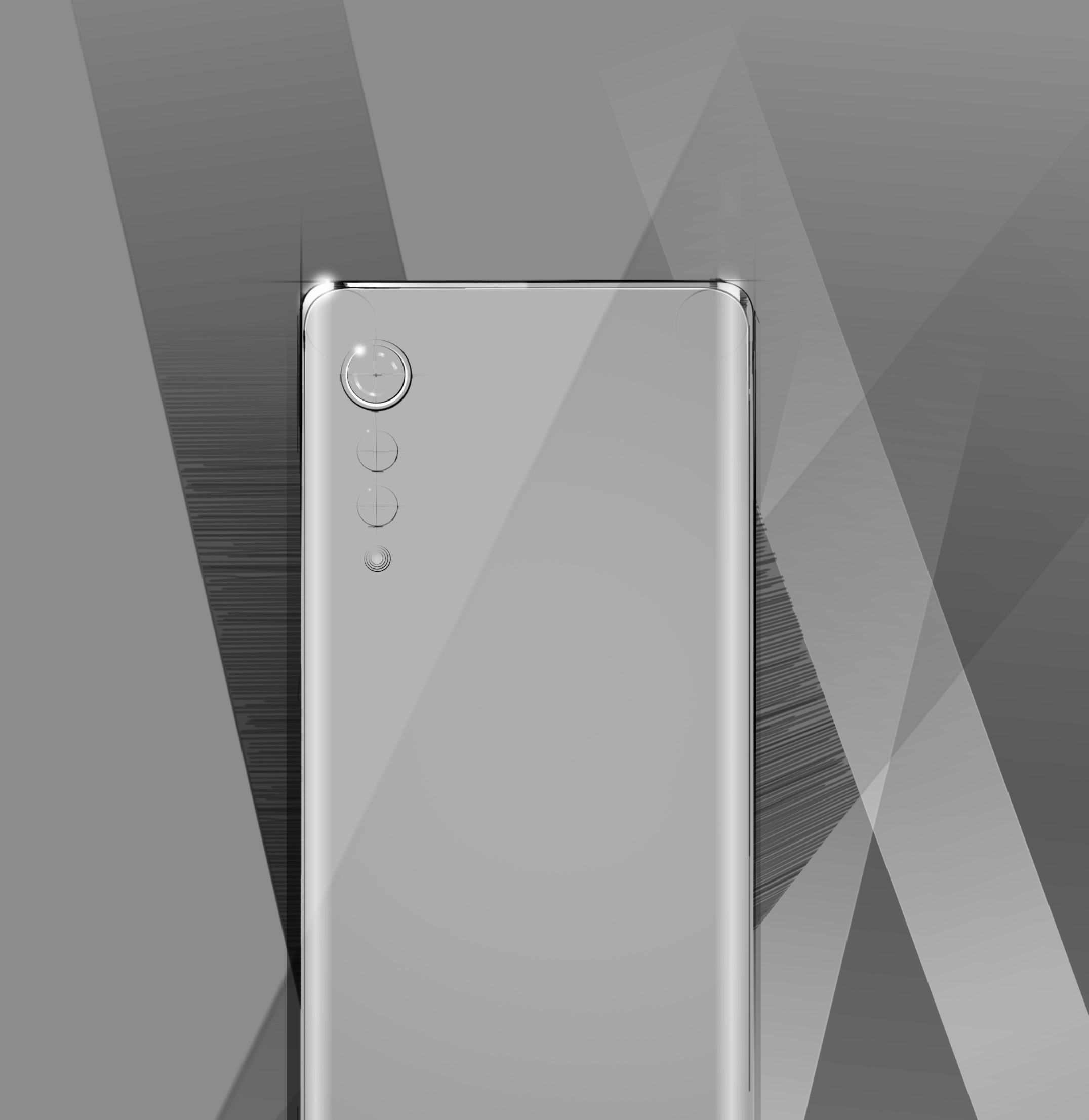
Recent reports had claimed that theLG will be killing its G-series of smartphones to make way for a new branding. Some reports had claimed that the LG Chocolate branding from the past will be brought back. Today, the South Korean company released an official confirmation to reveal that its upcoming mid-range smartphone will carry LG Velvet branding.
The company did not reveal any details on the specifications of the LG Velvet smartphone. The company has revealed the design language of the LG Velvet. It appears that the South Korean company will be emphasizing design over specs on the newly introduced mid-range lineup. The handset will be replacing the LG G9 ThinQ that was expected to debut in the first half of the year.
LG states that today’s smartphones are almost difficult to distinguish since they are packed with similar specifications. With distinctive designs and “tactile” elegance, the Velvet aims to stand cut above the rest. The company claims that the first LG Velvet phone will be sporting a unique “Raindrop” camera and a symmetrical appearance.
The handset could be packed with the same specs that were supposed to arrive on the LG G9 ThinQ smartphone. The handset could be fueled by the Snapdragon 765v or 765G chipset that will bring support for 5G connectivity on the device. The device could be housing a 4,000mAh battery with fast charging capabilities.
The smartphone could be sporting a 6.7-inch – 6.9-inch display and it could be sporting a 48-megapixel quad camera setup on its back. The device may arrive with support for dual screen accessory. Some reports have claimed that LG may announce it on May 15. It may carry a price tag of around ~$700. With over a month remaining for the rumored launch, more details on the LG Velvet is likely to surface in the coming weeks.
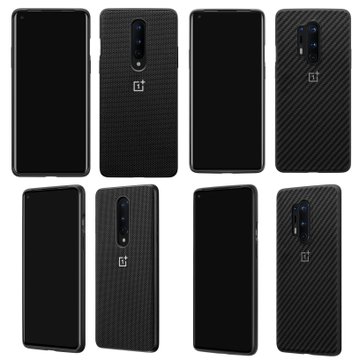
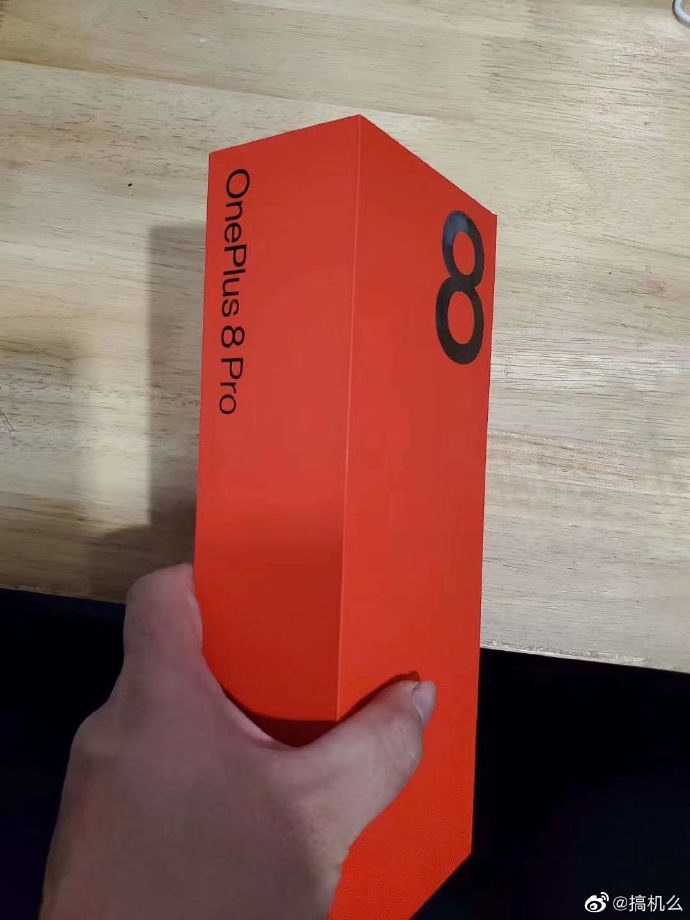
The OnePlus 8 series launches on Tuesday, April 14. There is practically nothing we do not know about the two phones already with respect to their specifications. However, fresh leaks keep revealing more info. The latest are pictures of the official cases for the OnePlus 8 Pro in addition to the retail box it will ship in.
OnePlus will announce four types of cases for the OnePlus 8 Pro according to photos posted on Twitter by Ishan Agarwal (@ishanagarwal24).
Sandstone Bumper Case
Nylon Bumper Case and Karbon Bumper Case
Sandstone Bumper Case and Transparent Bumper Case
The first is a Sandstone Case which will be available in Black, Smoky Purple, and Cyan. There is also the transparent bumper case which should be included inside the box. There is also a nylon case and a Karbon Bumper case.
For the retail box, OnePlus is going with the same elongated design it used for the OnePlus 7T series. The box is red and the name of the phone is written in black font on the side. There is also a large figure “8” written on top of the box.
The OnePlus 8 Pro will pack a 6.78-inch QHD+ display with a 120Hz refresh rate. It will be powered by Qualcomm’s Snapdragon 865 processor with up to 12GB of RAM and 256GB of storage. It will have 48MP quad rear cameras and a 16MP selfie camera.
The flagship will also have a 4510mAh battery capacity with support for Warp Charge 30 (30W) and Warp Charge 30 Wireless (30W).
Huawei is taking its Smart Screen to the office as an alternative to Google’s Jamboard and Microsoft’s Surface Hub. The Chinese manufacturer has announced that it will announce an enterprise version of the smart screen this week.
Official posters shared on the web reveal the Huawei Enterprise Smart Screen will be unveiled on Friday, April 17. The smart screen will support pairing with mobile phones and computers and also provide multi-device pairing, remote collaboration, video conference calls, cloud services, and more.
[envira-gallery id=”316294″]
The Huawei Enterprise Smart Screen will pack a high-resolution display, a metal frame, a camera, and a stand with wheels so it can be moved around easily. Unfortunately, we do not know what size it will be. However, we expect it to not be smaller than 50-inches. Of course, this will sell for much higher than the home version since it packs extra features.
The Huawei Enterprise Smart Screen was originally supposed to launch back in February but didn’t launch then.
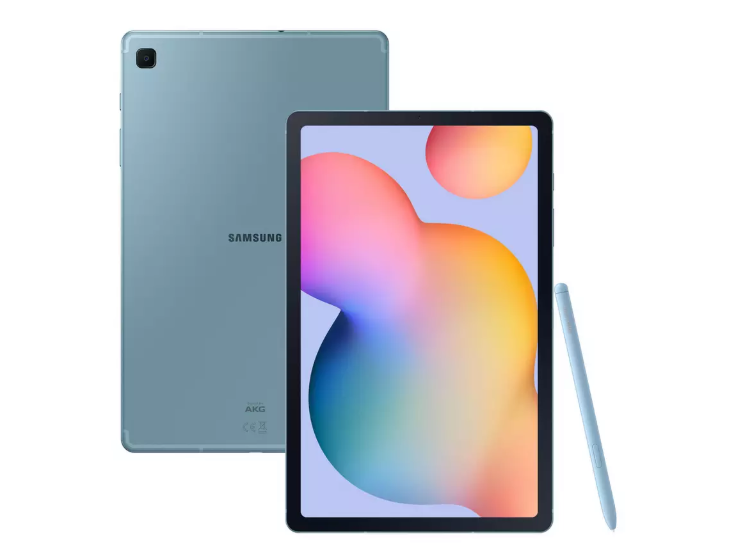
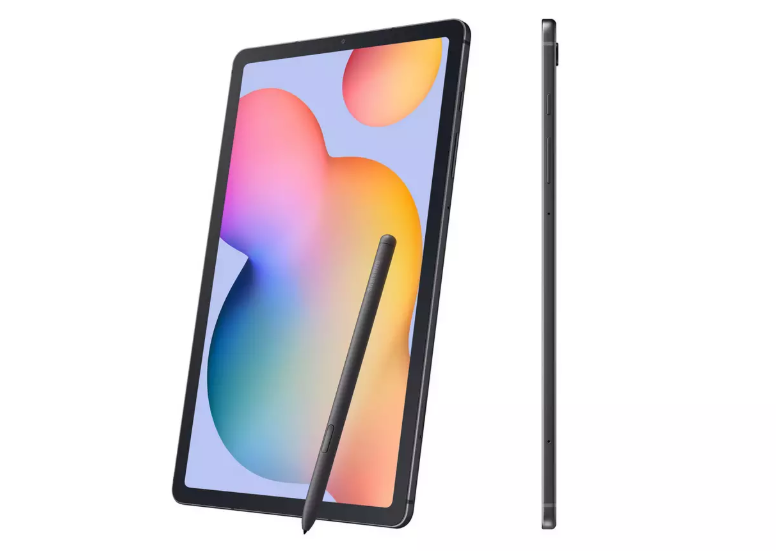
Samsung is yet to officially announce the Galaxy Tab S6 Lite but the tablet has already begun appearing on online stores. A few days ago, the 5G version was listed on a Korean online store. Today, the Wi-Fi version of the tablet has been spotted on Argos’ online store.
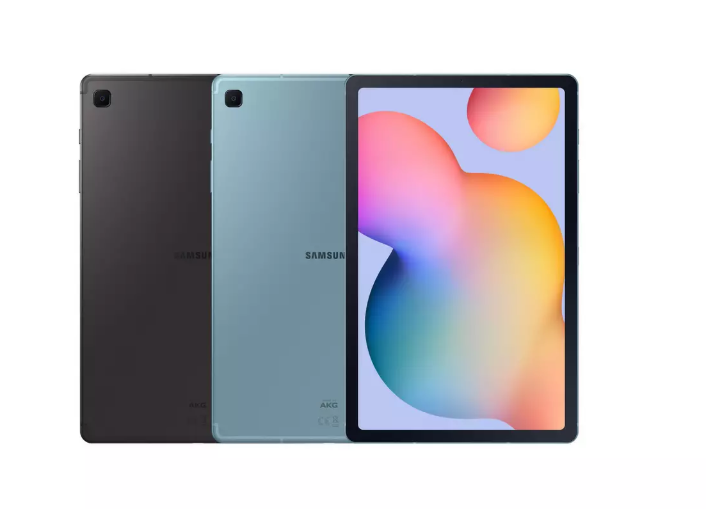
The Galaxy Tab S6 Lite is listed on the online store for £339 (~$422). It has 64GB of built-in storage and comes in two color variants – Angora Blue and Oxford Grey. The listing also includes key specs of the device.
The tablet has a 10.4-inch screen with support for multi-touch. It is powered by an Exynos 9611 octa-core processor clocked at 2.3GHz and paired with 4GB of RAM. There is a MicroSD card slot for up to an additional 1TB of storage.
The Galaxy Tab S6 Lite (SM-P610) has a 5MP selfie camera and an 8MP rear camera. It also has an audio jack and a USB Type-C port. Samsung also ships it with the new S-Pen and Android 10 out of the box. There is a matching Book Cover with a slot for the S-Pen but it has to be purchased separately.
If you are in search of a new tablet (that is not an iPad) with a stylus, then this should be a good purchase.
With the advent of 5G, manufacturers now have a reason to jack up the price of their phones. The increase in price is not limited to flagship phones but also mid-range phones with 5G support. However, 5G is not the only reason why phones cost more this year.
This increase in phone prices has got us curious as to how much our readers spend on a phone and thus serves as the basis for our poll this week – What is the highest amount you are willing to spend on a phone? Do you have a mark you won’t cross or do you go all out when purchasing a phone? Do take the poll below and also share the reason(s) behind your answer.
NB: We have added Indian Rupee options for our Indian readers to make it easy for them to choose an answer. However, these prices are not a direct conversion of the USD options.
In a few days, Huawei’s brand will officially unveil its new flagship lineup. We are talking about the Honor 30 and 30 Pro, two devices which, unlike the Huawei P40 series, will offer high-end specs sheet at modest prices. Despite the launch is still four days far, we got a lot of juicy details about the new flagships, even from official sources. In this article, we gathered all the leaked details, official info, and rumors about the Honor 30 series in order to give you a complete overview about them. Note that a lot of info surfaced about Honor 30 and 30 Pro is based on rumors, so, unless when we explicitly specify it, take everything with a pinch of salt.
Honor 30 and 30 Pro Rumor Roundup
Design
The design of the Honor 30 and 30 Pro has been largely unveiled thanks to leaked renders surfaced on the microblogging platform Weibo. The Honor 30 Pro will be launched in at least two color variants: blue and gray. But we are not talking about a normal gray color variant: it will be an attractive new silver color scheme. There will be a glass back housing a rectangle-shaped camera module that will include all the camera elements, as well as an aluminum frame like premium flagships. The Honor 30 Pro will have dimensions of 160.3 x 73.6 x 8.63 mm and it will weigh 190 grams. The phone will have chamfered sides and a curved display. The power key and the volume balancer will be placed on the right side of the device. On the front side, there will be a dual punch-hole display with a dual punch hole which seems smaller than the one on the Huawei P40 series. The camera module will have a golden accent, there will be a secondary microphone and an IR blaster at the top of the phone.
The Honor 30 series features a 6.57-inch OLED display with a Full HD+ resolution. Both the devices are expected to come with the same display diagonal, so there may not be a more compact device, unlike the Huawei P40 series. Inside the screen, we expect to see an in-display fingerprint scanner. Given that the dual punch hole is smaller compared to the Huawei P40 series, we expect it not to include additional sensors and a sensor 3D facial recognition.
As officially confirmed by the company, Honor 30 will be powered by the Kirin 985 chipset with 5G support. We still did not see any smartphone with this chipset. It is expected to be a toned-down version of the Kirin 990 which is currently the most advanced flagship chipset released by Huawei. The SoC will be paired with 8 GB of RAM. The Honor 30 Pro will be fueled by the Kirin 990 5G chipset, just like the Huawei P40 and P40 Pro. The RAM will be 8 or 12 GB depending on the chosen configuration. Android 10 will be obviously installed out of the box, customized by the Magic UI. But due to the U.S. ban, Honor 30 and 30 Pro won’t get Google services in the global market. They will ship with the new Huawei Mobile Services, including the new App Gallery which replaces the Play Store. An alleged unit of the Honor 30 Pro was spotted on Geekbench: the benchmarking platform recorded a score of 3876 points in single core performance and 12,571 points in multi core with a Kirin 990 5G chipset, 8 GB of RAM and Android 10.
On its rear side, Honor 30 Pro will sport a quad camera setup. The main sensor will be a Sony IMX700 lens with a 50 MP resolution. Alongside the main sensor, there will be a periscopic lens with optical zoom, an ultrawide lens, and a TOF sensor. The ultrawide lens is rumored to have a 12 MP resolution, with 4in1 pixel binning just like the main sensor. The periscopic lens is said to come with an 8 MP resolution and up to 3x optical zoom. Not impressive like the Huawei P40 Pro and Pro+, but still above-average zoom capabilities. The primary sensor will support the Octa Phase Detection autofocus system borrowed from the P40 series. Overall, the camera department looks very promising. The vanilla Honor 30 will replace the Sony IMX700 lens with a 40 MP sensor. On the front, the two devices will sport a 32 MP selfie snapper paired with a secondary lens. There is still no info about the secondary sensor placed in the dual punch hole.
In a world in which a lot of flagship feature batteries with capacities above 4000 mAh, Honor 30 Pro will offer a 3900 mAh battery. But this does not necessarily mean it will have below-average battery life. Huawei improved a lot at optimizing energy consumption, so despite the higher consumption of 5G network, Honor 30 Pro may still offer a pretty nice battery life. The battery will support 40W fast charging, not the fastest wired charging technology, but still very fast, especially for a 3900 mAh battery.
Honor 30 and 30 Pro – Launch, Price and Availability
Honor 30 and 30 Pro will be officially announced on April 15. The affordable variant of the lineup already debuted under the Honor 30S moniker, but it has nothing to do with the upcoming flagships. The launch date poster shared by the company features the Chinese actor Li-Xian who will be the ambassador of the new event. The smartphones will be initially launched in the Chinese market. Unfortunately, the company did not reveal any detail about the pricing. We can only tell you that Honor 20 started at $560, while Honor 20 Pro had a starting price of about $670: we expect the new devices to carry similar prices.
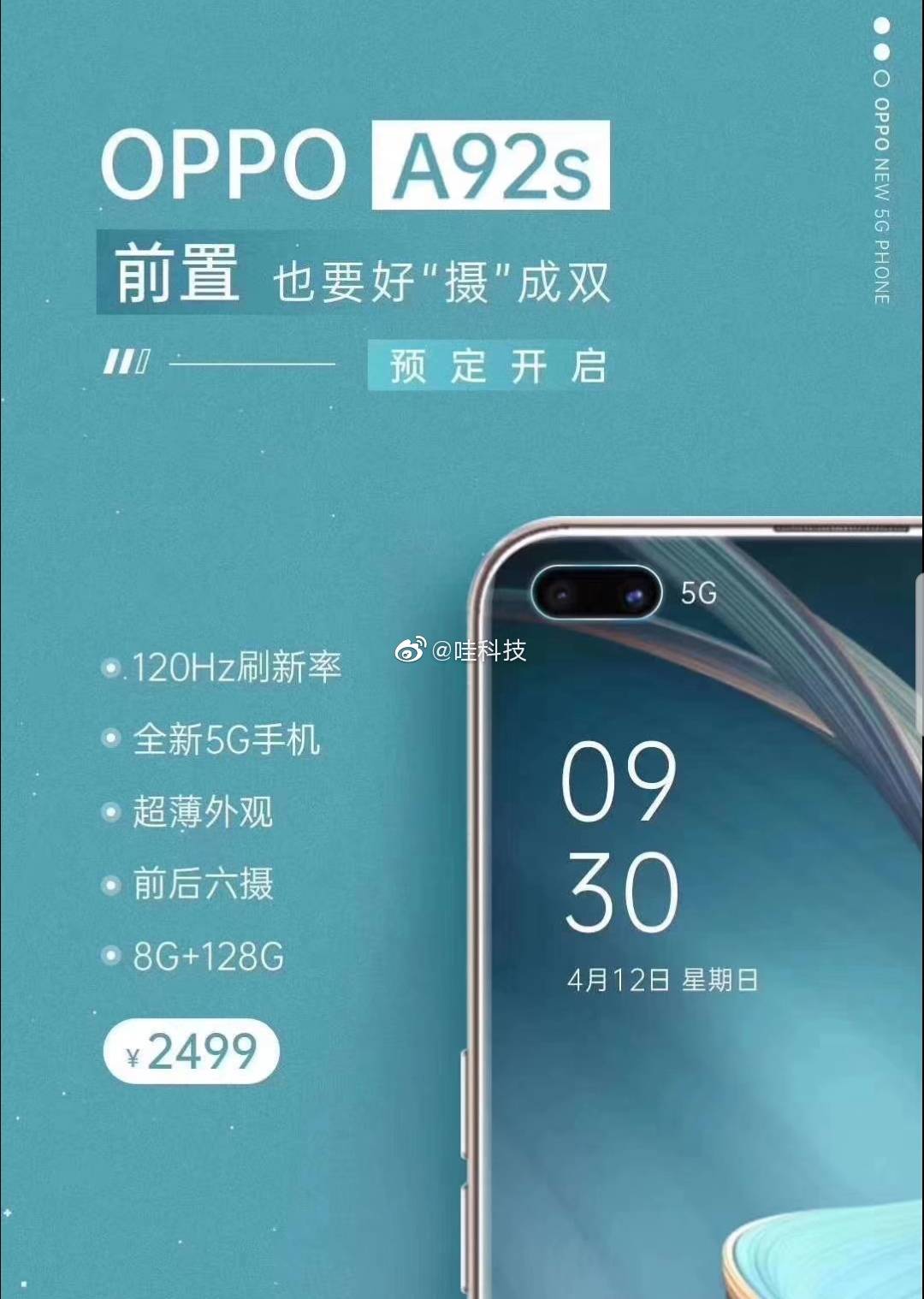
Earlier today, we reported OPPO has two mid-range 5G smartphones coming soon. Now, posters of one of the two phones have surfaced on the web. According to the images, the phone will arrive as the OPPO A92s.
The OPPO A92s will have a pill-shaped punch-hole at the top left corner for dual selfie cameras. It is also revealed that the phone’s 6.57-inch LCD display will have a 120Hz refresh rate.
We already know the phone will have a Dimensity 800 processor and now we know there will be an 8GB RAM + 128GB (UFS 2.1 storage) version with a price tag of ¥2499 (~$355) according to the image above.
Another of the images gives us a look at the rear design. OPPO has adopted a squircle housing for the four rear cameras but styles it up a bit by placing two of the sensors and the LED flash in a pill-shaped housing within the main one.
[envira-gallery id=”316263″]
Digital Chat Station already leaked the camera specs. The primary camera is a 48MP sensor and it comes along with an 8MP ultrawide angle camera and dual 2MP sensors which should be for macro photography and capturing depth details.
The image also reveals the OPPO A92s will come with a side-mounted fingerprint scanner. It will be available in Gradient White and Navy Blue/Black.
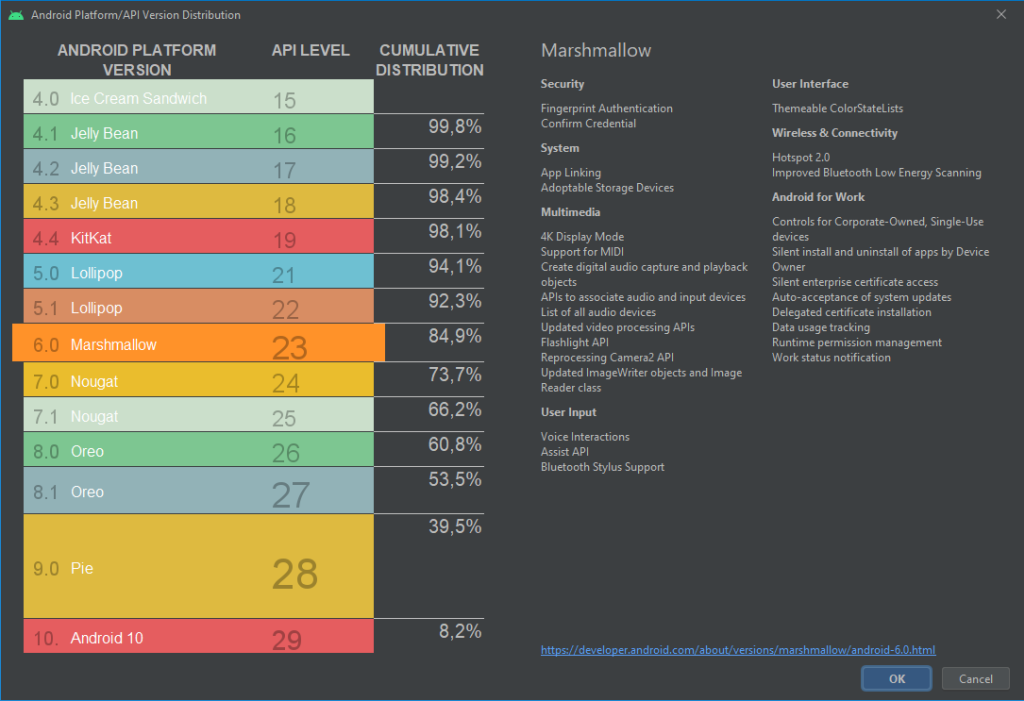
Google has for several years released the Android distribution chart which shows the percentage of Android devices running each version of Android right from the oldest to the latest. Google released the Android distribution chart was in 2017 and provided an update in 2018 and then another updated chart in May 2019. Last year, tech enthusiasts had to rely on data from Porn Hub to get an idea of how the Android versions are distributed in December. We may never find out the true state of things now as Google has finally taken off all records, including the old data off the web.
Google initially designed the Android distribution chart mainly to aid Android app developers to make informed decisions on the “minimum” version of Android that their app can run on. However, it was becoming a sort of embarrassment to Google especially as older Android versions still control a large percentage.
For instance, Android Marshmallow released in 2015 still has over 15% market share. That is mainly because most of the OEMs never bother to update their models to the next version. Rivals such as Apple could use the distribution chart data to brag about how they are better at pushing updates in a timely manner to iOS devices. We should add that there are models running Android OS that don’t necessarily need updating to the latest Android version such as digital signage.
Presently, the Android Distribution chart landing page contains a short notice advising those interested in the distribution numbers to find them in Android Studio. The studio shows a “cumulative distribution” percentages instead of the pie chart we are used to and which is easier to understand. The chart shows there are models still running Android 4.1 Jellybean. Thus, developers would need to select the oldest version of Android that their app will run on and that will in turn trickle down to the newer versions.
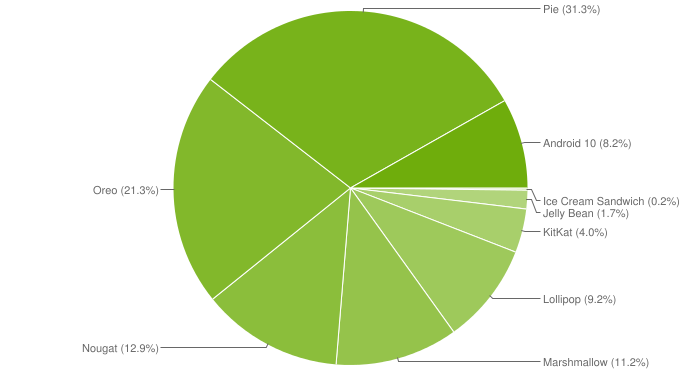
However, 9to5Google has created a pie chart created from the data Google provided. The chart shows that Android 10 has just 8.2% share of the market. On the other hand, last year’s Android Pie reached 31.3% which is the largest share which Android 8.0 Oreo comes in second with 21.3% market share. Check out the chart above.
Honor V10 aka Honor View 10 units are receiving a critical system stability patch update in China. The update weighs only 2.08 MB in size and the company suggests all the users to install it as soon as possible.
Honor launched the Honor V10 in December of 2017 with Android Oreo (EMUI 8) onboard. It was later updated to EMUI 9.1 last year, followed by EMUI 10 earlier this year. And now, the Chinese smartphone brand has released a critical system stability update weighing just 2.08 MB.
Unfortunately, the changelog for the update does not reveal what it is for. Instead, it merely reads the update is to ‘optimize the system stability’ and further ‘recommends to install’ it instantly.
Additionally, the changelog also assures the update to not delete user data but still suggests creating a backup before installing in case of any unexpected error. Also, the changelog mentions users to contact Honor via helpline number or Honor Club if they are facing any issue.
Anyway, if you are using a Chinese Honor V10, make sure to download and install the latest update. We are not sure if the same update will be rolled out to the global version of the device.
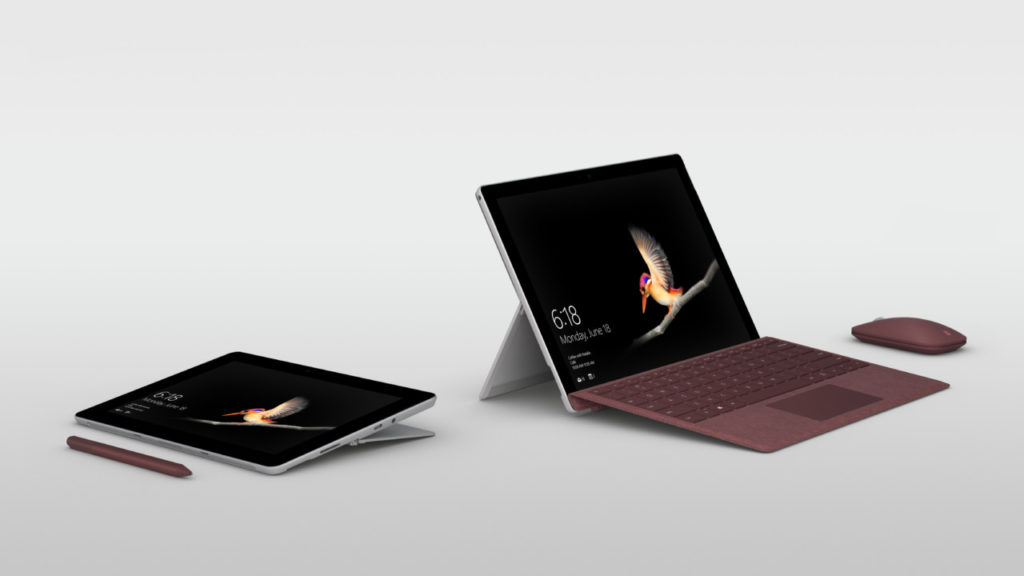
Microsoft launched the Surface Go Windows tablet in July of 2018. The new Surface lineup was not updated last year. But it is sure getting a successor this year dubbed as Surface Go 2, that too within a few weeks from now, claims MSPoweruser.
Microsoft Surface lineup of convertibles is popular among business people, artists, and even some developers. The Redmond tech giant introduced a tablet in the series called Surface Go with support for stylus and keyboard in mid-2018.
Though it was released as a competitor to Apple iPads, the king of tablets, it was no close to it in terms of specifications and power. Instead, it focussed on providing the power of the Windows 10 operating system in hands to a niche audience. And it seems to be worked out for Microsoft, at least in the US as they are sold out in the region.
This is why the speculations have begun and even the insiders are suggesting the launch of a new model called Surface Go 2. In February, a benchmark even confirmed the existence of this device powered by the 8th gen Intel Core m3-8100Y dual-core processor. This CPU will not bring much difference in terms of performance but will be at least better than the Intel Pentium Gold 4415Y CPU present in the original Surface Go.
Further, just like its predecessor, the Microsoft Surface Go 2 could start at $399 and go up to $650 for the high-end model with LTE. As for availability, it is possible the company might start taking orders in May itself.
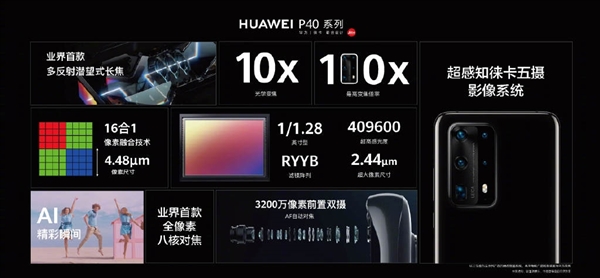
Huawei‘s P series has always been about the awesome camera co-engineered with German photography giant LEICA. The P40 series was released in China a few days back and alongside the P40, the Huawei P40 Pro and P40 Pro+ were also unveiled. The major highlight of the P40 Pro+ is the 10X optical zoom lens which is not only capable of capturing 10xzoom shots but also 20x hybrid zoom and 100x digital zoom. The scope of what this brings cannot be better imagined but experienced. However, some camera samples have been shared online which shows how the zoom pans out.
The zoom allows mobile phones to take pictures far beyond the horizon of the natural eyes, unravelling invisible objects and still maintaining the vivid clarity of the shots. The first set of six continuously zoomed-in pictures fully show the charm of the P40 Pro+ 100x digital zoom. From a distance, it is just a row of ordinary high-rise buildings. As the zoom factor continues to zoom in, the artwork on the building became visible. Further zooming in up to 100 times reveals a man and woman on the bridge.
HuaweiP40 Pro+ 100x digital zoom sample.-First shot
In another set of camera samples shot on a beach, the normal shot faintly shows the beach tents. The telephoto lens of the P40 Pro+ was able to reveal the colours of the beach chairs and even shows a few people sitting on them.
Huawei P40 Pro+ 100x digital zoom- Second shot
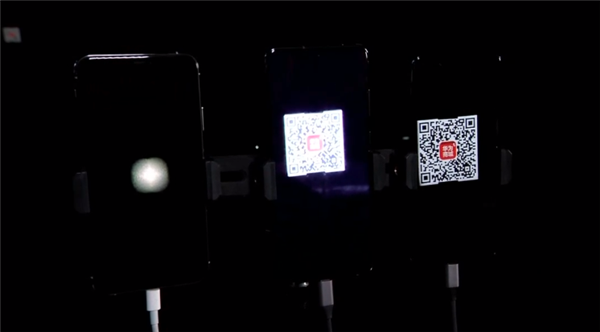
Another sample confirms the zoom is also active and can be deployed at night or in low light conditions. The P40 Pro+ zoom was able to scan the QR code on a smartphone’s screen from 50 meters away and in the dark! The picture is a collage with samples shot by two different flagship’s cameras which were not clear enough to complete a QR code scan.
Huawei P40 Pro+ 100x digital zoom – Third zoom shotHuawei P40 Pro+ 100x digital zoom – Fourth zoom shotHuawei P40 Pro+ 100x digital zoom – Fifth zoom shot. 100x zoom
Here are the samples of the beach shots using the optical zoom.
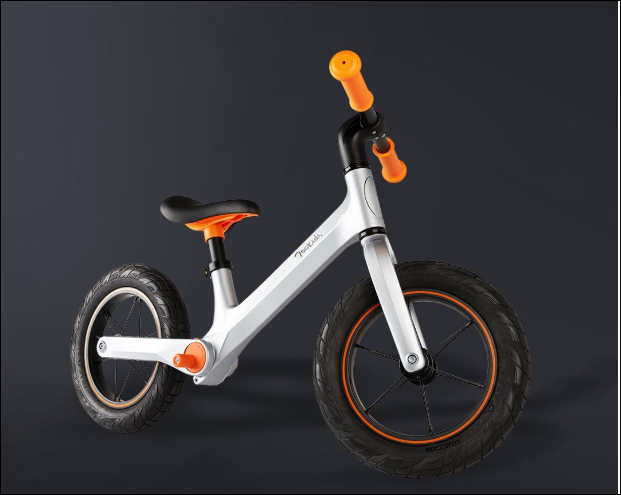
Xiaomi Youpin has launched the Qi Xiaobai professional shock-absorbing sports bike and it comes with a price tag of 799 yuan ($113). The first set of orders will come along with a helmet valued at 79 yuan.
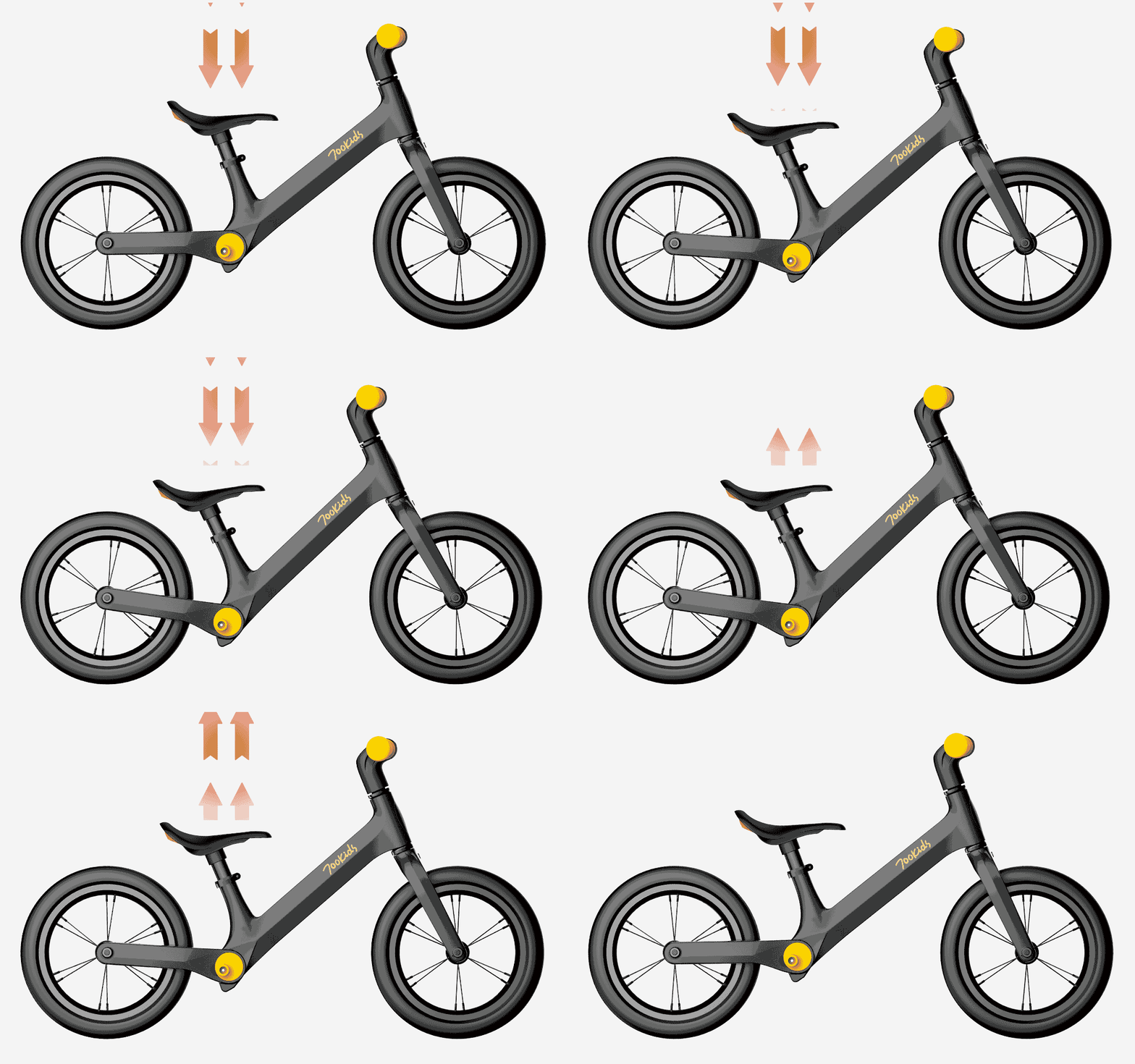
This bike manufactured for children and is said to be the industry’s first dual-use shock absorption system-packing bike. The shock absorption is locked when the bike is gliding through flat surfaces. The bike uses eh kick-pedalling system and even when pedalling, the back shock absorber doesn’t leak. The rear shocks open on undulating pavements to absorb shocks and buffer the force in order to protect the spine. As such, the bike is suitable for use in homes, yards, parks, and squares.
The Qi Xiaobai professional shock-absorbing sports bike adopts aluminium-magnesium alloy tube technology to achieve a 360-degree integrated frame with higher strength. The bike is equipped with two 1.75-inch competitive tires, durable and features an excellent road surface possibility. The 180-gram competitive lightweight seat cushion is made of PU material for car seats. The rear end of the seat is slightly raised, scientifically enhancing the glide force
The bike is also easy to install as it has just a few screws.
It comes with a grey coloured frame but there are two models with accents of yellow and orange on the handlebar, footrest, seat and the tires.
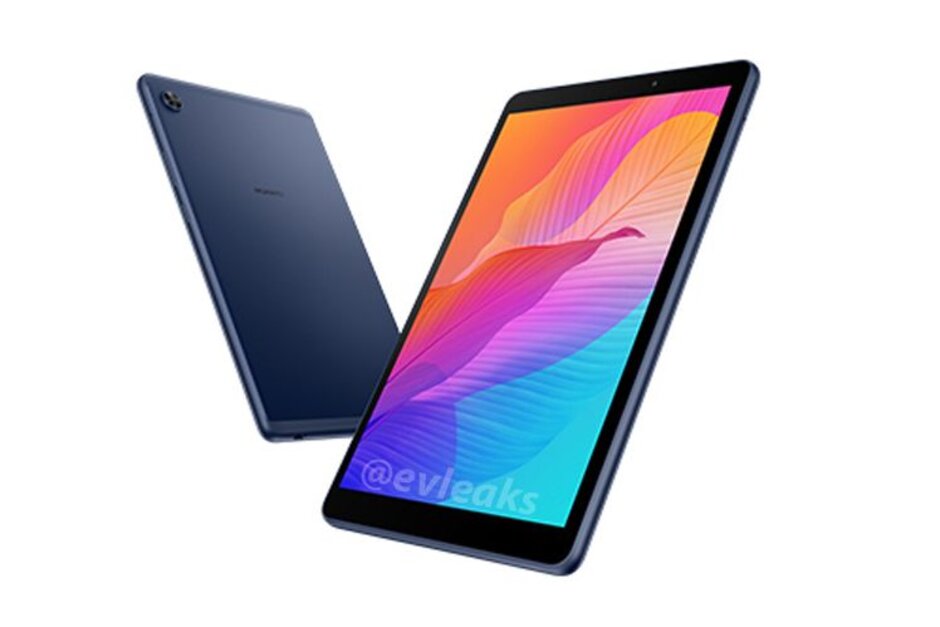
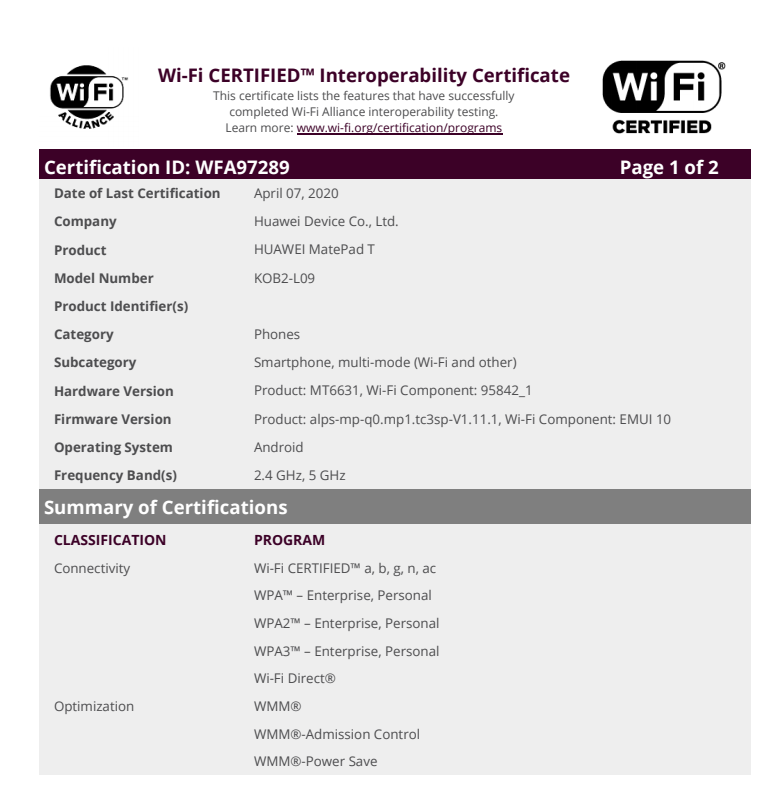
The upcoming Huawei MatePad isn’t the only tablet the Chinese manufacturer has planned for release soon. The render for a second and smaller tablet called the MatePad T has been leaked. The said tablet was also certified a few days ago by the Wi-Fi alliance.
The MatePad T is an 8-inch tablet with pretty thick bezels unlike those of its siblings – the MatePad and the MatePad Pro. It has a single rear camera that protrudes and its charging port appears to be positioned on the right side at the bottom. The render of the tablet was posted by Evan Blass (@evleaks) and it shows it will come in Navy Blue. There should be other color variants when it launches.
The Wi-Fi alliance certified the tablet on Wednesday, April 8 and the certificate reveals the tablet has the model number KOB2-W09. It also supports dual-band Wi-Fi and runs EMUI 10.
A lot of the tablet’s specs are still unknown but it should be less powerful than the MatePad which has been confirmed to have a Kirin 810 chipset. It should also be pretty affordable.
There is no info on when Huawei will announce the MatePad and the MatePad T but it should not be far off.
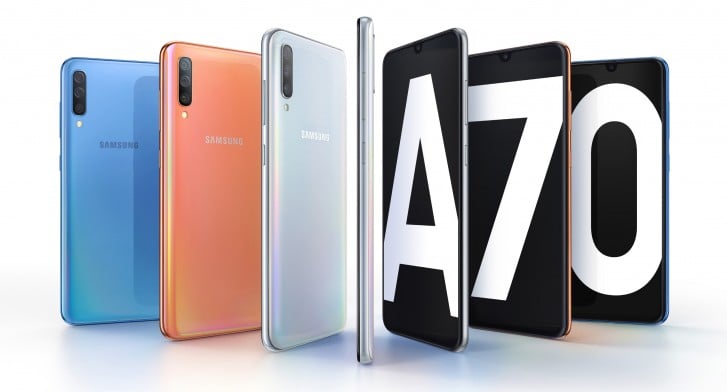
Samsung rolled out One UI 2.0 update based on Android 10 to the Galaxy A70 in certain markets a few days back. In a similar fashion, the company released April 2020 security patch for Galaxy M31. Now, the users who downloaded and installed the update are ended up with a non-functioning slab of brick.
Galaxy A70 One UI 2.0 Android 10 Update Bricks The Device
The South Korean tech giant has been updating a number of its devices to One UI 2.0 (Android 10). The Galaxy A70 launched back in March 2019 finally got its turn for the update exactly after a year from its launch. But unfortunately, it turned out to be bricking the devices. As of now, Samsung has halted the rollout but it is yet to acknowledge the issue.
According to SamMobile, the bricking of Samsung Galaxy A70 phones on updating it to Android 10 is a hardware issue, which requires the user to visit the nearest customer service center to replace a new PCB. Sadly, it is not possible in the current lockdown situation.
The smartphone maker has used two different versions of PCB to handle charging and control screen on the Galaxy A70. Hence, every time the brand releases a new update, the PCB is also updated to support the latest firmware. But with the One UI 2.0 Android 10 update, the firm has forgotten to include the code to update the PCB. Thus the motherboard assumes the battery to be empty and prevents the phone from booting.
Anyway, as mentioned earlier, Samsung seems to have rolled back the OTA but still does not update your Galaxy A70 to Android 10 if you ever receive the notification.
April 2020 Security Patch Update Could Brick Galaxy M31
In the case of Galaxy A70, the handset is certain to get bricked if the Android 10 update is initiated. On the other hand, the April 2020 security patch update on Galaxy M31 has a possibility of bricking the device and we recommend you not to update the device.
1 of 2
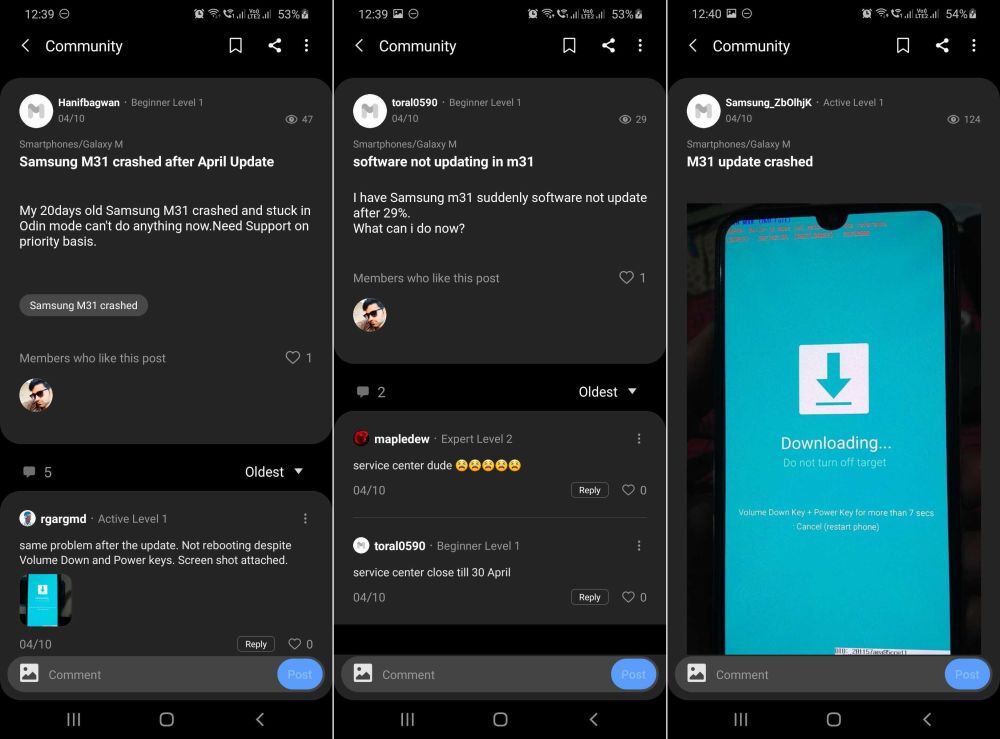
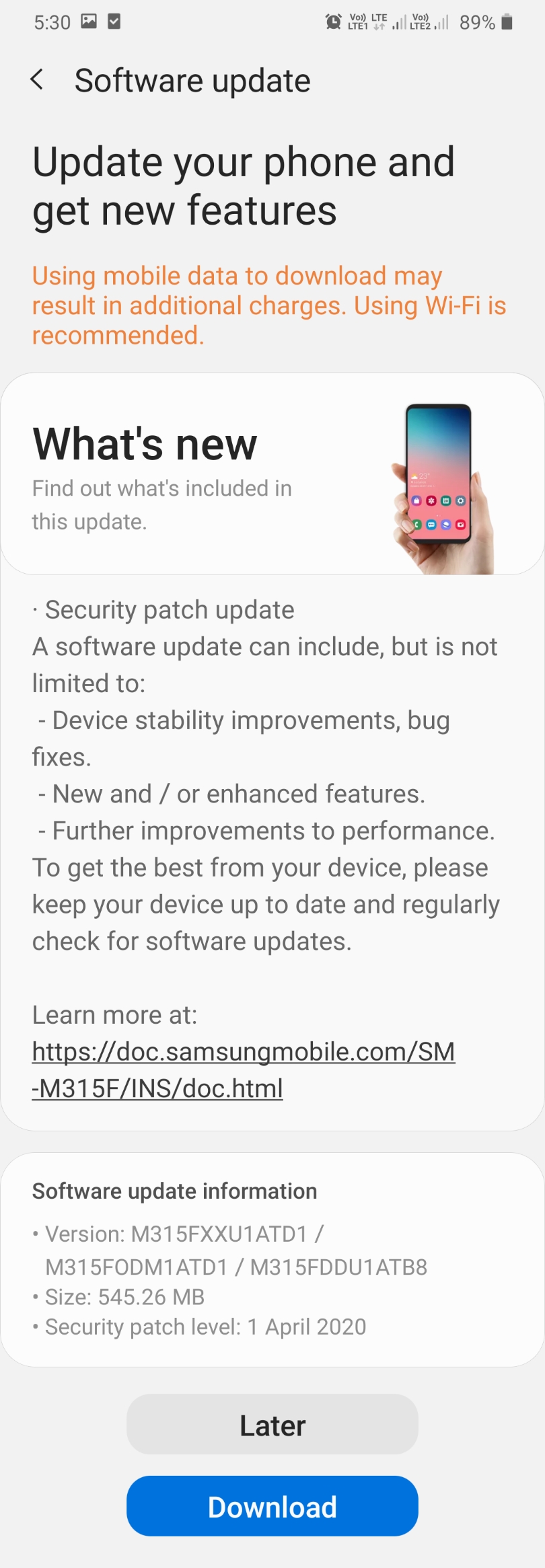
Our unit too received the update weighing 545.26 MB yesterday (April 10), and installed without any issue. But the same cannot be said for a number of unfortunate users who have reported their bad luck on Samsung Members app and Twitter.
The only fix for this issue is once again visiting the nearest Samsung service center to clean flash the firmware. Again this is not possible for many as they are closed due to lockdown order by governments across the world to fight the outbreak of coronavirus aka COVID-19.
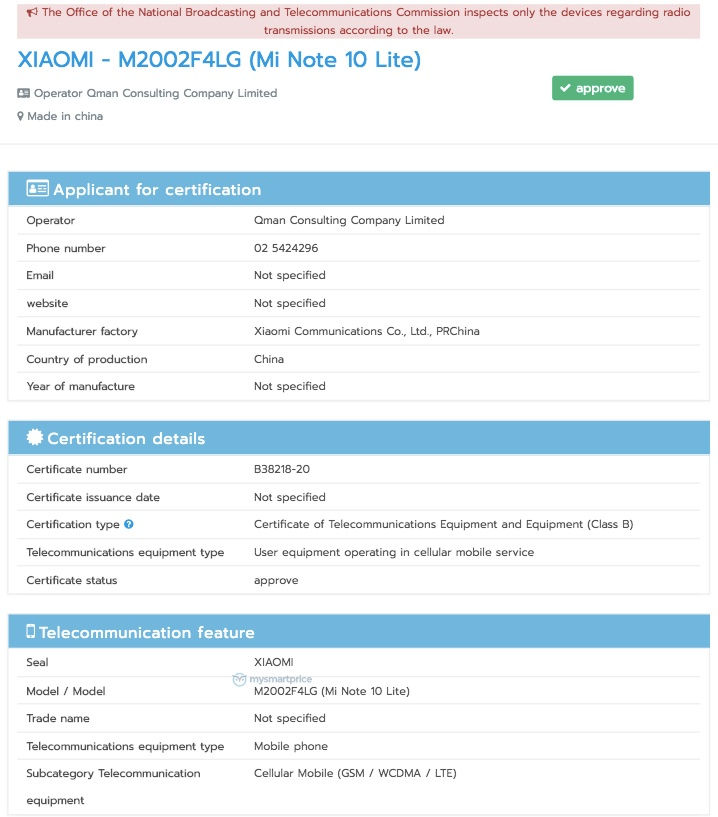
The world’s first 108MP camera smartphone was the Xiaomi Mi CC9 Pro aka Mi Note 10. Late last month, an FCC listing leak suggested the company to launch a new version of this device called Mi Note 10 Lite. Now, this device has also received NBTC certification in Thailand suggesting an imminent launch.
The NBTC listing of Xiaomi Mi Note 10 Lite reveals it to come with model number M2002F4LG. Other than that, it confirms support for only 4G networks, which is obvious as the previous leak suggested it to be powered by Qualcomm Snapdragon 730.
The FCC leak also exposed most of the handset’s primary specifications including those of display, camera, battery, and software.
The handset is expected to sport a 6.47-inch display but the type of the panel is a mystery for now. For optics, it will feature a quad-camera setting consisting of a 64MP primary sensor paired with an 8MP unit (probably ultra-wide), a 5MP shooter (could be macro), and a 2MP camera (most probably for depth sensing).
As for the battery, it is tipped to come with a 5,260 mAh cell with support for 30W fast charging. Last but not least, it will run Android 10 with MIUI 11 on top of it.
Anyway, Xiaomi is yet to announce a launch date for Mi Note 10 Lite and since it has now got NBTC certification, Thailand could be the first market for this device.
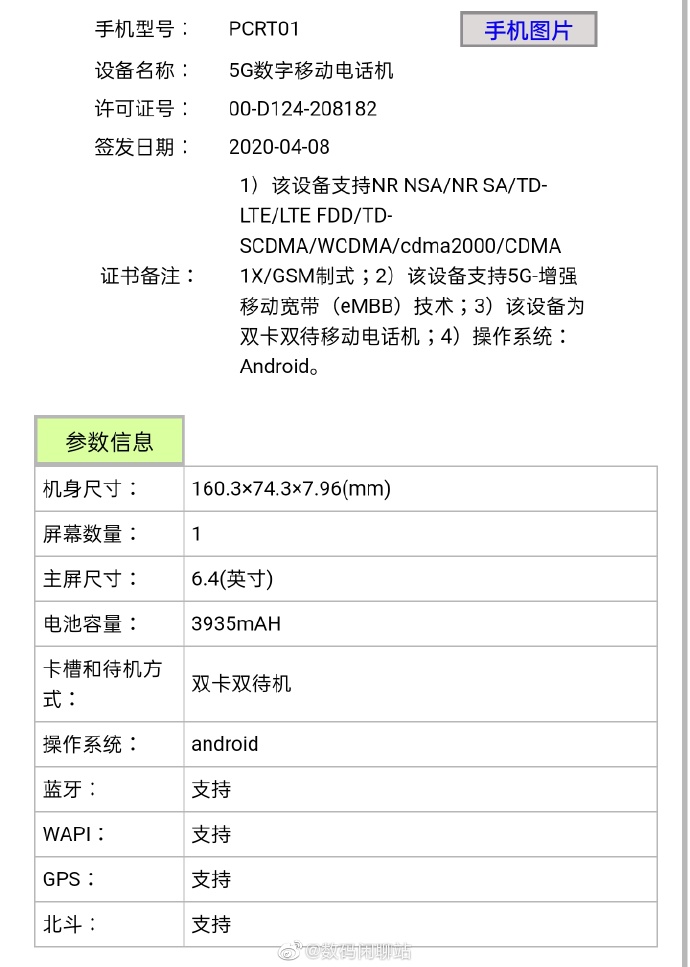
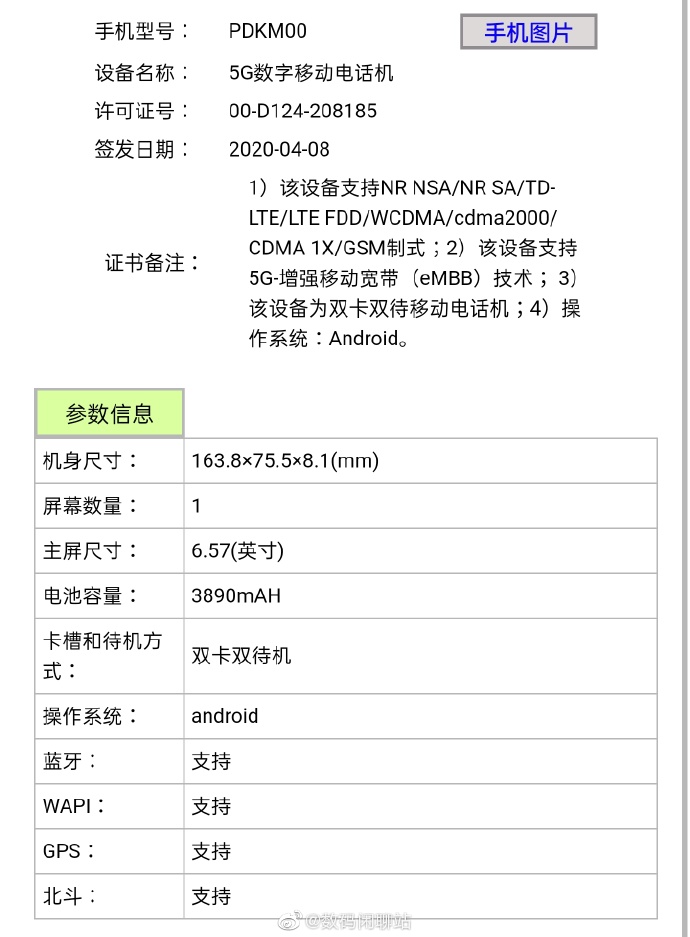
With flagships out of the way for a lot of manufacturers, the focus is now on mid-range 5G phones. OPPO, which is one of the first Chinese manufacturers to launch a mid-range 5G phone has more coming. The TENAA certificates for two new 5G phones have popped up online and they reveal some key specifications.
OPPO PCRT01
The OPPO PCRT01 has a 6.4-inch display and packs a 3935mAh battery (~4000mAh). It measures 160.3 x 74.3 x 7.96 millimeters according to the info released by TENAA. It also has support for SA and NSA 5G networks.
OPPO PDKM00
The second phone has the model number PDKM00. Its screen is bigger at 6.57-inches and its battery capacity is 3890mAh. The phone’s dimensions are given as 163.8 x 75.5 x 8.1 millimeters. Just like the model above, this also has support for SA and NSA 5G networks.
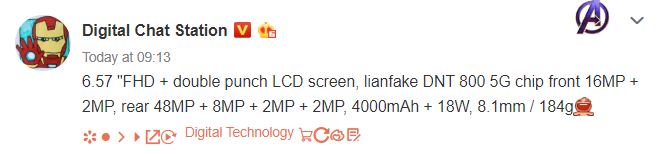
In a separate Weibo post, the Chinese leaker that goes by Digital Chat Station, revealed the key specs of the OPPO PDKM00.
The post said the phone has an LCD display with a double punch-hole for 16MP + 2MP dual front-facing cameras. The resolution of the screen is, of course, FHD+.
Powering the OPPO PDKM00 is MediaTek’s Dimensity 800 chipset which is yet to appear in a commercially-available smartphone. There is no info on the RAM and storage options available. However, he did reveal the phone will have a quad-camera setup on the rear that includes a 48MP primary camera, an 8MP sensor, and two 2MP sensors.
The upcoming OPPO phone will pack a 4000mAh battery capacity with support for 18W fast charge. The fast-charge technology is actually slow for a 2020 OPPO phone considering it has faster ones. The weight of the phone is stated as 184 grams.
We do not know under which series these phones will launch but they may likely arrive under the A-series. But before then, we expect TENAA to publish the full spec sheet of both devices.
We use cookies on our website to give you the most relevant experience by remembering your preferences and repeat visits. By clicking “Accept”, you consent to the use of ALL the cookies.
This website uses cookies to improve your experience while you navigate through the website. Out of these, the cookies that are categorized as necessary are stored on your browser as they are essential for the working of basic functionalities of the website. We also use third-party cookies that help us analyze and understand how you use this website. These cookies will be stored in your browser only with your consent. You also have the option to opt-out of these cookies. But opting out of some of these cookies may affect your browsing experience.
Necessary cookies are absolutely essential for the website to function properly. This category only includes cookies that ensures basic functionalities and security features of the website. These cookies do not store any personal information.
Any cookies that may not be particularly necessary for the website to function and is used specifically to collect user personal data via analytics, ads, other embedded contents are termed as non-necessary cookies. It is mandatory to procure user consent prior to running these cookies on your website.