Apple has confirmed that the company will be making a rear official appearance at the upcoming Consumer Electronics Show (CES) in Las Vegas. The company has revealed that its HomeKit smart home system will take the stage at the trade show.
The company will be showcasing its own smart home system at CES 2020. The development comes as Apple’s top two rivals Amazon and Google are expected to roll out new update that will add more capabilities to their IoT-powered devices and voice-based smart platforms.
However, do note that Apple isn’t expected to launch any new hardware product at Consumer Electronics Show but Apple executive Jane Horvath is scheduled to speak on a consumer privacy panel on January 7th.
Apple has usually stayed clear from officially attending CES. This will be the first time in decades that Apple will attend Consumer Electronics Show in an official capacity. Last year, the company had put up a giant sign in Las Vegas touting the security of its devices, just ahead of CES. A year prior to that, in 2018, some of the Apple employees reportedly met with potential augmented-reality glasses suppliers at CES.
The world’s biggest tech trade show is about to kick-off on 7th January in Las Vegas, showcasing and launching new products and technologies that will eventually make their way to the market. We’ll be covering CES 2020 so stay tuned for all the latest updates.
Realme X50 5G smartphone is confirmed to get launched in China next week, making it the first 5G device coming from the Oppo-backed company. The company has shared several teases highlighting the features of this upcoming smartphone.
Reports indicate that the company could also launch a Lite version of the Realme X50 5G smartphone which is expected to be named Realme X50 5G Youth Edition. Now, in a first hint about the phone’s existence, the company has teased this Youth Edition model by sharing a poster image of the letter “Y”. The company is expected to reveal more details about this today.
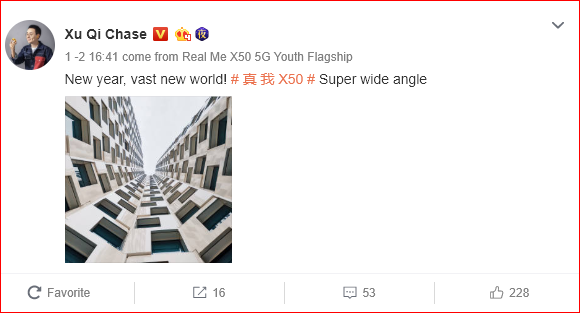
The caption for the post reads “Dare to Leap! Youth! Real!”. Also, Xu Qi Chase, the Chief Marketing Officer of Realme, took to Weibo to share new year greetings using Realme X50 5G Youth Edition smartphone. This confirms that the Lite version of X50 5G indeed exists.
While the Youth Edition model is expected to get launched along with the standard Realme X50 5G smartphone on 7th January at a launch event in China, nothing related to the phone’s specifications has been revealed by the company so far.
As for the X50 5G, the phone has been teased several times by the company, revealing its features and the device has also passed through Geekbench, confirming its specs. The phone will feature a 6.67-inch full-HD+ display with Corning Gorilla Glass 5 protection and is powered by Qualcomm Snapdragon 765G octa-core 5G SoC.
It packs 8GB of RAM and 256GB of internal storage. The phone’s quad-camera setup is expected to consist a 64-megapixel Samsung GW1 primary shooter, an ultrawide lens of 8-megapixel, a 13-megapixel telephoto lens with 5x hybrid zoom and a 2-megapixel super macro lens. On the front side, there will be 32-megapixel and 8-megapixel dual-camera setup for taking selfies and video calling.
The smartphone, which will run ColorOS 7 based on Android operating system, is powered by a 4,500mAh battery and comes with support for 30W Enhanced VOOC 4.0 fast charging technology.
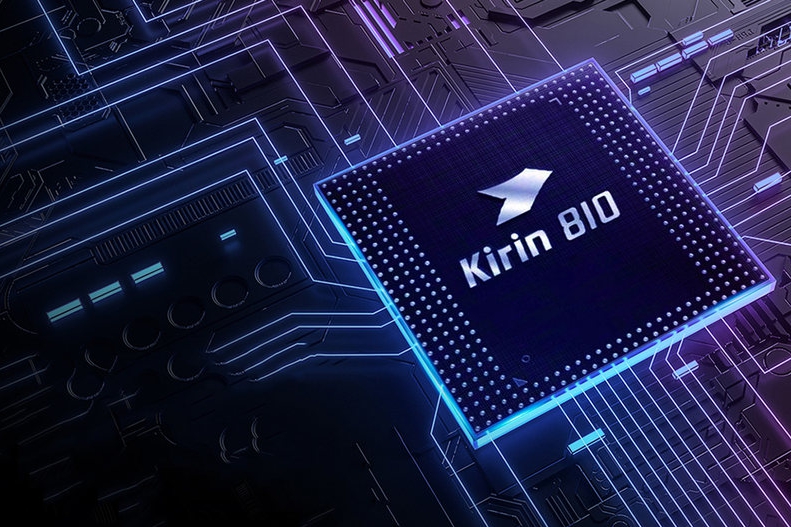
In June last year, Huawei had announced the Kirin 810 chipset. The 7nm chipset was designed to power upper-midrange and mid-tier Huawei and Honor phones. The Nova 5 and Nova 5 Pro were the first smartphones to feature the Kirin 810 chipset. Rumors have it that the HiSilicon has started working on the Kirin 820 chipset. Some of the key details of the upcoming SoC have surfaced.
It is speculated that the Kirin 820 could be built with Samsung’s 6nm manufacturing technology which can provide an additional density improvement of 18 percent. This will allow the Kirin 820 to deliver better performance than the same grade chipsets from Qualcomm and MediaTek.
The Kirin 820 chipset could be based on Cortex A77 architecture. There is no information available on the GPU and NPU of the chipset. With integrated 5G modem, the SoC will offer support for dual-mode 5G networks. It is being said that the mass production of the Kirin 820 will begin in the second quarter of this year. There is a possibility that the company may announce it by the end of June or early July this year. The Huawei Nova 7 and Honor 10X are rumored to be the first devices to be driven by the Kirin 820 chipset.
Huawei is yet to confirm on the existence of the Kirin 820. It is likely that the successor of the Kirin 810 may have a different name. Also, readers to advisable to digest the above lek with a grain of salt as there is no concrete evidence to prove its authenticity.
The Nova 6 SE is the latest Kirin 810 chipset powered phone from Huawei. Unveiled in December 2019, the Nova 6 SE comes with a 6.4-inch IPS LCD punch-hole display that produces full HD+ resolution of 1080 x 2310 pixels. The SoC is coupled with 8 GB of RAM and it has a massive internal storage of 128 GB. There is a nanoSD card slot onboard for more storage.
There is a front camera of 16-megapixel on Nova 6 SE. On its rear is a quad camera setup that includes a 48-megapixel main lens, an 8-megapixe ultrawide sensor, a 2-megapixel macro lens and a 2-megapixel depth assist lens. The EMUI 10 based Android 10 OS runs on the device. The device is equipped with a side-mounted fingerprint reader. The 4,200 mAh battery of the phone supports 40W fast charging. The handset is priced at 2199 Yuan (~$316) in China.
The Realme X50 5G smartphone is slated to go official in the coming week on Tuesday. At the event, the company is expected to unveil the Realme X50 Youth Edition and Realme Buds Air. The Chinese firm has already revealed that the rear design of the Realme X50 5G. Realme India CEO Madhav Sheth took to share couple of the images to the reveal the appearance of the company its first 5G phone to its fans in India.
Sharing with you guys the first look of our first #5G smartphone! This is in line with our philosophy of providing industry leading design and powerful performance. RT if you loved it.#realme #2020 pic.twitter.com/xXhe0lkcuk
The images shared by Sheth only showcases the rear side of the Realme X50 5G. The back panel of the device has an impressive gradient color appeal. The phone flaunts a vertical camera at its top-left corner. The rear design of the smartphone is quite similar to the Realme X2. Rumors have it that the phone is equipped with a 64-megapixel main lens. The company has also hinted that it is also equipped with a ultrawide lens.
A fingerprint scanner embedded under the power button is available on the right spine of the Realme X50 5G. On its left is the volume controller. The front image of the phone had revealed that it will be the firm’s first smartphone to come with dual front-facing cameras. The display of the phone will be equipped with a pill-shaped cutout to house them. It is speculated that the phone could be housing a 6.6-inch display that could be equipped with 32-megapixel + 8-megapixel dual front camera setup.
Even though Realme India CEO Madhav Sheth has shared the images of the smartphone, India is unlikely to receive its 5G edition. While China is expected to receive it only 5G version, India may get its 4G LTE version as the 5G networks haven’t started yet in the country.
The Snapdragon 765G will be powering the Realme X50 5G. The battery size of the phone is not revealed yet. However, it is known that it will be arriving with support for enhanced version of VOOC 4.0 Flash Charge technology. The company has claimed that its improved 30W fast charging technology can let the smartphone gain 70 percent battery by charging it for only 30 minutes. The handset will be rivaling with the Redmi K30 5G that will be releasing on the same day when Realme will be announcing the X50 series.
Realme‘s upcoming 5G smartphone – the Realme X50 5G has been a regular in leaks and teasers. The device is expected to go official soon but before then, Realme’s CMO Xu Qi n spectacular teaser about the device. The teaser happens to be the camera sample captured by the mobile phone’s ultra-wide-angle camera.
The Realme X50 5G is expected to sport a quad-camera setup consisting of a 64-megapixel Samsung GW1 primary shooter, an ultrawide lens of 8-megapixel, a 13-megapixel telephoto lens with 5x hybrid zoom and a 2-megapixel super macro lens. The ultra-wide lens was deployed in capturing the picture in question. Apart from the ultra-wide-angle shot, the picture is also crisp clear. The main sensor and ultrawide-angle lens are said to also feature image stabilization feature for the main and ultrawide lens.
In other aspects, the device is said to be powered by a Qualcomm Snapdragon 765G processor, with dual-perforated screen design in the upper left corner. In terms of charging, it will be equipped with an enhanced version of VOOC Flash Charge 4.0, which will charge to 70% in 30 minutes.
Realme is expected to go official with the X50 5G on January 7, 2020.
Huawei’s P series usually include two flagships – a standard model and a Pro version; an example is the P30 and the P30 Pro. However, that may change this year.
Alleged Huawei P40 Pro
According to a leaker, the Huawei P40 series may have three flagships this year. The info was revealed on Twitter by Teme (@RODENT950) who is known for his Huawei-related leaks.
He tweeted that the P40 may also come in three models and when asked if he referred to the lite, standard and pro models, he replied that he meant three flagship models.
Then he replied again that it may be a Porsche edition or a Max edition.
In another tweet, he said the camera design may remain unchanged for the base models (standard and Pro), retaining the design of the P30 Pro while the third model has the rectangular camera design we have seen in renders.
It is possible that the camera design might still be more like a P30 pro than a new rectangle for base models and third model came with that rectangular camera design 🤔 #HuaweiP40series
We are not so sure about the design, seeing as renders already revealed two P40 models will have a rectangular camera design. However, there is a possibility one of the three models will have a different camera design from the rest.
All the three Huawei P40 flagships should be powered by the Kirin 990 5G but the base model may come with the Kirin 990, the processor without an integrated 5G modem. They should also run EMUI 10 based on Android 10 out of the box
We advise that the above details about three P40 flagships be taken with a grain of salt seeing as there is no evidence to back up the claims.
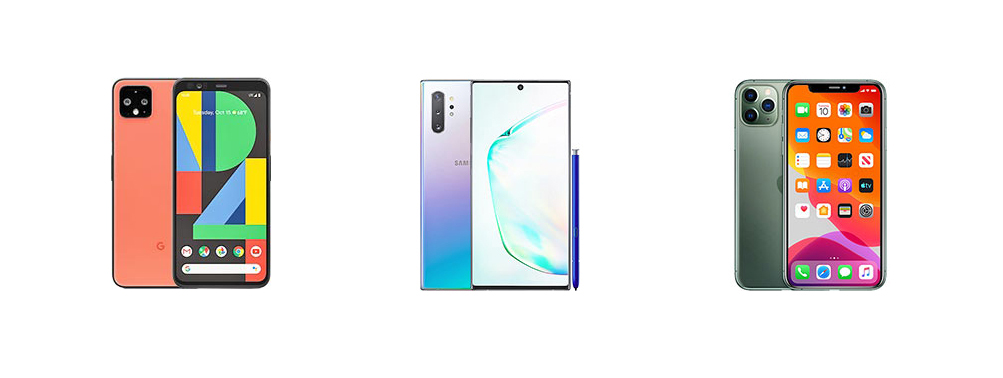
2020 just started and we just realized we never compared the most important flagship from the most important non-Chinese companies in the smartphones world: Google, Samsung, and Apple. All of them made a lot of steps forward with their devices in 2019, that is why we think it is worth making a comparison between their most expensive handsets. We are talking about Google Pixel 4 XL, Samsung Galaxy Note 10+ and Apple iPhone 11 Pro Max. Very different devices, but all offering something unique at expensive prices. Which one should you spend on? Let’s discover it together.
Google Pixel 4 XL vs Samsung Galaxy Note 10+ vs iPhone 11 Pro Max
Google Pixel 4 XL
Samsung Galaxy Note 10+
Apple iPhone 11 Pro Max
DIMENSIONS AND WEIGHT
160.4 x 75.1 x 8.2 mm, 193 g
162.3 x 77.2 x 7.9 mm, 196 g
158 x 77.8 x 8.1 mm, 226 g
DISPLAY
6.3 inches, 1440 x 3040p (Quad HD+), P-OLED
6.8 inches, 1440 x 3040p (Quad HD+), Dynamic AMOLED
6.5 inches, 1242 x 2688p (Full HD+), Super Retina XDR OLED
On the design point of view, Samsung Galaxy Note 10+ takes the gold medal. It comes with a punch-hole display, a very minimal glass back and the highest screen-to-body ratio. Not everyone may like the big camera module on the iPhone 11 Pro Max and its big notch, but it has a better build quality with a frame made of stainless steel and a glass back which Apple defines as the “most resistant ever mounted on a smartphone”. On the other hand, Google Pixel 4 XL offers a more compact design, but it has thicker bezels and it is less attractive.
Display
In each case, you get an incredible display. Three displays considered the best ones ever seen on a smartphone by DisplayMate. All of them received the Best Display Award and all of them feature an amazing color reproduction. My favorite one is the Samsung Galaxy Note 10+ as it comes with a wider diagonal, HDR10+ certification and the support to S Pen. I would give the silver medal to the iPhone 11 Pro Max, but the Google Pixel 4 XL is the only with a 90 Hz refresh rate.
Hardware/Software
iPhone 11 Pro Max is the fastest and the most stable device especially thanks to the optimization of the iOS operating system. But performance is not the most important thing when it comes to these devices as all of them are very fast flagship. You should rather consider that iPhone 11 Pro Max has iOS, Google Pixel 4 XL has the most updated Android version (close to stock) with the most advanced Android 10 features available, and Samsung Galaxy Note 10+ has a highly customized Android version but still based on Android 9 Pie.
Camera
Samsung Galaxy Note 10+ and iPhone 11 Pro Max are among the best camera phones ever and they provide very similar camera performance. The astrophotos feature on the Google Pixel 4 XL looks very interesting, but the lack of an ultrawide lens and the inferior image quality do not let it compete with Samsung Galaxy Note 10+ and iPhone 11 Pro Max.
Battery
Apple improved the battery life of its latest iPhones a lot, especially the iPhone 11 Pro Max which finally comes with a battery close to 4000 mAh. But Samsung was able to do slightly better with its Galaxy Note 10+. It has bigger dimensions, but it also comes with a bigger 4300 mAh battery allowing it to last more on a single charge. Further, unlike its rivals, it features reverse wireless charging so that you can use it as a power bank. And it even has a faster charging (and wireless charging) technology. Google Pixel 4 XL’s battery life is nothing so exciting.
Price
Google Pixel 4 XL is a bit disappointing, especially if we consider that it costs $899/€899. For €1129/$1099 Samsung Galaxy Note 10+ offers a lot more and it is the winner of this comparison. But if you prefer iOS, iPhone 11 Pro Max is still one of the best phones you can get, despite it starts from €1189/$1099.
Huawei has officially unveiled its new innovative venture in China. It is a smart unmanned store located in Wuhan Optics Valley New Development International Center. The store has in stock several types of electronic products owned by Huawei.
The smart unmanned store supports online ordering and on-site purchase. It is equipped with a robot arm that is responsible for taking out the goods. It is understood that Huawei’s smart unmanned retail store does not require personnel to provide supervision. The smart store also provides 24-hour uninterrupted service. Other features of the unmanned store include 24-hour smart storage, robot automatic inventory, smart schedule management, all tailored towards offering seamless unmanned services.
Huawei presently has several offline stores scattered across China. This new unmanned store may be a pilot scheme and is an indication that the company is working on ways to ensure its products are available to customers24/7. We may likely see more of such robot manned stores springing up in several cities across China in the near future.
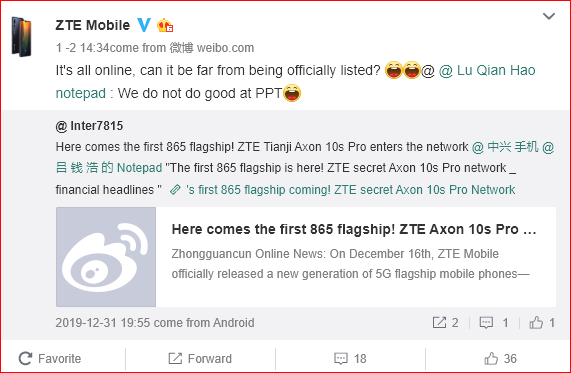
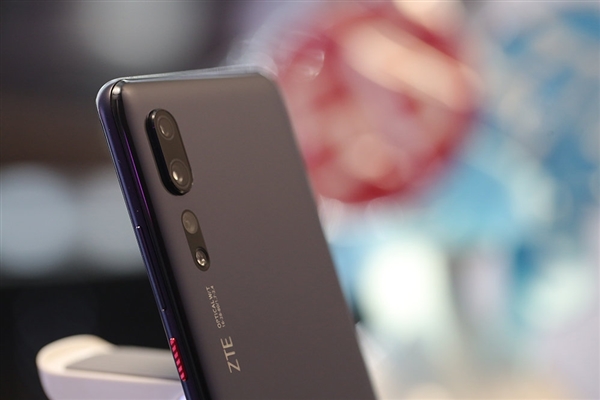
Xiaomi recently announced that it will launch the Mi 10 in Q1 2020 as the first Snapdragon 865 flagship. Chinese tech giant ZTE may snatch that crown from Xiaomi as the Axon 10s Pro has been certified by TENAA, making it the first Snapdragon 865 model to receive TENAA’s certification.
In response to the TENAA listing, Lu Qianhao, Director of Consumer Experience Department at ZTE released a statement which suggests that the device will be launched soon. We don’t know how soon but it may be outed before the Mi 10.
ZTE has not been able to fully recover since after the US ban was lifted. The company is looking up to 5G phones to mount a serious push for a slice of the market. The Axon 10s Pro comes with a Snapdragon 865 chipset integrated with 5G. In terms of specs, the AXON 10s Pro uses 6.47-inch display waterdrop OLED display that is integrated with a fingerprint scanner. The display neatly curves towards its left and right edges. The screen offers 19.5:9 aspect ratio as it produces full HD+ resolution of 1080 x 2340 pixels.
The phone comes in three RAM variants – 6GB, 8GB and 12GB. The storage options are 128 GB, 256 GB and 512 GB. The Android 10 OS comes preinstalled on the device. As the company has already confirmed, the Android 10 OS will be skinned with its latest MiFlavor 10 UI. The Axon 10s Pro has a 48-megapixel + 8-megapixel + 2-megapixel triple camera setup at the rear while there is a 20-megapixel front-facing camera.
The phone is backed by a 3,900mAh capacity battery with support for fast charging. The Chinese firm has already confirmed that the ZTE Axon 10s Pro will come in Black color. The other color variant dubbed as Ochre is also listed on TENAA.
The news came as a surprise as Lei Jun, Co-Founder and Chairman of Xiaomi Group, welcomed Chang Cheng as the new Vice President of the Chinese tech giant. However, Lenovo has now released a statement that could possibly entangle the former VP in legal constraints.
Lei Jun welcomes Former VP and Head of Lenovo Mobiles China, Chang Cheng, as the new VP for Xiaomi Group
According to Lenovo’s statement, all employees working with the company have to sign a non-competition agreement; this means that former employees are under a contract to not enter into a competition of any kind with the employer after the employment period has ended. Hence, Chang Cheng, the former VP of Lenovo, joining Xiaomi technically breaches the contract.
Lenovo Group’s response states that if a violation in the breach is confirmed, the company will be seeking a recourse within the legal frameworks. In other words, there is a chance of a lawsuit being filed against Chang Cheng if he does not comply with the terms and conditions of breaching a non-competition agreement. The terms and conditions in question will either convey a monetary figure being paid to Lenovo and will most likely have him agree to a non-disclosure agreement regarding Lenovo’s operations.
Notably, a lawyer from a Beijing firm has pointed out that the competition agreement does not fall under mandatory signing. Hence, it will have to be confirmed if both parties have signed the contract. If Chang Cheng is found having has signed a non-competition agreement, he is liable to pay compensation in a fixed amount as stated in the agreement for the violation.
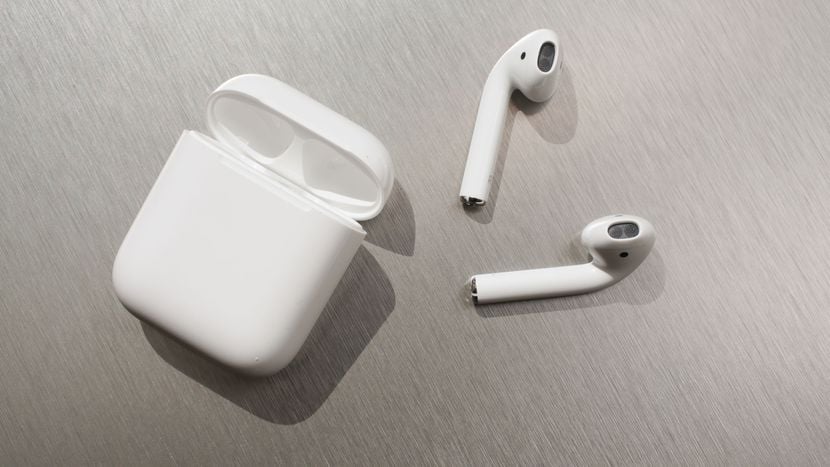
Apple‘s AirPods seemed like the ideal Christmas present for a 7-year-old Georgia kid until the adolescent inadvertently swallowed one of the pair and his mother needed to rush him to an emergency room.
Kiara Stroud, the mother of the 7-year old, says she never envisioned the AirPods would wind up in her child’s stomach and now needs to caution moms about the threats of such a gift to anyone in such age bracket According to the mum, he was holding it in his mouth by the long part and couldn’t explain how it got swallowed.
Over at the Children’s Healthcare of Atlanta Egelston, specialists were befuddled about the circumstance, however, an X-Ray photograph identified the metal parts in the AirPod and affirmed that the child had in fact swallowed the device. The major concern of the toddler and his mum was how it was going to come out but the specialist assured them that he would pass out the AirPods naturally.
The incident left the boy scared of even touching his smartphone which is also a Christmas present even though he can’t even swallow it.
In summary, AirPods as awesome as they are might be dangerous in the hands of kids of that age just like all other miniature-sized gadgets around.
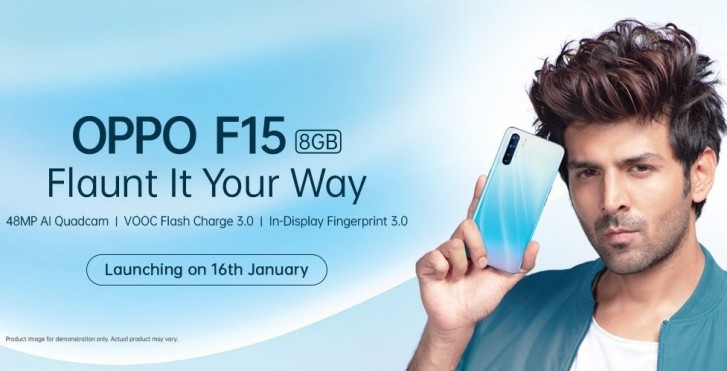
Chinese tech giant and BBK subsidiary OPPO has revealed the launch date for the next-generation F-series smartphone known as OPPO F15. The device is expected to go official in China on January 16 according to an official teaser poster released today. The poster also contains some key specifications of the phone
The F15 is expected to be the successor of the Oppo F11 smartphone in India and has featured in a couple of promo videos. It bears a design that looks like that of the OPPO A91 launched in China recently. This has fuelled speculations that the device will be a renamed A91. The teaser poster project a quad-camera setup consisting of a 48MP AI main camera. Other sensors include a 119-degree ultrawide lens of 8MP, a 2MP macro lens and another 2MP sensor.
The poster also shows the F15 will present with up to 8GB RAM, VOOC Flash Charge 3.0 for its 4,025mAH battery and in-display fingerprint 3.0. These basically feature onboard the OPPO A91 which also presents with a 6.4-inch AMOLED display with Full HD+ screen resolution of 1080 x 2400 pixels. The A91 comes with a 90.7 percent screen-to-body ratio, and 20:9 aspect ratio. The display offers features like eye protection mode, DC dimming 2.0 and packs third-generation in-screen fingerprint sensor.
Under the hood, the device is powered by MediaTek Helio P70 chipset along with 8GB of RAM and 128GB of internal storage. At the front, it features a 16MP snapper for taking selfies and video calling.
Something individuals new to iPhones are regularly astonished to learn is that iOS doesn’t have a “share by means of Bluetooth” alternative. Rather, Apple users depend on the firm’s custom AirDrop app to send documents between one another. However, in the event that the document needs to be sent to an Android smartphone, the Apple user will need to use email or an app.
AirDrop utilizes a mix of Bluetooth and Wi-Fi to set up a quick and secure connection between two Apple device which makes it exceptionally advantageous. Up until this point, there’s no such feature that works all around on all Android devices albeit, a few phone makers have their own custom file-sharing alternative.
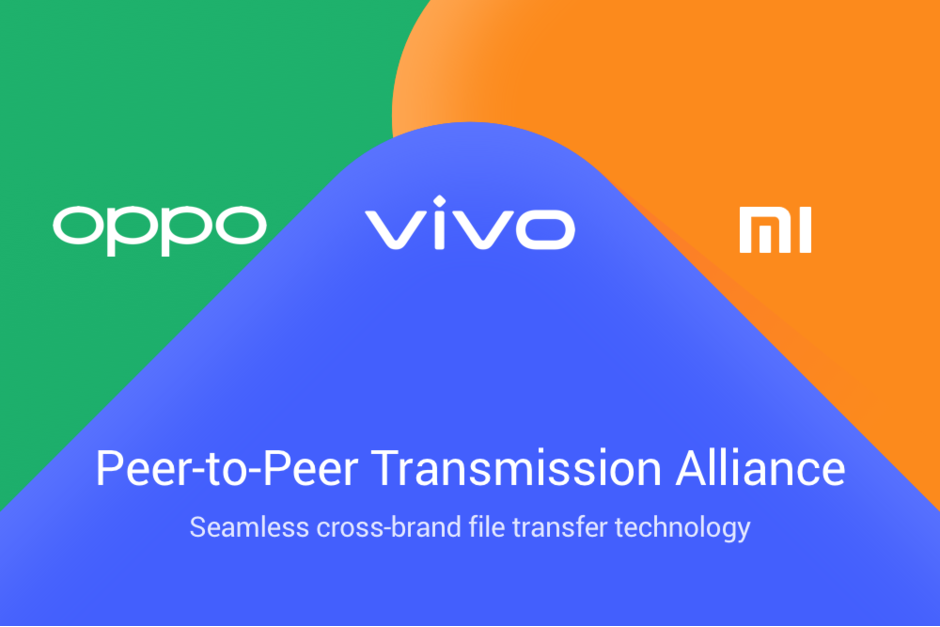
That may change soon as Oppo, Vivo and Xiaomi reported in a public statement that they’re forming a “Peer-to-Peer Transmission Alliance” in order to “provide users with an unparalleled file transfer experience.” The new record move framework doesn’t have a name yet, but it will likewise utilize Bluetooth for blending and WiFi P2P (distributed) for the information move.
Despite relying on the phone’s WiFi, the framework won’t disconnect users from their WiFi connection and can be utilized at the same time without meddling with other running apps. The new framework guarantees a normal transfer speed of 20MB/s with maximum speeds potentially much higher depending on the devices involved.
The first smartphones that will be released with the new framework onboard are scheduled to debut in February this year, as indicated by the press statement. The feature will get expanded to other models as new phones get released by the three brands.
Some of the specifications of the Mi 10 and Mi 10 Pro have leaked but other than the use of a Snapdragon 865 processor, the other specs are unconfirmed. Some of the leaks have revealed that the two flagship phones will differ with respect to the screen, cameras, battery capacity, fast charge technology, and memory.
Based on the above-mentioned differences, one would not be wrong to think the standard Mi 10 gets the short end of the stick. However, a new leak says it won’t be the case, at least with respect to the battery capacity.
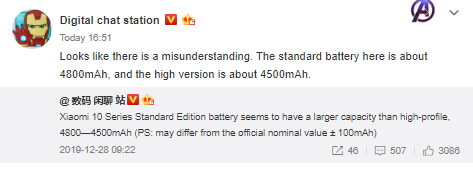
According to Digital Chat Station, the Mi 10 will have a bigger battery capacity than the Mi 10 Pro. Actually, his Weibo post said the standard version has a battery capacity of about 4800mAh while the pro version has a battery capacity of about 4500mAh.
While the battery capacity will differ, we believe both phones will have the same screen size but different designs. For those who have set their eyes on the Pro version and are disappointed it is getting a smaller battery, they can find solace in the fact that it will have support for a faster-charging technology.
It is also important we state that the Mi 10 is getting a big bump in battery capacity when compared to the 3300mAh capacity of the Mi 9. Yes, a bigger battery is necessary since the phone will have 5G support but it is still worth stating. Oh! And of course, not everyone is actually going to use the phone with a 5G network.
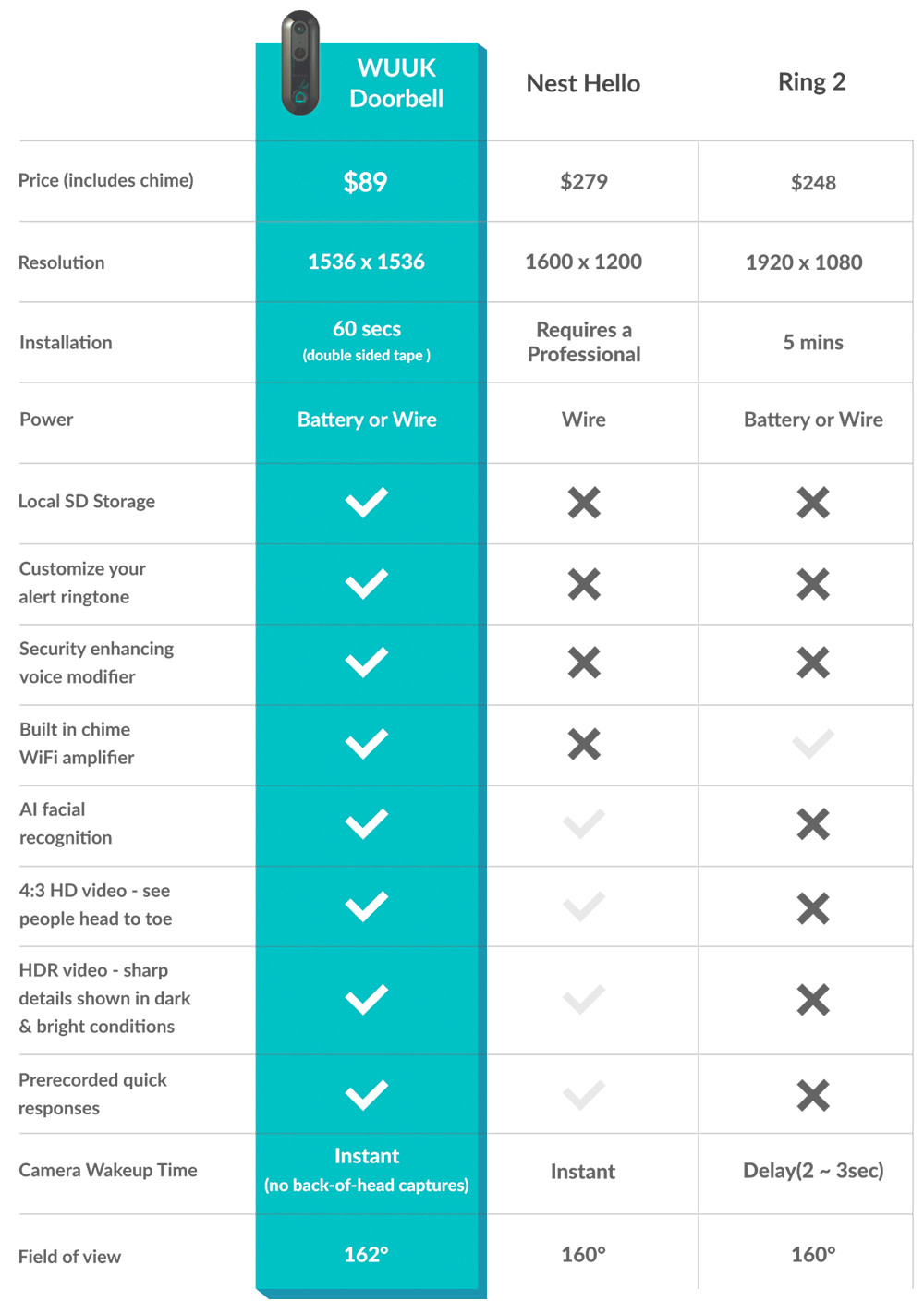
Nowadays every single device has its smart edition and of course, doorbells couldn’t be left out. There are already many remarkable smart doorbells out there like Nest Hello and Ring 2 but there’s plenty of room for more. WUUK Labs is making their effort in the field with the WUUK Smart Doorbell crowdfunding campaign on Indiegogo and as they claim, it is the world’s most advanced smart doorbell.
The device got full funding in just 20 minutes and it’s still going up with 16 days left until the end of the campaign. Judging from the features, it is the world’s most advanced smart doorbell when compared with renowned models of the market. Also, it is much more affordable than these models, almost 4 times cheaper!
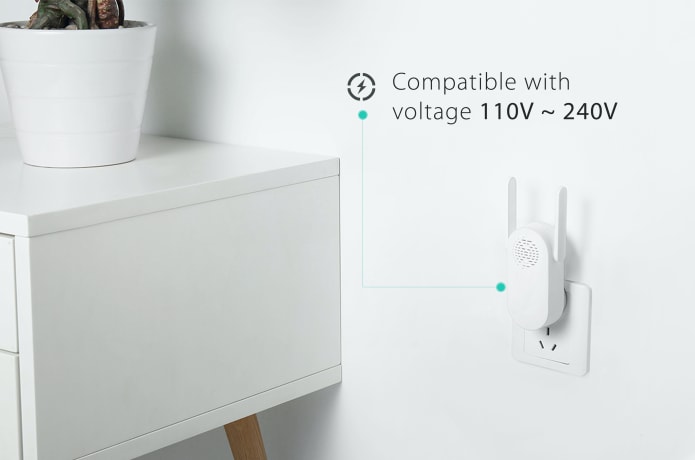
One more advantage of the WUUK is its easy and fast setup as any homeowner can install WUUK easily, using mounting screws or double-sided tape. The doorbell can be wired in for power or simply run off the internal battery for up to 8 months. Of course, it is wireless for absolute freedom.
The WUUK can also act as a surveillance camera as it detects motion when someone is at your door and sends you notification immediately with a 0.35s quick wake-up speed. You can open the camera to say hello, send a pre-recorded response or simply monitor the situation. This way, you always know what’s going on outside your door. You can see all the details and the Early Bird offers on the campaign page.
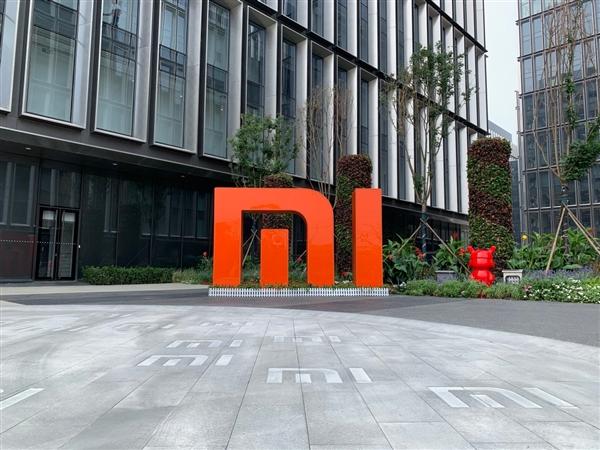
Earlier today (2nd January 2020), Lei Jun, Co-Founder and Chairman of Xiaomi Group, shared the official new colorful logo of Xiaomi for its 10th anniversary on Weibo.
According to the post, a short video reveals the bright new logo which carries multiple different color schemes. Each of the four dots in the logo is from unique colors and highlights the theme of the 10th anniversary.
Xiaomi’s new logo for the 10th Anniversary of the company (shared by Lei Jun)
Xiaomi was founded on 6th April 2010, in which the founding members and then employees shared a symbolic meal (Xiaomi porridge) together. According to Lin Bin (Co-Founder and President), the small team of 13 people present during the founding day had contributed greatly to the company and still play important active roles.
Xiaomi has since been one of the most popular smartphone brands in the world. It is currently the top selling smartphone brand in India and is also relatively popular in its home country, China. The company was also one of the first to successfully pull off the online operations business sales model, where the company initially only sold its handsets online with little to no expenditure being incurred on advertising.
Currently, Xiaomi is the 4th most popular smartphone brand in the world and is also the fourth, and one of the only, companies to have self-developed a smartphone chipset. Notably, in July 2019, the Chinese tech giant joined the Fortune 500 global list and was ranked 486th. Forbes also awarded Xiaomi for being China’s Most Innovative enterprise in June 2019.
The list of achievements goes on as the company has undoubtedly seen great success over the course of the decade. Xiaomi is best known for its smartphones but is also known to often offer products in any and every line of consumer-grade electronics.
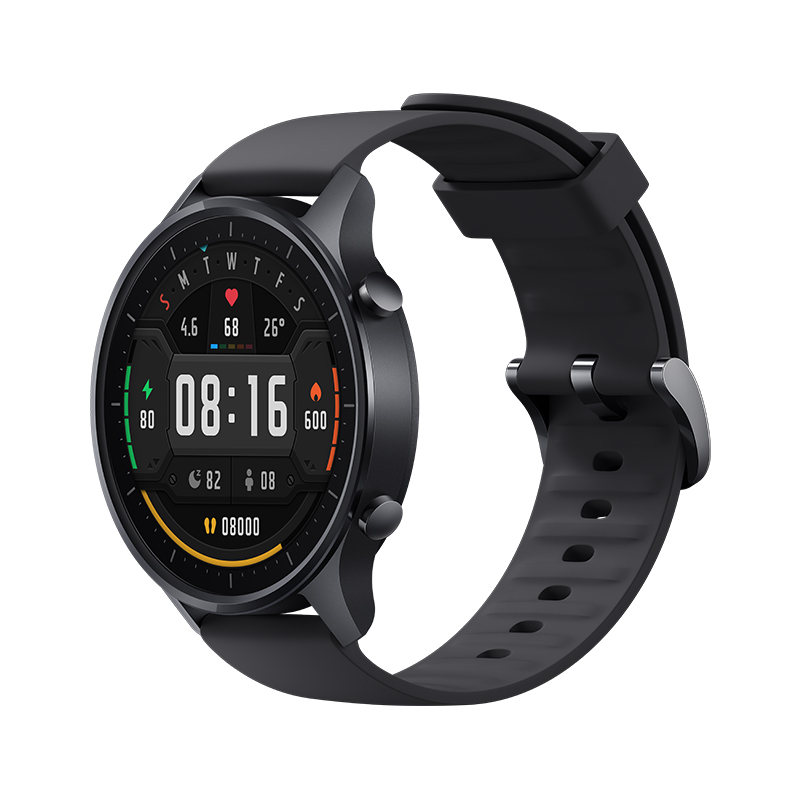
It is a known fact that the Mi Band line is manufactured for Xiaomi by Huami. However, Huami is not the manufacturer behind the new Xiaomi Watch Color. Based on our findings, the smartwatch is manufactured by Shanghai Suo Prime Technology LTD, a company under Xiaomi’s ecological chain.
That actually makes sense seeing as Xiaomi’s own smartwatches are not sold outside China, yet. Huami sells its Amazfit line of smartwatches in several markets abroad just like Huawei, so both are actually fighting for the same set of customers.
Xiaomi may eventually launch its Mi Watch and Watch Color smartwatches outside China but its main focus will likely remain on the Mi Band line which is what has pushed it to the top of the wearable devices market.
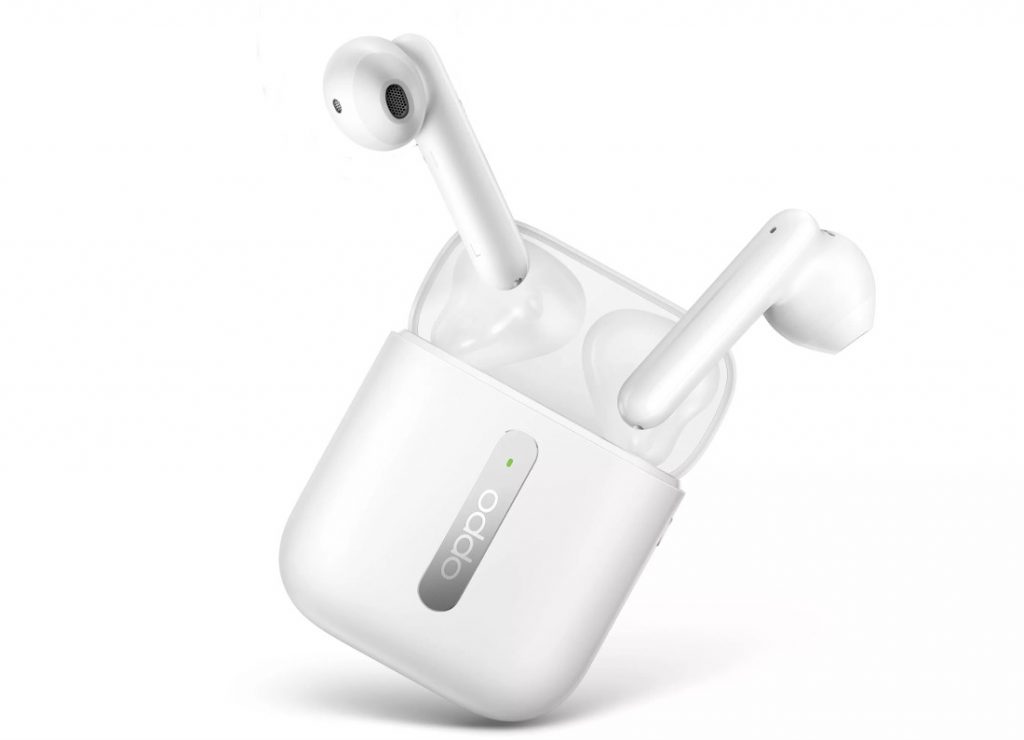
Oppo announced its first true wireless earbuds dubbed the Oppo Enco Free via a Weibo post in December last year, confirming that it will launch alongside the Reno 3 series smartphones on December 26th.
Aside from that, the Chinese consumer electronics company shared renders of the TWS earphones, revealing three highly appealing color options. As far as the design is concerned, the Oppo Enco Free seems to bear a notable resemblance to Apple’s AirPods.
The earbuds adopt a half-in-ear design that can be transformed into a shallow in-ear design using the ear cap. This is the second product Oppo has launched under its well-received Enco lineup.
If you have restlessly been waiting to get your hands on the Oppo Enco Free without emptying your pocket, it might interest you to know that Giztop is offering the feature-laden true wireless earphones for $119.99. The reasonably priced product is available in black, as well as white color options on the Chinese online store.
An absolute bargain at this price, the lightweight and compact Enco Free feature silicone in-ear tips for a comfortable fit and to ensure it stays in place regardless of the activity performed by the wearer. It comes with a charging case that sports a smooth-matte surface and serves as a wireless charger for the product.
The USB-C port is placed at the bottom for easy recharge for the case and the earbuds. Moreover, the earbuds support Bluetooth 5.0 connectivity which delivers an impressive wireless range of up to 10 meters.
On top of that, the Enco Free employs AI uplink noise cancellation and supports wear detection, which means it automatically pauses and resumes playback when you take them out or place them inside your ear. Furthermore, its open-fit design enables touch controls.
You can simply slide a finger on the left earbud to adjusting volume, and switch between tracks by sliding a finger on the right earbud. The Enco Free is backed by a 31 mAh battery that lasts for 5 hours, and 25 hours with the charging case that has a 410mAh battery.
You can visit this link to check out more details about the OPPO Enco Free and place your order through Giztop.
The Xiaomi Watch Color will be available for purchase tomorrow, and while we already know quite a lot about the watch, there are still some unknown details. Thanks to a pre-order page on Mi.com and the Youpin store, we now know all the details of the smartwatch.
Design
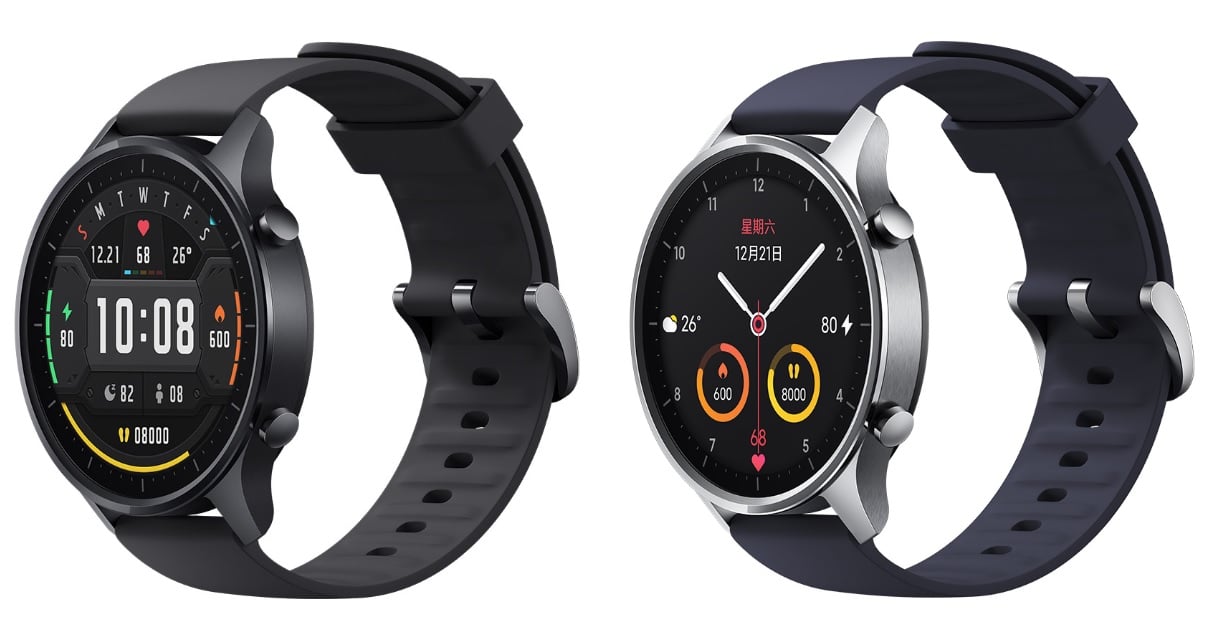
The Xiaomi Watch Color has a circular dial and will be available in Elegant Black and Fashion Silver. Both color variants have appeared in the live photos we have seen in the last few days. Unfortunately, there is no way to choose the strap you want at checkout but the page said owners will be able to purchase different straps later. Xiaomi also said the watch will ship with silicone straps and advises not to purchase third-party straps as they may cause allergies.
The page also explains the 1540 designs we have seen in the promotional images. Of course, we do not expect that there will be more than a few options to choose from. However, Xiaomi says you can actually have up to 1540 different combinations and the math is that there are 2 color options, 110 different dials to choose from, and seven different straps (six silicone and one alligator leather strap) to choose from. So if you mix any of these, you can get a total of 1540 different combinations. There will also be more dials in the future, so the number of combinations will increase.
The Xiaomi Watch Color has a 1.39-inch AMOLED display with a 454 x 454 resolution enclosed in a stainless steel frame. It has a dial size of 46.2 millimeters (46.2 x 53.3 x 11.4mm) but there are rumors there will be a 42mm version too. It connects via Bluetooth 5.0 LE, has GPS and GLONASS, and is water-resistant up to 50 meters.
The watch also has NFC and supports bus-card payments in several cities across China. The product page says it has an ambient light sensor, a gyroscope, a geomagnetic sensor, an accelerometer, and a barometer.
[envira-gallery id=”298577″]
The battery capacity is 420mAh which Xiaomi claims will last up to 14 days in typical watch mode, 22 days in basic mode, and 22 hours in outdoor sports mode. The watch ships with a circular charger that attaches to the base via magnets.
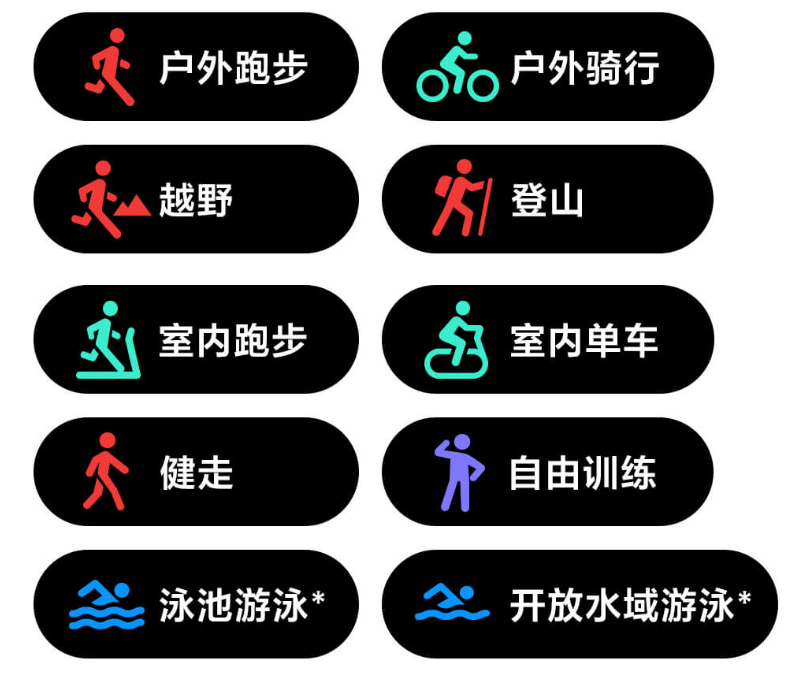
The smartwatch can track a total of 10 activities. They are outdoor running, indoor running (treadmill), trail running, climbing, outdoor cycling, elliptical training, walking, free training, indoor swimming, and open water swimming. Xiaomi said tracking for indoor and open water swimming will be available via an OTA update.
The watch can also measure VO2Max and uses FIRSTBEAT™ to analyze your physical activity and provide professional training guidance. It measures your heart rate (24-hour monitoring), stress level, and tracks your sleep too. The watch also monitors in real-time what it calls energy level and will tell you to take a break when you have engaged in energy-draining tasks.
The Xiaomi Watch Color has Xiaomi’s XiaoAI Assistant built-in, so you can use it to control your smart home products or ask it questions. However, the watch only has a microphone but doesn’t have a speaker, so responses will be displayed on the screen.
The Xiaomi Watch Color does not run MIUI for Watch but has a similar user interface. It also does not have built-in storage for storing songs.
Price
The Xiaomi Watch Color will sell for ¥799 (~$115) but will sell for more on third-party reseller sites. If there is a 42mm version, we presume it may sell for ¥699 (~$100) or even less. You can pre-order the watch here or here.
Xiaomi, the Chinese smartphone manufacturer, is planning to launch the Mi 10 and Mi 10 Pro together unlike its predecessors, the Mi 9 and Mi 9 Pro. The smartphone series will be the company’s 2020 flagship series.
Reportedly, the two smartphones in the series will share the stage in the launch event in the first quarter of 2020. Furthermore, the handsets are confirmed to feature Qualcomm’s latest Snapdragon 865 SoC, also making the series one of the first to feature the new chipset.
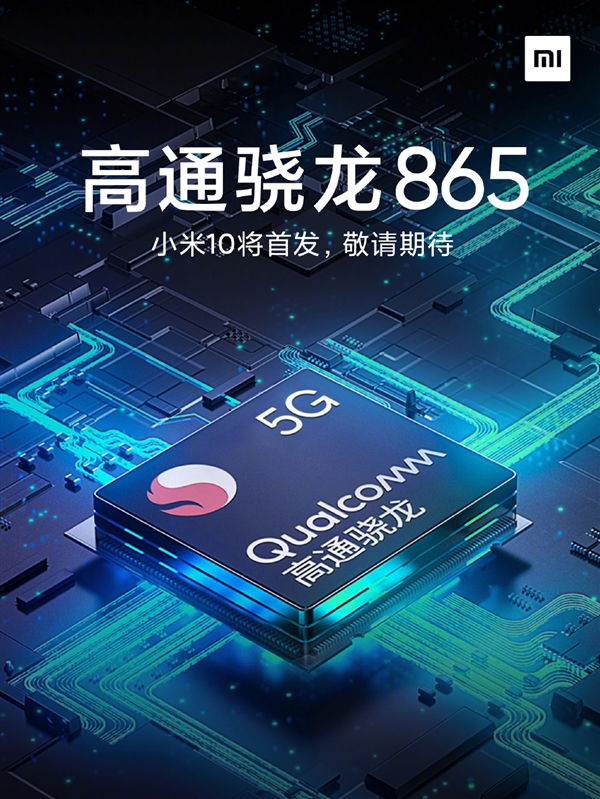
Xiaomi Mi 10 series equipped with Qualcomm’s Snapdragon 865 SoC.
Mi 10
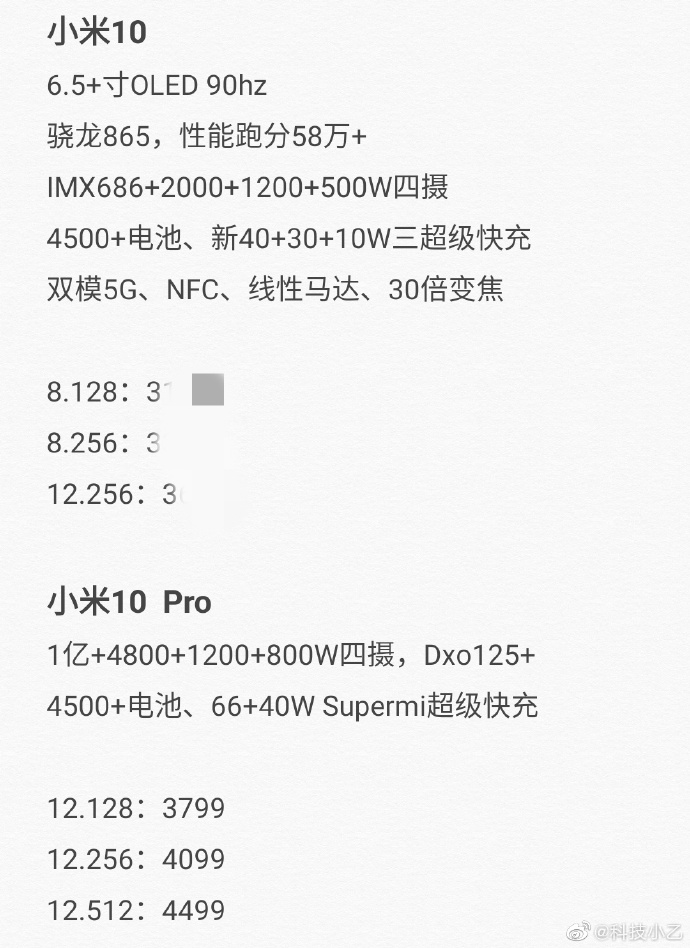
According to a leak on Weibo, the Mi 10 will feature a 6.5 inch OLED display with a refresh rate of 90Hz. Under the hood, its smartphone will be equipped with Snapdragon 865 SoC alongside 8GB/12GB of RAM and 128GB/256GB of internal storage. Unfortunately, exact pricing is still unknown but it is expected to start somewhere around 3,199 CNY or roughly 459 USD.
For photography, the device sports a quad camera setup that includes a Sony IMX686 primary sensor, a depth sensor, and a macro lens. It is also expected to feature a 30x digital zoom and will be powered by a large 4,500mAh battery; that supports triple fast charging technology, i.e 40W fast charging, or 30W fast charging and can even reverse charge for 10W wirelessly.
Xiaomi’s Mi 10 Pro is expected to arrive with a similar 6.5 inch OLED display with a 90Hz refresh rate. The processor will also be the Snapdragon 865 SoC and the battery is reported to be the same as well. However, what sets it apart from the base variant is the charging technology. The Mi 10 Pro is expected to feature a 66W wired fast charging alongside 40W wireless fast charging technology.
Leaked specs of the Xiaomi Mi 10 series shared on Weibo
Additionally, the Mi 10 Pro is said to also be equipped with a quad camera setup but the primary camera is Samsung’s 108 megapixel sensor. This will be paired with a 48 megapixel lens, a 12 megapixel telephoto lens and an 8 megapixel depth sensor.
The pricing details have yet to be officially unveiled but the Mi 10 Pro is expected to start from 3,799 Yuan (roughly 545 US Dollars) for the 12GB RAM and 128GB storage variant. The 12GB RAM + 256GB storage variant is might carry a price tag of 4,099 Yuan (roughly 588 US Dollars). Lastly, the most specced up 12GB RAM + 512GB storage variant is expected to go for 4,499 Yuan (roughly 646 US Dollars.)
We use cookies on our website to give you the most relevant experience by remembering your preferences and repeat visits. By clicking “Accept”, you consent to the use of ALL the cookies.
This website uses cookies to improve your experience while you navigate through the website. Out of these, the cookies that are categorized as necessary are stored on your browser as they are essential for the working of basic functionalities of the website. We also use third-party cookies that help us analyze and understand how you use this website. These cookies will be stored in your browser only with your consent. You also have the option to opt-out of these cookies. But opting out of some of these cookies may affect your browsing experience.
Necessary cookies are absolutely essential for the website to function properly. This category only includes cookies that ensures basic functionalities and security features of the website. These cookies do not store any personal information.
Any cookies that may not be particularly necessary for the website to function and is used specifically to collect user personal data via analytics, ads, other embedded contents are termed as non-necessary cookies. It is mandatory to procure user consent prior to running these cookies on your website.


















UP NEXT: Realme X50 full specifications, price appear in a leaked specs sheet