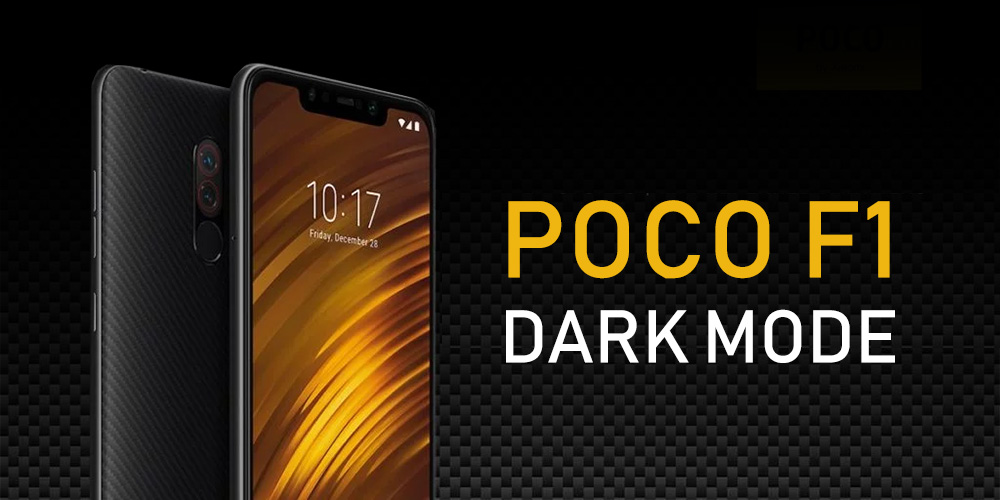
Xiaomi’s Poco F1 is quite in demand even after a year of its launch. The continuous support and some ongoing offers have made it even more affordable and popular among the users. The third-party developers are also quite active in the Poco F1 development, due to its immense popularity. The device recently received Widevine L1 and 960 fps slow-mo video recording capability. It also added Dark Mode but the settings to enable it is still missing. However, we have come across a way to enable Dark Mode in Poco F1.
Xiaomi Poco F1 is powered by Qualcomm Snapdragon 845 chipset and 6/8 GB of RAM and 64/128/256 GB of internal storage. In optics, there’s a 12 MP primary sensor with a 5 MP depth sensor. On the front, the device has a 20 MP primary selfie camera to assist Face Unlock and many other functions. The device hosts a 4000 mAh Battery with Qualcomm Quick Charge 4+.
The Poco F1 is soon going to get the Dark Mode, but those who can’t wait can follow our guide to enable dark mode before anyone else gets it. Moreover, the system-wide Dark Mode will be an integral part of MIUI 11. To enable the Dark mode, users need to have some drivers and a laptop/PC.
Pre-Requisites:
A PC/Laptop to execute the commands.
A USB cable to connect the device with the Computer machine.
Huawei‘s attempt to break into the US market may have had some effect on the company’s present predicament. Despite ditching plans to sell its smartphones in the US, Huawei still retained some of its workforces in the US, especially under its subsidiary Futurewei. Futurewei Huawei’s research arm and was in the news recently when it made moves to extricate itself from Huawei’s brand identity. Presently, Huawei seems to be planning to lay off some of its workforces in the US.
A report carried by The Wall Street Journal (WSJ) claims Huawei is planning to lay off hundreds of workers in the United States. Even though Huawei still remains strong, things have not gone smoothly since the Trump administration placed a de facto ban on US sales to the company. The Trump administration cited potential security threats but it was obviously due to the simmering US-Chinese trade war.
The workers who would be laid off are from the research subsidiary Futurewei Technologies which runs several research labs in the US. The company will reportedly allow some Chinese employees the option of relocating back to China to remain within the company. Some employees have apparently already been notified that they will be let go, with other layoffs planned in the near future.
Shortly after the Honor 9X and Honor 9X Pro appeared on TENAA, the official AnTuTu account shared the benchmark result of the Honor 9X (HLK-AL00) on Weibo.
The benchmark result confirms the Honor 9X runs Android 9 Pie and is powered by the Kirin 810 processor. It also has a Mali-G52 GPU. The variant benchmarked has 6GB of RAM and 128GB of storage. The phone also packs a display with a 2340 x 1080 resolution.
[envira-gallery id=”264219″]
The AnTuTu score is 219,809 points but it trails behind the Huawei Nova 5 which also uses the same processor but scored 237,437 points. It is important to note that the Nova 5 that was benchmarked has 8GB of RAM. While that may influence the score, optimizations will also play a part. The benchmarked Honor 9X is said to be a prototype, so the final product may have a higher score.
The Honor 9X will have a 6.59-inch LCD display powered by a 3900mAh battery. It will have a 16MP pop-up selfie camera and 48MP + 2MP dual rear cameras. The phone will be available in three variants – 4GB + 64GB, 6GB + 128GB, and 8GB + 256GB. It will also have support for storage expansion and a side-mounted fingerprint scanner.
The Honor 9X will launch alongside the Honor 9X pro on July 23 in China.
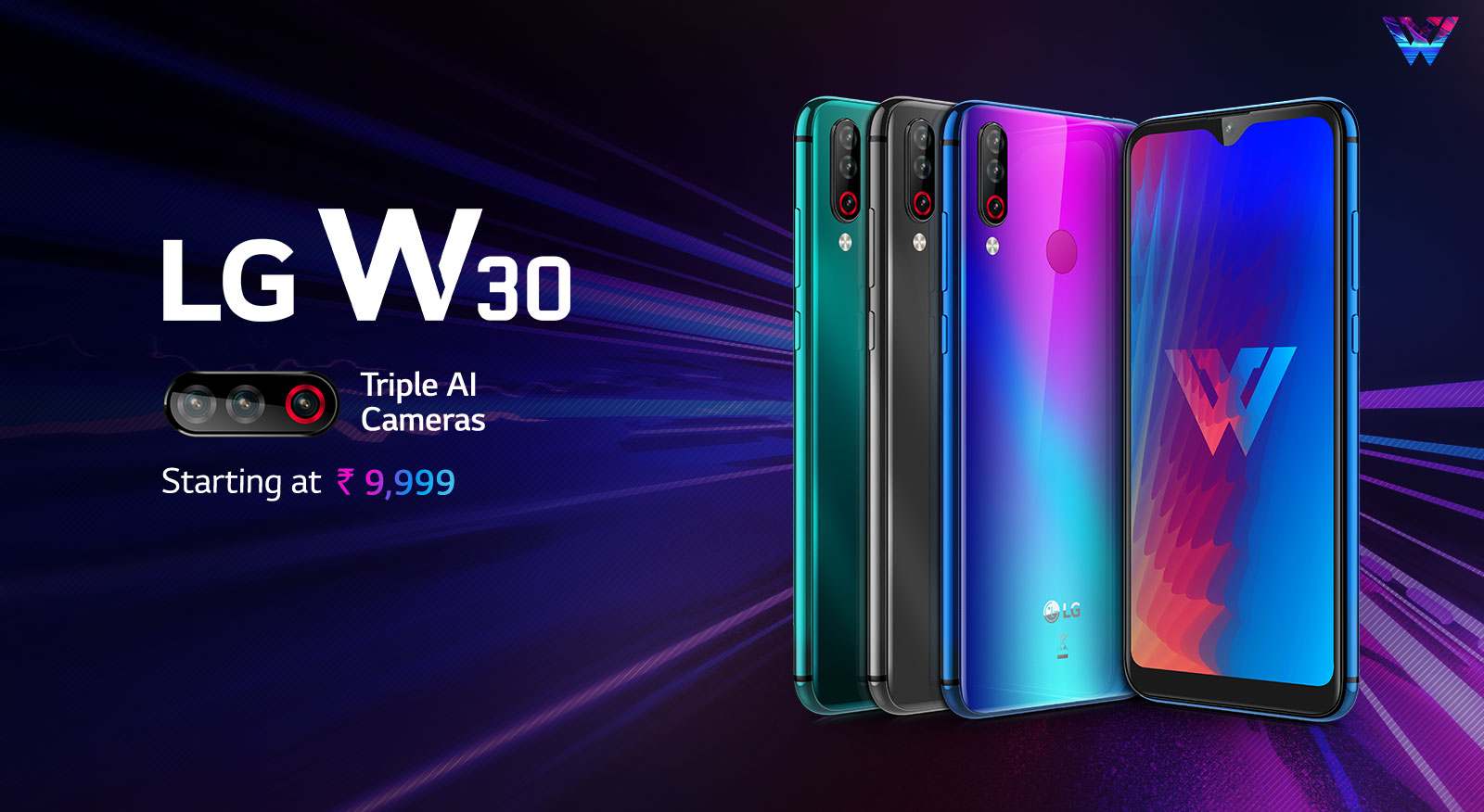
Last month, LG launched three new budget smartphones in the Indian market under its all-new W-series, which includes LG W10, W30, and W30 Pro. When launched, the LG W30 was made available in two colors — Platinum Gray and Thunder Blue.
Last week, the company had announced the Aurora Green color option for the smartphone and today, with the start of Prime Day sale on Amazon India, the LG W30 Aurora Green color variant is now available for purchase.
The LG W30 Aurora Green comes with 3GB of RAM and 32GB of internal storage, carrying a price tag of ₹9,990, which roughly converts to $146.
The smartphone comes with a 6.26-inch FullVision IPS LCD displays that support HD+ resolution of 1520 x 720 pixels and 19:9 aspect ratio. LG is offering a software feature that allows users to customize the notch design from options such as U-shaped or V-shaped or just a straight bezel.
Under the hood, it is powered by MediaTek Helio P22 chipset and comes with a hybrid dual SIM slot that can be used for adding a microSD card. The Android 9 Pie OS in its purest form is available on the LG W-series. It is equipped with Google Launcher that tags along Google Assistant, Digital Wellbeing and so on.
The phone carries a 16-megapixel front-facing camera for taking selfies and video calling. On the backside, there’s a triple rear setup, consisting of a Sony IMX486 12-megapixel main sensor for low-light photography, a 13-megapixel wide-angle lens and a 2-megapixel tertiary camera sensor for depth sensing.
It comes with a rear-mounted fingerprint sensor for biometric authentication and comes powered by a 4,000mAh battery but unfortunately, the phone lacks support for fast charging technology.
At a recent Honor media meeting, Honor President George Zhao officially announced that Honor will be launching a brand new smart TV in the future. Just as we had theorized earlier, it seems like an Honor TV is coming soon. It’s pretty interesting to see the company finally dabble in a completely new market.
According to George Zhao, the company isn’t just looking to release just any smart TV. The company wants to be a true innovator and revolutionize the smart TV market. To this end, they’ve partnered up with China’s JingDong to bring about a new evolution of the product. Honor is calling it “Smart Screen TVs”, as a combination of smart TVs and internet TV. They’re even hyping it up as the future of television, which seems a bit optimistic.
From what we can gather from George Zhao’s announcement, it seems like Honor’s TV will be heavily integrated with other smart devices. He claims that he wants the television to be less of a media center, and more of a complete information center. We assume that means it will serve as a smart center for services, household items and sharing from phones.
If the previous poster is to be believed, it’s fully possible that the Honor TV is coming extremely soon. We’ll probably see it next to the other new devices, these being the Honor 9X and new Magicbook. It seems like Honor is being very ambitious with their new TV, and we have to question whether it’s wise. Still, we’re eager to see what comes out of it, so stay around on Gizmochina.com for further news on Honor, as well as all your Chinese tech news.
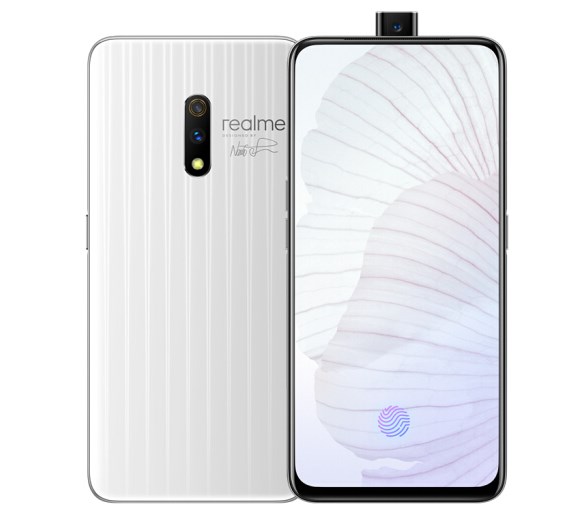
Today, Realme announced the highly anticipated Realme X and Realme 3i budget-friendly phone through an unveil event in India. While the Realme 3i is a new smartphone that is arriving first in India, the Realme X is essential the very same phone that was made official in China in May. The Realme 3i has a starting price of Rs. 7,999 (~$116) whereas the Realme X has arrived in India with a beginning price tag of Rs. 16,999 (~$248).
Realme X Specifications and Features
The Realme X smartphone is equipped with a 6.53-inch AMOLED display that supports 1080 x 2340 pixels full HD+ resolution and 19.5:9 aspect ratio. The notch-less display is integrated with in-screen fingerprint sensor. The smartphone is fueled by 12nm Snapdragon 710 chipset and up to 8 GB of RAM. The highest version of the phone features 128 GB of built-in storage. The handset does not feature a microSD card slot.
The ColorOS 6.1 based Android 9 Pie OS runs on the device along with Realme’s own theme. The dual camera setup of the Realme X has a dual camera setup that comprises of Sony IMX586 48-megapixel primary lens and a depth sensor of 5-megapixel. The pop-up camera module of the Realme X features a Sony IMX471 16-megapixel selfie camera. The front and rear cameras are equipped with 4-in-1 pixel binning technology that makes it possible to capture brighter shots in low-light scenarios. The front camera also supports AI beautification features.
Realme X Mater Edition – GarlicRealme X Master Edition – Onion
The Realme X is packed with a 3,765mAh battery. It carries support for VOOC 3.0 Flash Charge 20W rapid charging. The other features of the smartphone include AI face unlock, dual 4G VoLTE, Wi-Fi 802.11ac, Bluetooth 5.0, GPS, USB-C and 3.5mm audio jack.
Realme X Price and Availability
The Realme X smartphone has been announced in two variants in India such as 4 GB RAM + 128 GB storage at Rs. 16,999 (~$248) and 8 GB RAM + 128 GB storage at Rs. 19,999 (~$291). It can be bought in two colors like Polar White and Space blue. The Realme X Master Edition model that has been designed by Japanese industrial designer named Naoto Fukasawa comes with 8 GB of RAM and 128 GB of inbuilt storage. Onion and Garlic are the two color editions of the smartphone. The Realme X Master Edition costs Rs. 19,999. There is no 6 GB RAM edition of the smartphone for India.
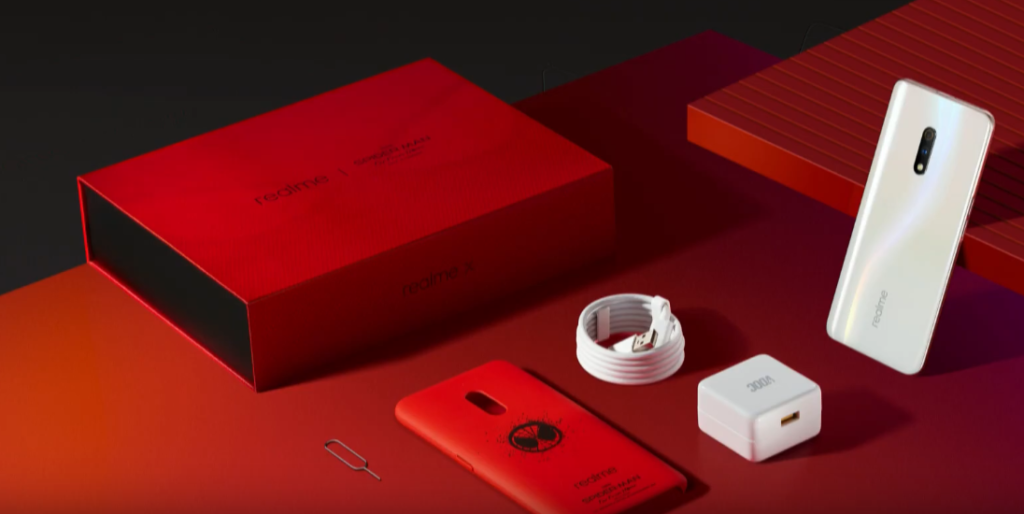
The Chinese firm is also selling a special Spiderman edition of the smartphone in India. The Realme X Spider-Man Far From Home Gift Box includes a Polar White edition handset that comes with a Spiderman theme and custom wallpapers. It comes in a big red colored box that also includes a VOOC 3.0 Flash Charger. The Spiderman version of the Realme X is priced at Rs. 20,999 (~$306).
Realme will be holding the first sale of the Realme X smartphone on July 24 in India at 12 PM. It can be purchased through Realme’s online store and Flipkart. Launch offers for Realme X buyers include 10 percent instant discount for SBI credit card users and no cost EMI. Realme.com is offering Rs. 750 worth free Paytm membership that brings benefits of up to Rs. 20,000. For early buyers, there will be “Hate-to-Wait” sale of Realme X on Flipkart on July 18 at 8 PM. Soon, it will be also made available through offline stores.
What’s your opinion on the Realme X? Does it carry an enticing price tag? Will Xiaomi Redmi K20 and Redmi K20 Pro smartphones arrival on July 17 will significantly impact the sales of Realme X? Share us your views by posting your comments below.
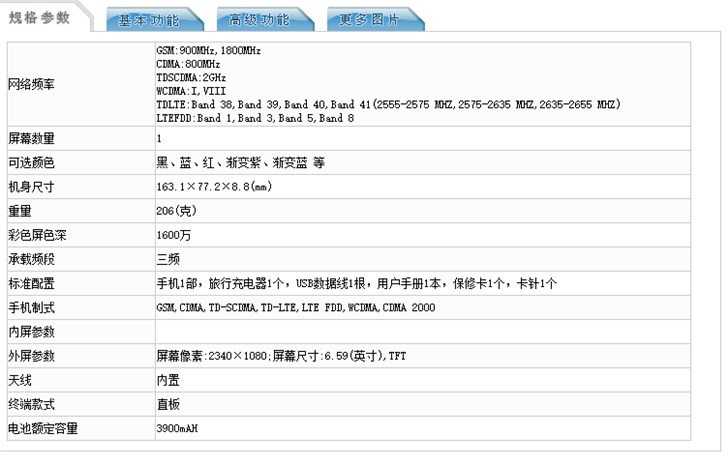
The Honor 9X is up for arrival next week, but there’s still plenty of time for more leaks and news. We already saw the design teaser that just came out, but now we’ve got more specs. Perhaps more specifically, we’ve got the complete spec list for a few variants of the Honor 9X. TENAA is at it once again, giving us all the infomation we need.
There are three variants of the Honor 9X listed online, these being the HLK-TL00, HLK-AL10 and HLK-AL00. After pouring through all the specifications, I can’t say I found much of a difference between them. They’ve ultimately got the exact same specs, so I’ve compiled them down below for easier viewing.
Colours: Black, Blue, Red, Gradient Violet, Gradient Blue
GSM: 900MHz, 1800MHz
CDMA: 800MHz
TDSCDMA: 2GHz
WCDMA: I, VIII
TDLTE: Band 38, Band 39, Band 40, Band 41
LTE FDD: Band 1, Band 3, Band 5, Band 8
We expect to see some minor differences once the devices finally launch, but for now it seems they’re all pretty similar. The launch of the Honor 9X is going to take place pretty soon, so we won’t have to wait long to find out. Until then, stay around on Gizmochina.com for all of your Chinese technology news.
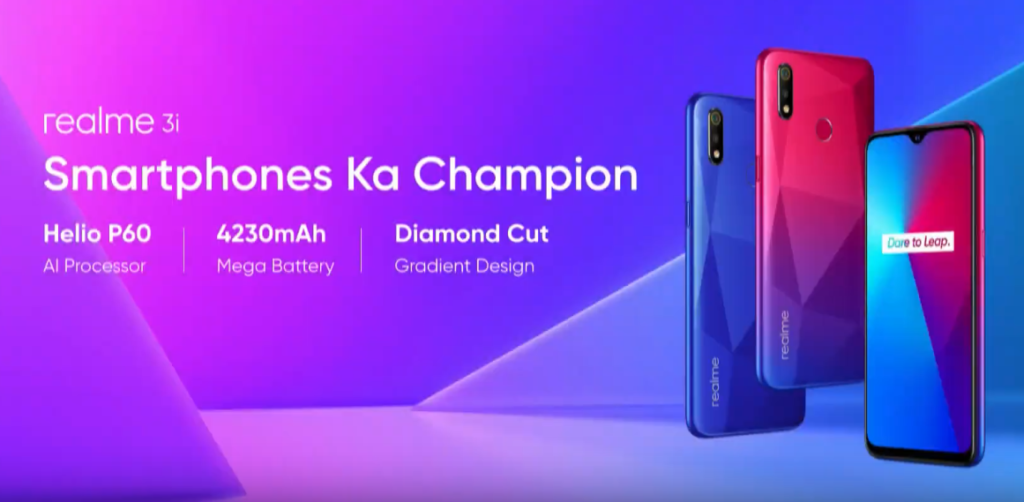
The Realme 3i is the latest budget-friendly smartphone to go official in India. In terms of pricing, the smartphone is positioned between the Realme C2 entry-level smartphone and Realme 3. The newly unveiled Realme 3i borrows its design from Realme 3 as well as some of its specs.
Realme 3i Specifications and Features
The Realme 3i has a 6.22-inch IPS LCD display with dewdrop notch. The tall aspect ratio of 19:9 screen offers HD+ resolution of 720 x 1520 pixels. The smartphone offers a screen space of 88.30 percent. The display of the Realme 3i is shielded by Corning Gorilla Glass 3.
The MediaTek Helio P60 chipset that includes 2.0 GHz octa-core processor powers the smartphone along with up to 4 GB of RAM. For storage, it comes with up to 64 GB of storage. There is a microSD card slot available on the phone for more storage. The ColorOS 6.0 based Android 9 Pie OS comes preloaded on the device.
i
The front notch of the Realme 3i features a 13-megapixel selfie camera. It is equipped with AI beauty feature for capturing beautified selfie shots. The rear shell of the phone has a dual camera setup that includes a primary lens of 13-megapixel with f/1.8 aperture and a depth sensor of 2-megapixel. The dual cameras offer features like Super Night scape, Chroma boost, Google Lens, AI scene recognition and 960fps slow-motion videos of 720p.
The Realme 3i houses a 4,230mAh battery. The big battery lacks support for fast charging. The handset is packed with usual connectivity features like dual 4G VoLTE, Wi-Fi 802.11 b/g/n, Bluetooth 4.2, GPS, microUSB 2.0 and 3.5mm audio jack. A fingerprint scanner is found on the backside of the Realme 3i. The handset also carries support for AI face unlock. Its dimensions are 156.1 x 75.6 x 8.3mm and it weighs 175 grams.
Realme 3i Price and Release Date
The Realme 3i’s first sale will be carried out on July 23. The 3 GB RAM + 32 GB storage model is priced at Rs. 7,999 (~$116) whereas its 4 GB RAM + 64 GB storage edition costs Rs. 9,999 (~$146). Diamond Blue, Diamond Red and Diamond Black are the three color variants of the Realme 3i.
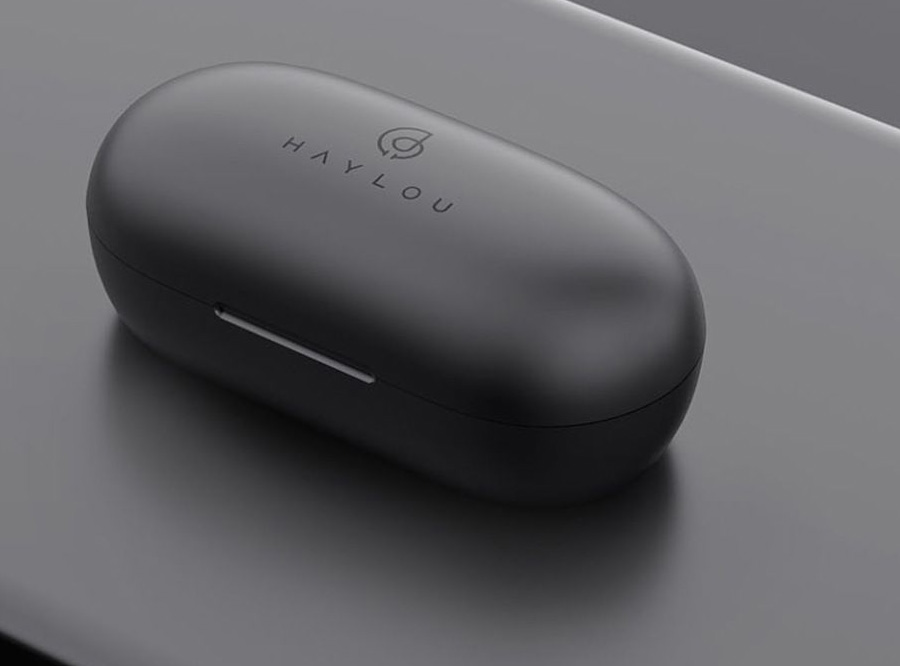
Designed for music lovers who fancy listening to their favorite music without any sort of interruption, the Haylou GT1 TWS earphones adopt true wireless 5.0 technology that delivers a stable, and smooth wireless connectivity.
As a result, you can now enjoy popular songs and other audio files in a 10-meter working distance without a break. The Haylou GT1 TWS earphones feature an easy-to-use touch control design, paired with unparalleled sound quality.
Thanks to its ergonomic design, the Xiaomi Haylou GT1 TWS earphones can be worn comfortably longer period of time without any sort of discomfort. In fact, the smart design of the earphones ensures they don’t fall off during heavy activities like running or working out.
The Haylou GT1 TWS Earphones have gone up for sale bearing reduced prices on GeekBuying and GearVita. We will shed light on the discounts and show how you can save more money during the checkout process.
GeekBuying
The Haylou GT1 would normally set you back a pretty penny on both online as well as offline stores, but you can buy it for only $29.99 from GeekBuying. This is a noteworthy 23 percent reduction in the device’s original asking price of $38.99.
Moreover, you can use coupon code 3EMLHGEP for an extra $10 off. In other words, you can bring the already reduced retail price of the earphones further down to just $19.99 before placing your order. You can click here to avail the discount and use the coupon.
You are highly likely to spend a lot of money on top-end TWS earphones that boast an impressive array of features; however, the Xiaomi Haylou GT1 surprisingly offers comparable features without burning a hole in your pocket. Currently available for a reduced price of only $22.99, the Xiaomi Haylou GT1 usually sells for $31.99.
You can even extend this 28 percent discount with the help of coupon code ROMGT1TWS. The coupon helps you save $4 more by reducing the original asking price of the to just $$18.99 at the time of checking out.
You can follow this link to take advantage of the coupon and avail the discount before the promo wraps up!
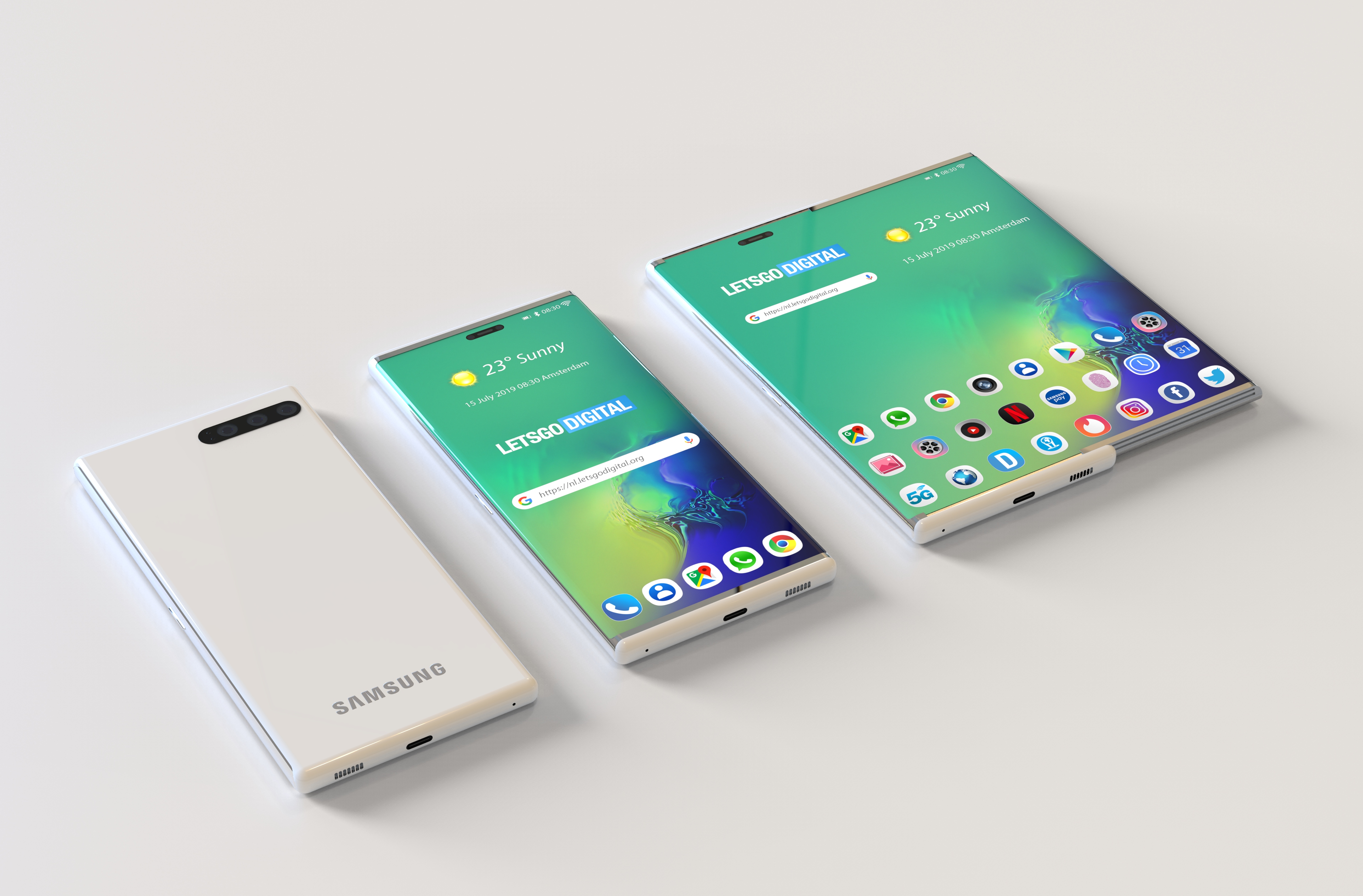
In less than a month, the Galaxy Unpacked Event will take place, where the high-end Samsung Galaxy Note 10 series will be unveiled. The new launch date for the Galaxy Fold may also be announced around the same period. Right after that, we’re probably going to back to waiting for the Galaxy S11. Usually the S-series is just a simple, bland flagship device, but if these new renders are true, we might be in for a surprise.
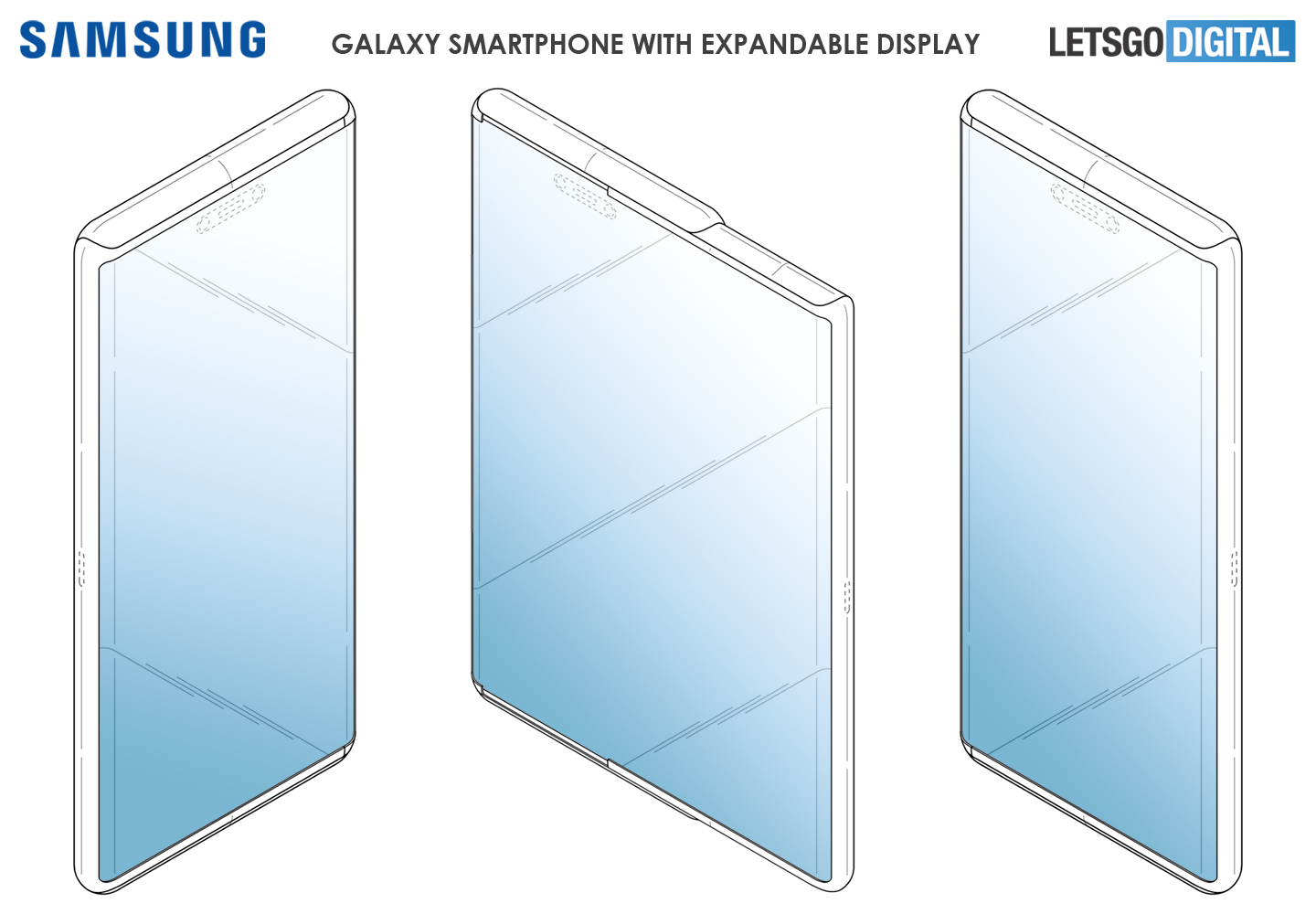
Now, Samsung annually records a large number of patents to protect future smartphone designs and technologies. Sometimes the designs are so futuristic that an actual market introduction will take years, or will never happen. This time, however, the Korean manufacturer has had a design patent filed that seems to be a little easier to realize. It seems to be a very effective solution to get a bigger display into your pocket.
Since it is a design patent, there is unfortunately no detailed description included that answers the question how this smartphone can be pulled out. The images do show that the Galaxy S11 screen on the right is enlarged. The frame border around the screen also shifts partially, so that the flexible display remains well protected against external influences.
Earlier this month LetsGoDigital also reported on a retractable Samsung smartphone. However, that model could be pulled in two directions, this time the screen area is only enlarged on the right side. Technically this will probably be much easier to achieve, partly because a smaller screen needs to be stored in the small housing.
Chances are that this design also uses a rail mechanism that supports the flexible display. A striking feature of this design is the punch hole camera system, which is positioned in the middle. This part of the screen will therefore not be able to move. Since the screen can only be slid to the right, the remaining screen surface is presumably also stored in the housing on the right-hand side, possibly rolling on a sort of tube.
The rear camera has been moved to the top right corner. This makes sense considering the extendable display. The extendable screen ensures that the camera system cannot be positioned on the left rear – as is probably the case with the Note 10, this will be the first Samsung smartphone with a punch-hole camera in the middle.
The patent does not make clear how many camera lenses are used. For the 3D renders, LetsGoDigital has opted for a similar set-up that Samsung is currently applying in its high-end models. This has been a pretty great look at what the future may hold for the company, and if this is what it looks like, it might be the most interesting Samsung launch in a long time.
It has already been confirmed that the Chinese telecom giant Huawei is working on an open-source Android-based mobile operating system. The OS, which is said to have been named HongMeng OS in China and Ark/Oak OS for the rest of the world, could go official in the coming months.
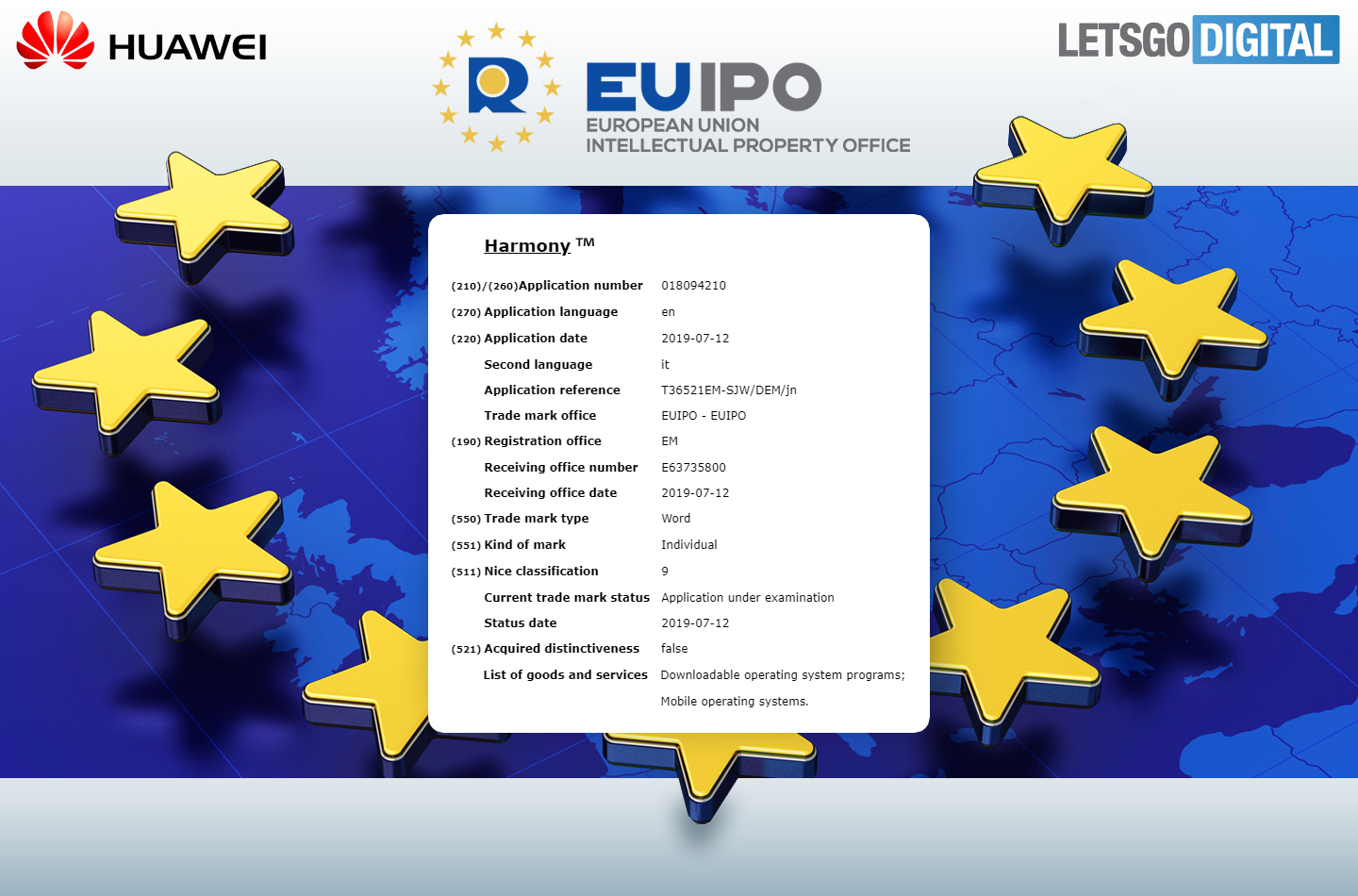
Now, the Chinese company has filed a trademark for yet another name for its upcoming operating system — Harmony OS. The filing with the EU Intellectual Property Office (EUIPO) notes that the trademark is related to “mobile operating systems; computer operating systems; downloadable operating system programs.”
As per the report, the application was filed by a firm called Forresters. This is the same company that also filed Huawei’s Hongmeng OS and P Smart Z trademarks. As we all know, the former filing is another name for the brand’s new operating system.
Huawei confirmed the development of its own mobile OS after the company was put on the “entity list” by the United States, banning all type of trade with the Chinese giant. While the US is moving ahead to allow some companies to resume business with Huawei, nothing can be sure with the Trump administration.
In an unlikely event where Huawei gets banned from using Google’s Android OS, the company is all set to replace it with the HongMong OS or whatever it ends up being named. Recently, it was reported that the HongMong OS is about 60 percent faster than Android and macOS and other Chinese brand likes Vivo and Oppo also participated in the testing.
In recent interviews, Huawei’s executives said that the operating system won’t be limited to just smartphone and will cover a wide range of products, including support for the current portfolio of products from Huawei, including routers, network switches, tablets, computers and data centers.
Google has also lobbied with the US government and asked them to allow Huawei to keep using Android OS. If Huawei is forced to give up using Android, the company will start using its own OS which will undermine Google’s absolute dominance with Android over the smartphone market, especially in China. It stands to lose around 700-800 million users if Huawei gives up using the Android operating system.
Earlier this year, the US government put Huawei in a tough spot after adding it to the Entity List. Given that Huawei sources a lot of components for its smartphones as well as networking infrastructure from the US, this was a big blow to the Chinese telecommunications giant. However, according to the comments from Huawei’s President of Global Affairs, Victor Zhang, things were probably not as bad as we thought because of the company’s ‘Business Sustainable Management’ strategy.
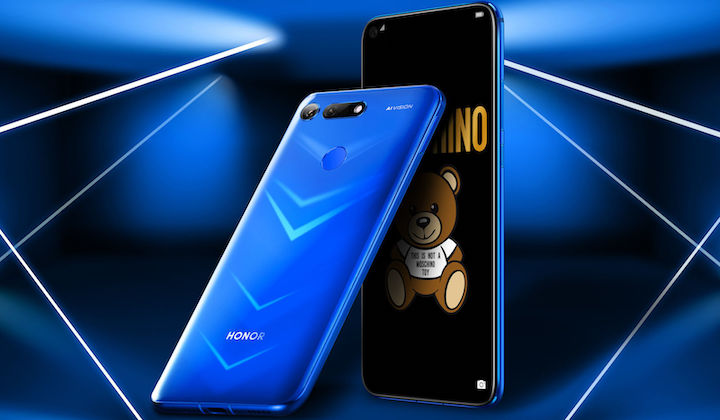
Huawei’s Honor View 20
In an interview with Xinhuanet in London, Victor revealed that Huawei established a strategy nearly 10 years ago wherein the company has two sources of supply for each component. This along with stockpiling essential components likely should have helped the company sustain the US ban for the past few months. But it’s worth adding that there are some essential components which don’t have an alternative, at least not right now, like Google’s Mobile Services for Android.
He further revealed that in the context of globalization, components aren’t 100% self-produced. So, it becomes necessary to cooperate with upstream and downstream industry chain to ensure the stability of product supply. He added that Huawei invests more than 10% of its sales revenue every year. There are more than 80,000 people working in R&D in the company right now, which accounts for 45% of the company’s workforce.
While talking about UK’s scene, Victor said that Huawei has invested more than £100 million ($126 million) in the UK, with over 300 engineers working in fields such as AI and 5G. This number is further expected to increase to 400 in 2019. A new R&D center in Cambridge is also in the works.
At present, Huawei has more than 2.500 patents in 5G with a total investment of more than $4 billion.
Chinese smartphone and consumer electronics major, Xiaomi may have started its journey off with China and India, but the company has been steadily trying to increase its grip-hold in the European market as well. Xiaomi has recently registered a research and development company in Tampere, Finland to focus on camera technology. The city is home to camera experts, thanks to Nokia having a research center for years in this area.
Xiaomi follows the steps of Huawei which in 2016, also opened a development and research center in this Finnish city. At the time, the Chinese manufacturer has been hiring several Nokia experts for its ranks and has also partnered with Leica, putting its top-of-the-range smartphones as the best smartphone cameras on the market as proven by ranking DxOMark, that places four Huawei smartphones in the top six.
This may also be part of a Nokia and Xiaomi collaboration from two years ago. Both companies has a collaboration agreement which was centered around licensing patents between the two companies. Nokia agreed to provide network infrastructure equipment to its Chinese partner and give access to its patent-rich portfolio. This new expansion by the Chinese company might be a result from that partnership to at least some extent.
Xiaomi will definitely be doing research on products inside this facility as well, but the company has decided to start the R&D arm with camera technology research. This means in the near future, it’s fully possible that we’ll be seeing Xiaomi devices with vastly better cameras on the company’s devices. Until then, stay around on Gizmochina.com for all you Chinese technology news.
The Xiaomi Redmi Note 7 smartphone was launched earlier this year after making multiple appearances online in the form of leaks. The proud Redmi Note 7 owners can enhance the overall appearance and improve the phone’s performances using protective case covers.
While mobile phone accessories including phone cases usually carry steep prices, here are top 5 phone cases for the Redmi Note 7 that you can buy without emptying your pocket.
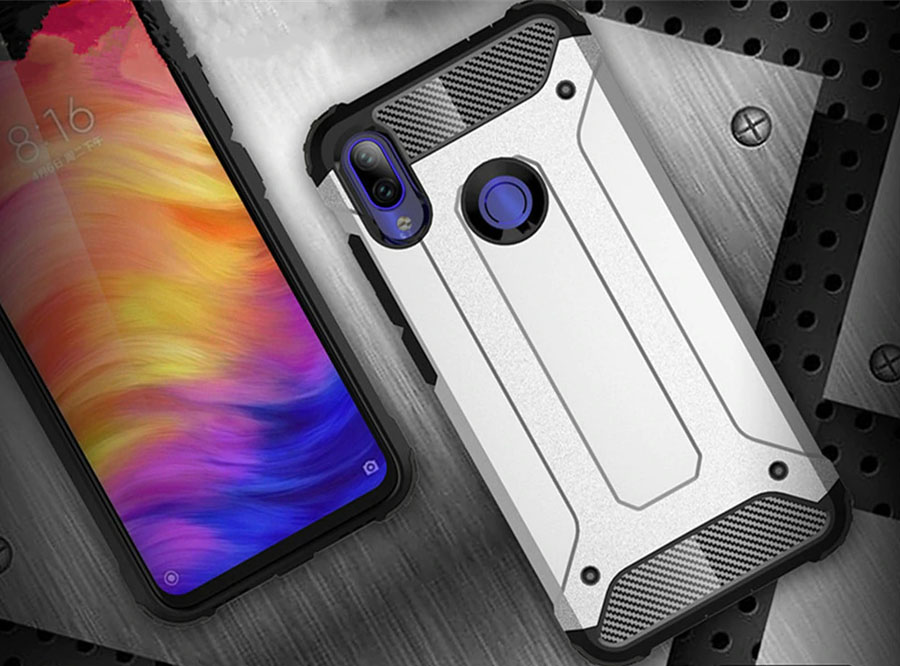
Hard Protective Case Cover for Xiaomi Redmi Note 7 / Note 7 Pro – Gearbest
Designed for the Xiaomi Redmi Note 7 and the Note 7 Pro, this Hard Protective Case Cover usually retails for $3.12, but Gearbest is offering it for a lowered price of just $2.26. This is a considerable 28 percent drop in the original asking price of the phone case.
This Hard Protective Case Cover comes in four eye-catching color options including blue, rose gold, black and red. Note that the red color version will set you back $2.27, which is a 27 percent reduction in the retail price of $3.13.
Aside from getting the aforesaid discounts, you can get 15 percent off if you order more than two items. You can follow this link to place your order before the promo comes to an end.
Protective Cover Case for Xiaomi Redmi Note 7 – Gearbest
Made using high-quality TPU, PC materials, this phone case protects your Redmi Note 7 smartphone from dirt scratches while protecting it from shocks and other damages. Moreover, this stylish protective cover is the perfect gifting option for your loved ones.
The Protective Cover Case for Xiaomi Redmi Note 7 comes in multiple color options including champagne gold, blue ivy, dark slate blue, black, red, rose gold, and silver. While it usually retails for $4.97, you can buy it for only $3.59, which is a noteworthy 28 percent discount.
Made using soft TPU and PC materials, this protective cover case enhances the overall appearance of your Xiaomi Redmi Note 7 smartphone. Aside from that, this shockproof phone case protects your phone from various damages including dirt scratches.
You can follow this link to check out more details about the Protective Cover Case for Xiaomi Redmi Note 7 and grab the discount. Those who order over two items will be eligible for a 15 percent off.
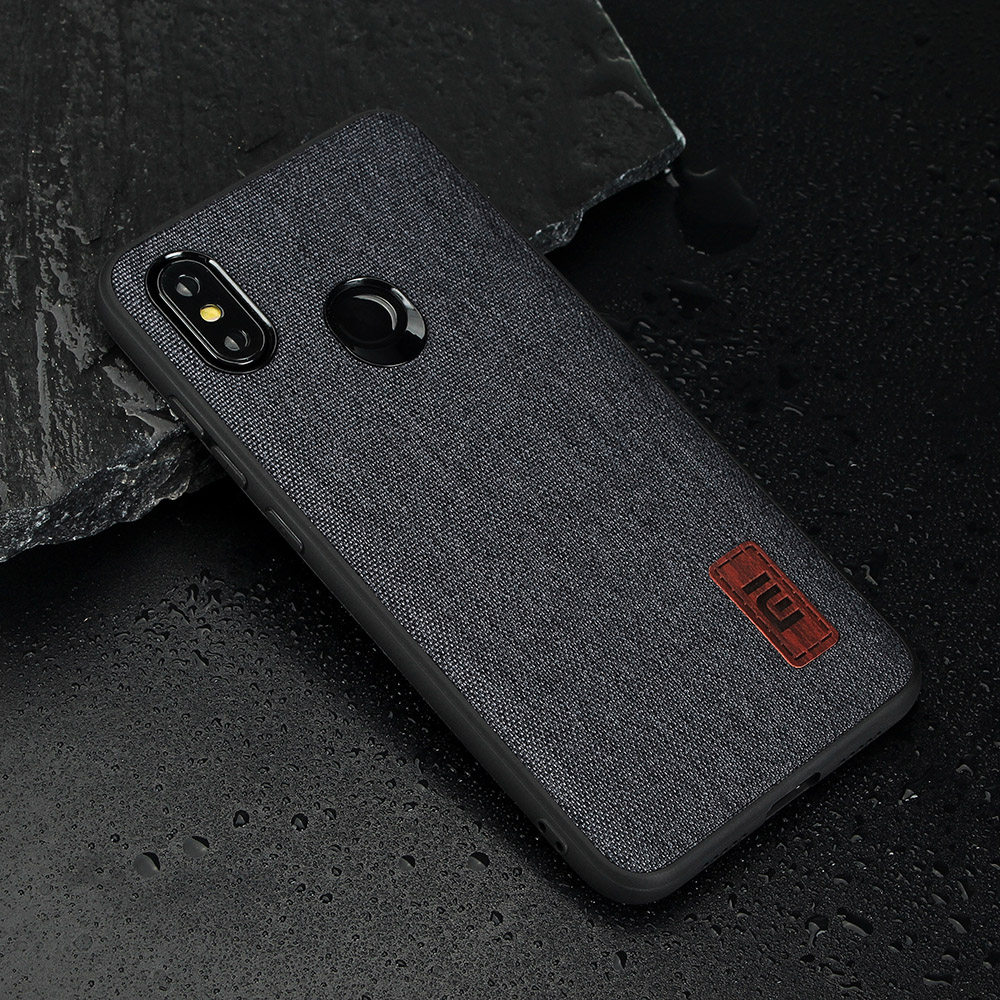
Bakeey Luxury Fabric Splice Soft Silicone Edge Shockproof Protective Case For Xiaomi Redmi Note 7 – Banggood
This Bakeey-branded protective case is compatible with your Redmi Note 7. It is made using carbon fiber, PC, silicone and PU leather materials. On top of that, it is shockproof, anti-scratch, and anti-fingerprint as well.
Offering four-corner protection to your phone, the Bakeey Luxury Fabric Splice Soft Silicone Edge Shockproof Protective Case usually carries an $8.35 price tag but thanks to 27 percent discount, you can now buy it for only $6.09.
The Bakeey Luxury Fabric Splice Soft Silicone Edge Shockproof Protective Case comes in various color options including denim blue, navy, black/gray, black, blue/yellow, and black/blue. Those who end up spending over $19.99 will be eligible for free shipping.
You can visit this link in order to avail the discount. With shipping time of 8-16 business days, the protective case ships in just 24 hours.
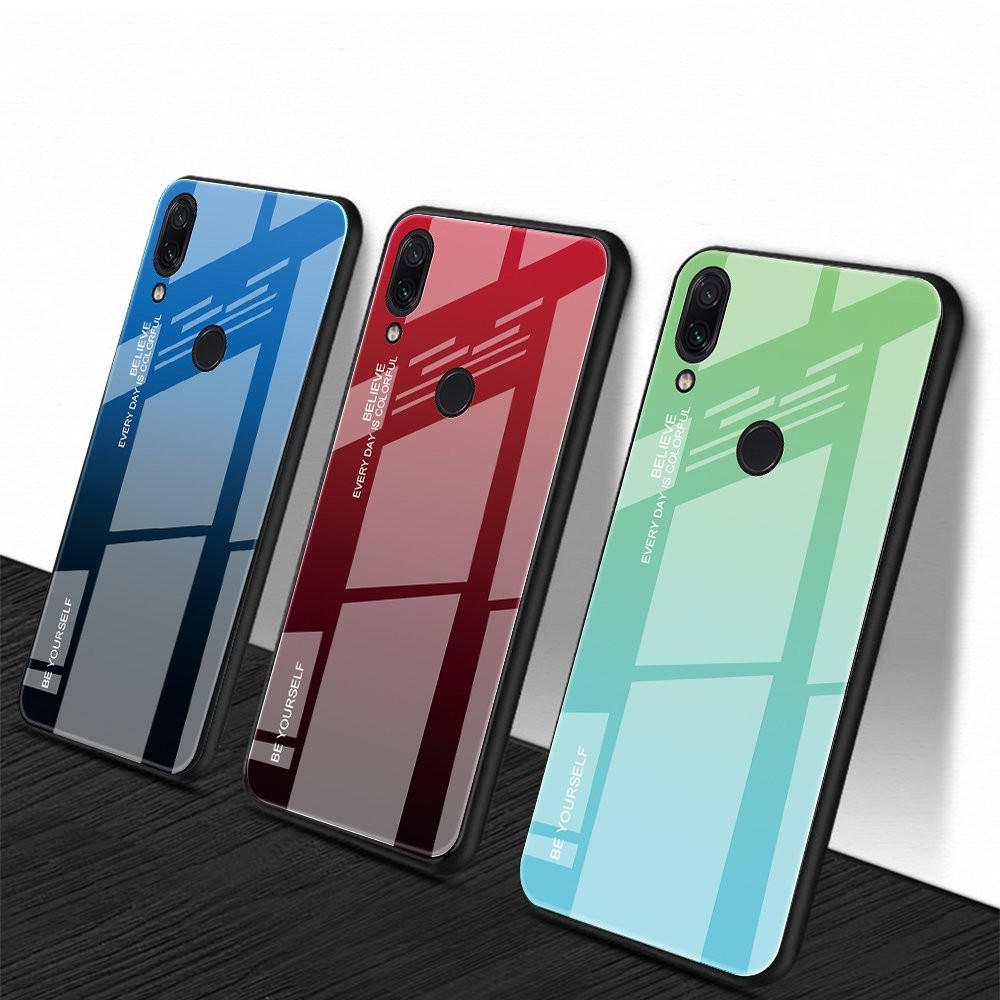
Bakeey Gradient Color Tempered Glass + Soft TPU Back Cover Protective Case – Banggood
Bearing an $8.53 price tag, the Bakeey Gradient Color Tempered Glass + Soft TPU Back Cover Protective Case is compatible with your Redmi Note 7, and Redmi Note 7 Pro smartphones. You can choose between multiple color options such as black/blue, blue/purple, blue/red, black/red, and more.
This eye-catching protective case is made using TPU and tampered glass material for reliable durability. Aside from that, it is shockproof, anti-scratch, anti-fingerprint, and features soft edges for a comfortable grip.
You can buy the Bakeey Gradient Color Tempered Glass + Soft TPU Back Cover Protective Case simply by following this link. If your order exceeds $19.99, you can get free shipping.
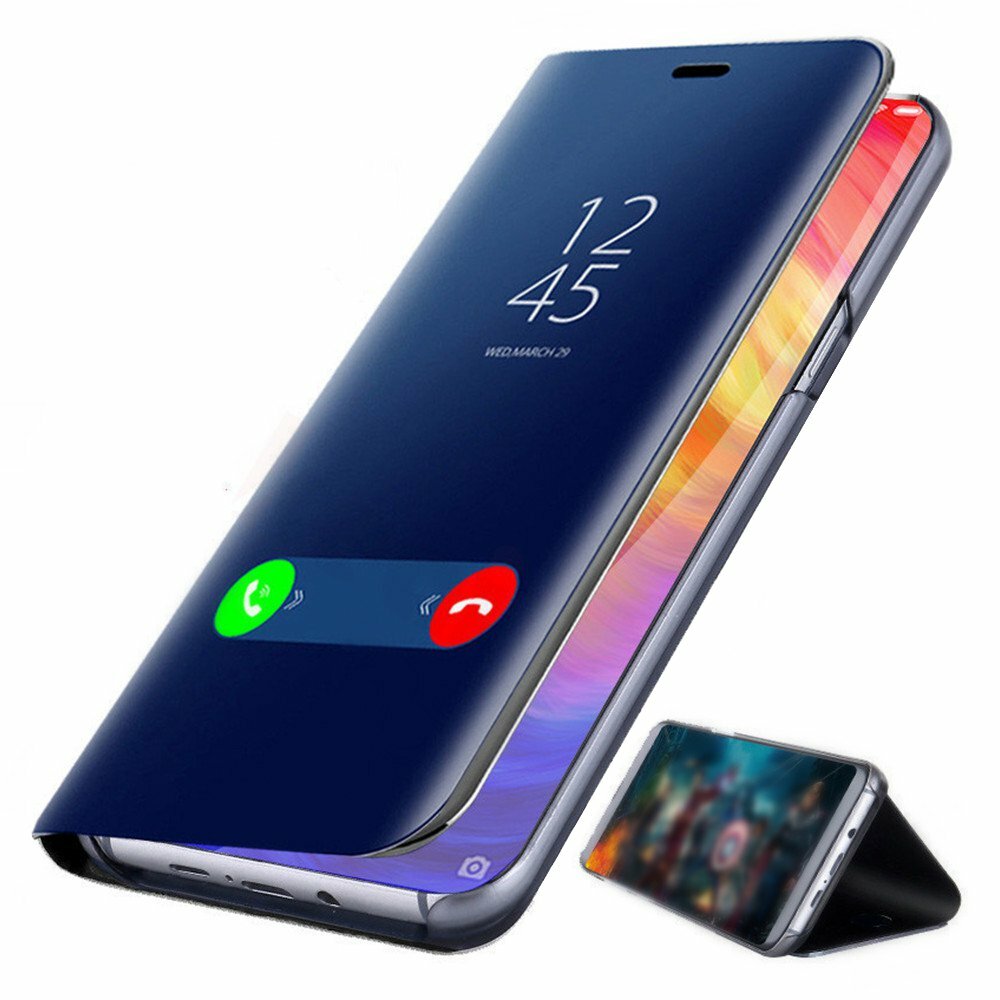
Bakeey Plating Mirror Window Shockproof Flip Full Cover Protective Case – Banggood
Available in blue, royal, silver, and gold color options, the Bakeey Plating Mirror Window Shockproof Flip Full Cover Protective Case will set you back $11.52 on Banggood. Buyers who spend more than $19.99 will get free shipping.
You can head straight to this link to avail the discount and check out more details about the Bakeey Plating Mirror Window Shockproof Flip Full Cover Protective Case.
According to Tianfeng International analyst Ming-Chi Kuo’s latest research report released today, it is expected that Huawei may regain Google’s GMS certification and authorization before the end of July. On top of this, they also claim that Huawei’s mobile phone shipments in 2019 is expected to reach 260 million units.
Ming-Chi Kuo claims that one reason for the increase in Huawei’s mobile phone shipments is that Huawei’s market share in China has gone up exponentially. Another reason is that Huawei’s mid- and low-end models have regained sales in overseas markets. In overseas markets, operators and vendors have resumed selling their devices, and the company has adopted a more aggressive sales strategy.
Although the market is still worried that Huawei won’t actually be able to get back Google’s GMS certification, Ming-Chi Kuo is confident that they’ll be able to regain it by the end of July. Adding on to that, he also believes that even if the company can’t regain GMS certification and authorization, they’ll still manage to hit 230 million shipments in 2019.
Ming-Chi Kuo also said that Huawei’s mobile phone supply chain has recently raised its forecast for shipments in the second half of the year and 2019. We’re not entirely sure it’s possible for Huawei to continue hitting these milestones, but we’re eager to find out. We’ll keep a close eye on Huawei, so stay tuned on Gizmochina.com for any updates on the Huawei situation.
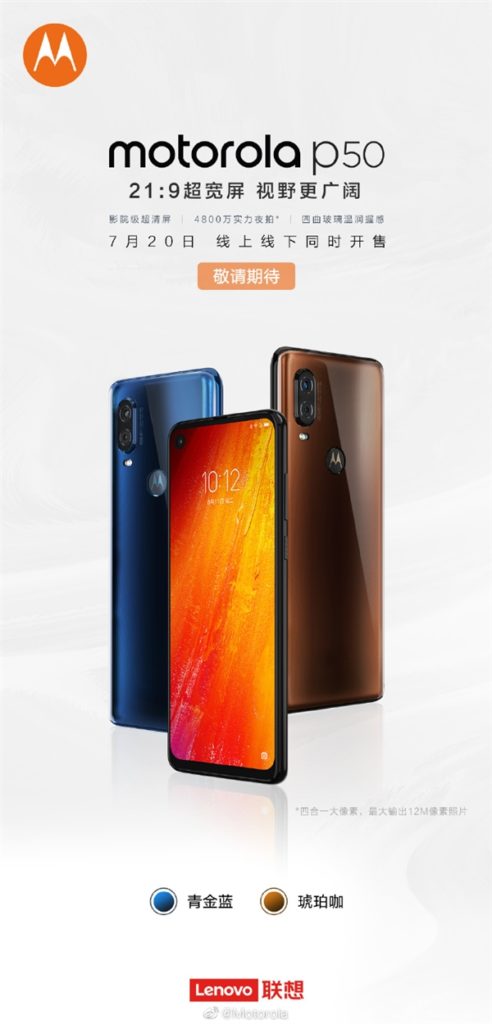
The Motorola P50 smartphone was made official discreetly earlier this month in China. The phone’s pricing was confirmed for the Chinese market was confirmed at an FY19 Middle East region sales event. Today, Motorola China has officially confirmed that the sales of the smartphone will begin on July 20 in the country.
The Motorola P50 is a rebadged version of the Motorola One Vision smartphone for international markets. The One Vision features 4 GB of RAM whereas the Motorola P50 has 6 GB of RAM. The ZUI 11 based Android 9 Pie OS runs on the P50 whereas the One Vision has Android Pie in its purest form. The smartphone has been introduced in China with a price tag of 2,499 Yuan (~$363). It will be available for purchase through online and offline retailer sites from July 20. The smartphone comes in two color editions such as Blue and Brown.
The Motorola P50 features a 6.34-inch LCD panel that supports 21:9 aspect ratio and full HD+ resolution of 1080 x 2520 pixels. It also carries support for DCI-P3 color gamut. The punch-hole on the top-left corner of the display houses the selfie camera of the Motorola P50. The rear shell of the phone has a 3D curved glass built that features a dual camera setup and a logo embedded fingerprint scanner.
The Exynos 9609 chipset is present under the hood of the device. The AI powered dual camera setup of the phone features an OIS enabled 48-megapixel primary sensor with f/1.7 aperture and a 5-megapixel depth sensor. It has a front-facing camera of 25-megapixel with f/2.0 aperture. The 3,500mAh battery of the smartphone carries support for 15W fast charging. For expanding storage, the phone is equipped with a hybrid SIM slot that can be used for adding a microSD card.
In related news, a refreshed listing of the Motorola P50 phone was recently spotted on TENAA. It revealed that the company may soon launch other variants of the phone in the near future such as 8 GB RAM + 128 GB storage and 12 GB of RAM + 512 GB storage.
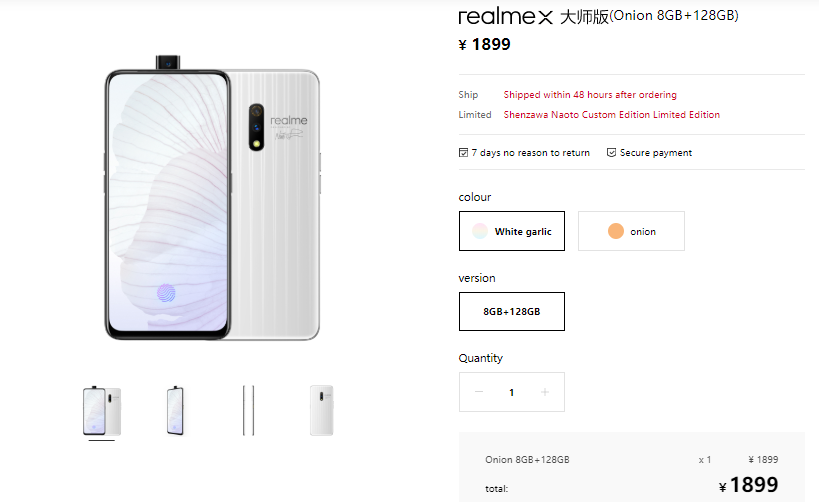
In China, the Realme X smartphone comes in a regular version and a special version called Realme X Master Edition designed by Japanese industrial designer named Naoto Fukasawa. At the launch event of Realme X in May, the company had confirmed that it will be available in two special colors like Onion and White Garlic. At June end, the Realme X Master Edition Onion variant was made available for buying. Starting from today, the Chinese firm is receiving the reservations of the White Garlic model of the smartphone.
The White Garlic model of the Realme X Master Edition features 8 GB of RAM and it has a built-in storage of 128 GB. The handset is priced at 1,899 Yuan, which roughly converts to $276 and its first sale will take place on July 18.
The Realme X has a notch-less Super AMOLED display of 6.53 inches. The display that comes embedded with an in-screen fingerprint reader carries support for full HD+ resolution of 1080 x 2340 pixels and 19.5:9 aspect ratio. The smartphone promises a screen-to-body ratio of 91.2 percent.
The Snapdragon 710 chipset powers the smartphone with 4 GB, 6 GB and 8 GB of RAM. It comes in storage choices of 64 GB and 128 GB. It features a microSD card slot for additional storage. The ColorOS 6.0 based Android 9 Pie OS runs on the device.
Realme X Mater Edition – White Garlic
The Realme X receives power to perform from a 3,765mAh battery that supports VOOC 3.0 Flash Charge technology. It enables 20W fast charging on the device through USB-C. The smartphone features a pop-up selfie camera of 16-megapixel and its rear shell is fitted with 48-megapixel + 5-megapixel dual camera setup.
Later today, Realme will be launching the Realme X and Realme 3i smartphone in India. The Realme 3i is expected to arrive as affordable edition of the Realme 3 smartphone. The company is expected to release the Realme X in multiple color options including Onion and Garlic. A special Spider-Man version of the phone is also expected to release in India.
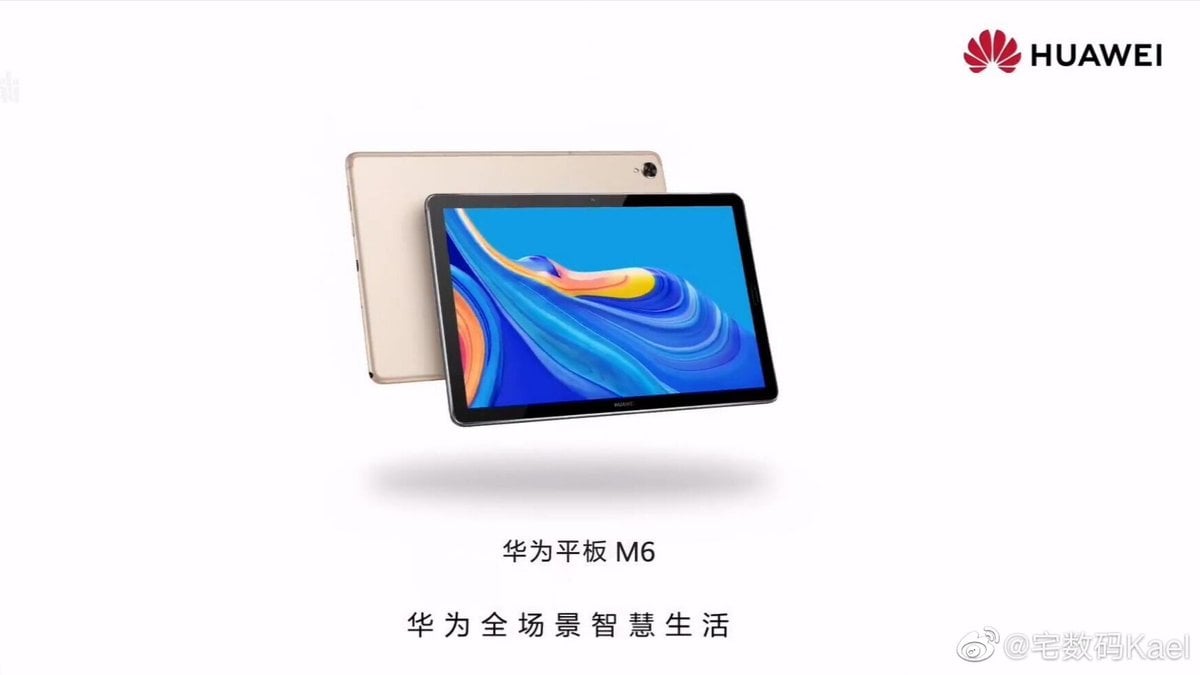
Last month, along with the Nova 5 series smartphone, China-based Huawei also launched the MediaPad M6 tablet in its home market, which is the first tablet to come powered by the Kirin 980 processor.
Now, the company has started rolling out a new update for the Huawei MediaPad M6 tablet which adds Ark Compiler that improves the system responsiveness and smoothness. It is claimed to be the first multi-language optimization compiler.
Huawei Ark Compiler is the compilation and operation mechanism for the system as well as applications, which was introduced by Huawei to improve the compilation efficiency of Android system. The company had announced the technology for the first time in April 2019 at a domestic launch of the Huawei P30 series.
Along with the Ark compiler, the update for the M6 also optimizes the fingerprint unlock performance, voice assistant capabilities, improved user interface for the third-party applications in the cross-screen state, touch sensitivity and also enhances the stylus experience.
The tablet comes in two models — one with a 10.8-inch display and another with an 8.4-inch model but both of them features a 2K screen resolution. Powered by the octa-core Huawei Kirin 980 CPU, dual NPUs, and a Mali-G76 GPU with GPU Turbo 3.0 support, the devices come in 4GB + 64GB and 4GB + 128GB configurations.
As for cameras, we have got a 13-megapixel rear camera and an 8-megapixel front-facing shooter. The smaller 8.4-inch tablet is powered by a 6,100mAh battery, while the 10.8-inch variant gets a massive 7,500mAh battery.
According to the reports coming in, citing senior U.S. official, the United States may approve licenses for the companies to resume their business with the Chinese giant Huawei in the coming week or two.
The development comes after the U.S. President Donald Trump announced during the press conference of the G20 summit that the US companies can continue doing business with Huawei as long as the equipment does not threaten the national security.
Huawei, which is the world’s largest telecommunications equipment maker, was added to the “Entity List” by the U.S. Commerce Department in May this year, effectively prohibiting US-based companies from supplying it with new American-made goods and services unless they obtain a special license, which was will likely be denied.
The reversal of the decision to ban Huawei by Trump and the rapid implementation of the same by the Commerce Department suggests that the United States is bowing down to the lobbying of the chipset industry and the pressure from the Chinese politics.
As per the report, out of $70 billion that Huawei spent on buying components in the year 2018, around $11 billion went to U.S. firms including Qualcomm, Intel, and Micron Technology. Even though there’s a ban on Huawei, U.S. companies can currently sell goods in order to maintain existing networks and provide software updates to existing Huawei handsets.
However, they are prohibited from making new sales of American-made goods and services. A Huawei spokesman said “the Entity list restrictions should be removed altogether, rather than have temporary licenses applied for US vendors. Huawei has been found guilty of no relevant wrongdoing and represents no cybersecurity risk to any country so the restrictions are unmerited.”
Officials of the United States have clarified that the new policy will allow sales of non-sensitive technology readily available abroad if national security is protected. But they have also reiterated that Huawei remains on the entity list, and relief would be temporary. It still remains unclear which products will be granted licenses.
Apart from this, the United States has pending cases against the Chinese giant for allegedly stealing American intellectual property and violating Iran sanctions. The U.S. has also launched a lobbying effort to persuade its allies to keep Huawei out of next-generation 5G telecommunications infrastructure.
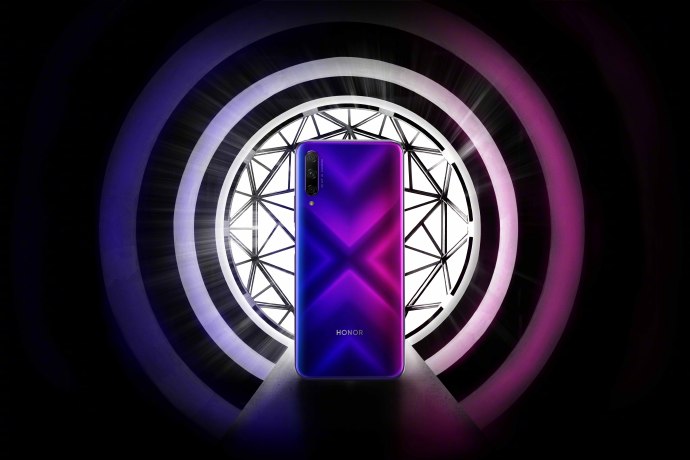
The Honor 9X series will be announced on July 23 as the successor for Honor 8X and Honor 8X Max phones from last year. The Honor 9X series is rumored to arrive as the first Honor phones with Kirin 810 chipset. This morning, Honor took to Weibo to share the first official image that showcases the rear design of the smartphone.
Rumors have it that the Honor 9X Pro has a triple camera setup on its rear. Hence, the image shared by the company belongs to the Honor 9X Pro handset. The smartphone features a blue-red gradient color rear that has an eye-catching ‘X’ pattern at the center. The rear side of the phone does not feature a fingerprint scanner. It is speculated that the Honor 9X series could be featuring a side-mounted fingerprint reader.
The Honor 9X and 9X Pro phones will be arriving as worthy competitors for the Xiaomi Redmi K20and Redmi K20 Pro. The Redmi K20 series feature attractive gradient colored rear and notch-less design with pop-up selfie camera. Recent reports have also revealed that the Honor 9X and 9X Pro will be equipped with a notch-less display and a pop-up selfie camera.
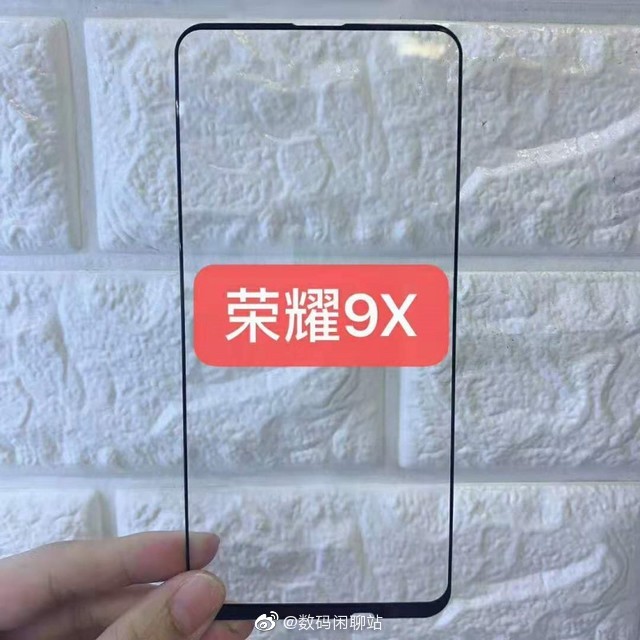
Recent reports have revealed that the Honor 9X and 9X Pro may come with some identical specs. However, one major difference between the two handsets could be that the Honor 9X will have a dual camera setup on its back. A recent leak had claimed that the Honor 9X and 9X Pro are both equipped with 6.59-inch display that supports 19.5:9 aspect ratio and full HD+ resolution of 1080 x 2340 pixels. Following is a leaked image of the Honor 9X’s front panel that was shared by a Chinese tipster yesterday.
Both phones may come with 20-megapixel front-facing camera. These phones could be packed with a 4,000mAh battery. The Pro model may support 22.5W fast charging whereas the 9X may only include 10W rapid charging. The EMUI 9.1 based Android 9 Pie OS runs on the device. Some of the other rumored features of the Honor 9X series smartphones include 3.5mm audio jack and storage slot. As of this writing, there is no information available on the pricing of the phone.
We use cookies on our website to give you the most relevant experience by remembering your preferences and repeat visits. By clicking “Accept”, you consent to the use of ALL the cookies.
This website uses cookies to improve your experience while you navigate through the website. Out of these, the cookies that are categorized as necessary are stored on your browser as they are essential for the working of basic functionalities of the website. We also use third-party cookies that help us analyze and understand how you use this website. These cookies will be stored in your browser only with your consent. You also have the option to opt-out of these cookies. But opting out of some of these cookies may affect your browsing experience.
Necessary cookies are absolutely essential for the website to function properly. This category only includes cookies that ensures basic functionalities and security features of the website. These cookies do not store any personal information.
Any cookies that may not be particularly necessary for the website to function and is used specifically to collect user personal data via analytics, ads, other embedded contents are termed as non-necessary cookies. It is mandatory to procure user consent prior to running these cookies on your website.