Realme made its entry into the Indian smartphone market last year as an offshoot of OPPO. Its phones which belong to the mid-range category have also launched in Indonesia and Vietnam. This year, the budding company plans to grow bigger and part of its plans is to open brick and mortar stores.
The company’s CEO, Madhav Sheth, disclosed that they plan to “open exclusive stores in India where prospective buyers can get a hands-on experience of the entire portfolio of Realme devices that would include accessories as well as smartphones”. These stores will begin popping up across India in the second half of the year.
At the moment, you can actually purchase Realme-branded phones offline at partner stores. Initially, interested buyers who didn’t want to buy online could only get them from Reliance stores but they are now collaborating with several multi-brand retail stores located in several cities in India.
Realme has also revealed its plans to double production by opening a new factory in Greater Nodia. It already has one there but it plans to increase its current output of between 60 – 80 million smartphones per annum. The manufacturer will also announce new models this year.
After an infinite amount of leak and rumors, Motorola finally unveiled the Moto G7 series. The most powerful and expensive device of the new line-up is the Moto G7 Plus that comes with midrange-class specs and a not so high price tag. Given the relevance of this handset, we think it is time to compare it with the best concurrency currently available. Two of the most important device in the actual midrange segment are surely the new Redmi Note 7 by Xiaomi and the Honor 10 Lite by Huawei. Does Moto G7 have a higher value for money or it is better to go for these other Chinese companies? Go ahead with this comparison to find out.
Motorola Moto G7 Plus vs Xiaomi Redmi Note 7 vs Huawei Honor 10 Lite
Motorola Moto G7 Plus does not sport the most catchy and futuristic design, but it comes with very nice build quality. It has glass on both front and back, as well as an aluminum frame just like flagship phones. Further, it is splash resistant. Xiaomi Redmi Note 7 comes with even more resistant glasses thanks to the Gorilla Glass 5 protection, but it has a plastic frame making its body a bit less solid. However, the company claims that the phone is water resistant, even though there is not any IP certification to prove it. Honor 10 Lite does not offer so strong materials, so I exclude it from this comparison. It is a hard challenge between Moto G7 Plus and Xiaomi Redmi Note 7, but I would choose the latter because it looks more beautiful thanks to the gradient glass back.
Display
At least on the paper, Motorola Moto G7 Plus seems to be the device with the best display. Its LTPS technology should help to provide a lower power consumption as well as more controlled temperature ranges. Further, Moto G7 Plus has stereo speakers which enhance the multimedia experience. However, it will be not easy to notice the differences between these panels as their specs are very similar and all of them are midrange-class. Even the size is more or less the same.
Specs & Software
If you are an advanced user and you play games or you care about multi-tasking, Xiaomi Redmi Note 7 offers a slightly better processor: the Snapdragon 660 by Qualcomm. If you prefer to have more internal storage, Honor 10 Lite is the only which comes with up to 128 GB of storage that you can furtherly expand with a micro SD card. Moto G7 Plus is inferior to both Honor 10 Lite and Redmi Note 7 due to its good but lower-end SoC.
Camera
Moto G7 Plus and Xiaomi Redmi Note 7 are the best camera phones on the paper and, even though we still did not test them, we believe that Moto G7 Plus will be surprising. The last three generations of “G Plus” devices are all excellent camera phones, even though they do not reach flagships. And we believe that Moto G7 Plus will be able to compete with the stunning 48 MP sensor of the Redmi Note 7 without issues. It may even be better thanks to its brighter aperture, OIS and accurate autofocus. And we think the same about the front camera. But in order to give a definitive verdict, we will have to click some photos.
Battery
We think that in 2019 putting a 3000 mAh battery on a midrange phone as Motorola did with the Moto G7 Plus is not enough unless it was optimized in an excellent way. Xiaomi Redmi Note 7 comes with a 4000 mAh battery and not only it wins the comparison, but we can consider it one of the longest lasting last-generation smartphones on a single charge. Honor 10 Lite sits in the middle with its sufficient 3400 mAh unit. On the other hand, note that Moto G7 Plus features a very fast charging technology, so it can be charged in a low amount of time.
Price
Moto G7 Plus will cost about €300/$340, definitely too much for a midrange with Snapdragon 636, unless its cameras will be something extraordinary. Xiaomi Redmi Note 7, that is the clear winner of this comparison, was launched for just $150/€132, while Honor 10 Lite costs about €210/$240.
The BlackBerry KEY2 launched in June 2018. It was announced in two color variants – Black and Silver but it has been reported that it will get a red variant soon just like that of the KEY2 LE‘s Atomic Red.
The info comes from Mysmartprice and they say the new color variant is set to launch in Europe. It may launch in other countries too but there is no confirmation yet. Just like the BlackBerry KEY2 LE, the red KEY2 will have a red frame and red accents for the keyboard.
The KEY2 may be nearly due for a successor but if you are looking for an Android phone with a physical QWERTY keyboard, this is probably the best option even though it is pricey.
There was a time the OPPO F series launched as the international variant of the OPPO R series but that has changed. Both series are now sold in the same markets these days. However, it appears OPPO may revert back to the old system based on this poster of the OPPO R19.
The OPPO R19 in the poster below looks like the OPPO F11 Pro which leaked yesterday. The R19 is clearly launching in China and we know the F11 Pro is making its way to India in early March.
The front of OPPO R19 has shaved off bezels but there is a thin cutout in the top frame for the speaker. There is no notch or punch hole which means the phone has a pop-up selfie camera much like the Vivo V15 Pro. Leaked photos of the OPPO R19 from last week already revealed the phone’s pop-out camera slides out from the middle.
On the back, the R19 has dual rear cameras with an LED flash above the sensors. All three share the same housing and are arranged vertically. They are also positioned in the middle of the device and connect to the frame. The poster says the main camera is a 48MP sensor.
There is no fingerprint scanner on the rear but there is also no fingerprint icon on the display but it most likely has an in-display fingerprint scanner. The OPPO R19 has a blue-purple gradient finish but should launch in other colors too.
GSMA, a body that represents the interests of the mobile network operators network has denied any allegations regarding the recent Huawei Ban for MWC19. GSMA is the body which organizes the world’s largest exhibition for the mobile industry, Mobile World Congress. Recently, Reuters reported that GSMA has requested to ban Huawei equipment at the MWC 2019 exhibition. Today, GSMA has responded to it and has said that they have not requested anything like the Reuters reported.
GSMA group has termed the Reuters report as “seriously inaccurate” without any factual knowledge. As an association which represents the mobile communications globally, we are not in a position or has the power to “ban” any supplier. Moreover, they have requested the Reuters to rectify the incorrect content which leads the association to give justification.
Further, the GSMA has said that the board of director’s meeting will be held every year to discuss current topics in the industry. Even the agenda is not finalized, but there will be an overwhelming talk about 5G technologies.
Thanks to timely clarification from GSMA, otherwise MWC 2019 would have become a battlefield between Huawei and GSMA. Huawei is continuously working to bring 5G support among all its devices. The Chinese company is also a global leader providing 5G apparatus to major telecom operators around the world.
Additionally, many companies are working to bring leading technologies at MWC 2019. Nokia, Huawei, Samsung, LG, and many other manufacturers are believed to come with new devices this month at MWC in Barcelona.
Huawei, ZTE, Qualcomm and a few other companies are the big players in the 5G technology field. Many companies are partnering with different countries in testing new 5G technologies. Among them, Huawei is facing problems in some countries due to the US ban on using their equipment. Moreover, the US has even urged its allies to restrict from using the Huawei 5G equipment while testing the new technology.
In an advancement, US oldest ally in Asia, Thailand has joined hands with the Huawei for 5G testbed. Despite sustained pressure from the US for not using the Huawei equipment, Thailand is doing the exact opposite. It will be the Chinese company’s first testing in Southeast Asia. Although, Thailand is also concerned about security and has said that cooperation does not mean that they are not looking into the security issues.
“We keep a close watch on the allegations worldwide. However, this 5G testbed project is a testing period for the country,” Pichet, Thailand Minister of Digital Economy added. “We can make observations which will be useful to either confirm or disconfirm the allegations.”
While talking about the new 5G test bed at Kasetsart University’s Sriracha campus in central Chonburi Province, Pichet said that the government is quite concerned about the allegations on Huawei. Moreover, other companies like Nokia, Ericsson, and Thai telecoms operators are also working at the same site for 5G technology. Thailand is working onto bringing the commercial 5G services by 2020. Currently, it is leading the path to the latest technology alongside Singapore.
Pichet Duriongkaveroj further added that some Japanese telecom operators are also keen on working for 5G trial in the country.
US Embassy in Bangkok has said that the United States “advocates for secure telecoms networks and supply chains that are free from suppliers subject to foreign government control or undue influence that poses risks of unauthorized access and malicious cyber activity”. The spokesperson continued saying, “We routinely urge allies and partners to consider such risks and exercise similar vigilance in ensuring the security of their own telecoms networks and supply chains, including when awarding contracts,”
Huawei which rely on business from outside of China is mending ways to secure some contracts. Already they have secured more than 30 commercial 5G agreements globally. The Chinese company is also in talks with some telecom operators for local partnerships.
Although, Huawei representatives at the testing site refused to say anything on the matter.
Samsung made bare its plans for the low-end market with the launch of the Galaxy M series comprising the Galaxy M10 and M20 in India recently. It seems the M series will also get a Galaxy M30 model as has been featured in a recent leak. The Galaxy M30 has once again leaked but we can’t vouch for the credibility of the source.
Samsung Galaxy M30 specs- -Exynos 7904 Soc -6.38-inch screen with resolution of 2220×1080 -13MP (F1.9) + 5MP (F2.2 ) +5MP (F2.2) -16MP (F2.0) selfie -5000mAh battery -159mm x 75.1mm x 8.4mm -175g -4GB+64GB (LP DDR4+ eMMC) -gradient design, with a gradient blue and black.
The Galaxy M30 has earlier appeared in a leak before the M10 and M20 were launched. The device had also appeared on GeekBench giving us a hint about the specs. The newly leaked specs are quite elaborate. The device is said to feature a 6.38-inch display with a resolution of 2220x1080pixels. The device is expected to be powered by an Exynos 7904 Soc with a memory combination of 4GB RAM + 64GB of internal storage.
The Galaxy M30 had earlier been tipped to ack a triple rear camera setup. This leak gives the sensors as 13MP (F1.9) + 5MP (F2.2 ) +5MP (F2.2) while at the front, there will be a 16MP (F2.0) selfie shooter. Under its hood, the M30 will pack a 5000mA battery. The device is also tipped to feature a gradient design available in gradient blue and black.
The Vivo V15 Pro is one of the most talked about devices in the past few weeks. There is barely any news about the Vivo V15 – which is the non-pro model. Ahead of the launch on February 20, Vivo has released another video advert for the phone and this one features Bollywood star, Aamir Khan.
The 18-second video shows the actor who is also a Vivo brand ambassador bring out the phone from his pocket to take a picture. First, we get a good look at the AI triple camera setup on the rear. We also see the glass has a hatch finish. The lines do not seem to be on the outside like that of the Huawei Mate 20 Pro, so this is purely for aesthetics rather than functionality.
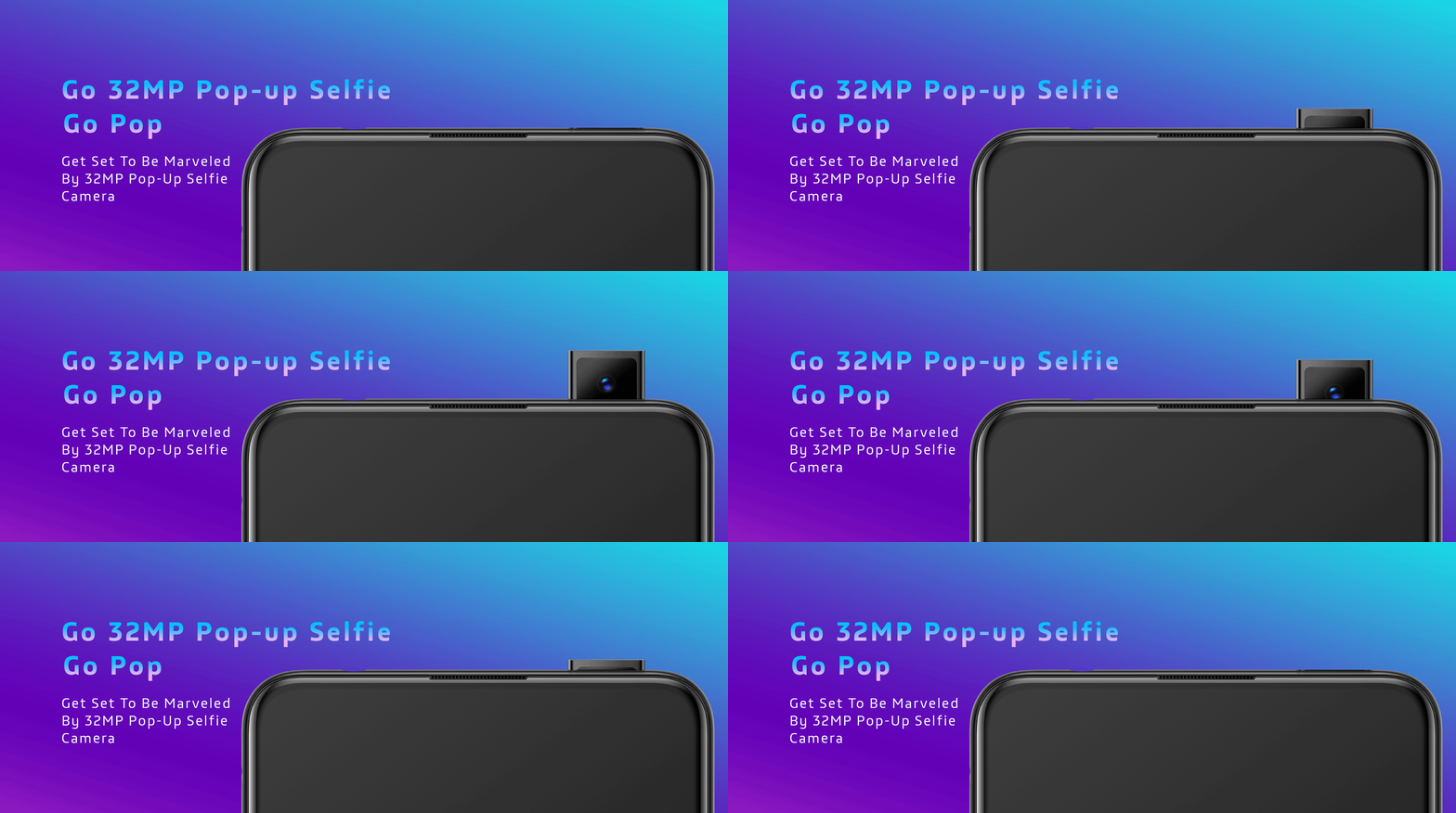
We also get to see the Vivo V15 Pro’s camera app. There are a bunch of icons which includes one for the timer mode, color mode, HDR mode, portrait mode, and even an icon to switch the viewfinder to full-screen. Tap to switch the camera and the 32MP selfie camera pops-out on the top right corner of the phone.
The Vivo V15 Pro will come with a 6.39-inch AMOLED screen, a Snapdragon 675 processor, and a 48MP + 8MP + 5MP triple camera setup. It will also have a fifth-generation in-display fingerprint scanner.
The Galaxy S10e has been labeled as Samsung‘s answer to Apple’s iPhone Xr. The phone is expected to be the cheapest in the S10 lineup just as the iPhone Xr is for Apple‘s latest lineup. However, a lower price tag won’t be the only similarity between both phones.
The Galaxy S10e (where e is said to stand for “Essential” according to Roland Quandt) will also come in bright colors one of which is Canary Yellow. Renders of this color variant have surfaced and it does look really nice.
The images which were shared by @IshanAharwal24 in collaboration with mysmartprice show the phone from a few different angles. The Galaxy S10e will have black bezels and a silver aluminum frame. Only the back which is covered in glass is actually yellow.
The Galaxy S10e has a punch hole in the top right corner of its display that houses the front camera. The screen flat and is said to be 5.8-inches in size just like that of the Galaxy S8. On the rear are dual cameras which are arranged horizontally.
Unlike the other S10 models which have an in-display fingerprint scanner, the Galaxy S10 has its fingerprint scanner on the right side of the phone where it doubles as the power button.
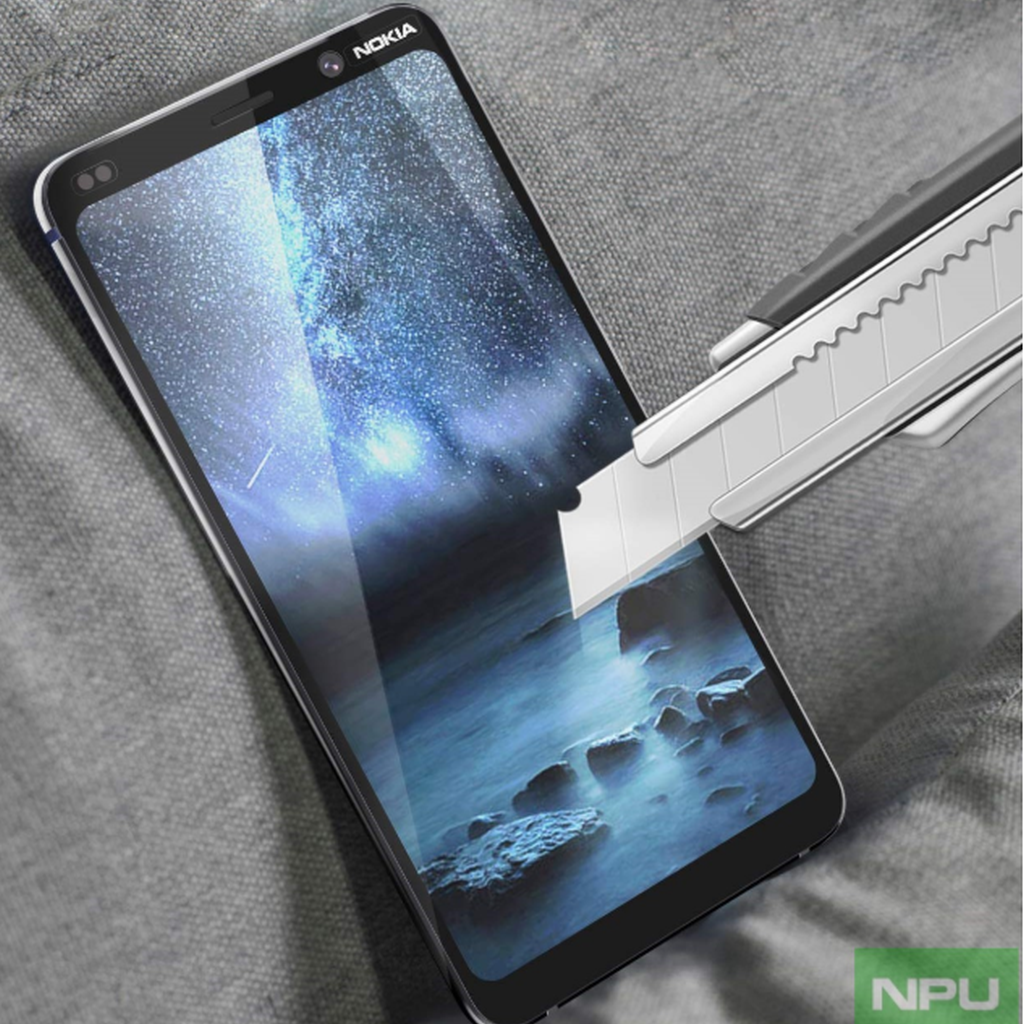
The Nokia 9 PureView is one of the most awaited smartphones to go official at the Mobile World Congress (MWC) 2019 on Feb. 24. Earlier this week, leaked renders of the Nokia 9 PureView had surfaced online to give a good look at its design. Today, Nokia Power User has shared some real-life images of the upcoming flagship phone from the company to reveal its awesome appeal.
The Nokia 9 PureView will be sporting an elongated display with rounded edges and equal-sized upper and lower bezels. The top bezel has some sensors at the top-left corner and there is a selfie camera along with a Nokia brand name. The bottom bezel of the phone is barren.
Rumors have it that it features a 5.99-inch AMOLED display that produces quad HD+ resolution. The display of the smartphone could be equipped with HDR10 support. It could be the first Nokia smartphone to arrive with an in-display fingerprint scanner.
The reflective rear of the Nokia 9 PureView suggests that it features a glass rear. The ZEISS branded penta-lens setup along with LED flash and autofocus module can be seen on the rear shell of the phone. Unlike the other Nokia phones, the Nokia 9 PureView does not feature Android One branding on its lower back.
The Snapdragon 845 mobile platform may power the Nokia 9 PureView. It may come in two models such as 6 GB RAM + 128 GB storage and 8 GB RAM + 256 GB storage. It could be packed with a 4,150mAh battery. Apart from fast charging, the Nokia 9 PureView may also come with wireless charging support.
The other Nokia smartphones that are expected to get unveiled at the MWC 2019 include Nokia 8.1 Plus and Nokia 6.2 (2019). There is a possibility that the Finnish firm may also announce a new feature phone at the same event.
Recently leaked renders of the upcoming Sony Xperia XA3 have revealed that the Sony Xperia XA3 will be arriving with a tall aspect ratio display. In fact, it could be sporting a 21:9 aspect ratio screen that is rumored to be also available on the Xperia XZ4 flagship phone. Today, a Japanese tech blog has shared hands-on images of the Xperia XA3 to reveal its entire design.
Sony Xperia XA3 Hands-on Photos Leaked
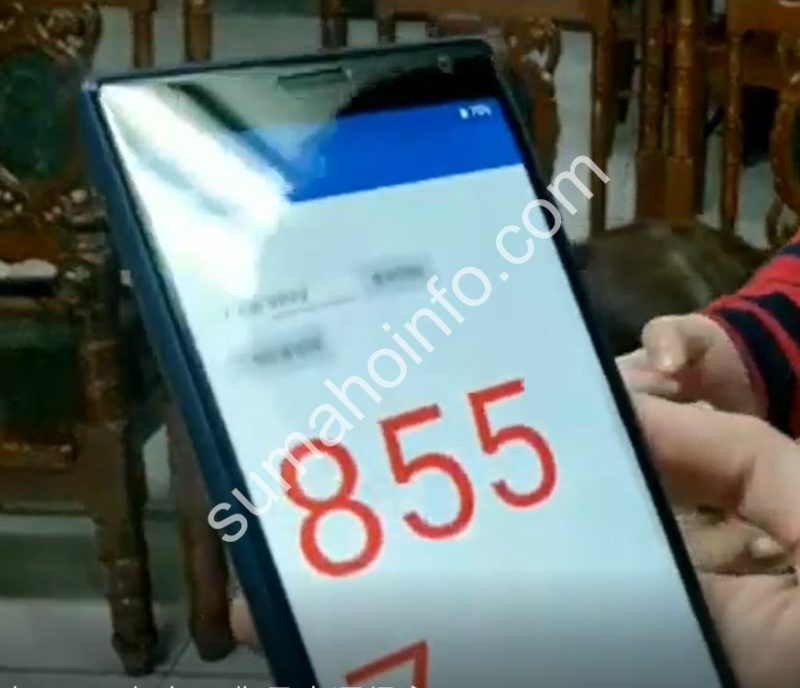
The images reveal that the Sony Xperia XA3 features a thick-sized top bezel, but its bottom bezel is extremely thin. The hands-on images of the phone resemble with the leaked renders that had surfaced yesterday. The top bezel only houses the usual components such as a selfie camera, an ear piece and some other sensors, but still it appears chunky.
The navigation pill that can be seen on the screen of the Xperia XA3 suggests that it is running on Android 9 Pie OS. The backside of the phone is fitted with a horizontal dual camera setup. The fingerprint scanner is not present on the rear shell of the device. The reason behind it is that the smartphone features a side-mounted fingerprint sensor.
Sony Xperia XA3 Specifications (Rumors)
The Xperia XA3 being a XA-series phone from the company could sport a huge display of around 5.9 to 6.5 inches. It is expected to carry support for full HD+ resolution. Rumors have claimed that the phone could be fueled by Snapdragon 660 chipset. However, a recent leak by Weibo tipster named Zackbucks reveals that the XA3 could be fueled by the Snapdragon 636 chipset.
The SoC of the Xperia XA3 could be supported by 6 GB of RAM. It may feature an internal storage of 64 GB. The main sensor present in the dual camera module of the XA3 could be of 23-megapixel. There is no information available on the battery capacity of the device.
There is no confirmation yet whether the above the device is Xperia XA3 and Xperia XA3 Ultra/Plus smartphone. Hence, the rumor mill is referring to the handset as XA3. Rumors are rife that the Japanese tech giant will be announcing the Xperia L3 entry-level smartphone alongside these phones at Feb. 25 media event at the Mobile World Congress (MWC) 2019 in Barcelona, Spain.
What’s your opinion on the asymmetrical design of the Xperia XA3? Let us know your thoughts by posting your comments below.
Huawei is expected to go official with its first flagship model for the year, the P30 series within the first quarter.There are speculations, backed by an official statement from Huawei Poland that the models will be launched around March ending. The P30 series will be made up of the Huawei P30,P30 Pro and the P30 Lite. The P30 and P30 Pro designs have now appeared online courtesy of case maker Spigen which have listed the protective cases for the two models for sale on its website.
This isn’t the first time the design of both flagships are appearing online. Fellow case maker Olixar had earlier unwrapped the design when it unveiled its own protective case for the models.
Going by the leaked renders, both the Huawei P30 and P30 Pro feature a teardrop notch on top of the full-screen display. Their sizes are also likely to differ as well as their camera configuration. While the teardrop notch on both models house a single selfie shooter, the P30 has three camera sensors at the rear with an LED flash under. On the other hand, the P30 Pro packs a quad-camera setup at the rear while there is an LED flash lying adjacent to the second sensor at the right side of the sensors. On the display is the date March 28. Could this be a clue as to the exact date Huawei will unveil the model?
The Moto G7 Series launched yesterday. Over the next couple of weeks, it will make its way to different markets. However, only the Moto G7 Plus will be sold in China.
The official Motorola Weibo account shared a post today that said the Moto G7 Plus China Red version a.k.a Moto G7 Plus Viva Red variant will launch soon in China.
We aren’t too surprised as to why the G7 Plus is the only one in the series launching in China. There are several alternatives to the Moto G7 series available in the Chinese market, so we guess Motorola (or Lenovo) is playing it safe.
What we are surprised about is that the post also says the Moto G7 Plus will be the only Motorola phone launching in China this year! The Weibo post says the mid-ranger will be the only Moto-branded device launching in China which means no Motorola P40 and no Moto Z4 series.
We haven’t seen an official statement explaining the decision but if we were to make a guess we would say the plan is to only launch Lenovo-branded phones in China henceforth. It doesn’t seem as if the Motorola brand is doing very well in the market and it is also competing with the Lenovo-brand.
Xiaomi Redmi Note 7 is in the news from past several months, thanks to several leaks and rumors. Xiaomi is also actively working to promote the device by teasing it via different means. After teasing its various color options and other details, the Chinese company took to Twitter to compete against the newly launched Samsung Galaxy M series. It is obvious, as the recently launched Samsung Galaxy M series is a potential competitor for Redmi Note 7. In the recent past, Xiaomi has been continuously mocking the Galaxy ‘M’ in different ways.
Until now, Xiaomi hasn’t explicitly named Galaxy M20 device, they have been using the word ‘M’ in all the teasers. The scenario is making us believe that they are mocking Galaxy M series devices. Although making assumptions more firm, Xiaomi specifically posted the AnTuTu scores of Galaxy M series phone and Redmi Note 7. The teaser reveals that the Redmi Note 7 scores pretty well against the competitor aka. Galaxy M series device. In the teaser, Redmi Note 7 managed to perform 143,000 points against the 123,000 points of M branded device.
Additionally, Xiaomi Redmi Note 7 is already launched in China for 999 yuan ($148) with a 48-megapixel primary rear camera. For selfies, Xiaomi has added a 13-megapixel front camera. There’s also a standard 6.3-inch FHD+ display having a resolution of 1080 x 2340 pixels. The display is protected with a Corning Gorilla Glass 5. There’s a 3/4/6GB RAM coupled with Qualcomm Snapdragon 660 SoC. It is available in 32/64GB internal storage along with the expandable storage option of upto 256GB via microSD card.
Moreover, Xiaomi is also planning to launch the Redmi Note 7 Pro in China very soon. It will feature much-improved specifications than the Redmi Note 7. It will have a better 48 MP camera module, 128GB storage, and a gradient color option.
Xiaomi India is expected to price the Redmi Note 7 for about INR 10000. As per old leaks, it is supposed to make a debut in India on Febraury 12th. So, let’s wait for a few more days before speculating anything else.
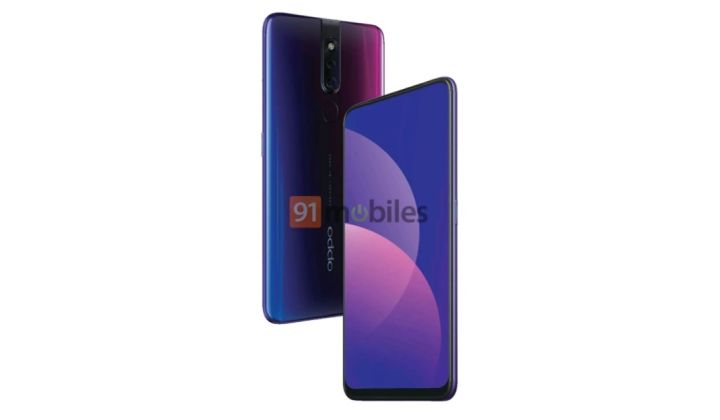
In the previous month, the OPPO F11 Pro had cleared certifications in multiple countries like Thailand and Indonesia. It has been revealed that the OPPO F11 Pro has a model number of CPH1969. Also, leaked photos that had surfaced earlier this month had revealed that the OPPO F11 Pro may sport a pop-up selfie camera and a dual camera module. Today, an Indian publication has shared leaked renders of the OPPO F11 Pro along with some of its key specs. The handset is speculated to debut early in the first week of the coming month in India.
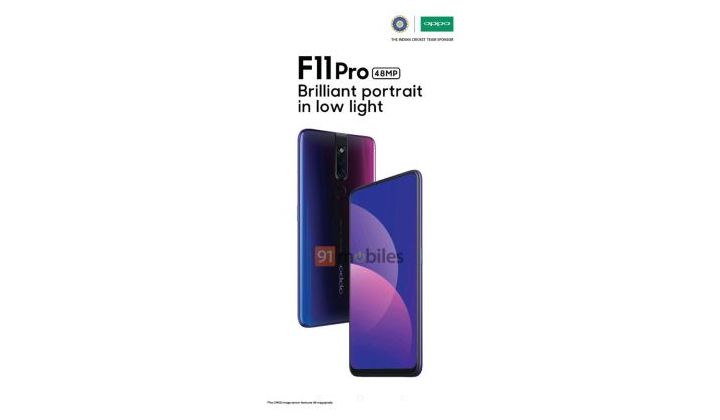
The OPPO F11 Pro render reveals that it features a notch-less display with super-slim bezels. At the top-center of the rear panel is an LED enabled dual camera system. The vertical dual camera strip connects to top-edge of the rear shell. There is a fingerprint scanner below the camera module. The handset can be seen sporting a gradient color. It is expected to be available in multiple gradient color choices.
The OPPO F11 Pro will be fitted with a 48-megapixel primary sensor in its dual camera system. Probably, it will include the Samsung ISOCELL GM1 sensor which is also available on the Redmi Note 7. The same sensor is also expected to be available on the upcoming Vivo V15 Pro that is scheduled to go official on Feb. 20. Like the V15 Pro, the OPPO F11 Pro will be also featuring a 32-megapixel pop-up selfie camera. As the above renders show, the smartphone will be able to capture brilliant portrait shots in low-light conditions.
An unknown MediaTek chipset is rumored to power the OPPO F11 Pro. It will be assisted by 6 GB of RAM. For storage, it will be equipped with an internal space of 128 GB. The publication has claimed that the Chinese manufacturer is aiming to launch the F11 Pro in the first week of the March. There is a possibility that the phone could be priced under Rs. 25,000 (~$350) in India.
What’s your opinion on the design of the OPPO F11 Pro and its key specs? Share your views by posting your comments below.
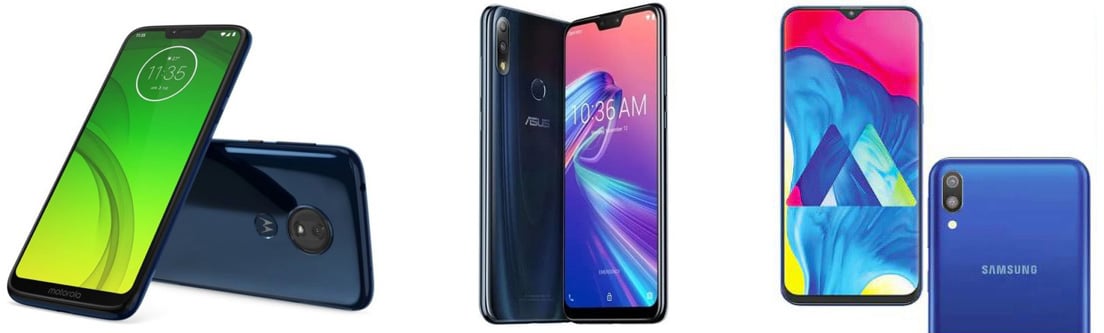
Smartphones with big batteries are becoming a very popular reality in the affordable devices niche. Most of the important manufacturers released at least one handset with a big battery in the last year and the latest one is the Moto G7 Power by Motorola. It has not only a huge battery but also very efficient components that will help to maximize the battery life of the phone. Here, you can find a comparison with other recent big battery phones that also offer a high value for money: Asus Zenfone Max Pro M2 and Samsung Galaxy M20.
Motorola Moto G7 Power vs Asus Zenfone Max Pro (M2) vs Samsung Galaxy M20
Dual 12 +5 MP f/1.8 and f/2.4
13 MP f/2.0 front camera
Dual 13 +5 MP, f/1.9 and f/2.2
8 MP f/2.0 front camera
BATTERY
5000 mAh, fast charging 15W
5000 mAh
5000 mAh
ADDITIONAL FEATURES
Dual SIM slot
Dual SIM slot
Dual SIM slot
Design
When it comes to affordable phones, for me the look is not everything. I also care about the build quality and if you want your device to last several years you should too. If we only consider the look, Samsung Galaxy M20 is the most attractive handset due to its thinner bezels and its small Infinity-V notch (even though some may prefer the Asus Zenfone Max Pro M2 due to its reflective plastic back), but if we also consider the build quality, then Moto G7 Power wins. It comes with a sturdier aluminum frame and it is also splashproof, so it can be used under the rain. But note that this protection will be available only in selected markets, as well as the Gorilla Glass 3 protection for the display. Further, note that Zenfone Max Pro M2 comes with the Gorilla Glass 6 protection.
Display
Despite coming with the advanced LTPS IPS technology, Moto G7 Power is excluded from the display comparison because of the low resolution of its display: it is just an HD+ panel, while Asus Zenfone Max Pro M2 and Samsung Galaxy M20 are Full HD+. Judging from the specs on the paper, Asus Zenfone Max Pro M2 should offer a slightly better display quality due to the better technology. It is also protected by Gorilla Glass 6 that is the strongest protection even seen on a mobile device for a display, while Samsung Galaxy M20 does not offer so advanced protections for the glass.
Specs & Software
Asus Zenfone Max Pro M2 has a superior hardware side to both Moto G7 Power and Asus Zenfone Max Pro M2. Actually, there is not any device from the Moto G7 series, neither from the M series, to have a more advanced hardware department than Zenfone Max Pro M2. The component making it superior is the Snapdragon 660 chipset that delivers better performances with advanced usage patterns and gaming. Further, it has more RAM in its most expensive variant: up to 6 GB. Note that Moto G7 Power is the only to come with Android Pie out of the box.
Camera
Unfortunately, we still had no chance to test the cameras of Samsung Galaxy M20 and Moto G7 Power because no much time has passed from their official announcement. But we know their specs, and on the paper, Asus Zenfone Max Pro M2 is better. It has a rear dual camera with a brighter aperture and a bigger pixel size, as well as a higher resolution for the front camera equipped with a front-facing LED flash. While these things do not necessarily mean that Asus Zenfone Max Pro M2 will click better photos, they raise the chance that it will be a much better camera phone.
Battery
All of these devices offer the same battery capacity: 5000 mAh. But there is one of them that should last definitely more than its opponents: the Moto G7 Power. We believe that it will offer a longer battery life due to the low resolution of its display, its efficient and less powerful Snapdragon 632 chipset, and its stock Android version. But only testing it thoroughly will confirm these thoughts.
Price
Moto G7 Power will cost about €210/$240, Asus Zenfone Max Pro M2 comes with a €270/$305 price tag and Samsung Galaxy M20 costs just €150/$170. Asus Zenfone Max Pro M2 is the best device overall, while Samsung Galaxy M20 has a higher value for money.
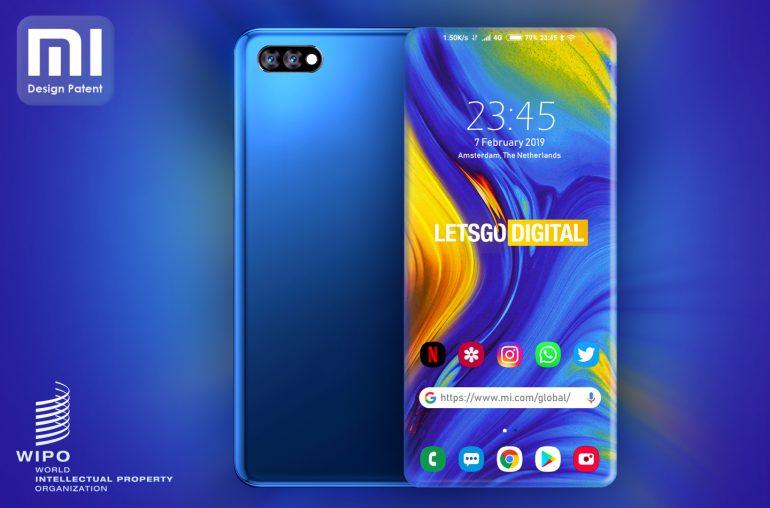
Xiaomi is an innovative company, no doubt about that. The company continues to output innovative products and designs on all fronts. The latest is a design patent that was published on the Global Design Database of the World Intellectual Property Office (WIPO) as first reported by LetsGoDigital.
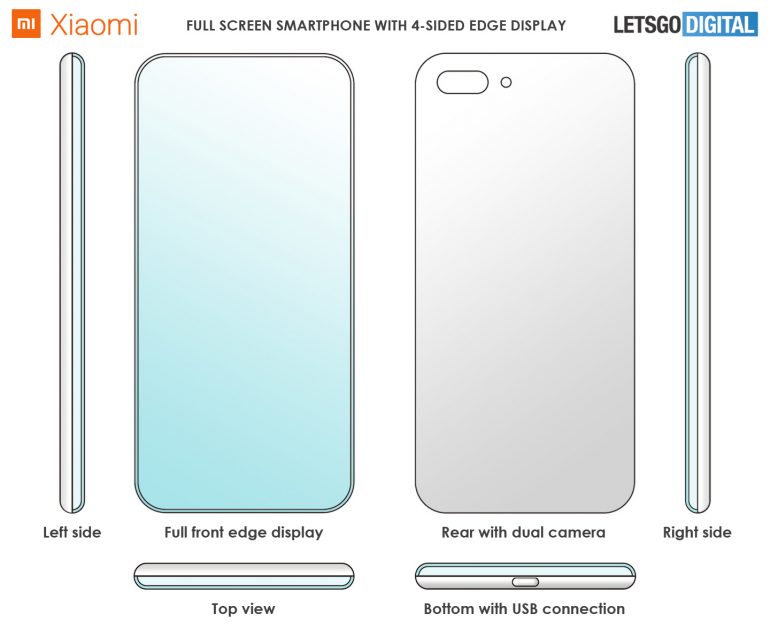
The patent is that of a full-screen smartphone that packs a dual camera setup on the back just like every other full-screen phone. However, one spectacular thing about the supposed Xiaomi phone is that the edges are well-rounded. Usually, what is common is the dual edge curved screen found on Samsung Galaxy models. Xiaomi even used the double curved edge design on the Mi Note 2 released in 2016. But this design is different as can be seen on the sketch. All four edges are curved both on the display end and the rear aspect. This design will enable the device to utilise a bezel-less design while eliminating the need for a slider.
The device also doesn’t have any buttons on the sides and this brings to mind the Meizu Zero concept smartphone is currently on crowdfunding. Further, the device has a USB Type-C port. The rear aspect houses dual cameras but there is no sign of a selfie shooter onboard. Perhaps, it will not have one. We can’t be so sure about that. It is unclear if the design will feature on a Xiaomi-branded phone releasing anytime soon.
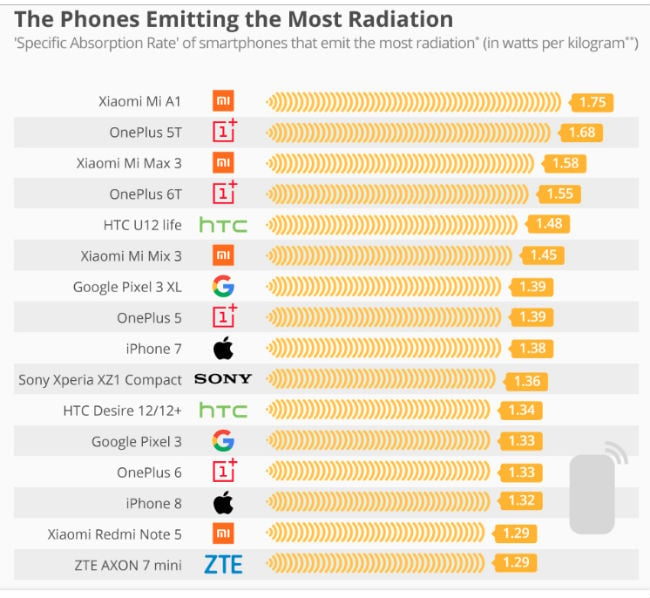
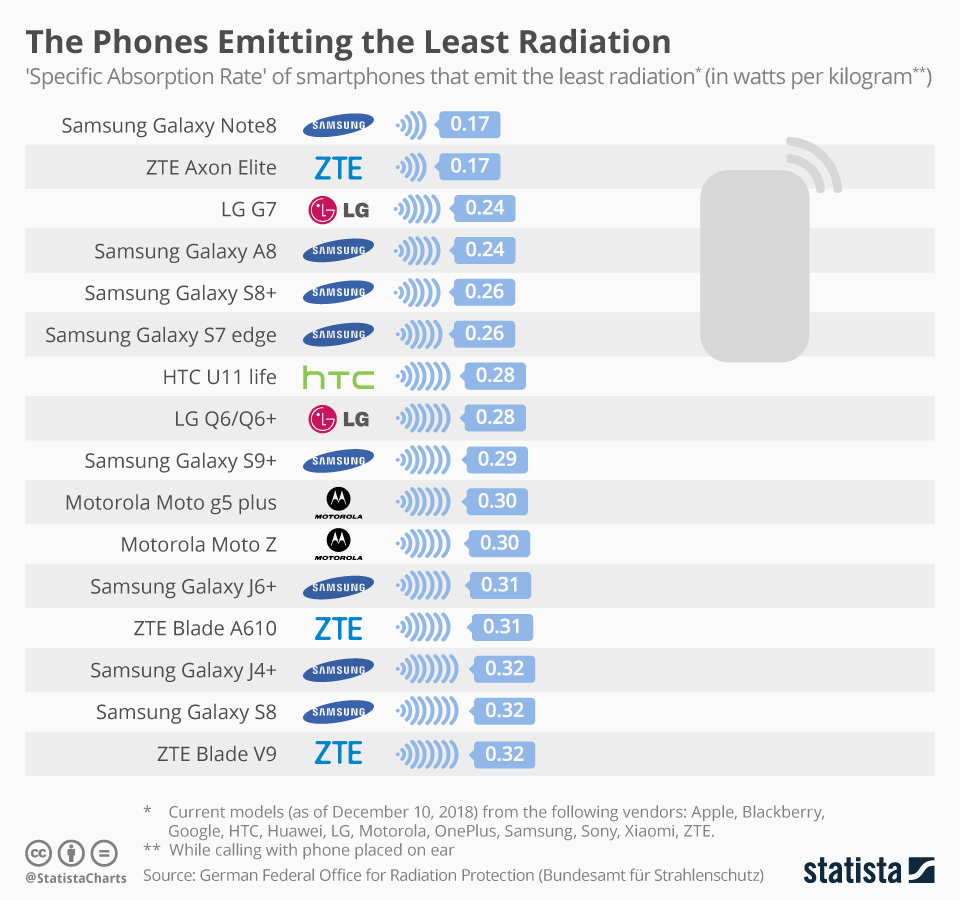
Smartphones are the most used personal gadgets which we all use and own. Even we reasearch a lot about their specifications, pricing, and features while buying it, but we always don’t count the radiation level in our decision. The German Federal Office has conducted reasearch to find devices emitting maximum and least radiation. As per data compiled by Statista, online statistics and marketing firm has published radiation data emitted by every popular device. Surprisingly, Xiaomi and OnePlus devices have topped the list as the highest radiation emitting devices.
Maximum radiation emitting smartphones
The most used and preferred devices in the mid-range from OnePlus and Xiaomi are emitting the most radiation. As per the report, Xiaomi Mi A1 emits maximum radiation while OnePlus 5T joined the list at second place. On the third and fourth position stands Xiaomi Mi Max 3 and OnePlus 6T. In the list of 16 handsets, both these companies have their eight devices listed as phones emitting the most radiation.
The list also compiles smartphones from HTC, Google, Apple, Sony, and ZTE. Significantly, Apple’s iPhone 7 and iPhone 8 are the devices with the Specific Absorption Rate (SAR) of 1.38 Wk and 1.32 Wk respectively. Google’s Pixel 3 and Pixel 3 XL has also made it to the list with the SAR values of 1.33 Wk and 1.39 Wk respectively.
Martin Armstrong, Data Journalist writes, “In fact, the two companies are represented heavily in this list, with eight of the top 16 handsets being made by one of them. Premium Apple phones such as the iPhone 7 and the recently released iPhone 8 are also here to be seen, though, as are the latest Pixel handsets from Google.”
The tests are done on the basis of criteria set by the German Federal Office for Radiation and Protection. The device is termed in ‘safe’ level when the absorption rate is below 0.60 in watts per kilogram. All the devices listed above emit double the radiation than the benchmark level.
Least radiation emitting phones
Surprisingly, most of the Samsung and Motorola devices fall in the least radiation emitting category. The Korean giant’s Galaxy Note 8 carries the least absorption rate of 0.17 watt per kilogram. While, the list carries many Samsung devices such as Galaxy A8, Galaxy S8+, Galaxy S7 edge, Galaxy S9+, galaxy J6+, Galaxy J4+, and Galaxy S8.
“In fact, Samsung handsets feature prominently, with half of the top ten coming from the South Korean company. This contrasts starkly with their major rival Apple. Two iPhones occupy a place in the list of phones which emit the most radiation, compared to none from Samsung,” Armstrong said.
Singapore’s IMDA authority has recently certified the M1902F1/T smartphone. The same body has also approved the M180F6LG model number with Redmi 7 moniker in Singapore. The listing lacks any information on the specifications of the Redmi 7, but it reveals that it will be released not only in China but also in international markets.
Last month, Xiaomi CEO Jun had confirmed that the Redmi 7 series will be priced between 700 Yuan (~$103) and 800 Yuan (~$119). It will be a lower-end phone compared to the Redmi Note 7 that was introduced in China with a starting a price of 999 Yuan in the previous month. Probably, the Redmi 7 series will include Redmi 7A, Redmi 7 and Redmi 7 Pro as the successors for the Redmi 6A, Redmi 6 and Redmi 6 Pro phones from last year.
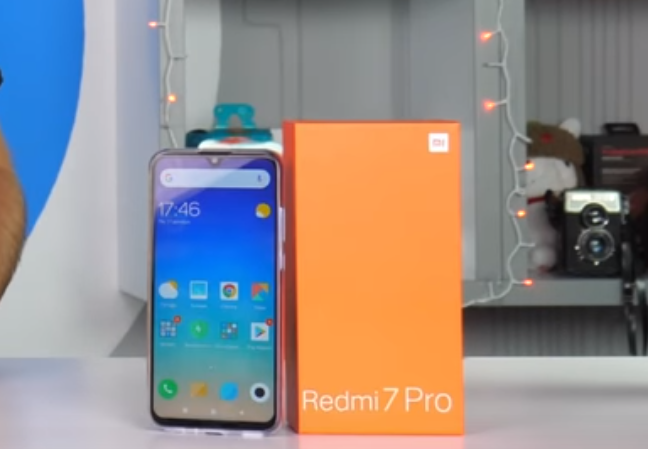
The Redmi 6A and Redmi 6 had featured 18:9 aspect ratio displays, and the Redmi 6 Pro was introduced with a notched display. In December 2018, a Russian tech blog had released a YouTube video to reveal the front design of the Redmi 7 Pro along with its box package. A screengrab shown below that was taken from the same video shows that the Redmi 7 Pro features a waterdrop-style notch screen with a thick chin. Since it is a Pro model, it may feature a dual camera setup as the predecessor model.
There is no information on the launch date of the Redmi 7. Last year, the Redmi 6 series were unveiled in Q2. Now that the Redmi brand has been recently established as a separate entity, there is a possibility that the Redmi 7 series may launch early this year. Later in this month, Redmi will be launching the Redmi Note 7 Pro that will be arriving as an advanced version of the Snapdragon 660 powered Redmi Note 7.
The Pro model is expected to arrive with Snapdragon 675 chipset, 6 GB of RAM, 128 GB of storage and 48-megapixel Sony IMX586 + 5-megapixel rear camera setup. The rest of its specs could be same as the non-Pro model. Earlier this week, the Redmi President Lu Weibinng confirmed that the company is also working on a Snapdragon 855 powered flagship phone. It is speculated that it may debut as China’s cheapest Snapdragon 855 powered smartphone. The handset could be priced around 2,500 Yuan (~$370).
Last year there were a couple of ASUS ZenFone 6 prototype leaks that revealed what the device could look like. One recurring team in all the leaks is the punch hole display but it appears the final device has taken a different direction.
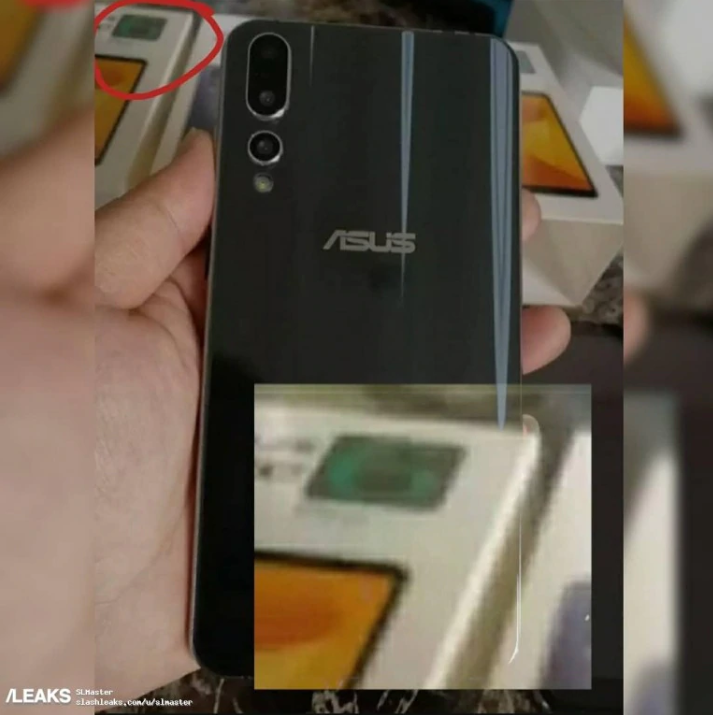
New live photos of the ZenFone 6 have surfaced online and these show what we believe is the final product as there is a retail box in the images too.
The Zenfone 6 will come with three cameras on its rear. The cameras are arranged vertically with two sharing a single housing while a third and the LED flash are separated. There are two color variants in the images. One has a red-blue gradient finish while the other is black but both are covered in glass.
There is no shot of the front of the phone but the retail box appears in the photos and they do reveal some key details. As you can see, the phone doesn’t have its fingerprint scanner on the back. That is because it is in front – on the chin. Yes, ASUS is going for a front-mounted fingerprint scanner this time around.
The new position of the fingerprint scanner means the bezel gets thicker though not as thick as before the 18:9 era. The forehead is not very visible but we can’t make out a notch or a punch hole display and the bezel doesn’t appear thin too.
We use cookies on our website to give you the most relevant experience by remembering your preferences and repeat visits. By clicking “Accept”, you consent to the use of ALL the cookies.
This website uses cookies to improve your experience while you navigate through the website. Out of these, the cookies that are categorized as necessary are stored on your browser as they are essential for the working of basic functionalities of the website. We also use third-party cookies that help us analyze and understand how you use this website. These cookies will be stored in your browser only with your consent. You also have the option to opt-out of these cookies. But opting out of some of these cookies may affect your browsing experience.
Necessary cookies are absolutely essential for the website to function properly. This category only includes cookies that ensures basic functionalities and security features of the website. These cookies do not store any personal information.
Any cookies that may not be particularly necessary for the website to function and is used specifically to collect user personal data via analytics, ads, other embedded contents are termed as non-necessary cookies. It is mandatory to procure user consent prior to running these cookies on your website.