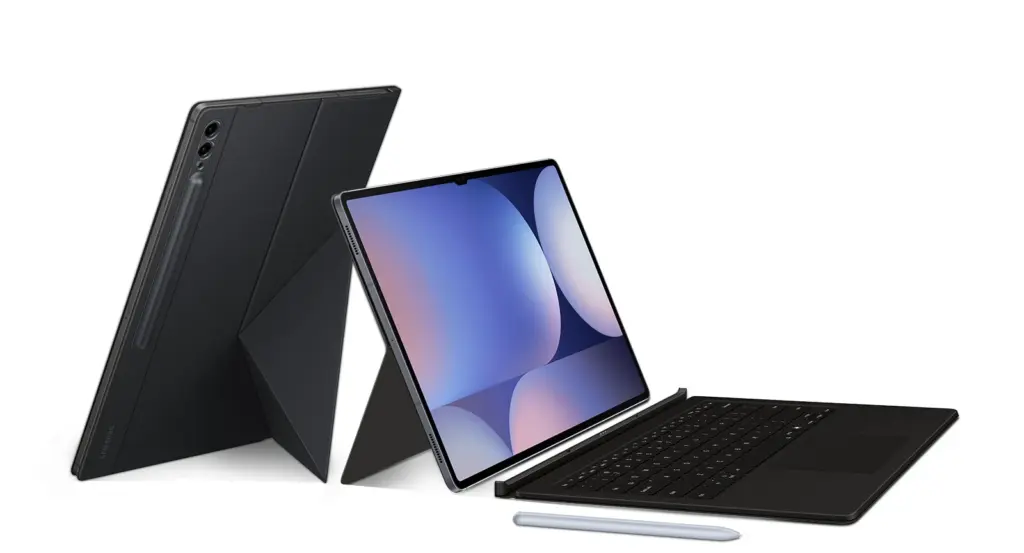
Samsung’s upcoming Galaxy Tab S11 Ultra is shaping up to be another powerhouse tablet, with new certifications revealing a slightly bigger battery and a sleeker design. While the upgrades are modest on paper, they could still translate into meaningful gains in everyday use.
Galaxy Tab S10 Ultra
The Galaxy Tab S11 Ultra has been certified with an 11,600mAh battery—slightly larger than the 11,200mAh unit found in last year’s Tab S10 Ultra. Earlier leaks pointed to a slightly higher capacity, but this confirmed number still suggests a small improvement in battery life. It also supports 45W fast charging, just like its predecessor, meaning users won’t need a new charger but shouldn’t expect faster top-ups either.
The device will come in several variants, including a Wi-Fi-only model, a 5G + Wi-Fi version, and a South Korea-specific model. Under the hood, it’s expected to run on the MediaTek Dimensity 9400+ chip, which brings a significant performance bump over the previous generation, along with a 12-core GPU and a primary Cortex-X925 core clocked at 3.73GHz.
The Galaxy Tab S11 Ultra will ship with Android 16 and One UI 8 out of the box. It also features 12GB of RAM and a refined design—complete with a smaller notch and the removal of the visible S Pen charging strip on the back, giving it a cleaner look overall.
With a launch expected sometime in October 2025, the Tab S11 Ultra is poised to go head-to-head with other premium tablets. Whether these incremental upgrades will be enough to maintain its edge remains to be seen—but Samsung clearly isn’t holding back.
Acer has launched the Nitro Lite 16 in India, targeting gamers, students, and content creators who need high performance in a portable form factor. Part of the brand’s Lite Series, this 16-inch laptop combines a lightweight design with gaming-ready hardware.
Acer Nitro Lite 16 features
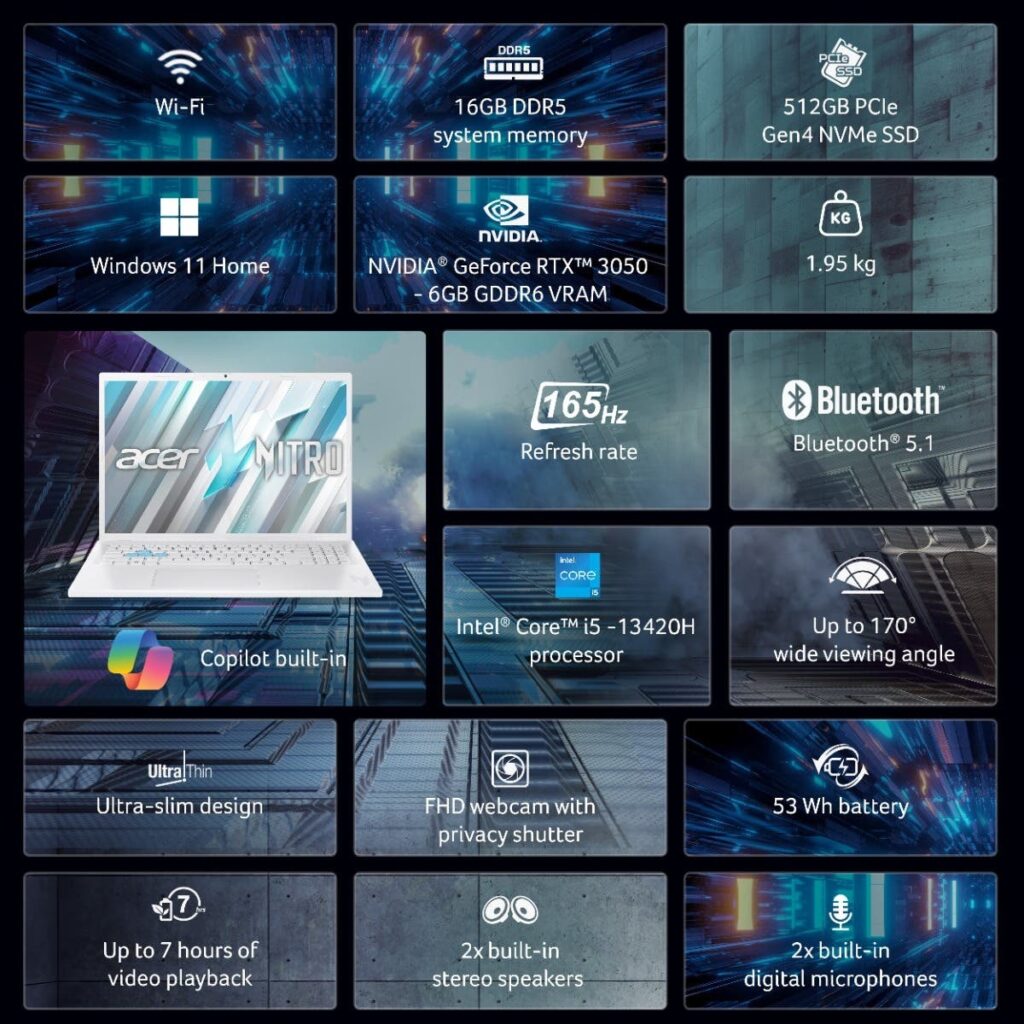
The Nitro Lite 16 features a 16-inch IPS display with a 16:10 aspect ratio and WUXGA (1920×1200) resolution. The screen supports up to 180Hz refresh rate and covers 100% of the sRGB color gamut. Housed in a Pearl White chassis, the laptop includes a built-in FHD webcam with a privacy shutter.
Weighing just 1.95 kg and measuring 22.9 mm thick, Acer claims it is among the lightest performance-focused 16-inch laptops. It runs on a 53Wh battery and supports 100W USB-C fast charging. Intel’s Thread Director helps manage hybrid core efficiency.
The top-tier configuration of the laptop has Intel’s 13th Gen Core i7-13620H processor and NVIDIA GeForce RTX 4050 GPU with 6GB GDDR6 memory. It supports ray tracing, DLSS 3, and includes a MUX switch for performance tuning. It is configured with up to 24GB DDR5 RAM and 1TB PCIe Gen 4 SSD storage.
Standard configurations include Intel Core i5-13420H or i7-13620H processors, RTX 3050 or RTX 4050 graphics, 16GB dual-channel DDR5 RAM (upgradable), and 512GB PCIe Gen 4 SSD. It ships with Windows 11 Home (64-bit).
Connectivity includes Wi-Fi 6, Bluetooth 5.1, Gigabit Ethernet, HDMI 2.1, USB-C (100W PD), and two USB 3.2 Gen 1 ports with power-off charging. The laptop also features dual stereo speakers and a white backlit keyboard with highlighted WASD keys and a dedicated Copilot key for quick AI access.
Pricing & availability
The Acer Nitro Lite 16 is priced starting at ₹69,999 and is available now through Acer exclusive stores, the Acer online store, Amazon.in, and Flipkart.com.
For more daily updates, please visit ourNews Section.
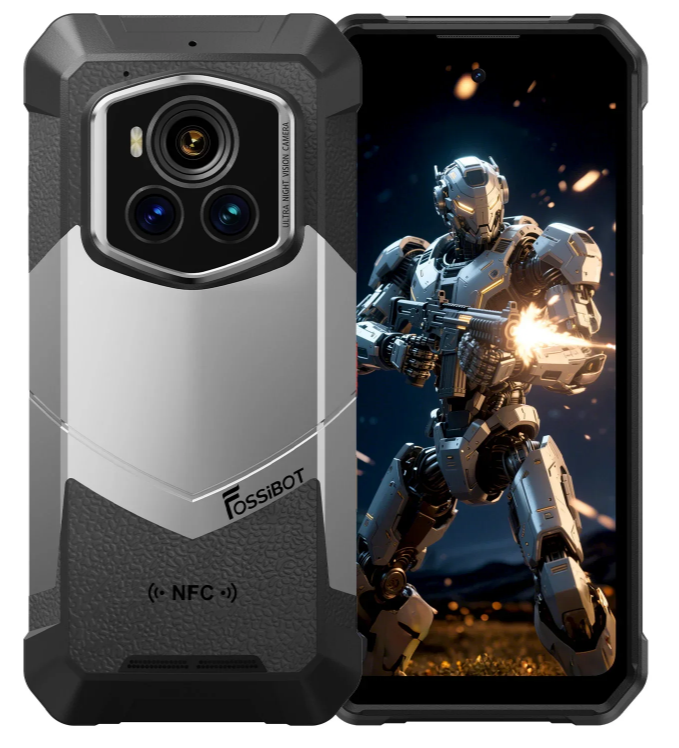
FOSSiBOT launched the F107 Pro, a high-performance, rugged smartphone that pioneers several new technologies, including the world’s first starlight night vision tech in a mobile device. Designed for outdoor explorers, emergency professionals, and extreme sports users, the F107 Pro aims to deliver advanced imaging and performance in the most challenging environments.
Industry-First Starlight Night Vision Technology
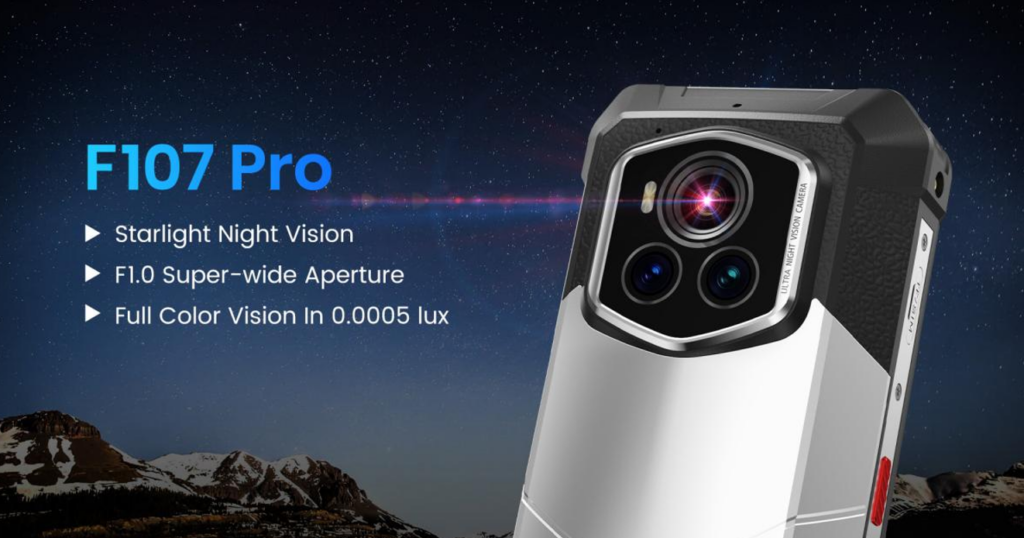
The F107 Pro is the first rugged smartphone to feature a full-color starlight night vision camera. Unlike conventional infrared night vision systems that capture only black and white images, this technology allows users to shoot clear and vivid color images even in extremely low-light conditions down to 0.0005 lux.
This is achieved through an F1.0 ultra-wide aperture lens combined with the AX620Q ultra-sensitive sensor, which utilizes ambient light sources such as starlight and moonlight. Notably, the system operates without infrared illuminators, making it more power-efficient and better suited for stealth-sensitive scenarios. This capability is particularly valuable for jungle exploration, cave navigation, disaster response, and nighttime maritime operations.
Advanced Triple Camera System
The device includes a flagship-grade camera array optimized for clarity, speed, and versatility. The primary camera is a 200-megapixel Samsung S5KHP3SP03 sensor with a 1/1.4-inch size, an F1.95 aperture, a six-piece lens structure, and phase detection autofocus. This setup enables rapid focusing speeds of 0.1 seconds and high-resolution image capture.
Supporting this is a 50-megapixel Sony IMX766 sensor that serves as a dual-purpose wide-angle and macro lens with an F1.79 aperture. This allows for detailed close-ups and expansive landscape shots without switching modules.
On the front, a 32-megapixel Sony IMX616 sensor powers the selfie and video call functions. All video recordings benefit from electronic image stabilization (EIS) to reduce motion blur and shake.
MediaTek Dimensity 7300 Performance
The F107 Pro runs on the MediaTek Dimensity 7300 chipset, built on a 4-nanometer process for high power efficiency and thermal management. The processor includes four Cortex-A78 cores clocked at 2.5 GHz and four Cortex-A55 cores at 2.0 GHz, ensuring a balanced blend of performance and efficiency.
An integrated AI processing unit supports real-time enhancements for voice recognition, video stabilization, and low-light photography. The device includes 12 GB of physical RAM, which can be expanded by an additional 18 GB of virtual memory, allowing for up to 30 GB of total RAM. It also offers 512 GB of onboard storage with support for microSD cards up to 2 TB.
Battery and Charging Capabilities
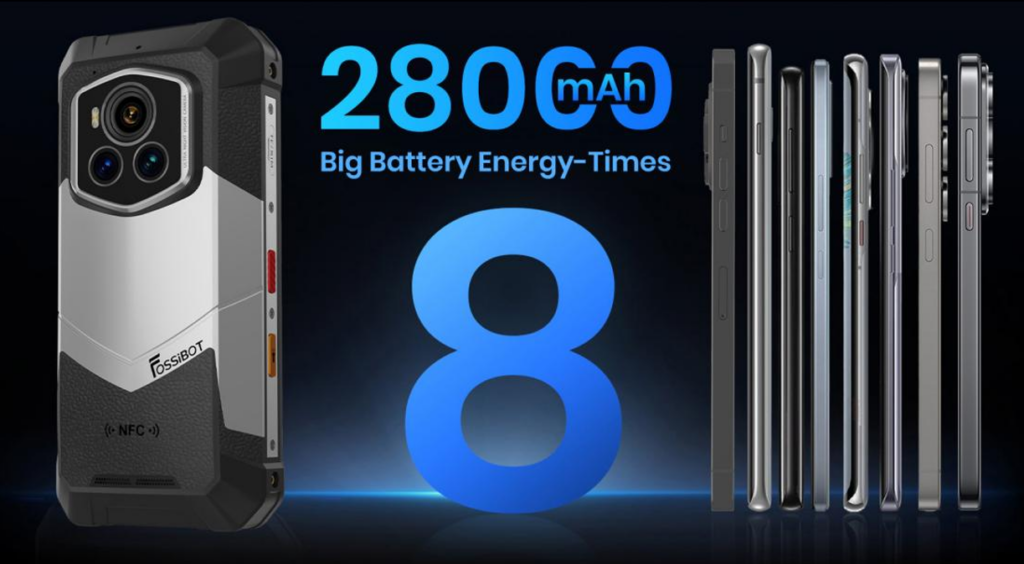
Powering the device is a 28,000 mAh high-capacity battery, designed for extended off-grid usage. This battery offers up to 30 days of standby time, 215 hours of call time, and 133 hours of music playback.
Despite its size, the battery supports 66W fast charging, reducing downtime during recharging. The phone also features 10W reverse charging, enabling it to function as a power bank for other devices in the field.
Durability Standards and Functional Design
The F107 Pro meets MIL-STD-810H military durability standards and is rated IP68 and IP69K for water and dust resistance. It is engineered to survive drops, mud, rain, sand, heat, and sub-zero temperatures. The display is protected by Corning Gorilla Glass for added scratch resistance.
Additional features include a high-lumen flashlight with a 50-meter beam distance and an anti-slip lanyard mount for secure handling during rugged use.
Display and Visual Output
The phone is equipped with a 5.95-inch Full HD+ LCD, optimized for visibility in direct sunlight and outdoor environments. It supports a 120Hz refresh rate, offering smooth user interaction and improved responsiveness during gaming and media playback.
Pricing and Promotions
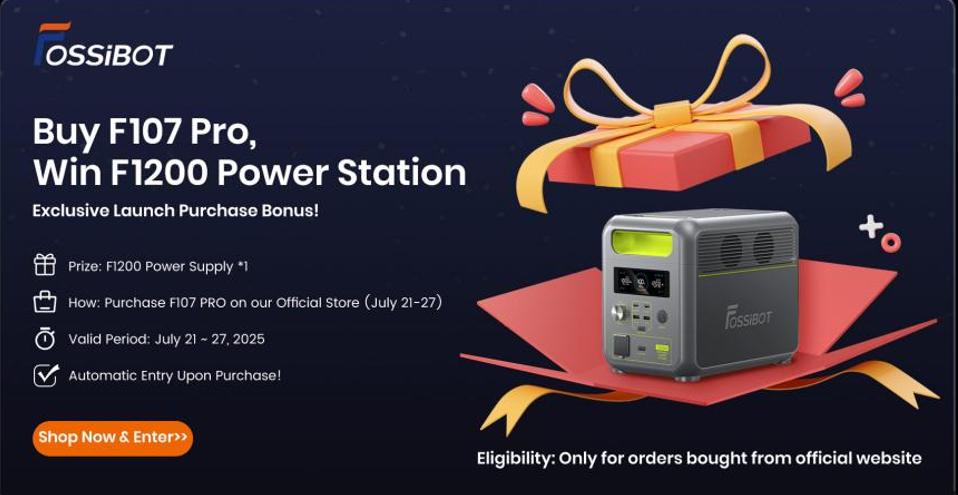
The FOSSiBOT F107 Pro is priced at $549, with a limited-time launch offer of $439.99. During the launch period, customers will automatically be entered into a giveaway for the F1200 Power Station, valued at $599, and will also have the opportunity to win an F107 Pro unit via a live website event.
Samsung is rethinking its AI strategy for the Galaxy S26 series. While recent Galaxy flagships have leaned heavily on Google’s Gemini for intelligence, the S26 lineup is set to offer something different: a multi-assistant AI experience designed to give users more choice and flexibility.
A broader AI vision for Galaxy phones
In a recent interview with Bloomberg, Won-Joon Choi, head of Samsung’s mobile division, confirmed that the company plans to open up its ecosystem to multiple AI agents. That means Google Gemini won’t be the sole intelligence powering Galaxy phones moving forward.
Choi explained that Samsung has built a flexible framework that can support a range of AI assistants, as long as they offer strong performance and a smooth user experience. This approach could pave the way for integrations with other AI companies, such as Perplexity, which Samsung is reportedly considering investing in to bring its capabilities directly to Galaxy devices.
While full details are still under wraps, Samsung plans to share more closer to the Galaxy S26’s expected launch in early 2026. For now, the move signals a major shift in how the company thinks about AI — one that could give users a richer, more customizable experience.
Samsung’s decision to embrace a multi-AI framework with the Galaxy S26 marks a strategic step away from relying solely on Google’s ecosystem. By allowing multiple assistants to coexist — and possibly compete — on its devices, Samsung is aiming to boost innovation and offer users more control over their digital experience.
With the S26 launch still some time away, this shift could mark one of the most significant changes in how Samsung smartphones operate — especially since AI has become a central focus for Samsung across both its flagship and mid-range devices in recent years.
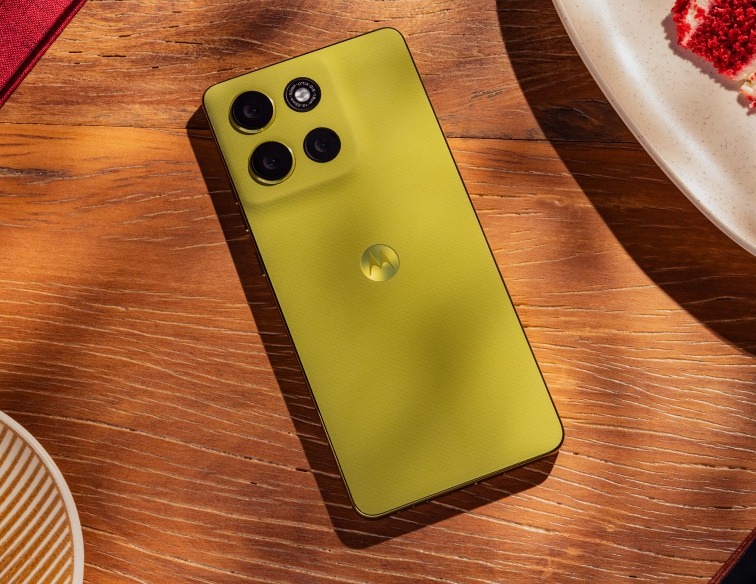
Motorola has introduced the Moto G86 Power 5G in India, expanding its G series portfolio with a new 5G offering. First launched in May 2025, the device is built for solid performance, extended battery life, and a rugged design. It ships with Android 15 pre-installed.
Moto G86 Power 5G features
The Moto G86 Power 5G features a 6.67-inch 1.5K 10-bit pOLED display with a 120Hz refresh rate and up to 4500 nits peak brightness. The screen is protected by Corning Gorilla Glass 7i. It runs on the MediaTek Dimensity 7400 4nm processor with Mali-G615 MC2 GPU. The device has 8GB LPDDR4x RAM and 128GB of internal storage, expandable up to 1TB via microSD.
The rear camera setup includes a 50MP primary sensor (Sony LYT-600) with OIS and f/1.8 aperture, paired with an 8MP ultra-wide lens that also supports macro shots. On the front, it has a 32MP selfie camera with Quad Pixel technology and f/2.2 aperture.
It supports an in-display fingerprint sensor, stereo speakers with Dolby Atmos, dual microphones, and USB Type-C audio. Connectivity options include 5G SA/NSA, dual 4G VoLTE, Wi-Fi 802.11ac (2.4GHz + 5GHz), Bluetooth 5.4, GPS, GLONASS, Beidou, and USB Type-C. The phone is IP68 and IP69 rated for dust and water resistance and carries MIL-STD 810H certification for durability.
Powering the device is a 6720mAh battery with support for 33W TurboPower fast charging. Motorola promises two major Android OS updates and four years of security patches.
Pricing & availability
The Moto G86 Power 5G is priced at ₹17,999 ($206) for the 8GB + 128GB model. It comes in Pantone Cosmic Sky, Pantone Golden Cypress, and Pantone Spellbound colours. Sales begin August 6 on Flipkart, motorola.in, and select offline stores. Launch offers include ₹1,000 off on select bank cards or ₹1,000 additional discount on exchange.
For more daily updates, please visit ourNews Section.
Xiaomi is expected to release HyperOS 3.0 around September, which will be based on Android 16. This major upgrade is said to bring numerous changes across the system and introduce a suite of new features to enhance the software experience and make it more useful for users. However, as you may already know, the rollout doesn’t happen all at once. Instead, Xiaomi rolls out in batches, and here are the devices that will be the first to get the HyperOS 3 update.
Xiaomi will roll out HyperOS 3 update to these devices first
Xiaomi hasn’t announced the HyperOS 3 rollout timeline yet. The list we’ve shared below was prepared by the folks at Xiaomi Time.
Xiaomi 15
Xiaomi 15 Pro
Xiaomi 15 Ultra
Xiaomi 15T Pro
Xiaomi 14T Pro
Redmi K80 Ultra
Redmi K70 Ultra
The upcoming Xiaomi 16 and Xiaomi 16 Pro will ship with HyperOS 3 (based on Android 16) right out of the factory.
Xiaomi typically rolls out major HyperOS updates starting with the newest flagship smartphones, and then gradually expands them to the remaining flagship models and mid-range phones. Budget devices need to wait a little longer to receive updates.
What to expect from HyperOS 3?
The next major upgrade for Xiaomi devices will bring many new features and enhancements from HyperOS 3. Additionally, it will include new features and changes directly from the development team at Google, as part of Android 16.
The HyperOS 3 upgrade is said to introduce Apple’s Dynamic Island-like feature with integration to many third-party apps. For the uninitiated, it’s an interactive UI element that shows live updates from apps such as food delivery, ride-hailing, and music, and lets you interact with them without needing to open the app.
The next major upgrade is also expected to bring UI changes, smoother animations, performance optimizations, and system stability improvements. Additionally, there may be new AI features, widgets, and more customizations for a more personalized experience.
Android Protection could also be part of this upgrade, which is an array of security features designed to protect users from online attacks, harmful apps, unsafe websites, scam calls, and other online threats. It could also introduce the Notification Cooldown feature, which lowers the volume and minimizes alerts when you receive multiple notifications from the same app in quick succession. For tablets and large-screen devices, there may be a new Desktop Windowing feature that offers a desktop-like multitasking experience, allowing users to open, group, and resize multiple app windows.
We are possibly just a few weeks away from the HyperOS 3 release. We’ll have more clarity on which devices will receive the update first and what’s coming inside the package as we get closer to the release. You can regularly visit our HyperOS section for the latest information.
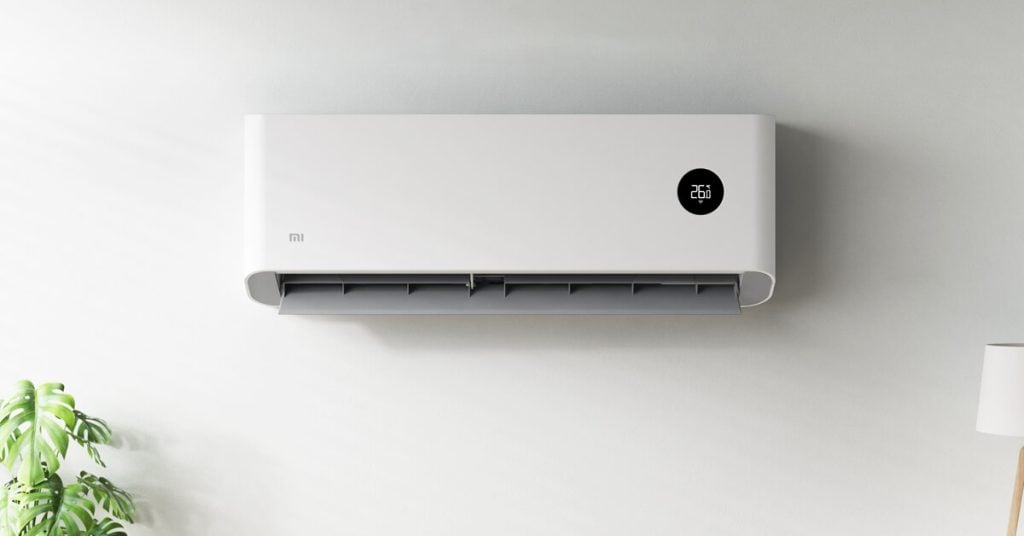
Xiaomi’s air conditioner business isn’t just quietly growing; it’s mounting a serious challenge to the old guard of Chinese home appliance giants. According to newly revealed Q2 2025 data, the company has officially locked in the No. 3 position in China’s online air conditioner market, capturing a 16.2% market share and inching dangerously close to Gree’s throne.
The monthly breakdown paints an even more dramatic picture. In April, Xiaomi held a modest 14.25% share. By May, it surged to 17%, nearly overtaking Gree, which dipped to 17.16%. June saw a slight pullback for Xiaomi to 16.5%, but Gree didn’t capitalize much, ending the quarter at 17.27%. Midea remains ahead with a comfortable lead, but its share is slowly receding from 23.45% in April to 22.18% in June.
These numbers aren’t just an anomaly. They’re a sign that Xiaomi’s strategy is working.
Unlike legacy brands that lean on decades of retail dominance and brand equity, Xiaomi is playing an entirely different game. Its products are born in the internet age, and its sales funnel lives online, right where its user base thrives. Xiaomi doesn’t need to fight for shelf space in a crowded electronics mall. It just needs a flash sale on JD.com or a viral post on Weibo. And increasingly, that’s enough.
Still, overtaking Gree or Midea won’t be easy. Both companies have cemented their presence in Chinese households for generations, and that kind of brand trust doesn’t evaporate overnight. As industry observers have noted, familiarity breeds loyalty in the world of air conditioners, and when you’re dealing with a product people rely on for comfort and survival during scorching summers, trust matters.
But Xiaomi isn’t just selling air conditioners. It’s selling an ecosystem. That means your Xiaomi phone can control your Xiaomi AC, your Xiaomi speaker can report the room temperature, and your Xiaomi home hub can optimize your power usage across every device. That interconnectedness is a powerful differentiator, especially for younger consumers who’ve grown up on smart tech and seamless integration.
Xiaomi’s Group President Lu Weibing has already laid out the company’s ambition: break into the top two in China’s air conditioner market by 2030. If current momentum holds, that timeline may end up being conservative. The gap is shrinking. The market is shifting. And Gree, for the first time in a long time, might have something to sweat about.
In related news, Xiaomi recently launched a new floor-standing air conditioner featuring rapid cooling and heating, a 115° wide-angle swing, and HyperOS integration. The company has also unveiled the Robot Vacuum Mop 5 Pro, equipped with AI-driven cleaning and a powerful 23,000Pa suction system.
For more daily updates, please visit ourNews Section.
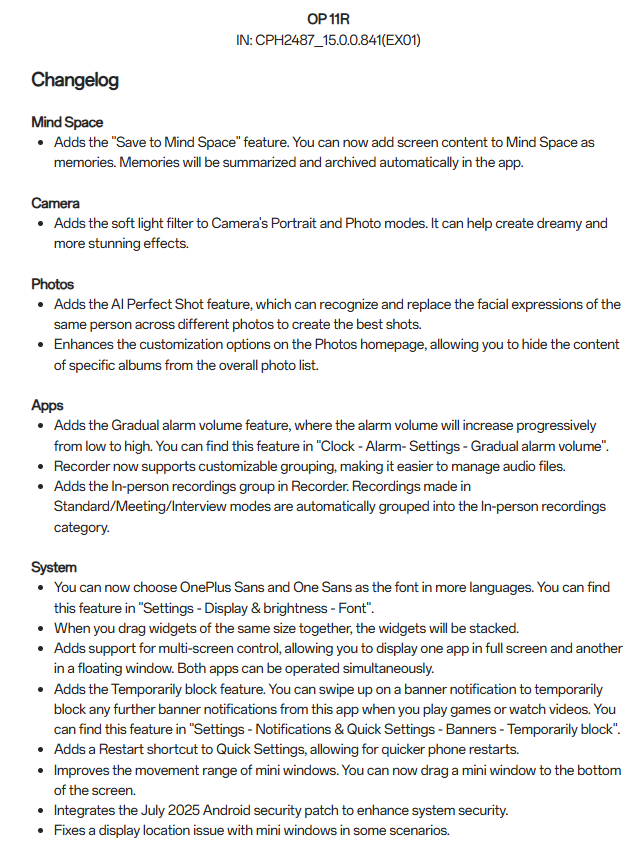
OnePlus started rolling out OxygenOS 15.0.0.841 to OnePlus 11R users in India. The update comes as build version CPH2487_15.0.0.841(EX01) and is being sent to users in batches.
What’s New
The biggest addition is “Save to Mind Space.” This lets you save anything on your screen as a memory. The phone automatically writes a summary and stores it in the Mind Space app.
The Camera app now has a soft light filter for Portrait and Photo modes. This makes lighting better and gives photos a softer look.
The Photos app gets AI Perfect Shot. This feature looks at different facial expressions of the same person across your photos and creates the best version automatically. You can also hide albums from your main photo list now.
App Updates
The Clock app now supports gradual alarm volume. Your alarm starts quiet and gets louder over time. The Recorder app lets you group audio files however you want and adds an “In-person recordings” section that sorts files by how they were recorded.
System Changes
OnePlus Sans and One Sans fonts work in more languages now. You can stack widgets that are the same size. The phone also gets multi-screen control – you can use one app full screen while another runs in a floating window.
Other changes include a “Temporarily block” option for banner notifications and a Restart button in Quick Settings. Mini windows move better now, and a display bug with mini windows is fixed. The update includes July 2025 Android security patches.
OnePlus 11R OxygenOS 15.0.0.841 Changelog
OnePlus says more users will get the update in the coming days. If you’re in India and find bugs, report them through the OnePlus Community App or dial *#800# on your phone. Users can check for updates by going to Settings > System > System Update.
For more daily updates, please visit our News Section.
Samsung may be planning a major change to its Galaxy S lineup next year, with the biggest surprise possibly being the name of its entry-level flagship. According to a new GSMA listing spotted by SammyPolice, the model previously expected to launch as the Galaxy S26 (SM-S942) is now officially listed as the Galaxy S26 Pro — hinting at a significant rebrand ahead of the series’ expected January 2026 debut.
Galaxy S26 Pro to replace the base model?
This change isn’t just about a name. Earlier firmware leaks also mentioned an S26 Pro, further reinforcing that this isn’t a typo or placeholder. The current lineup now seems to consist of Galaxy S26 Pro, S26 Edge, and S26 Ultra, with no clear sign of a regular S26 or S26 Plus.
If true, this could mean Samsung is repositioning its entry-level flagship to better compete with phones like the iPhone 17 Pro or Pixel 10 Pro. It’s still unclear whether the Pro label reflects real upgrades — such as a better display, larger battery, or improved camera — or if it’s simply a marketing move to make the lineup sound more premium. In Samsung’s past lineups, the “Edge” model typically emphasizes design, while “Ultra” goes all-in on hardware. With the Plus model apparently missing, the Pro variant could end up absorbing its place in the hierarchy.
If this rebrand sticks, expect Samsung’s 2026 flagship series to focus more heavily on premium appeal across all models — possibly with a higher starting price, but also potentially more features for the base-tier buyer.
The Snapdragon 8 Elite, announced last year, was a huge bet for Qualcomm, and it turned out to be a massive success. The powerful Oryon cores, combined with 3nm cutting-edge technology, delivered massive performance and efficiency gains. It’s still one of the fastest mobile chipsets.
Pushing the limits even further, Qualcomm is already working on its successor, the Snapdragon 8 Elite 2, and early leaks suggest promising upgrades. The chip is also arriving a month earlier, which means we’ll see devices launching with this chip sooner than ever before. Here’s everything we know about the Snapdragon 8 Elite 2.
Snapdragon 8 Elite 2 release date
Qualcomm will announce the Snapdragon 8 Elite 2 at the Snapdragon Summit 2025, scheduled to take place on September 23. That’s a month earlier than its usual timeline, and Qualcomm isn’t alone in here — its biggest rival, MediaTek, is also reportedly pushing up the announcement to showcase Dimensity 9500 even earlier in September.
Not to forget, Apple will also unveil its latest iPhones in the same month, powered by a new A19 chipset. So, September is going to be an extremely busy month, and I’m very excited to see how these chips stack up against each other.
Although the official announcement is still weeks away, leaks and benchmarks have already revealed numerous details about the upcoming Snapdragon flagship, as detailed in the following sections.
Snapdragon 8 Elite 2 specs
Qualcomm will reportedly use TSMC’s enhanced 3nm (N3P) process for the manufacturing of the Snapdragon 8 Elite 2. Several reports also surfaced online suggesting a Samsung-made (2nm) Snapdragon 8 Elite in the pipeline, but it is not ready for mass production just yet, according to a reliable leaker, Digital Chat Station.
The second-generation Snapdragon 8 Elite is said to feature ARMv9 architecture, supporting advanced instructions such as SME1 and SVE2. As for the CPU cores, Qualcomm will likely stick to the same core cluster, featuring two prime Oryon cores and six performance Oryon cores.
Qualcomm will reportedly use the third-generation Oryon CPU cores in the Snapdragon 8 Elite 2 chip. The 8 Elite features the second-generation Oryon core, whereas the first-generation core was used in the Snapdragon X Elite (for PC).
According to recent leaks, the 8 Elite 2 may hit 4.6GHz of peak frequency for its regular model, and a whopping 4.74GHz for the “for Galaxy” variant that Samsung will be using in the Galaxy S26 series early next year. That’s a nice jump from Snapdragon 8 Elite’s 4.32GHz, combined with performance upgrades on the third-gen Oryon CPU, will likely bring a considerable performance boost to the upcoming flagship.
The upcoming Snapdragon 8 Elite 2 is leaked to feature an upgraded Adreno 840 GPU with around a 30% performance boost. The GPU is said to be clocked at up to 1.2GHz and may feature increased independent cache (likely GMEM) from 12MB to 16MB for faster graphics rendering. It could bring support for LPDDR5X/LPDDR6 memory.
Here’s a spec sheet based on the leaked details:
Snapdragon 8 Elite 2 specs
Announcement
September 23, 2025
Process node
3nm
Manufacturer
TSMC
CPU
octa-core
CPU cores
2 x prime cores (Oryon) 6 x performance cores (Oryon)
GPU
Adreno 840
Snapdragon 8 Elite 2 benchmarks
While there have been no benchmark leaks as yet, reliable tipster Digital Chat Station has something to share with us. According to him, Qualcomm’s next flagship SoC will achieve a single-core score over 4,000 and a multi-core score over 11,000.
For reference, the Snapdragon 8 Elite scores around 3,100 and 9,800 in single-core and multi-core, respectively. This translates to an improvement of about 25-30% in single-core and 10-15% in multi-core for the newer flagship. These are not huge gains, but not less than impressive for a year-over-year upgrade.
The same tipster also believes that the 8 Elite 2 could surpass the 4 million AnTuTu mark. If that’s true, it would be an astonishing achievement for Qualcomm. For reference, the Snapdragon 8 Elite only manages around 2.8 million.
There’s still a lot we don’t know about the Snapdragon 8 Elite 2 — especially when it comes to the camera, connectivity, and NPU upgrades. Hopefully, more details will emerge soon, and I’ll update this article as they do.
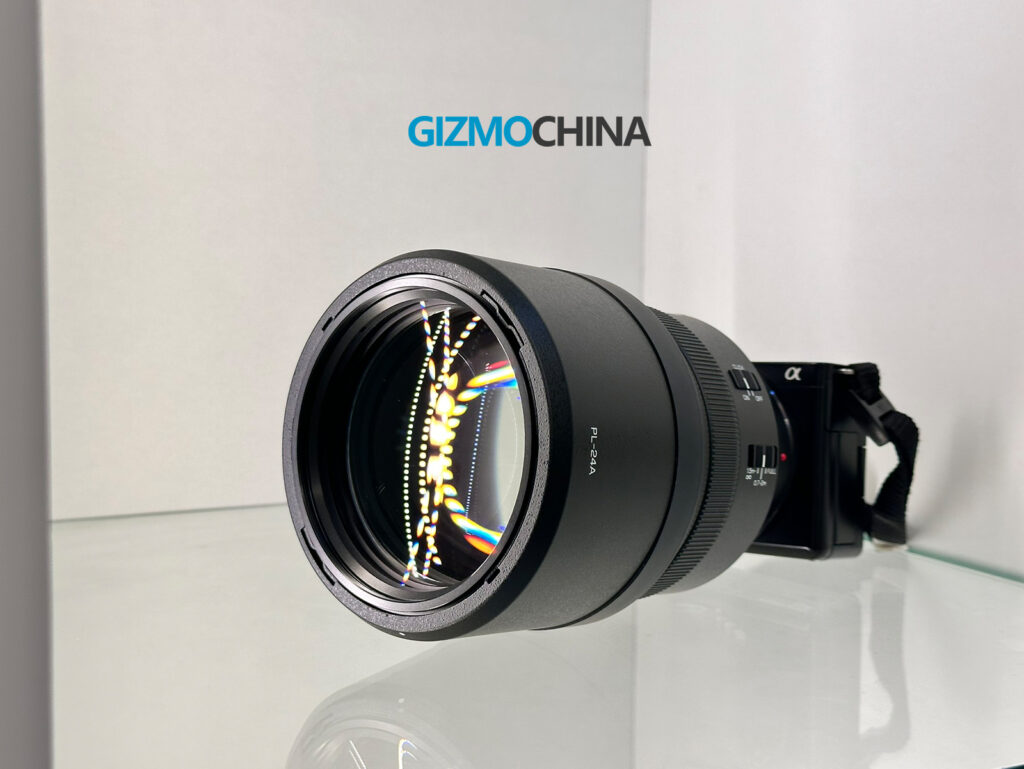
When I first heard that Viltrox was making a high-end 135mm f/1.8 prime lens for Sony full-frame, I had two reactions. One: wow, that’s ambitious. And two: it’s probably going to cut corners. Turns out I was only half right.
I’ve been testing the Viltrox LAB 135mm f/1.8 FE for a little over a month now, through sweltering humidity, erratic lighting, and my usual desk-bound tech photography workflow. This monsoon season in India has been relentless, and the lens has lived either on my Sony α7 IV or my ZV-E10 for most of that time.
Viltrox sent it to me recently for testing, though the lens originally launched back in 2024. I wasn’t drawn to it as a portrait shooter, but as someone who regularly photographs gadgets. And yet, this lens nudged me toward taking more portraits than I usually do.
It didn’t take long to realize this isn’t just another budget-friendly fast prime. Viltrox is clearly trying to prove something with this one.
What’s in the Box
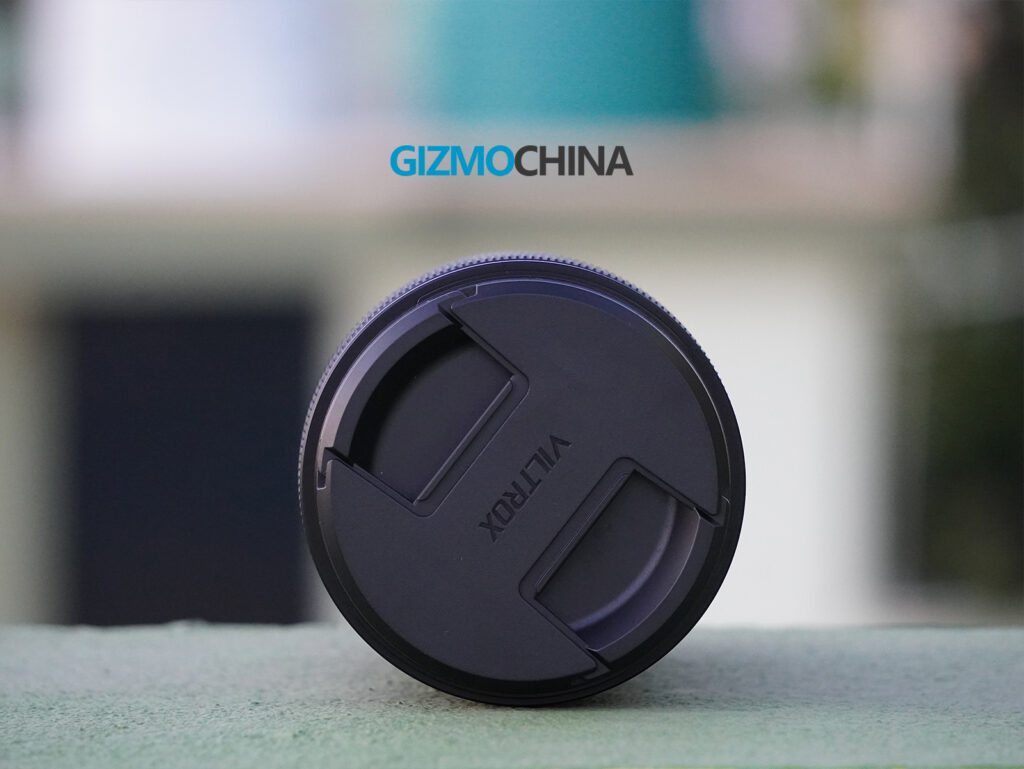
Viltrox ships the LAB 135mm f/1.8 with a straightforward yet premium kit. Inside the box, you get the lens itself, a thick plastic lens hood with a felt-lined interior and rubber bumper, front and rear caps, and a soft leather-style pouch.
The hood snaps into place with authority and doesn’t wiggle or rotate unintentionally. The packaging doesn’t scream luxury, but it does everything right.
Design and Build Quality
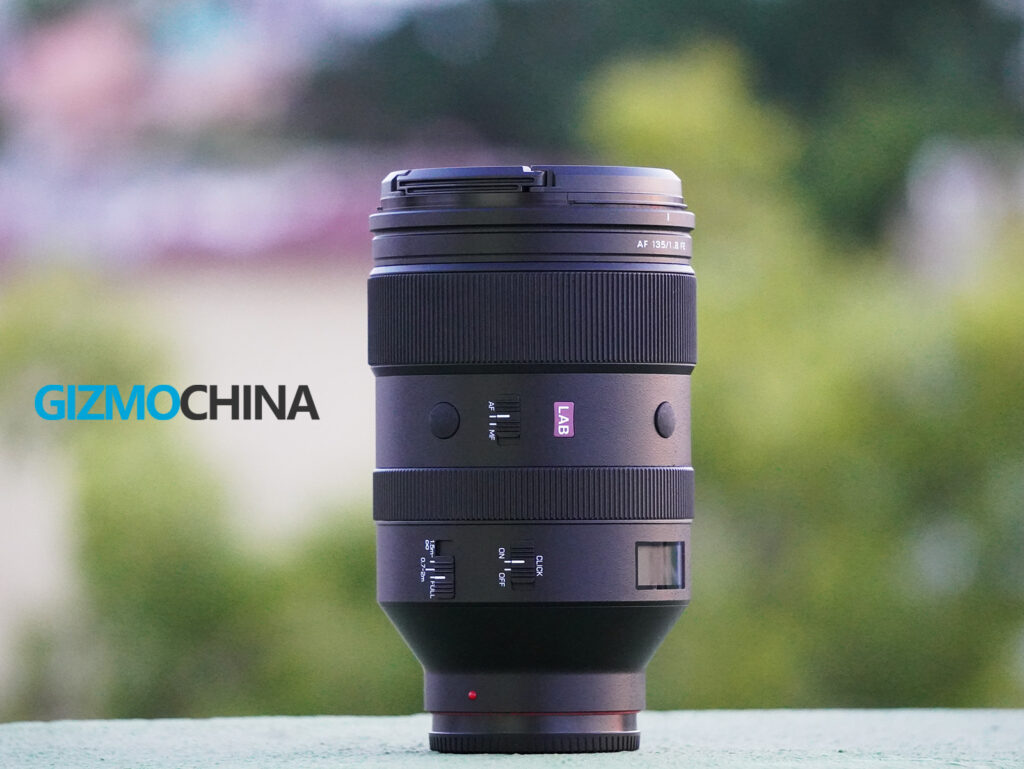
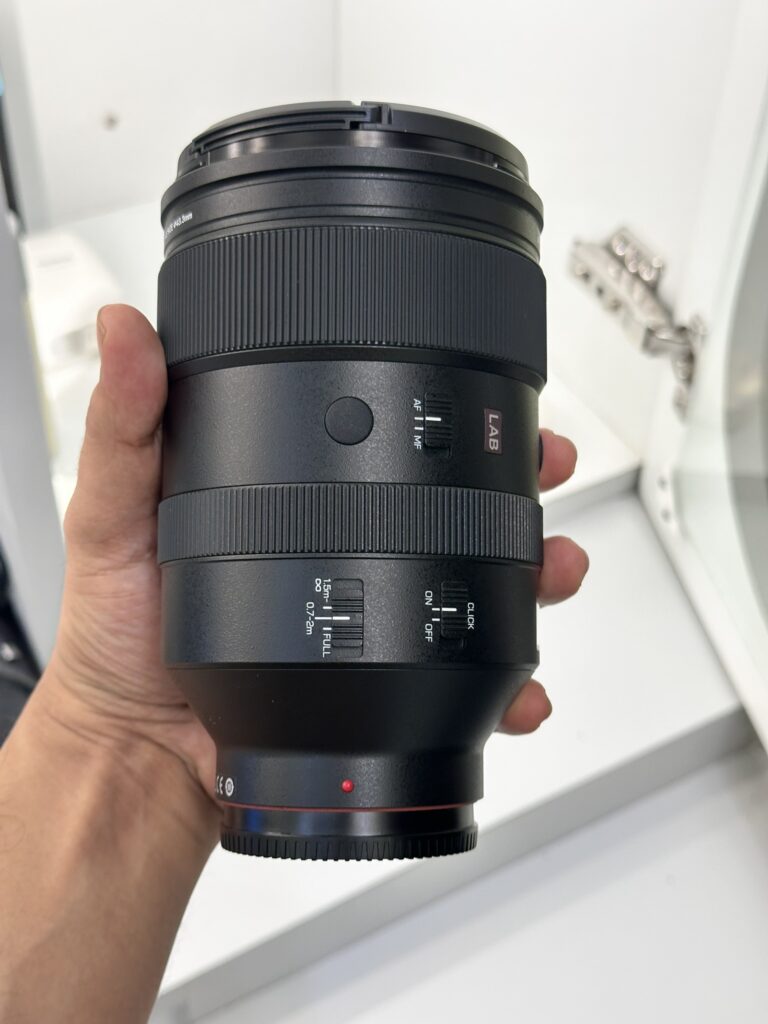
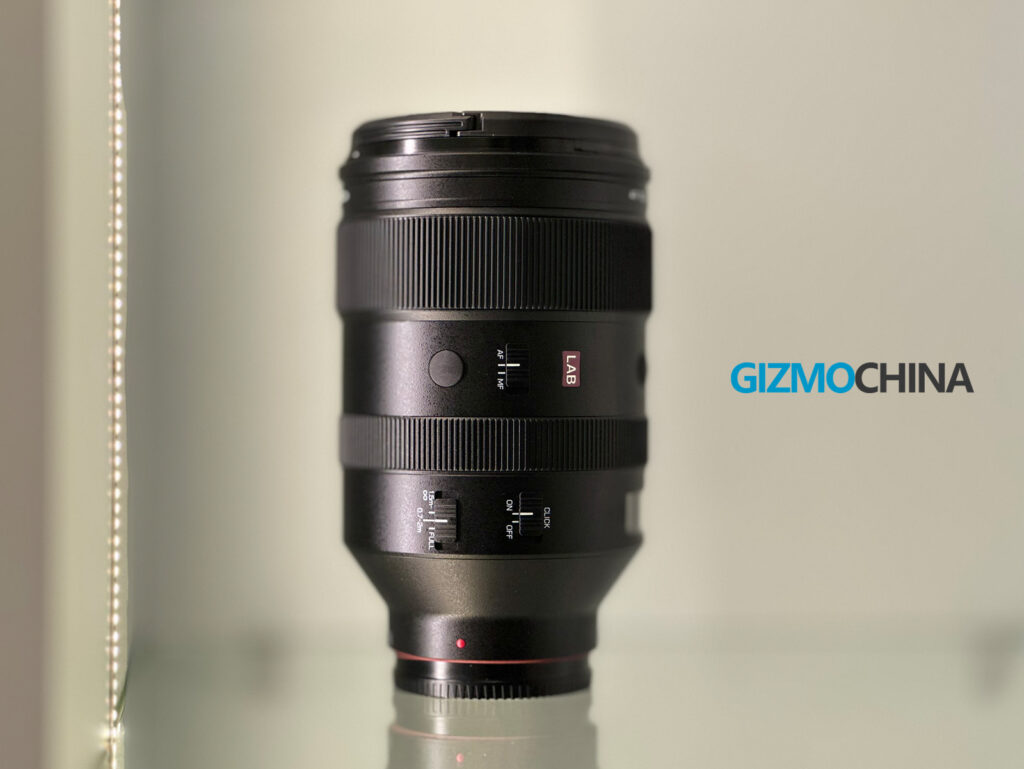
Calling the Viltrox LAB 135mm f/1.8 FE “big” doesn’t quite do it justice. It’s imposing. This isn’t a lens you casually toss into a sling bag or mount one-handed while on the go. It’s wide, it’s heavy, and it takes up space, physically and visually. But once it’s in your hand, that bulk feels intentional. This is a lens that’s been built to make a statement, and thankfully, it backs that up with thoughtful engineering.
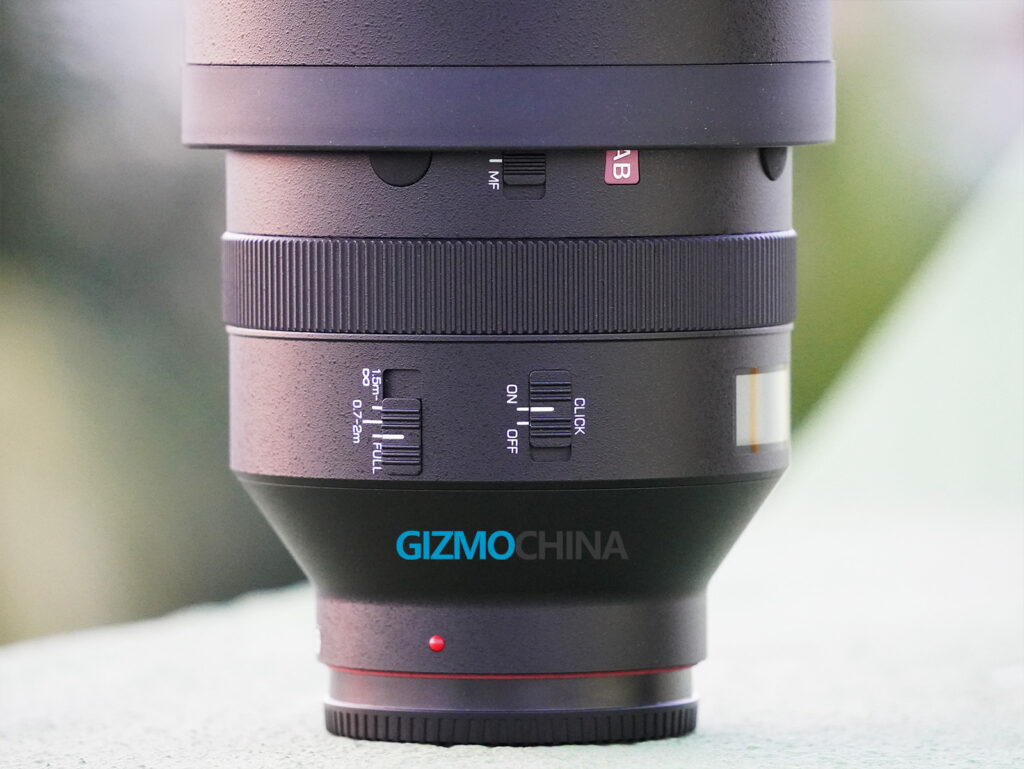
Starting from the rear, you’re greeted with a solid metal mount wrapped in a rubber gasket for environmental sealing. The gold-plated electronic contacts ensure smooth communication with Sony bodies, easily missed unless you’re looking for it. There’s a USB-C port discreetly placed near the lens base. This is for direct firmware updates. It’s simple, it works, and it’s the kind of feature that quietly says Viltrox is paying attention to long-term usability.
The lens barrel is all metal, with a smooth matte-black finish that resists fingerprints better than most. Everything is weather-sealed, at least on paper, and while Viltrox doesn’t make any IP claims, I’ve been shooting this in India’s suffocating monsoon humidity and it hasn’t skipped a beat. No fogging, no condensation inside the elements, and no sticky focus rings, even after stepping from an AC room into 90% humidity.
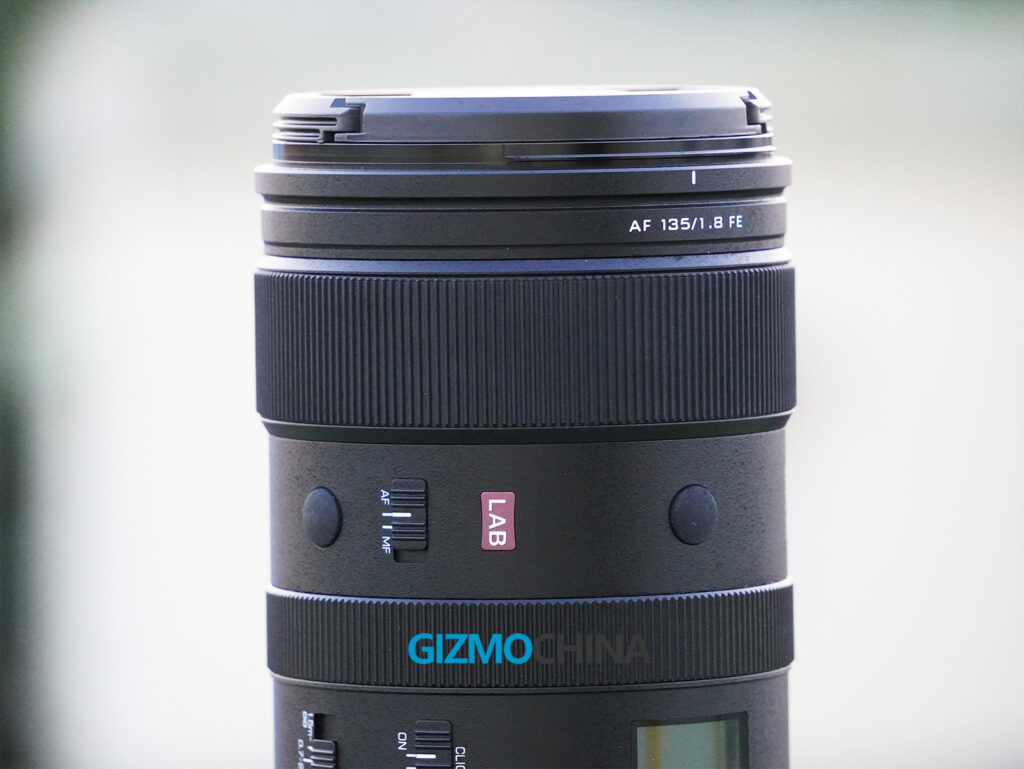
Now, about those controls. Viltrox really went all out here. On the left side of the barrel, there’s a three-position AF range limiter switch, which lets you toggle between the full 0.7m to ∞ range, a close-range lockout (0.72m to 2m), and a far-range lockout (1.5m to ∞). Right below it is a click/de-click switch for the aperture ring, a rare luxury at this price, and a nod to video shooters. The aperture ring itself is unmarked. It’s designed to be fully digital and customizable via your Sony camera.
Just forward of the aperture ring sits a generously wide manual focus ring. It’s fly-by-wire, but beautifully damped and well-textured. Manual focusing with peaking enabled felt satisfying, almost mechanical, despite being entirely electronic. Below that, there’s the usual AF/MF switch, and just ahead of that, two focus hold buttons, one near your thumb in landscape orientation, and another that lines up perfectly when shooting vertical. These buttons are fully customizable via Sony’s menu system.
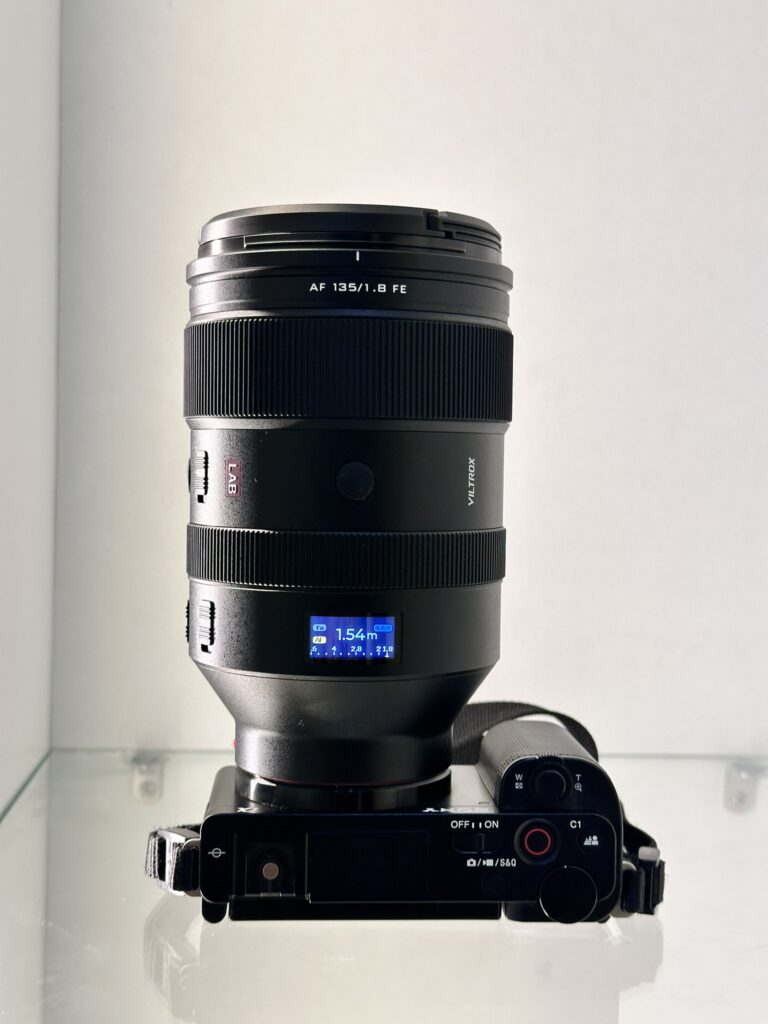
Then there’s the color LCD screen on the top of the barrel. It’s compact but clear, showing live readouts of your current aperture and focus distance.
Optically, Viltrox packed 14 elements in 9 groups, including four ED (Extra-low Dispersion) and two high-refractive index elements. There’s HD Nano multi-layer coating to suppress flare and ghosting, and the front element is treated with a water- and oil-repellent coating, which genuinely helped during a light drizzle.
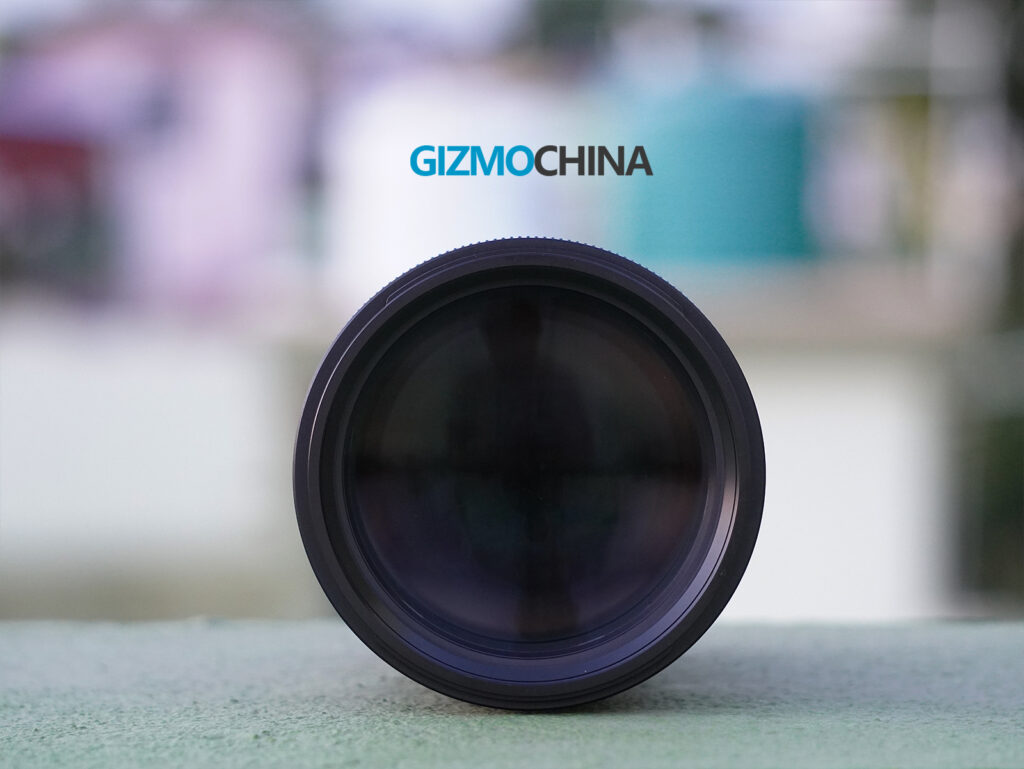
The filter thread is 82mm, which means filters won’t be cheap, but the front element is so massive it practically demands that size. The included lens hood is large, petal-shaped, plastic, and flocked on the inside, a small detail, but it helps cut internal reflections. There’s even a rubber ring around the outer edge to protect the hood when placing the lens face-down.
Weight-wise, it’s not going to win any portability contests. It comes in around 1300 grams with the hood, and while it balances well on the full-frame Sony α7 IV, it turns the ZV-E10 into a front-heavy beast. I’d never handhold it on the ZV for long, but for static shots on a tripod, it was still manageable. And again, despite this bulk, I never once worried about its durability or sealing, even while constantly swapping locations between humid balconies and cool interiors.
This isn’t just a well-built third-party lens; it’s built like a flagship. From the buttons to the rings to the physical presence, it feels like Viltrox is trying to break out of the budget-brand box entirely.
Performance
I didn’t plan to rely on this lens, but it’s quickly become essential for my product photography.
Let’s start with autofocus. It’s driven by a dual VCM (voice coil motor) system, and while that sounds like marketing fluff, the results are real. On my α7 IV, Eye AF locks in fast and tracks confidently, even when I’m shooting wide open at f/1.8 with razor-thin depth of field. For portraits, it rarely misses. On the ZV-E10, it performs fine, not quite as snappy, and tracking in video isn’t as reliable, but still usable with a bit of patience.
Manual focus, thanks to that wide, damped ring, is smooth and accurate. Combined with focus peaking, it’s enjoyable. I also tested A-B focus pulls; the transitions were smooth and silent, very usable for controlled video shots.
Image quality is where this lens really flexes. Center sharpness at f/1.8 is excellent. Edges soften a bit wide open, but this isn’t a landscape lens; it’s built for isolation, and it excels at it. By f/2.8, sharpness across the frame improves considerably. Contrast is punchy even at wide apertures, and microcontrast gives skin and materials a real sense of depth. Chromatic aberration is impressively well-controlled, even when shooting backlit subjects. There’s a hint of longitudinal CA if you pixel peep, but it’s mild.
Flare resistance is good, not perfect, but better than expected. I shot under streetlights and backlit windows, and while there was some contrast drop and minimal ghosting, it never ruined a shot. Distortion is basically zero, and vignetting at f/1.8 adds a subtle, flattering frame to portraits. It clears up around f/2.8.
Then there’s the bokeh. It’s creamy, clean, and almost cinematic. Light sources blur into soft-edged orbs without onion-ring patterns or nasty edges. Backgrounds melt, especially at mid- to close-range. The 11-blade diaphragm keeps things round even stopped down a bit, and the fall-off from sharp to soft is smooth and natural. For a lens that costs less than half of Sony’s GM, this rendering is remarkable.
Sample Images
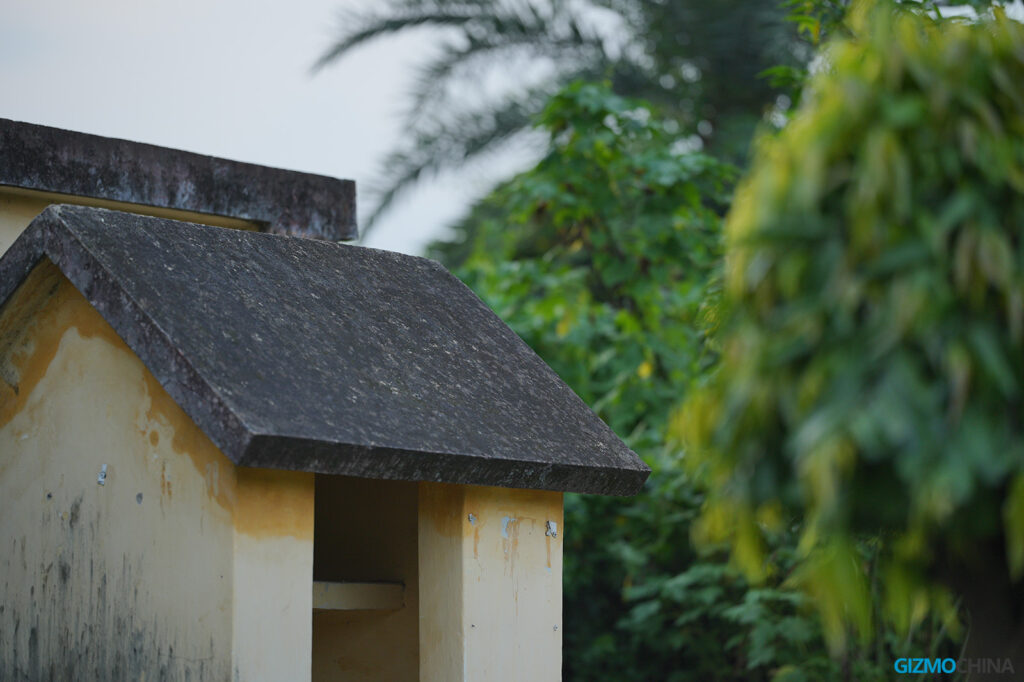
I mostly shoot gadgets, but for this lens, I made an effort to test it in a wider range of scenarios. I shot plenty of product photos, miniatures, both indoors and outdoors.
Even in simple setups, like a product placed near a window or outside with some greenery in the background, the lens delivered strong subject separation and smooth background blur that added depth to the images.
I also took it out for portraits, capturing friends, a few strangers, and even some self-portraits in natural light during the monsoon. The results felt clean and natural, skin tones looked accurate, and the background fall-off made the subjects stand out without looking overly processed.
I spent time photographing everyday scenes too, trees, buildings, and textures, and the lens handled it all with sharp detail and pleasing contrast.
If you’re even thinking about buying a 135mm f/1.8 lens for portraits, product isolation, or creative depth-of-field work, you should absolutely be looking at this Viltrox.
Is it perfect? No. It’s heavy. It’s big. The autofocus isn’t GM-tier, and the weight makes it tricky for casual handheld work, especially on smaller camera bodies.
But here’s the thing: for under $900, this lens delivers performance that comes dangerously close to lenses twice its price. It’s not a “good third-party alternative”, it’s just good. Full stop. You’re getting fast autofocus, sharp wide-open rendering, beautiful bokeh, pro-level control layout, and features like firmware updates over USB-C, an LCD screen, and A-B focus pulls, all in one package.
As a casual photographer who mostly shoots gadgets and only dabbles in portraits, this lens pulled me outside of my comfort zone. It made me want to take portraits. It made my product photos look more professional. And it gave me zero headaches in the process.
This isn’t just Viltrox’s best lens, it’s the lens that makes you stop calling Viltrox a budget brand.
Pricing and Availability
The Viltrox LAB 135mm f/1.8 FE is priced at $899 and is available on Amazon and the official Viltrox Store. You can find it for less during sales.
We also recently reviewed the Viltrox AF 25mm f/1.7 Air, an affordable prime that delivers pro-level results. Don’t miss it.
For more daily updates, please visit ourNews Section.
Google’s upcoming Pixel 10 series is back in the spotlight thanks to a new round of leaks from reliable tipster Evan Blass.
Pixel 10 Pro Fold: bigger cover screen, stronger build
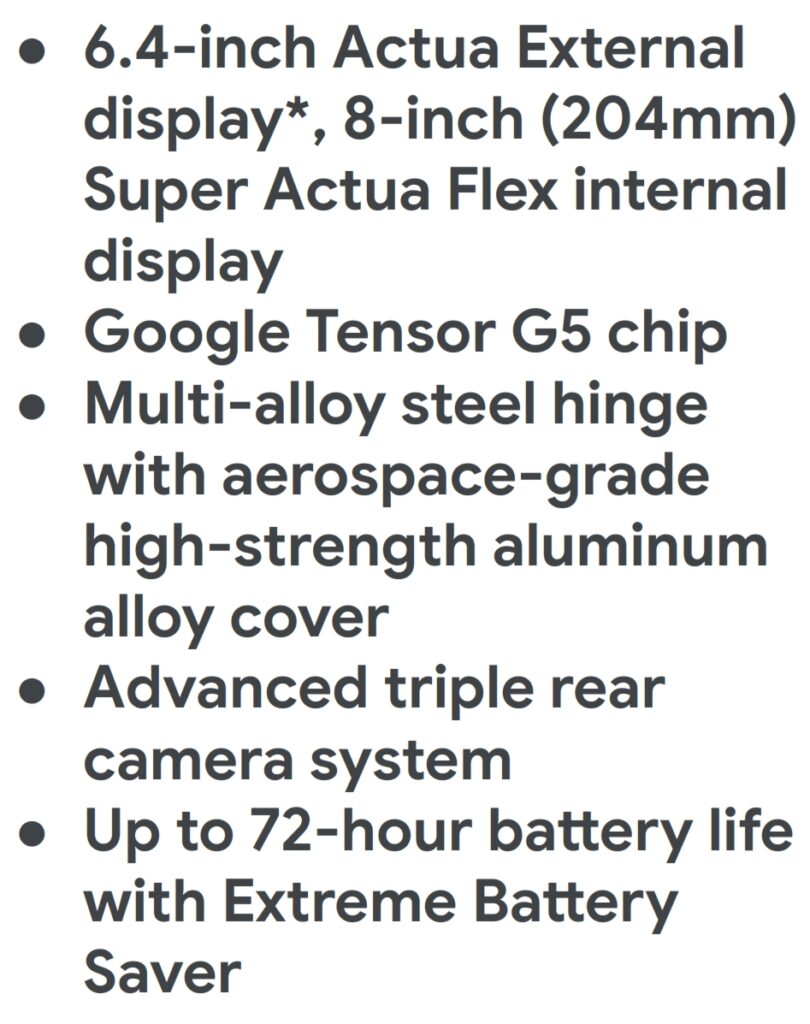
The Pixel 10 Pro Fold is getting a few notable upgrades. The outer screen will now measure 6.4 inches, slightly larger than its predecessor, while the main foldable display remains at 8 inches. Google is said to be using a more durable hinge made from “multi-alloy steel” along with a high-strength aluminum alloy for the outer shell. It’s also rumored to be the first foldable with an IP68 rating.
While Google is keeping camera specs under wraps, the leak confirms a triple-lens rear setup. Battery life should be another standout feature, with up to 72 hours of use in Extreme Battery Saver mode — great news for power users and foldable fans.
Pixel 10 Pro and Pro XL
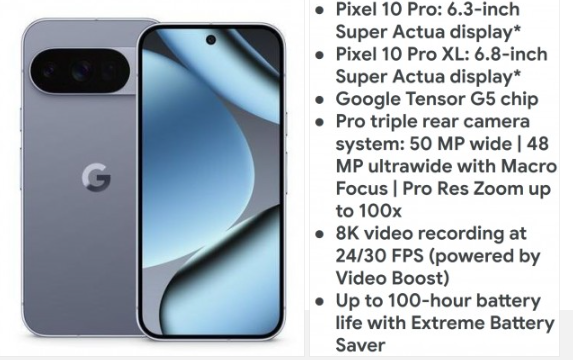
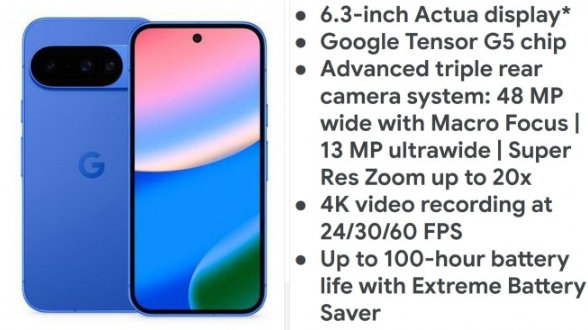
The Pro and Pro XL models will stick to the familiar 6.3-inch and 6.8-inch displays. Both phones will feature a 50MP main camera and a 48MP ultra-wide lens with autofocus, making them ideal for macro photography. The telephoto lens, labeled as “100x Pro Res Zoom,” is believed to use a 48MP 5x telephoto that supports 8K recording at 24 or 30fps.
Battery life is also getting a boost, possibly thanks to the more efficient chip. With Extreme Battery Saver, both phones will reportedly last up to 100 hours.
Pixel 10: same size, added telephoto
Despite its compact 6.3-inch size, the Pixel 10 introduces a new telephoto lens with ’20x Pro Res Zoom,’ reportedly powered by an 11MP sensor. The 20x zoom suggests a base optical magnification between 2x and 3x.
It will also have a 48MP main camera, though the ultra-wide lens appears to be a step down at 13MP, compared to the higher-res sensor seen on last year’s model.
HMD is bringing back the nostalgia with a modern twist, teaming up with FC Barcelona to launch a limited-edition version of its 3210 feature phone. The device mixes the old-school charm of classic Nokia phones with a touch of AI, aiming squarely at fans of the iconic football club.
Visually, the phone leans heavily into Barça branding. It comes in the club’s signature red and blue colors, complete with a hollowed-out FC Barcelona logo on the back. There are custom wallpapers, icons, and even a themed version of the classic Snake game. Hidden Easter eggs can also be unlocked by dialing special codes—a playful nod to fans who want a little extra from their device.
Under the hood, it sticks to the basics, much like the standard 3210 remake. There’s 4G VoLTE support across major Chinese networks and a 2MP camera that delivers intentionally grainy, retro-style photos. Users can make Alipay scan payments with spending limits, and access radio and streaming content through built-in apps.
But the real surprise is that the phone includes DeepSeek’s AI assistant, which reportedly comes with a 100-day free trial. Alongside answering questions, this AI assistant can set alarms or even manage workout routines using voice commands. It’s an unusual yet clever addition to a device that’s otherwise all about minimalism and distraction-free use.
The FC Barcelona 3210 offers a nostalgic design with a modern layer of intelligence—perfect for fans who want to stay connected without the noise of a smartphone. Pre-sales are now live in China, with early buyers getting a discounted price of 429 yuan (around $60).
Vivo is set to expand its Y-series lineup in India with the launch of the Vivo Y400 5G, following the earlier debut of the Y400 Pro 5G. Scheduled to launch on August 4, the upcoming model has already generated buzz thanks to its slim profile and stylish color options.
The company has revealed that the phone will arrive in two finishes—Glam White and Olive Green. With its flat display and clean dual-camera layout, the Y400 5G seems to share design cues with the Y400 Pro, which was praised for its slim 7.49mm build.
While official specs are still under wraps, the Y400 5G is expected to be a budget-friendly 5G device priced around ₹20,000, similar to its predecessor. For context, the Y300 5G features a 6.67-inch AMOLED display, Snapdragon 4 Gen 2 chipset, 5,000mAh battery, and a 50MP + 2MP rear camera setup, all protected by an IP64 splash-resistant design.
Based on Vivo’s recent track record, the Y400 5G could bring upgrades such as a larger battery and improved ingress protection. It may also include some basic but useful AI features, like Circle to Search and AI-powered object remover as part of Vivo’s Funtouch OS 15 based on Android 15.
Vivo has also lined up the launch of another phone, the T4R, on July 31—rumored to pack a Dimensity 7400 chip and premium camera features.
Specifications of the Vivo Y400 5G will likely surface as we inch closer to the launch on August 4. Sales are expected through Flipkart, Amazon, and Vivo’s online store.
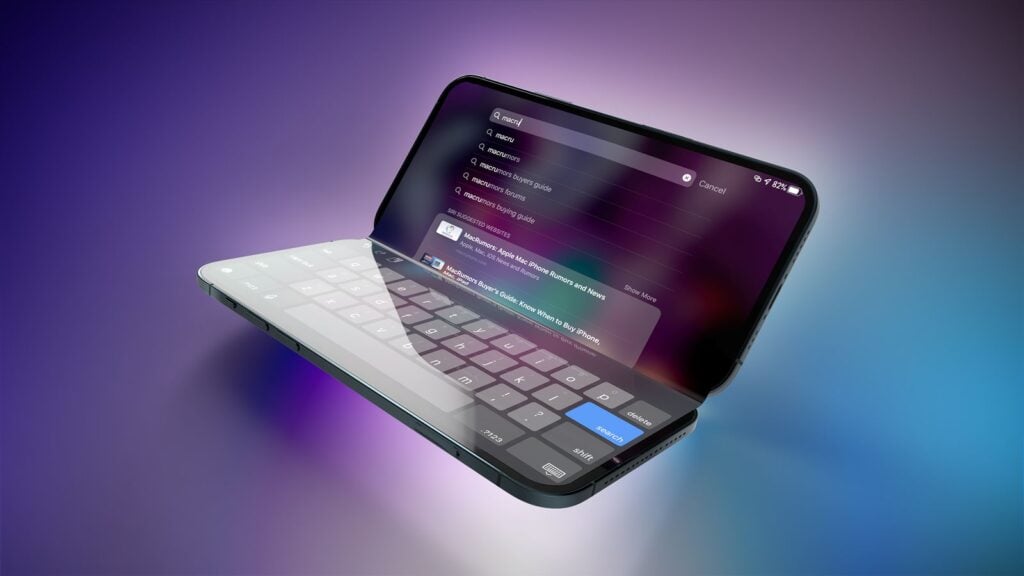
Apple is still not ready to enter the foldable phone race. According to a new investor report, the company is aiming to launch its first foldable iPhone—possibly called the iPhone Fold—alongside the iPhone 18 lineup in September 2026.
The device is expected to feature a 7.7-inch inner display and a 5.5-inch outer screen. Powering it could be the same A20 Pro chip set to power the iPhone 18 Pro, with software based on iOS 27 optimized for the foldable experience. Apple may also include Face ID or even bring back Touch ID for added flexibility.
This first generation foldable iPhone is said to start at $1,999—matching Samsung’s current Fold pricing. But JPMorgan forecasts that around 45 million units could be sold within two years, which would be a bold leap given that the entire foldable market sold less than half that in 2024.
Also, most Android phone makers have now fine-tuned their foldable hardware and resolved many of the early issues with this form factor. It’ll be interesting to see if Apple can match that level of quality with its first-generation foldable, and whether buyers are willing to place their trust in a first generation device. That said, the strength of Apple’s ecosystem could give it an edge—especially for iPhone users who may prefer a foldable that fits seamlessly into their workflow, even if it comes with compromises like a noticeably smaller outer display or first-gen limitations.
Rumors suggest Apple’s foldable could feature a new hinge design built with liquid metal, with a focus on durability. While details are still scarce, we’ll likely learn more as the September 2026 launch window approaches.
TerraMaster announced the global launch of the D1 Plus portable SSD enclosure recently, accompanied by an exciting giveaway event.
TERRAMASTER D1 SSD Plus is a highly competitive external SSD enclosure. Its outstanding performance, heat dissipation, and compatibility make it a great choice for users seeking efficient data transfer and stable storage solutions. If you are looking for an external hard disk enclosure that can fulfill your dual needs for speed and stability, then the TERRAMASTER D1 SSD Plus is worth your consideration.
GIVEAWAY:
Participating in the giveaway is easy. Simply sign up for Gizmochina Youtube subscriptions, join our Facebook community or Twitter(X).
The giveaway runs from July 30 to August 10, 2025, offering tech enthusiasts a chance to win the brand new TerraMaster D1 Plus portable SSD . Winners will be randomly selected and announced on Gizmochina’s Youtube page and via email within two days after the giveaway ends.
Samsung‘s top-of-the-line flagship for 2026, the Galaxy S26 Ultra, has been making headlines for some time — and the latest leak appears to confirm its chipset.
Samsung Galaxy S26 Ultra
Galaxy S26 Ultra’s firmware (spotted by SamMobile) includes a reference to “qcom, pmk8850″—a hint that the upcoming Ultra model may be powered by Qualcomm’s next-gen Snapdragon 8 Elite 2 chip. For comparison, the Snapdragon 8 Elite in the S25 Ultra carried the identifier SM8750, making this a likely successor. However, it’s still unclear what “pmk” (as opposed to the usual “SM”) actually signifies. Could it point to the previously rumored Samsung-fabricated 2nm variant of the chip? That remains to be seen. Either way, the leak reinforces the likelihood of another Snapdragon-exclusive Ultra model.
For those unfamiliar, the Snapdragon 8 Elite 2 is expected to debut with a reworked Oryon CPU, reportedly pushing clock speeds up to 4.6GHz in the standard version, and up to 4.74GHz in the “for Galaxy” edition—possibly the one labeled “pmk8850” in the firmware. Early performance estimates suggest a substantial leap over the previous generation, with up to 25% better overall performance and industry-leading GPU capabilities. The Snapdragon 8 Elite 2 chipset is expected to be officially announced in September.
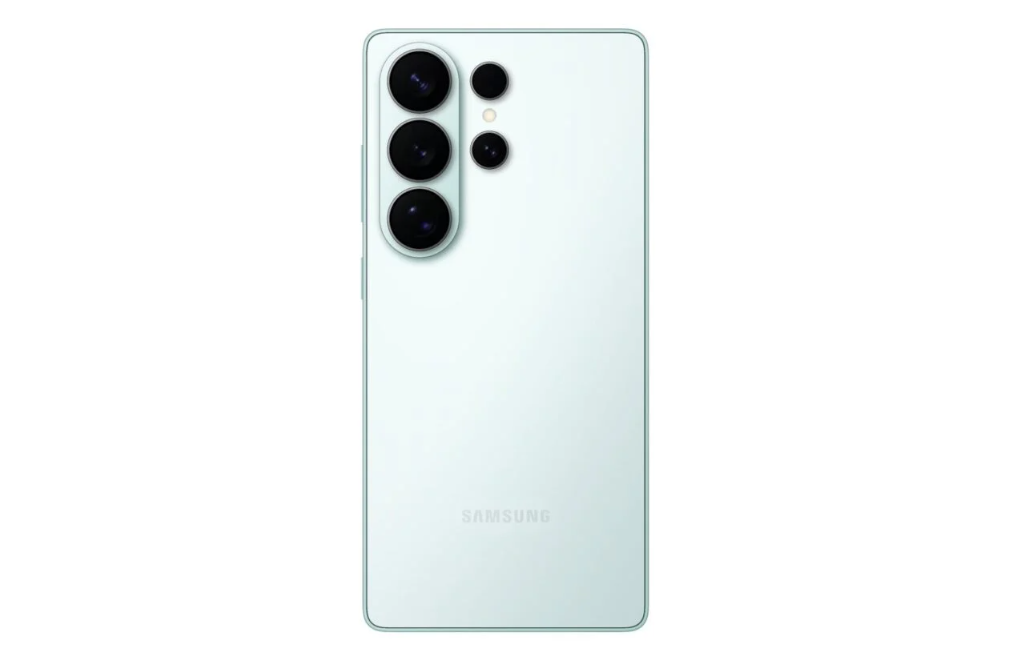
As for the S26 Ultra, rumors point to a massive 6.9-inch OLED display with improved brightness and color accuracy, a 200MP main camera with a wider aperture, and a 50MP 5x periscope zoom lens. Buyers may get a choice of 12GB or 16GB RAM, while a 5,000mAh battery and faster 60W charging could bring meaningful improvements in day-to-day use. Despite its size, the phone is said to be slimmer and lighter than previous Ultra models, offering a more comfortable feel in hand.
Samsung’s One UI 8.5 software is also expected to introduce more advanced AI features, with tools designed to assist with tasks, enhance photography, and streamline everyday use.
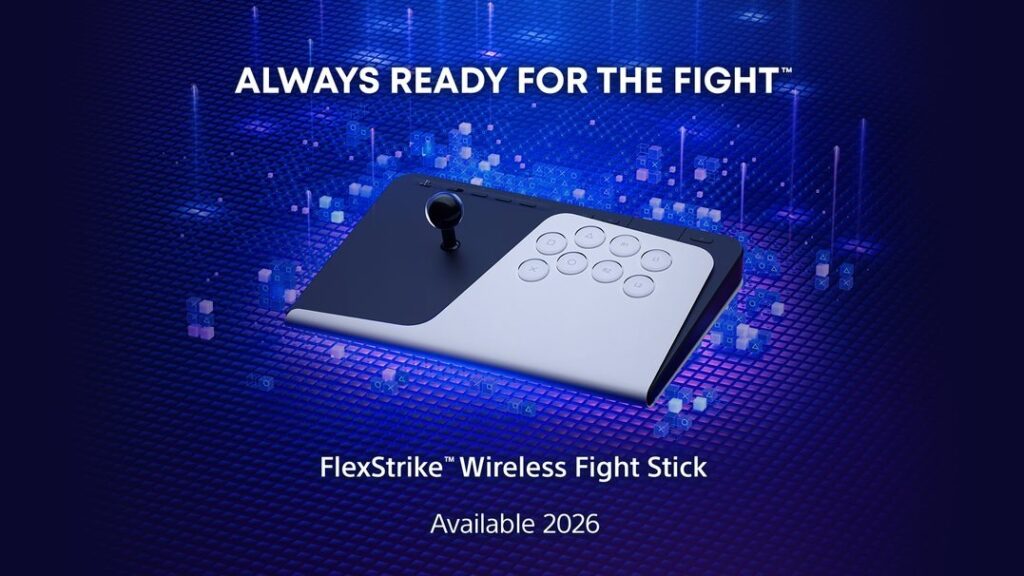
Sony has officially named its new fight stick controller, previously known as Project Defiant. The device is now called the FlexStrike and will be on display at Evo 2025 in Las Vegas from August 1 to 3. It is scheduled to launch in 2026. Pricing has not been announced yet.
The FlexStrike is Sony’s first in-house arcade controller. It works with both PlayStation 5 and PC. It supports wired USB-C connections and wireless play using the PlayStation Link adapter. The wireless setup is built to reduce input lag and also supports audio devices like the Pulse Elite headset and Pulse Explore earbuds at the same time.
Players can connect two FlexStrike controllers to a single adapter for local matches. A DualSense controller can stay connected at the same time for menu navigation. A quick press of the PS button can wake the PS5 when the FlexStrike is synced.
The controller uses a digital joystick, eight mechanical buttons similar to the DualSense, and a touchpad. It also includes a lever switch to change directional inputs and a lock button to prevent unwanted presses during a match.
The FlexStrike has a non-slip base and comes with swappable restrictor gates. It includes circular, square, and octagonal gate options, which can be stored in compartments under the base along with the USB adapter. The base covering can be removed to access these parts. The design includes angled surfaces for a more comfortable grip during long play sessions.
A sling carry case is included, and the controller runs on a built-in rechargeable battery. The FlexStrike will be playable at the Arc System Works booth and the Fight Stick Museum at Evo 2025.
For more daily updates, please visit our News Section.
OnePlus has started rolling out OxygenOS 15.0.0.840 for the OnePlus 12R in India. The update is going out in batches and includes several practical features focused on day-to-day use.
The update brings a new “Save to Mind Space” option. It lets you save screen content as memories, which the phone organizes and summarizes automatically.
In the Camera app, a soft light filter has been added to both Portrait and Photo modes. This helps create softer, cleaner images. The Photos app now has the AI Perfect Shot feature. It can recognize different facial expressions of the same person and choose the best one across multiple photos.
Video and live photo editing options are also improved. You can export videos as live photos or turn both formats into high-resolution still images. You can now hide certain albums from the main photo list for a cleaner view.
Other app updates include gradual alarm volume in the Clock app. Alarms now start quietly and get louder over time. The Recorder app now supports manual grouping and adds an “In-person recordings” section. Recordings from Standard, Meeting, and Interview modes go there automatically.
System changes include more font language support for OnePlus Sans and One Sans. Widgets of the same size can now be stacked. Multi-screen control is also available. It lets you run one app in full screen and another in a floating window at the same time.
There’s also a new option to block banner notifications temporarily when watching videos or playing games. You’ll find it in Settings under Notifications and Quick Settings. A Restart button has been added to Quick Settings, and mini windows can now be moved to the bottom of the screen. The update also fixes a display issue with mini windows.
This update includes the July 2025 Android security patch. A wider rollout will follow soon. Feedback can be submitted through the OnePlus Community App or by dialing *#800#. Users can check for updates by going to Settings > System > System Update.
Ayaneo has officially confirmed its entry into the smartphone market. At its 2025-2026 strategy briefing, the company announced plans to launch its first gaming smartphone, named the Ayaneo Phone. Alongside the phone, Ayaneo also introduced Konkr, a new sub-brand focused on affordable handheld gaming devices.
The Ayaneo Phone will mark the company’s first attempt at building a true gaming smartphone. Ayaneo stated that the device is “built for gamers” and will reflect the company’s handheld gaming design philosophy. Although the company has not revealed any technical specifications, teaser images and statements suggest that the phone will feature a sliding mechanism. Physical controls are expected to slide out from beneath the display, similar to Sony’s Xperia Play from 2011.
This move positions the Ayaneo Phone as a potential competitor to the Anbernic RG Slide, a recently launched handheld that also uses a sliding form factor. However, unlike Anbernic’s device, which lacks mobile network capabilities, the Ayaneo Phone will function as a full smartphone. The company has not confirmed a release date or price, but more information is expected in future livestreams and at the upcoming ChinaJoy 2025 event.
Ayaneo has also launched Konkr, a sub-brand aimed at delivering performance-focused handhelds at more affordable prices. The Konkr Pocket Fit will be the first Android-based handheld under this brand. It features a 6-inch 1080p display with a 144Hz refresh rate and will be powered by a flagship Qualcomm chipset. Ayaneo emphasized comfort and portability in the Pocket Fit’s design.
In addition to the Android model, Ayaneo is preparing the Konkr Fit, a Windows-based handheld that includes a large 80Wh battery. It will feature a 7-inch display and is designed to deliver flagship-level performance in a compact form factor.
Ayaneo also previewed other devices during the livestream, including the dual-screen Pocket DS and a vertical Game Boy-style handheld. The company has positioned itself as a serious competitor in both premium and mid-range handheld gaming categories and is now expanding its footprint into the smartphone segment with a hardware approach tailored to gamers.
For more daily updates, please visit ourNews Section.
We use cookies on our website to give you the most relevant experience by remembering your preferences and repeat visits. By clicking “Accept”, you consent to the use of ALL the cookies.
This website uses cookies to improve your experience while you navigate through the website. Out of these, the cookies that are categorized as necessary are stored on your browser as they are essential for the working of basic functionalities of the website. We also use third-party cookies that help us analyze and understand how you use this website. These cookies will be stored in your browser only with your consent. You also have the option to opt-out of these cookies. But opting out of some of these cookies may affect your browsing experience.
Necessary cookies are absolutely essential for the website to function properly. This category only includes cookies that ensures basic functionalities and security features of the website. These cookies do not store any personal information.
Any cookies that may not be particularly necessary for the website to function and is used specifically to collect user personal data via analytics, ads, other embedded contents are termed as non-necessary cookies. It is mandatory to procure user consent prior to running these cookies on your website.