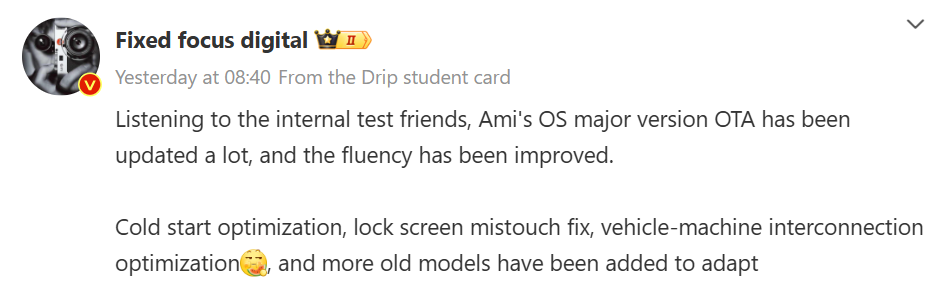
Vivo launched the X100 Ultra last year. The phone has already received a total of six system updates so far. The latest one is the OriginOS 4 PD2366I_A_14.0.10.2.W10.V000L1. The package is 245MB in size and contains a number of camera improvements, a new camera feature, battery life improvements and more.


The new camera feature lets you connect the phone with certain MR (mixed reality) devices to offer a more immersive photography experience. You can see all the other improvements in the changelog below.
New in OriginOS 4 PD2366I_A_14.0.10.2.W10.V000L1
Camera improvements:
Improves the stabilization performance of 4K60fps video recording, making the camera movement more stable and smoother.
Improves camera stability for usage under a high-temperature environment.
Zooming becomes smoother, which also improves the overall camera experience.
Night mode has also improved to offer clearer images.
Third-party camera apps now also work better than before in terms of managing the exposure and producing clearer images.
Battery improvements:
Standby power consumption in certain scenarios is reduced for improved battery life.
Bluetooth:
Standby power consumption is optimized for improved battery life.
System:
Display effects have also been optimized.
However, the update does not mention which MR devices support connectivity with the phone and which do not. Notably, vivo is also working on an MR prototype that according to Hu Baishan, the executive vice president and chief operating officer of the brand, will be released on its 30th anniversary next year.
The vivo X100 Ultra (review) is powered by the Snapdragon 8 Gen 3 chipset, a 1/0.98″ main sensor with gimbal stabilization, a 200MP periscope telephoto with 3.7x optical zoom, and an additional 50MP ultrawide. It has a 5500 mAh battery that supports 80W fast charging. The phone is exclusively available in the home country and is available for 6499 Yuan (~$914).
Titan Army has launched a new 27-inch curved gaming monitor in the Chinese market, the N27SKC. This budget-friendly monitor boasts a 1080p resolution with a 240Hz refresh rate, making it a great option for gamers looking for a smooth and responsive gaming experience.
The monitor is priced at 890 yuan ($125) and is now available on JD.com. Let’s check out its key specs.
Titan Army N27SKC Monitor Specifications:
The N27SKC features a 1920×1080 resolution HVA panel with a 1500R curvature, offering an immersive viewing experience. The monitor has a static contrast ratio of 3000:1, a 1ms response time, and 300 nits brightness. It also covers 85% DCI-P3, 99% sRGB, 85% Adobe RGB, and 85% NTSC color gamut, providing rich and vibrant colors.
The display supports a staggering 240Hz refresh rate which ensures smooth and tear-free visuals, even in fast-paced games. Additionally, the monitor supports Adaptive-Sync technology, compatible with both AMD Radeon FreeSync and NVIDIA G-Sync graphics cards, eliminating screen tearing and stuttering. It also includes gaming-oriented functionalities such as an on-screen crosshair, and customizable game modes for FPS and RTS genres.
The N27SKC features a red backlight on the back, adding a touch of style to your gaming setup. The stand supports tilt adjustment for comfortable viewing positions. In terms of connectivity, the monitor provides 2 HDMI 2.0 ports, 2 DP 1.4 ports, and a 3.5mm audio interface.
For eye care, the Titan Army N27SKC is equipped with a low blue light eye protection mode and DC flicker-free dimming technology to reduce eye strain during long gaming sessions. The monitor offers viewing angles of 178 degrees both horizontally and vertically.
The gaming monitor also supports PIP/PBP two split-screen modes, allowing you to connect two devices simultaneously and display them in a left/right or overlayed window configuration, increasing productivity for multitasking.
In terms of dimensions, the Titan Army N27SKC monitor measures 616.2 x 445.7 x 237.4 mm; however, the weight of the monitor is not specified.
Huawei has unveiled a new magnetic power bank, the “Huawei SuperCharge All-in-One Magnetic Power Bank”, designed for convenient on-the-go charging for your Huawei phone. The power bank is now available for pre-order on JD.com and will officially go on sale on June 10th. It is priced at 369 yuan (approximately $52).
Huawei SuperCharge All-in-One Magnetic Power Bank Specifications:
The power bank boasts a slim and portable design, measuring only 11.26mm thick and weighing 141g. Despite its compact size, it packs a 5000mAh capacity, offering enough juice to top up your phone on the go.
It supports bi-directional 25W wired charging, allowing you to charge the power bank itself or other devices quickly. Additionally, it offers 15W wireless charging when powered by the battery cell, and can be bumped up to 30W when connected to an adapter.
The power bank is compatible with various fast charging protocols like SCP, UFCS, and PD, ensuring compatibility with a wide range of devices. It comes with a 25cm USB-C to USB-C cable for wired charging.
The magnetic aspect comes into play with Huawei phones that support wireless charging and utilize an official magnetic adsorption case. This allows for a convenient cable-free charging experience by simply attaching the phone to the power bank.
The powerbank also features a foldable stand, providing a hands-free charging option for watching videos or working. Huawei claims that the power bank can fully charge both the power bank and a phone overnight in base charging mode, ensuring you wake up with ready-to-go devices.
The power bank is built with a high-quality lithium polymer battery cell that meets national safety standards and is UL 1642 certified. It also boasts multiple protection features to safeguard against overcharging, over-discharging, short circuits, and more.
Xiaomi is gearing up to launch the Xiaomi 14 Civi smartphone in India on June 12th. The device is rumored to be a rebrand of the Chinese Civi 4 Pro, which debuted in March.
Ahead of the launch, tipster Abhishek Yadav has leaked the retail box of the Xiaomi 14 Civi, which reveals key specs of the device, while also confirming the fact that it is indeed a rebrand of the Civi 4 Pro.
As per the retail box, the phone boasts a Leica-branded 50MP main camera with dual 32MP selfie cameras. The display is a curved AMOLED with 1.5K resolution and a 120Hz refresh rate. Powering the device is the Snapdragon 8s Gen 3 SoC with a 4700mAh battery. Color options include Cruise Blue, Matcha Green, and Shadow Black.
Other details are also expected to be the same as those of the Xiaomi Civi 4 Pro, which means that the device could offer a 6.55-inch display that has 3,000 nits peak brightness, as well as a 12MP ultra-wide, and a 50MP telephoto camera to accompany the 50MP primary camera.
The Snapdragon 8s Gen 3 chip will be paired with LPDDR5x RAM, and UFS 4.0 storage, and the 4,700mAh battery will likely offer 67W fast charging support. Pricing details are currently unavailable, but going by a previous leak by the same tipster, the phone will be priced under ₹50,000.
One UI is a popular and clean Android custom skin with plenty of customisations to offer. The latest iteration, One UI 6.1, works well with the default settings, but you can improve your device’s performance by tweaking a few settings.
So, if your Samsung Galaxy is running slow or you want to optimise its performance further, apply the tips mentioned below.
TIP #1: Remove Bloatware
Samsung phones have bloatware (unwanted apps), and you can’t uninstall them using the regular approach. They eat up storage and might consume additional resources such as RAM and CPU.
Removing these unwanted apps frees up storage and system resources, which can be used by essential apps to offer better performance.
One of the easiest ways to remove bloatware on Samsung phones is by using Universal Android Debloater. You can download it from GitHub for your PC or Mac. The next step is to set up ADB and then start removing bloatware. You can find a lot of guides for the step-by-step procedure by doing a Google search.
If removing bloatware is too much work for you, add them to the deep sleeping list, as mentioned in the next tip.
TIP #2: Deep Sleeping Unused Apps
Apps you have installed on your Samsung device but don’t use very often consume storage (obviously) but also use system resources to sync in the background. Not just performance, it negatively impacts the battery life as well.
If you can’t remove such apps, add them to the deep sleeping list to stop them from running in the background until you open them manually.
Here’s how to do it:
Step 1: Open the Settings app.
Step 2: Tap on Battery and click Background usage limits.
Step 3: Tap Deep sleeping apps.
Step 4: Click the “+” icon at the top.
Step 5: Select the apps and click Add.
Deep sleeping apps never run in the background. This means you won’t receive updates and notifications from those apps when not in use. In case, notifications are crucial for you, putting them to the sleeping apps list would do the job. This will allow the app to occasionally run in the background. However, the notifications may be delayed.
TIP #3: Switch to Maximum Processing Speed
Samsung phones are default set to operate at an “Optimal” processing speed, which is fine for most users, as it offers a good balance of performance and battery. However, if you do heavy tasks that require a lot of processing (for example, video editing), switching to “Maximum” processing speed should be a better option but uses more battery.
Step 1: Open the Settings app and tap Device care.
Step 2: Scroll down to Processing speed and tap on it.
Step 3: Choose Maximum.
Switching to maximum processing speed won’t make any difference to the gaming performance, as it does not apply to games.
If you are concerned about your gaming performance, you can set the Game optimisation to the “Performance” mode.
Step 1: Launch the Settings app.
Step 2: Tap the search icon and search for “Game Booster settings”.
Step 3: Click Game Booster settings from the search results.
Step 4: Tap Game optimisation and select Performance.
If touch protection is enabled on your Samsung Galaxy, disable the “Save power during touch protection” toggle to achieve a higher frame rate in games.
TIP #4: Disable RAM Plus
Samsung phones have RAM Plus enabled by default. It uses a specified portion of the internal storage to act like RAM. But as you know, RAM is much faster than the internal storage, and therefore it doesn’t make a big difference in the performance.
RAM Plus (or virtual RAM) is better suited for general multitasking and keeping more apps in the background. However, many people have had a completely different experience. Users on Reddit have said that the device performs better when the RAM Plus option is disabled.
You can try disabling the RAM Plus to see if it works in your favour. If things get worse, you can enable it anytime.
Steps to disable RAM Plus on Samsung phones:
Step 1: Open the Setting app and tap on Device care.
Step 2: Click Memory.
Step 3: Tap on RAM Plus (located at the bottom of the page).
Step 4: Disable RAM Plus.
TIP #5: Enable Auto Optimisation
Enabling “Auto optimisation” on Samsung phones allows the device to automatically perform necessary optimisations to keep it running smoothly.
To perform the optimisations, the device automatically restarts. Don’t worry; it won’t happen while you’re using the device. Alternatively, you can schedule to restart your phone.
Step 1: Open the Settings app and click Device care.
Step 2: Scroll down a little and tap on Auto optimisation.
Step 3: Click Auto restart and make sure Restart when needed is enabled.
TIP #6: Turn off Power Saving
If the power saving mode is turned on, you’re losing a lot on the performance side. This mode allows you to keep the device turned on for an extended period by restricting background tasks, disabling synchronisation, turning off 5G and AOD, and tweaking many other settings.
In the power saving mode, the device prioritises battery over performance. Hence, disable it for a snappier experience.
You can turn off power saving from the Control Center itself. If you can’t find the shortcut there, use these steps:
Step 1: Launch the Settings app and tap on Device care.
Step 2: Click Battery.
Step 3: Toggle off Power saving.
TIP #7: Ensure Sufficient Storage and Battery
When your device runs low on storage or battery (or both), it can severely affect its performance.
For optimal performance, it is recommended that at least 20% to 30% of the internal storage be free and that the battery level be between 80% and 100%.
Applying these easy tips should boost your Samsung device’s performance running One UI 6.1. Although the title mentions One UI 6.1, you can apply these tips to other One UI versions as well, but the steps may be different.
After months of speculation, Asus has finally unveiled the ROG Ally X at Computex 2024. While not a full-fledged sequel to the original Ally, the X version brings several improvements that make it an even more compelling option for portable PC gaming.
Asus ROG Ally X Specifications
The biggest change lies under the hood. The Z1 Extreme processor powering the handheld remains the same, but it now sits on a new motherboard that supports full 2280 SSDs, one which supports double-sided drives.
Asus has also doubled the storage on the base variant to a hefty 1TB SSD. The RAM has been increased to 24GB of DDR5-7500 — 8GB which is dedicated to the Z1 Extreme’s integrated GPU.
Moreover, the ROG Ally X now packs an 80mAh cell, double that of the original Ally, and Asus has addressed thermal concerns with larger heat pipes and quieter fans. This also makes an impact on the performance draw as the performance mode now runs at 17W, up from 15W, and the silent mode has increased from 10W to 13W.
Design-wise, the ROG Ally X retains its sleek black asthetics but receives some control layout refinements. The D-pad has been improved, the joysticks are redesigned for better durability and a five-million-cycle lifespan (compared to the Steam Deck’s two million), and the macro button on the back is now smaller and more discreet.
One notable change is the removal of the XGM port, replaced by a second USB Type-C port. One of these ports is Thunderbolt compatible allowing users to connect an external GPU for even more demanding gaming experiences.
The display remains the same as the original Ally, a 7-inch 1080p panel with a 120Hz refresh rate.
Price and Availability
The ROG Ally X is currently available for pre-order starting at $799 and shipping starts on July 22nd. You can pre-order it from Best Buy.
As Android 15 prepares for release later this year, Google is fine-tuning its new features. Among them is Instant Hotspot, a convenient tool that allows Android tablets and Chromebooks to seamlessly connect to a phone’s hotspot. However, recent reports confirm this feature won’t be available on Samsung Galaxy devices.
Instant Hotspot simplifies the process of connecting your tablet or Chromebook to your phone’s internet. When in range and without Wi-Fi, a pop-up will appear on your device, prompting you to connect to the phone’s hotspot. It’s a smooth and intuitive experience.
For Galaxy users, this might sound familiar. Samsung’s One UI already offers a similar functionality called Auto Hotspot. Both features achieve the same goal of connecting your tablet or Chromebook to your phone’s internet.
The key difference lies in compatibility. Google’s Instant Hotspot works with any Android tablet and Chromebook, while Samsung’s Auto Hotspot is exclusive to Galaxy devices within the same Samsung account or family group.
Although Samsung users have been enjoying Auto Hotspot for a while, the absence of Instant Hotspot in Android 15 won’t greatly affect their experience. As long as you exclusively use Samsung Galaxy devices, you won’t miss out on Instant Hotspot’s benefits.
However, if you were hoping to use Auto Hotspot with other Android tablets or Chromebooks, you might find yourself left out once Android 15 arrives.
It’s unclear why the Instant Hotspot feature won’t be available on Galaxy devices. The feature is part of Google Play Services, which is available on all Google-certified Android devices, including those from Samsung.
Samsung likely opted out of this feature because it overlaps with their existing Auto Hotspot. However, with Instant Hotspot, the usefulness of Auto Hotspot feels a bit limited.
Like every month, AnTuTu revealed its top 10 flagship killer smartphones from the previous month. We were expecting new contenders like the Redmi Turbo 3 and the iQOO Z9 Turbo featuring the Snapdragon 8s Gen 3 chip to enter the list this month, however, that hasn’t happened for some reason, resulting in the list being pretty much the same as the last month.
AnTuTu Benchmark Top Flagship Killer Smartphones May 2024
Redmi Note 12T Pro (MediaTek Dimensity 8200-Ultra, 12GB+512GB) – 886,865
The OnePlus Ace 3V has been in the number-one spot for 3 months in a row now, followed closely by the Realme GT Neo 6 SE and Redmi K70E. Other than that, we have the Realme GT Neo 5 SE and the Redmi Note 12 Turbo closing off the top 5 with an average AnTuTu score of above a million points. The only new addition to the list is the OPPO K12 5G, which has taken up the number ninth position.
In recent news, the flagship category has experienced a notable change: the Vivo X100s has taken the top spot, while the ROG Phone 8 Pro, which led in March and April, is no longer on the list.
Following the recent launch of the Realme C63 in Indonesia, another C-series smartphone, the Realme C61, has surfaced on the Global Certification Forum (GCF). It suggests the brand is gearing up for another budget-friendly offering.
The smartphone showed up on the GCF listing with the model number RMX3939. The listing does not reveal the phone’s official name or specifications. But previous entries in the NBTC and Indonesia Telecom databases have linked this model number to the Realme C63.
The C61 will be the successor to the Realme C51, which shares many of its specifications with the Realme C53. So it is likely that the C61 will have similar specifications to the recently launched Realme C63.
If the C61 follows the C63’s blueprint, it could offer a 90Hz LCD display with 450 nits peak brightness, a UniSoC T612 processor paired with a Mali G57 GPU, and Realme UI based on Android 14.
In terms of camera, the C61 might sport a 50MP rear sensor and an 8MP front-facing camera, along with a 5,000mAh battery with 45W SuperVOOC fast charging. Additionally, it could feature a side-mounted fingerprint scanner and a dedicated microSD card slot, similar to the C63.
With the C63’s weight hovering around 190 grams, the C61 might also be similarly lightweight.
Although the exact specifications and launch date of the C61 are still unknown, its appearance on the GCF suggests that an official announcement could be made soon. We will keep you in the loop on any new developments about the smartphone.
Realme is said to be working on two versions of the Realme GT 6, one for the global market and one for the Chinese market. The global variant featuring the Snapdragon 8s Gen 3 chip is very likely to go official on June 20. On the other hand, while the existence of the Chinese variant is still doubtful, it may debut with the Snapdragon 8 Gen 3 chip phone in July. The Chinese Realme GT 6 is expected to compete with the likes of the OnePlus Ace 3 Pro, iQOO Neo 9S Pro+, and the Redmi K70 Ultra, which are also expected to launch in July. By the end of the year, all the major Chinese smartphone brands are expected to launch the Realme GT 7 Pro in India and China. Last year, the Realme GT 5 Pro was announced in December, which suggests that the GT 7 Pro may go official in the same month this year. Here is a look at some of the details of the device that have emerged in recent leaks.
Realme GT 7 Pro key specifications (rumored)
Qualcomm is expected to unveil the next-generation Snapdragon 8 Gen 4 chipset in October. The same chip is likely to power the Realme GT 7 Pro. It won’t be the first Snapdragon 8 Gen 4 phone to debut in the Chinese market, as the Xiaomi 15 and 15 Pro, which are expected to launch in October, are said to be the first smartphones to come equipped with the said chipset. However, the GT 7 Pro could be the first Snapdragon 8 Gen 4 phone to debut in the global market.
Tipster Digital Chat Station claimed that the Realme GT 7 Pro has an ultra-large battery. To recall, the GT 5 Pro housed a 5,400mAh battery, which suggests that the GT 7 Pro may pack a battery of around 6,000mAh.
The leaker also said that the Realme GT 7 Pro will come equipped with a periscope telephoto camera like its predecessor. Another leaker, Smart Pikachu, said the GT 7 Pro will feature an ultrasonic in-screen fingerprint sensor. Hence, it appears that it could be Realme’s first phone to feature an ultrasonic fingerprint scanner.
Last month, Honor unveiled the Honor 200 and 200 Pro smartphones in China. It is speculated that the brand may announce its flip-style foldable phone for the Chinese market this month (June). Recently, an Honor phone with model number LRA-AN00 was approved by the 3C certification platform in China. It is speculated that it could be the upcoming Magic V Flip (tentative name) phone.
Alleged Honor Magic V Flip 3C certified
Honor LRA-AN00 3C certified
There is no concrete way to confirm that the LRA-AN00 is the upcoming Honor Magic V Flip. However, the listing reveals that this phone may ship with a HN-110600C00 / HW-110600C02 charger, which supports up to 66W fast charging.
According to reports, the Magic V Flip is likely to sport a massive cover display like the Motorola Razr 50 series. While the exact size of the display is not known, it is likely to be flanked by a round camera module with three cameras and an LED flash inside.
The device is expected to house a 4,500mAh battery. It appears that it may have the largest battery seen in a flip-style foldable phone. Unfortunately, the other details of the phone are under wraps.
Rumors have it that Honor is also working on the Honor X60 series for the Chinese market. While X60 may debut this month, the rumor mill is yet to leak concrete details about it. A recent report claimed that the device will have a quad-curved screen, a massive battery, and a drop-resistant chassis.
The Magic V3, a horizontally foldable phone, is also in the works for the Chinese market. Rumors suggest that the Snapdragon 8 Gen 3 foldable phone could make its debut in July of this year.
AnTuTu has released its list of top-performing flagship smartphones for this past month of May. Topping the list this month we have the newly released Vivo X100s, which is rocking MediaTek’s new and improved Dimensity 9300 Plus chipset. This chip is essentially an overclocked version of the regular Dimensity 9300, along with improved AI capabilities like support for various LLMs including Google’s Gemini Nano and Meta’s Llama 2 and 3. You can find the complete list below.
AnTuTu Benchmark Top Flagship Smartphones May 2024
Red Magic 9 Pro+ (Qualcomm Snapdragon 8 Gen 3) – 2,080,986
iQOO 12 (Qualcomm Snapdragon 8 Gen 3) 2,079,919
Vivo X100 Pro (MediaTek Dimensity 9300) – 2,045,717
iQOO Neo 9S Pro (MediaTek Dimensity 9300+) – 2,043,384
Vivo X100s Pro (MediaTek Dimensity 9300+) – 2,043,218
Vivo X Fold 3 Pro (Qualcomm Snapdragon 8 Gen 3) – 2,033,054
iQOO 12 Pro (Qualcomm Snapdragon 8 Gen 3) – 2,024,909
Vivo X100 Ultra (Qualcomm Snapdragon 8 Gen 3) – 2,024,787
At number two, we have the Oppo Find X7 featuring the Dimensity 9300, and on number 3, we have the first entry from the Qualcomm camp, the Red Magic 9 Pro+, with the Snapdragon 8 Gen 3 chip. An interesting entry is the iQOO Neo 9S Pro at number six. Devices from iQOO’s Neo series are generally aimed at mid-range gamers rather than being flagship models, but the inclusion of a Dimensity 9300+ chip in this device has earned it a spot on the list.
Despite all this, April’s champion, the Asus ROG Phone 8 Pro, is missing from the list. It’s also notable that the scores for all these devices are quite close, so this coming month’s rankings could look different from last month’s.
Edifier has unveiled its latest TWS earbuds, the NeoBuds Evo, boasting dual Hi-Res certification, low-latency audio codecs, and effective noise cancellation. Retailing at 599 yuan (roughly $84) on JD.com, these earbuds target audiophiles seeking exceptional sound quality and active noise cancellation (ANC) technology. Let’s delve into its key specs.
Edifier NeoBuds Evo Specifications:
The NeoBuds Evo stands out with its dual Hi-Res certification, supporting audio decoding up to 192kHz/24bit. Edifier further elevates the audio experience with a “Lowsy Balanced Armature” driver combined with a dynamic driver unit. This hybrid design aims to deliver crisp highs, powerful mids, and deep bass.
The earbuds boast a maximum noise cancellation depth of 48dB at 4000Hz. This effectively reduces ambient noise, allowing users to focus on their music, audiobooks, or podcasts without distractions.
Edifier has also upgraded the noise cancellation modes, offering both “Deep Noise Cancellation” for maximum noise reduction and “Comfortable Noise Cancellation” for a more balanced experience that allows some environmental sounds to pass through.
Equipped with six high-performance microphones, the NeoBuds Evo ensures clear voice quality during calls. The microphones work together with updated call noise reduction algorithms to minimize background noise and enhance voice pickup, even in windy or noisy environments.
Bluetooth 5.4 connectivity ensures a stable and reliable connection with your device, while support for high-fidelity codecs like LHDC 5.0, LDAC, AAC, and SBC guarantees high-quality wireless audio transmission.
The NeoBuds Evo offers a single-charge battery life of around 11 hours with noise cancellation turned off. With ANC enabled, the playtime drops to about 7 hours. The included charging case provides an additional 37 hours (ANC off) or 25 hours (ANC on) of playback, keeping you powered up throughout the day. A quick 15-minute charge delivers an impressive 4 hours of playtime, perfect for those on the go.
Edifier’s companion app, Edifier Connect, allows for further customization of the NeoBuds Evo. Users can adjust touch controls, personalize wearing detection settings, and tailor the sound signature using the EQ.
Edifier has prioritized hygiene with the NeoBuds Evo. The ear tips are crafted from antibacterial materials, suppressing 99.9% of bacterial growth. Additionally, seven pairs of ear tips in various sizes are included to ensure a comfortable and secure fit for different ear canals.
Earlier this month, the Russian source Rozetked revealed the first live photos of the Google Pixel 9 phones. Now, the same source has shared core architecture details and preliminary benchmarks of Google’s Tensor G4 chips powering these devices.
The leak shows that the Tensor G4 uses a 1+3+4 core configuration, with the powerful Cortex-X4 as the primary core, three mid-range Cortex-A720 cores, and four energy-efficient Cortex-A520 cores.
This architectural layout differs completely from the original Tensor and G2’s 2+2+4 setup and the Tensor G3’s 1+4+4 configuration. Interestingly, Google appears to be returning to an octa-core CPU layout from the nine-core design used in the Tensor G3.
Here’s a comparison table of the Tensor G4 against previous Tensor SoCs (via 9to5Google):
Tensor
Tensor G2
Tensor G3
Tensor G4
2x Cortex-X1 (2.8 GHz)
2x Cortex-X1 (2.85 GHz)
1x Cortex-X3 (2.91 GHz)
1x Cortex-X4 (3.1 GHz)
2x Cortex-A76 (2.25 GHz)
2x Cortex-A78 (2.35 GHz)
4x Cortex-A715 (2.37 GHz)
3x Cortex-A720 (2.6 GHz)
4x Cortex-A55 (1.8 GHz)
4x Cortex-A510 (1.7 GHz)
4x Cortex-A520 (1.95 GHz)
Regarding benchmarks, all devices scored over 1 million points on AnTuTu. To be specific, the base Pixel 9 scored 1,016,167 points, the Pixel 9 Pro scored 1,148,452 points, and the Pixel 9 Pro XL scored 1,176,410 points.
The vanilla Pixel 8 scores about 900,000 points on AnTuTu so the performance gain on the Pixel 9 is not very significant.
However, these are early benchmarks on devices running pre-release software. Further software optimization and tuning are still to come that should make the phone’s overall performance even better.
OnePlus 13 is the company’s upcoming flagship smartphone. While it will see a performance boost with the new Snapdragon 8 Gen 4 chip, there may be a downgrade in the charging department, according to a new leak.
Tipster Digital Chat Station recently revealed on Weibo that the OnePlus 13 will feature a Snapdragon 8 Gen 4 processor, a 6000mAh battery, and 100W fast charging support.
Its predecessor, the OnePlus 12, has a 5000mAh battery, so the increase in capacity is significant, and the wired charging speed remains the same. However, the tipster hinted that the OnePlus 13 may not support wireless charging.
As Notebookcheck pointed out, the company touts the OnePlus 12 as the “Fastest Wireless Charging” flagship Android smartphone on Amazon.com. The absence of this feature in the OnePlus 13 will likely disappoint users.
The tipster didn’t specify why OnePlus might omit the wireless charging feature. But it could be due to the larger 6000mAh battery, which adds significant weight and takes up more space inside the phone, likely making it difficult to fit the magnetic coil needed for wireless charging.
However, it will not be the first time OnePlus skipped wireless charging in a flagship model. The company did the same with the OnePlus 11, and the trend might continue with its 2025 flagship.
Anyway, the same tipster previously revealed that the phone will have a 6.8-inch 2K LTPO display with a micro-curved design and there will be an ultrasonic fingerprint scanner for biometrics.
The smartphone is rumored to launch sometime in November or December. It will be one of the first phones to feature the Snapdragon 8 Gen 4 chip.
Realme launched the Realme 12 smartphone back in March. While that was the 5G model, the company is now preparing to launch a 4G version of the handset. Now, tipster Paras Guglani has shared official renders and marketing materials, revealing most of its key specifications.
The Realme 12 4G will feature a design similar to other devices in the Realme 12 series, with a circular camera module in the center of the back. It will house a 50MP Sony LYT-600 main sensor with OIS support and a 2MP macro lens.
The front will sport a 6.67-inch AMOLED display with a 120Hz refresh rate and a 16MP selfie camera in a punch-hole cutout at the top.
The device will be powered by an octa-core Snapdragon 685 4G chip, the same SoC found in the Redmi Note 13 4G. It features four Cortex-A73 cores (2.8GHz) four Cortex-A53 cores (1.9GHz) and Adreno 610 GPU.
The silicon will be paired with 8GB of RAM and options for 128GB, 256GB, or 512GB of storage. And the software side of things will be handled by Realme UI 5.0 based on Android 14.
Keeping all things running will be a 5000mAh battery with 67W fast charging support. It will also feature Rainwater smart touch technology, allowing you to use the phone even when it gets wet with rain, and will also have an IP54 dust and water resistance certification.
Additionally, the tipster mentioned that the phone is expected to be priced at $189 or between Rs 15,000 and 17,000 in India. Global sales are tipped to start on June 7th.
TP-Link has launched a new travel router, the TL-WR1502X, priced at US$59.99. The pocket-sized router fits easily in the palm of your hand according to the image and boasts a variety of features that make it ideal for travelers.
The router has support for OpenVPN and WireGuard protocols for security
The TL-WR1502X supports a 1.5 Gbps dual-band Wi-Fi 6 network, with speeds of up to 1.2 Gbps on the 5 GHz band and 300 Mbps on the 2.4 GHz band. It also comes equipped with two Gigabit network ports and a USB 2.0 interface for added versatility.
For those looking to stay connected on the go, the TL-WR1502X can function as a 3G/4G USB modem, a USB network sharing device, or a mobile hotspot. It also supports various other modes including access point, range extender, and client mode, making it a truly versatile device for any travel scenario.
Security features include support for OpenVPN and WireGuard protocols, so you can keep your connection safe and private while using public Wi-Fi. With its compact size, comprehensive features, and affordable price tag, the TP-Link TL-WR1502X looks like a great option for travelers who need to stay connected on the go.
AGON, the gaming sub-brand of AOC, has unveiled its latest addition to the competitive gaming monitor market – the AGON 6 Pro (model no: AG246FK). The monitor is priced at 5999 yuan (roughly $844) and is now available on JD.com. Let’s check out its key specs.
AGON 6 Pro Monitor Specifications:
The AG246FK monitor features a 24.1-inch Fast TN panel with 1920 x 1080 resolution and a staggering 540Hz refresh rate, making it one of the fastest monitors on the market. The display supports a brightness of 400 nits and an 8-bit color depth, ensuring vivid colors and good contrast.
While the resolution might seem low by today’s standards, the focus here is on speed. The TN panel boasts a 0.3ms (MPRT) and 0.5ms GtG response time, ensuring minimal ghosting and blur during fast-paced games.
Additionally, AOC’s MBR Sync technology aims to eliminate image quality issues typically associated with variable refresh rate (VRR) technologies like G-Sync and FreeSync.
In terms of color accuracy, it covers 99% of the sRGB color gamut and has a Delta E<2 rating, which is decent but not outstanding. However, the monitor offers various game modes and color settings to optimize the experience for different genres.
The AG246FK comes equipped with two HDMI 2.0 ports, one DP1.4 port, and four USB-A 3.2 Gen 1 ports for connecting peripherals. The stand offers a wide range of adjustments, including tilt, swivel, height adjustment, and even portrait mode. VESA 100x100mm wall mounting is also supported.
AGON has equipped the AG246FK with its “Rage Engine,” a suite of features designed to enhance the gaming experience. This includes AI Smart Quality Control for consistent visuals, and Dark Boost for enhanced visibility in dark scenes. The monitor also incorporates FPS-specific settings and parameters, meticulously tuned by professional CSGO players to optimize image quality and performance in competitive gaming.
Earlier this year, AOC also launched the AGON 6 Pro series gaming monitor, featuring a 45-inch OLED curved display and a 10-bit 240Hz panel.
A new leak suggests that Qualcomm might be expanding its Snapdragon X Plus family of chipsets. The new silicon, codenamed “Purwa,” has the model number X1P-39-100.
So far, Qualcomm has officially announced only one Snapdragon X Plus model, the X1P-64-100. In comparison, the Snapdragon X Elite line includes three new chipsets with the same core architecture but varying CPU clock speeds and theoretical GPU performance.
Additionally, there have been leaks about another X Plus chip, the X1P-42-100, which is a less powerful version of the X1P-64-100. Now, reliable leaker Roland Quandt has revealed an even more basic variant, the X1P-39-100. So the leak suggests that the X Plus line will also have three chips, similar to the Snapdragon X Elite.
There's another Snadpragon X Plus: X1P-39-100 is a thing, too. 8 cores. Codename is "Purwa", just like with the other 8-core Nuvia chips aka SC8340XP.
Details about the X1P-39-100 are still limited, but Quandt tips that it will likely feature eight CPU cores, similar to the rumored configuration of the X1P-42-100. It is yet to be confirmed if it will use the same Oryon performance cores as the X1P-42-100.
Qualcomm’s Snapdragon X Plus series is designed for Windows on ARM devices, offering a specialized architecture for this platform. The possible addition of the X1P-39-100 suggests that Qualcomm may be expanding its offerings to cater to a wider range of performance needs and price points within this niche market.
The OPPO Reno 12 Pro and Vivo S19 Pro are two impressive upper mid-range smartphones released in May 2024, both boasting cutting-edge features and powerful performance. While they share similarities in several aspects, including their processor, charging capabilities, and price range, there are key differences that set them apart. This detailed comparison delves into various aspects of both phones, allowing you to decide which one better suits your needs.
Both phones offer stunning visual experiences with their curved AMOLED displays. The OPPO Reno 12 Pro features a 6.7-inch 1.5K 120Hz OLED screen with a peak brightness of 1200 nits, 2772 × 1240 pixels resolution, and Corning Gorilla Glass Victus 2 protection.
In contrast, the Vivo S19 Pro offers a slightly larger 6.78-inch FHD+ 120Hz AMOLED display with a remarkable 4500 nits peak brightness and 2800×1260 pixels resolution. While both screens offer vibrant colors and smooth scrolling, the S19 Pro’s higher brightness might be advantageous in bright outdoor conditions.
2. Performance
Both phones are powered by the same MediaTek Dimensity 9200+ processor with up to 16GB of RAM and Immortalis-G715 GPU. This ensures smooth performance for everyday tasks, multitasking, and even demanding games. However, the Oppo Reno 12 Pro goes a step further with its Star Speed Edition processor variant, which Oppo claims unleashes the full potential for gaming through MediaTek’s Star Speed Engine technology.
3. Storage
The Oppo Reno 12 Pro offers two LPDDR5X RAM options (12GB and 16GB) paired with either 256GB or 512GB of storage. The Vivo S19 Pro provides three LPDDR5X RAM options (8GB, 12GB, and 16GB), with either 256GB or 512GB of storage. Both phones utilize the latest UFS 3.1 storage standard for fast app loading and data transfer speeds.
4. Camera
Both the Reno 12 Pro and S19 Pro sport impressive camera setups. The Reno 12 Pro features a 50MP main camera with OIS, an 8MP ultra-wide camera, and a 50MP 2x telephoto camera. This setup delivers excellent image quality and versatility, allowing you to capture stunning shots in various scenarios.
On the other hand, the S19 Pro boasts a 50MP main camera with the Sony IMX921 sensor and OIS, an 8MP ultra-wide camera, and a 50MP telephoto portrait camera with 4x lossless zoom. The S19 Pro’s camera setup promises exceptional low-light performance and detailed portrait shots. Both phones also offer 50MP front cameras for high-quality selfies.
5. Battery
The Reno 12 Pro packs a 5000mAh battery with 80W SuperVOOC fast charging, while the S19 Pro boasts a larger 5500mAh battery with 80W fast charging. Both phones can easily last a full day on a single charge, even with heavy usage.
6. Design and Durability
Both phones offer sleek curved displays and in-display fingerprint sensors. The Oppo Reno 12 Pro highlights a sturdier build with its diamond architecture and the company’s own die-cast aluminum alloy. Both phones offer IP ratings for dust and water resistance, with the Vivo S19 Pro boasting a slightly better IP68 and IP69 rating compared to the IP65 rating of the Reno 12 Pro.
7. Software
The Oppo Reno 12 Pro runs on Android 14 with ColorOS 14, while the Vivo S19 Pro runs on Android 14 with OriginOS 4. These are custom user interfaces from their respective manufacturers that offer additional features and customizations on top of the stock Android experience. User preference often dictates which interface feels more intuitive and user-friendly.
8. Price
The Oppo Reno 12 Pro and Vivo S19 Pro are priced competitively, reflecting their premium features and specifications. The Reno 12 Pro starts at 3399 yuan ($478) for the 12GB + 256GB variant, going up to 3999 yuan ($562) for the 16GB + 512GB model. The Vivo S19 Pro has a slightly lower starting price of 3299 yuan ($464) for the 8GB + 256GB option, with the top-tier 16GB + 512GB variant priced at 3999 yuan ($562).
9. Conclusion
Both the Oppo Reno 12 Pro and Vivo S19 Pro offer compelling features and top-tier specifications, making them formidable choices in the 2024 smartphone landscape. If you ask my personal opinion, the Reno 12 Pro has a slight edge over the V19 Pro in terms of performance, thanks to its MediaTek Dimensity 9200+ Star Speed Edition. However, when it comes to camera performance, especially with the telephoto camera offering 4x lossless zoom, the V19 Pro comes out on top. Ultimately, the choice between the two boils down to individual preferences and priorities.
We use cookies on our website to give you the most relevant experience by remembering your preferences and repeat visits. By clicking “Accept”, you consent to the use of ALL the cookies.
This website uses cookies to improve your experience while you navigate through the website. Out of these, the cookies that are categorized as necessary are stored on your browser as they are essential for the working of basic functionalities of the website. We also use third-party cookies that help us analyze and understand how you use this website. These cookies will be stored in your browser only with your consent. You also have the option to opt-out of these cookies. But opting out of some of these cookies may affect your browsing experience.
Necessary cookies are absolutely essential for the website to function properly. This category only includes cookies that ensures basic functionalities and security features of the website. These cookies do not store any personal information.
Any cookies that may not be particularly necessary for the website to function and is used specifically to collect user personal data via analytics, ads, other embedded contents are termed as non-necessary cookies. It is mandatory to procure user consent prior to running these cookies on your website.