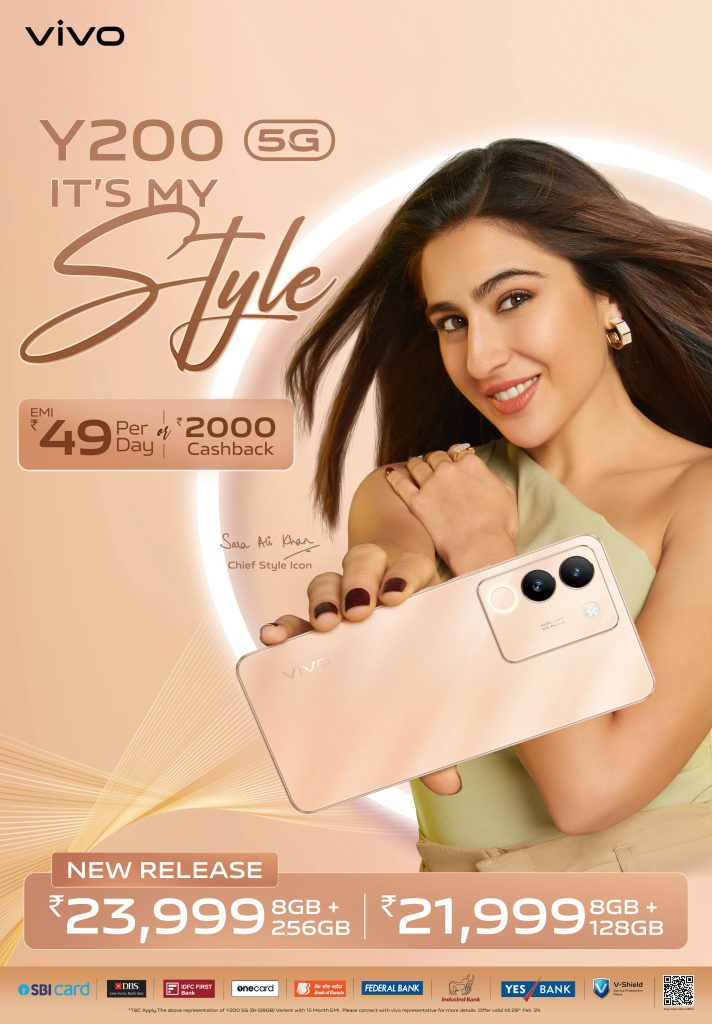
Vivo launched the Y200 5G smartphone in India in October last year. At that time, it was announced in a sole 8GB RAM and 128GB storage variant. Now, the Chinese brand has announced a new configuration of the Y200 5G with double the storage capacity. It is a device in the sub-Rs 25,000 price segment and packs some impressive specifications. Read on to know more about the new variant.
Vivo Y200 5G gets new storage variant
The Vivo Y200 5G has the same 8GB RAM. But it now comes in a 256GB storage variant. The new configuration is priced at Rs 23,999 and is offered in Jungle Green and Desert Gold color options. The smartphone is already available for purchase from the brand’s website and Flipkart. To recall, the base 8GB + 128GB model of the Vivo Y200 5G costs Rs 21,999
Apart from the storage bump, the core specifications of the Vivo Y200 5G remain the same. It has a 6.67-inch AMOLED display bearing an FHD+ resolution and a 120Hz refresh rate. The screen is integrated with a fingerprint scanner and it supports HDR10+. The device has a flat frame design and a rectangular camera module.
The Vivo Y200 5G has dual rear camera setup of a 64MP main sensor with OIS support and a 2MP depth lens. There is a Smart Aura Light flash The device features a 16MP front-facing selfie snapper.
Under the hood, the Vivo Y200 5G is powered by a Snapdragon 4 Gen 1 processor. It is backed by a 5,000mAh battery cell with support for 44W fast charging. The device runs on Android 13 OS out of the box.
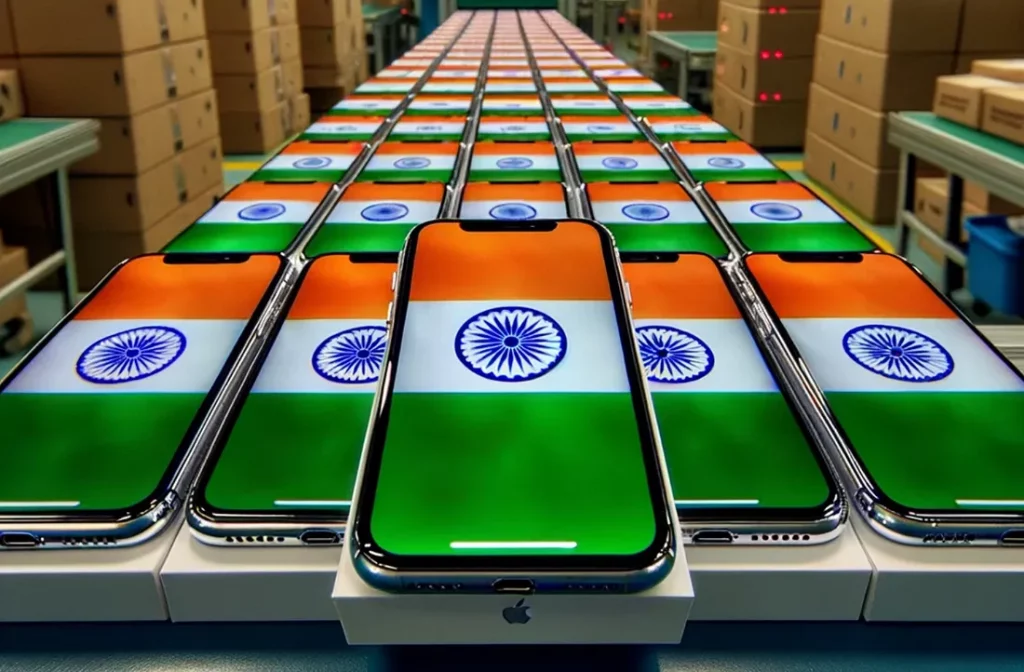
India stands out as a key tech market and a central hub for tech companies, catering not just to sales but also production. Companies like Apple and Xiaomi manufacture their products within the country. The government is proactively enhancing its attractiveness for investments, offering diverse incentive packages. As of January 31, 2024, India has decreased the import duty on smartphone components from 15% to 10%, showcasing its commitment to fostering a favorable business environment. Here are the details…
India’s 10% Import Duty Sparks Surge in Smartphone Production
India has decreased the import duty on smartphone components from 15% to 10%, intending to boost smartphone manufacturing and reduce prices. As a result, companies manufacturing in India will now pay lower taxes on items like camera lenses, back covers, plastic and metal mechanical parts, GSM antennas, and other components imported from other countries.
This decision brought joy to major manufacturers, including Apple. While a drop from 15% to 10% may not appear substantial initially, it’s crucial to acknowledge that we’re dealing with operations valued in billions of dollars. The cost reduction could motivate current manufacturers like Apple, Samsung, Xiaomi, Oppo, Vivo, Realme, and OnePlus to boost their investments and inspire new ones to initiate production in India.
“Duty cuts on import of mobile phone parts would help big global manufacturers to set up large scale mobile assembly lines in India, and substantially increase exports of mobile phones,” said Rajat Mohan, a director at tax consultancy firm MOORE Singhi.
In 2022, Apple started making iPhones and AirPods at its factory in India, with a hefty $1 billion investment. Xiaomi, since 2014, runs five Indian factories, producing smartphones like Redmi, Mi, and POCO. Samsung, having started production in India back in 2007, operates six factories, making phones under brands like Galaxy, M, and A. This decision seems to be very beneficial for all these brands and many more.
Nothing has finally put rumors about its next smartphone to bed. The London-based brand has officially confirmed the launch of the Phone (2a). That’s not all. Nothing’s sub-brand CMF has also confirmed the arrival of two new audio devices. Read on to know all the details below.
Nothing confirms Phone (2a), new CMF products also incoming
Nothing has officially confirmed the Phone (2a)’s launch on its X (formerly Twitter) handle. The brand says that the upcoming offering is coming soon without explicitly revealing its launch date. Nothing has already confirmed its presence at the MWC that will commence on February 26. Hence, the Phone (2a) is widely expected to launch around that time.
As per several leaks and rumors, the Nothing Phone (2a) will have a circular island housing two horizontally positioned cameras. The module will be surrounded by glyph strips. It is expected to be powered by a Dimensity 7200 SoC, support 45W charging, and feature an AMOLED display.
Alongside the Nothing smartphone, sub-brand CMF also confirmed on its Instagram and X handles that it is launching two new audio devices, more specifically, the Neckband Pro and Buds. Like the Phone (2a), the upcoming CMF devices are teased to be coming soon. The neckband is an entirely new category. The Buds Pro debuted last year, so the upcoming CMF Buds could be a cheaper version.
Both CMF devices have bagged TDRA and BIS certifications recently which also confirms their launch in UAE and India.
Additionally, Nothing also announced Glyph Developer Kit that will give third-party Android apps the ability to control the Glyph Interface.
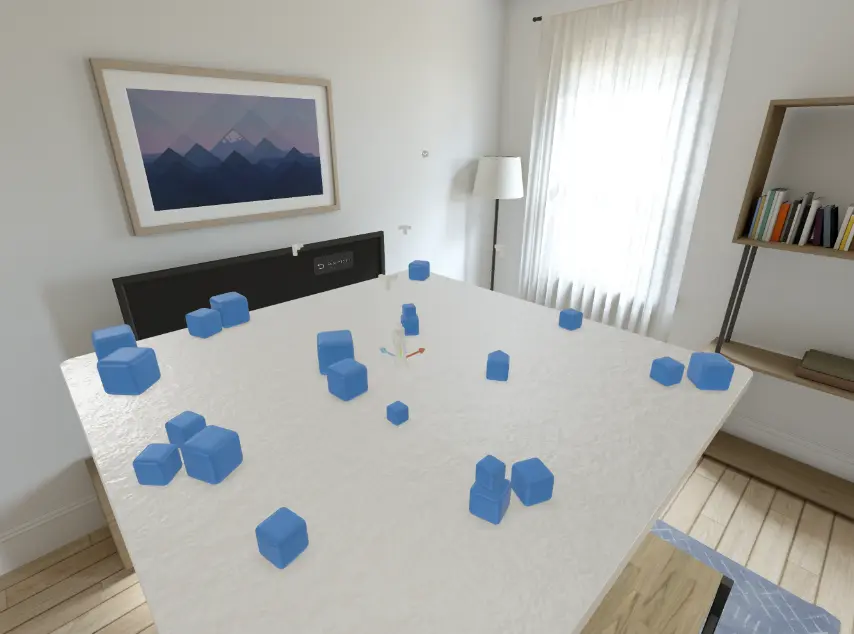
Unity, a leading game development platform, has officially announced its support for Apple’s visionOS platform. This move comes after months of collaboration with developers, and it signifies a significant step toward expanding Unity’s capabilities to enhance spatial experiences on Apple Vision Pro. The support is now available to all Unity Pro, Enterprise, and Industry subscribers, empowering developers to leverage Unity’s familiar authoring workflows, XR tools, and cross-platform compatibility for creating immersive spatial applications.
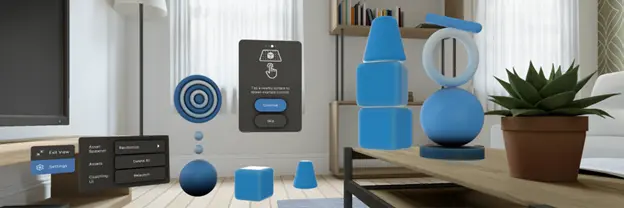
Unity is also providing developers with template scenes and examples through visionOS resource packs
Developers utilizing Unity for Apple Vision Pro can embark on crafting diverse spatial experiences, thanks to the platform’s versatile features. Unity’s support for visionOS enables the creation of three main types of spatial experiences. Firstly, developers can design immersive mixed reality (MR) experiences that seamlessly merge digital content with the real world, capable of running alongside other applications in a shared space.
Secondly, the platform allows for porting existing virtual reality (VR) games or crafting entirely new, fully immersive experiences that replace the user’s environment with customized content. Lastly, Unity enables the deployment of content in user space as a 2D window that offers flexibility in resizing and repositioning.
To initiate spatial application development for Vision Pro using Unity, developers need to download the latest version of Unity 2022 LTS from the Unity Hub and ensure the installation of the visionOS Build Support module. Notably, the ongoing development of visionOS is currently exclusive to Mac computers equipped with Apple’s proprietary chips. Unity aims to further facilitate the learning curve for developers by introducing training courses for Vision Pro space application development in China.
Moreover, Unity is providing developers with template scenes and examples through visionOS resource packs, streamlining the creation process. For those seeking to migrate iOS (or iOS-compatible) applications to visionOS, Unity has introduced a convenient one-click solution. This solution aids developers in seamlessly adjusting existing content to transform it into a 2D windowed application within a shared space, enhancing accessibility and usability.
We have been hearing about HMD Global’s first smartphone since the last few weeks. It seems like the launch of the company’s device is imminent. Earlier today, the NokiaMobile account was renamed to HMD. Now HMD on its official website has put up another image of its first smartphone that is in line with the previously leaked image.
First official look at HMD phone
The image posted on HMD’s official website shows the company’s first phone in a Pink color option. It has a rectangular-shaped camera module in Black color. We could notice the phone with a boxy design. Additionally, the side frame appears to blend seamlessly with the back panel. The design of the upcoming smartphone from the company instantly takes us back to the Nokia Lumia era. The first HMD phone is also seen in a Blue color option though that does not reveal much.
HMD says that phones with its branding are coming soon. The company aims to make phones that stick around. This means phones that are durable, fun, fast, secure, and affordable. While the exact launch timeline of the HMD phone remains a mystery, rumors suggest that the company may announce its first devices at MWC in Barcelona, Spain later this month. The tech exhibition is set to commence on February 26.
Previously, a leaked promotional image of the HMD phone revealed a 108MP primary camera and support for OIS. Meanwhile, as per a leaked render of the smartphone, it will have a centre-aligned punch-hole display. Tipster Evan Blass has revealed that HMD has six phones in the pipeline codenamed Pulse, Legend, Pulse+, Legend Plus, Pulse Pro, and Legend Pro.
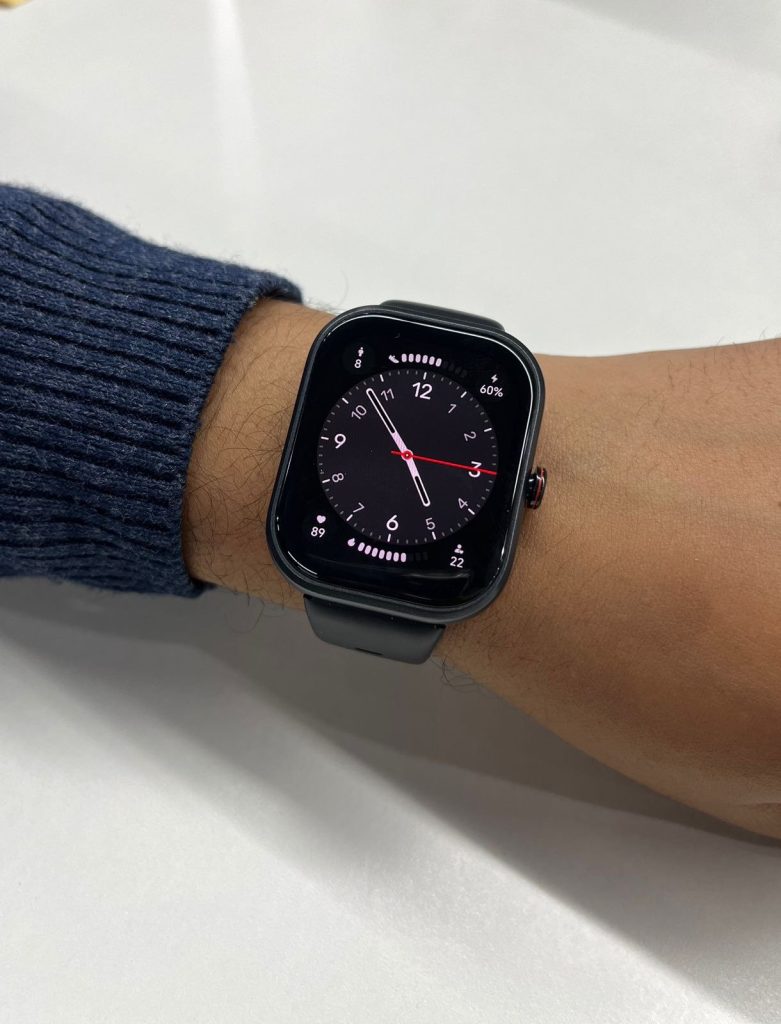
Honor is gearing up to unveil the new Honor X9b smartphone in the Indian market soon. However, it appears that the handset won’t be alone during the launch event as the company plans to release a new smartwatch model called the Honor Choice Watch as well.
Honor Choice Watch
The news was shared by known tipster Mukul Sharma on X (formerly Twitter). He claims that the brand will release the new Honor Choice Watch in India alongside the Honor X9b. This smart wearable will arrive with a companion Honor Health app for seamless connectivity and likely bring integration of health related features like heart rate and sleep tracking.
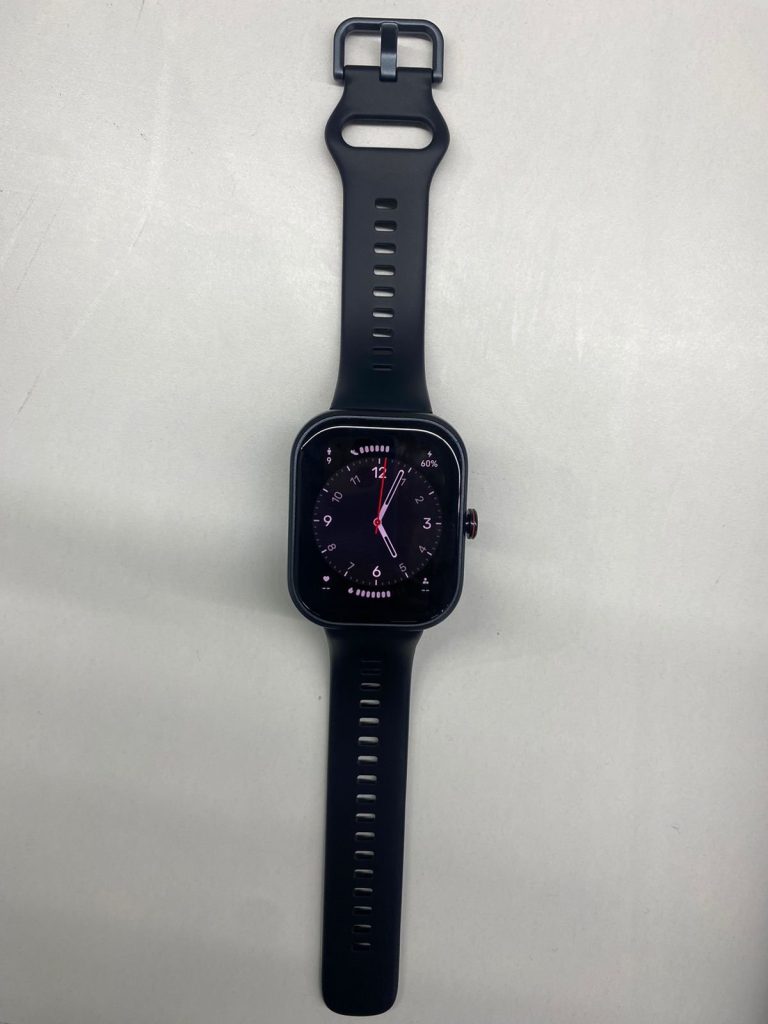
Another notable aspect about this Honor Choice Watch is that it will be the first ever smartwatch that comes with a dedicated SOS call button. This is in line with one of our previous reports where we covered a teaser by Madhav Sheth, the CEO of the brand’s Indian unit. An unboxing video of this watch was shared on X, and now, live images of the device were also shared by the tipster.
Mukul Sharma’s tweet showcases a smartwatch that appears similar to the Apple Watch in design. It has a squarish display with rounded corners and what appears to be a silicon strap. The physical dial can is situated on the right side. Based on the previous teaser, it is confirmed to offer heart rate tracking, sleep monitoring, and support for various workout modes. Other notable features include a built-in calculator, weather app, alarm, calendar, and more. This is all the information we have at the moment so stay tuned for more updates.
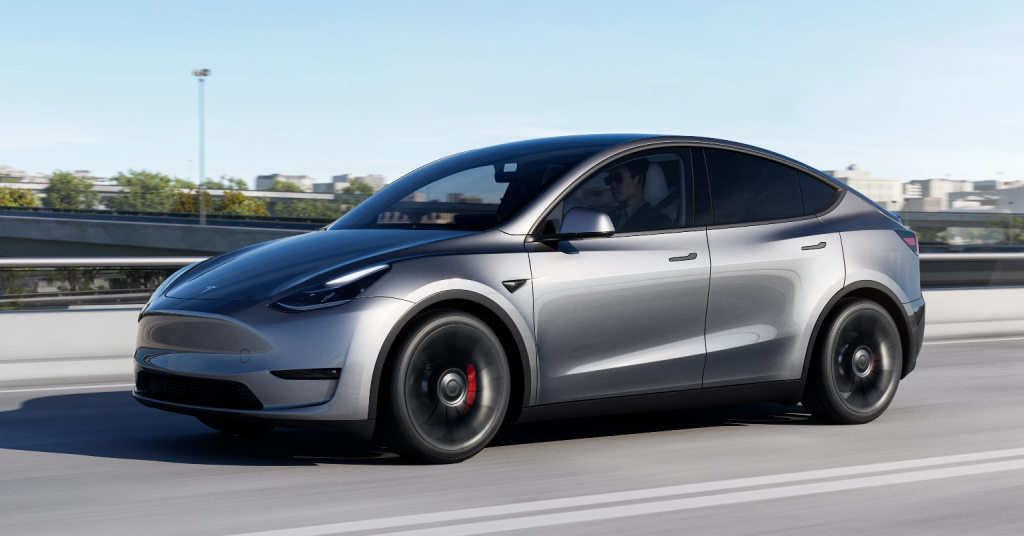
Tesla has announced a hardware upgrade for its Model Y lineup in China, equipping the vehicles with the cutting-edge Hardware 4.0 (HW 4.0) self-driving computer. Despite the notable enhancements, the electric automaker has decided to maintain the same pricing for the Model Y, emphasizing its commitment to offering advanced technology without increasing costs for consumers.
The HW 4.0 upgrade brings substantial improvements to the Model Y’s autonomous capabilities. With a maximum detection range of 424 meters, the vehicle gains the ability to see farther distances. The upgraded self-driving computer boasts a remarkable five-fold increase in chip computing power, resulting in enhanced responsiveness and faster processing speeds.
China’s Model Y lineup includes three versions: the base rear-wheel-drive model, the dual-motor all-wheel-drive Model Y Long Range, and the dual-motor all-wheel-drive Model Y Performance. Despite the hardware upgrade, Tesla has decided not to alter the pricing for these variants.
source: tesla.cn
Tesla China officially introduced the HW 4.0 upgrade on its Weibo account, emphasizing the improved visibility, clarity in perception, and faster processing speed offered by the advanced autonomous driving hardware.
In addition to the hardware upgrade, Tesla has unveiled a new color option for the upgraded Model Y in China – “Quicksilver.” This color, previously exclusive to Giga Berlin vehicles, is now available due to advanced paint shop technology.
Notably, Tesla had silently implemented Hardware 4.0 in Model S and Model X vehicles in the United States last year, with customers reporting enhanced processing power and improved Tesla Vision technology.
Looking forward, Tesla CEO Elon Musk hinted at ongoing developments with Hardware 5 during the Q4 and Full Year 2023 earnings call. Describing it as the third version of the Tesla-designed AI inference chip, Musk mentioned that Hardware 5 is currently in the design completion phase.
In terms of pricing, Tesla has recently reduced the starting prices of the Model Y entry edition and Model Y Long Range in China. The automaker is also offering cash discounts on select Model Y stock vehicles, providing customers with additional savings. Additionally, Tesla customers in China can avail themselves of a significant discount on paid paint for both Model 3 and Model Y vehicles.
Tesla’s Autopilot Evolution:
In October 2014, Tesla introduced pre-purchasable Autopilot, initially relying on hardware version 1 (HW1) developed in collaboration with Mobileye. The Mobileye partnership concluded in July 2016 due to safety concerns, prompting Tesla’s transition to independent hardware development. Cars produced after September 2014 were equipped with HW1, marking the beginning of Tesla’s Autopilot journey.
By October 2016, Tesla shifted to hardware version 2 (HW2) for new vehicles, collectively known as Autopilot 2.0. Despite its label, HW2 initially had fewer features than its predecessor. The term “Enhanced Autopilot (EA)” was introduced, featuring the notable “Navigate on Autopilot” capability unveiled in December 2016, allowing automated highway driving.
In early 2016, Tesla initiated the development of the Full Self-Driving (FSD) Computer, or Hardware 3 (HW3), which replaced the NVIDIA DRIVE PX 2 AI computing platform, significantly enhancing processing power.
The latest Hardware 4 (HW4) not only upgrades the FSD Computer but introduces a comprehensive sensor suite with enhanced cameras and radar. HW4 boasts a faster FSD Computer based on the Samsung Exynos architecture, additional high-resolution cameras, and a new radar named “Phoenix” for improved accuracy, setting the stage for a transformative advancement in Tesla’s autonomous driving technology.
With these continuous advancements and pricing adjustments, Tesla’s Shanghai factory, producing both the Model 3 and Model Y, remains at the forefront of electric vehicle manufacturing, solidifying its position as the largest Tesla factory globally.
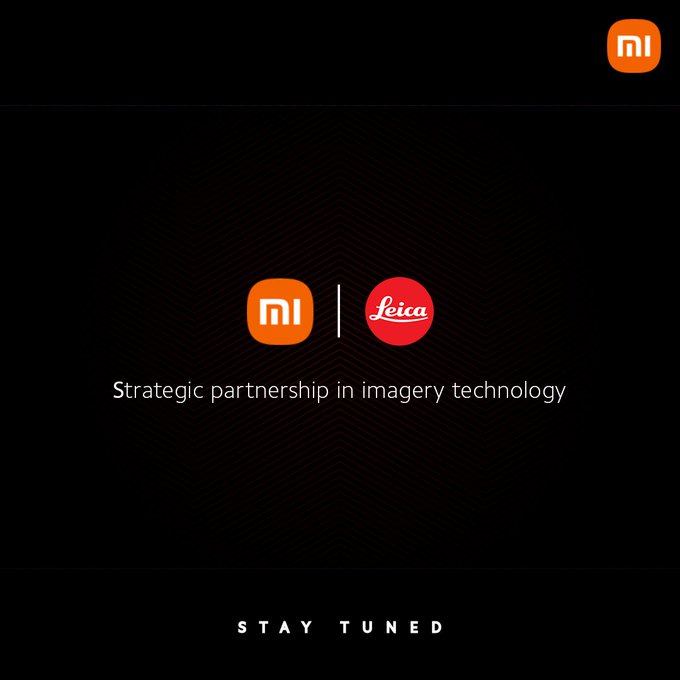
Earlier today (1st February 2024), Xiaomi India showcased its strategic partnership with Leica. This hints that the Xiaomi 14 series is set to launch in India soon. With the Xiaomi 14 Ultra rumored to launch soon, this announcement hints that it could also offer Leica branded lenses.
Xiaomi 14 series India launch near
The Leica partnership was announced by the Chinese tech giant on X (formerly Twitter). To recall, the Xiaomi 14 and Xiaomi 14 Pro were flagship grade devices that were released with camera lenses from Leica. Apart from these two models, the company is also working on another entry in the series, which is the Xiaomi 14 Ultra. The Ultra models typically launch after the mainline’s release and offer top notch specs and photography experience.
While the Xiaomi 14 and 14 Pro have been released in China, it hasn’t been available in the global market like India. Although, the brand is expected to unveil the Xiaomi 14 Ultra alongside the base and Pro variants during the upcoming MWC 2024 event. For those unaware, the Mobile World Congress is set to lick off in late February, which means we can expect an announcement around the same time.
The Xiaomi 14 Ultra was just recently spotted on GeekBench, BIS, EEC, and IMEI databases. This confirmed a bunch of its specs and confirmed the India release as well. It is expected to be equipped with the Qualcomm Snapdragon 8 Gen 3 SoC under the hood and offer an under display selfie camera on the front. Satellite connectivity is also rumored to be supported on the upcoming flagship phone.
Consumer products are on sale at heavily discounted prices in China for the Lunar New Year festival. For the first time, even Apple itself joined other brands in offering discounts a few weeks back.
However, retailers are known to provide better deals. JD (Jingdong) proves it with its eye-catching iPhone 15 deal.
JD is offering the base 128GB variant of the Apple iPhone 15 as low as ¥4,639 (~$650). That’s an insane ¥1,360 (~$190) discount on a premium smartphone that’s just four months old.
Additionally, new Apple Music subscribers are eligible for 2 months of free trial. Both the discount and streaming subscription offer are only available for a limited time.
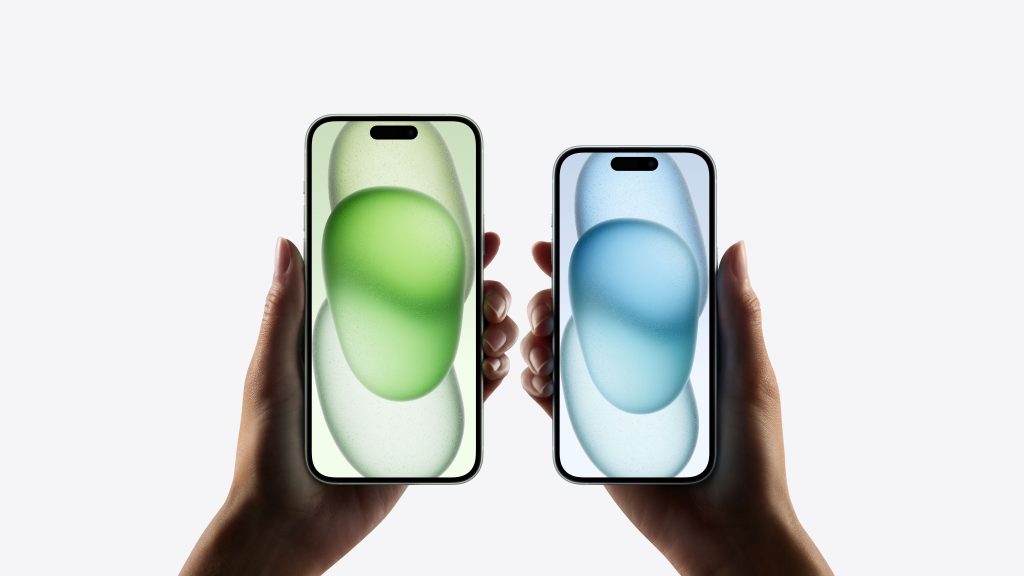
The iPhone 15 is a solid upgrade for someone coming from non-5G iPhones like iPhone 11 and older models. Apart from faster mobile connection, consumers also get better cameras and display, a faster chip, and a USB Type-C port.
The device comes in standard and plus variants. The latter version has a larger display and a bigger battery.
Unfortunately, the base version still starts at 128GB priced at ¥5,999 (~$845). However, interested customers can opt for 256GB and 512GB storage variants.
Just like its predecessors, the iPhone 15 arrives in multiple colors. It is offered in blue, pink, yellow, green, and black. But unlike its forerunners, the new model has a matte finish and lighter tones.
DYNAMIC ISLAND COMES TO IPHONE 15 — Dynamic Island bubbles up alerts and Live Activities — so you don’t miss them while you’re doing something else. You can see who’s calling, track your next ride, check your flight status, and so much more.
Please Note: When you buy something using the links in our articles, we may earn a small commission at no cost to you.
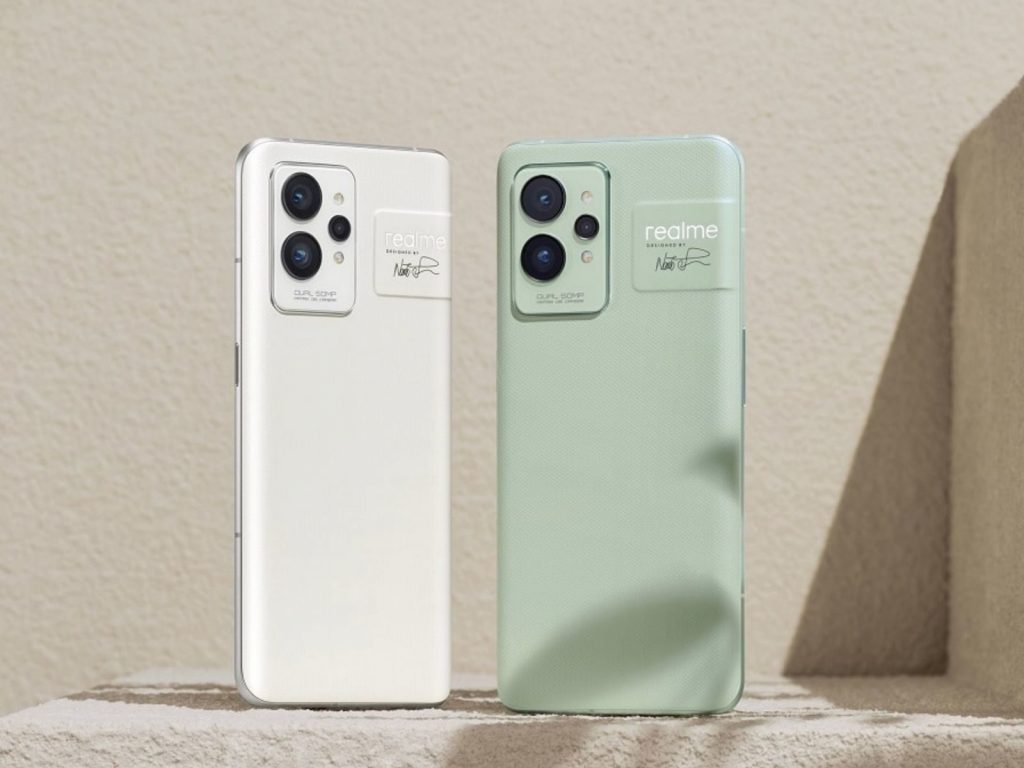
Realme is bringing new software updates for the Realme GT2 Pro and Realme GT2 Explorer Master Edition to China. The new updates bring certain fixes and enhancements for both smartphones. Precisely, the Realme GT2 Pro and Realme GT2 Explorer Master Edition are receiving Realme UI 140.0.213. Let’s dive into more details:
Realme GT 2
The Realme GT2 Explorer Master Edition and Realme GT2 Pro feature a similar changelog. The update refines the permission settings that restrict apps from switching. It even adds a pop-up window as a fail-safe for switching between different apps. The update enables system performance and stability. Below is the official change log:
【NFC】

• Fixed the problem that the access card can be entered but the door cannot be opened.

【system】

• Added device action and direction sensor permission settings to restrict applications from calling sensors for shake-to-jump behavior

• Added pop-up prompts for jumping between applications to make every jump knowable and controllable

• Optimize system performance and improve system stability
As per the announcement thread, it is a staggered rollout and may take up to 2-3 weeks for the new firmware to become available on each device.
Realme GT2 Pro and Realme GT2 Explorer Master Edition Specs
Additionally, the Realme GT2 Pro was launched on January 8, 2022, weighing 189/199g and measuring 8.2mm in thickness. It was introduced with Android 12 and is now upgradable to Android 14. It is available in three storage options: 8/12GB RAM and 512 GB, and offers no card slot. There’s a 6.7″ display with 1440×3216 pixels resolution and a 50MP primary camera capable of recording 4320p video. It is powered by a Snapdragon 8 Gen 1 chipset and a 5000mAh battery.
On the other hand, Realme GT2 Explorer Master Edition is available with a 195g weight and 8.2mm thickness and was launched running Android 12 with Realme UI 3.0. It features a 6.7″ display with 1080×2400 pixels resolution, a 50MP primary camera capable of recording 2160p video, 8/12GB RAM, a Snapdragon 8+ Gen 1 chipset, and a 5000mAh battery.
Recently Tecno announced its partnership with Dolby Labs to bring Dolby Atmos to its upcoming POVA 6 series phones. The smartphones are set to launch at MWC later this month. Now, the Tecno POVA 6 Pro has been spotted on the Google Play Console certification website revealing its key specifications. The device is expected to arrive as the successor to the last year’s POVA 5 Pro.
Tecno POVA 6 Pro Google Play Console listing
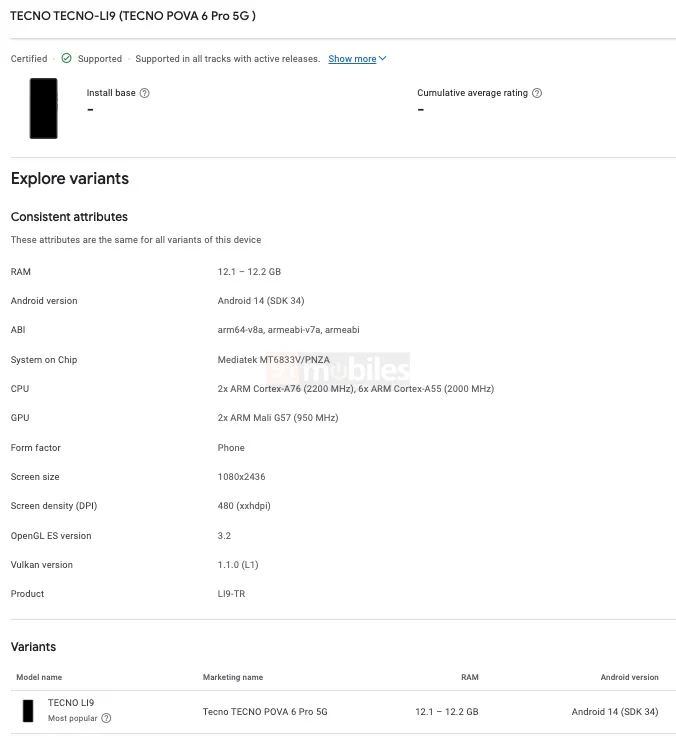
The Tecno POVA 6 Pro is listed on the Google Play Console with the model number Tecno LI9. The certification website reveals SoC with model number MediaTek MT6833V/PNZA. It comprises of two Cortex-A76 cores at 2.2GHz and six Cortex-A55 cores ticking at 2GHz. There is a Mali G57 GPU onboard. This suggests that the device will be powered by a Dimensity 6080 processor under the hood. The listing also reveals 12GB RAM onboard and we can expect more options at launch. The smartphone will ship with Android 14 OS out of the box.
The Google Play Console also has a render of the POVA 6 Pro. It seems that the phone will come a curved display. It will have a resolution of 1080 x 2436 pixels and 480 dpi screen density. The device is seen with power and volume rocker buttons on the right side.
The rest of the details of the Tecno POVA 6 Pro remain a mystery. To recall, the Tecno POVA 5 Pro has a LED light strip on the back panel. It is powered by Dimensity 6080 anad backed by a 6,000mAh battery with support for 65W fast charging. The device packs 8GB RAM along with virtual RAM technology and up to 256GB storage. The smartphone also features a VC system for heat dissipation.
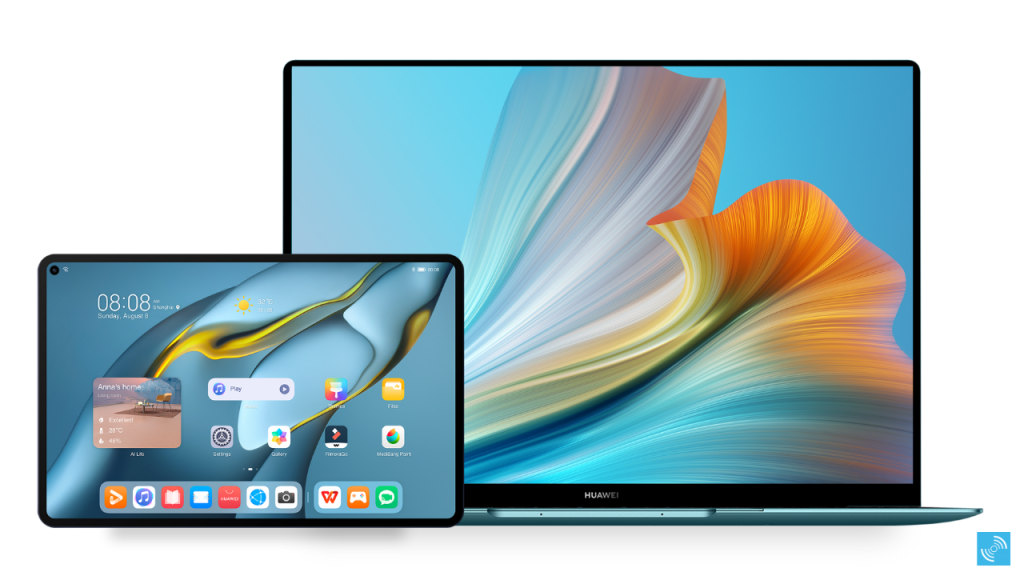
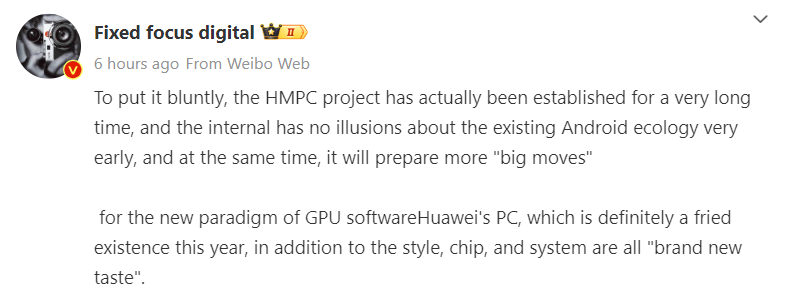
Huawei has been making significant strides with its HarmonyOS, an operating system designed to serve a multitude of devices, ranging from smartphones to smart appliances. According to insider reports from Weibo tipster Fixed Focus Digital, Huawei is now delving into the PC market with its ambitious HarmonyOS PC project. This move signals Huawei’s intent to challenge the established Android ecosystem and create a unique space in the market.
Huawei’s plans for HarmonyOS PC
This development isn’t entirely surprising, as Huawei’s former executive Wang Chenglu previously hinted at an official release of HarmonyOS for PCs in 2024. The tipster also provides insights into Huawei’s plans to introduce significant innovations in GPU software, aiming to deliver an unparalleled experience for Huawei PC users.
Adding to the anticipation, the tipster previously revealed details about Huawei’s Kirin PC processor, showcasing its technical prowess. The processor features advanced core configurations, including 4×TSV big cores and 4×TSV medium cores, along with high-end components like the Maleoon 910 GPU and dual NPU setups to bolster AI capabilities.
Additionally, Huawei is also planning to launch some exciting laptops this year focusing on specs and features. In the mobile arena, Huawei is also diligently working on its HarmonyOS version, known as HarmonyOS Next. This represents a bold move away from Android, challenging the dominance of Google’s Android and Apple’s iOS in China. The developer version has already been released, with plans for a commercial launch in the fourth quarter of this year.
Huawei is building an ecosystem and has garnered support from industry partners, making substantial investments in this endeavor. They aim to redefine the smartphone OS landscape and potentially surpass iOS in China by 2024, despite facing challenges from US restrictions.
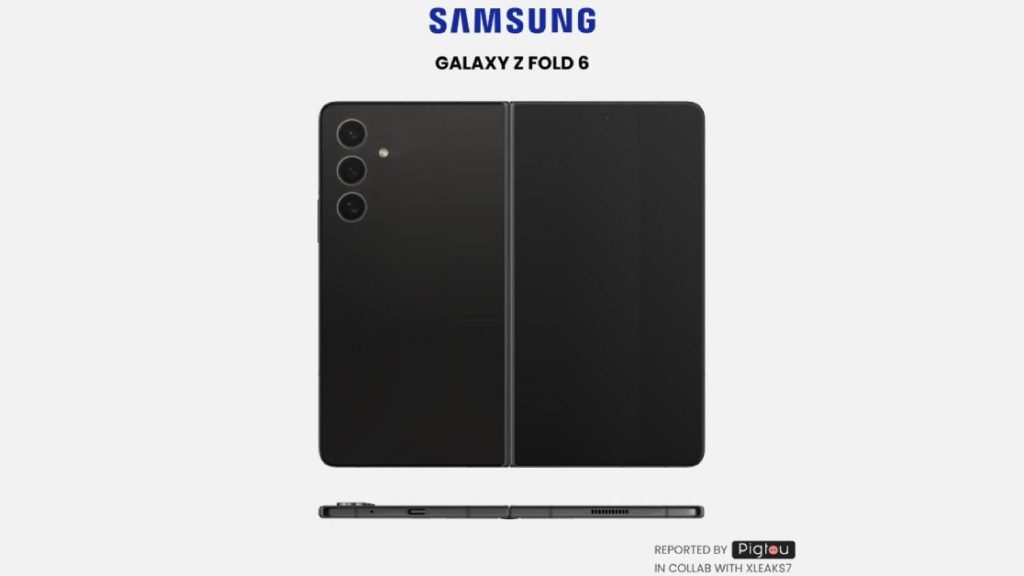
Samsung‘s Galaxy Z Fold series has been at the top of the foldable phone game for a while, but lately, it seems the competition has been catching up. Now, rumors suggest the upcoming Galaxy Z Fold 6 could be a major shake-up, aiming to win back the foldable crown.
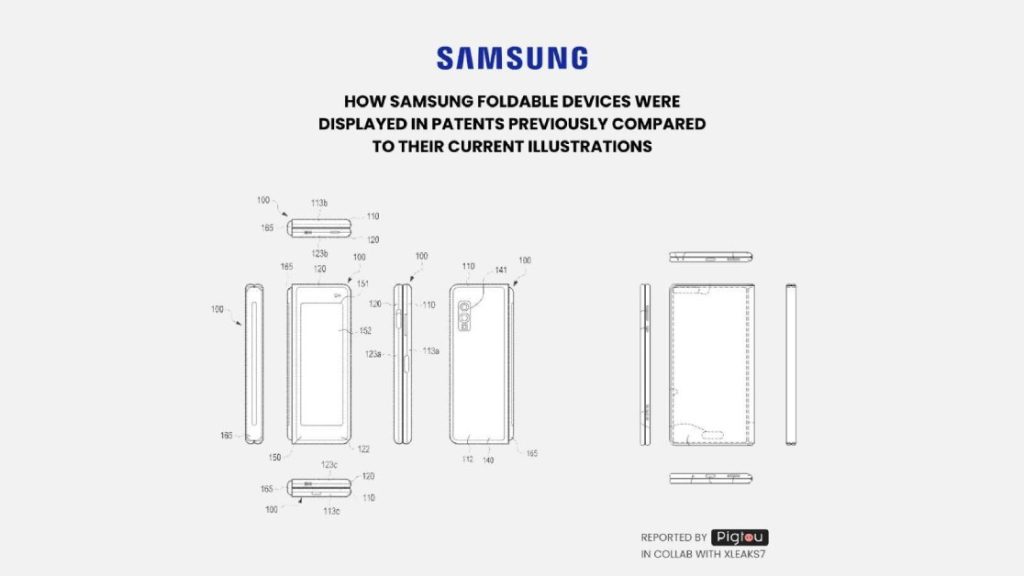
While the current Z Fold 5 is well-regarded, it lacks the wow factor of some rival foldables. But Samsung seems to be taking notes. A recent patent suggests they’re ditching the “fat phone” look for a slimmer profile, but not at the expense of usability. They might’ve understood that ultra-tall foldables aren’t everyone’s cup of tea.
Instead, rumors point towards a wider device with larger inner and outer screens. This wider design might mean a different aspect ratio, too, making the phone feel less like a tall, narrow tablet when unfolded.
Samsung may also bring a new hinge design with multiple housings, distributing pressure more evenly across the screen and potentially reducing the crease on the inner screen.The patent also shows a new camera layout with modules directly on the back, but it’s unclear if this reflects actual plans.
While the final design might differ, it seems likely that the Z Fold 6 will be thinner and wider. Additionally, recent reports suggest that Samsung is contemplating the development of a more affordable version of the Z Fold 6.
The decision to launch a budget-friendly Galaxy Z Fold is expected to increase Samsung’s market share in China’s foldable smartphone segment. Currently, the South Korean brand holds the third position with a 19 percent share, trailing behind Huawei and Honor, which dominate the market.
The budget-friendly Galaxy Z Fold is expected to debut in the second half of 2024, likely alongside the next-generation Z Fold 6 and Z Flip 6 at Samsung’s upcoming Unpacked event in August. So Samsung might for the first time in foldables history release three foldable devices.
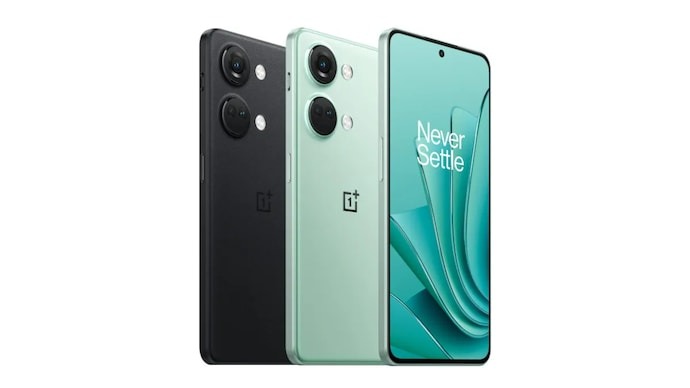
OnePlus is bringing a new firmware update for the OnePlus Nord 3, featuring a January 2024 Android Security Patch. The firmware version OxygenOS 14.0.0.300 update is now rolling out to most regions, including India, Europe, and global variants. The OnePlus Nord 3 India Variant also received another update a few days ago with firmware 14.0.0.201 featuring the same changelog.
As per the announcement thread, the previous update firmware OxygenOS 14.0.0.201 is now paused, and the new firmware OxygenOS 14.0.0.3 will be made available to all users. The reason seems to be some issues that popped up with the previous update on India Variants.
Talking about the new update, the OnePlus Nord 3 will receive the January 2024 Android security patch, which also improves the system’s stability and performance. It even extends the battery life. The update fixes issues related to the theme store, and the background stream feature is now unavailable in the Smart Sidebar. Below is the official change log:
System

Integrates the January 2024 Android security patch to enhance system security.
Improves system stability and performance.
Extends battery life in some scenarios.
The Background stream feature in Smart Sidebar has been removed.


Apps

Fixes an issue where the screen might turn white when "Theme Store" is opened.
It is an incremental update and may take time to reach each unit over the coming few days. The update will first be made available to a small number of users before a broader rollout. Users can report any bugs and issues via the OnePlus Community or Google Dialer (in India only) by typing *#800#.
OnePlus Nord 3 Update Features
Additionally, the OnePlus Nord 3 already received the OxygenOS 14 update, featuring all the new luxuries and feature enhancements. The Android 14-based OxygenOS 14 update is now available on most of the compatible OnePlus smartphones. However, the updates are scheduled for the remaining devices in the coming few weeks or months.
Camera: 50MP Main Camera with Sony IMX890 (OIS supported), 8MP Ultrawide Camera with Sony IMX355 (FOV: 112 degree) and 2MP Macro lens f/2.4 and a FOV 89°; 16MP Front (Selfie) Camera with EIS supported
Camera Features: Photo, Video, Night, Portrait, PANO, TIME-LAPSE, and Dual-view video
Please Note: When you buy something using the links in our articles, we may earn a small commission at no cost to you.
The Honor X9b is set to launch in the Indian market soon. But ahead of the release, the Amazon landing page of the upcoming smartphone has gone live and an official teaser has even highlighted one aspect of its display. So here are all the details.
Honor X9b Teaser
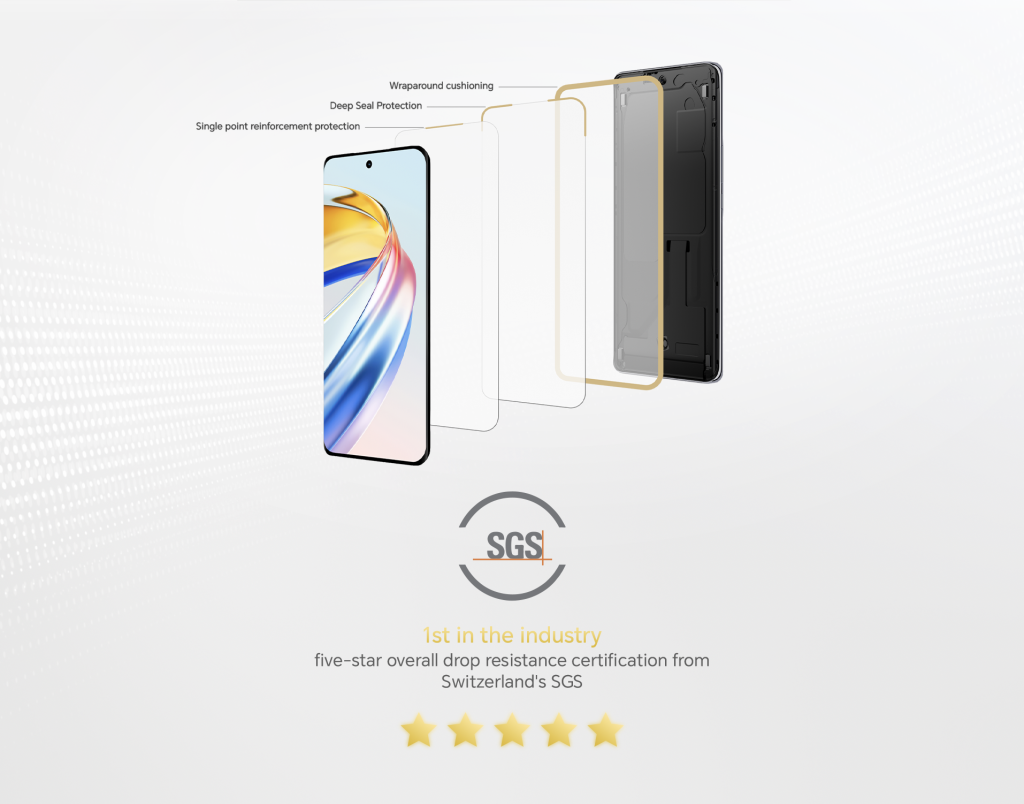
The Chinese brand is set to unveil the X9b in the region on 15th February 2024. Now, Amazon availability has been confirmed after the landing page of the device went live. This listing showcases the Honor X9b’s curved display and slim design. It teases the Snapdragon chipset under the hood and a long battery life. Honor also promised a new standard of durability and endurance in its latest teaser.
The Honor X9b will feature an Ultra Bounce 360° Anti-Drop Resistance, which is possible thanks to cutting edge cushioning technology. Thanks to this technology, the handset received a Five Star Overall Drop Resistance certification from SGS. The Ultra Bounce Anti Drop display promises to offer greater protection by employing a shock absorbing structure. Honor claims that it can offer improved resistance to drops of up to 1.5 meters on all six faces and four corners.
To recall, the new Honor X9b sports a tall 6.78-inch display with a 120hz refresh rate and 1.5K resolution. The model supports PWM Dimming technology along with low blue light ensures reduces eye discomfort and fatigue. Other notable display features include Dynamic Dimming for natural light rhythm for eye protection and Circadian Night Display to filter blue light during nighttime use.
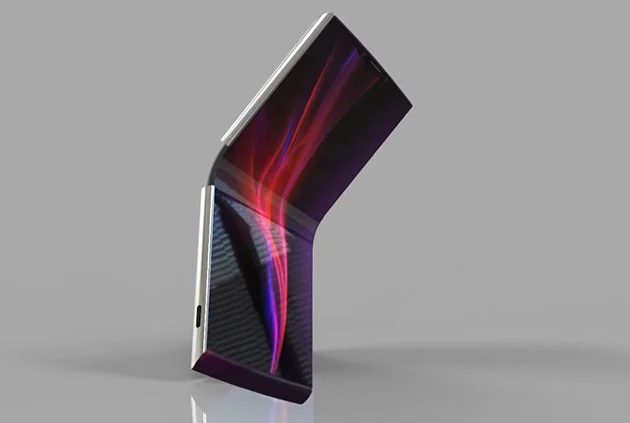
There have been ongoing rumors about Sony‘s entry into the foldable smartphone market, with many speculating it would be a clamshell-style device. However, recent reports suggest that Sony’s potential foldable phone, tentatively called “Xperia F,” is still uncertain, as discussions about the future of foldable devices continue. A Reddit conversation, reportedly involving a Sony insider, hints that consumer trends might be influencing Sony’s decision regarding foldable smartphones.
Sony Analyzing Consumer Trends Before Entering the Foldable Market
According to the insider, there is concern that more than 70% of current foldable smartphone users might switch back to traditional smartphones for their next purchase. This suggests a potential decline in the adoption of foldable devices after an initial surge in sales. However, it’s essential to highlight that this perspective is not officially endorsed by Sony and lacks solid data to support claims about user preferences for future upgrades.
Although the future of foldable smartphones is uncertain, there is still significant interest in these innovative devices. It is expected that foldable phones, like the rumored Sony Xperia F, will attract users who want to experience their unique features, particularly as prices become more affordable. In the short term, the foldable smartphone market is predicted to grow, but whether this growth will continue as users plan their next upgrades remains uncertain.
The foldable smartphone segment may encounter difficulties in retaining its market share in the coming years, primarily due to the typical 3 to 4-year smartphone replacement cycle.
Projections suggest that the adoption rate of foldable devices might reverse during this timeframe, based on speculated consumer behavior. The rumored Xperia F is said to feature a 7-inch 4K display with a 21:9 aspect ratio, though further details are pending. Sony’s foldable smartphone continues to generate high interest, and we will share further updates as additional information becomes available.
Taiwanese chipmaker MediaTek held a ceremony on January 30th to mark the start of construction for a new office building near the Hsinchu High-speed Railway station. The 22-story building is expected to accommodate 3,000 employees by 2027.
During the event, CEO Cai Lixing mentioned the upcoming Dimensity 9400 chip (though not specifically referred to) will arrive in the fourth quarter of 2024. According to Cai, the new SoC will boast improved AI capabilities, aiming to compete with other high-end smartphone processors.
Even though we don’t know all the details about its performance, a report by China Times spilled some beans about the Dimensity 9400.
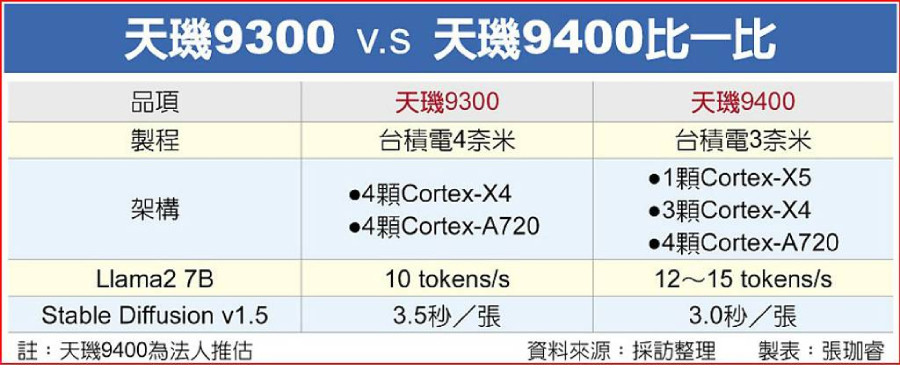
The leak includes a table detailing potential upgrades for the upcoming SoC, which unsurprisingly mentions the use of TSMC’s 3nm process. The switch from 4nm to 3nm should result in improved performance and power efficiency compared to its predecessor, the Dimensity 9300.
Moreover, unlike Qualcomm, which is transitioning to its custom Oryon CPU cores, MediaTek will likely stick with Arm’s CPU designs and will upgrade to the Cortex-X5 for its main core. Besides this, the Dimensity 9400 will have three Cortex-X4 and four Cortex-A720 performance cores.
The leaked details also suggest that the Dimensity 9400 will be able to process 12 to 15 tokens (most basic units of a text for an LLM) per second using a specific model called Llama 2 from Meta.
Additionally, for image creation using Stable Diffusion 1.5, the Dimensity 9400 is expected to be faster than the 9300, taking only 3 seconds compared to 3.5 seconds.
This improvement will make the Dimensity 9400, and its APU 790 successor, potentially 20-50% faster for processing tokens and up to 16.7% faster for image creation.
These are still early details about the MediaTek Dimensity 9400, so we suggest you take this information with a pinch of salt.
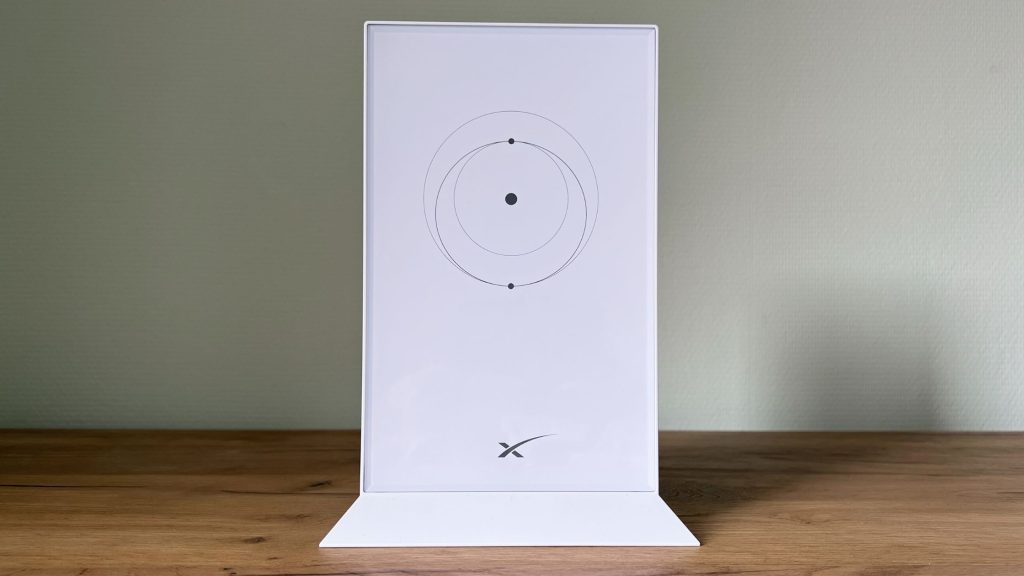
Following its innovative “cellphone tower in space” announcement, Elon Musk’s Starlink is now working on something more grounded. While the company has its expertise in satellite communication and internet connectivity, it might be launching a new WiFi 6 router soon. So here are all the details.
Starlink WiFi 6 Router certified on FCC and IMDA
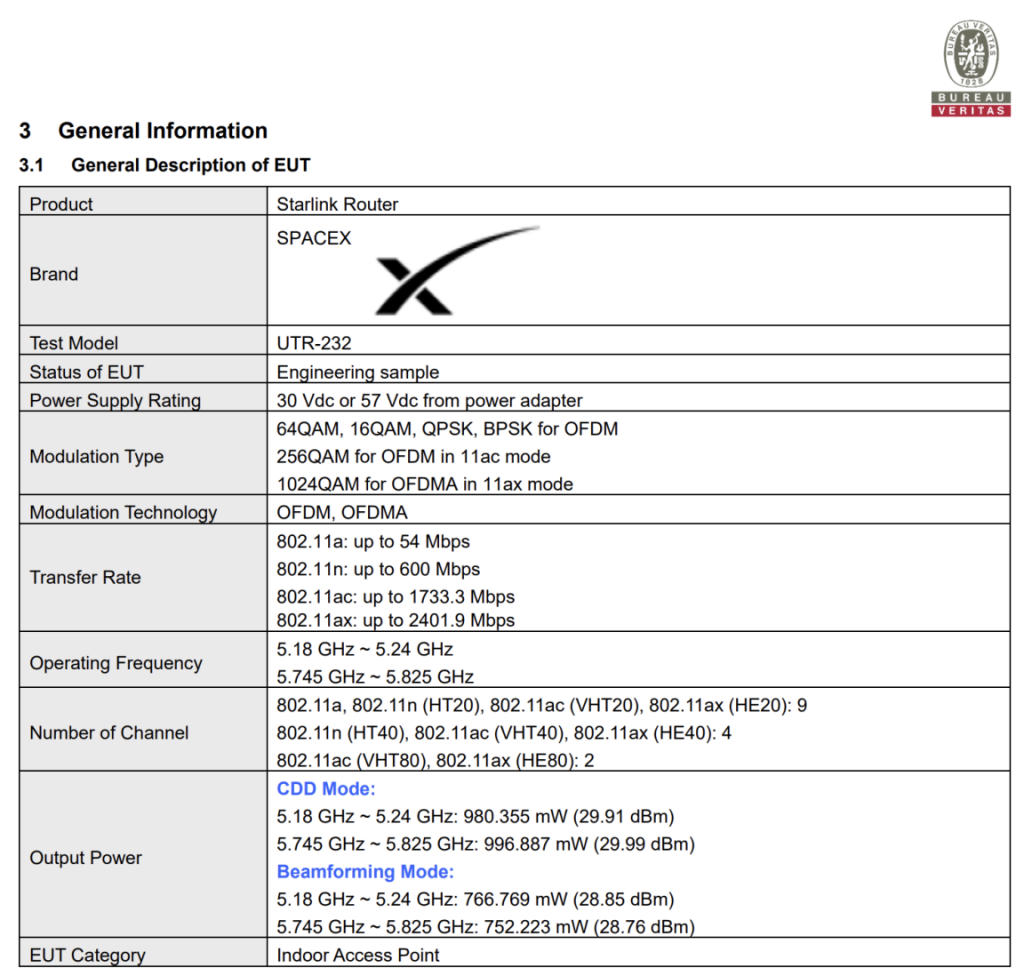
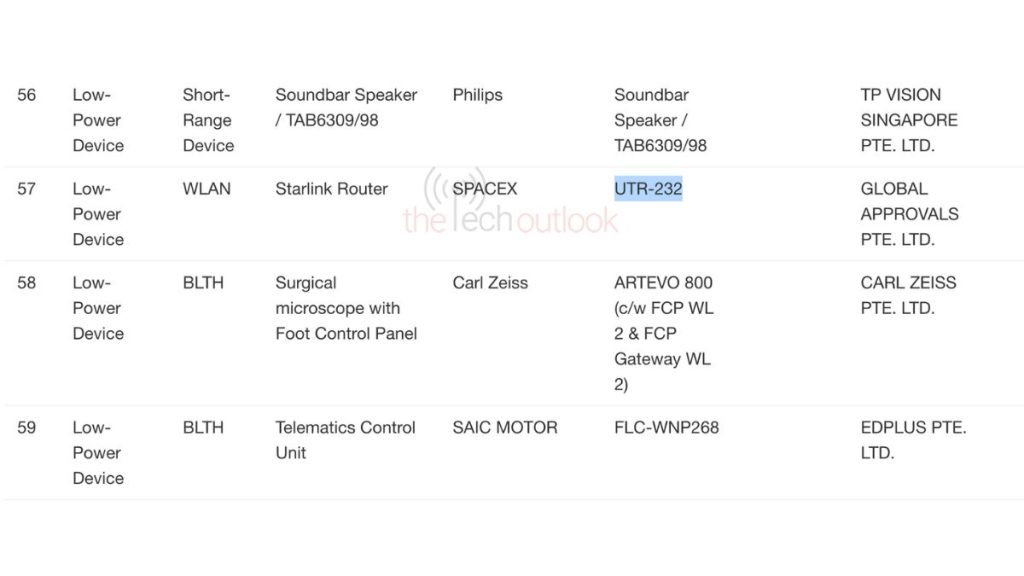
SpaceX’s Starlink is apparently working on a new WiFi 6 router, which was spotted on the IMDA and FCC database. The IMDA certification revealed that it carries the UTR-232 model number and was listed as a low power WLAN device. On the other hand, the FCC listing confirmed that it will utilize the same wireless bands as other WiFi 6 routers.
It also adds that the upcoming router features two built in LAN ports and will house two power adapters, namely UTP-231L and UTP-232C. The UTR-232 Wi-Fi 6 router is likely a finalized version of the UTR-231 Wi-Fi 6 router, which is a Gen 3 mesh router. To recall, the UTR-231 is expected to be an accessory for existing Starlink customers to boost their connectivity with Starlink’s coverage.
In the past, Starlink’s dish came bundled with the Gen 1 and Gen 2 WiFi routers that only supported the WiFi 5 standard. The upcoming Gen 3 mesh router supporting WiFi 6 means that users can expect much faster broadband speeds. Apart from this, users also gain access to faster broadband speeds, improved energy efficiency on mobile phone devices, and lesser bandwidth congestion. This is all the information we have at the moment, so stay tuned for more updates.
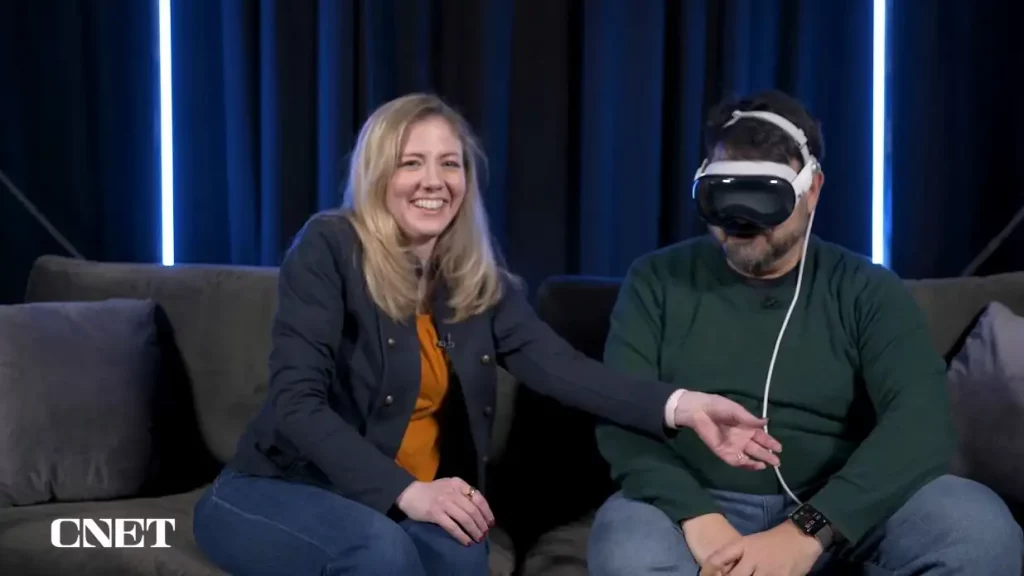
Apple‘s Vision Pro headset, known for its innovative gesture-based interaction, has a minor flaw in its hand-tracking gesture controls, as revealed by test results from technology media CNET. The issue arises when others insert themselves into the interaction area while the wearer is using gestures. Any random hand movement within the interaction area (where the wearer’s hands are supposed to be) may lead to interference with the headset’s gesture controls and impact the overall user experience.
Apple Vision Pro does not differentiate between its user and someone else’s hand, just follows the gesture instruction
The Apple Vision Pro headset relies heavily on gestures for user interaction, facilitated by the visionOS software. CNET’s tests reveal that the headset struggles to distinguish between the wearer’s hand and the hands of others entering the interaction space. This could pose challenges, especially in scenarios where users have children or other individuals around them.
The interference from additional hands affects the seamless execution of gestures, potentially disrupting the intended experience. This will be very inconvenient in certain scenarios like accidental deletion of a file caused by a random hand movement within the range of the gesture system.
While this flaw is relatively minor, it underscores the room for improvement in Apple’s visionOS. The expectation is that future updates might address this issue, allowing the headset to accurately distinguish the wearer’s hand. As Apple continues to enhance its software systems, improvements in gesture recognition may become a focal point, ensuring an optimal and uninterrupted user experience for Vision Pro users.
In conclusion, while this imperfection may cause some inconvenience in certain situations, it is a part of the ongoing development process for this one of a kind first-generation product. Notably, a second-generation Vision Pro, speculated to be called the Apple Vision Pro 2 is in the works which might solve some of the imperfections of this first-generation product such as the weight and more importantly, the weight distribution.
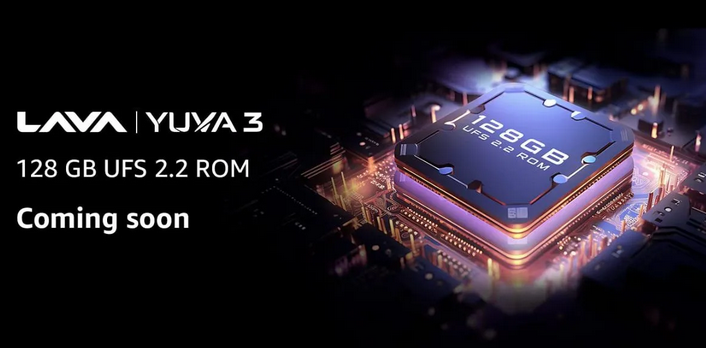
Lava is gearing up to launch a new smartphone in the Indian market soon. The brand previously unveiled the Yuva 3 Pro, and now, it appears the base model is also in the works. An online listing has teased the launch of the Yuva 3 and also revealed some of its specifications. So let’s have a look.
Lava Yuva 3 India Launch Imminent
A microsite on Amazon just went live, which teases the launch of the Lava Yuva 3 model. Looking at the online listing, the storage specs of the upcoming smartphone were also teased. It will be equipped with 128GB of UFS 2.2 storage. Furthermore, the company is also claiming that this storage will enable 3x faster speeds when compared to eMMC storage tech.
Apart from this, the teaser on the microsite confirms a 64GB storage configuration as well as support for up to 512GB of expandable memory. This is likely via a microSD card slot. Unfortunately, finer details regarding this device like its specs and pricing are still unclear. But we can expect it to be a cutdown version of the previously launched Lava Yuva 3 Pro model. To recall, the Yuva 3 Pro was also a budget grade handset, which was equipped with the UNISOC T616 SoC.
It offered a 6.5-inch LCD panel with a 90Hz refresh rate. A large 5,000mAh battery pack powered this phone, which supports 18W fast charging. The rear packs a 50-megapixel dual camera setup and the front houses an 8-megapixel selfie shooter. It launched for a starting price tag of 8,999 INR, so we can expect the vanilla Yuva 3 to start from around 6,999 INR price range in the Indian budget phone segment.
We use cookies on our website to give you the most relevant experience by remembering your preferences and repeat visits. By clicking “Accept”, you consent to the use of ALL the cookies.
This website uses cookies to improve your experience while you navigate through the website. Out of these, the cookies that are categorized as necessary are stored on your browser as they are essential for the working of basic functionalities of the website. We also use third-party cookies that help us analyze and understand how you use this website. These cookies will be stored in your browser only with your consent. You also have the option to opt-out of these cookies. But opting out of some of these cookies may affect your browsing experience.
Necessary cookies are absolutely essential for the website to function properly. This category only includes cookies that ensures basic functionalities and security features of the website. These cookies do not store any personal information.
Any cookies that may not be particularly necessary for the website to function and is used specifically to collect user personal data via analytics, ads, other embedded contents are termed as non-necessary cookies. It is mandatory to procure user consent prior to running these cookies on your website.