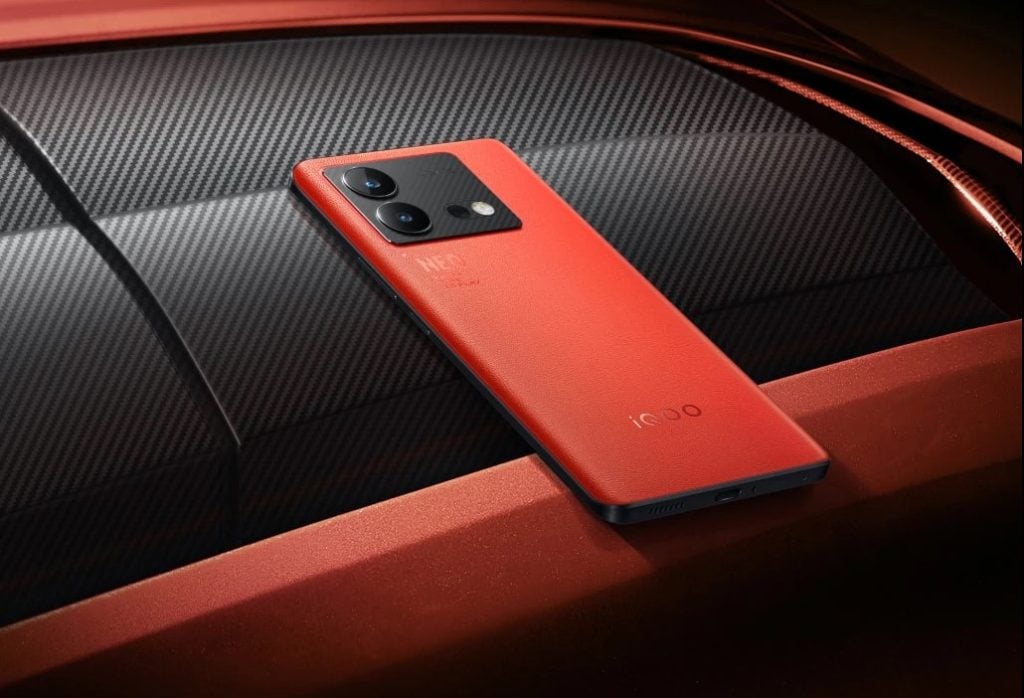
It is speculated that iQOO will announce the iQOO 12 and the iQOO 12 Pro flagship phones in early November in China. The vanilla model is expected to be released in India in the same month. A new report by GSMChina has revealed the first details about the iQOO Neo 9 series of affordable flagship phones for the Chinese market. Continue reading ahead to learn about the model numbers, launch timeframe, and key specifications of the Neo 9 series.
iQOO Neo 9 series’ first details emerge
iQOO Neo 8 series
The publication has come across the IMEI database listing of the iQOO Neo 9 and Neo 9 Pro. The listings revealed that these devices have V2338A and V2339A model numbers, respectively.
The iQOO Neo 8 and Neo 8 Pro debuted in May 2023 in China. These phones are powered by the Snapdragon 8 Plus Gen 1 and Dimensity 9200 Plus chipsets, respectively. Hence, the new report speculates that the Neo 9 will have the Snapdragon 8 Gen 2, whereas the Neo 9 Pro will be equipped with the Dimensity 9300. There is a possibility that the Neo 9 series may arrive with up to 16 GB of LPDDR5x RAM and up to 512 GB of UFS 4.0 storage.
The Neo 9 series is anticipated to operate on Android 14 with OriginOS 4 in China. Reports suggest that the Neo 9 series is scheduled to make its debut in the first quarter of 2024. This launch timeframe appears to be specific to the Chinese market, and it remains uncertain whether or when these devices will be introduced in other regions.
More details of the iQOO Neo 9 series are expected to surface after the launch of the iQOO 12 lineup. Hence, it is advisable to wait for further reports to confirm the specifications of the Neo 9 and Neo 9 Pro.
Elon Musk‘s rebranded social media giant, X, has been slapped with a A$610,500 fine by Australia’s e-Safety Commission for not cooperating in an inquiry related to anti-child abuse practices. The fine might appear small change for Musk, who paid a whopping US$44 billion to acquire the platform. However, it raises significant concerns about the platform’s commitment to user safety.
People are stating that X needs to be more transparent with its users
The trouble started when X failed to address questions about its responsiveness and methods for detecting child abuse material. After taking over Twitter and turning it into X, Musk had declared that combating child exploitation was the company’s top priority. Still, the Australian regulator found X’s actions didn’t match its words.
Adding fuel to the fire is the EU’s ongoing investigation into X for potential violations of new tech laws. Accusations point to the platform’s weak effort to combat disinformation, notably related to the Hamas-Israel conflict.
The fine’s impact goes beyond monetary value; it deals a reputational blow to X at a time when advertisers are already skeptical. The platform has seen a continuous dip in revenue, and things might worsen if it doesn’t take effective measures for content moderation.
Julie Inman Grant, the e-Safety Commissioner, raised an important question. If X is genuinely committed to addressing illegal content, why isn’t it transparent in its actions? A lack of answers could indicate a lack of solutions, she suggested.
X’s Australian office was shut down post-acquisition, leaving no local representative to comment on the matter. If X doesn’t pay the fine, the e-Safety Commission can take the company to court. And the timing couldn’t be worse for X. They recently confirmed an 80% global workforce reduction and admitted their proactive detection measures had declined.
China‘s economic slowdown continues to tighten consumer spending, but this year’s Singles’ Day—one of the world’s biggest online shopping fests—is getting a price-conscious revamp. Alibaba’s Taobao & Tmall and rival JD.com are both wheeling out aggressive low-price strategies, but is this enough to keep the shopping carts rolling?
Singles’ Day is a pretty big event in China for customers
From October 12 to 23, Alibaba is giving away a whopping 1 billion yuan (about $137 million) in cash coupons through its live-streaming platform, Taobao Live. The company aims to be the go-to place for the best online deals, offering consumers more bang for their yuan. Meanwhile, JD.com is not to be left behind; it’s kickstarting its own Singles’ Day extravaganza on October 23 with an event themed “real cheap.” Over 800 million products will go on sale, and JD.com is also offering 10 billion yuan worth of price subsidies and free shipping for selected items.
Interestingly, the e-commerce giants are changing their game plan due to economic pressures, signaling a move away from lavish promotions and shifting toward what Chinese consumers seem to want most—low prices.
However, this new approach comes with its own set of challenges. JD.com, for example, is already feeling the heat with less-than-impressive retail revenue growth in the last quarter. Alibaba too is aware of the stakes, with founder Jack Ma advising a renewed focus on Taobao and its consumer base to sustain in a fiercely competitive market.
As both companies brace for the annual shopping spree stretching from late October to mid-November, it’s unclear if their bet on low prices will pay off. Consumers, like 27-year-old Lucy Liu from Shanghai, remain on the fence, cautious about how they’ll engage with this year’s Singles’ Day.
The Tesla Cybertruck is a very powerful and expensive electric vehicle. It is equally a popular EV even before it goes on sale. We have seen a few look-alikes already. Now, Infinite Machine is providing an alternative Cybertruck with two wheels. Well, not exactly. The Infinite Machine’s P1 electric scooter bears a striking resemblance to the Cybertruck. Perhaps, we could call it the e-bike version of the Cybertruck or call it Cyberbike if you like.
Infinite Machine is a Brooklyn-based startup and it expects the P1 to be a hit in different directions. Although the company has not specifically stated that the P1 was inspired by the Cybertruck, the similarity is quite obvious. The scooter comes with a stocky and angular design. It has an aluminum and steel chassis with rectangular bar-like light. It has a top speed of 55mph (~89km/h) and a range of 60 miles (~97km) on a single charge.
The Infinite Machine P1 e-scooter allows for the mounting of other modules like a rear cargo compartment, speakers, and so on. There is a storage compartment below the moped’s seat and a reservoir under the handles. The P1 comes with some tech features as well. It features Apple CarPlay and Android Auto. This allows the user to get navigation, notifications, music, and other parameters on the scooter’s display. The integrated companion app allows the user to lock, track, or immobilize the P1 scooter if it is stolen.
The new Infinite Machine electric scooter will be available in anodized silver and black color options. The P1 electric scooter will have its first production run of 1,000 units and it has a starting price of $10,000. The first units will ship between 12 and 18 months, according to Infinite Machine. This means that the earliest P1 scooters will enter the market in Q4, 2024. Infinite Machine is already accepting deposits for the P1 ($1,000 or $5,000). The higher deposit places the buyer on the line to be among the first 100 recipients of the P1.
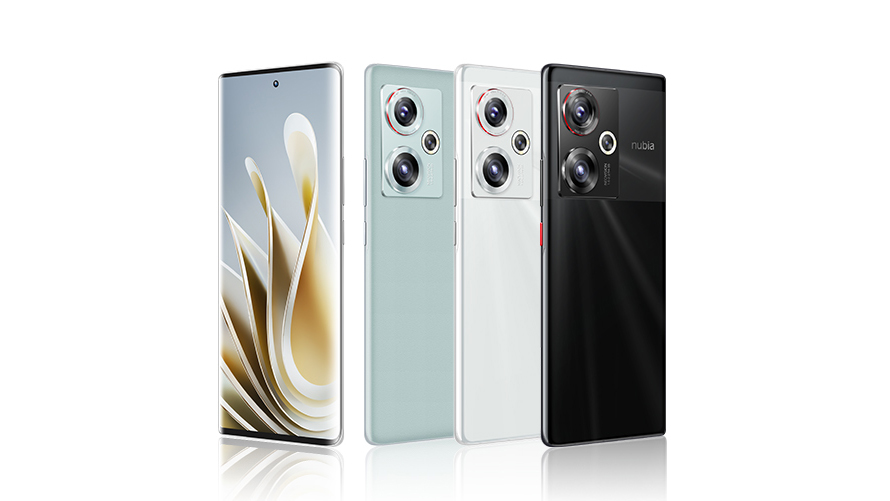
Nubia‘s recent flagship models, the Z50 and Z50 Ultra, received a positive market response. The Z50, released in December last year, and the Z50 Ultra, launched in March this year, both offer impressive features. The Z50 Ultra boasts a Snapdragon 8 Gen 2 chipset, a notch-free AMOLED display with an under-display camera, and a 64MP triple rear camera setup, making it a top-notch device in the market.
Nubia Z60 is expected to feature under-screen selfie camera
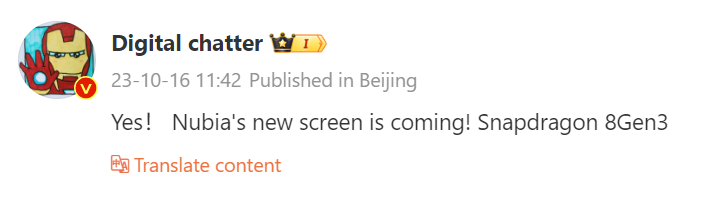
Now there are reports that the company is developing its next smartphone, possibly called the Nubia Z60 or Red Magic 9 series. The device is said to feature Qualcomm‘s upcoming Snapdragon 8 Gen 3 chipset and an upgraded under-screen front-facing camera. The leak comes from prominent tipster Digital Chat Station, though the exact name of the device remains undisclosed.
The possibility of it being the Nubia Z60 is more, considering that Nubia introduced the Nubia Z50 in December 2022. This timing aligns with the potential release window for the Z60.
Apparently, a Nubia phone with model number NX769J was also spotted on the Geekbench benchmarking platform recently, equipped with the Snapdragon 8 Gen 3 chipset. It demonstrated impressive performance with a single-core score of 1596 points and a multi-core score of 5977 points. The device is said to be the Red Magic 9 gaming smartphone.
Furthermore, two Nubia phones with model numbers NX721J and NX769J recently received Wi-Fi Alliance certification, affirming their compatibility with Android 13 and support for both 2.4GHz and 5GHz Wi-Fi networks.
Nubia is also rumored to be launching its first foldable smartphone, the Nubia Z60 Fold, in Q4 2023. According to leaks, the device is expected to feature a 7.3-inch AMOLED foldable display. It’s also expected to equip a Snapdragon 8 series chipset with 12GB of RAM, storage options of 256GB and 512GB, a 5,000mAh battery, and support for 100W wired charging, possibly with wireless charging as well.
Lenovo‘s Legion lineup, a part of its product portfolio, is specifically tailored for gaming enthusiasts. It includes gaming laptops, desktops, monitors, and accessories designed to deliver high-performance gaming experiences. Legion products are known for their powerful hardware, advanced cooling systems, and customizable features, making them a popular choice among gamers worldwide.
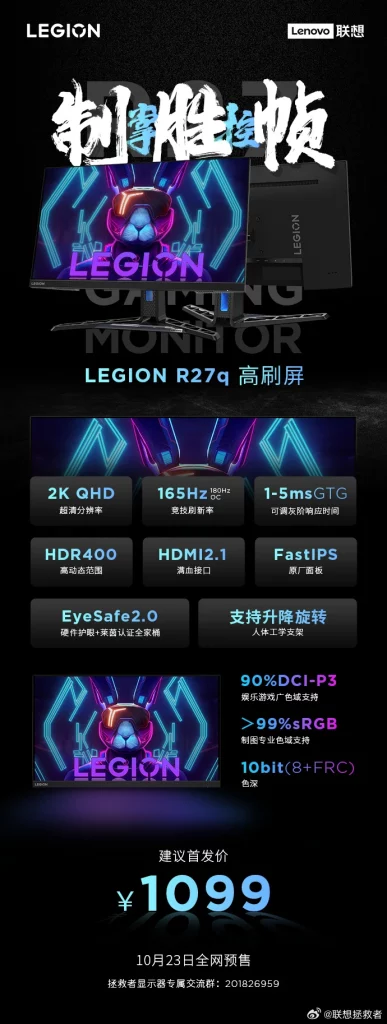
Earlier today, Lenovo announced its latest Legion R27q gaming monitor, which will begin pre-sales on October 23. The monitor comes with an attractive introductory price of 1,099 yuan ($150). Let’s delve into the key specs of this monitor.
Lenovo Legion R27q Monitor Key Features:
The monitor prioritizes an exceptional viewing experience. It features a 2K FastIPS panel with a QHD resolution for clear and vivid visuals.
FastIPS displays are an enhanced version of traditional IPS panels, offering faster response times and better motion handling, ideal for gaming and multimedia. They support high refresh rates, ensuring smoother gameplay, maintain excellent color accuracy and wide viewing angles, and often include a wide color gamut and HDR support for vibrant visuals. FastIPS screens are a balanced choice for users seeking both superior color quality and responsive gaming performance.
Lenovo Legion R27q offers a broad 90% DCI-P3 color gamut for immersive gaming and entertainment, and over 99% sRGB coverage for accurate color representation, ideal for graphic design and visual arts. The monitor also features 10-bit color depth (8+FRC) and HDR400 high dynamic range, enhancing the color palette and contrast for a richer visual experience.
Gamers and enthusiasts will appreciate its 165Hz refresh rate, which can be overclocked to 180Hz for even smoother performance. Additionally, the monitor offers adjustable 1-5ms GTG gray response times, minimizing latency for competitive gaming.
It also prioritizes user eye health with EyeSafe 2.0 technology, certified by TÜV Rheinland, to reduce eye strain during extended use, making it suitable for longer gaming or work sessions.
The Lenovo Legion R27q monitor features an ergonomic stand, offering customization options for users to adjust height, tilt, and rotation, providing comfort and flexibility in their setup. For connectivity, it includes an HDMI 2.1 interface.
While detailed specs of this monitor are not yet available, we will keep you updated with its features as it becomes available for purchase.
The Google Pixel 8 and 8 Pro were recently introduced, and like every Pixel model, they had a rough start filled with issues. These strange errors and problems in Google’s new phones have now become a part of the tech world. For instance, we recently mentioned that the Pixel 8 and 8 Pro were unable to launch Android Auto. Now, there are reports that the Face Unlock on the Google Pixel 8 has already been deceived. Here are the details…
Sibling Able to Unlock Google Pixel 8 with Face Unlock, Despite Looking “Very Different”
Biometric protection has been an essential part of our lives for a while now. It began notably with fingerprint scanners, and today, we see facial recognition technology. The shift to facial recognition is primarily due to its enhanced security. As an iPhone 14 Pro Max user, I can say that this technology is highly functional. Consequently, the latest Pixel 8 and 8 Pro also feature it. However, according to a Reddit user, the Face Unlock on the Google Pixel 8 was allegedly fooled by a sibling.
The Reddit user claims that their brother was able to unlock their Pixel 8 Pro with Face Unlock, despite the two siblings looking “very different”. The full post is as follows:
“I watched dave2ds video yesterday where one of his main talking points was about how the pixel 8 pro had a much better face unlock that actually has the capability to get into more secure apps. After I set up my 8 pro today and got home my brother (who I bought the pixel 7 pro for last year) picked up my phone to look at it and he can unlock it every time with his face (my face works perfectly fine as well) i think we have some of the same facial features but we both look very different. Just to make sure I wasn’t going insane I set up my face on his p7p and it would not let him unlock it until he retrained it to his face. I just find it funny that they say now the more secure unlock feature will let him into my bank account no problems but his p7p wouldn’t even let him get past the lock screen”
Google says that Face Unlock on the Pixel 8 and Pixel 8 Pro is very secure. It meets the highest Android biometric class standard, which is Class 3. This means that it is very unlikely for someone else to be able to unlock your phone with Face Unlock.
Although the user claims otherwise, it is possible that the Pixel 8’s Face Unlock system was fooled by the sibling’s resemblance to the user. It is also possible that there is a bug in the system that could be exploited by someone who looks similar to the user. Google has not yet commented on the report. It is unclear whether the company is aware of the issue or whether it is working on a fix.
Artificial intelligence continues to grow in popularity and becomes more widespread. Every day, another company continues to incorporate this technology into their services. For instance, we recently mentioned Samsung’s plans to expand Tizen integration, bringing AI to a broader range of home appliances. Now, Vivo is preparing to make a similar AI move. The company will release its self-developed artificial intelligence model, Matrix, on November 1st. Here are the details…
Vivo Will Release Its Self-developed AI Large Model Matrix on November 1st
Vivo has announced that it will release a self-developed AI matrix on November 1st, 2023. The matrix will consist of five different AI models, each with a different parameter size: 1 billion, 10 billion, and 100 billion. According to Vivo, the AI matrix has strong comprehensive capabilities, especially in the fields of humanities and social sciences. It surpasses similar large models at the same level.
In simpler terms, Vivo has created a massive AI system that is capable of performing many different tasks. The system is made up of five different AI models, each with its own strengths and weaknesses. Some of the models are designed to be very fast, while others are designed to be very accurate.
Imagine your Vivo smartphone becoming smarter in handling photos, understanding your voice, and even picking up languages. That’s what this AI matrix promises. Shen Yiren, Vivo’s CEO, proudly shared that this AI matrix marks a big achievement for them. He’s hopeful that with this, Vivo will stand tall in the AI realm.
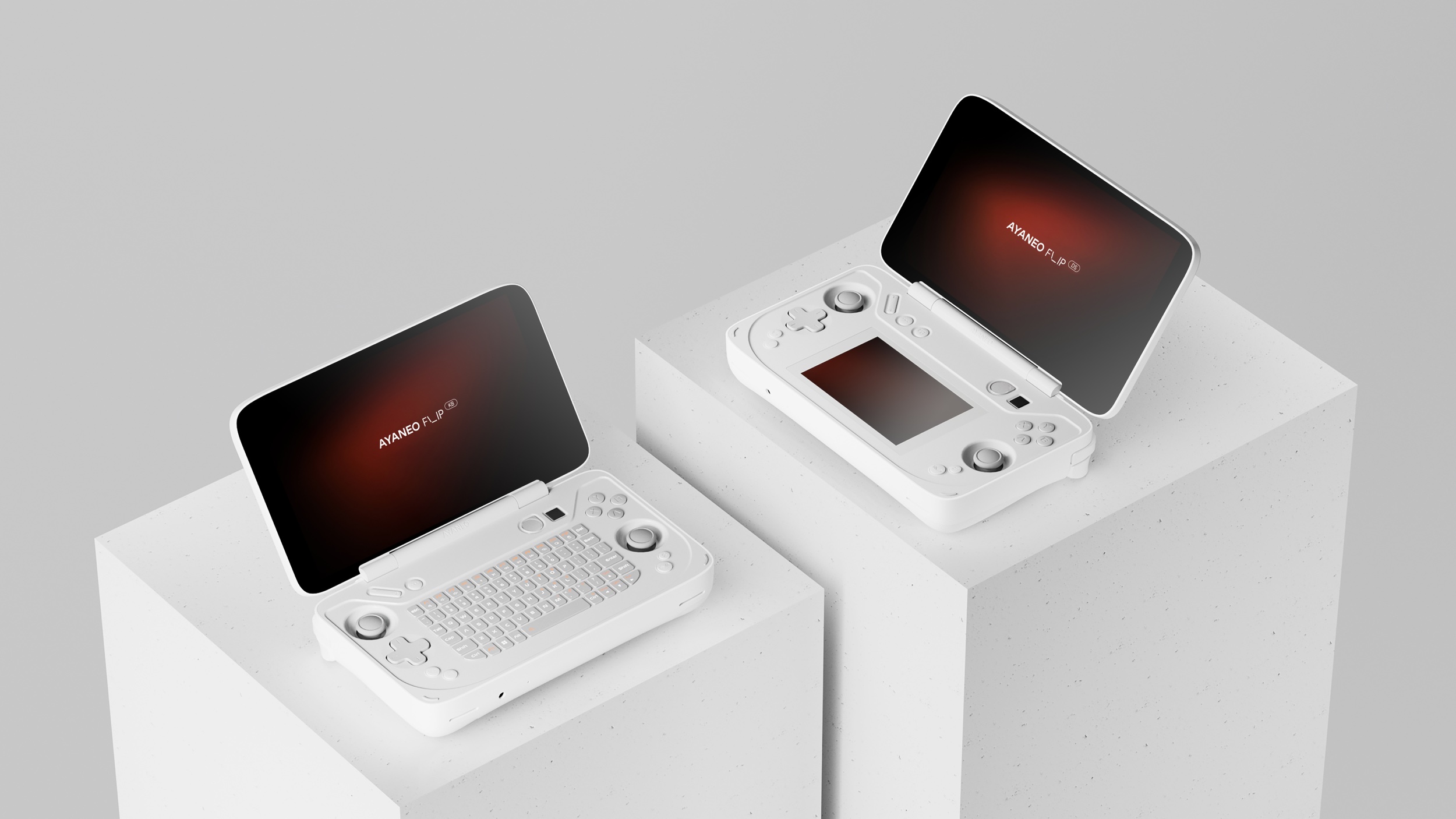
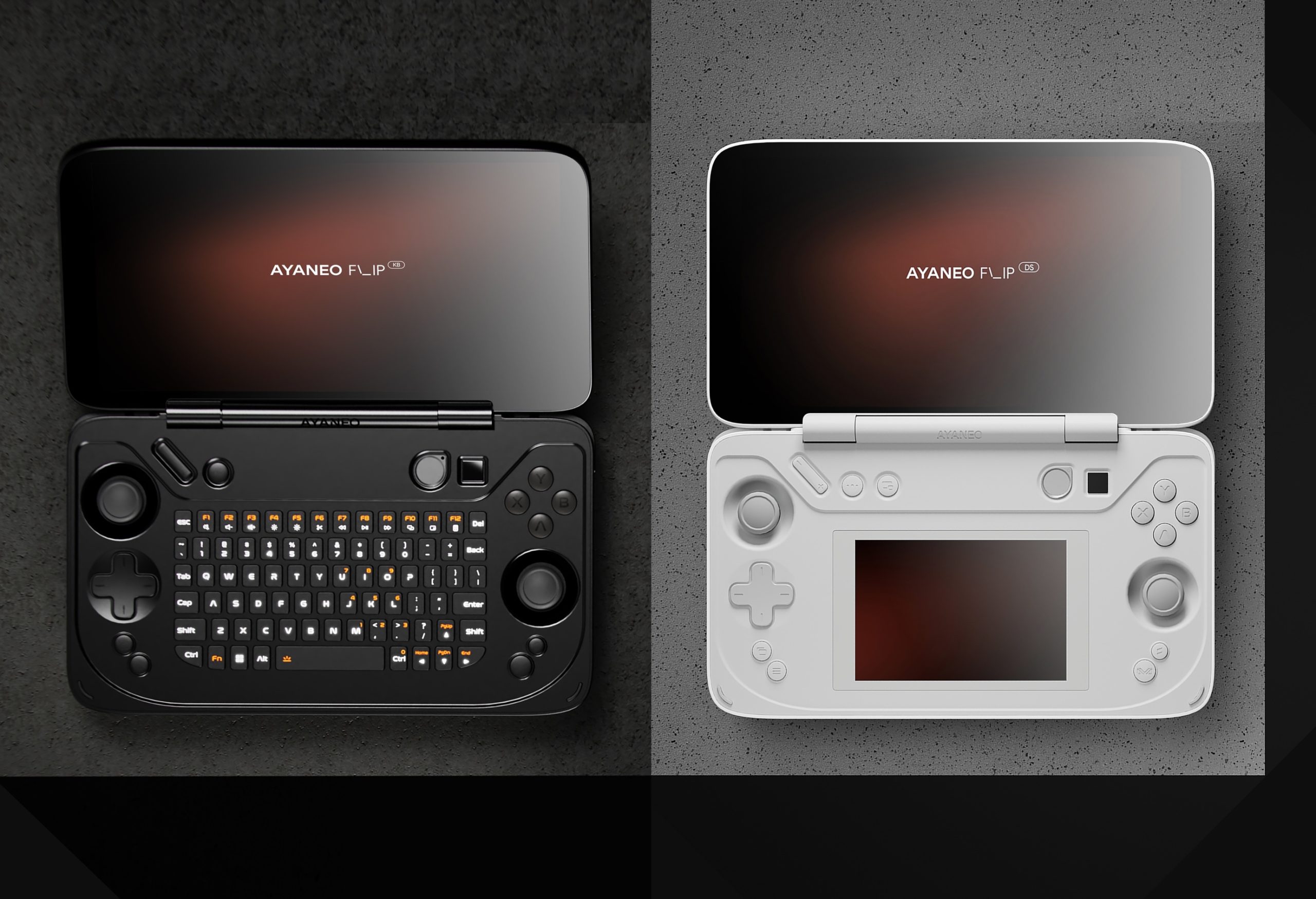
The AYANEO Flip clamshell gaming handheld device is set to be released this December. The FLIP comes with a revised design from its previous teaser presented in September 2023. The gaming device has tweaked keyboards and gamepads from the one teased earlier.
The AYANEO FLIP is the brand’s first clamshell gaming handheld and it was first announced last month. It was stated then that the device would have a D-pad similar to what is present in the Xbox 360. However, the new model has omitted the D-pad in place of a conventional design with a simple layout. The newer D-pad architecture provides more precise inputs than the earlier spec. The spacing between the gamepad buttons has also been increased in the FLIP. This delivers improved ergonomics in addition to the reduced keycaps in the device.
The AYANEO FLIP retains the look of a floating display with its centrally mounted hinge. The hinge mechanism is however wider while other elements are unchanged. The FLIP has a 7-inch, 120Hz IPS panel and will be powered by the AMD Ryzen 7040U APUs. The top APU in the lineup is likely to be the AMD Ryzen 7840U.
The revised AYANEO FLIP is expected to arrive before the end of 2023. The specific release optics has not been released although the model may be in a race against time to meet the release deadline. AYANEO has not provided any pricing details of the FLIP yet but this could be released shortly.
Huawei Mate 60 Pro+ Macro Lens Captures Stunning Footage of a Mosquito’s Blood Meal
A recent video shared by Chinese blogger shows the incredible capabilities of the Huawei Mate 60 Pro+‘s macro lens. The video captures in stunning detail the entire process of a mosquito feeding on a human. The video begins with the mosquito landing on the person’s skin. The macro lens is able to capture the mosquito’s tiny legs and antennae, as well as the needle-like proboscis that it uses to pierce the skin.
As the mosquito feeds, the video shows the proboscis extending and retracting as it draws blood. The macro lens is able to capture even the smallest details of the feeding process, such as the mosquito’s saliva and the blood that it draws. The video ends with the mosquito flying away, having finished its meal.
The Huawei Mate 60 Pro+‘s macro lens uses a combination of two innovative technologies to achieve its impressive results. The first technology is a super-long-stroke slide-axis motor design. This motor allows the lens to focus at a distance of up to 3.5 cm, which is significantly closer than most smartphone cameras.
The second technology is a dual-lens-in-focus architecture. This architecture uses two lens groups, one of which is fixed and one of which is movable. The movable lens group is able to focus at a distance of up to 3.5 cm, while the fixed lens group provides image stabilization. These two technologies combine to give the Mate 60 Pro+‘s macro lens a unique combination of close-focusing ability and image quality.
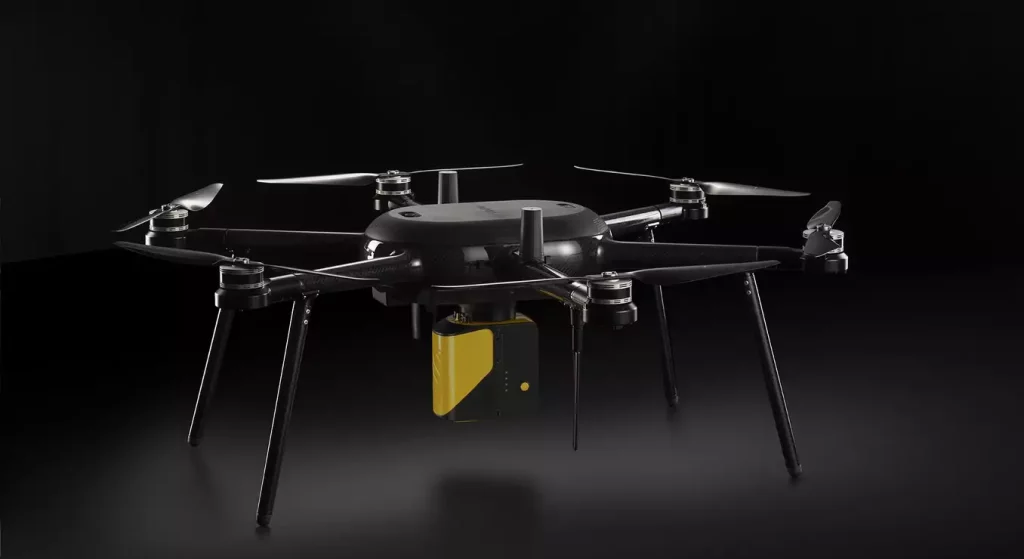
Nokia Drone Network has released official video footage of its new hexacopter drones. Nokia is offering a new lineup of affordable and simple drones that are bound to catch the attention of the public. The telecoms giant has delved into drone-making for industries and businesses. They offer wide insights
Features
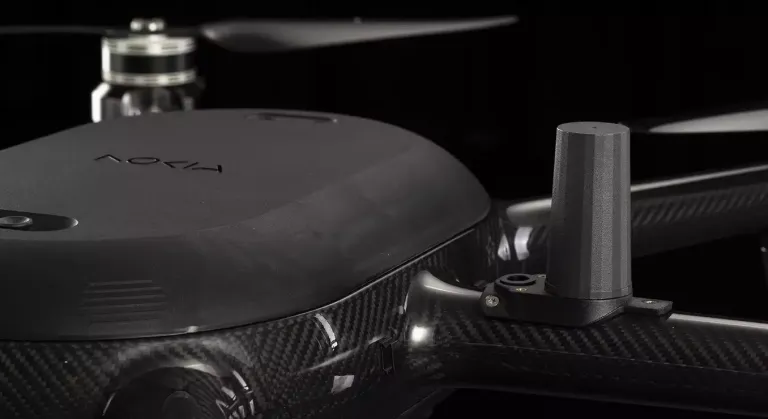
Nokia Drones provide a wide range of possibilities for aerial insights and mission-critical flights. The new Nokia unmanned aerial vehicle (UAV) is a 5G-compatible drone with industry-grade components. The Nokia hexacopter drone is designed to be robustly protected from dust, water, and weather elements. It has a dual gimbal camera module with integrated RGB lighting and a thermal camera. Furthermore, the drone can accommodate the integration of other accessories like searchlights, loudspeakers, or customizable sensors for smoke, motion, radiation, and LIDAR.
The Nokia Drone is manufactured in Europe and also features a docking station that can be fully automated. The new Nokia drone is entering the market at a time when demand for the super-cool gadget is rising in the market.
The drone features 30X optical zoom and is being offered as a Bespoke solution with uncompromising safety features. It offers precision landing and fast charging of its battery. The docking station can be used outdoors and overall the drone is designed to make aerial movement to be routine. The full specs and performance stats of the Nokia drone, as well as release and pricing details are lacking at this time. RELATED:
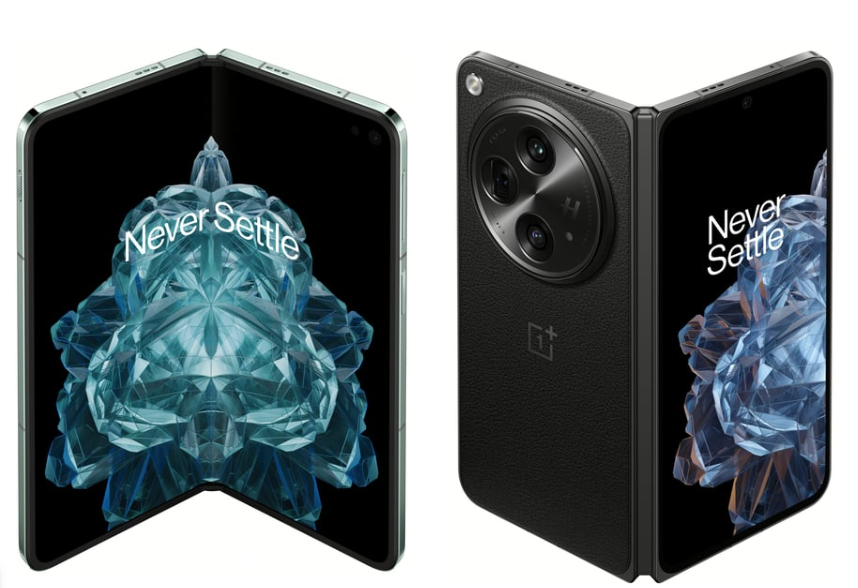
Once upon a time, OnePlus and Oppo were pretty different brands owned by BBK Electronics. But a few years ago, they decided to team up and share their tech and resources, becoming like sister brands. Since then, they’ve released the same gadgets with different names. Like the OnePlus Pad and the Oppo Pad – both the same tablet. Now, they’re doing it again. Oppo is getting ready to launch the OPPO Find N3 Foldable phone, and it’s going to be sold as the first foldable phone from OnePlus, called the OnePlus Open.
The OPPO Find N3 will only be available in China, while the OnePlus Open will be sold worldwide. For the sake of clarity, we’ll refer to the device as the OnePlus Open in this article. Here’s what we know so far about the upcoming foldable phone.
Design & display
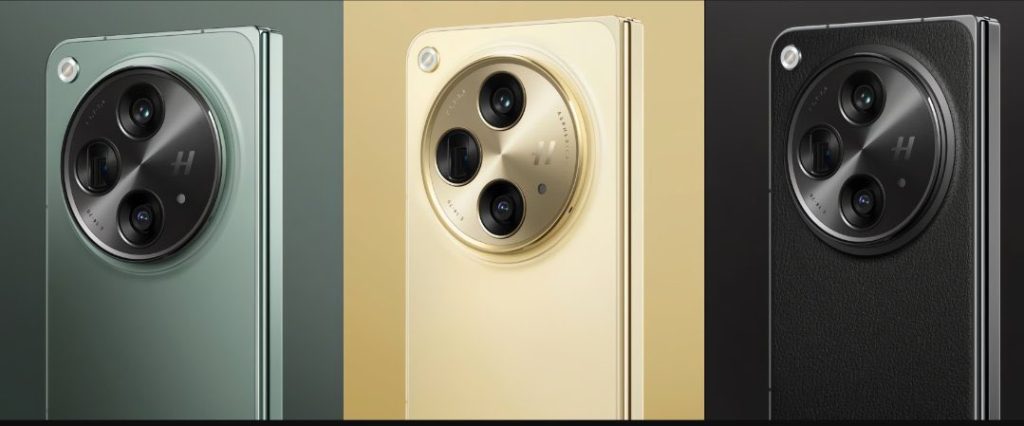
Leaks have revealed quite a few details about the OnePlus Open. Through many leaked renders and some hands-on images, we know that the device will feature a round camera module with three camera cutouts on the back along with a Hasselblad branding. The back will likely have a glass finish with a metal frame.
Talking about the frame, it has flat edges, with the power button and volume rocker residing on the right side. It also has an alert slider button which goes to the left side when you open the smartphone.
Following the lineage of the Find N series, the OnePlus Open features a short and stocky wide design, meaning that it’s a tad bit shorter and wider than competitors like the Samsung Galaxy Z Fold 5. On the inside, the device is said to feature a 2K AMOLED display with a snappy 120Hz refresh rate. On the other hand, the cover screen of the device features a 6.31-inch AMOLED panel with a 120Hz refresh rate.
Claims have also been made regarding its durability. As per a report in August, the smartphone has been put through a tough testing process, revealing that it can last at least 400,000 folds without any issues. This means that users can fold and unfold the OnePlus Open 100 times a day for 10 years without facing any problems with the hinge or the display. In addition to that, it is also said that the crease on the display is barely noticeable. We expect the device to be 12.44mm thick and weigh 244.8g.
Specification and performance
Although the launch of the Snapdragon 8 Gen 3 SoC is just around the corner, OnePlus is going with the Snapdragon 8 Gen 2 chip instead. This chip features up to 3.19GHz clock speed with its prime core, and up to 2.02GHz with its efficient cores. The device recently emerged on Geekbench 5 scoring 1066 points in the single-core test and 5042 points in the multi-core test. The listing also revealed that it will have up to 16GB RAM (likely LPDDR5x RAM) onboard. We can expect it to be available with up to 1 TB storage option, at least in some markets.
The Oppo Find N3, on the other hand, was tested on Geekbench 6.1, managing to score 2,037 points on the single-core test and 5,485 points on the multi-core test. With these results, it’s clear that the device won’t give users any issues in day-to-day use. The hardware will draw power from a 4800mAh battery, paired with 67-watt charging.
Oppo is giving a lot of importance to security. They’re providing a special feature called “Isolated Island” powered by a dedicated security chip meant to safeguard personal and business data at a hardware level. It’s not clear if the OnePlus Open will have this chip and its security features.
Camera
Reports claim that the OnePlus Open will come with a 48MP main camera and a 48MP ultrawide module. Additionally, there’s a third 64MP sensor on the rear, possibly with 3x or 6x optical zoom capabilities. In contrast, the OPPO Find N3 is rumored to include Sony’s cutting-edge LYTIA 800 camera sensor, which uses a two-layer transistor pixel structure. For those unaware, the LYTIA 800 is a 50MP sensor, which means that it’s likely different from the one on the OnePlus Open.
Pricing & availability
Both of these smartphones are set to debut on October 19. As per a leak, the first sale of the OnePlus Open will take place on October 27, 2023, in India. The device is expected to have a starting price of ₹1,39,999 ($1,683) in the country. It will launch in three color options: Black, Green, and Gold.
Logitech launched the Zone Wireless headset in 2019 and today we get the due successor. The new Zone Wireless 2 debuted as new business-oriented headphones with features like far-end noise suppression, multipoint Bluetooth connectivity, and more. However, there’s also a decent increase in the price. Here are the detailed specifications and pricing of the new Logitech Zone Wireless 2.
Logitech Zone Wireless 2 Specifications
As mentioned, the Logitech Zone Wireless 2 wireless Bluetooth headset is aimed at corporate folks. It is compatible with platforms such as Zoom, Google Meet, Google Voice, and Fast Pair, and has also passed Microsoft Teams certification.
Logitech has taken several steps to make the Zone Wireless 2 headset more sustainable. The ear pads and internal battery are replaceable, and the plastic and aluminum parts are made from renewable materials. The headset has also achieved carbon-neutral certification.
One notable feature of this headset is the support for AI noise reduction. It allows you to hear the sound clearly even in a noisy environment with the help of 4 noise reduction microphones that suppress background noise. The headset supports ANC hybrid active noise reduction with two levels of adjustment and also brings a transparency mode.
The Logitech Zone Wireless 2 is a versatile headset that can be connected to devices via a USB receiver or Bluetooth. It can also be switched between multiple devices with ease. When active noise cancellation is turned on, the headset supports up to 15 hours of calls and music playback. It can be used for up to 22 hours without active noise cancellation. The headset also supports fast charging and can provide 1 hour of talk time after just 5 minutes of charging.
Price and Availability
The Zone Wireless 2 is set to be available for purchase in the United States, Canada, Europe, Asia, Australia, and New Zealand. In North America and the UK, these headphones will be priced at $299, which is $100 more than the original version. They are expected to start shipping sometime in October and can be found on Logitech’s official website.
China has experienced a significant 14.6% decline in semiconductor imports from the United States during the first nine months of 2023 compared to the same period in the previous year. This drastic reduction, amounting to 355.9 billion units of integrated circuits (ICs), is attributed to stringent US export controls imposed due to concerns about China’s rapid advancements in the AI sector through American technology infusion. The total value of IC imports plummeted by 19.8% year on year, reaching $252.9 billion, reflecting the impact of these restrictions on China’s economy.
Remarkably, despite export bans, China’s demand for advanced semiconductors for AI projects has given rise to an underground market for smuggled graphics processing units (GPUs). Notably, Nvidia’s A100 and H100 devices have been making their way into the country, circumventing official channels.
The US government’s attempts to restrict specific chip exports to China, initiated in August of the previous year, have not entirely curtailed the under-the-counter trade of certain products from chip giants Advanced Micro Devices and Nvidia. This situation underscores the challenges faced by the US in attempts to limit China’s access to cutting-edge AI technology while addressing trade imbalances.
Furthermore, China’s imports from major semiconductor supply chain players South Korea, Japan, and Taiwan have also dwindled. Imports from South Korea witnessed a substantial 23% decline, while imports from Japan and Taiwan fell by 16.3% and 20% respectively. This broader reduction emphasizes the impact of global supply chain disruptions on China’s semiconductor industry.
Analysts are now eyeing the potential revitalization of China’s smartphone industry, despite US sanctions, with the imminent release of new 5G handsets by Huawei Technologies. This development could breathe new life into an industry that has experienced declining manufacturing activity, providing a glimmer of hope amidst the prevailing challenges.
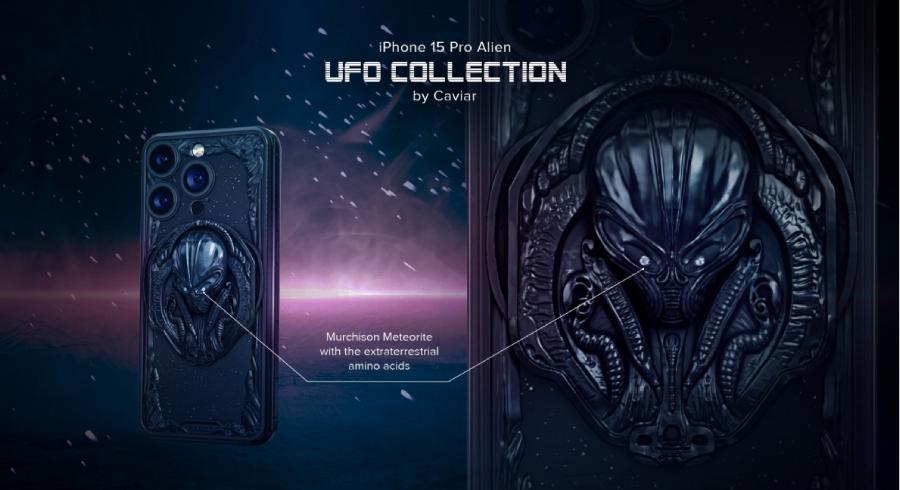
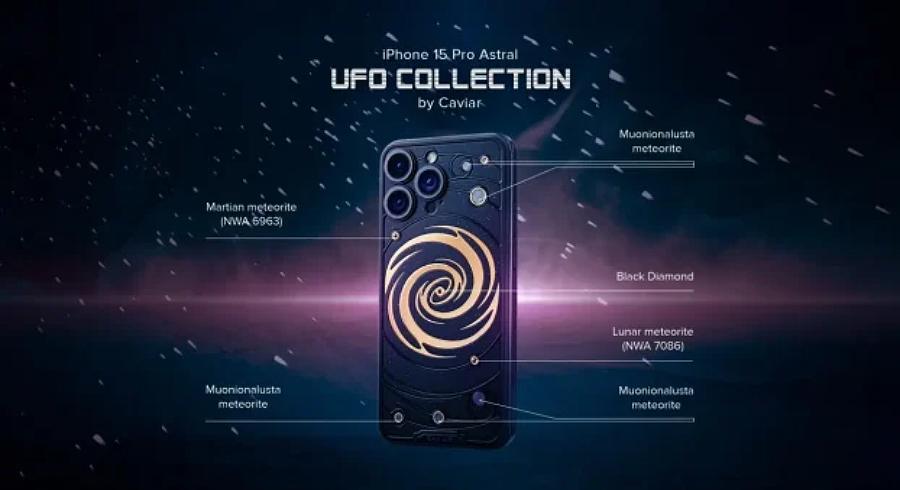
Caviar, a company known for its luxurious and unique custom smartphone designs, has announced a new collection of iPhone 15 Pro and Pro Max models inspired by outer space. The UFO collection features three designs: Alien, Astral, and Starship.
The Alien version features a titanium case with a stylized image of the Predator on the back. The back also incorporates fragments from the Murchison meteorite, a 7 billion-year-old meteorite that contains amino acids, the building blocks of life.
The Astral design features a titanium case with a stylized image of the Milky Way galaxy, made of 24-carat gold. The back also incorporates fragments from the Moon, Mars, and the Muonionalusta meteorite. The latter was found in Sweden in 1906 and is one of the oldest meteorites found to date.
The Starship design—as implied by the name—is inspired by a spaceship. The titanium back of the Starship model is adorned with a Star Destroyer from Star Wars, but perhaps to avoid royalties, it is simply referred to as a futuristic spaceship. As usual, the Caviar models are technically identical to the regular iPhone 15 Pro, although neither wireless charging nor MagSafe is likely to work due to the titanium back.
All three designs in the UFO collection are limited editions. The Alien design is limited to 15 units, the Astral design is limited to 24 units, and the Starship design is limited to 99 units.
Caviar’s UFO collection is a unique and luxurious way to own an iPhone 15 Pro or Pro Max. However, it is important to note that the prices are very high. The Alien design, for example, costs $9,000, which is more than three times the price of a standard iPhone 15 Pro Max.
The Indian government has revised its approach. Instead of enforcing strict rules for importing PCs, laptops, and tablets, they will simply monitor them. Starting November 1, there will be a new online system where companies must report the products they bring into the country. This change aims to better understand the origin of imports and to reduce dependence on China. Here are the details…
India to Implement Import Management System for PCs, Laptops, and Tablets
The Indian government has decided not to impose licensing requirements on the import of PCs, laptops, and tablets, but will monitor their inbound shipments instead. This is a relief for companies like Apple and Samsung, which import laptops into India. An import management system will be implemented from November 1 to track these imports.
The import management system will be an online portal where companies will be required to register and disclose data related to their imports, including the countries from which they import electronics hardware like laptops and personal computers, and the domestic sales value. The government has said that the import management system is being implemented to improve transparency and efficiency in the import process, and to reduce import dependence on China.
The decision to not impose licensing requirements on the import of PCs, laptops, and tablets is a welcome one for the industry. Licensing requirements would have added to the cost and complexity of importing these products, and would have made it more difficult for companies to meet the growing demand for laptops and other IT hardware in India.
The import management system is a more nuanced approach to import management. It will allow the government to track imports and identify any potential concerns, without imposing unnecessary restrictions on businesses. This is a positive step towards creating a more supportive environment for the IT industry in India.
It remains to be seen how the import management system will be implemented and enforced. However, the government has said that it is committed to working with the industry to make the process as smooth and efficient as possible.
In a dramatic turn of events, Chinese smartphone camera manufacturer Ofilm, once blacklisted by the US Department of Commerce in 2020, has managed to rise by securing a major contract with Huawei Technologies. The blacklisting led to Ofilm’s removal from Apple’s supplier list in 2021, causing a significant blow to its financial stability.
Despite the setbacks, Ofilm has found a lifeline in Huawei, becoming a pivotal contractor for the tech giant’s latest Mate 60 smartphone series. Huawei, grappling with US trade sanctions, has relied on Ofilm for camera modules for its flagship Mate 60 series. The soaring demand for the Mate 60 Pro 5G handset prompted Huawei to increase its smartphone shipment target for the second half of the year by 20 percent, thereby benefiting suppliers like Ofilm.
The financial impact on Ofilm had been severe, with the company’s market value plummeting by over two-thirds after losing Apple as its primary client. Reporting a widened loss of $708 million in the previous year, Ofilm faced a challenging financial landscape.
Ofilm’s story underscores the profound impact of geopolitical tensions between the US and China on businesses. Accusations of using forced Uygur Muslim labor at its factory led to Ofilm’s blacklisting and subsequent loss of major contracts, illustrating the intersection of human rights concerns and international business dynamics.
Despite these challenges, reports of Ofilm’s contract with Huawei triggered a remarkable resurgence. Within two weeks of the announcement, Ofilm’s Shenzhen-listed shares surged by nearly 70 percent, signaling renewed investor confidence and faith in the company’s prospects.
Ofilm’s journey also sheds light on its previous association with tech giant Apple. The company had been named an Apple supplier in 2017, experiencing rapid growth in China’s stock market. Apple CEO Tim Cook visited Ofilm’s factory in 2017, praising the company for its innovations. However, following the US government’s blacklisting in 2020, Apple removed Ofilm from its suppliers’ list in 2021, severing ties with the once-promising Chinese camera maker.
I was planning to upgrade to a new smartphone during this year’s festive sale in India. I was particularly interested in buying a flagship phone.
When the Galaxy S23 Plus went official, I had set my eyes on it. Having used the Galaxy A52 since its release, I was too accustomed to the Galaxy ecosystem as it works well with my Chrome OS tablet (Phone Hub) and Windows laptop (Phone Link). I even invested in Galaxy Buds Plus and Galaxy Watch 4 over the past two years.
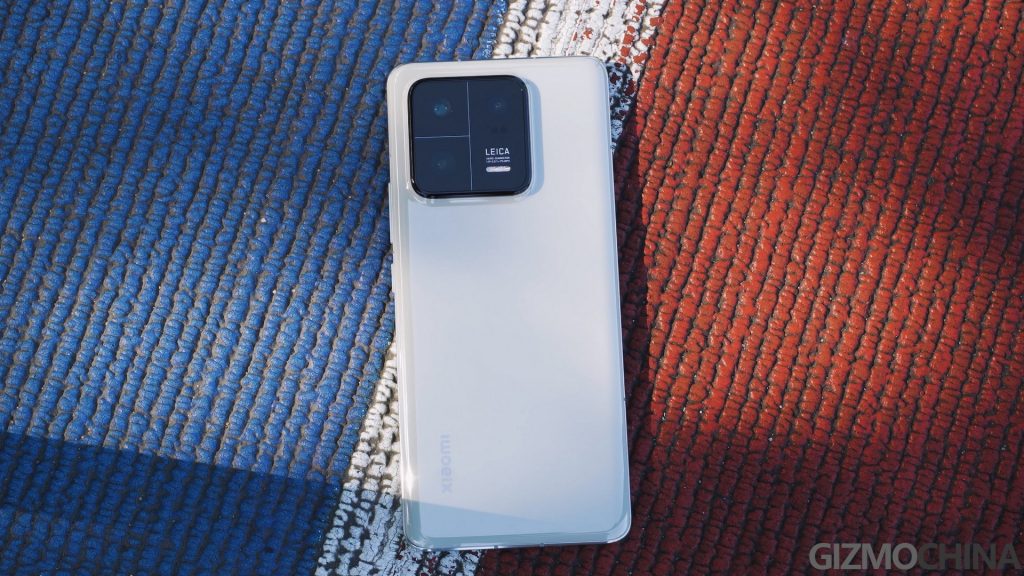
Xiaomi 13 Pro
But out of nowhere, I got attracted to the Xiaomi 13 Pro due to its camera prowess, which I require for my reviews’ product shots. The Galaxy S23 Plus’ camera paled in comparison.
Also, neither Samsung nor retailers offered discounts on the bigger S23 which retails at ₹94,999. This made the Xiaomi 13 Pro a much better deal with its discounted price tag of ₹74,999.
I visited my local Xiaomi Studio store multiple times to try Xiaomi’s most premium smartphone in India. I loved every bit of it, except the front camera, which is its Achilles’ heel.
However, I decided not to buy the Xiaomi 13 Pro after doing some research. And to my surprise, I jumped over the fence to join the dark side by purchasing an iPhone 15.
Yes, you heard it right. I wanted an Android premium phone but I went with an iPhone instead.
I knew from the beginning that the Xiaomi 13 Pro is one of the best smartphones on the market, thanks to our review team from China. When the phone hit global markets, it became more apparent to me after going through media and user reviews from multiple regions.
Especially, in India, Xiaomi 13 Pro offers a lot more value for ₹79,999. Don’t listen to people who say otherwise. It is not overpriced at all as you don’t get hardware like this on any similarly priced products.
But then why I decided not to buy it? It has to do nothing with the phone but with the history of Xiaomi’s premium smartphones in India.
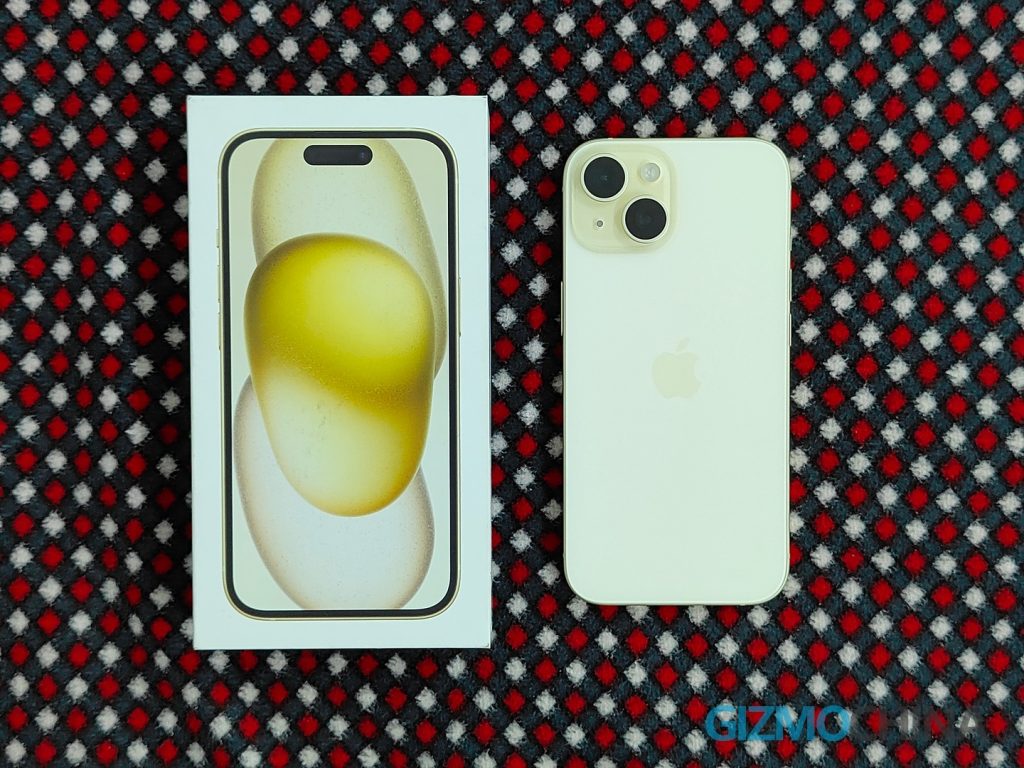
Apple iPhone 15
Xiaomi stopped launching its Mi series flagships in India after the Mi 5 in 2016. Anyways, the Mi Mix 2 did receive a limited release in 2017.
Then, three years later in 2020, the company brought the Mi 10 to India during the worst time possible (COVID-19 global pandemic). It was later followed by Mi 11 Ultra, which also suffered from bad timing (India’s deadly COVID-19 second wave).
Not only sales of these products tanked but they were plagued with hardware issues following software updates. Both of them were discontinued quickly.
Then, in 2021, Xiaomi didn’t give up and debuted the Xiaomi 12 Pro in the country. This device is still being sold at a cheaper price more than a year after its release.
It was a breath of fresh air but with a quirk. It houses the infamous Snapdragon 8 Gen 1 chip, which results in poor thermal and battery performance.
The Xiaomi 13 Pro, on the other hand, does not have any issues like its predecessors so far. But I still couldn’t trust the company’s after-sales support for premium handsets as they have been terrible so far.
Also, you never know which MIUI update will break your device’s hardware. Xiaomi really needs to work on it instead of stopping system updates altogether, like on the Redmi Note 10 Pro.
The Xiaomi 13 Pro is perfectly fine right now. However, I am skeptical about its future, given Xiaomi’s history so far.
I don’t believe in upgrading smartphones every year. And when I am investing a premium amount, I not only expect longevity but also good after-sales service, be it official or third-party. Thus far, these things do not resonate with Xiaomi’s premium handsets in India.
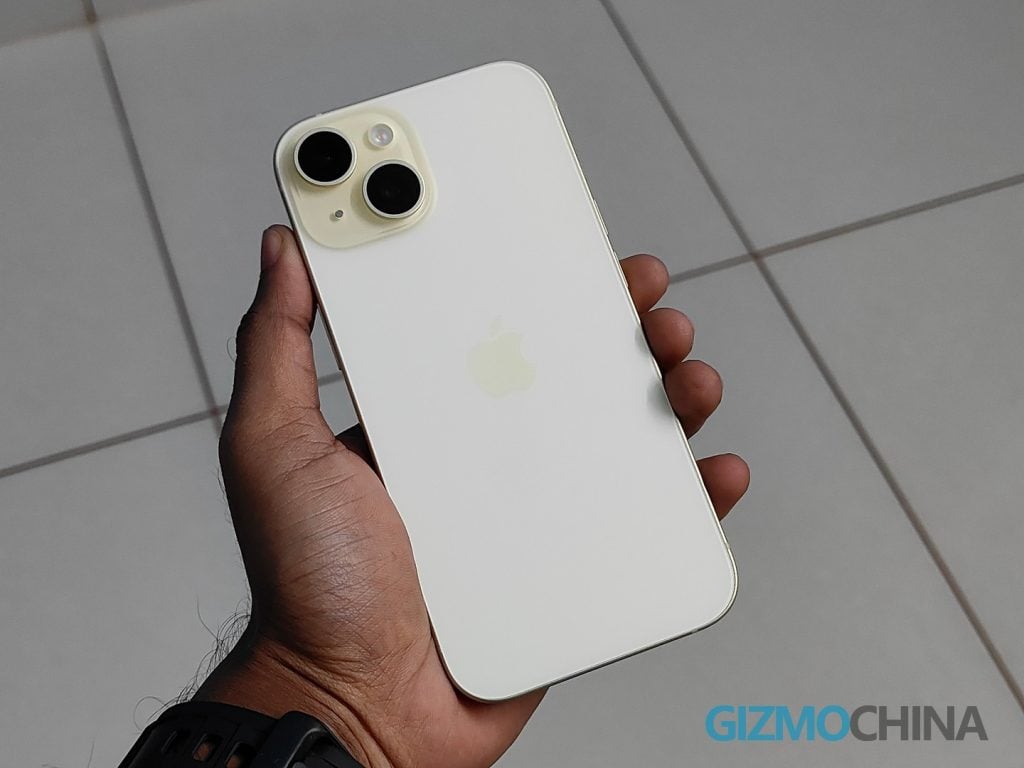
Apple iPhone 15
So then again why I went with the iPhone 15 instead of the Galaxy S23 Plus? As I mentioned earlier, lack of discount is the first reason.
Secondly, Apple hit it out of the park with the iPhone 15, which starts at ₹79,900. The new base iPhone arguably has better cameras than the S23. Yes, the lack of a zoom camera is painful for my usage but the level of detail you get from the new 24MP shots is really good.
I am yet to settle down with the whole iOS thing. But so far, I am enjoying the device. Interestingly, the 60Hz display doesn’t bother me though I use the iPhone 15 alongside the OnePlus Nord CE 3 (review) sporting a 120Hz screen.
I wouldn’t call the iPhone 15 a perfect smartphone for its asking price. But I find it better than the options I had in mind.
I could have waited for the Galaxy S24 series, which is expected to release in January. But the non-Ultra models are rumored to feature the new Exynos chip in India. We all know how terrible Samsung’s own chipsets have been lately in terms of thermals and battery life.
So this was the story of how I joined the dark side. Not by choice but by force.
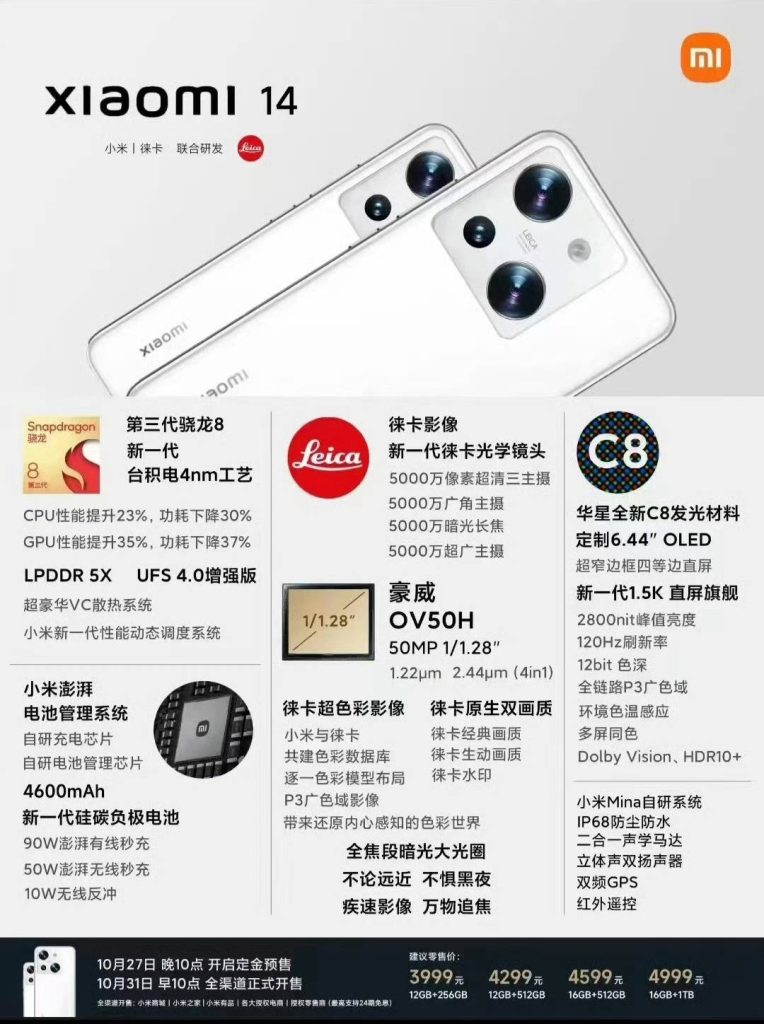
After the successful launch of the Xiaomi 13T in global markets, the highly anticipated Xiaomi 14 series is expected to launch in its home market in China by this month. And with a surprise leak earlier today that fully showed off the specs, we also now know the launch date and even launch prices of the Xiaomi next-generation flagship, the Xiaomi 14 from a newer leak.
From the newly leaked poster, the Xiaomi 14 is launching on October 27, 2023 (Friday), and will go on sale in China from October 31, 2023 (Tuesday) onwards. The pricing of the Xiaomi 14 is as follows:
12 GB RAM + 256 GB storage – 3999 CNY (547 USD)
12 GB RAM + 512 GB storage – 4299 CNY (588 USD)
16 GB RAM + 512 GB storage – 4599 CNY (630 USD)
16 GB RAM + 1 TB storage – 4999 CNY (684 USD)
Xiaomi 14 Promotional Poster with Launch Date, Sale Date and Pricing Revealed (Source: Xiaohongshu user)
Gathered from Chinese Xiaohongshu user 5641400486, the leaked poster above reveals the Xiaomi 14 with a large square camera module housing three Leica-branded sensors. The setup is said to comprise a 50MP OV50H main lens paired with a 50MP ultra-wide and a 50MP telephoto unit.
The Xiaomi 14 is to launch with a 6.44-inch C8 OLED 12-bit display bearing a 1.5K resolution. It will offer a 120Hz refresh rate, 2,800 nits peak brightness, Dolby Vision, and HDR10+ support. The device is tipped to have dual-stereo speakers, an IP68-certified body, and an IR Blaster.
Under the hood, the leak reveals that the Xiaomi 14 will be equipped with the unannounced Snapdragon 8 Gen 3 processor coupled with LPDDR5X RAM and “UFS 4.0 Enhanced” storage. It will also feature a large VC liquid cooling system for heat dissipation. The upcoming smartphone will reportedly be backed by a 4,600mAh battery unit with support for 90W wired, 50W wireless, and 10W reverse wireless charging.
For more of the latest updates on the launch of the Xiaomi 14 series, stay tuned to our coverage of Xiaomi’s upcoming launch event on October 27 only on Gizmochina!
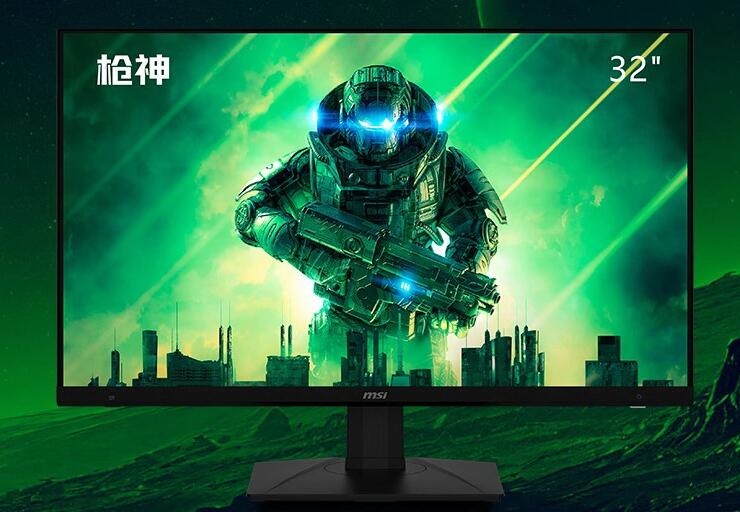
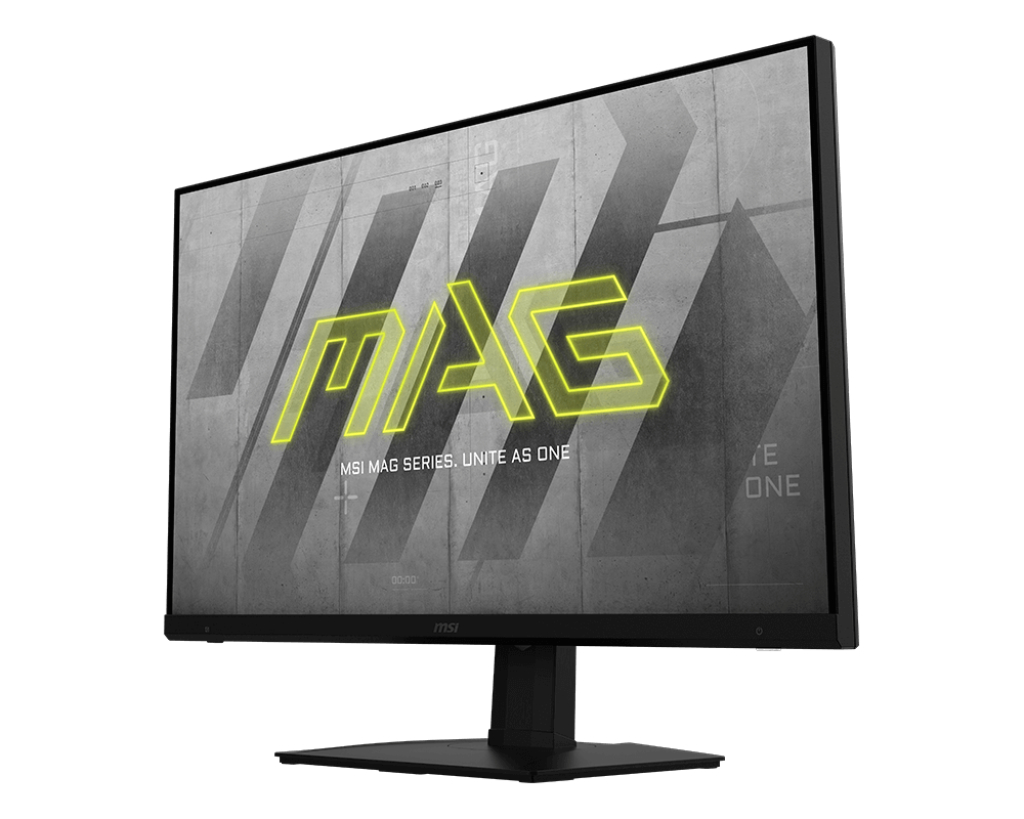
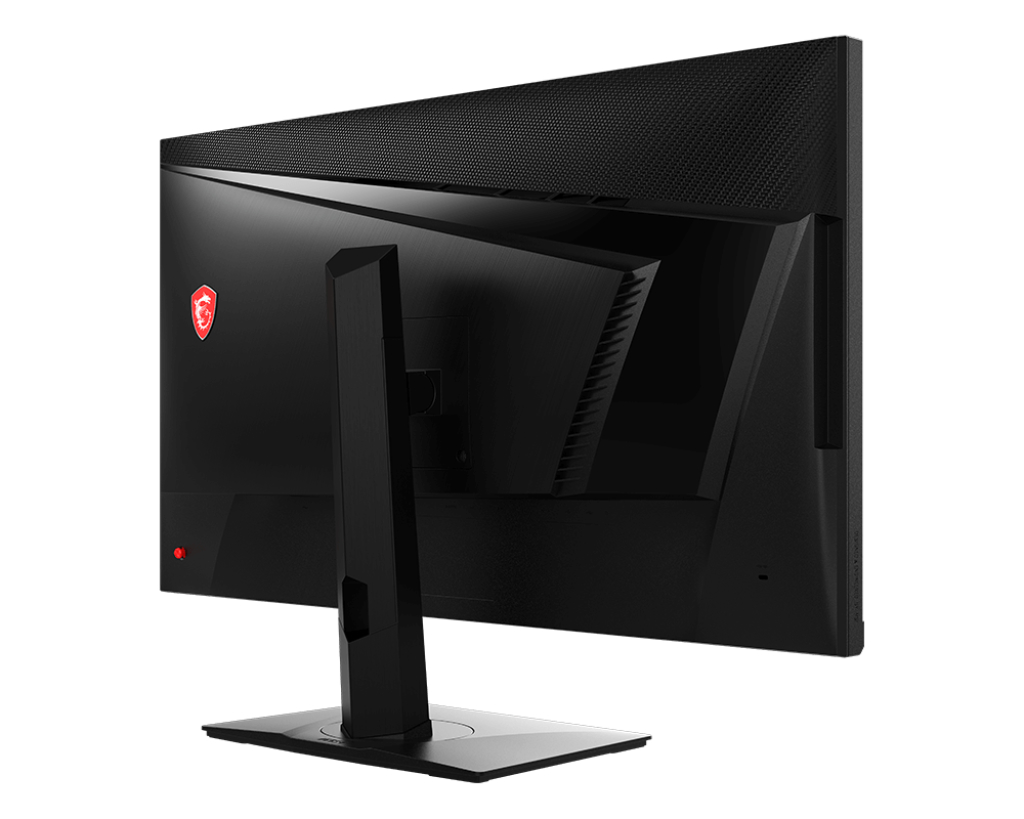
Back in August, MSI unveiled the MAG 323UPF gaming monitor in China. What made this monitor special is its 160Hz refresh rate panel, even with 4K resolution. The brand has now introduced this monitor on the global stage, meaning that we can expect market availability in the near future.
MSI MAG 323UPF specs
The MSI MAG 323UPF gaming monitor comes equipped with a spacious 32-inch display, it offers a native 4K resolution of 3,840 x 2,160 for detailed visuals. For gaming, it offers a 160 Hz refresh rate and a swift 1 ms GtG response time for responsive gameplay.
In terms of color quality, the monitor features a 1,000:1 contrast ratio and covers a wide color space, including 93.6% AdobeRGB, 95% DCI-P3, and 125.7% sRGB. It holds VESA DisplayHDR 600 certification, providing a peak brightness of 600 nits and a 10-bit color depth (8-bit+FRC) for enhanced visuals. It’s worth noting that the typical brightness of the monitor is 440 nits.
For AMD graphics card users, the MSI MAG 323UPF supports AMD FreeSync Premium Pro, reducing screen tearing during gaming. The monitor offers various connectivity options, including DisplayPort 1.4, HDMI 2.1, USB Type-A, and USB Type-C ports. Notably, it comes with two HDMI 2.1 ports, each boasting a 48 Gbps bandwidth, ensuring compatibility with the latest gaming consoles.
The USB Type-C port does two jobs: it connects devices and charges them at a strong 90W rate. This is handy for folks who want to use the monitor as a workstation because you can easily link a laptop to the monitor while keeping it charged.
Pricing and availability details of the monitor are expected to be unveiled in the coming weeks, so stay tuned.
We use cookies on our website to give you the most relevant experience by remembering your preferences and repeat visits. By clicking “Accept”, you consent to the use of ALL the cookies.
This website uses cookies to improve your experience while you navigate through the website. Out of these, the cookies that are categorized as necessary are stored on your browser as they are essential for the working of basic functionalities of the website. We also use third-party cookies that help us analyze and understand how you use this website. These cookies will be stored in your browser only with your consent. You also have the option to opt-out of these cookies. But opting out of some of these cookies may affect your browsing experience.
Necessary cookies are absolutely essential for the website to function properly. This category only includes cookies that ensures basic functionalities and security features of the website. These cookies do not store any personal information.
Any cookies that may not be particularly necessary for the website to function and is used specifically to collect user personal data via analytics, ads, other embedded contents are termed as non-necessary cookies. It is mandatory to procure user consent prior to running these cookies on your website.