Advertisement

Realme GT Neo 5 SE specs Roundup: Everything we know so far

Realme released the GT Neo 5 smartphone in China in February, and now they are preparing to launch another device called the Realme GT Neo 5 SE on April 4. Various noteworthy specifications of the upcoming smartphone have been revealed through teasers and leaks. Here is a summary of all the available information thus far.

Realme GT Neo 5 SE
Realme GT Neo 5 SE

Design & display

Realme has provided a sneak peek into the appearance of the GT Neo 5 SE. The back and sides of the smartphone will be curved, while the front will have a flat-screen. The camera setup will comprise of a dual cutout with a single lens located in the top cutout and two camera sensors placed in the lower one. The power button will be situated on the right-hand side, while the volume rocker will be on the left. The smartphone will be available in two color variants at launch, namely Black and Final Fantasy Blue.


The flat display on the front side of the Realme GT Neo 5 SE will have slim bezels and a centered punch hole for the front camera. As per the official teaser, the screen will have a 1.5K resolution, up to 144Hz refresh rate, and 2160Hz high-frequency PWM dimming. The teaser images also reveal the presence of an in-display fingerprint sensor. Reports indicate that the smartphone will have a 6.74-inch OLED display with a maximum brightness of 1,400 nits.

Performance

Realme GT Neo 5 SE Blue
Realme GT Neo 5 SE in Final Fantasy Blue

It is confirmed that the Realme GT Neo 5 SE will feature the new Snapdragon 7+ Gen 2 chipset. The Snapdragon 7+ Gen 2 chipset is configured similarly to the Snapdragon 8 Gen 1 SoC. It comprises a Cortex-X2 core that runs at 2.91GHz, three Cortex-A710 cores clocked at 2.49GHz, and four Cortex-A510 cores that operate at 1.8GHz. Notably, this is the first instance of the Cortex-X2 prime core being integrated into a 7-series SoC. However, it falls short of the performance of the Snapdragon 8+ Gen 1, which also includes this chip. The Adreno 725 GPU is built into the chipset, which is equivalent to the Adreno 730 on the Snapdragon 8+ Gen 1, but with a lower clock speed limit of 580mAh instead of 900mAh.

On the AnTuTu benchmark, the smartphone has scored 1,009,127 points, which is an amazing score for a mid-range device. The chipset of the device is paired with up to 16GB of LPDDR5x RAM, 1TB of UFS 3,1 storage, and Android 13 OS out of the box. The device is also confirmed to feature a 5,500mAh battery unit with 100W fast charging.

Camera

While Realme has remained tight-lipped regarding the camera specifications of the upcoming GT Neo 5 SE, various leaks suggest that the smartphone will boast an impressive camera setup. According to the rumors, the front camera of the device will have a resolution of 16MP, ensuring sharp and detailed selfies. Additionally, the rear camera system is expected to feature a 64MP OmniVision primary camera with an f/1.79 aperture. This powerful camera will enable users to capture stunning photos with exceptional clarity and detail. The smartphone is also rumored to have an 8MP Sony IMX355 ultra-wide sensor, which will enable users to capture more in the frame, and a 2MP sensor.

RELATED:

Lenovo YOGA Celebrates April Fools’ Day with World’s First Four-sided Flip Screen Laptop

Lenovo YOGA has announced its latest prank product in celebration of April Fools’ Day – the YOGA Booook 18i, touted as the world’s first four-sided flip-screen laptop. This product is a playful take on the YOGA Book 9i dual-screen laptop released earlier this year at CES.

YOGA Booook 18i prank

The YOGA Booook 18i features a unique design with a four-sided flip screen that allows users to adjust the display as needed. Imagine being able to flip the screen to the side to showcase a presentation to a group, or flipping it over to use it as a tablet for sketching or note-taking. The YOGA Booook 18i’s innovative design would allow for seamless transitions between laptop, tablet, and presentation modes.

As for last year’s prank product, the Run90s steel ball-shaped computer could be connected to the human brain simply by holding it in the mouth. The numerous non-invasive high-precision sensors on the surface of the Run90s could exchange signals with the brain through the neural current in the mouth.

Run90s prank Lenovo

Although the Run90s was not a real product, it showcased Lenovo YOGA’s commitment to innovation and technology. Who knows, maybe one day we’ll see a four-sided flip screen laptop in the market thanks to Lenovo YOGA’s April Fools’ Day prank.

RELATED:

Vivo Y11 With Helio P35 SoC, 5,000mAh Battery Launched In China

Vivo has quietly launched a new Y-series device in China. It is dubbed the Vivo Y11. The latest offering is a budget smartphone with decent specifications. Read on to know what it offers out of the box. 

The Vivo Y11 comes with a 6.51-inch display bearing a resolution of 1,600 x 720 pixels. There is a waterdrop notch on the top and a thick chin at the bottom. The device lacks a fingerprint scanner. The back panel has a circular camera module in a rectangular island. 

The Vivo Y11 features an 8MP rear camera paired with an LED flash. There is a 5MP front-facing selfie snapper with face support unlock recognition. There are various camera-related features onboard. 

Under the hood, the Vivo Y11 is equipped with a MediaTek Helio P35 processor. It is offered in 4GB and 6GB RAM options with 2GB virtual RAM technology. There is a 128GB onboard storage expandable via a microSD card slot for additional needs. The smartphone draws its power from a 5,000mAh battery unit with support for 10W charging. Software-wise, the device runs on OriginOS based on Android 12 out of the box. 

Connectivity options on the Vivo Y11 include 4G, WiFi, Bluetooth 5.0, microUSB port, GPS, and a 3.5mm headphone jack. 

The Vivo Y11 costs RMB 899 (~$130) for the base 4GB RAM variant whereas the 6GB option is priced at RMB 999 (~$145). It is offered in Obsidian Black and Ice Blue colours. The smartphone will be available for purchase in China.

Related:

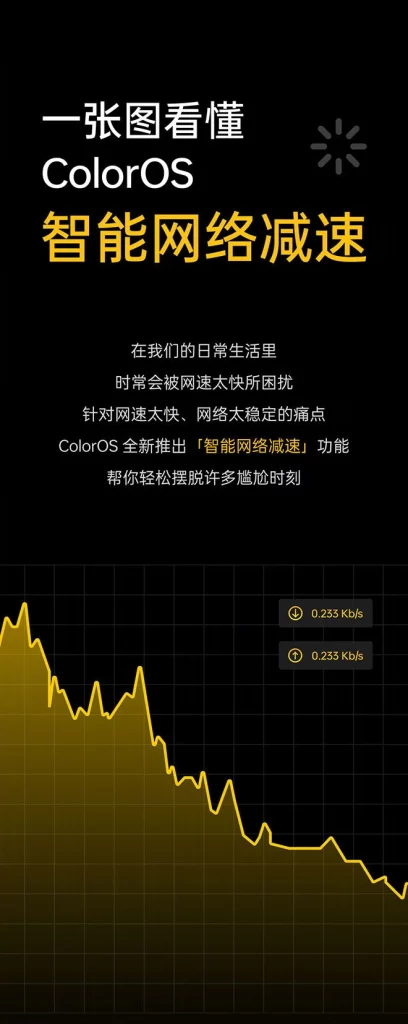
OPPO’s April Fools’ Prank: ColorOS Launches Intelligent Network Slowdown Feature

In a hilarious April Fools’ Day prank, OPPO has introduced a new feature in its ColorOS system that’s bound to make anyone’s life easier when it comes to dodging awkward situations. The feature, called “Intelligent Network Slowdown,” is set to launch on April 31, which of course doesn’t exist, making this a clever prank.

The Intelligent Network Slowdown feature includes several functions that users can activate to make their excuses more convincing, such as the Weak Signal during Call function. This feature allows users to display a constant message to the other party that says, “the other party’s network is poor,” enabling users to avoid embarrassing situations such as being pressured by their parents to get married.

The Background Noise feature is another great addition that users can leverage to create believable excuses. When activated, the feature allows users to select from different background noise options such as hospital, car accident, movie theater, or music theater sounds, adding a layer of realism to their excuses.

For those who prefer to dodge video conference calls, the Freeze Video Conference Screen function is a godsend. This feature makes the user’s video call screen static, giving them the freedom to slack off and do other things while appearing to be present in the meeting.

In addition, the Game Cloud Slowdown feature is another brilliant addition to the Intelligent Network Slowdown feature set. When activated, it shows a message indicating that the user is constantly reconnecting, giving them a more convincing excuse for losing a game.

Lastly, the Dynamic Payment Code Not Loading function is perfect for those who often find themselves being pressured to pay for meals with friends. The feature constantly displays the message “Payment code failed to load” on the user’s phone screen, taking the pressure off them and shifting it back to their friends.

While the Intelligent Network Slowdown feature is, of course, a prank, it’s an entertaining reminder of how technology can make our lives easier and more fun. OPPO’s ColorOS system continues to offer exciting and innovative features, and we can’t wait to see what they come up with next.

RELATED:

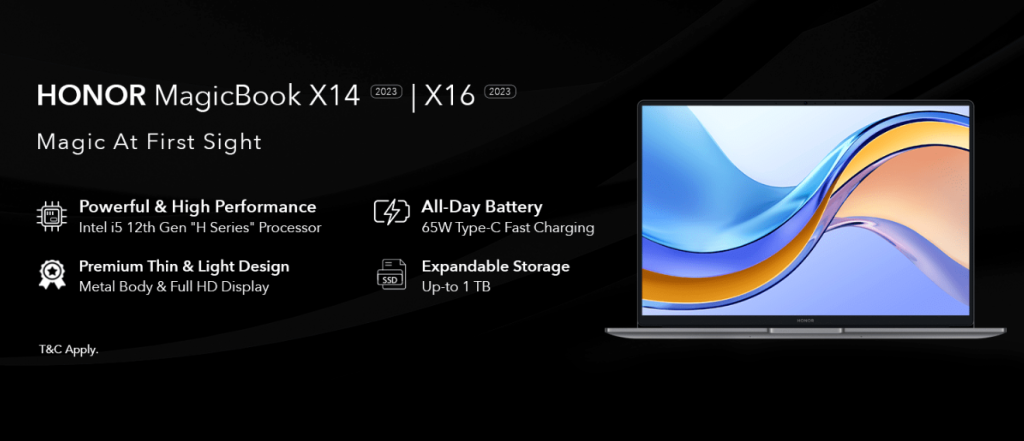
Honor MagicBook X14 2023, X16 2023 Teased To Launch In India Soon

Honor MagicBook X14 2023 and X16 2023 are teased to launch in India soon. E-commerce platform Amazon has put up a microsite of the upcoming offerings revealing key specifications. The MagicBook X14 2023 will pack incremental upgrades over the refreshed variant that was announced in January this year. Meanwhile, the X16 will be the latest addition to the MagicBook X-series laptops. 

As per Amazon, the MagicBook X14 2023 and X16 2023 will feature 14 and 16-inch displays respectively with thin bezels, FHD resolution, 100 percent color gamut, and 300 nits peak brightness. The laptops sport a metal unibody with a thin and lightweight design. There is a fingerprint scanner embedded in the power button and this time the webcam is located on the top bezel of the display. 

The MagicBook X14 and X16 2023 have a full-sized backlit keyboard with the latter also featuring an independent number pad. The laptops are equipped with stereo speakers and feature Nahimic immersive gaming audio that is said to intelligently recognizes different playback content and automatically adapt to the screen’s sound effects. 

Under the hood, the Honor MagicBook X14 2023 and X16 2023 are confirmed to be equipped with a 12th-generation Intel Core i5 processor. The machines will be offered in 8GB and 16GB LPDDR4x RAM and pack 512GB SSD storage with dual SSD slots for expansion. The laptop has a cooling fan for heat dissipation. The MagicBook X duo will pack the Honor Device Clone feature for migrating to Honor laptops from multiple brands and Windows versions.  

The Honor MagicBook X14 2023 and X16 2023 are confirmed to be powered by a 60WHr battery unit with support for 65W fast charging via USB-C port. 

Related:

ChatGPT-5 rumored to launch at the end of 2023, will it achieve AGI?

OpenAI, the artificial intelligence research lab, has been making headlines recently with the release of ChatGPT-4, the latest iteration of its Large Language Model (LLM). However, reports have already surfaced about the development of ChatGPT-5, with rumors suggesting that OpenAI expects to complete its training by the end of 2023.

chatgpt

The details surrounding GPT-5 remain murky, as OpenAI has not publicly discussed the project. However, a tweet by developer Siqi Chen has suggested that some individuals within the company believe that GPT-5 could achieve Artificial General Intelligence (AGI), a significant milestone in the development of AI that would mark the point at which machines can display human-like understanding and intelligence.

It is unclear at this time whether GPT-5 will actually achieve AGI, and Chen later clarified that his original tweet was not representative of a consensus within OpenAI. Nevertheless, the potential for GPT-5 to surpass the capabilities of GPT-4 is significant, given that the latter is already capable of analyzing both text and images, performing complex tasks, and displaying creativity.

Microsoft is already using GPT-4 for its new Bing search engine, which was launched in preview earlier this year. GPT-4’s advanced capabilities have already been put to use in a variety of applications, and it seems likely that GPT-5 will be even more capable.

Despite the potential for GPT-5 to advance the state of the art in AI, there remain significant concerns about the idea of machines achieving human-level intelligence and understanding. While some reports have suggested that ChatGPT has already passed the Turing test, which evaluates a machine’s ability to exhibit intelligent behavior that is indistinguishable from that of a human, other experts have disputed this claim.

We might get an intermediate ChatGPT version before GPT-5, with OpenAI expecting GPT-4.5 to launch in September or October. Nevertheless, the continued evolution of OpenAI’s LLMs represents an exciting development in the field of AI and natural language processing.

RELATED:

(Via)

Apple iPhone 15 Pro to feature customizable sensitivity for solid-state buttons

Apple is reportedly set to introduce a new customizable sensitivity feature for the solid-state buttons on its upcoming iPhone 15 Pro and iPhone 15 Pro Max models. According to a source on the MacRumors forum, the sensitivity toggle will be added to the Settings, allowing users to adjust the sensitivity of the buttons to their liking. This feature is expected to address concerns from some iPhone users who were worried about how the new capacitive buttons would work when the phone is fitted with a case or gloves are worn.

Apple iPhone 15 Pro render

The new solid-state capacitive buttons, which will be exclusive to the iPhone 15 Pro series, are expected to feature a new ultra-low energy chip, enabling the buttons to remain functional even when the device is powered off or out of battery. The chip will sense user presses and hold gestures and provide Taptic Engine feedback.

In addition to the new sensitivity feature, the iPhone 15 Pro will also feature a new programmable Action button, which will replace the mute switch. This button will allow users to customize various functionalities, such as toggling the orientation lock, flashlight, and low power mode.

The new low-energy chip in the iPhone 15 Pro series will also power NFC, Bluetooth LE, and UW chips, even when the phone is powered off or out of battery. With this feature, users can still use their devices for contactless payments or other tasks that require these technologies, even when their phone is not turned on.

The iPhone 15 Pro is also expected to feature a unified volume button, replacing the separate up/down volume buttons featured in the iPhone 14 series. The new button will allow users to adjust the volume by pressing different sections of the button.

Apple’s iPhone 15 series is expected to be announced in September, and the addition of customizable sensitivity to the solid-state buttons will likely make it one of the most highly anticipated releases from the tech giant. With the new features, iPhone 15 Pro users can look forward to a more customizable and responsive experience when using their devices.

RELATED:

(Source)

Realme 11 Pro passes TENAA certification with a circular camera module

Realme has been working on its upcoming device, the Realme 11 Pro, which has recently passed the TENAA certification with model number “RMX3770” in China. This certification has revealed some key features of the device, including a circular camera module and a centered punch-hole curved display.

As per the renders shared on the TENAA website, the Realme 11 Pro will come with a centered punch-hole display with a curved screen. Moving to the back of the device, it will sport a circular camera module with the primary camera sensor placed in the center, accompanied by two secondary lenses on either side and an LED flash above them. The design of the camera module is a departure from Realme’s previous rectangular camera modules, adding a new and unique look to the phone. The Realme branding is also there in the back panel.

Apart from this, according to a leak from Digital Chat Station, the Realme 11 Pro is expected to feature MediaTek’s latest Dimensity chipset with 5G and is likely to launch in May 2023. However, no further details regarding the specifications of the device have been revealed yet.

The device has also cleared TKDN and Bluetooth SIG certifications, suggesting that it will support Bluetooth 5.2 connectivity and will be available in Indonesia.

Realme has been known for providing feature-rich smartphones at an affordable price point, and the Realme 11 Pro is expected to continue that trend. With the latest MediaTek chipset and the curved punch-hole display, the device is expected to deliver a premium user experience.

Realme has not officially announced the launch date of the Realme 11 Pro yet, but the TENAA certification indicates that it could be soon.

RELATED:

Huawei Claims Breakthrough in Semiconductor Design Tech, Says Comeback is Imminent

In 2019, the United States government imposed sanctions on the Chinese technology giant Huawei, citing national security concerns. The sanctions severely limited Huawei’s access to US technology, including crucial components for its smartphones and telecommunications equipment. The move came as part of a wider trade war between the US and China and had significant implications for the global technology industry. Huawei denied any wrongdoing and insisted that it posed no threat to national security. However, the company’s business suffered as a result of the sanctions, with some countries banning the use of Huawei equipment in their 5G networks. Since then, Huawei has had to make a lot of changes to its operations and device catalogue.

Huawei

The sanctions prevented Huawei from accessing critical components and software from US companies, including Google’s Android operating system, which is used on the majority of smartphones worldwide. As a result, Huawei was forced to develop its own operating system and reduce its reliance on US technology. However, this process was time-consuming and costly, and Huawei’s smartphone sales suffered as a result. In 2020, Huawei’s smartphone shipments declined by over 20%, and the company was forced to sell its low-end smartphone brand, Honor, to avoid further losses.

Huawei’s rotating chairman, Eric Xu, has recently claimed that China’s semiconductor industry will be “reborn” as a result of U.S. sanctions, and said that Huawei would support efforts by the Chinese semiconductor industry to become more self-sufficient. Semiconductors have been a major point of contention in the ongoing U.S.-China tech battle, with Washington imposing export restrictions on Chinese firms in an attempt to limit their access to American technology. Huawei, in particular, has been affected by the restrictions, which have prevented the company from accessing the latest cutting-edge chips it requires for its smartphones. However, Xu argued that the restrictions could ultimately strengthen China’s domestic semiconductor industry, rather than weaken it.

Chinese firms are now trying to develop the tools required for semiconductors domestically, but this will prove to be an uphill task. Last week, Xu confirmed that Huawei and other domestic firms had jointly created electronic chip design tools needed to make semiconductors sized at 14 nanometers and above. However, Huawei ideally needs chips of a much smaller nanometer size for more advanced applications, which they are currently struggling to obtain. The smaller the nm size, the better their chips will perform against the giants in the smartphone industry, such as Apple and Samsung.

RELATED:

(Via)

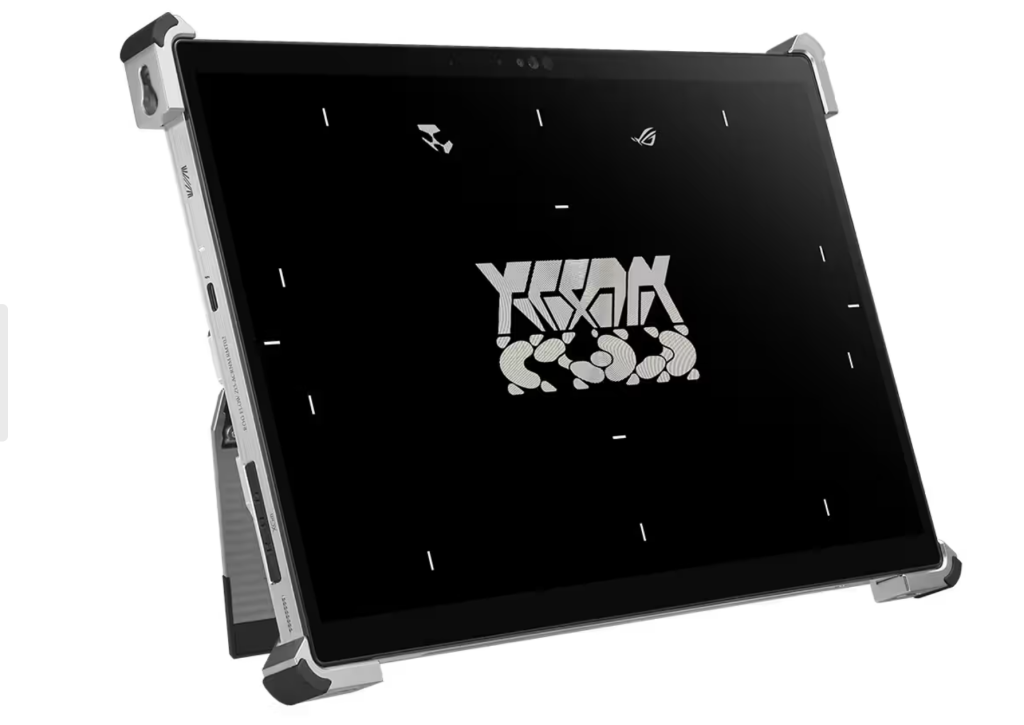
ASUS Collaborates with Fashion Brand ACRONYM to Unveil Gaming Tablet

In recent years, fashion brands and tech products have been joining forces to create unique collaborations that attract the attention of consumers. This helps to draw attention from multiple fanbases at the same time, while creating an element of design that is unique to both companies. One such collaboration that caught the eye of many was the 2020 partnership between Errolson Hugh’s Berlin-based label ACRONYM and ASUS, resulting in the ROG ZEPHYRUS G14-ACRNM laptop. The success of this project led to a new collaboration in the form of the ROG Flow Z-13-ACRNM RMT02 gaming tablet.

ASUS

This tablet incorporates design elements from concept artist Phil Saunders, who is renowned for creating the Ironman suit. The external aesthetics feature an industrial-like chassis system that can be easily attached to existing ACRONYM jackets. Not only does this provide portability, but it also offers protection and a more stable handgrip when on the move. The detachable keyboard also integrates futuristic design choices, with ACRONYM branding cues throughout.

Powering the device is an Intel CoreTM i9-13900H Processor with an Nvidia GeForce RTX 40 GPU, making it suitable for a variety of tasks, including gaming. To complement the impressive performance, the device comes with a 1TB SSD, 32GB RAM, a 500NITS brightness display, a 165HZ refresh rate, and a 100% DCI-P3 touchscreen panel. Additional items such as a separate pouch for peripherals, including a stylus and charging unit, are included in the package.

ASUS

This collaboration showcases the benefits of combining fashion and technology, providing consumers with unique products that not only perform well but also look great. The ROG Flow Z13-ACRNM RMT-02 will be available for purchase from April 3 on the ASUS eShop and Amazon, retailing for $2,499.99 USD.

RELATED:

(Source)

Jeep’s New Hybrid Concept SUV is a Visual Treat, Also Unveils a Stick Shift EV

Jeep enthusiasts and off-road vehicle fans will have a treat in store for them during the 57th annual Easter Jeep Safari, taking place from April 1-9, 2023, in Moab, Utah. The Jeep brand has unveiled a new collection of innovative concept vehicles that are designed for impressive terrain-traversing capabilities. With the focus on electrified power and performance, the brand has incorporated an array of advanced powertrains in each of the seven distinctive concept vehicles, which include the latest Jeep 4xe concept vehicles and the Jeep Wrangler Magneto, the first battery-electric vehicle (BEV) concept from the Jeep brand. The vehicles also feature production and prototype Jeep Performance Parts (JPP) from Mopar.

Jeep

The Jeep Cherokee 4xe concept will be the star of the show, paying homage to the original 1974 Jeep Cherokee SJ, a sporty, two-door version of the Wagoneer. The Jeep design team has blended a 1978 Jeep Cherokee with a 2022 Jeep Wrangler Rubicon 4xe to create a modern, electrified, off-road performer. The vehicle features a custom interior with low-back bucket seats, trimmed in leather, while the rear bench seat has been replaced with a four-point safety cage. The 78’ Cherokee 4xe concept’s exterior has original proportions fused with a bright, unmistakably 1970s-theme multicolour paint scheme, transforming it into a modern, electrified, off-road performer. Under the hood, the concept vehicle features the advanced Jeep Wrangler 4xe powertrain, which provides a unique on- and off-road experience through the combination of two electric motors, a high-voltage battery pack, and a high-tech 2.0-liter turbocharged I-4 engine.

Jeep

Another concept vehicle making an appearance this year is the Jeep Wrangler Magneto 3.0, the third iteration of the off-road beast. The Jeep Magneto 1.0 concept was first introduced in 2021, as a fully capable BEV designed to push the boundaries of 4×4 electrification. The Jeep Magneto features a custom-built axial flux electric motor that operates up to 6,000 rpm and connects to a six-speed manual transmission for ultimate control. This year, updates include a more efficient motor that boosts torque output and updated programming, which results in a 20% increase in usable energy and range. The vehicle also features three driver-selectable functions that capitalize on the benefits of a fully electric powertrain in serious off-road situations, including output select, which allows the driver to choose between two power settings.

Jeep fans and off-road enthusiasts can look forward to a thrilling experience at the Easter Jeep Safari this year, with the brand’s commitment to Zero Emission Freedom and 4×4 leadership being showcased in their latest collection of concept vehicles.

RELATED:

(Source)

Here’s How Google Tackles Fake Contributions & Scammers on Google Maps

Google Maps relies on user contributions to provide accurate and up-to-date information about locations around the world. However, some users may provide fake or misleading information for a variety of reasons, such as personal gain or malicious intent. One reason for fake contributions on Google Maps may be the Local Guides program, which incentivizes users to contribute information about places they’ve visited in exchange for perks like early access to new features and Google services. Some users may be tempted to provide inaccurate information in order to increase their contribution count and earn rewards. Another reason for fake contributions could be attempts to manipulate search results or damage the reputation of a business or location. For example, a competitor of a local business might leave fake negative reviews to try and hurt their business. However, the tech giant recently explained in a blog post how it tackles fake contributions to the platform, keeping it unbiased and safe for everyone who uses it.

Google Maps

The first way involves using machine learning to spot patterns of potential abuse. In one instance, automated systems detected a sudden uptick in Business Profiles with websites that ended in .design or .top, which were quickly confirmed as fake and removed by the team of analysts. The second instance involves a new machine learning model that recognizes numbers overlaid on contributed images, which helps detect and block fraudulent and policy-violating images before they’re published.

In 2022, Google made significant progress in combatting fake content. As per their blog post, they removed over 115 million policy-violating reviews, blocked or removed over 200 million photos and 7 million videos, and stopped 20 million attempts to create fake Business Profiles. Additionally, they took legal action against fraudsters who were impersonating the company and selling fake reviews online and shared their best practices with government agencies to tackle fake reviews industry-wide.

While scammers will continue to evolve their strategies, it is clear that Google’s teams will continue to invest in the latest technology and work around the clock to keep contributed content on Google Maps authentic, safe, and reliable. Plus, over the last few years, Google has made significant strides in the field of Machine learning and AI, which will hopefully further contribute towards keeping the platform secure without investing too much manpower in the same.

RELATED:

(Source)

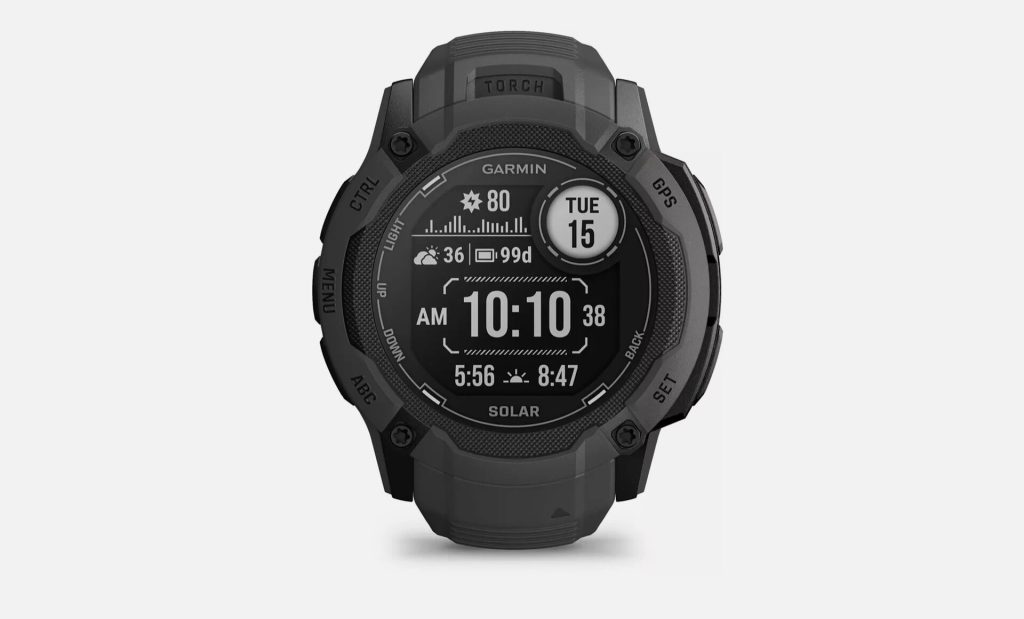
Garmin Instinct 2X Solar with a power-efficient display, solar charging leak in press renders

Smartwatch maker Garmin is reportedly preparing to release a new device called the Instinct 2X Solar. The device is part of a new Instinct 2X series and is expected to be larger than the existing Instinct 2 model. The leaked press images obtained by WinFuture show that the Instinct 2X Solar has a 57mm case size, making it significantly larger than the existing model.

Garmin Instinct 2X Solar

One of the most notable design differences between the Instinct 2 and the Instinct 2X is the thickness of the bezel. The Instinct 2X has a thicker bezel, and the inclusion of visible screws gives it a more rugged and industrial appearance. However, the watch will still retain the five hardware buttons that were included in the Instinct 2 model.

The Instinct 2X Solar will feature a MiP display, which is known for being power-efficient and providing excellent battery life. Unlike some of Garmin’s other recent releases, such as the Forerunner series, the Instinct 2X Solar will not feature an AMOLED display. While this may be seen as a downside by some users, the use of a MiP display should allow the watch to offer outstanding battery life.

Garmin Instinct 2X Solar

One of the most exciting features of the Instinct 2X Solar is the inclusion of a small solar element that can keep the watch charged when used outdoors for extended periods. This feature is expected to offer practically infinite runtimes, making the Instinct 2X Solar an ideal choice for those who spend a lot of time outdoors.

The Instinct 2X Solar will also be water-resistant up to 100 meters, making it suitable for swimming, diving, and other water-based activities. Additionally, the watch will come with an integrated LED flashlight, with adjustable color and brightness. This is a handy feature that will undoubtedly be appreciated by outdoor enthusiasts who may find themselves in low-light conditions.

Garmin Instinct 2X Solar

At this stage, pricing details and availability for the Instinct 2X Solar are unknown. However, based on the leaked press images, it is clear that Garmin is working on an exciting new smartwatch that is sure to appeal to outdoor enthusiasts and tech-savvy consumers alike.

RELATED:

Pop-Cycle compact bike with a sliding frame unveiled

The Pop-Cycle city bike with a compact foldable design has been launched via Kickstarter. The new bike has a sliding frame and is marketed as the world’s first bike with such a design. The bike is foldable to up to a third of its size and is made with eco-friendly materials.

Pop-Cycle compact bike

The Pop-Cycle bike is manufactured by Popcycle US INC but it is believed that it may be a Korean company. There is thus some uncertainty as to the manufacturers of the Pop-Cycle bike. One of the highlights of the bike is that the rear wheel, seat post, and drivetrain slide forward on the connecting tube. The sliding mechanism is controlled by a clamp under the seat tube. It takes three seconds to adjust the bike and the folding last just four seconds. Popcycle says the quick folding mechanism of the bike is among the fastest in the market.

Pop-Cycle compact bike

The Pop-Cycle’s frame is made via the die-casting method which avoids welding of joints on the frame. It also allowed for the manufacturing of the bike faster and more efficient. The bike can be easily assembled with just bolts and nuts. Pop-Cycle hopes that the assembling process of the bike will be seamless and exciting for its owners. It says it wants to give customers the joy of building the bike up from scratch.

The concept of the Pop-Cycle bike seems to be inspired by a Scandinavian furniture company. It has a thin design and weighs 13kg with a 78% folding efficiency. The pedals and handlebars of the bike are also foldable.

Pop-Cycle compact bike

Furthermore, the handlebar and saddle height are adjustable to provide comfort to different heights of riders. The 16-inch wheels, according to Pop-Cycle, are fully maximized by the dual-speed gear setup. The bike also features a 7-level Shift gearing system.

The Pop-Cycle bike will retail at $468 and will be released in June 2023. The Kickstarter campaign will end in May 2023 for the Pop-Cycle revolutionary and compact bike.

RELATED:

(via)

Insta360 Flow smartphone gimbal with a portable build, AI capabilities launched

Insta360 has unveiled its first portable and versatile smartphone gimbal, the Insta360 Flow. The gimbal is AI-powered and its AI architecture combines with the in-built stabilization on the device. The Insta360 Flow is the company’s heralding entry into the action-cam market. The Flow has third-gen Deep Tracking functionality and its motors are also capable of rapid deployment.

Insta360 Flow smartphone gimbal

The Insta360 Flow is entering a niche segment of the gimbal market with its release. While the Sony ZV-E1 is high up as the leading all-in-one content creation cam, the Flow provides equally great optics, enhanced with AI. It is being propped as the best-existing mobile camera system augmented by the AI tracking stabilizer. It also features Deep Track 3.0, using AI to keep the subject fully focused on the shot. The Insta360 app further extends the functionality of the gimbal. You can use the app to edit and highlight-reel suggestions.

Insta360 Flow smartphone gimbal

The Insta360 Flow is capable of a 360-degree spin of the smartphone it holds using the 360 Panorama mode. The Flow has a partially transparent build that integrates its selfie telescope and tripod, together with its Smartwheel controls. The physical smart-wheel controls of the Flow are intuitive in operation. The gimbal has a 2,900mAh battery that can sustain it for up to 12 hours. It can be charged via USB-C and the mounted smartphone can be recharged via its port if needed.

The Insta360 Flow smartphone gimbal is available in the US for $159 via Amazon. This new motorized mobile photography gadget may be available in other markets subsequently.

Related:

(source)

HP ProBook 400 G10 series of notebooks launched

HP has recently introduced the ProBook 400 G10 series of laptops, engineered to cater to the needs of professionals working in hybrid environments. Boasting cutting-edge technology, this lineup of devices provides improved collaboration, manageability, and security features, making them the perfect companion for businesses seeking the perfect blend of performance and convenience. Here are the details…

HP ProBook 400 G10 Series: The Ultimate Hybrid Work Solution for Professionals

The ProBook 400 G10 series is available in various configurations to suit specific business requirements. The HP ProBook 440 G10 and HP ProBook 450 G10 are equipped with 14” and 15.6” diagonal HD, ultra-wide viewing angle FHD, optional FHD touchscreen, and Low Blue Light displays. Powered by the latest Gen Intel processor with integrated Intel UHD Graphics or optional NVIDIA GeForce RTX 2050 graphics, these devices ensure optimal performance.

For those who prefer AMD-powered devices, the HP ProBook 445 G10 and HP ProBook 455 G10 feature 14” and 15.6” diagonal HD, ultra-wide viewing angle FHD, optional FHD touchscreen, and Low Blue Light displays, along with AMD Ryzen 7000 Series processors and integrated AMD Radeon graphics.

The HP Pro x360 435 G10 stands out among the ProBook 400 G10 series, offering Windows 11 Pro, an AMD Ryzen 7000 Series processor, and a 13.3” diagonal IPS wide viewing angle FHD touchscreen with Corning Gorilla Glass 5. With up to 32GB DDR4-3200 SDRAM, a user-facing 720p HD camera, and an optional world-facing 5MP auto-focus secondary camera, this versatile device is perfect for professionals seeking top-notch performance and adaptability.

The HP ProBook 430 G10 presents a cost-effective solution for businesses, delivering a sleek design, enhanced collaboration experiences, manageability, and security features. Powered by either a 13th Gen Intel Core processor or the next-generation AMD Ryzen processor, this device caters to those looking for an affordable yet high-performance option.

The HP ProBook 400 and 405 G10 Series PCs are tailored to help SMB leaders and employees excel in a hybrid work environment while maximizing their IT investment. These laptops come with built-in collaboration tools, multi-layered security, and a durable, serviceable chassis for longevity. A 13th Gen Intel Core processor or next-generation AMD Ryzen processor guarantees top-notch performance that can drive business growth.

:

ModelDisplayProcessorGraphicsMemoryCamera
HP ProBook 440 G1014” HD, ultra-wide viewing angle FHD, optional FHD touchscreen, and Low Blue Light displaysLatest Gen Intel processor with integrated Intel UHD Graphics or optional NVIDIA GeForce RTX 2050 graphicsIntegrated Intel UHD Graphics or optional NVIDIA GeForce RTX 2050 graphicsUp to 32GB DDR4-3200 SDRAMUser-facing 720p HD camera
HP ProBook 450 G1015.6” diagonal HD, ultra-wide viewing angle FHD, optional FHD touchscreen, and Low Blue Light displaysLatest Gen Intel processor with integrated Intel UHD Graphics or optional NVIDIA GeForce RTX 2050 graphicsIntegrated Intel UHD Graphics or optional NVIDIA GeForce RTX 2050 graphicsUp to 32GB DDR4-3200 SDRAMUser-facing 720p HD camera
HP ProBook 445 G1014” diagonal HD, ultra-wide viewing angle FHD, optional FHD touchscreen, and Low Blue Light displaysAMD Ryzen 7000 Series processors and integrated AMD Radeon graphicsIntegrated AMD Radeon graphicsUp to 32GB DDR4-3200 SDRAMUser-facing 720p HD camera
HP ProBook 455 G1015.6” diagonal HD, ultra-wide viewing angle FHD, optional FHD touchscreen, and Low Blue Light displaysAMD Ryzen 7000 Series processors and integrated AMD Radeon graphicsIntegrated AMD Radeon graphicsUp to 32GB DDR4-3200 SDRAMUser-facing 720p HD camera
HP Pro x360 435 G1013.3” diagonal IPS wide viewing angle FHD touchscreen with Corning Gorilla Glass 5AMD Ryzen 7000 Series processorIntegrated AMD Radeon graphicsUp to 32GB DDR4-3200 SDRAMUser-facing 720p HD camera and optional world-facing 5MP auto-focus secondary camera
HP ProBook 430 G1013” diagonal HD, optional FHD display, and Low Blue Light displays13th Gen Intel Core processor or next-generation AMD Ryzen processorIntegrated Intel UHD Graphics or integrated AMD Radeon graphicsUp to 32GB DDR4-3200 SDRAMUser-facing 720p HD camera
HP ProBook 400 G1015.6” diagonal FHD display13th Gen Intel Core processor or next-generation AMD Ryzen processorIntegrated Intel UHD Graphics or integrated AMD Radeon graphicsUp to 32GB DDR4-3200 SDRAMUser-facing 720p HD camera
HP ProBook 405 G1015.6” diagonal FHD display13th Gen Intel Core processor or next-generation AMD Ryzen processorIntegrated Intel UHD Graphics or integrated AMD Radeon graphicsUp to 32GB DDR4-3200 SDRAMUser-facing 720p HD camera

RELATED:

(via)

Apple’s A17 and M3 Chips in Jeopardy: The Implications of Rejecting TSMC’s Price Increase

According to a blogger, Apple has declined TSMC‘s request for a price increase in 2023. This decision was made because iPhone sales are declining, making it hard for Apple to justify raising prices for the new process and technology. Apple thinks it has already paid for the new process and any more price increases would be unfair given the disappointing iPhone sales performance.

Apple Pushes Back on TSMC Price Hike Amid 3nm Production Struggles

TSMC’s struggles with its 3nm chip production have also caused Apple to reconsider its performance targets for the upcoming high-end iPhone SoC. As the only customer for TSMC’s 3nm chips, Apple is waiting for the semiconductor manufacturing giant to provide a solution. The current situation could jeopardize the long-standing cooperative relationship between the two companies, as Apple may have to sacrifice the performance of its A17 chip if improvements cannot be made.

The performance concerns may also extend to Apple’s M3 SoC, which is designed for future Mac computers. If TSMC’s 3nm process cannot meet Apple’s expectations, the M3 SoC could similarly suffer a performance setback.

Industry insiders speculate that Apple might choose to prioritize energy efficiency for the A17 Bionic and M3 chips over raw performance. This would be a strategic shift in response to the ongoing challenges with TSMC’s 3nm process. However, given TSMC’s current efficiency, any significant changes in the short term appear unlikely.

RELATED:

(source)

Google Photos Update Brings Exciting New Movie Editor Feature to Chromebooks

Last year, Google hinted at giving Chromebooks new movie editing tools through Google Photos. The wait is finally over as these features have started rolling out to users. This exciting update brings an intuitive movie editor to Chromebooks, enabling users to create and edit movies with just a few clicks.

New Movie Editor and Video Editing Features on Google Photos

In an announcement on the Google Photos community page, the company revealed that it has started rolling out new video editing features for Google Photos on Chromebooks. With these features, users can now effortlessly use images and videos from their Chromebook and edit them directly within Google Photos.

The new movie editor provides users with two options: create a movie from scratch or choose a preset suggested theme. If users opt for the former, they have the freedom to select any media from their gallery and make adjustments to images or scenes using the built-in editor. On the other hand, if they choose a suggested theme, the feature will automatically select videos and images based on the chosen theme, but users can still swap out and edit the selections.

Google Photos’ movie editor intelligently selects the most meaningful moments from long videos, ensuring that the final movie is both engaging and memorable. Users can select the theme, people, or pets they want to include, and Google Photos will create a custom movie using both video clips and photos.

Google has designed the movie editor to be user-friendly and accessible, requiring minimal knowledge of movie-making intricacies. With just a few taps, users can create high-quality movies without the need for professional editing software. However, it is essential to note that while the tool is impressive, it may not offer the same level of functionality as more advanced video editing software. To access the new movie editor features, users need to have the Google Photos app installed on their Chromebook. The rollout is currently underway, and users can expect to see the update arriving on their devices in the coming days.

RELATED:

(via)

BYD Seagull Unveiled: Discover the Dynamic Design of this Affordable Miniature Electric Car

BYD has unveiled the official promotional image of its latest micro electric car, the Seagull. Designed to be an affordable and compact option for urban commuters, the Seagull is based on BYD’s e-platform 3.0 and is positioned below the popular Dolphin model in the company’s lineup. Here are the details…

Introducing the BYD Seagull: A Sleek and Stylish Mini Electric Car for the Modern Commuter

The Seagull’s design is an eye-catching mix of dynamic lines and sharp angles, giving it a modern, distinctive look. The front face features a closed design, with a trapezoidal air intake below and a pair of striking headlights referred to as “ice-breaking eyes” by the manufacturer. The overall dimensions of the car are 3780 mm in length, 1715 mm in width, and 1540 mm in height, with a wheelbase of 2500 mm. The compact yet practical 5-door, 4-seat design ensures that the Seagull can comfortably accommodate small families or groups of friends. Despite its small size, the car is expected to offer a surprisingly spacious interior, thanks to the clever use of space and efficient layout provided by the e-platform 3.0.

The BYD Seagull will come with two power motor options, offering a maximum power output of 55 kW and 70 kW. With a top speed of 130 km/h, the Seagull is perfect for urban commuting and short trips. One of the most impressive aspects of the car is its maximum cruising range of 400 km, which rivals many higher-priced electric vehicles on the market. This extended range ensures that drivers can travel longer distances without the need for frequent charging.

According to previous reports, BYD has estimated the price range of the Seagull to be between 80,000 and 100,000 yuan, making it an affordable option for those looking to make the switch to electric vehicles. The specific launch date is still under planning, but the Seagull is expected to make its debut in the coming months.

With the introduction of the Seagull, BYD continues to demonstrate its commitment to creating affordable and efficient electric vehicles for the mass market. The car’s dynamic design, compact size, and impressive range make it an attractive option for urban dwellers seeking an environmentally-friendly mode of transportation. As the electric vehicle market continues to grow, the BYD Seagull stands out as an exciting new option for those looking to embrace a more sustainable future.

RELATED:

(source)

Get Ready for Apple AirPods Pro with Touch-Screen! Patent Filing Indicates Imminent Launch

Apple has always been a frontrunner when it comes to technological innovation. Recently, the US Patent & Trademark Office published a patent application from Apple revealing a potential redesign of their popular AirPods Pro case. The proposed design features a touch display that allows users to interact with various apps like Apple Music, Apple TV+, Maps, and more. This added functionality aims to improve the effectiveness, efficiency, and user satisfaction with their devices. Here are the details…

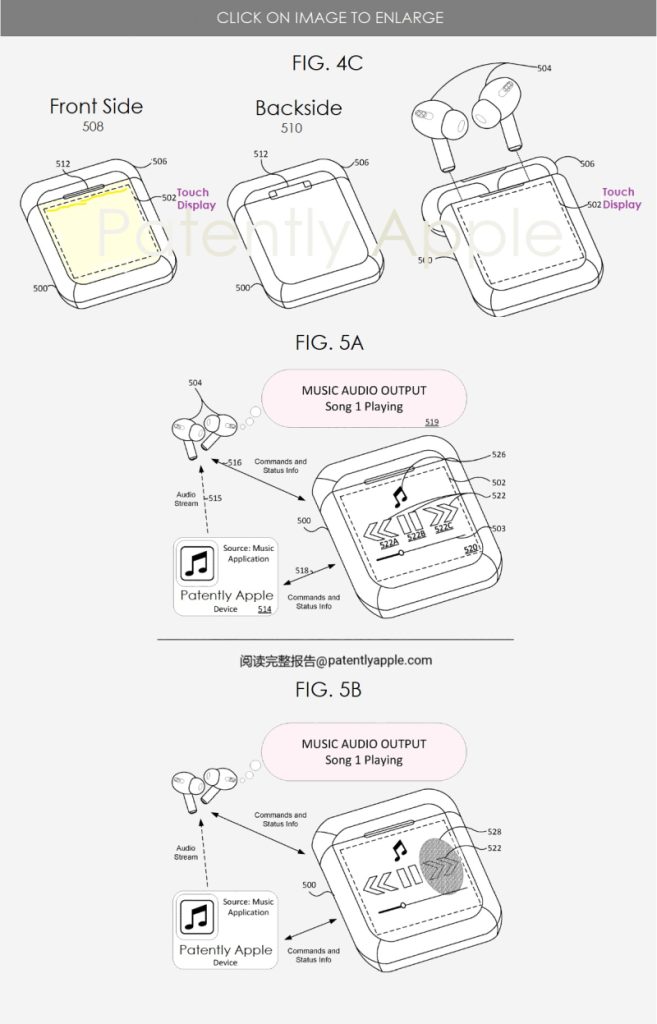
Apple invents an AirPods Case with a frontside Touch Display allowing users to interact with apps for Music, Apple TV+, Maps & more

The newly patented design seeks to enhance the user experience by transforming the AirPods case into a mini touch display. In this design, the headphone case features a graphical user interface (GUI), one or more processors, memory, and one or more modules or sets of instructions for performing multiple functions. The user can interact with the GUI primarily through finger contacts and gestures on the touch-sensitive surface or with an Apple Pencil.

Apple’s vision is to provide users with a seamless experience, enabling them to access essential apps and services directly from the AirPods case. The integration of displays, touch-sensitive surfaces, tactile output generators, device orientation sensors, and audio systems aims to create an intuitive and efficient interface for users.

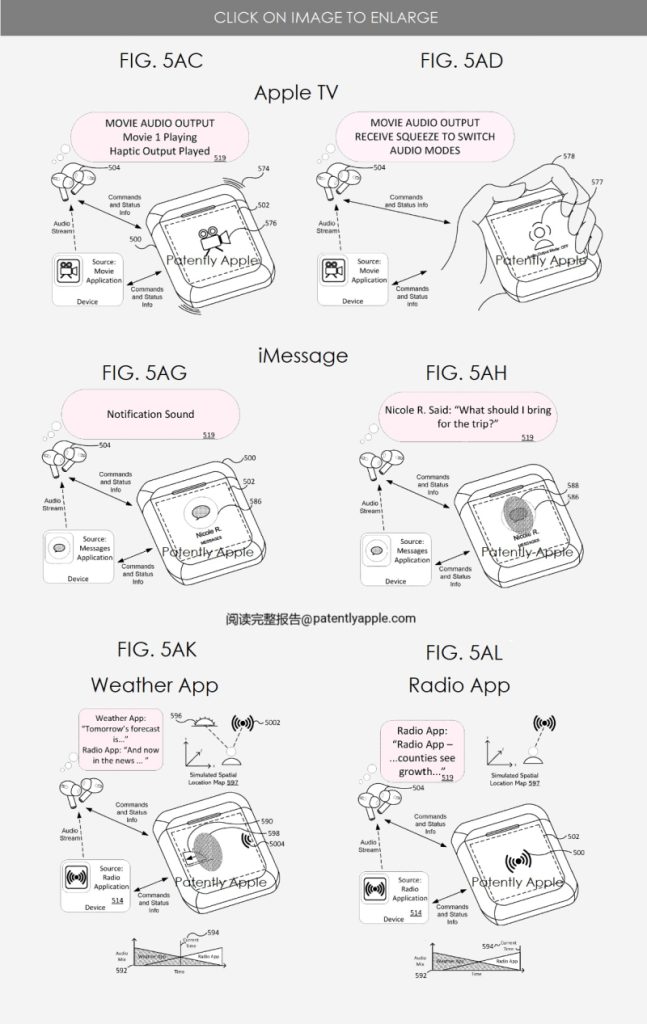
The patent application includes a wide range of patent figures showcasing the case-display in action, demonstrating various scenarios using apps such as Apple Music, Apple TV+, Maps, Weather, and Audio Books. These figures illustrate the potential versatility of the touch display on the AirPods case, offering users a more convenient and enjoyable experience.

Siri, Apple’s voice assistant, is also incorporated into the design to facilitate communication and interaction with the user about an app or service. Siri is represented by pink bubbles in the patent figures, indicating its role in guiding users through the touch display interface. One example demonstrates how “squeezing” the case could signal a change in the audio mode on Apple TV+ content. This gesture-based control adds another layer of convenience and functionality to the AirPods case, further enhancing the user experience.

This patent application, originally filed in September 2022, suggests Apple’s ongoing commitment to innovation and its dedication to providing customers with a more immersive and convenient experience. The redesigned AirPods case, with its touch display and app integration, has the potential to revolutionize the way users interact with their devices.

While there is no guarantee that Apple will release a product based on this patent application, the concept presents a fascinating glimpse into the future of AirPods cases and the possibilities for enhanced user experiences. As technology continues to evolve, it will be exciting to see how Apple and other companies push the boundaries of what is possible with our everyday devices.

RELATED:

(via)