Advertisement

Truke Buds A1 Earbuds Launched in India with ANC & 48hr Battery for Just Rs 1,299

Truke has just launched a brand new product for the Indian market. This device in question is the new Buds A1 truly wireless earbuds, which are a pair of budget earphones that feature some notable specs. So let’s have a look.

Truke

The company has just launched the new Buds A1 TWS earbuds that feature a unique special textured classic case design. It also adopts a stem design on the earbuds while the charging case is shaped like a pebble. The brand promises to offer a cinematic music experience thanks to its 10mm titanium audio drivers. The new Truke Buds A1 come with 3 preset EQ modes options like Dynamic Audio, Bass Boost Mode, and a Movie Mode.

One of its highlighting features is undoubtedly the support for ANC (Active Noise Cancellation). The Buds A1 feature Hybrid ANC that offers up to 30dB noise reduction, which is quite impressive for its pricing. It also houses a quad mic system for ENC to offer an improved and clear calling experience. The earbuds also support the seamless one step instant pairing technology for faster connections. It even supports the latest Bluetooth 5.3 and offer an impressive 48 hours of total battery life. On single full charge, the earbuds can last for up to 10 hours with ANC off.

Truke

The earbuds’ charging case is equipped with a 300mAh battery pack that supports fast charging via a USB Type-C port. This hearables can even be used by gamers since it offers a dedicated low latency gaming mode that drops the latency down to just 50ms. The new Truke Buds A1 will be available for purchase on Amazon India for a price tag of 1,499 INR, but have a special introductory price of just 1,299 INR for those that pre-order before its first sale on March 3.

RELATED:

Microsoft Announces ChatGPT for Robotics, Robot Interactions Without Learning Complex Programming

Microsoft Announces ChatGPT for Robotics, Robot Interactions Without Learning Complex Programming

The recent announcement of Microsoft implementing ChatGPT (based on the upgraded GPT-4) into the company’s search engine Bing took the world by surprise and attracted many users to join in on the AI hype. But it seems like Microsoft is not only bringing AI to the online market, but to the offline market as well.

As recently announced on the company’s official blog post, the Microsoft Autonomous Systems and Robotics Research Group has recently published a research paper on ChatGPT for Robotics, which allows text robots to directly control physical robots.

ChatGPT for Robotics aims to help people interact with robots more easily, without needing to learn complex programming languages or details about robotic systems.

To go further into the specifics here is a comparison table between robotics today vs ChatGPT for Robotics:

Robotics TodayChatGPT for Robotics
Current robotics pipelines begin with an engineer or technical user that needs to translate the task’s requirements into code for the system. The engineer sits in the loop, meaning that they need to write new code and specifications to correct the robot’s behaviour. Overall, this process is slow (the user needs to write low-level code), expensive (requires highly skilled users with deep knowledge of robotics), and inefficient (requires multiple interactions to get things working properly).ChatGPT unlocks a new robotics paradigm, and allows a (potentially non-technical) user to sit on the loop, providing high-level feedback to the large language model (LLM) while monitoring the robot’s performance. By following a set of design principles, ChatGPT can generate code for robotics scenarios. Without any fine-tuning, users can leverage the LLM’s knowledge to control different robots form factors for a variety of tasks. 
Requires human to translate language instruction to programming instructionChatGPT translates language instruction to programming instruction
Requires human for debuggingChatGPT does some of the debugging
Process is slow, expensive and inefficient.Process is faster, cheaper and more efficient.

In their research paper and blog, Microsoft’s research team shows multiple examples of ChatGPT solving robotics puzzles, along with controlling robot arms, drones, and home assistant robots intuitively with language. 

Source: Microsoft

The paper also details several challenges the team has faced since the product is still in development. However, Microsoft’s research team states that their research is only a small fraction of what is possible within the intersection of large language models operating in the robotics space, and hope that more is to come.

Microsoft stated that the tech giant believes that language-based robotics control will be fundamental to bringing robotics out of science labs, and into the hands of everyday users. 

 RELATED:

(Source)

Xiaomi Is Shutting Down Its TikTok Rival Zili in India

Xiaomi is gearing up to shut down its short video sharing platform that is called Zili. The company will be ending its operations in the Indian market soon, so here is everything you need to know about this new move.

For those unaware, the Chinese tech giant’s Zili was first launched in Google Play Store back in 2018 and functioned similar to another social media giant, TikTok. In other words, Zili also allowed users to share or watch short videos on their platform and even sought to fill up the market left by TikTok after it was banned by the Indian government. But now, it appears that Xiaomi is also exiting the market, as it plans on shutting its operations on 13th March 2023 at 23:59PM “due to an operational adjustment.”

Xiaomi

As of right now, the application has already been removed from the Google Play Store. Furthermore, Zili added that “All services on Zili app will be disabled on and from the shutdown date, including but not limited to the functions of download, Z-points encashments or withdrawal, etc. and all user data would be deleted from our server after that date and will no longer be retrievable.” Notably, this decision to shut down the platform would likely have resulted in a number of people being laid off in the country.

This app was quite popular in the Indian market with Play Store showing downloads crossing an impressive 100 million before it was taken down. Zili had seen breakout success after TikTok got banned in India in 2020. So it remains to be seen, which other short video sharing app will cover the gap left behind by these two platforms.

RELATED:

Qualcomm Shows Off Fastest-ever Local AI Image Generation on Mobile

Qualcomm has recently unveiled an exciting new development in mobile technology, showcasing its AI capabilities with the latest iteration of its image generator, Stable Diffusion. The company has claimed that this is the fastest-ever deployment of the software on a smartphone, with a demo video showing it generating a 512 x 512-pixel image in under 15 seconds. While Qualcomm has not revealed the specific phone used, it has confirmed that it was powered by its flagship Snapdragon 8 Gen 2 chipset. The software has also undergone a range of custom optimizations to achieve optimal performance.

Qualcomm

This is an impressive feat, particularly as generating an image in this way on a decent laptop can take minutes, let alone seconds on a smartphone. Most apps offering AI image generation do all their processing in the cloud, rather than on the mobile device itself. Dall.E is an example of one such AI image generation software that runs all of its processing threads on the cloud, which is why it generates images with the speed it does. Qualcomm’s achievement marks a significant step forward in the productization of AI, with the potential to offer greater convenience, cost savings, and privacy.

While Qualcomm has claimed that this is a speed record, some developers have pointed out that they have already achieved similar results with Stable Diffusion running on Android devices. However, this doesn’t take away anything from the impressive nature of Qualcomm’s achievement. It’s important to remember that getting big AI models running locally on mobile devices is a complex task that requires significant computing power. Plus, privacy is highly enhanced since no data is being sent over the internet. By showcasing this technology, Qualcomm has demonstrated its expertise in this field and opened up exciting possibilities for the future of mobile AI.

RELATED:

(Via)

Apple May Launch iPhone 15 Pro in a Dark Red Color Special Edition

We had just recently covered CAD renders of the Apple iPhone 15 and 15 Pro, which showcased the design of the next gen iPhone that is set to launch later this year. Now, we have another leak that showcases this high end iPhone model in a new Dark Red special edition.

Apple

The news arrives from the 9To5Mac, who also shared the CAD renders of the iPhone 15 Pro earlier this week. In the latest renders, we can see the iPhone 15 Pro in a new dark red color option. As of right now, it is still unclear if the company will actually launch such a color variant for its next gen flagship iPhones. The Cupertino based giant usually launches special color variants for the more expensive Pro models.

For example, it had released the pacific blue color for the iPhone 12 Pro, sierra blue for the iPhone 13 Pro, and space black and deep purple for the iPhone 14 Pro model. But a source close the company company has revealed the the iPhone 15 Pro model will arrive in a new dark red color option (410D0D). However, this is not the only possible color that the device will launch in as other rumors have hinted at other special edition variants as well.

Apple

This includes a possible light blue and pink color options. Keep in mind that this is still just an unconfirmed report and the brand plan to launch all or possibly none of these colors for the iPhone 15 Pro. The high end model is expected to feature titanium, so we can also expect it to opt for some natural or space black like hues to better match the new materials being used on its upcoming smartphone.

RELATED:

(Source)

Xiaomi 13 Lite Visits NBTC Certification Ahead of February 26 Launch

The Xiaomi 13 Lite has passed NBTC certification today. As it is known, the device is scheduled to break cover alongside the Xiaomi 13 and 13 Pro on Feb. 26 at the MWC 2023 event. Reports have claimed that the 13 Lite will be rebranded version of the Xiaomi Civi 2 that went official in China in September 2022. The NBTC listing also shows that the Civi 2 will be rebadged as the 13 Lite in the global market.

The Xiaomi 13 Lite’s specifications are not mentioned in the NBTC listing. However, it does state that the model number of the device is 2210129SG. To recall, the Xiaomi Civi 2’s model number is 2210129SC. As a result, it appears that the Civi 2 will be renamed 13 Lite outside of China.

XIaomi 13 LIte NBTC
XIaomi 13 LIte NBTC listing

The Xiaomi 13 Lite is likely to be the first device to release with the Snapdragon 7 Gen 1 onboard in the global market. It will feature a 6.55-inch AMOLED display with a Full HD+ resolution and a 120Hz refresh rate.

The device boasts 8GB of RAM and up to 256GB of storage. It comes preloaded with the latest Android 13 OS and MIUI 13 user interface.

On the back panel, the Xiaomi 13 Lite will feature a 50-megapixel Sony IMX766 main camera with OIS support, a 20-megapixel ultra-wide lens, and a 2-megapixel macro camera. On the front, it will have dual front-facing cameras, consisting of a 32-megapixel main camera and a 32-megapixel ultra-wide lens.

The leaked renders of the Xiaomi 13 Lite have revealed that its display has curved edges and a pill-shaped cutout. The device has an under-display fingerprint scanner and will be available in black, pink, and blue shades. In Europe, the device is likely to be priced at 449 euros.

RELATED:

(via)

Realme GT 3 240W Spotted with Key Specifications on Geekbench Before February 28 launch

Realme GT 3 has been spotted on Geekbench before its official announcement. To recall, Realme recently confirmed that it will unveil the Realme GT 3 on Feb. 28 for the global market at the MWC 2023 tech exhibition. Apart from teasing the design and revealing support for 240W SuperVOOC charging, the company hasn’t revealed any details about the device’s specifications. The Geekbench appearance of the device has leaked some of its key specifications.

A device labelled as Realme RMX3709 has surfaced on Geekbench today. The same device has also been recently spotted on other platforms, such as Indonesia’s TKDN, Europe’s EEC, and Bluetooth SIG. It has also emerged in Thailand’s NBTC database with the Realme GT 3 240W moniker.

Realme GT 3 Geekbench
Realme GT 3 Geekbench listing

Going back to the Geekbench listing for the Realme GT 3 240W, it reveals that a 3.00GHz Qualcomm chipset powers it. While it appears to be the Snapdragon 8 Gen 1, it could be the underclocked version of the Snapdragon 8 Plus Gen 1 with the same clock speed. For those who don’t know, the Realme GT 3 240W might end up as a rebranded version of the Realme GT Neo 5 240W, which launched in China earlier this month.

The Geekbench listing further states that the device has 16 GB of RAM and runs on Android 13 OS. It scored 1265 and 3885 in the single-core and multi-core tests of Geekbench 5. The rest of the specs of the GT 3 could be identical to the Neo 5.

The Realme GT 5 is likely to feature a 6.74-inch OLED 1.5K display that offers a 144Hz refresh rate. It will come with LPDDR5 RAM, UFS 3.1 storage, a 4,600mAh battery, and Android 13 OS with Realme UI 4.0 on top. The GT 5 will have a 16-megapixel front camera, and a 50-megapixel (main, with OIS) + 8-megapixel (ultra-wide) + 2-megapixel (macro) triple camera unit.

RELATED:

(via)

Google’s Quantum Computing Breakthrough Aims to Eliminate Errors

Google’s quantum computing department has announced a significant reduction in the error rate of quantum computers, a promising development for the future of computation. While quantum computing is known for its exceptional computational abilities, it often tends to produce a high rate of errors, rendering many calculations unreliable.

Quantum Computing

According to Google’s VP of Engineering Hartmut Neven and Director of Quantum Hardware Julian Kelly, in order to run quantum circuits that can solve industrially relevant problems, the industry will need to achieve error rates in the range of 1 in 10,000,000,000 to 1 in 10,000,000.

The team has discovered that, under certain conditions, the more physical qubits used to construct a logical qubit, the better the logical qubit becomes. However, this is only true if the benefits of quantum error correction outweigh the added errors from each additional physical qubit.

Google’s Quantum AI Team has achieved a first-ever feat for any quantum computing platform by developing an error-correcting code called a surface code. The process involves repetition so that any errors, such as flipped bits, can be ruled out by what the researchers describe as a majority vote.

This is just one part of the company’s roadmap, which involves six steps, ultimately leading to error-corrected quantum computing. The company has recently entered the second stage of its plan to produce a logical qubit prototype and aims to produce a long-lived logical qubit beyond 2025.

While Google sees this as a significant breakthrough, it is important to note that we are still years, if not decades, away from achieving error-free quantum computing. There is undoubtedly a long journey ahead, but with developments such as this, we are closer than ever to realizing the full potential of quantum computing.

RELATED:

(Via)

Apple A17 Bionic to Trump Over Snapdragon 8 Gen 3 in Chipset Battle

The tech world is abuzz with the latest news on upcoming smartphone chipsets. The transistor count on chips has been increasing year-over-year, thanks to feature size decreasing due to evolving technology. According to reports, the Snapdragon 8 Gen 3 from Qualcomm is expected to perform better than the A16 Bionic in terms of CPU. However, it seems that TSMC’s 3 nm node has been reserved for Apple’s next-gen chipset, the A17 Bionic, giving it a production priority over the Snapdragon 8 Gen 3 and Dimensity 9300, which will continue to be manufactured on TSMC’s 4 nm processes. 

iPhone 14 Pro

In 2022, Qualcomm improved upon the Snapdragon 8 Gen 1 chip by switching to TSMC’s 4 nm process for the Snapdragon 8+ Gen 1. As evident from the latest smartphone launches, the Snapdragon 8 Gen 2 has been a huge success. Now, rumors suggest that the Snapdragon 8 Gen 3 will outperform the A16 Bionic in the CPU department. However, it seems Apple will bounce back harder, claiming its lead back with the upcoming A17 Bionic chip this fall.

Reports suggest that TSMC will be responsible for manufacturing the A17 Bionic. This doesn’t come as a surprise at all, since the Taiwanese company has been producing Apple SoCs for quite some time. What’s interesting, though, is that the A17 Bionic will be built on TSMC’s 3 nm process, alongside the next-gen M3 chips. Apple is said to have fully booked TSMC‘s 3 nm production capacity, leaving no room for Qualcomm and MediaTek. It will be exciting to see how other chip manufacturers will adjust to his change in this market scenario.

What this means is that the A17 Bionic, which is expected to power the iPhone 15 Pro models coming this year, will have a generational advantage over Qualcomm’s Snapdragon 8 Gen 3 and MediaTek’s Dimensity 9300. Qualcomm might stay at the top for now. However, as mentioned previously, when Apple announces the A17 Bionic chip in 2023, Apple will most likely reclaim its position at the top, at least until the Snapdragon 8 Gen 4 is released at the end of 2024. Even then, the competition will definitely be cutthroat.

RELATED:

(Via)

Realme C55 visits Geekbench with Helio G85 SoC, 8GB RAM

Realme will soon be launching a new smartphone in the C-series called the Realme C55. It was recently confirmed that the phone will come with an Apple Dynamic Island-like feature called the Mini Capsule. The device has now appeared on Geekbench revealing some key specs along with its performance.

Realme

Bearing model number RMX3710, the device has an octa-core processor with model number MT6769V/CZ. It has a base frequency of 1.80GHz and a peak frequency of 2.0GHz. From this information, it is evident that the Realme C55 has a MediaTek Helio G85 processor.

The benchmark also reveals that the device has 8GB of RAM and an Android 13-based operating system. We can expect it to feature Realme UI 4.0. Coming to the benchmark scores, the device scores 376 points on the single-core test and 1463 points on the multi-core test of Geekbench 5. The listing does not reveal any other features.

Previous leaks mention that the smartphone will have a 4,880mAh battery unit with support for 33W fast charging. It has also emerged on NBTC, BIS, and FCC certification websites, hinting that it will soon launch in multiple markets. There is no information on a specific launch date as of yet, but we expect the Realme C55 to launch in the coming weeks.

RELATED:

(via)

Apple Watch Will Soon Let You Monitor Glucose Levels Without Pricking Your Skin

With every new iteration of its smartwatch, Apple has been introducing health-oriented features that entice its customer base. As of late, the tech giant has reportedly made significant progress towards bringing blood glucose monitoring to its smartwatch. According to insiders cited by Bloomberg, the no-prick monitoring system is now at the “proof-of-concept stage”, which means that the technology is feasible now and could be brought to market in the future. The technology uses lasers to determine glucose concentration under the skin and was previously not scaled down enough, but has reportedly been shrunk down to the size of an iPhone. The system could not only help people with diabetes monitor their conditions but could also alert those who are prediabetic to make lifestyle changes that could prevent Type 2 diabetes.

Apple Watch

The project has been under development for a long time, beginning in 2010 when Apple acquired blood glucose monitoring startup RareLight. Since then, the project has been kept under wraps by operating it as a seemingly isolated firm, Avolonte Health, before being folded into a previously unknown Exploratory Design Group (XDG). The company declined to comment on the project’s current status.

While it’s still too early to predict when the technology will be available, the incentives for bringing non-intrusive glucose monitoring to wearables are strong. Apple has marketed its smartwatch as a health device, capable of detecting atrial fibrillation, low blood oxygen levels, and ovulation cycles. Non-invasive glucose monitoring would be a significant step forward for people with diabetes. They would no longer need to rely on devices that pierce the skin, such as a continuous glucose sensor. However, the industry has a poor track record when it comes to bringing no-prick monitors to market, and it remains to be seen how accurate Apple’s solution will be. It might not even be present in the next Apple Watch when it comes out, considering Apple likes to perfect its technologies before it brings them to its consumers. 

RELATED:

(Source)

Vivo V27 Pro Full Specifications, Price in India Leaked Before March 1 Launch

Vivo is all set to unveil the Vivo V27 Pro on March 1 in multiple markets, including India. Before the launch, Appuals published a report to reveal the press renders and full specifications of the device. The report has also revealed the price of the V27 Pro for the Indian market. Continue reading ahead to learn everything about it.

Vivo V27 Pro Specifications (Rumored)

According to the publication, the Vivo V27 Pro will have a 6.78-inch AMOLED display, which will have a 60-degree curvature at the left and right edges. The screen will support an FHD+ resolution of 1080 x 2400 pixels and a 120Hz refresh rate.

Vivo V27 Pro
Vivo V27 Pro

The Dimensity 8200 chipset, LPDDR5 RAM, UFS 3.1 storage, and a 4,600mAh battery with 66W fast charging will power the Vivo V27 Pro. It will come preloaded with the Android 13 OS, which will be overlaid with the FunTouch OS 13.

The V27 Pro will have an autofocus-enabled 50-megapixel camera with dual-LED flash on the front for selfies. The back panel of the device will be equipped with an OIS-enabled 50-megapixel Sony IMX766V primary camera, an 8-megapixel ultra-wide lens, a 2-megapixel macro camera, and Aura Light LED flash. Like the V25 Pro, the V27 Pro will feature a color-changing back panel.

The Vivo V27 Pro will come with other features like dual SIM, 5G (n1/n3/n5/n8/n28A/n77/n78), Bluetooth 5.3, Wi-Fi 6, a USB-C port, and an under-display fingerprint scanner. It will measure 164.1 x 74.8 x 7.36 / 7.4mm in thickness.

Vivo V27 Pro Price in India (rumoured)

The Vivo V27 Pro will arrive in two variants, such as 8 GB RAM + 256 GB of storage for Rs 41,999 (MRP) and 12 GB RAM + 2566 GB storage for Rs 45,999 (MRP). It will be sold in shades like Magic Blue and Noble Black. The V27 Pro is nothing but a rebranded version of the China-exclusive Vivo S16 Pro from last year.

RELATED:

(source)

Netflix Slashes Prices By Almost 50% in Over 30 Countries

Netflix, the world’s leading streaming service, has slashed its prices by up to 50% in over 30 countries. This move seems counterintuitive, given that the company raised prices in North America last year. However, Netflix is adapting to changing viewer habits post-lockdown and experimenting with a balance between revenue and subscriber growth.

Netflix

The subscription price cuts have been implemented in parts of the Middle East, Sub-Saharan Africa, Europe, Latin America, and Asia. Netflix has also introduced a cheaper ad-supported plan in 12 countries. These moves come as several other streaming services have raised prices recently, with Disney+, Hulu, and Sling TV among them.

According to John Hodulik, media and entertainment analyst at UBS Group AG, Netflix’s decision “definitely goes against the recent trends not just for Netflix, but for the broader streaming industry”. However, in January, co-CEO Greg Peters stated that the company wants to find areas where it can raise prices, helping to fund new content investments. The regional price increases also allow Netflix to add a new demographic of subscribers to global markets where its share could be higher. Since rival services, including Disney+, HBO Max and Paramount+, are expanding globally, Netflix likely made a decision keeping all that in mind.

In addition to price cuts, Netflix is rolling out a new monthly fee for people who share their login credentials outside their homes. Netflix intends to use IP addresses, device IDs, and account activity to enforce its password-sharing policies. Although multi-household sharing has never been permitted by Netflix’s terms of service, it has been permitted for so long that charging for account access to friends and family could annoy some subscribers.

The program has gone through a trial phase in Latin America and has been rolled out in Canada, New Zealand, Portugal, and Spain. The new fee is $8 in Canada and New Zealand, €4 in Portugal, and €6 in Spain. The new payment structure will make its way to the US early this year. 

RELATED:

(Via)

Motorola Razr (2023) Launch Date Leak Reveals it Will Debut Before Galaxy Z Flip 5

Earlier this week, a report with reliable tipster Evan Blass as a source revealed the design of the upcoming Motorola Razr (2023). It is expected to arrive as a follow-up device for the Motorola Razr (2022), which debuted last year. A new leak by the same tipster has revealed the launch date of the Razr (2023). The leak reveals that it will debut before the Samsung Galaxy Z Flip 5, which is expected to debut in August this year.

The date for “Juno Announcement Reveal + Event Activation Launch” is June 1, according to the new leak. For those who don’t know, Juno is the codename of the Razr (2023). Given that it will be released in a few months, it appears that several teasers will be released in the interim to reveal its specifications. 

Motorola Razr 2023 render
Motorola Razr 2023 render | Source: Evan Blass

At present, only a few details about the Razr (2023) are known. It is expected to feature a 144Hz refresh rate display and the Snapdragon 8 Plus Gen 1. Since these specs are also available on the Razr (2022), the upcoming model could arrive as an incremental upgrade.

Blass had already said that Motorola is making another clamshell phone with the codename “Venus.” While there is no information available on its specifications, it could be a true flagship featuring the Snapdragon 8 Gen 2 chip.

As far as the design of the Razr (2022) is concerned, it is expected to feature the same 6.7-inch foldable OLED panel with a punch-hole design on the inside. The cover display is expected to receive a major upgrade on the Razr (2023).

Leaked renders have suggested that the size of its external screen could be around 3.5 inches. The outer screen will have cutouts for the dual cameras and LED flash. For security, the device will come equipped with a side-facing fingerprint scanner.

RELATED:

(source)

OnePlus Ace 2 Dimensity Edition Front Design Leak, Likely to be Rebadged as Nord 3 Outside China

OnePlus is gearing up to launch the OnePlus Ace 2 Dimensity Edition in China. Reports claim that it will be unveiled in March in the home market. Ahead of the expected launch, tipster Digital Chat Station has released a poster to showcase the front design of the Ace 2 Dimensity Edition.

The image shared by DCS shows that Ace 2 Dimensity Edition has a flat screen with a centred punch-hole. The bezels of the device are very narrow, which indicates that it will offer an impressive screen-to-body ratio. As per reports, it has a 6.74-inch OLED display that offers a 1.5K resolution and a 120Hz refresh rate. For security, it has an under-display fingerprint scanner.

OnePlus-Ace-2-Dimensity-Edition-display-design
OnePlus Ace 2 Dimensity Edition front design

The rear design of the phone is yet to be revealed. For photography, it is expected to feature a 64-megapixel (main, with OIS) + 8-megapixel (ultra-wide) + 2-megapixel (macro) triple camera unit, and a 16-megapixel front-facing camera. It will come preloaded with the ColorOS 13-based Android 13 OS.

The Dimensity 9000 chip will power the Ace 2 Dimensity Edition. The handset may offer up to 12 GB of LPDDR4x RAM and 512 GB of UFS 3.1 storage. It may pack a 5,000mAh battery with 80W charging support.
Readers should note that the Ace 2 Dimensity Edition is only the device’s tentative name. Before the official announcement, teasers are likely to show what the real name of the device will be. A report that surfaced yesterday revealed the key specifications of the OnePlus Nord 3. Its specs were found to be quite similar to the Ace 2 Dimensity Edition. So, it looks like the next Ace model might be called the OnePlus Nord 3 in markets other than China.

RELATED:

(source)

Apple Patent Grants New Color-Adjustable Fabric Band for Apple Watch

Apple has been granted a new patent that relates to a fabric Apple Watch band with an electrochromic feature. This allows users to adjust the color scheme and design in three distinct band zones to give the watch band a customizable look unique to the user. Users can set three different colors on the band, and the color selections can be made and adjusted without removing and exchanging the watch band.

Apple Patent Grants New Color-Adjustable Fabric Watch Band for Apple Watch

Apple notes that users may desire the ability to customize their watch bands to express variety and style, and this new technology offers a solution to this problem. Traditional watches require users to have a separate watch band for each color or color combination that they desire, and the user is required to remove and exchange the watch bands whenever a different color or color combination is desired.

Apple Watch band patent

This new technology offers adjustable color control, providing a variety of colors and color combinations to be displayed by a single band. The user or a control system can control, select, and/or adjust one or more colors of the watch band for visual display. Accordingly, a variety of colors can be displayed at different times without requiring different watch bands for each color or color combination.

The patent notes that watch bands having adjustable colors can also be used to communicate information to a user. For example, the color-adjustable elements of the watch band can be arranged and independently controlled in a manner that allows the system to display particular icons, shapes, and/or text by illuminating certain elements in a particular way. This technology can be used as a visual output of information from the watch to the user.

Apple Watch band patent

The watch band is made of a fabric that includes a number of filaments to form a fabric. Some or all of the filaments can include electrochromic features. Electro-chromism is a reversible color change in a material caused by an applied electric field or current. Ion insertion materials, which are mixed conductors (i.e. both electronic and ionic), into which ions can be rapidly and reversibly inserted, can be used as electrochromic materials.

The watch band conductor can optionally include a shape memory alloy that changes shape when a voltage is applied to the conductor. This applied voltage can be the same voltage that is applied to achieve a color change in the electrochromic layer. This shape change can provide haptic feedback to the user along with the visual indication provided by the color change. This technology offers a customizable and innovative solution to traditional watch bands.

RELATED:

(via)

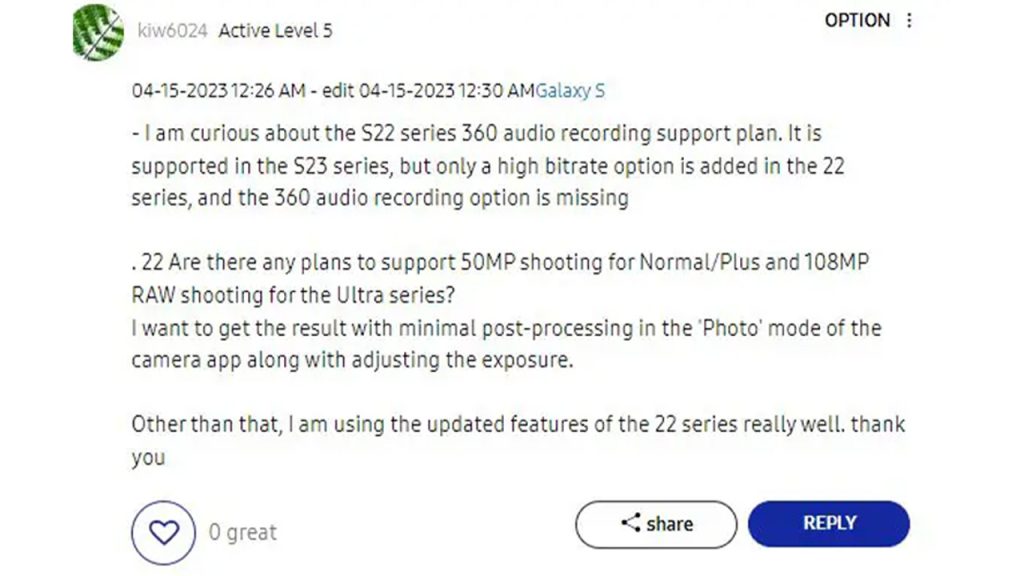
Samsung Admits Slow Camera Speed: Fixes Issue but Not for Everyone

Samsung is one of the largest smartphone manufacturers in the world, and the company introduces dozens, if not hundreds, of new models every year. However, did you know that all Samsung models, whether entry-level or flagship, have a common problem? This problem, caused by the slowness of the stock camera application, has bothered some users, if not everyone, and caused them to miss unique moments by milliseconds. The company eventually admitted that the phone’s camera was slower than it should be and fixed it, but not everyone received the fix. Here are the details…

Samsung just admitted your phone’s camera is slower than it should be

Samsung has recently admitted that its stock camera app on Galaxy smartphones can sometimes be slow in capturing moments. The admission came with a new update that introduced a feature called Quick Shutter Tap in the Camera Assistant app. This feature captures photos as soon as your finger touches the shutter button, rather than when you release it. That’s how saving off a few milliseconds from the capture time.

Samsung Camera Assistant app

While this feature can help you capture the moments you actually wanted to capture, the fact that it’s only available through the Camera Assistant app is a cause for concern. The Camera Assistant app is not compatible with lower-end or mid-range smartphones, and even some high-end smartphones aren’t compatible with it.

This means that millions of Galaxy users are being deprived of faster capture times (and probably cherished memories) because they can’t use the app. Instead of hiding this simple option in the Camera Assistant app, Samsung should bring the feature to the stock camera app on all Galaxy smartphones and tablets. The feature should be turned on by default, so that everyone can benefit from it.

In addition to Quick Shutter Tap, Samsung should also consider bringing the Capture Speed feature from the Camera Assistant app to the stock camera’s settings section. Samsung phones can sometimes take too much time to capture a shot for HDR and multi-frame noise reduction processing, and this can lead to missed moments or blurred images of fast-moving subjects.

By automatically detecting moving objects and prioritizing shutter speed over image quality in such situations, Samsung can significantly improve the camera experience for a lot of Galaxy users. Samsung’s admission that its stock camera app can be slow in capturing moments is a step in the right direction. However, the company needs to take more concrete steps to address this issue.

By bringing Quick Shutter Tap and Capture Speed to the stock camera app, the company can improve the camera experience for all Galaxy users, regardless of their device’s specifications. We hope Samsung takes this feedback into consideration and makes the necessary changes in its upcoming updates.

RELATED:

(via)

MINISFORUM Neptune MBG6 mini-PC With AMD Ryzen Processor Unveiled

MINISFORUM has showcased its latest mini-PC billed for release in the spring. The Neptune MBG6 comes with a desktop-class AMD Ryzen processor and a discrete GPU. The Neptune MBG6 is yet another offering in the growing collection of MINISFORUM mini-PCs.

MINISFORUM Neptune MBG6 mini-PC

In the last few months alone, MINISFORUM has announced several mini-PCs which mainly rely on laptop-grade processors. The AMD Ryzen 7 series and UM773 Lite are some of the processors implemented in the mini-PCs. On the other hand, the Neptune MBG6 uses the AMD Ryzen 7 5700X APU. The Ryzen 7 5700X is part of the AMD Vermeer series and is 65W rated. There are no indications yet of the improvements the processor brings over the 45W counterparts. It however lacks integrated graphics which are present in the laptop-version processors.

The absence of integrated graphics in the Ryzen 7 5700X translates to greater computing power for the processor. It will deploy all of its 65W TDP to CPU tasks and this translates to a performance boost. The Ryzen 7 5700X will be complemented by the Radeon RX 6600M GPU. The Radeon RX 6600M is a Navi 23-based GPU having 28 compute units, 8GB GDDR6 VRAM and up to 100W TDP. The GPU offers up to three times performance improvement above previous Radeon 6000 series APUs.

The fine optics of the performance of the Neptune MBG6 mini-PC are not fully established yet. MINISFORUM has not provided any pricing information for the product yet. However, we expect the Neptune MBG6 to be released next month (March 2023). More details will emerge as we inch closer to the official unveiling of the MINISFORUM MBG6 mini-PC.

RELATED:

Xiaomi’s Partner Launches the Wanbo TT Projector With up to 650 ANSI Lumens Brightness

The Wanbo TT projector is now available in the global market. The projector has a maximum brightness of 650 ANSI lumens and is a sub-brand of Xiaomi. The Wanbo TT projector outputs a 1080p LCD and can throw images up to 120 inches wide from 3.3 meters.

Wanbo TT projector

The Wanbo TT has a native aspect ratio of 16:9 and a LED source provides brightness of up to 650 lumens. The lifespan of the light source of the Wanbo TT is about 20,000 hours. The projector is powered by the MTK9266 CPU with a 1GB/8GB memory configuration.

Two 5W speakers are built into the projector to provide a balanced stereo sound and Dolby Atmos support. You can download up to 200 apps into the Wanbo TT projector for a more nuanced experience. The projector supports Bluetooth 5.1 connectivity, as well as HDMI and USB.

Wanbo TT projector

The new Xiaomi Wanbo TT uses the auto-focus tool to provide clarity in the projected image. This can be achieved within a split second while keystone correction helps you to further improve the image. The projector weighs about 1.7kg and has dimensions of 6.7 x 4.7 x 6.9 inches.

The Wanbo TT projector can be purchased via Geekbuying at a discounted price of €308.27 ($327). In the US, a $150 discount coupon is redeemable for the projector, reducing its price to $309. The projector is originally priced at €327.94 ($) and ships directly from China. Shipping times and costs will vary.

RELATED:

(source)

Doogee S100 Rugged Smartphone Unveiled With Helio G99 SoC Under the Hood

Chinese smartphone maker Doogee has introduced a new rugged smartphone in the global market. Called the Doogee S100, the handset comes with a large display and offers up to 120Hz refresh rate. There’s also a capable MediaTek Helio G99 processor inside. With MIL-STD-810H certification, the device should be able to accompany you in all your outdoor adventures. Let’s have closer look at the details.

The Doogee S100 shares some interesting features with the Doogee V30. For one, there’s support for e-Sim. However, the handset comes with the Helio G99 instead of the Dimensity 9000 SoC found on the V30. The smartphone features a 6.58-inch FHD+ IPS display with a 120 Hz refresh rate

Doogee_S100

The smartphone has 12 GB of RAM, which the brand claims to be the biggest RAM on any rugged phone currently on the market. The handset comes with 256 GB of UFS 2.2 storage that can be expanded up to 2 TB with a microSD card.

The handset gets a 10,800 mAh battery with 66 W fast charging testing. According to the company, the battery should last 55 hours in calling, 17.5 hours in streaming mode, and 43 hours while playing music. The Doogee S100 boasts multiple levels of protection from various hazards. In addition to meeting the rigorous MIL-STD-810H standard, it also holds impressive IP68 and IP69K ratings, ensuring superior protection against water ingress.

For photography, the rugged smartphone gets a triple camera unit in the rear with a 108 MP primary sensor, a 20 MP night vision camera, and a 16 MP ultrawide lens. The front houses a 32MP sensor for selfies and video calls.

The Doogee S100 should be available through AliExpress and DoogeeMall from March 20 to March 26. The pricing of the smartphone is yet to be announced.

RELATED:

(Via)