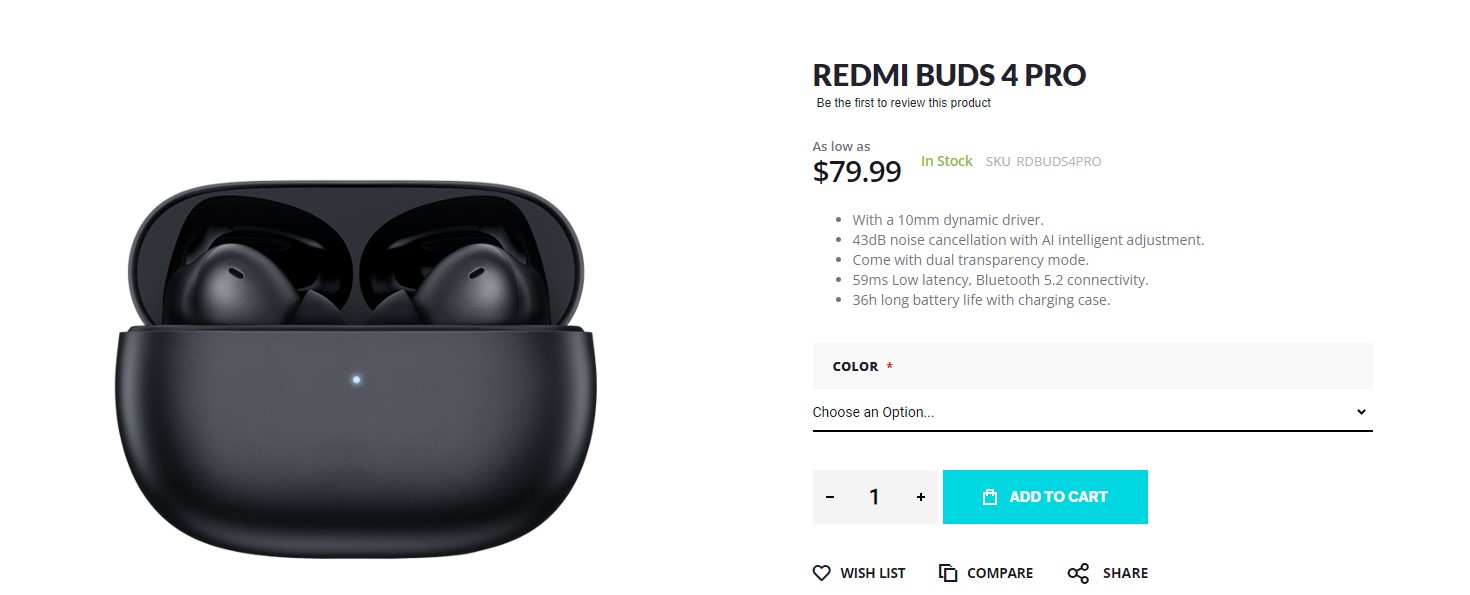
Redmi Buds 4 Pro, the latest earbuds from Redmi features a 10mm dynamic driver that gives you HIFI audio quality and virtual stereo sound. The earbuds offer 43dB noise cancellation with AI intelligent adjustment.
Buds 4 Pro is perfect for gaming enthusiasts as it offers 59ms low latency with the latest Bluetooth 5.2 connectivity. You also have a dual transparency mode that helps you manage the external sound and have better situational awareness.
Redmi Buds 4 Pro gives you 9hrs nonstop playback on a single charge and 36hrs with the charging case. The IP54 certified water and dust-proof earbuds support multifunctional touch control for play, pause, track change, etc.
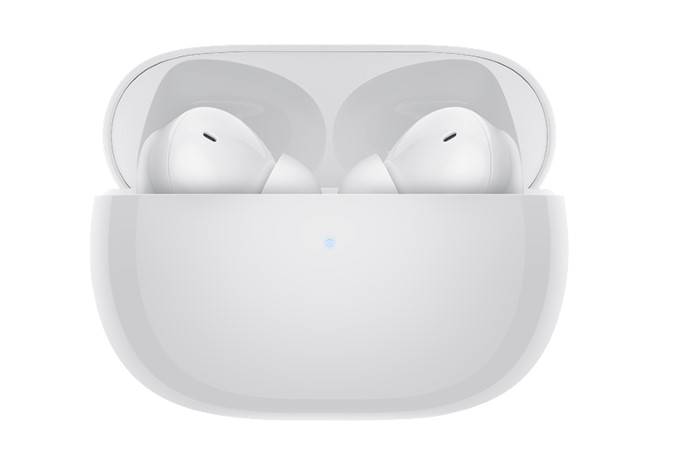
You can now buy Redmi Buds 4 Pro for $79.99 only at Giztop. Please note that the earbuds are available in Black and White color variants.
For more information on such exciting deals and offers check out our deals hub.
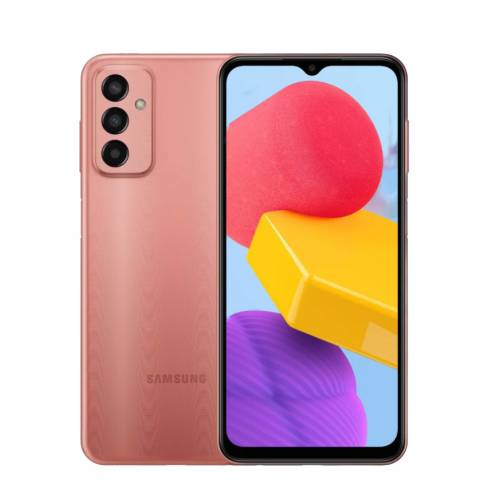
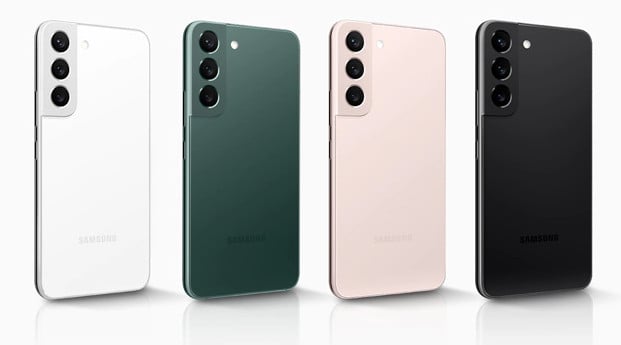
Samsung has apparently slashed its smartphone production for this year. The company has lowered production goal by around 30 million units due to various reasons ranging from the economy to even the supply chain.
According to a TechRadarreport, Korean media publication claimed that the company has reduced its orders of smartphones down to 280 million units from 310 million units. Furthermore, this slashing of orders is not limited to just one or two segments and has been done across its entire handset portfolio. In other words, phones ranging from the budget A series to the premium grade flagship Galaxy S and Z series have also been affected by this decision.
As per the report, there were a number of reasons why the South Korean tech giant made this move, which hints at the potential slowdown of the market. This includes economic issues as well as ongoing supply constraints. While the market did recover from the dip in 2020, with 5G handsets leading the rise, ongoing supply chain issues and materials shortages have stunted market growth. Lockdowns in China and the ongoing semiconductor shortages have also worsened the situation.
Apart from this, there have also been wider macroeconomic and geopolitical factors that have impacted the smartphone market due to their affects on the global economy. Due to these factors, consumers are less likely to purchase a new smartphone and delay their upgrade cycle. Although, Qualcomm believes that this would affect the entry level market more than the premium segments. On a positive note, the smartphone market is also expected to see a rise in the second half of this year.
Earlier this month, Motorola announced the Moto G82 5G. The device was followed by the Moto E32s last week. Now, a tipster says that these smartphones will be heading to India in June. He has even revealed the exact launch dates.
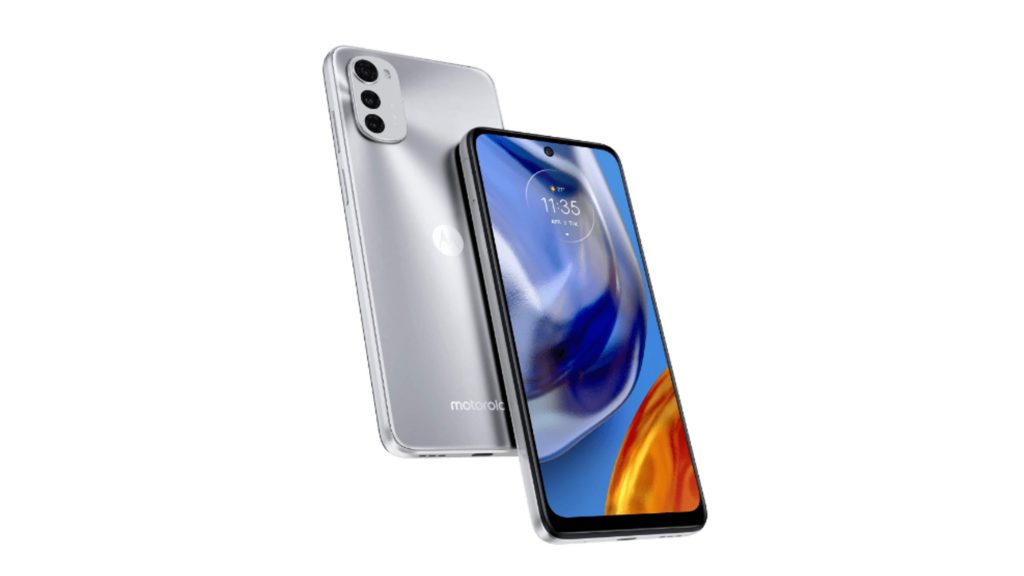
Motorola Moto E32s
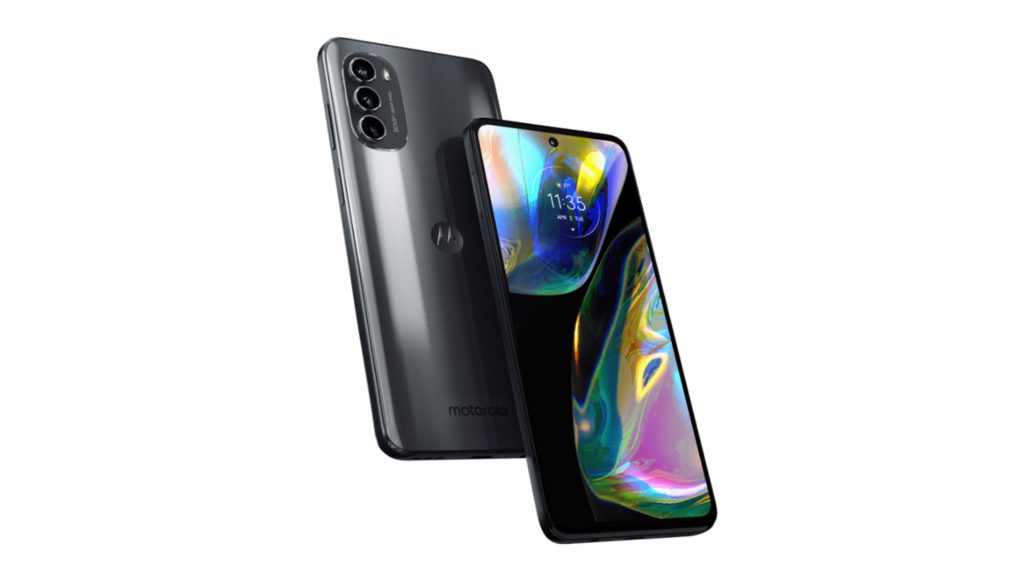
According to Yogesh Brar, Motorola will debut the Moto E32s and Moto G82 5G in India in early June. The former will go official by the end of this week, whereas the latter will be announced next week.
Yogesh says that the Moto E32s will launch in India on June 2 (Thursday). On the other hand, the Moto G82 5G will debut in the county on June 9 (Thursday).
Since these phones are already official, we know everything about them. The only thing that’s not known is their pricing in India.
Motorola Moto G82 5G
As far as features are concerned, the Moto E32s comes with a 90Hz HD+ display (LCD), MediaTek Helio G37 chipset, Android 12, 16MP (wide) + 2MP (macro) + 2MP (depth) triple camera setup, 8MP selfie camera, side-mounted fingerprint sensor, 5,000mAh battery, and 15W fast charging support.
Talking about the Moto G82 5G, it arrives with a 120Hz FHD+ OLED display, Qualcomm Snapdragon 695 SoC, Android 12, 50MP (wide, OIS) + 8MP (ultra-wide) + 2MP (macro) triple camera setup, 16MP selfie camera, side-mounted fingerprint sensor, dual stereo speakers, 5,000mAh battery, and 30W fast charging support.
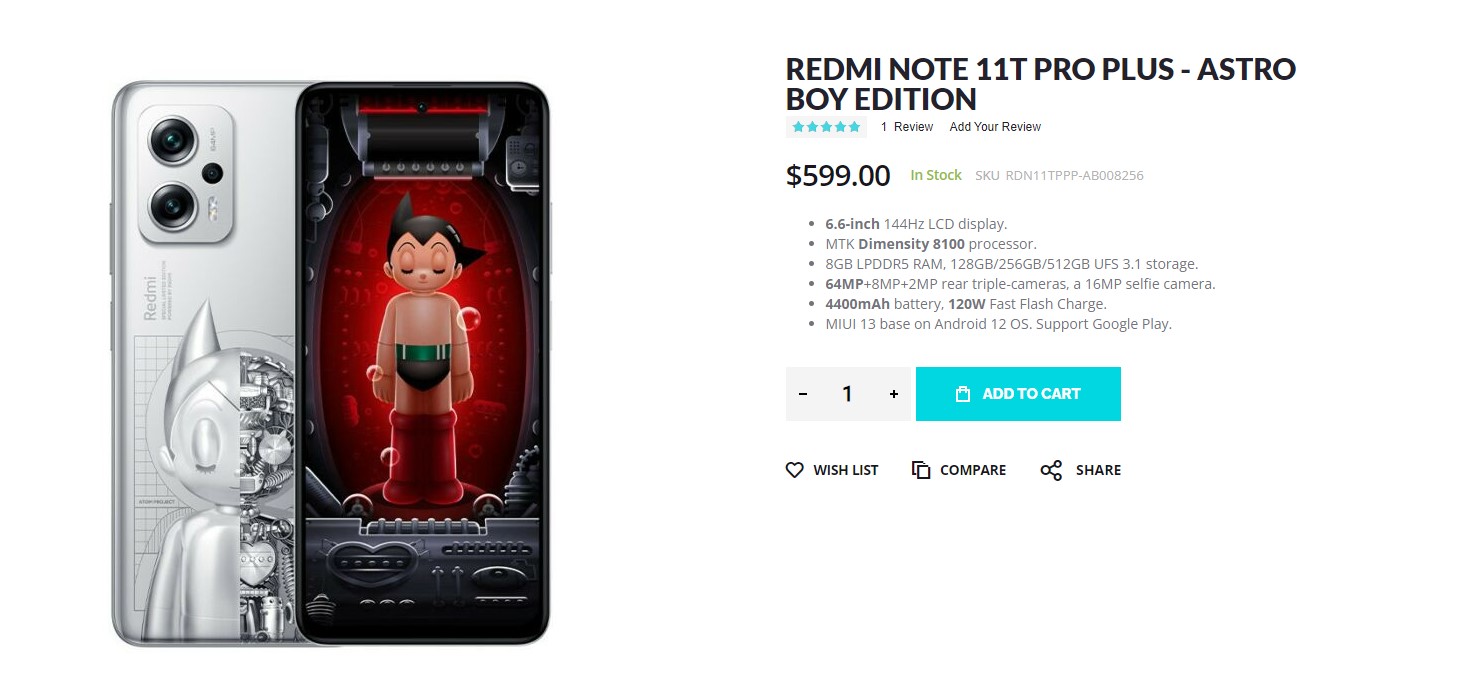
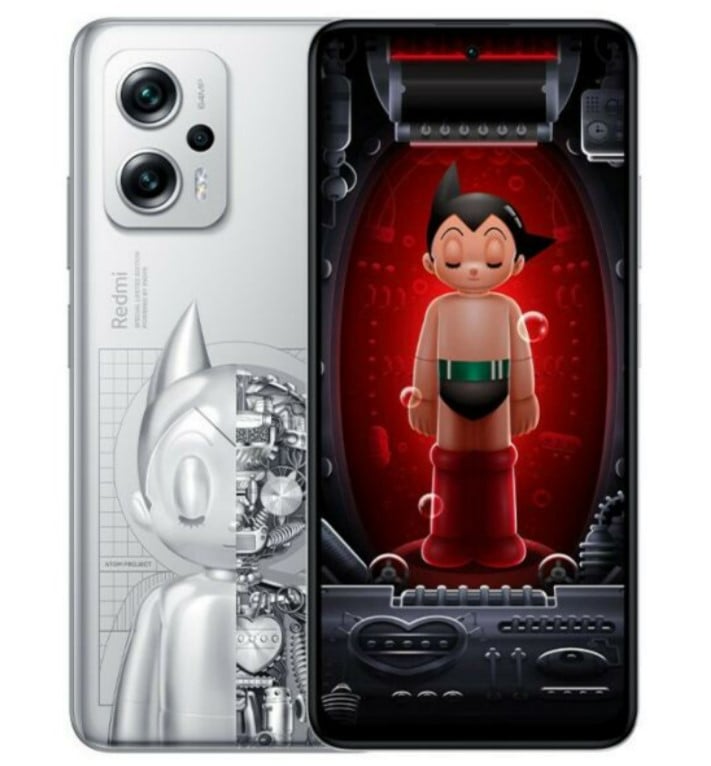
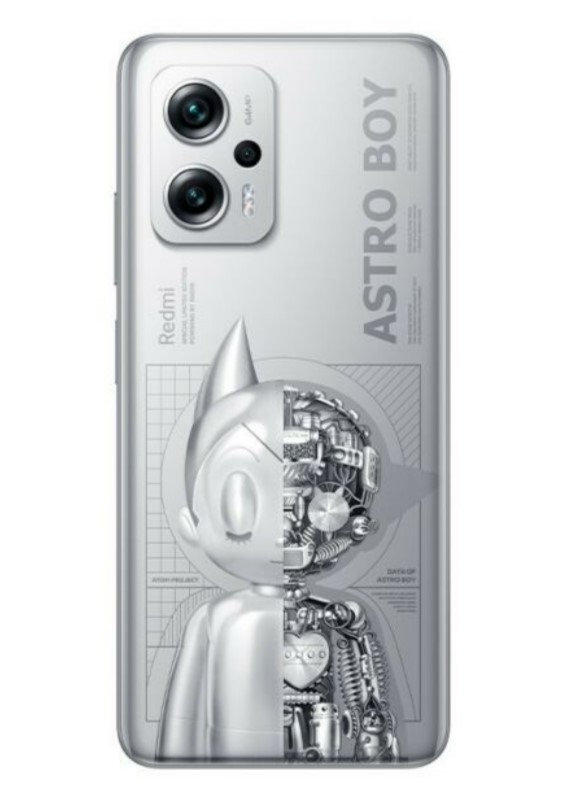
Redmi Note 11T Pro Plus Astro Boy Edition features a 6.6″ LCD display and supports a 144Hz refresh rate. Powered by the MTK Dimensity 8100 chipset, the phone comes with 8GB LPDDR5 RAM and 128GB / 256GB / 512GB internal storage options.
The phone comes with professionally tuned dual JBL speakers and a 3.5mm headphone jack and Hi-Res audio. It features a triple rear camera setup with a 64MP main camera and 8MP + 2MP secondary cameras. For the selfie camera, you have a 16MP sensor in the front.
Fueled by a 4400mAh battery, it supports 120W fast charging. It runs on Android 12 OS-based MIUI 13 and comes with interesting features like a side-mounted fingerprint sensor, AI face unlock, etc.
You can now buy Redmi Note 11T Pro Plus Astro Boy Edition for $599 only at Giztop. This is a limited edition phone. Hence place your orders before it goes out of stock.
For more information on such exciting deals and offers check out our deals hub.
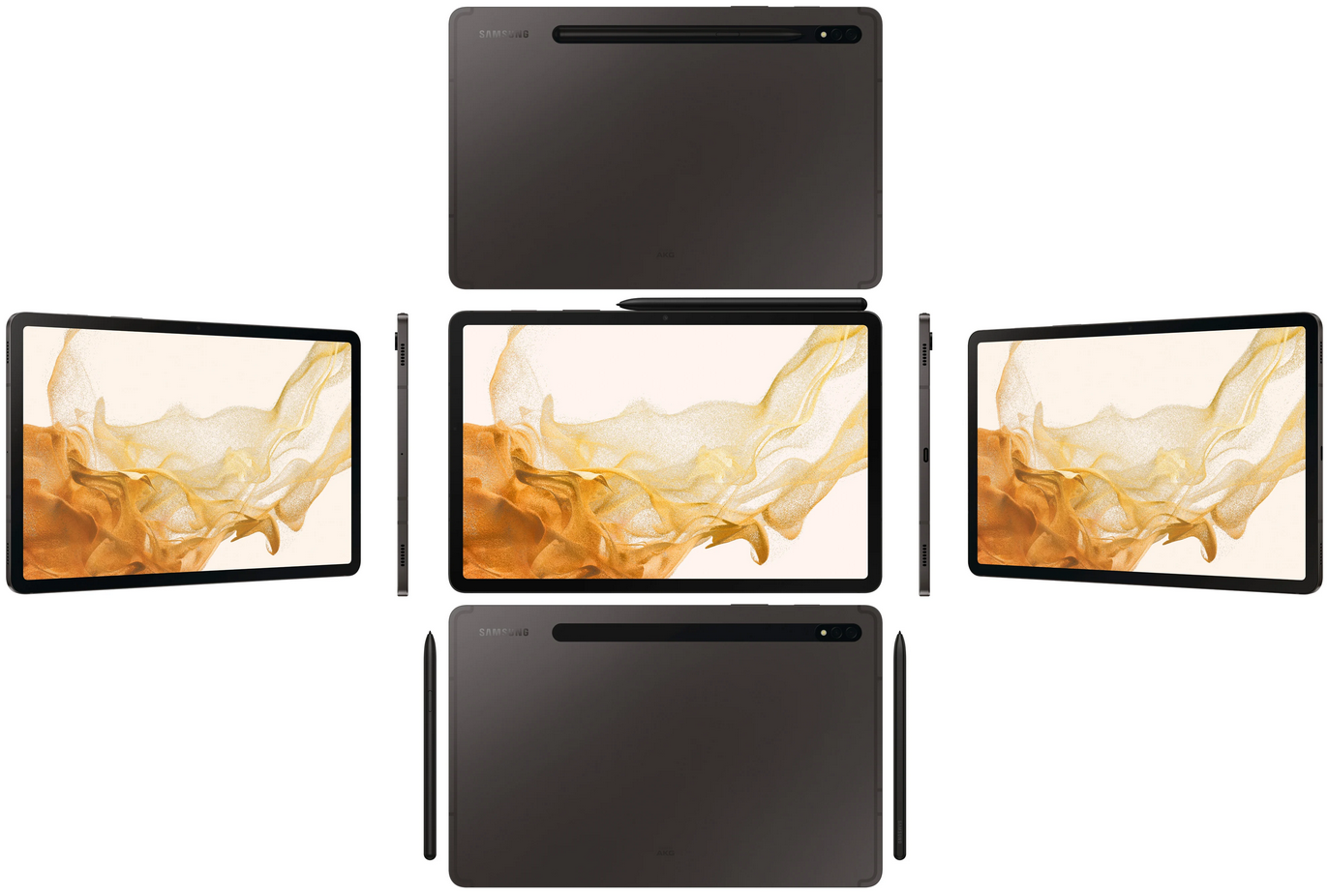
Samsung dethroned Apple to become the leading tablet vendor in the Indian tablet market in the first quarter ending March 2022, as per a report by IDC. The South Korean company had a 40% volume market share in India during the quarter, growing 10% sequentially. Samsung not only led the Android tablet market but also dominated Apple’s iPad segment with its premium offerings.
According to a report by IDC, Samsung has become the leader in the tablet segment in India. The company saw a huge increase in sales. It accounted for 40% of total tablet shipment volumes in India during the quarter, which is significant growth of 10% against the last quarter, as per the report.
Image via SamMobiles
The IDC report also revealed that Samsung was able to ship a large number of Galaxy A8 series tablets, as well as the premium Galaxy Tab S8 series, which debuted in March of this year. In comparison to the previous quarter, Samsung gained more than 8.3% in the premium segment in Q1 2022. This indicates that the company is getting popular in the $500> range.
“The popularity of recently-launched Galaxy Tab S8 series and Galaxy Tab A8 series enabled us to further strengthen our leadership in the tablet market. The success of Galaxy Tab S8 series, especially Galaxy Tab S8 Ultra, is a testimony to the fact that consumers value meaningful innovations that add value and solve everyday tasks effectively,” said Sandeep Poswal, Business Head, New Computing Business, Samsung India. “Our wide channel presence, availability of devices across price segments and attractive programs for consumers helped us consolidate our leadership,” Poswal added.
Samsung provides customers with a range of convenient payment options. The company recently launched financing plans to reduce the cost of ownership and attract more buyers. For example, the Samsung Finance+ plan provides easy EMIs to buyers with no post loan and credit history.
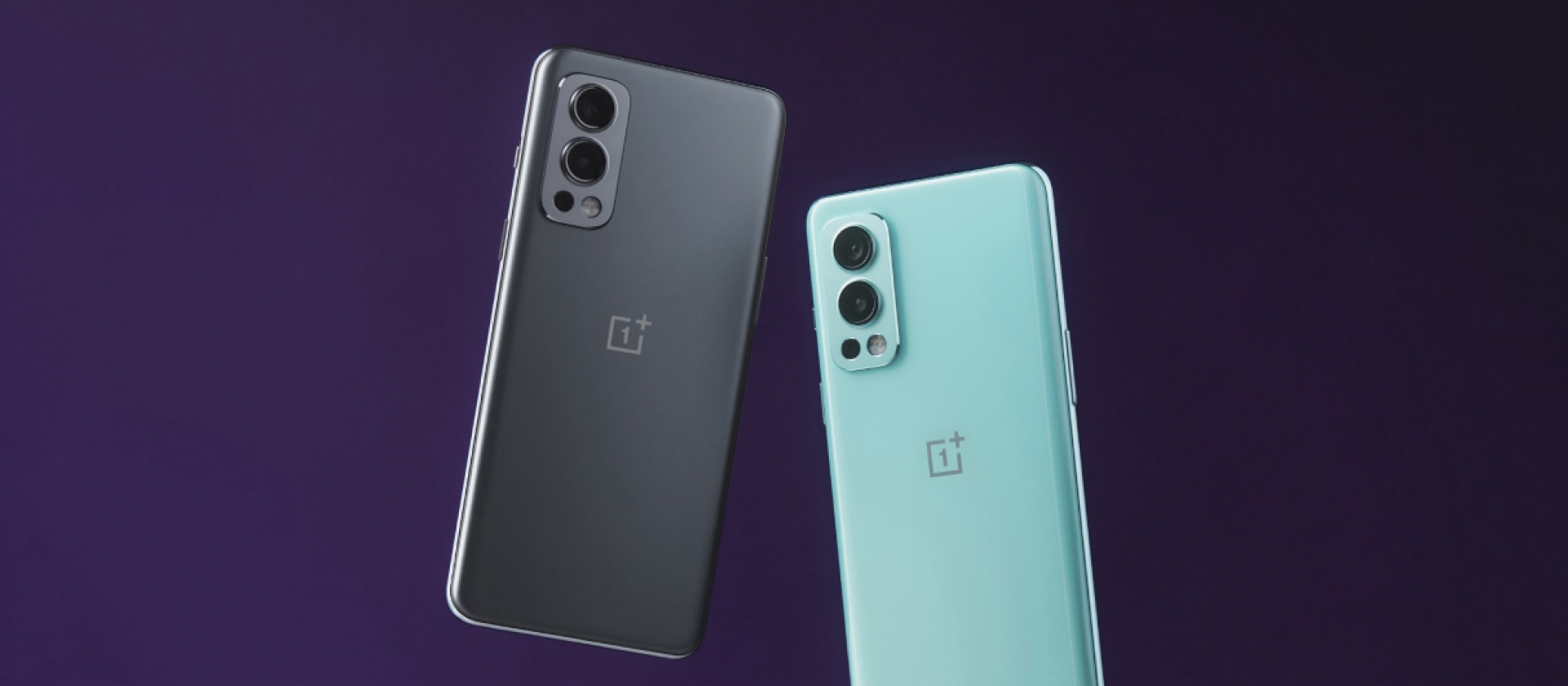
At the end of April, OnePlus commenced the OxygenOS 12 open beta program for the OnePlus Nord 2. Over a month later, the company has started rolling out the stable OxygenOS 12 build on these devices.
OnePlus has not put out an official changelog on its community forums yet. However, the new features coming with the update can be observed when users receive the OTA. These changes include the much-awaited Android 12 update, a revamped user interface, Material You theming for Google apps, new features added to Work-Life Balance, May 2022 Android security patch, and much more.
One peculiar thing about this update is that it’s showing up as ‘Beta’ confusing many users. This is due to the build number of the update (C.04) being the same as the build number of Beta 2. A OnePlus community moderator has cleared up that the update is indeed stable and the Beta tag is appearing because the developers forgot to change the build number.
As usual, OnePlus is rolling out the update in batches, so some users might receive the OTA earlier than others. To check if the update is available for your device, you can navigate to Settings > System > System updates.
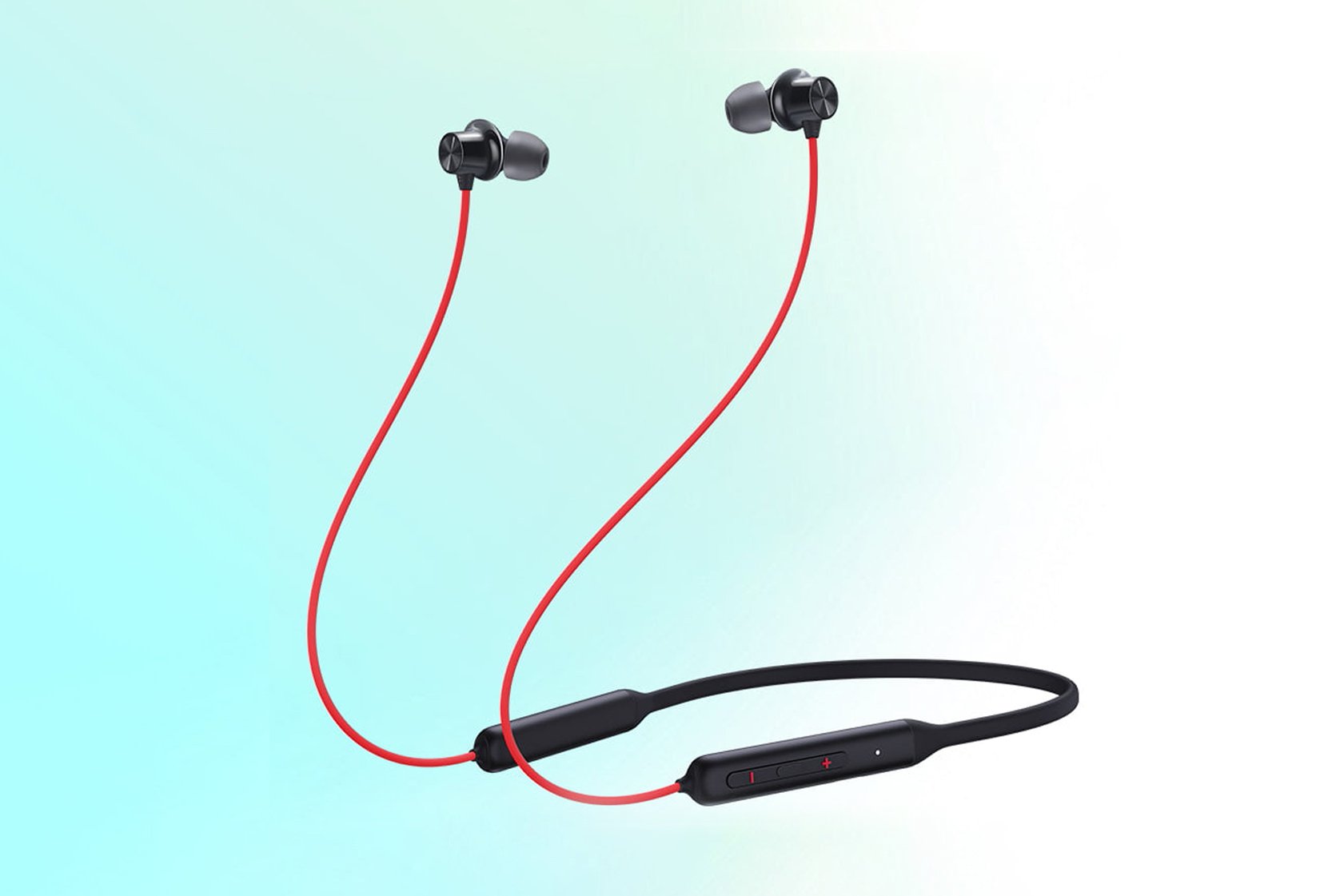
With the headphone jack becoming increasingly more rare now, wireless earphones have grown exponentially in popularity. This led to Chinese brands like OnePlus and Oppo to diversify their products to include new hearables as well, with the former being one of the top wireless earphones seller in India.
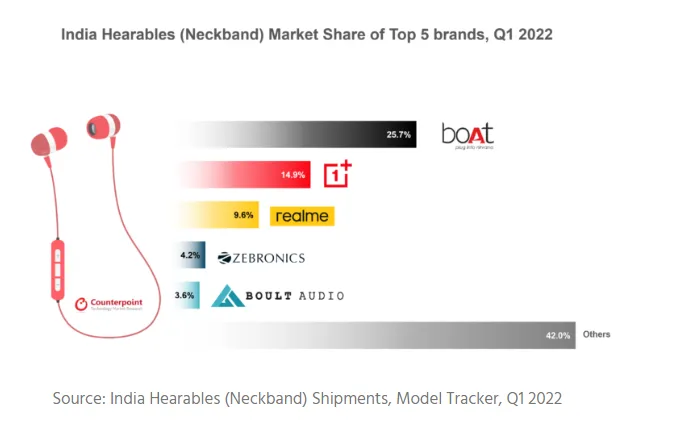
The news arrives from a Counterpoint Research report, which was about the neckband category of the wireless earphones segment. This report revealed the top brands in the category and their market share, as well as the top selling models as well. boAt took the top spot in the neckband category as a whole, with an impressive 25.7 percent market share, although, the OnePlus Bullets Wireless Z is India’s top selling neckband earphones.
This model was followed by the boAt Rockerz 255 series and the Realme Buds Wireless 2 Neo. On the other hand, OnePlus arrived second in the overall neckband segment with a market share of 14.9 percent, while Realme arrived third with a 9.6 percent market share. Other brands like Zebronics and Boult Audio rounded up the top five spots of the market.
Bullets Wireless Z Reverb Red
For those unaware, the Bullets Wireless Z was launched back in October 2020. In other words, the wireless earphones is still one of the best selling neckband models despite being released 18 months ago. Meanwhile, boAt’s Rockerz 255 series included a number of models like the Rockerz 255, Rockerz 255 Neo, and Rockerz 255 Pro. Interestingly, all of these hearables are priced under the 2,000 INR (roughly 26 US Dollars) mark, which means that price is also an important factor in the region since 70 percent of neckbands sold were between 1,000 to 2,000 INR range.
Xiaomi‘s range of sonic electric toothbrush have often promised efficient teeth care. The Chinese company has now launched the MIJIA T200 Sonic Electric Toothbrush which claims to provide a combination of full-effect gum protection and deep tooth cleaning. The product is super affordable as it carries a price tag of 79 yuan (~$12).
The MIJIA T200 Sonic Electric Toothbrush uses a small round brush head suitable for people with small mouths to penetrate deep into the mouth to clean the rear teeth. It uses 0.15mm DuPont soft wool antibacterial silk which is of FDA food contact grade standards. The multi-rounded tip is higher than the national standard, and the brush head is softly oscillated horizontally, which can clean efficiently and gently protect the gums.
The T200 is also smaller than common electric toothbrushes, with a bottom diameter of only 23mm. It is slender, comfortable and light to hold, and friendly to first time users of electric toothbrush. The size also means it won’t take up much space in case it is taken on a trip.
The T200 comes with two operating modes: standard mode and gentle mode. The two modes are designed to suit persons with different tooth cleaning needs. The gentle mode will be better suited for someone with teeth sensitivity or inflamed gingivae while the standard mode should meet the need of regular users.
The new toothbrush also offers a higher vibration frequency of 31,000 times per minute ensuring it is able to penetrate the entire tooth surfaces and achieve deep cleaning. It packs a magnetic levitation motor which provides the sonic power.
The electric toothbrush T200 charges via a USB Type-C port which guarantees you can charge it any where even if you are not with the in-box charging cable. A full charge offers up to 25 days of usage. It also comes with water resistance and can stay in water of 1m depth for up to 30 minutes.
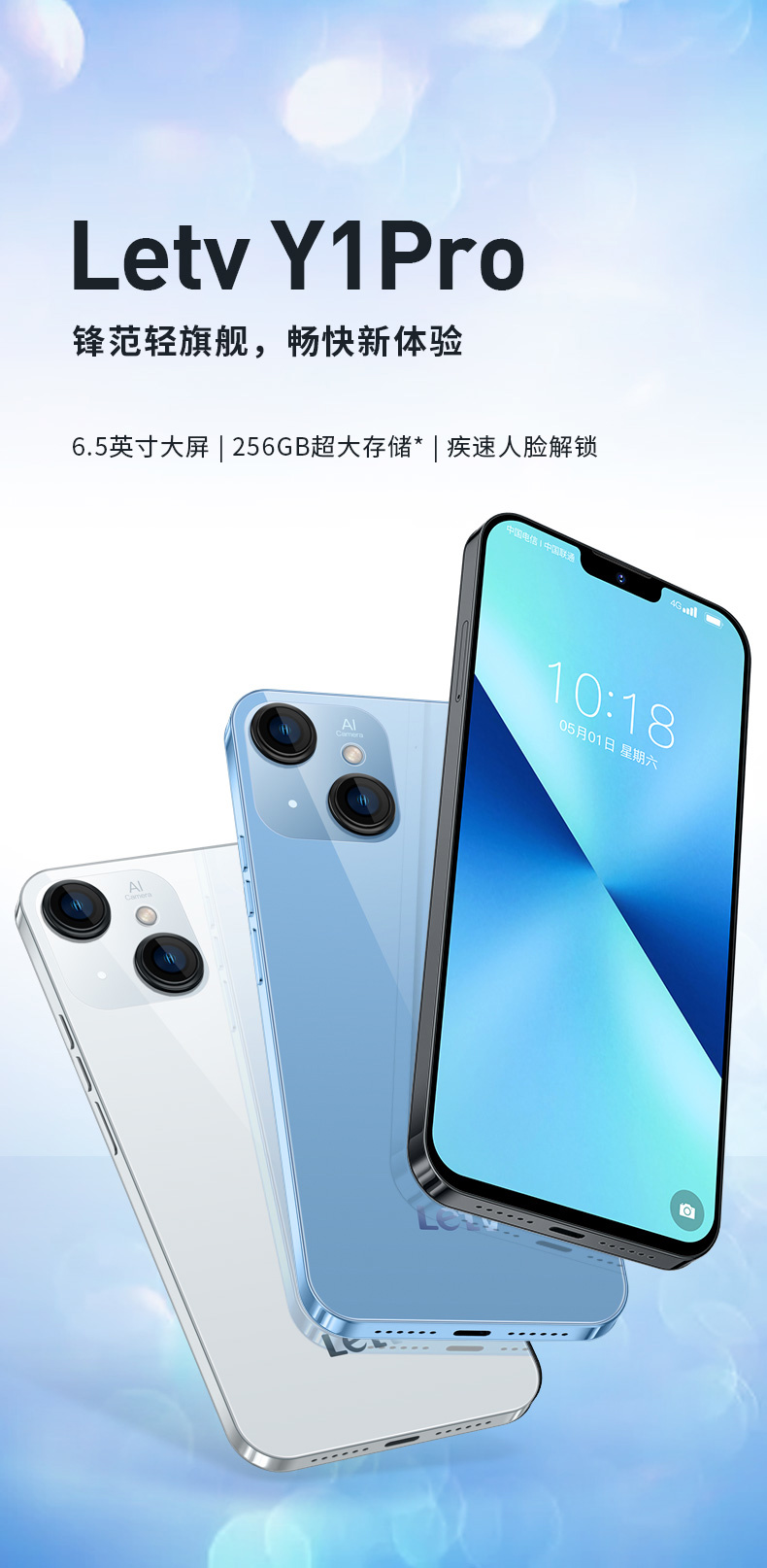
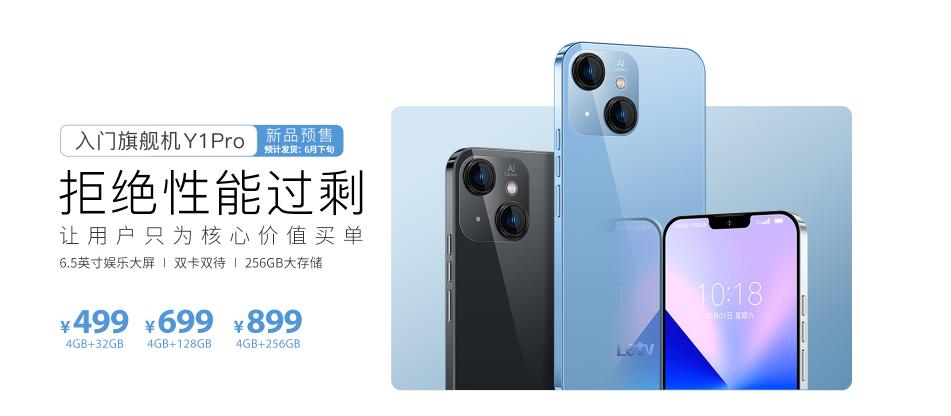
Earlier today (31st May 2022), LeTV quietly launched a new smartphone in the company’s home market of China. The model in question is the Y1 Pro, which is a new budget grade handset.
Talking about it design first, the LeTV Y1 Pro features a design that appears to be highly inspired by the Apple iPhone 13 model. It sports a flat rear panel but rounded corners, with the camera module and image sensor alignment also being nearly identical. On the front, it sports a notch display, which is surrounded by a metallic frame. The Chinese brand is marketing the smartphone as a budget flagship model and is offering a premium build quality at a cost effective price tag.
The display is a 6.5 inch LCD panel that has a 1560 x 720 pixel resolution. Under the hood, it is equipped with a UNISOC Tiger T310 SoC, which is a 4G enabled chipset. This processor is paired with up to 4GB of RAM and up to 256GB of internal storage. A 4,000mAh battery pack powers the device and it supports just standard 10W charging and a USB Type C charging port.
Other specifications include, dual card 4G support, built in Le OS 9.1,9.5mm thickness, and 208 grams in weight. The new device is available in multiple storage configurations and starts from 499 Yuan (roughly 75 US Dollars) for the 4GB + 32GB model. The 4GB + 128GB model is priced at 699 Yuan (roughly 105 US Dollars), and the top end 4GB + 256GB variant cost 899 Yuan (roughly 135 US Dollars). It is also available in multiple color options, including a blue, white, and black variant. The pre-orders are currently live for the LeTV Y1 Pro.
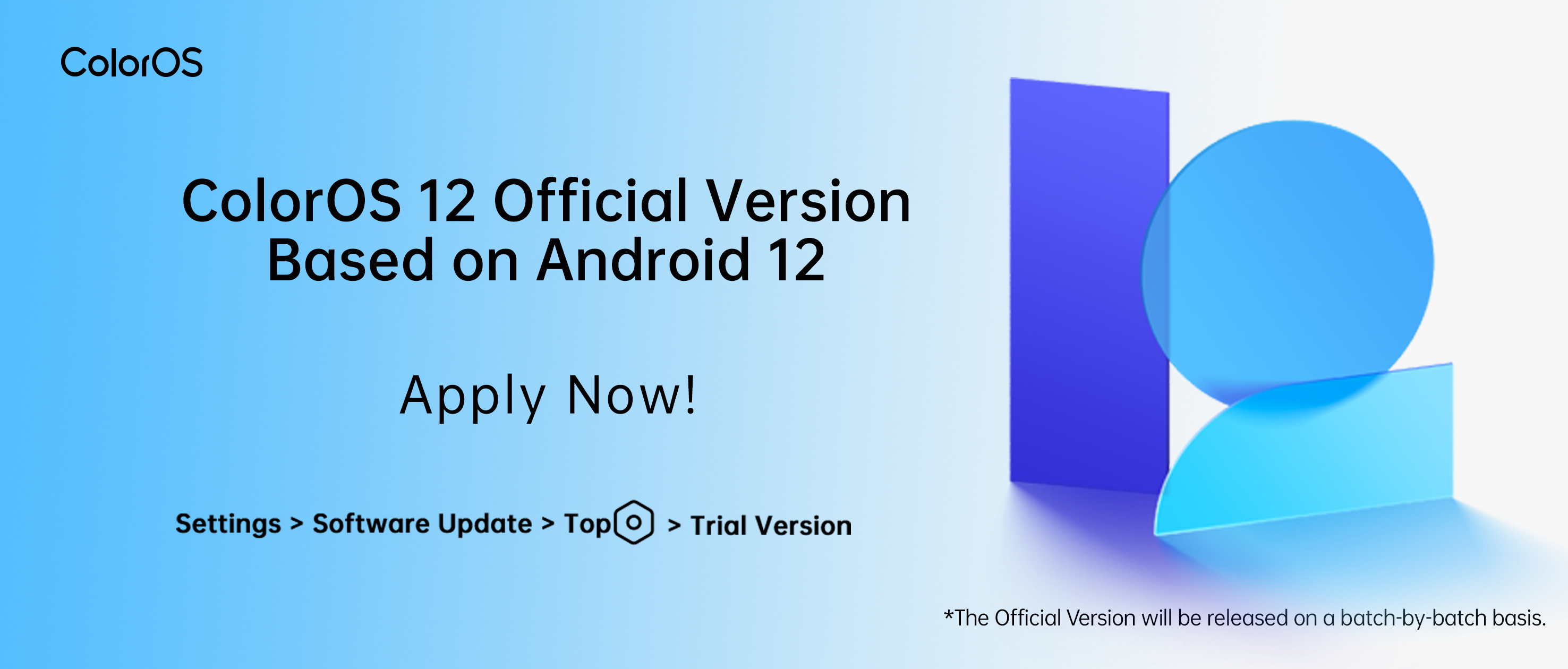
Oppo has been rolling out the Android 12-based ColorOS 12 update for eligible smartphones since September 2021. The company has been releasing update schedule every month since then. The latest plan meant for June reveals that the Oneplus flagship phones from 2019 will finally get access to beta update.
Oneplus 7T
When ColorOS 12 was officially announced in September 2021, Oppo disclosed that the Oneplus flagship smartphones released in 2019 and 2020 will receive the update in the first half of 2022.
As promised, the company had already delivered the update for the 2020 handsets like Oneplus 8, Oneplus 8 Pro, and Oneplus 8T in March. Now, the firm says that the Oneplus 7 and the Oneplus 7T series of smartphones from 2019 will get the ColorOS 12 beta update in June alongside Oneplus 9RT and Oppo A96 5G.
At the same time, Oppo has confirmed to roll out ColorOS 12 stable update for its self-branded 2019 flagships like Oppo Reno 10x Zoom and Oppo Reno Ace in China along with Oppo Reno 7 5G and other newer devices. For those unaware, these phones got the beta update earlier this month.
ColorOS 12 Beta Update Timeline China June 2022
From June 23
Oneplus 9RT
Oneplus 7T Pro
Oneplus 7T
Oneplus 7 Pro
Oneplus 7
Oppo A96 5G
ColorOS 12 Stable Update Timeline China June 2022
From June 15
Oppo Reno 7 5G
Oppo K9x 5G
From June 16
Oppo K9s 5G
From June 28
Oppo Reno Ace
Oppo Reno Ace Gundam Edition
Oppo Reno 10x Zoom
Oppo Reno FC Barcelona Edition
From June 29
Oppo A36
For those wondering about the international variants of the aforementioned Oneplus smartphones, those devices will get the OxygenOS 12 update instead of ColorOS 12 since the latter is exclusive to China. Either way, both software is near identical. Unfortunately, unlike Oppo, Oneplus hasn’t revealed the schedule for global markets yet.
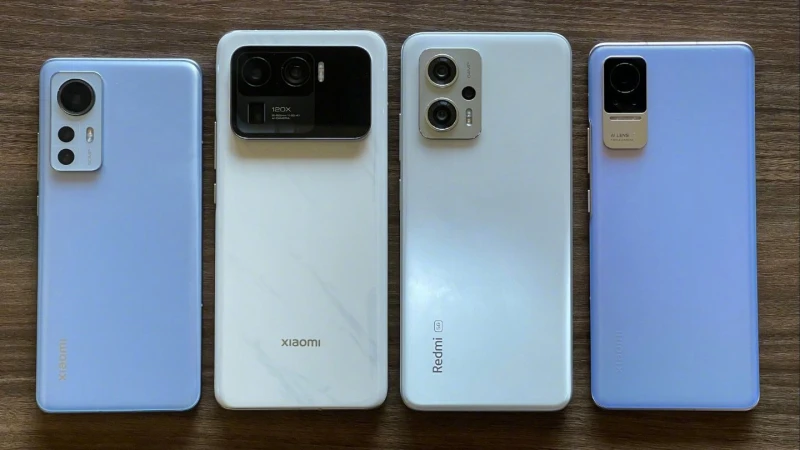
Flagship smartphones are premium offerings from a company, which typically offers the brand’s latest technology and features. But what do top executives of these companies use? Now, we have an idea on what models the Xiaomi CEO uses and there are four!
The Chinese tech giant’s senior official revealed the smartphone models that he uses on his official Weibo account (a Chinese microblogging website). It was surprising to see four devices, which included the Xiaomi 12, Mi 11 Ultra, Redmi Note 11T Pro, and the Xiaomi Civi. Interestingly, all four models were from the company’s smartphone portfolio, and one was even from its budget sub brand Redmi.
Lei Jun further added that these are the four models that can found on his desk and he often uses all of them at the same time. The Mi 11 Ultra is the previous generation’s top end model, but unfortunately, we don’t see the Xiaomi 12 Ultra since the brand has yet to launch that particular model yet. While its unclear how one uses four smartphone models as their daily driver, it is entirely possible that he cycles between them one by one.
Oppo A53 5G recently received the updated version of ColorOS 12 on the variants across India. The rollout comes 2 months after Oppo announced the release of the beta version for Indian users. The news of this update is going to cause mixed reactions among Oppo A53 users because the latest update marks the end of official ColorOS releases for the smartphone.
As per a recent announcement post on OPPO Community, the stable ColorOS 12 update with Android 12 is currently rolling out to the OPPO A53 in India. However, the rollout is still in the initial stage so, in order to receive the update, users are required to submit an application form.
If you own the Oppo A53 and live in India, you can register for the ColorOS 12 stable update by going to the Software Updates section in the Settings app on your phone. In the Software Updates section, tap on the kebab menu in the top right corner and you will be able to see an option to register for the update. After submitting your application, you will receive the ColorOS 12 through an OTA update.
OPPO is yet to share the release timeline for other regions. But we expect the company to soon make an announcement on the future updates once it’s ready for a wider rollout.
OPPO A53
Oppo has brought many new features and updates with the latest stable ColorOS 12 update based on Android 12. The new firmware brings changes in the elements of the smartphone’s interface, including icons, system apps, and quick settings panel. It also introduces some Android 12 privacy features like Privacy Dashboard and microphone and camera Indicators.
It is worth mentioning that once you update to the latest version, the operating system will automatically perform various operations to optimize your device. It could cause your smartphone to overheat, lag, and drain its battery quickly. Oppo recommends to you to turn off the screen and charge your device for a whole night once the update is successfully installed.
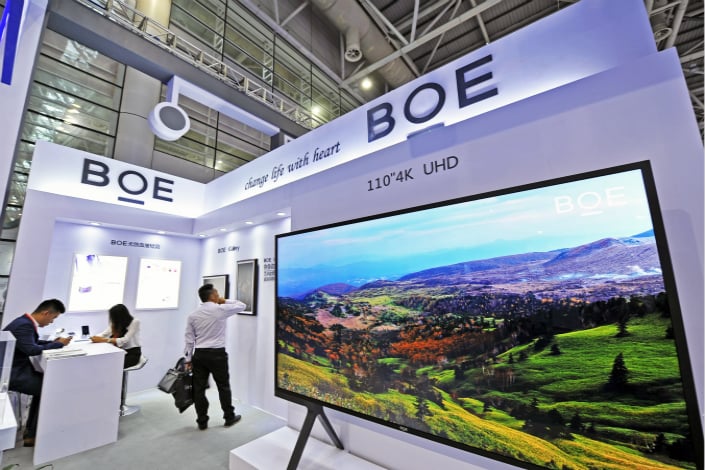
Beijing-based display manufacturer company, BOE is well known for supplying its high-quality OLED displays to TVs, smartphones and even laptops in both the Chinese and global markets.
BOE company
But the company is looking to take things to the next level as the mainstream Chinese news outlet, People’s Daily Newspaper, reported that BOE successfully pioneered the next generation of mini-LED display panels within an independent research team in the company.
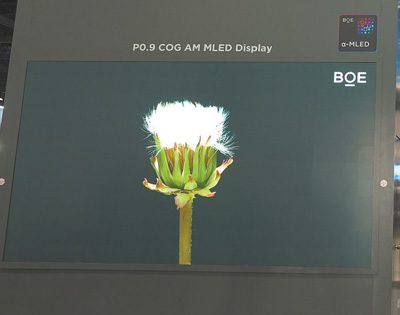
BOE had revealed their revolutionary next-generation P0.9 mini-LED display at SID 2022 International Display Week recently in which the panel is a sub-millimetre light-emitting diode display, meaning it measures less than 1mm in thickness. The mini LED display is made of a glass-based material.
BOE P0.9 mini LED. Via: People’s Daily
As to why it is revolutionary, the report mentions that according to a BOE spokesperson, the P0.9 mini LED has high peak brightness and strong contrast levels. The LED panel not only has the normal advantages of OLED like low power consumption, uniform brightness across the panel, and healthy eye protection but since it is a mini-LED, the display can also be stitched in any size.
The spokesperson added that as a leader in mini LED technology, BOE has also been developing a series of mini LED display products, which have greatly improved the display effect by incorporating glass-based mini LED backlights and related technologies, and will continue to lead in the consumer display industry whether it be live streaming sports events, providing for e-sports gamer, or for applications in the next generation of TVs.
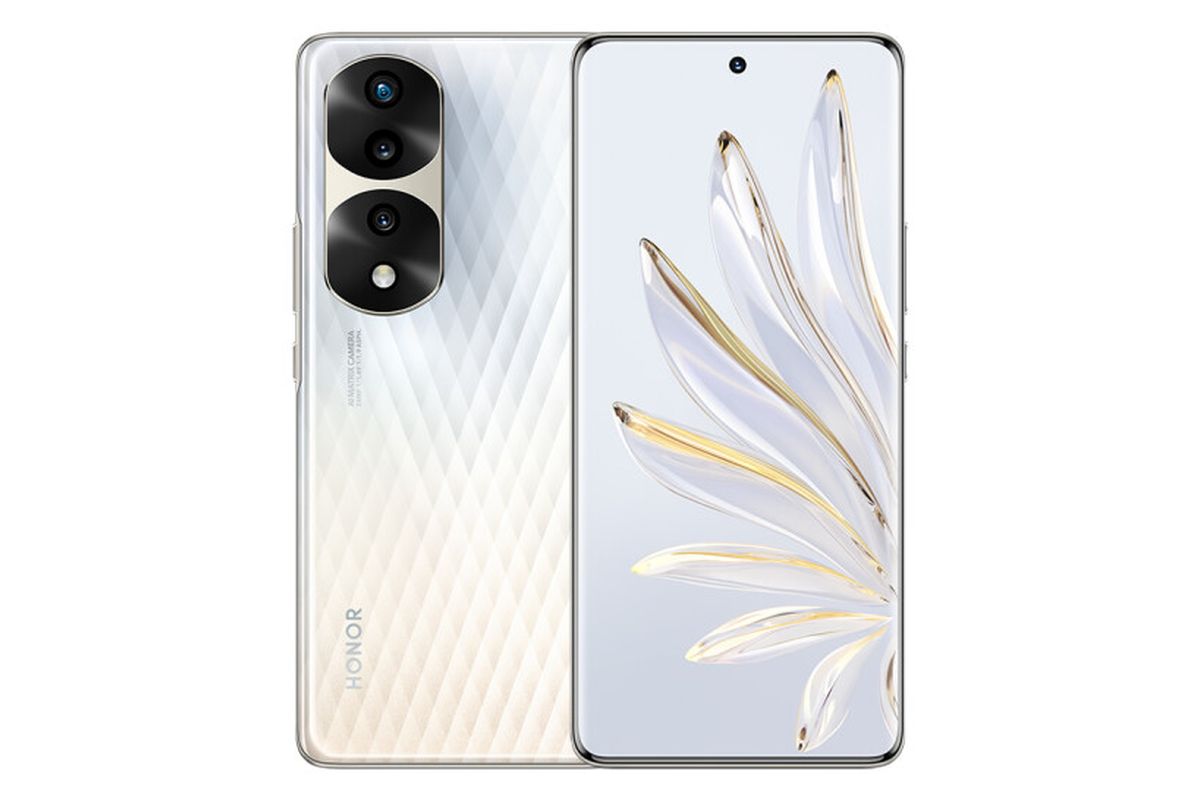
Honor 70 Pro Plus
Recently, the Honor 70 series were launched with BOE-supplied OLED displays. Namely, BOE had supplied the Honor 70 Pro Plus with a 6.78-inch 10-bit QHD+ 120Hz LTPO OLED flagship-class display to boot. The Honor 70 Pro Plus is also quite the performer as well, with MediaTek’s top-end Dimensity 9000 SoC powering the device on a day-to-day basis.
To read more on the Honor 70 series, you can head on over to our launch coverage article here.
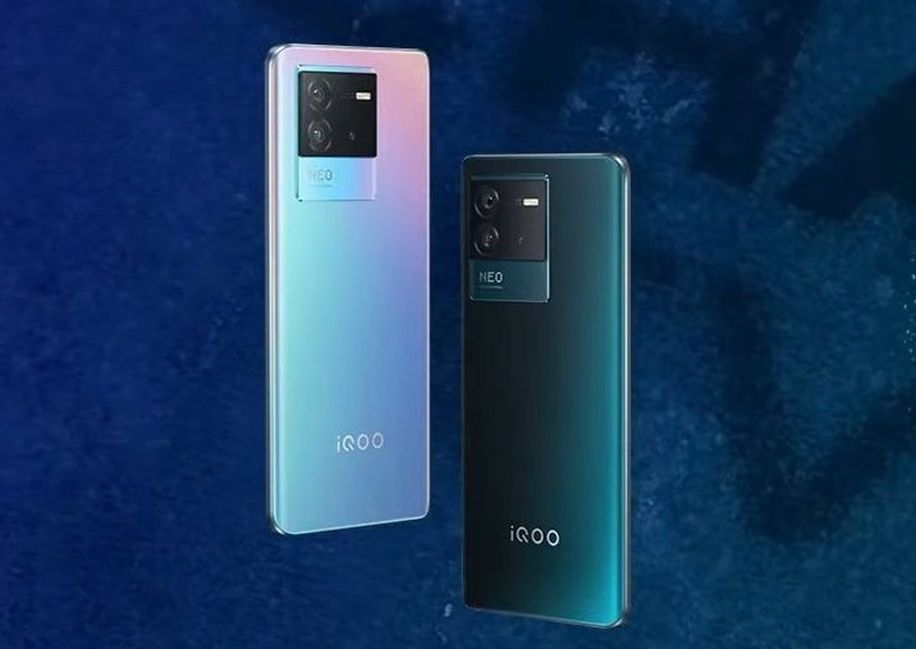
iQOO has announced the iQOO Neo 6 smartphone in India. It is the company’s first Neo-series phone to arrive in the country. The device offers key features such as a 120Hz OLED display, Snapdragon 8-series chip, 80W fast charging, and carries a starting price of Rs 29,999 (~$386). The Neo 6 that has landed in India is different from the phone of the same name that debuted in China last month. The specifications and design of the Neo 6 confirm that it is a rebadged version of the Neo 6 SE that launched in China earlier this month.
Design and Display
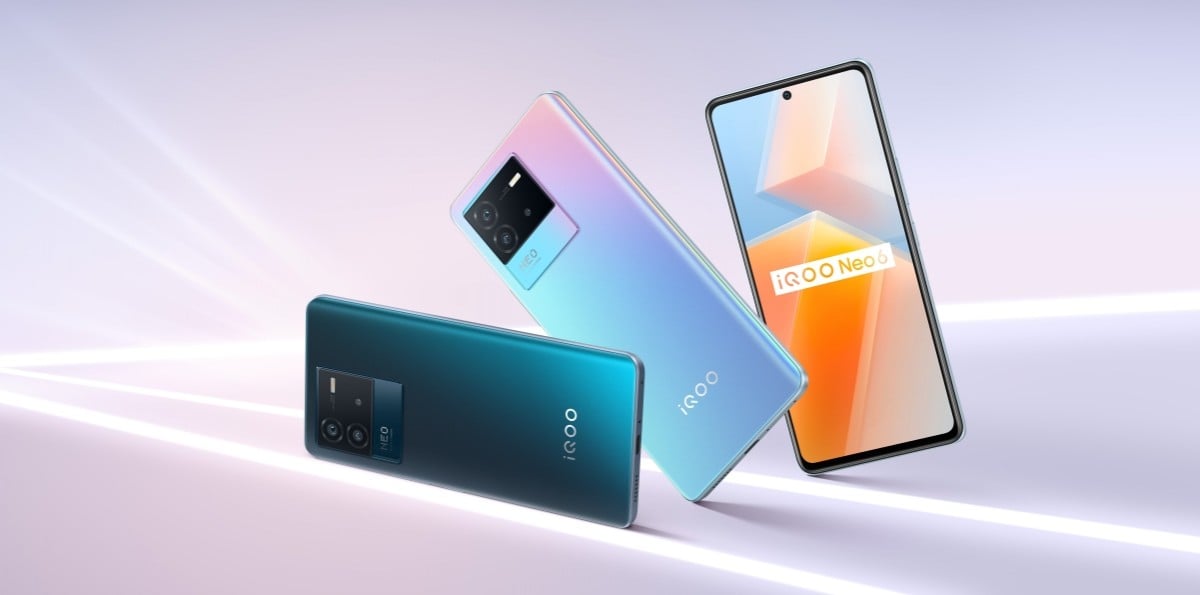
The iQOO Neo 6 has a flat display with a centrally positioned punch-hole on the front. It comes equipped with an in-display fingerprint scanner. The rear shell of the device has a matte finish. The top-left corner of the phone’s back has a triple camera unit, an LED flash, and a Neo branding. The device is dual stereo speakers but lacks a 3.5mm audio jack.
iQOO Neo 6
The Neo 6 has a 6.62-inch E4 AMOLED display with FHD+ resolution, a refresh rate of up to 120Hz, a touch sampling rate of 1200Hz, a colour gamut of 100 percent DCI-P3, a contrast ratio of 6000000:1, and a brightness of 1,300 nits. The Neo 6 has a screen-to-body ratio of 91.4 percent, according to iQOO.
Specifications
The iQOO Neo 6 is powered by the Snapdragon 870 mobile platform. The device ships with up to 12 GB of LPDDR4x RAM and up to 256 GB of UFS 3.1 storage. It carries support for up to 4 GB of extended RAM.
To keep the lights on, the Neo 6 houses a 4,700mAh battery that carries support for 80W fast charging. The smartphone is equipped with a liquid cooling unit for heat dissipation. It includes a vapor chamber soaking plate and 5-layer laminated graphite.
iQOO Neo 6
The iQOO Neo 6 runs on the Android 12 OS and FunTouch OS 12. It offers other features such as a dual SIM slot, 5G, Wi-Fi 802.11ax, Bluetooth 5.1, GPS, a USB-C port, and an X-axis linear motor. It also carries support for Hi-Res Audio and Hi-Res Audio Wireless.
Cameras
The iQOO Neo has a 16-megapixel camera for shooting selfies and video calls. Its rear camera unit has a 64-megapixel main camera with OIS support, an 8-megapixel ultrawide camera, and a 2-megapixel macro snapper. The handset supports photography features, such as portrait mode, night scene mode, time-lapse, dual-view video, up to 1080p slow-motion video shooting, and up to 4K video recording.
Price and availability
The iQOO Neo 6 has arrived in two variants, such as 8 GB RAM + 128 GB storage and 12 GB RAM + 256 GB storage. These models are priced at Rs 29,999 (~$386) and Rs 33,999 (~$438), respectively. The Neo 6 comes in two colors: Dark Nova and Cyber Rage. It will be available for purchase through iQOO India’s website and Amazon India. These platforms will carry out the first sales of the Neo 6 on June 2.
Buyers with an ICICI Bank credit card can benefit from a Rs 3,000 (~$39) discount while purchasing the Neo 6. This offer is available between May 31 and June 5. In addition, the handset will be available with a Rs 1,000 (~$13) discount coupon on Amazon India.
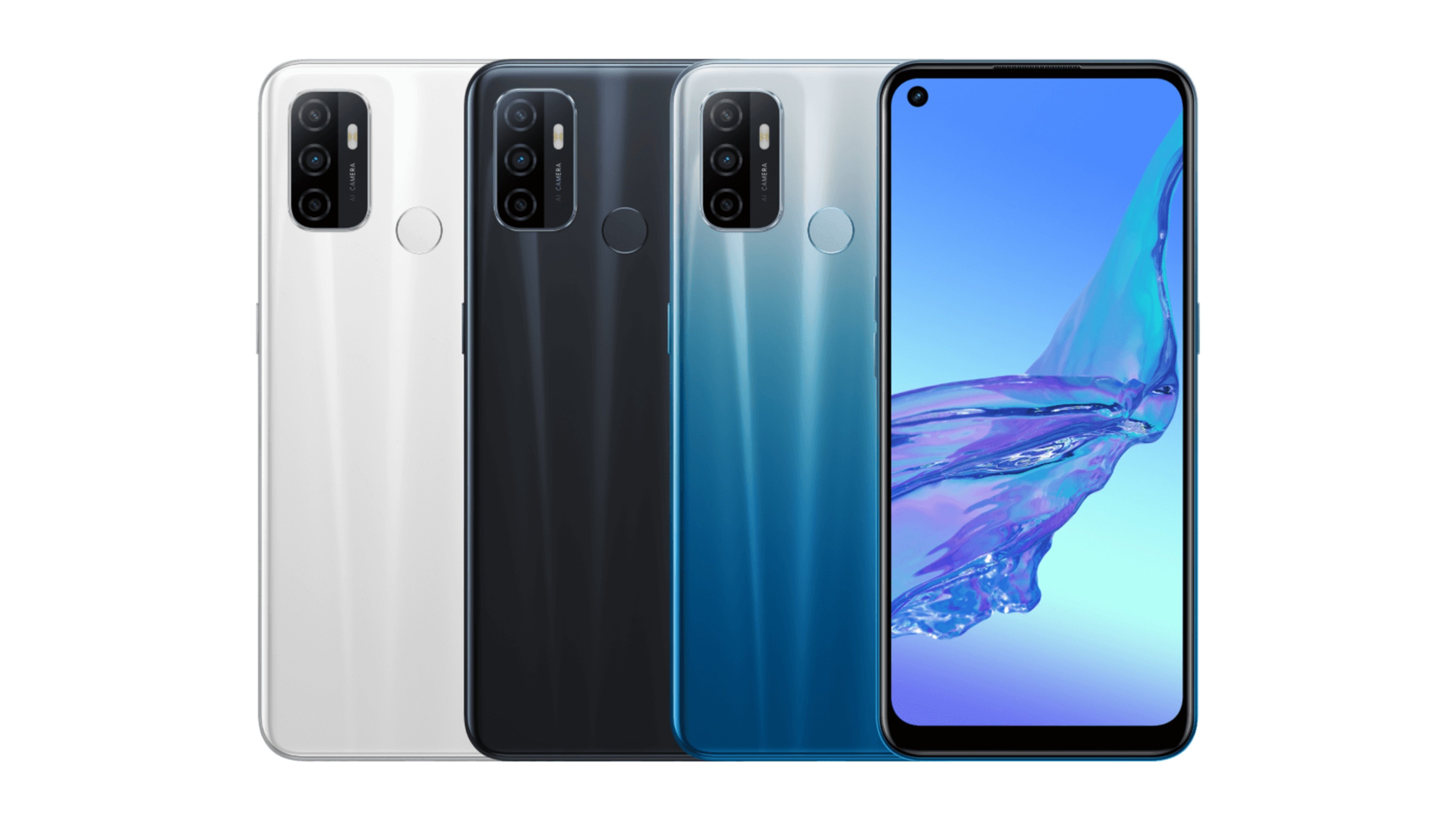
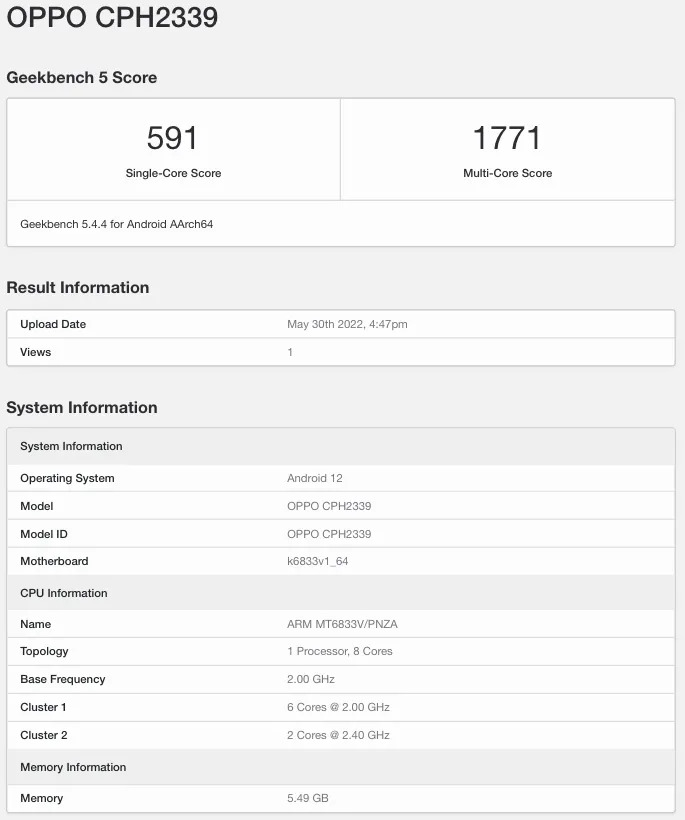
Oppo A77 5G has been spotted on the Geekbench database, hinting at a few key specifications and an imminent launch. The listing indicates that the upcoming handset will be powered by an octa-core MediaTek Dimensity SoC. The smartphone is also expected to run on Android 12 out of the box. Earlier, the phone was also spotted on the NBTC, FCC, GCF, and HTML5Test Certification websites with model number CPH2339.
As initially spotted by MySmartPrice, the listing shows the Oppo A7k7 5G is powered by a MediaTek processor named MT6833V/PNZA. The processor has 6 power-efficient cores clocked at 2.0GHz and 2 performance cores at 2.4GHz. Therefore, Oppo A77 5G is expected to feature an octa-core MediaTek Dimensity 810 SoC under the hood.
Image Credit: MySmartPrice
The Dimensity 810 SoC is accompanied by the Adreno 610 GPU. The listing also indicates that the smartphone will have 6GB of RAM. There’s no mention of the Internal storage, however, the phone could offer up to 128GB of storage. As mentioned above, the smartphone will likely run Android 12 with ColorOS on top.
Oppo A77 5G was spotted on the Geekbench website with 591 points in the single-core test and 1771 in the multi-core test. That’s all the details that we could get from the listing, we hope to learn more in the coming weeks. Meanwhile, let’s check out the features of its predecessor Oppo A76 to get a better idea of what to expect.
Oppo A76 Specifications
Oppo A76 is powered by Qualcomm Snapdragon 680 4G Octa-core processor and the GPU is Adreno 610. It features a 6.56 inches IPS LCD screen that provides a resolution of 720 x 1612 pixels.
The handset sports a dual-camera setup on the back that consists of 13 MP (wide) + 2 MP (depth). While On the front, there is a single 8MP camera for selfies. Oppo A76 is fueled by a 5000 mAh battery and supports Fast charging 33W.
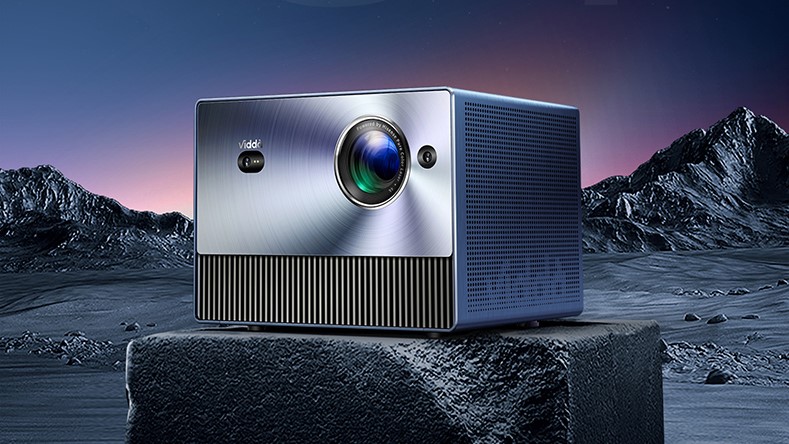
Tonight, Hisense, the Chinese multinational electronics corporation, has unveiled the company’s latest product – the Hisense Vidda C1. The Vidda C1 is seen as ground-breaking product in the screen projector category as Hisense had announced today that the Vidda C1 projector is the world’s first 4K resolution multicolour screen projector.
Hisense Vidda C1
Let’s start with the projector headlight. The Hisense Vidda C1 is able to output visual media onto your screen at up to 1350 ANSI lumens with the colour gamut coverage reaching 202% in the BT.709 colour space. The colour accuracy values are relatively shocking at △ E≈0.9, with 10-bit colour depth to boot as well.
The screen projector can also support refresh rates of up to 240Hz, utilise MEMC motion refresh rate enhancement technology, decode HDR 10+ visual media and even output it accordingly.
Coming to the silicon under the hood, the Hisense Vidda C1 is powered by a MediaTek MT9669 SoC with 4GB RAM + 64GB of internal storage. Paired with the CMOS and ToF sensors onboard, the screen projector can gather data from your surroundings, then use artificial intelligence to auto-calibrate the screen output for the best multimedia experience. For example, the screen projector can auto-calibrate for focus, tilting alignment, screen size and even orientation depending on the surrounding situation.
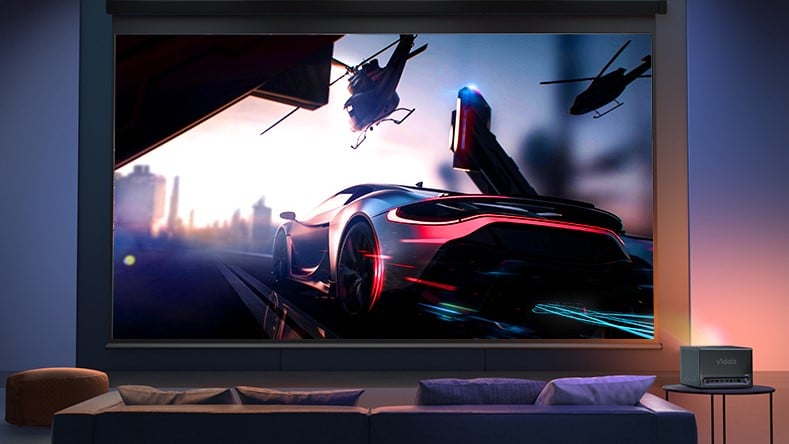
Hisense’s marketing materials state that the recommended projection size of Vidda C1 is 80~150 inches. With that in mind, besides big screen movie viewing, the projector can also be a great companion for big-screen gaming. With a rated latency of only 12ms and support for refresh rates of up to 240Hz, gaming on a 150-inch screen has never been this portable before.
Source: Hisense
Last are the speakers. The Hisense Vidda C1 screen projector comes equipped with a dual stereo speaker setup with 2 10W speakers built on the exterior. The speakers are supported for Dolby Atmos and dts Hi-Res audio for those who prefer a more rich and immersive audio experience.
The Hisense Vidda C1 screen projector officially goes on sale from June 15th onwards and is available for only 6999 RMB (1051 USD) on its first sale.
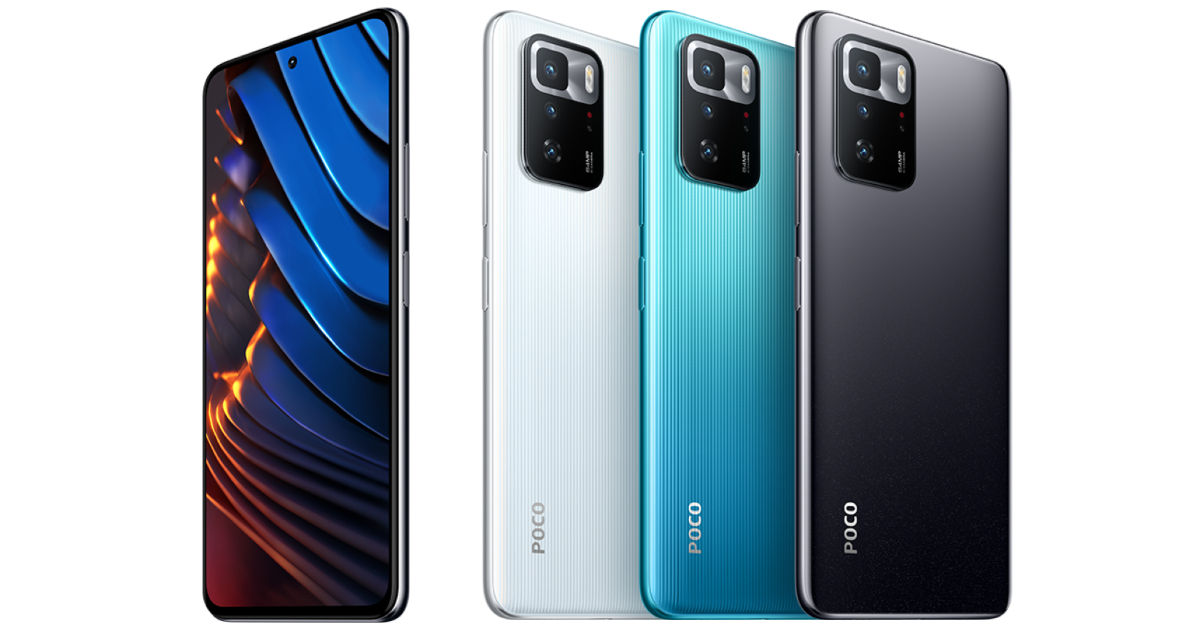
POCO X4 GT launch in India appears to be inching closer as the device has appeared on the Bureau of Indian Standards (BIS) certification site. The upcoming smartphone has been listed on the certification website with model number 22041216I. The certification page does not reveal any specifications of the phone. However, BIS India, as spotted has granted approval to the smartphone. Poco is yet to officially confirm the handset’s launch in India.
Mukul Sharma took to Twitter to reveal that the Poco X4 GT Indian variant has been spotted on the BIS India website and it has in fact completed both the steps of the approval process. Although the listings did not contain the details regarding the specifications of the smartphone, the model number signals that the smartphone is an Indian-specific variant.
Poco X3 GT
Sharma also reveals that the Indian variant of the Poco X4 GT will be rebranded as Xiaomi 12X or Xiaomi 12i. Recent reports have also suggested that the Note 11T Pro series will be rebranded to the POCO X4 GT global lineup.
Let’s Check out the rumored specifications of the smartphone
POCO X4 GT Specifications (Rumored)
The POCO X4 GT will likely feature a 6.6-inch LCD panel that offers an FHD+ resolution and a 144Hz refresh rate. It may sport a 20-megapixel front-facing camera. While on the rear, it may pack a 48-megapixel main camera, an 8-megapixel ultrawide lens, and a 2-megapixel camera.
POCO X4 GT will be powered by Dimensity 8100 paired with up to 8GB of RAM and 256GB of internal storage. The MIUI 13 based on Android 12 OS may come preinstalled on the smartphone. The POCO X4 GT will be fueled by a 5,000mAh battery and support 67W fast charging support.
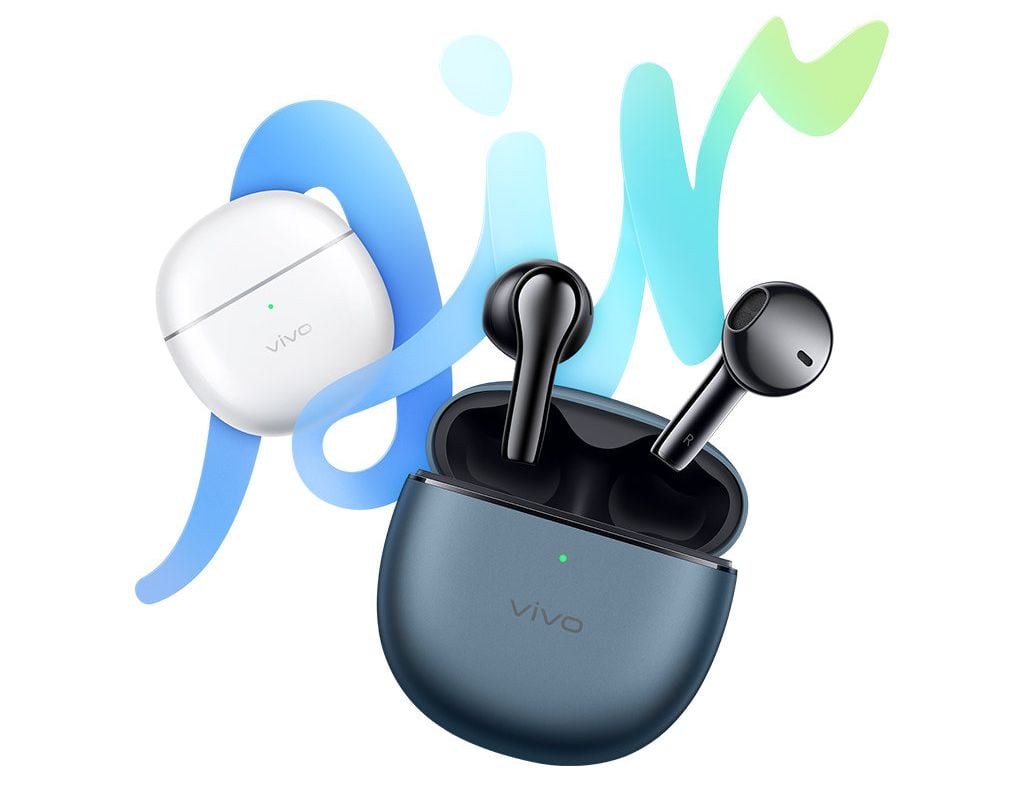
A couple of weeks ago, Vivo had launched its new true wireless earbuds in its home market China — Vivo TWS Air, along with the Vivo S15 series smartphones. They were up for pre-order since the day of the announcement and are now all set to go on sale.
The Vivo TWS Air will be available for purchase at 12:00 AM on 31st May for a discounted price of 169 yuan (~$25) instead of its original retail price of 199 yuan (~$30). It comes in two color options — Stone Blue and Vitality White.
The earphones appear to be a re-branded model of the Vivo TWS 2 that were launched in India along with the Vivo X80 series smartphones.
In terms of design, the Vivo TWS Air comes with an in-ear design featuring a stem and looks identical to Apple AirPods. The earbuds are lightweight weighing just 3.5 grams thus making them comfortable to wear for a long time. Users can control various functions by tapping the stem of either earbud. They are IP54 certified dust and waterproof.
The earbuds come equipped with a 14.2mm driver for strong bass. They also have dual microphones and noise reduction functionality that uses artificial intelligence. The audio device features DeepX 2.0 stereo sound effects. The Vivo TWS Air supports 117ms low latency mode via Bluetooth 5.2 connectivity.
The true wireless earbuds are equipped with a 420mAh battery with each earbud backed by a 27mAh cell. The earphones are claimed to offer 4.5 hours of usage and 25 hours of total battery life with a charging case that supports a USB-C port.
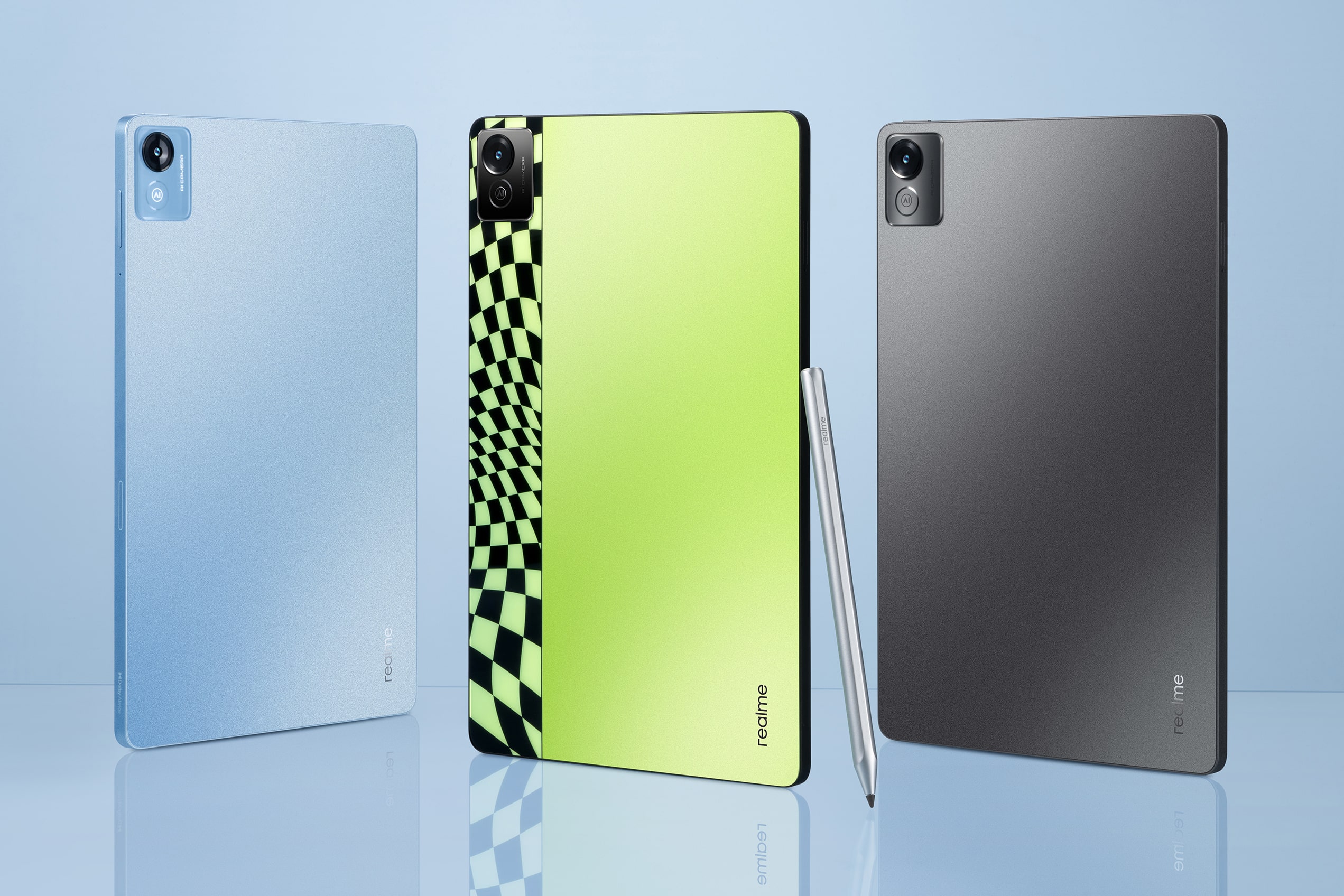
A few days ago, Realme launched its latest tablet device in its home market China, dubbed Realme Pad X. Today, the 6GB RAM model of the tablet is available for pre-order in the Chinese market.
The 6GB RAM and 128GB internal storage model of the Realme Pad X is priced at 1,499 yuan, which is approximately $225. It is offered in three color options — Fluorescent Green Chessboard, Sea Salt Blue, and Star Gray.
Coming to the specifications, the Realme Pad X features an 11-inch LCD display with a 2K screen resolution and 16.7 million colors. It supports sunlight mode (450 nits peak brightness level), and DC dimming. It is also claimed to have TÜV Rheinland-certified hardware-level blue light filter.
Under the hood, the device is powered by the Qualcomm Snapdragon 695 chipset. There’s also support for stylus input. The official optional stylus charges magnetically on the side of the device and supports 4096 levels of pressure sensitivity. Customers can also opt for the official keyboard accessory featuring a 1.3mm key travel.
In the camera department, the device has a 13-megapixel camera sensor on the back and a 105° front-facing front snapper. It runs the Android 12 operating system with the company’s own Realme UI 3.0 on top. It comes with features like PC Connect, split-view, and Apple’s center stage-like functionality on the front camera.
The device packs quad speakers with support for Dolby Atmos and Hi-Res Audio. It is powered by an 8,340mAh battery and has support for 33W fast charging.
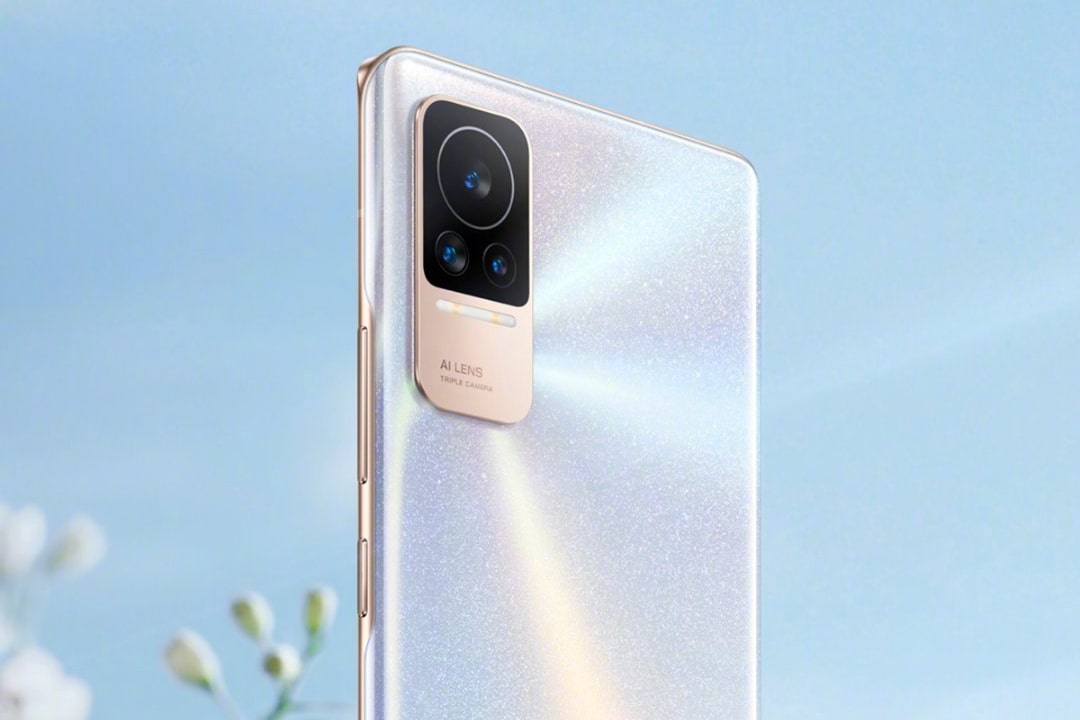
The Xiaomi CIVI 1S was announced in April this year in China. It arrived as an updated version of the original Xiaomi CIVI, which went official in September last year. It appears that the Chinese manufacturer could be working on the Xiaomi CIVI 2 smartphone. Well-known tipster Digital Chat Station has shared the key details of what appears to be the CIVI 2.
The smartphone will have a curved edge screen with ultra-thin bezels, according to the leaker. The screen will support a resolution of FHD+, a refresh rate of 120Hz, Dolby Vision, and an under-display fingerprint scanner.
The leak says that it is powered by the SM 74XX chip, which appears to be the Snapdragon 7 Gen 1 mobile platform. While the battery size of the device has not been revealed, the leak states that it will carry support for 67W rapid charging.
Xiaomi CIVI1S
The leak further mentions that the device is fitted with upgraded front and rear cameras but does not go into the specifics. Lastly, it will be sporting a thing and lightweight chassis. The company is currently testing the device in China, which indicates that its launch may not be far away.
Since the Xiaomi CIVI was announced in September 2021, the company may unveil its successor around the same time this year. The original model, a female-focused device, was a China-exclusive smartphone. Hence, it is likely that the company may not offer the CIVI 2 outside China.
In related news, the Xiaomi CIVI 1S and CIVI have identical specifications, including a 6.55-inch FHD+ 90Hz OLED display, a 32-megapixel front camera, a triple camera with 64-megapixel (main) + 8-megapixel (ultrawide) + 2-megapixel (macro), and a 4,500mAh battery with 55W charging. While the CIVI features the Snapdragon 778G SoC, the CIVI 1S is equipped with the Snapdragon 778G Plus chipset.
We use cookies on our website to give you the most relevant experience by remembering your preferences and repeat visits. By clicking “Accept”, you consent to the use of ALL the cookies.
This website uses cookies to improve your experience while you navigate through the website. Out of these, the cookies that are categorized as necessary are stored on your browser as they are essential for the working of basic functionalities of the website. We also use third-party cookies that help us analyze and understand how you use this website. These cookies will be stored in your browser only with your consent. You also have the option to opt-out of these cookies. But opting out of some of these cookies may affect your browsing experience.
Necessary cookies are absolutely essential for the website to function properly. This category only includes cookies that ensures basic functionalities and security features of the website. These cookies do not store any personal information.
Any cookies that may not be particularly necessary for the website to function and is used specifically to collect user personal data via analytics, ads, other embedded contents are termed as non-necessary cookies. It is mandatory to procure user consent prior to running these cookies on your website.