MSI Creator Z16 laptops with an array of features have been unveiled for the Indian market. The Creator Z16 offers an 11th Gen Intel Core i9 and i7 processors, NVIDIA graphics, and a 16-inch Quad HD+ touchscreen. The laptop also features a 120Hz display refresh rate and 16:10 aspect ratio. The True Color Technology interfaces a rich color gamut relevant to designers and creators.
MSI boasts that the Creator Z16 has pioneered a mini LED-backlit keyboard design to illuminate dim areas to enhance the user’s work experience. It also features a personalized per-key RGB backlight by Steel Series Engine and the laptop is an overall sleek objective. The design reflects a merging of postmodernism with the traditional template. It offers up to 64GB of Memory and its webcam is the IR HD type, while communication support is provided by Killer Wi-Fi 6E and Bluetooth 5.2.
The MSI Creator Z16 has an array of input and output ports including Thunderbolt 4, USB-C, USB 3.2, and Gen 2, as well as Type-A. It comes in a single lunar gray color variant while two processor variants are available with pricing fixed at Rs. 240,990 ($3,180) for the i7 variant and Rs. 257,990 ($3,405) for the i9 model. Both variants will be available directly via MSI brand stores as well as through Flipkart and some authorized sellers across the subcontinent.
MSI says they will continue to offer seamless products to Indian consumers as underscored by the latest MSI Creator Z16 series. The company says the models are a culmination of its design strategy of meeting technology with aesthetics in such products. It hopes to continue to deliver several performance-driven products in the market with the target of having a growing influence in the Indian market.
India’s homegrown 5Gi telecommunications network standard developed by the country’s Telecommunications Standards Development Society is to be merged with the global 5G standard, a news report has indicated. A meeting to tie up loose ends in the two telecommunications standards had been held and some compromises were made that will facilitate the merging of the two standards. The merging of the 5Gi and 3GPP 5G standards will subsequently get the approval of and buy-in of the international standards regulatory body.
The 5Gi is a tech initiative driven by IIT Hyderabad and IIT Madras and provides 5G-level technology as a competitor to the globally certified 3GPP 5G standards. The Indian 5Gi standard has gotten the approval of the International Communications Union (ITU) amidst its growing influence. It will operate in the same bands and spectrum as the global 5G network. It offers a huge opportunity for Indians to enjoy high-speed network speeds with high-quality and excellent connectivity akin to what obtains with 5G. It will be able to use 5G network infrastructure nd could also be scaled beyond India, thus opening the potential for much of symbol.
The need to standardize the 5Gi with the 3GPP 5G is underscored by the fact that standardization and interoperability are key drivers of economies of scale and faster deployment, as compared with parallel infrastructure requirements. The implications of the meeting and necessary compromises will boost the potentials of the new Indian 5Gi telecommunications standard.
True to the hype and teasers, Taiwanese electronics maker ASUS has launched the Chromebook CX1 dual-use laptop with military-grade durability in India. The device will sell at an introductory price of Rs. 18,990 ($250). The Chromebook CX1 comes with an 11.6-inch anti-glare HD display, a spill-resistant keyboard with a 1.5mm key travel and it can turn 180 degrees, thanks to its solid hinge.
The Chromebook CX1 is well-kitted as a rugged travel companion that enables you to keep working even on the go using a compact, dual-function device that can both operate as a tablet and a laptop. It has structural reinforcements that have further enhanced the chassis strength and it meets the MIL-STD 810H testing standard. It has also undergone some intense and stringent testing regimen that includes shock and drop tests, panel pressure, and a few other tests meant to ensure maximal toughness of the device in everyday use.
The Chromebook CX1 has a Quad-Core Intel Celeron N4020 processor which is higher than the N3350 processor in the low-end models of the series. A monster 13 hours of activity is assured on a full charge of the battery and the Chromebook CX1 will have 4GB of RAM 64GB of storage. It will run on Chrome OS and has both Wi-Fi 5 and Bluetooth 5.1 supports. Several input/output ports are also available including USB-A, USB 3.2, and a combined headphone/ microphone jack.
The ASUS Chromebook CX1 is originally priced at Rs 19,999 ($264) but the one-week promo on Flipkart means you can get the device at Rs. 18,990 ($250). There are other incentive packages available for the ASUS Chromebook CX1.
Chinese tech giant Xiaomi is known for affordable smartphones but in recent times, the company made a lunge for the premium flagship smartphone market with the Mi 11 and it was a huge success. The company is expected to continue the upgrade in its phone design with the 12 series. Recently, some renders of the protective cases of the Xiaomi 12 series leaked online.
The protective case for the 12 Ultra was recently shared online by Twitter tipster @rodent950 who spotted them on Chinese social media platform Weibo. Graphic designer Technizo Concept has now imagined the Xiaomi 12 Ultra based on the leaked protective cases.
The renders show the premium flagship will have a completely redesigned camera system different from the design style of the Mi 11 series. The Mi 12 Ultra will utilize a round-shaped camera module with a wide radius with a slight rectangular protrusion at the base. The circular module will house a Quad-camera setup comprising of a centrally placed, wide main sensor. There are rumors the Mi 12 Ultra main camera will be a 50-megapixel Samsung ISOCell GN5 image sensor wide-angle camera
We don’t know for sure the configurations of the other three sensors but we expect them to include ultra-wide and periscope sensors. The device is also envisioned to carry a sensor in addition to the four camera lenses but the use is not known. The LetsGoDigital in-house designer also envisions the Mi 12 Ultra to come with a Leica badge meaning Xiaomi could team up with the renowned German camera maker for the Mi 12 Ultra. That is just speculation, though.
The renders also include the front design which is expected to house a 20MP under-display camera.
Xiaomi hasn’t revealed when it will launch the Mi 12 Ultra but as it is in a race to be among the first OEMs to launch a flagship packing the latest Snapdragon 8 Gen 1 chipset, we expect the launch to happen pretty soon.
Xiaomi appears to be gearing up to launch a new smartwatch in European and Asian markets dubbed the Xiaomi Watch S1.
Xiaomi Mi Watch Color Sports
According to a report by 91mobiles, tipster Mukul Sharma informed that the Chinese tech giant Xiaomi is working on a new smartwatch dubbed the Xiaomi Watch S1. The smartwatch is expected to hit multiple markets globally, including Europe, Indonesia, Malaysia, and Singapore, in Q1 of 2022. The smartwatch is also set to debut in India but it is not confirmed at the moment.
The Xiaomi Watch S1 is believed to be the next generation of smartwatches offered by the company after Mi Watch Colour, Mi Watch Revolve, and the Mi Watch Revolve Active. Unfortunately, the specifications of this upcoming smartwatch are still under wraps, but we can get a gist of what to expect by looking at the Mi Watch Revolve Active.
Xiaomi Mi Watch Revolve Active
The Mi Watch Revolve Active, released back in June, offers various features like SpO2 blood oxygen monitoring, 24/7 heart rate monitor, VO2 Max, sleep tracking, and even a stress and energy indicator. It also supports 5ATM water resistance and is offered in 6 colorful strap options.
Furthermore, the Mi Watch Revolve Active also supports Amazon’s Alexa and offers users music control, 117 sports modes, over 110 Watch faces, inbuilt GPS/GLONASS positioning system alongside app notifications. The smartwatch sports a circular 3.53 cm (1.38 inch) colored AMOLED display and has a battery life of 14 days.
As the year comes close to an end, we expect more leaks and information regarding the upcoming Xiaomi Watch S1, so stay tuned.
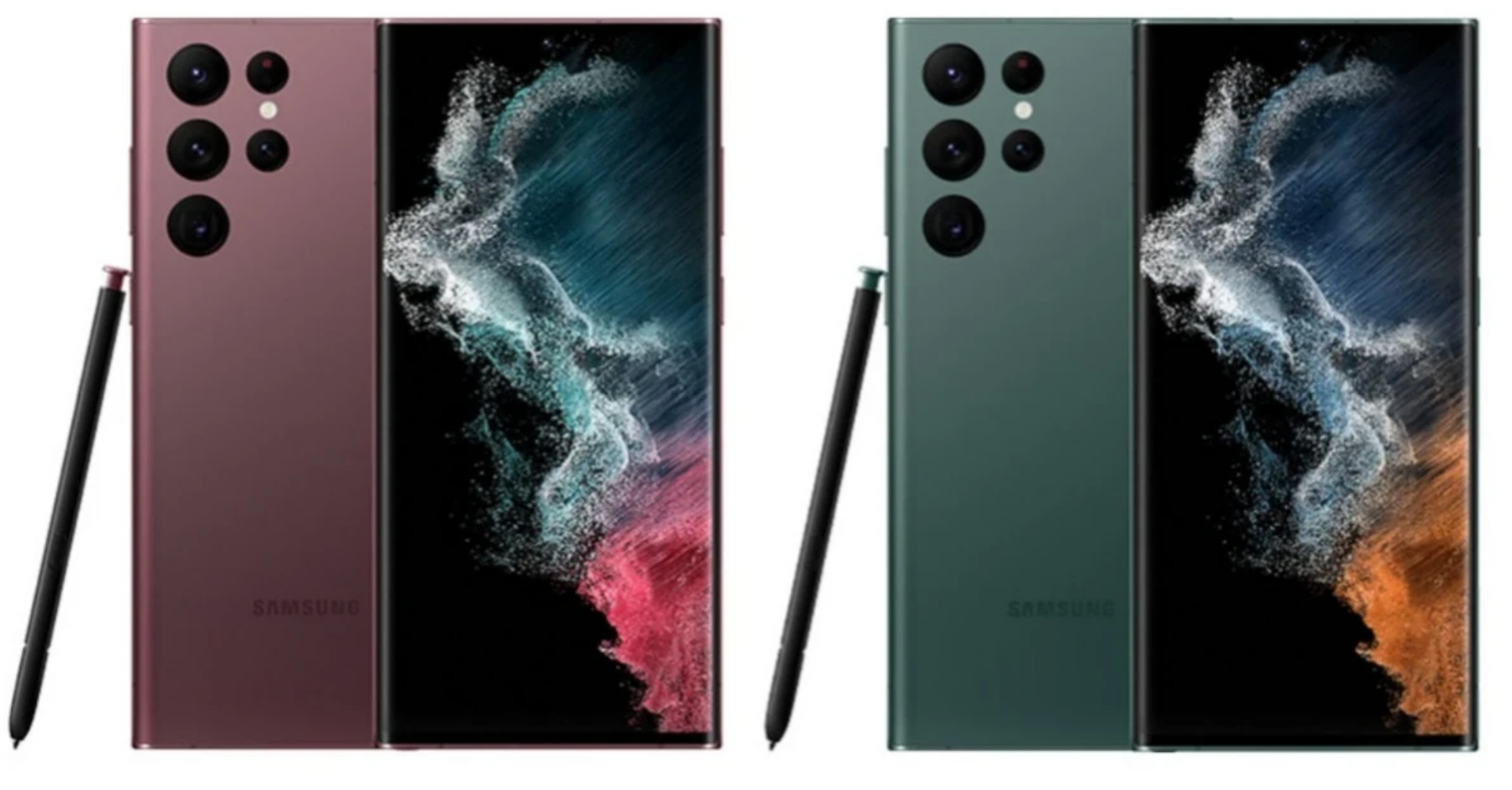
Samsung has been working on the next generation Galaxy S-series flagship smartphones including the Galaxy S22, the Galaxy S22 Plus, and the Galaxy S22 Ultra (Galaxy S22 Note). These devices are rumored to launch in February 2022 after the rumored launch of the much-delayed Galaxy S21 FE at CES 2022.
Now, tipster Yogesh Brar has revealed on Twitter, what could be the first visuals of the upcoming Galaxy S22 lineup via dummy models.
Samsung Galaxy S22 Lineup
1 of 2
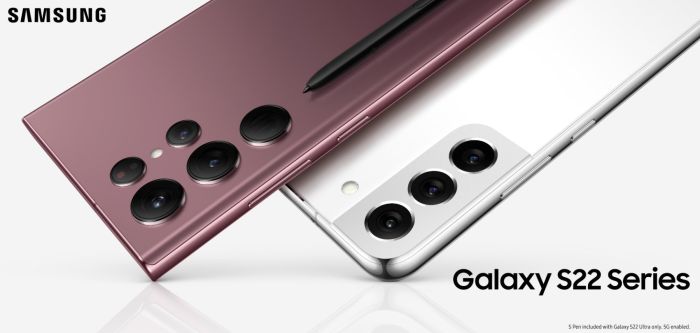
The dummy models showcase the phones in two color variants, black and white. The Samsung Galaxy S22 and S22 Plus back panels follow their predecessors’ design profile to a T with a triple camera module placed in the top left corner of the device in a verticle alignment and an LED flash placed beside the primary camera.
The Samsung Galaxy S22 Ultra is different, opting for a more boxy look akin to the Samsung Galaxy Note 10. The device also features a similar but different camera setup compared to the S21 Ultra. Instead of the quad-cameras being surrounded by the camera module, the lenses appear to protrude out of the flat body. The laser autofocus and LED flash are placed above the telephoto camera, similar to the S21 Ultra. Additionally, the device appears to have rounded edges, hinting at a curved display.
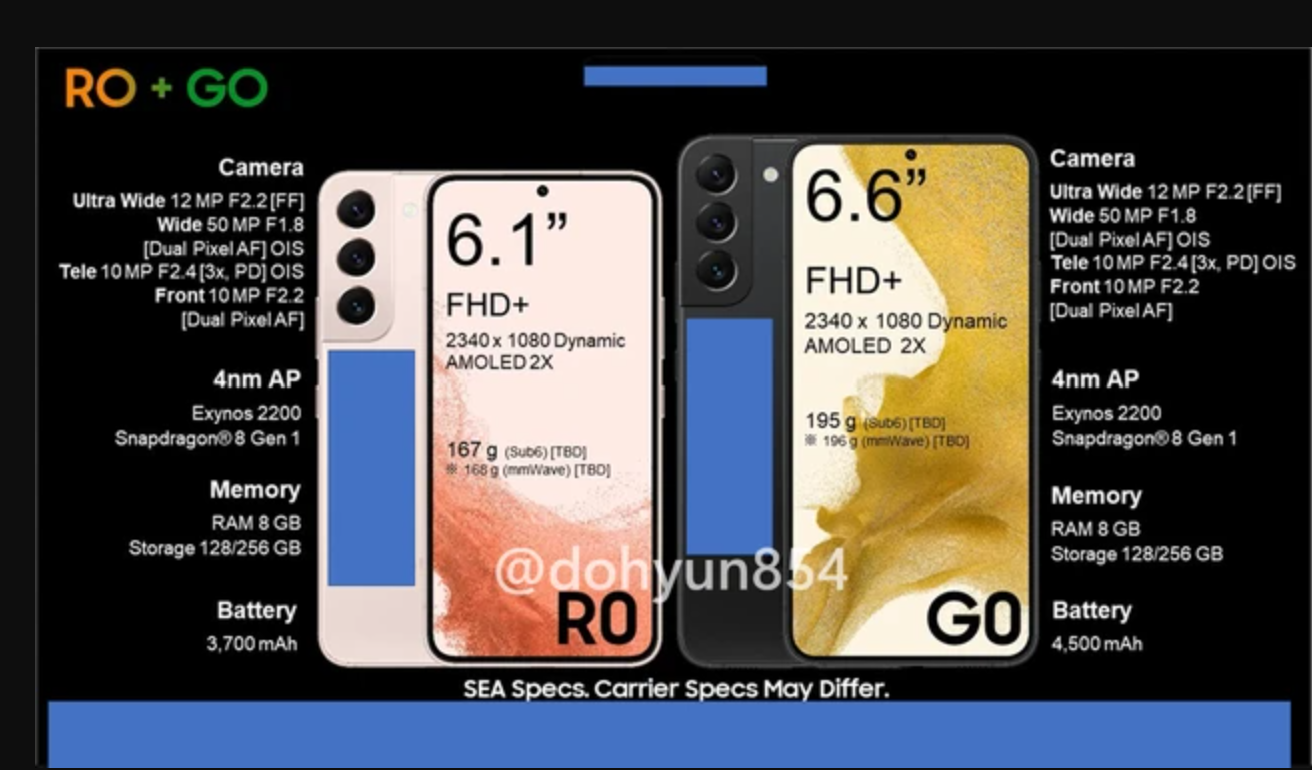
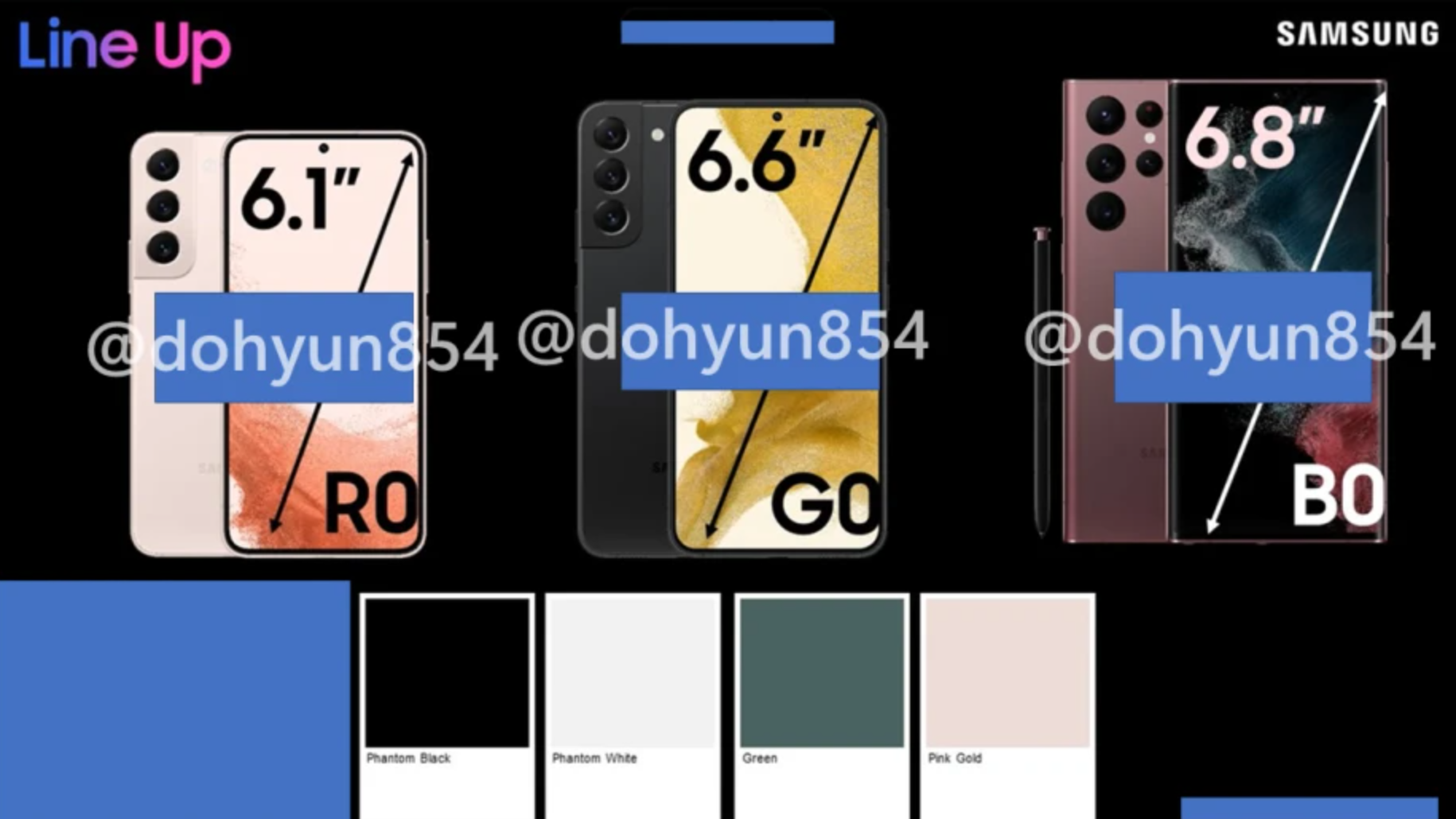
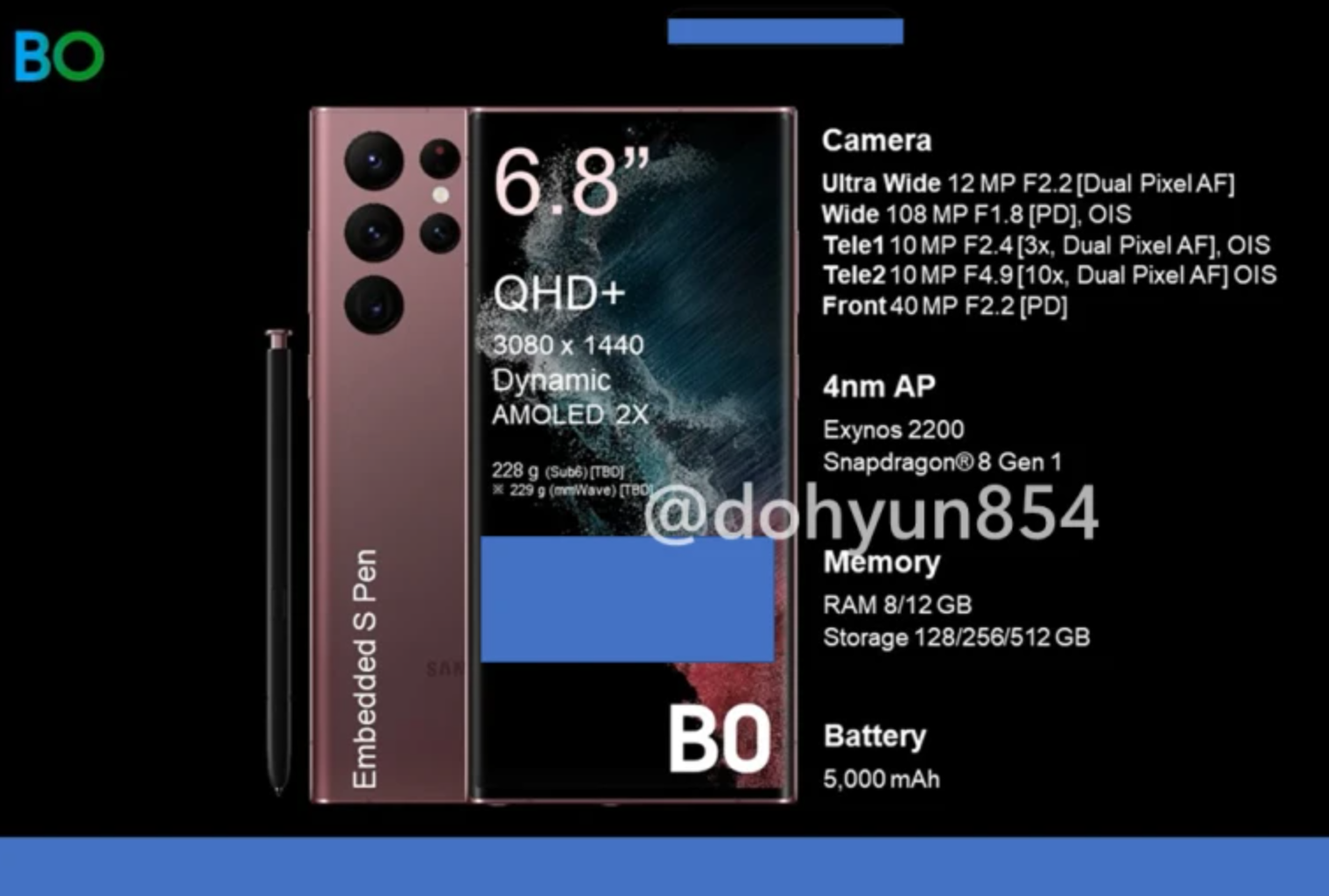
All three models can be observed with the Samsung branding on the lower center. The devices can be observed to differ a lot in size giving credence to previous rumors that suggest the Galaxy S22 and S22 Plus will feature smaller size displays at 6.06-inch and 6.55-inch, respectively. The Galaxy S22 Ultra is rumored to feature a 6.8-inch screen accompanied by a Stylus which will be housed inside the device.
The Samsung Galaxy S22 and S22 Plus models are expected to feature 8GB RAM and storage options of 128GB and 256GB. However, the Samsung Galaxy S22 Ultra variant will come with two RAM configurations of 12GB paired with 128/256GB storage and 16GB paired with 512GB. All three Galaxy S22 series devices are expected to come with the Snapdragon 8 Gen 1 SoCs and Samsung’s own Exynos 2200 SoC. And the device is rumored to come in four color variants so far namely Black, White, Red, and Olive.
Samsung is yet to reveal any official details or a launch timeline for the Galaxy S22 series, but rumors are afloat of an early February launch. So stick around as we expect more leaks to surface as we get closer to the launch event.
Motorola recently launched a lot of budget phones and even new flagships: its portfolio in the mobile sector is completely renewed and you have a lot of choices to evaluate if you are looking for a new affordable phone. If we talk about the G series which is the midrange lineup, the most affordable last-generation handset is the new Motorola Moto G31, packing sufficient specifications for everyone. This is a comparison between Moto G31 and two other excellent handsets sold with similar price tags: Redmi Note 10 and Samsung Galaxy F22.
Xiaomi Redmi Note 10 vs Motorola Moto G31 vs Samsung Galaxy F22
Xiaomi Redmi Note 10
Motorola Moto G31
Samsung Galaxy F22
DIMENSIONS AND WEIGHT
160.5 x 74.5 x 8.3 mm, 179 grams
161.9 x 73.9 x 8.6 mm, 181 grams
160 x 74 x 9.4 mm, 203 grams
DISPLAY
6.43 inches, 1080 x 2400p (Full HD+), Super AMOLED
I personally prefer the design of the Motorola Moto G31 because it has smaller dimensions, a minimalistic camera module, and a punch-hole display. But the Redmi Note 10 seems to offer a better build quality as it comes with the IP52 certification (it indicates that the phone is dust resistant and splash resistant) and the Gorilla Glass 3 protection by Corning for the display. Further, the Redmi Note 10 is thinner and packs a slightly wider display. I do not like the Samsung Galaxy F22 so much because of its waterdrop notch.
Display
My favorite displays belong to the Motorola Moto G31 and the Redmi Note 10: they both come with AMOLED technology and a Full HD+ resolution, as well as a good brightness. But the Redmi Note 10 has a slightly wider panel and a higher brightness (up to 1100 nits), so it wins this comparison. If it wasn’t for its low HD+ resolution (720 x 1600 pixels), I would choose the Samsung Galaxy F22 due to its 90 Hz refresh rate and the HDR certification, but having a Full HD+ resolution is better for most of the users. Despite all of these handsets coming with AMOLED displays, their fingerprint scanners are mounted at the side, on the power key.
Hardware/Software
If you need the highest performance, then go for the Redmi Note 10 without thinking twice. First of all, it has a better chipset: the Snapdragon 678 built at 11 nm and running at a max frequency of 2.2 GHz. The SoC is paired with up to 6 GB of RAM and up to 128 GB of native storage. Right after, we got the Samsung Galaxy F22 with an Helio G80 and the same memory configuration. The Motorola Moto G31 has a better Helio G85 chipset, but just 4 GB of RAM. All the phones in this comparison run Android 11.
Camera
You can get higher camera performance with the Motorola Moto G31 because it sports a better main camera: it is a more recent 50 MP sensor that is still placed in the affordable segment, but it is better than the 48 MP camera found on Redmi Note 10 and Samsung Galaxy F22. The secondary sensors are an ultrawide lens with a resolution of 8 MP and a 2 MP macro camera. Redmi Note 10 is better at video recording because it supports the 4K resolution.
Battery
The Samsung Galaxy F22 packs a bigger battery which, alongside the HD+ display, guarantees a longer battery life than Redmi Note 10 and Moto G31. But the Redmi Note 10 has the fastest charging technology (33W).
Xiaomi Redmi Note 10 vs Motorola Moto G31 vs Samsung Galaxy F22: Price
Redmi Note 10 is currently available in India at great street prices if compared to the Rs. 17,999 / $238 listing price. Samsung Galaxy F22 starts from Rs. 12,999 / $171, just like the Moto G31, but Redmi Note 10 goes close because it is an older device. The winner of this comparison is Redmi Note 10 because it offers a better chipset, stereo speakers, great build quality, faster charging. But you can get better camera performance with Moto G31 and a longer battery life with Galaxy F22.
Earlier this month, the upcoming iQOO Neo6 made it to the Google Play Console listing revealing its key specs and design. Now, ahead of any announcements, the device has appeared on the Geekbench portal flaunting its scores.
According to the Geekbench 5 results, the device scores 1072 single-core points and 3450 multi-core points. These scores are possible, thanks to the Qualcomm Snapdragon 888 SoC, which powers the device. Since it is an octa-core SoC, it has eight scores clocked at different clock speeds.
The first four cores are clocked at @1.80GHz, while the other three cores are clocked @2.42GHz, and the last core is clocked @2.84GHz. It has 12GB of RAM and runs on Android 11 under the hood.
In addition to this, the previous Play Console listing revealed that the device will have a punch-hole display. It will feature a Full-HD+ resolution and will have a thin-bezel design. The 3C listing for the same phone with the V2154A model number confirmed 66W fast charging support.
Apart from this, there’s still time until we have the phone in the market as the company is yet to launch its much-anticipated iQOO Neo5s. For starters, the iQOO Neo5s is scheduled to launch on December 20 and ahead of it today, news broke that it will come with a pressure-sensitive screen. This pressure-sensitive screen will be good for gaming since it is already marketed as a gaming device.
The iQOO Neo5s is expected to come with a 120Hz refresh rate display and have Snapdragon 888 SoC under the hood. The smartphone will feature a 16MP selfie lens and a 48MP triple rear camera system. It is also slated to have Optical Image Stabilization on its primary sensor.
iQOO may also launch a device dubbed iQOO Neo5SE at the same launch event as the Neo 5s. The Neo5SE was rumoured to come powered by Snapdragon 778G Plus mid-range SoC.
Realme’s lifestyle brand DIZO launched its smartwatch dubbed DIZO Watch 2 and Watch 2 Pro back in September in India. Now, after a few months, the company is all set to bring more wearable options to the country. As per Mukul Sharma(via 91Mobiles), DIZO will launch two new smartwatches in the country called DIZO Watch 2 special sports and DIZO Watch R.
As the name suggests, the DIZO Watch 2 special sports edition is slated to be a sports model of the original Watch 2. However, we aren’t sure if it will bring any new features or design changes. We can expect a few added sports modes and a sporty look considering the moniker.
On the other hand, the DIZO Watch R is touted to be a completely new smartwatch series from the company. Although there’s no official confirmation, it is expected to be an affordable smartwatch in comparison to the Watch 2 series.
It isn’t clear if it will be a rebranded Realme smartwatch or a fresh device exclusive to the DIZO brand. Nonetheless, it will be interesting to see its design and features once DIZO spills some beans on the same in the near future.
DIZO Watch Pro
As far as the launch is concerned, both the DIZO Watch 2 special sports and Watch R are expected to launch next year in January-end.
In related news, the DIZO Watch 2 comes with a 1.69-inch TFT LCD display, while the Watch 2 Pro sports a 1.75-inch TFT LCD screen. The duo comes with features like a SpO2 sensor, heart-rate monitoring, sleep tracking, camera & music controls, and call & SMS alerts. The Watch 2 has 15 sports modes and a battery life of 10 days, whereas, the Watch 2 Pro has a whopping 90 sports modes and 14 days of battery life.
Motorola Edge S30 is now available for pre-order for $369 onlyat Giztop. Please note that Giztop is right now accepting only pre-orders and the actual shipment will start from 25 December 2021.
Motorola Edge S30 which was launched a couple of days back is now available for pre-order for all global customers at Giztop. The smartphone can be pre-ordered for $369 only. Please note that this price is applicable to the 6GB + 128GB variant. Other memory variants are also available at a slightly higher price.
For more information on such exciting deals and offers check out ourdeals hub.
The Chinese smartphone maker vivo launched the vivo V23e last month in Thailand and was rumored to launch the V23 series in India by the end of December, starting with the vivo v23, but new leaks reveal that there might be a change in vivo’s plans.
According to a new report by 91mobiles, industry sources have informed that the vivo V23 Pro will hit the Indian markets on January 4, 2022, or during the first week of January. Sources have also informed that the V23 Pro will come equipped with a 64-megapixel primary camera. The vanilla V23 is expected to follow along sometime later. The vivo V23 Pro , carrying the model number V2132.
Unfortunately, not much is known about the Vivo V23 Pro other than its model number, V2132, which was spotted on the IMEI database in September 2021. But, we can expect the vivo V23 Pro to be a significant upgrade over the vivo V23e 5G, which was launched in Thailand last month.
Vivo V23e
The vivo V23e features a 6.44-inch Full HD+ AMOLED display with 2400 x 1080 pixels screen resolution. Under the hood is a MediaTek Dimensity 810 processor, coupled with 8GB of RAM and 128GB of internal storage, which can be further expanded up to 1TB with a microSD card. There’s also an on-screen fingerprint sensor as an additional security measure. The device is powered by a 4,050mAh battery that comes with support for 44W fast charging technology.
The phone features a triple-camera setup on the back consisting of a 50-megapixel main sensor with f/1.8 aperture, an 8-megapixel wide-angle sensor with f/2.2 aperture, and a 2-megapixel sensor with f/2.4 aperture. The device has a 44-megapixel snapper on the front side for taking selfies and video calling.
With the year nearing an end, we expect more leaks of the upcoming vivo V23 and V23 Pro devices, so stay tuned as we will be reporting any notable developments.
Indian mobile phone company Lava recently made a foray into the smart wearable market with the launch of the Lava Probuds 2 TWS earbuds in August this year. The company has now launched a second wearable in India. The Lava Probuds N2 neckband headset was today unveiled with several features.
The Lava Probuds N2 earbuds uses a neckband design with each of the buds having magnetic locks. The neckband isn’t rigid bu flexible as it is manufactured from silicon. In terms of the hardware, the earbud features 10mm dynamic drivers that are said to be tuned for bass and supports Bluetooth 5.0. The earbuds also come with the IPX4 waterproof and dustproof certification, meaning it is water and sweat-resistant. The earbuds weighs about 25g.
In addition, the Lava neckband earbuds comes with call alert and the ability to connect two devices at the same time. It also crams a 110mAh battery which Lava says can last up to 120 hours on standby and 4 hours of playback time if it is charged for 20 minutes. A full charge is touted to deliver up to 12 hours of playback on a single charge.
The Lava Probuds N2 carries a decent price tag of Rs 1,199 (~$16) and is presently up for grabs on Lava e-store as well as its 100K+ PAN India stores, Flipkart, and Amazon.
A few days ago, we covered the leaked protective cases of the upcoming Xiaomi 12 line, including the Xiaomi 12, the 12 Pro, and the Xiaomi 12 Ultra. While the 12 & 12 Pro shared similar rear designs, the Xiaomi 12 Ultra left us wondering if the phone will indeed follow the massive and complex rear camera module design revealed by the case. Now, we have the answer to your questions.
We have acquired exclusive images of the Xiaomi 12 Ultra’s case through our industry sources, which reveal the same design featured in earlier leaks. Our sources have also revealed that this design for the upcoming device is confirmed.
So what will fill the eight cutouts of the rear camera module revealed by the case? Well, first, it appears that the phone will not feature a secondary display panel that was present in its predecessor, the Xiaomi 11 Ultra. Additionally, previous leaks have suggested that the phone might feature a quad-camera setup with a 50-megapixel Samsung GN5 primary sensor that will fill up the massive center cutout. The other three cameras were tipped to be a 48-megapixel camera with 2x zoom, a 48-megapixel camera with 5x zoom, and another 48-megapixel camera with 10x zoom.
While other leaks suggest that Xiaomi 12 Ultra might feature Leictha’s technology since Leica‘s partnership with Huaweiended earlier this year. The other four cutouts are expected to be filled by an LED flash, a noise-canceling mic, and other sensors.
Other than the camera module, the cases reveal that the Xiaomi 12 Ultra will feature the power button and volume rocker on the right side, a USB-C, speaker grill, and mic at the bottom, along with another speaker grill at the top.
The Xiaomi 12 Ultra is all but confirmed to feature Qualcomm’s latest Snapdragon 8 Gen 1 Soc and may also feature a 120Hz OLED display with an ultrasonic fingerprint sensor, a 4500mAh battery, and 120W fast charging support.
Apart from this, not much is known about the upcoming device, but we expect to learn more in the coming days ahead of its official launch.
ADO bikes is giving out some incredible discounts and free gifts under their Christmas Sale 2021. The sale starts on 13 December 2021,00:00 and ends on 15 December 2021, at 23:59 PST. During the event, there is a 10% discount on all accessories across their website. Moreover, there are some amazing offers available on their premiere E-bikes. So let’s check out some of their best and interesting offers this holiday season.
*Alternatively, you can also buy this E-bike from Amazon.de where it usually retails for €999, at a discounted price of €849, from 16 December to 21 December 2021 only.
*Alternatively, you can also buy this E-bike from OTTO.de where it usually retails for €1119, at a discounted price of €1099, from 16 December to 21 December 2021 only.
Key Features:
Ergonomic and comfortable design for long rides
Gravity center structure handle
Dual-mode: Hybrid Drive and Pedal assist
Double Shock absorption
Shimano 7-speed transmission
500W high-speed motor gives you strong climbing ability
ADO creates powerful and stylish electric bikes, electric scooters, and accessories that can be your urban commute partner. Apart from urban commuting they also cater to the needs of cross country bikers, adventure enthusiasts, mountain climbers, campers, etc, and have specially designed bikes for different venues and needs. They are a fast-growing brand and this December have also joined Xiaomiyoupin and Alibaba’s Elite partner event.
Please note that the ADO Christmas Sale starts on 13 December 2021, 00:00 PST, and ends on 15 December 2021, 23:59 PST. So make sure to grab the best offers and free gifts before the deal expires.
For more information on such exciting deals and offers check out ourdeals hub.
After flagships, OPPO has now started recruiting ColorOS 12 beta testers for its mid-rangers and budget models. The latest devices to join the beta program are OPPO A73 5G and OPPO A95 5G. Let’s take a look at how interested users can try OPPO’s version of Android 12 on these smartphones.
OPPO A73 5G
OPPO is scheduled to kickstart ColorOS 12 beta initiative for OPPO A73 5G in Saudi Arabia and OPPO A95 5G in China on December 15. However, just like the previous phones, the beta registrations for this duo have also been opened ahead of the said date.
For the OPPO A73 5G, the registrations will last until December 10. Whereas, the registration window is longer for the OPPO A95 5G as it will only close on December 15.
In order to participate in the beta program, users should be running the following mentioned firmware version.
OPPO A73 5G – C.06
OPPO A95 5G – A.09
If they are, then they will have to navigate to Settings > Software Update > Gear Icon > Apply for Beta Version > Update Beta Version and follow on-screen instructions.
Selected applicants will start receiving the Android 12-based ColorOS 12 beta build via OTA within three days from the selection. If the participants don’t get selected, then they can try their luck during the next batches. In China, candidates also have an option to increase their chance of selection by filling a questionnaire.
As of now, there’s no official word on when these handsets will receive the ColorOS 12 stable update.
An independent licensing administrator, Access Advance, has just recently announced that Vivo Mobile Communication has officially joined the HEVC Advanced Patent Pool, which will enable the smartphone maker to gain access to more than 16,000 patents.
The announcement was made by Access Advance earlier this month. Now, Vivo will also have access to a large number of patents based on the HEVC/H.265 video codec standard. Access Advance CEO Peter Moller stated that “We are very pleased that Vivo has chosen to join our HEVC Advance program. Vivo’s joining is another important endorsement by a major smartphone manufacturer and brand, further demonstrating the value of our HEVC pool license.”
He further added that the company is the latest to join their HEVC Advance program, which is already licensing a large majority of brands within the smartphone market. This includes reputable smartphone manufacturers like Samsung, Huawei, OPPO, with new additions being Vivo and recently even ZTE. Peter Moller also said that “We thank Vivo and all our Licensees and Licensors for their support and expect to have further significant announcements soon.”
For those unaware, Access Advance licenses its technology and patents to a number of firms across various fields. It was formed as an independent licensing entity that will lead the development, administration, and management of patent pools for licensing essential patents of the most important standards based video codec technologies that is currently being used across the globe. Meaning, Vivo has also gained accessed to new technologies that will likely help in its smartphone operations.
Xiaomi has started rolling out MIUI 12.5 Enhanced Edition update for three more devices. The first one is the POCO F3 GT, which was released at the end of July 2021. The second and third models are Mi Note 10 and Mi Note 10 Pro respectively. This duo made its debut in November 2019.
POCO F3 GT
The POCO F3 GT is nothing but a rebranded Redmi K40 Gaming Edition. Since the original Chinese handset received the latest version of MIUI in China recently, it was obvious for the rebadged Indian version to get the update as well.
On the other hand, the Mi Note 10 and the Mi Note 10 Pro are basically the same phones with the only difference being their camera lens. Hence, they run a common MIUI build and are receiving the new update together.
They are known as Mi CC9 Pro and Mi CC9 Pro Premium Edition in China. Currently, only the Indonesian variant has got access to the fresh version of MIUI.
The latest system update for the aforementioned Xiaomi group smartphones arrives with the following build number.
The successor to the Nvidia GeForce MX450 mobile GPU has just been spotted on a benchmarking platform. The GeForce MX550 is the next gen entry level mobile GPU from the company, which apparently beats its predecessor by a 15 percent margin.
The upcoming graphics card was spotted on known benchmarking platform Geekbench and was first reported by ITHome (Via NotebookCheck). The original report talks about an unidentified Nvidia graphics card that features 2GB of VRAM, which is equipped on a Lenovo laptop that also sports the Alder Lake 12 core 16 thread Intel i7-1260P processor. This yet to be officially released GPU scored 39000 points in Geekbench’s OpenCL benchmark that puts it at a 15 percent lead over the MX450.
Interestingly, the benchmarks also showcases that this GPU is comparable to the mobile GeForce GTX 1050 Ti graphics card. Other notable aspects include a GA107 architecture, which is the same that powers the GeForce RTX 3050, and 2GB of VRAM. Although, this begs the question on whether or not Team Green plans on allowing Ray Tracing on such an entry level card. Although, it would seem more practical if the company enables its DLSS (Deep Learning Super Sampling) technology that will better allow notebooks to offer a smoother gaming experience on current gen titles.
A new report has just revealed the market share of brands for the global smartphone shipments for the third quarter of this year. This information has shared that Samsung Electronics is still in the lead.
According to a Counterpoint Research report, the global smartphone market grew by 6 percent quarter on quarter but saw a modest decline of 6 percent year on year. During Q3 2021, the market shipped a total of 342 million units, which is down from 265.5 million from last year. However, the South Korean tech giant managed to retain its spot on the throne with a sizeable 20 percent market share during this quarter, shipping 69.3 million units.
Meanwhile, Apple came in second with a market share of 14 percent. The Cupertino based company shipped around 48 million units during this time, marking a notable 15 percent growth over the same period last year. Counterpoint credits this growth to the “persistent” growth of the iPhone 12 series and the launch of the latest iPhone 13 series. Similarly, Xiaomi followed close behind with a 13 percent market share in Q3 2021.
Galaxy Z Flip3
Although, its shipments dropped by 5 percent year on year and 15 percent quarter on quarter, hitting 44.4 million units in the third quarter of this year. The company saw the slight fall likely due to the ongoing component shortage and supply issues. On the other hand, Realme saw its highest ever shipments in Q3 2021, shipping 16.2 million units. This marked a record quarterly performance that arrived despite the globe suffering from a lack of semiconductors.
India lifestyle brand boAt has launched yet another fitness tracker disguised as a smartwatch. The company calls it boAt Watch Mercury. Let’s take a look at what this new wearable has to offer.
The newly launched boAt Watch Mercury sports a 1.54-inch square-shaped LCD screen with a resolution of 240 x 240 pixels. The brand offers over 100 watch faces for users to try out.
The main highlight of this wearable is the presence of a temperature sensor. This helps wearers to measure their body temperature. Since the watch also supports real-time monitoring, it can notify users when there’s a rise in body temperature. However, boAt recommends not to use its product as a medical device.
Further, like any other fitness tracker, this one also has a heart-rate sensor. It supports 11 sports modes like running, walking, cycling, climbing, treadmill, swimming, yoga, spinning, basketball, football, and badminton.
Other features of the smartwatch include camera shutter control, music control, call & message alerts, app notifications, and IP68 dust and water resistance. As far as endurance is concerned, the brand claims a 10-day battery life, and the wearable charges via a magnetic charger.
The boAt Watch Mercury is priced at ₹1,999 ($26) in India. Customers can pick it up in either beige, black, blue, or green-colored strap options. It will go on sale starting at 12 PM on December 15 via Flipkart.
We use cookies on our website to give you the most relevant experience by remembering your preferences and repeat visits. By clicking “Accept”, you consent to the use of ALL the cookies.
This website uses cookies to improve your experience while you navigate through the website. Out of these, the cookies that are categorized as necessary are stored on your browser as they are essential for the working of basic functionalities of the website. We also use third-party cookies that help us analyze and understand how you use this website. These cookies will be stored in your browser only with your consent. You also have the option to opt-out of these cookies. But opting out of some of these cookies may affect your browsing experience.
Necessary cookies are absolutely essential for the website to function properly. This category only includes cookies that ensures basic functionalities and security features of the website. These cookies do not store any personal information.
Any cookies that may not be particularly necessary for the website to function and is used specifically to collect user personal data via analytics, ads, other embedded contents are termed as non-necessary cookies. It is mandatory to procure user consent prior to running these cookies on your website.