The OnePlus Nord 5 will be among the latest entries in the brand’s popular Nord series. This will be an upper mid-range smartphone, packing some impressive specs and upgrades over its predecessor. From teasers to leaks, here’s a quick roundup where we break down all the key details surrounding the upcoming phone.
The Chinese brand’s new Nord 5 is basically a rebranded global version of the Ace 5 Ultra Edition. While there are slight differences in terms of specifications, the overall design is identical. So you get a flat front display and a flat rear panel with rounded corners. The back also has a vertically stacked dual camera setup in an oval shaped module. OnePlus released the Ace 5 Ultra with an IP65 rating for water and dust resistance, and the Nord 5 likely offers similar protection.
This model may launch in India in White and Black color options. The display specs of the next-gen Nord are still unknown, but it might be the same as the Ace 5 Ultra as well. OnePlus launched the Ace 5 Ultra with a tall 6.83-inch AMOLED display with a 1.5K resolution, a 144Hz refresh rate, 1400 nits of peak brightness, and 3840Hz PWM dimming.
2. Specifications
Unfortunately, the Nord 5 was just teased with the Qualcomm Snapdragon 8s Gen 3 SoC, making it the first Nord model with a Snapdragon 8 series processor. This is a downgrade over the Ace 5 Ultra that was announced with MediaTek’s latest and greatest Dimensity 9400+ SoC. It is expected to pack a huge battery, which could have a 6,550Ah capacity. The device may support 80W wired fast charging as well.
This processor also enables it to run Call of Duty Mobile and BGMI at 144fps via frame interpolation. The chip is rumored to be paired with at least 8GB of RAM (12GB top model) and a starting storage option of 256GB. Keeping these beefy specs cool is a large 7300 mm² VC cooling mechanism. Other notable features likely include an optical in-display fingerprint scanner, stereo speakers, Bluetooth 5.3, Android 15 OS based OxygenOS 15 custom skin out of the box, and an infrared sensor.
3. Camera
Once again, the camera hardware details have yet to be confirmed. We can assume that the specs are the same as the Ace 5 Ultra. So the rear could have a 50MP primary camera and an 8MP ultra wide angle lens, while the front houses a 16MP shooter for selfies and video calls.
4. Launch Date
OnePlus just confirmed the official launch date of the Nord 5, Nord CE 5, and the OnePlus Buds 4. These products will be debuting globally in the Indian market on 8th July 2025 at 2PM IST. Availability details have yet to be confirmed but the teaser did reveal a lifetime warranty for the display. This is likely related to the infamous green issue that plagued previous OnePlus phones. Thanks to these specs and its expected competitive pricing, the Nord 5 is set to be the most powerful Nord series smartphone.
For more daily updates, please visit our News Section.
Announced in April, the Snapdragon 8s Gen 4 is a high-end premium chipset from Qualcomm that offers excellent performance and efficiency. It features a high-performance octa-core CPU that operates at up to 3.2GHz and a capable Adreno 825 GPU, ensuring smooth graphics performance.
On the other hand, the Dimensity 8400 Ultra is a mid-range announced back in December 2024. It also features a capable CPU and GPU that operate at a higher speed than the Snapdragon 8s Gen 4. However, there’s much more beneath the surface, which we will uncover in this detailed comparison. How do these two chipsets stack up against each other? Which offers the better performance and features? Let’s break it down.
Let’s begin with a spec sheet:
Snapdragon 8s Gen 4
Dimensity 8400 Ultra
Announced
April 2025
December 2024
Manufacturing
4nm (TSMC)
4nm (TSMC)
CPU
1 x 3.21 GHz — Cortex-X3 3 x 3 GHz — Cortex-A720 2 x 2.8 GHz — Cortex-A720 2 x 2.02 GHz — Cortex-A720
1 x 3.25 GHz — Cortex-A725 3 x 3 GHz — Cortex-A725 4 x 2.1 GHz — Cortex-A725
GPU
Adreno 825 GPU Ray tracing support Snapdragon Elite Gaming features
Mali-G720 MP7 Ray tracing support MediaTek HyperEngine features
NPU
Qualcomm Hexagon NPU
MediaTek NPU 880
Storage/Memory
UFS 4.0 LPDDR5x, up to 4.8GHz
UFS 4 + MCQ LPDDR5x, up tp 8533Mbps
Camera
Spectra triple 18-bit AI ISP Up to 320MP single camera Semantic segmentation support Up to 4K/60fps video recording
Imagiq 1080 ISP Up to 320MP single camera Semantic segmentation support Up to 4K/60fps video recording
MediaTek 5G modem Peak speed: 5.17Gbps Wi-Fi 6E Bluetooth 5.4
Snapdragon 8s Gen 4 vs Dimensity 8400 Ultra: Benchmark battle
Note: The following benchmark tests were conducted on the Redmi Turbo 4 Pro (powered by Qualcomm Snapdragon 8s Gen 4) and Poco X7 Pro (powered by MediaTek Dimensity 8400 Ultra).
AnTuTu comparison
SD 8s Gen 4
D8400 Ultra
AnTuTu score
2,050,881
1,590,202
CPU
460,339
370,994
GPU
852,942
567,384
Memory
410,236
329,331
UX
327,364
322,493
In the AnTuTu benchmark comparison, the Snapdragon 8s Gen 4 clearly outperforms the Dimensity 8400 Ultra with a total score of 2,050,881 — roughly 29% higher than the 8400 Ultra’s 1,590,202. This advantage is consistent across every test category.
The Snapdragon chip delivers 24% better CPU performance (460,339 vs 370,994), making it more capable in handling demanding tasks and multitasking. Its GPU score is also significantly higher — 852,942 vs 567,384 — marking a 50% improvement in graphics performance. Additionally, the 8s Gen 4 leads in both memory (410,236 vs 329,331) and UX (327,364 vs 322,493), although the UX difference is marginal. Overall, the Snapdragon 8s Gen 4 stands out as the more powerful and well-rounded performer in synthetic benchmarks.
Geekbench comparison
SD 8s Gen 4
D8400 Ultra
Single core
2,041
1,579
Multi core
6,833
6,238
The Snapdragon 8s Gen 4 shows a decisive performance lead over the Dimensity 8400 Ultra. It scores 2,041 in the single-core test — about 29% higher than the Dimensity chip’s 1,579. This means improved responsiveness in tasks such as app launches, UI navigation, and light multitasking.
In multi-core performance, the Snapdragon 8s Gen 4 also maintains an edge with a score of 6,833, outperforming the Dimensity 8400 Ultra’s 6,238 by nearly 10%. This gives it an advantage in handling heavier workloads, such as multitasking and gaming. Overall, the Snapdragon chip proves to be stronger across the board in raw CPU power.
Snapdragon 8s Gen 4 vs Dimensity 8400 Ultra: key differences that matter
Performance
The Snapdragon 8s Gen 4 and Dimensity 8400 Ultra utilize TSMC’s 4nm process node and the same ARMv9.2-A instruction set, but they have distinct CPU architectures. The 8s Gen 4 features one Cortex-X4 core and seven Cortex-A720 cores. In contrast, the Dimensity 8400 Ultra features all Cortex-A725 cores.
The Cortex-X4 is significantly more powerful than Cortex-A720 and is designed to handle demanding tasks. In contrast, the Cortex-A725 is better optimized for efficiency and sustained performance rather than peak speed. That’s why the Snapdragon 8s Gen 4 achieves higher scores on benchmarks.
For graphics, the Snapdragon 8s Gen 4 features Adreno 825, while the Dimensity chip utilizes Mali-G720 MP7 GPU. While the latter has a slightly higher peak frequency, the Adreno 825 features higher shading units, total shaders, and FLOPS, which are crucial for gaming performance. The result is better GPU performance on the Snapdragon chip.
Both chips also feature NPUs with support for various LLMs, enabling on-device intelligence. The AI also works with the camera for fine-tuning images.
Camera
The Snapdragon 8s Gen 4 features a Spectra 18-bit Triple AI ISP with support for up to 320MP camera. With zero shutter lag, it supports up to 108MP single-camera or 36MP triple-camera setups. The chip also supports real-time semantic segmentation in photos and videos with up to 250 layers. Additionally, the chip offers a range of camera features, including AI-based auto-exposure, low-light capture, Truepic photo capture, Video super resolution, and Bokeh Engine.
The Dimensity 8400 Ultra has an Imagiq 1080 ISP with support for 320MP (maximum resolution). It can record HDR videos throughout the entire zoom range. The chip allows up to 4K video recording, similar to the Snapdragon 8s Gen 4.
Connectivity
The Snapdragon 8s Gen 4 has an integrated 5G modem with a maximum download speed of 4.2Gbps. On a Wi-Fi 7 connection, the maximum speed can reach up to 5.8Gbps.
The Dimensity 8400 Ultra has a slightly lower peak connection speed of 5.17 Gbps. The Wi-Fi and Bluetooth standards are also slightly downgraded — Wi-Fi 6E (vs. Wi-Fi 7) and Bluetooth 5.4 (vs. 6.0).
Snapdragon 8s Gen 4 vs Dimensity 8400 Ultra: Conclusion
In conclusion, the Snapdragon 8s Gen 4 emerges as the more powerful and versatile chipset when compared to the Dimensity 8400 Ultra. It dominates across all major benchmark categories — CPU, GPU, memory, and UX — and consistently delivers better scores in both AnTuTu and Geekbench tests. With its inclusion of a high-performance Cortex-X4 core and the capable Adreno 825 GPU, the 8s Gen 4 excels in demanding tasks, gaming, and multitasking scenarios.
While the Dimensity 8400 Ultra holds its ground with solid efficiency and slightly higher clock speeds, it ultimately prioritizes sustained performance over peak power.
The Snapdragon 8s Gen 4 also excels in connectivity, AI capabilities, and imaging features, making it a better fit for users who want a truly premium smartphone experience without going full flagship.
Anker has officially launched the S1 power bank in the Chinese market. The new model, which landed in the global market earlier this month, features a built-in retractable USB-C cable, 45W fast charging support, and a hidden display. It is available in black and white color options, priced at 299 yuan ($42).
Anker S1 Power Bank Specifications
The Anker S1 includes a 10,000mAh battery with a rated capacity of 5,800mAh. It features a compact design, measuring 81.5 x 50.5 x 36mm and weighing 235g. The body size is comparable to a small makeup case, making it easy to carry in a pocket or small bag.
Anker has equipped the power bank with its proprietary 4S InstaCord retractable cable system. The built-in 70cm USB-C cable can withstand more than 20,000 pulls and 20,000 swings, according to Anker’s durability tests. The cable supports up to 45W fast charging and retracts automatically when not in use.
In addition to the retractable cable, the S1 includes one USB-C port and one USB-A port. Both USB-C outputs support 45W power delivery, while the USB-A port supports up to 22.5W. When multiple ports are used at the same time, the total output is limited to 24W. The USB-C port also supports 30W fast input for recharging the power bank.
The front of the device hides a TFT display beneath the surface. The screen activates during charging to show real-time output power, remaining battery percentage, and internal temperature. The display adds functionality while keeping the design clean and minimal.
Anker has implemented a three-layer thermal management system in the S1. The system uses low-resistance MOSFETs, graphene thermal sheets, and aerogel insulation materials. This setup helps manage heat during high-speed charging and protects the battery’s health.
The power bank supports a wide range of devices, including iPhones, iPads, Android smartphones, laptops, Nintendo Switch, wireless earbuds, and smartwatches. Anker claims the S1 can charge an iPhone 16 Pro to 50% in just 27 minutes. For older Apple models or Lightning-based devices, a separate Lightning cable version is available.
Hisense has launched its new U7Q Mini-LED TV series in India. The lineup includes five screen sizes: 55″, 65″, 75″, 85″, and 100″. The starting price is ₹59,999, and the TVs are now available on Amazon, Flipkart, and in offline stores.
All models come with 4K resolution (3840×2160) and Mini-LED panels. They support Full Array Local Dimming, Quantum Dot Color, and QLED Color Billion+. The TVs also feature Filmmaker Mode, AI HDR Upscaler, AI Light Sensor, AI Smooth Motion, and AI Sports Mode.
HDR formats include HDR10, HDR10+, HLG, and Dolby Vision IQ. The 100″ model comes with the upgraded Hi-View AI Engine Pro, while the rest use the regular Hi-View AI Engine.
The TVs are also built for gaming. The 55″ to 85″ models support 144Hz Game Mode PRO with VRR and AMD FreeSync Premium. The 100″ model steps up to 165Hz Game Mode Ultra.
Audio is handled by a 2.1 channel setup with a built-in subwoofer. The 55″ to 85″ models have 40W output. The 100″ model has 50W output. Dolby Atmos is supported on all sizes.
Ports include 2 USB ports, 3 HDMI ports, 2 antenna ports, Ethernet, digital audio out, AV input, and a headphone jack.
The TVs run on VIDAA OS, with 8 years of software updates promised. Voice control is available through a remote, Alexa, VIDAA Voice, and Google Assistant. The TVs support 28 languages.
Smart home features include Apple HomeKit, AirPlay, ConnectLife, and Share to TV. A 2-year warranty is included.
Anker just launched a new pair of truly wireless earbuds, but these aren’t your average noise-canceling buds. The Soundcore Sleep A30 brings a new feature, which allows it to detect when you snore. This model has just been announced, so here’s its specs, pricing, and more. The latest announcement also arrives after the company launched the new Nano Power Bank 10K and Nano Power Bank 5K.
Anker Soundcore Sleep A30: What Does it Offer?
The Soundcore Sleep A30’s predecessor, which is the Sleep A20, came with features that helped users keep track of their sleep and even receive analytics. Thanks to its unique design, the Sleep A20 could even be worn by side sleepers. This makes it great for replacing the typical earplugs that people wear when sleeping. The new Sleep A30 model keeps this unique design to reduce pressure when sleeping on your side, but takes this sleep centric feature a step further.
Anker Soundcore Sleep A30 TWS Earbuds
It arrives with snore detection technology that can detect when you snore in your sleep. Anker claims that its latest earbuds can offer 93 percent snore detection accuracy. This is done in real-time, and the Soundcore Sleep A30 can even generate a masking sound tailored to the frequency, volume, and pattern of the snoring. Apart from this, the Anker Soundcore Sleep A30 arrives with features one would expect from modern TWS earbuds.
This includes Active Noise Cancellation (ANC) up to 30 decibels, with Anker claiming that the Sleep A30 is the “world’s first smart ANC sleep earbuds.” On a single full charge, the A30 can last for up to 9 hours with ANC enabled. The overall battery life can be bumped to 45 hours with the charging case. The known accessories maker has announced this model in Mist Green and Classic White with a 249.99 EUR/229 USD price tag. This model is currently listed for pre-orders with the full release set for September via Amazon and Soundcore’s official website.
For more daily updates, please visit our News Section.
Tecno is gearing up to launch a new budget smartphone from its Pova series. A fresh teaser has just been shared, showcasing a refreshing new design and confirming its imminent launch. So here’s everything you need to know about this new affordable phone.
Tecno Pova 7 India Launch Near
The smartphone maker has officially teased the upcoming Pova 7 for the Indian market. On the official Instagram account, the brand shared that the device is “coming soon”. The official teaser also showcases the Pova 7’s rear design, including its rear camera layout and an LED strip that surrounds the camera module. Looking at this design, it appears that there might be three image sensors on the back.
Tecno Pova 7 Teased to launch in India soon via Flipkart
This is a notable change from the Tecno Pova 6, which debuted with big batteries and a more industrial look. So it resembles the Nothing Phone (3a) series more than its predecessor. The Pova 6 Pro did feature RGB lighting, but it came with a more distinct and angular design. Another notable detail confirmed in the teaser is the Pova 7’s Flipkart availability. Unfortunately, this is all the information we have at the moment, but we can make some speculations based on its predecessor.
The Pova 7 could also offer high refresh rate displays, massive batteries, and MediaTek’s Dimensity chipsets (unconfirmed). This is all the information we have at the moment, so stick around for more as we will be covering any new leaks or teasers that should surface in the coming days.
For more daily updates, please visit our News Section.
Twopan has launched the Nano SSD, a tiny flash drive that features fingerprint encryption and USB-C connectivity. The company claims it is the world’s smallest fingerprint-secured SSD, designed to meet the needs of smartphone users, mobile creators, and professionals who want secure and portable storage.
Twopan Nano SSD Specifications
The Nano SSD measures 20×13×5mm and weighs just 5 grams. It comes with 512GB of storage and supports USB 3.1 Gen1 with read and write speeds of up to 450MB/s. It connects via USB-C and works with a wide range of devices, including iPhone 16, Android phones, iPads, MacBooks, Windows laptops, Steam Deck, PS5, and more.
The device includes built-in fingerprint recognition and can store up to 20 fingerprints. It allows users to unlock the drive with a single touch, without requiring any apps or software installation. Twopan highlights that this plug-and-play functionality offers a convenient solution for users seeking fast and secure access to their files.
The Nano SSD is built using an aluminum-plastic composite and carries an IP65 rating for dust and water resistance. Twopan says it can survive drops from up to 10 meters. The device is small enough to stay attached to a keychain and is compatible with phone cases up to 3mm thick.
It also supports direct 4K video recording on devices like the iPhone 16 Pro, allowing creators to bypass internal storage limits and work directly off the drive.
Pricing and Availability
Twopan is crowdfunding its Nano SSD on Indiegogo, offering the standard version at $78 during the campaign, down from its regular price of $119.99. It also comes in a Leather Case version priced at $129.99. Shipments are scheduled to begin by the end of June 2025.
OnePlus has finally revealed the launch date for its next-gen Nord series smartphones and premium TWS earbuds. The highly anticipated Nord 5, Nord CE 5, and OnePlus Buds 4 have just had their global launch confirmed, so here’s everything you need to know.
OnePlus Nord 5, Nord CE 5, OnePlus Buds 4 India Launch Date
In the official announcement, the Chinese brand has revealed that the Nord 5 will make its debut on 8th July 2025 at 2PM IST along with the Nord CE 5, and OnePlus Buds 4. To recall, the OnePlus Nord 5 is a rebranded version of the Ace 5 Ultra Edition. But while the Ace 5 Ultra packs MediaTek’s flagship Dimensity 9400+ SoC, the Nord 5 will pack a Snapdragon 8s Gen 3 chipset. OnePlus claims that this is its fastest Nord ever, which also packs the largest VC cooling and supports 144fps for BGMI and CODM (via frame interpolation).
OnePlus Nord 5, Nord CE 5, and OnePlus Buds 4 India Launch Set for July 8
On the other hand, the Nord CE 5 carries a more affordable price tag and is a rebranded global version of the Ace 5 Racing Edition. There will be some tweaks like the Dimensity 8350 SoC over the Dimensity 9400e chipset. The Nord 5 may house a massive 6,700mAh or 7,000mAh battery pack, but the Nord CE 5 could be powered by a larger 7,100mAh cell.
Lastly, the third product that will be launching next month is the OnePlus Buds 4. Teasers have confirmed features like near lossless sound and Dual DACs with 6mm tweeters and 11mm woofers. There is also support for LHDC 5.0, Hi Res audio, and 3D spatial audio. OnePlus will release these TWS earbuds in both Zen Green and Storm Gray color options.
For more daily updates, please visit our News Section.
Gigabyte has introduced a new high-end gaming monitor, the Aorus FO32U2, in the Chinese market. Listed at 6299 yuan (around $870) on JD.com, the monitor targets competitive gamers and creators looking for top-tier performance with QD-OLED visuals.
Gigabyte FO32U2 Monitor Specifications
The monitor uses a 31.5-inch 3840×2160 UHD QD-OLED panel, manufactured by Samsung Display. This second-generation QD-OLED panel delivers deeper blacks and more vibrant colors compared to standard OLED or IPS displays. It supports wide viewing angles with minimal color distortion and a static contrast ratio rated at 1.5 million to 1, which helps in displaying rich detail across dark and bright areas of the screen.
The FO32U2 supports a 240Hz refresh rate and offers a 0.03ms GtG response time, making it suitable for fast-paced gaming with minimal motion blur. It is certified for AMD FreeSync Premium Pro, which helps eliminate screen tearing and stuttering. The monitor also carries VESA DisplayHDR 400 and ClearMR 13000 certifications, ensuring smoother motion clarity and improved dynamic range for games and videos.
In terms of color accuracy, the monitor supports true 10-bit color and covers 99% of the DCI-P3 color gamut. This ensures precise and consistent color reproduction, making it a capable display not just for gaming but also for content creation. The peak brightness reaches 1000 nits, suitable for HDR playback and well-lit environments.
The monitor features AI-based OLED Care that manages pixel shifting and panel refresh cycles to minimize image retention and burn-in. It also offers tactical gaming tools, including customizable crosshairs, Black Equalizer 2.0, night vision mode, picture-in-picture (PIP) and picture-by-picture (PBP) modes, and a hardware monitoring dashboard. For controls, it includes a 5-axis joystick beneath the screen for easy OSD navigation and supports KVM switching, enabling control of two systems with a single keyboard and mouse.
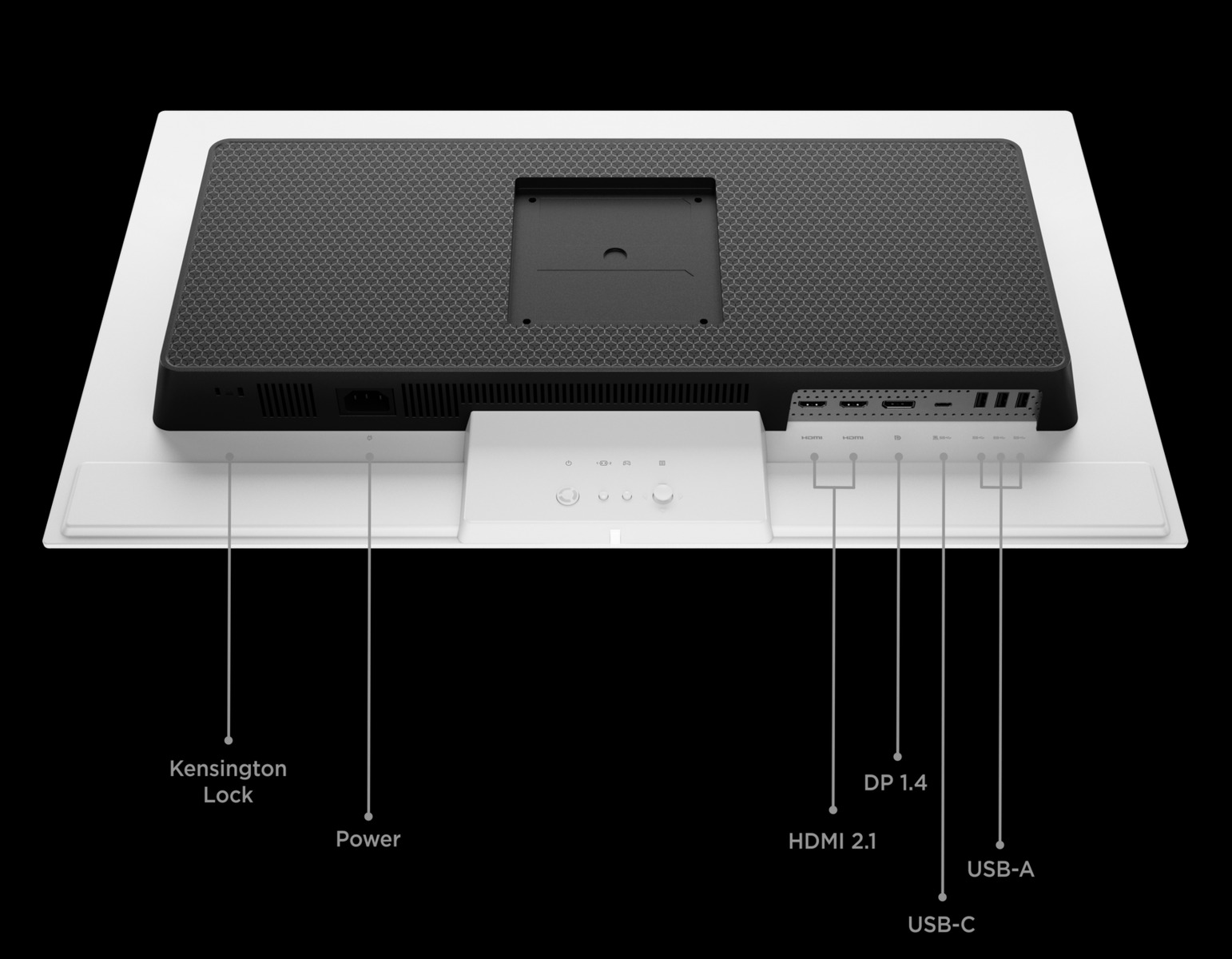
For connectivity, the FO32U2 includes two HDMI 2.1 ports, one DisplayPort 1.4, one USB-C port with 18W power delivery and DP Alt Mode, two USB-A 3.2 Gen1 ports, a USB-B upstream port, a 3.5mm headphone jack, and a mic input. The display also features dual 5W built-in speakers for basic audio output.
The stand is fully adjustable, supporting height adjustment up to 130mm, ±20° swivel, -5° to +20° tilt, and +90° pivot rotation. The monitor is also compatible with 100x100mm VESA wall mounts, giving users flexibility in their workspace setup.
In related news, the company also introduced a budget-friendly 2K QD-OLED gaming monitor recently with a 240Hz refresh rate and a rich set of features.
For more daily updates, please visit ourNews Section.
The stable version of Android 16 arrived a lot earlier than the usual timeline, and so should One UI 8. Samsung is actively working on it towards a quicker rollout, and it has also shown clear improvements in its communication strategy. The brand has already begun the One UI 8 beta program, and the stable release is not far behind.
With the stable release around the corner, you may want to find out if your Galaxy device is eligible for the One UI 8 upgrade, which is based on Android 16. This post is specifically geared towards Galaxy S-series fans. If you have a different Galaxy device, check out this post.
These Galaxy S-series phones are eligible for One UI 8 update
Samsung hasn’t announced which devices will be upgraded to the newest software, but it has a transparent update policy, which helped us prepare the following list.
Galaxy S25
Galaxy S25+
Galaxy S25 Ultra
Galaxy S25 Edge
Galaxy S24
Galaxy S24+
Galaxy S24 Ultra
Galaxy S24 FE
Galaxy S23
Galaxy S23+
Galaxy S23 Ultra
Galaxy S23 FE
Galaxy S22
Galaxy S22+
Galaxy S22 Ultra
Galaxy S21 FE
If your device is on the list, it is almost certain to receive the One UI 8 update when it becomes available. Other Galaxy S-series users will need to upgrade to a newer model to get the latest features and enhancements.
Samsung promises four generations of Android updates to the Galaxy S21 series, Galaxy S22 series, and Galaxy S23 series phones. With the Galaxy S24 series, the brand started offering a whopping seven years of Android updates, which also applies to the Galaxy S25 series and future S-series phones.
Just in case you’re wondering why the Galaxy S21 FE is on the list but not the regular models, that’s because the Galaxy S21, S21+, and S21 Ultra were released with Android 11, while the S21 FE arrived later with Android 12 out of the box. Hence, the FE model is also eligible for the One UI 8 treat.
Please Note: When you buy something using the links in our articles, we may earn a small commission at no cost to you.
When will Samsung start rolling out One UI 8?
Samsung hasn’t announced a release date for One UI 8. However, it has confirmed that the new version will begin rolling out to eligible devices “this summer.” That means anything between June and September.
While the exact One UI 8 release timeline remains under wraps, Samsung has confirmed that the Galaxy Z Fold 7 and Galaxy Z Flip 7 will be the first phones to run One UI 8, which could be released next month.
It’s clear that the One UI 8 will arrive much earlier than last year. But this isn’t very surprising, as Google has already released the stable version of Android 16, and it shouldn’t take more than a few weeks for other brands to release the update with their custom skins (such as One UI) on top. Secondly, this upgrade doesn’t bring significant changes like One UI 7. Instead, it focuses on improving the overall software experience.
While the stable release is at least a month away, you can get an early hands-on experience with the newest software through the One UI 8 beta program. The prerequisites are: you must have a Galaxy S25 model and that you’re living in a supported region (read more about it here).
ViewSonic has launched two new ultra-wide presentation displays in India—the CDE92UW and CDE105UW. These 5K enterprise-grade displays are designed to enhance collaboration, hybrid meetings, and digital signage in commercial and corporate spaces. Here’s a look at the key specifications of both monitors.
ViewSonic CDE92UW key specifications and features
ViewSonic CDE92UW
The ViewSonic CDE92UW features a massive 92-inch ultra-wide screen with 5K resolution and a 21:9 aspect ratio, offering 33% more screen space compared to conventional 16:9 displays. Designed for high-traffic environments like meeting rooms, control centers, and signage installations, it delivers vivid visuals with 500 nits brightness and a wide 178-degree viewing angle. An anti-glare finish helps maintain clarity under strong lighting.
Built to operate around the clock, the display supports both portrait and landscape orientations. It is powered by an octa-core processor running Android 13 and offers streamlined connectivity with USB-C (100W power delivery), HDMI 2.1, HDMI 2.0 out, DisplayPort, RJ45, and RS232 ports. The device includes ViewSonic Manager for remote scheduling and monitoring, as well as AirSync wireless screen casting. A slim 1.8 cm bezel adds to its modern appeal.
ViewSonic CDE105UW key specifications and features
ViewSonic CDE105UW
The larger CDE105UW is a 105-inch ultra-wide display optimized for Microsoft Teams Rooms with Front Row mode. It enables a more inclusive hybrid meeting layout by placing remote participants across the wide screen in a natural, seated-like arrangement.
This display supports portrait layout and daisy chaining for expansive digital signage or multi-display branding. It also runs Android 13 on an octa-core processor and features the same suite of connectivity options as the CDE92UW. Centralized management via ViewSonic Manager and AirSync wireless sharing comes pre-installed for IT-friendly integration.
The POCO F7 has been making the rounds online over the last couple of weeks. We’ve seen leaks that revealed its design and hardware, but the latest reveal might have confirmed its official launch date. The anticipated device could be dropping later this month, so here’s what we know.
POCO F7 Debuts in Indonesia on June 25
The launch details were shared by known tipster Abhishek Yadav. In his latest tweet, he claimed that the POCO F7 will make its global debut in Indonesia on 25th June 2025, with a screenshot of Shopee confirming the same. The tipster believes that the Indian release could also be on the same date. If this is true, then we might get an official launch next week. To recall, the upcoming POCO F7 will release with cutting edge specs and features with a relatively more affordable price tag.
POCO F7
In our recent report, we covered a leak that revealed that it is equipped with Qualcomm’s new Snapdragon 8s Gen 4 SoC. It sports a tall 6.83-inch AMOLED display with a 1.5K resolution, a 120Hz refresh rate, 3840Hz PWM dimming, 480Hz touch sampling rate, and 3200 nits of peak brightness. For optics, the rear has a 50MP Sony IMX882 primary sensor and an 8MP ultra wide angle lens. Meanwhile, the front houses a 20MP shooter for selfies and video calls.
A massive 6,500mAh battery pack could power this model, while the Indian version could house a larger 7,550mAh cell. But fast charging is expected to remain the same with 90W wired fast charging support. Leaked renders also showcased its new design in black and white variants. Other notable features include an IP68 rating for water and dust resistance, Android 15 OS based HyperOS 2.0, Wi-Fi 7, and an in-display optical fingerprint scanner.
For more daily updates, please visit our News Section.
For the past few days, Vivo has been teasing the key features of the Vivo X Fold 5 before its launch in China. While it has revealed several details, it is yet to confirm the chipset that will power the device. In a new development, a new Vivo phone with the Snapdragon 8 Gen 3 chip has appeared on Geekbench. It is speculated that this device could be the upcoming Vivo X Fold 5.
Vivo X Fold 5 Geekbench listing
Vivo X Fold 5 GeekbenchVivo X Fold 5 Geekbench source code
The alleged Vivo X Fold 5 bearing the model number V2436A has emerged in Geekbench’s database. The CPU and GPU (via source code) details confirm that the device is equipped with the Snapdragon 8 Gen 3 chipset. The same chip powered the China-exclusive Vivo X Fold 3, which debuted last year.
While competing models such as the Oppo Find N5 and the upcoming Honor Magic V5 pack the latest Snapdragon 8 Elite chipset, Vivo has decided to use the older Snapdragon 8 Gen 3 chip to power the X Fold 5, probably to make it available at a more affordable price.
The Geekbench listing has further revealed that the Vivo X Fold 5 is equipped with 16GB RAM and Android 15. In the single-core and multi-core tests, the device achieved 2,270 and 6,913 points, respectively.
Vivo X Fold 5 launch date
Set to launch on June 25 in China, the Vivo X Fold 5 is confirmed to feature a massive 6,000mAh battery and still measure only 4.3mm in the unfolded state. It will arrive in three shades: Pine Green, White, and Titanium. It will be an IP59+ device and will be durable enough to function normally at minus 20 degrees Celsius.
For photography, the device will feature a 50-megapixel periscope telephoto camera that will support long-range zoom and telephoto macro shots. Vivo claims the X Fold 5 is the first Android phone to connect seamlessly with Apple Watch, AirPods, iPhone calls, messages, and iCloud services. It also supports multi-device file transfer and productivity workflows with Mac, creating a highly connected environment for hybrid users.
For more daily updates, please visit our News Section.
Samsung has yet to unveil its 7th-generation foldables, but the Galaxy S26 series—expected to launch in January next year—has already entered the rumor mill. This time, it’s about software.
After a delay with One UI 7, Samsung reportedly skipped One UI 7.1 for its upcoming foldables and jumped straight to One UI 8, which was originally expected to be a major part of January’s Unpacked event. With leaks suggesting minimal hardware changes for the S26 lineup, Samsung appears to be shifting its focus to software, once again.
Samsung Galaxy S26 Ultra mockup (modified image of S25 Ultra)
Galaxy S26 expected to launch with One UI 8.5, not One UI 8
Whispers of One UI 8.5, the software set to power these 2026 flagships, suggest Samsung is cooking up something big. With development reportedly underway, could this mid-cycle update steal the spotlight from rivals like Apple’s iOS 26?
Samsung has quietly started firmware development for One UI 8.5, according to two trusted tipsters cited by SamMobile. Built on Android 16, One UI 8.5 follows One UI 8.0 and marks a return to Samsung’s older tradition of significant mid-cycle updates, like the x.5 versions seen up to One UI 2. Unlike recent years, where One UI 6.1 and 7.0 skipped major mid-cycle releases in favor of minor x.1.1 iterations, One UI 8.5 reportedly promises to be a substantial leap. Its existence was even hinted at in a hidden menu within One UI 7, fueling speculation.
While details on features remain under wraps, One UI 8.5 is expected to bring a polished user experience, potentially rivaling Apple’s design-heavy iOS 26. One UI 8.5 is said to be positioned as a “gap filler” to keep Galaxy devices competitive until the next major OS cycle. The update may also roll out to older devices, with the Galaxy S25 series likely getting the full suite of new features, while select enhancements could reach the S24, S23, and even S22 series.
Samsung’s early work on One UI 8.5 signals bold ambitions for the Galaxy S26 series, aiming to outshine competitors with a robust software experience. As Apple pushes iOS 26, will Samsung’s mid-cycle update give Galaxy users the edge in 2026? We’re eager to see what’s next.
Oppo has confirmed that it will announce the Oppo K13x 5G on June 23 in India. Ahead of the launch, its Flipkart landing page has been updated with several details about its specifications, variants, and price range. Here’s a look at the details confirmed by the brand.
Oppo K13x key specifications officially confirmed
Oppo K13x 5G launch date
As per the brand, the Oppo K13x 5G will be a durable smartphone equipped with an aerospace-grade AM04 aluminium alloy frame, Crystal Shield Glass protection for the display, and IP65-rated dust and water resistance. Additionally, it is certified by SGS Gold Drop Certification and MIL-STD 810H military standards.
The K13x will feature a 120Hz LCD screen that supports up to 1000 nits of brightness. With features like Splash Touch and Glove Touch, the screen will be usable with wet fingers or gloves. The device will run on ColorOS 15-based Android 15 and offer a wide range of AI-driven features, such as AI Eraser, AI Unblur, AI Reflection Remover, AI Clarity Enhancer, AI Summary, AI Recorder, AI Studio, and AI LinkBoost.
Oppo K13x 5G key features
Under the hood, the K13x will feature the Dimensity 6300 chip and a massive 6,000mAh battery with 45W charging. The device will be available in two options: 4GB RAM + 128GB storage and 6GB + 128GB storage. For photography, it will feature an 8-megapixel front camera and a 50-megapixel + 2-megapixel dual-camera setup.
The Oppo K13x will come in two shades: Midnight Violet and Sunset Peach. Oppo claims that it will be the toughest 5G phone under the Rs 15,000 price tag.
For more daily updates, please visit our News Section.
Xiaomi is gearing up to expand its tablet lineup from its Redmi sub-brand. A new compact flagship tablet is on its way, with a fresh teaser confirming the display size of the Redmi K Pad. We also get a look at its design in a refreshing new color, so let’s have a look.
Redmi K Pad Teased
Redmi K Pad
The Chinese tech giant’s upcoming tablet was just teased with the Redmi K Pad, with an 8.8-inch LCD display. This panel has a 3K resolution, a 16:10 aspect ratio, and a 165Hz refresh rate. While this isn’t particularly compact, a typical tablet usually has a larger screen. But recently, there has been a rise in tablets with display panels that are around 8 inches tall. Now, Xiaomi is the latest brand to offer such a model. The Redmi K Pad sports an 8.8-inch display on the front with noticeable bezel surrounding the screen.
Meanwhile, the rear has a single rear camera with an LED flash module. The previous teasers showcased the new tablet in a light green color option, while the latest teaser showcases this device in a light purple variant. A previous GeekBench listing showcases high end hardware, which is what makes this tablet a compact powerhouse. Under the hood, it is equipped with the MediaTek Dimensity 9400+ SoC, which is paired with 16GB of RAM. This model will also run on the Android 15 OS out of the box.
Thanks to the 3C and CMIIT certification, we also know that the Redmi K Pad will support 67W wired fast charging. An official launch date is still unclear, but a live broadcast set to be held on June 18 might reveal more details regarding the Redmi K Pad and the upcoming Redmi K80 Ultra.
For more daily updates, please visit our News Section.
OnePlus is reportedly getting ready to unveil the OnePlus 15 as its next flagship. Well-known Chinese tipster Digital Chat Station has revealed some key details about the phone, including a new imaging system. According to the source, the upcoming model will be the first OnePlus device to feature a self-developed imaging brand—marking a major shift in the company’s camera strategy.
OnePlus to debut its in-house imaging brand with OnePlus 15
As per the leak, the OnePlus 15 is rumored to be the company’s first smartphone to carry a self-branded imaging solution. This move mirrors the strategy of rival brands that have formed long-term partnerships or developed their own camera divisions to improve photo and video performance. The new system will reportedly make its debut alongside a revised rear camera layout, ditching the circular camera deco seen in previous generations.
The rear camera setup is expected to include three 50-megapixel cameras, consisting of a main camera, an ultra-wide lens, and a 3x periscope telephoto unit. This new shift suggests that OnePlus may finally ditch its long-standing Hasselblad partnership.
Apart from the imaging upgrade, the OnePlus 15 will feature a 6.78-inch flat display with 1.5K resolution. It will use LIPO screen packaging technology, which enables ultra-thin bezels and better display integration compared to older methods like COG and COF. Powering the device will be the Snapdragon 8 Elite 2 chipset, expected to be one of the most powerful Android SoCs this year. It may pack a 7,000mAh battery with 100W wired and 50W wireless charging support. It is also expected to feature other features, an ultrasonic in-screen fingerprint sensor and an IP68/69-rated body.
The phone is expected to launch in October, following the same timeline as last year’s OnePlus 13.
For more daily updates, please visit our News Section.
The Galaxy Unpacked event, set to showcase the Galaxy Z Fold7, Z Flip7, and new wearables, has been shrouded in mystery—until now. A recent Samsung press release might have just spilled the beans on the event’s date and location.
Samsung Galaxy Z Fold 7 teaser
Samsung’s Galaxy Unpacked 2025, expected to unveil the Galaxy Z Fold7, Z Flip7, Galaxy Watch 8, Galaxy Watch Ultra 2, and a budget-friendly Galaxy Z Flip7 FE, is slated for mid-July, but the company hasn’t officially confirmed the specifics. However, a press release spotted by SamMobile offers a tantalizing hint. Samsung announced a partnership with two major New York City running clubs, sponsoring events to showcase its Galaxy wearables, starting with the NYCRuns Queens Ice Cream Social 5K on July 13, 2025. This timing and location have led insiders to speculate that Unpacked could happen around the same day, likely in New York City, leveraging the running events to promote the Galaxy Watch 8 series.
The Galaxy Z Fold7 is rumored to be slimmer with a larger display and boast a 200MP main sensor, while the Z Flip7 is expected to sport a redesigned cover screen. The Z Flip7 FE, a first for Samsung’s Fan Edition foldables, could attract budget-conscious buyers with toned-down specs but the same clamshell charm. Speculations also suggest the event will highlight Gemini AI integration and One UI 8, based on Android 16, for the foldables. In fact, Samsung recently teased the book-style foldable, saying it now “gets what you’re looking at — and responds.”
For now, this announcement is a hint from Samsung at a July 13 event for the 7th generation foldables and new wearables. Confirmed dates are expected to be announced soon, so stick around.
Earlier this year, Realme unveiled the Narzo 80 series by launching handsets like the Narzo 80x 5G and Narzo 80 Pro 5G. The brand has now introduced the third model in the lineup by announcing the Narzo 80 Lite 5G, a new budget 5G offering designed to deliver smooth performance, reliable battery life, and a feature-rich display. Here’s a detailed look at the Realme Narzo 80 Lite 5G’s specifications, features, and everything it brings to the table.
Realme Narzo 80 Lite 5G specifications and features
Realme Narzo 80 Lite 5G
The Realme Narzo 80 Lite 5G is built around a 6.67-inch LCD screen that offers an HD+ resolution of 1604 × 720 pixels. It supports a 120Hz refresh rate, up to a 180Hz touch sampling rate, and 625 nits of peak brightness. The device is preloaded with Realme UI 6.0 based on Android 15.
Under the hood, the Narzo 80 Lite 5G is powered by the MediaTek Dimensity 6300 chipset. The phone comes in 4GB or 6GB RAM options with 64GB or 128GB of internal storage, and users can extend memory up to 12GB of Dynamic RAM via virtual RAM expansion.
One of the highlights of the Narzo 80 Lite 5G is its massive 6000mAh battery, offering long hours of usage on a single charge. It supports 15W fast charging via a USB Type-C port, and Realme includes a 15W adapter in the box.
Realme Narzo 80 Lite 5GRealme Narzo 80 Lite 5G
On the rear, the Narzo 80 Lite 5G is equipped with a 32-megapixel GalaxyCore GC32E2 sensor. For selfies, it has an 8-megapixel front camera. In terms of connectivity, the phone supports dual 5G SIM, dual-band Wi-Fi (2.4GHz/5GHz), Bluetooth 5.3, GPS, FM radio, and a USB-C port.
Despite its large battery, the Narzo 80 Lite 5G maintains a slim profile of 7.94mm and weighs around 197 grams. The device boasts an IP64-rated dust and water-resistant build and also offers military-grade shock resistance. Realme has added its Rainwater Smart Touch feature, which improves touch accuracy even with wet fingers.
Please Note: When you buy something using the links in our articles, we may earn a small commission at no cost to you.
Realme Narzo 80 Lite 5G price in India, availability
The Realme Narzo 80 Lite 5G has arrived with a starting price of Rs 9,999 (~$115). Scheduled to go on sale via Amazon and Realme India website from June 20, it will be available in two color options: Crystal Purple and Onyx Black.
For more daily updates, please visit our News Section.
Last week, Redmi confirmed that it will announce the Redmi K80 Ultra flagship phone and the Redmi K Pad, a compact gaming tablet, later this month in China. While the brand has been teasing the arrival of these devices, it has neither confirmed the launch date nor their design. Today, the brand finally released a poster to give the first look at their design.
Redmi K80 Ultra, Redmi K Pad design revealed
Redmi K80 Ultra, Redmi k Pad
The Redmi K80 Ultra and Redmi K Pad can be seen in a green shade with a matte finish in the above image. The K80 Ultra, equipped with a round camera module, does not look too different from the Redmi K80 and K80 Pro, which debuted back in November 2024 in China. A closer look at the camera island reveals that the K80 Ultra is equipped with an OIS-assisted 50-megapixel dual-camera system.
The Redmi K Pad has a minimalist design on the back, featuring has a single camera with an LED flash. According to reports, the device will be pitted against the likes of the iPad Mini 7, Red Magic Gaming Tablet 3 Pro, and Lenovo Legion Y700 (Gen 4).
As per reports, the K80 Ultra will arrive with specs like a 6.83-nich LTPS OLED 1.5K display, a 7,500mAh battery with 100W charging, a metal middle frame, and an IP68-rated body. On the other hand, the Redmi K Pad will arrive with an 8.8-inch LCD 3K display with support for a 165Hz refresh rate and 67W fast charging support.
For more daily updates, please visit our News Section.
We use cookies on our website to give you the most relevant experience by remembering your preferences and repeat visits. By clicking “Accept”, you consent to the use of ALL the cookies.
This website uses cookies to improve your experience while you navigate through the website. Out of these, the cookies that are categorized as necessary are stored on your browser as they are essential for the working of basic functionalities of the website. We also use third-party cookies that help us analyze and understand how you use this website. These cookies will be stored in your browser only with your consent. You also have the option to opt-out of these cookies. But opting out of some of these cookies may affect your browsing experience.
Necessary cookies are absolutely essential for the website to function properly. This category only includes cookies that ensures basic functionalities and security features of the website. These cookies do not store any personal information.
Any cookies that may not be particularly necessary for the website to function and is used specifically to collect user personal data via analytics, ads, other embedded contents are termed as non-necessary cookies. It is mandatory to procure user consent prior to running these cookies on your website.