Indian deep-tech company QWR has revealed its upcoming wearable device, Humbl, which it claims is the country’s first AI-powered smart glasses. The startup, which has been active in the XR space since 2017, shared initial details and features through promotional materials and a press note, suggesting that the device could mark a new direction in voice- and vision-based computing.
Humbl – India’s first AI-powered smart glasses
Humbl, India’s First AI Glasses by QWR
Humbl is powered by the Qualcomm AR1 processor and is built around a screenless, voice-first interface. The glasses feature a contextual camera, gesture support, and open-ear audio. Designed to serve as an always-on assistant, Humbl can respond to voice commands such as “Hey Humbl” to carry out tasks like recording point-of-view videos, providing directions, playing music, summarizing conversations, setting reminders, and offering real-time translations.
The AI can interpret both audio and visual input, allowing it to identify objects and landmarks to enhance user navigation. QWR says the glasses are tuned to understand multiple Indian languages and dialects, which makes them particularly relevant to the local market. It also highlights that Humbl is designed to be discreet and practical for everyday wear. The appearance is similar to that of Ray-Ban Meta smart glasses, though specific hardware details like battery life haven’t been disclosed yet.
Launch timeline
The official launch is scheduled for later this month, but buyers will have to wait until the final quarter of 2025 for shipping. QWR, led by founder Suraj Aiar, also hinted at larger ambitions, including building advanced XR manufacturing infrastructure for global exports. While their website currently doesn’t mention Humbl, the company’s social media is teasing its arrival.
QWR already offers smart glasses under the Aurl brand, which are audio-only, and two different VR headsets.
For more daily updates, please visit our News Section.
Hisense unveiled the HT SATURN, a 4.1.2-channel surround sound system built in partnership with audio company Devialet, back in April. After months of delay, the home theater system is now about to hit store shelves in various regions.
Hisense HT SATURN features
The HT SATURN includes 13 total speakers and delivers up to 720 watts of power. The system combines Hisense’s Hi-Concerto technology with Devialet’s tuning to deliver immersive home audio.
The HT SATURN features four satellite units, each with upward-firing speakers, tweeters, and full-range drivers. A 6.5-inch wireless subwoofer handles low frequencies with minimal distortion. Together, the system creates a 7.1.2-channel soundstage when paired with supported Hisense TVs. It supports both Dolby Atmos and DTS:X for spatial audio.
Devialet tuning helps produce clean, well-balanced sound across different types of content. The system offers five preset sound modes: Standard, Movie, Music, Game, and Sports. It also includes extra effects like Surround, Night, Voice, AI, and Virtual:X to tailor audio output to different listening environments.
Connectivity includes triple-band wireless (2.4GHz, 5.2GHz, 5.8GHz) for stable streaming, Bluetooth 5.3, HDMI IN, HDMI eARC, and optical input. Users can control the system with a Hisense TV remote using the EzPlay feature, with settings displayed on the TV screen for easy adjustments.
The compact satellite speakers and subwoofer can be placed on stands or wall-mounted. Intelligent Room Correction automatically adjusts the audio based on room size and layout, ensuring consistent performance.
The Hisense HT SATURN is priced at €999/US$1299. Sales will soon begin at Amazon, BestBuy US, Currys UK, M.Video Russia, and other major retailers. Although the launch was delayed in some European countries, online listings are now live, confirming wider availability.
Nothing has launched the Phone (3) with a new Glyph Matrix interface, a Snapdragon 8s Gen 4 chip, and long-term software support. The phone runs Android 15 with Nothing OS 3.5 and includes new AI tools like Essential Search, Flip to Record, and Essential Space. It also promises five OS updates and seven years of security patches.
While the Phone (3) introduces bold design changes and practical software features, the competition in the premium smartphone space has intensified. Several brands have devices with better displays, camera systems, battery performance, and AI integration. Here are the top five alternatives to consider.
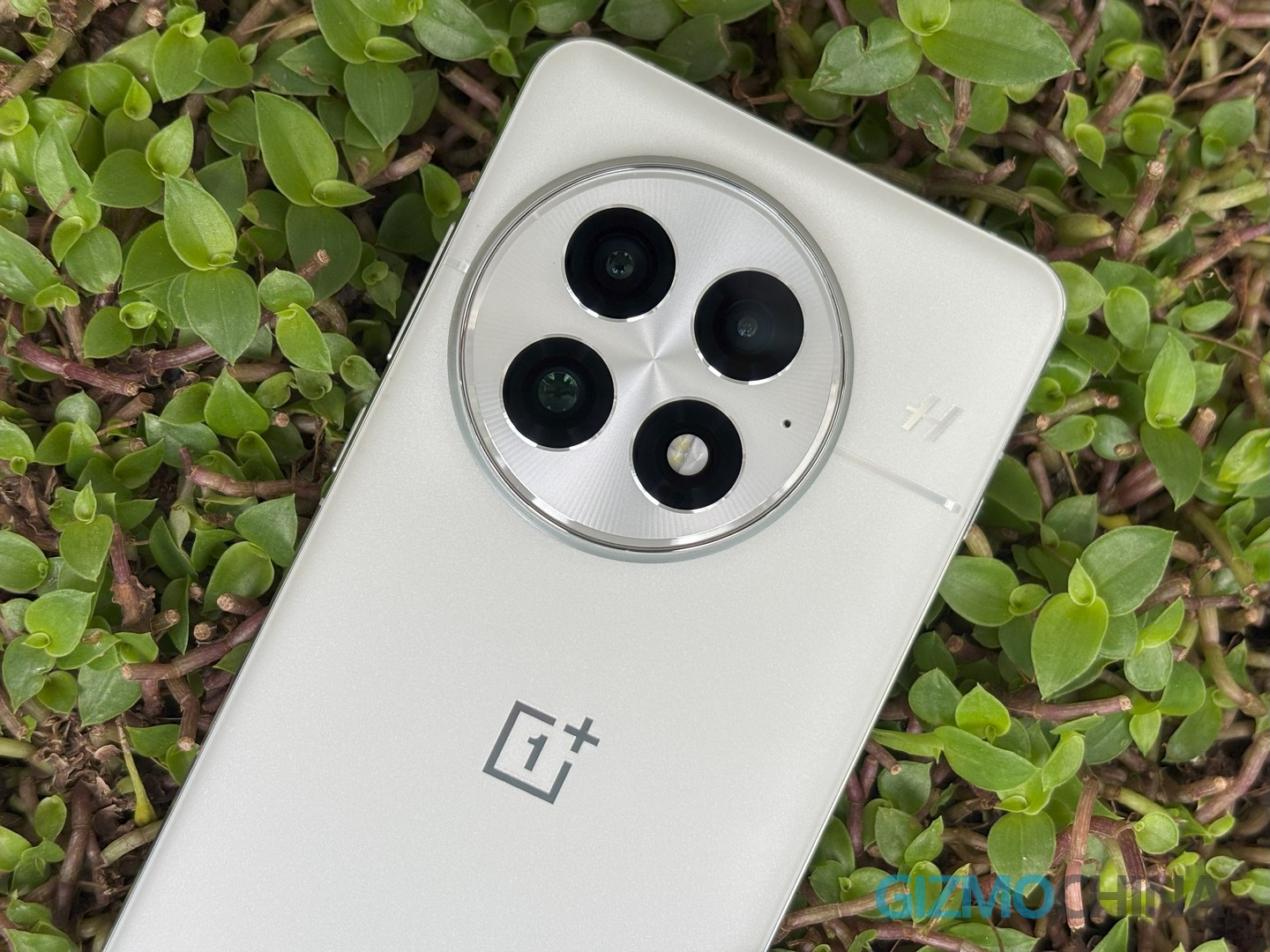
OnePlus launched the OnePlus 13 with a large 6.82-inch 2K+ AMOLED display that supports 4,500 nits of peak brightness. The display received DisplayMate A++ certification. The phone runs on the Snapdragon 8 Elite chipset and supports up to 24GB of LPDDR5X RAM and up to 1TB of UFS 4.0 storage.
OnePlus has retained its flagship camera setup with a 50MP Sony LYT-808 main sensor, a 50MP ultra-wide lens, and a 50MP periscope telephoto camera with up to 120x digital zoom. The company has added an advanced cooling system and improved antenna performance using the redesigned alert slider module.
The phone supports 100W SuperVOOC wired charging and 50W wireless charging for its 6000mAh battery. OnePlus has priced the base 12GB + 256GB model at $799, which undercuts Nothing’s top-end variant while offering more RAM, storage, and charging features.
Please Note: When you buy something using the links in our articles, we may earn a small commission at no cost to you.
2. Samsung Galaxy S25
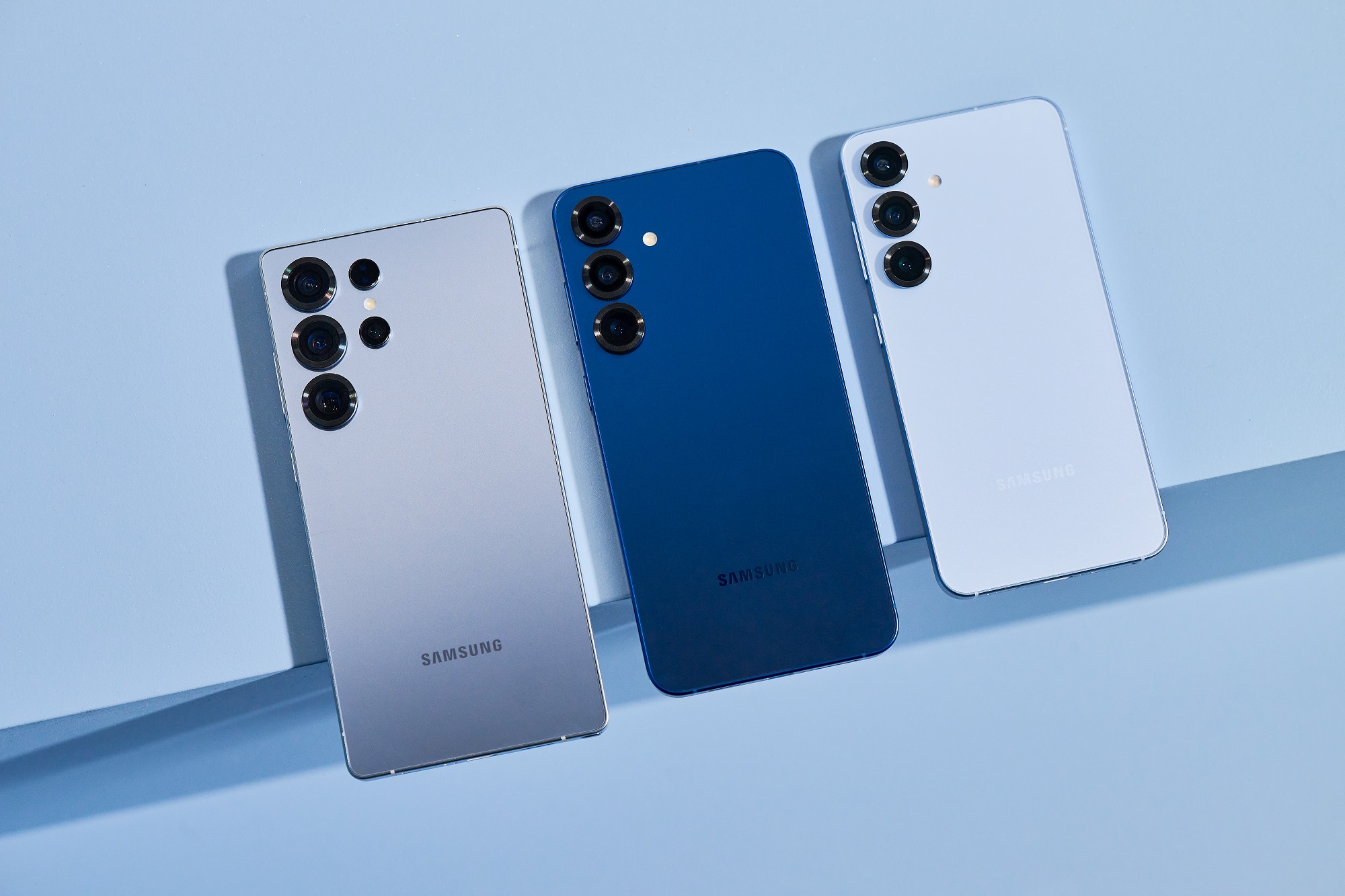
Samsung introduced the Galaxy S25 with a 6.2-inch FHD+ AMOLED display that supports a 120Hz refresh rate and up to 2,600 nits brightness. The device runs on the Snapdragon 8 Elite for Galaxy chipset and features deep integration with Google’s Gemini-based AI tools. Samsung has confirmed support for seven generations of Android and security updates.
The S25 includes a triple camera system with a 50MP main sensor, a 12MP ultra-wide lens, and a 10MP telephoto lens. Samsung continues to offer reliable performance and consistent camera results. The Galaxy S25 starts around $799.99 globally, positioning itself as a well-rounded alternative to the Nothing Phone (3).
Please Note: When you buy something using the links in our articles, we may earn a small commission at no cost to you.
3. Xiaomi 15
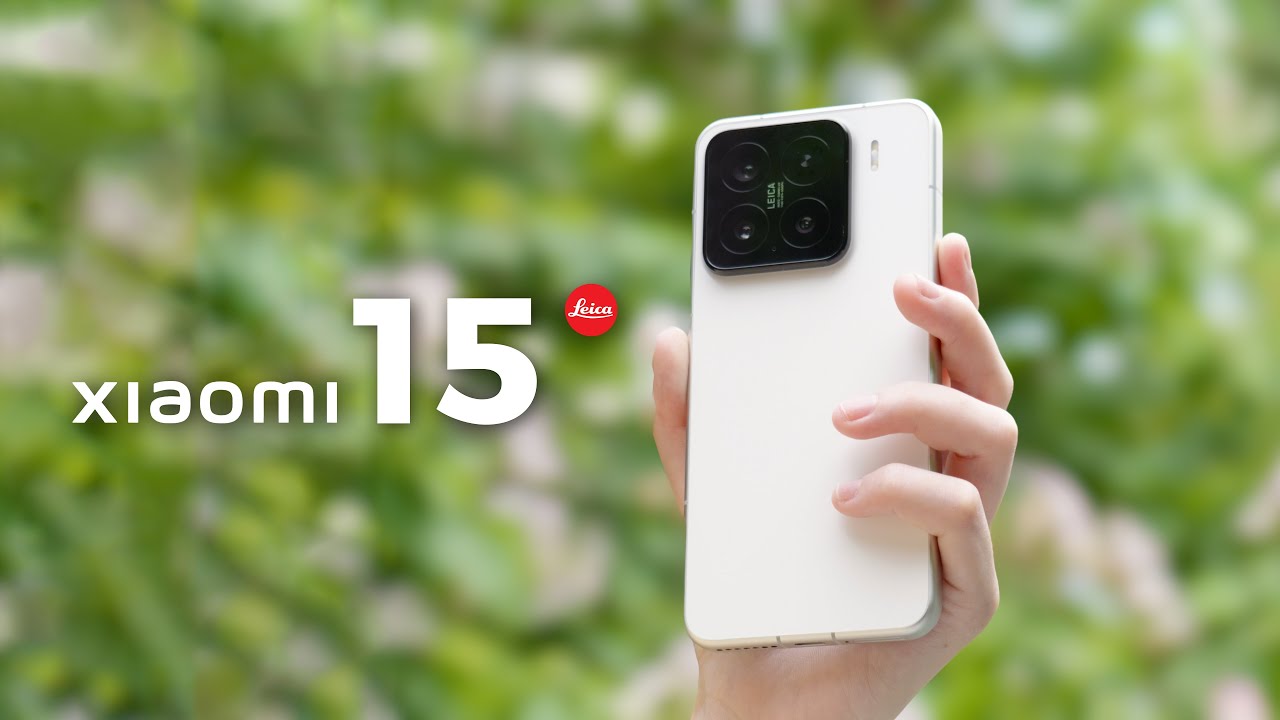
Xiaomi launched the Xiaomi 15 with a compact 6.36-inch 1.5K OLED LTPO panel that supports a peak brightness of 3200 nits and ultra-narrow bezels. The phone runs on the Snapdragon 8 Elite chip and includes the IceLoop Wing-type cooling system for better thermal performance.
The Xiaomi 15 features three Leica-branded 50MP cameras, including a 1/1.31-inch main sensor, an ultra-wide lens, and a 2.6x telephoto camera. The company has also added its new AISP 2.0 image processing engine and Leica Summilux optics for better low-light and portrait results.
Xiaomi has included a 5240mAh battery with 90W wired charging and 50W wireless charging support. The phone is priced at around $779 for the single 12GB + 512GB variant, offering excellent value in a smaller form factor.
Please Note: When you buy something using the links in our articles, we may earn a small commission at no cost to you.
4. Apple iPhone 16
Apple announced the iPhone 16 and iPhone 16 Plus with the new A18 chip. These models include the Action Button and introduce a new Camera Control button with haptic feedback and gesture support. The iPhone 16 has a 6.1-inch OLED display while the Plus variant features a 6.7-inch panel, both with up to 2,000 nits of outdoor brightness.
The camera setup includes a 48MP main sensor with sensor-shift stabilization and a 12MP ultra-wide lens. Apple has added support for spatial video and spatial photos for the Vision Pro headset. New AI tools in iOS 18 enhance image cleanup and editing through Apple Intelligence.
The iPhone 16 starts at $799 for the 128GB model. With long-term iOS support and Apple’s ecosystem, it remains a solid alternative to Nothing’s offering.
Please Note: When you buy something using the links in our articles, we may earn a small commission at no cost to you.
5. Google Pixel 9 Pro XL
Google launched the Pixel 9 Pro XL with a 6.8-inch QHD+ LTPO AMOLED display that supports up to 3,000 nits brightness. The phone runs on the Tensor G4 chip and includes the Titan M2 security module. Google promises seven years of OS, security, and feature updates.
The camera setup includes a 50MP GNK main sensor, a 48MP ultra-wide camera, and a 48MP 5x periscope telephoto lens. The front camera uses a 42MP Sony IMX858 sensor with autofocus. The Pixel 9 Pro XL introduces AI-based features such as Zoom Enhance, Add Me, and Magic Editor with auto-framing.
The phone packs a 5060mAh battery with support for 37W wired and 23W wireless charging. It starts at $1,099. For users prioritizing photography, AI tools, and long-term support, the Pixel 9 Pro XL delivers a complete flagship experience.
Please Note: When you buy something using the links in our articles, we may earn a small commission at no cost to you.
6. Verdict: Should you still go for the Nothing Phone (3)?
There’s no doubt the Nothing Phone (3) brings a unique identity to the Android space. The new Glyph Matrix is fun, the Essential Key introduces useful AI-powered features, and its 5500mAh battery with 65W charging is solid. But when your rivals are offering better displays, stronger cameras, faster processors, and equally long software support, being “different” may not be enough.
If you want the most complete phone experience today, the OnePlus 13 and Pixel 9 Pro XL stand out. If AI productivity and long-term support matter most, the Galaxy S25 is the smarter pick. Xiaomi 15 is for compact power users, and the iPhone 16 remains a no-nonsense benchmark of stability and ecosystem lock-in.
The Nothing Phone (3) isn’t a bad phone by any means. But in 2025, competition is fierce, and “Nothing” has never had to prove itself more.
For more daily updates, please visit our News Section.
Oppo is gearing up to unveil its new K13 Turbo series of smartphones, aimed at users looking for powerful performance in the mid-range segment. The company has confirmed that the launch will take place on July 21 at 2:30m (local time) in China. Here’s a look at all that is known about the K13 Turbo.
Oppo K13 Turbo series teaser
The above teaser gives a glimpse of the Oppo K13 Turbo series’ active cooling fan. This seems to be positioned below the primary camera of the device. It is also said to support smart frequency adjustment for better power efficiency and includes RGB lighting for visual appeal. Interestingly, despite the addition of moving parts, the K13 Turbo is expected to be IPX8 certified, hinting at strong water resistance.
The Oppo K13 Turbo is said to be targeted at gamers and young users. It is also expected to ship with a flat display supporting high refresh rates, aiming to deliver a smooth and immersive gaming experience.
Oppo K13 Turbo series specifications (rumored)
Recently, the Oppo K13 Turbo Pro, bearing the PLE110 model number, was spotted on Geekbench with the Snapdragon 8s Gen 4 chipset and 16GB of RAM. The display could be a 6.8-inch flat OLED LTPS panel with a 2800 x 1280 resolution and 144Hz refresh rate. Camera hardware may include a 50-megapixel main sensor alongside a secondary 2-megapixel camera, with a 16-megapixel front camera. Additional features tipped include a plastic frame, short-focus fingerprint scanner, and RGB lighting.
The K13 Turbo, on the other hand, is said to be equipped with the Dimensity 8450 chipset. It is likely to feature the same display and cameras as the Pro model. Both phones are expected to come in Black Warrior and First Purple shades. While the K13 Turbo will also come in Knight White, the Pro edition may come in Knight Silver.
For more daily updates, please visit our News Section.
Nothing is giving Indian customers a chance to buy the Nothing Phone (3) before its official release. The company will host a special drop event on July 12 at UB City in Bengaluru. The event starts at 7:00 PM IST and entry will be on a first-come, first-served basis.
At the event, customers will be able to purchase the Phone (3) ahead of its global sale. The first 100 buyers will receive a free Nothing Headphone (1), which is priced at Rs. 21,999. Attendees will also be able to try out the Phone (3) and Headphone (1) at the venue.
The Phone (3) is powered by the Snapdragon 8s Gen 4 chipset and runs on Nothing OS 3.5. It features a 50MP triple rear camera and a 50MP front camera. The phone comes with a 5500 mAh battery, supports 65W fast wired charging, and 15W wireless charging. It is rated IP68 for dust and water resistance (explore more details by clicking here).
The event will include music, lighting, and challenges where participants can win more units of the Headphone (1) and other merchandise. Complimentary refreshments and barista-style coffee in collectible mugs will also be available.
The Nothing Phone (3) has a retail price tag of Rs. 79,999 for the 12GB + 256GB model, and the 16GB + 512GB model costs Rs. 89,999. With bank offers and exchange offers, the starting price of the device drops to Rs. 62,999. That said, it is unclear which of these offers will be applicable during this drop event.
For more daily updates, please visit ourNews Section.
Samsung has officially launched its next generation of wearables, the Galaxy Watch 8 series, at the recent Unpacked event. The new smartwatches build on what Samsung already does well: solid fitness tracking, seamless Android integration, and consistent design.
But with the Galaxy Watch 8 series, Samsung has decided to make a few bolder changes, both visually and under the hood. The company is also bringing back the Classic model this year, complete with everyone’s favorite rotating bezel.
Here are the new features that make the Galaxy Watch 8 and Watch 8 Classic what they are.
The most immediately noticeable change in the Galaxy Watch 8 series is the design. The watches are now squircle in shape compared to the round casing of the Watch 7 line.
Essentially, this means both the Watch 8 and Watch 8 Classic have a square case with a round display. It’s a bold visual shift that brings the Galaxy Watch 8 and 8 Classic closer in form to the Galaxy Watch Ultra.
This design might take some getting used to. Traditional round watches have a timeless aesthetic, and some may prefer that classic look. But on the wrist, the wearables still look modern and refined.
Also, the Watch 8 is nearly a millimeter thinner than its predecessor at 8.6mm. The new shape also helps the device sit more securely on the wrist, which Samsung claims improves sensor accuracy.
Samsung has also improved how the straps attach. There’s now a quick-release mechanism similar to what we’ve seen on the Watch Ultra. It makes swapping out bands easier. However, you wouldn’t be able to use earlier Galaxy Watch bands on the new models.
2. A Brighter, Still OLED Display
Both Watch 8 models retain OLED displays, but brightness now reaches up to 3,000 nits, according to Samsung. This level of brightness matches what Apple offers with the Watch Ultra 2.
While the Watch 7 was already easy to see in direct sunlight, the bump in brightness ensures better visibility in harsh lighting conditions. That said, the difference might be difficult to detect under normal circumstances.
Samsung hasn’t changed the display resolution or size in any significant way, so the brightness bump is the headline improvement here. It’s a modest but useful upgrade, especially for users who spend a lot of time outdoors.
3. Expanded Health Tracking with Sleep and Vascular Features
Samsung continues to treat health tracking as a major priority in its smartwatches. The Galaxy Watch 8 series brings new and updated health features, though most of them lean toward lifestyle advice rather than medical-grade diagnostics.
New in One UI 8 Watch is a “Bedtime Guidance” system that recommends sleep times based on personal habits. It requires at least three nights of sleep data to begin offering insights.
The sleep apnea detection feature has also received EU medical certification, lending more credibility to its measurements.
Another addition is vascular strain measurement, designed to monitor the condition of blood vessels during sleep. While useful, this feature is not medically certified.
There’s also a new Antioxidant Index feature that estimates levels of free radicals in the body. However, it requires users to remove the watch and place a thumb on the sensor. Like other new tools, it serves more as a general wellness guide than a diagnostic tool.
Beyond these, the Watch 8 continues to offer the usual health tracking features, including body composition analysis, heart rate monitoring, blood pressure tracking, and ECG readings (when paired with a Samsung smartphone and the Health Monitor app).
4. Google Gemini Replaces (Some of) Bixby
Perhaps one of the most interesting additions to the Galaxy Watch 8 is Google Gemini integration. For years, Bixby has handled voice assistance on Samsung watches, though to lukewarm reception. Now, users can choose Gemini as an alternative.
Gemini is available via LTE and Wi-Fi and supports a range of voice commands; everything from sending messages to creating reminders or generating basic routes.
It doesn’t yet support full conversational AI or work with all apps (WhatsApp replies, for example, are not available). But it’s an improvement over Bixby in terms of functionality and cloud-connected features.
That doesn’t mean Bixby is gone. It still handles all offline tasks and can be set as the default assistant. Users can configure which assistant is triggered via the top button, now dubbed the “AI Button.”
Wear OS continues to be the foundation of the Watch 8 software experience. The Play Store offers access to standalone apps like WhatsApp and Spotify, as well as many other Android-compatible services.
5. Running Coach and Upgraded Sports Features
The Galaxy Watch 8 introduces a new running coach feature designed to help runners of all levels train more effectively. It uses the 12-minute Cooper test as a starting point to assess a user’s fitness level and build a customized running plan from there.
During workouts, the watch offers real-time coaching feedback, like maintaining the correct pace or adjusting intensity. The watches also include dual-frequency GPS to improve location accuracy during outdoor exercise.
These fitness improvements aren’t exclusive to professional athletes. They’re designed for anyone who wants to monitor or improve their daily activity without diving into complex metrics. It’s a subtle but useful evolution for Samsung’s fitness platform.
For more daily updates, please visit our News Section.
Razer has launched the DeathAdder V4 Pro, the latest version of its best-selling gaming mouse. It is designed for competitive gaming and built with input from professional esports players.
The DeathAdder V4 Pro features Razer HyperSpeed Wireless Gen-2, which offers over 63 percent better power efficiency and 37 percent lower latency than the previous generation. It supports a polling rate of up to 8000 Hz in both wired and wireless modes. At 1000 Hz, the battery lasts up to 150 hours. At 8000 Hz, battery life drops to 22 hours.
The mouse includes the new Razer Focus Pro 45K Optical Sensor Gen-2 with up to 45,000 DPI, 900 IPS speed, and 85 G acceleration. It offers 99.8 percent resolution accuracy and includes features like Dynamic Sensitivity, Mouse Rotation, and Sensitivity Matcher.
This is also the first Razer mouse to feature an Optical Scroll Wheel. It is more durable than mechanical scroll wheels and offers consistent tactile feedback. The DeathAdder V4 Pro uses Razer Optical Mouse Switches Gen-4, rated for 100 million clicks and redesigned for a sharper click feel.
The mouse weighs 56 grams in black and 57 grams in white. It has a right-handed ergonomic shape with six programmable buttons. The feet are made of 100 percent PTFE for smoother glide. It has no RGB lighting and comes with a USB Type-A to USB Type-C cable.
Razer has used over 67 percent bio-based and recycled plastics in the mouse. The internal structure is redesigned to stay lightweight without losing durability. Reinforced side walls add strength. Split side buttons help avoid misclicks. A smooth-touch finish improves grip.
The mouse was developed with esports players, including Nikola “NiKo” Kovač, who tested the prototypes during official matches. The DeathAdder V4 Pro is priced at 169.99 US dollars and is available now in black and white on the Razer online store.
Other than the new mouse, Razer has also launched the BlackWidow V4 Tenkeyless HyperSpeed, a $179.99 wireless gaming keyboard featuring Gen-3 Orange Tactile Mechanical Switches with hot-swappable 3-pin/5-pin support, dual-layer dampening foam, and pre-lubed stabilizers for better acoustics.
For more daily updates, please visit our News Section.
Philips has announced the new Evnia 27M2N3800A gaming monitor, aimed at gamers looking for high performance and flexibility. The 27-inch Fast IPS display supports a dual mode setup, allowing users to switch between 3840 x 2160 resolution at 160Hz and 1920 x 1080 resolution at 320Hz. This lets gamers choose between high detail or smoother motion depending on the game.
The monitor uses a W-LED backlight and has a 16:9 aspect ratio. It supports 1.07 billion colors and covers 130 percent sRGB, 95 percent DCI-P3, and 90 percent Adobe RGB color spaces. It features HDR 400 with up to 450 nits peak brightness and a 1000:1 contrast ratio. The response time is rated at 0.5 milliseconds using Smart MBR technology to reduce motion blur during fast scenes.
Gaming-focused features include Smart Crosshair, Smart Sniper, Stark ShadowBoost, and SmartImage game modes for FPS, Racing, and RTS titles. It also offers two Gamer profiles for custom settings. Adaptive Sync, Low Input Lag, and FlickerFree technology are also supported for a smooth gaming experience.
The Evnia Precision Center software gives users full control over display settings and customization. The monitor includes two 2W stereo speakers and a headphone jack. It also has LowBlue mode, anti-glare coating, and a pixel density of 163 PPI. SmartUniformity is rated between 93 to 105 percent for consistent brightness and color.
Connectivity includes two HDMI 2.1 ports and one DisplayPort 1.4, along with support for HDCP 1.4 and 2.3. The MultiView feature allows two devices to display simultaneously on the screen, useful for multitasking or console and PC setups.
The Evnia 27M2N3800A will begin shipping in Europe in July. It is available for preorder on Amazon Germany at €359 and in the UK for £279, which is around $379.
In related news, Philips has introduced the 27M2N8500X gaming monitor in China, equipped with a 27-inch QD-OLED panel offering a 2560×1440 resolution, 500Hz refresh rate, and 0.03ms response time. The price is set at 5999 yuan (approximately $835). Global launch details are not yet confirmed.
For more daily updates, please visit our News Section.
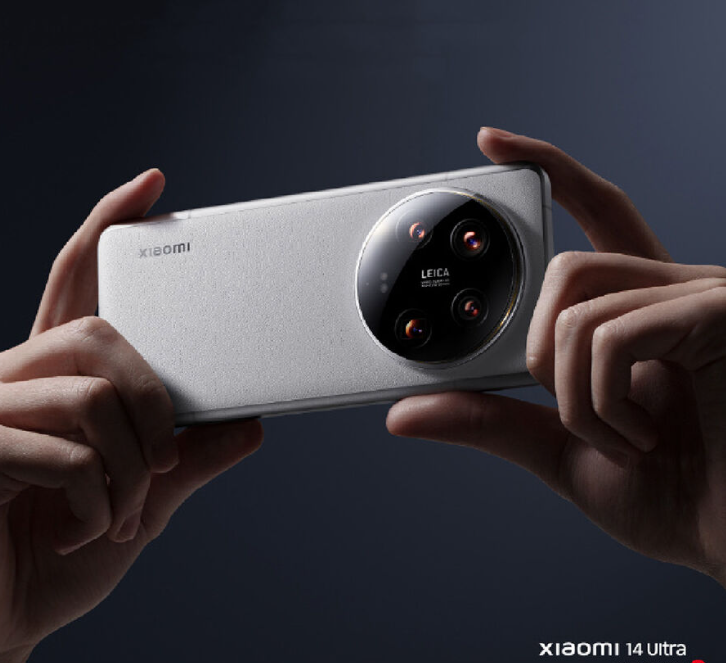
Xiaomi has started rolling out the HyperOS 2.2 update for global users. The Xiaomi 14 Ultra in India is now receiving the update with version number 2.0.201.0.VNAINXM. The update is 1.3GB in size and includes the June 2025 Android security patch.
The update brings several system improvements. Animations have been optimized to stop when entering subpages, switching apps, or closing apps in landscape mode. Issues with app launch and close animations, display glitches, and gesture failures have been fixed. Scrolling in third-party content feeds is now smoother.
The home screen wallpaper now supports a blur effect. The full-screen indicator has been updated with better visual effects and fewer accidental triggers of XiaoAi. Some classic pages have been redesigned, and app launch animations have been improved.
Lock screen updates include new Eastern-style templates, lens-effect wallpapers, and options to customize lock screen shortcuts.
The camera app gets a full redesign. It now uses a cleaner, more professional layout. Feature menus and settings have been reorganized. The standard watermark tool now lets users change the position of the watermark.
In settings, a shortcut to system navigation has been added to the home screen settings. Some icons in the status bar can now be customized.
Accessibility improvements fix issues where gestures and volume buttons didn’t work in TalkBack mode. The update also fixes missing audio feedback in apps like Calendar, Settings, Contacts, Control Center, and others.
The update is now live for Xiaomi 14 Ultra users in India and will roll out to more devices soon. The update was also launched in other regions last month.
For more daily updates, please visit our News Section.
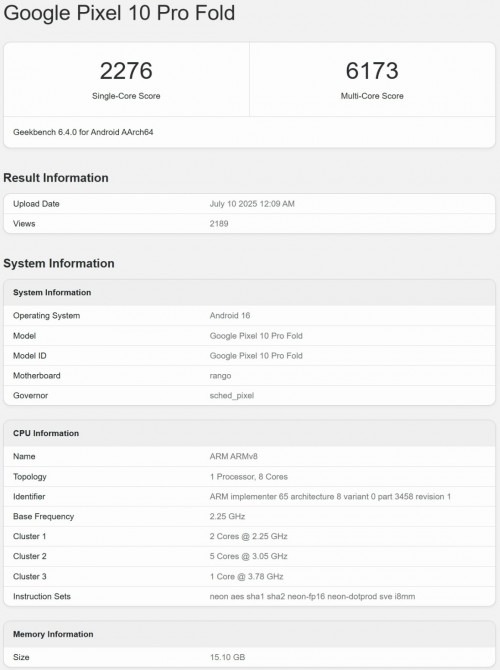
Google is expected to launch the Pixel 10 series on August 20, including the Pixel 10, Pixel 10 Pro, Pixel 10 Pro XL, and Pixel 10 Pro Fold. While the company hasn’t officially confirmed details, the Pixel 10 Pro Fold has surfaced on Geekbench, revealing key specifications.
Google Pixel 10 Pro Fold
The foldable is listed with the motherboard codename “rango” and an octa-core CPU using a 2+5+1 configuration: two cores at 2.25GHz, five at 3.05GHz, and one at 3.78GHz. It is powered by Google’s upcoming Tensor G5 chip, paired with 16GB of RAM, and runs Android 16.
In benchmark tests, the device scored 2,276 in single-core and 6,173 in multi-core performance, significantly higher than the Pixel 9 Pro Fold with its Tensor G4 chip, which scored 1,981 and 4,783, respectively. The scores are expected to improve in retail units with final software and chipset tuning.
Earlier reports highlighted that the Pixel 10 Pro Fold is set to be slimmer and more durable than its predecessor. A new hinge mechanism aims to reduce thickness, making the phone easier to handle. The biggest upgrade is the IP68 rating, making it the first foldable phone to offer full dust and water resistance. Most foldables skip dust protection and offer only water resistance.
Design leaks suggest the Pixel 10 Pro Fold resembles the Pixel 9 Pro Fold, with slight modifications. The camera setup is expected to stay largely the same: a 50MP Sony GN8 main sensor, a 12MP Samsung 3J1 telephoto lens, and a 12MP 3J1 ultra-wide lens, with minor improvements to the primary shooter.
For more daily updates, please visit our News Section.
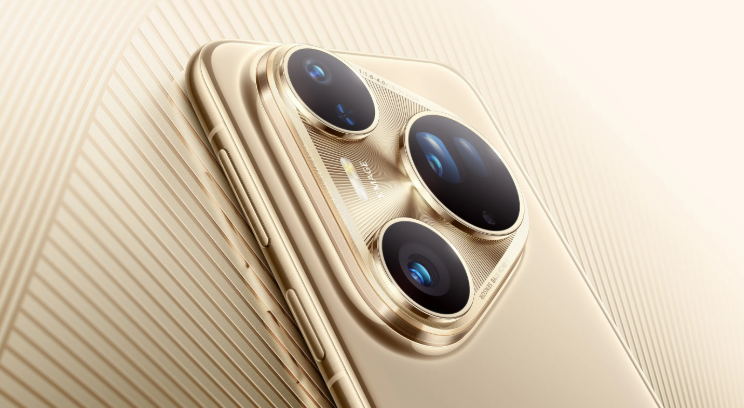
Huawei has officially brought its Pura 80 Ultra to global markets, and it’s making headlines for one key reason: a world-first switchable telephoto lens. Announced on July 10, in the UAE, the phone aims to push mobile photography into new territory—blending innovation with a bold flagship design.
World’s first switchable dual-lens telephoto leads the way
At the heart of the Pura 80 Ultra’s appeal is its groundbreaking dual-lens telephoto system. The rear camera setup includes a 50MP 1-inch RYYB main sensor (f/1.6–f/4.0), a 40MP ultrawide camera (f/2.2), and a 1.5MP spectral sensor to enhance color accuracy. But the real showstopper is the 50MP 1/1.28-inch telephoto sensor—the largest of its kind on any smartphone—delivering 3.7x (83mm) and 9.4x (212mm) optical zoom via a motorized periscope module. Some older Galaxy flagships, like the Galaxy S23 Ultra, offered 10x periscope telephoto—but the sensor was tiny (1/3.52″) in comparison.
Design-wise, the phone doesn’t hold back. It features a polished aluminum frame, second-gen Kunlun Glass on both the front and back, and a 6.8-inch LTPO OLED panel (2848×1276, 120Hz) underneath that reaches 3000 nits of peak brightness.
According to unofficial sources, the phone is powered by the brand’s in-house Kirin 9020 chip, is paired with 16GB RAM and up to 1TB of storage, and runs on Android-based EMUI 15. The 5,170 mAh battery (5,700 mAh in China) supports 100W wired and 80W wireless charging.
One caveat: while the Chinese version includes 5G and satellite connectivity via HarmonyOS 5.1 (free of Android), the global version ships with 4G-only and no satellite support. That could be a sticking point for users, given its flagship positioning.
Pricing and availability
The Pura 80 Ultra is available in Black and Gold finishes and starts at ¥9,999 (around $1,400) in China. Global pricing and release details haven’t been fully revealed yet, but more information is expected soon via Huawei’s official channels.
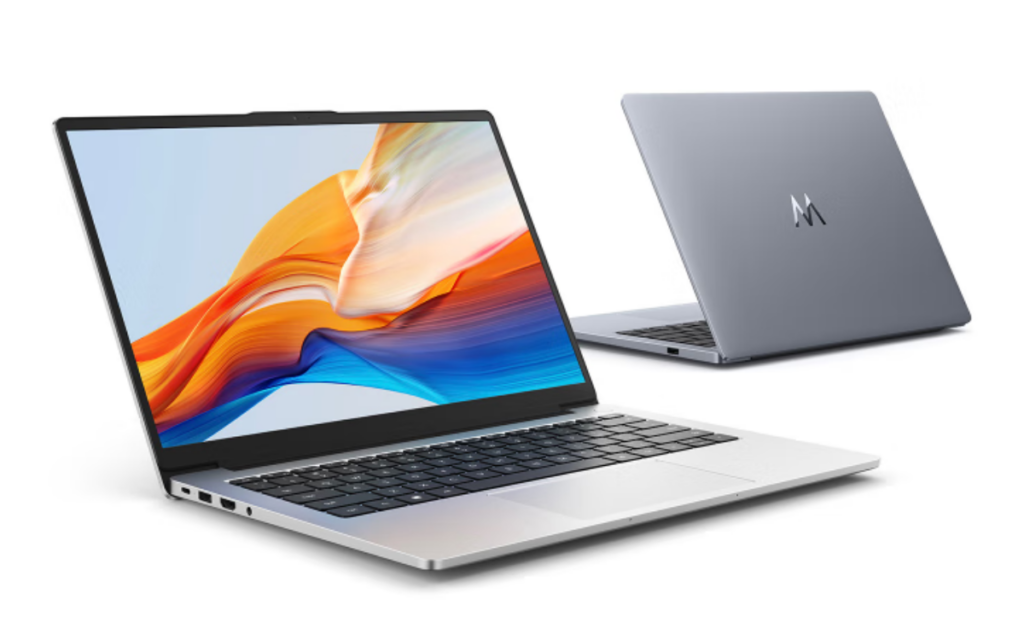
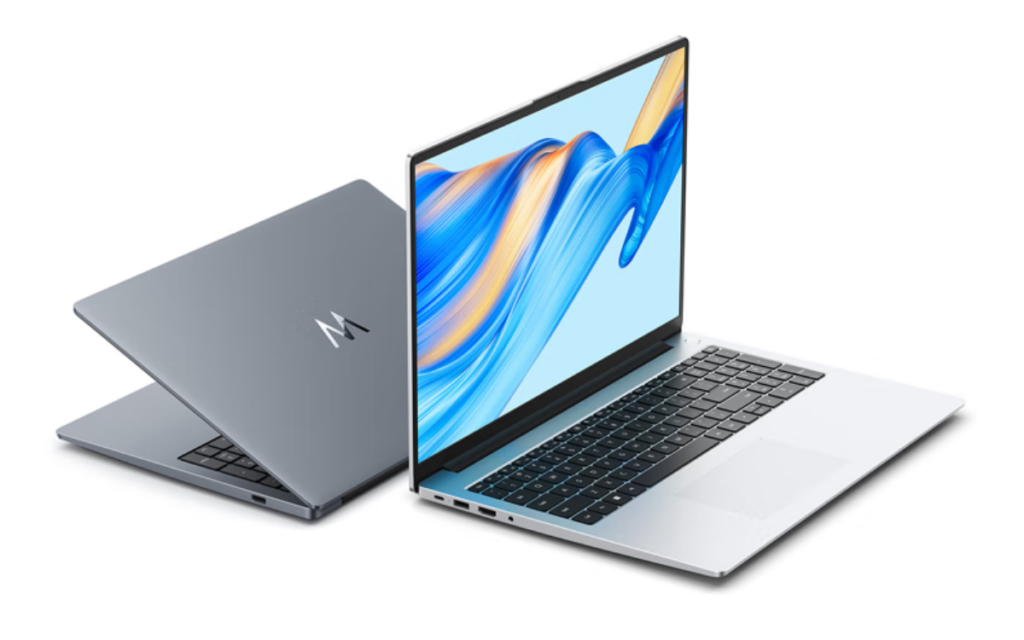
Wiko has refreshed its Hi MateBook D 14 and D 16 laptops with the latest Intel Core 7 240H and 250H processors, bringing improved performance to the series. While the design remains slim and minimalist, the internal upgrade marks a significant enhancement in processing capabilities. Both models are currently available for purchase on JD.com.
Hi MateBook D 14 Specifications
The MateBook D 14 features a 14.2-inch 2880×1920 display with a 120Hz refresh rate and 10-point multi-touch support. It weighs just 1.31kg and measures 14.5mm thick, making it highly portable. The screen uses a 16:10 golden aspect ratio for a broader field of view across tasks like gaming, video editing, and document work.
It also features TÜV Rheinland-certified low blue light and flicker-free performance to reduce eye strain, a 90% screen-to-body ratio with 3.5mm bezels, and 100% sRGB color coverage for vivid and accurate visuals.
The laptop houses a 56Wh battery, offering up to 17.5 hours of usage on a single charge. It supports 65W USB-C fast charging. Additionally, it features a fingerprint-enabled power button, an edge-to-edge keyboard, and improved wireless range thanks to a new-generation antenna with claimed 270-meter coverage under optimal conditions.
It also supports Huawei’s ecosystem features like Super Device, app continuity, and screen sharing for users already using Huawei phones and tablets.
Hi MateBook D 16 Specifications
The Hi MateBook D 16 comes with a 16-inch 1920×1200 display with a 16:10 aspect ratio and 90% screen-to-body ratio. It supports the full sRGB color gamut and is TÜV Rheinland certified for low blue light and DC dimming. This model is better suited for users who need a larger screen and better color accuracy.
The D16 is powered by the Intel Core 7 250H processor and comes equipped with a redesigned Shark Fin cooling system that uses ultra-thin fan blades. Wiko claims the noise level remains as low as 22dB during use. The full-sized keyboard includes a numeric keypad, 1.5mm key travel, and a soft-landing design for quieter typing. It also has a physical switch for the webcam and a dedicated Smart Search key.
The D16 packs a 70Wh battery and supports 65W USB-C charging. It includes one USB-C port, two USB-A ports, and an HDMI port.
Both laptops run Windows 11 and come pre-installed with Microsoft Office Home Edition. Wiko is also offering limited-time value-added services such as OS reinstallation, remote diagnostics, and cleaning support.
Pricing and Availability
The Hi MateBook D 14 is priced at 4,799 yuan (about $668) for the version with 16GB RAM and 1TB SSD, and 5,199 yuan (about $724) for the 32GB RAM model.
The Hi MateBook D 16 is available in a single configuration with 32GB RAM and 1TB SSD, priced at 5,699 yuan (about $794). Both models come in Deep Space Grey and Moonlight Silver color options.
For more daily updates, please visit our News Section.
Sony is hitting pause on global sales of its flagship Xperia 1 VII smartphone following widespread complaints of unexpected shutdowns and boot failures. After initially suspending sales in Japan, the company is now extending the halt worldwide while it investigates what appears to be a hardware-related issue.
In an updated support notice published on July 8, Sony acknowledged the growing number of reports involving sudden reboots, freezing, and devices failing to power on entirely. While the issue first surfaced in Japan, affecting four models—SO-51F, SOG15, A501SO, and XQ-FS44—similar problems have now been reported by users in Europe, Taiwan, and Hong Kong. In response, listings for the phone have quietly disappeared from Sony’s online stores in several markets, including the UK, Germany, and Spain.
The exact cause remains unclear
Sony believes the glitch may be limited to specific production batches, possibly tied to a hardware fault, although the exact cause remains unclear. As of now, there’s no word on how many units are affected or when sales might resume.
For those already experiencing issues, Sony is offering a temporary workaround: press and hold the power and volume up buttons simultaneously for about 20 seconds to force a restart. The company also recommends updating to the latest software version and, most importantly, backing up important data right away.
Sony is urging customers to contact support if their phone is acting up. While some devices may recover with software updates, others might need to be sent in for repair.
The Xperia 1 VII, released earlier last month, features a Snapdragon 8 Elite chip and a triple camera system. But with these reliability concerns now surfacing, the phone’s momentum in the premium market could take a hit unless Sony addresses the problem quickly and clearly.
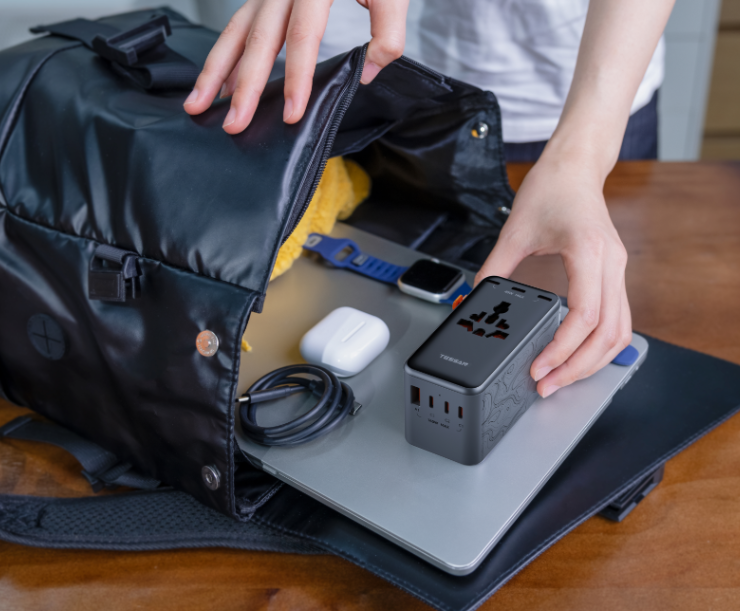
Traveling with technology is no longer a luxury; it’s a necessity. Whether you’re on a business trip or exploring new cities, staying connected is crucial. But managing multiple devices, plug types, and power demands across borders can be frustrating. The TESSAN Voyager 205 Universal Travel Adapter aims to solve these issues with one compact, high-powered solution. Designed for today’s global traveler, it brings reliable performance, convenience, and smart design into a single charging hub.
A Smarter Way to Stay Powered Abroad
Most standard chargers can’t keep up with the demands of international travel. Outlets are scarce, voltage standards vary, and carrying multiple chargers creates clutter and weight. The Voyager 205 is designed to remove that hassle. It’s not just about charging, it’s about staying efficient and prepared in unpredictable environments. With global plug support, high-speed USB-C charging, and power safety features, it replaces multiple chargers and adapters in one compact unit.
Fast and Efficient Charging at the Airport
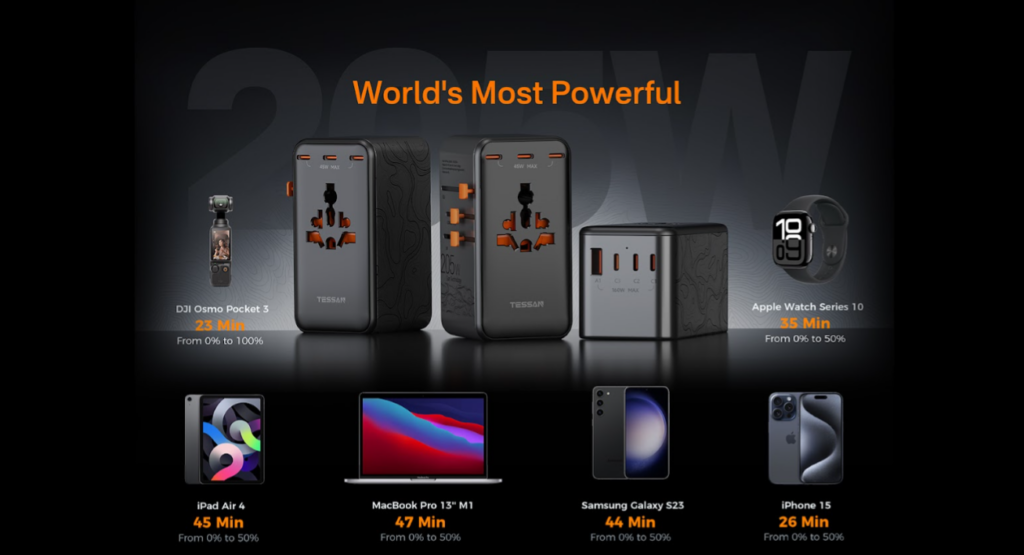
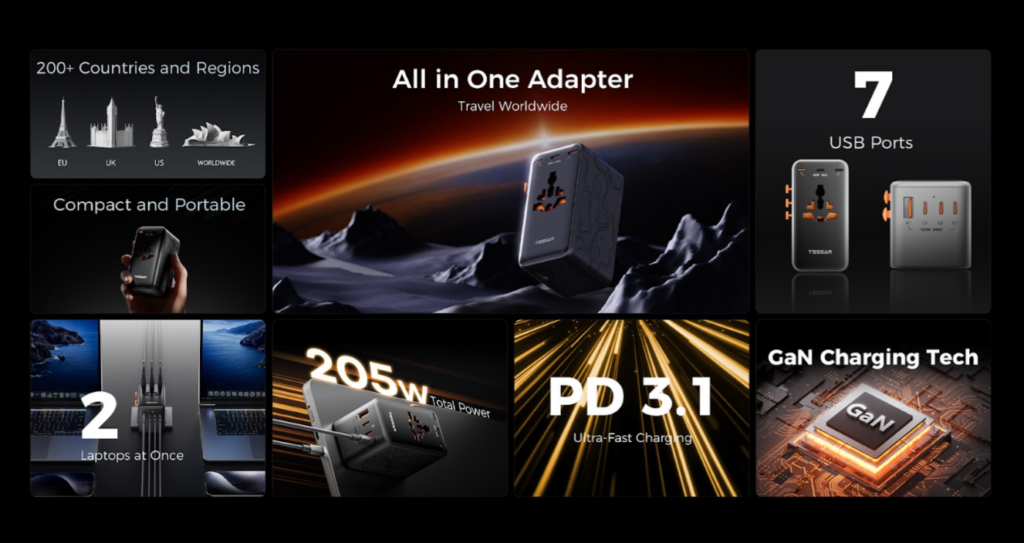
Airports are where charging speed and convenience matter most. Travelers often have access to just one outlet and only a few minutes before boarding. The TESSAN Voyager 205, with 205W GaN output and six USB-C ports, lets you charge a laptop and phone simultaneously at full speed. Unlike heavier adapters, its 336g lightweight body stays secure in wall sockets and easily fits into a carry-on bag. It turns any last-minute charging opportunity into a fast, efficient top-up session for your most important devices.
In-Flight Charging Without Overheating
Newer planes and business class seats often include AC outlets, but power quality isn’t always consistent. The Voyager 205 performs well under these conditions, even charging two laptops for hours without overheating. That kind of stable output from such a compact charger is rare. It fits neatly on tray tables and operates safely in tight, closed environments. Smart power management ensures that each device receives exactly the power it needs, which is especially helpful when multiple users or devices share one adapter mid-flight.
Hotel Rooms: One Outlet Becomes a Charging Station
Hotel rooms, especially older ones, usually don’t offer enough outlets. The Voyager 205 solves this by converting one socket into a hub for up to eight devices, six USB-C ports, one USB-A, and a universal AC outlet. Whether you’re a solo traveler or with family, it supports all your gear. The slider-based plug mechanism lets you switch between US, UK, EU, and AU standards without needing a separate adapter. From laptops to phones to cameras, you can charge everything at once. It also supports devices like kettles or straighteners, just not high-wattage appliances.
Quiet and Clean Work in Cafés or Co-Working Spaces
For remote workers or digital nomads, quiet operation and portability are essential. The Voyager 205 is fanless and silent, perfect for quiet environments like cafés or coworking desks. Its symmetrical port design and small footprint help avoid cable mess and free up space. No extra power bricks or extension cords are required; just plug in and start working.
Safety in Shared Spaces Like Hostels
In hostels or group accommodations, power safety is a real concern. Unstable power, crowded outlets, and varying socket types can be risky. The Voyager 205 features flame-retardant casing, short-circuit protection, and heat safety. While it doesn’t have advanced surge protection, it’s recommended to use it with a separate surge suppressor in areas with unstable electricity.
Better for the Planet, Better for Your Bag
TESSAN also focuses on sustainability. The Voyager 205 is backed by eco-initiatives like Climate Partner and One Tree Planted. The materials and packaging are eco-conscious, but the real benefit is practical; replacing multiple chargers and adapters reduces waste. With fewer electronics in your bag and less plastic used over time, it’s a cleaner, simpler way to travel.
Built to Travel the World With You
The TESSAN Voyager 205 isn’t just about more power or more ports; it’s about solving real problems travelers face every day. It combines fast charging, global compatibility, and efficient design in a way that makes travel simpler. From the airport gate to hotel rooms, café desks, or long-haul flights, it adapts to how and where people work and stay connected. While it’s priced on the premium side, its performance and versatility justify every cent. For travelers who carry multiple devices and want one dependable charging solution, this is it.
TECNO is taking foldable phones to a whole new level with its upcoming PHANTOM Ultimate G Fold Concept. This concept device breaks traditional norms by introducing a tri-fold design with a dual-inward-folding mechanism, something not seen in mainstream foldables so far. With a unique G-style folding structure, it opens the door to more versatile usage scenarios and addresses the limitations of both traditional book-style and outward tri-fold foldables.
Tri-Fold Design with Dual Inward Folding
The biggest innovation in the PHANTOM Ultimate G Fold is its dual-inward-folding tri-fold design. Unlike other tri-fold phones that fold outward and expose the flexible display to potential damage, TECNO’s concept keeps the main inner display fully protected. The design uses two inward folds, forming a G-shape when closed. This not only shields the main screen but also allows the inner display to remain perfectly flat and uninterrupted when fully unfolded. The seamless panel is ideal for immersive media viewing and multitasking.
Image for Representation Only
Dual-Screen Experience for Flexibility
To make daily use easier, the device features a secondary cover screen. This screen acts like a regular smartphone display when the device is folded, letting users handle calls, messages, and light tasks without needing to unfold the phone. When opened, the large inner screen transforms the experience into something close to a small tablet or even a laptop-like device, depending on how it’s positioned.
Multi-Angle Hovering for Hands-Free Use
TECNO also adds practical usability through its multi-angle hovering support. This allows the phone to remain partially folded at various angles, similar to a laptop or stand. It’s especially useful for video calls, watching movies, or using the device in a dual-panel productivity mode. This feature makes the device more than just a showpiece; it’s meant to work in real-world scenarios.
Slim Profile Despite Complex Build
Even with its dual hinges and two separate screens, TECNO claims that the PHANTOM Ultimate G Fold remains incredibly slim. The brand suggests it’s the slimmest tri-fold device to date, offering a profile that rivals some single-hinge foldables. This was achieved through impressive engineering in hinge miniaturization and advanced flexible display layering, allowing for a compact fold without bulk.
A Concept Built on Proven Innovation
This isn’t TECNO’s first step into experimental form factors. The company has previously worked on tri-fold and rollable prototypes. The PHANTOM Ultimate G Fold Concept builds on that legacy and aims to push boundaries further. It’s a clear signal of TECNO’s ambitions in next-gen mobile technology.
TECNO plans to officially unveil the PHANTOM Ultimate G Fold Concept in mid-July. While it’s still a concept device, the level of detail and engineering already achieved suggests a serious push toward commercial tri-fold smartphones. If this vision comes to life soon, TECNO could redefine how we think about smartphone versatility, portability, and design.
The OnePlus 13 series offers three distinct options designed to suit varying needs and budgets. The OnePlus 13 is the full-fledged flagship with top-tier performance and camera power, while the OnePlus 13R is a more budget focused model with near-flagship-level hardware. Lastly, we have the latest addition, which is the OnePlus 13s, that brings power in a compact and sleek body. So here’s a breakdown to help you find the perfect match.
OnePlus 13 (6 Months Review) arrives as the brand’s top smartphone model. It is a true flagship that is equipped with Qualcomm’s latest and greatest Snapdragon 8 Elite. This brings impressive performance with improved power efficiency as well. Eveything about this device is premium, including its gorgeous 6.82-inch LTPO AMOLED display with a high QHD+ resolution, a 120Hz refresh rate, 4500 nits of peak brightness, and Dolby Vision support.
Meanwhile, the rear has a 50MP triple camera setup that delivers flagship grade photography experience. The build quality is also top tier, with both glass and vegan leather options and an IP68 + IP69 rating for better water and dust resistance. Rounding all of this off is the massive 6,000mAh battery pack, which supports 100W wired fast charging and 50W wireless fast charging. At the moment, this device starts from 64,999 INR for the 12GB + 256GB base variant and even comes with some bank discounts. So if you want the best from OnePlus, you won’t have to break the bank with an exorbitant price tag since this is still one of the reasonably priced flagships.
Please Note: When you buy something using the links in our articles, we may earn a small commission at no cost to you.
2. OnePlus 13R: The Budget-Premium Pick
OnePlus 13R
For those looking for a more affordable device that is more affordable than the OnePlus 13, the OnePlus 13R is a great option to check out. For around 42,999 INR, this device packs the Snapdragon 8 Gen 3, which is just a single generation behind the 8 Elite and still offers great performance. You still get a premium design that blends glass and metal, a decent IP65 rating, and a tall 6.78-inch LTPO AMOLED display on the front with a 1.5K resolution and a 120Hz refresh rate.
On the rear, you get a triple camera setup with a solid 50MP main camera, which is also found on the Oppo Find X8, along with a telephoto and ultra wide angle lens. Apart from the main sensor, the other two cameras are decent but not flagship level. So OnePlus did cut corners here to save on cost. But at this price range, it is still one of the better smartphone picks. One aspect that doesn’t disappoint is the battery life, since it packs a massive 6,000mAh battery that supports 80W wired fast charging. I’d recommend this device for those with a tighter budget that hovers around the 40,000 INR range, since it has only a few compromises.
Please Note: When you buy something using the links in our articles, we may earn a small commission at no cost to you.
3. OnePlus 13s: Compact Flagship
OnePlus 13s
In 2025, compact flagships are all the rage, and the OnePlus 13s had a massive hype leading up to its release. This model sits right between the OnePlus 13 and OnePlus 13R, but it leans more towards the 13R than the top model. This is because it shares the same camera system (but no ultrawide), skips wireless charging (80W wired once again), and brings the 120Hz ProXDR LTPO OLED display of the OnePlus 13R. However, the big twist is that this screen is a relatively tiny 6.32-inch panel, allowing for greater one hand usability.
Despite its small build, the OnePlus 13s (Review) packs a massive 5,820mAh cell. Pairing this with the OnePlus 13’s Snapdragon 8 Elite, the battery life is excellent on this model, from my personal experience. The brand also debuted the OnePlus AI and Plus Key on this model (replacing the iconic alert slider). This device is listed for 54,998 INR, but bank discounts and exchange deals can bring it down to under 49,999 INR. So if you’re a fan of smaller devices and want a premium build with top notch performance and battery life, this one might be the right pick for you.
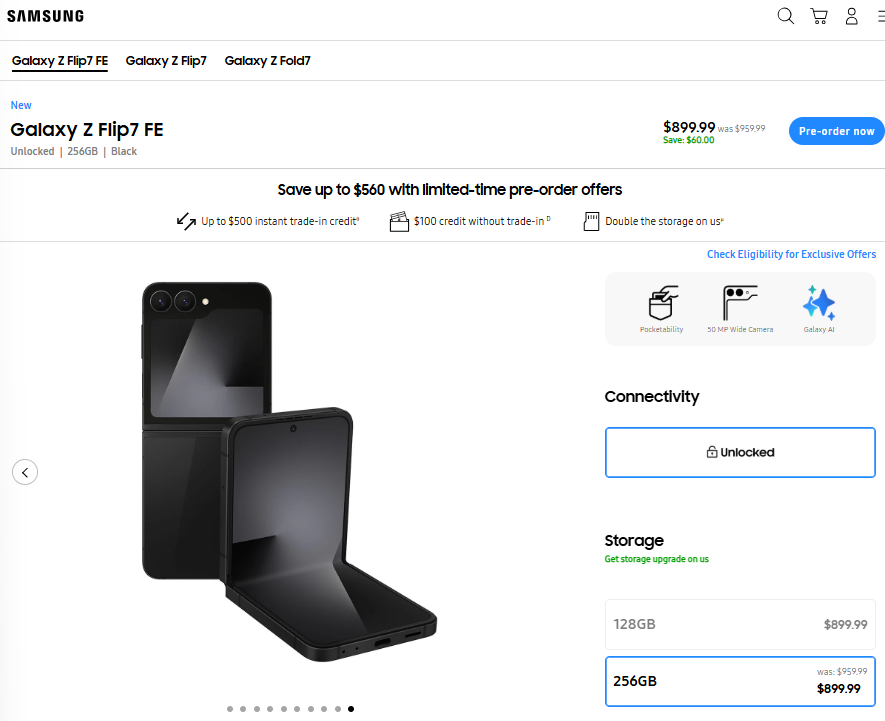
Samsung’s latest budget foldable, the Galaxy Z Flip7 FE, promises a more affordable entry point into the world of foldable phones. But while the $899 price tag may sound appealing, there’s a catch: most US carriers aren’t offering it. So buyers will miss out on the usual carrier deals and trade-in offers that often make these devices even more accessible.
Samsung Galaxy Z Flip7 FE
Unveiled yesterday, during Samsung’s Galaxy Unpacked event, the Flip7 FE is positioned as a lower-cost alternative to the $1,099 Galaxy Z Flip7. It shares much of its design and hardware with last year’s Flip 6—such as a 6.7-inch 120Hz AMOLED main display, a 3.4-inch cover screen, a 50MP main camera, and a 4,000mAh battery. It runs on Samsung’s Exynos 2400e chip, offering enough power for everyday use without pushing flagship-level performance.
But unlike the Flip7 and Fold7, which are widely available through Verizon, AT&T, and T-Mobile with monthly financing, the Flip7 FE has been left out of major carrier lineups. As of launch, only Boost Mobile and Xfinity Mobile are stocking it, with some promotional offers tied to their postpaid plans.
Samsung’s own US website lists the Flip7 FE as an unlocked-only device, and the same goes for retailers like Best Buy and Amazon. That means if you’re interested in picking one up, you’ll either need to pay the full $899 upfront or use Samsung’s own installment financing.
It’s an unusual move for a phone meant to be budget-friendly—especially in a market where a significant percentage of consumers rely on carrier deals to spread out the cost of new devices. The decision may reflect carriers’ hesitation to support a sub-$1,000 foldable with older internals or their preference to push customers toward pricier flagships with higher margins.
Still, the Flip7 FE has a few things going for it: it supports Galaxy AI features, ships with One UI 8 based on Android 16, and is eligible for seven years of updates—matching Samsung’s top-tier phones in long-term software support.
But without carrier support, its reach in the US could be limited. For those willing to go unlocked, pre-orders are now live through Samsung and select retailers.
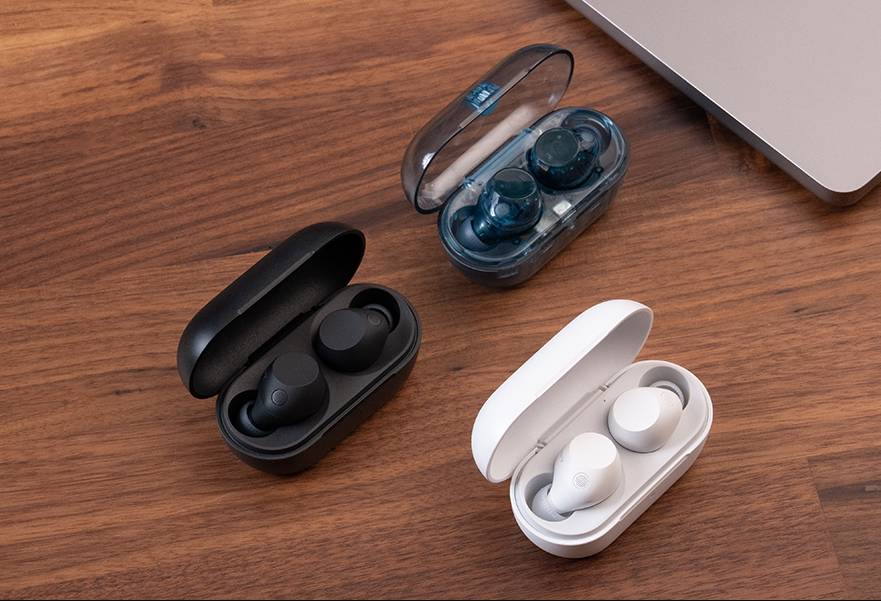
As expected, Sony has launched the WF-C710N truly wireless earbuds in India following their global debut earlier this year. The new model supports active noise cancellation, a compact design, and long battery life, targeting users who want advanced features without spending on flagship earbuds.
Sony WF-C710N Specifications
The Sony WF-C710N comes with dual microphones on each earbud that enhance noise cancellation by adapting in real-time to the user’s ear fit, reducing background noise during both music playback and calls.
It also features an Ambient Sound Mode, allowing users to stay aware of their environment when needed. Additionally, Sony has integrated Adaptive Sound Control, which automatically adjusts ambient sound levels based on the user’s movement and location.
The earbuds use Sony’s 5mm drivers along with DSEE (Digital Sound Enhancement Engine) technology to restore compressed audio and maintain clear vocals and balanced bass. The earbuds also support customizable EQ through the Sony Sound Connect app.
The Sony WF-C710N uses AI-powered voice pickup technology trained on over 500 million voice samples to improve call clarity, even in noisy settings. It also includes a Quick Attention mode that lets users temporarily lower the volume and hear external sounds by tapping the left earbud.
The earbuds support Bluetooth 5.3 and allow multipoint connection with two devices at the same time. Supported audio codecs include SBC and AAC. The earbuds are IPX4 rated for water and sweat resistance.
In terms of battery life, it delivers up to 8.5 hours of playback with ANC enabled and up to 12 hours without it. The charging case adds between 21.5 and 28 hours of additional battery life, depending on ANC usage, bringing the total to as much as 40 hours. It also offers fast charging, with just a 5-minute charge providing up to 60 minutes of playback. Charging is done via USB Type-C.
The earbuds weigh about 5.2 grams each, and the charging case weighs 38 grams. The WF-C710N is available in four colors: Glass Blue, Pink, White, and Black. The packaging is 100% plastic-free, in line with Sony’s ongoing sustainability efforts.
Pricing and Availability
The earbuds are priced the WF-C710N at Rs. 8,990 ($104) in India. These are available through Sony retail stores, ShopatSC.com, major electronics retailers, and Amazon.in.
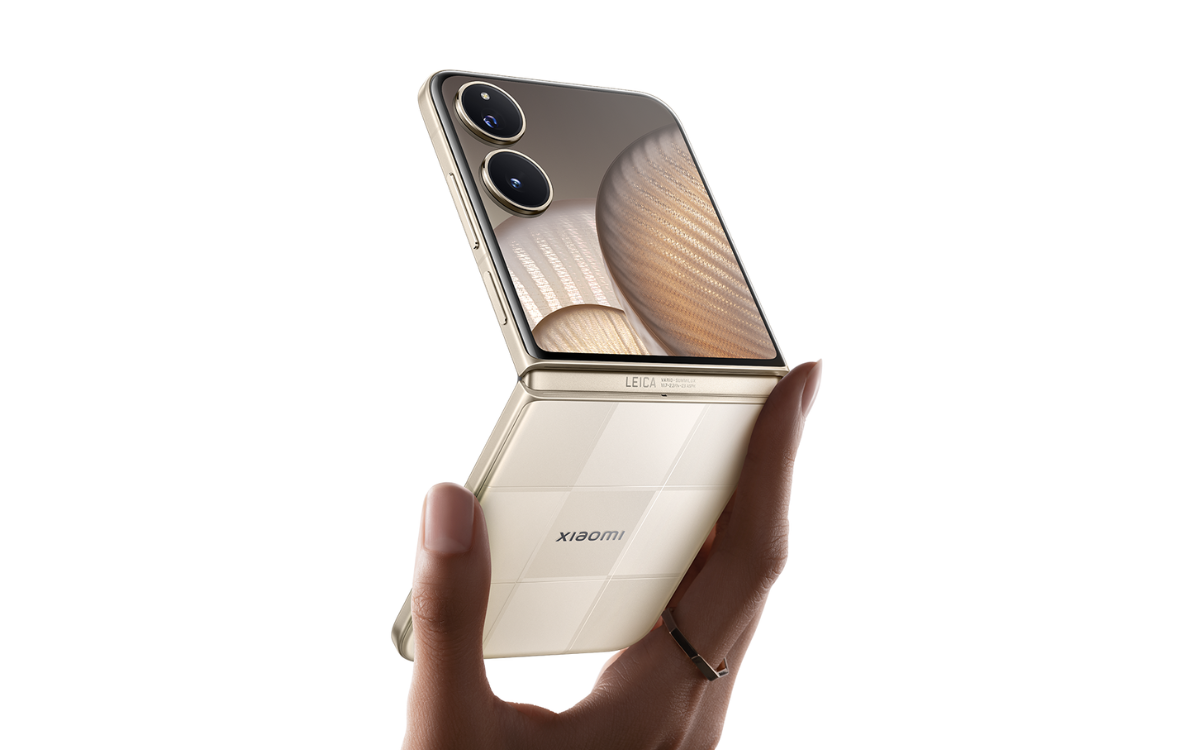
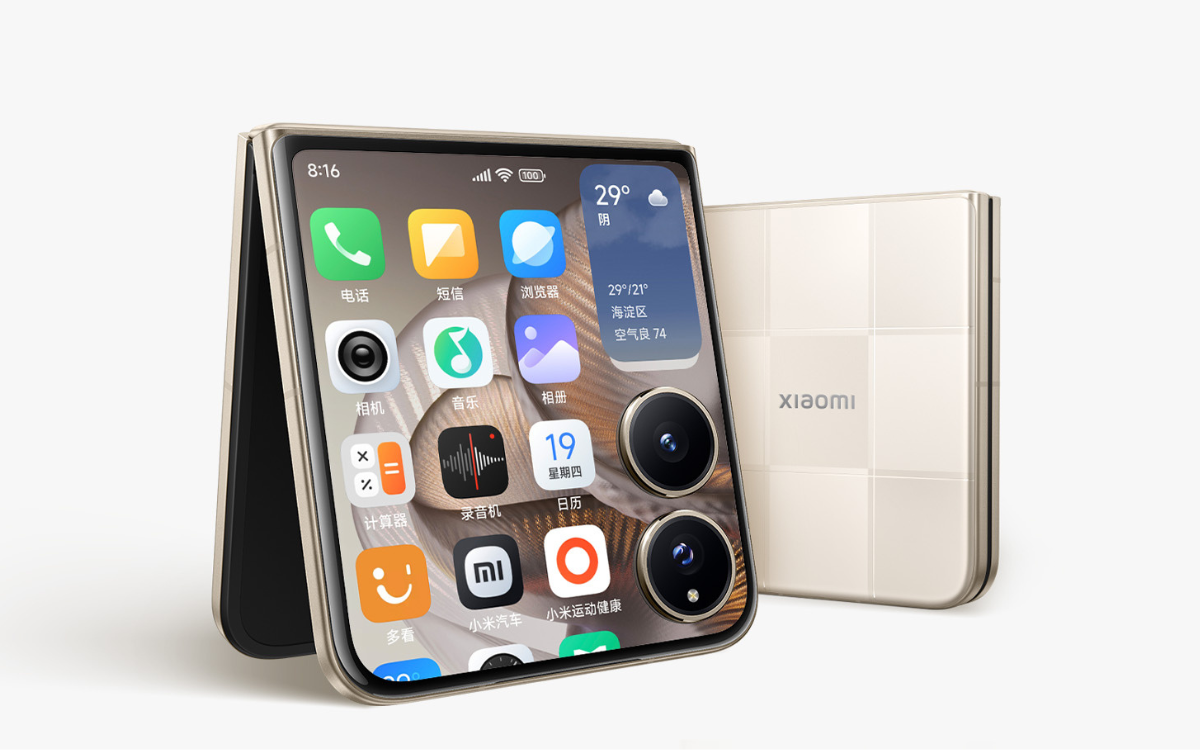
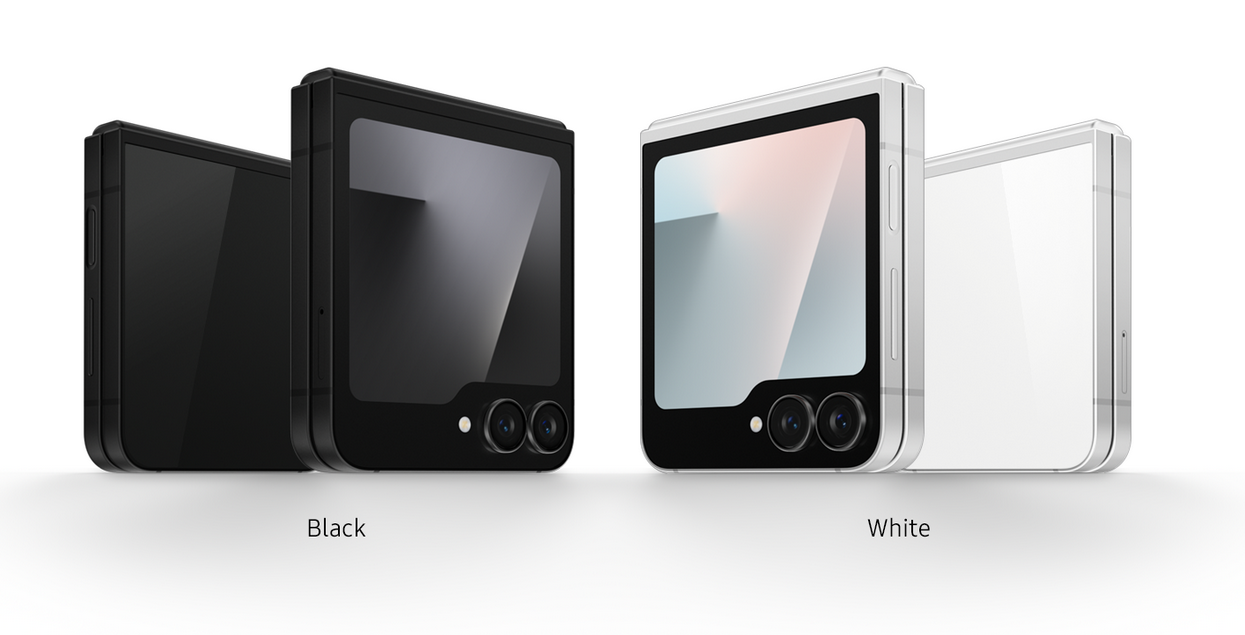
The flip phone market is heating up once again, with Samsung’s Galaxy Z Flip 7. While Samsung had long dominated the foldable segment, other brands have since caught up and even surpassed the South Korean giant. Chinese companies in particular have offered cutting edge designs and tech without any of the compromises faced by typical foldable phones. But this year, Samsung made some notable upgrades, so let’s see how the latest Z Flip 7 compares against the Xiaomi Mix Flip 2.
There were plenty of minor changes on the new Galaxy Z Flip 7 that were related to improved hinge and helped pack a taller display. But it also caused it to become thicker than its predecessor, measuring 13.7mm when folded (6.5mm unfolded) and weighing 188 grams. However, this is still thinner than Xiaomi’s Mix Flip 2 that is heaier at 199 grams and thicker 15.87mm when folded (7.57mm unfolded). So Samsung is still beating some of its competition in the design department.
Another upgrade in Samsung’s new flip is the taller 4.1-inch Super AMOLED FlexWindow screen with a 120Hz refresh rate. This is slightly taller than Xiaomi Mix Flip 2’s 4.01-inch screen, which brings 3200 nits of peak brightness, Dolby Vision, and a 120Hz refresh rate as well. The main screen on both is quite similar with a 6.9-inch Dynamic AMOLED 2X Infinity Flex display on the Z Flip 7 that also offers a 120Hz refresh rate and FHD+ resolution, while the Mix Flip 2 sports a 6.86-inch foldable LTPO AMOLED screen with a FHD+ resolution and 120Hz refresh rate.
Please Note: When you buy something using the links in our articles, we may earn a small commission at no cost to you.
2. Performance
Xiaomi Mix Flip 2
Samsung made a big shift away from Qualcomm for its flip phones this year, opting for an Exynos 2500 chip on the Z Flip 7. This is still a flagship grade 3nm chip with top notch performance, but the Snapdragon 8 Elite on the Mix Flip 2 still edges ahead in raw performance.
The Galaxy Z Flip 7 gets a slightly larger 4,300mAh cell compared to the 4,000mAh battery on the Z Flip 6, but this still pales in comparison to the Mix Flip 2’s 5,165mAh battery. Even in fast charging rates the Xiaomi flip phone has a faster 67W wired and 50W wireless charging support (25W wired and 15W wireless on the Z Flip 7).
3. Camera
For photography, there are two 50MP camera on the Mix Flip 2, which includes a primary Leica Summilux lens and an ultra wide angle shooter. The front houses a 32MP selfie camera. A similar setup can be found on the Galaxy Z Flip 7, but the ultra wide angle is a 12MP shooter, while the front features a 10MP selfie sensor. On paper, the Chinese brand’s flip phone clearly has an edge here considering the higher resolution and Leica collaboration.
4. Pricing and Availability
Samsung Galaxy Z Flip 7 FE
The Samsung Galaxy Z Flip 7 starts from 1,099 US Dollars for the base 12GB + 256GB variant. On the other hand, the Xiaomi Mix Flip 2 start from 5,999 yuan for the same configuration, which is around 835 US Dollars. This makes it even more affordable than the value-focused Galaxy Z Flip 7 FE. Unfortunately, Xiaomi has yet to release this model in the global market, so you can only get it by shipping it from China. So the Z Flip 7 is simply more easy to get your hands on. Xiaomi is the better deal overall, but Samsung with its strong ecosystem and consistent support is slowly catching up with its competitors.
For more daily updates, please visit our News Section.
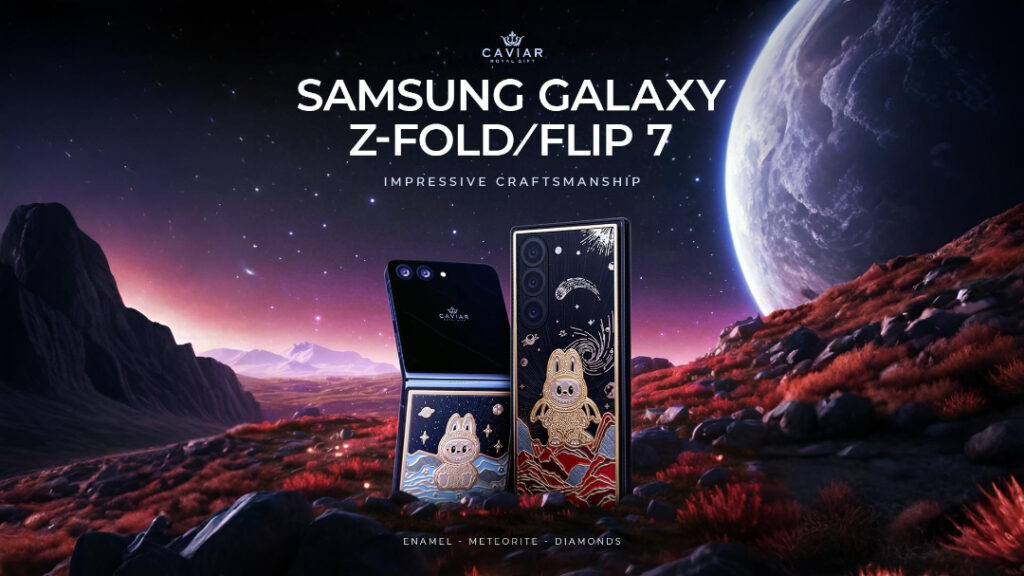
Luxury brand Caviar has launched a new collection based on the Samsung Galaxy Z Fold 7 and Z Flip 7. The new “Cosmic Cabubu” lineup transforms the latest Samsung foldables into high-end collectible art pieces, featuring 24K gold, meteorite fragments, natural diamonds, and intricate enamel detailing. Prices start at $8,910 and go up to $10,340, making this the most expensive Samsung-based series Caviar has ever created.
The collection draws inspiration from Labubu, a cult pop character created by Hong Kong artist Kasing Lung. Labubu gained global popularity in 2025, with appearances on social media by celebrities such as Rihanna and Dua Lipa. Caviar adapted the character into its own version called Cabubu and reimagined it as a cosmic traveler. The company has dedicated each phone in the series to a different planet, Venus and Mars, representing beauty and power respectively.
The Samsung Galaxy Z Fold 7 “Cabubu on Mars” features a titanium body finished with Swiss PVD coating. The back showcases a 3D figure of Zimomo, the male version of Cabubu, detailed with 24K gold and jewelry-grade enamel. The red Martian terrain uses fragments of real meteorites and vibrant red enamel to create a layered design. This model starts at $10,340 for the 256GB variant.
The Galaxy Z Flip 7 “Cabubu on Venus” uses black titanium and gold-plated detailing. It features a handcrafted depiction of Cabubu surrounded by a Venus-inspired landscape. The design includes 13 natural diamonds and meteorite inlays, blending artistic craftsmanship with rare materials. This version starts at $8,910 for the 256GB variant.
Both models are based on Samsung’s newly announced foldables. The Galaxy Z Fold 7 sports an 8-inch AMOLED display, Snapdragon 8 Elite for Galaxy processor, and a 200MP main camera. The Z Flip 7 features a 6.9-inch AMOLED screen, Exynos 2500 chip, and a 50MP camera with Galaxy AI.
Caviar confirmed that each phone is a limited edition, with only eight units available worldwide for each design. The packaging also matches the luxury theme and includes a futuristic gold-accented case.
We use cookies on our website to give you the most relevant experience by remembering your preferences and repeat visits. By clicking “Accept”, you consent to the use of ALL the cookies.
This website uses cookies to improve your experience while you navigate through the website. Out of these, the cookies that are categorized as necessary are stored on your browser as they are essential for the working of basic functionalities of the website. We also use third-party cookies that help us analyze and understand how you use this website. These cookies will be stored in your browser only with your consent. You also have the option to opt-out of these cookies. But opting out of some of these cookies may affect your browsing experience.
Necessary cookies are absolutely essential for the website to function properly. This category only includes cookies that ensures basic functionalities and security features of the website. These cookies do not store any personal information.
Any cookies that may not be particularly necessary for the website to function and is used specifically to collect user personal data via analytics, ads, other embedded contents are termed as non-necessary cookies. It is mandatory to procure user consent prior to running these cookies on your website.