Earlier this year, Poco unveiled the Poco X8 Pro and X8 Pro Max in multiple markets. At that time, it was believed that the company may not launch the standard Poco X8 this year. However, recent certification sightings have suggested that the standard X8 is indeed in development. It appears that the X8’s launch could be close at hand as the brand has seemingly started teasing its arrival.
Poco X8 seemingly teased
♾️ Infinity Identity Activated Mission Update. A new route has appeared inside the POCO Infinite Universe. Only those who move faster than the moment can unlock it.
🟡 POCO X Series The Spacetime Pilot eXplore. eXceed. eXpand.
The above X post reveals that Poco has started teasing a new X-series phone. While the company has not explicitly mentioned the device, it appears that the brand could be teasing the Poco X8’s arrival.
The teaser shows a smartphone in Poco’s signature Yellow color, which has been associated with several of the company’s X-series devices in the past. However, the brand is yet to confirm the name or launch details of the upcoming phone.
Poco X8 specifications: what to expect?
Recent reports have suggested that the Poco X8 could be a rebranded version of the Redmi Note 17 Pro 5G, which debuted in China last month. Therefore, it is expected to feature a 6.83-inch AMOLED panel offering a 1.5K resolution and a 120Hz refresh rate.
Under the hood, it could feature the Snapdragon 6s Gen 4 chipset and a massive 9,000mAh battery. For photography, it may feature an 8-megapixel selfie camera and a 50-megapixel + 2-megapixel dual-camera setup on the back. It is also expected to have other features, such as HyperOS 3-based Android 16, an in-screen fingerprint sensor and an IP68/69-rated body.
As far as the Redmi Note 17 Pro’s global edition is concerned, it is being said that it will have an 8-megapixel ultra-wide lens instead of a 2-megapixel camera. It may pack a smaller 8,340mAh battery. The rest of its specifications could remain the same as its Chinese version.
For more daily updates, please visit our News Section.
Oppo has quietly raised prices on a bunch of its popular K14 and A6 phones in India again. Several variants are now up by as much as ₹2,000, and this isn’t the first time. A few of these models have already been hiked more than once, so some phones are noticeably more expensive than when they first launched.
The latest changes cover the K14x, regular K14, A6c 4G, A6, and A6 Pro. On the K14x, the 4GB + 64GB version is now ₹17,999 (was ₹16,999), the 4GB + 128GB is ₹19,999 (from ₹18,999), and the 6GB + 128GB sits at ₹22,999 (up from ₹20,999). The standard K14 follows the same pattern: 6GB + 128GB moves to ₹23,999, 6GB + 256GB to ₹25,999, and 8GB + 256GB to ₹28,999.
That said, not every listing has caught up yet. The K14x 4GB + 128GB is still showing up at ₹18,499 or ₹18,999 on Amazon depending on the seller, even though Flipkart has already moved to the new price. The 6GB + 128GB variant is still floating around the ₹20,000 mark on both Amazon and Flipkart in some places. Similar older deals are still hanging around for the K14 6GB + 128GB and 6GB + 256GB on Amazon right now, while the top configuration already seems to have been updated.
In the A6 series, the A6c 4G jumps to ₹16,999 for the 4GB + 64GB and ₹18,999 for the 4GB + 128GB. The regular A6 sees its 4GB + 128GB at ₹26,999, 6GB + 128GB at ₹28,999, and 6GB + 256GB at ₹31,999. The A6 Pro lands at ₹32,999 (8GB + 128GB) and ₹35,999 (8GB + 256GB).
Same situation here: a few of these are still available at the previous prices on Amazon as of writing. If you’re eyeing one of these models, it might be worth checking the listings sooner rather than later before the older stocks disappear.
The price increase has been happening in stages. The K14x base model started at ₹15,999, went to ₹16,999, and is now ₹17,999 after hikes in April and July. The K14 has climbed from its earlier ₹19,999 level as well. The A6 Pro has been through at least three increases since it launched around the low ₹20,000s in March, adding up to roughly ₹8,000–₹11,000 more depending on the variant, all without any hardware changes. The A6c and A6 have seen similar stepwise jumps.
The Motorola Edge 70 Max is the latest smartphone to join the company’s ongoing Android 17 beta program. Ideally, the device should have launched with the newest Android OS since it was launched in July 2026, but anyway, it’s good to see Motorola acting quickly to bring the update.
According to the official community post, the Android 17 beta program for the Edge 70 Max is live in EMEA (Europe, the Middle East, and Africa) and India. This doesn’t just mean the beta build is rolling out; it means the company is now allowing people to register for the beta testing opportunity.
As always, the number of testers should be limited, and you must therefore submit your participation as early as possible to stand a chance. Unlike beta applications from other brands, Motorola’s require a few extra steps. We have a detailed step-by-step guide on how you can register for Motorola’s Android 17 beta program that you can refer to.
Once you’ve upgraded to Android 17 beta, you’ll have many new features and plenty of upgrades to explore. For instance, there’s a new Classic Control Center, new status bar icons, and updated home screen icons. Motorola has also improved haptics that now feel different when you swipe a notification.
Motorola has integrated Live Updates into the camera cutout in the middle, similar to Apple’s implementation. Previously, it would appear on the left side of the Status bar. The update also adds support for most day-to-day apps.
The lock screen gets new clock faces and new font styles. Motorola has made it a lot easier to take screenshots and open split-screen. Now, you can swipe down three fingers to take a screenshot. To open a split-screen, simply swipe up three fingers. The update also brings some new features, including Landscape Stereo, Enhanced HDR Brightness, and Battery health.
iQOO is all set to unveil the iQOO Z11 on Aug. 20 in India. Ahead of the official launch, the brand has started revealing key details about the upcoming smartphone through official announcements. The company has now confirmed the battery capacity, AI features and the price segment of the device.
iQOO Z11 price segment and battery details revealed
iQOO Z11 launch date
The iQOO Z11 will be positioned in the under Rs 40,000 price segment in China. Alongside confirming its pricing category, iQOO has revealed that the smartphone will pack a massive 7,050mAh battery. The large battery is aimed at supporting extended usage for activities such as learning, content creation, entertainment and multitasking. At present, there is no information about the device’s fast charging capabilities.
The company has also highlighted the phone’s AI capabilities, with the iQOO Z11 featuring AI-powered tools designed for everyday productivity. These include AI Captions, which combines Google Gemini and Microsoft Azure to provide transcription and translation features. The smartphone also supports AI Creation tools for summarising documents, refining assignments, generating ideas and assisting with content creation.
The iQOO Z11 will also feature AI routing technology that assigns different tasks to suitable Gemini models. It supports real-time AI processing and conversation memory, allowing users to continue refining content through follow-up prompts. The device will also support Circle to Search for quicker information discovery.
Previously confirmed details revealed that the iQOO Z11 will be India’s first smartphones to feature the MediaTek Dimensity 7500 Turbo chipset. It will also come with a 6.83-inch curved AMOLED display featuring a 144Hz refresh rate, 2,000 nits HBM brightness and 3,000 nits local peak brightness.
The smartphone will be available in Celestial Blue and Aurora Green colour options. While iQOO has confirmed several details ahead of launch, other specifications, including camera details, RAM and storage configurations, are still under wraps.
For more daily updates, please visit our News Section.
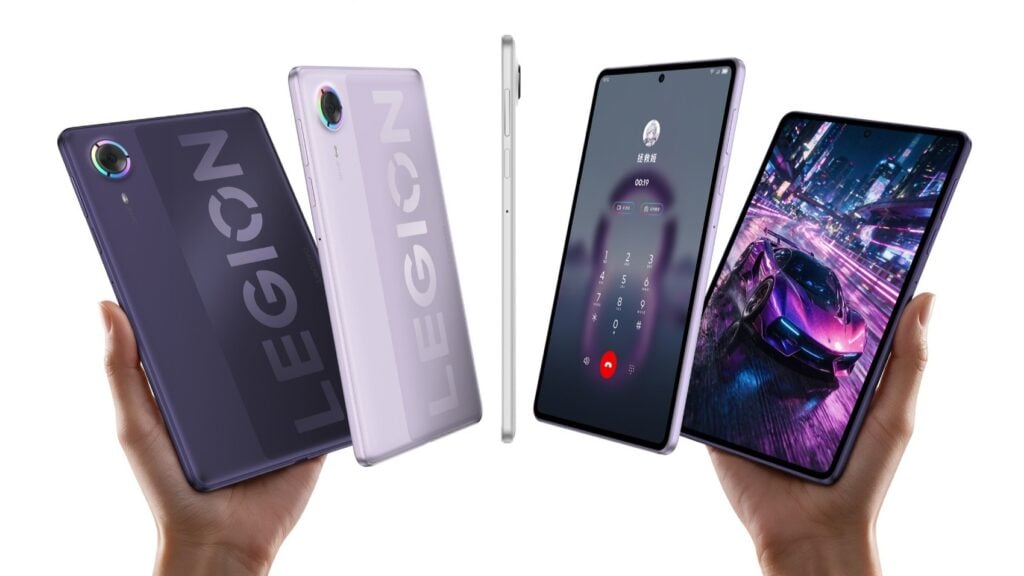
The Legion Y700 Infinite is set to arrive on August 25, 2026, in China. Official details confirm an 8.4-inch OLED display with a 165 Hz refresh rate. That size and refresh rate trail the RedMagic Astra 2 (9.06-inch, 185 Hz), but the Lenovo tablet pulls ahead with its processor, an overclocked Snapdragon 8 Elite Gen 5 Leading Version. The prime cores hit 4.74 GHz versus 4.61 GHz on the standard version, and the GPU is also clocked higher at 1.3 GHz compared to 1.2 GHz.
Lenovo has shared an AnTuTu score of 4,585,844 points for the device, which sits above the average results (roughly 4,159,341 to 4,297,377) the RedMagic Astra 2 has been posting in the latest monthly charts.
A recent promo video also shows off 2.89 mm bezels, giving the tablet a pretty slim-looking frame. Unlike the Legion Tab Gen 5 (also known as the Y700 Gen 5), the Y700 Infinite uses a punch-hole cutout for the front camera. Some people might see that as a small step back from a completely uninterrupted display, but it does help achieve those tighter bezels.
Battery capacity hasn’t been officially confirmed yet. A leak from tipster Panda is Bald points to a 7,500 mAh cell with 68 W fast charging. If that turns out to be accurate, it would put the tablet behind the RedMagic Astra 2 in both capacity and charging speed. Pricing is still under wraps, and it’s unclear whether this OLED Legion model will make it to global markets.
Overall, the mix of a high-refresh OLED panel, flagship-level silicon, and strong benchmark results makes the Y700 Infinite look like a solid contender in the compact gaming tablet space. With the Chinese launch only a couple of weeks away, we should get more official specs soon, including exact memory configs, camera details, and final pricing.
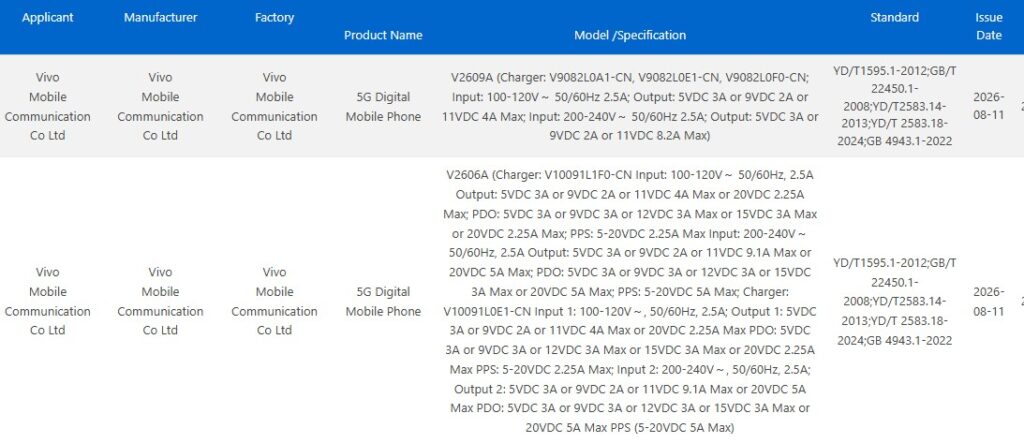
Two new Vivo phones bearing the model numbers V2609A and V2606A were spotted at China’s SRRC (radio certification) and MIIT in recent weeks. Both phones have now passed 3C certification, indicating that they are heading closer to launch. Here’s a look at the details that have emerged through the latest certification.
Vivo X500, iQOO 16 clear 3C certification
Vivo X500 and iQOO 16 3C certified
The V2609A is believed to be the Vivo X500 series, while the V2606A is expected to be the iQOO 16. The Vivo X500 has been certified with support for the N79 5G band and a 90W charging adapter. A version with Beidou satellite communication is also said to be in development.
The Vivo X500 series is tipped to use MediaTek’s Dimensity 9600 lineup, which is expected to include a 3nm Dimensity 9600 Lite and a 2nm Dimensity 9600 Pro. However, it remains unclear whether the X500 will actually use the Pro variant.
The MIIT certification of the device revealed that the Vivo X500 will support several AI models and platforms, including Vivo’s BlueLM, Zhipu AI’s ChatGLM, Baidu’s ERNIE, ByteDance’s Doubao, DeepSeek, and Alibaba’s Qwen.
The iQOO 16, carrying model number V2606A, has also received 3C certification with a 100W charging adapter and support for the N79 5G band. It is expected to be among the first phones powered by Qualcomm’s Snapdragon 8 Elite Gen 6 Pro, with a launch reportedly scheduled for early October in China. However, there is also a possibility that the phone may debut by the end of September.
The Vivo X500 series will be competing with the iPhone 18 Pro series and the Xiaomi 18 series, which are expected to break cover in September. On the other hand, the iQOO 16 will compete with the likes of the OnePlus 16 and Redmi K100 Pro Max.
For more daily updates, please visit our News Section.
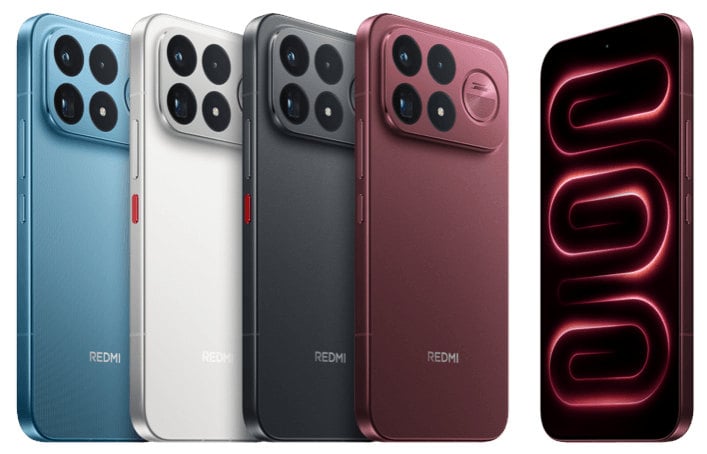
In recent weeks, the upcoming Poco F9 series has been spotted on certification platforms such as IMDA (Singapore) and SDPPI (Indonesia), indicating that it may debut in the next few months. Reports suggest that the Poco F9 Ultra and F9 Pro will be rebranded versions of the Redmi K100 Pro and K100 Pro Max, which recently launched in China. However, a new development reveals that the Poco F9 duo will arrive with some major changes in the battery department compared to their Redmi counterparts.
Poco F9 Ultra, Poco F9 Pro battery, charging details emerge
Redmi K100 Pro Max
Reliable tipster Kacper Skrzypek has scoured through the HyperOS code to reveal the battery sizes and charging capabilities of the F9 series. He has revealed that the Poco F9 Ultra will house an 8,050mAh battery, whereas the F9 Pro will pack a 6,330mAh battery.
In comparison, the Redmi K100 Pro Max has a 9,070mAh battery, whereas the K100 Pro features an 8,580mAh battery. While there is a major change in the battery department, there is no change in charging capabilities, as the Poco models support 100W charging like their Redmi siblings.
The tipster did not specify the other specifications of the Poco F9 Ultra and F9 Pro, but they are expected to remain identical to those of the Redmi models.
Poco F9 Ultra, F9 Pro specifications (expected)
The Poco F9 Ultra is expected to feature a 6.9-inch AMOLED panel, while the Pro edition could be equipped with a 6.59-inch screen. Both phones are expected to support a 1.5K resolution and a 185Hz refresh rate. Both models may feature the Snapdragon 8 Elite Gen 5 V-series chip and offer up to 16GB of LPDDR5X RAM and up to 1TB of UFS 4.1 storage.
For selfies, both Poco F9 series phones may house a 32-megapixel front camera. On the back, both models may feature a 200-megapixel Samsung HP5 main camera. While the F9 Ultra’s rear camera module may also include a 50-megapixel ultra-wide lens and a 50-megapixel periscope telephoto camera with 5x optical zoom, the Pro edition’s rear setup may comprise an 8-megapixel ultra-wide snapper and a 50-megapixel periscope telephoto camera with 2.5x optical zoom.
For more daily updates, please visit our News Section.
Rumors of a big collaboration between two major smartphone brands on a new imaging product have been pretty firmly shut down.
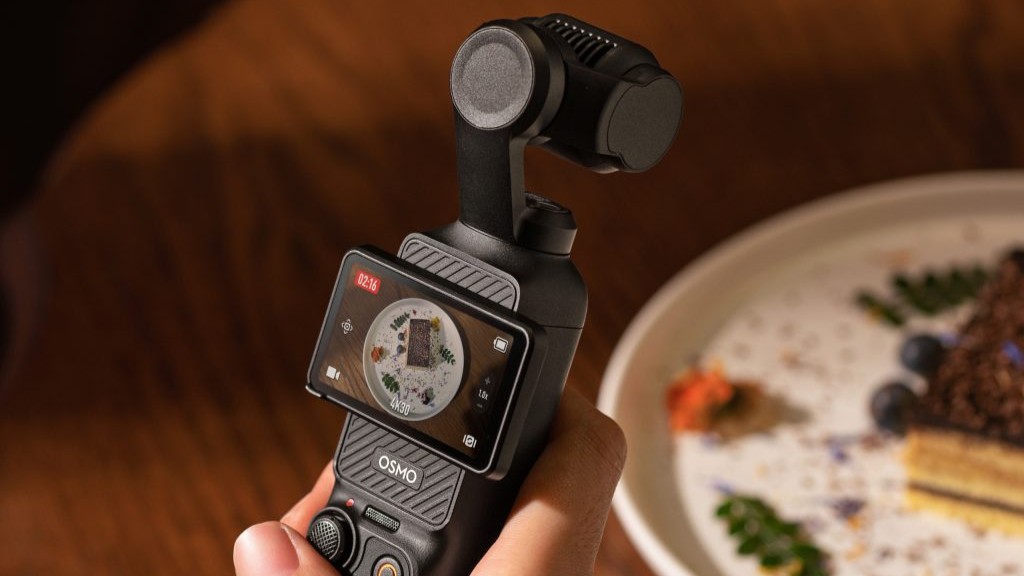
Oppo and Vivo have both explicitly denied online reports that claimed they had finalized a strategic partnership to jointly develop and launch a pocket gimbal camera sharing all their core imaging tech. In statements to Nandu Bay Finance (via ITHome), both companies said no joint R&D agreement has been reached and there are currently no plans to co-launch anything like that.
The denial comes at a time when the handheld gimbal camera category is growing fast. Industry data shows global shipments of handheld smart cameras topped 16 million units in 2025, more than an 80% jump year-on-year. DJI’s Osmo Pocket 3 alone has passed 10 million cumulative sales since it launched in October 2023, with 5 million sold in 2024 and nearly 20 billion yuan in revenue. That kind of potential has attracted new players. Inspiron released its Luna Ultra handheld gimbal camera in June, while DJI brought out the dual-main-camera Osmo Pocket 4P around the same time.
Both Oppo and Vivo have been working on their own projects independently. At the start of the year, Vivo confirmed that it kicked off an internal Vlog camera project at the end of 2025 and put together a team of more than 200 people. Separate reports say Oppo has also started its own gimbal camera project, with an expected launch in the fourth quarter of 2026. Honor is also looking into similar devices through an ODM route.
With everyone moving in parallel and competition heating up, speculation about a formal Oppo-Vivo partnership started floating around. The official responses make it clear that nothing of the sort has actually happened. Instead, the two companies seem to be pushing ahead with their own efforts separately.
Mainstream smartphones are not built for every user. If you spend a lot of time outdoors, go traveling, hiking, and have a habit of dropping your phone, a proper rugged handset can be a useful secondary device.
These devices come with reinforced bodies, huge batteries, and screens that can handle more abuse than an average handset. If you are the right person, here are five of the best rugged phones to look for in 2026.
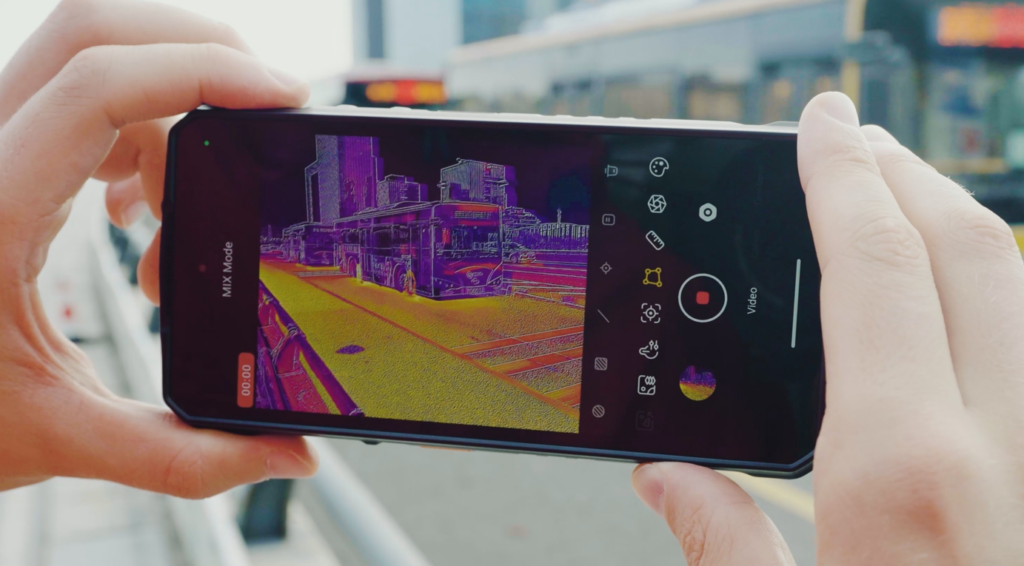
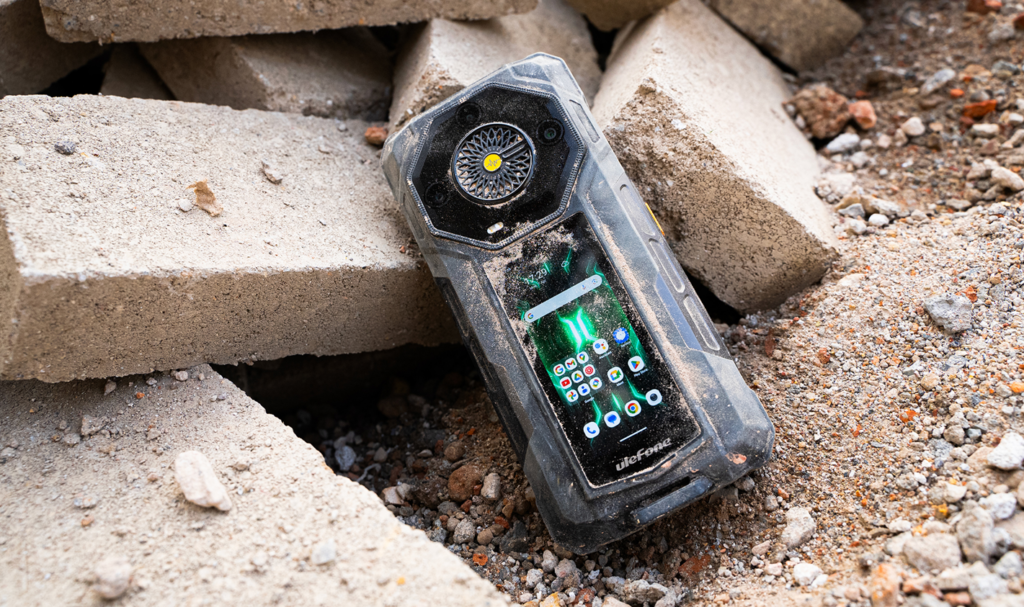
The Ulefone Armor 29 Pro Thermal comes with an IP68/IP69K rating. Ulefone claims it can handle drops from up to 1.5m. Two special features of this phone are a 1,000-lumen dedicated flood flashlight and a warning light.
Inside, it packs a MediaTek Dimensity 7400 and a massive 21,200 mAh battery with 120 W wired charging (and PPS support). Despite the large battery, the brand claims it can hit 20 % charge in about 10 minutes. As for cameras, it includes a 50MP + 64MP + 50 MP setup on the back and a 50 MP selfie shooter.
It was released in September 2025 at around £559 / $799 and is available worldwide through Ulefone’s regional stores, official channels, and places like AliExpress. Pricing does vary a bit depending on where you buy it.
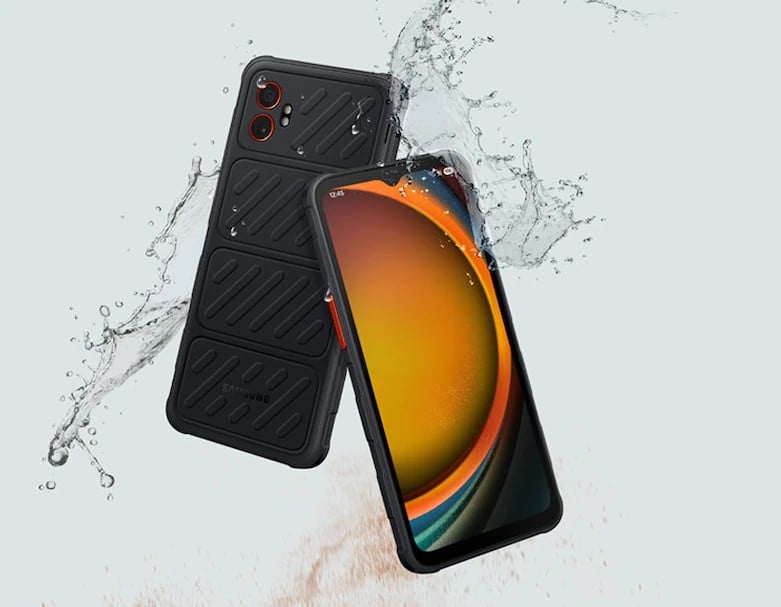
Samsung’s take is a bit more compact while still delivering the durability you’d expect. It has an IP68 rating and can survive drops of up to 1.5 m. The 4,350 mAh battery is removable, which is genuinely useful if you’re working long shifts or often away from a charger.
At 240 g and 10.2 mm thick, it’s also noticeably lighter and thinner than a lot of its rugged rivals. Specs include a 6.6-inch 1080p PLS LCD with 120 Hz, a Snapdragon 7s Gen 3 processor, and 15 W wired charging. Cameras are a more modest 50 MP + 8 MP on the back with a 13 MP front camera.
It went on sale in Europe from late April 2025 and arrived in the US in early May, mainly aimed at enterprise and business customers. There’s no successor yet. Current European prices sit roughly between €405 and €609 depending on the retailer and any business deals. Official launch price was around €609.
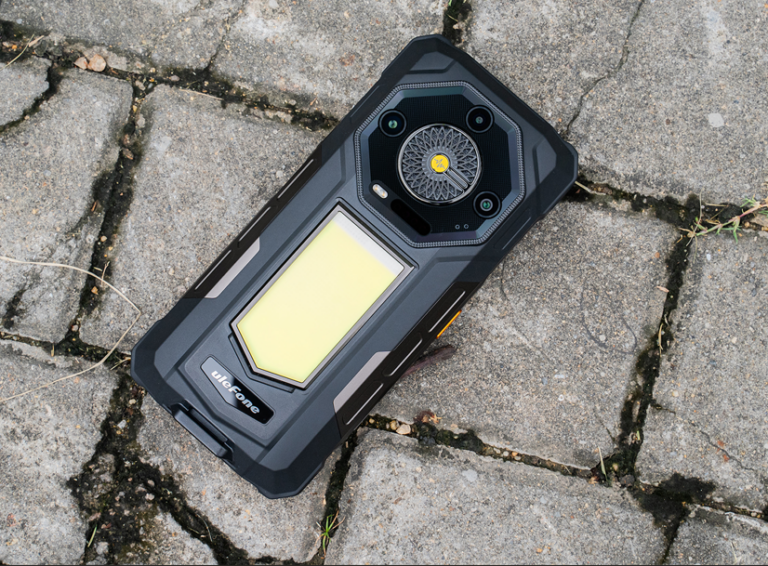
This is one of the more extreme options. Same IP68/IP69K rating and 1.5 m drop protection as its siblings, but the standout feature is a secondary 3.4-inch display on the rear (IPS LCD, 412 × 960, up to 600 nits). It packs a 25,500 mAh battery and supports 66 W charging.
The primary screen is a 6.95-inch IPS LCD with 120 Hz, 1080p, and up to 700 nits. Performance comes from a MediaTek Dimensity 7300X. Just be aware it’s a big phone: 185.5 × 85.5 × 34 mm and 776.5 g. Cameras are 50 MP + 64 MP + 50 MP on the back and 32 MP up front.
It was released in August 2025 and usually sells for around €379–€467 depending on the retailer, region, and any current discounts. It’s available across most of Europe and several other global markets.
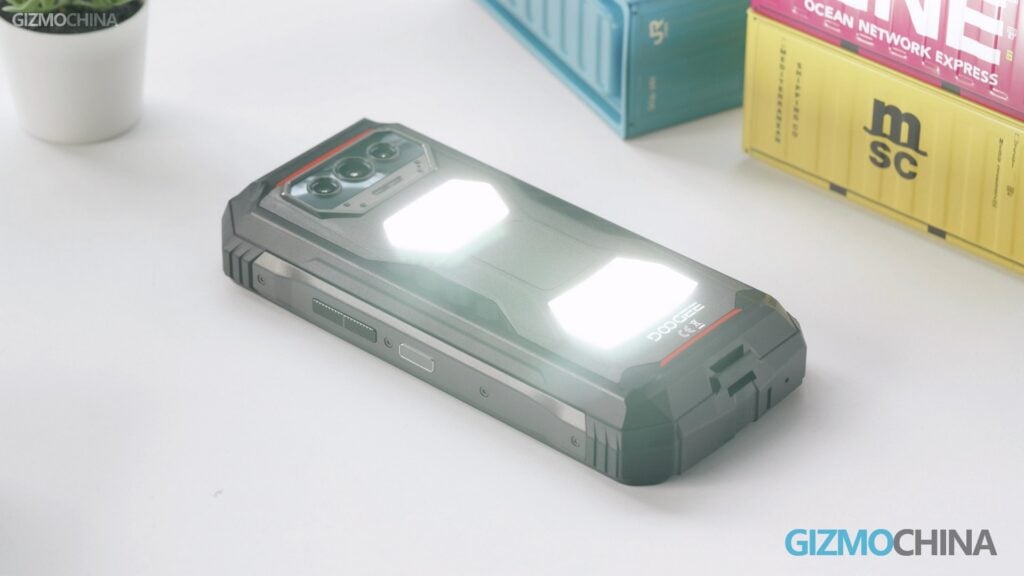
This shares a lot of the same rugged hardware as the Pro (IP68/IP69K and 1.5 m drop resistance), but instead of the rear secondary screen it has an RGB LED on the back that can light up for music, calls, notifications, and charging. It also gets a dedicated 1,100-lumen flood flashlight.
Inside it’s a MediaTek Helio G100, so this one is 4G-only rather than 5G. You still get the big 6.95-inch 1080p 120 Hz IPS LCD, the same 25,500 mAh battery with 66 W charging, and the same 50 MP + 64 MP + 50 MP camera setup with a 32 MP selfie camera.
It was also released in August 2025 and is a bit cheaper, roughly €310–€380 depending on where you look. Available globally through AliExpress, Amazon, and the official Ulefone store.
IP68/IP69K and 1.5 m drop resistance again, plus a 22,000 mAh battery. Charging is more modest at 33 W. It weighs 536 g and measures 178.5 × 83.1 × 26.3 mm, still chunky, but not quite as extreme as the heaviest Ulefone models. Specs include a 6.58-inch 1080p IPS LCD with 120 Hz and a MediaTek Dimensity 7050. Cameras are a 108 MP + 20 MP + 2 MP setup with a 16 MP front camera.
It was released back in May 2025 and generally sells for around €380–€430. You can find it worldwide through major online platforms, global shipping suppliers, and Doogee’s official store.
Xiaomi has released two new 20,000mAh power banks, offering 45W and 67W charging speeds. The main update for these models is that they are built to comply with China’s new 2026 national safety standards for portable batteries (GB 47372-2026). The 45W model is priced at 229 yuan ($34), and the 67W version is 269 yuan ($40). Both are available starting today on Xiaomi Youpin.
In terms of design, both power banks feature a built-in USB-C cable, alongside one standard USB-C port and one USB-A port. The integrated cable is made of TPU and tucks into a slot on the side, which also lets it work as a small carrying loop.
Both versions come in light blue and light brown. The slightly more expensive 67W model includes a digital screen on the side to show the exact battery percentage and current charging status, while the 45W model relies on standard indicator lights.
For charging, the 45W model supports up to 45W for both input and output through the USB-C connections. The 67W model increases the maximum output to 67W and supports 65W input for recharging the power bank itself. On both models, the USB-A port provides up to 22.5W. They support common charging standards like PD 3.0, PPS, and QC 3.0.
However, if you charge multiple devices at the same time, the total power output is capped at 15W across all ports. They also include a low-current mode for safely charging smaller accessories like wireless earbuds and smartwatches.
To meet the new 2026 safety regulations, Xiaomi included 16 hardware protection features. The company says the internal cells are tested to withstand high compression and temperatures up to 135°C for an hour.
The power bank also features a battery management system that lets you check battery health, charge cycles, temperature, and charging error logs via USB-C.
For travel, the batteries are rated at 74Wh and 74.37Wh. This is well under the 100Wh limit set by most commercial airlines, so they are perfectly fine to pack in your carry-on luggage when flying.
Citizen has updated its World Chronograph A.T lineup in the UK, adding a new green dial option to the series. The new model, officially listed as the AT8260-85X, is priced at £499 and is available to purchase now. It joins the existing blue and white versions in the company’s current catalog.
The AT8260-85X is a 43mm stainless steel watch that combines traditional analog design with practical timekeeping technology. The case features a mix of brushed and polished finishes, paired with a standard silver-tone stainless steel bracelet that uses a push-button fold-over clasp.
On the right side of the case, there is a faceted crown and two pushers to operate the chronograph functions. The dial is protected by a scratch-resistant sapphire crystal, and the watch is water-resistant up to 100 meters, making it suitable for everyday wear, showering, and swimming.
The dial itself is green with silver-tone markers to provide visual contrast. It features a vertical three-register chronograph layout capable of measuring time in 1/20th of a second increments for up to 60 minutes. There is also a standard date window positioned at 3 o’clock.
Internally, the watch is built around Eco-Drive and Atomic Timekeeping systems. Because Eco-Drive draws power from both natural and artificial light, it eliminates the need for routine battery replacements. There is also a power reserve indicator on the dial so you can monitor the current charge level.
The Atomic Timekeeping feature uses a built-in radio receiver to sync with local time signals in four different global regions. When traveling, the watch automatically adjusts to the correct local time and date.
It supports 26 different time zones and includes a perpetual calendar, meaning the watch automatically accounts for the varying lengths of months and leap years without requiring manual adjustment. It also includes a 12/24-hour time format display.
Xiaomi has officially launched the new Redmi K100 Pro and K100 Pro Max in China. Both smartphones come with Qualcomm’s flagship processor, high-refresh-rate OLED displays, large batteries, and 200MP main cameras.
The Redmi K100 Pro is powered by the new Snapdragon 8 Elite Gen 5V Series chipset, which has one less GPU slice than the standard Snapdragon 8 Elite Gen 5. The phone uses LPDDR5X RAM and UFS 4.1 for storage, and a 5,150mm² ice-cooled circulating pump for heat management. It also has the company’s in-house D2 discrete graphics and T1+ signal booster chip.
The standard Pro model features a 6.59-inch OLED flat display with a 2510 × 1156 resolution. The panel supports a 185Hz refresh rate and uses M11 luminescent material. It reaches up to 2,200 nits of full-screen brightness and supports full-brightness DC dimming.
The camera specs on the Redmi K100 Pro include a 32MP selfie unit. The back has a 200MP primary camera with optical image stabilization (OIS), a 50MP telephoto camera, and an 8MP ultra-wide-angle camera.
Keeping everything powered on the standard Pro is an 8,580mAh Jinshajiang battery with 26% silicon content and an energy density of 945Wh/L. It supports 100W wired fast charging and 50W wireless charging. The phone also supports 27W wired reverse charging and 22.5W wireless reverse charging.
The Redmi K100 Pro is 8.55mm thick and weighs 218 grams. It comes in four colors: black, white, shimmering light, and Cabernet Sauvignon red. Other features include ultrasonic fingerprint recognition, IP66, IP68, and IP69 dust and water resistance, and Xiaomi’s HyperOS 3.0.
Redmi K100 Pro Max gets bigger display and battery
The Redmi K100 Pro Max has the full-core Snapdragon 8 Elite Gen 5 processor, while it uses the same LPDDR5X memory and UFS 4.1 storage as the standard Pro model. However, Xiaomi has increased the size of its ice-sealed circulating cooling pump to 6,300 mm².
The Pro Max also gets a larger 6.9-inch OLED flat display with a 2608 × 1200 resolution. Like the Pro model, it supports a 185Hz refresh rate and uses M11 luminescent material.
The camera system has also received an upgrade. The Redmi K100 Pro Max features a 200MP main camera with OIS, a 50MP periscope telephoto camera, and a 50MP ultra-wide-angle camera.
The phone packs a larger 9,070mAh battery with 16% silicon content. It supports the same 100W wired charging, 50W wireless charging, 27W wired reverse charging, and 22.5W wireless reverse charging as the Redmi K100 Pro.
Despite the larger battery and display, the Pro Max is 8.45mm thick and weighs 238 grams. It uses a glass fiber back cover and comes in black, gold, blue, and red color options.
The Pro Max also gets several connectivity and audio upgrades. It features a USB 3.2 Gen 1 interface and a 2.1-channel speaker system made up of dual 1115D master-level speakers and Deco 2016 tablet-level speakers.
Like the standard model, the Redmi K100 Pro Max features an ultrasonic fingerprint sensor, IP66/IP68/IP69 protection, and HyperOS 3.0.
Redmi K100 Pro and Pro Max pricing
The Redmi K100 Pro starts at 3,699 yuan (~$550) for the 12/256GB storage version. The 12/512GB model costs 4,099 yuan (~$610), while the 16/256GB version costs 4,299 yuan (~$640). The top-end 16/512GB variant is priced at 4,699 yuan (~$700).
The Redmi K100 Pro Max retails at 4,499 yuan (~$670) for the 12/256GB model, 4,899 yuan (~$730) for the 12/512GB version, and 5,099 yuan (~$760) for the 16/256GB model. Meanwhile, the top-line 16GB + 512GB model is priced at 5,499 yuan (~$820), and the 16GB + 1TB variant costs 5,999 yuan (~$890).
BenQ has launched the MOBIUZ EX271QMZ, a 26.5-inch gaming monitor priced at $499.99 in the US and ¥104,200 in Japan. It features a third-generation QD-OLED panel and is now available through BenQ’s US and Japanese websites.
The monitor features a 2560 x 1440 (WQHD) resolution, a 240Hz refresh rate, and a 0.03ms gray-to-gray response time. For color and brightness, it covers 99% of the DCI-P3 gamut and outputs 200 nits of typical brightness in SDR, with a peak of 400 nits in HDR10.
Because OLED panels carry a risk of burn-in over time, BenQ has included several hardware and software features to mitigate panel wear. Physically, the monitor uses a graphene film to help disperse heat.
On the software side, it includes a suite of standard OLED protections: Pixel Refresh, Pixel Shift, an Idle Dimmer, and Logo Dimming. BenQ has also added a feature called Brightness Flow, which adjusts pixel brightness based on the scene to reduce the flickering sometimes caused by the Auto Baseline Limiter (ABL) found in OLED displays.
For display settings, BenQ offers Fantasy, Sci-Fi, and Realistic color modes, with over 120 game-specific profiles available through its Color Shuttle software. It also includes a built-in crosshair, FPS counter, and blur reduction.
For connectivity, it includes two HDMI 2.1 ports, one DisplayPort 1.4, and a headphone jack. The monitor has a built-in power supply, basic dual 2W speakers, and an adjustable stand that supports tilt, swivel, and 100mm of height adjustment.
Alongside the EX271QMZ, BenQ announced two IPS monitors. The EX271QM has a 320Hz refresh rate, and the EX271QP has a 260Hz refresh rate. Both IPS models share the same 99% P3 color coverage and include the same art style color modes, but with a standard 1ms response time.
The T13 Pro features 50dB ANC powered by six microphones, with adaptive noise cancellation that adjusts based on ear shape and fit. The QCY app offers six noise-control modes, while the microphones also reduce background and wind noise during calls, with wind resistance rated up to 35km/h.
For audio playback, the T13 Pro features 13mm polymer-diaphragm dynamic drivers designed to deliver stronger bass and 19% higher high-frequency resolution than the standard T13. It also supports 360-degree spatial audio and offers multiple EQ presets through the companion app.
Each earbud weighs 4.5 grams and features a curved design meant to distribute pressure across the ear. They have an IPX4 water-resistance rating, meaning they can handle light rain and sweat. The retail package includes three sizes of silicone ear tips.
For connectivity, the T13 Pro features Bluetooth 6.0 with support for connecting to two devices simultaneously. It also offers a 45ms low-latency mode for gaming and touch controls for playback, calls, and ANC.
The earbuds feature 40mAh batteries, while the USB-C charging case packs a 450mAh cell. They offer up to 11 hours of playback or 49 hours with the case when ANC is off, dropping to 8.5 and 38.5 hours respectively with ANC enabled. It also features fast charging and a 10-minute top-up provides 1.5 hours of listening.
The QCY T13 Pro is compatible with both iOS and Android devices and is available in two colors: Moonlight White and Ice Sea Blue.
In related news, Edifier has recently launched new wired gaming earbuds featuring Hi-Res Audio and hybrid triple drivers.
For more daily updates, please visit our News Section.
In today’s smartphone market, where most devices look and feel the same, truly eye-catching releases are few and far between. But when I got my hands on the TECNO Pova 8 5G – model number LK6 – it genuinely threw a few pleasant surprises my way. As the latest addition to TECNO’s Pova lineup, this phone has already turned heads with its massive 8000mAh battery and the distinctive Alive Matrix dot‑matrix display on the rear.
Design & Build
On paper, the official weight is 225 grams – which doesn’t sound too bad, right? But consider this: the iPhone 17 Pro tips the scale at 240 grams, so this phone is only a hair lighter than that heavyweight. In hand, it feels solid and substantial – you definitely know it’s there. The body is 8.8mm thick, which isn’t exactly slim, but given the 8000mAh battery packed inside, I have to say TECNO’s engineers did a commendable job keeping it under control.
The retail box is well-stocked: you get a transparent silicone case, a 45W charger, a USB cable, and a SIM ejector tool – nothing missing. In an age where chargers are often sold separately, this is a welcome touch. The clear case is decent quality, and once it’s on, you can still clearly see the back design – which is where this phone gets really flashy.
The single most attention-grabbing element is undoubtedly the Alive Matrix dot‑matrix screen embedded in the rear camera module. What is it? It’s a tiny LED dot‑matrix panel at the bottom of the camera bump. Think of it as a miniature notification board – when a call comes in, it lights up with a custom pattern; while charging, it shows an animated progress bar; and incoming notifications trigger their own flashing effects. You can even DIY your own patterns and text – I tried a scrolling “HELLO” effect. It’s not exactly life-changing, but it sure drew some “wow” reactions when I showed it to friends.
This design inevitably invites comparisons with Nothing Phone’s Glyph interface. But honestly, the dot‑matrix approach feels more retro‑digital – like an old‑school electronic watch. Some might call it a gimmick, but I think when every brand is fighting over camera module designs, carving out a differentiated feature in that exact spot shows TECNO actually put some thought into it. In terms of sheer distinctiveness, they absolutely nailed it.
The phone also carries an IP64 water‑resistance rating and MIL‑STD‑810H military‑grade certification. I’m not about to dunk it in water or drop it from a height on purpose, but knowing it can handle an unexpected rain shower or a tumble off the table does give extra peace of mind.
Display
Up front, you get a 6.76‑inch IPS LCD with a 1080×2344 resolution – sharp enough for everyday viewing. The headline spec is the 144Hz refresh rate. And yes, the fluidity is immediately noticeable when swiping through home screens or scrolling through social feeds. That said, I did observe that the system dynamically drops the refresh rate to around 90Hz in certain scenarios – presumably to save power. Even with an 8000mAh battery, every drop counts, right?
Colour performance is where IPS LCD naturally falls short of AMOLED – blacks aren’t as deep, contrast is more modest, and dark‑mode content can look a bit washed out. On the plus side, there’s a feature I genuinely appreciate: wet‑touch support. After washing your hands or in rainy weather, the screen still responds accurately even with damp fingers – a small but genuinely useful detail.
One downside: there’s no 3.5mm headphone jack. I’ve mostly switched to Bluetooth earbuds, but every now and then, I miss the convenience of plugging in wired earphones.
Performance
The MediaTek Dimensity 7100 chipset isn’t a flagship killer, but it’s no slouch either. Built on a 6nm process with an 8‑core architecture, it handles daily tasks with ease – scrolling through Douyin (TikTok), browsing shopping apps, chatting on WeChat, or keeping a dozen browser tabs open – I rarely encountered any stutter. The 8GB of LPDDR5X RAM and 256GB of UFS 2.2 storage are generous for this price tier, and the microSD card slot (supporting up to 1TB) is a bonus for media hoarders.
We ran a quick test with Genshin Impact – and unsurprisingly, it’s not a gaming powerhouse. Maxed‑out graphics led to noticeable frame drops and rising temperatures. Simply put, the Dimensity 7100 is a capable mid‑range chip: fine for everyday use, playable for games, but don’t expect it to rival Snapdragon 8‑series flagships.
Battery Life
What does 8000mAh actually mean in real life?
I ran a dedicated test: starting at 8 AM with a full charge, I used the phone normally throughout the day – WeChat chats, about 1.5 hours of short‑video scrolling, 2 hours of YouTube, roughly 40 minutes of Honor of Kings, two dozen photos, and around 6 hours of screen‑on time total. By the following evening before bed, the battery still had 23% left.
The feeling is liberating – you no longer scramble for a charger before leaving home, no longer ask restaurant staff for a power bank, and no longer panic when the battery dips to 20%. This battery truly cured my charging anxiety.
TECNO claims the cell retains over 80% capacity after 2,000 charge cycles – roughly five to six years with a single daily charge. I can’t verify that right now, but it’s reassuring to hear.
Charging speeds: 45W wired fast charging takes about 35 minutes to go from 0 to 50%, and a full 0‑100% charge takes nearly 1.5 hours. Not the fastest out there, but given the sheer capacity, it’s acceptable. Additionally, it supports 30W wireless charging and 10W reverse wired charging – handy for topping up earbuds or a smartwatch in a pinch.
Camera
The main camera is a 50‑megapixel Sony LYT600 sensor with an f/1.8 aperture. In good daylight, it produces very pleasing shots – colours lean towards the vibrant side, making food and landscape photos pop, perfect for sharing straight to social media without editing. The 50MP resolution also gives you enough detail to crop in without losing too much clarity.
TECNO Pova 8 5G – Camera UI
However, note that there’s no ultra‑wide lens on this phone. What looks like a third camera bump is actually the Alive Matrix dot‑matrix display – so for wide‑angle scenes, you’ll have to step back a few paces. The front‑facing camera is a 13‑megapixel wide‑angle lens; selfies are decent, and the beauty algorithm is fairly natural – TECNO has solid experience in this area.
Verdict
The TECNO POVA 8 5G is a phone that knows its audience and delivers where it matters most. Its massive 8,000mAh battery is the undisputed star — easily powering through two days of moderate use and outlasting most flagships by a comfortable margin, though the 225g weight is a predictable trade-off. The 6.76-inch 144Hz IPS display offers smooth scrolling and decent brightness, while the customizable Alive Matrix LED back panel adds a dose of personality rarely seen at this price point. Camera performance from the 50MP main sensor is serviceable in good light but struggles in low-light scenarios — if photography is your priority, look elsewhere. The Dimensity 7100 5G chip handles daily tasks and gaming without breaking a sweat, and TECNO’s two-year OS upgrade commitment adds long-term value. The POVA 8 5G isn’t trying to be a flagship killer — it’s a battery-first device with character, and for users who prioritize endurance over camera prowess, it’s an easy recommendation.
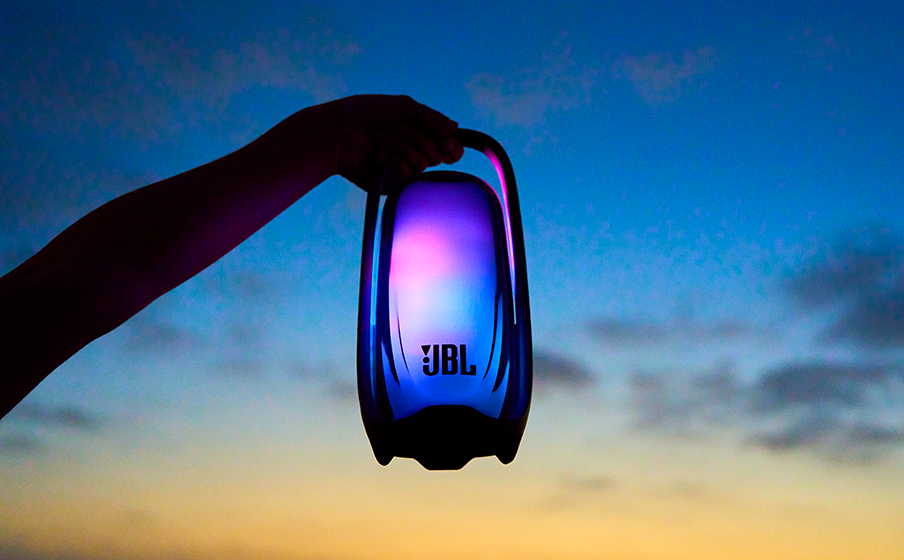
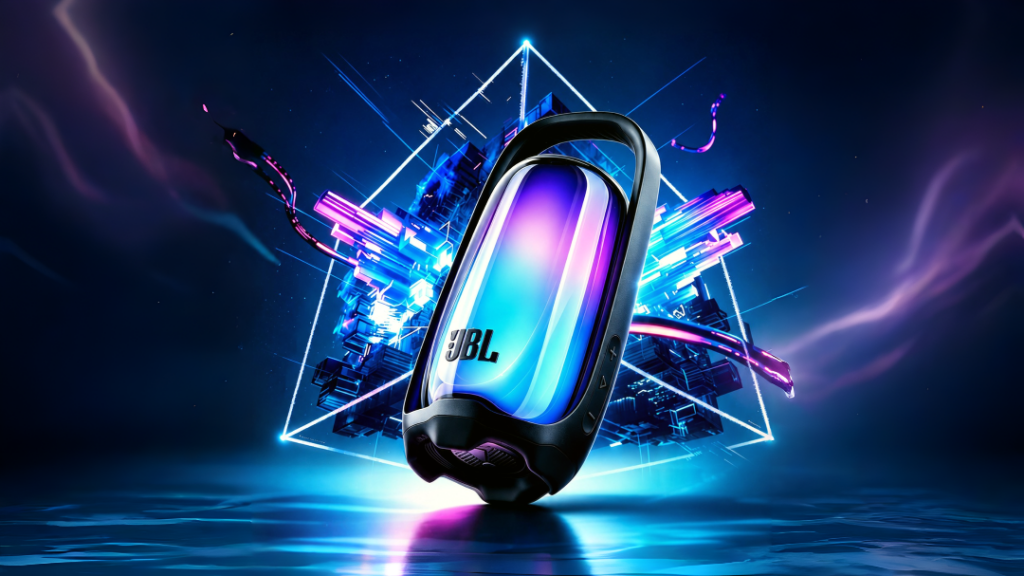
JBL has introduced the Pulse 6, the newest model in its line of portable Bluetooth speakers known for their built-in LED lighting. The speaker is launching first in China with a price tag of 2,499 yuan ($370). It is also listed on the JBL Cambodia website.
On the outside, the Pulse 6 keeps the transparent cylindrical design of older models but adds an illuminated handle to the top. Given that the speaker weighs 1.49kg and measures 131.7 x 264.1 x 106.4mm, the handle makes it noticeably easier to pick up and move around.
The transparent casing covers a 360-degree LED lighting system that syncs with whatever audio is playing. You can choose from 16 different lighting patterns using the JBL One app, which also includes basic EQ controls. For durability, the speaker has an IP68 rating, meaning it is fully protected against dust and can handle being submerged in water.
Inside, the audio setup consists of a 30W RMS woofer and a 10W RMS tweeter, providing a total output of 40W. JBL says the frequency response is between 42Hz and 20kHz. The speaker also uses an audio algorithm that JBL calls AI Sound Boost, which is designed to analyze the music in real-time to prevent distortion when you turn the volume up.
For connectivity, the Pulse 6 supports Bluetooth 6.0 with SBC, AAC, and LC3 codecs, along with Auracast for pairing with compatible JBL speakers. It also features a built-in DAC and USB-C port for lossless audio playback from Mac or Windows PCs.
The Pulse 6 packs a 34Wh battery with up to 12 hours of playback, while Playtime Boost can add around two hours. It supports 15W USB-C charging and takes about 4.5 hours to fully charge. It also features a low-light mode and a timer-based Sunset Mode.
One UI 9.0 is a major upgrade for Samsung devices that’s built on top of Android 17. It debuted in July on the latest foldable phones, namely the Galaxy Z Fold 8, Galaxy Z Fold 8 Ultra, and Galaxy Z Flip 7. Soon, the update will start rolling out to older Galaxy devices.
If you’re rocking a Samsung Galaxy and wondering whether your device is eligible for the One UI 9.0 update, when the update will arrive, or what new features to expect, you’ve come to the right place. This post has everything you may need to know about One UI 9.0.
Which Galaxy devices are eligible for the One UI 9.0 update?
Galaxy S series
Galaxy S26, S26+, S26 Ultra
Galaxy S25, S25+, S25 Ultra, S25 Edge, S25 FE
Galaxy S24, S24+, S24 Ultra, S24 FE
Galaxy S23, S23+, S23 Ultra, S23 FE
Galaxy Z series
Galaxy Z TriFold
Galaxy Z Fold 7, Z Flip 7, Z Flip 7 FE
Galaxy Z Fold Special Edition
Galaxy Z Fold 6, Z Flip 6
Galaxy Z Fold 5, Z Flip 5
Galaxy A, M, F series
Galaxy A57, A56, A55, A54
Galaxy A37, A36, A35, A34
Galaxy A27, A26, A25, A24
Galaxy A17 (4G/5G), A16 (4G/5G), A15 (4G/5G)
Galaxy A07 (4G/5G), A06 5G
Galaxy M56, M55, M55s, M54
Galaxy M47
Galaxy M36, M35, M34
Galaxy M17, M17e, M16, M15
Galaxy M07, M06
Galaxy F70e
Galaxy F56, F55, F54
Galaxy F36, F34
Galaxy F17, F16, F15
Galaxy F07, F06
Galaxy Tab series
Galaxy Tab S11, Tab S11 Ultra
Galaxy Tab S10 Lite, Tab S10 Plus, Tab S10 Ultra
Galaxy Tab S10 FE, Tab S10 FE+
Galaxy Tab S9, Tab S9+, Tab S9 Ultra
Galaxy Tab S9 FE, Tab S9 FE+
Galaxy Tab S6 Lite (2024)
Galaxy Tab A11, Tab A11+
Galaxy Tab Active 5, Tab Active 5 Pro
Galaxy XCover series
Galaxy XCover 7
Galaxy XCover 7 Pro
Samsung has yet to publish an official list. The one above is based on the company’s existing software update policy; therefore, you can count on it.
If your Galaxy device is on the list, it’s almost guaranteed to receive the One UI 9.0 update. But when can you expect the update? Read the following section to find out.
When will your Samsung Galaxy receive the One UI 9.0 update?
Samsung is closely following last year’s One UI 8.0 timeline for the One UI 9.0 release. The beta program was announced in May, followed by the debut of the stable version on the latest foldable phones in July. In fact, the One UI 9.0 beta expansion is following a similar pattern as well.
The brand is most likely to follow a similar rollout schedule going forward. So, we can expect the stable rollout to begin sometime in September. Initially, it will be released for high-end models like the Galaxy S26 series, Galaxy Z Fold 7, and Galaxy Z Flip 7.
Once the rollout begins, Samsung doesn’t spend much time to expand the update to mid-range and affordable devices. If things continue to move smoothly, all eligible devices should receive the update by the end of this year.
One UI 9.0 update: New features and major upgrades
One UI 8.5 has already brought major design upgrades, and therefore, One UI 9.0 looks too familiar. Instead, the latest build focuses heavily on advanced Galaxy AI integration, a redesigned Quick Panel, and a more productive experience for foldable users.
Galaxy AI Gets Smarter and More Capable
Now Nudge: A contextual assistant that monitors on-screen actions and gives you helpful prompts at the right moment.
My FanCam: It’s a new AI feature that lets users turn a wide shot into a subject-tracking clip right in the Gallery. It supports cropping and reframing to any aspect ratio.
Voice Photo Assist: It lets users describe image edits aloud, and the AI handles the rest. Users see a side-by-side view to compare the original and edited images.
Samsung Internet: The browser now features an integrated “Ask AI” side panel powered by Perplexity AI for rapid search and summaries.
Now Brief: It gets more personal and helpful. With the latest upgrades, you can now build briefing cards tailored specifically to your personal interests. Cards now feature integrated action buttons to help you jump right into an active task without opening the respective app manually.
Visual and Interface Changes
Revamped Quick Panel: Now features independent, ticker slides for brightness and volume, plus a resizable media player.
Optimized Wallpaper Layouts: Automatically repositions lock screen wallpaper subjects so they do not overlap with widgets, and uses generative AI to fill empty spaces naturally.
Condensed Navigation: Replaces text descriptions with clean titles and swaps the bottom bars for floating pill-shaped bars to maximize viewable screen space.
Enhanced Productivity
Three-App Split Screen: One UI 9.0 expands multi-window capabilities to support running three apps side by side seamlessly.
Samsung Notes: Adds a decorative tape tool to conceal text or straighten crooked handwritten lines, alongside new pen styles.
Overlay Game Booster: Allows users to tweak hardware settings on the fly without minimizing the game.
Security and Privacy
AI Assistant Activity: Offers a clear view of every app action your AI assistants have taken on your behalf, so you can keep an eye on what app actions were performed and exactly when they happened.
Browser Protection: When you accidentally access a malicious website through Samsung Browser, it will alert you just in time.
Advanced Auto Blocker: It blocks high-risk apps and lets users review extensive data regarding blocked background installations.
We’ll update this post regularly with the latest information. You can bookmark the page or join our Telegram channel to never miss an update.
We’ve all been there: you pack your bag for a long day, remember to grab your power bank, but realize later that you forgot the charging cable. It’s a common frustration, especially now that our phones, tablets, and laptops all rely on us keeping them topped up.
Fortunately, accessory manufacturers have started to address this by building the cables directly into the power banks themselves.
Having an integrated cable means one less thing to remember and one less cord getting tangled in your bag. If you’re looking to simplify your everyday carry, here is a look at some of the most practical and reliable power banks with built-in cables available right now.
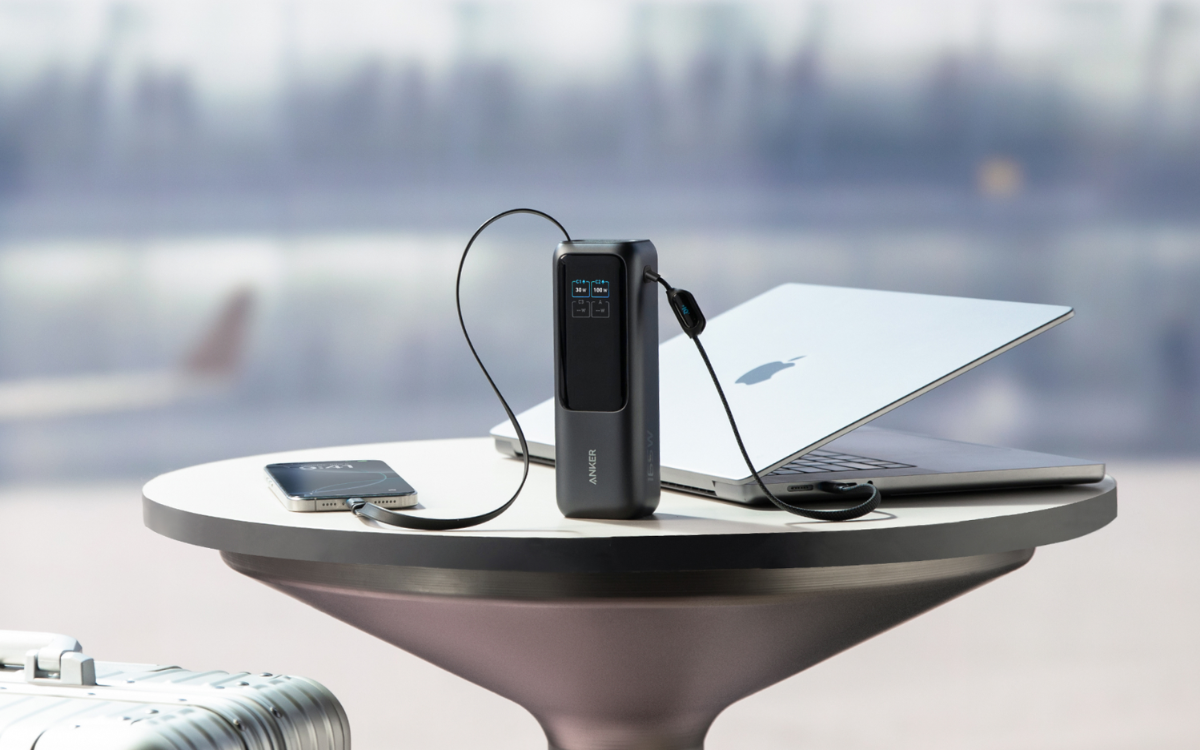
If you frequently work from coffee shops or travel often, the Anker Laptop Power Bank is a very capable option. It has a large 25,000mAh capacity, which is right at the limit of what is generally allowed on commercial flights. It provides a total output of 165W, meaning it can easily handle larger devices.
The model comes with dual retractable cables that feel sturdy enough for regular use, with each cable supporting up to 100W output and charging a 16-inch MacBook Pro to 50% in around 30 minutes. It also includes a smart display that shows your current battery level and charging speeds.
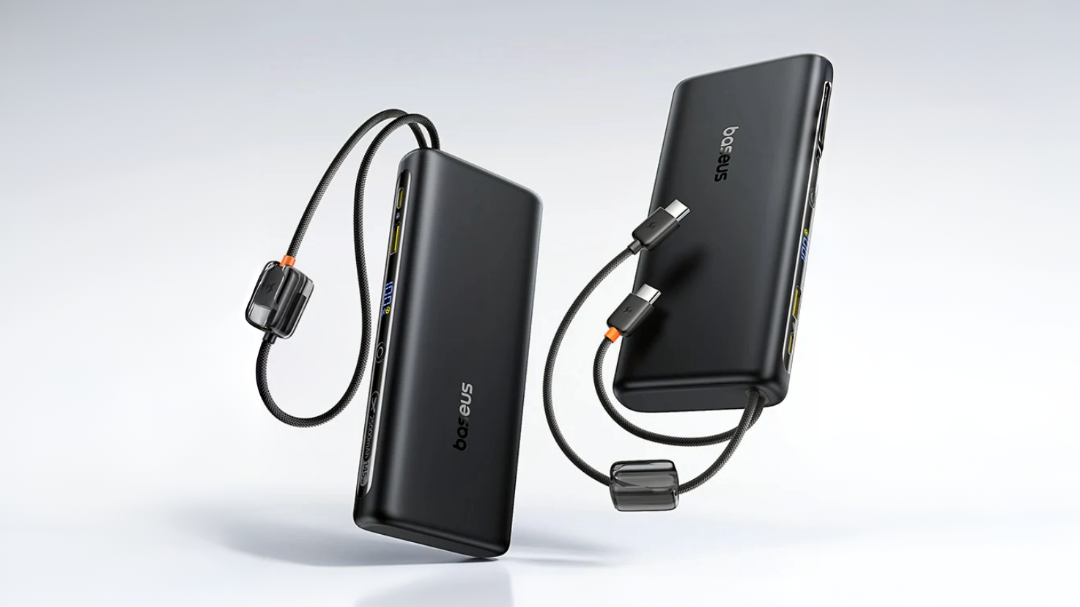
For those who want a high-capacity battery but prefer a slightly different design approach, the Baseus EnerFill FC41 is a solid alternative. It offers the same airline-friendly 25,000mAh capacity and a very capable 145W total output.
Instead of a retractable mechanism, Baseus uses two built-in braided USB-C cables that are designed to double as a carrying strap. It’s a simple, functional design choice that makes the battery easier to hold.
The primary cable can output 140W, making it suitable for most modern laptops. It also supports pass-through charging, so you can plug the power bank into the wall and charge your devices at the same time.
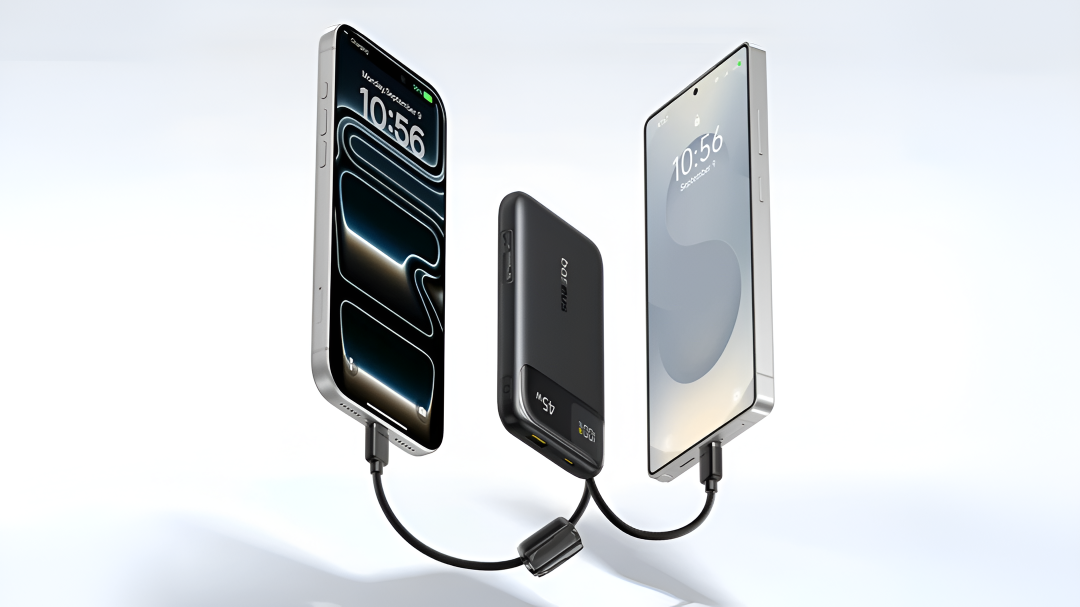
Not everyone needs to charge a laptop on the go. If you just want something to keep your phone alive during a long day out, the Baseus EnerFill FC11 makes a lot of sense. It features a 10,000mAh capacity, which is usually enough to charge an average smartphone about two times.
It weighs just 363g and is slim enough to fit comfortably in a jacket pocket or a small bag. Despite its small size, it still includes dual built-in USB-C cables and can output 45W. That’s enough power to fast-charge most current smartphones, including the iPhone 17 and Samsung Galaxy S25 series.
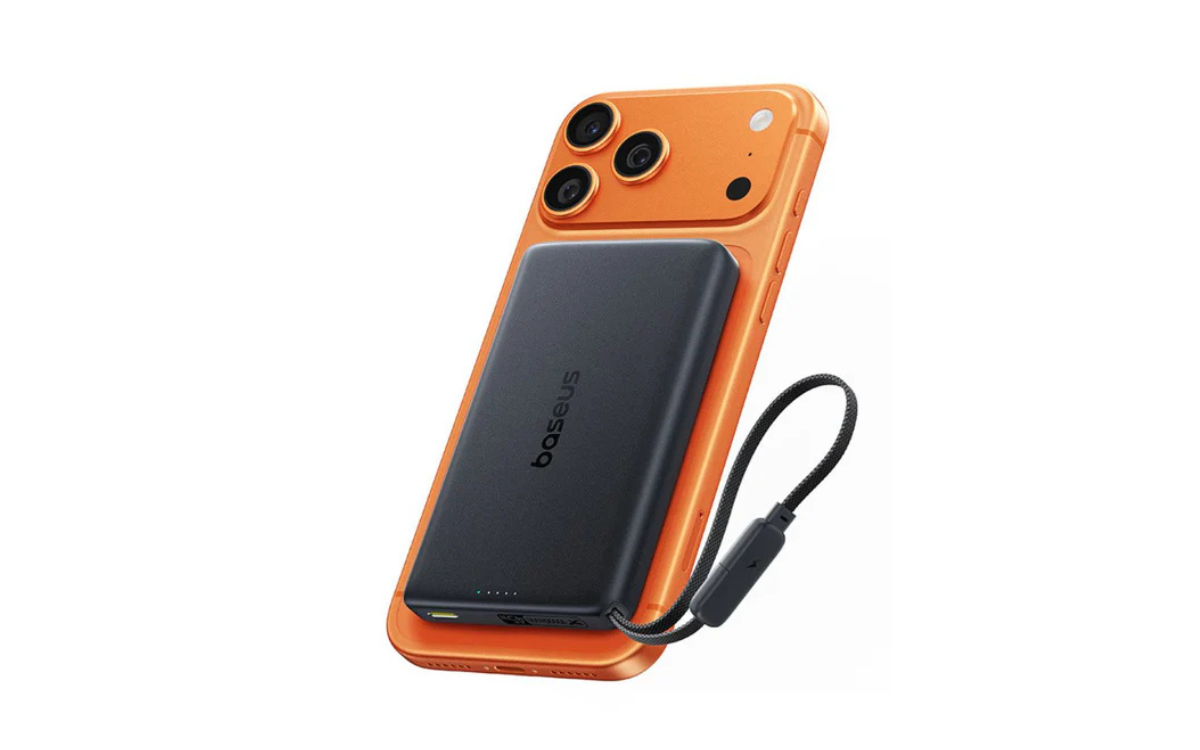
The Baseus PicoGo AM52 offers a hybrid approach to charging. It’s a 10,000mAh power bank that supports the new Qi2.2 standard, allowing it to magnetically attach to the back of compatible phones (like the iPhone 16 and 17) for 25W wireless charging.
However, wireless charging isn’t always the most efficient option. For times when you need power quickly, the PicoGo also features a built-in USB-C cable capable of 45W wired charging.
Baseus has included an aluminum heat-dissipation body to help manage the temperatures that usually come with magnetic charging.
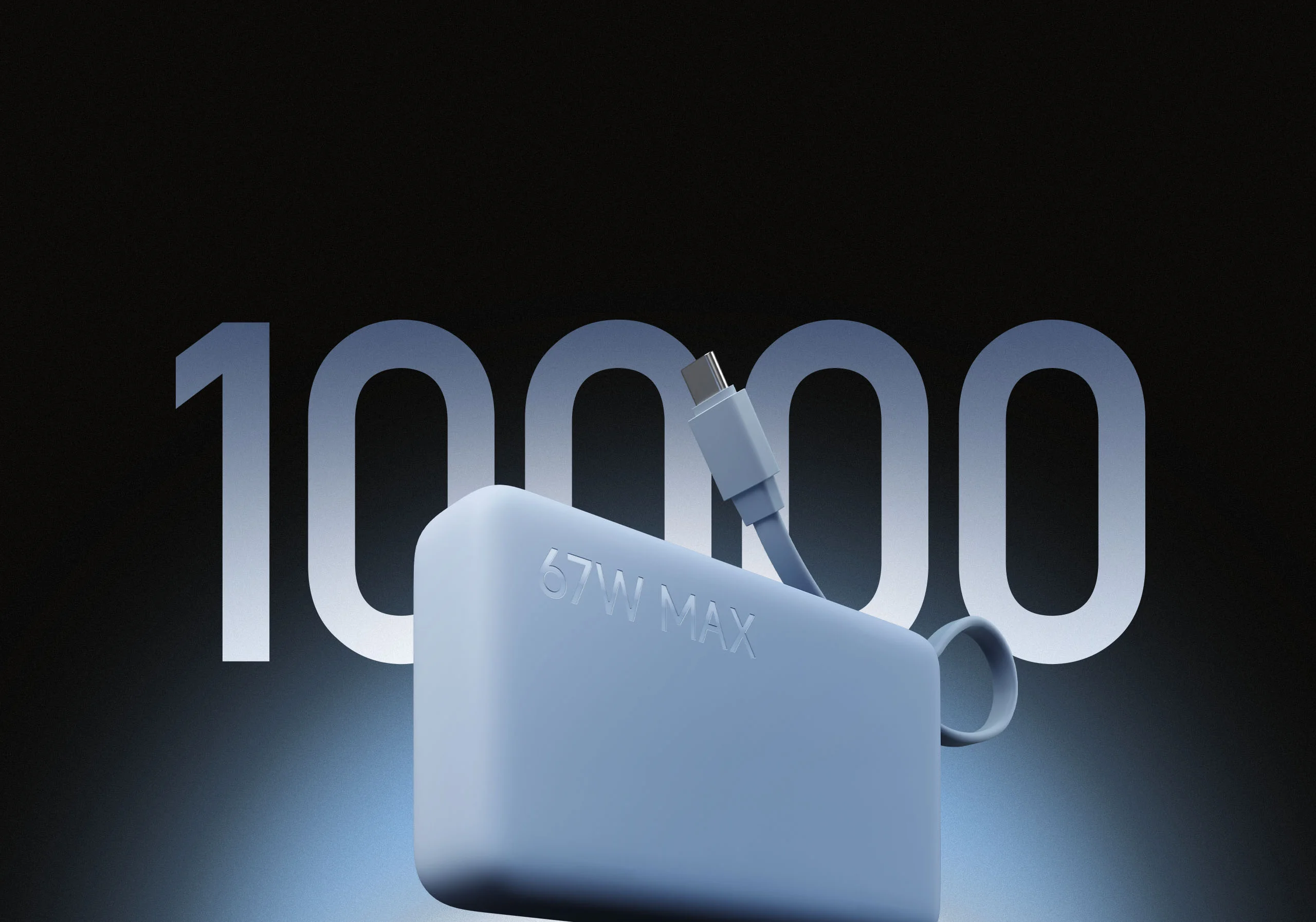
Xiaomi’s 67W Power Bank is a straightforward, well-designed 10,000mAh battery. It features a single integrated USB-C cable made from flexible TPU, which tucks neatly into a storage slot to form a small lanyard loop.
The power bank supports 67W output, which is great for fast-charging phones and smaller tablets. Equally useful is its 65W input speed; if you have a compatible wall charger, you can recharge the power bank itself from zero to full in just over an hour. It also includes a digital display and supports low-current charging for smaller accessories like wireless earbuds.
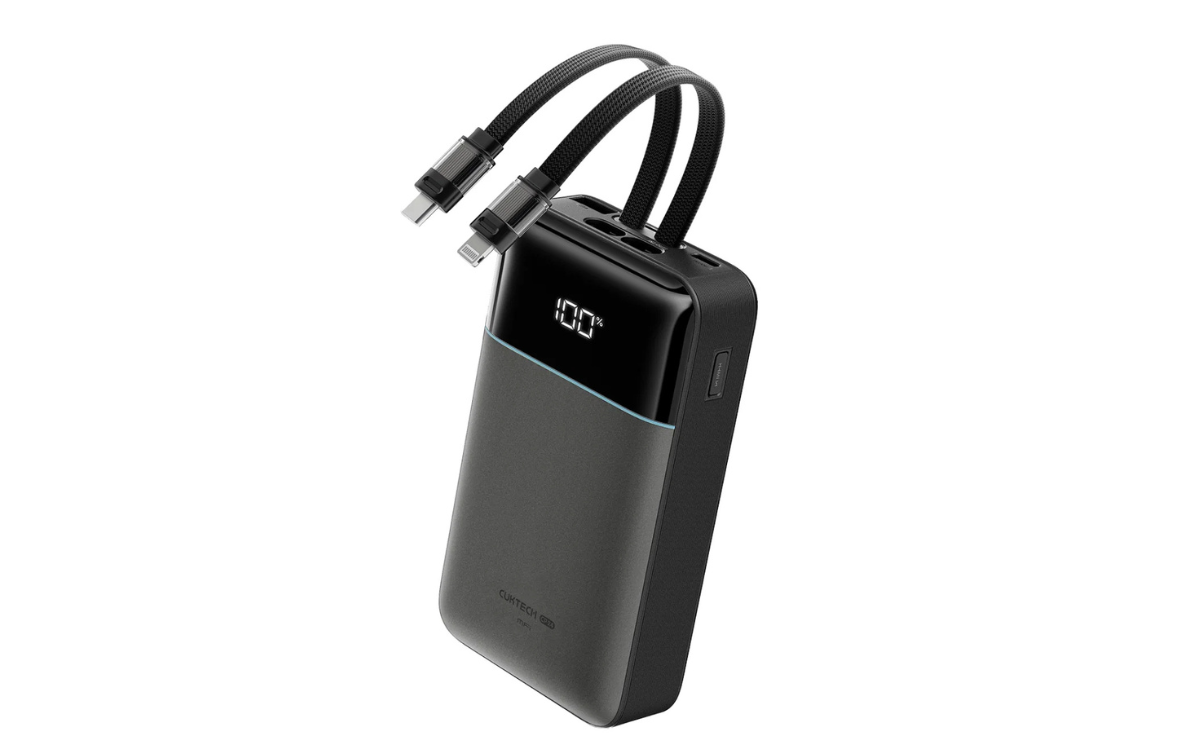
While USB-C has become the standard, many people still own older iPhones or accessories that require a Lightning cable. The Cuktech CP24 is designed specifically for this mixed-device reality. It’s a 20,000mAh battery that includes two built-in cables: one 40W USB-C cable and one MFi-certified Lightning cable.
This makes it a very practical choice for households or friend groups that use different types of devices. You can charge a newer USB-C device and an older Lightning device at the same time without needing to carry adapters. It supports 40W charging speeds, which is adequate for phones and tablets, and it meets standard airline regulations for travel.
Lenovo is known for experimenting with screens that bend and grow. New renders have surfaced online showing a rollable laptop codenamed Project Swan, and this one expands horizontally instead of the usual up-and-down stretch.
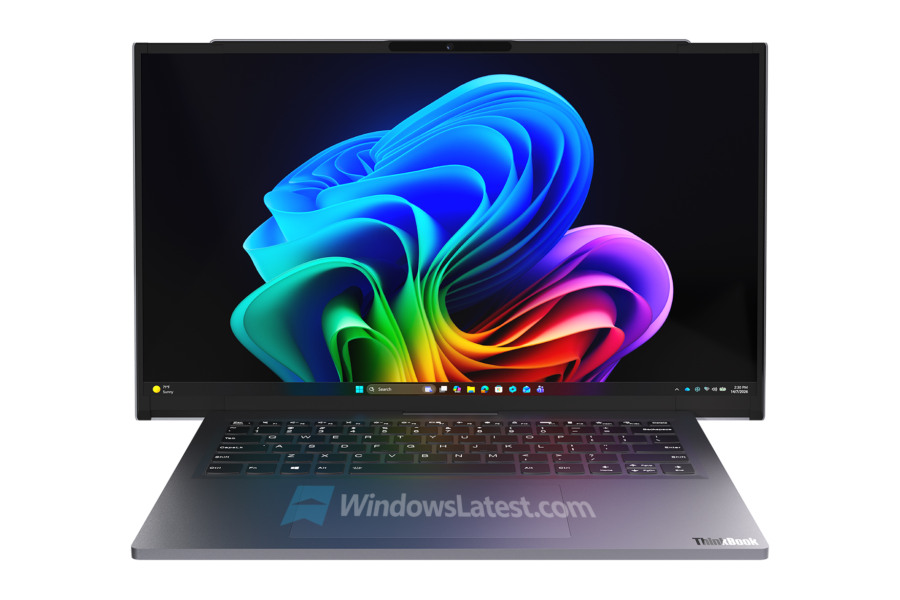
Windows Latest shared the images yesterday, and the palm rest gives away that the device is part of Lenovo’s ThinkBook series. That tracks with how Lenovo has positioned its past rollable machines, including the ThinkBook Plus Gen 6, which launched last year with a similar office-first pitch.
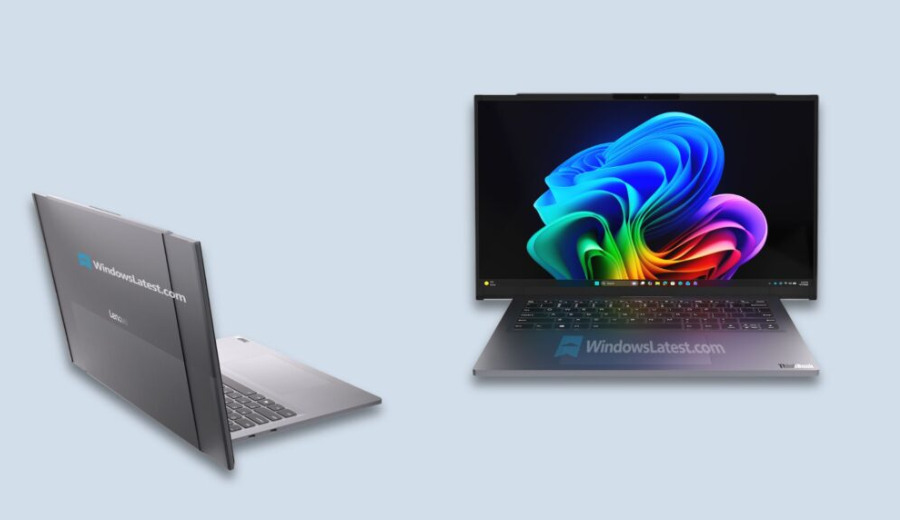
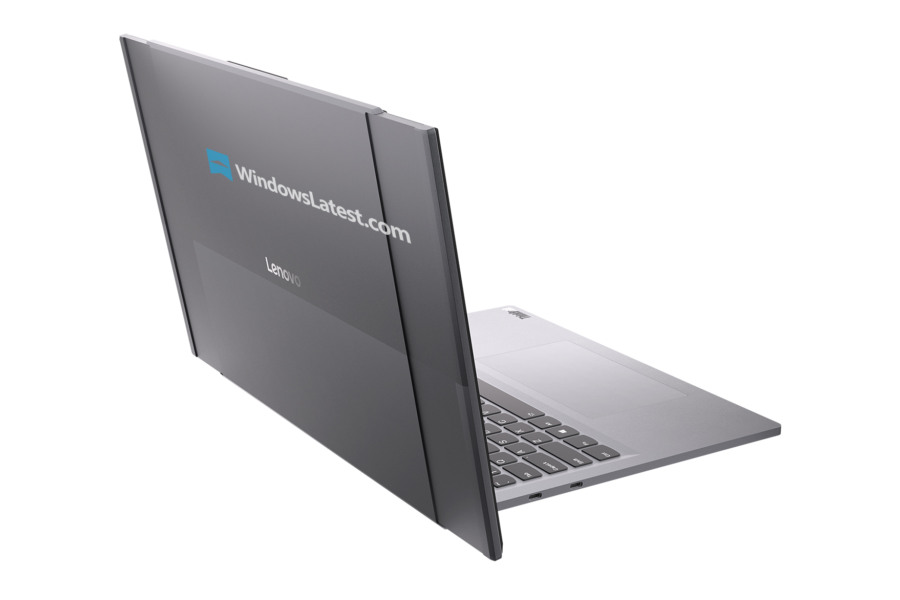
Closed up, Project Swan looks like a normal laptop. You get a centered webcam at the top of the display and two USB-C ports on the left edge. The images don’t show the right side, so ports on that side remain a mystery for now. Flip it around, and you’ll spot a two-tone rear panel with cutouts on both sides.
According to a report, Project Swan uses guide rails to tuck away extra screen when you don’t need it. Once you want more room, motors pull the hidden section of the flexible OLED panel out from both sides at once. To make space for those rails, the hinge sits shorter and more centered than what you’d find on a regular ThinkBook.
There’s a software detail worth noting too. The renders don’t show a Copilot key anywhere on the deck, but the taskbar does show the Recall icon active near the system tray.
Lenovo also showed a ThinkBook Modular AI PC concept and shipped the ThinkBook Plus Gen 7 Auto Twist with its motorized hinge this year. Project Swan still looks like early-stage hardware, so don’t expect pricing or a release date just yet. Given how quickly Lenovo’s other rollable concepts have gone from leak to stage demo, though, an official reveal may not be far off.
For more daily updates, please visit our News Section.
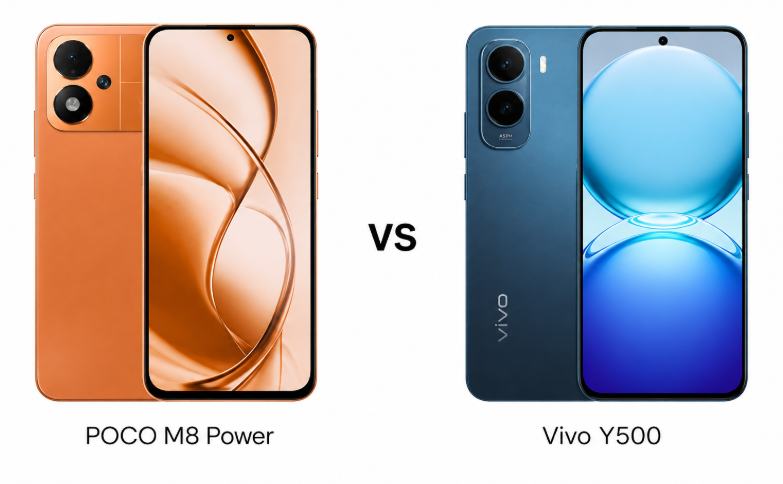
Choosing between the POCO M8 Power and Vivo Y500 comes down to priorities. Both smartphones target the affordable segment with AMOLED displays, large silicon-carbon batteries, stereo speakers, and Android 16. However, they approach value differently. The POCO M8 Power focuses on performance, long software support, and connectivity, while the Vivo Y500 emphasizes display quality, durability, and camera hardware. Here’s a detailed comparison to help you decide.
Both smartphones feature modern flat designs with AMOLED displays and under-display fingerprint scanners. The Vivo Y500 stands out with its IP68/IP69 rating and MIL-STD-810H compliance, offering significantly stronger resistance against water and dust than the POCO M8 Power’s IP65 certification. For users who frequently travel or spend time outdoors, Vivo’s durability provides extra peace of mind. Meanwhile, the POCO counters with Gorilla Glass 7i protection and practical additions such as an infrared blaster and optional NFC, making everyday usage slightly more versatile. Both feel contemporary, but Vivo clearly prioritizes protection while POCO balances durability with useful hardware extras.
The display is another area where both phones perform well, but the Vivo Y500 has a noticeable advantage. Its AMOLED panel delivers a sharper 1260 x 2800 resolution, HDR support, and an impressive peak brightness of up to 5,000 nits, making outdoor visibility excellent. The POCO M8 Power also offers a smooth 120Hz AMOLED display with 1,800 nits peak brightness and Gorilla Glass protection, producing vibrant colors and fluid animations. However, Vivo’s higher pixel density and HDR capabilities provide a richer viewing experience for streaming and gaming. The difference may not be dramatic indoors, but it becomes easier to appreciate in brighter environments.
Verdict
The Vivo Y500 delivers the stronger display and more premium durability, making it the better choice for multimedia users. The POCO M8 Power remains appealing thanks to Gorilla Glass protection, NFC, and infrared support, but Vivo takes this category overall.
Specifications Including Battery
Performance
Performance favors the POCO M8 Power thanks to Qualcomm’s Snapdragon 4 Gen 4 chipset. The newer processor delivers stronger CPU efficiency and a noticeably better Adreno GPU than the Vivo Y500’s Unisoc T7300 with Mali-G57 graphics. Combined with four promised Android version upgrades, the POCO also offers better long-term software value. Vivo provides up to 256GB storage in higher variants, which benefits users needing extra space, but overall processing power and future software support remain stronger on the POCO. Everyday tasks run smoothly on both, yet heavier multitasking and gaming are likely to feel more comfortable on the Snapdragon-powered device.
Battery and Charging
Battery life is excellent on both smartphones. The Vivo Y500 includes a slightly larger 8,100mAh silicon-carbon battery, while the POCO M8 Power carries an equally impressive 8,000mAh unit with 45W charging. Charging speeds are nearly identical, although POCO adds PD3.0 compatibility and 22.5W reverse wired charging, making it more flexible for charging accessories or another phone. Vivo responds with bypass charging, which helps reduce heat during gaming sessions. Both comfortably deliver multi-day endurance, but POCO offers a slightly more versatile charging package.
Verdict
The POCO M8 Power wins thanks to its faster chipset, longer software support, better graphics performance, and more feature-rich charging system. Vivo’s slightly larger battery is excellent, but POCO provides the more balanced long-term ownership experience.
Anyone still deciding between these two can check how they stack up against other options in our budget smartphone rankings.
Camera
Main and Secondary Lenses
On paper, both smartphones feature a 50MP primary camera capable of HDR photography and 1080p video recording. However, Vivo supplements its main sensor with an auxiliary camera for additional shooting assistance, while the POCO relies on a single-camera setup. Image quality is expected to remain competitive in daylight, producing detailed photos with balanced colors. Neither device targets advanced photography enthusiasts, but both should satisfy casual users. The hardware differences are relatively small, meaning image processing and software optimization are likely to play a bigger role than sensor count in everyday photography.
Selfie Camera
The selfie camera is where Vivo establishes a clear advantage. Its 32MP front-facing sensor captures significantly more detail than the POCO M8 Power’s 8MP camera, making it better suited for selfies, social media uploads, and video calls. Both phones support 1080p video recording, but Vivo’s higher-resolution sensor should produce sharper facial details and better cropping flexibility. Users who frequently rely on the front camera are likely to appreciate this upgrade immediately.
Verdict
The Vivo Y500 is the stronger camera phone overall, primarily because of its superior 32MP selfie camera and additional rear sensor. POCO delivers dependable photography, but Vivo offers a more complete imaging experience for everyday users.
Pricing
The POCO M8 Power is priced around $250 (approximately ₹25,000), while the Vivo Y500 is priced around $250 (approximately ₹22,000). Although both occupy a similar global price bracket, Vivo arrives at a noticeably lower estimated Indian price, making it more accessible. The POCO justifies its premium with the Snapdragon chipset, four Android upgrades, Wi-Fi 6, NFC, infrared blaster, and Gorilla Glass 7i. Vivo, meanwhile, delivers stronger durability, a sharper display, and a much better selfie camera for less money. Both represent strong value, but they appeal to different buyer priorities rather than competing on specifications alone.
The Vivo Y500 offers better value for buyers focused on display quality, durability, and cameras at a lower price. The POCO M8 Power justifies its slightly higher cost with stronger performance, better connectivity, and longer software support.
Conclusion
The POCO M8 Power distinguishes itself with the Snapdragon 4 Gen 4 processor, four major Android updates, Wi-Fi 6, Gorilla Glass 7i, infrared blaster, NFC support, and flexible reverse charging. These features make it a practical choice for users who prioritize longevity and everyday performance. The Vivo Y500 counters with an excellent HDR AMOLED display, IP68/IP69 certification, MIL-STD-810H compliance, an 8,100mAh battery, bypass charging, and a significantly better 32MP selfie camera. Both smartphones are highly competitive, but they excel in different areas. One focuses on performance and software reliability, while the other emphasizes durability, multimedia, and imaging.
Verdict
Choose the POCO M8 Power for stronger overall performance, longer software support, and better long-term value. Choose the Vivo Y500 if display quality, rugged protection, selfie photography, and a lower purchase price matter more. Both are compelling options, but the better choice depends on which strengths align with daily usage.
We use cookies on our website to give you the most relevant experience by remembering your preferences and repeat visits. By clicking “Accept”, you consent to the use of ALL the cookies.
This website uses cookies to improve your experience while you navigate through the website. Out of these, the cookies that are categorized as necessary are stored on your browser as they are essential for the working of basic functionalities of the website. We also use third-party cookies that help us analyze and understand how you use this website. These cookies will be stored in your browser only with your consent. You also have the option to opt-out of these cookies. But opting out of some of these cookies may affect your browsing experience.
Necessary cookies are absolutely essential for the website to function properly. This category only includes cookies that ensures basic functionalities and security features of the website. These cookies do not store any personal information.
Any cookies that may not be particularly necessary for the website to function and is used specifically to collect user personal data via analytics, ads, other embedded contents are termed as non-necessary cookies. It is mandatory to procure user consent prior to running these cookies on your website.