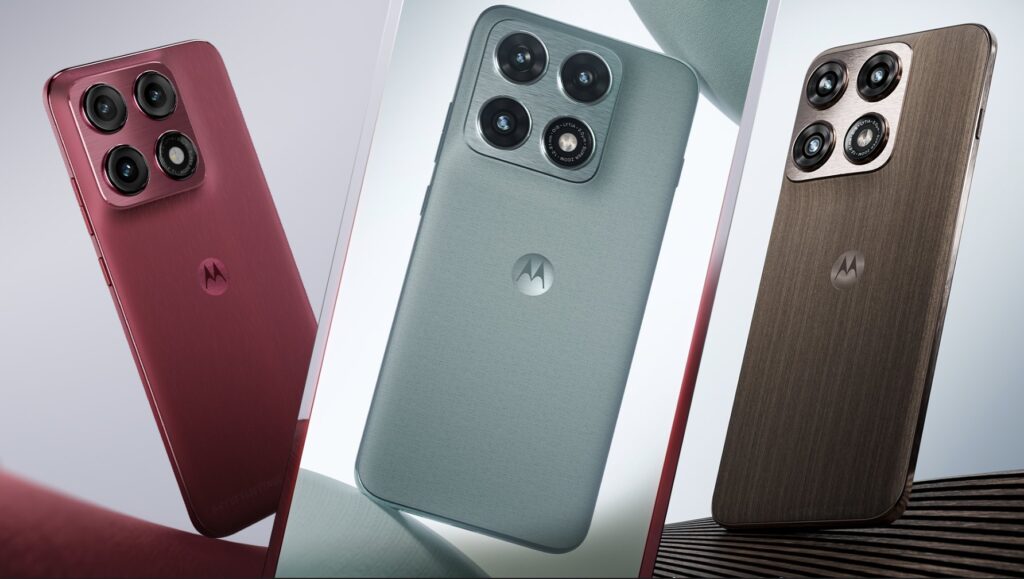
Motorola has been teasing the new Edge phone for the Indian market, and now it finally has a launch date. The company has confirmed that the Motorola Edge 70 Pro+ will launch in India on June 4, or next Thursday.
Here’s everything we know so far about the Motoroal Edge 70 Pro+.
Motorola Edge 70 Pro+ Specifications (Expected)
The Motorola Edge 70 Pro+ is rumored to feature a 6.8-inch 1.5K quad-curved OLED display with a 144Hz refresh rate. The screen is further said to have a 5200-nit peak brightness.
On the camera front, the device could be equipped with a 50-megapixel (main) + 50-megapixel (ultra-wide) + 50-megapixel (3.5x periscope) triple setup on the rear. For selfies and video calls, the device will include a 50-megapixel front-facing camera.
Under the hood, the device will run on the Dimensity 8500 Extreme chip. Software-wise, it will run on Hello UX-based Android 16 and is expected to receive three major Android updates.
The Motorola Edge 70 Pro+ will pack a large 6500mAh battery paired with 90W fast charging support. The company has also confirmed wireless charging support, which will help the Pro+ model stand apart from the regular Edge 70 Pro.
Previous teasers already revealed multiple rear panel finishes, including Satin-Luxe, Sculpted Wood, and a twill-inspired texture. The smartphone is expected to arrive in multiple colour options, including brown, red, and teal variants.
The Motorola Edge 70 Pro+ will be sold in India through Flipkart after launch. While official pricing details are still under wraps, earlier reports suggest that the smartphone could be priced under Rs 50,000 in India.
For more daily updates, please visit our News Section.
The iPhone 18 is still months away, but surprise, surprise, we may already have our first look at iPhone 20.
A newly released render video claiming to show the so-called “iPhone 20” suggests the line could introduce one of the biggest design changes in iPhone history.
The video was published by the YouTube channel fpt., which claims the device is already in the early stages of production. While Apple has not confirmed anything, the render combines many rumors that have been circulating for months, from supply chain reports and analysts such as Mark Gurman.
iPhone 20 is almost bezel-less
The renders in the video show iPhone 20 as an almost bezel-free device with glass flowing across all four edges. The backplate is all-glass, the front has under-display Face ID, and the sides have no physical buttons at all.
One thing that may confuse is the name itself. If Apple is releasing the iPhone 18 this year, it’s expected that the 2027 model will be called the iPhone 19. But according to the rumors, Apple could skip directly to iPhone 20 to celebrate the 20th anniversary of the original iPhone.
Apple did something similar before. In 2017, the company celebrated the iPhone’s tenth anniversary by skipping the iPhone 9 and launching the iPhone X instead. It introduced major changes such as Face ID and a nearly edge-to-edge display, setting the direction for future iPhones.
The rumored iPhone 20 could be following the same strategy.
Three major design changes in iPhone 20
The video claims the iPhone 20 series will introduce three major design changes:
The first is the introduction of a quad-curved screen. Apple is reportedly working with Samsung on a custom OLED panel that curves slightly on all four sides.
The second major change could be the removal of the Dynamic Island. According to the leaks, both the front camera and the Face ID system may sit completely under the display.
The third change involves the removal of physical buttons. Instead of traditional power and volume keys, Apple may use solid-state touch controls with vibration feedback.
The redesign may also come with major hardware upgrades.
The phone is expected to use Apple’s new 2nm A21 chip. And the iPhone 20 could also include a 200-megapixel main sensor with improved HDR technology. Apple is also claimed to be using silicon-carbon battery technology in the iPhone 20.
According to reports, Apple is currently working with both Samsung and LG to solve technical issues related to the quad-curved display. One major problem is brightness reduction around the curved edges of the screen.
Under-display Face ID is another challenge for the brand. Apple will need to make sure the sensor works while maintaining fast unlocking speeds and good selfie camera quality.
For more daily updates, please visit our News Section.
Xiaomi has launched a new air conditioner called Mijia Air Conditioner Giant Power Saver 2026 in the Chinese market. The AC is priced at 1899 yuan ($278) and is now listed on JD.com. It will go on sale on May 30.
Mijia Giant Power Saver 2026 AC Specs
The main selling point here is energy efficiency. The 2026 model has an Annual Performance Factor (APF) of 5.36, earning it a Level 1 energy efficiency rating in China. Xiaomi estimates this translates to saving about 208 kWh of electricity a year compared to older standards, which works out to roughly 124 yuan ($18) in savings annually.
To manage this, the unit uses a 9.8cc compressor, a dual-row evaporator, and a 108mm cross-flow fan. It can push up to 760 cubic meters of air per hour, and Xiaomi says it takes about three minutes to reach a target temperature in a standard room.
The AC runs on Xiaomi’s Mijia Lingyun control engine, which uses cloud-based learning to adjust how it cools or heats based on your habits. For example, it can tweak the temperature automatically while you sleep to save power and keep the room comfortable. It connects to the Mijia app and supports Xiaomi’s HyperOS Connect for integration with other smart home devices.
Like a lot of modern hardware, it also supports over-the-air (OTA) updates. Xiaomi says it will continue to tweak the energy-saving algorithms and add features over time. There is also a built-in diagnostic system that runs 122 different checks. If the filter needs cleaning or the refrigerant is running low, the app will send a notification before the unit actually stops working.
For maintenance, the AC has a self-cleaning function that washes and then dries the internal components at 58 degrees Celsius to prevent mold and bacteria. It is also built to handle a wide range of temperatures, operating in outdoor environments as cold as -35 degrees Celsius or as hot as 60 degrees Celsius. When running quietly at night, the indoor unit’s noise level drops to 18 decibels.
Robotic lawnmowers are slowly becoming more common, but for many people, the high prices and complicated setup process still make them hard to justify. Anker’s eufy brand is now trying to make the category a bit more approachable with the new eufy C15, its cheapest robotic mower so far.
Compared to the company’s larger E15 and E18 models, the new C15 is aimed at smaller gardens up to 500 square meters. The biggest selling point is probably the setup process. Instead of using perimeter wires or RTK antennas like many competing robotic mowers, the C15 relies entirely on eufy’s camera-based TrueVision system for navigation and mapping.
There’s a front-mounted camera system that handles obstacle detection, positioning, and route planning automatically. That means the mower can avoid objects like pets, toys, garden furniture, and even smaller animals such as hedgehogs while moving around the yard. Initial mapping may still take a little time depending on the layout of the garden, but overall installation looks much simpler than traditional robotic mower setups.
The mower itself uses a 180 mm cutting disc with adjustable cutting heights between 20 mm and 60 mm. It can also manage slopes up to around 32%, which should be enough for most smaller residential gardens.
The C15 was introduced during Anker Day 2026 alongside several other eufy products, including new AI-focused earbuds, a robot vacuum with a fragrance diffuser, and an updated smart doorbell lineup.
Pricing and availability:
The mower has officially gone on sale after its recent pre-order phase. It starts at €899, and eufy is currently including the optional garage accessory for free as part of a limited launch offer. Normally, that bundle costs €999. The C15 is available through eufy’s online store, Amazon, and select retailers.
With features like app-based scheduling, automatic charging, and multi-zone support, the C15 feels like eufy’s attempt to bring premium robotic mower features into a more affordable price range. For homeowners who have been curious about robotic lawn care but didn’t want to deal with wires or expensive flagship models, this one could end up being a much easier entry point.
Xiaomi is offering free repairs for devices damaged in the recent floods and heavy rainstorms affecting several parts of China. The company announced a temporary after-sales support program covering smartphones, tablets, laptops, wearables, and even some home appliances in disaster-hit regions.
The initiative runs from May 22 to June 20, 2026, and mainly covers affected areas across Jiangxi, Hunan, and Hubei provinces.
For Xiaomi and Redmi phones, tablets, smart bands, watches, earphones, and laptops, the company says users can get free inspections, cleaning, and repairs for water damage caused by the storms. Xiaomi service centers will also reportedly provide charging facilities, WiFi access, and drinking water for visitors. Eligible users can either visit supported offline centers or apply for mail-in repair services in select locations.
The support program also extends to Mijia ecosystem products and large household appliances affected by flooding or water ingress.
Some of the covered regions include parts of Ganzhou in Jiangxi Province, multiple counties across Hunan Province, and areas in Jingzhou and Enshi within Hubei Province. Xiaomi says users can apply through the Xiaomi Mall app under the after-sales section, contact the 950816 hotline, or use the company’s official WeChat service account.
Xiaomi’s program stands out because water damage is normally excluded from standard warranty coverage. Repair costs for flood-damaged electronics can often become expensive, especially for smartphones and laptops, so the move will likely come as a major relief for affected users.
The announcement also arrives at a time when weather-related disruptions are becoming more common. By temporarily waiving repair costs for water-damaged products, Xiaomi is not only helping users deal with immediate losses but also reinforcing its after-sales service image.
For users in the eligible regions, the program is available for a limited time, and Xiaomi advises customers to contact nearby service centers as early as possible due to potentially high demand.
Ugreen has released a new portable Bluetooth speaker in China called the M3. It is currently listed on the retailer JD.com for 249 yuan ($36) and is designed primarily for outdoor use. While it shares a lot of similarities with other rugged speakers on the market, it includes a specific feature to deal with getting wet: a water drainage system that uses sound to clear out the grille.
Ugreen M3 Speaker Specifications
If the speaker gets splashed by a pool or left out in light rain, you can open Ugreen’s companion app and turn on a dedicated drainage mode. The speaker will then generate high-frequency vibrations, up to 400 times per minute, to physically push trapped water out of the hardware. It is a practical approach to water exposure, working alongside the device’s standard IP66 rating for dust and water resistance.
Physically, the M3 weighs 653 grams, which is light enough to throw in a backpack for camping or a beach trip. It comes in two colors, Starry Black and Champagne Gold, and includes a hidden RGB light strip at the bottom. The lights can be set to solid colors, a breathing effect, or synced to your music. There is also an SOS mode that flashes the lights and plays a warning sound in case of an emergency.
For audio, the M3 uses a 20W triple-driver setup. This includes specific drivers for high and mid-low frequencies, plus a passive radiator to handle the bass. Ugreen says it uses digital signal processing (DSP) and its own bass enhancement software to keep the low-end frequencies audible even when you have the volume turned down. The company says the speaker can reach a sound pressure level of 105dB.
On the connectivity side, the speaker supports Bluetooth 6.0 and LE Audio. It also supports Auracast, meaning you can sync the audio with over 100 compatible devices, or you can just pair two M3 speakers together for standard left-and-right stereo sound.
The speaker runs on a 2,500mAh battery. Ugreen estimates it will last up to 20 hours on a single charge, provided you keep the volume at a moderate level and leave the RGB lighting turned off. It charges via a standard USB-C port. It also features a built-in microphone for phone calls and voice chats.
In related news, Ugreen recently launched a 160W GaN fast charger with five ports and a smart display, alongside a new 45W 10,000mAh power bank featuring a built-in cable and integrated smart screen.
For more daily updates, please visit our News Section.
Hot on the heels of a powerbank launch, Chinese accessories maker Ugreen has introduced a new 160W GaN fast charger with upgraded multi-port charging support, a lighter design, and a built-in smart display. The charger is priced at 279 yuan (~ $40) in China.
The new model comes with a multi-window smart display on the front that shows charging information in real time. Users can check the power output and fast-charging protocol status directly from the screen while charging devices.
Ugreen has also equipped the charger with four USB-C ports and one USB-A port, allowing up to five devices to charge at the same time. The company says its self-developed SmartCharge power allocation technology can intelligently detect the power requirements of connected devices and distribute charging speeds accordingly.
Ugreen 160W GaN charger Specifications
In terms of performance, the charger supports up to 140W output from a single USB-C port. Ugreen also says the charger can reach a combined maximum output of 160W when using dual USB-C, triple USB-C, or quad USB-C setups. The charger delivers up to 155W total output when all five ports are used.
The charger also uses an upgraded gallium nitride, or GaN, chip for better efficiency and lower heat generation. It also supports real-time temperature monitoring to help maintain safe charging during extended use.
Ugreen has slightly updated the external design as well. The weight has been reduced from 353 grams on the older version to around 320 grams. The “160W” branding on the side has also been changed from gray to red for a more noticeable appearance.
According to the listed specifications, the USB-C1 and USB-C2 ports can each provide up to 140W output, while USB-C3 supports up to 100W. The USB-C4 port supports up to 30W, and the USB-A port can provide up to 22.5W charging speeds.
The charger supports an input range of 100V to 240V, making it suitable for international use.
For more daily updates, please visit our News Section.
Chinese consumer AR brand RayNeo has announced a new line of flagship augmented reality glasses called the GT series. The first device in the series is called RayNeo GT Max.
Unlike the company’s existing Air lineup, which targets lightweight everyday use, the new GT series is a more premium option focused on what the company describes as a “professional film and television-grade” viewing experience.
The new products will officially launch on May 27 alongside an event at the TCL Chinese Theatre.
What is the RayNeo GT series all about?
The biggest upgrade in the new lineup is the display system. Most AR glasses designed for movie viewing usually offer a field of view of around 45 degrees, but the new RayNeo GT Max reportedly increases that to 59 degrees.
The company says the glasses use its self-developed Peacock Optical Engine 3.0 Max, along with a new hybrid prism light module, to create a virtual viewing experience similar to watching a 267-inch screen from six meters away.
The GT series will also introduce a new generation Micro-OLED display and a dedicated image quality chip called the Vision 4000. According to the company, the chip is designed to improve color accuracy and image processing for video playback.
RayNeo is also partnering with Dolby Laboratories for the new lineup. When paired with the RayNeo Magic Box 2 Dolby Vision Edition, the GT series is claimed to become the first AR glasses kit capable of supporting Dolby Vision playback. The company says this setup is intended to deliver cinema-style contrast and lighting performance.
The glasses will also bring a new dual-core system architecture. Alongside the image processing chip, the GT series includes a custom spatial computing chip called Zone 360. This processor enables native 3DoF spatial hovering and supports different viewing modes, including follow mode, fixed mode, and image stabilization.
For audio, RayNeo is working with Danish audio company Bang & Olufsen to tune the sound system. The GT series includes a quad-speaker setup with built-in spatial audio and 360-degree head tracking.
Despite adding a wider field of view, spatial audio, and dual-chip architecture, the RayNeo GT Max weighs 78 grams.
Alongside the GT series, RayNeo is also expected to introduce its next-generation AI-powered shooting glasses, called the V4, during the same launch event later this month.
For more daily updates, please visit our News Section.
Edifier has announced a new desktop speaker, the S260, which goes on sale in China today for 1,059 yuan (roughly $156). The pitch here is pretty straightforward: it’s a speaker that looks like a piece of vintage hi-fi equipment but includes current wireless standards like AirPlay 2 and LDAC support.
Edifier S260 Speaker Specifications
Physically, the S260 leans heavily into an older aesthetic. The cabinet is made from medium-density fiberboard (MDF) to help reduce acoustic resonance, paired with an 18mm thick front baffle and a woven grille.
On top, there is a CNC-machined aluminum control panel that includes physical mechanical toggle switches and metal knobs for adjusting volume and playback. It’s a fairly heavy unit, weighing in at 4.07kg (about 9 pounds). You can get it in three colors: Black Walnut, Pearl White, and Warm Brown.
Inside the cabinet, the hardware is standard for a modern desktop setup. It uses a 4-inch aluminum diaphragm mid-bass driver alongside two 25-core titanium dome tweeters. According to Edifier, the tweeters can push high frequencies up to 40kHz, while the woofer handles bass down to 50Hz.
The system is powered by dual Texas Instruments TAS5805 digital amplifiers. It outputs 65W RMS, with a peak power of 130W. Edifier also claims a low distortion level of 0.03% and a signal-to-noise ratio of 107dB(A), with audio processing handled by a built-in DSP chip.
The connectivity options are where the speaker becomes more practical for everyday use. It has both Hi-Res Audio and Hi-Res Audio Wireless certifications. It supports the LDAC codec, allowing for higher-resolution streaming over Bluetooth (up to 990kbps).
It also includes Apple AirPlay 2 support over 2.4GHz and 5GHz Wi-Fi, which is useful if you want to stream audio directly from an iPhone or Mac. The Bluetooth 5.4 connection supports dual-device pairing, so you can keep a phone and a computer connected at the same time and switch between them.
If you prefer to plug things in, the S260 has an AUX analog input and a USB sound card input, making it easy to connect to a PC or a turntable. It also comes with a small remote control and works with Edifier’s mobile app, where you can adjust the EQ, switch inputs, and update the firmware.
In related news, GOBOULT has recently unveiled new Mustang series speakers with Marshall-inspired styling at affordable prices, while Portronics has introduced the Strings smart speaker with a built-in alarm clock and wireless charging support.
For more daily updates, please visit our News Section.
The iQOO Z11 5G and Redmi Note 15 Pro+ bring flagship-style features to the upper mid-range segment, but they take very different approaches. The iQOO focuses on massive battery life and gaming performance, while the Redmi pushes a more premium experience with stronger cameras and multimedia features. For buyers in this range, this comparison is far more competitive than it first appears
Major Features:
Feature
iQOO Z11 5G
Redmi Note 15 Pro+
Winner
Display
6.83-inch AMOLED, 144Hz, 5000 nits peak
6.83-inch AMOLED, 120Hz, Dolby Vision, 3200 nits
Redmi – Better color tuning and Dolby Vision support
Refresh Rate
144Hz
120Hz
iQOO – Smoother gaming and scrolling experience
Processor
Snapdragon 7s Gen 4
Snapdragon 7s Gen 4
Tie – Same chipset performance
Storage Type
UFS 3.1
UFS 2.2
iQOO – Faster app loading and data speeds
RAM & Storage Options
Up to 12GB + 256GB
Up to 12GB + 512GB
Redmi – Higher storage option available
Main Camera
50MP OIS
200MP OIS
Redmi – Better detail and camera hardware
Ultrawide Camera
No
8MP Ultrawide
Redmi – More versatile photography setup
Selfie Camera
32MP with 4K video
32MP with 1080p video
iQOO – Better selfie video recording
Video Recording
4K 30fps
4K 30fps, 1080p 120fps
Redmi – More recording flexibility
Battery
9020mAh
6500mAh
iQOO – Massive endurance advantage
Charging Speed
90W wired
100W wired
Redmi – Slightly faster charging
Reverse Charging
7.5W reverse wired
22.5W reverse wired
Redmi – More useful reverse charging
Build Quality
Plastic frame and back
Victus 2 protection, eco leather/glass finish
Redmi – More premium materials
Durability
IP68/IP69
IP68/IP69K + drop resistance
Redmi – Better overall protection
Audio
Stereo speakers, Hi-Res audio
Stereo speakers, Dolby Atmos, Hi-Res audio
Redmi – Richer multimedia experience
Connectivity
Wi-Fi 6, Bluetooth 5.2
Wi-Fi 6E, Bluetooth 5.4
Redmi – Newer connectivity standards
Software
Android 16, Origin OS 6
Android 15, HyperOS 2, 4 updates
Redmi – Longer software support
Starting Price
~$300 / ₹31,000
~$360 / ₹34,500
iQOO – Better value for performance users
Overall Value
Gaming and battery focused
Balanced premium all-rounder
Tie – Depends on user priorities
Disclaimer: Specs are based on available data. Actual performance may vary. Verify details from official sources before buying.
The iQOO Z11 5G focuses more on practicality with a durable IP68/IP69-rated body, a clean matte-style finish, and a display tuned for fluidity. The overall design feels gaming-oriented and performance-focused rather than premium. The Redmi Note 15 Pro+ takes a more polished approach with Gorilla Glass Victus 2 protection, eco-leather or glass-style finishes, and stronger durability claims, including improved drop resistance. It simply looks and feels a bit more flagship-like in daily use.
Both devices are protected against water and dust, but Redmi’s extra durability layers make it feel more reassuring for long-term use. The iQOO, however, has a slightly more aggressive and youthful appeal that suits gamers well.
Display Quality
Both phones use large AMOLED panels with excellent sharpness and HDR support, but the experience differs. The iQOO Z11 offers a smoother 144Hz refresh rate and an incredible 5000 nits peak brightness, making scrolling and gaming feel exceptionally fluid. Meanwhile, the Redmi Note 15 Pro+ counters with Dolby Vision, HDR10+, higher PWM dimming, and richer color depth that feels more cinematic during media playback.
Verdict
The Redmi Note 15 Pro+ delivers a more premium and refined display experience overall, especially for entertainment lovers. The iQOO Z11 feels faster and smoother for gaming-focused users.
2. Specifications Including Battery
Performance
Both smartphones run on the Snapdragon 7s Gen 4 chipset paired with the Adreno 810 GPU, so raw performance is very close. Daily multitasking, gaming, and app handling feel smooth on both devices. The iQOO Z11 gains an advantage with UFS 3.1 storage, which helps with faster app loading, quicker installs, and slightly better gaming responsiveness. The Redmi Note 15 Pro+ still performs well, but its UFS 2.2 storage feels less future-ready at this price point.
Software philosophy also differs. iQOO’s Origin OS feels performance-driven and optimized for speed, while HyperOS 2 on Redmi focuses more on polish and ecosystem features. Gamers may naturally lean toward the iQOO because it feels more aggressive under heavy load.
Battery and Charging
This is where the iQOO Z11 becomes extremely hard to ignore. Its massive 9020mAh silicon-carbon battery is one of the largest in the segment and comfortably outclasses the Redmi’s 6500mAh cell in endurance. Even with heavy gaming or long streaming sessions, the iQOO should last noticeably longer.
The Redmi counters with faster 100W charging compared to iQOO’s 90W solution, but the difference in real-world charging speed is not dramatic.
Verdict
The iQOO Z11 wins this section because of its exceptional battery life and faster storage performance. The Redmi remains balanced, but the iQOO feels more power-user friendly.
3. Camera
Main and Secondary Lenses
The Redmi Note 15 Pro+ clearly targets camera-focused buyers with its 200MP main sensor, OIS support, and dedicated ultrawide camera. Photos should offer better detail retention, stronger dynamic range, and more versatility in different shooting situations. The addition of Dolby Vision-style display tuning also helps photos and videos appear richer during playback.
The iQOO Z11 uses a simpler dual-camera setup with a 50MP primary sensor and an auxiliary lens. While the main camera should still perform well in daylight and casual photography, the absence of an ultrawide camera limits flexibility. Its camera system feels more functional than ambitious.
Video recording is solid on both devices with 4K support, but Redmi’s stabilization and higher frame-rate options provide more creative flexibility.
Selfie Camera
Both phones feature 32MP front cameras, but the iQOO gains an advantage by supporting 4K selfie video recording. Content creators and vlog users may appreciate this extra capability.
Verdict
The Redmi Note 15 Pro+ is the stronger overall camera phone thanks to its superior main sensor and ultrawide lens. The iQOO only pulls ahead slightly for selfie video recording.
4. Pricing
The iQOO Z11 is priced at around $300 or ₹31,000, while the Redmi Note 15 Pro+ costs roughly $360 or ₹34,500. The difference is not massive, but it changes the value equation significantly.
At its price, the iQOO Z11 offers an unusually large battery, flagship-level display smoothness, and faster UFS 3.1 storage. It feels aggressively priced for gamers and heavy users who prioritize endurance and performance over camera versatility. Few phones in this range deliver such massive battery capacity without major compromises elsewhere.
The Redmi Note 15 Pro+ justifies its higher price through a more premium build, better durability, stronger camera hardware, Dolby Vision support, and richer multimedia features. It feels like a more complete all-rounder rather than a specialist device.
Verdict
The iQOO Z11 delivers stronger raw value for money, especially for gaming and battery-focused buyers. The Redmi Note 15 Pro+ feels worth the premium for users who care more about cameras, display refinement, and premium design.
Disclaimer: Prices are approximate and may vary based on country, region, launch timing, and applicable taxes. Always check whether the listed price is for a China unit or a global/international variant when purchasing.
5. Conclusion
The iQOO Z11 stands out mainly because of its enormous 9020mAh battery, 144Hz AMOLED display, bypass charging support, and faster UFS 3.1 storage. It feels purpose-built for gamers, travelers, and users who simply hate charging their phones frequently. The performance-focused tuning gives it a slightly more enthusiast-friendly personality.
The Redmi Note 15 Pro+ focuses on balance and refinement. Its 200MP camera, Dolby Vision display, Gorilla Glass Victus 2 protection, ultrawide lens, and polished software experience make it feel closer to a premium flagship-lite smartphone. It handles nearly every category well without obvious weaknesses.
Verdict
Overall, the Redmi Note 15 Pro+ feels like the better all-round smartphone thanks to its more premium design, stronger camera setup, richer multimedia experience, and longer software support. The iQOO Z11 5G still stands out with its massive battery and gaming-focused performance, but for most users looking for a balanced daily flagship-style experience, the Redmi Note 15 Pro+ is the smarter choice.
Disclaimer: This comparison is based on the specifications provided and is intended for general informational purposes. Actual performance, camera results, battery life, and overall experience may vary depending on real-world usage, software updates, and individual preferences.
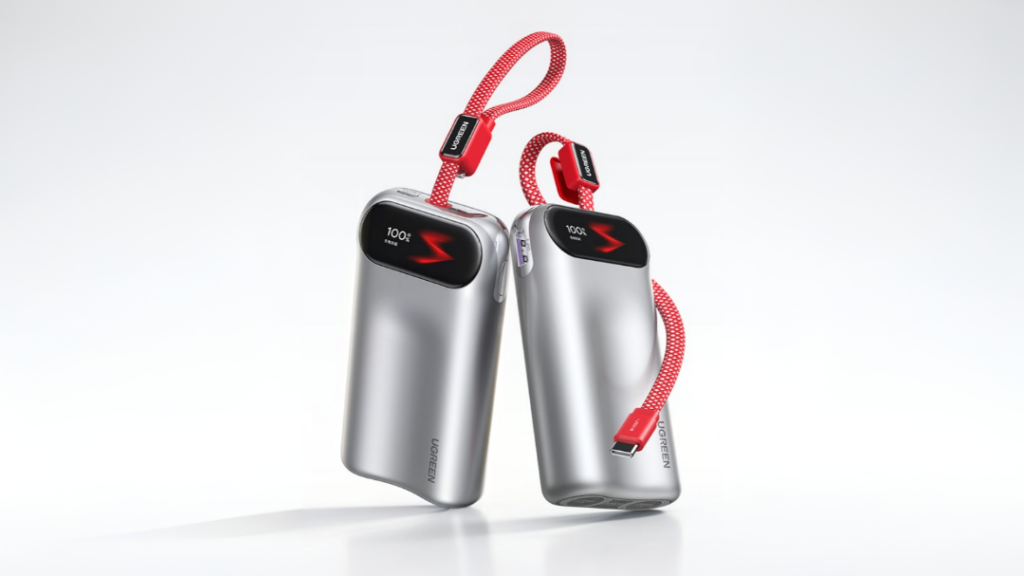
Ugreen is releasing a new 45W power bank (PB610) in China, and it includes a few practical hardware additions alongside a customizable color screen. Listed on JD.com for 199 yuan ($29) ahead of a May 26th release, the 10,000mAh battery pack tries to reduce the number of accessories you need to carry by integrating a built-in USB-C cable directly into the device.
Ugreen 45W Power Bank Specifications
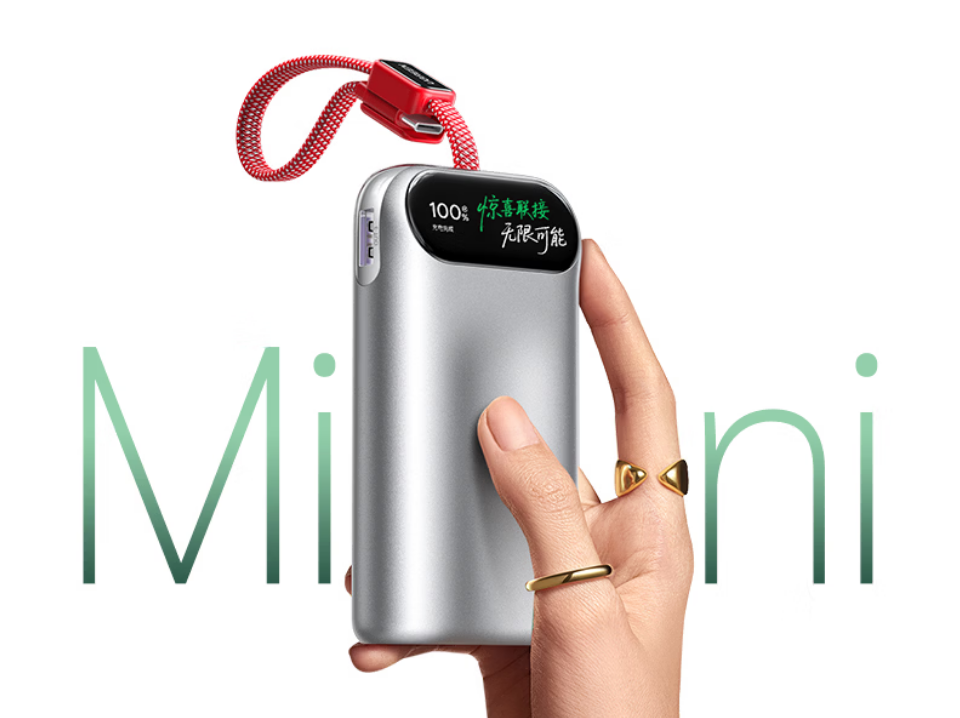
The main draw here is the 1.47-inch smart screen on the front. If you like to monitor your hardware, the display shows real-time data like total output power, battery temperature, remaining charge percentage, and overall battery health. If you don’t care about the exact wattage, you can connect the power bank to Ugreen’s mobile app via Bluetooth and upload custom images or emojis to display instead. It is a minor feature, but it gives a normally boring utilitarian accessory a bit of personality.
Physically, the device is a fairly standard size for a 10,000mAh battery, measuring 109 x 58.5 x 25.5mm and weighing about 239 grams. Ugreen went with a silver finish and included a built-in USB-C cable with contrasting red accents. The cable loops around to function as a carrying strap, which is a practical design choice if you prefer not to carry a separate wire when you leave the house.
Inside the casing, the power bank uses two 5000mAh 21700 cylindrical steel shell battery cells. Ugreen says it also includes an upgraded NTC temperature-control chip that monitors heat levels regularly to maintain safe temperatures during charging.
For connectivity, the power bank has a 2C + 1A configuration: the built-in USB-C cable, a standard USB-C port, and a USB-A port. Both the built-in cable and the USB-C port max out at 45W, which is enough to fast-charge most modern phones and power smaller tablets. The USB-A port tops out at 22.5W. You can plug in three devices at once, though the charging speeds will naturally drop as the 45W maximum output is divided among the active ports.
Ugreen claims the 45W output can charge an iPhone 17 Pro Max to 65% in half an hour. It lists similar 30-minute charging numbers for the Huawei Mate 80 Pro Max (52%) and Xiaomi 17 Pro Max (43%). Because it supports standard fast-charging protocols, it is compatible with standard Apple and Android devices, as well as smaller electronics like the Nintendo Switch, wireless earbuds, and portable cameras.
Right now, the power bank is only listed for the Chinese market. Ugreen hasn’t announced a global release date yet, but the company regularly brings its charging accessories to the US and Europe, so it is highly likely to show up on international storefronts eventually.
In related news, Ugreen has also launched a new portable GaN charger featuring an angled display design and a contrasting red base.
For more daily updates, please visit our News Section.
OnePlus is actively working on Android 17, which will come with the OxygenOS 17 skin on top. It’s said to be one of the biggest Android OS upgrades in recent years, which, paired with new features and upgrades from OxygenOS 17, becomes a significant upgrade rather than just an annual refresh.
If you have a OnePlus device, you may be looking forward to the next major upgrade, OxygenOS 17. So, we’ve written this post to share everything we know about this upgrade, including details on eligible devices, the release timeline, and new features.
OxygenOS 17 update: Full list of eligible devices
OnePlus flagship phones
OnePlus Open
OnePlus 15
OnePlus 15R
OnePlus 13
OnePlus 13R
OnePlus 13s
OnePlus 13T
OnePlus 12
OnePlus 12R
OnePlus 11
OnePlus Nord series
OnePlus Nord 6
OnePlus Nord 5
OnePlus Nord 4
OnePlus Nord CE 6
OnePlus Nord CE 6 Lite
OnePlus Nord CE 5
OnePlus Pad series
OnePlus Pad 4
OnePlus Pad 3
OnePlus Pad 2
OnePlus Pad Lite
OnePlus Pad Go 2
As an official announcement is still pending, this list has been prepared by analyzing the update policy for every OnePlus device released to date and should therefore be accurate.
If your OnePlus device is on the list, you can be sure that it will receive the OxygenOS 17 update when the rollout begins. Otherwise, you may need to upgrade to a newer model.
OnePlus’ progress on Android 17 so far closely matches last year’s timeline. It skipped the first beta and directly released Beta 2 in April, followed by another beta in May.
These early Android “Developer Preview” builds do not include a new version of OxygenOS until around October. That’s when the software is almost ready for a public release with a new OxygenOS skin.
Since the stable Android 17 is dropping almost the same time as last year, in June, OnePlus may also follow a similar rollout pattern. That means the OxygenOS 17 beta program could begin in October, and the stable rollout may go live in early November.
The stable rollout is still months away, but we already have a solid idea about the new features and upgrades coming with the next major upgrade, as discussed below.
What to expect from the OxygenOS 17 update?
OnePlus hasn’t revealed any details about the changes coming to OxygenOS 17, but early leaks suggest a major upgrade to the user experience. According to a leak posted on a Telegram channel, the new version will offer significantly smoother zooming for both photos and videos.
The same leak also says OxygenOS 17 significantly reduces lag, flickering, and UI frame drops, and offers improved scrolling and smoothness. The power efficiency for small tasks is said to have been optimized. OxygenOS 17 could also optimize CPU usage, background app retention, app launch speed, and overall battery usage.
Besides these under-the-hood upgrades, we also expect new features, visual enhancements, and improved AI capabilities in OxygenOS 17. We’ll have more details on them once the open beta is released.
In addition to the OxygenOS 17 upgrades, the final update will also include new features and changes from Android 17, developed by Google. In the beta releases so far, many new features and changes have been spotted, including a native app lock, floating-bubble support for all apps, a more powerful screen recorder, redesigned privacy indicators, limited contact access to apps, and seamless task continuity. You can read more about the changes in Android 17 on this page.
We’ll update the page periodically to keep it up to date. You can bookmark this page to visit later. Or, join our Telegram channel to get notified when we publish new stories.
The mid-range smartphone segment is becoming more competitive than ever, and the iQOO Z11 5G and Poco X8 Pro are two strong examples of that shift. One focuses heavily on battery life and gaming endurance, while the other aims for a more premium all-around experience with stronger performance and multimedia features. With both phones offering flagship-inspired specs at relatively aggressive prices, this comparison highlights which one actually delivers the better value depending on different types of users.
Feature
iQOO Z11 5G
Poco X8 Pro
Winner
Design & Build
Plastic frame and back, IP68/IP69
Aluminum frame, Gorilla Glass 7i, IP68/IP69K
Poco – More premium materials and stronger protection
Display
6.83-inch AMOLED, 144Hz, 5000 nits peak
6.59-inch AMOLED, 120Hz, Dolby Vision, HDR10+
Poco – Better color quality and multimedia support
Refresh Rate
144Hz
120Hz
iQOO – Smoother gaming and scrolling experience
Processor
Snapdragon 7s Gen 4
Dimensity 8500 Ultra
Poco – Faster flagship-level performance
GPU
Adreno 810
Mali-G720 MC8
Poco – Better gaming graphics performance
Storage Type
UFS 3.1
UFS 4.1
Poco – Faster app loading and transfers
RAM & Storage Options
Up to 256GB + 12GB
Up to 512GB + 12GB
Poco – More storage flexibility
Main Camera
50MP OIS
50MP OIS
Tie – Similar primary camera hardware
Ultrawide Camera
No
8MP ultrawide
Poco – More versatile camera setup
Selfie Camera
32MP with 4K video
20MP with 1080p video
iQOO – Sharper selfies and better video support
Rear Video Recording
4K 30fps
4K 60fps, HDR10+
Poco – Better video capabilities
Speakers
Stereo speakers
Stereo speakers with Dolby Atmos
Poco – Richer audio experience
Battery Capacity
9020mAh
6500mAh
iQOO – Massive endurance advantage
Charging Speed
90W
100W
Poco – Faster wired charging
Reverse Charging
7.5W
27W
Poco – More useful reverse charging support
Software
Android 16, Origin OS 6
Android 16, HyperOS 3
Tie – Both offer modern Android experiences
Connectivity
Bluetooth 5.2
Bluetooth 6.0, Auracast
Poco – Newer wireless standards
Extra Features
Bypass charging
Infrared port, Dolby Vision
Tie – Useful extras for different users
Price
Around $300 / ₹31,000
Around $375 / ₹35,000
iQOO – Better value for the hardware offered
Overall Value
Battery-focused powerhouse
Premium all-rounder
Poco – More complete overall smartphone
Disclaimer: Specs are based on available data. Actual performance may vary. Verify details from official sources before buying.
The iQOO Z11 5G focuses heavily on endurance and practicality. Its clean design, IP68/IP69 protection, and large battery-oriented chassis make it feel like a device built for long gaming sessions and heavy outdoor usage. The plastic frame and back help keep durability concerns low, though it does not feel as premium in hand as the Poco X8 Pro.
The Poco X8 Pro takes a more refined approach with an aluminum frame and Gorilla Glass 7i protection. It looks and feels more polished, while features like Dolby Vision and stronger multimedia tuning give it a flagship-inspired touch. The compact feel compared to the iQOO also makes daily handling slightly more comfortable.
Display Quality
The iQOO Z11 5G offers a larger 6.83-inch AMOLED panel with a 144Hz refresh rate and extremely high 5000-nit peak brightness. Scrolling and gaming feel exceptionally fluid, and the bigger screen suits content consumption well.
The Poco X8 Pro counters with a sharper AMOLED display supporting Dolby Vision, HDR10+, and 3840Hz PWM dimming. Colors appear richer and more cinematic, especially while streaming movies or HDR videos. The lower 120Hz refresh rate is barely noticeable in daily use.
Verdict
The iQOO Z11 5G feels more gaming-focused with its massive display and ultra-smooth refresh rate. However, the Poco X8 Pro delivers a more premium overall visual experience thanks to better display calibration, stronger materials, and enhanced multimedia features. Users prioritizing entertainment and design may lean toward Poco, while gamers and power users could prefer the iQOO approach.
2. Specifications Including Battery
Performance
The iQOO Z11 5G uses the Snapdragon 7s Gen 4 paired with UFS 3.1 storage. Performance is stable and efficient for gaming, multitasking, and long-term sustained workloads. Origin OS 6 also appears optimized for smooth responsiveness, especially during extended sessions.
The Poco X8 Pro pushes harder with the Dimensity 8500 Ultra and faster UFS 4.1 storage. App loading speeds are noticeably quicker, gaming performance is stronger, and high-end titles can sustain better frame consistency. The chipset positioning clearly places the Poco closer to upper mid-range flagship territory.
Battery and Charging
Battery life is where the iQOO Z11 5G becomes extremely difficult to ignore. The enormous 9020mAh battery is easily among the biggest in the segment and can comfortably last beyond a full day of heavy use. The 90W charging support still keeps refill times reasonable despite the huge capacity.
The Poco X8 Pro uses a smaller 6500mAh battery but compensates with faster 100W charging and better charging standards support. It feels more balanced for users who value speed over outright endurance.
Verdict
The Poco X8 Pro wins pure performance with its faster chipset and storage setup, but the iQOO Z11 5G dominates battery life in a way very few smartphones currently can. Users wanting maximum longevity and gaming endurance may find the iQOO more practical, while the Poco feels faster and more future-ready overall.
3. Camera
Main and Secondary Lenses
The iQOO Z11 5G keeps things simple with a 50MP OIS primary camera and an auxiliary sensor. Daylight shots are expected to look clean with balanced colors and reliable sharpness, while OIS should help with low-light stability. However, the lack of an ultrawide lens limits versatility, especially for landscape and group photography.
The Poco X8 Pro delivers a more complete setup with a 50MP OIS main sensor and an 8MP ultrawide camera. Video capabilities are also stronger with support for 4K 60fps, HDR10+, and extensive slow-motion modes. The camera experience feels more polished and feature-rich overall.
Selfie Camera
The iQOO Z11 5G gains an advantage with its 32MP selfie camera capable of 4K video recording. Content creators and video callers may appreciate the sharper front camera output.
The Poco X8 Pro uses a smaller 20MP sensor limited to 1080p recording. Selfies should still appear decent, but it lacks the premium front-camera flexibility offered by the iQOO.
Verdict
The Poco X8 Pro is the stronger all-around camera phone thanks to its ultrawide lens, superior video capabilities, and more versatile imaging package. Still, the iQOO Z11 5G offers a surprisingly strong selfie experience, making it attractive for users focused on social media and front-camera content.
4. Pricing
The iQOO Z11 5G is priced at around $300 or ₹31,000, while the Poco X8 Pro sits higher at approximately $375 or ₹35,000. The difference may not seem massive on paper, but it places the Poco in a more premium category where expectations naturally increase.
At its price, the iQOO Z11 5G offers tremendous battery value. A massive 9020mAh battery, 144Hz AMOLED display, IP68/IP69 protection, and 32MP 4K selfie camera make it feel aggressively positioned for gamers and heavy users. It delivers standout hardware without crossing flagship pricing territory.
The Poco X8 Pro justifies its higher cost with better materials, stronger performance hardware, faster storage, improved multimedia features, and a more versatile camera system. The overall package feels more refined and balanced rather than specialized.
Verdict
The iQOO Z11 5G offers better value for buyers prioritizing battery life and gaming endurance on a tighter budget. Meanwhile, the Poco X8 Pro feels worth the extra money for users wanting a more premium, complete smartphone experience with stronger cameras and flagship-style performance.
Disclaimer: Prices are approximate and may vary based on country, region, launch timing, and applicable taxes. Always check whether the listed price is for a China unit or a global/international variant when purchasing.
5. Conclusion
The iQOO Z11 5G stands out primarily because of its enormous 9020mAh battery, which completely changes day-to-day usability. Long gaming sessions, travel, streaming, and multitasking become far less stressful when battery anxiety is nearly removed. The 144Hz AMOLED panel and 32MP 4K selfie camera also give it a distinctive edge in specific areas.
The Poco X8 Pro feels more balanced and premium overall. Features like UFS 4.1 storage, Dolby Vision support, aluminum frame, ultrawide camera, and advanced video recording capabilities create a more flagship-inspired experience. It may not dominate a single category as aggressively as the iQOO, but it performs strongly across nearly every department.
Verdict
iQOO Z11 5G is the better choice for battery-focused power users, gamers, and buyers wanting maximum hardware value at a lower price. Poco X8 Pro, however, feels like the more complete smartphone overall with stronger performance, better cameras, and a more polished multimedia experience. The final choice depends on whether endurance or refinement matters more.
Disclaimer: This comparison is based on the specifications provided and is intended for general informational purposes. Actual performance, camera results, battery life, and overall experience may vary depending on real-world usage, software updates, and individual preferences.
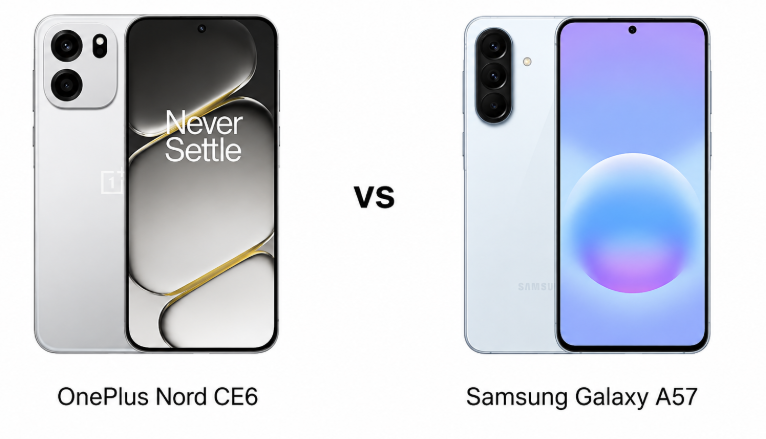
OnePlus Nord CE 6 and Samsung Galaxy A57 take two very different approaches to the premium mid-range market. One focuses on massive battery life, ultra-fast charging, and aggressive hardware value, while the other delivers a more polished flagship-style experience with longer software support and refined cameras. With a huge price gap between them, this comparison reveals which phone actually offers the smarter buy in 2026.
Major Features:
Feature
OnePlus Nord CE 6
Samsung Galaxy A57
Winner
Display
6.78-inch AMOLED, 144Hz, 1272p, 3600 nits peak
6.7-inch Super AMOLED+, 120Hz, 1080p, 1900 nits peak
OnePlus – Sharper panel, higher refresh rate, and brighter display.
Build Quality
IP68/IP69K, MIL-STD-810H
Gorilla Glass Victus+, aluminum frame, IP68
Samsung – Feels more premium with glass and metal construction.
Performance
Snapdragon 7s Gen 4, Adreno 810
Exynos 1680, Xclipse 550
OnePlus – Better gaming-focused optimization and smoother overall feel.
Software Support
Android 16
Android 16 with 6 major updates
Samsung – Much stronger long-term software commitment.
Rear Cameras
50MP main + auxiliary lens
50MP main + 12MP ultrawide + 5MP macro
Samsung – More versatile camera setup for different shooting styles.
Selfie Camera
32MP with 4K video
12MP with HDR video
OnePlus – Sharper selfies and stronger front camera hardware.
Battery
8000mAh
5000mAh
OnePlus – Massive advantage in endurance and screen-on time.
Charging
80W wired, bypass charging
45W wired
OnePlus – Faster charging with extra gaming-friendly features.
Connectivity
Wi-Fi 6, Bluetooth 5.2, IR blaster
Wi-Fi 6E, Bluetooth 6.0, NFC, eSIM
Samsung – More modern connectivity and premium extras.
Audio
Stereo speakers
Stereo speakers
Tie – Both offer solid stereo audio performance.
Storage Options
Up to 256GB
Up to 512GB
Samsung – Higher storage and RAM configurations available.
Price
Around $330 / ₹30,000
Around $550 / ₹57,000
OnePlus – Delivers far stronger value for the price.
Overall Value
High-end specs at aggressive pricing
Premium experience with longer support
OnePlus – Better hardware-to-price ratio for most buyers.
Disclaimer: Specs are based on available data. Actual performance may vary. Verify details from official sources before buying.
The OnePlus Nord CE 6 focuses more on durability and practicality, offering IP68/IP69K protection along with MIL-STD-810H certification. It feels like a phone built for heavy everyday usage, especially for users who travel often or use their devices outdoors. The Samsung Galaxy A57, meanwhile, takes a more premium route with Gorilla Glass Victus+ on both sides and an aluminum frame. It looks and feels cleaner and more flagship-like in hand. Samsung also gains an advantage with eSIM support and a slimmer profile that makes it feel more refined during long usage sessions.
Display Quality
OnePlus pushes harder on raw display specifications with a 144Hz AMOLED panel, higher resolution, stronger PWM dimming, and a much brighter peak output. Gaming and scrolling feel smoother, while sharper visuals make media consumption more immersive. Samsung counters with a well-calibrated Super AMOLED+ panel supporting HDR10+, and its colors tend to look slightly more natural. The lower resolution is noticeable beside the Nord CE 6, though overall viewing quality remains excellent.
Verdict
The Galaxy A57 feels more premium and polished, but the Nord CE 6 delivers a more impressive display experience overall. Users focused on entertainment and smoother visuals may lean toward OnePlus.
2. Specifications Including Battery
Performance
The OnePlus Nord CE 6 is powered by the Snapdragon 7s Gen 4, paired with Adreno 810 graphics, and it targets balanced gaming alongside efficient thermal management. Daily performance feels quick, and the higher refresh rate display complements the smoothness nicely. The Samsung Galaxy A57 uses the Exynos 1680 with Xclipse graphics and offers stronger software longevity with up to six major Android upgrades. Samsung’s optimization inside One UI 8.5 also feels polished for multitasking and long-term reliability. However, heavier gamers may still prefer the slightly more aggressive tuning on the OnePlus device.
Battery and Charging
Battery life is where the Nord CE 6 creates a huge gap. Its 8000mAh battery is massive compared to the 5000mAh cell inside the Galaxy A57. Two-day usage becomes realistic on the OnePlus phone, while Samsung comfortably handles a full day. Charging is also faster on the Nord CE 6 with 80W support and bypass charging, making it more convenient for gaming sessions. Samsung’s 45W charging is decent but no longer class-leading in this segment.
Verdict
The Galaxy A57 wins on software support and polished optimization, but the Nord CE 6 dominates battery endurance and charging speed. Power users will likely find the OnePlus setup more practical.
3. Camera
Main and Secondary Lenses
Samsung takes a more versatile approach with a triple-camera setup that includes a 50MP main sensor, ultrawide camera, and macro lens. The larger primary sensor helps with better light capture, and Samsung’s image processing usually delivers richer dynamic range and more balanced colors. The ultrawide camera also adds flexibility for travel and landscape photography. The OnePlus Nord CE 6 keeps things simpler with a dual-camera setup centered around a 50MP OIS main sensor. Daylight shots look sharp and punchy, but the lack of a proper ultrawide lens limits creative flexibility.
Selfie Camera
OnePlus clearly targets selfie-focused users with its 32MP front camera capable of 4K recording. Selfies look sharper and more detailed, especially in brighter environments. Samsung’s 12MP front camera is smaller in resolution, though its HDR processing and skin tones often appear more natural in social media uploads and video calls.
Verdict
Samsung offers a more complete rear camera system with stronger versatility, while OnePlus delivers better selfie hardware. Photography enthusiasts may appreciate Samsung more, but content creators could prefer the sharper front camera on the Nord CE 6.
4. Pricing
The OnePlus Nord CE 6 is priced around $330 or ₹30,000, while the Samsung Galaxy A57 sits much higher at roughly $550 or ₹57,000. That creates a major pricing gap between the two devices despite several overlapping features. The Nord CE 6 delivers a high-refresh AMOLED display, a huge battery, fast charging, flagship-level durability ratings, and solid performance at almost half the price. Samsung justifies its premium through better build materials, longer software support, stronger camera versatility, and a more polished overall ecosystem experience.
The value equation depends heavily on priorities. The Galaxy A57 feels more future-proof for users planning to keep a phone for many years, especially because of Samsung’s software commitment. However, the Nord CE 6 offers far more aggressive hardware value for buyers focused on specifications per dollar.
Verdict
The Galaxy A57 is expensive but refined, while the Nord CE 6 stands out as the stronger value-for-money option. For most buyers, the OnePlus device feels easier to recommend financially.
Disclaimer: Prices are approximate and may vary based on country, region, launch timing, and applicable taxes. Always check whether the listed price is for a China unit or a global/international variant when purchasing.
5. Conclusion
The OnePlus Nord CE 6 stands out with its massive 8000mAh battery, 144Hz AMOLED display, ultra-fast charging, and rugged durability certifications. It feels designed for users who prioritize endurance, gaming, and multimedia consumption above everything else. Samsung’s Galaxy A57, on the other hand, focuses on refinement through premium materials, cleaner software optimization, better long-term software support, and a more versatile camera system. Features like eSIM support and Gorilla Glass Victus+ also help it feel closer to a flagship experience.
Both phones target very different audiences despite sharing the upper mid-range category. The Nord CE 6 feels bold and specification-heavy, while the Galaxy A57 emphasizes balance and longevity. Samsung’s polished ecosystem experience may appeal more to professional users, whereas OnePlus clearly targets performance-focused buyers who want maximum hardware value.
Verdict
OnePlus Nord CE 6 is the better choice for battery life, display quality, and raw value. The Samsung Galaxy A57 feels more premium and future-focused, but its much higher price makes the competition surprisingly close.
Disclaimer: This comparison is based on the specifications provided and is intended for general informational purposes. Actual performance, camera results, battery life, and overall experience may vary depending on real-world usage, software updates, and individual preferences.
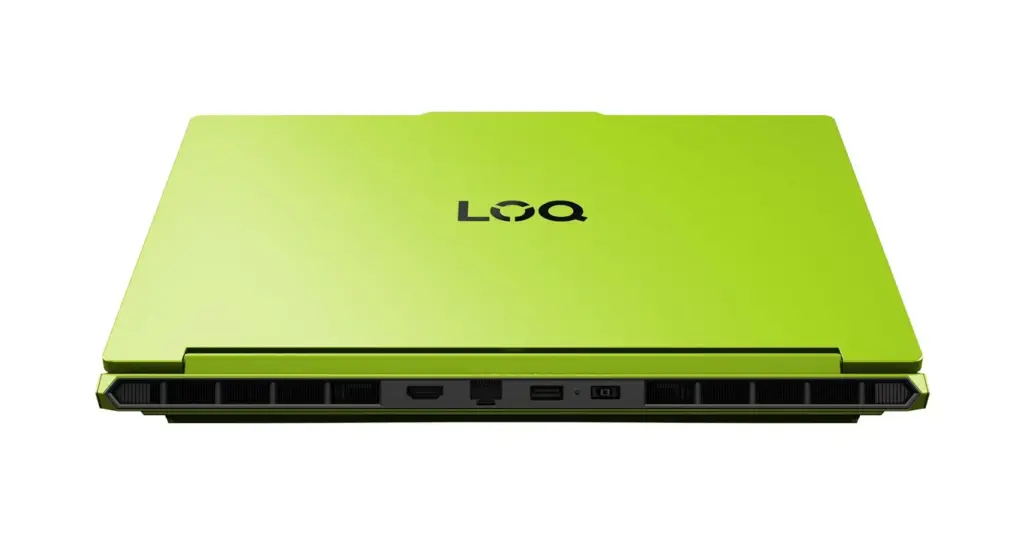
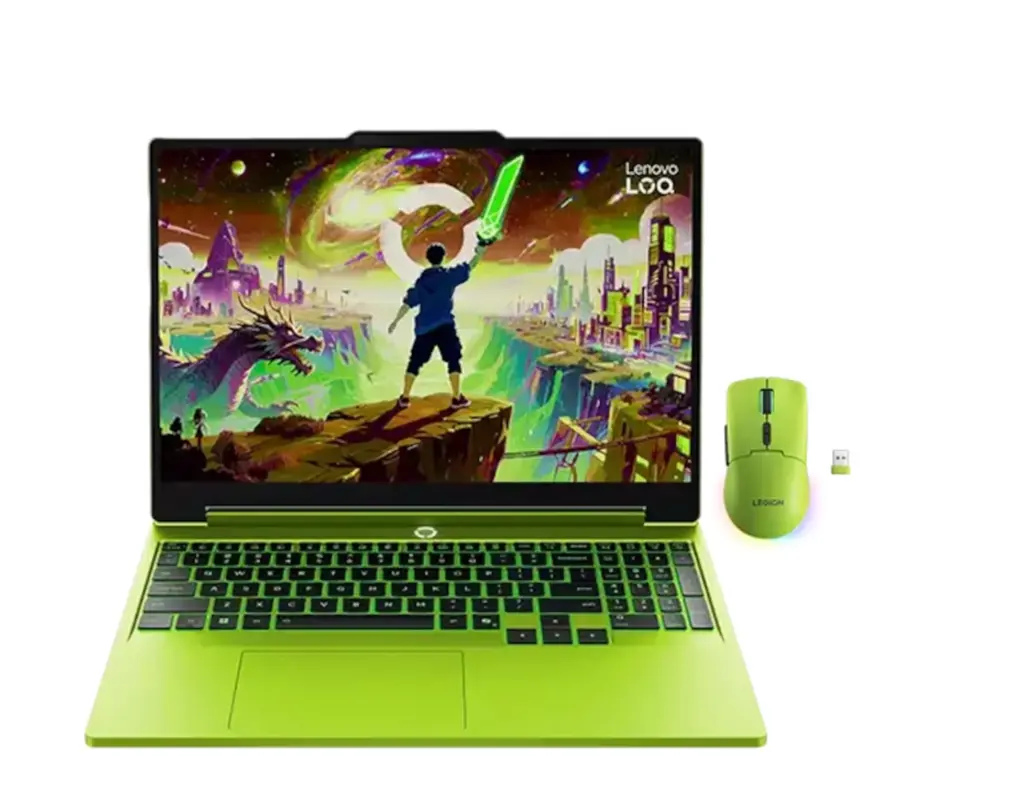
Lenovo is refreshing its budget gaming lineup with the new LOQ 15AHP11, a gaming laptop that mixes a more playful design with newer AMD and NVIDIA hardware. The company is clearly targeting buyers who want solid 1080p gaming performance without stepping into premium Legion pricing territory.
One of the first things that stands out is the design. This gaming laptop comes in a whirlwind green finish paired with black bezels and keyboard accents, giving it a very different look compared to the usual dark-grey gaming laptops on the market. Lenovo is even offering a matching wireless mouse in some regions to complete the setup.
Under the hood, the LOQ 15AHP11 uses AMD’s Ryzen 7 250 processor, an 8-core, 16-thread Zen 4 chip that boosts up to 5.1GHz. It’s essentially a refreshed Hawk Point platform, which also means users get capable Radeon 780M integrated graphics alongside decent multi-core performance for gaming, editing, and general workloads.
Graphics options include NVIDIA’s new GeForce RTX 5050, RTX 5060, and RTX 5070 Laptop GPUs, each paired with 8GB of GDDR7 memory and power limits around 115W. These newer Blackwell GPUs bring support for DLSS 4, improved ray tracing performance, and updated AI features compared to the previous generation.
The laptop also checks most of the boxes gamers would expect in this segment. There’s up to 32GB DDR5-5600 memory, dual M.2 SSD slots for storage expansion, and a 15.3-inch IPS display with a 1920×1200 resolution, 165Hz refresh rate, and full sRGB color coverage. Brightness tops out at 300 nits, which should still be fine for indoor gaming and everyday use.
Lenovo has included a decent selection of ports too, including USB4, HDMI 2.1, Wi-Fi 6, and Bluetooth 5.3. The machine weighs around 2.1kg, so while it’s not exactly ultrabook territory, it still remains fairly portable for a gaming laptop in this category.
Pricing and availability:
Pricing starts at around £1,600 in the UK and roughly $1,645 in the US depending on configuration. That places it in an increasingly competitive part of the gaming laptop market, especially as more brands begin rolling out RTX 50-series machines. It’s widely available across Europe (including Germany and Switzerland), the UK, Canada, and Australia.
Overall, the LOQ 15AHP11 feels like Lenovo trying to make its entry-level gaming lineup a little more modern and less boring.
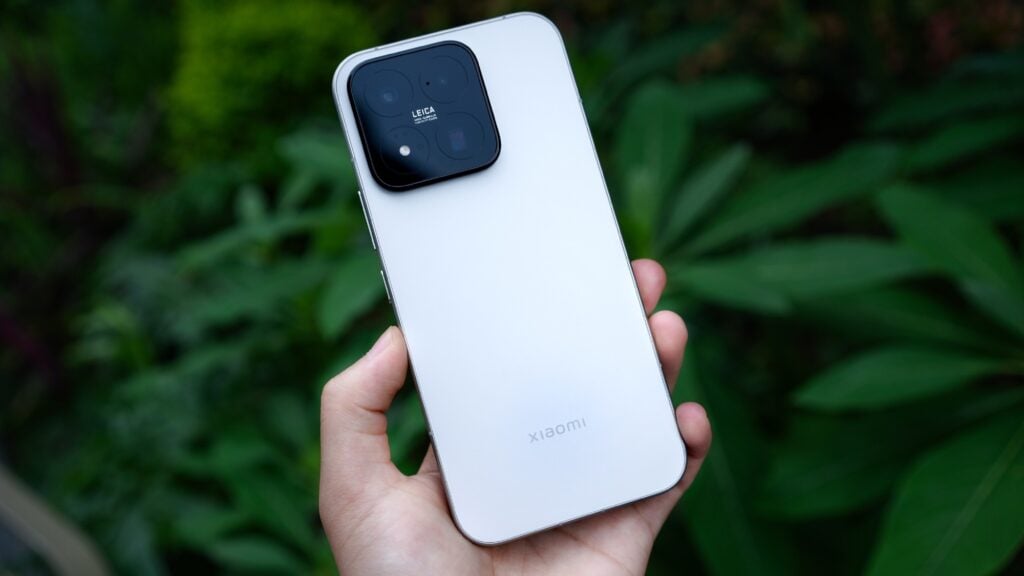
Xiaomi is set to launch the Xiaomi 17T and 17T Pro in global markets on May 28. Thanks to a steady stream of leaks, we are aware of the specifications and prices for some markets well ahead of time. Now, fresh leaks are adding price details for several more markets.
A new leak from the UAE market claims the standard Xiaomi 17T could launch at AED 2,599, which roughly converts to around $708 or ₹68,000.
A separate leak claims the Xiaomi 17T will start at PHP 33,999 ($553) for the 12GB + 256GB variant. The 512GB version may be priced at PHP 37,999 ($618). The Xiaomi 17T Pro, meanwhile, could start at PHP 45,999 ($748) for the 256GB model and go up to PHP 47,999 ($780) for the 512GB variant.
Xiaomi 17T (left) | Xiaomi 17T Pro (right)
Meanwhile, in Russia, the Xiaomi 17T may start at RUB 51,625 ($725) for the 256GB model and reach RUB 54,537 ($766) for the 512GB option. The Xiaomi 17T Pro was listed at RUB 68,535 ($963) for the 256GB variant, while the top-end 1TB model appeared at RUB 81,861 ($1,150).
Direct currency conversions do not translate actual retail pricing across regions, but the leaks collectively suggest the Xiaomi 17T lineup could fall somewhere between $700 and $1,100, depending on the model and storage configuration. Previous European leaks have also hinted that the Xiaomi 17T Pro may hit the €1,000 mark in certain markets.
Xiaomi 17T and Xiaomi 17T Pro Specifications
For the price, the Xiaomi 17T is expected to offer a 6.59-inch display with a 2756 x 1268 resolution and a 120Hz refresh rate. The Pro model, on the other hand, may feature a larger 6.83-inch panel with a sharper 2772 x 1280 resolution and a faster 144Hz refresh rate.
The standard model will use the MediaTek Dimensity 8500 Ultra chipset, while the Pro variant may arrive with the Dimensity 9500. Both devices are tipped to include 12GB of RAM and storage options up to 512GB, although the Pro model may also get a 1TB version in some regions.
Xiaomi 17T
The Xiaomi 17T is also rumored to pack a 6,500mAh battery with 67W charging support, while the 17T Pro could include a larger 7,000mAh battery with 100W wired and 50W wireless charging.
For cameras, both phones are expected to feature a triple rear setup of a 50MP main sensor, a 50MP telephoto lens with 5x optical zoom, and a 12MP ultra-wide camera.
For more daily updates, please visit our News Section.
Vivo is sticking with a familiar chipset for its upcoming Vivo S60 smartphone. A new Geekbench listing for the device, carrying the model number V2571A, shows that the phone will use Qualcomm’s Snapdragon 8s Gen 3 processor, the same chip that powered last year’s Vivo S50.
Vivo S60 Geekbench
The Snapdragon 8s Gen 3 features one prime core clocked at 3.01GHz, four performance cores running at 2.80GHz, and three efficiency cores at 2.02GHz. The chip is paired with the Adreno 735 GPU. The listing also confirms Android 16 and up to 16GB of RAM for the device.
In Geekbench CPU tests, the Vivo S60 scores 1,960 points in single-core and 5,194 points in multi-core.
What can you expect?
The new benchmark details arrive shortly before Vivo’s scheduled launch event on May 29 in China. The company is expected to unveil both the Vivo S60 and the Vivo S60 Vitality Edition during the event.
Both phones will share a similar design and will be available in Starry Sea, Early Summer Green, and Midsummer Night color options. The standard S60 is expected to offer configurations up to 16GB RAM and 512GB storage, while the Vitality Edition may start with 8GB RAM and 256GB storage, making it the more affordable model.
Vivo S60 – Midsummer Night
Moreover, leaks suggest the Vivo S60 could feature a 6.59-inch OLED display with 1.5K resolution and a 120Hz refresh rate. Other rumored specifications include a 7,200mAh battery with 90W fast charging support, an ultrasonic in-display fingerprint scanner, and a 50-megapixel triple-camera setup with a Sony IMX-series periscope telephoto sensor.
Additional expected features include stereo speakers, an X-axis linear motor, an IR blaster, and IP68/IP69-rated dust and water resistance. Vivo has yet to officially confirm the full specifications, but with the launch date approaching, more details are likely to surface soon.
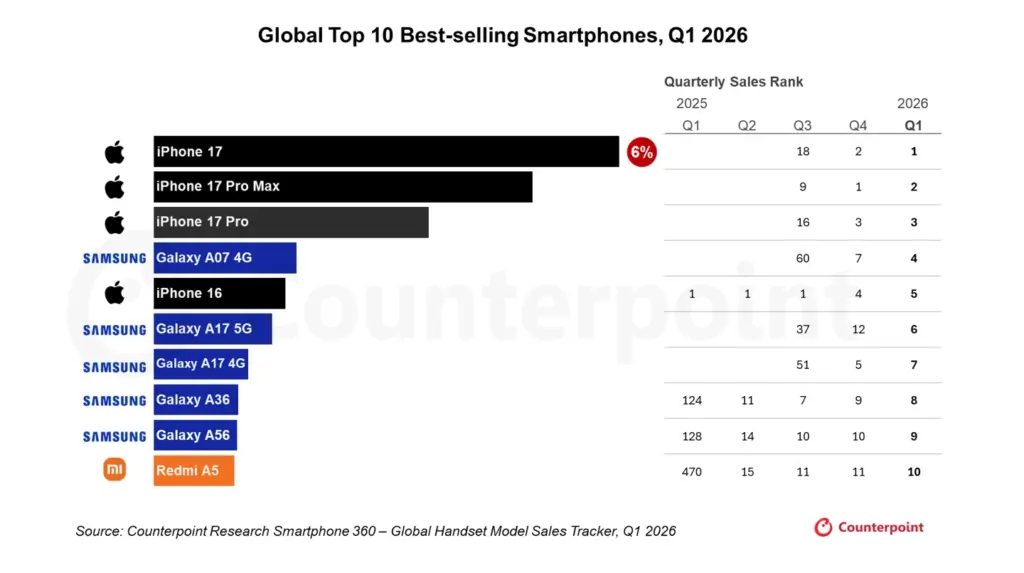
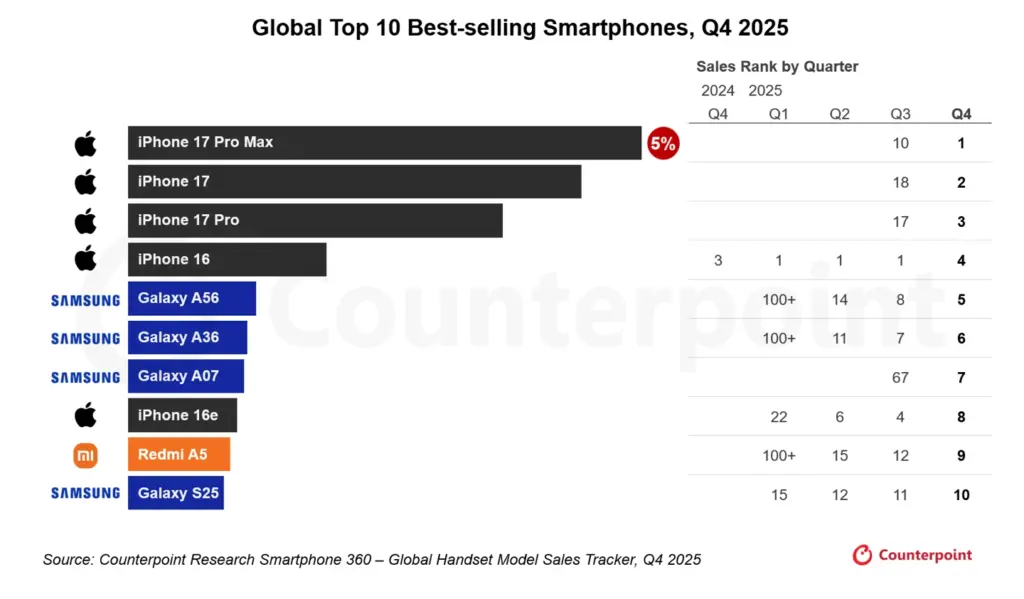
Apple’s latest iPhones are clearly driving momentum in the premium smartphone segment, even as the broader market deals with supply issues and softer demand in lower price categories. New data from Counterpoint Research shows the top 10 best-selling smartphones made up 25% of global shipments in Q1 2026, marking the highest first-quarter concentration the firm has recorded so far.
Leading the rankings was the iPhone 17, which alone accounted for 6% of global smartphone shipments during the quarter. The iPhone 17 Pro Max and iPhone 17 Pro followed closely behind, giving Apple the top three spots overall. The report reflects how strongly the company’s latest lineup has resonated across multiple regions.
Part of the iPhone 17’s success seems tied to Apple narrowing the gap between the standard and Pro models this year. The base variant now starts with 256GB storage, features a 48MP main camera setup, and finally brings a smoother 120Hz ProMotion display to non-Pro buyers. Those upgrades appear to have made the regular model far more appealing to mainstream users who previously leaned toward older Pro devices or skipped upgrades entirely.
Counterpoint says the device posted double-digit year-over-year growth in markets including China, the US, and South Korea. Analysts also pointed to Apple’s ecosystem advantages, trade-in offers, and brand loyalty as key reasons behind the lineup’s strong performance, despite ongoing memory component shortages affecting the wider industry.
Samsung, meanwhile, secured five places in the global top 10, mostly through its entry-level Galaxy A-series phones. The Galaxy A07 4G emerged as the company’s best-performing Android phone, particularly in regions such as Latin America, Africa, and the Middle East where affordable devices continue to dominate volumes. The Galaxy S26 Ultra reportedly saw solid early demand too, though it missed making the list.
Xiaomi also held onto a spot in the rankings with the Redmi A5, showing continued strength in budget-focused markets.
For now, Apple’s iPhone 17 lineup and Samsung’s Galaxy A-series appear to be setting the pace at opposite ends of the market. With competition heating up around cameras, displays, on-device AI features, and software ecosystems, the next few quarters could end up being especially important for the industry’s biggest players.
Oppo is preparing to launch a new Android tablet on May 25, and from the early details, the company seems to be going for a more balanced approach instead of chasing only raw performance numbers.
The upcoming Oppo Pad 6 is scheduled to launch in China on May 25 at 18:00, and Oppo has already revealed quite a bit about the hardware ahead of the event.
One of the first things the company is highlighting is the design. The tablet measures just 5.99mm thick and weighs around 577 grams, which should make it fairly comfortable to carry around for classes, work, or longer reading sessions. It will be available in Starlight Blue, Galaxy Silver, and Deep Space Gray.
Oppo is using a 12.1-inch 3K LCD panel with a 144Hz refresh rate. The company says the “Soft Light” screen design also helps reduce glare and reflections significantly, which could make a noticeable difference for users who spend long hours reading documents or studying on the tablet.
Under the hood, the Pad 6 is powered by the new MediaTek Dimensity 9500s chipset. The company claims the tablet can score around 3.06 million points on AnTuTu, although benchmark numbers only tell part of the story in actual day-to-day use.
Battery life should not be much of a problem either. The tablet packs a large 10,420mAh battery along with 67W fast charging, which should comfortably handle a full day of mixed use.
On the software side, Oppo is putting a lot of emphasis on multitasking and productivity features. Things like floating windows, PC-style file management, stylus support, cross-device integration, and AI-powered note-taking tools are all part of the pitch this time. There is also support for sharing a nearby phone’s 5G connection directly with the tablet, which is a practical addition for users who work on the go without constant Wi-Fi access.
At least from the details revealed so far, the Oppo Pad 6 feels less like a flashy spec experiment and more like a tablet designed for people who actually plan to use it daily for work, study, streaming, and casual gaming.
Oppo is preparing to launch a new pair of wireless earbuds later this month, and the company seems to be focusing heavily on comfort.
The upcoming Oppo Enco Air5s will officially launch in China on May 25, and from the teasers released so far, the earbuds stick with a semi-in-ear design instead of the more isolating silicone-tip style seen on many recent TWS models.
One of the main highlights is the weight. Oppo says each earbud weighs just 3.9 grams, which should make them more comfortable for longer listening sessions, especially for users who dislike bulky in-ear designs. The earbuds will be available in three colors: Midnight Black, Starlight Purple, and Moonlight White.
Even though the design is semi-in-ear, Oppo is still promising fairly strong call noise reduction performance. The Enco Air5s use a three-microphone setup combined with AI-based voice processing that is designed to better isolate speech in noisy environments like cafés, dorms, or outdoor areas with wind noise.
For audio, the earbuds are equipped with a 12mm dynamic driver, and Oppo is also advertising features like spatial audio and adaptive sound tuning. As usual, the real-world audio quality will matter more than the feature list, but the hardware itself sounds fairly competitive for the segment.
The company is also adding a handful of convenience features that feel aimed at younger users and students. That includes dual-device connectivity, sliding touch controls for volume adjustment, audio sharing, and support for AI-related features like live translation and assistant integration.
Interestingly, Oppo is also emphasizing compatibility with both Android and Apple devices rather than focusing only on its own ecosystem.
Battery life and official pricing still have not been confirmed yet, so those details will likely be saved for the launch event itself.
At least from the early teasers, the Enco Air5s look less focused on being lightweight, comfortable earbuds that people can just wear all day without thinking too much about them.
We use cookies on our website to give you the most relevant experience by remembering your preferences and repeat visits. By clicking “Accept”, you consent to the use of ALL the cookies.
This website uses cookies to improve your experience while you navigate through the website. Out of these, the cookies that are categorized as necessary are stored on your browser as they are essential for the working of basic functionalities of the website. We also use third-party cookies that help us analyze and understand how you use this website. These cookies will be stored in your browser only with your consent. You also have the option to opt-out of these cookies. But opting out of some of these cookies may affect your browsing experience.
Necessary cookies are absolutely essential for the website to function properly. This category only includes cookies that ensures basic functionalities and security features of the website. These cookies do not store any personal information.
Any cookies that may not be particularly necessary for the website to function and is used specifically to collect user personal data via analytics, ads, other embedded contents are termed as non-necessary cookies. It is mandatory to procure user consent prior to running these cookies on your website.