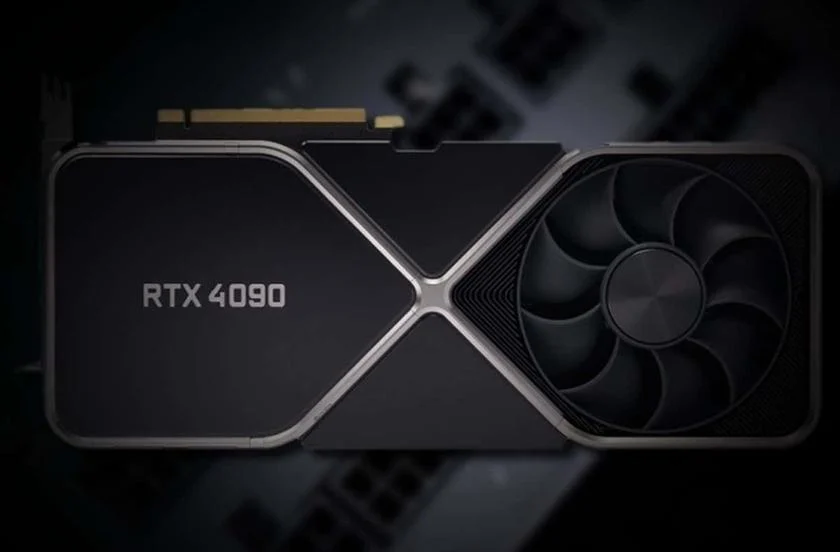
As covered here, the Chinese tech market was scrambling as the news of the ban on RTX 4090 cards spread like wildfire. Now, Nvidia has completely taken the card off it’s website, it seems. This action raises questions about the availability and future supply of this sought-after gaming card in China.
This rumour was lingering in the tech space very recently, but it happened sooner than expected
The RTX 4090, known for its top-of-the-line graphics processing capabilities, is part of Nvidia’s GeForce RTX 40 series. Its sudden disappearance from the official websites has caused unease among Chinese gamers and tech enthusiasts. This move comes amidst tight supply in China, attributed to the card’s high performance in graphics applications.
The situation is compounded by recent U.S. export controls, which impose stricter regulations on the export of advanced graphics chips to China. This has led to speculation that the RTX 4090 might face withdrawal due to these new rules. Adding to the concerns, several of Nvidia’s major hardware partners in China have also removed the RTX 4090 from their online stores.
Despite these challenges, the RTX 4090 remains available through e-commerce platforms and unofficial channels, albeit at inflated prices. This availability hints at a resilient demand for the product, despite regulatory hurdles.
Interestingly, the RTX 4090’s significance extends beyond gaming in China. It plays a crucial role in supporting advanced applications like autonomous driving, highlighting its importance in various technology sectors. However, the main concern in China still revolves around Nvidia’s data center chips, which are facing surging prices and supply issues.
In response to these challenges, Nvidia is adapting by developing new data center GPUs specifically for the Chinese market. The first shipment of these new GPUs is expected by the end of the year.
Chinese tech innovator Xiaomi has officially unveiled the Multi-Function Camping Lantern in select European countries, following its initial debut in China earlier this year. The camping lantern introduces a unique two-part design, comprising a main lantern and a compact, removable light stored within the larger lamp’s center.
Features
The multi-function camping lantern boasts an array of features tailored for outdoor enthusiasts, the detachable light serves a dual purpose as a powerful flashlight. It is equipped with a convenient hook for suspension. Users have the flexibility to control color temperature with options for cold, warm, and RGB lighting, as well as adjust brightness levels ranging from 6 to 230 lumens. The intuitive controls, facilitated by a front-facing dial, allow for seamless customization of the lighting experience.
One of the standout features is the integration of Bluetooth connectivity, enabling users to remotely control the lantern through the Xiaomi Home app. The auxiliary light operates on an 800 mAh battery, while the main lantern is powered by a robust 4,800 mAh lithium-ion battery, supporting quick recharging via USB-C in just 3.5 hours.
The Xiaomi Multi Function Camping Lantern holds an IP54 rating, making it resistant to dust and water splashes. With compact dimensions measuring 198 x 114 x 123 mm and a weight of 565 g, this gadget proves to be a portable and essential companion for camping adventures.
Pricing & Availability
The product is currently available in France and Germany, retailing at €59.99, with an exclusive €5 discount offered in Germany through an in-page coupon. Xiaomi’s expansion plans are evident with the product listing on the Xiaomi Italy website, signaling a broader availability in the near future.
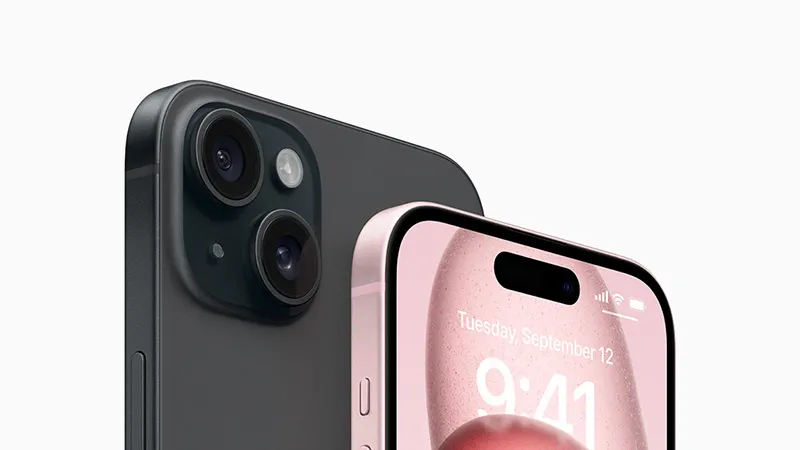
Apple’s upcoming iPhone 16 series is attracting a lot of attention, but not necessarily for the reasons the tech giant would prefer. Rumor has it that both the iPhone 16 and 16 Plus will stick with a 60Hz display refresh rate, falling behind the 120Hz standard offered by many other flagship smartphones.
Apple is set to disappoint again with non-Pro iPhone 16 displays
This decision by Apple has been a point of discussion since the release of the iPhone 15 series, which also featured the same 60Hz refresh rate. Despite advancements like the Dynamic Island design in recent models, Apple appears hesitant to upgrade the refresh rate in its non-Pro iPhones.
Leaks from various sources, including South Korean tech site Naver and Twitter leaker @Tech_Reve, suggest that the iPhone 16 series won’t see an improvement in this aspect. This aligns with predictions from display analyst Ross Young, who suggests that Apple may only introduce high-refresh-rate screens to its base models by 2025.
Yes… The iPhone 16/16 Plus has been reconfirmed to have an LTPS 60Hz display…
The rumored screen sizes for the iPhone 16 series include a 6.12-inch display for the standard model and a 6.69-inch display for the Plus variant. In contrast, the Pro models are expected to feature slightly larger screens with 120Hz refresh rates, in line with current flagship smartphone trends.
This decision by Apple is surprising, especially considering that competitors like Samsung and Google have already adopted higher refresh rates in their flagship models, including budget variants like the Pixel 7a. Some Moto phones even offer 144Hz displays in the mid-budget segment. The persistence of a 60Hz refresh rate in premium models like the iPhone 16 and 16 Plus makes them outliers in the current smartphone market. While a 60Hz refresh rate isn’t inherently bad, it is noticeably lower than the standard found in recent flagship devices.
The reluctance to upgrade the refresh rate could be influenced by factors like cost and potential battery life trade-offs. However, it remains a significant point of contention for users who expect a smoother and more responsive experience from new models. As the industry moves toward smoother and more dynamic displays, Apple’s choice to stick with a 60Hz refresh rate in its upcoming models might be seen as lagging behind its competitors.
Technological advancements continues to make our lives easier and assist us in our daily tasks. However, if you don’t use the right products, the situation can sometimes be the opposite. Being within an ecosystem and using devices that communicate with each other is great. However, if you step outside of that ecosystem, things can get a bit messy. If you’ve ever used a Windows PC and an iPhone simultaneously, you can understand what I mean. But Microsoft aims to solve this problem with its new Windows app for iPhones, iPads, Macs, and PCs. Here are the details…
Microsoft’s New Windows App Unveiled
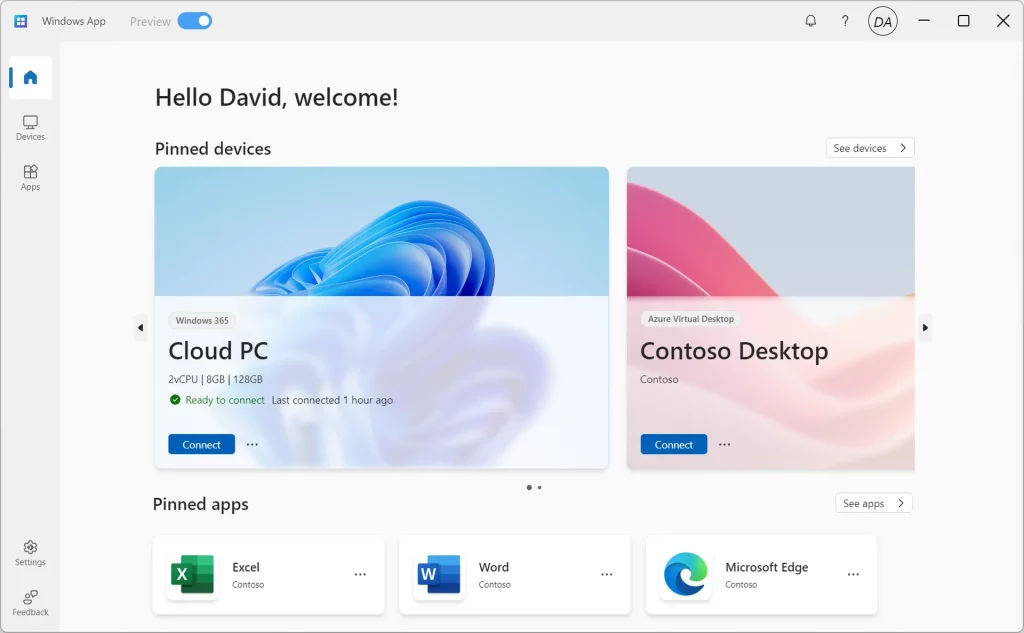
Microsoft has developed a new Windows app for iOS, iPadOS, macOS, Windows, and web browsers. This app essentially replaces the previous Windows 365 and serves as a central hub used to view Windows from a remote computer. However, the preview version is currently not available on Android.
As a result, users can access, control, and use their remote devices even when they are not constantly at their computers. Establishing communication between Windows and iPhone has, until now, been quite a literal pain. However, this has somewhat reduced the access issue between the two devices. At least now, you don’t have to go through the hassle of trying to access photos and files on your computer.
At the moment, it seems the app is limited to Microsoft’s business accounts, but there are hints that it will eventually be available for consumers. The app comes with a range of features, including multi-monitor support, custom screen resolutions, dynamic screen resolutions and scaling, and support for devices like webcams, audio, storage devices, and printers redirection.
Microsoft has had remote connection applications for computers for many years, but the introduction of a dedicated “Windows App” is a unique development, possibly signaling that Microsoft’s broader goal of transitioning Windows entirely to the cloud is still in progress.
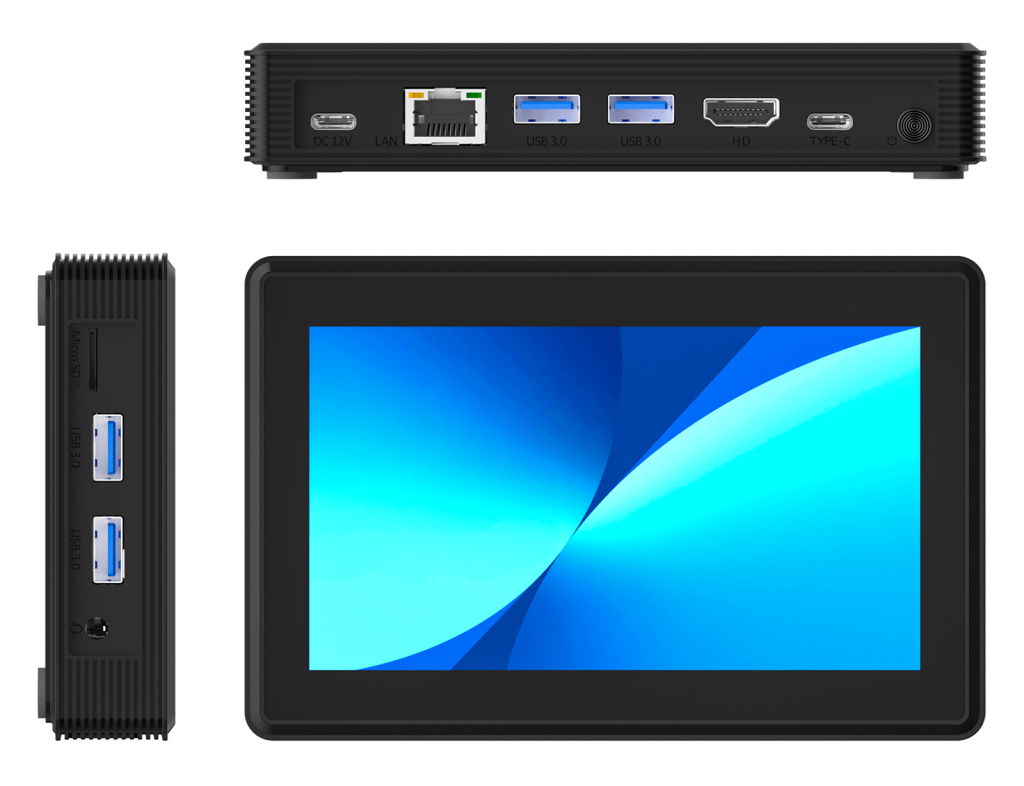
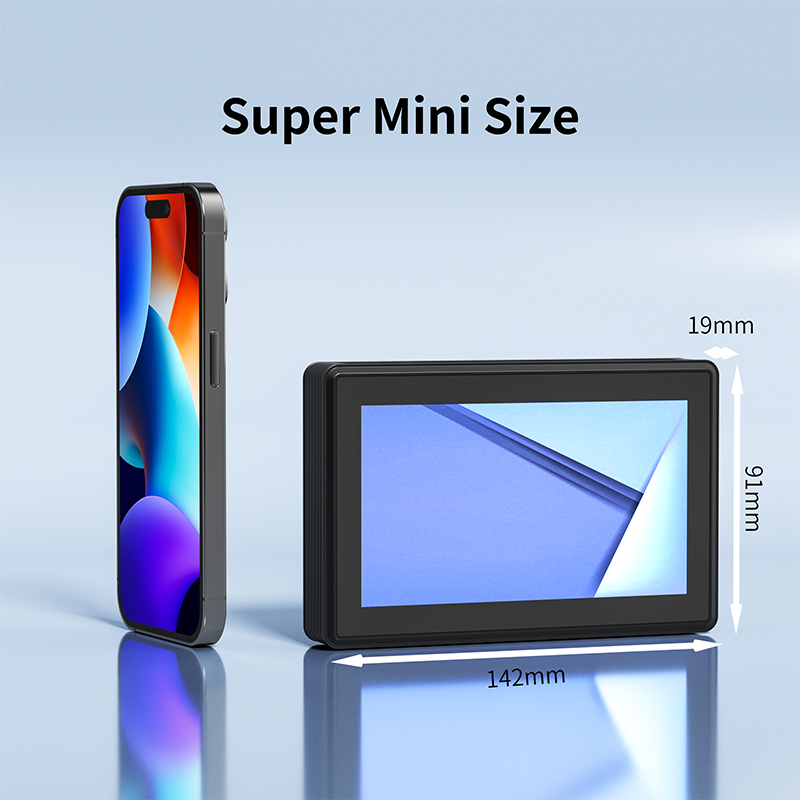
HIGOLE has released the GOLE 2 Pro, a compact mini PC with a 5.5-inch touchscreen display. This pocket-sized device is slightly larger than two stacked smartphones, measuring 142 x 91 x 19 millimeters. Despite its small size, it functions as a full-fledged PC and can run desktop operating systems such as Windows 11 and Ubuntu.
HIGOLE GOLE 2 Pro Key Features:
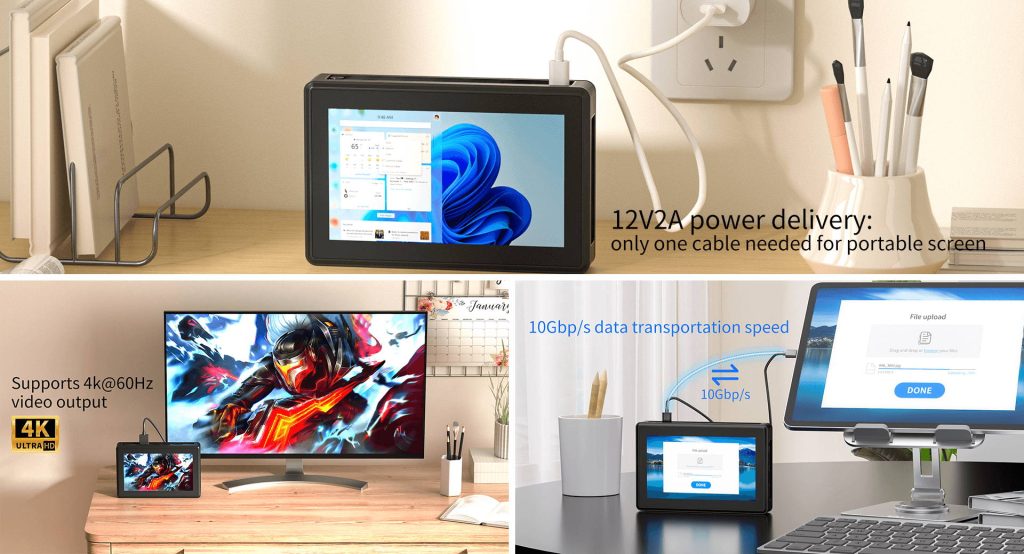
The GOLE 2 Pro features an Intel Celeron N5105 quad-core processor with 15-watt power, an improvement over the previous model’s Intel Gemini Lake architecture, using the newer Jasper Lake architecture. While this processor can handle basic tasks and 4K video playback effectively, it may not be suitable for demanding applications like AAA gaming or intensive video editing due to its low-cost, low-power design.
The device comes with 16GB LPDD4 of RAM and offers storage options of 256GB or 512GB of solid-state storage. It includes an M.2 2280 slot that supports PCIe 3.0 x2 NVMe solid-state storage, an upgrade from the slower eMMC storage of earlier models. The device also features a 5.5-inch touchscreen display with a resolution of 1280 x 720 pixels, offering versatility for functions such as status display and full touchscreen control.
In terms of connectivity, the mini PC includes a full-function USB Type-C, another USB Type-C for power, HDMI, four USB 3.0 Type-A, Gigabit Ethernet, a 3.5mm audio jack, and a microSD card reader. It also supports dual displays via the USB-C and HDMI ports, enhancing its versatility. The device also supports WiFi 6 and Bluetooth 5.2.
The pricing of GOLE 2 Pro starts at $259 for the base variant while the model with internal battery starts at $289. The models are now up for pre-order, with shipping scheduled to begin in December 2023. It is primarily available for purchase on the GOLE Mini PC store and is expected to become available on Amazon and other e-commerce stores as well.
In a strategic move, Meta Platforms has disbanded its Responsible AI (RAI) team, signaling a significant restructuring within the tech giant. Most former RAI team members will now be integrated into the generative AI product team, aligning with Meta’s broader vision for AI development. This shift aims to enhance collaboration across various verticals, with a particular focus on core product development.
The reshuffling also involves some team members contributing to Meta’s AI infrastructure, underscoring the company’s commitment to bolstering its technological foundations. Despite this restructuring, Meta emphasizes an unwavering dedication to prioritizing safe and responsible AI development.
Meta, affirms that the dissolution of the RAI team does not diminish the company’s commitment to responsible AI initiatives. The move is positioned as part of a broader effort to integrate responsible AI practices into Meta’s key technologies.
This restructuring follows previous changes within the RAI team, which reportedly resulted in layoffs. RAI team faced autonomy-related challenges, requiring extensive stakeholder negotiations for its initiatives.
Established in 2019, the RAI team played a crucial role in identifying and addressing issues in Meta’s AI training approaches. The focus included ensuring diverse information in model training to prevent moderation issues on Meta’s platforms. The team’s initiatives were designed to enhance the responsible use of AI technology within Meta.
This restructuring comes amidst Meta’s recent rollout of generative AI tools, showcasing the company’s continuous commitment to advancing AI capabilities. Despite the changes, members of the former RAI team are expected to continue supporting cross-Meta efforts related to responsible AI development and use.
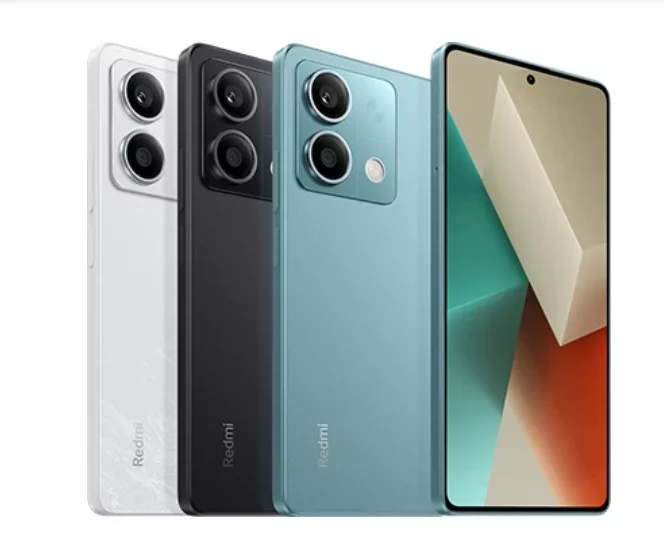
Xiaomi’s Redmi Note 13 5G has emerged from its initial debut in China and is now gearing up for a global launch. The latest update in its journey is the certification from the TDRA certification authority, solidifying its presence in the tech arena.
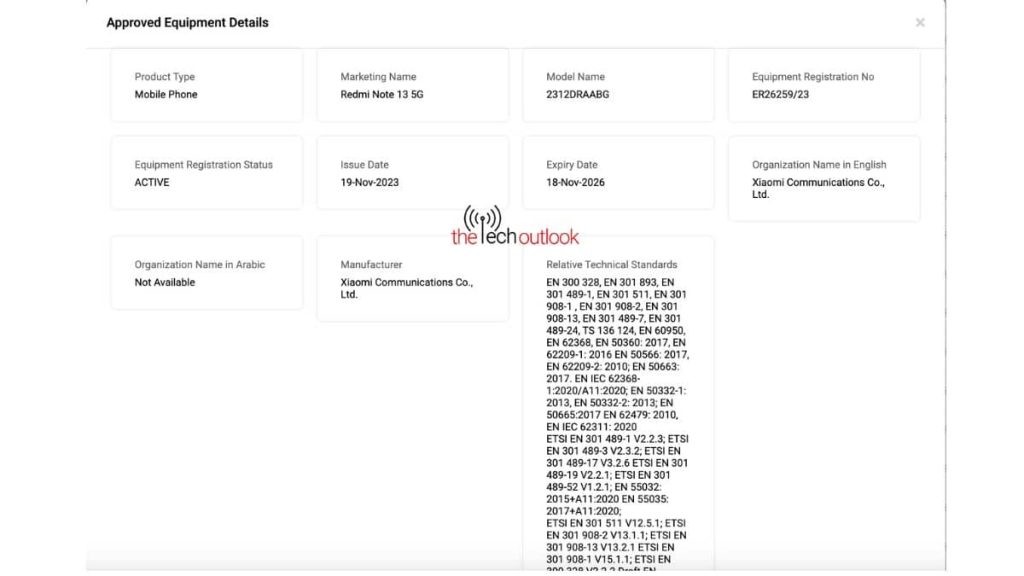
TDRA’s seal of approval comes with the equipment registration number “ER26259/23” and the model number “2312DRAABG.” Previously, the device has been spotted on many regional certification databases including Thailand’s NBTC, Singapore’s IMDA, and FCC. It’s worth noting that the device has also secured a spot in India, courtesy of the BIS certification authority, albeit under a different model number.
Redmi Note 13 5G specs:
Digging into the Redmi Note 13 5G’s specs, the smartphone boasts a 6.67-inch AMOLED display, providing a Full HD+ resolution of 1080 × 2400 pixels. With a high 120Hz refresh rate and Corning Gorilla Glass 5 protection, it promises vibrant visuals and durability. Notable features include a 3.5mm audio jack, infrared sensor, and IP54 dust and splash resistance.
Under the hood, the MediaTek Dimensity 6080 SoC powers the device, complemented by the Mali G57 GPU. Storage options range from 128GB to 256GB of UFS 2.2 storage, expandable via a microSD card. Users can opt for configurations with 6GB, 8GB, or 12GB of LPDDR4X RAM, catering to different needs. Running on MIUI 14 based on Android 13, the software experience is poised to be smooth.
Turning to the camera setup, it boasts a robust 100MP primary camera with an f/1.7 aperture, complemented by a 2MP depth sensor and LED flash. Selfies are handled by a 16MP front camera. Powering the device is a substantial 5000mAh battery, supporting 33W fast charging through the USB Type-C port.
The launch of the Red Magic 9 Pro is almost upon us as we get closer and closer to November 23. The new flagship gaming phone from the Red Devil’s camp will be among the first to launch a Snapdragon 8 Gen 3 chip. Xiaomi 14 series and iQOO 12 series are currently the only smartphones with this new chip on the market. These phones have shown great performance on AnTuTu, scoring almost 2 million points. But here’s the thing: the Red Magic 9 Pro is all about gaming, so we expect it to be much better at sustaining its performance than its counterparts. Let’s look at what’s coming with this new smartphone.
Design & display
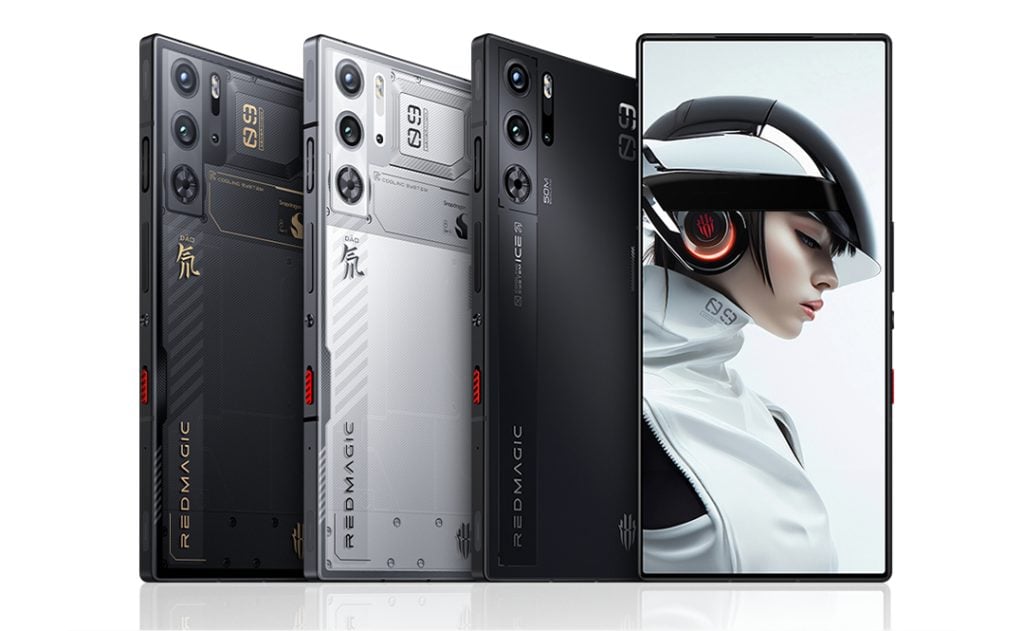
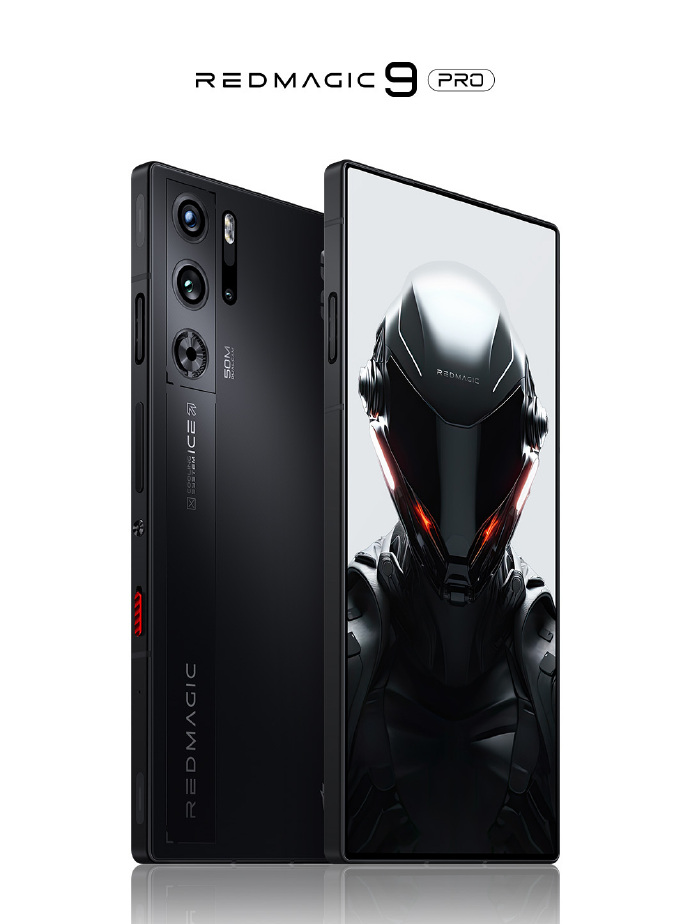
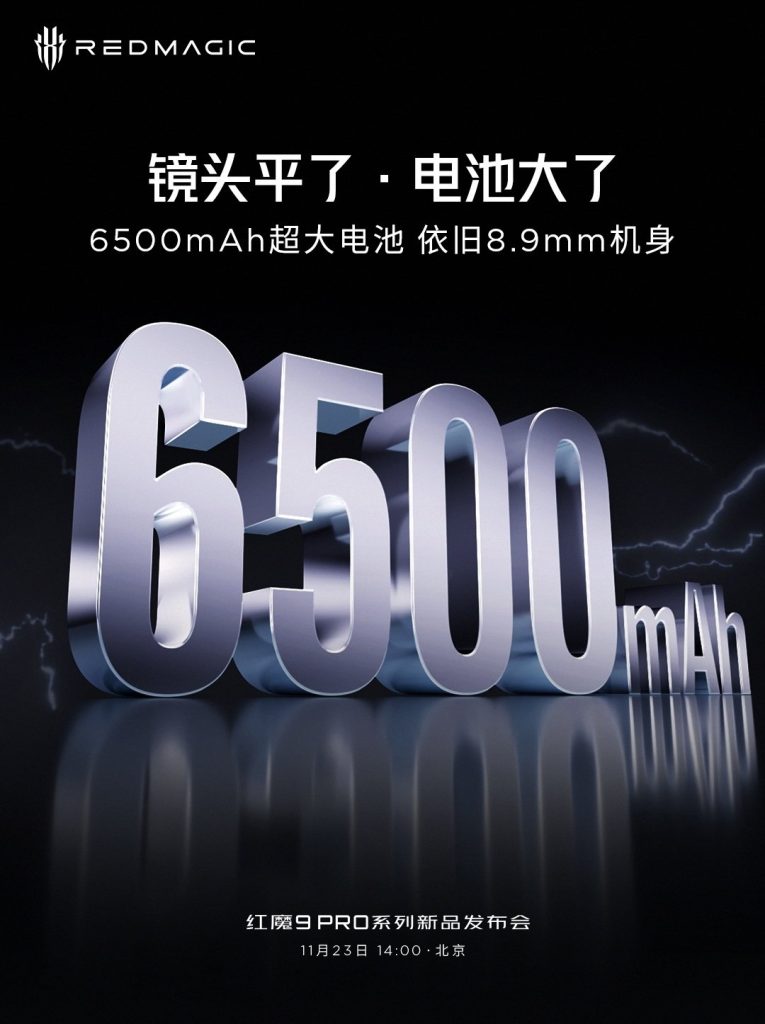
The brand recently showed off the look and color choices for the upcoming Red Magic 9 Pro. This time around, they’ve made some changes to the design, moving the camera setup to the left side of the device. What’s interesting is that the camera has a flat design, so it doesn’t stick out. The brand has also teased that the smartphone will be quite slim, measuring only 8.9mm, which is chunky by flagship smartphone standards but quite slim for a gaming phone.
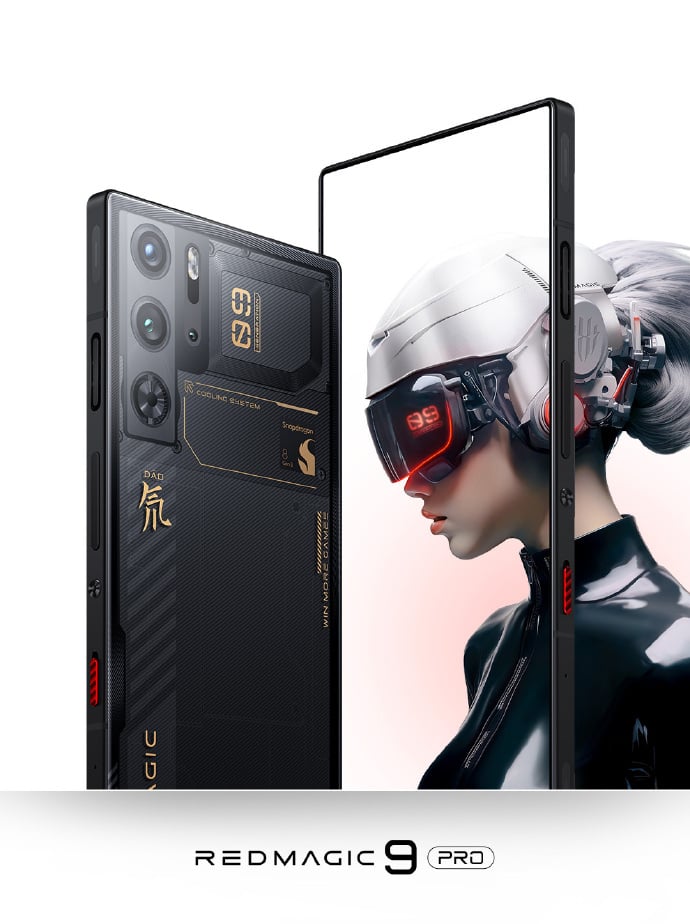
The phone has a generally flat look, featuring flat edges and buttons. It will come with a unique RGB light that boasts the industry’s first custom RGB fan lighting effect, along with new RGB gaming shoulder keys for various operations. You can choose from three colors: Deuterium Transparent Silver Wings, Deuterium Transparent Dark Night, and Dark Night Knight. The Transparent Silver Wings and Deuterium Transparent Dark Night options have a transparent back, providing a glimpse of the phone’s internal components.
On the front, the smartphone will feature a flat, full screen without any cutouts for a front camera. This is because the device will use an under-display camera. Talking about the display, it is anticipated to measure 6.8 inches and offer a resolution of 2480 x 1116 pixels. The display material will be OLED and the refresh rate is expected to be 120Hz.
Specs
As mentioned earlier, the phone will be powered by the Snapdragon 8 Gen 3 chip paired with up to 24GB RAM and 2TB storage. It includes a 10,182mm² vapor chamber, claiming to reduce the heat generated by the Snapdragon 8 Gen 3 chip by up to 25°C. Thanks to this cooling system, the phone achieved an impressive score of 2,290,773 points on AnTuTu. In games like Genshin Impact, the device can maintain an average of 60 FPS at 720P resolution. What’s noteworthy from the benchmark results is that the device consumes less power compared to the iQOO 12 Pro and Xiaomi 14 Pro, while at the same time, outperforming them in terms of performance.
The device is also teased to come with Red Magic’s self-developed game chip called the Red Core R2 Pro. This chip will focus on aspects that enhance the gaming experience like haptic feedback, audio, and touch-sampling rate. The smartphone will also feature X Gravity 2.0 software, which will be used for seamless mapping of external devices like a controller or keyboard and mouse to on-screen controls. Along with these features, the device will be launching with REDMAGIC OS 9.0 based on Android 14. The brand has promised a smoother and more polished experience compared to REDMAGIC OS 8.
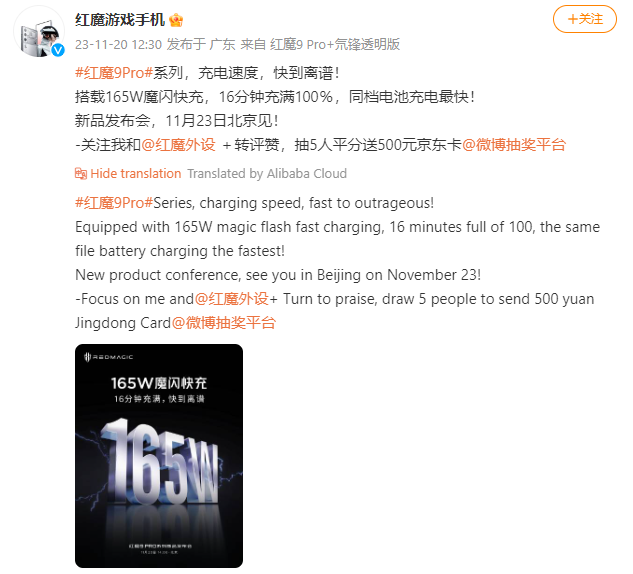
The haptic motors are larger this time, providing 30% stronger vibration compared to its predecessor. A dual stereo speaker system will also be onboard ensuring you don’t miss out on any sound queues. In addition to that, the phone will also be equipped with a 3.5mm audio jack for low-latency wired audio. The shoulder buttons will have a 90% larger area with 520Hz touch sampling and new lighting effects. The battery will also come with a few upgrades. The capacity will be increased to 6,500mAh compared to 6,000mAh on its predecessor. Along with that, the fast charging is jumping up to 165W, which is awesome news for gamers as the brand claims that the device can be fully charged in just 16 minutes.
Camera
While Red Magic phones aren’t typically recognized for their focus on cameras, so, it’s not surprising that details about the camera setup are scarce. Nonetheless, there are rumors suggesting that the Red Magic 9 Pro might incorporate a 50-megapixel Samsung GN5 primary sensor on the rear with Optical Image Stabilization (OIS). This is expected to be accompanied by a 50-megapixel Samsung JN1 ultra-wide-angle lens. These sensors have proven their capabilities in various flagship devices, raising expectations for the Red Magic 9 Pro to capture impressive and visually appealing photos.
In a spectacular financial performance for Q2 2023, ByteDance, the parent company of TikTok and Douyin, reported a staggering $29 billion in revenue. This marked a remarkable 40% year-on-year growth, propelling ByteDance into the coveted top three among China’s Big Tech companies, alongside Tencent and Alibaba.
ByteDance’s meteoric rise outpaced industry giants, with its growth surpassing both Tencent’s 11% and Alibaba’s 14%. The company’s revenue even approached that of Meta Platforms, with ByteDance reporting $54 billion in first-half earnings compared to Meta’s $60.6 billion.
The driving force behind ByteDance’s success lies in its strategic business segments. A surge in advertising, particularly in the Chinese market, significantly contributed to the revenue spike. ByteDance’s aggressive foray into e-commerce through Douyin paid off handsomely, boasting an impressive 80% growth in gross merchandise volume (GMV) last year.
In contrast, industry stalwarts Tencent and Alibaba reported more modest growth. Tencent, with an 11% increase in sales, saw its advertising segment as the fastest-growing, up 34%. Alibaba, with 14% year-on-year growth, continued to rely on its core e-commerce business, constituting approximately half of its total sales.
ByteDance’s push into diversified revenue sources, including ventures into food deliveries and hotel reservations, reflects a proactive approach to adapt to economic headwinds and regulatory challenges. Douyin, with its 600 million daily active users, emerged as a formidable competitor to Alibaba, leveraging e-commerce as a key revenue pillar.
However, ByteDance faced geopolitical challenges, notably the ban on TikTok in government devices across 30 states in the US, the EU, and Australia due to data security concerns. Despite this setback, ByteDance managed to generate approximately $5.8 billion, or 12% of its Q2 2023 sales, from international markets, primarily through TikTok.
ByteDance is a big player in its home market, but its success globally and unclear IPO plans make its story even more interesting. Despite facing challenges from regulators and economic ups and downs, ByteDance’s ability to adapt and find new ways to make money shows that it’s shaking things up in the world of Big Tech.
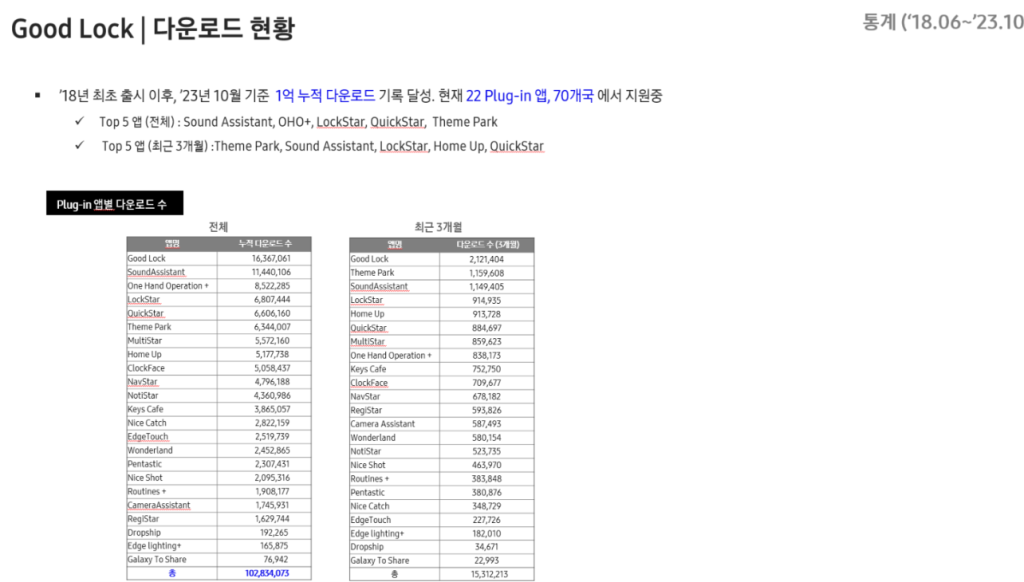
Expanding support for Good Lock in different regions across different Galaxy smartphones has paved the way for new milestones. The popular Good Lock App which is used to extend customizability across Galaxy smartphones via its different modules has conclusively hit more than 100 million downloads on Galaxy Store.
Apart from the Good Lock’s 16,367,061 installs, it is joined by the Sound Assistant module with 11,440,106 downloads in second position. It is further joined by One Hand Operation + with 8,522,285 installs and Lockstart at fourth position with 6,606,160 installs. Several other popular modules follow the list as – Theme Park, Multi Star, Home Up, ClockFace, NavStar, NotiStar, etc.
In the last three months, the installs have significantly increased with the compatibility extending across different devices. Good Lock App alone pulled 2,121,404 installs, which is followed by Theme Park with 1,159,608.
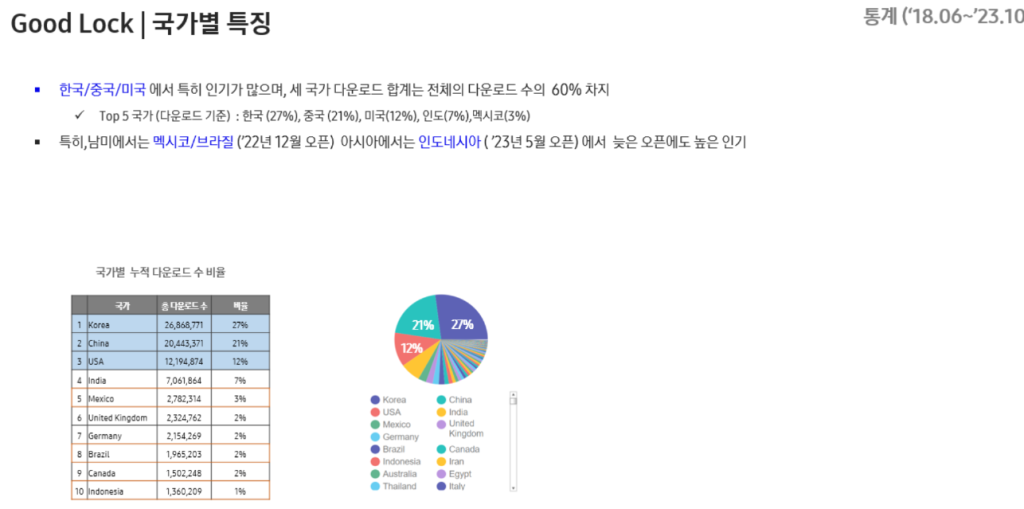
Among countries, Korea contributes 26,868,771 installs, China with 20,443,371 downloads and the USA contributes 12,194,874 installs. India and Mexico remained in 4th and fifth position with 7,061,864 and 2,782,314 installs, respectively.
Good Lock Modules’ Popularity With Respect To Specific Country
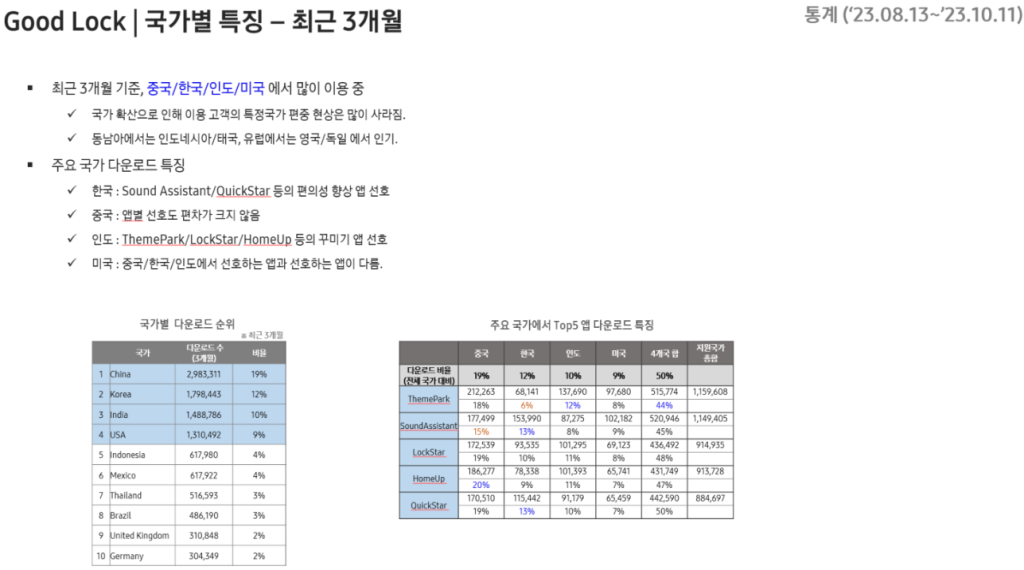
In the past 3-4 months, most downloads have come from Southeast Asia including countries like Thailand, and Indonesia. Due to compatibility expansion, customers are widely using these add-ons in China, Korea, India, and the USA. Even European nations like the UK and Germany are contributing to the increasing demand for customizability with these modules.
Korea: The users prefer Sound Sound-Assistant//QuickStart kind modules which enhance the convenience.
China: The users don’t really prefer any specific kind of app, the data shows symmetric installs of all modules.
India: Indian users love to customize their smartphones using apps like ThemePark, LockStart HomeUp, etc.
In the coming few weeks, a lot of new features will be part of the Good Lock App. However, the users can leave positive feedback by using the hashtag #GoodLock100Million on Instagram to cheer the development team.
Xiaomi is a Chinese tech company known for its wide range of consumer electronics and smart devices. With a focus on offering innovative and affordable products, Xiaomi has gained popularity for its smartphones, smart home devices, wearables, and other tech gadgets. The company’s products are characterized by their competitive pricing and quality, making technology accessible to a broader audience. Xiaomi’s commitment to providing value-for-money options has contributed to its success in various markets around the world.
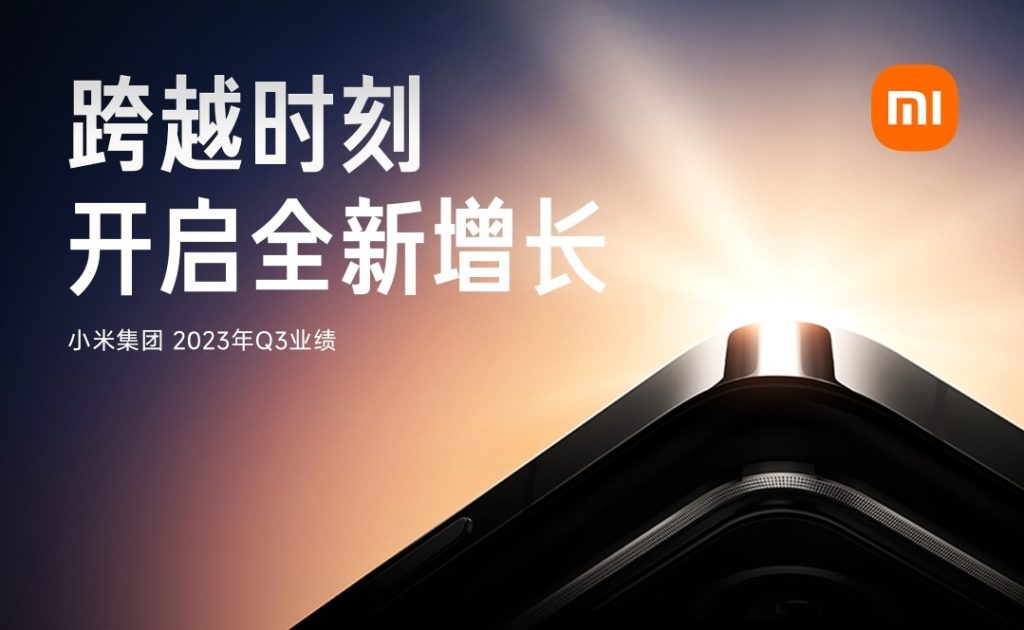
Xiaomi’s 2023 Q3 Financial Report
Earlier today, the company released its Q3 2023 financial report. According to the report, their total revenue has surged to 70.9 billion yuan ($9.92 billion), and they’ve posted an adjusted net profit of 6 billion yuan ($840 million), marking a substantial year-on-year growth of 182.9%. Notably, Xiaomi has achieved a historic high gross margin of 22.7% and amassed an unprecedented cash reserve of 127.6 billion yuan ($17.8 billion).
A significant part of Xiaomi’s success can be attributed to their continuous investment in innovation, especially in research and development (R&D), which has seen a 22% year-on-year increase, totaling 5 billion yuan ($700 million). This investment drives Xiaomi’s “People, Car, Home” ecosystem strategy, with the centerpiece being the Xiaomi HyperOS. This new operating system, developed over seven years by a team of over 5,000 engineers, is designed to seamlessly connect billions of devices, underscoring Xiaomi’s commitment to building a comprehensive ecosystem.
Xiaomi’s smartphone division, particularly the Xiaomi 14 series, has also experienced remarkable growth, boasting a record gross margin of 16.6% and selling over a million units at launch. Additionally, Xiaomi has excelled in the IoT and consumer products segment, achieving historic highs in revenue at 20.7 billion yuan ($2.8 billion) and a gross margin of 17.8%. Their AIoT platform is now connected to a staggering 699 million IoT devices, and the monthly active users of the Mi Home app have increased by 16% to reach 84 million.
In the global smartphone market, Xiaomi has maintained a top-three position for 13 consecutive quarters. Their internet business has thrived as well, with internet services revenue hitting 78.125 billion yuan ($10.9) and a remarkable gross margin of 74.4%.
Beyond technology and innovation, Xiaomi is also committed to environmentally friendly practices, aiming for carbon neutrality by 2040 and utilizing 100% renewable energy sources. On the social front, Xiaomi has earned recognition as one of Forbes’ global best employers for three consecutive years and continues to make significant contributions to public welfare and education through initiatives like the Xiaomi Public Welfare Foundation and the Xiaomi Scholarship program.
In an overdue move, the Federal Communications Commission (FCC) has announced new rules aimed at protecting consumers from SIM swapping and port-out fraud, scams that have become increasingly prevalent in recent years.
SIM swapping occurs when fraudsters trick mobile carrier employees into transferring a victim’s phone number to a new SIM card, effectively taking control of their account. Port-out fraud, on the other hand, involves transferring the victim’s number to a different carrier without their authorization.
These scams have become so common that an entire industry has emerged to facilitate them. SIM swapping has also been used to target and breach the networks of major organizations.
The new FCC rules require that wireless providers implement secure authentication methods before transferring a customer’s phone number and immediately notify customers of any SIM changes or port-out requests. However, the rules lack specific details on what constitutes secure authentication or immediate notification.
While the FCC’s actions are a step in the right direction, the effectiveness of the new rules remains to be seen. The challenge lies in implementing effective security measures while dealing with a diverse range of carriers with varying levels of employee training and security cultures.
In the meantime, consumers should take steps to protect themselves, such as enabling PIN or verbal password protection for their accounts and following additional precautions recommended by the Federal Trade Commission.
Google has a knack for leaving digital breadcrumbs in its code, and this time, the trail leads to a mysterious feature called “Cubes.” While its exact functionality is still shrouded in secrecy, recent discoveries suggest that Cubes might be a central hub for discovering new apps tailored to each user’s preferences.
Evidence of Cubes has been unearthed in recent Android updates, indicating that the project is nearing completion. The feature was first spotted in January as a basic framework, but subsequent discoveries suggest that development is steadily progressing.
Google Cubes | Image: Google News Telegram
According to Google News Telegram, Cubes will likely facilitate app discovery across various categories, curating a personalized feed of app information, deals, and updates based on user-selected categories and individual app preferences.
X/Twitter user AssembleDebug has further uncovered the possibility of direct shopping within Cubes, though the extent of this feature remains unclear.
With much of its functionality still shrouded in mystery, Cubes is poised to revolutionize app discovery on Android. Its personalized approach could provide users with a more refined and tailored experience compared to the existing Play Store structure.
While the exact timing of Cubes’ release is unknown, it appears to be another step towards personalized feeds, potentially based on existing apps or those yet to be discovered. While the concept might seem familiar within the Play Store’s existing structure, Cubes could bring a more refined and tailored experience.
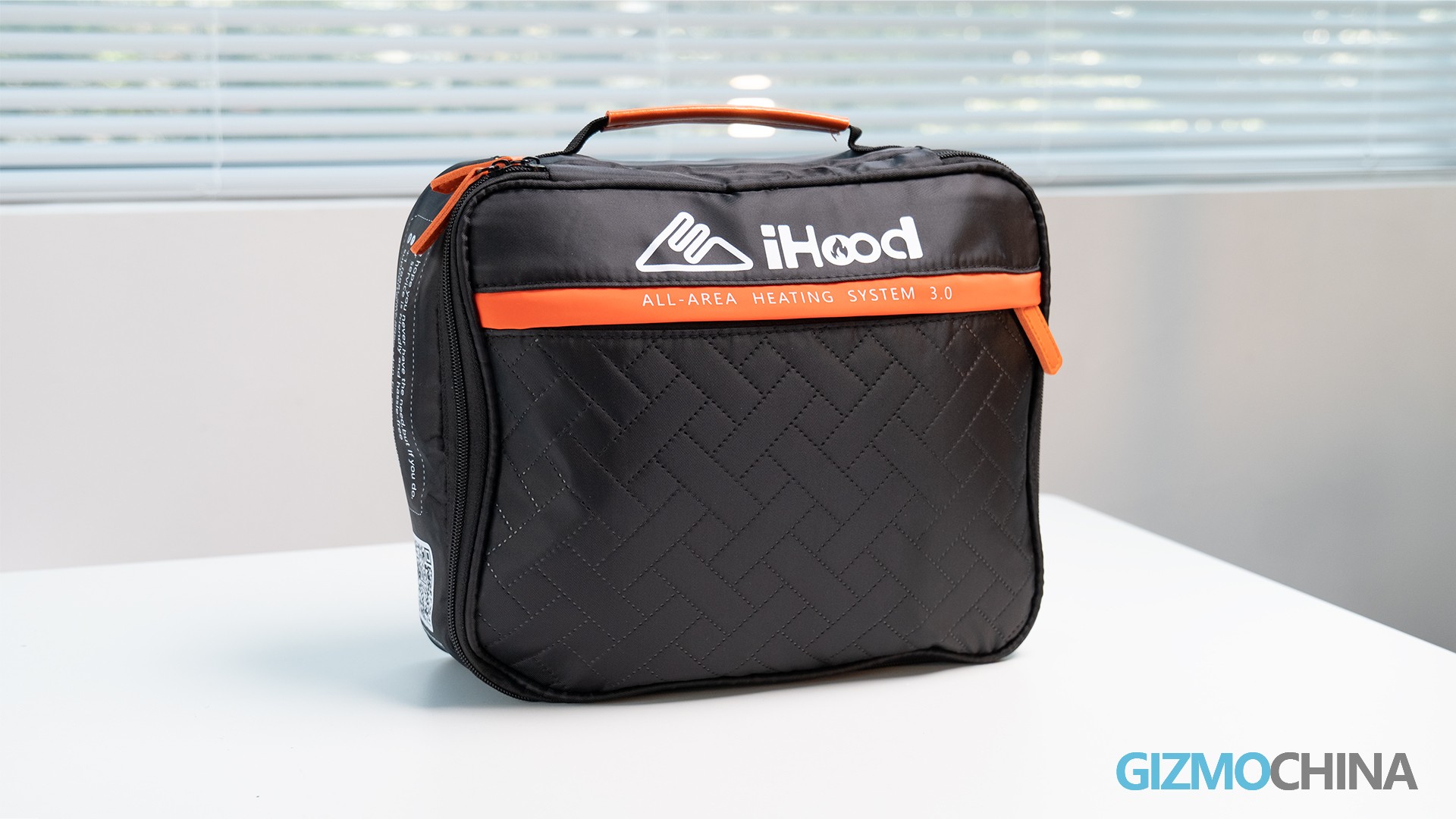
Now the winter is upon us, soon the coldest time will arrive, and we should be prepared. Unlike normal jacket we wear every day to keep you in a decent warm situation, a heated vest or jacket can be a better choice when you want to go outside. This time we have the iHoodwarm Heated Vest for review, this vest has a built-in warming system inside, and can heat you up quickly. Let’s have a look at it.
How it works
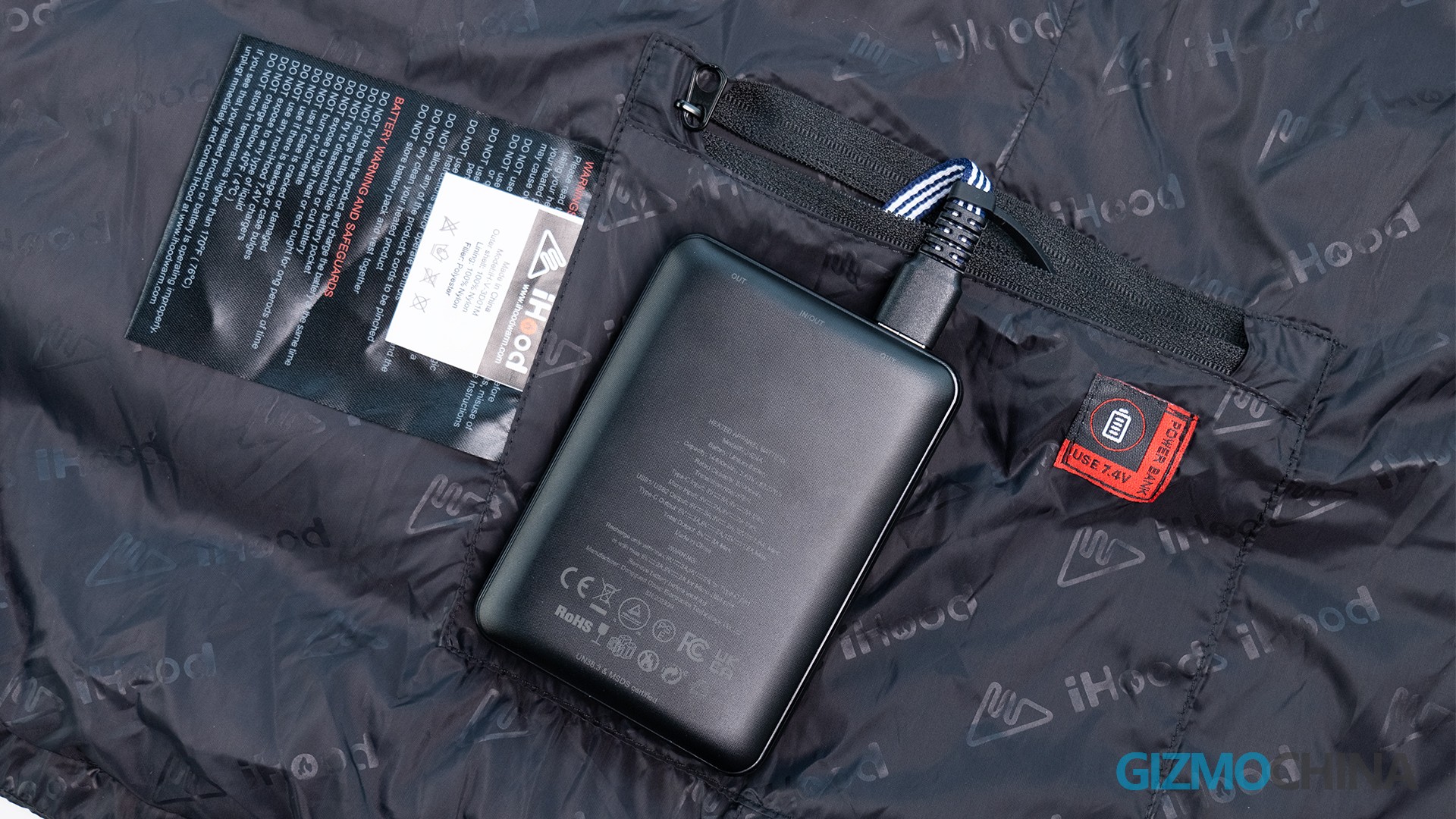
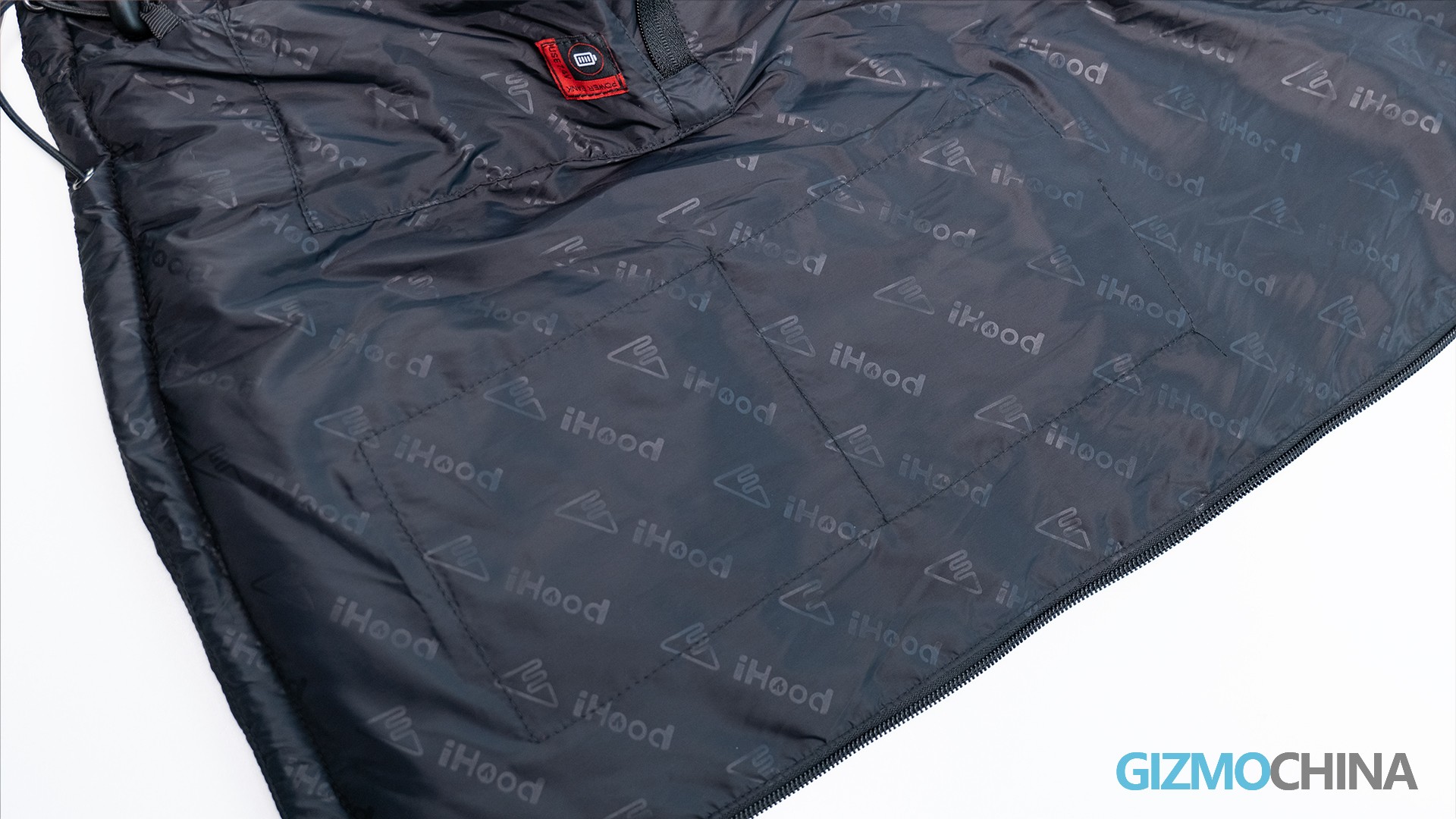
Basically, it has a battery bank to act as the power source, and there is a pocket at the left corner to hold it. In the pocket, there is a dedicated connector to link the battery bank to the warming system spread out in the vest. Then we have heat plates in three areas, Chest and Belly, Back, Ears and Neck. These are the key body parts that need warmth and will pretty much preserve the energy well.
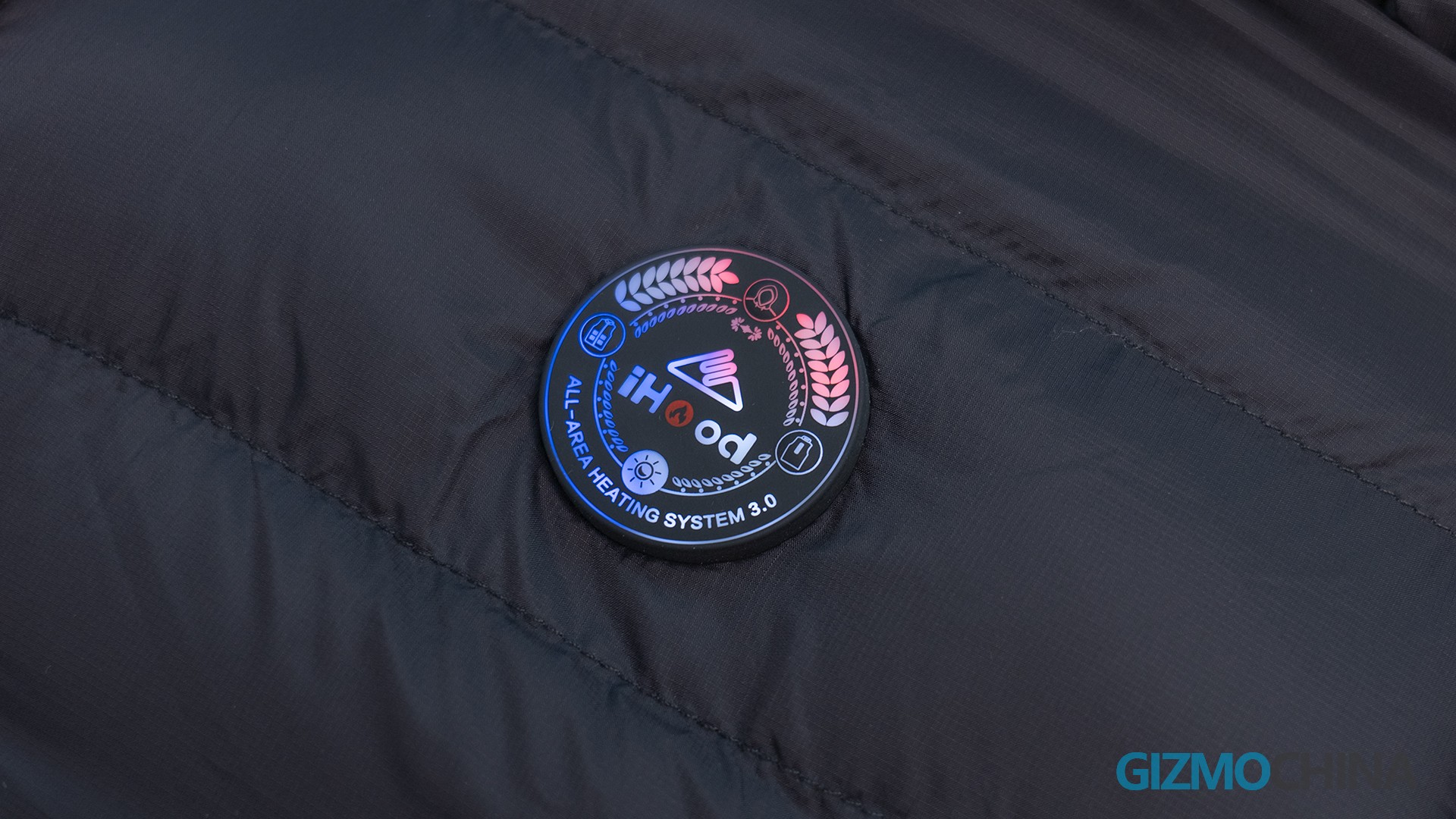
At the left chest area, there is a rounded control panel that can help you select the area to heat up, or control the light on or off. It feels very natural to use these buttons.
Build Quality
As a winter vest, it has solid materials used at every part, the surface is made of stretchy and anti-dirt nylon, and it feels much better than some random vest you pick up at Walmart. The filler is probably artificial fiber, it is well-stacked and won’t go anywhere since they are separated by the sewing threads. The inside is also nylon I think, it is slightly thinner than the outside but has a soft touch to it, so it feels comfortable to have your body surrounded by the vest. The hat is made of a different material, it is polyester I think, it has some give to it, so it can fit the different shapes of heads, also there are buckles built-in to make sure you can have the hat on very tightly.
The main zipper and the pocket zippers are made by YKK, and the ones on the hat and battery bank pocket are standard, they all work smoothly and seem to last long. Since there is no waterproof rating on this vest, based on my experience with the material used on this vest, it should be able to withstand light rain or snow.
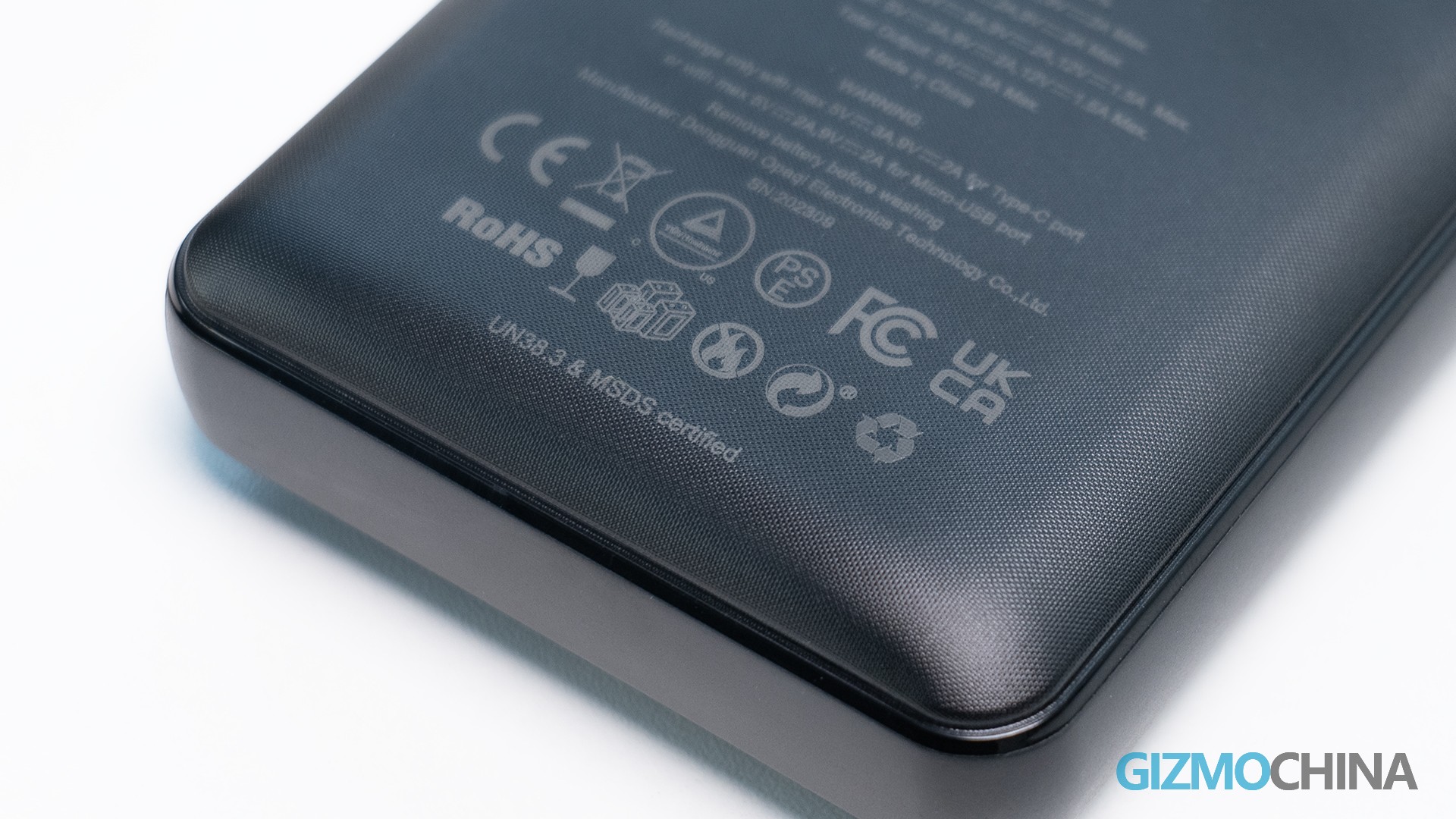
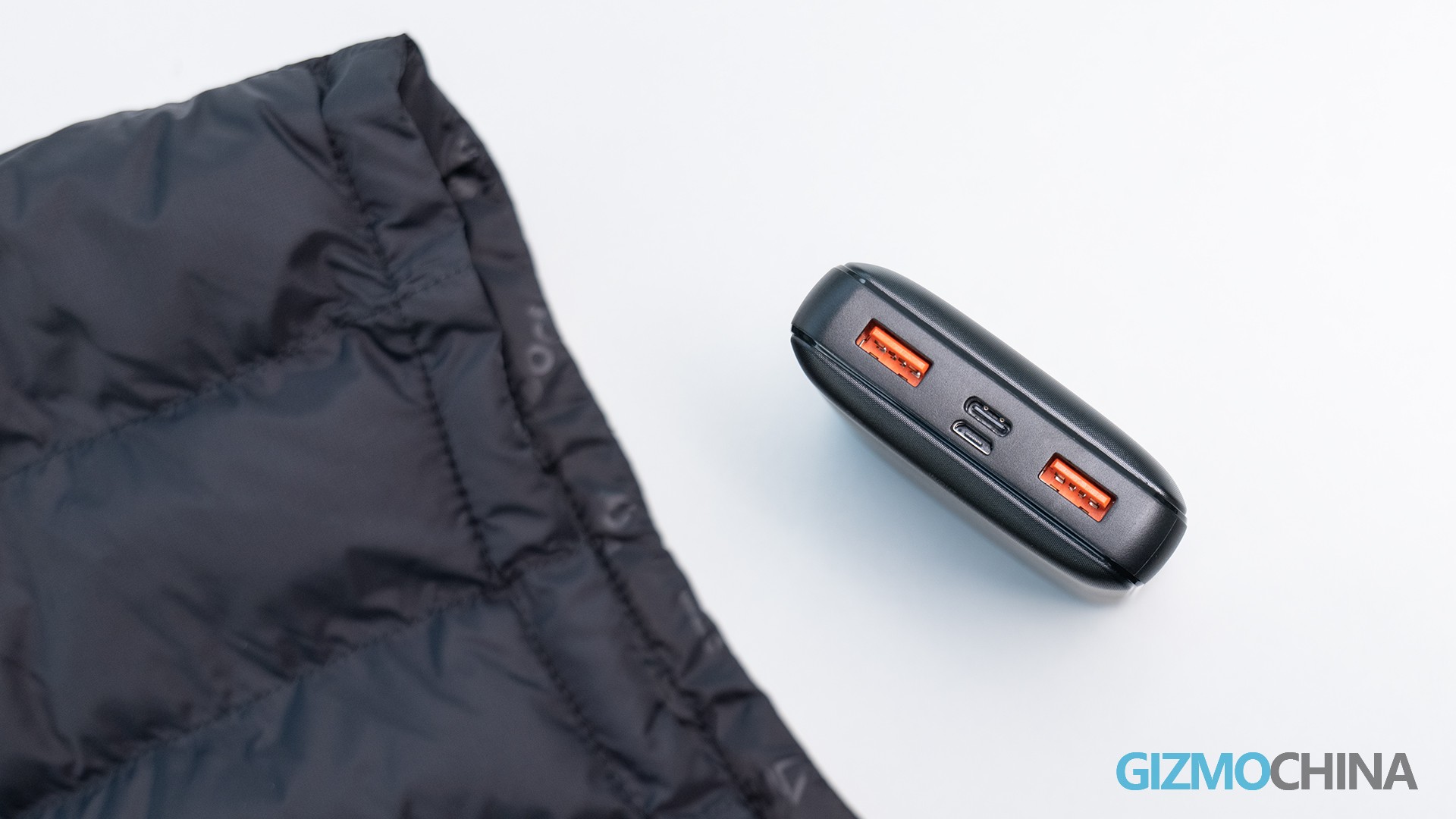
The heating system is made by a 14400mAh/ 3.63V lithium battery bank, and the heating patches are spread in the three areas mentioned earlier. The battery bank looks standard, but it is UN38.3 & MSDS certified, so the reliability should be very good. There are four ports, 2 USB-A for output, 1 USB-C and 1 Micro-USB for in and out, by seeing these ports you know that you can also use them to charge your phone or other devices at the same time, but this will have to sacrifice the overall heating time of course. The connector used for linking the heating system is with a USB-A port, so you can only use one of the USB-A ports on the battery bank. The brand is also kind enough to include a charging brick for you to charge the battery bank.
So there are three heating areas on this vest, basically the main body except the limbs, they are the key parts that need to keep warm. The heating patches are really thin and flexible, but they are fixed in certain spaces by the threads, so they won’t be running around in the vest, certainly won’t break loose anyway. When you put your hands on them, you can feel there are lines inside the patch, but they are not that thick, so it won’t affect the wearing comfort.
Use Experience
Now they claim that there are three heating modes, High: 149-158°F/65-70°C, Medium: 131-149°F/55-65℃, Low: 122-131°F/50-55℃. This can definitely help you tackle different scenarios, like shoveling snow on really cold days outside, or simply wearing them for a run. And if you have an elder person in the family, this can help them keep warm very well.
In our place, it does not get that cold in winter, but we did use the thermoprobe to see if it can reach the advertised temperatures, and it does. As you can see, the max temperature comes from the wires around the heating patch, then conduct the heat to other areas as well. When the battery bank is linked with the patches, the heat comes up immediately, I can feel it right away, so whenever you want to go out, you can simply grab this vest and go.
*The temperatures may vary in different situations.
Now the control panel is made of rubber, and the buttons are clicky, so once you press it, it responds instantly. By pressing the buttons, you can select the different temperatures for each area, this is a very innovative design. I even found turning on the heat in the neck area can be somehow a massage, you can try it and let us know how you feel.
Is It Safe?
Somebody would be worried about its reliability, but iHood has addressed it very thoroughly on the website. Basically there are two things that makes it very reliable, which are the solid battery bank and our real-time user experience. The battery bank is made of UN38.3 & MSDS-certified lithium cells, and it’s not built for extreme output, so it does not heat up crazy. Also based on our experience, during several hours’ test, the battery bank remained just a bit warm, and certainly within the tolerance level of a lithium cell, the vest remained stable. And thirdly, the battery is well below 20000mAh so it is TSA approved, and also iHood said it’s hand washable or machine washable, if they have faith in it, so should we, isn’t it?
Verdict
So this is the iHoodwarm Heated Vest. As the winter has come, the Heated Vest could be your best companion for going outside, working, or playing, which also can be a Heartwarming Christmas gift for families and any human you care about. They have some other products in the lineup, if you need a heated jacket or gloves, searching through their website is the right way.
After some speculated higher prices, the Kia EV5 electric vehicle has been launched in China at a lower price (a 10,000 yuan reduction). The Kia EV5 was on display during the Guangzhou International Automobile Exhibition 2023.
Features
The Kia EV5 comes in three trim levels namely standard, long-range, and AWD in China. The standard trim option of the Kia EV5 has a 160kW motor and BYD LFP Blade battery with 64.2Wh capacity. It has a range of 530km but the long-range variant has a 88kWh LFP battery that delivers 720km using the same motor. The AWD version of the EV5 will come with dual 160kW front and 70kW rear motors with an 88kWh battery. The range of the AWD trim of the EV5 has not been specified.
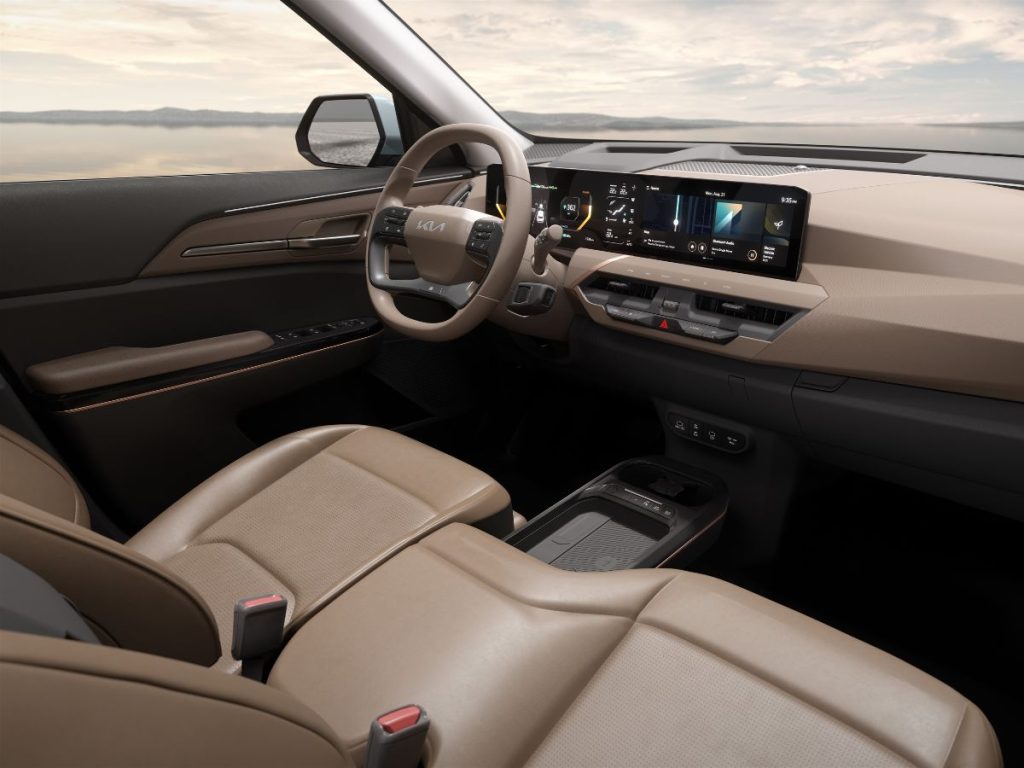
The interior of the Kia EV5 features three screens – a 12.3-inch digital instrument cluster, a 5-inch climate control panel, and a 12.3-inch infotainment display. The EV5 also features Level 2 assisted driving with semi-automated lane changing and intelligent remote control parking.
Pricing & Availability
The new Kia EV5 was earlier announced as having a starting price of 159,800 yuan (~$22,160) but it will now start at 149,800 yuan (~$20,775). Kia is offering a 5-year warranty for the EV5 (or 100,000km of range). In addition, the battery, motor, and electronic control system of the EV5 are covered for 8 years (or 150,000km).
Kia already plans to release the EV5 in Canada, South Korea, Australia, and a few other markets in 2024. The schedule for the international release and the prices of the model in specific markets have not been specified yet.
Chinese tech giant Lenovo has launched the ThinkPlus X16 wireless earbuds. The new Lenovo headphones come with IPX4 water resistance and are designed to withstand tough environmental conditions.
Features
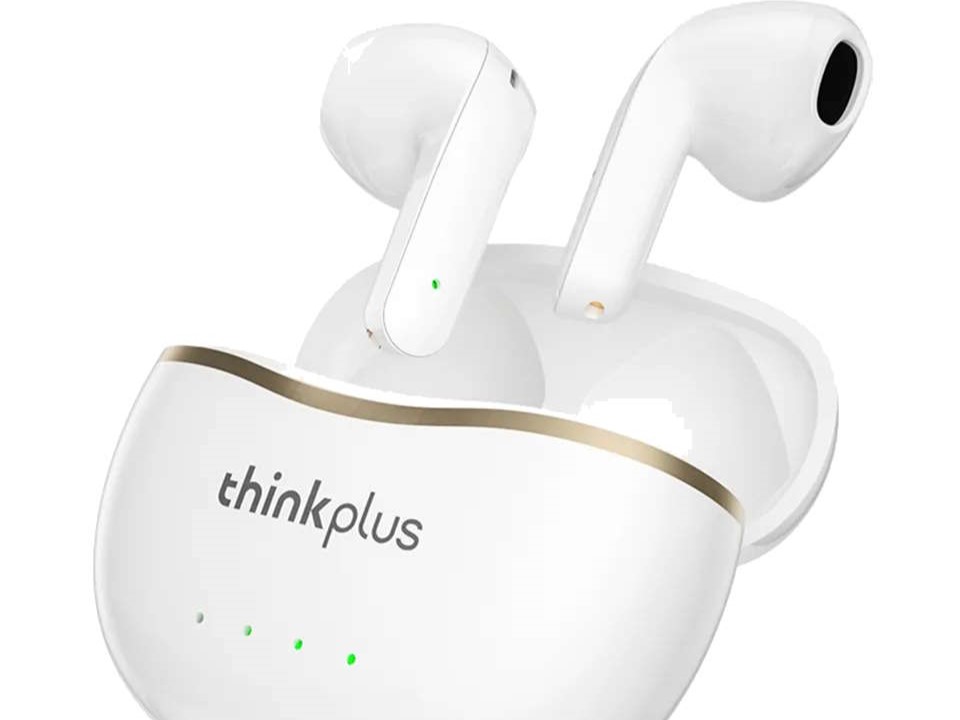
The Lenovo ThinkPlus X16 TWS earbuds are among a growing number of wireless audio accessories delivered by the electronics company. It follows the release earlier this year of the Lenovo XT80 affordable headphones. The X16 comes with a classic design and is a completely wireless pair of headphones.
The X16 are completely wireless headphones and each weighs 4.5g. The model comes with 14.2mm drivers that deliver high playback quality and clarity when making calls. A microphone is installed in each of the headphones and this is capable of reducing ambient noise. The headphone’s touch surface allows for seamless control of music or calls. It has a battery life of 20 hours. Four LEDs help to display the charging status of the headphones’ case. The new Lenovo X16 wireless headphones support Bluetooth 5.2 connectivity and also offer low latency.
Pricing & Availability
The Lenovo X16 headphones are available from a set of retailers including German platforms. The headphones are priced at around €15 (~$16). The headphones are well-suited for use during sports activities and when operating in demanding environmental conditions. Various prices of the model are available from different retailers and shipping times are said to be quick and relatively free. The model is also probably free from import duties and there may be no warranty on the product.
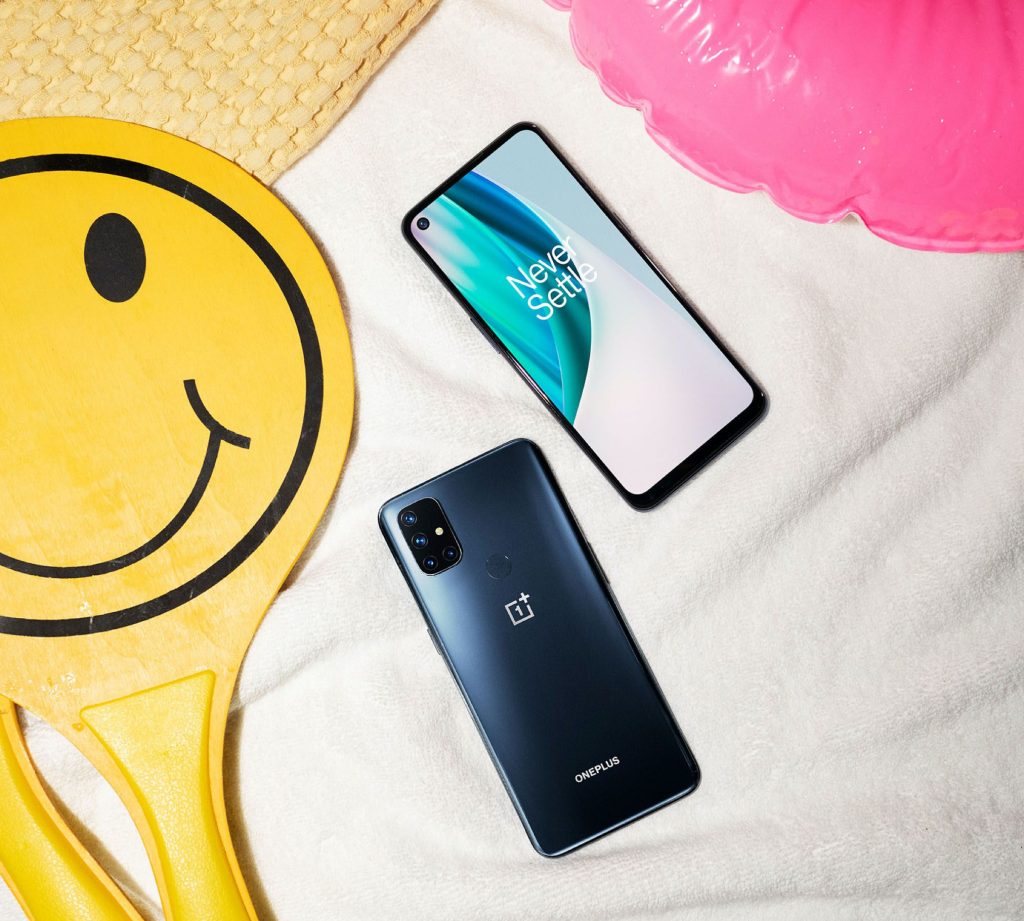
Back in October 2020, OnePlus launched the Nord N10 5G smartphone in select markets. In July 2021, the device got its first and final major update bumping its OS to Android 11. Although the device is quite outdated operating system-wise, OnePlus is still keeping its promise to provide regular security updates.
The Nord N10 5G has recently received the November 2023 Android security patch to enhance system security. The OxygenOS 11.0.16 update comes with version number 11.0.16.BE89BA for global and EU users, while it is marked with version number 11.0.16.BE86AA for North American users.
Although the update only carries a security update and should be quite stable, if you still encounter any issues with the update, you can provide feedback via the link given on the update page.
OnePlus is set to celebrate its 10th anniversary with a special event on December 4, unveiling its highly anticipated flagship smartphone, the OnePlus 12. The occasion is expected to showcase not only the new flagship but also introduce additional products like the OnePlus Ace 3 and the OnePlus Watch 2. Although the global launch dates are yet to be revealed, it is anticipated that the OnePlus 12 will make its debut in India simultaneously with its launch in China.
The upcoming gaming flagship from Nubia, the Red Magic 9 Pro, is set for an official release on November 23. This device is confirmed to bring 165W fast charging support and the legendary Snapdragon 8 Gen 3 chipset together. With the new ‘Magic Flash Fast Charging’ this device will take only 16 minutes for a full charge.
Nubia packs a massive battery with a superfast 165W charging
To ensure the stability and safety of the device during fast charging, the Red Magic team employs charging separation technology. This approach avoids localized heating by distributing the charging load across the device through a three-charge pump connected in parallel. This technology is successfully implemented in the Red Magic 8 Pro. It is expected to continue in the Red Magic 9 Pro, promising users a consistently stable and safe output at 165W.
Beyond its remarkable charging capabilities, the Red Magic 9 Pro is said to pack the 6500mAh battery within an 8.9mm frame. The official claim of “comprehensive battery life exceeding 2 days and 2 nights” positions this device as a reliable companion for users with demanding smartphone needs.
In terms of design, this gaming device comes with a back cover made of “customized integrated glass”. Processed through 15 intricate steps, this integrated design is said to seamlessly combine the back shell glass and lens cover.
The front screen includes an under-display camera for selfies ensuring an immersive gaming experience. The Red Magic 9 Pro series is likely to set some new standards in the world of gaming smartphones.
Microsoft has recently made a significant move by hiring Sam Altman, the former CEO of OpenAI, and Greg Brockman, a co-founder of OpenAI, to lead a new advanced AI research team. This development comes after a tumultuous weekend at OpenAI, which saw Altman abruptly dismissed from his role by the company’s board due to concerns over his commitment to OpenAI’s mission. The board cited issues with overseeing Altman and a lack of trust, leading to his and Brockman’s departure.
Credit: WIRED
Altman’s Departure and New Beginning at Microsoft
Emmett Shear, co-founder of Twitch, was appointed as the interim CEO of OpenAI, succeeding Mira Murati, who had briefly held the position following Altman’s firing. The OpenAI board highlighted Shear’s unique skills and experience as pivotal for the company’s future. Microsoft CEO Satya Nadella expressed excitement about Altman and Brockman joining Microsoft and emphasized the company’s commitment to providing them with the necessary resources.
Notably, Nadella took to social media to reiterate Microsoft’s dedication to its partnership with OpenAI, stating, “We remain committed to our partnership with OpenAI and have confidence in our product roadmap.” This statement reflects Microsoft’s strategic intent to maintain a strong collaboration with OpenAI while also enhancing its own AI research capabilities.
Altman’s departure from OpenAI was unexpected and caused a stir in the tech industry, revealing a divide in the AI community between rapid development and concerns about AI’s potential risks. Altman had been discussing a new AI start-up, and his firing led to some employees planning to leave OpenAI. Microsoft, a major investor in OpenAI, was taken aback by the sudden decision, learning about it shortly before it was publicly announced.
Microsoft’s new AI research team, led by Altman and Brockman, is part of the company’s ongoing investment in AI technology. Microsoft has also developed its own custom AI chip, the Azure Maia, to reduce reliance on Nvidia and power its Azure data centers.
Overall, Microsoft’s acquisition of Altman and Brockman positions the company favorably in the competitive AI research space, capitalizing on their expertise and following among AI professionals.
In the latest Android 14 update, Google has made a noticeable change in how users interact with app icons on their home screens. Unlike in Android 13, where long-pressing an app icon displayed recent notifications for that app, Android 14 has done away with this feature. Instead, long-pressing an app icon now presents options like app shortcuts, app info, the ability to pause the app, and widgets.
A lot of users are complaining about a feature very few people used
This change might not seem significant at first glance, but it subtly alters how users manage and view their notifications. In the past, if your notification tray was brimming with alerts, you could easily view notifications for a specific app directly from the home screen. This feature was particularly handy for those who receive a high volume of notifications and prefer to deal with them app-by-app.
However, with Android 14, this convenience has been stripped away. Google has not provided a clear rationale for this change, but it’s possible that internal usage statistics influenced this decision. During the Android 14 Beta Program, Google confirmed that the removal of this notification feature was intentional and not something they plan to “fix.”
The response from users has been mixed. While some, like myself, rarely used the long-press feature for checking notifications, preferring the notification tray, others found it incredibly useful and are now calling for its return. Over a hundred new comments have been posted since the stable launch of Android 14 on Pixel devices, with users requesting that this capability be reinstated.
Despite these user requests, it seems Google has no immediate plans to bring back the feature. The current long-press menu in Android 14, primarily focused on shortcuts and app information, doesn’t appear to be undergoing any significant changes. Restoring the notification feature might not cause much disruption, but for now, users will have to adapt to this new way of handling their notifications on Android devices.
We use cookies on our website to give you the most relevant experience by remembering your preferences and repeat visits. By clicking “Accept”, you consent to the use of ALL the cookies.
This website uses cookies to improve your experience while you navigate through the website. Out of these, the cookies that are categorized as necessary are stored on your browser as they are essential for the working of basic functionalities of the website. We also use third-party cookies that help us analyze and understand how you use this website. These cookies will be stored in your browser only with your consent. You also have the option to opt-out of these cookies. But opting out of some of these cookies may affect your browsing experience.
Necessary cookies are absolutely essential for the website to function properly. This category only includes cookies that ensures basic functionalities and security features of the website. These cookies do not store any personal information.
Any cookies that may not be particularly necessary for the website to function and is used specifically to collect user personal data via analytics, ads, other embedded contents are termed as non-necessary cookies. It is mandatory to procure user consent prior to running these cookies on your website.