Advertisement

Rest in Peace Twitter! Threads Now Available to Download

Social media is a big part of our lives. We spend a lot of time on platforms like Facebook, Instagram, Twitter, and TikTok. Now, there’s a new player in the game. Meta, led by Mark Zuckerberg, has released an app called Threads in response to users looking for an alternative to Elon Musk’s Twitter. Here are the details…

Meta Launches Threads, a New Social Media App to Compete with Twitter

Elon Musk bought Twitter in late 2022 for $44 billion. He became CEO and started making changes right away. Some users liked the changes, but others didn’t. The tweet viewing limit that was introduced last week was especially unpopular. This led to many users leaving the platform. Meta, which owns Facebook and Instagram, saw this coming.

They had already been working on a platform called Threads to compete with Twitter. Threads is a text-based conversation app that is linked to Instagram. It allows users to connect with their close friends and followers in a more intimate way. Now, this platform is live, and signing in can be as simple as pressing a button.

How to Use Threads

If you want to use Threads, all you have to do is download the application from the App Store or Google Play Store. Immediately after that, follow these steps:

  • Open the app and click on “Log in with Instagram.”
  • If you already have the Instagram app installed on your device, Threads will automatically log you in.
  • If you don’t have the Instagram app installed, you’ll be prompted to install it. Once you’ve installed the app, you’ll be able to log in to Threads.
  • Once you’re logged in, you’ll be able to start sending messages to your close friends.

“It’s fair to say that Threads is currently the best Twitter alternative on the market. The app resembles Twitter in many ways, from its design to its features. In fact, this situation is expected to lead to a legal battle between the two companies in the future. As you know, Meta does not shy away from copying the features and designs of its competitors. For instance, the Stories feature of Instagram, which many of us use and is quite popular, was once taken from Snapchat, and despite objections, it brought great success. It is expected that Zuckerberg will again land on his feet in a similar fashion.”

RELATED:

The AIM EV Sport 01 is the future of Electric Sports Cars

AIM, a Japanese engineering company with expertise in automotive design and technology, is set to unveil its first-ever concept vehicle, the AIM EV Sport 01. This all-electric sports car is generating immense excitement as it promises to redefine the boundaries of performance and design in the electric vehicle (EV) world.

The EV Sport 01 lies in the subcompact car category

Having made its initial appearance in Japan back in April, the AIM EV Sport 01 received a warm reception from enthusiasts and experts alike. Encouraged by the positive feedback, AIM is now contemplating a limited series production run. However, before reaching that milestone, the vehicle is undergoing rigorous testing and evaluation. Notably, AIM is utilizing the EV Sport 01 as a platform to assess its cutting-edge APM200 electric motor in a dual-motor, rear-wheel-drive configuration.

AIM Electric Vehicle

The specifications of the EV Sport 01 are truly impressive. Weighing in at a mere 3,141 pounds (1,425 kilograms), this two-seat coupe packs a combined punch of 483 horsepower (360 kilowatts) and a maximum torque of 545 pound-feet (740 Newton-meters), courtesy of its dual APM200 motors. The torque vectoring system ensures precise control over the power delivery, while the 720V input and 380 kW output inverter facilitate efficient operation.

AIM estimates that the EV Sport 01’s laminate rechargeable lithium battery, boasting a capacity of 81 kilowatt-hours, will offer a driving range of approximately 186 miles (300 km). Although performance figures are yet to be revealed, the car’s agile aerodynamic shape, lightweight build, and ample power output indicate thrilling acceleration and handling capabilities.

Measuring 153.5 inches (3.9 meters) in length, the EV Sport 01 falls within the subcompact car category. However, its wider stance of 74.8 inches (1.9 meters) and lower profile of 47.2 inches (1.2 meters) give it an assertive presence on the road. The car’s multi-tubular aluminum frame chassis, coupled with a double-wishbone suspension system, ensures optimal stability and responsive handling.

The AIM EV Sport 01 showcases a stunning exterior design, conceived by SN Design Platform, led by renowned automotive designer Shiro Nakamura. Nakamura, famous for his work on iconic models such as the Nissan GT-R, Cube, and Leaf, aimed to capture the essence of classic sports cars from the past while infusing a touch of modern elegance. The result is a minimalist design language with clean lines and a timeless appeal that pays homage to the great European and Japanese sports cars of the 1960s.

This remarkable concept will be put to the test at the Goodwood Festival of Speed, where the AIM EV Sport 01 will participate in timed runs as part of the “First Glance” category. Enthusiasts and industry insiders eagerly anticipate witnessing the EV Sport 01’s performance and experiencing firsthand the future of electric sports cars.

In the words of Shiro Nakamura, “We learned from the spirit of the great sports cars of the past, helped by the RWD configuration and layout. I wanted to express dynamism with sophisticated elegance through a simple, clean design. The EV Sport 01 has minimal form language and avoids exaggerated and complicated surfaces, reminiscent of the great European and Japanese sports cars of the 1960s. Given that inspiration, it is particularly fitting we can demonstrate our car at Goodwood.”

RELATED:

(Via)

Tidal Music Unveils Hi-Res FLAC Streams, Offering Class-Leading Sound Quality

In an exciting development for music enthusiasts, Tidal, the popular music-streaming app, has commenced the rollout of hi-res FLAC streams across its platform. Jesse Dorogusker, the CEO of Tidal, made the announcement in a Reddit post, sending waves of excitement through the audiophile community. FLAC, short for free lossless audio codec, enables the streaming of high-fidelity audio up to an impressive 24-bit/192Hz, delivering an unrivalled listening experience.

The Hi-Fi Plus plan will be priced at a hefty $20 on the first date

While FLAC streams offer superior sound quality, they do come with a tradeoff in terms of file size. These audio files occupy approximately four times the space of a standard MP3, which explains their scarcity on widely-used streaming platforms. However, Tidal has taken a bold step to cater to discerning ears by embracing this format.

Tidal

The rollout is currently in the early access phase for iOS users, allowing them to indulge in over six million tracks available in hi-res FLAC. The company has also promised to continuously expand its FLAC library with new additions every day. To access these premium streams, users can simply update their beta app, if they have access, and select the “Max” quality in settings. Tidal is keen on gauging user feedback during this phase before making the feature widely available. Android users and those not affiliated with the early access plan can expect to access the hi-res FLAC streams in August.

Tidal’s decision to embrace FLAC streams marks a departure from their previous use of MQA (Master Quality Authenticated) audio, which was more of an upscaling technique than an actual file type. While the CEO, Jesse Dorogusker, has not explicitly addressed the future of MQA, he did mention that Tidal plans to “support multiple formats” of hi-res audio, promising an even more versatile listening experience for users.

Naturally, access to such high-quality audio comes at a price. Users interested in enjoying the FLAC streams will need to subscribe to the HiFi Plus plan, priced at $20 per month. Tidal recently increased the price of their standard subscriptions from $10 to $11 per month, a move that has sparked speculation about industry giant Spotify‘s plans to introduce its own hi-fi tier (which has been in speculations for quite some time now).

RELATED:

(Via)

OpenAI’s Bold Plan to Align Superintelligence with Human Intent

Superintelligence, a technology that has the potential to revolutionize humanity, is both awe-inspiring and concerning. OpenAI, a leading research organization, believes that the arrival of superintelligence is closer than we may think, possibly within this decade. Recognizing the immense power and risks associated with this technology, OpenAI has launched an ambitious initiative to align superintelligence with human intent.

The technical challenges are expected to be resolved in the next four years

The challenge lies in ensuring that AI systems, far surpassing human intelligence, remain aligned with our values and goals. Current techniques, like reinforcement learning from human feedback, fall short when applied to superintelligence. OpenAI acknowledges the need for new scientific and technical breakthroughs to address this critical issue.

OpenAI

To tackle the problem, OpenAI is building an automated alignment researcher, with capabilities comparable to human-level understanding. By leveraging advanced AI systems to evaluate and supervise other AI systems, OpenAI aims to develop scalable oversight and generalization techniques. Validating the alignment of AI systems will involve automating the detection of problematic behaviour and interpreting the internal workings of these models.

The road to achieving superintelligence alignment is not without challenges. OpenAI plans to stress test its alignment pipeline by deliberately training misaligned models and ensuring their techniques can detect and mitigate such misalignments. Research priorities are expected to evolve as OpenAI gains a deeper understanding of the problem, and collaboration with experts from various disciplines will be crucial.

OpenAI’s dedicated team of top machine learning researchers and engineers, led by Ilya Sutskever and Jan Leike, is committed to solving the core technical challenges of superintelligence alignment in the next four years. While success is not guaranteed, their optimism stems from promising preliminary experiments, measurable progress, and the involvement of brilliant minds in the field.

OpenAI’s efforts extend beyond superintelligence alignment. They continue to improve the safety of current AI models and actively address broader societal concerns related to AI. OpenAI welcomes the contribution of outstanding researchers and engineers to this critical endeavour, recognizing the significance of machine learning expertise in finding solutions.

RELATED:

(Source)

Twitter quietly removes login requirement to view tweets

In a surprising move, Twitter has silently removed the login requirement for users to view tweets, enabling anyone to access Twitter links in their browsers without the need for an account. This development was noticed by TechCrunch, as tweet previews began to unfurl on popular messaging platforms such as Slack, WhatsApp, and even iMessage, as reported by Engadget.

Twitter

The impact on user engagement and discoverability of tweets

The initial implementation of the login requirement was introduced as a temporary measure by Twitter, with Elon Musk explaining that it was intended to prevent data scraping, which had been causing service degradation for regular users. However, Twitter has not provided any official statements regarding the recent change or disclosed the specific measures taken to address data scraping concerns.

Notably, Twitter’s decision coincides with the upcoming launch of Meta’s new text-based app called Threads. Interestingly, Threads also briefly allowed users to view posts on the web without logging in before subsequently removing this feature. It remains to be seen whether Threads will adopt a similar approach and allow users to access posts without requiring an account upon its official launch.

In addition to this update, Elon Musk, over the weekend, imposed read limits on Twitter. Unverified users now have a daily limit of 1,000 posts, while verified users can access up to 10,000 posts per day. Twitter claims that only a small percentage of users have been affected by these changes, and the impact on advertising has been minimal, as stated in a recent company blog post.

RELATED:

(Via)

Meta faces setback as EU Court backs antitrust regulators over privacy breach checks

The European Court of Justice (CJEU) has issued a ruling stating that antitrust authorities overseeing companies like Meta Platforms, the owner of Facebook, Instagram, and WhatsApp, have the right to evaluate privacy breaches. The decision potentially grants more flexibility to antitrust regulators in investigating Big Tech firms.

Meta Platforms

Understanding the CJEU Ruling: Antitrust Agencies and Data Protection Concerns

The case stemmed from a 2019 order by the German cartel office, which instructed Meta to cease collecting users’ data without their consent, deeming it an abuse of market power. Meta challenged the order, leading a German court to seek guidance from the CJEU.

The CJEU ruling clarifies whether antitrust agencies exceeded their jurisdiction by utilizing antitrust powers to address data protection concerns, typically handled by national data protection authorities.

In response to the ruling, a Meta spokesperson stated that they are evaluating the decision and will provide further comments later.

According to the CJEU judges, during antitrust investigations, it might be necessary for competition authorities to examine whether a company’s conduct complies with regulations beyond those related to competition law. However, the court emphasized that antitrust regulators must take into account any decisions or investigations carried out by relevant supervisory authorities concerning data protection.

The German cartel office welcomed the ruling, with its head, Andreas Mundt, highlighting the significance of data in establishing market power. Mundt stated that the use of consumers’ highly personal data by large internet companies can also qualify as an abuse under antitrust law.

Legal experts, such as Thomas Graf from Cleary Gottlieb law firm, expressed caution regarding the extent to which antitrust authorities would delve into privacy law. Graf noted that demonstrating the relevance of privacy law to antitrust and coordinating with GDPR authorities would be necessary.

The ruling received support from the European Consumer Organisation (BEUC), emphasizing the need for authorities to consider data protection in today’s complex digital economy.

RELATED:

(Via)

Huawei MatePad Air Green Edition officially up for sale in China

Huawei officially launched the MatePad Air back in May this year. Now the company has introduced a new Green Edition of MatePad Air and it is now up for first sale in China. Priced at 3,199 yuan ($441) for the base variant, the tablet comes with a first-sale discount of 200 yuan ($27), resulting in a final price of 2,999 yuan ($413).

Huawei MatePad Air Green Edition

The MatePad Air Green Edition showcases a sleek design with industry-leading features. Its appearance incorporates a fiberglass optical coating transfer film frosting process, along with nano-silver ink. The rear camera module draws inspiration from the star ring of the universe, giving it a distinctive and recognizable look. The tablet is available in four colors at launch: Obsidian Black, Yunjin White, Starry Blue, and Feather Purple. The newly introduced fifth color, “Green Edition,” adds a refreshing green tone, offering consumers more personalized choices.

Huawei MatePad Air specifications:

Featuring an 11.5-inch 3:2 aspect ratio full-screen display, the MatePad Air boasts an 87% screen-to-body ratio. The tablet supports a 2.8K resolution and utilizes adaptive refresh rate technology ranging from 30Hz to 144Hz, providing users with an excellent visual experience. Notably, it is the first Huawei tablet to support a maximum 144Hz screen refresh rate and has received HDR Vivid professional certification.

Huawei MatePad Air Green Edition

One of the standout features of the MatePad Air is its support for native PC-level applications. With the inclusion of a dedicated CAJ Viewer browser, users can directly access CAJ Viewer and view downloaded CAJ files, enhancing productivity and convenience.

The MatePad Air features a Snapdragon 888 processor, 8GB/12GB RAM, and 128GB/512GB storage options. It has an 8 MP front camera, 13 MP rear camera, quad speakers, and four microphones.

Powered by the latest HarmonyOS 3.1 system, the tablet offers seamless collaboration and connectivity with other devices, enabling improved work efficiency. It is equipped with an 8,300mAh large-capacity battery and supports up to 40W Huawei SuperCharge, ensuring fast charging capabilities.

RELATED:

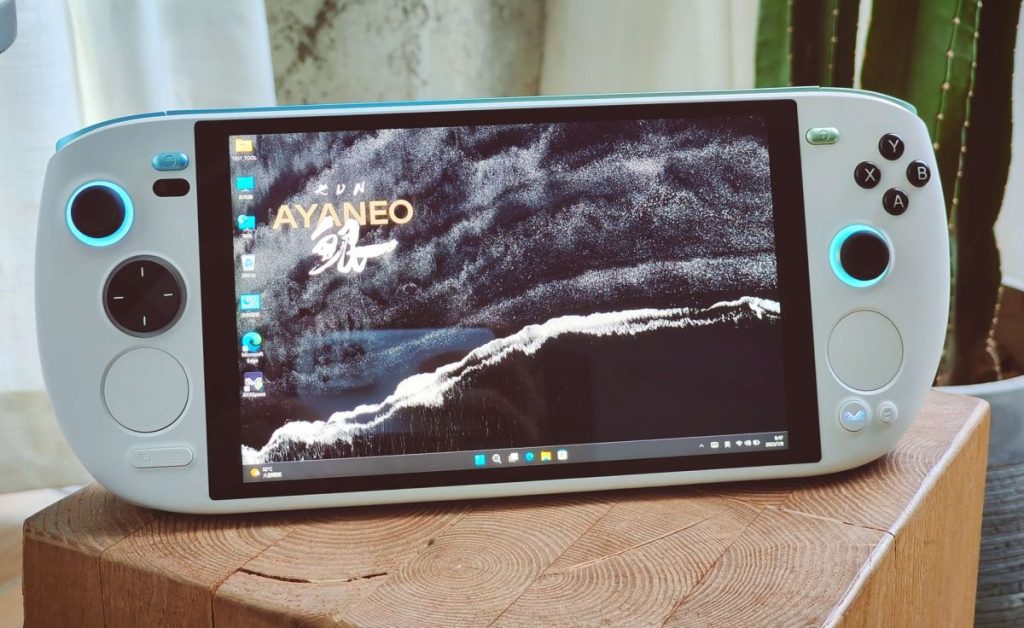
AYA NEO KUN teased as the brand’s best-ever Windows handheld

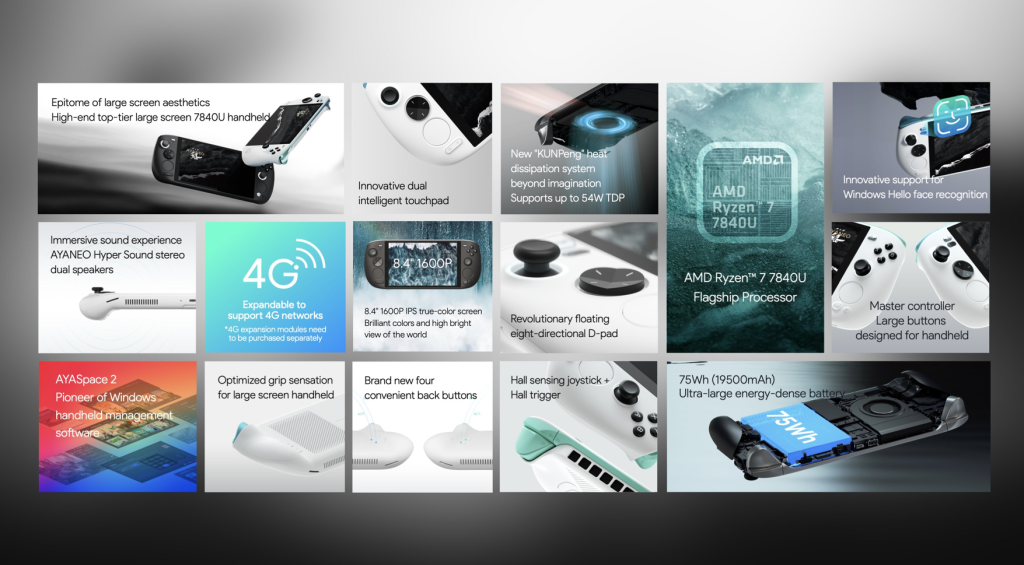
AYA NEO has released more details of the AYA NEO KUN, projected to be the brand’s most powerful Windows handheld so far. The 8.4-inch display of the device puts it ahead of other gaming handhelds. It also features nearly full-size game controls and a pair of touchpads. The AYA NEO KUN was first teased in January and it was previewed today alongside the AYA NEO Pocket Air.

AYA NEO KUN

AYA NEO has hinted that the KUN will be its most powerful Windows handheld ever although the fine optics of this claim was not provided. It will outshine the well-kitted AYA NEO NEXT II which is powered by Ryzen 7000 APUs combined with discrete GPUs. The large display of the KUN puts it in direct comparison with the ONEXPLAYER 2. A version of the ONEXPLAYER 2 powered by the Ryzen 7 7840U APU is available globally.

AYA NEO KUN
AYA NEO KUN battery

The AYA NEO KUN has nearly full-size gamepad buttons and controls, having a candy bar form factor. The new gaming handheld will reportedly ship with hall-sensing joysticks, hall triggers, two touch pads, and an 8-directional d-pad. The gadget also features three sets of shoulder buttons, a fingerprint scanner with support for Windows Hello authentication, and a front-facing camera.

The AYA NEO KUN could come with a pretty large battery, according to a previous statement by the brand’s CEO. This could mean that the handheld will be heavier than its competition. There are no exact release and pricing details yet for the AYA NEO KUN. However, the gadget will be launched via an Indiegogo crowdfunding campaign shortly.

RELATED:

(source)

Umidigi Active T1 Android tablet with a mammoth 15,000mAh battery and three charging options unveiled

The Umidigi Active T1 Android tablet will be available for order this summer. The new Umidigi rugged Android tablet comes with a 15,000mAh battery and offers three charging options. It supports wireless, POGO, and USB-C charging, with 8GB+128GB memory/storage configuration.

Umidigi Active T1 Android tablet

The Active T1 has an 11-inch display with 2000 x 1200 pixels resolution. It will join the already existing lineup of Umidigi tablets namely the G3 Tab, A11 Tab, and A13 Tab. The Active T1 is the most rugged however of the lot. It comes with the MIL-STD-810G, IP68, and IP69 reliability and durability standards. The Active T1 will come with a stylus and will support operating the display with a glove on your hand. It also features a keyboard mode for doing more engaging tasks on the go.

Umidigi Active T1 Android tablet

The processor details of the Umidigi Active T1 slate are yet to be specified but it may be either a MediaTek or Unisoc model. The device also comes with a microSD card slot that offers up to 1TB of extra storage. As per the charging speeds, 20W fast charging is achieved via its USB-C outlet and POGO connector. The POGO connector comes with a charging dock and wireless charging is also supported.

The Umidigi Active T1 tablet is rumored to arrive this summer. Although pricing and full availability details are lacking, it is expected that these details will surface in the coming weeks. The full specs of the rugged tablet will also be known as its release draws closer.

RELATED:

(via)

Cult.sport Active T smartwatch with 2.01-inch square display, Bluetooth calling unveiled in India for $19

Cult.sport has unveiled the Active T smartwatch in India. The new smartwatch comes with a 2.01-inch display and supports Bluetooth calling. Cult.sport is offering the smartwatch at a discounted price in the Indian market.

Cult.sport Active T smartwatch

The Active T is a sports and fitness smartwatch and will appeal to these enthusiasts. Earlier this year, Cult.sport released the Beats and Burn smartwatches and they have both had a decent reception. The sleek and elegant design of the Active T is illuminated by a large 2.01-inch HD display and minimal bezels. It has a single chipset that supports fast Bluetooth calling with seamless pairing of devices. It also offers improved power efficiency and features a raft of sensors for monitoring.

Cult.sport Active T smartwatch

Some of the health and fitness features available in the Active T are advanced heart monitoring, SPO2, and period tracking for women. The Active T has a battery that can last up to 7 days on normal usage. The smartwatch supports fast charging and it is quite reliable to provide juice for extended periods. There are 100+ sports modes in the Active T to cater to various fitness routines. There are 200+ watch faces that offer customization options to users.

Cult.sport Active T smartwatch

The Cult.sport Active T is rated IP67 water resistant while the Cult.sport watch app provides greater functionality and control for the device. The Active T is offered at an introductory price of Rs. 1,599 (~$19) in the subcontinent. It is exclusively available from Flipkart and Cult.sport. The original price of the smartwatch is Rs. 1,799 (~$22). Available in black, blue, and grey color options, the Active T.

RELATED:

(source)

Get up to $200 OFF on Motorola Razr 40 Ultra, premium foldable phone

Giztop is giving up to $200 OFF on Motorola Razr 40 Ultra the latest premium foldable smartphone from Motorola. You can now get the phone for a starting price of $899 only. 

WHERE TO BUY
Motorola Razr 40 Ultra at $899 @Giztop

Motorola Razr 40 Ultra features a 6.9-inch foldable P-OLED 165Hz FHD+ inner screen and a 3.6-inch P-OLED external display. Powered by the latest Snapdragon 8+ Gen 1 processor and Adreno 730 GPU, the phone comes in multiple memory variants viz. 8GB / 12GB LPDDR5 RAM and 256GB / 512GB UFS 3.1 internal storage. 

Motorola Razr 40 Ultra is fueled by a 3800mAh battery and supports 33W fast charging. It has dual rear cameras with a 12MP main sensor and a 13MP wide-angle camera. For your selfies, you have a 32MP sensor in the front. Other features include a side-mounted fingerprint scanner, Wi-Fi 6E, MYUI 6.0, etc. 

You can now buy Motorola Razr 40 Ultra foldable phone for $899 on Giztop. Please note that this price is applicable to the base variant.

For more information on such exciting deals and offers, check out our deals hub.

Taiwan’s Powerchip Semiconductor and SBI Holdings forge partnership to build chip foundry in Japan

Taiwan’s Powerchip Semiconductor Manufacturing Corp. and Japanese investment firm SBI Holdings Inc. have announced a collaboration to establish a foundry in Japan, catering to the rising demand for locally sourced chips. SBI will play a crucial role in raising funds for the joint venture, which aims to commence production with 40-nanometer and 55-nm automotive and industrial chips. The partnership also has plans to produce more advanced 28-nm chips in the medium to long term, according to SBI President Yoshitaka Kitao.

Specific details regarding the factory’s location and timeline are yet to be determined. However, the leading contract chipmaker globally, Taiwan Semiconductor Manufacturing Co., is simultaneously constructing a plant in southwest Japan that is expected to become operational as early as next year.

During a recent news conference, Masayuki Otani, the chief market analyst at Securities Japan, highlighted the importance of recovering the investment made in this venture. Following the announcement, shares in SBI rose by 2%, while Powerchip witnessed a 2.3% increase.

In a bid to revive its chip industry, financial firm SBI Holdings has decided to support Powerchip Semiconductor Manufacturing in establishing a factory in Japan. SBI will form a company to assist in planning, fundraising, lobbying for government subsidies, and finding a suitable location for semiconductor production.

This collaboration between SBI and Powerchip comes as Japan offers substantial subsidies amounting to billions of dollars to attract foreign chip companies. The goal is to encourage the establishment or expansion of chip production facilities, ensuring that Japanese automakers and technology firms have uninterrupted access to this critical component amid surging global demand.

Related:

(via)

Xiaomi commences mass production of the Mix Fold 3 using a new, efficient smart manufacturing system

Xiaomi Group president LU Wiebing, yesterday, announced that the company has rolled out a new manufacturing line which is dubbed Xiaomi Smart Manufacturing Digital Intelligence System 2.0. The new system is integrated into the Beijing Yizhuang Xiaomi Smart Factory. The company chief also disclosed that the Xiaomi MIX Fold 3 will be the first model that will be mass-produced on the new system.

The MIX Fold 3 is the brand’s next-gen foldable model which is expected to be released in August. According to Lu Weibing, the new manufacturing system has seen immense upgrades. He specified that the system is smarter and more precise up to the minutest details. Thus, the president noted that the next-gen foldable flagship will be thinner and stronger.

The fact that the Chinese tech giant has started mass-producing the flagship foldable phone affirms speculations that the device will be announced in August. The company is expected to announce the launch date any time within this month.

The MIX Fold 3 is expected to be powered by a Qualcomm Snapdragon 8 Gen 2 processor which is the latest flagship chipset from the chip maker. The phone is touted to pack a quad-camera phone including a telephoto lens with 5X periscope capability. The periscope telephoto lens allows mobile phones to capture farther scenes, bringing better optical zoom effects when compared to traditional telephoto lenses.

Furthermore, the Xiaomi MIX Fold 3 is expected to come with support for 67W wired fast charging and 50W wireless fast charging capabilities. For comparison, the MIX Fold 2 only featured support for 67W wired fast charging.

With an expected thinner and more solid build and more advanced features, the MIX Fold 3 promises to be a device to have. Unfortunately, we still don’t know if the device will be sold outside China as its predecessor – MIX Fold 2 was only offered to the Chinese market. The fact that the detail was shared by Lu Weibing who happens to be the head of the Internation Business arm may be an indication that the company plans to offer it to the global market. If it finds its way to the global, market, the device is expected to take on the Samsung Galaxy Z Fold 5.

RELATED:

Nothing Ear (2) could soon launch in black, renders leak

The most-awaited Nothing Phone (2) is launching on July 12 and the company has already taken the wraps of its design. While all the spotlights are on the smartphone, a leaker has shared renders of a new colorway of the Nothing Ear (2). The TWS earbuds were launched around four months back in a white color but it seems they’ll soon be available in black.

Nothing Ear (2) new colorway on the way

Nothing Ear (2) were unveiled earlier this year with a design familiar to the original Ear (1). They featured the same transparent look with some changes here and there. The earbuds were initially available only in black but Roland Quandt suggests the earbuds are going to launch in black very soon. The tipster has shared renders on Twitter, showcasing the new colorway of the Nothing Ear (2).

You’ll see the design of the earbuds remains the same as their white alternatives. The stem is transparent but the buds and the silicon tips are now black. The charging case is also getting a makeover. Currently, there’s no news about the launch date of the earbuds. Nothing may unveil the new shade alongside the Phone (2). We’d expect the earbuds to cost same as the ones that launched in March— $150.

This writer finds the black variant of the earbuds to be better than the original ones, but beauty is in the eye of the beholder, so you may disagree. To remind you, the Nothing Ear (2) feature 11.6mm custom drivers. They offer up to 26 hours of music playback on a single charge when ANC is off. The TWS get  advanced features such as Hi-Res Audio and LHDC 5.0 technology.

RELATED:

(Source)

Lucid CEO Wants to Make EVs More Affordable by Reducing Battery Size

The popularity of electric vehicles is growing rapidly. That’s because, EVs have many advantages over traditional cars, such as being more environmentally friendly. However, there are still some significant drawbacks to EVs, such as range and charging time. In an interview, Lucid CEO Peter Rawlinson made an interesting claim about the future of EVs. He said that the EV of the future will only need a range of 250 miles and buying short range vehicles will not be a problem for drivers. Here are the details…

The EV of the Future Only Needs 250 Miles

Lucid CEO Peter Rawlinson believes that the future of electric vehicles will have a range of 250 miles. He thinks that battery technology will improve enough by the time the next generation of EVs is released that a small battery pack will be able to provide this range. This would make EVs more affordable, as the cost of battery packs is a major factor in the overall price of an EV.

Lucid CEO
Lucid CEO Peter Rawlinson

Rawlinson also believes that the development of faster charging infrastructure will make it less necessary for EVs to have a long range. With fast charging, drivers will be able to quickly recharge their EVs even if they don’t have a long range. Of course, not everyone agrees with Rawlinson’s assessment.

Some people believe that EVs will still need a long range in order to be practical for long-distance travel. However, Rawlinson’s point of view is worth considering, as it could lead to the development of more affordable and practical EVs in the future. In addition to his thoughts on the future of EVs, Rawlinson also talked about Lucid’s plans to become a technology leader in the EV industry.

He said that Lucid is not only interested in making its own EVs, but also in licensing its technology to other automakers. Rawlinson believes that this is the best way to accelerate the adoption of EVs and help to reduce greenhouse gas emissions.

RELATED:

(via)

Huawei Nova Y71 launches globally with a 6000mAh battery, 48MP camera

Huawei has launched a new budget smartphone in the global market. The Huawei Nova Y71 is now listed on the official website with a 6.75-inch display and a particularly large 6000mAh battery unit. The handset gets a premium-looking design with a triple camera unit on the back. The 4G phone is powered by a Kirin chipset and lacks Google services, like the rest of Huawei phones. Let’s look at pricing and specifications.

Pricing and Specifications

Huawei Nova Y71 is a mid-range smartphone but it debuts with a premium design. The handset features a slightly curved pack, featuring a cylindrical camera module. On the front, you get a U-shaped notch and thin bezels on the sides. It weighs approximately 199g and is 8.98 mm thin. There’s also a headphone jack on the device, which you don’t often see now.

Huawei Nova Y71

The smartphone gets a large 6.76-inch TFT LCD display with a 90.26% screen-to-body ratio and HD+ resolution (1600 x 720 pixels). It can display 16.7 million colors. Huawei doesn’t mention the processor of the device on the product page but it is supposed to be the Kirin 710A. The chip is paired with 8GB of RAM and 128GB of storage, expandable up to 512GB with a microSD card.

For photography, the Nova Y71 gets a 48MP main camera with f/1.8 aperture, 5MP 120-degree ultra-wide angle, and a 2MP depth assist (f/2.4 aperture). On the front, you get an 8MP selfie shooter. The device packs a 6000 mAh battery, which is claimed to last half a week. It supports 22.5 W HUAWEI SuperCharge. It runs Huawei EMUI 12 software out of the box.

Huawei Nova Y71 is currently available in South Africa at a price of 4999 ZAR ($266). It should extend to other regions in the coming days.


RELATED
:

(Source) (Via)

Micron Technology to establish a $2.75 billion Chip Assembly facility in India by 2024

In a significant step towards India’s self-reliance in the semiconductor industry, Micron Technology Inc, a prominent US semiconductor company, is gearing up to construct a chip assembly facility in the country. The Indian government, under the ambitious $10-billion India Semicon incentive plan, has approved 50% financial support for the overall project cost, with an additional 20% incentives provided by the Gujarat government.

The collaboration between India and the United States in this venture was solidified during Prime Minister Narendra Modi’s recent visit to Washington. Micron Technology announced its plans to establish a semiconductor testing and assembly facility worth $2.75 billion during this visit.

According to a Financial Times report, Micron Technology will spearhead this massive project in Gujarat, receiving support from the Indian government. The initiative, known as the India Semiconductor Mission, is aimed at garnering support from various partners in the supply chain, including chemical, gas, and manufacturing equipment suppliers, as well as companies interested in setting up silicon wafer fabrication plants.

Ashwini Vaishnaw, the Indian Minister for Electronics and Information Technology, expressed that this endeavor represents a new industry for India. With an ambitious timeline of just 18 months, the objective is to have the factory operational by December 2024.

The establishment of the first semiconductor chip manufacturing unit in India marks a significant milestone for the nation, bolstering its efforts towards self-sufficiency in the crucial field of microchip production. This development is expected to enhance India’s technological prowess and contribute to the country’s overall economic growth.

India’s Semiconductor Market:

India’s semiconductor market is expected to experience robust growth, with a projected Compound Annual Growth Rate of 24.32% by 2029. Factors driving this growth include increasing consumer demand for electronic products and government initiatives to promote electronic manufacturing.

The Indian government has introduced a USD 9.43 billion incentive program for semiconductor fabrication and design, with up to 50% government co-funding. Additional schemes worth around USD 10 billion have been approved to encourage semiconductor and display manufacturing. The establishment of electronic parks and clusters in certain states aims to attract investment and industry players.

Notable developments include a joint venture between Vedanta and Foxconn and the Micron factory plan in Gujarat. Collaborations between academic institutions and industry giants, such as the Indian Institute of Technology (BHU) and Applied Materials, focus on semiconductor research.

The India Semiconductor Market is segmented based on components, applications, types, and regions. Key players include Broadcom India Private Limited, Chiplogic Semiconductor Services Private Limited, Tata Elxsi Limited, NXP Semiconductors India Private Limited, and STMicroelectronics Private Limited.

This growth in the semiconductor market is expected to contribute to India’s technological advancements and economic growth in the coming years.

Related:

(via)

ONEXPLAYER 2 Pro EVA Limited Edition console launched globally with FHD+ display, Ryzen 7 7840U APU

Last month, One-netbook unveiled the Ryzen 7 7840U powered ONEXPLAYER 2 Pro EVA Limited Edition handheld console. Now, the console has been launched for the global market. Previously, the brand launched the ONEXPLAYER 2 powered by the Ryzen 7 6800U and Intel Core i7-1370P.

ONEXPLAYER

Talking about the design, the console is themed around the iconic Neon Genesis Evangelion anime, taking the purple and green color scheme of the Evangelion Unit-01. Similar to the ONEXPLAYER 2, this particular model also includes detachable side controls that can function as a Bluetooth controller when connected using an additional middle piece.

ONEXPLAYER

In addition to its impressive visual design, another notable aspect of this handheld console is its processor. The Ryzen 7 7840U is an APU based on Zen 4 architecture, featuring GPU units based on RDNA 3. This chip closely resembles the Ryzen Z1 Extreme APU found in the Asus ROG Ally, positioning the ONEXPLAYER 2 as a direct competitor in the console market. With 8 cores and boost clocks reaching 5.1GHz, the AMD Ryzen 7 7840U offers powerful performance. The integrated Radeon 780M GPU provides 12 compute units (CU) and operates at speeds of up to 3.0GHz.

ONEXPLAYER 2 Pro gaming handheld

Furthermore, the EVA Limited Edition console boasts an 8.4-inch display with a resolution of 2,560 x 1,600 pixels and a refresh rate of 60 Hz. It is equipped with LPDDR5X RAM, an M.2 2280 SSD, and a 65.5 Wh battery. Currently, the console is available in a single configuration with 32GB RAM, and customers can choose between 1TB and 2TB storage options.

At present, the ONEXPLAYER 2 Pro EVA Limited Edition with 32GB of RAM and a 1TB SSD is priced at $1,299.99 by Minixpc. Alternatively, customers have the option to purchase the gaming handheld with a 2TB SSD for $1,399.99.

RELATED:

(Source, via: Notebookcheck)

Red Magic 49-inch QD-OLED curved gaming monitor launched with 240Hz refresh rate

Red Magic today held a major launch event in China, where it unveiled its latest gaming smartphone— the Red Magic 8S Pro. The device is a literal beast with a Snapdragon 8 Gen 2 processor and 24GB of RAM (the first phone to get this much RAM). The company also unveiled a new 49-inch QD-OLED gaming monitor at the launch with a curved screen and a 240Hz refresh rate. Here are the details.

Red Magic’s new monitor is a gamer’s paradise

The new Red Magic gaming monitor comes with some over-the-top features. It boasts a 49-inch curved giant screen with a ratio of 32:9. It gets a curvature of 1800R, offering a good balance between being too curved and not curved enough. Further, the monitor features a resolution of 5120 x 1440 pixels and TRUE BLACK 400 certification, meaning it can display very deep blacks. There’s a 99% DCI-P3 color gamut as well.

Red Magic Gaming monitor 49-inch

The monitor utilizes Samsung’s QD-OLED (quantum dot OLED) technology, which offers several advantages such as high brightness and vibrant colors. In comparison to other OLED panels, QD-OLED panels offer better color richness and are capable of displaying a wider range of colors. The Red Magic display has a high refresh rate of 240Hz, a fast response of 0.03ms, and is compatible with FREE-SYNC and G-SYNC (technologies that reduce screen tearing and stuttering).

There are two built-in 5W speakers as well as a noise-reduction mic. In terms of ports, the new display has 1 HDMI 2.1, 1 DP 1.4, and 1 Type-C, which supports one-key projection and 90W reverse charging.

The monitor packs some impressive specifications that should make it an ideal option for gamers. Red Magic hasn’t announced the pricing and availability of the monitor yet, so we can’t say how good of a deal it would be.

RELATED:

Honor launches Tablet X8 Pro with a 11.5-inch 2K display, 7250mAh battery

Honor will launch the MagicPad 13 on July 12 as its latest high-end tablet. But while we wait for that, the company has today unveiled a more affordable slate, called the Honor X8 Pro. It was launched earlier today in China alongside the Honor X50 smartphone and a few other devices. The tablet brings a large 11.5-inch display that is backed by a massive 7250mAh battery. Powering the X8 Pro is the Snapdragon 685 chip. Let’s have a closer look at the specifications and pricing of the device.

Specifications & Pricing

The Honor X8 Pro brings a decent design. It gets a flat back with a single camera unit, paired with a ring-shaped LED flash. The front gets thick but even bezels throughout, which hides the selfie camera well. It features an all-metal body with a thickness of 6.9mm and a weight of 495g. The slate is offered in coral purple, sky blue, and star gray colors.

The Honor Tablet X8 Pro features a large 11.5-inch LCD screen with a 2K high-definition resolution and an ultra-high 86% screen-to-body ratio. The screen also has a 120Hz high refresh rate for smooth and fluid visuals. It is equipped with multiple eye protection technologies to reduce eye strain, including TÜV Rheinland Low Blue Light Eye Protection Certification.

The Honor Tablet X8 Pro also features the industry’s first surround-type six speakers with vocal enhancement 2.0 for immersive audio. Under the hood, the device is equipped with Qualcomm Snapdragon 685 chip and a built-in 7250mAh battery that supports 22.5W charging. It runs MagicOS 7.1 on the software front and supports Bluetooth keyboard integration. The tablet also has a front 5MP selfie camera, and a rear 5MP single camera, and supports Wi-Fi 5.

The Honor Tablet X8 Pro will be available for pre-sale in China at 21:00 on July 5. The prices are as follows:

  • 4GB+128GB: $148 (1099 Yuan)
  • 6GB+128GB: $163 (1199 Yuan)
  • 8GB+128GB: $188 (1399 Yuan)
  • 8GB+256GB: $223 (1599 Yuan)

Related: