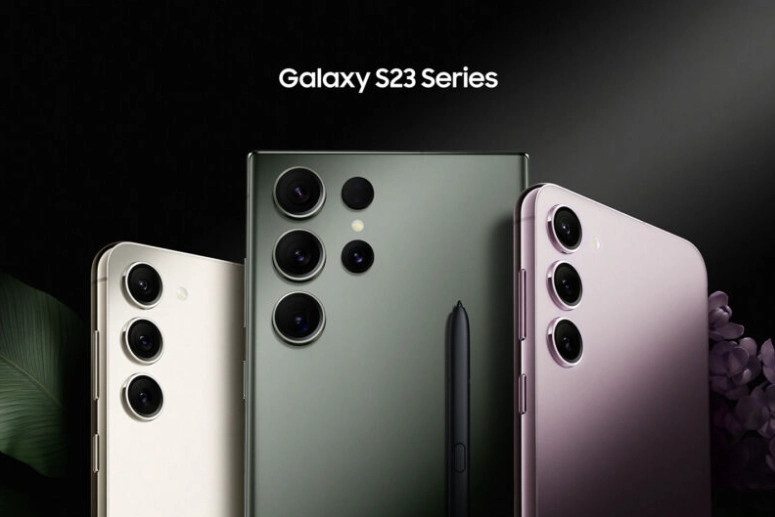
Samsung has started rolling out a significant camera update for its Galaxy S23 series in India. The update, which comes with firmware version S91xBXXU2AWF3 and a download size of approximately 2.2GB, includes several improvements and enhancements to the camera functionality.
What’s new in this update?
One notable addition is the ability to capture portrait images at 2x zoom, allowing users to achieve more diverse and detailed compositions. Additionally, the update addresses camera autofocus issues and enhances the image processing capabilities in Night mode, resulting in improved low-light photography.
Furthermore, users now have the option to delete multiple motion photos simultaneously, streamlining the organization and management of their image galleries. The update also introduces distortion correction for photos taken with the ultrawide camera, effectively rectifying any distortions present at the edges of the images. Similarly, distortion correction is now available for images captured with the primary camera in the 1x to 1.5x zoom range.
In response to user feedback, Samsung has added the option to disable Adaptive Pixel in the Camera Assistant, a feature introduced in a recent app update. Additionally, the update enhances the sharpness of videos captured in Super Steady mode using the ultrawide camera.
Users will also notice improvements in low-light conditions, as the viewfinder no longer appears jittery, ensuring a smoother and more stable camera experience. Samsung has also made strides in enhancing the rendition of colors and sky in ultra-high-resolution images, as well as minimizing color shifts in solid color backgrounds when switching between the primary and telephoto cameras.
On the software side, the update brings smoother animations and transitions in One UI, enhancing the overall user experience. Furthermore, subtle improvements have been made to the haptic feedback on the Galaxy S23 series, offering a more refined tactile response.
To install the update, users can navigate to Settings, select Software Update, and tap on Download and Install. The update also includes the June 2023 security patch, addressing more than 50 security vulnerabilities found in Galaxy phones and tablets.
Last week, the Xiaomi TV EA43 2023 launched in China. Today, the company unveils the 32-inch variant of this television.
The 32-inch model comes with the same upgrades as the 43-inch version while retaining the core features of the 2022 edition. Let’s go through the details.
Xiaomi TV EA32 2023 Specifications
The newly released Xiaomi TV EA32 2023 arrives with a better chipset than its predecessor. It is powered by an unnamed 64-bit chip comprising a quad-core CPU. For comparison, the older model houses a dual-core Amlogic chipset.
Thanks to the new chip, the television now supports dual-band WiFi. But for some reason, there’s no mention of Bluetooth in the spec sheet. Anyways, RAM and storage remain the same at 1GB and 8GB, respectively.
Further, the TV features a metal frame. It sports a 32-inch LED-backlit LCD panel with a resolution of 1366 x 768 pixels (HD) and a 60Hz refresh rate. The screen does not support HDR but offers a 178° viewing angle.
The display is supplemented by 2 x 8W (16W) speakers with support for DTS-HD. As for ports, the television comes with 1 x HDMI, AV, 2 x USB, and Antenna.
Last but not least, the TV boots MIUI for TV 3.0 with support for leading Chinese streaming platforms and Mijia smart home integration.
Xiaomi TV EA32 Price
The Xiaomi TV EA32 2023 is priced at only ¥599 (~$80) in China. It is already up for sale in the country.
This television will most likely not release outside mainland China like its forerunner.
Kodak has just announced 8 new smart TV models in the Indian market a month after its SE TV series launch. The new television lineup ranges from both an affordable to a flagship grade model. So let’s have a look at their price and specs.
Kodak 75 inch 4K QLED TV
Talking about the top end model first, this TV sports a tall 75 inch QLED display and is the most premium offering in the latest announcement. It offers high 4K resolution and offers 1.1 billion colors as well. Other notable features include support for Dolby MS12 and HDR10+. Under the hood, it is equipped with 2GB of RAM and 16GB of internal storage.
For audio, it has a total volume output of 40W from its speakers that support Dolby Atmos. This TV arrives with what the brand calls, an Airslim design and a bezel-less screen. It carries the model number 75MT5044 and will go on sale for a price tag of 98,888 INR and will be available for purchase via Flipkart.
Kodak 9XPRO series
Moving forward, we have the 9XPRO lineup that consists of a new series of affordable smart TV models. The 9XPRO portfolio arrives in multiple size options including 32 inch, 40 inch, 42 inch, and a 43 inch variant. All of these are equipped with the ARM Cortex A55x4 Realtek CPU that is paired with 1GB of RAM and 8GB of internal storage. The base 32 inch model offers HD resolution, while the other TV models have a higher Full HD+ resolution. The Kodak 9XPRO series will run on Android 11 OS for TV and have a total audio output of 30W with Dolby Digital sound support.
Other notable features include, built in Netflix, Google Assistant, Chromecast, and come with a vast library of applications and games as well. The series has a starting price tag of 10,499 INR for the 32 inch model, while the 42 inch and 43 inch variants cost 16,999 INR and 17,999 INR respectively. The pricing for the 40 inch model is still unclear. The 32 inch model can be found on both Amazon and Flipkart, while the 43 inch model is only available on Flipkart. Similarly, the 40 inch and 43 inch TVs will be sold via Amazon.
Kodark CA PRO series
The CA PRO series sits in the middle of the flagship and entry level models with three smart TV entries. These include a new 50 inch, 55 inch, and a 65 inch TV. All three TVs will offer high 4K resolution and will be powered by a MT9062 processor that offers Bluetooth 5.0 connectivity. The new TVs also feature a bezel-less design similar to the 75 inch QLED model and deliver 40W output with Dolby Atmos enabled speakers.
These come with Chromecast and Google Assistant built in as well. It also offers more than 10,000 applications and games. The 50 inch TV costs 27,999 INR, while the 65 inch model costs 43,999 INR. Unfortunately, the pricing details for the 55 inch model are still unknown. The 50 inch and 65 inch CA PRO TVs will be sold through Flipkart as well as Amazon, but the 55 inch model will only be sold via Amazon.
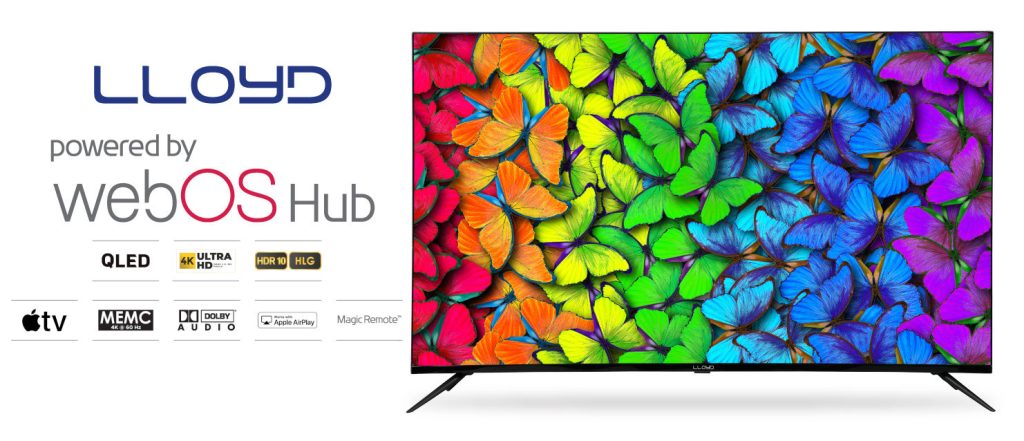
In India, Lloyd has recently introduced its latest lineup of advanced QLED and HD Ready TVs. The QLED TV series presents a captivating viewing experience with its range of sizes, including models measuring 43″, 50″, and 55″. These TVs offer stunning visuals, incorporating intelligent features like 4K upscaling and MEMC technology, while also supporting HDR10 for enhanced color and contrast. Now, let’s delve into the specifications and features of these exciting new television models.
Llyod QS850E QLED TVs and 32WS550E TV specs
For those seeking a more compact option, the HD Ready WebOS TV, represented by the 32WS550E model, delivers impressive picture quality on its 32″ screen. The TV exhibits rich colors and deep contrast, ensuring an engaging visual experience. Both the QLED and HD Ready TVs grant access to major OTT apps, personalized content recommendations, and feature Dolby Audio technology, which guarantees crystal-clear sound.
Smooth and fluid visuals are made possible with Motion Estimation, Motion Compensation, and ALLM technology incorporated in both TV models. Additionally, the inclusion of HDR10 and HLG further enhances brightness and color reproduction, resulting in captivating imagery.
The provided Magic Remote offers effortless navigation and control of the TVs, while the integration with Apple devices brings added convenience and access to Apple TV, AirPlay, Apple Music, and Apple Homekit.
The Lloyd QS850E QLED TVs are equipped with 4K QLED displays, offering resolutions of 3840 × 2160 pixels across the 43″, 50″, and 55″ variants. The HD Ready Model, 32WS550E, features a 32″ HD Ready LED screen with a resolution of 1366 x 768 pixels. These TVs support HDR10, HLG, and MEMC technology to optimize the visual experience. With 20W speakers and Dolby Audio technology, the TVs deliver immersive audio quality, complementing the exceptional visuals.
Connectivity options include 3 HDMI ports, 2 USB ports, Wi-Fi, Bluetooth, and a Wireless LAN Adapter, ensuring easy connectivity with other devices. Built-in apps such as YouTube, Netflix, Prime Video, and Disney+Hotstar provide seamless access to popular streaming platforms.
Pricing & availability
The QS850E QLED TV from Lloyd is available in three different sizes, with the 43″ model priced at Rs. 29,999, the 50″ model at Rs. 39,999, and the 55″ model at Rs. 44,990. Additionally, the 32WS550E HD Ready TV can be purchased for Rs. 13,999. These television models are conveniently available for purchase on Flipkart.
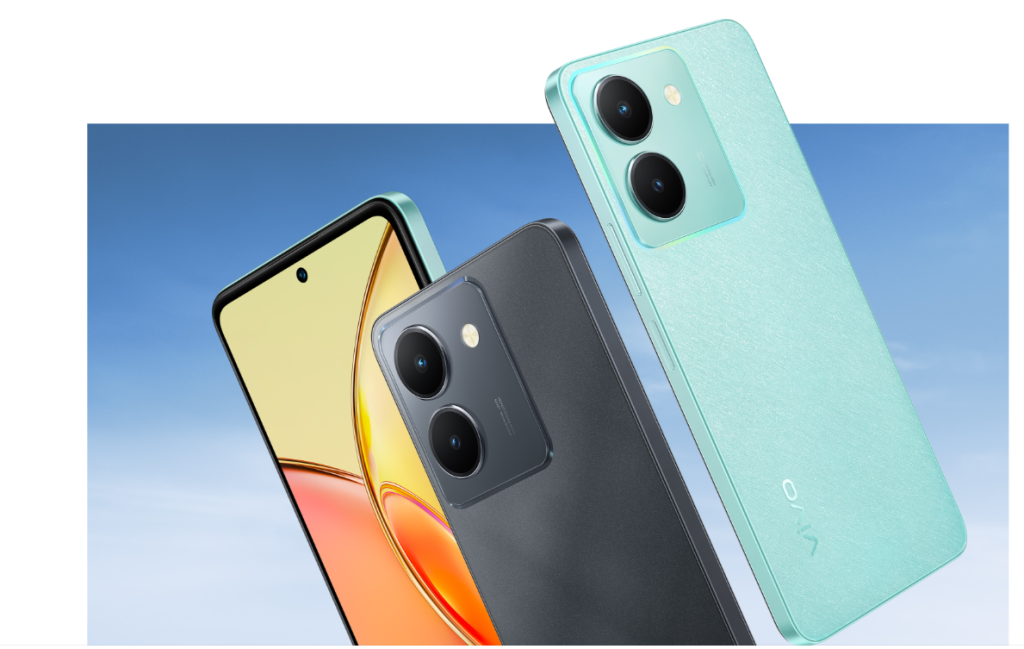
Vivo is working on a new device called the Vivo Y27 5G. This device has already made appearances on Geekbench, Google Play Console and has been EEC certified. Now, the smartphone has also cleared the NBTC certification.
As per the listing, model number V2302 belongs to the Vivo Y27 5G smartphone. Other than clarifying the model number and moniker, the listing does not reveal any further details. That being said, it is all but confirmed that the device will be launching in Thailand soon. Let’s look at what we know about the Vivo Y27 5G so far.
Vivo Y27 5G specs (expected)
There have been speculations that the Vivo Y27 5G could potentially be a rebranded version of the Vivo Y36 5G, based on leaked specifications. If this turns out to be true, the Y27 5G is expected to feature a 6.64-inch LCD FHD+ display with a smooth 90Hz refresh rate. In terms of its camera setup, the device is likely to sport a dual-camera system, consisting of a 50-megapixel primary camera and a 2-megapixel secondary camera. For selfies and video calls, a 16-megapixel front-facing camera is anticipated.
In addition to its imaging capabilities, the Y27 5G is rumored to house a 5,000mAh battery. Moreover, the device is expected to support 44W fast charging.
Earlier this month, we reported on a new rumor that revealed that an iQOO TWS 1 earbuds will be launching alongside the highly anticipated iQOO 11s on July 4. And now, a fresh leak has hinted at a special edition planned for the upcoming truly wireless earbuds.
iQOO TWS confirmed to launch in a BMW Edition
The latest details arrive from known tipster Sudhanshu Ambhore who shared leaked teaser image posters on Twitter. These images revealed certain specs of the TWS 1 earbuds model as well as the BMW Edition variant. Looking at the images, this is the first look we have for the upcoming wireless earphones and it features an in-ear style design that slightly resembles the AirPods Pro.
On the other hand, the oval charging case will feature the BMW Motorsport branding and stripes on the special edition model. This design also makes it more in line with the existing iQOO 11 smartphone as well. Furthermore, the leak also adds that the iQOO TWS 1 will be the first truly wireless earbuds to support end-to-end aptX Lossless transmission. This will be possible thanks to its high code rate of up to 1200Kbps. In other words, the earphones will allow you to listen to your favorite music or movies at a higher audio quality.
Based on what we know so far, the TWS 1 earbuds will offer up to 49 decibels of active noise cancellation (ANC), which will help you have a better listening experience and ess disturbance. Furthermore, this model will reportedly offer up to 42 hours of audio playback when paired with the charging case.
Near Field Communication (NFC) technology has made significant advancements in recent years, and the NFC Forum, the organization that defines the standards for NFC, has recently revealed a roadmap for key research and plans for NFC through 2028. This roadmap lays out the future direction of NFC technology and highlights the exciting developments expected in the coming years.
What is NFC?
NFC is a short-range wireless communication technology that enables secure and contactless communication between devices. It allows for the exchange of data over short distances, typically a few centimeters, by simply bringing two NFC-enabled devices close together. This technology has gained popularity and is widely used in various applications such as mobile payments, access control, transportation, and more.
Over the years, NFC has experienced significant evolution and widespread adoption. It emerged as a relatively new short-range wireless connectivity technology that enabled seamless communication between NFC-enabled devices. Its simplicity and convenience quickly made it popular among users, leading to its incorporation in various applications.
According to market research reports, the NFC market size is expected to reach USD 34.9 billion by 2025, with a compound annual growth rate (CAGR) of 14.2% during the forecast period. This growth can be attributed to the increasing demand for NFC chips from various industries, including healthcare and retail.
One of the key milestones in the evolution of NFC was the introduction of the NFC Forum, a global consortium consisting of leading technology companies. The NFC Forum played a crucial role in promoting the development and standardization of NFC technology, ensuring interoperability and compatibility across devices. The Forum is comprised of Board representatives from the top tech companies like Apple, Google, Huawei, Identiv, Infineon, NXP, Qualcomm, Sony, and STMicroelectronics.
What’s Exciting In The New NFC Roadmap?
The NFC Forum, recently unveiled an exciting roadmap that outlines key research and plans for the future of NFC through 2028. This roadmap promises significant advancements and improvements to NFC, making it faster, easier, and truly contactless.
Here are the proposed upgrades to the NFC technology.
More Power
NFC forum proposes to increase the wireless charging power of the NFC standard from the current 1W to an impressive 3W. Such an upgrade would unlock wireless power possibilities like bringing wireless power and charging to new and smaller form factors, and also paving the way for innovative applications in new industries that were previously not viable.
Extended Range
Additionally, the roadmap aims to make NFC fully contactless thanks to extended range capabilities, eliminating the need for physical contact between devices.
While the older version typically required devices to be extremely close to each other for communication (5mm), the new standard allows for greater distance between devices (four to six times the current operating distance) without compromising the connection quality. This will provide a more seamless and hygienic interaction, particularly in the post-pandemic era, where contactless technologies are increasingly preferred. Also, it opens up possibilities for applications in areas such as asset tracking and smart home automation, where devices can communicate over longer distances.
Support for Multi Purpose Tap
Additionally, the NFC Forum aims to introduce support for multiple purpose tap, expanding the range of applications and possibilities for NFC technology. This means that NFC will soon be able to support several actions with a single tap. This could potentially have very wide applications including point-to-point receipt delivery, loyalty identification, and total-journey ticketing.
Smartphones with NFC can Be POS Devices
This new plan aims to improve how smartphones with NFC (Near Field Communication) can work like a cash register. This means businesses or people can accept payments anywhere using their smartphones.
Improving NFC’s Sharing of Sustainability Data
The plan also includes ways for NFC to share information about what a product is made of and how it can be recycled. This is important to meet new customer needs and government rules, and it helps contribute to a greener economy.
How New NFC Standard Can Bring Exciting Applications
Looking ahead to the future, the new NFC standard expected to roll out by 2028 promises even more exciting applications. One such application is the integration of NFC technology into healthcare systems. With NFC-enabled medical devices, patients can easily monitor their vital signs and share the data with healthcare professionals. This enables remote patient monitoring, reducing the need for frequent hospital visits and enhancing overall healthcare efficiency.
Another industry that could benefit from the new NFC standard would be transportation. By better implementing NFC technology in public transportation systems, passengers can enjoy seamless ticketing (without having to go and tap on the terminal) and fare payment experiences with better security. NFC-enabled smartphones or smart cards can be used to access various modes of transportation, eliminating the need for separate tickets and reducing paper waste.
In conclusion, the latest roadmap of NFC brings significant advancements compared to the older version. With improved charging speeds, extended range capabilities, and multipurpose tap, NFC becomes even more versatile and reliable across various industries.
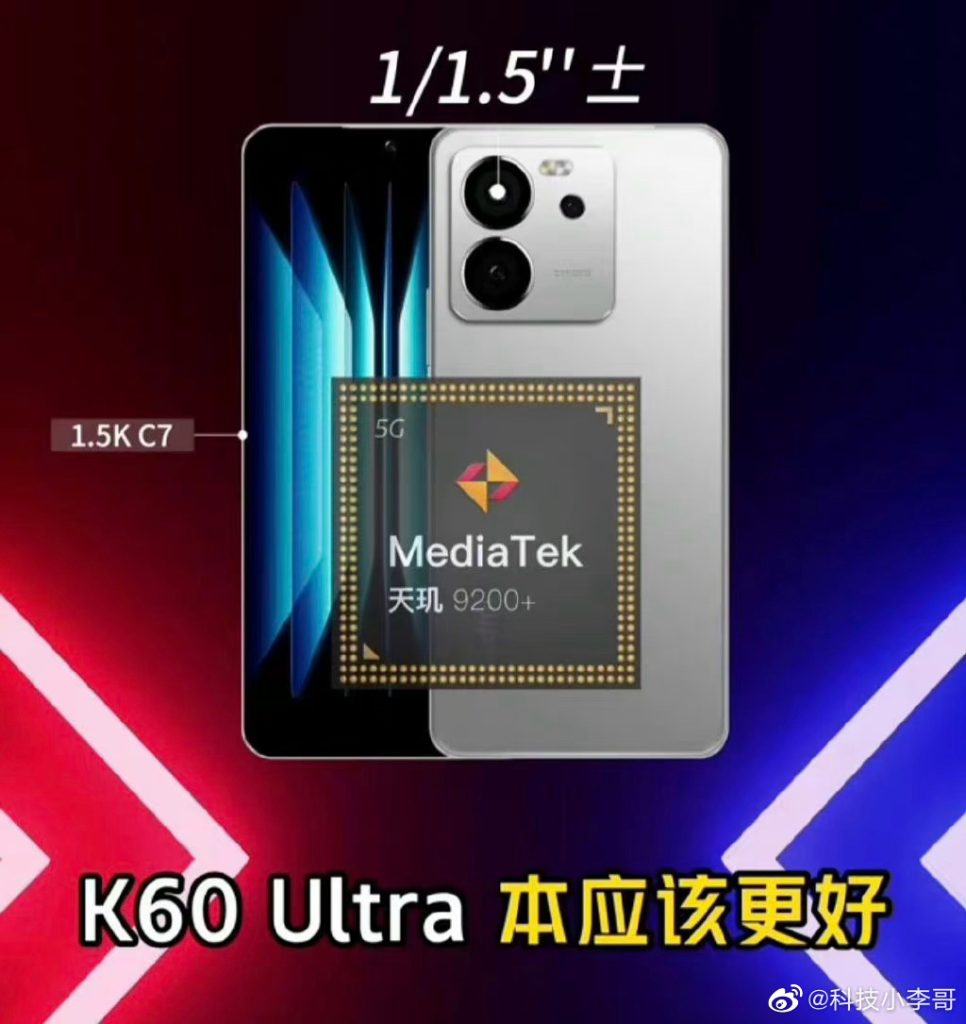
According to reports, Redmi is said to be preparing for the launch of the Redmi K60 Ultra flagship smartphone sometime between July and August this year. This upcoming device will serve as the successor to last year’s Redmi K50 Ultra. Recently, a well-known tipster, Digital Chat Station, shared a schematic of the K60 Ultra, providing a glimpse of its design. Additionally, a render of the K60 Ultra based on the leaked schematic has now been shared by a user on the Chinese social media platform, Weibo. The image seems to be based on the previously seen schematic of the device.
Redmi K60 Ultra design, key specifications
Redmi K60 Ultra design
The Redmi K60 Ultra render shows the smartphone sporting a punch-hole display. While it is not clearly visible, it appears to be equipped with ultra-thin bezels. The leak claims that it is equipped with a TCL-made C7 display, which offers a 1.5K resolution and a 144Hz refresh rate. The same display is also available on the Xiaomi 13 Ultra. It also seems to be equipped with an under-display fingerprint sensor.
On the back, the K60 Ultra has a square-shaped camera module, which houses three cameras and an LED flash. It is said to be equipped with a 1/1.5-inch primary camera, which seems to be a 50-megapixel snapper.
The Dimensity 9200 Plus chip is likely to power the Redmi K60 Ultra. The only other phones that feature the same chip are the iQOO Neo 7 Pro and the Vivo X90s. The inclusion of the D9200+ chip hints that the K60 Ultra will arrive with LPDDR5x RAM and UFS 4.0 storage.
The alleged K60 Ultra with model number 23078RKD5C was recently approved by the 3C authority in China. The listing revealed that the device may ship with a 120W fast charger. Rumors have it that it may house a 5,500mAh or 5,000mAh battery and also have support for 30W wireless charging. It appears a rebranded or tweaked version of the K60 Ultra will debut in the global market under the Xiaomi 13T Pro moniker.
Honor has officially revealed the launch date of its next-gen foldable smartphone, the Magic V2. The company’s upcoming foldable device has been rumored to launch for some time now, and during the MWC event, we finally got confirmation for its China launch.
Honor Magic V2 will be announced in China on July 12
The Chinese smartphone maker will be unveiling the new Magic V2 foldable phone in its home market on 12th July 2023, which is in line with our previous reports. During the event, Honor CEO Zhao Ming revealed in his keynote speech that the device will offer a ‘revolutionary’ flexible display experience. The senior official further added that the brand has also planned to focus on its applications in artificial intelligence (AI) for its smartphones.
This technology will primarily be seen in the photography segments. Apart from this, the executive adds that Honor is planning to add cutting-edge technology to its latest generation of products. While finer details regarding the new Magic V2 model are still at large, the CEO had hinted at some of its design elements. He claimed that the company faced many hurdles in having the foldable phone feature a lightweight design.
Based on an MIIT certification sighting, the Honor Magic V2 will carry the model number VER-AN00. Meanwhile, other rumors have hinted that it will be equipped with a Qualcomm Snapdragon 8+ Gen 1 SoC, while the Magic V2 Supreme Edition could feature the more powerful Snapdragon 8 Gen 2 chipset. Another leak adds that the device will sport custom 2K LTPO foldable screen. This is all the information we have at the moment, so stick around for more updates.
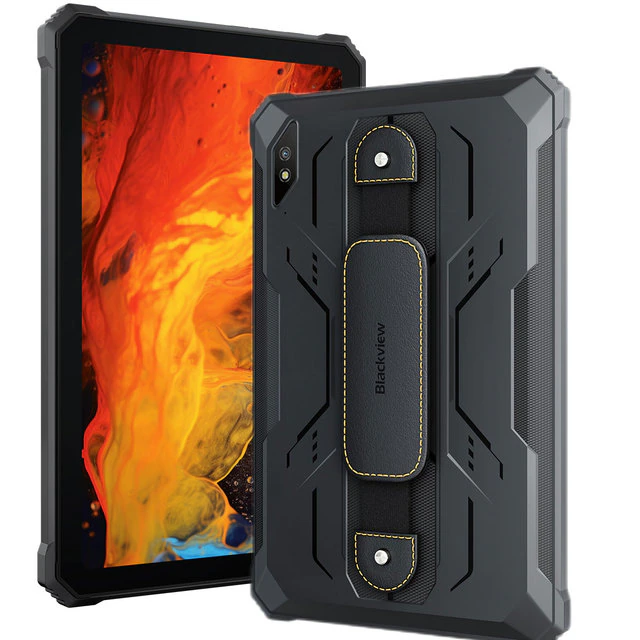
Following the release of the Blackview Tab 16, a standard tablet in March, Blackview has now unveiled a rugged tablet known as the Blackview Active 8 Pro. This latest offering from the brand boasts an impressive array of specifications.
Blackview Active Pro 8 specs
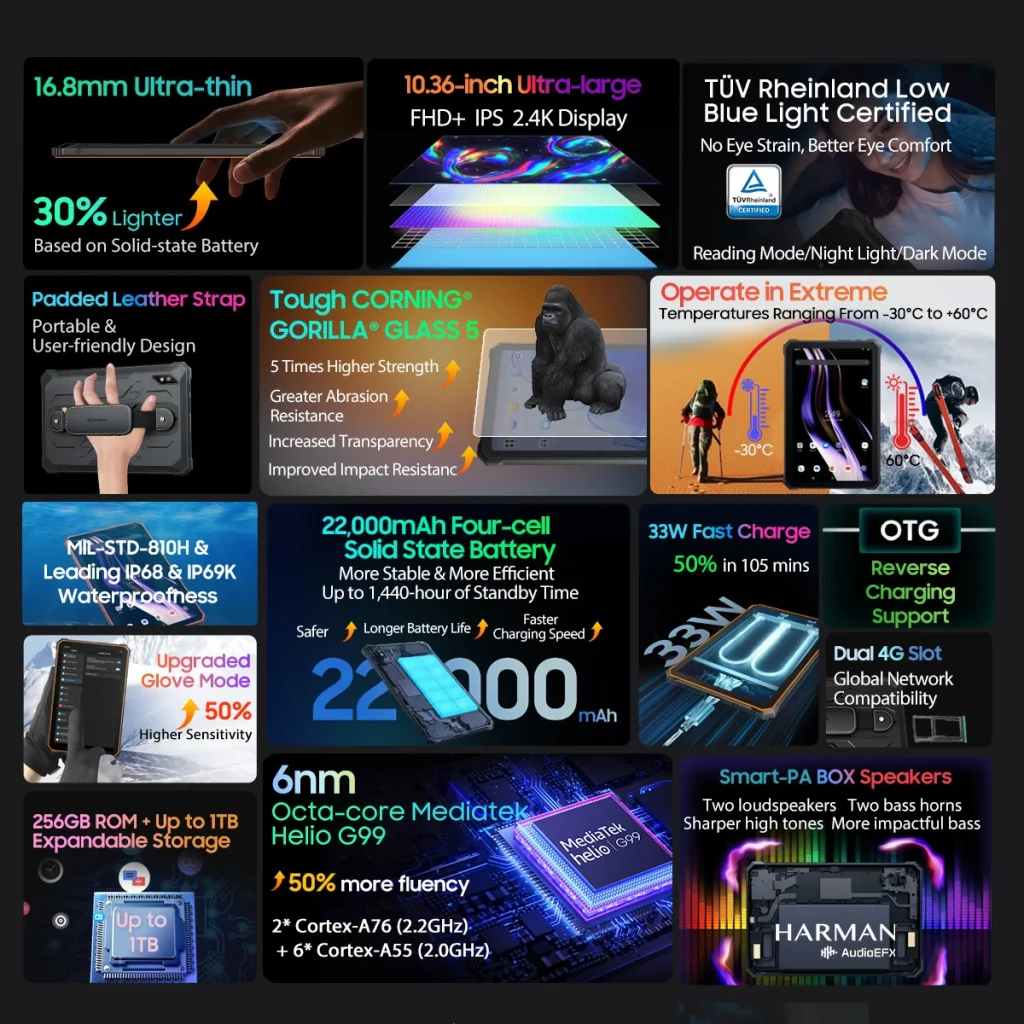
The tablet sports a 10.36-inch IPS display with a resolution of 2,000 x 1,200 pixels, providing a sharp and vibrant visual experience. In addition to that, the tablet features a quad-speaker system by Harman Kardon, comprising two tweeters and two low-frequency speakers, delivering immersive audio quality.
Under the hood, the tablet features the MediaTek Helio G99 SoC, which is based on TSMC’s 6nm process and provides a good balance of performance and efficiency. With 8GB of RAM and 256GB of internal storage, expandable up to 1TB with a microSD card, the Blackview Active 8 Pro offers ample memory and storage capacity. It also supports hybrid dual 4G SIM cards, allowing for seamless connectivity on the go. Additional features include OTG, NFC, and FM radio.
One of the standout features of the Blackview Active 8 Pro is its impressive camera setup. It features a 16.48MP camera on both the front and rear, enabling high-quality photography and video recording.
The tablet is designed to withstand extreme conditions and hazards, certified to meet the MIL-STD-810H and IP68/IP69K standards. It also incorporates an improved glove mode and a graphite cooling system to ensure optimal performance even in challenging environments.
The Blackview Active 8 Pro is powered by a massive 22,000mAh battery with 33W fast charging capability, providing long-lasting usage and quick recharging. It offers up to 1,440 hours of standby time, ensuring reliable performance throughout the day. In the retail package, along with the tablet and standard accessories, you will find a stylus and a padded leather strap.
Price & availability
During the promotional period from July 10 to July 14, the Blackview Active 8 Pro will be available at an introductory price of $239.99 (with a regular MSRP of $396.81). As an added bonus, the first 200 customers will receive a complimentary Bluetooth keyboard with their purchase.
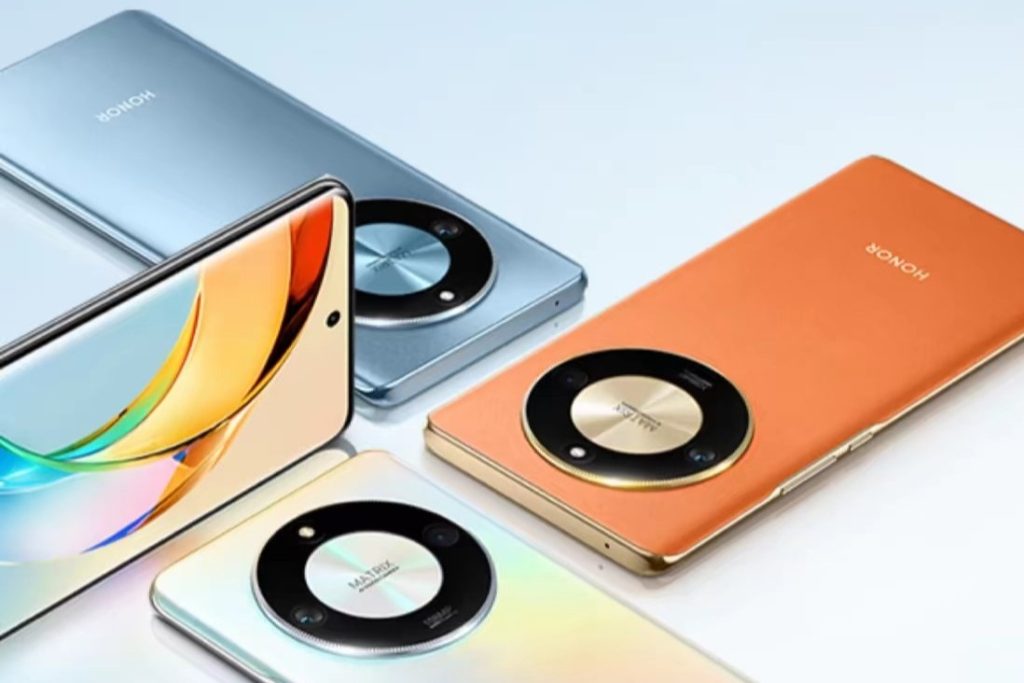
Honor is set to launch the Honor X50 budget smartphone in China on July 5. Ahead of that, the brand has been teasing the device’s features.
Recently, the company revealed the handset’s battery capacity. Today, we get to learn all the key specs of the phone through a reliable tipster.
Let’s check out everything that’s known about this upcoming smartphone so far.
Honor X50 | Source: Digital Chat Station
The new details regarding the Honor X50 come from Digital Chat Station. As per him, the device will be powered by a Qualcomm Snapdragon 6 Gen 1 SoC. The chipset will be paired with up to 16GB RAM and 512GB storage.
Just like the Honor X40, the X50’s main highlight will be its display. The handset will flaunt a curved OLED display with a resolution of 2652 x 1200 pixels (1.5K). This screen is said to offer eye protection, and thus, it may support high-frequency PWM and certified low-blue light mode.
Finally, according to the leaker, the rear camera system will be headed by a 100MP primary camera. He also notes that the phone will fall under the ¥1,000 price category. Hence it will be one of the most affordable 5G-enabled curved display smartphones.
Other than the aforementioned features, Honor had officially confirmed that the device will be backed by a 5,800mAh battery. In addition to that, the handset’s 3C certification suggests that it will support 35W fast wired charging.
We are looking forward to learning even more about this phone in the coming days.
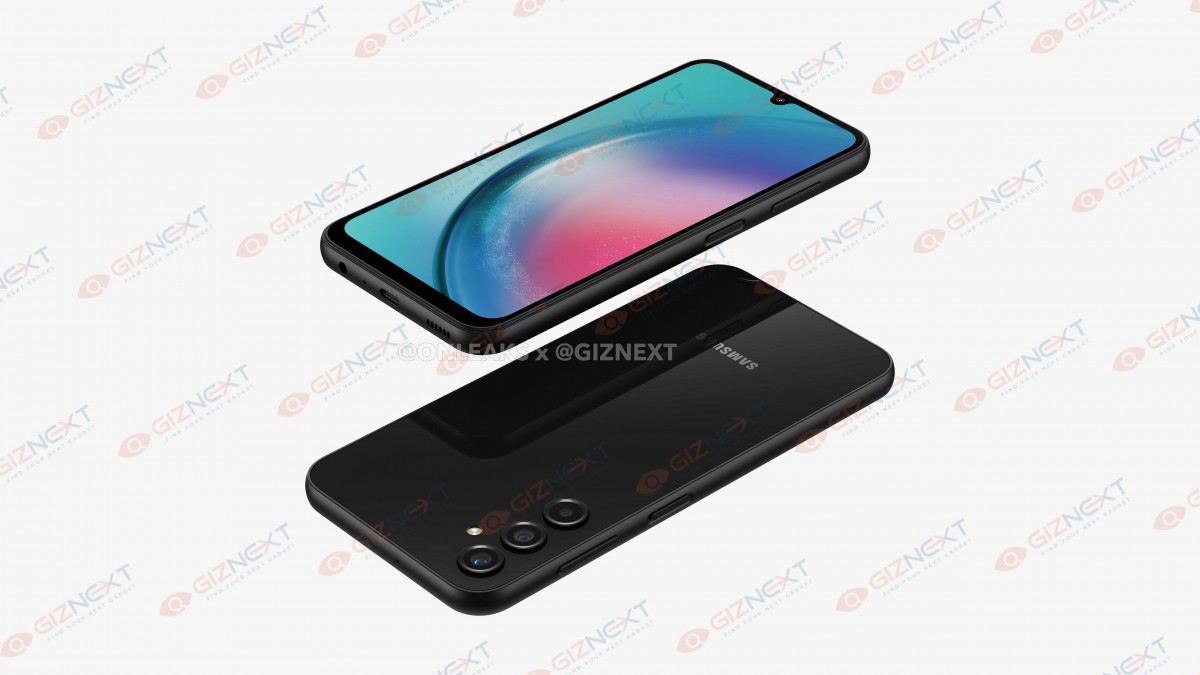
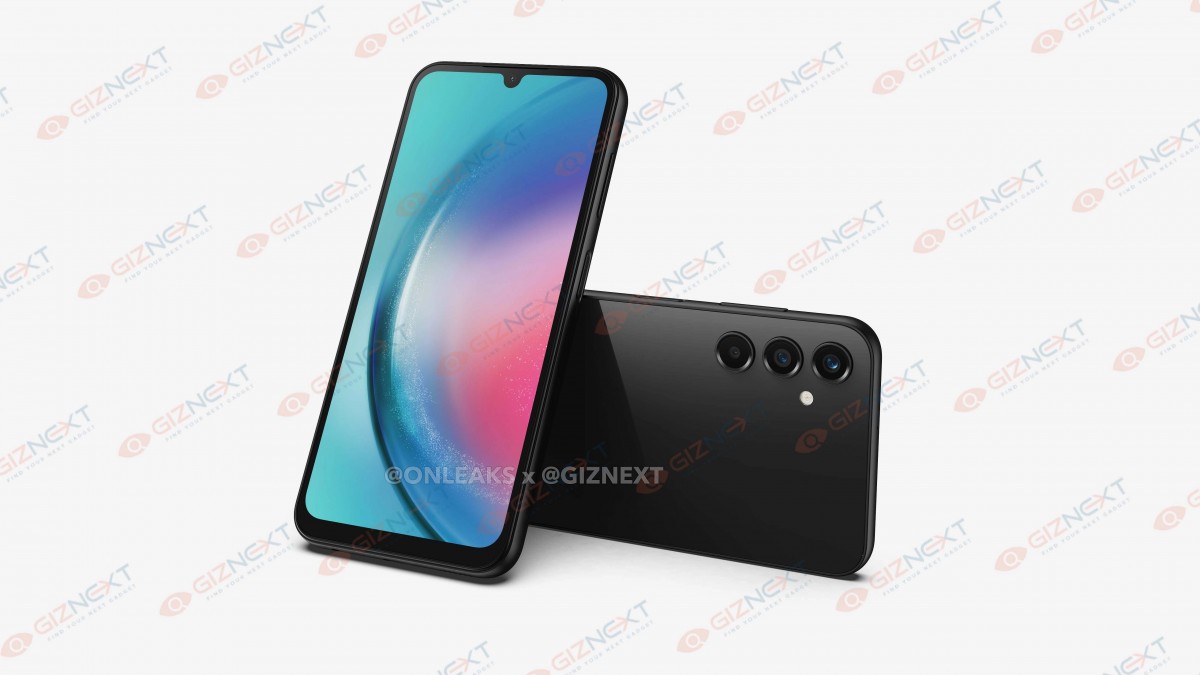
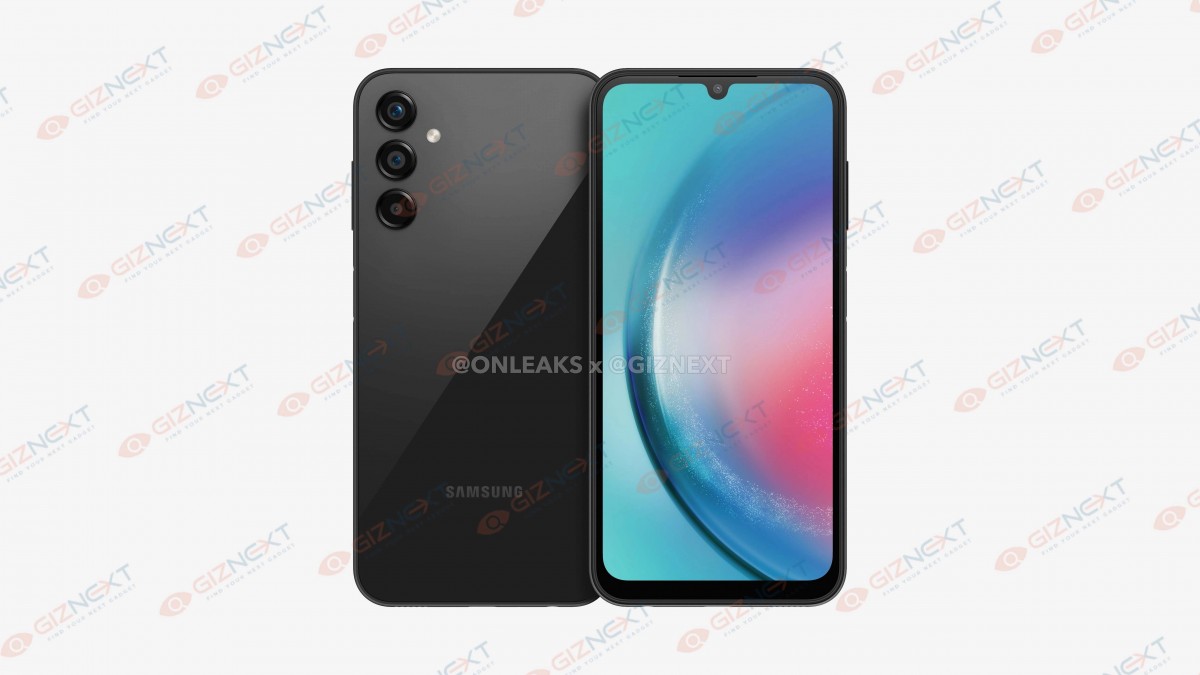
In April, Samsung announced the Galaxy A24 4G in multiple markets. If a fresh report by GizNext is to be believed, the brand is now working on the Galaxy A25 5G. The publication has collaborated with prominent tipster Steve Hemmerstoffer (aka OnLeaks) to reveal the design of the A25 through its CAD renders. Here is a look at the design of the phone.
Samsung launched the Galaxy A23 in 4G and 5G variants. The A24 is currently only available in a 4G version. It is still unclear whether the company has plans to launch its 5G edition. The report suggests that the device that was expected to launch as the A24 may end up launching as the Galaxy A25 5G.
Samsung Galaxy A25 5G renders
Samsung Galaxy A25 5G renders by GizNext / OnLeaks
The new report reveals that the Galaxy A25 will have a 6.44-inch display with a waterdrop notch. The back panel of the phone has a triple camera unit with an LED flash. For security, the device is fitted with a side-facing fingerprint sensor on the right. The same edge also features a volume rocker.
The Galaxy A25 has a single speaker and a 3.5mm audio jack. As per the report, the device measures 162 x 77.5 x 8.3mm, which is almost identical to the dimensions of the Galaxy A24 4G. At present, there is no information on the other specifications of the A25.
In related news, OnLeaks also released the CAD renders of the Galaxy S23 FE, an upcoming affordable flagship phone. Regrettably, like the Galaxy A25, the S23 FE has an uninspiring design, bearing a striking resemblance to the Galaxy A54. In terms of internals, the S23 FE is expected to come with specs like a 6.4-inch FHD+ 120Hz AMOLED display, an Exynos 2200 chip, up to 8 GB of RAM, up to 256 GB of storage, a 4,500mAh battery, 25W charging, and a 50-megapixel main camera. The S23 FE is expected to debut in Q3 this year.
The iQOO 11S is all set to go official on July 4 in China. The upcoming flagship phone will be positioned between the iQOO 11 5G and the iQOO 11 Pro 5G. Today, the Chinese manufacturer released two posters to confirm the display specifications and the charging capabilities of the iQOO 11S. Here is a look at all the new details of the 11S confirmed by the brand.
iQOO 11S display, charging specifications
As revealed in the poster, the iQOO 11S will feature a stunning E6 AMOLED display that will offer a 144Hz refresh rate, a 2K resolution, a pixel density of 517 ppi, and a peak brightness of up to 1800 nits. The screen will also support both PWM and DC dimming. While the exact dimensions are yet to be confirmed, it is expected to inherit the iQOO 11 5G’s 6.78-inch screen.
In the other poster, iQOO confirmed that the upcoming iQOO 11S will support 200W fast charging. In just 5 minutes of charging, users can enjoy extended high-frame-rate gaming for up to 3 hours.
The iQOO 11S will have wide compatibility with third-party UFCS chargers, enhancing flexibility for users to choose their preferred charging solutions. To ensure safety and reliability, the iQOO 11S incorporates a new boron nitride material, effectively reducing the temperature rise of the battery protection board.
iQOO 11S color options
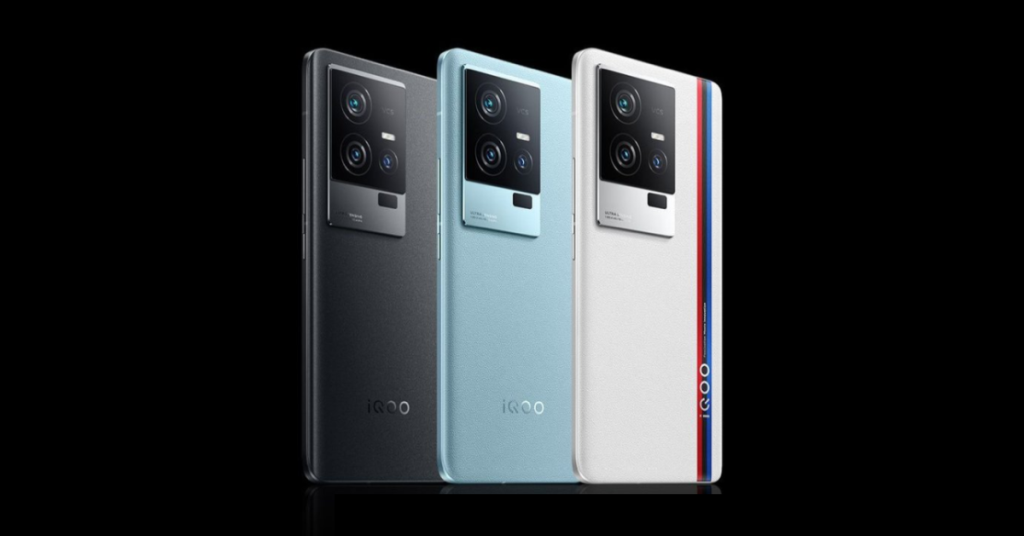
The company previously confirmed that the iQOO 11 has the Snapdragon 8 Gen 2 chipset, LPDDR5x RAM, and UFS 4.0 storage. The highest variant of the 11S is expected to offer 16 GB of RAM and 1 TB of storage. It has not confirmed the battery size of the 11S yet. As per reports, it will house a 4,700mAh battery. For photography, it will feature a 50-megapixel Sony IMX866 primary camera with OIS support. The phone will come in three color options: black, white, and cyan.
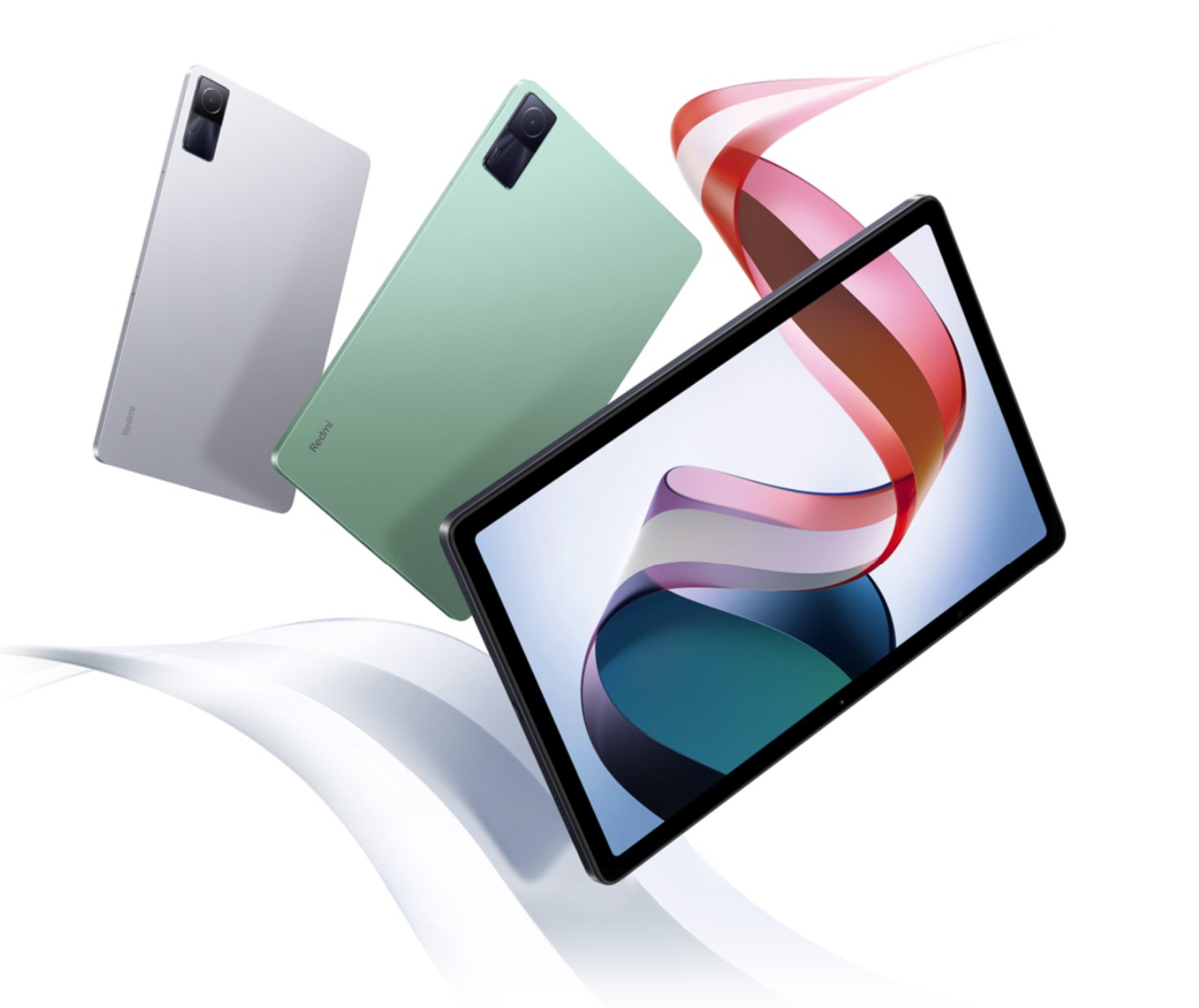
Redmi is making preparations for the upcoming release of the Redmi Pad 2, which has already been spotted on the FCC website. The tablet’s specifications have been leaked online, and now its performance details have surfaced on Geekbench.
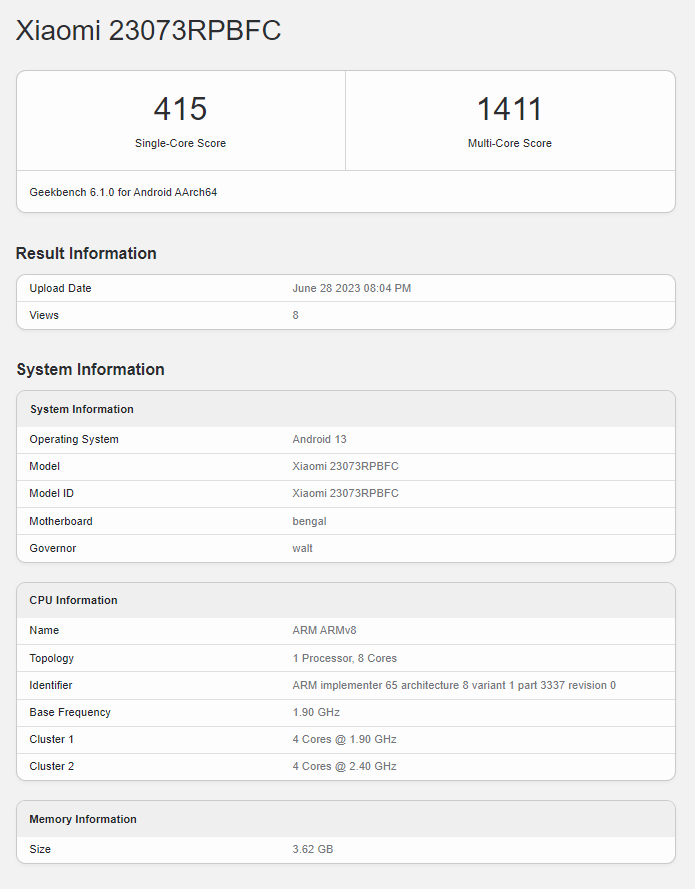
Ahead of its official launch, the Redmi Pad 2 (model number 23073RPBFC) has made an appearance on Geekbench. The listing unveils that the tablet will be equipped with an octa-core processor, comprising four cores running at 2.40GHz and the remaining four cores operating at 1.90GHz. Notably, the chipset codenamed Bengal suggests that the Redmi Pad 2 will be powered by the Qualcomm Snapdragon 680 processor. This development has sparked discussions as the previous Redmi Pad featured the more robust MediaTek Helio G99 processor, making the Snapdragon 680 a perceived downgrade.
The device has 4GB RAM and operated on Android 13. Moving to the performance, the device scored 415 points on the single-core test and 1411 points on the multi-core test of Geekbench 6. Since the listing on Geekbench doesn’t provide any additional information, let’s explore the available details about the Redmi Pad 2 that have been disclosed thus far.
Redmi Pad 2 rumored specs
According to previous reports, the Redmi Pad 2 is anticipated to come with a 2K resolution display, likely utilizing an affordable IPS LCD panel. The display size is expected to fall between 10 to 11 inches, with some sources suggesting a diagonal measurement of 10.95 inches. Furthermore, there are rumors of the tablet supporting a smooth 90Hz refresh rate.
To ensure prolonged usage, the tablet is said to be equipped with a substantial 8,000mAh battery. In terms of cameras, it is speculated that the Pad 2 will feature a single rear camera sensor, possibly an 8MP lens, for capturing everyday moments. For selfies and video calls, a 5MP front camera is likely to be included.
In a move aimed at maintaining dominance in the field of artificial intelligence (AI) and addressing concerns about potential military applications, the United States is reportedly considering implementing new restrictions on the export of AI chips to China. According to a report from the Wall Street Journal, the US Commerce Department may halt shipments of chips made by Nvidia, Advanced Micro Devices (AMD), and other chip companies to customers in China as early as July.
The proposed restrictions have caused a decline in share prices for major chip manufacturers. Following the news, shares of Nvidia (NVDA.O) dropped more than 2%, while Advanced Micro Devices (AMD.O) experienced a decline of approximately 1.5% in extended trading.
The deliberations within the US government highlight the White House’s concerns about potential technological advancements made by China in the AI field and the subsequent implications for national security. By tightening trade restrictions, the US aims to maintain its lead in AI technology and prevent Beijing from leveraging it for military purposes.
Nvidia, Micron, and AMD find themselves caught in the crossfire between China and the Biden administration as tensions continue to rise. Last September, Nvidia received a request from US officials to cease exporting two top computing chips specifically designed for AI work to China. In response, the company introduced the A800 chip in China to adhere to export control regulations. Additionally, Nvidia modified its flagship H100 chip earlier this year to comply with the evolving regulatory landscape.
However, the new restrictions being considered by the US Commerce Department would go even further, potentially banning the sale of A800 chips without a special US export license. If implemented, these restrictions could significantly impact the operations and revenue of chip manufacturers operating in both the US and Chinese markets.
The ongoing trade tensions between the two nations continue to pose challenges for companies operating within the semiconductor industry. As geopolitical concerns persist, industry stakeholders are closely monitoring developments and preparing for potential disruptions in the global supply chain.
Electric bicycles have established themselves as a prominent mode of transportation worldwide, and their popularity continues to surge as the electric vehicle revolution is slowly spreading over the world. Embracing the advantages of electric bikes not only benefits the economy but also promotes the general well-being of the population. Germany, in particular, has witnessed a remarkable upswing in the e-bike industry, displaying no signs of slowing down despite initial hesitations earlier this year. In May, favourable weather caused the popularity of e-bikes to go up again. By the end of May 2023, Germany had produced over one million electric bikes, marking a significant five-percent growth compared to the same period last year. This growth is particularly impressive considering the challenging economic climate the country has faced.
Good weather boosted the sales of e-bikes, benefitting the industry
Burkhard Stock, the Managing Director of the Zweirad-Industrie-Verband (ZIV), discussed this unexpected turn of events in a report published by German e-bike publication E-Bike News. He mentioned that they had anticipated a slowdown in the market during the first few months, given the ongoing European war, inflation concerns, general reluctance to make purchases, and adverse weather conditions. However, the arrival of good weather promoted more outdoor time, and that led to a positive shift in the industry.
ZIV, a prominent organization in the German and international bicycle industries, plays a crucial role as a governing body and major stakeholder in the European e-bike sector. About 90 percent of all electric bikes produced by German companies are manufactured by ZIV member companies. Their presence ensures the industry’s steady growth and development.
In addition to the domestic market, German-made electric bicycles have gained traction in other parts of the world. In the first quarter of 2023, a staggering 190,000 electric bikes were exported, signifying a significant 28-percent increase compared to the previous year. Notably, a majority of these exports were destined for European Union and European Free Trade Association member countries. With such a strong export performance, it is anticipated that the German e-bike market will produce a total of two million electric bicycles by the end of 2023.
Renault, a renowned automobile brand, is making its mark in Europe once again with the introduction of the Renault Scenic E-Tech, an upcoming electric vehicle (EV) model. The development of this exciting new addition to Renault’s lineup has been captured in these recently leaked spy shots, providing us with our first glimpse into its design.
Few details peer through the camouflage wrapping the Renault vehicle
To keep the Scenic E-Tech’s appearance under wraps, Renault’s engineering team has covered the exterior with a camouflage wrap, employing blocky panels to further obscure the vehicle’s body. However, certain details manage to shine through. The front of the Scenic E-Tech boasts a sleek nose with a tiny inlet positioned in the lower portion of its face, accompanied by slender headlights that gracefully frame the hood.
When viewed from the side, the Scenic E-Tech proudly displays its short overhangs at both ends, giving it a compact yet stylish profile. The C-pillar, with its distinctive angle, adds a touch of elegance to the rear, ensuring that it doesn’t appear too boxy. A subtle spoiler gracefully extends over the back window, enhancing its aerodynamic appeal.
Although the heavy camouflage conceals many details at the rear, the taillights manage to peek through, providing a glimpse of their design. Unfortunately, the interior of the Scenic E-Tech remains a mystery as the spy shots do not provide us with a clear view of the cabin.
Drawing inspiration from the 2022 Renault Scenic Vision concept, the Scenic E-Tech exhibits design elements reminiscent of its counterpart. The Scenic Vision concept showcased sharper creases and a crossover-like appearance, setting it apart from previous Scenic models that traditionally belonged to the MPV segment.
The Scenic Vision concept featured a 215-horsepower electric motor borrowed from the Megane E-Tech, coupled with a 40-kilowatt-hour battery. Additionally, it incorporated a 16-kW hydrogen fuel cell beneath the floor for charging the drive battery.
Renault had previously announced plans for a production version of the Scenic Vision concept, scheduled for release in 2024. This production model would utilize the CMF-EV platform, most likely eliminating the hydrogen range extender seen in the concept. All indications point to the vehicle captured in these new spy shots being the much-anticipated realization of the Scenic Vision concept – a car finally come to life.
China‘s Sky Eye FAST telescope, the world’s largest and most sensitive radio astronomy telescope, continues to make groundbreaking discoveries in the field of astronomy. Recently, the Chinese pulsar timing array research team, comprised of scientists from the National Astronomical Observatories of the Chinese Academy of Sciences and other institutions, utilized Sky Eye FAST to detect compelling evidence of nanohertz gravitational waves. This remarkable achievement demonstrates that China’s research in this area is on par with international standards and has even reached a leading position.
The data set containing the Research Data spanned over 3 years
The findings were published in China’s prestigious astronomical journal, “Astronomy and Astrophysics Research,” on June 29. The research team analyzed a data set spanning 3 years and 5 months, collected by Sky Eye FAST, and successfully identified key evidence supporting the existence of nanohertz gravitational waves at a confidence level of 4.6 sigma. Such a high level of confidence signifies a false positive rate of less than 1 in 500,000.
Nanohertz gravitational waves are a type of gravitational wave characterized by an extremely low frequency of 10 to the power of minus 9 Hz. Detecting these waves poses significant challenges due to their ultra-low frequency, long periods lasting several years, and wavelengths stretching across several light-years.
Gravitational waves, as predicted by Albert Einstein’s general theory of relativity, are ripples in spacetime caused by the acceleration of objects with mass. Analogous to throwing a stone into a pond and observing the resulting ripples on the surface, these waves propagate outward from the source of mass. Their weak interaction with matter during propagation makes them ideal carriers of valuable information from the depths of the universe. Gravitational wave astronomy, a field of observational astronomy, focuses on using gravitational waves to gather information about violent astronomical events such as binary star systems comprising white dwarfs, neutron stars, and black holes. Supernovae and the Big Bang also serve as sources of these cosmic disturbances.
The groundbreaking discovery of gravitational waves in 2015 by the LIGO scientific team and subsequent observations have opened up an exciting new chapter in our understanding of the universe. In recognition of their pioneering work, Rainer Weiss, Barry Barish, and Kip Thorne were awarded the Nobel Prize in Physics in 2017.
China’s significant contributions to gravitational wave research, as evidenced by the latest breakthrough utilizing Sky Eye FAST, reaffirm its position as a global leader in astronomy and showcase the nation’s dedication to pushing the boundaries of scientific knowledge. With each new discovery, our understanding of the universe deepens, unveiling its secrets and inspiring future generations of astronomers and scientists.
With the rise of contactless payments and the decline of cash usage, it has become crucial for businesses to adapt to this new consumer behaviour. Recognizing this need, PayPal has introduced Tap to Pay on Android for Venmo business profile users in the U.S., allowing them to accept contactless payments directly on their Android mobile devices without any additional hardware or upfront costs.
Tap to Pay is already available for all Android Users in the US
Traditionally, small businesses had to invest in and manage card readers to meet the expectations of their customers who increasingly prefer contactless payments. However, with Tap to Pay through Venmo, businesses can now start accepting contactless cards and digital wallets within minutes, using their existing mobile devices. This not only eliminates the need for additional hardware but also streamlines operations and cash flow management, as all funds settle into their Venmo accounts.
Ed Hallett, Head of Product, Microbusiness at PayPal, stated, “Tap to Pay is the last milestone in the democratization of in-person card payments, where users can start taking card payments with no setup cost in a matter of minutes.” This innovative technology opens up access to frictionless payment options for the millions of businesses using Venmo and PayPal Zettle, driving sales and enhancing customer convenience.
Several Venmo business profile users have already experienced the benefits of Tap to Pay. Heather Driscoll, founder of Magical Box Bakery, shared her positive experience, stating, “With Tap to Pay, I can accept credit and debit cards directly on my phone, manage all of my transactions in one place, and have my funds settle directly within the Venmo app.”
While Tap to Pay on Android will be available for all Venmo business profile users in the coming months, businesses can request early access. Additionally, Tap to Pay on Android is already available for all PayPal Zettle users in the U.S. Furthermore, Tap to Pay on iPhone is currently accessible to select Venmo business profile and PayPal Zettle users, with plans to expand availability to all users in the near future.
By introducing Tap to Pay, PayPal is empowering small businesses to thrive in an increasingly cashless society, providing them with a convenient, cost-effective, and streamlined payment solution. With this technology, businesses can effortlessly adapt to evolving consumer preferences, boost sales, and stay ahead in a rapidly changing market.
In an exciting announcement, a scientist from the National Aeronautics and Space Administration (NASA) revealed that the agency is actively pursuing the development of lunar resources. The initial focus lies on extracting oxygen and water, with future plans to expand to valuable elements such as iron and rare earths. NASA’s goal is to commence excavation of lunar soil by 2032, marking a significant step towards the establishment of sustainable space exploration.
Lunar soil excavation is expected to scale up by the year 2032
Central to NASA’s ambitious moonshot program is the advancement of commercial opportunities in space. Gerald Sanders, a seasoned rocket scientist at NASA’s Johnston Space Center, emphasized the importance of quantifying potential resources, including energy, water, and lunar soil, to attract commercial investment. Sanders believes that developing access to lunar resources will be pivotal in reducing spaceflight costs and fostering a circular economy, ultimately facilitating the growth of the space industry.
To comprehensively understand the resource profile of the moon, NASA is planning to send a test drilling rig to the lunar surface later this month. The agency aims to scale up lunar soil excavation by 2032 and establish a pilot processing plant. Initial customers are expected to be commercial rocket companies seeking to harness lunar resources for fuel and oxygen, paving the way for a new era of space exploration and commerce.
Australia’s Space Agency is also actively contributing to this lunar endeavor. They are collaborating on the development of a semi-autonomous rover capable of collecting samples of lunar regolith during NASA’s upcoming lunar missions. By as early as 2026, this rover will gather samples containing oxide lunar soil, which will then be used by NASA to extract oxygen using a dedicated device.
NASA’s plans extend beyond the moon, as they intend to leverage the knowledge and experience gained from lunar missions to facilitate future manned missions to Mars. With their sights set on returning American astronauts to the moon by 2025, including the historic first woman and person of color, NASA is demonstrating its commitment to diversity and inclusion in space exploration.
The journey to the moon holds vast potential, not only for scientific advancements but also for the growth of a thriving commercial space industry. The future is bright, and the moon looks like it will become humanity’s stepping stone to the stars.
We use cookies on our website to give you the most relevant experience by remembering your preferences and repeat visits. By clicking “Accept”, you consent to the use of ALL the cookies.
This website uses cookies to improve your experience while you navigate through the website. Out of these, the cookies that are categorized as necessary are stored on your browser as they are essential for the working of basic functionalities of the website. We also use third-party cookies that help us analyze and understand how you use this website. These cookies will be stored in your browser only with your consent. You also have the option to opt-out of these cookies. But opting out of some of these cookies may affect your browsing experience.
Necessary cookies are absolutely essential for the website to function properly. This category only includes cookies that ensures basic functionalities and security features of the website. These cookies do not store any personal information.
Any cookies that may not be particularly necessary for the website to function and is used specifically to collect user personal data via analytics, ads, other embedded contents are termed as non-necessary cookies. It is mandatory to procure user consent prior to running these cookies on your website.