iQOO launched the iQOO 11S smartphone today in China. Alongside, the Vivo sub-brand also announced a new TWS earphone. It is dubbed the iQOO TWS 1 and there is also a special BMW edition of the device. Read on to know what the device offers out of the box.
iQOO TWS 1 specifications and features
The iQOO TWS 1 look similar to the Apple AirPods Pro. The earbuds feature a stem and silicon ear tips. The BMW Edition has the BMW Motorsport’s Red, Black, and Blue stripes on the pebble-shaped storage and charging case. The TWS earphones are IP54-certified dust and water-resistant.
In terms of audio, the iQOO TWS 1 are equipped with a 12.2mm dynamic driver. They pack intelligent noise cancellation of 49dB. There are triple microphones for ensuring clear quality on calls. The TWS earphones support end-to-end aptX Lossless transmission. There is a 52ms low-latency mode. The audio is said to be tuned by Golden Ears Acoustic Lab. The audio device offers 3D panoramic audio and support for 3D binaural recording.
The iQOO TWS 1 is powered by a 420mAh battery unit that is claimed to last up to 42 hours with the charging and storage case. The earbuds are backed by up to 10.5 hours of usage on a single charge. The audio device supports dual connection and find my earbuds feature.
The iQOO TWS 1 are priced at CNY 399 (~$55) and are offered in Black and a BMW Edition (White color) options. The former will be available for purchase from July 10 whereas the latter will go on sale from July 21.
According to recent reports from the Wall Street Journal, Meta, the company headed by Mark Zuckerberg, is engaged in discussions with Chinese enterprises to introduce its VR headsets into the Chinese market. The move aims to reestablish Meta’s presence in China and expand the availability of its devices. However, some Chinese companies express concerns due to Zuckerberg’s previous statements, which may pose challenges to potential collaborations.
One of the companies reportedly in negotiations with Meta is Tencent. The decision to proceed with talks was made by Tencent’s founder and chairman, Pony Ma, after an internal debate among executives. However, Tencent has stated that they first need to understand the cooperation conditions put forth by Meta.
Challenges and Opportunities in China’s VR headset market
If an agreement is reached, Meta’s Quest 3 headset is likely to make its way into the Chinese market. Unveiled prior to Apple’s Vision Pro in early June, the Quest 3 features the Pancake optical design, resulting in a 40% reduction in weight and thickness compared to the Quest 2. Powered by the latest Qualcomm chip, the headset boasts performance more than twice that of the previous Snapdragon XR2 generation. While the device has not yet been officially released, Meta has announced its pricing, starting at $499, which represents a significant increase compared to its predecessor.
Currently, PICO, a VR headset manufacturer acquired by ByteDance, holds significant influence in the Chinese market. PICO’s PICO 4 series of VR headsets offer a price advantage over Meta’s Quest 3. Furthermore, the VR headset market in China is relatively small, making the success of Meta’s collaboration with Chinese companies uncertain, even if the Quest 3 is introduced.
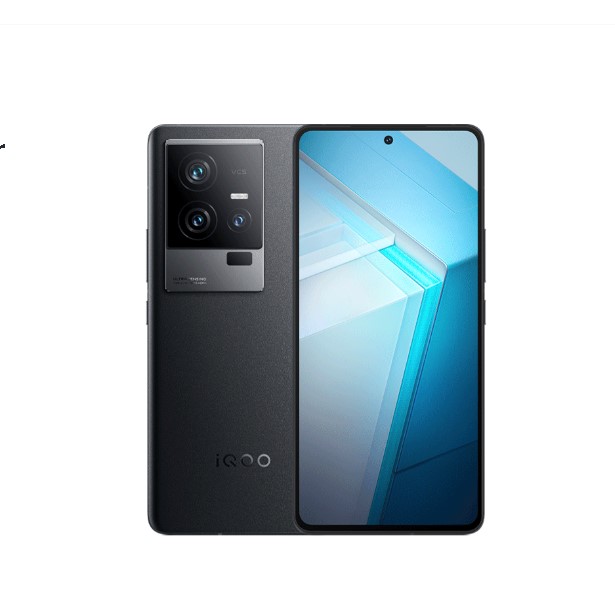
iQOO has launched a new device in the iQOO 11 series that consists of a standard and pro variant. The Vivo sub-brand has introduced a third addition dubbed the iQOO 11S. It sits between the iQOO 11 5G and iQOO 11 Pro 5G. The latest offering packs most of the same specifications as its other two siblings. Read on to know what it offers out of the box.
iQOO 11S specifications and features
The iQOO 11S comes with a flat E4 AMOLED screen measuring 6.78 inches with a center-aligned punch-hole cutout. It offers a 2K resolution, a 144Hz refresh rate, and 1,800 nits peak brightness. The display is integrated with a fingerprint scanner. The smartphone retains the same design as the iQOO 11 Duo with a rectangular camera module on the back panel.
On the imaging front, the iQOO 11S features a triple rear camera setup comprising a 50MP OIS-enabled Sony IMX866 VCS sensor, an 8MP ultra-wide-angle lens, and a 13MP portrait unit. Upfront, there is a 16MP selfie snapper. It comes with a Vivo’s proprietary V2 chip.
Under the hood, the iQOO 11S is powered by a Snapdragon 8 Gen 2 processor. It packs up to 16GB RAM and 1TB UFS 4.0 storage. It features a VC cooling system onboard for heat dissipation. The smartphone is backed by a 4,700mAh battery unit with support for 200W fast charging along with support for UFCS fast-charging protocol. Software-wise, the device runs on Android 13 OS out of the box. The iQOO 11S has an X-Axis Linear Motor, WiFi-7, Bluetooth, NFC, GPS, and 5G.
The iQOO 11S starts at CNY 3,799 (~$526) for the 12GB + 256GB variant. The 16GB + 256GB and 16GB + 512GB are priced at CNY 4099 (~$567) and CNY 4,399 (~$609) respectively. The highest 16GB + 1TB configuration carries a price tag of CNY 4,799 (~$665). The device is up for pre-booking starting today with sales commencing from July 10. It is offered in three colors – Sky Blue, Black, and a BMW Legend Edition.
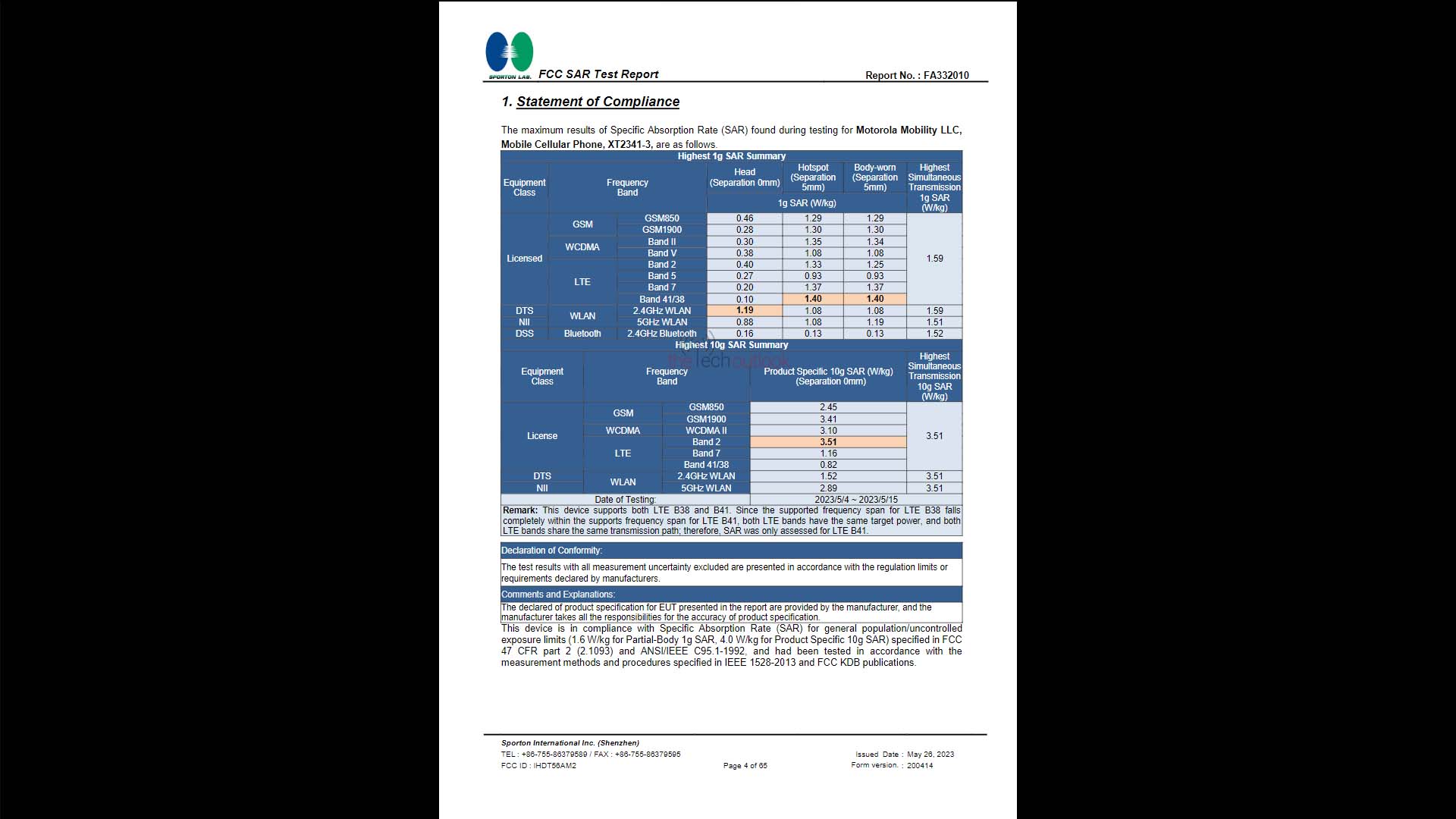
Motorola has recently introduced its latest flip smartphones, the Razr 40 and Razr 40 Ultra, in India. Alongside these premium foldable devices, the brand is also preparing to launch an affordable smartphone called the Moto G14. The Moto G14 is the successor to the well-received Moto G13, which was released in January. The device has obtained FCC certification, indicating that a worldwide release may be imminent.
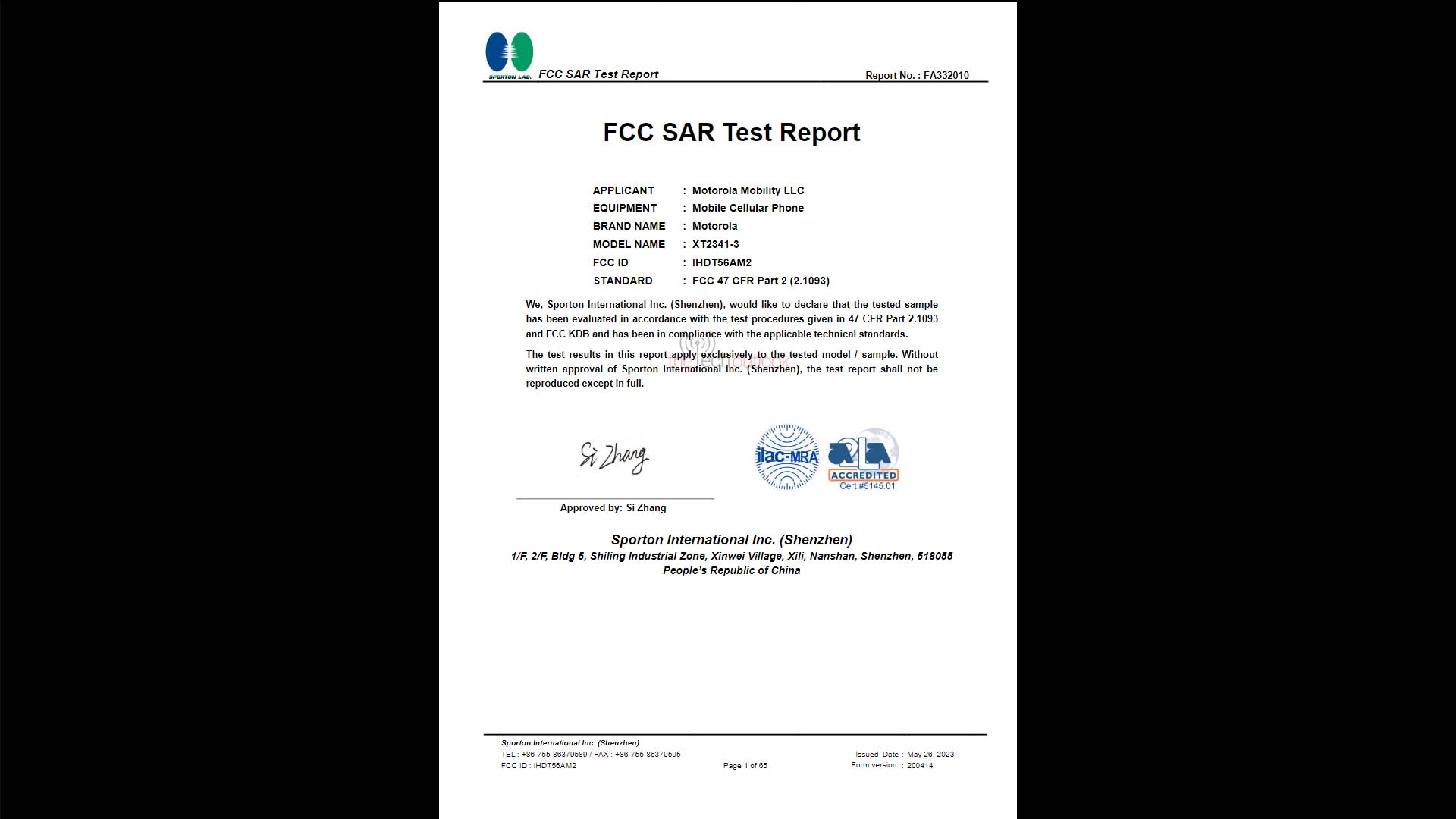
The recently certified device by the FCC bears the model number XT2341-3, which intriguingly matches the model number of the Moto G14 variant spotted on the BIS database in India. The FCC listing provides insights into the Moto G14, confirming that it will be a 4G smartphone supporting 2G, 3G, Bluetooth, Wi-Fi, and NFC. It is expected to run on an Android 13-based operating system, likely to be close to stock Android.
One notable detail from the listing is the charging speed. The Moto G14 with the XT2341-3 model number will come equipped with 20W fast charging. This is noteworthy as the previous Indian variant of the G13 had limited 10W fast charging, while the global model enjoyed 20W fast charging. Since the listing does not disclose additional specifications, we can refer to the spec sheet of the Moto G13 to get an understanding of what to expect from the Moto G14.
Moto G13 specs
The Moto G13 boasts a centered punch-hole LCD display, measuring 6.5 inches with a resolution of 1600 x 720 pixels and a 90Hz refresh rate. It runs on Android 13 and guarantees an upgrade to Android 14, along with three years of security updates.
Under the hood, the Moto G13 is powered by a MediaTek Helio G85 chipset. In terms of photography, it offers a triple camera setup on the rear, featuring a 50MP primary shooter, a 2MP macro lens, and a 2MP depth sensor. The front camera houses an 8MP sensor. Connectivity options include dual SIM support, 4G compatibility, dual-band WiFi, Bluetooth 5.1, and GNSS. The device is equipped with a 5,000mAh battery, but charging is limited to 10W.
Reliance Jio has launched a new feature phone in India. It is dubbed Jio Bharat. The device is the cheapest feature phone with 4G connectivity. The oil-to-telecom conglomerate aims to enable existing 250 million feature phone users with internet-enabled phones. Read on to know what it offers out of the box.
Jio Bharat specifications and features
The Jio Bharat feature phone comes with a 1.77-inch display and a T9-style keypad. It has a 0.3MP VGA rear camera. The device is loaded with a host of features like FM Radio, torchlight, support for 23 languages, headphone jack, etc. The feature phone supports UPI and users can make payments via the JioPay app.
The company says that Jio Bharat offers clear voice quality on calls and wide network coverage across India. The device also features JioCinema and JioSaavn for entertainment purposes like watching movies, sports, and listening to music in multiple languages. The feature phone offers internet browsing with 4G connectivity.
The Jio Bharat is priced at Rs 999 making it the cheapest 4G feature phone in India. It comes in Red and Blue color options. The company has also announced tariff plans for the phone starting at Rs 123 with 23 days validity, unlimited calls, and 14GB of data. There is also an annual plan priced at Rs 1,234 and it offers 0.5 GB data per day and unlimited voice calls. The Jio Bharat feature phone will be available as part of a beta trial starting from 7th July. It will be available across all Reliance and Jio stores across India.
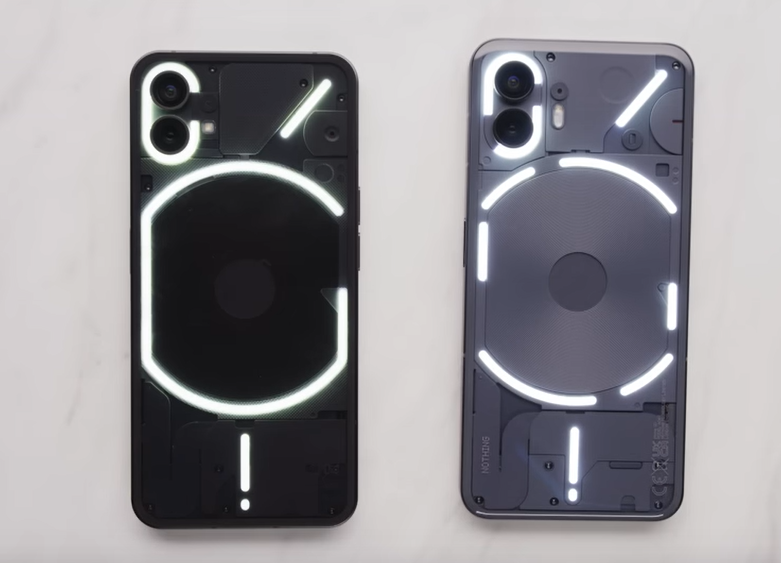
We finally have a first proper look at the Nothing Phone (2) in all its glory. The upcoming device’s entire design was teased in a recent YouTube video, which offers us a glimpse at the various changes and improvements made to its design, especially its Glyph LED interface. So let’s have a look.
Nothing Phone (2) Glyph interface brings new functions & upgrades
Talking about the overall design first, the exclusive MKBHD video compared the Phone (2) with its predecessor, the Phone (1). Here, we can see that there are barely any changes in the dimensions of the smartphone and its design language, which makes sense considering the brand is just starting off. Although, the back is apparently slightly more curved while the front retains the flat display.
The layout of the Glyph LEDs also follows a similar pattern, but there is a big change in the strips themselves and their overall functionality. Previously, the Phone (1) featured 12 different LED lighting zones that were controlled by the software. Now, the Phone (2) offers a much higher 33 zones. Out of these, 16 alone are housed in the arc LED strip situated on the center-right.
This was to add a bunch of features to this LED strip. It is now capable of doubling as a volume indicator, indicates a countdown timer, and will even support Uber and Zomato in the future with the light indicating the distance of your cab/food delivery. MKBHD showcased new customization options as well, with the top right LED strip now lighting up when a particular app notification is set to be highlighted. Lastly, the Swedish House Mafia-made Glyph composer can also be seen in action, which allows you to create your very own ringtone.
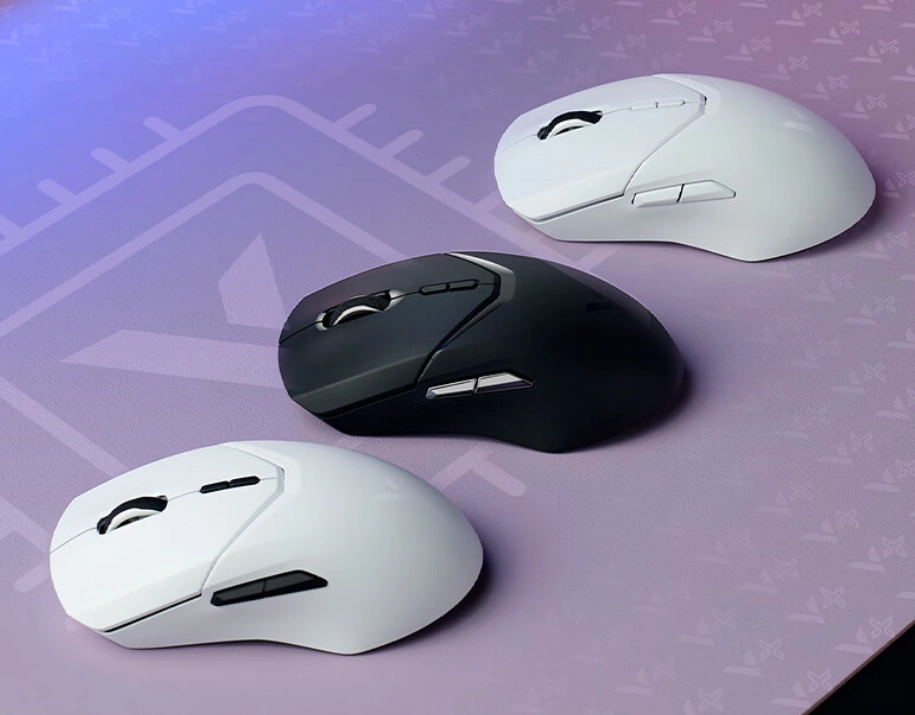
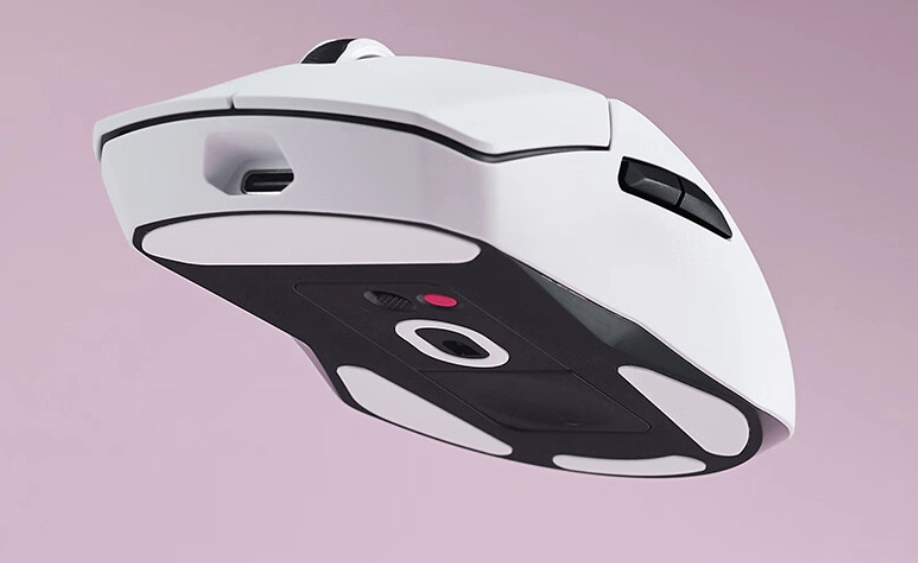
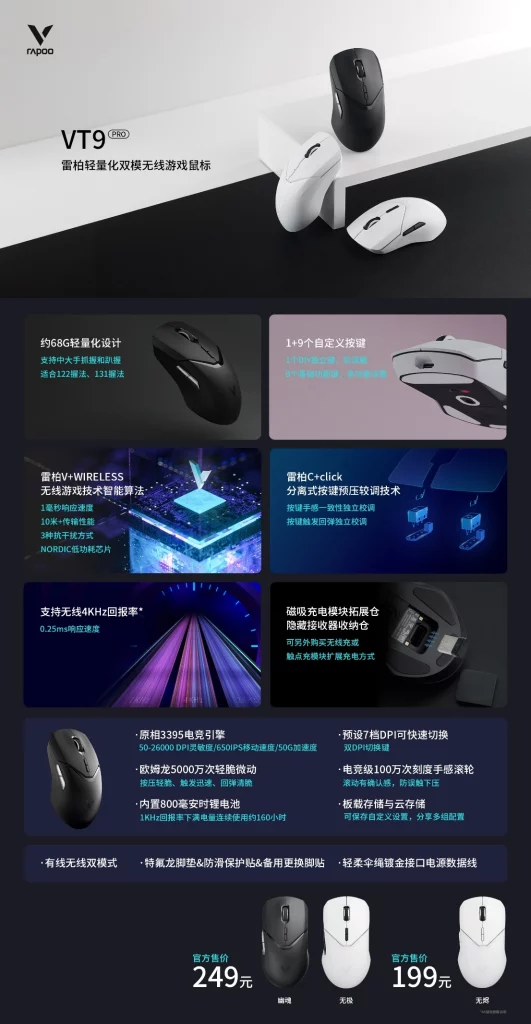
Rapoo has launched the VT9 PRO dual-mode wireless gaming mouse, with prices starting from 199 yuan ($27). The new mouse features a lightweight design, weighing only 68 grams. It boasts a customizable DPI with adjustable buttons, offering 1+9 programmable buttons for personalized configurations. The mouse is equipped with Omron switches that provide crisp and tactile feedback with a lifespan of 50 million clicks and a gaming-grade scroll wheel with a 1 million times scale.
Gaming-Grade Performance for Competitive Advantage
The VT9 PRO is powered by the Avago 3395 esports optical engine, capable of reaching a maximum DPI of 26,000. It offers a tracking speed of 650 IPS and an acceleration of 50G, ensuring precise and responsive movements. With a 1000Hz polling rate, the mouse delivers a highly smooth and accurate user experience.
In terms of connectivity, this mouse supports both wireless and wired modes. It features V+Wireless gaming technology, allowing for a wireless transmission range of up to 10 meters. It incorporates an onboard antenna, adaptive signal enhancement, and frequency-shifting technology to resist interference and ensure stable and reliable connectivity.
The Rapoo VT9 PRO is equipped with an 800mAh lithium battery, boasting a battery life of up to 160 hours. It also offers the option of wireless charging or contact charging with separately available modules for added convenience.
The mouse is available in three color options: Ashes, Phantom, and Infinity. The Ashes edition is priced at 199 yuan ($27), while the Phantom and Infinity editions are priced slightly higher at 249 yuan ($34). A few weeks back, Rapoo also introduced the VT950 Pro gaming mouse featuring an OLED display.
Xiaomi is gearing up to launch its new Xiaomi 13T series of smartphones in the market soon. But prior to their release, there have already been leaks regarding these devices. And now, a new sighting at the IMDA certification hints at the 13T Pro‘s upcoming launch.
Xiaomi 13T Pro spotted on IMDA
For those unaware, the Chinese tech giant is gearing up to launch the 13T and 13T Pro smartphones. The latter is the higher-end model, which was spotted on the IMDA certification website carrying the model number 23078PND5G (Via TechOutlook). This listing reveals that the device will support Bluetooth, WiFi, and NFC connectivity, which isn’t groundbreaking information. However, such a listing does hint that the Xiaomi 13T Pro’s launch isn’t too far off.
Just a couple of days ago, the UK pricing of the device and its launch date was leaked on Amazon. The smartphone would apparently cost around £799, which is about £100 higher than the £699 price tag of its predecessor. Apart from this, another leak also hinted at some of its key specifications as well. The Xiaomi 13T Pro will reportedly be equipped with the MediaTek Dimensity 9200+ SoC that will be paired with up to 12GB of RAM and 512GB of internal storage.
The device will likely run on Android 13 OS based MIUI 4 out of the box as well. Under the hood, a large 5,000mAh battery pack is expected to power the device, which might support 120W fast charging as well. So stick around for more as we will be offering updates when additional information is available regarding this device.
The iQOO Neo 7 Pro has been officially unveiled in India. This high-end smartphone was highly anticipated in the region, with a number of rumors and reports circulating ahead of its launch. So now, here are the official specs, pricing, and other key details.
Design, Color, & Display
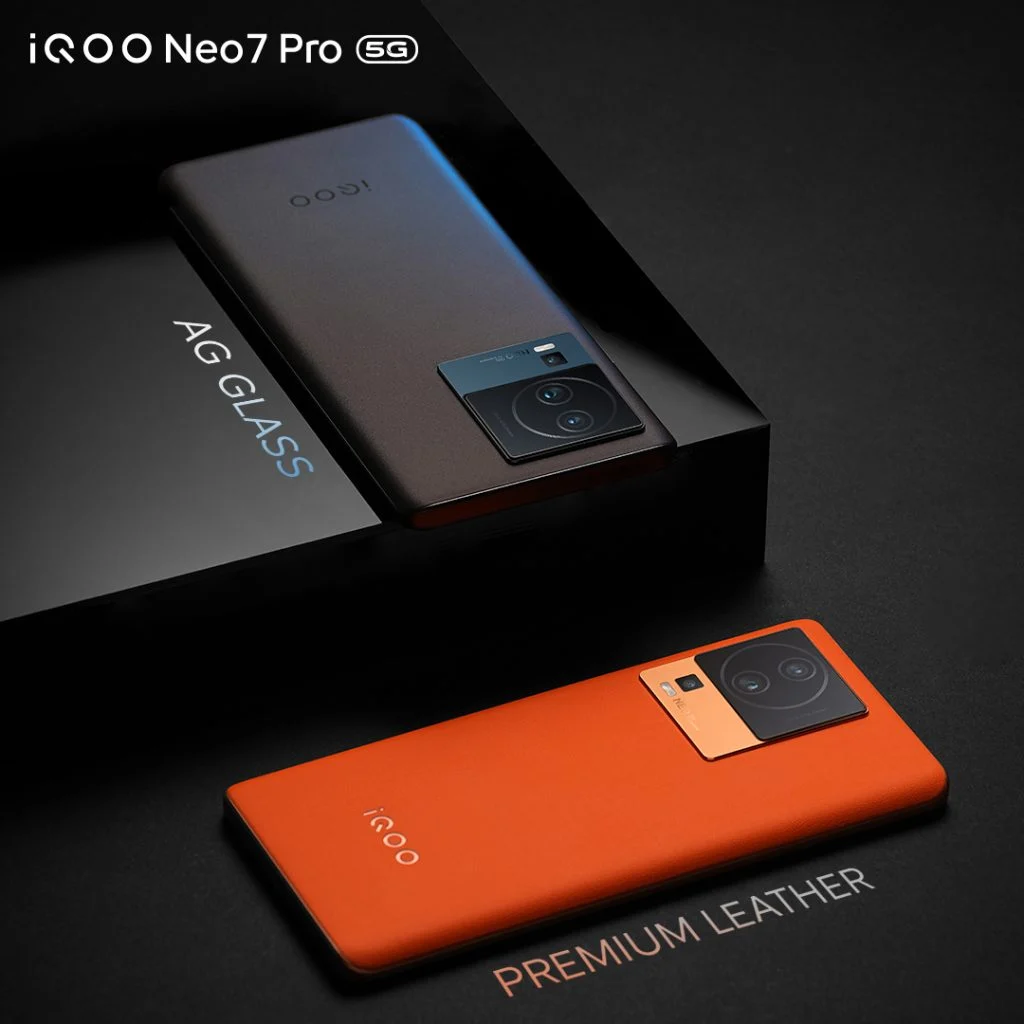
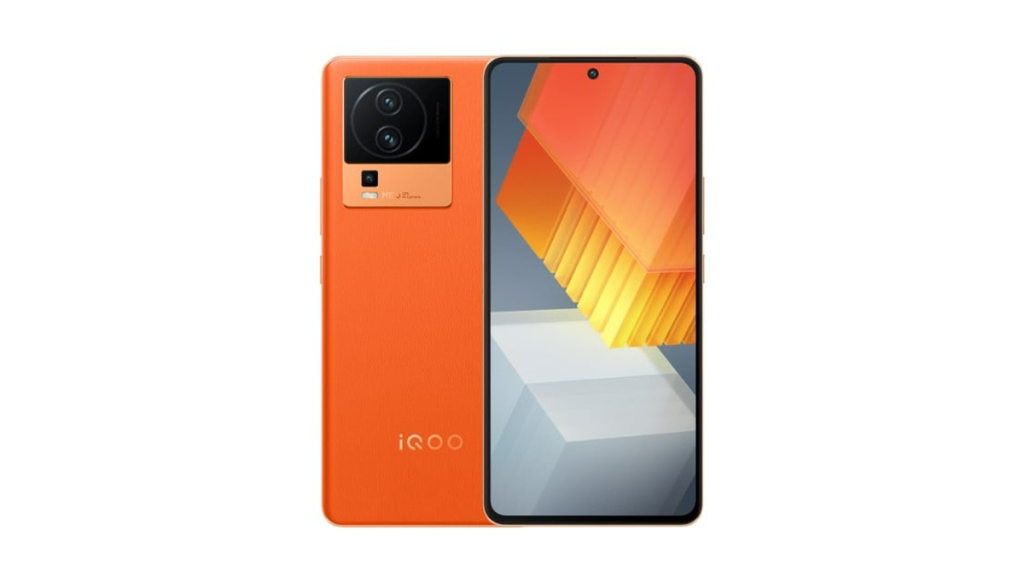
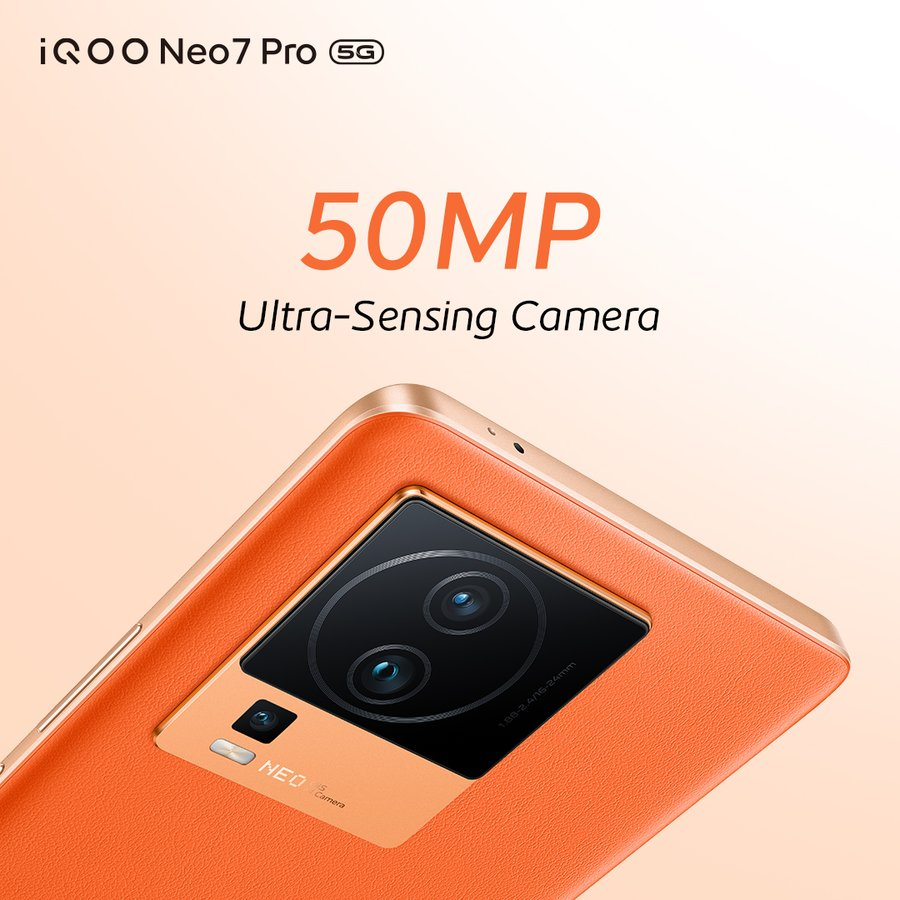
The Neo 7 Pro model features a design that is quite similar to the Chinese smartphone maker’s existing Neo 7 Racing Edition handset. It arrives with a curved back panel that also has a large rectangular camera island in the top left corner. Here, you can find three image sensors and the LED flash module.
The iQOO Neo 7 Pro will be available in two color variants, which also feature different rear panels. The first is the Dark Storm model that features the AG Glass coated back, while the second is the Fearless Flame variant that has a faux leather back. This adds another element of a premium feel to the new smartphone.
Meanwhile, the front sports a tall 6.78-inch E5 AMOLED flat display. This panel has a center-aligned punch hole cutout for the selfie camera and offers Full HD+ resolution. It even offers a 120Hz high refresh rate, HDR10+ support, an in-display fingerprint scanner, and an impressive 1,500 nits of peak brightness. The Neo 7 Pro also houses a dedicated chip for display optimizations for gaming and more.
Specifications
The iQOO Neo 7 Pro is equipped with the Qualcomm Snapdragon 8+ Gen 1 SoC. While this chip isn’t exactly cutting edge in 2023, it has been very popular in affordable flagship phones that have been launching at a competitive price point this year. This processor is also barely a year old and is still quite capable, with its AnTuTu benchmark results crossing 1.3 million points.
This chipset will be paired with another independent gaming chip that will seek to optimize gaming performance to ensure a smoother gameplay experience. This will be made possible thanks to the chip ensuring consistently high framerates. Furthermore, the device will also be offered with up to 12GB of LPDDR5 RAM and 256GB of UFS 3.1 storage. Under the hood, a large 5,000mAh battery pack powers this device, which supports 120W fast charging.
With just 8 minutes of charging, the iQOO Neo 7 Pro can apparently reach 50 percent charge. The company is also offering a robust cooling mechanism to ensure that the beefy specs remain cool. The device will house a VC cooling system for improved heat dissipation. It will also run on Android 13 OS based Funtouch OS 13 out of the box.
Camera
The iQOO Neo 7 Pro features a triple camera setup on the rear. This module includes a 50 megapixel Samsung ISOCELL GN5 primary image sensor that features Optical Image Stabilization (OIS). This will be paired with an 8 megapixel ultra wide angle sensor as well as a 2 megapixel shooter. On the other hand, the front houses a 16 megapixel selfie camera in the punch-hole cutout.
Pricing & Availability
The iQOO Neo 7 Pro has just been launched for a starting price tag of 34,999 INR for its 8GB + 128GB model. The more expensive 12GB + 256GB model will cost 37,999 INR. iQOO will release the device for sale starting on July 15 during the Amazon Prime Day Sale. YOu can also get an instant 2,000 INR discount with the ICICI Bank and SBI Bank cards on both models and there is even a 1,000 INR discount for early buyers as well. In other words, you can effectively bring the price of this device down to just 31,999 INR.
Last year, when the Apple MacBook Air 13-inch model was launched, the laptop came with support for Bluetooth 5.0 connectivity out-of-the-box. That has now changed, based on the official specs listed on the company’s website.
As per the listing of the 13-inch MacBook Air on the Apple website, the device now has support for the newer Bluetooth 5.3 connectivity, which is said to be faster and more reliable.
The development comes after the Cupertino-based technology giant introduced the new 15-inch MacBook Air laptop with support for Bluetooth 5.3 at WWDC last month.
Thanks to the latest standard, the device will now have more reliable connections with Bluetooth accessories and improved power efficiency, which can contribute to longer battery life.
Bluetooth 5.0 is now a bit older technology, launched back in 2016. On the other hand, Bluetooth 5.3 was introduced in 2021 and a lot of Apple devices use it, including the iPhone 14 series, Apple Watch Ultra, AirPods Pro (2nd Gen), and the latest iPad Pro models.
The 13-inch MacBook Air also comes with a new 70W USB-C power adapter, similar to the 15-inch model. Recently, Apple expanded its self-repair program to include M2-powered MacBooks and the iPhone 14 lineup.
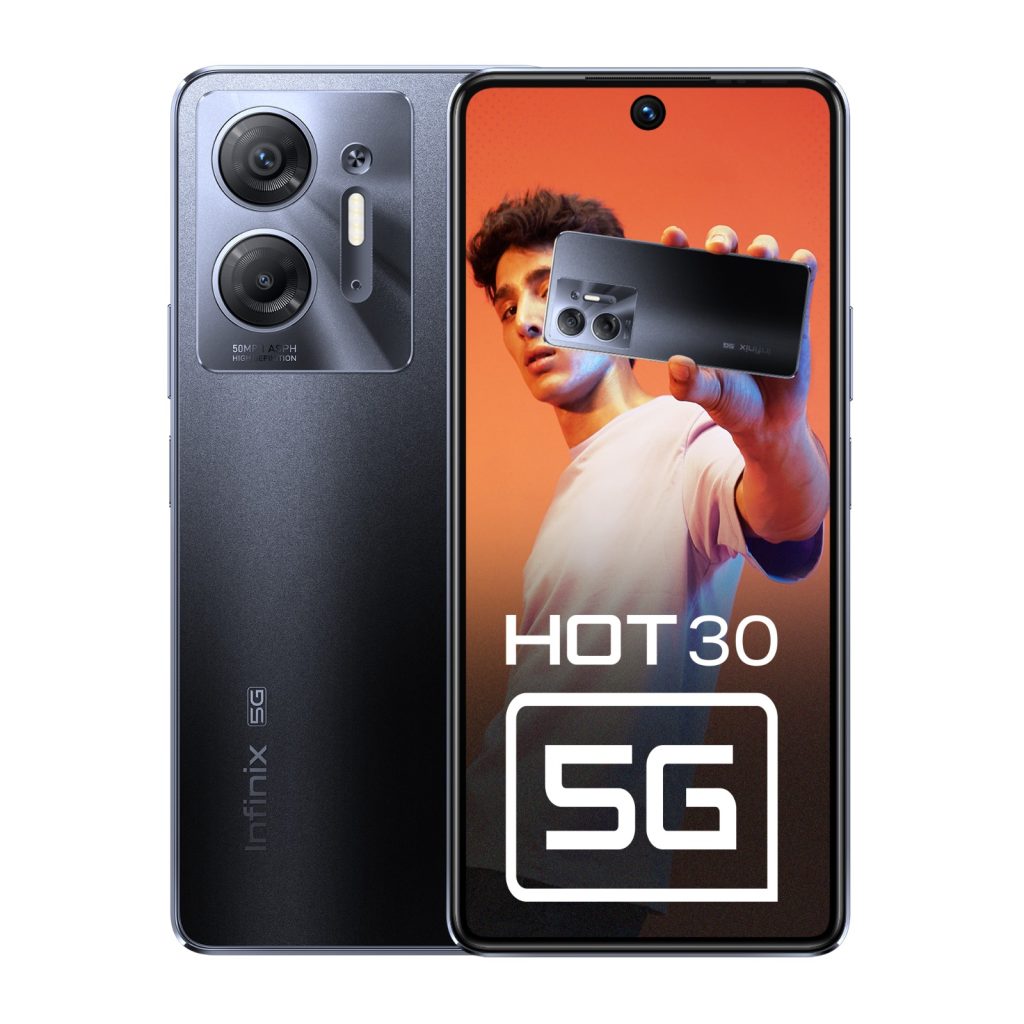
Earlier this year, the Infinix Hot 30 was launched with a 4G enabled chipset. However, we already know that the company is gearing up to unveil a new 5G variant of this device. Now, we have the official launch date of the Hot 30 5G model as well as some of its key specifications.
Infinix Hot 30 5G to launch in India on July 14
Just yesterday, we had covered a new leak, which revealed the renders of the upcoming smartphone. This report even hinted at its July 14 launch, which has finally been confirmed. Apart from this, even the leaked renders were accurate as well since have an official render as well. Furthermore, it has also been confirmed that the device will launch in at least two color options, namely Aurora Blue and Knight Black.
It is unclear if the Miami Orange model, which features a faux leather back panel, will be released in the market as well. Talking about some of its confirmed specs, the new Infinix Hot 30 5G will be powered by a large 6,000mAh battery. In other words, you should easily be able to use the device for an entire day.
Other notable features include, 580 nits of peak brightness on its display and IP53 rating for protection. The device is also believed to offer a premium design for its budget price point and is expected to be priced around the 10,000 to 15,000 INR price range. Previous reports have hinted that the device will feature 33W fast charging and a 50 megapixel dual camera setup on the rear.
Hidizs, a brand known for making premium audio products at an affordable price, is back with another groundbreaking release just two months after the unveiling of their flagship HiFi In-Ear Monitors, the MS5 Dark Angel. The brand has launched its second flagship model, the Hidizs MS3 HiFi In-Ear Monitors.
The MS3 features a lightweight aviation aluminum alloy housing, precision-cut and carved to perfection. The ergonomic design conforms seamlessly to the contours of the human ear, ensuring a comfortable and secure fit. The panel of the MS3 showcases a captivating flame-like shape achieved through three-dimensional fine carving technology and anodizing treatment. Not only does it exude a sense of dynamism, but it also boasts a unique visual identity that sets it apart.
Under the hood, the Hidizs MS3 is powered by a 10.2mm diameter dynamic driver boasting dual magnetic circuits and dual cavities, an innovation developed exclusively by Hidizs. The diaphragm, constructed from a bio-nanofiber composite material, delivers exceptional acoustic performance. This advanced driver design, with its dual magnetic circuits and cavities, enhances the magnetic flux, resulting in improved transient response and higher electro-acoustic energy conversion efficiency. As a result, the MS3 delivers powerful, yet flexible low frequencies, while offering crystal-clear midrange and vocal reproduction. The dual magnetic circuits and cavities work in perfect harmony, creating an immersive and delightful sonic experience.
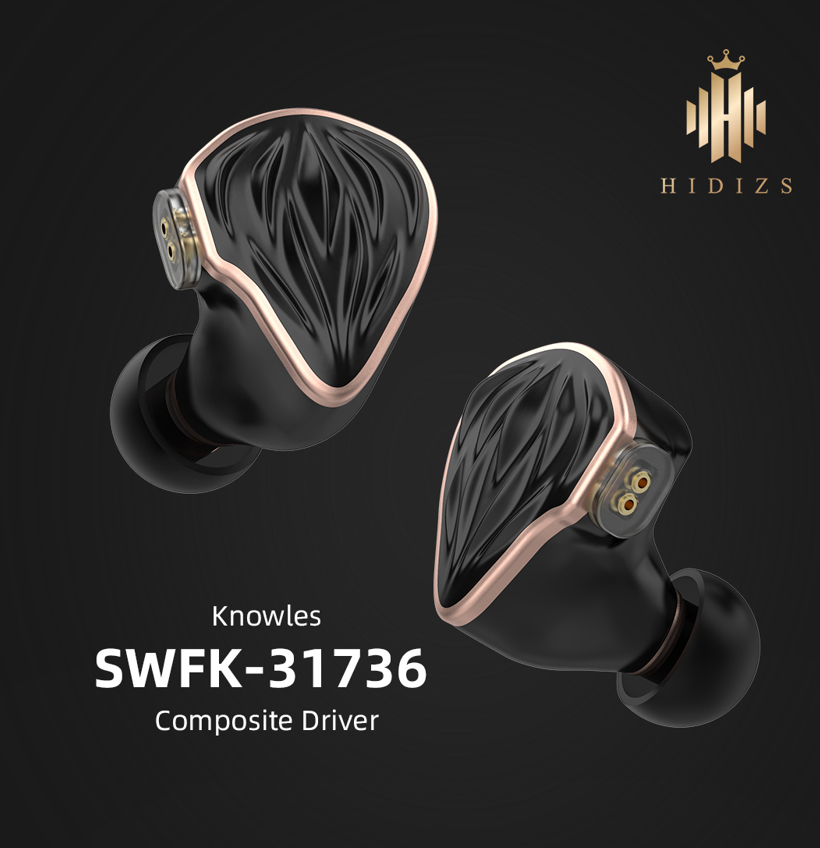
To complement the dynamic driver, the MS3 incorporates an enduring Knowles SWFK-31736 composite balanced armature driver. Consisting of two independent balanced armature drivers, this composite configuration handles the high and extremely high frequencies with precision. The Knowles SWFK-31736 imparts high resolution, clarity, and excellent ductility enabling the MS3 to reproduce the finest details and emotions with breathtaking accuracy.
Hidizs has also meticulously redesigned the crossover point within the earphone and implemented tantalum capacitors for enhanced accuracy. These capacitors offer higher frequency response and lower Equivalent Series Resistance (ESR), resulting in cleaner, more precise sound reproduction.
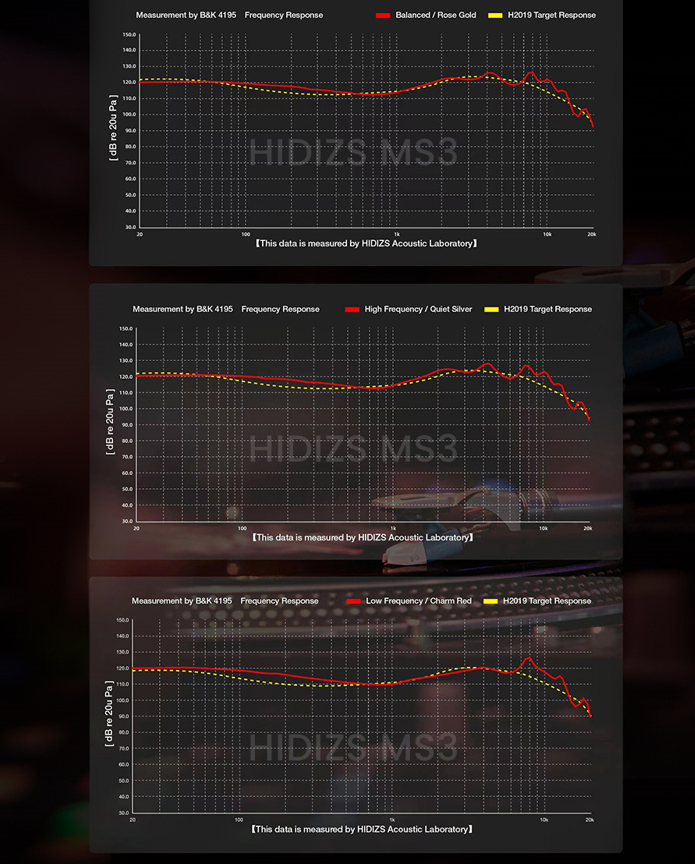
The MS3’s frequency response curve has been fine-tuned by the expert acoustic engineers at HAL (Hidizs Acoustic Laboratory), utilizing G.R.A.S artificial ear and human torso model data calibration. This careful calibration ensures that the MS3 adheres to the H-2019 standard target curve, delivering excellent frequency response characteristics. With an effective frequency response range reaching the Hi-Res standard of 20Hz-40kHz, the MS3 offers excellent resolution, extended treble, and an expansive soundstage.
The MS3 comes complete with a range of accessories to enhance your listening pleasure. With nine varieties of skin-friendly silicone eartips, you can find the perfect fit for your ears. The MS3 supports Hidizs’ innovative Pneumatic Sound Tuning Filter technology, providing three classic pneumatic sound tuning filters. Additionally, it is compatible with third-party standard sound tuning filters, allowing you to fine-tune your audio to your preferences. The 0.78mm 2-pin plugs enable easy cable interchangeability, and the MS3 supports third-party upgrade cables for those seeking to take their audio experience to new heights. It is a truly customizable HiFi In-Ear Monitor, tailored to meet your individual needs.
Don’t miss out on the worldwide launch of Hidizs MS3 HiFi In-Ear Monitors on July 4, 2023! For a limited time until July 17th, you can grab these earphones at an incredible price of only $113.00, saving a whopping $56.00.
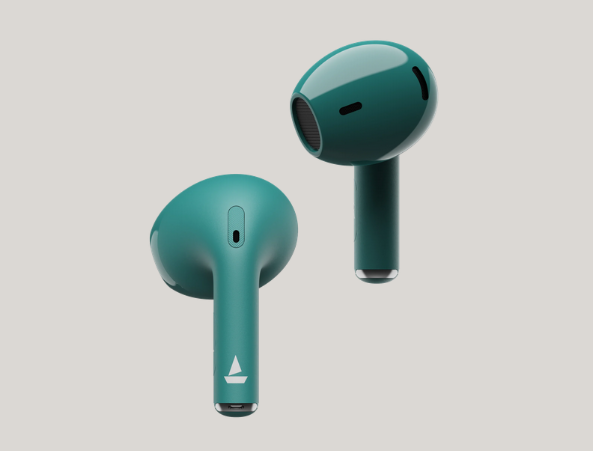
boAt has just unveiled a new affordable pair of truly wireless earbuds in the Indian market. The latest model is a part of its popular Airdopes series and is dubbed the Airdopes Alpha. It has been launched as a budget offering with capable specs, so here are all the details.
boAt Airdopes Alpha Specifications & Pricing
The company’s new Airdopes Alpha house large 13mm drivers that will offer its Signature Sound technology. Meaning, it promises clarity and punchy bass. The earbuds also feature ENx technology, which basically improved call quality thanks to its dual mic setup. This TWS model supports Bluetooth 5.3 and even offers touch controls as well. It features a semi in-ear design as well.
The boAt Airdopes Alpha can offer up to 35 hours of audio playback and supports fast charging as well. Just 10 minutes of charging can offer up to 2 hours of playback. Other notable features include BEAST Mode that lowers the latency down to just 50ms, IPX5 splash resistance, 300mAh battery on the charging case and 35mAh on the earbuds. Notably, the launch of these earbuds arrives just days after the boAt Lunar Connect Ace smartwatch was announced in the region.
The Airdopes Alpha will go on sale tomorrow (5th July 2023) and can be purchased from the company’s official website or Flipkart. It has an introductory price tag of just 799 INR and comes with a 1 year warranty period. Furthermore, the wireless earphones will be offered in multiple color options, namely Jet Black, Swedish White, and Dark Cyan.
Understanding the intricacies of our own Milky Way galaxy has been a challenge for astronomers. The vastness of space makes it unrealistic to send probes outside the Milky Way to observe its entirety. However, scientists have found alternative methods to study our galaxy indirectly and gain valuable insights into its structure and evolution. One approach is to observe similar galaxies around us. According to the principles of cosmology, the universe is uniform and isotropic, implying that celestial bodies like stars and galaxies are not unique if placed within the broader universe. By studying other galaxies that share similarities with the Milky Way, astronomers can build models that capture the evolution process of our galaxy.
Observing the Andromeda Galaxy can help us understand the Milky Way
In this pursuit, the Andromeda Galaxy (M31) plays a significant role. It resides in the local group of galaxies, close to the Milky Way, and bears a striking resemblance to our galaxy. The overall outline and internal spiral structure of the Andromeda Galaxy mirror those of the Milky Way. Recent discoveries even suggest that it has a bar-shaped core, indicating a possible similarity in being a barred spiral galaxy like our own.
Furthermore, the outer halo of the Andromeda Galaxy, with its metal-poor “old” stars, shares similarities with the Milky Way. This suggests a comparable evolutionary process where both galaxies gradually grew to their present scale by incorporating numerous surrounding dwarf galaxies over billions of years.
In addition to the Andromeda Galaxy, astronomers have also caught a glimpse of the “Milky Way” in its early stages. Images captured by the Webb telescope depict a distant galaxy with a redshift of 1.378, viewed approximately 4 billion years after the Big Bang. The galaxy appears elongated, surrounded by bright spots, which are actually ancient globular star clusters comprised of millions of stars. This galaxy has been aptly named “sparks” due to the dazzling fireworks-like display created by these star clusters.
Through the analysis of metal elements and evolution models, astronomers have inferred that this galaxy, referred to as the Spark Galaxy, bears a strong resemblance to the Milky Way during its infancy. At that time, it only constituted 3% of the mass of today’s Milky Way and was actively assimilating surrounding satellite galaxies and globular clusters. It is estimated that in another 9 to 10 billion years, it will reach the mass of today’s Milky Way.
This “young mirror image” of the Milky Way provides a treasure trove of information for astronomers, aiding in the study of our galaxy’s evolution. It offers a rare glimpse into the appearance and behavior of the Milky Way during its early years, which were previously only theoretical. One intriguing puzzle it helps address is the origin of globular clusters. By studying the globular clusters in the Spark Galaxy, scientists can gain insights into their age and formation, shedding light on the mysteries surrounding these clusters in the Milky Way.
It is currently believed that both globular clusters and early galaxies originated from primordial gas clouds, such as high-density neutral hydrogen clouds, in the universe. While galaxies are more complex in composition, star clusters are relatively simpler. This explains why some globular clusters contain older stars than the galaxies they reside in.
Twitter has been grappling with a series of issues lately, but that’s nothing new in terms of news. This left many users frustrated and seeking alternatives. The problems began when the platform started imposing limits on the number of daily posts users could view, causing widespread disruptions. Despite some improvements over the weekend, one important casualty of the ongoing troubles has been TweetDeck, which has remained problematic for users unless they switch to the beta version. In an effort to address these issues head-on, Twitter has now unveiled an enhanced version of TweetDeck.
In 30 days, users will have to be verified to use TweetDeck
The new update is still referred to as the “TweetDeck Preview” within the app itself. Users must actively opt-in to utilize the new version by accessing the menu in the original TweetDeck interface. However, once users make the switch, they will indeed regain access to basic TweetDeck functionality, particularly the invaluable list aggregation features. Twitter assures users that the transition process should be relatively simple, with saved searches, lists, and columns seamlessly carrying over. Additionally, the updated preview build now supports previously missing features such as Twitter Spaces and polls, although Teams functionality is currently unavailable.
While Twitter has not yet officially announced the retirement of the old version of TweetDeck, a Twitter employee hinted at the change being permanent in a discussion thread, stating that they were in the process of “migrating everyone to the preview version.”
Nevertheless, despite the potential resolution offered by the new TweetDeck version, many long-time users may find themselves at a loss in the near future. According to Twitter Support, access to the power-user tool will soon be limited to Twitter Blue subscribers. They emphasized that “in 30 days, users must be Verified to access TweetDeck.” It remains uncertain whether this change will be implemented for all users in early August or if there will be a 30-day trial period before users are prompted to subscribe to the new version of Tweetdeck.
As Twitter continues its efforts to address the ongoing issues and refine TweetDeck, users may need some time to adapt to the evolving landscape of the platform.
In a shocking revelation, renowned security company Wordfence has recently uncovered a critical zero-day vulnerability in the widely used “user login system” plug-in, Ultimate Member, on the WordPress blogging platform. This vulnerability allows hackers to exploit their accounts and gain elevated administrative rights, effectively granting them full control over targeted websites.
200,000 websites have used the plugin until now
The security flaw, identified as CVE-2023-3460, has been assigned a risk score of 9.8, indicating its severity. Through this vulnerability, cybercriminals can circumvent the plug-in’s built-in security measures, enabling them to manipulate the wp_capabilities configuration data of user accounts. By setting up their own accounts as administrators, hackers can assume complete control of compromised websites.
The plug-in’s developer has responded swiftly to address the issue. On June 26, they released Ultimate Member version 2.6.3, which provided partial mitigation against the vulnerability. Subsequently, on July 1, version 2.6.7 was released, offering a complete fix for the security flaw.
Disturbingly, it has come to light that over 200,000 WordPress websites have incorporated the Ultimate Member plug-in. Given the high number of installations and the potential delay in updating the plug-in due to inadequate information dissemination, these websites remain exceptionally vulnerable to exploitation by malicious actors.
Web administrators and website owners are strongly advised to take immediate action by updating their Ultimate Member plug-in to the latest version, 2.6.7, to safeguard their websites against potential attacks. Additionally, it is crucial to remain vigilant and monitor any suspicious activity or unauthorized access attempts.
Experts emphasize the significance of promptly addressing software vulnerabilities and staying up-to-date with the latest security patches. Regularly updating plug-ins and software is an essential practice that ensures website integrity and safeguards against emerging cyber threats.
Hyundai is considering establishing a second electric vehicle (EV) manufacturing facility in North America, and Canada is among the potential locations being explored, according to Automotive News. The South Korean automaker aims to expand its footprint in the all-electric vehicle sector and capitalize on the growing demand for EVs in the region. Hyundai Auto Canada’s CEO, Don Romano, revealed that the company is in discussions about its “step two” EV plans for North America, and Canada is a key part of that conversation. Talks have already taken place with Canadian officials, alongside engagement with government representatives from the United States and Mexico. Hyundai is actively seeking opportunities to boost its EV production capacity in line with its ambitious growth targets for the next decade.
The company’s previous plant was shut down in the year 1995
To strengthen the case for Canada, François-Philippe Champagne, Canada’s Minister of Innovation, Science, and Industry, met with Hyundai officials during a trip to South Korea. On his official Twitter account, Champagne pledged to work together with Hyundai to expand and collaborate in the EV and critical minerals sectors. Industry experts support Canada’s bid to become an EV manufacturing hub, citing the country’s battery plants, technological expertise, and skilled workforce. Sam Fiorani, vice-president of global vehicle forecasting at AutoForecast Solutions, noted that Canada’s push for an EV future aligns with the industry’s trajectory and offers significant advantages for Hyundai’s expansion plans.
If Hyundai chooses Canada for its second North American EV factory, it would mark the brand’s second venture in the region. Hyundai previously established an assembly plant in the area in 1989, but due to lower-than-expected sales, it was temporarily halted in 1993 and ultimately shut down in 1995.
With its existing manufacturing facilities in the United States, including the recently announced EV factory in Georgia, Hyundai aims to solidify its position as a leading player in the North American EV market. Canada’s favorable conditions and government support make it an attractive prospect for Hyundai’s expansion plans. The company is already making record sales in the United States, and this is just another step in the right direction.
In an exciting announcement on July 4th, BYD’s new sub-brand, Fang Leopard, officially revealed that their inaugural model would be called the “Leopard 5.” This vehicle, which focuses on “personality,” aims to make a bold statement in the automotive market. Previously known by its internal code name SF, the Leopard 5 was initially positioned as a hardcore off-road electric vehicle, aiming to rival the renowned Mercedes-Benz G-Class. Spy photos of the car, covered in camouflage, have surfaced multiple times, piquing the curiosity of enthusiasts. Notably, the car featured the mysterious numbers 2316 or 2318, leading industry experts to speculate that it may boast dual motors, three differential locks (front, middle, and rear), and an impressive battery range of 1000 kilometers. The expected release date falls between June and August.
The car is expected to be priced between $55,275 and $82,913
Adding to the excitement, news emerged in late June about BYD’s forthcoming hybrid system, the DM-o. Following the success of the DM-i and DM-p hybrid technologies, the DM-o marks another milestone for BYD as it solidifies its position as a leader in plug-in hybrid platforms. The hybrid system incorporates the core technical advantages of its predecessors, offering a comprehensive battery range of 1,200 kilometers and a remarkable maximum power output of over 500 kilowatts.
Internal sources indicate that the Leopard 5 might feature a non-load-bearing body structure, along with BYD‘s cloud car-p intelligent body control system. Furthermore, it is expected to be equipped with the innovative DM-o hybrid platform. The anticipated price range for the Leopard 5 is between 400,000 and 600,000 yuan, with plans to commence official deliveries later this year.
As BYD’s sub-brand Fang Leopard sets its sights on the automotive market, the launch of the Leopard 5 promises a thrilling new avenue for car enthusiasts seeking a blend of personality, advanced technology, and exceptional performance. With its anticipated features and competitive pricing, the Leopard 5 is poised to make a strong impression and potentially disrupt the luxury off-road segment. Automotive enthusiasts eagerly await further updates from BYD and Fang Leopard as they embark on this exciting new venture.
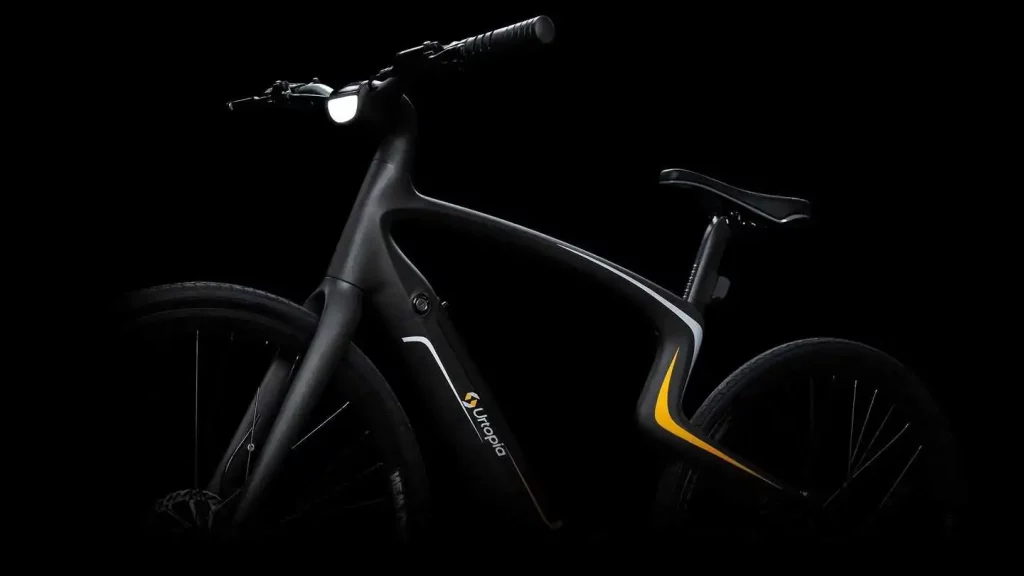
At this point, everyone knows what ChatGPT is. The popularity of the chatbot has been on a constant rise, and for all the right reasons, since it is one of the best conversational AI bots out there right now. AI has become an indispensable part of our modern existence, getting integrated into various industries and unlocking new capabilities. From content creation to language processing, AI tools are everywhere. But what about electric bicycles? Urtopia Fusion, the latest e-bike from the renowned brand Urtopia, seamlessly incorporates ChatGPT as a defining feature of the e-bike.
The AI analyzes the e-bike’s riding capabilities to enhance efficiency on long rides
Dubbed a “bicycle with a mind” by Urtopia, the Fusion is built on a fusion of art and technology. On the technological front, OpenAI‘s ChatGPT allows riders to enjoy an immersive and interactive riding experience, just like conversing with an onboard assistant. With this integration, users can effortlessly request directions and engage in natural conversation while on the move. This electric bike feels like something out of the near future.
While the idea of an e-bike with an AI-powered mind might raise a few eyebrows, it’s essential to understand how ChatGPT functions. ChatGPT is designed to enhance the user experience without compromising safety or control. Beyond the ChatGPT integration, the Urtopia Fusion seamlessly integrates with other applications such as Apple Health and Strava. This integration further caters to health-conscious individuals, offering comprehensive ride-tracking capabilities. Furthermore, the built-in AI analyzes this data in real time, fine-tuning the bike’s settings to maximize efficiency while on long rides.
Urtopia’s Fusion represents a significant step forward in the e-bike industry, revolutionizing the way riders interact with their bikes. By merging cutting-edge technology with the joy of cycling, the company seems to have crafted a masterpiece that brings together innovation and human experience.
Instagram has been working on a Twitter competitor named Threads, which was leaked a few weeks back. Now, it appears the company is all set to launch it in the coming days or weeks officially.
The official Instagram Threads application from Meta is now available for pre-order on Apple’s App Store, indicating that the launch is imminent.
While the company has not yet revealed the launch date, the listing on the App Store reveals that the application could get launched on 6th July, in just a couple of days. It is being said that Instagram Threads will integrate with the decentralized social media protocol used by Mastodon, called ActivityPub.
The official description of the application on the App Store listing reads: “Threads is where communities come together to discuss everything from the topics you care about today to what’ll be trending tomorrow. Whatever it is you’re interested in, you can follow and connect directly with your favorite creators and others who love the same things — or build a loyal following of your own to share your ideas, opinions and creativity with the world.”
It remains to be seen if the company will adopt a slower rollout for users, which is more likely to happen. So, while the app may be available for download from the 6th of July, not everyone will be able to post on the platform from that date.
Twitter has been facing a lot of issues with the platform, especially after its acquisition by Elon Musk. While there were issues with the content moderation policies, the platform has had a lot of technical problems over the past few weeks. Given Twitter’s condition these days, it looks like a perfect time to launch a competing product.
We use cookies on our website to give you the most relevant experience by remembering your preferences and repeat visits. By clicking “Accept”, you consent to the use of ALL the cookies.
This website uses cookies to improve your experience while you navigate through the website. Out of these, the cookies that are categorized as necessary are stored on your browser as they are essential for the working of basic functionalities of the website. We also use third-party cookies that help us analyze and understand how you use this website. These cookies will be stored in your browser only with your consent. You also have the option to opt-out of these cookies. But opting out of some of these cookies may affect your browsing experience.
Necessary cookies are absolutely essential for the website to function properly. This category only includes cookies that ensures basic functionalities and security features of the website. These cookies do not store any personal information.
Any cookies that may not be particularly necessary for the website to function and is used specifically to collect user personal data via analytics, ads, other embedded contents are termed as non-necessary cookies. It is mandatory to procure user consent prior to running these cookies on your website.