Advertisement

Samsung Galaxy A54, A34 Official Renders Leak Before Launch

Earlier today, Samsung revealed that it will be holding its first ‘Unpacked’ event of 2023 on February 1. Though the company hasn’t disclosed it officially, we all know that the conference is meant for the Galaxy S23 series.

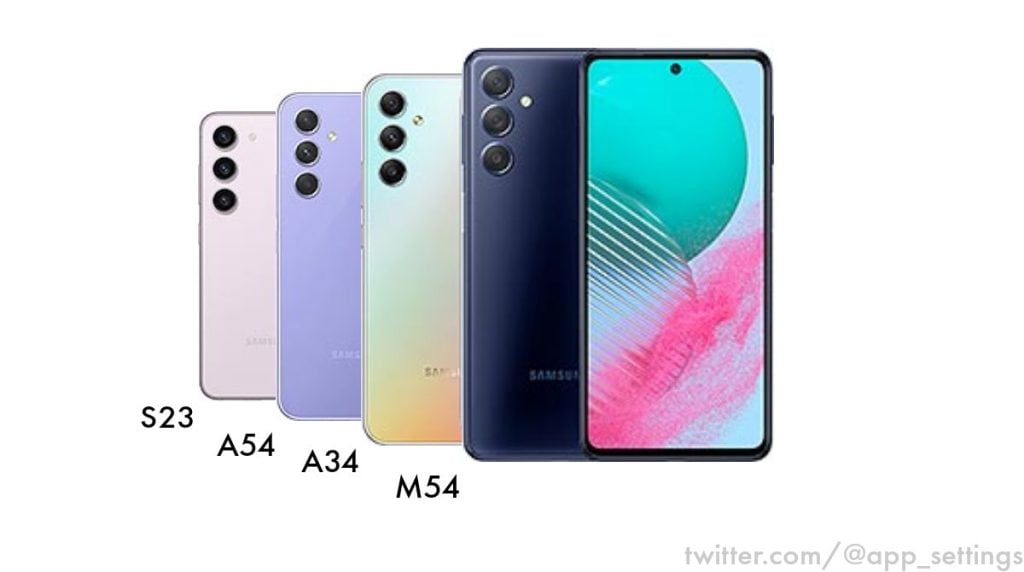
This event is expected to be followed by yet another ‘Unpacked’ conference for the next-gen Galaxy A series. The firm is anticipated to debut Galaxy A54 and Galaxy A34. Ahead of that, these phones have now leaked in official renders.

Samsung Galaxy A54 and Galaxy A34
Samsung Galaxy A54 and Galaxy A34 | Source: Evan Blass

We have been hearing about the Galaxy A54 and Galaxy A34 for a long time. Hence, we are aware of the key highlights of the handsets along with their design.

As we are nearing the official announcement, more leaks have started pouring. The latest one by Evan Blass shows us the official front renders of these phones.

The pictures confirm that the Galaxy A54 will arrive with a centered punch-hole, while the Galaxy A35 will come with a dewdrop notch. Interestingly, the former may have thicker bezels despite being costlier than the latter.

Finally, the renders also confirm the new ‘lime’ color. The devices are said to be available in black, white, and purple colors as well.

According to previous reports on these handsets, they will sport a triple camera system as Samsung has decided to give up on depth sensors. Further, they will feature an identical rear design though their fronts are different.

Last but not least, the Galaxy A34 is expected to be powered by MediaTek Dimensity 1080 chipset, whereas the Galaxy A54 may house an unreleased Exynos 1380 SoC.

RELATED:

Nothing Phone (1) launches in the US under a Beta Membership

Despite being launched in various markets, the Nothing Phone (1) was not released in the US for various reasons. However, the company’s CEO recently revealed that a US launch is in the works, and now, the device is finally available in the region. So here are all the details.

The smartphone maker has announced earlier today (11th January 2023) that the Phone (1) has finally been released in the US. For those unaware, this model is the brand’s first ever smartphone and it is available for purchase through a beta membership. This is an interesting beta program where you need to pay 300 US Dollars to enroll. Although, this sum not only gets you the membership but also the smartphone as well.

Nothing

Notably, the beta members are not obligated to provide feedback regarding this beta program either. Carl Pei had stated last week that “The reason why we didn’t launch in the US is because you need a lot of additional technical support to support all the carriers and their unique customizations that they need to make on top of Android. We felt that we weren’t ready before. Now we are in discussions with some carriers in the US to potentially launch a future product there.”

As of right now, Nothing is still working on convincing more carries to offer support for its smartphone since the device is only being offered through the beta program on the T-Mobile 5G network. On the other hand, official carries support for Verizon and AT&T is still quite limited, with no 5G support at the moment.

RELATED:

OnePlus 11 Full Review: OnePlus is getting better

As we all know, OnePlus is in a bit of an awkward position. Neither a flagship nor a flagship killer. Maybe OnePlus itself has lost its way, and people’s enthusiasm for it is fading away. But this year’s OnePlus 11 seems to give me hope. Although it seems they got their position wrong, this OnePlus 11, is a good phone.

Unboxing

OnePlus’ strategy now is to be the best-performing phone in the OPPO family. It’s in a position somewhat similar to Vivo’s sub-brand: iQOO. Performance first, everything else second. This is not my own guess, it’s written on the box of the OnePlus 11. The accessories in the box are a transparent case, a card pin, a bunch of instructions, and stickers. There’s also a sticker to prevent UV glue from seeping into the gaps. A 100w charger and OnePlus’ signature red charging cable. That’s all that’s in the box.

Design

The OnePlus 11 has a similar design to the OnePlus 10 Pro, except that the square shape has been turned into a round shape. I can’t say whether it’s a good-looking or ugly design, because I’m used to OnePlus using similar designs. The mirror part of the OnePlus 11 lens module has been made smaller, so it is no longer easy to get fingerprints. But I don’t like the shiny spots in the black area, which look like dust that can’t be wiped off.

The green version is good, the color is not so bright. And it looks like a ceramic-like shine, a premium look. The alert slider did not disappear this time, and the build quality is very good. Fingerprint recognition is also in the right place. This time OnePlus 11 uses the largest vibration motor in Android phones. The vibrations are the closest to the iPhone, which is a unique selling point of the OnePlus 11. Unfortunately, the USB-C port is still USB 2.0, making this phone one more pity.

Display

According to the specs, the screen of the OnePlus 11 should be top-of-the-line. 2K resolution, high refresh rate, and LTPO are there. Especially with their LTPO 3.0, they have evolved again. How fast or slow you swipe your finger affects the refresh rate in real-time. No color shift even when squinting.

It seems like a great screen, doesn’t it? But it does have some drawbacks. For some reason, the panel on this display is still the same as the Samsung E4 from two years ago. meaning it will be more power-hungry than the latest E6 panel, and the maximum brightness will be lower. If you are outdoors in direct sunlight, you may not be able to see the screen. Some people care more about DC dimming or high-frequency PWM dimming, which is not available in OnePlus 11. 360Hz PWM dimming is considered worse even two years ago.

So it’s up to you if this display is good or not. If you care more about resolution, refresh rate, and LTPO, then it’s a good display. If you are more concerned about maximum brightness, power consumption, and good dimming strategy, then it is not a good display.

Benchmark & Gaming

The performance of the OnePlus 11 is on the level of mainstream 8 Gen 2 phones, with no issues found on Benchmark. But the CPU throttling test results are a bit disappointing, OnePlus 11 is the only 8 Gen 2 phone we’ve tested that’s underclocked. The phone is only 47 degrees Celsius at this point, which isn’t particularly hot. Hey OnePlus, did you forget what it is written on your box?

The Genshin Impact is not as stable as the iQOO 11, it is closer to the Xiaomi 13. When we turn on Ultra-steady frames mode, the frame rate is a little more stable, but the effect is not obvious, and the same goes for the Super-resolution feature. You can see a little bit of clarity in the screenshots by zooming in, but you won’t notice it when the characters are moving.

Thankfully the OnePlus 11 has game frame insertion, so playing all games smoothly is not a problem. Actually, OnePlus 11 is not a bad performer, it’s just that their tagline made me think it would be super powerful and would be the best in the world, but it’s not.

Camera

What impressed me wasn’t the gaming experience of the OnePlus 11, but the photography. If you had told me last year that the OnePlus phone had an awesome camera, I would have thought you were joking. But the camera on OnePlus 11 is really, really good, and I’m not joking.

Because the sensors in all three cameras are so good, the OnePlus 11 does a great job of taking very nice pictures with any lens at any time. The colors will be more vibrant than reality, but not too vibrant. It can reproduce the ambiance of the moment. The dynamic range is excellent and the balance of clarity and sharpening effects is good. In most scenes, photos taken by auto mode and night mode are the same, so it is unnecessary to purposely select the night mode for night photos, very convenient.

The ultra-wide camera is as good as the main camera for most scenes. Unless you zoom in to look all around the picture, it can really get about the same image quality as the main camera. the Purple-fringing issue is almost non-existent, or at least better than the Xiaomi 13.

Just compare the recent models to show how good this ultra-wide camera is. iQOO 11 is definitely the worst one, and a quick glance shows how good OnePlus 11 is. The downside of Xiaomi 13 is the low dynamic range, although at the time it was just that dark. But just not good-looking. The Motorola X40 is the closest to OnePlus 11, but unfortunately, the color is not accurate enough. And the photo is overall greenish.

Actually, there is a bug in this photo OnePlus 11, did you find it? Something went wrong with the HDR, resulting in a strange circle of light around this light. Not a big problem, I shot hundreds of photos and it happened only one time.

Because this camera supports autofocus, you can also use it to take macro photos. Although you can’t take exaggerated macro photos because it’s not specifically designed for macro photography, the image quality is still great.

I believe many people will like This 2x telephoto lens because it is just right for recording life. Especially for taking pictures of food, you can use this telephoto lens to capture the food on the table as soon as you lift your hand. And the image quality is great, with lots of detail. It is also very suitable for street photography.

I used this lens to go to the seaside to take a lot of photos, and you can see that most of them are very good. The difference between it and flagship phones is a periscopic telephoto, and the 2x optical telephoto lens is not quite enough when shooting at super long distances.

At night, there are no drawbacks in scenes with more light. Dynamic range and sharpness are good. If the environment is very dark, even if you tap the 2x button, the auto mode will still use the main camera crop. When you use Pro mode to force a telephoto lens to shoot with, you will know why use the main camera instead of the telephoto lens.

The main camera supports up to 8K 24fps, the ultra-wide camera supports 4k 30fps, and the telephoto only 1080P 30fps. the main camera and ultra-wide camera are both flagship phone level. However, the telephoto is limited by the resolution and does not look as clear as the other two cameras. You can zoom in and out of the recording at 4k 30fps. But there seems to be a bug after zooming, the noise becomes significantly more. The most pity one is the front camera. Although the image quality of the selfie is good, but still does not support 4K and 60fps.

Battery & Charging

The charging power of the OnePlus 11 is not particularly high, but 100w can also meet the needs of most people. 5 minutes to charge 28%, a full charge only takes 25 minutes, the same as 120w iQOO 11. There is no wireless charging by the way. The battery life is also similar to iQOO 11. It is the regular level of an 8 Gen 2 phone.

I think it’s not that OnePlus got its position wrong, but that it can only be in this position. Because the OPPO Find X6 Pro is going to be the most powerful imaging flagship in the OPPO family, then OnePlus can only say “Oh we are the main performer”. The truth is that it’s the best 8 Gen 2 phone in terms of photography, except for flagship phones like the Xiaomi 13 Pro and X90 Pro+.

Although the OnePlus 11 is not a real flagship, and it’s not cheap enough to be a flagship killer. But it is indeed one of the best phones to buy in its price range, especially for those who like to take pictures but don’t want to spend too much money. Will you give OnePlus a chance in the future?

Apple To Start Transitioning Away From Qualcomm Modem Chips Next Year

Apple has been trying to replace the Qualcomm modems from its devices with the company’s own modems and for this, the company also acquired a division of Broadcomm.

The transition was pushed back due to some reasons, but now the Cupertino-based tech giant is back on track and is gearing up to use its in-house developed modem and chips.

Apple Logo

A new report coming from Bloomberg claims that Apple plans to start replacing Qualcomm modem chips on its iPhones as soon as 2024, for which the company has been working for years.

Apple had initially planned to use its own modem chips on iPhones this year, i.e. 2023, but its development efforts didn’t produce the results it wanted and, thus, pushed back the transition and decided to keep using Qualcomm until its own solution is developed.

Modem chip development has seen delays, and Apple will use a slow rollout to end its reliance on Qualcomm. Apple will start by using its modem in a single device before expanding the rollout to other devices. The transition away from Qualcomm could take up to three years.

Apart from this, the company also wants to stop using wireless components from Broadcom in 2025. For this, Apple is working on a Wi-Fi and Bluetooth chip that would replace the components that it is currently sourcing from Broadcom. A couple of years ago, Apple signed a three and a half-year deal with Broadcom for wireless components and modules, which is set to expire midway this year.

RELATED:

Source

Poco X5, X5 Pro Bag TDRA Certification, Launch Seems Near

Rumors suggest that the Poco X5 series will be available in India as early as the end of this month. The lineup will have two phones, such as the Poco X5 and the Poco X5 Pro. Both models have now received certification from the TDRA certification platform, which indicates that it may not take too long for these devices to go official.

The TDRA listings of the Poco X5 and X5 Pro do not reveal anything significant about their specifications. Reports have claimed that the Poco X5 could be a tweaked version of the Redmi Note 12 5G. While the Note 12 has the Snapdragon 4 Gen 1 chipset, the Poco variant may come equipped with the Snapdragon 695 chipset.

Redmi recently unveiled the Redmi Note 12 Pro Speed Edition in the Chinese market. This device is likely to be rebranded as the Poco X5 Pro 5G. Apart from releasing in India, both X5 models are expected to arrive on the global market too.

Redmi Note 12 Pro Speed Edition

The Poco X5 may feature a 6.7-inch AMOLED FHD+ 120Hz display, an 8-megapixel front camera, and 48-megapixel triple rear cameras. The Snapdragon 695-powered phone may come with LPDDR4x RAM, UFS 2.2 storage, and a 5,000mAh battery with 33W fast charging support.

The Poco X5 Pro may arrive with a 6.7-inch AMOLED FHD+ 120Hz screen, a 16-megapixel selfie snapper, and a 108-megapixel (main) + 8-megapixel (ultra-wide) + 2-megapixel (macro) triple camera unit. Under the hood, it may feature the Snapdragon 778G chip, a 5,000mAh battery with 67W charging, LPDDR4x RAM, and UFS 2.2 storage.

Both phones will have a side-facing fingerprint scanner. They may come preloaded with the Android 13 OS and MIUI 13.

RELATED:

(via)

Surface Duo 3 Could be Microsoft’s First Foldable Display Phone, Surface Phone Could be in Works

Microsoft launched the Surface Duo in 2020. It was a dual-display Android phone that could be opened like a book. The Surface Duo 2, which came out in 2021, continued to sport the same design, albeit with better internals. According to a report by WindowsCentral, Microsoft may offer a foldable screen on the Surface Duo 3 instead of dual displays.

The report states that the company has decided to launch the Surface Duo 3 as a foldable phone like the Galaxy Z Fold series after conducting hardware prototyping and experimentation for about a year. The Duo 3 is expected to sport an inward folding design with a foldable screen, a 180-degree hinge, and an external cover display.

Microsoft Surface Duo 2

The publication states that Microsoft had decided to launch the Surface Duo 3 with a dual-display design like its predecessor models. The Duo 3 with dual displays was expected to come with improvements like a narrower design, taller displays with reduced bezels, and wireless charging. The dual-display design has been scrapped, as the company has seemingly decided to launch the Surface Duo 3 as a foldable phone.

The specifications of the Microsoft Surface Duo 3 is yet to be revealed. Also, there is no confirmation as to whether the device will be ready to launch in the fourth quarter of this year. While the device is being internally called as the third-generation Duo phone, there is a possibility that the company may launch it with a different name in the market.

The report also states that Microsoft is putting more effort into the software of the device to ensure it stands out from the rest of the foldables available on the market. One of the efforts is to offer an ecosystem between the Android-powered Surface Duo 3 and Windows PCs. The publication also states that the company may expand its Android smartphone lineup by launching devices with different form factors. It appears that the long-rumored Surface Phone may finally come true.

RELATED:

(source)

Tecno Phantom X2 Pro 5G India Launch Teased, Prebooking Offers Revealed

The Tecno Phantom X2 5G has just been made available for purchase in India, and now the company has started teasing the arrival of the Tecno Phantom X2. The Pro and vanilla models differ in the camera department, but the rest of their specs are identical. Now that the Phantom X2 Pro 5G has been treated in India, it may debut there by the end of this month.

Shown above is the first teaser of the Phantom X2 Pro. As can be seen, the major attraction of the device is that it is equipped with the world’s first retractable 50-megapixel portrait camera. With a large 1.2-micron camera sensor onboard, it can intake more light to capture shots with the desired bokeh effect.

Tecno Phantom X2 Pro prebooking

Customers who pre-book the Phantom X2 Pro on Amazon can benefit from offers like a discount of Rs 5,000 on smartphone exchange, 12 months of Amazon Prime membership, and no-cost EMI up to 6 months. The first 600 customers who pre-book the phone through retail stores will get a premium business gift box for free.

Other offers include a free upgrade to Phantom X3 for 50 lucky customers and a special discount of Rs 2,000 as part of the launch promotion. Prebooking will begin on Jan. 17. Readers can visit this page on Amazon to stay updated on its arrival.

Apart from the 50-megapixel retractable portrait lens, the rear camera setup of the Phantom X2 Pro has a 13-megapixel ultra-wide lens and a 50-megapixel primary camera. Its other specs include a 6.8-inch AMOLED FHD+ 120Hz curved-edge display, a Dimensity 9000 chipset, 8 GB of RAM, 256 GB of storage, a 5,160mAh battery with 45W fast charging, Android 12 OS, and a 32-megapixel front camera. At present, there is no word on its price.

RELATED:

Redmi Note 12 5G Series’ First Sale Begins Today in India, Checkout Offers, Price

On Jan. 5, Redmi unveiled the Redmi Note 12 5G, Redmi Note 12 Pro 5G, and Redmi Note 12 Pro+ 5G in India. Today (Jan. 11), the company will carry out the first sale of the Note 12 lineup at 12 pm through different e-commerce sites. Here is a look at the price and launch offers for the Note 12 trio.

Redmi Note 12 5G series price, offers

Redmi Note 12 variantsPricePrices with exchange offers or ICICI Bank credit card discount  Prices with extra discount of Rs 1,000 for Xiaomi / Redmi phone users
Redmi Note 12 4GB + 128GBRs 17,999Rs 16,499Rs 15,499
Redmi Note 12 6GB + 128GBRs 19,999Rs 18,499Rs 17,499
Redmi Note 12 Pro 6GB + 128GBRs 21,999Rs 21,999Rs 20,999
Redmi Note 12 Pro 8GB + 128GBRs 23,999Rs 23,999Rs 22,999
Redmi Note 12 Pro 8GB + 256GBRs 24,999Rs 24,999Rs 23,999
Redmi Note 12 Pro+ 8GB + 256GBRs 29,999Rs 26,999Rs 25,999
Redmi Note 12 Pro+  12GB + 256GBRs 32,999Rs 29,999Rs 28,999

The Redmi Note 12 5G will come in two options, such as 4 GB RAM + 128 GB storage for Rs 17,999 and 6 GB RAM + 128 GB storage for Rs 19,999. It can be purchased through Amazon India. It comes in three colours: Mystique Black, Matte Black and Frosted Green.

The Redmi Note 12 Pro 5G comes in three variants, such as 6 GB RAM + 128 GB storage for Rs 24,999, 8 GB RAM + 128 GB storage for Rs 26,999, and 8 GB RAM + 256 GB storage for RS 27,999.

The Redmi Note 12 Pro+ 5G has arrived in two configurations, such as 8 GB RAM + 256 GB storage for Rs 29,999 and 12 GB RAM + 256 GB storage for Rs 32,999. The Note 12 Pro and Note 12 Pro+ can be purchased through Flipkart. The Pro models are available in shades like Obsidian Black, Arctic White, and Iceberg Blue.

Redmi Note 12 5G series

All three phones are available through Mi.com, Mi Home, Mi Studio, and Mi Preferred partner stores. Buyers can either avail exchange offers or get a discount using an ICICI Bank credit card. The latter is a Rs 1,500 discount for Note 12 buyers and a Rs 3,000 discount for Note 12 Pro and Note 12 Pro+ customers. In addition, there is an additional exchange discount of Rs 1,000 for existing Xiaomi / Mi and Redmi smartphones.

RELATED:

Samsung Galaxy S23 Unpacked Launch Event Date Officially Confirmed

Samsung has finally confirmed the date of its next Galaxy Unpacked event, through which it will announce the Galaxy S23 series. For the first time in three years, the South Korean tech giant will hold an offline launch event at 10 pm on Feb. 1 in San Francisco, USA.

The launch event will be livestreamed on Samsung.com, Samsung Newsroom, and the official YouTube channel. Leaked teasers of the Galaxy S23 series show that the company may focus on the camera capabilities of the S23.

Samsung Galaxy Unpacked event
Samsung Galaxy S23 Unpacked launch event date

Leaks about the Galaxy S23 series have shown that the S23 and S23 Plus may get the same 50-megapixel (main, with OIS), 12-megapixel (ultra-wide), and 10-megapixel (telephoto) triple camera unit that was available on the S22 and S22+. The Galaxy S23 Ultra, on the other hand, will be Samsung’s first phone to feature a 200-megapixel camera. It will be assisted by a 12-megapixel ultra-wide lens, a 10-megapixel telephoto camera, and a 10-megapixel periscope zoom camera. Al three phones are likely to feature a new 12-megapixel selfie camera.

Leaked promo videos have suggested that low-light photography will be one of the major highlights of the S23 trio. Some other reports have claimed that Samsung’s partnership with leading social media brands will allow the S23 series to capture better shots through apps like Facebook, Instagram, and TikTok.

The Galaxy S23 series is said to be powered by a custom-made version of the Snapdragon 8 Gen 2 mobile platform. The rest of the specs of the S23 trio could be largely identical to the S22 series. Now that the brand has officially confirmed the launch date for its next Unpacked event, it appears that it will roll out more teasers for the S23 series in the coming days.

RELATED:

(source)

OnePlus 11 vs Motorola Moto X40: Specs Comparison

At the beginning of this month, OnePlus launched its brand-new flagship OnePlus 11. It won’t be followed by a Pro variant as it replaces the Pro variant this year. It is a flagship focused on the quality price ratio. Earlier last month, Motorola released the same kind of device: the Motorola Moto X40. It is expected to hit the global market soon under the Motorola Edge 40 Ultra moniker, and the new OnePlus flagship will hit the global market too, on February 7. That is the reason why we think it is a perfect moment to publish a comparison between the main specifications of the OnePlus 11 and the Motorola Moto X40.

OnePlus 11 vs Motorola Moto X40

OnePlus 11 Motorola Moto X40
DIMENSIONS AND WEIGHT 163.1 x 74.1 x 8.5 mm,
205 g
161.2 x 74 x 8.6 mm,
199 g
DISPLAY 6.7 inches, 1440 x 3216 pixels (Quad HD+), AMOLED 6.7 inches, 1080 x 2400 pixels (Full HD+), AMOLED
PROCESSOR Qualcomm Snapdragon 8 Gen 2, octa-core 3.2 GHz Qualcomm Snapdragon 8 Gen 2, octa-core 3.2 GHz
MEMORY 12 GB RAM, 256 GB – 16 GB RAM, 256 GB – 16 GB RAM, 512 GB 8 GB RAM, 128 GB – 12 GB RAM, 256 GB – 12 GB RAM, 512 GB
SOFTWARE Android 13, OxygenOS Android 13, MyUI
CONNECTIVITY Wi-Fi 802.11 a/b/g/n/ac/6, Bluetooth 5.3, GPS Wi-Fi 802.11 a/b/g/n/ac/6e, Bluetooth 5.3, GPS
CAMERA Triple 50 + 32 + 48 MP, f/1.8 + f/2.0 + f/2.2
16 MP f/2.4 front camera
Triple 50 + 50 + 12 MP, f/1.9 + f/2.2 + f/1.6
60 MP f/2.0 front camera
BATTERY 5000 mAh, fast charging 100W 4600 mAh, fast charging 125W
ADDITIONAL FEATURES 5G, dual SIM 5G, dual SIM, IP68 waterproof

Design

In terms of design, both phones have something to offer. They come with premium materials including a glass back and, on the Motorola Moto X40, an aluminum frame too. The OnePlus 11 is definitely more original thanks to its circular camera module, but the Motorola Moto X40 is waterproof with the IP68 certification, and this is an important added value. Both devices offer a curved screen at the sides, with a very high screen to body ratio. But the position of the punch holes is different. These are beautiful phones, even though not the most beautiful you can see in 2023. Which one do you prefer?

Display

If you are looking for the best image quality, you should go for the OnePlus 11. It sports an AMOLED display with a diagonal of 6.7 inches, a Quad HD+ resolution of 1440 x 3216 pixels, a 120 Hz refresh rate (adaptive refresh rate from 1 to 120 Hz thanks to LTPO technology), Dolby Vision support, HDR10+ certification, and an in-display fingerprint reader. If you are a gamer, then you may prefer the Motorola Moto X40 simply because it has a higher refresh rate: it reaches up to 165 Hz. However, its resolution is lower as we are talking about a Full HD+ OLED panel. For the rest, they do not differ too much.

Specs & Software

The OnePlus 11 wins the hardware comparison. Both phones are powered by the Snapdragon 8 Gen 2 mobile platform: the best chipset by Qualcomm. It is a processor built with a 4 nm production process and sporting an octa-core architecture composed of a Cortex X3 CPU running at a max frequency of 3.2 GHz, two Cortex A715 CPUs, two Cortex A710 CPUs, three Cortex A510 CPUs, and an Adreno 730 GPU. The OnePlus 11 is better because it offers a higher amount of RAM: up to 16 GB instead of just 12 GB. The internal storages are the same if we consider the highest-end memory configurations: up to 512 GB UFS 4.0. The handsets run Android 13 out of the box, customized by ColorOS/OxygenOS and MyUI, respectively.

Camera

The rear cameras of the OnePlus 11 look more convincing: it has a triple camera setup composed of a Sony IMX890 main sensor with a 50 MP resolution and OIS, a 32 MP telephoto shooter with 2x optical zoom, and a 48 MP ultrawide lens. The Motorola Moto X40 has a better selfie camera, with a 60 MP resolution and 4K video recording. But its rear cameras are not disappointing: there is a 50 MP main sensor with OIS, a 50 MP ultrawide lens, and a 12 MP telephoto shooter with 2x optical zoom.

Battery

Coming to the battery, the OnePlus 11 wins easily. Its battery is way bigger, with a capacity of 5000 mAh. However, the Motorola Moto X40 is able to charge quicker thanks to 125W fast charging. Further, it is the only one to support wireless charging.

Price

The starting listing price of the OnePlus 11 roughly translates into $590/€550 at the actual change, while you need at least $494/€460 to purchase the Motorola Moto X40. The prices are referred to the Chinese market as they are still not available globally. Which one would you pick?

OnePlus 11 vs Motorola Moto X40: PRO and CONS

OnePlus 11

PRO

  • Better rear cameras
  • Superior display
  • Wider availability
  • Alert slider
  • Bigger battery

CONS

  • Slower charging

Motorola Moto X40

PRO

  • Higher refresh rate
  • Great price
  • Faster charging
  • Waterproof IP68
  • Wireless charging
  • Better selfie cam

CONS

  • Smaller battery

RELATED

Check the latest videos from our YouTube channel and subscribe:

* Please Note: When you buy something using the links in our articles, we may earn a small commission at no cost to you.

BMW Motorrad CE04 e-Scooter with 120km/h top speed & 130km range Launched in Malaysia

BMW Malaysia has announced its Motorrad CE 04 electric scooter in Malaysia. The urban mobility vehicle packs a powerful motor that takes it from 0 to 50km/h in 2.6 seconds. It has a range of 130km and can reach a speed of 120km/h.

BMW Motorrad CE04 e-Scooter
BMW Motorrad CE04 e-Scooter Credit: Paultan.org

The CE 04 is powered by a liquid-cooled motor mounted in the lower frame. The electric motor is located between the battery and the rear wheel and is rated at 42hp. The e-scooter has a torque of 62Nm while the drive goes through a single-sided swingarm. The drive system also consists of a toothed belt and gearbox with a fixed transmission. The 120km/h top speed of the CE 04 is a governed rating. It has an 8.9kWh battery to deliver a riding range of 130km.

The BMW Motorrad CE 04 uses twin 265mm diameter discs on the front wheel and dual four-piston calipers. Both wheels are 15 inches with the front tire sized 120/70 and the rear 160/60. The rear tire has a single 265mm disc with a single-piston floating caliper and ABS. The front suspension of the CE 04 is a single-bridge telescopic fork with 110mm spring travel. The rear suspension consists of a single-sided swingarm with a central spring strut, which provides 92mm of suspension travel.

The Motorrad CE 04 has an integrated charging system that allows for a variety of charging options. You can either charge the scooter via a mains socket, Type 2 wall box, or in a charging station. The fitted lithium battery is however non-removable. When charged using a 2.3kW charger, the CE 04 can be fully charged in about 4 hours and 20 minutes. A Type 2 charger with a 6.9kW capacity can charge the scooter fully in 100 minutes.

BMW Motorrad CE04 e-Scooter

Three ride modes are present in the CE 04 – Eco, Rain, and Road. A fourth mode, Dynamic will be only available as an ex-factory option. The scooter has a 10.25-inch TFT color display that can be connected to the companion app. This provides turn-by-turn navigation and various ride parameters. A USB charging port is also available, as well as storage compartments. The e-scooter also features keyless ride, and reverse functionality.

The price of the BMW Motorrad CE 04 has not been released. It is however estimated to be around RM 60,000 (~$13,721) but official pricing will be announced by March 2023.

RELATED:

(source)

iFlytek Max e-Note with a 13.3-inch e-Ink Display Unveiled

iFlytek has released its first digital note, the iFlytek Max. The digital note has a 13.3-inch display and comes with a new stylus. The Max features lots of functionality including a split screen. The split screen functionality allows the user to multitask in a variety of ways. The screen is an E-INK Carta HD e-paper display with a resolution of 2200 x 1650 together with 207 PPI.

iFlytek Max Digital Note

The Max has a protected screen flush with bezels and a layer of glass protection. It has a Piano black color design and the gadget lacks both a front-lit display and a color temperature system. The Max is powered by an 8-core processor with a RAM/ storage configuration of 6GB/ 128GB. The storage can be expanded by up to 128GB via its SD card slot.

In terms of connectivity, the iFlytek Max supports Bluetooth 5.0 and WiFi connectivity, as well as USB. You can use the USB-C cable for charging as well as transferring documents. The Max has a 4,500mAh battery but its performance parameters were not provided. The gadget will run on Android 9.0 but the number of upgrades available for the model.

It is unclear whether the Max will allow sideloading apps but it comes preloaded with a bookstore. The preloaded bookstore does not have any English titles. In addition, the user interface and the menu of the device are in Chinese.

The iFlytek Max e-Note, as currently configured is exclusively for the Chinese market. Handwriting recognition is only active for Chinese writing. The MAX is compatible with PDF, MOBI, IPUB, and TXT. It also supports the Microsoft Office suite. The Max comes with a huge price tag of $1,200. It can be purchased exclusively from the Good e-reader website.

Related:

(source)

Galaxy S23 Video Teasers Surface Online Ahead of Launch

Samsung’s Columbia division accidentally shared a poster on Twitter, revealing the launch date of the upcoming Galaxy S23 series. The lineup, which could include the Galaxy S23, Galaxy S23 Plus, and Galaxy S23 Ultra, is expected to be unveiled on February 1. Now, ahead of a formal announcement, the video teasers of the S23 have surfaced online.

This time the China division of the brand has shared a couple of video teasers of the upcoming flagships. As can be seen in the Ice Universe’s tweet embedded below, the teaser says “megapixels that’ll make you say wooow”. It’s likely for the higher-end Galaxy S23 Ultra, which is expected to arrive with a 200MP camera. The three O’s in Wow are a representation of the camera lenses.

Another teaser talks about better nighttime photography. Says that “stunning night photos are coming soon.” These are all the details we could get from the leaked videos. Specifications of the new lineup are already out.

All three phones in the S23 series will likely be powered by a Qualcomm Snapdragon 8 Gen 2 processor. They all will have a 12MP selfie camera and come pre-installed with Android 13 and a layer of One UI 5.0 on top.

The spotlight will be on the Galaxy S23 Ultra, which is rumored to pack a better display and camera setup. It is said to have a 6.8-inch Dynamic AMOLED display with a 120Hz refresh rate, a QHD+ resolution, and a 2200-nits peak brightness.

There will likely be a quad camera setup with a 200MP primary camera accompanied by two 10MP telephoto cameras and a 12MP ultrawide unit. It will be powered by a large 5000mAh battery with support for 45W fast charging.

RELATED:

OnePlus 11 Outsells the Xiaomi 13 and Vivo X90 Series in China

If anything, the OnePlus 11 brings hope that the old OnePlus is not all gone (yet). The new handset comes with a powerful processor, an immersive display, and a capable camera setup. Notably, the brand received staggering a number of pre-orders for the smartphone. And now it seems the first-day sales figures are not any different.

OnePlus took to Weibo to announce that in just 51 minutes, OnePlus 11 surpassed every other Snapdragon 8 Gen 2 phone in terms of first sales. This includes the recently launched Xiaomi 13, Vivo X90 Pro Plus, Moto X40, iQOO 11, and the Nubia Z50. It shows that OnePlus’s popularity in China is still unhindered.

OnePlus 11 is available for purchase in China through Jingdong and Tmall. It comes with three options: 12 GB RAM + 256 GB storage, 16 GB RAM + 256 GB storage, and 16 GB RAM + 256 GB storage. The price starts at 3,999 Yuan (~$580).

The brand has already confirmed that OnePlus 11 will not be joined by a pro model. President Li Jei recently said that the brand wants to focus on quality over quantity, meaning one powerful smartphone instead of several mediocre ones.

To recall, OnePlus 11 has a 6.7-inch E4 AMOLED LTPO 3.0 display that produces a Quad HD+ resolution of 3216 x 1440 pixels, a refresh rate of up to 120Hz, and Dolby Vision. Under the hood, it is powered by Qualcomm’s latest and greatest Snapdragon 8 Gen 2 chipset, paired with up to 16 GB of LPDDR5x RAM and up to 512 GB of UFS 4.0 storage.

It features a triple camera unit on the back, comprising a 50MP primary camera with OIS, 48MP ultrawide unit, and a 32MP telephoto sensor. The device is fueled by a 5,000mAh battery with support for 100W fast charging.

RELATED:

(Via)

Huawei FreeBuds 5i With Active Noise Cancellation, Hi-Res Audio Support Arrive in Europe

Huawei recently launched the FreeBuds 5i TWS earbuds in its domestic Chinese market. The earbuds feature active noise cancellation and offer Hi-Res Audio support. Now, these earbuds have finally made their debut in the European market.

Starting today, customers in Italy and Spain for €100, while users in the UK can pre-order them at the online store for £90. Users in the United Kingdom will be able to purchase the Freebuds 5i directly beginning January 16; until then, pre-orders are only available on the Huawei Store. From the beginning of February, the earbuds will also be available on Amazon, Argos, and Currys.

Customers in the United Kingdom who pre-order will receive a £10 early-bird coupon for the company’s online store, while users in Continental Europe will receive a free travel case for the Freebuds 5i.

Huawei FreeBuds 5i specs

The FreeBuds 3i features 10mm polymer composite audio drivers with a frequency range of 20Hz 40kHz for an immersive listening experience. Furthermore, the device supports up to 42 dB of active noise cancellation.

It includes transparency and gaming mode support. The gaming mode ensures that the device’s users have the lowest possible latency during games in order to avoid major sound delays and provide a good overall gaming experience. Each earbud contains a 55mAh battery, while the charging case contains a 410mAh battery. Huawei claims it can last up to 28 hours with ANC turned off and 18.5 hours with ANC turned on (with case), and up to 7.0 hours with ANC turned off and 6.0 hours with ANC turned on (without case).

Both cable and wireless charging methods are supported by the TWS. The wireless charging method requires 110 minutes to fully charge the device, as opposed to the standard charging method’s 60 minutes. You can simultaneously connect two devices to the earbuds using Bluetooth V5.2 and dual device connection thanks to this feature. According to IP54 requirements, the earphones are resistant to water and dust.

RELATED:

Xiaomi 12S Ultra Might Get Discontinued as It Reaches Sales Goal Ahead of Schedule

Xiaomi 12S Ultra is a rather interesting device that debuted last year with probably the best camera setup ever seen on a smartphone. Unsurprisingly, the handset received an overwhelming response in China, the only country where it is sold. Today, the company’s CEO announced that the 12S Ultra has reached the expected sales goal ahead of schedule, hinting it may get discontinued soon.

Lei Jun, CEO of Xiaomi, took to Weibo to announce that Xiaomi 12S Ultra has achieved the expected sales goal ahead of schedule. This implies that no new models will be manufactured and the smartphone will be taken off the shelves. 12S Ultra is already out of stock on Xiaomi Mall and is only available on some third-party platforms.

Xiaomi-12S-Ultra

The handset would have received a similar response in the international market but the company chose to limit it to mainland China. To remind you, Xiaomi 12S Ultra is the first high-end flagship launched after the cooperation between Xiaomi and Leica. It packs a 1-inch outsole Sony IMX989 sensor, is equipped with a plain leather back cover, and features a huge camera module. Its price starts at 5,999 yuan ($885).

Xiaomi is also reported to be working on the Xiaomi 13 Ultra. CEO Lei Jun also hinted at the same today while replying to a user’s comment on Weibo. Rumors claim the 13 Ultra will be unveiled at the MWC 2023, which is going to take place from February 27 to March 2 in Barcelona, Spain. The Xiaomi 13 Series (Xiaomi 13 and Xiaomi 13 Pro) will launch globally during the same event.

RELATED:

(Via)

HP E45c G5 Monitor with a 44.5” Curved Display, DQHD resolution, and 165Hz Refresh Rate Unveiled

HP has announced the E45c G5 monitor with a 44.5-inch curved display and 165Hz refresh rate. The new HP VA monitor offers DQHD resolution and is the largest model yet in the E series G5. The monitor has a peak brightness of 400 nits and a contrast ratio of 3,000:1. The unveiling of the HP E45 G5 is one of the highlights of CES 2023.

HP E45c G5 Monitor

The visible aesthetic appeal of the new monitor is accentuated by its curved design. However, HP is silent on the curvature angle of the monitor. The display has a 99% sRGB color gamut coverage and 3ms GtG response time. The monitor has an 8-bit panel depth and offers up to 180 degrees viewing angles vertically and horizontally. The monitor’s DQHD resolution (5,120 x 1,440 pixels) helps to deliver crisp and clear visuals. It is a monitor that can be used for work or as a gaming accessory.

The HP curved display monitor has a 120 PPI pixel density and its decent refresh rates mean you can enjoy your gaming without hassles. The monitor has several ports including DisplayPort 1.4, HDMI 2.1, Gigabit Ethernet, and USB (Type A and Type C). The USB ports have a signaling rate of 5Gbps. The two USB-C ports offer 65W power delivery and DisplayPort 1.4 Alt Mode.

HP E45c G5 Monitor

Other features of the HP E34c G5 monitor are an adjustable stand, 3W stereo speakers, and 100 x 100mm VESA mounting holes. The availability of the monitor in the UK is certain and it will cost £1,499 (~$1,818). HP has not provided a release date for the monitor. In addition, the availability of the E45c 5G in other markets is not known at this time.

Related

Philips R6 Slim Robot Vacuum and Mop with Self-cleaning Docking Station Released in China

The Philips R6 Slim robot vacuum and mop has been unveiled in China. The R6 Slim comes with some decent features and is accompanied by a self-cleaning docking station. It has up to 2.7kPa suction power and can be controlled using the Philips smart home app.

Philips R6 Slim Robot Vacuum and Mop

The R6 Slim robot vacuum cleaner has a 0.4 L onboard dustbin and various brushes to lift and trap dirt. The robot vacuum cleaner can mop your floors with a speed of 120 rotations per minute. It delivers up to 6N of force and can avoid carpets. The robot mop of the vacuum cleaner is lifted so as not to wet the carpet fibers. The self-cleaning docking station extends the life of the robot and keeps it neat always.

The Philips R6 uses ultrasound technology and its base contains a 4.5 L fresh water tank together with a 5.5 L dirty water tank. The gadget has 360-degree LiDAR for precise navigation and obstacle avoidance. The device has a detection range of up to 8 meters which is sufficient for most rooms.

Philips R6 Slim Robot Vacuum and Mop

The robot has a 340mm diameter and a height of 100mm. The dock has dimensions of 373 x 400 x 455mm. The robot can also be controlled by the Philips smart home mobile app. The launch price of the Philips R6 Slim robot vacuum cleaner in China is 3,599 yuan (~$531). The product will later revert to its original price of 4,999 yuan (~$738). There are no indications yet on the global availability of the R6 Slim. Buyers in China can purchase the Philips Slim R from e-commerce platforms like JD.com.

RELATED:

Huawei Brings New Lock Screen Optimizations for Devices Running HarmonyOS 3

Huawei smartphones run the company’s own HarmonyOS operating system, which is not based on Google’s Android. Over the past few years, the brand has significantly improved its in-house OS and the latest version— HarmonyOS 3— brings plenty of new stuff. Recently, Huawei started releasing new lock screen optimizations for a sizable number of smartphones running HarmonyOS 3.

Huawei has started rolling out the HarmonyOS 3.0.0.192 update in China, which brings the December 2022 security patch and new lock screen optimizations. It also revamps the user experience of the phone clone feature.

harmony-os

The new changes are being implemented on the devices mentioned below:

  • Huawei P40
  • Huawei P40 Pro
  • Huawei P40 Pro+
  • Huawei P40 4G
  • Huawei Mate 30
  • Huawei Mate 30 Pro
  • Huawei Mate 30 RS Porsche Design
  • Huawei Mate 30 4G
  • Huawei Mate 30 Pro 4G
  • Huawei Mate 30E Pro 5G
  • Huawei Mate Xs
  • Huawei Nova 10
  • Huawei Nova 10 Pro
  • Huawei Nova 9
  • Huawei Nova 9 Pro

In order to receive the HarmonyOS 3.0.0.192, users first need to download the base build. If you own the above-mentioned devices, you can check for the update by Settings > System and Updates > Software Updates > Check for Updates.

The new build will not delete the existing data of the device but it is still recommended to keep a backup, just in case.

To recall, HarmonyOS 3 brings several new features and an improved user interface. It includes smart folders, widget grouping, stacking, and better system security. Last month, the Chinese company even released a new feature called Turbo charge to the flagship Mate 50, P50, and Mate 40 series. It allows users to customize the charging UI.


RELATED
:

(Source)

Apple’s iPhone 16 Pro to Feature Under-display Face ID

Apple introduced a new pill-shaped cutout on the iPhone 14 Pro models, getting rid of the notch at the top, which has been a familiar sight for the past several generations. The Cupertino company calls it “Dynamic Island,” and rumors suggest it will expand to all four iPhone 15 models this year. However, the brand may be having some different plans for next year’s iPhone 16 Pro.

According to a report by The Elec, Apple’s iPhone 16 Pro will feature under-display Face ID technology in order to provide a more usable display area. The TrueDepth camera used for ‌facial recognition will not be visible when the function is not in use. Only the lens hole for the front camera will be visible, giving a more seamless look.

iPhone 14 Pro

The publication says the front-facing camera hole will remain on the iPhone 16 Pro, but the display area and immersive experience will improve overall. In addition, it confirms that the display cutouts for this year’s iPhone 15 Pro will be the same as the ones on the iPhone 14 Pro, as the under-display Face ID is not yet ready.

Further, the report adds that Apple will adopt an under-panel camera (UPC) sequentially after applying under-panel Face ID to the front of the iPhone. UPC will still have a front camera module mounted under the display, but when not in use, the camera lens hole will not be visible. The application principles of under-panel face ID and UPC will apparently be the same.

The new technology will likely be limited to the Pro models, and will be extended to the rest of the devices in the next generation.

RELATED:

(Source)