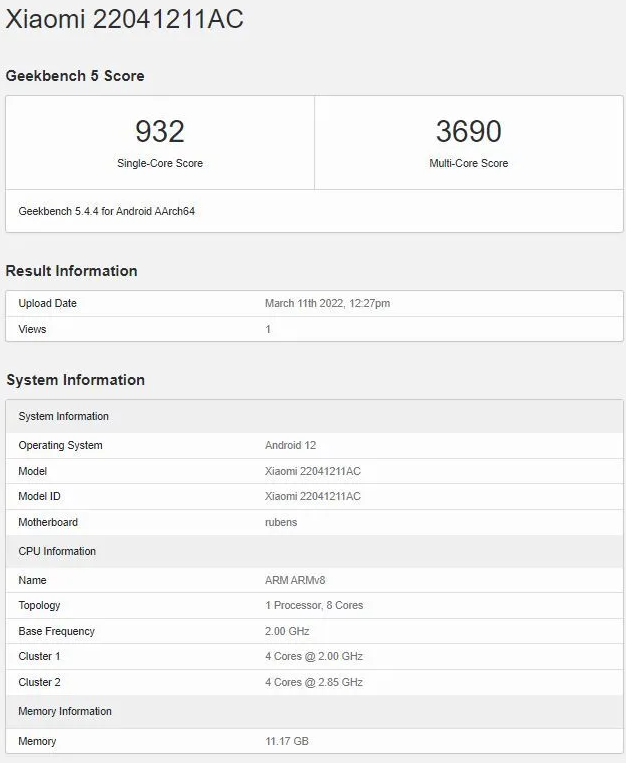
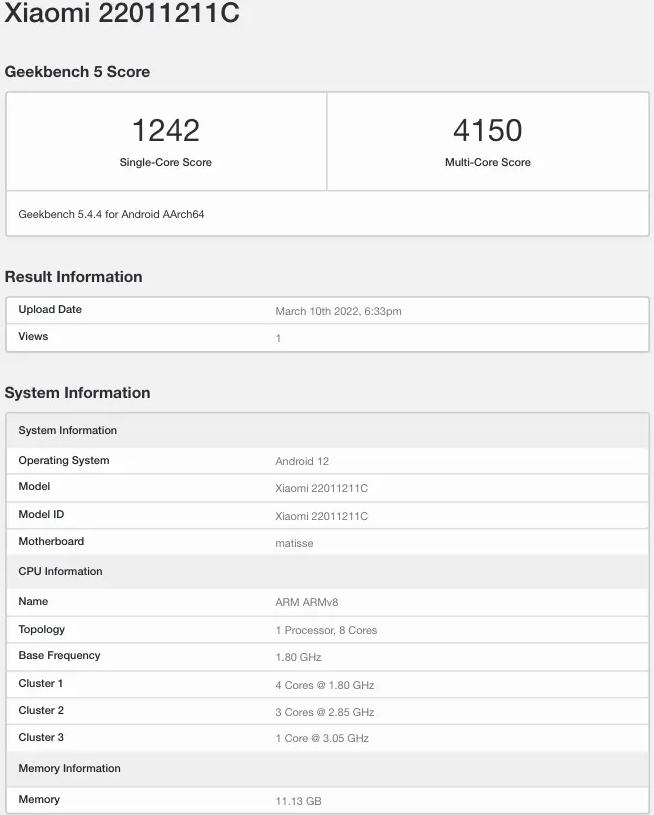
Redmi K50 series is scheduled to be announced in China next week. But prior to the March 17 launch, the two Pro models within the lineup were spotted on GeekBench, which also listed a number of the K50 Pro+ and K50 Pro‘s specifications.
According to a MySmartPricereport, a smartphone with model number 22041211AC was listed on the popular benchmarking platform. This model is believed to be the Redmi K50 Pro. Similarly, the K50 Pro+ was also spotted on GeekBench with the 22011211C model number. Both models will likely run on MIUI 13, since they were listed with Android 12 OS. Furthermore, the K50 Pro will come with up to 12GB of RAM.
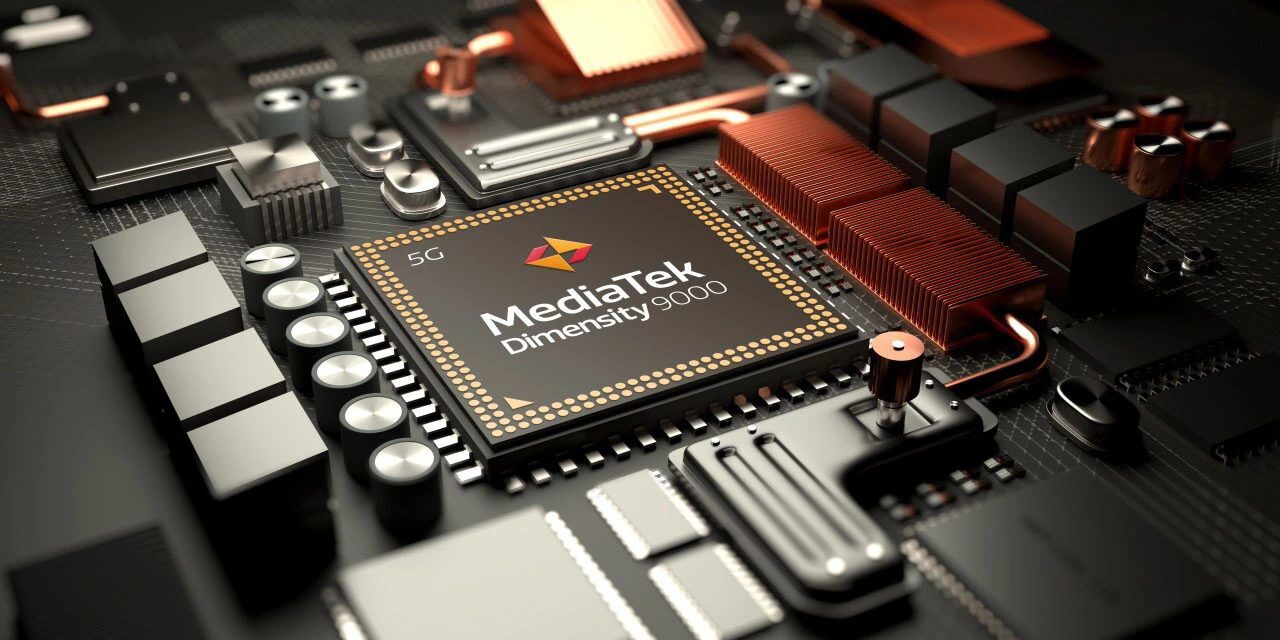
Furthermore, this model will also run on MediaTek’s Dimensity 8100 SoC, although, this was already confirmed by the brand previously. This chipset is coupled with the Arm Mali G610 MC6 GPU with HyperEngine 5.0 gaming suite. On the other hand, the K50 Pro+ was spotted on the platform with Dimensity 9000 SoC, paired with 12GB of RAM and Android 12 OS as well. This chipset is also coupled with Mali G710 MC10 GPU.
Talking about the base K50 variant, this model will launch alongside the two Pro models on March 17. It will reportedly sport a 6.6 inch AMOLED display with a 120Hz refresh rate and 4,700mAh battery pack, with support for 120W fast charging rate. The smartphone will also probably run on Android 12 out of the box, however, we will have to wait for its official release to know for sure. So stick around for more updates.
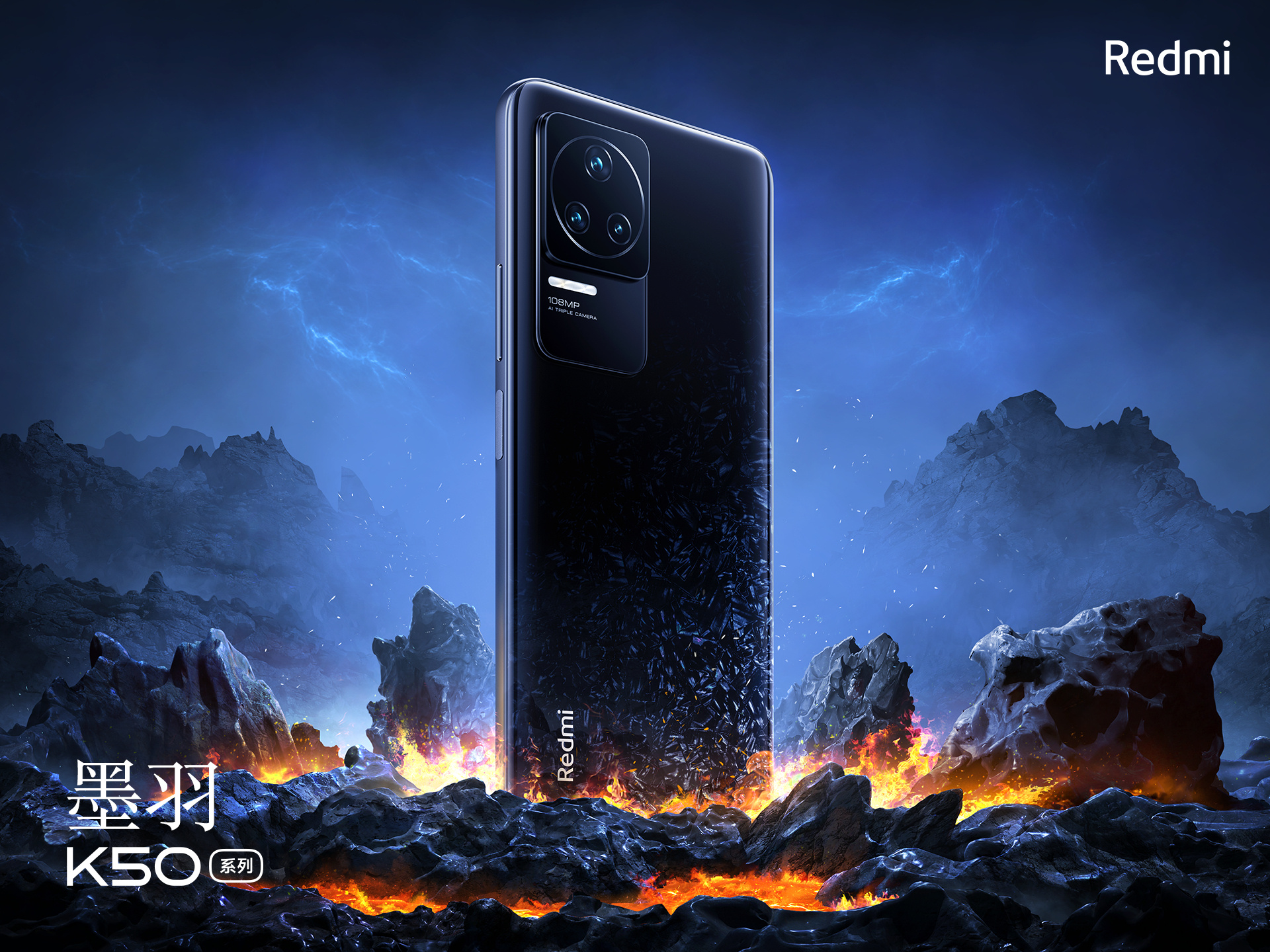
Xiaomi’s sub-brand Redmi will be announcing the Redmi K50, Redmi K50 Pro, and Redmi K50 Pro+ smartphones on March 17 in China. Yesterday, the company released a poster to showcase the rear camera design of the K50 lineup. Today, it rolled out a new poster to give a good look at its rear design.
Shown below is the “Black Feather” color variant of the Redmi K50 series. The upper-left corner of the phone’s back features a triple camera unit, which is headlined by a 108-megapixel camera. Below it is a flashlight strip, which seems to house a dual-LED unit. The right edge of the phone has a volume rocker and a power key.
The Redmi K50 trio is likely to sport the same rear design. It is unclear whether the vanilla K50 will have a 108-megapixel main camera. However, reports have revealed that the Redmi K50 Pro+ will feature a 108-megapixel primary camera with OIS support, while the K50 Pro will have the same camera without OIS support.
Hence, it appears that the handset shown in the new poster could be the Redmi K50 Pro or Pro+. The bottom portion of the phone’s back panel has a crystal-like pattern that seems to glow when light passes through it. The front side of the phone has yet to be revealed. However, rumors surrounding it have claimed that the K50 lineup will have an AMOLED display with a centrally positioned punch-hole.
The K50, K50 Pro, and K50 Pro+ are rumored to be powered by the Snapdragon 870, Dimensity 8100, and Dimensity 9000 chipsets, respectively. The K50 and K50 Pro may have support for 67W fast charging, while the Pro+ variant may come with 120W rapid charging support.
Redmi, the budget smartphone making unit of Xiaomi, is apparently planning on launching a new smart TV in its home country of China. It appears that the company will soon launch a top end TV with a massive 100 inch display size.
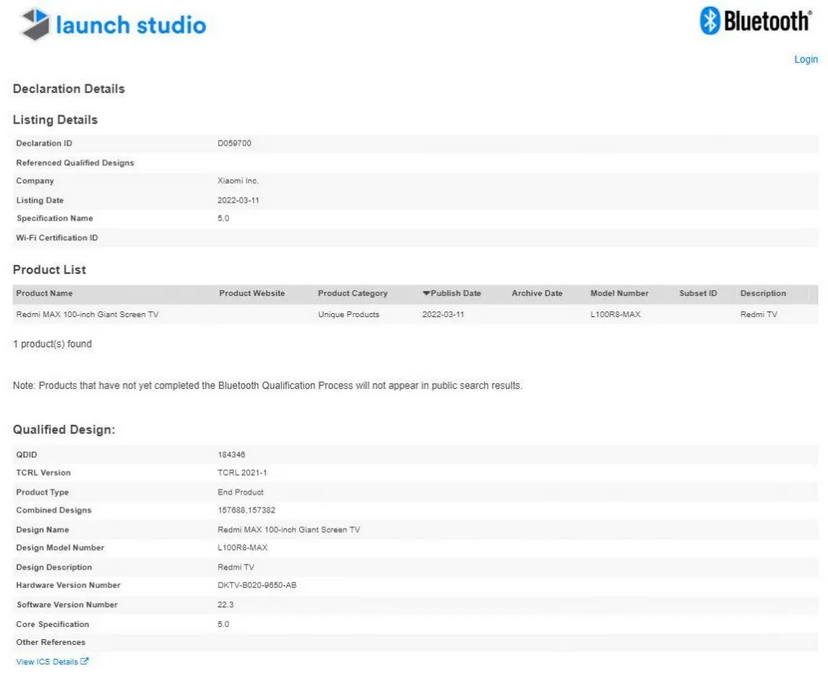
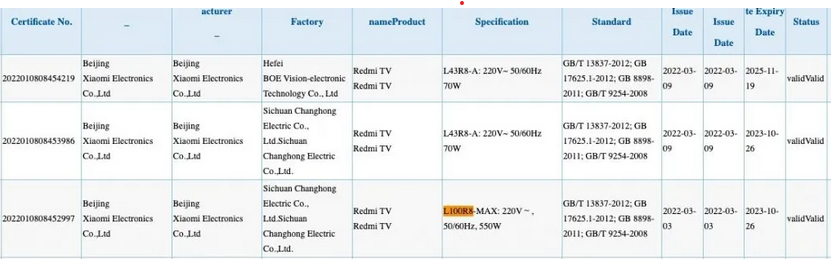
According to a MySmartPricereport, the Chinese company’s new MAX smart TV has been spotted on various certification websites. It is a 100 inch smart TV model that has surfaced on Bluetooth SIG certification and even 3C certification database as well. It carries the model number L100R8-MAX and was also listed with its actual name, the Redmi MAX 100 inch Giant Screen TV. Notably, the company had released the Redmi Smart TV 98 inch MAX back in 2020, so this version might be its successor.
The 98 inch smart TV was also launched in India, and supports 4K resolution. So, we can expect the newer model to also release in India and carry a similar, if not higher resolution. As per the Bluetooth SIG certification, the upcoming MAX 100 inch Giant Screen TV will feature Bluetooth 5.0. Unfortunately, this is also the information shared on this listing. However, the 3C certification database in China revealed that the display panel on the TV will arrive with a 60Hz refresh rate.
Finer details regarding this new smart TV is still at large, but, we can make some speculations based on the previously launched MAX model. The 98 inch model featured 4K resolution along with 85 percent NTSC color gamut and 192 dynamic backlight zones. Furthermore, it was also powered by a custom 12nm chipset that was paired with 4GB of RAM and 64GB of internal storage. So, the new 100 inch model will likely feature at least these specifications, alongside some improvements as well.
A HUAWEI device with model number NOH-AN50 has appeared with the Kirin 9000L on Geekbench. Named Mate 40E Pro 5G, its benchmark scores indicate that it performs very similarly to the Dimensity 1200.
The single-core scores average around 900 while the multi-core scores average around 2,800, which puts it in the upper mid-range bracket by 2022 standards (via Huawei Central).
Via Geekbench
The Kirin 9000L is actually a slightly toned-down version of the original Kirin 9000 and 9000E chipsets, with a slightly lower peak clock speed of 2.86GHz, compared to the 3.13GHz frequency of the other two. Its GPU is slightly less powerful too with the Mali-G78 being an 18 core unit as opposed to the 24 and 22 cores on the Kirin 9000 and Kirin 9000E, respectively.
The chip’s configuration includes 1x Cortex-A77 at 2.86GHz + 2x Cortex-A77 at 2.54GHz + 3x Cortex-A55 at 2.05GHz.
The Huawei Mate 40E Pro 5G already went on sale in China last month for 6,700 Yuan (around $1,062) for the 8GB RAM and 256GB internal storage variant. It features a 6.76-inch OLED FHD+ display, a triple camera setup at the rear, and a 4,400mAh battery with support for 66W super-fast charging.
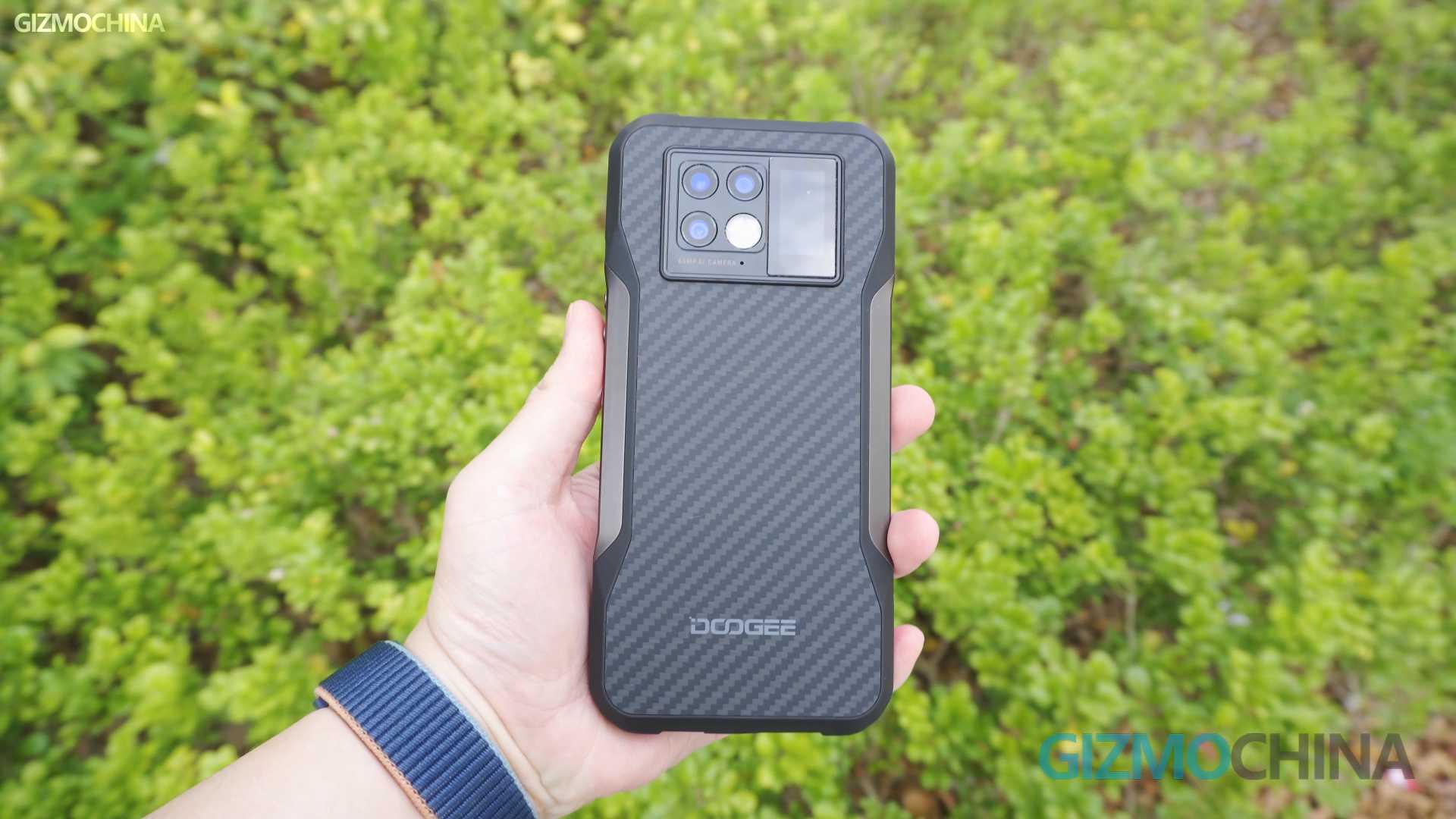
When I first saw the DOOGEE V20, I was amazed. The phone brings in a new choice for people who need a rugged phone. The V20 is basically a rugged phone with a flagship look and a great screen.
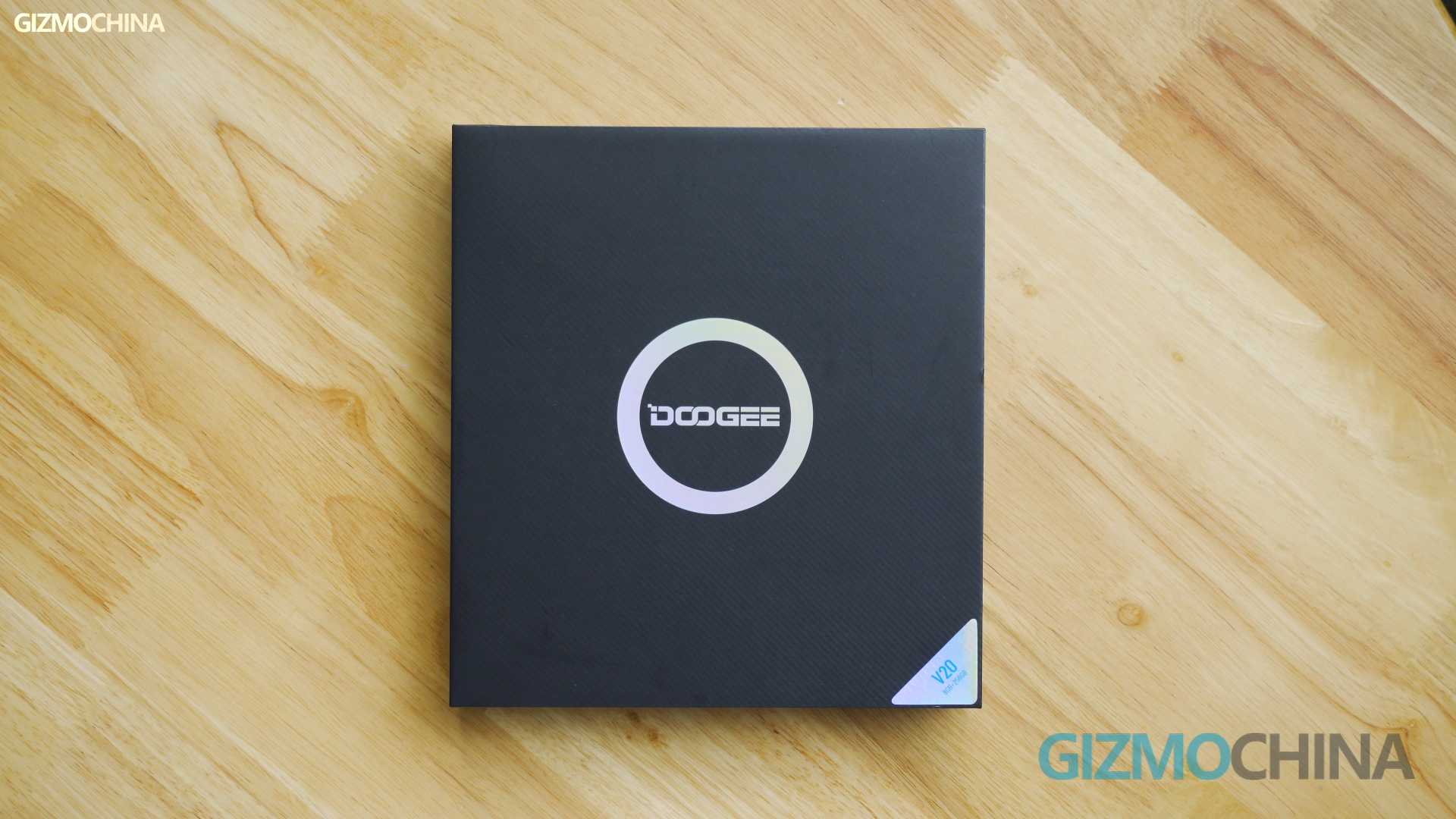
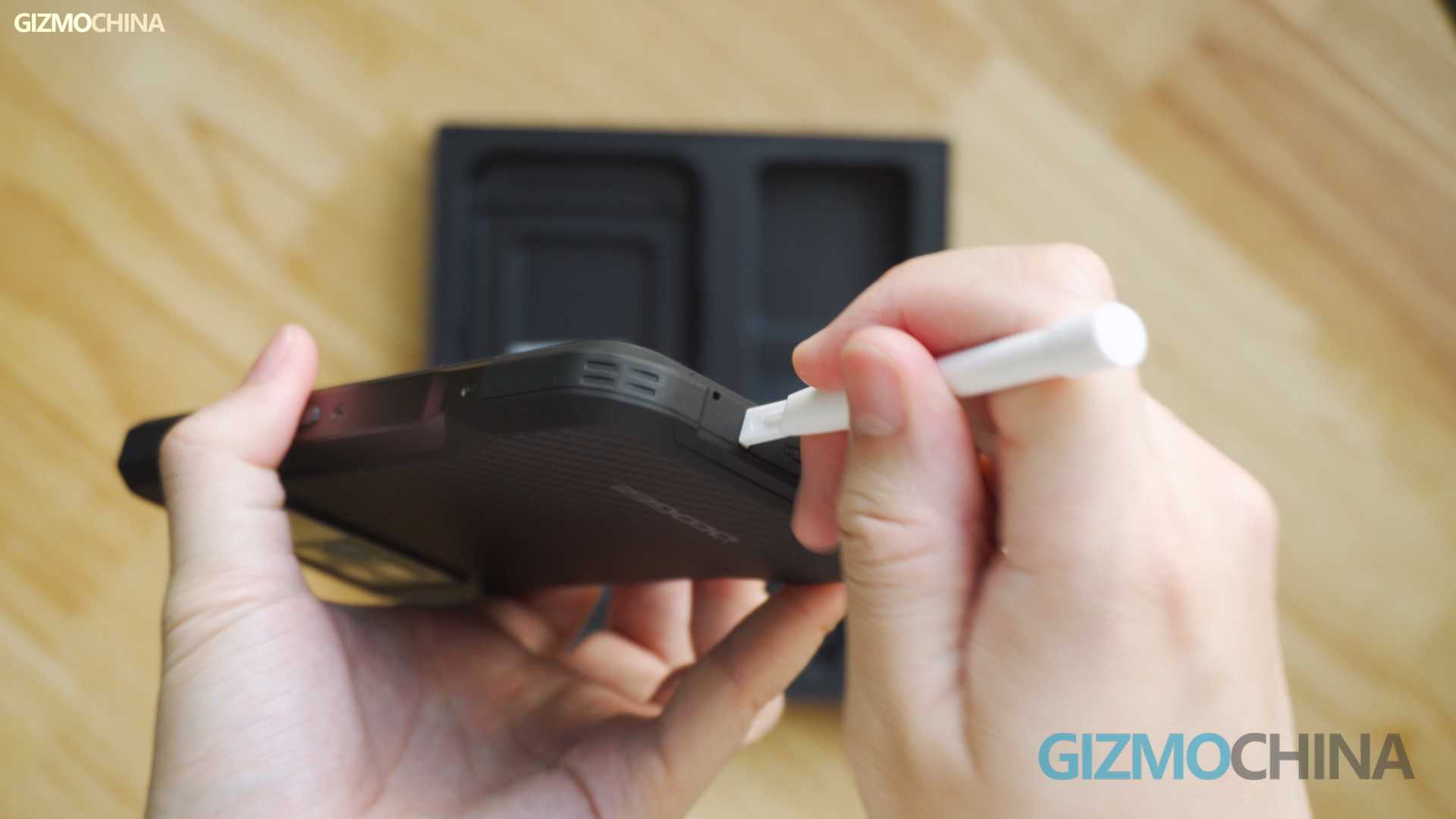
As soon as I saw the box of DOOGEE V20, I knew it was different from other rugged phones. When you open the box, you can see the rich accessories inside. One of the most eye-catching ones is the white pry bar.
I have to say that DOOGEE is really thoughtful. It helps you to open the SIM Card Slot and charging port to avoid damaging your nails. And the phone comes with a pre-installed tempered film protector. However, DOOGEE still adds an extra Anti-explosion film in the box.
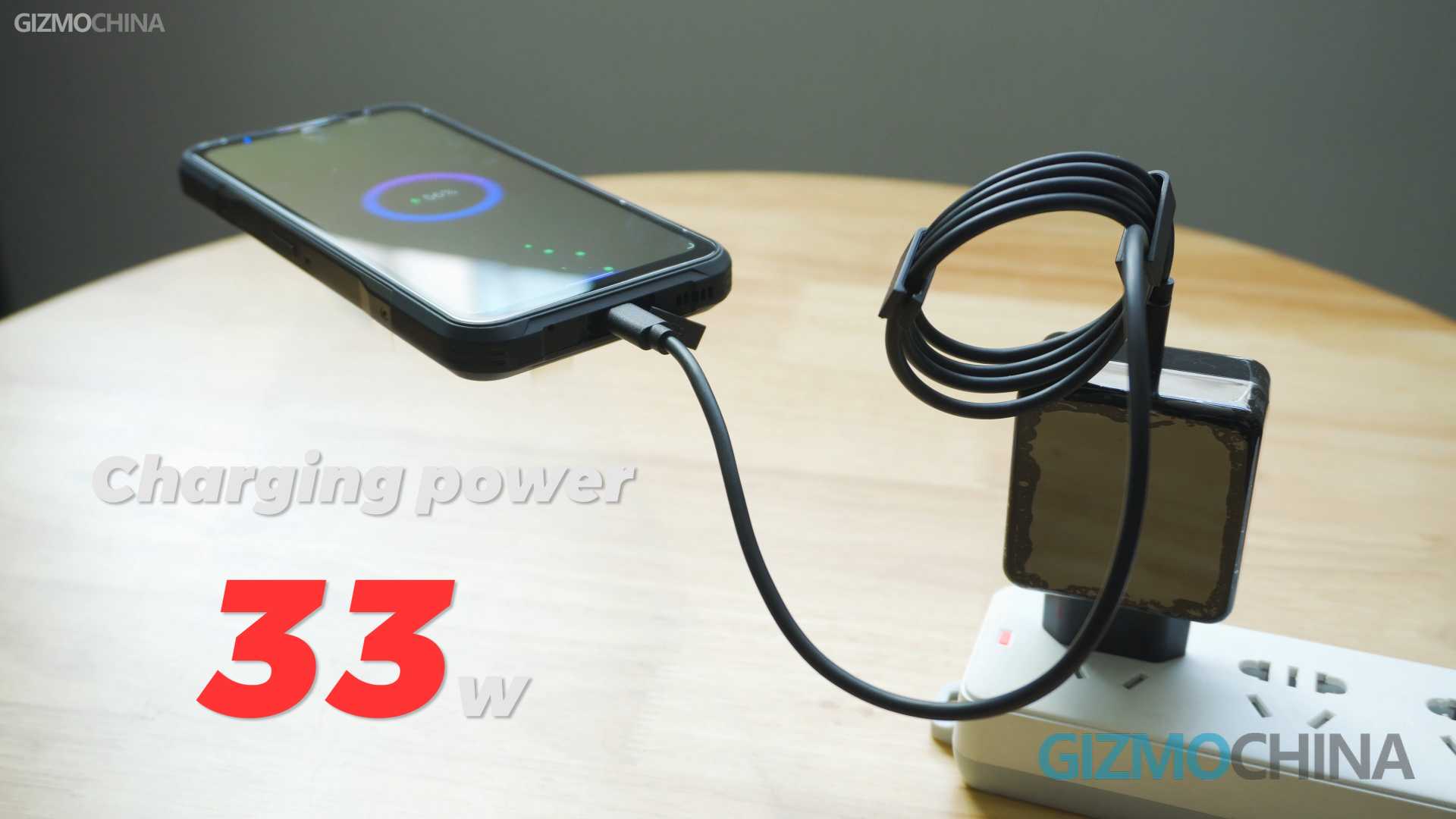
This power brick here is a 33w Type-C charger. And we tested its compatibility performance and found that it performed well, supporting PD 3.0 and PPS. It comes with a USB C to A Female cable. As you can see, the V20 is already better than most rugged phones right from its unboxing.
Doogee V20 Review: Design
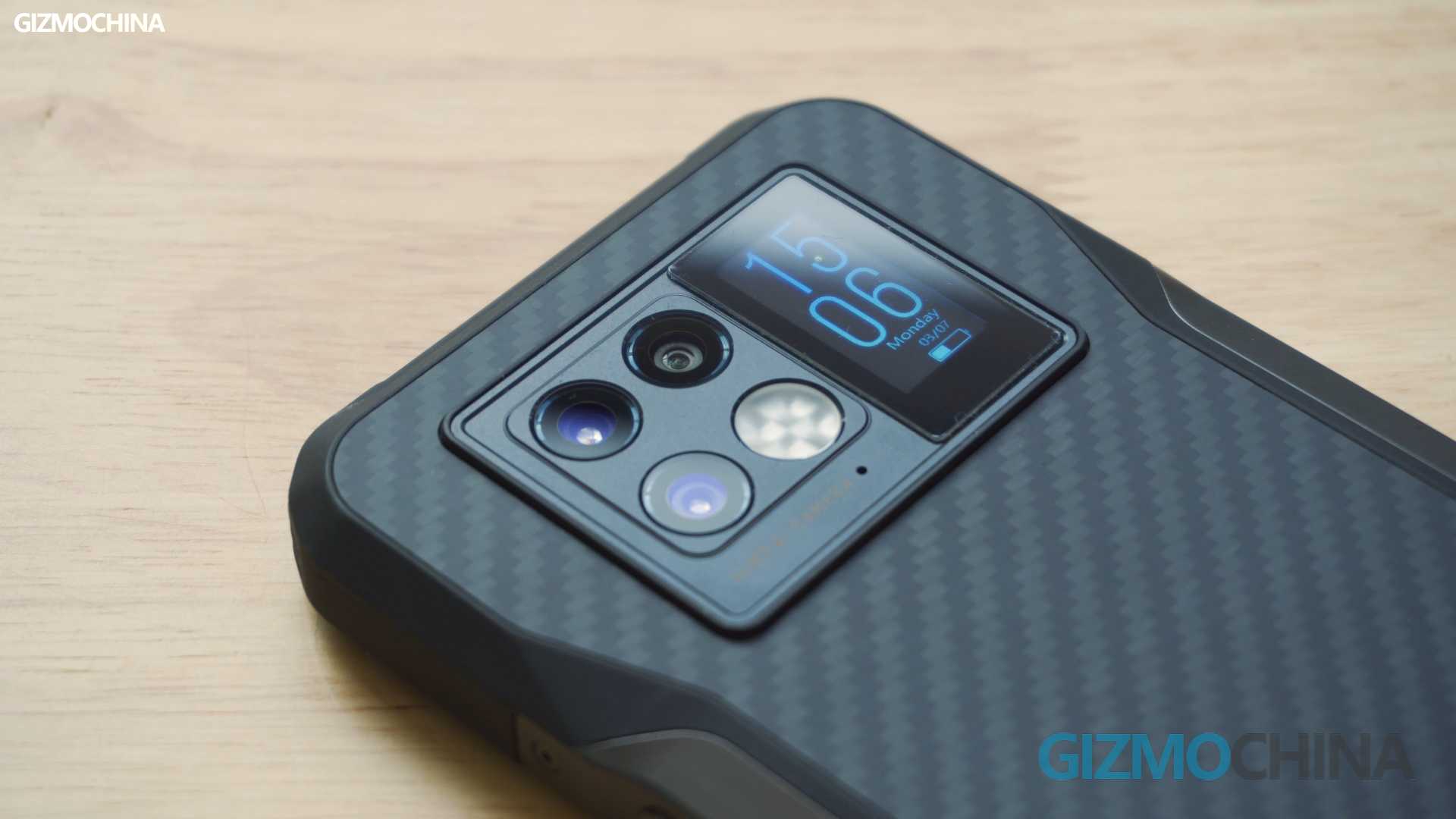
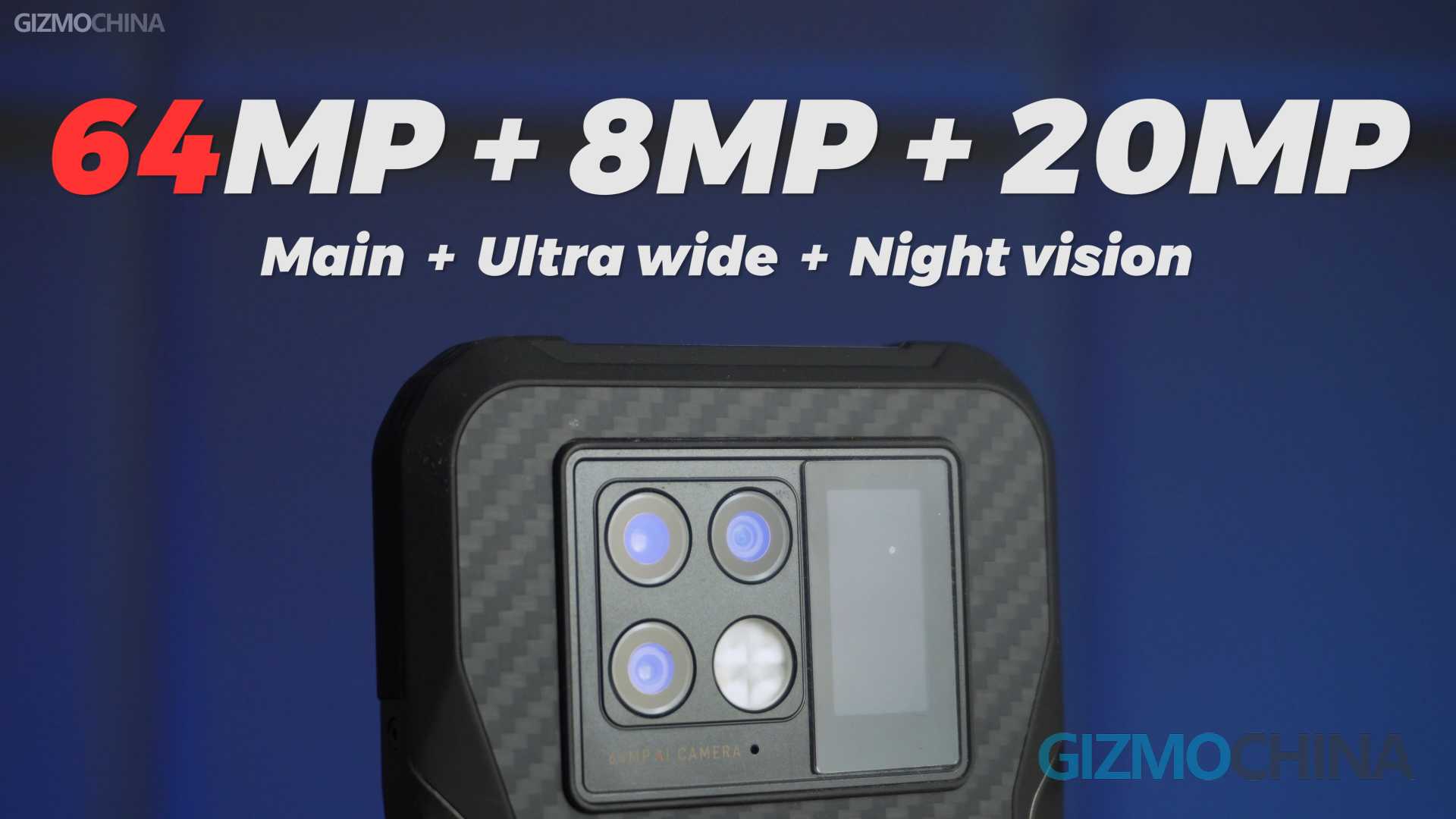
I thought there was nothing much to say about the design of the rugged phone. It’s just a rubberized case with a few cameras in the middle. The bezel has some screws, and that’s it. But the design of the V20 does have some unique features. The rubber around the perimeter is not very raised, and the overall look is relatively flat. The material on the back is real carbon fiber. It is very smooth to touch and won’t be easily damaged. The most notable feature of the design is the camera module. Rectangular camera modules are common, but the small screen next to it is very interesting.
Yes, it’s a small touch screen. Time can be displayed and songs can be switched. It also comes with a tempered film pre-applied. Unfortunately, the rear screen can’t be used to show the camera preview.
Looking at the three lenses, we seem to have seen this design somewhere…. right?
Any way, you won’t see such a special design on other rugged phones. It has NFC and customizable buttons, which DOOGEE calls the Easy Key for customizable shortcuts. It also has a SIM Card Tray with Micro SD Card slot. Except for the lack of a headphone jack, the phone has all the features you’d want on a rugged device.
Doogee V20 Review: Display
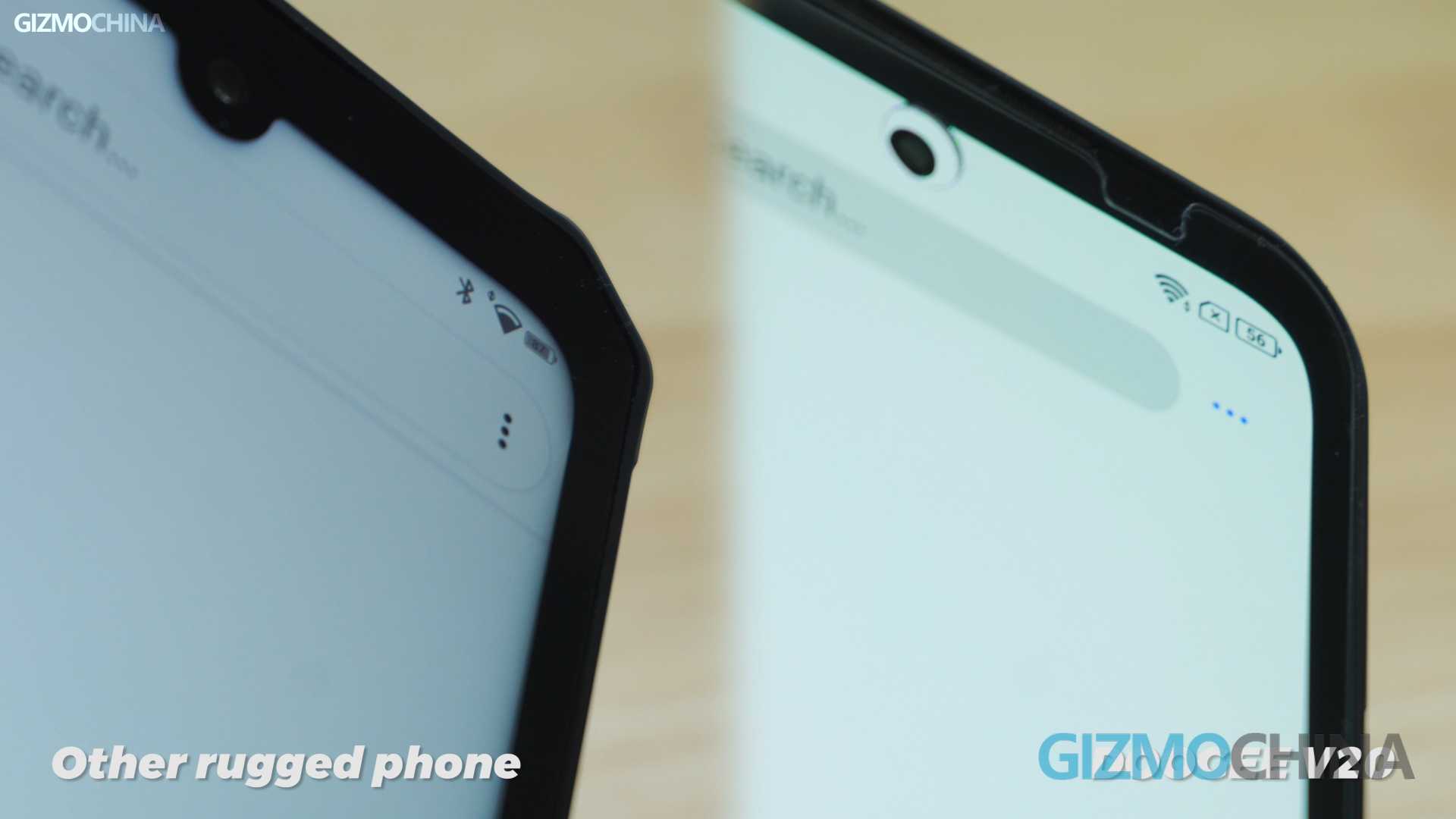
But if you think the design of the V20 is its biggest selling point, you are in for a surprise. The phone’s biggest selling point is actually the screen. While other rugged phones are using LCD screens, the V20 is already using OLED. This OLED screen comes with a maximum brightness of 500 nits and definitely ranks on top among rugged phones.
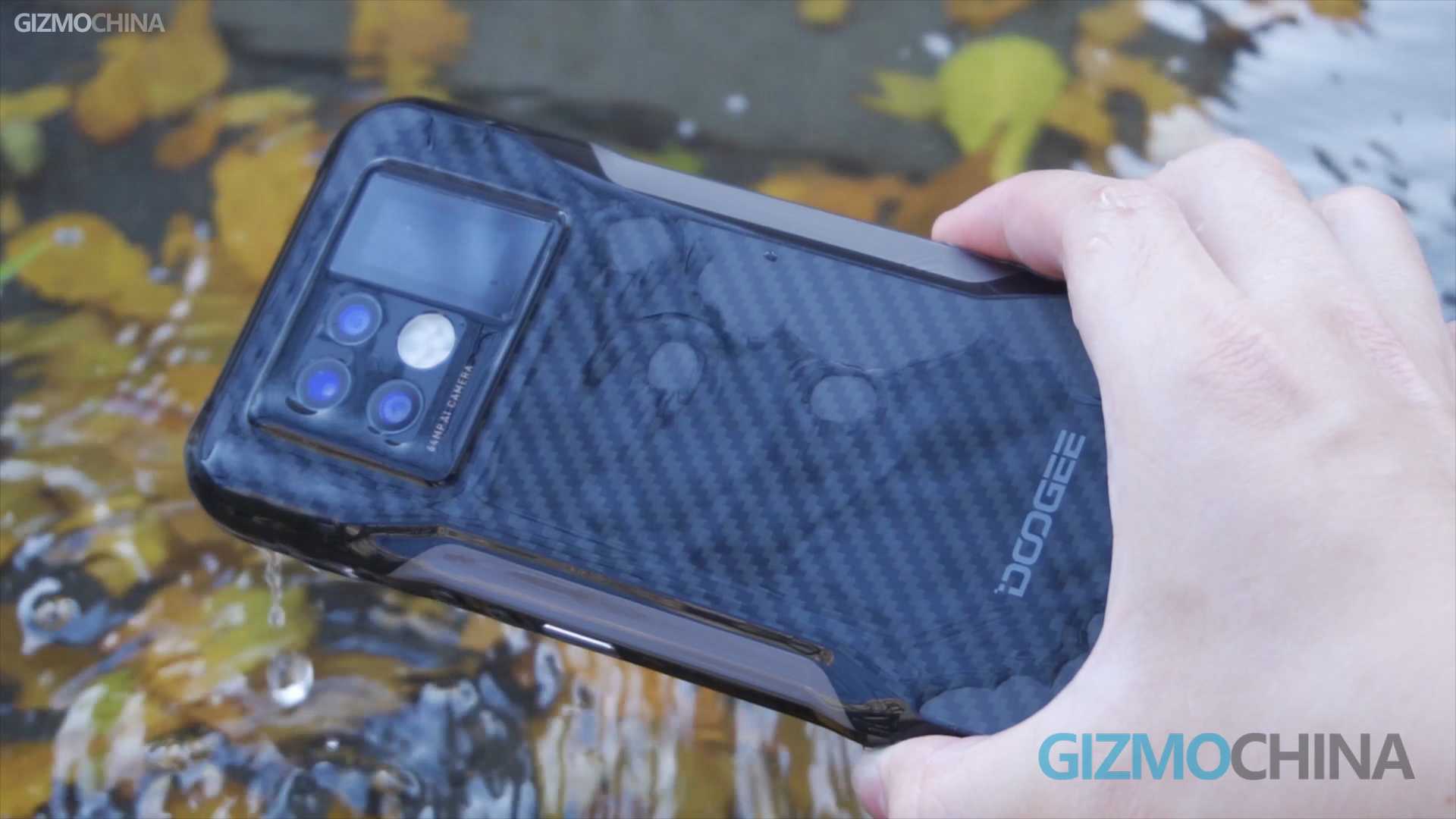
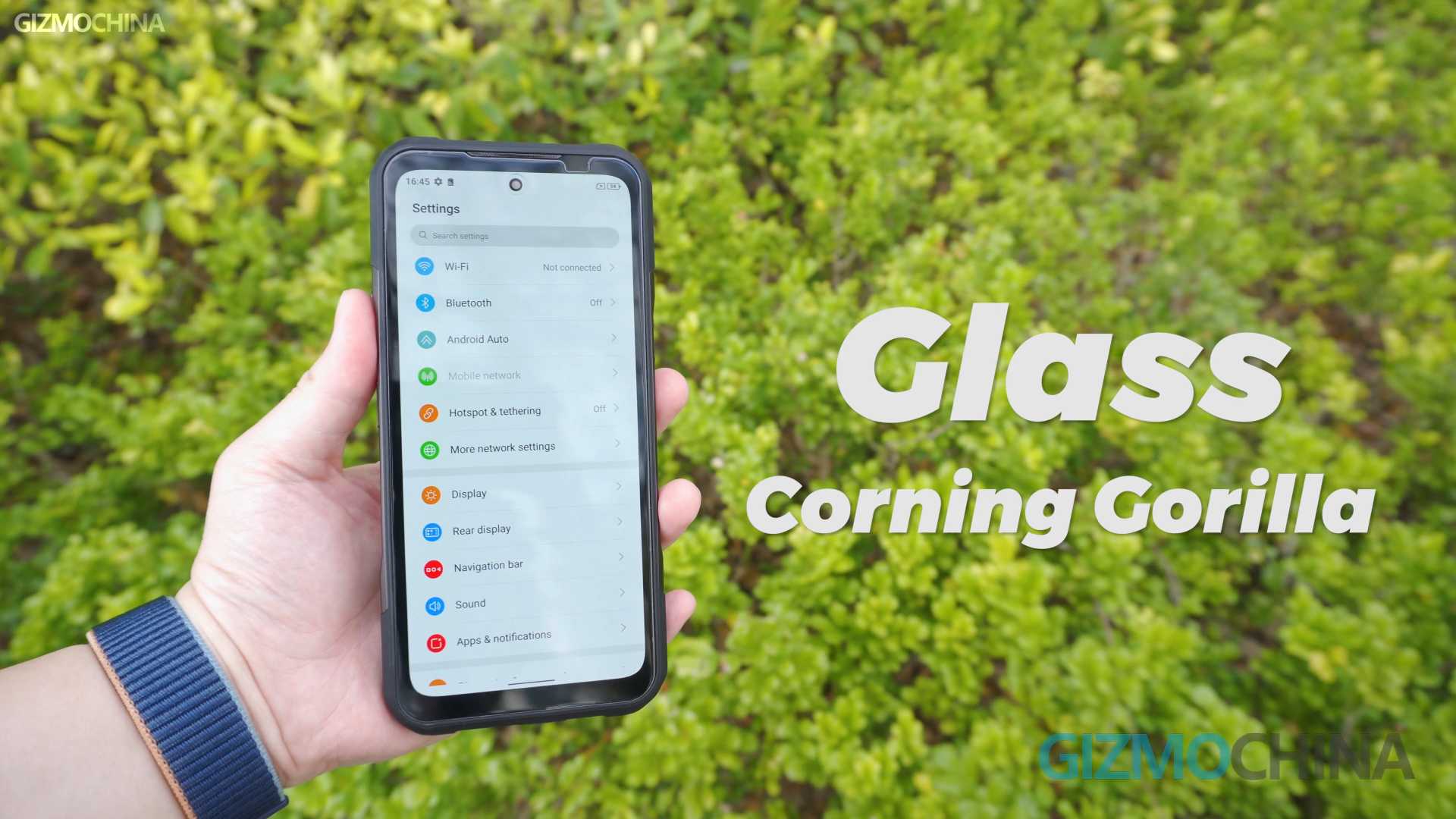
Let’s compare it with other rugged phones featuring LCD screens. It is pretty obvious that there are shadows around the LCD screen of other rugged devices and the black areas are not pure black either. However, the V20 has none of these problems. The colors are vivid and the contrast is high, so you can enjoy a good experience with a high quality screen, even outdoors. A good screen must be protected, the protective glass of Corning Gorilla plus the tempered film is enough to ensure that the screen is not broken when dropped at a height of 1.8 meters. All interfaces are waterproof and it is IP68 and IP69K certified.
Doogee V20 Review: Cameras
The camera system of V20 consists of a 64MP main camera, 8MP ultra-wide camera, and 20MP Night vision Camera. This camera system has performed well in the past few days of use. Because the main camera doesn’t have four in one pixel in auto mode like other phones, you get a clear, sharp photo most of the time. The benefit of the native 64 mega pixel is that you can crop the photo and it will still be sharp.
Main
1 of 9
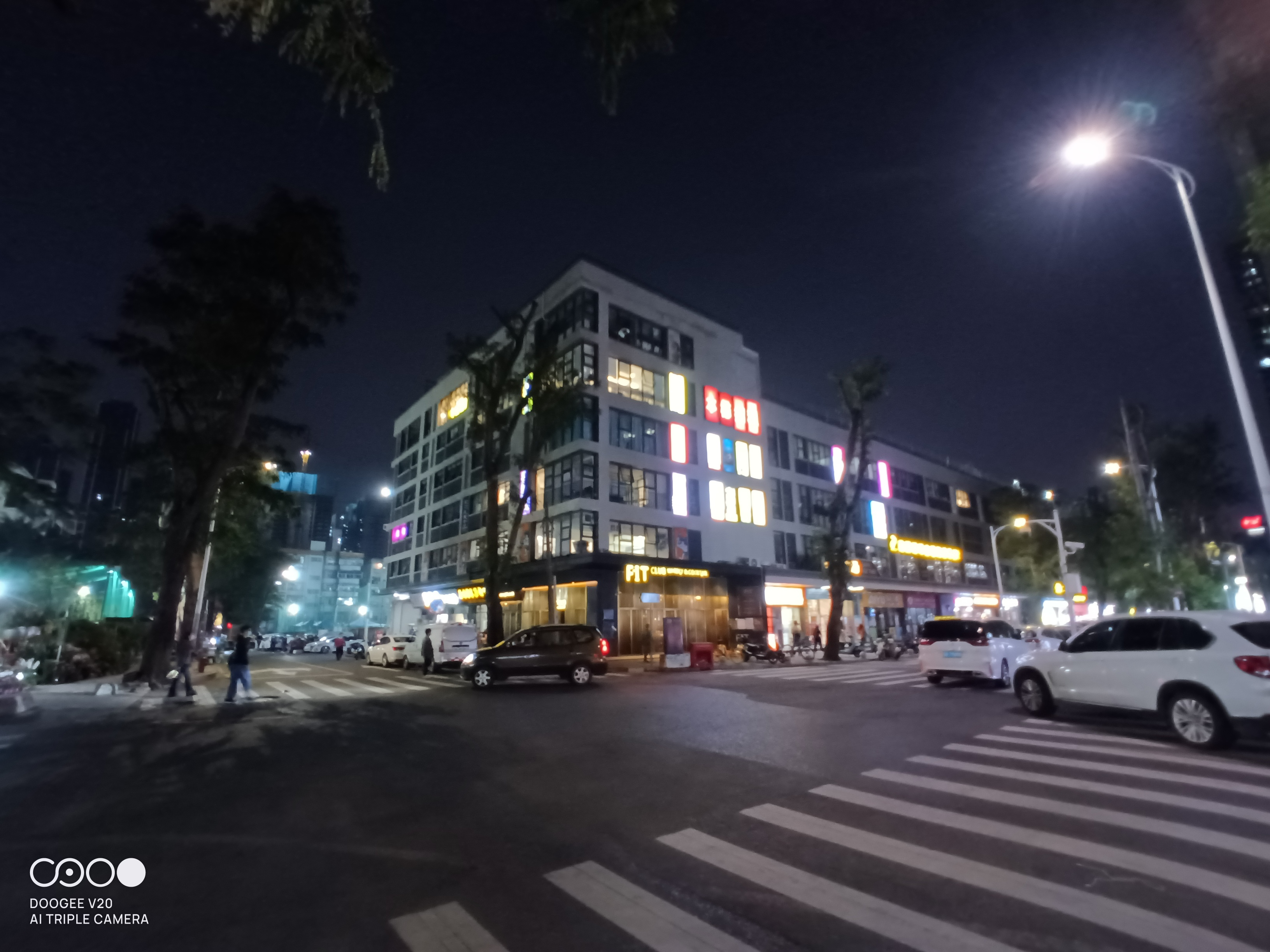
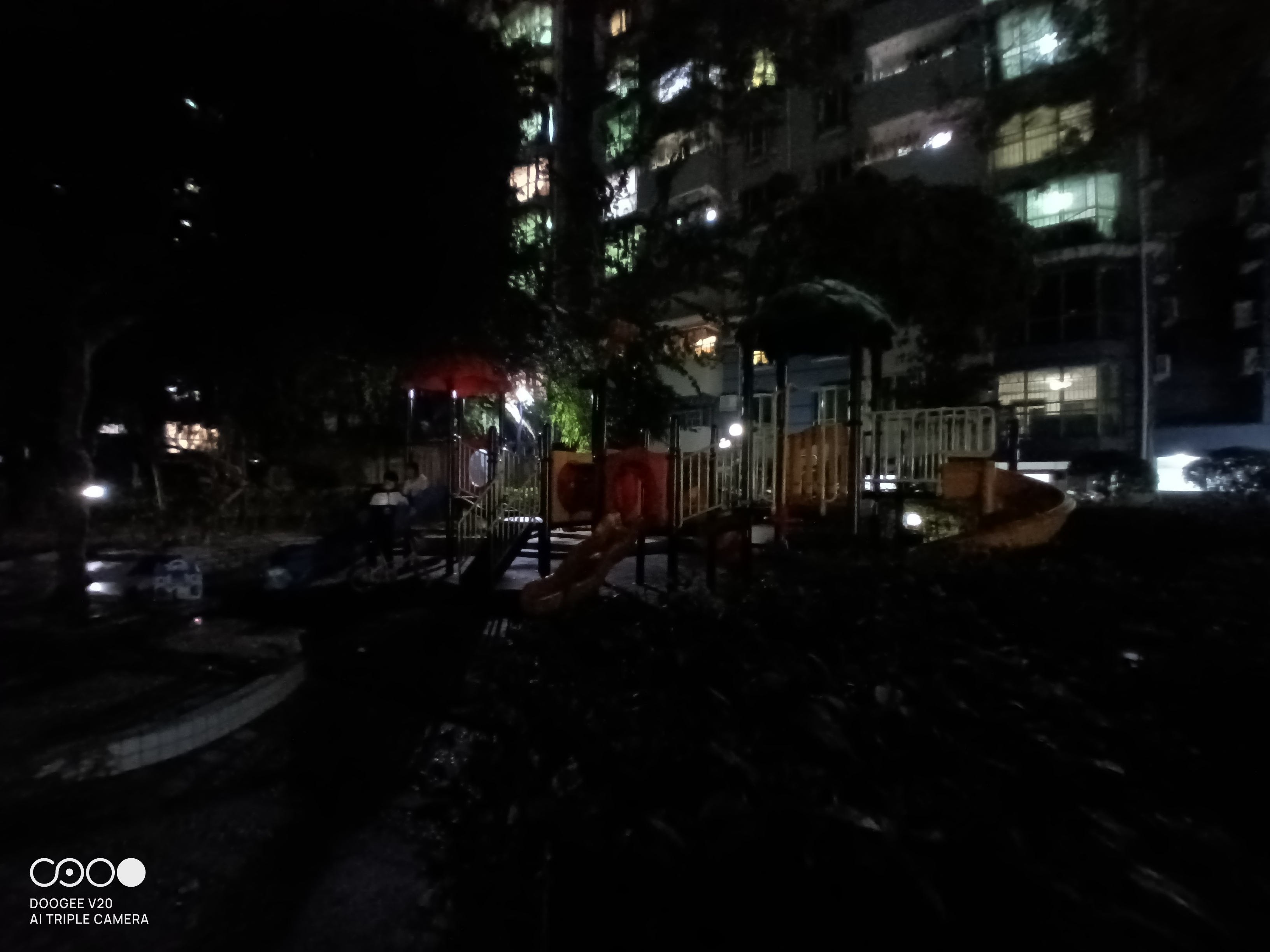
Night
Night
Night mode is sometimes blurrier than photos taken in auto mode, so you can actually use auto mode for all scenes. Unless the environment is very dark, there is no need to switch to night mode.
Ultrawide
1 of 7
The ultra-wide camera can help you capture a wider range of images, but of course its photo quality is still inferior compared to the main camera.
Night Vision
1 of 3
Night vision camera is actually an infrared camera, but unfortunately this camera cannot auto-focus. When you are too close to the subject, infrared fill light will flash to remind you that the object is not in focus. When you move away from the object, it will return to normal. This will reduce your chances of getting a blurry picture. If you are using the video mode, the IR fill light will not flash.
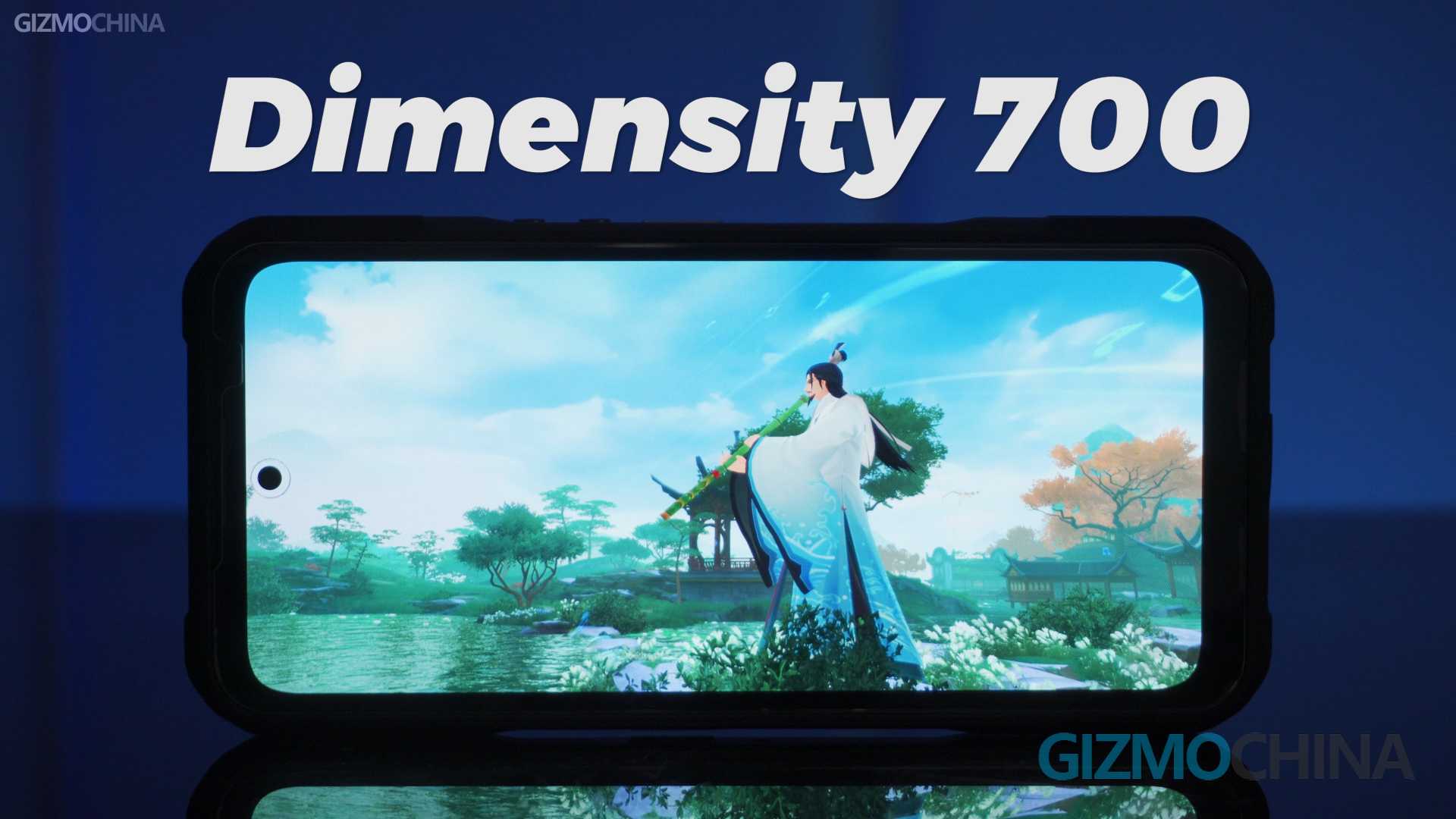
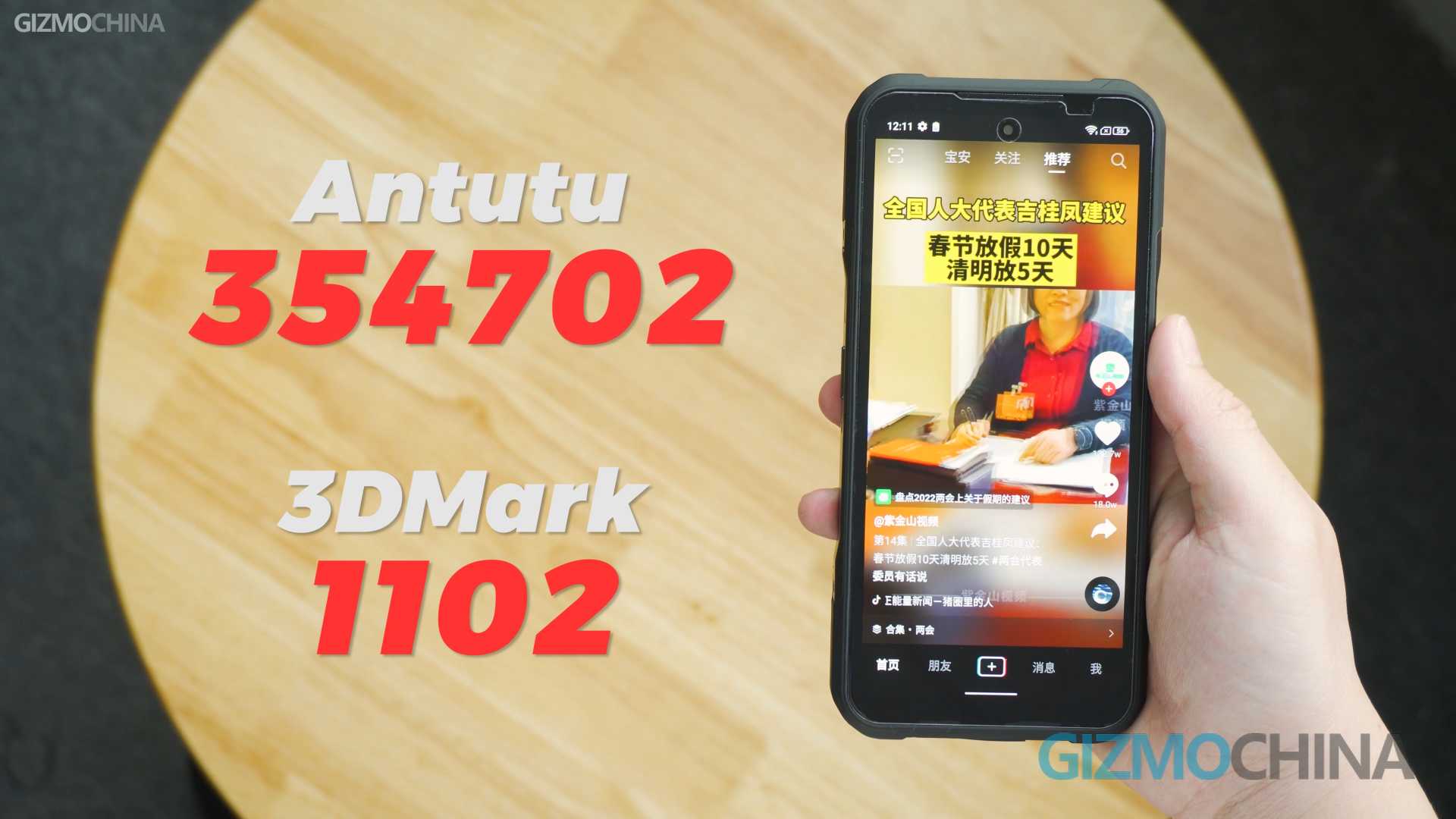
DOOGEE V20 uses the Dimensity 700 processor. We have seen this processor in many rugged phones. But we still decided to test its performance. The Antutu Bench score is 350,000 and the 3DMark score is 1102. As long as we don’t make things difficult for this processor, it has no problem handling daily applications and light games. For example, PUBG is also stable at 40fps.
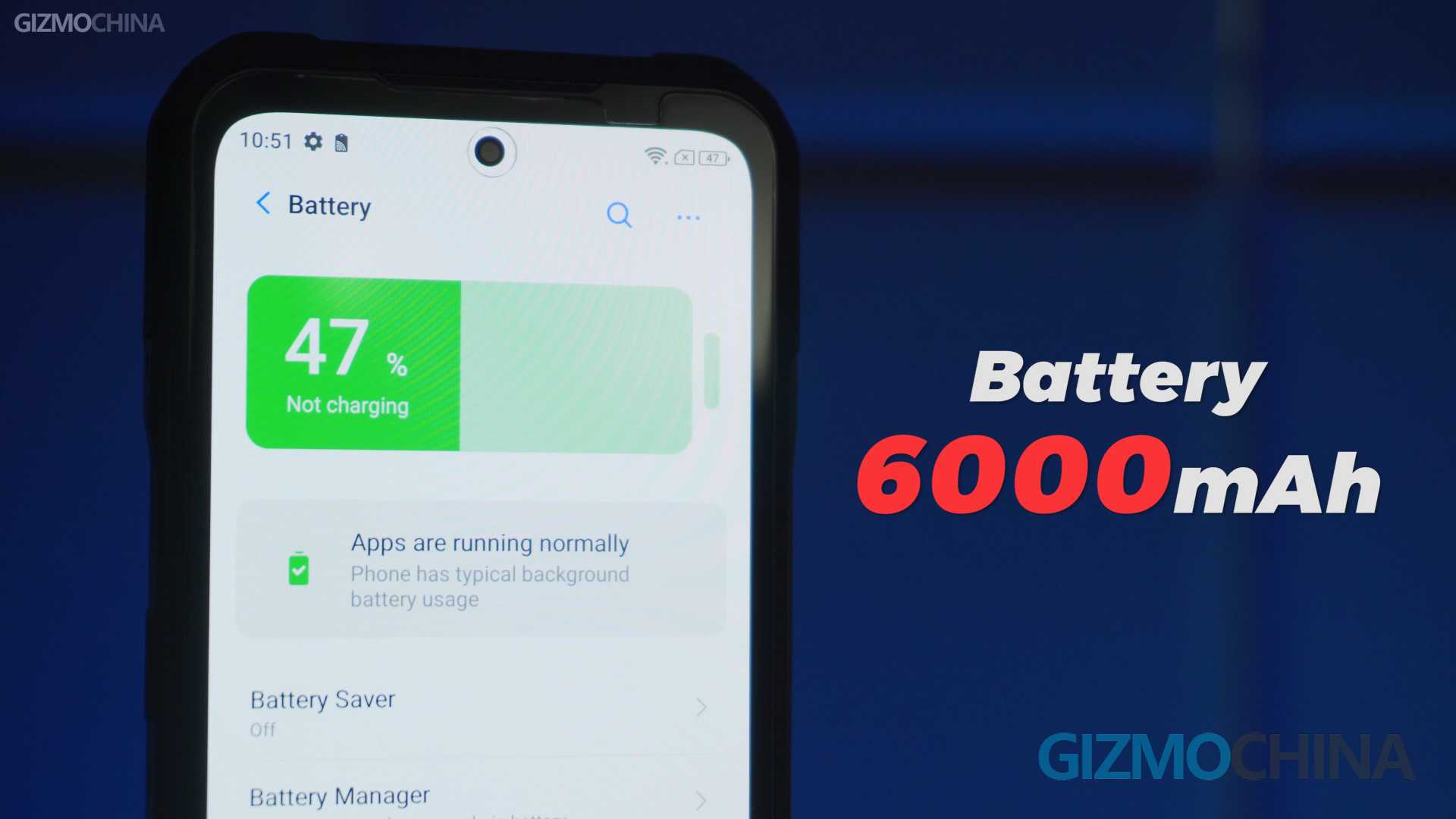
The battery capacity is 6000mAh, and you can use it for two or three days without charging. While the V20 may not have the largest battery capacity we’ve ever seen, it’s definitely one of the fastest charging rugged phones in the market. And, it supports 15w wireless charging too! This is not common among rugged phones.
To conclude, the rugged phone market is pretty uniform and there are hardly any phones that can distinguish itself from the crowd. And DOOGEE V20 is one of them. It has an OLED screen and a unique design that no one else has. It gives the target users a new choice, and that’s the biggest point of its existence.
The HUAWEI P50E is all set to be launched on March 16th along with a number of other products including MatePad Paper ink tablet, Sound Joy speaker, and more. Ahead of that, a tipster has shared a little of what to expect from the device.
First things first, the HUAWEI P50E will be powered by the Snapdragon 778G 4G processor (via My Drivers). The 5G version of the chip was fairly popular in mid-range devices last year but still holds up quite well by 2022 standards. The P50E will be using its 4G version because of the US ban.
HUAWEI P50 4G
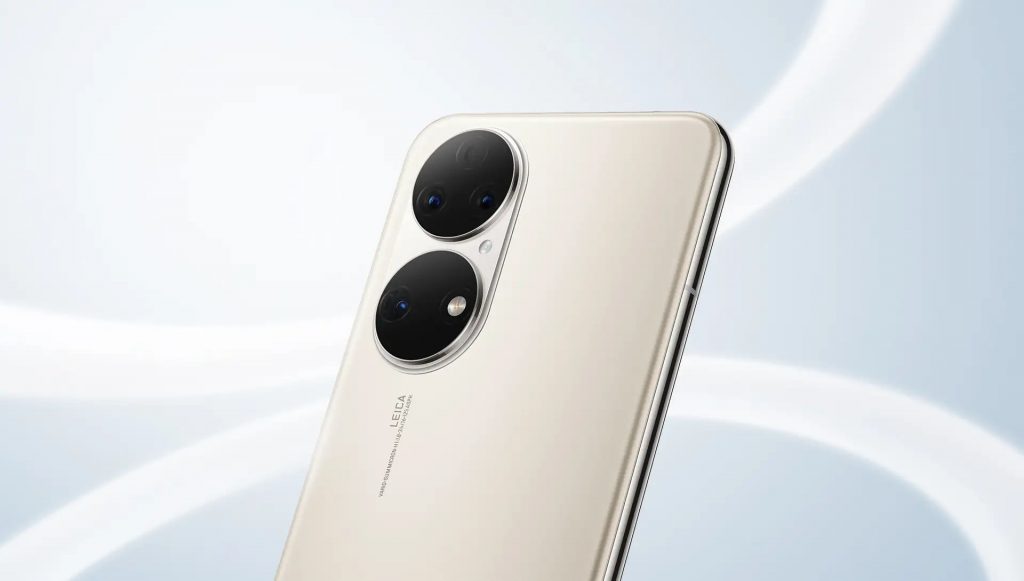
The design of the phone will be very similar to the HUAWEI P50 that was launched in July 2021. The older device has a premium build with a unique dual-ring camera design, each housing multiple lenses.
All in all, the HUAWEI P50E looks to be a more affordable, mid-range version of the standard P50. Previous leaks had indicated that it will start at approximately 4,000 Yuan (around $630) in China.
Meanwhile, the HUAWEI P50 series that was launched in July 2021 started from 4,488 Yuan (around $710), of which the P50 is powered by the Snapdragon 888 4G while the P50 Pro came in two chip variants — one is equipped with the Kirin 9000 4G and the other with the Snapdragon 888 4G.
It is worth mentioning here that although 5G is not supported by either of the devices, Yu Chengdong, CEO of Huawei’s consumer business, previously stated that Huawei P50 series users can still get a great networking experience through 4G+WiFi6+AI technologies.
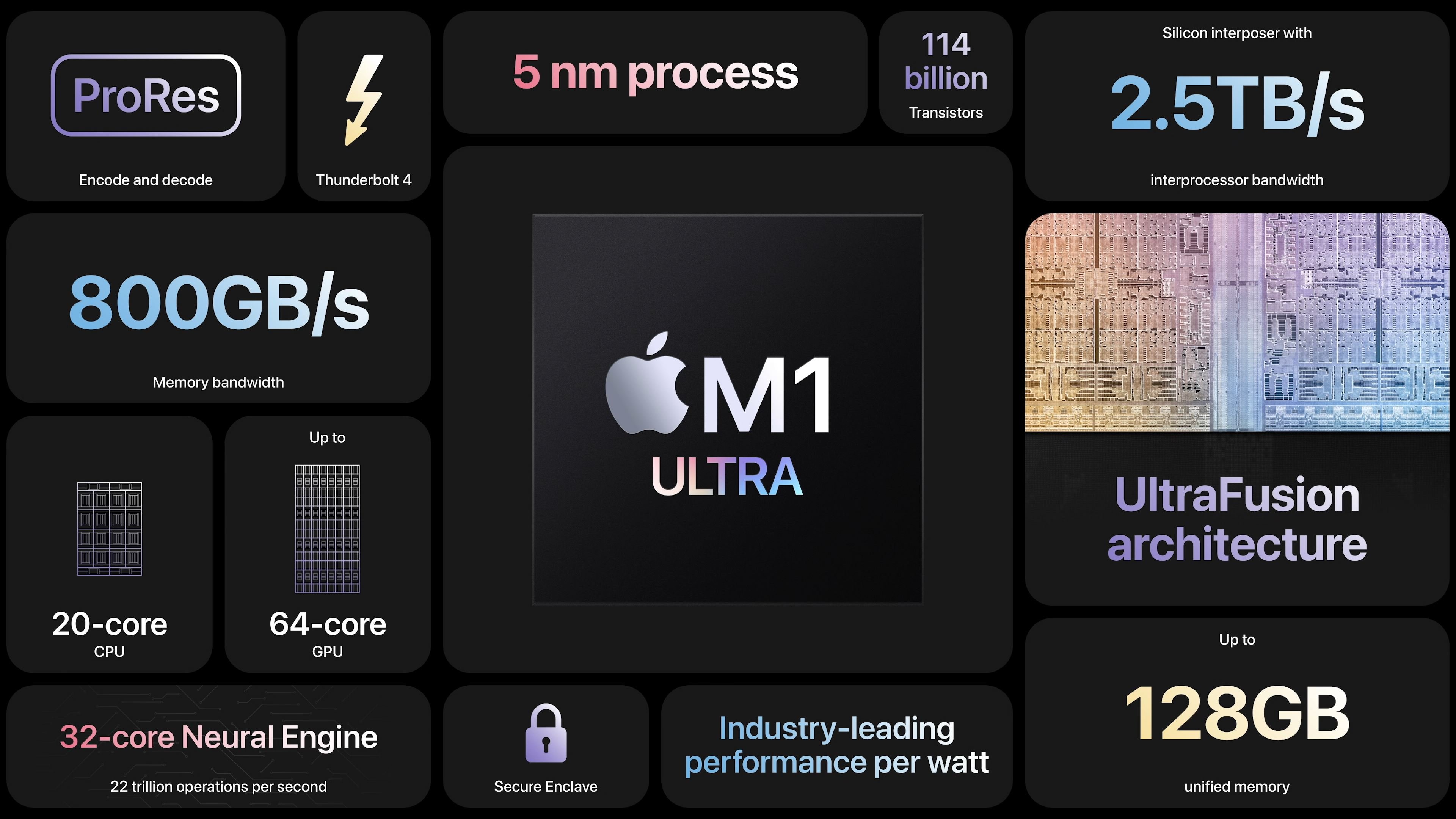
Apple had just launched its top end desktop series processor, the M1 Ultra. This chipset has been surfacing on benchmarking platforms, and now, the chipset has been spotted on GeekBench where it beat some notable chips from Intel and AMD.
According to a Tweet from @TheGalox_, the Cupertino based giant’s newly unveiled M1 Ultra passed through GeekBench with a score of 24,055 points in the multi core tests and 1793 points in single core tests. This result was quite impressive considering it beat Team Blue’s high end Core i9-12900K processor that only scored 17,299 points in the multi core tests. Although, its single core tests were slightly faster with a score of 1893.
However, the M1 Ultra’s performance really impressive when you pit it against Team Red’s Ryzen Threadripper PRO 5975WX chipset. This is a enterprise grade processor that scored 27603 points in multi core tests. Keep in mind, the Threadripper has 32 cores while the M1 Ultra has just 20 cores. Furthermore, we had also recently reported on an early benchmark of the M1 Ultra nearly rivaling the Ryzen Threadripper 3990X processor, which has a whopping 64 cores.
Just saying, but geekbench scales a lot worse on windows than on macos so scores aren't really comparable, Cinebench is better
While the new Apple chip did not beat the AMD chips, it came extremely close to matching both chipsets. This is quite impressive for a chipset that is basically two M1 Max SoCs combined together. Although, this is just synthetic benchmarks that only depict raw performance in one particular platform. So it does not directly imply that the chip is already outperforming every other chipset in the market. But, it is still impressive nonetheless.
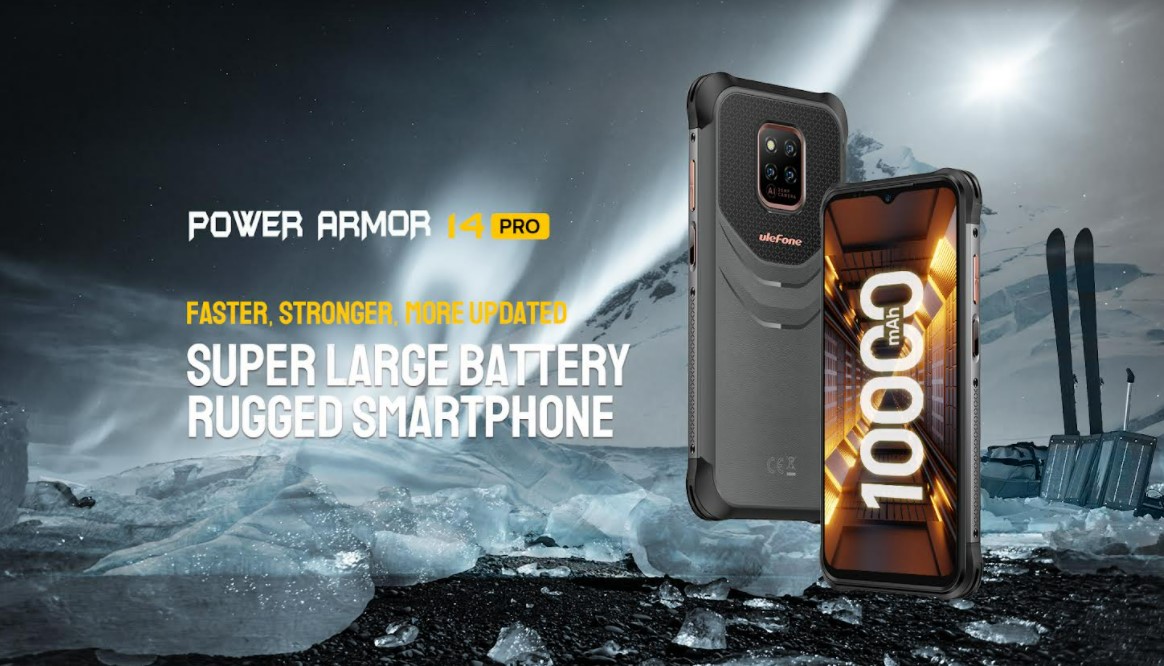
Ulefone has come out with its latest Power Armor Phone the Ulefone Power Armor 14 Pro. An obvious upgrade to the Power Armor 14, the 14 Pro smartphone retains all the best features of its predecessor but comes with upgraded specs. So let’s check out the Power Armor 14 Pro.
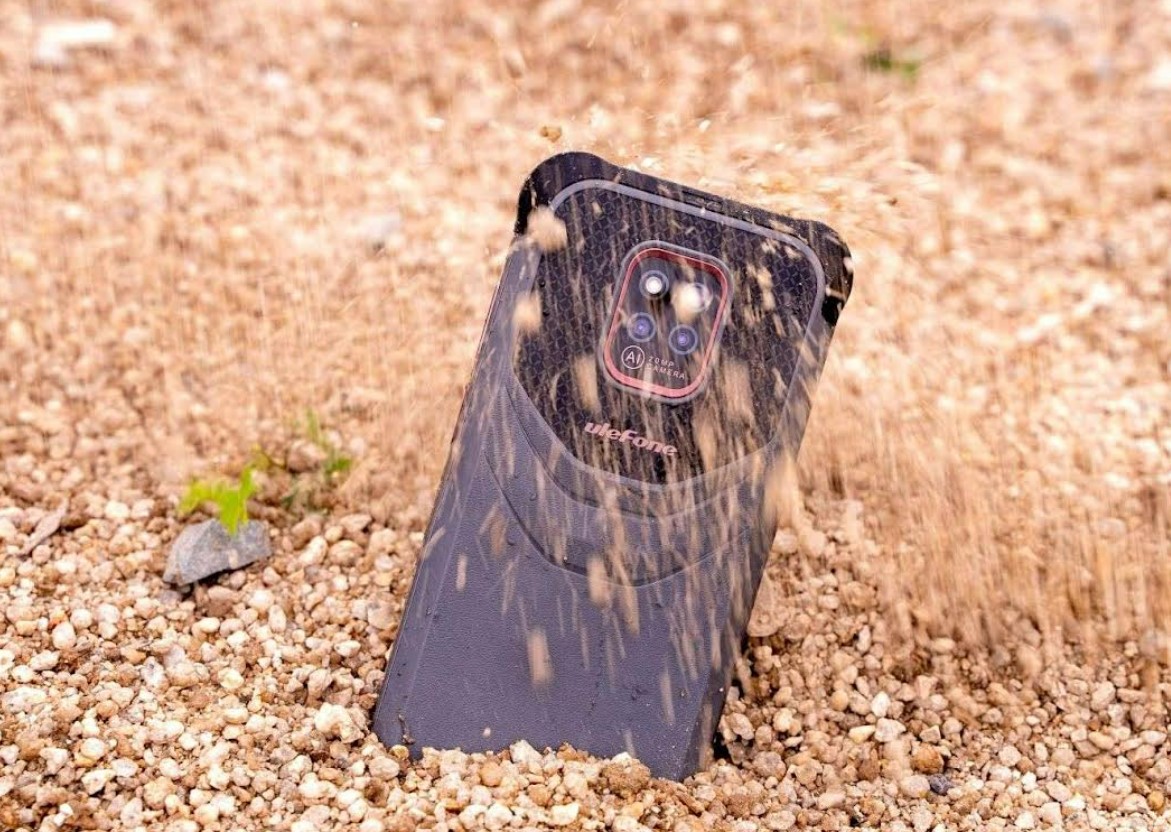
Ulefone Power Armor 14 Pro is designed to withstand the harsh and extreme outdoors. And to that end, this 6.52” smartphone comes with IP68/69K and MIL-STD – 810G military-grade certifications. This means the phone is dust, dirt, shock, and waterproof and can perform under extreme and harsh conditions.
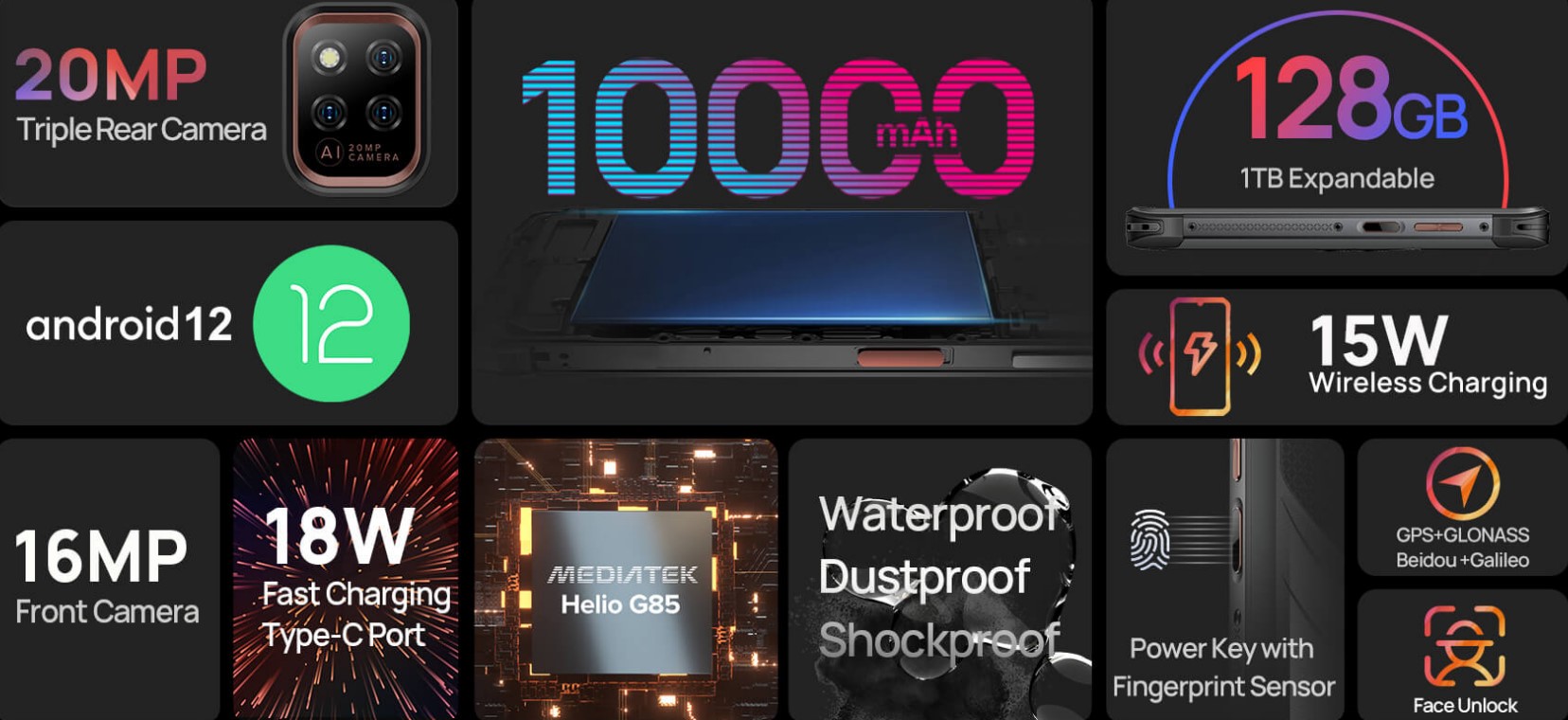
But Ulefone Power Armor 14 Pro stands out from other rugged smartphones not only for its endurance but also for its exceptional battery life. Similar to Power Armor 14, the Pro version also comes with a 10000mAh battery that can last you for up to two days on moderate usage and supports 18W wired charging and 15W wireless charging.
Ulefone Power Armor 14 Pro features a 6.52” IPS LCD display with 1700x720p resolution and a 20:9 aspect ratio. While the display comes with Corning Gorilla Glass protection, the phone is protected by a high-grade rigid plastic body encased in metal frames and rubber corners. Powered by MediaTek Helio G85 octa-core processor, it comes with 6GB RAM and 128GB storage space.
You have a triple rear camera setup with a 20MP main camera, a 2MP macro sensor, and a depth sensor. For your selfies, you have a 16MP front camera. The phone also comes with a special AI photoshoot feature wherein it automatically identifies the subjects and adjusts the camera specs to give you optimal results.
Ulefone Power Armor 14 Pro runs the latest Android 12 and comes with a fingerprint sensor, programmable side key, and dual Sim / MicroSD slot. For more detailed information and visuals check out this video.
Ulefone has scheduled the global launch of Power Armor 14 Pro at the end of March. The smartphone will retail at $399.99, but under the World Premiere sale, you can expect huge discounts on the smartphone. So stay tuned at Ulefone.com for more information on the upcoming World Premiere Deal.
For more information on such exciting deals and offers check out our deals hub
MediaTek recent shared a financial report that revealed its consolidated revenue for the first two months of this year. The company has seen robust growth in recent months, rivaling Qualcomm in certain quarters, and now, its newly launched Dimensity 9000 has helped boost its revenue even further.
In February 2022 alone, the Taiwanese chipmaker recorded 40 billion Yuan (roughly 6.32 billion US Dollars) in revenue. This marked one of the company’s best February performance till date, marking a notable 22.9 percent rise over the same month last year. On the other hand, the brand’s performance in the first two months was also robust, with a combined revenue of 83.531 billion Yuan (roughly 13.2 billion US Dollars), which was 23 percent higher than the same period in 2021.
Furthermore, MediaTek also revealed its estimated revenue for the first quarter of this year. According to company CEO Cai Lixing (Via UDN), the increase in revenue was due to the better penetration of the brand’s 5G chipsets alongside the launch of its new flagship 5G SoC, the Dimensity 9000. This is its latest high end processor that will be shipped in premium grade handsets and rivals the Qualcomm Snapdragon 8 Gen 1.
Cai Lixing also believes that MediaTek’s annual growth rate this year will surpass 20 percent. Recently, we have covered numerous reports of the company catching up or even beating its primary rival Qualcomm, in some quarters in 2021. With its new 5G chip launches, the company will likely see robust performance in the coming quarters as well. So stick around for more updates.
Earlier this year, a massive leak revealed almost the entire spec sheet of the OnePlus Nord 2T 5G, leaving nothing but the price to speculation. But that changes today with yet another leak which says that the phone’s base variant will cost below Rs 35,000.
The info comes from tipster @Shadow_Leak on Twitter who also shared the already-known specifications of the Nord 2T. It’s powered by the MediaTek Dimensity 1300, which looks to be the successor of the Dimensity 1200. The Dimensity 1200 was actually MediaTek’s most powerful smartphone chip last year before it was dethroned with the announcement of the Dimensity 9000 in December 2021.
OnePlus Nord 2 5G
And if the past is any indication, then the Dimensity 1300 will be an upper mid-range offering and will be fair enough for a sub-Rs 35,000 phone.
Other known specifications of the OnePlus Nord 2T 5G include a 6.43″ AMOLED display with a 90Hz refresh rate and an FHD+ resolution of 2400×1080. It will have a 50MP+8MP+2MP rear camera setup and a 32MP selfie camera. The battery will be sized 4,500mAh with support for 80W fast charging. Two memory configs will be offered — 8GB+128GB and 12GB+256GB. Out of the box, the device will be booting into Android 12.
Another leak from a couple of days back had provided a first glimpse into the design of the upcoming phone, which you can check out from here.
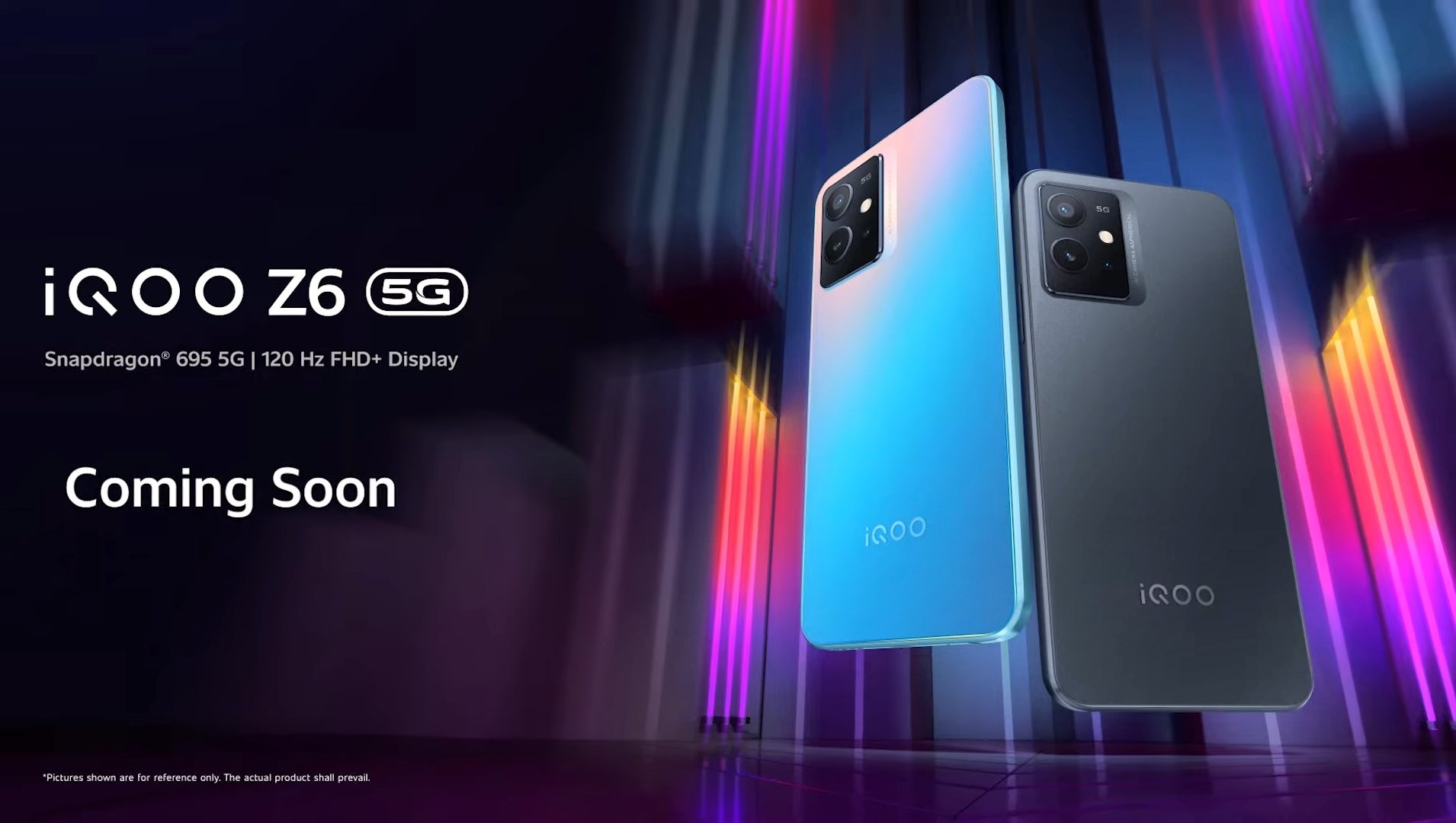
Yesterday, iQOO India teased the arrival of the iQOO Z6 5G smartphone in India. The key specifications of the phone were shared by Mukul Sharma (aka stufflistings) yesterday. Now, tipster Abhishek Yadav has tipped the launch date of the iQOO Z6.
According to Yadav, the iQOO Z6 will be made official on March 16 in India. The device is likely to be priced around Rs 15,000. iQOO India has rolled out a new promo video to reveal that the Z6 will feature a 120Hz refresh rate and it will be powered by the Snapdragon 695 chipset.
IQOO Z6 5G
As can be seen in the screenshot above, the iQOO Z6 will be arriving in black and gradient colors. It looks like the Z6 will be the same as the Vivo T1 5G that came out in India last month.
Reports surrounding the iQOO Z6 5G have revealed that it will be equipped with a 6.58-inch display, 240Hz touch sampling rate, 4 GB of virtual RAM, and a 5-layer liquid-cooling system. The device is likely to arrive in two options, such as 6 GB RAM + 128 GB storage and 8 GB RAM + 128 GB storage.
Now that the company has started teasing the iQOO Z6 5G in India, it may confirm its launch date in the next few days. Last year, iQOO launched the Snapdragon 695 powered iQOO U5 in China. The same phone with an enhanced rear design and a 16-megapixel front camera was made official as the Vivo T1 5G in India. In comparison, the iQOO U5 offers an 8-megapixel front camera. It remains to be seen whether the iQOO Z6 5G will be similar to the Vivo T1 5G / iQOO U5.
Last month, Samsung officially launched the Galaxy S-series flagship smartphones in the form of the Galaxy S22 lineup. Now, the company is gearing up to announce the next-generation foldable smartphones.
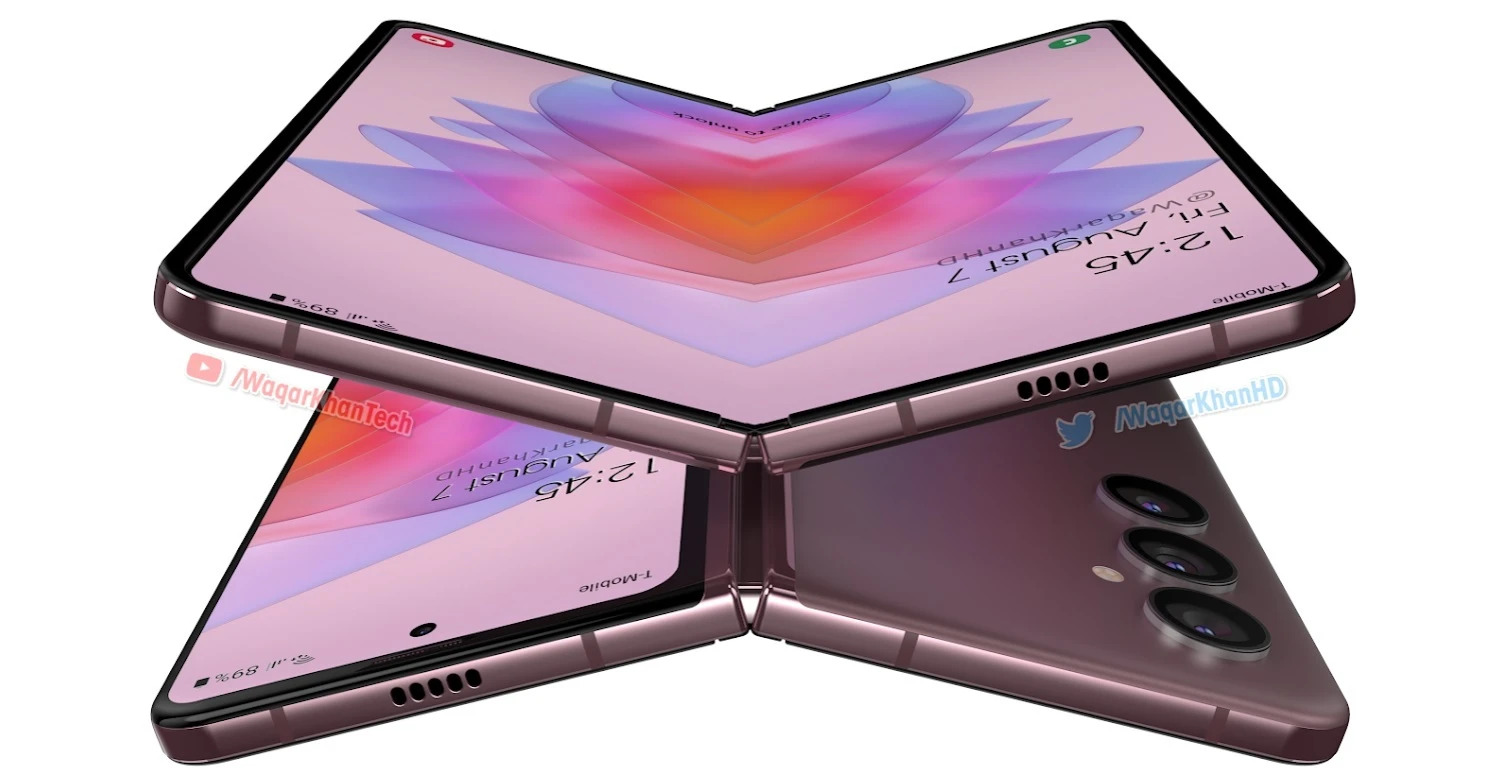
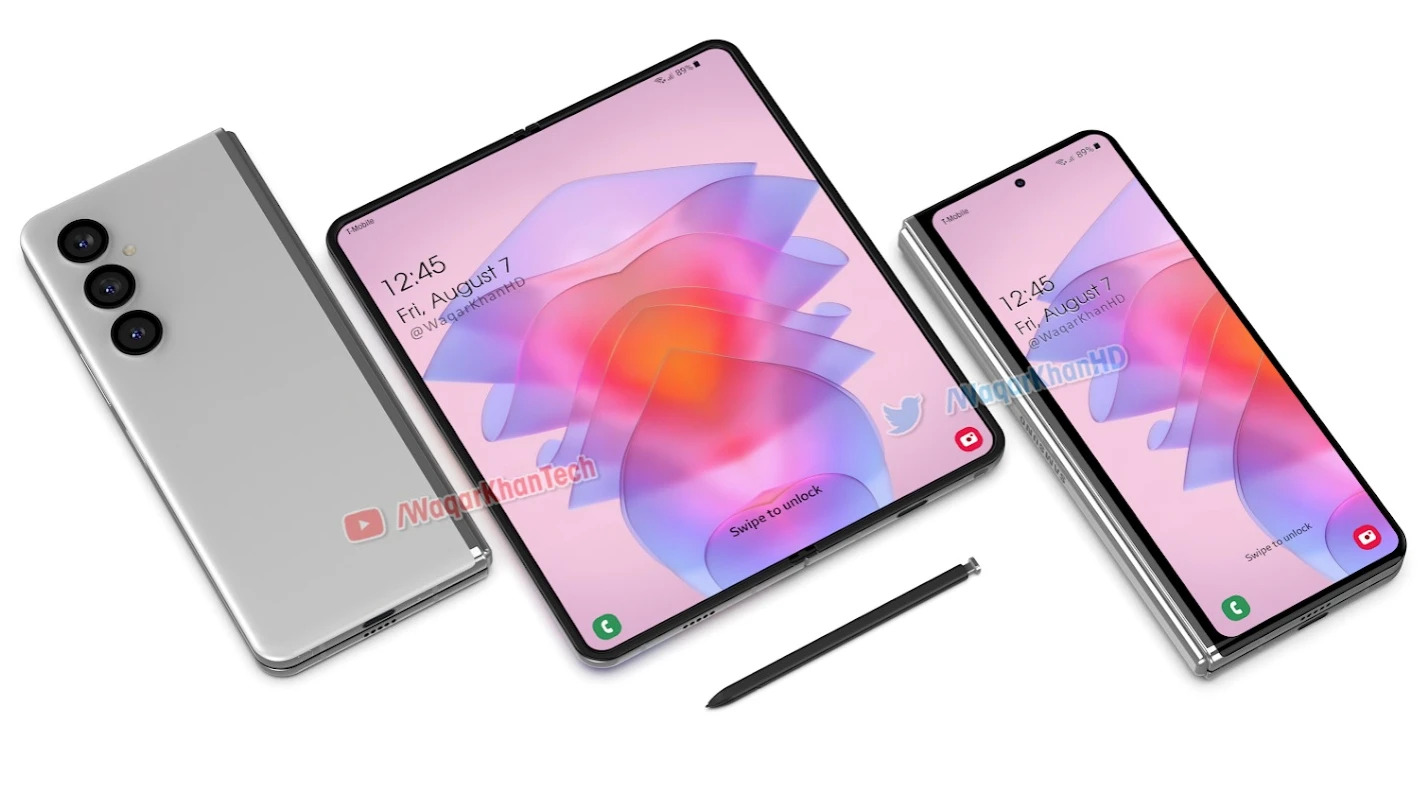
Ahead of any official announcement regarding the upcoming foldable smartphones, the Samsung Galaxy Z Fold 4 smartphone’s renders have surfaced online through the concept render designer Waqar Khan.
In terms of design, the upcoming Galaxy Z Fold 4 continues with the book-like foldable design. The size of the internal display when the device is fully opened is 7.6-inch while externally, there’s a 6.2-inch screen.
The renders of the smartphone show the S Pen stylus but there’s no place on the smartphone to hold the S Pen. However, previous reports have indicated that the phone will come with a slot for holding the Samsung S Pen stylus.
The current generation Galaxy Z Fold 3 has support for S Pen Fold Edition and the S Pen Pro, however, the stylus needs to be bought separately and the device does not feature a dedicated silo to house the stylus inside its body.
On the other hand, the South Korean giant will also announce the Galaxy Z Flip 4 which is a clamshell foldable smartphone. It features a 1.1-inch external display for notifications and more and flips to open, offering a 6.7-inch smartphone with a tall and thin display.
As of now, not much is known about the upcoming foldable smartphones from Samsung but we expect to get information in the coming weeks and months. While the launch date is not yet known, the phones are said to go official in the second half of this year.
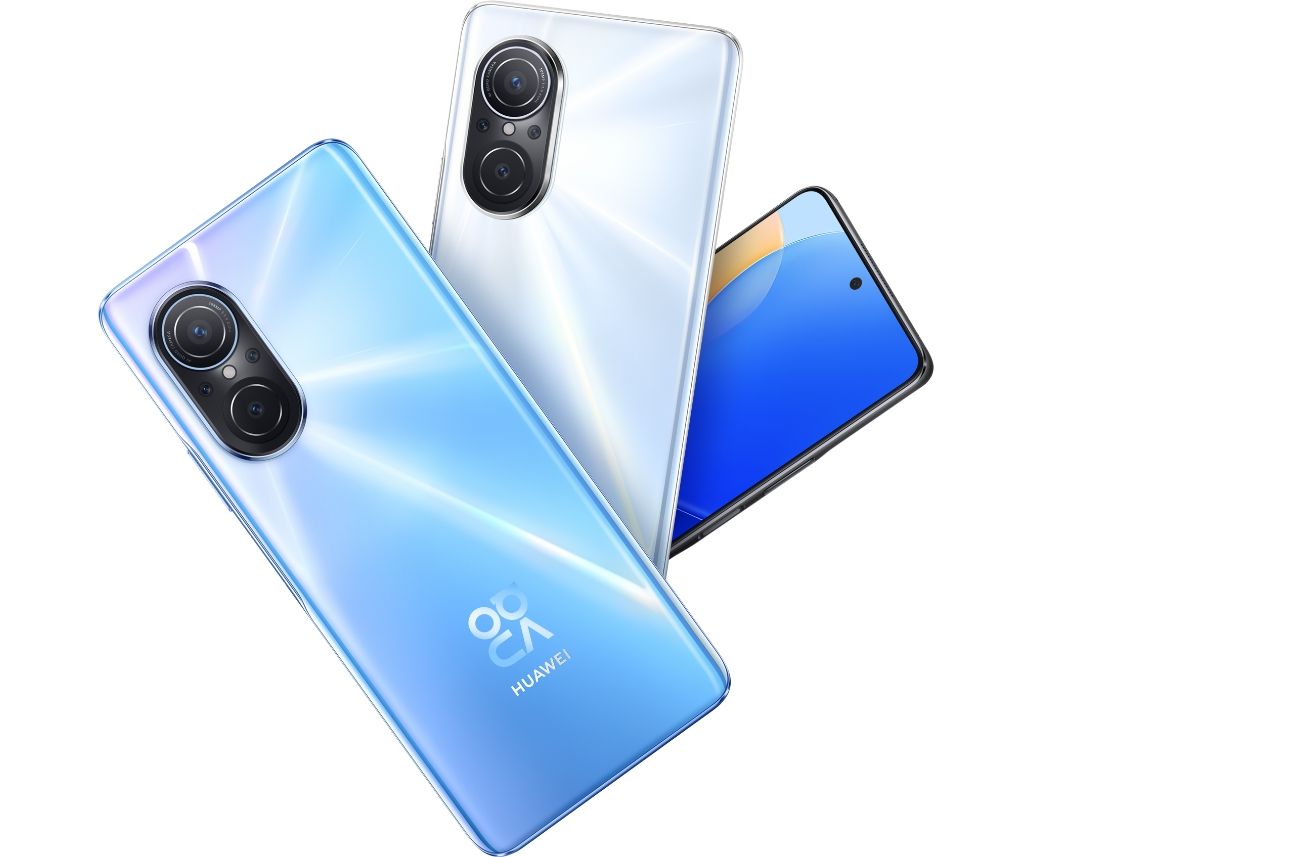
Huawei has silently announced the Huawei Nova 9 SE in markets like China and Malaysia. Back in September 2021, Huawei announced the Nova 9 5G and Nova 9 Pro 5G smartphones. Now, it has unveiled the more affordable Nova 9 SE, which is a 4G LTE device powered by the Snapdragon 680 chip. Here is all the information on the specifications, features, and pricing of the Nova 9 SE.
Huawei Nova 9 SE specifications and features
The Huawei Nova 9 SE features a 6.78-inch IPS LCD display with a centrally positioned punch-hole. The screen produces a Full HD+ resolution of 1080 x 2388 pixels, a refresh rate of 90Hz, and a touch sampling rate of 240Hz.
Huawei Nova 9 SE
A 16-megapixel camera is available on the front of the Nova 9 SE. Its back panel has a 108-megapixel primary camera, which is coupled with an 8-megapixel ultrawide lens, a 2-megapixel depth sensor, and a 2-megapixel macro camera. The phone boots into EMUI 12. Like other Huawei phones, it lacks Google apps and services.
Huawei Nova 9 SE
The Nova 9 SE is powered by the Snapdragon 680 and has a 4,000mAh battery that supports 66W fast charging. The device comes with 8 GB of RAM and 128 GB / 256 GB of storage. The usual connectivity features such as dual SIM support, 4G VoLTE, Wi-Fi 802.11ac, Bluetooth 5.0, GPS, NFC, and a USB-C port are also present on the device. For security, it has a side-mounted fingerprint scanner.
Huawei Nova 9 SE pricing and availability
The Huawei Nova 9 SE has arrived in three colors such as Crystal Blue, Pearl White, and Midnight Black. It’s pricing for China and Malaysia is yet to be confirmed. The Vmall retailer listing of the phone comes in two options, such as 8 GB RAM + 128 GB storage and 8 GB RAM + 256 GB storage.
Since working from home has become common for so many people, many new products have emerged that have tried to make your work-life easier at home. While portable monitors are not exactly one of the latest innovative products, their portability and ease of use can solve a lot of the users’ pain points. You don’t really have to settle for a heavy monitor in your small room. A portable monitor can be a better option in a lot of scenarios.
So today we bring you guys the latest portable monitor from the brand Arzopa, the Arzopa A1 Gamut Slim.
Display
The A1 Gamut series has been pretty popular in recent years, including its 15.6-inch versions and 13-inch mini variants. Apart from a Full-HD standard resolution, the 13-inch Mini version even offers 2K resolution as an option. But personally, I think the Slim Version has better value for money. And it could be a great option for those who are planning to have a second or even a third monitor, whether it’s for your laptop, smartphone, or game consoles like a switch.
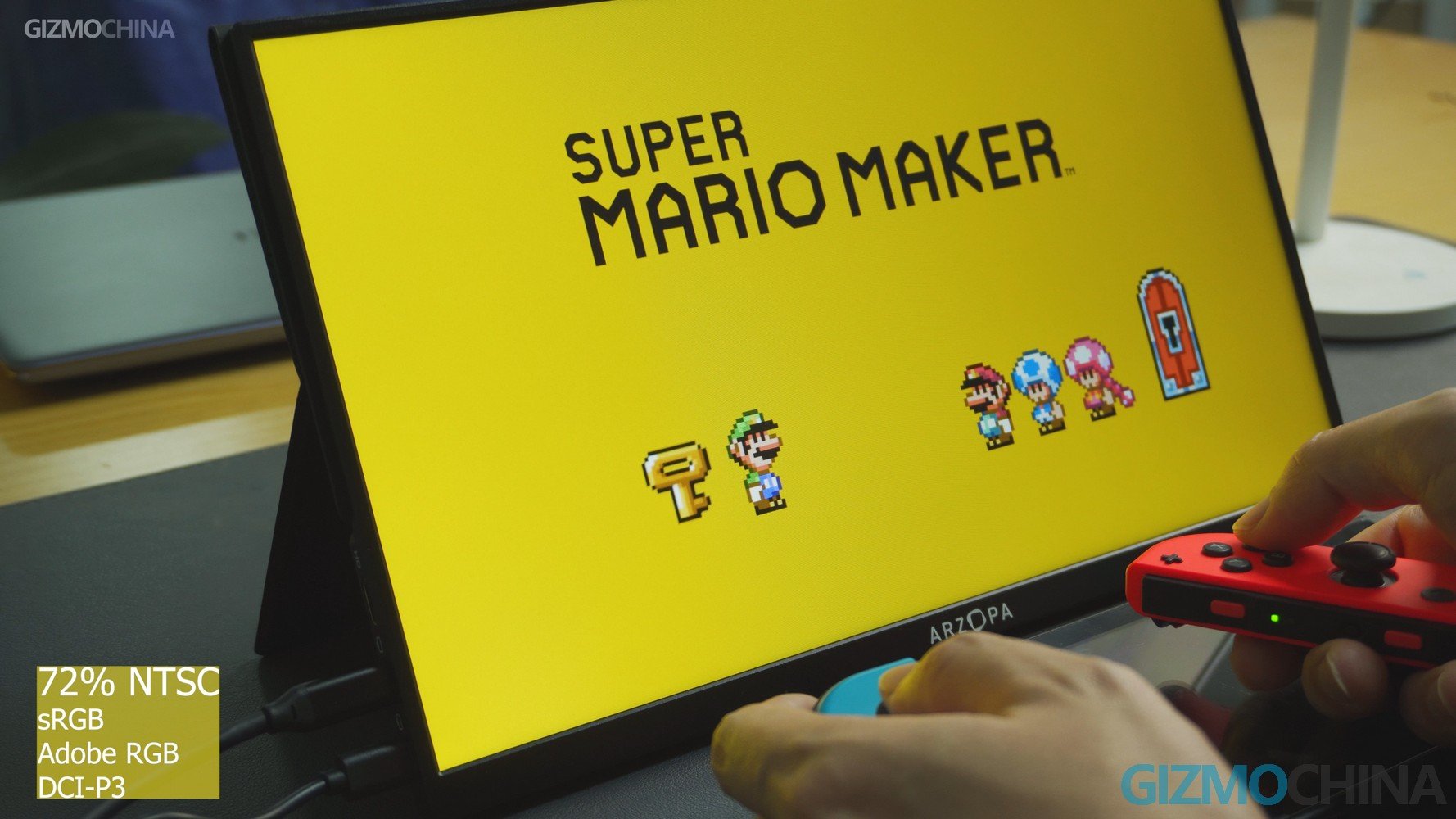
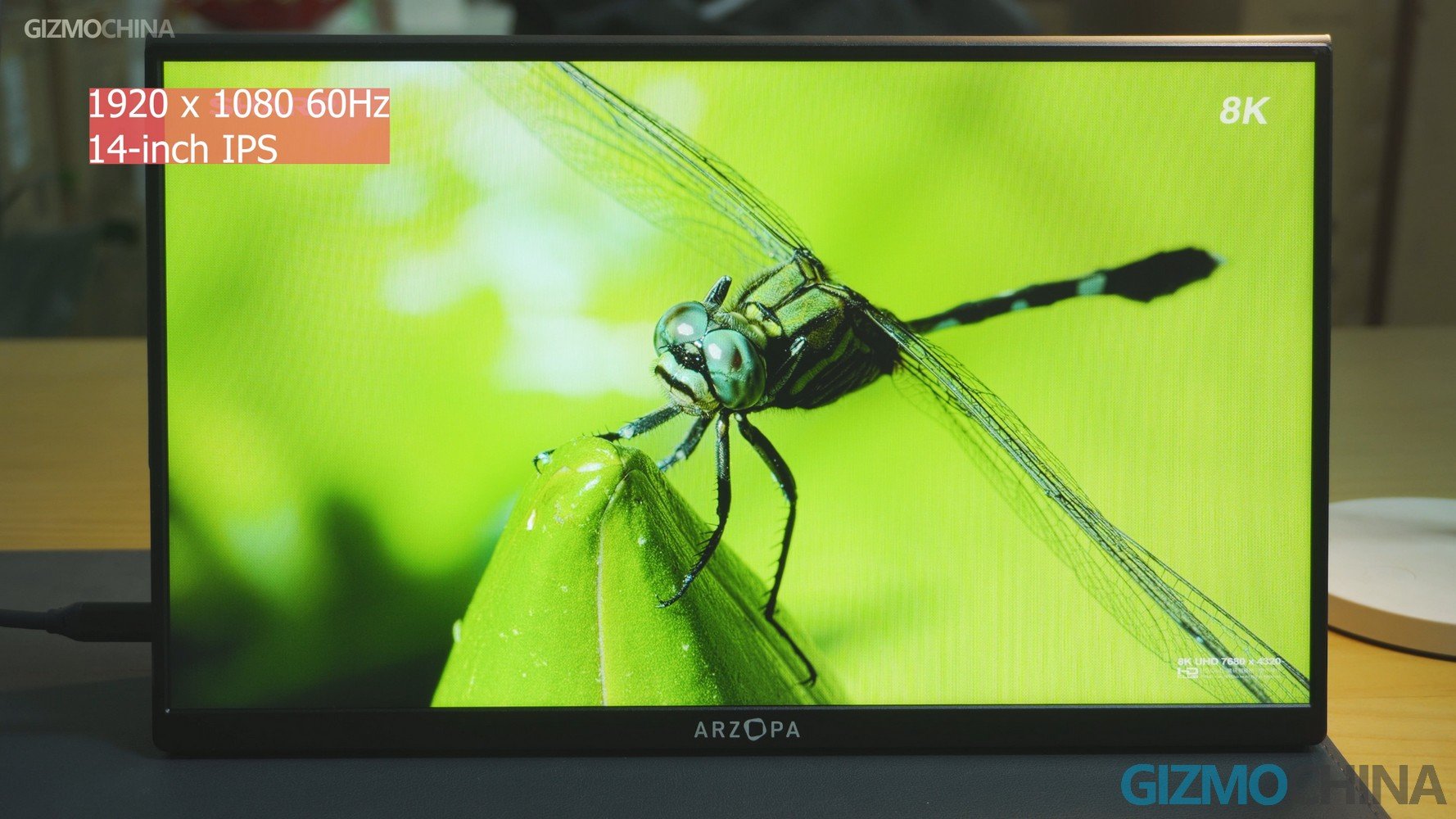
The A1 Gamut Slim features a 14-inch Full-HD IPS screen with a 60Hz refresh rate. The slim version gets a slightly upgraded contrast ratio from 1000:1 to 1200:1. The IPS panel supports a wide 178°-viewing angle, which visually gives a pretty decent color contrast under 72% NTSC color gamut. Apart from the NTSC gamut, the monitor also offers sRGB, DCI-P3, Adobe, and the native gamut in OSD Menu for options.
The brightness can reach up to 320cd/㎡, which is slightly better than most portable monitors that we used before. At the same time, HDR mode is available in the OSD menu. During our experience, we could obviously see the difference in the HDR output, but the actual effect isn’t as good as what we saw on many smartphones’ OLED displays.
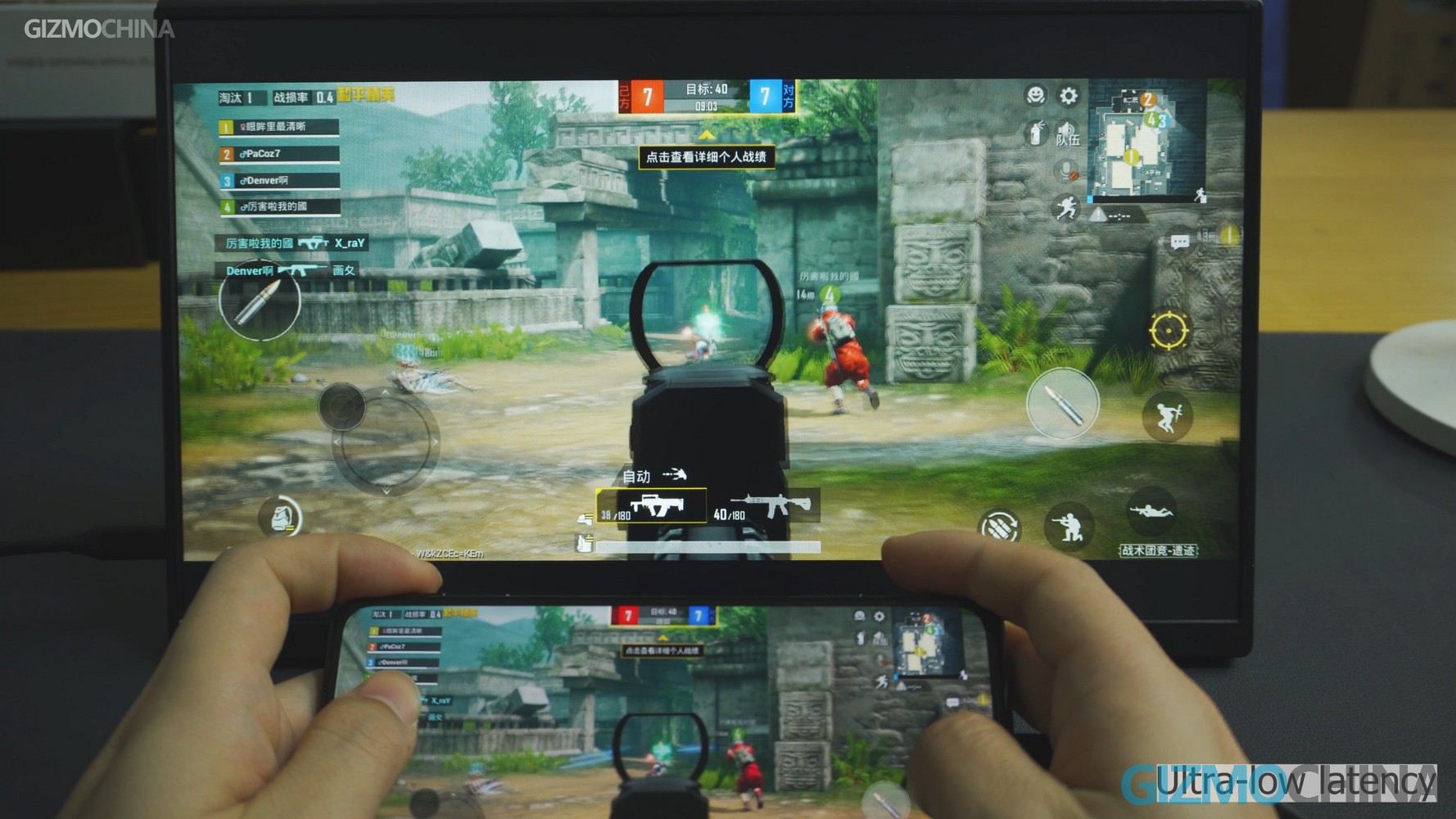
In actual use, it could deliver pretty good detail and colors under different visual modes. The blur and ghosting issues were not as serious as we thought. Most of the time, it could provide a fast response without lags or perceivable latency.
Accessories in the box
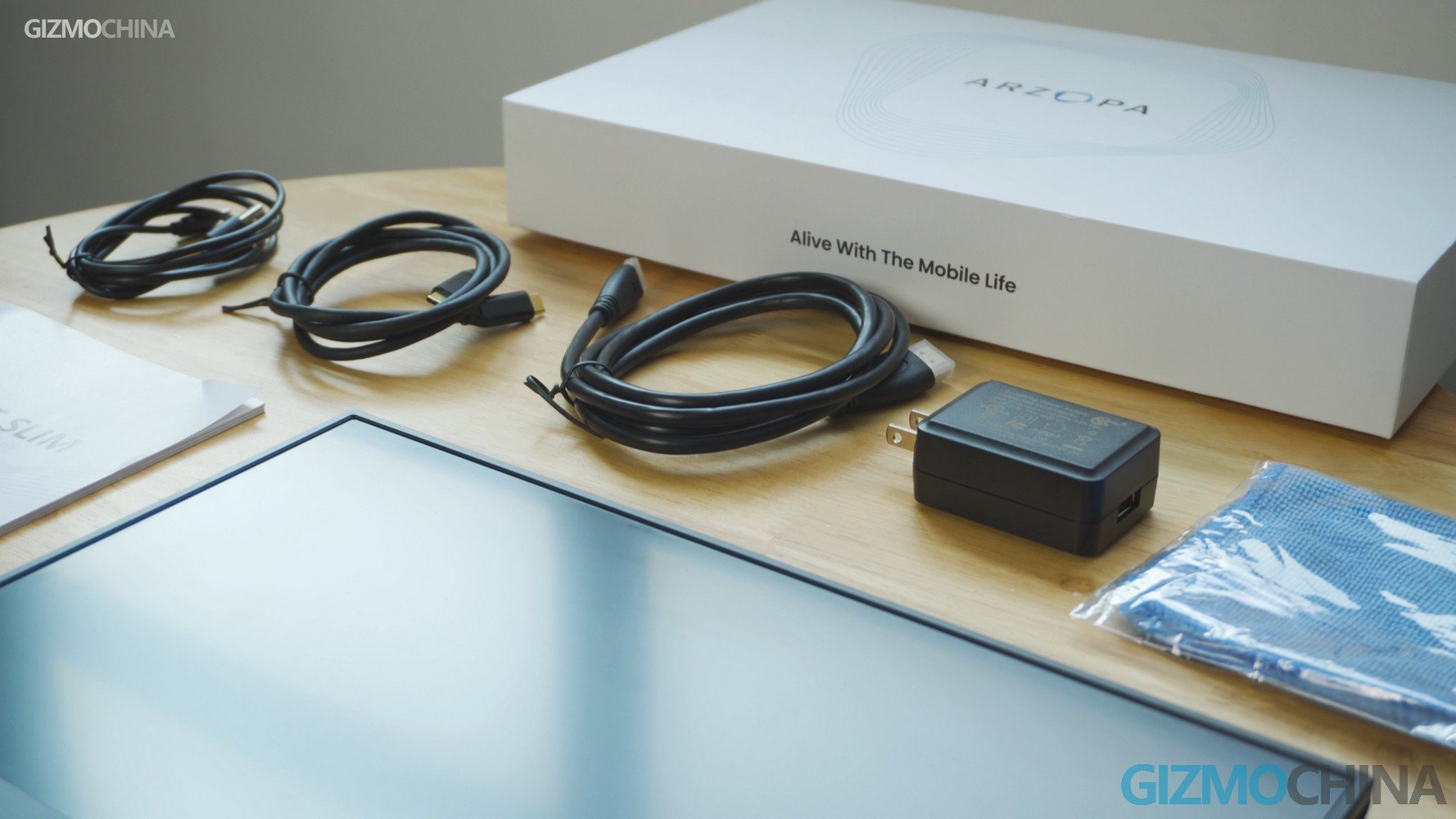
Now let’s check out what’s in the product box and what the slim monitor provides for connectivity. The first item we found was the user manual in different languages, which looks pretty detailed for those who are using it for the first time.
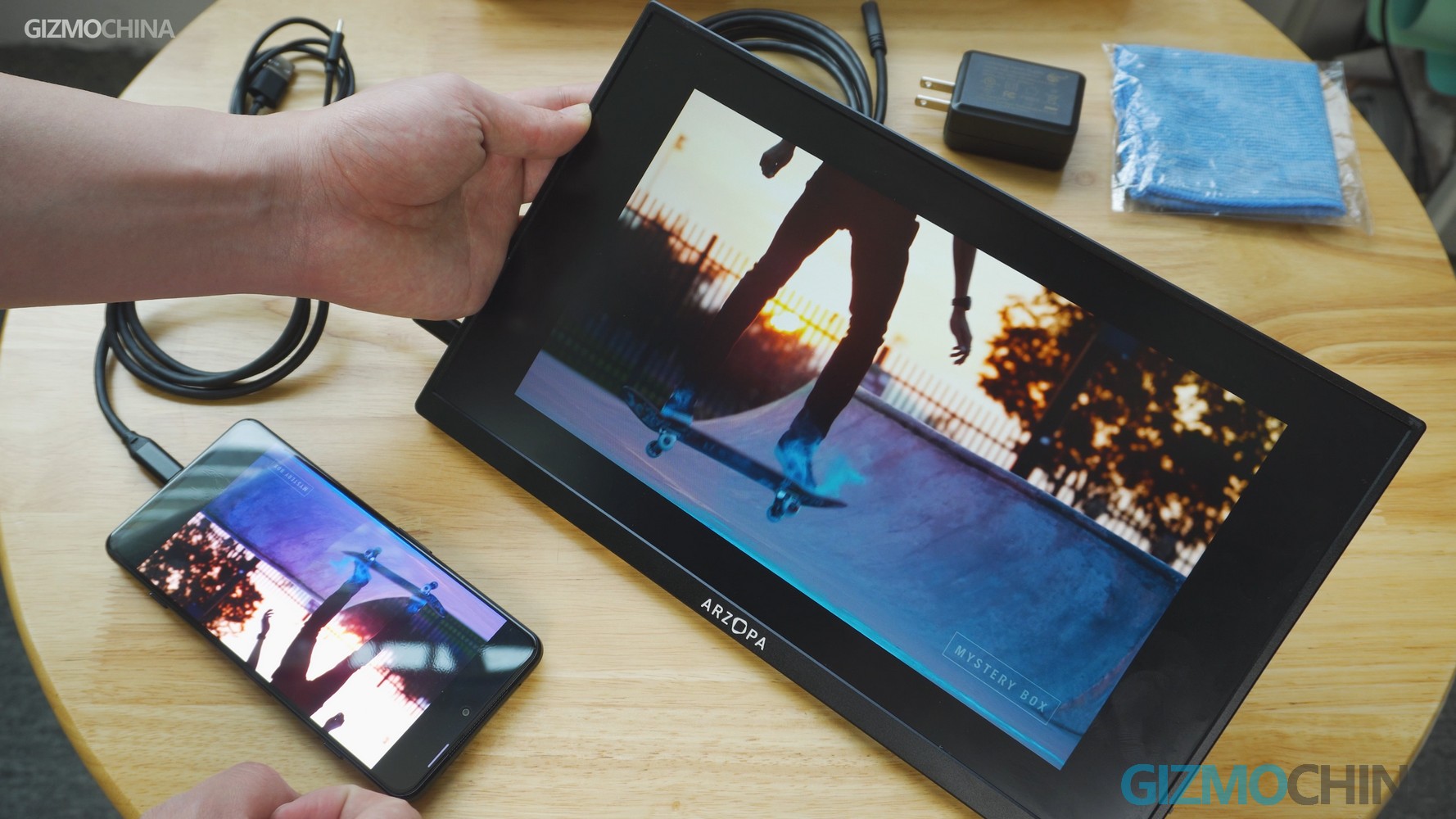
Well, it’s good to see all the three cables are made available for different connectivity options, including a Type-C to Type-C cable for full-feature use, a Type-C to Type-A cable basically used for supplying power, and another Mini HDMI to HDMI cable for video signal input. In addition to the power cable, there’s a piece of cleaning cloth and a common power brick included inside the accessories kit.
Connectivity
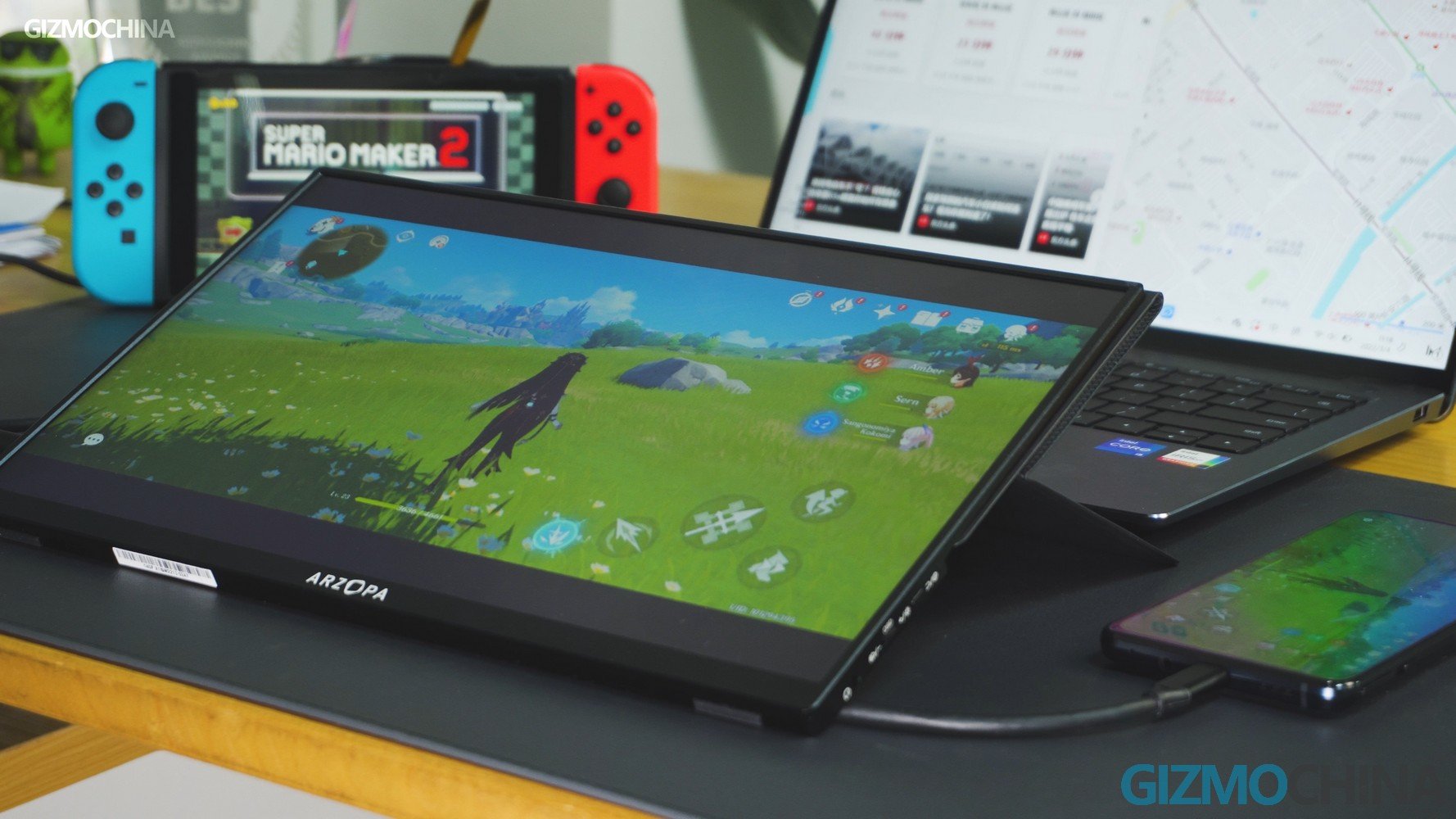
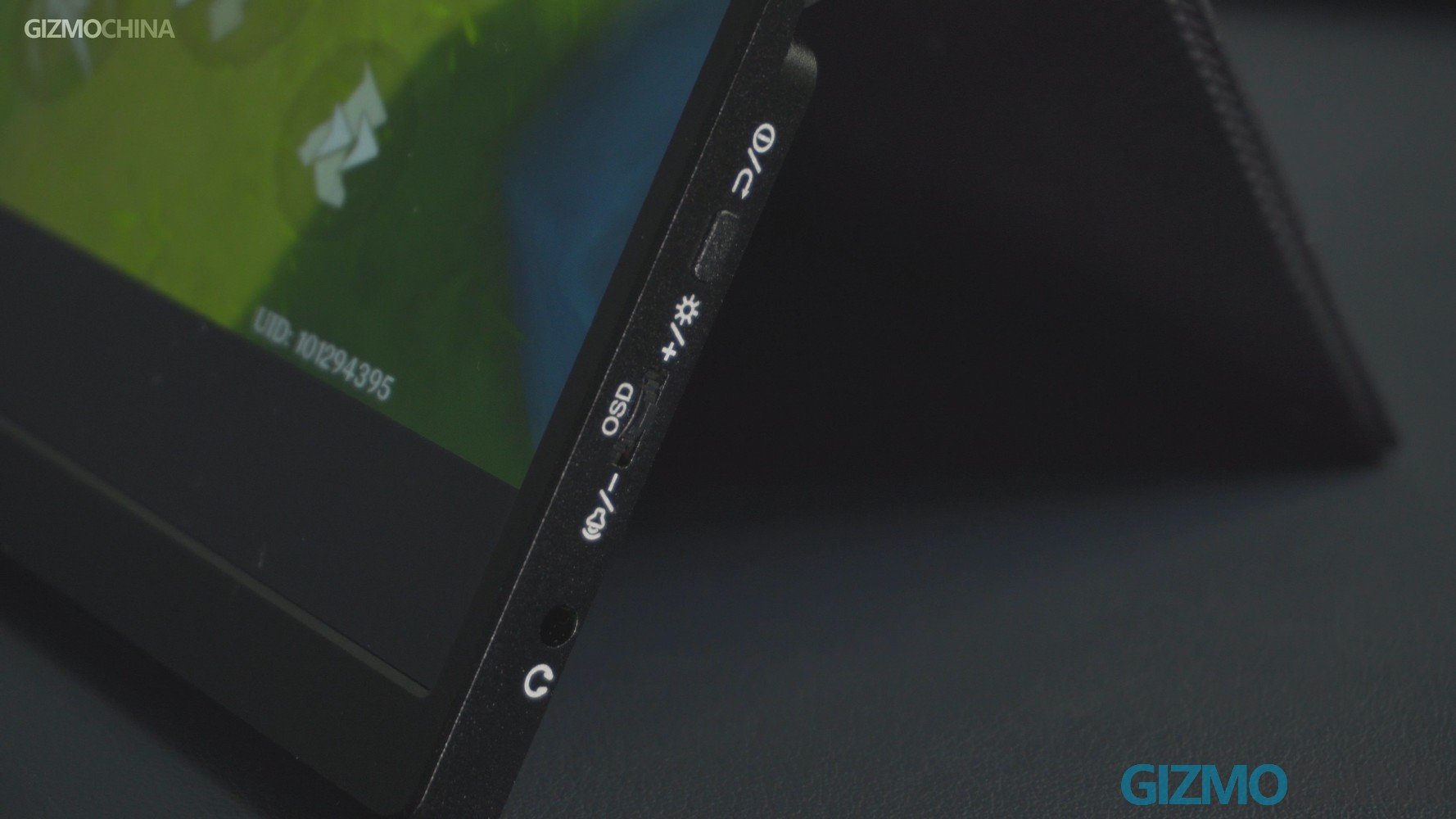
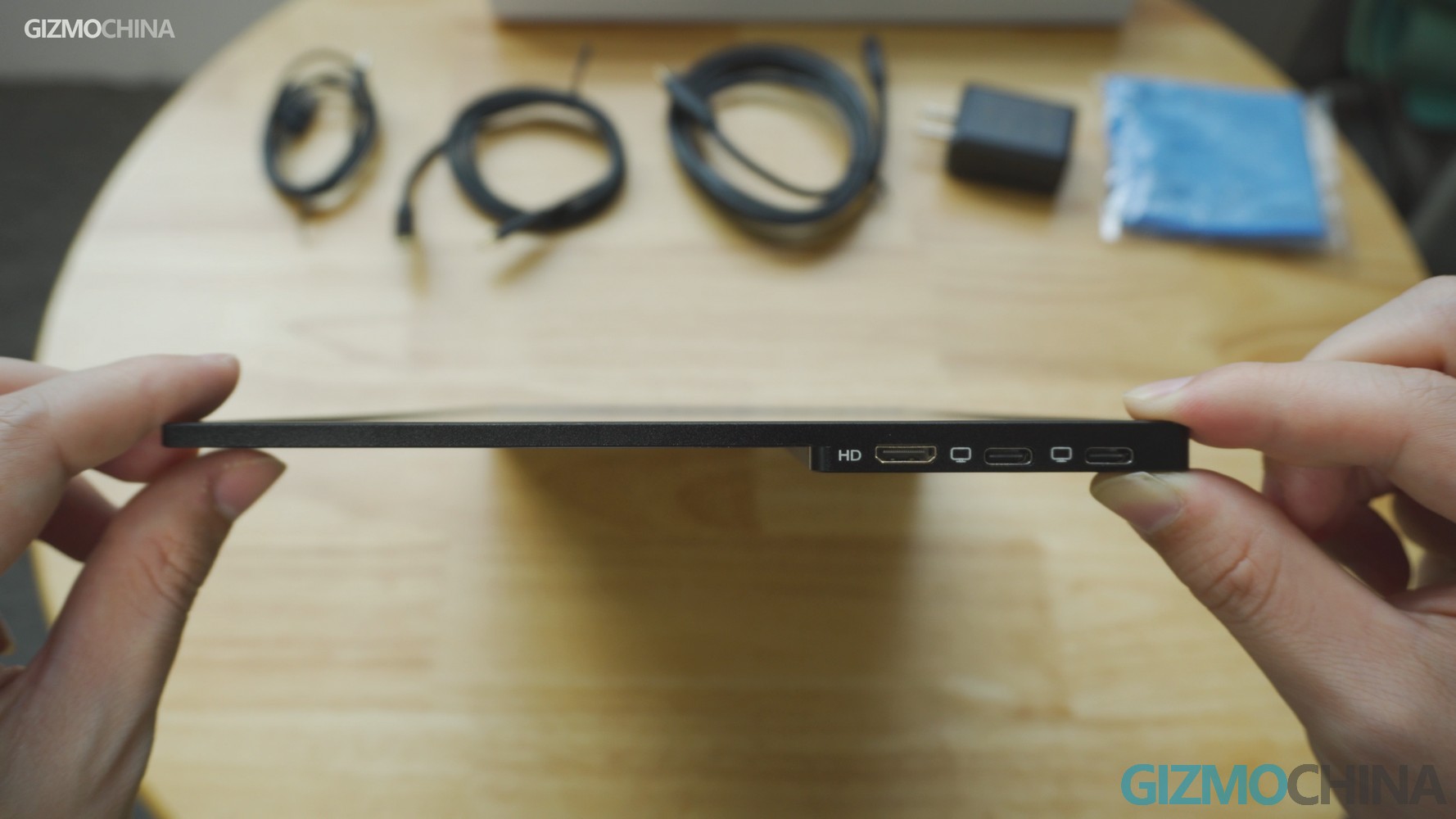
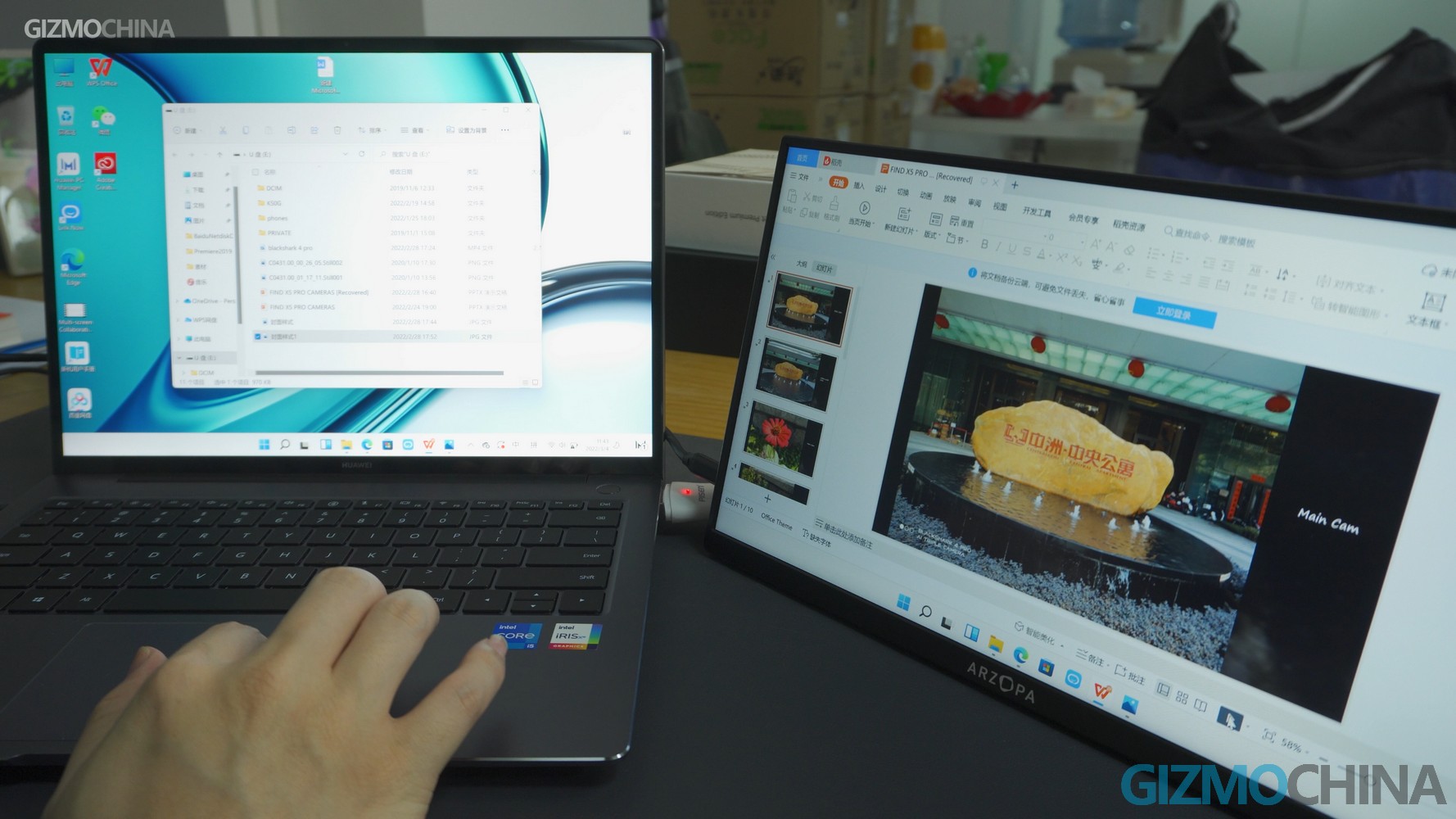
And now let’s look at the portable monitor. Just as it claims, the monitor is slim and lightweight, even with the attached protective cover. On the left side, there’s a power button, 3.5mm audio output, and another scrolling button for OSD operation. On the other side, it offers a Mini HDMI Port, a full-featured USB Type-C Port for receiving audio, video signals, and power connection, and another Type-C port only for power supply. At the same time, just note that the monitor doesn’t have a built-in battery, which means a wired power supply is necessary.
So let’s find out how it works. First, if you are going to use it as a monitor for a device with a full-functioned Type-C port, all you need to do is connect the monitor directly with the included Type-C cable. While transferring audio and video signals, it can also output the power supplied from the device. Such a full-functioned Type-C port now is available on most new Laptops, so just make sure that your laptop supports the most convenient connectivity.
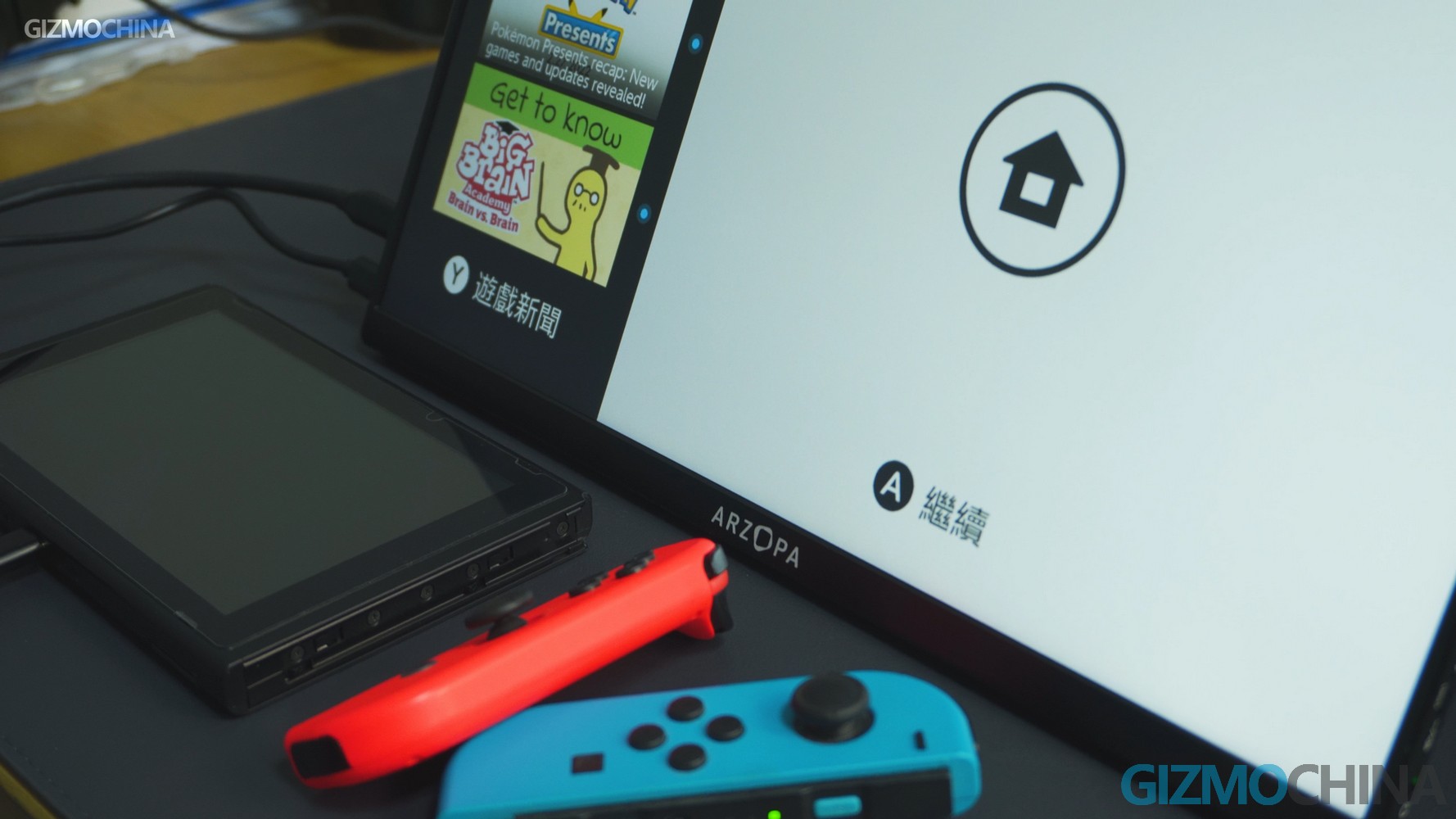
Or if you were going to project the content from your phone or a Switch console, a single-cable connection would still work. But at the same time, the monitor might quickly drain your phone’s power. Note that, different devices support different power output solutions, and some of them may be too low to consistently power the monitor.
So in this case, it’s better to connect the monitor with the included power kit. When connected to the external power, we found that the monitor surprisingly reverse-charged the phone during projection. When connected to a Switch console, it could also supply power to both the monitor and the console.
For those devices without a Type-C port for video output, such as TV boxes, PC,s or older game consoles, the A1 Gamut monitor offers another connectivity with the Mini HDMI port. But in this case, the external power supply is necessary through the type-C power port.
Verdict
So in short, it comes with wide support for different devices like phones, Laptops, PCs, or even game consoles like Switch and PS4. More specifically, it could be a second portable screen for gaming; or just a duplicate screen for entertainment or even learning from your mobile devices; or it could also be an extended screen for your PC or laptop and help make your work from home experience more efficient.
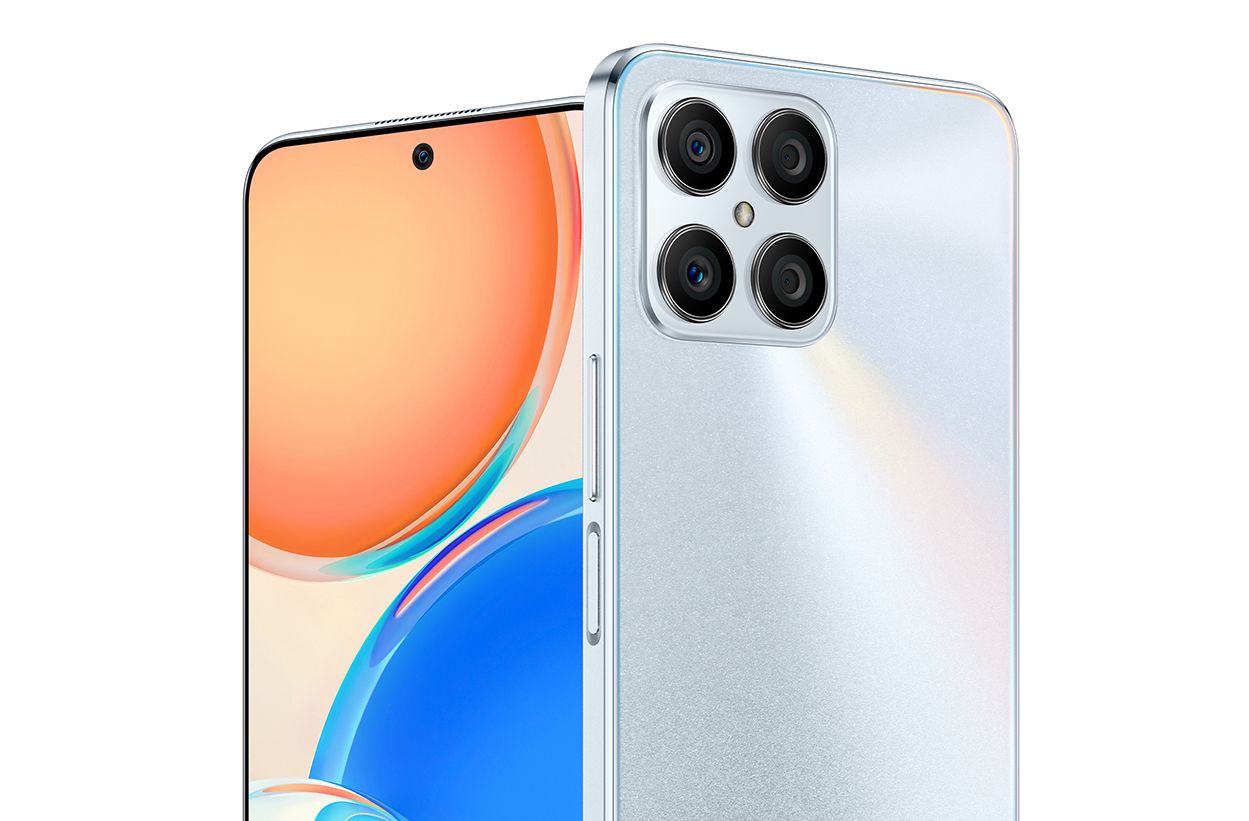
Honor has silently unveiled the Honor X8 mid-range phone. Its front side features a display with a centrally positioned punch-hole. Its rear side has a 64-megapixel quad-camera unit. Here is all the information on the specifications, features, and pricing of the phone.
Honor X8 specifications and features
The Honor X8 measures 163.4 x 74.7 x 7.45mm and weighs 177 grams. It has a 6.7-inch LCD screen that offers a Full HD+ resolution of 1080 x 2388 pixels and a 90Hz refresh rate. It has a 93.6 percent screen-to-body ratio.
Honor X8
The Snapdragon 680 is present under the hood of the Honor X8. The device comes with 6 GB of RAM and 2 GB of virtual RAM. It offers 128 GB of built-in storage. The handset runs on Android 11 OS, which is overlaid with Magic UI 4.2.
The X8 is equipped with a 16-megapixel camera on the front, which is capable of shooting 1080p videos. Its rear camera setup has a 64-megapixel main camera, a 5-megapixel ultrawide lens, a 2-megapixel depth sensor, and a 2-megapixel macro camera.
Honor X8
The Honor X8 includes a 4,000mAh battery that carries support for 22.5W fast charging. The company claims that a 10-minute charge will allow the phone to offer 3 hours of video playback. The handset offers other features such as dual 4G VoLTE, Wi-Fi 802.11ac, Bluetooth 5.0, GPS, a USB-C port, a 3.5mm audio jack, AI face unlock, and a side-mounted fingerprint scanner.
Honor X8 pricing and availability
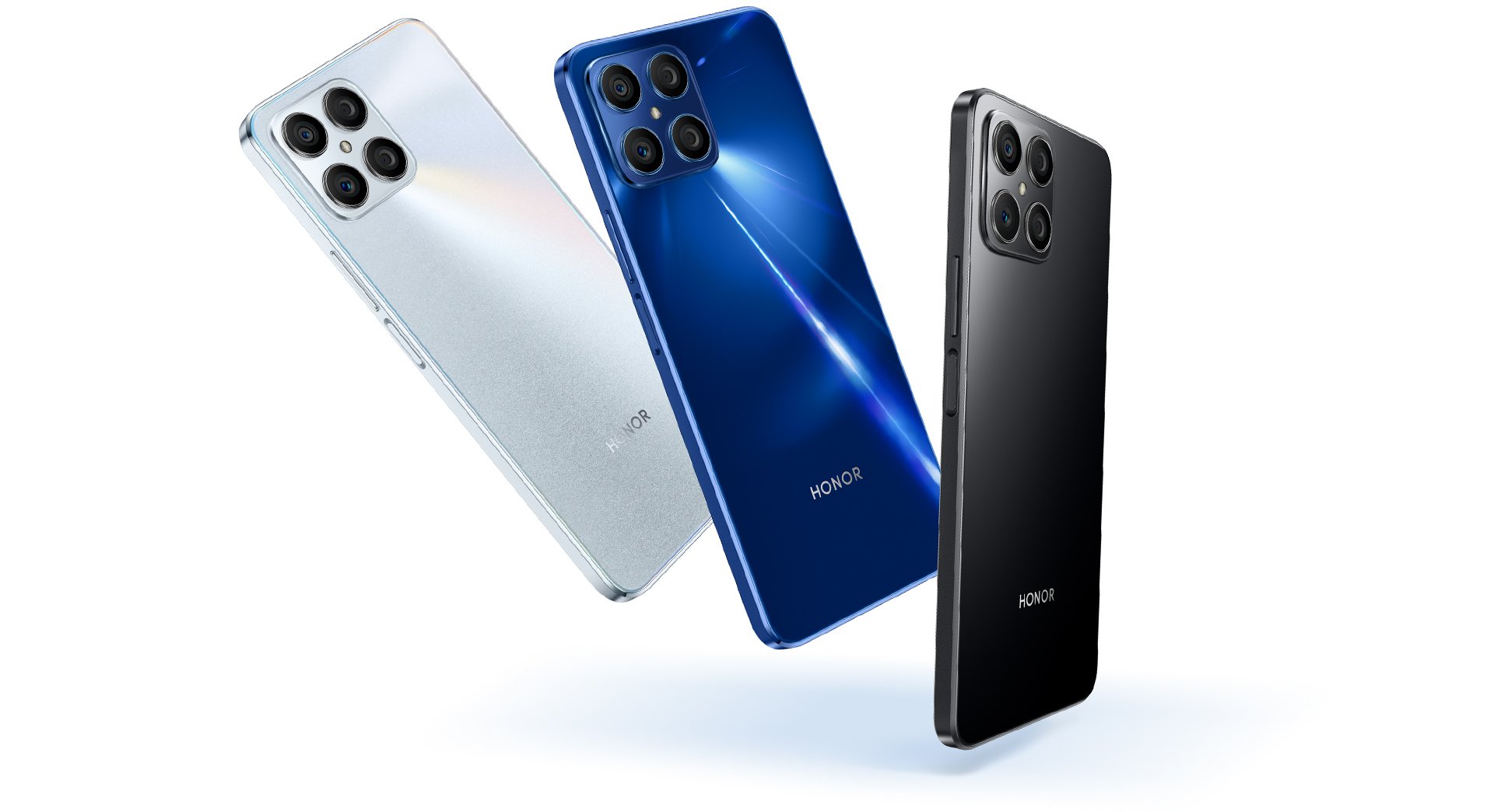
The price of the Honor X8 is yet to be confirmed. It is expected to arrive in markets like the Middle East, Africa, and Europe. It will be available in colors like Titanium Silver, Midnight Black, and Ocean Blue.
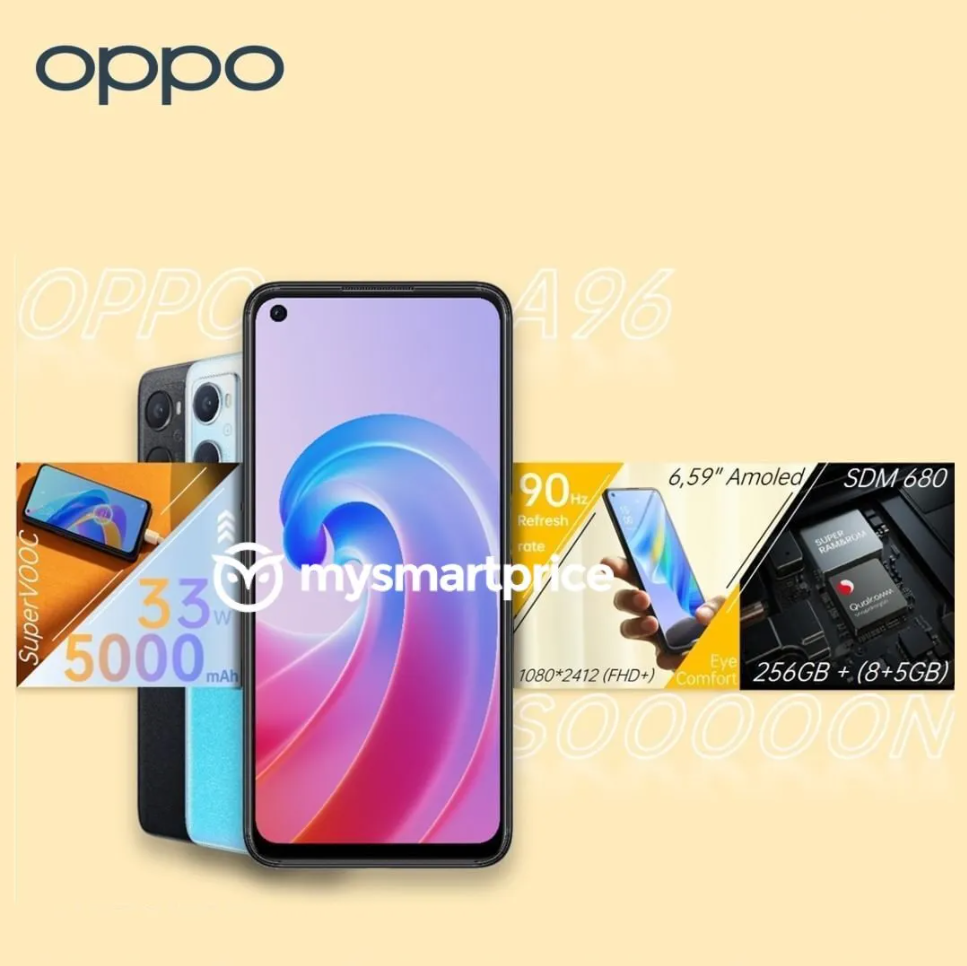
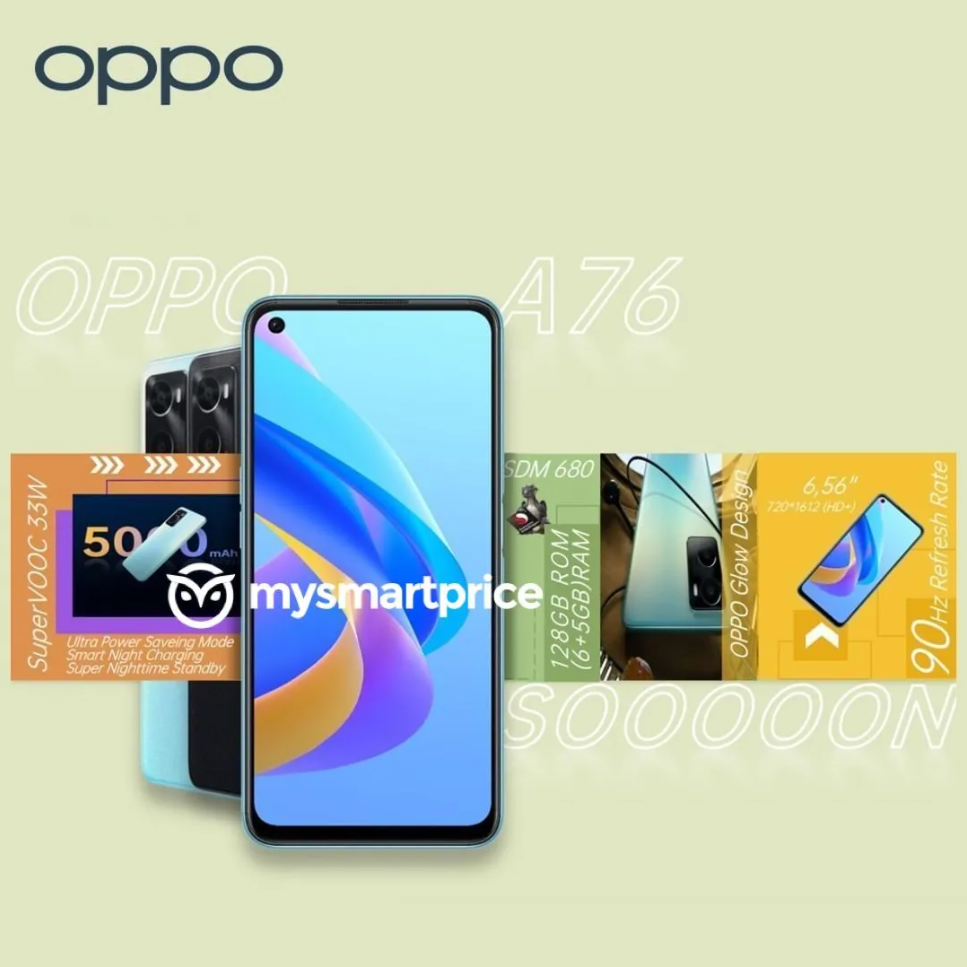
Leaked information that surfaced yesterday claimed that the OPPO A96 and OPPO A76 smartphones will be launching soon in India. The report revealed the key specifications of both smartphones. Abhishek Yadav, a tipster, has now shared the variants, prices, and launch dates of these phones.
The tipster claimed that the OPPO A96 and OPPO A76 would be launched on March 12 in India. The 8 GB RAM + 128 GB storage edition of the OPPO A96 will be priced at Rs 20,000 (~$262). On the other hand, the 6 GB RAM + 64 GB storage variant of the OPPO A76 may cost Rs 17,000 (~$222). It is unclear whether these smartphones will be available in other configurations.
OPPO A96 specifications (rumored)
Oppo A96 leaked poster by MySmartPrice
The OPPO A96 is expected to arrive with a 6.59-inch AMOLED punch-hole display that offers an FHD+ resolution and a 90Hz refresh rate. The Snapdragon 680 powered phone will come with 8 GB of RAM, up to 256 GB of storage, and a 5,000mAh battery that supports 33W fast charging.
OPPO A76 specifications (rumored)
Oppo A76 leaked poster by MySmartPrice
The OPPO A76 is likely to house a 6.56-inch LCD HD+ punch-hole display that offers a 90Hz refresh rate. It is also expected to arrive with the Snapdragon 680 chip. It may come with 6 GB of RAM, up to 128 GB of storage, and a 5,000mAh battery with 33W rapid charging support.
Both phones will come with 5 GB of virtual RAM. The camera details of both phones are yet to be revealed. Both devices are likely to arrive in black and blue colors. It is likely that both phones will be available for purchase through Amazon India, Flipkart, and OPPO India’s online store.
Apple recently hosted an event where the company announced its new iPhone SE, iPad Air, Mac Studio, and Studio Display. There are still several new products from the company that is yet to go official.
In the latest development, it has been reported that Apple is gearing up to launch at least two new laptop models and both of them will be launched later this year.
Apart from the Mac models, the Cupertino-based technology giant is also set to launch the next-generation Apple Silicon M2 processor. It will be the successor to the M1 chipset which also has other variants like M1 Pro, M1 Max, and M1 Ultra.
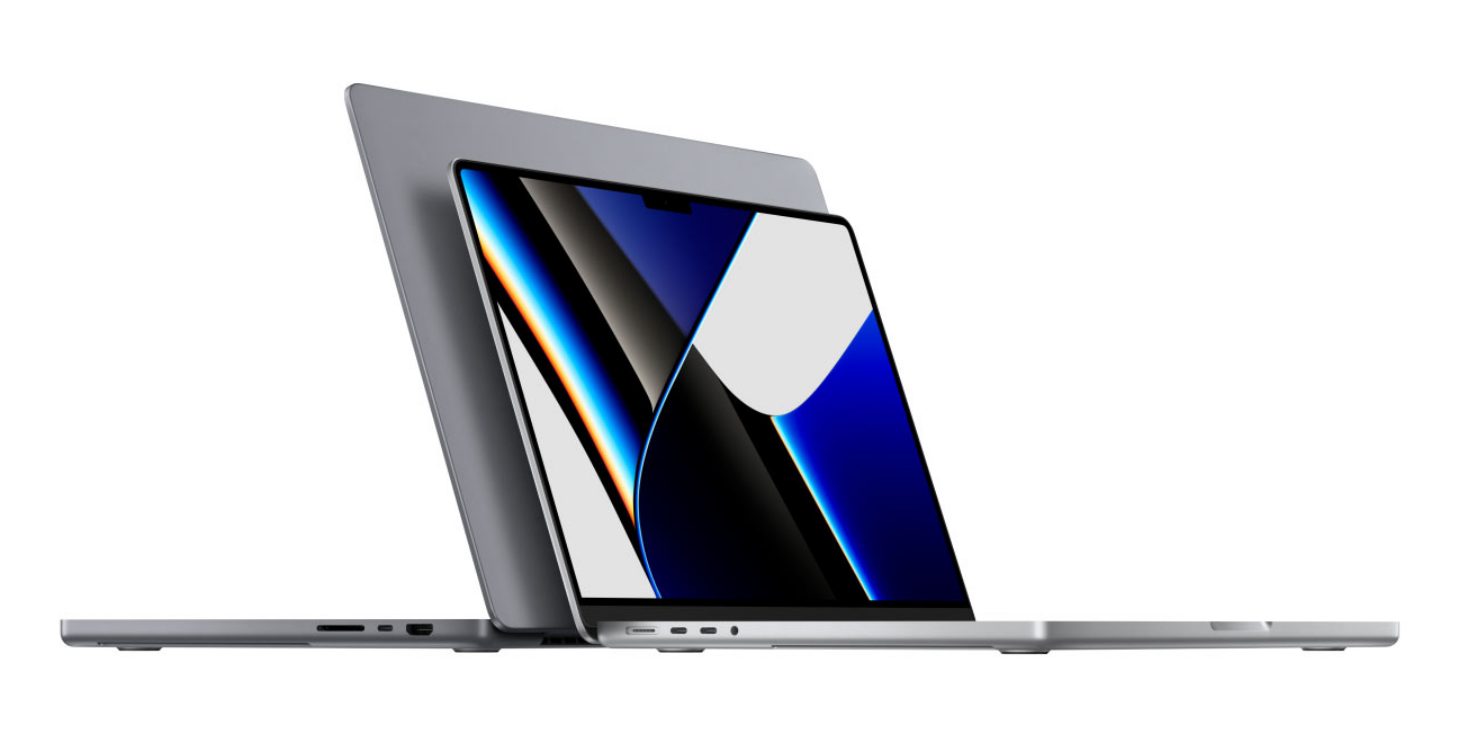
Coming to the MacBook, the report adds that there will be two models — MacBook Air and MacBook Pro, both of which are said to have Apple Silicon chip. This contradicts the previous report that the next-gen MacBook will be powered by a different variant of the M1 chip.
However, the report adds that for the MacBook Pro, the company could drop the “Pro” labeling, which means that the new product could simply be called MacBook. As of now, there’s no launch date known but the devices are said to be all set for the official launch sometime this year.
Google has outlined its vision and recent work in large screen devices including tablets, as captured by its tablet-first Android apps plans. The details were presented on March 10 during the Android Show which featured Google’s CTO of tablets and Android co-founder Rich Miner.
According to Miner, since 2011 when its first Android tablets were released, the trajectory had been a mixture of highs and lows. The Android tablet market had virtually fizzled out before the COVID-19 pandemic after its surge post-2011.
The Android tablet market has continued to rebound since the pandemic era began and Google is projecting an even more accelerated growth with its development of tablet-first apps. Google says that tablets have taken a new identity as tools for creativity and productivity. Miner also posits that the trajectory of growth of tablets will continue in the positive direction, and tablets sales may surpass that of laptops within a few years.
On the development of tablet Android Apps, Miner points app developers in the direction of taking advantage of additional screen resources and having a look at Google’s latest Jetpack Libraries and other features available in the Android 12L. Miner also said that Google is encouraging developers to focus on building tablet-first apps to take advantage of the massive opportunities in that direction.
Google’s tablet-first vision for tablet Android apps needs to have the buy-in of the developer community for it to be a huge success. It also relies on the incentives and resources already put in place by Google for the success of its grand vision, aptly pursued by an Android giant in the person of Miner.
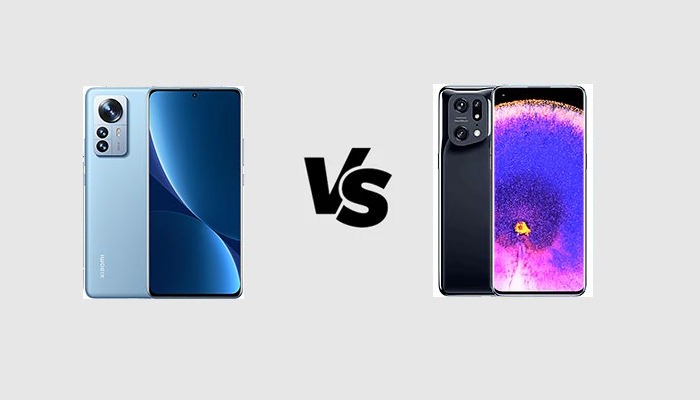
Nowadays, all the main Chinese brands release top-tier flagships. The most powerful handsets released by Chinese manufacturers have nothing to envy the best Samsung and Apple devices and they often turn out to be very innovative. The OPPO Find X5 Pro is a perfect example of innovation with its amazing design and the first proprietary NPU dedicated to imaging. It launched in the global market a few days ago, but it will not be lonely. Xiaomi 12 Pro is another top-tier flagship that will hit the global shelves very soon this month. This comparison between the specifications of the Xiaomi 12 Pro and the OPPO Find X5 Pro will highlight the differences between the most powerful Chinese flagships in the global market alongside the OnePlus 10 Pro, the Realme GT 2 Pro, and the Motorola Edge 30 Pro.
Triple 50 + 50 + 50 MP, f/1.9 + f/1.9 + f/2.2
32 MP front camera
Triple 50 + 13 + 50 MP, f/1.7 + f/2.4 + f/2.2
32 MP f/2.4 front camera
BATTERY
4600 mAh, fast charging 120W and Qi wireless charging 50W
5000 mAh, Fast Charging 80W, Qi wireless charging 50W
ADDITIONAL FEATURES
5G, dual SIM
5G, dual SIM, eSIM, IP68 waterproof
Design
The design of the OPPO Find X5 Pro wins the battle thanks to its futuristic look and its ceramic body. It is the only 2022 flagship made of ceramic and it even comes in an additional color option made of vegan leather (this color option is exclusive for the Chinese market). Thanks to its ceramic body and the Gorilla Glass Victus protection for the front glass, it is a very resistant phone. Further, it has the IP68 certification making it waterproof and dustproof. The Xiaomi 12 Pro is a traditional glass + metal sandwich and it lacks the IP68 certification; further, its design is pretty anonymous if compared to the other 2022 flagships.
Display
The Xiaomi 12 Pro and the OPPO Find X5 Pro come with very similar displays on paper. They have LTPO AMOLED panels with a Quad HD+ resolution of 1440p, an adaptive refresh rate from 1 to 120 Hz, the HDR10+ certification, and up to one billion colors which can be shown with very high brightness. They also come with stereo speakers and in-display fingerprint scanners. It is hard to tell which of these two devices features the better display; for DisplayMate, they both deserve the A+ vote. The screens are both curved, with a punch hole placed in the upper left corner.
Specs & Software
The Xiaomi 12 Pro and the OPPO Find X5 Pro are powered by the Snapdragon 8 Gen 1 mobile platform: it is the most advanced Qualcomm chipset and it is built at 4 nm with an octa-core architecture running at a max frequency of 3 GHz. The chipset is paired with up to 12 GB of RAM on both the phones and up to 256 GB on the Xiaomi flagship, while the OPPO one goes up to 512 GB. Note that the 512 GB configuration is for the Chinese market. Both the phones run Android 12 with a customized user interface on top: MIUI and ColorOS, respectively. Two of the best UIs out there.
Camera
Even though both the phones look to be top-tier camera phones, we believe that the OPPO Find X5 Pro is able to shoot better photos in a higher amount of scenarios if compared to its rival. It comes with a 50 MP Sony IMX766 main camera with OIS, a 50 MP Sony IMX766 ultrawide camera, and a 13 MP telephoto sensor with 2x optical zoom. But the difference will be made by the MariSilicon X: the first OPPO’s proprietary chip which is exclusively used to improve the imaging. The Xiaomi 12 Pro has three 50 MP cameras including a telephoto sensor with 2x optical zoom: the telephoto sensor should be better than the one found on the Find X5 Pro, but for the rest, the OPPO flagship should be superior.
The OPPO Find X5 Pro is equipped with a bigger battery, so it will most likely provide a longer battery life in almost every scenario. On the other hand, the Xiaomi 12 Pro features faster charging thanks to a power of 120W.
Price
The global listing price of the OPPO Find X5 Pro for the global market is €1300/$1428, while the Xiaomi 12 Pro is still not available globally, but it is rumored to cost €1100/$1208 in its base variant. The Find X5 Pro looks like a superior flagship due to its amazing build quality, great camera performance, and bigger battery.
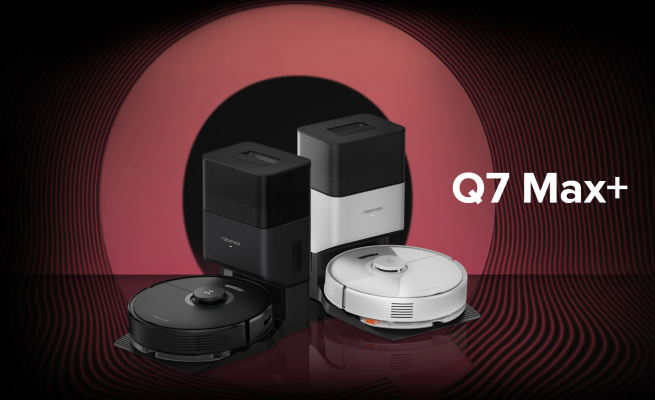
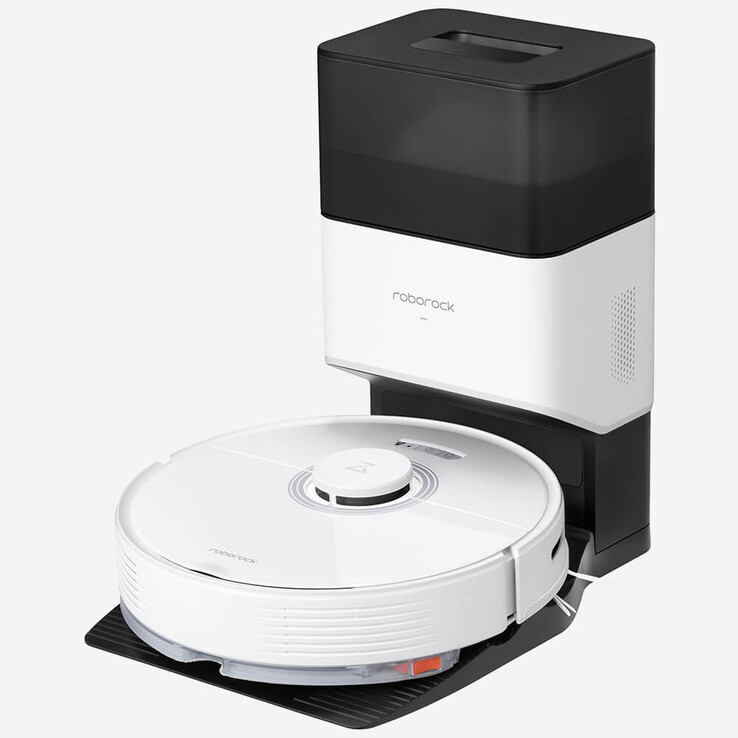
Robotics company Roborock has released its Q7 Max+ robot vacuum cleaner with LIDAR navigation and an auto-emptying dock. The new robot vacuum cleaner also has up to 4,200 Pa suction power and it is capable of effectively cleaning larger room spaces up to 300 square meters. The Q7 Max+ has a limited feature compared to the earlier showcased S7 MaxV which can refill its tank.
According to Roborock, the dock of the Q7 Max+ can hold 2.5 liters of dirt at a time and the dustbin could be left for up to 7 weeks without emptying it. It has a 350 ml water tank and a 470 ml bin. The Q7 Max+ offers up to 0.3kg of wiping pressure and 30 water levels, in addition to its suction power of 4,200 Pa.
The LIDAR navigation system in the Q7 Max+ enables the robot vacuum cleaner to easily map and navigate the cleaning environment for an effective operation. The LIDAR navigation system also allows the user to view and edit the 3D maps via the Xiaomi Home mobile app.
The Roborock Q7 Max+ robot vacuum cleaner has a 5,200mAh battery that enables it to work for up to three hours. This is one of the reasons why the device can clean up to 300 square meters space. However, it is most probable that the 3 hours capacity of the device’s battery may be possible under the quiet mode with several functionalities disconnected.
Pricing details have not been provided by Roborock but the Q7 Max+ will be available from Spring but the markets have not also been specified.
We use cookies on our website to give you the most relevant experience by remembering your preferences and repeat visits. By clicking “Accept”, you consent to the use of ALL the cookies.
This website uses cookies to improve your experience while you navigate through the website. Out of these, the cookies that are categorized as necessary are stored on your browser as they are essential for the working of basic functionalities of the website. We also use third-party cookies that help us analyze and understand how you use this website. These cookies will be stored in your browser only with your consent. You also have the option to opt-out of these cookies. But opting out of some of these cookies may affect your browsing experience.
Necessary cookies are absolutely essential for the website to function properly. This category only includes cookies that ensures basic functionalities and security features of the website. These cookies do not store any personal information.
Any cookies that may not be particularly necessary for the website to function and is used specifically to collect user personal data via analytics, ads, other embedded contents are termed as non-necessary cookies. It is mandatory to procure user consent prior to running these cookies on your website.