Advertisement

Tata Nexon EV reaches new milestone, selling over 13,500 units in India

Tata recently announced that its Nexon EV has reached a new milestone, selling over 13,500 units in India since the vehicle’s launch in January 2020 (via 91mobiles). Several bits have worked out well in favor of the EV, including the 8 years warranty on battery and motor, great sizing, extremely attractive design, and of course, the significantly low running costs compared to its petrol counterparts.

Today, the Tata Nexon EV enjoys a dominant 70% of the total sales in the electric passenger car segment, beating various new players at the game. There are other offerings in the sub-Rs 25 lakh segment like MG ZS and Hyundai Kona but their higher prices haven’t helped them achieve Nexon’s popularity.

A more affordable offering comes from Tata itself and this one’s a proper saloon car. The Tigor EV was launched more recently in August 2021 and starts at Rs 11.99 lakh. Again, this one’s yet to surpass the Nexon’s success.

The Tata Nexon EV is a tad more expensive, starting at Rs 14.29 lakh, and goes up to Rs 16.90 lakh (ex-showroom) for the top-end variant. Its motor is capable of accelerating the car to 100kmph from a standstill in just 9.14 seconds. The battery comes with a claimed range of 312km on a single charge, although a new updated model is on the way with 400km range capabilities. An hour’s charge on the current model should get you to 80% battery.

The 2022 Tata Nexon EV has been spotted a couple of times testing city driving conditions and is expected to be launched quite soon.

RELATED:

Nokia N139DL Flip Phone appears on Bluetooth SIG

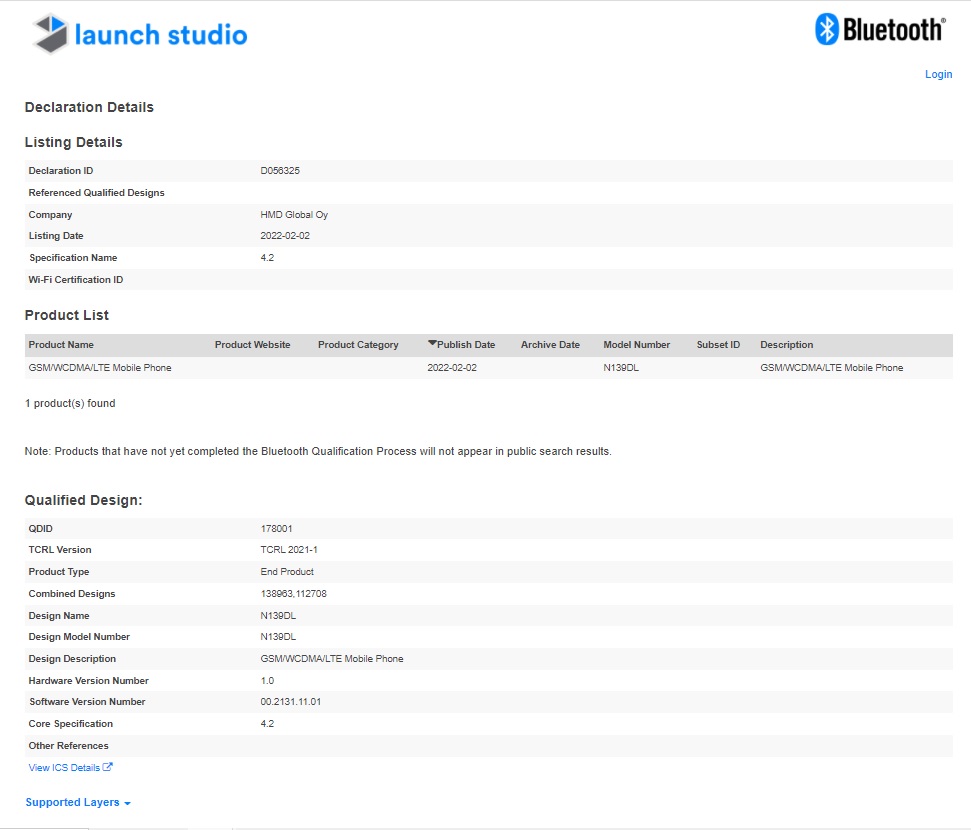
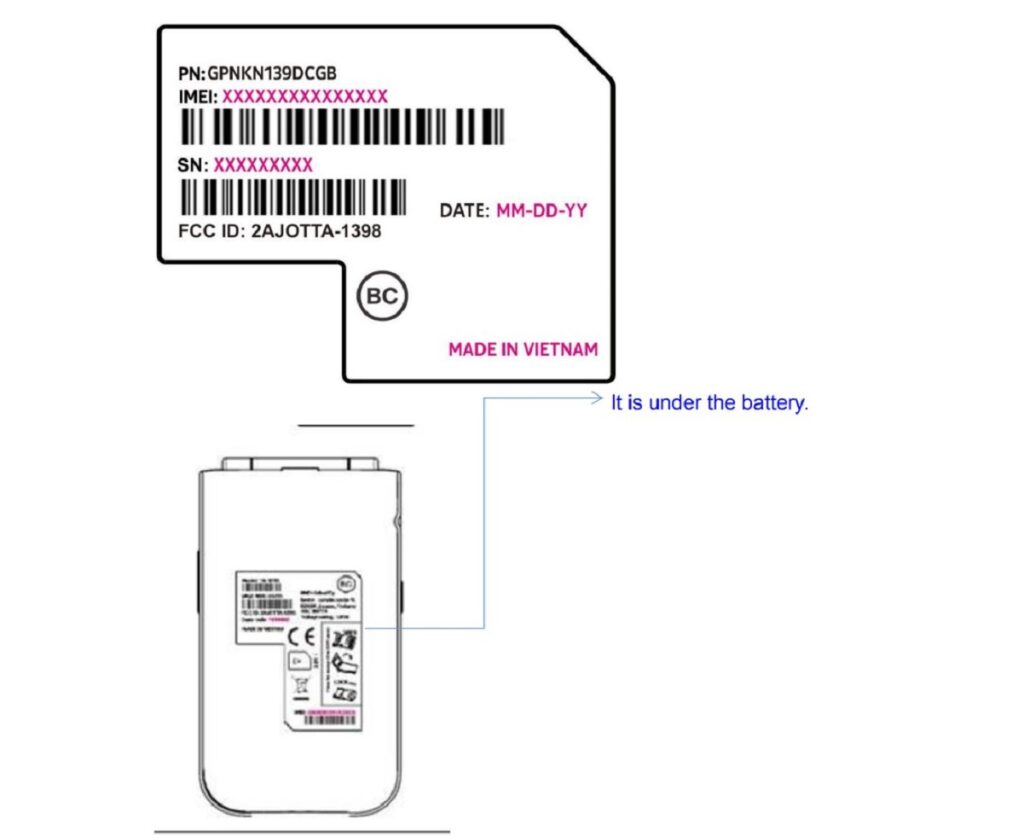
Back in December 2021, a Nokia feature phone with model number TA-1398 and moniker Nokia N139DL was spotted on the FCC certification site confirming its existence. Now, the phone has appeared on the Bluetooth SIG authority revealing its Bluetooth version.

The Bluetooth SIG certification confirms that the Nokia N139DL will have support for Bluetooth v4.2. We also get to learn that it is an LTE phone. Unfortunately, there’s nothing else to learn from this listing.

Nokia N139DL

Previously, we learned that the Nokia N139DL will be a feature phone with the iconic flip-phone design. It will be booting on the KaiOS 3.0. Its FCC certification revealed that the device packs a 1,450mAh battery and has support for Wi-Fi.

That being said, it will be a smart feature phone. Also, considering that it will come with the KaiOS 3.0, we expect the phone to have Google Assistant support.

Nokia N139DL

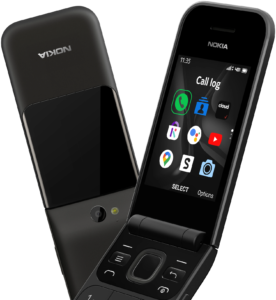
Other than this, the company’s last smart flip phone was the Nokia 2720 4G. The smartphone was launched in May 2021 featuring two displays. The smartphone has a 2.8-inch primary screen inside and a 1.3-inch outer display. It is powered by the Qualcomm 205 SoC and has 512GB of RAM and 4GB of internal storage.

Nokia 2720 V Flip

Since it is a KaiOS phone, the device supports apps like Youtube, Whatsapp, Facebook, and other popular apps. The phone packs a 1,500mAh battery and has up to 26 days of standby time.

Now that the Nokia N139DL will be another flip phone, we expect it to have a similar design to the Nokia 2720 4G. The Nokia 2720 4G was launched at a price tag of $80.

RELATED:

Inbase launches three new TWS earbuds starting at just Rs. 999 ($13) in India

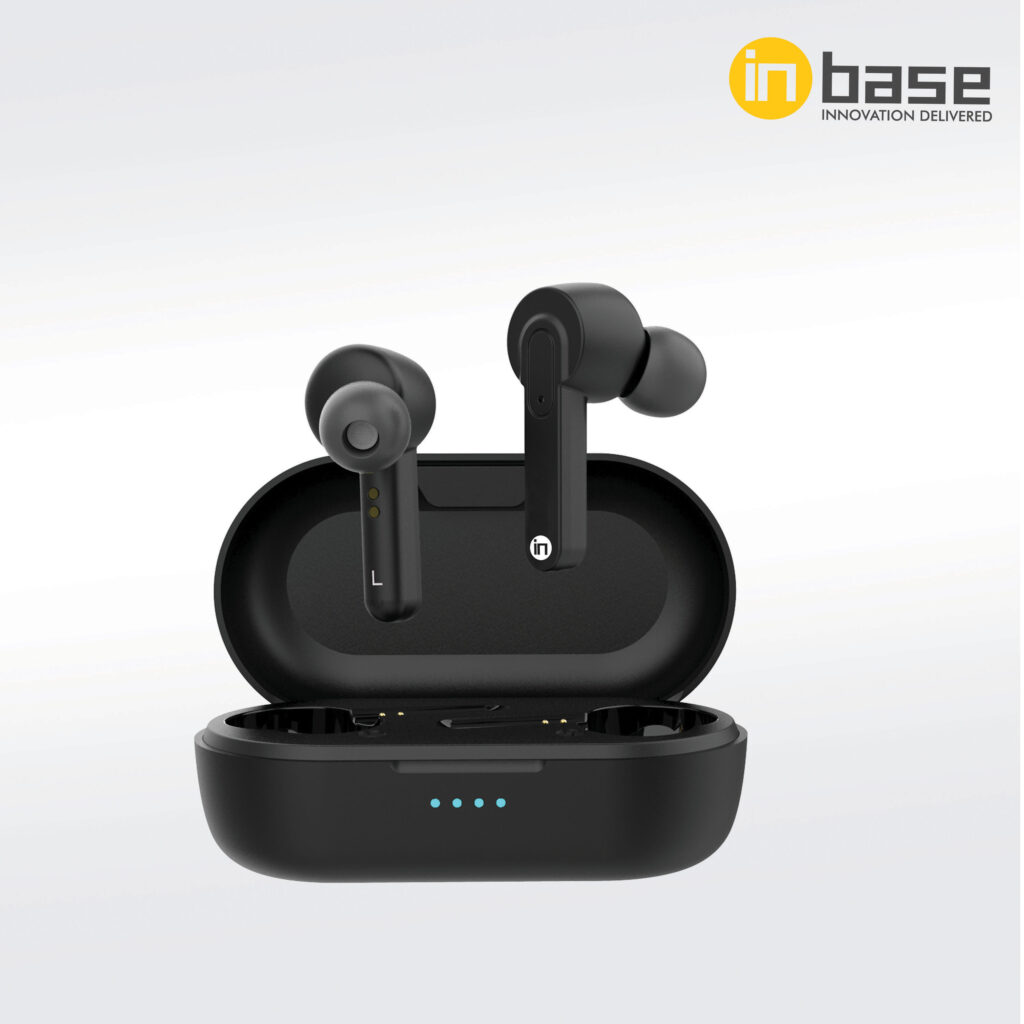
The Indian smartphone accessories manufacturer Inbase has launched a new range of earbuds. The new range offers three TWS earphones namely the Buds Mini Pro, the Free Buds Active, and the Free Buds 3 Pro. So let’s take a look at what these new products have to offer.

Inbase Buds Mini Pro specs and features

Inbase Buds Mini Pro

The Inbase Buds Mini Pro are compact lightweight TWS earbuds that are crafted to fit snugly in your ears. They come equipped with 10mm drivers and have a great balance of treble and bass. Bluetooth 5.9 powers the connectivity of the Buds Mini Pro and offers a transmission range of up to 10 meters.

The TWS earbuds provide up to 5 hours of playback time on a single charge which can be further extended to 35 hours with the charging case. Additionally, the TWS earbuds offer a total standby time of up to 480 hours.

The Buds Mini Pro support USB-C fast charging and feature a smart touch function that can be used to play or pause or change the tracks of music. You can even answer or reject incoming calls with just one tap. The TWS earbuds also offer sweat and water resistance with their IPX5 certification.

Buds Mini Pro price and availability

Available in Black and White color variants, the Buds Mini Pro is retailing for just Rs.999 ($13) with a 1-year warranty period. The earbuds can be purchased from the Inbase official website or leading retail stores in India.

Inbase Free Buds Active specs and features

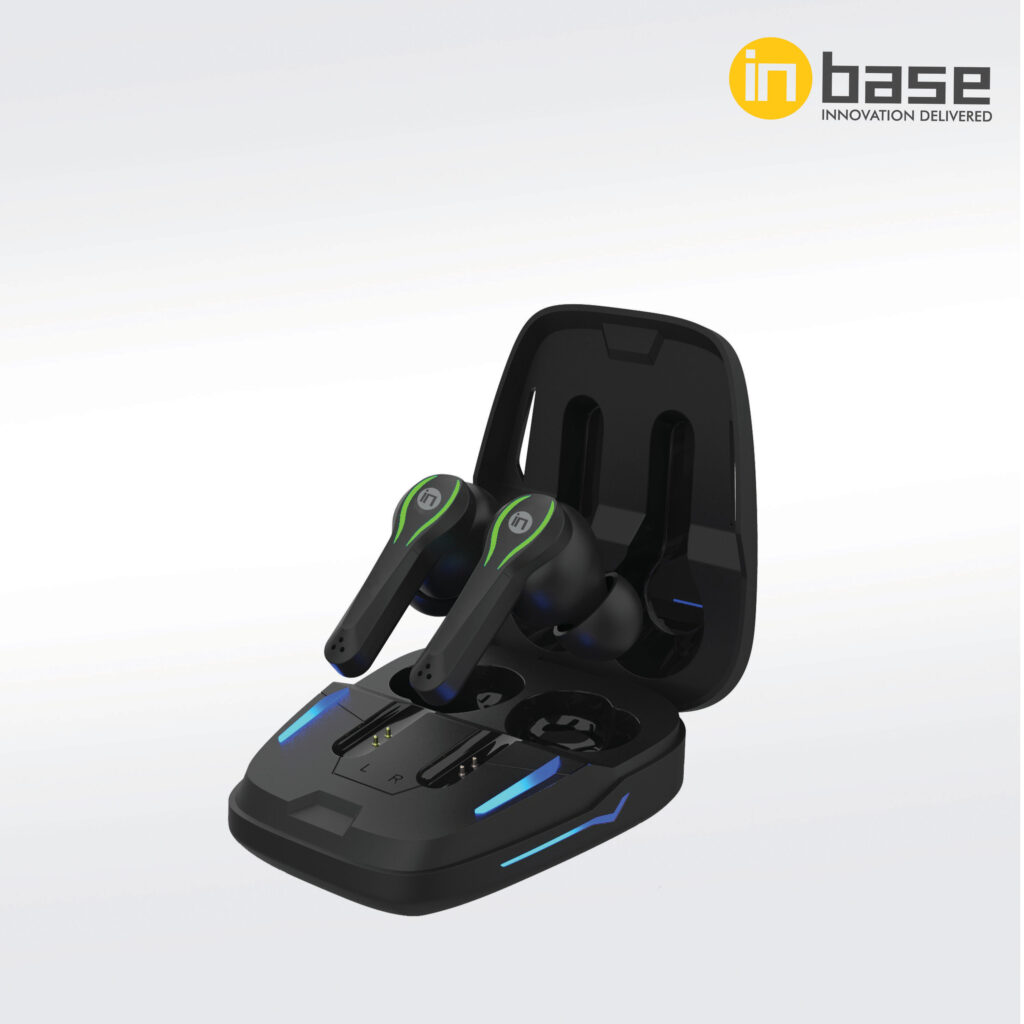
Inbase Free Buds Active

The Inbase Free Buds active has been made with multiple use cases in mind. Focused on a younger audience, the Free Buds Active offers a balanced sound profile with deep bass. It also offers low latency mode and surround sound effects making it perfect for gaming. The case of the earbuds features an unorthodox yet stylish design with LED lights to enhance the gaming aesthetic.

Talking about the technicalities of the product, it comes with 10mm drivers and weighs just 35 grams.  For connectivity, it comes with Bluetooth 5.0 offering up to 10 meters of transmission range. On a single charge, the TWS earbuds are capable of outputting audio for up to 4 hours. This can be further increased to 20 hours with the charging case. The earbuds feature touch controls which can even activate the voice assistant on your device. For protection against sweat and light drizzles, the earbuds are equipped with an IPX5 certification.

Inbase Free Buds Active price and availability

The Free Buds Active is available in Black and White color variants for a price of Rs 1,499 ($20) with a 1-year warranty period. The earbuds can be purchased from the Inbase official website or leading retail stores in India.

Inbase Free Buds 3 Pro

Inbase Free Buds 3 Pro

The Inbase Free Buds 3 Pro holds a simplistic design and offers great audio performance thanks to its fine-tuned 10mm dynamic drivers. The Free Buds 3 Pro delivers crystal clear immersive sound with Super Bass crisp highs. The buds are designed in a shape to snugly fit in your ear with the silicone tips creating a passive noise isolation layer.

The TWS earbuds can run for 4 hours on a single charge which can be further increased up to 30 hours with the charging case. It uses Bluetooth 5.0 for connectivity and offers a transmission range of 10 meters. It also comes with smart touch functionality, supports voice assistance, and also offers auto-pairing when you flip open the lid of the charging case. To protect against sweat and water splashes, the earbuds come with an IPX5 certification.

Inbase Free Buds 3 Pro price and availability

The Free Buds 3 Pro is available in Black and White color variants for Rs 1,499 ($20) with a 1-year warranty period. The earbuds can be purchased from the Inbase official website or leading retail stores in India.


REALTED:


Realme GT2 and Narzo series confirmed to arrive in India

Realme is gearing to launch the Realme 9 Pro series in the Indian market on February 16, which is a day after the global unveiling. While the budget-centric Realme 9 series is on its arrival, there’s also a slew of devices waiting to be released in India. These phones include the flagship Realme GT2, Realme Narzo 50 phones, and Realme C-series devices. Now, in a recent #AskMadhav session, Realme’s VP Madhav Sheth has officially confirmed the arrival of the flagship GT2 and Narzo phones.

As per the new Ask Madhav video, Sheth revealed that the Realme GT2 series will indeed get an Indian release and it will be pretty soon. He also confirmed that the Realme Narzo phones would also debut soon in India.

Furthermore, he revealed that the Narzo lineup will offer devices at various price segments. Although not confirmed, it could be the vanilla Realme Narzo 50 that arriving. Some rumors also point out at the budget Realme Narzo 50A Prime smartphone.

Unfortunately, Sheth did not reveal the exact launch date or month. But given that both the flagship GT2 and Narzo 50 phones have been spotted on several certification sites, we can expect an imminent launch.

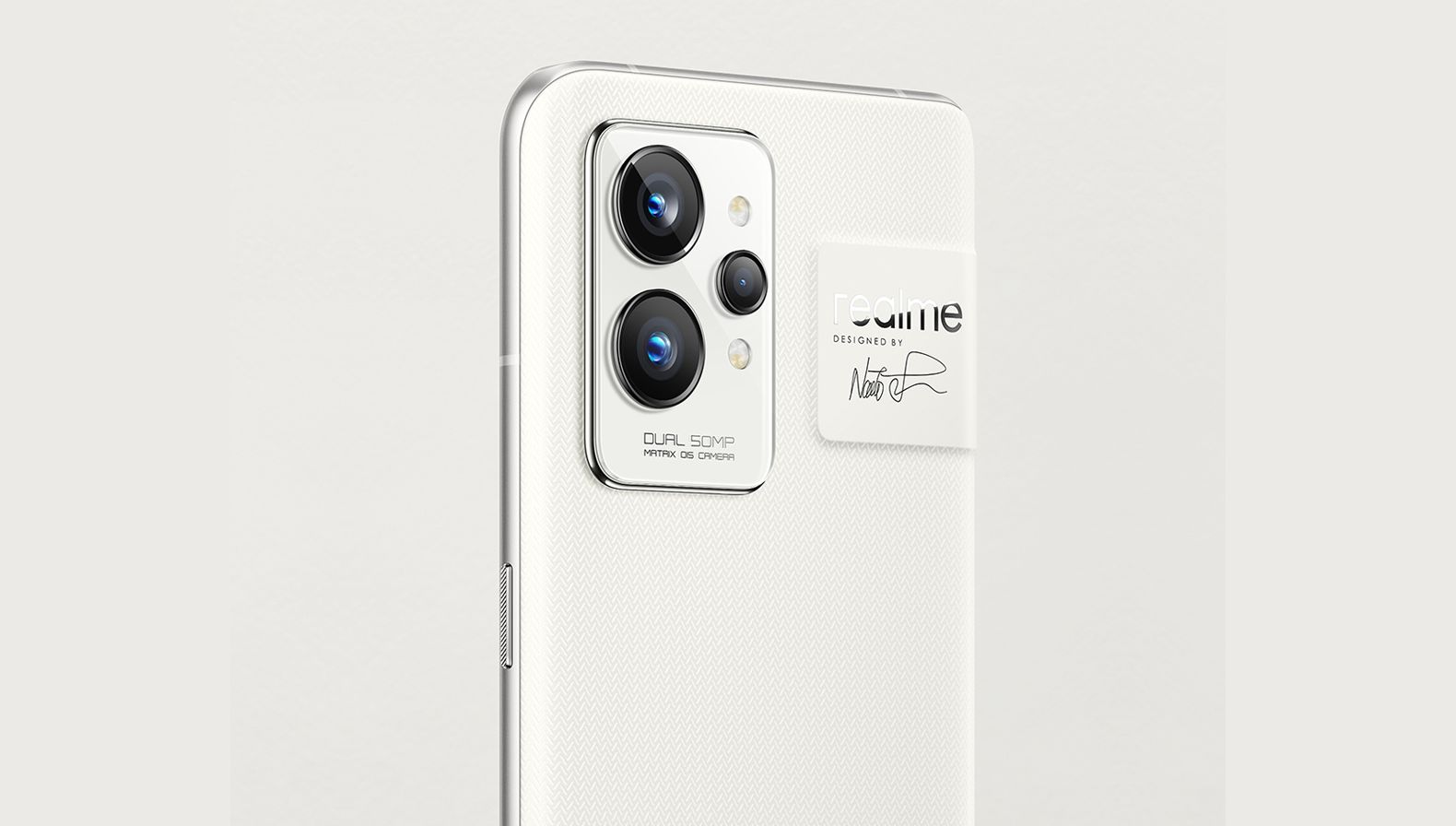
Realme GT2 Pro
Realme GT2 Pro

The Realme GT2 series has two phones — Realme GT2 and GT2 Pro. The former has the Snapdragon 888 SoC, whereas, the latter is powered by the latest Snapdragon 8 Gen 1 chipset. The Narzo series will have Narzo 50A Prime and the Narzo 50. Both the phones will have a similar design to the Narzo 50A that launched in India last year.

RELATED:

realme 9 Pro and 9 Pro+ early unboxing video reveals design and in-box contents

The realme 9 Pro and realme 9 Pro+ are all set to be launched in India on February 16th, and ahead of the launch, a new unboxing video has provided perhaps our most detailed real-life look at the devices yet.

The unboxing video from “The Box” on YouTube reveals the complete in-box contents you get with both devices for the first time. In the realme 9 Pro+ box, there’s a standard TPU case, a SIM tool, the phone itself, a 65W SuperDart charging brick, and finally a USB-C cable. You get similar contents in the realme 9 Pro box as well, although the charging brick has been switched for a more standard 33W unit.

realme 9 pro series unboxing
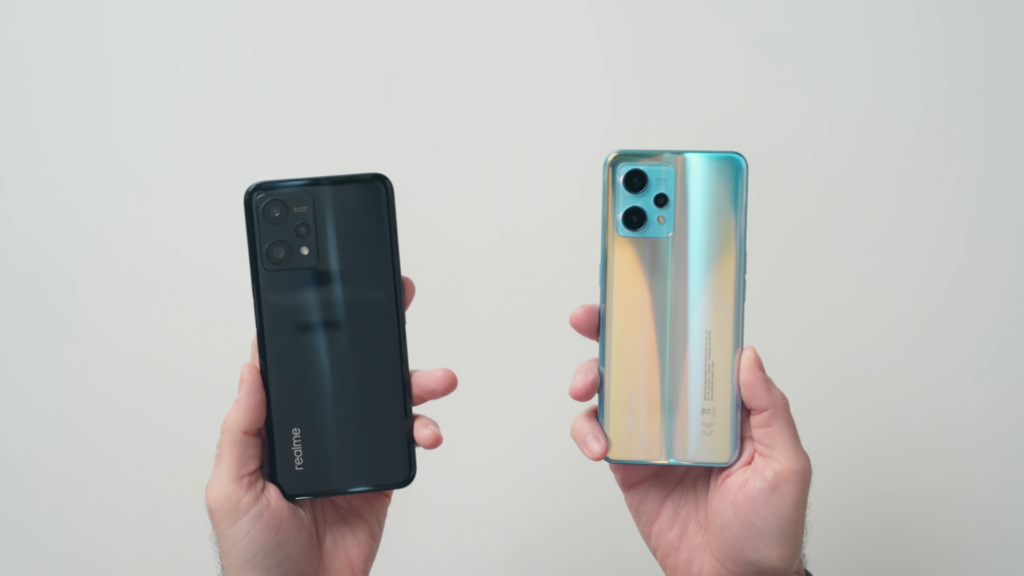
realme 9 Pro (L), realme 9 Pro+ (R)

The realme 9 Pro+ has been described as slim and light in hand and its left edge features the volume rocker along with the SIM tray while the right has the power button. On top, there’s a noise cancellation mic while on the bottom you get a headphone jack, a speaker unit, and a USB-C port.

On placing the devices side by side, the reviewer right away noted a difference in the display quality between the two, with the realme 9 Pro+ not only appearing brighter but also a lot punchier. The Pro+ also appears to have slimmer bezels, although there is quite a bit of chin at the bottom. The 9 Pro model does offer a higher refresh rate though — 120Hz compared to 90Hz on the 9 Pro+.

realme 9 pro series unboxing display

The realme 9 Pro+ opts for an in-display fingerprint sensor while the 9 Pro keeps it on the right edge within the power button. Both work fairly fast, so no problems there. However, on the Pro+, there’s another nifty feature that allows using the in-display fingerprint sensor as a heartrate monitor, which can turn out to be quite useful if you don’t own a smartwatch/fitness band.

Also revealed was that the realme 9 Pro+ comes with a stereo speaker setup which is a step up from the single speaker unit on the realme 9 Pro, and gets sufficiently loud.

Finally, a quick camera comparison was performed but you’ll have to watch the video for that:

RELATED:

Microsoft Surface Laptop Studio launched in Europe & UK
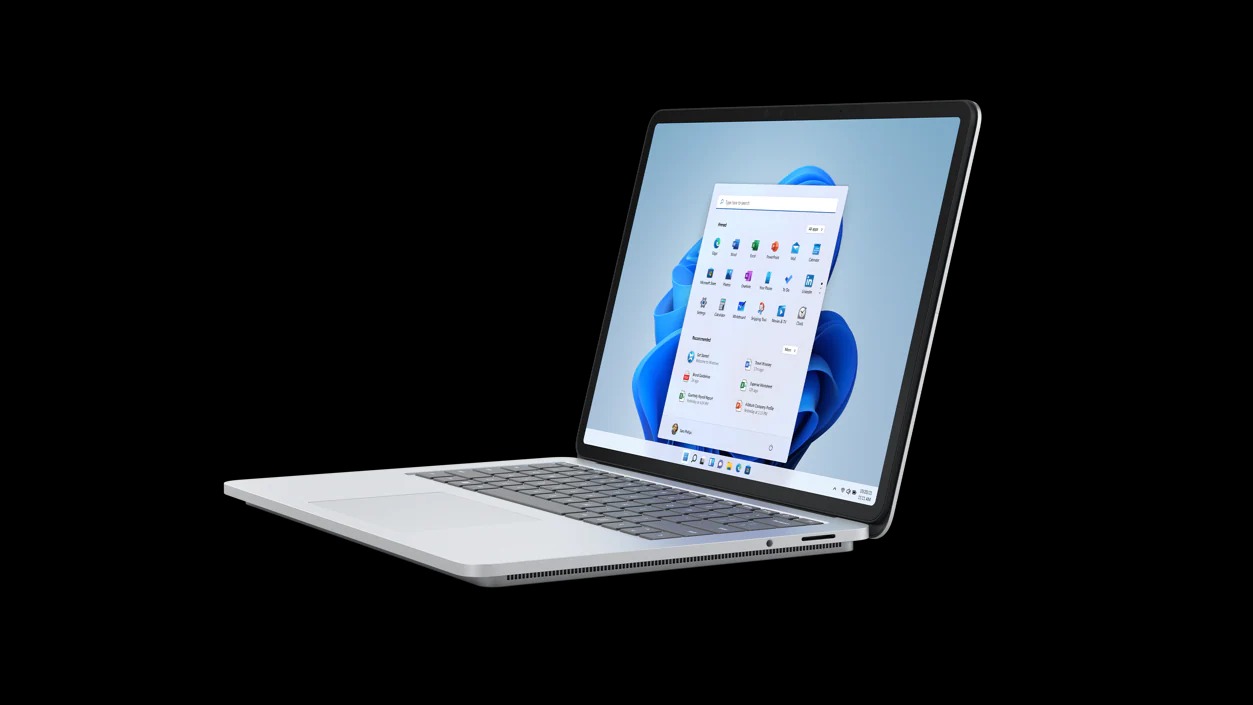
The Microsoft Surface Laptop Studio is now available outside North America and Microsoft may have pleasantly surprised its customers with a much lower than the expected price for the model. It is available from €1,699 ($1,910) in the EU and from £1,449 ($1,950) in the United Kingdom.Microsoft Surface Laptop Studio

The Microsoft Surface Laptop Studio was launched in North America back in 2021 and it is seen as a successor to the Surface Book 3 although with a different form factor and display resolution, with some improvement from the predecessor. The Microsoft Surface Laptop Studio boasts of 120Hz display refresh rate, although the base model lacks a dedicated GPU, which may be hugely inadequate in some gaming applications. On the other hand, the higher model variant of the Surface Laptop Studio will come with a GeForce RTX 3050 Ti GPU. The higher variant of the Surface Laptop Studio cone with the Intel Core i7-11370H processor and a 102 W charger. In addition, it weighs an extra 80g.

Microsoft Surface Laptop Studio
Microsoft Surface Laptop Studio Laptop Mode

Microsoft will begin shipping all Surface Laptop Studio configurations from February 22. Additionally, buyers who pre-order the product will receive a complimentary Surface Slim Pen 2.

RELATED:


(source)


Mobile gaming market is now larger than consoles and PCs combined

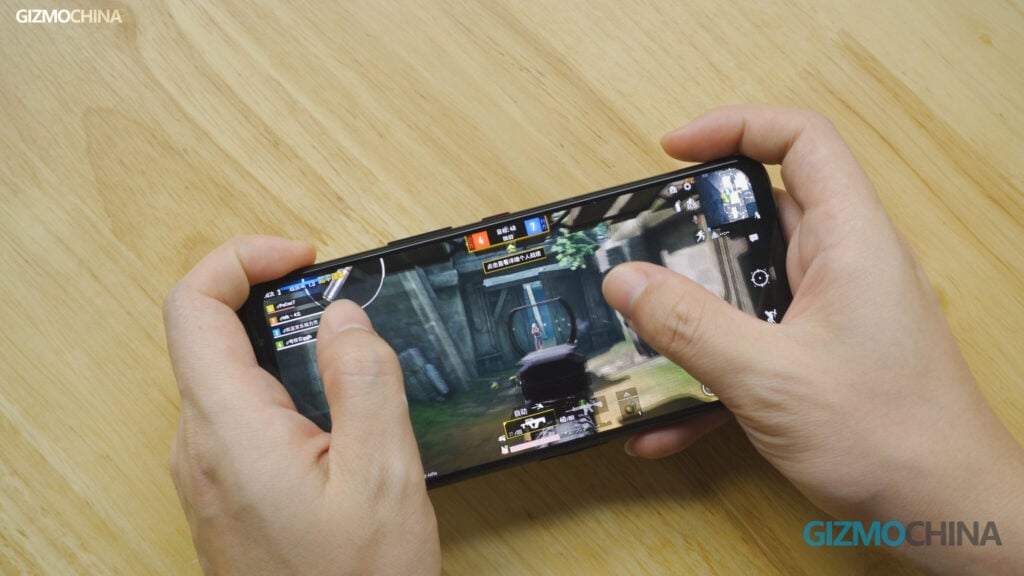
The video gaming market was always dominated by consoles and PCs and even arcades from decades ago. Mobile gaming arrived much more recently but has since changed the gaming landscape forever. Fast forward to now, and over 6 billion people own a smartphone, making it no surprise that mobile gaming today has a market share of around 53%, generating over $90 billion in revenue last year.

The figures come from a report by gaming industry analyst Newzoo (via Android Authority), which highlights that mobile gaming is not only larger than consoles and PCs combined but is also the fastest-growing segment.

ROG PHone 5S Pro Review 21

Moreover, as PC and console sales continue to dip due to the easing of workplace restrictions, the overall industry revenue has kept up its growth. This means that mobile gaming is not only extremely popular but is encouraging the industry’s growth as a whole.

Of course, the main factor behind this is the explosive rise of the smartphone market since 2021. Android’s popularity has made it easier for developers to make their games available across a variety of devices.

A larger part of the $90 billion market revenue came from the Asia-Pacific region, with China accounting for over a third of it ($30 billion vs $15 billion from the US). The most notable players were Tencent with CODM and PUBG and Mihoyo with its Genshin Impact, which together reeled in $18 billion in revenue.

But China isn’t the only major source of the gains as regions like Latin America, Africa, and the Middle East have also been showing some really great growth figures.

All in all, with smartphone ownership expected to exceed 7 billion by 2024, there are even better times for the mobile games market up ahead.

RELATED:

Here’s how to watch OPPO Reno7 series India launch event

The OPPO Reno7 series initially went official in China at the end of November 2021. The smartphones are now set to debut in international markets, starting with India. The company has already revealed the launch date and we know exactly when the phones will be announced. Let’s check out how you can watch the unveiling of these handsets live.

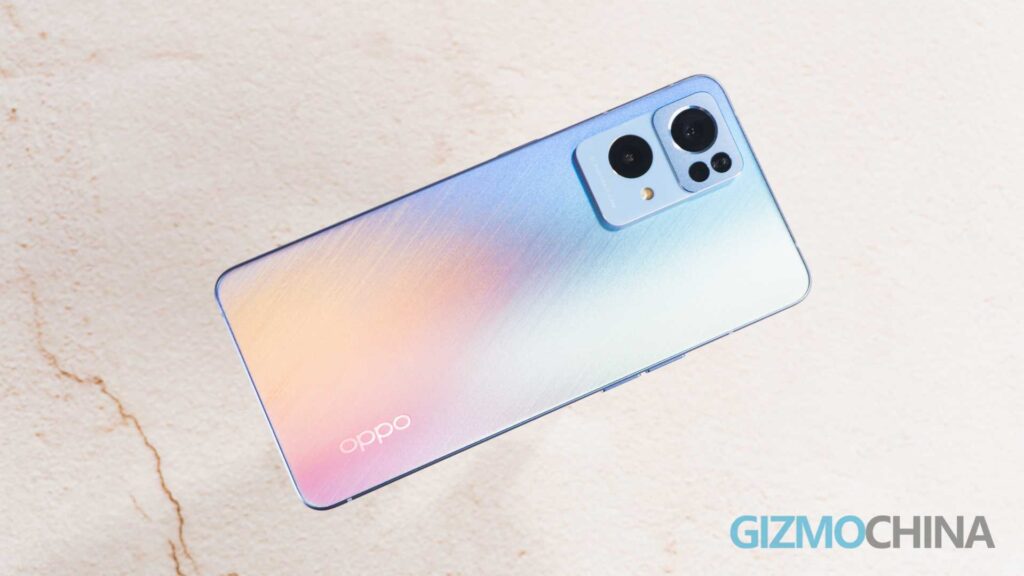
OPPO Reno 7 Pro
OPPO Reno7 Pro


When is the OPPO Reno7 series launch in India?

The OPPO Reno7 series is scheduled to launch in India on February 4. The event will kickstart at 12 PM IST.


How to watch the OPPO Reno7 series India launch event?

The launch of the OPPO Reno7 series in India will be live-streamed by the brand on its official social media profiles. Those who are interested can watch the live event on either YouTube, Facebook, Twitter, or Instagram.

As mentioned earlier, the conference will begin at 12 PM IST on February 4.


What are the expected products at the OPPO Reno7 series India launch event?

OPPO is expected to announce the following products at the OPPO Reno7 series launch event in India.

The OPPO Reno7 Pro is said to be the same as the Chinese variant. Whereas, the vanilla OPPO Reno7 will be a completely new device. Finally, the OPPO Watch Free and the OPPO Enco M32 will be the same as the version sold in other markets.


RELATED:


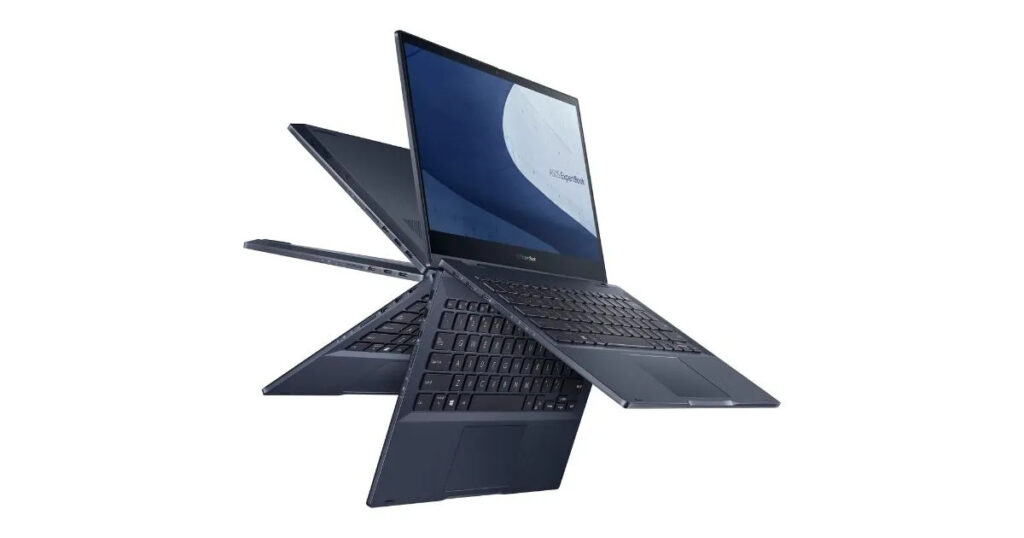
Asus ExpertBook B5 Flip OLED laptop with 360° rotatable screen launched in India

The Asus ExpertBook B5 Flip OLED laptop has been launched in India, aimed at business users with a bunch of premium features.

First things first, there’s the Full-HD OLED touch screen display with a 16:9 aspect ratio, 400 nits brightness, and 100% DCI-P3 coverage that also comes with stylus support. The display is also 360-degrees convertible, allowing the laptop to convert into various form factors such as a ‘tent’ and a tablet.

Under the hood, you get the 11th gen Intel Core i7-1165G7 with a 2.8GHz clock speed and up to 4.7GHz on Turbo. There’s also a Core i5-1135G7 model that’s paired with Intel Iris Xe Integrated graphics.

Asus ExpertBook B5 Flip

In terms of RAM, the Asus ExpertBook B5 Flip OLED offers up to 48GB of DDR4 3200MHz memory, with DDR4 4/8/16GB 3200 MHz onboard and DDR4 4/8/16/32GB 3200 MHz DRAM Module. For storage, you get a 2TB M.2 PCIe SSD.

Connectivity options include 2x Thunderbolt 4 Type-C (PD3.0 and display port), 1x USB 3.2 Gen 2 Type-A, 1x HDMI 2.0b port, 1x Micro HDMI (LAN only), and 1x Kensington lock slot.

The laptop’s battery is a 66Wh polymer unit and has been claimed to last up to 12 hours on a single charge. It also supports Type-C 65W fast charging.

Other miscellaneous features include a 720p webcam, dual-band Wi-Fi, Bluetooth 5, AI Noise-Cancelling Technology, dual array microphone, stereo speakers, 1.3Kg weight, backlit keyboard, and a fingerprint scanner.

The Asus ExpertBook B5 Flip OLED starts at Rs 1,39,000 for the Intel Core i7 + 16GB RAM variant. The laptop is already available for purchase across Asus’s local stores and other resellers.

RELATED:

MIUI 13 launched in India with system optimizations and some new wallpapers

MIUI 13 has finally arrived in India. And with monthly active users crossing 500 million globally, it is not unsafe to say that a large part of those are Indians excitedly awaiting its launch since its Chinese advent in December 2021. This base will perhaps be disappointed to know that the update focuses on performance once more, giving a miss to UI-related changes for the second time in a row.

The latest version of MIUI revolves around four elements, aimed at improving user experience and reducing power consumption. The list is topped by Optimized File Storage System which has been claimed to keep read/write speeds tip-top even after 36 months of usage. Xiaomi says that other Android skins don’t focus on defragmentation the way MIUI does, resulting in them losing up to 50% of the R/W speeds in 3 years.

miui 13 core experience

Next up is RAM Optimization which has been claimed to boost background process efficiency by 40%, allowing more apps to be run at once and helping achieve a better multitasking experience. It is joined by Processor Priority Optimization that employs automated CPU/GPU allocation to help the OS prioritize foreground apps.

Lastly, there’s the promise of up to 10% improved battery life thanks to Smart Balance.

Apart from this, for the visual elements, Xiaomi has partnered with Beauty of Science to bring a bunch of cool, new live wallpapers, inspired by the crystallization of various substances. Do note that just like Super Wallpapers from MIUI 12, these will not be available across all devices. Still, lower-end devices can enjoy a brand new collection of static wallpapers that look like a breath of fresh air.

miui 13 new live wallpapers

Upgraded widgets support, which was one of the main highlights of MIUI 13 China, looks to have been skipped for now but you do get a new Sidebar feature. This allows access to your favorite apps with just a swipe. A great use-case for this would be pulling up the Notes app as a small window over the current app for some quick jotting.

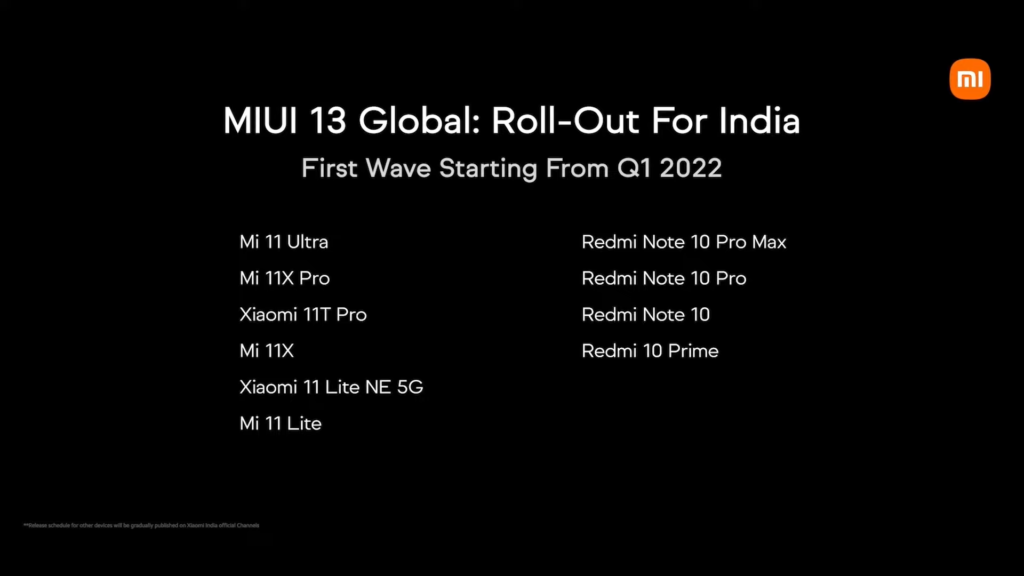
miui 13 india rollout

MIUI 13 in India will commence rollouts starting with flagships and recent launches. The first wave will get it from Q1 2022, as depicted above.

RELATED:

TECNO POVA 5G India launch confirmed for next week

Tecno has been teasing the lauch of TECNO POVA 5G in India quite some time. Today, we finally know when the smartphone is heading to the country. The brand has officially revealed the timeline of the phone’s release. At the same time, it has also disclosed the official retailer.

TECNO POVA 5G

In a press release sent to us, Tecno has confirmed to launch the TECNO POVA 5G in India next week. The brand’s first 5G smartphone will be sold on Amazon India.

The company has started teasing the arrival of the handset on social media. It will most likely disclose the exact launch date by the end of this week.

Since the phone is already official in Nigeria, we know everything about it. It has a 6.9-inch FHD+ 120Hz display (LCD), MediaTek Dimensity 900 chipset, LPDDR5 RAM, and UFS 3.1 storage.

The device arrives with a 16MP selfie camera and a triple camera setup on the rear comprising of a 50MP primary sensor, a 2MP secondary sensor, and an AI lens. It has a side-mounted fingerprint sensor and runs HiOS 8 based on Android 11.

Finally, the handset is backed by a 6,000mAh battery with support for 18W fast charging. In Nigeria, the device is sold in a sole 8GB + 128GB memory configuration. At present, it’s not known whether India will get the same variant or another. However, we know that it will cost around ₹18,000-₹20,000.


RELATED:


Vivo NEX 5 renders emerge, design tipped to be close to actual device

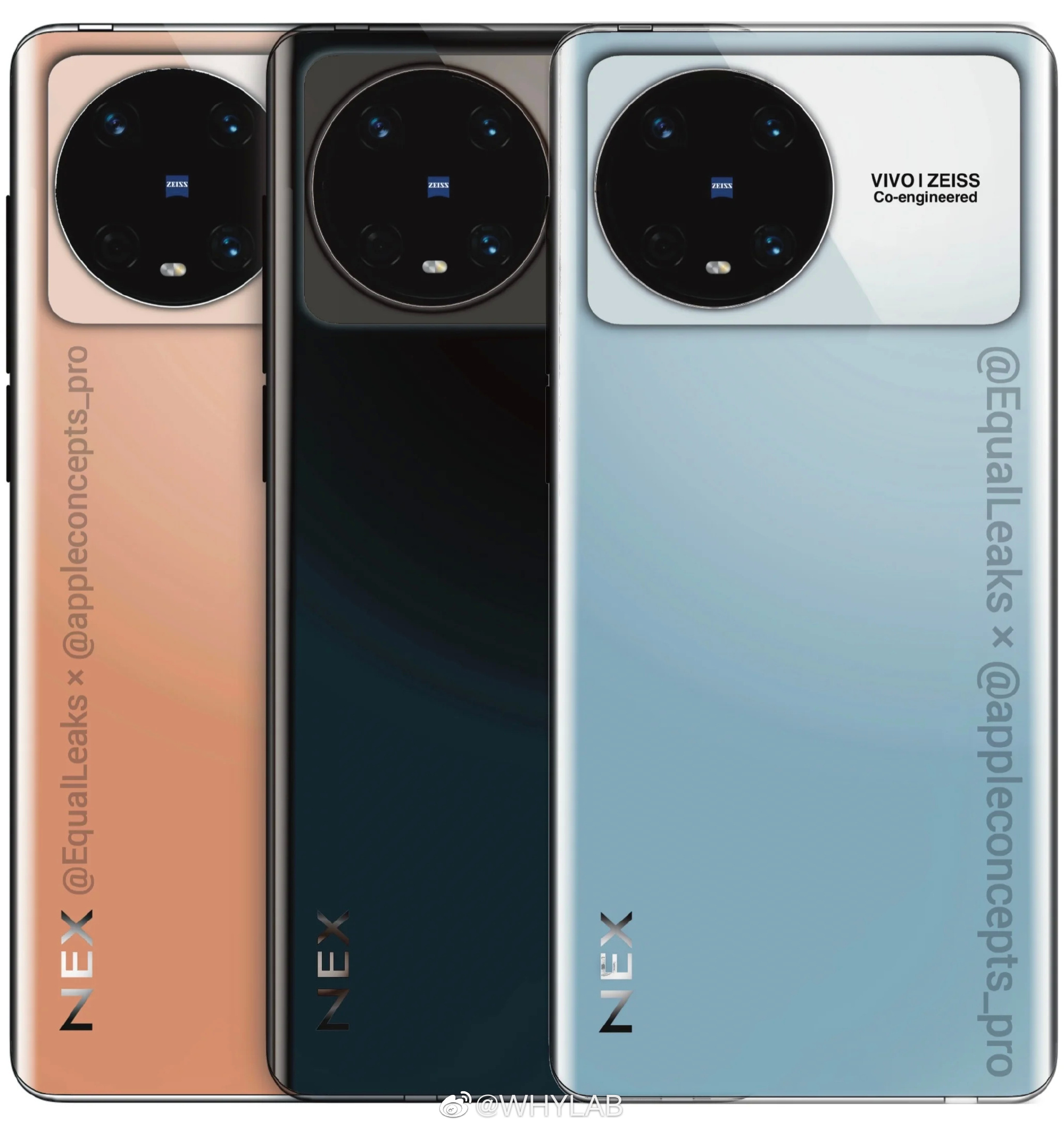
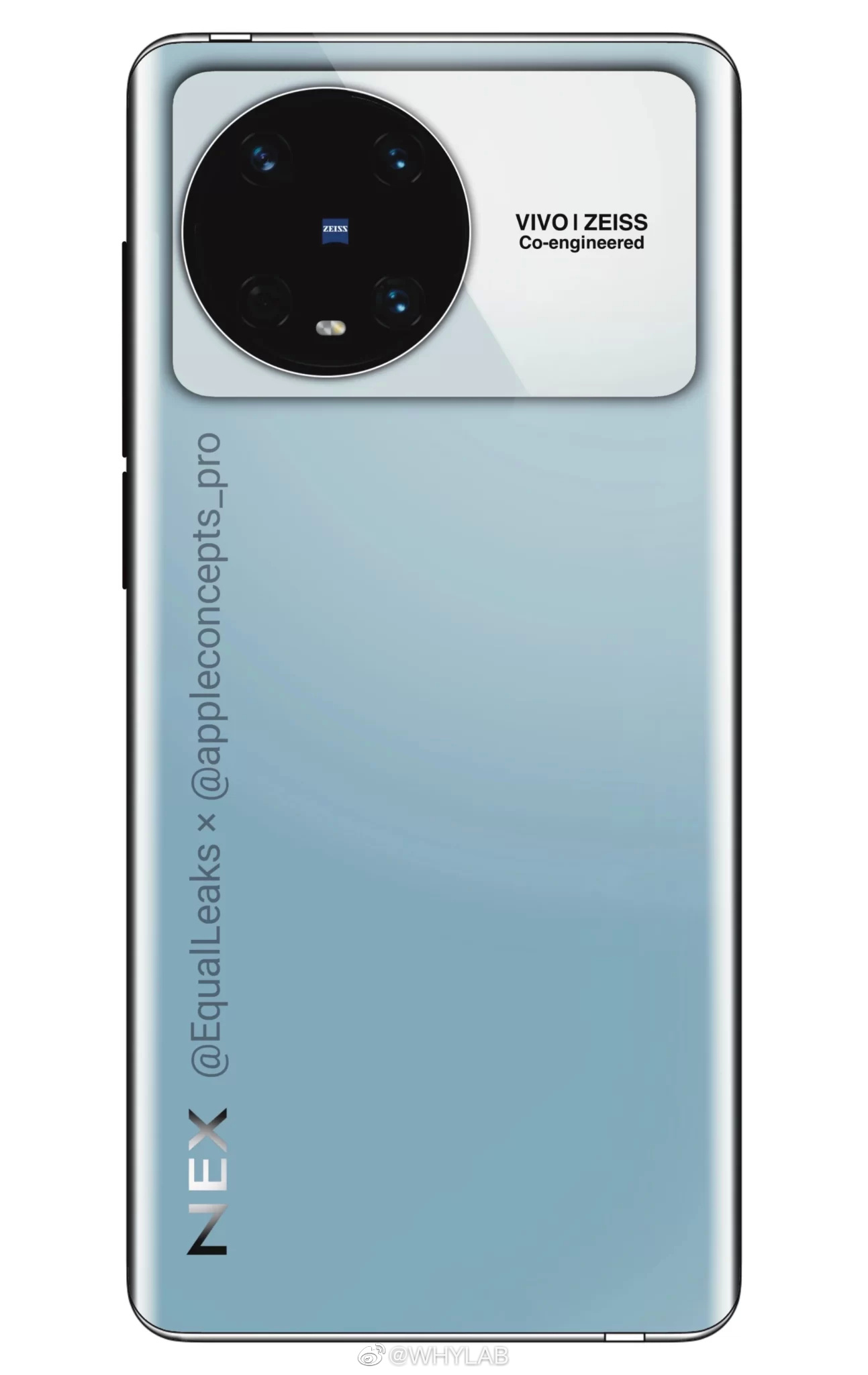
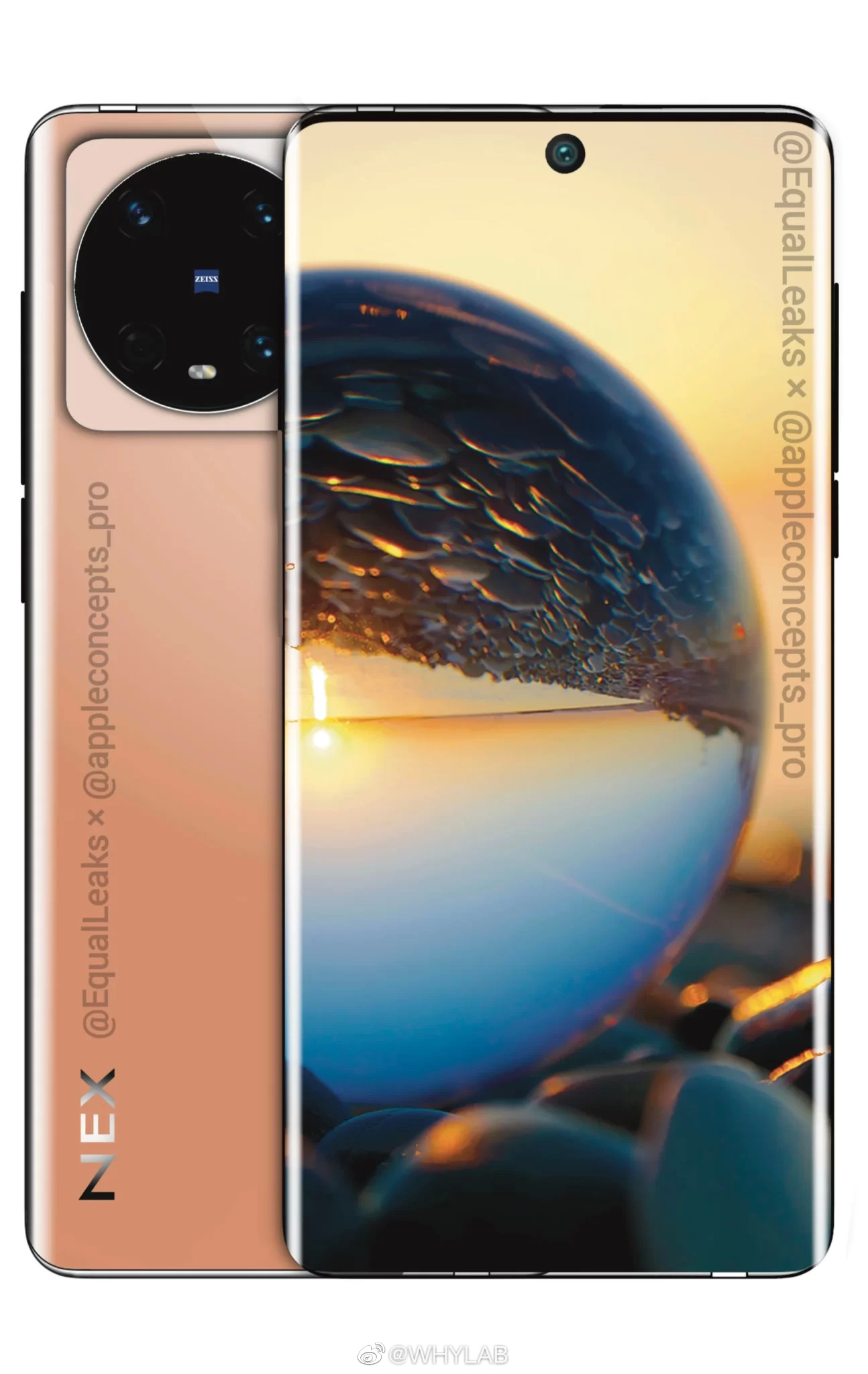
Vivo NEX 5 renders have been released by Equal Leaks and Apple Concepts Pro. The images shared by these sources seems to be based on the rumors surrounding the NEX 5. Reliable Chinese tipster WHY LAB has claimed that the design shown in the new renders is very close to the actual design of the production unit of the NEX 5.

The Vivo NEX 5 renders show that it will be sporting a punch-hole display with curved edges. The device will be equipped with super-slim upper and lower bezels. The display is most likely integrated with a fingerprint scanner. A volume rocker and a power key can be seen on the right spine of the NEX 5.

Moving to the rear shell of the Vivo NEX 5, the render shows that it will feature a rectangle-shaped module with a circular camera unit on the left and “Vivo | ZEISS co-engineered” branding on the right. The camera unit includes quad cameras and an LED flash. The rear design of the phone is quite different from the previously seen live shot of the device. The device comes is shown in three colors such as light blue, black, and orange.

Vivo NEX 5 specifications (rumored)

The Vivo NEX 5 is rumored to measure 168.5 x 76.5 x 9.2mm and weigh 221 grams. It is rumored to house a behemoth 7-inch AMOLED E5 display that offers a Quad HD resolution and a high refresh rate. The device will be powered by the Snapdragon 8 Gen 1 chipset and a 5,000mAh battery. The NEX 5 will arrive with support for 80W fast charging.

The details of the NEX 5’s camera is not known yet. However, it is speculated to be equipped with a 5x periscope telephoto camera. The device is likely to arrive in variants like 8 GB RAM + 256 GB storage, 12 GB RAM + 256 GB storage, and 12 GB ARM + 512 GB storage. It will be available in colors like Earth Gray and Night Black.

RELATED:

XPENG Motors becomes the first Chinese EV company to enter Sweden

XPENG Motors, the China-based electric vehicles manufacturers, has become the first Chinese EV company to enter Sweden. This marks the second European market for the company after entering Norway.

The smart car-making company is currently setting up its first store in Sweden and images of the store have leaked on Reddit. As for the location, the experience center is located in Westfield Mall of Scandinavia.

Xpeng Sweden

The development is in line with the company’s plan for overseas operations. A few weeks ago, XPENG Motors had revealed that it was planning to enter more European markets in the year 2022 to boost its exports.

The company had previously announced that Xpeng Experience Center will open in Sweden in the first quarter of 2022, i.e. somewhere between January to March. Based on that timeline, we expect the store to open doors in the coming weeks.

Xpeng Experience Center in Sweden

Xpeng Experience Center in Sweden

Elvis Cheng, Nordic Region Manager for the company claimed that Westfield Mall of Scandinavia is the best place to reach many people in the country. The company will be providing test drives of its models at the location.

He Xiaopeng, co-founder, Chairman, and CEO of the company has said that apart from Sweden, the company also has plans to enter two more European markets this year — Denmark and the Netherlands. It will also put in efforts to expand its presence in Norway.

XPENG Motors is currently building its EVs in Zhaoqing, China and is in the process of setting up new factories in Guangzhou and Wuhan. Once these new units as up and running, the company will have a production capacity of more than 400,000 units. With double-shift, it has the potential to roll out up to 600,000 electric cars annually.

RELATED: 

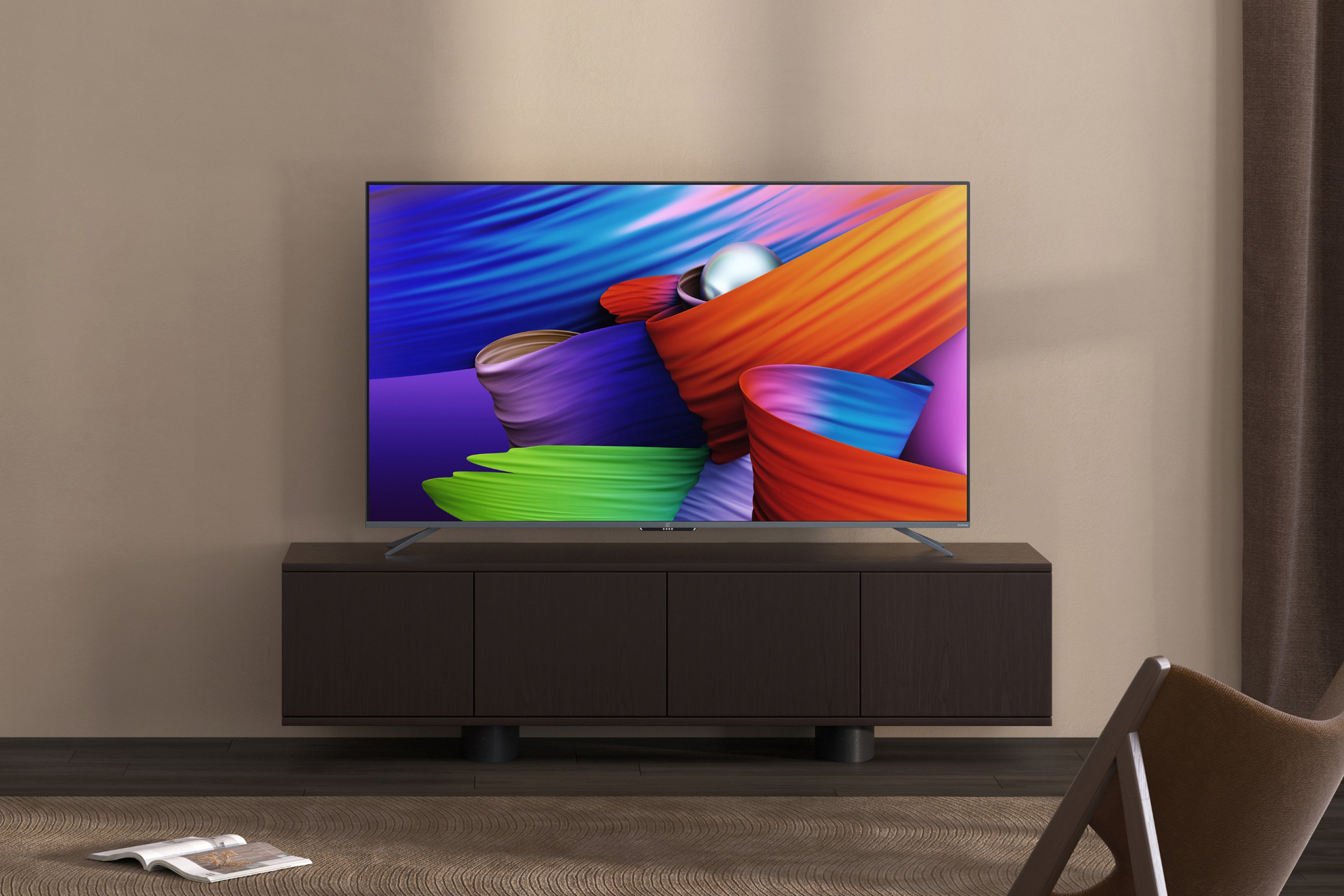
OnePlus to reportedly launch new Y1S smart TV series in India on February 17

OnePlus, the OPPO-backed company which started off with “flagship killer” smartphones has now expanded its presence to various other categories, including the highly competitive Smart TVs market.

While there are a few models already available in the market across the different price ranges — U1S, Y-series, and Q1-series, the company is now gearing up to launch four new Smart TVs in the Indian market.

OnePlus TV U1S Series Featured A

According to the latest report from tipster Abhishek Yadav, the four new Smart TVs from OnePlus will be officially launched in the Indian market on 17th February. He also reveals that the upcoming products will go on sale online as well as offline channels.

It is also claimed that the Smart TV with model numbers 32Y1S and 42Y1S will be available for purchase through online and offline stores while the company will launch two more models, which are yet unknown, which will go on sale only through the offline stores.

If the previous reports are to be believed, then the 32Y1S and 42Y1S models are expected to come with support for HDR10+ display and Dolby Audio. The devices will have a 20W speaker and dual-band Wi-Fi for connectivity. They are likely to come running Google TV based on the Android TV 11 operating system out-of-the-box.

As for the pricing, the OnePlus Y1S 32-inch model could cost around ₹25,000 while the 43-inch model could be priced around ₹25,000 in India. We expect more details about the upcoming TVs to surface online in the coming days as well as the official confirmation of the launch date from OnePlus.

RELATED: 

Microsoft Surface Duo gets work-in-progress Windows 11

Microsoft may have its own operating system but continues to ship its mobile offerings with Android, just like any other manufacturer. That’s not to say, though, that Windows 10 Mobile did not have quite the fan following back in the day, mostly thanks to its unique interface. And a part of this base continues to prove their loyalty by booting Windows on ‘unsupported’ devices, with the latest now being the Microsoft Surface Duo which was launched back in 2020 with Android 10.

A developer by the name of Gustave Monce has given us the first glimpse of Windows 11 on the device through a tweet (via XDA). There’s still a long way to go to actually run the OS on the device, but you do get the Windows 11 boot animation which is “satisfying to watch,” as Monce puts it. A look at the embedded video will reveal that the current implementation only got the installer for Windows 11, and not Windows 11 itself, but the developer has made it clear that it’s a work in progress.

XDA Developers reached out to Monce who confirmed that the preliminary firmware implementation has been done and that he’ll be moving on to implementing the Windows drivers themselves, after some polishing. The build shown on the tweet is Windows 11 Insider Build 22523.

Monce had earlier booted Windows 10X on the Lumia 950XL and later followed that up by booting Windows 11.

Windows is most popular as an OS for regular PCs and laptops but has been gaining installations on more unconventional form factors lately, thanks to the 64-bit emulation capability of Windows 11. There are also community projects like ‘Renegade Project’ that aim to simplify booting Windows 10 and 11 on Android devices.

RELATED:

Qualcomm reports 35% growth in chip business; Snapdragon chipsets witness 60% annual growth

Qualcomm, the company that makes chips for smartphones, has announced its financial results and revealed that the firm generated revenue of $10.71 billion, which is 30 percent more from the first fiscal quarter of 2021.

The net income for the company comes down to $3.40 billion, which is 38 percent more than the $2.46 billion that Qualcomm had reported last year. The numbers indicate increased demand for chips and how increased sales from smartphone manufacturers helped Qualcomm grow its business.

Qualcomm Logo

QCT, the chip business of Qualcomm, reported $8.85 billion in sales, which is up 35 percent from the same quarter last year. However, the company’s growth slowed from 63 percent that was reported during the same quarter last year.

The company breaks down the chip division into four categories and each of them reported growth during the quarter. The primary source of revenue for Qualcomm is the 42 percent rise in demand for handset chip sales which stand at $5.98 billion.

Ever since Cristiano Amon took the role of Chief Executive Officer last year, he has prioritized diversifying into different markets, which seems to have worked in the company’s favor. Its sales of car chips or Qualcomm’s automotive business rose 21 percent to $256 million. On the other hand, the IoT division, which focuses on low-power chips, increased sales by 41 percent to $1.48 billion.

The company’s division for wireless connectivity chips, called RF front-end, witnessed an increase of 7 percent to $1.13 billion and in terms of growth, it grew 76 percent during the fiscal year 2021. QTL, the licensing division of Qualcomm, increased 10 percent year-on-year to $1.81 billion in terms of revenue.

RELATED: 

Alleged Redmi K50 series recevies TENAA certification

Redmi is expected to unveil the Redmi K50 series as early as this month. Ahead of that, the smartphones in the lineup have started getting necessary certifications. Three models have now made their appearance on TENAA.

Redmi K40 Pro 02
Redmi K40 Pro

According to Digital Chat Station, three Redmi K50 series phones have been certified by TENAA. These devices bear model numbers 22021211RC, 22041211AC, and 22011211C respectively.

The tipster says that these handsets are powered by MediaTek Dimensity 9000 chipset. Qualcomm Snapdragon 870 SoC, and unannounced MediaTek Dimensity 8000 chip. However, he specifically doesn’t mention the silicon associated with the aforementioned models.

According to earlier reports, the Redmi K50 series smartphone with model number 22021211RC will be powered by a Snapdragon 870 chipset. Further, the one with model number 22041211AC was previously said to house a yet-to-release Dimensity 7000 chip. For the unaware, this SoC is now rumored as Dimensity 8000.

Lastly, the phone with model number 22011211C was earlier reported to feature a Qualcomm Snapdragon 8 Gen 1 silicon. However, Digital Chat Station does not list this chipset in his post. Instead, he mentioned Dimensity 9000. Hence, this particular device could come powered by the latest flagship chip from MediaTek, rather than Qualcomm.

We expect these handsets to get more certifications in the coming days. At the same, we are also looking forward to the official teasers from Redmi. In other words, like any other recent smartphone from the Xiaomi group, we expect to learn almost everything about the Redmi K50 family before it goes official.


RELATED:


[Update] Realme 9 Pro series launch date revealed for India

Update: Realme has confirmed the Realme 9 Pro series launch date.

Realme 9 Pro series India launch date

Original story continues…

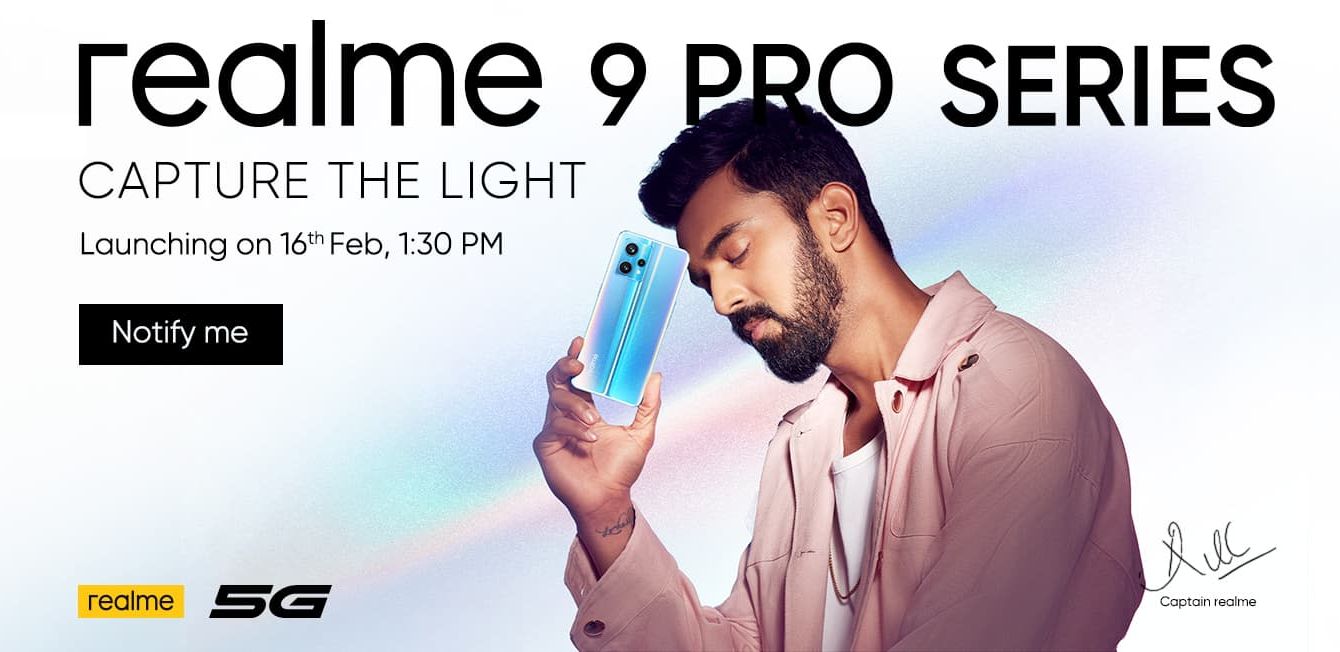
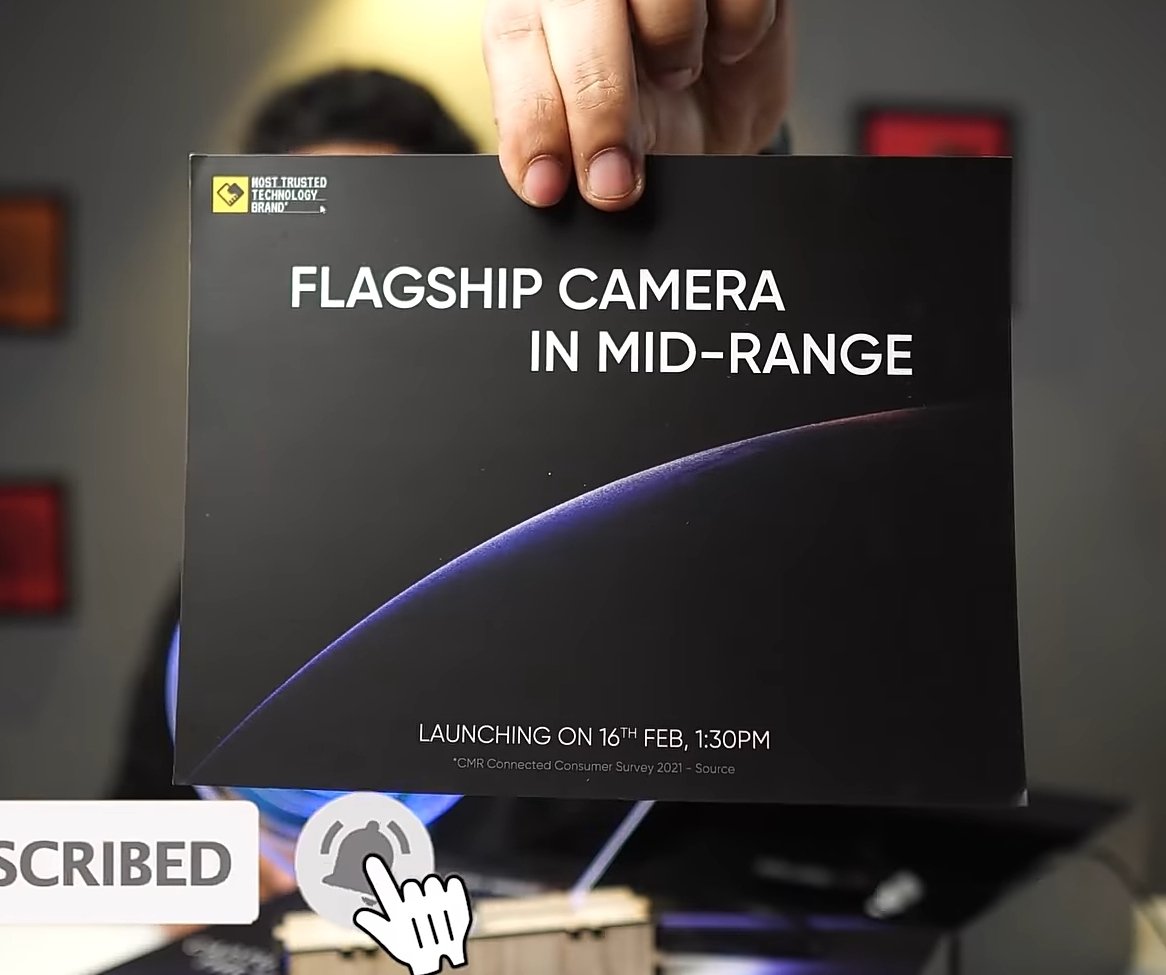
Realme 9 Pro series launch date is yet to be officially confirmed. The company is likely to confirm it later today or in the next few days. However, a YouTuber has seemingly spilt the launch date for the Indian market. As can be seen in the image below, the Realme 9 Pro lineup may go official at 1:30 PM (local time) on Feb. 16 in the country.

Realme 9 Pro launch date

In the recent teasers, Realme has been touting the camera capabilities of the Realme 9 Pro lineup, which reportedly includes two models such as Realme 9 Pro and Realme 9 Pro+. Smartphone OEMs have been providing the 50-megapixel Sony IMX766 lens on flagship smartphones. The “flagship camera in mid-range” text in the above image does indicate that the Realme 9 Pro series will feature the IMX766 camera. Reports have revealed that the same camera with OIS support will be available on the Realme 9 Pro+.

Speaking of Realme 9 Pro+, it will be arriving with an in-screen fingerprint scanner and a heart rate sensor. As can be seen in the above teaser, the Pro+ will be equipped with a color-changing rear shell. The 15-second clip shows that the back panel of the device is capable of changing the color of its back panel from Sunrise Blue to Glittery Red. According to Realme, the device can shift colors when it is exposed to sunlight at certain temperatures.

Realme 9 Pro+ specifications (rumoured)

Reports have revealed that the Realme 9 Pro+ will feature a 6.43-inch AMOLED FHD+ 90Hz display. It will be equipped with a 16-megapixel selfie camera and a 50-megapixel (main) + 8-megapixel (ultrawide) + 2-megapixel (macro) triple camera unit.

The Dimensity 920 chipset will fuel the Realme 9 Pro+ with 6 GB / 8 GB of RAM. It may run on Android 12 OS and come in 128 GB / 256 GB storage options. The device may come packed with a 4,500mAh battery that supports 65W fast charging.

RELATED:

Realme 9 Pro, 9 Pro+ chipset, camera, refresh rate, charging details officially confirmed

Realme will be launching the Realme 9 Pro series on Feb. 16 in Indonesia. The Realme 9 Pro lineup’s microsite is now live on the company’s official website. The landing page has revealed the key features of the Realme 9 Pro and Realme 9 Pro+.

Realme 9 Pro+ key specifications

The Realme 9 Pro+ has a Super AMOLED display that offers a 90Hz refresh rate. It is equipped with an in-screen fingerprint scanner, which can be used for tracking heart rate. The Dimensity 920 chipset will be present under the hood of the device, which will be coupled with vapor chamber liquid cooling.

While the battery size is not mentioned, the landing page reveals that the Realme 9 Pro+ will support 60W SuperDart fast charge technology. For photography, it features an OIS-assisted 50-megapixel Sony IMX766 triple camera unit. It will also carry support for NFC connectivity. It will carry support for color-shifting design.

Realme 9 Pro series launch date

Realme 9 Pro key specifications

The Realme 9 Pro supports a higher 120Hz refresh rate. It appears that the company may provide an LCD panel on the device. It will be equipped with the Snapdragon 695 mobile platform.

The rear shell of the device has a 64-megapixel triple camera unit. It will be backed by a 5,000mAh battery that supports 33W Dart charging. Like the Pro+ model, the 9 Pro will come with other features like NFC and color-shifting design. Probably, this device will come equipped with a side-mounted fingerprint scanner.

Reports have revealed that both phones have a 16-megapixel camera on the front and 8-megapixel + 2-megapixel auxiliary cameras on the back. The lineup is expected to come preinstalled with Android 12 OS and Realme UI 3.0.

RELATED:

Samsung Galaxy Tab S8 series marketing images highlighting key features leaked

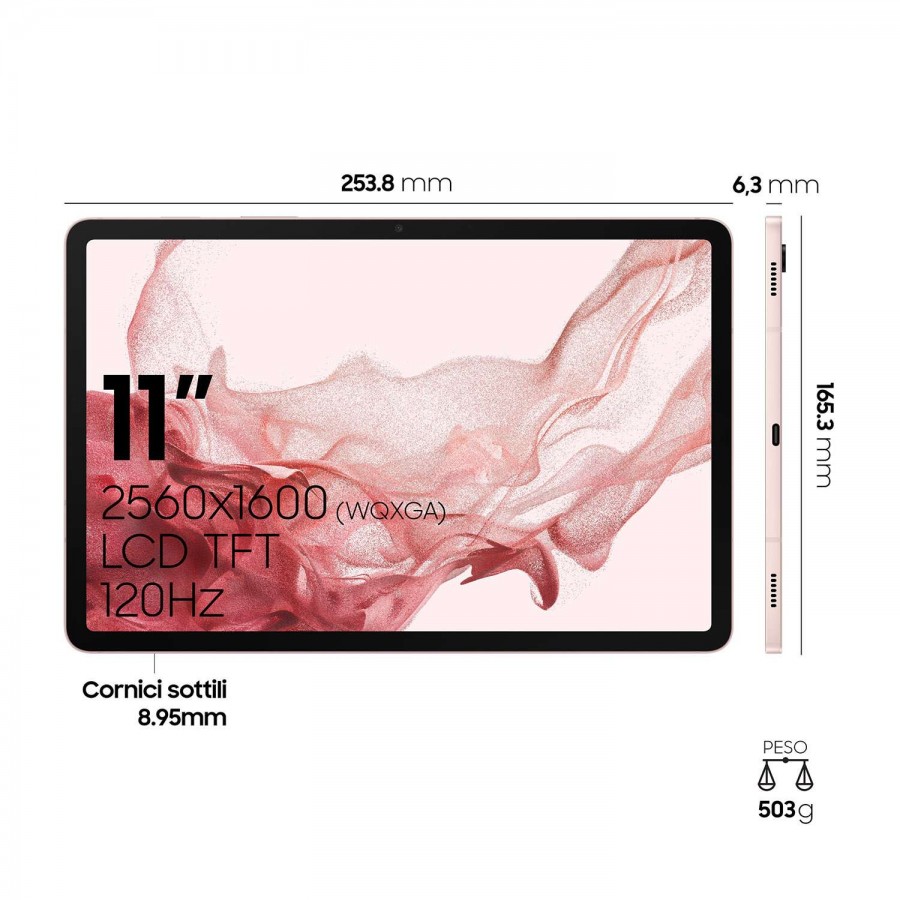
Samsung Galaxy Tab S8 Ultra, Tab S8 Plus, and Tab S8 flagship tablets are expected to launch with the Galaxy S22 lineup on Feb. 9. A fresh leak by well-known tipster Evan Blass has revealed the key features of the Galaxy Tab S8 family.

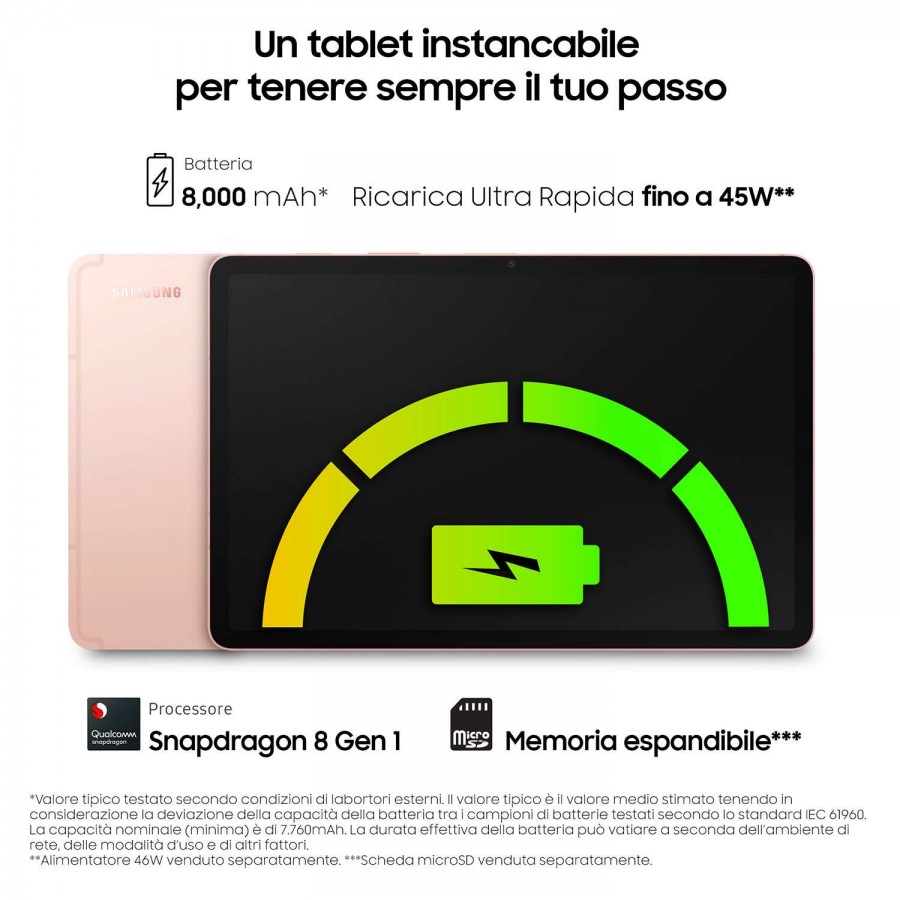
The Galaxy Tab S8 features an 11-inch LCD display that offers 2560 x 1600 pixels and a 120Hz refresh. It is equipped with an 8,000mAh battery that carries support for 45W fast charging. The device measures 253.8 x 165.3 x 6.3mm and weighs 503 grams.

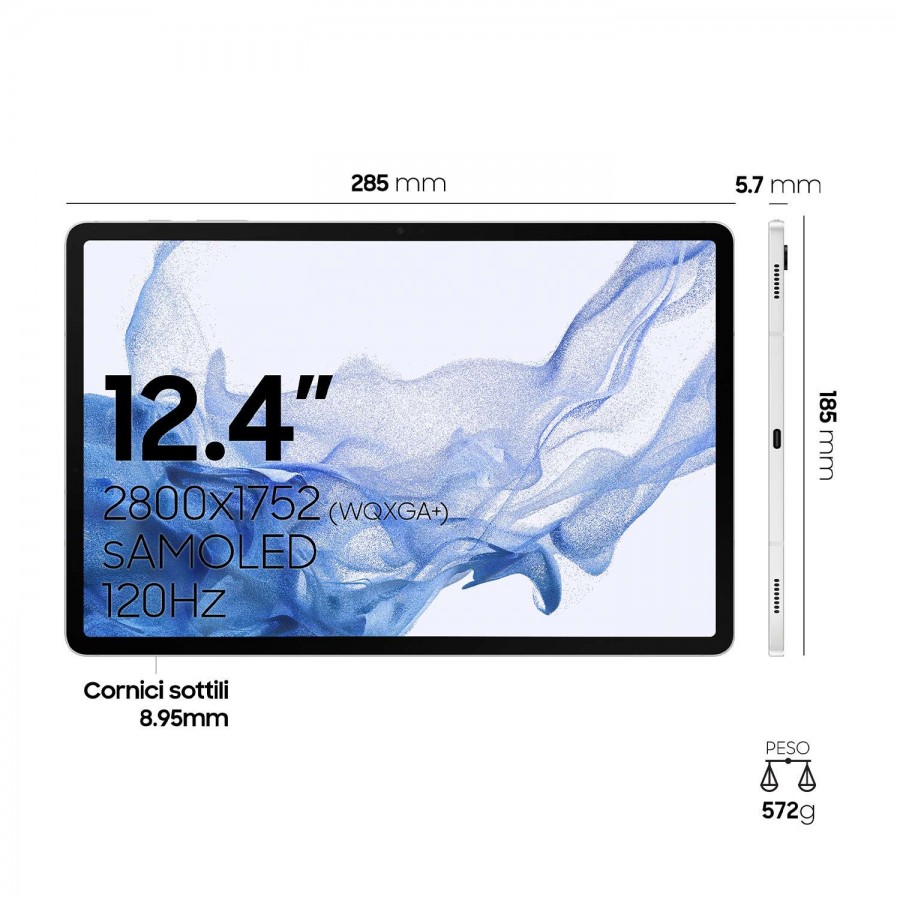
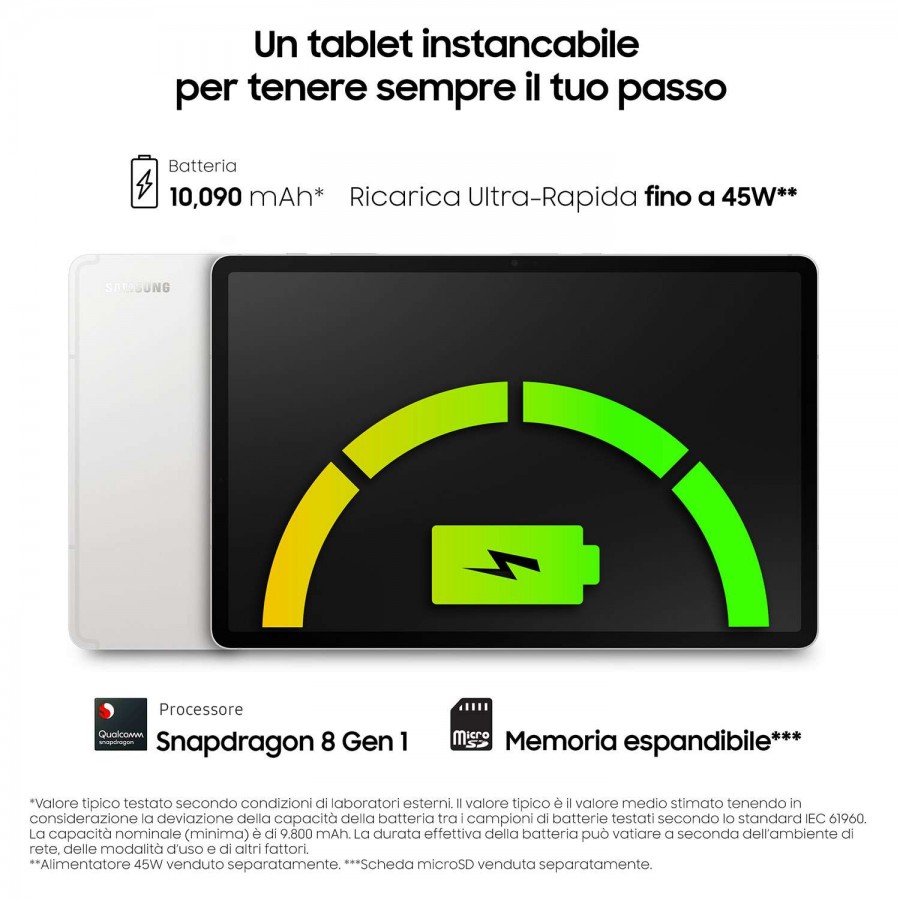
The Galaxy Tab S8+ has a 12.4-inch Super AMOLED display that delivers 2800 x 1752 pixels and a 120Hz refresh rate. It is packed with a 10,090mAh battery that offers 45W fast charging. Its dimensions are 285 x 185 x 5.7mm and weigh 572 grams.

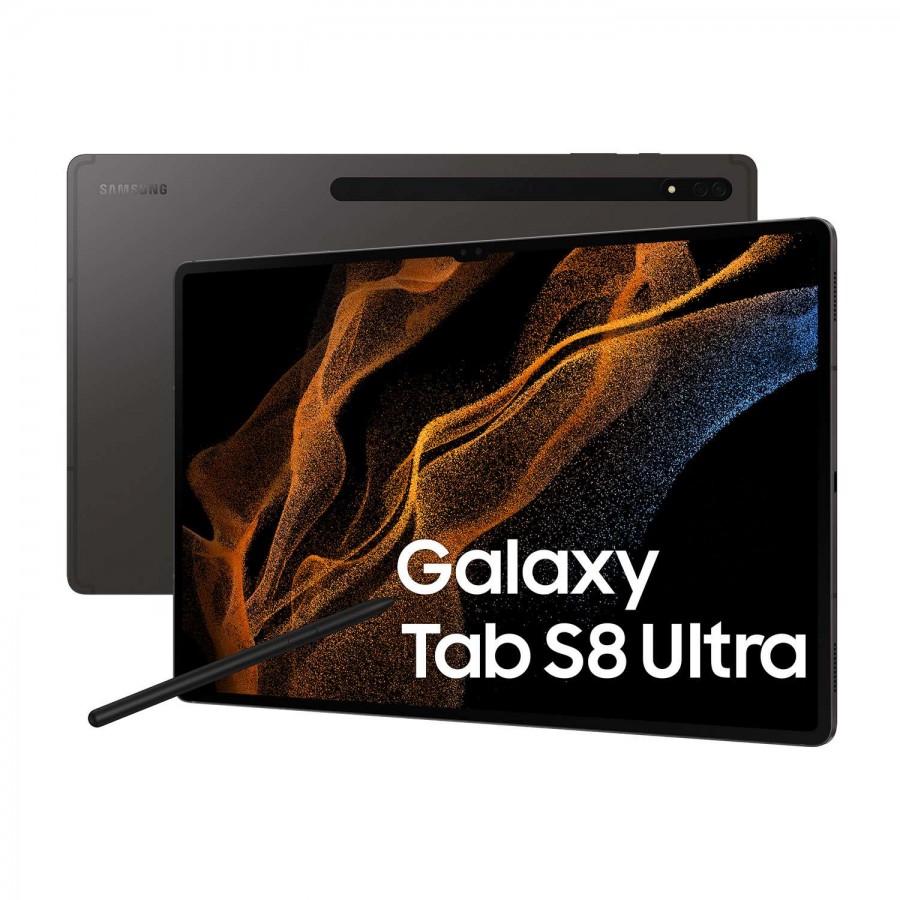
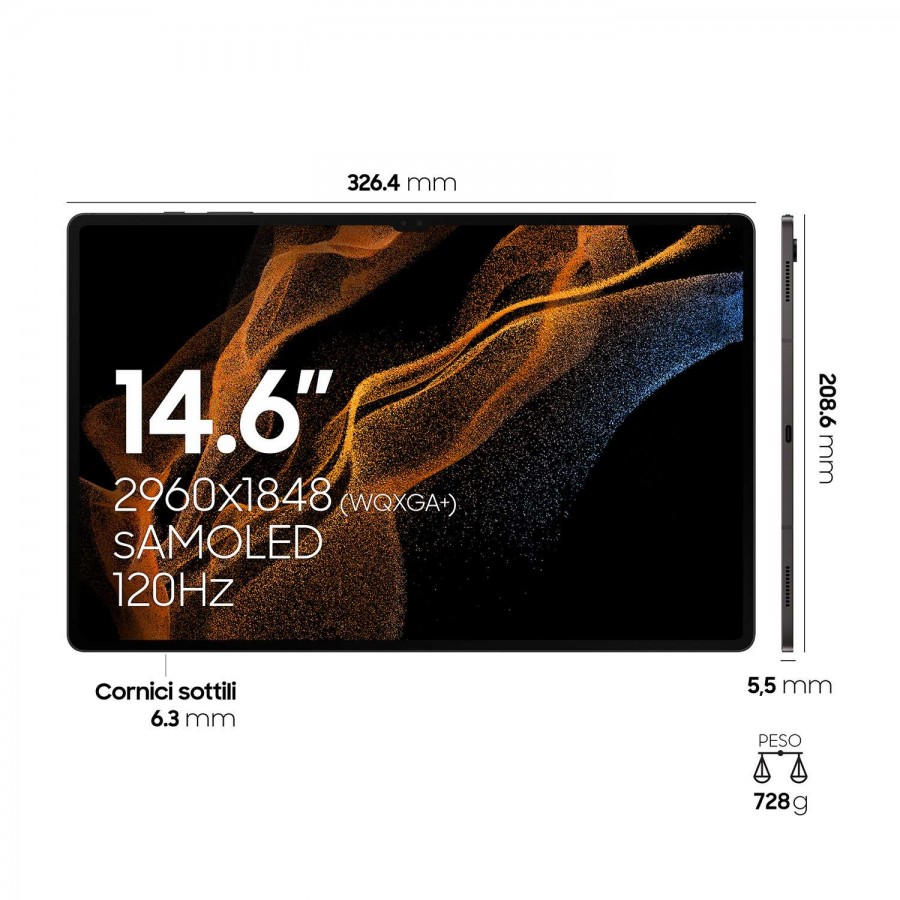
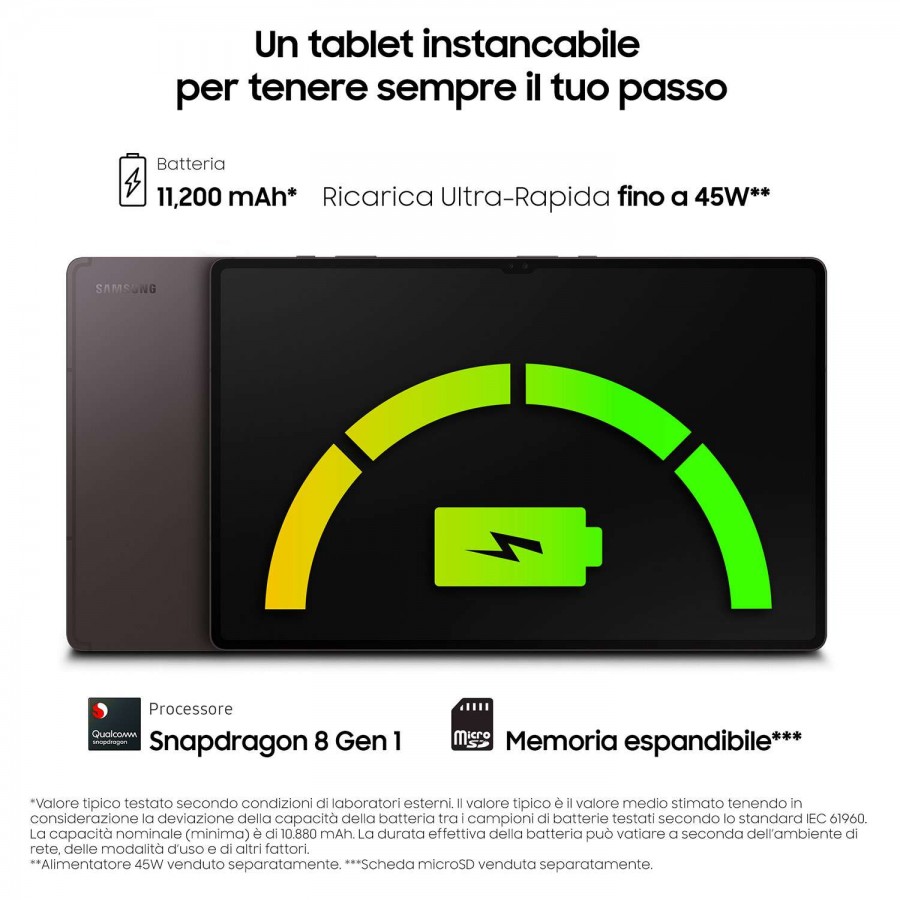
The Galaxy Tab S8 Ultra has a 14.6-inch Super AMOLED screen that offers 2960 x 1848 pixels resolution and a 120Hz refresh rate. It has a larger 11,200mAh battery that supports 45W fast charging. The tablet measures 326.3 x 280.6 x 5.5mm and weighs 728 grams.

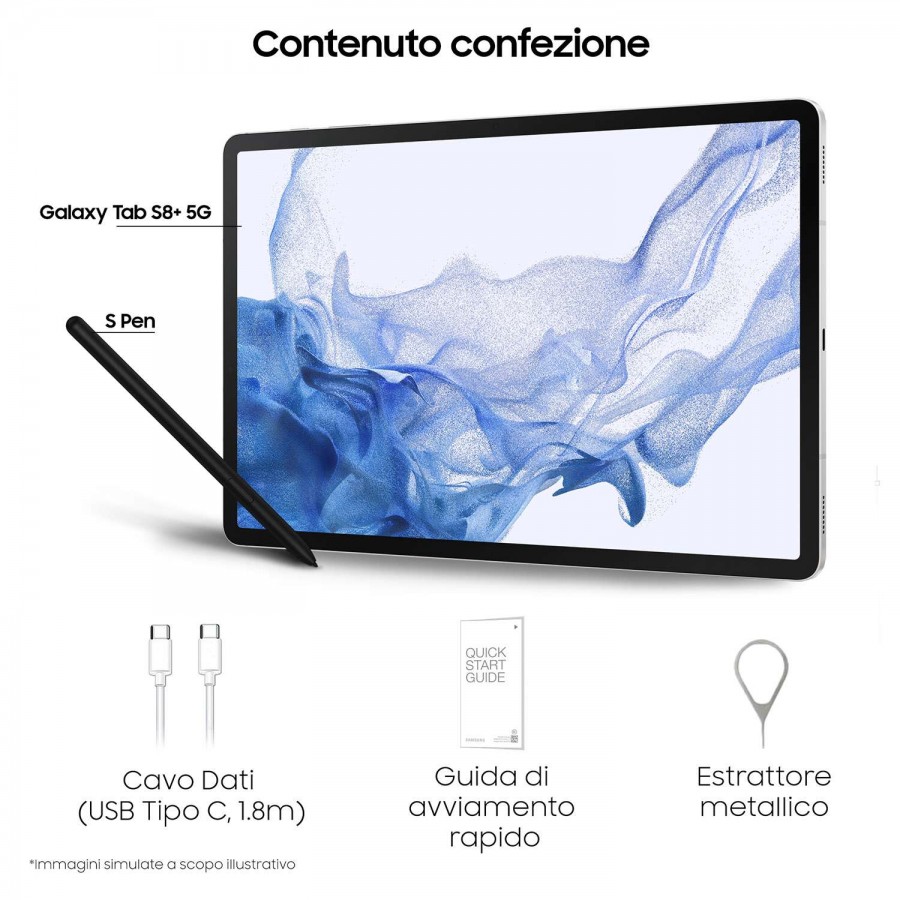
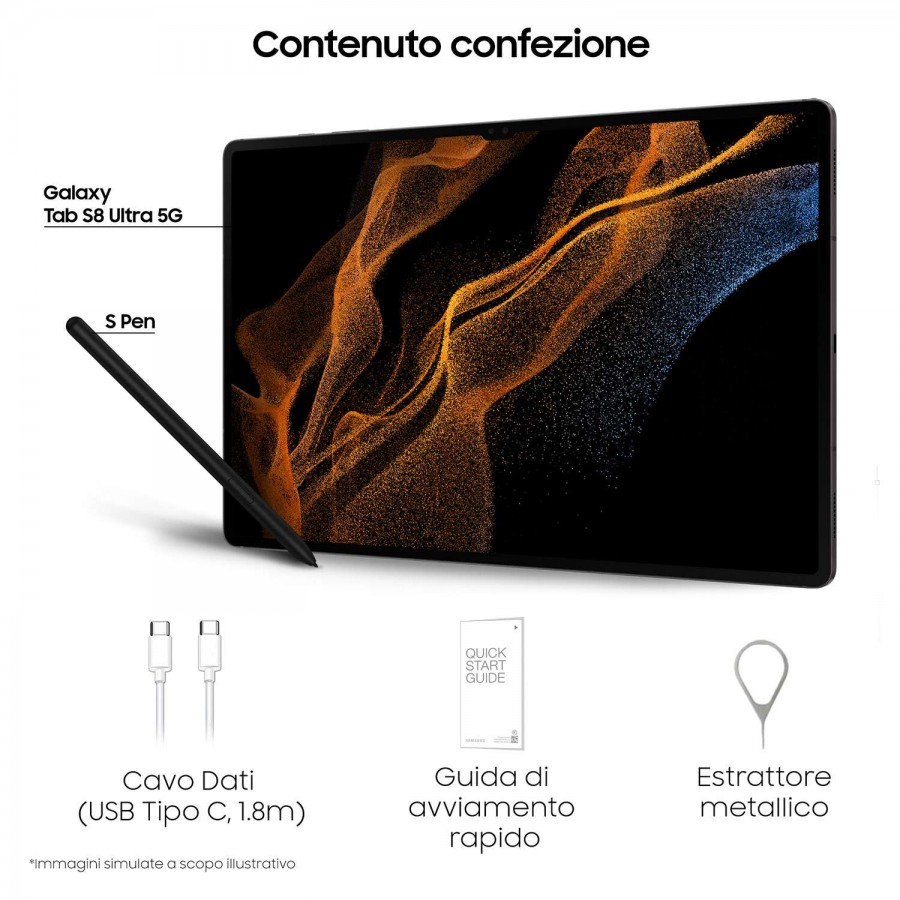
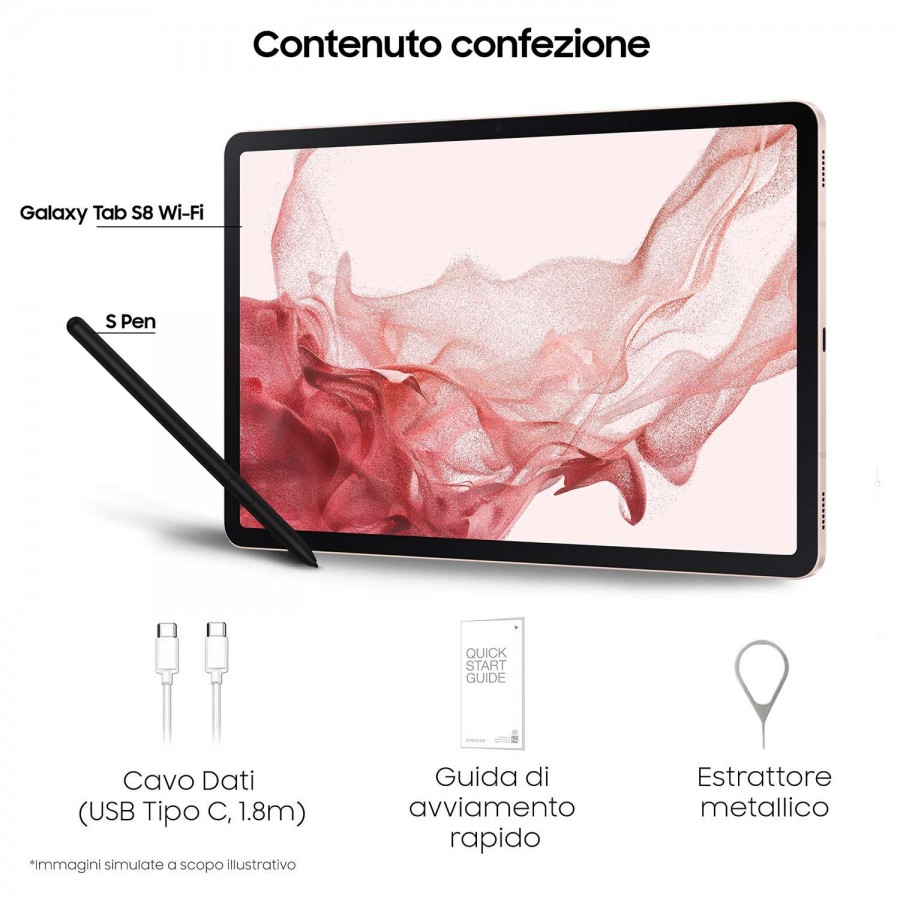
The Galaxy Tab S8 series is powered by the Snapdragon 8 Gen 1. The above images show that all three models will carry support for S Pen, which can be magnetically attached to the rear shell for charging. The retail package of the Tab S8 trio will include the S Pen, USB-C to USB-C, a SIM tool, and some documents.

A recent leak by Techinsider revealed that the Galaxy Tab S8 will be available for €970 (~$1,096). The Tab S8+ will be priced at €999 (~$1,129), whereas the Ultra variant is priced at €1,699 (~$1,290).

RELATED: