Advertisement

Global smartphone production declines in Q2 2021; Samsung and Apple witness heavy drop

The production of smartphones has been severely impacted because of the global chip shortage as well as rising cases of COVID-19 in some regions of Asia, reveals a new report coming from TrendMicro.

The report adds that in the second quarter of this year, smartphone production totaled 307 million units which is a significant drop of 11 percent compared to Q1 2021. However, when compared to Q2 2020, the numbers represent an increase of 10 percent.

Samsung Galaxy Z Flip 3 Featured 001
Samsung Galaxy Z Flip3

Samsung, which has been dominating the smartphone market for years, was the largest smartphone manufacturer by production volume in the second quarter of the year, making 58.5 million units. Compared to the company’s production in the first quarter of 2020, this is a massive drop of 23.5 percent.

The company has production facilities in India and Vietnam which have been hit hard with the COVID-19 outbreak. The South Korean giant had to temporarily halt production in some local factories or scale back production.

Apple iPhone 12 All Colors Featured
Apple iPhone 12

Coming to Apple, the production of the iPhone declined in the second quarter of the year but that is normal given that the company entered a model transition phase. In the third quarter, the Cupertino-based giant launches its new iPhone model and this time, it is set to launch the iPhone 13 series in the coming days.

The production of the iPhone went down 22 percent quarter-on-quarter to 42 million units. If the companies are to be ranked based on the production numbers, then Apple is moved to the fourth position, but it’ll make a comeback in the third and fourth quarter.

With Samsung getting the top position and Apple ranking fourth, Chinese smartphone makers OPPO and Xiaomi have secured the second and third position based on the smartphone units produced in Q2 2021. Both the companies produced 49.5 million units each and the count includes their sub-brands.

RELATED: 

Vivo X70 series teased again, features a 2K E5 AMOLED Display

Vivo has just shared another teaser for its upcoming X70 series of smartphones. While the company has teased the rear cameras of the device previously, it has now revealed certain specifications of its display.

As per a new image poster shared online, the Chinese smartphone maker revealed the X70’s front side. The company adds that the new smartphone uses Samsung’s fifth and latest generation of luminous material for the new AMOLED screen panel. The E5 panel offers various improvements over the previous E4 generation of OLED displays and arrives with 25 percent lower power consumption, higher contrast ratio of 8000000:1, and a peak brightness of up to 1500 nits.

Vivo

Furthermore, the brand also revealed the resolution of this display, which is a 2K panel. Unfortunately, Vivo did not reveal any finer details regarding the new smartphones, although, we had covered key specifications of the X70 Pro+ that were found on a TENAA certification listing. The higher end variant sports a QHD+ 6.78 inch display. Notably, the teaser image also confirmed the center aligned punch hole front facing camera as well, which is expected to be a 32 megapixel selfie camera. So stay tuned for more, as we will be covering any new updates or leaks that surface prior to the September 9 launch of the new lineup.

RELATED:


Redmi Earbuds 3 Pro launched in India as rebadged Redmi AirDots 3

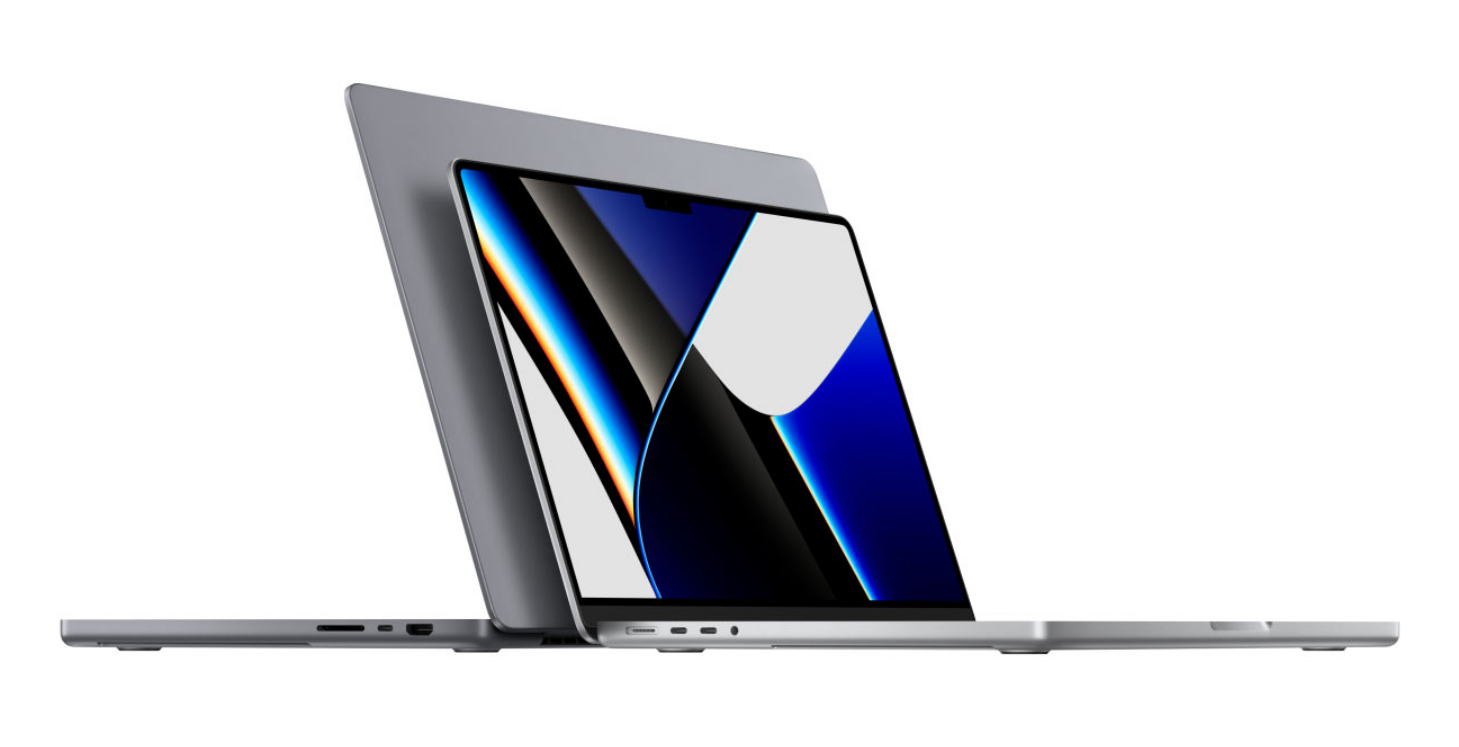
At the Redmi 10 Prime launch event for India, Xiaomi also announced a new pair of truly wireless earphones for the country called Redmi Earbuds 3 Pro. This new pair of earbuds are nothing but rebadged Redmi AirDots 3. Let’s take a look at what they offer and how much they cost in the region.
Redmi Earbuds 3 Pro AirDots 3 Featured

Redmi Earbuds 3 Pro Specifications and Features

The newly unveiled Redmi Earbuds 3 Pro for India come with a Qualcomm QCC3040 chipset. Thanks to this silicon, the earphones offer Bluetooth 5.2 connectivity and aptX Adaptive codec support.

Further, the buds feature dual drivers and weigh 4.6g each. They are IPX4 rated for splash resistance and support touch gestures controls. The buds also have wear detection and can pair seamlessly with MIUI devices.

Xiaomi claims 7 hours battery life on a single charge and 30 hours with the USB Type-C equipped charging case. Last but not least, the product weighs 51g as a whole and comes in three colors, namely Blue, White, and Pink.

Redmi Earbuds 3 Pro Price and Availability

The Redmi Earbuds 3 Pro are priced at ₹2,999 ($41) in India. They will go on sale from 12PM on September 9.

The product will be available on Mi.com, Amazon India, Mi Home stores, and partner retail stores.


RELATED:


Redmi 10 Prime launched with 90Hz display, Helio G88, 50MP quad cameras, 6,000mAh battery

Last month, Xiaomi announced the Redmi 10 in global markets. It came with several upgrades over last year’s Redmi 9 smartphone. Today, the company held a launch event in India to announce the Redmi 10 Prime and Redmi Earbuds 3 Pro TWS as a rebranded version of China’s Redmi AirDots 3.
Redmi 10 Prime specifications and features

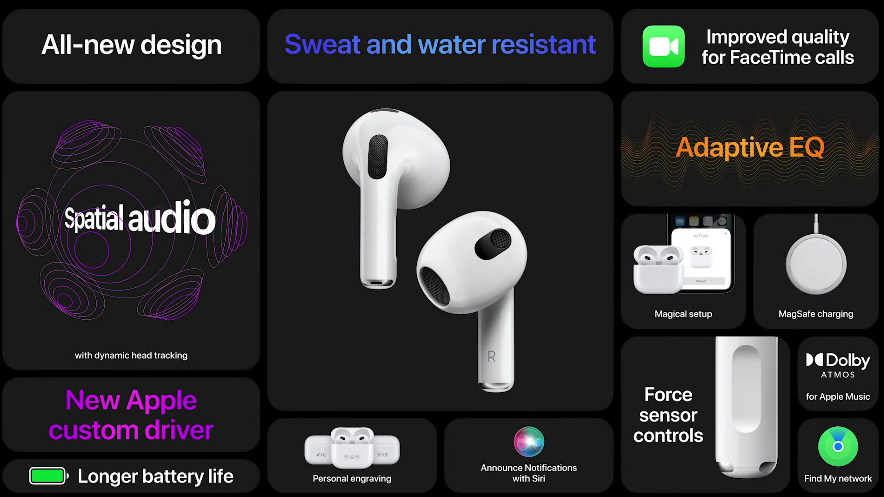
The Redmi 10 Prime features an impressive 6.5-inch LCD panel with a centrally positioned punch-hole. The screen offers a Full HD+ resolution of 1080 x 2400 pixels, 405ppi pixel density, a 90Hz adaptive refresh rate, and Gorilla Glass 3. For security, it is fitted with a side-mounted fingerprint scanner.

The Redmi 10 Prime is the world’s first phone to house the Helio G88 chipset. The device ships with up to 6 GB of LPDDR4x RAM and up to 128 GB of storage. For additional storage, it has a microSD card slot.

Redmi 10 Prime
Redmi 10 Prime

For snapping selfies, the Redmi 10 Prime offers a front camera of 8-megapixel. The rear camera unit of the smartphone features a 50-megapixel main camera with an f/1.8 aperture, an 8-megapixel ultrawide lens with a 120-degree FOV, a 2-megapixel macro camera, and a 2-megapixel depth assist lens.

The Redmi 10 for a global audience features a 5,000mAh battery. However, the Redmi 10 Prime is packed with a larger 6,000mAh battery that promises 723 hours of standby time, 192 hours of music playback, 24 hours of video playback, 11 hours of gaming, and 11 hours of video recording. The device carries support for 18W fast charging through USB-C, and it also supports 9W reveres charging. Xiaomi is offering a 22.5W in-box charger with the Redmi 10 Prime. It is equipped with dual graphite sheets for heat dissipation.

The Redmi 10 Prime comes preinstalled with MIUI 12.5 based Android 11, which tags along with support for extended RAM. It is a dustproof and splash-resistant device with corrosion-proof ports and rubberized seals. It offers other features such as dual 4G VoLTE, Wi-Fi, Bluetooth 5.1, GPS, IR blaster, a 3.5mm audio jack, and dual stereo speakers.

Redmi 10 Prime price in India and availability

The Redmi 10 Prime is priced as follows in India:

  • 4 GB RAM + 64 GB storage – Rs 12,499 (~$171)
  • 6 GB RAM+ 128 GB storage – Rs 14,499 (~$198)
    Colors: Phantom Black, Astral Blue, and Bitfrost White

Through HDFC Bank debit/credit cards and EMI transactions, users can get up to Rs 750 instant discount while purchasing the Redmi 10 Prime in India. The first sale of the device for the first time from 12 PM on Sept. 7 through Mi.com, Mi Home, Amazon India, Mi Studios, Mi Stores, and retail outlets.

RELATED:

Huawei Nova 9 launch date tipped
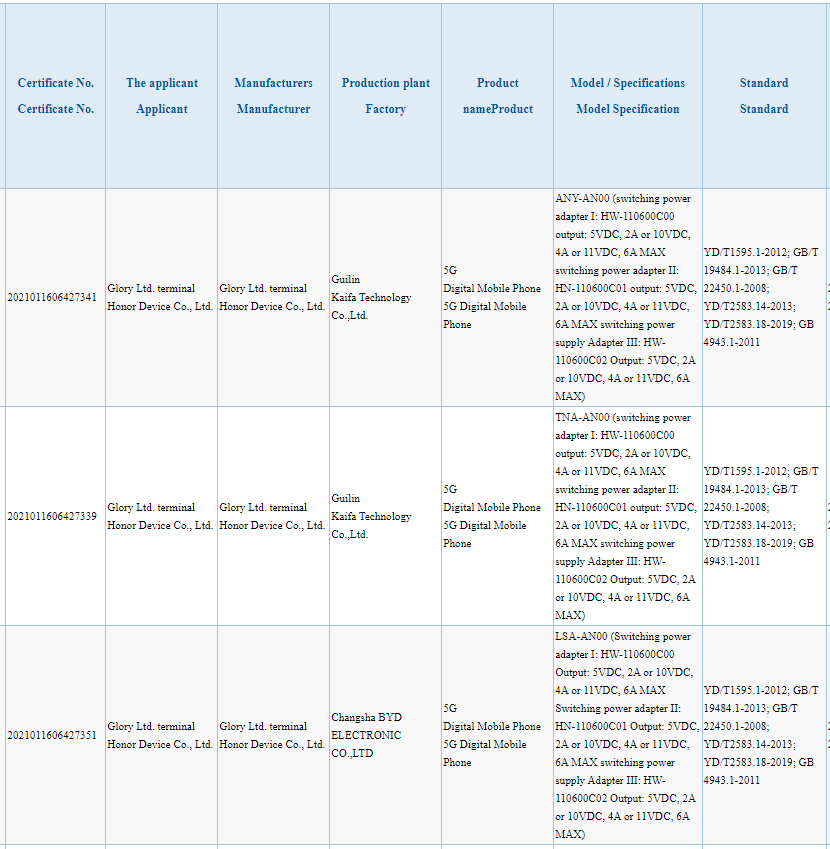
Last month, a Huawei phone with model number RTE-AL00 was certified by the TENAA certification platform of China. The device was also spotted at the 3C certification site. It is speculated that this device will be debuting in the Chinese market as the Huawei Nova 9.  According to a tipster, Huawei will be announcing the Nova 9 on Sept. 23.

The new leak further reveals that the Nova 9 will be equipped with Snapdragon 778G chipset’s 4G version. After the announcement, the device is expected to go on sale from Sept. 29 in China.

Huawei-Nova-RTE-AL00-front

The TENAA images of the RTE-AL00 revealed that it features an OLED screen with an in-screen fingerprint scanner and a pill-shaped cutout for dual front cameras. The back panel of the phone has an oval-shaped camera module that houses a quad-camera unit. The 3C certification of the device revealed that it may ship with a 66W fast charger. The same tipster has previously claimed that the Nova 9 houses a 4,500mAh battery.

Another Huawei phone with model number NAM-AL00 was spotted with RTE-AL00 at 3C last month. The 3C listing of the device revealed that it is a 4G LTE phone and it may arrive with support for 100W fast charging. This device is speculated to break cover as the Huawei Nova 9 Pro. It is speculated to arrive with a 4,000mAh battery.

Huawei is yet to confirm the existence of the Nova 9 series. Now that it is tipped to go official on Sept. 23, the Chinese manufacturer is expected to confirm its launch date in the coming days.
RELATED:

Samsung Galaxy A52 receives a price hike in India

Samsung launched the Galaxy A52 in India in March. The smartphone comes in two storage configurations and four color options in the country. Over five months after its release in the region, the South Korean tech giant has now hiked the price of this phone.

Samsung Galaxy A52 Awesome Blue Featured
Samsung Galaxy A52

Samsung has increased the price of Galaxy A52 in India by ₹1,000. The price hike comes after the launch of Galaxy A52s 5G. The new price is currently live on Samsung.com.
The base 6GB + 128GB and higher 8GB + 128GB variants of the Galaxy A52 debuted at ₹26,499 and ₹27,999 respectively. With the increment in price, the same models now cost ₹27,499 and ₹28,999.

The Galaxy A52 is one of the best smartphones released by Samsung in 2021. But unfortunately, due to the global semiconductor shortage, the handset has been mostly out of stock in India for the past few months.

Talking about specifications, the Galaxy A52 features a 6.5-inch FHD+ Infinity-O Super AMOLED display with a 90Hz refresh rate. It is powered by a Qualcomm Snapdragon 720G SoC and draws its power from a 4,500mAh battery with support for 25W fast charging (ships with a 15W charger).
The device has a 64MP (wide, OIS) + 12MP (ultra-wide) + 5MP (macro) + 5MP (depth) quad-camera setup on the back and a 32MP selfie camera. It runs One UI 3.1 based on Android 11 with a guaranteed three years of OS upgrades and at least four years of security updates.

Other features of the phone include dual stereo speakers, a 3.5mm headphone jack, a MicroSD card slot, Samsung Pay, and an IP67 rating for dust/water resistance.


RELATED:


Apple iPhone 13 Pro may not come with a 256GB storage variant

Apple is expected to launch the iPhone 13 series this month and as the release gets closer, we’ve more leaks on our way. One fresh piece of information about the iPhone 13 Pro series has just emerged and it reveals that Apple won’t launch a 256GB storage variant for the Pro models.

Apple is infamous for cutting on a mid-storage variant just to let users spend extra cash to opt for a higher version. Earlier, we’ve seen Apple offering as low as 16GB of base storage variant followed by a 64GB variant, by skipping the mid 32GB storage variant. Similarly, Apple offered a 32GB base storage variant with the iPhone 7 and skipped the mid 64GB variant(which was supposed to be the most suitable storage space) and directly jumped to the 128GB storage variant.

iPhone 13 pro

The same was the case with the rest of the models from Apple every year. Now, Apple is touted to offer a 128GB base storage variant with the iPhone 13 Pro and then directly offer the 512GB storage variant. Yet again, the most suitable 256GB storage variant will be skipped by Apple. This forces users to buy the higher 512GB storage variant even though the need for some users would be sufficed by a 256GB storage variant.

Nonetheless, Apple will also bring 1TB storage variants with the Pro models. The iPhone 13 mini and iPhone 13 will start with a base 64GB storage variant, 128GB storage variant, and 256GB storage variant. The non-Pro variants will have bumped up 4GB of RAM, whereas, the Pros will get 6GB of RAM.

RELATED:

(via)

TCL L10 Pro launched with 6.22-inch HD+ display, 13MP triple cameras, 128GB storage

TCL announced the TCL L10 Pro smartphone in Brazil. It is a low-budget smartphone powered a Unisoc processor. It has a tall aspect ratio, a 13-megapixel triple camera unit, a large internal storage, and a decent battery. Here is all the information on the specs, features, and pricing of the L10 Pro.

TCL L10 Pro specifications and features

The TCL L10 Pro has a 6.22-inch LCD Panel with a waterdrop notch display and a noticeable chin. IT supports an HD+ resolution and a 60Hz refresh rate.

TCL L10 Pro
TCL L10 Pro

The display notch houses a 5-megapixel selfie camera. Its polycarbonate rear has a 13-megapixel primary camera, a 5-megapixel ultrawide snapper, and a 2-megapixel depth helper. The rear shell of the device also features a fingerprint scanner.

The Unisoc SC9863A chipset powers the TCL L10 Pro with 4 GB of RAM. The device offers massive internal storage of 128 GB. For additional storage, it has a microSD card slot.

TCL L10 Pro
TCL L10 Pro

It has a 4,000mAh battery to keep the lights on. The device offers other features such as dual SIM support, 4G VoLTE, Wi-Fi, Bluetooth, GPS, a USB port, a 3.5mm audio jack, and Android 10 OS.

TCL L10 Pro pricing and availability

The TCL L10 Pro is priced at BRL 1,299 (~$250) in Brazil. It is unclear whether the device will be heading any other markets.

RELATED:

Redmi Buds 3 China launch date set for September 6

At the end of May, Redmi, the sub-brand of Xiaomi, launched a new pair of truly wireless earphones called Redmi AirDots 3 Pro. A little over three months later, the brand has announced to release yet another TWS product called Redmi Buds 3.

Redmi Buds 3 Featured A

According to the official Redmi Weibo account, the Redmi Buds 3 will be launched on September 6. This product will be the brand’s first semi in-ear wireless earphones.

The brand has even shared a render of the audio accessory. As per the image, the buds will have an Apple Airpods-esque design. However, the charging case will be square-shaped with an LED indicator and a button on the front.

Unfortunately, the company has not revealed any features of the earbuds yet. But it does hint at the presence of low latency gaming mode.

Redmi Buds 3 Featured B

As per Digital Chat Station, the forthcoming Redmi Buds 3 will arrive with a Qualcomm QCC3040 chipset. He also adds that the accessory will use Bluetooth 5.2 connectivity and the buds will be comfortable to wear.

The Redmi Buds 3 will be the third TWS product from Redmi in 2021. The first two are Redmi AirDots 3 and Redmi AirDots 3 Pro. The former was announced alongside the Redmi K40 series, while the latter debuted with the Redmi Note 10 Pro 5G.


RELATED:


Realme Pad, the company’s first tablet, confirmed to launch on September 9

A couple of months back, Realme had teased its two new products — Realme Book and Realme Pad, confirming the brand’s entry into the laptop and tablet segment. The OPPO-backed company has already launched the Realme Book (aka Realme Book Slim) in a few regions, but the tablet has not been launched yet.

Today, the company has confirmed that the Realme Pad, the very first tablet from the brand, will be officially launched in the Indian market on 9th September. The launch event will take place at 12:30 PM local time.

Realme Pad Launch Date

The tagline for the Realme Pad is “Ultra Slim. Real Fun.” This indicates that just like the Realme Book laptop, the tablet will also come with a slim build. The landing page for the product on Flipkart confirms that the device will have a 6.9mm thickness, which is slimmer than the Apple iPad measuring around 7.5mm in thickness.

Currently, apart from the thickness, the company has not revealed the tablet’s features and specifications. To know for sure what the device packs, when it will be available for purchase, and at what cost, we will have to wait for the official launch event.

As per the leaks, the Realme Pad will come equipped with a 10.4-inch AMOLED display offering a Full-HD+ screen resolution. A Geekbench listing of the device has revealed that it could be powered by the MediaTek Helio G80 chipset.

Realme Pad AMOLED Display hint

The device is likely to come packed with at least 4GB of RAM and 64GB of internal storage and we are expecting multiple memory variants. In the camera department, it will feature an 8-megapixel snapper on the front side and an 8-megapixel sensor with autofocus support on the back panel.

The Realme Pad is also expected to have quad-speakers and may carry support for Stylus. For connectivity, it will likely support 4G LTE along with Wi-Fi. The device will be powered by a 7,100mAh battery and we expect support for fast charging technology.

Along with the Realme Pad, the company is also set to launch the Realme 8i and 8s smartphones in the Indian market on 9th September.

RELATED: 

Samsung confirms One UI 4.0 (Android 12) Beta to hit German Galaxy S21 series soon

Android 12 has been introduced to the world and there’s a big list of devices already lined up to receive the update. Despite being away from the Android 12 beta program, Samsung is set to find its place among the first few devices that are going to receive the update later this month. After announcing the commencement of the One UI 4.0 beta program in South Korea, Samsung has decided to further expand the rollout to Germany.

Samsung-Galaxy-S21-series-One-UI-4-Germany

The confirmation comes from the official Samsung German community and as expected, first in line are the flagship offerings – Samsung S21, Samsung S21 Plus, and Samsung S21 Ultra. The OEM, however, hasn’t been specific about the timeline, leaving users keyed up. But if Samsung’s previous track is anything to go by, there shouldn’t be much of a wait after the update goes live for South Korean units and can be expected by the end of September.

Samsung, having a massive global presence, may even explore the option of adding more countries such as the UK, China, and India to join the program in the next few days. What remains to be seen is the list of devices that are next in the queue to receive the One UI 4.0 beta update.

Android 12-based One UI 4.0 is going to bring a bucket load of changes to the UI including icons and themes, inspired by Android 12’s Material You design. There will be, of course, more security and privacy features on top of it. We will have a better understanding of the changelog when the update finally begins to roll out.


Related:

[embedyt] https://www.youtube.com/watch?v=5IRY-_IjDkg[/embedyt]


(via)

Huawei Mate 50 rumored to feature satellite connectivity support for SMS messaging

Huawei has been a dominating player in the smartphone maker for years but that is no longer the case. Although the company has been struggling to get a foothold after getting sanctioned by the United States, it is still trying.

The Chinese tech giant is now gearing up to launch a new flagship smartphone, dubbed Huawei Mate 50. While some details about the device have already been leaked, the latest rumor is about a unique feature of the smartphone.

Huawei Logo MWC 2019

A Weibo user has tipped (via GizChina) that the upcoming Huawei Mate 50 smartphone will come with support for satellite connectivity when the cellular network isn’t available. The satellite connectivity will be used to communicate via short message service (SMS) in a situation where a cellular network isn’t an option.

For this, the company has reportedly opted for the Beidou Satellite System. It is being reported that because of this new feature addition, the launch of the upcoming flagship smartphone from Huawei has been delayed.

It makes sense for the company to add this unique feature to the Mate series devices given that the Huawei Mate lineup, the second flagship series of the Chinese giant, usually comes packed with the most advanced technology available.

The satellite communication feature proves that Huawei is still trying to innovate in the smartphone space and hasn’t given up on the mobile phone business despite being severely restricted by the United States sanctions. But do note that the satellite communication feature isn’t confirmed by Huawei and it currently looks like speculation.

The Huawei P50 series smartphones, which are usually launched in the first quarter of the year, have been delayed and are now expected to get launched this month. Because of this, the Mate 50 lineup is now expected to get launched in the first half of 2022.

Apple is also expected to add satellite communication support for the iPhones using which users can text first responders and report incidents such as plane crashes, sinking boats, fires, and more. The feature, which is likely to be called “Emergency Message via Satellite” would be integrated into the Messages app as a third option after SMS and iMessage and would be identified by a gray text bubble.

RELATED: 

Ineligible Windows 11 PCs are being booted out of Windows Insider Program

Being an iteration that included radical changes, Microsoft announced that Windows 11 will not bring joy to the older PCs. Among the CPUs that were cut off the list are the 6th gen and 7th gen Intel processors. AMD processors were in no good shape either. But that didn’t stop enthusiasts from getting their hands on the next-gen Windows, and they went for it anyway. Previously, Microsoft allowed these older PCs to at least test out the new Windows version. But as we move closer to the stable release date, the process of kicking out unsupported PCs has begun.

Windows 11 dark mode

Earlier, users who were already in the Dev and Beta channels with unsupported hardware were allowed to stay in the program till the stable version was out. Upon its arrival, they’d have to be turned back to Windows 10 21H2 build. But now, Microsoft has already begun to filter out ineligible devices and prompting them to go back to Windows 10 to keep the update cycle running.

Microsoft continued to air pre-release builds on unsupported CPUs, namely 20H2, 21H1, and 21H2 which eventually became the stepping stones to the big upgrade, apparently letting a big chunk of ineligible devices be part of the Windows 11 program. This explains why the company allowed Insiders and Dev channels to sneak into the new version. With the older PCs testing out the earlier builds, Microsoft used that data to formulate a conclusion that eligible PCs had negligible crashes, at around 0.2%, while ineligible PCs had 52% more crash incidents.

So now, it’s time to move back to where your older PCs belong. For the systems that are being deported back to Windows 10, you may still have a chance to run Windows 11 by installing it via ISO.

Related:

[embedyt] https://www.youtube.com/watch?v=5IRY-_IjDkg[/embedyt]

Vivo V2130A Dimensity 900 phone’s full specifications leaked through TENAA listing

Last month, a Vivo phone with model number V2130A and its variant V2131A was spotted at the Google Play Console with some specifications. The listings revealed that the V2130A / V2131A are powered by the Dimensity 900 chipset. Today, the V2130A received approval from the TENAA telecom authority of China. The certification has revealed all the important specifications of the device.

Vivo V2130A specifications

The mysterious V2130A Vivo smartphone measures 160.87 x 74.28 x 7.49mm and weighs 175 grams. It is likely to arrive in colors like Mirror Black, Cyan, and Light. The appearance of the device is not known since its images are not available in the TENAA listing.

Vivo Dimensity 900 phone
Vivo’s upcoming Dimensity 900 | image source: Google Play Console

The V2130A has a 6.44-inch AMOLED panel that offers 1080 x 2400 pixels. For security, it has an in-screen fingerprint reader. It draws power from a 3,970mAh rated battery and it features a 2.4GHz octa-core processor, which appears to be Dimensity 900 chip.

The device is likely to arrive in 6 GB, 8 GB, and 12 GB RAM variants in China. It may offer storage choices like 128 GB and 256 GB. The device will come preloaded with Android 11 OS.

The rear camera unit of V2130A has a 64-megapixel primary camera, an 8-megapixel secondary lens, and a 2-megapixel camera. For video calls and selfies, it is fitted with a 32-megapixel front camera.

RELATED:

Apple is now selling refurbished 24-inch iMac powered by M1 chipset in China

The 24-inch iMac was launched by Apple earlier this year in April. Just months after the device is available for purchase, the tech giant officially started selling the refurbished models of the same in the UK in August.

Now, just a month after the refurbished 24-inch iMac models were up for sale in the United Kingdom, Apple has started selling the same in China. They are being sold in different memory configurations and multiple color options in the Chinese market on its website.

The new iMac

The 8GB RAM and 256GB solid state drive (SSD) model is priced at 8,499 yuan (~$1,316) while the 8GB RAM with 512GB SSD is available at 9,769 yuan (~$1,512). The product is being offered in four color options — Silver, Green, Blue, and Pink.

It’s noteworthy that the stock for the refurbished models varies based on what people have sent in for repair or replacement. Those who are looking to purchase a refurbished version of a particular model need to keep a close eye on the store for its availability.

As the name itself indicates, the new 24-inch iMac features a 24-inch 4.5K Retina Display that comes with support for 1 billion colors. It has True Tone technology which is used to automatically adjust the color temperature based on the environment.

Underneath, the device is powered by Apple Silicon‘s M1 chipset and comes in two versions — one with an 8-core CPU and a 7-core GPU and another with an 8-core CPU and 8-core GPU. The base model packs 8GB of RAM and 256GB of SSD storage which can be expanded up to 16GB of RAM and 2TB of SSD storage.

Apple M1 chipset is the first from the technology giant for its Mac devices under Apple Silicon. The company is now working on an upgraded chipset, which is likely to be called M1X and there are already reports about Mac devices powered by the same.

The upcoming 14-inch and 16-inch MacBook Pro models are expected to come powered by the yet unannounced Apple M1X chipset, and so is the new Mac Mini. We expect the launch of newer Mac devices to take place by the end of this year.

RELATED: 

WhatsApp fined €225 million for breaching EU data privacy rules

WhatsApp, the instant messaging platform owned by Facebook, has been fined 225 million euros (approximately $267 million) by a data watchdog in Ireland for breaking the EU data privacy rules. This makes it the largest penalty handed out by the Irish data regulatory over General Data Protection Regulation (GDPR) violation and the second-largest in EU.

Data Protection Commission of Ireland says that the Facebook-owned WhatsApp failed to tell its European Union citizens about what the company does with the data collection of the user, including how the details are collected and users, as well as how WhatsApp shares the user data with Facebook.

WhatsApp

The Irish authority had originally asked WhatsApp for a €50 million fine for breaking GDPR, but other data protection agencies pushing for a stiffer penalty. Now, the fine levied is more than four times the originally proposed.

In its order, the commission asked WhatsApp to tweak its privacy policies and how it communicates with users in order to make the platform compliant with Europe’s privacy law. This means that the messaging service may need to expand its privacy policy.

WhatsApp has said that the company will be filing an appeal over this verdict. The company’s spokesperson added, “WhatsApp is committed to providing a secure and private service. We have worked to ensure the information we provide is transparent and comprehensive and will continue to do so. We disagree with the decision today regarding the transparency we provided to people in 2018 and the penalties are entirely disproportionate.”

The company has revealed on its website that it shares information like phone numbers, transaction data, business interactions, mobile device information, IP addresses, and other information with Facebook. The firm emphasizes that it does not share personal conversations, location data, or call logs.

RELATED: 

Vivo X70 Pro+ specifications emerge through TENAA appearance

The Vivo X70 Pro appeared with its entire specifications at TENAA yesterday. The vanilla X70 has also surfaced at the Chinese certification site. Now, the Vivo X70 Pro+ flagship has made its way to TENAA to reveal all its major specs.

Vivo X70 Pro+ specifications

The Vivo phone with the V2145A model number that has appeared at TENAA is the upcoming Vivo X70 Pro+. The device measures 164.54 x 75.21 x 8.9mm and weighs 209 grams. It features a 6.78-inch AMOLED panel that delivers a QHD+ resolution of 1440 x 3200 pixels. It has a 4,430mAh battery that is likely to carry support for 55W fast charging. Rumors suggest that it may carry support for 50W wireless charging.

The 3GHz octa-core processor that fuels the X70 Pro+ could be the Snapdragon 888 Plus chip. It is likely to arrive in China in 8 GB and 12 GB RAM variants and storage choices such as 256 GB and 512 GB.

Vivo X70 Pro Plus
Vivo X70 Pro Plus

For selfies, it has a 32-megapixel selfie camera. The rear camera setup includes a 50-megapixel main camera, which could be a Samsung GN1 lens. It is assisted by a 48-megapixel camera, which could be a Sony IMX598 lens with micro-gimbal stabilization. The third lens is a 12-megapixel camera, which could be a telephoto snapper with 2x optical zoom and OIS support. The quad-camera setup also includes an 8-megapixel periscope zoom lens that is speculated to offer 5x optical zoom, 60x digital zoom, and OIS. The X70 Pro+ will carry support for 8K video recording.

The X70 Pro+ runs on Android 11 OS. For security, it has an in-display fingerprint scanner. A recent leak claimed that it will arrive in colors like orange (leather), blue (leather), and black (AG glass). The X70, X70 Pro, and X70 Pro+ are scheduled to launch on Sept. 9 in China.

RELATED:

Vivo X70 full specifications emerge through TENAA listings, reveals two CPU variants

Vivo is all set to announce the Vivo X70 series of smartphones on Sept. 9 in China. Yesterday, the Vivo X70 Pro with model number V2134A was spotted at TENAA with specifications and images. At TENAA, two Vivo phones with model numbers V2132A and V2133A have appeared with nearly identical specs and different chipsets. These appear to be the two variants of the Vivo X70.

Vivo X70 specifications

Both models measure 160.10 x 75.39 x 7.55m and weigh 181 grams. They are fitted with a 6.58-inch AMOLED display that offers a Full HD+ resolution of 1080 x 2376 pixels. They are backed by a 4,320mAh rated battery, which may carry support for 44W fast charging.

Source: MySmartPrice

The V2132A variant is powered by a 2.8GHz octa-core processor and 6 GB / 8 GB / 12 GB of RAM. On the other hand, the V2133A model is fueled by a 3.0GHz octa-core processor and 8 GB / 12 GB of RAM. Probably, the V2132A model could be powered by the Exynos 1080, whereas the 3.0GHz model may feature Dimensity 1200. Tipster Digital Chat Station has also claimed that the X70 will arrive in two CPU variants.

Both variants offer 128 GB / 256 GB / 512 GB of storage. They are preinstalled with Android 11 OS. For security, both models are equipped with an in-screen fingerprint scanner.

The V2132 / V2133A features a 32-megapixel camera for capturing selfies. Their rear camera setup includes a 40-megapixel + 12-megapixel + 12-megapixel triple camera unit. Both phones carry support for 8K video recording.

RELATED:

Xiaomi controls 50% of China’s OLED TV market, sold over 10K OLED TVs in 15 days

Xiaomi has officially announced that it has sold over 10,000 OLED smart TVs in just 15 days, setting a new record in the OLED TV industry. The company also disclosed that it presently controls about 50% of China’s OLED TV market in the wake of a low penetration rate for OLED TVs in China.

The recent sales record is connected to the Mi OLED TV 6 and the Mi Masters TV 77 that were announced not too long ago. The Mi TV 6 OLED comes with a cheaper 5699 yuan (~$883) starting price tag for the 55-inch. The Mi TV Masters 77 OLED isn’t that cheap, packing a hefty price tag of 19,999 yuan (). The design and features seem to justify the price tag as the device packs a slim form factor said to be thinner than a smartphone.

Xiaomi has often dominated the smart TV market in China for the past months. A recent report by market research firm Avi Cloud (AVC) shows that Xiaomi has topped that smart TV market ranking for 10 consecutive quarters.

The growth recorded by the Chinese tech giant in the sector is driven by a consistent outflow of quality products and that continued in to date. The company recently launched the Mi TV 5X and it is already performing excellently in the market especially in India where it has been launched.

RELATED: 


(via)


Vivo officially confirms the V1 custom Imaging chip developed in 24 months

Vivo has officially confirmed the brand’s first Imaging Chip V1 which is designed to improve the photography prowess of its smartphones. The company issued an official press release which unfortunately did not contain details of the technical feature of the new ISP chip. However, the firm disclosed that the development marks a milestone in the company’s first breakthrough in independent R&D and chip design.Vivo V1 Chip Leak

Vivo disclosed that the new V1 ISP chip is the product of 24 months of research and development by an R&D team made up of over 300 persons. The company hopes to approach the new development in four key directions: image system, operating system, industrial design, and performance. It did not state the stage the product is but considering it is tipped to feature on the upcoming Vivo X70 series, we can conclude that it is already in mass production.

Vivo’s Executive VP and COO Hu Baishan also hinted that the V1 chip can better serve user needs by “optimizing smartphone application scenarios such as viewfinder look and video recording”. Earlier on, the Vivo VP it was who confirmed that the chip will feature on the X70 series which is expected to go official on September 9.

Although the X70 series will include the X70X70 Pro, and X70 Pro+, the topmost Pro+ model is speculated to be the model that will feature the new ISP chip. Recall that the Vivo X70 Pro+ was earlier tipped to feature ZEISS’s original glass lenses.

RELATED: 


(via)