The Android 11-based LineageOS 18.1 went official at the beginning of April. Since then, the project has added support for a number of devices. The latest addition brings builds for three popular POCO smartphones.
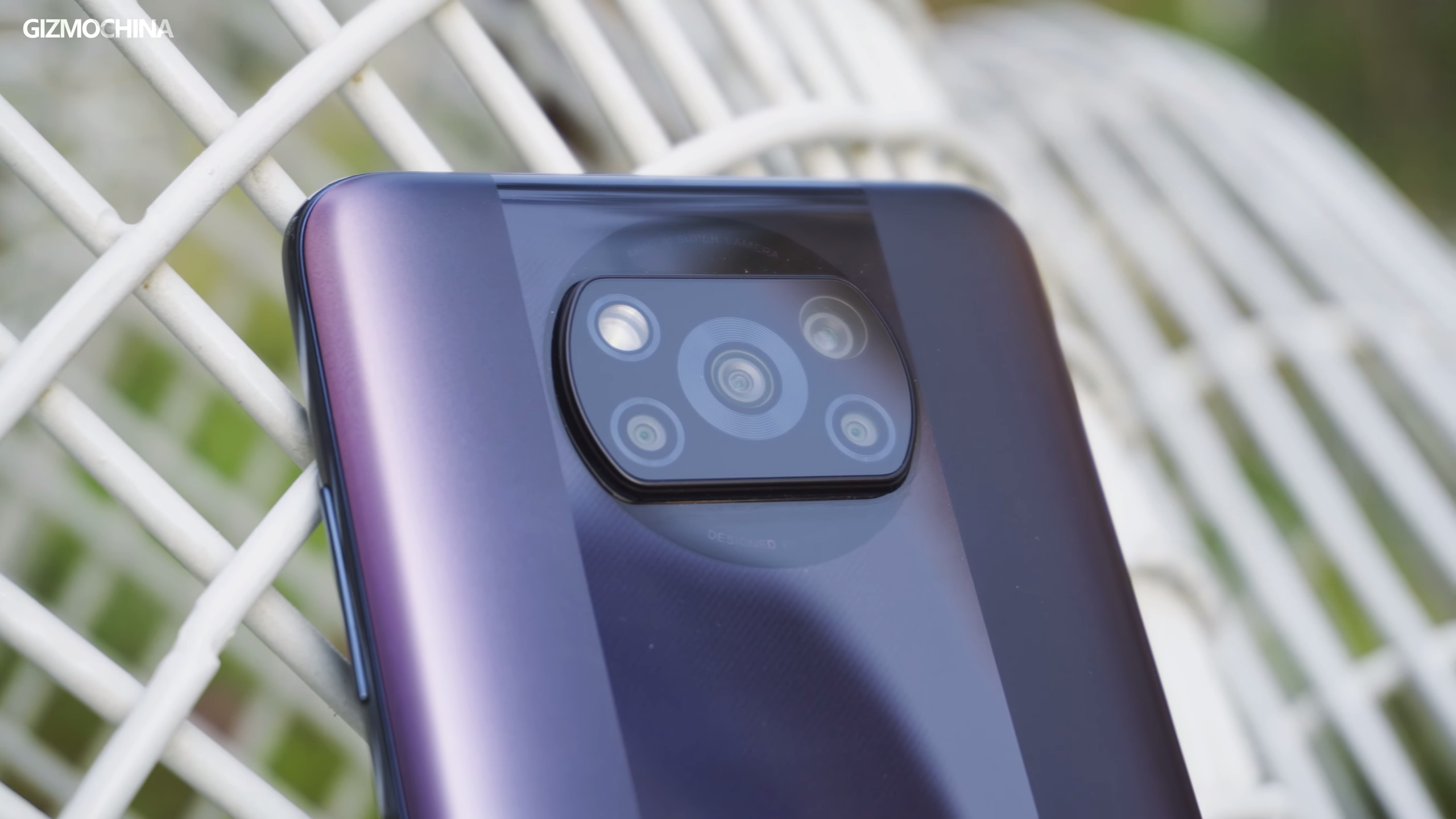
POCO X3 Pro
POCO handsets run MIUI like other Xiaomi group phones. The brand calls it MIUI for POCO. Not everyone likes the company’s software. Those users can try custom ROMs.
LineageOS is one of the most popular custom ROMs. The team released LineageOS 18.1 based on Android 11 a few months back. This software is now available for POCO F2 Pro, POCO F3, and POCO X3 Pro.
Power users of the above-listed handsets who enjoy fiddling with their smartphones can unlock their device’s bootloader and install the latest LineageOS 18.1 via custom recovery. It is worth noting that third-party software is not meant for everyone. Hence, proceed only if you know what you are doing.
That said, since POCO F2 Pro is a rebranded Redmi K30 Pro, LineageOS 18.1 can be also installed on Redmi K30 Pro as well as Redmi K30 Pro Zoom Edition. Similarly, Mi 11X and Redmi K40 also support the latest version of LineageOS as these phones are nothing but the POCO F3.
Talking about official software, all these POCO smartphones currently run MIUI 12.5 based on Android 11. They should receive MIUI 12.5 Enhanced Edition in the coming months, followed by MIUI.
Following the launch of the ROG Phone 5s series, Nubia’s Red Magic gaming brand is also set to launch its own gaming phones for the second half of the year. The phones are expected to launch as the Red Magic 6S and Red Magic 6S Pro, and ahead of the launch in September, the manufacturer has revealed a key specification of the pro model.
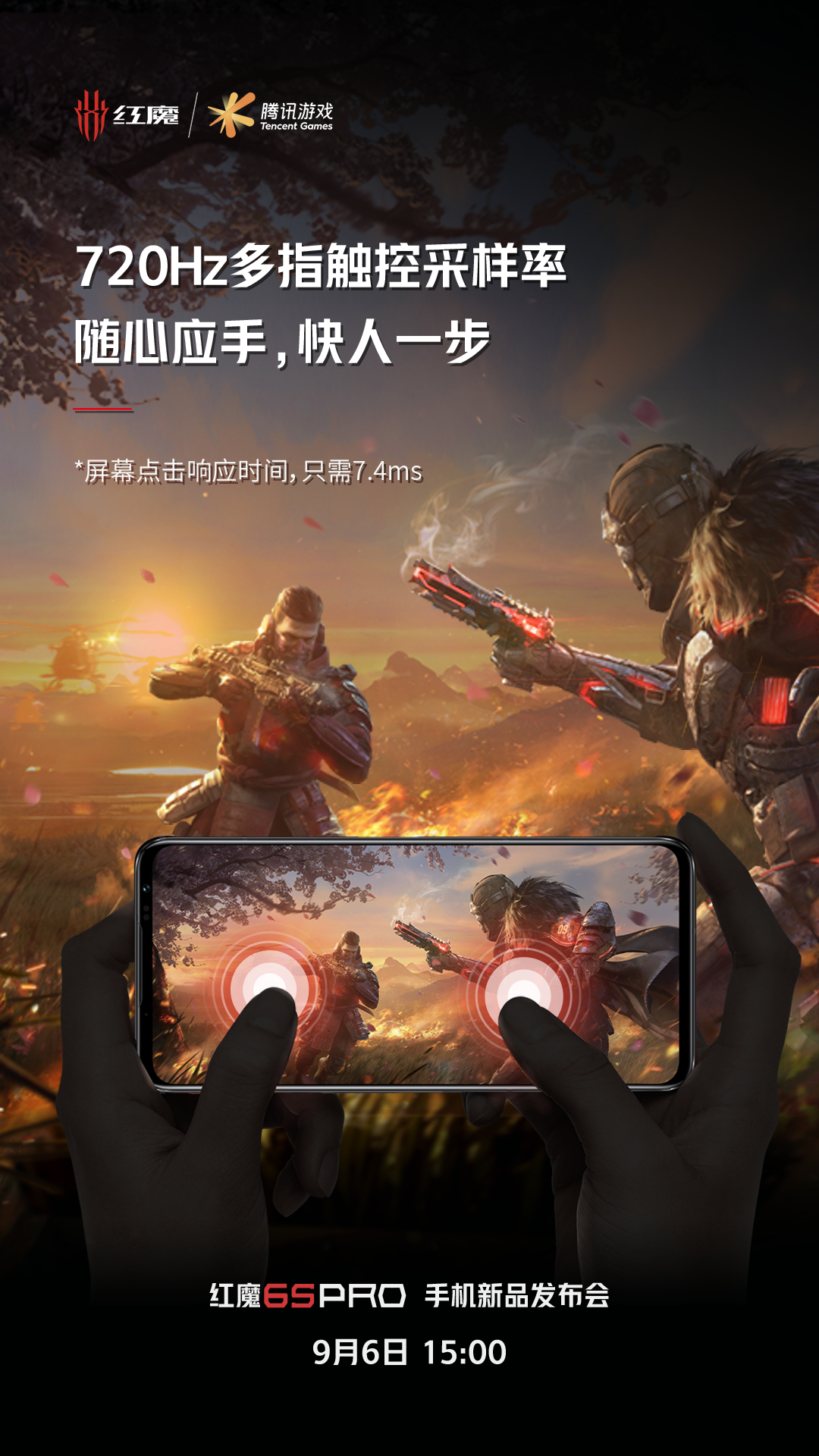
A post shared on Weibo by the official Red Magic account has revealed that the Red Magic 6S Pro will have a 720Hz multi-touch sampling rate, which is a significant increase from the 400Hz touch sampling rate of the Red Magic 6 Pro launched earlier this year.
Red Magic is not only increasing the touch sampling rate but has also revealed that the touch response rate is only 7.4ms.
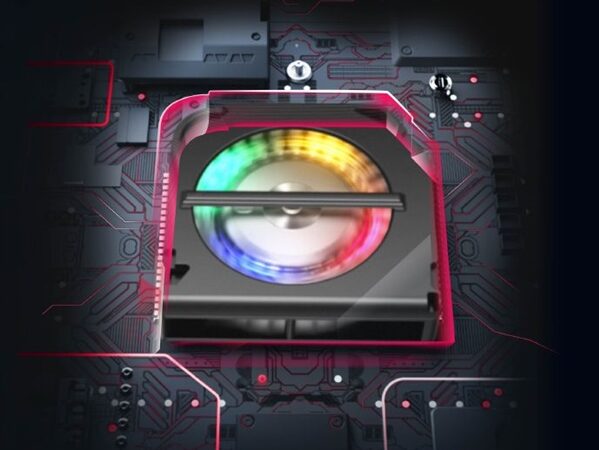
The manufacturer has revealed earlier that the phone will also come with improved cooling technology along with a built-in cooling fan, a Snapdragon 888 Plus processor, a 165Hz refresh rate display, and triple rear cameras.
The OnePlus Nord 2 is the brand’s latest smartphone in India. It is the direct successor to last year’s OnePlus Nord with a better set of features. A little over a month from its release, the company is now offering heavy discounts on a couple of accessories when bought alongside this phone.
OnePlus Nord 2
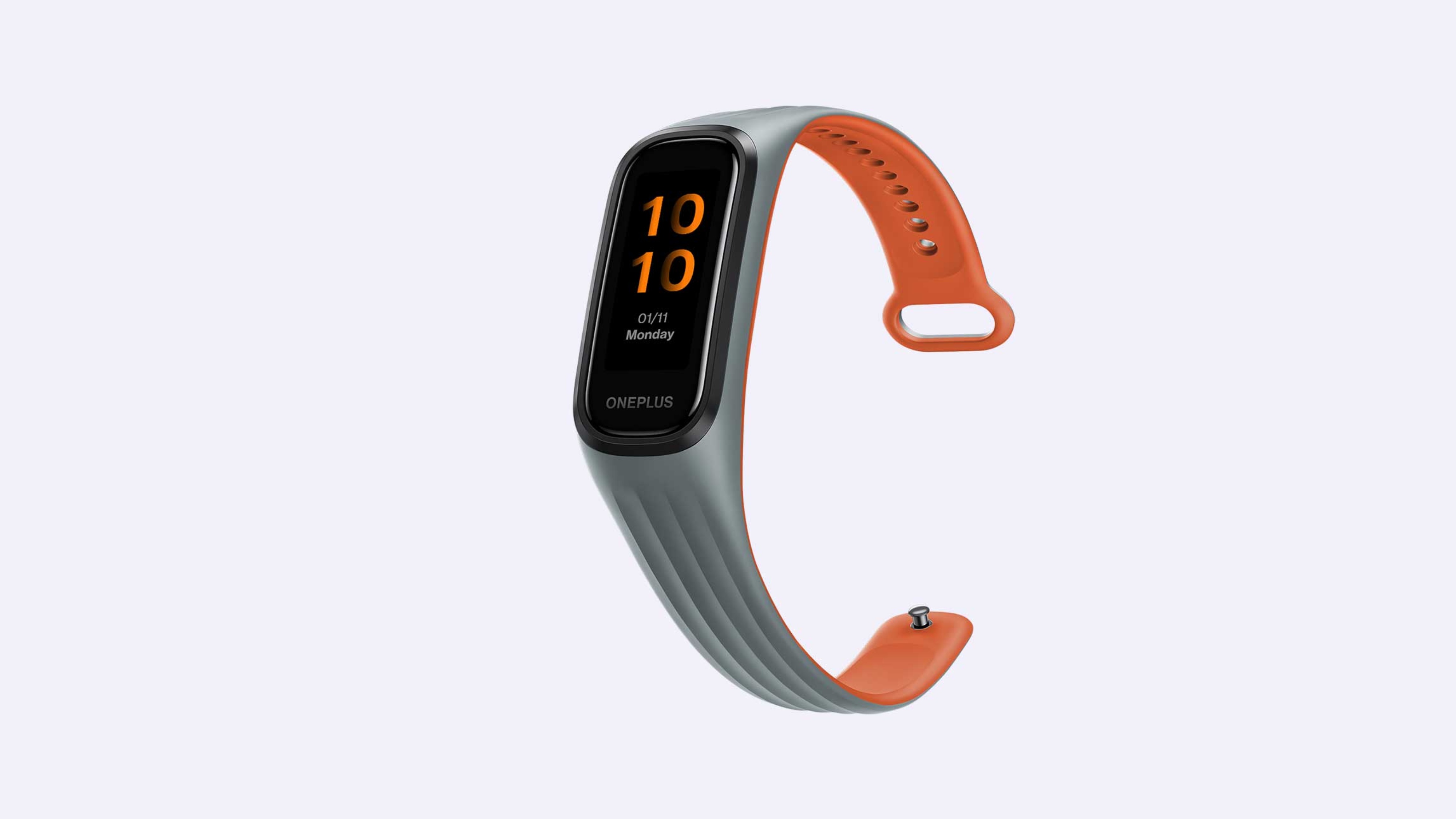
The OnePlus Band is the brand’s first wearable product. It is a rebranded OPPO Band. The product is only available in India and retails for ₹2,499 in the country.
While ordering the OnePlus Nord 2 on the company’s official website, customers can avail a ₹1,500 discount on the OnePlus Band. All they have to do is checkout the phone along with the fitness tracker. As a result, one can buy the OnePlus Band effectively at only ₹999.
On the other hand, the OnePlus Power Bank 10,000mAh costs ₹1,099 in India. But when bought with the OnePlus Nord 2, customers only need to pay ₹599.
OnePlus Band
Additionally, buyers can get ₹1,000 off on the OnePlus Nord 2 using HDFC Bank credit cards. In other words, one can purchase both the Nord 2 and the Band at the original price of the phone.
We are not sure how long these offers will be valid. Hence, we recommend you to make your purchase before it’s too late.
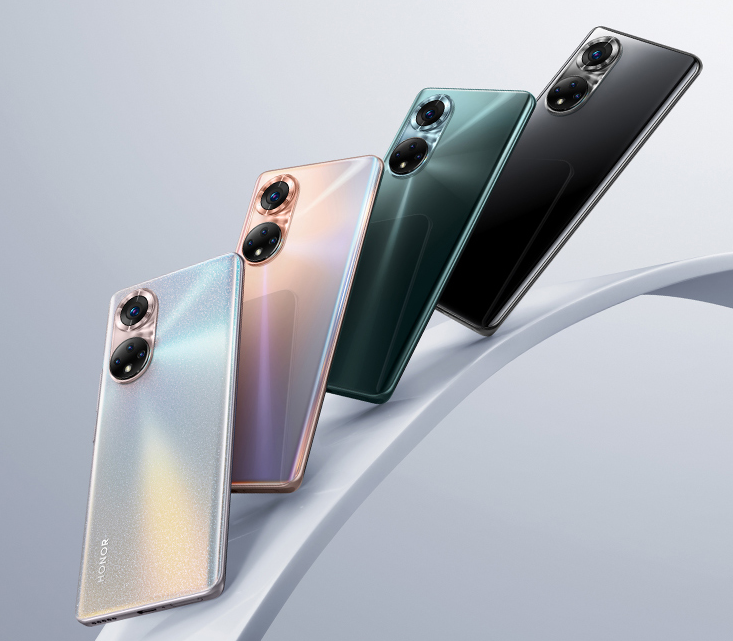
Honor has become the third largest smartphone maker in China, as per a new report. The brand has overtaken industry giants like Apple and Xiaomi to reach the top three positions in the Chinese market.
According to ChinaDaily, a report from CINNO Research found that Chinese smartphone makers Oppo and Vivo took the first and second place in the smartphone market in China, with shipments reaching 5.6 million and 5.3 million units respectively. Meanwhile, Xiaomi arrived fourth with 3.9 million units shipped and Apple came fifth with 3 million units. On the other hand, Honor ranked third in its home country’s smartphone market, despite having face supply issues initially after it was sold by its former parent company, Huawei.
After its complete independence, the company had a market share in China of just 3 percent. But since then, the brand has managed to secure and stabilize its supply chain, enabling it to grow. Honor had recently launched the Magic 3 series of smartphones, which marked the company’s entry into the high end premium segment of the handset market. Furthermore, the CINNO Research report also found that the market experienced a steady growth last month, with shipments rising by 28.6 percent year on year reaching 26.68 million units.
Notably, 5G enable smartphones were the driving force behind this sizeable rise in shipments. 5G devices alone accounted for 22.83 million units or about 79.6 percent of the total sales. During this time, MediaTek saw a whopping 118.3 percent year on year growth, shipping over 10.2 million chips in July 2021. Qualcomm still ranked first, while Huawei HiSilicon saw its sales fall by a significant 70 percent.
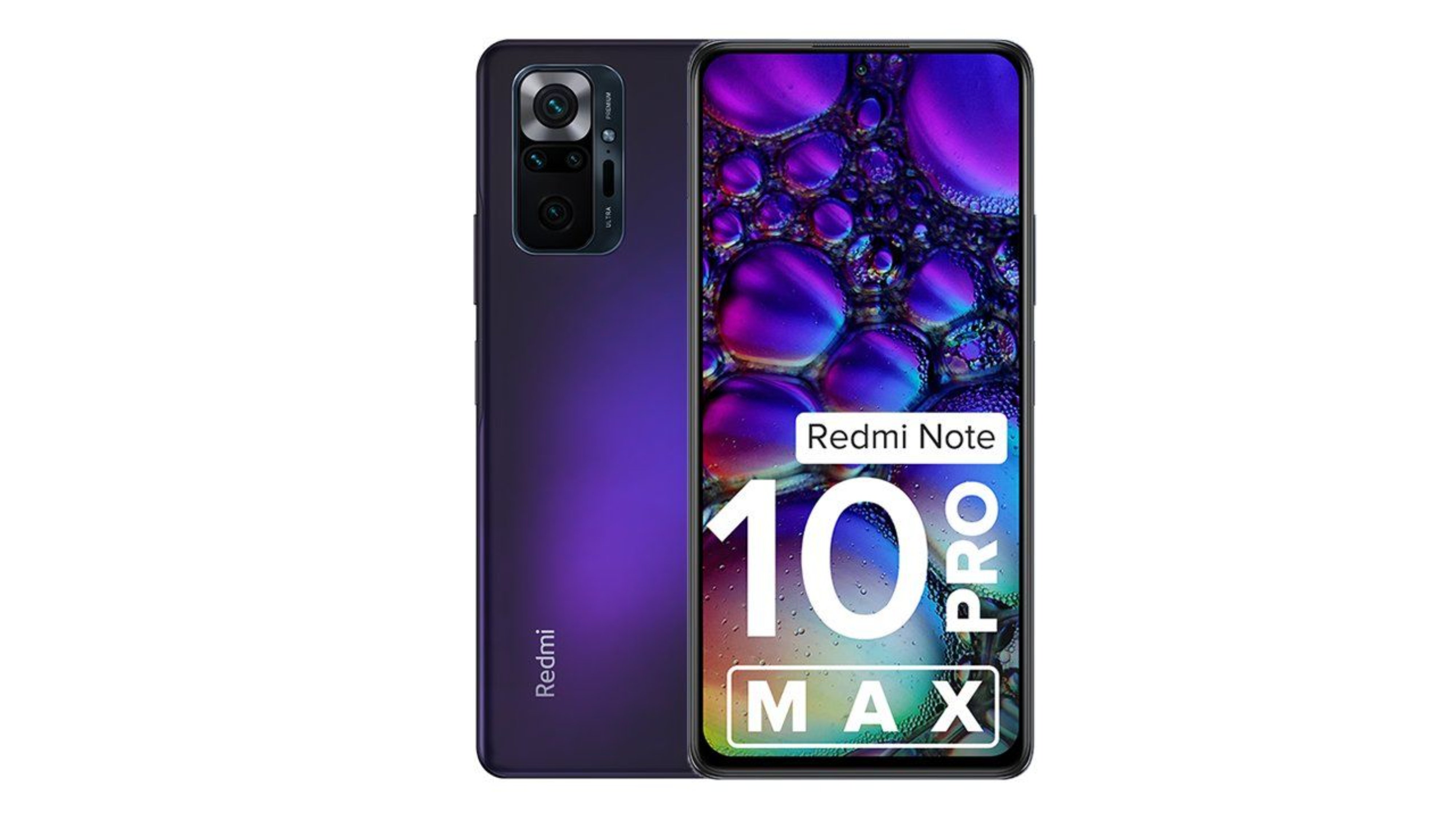
The Redmi Note 10 Pro and the Redmi Note 10 Pro Max were launched in India in March. The smartphones debuted in three colors. Now, five months after their release, they are now available in four colors.
Redmi Note 10 Pro
Recently, the Redmi Note 10S got a new Cosmic Purple color variant in India. Following that, the more expensive Redmi Note 10 Pro and Redmi Note 10 Pro Max now come in a similar color.
The new colorway for the Redmi Note 10 Pro series in India is called ‘Dark Nebula’. This color option has a glossy finish like the ‘Dark Knight’ color variant. For those unaware, the Glacial Blue and the Vintage Bronze color versions feature a matte finish.
The Redmi Note 10 Pro and the Redmi Note 10 Pro Max in Dark Nebula color variant is already up for sale on Mi.com. At present, this colorway is not listed on Amazon India. Maybe, it will be available later since the Cosmic Purple color version of Redmi Note 10S can be purchased from both Mi.com and Amazon India.
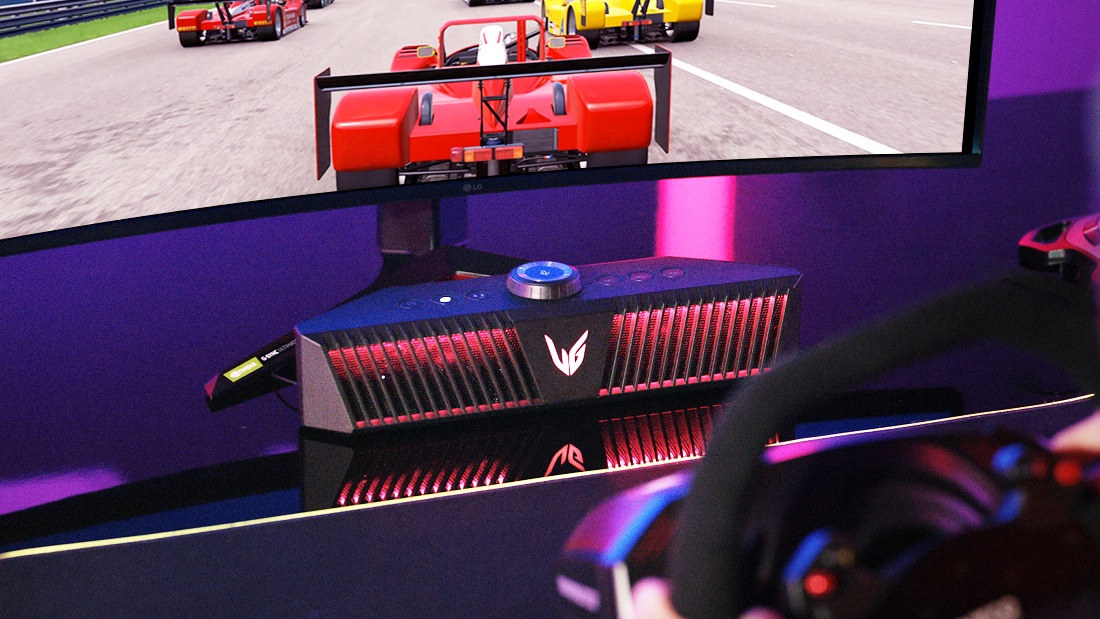
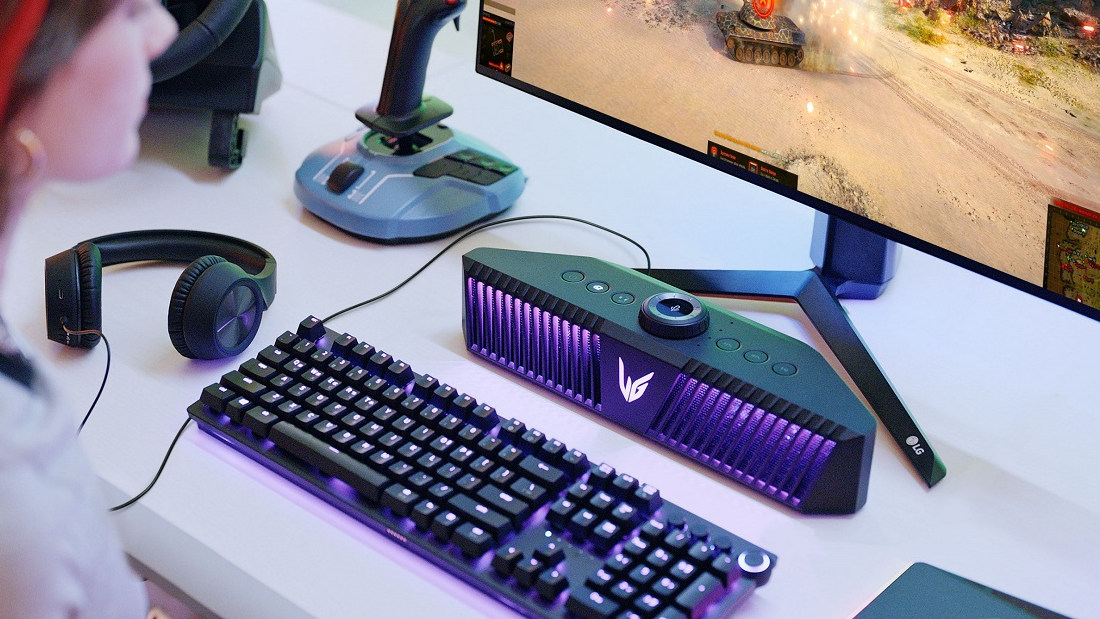
LG‘s UltraGear product lineup has got a new product and it is a speaker dubbed UltraGear GP9 Gaming speaker. This is the first speaker that will be launched under the gaming line. Its highlight include 3D Gaming Sound innovation, Game Genre Optimizer, 7.1 virtual surround sound, built-in mics, Hi-Res Audio and that’s just the beginning.
The UltraGear GP9 utilizes LG’s 3D Gaming Sound innovation with an exceptionally planned HRTF (head-related exchange work) designed to reproduce a game’s sound according to the genre. With its Game Genre Optimizer, clients can switch between two methods of activity – an FPS (First individual shooter) Mode and RTS (Real-Time Strategy) Mode.
Inside the GP9 there is an ES9038PRO Hi-Fi Quad DAC, which will offer adjusted sound and decreased commotion, and the speaker is Hi-Res Audio guaranteed. One more capacity of the speaker is its echo-cancelling voice chat technology that permits users to communicate during games without requiring a headset. It has top-mounted control buttons, adjustable RGB lighting, and an assortment of ports including USB-C, AUX, optical, and Bluetooth. The battery can last up to five hours on a single use.
As for the pricing and availability, the LG UltraGear GP9 Gaming Speaker will go on sale in the U.S and South Korea in September. It is presently priced at 549,000 won (~$471).
Xiaomi has just launched a new product from MIJIA earlier today (31st August 2021). The product in question is the new MIJIA Side Smoking Stove Set S1 that is now available in China.The new smart home product is currently available for pre orders and arrives with support for air gestures. This includes functions like turning it on or off, adjusting gears, and more commands that can be inputted just with a wave of a hand. As per official notes, the air gesture support on the new Side Smoking Stove Set S1 aims to let users operate the product with ease since all basic operations can be completed with only two simple movements of swiping right and left.
Talking about its specs, the new product has a large suction power of 20 cubic meters per minute, which enables it to easily function with oily fumes like heavy stir fry cooking. This also keeps the fumes from hitting the cook’s face by quickly sucking up and disposing these fumes. It adopts a 15 degree inclination angle design that also helps in preventing the escape of the oily fumes from the source.
Arriving at the design of the product, the new MIJIA stove set sports a stylish black mirror design with a tempered glass panel, which is bright and textured. Despite being made of glossy materials, the company claims it is relatively easy to clean even when stained. As of right now, the product is available for pre orders while first sales will begin on 3rd September 2021, with a price tag of 1898 Yuan (roughly 300 US Dollars).
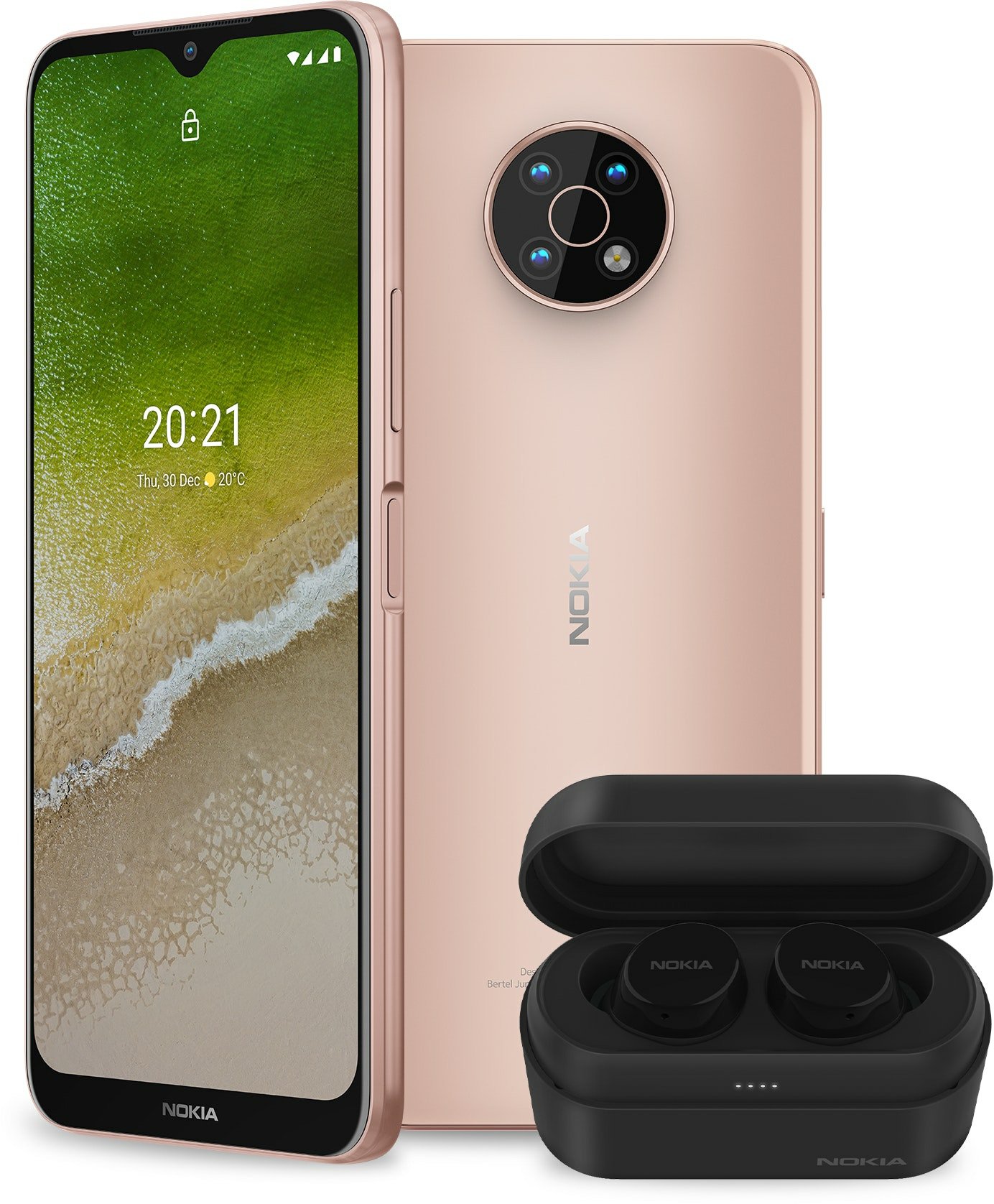
Several reports have revealed that HMD Global is working on a mid-range 5G phone with Nokia G50 5G. Ahead of the launch,Winfuture.de has shared leaked renders and key specifications of the smartphone. It appears that it may not take too long for the smartphone to go official.
Nokia G50 5G design
The leaked promo images of the Nokia G50 5G show that it will be arriving in colors like Midnight Sun and Blue. At the front, it features a teardrop notch display, and its polycarbonate back has a round-shaped camera module, which houses three or four cameras and an LED flash.
Nokia G50 5G
The Nokia G50 5G has a volume rocker on the right. Below it is a power button, which is integrated with a fingerprint sensor. A voice assistant button is available on the left edge of the phone.
Nokia G50 5G specifications (Rumored)
The Nokia G50 5G has a 6.38-inch LCD display that offers an HD+ resolution of 720 x 1560 pixels. The Snapdragon 480 chipset is present under the hood of the device. It is backed by a 4,850mAh battery. It will come preinstalled with Android 11 OS.
Nokia G50 5G
It is likely to feature a 48-megapixel main camera. Other reports have revealed that it may arrive in variants like 4 GB RAM + 64 GB storage and 4 GB RAM + 128 GB storage. Speculations are rife that it may go official in September.
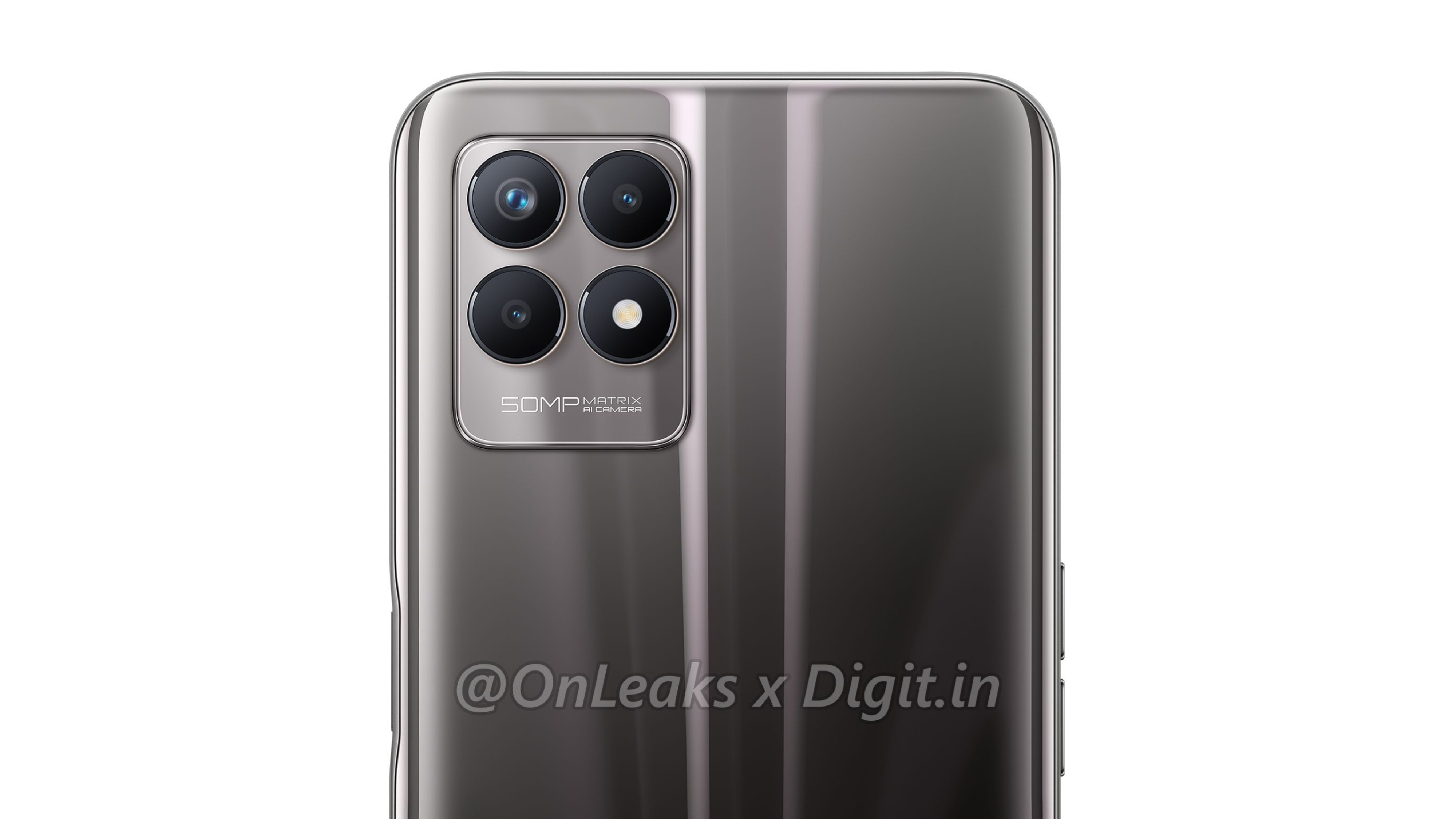
Chinese handset maker realme is expected to release a bunch of smartphones in the coming weeks. These are new models in the already existing realme 8 series and the brand new realme 9 series. Today, we get to learn when these phones will be launching in India.
realme 8i
Tipster Yogesh Brar has partnered with 91Mobiles to reveal the launch timeline for the realme 9 series, realme 8s, and realme 8i in India. According to him, these phones will start debuting in the country as early as next month.
According to the leakster, the realme 8s and the realme 8i will launch first in September. In fact, retail stores have already begun to put up promotional posters for these handsets. Hence, they might indeed release in the next few days.
On the other hand, the leaker says that the realme 9 series will be introduced in October ahead of Diwali festive season in early November. As per recent findings, this lineup is expected to include four devices, namely realme 9, realme 9 Pro, realme 9 Prime, and realme 9A.
That’s not all, realme is also said to be working on the realme Note 9 series consisting of two models – realme Note 9 and realme Note 9 Prime. Unfortunately, their launch details are not known at the moment.
Lastly, talking about features and design, almost everything about the realme 8s and the realme 8i had leaked already. However, we are yet to learn anything about the realme 9 series.
Huawei Technologies has apparently raised the use of components made in China for its newer smartphones. The news arrives as the company steers away from US made parts due to the US sanctions.
According to a NikkeiAsiareport, the Chinese tech giant has doubled Chinese components in recently launched phones. Now, the company’s devices house over 60 percent of parts made in its home country. For those unaware, the company had to replace US made parts as the company was placed in the US government’s Entity blacklist which barred it from using many crucial American technology. So now, the brand has been working on using locally manufactured components more parts shipped from overseas.
Nikkei worked with Tokyo based research specialist Fomalhaut Techno Solutions and tore down a Mate 40E model. This handset is 5G enabled and was found to feature Chinese made parts that accounted for about 60 percent of the total value of all components. In other words, it is about twice as much as its predecessor, the Mate 30. Although, Huawei is still using certain key semiconductors like US made chips it still has in its inventory. However, this also means that the company is still reliant on this technology and could face further decline due to its current situation.
Via NikkeiAsia
Notably, Fomalhaut found that a major part of the the rise in Chinese made components share arrived as the company used BOE Technology Group‘s display over a Samsung Electronics panel. The display alone accounts for nearly 30 percent of the overall value of a smartphone. Other notably Chinese parts include Mate 40E’s antenna switch, power control chips, and others like the fingerprint sensor and battery.
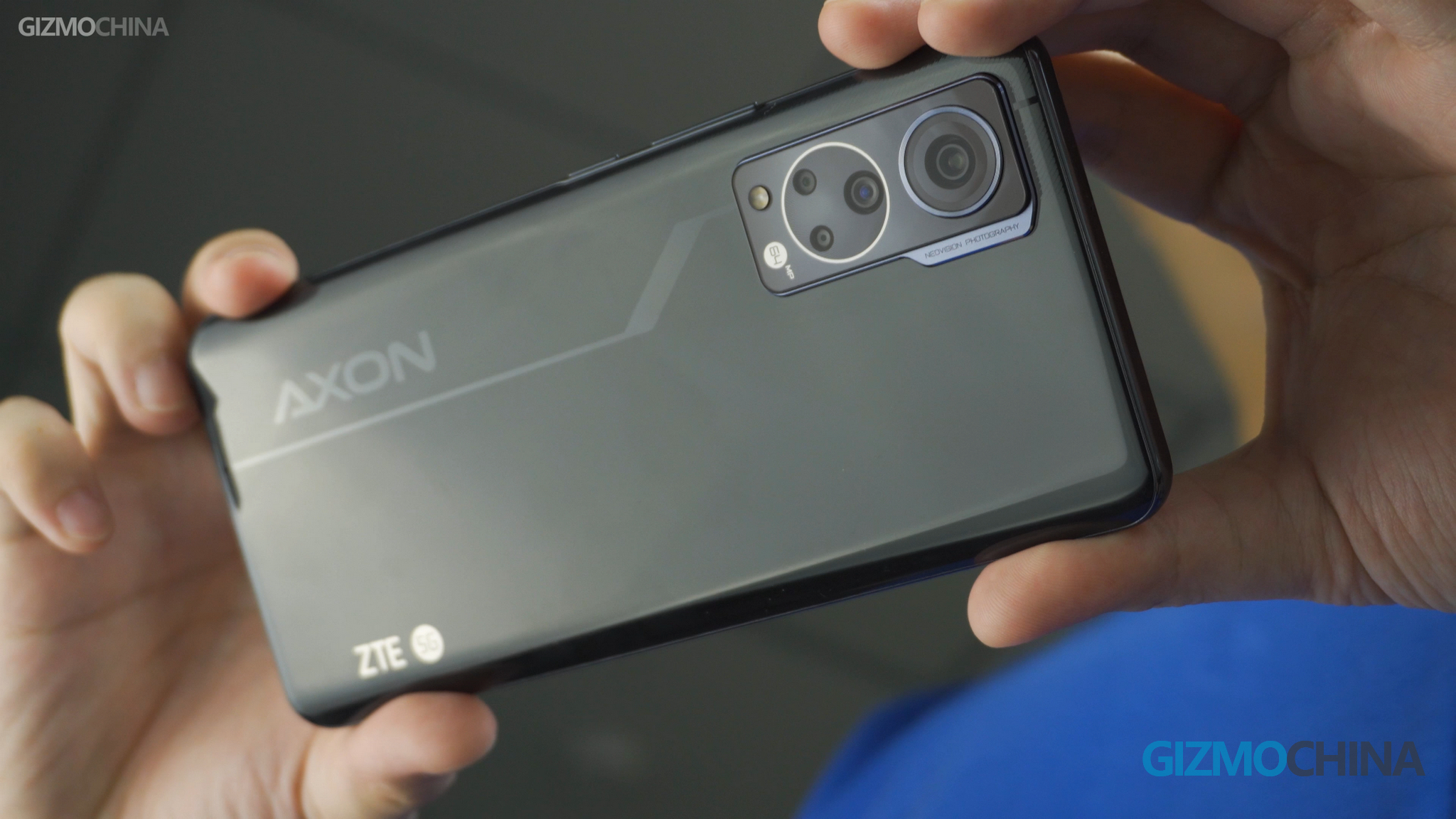
ZTE was the first manufacturer to mass-produce an Under-display Camera phone. And recently, the brand launched the latest generation of Under-display Camera phone— the AXON 30. We all know that the performance of the first generation Under-display Camera on Axon 20 was not perfect. So can the Axon 30 finally give us a complete full screen experience?
Let’s find out!
ZTE Axon 30 Review: Under Screen Display Camera
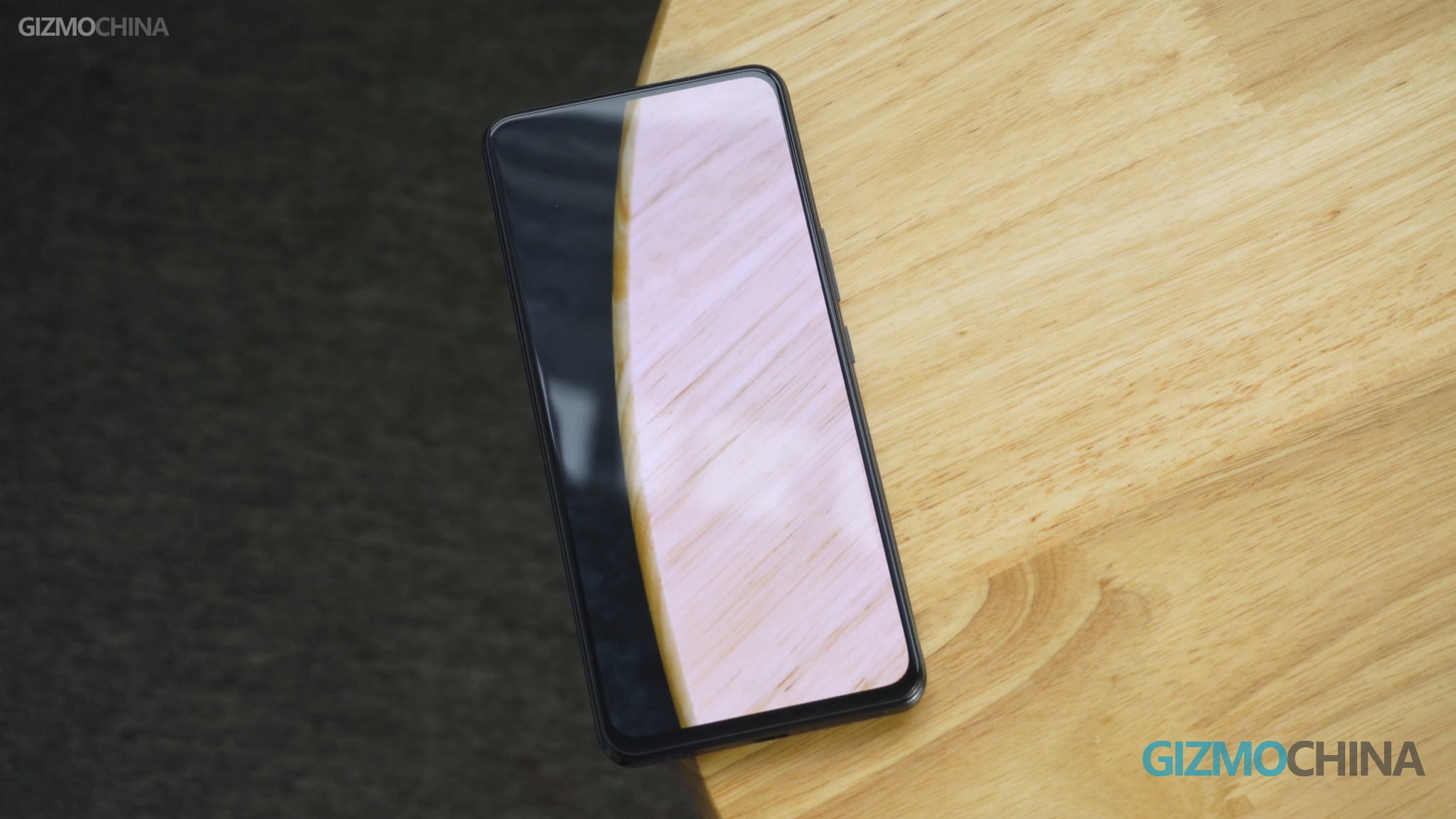
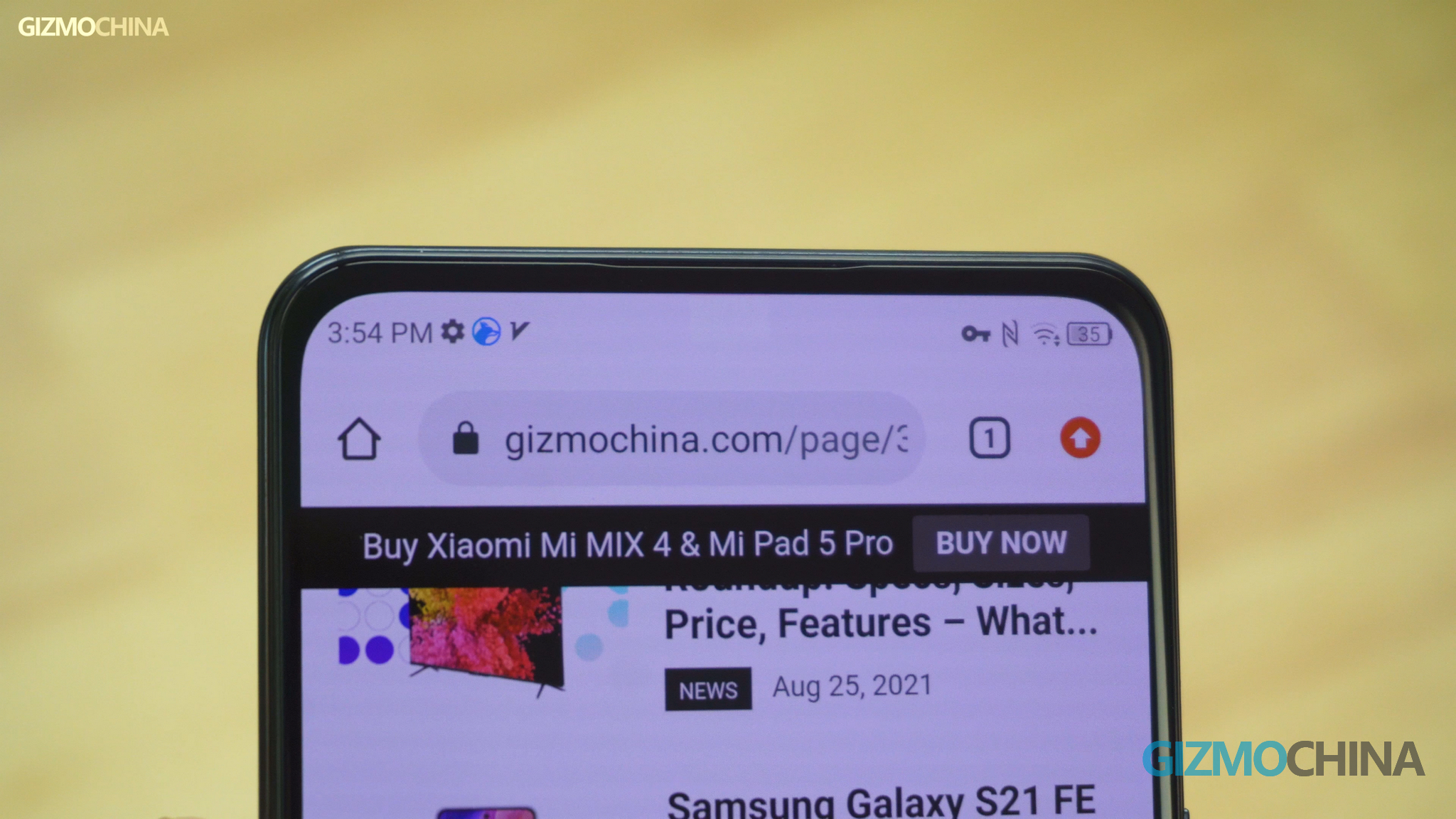
The experience of using this screen is excellent most of the time. Because there is no hole-punch, the full screen is particularly good when watching videos.
The front camera area performs almost identically to the other areas at normal viewing distances. So performance of the new generation Under-display Camera is much better than the Axon 20, and it’s finally a usable technology.
But! Be warned, if you’re being fussy, there’s a lot more to talk about this screen.
Why?
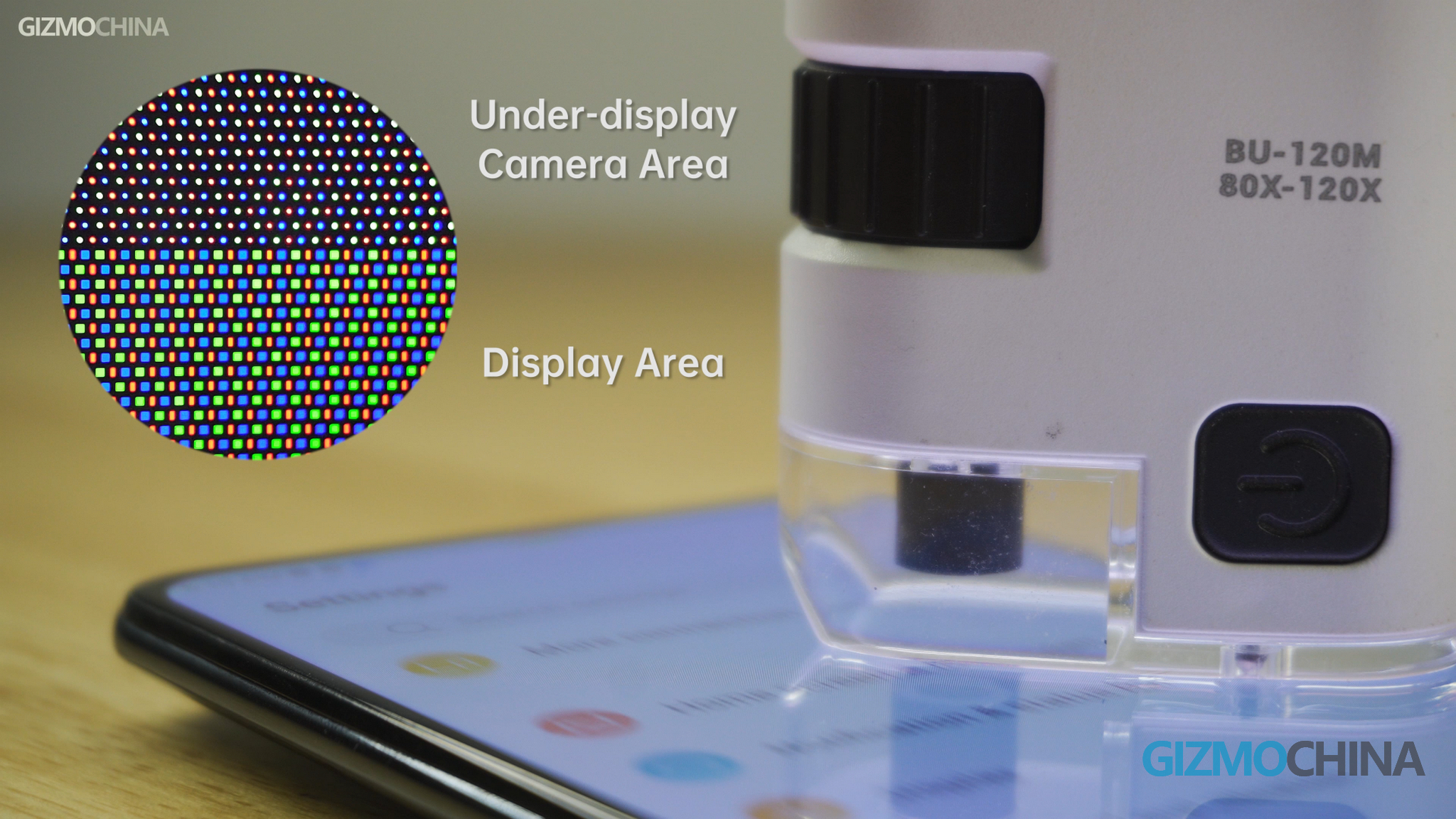
Well, the display is not really perfect. Not to mention that this screen can’t do 2k resolution. Since it has to add an Under-display Camera, it uses RGB Delta pixels, so the detail is a bit lower than Diamond-like pixels.
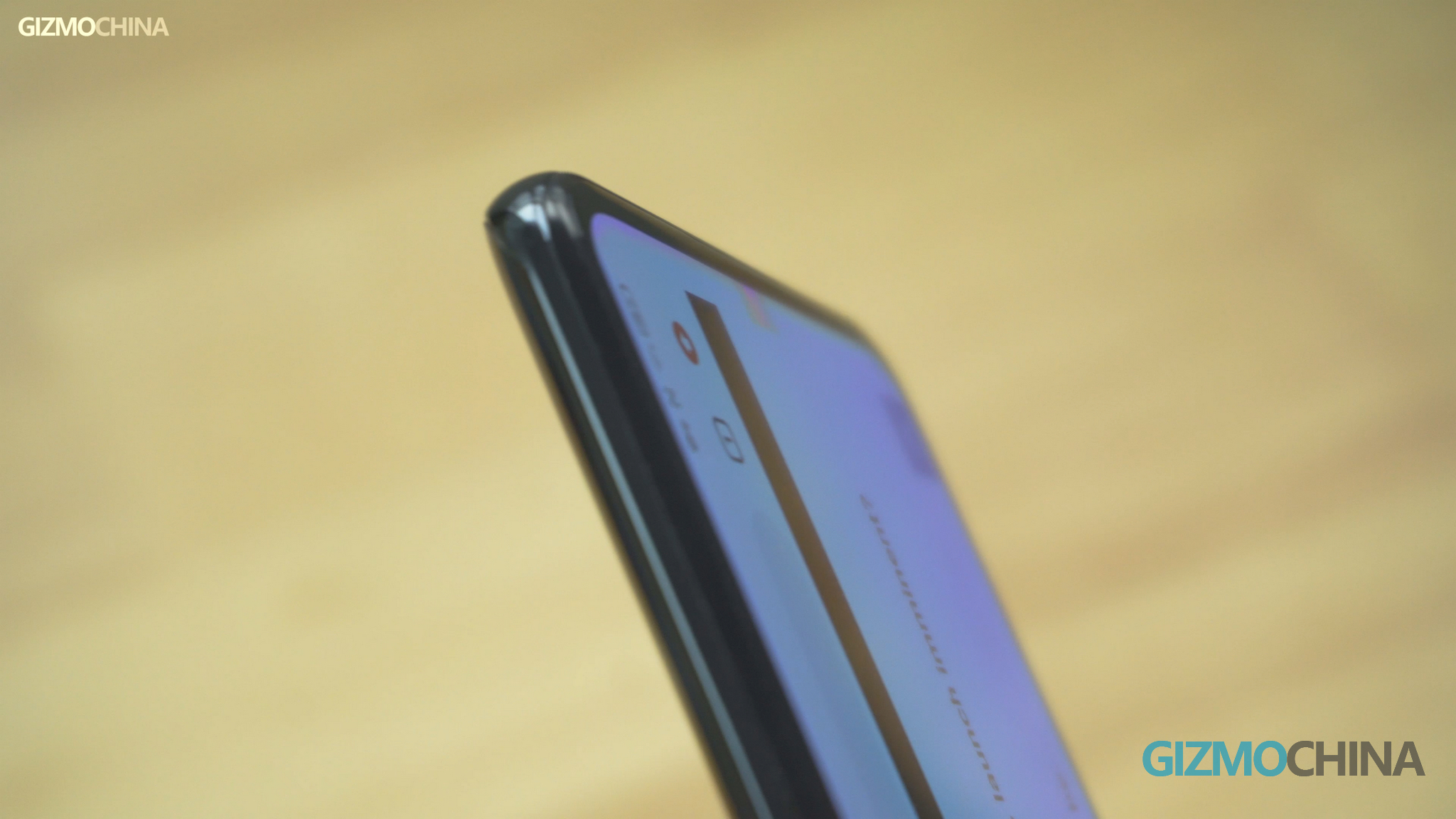
Secondly, there will be rainbow lines in the oblique view, and the Under-display Camera area will be easily visible under the influence of these rainbow lines. Even if you look at it from the front, some traces of the Under-display Camera can still be seen, at close range.
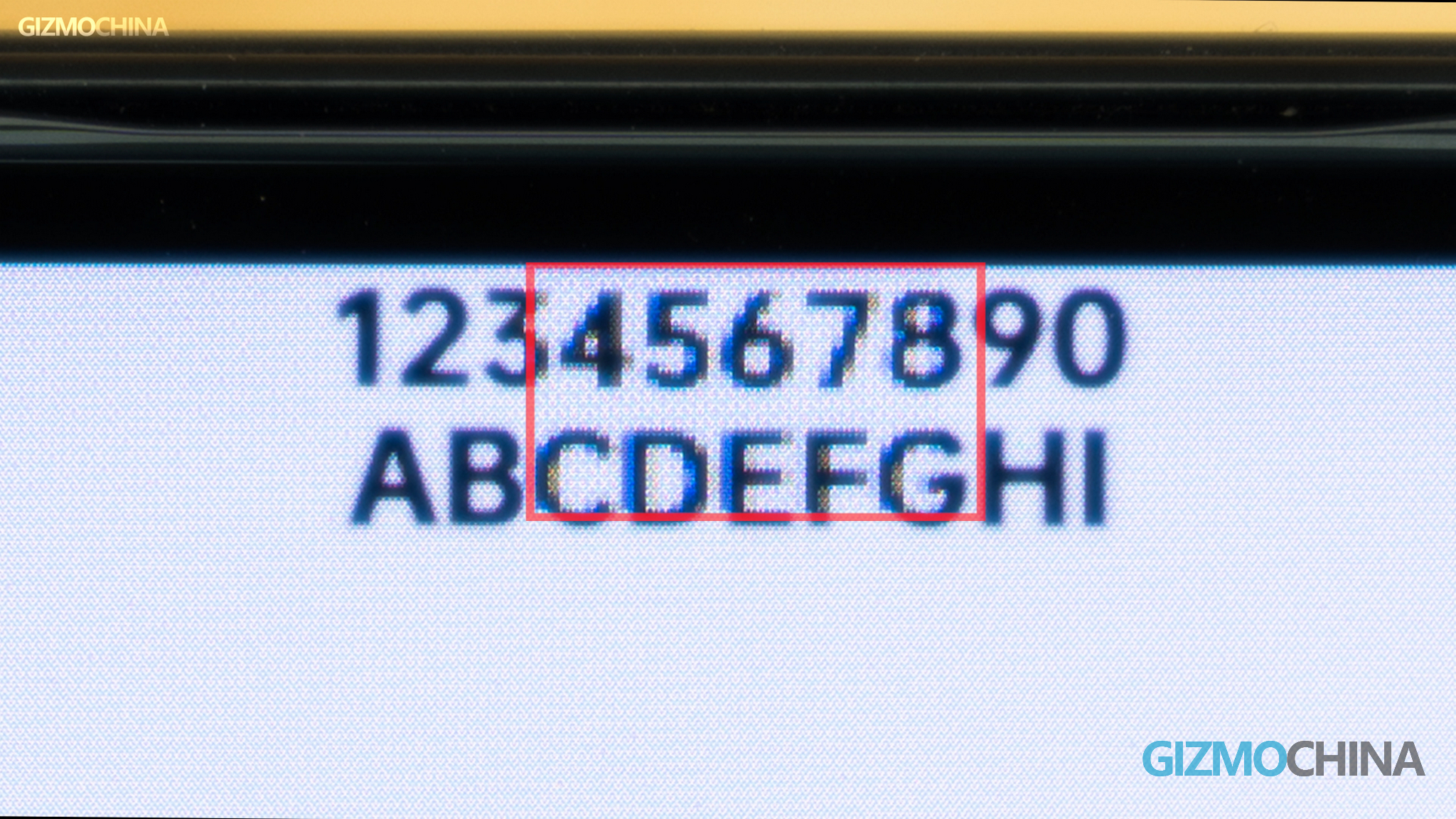
In low brightness, this will be even more obvious. Further, In extreme cases, you’ll find the appearance of tiny text around the Under-display Camera area. Since the chip controlling the Under-display Camera area can only control multiple pixels with a single circuit, the text edges will appear noticeably jagged. Of course, these drawbacks are rare in everyday use, so whether you would give up some high-end screen features for a full screen is entirely up to your own preference.
Axon 30 Review: Selfie Camera Quality
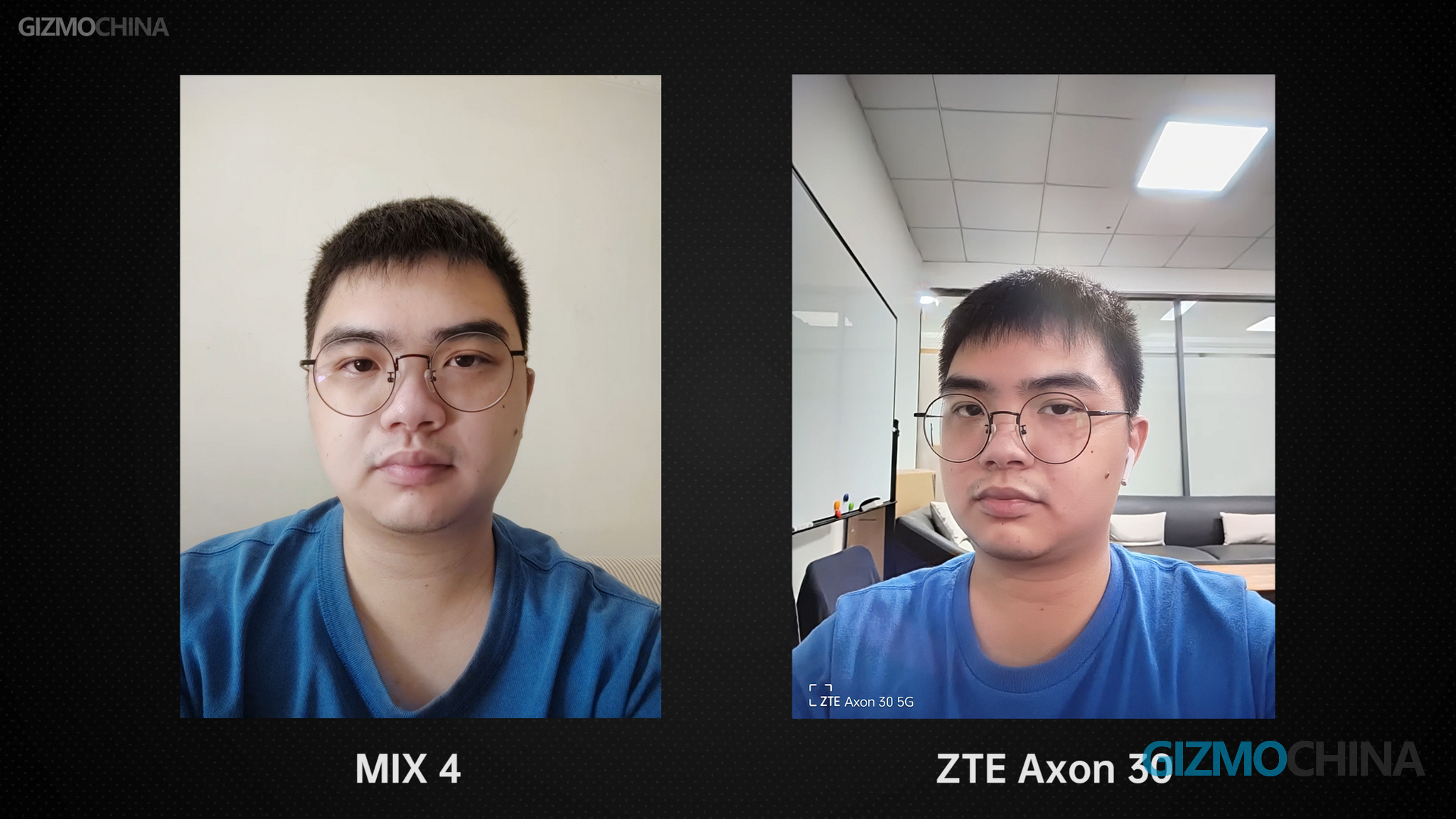
Now that we have talked about the quality of the screen, it’s time to talk about its front camera photo quality. If you’ve seen our MIX 4 Hands on Review, you’ll know how bad the Under-display Camera can be. Thanks to the AI processing, the front camera’s photo results are at the passing line. Although many details of the image have been lost, but at least the look and feel is not bad. But when it comes to video recording, which AI can’t handle, it’s probably only a little better than a laptop’s camera. So users who like to take selfies should choose other phones.
ZTE Axon 30 Review: Hardware & Gaming Performance
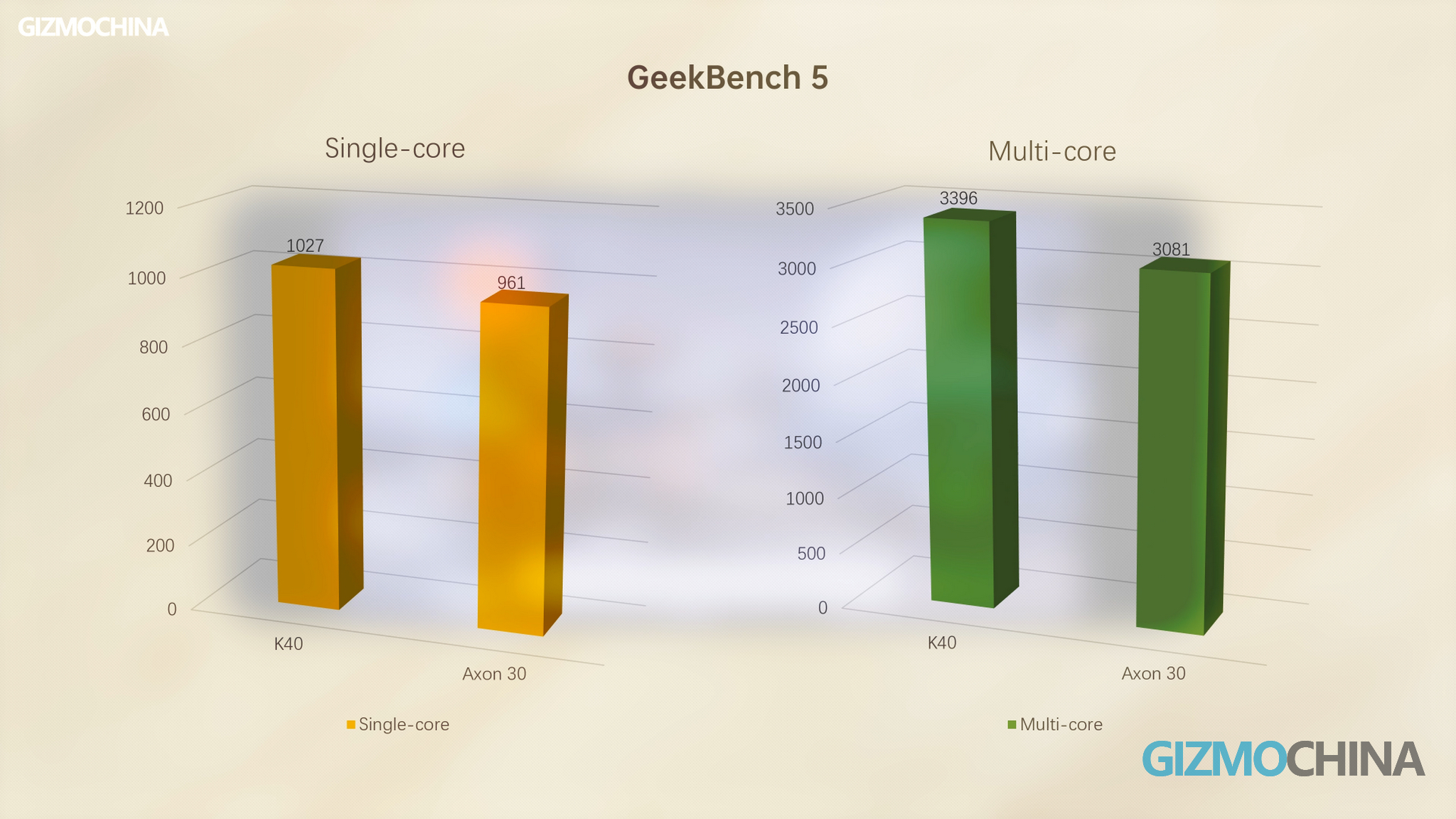
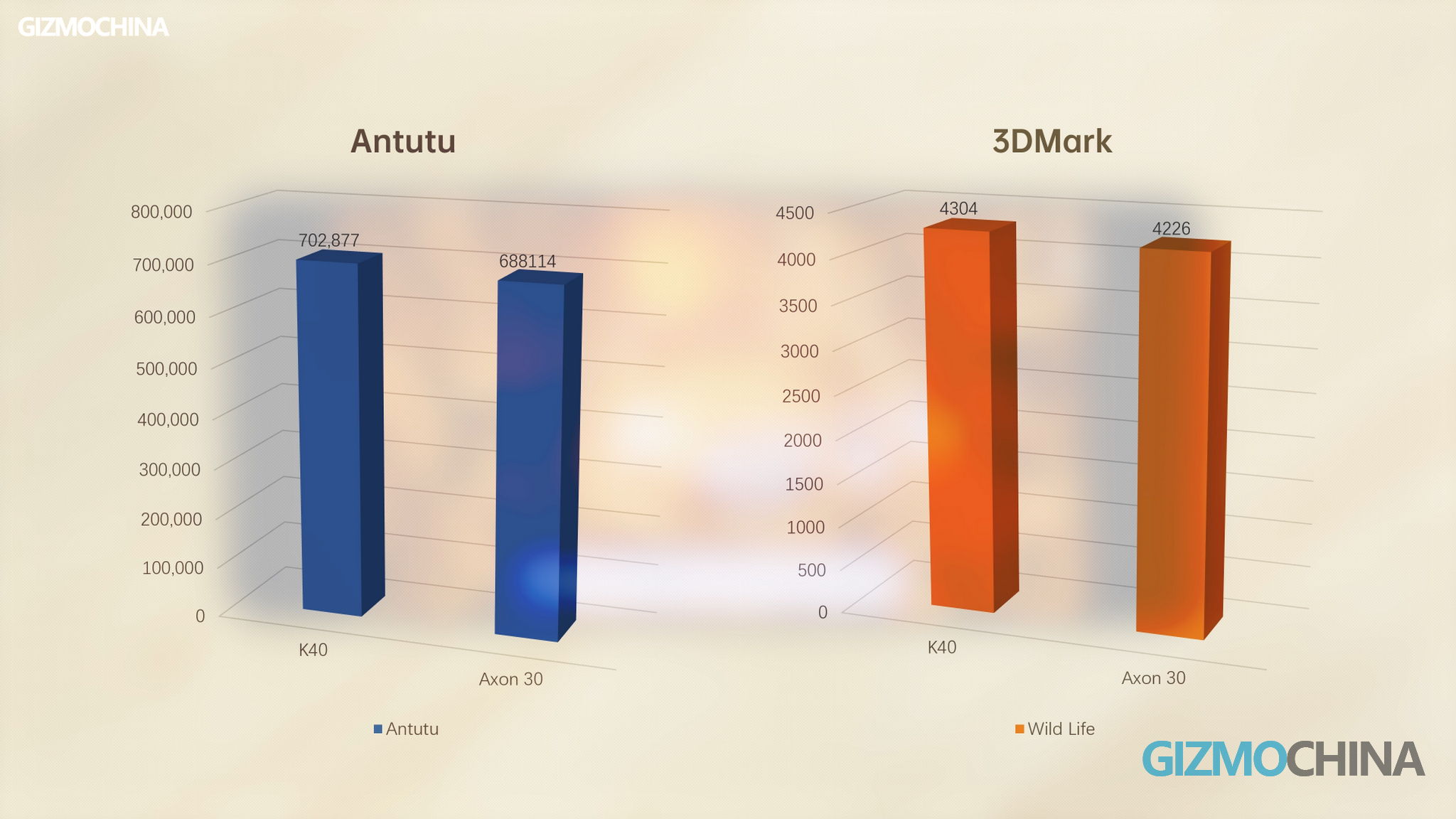
The Axon 30 features the Snapdragon 870 as its SOC, which we all have come to love. In Antutu Benchmark it scores 688,114, while in 3D Mark it gets a score of 4223, and in Geekbench 961 in single-core, and 3081 points in multi-core.
ZTE Axon 30 Review Geekbench
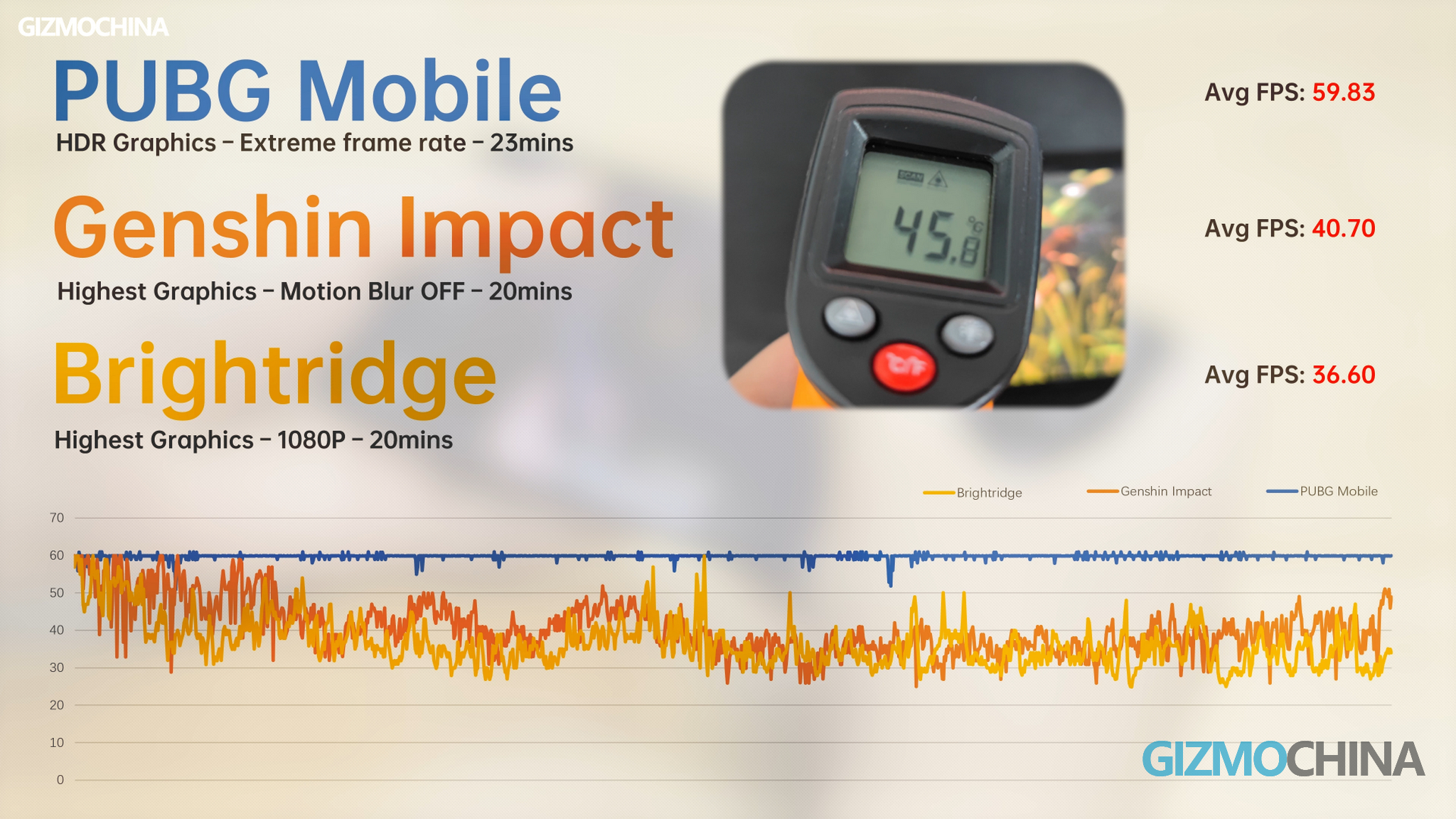
The Benchmark performance is conservative, but the gaming performance is not bad. PUBG basically runs at full 60fps throughout. While Genshin Impact does not run at full 60 fps, the frame rate curve fluctuates less and there is no frame lock. The average frame rate of 40.7FPS will still ensure a good gaming experience. Brightridge also performs similarly and has good temperature control. If you’re not looking for extreme frame rates, this phone is still pretty good for gaming.
ZTE Axon 30 Review Gaming
ZTE Axon 30 Review: Rear Cameras
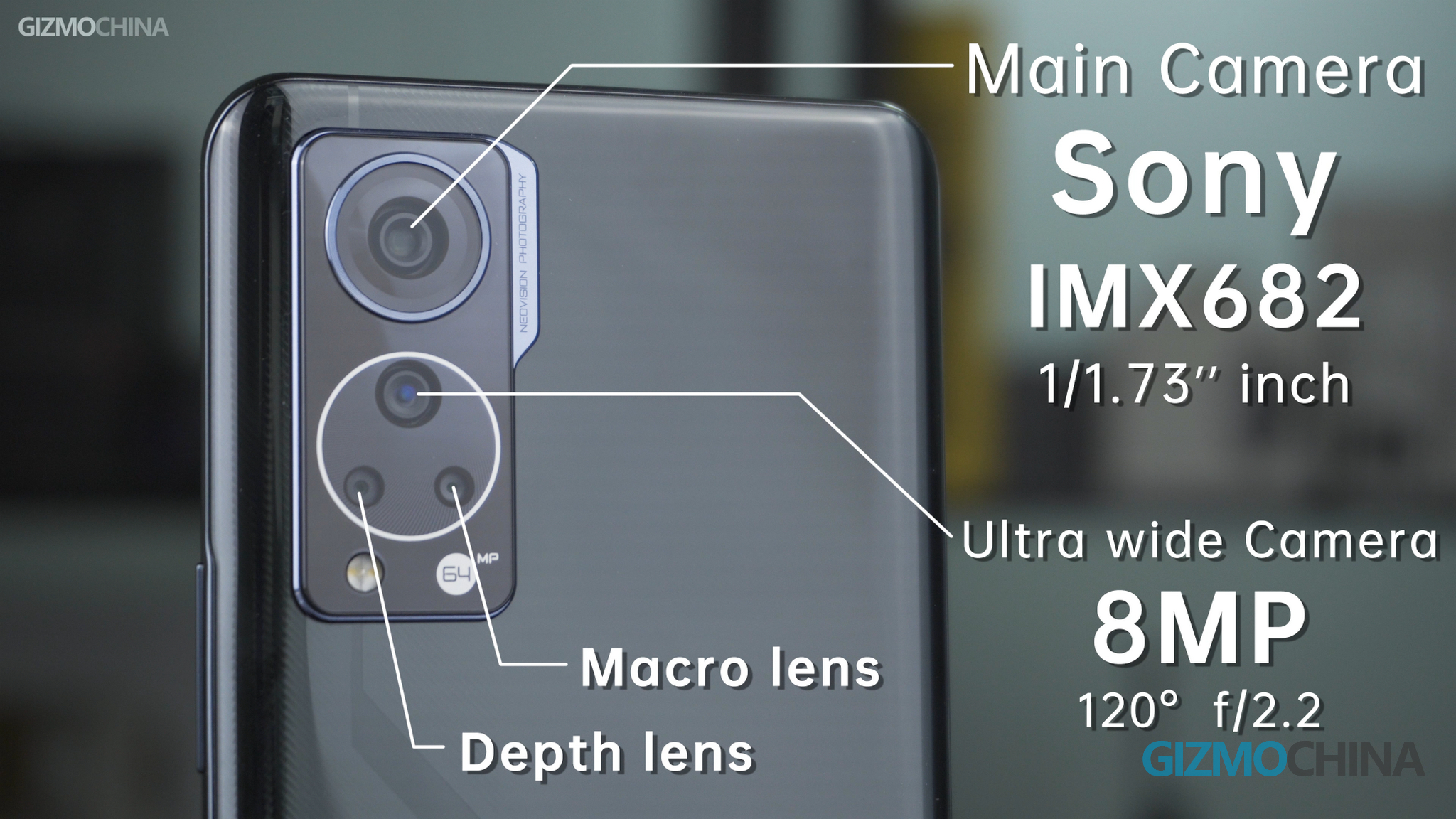
The two large circles in the middle of the camera housing are inspired by the lights of a sports car. The top one is the 64MP IMX682 main camera, and the bottom circles are the 8MP Ultra wide lens, Macro lens and Depth lens respectively.
Main Camera
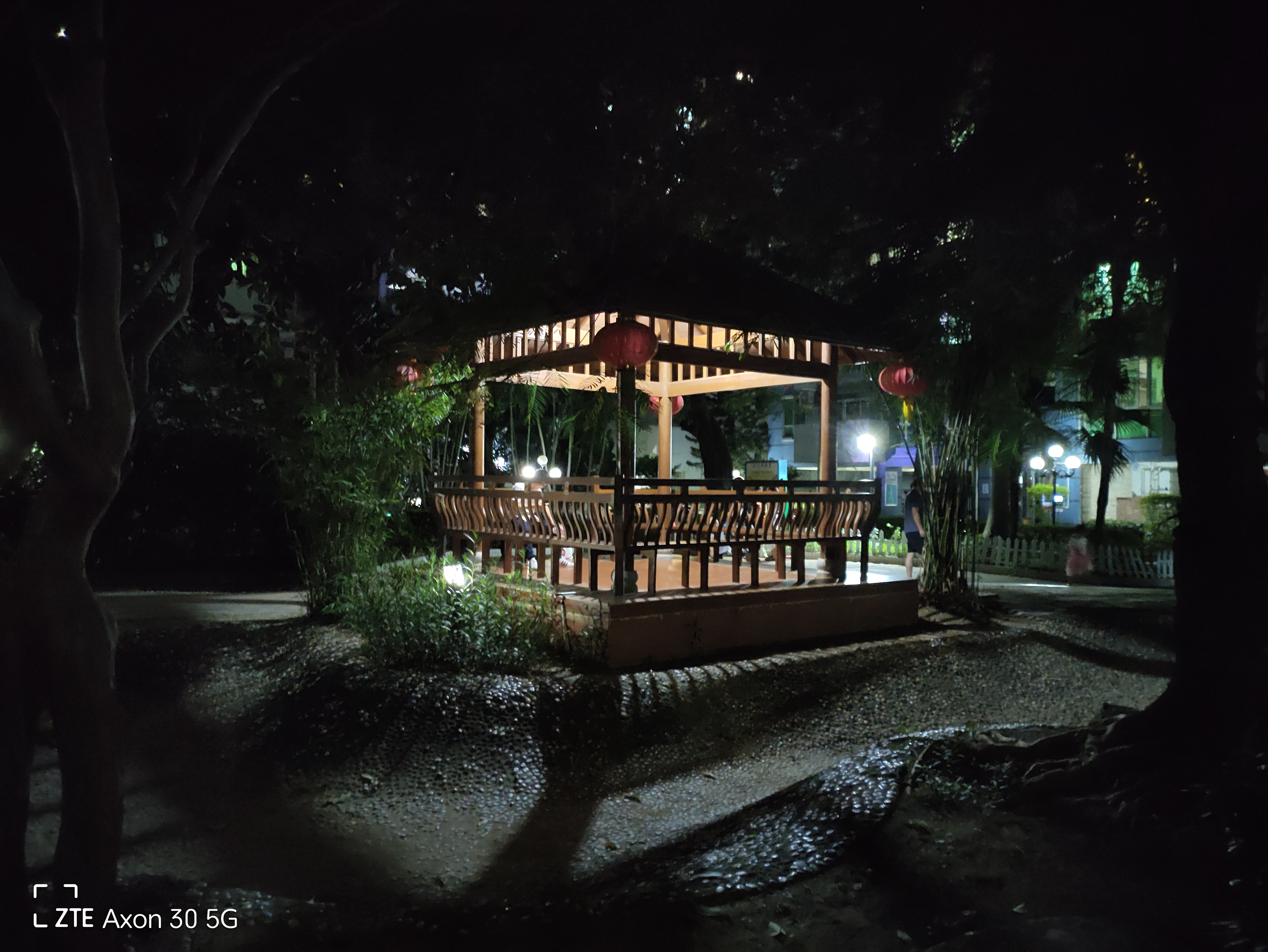
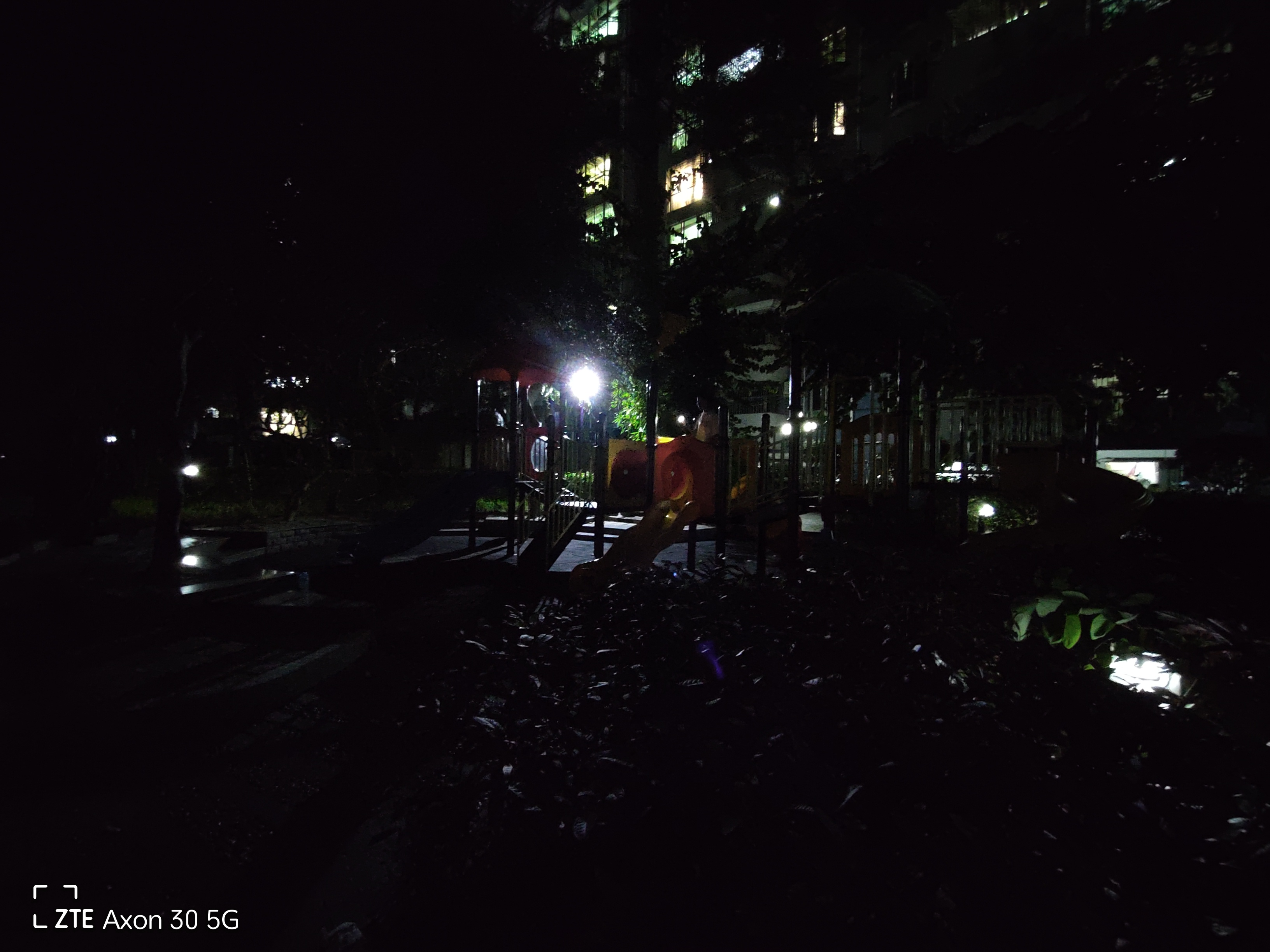
The main camera performs quite well in the daytime, with bright colors and the samples being clear. At night, the dynamic range is lower in normal mode and the details in the dark are no longer clear. But night mode improves this problem significantly and gives you very good photos at night.
1 of 17
Ultra-wide camera
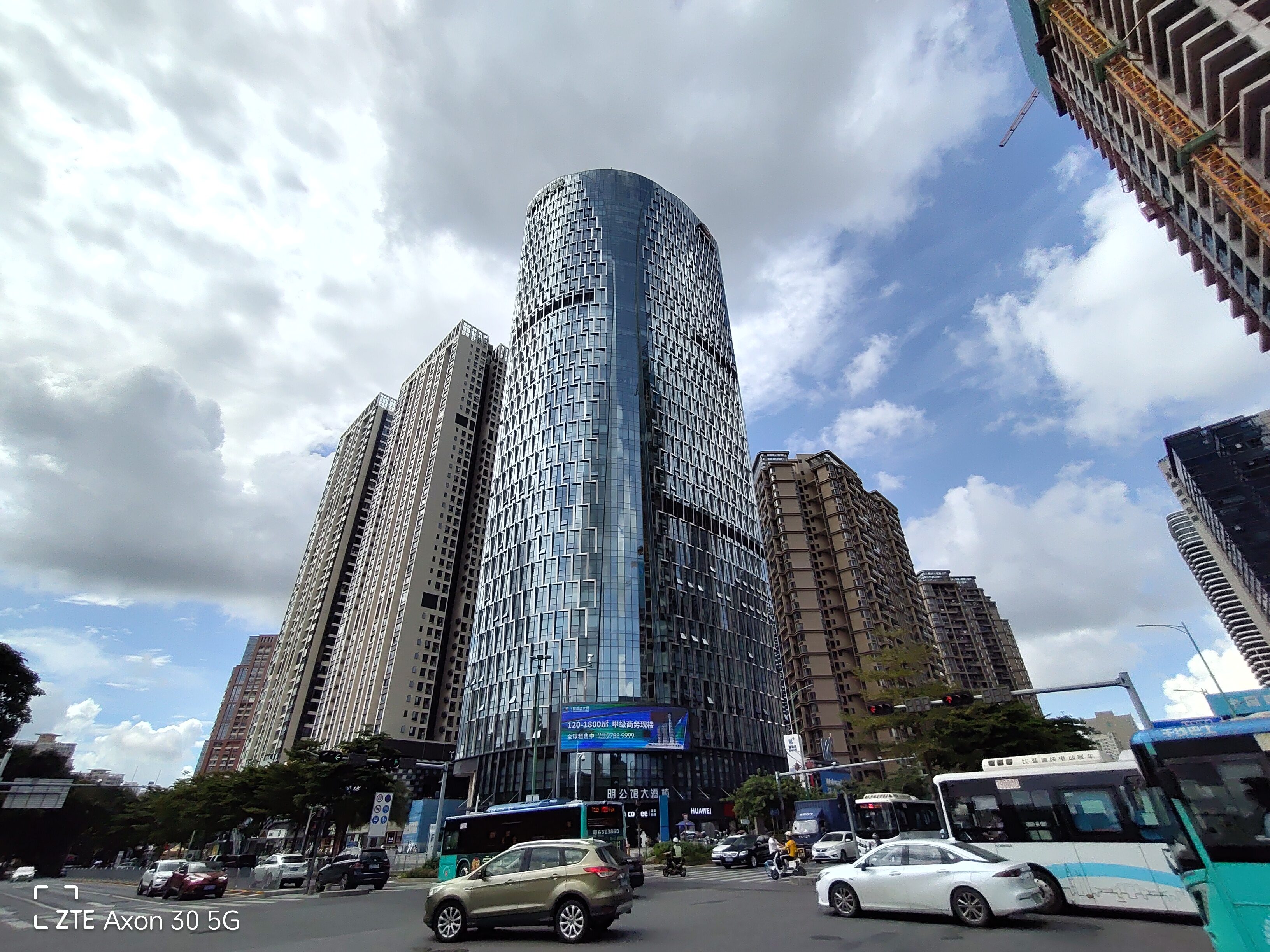
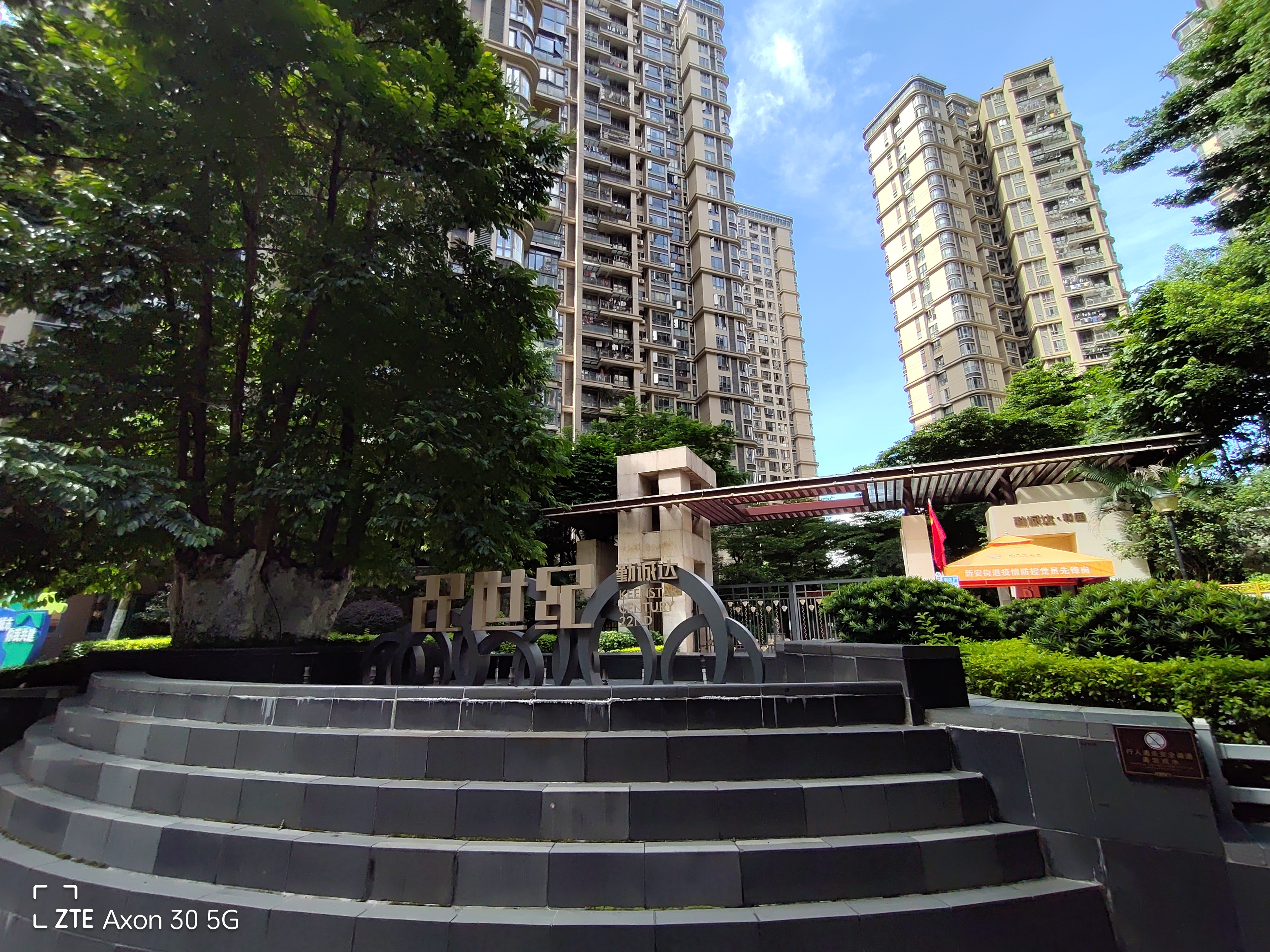
Ultra-wide lens and main camera tuning are basically the same, so it has the same problem at night. However, since Ultra wide lens does not have night mode, try to choose a place with better light for taking wide-angle photos at night.
1 of 11
Macro Camera
The Macro lens of Axon 30 performs beyond our expectations and is much better than the Macro lens of other phones. The image quality is very good and the usability of the photos is very high.
1 of 3
ZTE Axon 30 Review: Battery & Charging
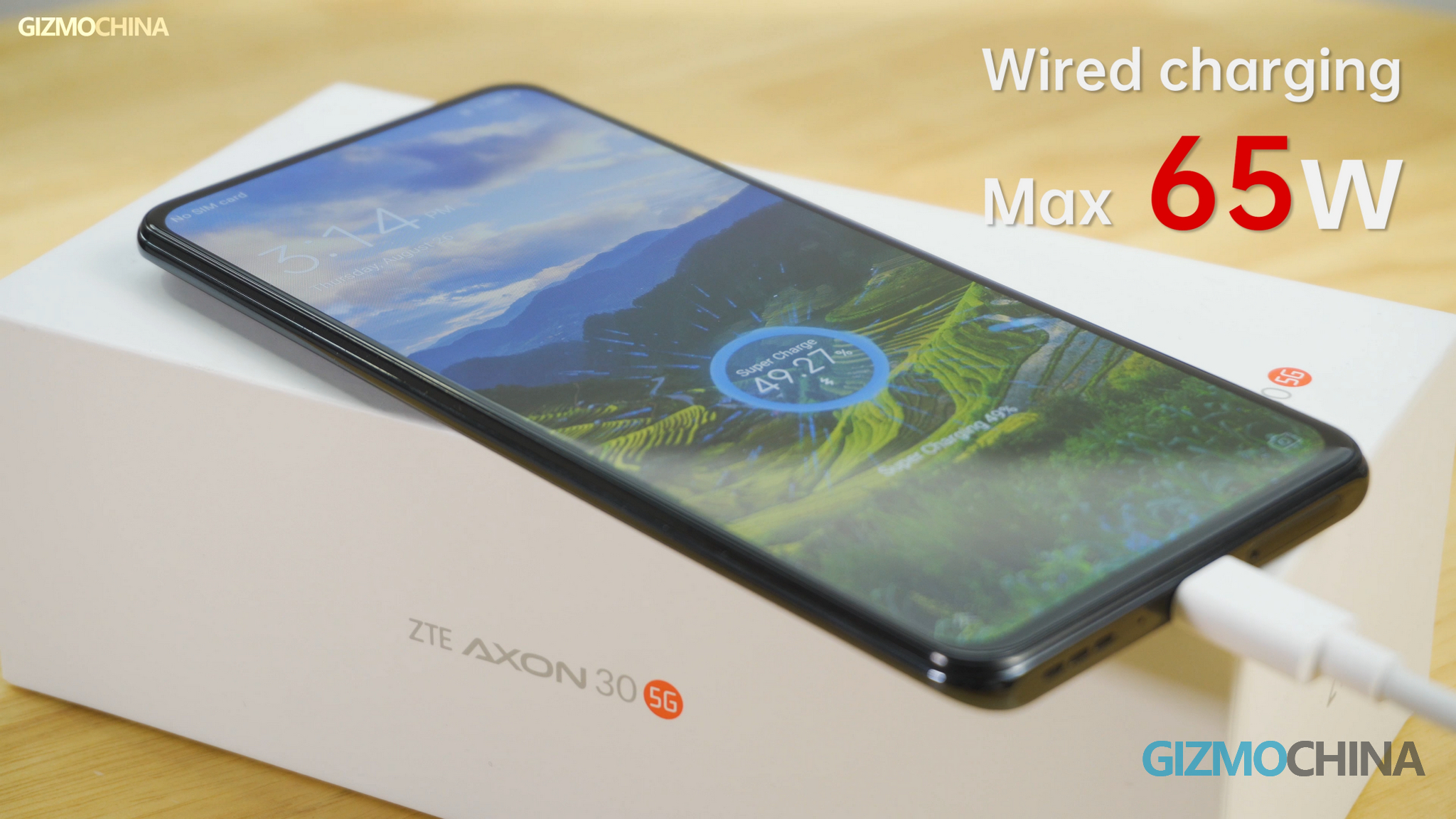
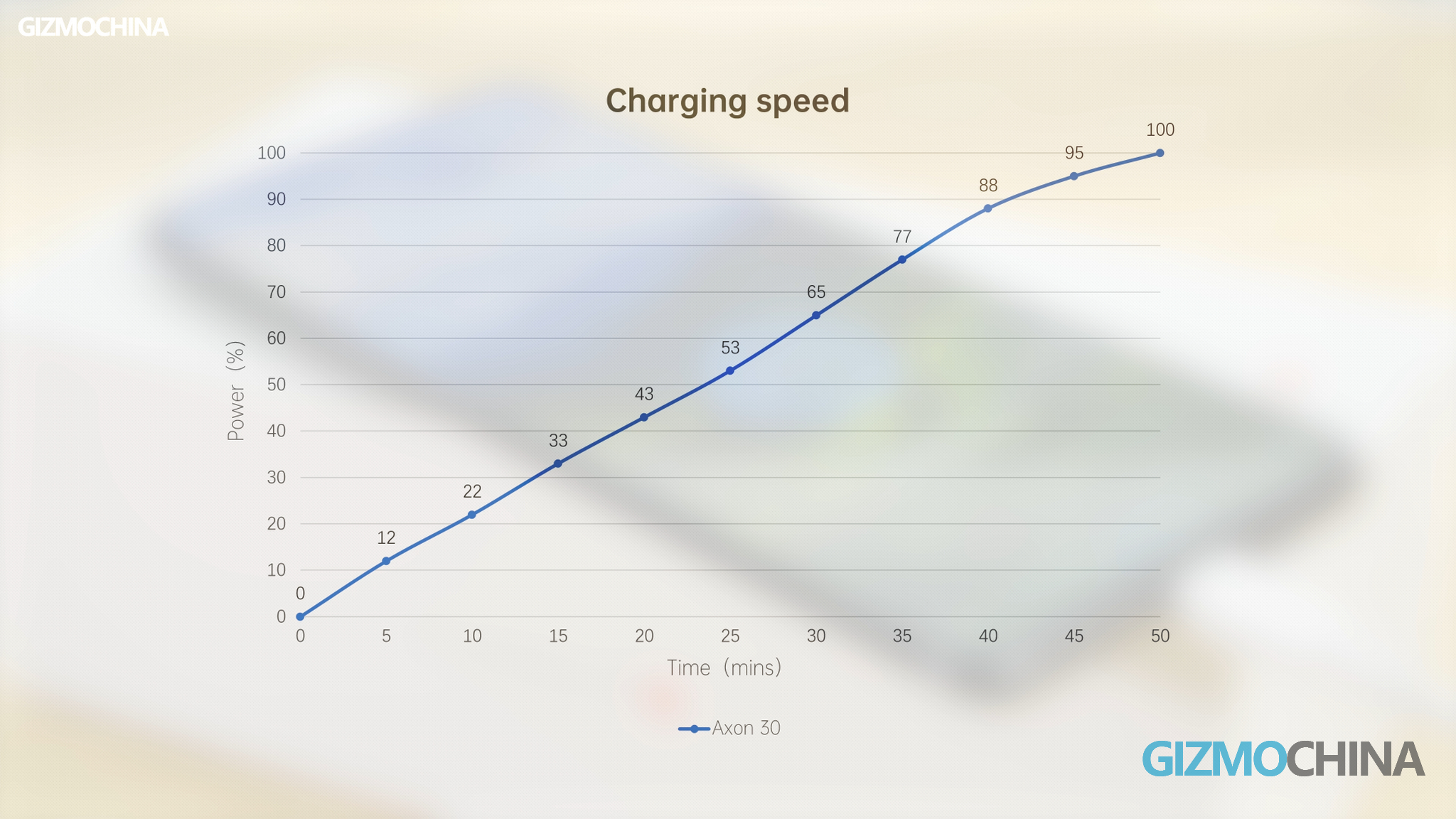
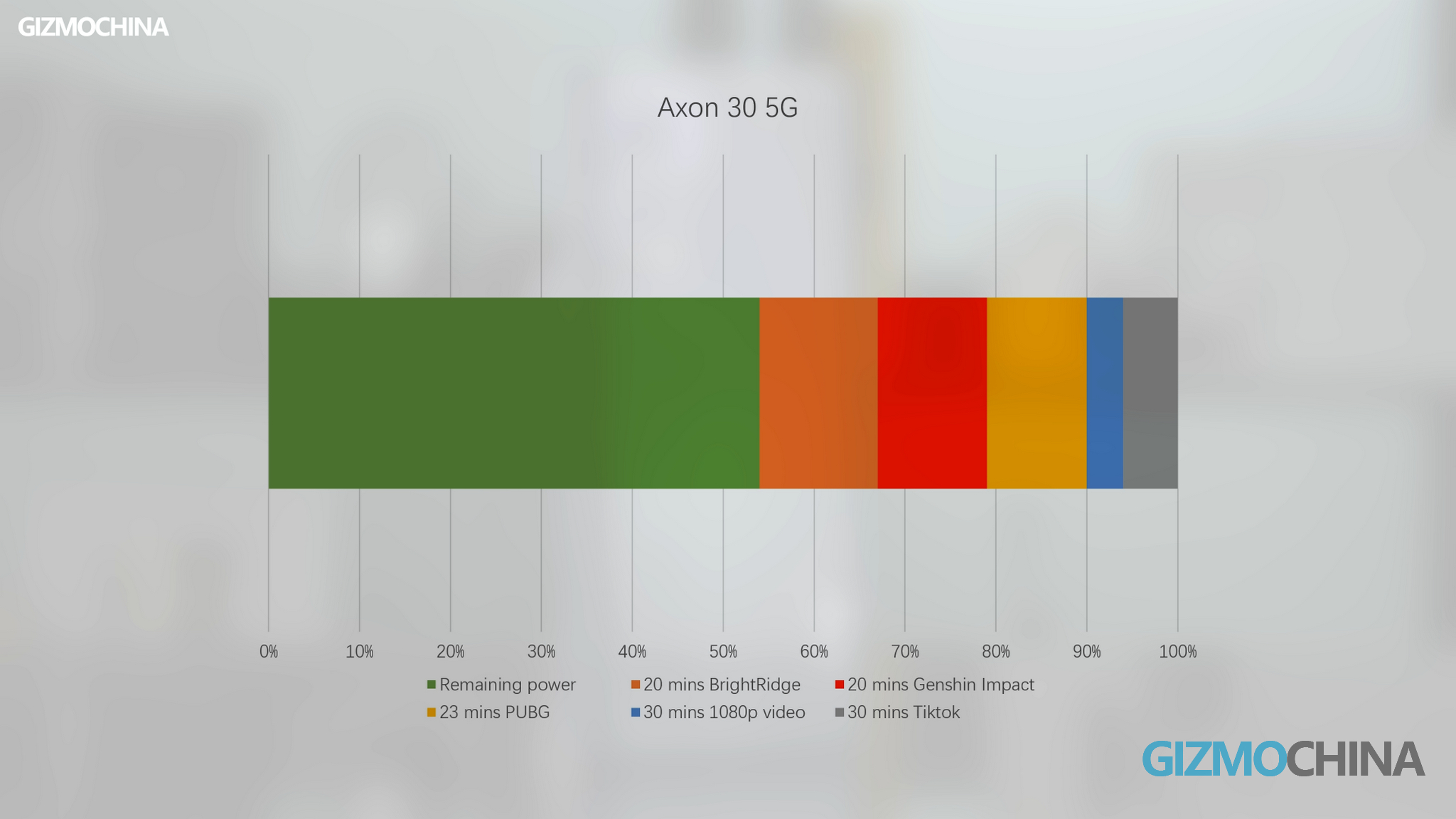
The Axon 30 comes with a charger in the box, and the phone’s maximum charging power is 65w without wireless charging. It charges to 22% in 10 minutes, 65% in half an hour, and it takes 50 minutes to 100%. Although the body only weighs 189g, it comes with a plastic back and features a 4200mAh battery capacity in exchange. Half an hour of Tiktok consumed 6%, half an hour of 1080p video consumed 4%. One PUBG game dropped the charge further by 11%, while in Genshin Impact the phone lost 12%, and in Brightridge 13%. With this battery life, it looks like if you want to use this phone for an entire day without charging, then you must use your phone less.
Battery Life Usage Chart
ZTE Axon 30 Review: Verdict
So Why did ZTE release the Axon 30 as a phone? Because I think ZTE has big dreams. It set the starting price for a phone with the latest generation of Under-display Camera technology at $500. It’s obviously to popularize this new technology and make more people appreciate how enjoyable it is to have a full screen. We have to thank ZTE for providing an option for those who like to try something new and are on a budget.
So that’s all about our quick review of the ZTE Axon 30!
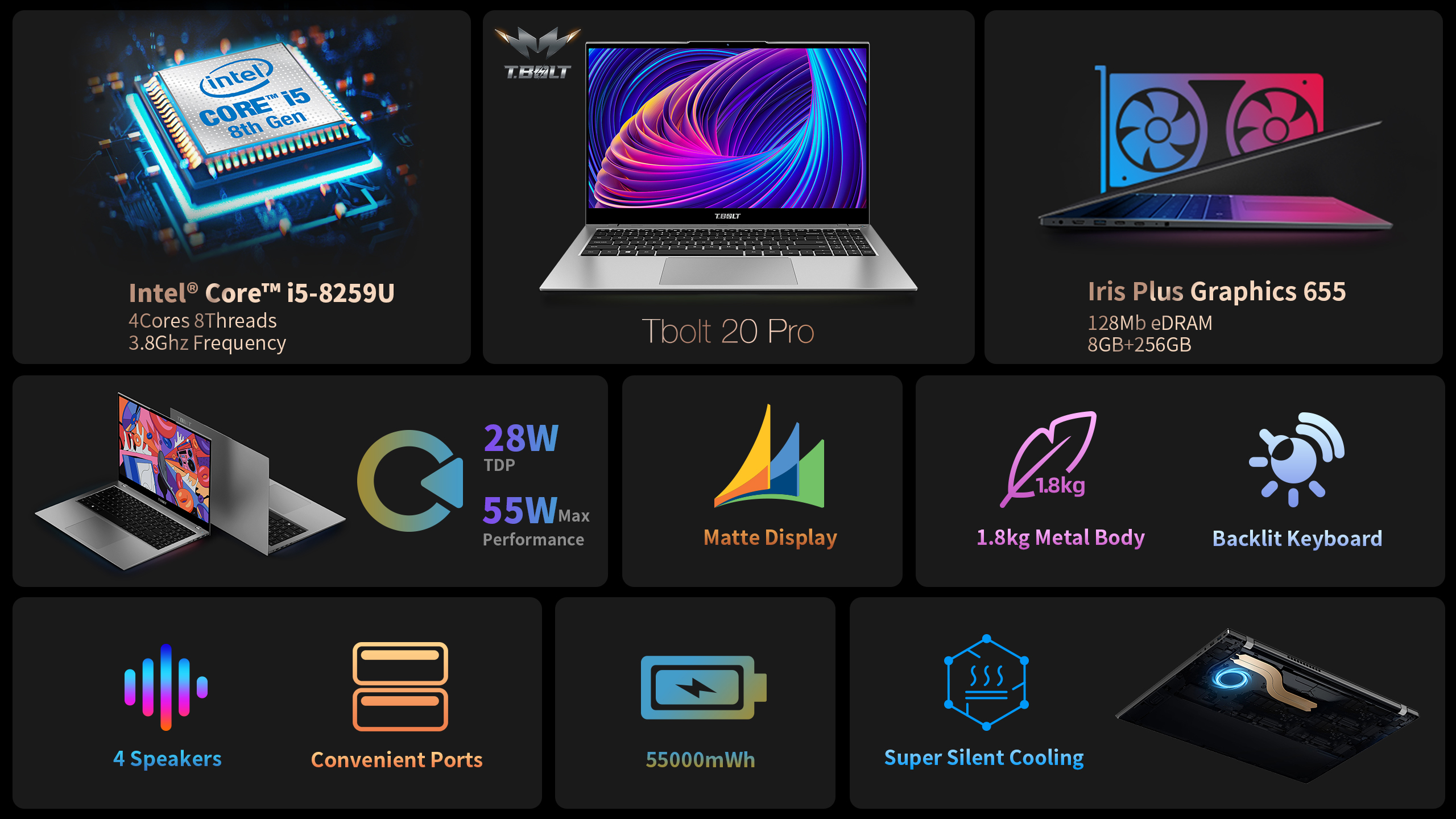
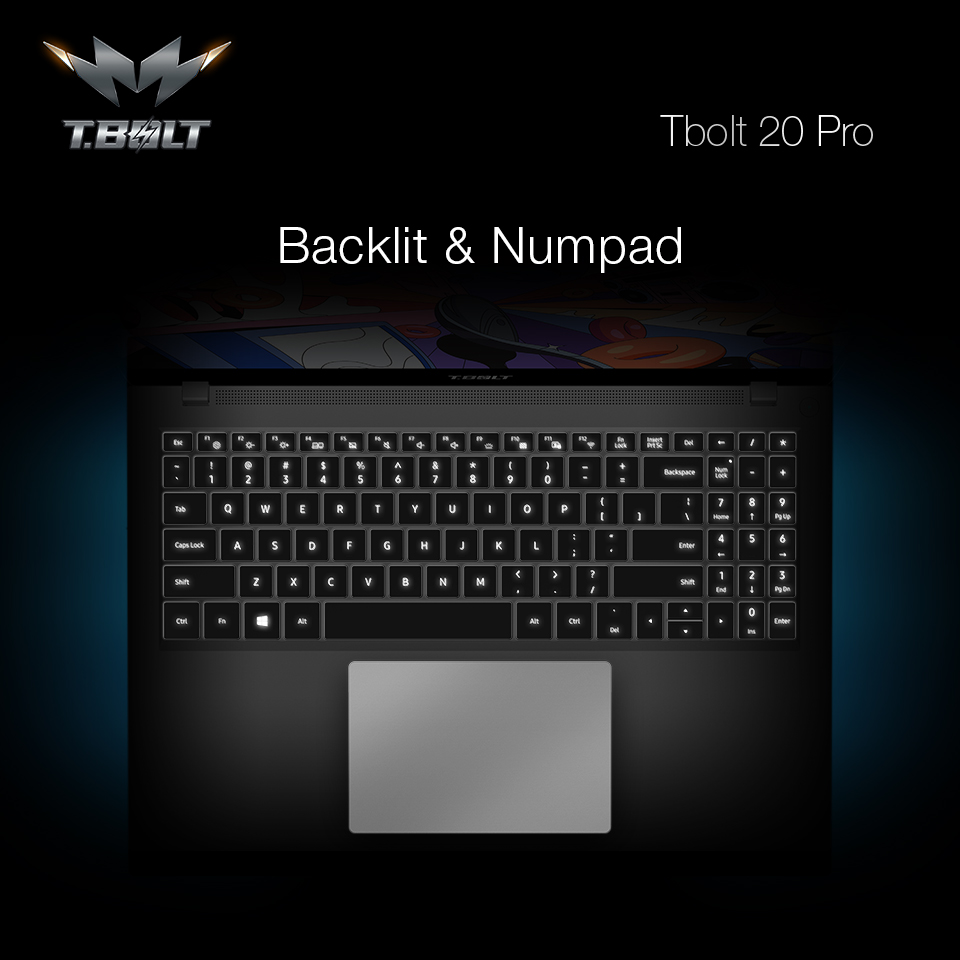
Teclast just launched a new powerful laptop – Tbolt 20 Pro as a successor to the Tbolt F15 Pro and Tbolt 10 DG. There are several advancements that are part of the newly launched Tbolt 20 Pro laptop. It comes with an Intel i5-8259U processor, 15.6-inch Full HD Matte IPS display. 8GB LPDDR4 RAM, 256GB SSD, Dual Heat pipes, and Super silent cooling. The laptop houses a backlit keyboard for better usability in a dark environment.
Teclast Tbolt 20 Pro is powered with Intel Core i5-8259U processor which offers 2.8GHz Turbo Boost. There are four cores and 8 threads to process multiple tasks simultaneously and effectively. It is an energy-efficient processor with a TDP rating of 28W and 55W max Iris Plus Graphics 655 are present on board to handle the intensive graphics with 128MB eDRAM. Furthermore, to enhance the multitasking and offer abundant storage, Teclast added an 8GB LPDDR4 RAM and 256 GB SSD storage. A separate SSD slot is also available for easy storage expansion.
Efficient heat dissipation is present with the help of dual heat pipes which enhances the overall system efficiency and enhances cooling. A laptop without a decent display doesn’t make sense, so the company added a 15.6-inch display with 1,920 x 1,080 pixels resolution.
Teclast Tbolt 20 Pro with its metal-framed body weighs 1.8kg, and the touchpad measures 133 x 87 millimetres. The presence of a 55Wh battery offers a decent long-lasting battery backup. Beautifully design laptop is available only in space grey colour. There are four speakers for richer and clearer audio while listening to music and watching videos.
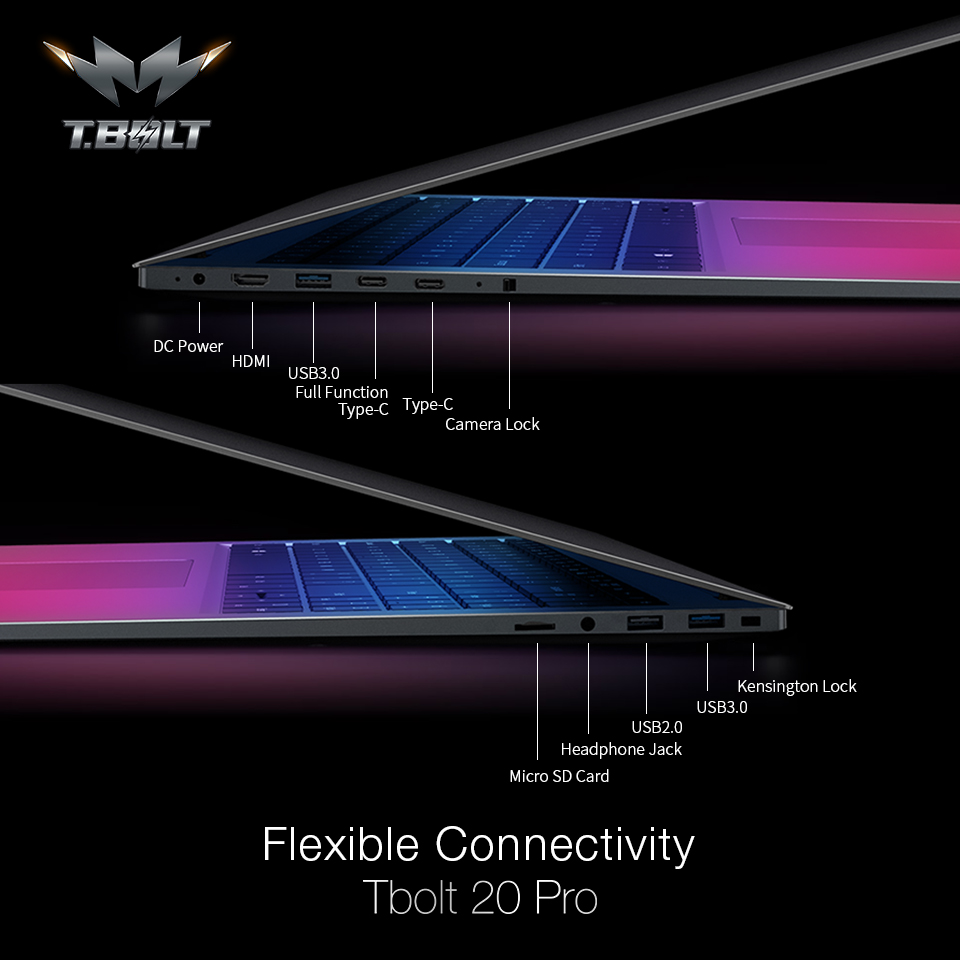
Teclast Tbolt 20 pro offers flawless connectivity with its 2x USB 3.0 and 2x Type-C ports. These can easily manage all your needs as ports support data transfer, PD fast charging and DisplayPort video audio output. Apart from those, there’s a headphone jack, MicroSD Card port, DC Power, and Camera Lock.
However, the pricing and availability details are not yet live. We expect the smartphone to be made available in the coming few weeks. You can know more about the device by heading to the official website.
The globally renowned PC brand, Acer, had been rumored to be planning on entering the smart TV market in India earlier this month. Now, the company has officially announced that it will be launching its first smart TVs in the region later this year.In a press release, the Taiwanese tech giant announced that it will be debuting in the smart television segment under a license to the Bengaluru based Indkal Technologies. In other words, the brand is partnering up with an Indian firm for the highly anticipated launch of Acer branded smart TVs. As per official notes, the company’s smart TVs will be launched in the region through Amazon and Flipkart across a wide range of sizes. This includes 32 inch models to large TVs with 70 inch screens.
Notably, this is in line with our previous report that covered the resolution and screen sizes of the upcoming Acer TVs. The press release also added that Indkal will be sharing the detailed specifications and pricing for these new products soon. Furthermore, the brand has also confirmed that its TVs will be launching in the Indian home entertainment market sometime in September 2021.
Anand Dubey, CEO of Indkal Technologies stated that “The need for home entertainment has increased in the past twelve months, thus boosting the demand for televisions. This marks a great time to enter the market with Acer, which is one of the most trusted and reliable brands across markets. As the current surge in sales is expected to grow till Diwali, we will find immense opportunities to showcase the value addition that Acer Televisions will bring to the market and towards improving the overall TV viewing experience.”
A new report from a known tipster has revealed the launch date for the upcoming Huawei Nova 9 series. The lineup will apparently launch in late September 2021 and will be available with sufficient stock right from the start.
The information was shared by @菊厂影业Fans on his Weibo account, a Chinese microblogging website, earlier this week. As per the known tipster, the company will be launching the device late next month, however, the online post did not reveal any specific date or time of the launch. Notably, the September launch is in line with previous reports although the launch conference was initially expected to be in the middle of the month. The brand might have shifted the dates to a later time to better stock up on the upcoming devices.
He stated that the Chinese tech giant has also prepared sufficient stocks for the Nova 9 series. The leakster claimed that the inventory of the device is more than the Huawei P50 series that was previously launched. In other words, customers awaiting the launch of the new handsets wouldn’t have to worry about a shortage, which has been an issue during smartphone launches in the past as well. Furthermore, @菊厂影业Fans also added that there will be many new products that will be released alongside the Nova 9. Unfortunately, we have no way of knowing exactly which products will be launching next month as of right now but it could be a new all in one PC and a desktop printer going by our previous report.
While finer details of the Nova 9 series is currently unknown, we do have certain specs thanks to a 3C certification. The Nova 9 Pro will support up to 100W fast charging while the base model will support up to 66W fast charging. Meanwhile, another tipster had revealed that the Pro variant will be powered by a large 4,000mAh battery pack while the base variant will house a 4,500mAh battery pack. We had also previously reported that the company might plan on launching the 4G versions prior to the 5G enabled variants as well. So stay tuned for more updates.
The OPPO K3 got access to the Android 11-based ColorOS 11 Beta update in India at the end of July. A month later, the smartphone has now started receiving the ColorOS 11 stable update in the region. The rollout is happening following the schedule shared by OPPO earlier this month.
A few weeks back, OPPO revealed the ColorOS 11 Stable update timeline for August 2021. According to the plan, only OPPO K3 is supposed to receive the stable update in India. Hence, the update is now being seeded out to this device.
The Android 11 stable update for OPPO K3 arrives with firmware version CPH1955_11_F.11. Like any other OTA system update, it is being rolled out in batches.
Hence, some users might get access to the update earlier than others. For instance, the stable build initially went live for users who were running the beta build. Slowly, it has now begun to reach regular users. It should be available for all the users in the following weeks.
OPPO launched the OPPO K3 with ColorOS 6.x based on Android 9.0 Pie. The handset got ColorOS 7.x update based on Android 10 last year. This means ColorOS 11 (Android 11) is the phone’s second major update will be mostly its last ever major system update as per OPPO’s software update track record.
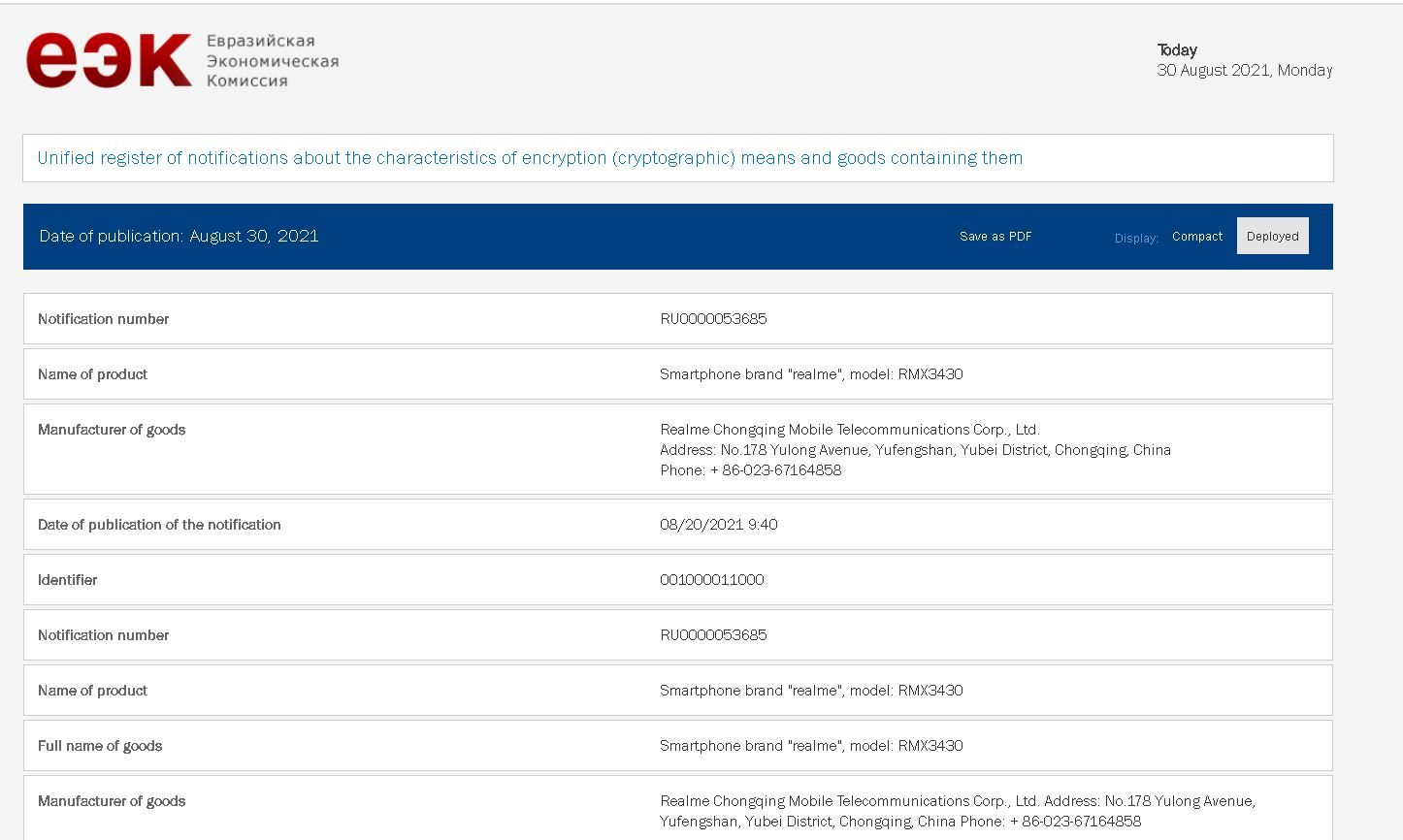
Last week, the Realme Narzo 50A was spotted certification sites such as the Bureau of Indian Standards (BIS) and Thailand’s National Broadcasting and Telecommunications Commission (NBTC). A new report (via. Pricebaba) states that the smartphone has also bagged approval from the Eurasian Economic Commission (EEC). These certifications are a good hint the Narzo 50A will break cover soon in multiple markets.
It can be said based on recent reports that the EEC certified RMX3430 smartphone may debut in the European markets with the Narzo 50A moniker. Unfortunately, none of the certification listings have revealed the major specs of the device. The NBTC listing only revealed that it is a 4G LTE phone.
A recent leak revealed that the Narzo 50A will be arriving in India in two variant such as 4 GB RAM + 64 GB storage and 4 GB RAM + 128 GB storage. It is expected to arrive in colors like Oxygen Green and Oxygen Blue.
Realme Narzo 50A
A leaked render of the Narzo 50A that appeared recently revealed that it will be sporting a teardrop notch display and a side-facing fingerprint scanner. The uniquely designed rear shell of the device features a triple camera unit and a fingerprint scanner. It is speculated that it has a front camera of 8-megapixel and a 13-megapixel primary camera on the back. It is likely that Realme may announce the Narzo 50 series of smartphones at some point in September.
Earlier this year, Xiaomi had announced the commencement of its smart electric vehicle business and had even revealed its sizeable investment plans for the next decade. Since then, the company has invested and acquired various companies related to the automobile industry, with the latest investment being in Motorcomm.
This would mark another investment that the Chinese tech giant has made into firms related to automobiles. Furthermore, the company invested in Motorcomm through the Hubei Xiaomi Yangtze River Industrial Fund. For those unaware, Motorcomm working with research and the development of core communications chips that are found in vehicles. The firm was established back in 2017 and its business scope includes technology development, industrial automation, automobiles, consulting, and other technical services as well.
Notably, Xiaomi’s President Wang Xiang had recently stated in an interview (Via ITHome) that the company has begun with in depth research and development of the key core technology of smart electric cars. In other words, this investment might be quite important as well since core communication chips for vehicles is an important aspect, especially for smart cars. Just recently, we had also reported on the brand seeking to acquire DeepMotion, which is an autonomous driving technology based startup for a sum of 77.4 million US Dollars.
Earlier today (31st August 2021), Nubia shared another teaser for its upcoming Red Magic 6S Pro gaming smartphone. The new teaser showcased its heat dissipation system again, but this time, the company revealed the aerospace-grade phase change material used in the device.
Previously, the Chinese smartphone maker had shared a teaser that highlighted two key components of the Red Magic 6S Pro’s thermal management systems. This included aerospace level heat dissipation black technology, which is an aviation-grade aluminum that is used in a surface of up to 18,000 square millimeters inside the handset to reduce the CPU’s core temperature by around 16 degrees Celsius and even reduce the temperature of the smartphone’s body as well. Furthermore, the brand had even talked about the new turbo cooling fan, which can spin at a speed of up to 20,000 RPM.
Now, the company has revealed that the unique aerospace-grade heat dissipation technology used in the upcoming device is the material n-ecosane C21H44. For those unaware, this material is a compound that has a melting point of about 39 to 41 degrees Celsius. Notably, the material is also soluble in water and appears to have practical applications for smartphones’ heat dissipation systems as well.
While Nubia only hinted at the cooling system of the Red Magic 6S Pro again, we already have confirmation that the device will house a Qualcomm Snapdragon 888+ SoC along with support for 165Hz high refresh rate display and a triple camera module on the rear. Unfortunately, not a lot of information is available regarding this handset so stay tuned as we will be covering its 6th September 2021 launch event.
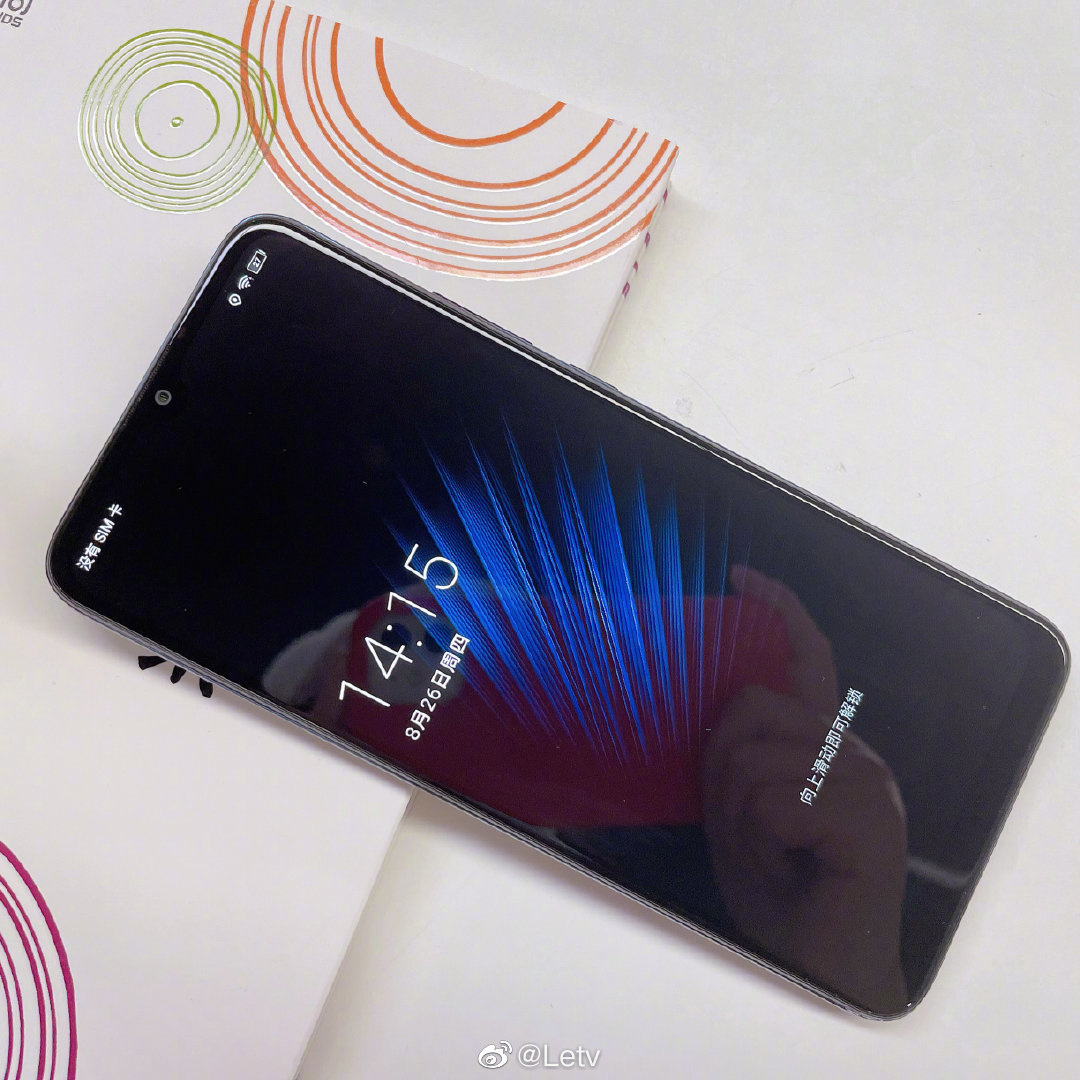
Earlier this year, in the month of May, announced the return of LeTV Smart Ecology for its products, including Smart TVs and smartphones in the market. While the company hasn’t launched a new device, it has now shared live images of a smartphone.
The company has shared live images of an unnamed smartphone on its official Weibo account, without revealing any details related to the device.
The image shows that the smartphone features a waterdrop notch on top of the screen for housing the front-facing camera sensor. The chin below the display panel is a bit thicker, indicating that the phone’s design isn’t new and it may have been designed sometime back.
On the backside, the phone carries LeTV branding towards the bottom and at the top-center position, there’s a circular camera module, another hint regarding the phone’s design being made a couple of years back.
A smartphone from the company, named LeTV L5 has been spotted on TENAA, indicating that the device could soon be officially launched in China. The listing reveals that it features a 6.528-inch HD+ display offering a screen resolution of 1600 x 720 pixels.
It’s likely to come in two memory variants — 6GB RAM with 128GB internal storage and 8GB RAM with 256GB of internal storage. The triple-camera setup on the back consists of a 48-megapixel primary sensor and two 2-megapixel sensors. On the front side, it features an 8-megapixel snapper for taking selfies and video calling.
The listing hints that the smartphone is running the Android 9 operating system out-of-the-box and is powered by a 4,900mAh battery. More details about the phone’s specifications remain a mystery. As of now, the company has not yet announced a launch date but given that it has passed TENAA certification, the smartphone could get launched soon in China.
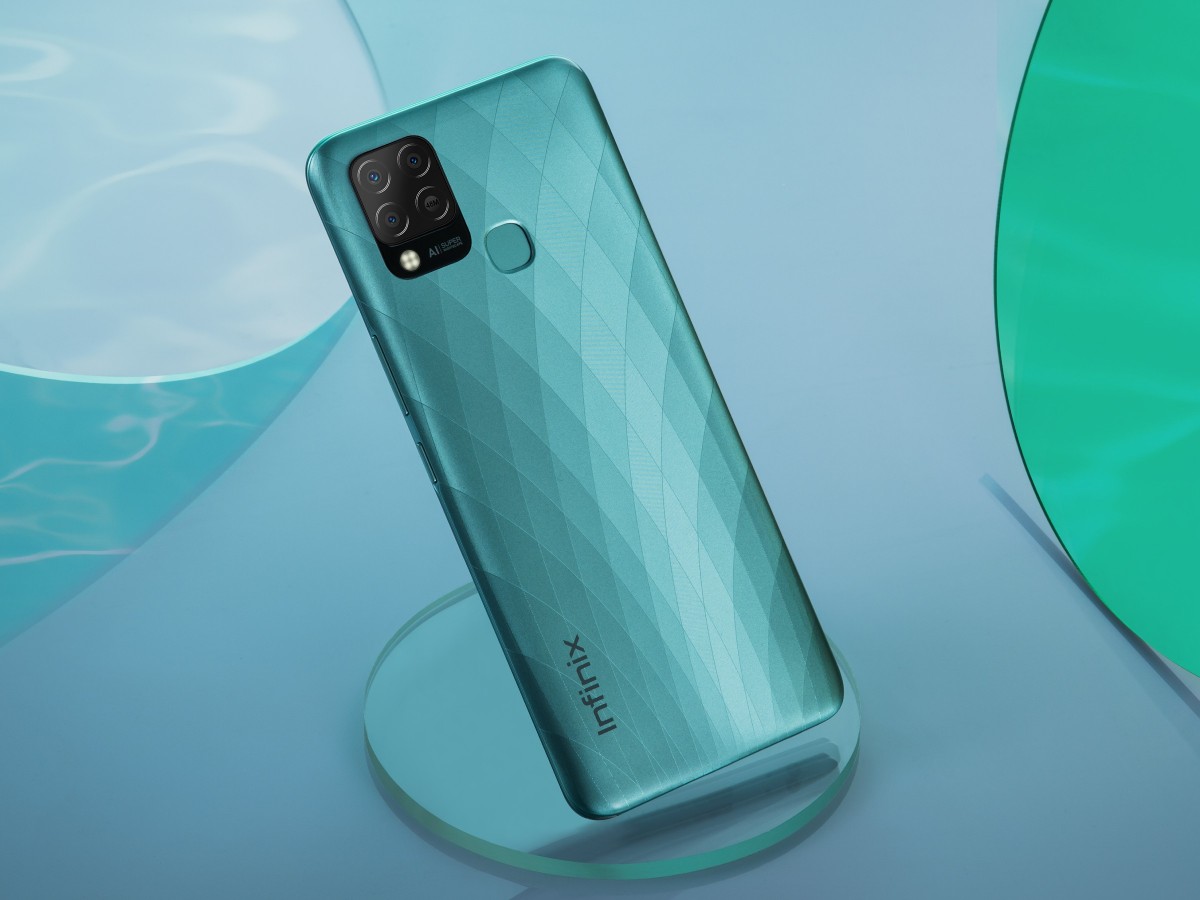
Infinix is all set to debut the HOT 11 series. The brand had already confirmed that the Infinix HOT 11S will be launching in India in September. This smartphone along with the vanilla Infinix HOT 11 has now appeared on Google Play Console.
Infinix HOT 10S
According to Google Play Console, the Infinix HOT 11 and the Infinix HOT 11S bear model numbers X662 and X6812 respectively. Bot the smartphones are powered by MediaTek chipsets.
The former features an Helio G70 SoC, while the latter has an Helio G88 SoC as revealed by the company. The duo runs Android 11 and is listed with 4GB RAM.
Both phones sport an FHD+ (1080 x 2460 pixels) display. However, the panel on the vanilla model has a dewdrop notch as opposed to a punch-hole on the S variant.
As per official information, the Infinix HOT 11S will be available in two storage configurations in India – 4GB + 64GB and 6GB + 64GB. These versions of the handset have been confirmed to retail at ₹9,999 and ₹10,999 respectively. Unfortunately, we don’t have similar details for the standard Infinix HOT 11.
Anyway, we expect to learn more about these two phones before their official launch in the coming weeks. Also, since the vanilla model is inferior to the S variant in terms of features, it should be cheaper.
We use cookies on our website to give you the most relevant experience by remembering your preferences and repeat visits. By clicking “Accept”, you consent to the use of ALL the cookies.
This website uses cookies to improve your experience while you navigate through the website. Out of these, the cookies that are categorized as necessary are stored on your browser as they are essential for the working of basic functionalities of the website. We also use third-party cookies that help us analyze and understand how you use this website. These cookies will be stored in your browser only with your consent. You also have the option to opt-out of these cookies. But opting out of some of these cookies may affect your browsing experience.
Necessary cookies are absolutely essential for the website to function properly. This category only includes cookies that ensures basic functionalities and security features of the website. These cookies do not store any personal information.
Any cookies that may not be particularly necessary for the website to function and is used specifically to collect user personal data via analytics, ads, other embedded contents are termed as non-necessary cookies. It is mandatory to procure user consent prior to running these cookies on your website.


 Notably, 5G enable smartphones were the driving force behind this sizeable rise in shipments. 5G devices alone accounted for 22.83 million units or about 79.6 percent of the total sales. During this time,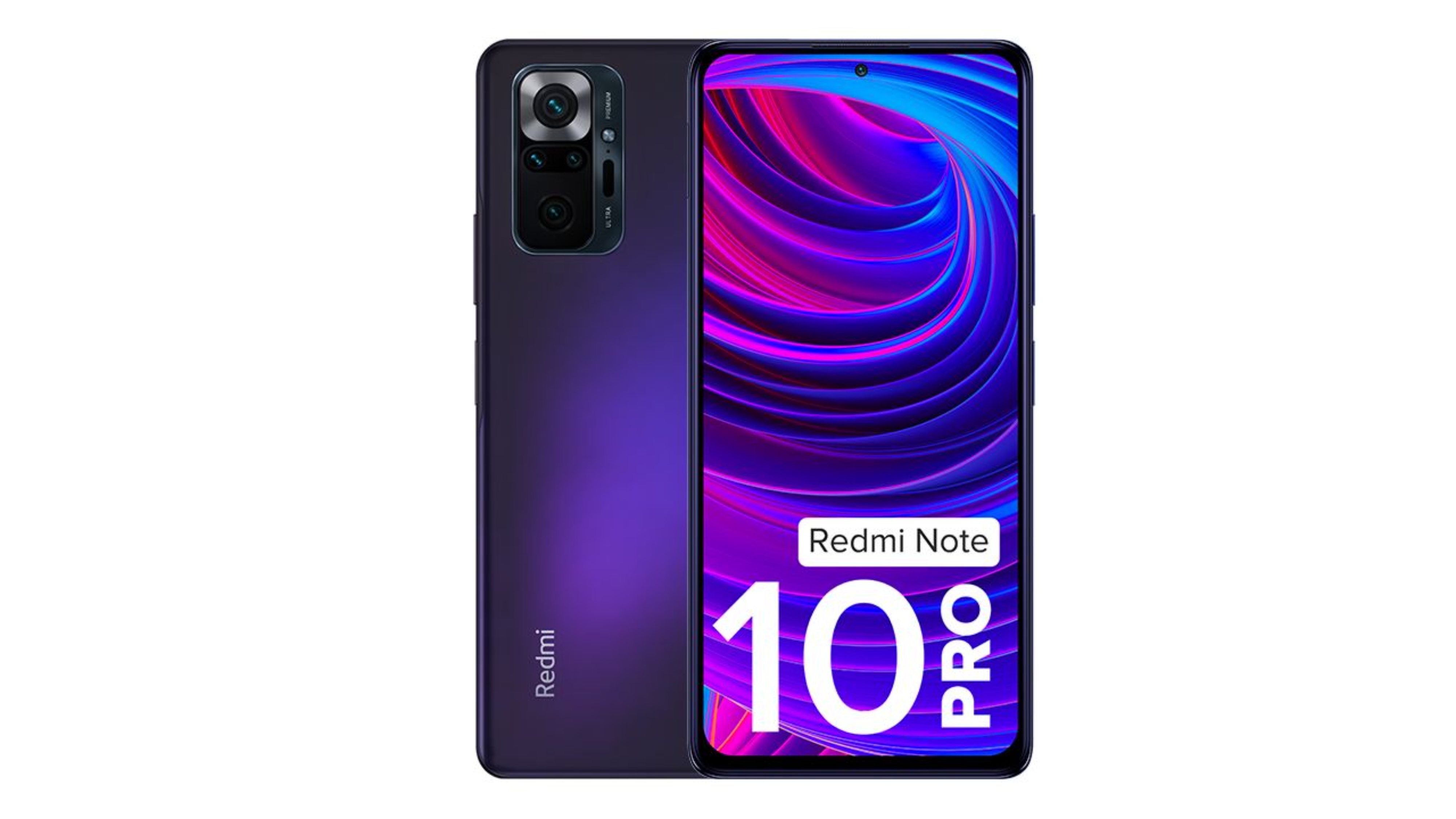

 The new smart home product is currently available for pre orders and arrives with support for air gestures. This includes functions like turning it on or off, adjusting gears, and more commands that can be inputted just with a wave of a hand. As per official notes, the air gesture support on the new Side Smoking Stove Set S1 aims to let users operate the product with ease since all basic operations can be completed with only two simple movements of swiping right and left.
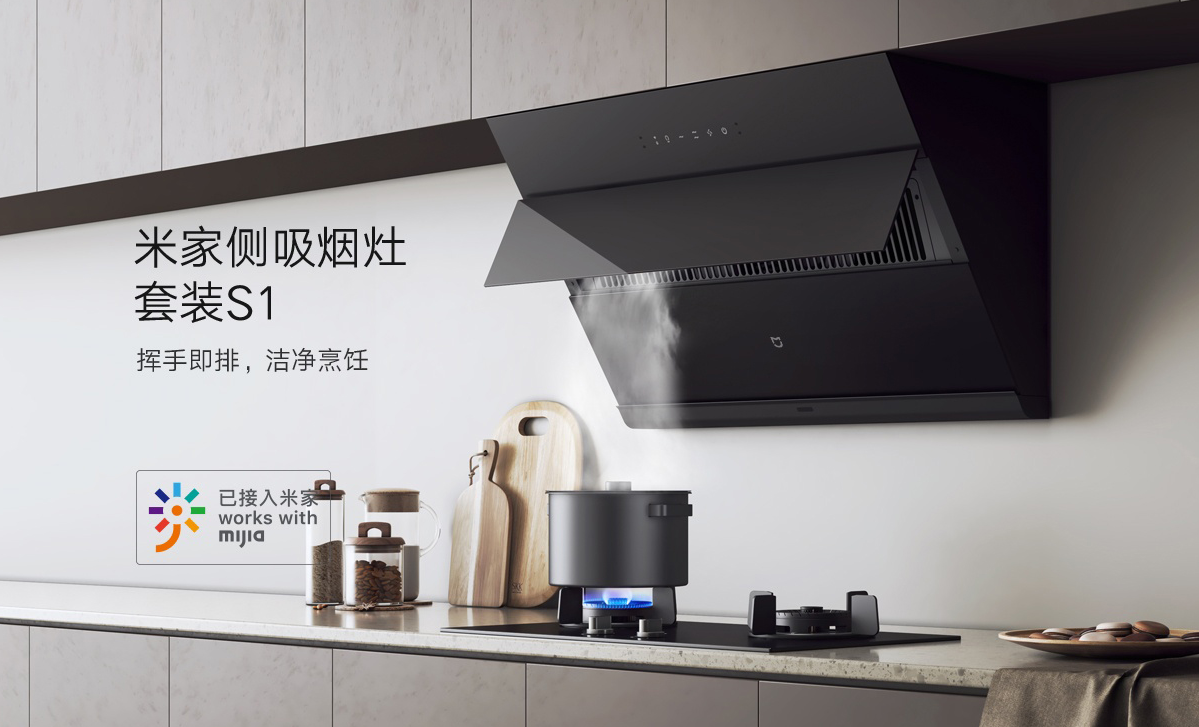 Arriving at the design of the product, the new MIJIA stove set sports a stylish black mirror design with a tempered glass panel, which is bright and textured. Despite being made of glossy materials, the company claims it is relatively easy to clean even when stained. As of right now, the product is available for pre orders while first sales will begin on 3rd September 2021, with a price tag of 1898 Yuan (roughly 300 US Dollars).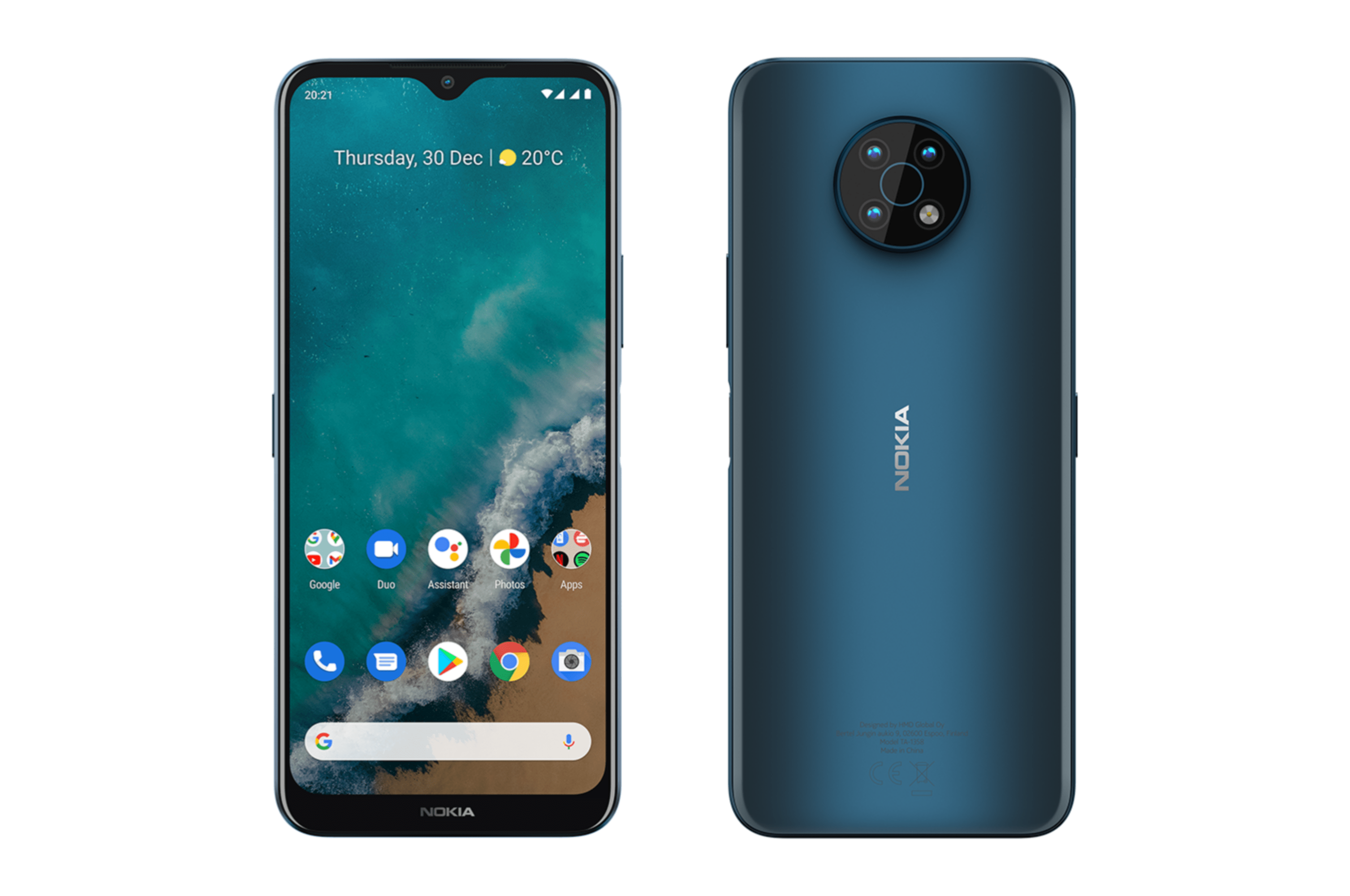
 According to a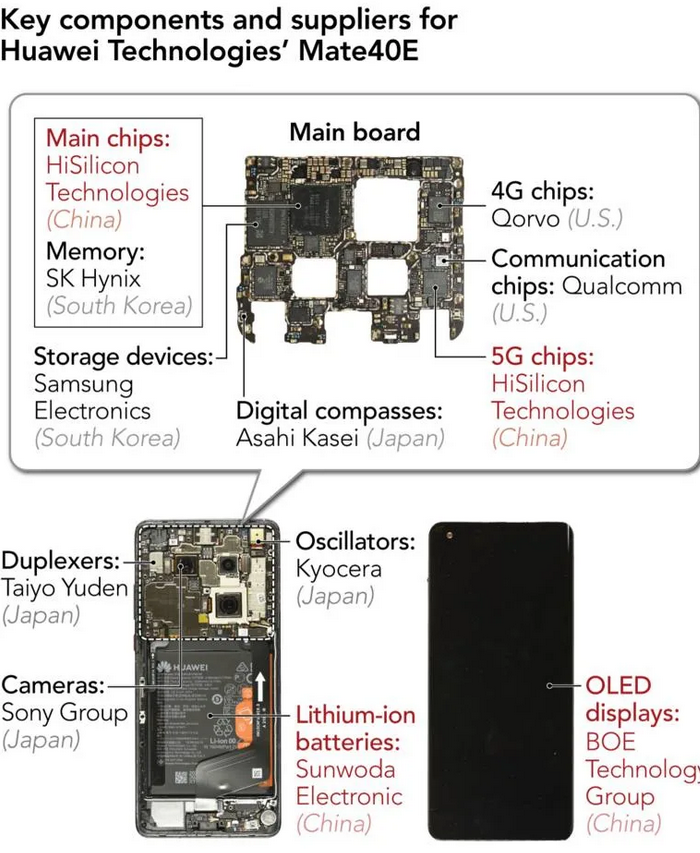




























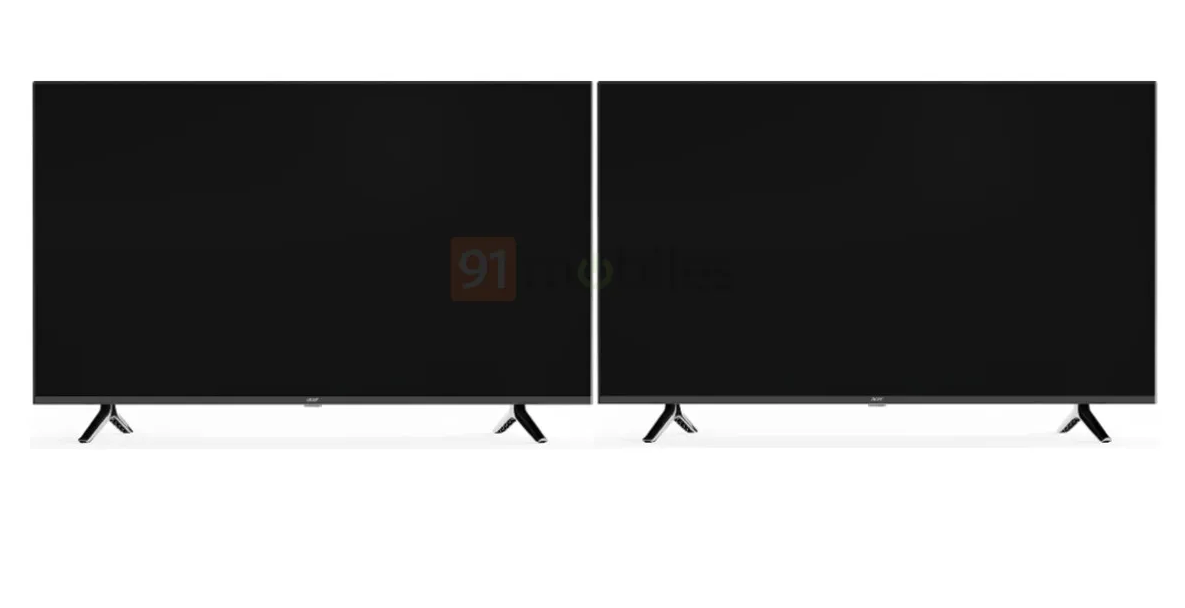 In a press release, the Taiwanese tech giant announced that it will be debuting in the smart television segment under a license to the Bengaluru based Indkal Technologies. In other words, the brand is partnering up with an Indian firm for the highly anticipated launch of Acer branded smart TVs. As per official notes, the company’s smart TVs will be launched in the region through Amazon and Flipkart across a wide range of sizes. This includes 32 inch models to large TVs with 70 inch screens.
 Anand Dubey, CEO of Indkal Technologies stated that “The need for home entertainment has increased in the past twelve months, thus boosting the demand for televisions. This marks a great time to enter the market with Acer, which is one of the most trusted and reliable brands across markets. As the current surge in sales is expected to grow till Diwali, we will find immense opportunities to showcase the value addition that Acer Televisions will bring to the market and towards improving the overall TV viewing experience.”
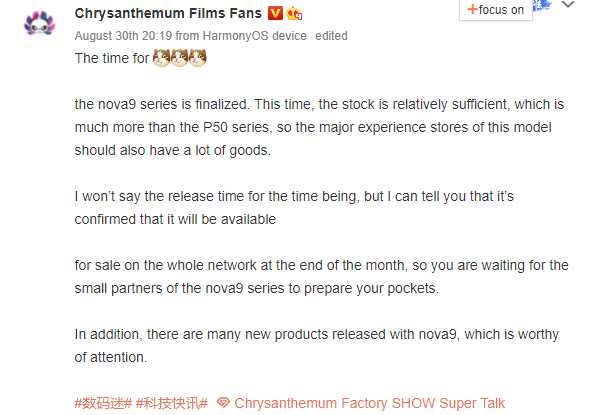 The information was shared by @菊厂影业Fans on his Weibo account, a Chinese microblogging website, earlier this week. As per the known tipster, the company will be launching the device late next month, however, the online post did not reveal any specific date or time of the launch. Notably, the September launch is in line with previous reports although the launch conference was initially expected to be in the middle of the month. The brand might have shifted the dates to a later time to better stock up on the upcoming devices.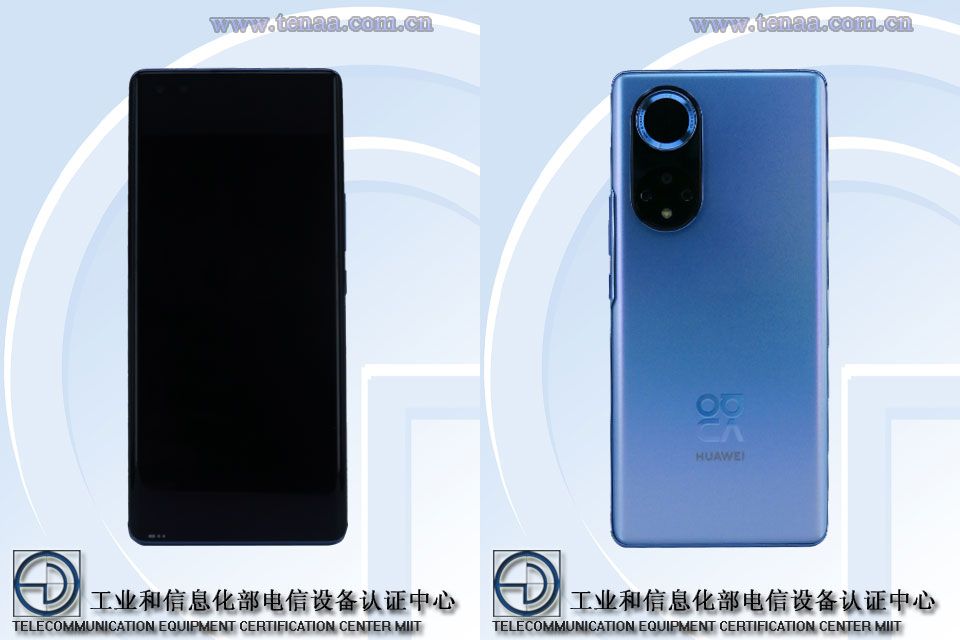

 Notably, Xiaomi’s President Wang Xiang had recently stated in an interview (Via
  Previously, the Chinese smartphone maker had shared a
  While Nubia only hinted at the cooling system of the Red Magic 6S Pro again, we already have confirmation that the device will