Samsung has officially announced a new chipset dubbed Exynos 9611. The new chipset seems to be an upgrade over the Exynos 9610 chipset which was announced last year even though they both share several features.
The Exynos 9611 chipset utilises the same 10nm process as its predecessor. It comes with four Cortex A73 cores with a maximum clock speed of 2.3GHz as well as four Cortex A53 cores clocked at 1.7GHz maximum, in a 64-bit octa-core arrangement. This is the same architecture as the Exynos 9610 SoC but there is an improvement in the clock speed. The Exynos 9611 equally packs a Mali -G72 MP3 GPU which fires up the graphics. This is also the same GPU on the Exynos 9610 but it has a faster clock speed than its predecessor. With this hardware setup, the processor lets users do more of their favourite activities such as gaming thanks to a robust performance that fits the evolved mobile devices.
The Exynos 9611 mobile processor brings intelligent performance for the next-generation experiences from artificial intelligent applications to pro-grade camera. The Exynos 9611 processor has a built-in artificial intelligence engine that consists of vision processing unit. It enables the smartphone to feature an intelligent pro-grade camera that makes smart enhancements to photographs. The chipset offers artificial intelligence capabilities via a deep-learning technology.
The new processor also brings along some improvements in image processing. It is built with a digital signal processor and a neural network engine. The vision image processing unit of the Exynos 9611 can analyze analogue signals of images and videos and identify the objects and environment within the scene. The technology enables users to enjoy enriched photography experiences and do more with intelligent assistant services. The advanced image processing unit uses the acquired data to fine-tune the settings such as exposure, white balance, hue, saturation, contrast, sharpness, etc. to take a higher quality photograph. The smart depth sensing allows the smartphone to take a beautiful portrait with a bokeh effect with just a single camera. The Exynos 9611 processor also supports diverse multi-camera solutions such as wide, ultra-wide, and tele cameras.
For connectivity, the Exynos 9611 processor comes with an LTE modem and diverse connectivity solutions. The integrated modem supports up to 600Mbps for downlink with 3CA and 150Mbps for uplink with 2CA for seamless live broadcasting and streaming. The Exynos 9611 also packs several connectivity features such as Wi-Fi, Bluetooth 5.0, and FM radio. Furthermore, for a location based mobile experiences, the Exynos 9611 features a 4-mode GNSS (Global Navigation Satellite System) receiver that includes GPS (Global Positioning System), GLONASS, BeiDou and Galileo.
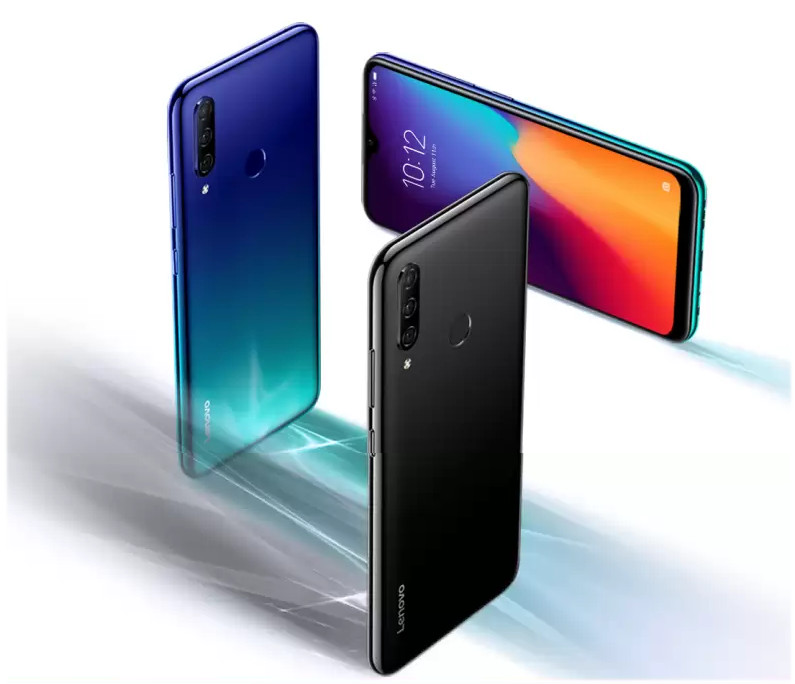
Lenovo launched the K10 Note smartphone in the Indian market earlier this month along with the Z6 Pro flagship smartphone. Now, the company is gearing up to launch the Lenovo K10 Plus in the Indian market.
This upcoming smartphone has been spotted on online marketplace Flipkart and the landing page for the same suggests that the device will get launched on 22nd September. it suggests that the phone will feature a waterdrop notch display and will feature a triple camera setup on the back.
It has been confirmed that the Lenovo K10 Plus will be powered by Qualcomm Snapdragon 632 chipset and will pack 4,050mAh battery which is claimed to offer 39 hours of calling time on a single charge.
The phone will come with a 6.22-inch HD+ display with 1520 x 720 pixels screen resolution, 19:9 aspect ratio, and 87 percent screen-to-body ratio. The device will pack 4GB of RAM and 64GB internal storage.
As for the cameras, on the back side, it will feature a 13-megapixel primary sensor with f/2.0 aperture and PDAF, along with an 8-megapixel 120-degree wide-angle sensor, and a tertiary 5-megapixel depth sensor. On the front side, it comes with a 16-megapixel snapper for taking selfies and video calling.
The Lenovo K10 Plus will be made available in two color options — Black and Blue. To know about the phone’s pricing as well as availability information, we’ll have to wait for the official launch event to take place on 22nd September.
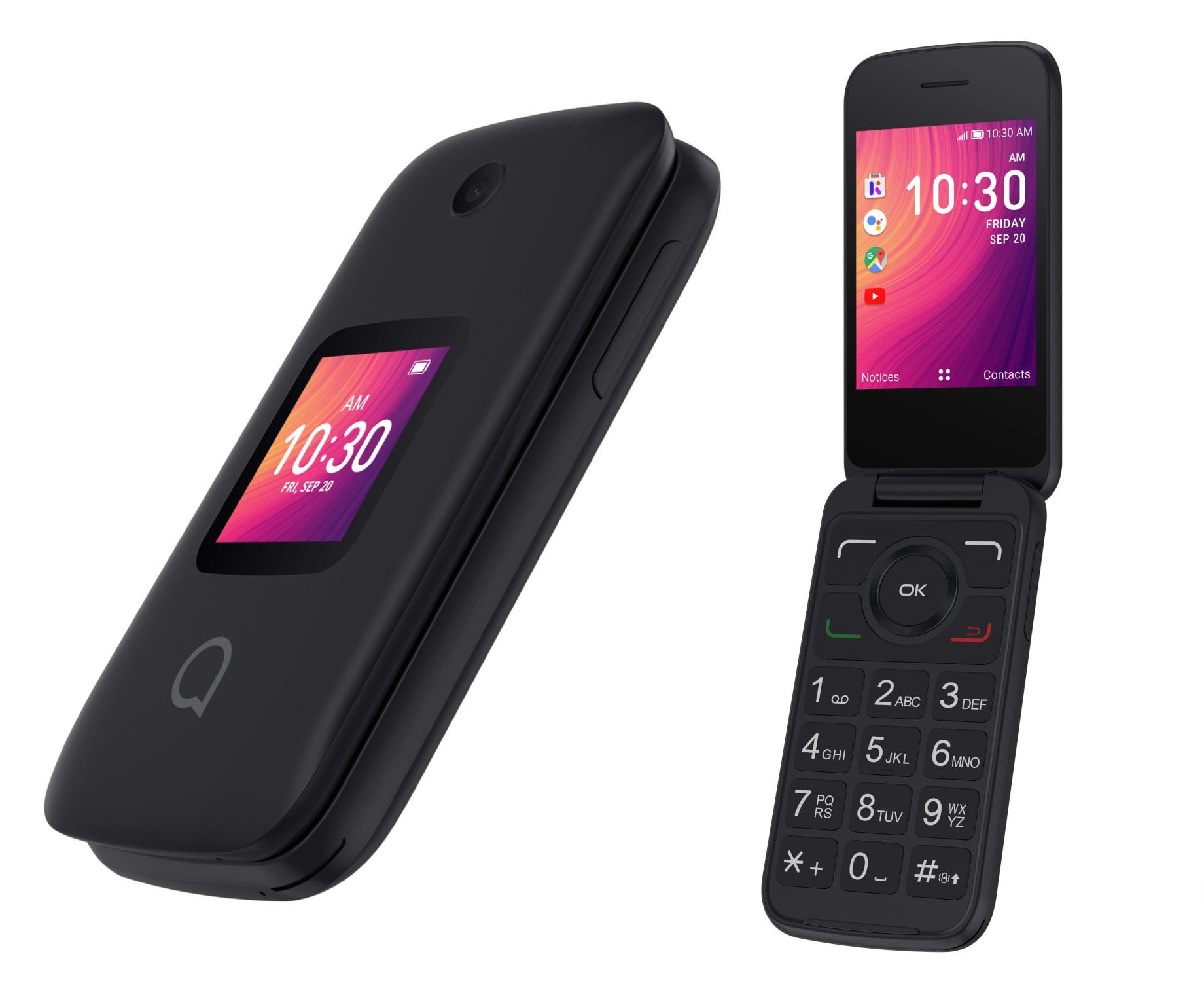
At a time when smartphone makers are launching devices with foldable display, Alcatel has launched Go Flip 3 and Smartflip phones that come with the once-trendy flip design. The company claims that these are the first flip phones in the North American market to come with access to the KaiStore and Google Assistant.
Actually, both of these are the same phone but the naming depends on the carrier. For T-Mobile and Metro by T-Mobile, it is called Alcatel Go Flip 3, while on AT&T and Cricket Wireless it’s the Smartflip.
It comes with a 2.8-inch dispplay and is powered by Qualcomm Snapdragon 210 processor. The device packs 8GB of internal storage which can be further expanded up to 32GB using a microSD card.
As for the battery life, the phone can provide 6.8 hours of continuous talktime on a single charge. The interesting part of the phone is that it runs on KaiOS operating system and comes with access to KaiStore which is an applications marketplace. Along with having KaiOS, the phone also comes with support for Google Assistant.
Thanks to Google Assistant, you can use voice commands to open and navigate to apps, message friends, control smart home devices, find information from the web, and more — basically everything that you could do with a smartphone.
KaiOS is a mobile OS that is developed by US-based KaiOS Technologies. The operating system is based on B2G (Boot to Gecko) which is an open source community-driven successor of Firefox OS from Mozilla. Last year, Google invested $22 million in the company, which at the time had over 40 million devices running KaiOS.
The Alcatel Go Flip 3 is now available from T-Mobile, while the Smartflip is available from AT&T but the pricing details have not been revealed yet. However, given that it’s a feature phone with lightweight software, we don’t expect it to cost much.
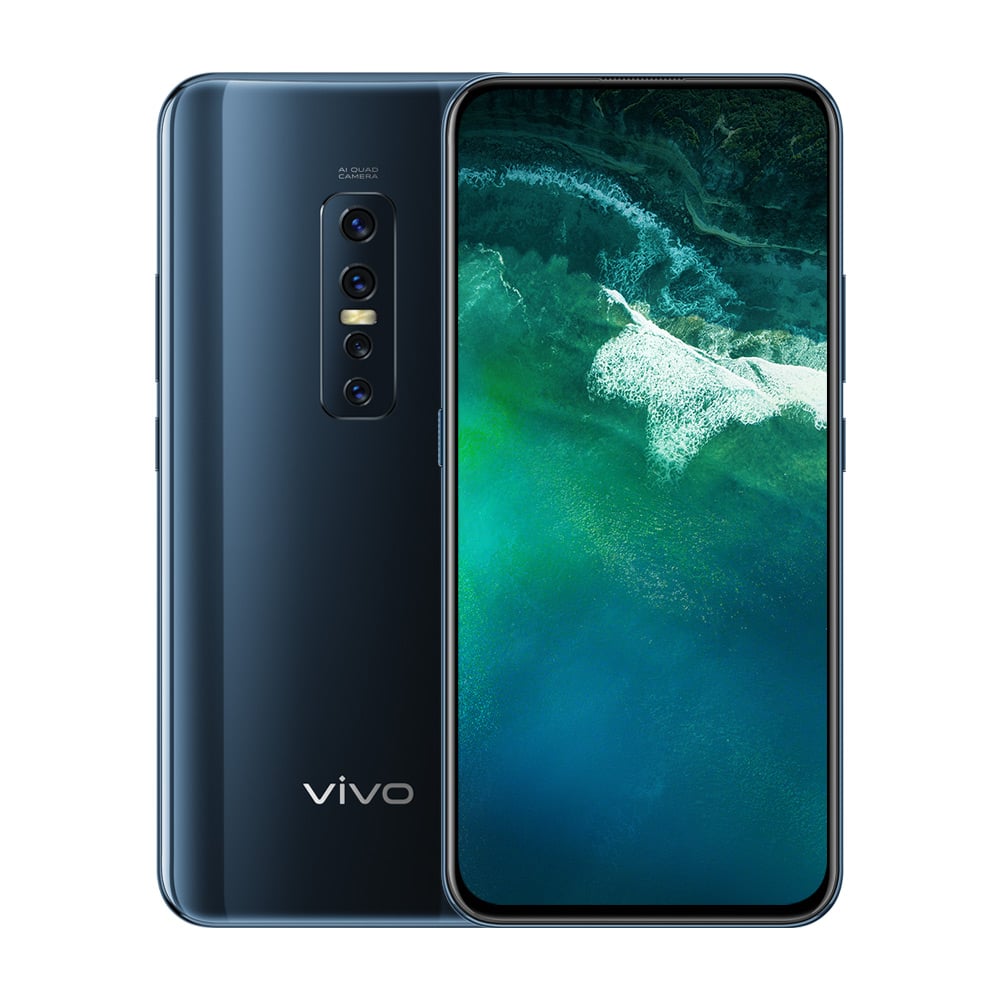
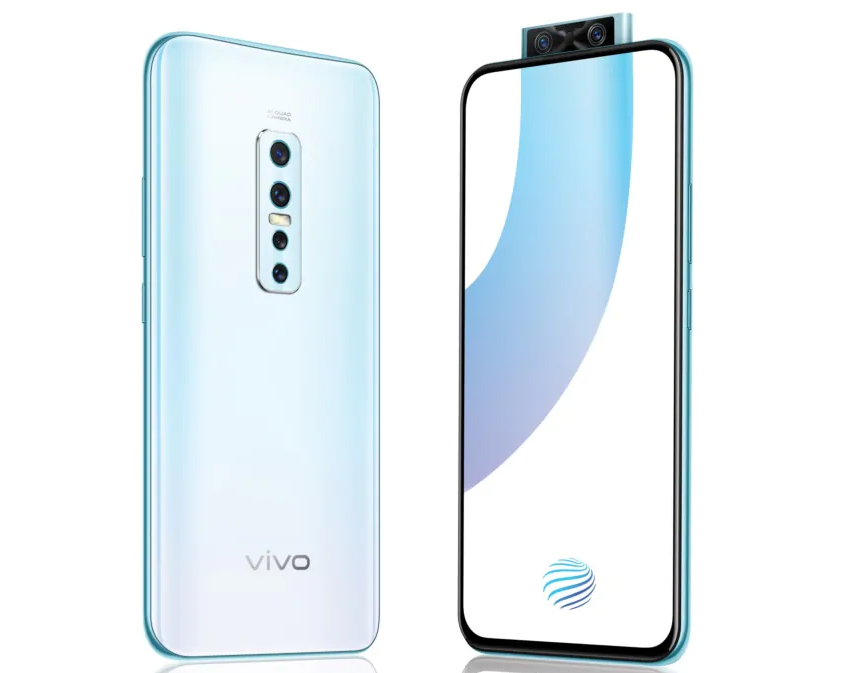
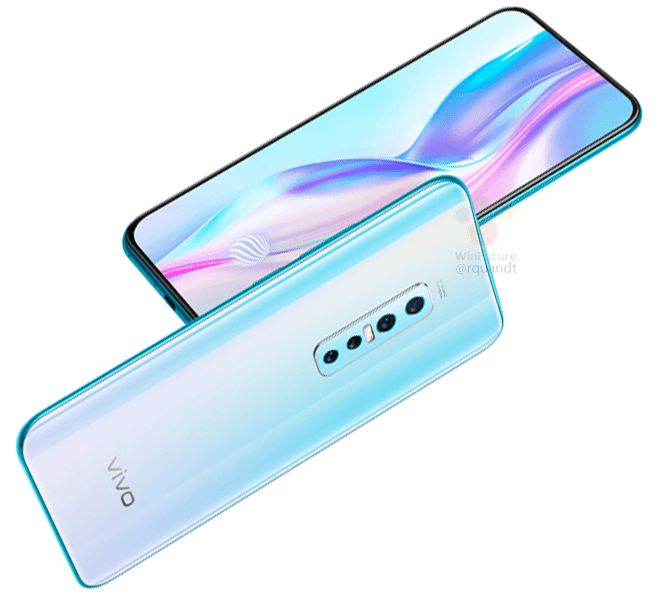
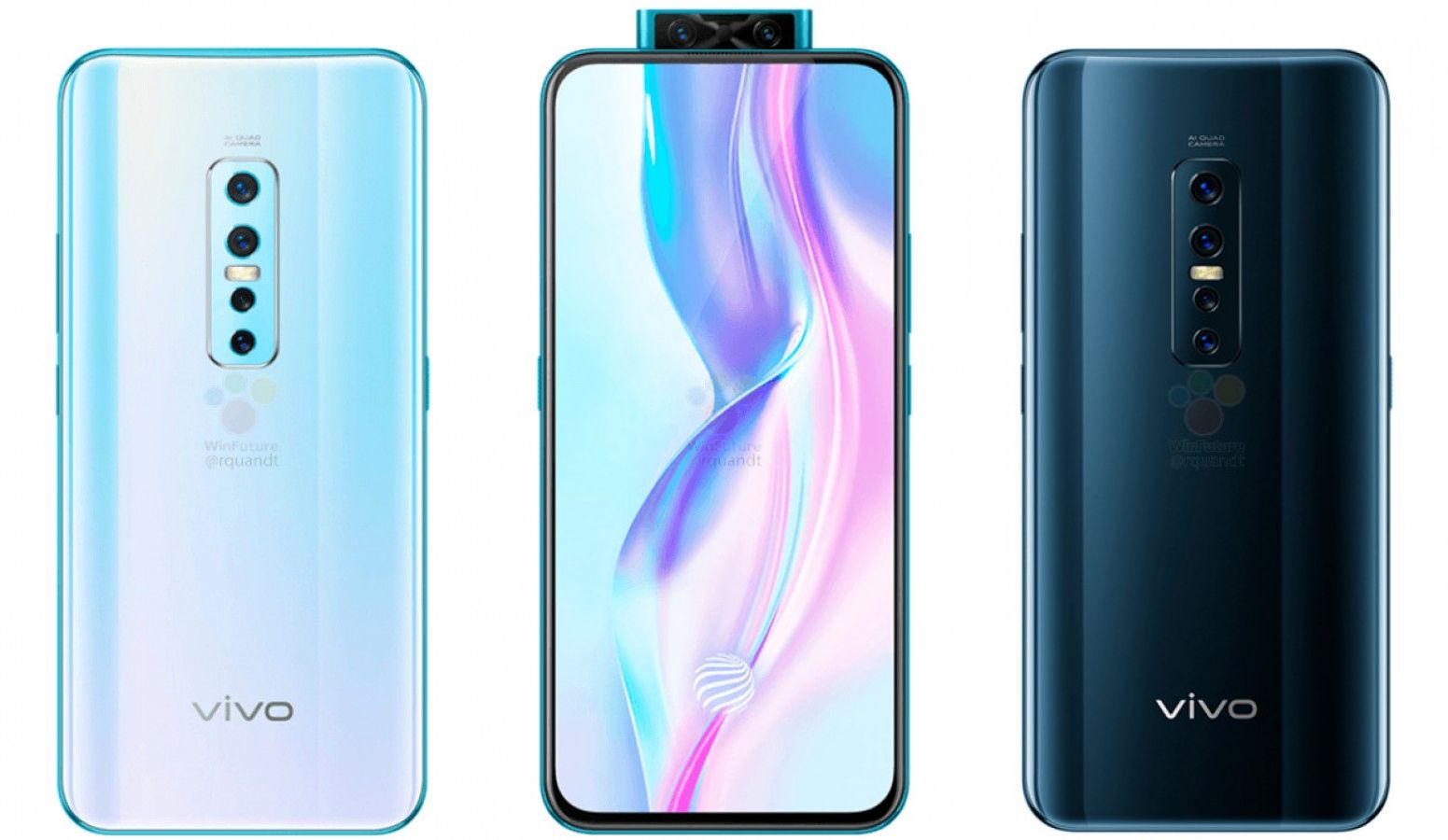
Vivo has officially launched a brand new selfie-focused flagship in the market, the Vivo V17 Pro. The phone distinguishes itself from competitors by offering not one, but two selfie camera sensors housed in a wide pop-up mechanism upfront. There’s even a flash onboard which ensures your selfies come out nice even when it’s dark.
World’s First Dual Front Pop-up Camera Setup
The V17 Pro is the world’s first camera to feature a dual pop-up front camera. Since this is the main highlight of the device, let’s talk about it first. The two camera sensors are housed inside a single pop-up mechanism. This makes for a much wider setup than what you usually see on such devices. The primary camera is a 32MP f/2.0 lens while the second 8MP wide-angle camera is aimed at ‘groufies’ with its 105-degree field of view. The same pop-up mechanism houses a moonlight flash. So, no more worrying about the ambient light for your selfies.
Given the phone’s focus on selfies, it comes with a set of software features that takes advantage of this unique setup. For example, the Vivo V17 Pro has a special ‘Super Night Mode’ for the front camera that combines multiple frames for high-quality selfies, even in low-light conditions. The Shot Refocus tool helps you manage the amount of bokeh effect. Then there’s another feature called the ‘Pose Master’ which will suggest several poses to make your selfies more creative.
The front camera setup is tested to withstand up to 40kgs of weight and comes with an auto-retraction feature, which has become common among such phones. The camera lens is protected by sapphire glass.
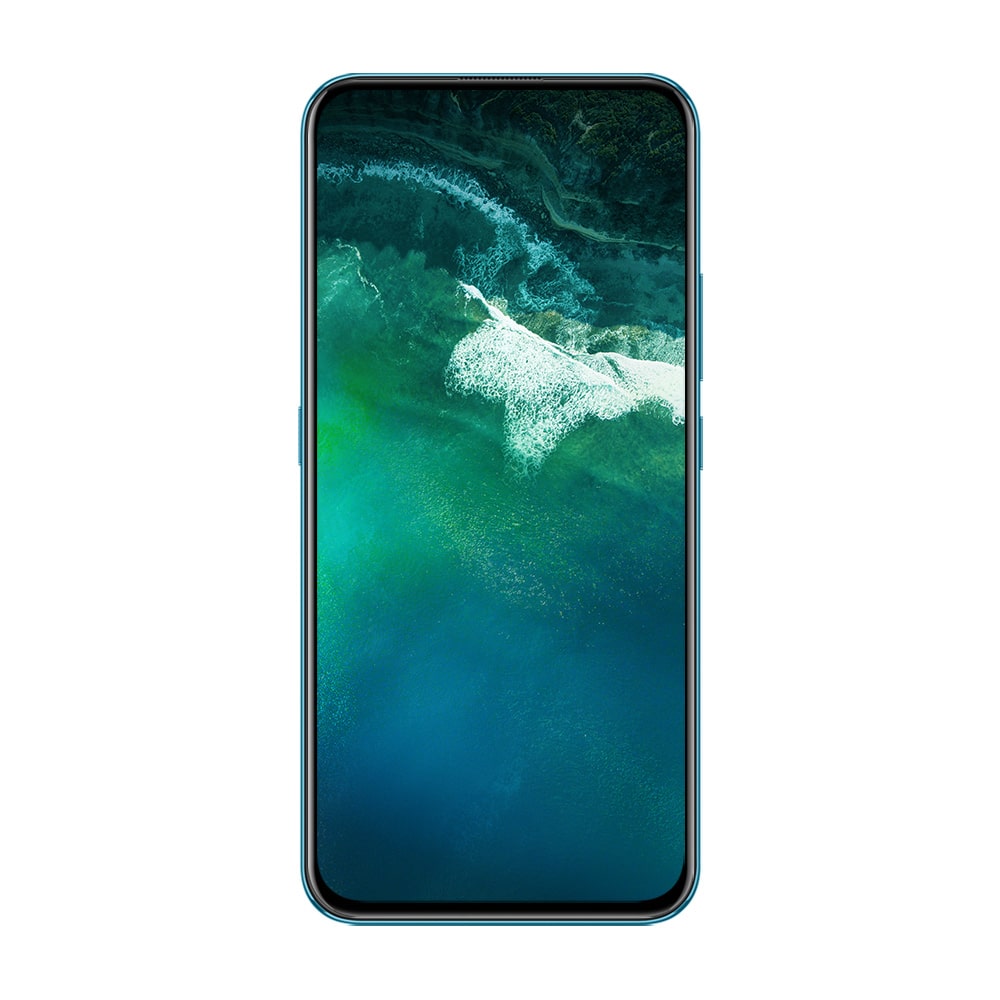
Coming to the rest of the hardware, the Vivo V17 Pro features a 6.44-inch Super AMOLED display with 2340 x 1080p resolution. It is a true full-screen display, all thanks to the pop-up design and boasts 91.65% screen to body ratio.
The phone is powered by a Qualcomm Snapdragon 675 processor with 8GB of RAM and 128GB of internal storage. As for the battery, the phone has a 4100mAh battery and supports 18W fast charging.
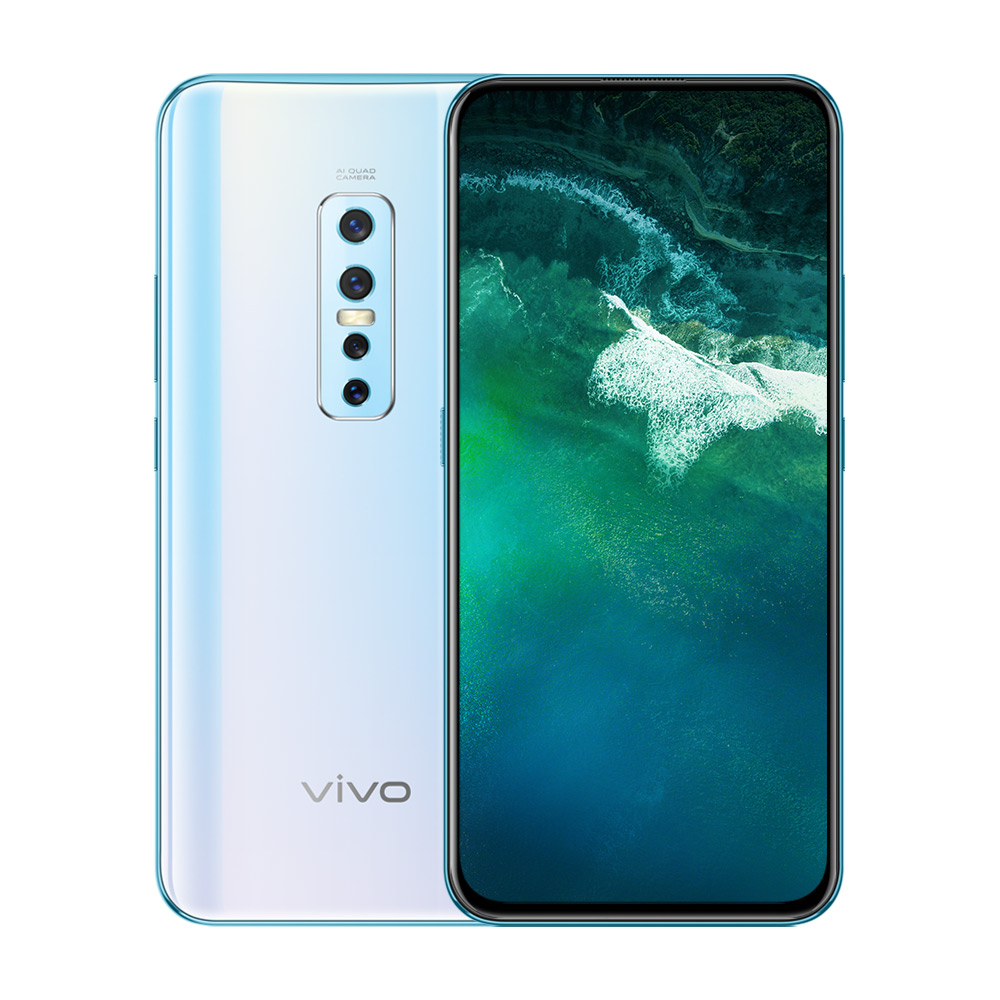
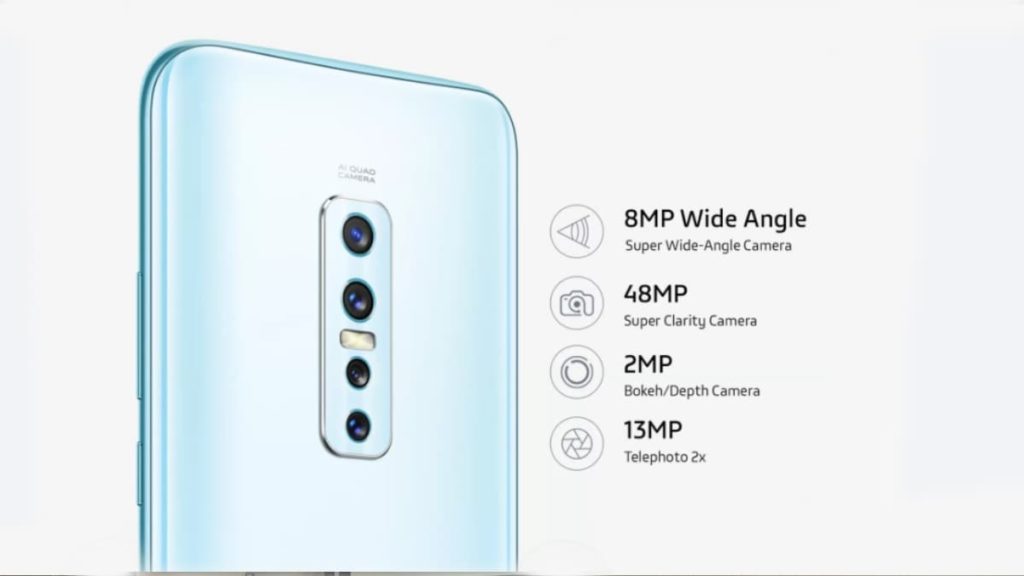
If the front camera didn’t impress you, then let’s have a look at its rear camera setup. The company has used a quad-camera setup on the back featuring a 48MP Sony (IMX582) primary sensor with f/1.8 aperture, an 8MP f/2.2 AI Super-wide angle lens, a 13MP f/2.5 telephoto lens that supports 2x optical zoom (10x digital zoom) and a 2MP f/2.4 depth sensor. You can expect the usual set of camera features onboard such as portrait mode and Super night mode.
The phone is relatively thick at 9.8mm and weighs 201 grams. Other features include BL 5.0, Wi-Fi dual-band, Android 9 Pie-based Functouch OS 9.1, and an in-display fingerprint sensor.
Vivo V17 Pro Pricing & Availability
Vivo V17 Pro goes on sale at Rs. 29,990 ($423) for the 8GB+128GB storage variant. There are two color options available, Midnight Ocean and Glacier ice. Pre-orders are already open in India and the first sale starts on September 27 via Vivo’s eShop, Flipkart, Amazon, Paytm and Tata Cliq.
The company has several HDFC and ICICI credit card offers alongside no-cost EMI option. Vivo is also offering a limited one-time screen replacement for the device.
Oppo-backed Realme has already confirmed that the Realme X2 smartphone will be launched in China at an event on 24th September. Later, Francis Wang, Chief Marketing Officer of the company confirmed that the upcoming X2 is the re-branded version of XT for the Chinese market.
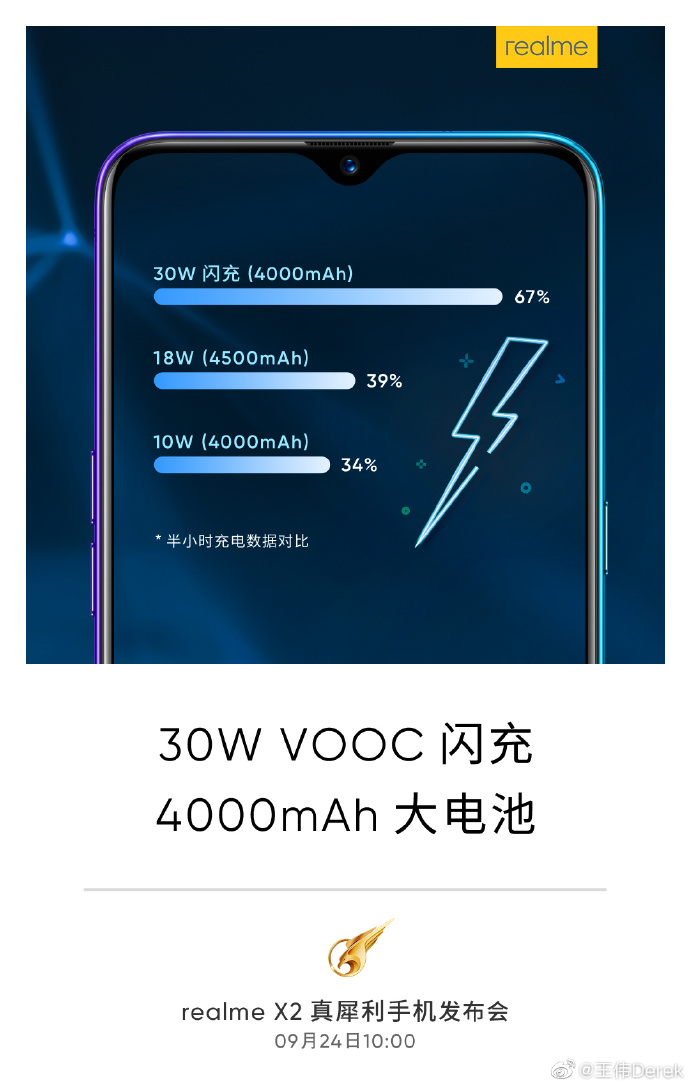
In the latest teaser shared by the company, it has been confirmed that the smartphone will be powered by a 4,000mAh battery and will come with 30W VOOC fast charging technology. The company claims that it can get charged up to 67 percent in 30 minutes.
The image shared by the company compares this 30W charging technology with 18W and 10W charging technology which can charge 4,000mAh battery to 39 percent and 34 percent respectively in 30 minutes.
In the past few days, the company has confirmed that the Realme X2 will come powered by Qualcomm Snapdragon 730G chipset and will be featuring a 32-megapixel front-facing camera for taking selfies and video calling.
Apart from these changes, we expect that most of the specifications on the Realme X2 will remain the same as Realme XT. It will feature 6.4-inch S-AMOLED Full HD+ display with 2340 x 1080 pixels screen resolution, and 19.5:9 aspect ratio. It will come with up to 8GB RAM and 128GB internal storage.
The quad camera system on the phone will consist of 64-megapixel Samsung GW1 primary camera sensor, an 8-megapixel ultrawide lens, a 2-megapixel dedicated macro camera and a 2-megapixel depth sensor. The smartphone will be running Android 9 Pie operating system out-of-the-box with ColorOS on top.
Looking at the features and specifications of this Realme X2 smartphone, it seems that the phone isn’t a rebranded version of the Realme XT but is a renamed variant of Realme XT 730G which is slated to go official in India later this year, in December.
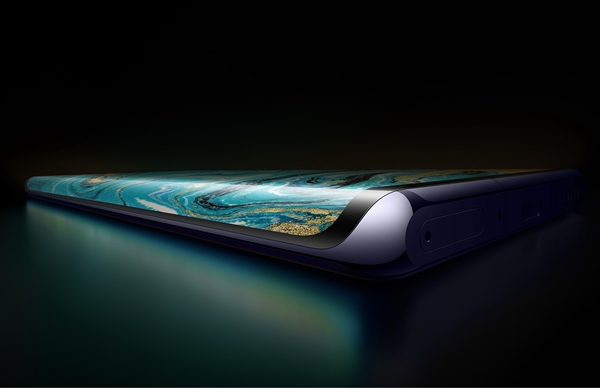
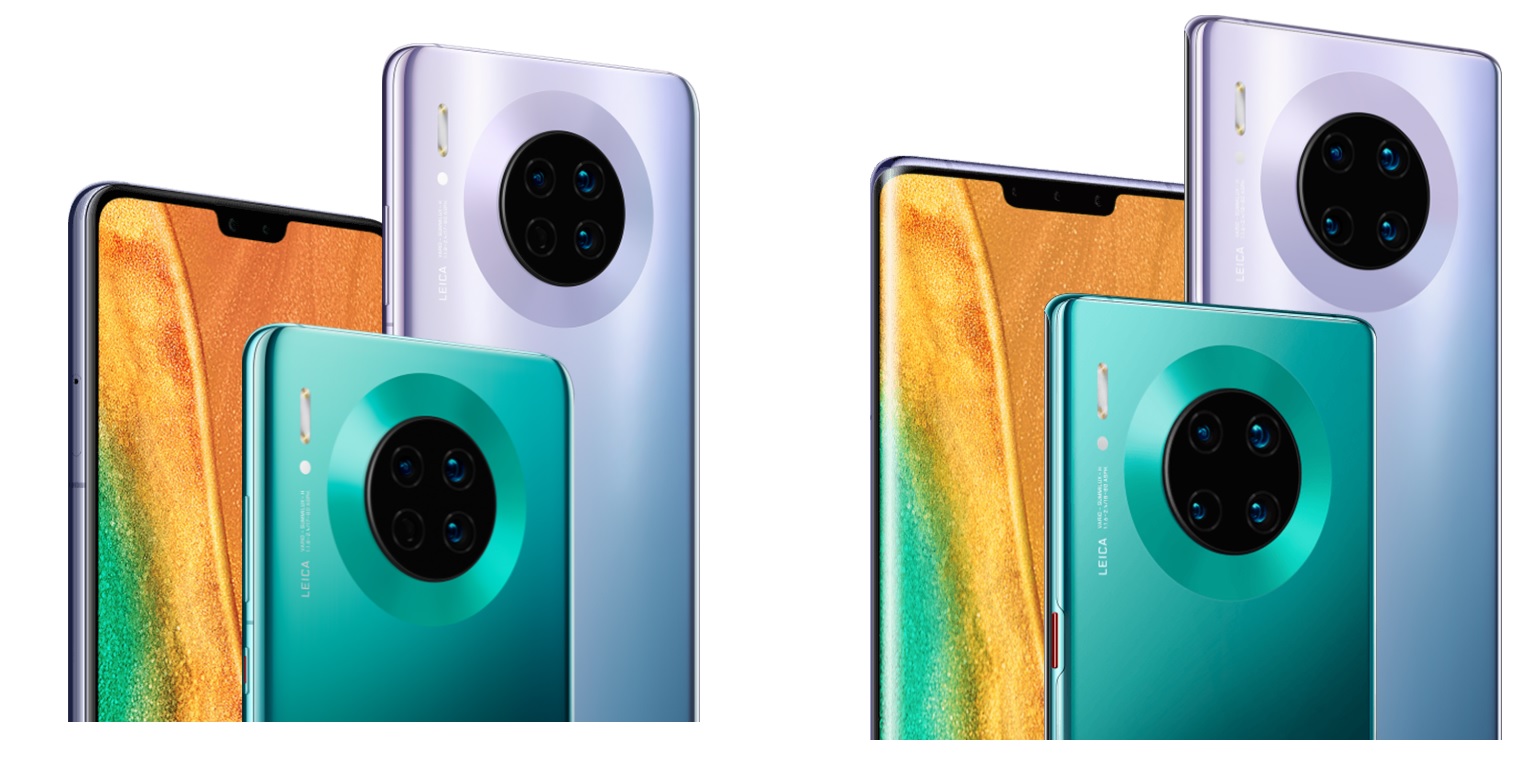
The new Huawei Mate 30 Pro has a curved display that’s a lot more impressive than curved displays from other companies like Samsung and Apple. This is mainly because it curves at an intense angle of 88°, basically forcing the display to curve around the edges of the phone and forming a traditional phone grip.
This looks very cool and nice, but many people have brought up that this might lead to accidental touches from the side. Thankfully, Huawei VP Bruce Lee has addressed this, revealing that the curved parts of the Huawei Mate 30 Pro‘s display will not be able to affect the content that’s on the main screen.
According to Bruce Lee, Huawei has divided the main screen of the mobile phone into three areas, the flat display in the middle, and the bending area on both sides of the device. Touching the bending areas on either side will not affect the flat main display, though they will and can be used to bring up the smart touch volume controls.
This effectively means that the curved display will never get in the way of your usage with accidental touches and what not. It’s reassuring to know, and a good amount of foresight on Huawei’s part. Regarding the actual volume controls however, we’ve heard some mixed responses. For now, Bruce Lee feels that the touch volume controls are convenient and hopes consumers will get used to using them soon enough.
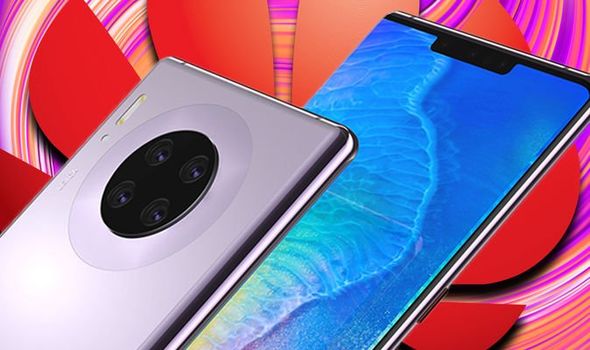
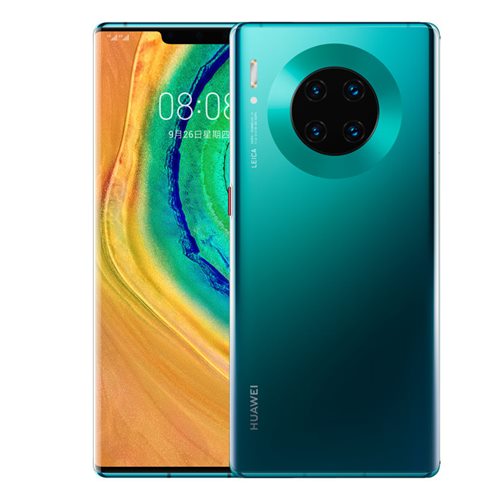
When the Huawei Mate 30 Pro launched yesterday, Huawei made sure to spend a lot of time talking about the new camera setup on the device. The specs of the camera are nothing short of an incredible, and it all sits in a brand new circular module that Huawei is calling the Halo Ring. It’s a refreshing change from the Mate 20’s square shaped module, but why exactly is it a circle now?
According to Huawei VP Bruce Lee, the new camera module is to show off the prevent design stagnation and show off the company’s progress. Every single iteration of the Mate devices has changed up the cameras modules to keep things interesting and fresh. It’s also meant to be somewhat reminiscent of a DSLR camera, highlighting the device’s camera performance.
Huawei’s Mate 30 Pro’s camera is the result of iteration from multiple generations of Mate devices. All of this development has led to today’s result, which Huawei hopes will lead the pack when it comes to design. Huawei wants their own design language to form a trend within the smartphone market, similar to Apple with their iPhones.
The Mate 30 Pro series boasts an impressive camera setup. The quad cameras on the back are a SuperSensing 40MP f/1.6 camera with OIS, a 40MP Cine f/1.8 camera, an 8MP f/2.4 telephoto camera with OIS, and a 3D depth-sensing camera. The phones also have a dual-LED flash, a laser focus sensor, and a color temperature sensor. The selfie camera is a 32MP f/2.0 sensor and with the 3D sensor.
We’re honestly very eager to see more about the new Huawei Mate 30 Pro. It seems like an extremely interesting device, between its lack of Google apps to its sophisticated camera setup. We’d love to test it out and give it a go just to see how it runs. What do you think about the Mate 30 Pro? Tell us your thoughts and opinions down in the comments below.
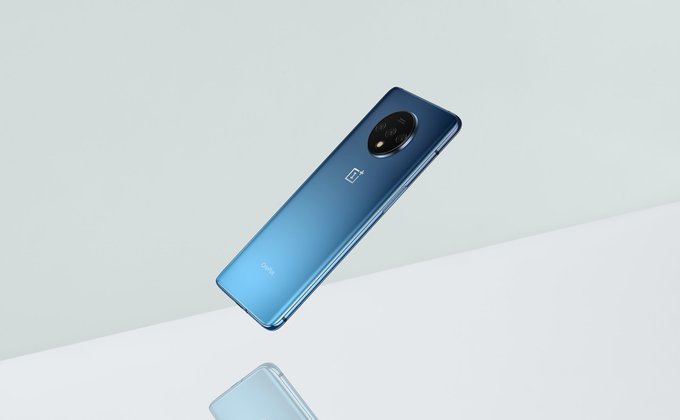
OnePlus has scheduled a launch event on 26th September where the company will be launching its new OnePlus 7T series smartphones and the all-new OnePlus TV. The company’s CEO Pete Lau has already showcased the design of the upcoming smartphone.
Now, a new report has surfaced online which says that the OnePlus 7T will come with 23 percent faster charging compared to its predecessor, thanks to the support for company’s proprietary Warp Charge 3T fast charging technology.
OnePlus 7T
Pete Lau, CEO of OnePlus said to TechRadar: “We believe that Warp Charge 30T offers the best charging solution for real-world usage. You can charge the phone at 23% faster speeds, even while using the device.”
He added that the company is not going to introduce something just for the sake of being first. Explaining why it didn’t come to the OnePlus 7 Pro launched earlier this year, he said “We took time to refine and iterate, continuously testing until we were able to achieve something we were proud to provide to our fans.”
He explains that unlike most fast charging solutions, OnePlus’ Warp Charge 30 handles the power management inside of the power brick instead of inside the phone. This keeps the phone cool, allowing for fast charge rates even when the phone is in use, says Lau.
The technology used by OnePlus for fast charging is different from the one that the likes of Samsung and Huawei have adopted. Compared to other fast charging technology that rely on high voltage, Warp Charge 30T delivers 6A at 5V to attain 30W.
While 30W charging is fast, it is not as fast as other flagship smartphones. For instance, Huawei is offering 40W charging for its flagship smartphones while Xiaomi’s upcoming Mi 9 Pro 5G will also have support for 40W charging. On the other hand, Oppo Reno Ace will come with 65W fast charging.
One of the feature that most flagship smartphones offer and which OnePlus’ users have been demanding since a long time is wireless charging support. But they will have to wait a bit longer as the OnePlus 7T will also not support wireless charging as OnePlus believes that the technology doesn’t offer experience that the company wants to offer.
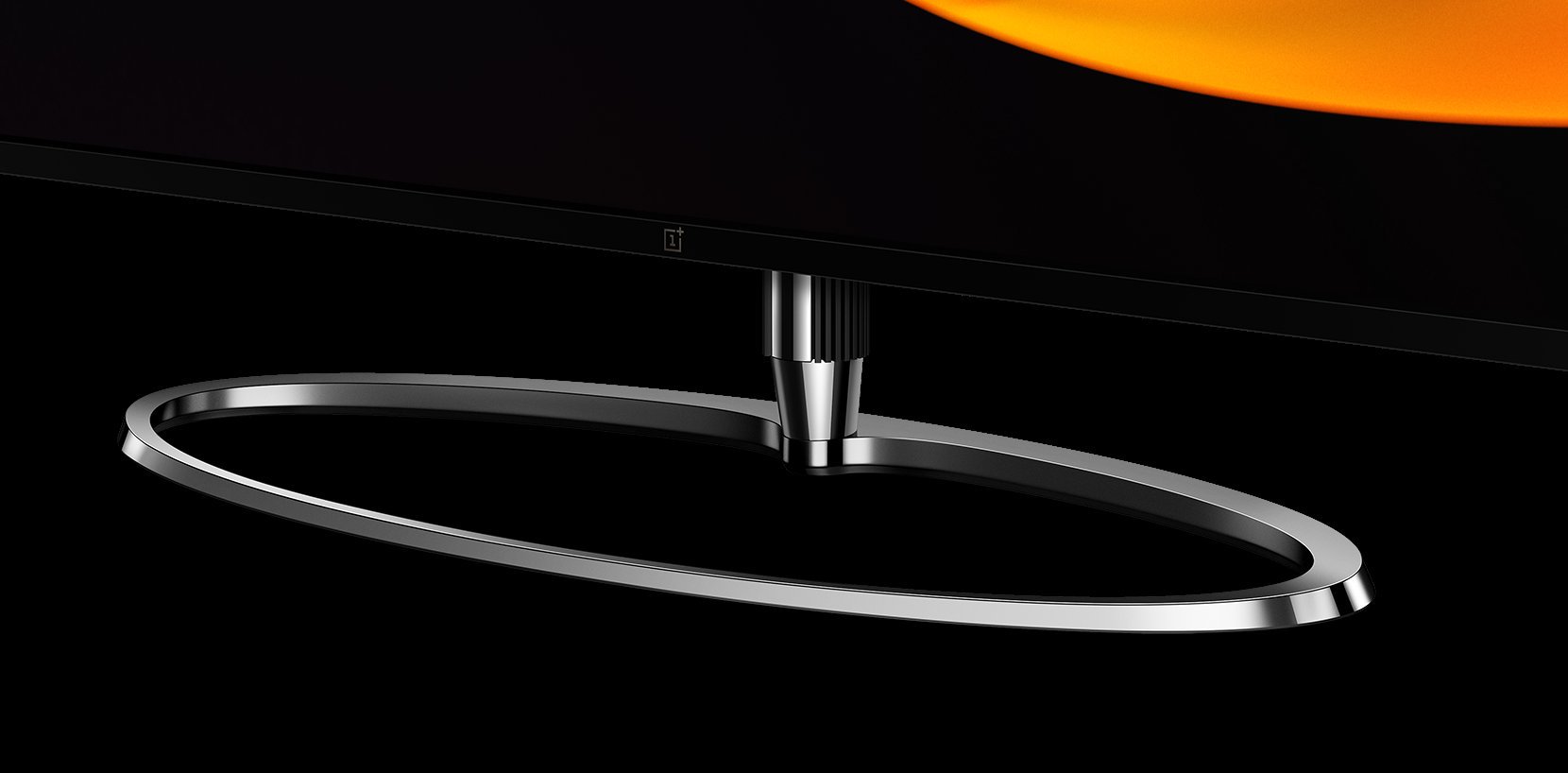
Along with the OnePlus 7T series smartphone, OnePlus TV is also getting launched on 26th September in India. While the company has shared a few details about the upcoming smart TV, a new teaser shared by Pete Lau show the metal stand that will hold the OnePlus TV.
The image shows the OnePlus TV metal stand in silver color and will hold the 55-inch screen of the OnePlus TV. Overall, the stand appears to have a minimal design, similar to the remote control of the TV which was shared earlier.
Xiaomi TV general manager Li Xiaoshuang went to Weibo earlier today to detail the brand new chipset that will come in most of their new TVs. Interestingly, he says that the new Xiaomi Mi TV Pro comes with an Amlogic chip built on a 12 nanometer process. The chip was built in collaboration between the two companies, and Xiaomi seems to be proud of it.
Compared with the previous generation chipsets, Xiaomi touts that the overall performance of the new chip has improved by 63%, while the power consumption was reduced by up to 55%. Considering how the previous Xiaomi boxes and TVs already had pretty good performance, we’re eager to see how the new chipset stacks up.
It also makes a lot of sense that Xiaomi would begin preparing more powerful chipsets for their future devices. We already know that the company will be releasing their first 8K TVs, the Mi TV PRO 65-inch and 55-inch, later this month on the 24th. It only makes sense that higher resolution content streaming is going to require more power to run smoothly.
The brand new Mi TV PRO devices offered by Xiaomi will come in 55-inch and 65-inch display sizes. Now that we know the chipset it’ll run, the only pieces of the mystery left are the other specifications and the pricing of the TVs. We can assume it’ll be more expensive than the previous Mi TVs, though we’ll have to wait for the official launch for confirmation.
Xiaomi’s custom Android skin MIUI is about 9 years old and the company is all set to introduce a new version of the same, dubbed MIUI 11 at a launch event next week in China along with Mi MIX 4/Mi MIX ALPHA and the Mi 9 Pro 5G smartphone.
Ahead of the official announcement, the company has started teasing some of the features of the MIUI 11 operating system. In the latest update, Xiaomi has revealed a new “life saving” feature — Earthquake warning.
Xiaomi’s product director and general manager of MIUI experience has confirmed this feature through a post on Weibo. He said: “In addition to life and work, we are also very concerned about the personal safety of everyone. Before SOS emergency help, there is another new member in the ‘MIUI Care Series’ – earthquake warning.”
He added that the company uses system-level information access capabilities to work with organisations with sophisticated earthquake warning capabilities to provide timely warnings in the event of an earthquake.
When there’s a possibility of an earthquake in the surrounding area, the mobile phone will give you a notice for the same through a pop-up window and the alarm sound. In addition to that, it will also provide information about the nearest emergency shelter, emergency contact details, medical contacts, and the rescue information to help in critical moment.
Recently, the company confirmed that the the upcoming MIUI 11 OS has focused on making the animations slightly slower and thereby making them richer in detail and the company says that faster and smoother animations make for better user experience.
MIUI 11 will also come with a new feature called Children’s Space to help parents with raising kids and keeping them entertained. It will feature several high-quality educational and entertainment apps designed for kids. Parents will be able to customize app access and duration of use. According to Xiaomi, the Children’s Space will be completely separated from the parent’s own space.
This new operating system from Xiaomi will be officially announced at an event in China on 24th September where the company will also launch its Mi MIX 4 and Mi 9 Pro 5G smartphones as well as Mi TV Pro 8K.
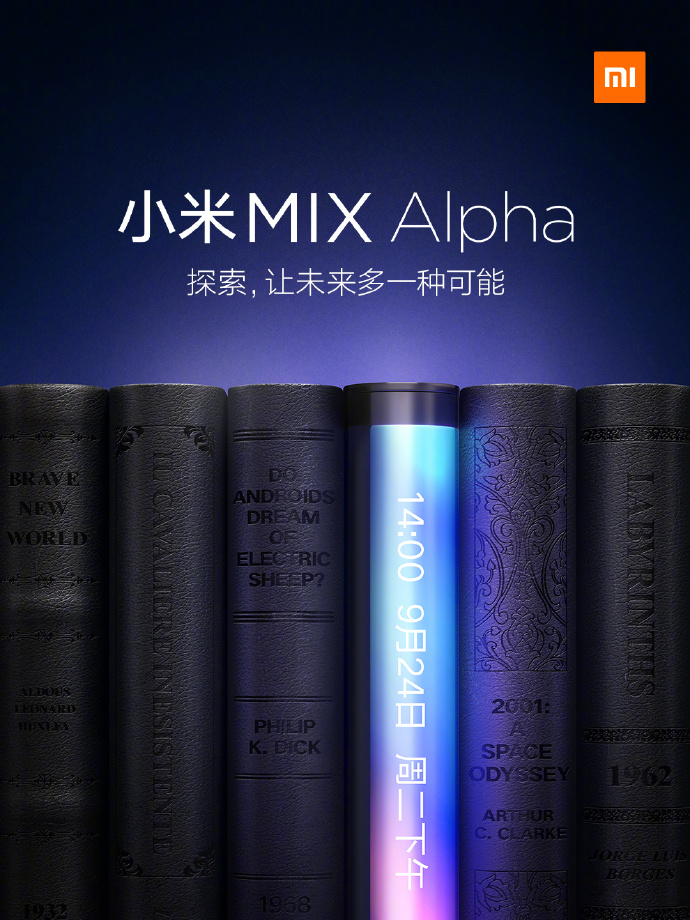
UPDATE: Xiaomi has posted two new teasers further adding fuel to the Mi Mix 5G being foldable smartphone speculation. First, the company confirmed that its called the Alpha, which is usually what the first version of a product is called. Second, the new teaser hints that the Mix 5G is nearly as thick as a book and features a really curved display that extends to the back.
Original Story as follows.
Xiaomi’s upcoming Mi 9 Pro 5G has been teased quite well over the past few days, however, we haven’t heard much about the second model meeting us next week, the Mi Mix 5G. Now a teaser of the Mi Mix 5G has been posted and it reveals something really interesting.
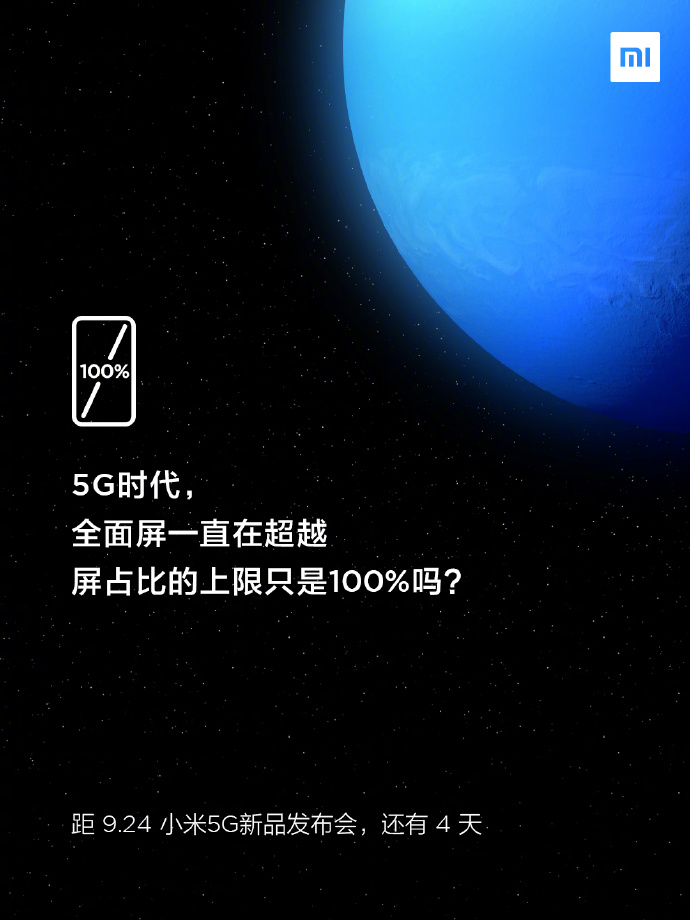
The new Mi Mix 5G teaser asks us “Is 100% screen to body ratio really the upper limit?”. If this doesn’t build up speculations about the phone being foldable, then how about a leaked teaser image? A glimpse of the Mi Mix 5G’s side reveals extremely curved display sides. In fact, it looks even more curved than a waterfall display found on the NEX3 and Mate 30 Pro. Could this be an indication that the phone’s display folds inwards from the left?
Leaked poster of the Mi Mix 5G and Mi 9 Pro 5G
This speculation is actually not very far fetched. Xiaomi’s Mi Mix series has always been a concept lineup featuring new generation designs. And don’t you think that the phone in the teaser looks awfully similar to Xiaomi’s foldable smartphone that was shown off a few months back? Imagine if that screen was folded, with the left and right sides of the display folded towards the back. Now, look at the leaked image of the Mi Mix 5G.
While a foldable Mi Mix 5G isn’t a far fetched idea, it’s also possible that this render is showing off a waterfall display like the NEX 3. Even in this leaked image, there’s a black outline at the back which could mean that the screen ends at the curved sides. Unfortunately, you can’t make accurate conclusions based on such renders as they often differ from the real device.
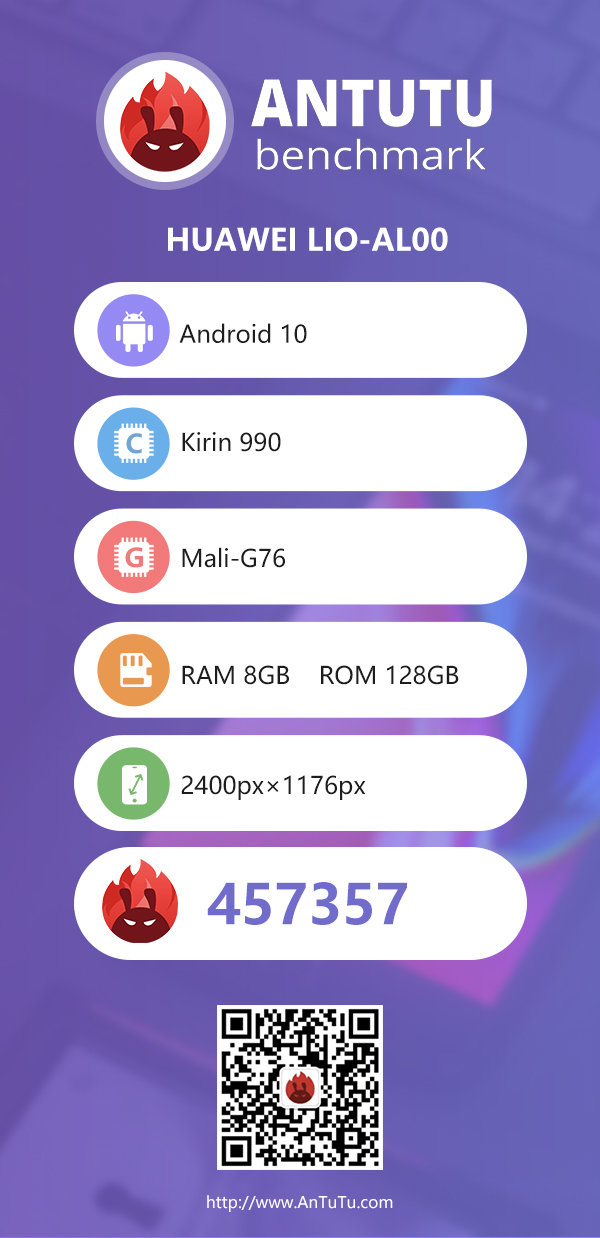
Huawei has launched its flagship smartphone Mate 30 Pro powered by the company’s own Kirin 990 chipset, which has now been benchmarked by AnTuTu. The benchmark result shows the highest score from a device powered by Kirin 990 SoC.
The chipset has managed to score 457,357 points in the benchmark test. While the score is highest for the Kirin 990-powered device, it is still lower than the highest score of a device powered by Qualcomm Snapdragon 855 Plus chipset.
The device tested for this Kirin 990 benchmark is Huawei LIO-AL00, which is the Mate 30 Pro. It features a screen resolution of 2400 x 1176 pixels, Kirin 990 processor, Mali -G76 GPU, 8GB RAM, 128GB storage, and is running the latest Android 10 operating system.
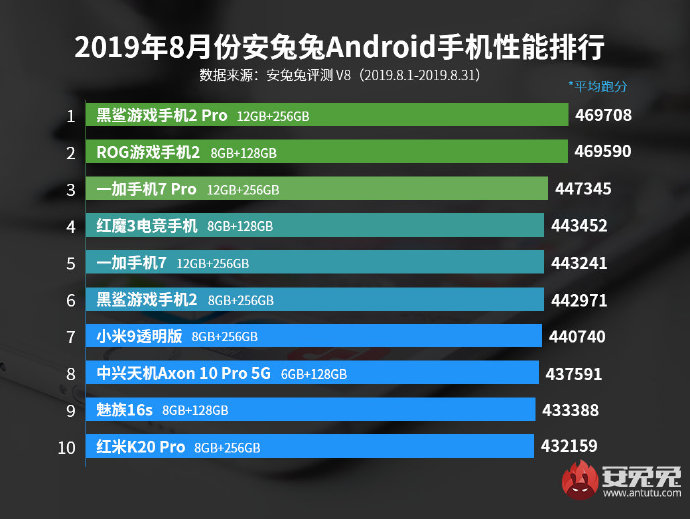
While the overall score of the device is 457,357, the smartphone has scored 151,647 points for CPU, 159,418 points for GPU, MEM score of 87,367, and UX score of 58,925 points. In the AnTuTu ranking, the highest scoring device is Black Shark 2 Pro with 469,708 points, followed by ASUS ROG Phone 2 with a score of 469,590 points.
Earlier, in the AI Benchmark test, Huawei HiSilicon Kirin 990 5G chipset was ranked ahead of the Qualcomm Snapdragon 855 Plus SoC, topping the rankings. The chipset has achieved a score of 52,403 in the test, far ahead compared to the scores of Unisoc Tiger T710 and Qualcomm Snapdragon chipsets.
The Huawei Kirin 990 5G is a 7nm octa-core chipset that has 10.3 billion transistors. It uses two big, two middle and four little cores to optimise multitasking, with clock speeds of 2.86GHz, 2.36GHz and 1.95GHz respectively. It also packs a 16-core Mali G76 graphics processor which should offer plenty of power for mobile gaming, as well as smart cache built in to reduce bandwidth by up to 15 percent.
It is also touted to be the first full-frequency 5G SoC — with support both non-standalone and standalone architectures as well as TDD/FDD full frequency bands. The Kirin 990 is a true unified design, supporting Sub-6 GHz 5G networks on both SA and NSA architectures.
For photography, it has a new fifth-generation Dual ISP boasts DSLR-level hardware noise reduction and block-matching and 3D filtering. Aside from implementing the 5G modem, the biggest change in the Kirin 990 is going to be the NPU which is a co-processor optimised for the sort of vector math that’s the lifeblood of machine learning frameworks.
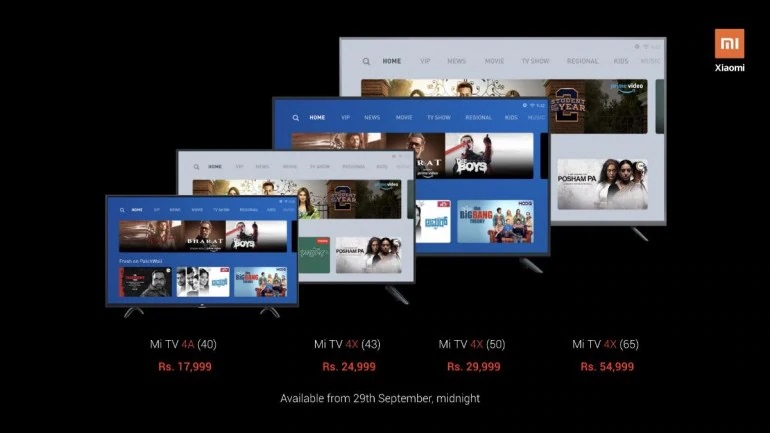
If you are wondering if the updated interface will be hitting old Mi TV models, Xiaomi has got a response for you. The tech giant has announced that indeed all previously launched Mi TVs will get Android Pie support as well. The company disclosed that older Mi TV models such as the Mi TV 4A Pro 43-inch, Mi TV 4A Pro 49-inch and Mi TV 4 Pro 55-inch. The update will also bring along support for Netflix and Amazon Prime.
Xiaomi had earlier commenced recruitment of testers for Android 9 early access program for the Mi TV 4A series as far back as July. The Mi TV 4C Pro 32-inch and Mi TV 4A Pro 32-inch started receiving their Android Pie update late last month. However, no date has been announced for the rollout of the update but Xiaomi did reveal it will be sometime in Q4 2019.
Xiaomi’s Mural TV is just like LG’s Wallpaper TV!
PatchWall 2.0 brings on board several tweaks like a Light Theme and a carousel view. The new interface also comes along with Live News integration which delivers real-time news updates on one single screen.
The Mate 30 and Mate 30 Pro launched today as Huawei‘s latest flagships. Just like other phones with standard and Pro models, the Mate 30 and Mate 30 Pro have some very key differences. We highlight those differences below.
Parameter
Mate 30
Mate 30 Pro
Display and Resolution
6.62-inch Rigid OLED FullView Display
2340 x 1080
6.53-inch Flex OLED 88° Curved Horizon Display
2400 x 1176
RAM and Storage
8GB RAM
128GB storage
8GB RAM
256GB storage
Rear Cameras
40MP f/1.8 1/1.7'' SuperSensing Camera (ISO 204800)
16MP f/2.2 Ultrawide Angle Camera with 2.5cm Macro Photography
8MP f/2.4 Telephoto Camera with OIS, 3x optical zoom, 5X hybrid zoom, and 30X digital zoom
40MP f/1.8 1/1.54'' Cine Camera - Ultrawide Angle, Ultra low-light, and Ultra slow-motion at 7680 fps
40MP f/1.6 1/1.7'' SuperSensing Camera with OIS (ISO 409600)
8MP f/2.4 Telephoto Camera with OIS, 3x optical zoom, 5X hybrid zoom, and 30X digital zoom
3D Depth Sensing Camera
Selfie Camera
24MP f/2.0 camera
32MP f/2.0 camera
3D Depth Sensing Camera
Ports and Sensors
Infrared Sensor
3.5mm Audio Jack
In-display fingerprint scanner
Infrared Sensor
In-display fingerprint scanner
3D Face Unlock
Gesture Sensor
IP Rating
IP53
IP68
Wireless Charging
Wireless Huawei SuperCharge 27W
Wireless Huawei SuperCharge 27W
Upgraded Wireless Reverse Charging
Price
€799
€1099
Conclusion
The Mate 30 Pro misses out on the Horizon Display but not everyone is a fan of curved displays. Plus the Mate 30 Pro’s display will definitely cost more to repair compared to the Mate 30. The Mate 30 also keeps the audio jack which has been missing on the Pro version since the Mate 10 Pro. Unlike last year’s Mate 20, the cheaper Mate 30 gets support for wireless charging and it is amazing to see it charges at the same speed as the Pro variant.
The Mate 30 Pro costs more and for €300 extra, you get a sharper and more gorgeous display. You also get 3D Face Unlock, reverse wireless charging, and an IP rating. It also packs some pretty cool party tricks such as 7680fps slow-motion recording thanks to its 40MP Cine Camera, Gesture Control thanks to the gesture Sensor up in front and invisible virtual keys. There is also an upgraded wireless reverse wireless charging so you can bail out your friends at 3x the speed of last year’s model.
Vivo is always striving to blaze the trail as far as innovation is concerned. The Chinese tech giant did it with the NEX which took the concept of bezel-less display to the extreme. The BBK subsidiary is set to launch yet another innovative smartphone that adopts the moniker Vivo V17 Pro. The device has already been revealed to launch on September 20. Right now, the price of the device has been tipped to be around Rs. 27,999 ($397).
The Vivo V17 Pro will be arriving as world’s first phone with dual pop-up selfie cameras. The wider pop-up module is expected to feature a 32-megapixel primary lens and a depth sensor of 2-megapixel. The rear shell of the phone has a quad-camera system. It comprises of a 48-megapixel main lens, an ultrawide lens of 8-megapixel and a pair of 2-megapixel lenses.
As for other hardware, the device packs a 6.59-inch S-AMOLED display with full HD+ resolution of 1080 x 2440 pixels. The display of the V17 Pro is embedded with an in-screen fingerprint reader. The Snapdragon 675 mobile platform is present under the hood of the device. The handset will come with 8 GB of RAM. The handset will be equipped with a native storage of 128 GB. The Android 9 Pie OS based FunTouch OS 9 UI is loaded on the device. It will be backed by a 4,100mAh battery.
In addition, the V17 Pro will come with 6GB/8GB of RAM and 128GB storage. It will run Android 9 Pie OS with some customisation. The phone will be an online-only device which will be sold exclusively through Flipkart. Already, the Flipkart product page is live but shows the phone is coming soon.
If you are a tech buff or a gadget lover, you probably spend tens of thousands of dollars on high-end electronic items such as smartphones, tablets, laptops, etc. Those who aren’t willing to spend a fortune on their favorite gadgets usually settle for a low-priced, inferior alternative.
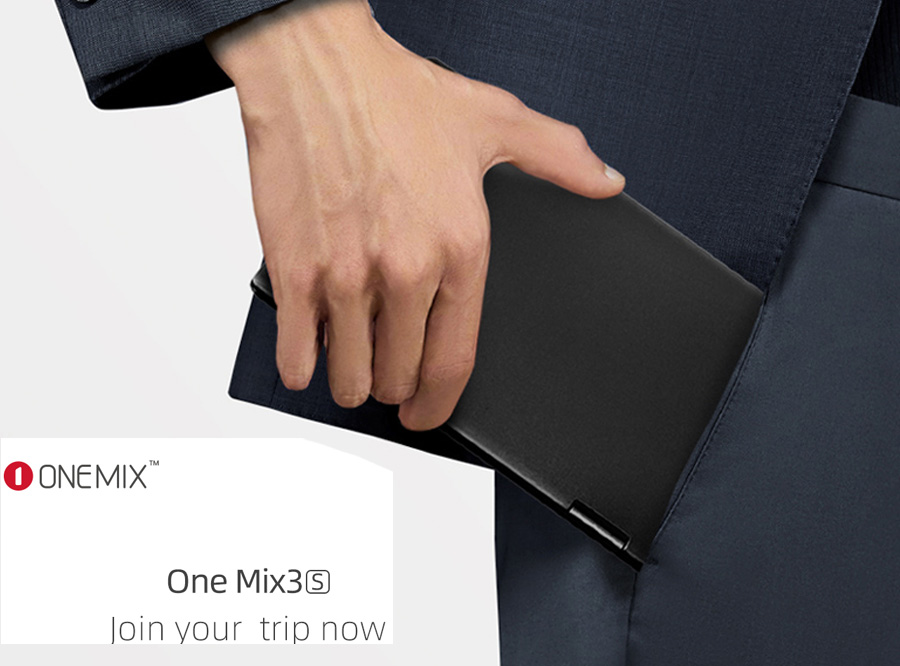
Much to the relief of electronics lovers that have been refraining themselves from buying their favorite devices due to the steep price tags they carry, GeekBuying has launched the One Netbook One Mix 3S Sale. The promo not only gives you a chance to get your tech greedy hands on all sorts of electronic items such as laptops, but it also offers free goodies.
As part of the promo, GeekBuying is doling out noteworthy discounts on top-end laptops, tablets, and smartphones. These products have carefully been divided into Free Goodies, Laptops & Tablets, and Smartphones categories.
We will be checking out the discounts that you can avail on two models of the One Netbook One Mix 3S Yoga Pocket Laptop, and shed light on the gift sets that you get with each model. So without wasting more time, let’s delve straight into the details.
[Gift Set 2]One Netbook One Mix 3S Yoga Pocket Laptop
This model of the One Mix 3S Yoga Pocket Laptop comes with two gifts. In Gift Set 2, you get the original stylus pen, as well as the QCY T2C Bluetooth 5.0 TWS Earbuds with your order.
The aforesaid model usually retails for a whopping $1072.99, but you can now buy it for a lowered price of just $929.99 from GeekBuying. Moreover, you can extend this 13 percent discount with the help of coupon code 3QPUREBG.
The aforesaid coupon helps you grab an extra $14 off. In other words, you can bring the already lowered asking price of the laptop further down to just $915.99 simply by applying the coupon at checkout.
You can visit this link to avail the discount and use the coupon before it expires. Note that the promo is slated to end in just two days.
[Gift Set 1]One Netbook One Mix 3S Yoga Pocket Laptop
This model comes with the Gift Set 1 that comprises wipes, HDMI male to male cable, wired mouse, protective film, and a PU protective case, and that’s not all. The One Mix 3S Yoga Pocket Laptop usually retails for $1203.99, but GeekBuying is giving its loyal users a chance to buy it for just $899.99.
This is a noteworthy 25 percent reduction in the device’s original asking price. Moreover, you can save $14 more by applying coupon code 3QPULHKA during the checkout process.
As a result, the original selling price of the laptop reduces to just $885.99 even before you place your order. You can follow this link to take advantage of the coupon, which is likely to expire soon. The promo is slated to end in just two days as well.
An absolute steal at this price, the One Netbook One Mix 3S Yoga Pocket Laptop offers the following features:
8.4-inch 2.5K display with 2560×1600 pixels resolution
Fingerprint recognition sensor
Intel Core M3-8100Y, Dual-Core, 3.4GHz Max processor
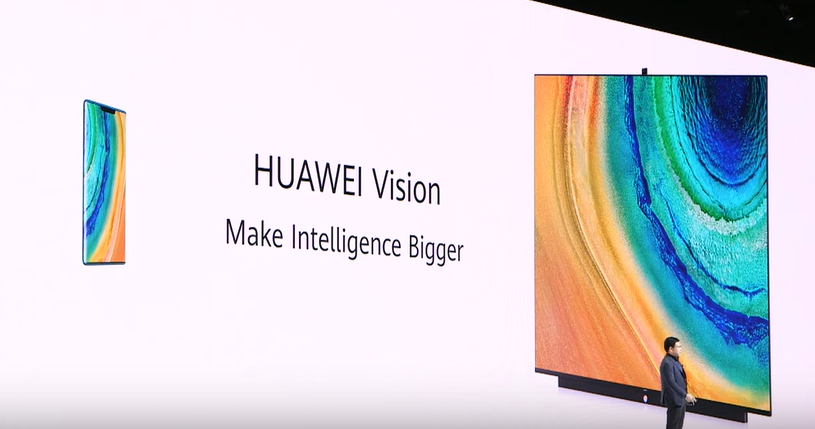
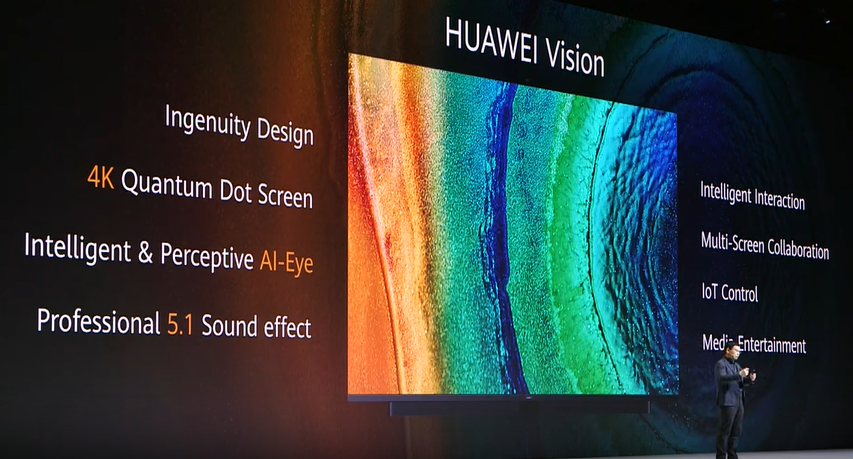
The Honor Vision launched as the first commercially available product powered by Huawei’s Harmony OS. Today, Huawei announced its own smart screen – the Huawei Vision which also runs Harmony OS. We actually wish they gave it a different name.
The Huawei Vision sports a 4K Quantum Dot display with a refresh rate of 120Hz and comes in 55”, 65”, 75”, and 85” versions. However, only the 65” and 75” models will be available for now. The other two sizes will come later. There is a Honghu Smart Chip inside for Huawei’s AI Picture Quality Engine.
Huawei doesn’t want you to call it a TV because it is much more than that. Nevertheless, you still get TV functions. The Huawei Vision is an IoT Hub for all your HiLink smart home products and is always listening for your commands.
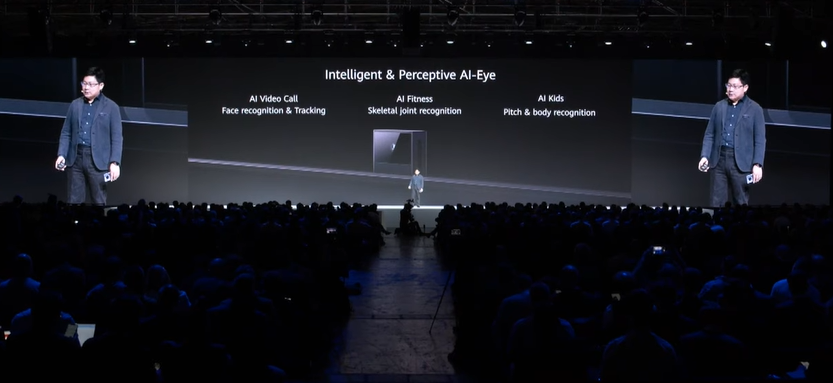
There is a motorized pop-up camera which Huawei calls AI-Eye similar to the one present in the Honor Vision Pro for video calls, face recognition and tracking, skeletal joint recognition (AI fitness), and AI Kids (pitch and body recognition for games).
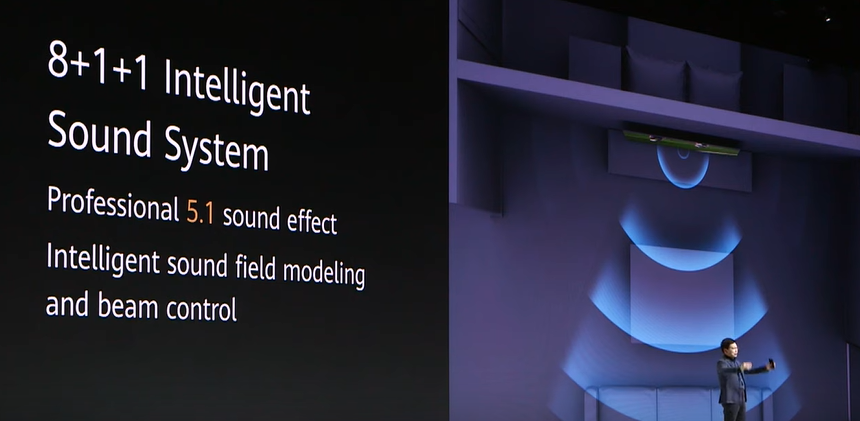
The Huawei Vision has an 8 (speakers) + 1 (subwoofer)+ 1 (refractor) intelligent sound system that provides a professional 5.1 sound effect. It also has intelligent sound field modeling and beam control.
The Huawei Vision supports One-Hop projection which allows users to project what is on their phone on to the display with a single touch to the remote. There is also Intelligent Live Control which allows you to control the device with your smartphone while Huawei Share allows you to easily send files like pictures to the TV.
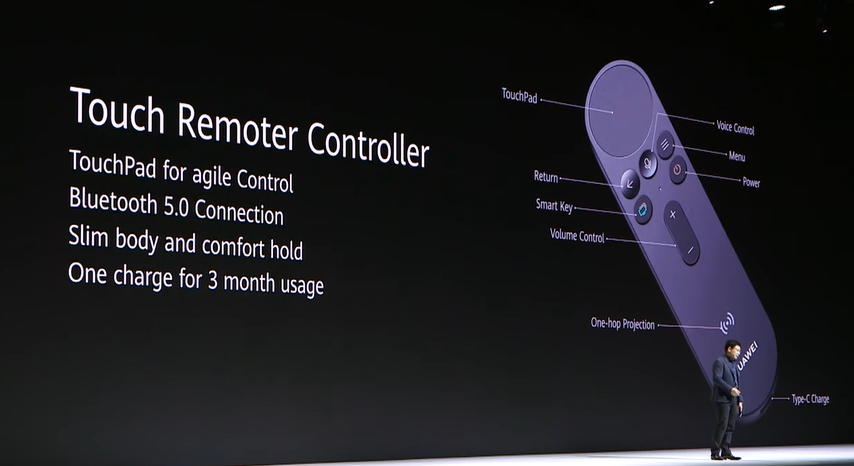
Talking about the remote, Huawei has gone with a controller with a circular touchpad at the top. There is a dedicated microphone button flanked on the left by the Return key and on the right by the Menu key. The remote also has a power button, a smart key, and volume control keys. At the base of the remote is the One-Hop chip area which you tap with your phone to seamlessly project what is on it on to the Huawei Vision a 60fps.
The touch remote controller connects via Bluetooth 5.0 and has a slim profile and should be comfortable to hold. There is a USB Type-C port at the bottom for charging it and Huawei says you only have to charge it once in 3 months.
Huawei didn’t reveal a price for the Huawei Vision but it will be available first in its home country of China before any other market.
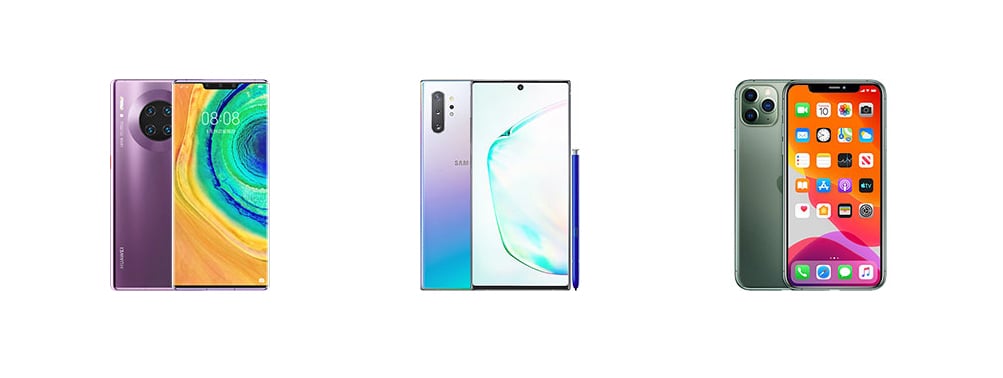
Samsung, Huawei, and Apple are currently the world’s most important smartphones manufacturers. Every time one of them releases a new top-tier, we compare it with the most powerful flagships of the two other rival companies. And this is exactly one of those comparisons. Right after the announcement of the Huawei Mate 30 Pro, here is a specs comparison between the new Huawei’s flagship, the recently-announced iPhone 11 Pro Max which is going to hit a lot of markets around the world, and the Samsung Galaxy Note 10+ announced last month which has been on sale for several days until now.
Huawei Mate 30 Pro vs Samsung Galaxy Note 10+ vs Apple iPhone 11 Pro Max
Huawei Mate 30 Pro
Samsung Galaxy Note 10+
Apple iPhone 11 Pro Max
DIMENSIONS AND WEIGHT
158.1 x 73.1 x 8.8 mm, 198 g
162.3 x 77.2 x 7.9 mm, 196 g
158 x 77.8 x 8.1 mm, 226 g
DISPLAY
6.53 inches, 1176 x 2400p (Full HD+), OLED
6.8 inches, 1440 x 3040p (Quad HD+), Dynamic AMOLED
6.5 inches, 1242 x 2688p (Full HD+), Super Retina XDR OLED
It is true, Huawei Mate 30 Pro still comes with a big notch, unlike its predecessor P30 Pro. But its design remains the most astonishing one thanks to the “Horizon” display: a front panel with extremely curved sides, without side bezels and even without physical keys. There is a side touch technology which replaces the volume balancer and, despite the sides create 88 degrees curves, you do not have to worry for your touch screen even if you touch the display with your palm. While the Huawei Mate 30 Pro has the most stunning design, iPhone 11 Pro Max comes with the best build quality. Its frame is made of stainless steel and the phone is waterproof up to 4 meters deep. Samsung Galaxy Note 10+ is definitely too big for an average user, it is a productivity phone, but it supports S Pen and that makes it the best device for productivity users.
Display
Each of these devices comes with a stunning display, but given the presence of the S Pen, an amazing color reproduction and a wider diagonal, I prefer the Samsung Galaxy Note 10+. However, iPhone 11 Pro Max offers a better 120 Hz refresh ratio and it may even boast better colors. We will give you a definitive verdict about the display quality after testing it. Despite the “Horizon” sides, we do not think Huawei Mate 30 Pro can compete with its rivals in terms of image quality.
Hardware/Software
If you are reading this paragraph because you want to know about the performances of these three flagships, first note that all of them might feature a different operating system with a different level of software optimization in the global market. Samsung Galaxy Note 10+ comes with Android, iPhone 11 Pro Max has iOS, and Huawei Mate 30 Pro may hit the European market with the new HarmonyOS and without Google apps. This said we believe iPhone 11 Pro Max will be the fastest and smoothest one thanks to its Apple A13 Bionic chipset and the wonderful software optimization of iOS 13.
Camera
With a double 40 MP sensor, the support to 7680 fps super slow motion videos, ISO up to 512,000, dual OS, 3x optical zoom, and much more, Huawei Mate 30 Pro features the best camera hardware out there. We are yet to discover how the algorithm will manage all the sensors and the hardware from its quad-camera, but on the paper, it wins the comparison.
Battery
Given that these handsets come with similar battery capacities and very different components, it is still too early to give you an opinion about their battery life. Two of them are still not in commerce, so we can not test them thoroughly. For now, just keep in mind that Huawei Mate 30 Pro has a bigger battery, a more efficient display than Galaxy Note 10+ and, unlike the iPhone 11 Pro Max, it features reverse wireless charging. Last but not least, it supports the fastest wireless charging technology with a 27W power.
Price
The Huawei Mate 30 Pro will start from €1,100/$1215, and that is the same for the Samsung Galaxy Note 10+. The iPhone 11 Pro Max is costlier as it starts from €1250/$1380. Note that Samsung Galaxy Note 10+ have 5G variants, while iPhone 11 Pro Max does not. If you are a productivity user, the S Pen is an important added value and given that there are no important differences in terms of performances, you should go for the Samsung Galaxy Note 10+. But if you do not care about it, iPhone 11 Pro Max is a more interesting choice with an amazing display and build quality. Huawei Mate 30 Pro is more or less at the same level: it is another amazing device, but it has a worse display. However, its rear camera hardware is superior.
The freshly launched Huawei Mate 30 series is the first phone from the company to fall under the ban issued earlier this year by the U.S. Commerce Department prohibiting American companies from selling goods or services to Huawei. As a result, Google isn’t allowed to provide what is a core part of the Android experience: Google Play Services.
Google typically licenses the latest version of Android, currently Android 10, for phone manufacturers to use, but the Mate 30 Pro devices opt for AOSP, the open source version of Android 10. This is the reason why Huawei has no choice but to omit Google apps, as the open source version of Android is completely bloat free and features no Google integration.
Google’s Play Services is an essential part of any Android device and it’s how the majority of Android-powered handsets outside of China get access to apps. Play Services is more than just a way for Google to pre-install its own apps. It is the conduit for notifications, maps, and security that most third-party apps take for granted.
Now of course, there are methods to remedying this, the key one being sideloading apps. Anyone who has used a custom ROM in any capacity is probably well aware of sideloading and flashing Google apps, but the problem with this is that it’s dependent on the user. Most users simply aren’t going to have the know how to sideload Google apps, let alone flash them.
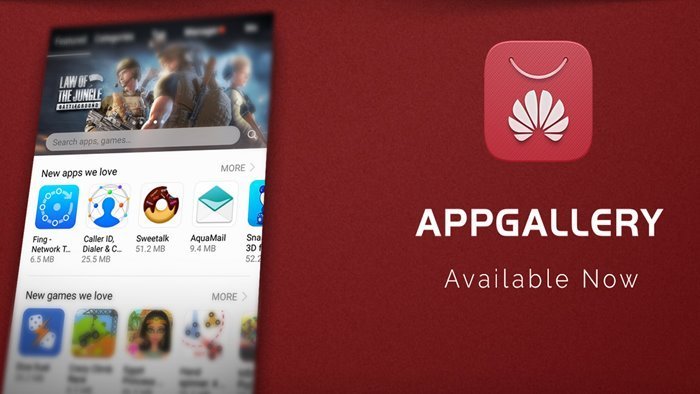
Instead, you’ll surf the web through the Huawei Browser and download apps through the Huawei AppGallery. The AppGallery has around 45,000 apps, according to Huawei, which is a respectable number all things considered. Unfortunately, when compared to the Google Play Store’s estimated 2.7 million apps, it’s a clear they aren’t on the same footing. Huawei’s app store doesn’t have nearly enough to compete.
So, how will Huawei improve their AppGallery exactly? According to Huawei CEO Richard Yu , the company will have an upcoming HMS Ecosystem Incentive Program, where it would invest $1 billion USD to encourage developers to build apps and get them marketed on Huawei phones outside China. It will even provide a greater revenue share to those developers — 85%, compared to the 70% that Google and Apple offer today.
During the briefing, Yu said, “We were forced to do this. We have a good relationship with Google, but the US government forced us to do this and we have no other option.” With the high prices of the Huawei Mate 30 devices, is it really fair to pay such an amount for devices that have been neutered? Tell us your thoughts down in the comments below.
It’s a bit surprising that the freshly launched Huawei Mate 30 series of devices is running Android at all. They all ship with the EMUI 10 user interface, which is based on Android 10, but as mentioned, will not be shipping with Google apps. Instead, users will use the Huawei App Gallery to download apps, which is a pretty big roadblock for many users.
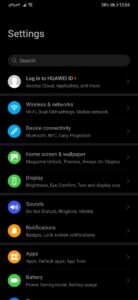
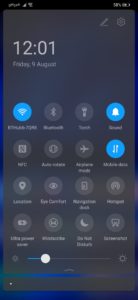
One would think that the Huawei should begin focusing less on their Android skin, and more towards making Hongmeng OS more suitable for smartphones, but Huawei seems to think otherwise. With the latest iteration of EMUI, the company seeks to address many of the complaints regarding its UI by introducing tweaks and features to it.
Flat and simple design approach
With EMUI 10, Huawei is applying a more modern twist to their overall design language. As is the tend, most interactable elements have been moved to the bottom of the screen for easy reaching. For example, the Contacts app now has a picture of the Contact takes up the top half of the screen, with all the clickable information over on the bottom.
This same design language has been applied to almost every section of EMUI 10, resulting in a clean and modern look. This is a really good move for Huawei. Making it easier to reach everything, and making the UI easier on the eyes.
Fluid and snappier animations
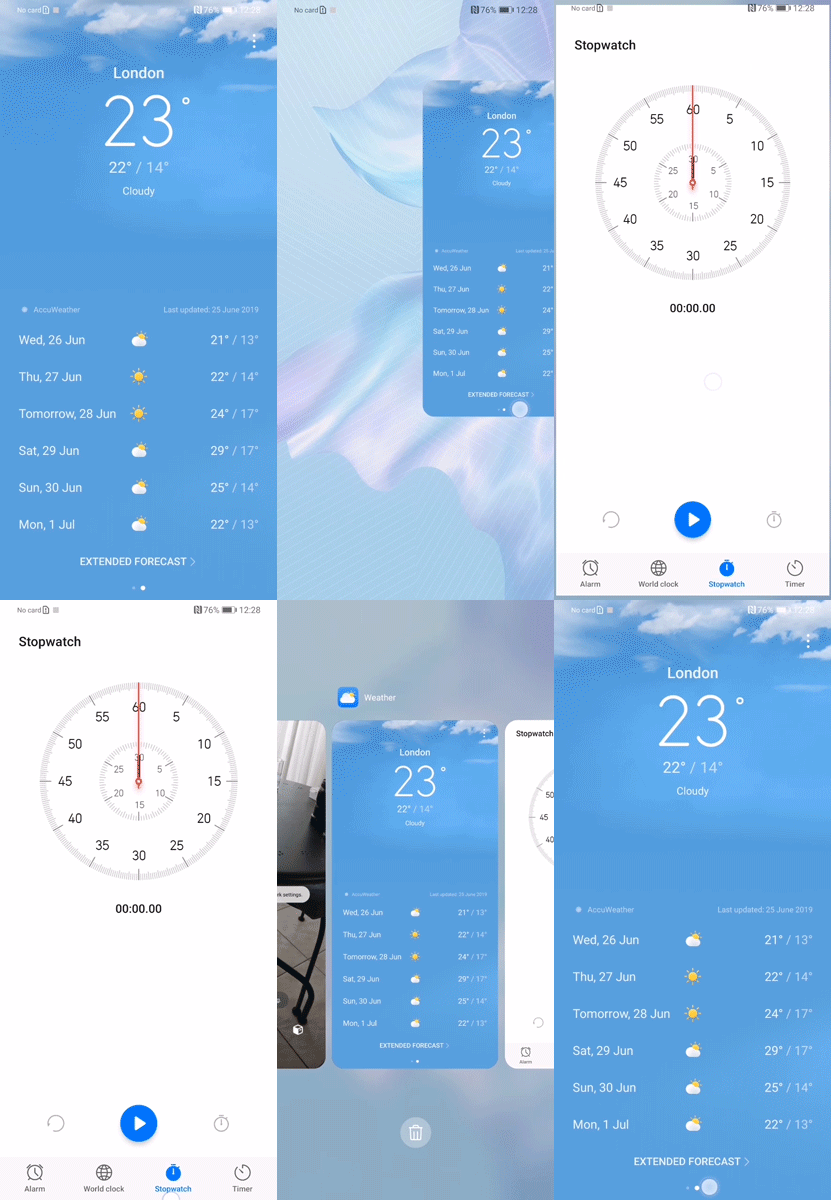
Another cosmetic change in EMUI 10 is the introduction of more “natural” animations. Huawei says that it’s redone a lot of animations throughout the system and modeled them on real-world physics. For example, pressing a button or object it depresses it down into the screen before springing up. Larger objects appear to spring back up with more force.
Huawei has also improved the animation transitions between apps. The frame rate of these transitions has increased, smoothing out their appearance and reducing any appearance of lag. There’s also a cool “Projectile Motion” animation when exiting an app, where you can move the window around the screen and watch it fly back towards the home screen app icon.
So far, impressions seem to be really positive, with most media outlets claiming that the new animations are seamless and snappy, providing for a smooth user experience.
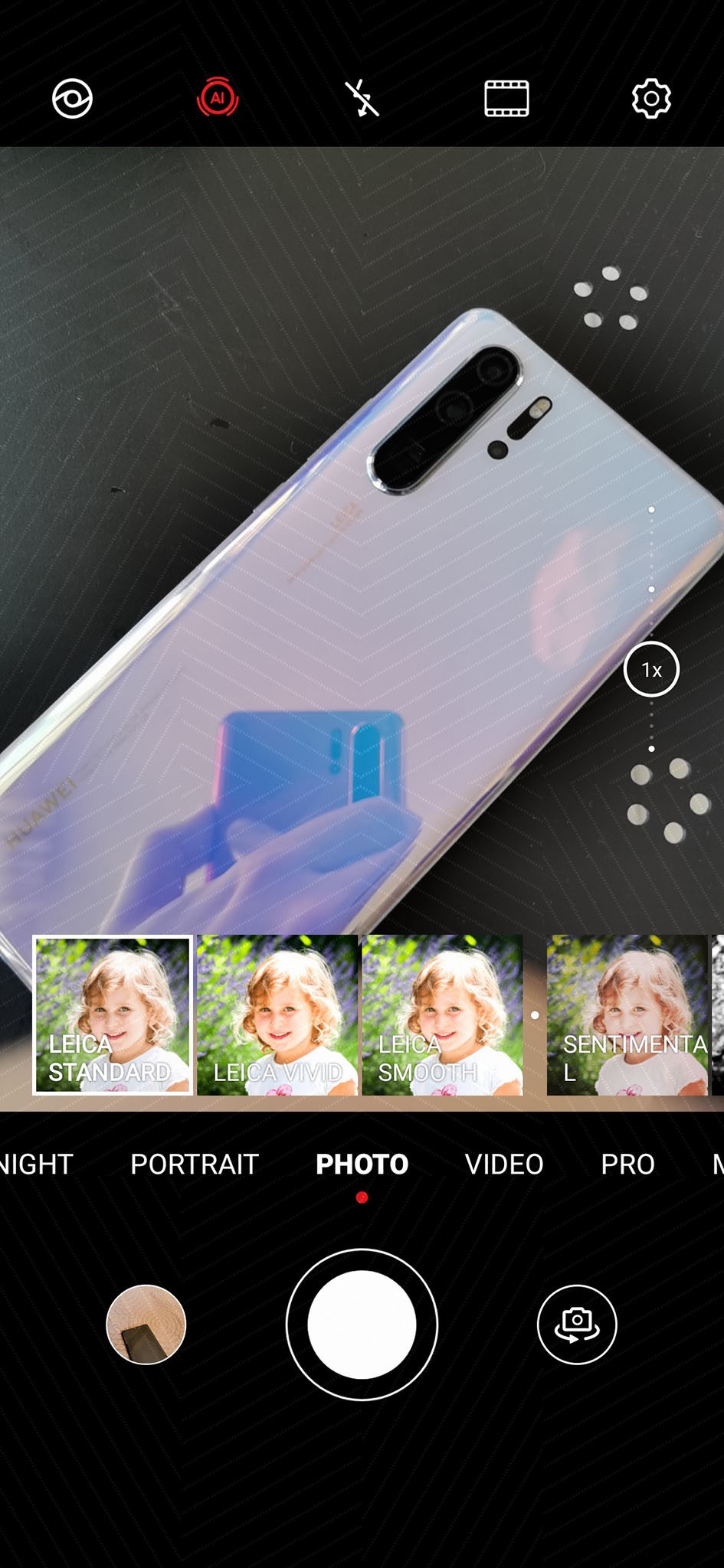
The new EMUI 10 camera app has mostly visual changes, with the biggest difference being the font and icon changes that move further away from the Leica style we’re seen for the past few generations. Despite this, we doubt there’s anything more to it. The Huawei-Leica partnership has been ongoing for several years, and it’s unlikely the two will part anytime soon.
The new camera UI is now designed to fit the new modern and clean aesthetic that the majority of the operating system utilizes. The physics of scrolling between different camera modes seems smoother, as does the slightly redesigned zoom level switch over on the right side. Overall, a lot of small improvements here and there.
The longstanding “vivid,” “smooth,” and “standard” color options in earlier Huawei camera apps has been replaced with a vast loadout of filter options, dramatically changing the look of your photos. And there’s also a new intensity slider that lets you control the strength of the filter — a welcome addition considering the all-or-nothing approach of the old Leica color options.
Aside from that, the functionality of the app, that seems pretty much unchanged right now. No major new camera features that we can see at least. Instead, Huawei seems to have focused on overhauling its camera app design language in this early build. It’s likely we’ll see those whenever the Mate 30 series lands later this year.
Enhanced Dark Mode
Dark Mode is a major feature of Android Q and EMUI 10 implements this with a few of its own bells and whistles. Huawei has actually gone to some major lengths to improve on the default Dark Mode formula, polling test participants on a range of colors, icons, and styles that they found most comfortable to read in low light.
The result is that Huawei’s Dark Mode provides a slightly tweaked color palette rather than simply inverting blacks and whites. In theory, this makes text easier to read when in Dark Mode and also tweaks other icon colors so that they don’t strain your eyes. it’s also especially nice that Huawei’s Dark Mode is truely black instead of dark grey.
Huawei’s Dark Mode applies not just to the OS UI but also to its pre-installed apps. This includes email, contacts, clock, photos, notes, etc. Huawei is also working with third-party developers to enable them to utilize its enhanced Dark Mode. Apps available through the Huawei app store that are dark mode compatible will work with Huawei’s enhanced color pallet without any extra development efforts.
We use cookies on our website to give you the most relevant experience by remembering your preferences and repeat visits. By clicking “Accept”, you consent to the use of ALL the cookies.
This website uses cookies to improve your experience while you navigate through the website. Out of these, the cookies that are categorized as necessary are stored on your browser as they are essential for the working of basic functionalities of the website. We also use third-party cookies that help us analyze and understand how you use this website. These cookies will be stored in your browser only with your consent. You also have the option to opt-out of these cookies. But opting out of some of these cookies may affect your browsing experience.
Necessary cookies are absolutely essential for the website to function properly. This category only includes cookies that ensures basic functionalities and security features of the website. These cookies do not store any personal information.
Any cookies that may not be particularly necessary for the website to function and is used specifically to collect user personal data via analytics, ads, other embedded contents are termed as non-necessary cookies. It is mandatory to procure user consent prior to running these cookies on your website.