Advertisement

An early user reveals some unannounced details of the Samsung Galaxy Fold

Interests in Samsung Galaxy Fold continues to grow by the day as we await the sales of the foldable phone to commence. When Samsung announced the model last month, not all the details of the model was revealed. The phone is yet to be released but apparently, Samsung has sent out some units to reviewers who are under strict instructions not to show pictures or videos of the phone but are not barred from sharing details about the model. One of the early users has hosted a Q&A on Twitter where some of the nitty-gritty details of the device were revealed.Samsung Galaxy Fold
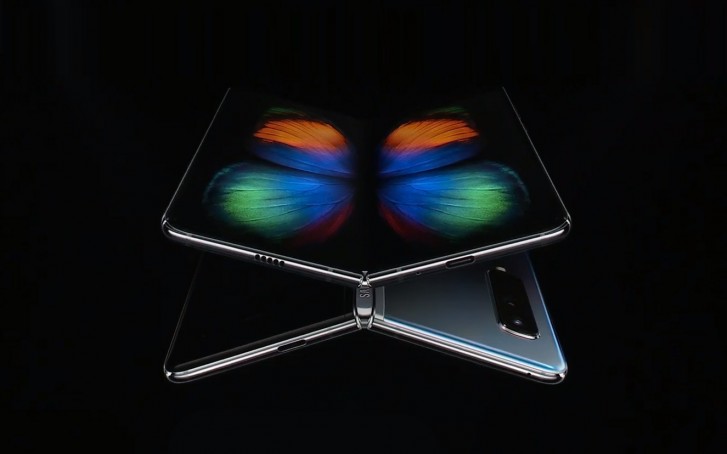
Since the Galaxy Fold uses a hinge design, there have been concerns about the sturdiness of the hinge. So, a respondent asked if the phone can bend in the opposite direction if that happens accidentally. It was revealed that the Fold has a sturdy hinge and can’t accidentally bend the wrong way which could damage the device. In case you are still wondering, the Fold still has a crease on the display when it is unfolded. The user says it is noticeable but played down any concerns of it being a bad thing. He noted that it is difficult to notice when the screen is on and the brightness is set above 70%. In addition, the screen can only be used when fully opened. The screen turns off if it is not fully opened. So, no chance you can use it as a laptop. The Q&A also revealed some few flaws in the interface which we expect to be fixed before the official roll out. You can read the entire Q&A from the source link below.

Read Also: Samsung Galaxy Fold to be available on pre-order in Europe from 26th April

The Galaxy Fold was also confirmed to hit Europe with a Snapdragon 855 chipset onboard with performance comparable to the Galaxy S10+. This is in line with earlier rumours that the model hitting Europe and Asia won’t feature an Exynos chipset. The device packs a 4,380mAh battery which will likely have fast charging technology considering the battery has to power up two displays. On the software end, it runs Samsung’s One UI 1.2 based on Android 9 Pie.

(source)
New Google Pixel 3a and Pixel 3a XL details: Storage, Colors and Price

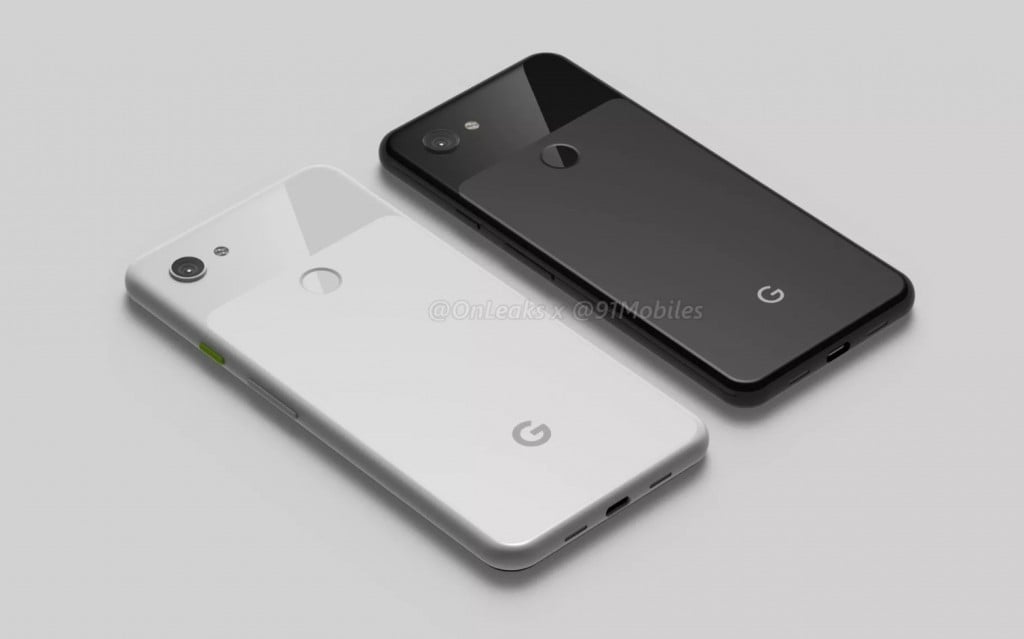
For the first time, Google will launch cheaper models of its Pixel lineup. The two devices which are codenamed “Sargo” and “Bonito” were originally thought to be marketed as the Pixel 3 Lite and Pixel 3 Lite XL. However, it was revealed about a week ago that their marketing names are Pixel 3a and Pixel 3a XL respectively. More details have now surfaced about the phones.

Google Pixel 3 Lite and Pixel 3 XL Lite

German tech blog Winfuture.de, reports that information received from European online retailers confirm that both phones are indeed named Pixel 3a and Pixel 3a XL. The retailers also confirmed both phones will have 64GB of built-in storage. There is no storage expansion and there is no news of other storage configurations.

It has also been revealed that in addition to the black and white color variants, there will be a third one called “Iris”. This color is said to be in the range of blue-violet to violet. Other info revealed by the dealers is the price, although they were not specific about it. It is said the Pixel 3a will sell for about €450 while the larger Pixel 3a XL will have a more expensive price tag.

READ MORE: Google unveils Stadia Cloud Gaming Service at GDC 2019

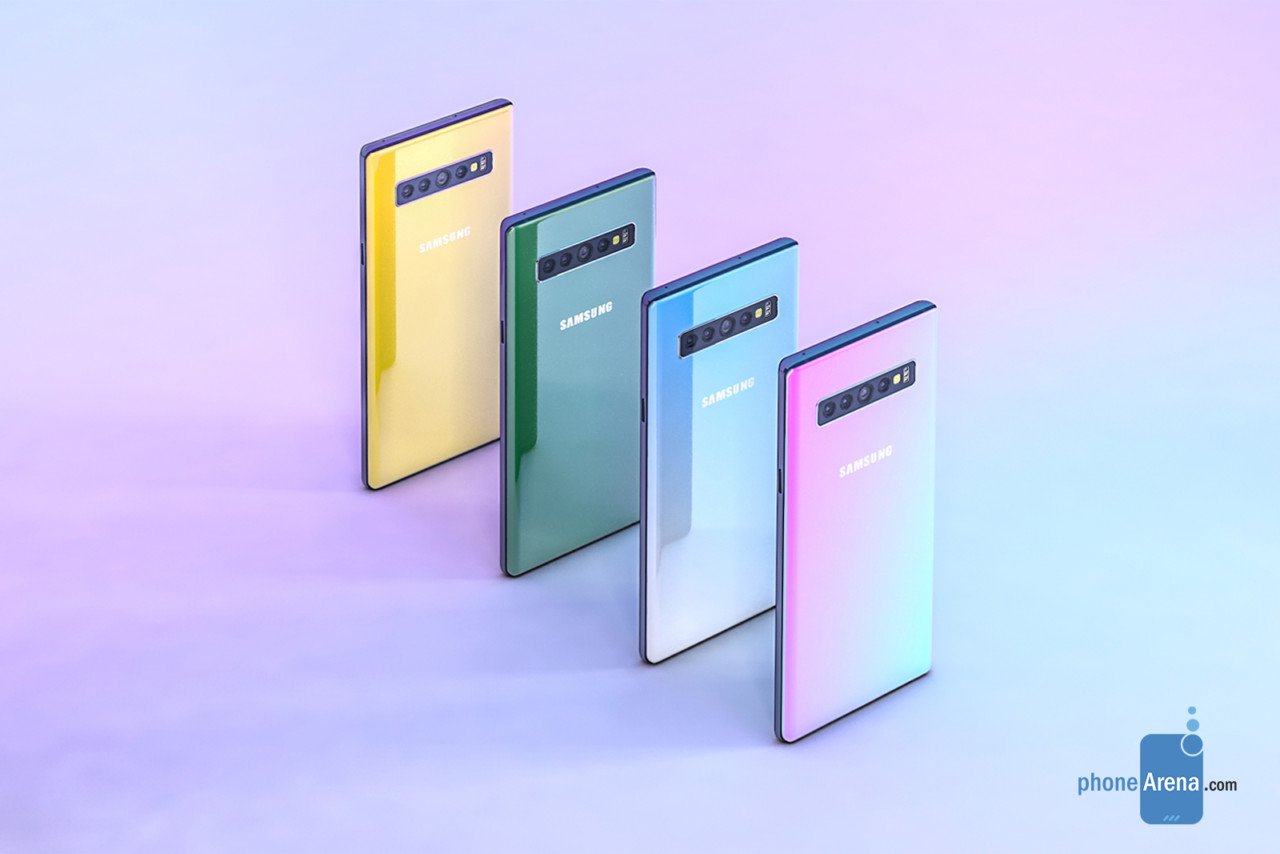
Samsung Galaxy Note 10 likely to arrive with button-less design

Samsung has recently launched the highly anticipated Galaxy Fold phone alongside the Galaxy S10 series. While the company is busy making the S10 series available in wider markets, a fresh report that has appeared on a South Korean publication has revealed that the forthcoming Galaxy Note 10 will be arriving with an innovative button-less design.

The report claims that the Galaxy Note 10 may not feature hardware buttons for power, volume and Bixby assistant. Samsung has reportedly developed a technology through which one can turn on or off the device and increase or decrease the volume through pressure-sensitive touch controls. The company may work with China based NDT that manufacturers keyless modules to recognize force of pressing.

The report has further stated that the company is also considering bringing keyless technology to mid-range and low-end phones such as Galaxy A series. In January, Meizu had introduce the Meizu Zero phone that came with buttonless design. The smartphone was met with lukewarm response during its crowdfunding campaign.

Galaxy Note 10 concept by PhoneArena

Samsung’s move to bring keyless technology on its smartphones is one of its strategies to enhance the design of its smartphones. The recent phones from Samsung have offered higher screen-to-body ratio than predecessor smartphones through punch-hole and waterdrop-style notched display designs. Also, newer smartphones from the company are equipped with more advanced in-display fingerprint scanner.

Previous reports have revealed that the Galaxy Note 10 will be available in 5G and 4G variants. These editions may have respective model numbers of SM-N975 and SM-N970. The Note 10 that is reportedly codenamed as “Da Vinci” is speculated to be fueled by Snapdragon 855 mobile platform and it may come with up 12 GB of RAM and up to 1 TB of storage. Wider markets may receive the Exynos 5100 5G modem enabled Exynos 9825 SoC. It could be the first Note series phone from the company to arrive with quad cameras. The smartphone may feature a massive display of 6.75 inches. Rumors are rife that Samsung unveil the Galaxy Note 10 in August.

(source)
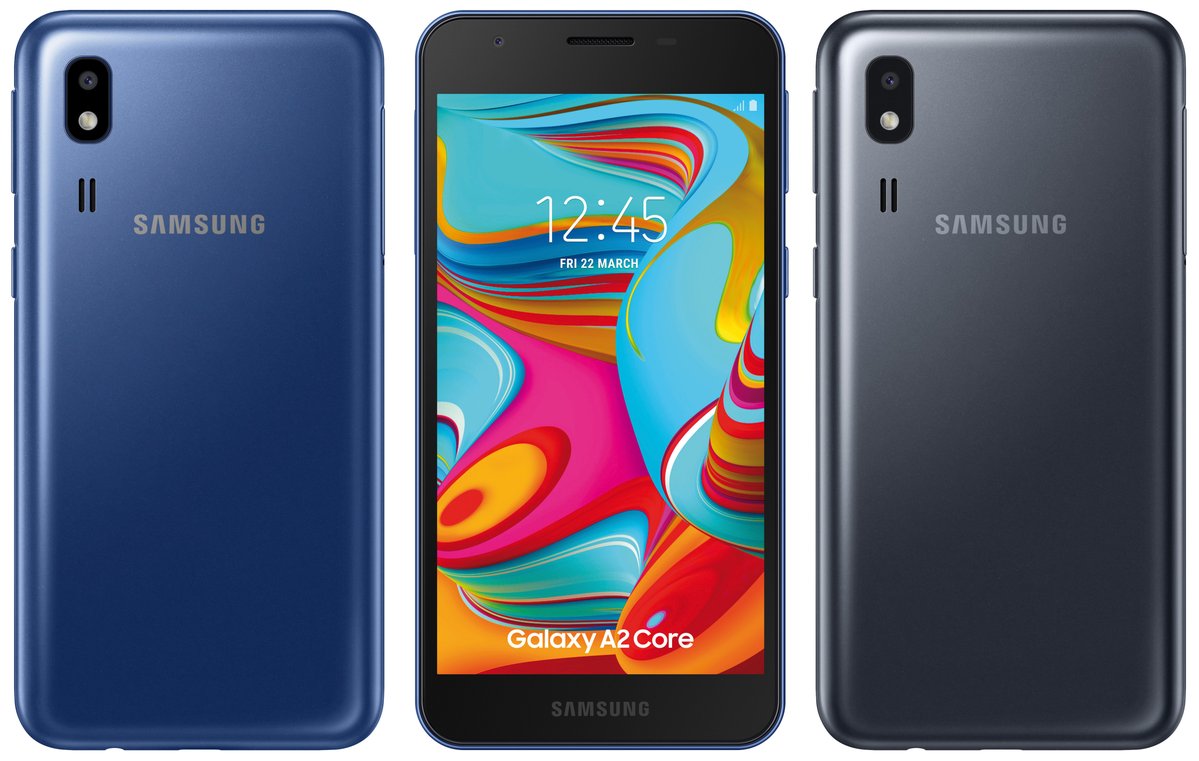
Samsung Galaxy A2 Core Android Go phone’s specifications leaked

The Samsung Galaxy A2 Core is an upcoming Android Go smartphone from the company. The renders of the smartphone had surfaced earlier in this month. The key specifications of the smartphone have been leaked on its official support page.

The Samsung Galaxy A2 Core that has a model number of SM-A260F is Android Go that runs on the Go edition of Android 8.1 Oreo OS. It measures 141.6 x 71. 9.1mm and it weighs 142 grams.

The smartphone features a PLS TFT LCD panel of 5 inches that produces qHD resolution of 540 x 960 pixels and a conventional aspect ratio of 16:9. The handset draws power from 2,600mAh battery. The rear side of the phone features an f/1.9 aperture 5-megapixel camera with autofocus and LED flash. The connectivity options available on the device include 4G VoL, Wi-Fi 802.11 b/g/n, Bluetooth 4.2, microUSB 2.0 and 3.5mm audio jack.

Samsung Galaxy A2 Core

Previous reports have revealed that the Galaxy A2 Core will be powered by Exynos 7870 chipset and 1 GB of RAM. The user manual of the phone that has appeared on the official site has revealed that it will be featuring a dedicated microSD card slot. Like the other Android Go phones, the Galaxy A2 Core is rumored to be equipped with an internal storage of 8 GB.

The official renders of the phone that had appeared in the recent past had confirmed that it would be arriving in color choices such as Black and Black. The modest phone features thicker bezels around the display and it lacks support for fingerprint scanner.

Samsung is yet to confirm the launch date of the Galaxy A2 Core Android Go smartphone. The rumor mill is speculating that the South Korean company may unleash it through April 10’s Galaxy A-series launch event. As of this writing, there is no information on the pricing of the phone.

(source|via|source 2)

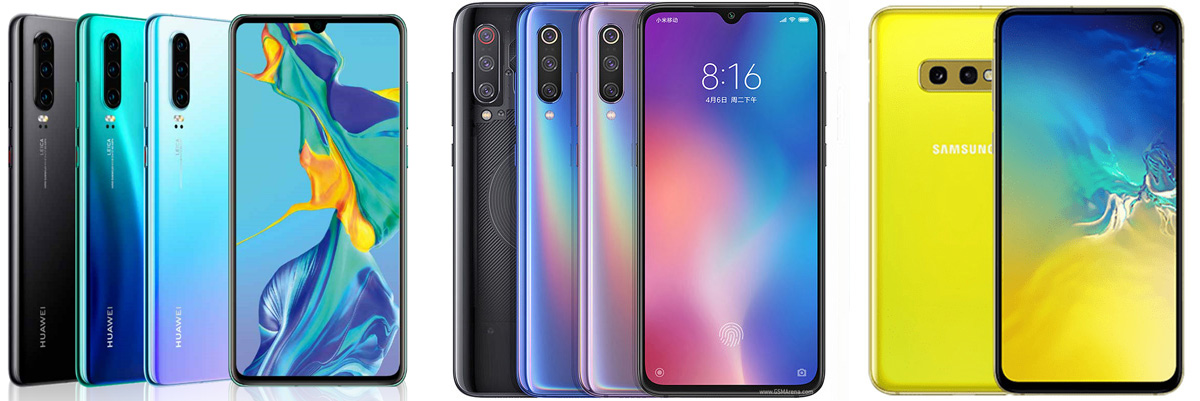
Huawei P30 vs Xiaomi Mi 9 vs Samsung Galaxy S10e: Specs Comparison

While Huawei is trying to dominate the smartphones market by releasing the most advanced and innovative devices, Xiaomi seems to point on a different strategy: unlike the newly-announced Huawei P30 Pro, its latest top-end device Xiaomi Mi 9 is still an affordable flagship and it is also one of the most affordable phones equipped with the Snapdragon 855 chipset. That is the reason why it is perfect to compare it to the vanilla Huawei P30 and to the affordable variant of the Samsung Galaxy S10 series: the Galaxy S10e. If you want to get a new powerful device, here we will try to let you understand which affordable flagship you should choose this year.

Huawei P30 vs Xiaomi Mi 9 vs Samsung Galaxy S10e

Huawei P30 Xiaomi Mi 9 Samsung Galaxy S10e
DIMENSIONS AND WEIGHT 149.1 x 71.4 x 7.6 mm, 165 g 157.5 x 74.7 x 7.6 mm, 173 g 142.2 x 69.9 x 7.9 mm , 150 g
DISPLAY  6.1 inches, 1080 x 2340p (Full HD+), OLED 6.39 inches, 1080 x 2340p (Full HD+), Super AMOLED 5.8 inches, 1080 x 2280p (Full HD+), AMOLED
PROCESSOR Huawei HiSilicon Kirin 980, octa-core 2.6 GHz Qualcomm Snapdragon 855, octa-core 2.84 GHz Qualcomm Snapdragon 855, octa-core 2.8 GHz
MEMORY  6 GB RAM, 128 GB – 8 GB RAM, 64 GB  – 8 GB RAM, 128 GB – 8 GB RAM, 256 GB, nano memory card slot 6 GB RAM, 64 GB – 6 GB RAM, 128 GB – 8 GB RAM, 128 GB 6 GB RAM, 128 GB – 8 GB RAM, 256 GB – micro SD slot
SOFTWARE  Android 9 Pie, EMUI Android 9 Pie, MIUI Android 9 Pie, One UI
CONNECTIVITY  Wi-Fi 802.11 a/b/g/n/ac, Bluetooth 5.0, GPS Wi-Fi 802.11 a/b/g/n/ac, Bluetooth 5.0, GPS  Wi-Fi 802.11 a/b/g/n/ac, Bluetooth 5.0, GPS
CAMERA  Triple 40 + 16 + 8 MP, f/1.8, f/2.2 and f/2.4
32 MP f/2.0 front camera
Triple 48 + 16 + 12 MP, f/1.8, f/2.2 and f/2.2
20 MP f/2.0 front camera
Dual 12 + 16MP, f/2.2 + f/1.5-2.4
10 MP f/1.9 front camera
BATTERY  3650 mAh, fast charging 22.5W 3300 mAh, fast charging with Quick Charge 4+, wireless charging 3100 mAh, fast charging, wireless charging
ADDITIONAL FEATURES  Hybrid Dual SIM slot Dual SIM slot Dual SIM slot, waterproof (IP68), reverse wireless charging

Design

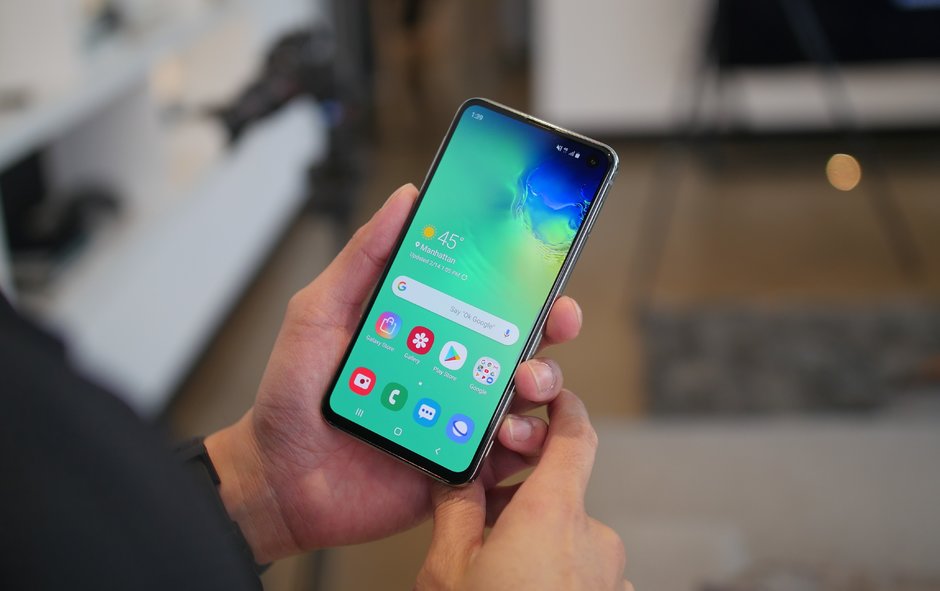
There are no doubts about the fact that Huawei P30 and Xiaomi Mi 9 come with stunning and very attractive designs. But we want to award the Samsung Galaxy S10e for its originality and aesthetical innovation. Unlike those boring waterdrop notches, Samsung Galaxy S10e minimizes the bezels around the display with a punch-hole camera. Further, we liked a lot the unusual Canary Yellow color variant, even though not everyone loves it. Further, the Samsung Galaxy S10e comes with better build quality and it is fully waterproof with the IP68 certification. Last but not least, it is even a more compact device than its rivals.


Display

Samsung is the leader of the mobile OLED industry, that is why a lot of people will not be surprised after reading that the Samsung Galaxy S10e has a better display than its opponents. It comes with the brand new Dynamic AMOLED technology and the support to HDR10+ which improves the color reproduction. It also has a smaller display which is easier to use with one hand, even though there is to say that most of the people nowadays like bigger displays like the one of the Xiaomi Mi 9.


Hardware/Software

Samsung Galaxy S10e and Xiaomi Mi 9 are powered by a more powerful chipset, so the Huawei P30 loses the comparison. Out of these twos, we give the victory to the Samsung Galaxy S10e because, in its most expensive variant, it boasts more RAM and a higher amount of internal storage. Further, unlike the Xiaomi Mi 9, it has a micro SD slot to expand the storage. All the phones come with a highly customized Android fork based on Pie, full of additional features: EMUI for Huawei P30, MIUI for Xiaomi Mi 9 and One UI for Galaxy S10e. Which user interface do you prefer?


Camera

We still did not test it thoroughly, but from what we can see by looking at the specs on the paper, Huawei P30 comes with the most interesting camera department. It has a triple setup with a 40 MP main sensor, an ultrawide lens and a telephoto lens with up to 3x optical zoom and OIS. However, even Xiaomi Mi 9 manages to shoot outstanding photos with its triple camera, and it is the same with the Galaxy S10e and its variable aperture. So I will give a definitive verdict only after testing the Huawei P30 thoroughly.


Battery

Its biggest battery with a capacity of 3650 mAh should allow the Huawei P30 to last significantly more on a single charge. And with its 22.5W fast charging, it should even be able to charge its battery faster (although its rivals may reach 100% faster due to their smaller capacities). However, Huawei P30 lacks wireless charging unlike the Xiaomi Mi 9, while the Samsung Galaxy S10e supports both wireless charging and reverse wireless charging (it can be used as a power bank).


Price

Huawei P30 starts at €800, Xiaomi Mi 9 costs just €450 and Samsung Galaxy S10e starts from €680. Overall, I define Samsung Galaxy S10e a slightly better device due to its better display, higher-end hardware, great build quality, water resistance, and more. Unlike you want a device that lasts long on a single charge, in that case you should go for the Huawei P30. Last but not least, Xiaomi Mi 9 wins the value for money award.


Huawei P30 vs Xiaomi Mi 9 vs Samsung Galaxy S10e: PRO and CONS

Huawei P30

PROS

  • Amazing cameras
  • Splash resistant
  • Bigger battery
  • Fast charging

CONS

  • Inferior chipset


Xiaomi Mi 9

PROS

  • Wireless charging
  • Great build quality
  • Good cameras
  • Affordable price

CONS

  • No micro SD


Samsung Galaxy S10e

PROS

  • Compact
  • Good hardware
  • Great audio
  • Waterproof
  • Fast, wireless and reverse charging

CONS

  • Smaller battery


Buy Link:

Get Huawei P30 on Giztop, Banggood, GeekBuying

Check out Xiaomi Mi 9 on GearBestGiztop, Banggood, GeekBuying

Richard Yu: No 5G version for the Huawei P30 series

The Huawei P30 and P30 Pro launched yesterday in Paris. The phones are available in multiple configurations but there was no mention of a 5G version. If you are expecting one, sorry to dash your hopes, but Huawei says there won’t be a 5G variant of the phones.

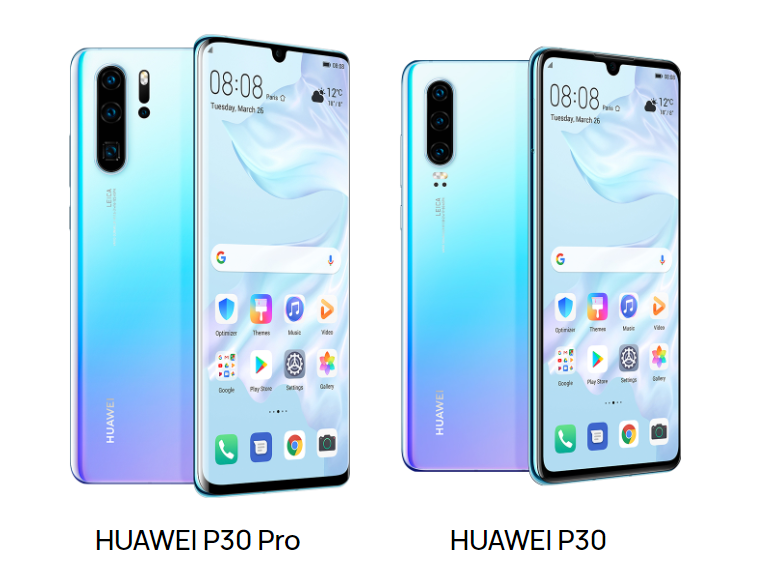
Huawei P30 and Huawei P30 Pro

The info was revealed by Huawei’s head of mobile business, Yu Chengdong (Richard Yu) in an interview with CNET. In the top executive’s words “the world is not yet prepared for Huawei’s 5G flagship phone”. That sounds ironical considering the foldable Mate X is a 5G device.

Mr. Yu did say they are considering making the next Mate series 5G ready. The next Mate series should be the Mate 30 and Mate 30 Pro and they are expected to launch in Autumn 2019.

Huawei’s VP of Global Product Marketing, Clement Wong, also revealed that they could have made the P30 and P30 Pro 5G devices but the timing isn’t right. He added that he believes 5G won’t be a big deal until 2020.

READ MORE: Huawei’s Watch GT gets new Active Edition and a smaller 42mm Elegant version

Check out the premium Huawei P30 and P30 Pro in pictures

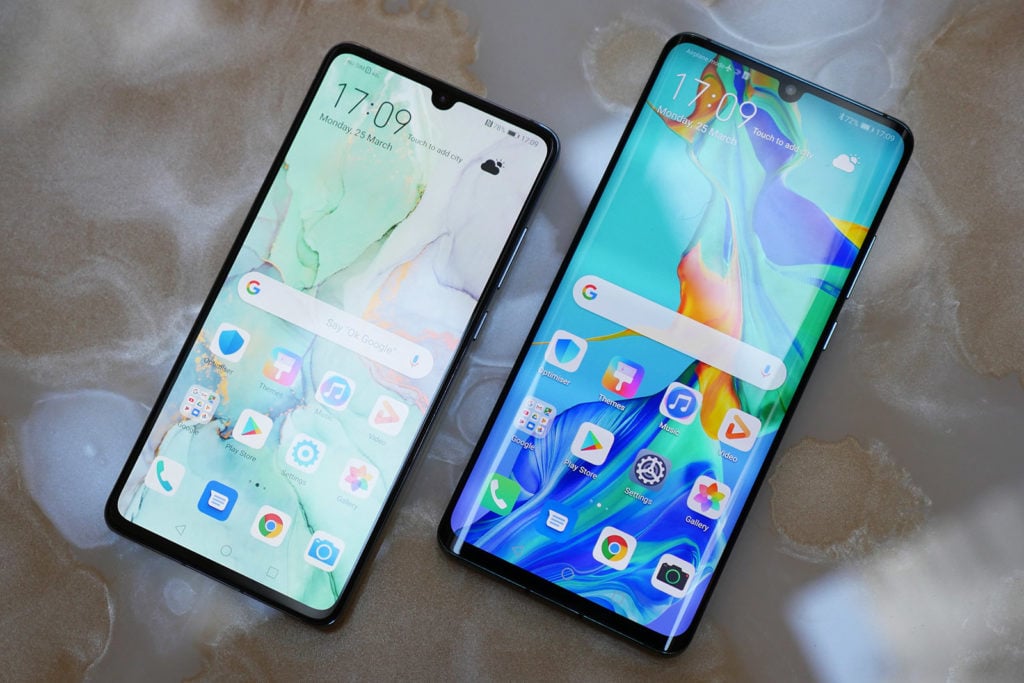
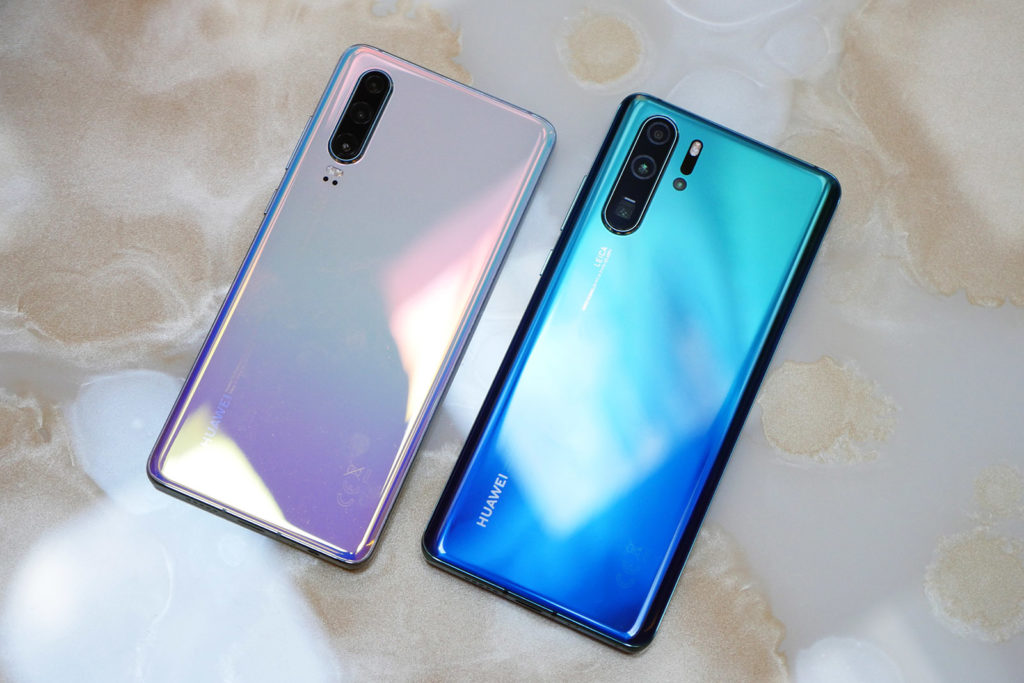
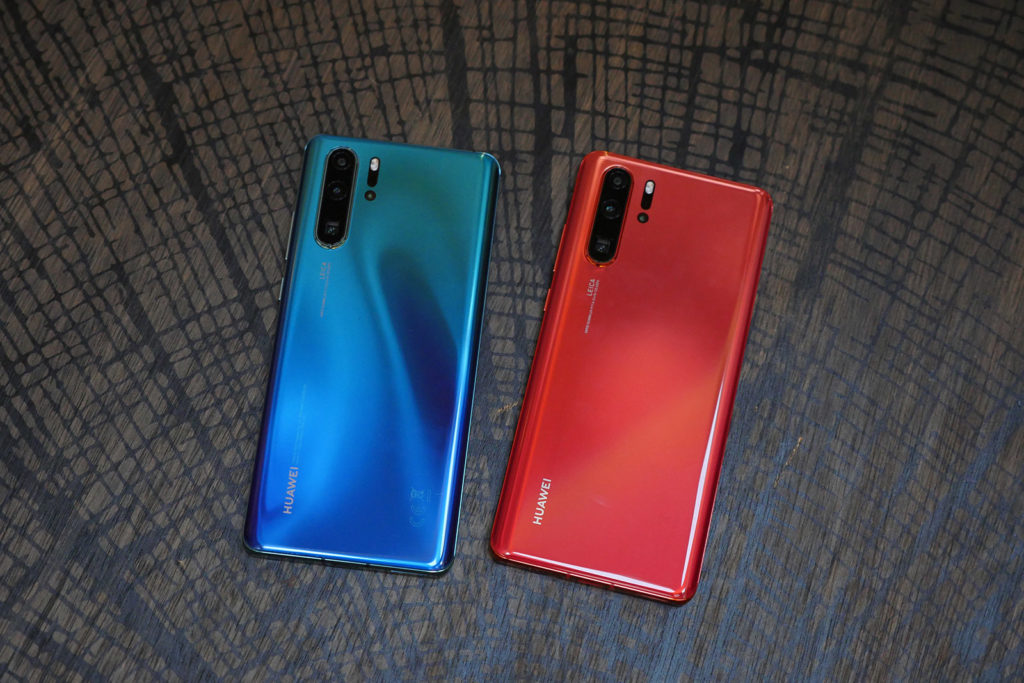
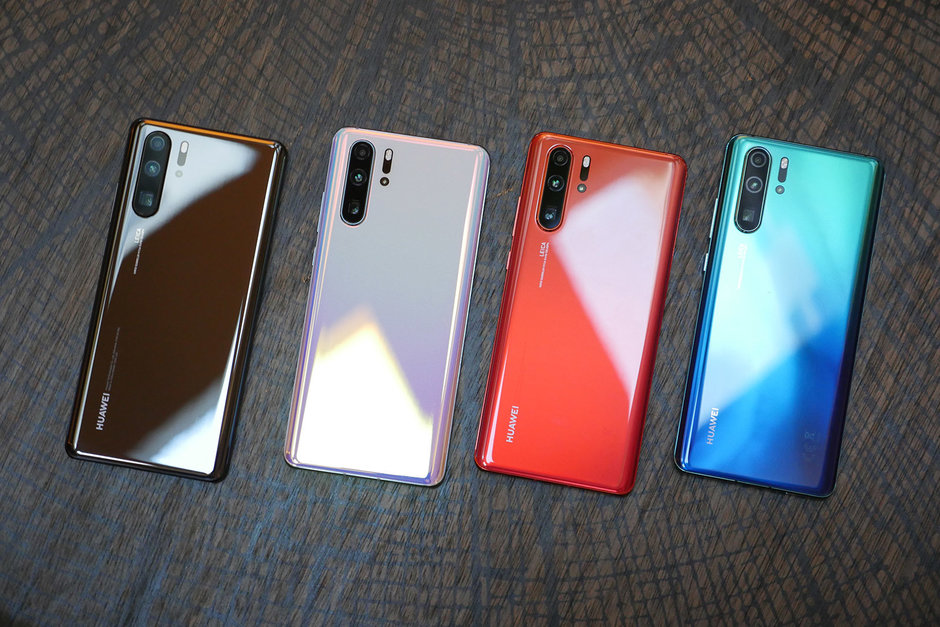
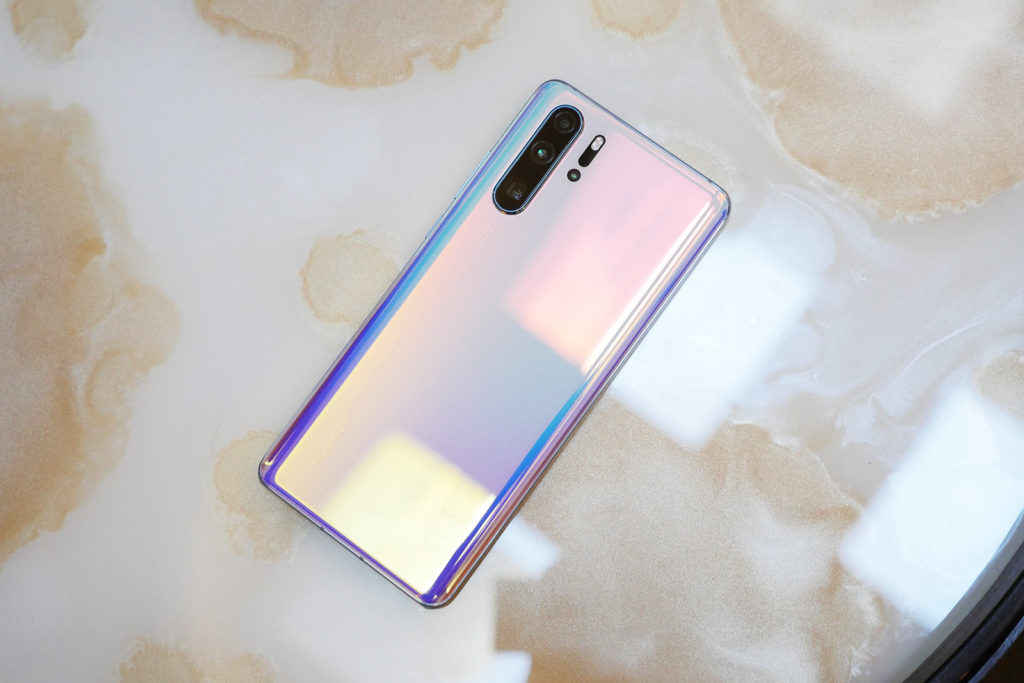
Huawei yesterday went official with two strong flagships, the P30 and P30 Pro which would definitely be raking in some cool cash for the Chinese giant. The Huawei P30 and P30 Pro are not just beautiful but also premium looking just like Huawei’s range of flagship models. Here are some cool pictures of the Huawei P30 and P30 scooped from Phonearena.Huawei P30 and P30 Pro

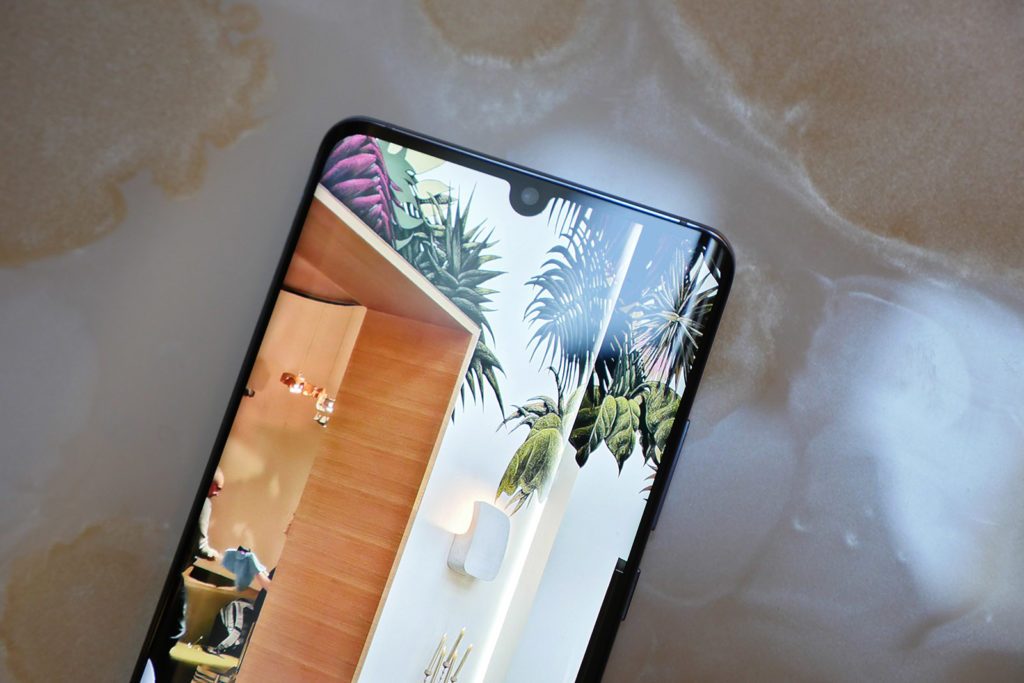
Even though both models are beautiful, the Huawei P30 Pro definitely steals the show with its curved edge display. The bezels at the chin of the P30 is thinner but that doesn’t in any way reduce the P30 Pro’s attraction. Well, except you are not a fan of curved edge display. Both models have the waterdrop notch design with a 32AI HDR+.. On the P30, the earpiece is at the top of the notch but the Pro version doesn’t have one instead, it uses Acoustic Display Technology which emits sounds through the display using magnetic levitation. Huawei P30 Pro

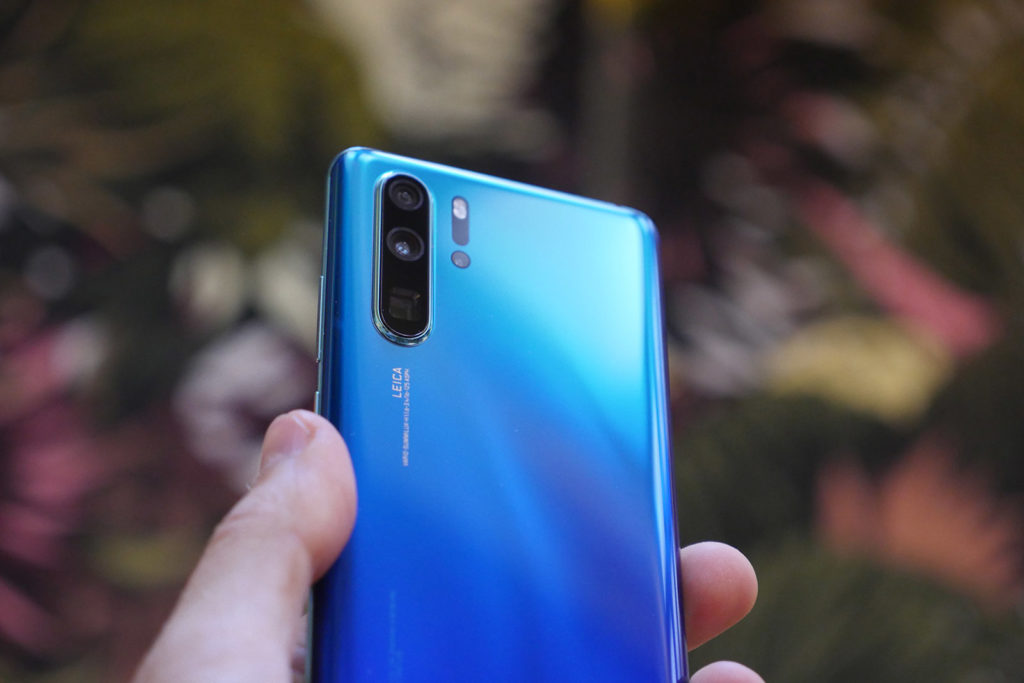
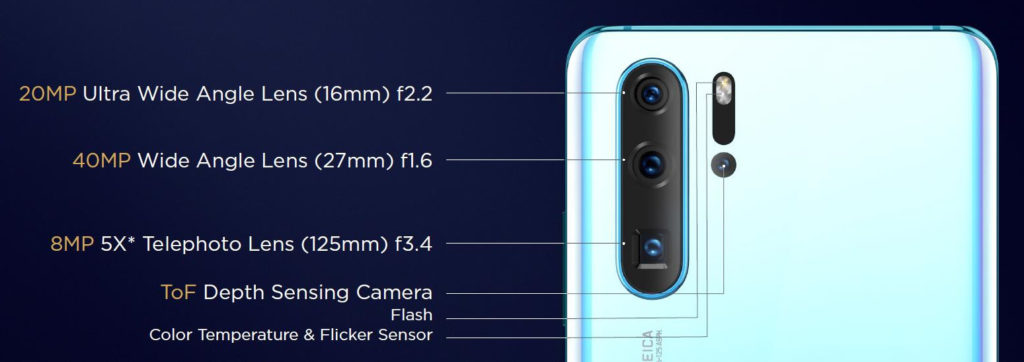
Turning to the rear aspect, the P30 has triple cameras aligned vertically at the top left corner. Huawei has always improved on its camera and the new models are no exceptions. The P30’s camera configuration includes an 8MP 3X telephoto lens, a 16MP ultra-wide-angle lens, and a 40MP wide angle lens. On the other hand, the P30 Pro features a 20MP ultra wide angle lens, a 40MP wide-angle lens, an 8MP 5X telephoto, and a ToF depth-sensing camera. The arrangement of the LED flash on the models also differs which make for easy identification. The LED flash is at the bottom on the P30 and on the side in the P30 Pro. There is noticeably no rear fingerprint sensor on any of the models and that is because the device features an in-display sensor.Huawei P30 Pro

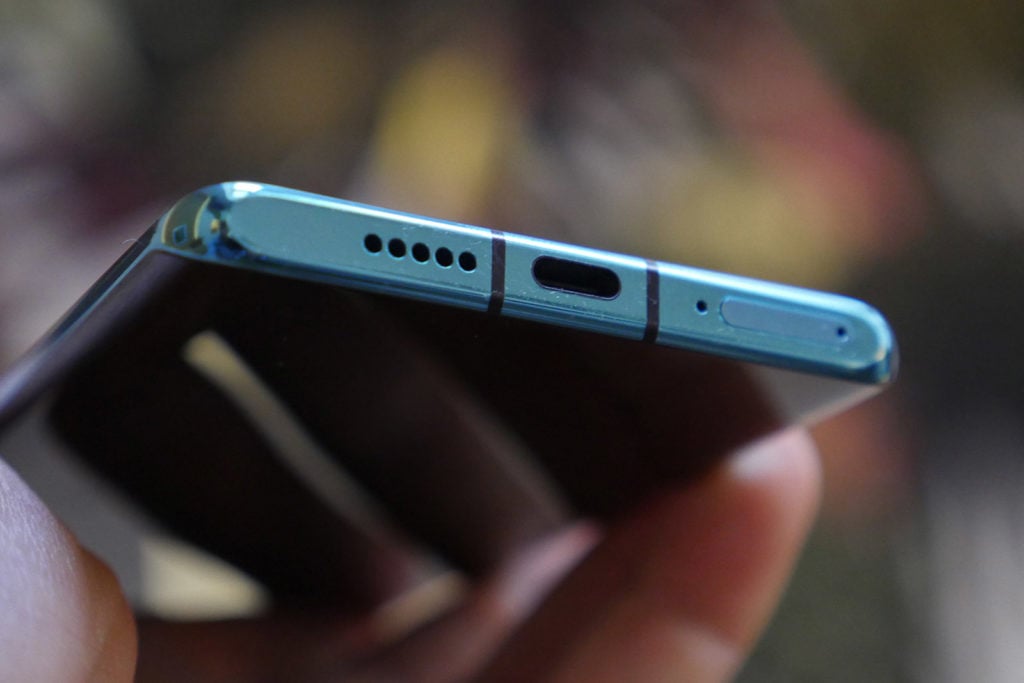
For specs, the P30 packs a 6.1-inch OLED display with an FHD+ resolution of 2340x1080pixels and 19.5:9 aspect ratio. The P30 Pro is slightly bigger with a 6.47-inch FHD+ curved OLED display. They are both powered by a Kirin 980 chipset with up to 8GB of RAM and 512GB of storage. There is support for storage expansion using Huawei’s NM Card. Huawei has redesigned the tray: rather than a SIM tray where the two SIMs and or the NM Card are side-by-side, the tray of the P30 series is designed to fit in one Nano SIM on top and the NM Card or a second Nano SIM underneath. On the P30, you get an IP53 rating while the P30 Pro has an IP68 rating. Finally, Huawei crammed a 3,650mAh battery with support for 22.5W fast charging on the P30 while the P30 Pro packs a 4,200mAh battery bundled with support for 40W fast-charging and 15W wireless fast charging.

(source)Huawei P30 ProHuawei P30 ProHuawei P30 ProHuawei P30 ProHuawei P30 Pro


Buy Links:

Get Huawei P30 (from $899) and Huawei P30 Pro (from $1199) on Giztop

Check out Huawei P30 on Banggood

Buy Huawei P30 and Huawei P30 Pro on GeekBuying

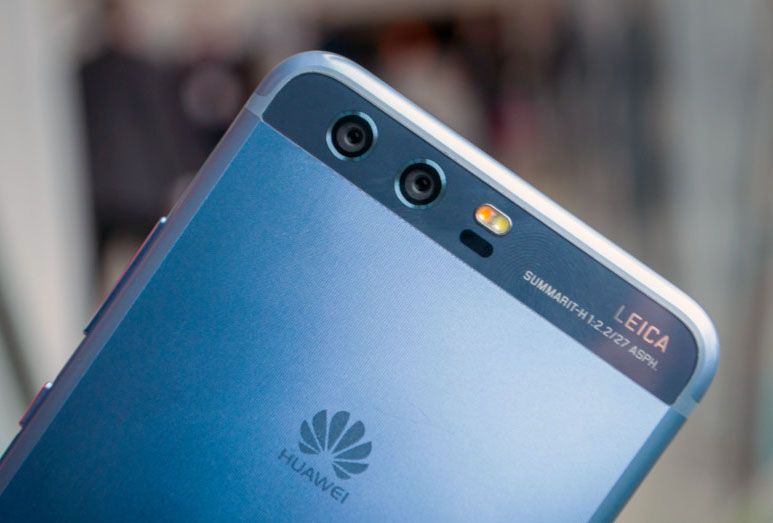
EMUI 9.0.1 brings Android Pie to 2017’s Huawei P10 (international version)

There are some manufacturers that are yet to update even their most recent flagships to Android 9 Pie (yes, I am looking at you LG) while others like Huawei are rolling out the update to their older phones. Last month, the Mate 9 series got the update to Android Pie. Now the update is rolling out to the Huawei P10.

huawei p10

The update began rolling out to the device in China earlier this year but is now arriving on the international variant. It is pretty heavy at 3.14GB but you get a ton of new features including a redesigned UI, faster launch times, and an overall improvement in performance. The update also brings new features to the Recorder app and the Huawei Share app. However, there is no info on the security patch version.

The Huawei P10 launched in March 2017. It sports a 5.1-inch IPS-NEO LCD display with thick bezels at the top and bottom. The chin is home to the fingerprint scanner and the entire front is covered in Gorilla Glass 5. There is a Kirin 960 processor under the hood paired with 4GB of RAM and 32GB/64GB of storage.

There are dual cameras on the rear – a 12MP f/2.2 sensor and a 20MP monochrome camera with 2x zoom. It also has an 8MP selfie camera. Other features are a 3200mAh battery with support for 22.5W fast-charging, NFC, and a 3.5mm audio jack.

READ MORE: Huawei FreeLace Bluetooth headset and AirPods-like Freebuds Lite launched

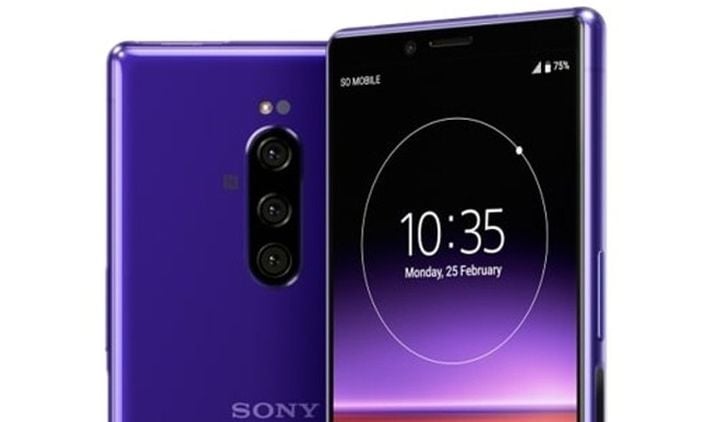
Sony Xperia 2 with 6.2-inch display, Snapdragon 855 and 6 GB RAM rumored to debut in September

Sony had recently launched the Xperia 1 flagship phone with a massive 6.5-inch display that offers an aspect ratio of 21:9. The Japanese tech giant had also launched the Xperia 10 and Xperia 10 Plus mid-range phones alongside it. Rumors are rife that the company is planning to launch few more devices in the near future. A recent leak had revealed that the company may debut an upper mid-range smartphone called Xperia 4 by May. Fresh information reveals that the Xperia 2 is the other upcoming phone from the company that could be slotted between the Xperia 1 and Xperia 4.

Sony Xperia 2 Specifications (Rumors)

The Xperia 2 may come equipped with a 6.2-inch CinemaWide display that will offer an aspect ratio of 21:9 along with a screen resolution of 2880 x 1234 pixels. The handset will be measuring 161 x 70 x 8.1mm.

It is rumored to be powered by Snapdragon 855 mobile platform and 6 GB of RAM. It could be fueled by a 3,000mAh battery that will be equipped with support for wireless charging. The handset is unlikely to feature a 3.5mm audio jack.

Sony Xperia 1
Sony Xperia 1

The Xperia 2 is tipped to feature a triple camera setup. However, the exact configurations of the three camera sensors are not known yet. Probably, one of the them could be a ToF (Time of Flight) sensor. There is no information on the other specifications of the Xperia 2. The above leaks reveal that it borrows most of its specs from the Xperia 1 smartphone. The only major difference between the two phones seems to be that the Xperia 2 could be coming with a smaller and inferior display, weaker camera specs and a lower capacity battery.

Sony is known of using IFA tech trade show event for announcing its new phones. Hence, it is speculated that the Xperia 2 will be debuting in September this year through the IFA 2019 event. The Xperia 1 carries a price tag of $999 in the U.S. Hence, the Xperia 2 could be priced around $799.

(source|via)

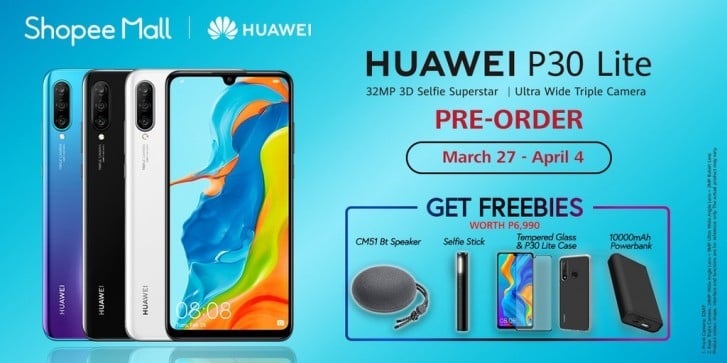
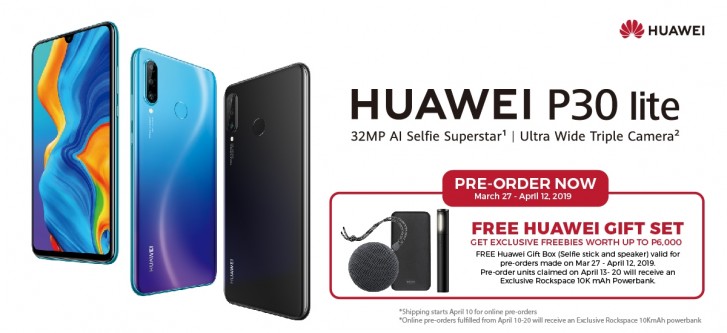
Huawei P30 Lite goes official in the Philippines for PHP16,990 (~$320)

Huawei held an event yesterday in Paris where it took the wraps off the Huawei P30 and P30 Pro flagship models. Apart from other tech gadgets, no other phone was announced during the event. But barely 24 hours after the event, the Huawei P30 Lite has gone official in the Philippines and is now on pre-order. The Lite model has been a part of Huawei’s P series offering each year. Huawei P30 Lite

Huawei P30 Lite is a premium midrange smartphone with a sleek design and classy finish. It features the U-shaped (water drop) notch at the top of the display which houses the selfie camera. The device seems to have an all-glass body but it could be plastic, we can’t say for sure. The back adorns triple cameras anchored at the top left corner in a vertical arrangement.Huawei P30 Lite

The P30 Lite sports a 6.15-inch LCD screen with a Full HD+ resolution and tall 19.5:9 ratio. The phone is powered by what looks like the Kirin 710 chipset going by the listed CPU configuration of four Cortex-A73 cores clocked at 2.2 GHz and four Cortex-A53 units clocked at 1.7 GHz. The SoC comes with the Mali-G51 GPU. It features 6GB of RAM while there is 128GB of storage but we can’t say if the storage is expandable.Huawei P30 Lite

On the camera end, the Huawei P30 Lite packs a 24MP main camera sensor which teams up with an 8MP Ultra-wide-angle lens and a 2MP depth sensor. At the front, Huawei tweaked things up by cramming a 32MP sensor on the notch for obviously stunning selfies and portraits. The device will run EMUI 9.0.1 based on Android Pie and a 3,340 mAh battery with 18W fast-charging will keep the lights on. The phone equally packs a USB-C port and 3.5 mm audio jack. It supports Wi-Fi 802.11 a/b/g/n/ac standards, Bluetooth 4.2 but there’s no NFC.Huawei P30 Lite

Read Also: Huawei P30 Lite base model to have 128GB storage and cost €369

The phone comes in White, Black, and Blue. It is presently available to pre-order from online stores Abenson and Shopee for PHP16,990 ($320/€290). It will be on pre-order until April 4 on Shopee when it will start shipping while Abenson will terminate its own on April 12 but will start shipping the model on April 10. There are several freebies for fans who pre-order during the window. The gifts include a 10,000 mAh powerbank, Bluetooth speaker and a selfie stick while supplies last.

(source 1, 2)

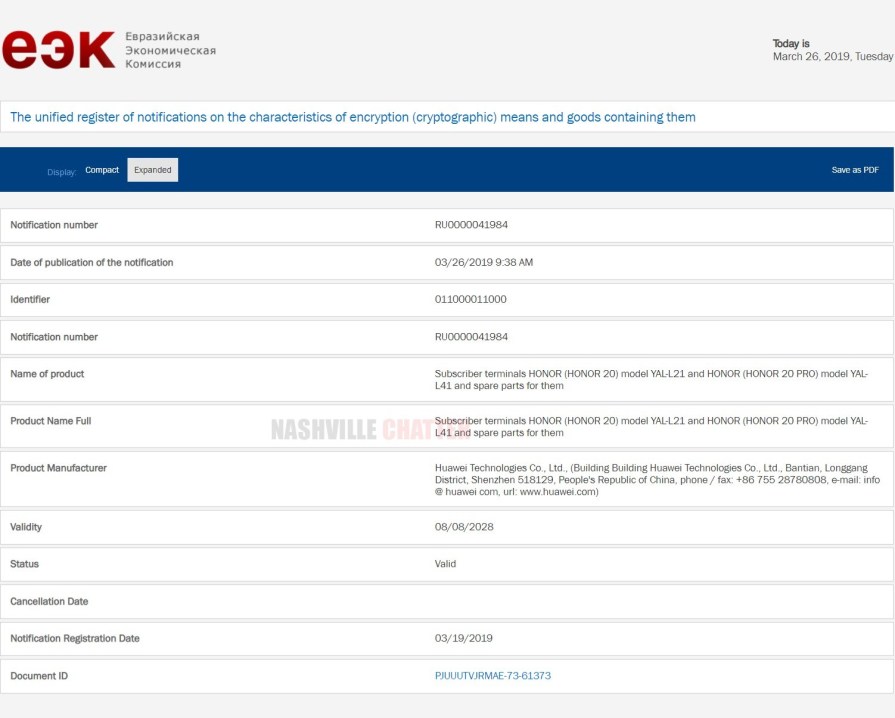
Honor 20, Honor 20 Pro, Huawei Y5 2019, Huawei P Smart Z and more get EEC approval

The first quarter of the year is almost over and there are already a lot of new phones in the market but with 9 months left in the year, there are still several more that will be released. Yesterday, a number of new devices were approved by the Eurasian Economic Commission (EEC). Some are successors to already existing models and others are new models entirely.

Honor 20 and Honor 20 Pro EEC

Honor 20 and Honor 20 Pro

Thanks to trademark applications filed by Huawei last year, we already know the successors to the Honor 10 series will not be the Honor 11 but the Honor 20. The Honor 20 series will include the Honor 20 itself, the Honor 20A, Honor 20C, and Honor 20X.

The EEC documents reveal the Honor 20 will have the model number YAL-L21 and it will bring along the Honor 20 Pro whose model number is YAL-L41. The Honor 20 will be a flagship phone with a Kirin 980 processor. There are reports it will have a triple camera setup on its rear which includes a 48MP primary sensor paired with a 20MP secondary sensor and another 8MP sensor. It has also been reported that it will have a 32MP selfie camera, a 3,650mAh battery, and run Android 9 Pie out of the box. There is no info on the Honor 20 Pro but we expect a bigger display, a bigger battery, and a different camera configuration.

Huawei Y5 (2019) and Huawei P Smart Z

Huawei already launched the Huawei Y6 (2019) and the Huawei Y7 (2019). The EEC documents reveal there will be a Huawei Y5 (2019) too. The phone has the model number AMN-LX9 and should have fewer features compared to the Y6 and Y7.

Another phone called the Huawei P Smart Z also received approval. The device’s model number is STK-LX1 which is identical to that of another phone called the Huawei P Smart Pro which also got approved by the EEC about a week ago.

There is no information on the specs of these phones.


Realme 3 Pro, Vivo 1901 and Vivo 1902

Huawei and Honor are not the only brands that got EEC approvals. Realme also got approval for its upcoming Realme 3 Pro. Vivo’s entry-level Vivo 1901 and Vivo 1902 which were seen on Geekbench last week have also been approved by the European agency.

READ MORE: Honor 10i live on Huawei’s Russian website, packs 32MP selfie camera, triple rear cams, and Kirin 710 chipset

Samsung Galaxy S10 shipments to reach 60 million mark in 2019: Report

A new report from Digitimes estimates Samsung Galaxy S10 shipments to reach 60 million shipments by the end of this year. Samsung’s decision to target different market segments would gradually increase the Galaxy S10 sales. As compared to Galaxy S9, the new series featuring Galaxy S10e, Galaxy S10, Galaxy S10+, and Galaxy S10 5G will see a rise of 10-15% in sales.

Recently, Samsung Galaxy S10 surpassed 10 million pre-orders in China due to its unmatchable features. The devices come with Snapdragon 855 Soc in the US and Exynos 9820 octa-core processor for rest of world. The Galaxy S10+ has dual-front facing cameras, a larger display, and a 3400mAh battery. It also has a version with 12GB of RAM and 1TB of storage.

Samsung’s expected plans for 2019

The Korean giant is already on the top with a 20% share in the smartphone industry, followed by Huawei and Apple each constituting 14% share. Huawei’s aggressive planning to take over the top spot has made Samsung strengthen its reach across different segments. It’s quite difficult to remain at the top, companies regularly have to evolve and blend features as per the demand.

Samsung is making efforts to strengthen its position in the smartphone market ahead of 5G revolution. Samsung’s efforts involve restructuring the high-end lineup, launching 5G devices and upgrading its mid-range lineup. The new Galaxy A50, A30, M10, M30, etc are launched under the same strategy.

The Korean giant is investing a lot to bring 5G wireless connectivity among smartphones into reality. Samsung Galaxy S10 5G is the maiden device expected later this year, and Galaxy Fold 5G will also debut by the end of 2019. Even though, Samsung is actively building 5G wireless equipment to encash on Huawei’s ban in various countries. They have already shipped 36000 5G base stations featuring 5G RF chipsets to different partners across the Globe.

Samsung is betting on different devices to continuously grow and be at the topmost position in the industry. Its foldable device’s early launch, ahead of Huawei Mate X, will help it reap more sales. Samsung Galaxy Fold estimates to constitute sales of 1.5 million – 2.5 million units this year. Other manufacturers such as Oppo, Vivo, Xiaomi, and TCL are also prepping foldable devices later this year.

Samsung’s well-ordered moves will easily help to sail through the market’s weak demand.

source | via

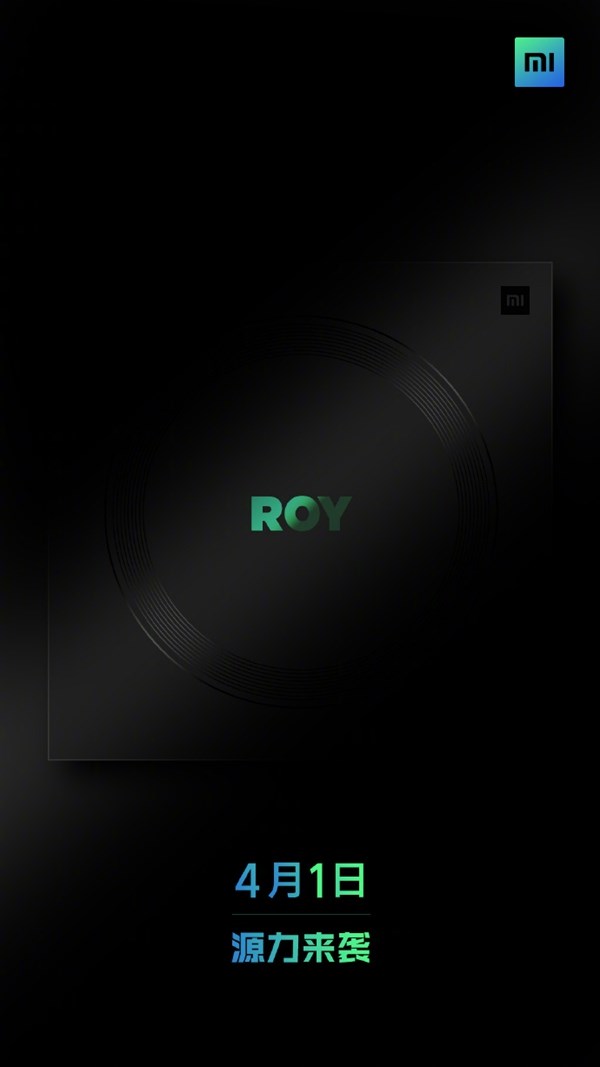
Xiaomi Mi 9 Roy Wang Custom Edition to launch in China on 1st April

Last month, Xiaomi launched its flagship smartphone — Mi 9, which offers high-end specs at comparatively lower pricing than other flagship smartphones from leading brands. The Chinese company is even working on solving its supply chain issues.

Today, the company has confirmed that it is again partnering with Roy Wang and will launch the Mi 9 Roy Wang Custom Edition in China on 1st April. Previously, the company had launched the Roy Wang Custom Edition phone case.

Also, in a user query on Weibo regarding the Pro edition of the Mi 9 smartphone, Wang Teng, Product Director at Xiaomi said “giving time will definitely do it”, hinting that the Pro model of the flagship smartphone is also in the works. However, do note that this is not yet confirmed by Xiaomi.

Xiaomi Mi 9 Roy Wang Custom Edition

Coming to the specifications, the Mi 9 packs a 6.39-inch 2340 x 1080 AMOLED display with a waterdrop notch that houses the selfie camera. The display panel is supplied by Samsung and is protected by a layer of Gorilla Glass 6. Under the hood, it runs Snapdragon 855 processor and is paired with 6GB of RAM and 128GB of storage.

There is also an 8GB RAM variant with 128GB of storage too. The Mi 9 is Xiaomi’s first triple camera phone. The first camera with the holographic ring around it is actually the telephoto lens – a 12MP Samsung ISOCELL S5K3M5 sensor with an f/2.2 aperture and 2x optical zoom.

The next sensor is the primary camera – a 48MP Sony IMX586 f/1.75 sensor with a 6P lens. There is also a 16MP Sony IMX481 f/2.2 sensor for taking wide-angle photos and macro shots. The selfie camera is a 20MP sensor and comes with a bunch of modes including AR avatars and an integration with TicTok.

It comes with an in-display fingerprint scanner which is 25% faster than the previous generation. It has NFC with NXP’s new SN100T chip for faster transaction speeds, a dedicated AI button, Bluetooth 5.0 dual-frequency GPS for better positioning, an infrared port, and a USB Type-C port.


Read More: Xiaomi Mi 9X full specifications and price information leaked ahead of its launch next month


The smartphone runs Android 9 Pie-based MIUI 10 out-of-the-box and is powered by a 3,300mAh battery. It comes with support for 27W fast-charging which allows you to charge the phone from empty to 70% in just 30 minutes.

Buy Link:

Check out Xiaomi Mi 9 on GearBestGiztop, Banggood, GeekBuying

Honor Magic 2 smartphone gets updated with March security patch

Last year, Huawei’s sub-brand Honor launches its Magic 2 smartphone, which is the successor of the Honor Magic launched in 2016. The Magic 2 comes with sliding mechanism design and is available in three colors — Gradient Red, Gradient Blue, and Gradient Black.

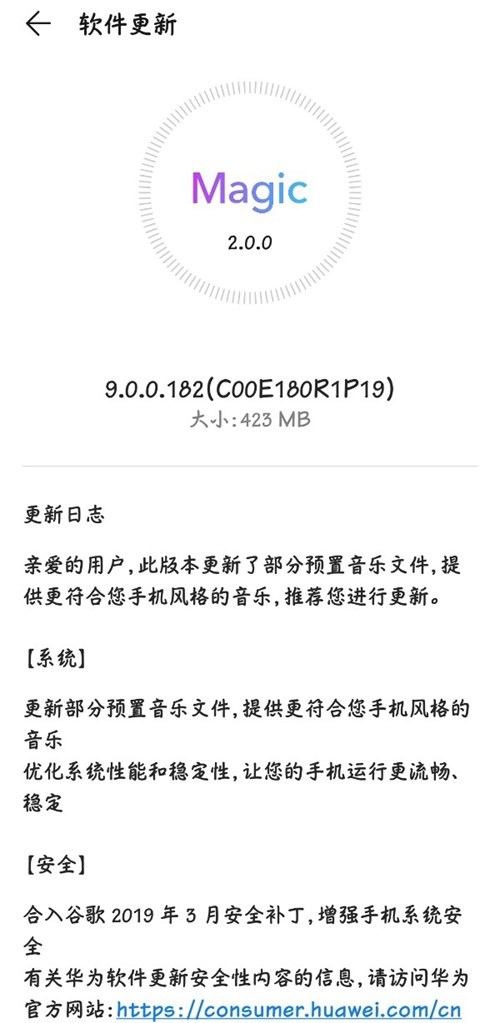
Now, the phone has received a new software update — version 9.0.0.182, which updates the phone’s built-in music app as well as upgrades the Android security patch level to March 2019.

honor magic 2 march security patch

In terms of design, the phone has a sliding screen that adopts five tracks to offer sturdiness over time along with an unmatched sliding experience. The Honor Magic 2 flaunts a 6.39-inch Full HD AMOLED display bearing a screen resolution of 2340 x 1080 pixels and 19.5:9 aspect ratio.

Under the hood, the device packs the company’s own Kirin 980 CPU ARM Cortex A76 octa-core processor, which is paired with Mali-G76 MP10 GPU. The handset packs either 6GB or 8GB RAM along with 128GB or 256GB of internal storage.

The smartphone boasts a triple rear camera setup, consisting of a 16MP f/1.8 RGB sensor, a 24MP f/1.8 Monochrome sensor, and a 16MP super wide-angle f/2.2 sensor. The cameras are packed with tons of features such as scene recognition (more than 1500 scenes), HDR wide-angle photography with night mode, AIS, AR mode, studio level 3D portrait mode and even 480fps slow-motion recording.

On the front side, the phone comes equipped with a 16MP f/2.0 camera and two 2MP f/2.4 depth-sensing camera sensors. There’s also an IR 3D face unlock system, in case you don’t want to use the in-display fingerprint scanner.

The phone runs on Honor’s Magic UI 2.0 which is based on Android Pie operating system. The phone also comes with an advanced AI Assistant called YOYO that packs tons of features, including a feature similar to Google’s Duplex. It is fuelled by a 3,400mAh battery with 40W fast charging support that is dubbed as Magic Charge.


Read More: Honor 10i live on Huawei’s Russian website, packs 32MP selfie camera, triple rear cams and Kirin 710 chipset


As for the pricing, in China, the 6GB RAM with 128GB storage version costs ¥3799 (approx. $545) while the 8GB RAM + 128 storage model retails for ¥4299 (approximately $616). The 8GB RAM + 256GB version is priced at ¥4799, which roughly converts to $688.

Xiaomi Black Shark 2 Hands On: An Incredible Gaming-Centric Smartphone

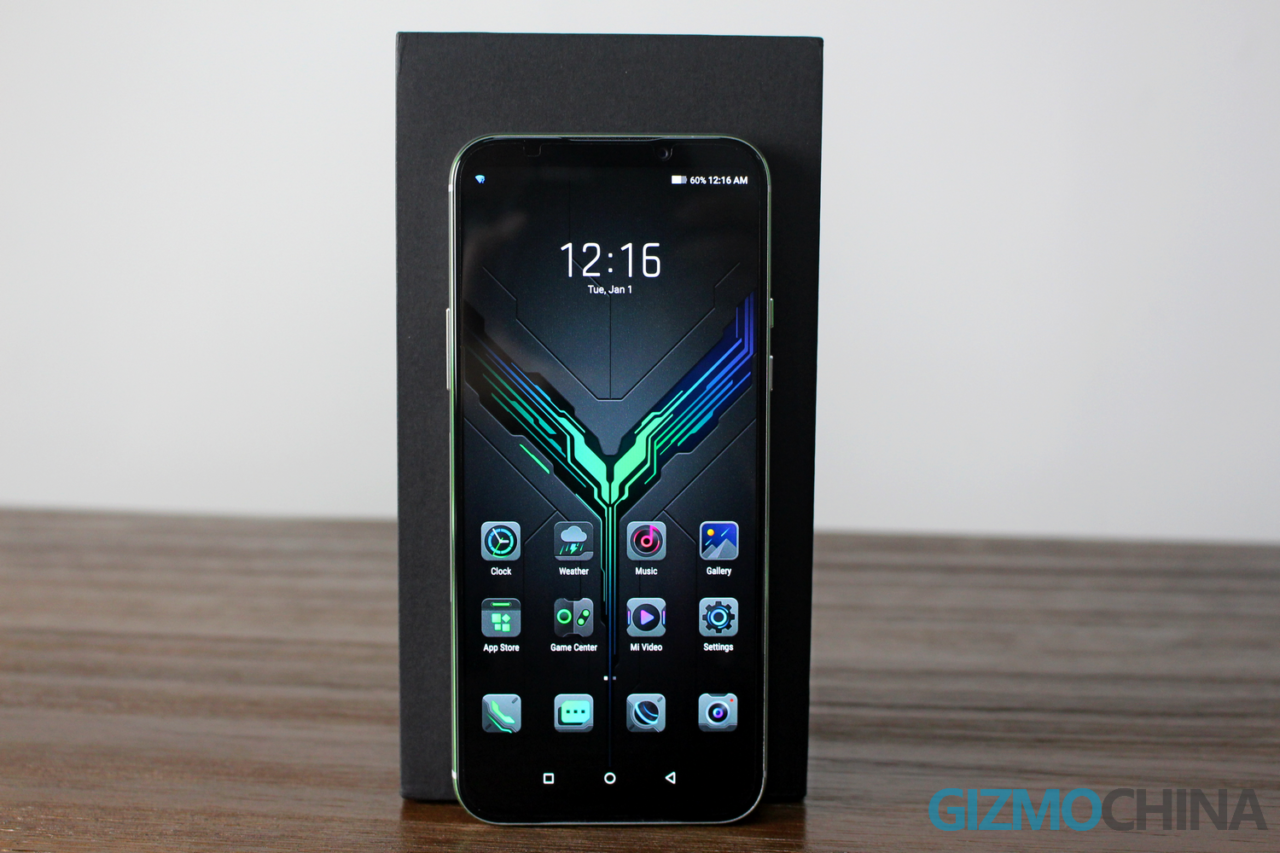
An incredible gaming-centric smartphone was released last week, namely the Xiaomi Black Shark 2. Since mobile games have become popular, phone manufacturers are spending a lot of R&D on gaming-centric smartphones. Xiaomi Black Shark is one of the famous gaming smartphone manufacturers, and the Black Shark and Black Shark Helo have achieved a good amount of popularity. Now, we have got our hands on the new model, so let’s do a quick Xiaomi Black Shark 2 hands on.

Unlike other smartphones, Xiaomi Black Shark 2 doesn’t adopt a notch screen which pursues the higher screen-to-body ratio. Black Shark 2 keeps the bezels on top and bottom which I call them as traditional bezels. There are two narrow bezels on the two sides of its display. Although the Black Shark 2 doesn’t adopt the notch display, the design looks great, and I do love the display design. The handset is equipped with two speakers in the top and bottom bezels respectively.

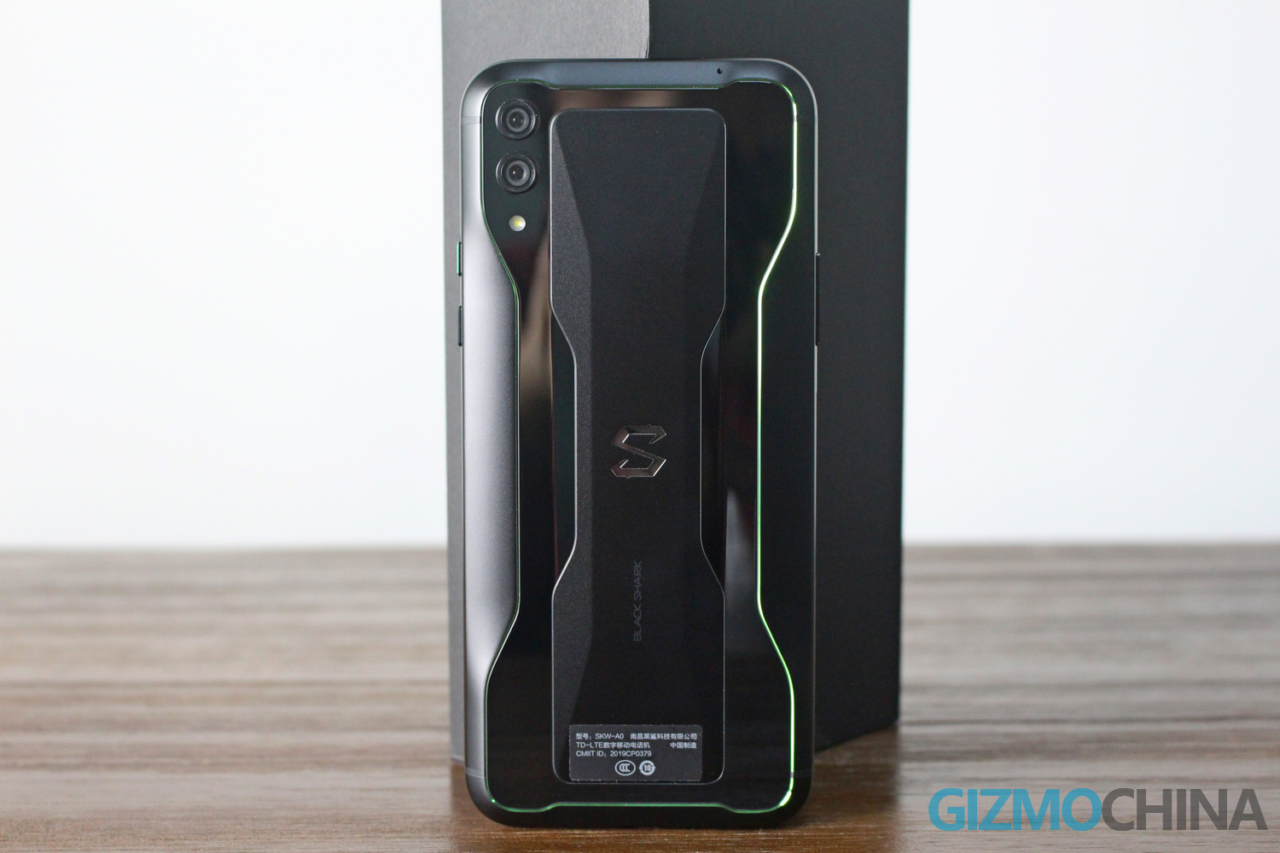
On the back, Black Shark 2 is covered in glass with metal. The texture is nice even though the rear panel is not flat. If you have ever held the Black Shark Helo, then know that the texture is the same on the new Black Shark 2. There are two cameras on the left top corner, which host the 48MP+13MP setup, and a flashlight vertically set below the module. I need to add that, compared to Xiaomi Mi 9, the rear camera module of Black Shark 2 protrudes a bit too much.

The ‘S’ logo stands out quite well on its back. It’s cool and attractive. As the phone comes with an under-display fingerprint sensor, there’s no fingerprint sensor on the rear panel.

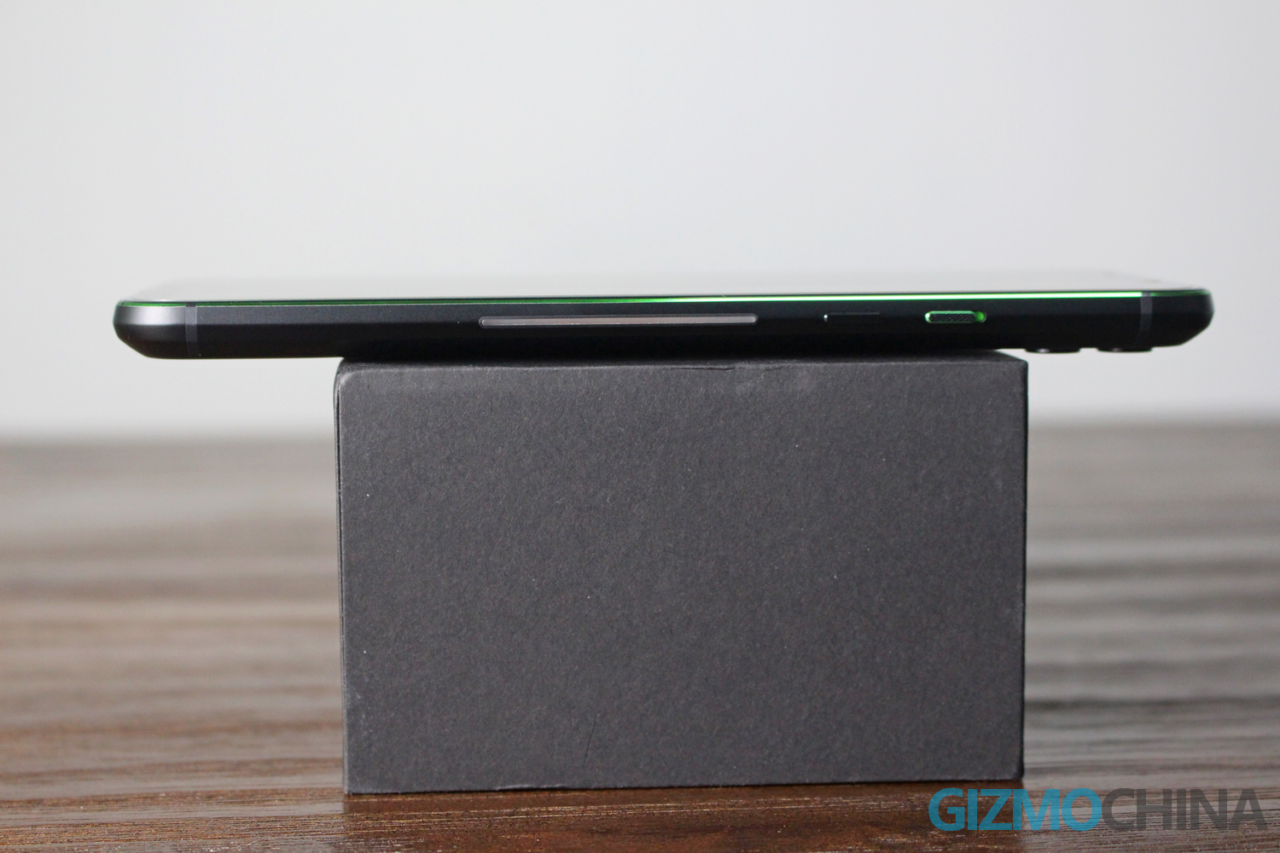
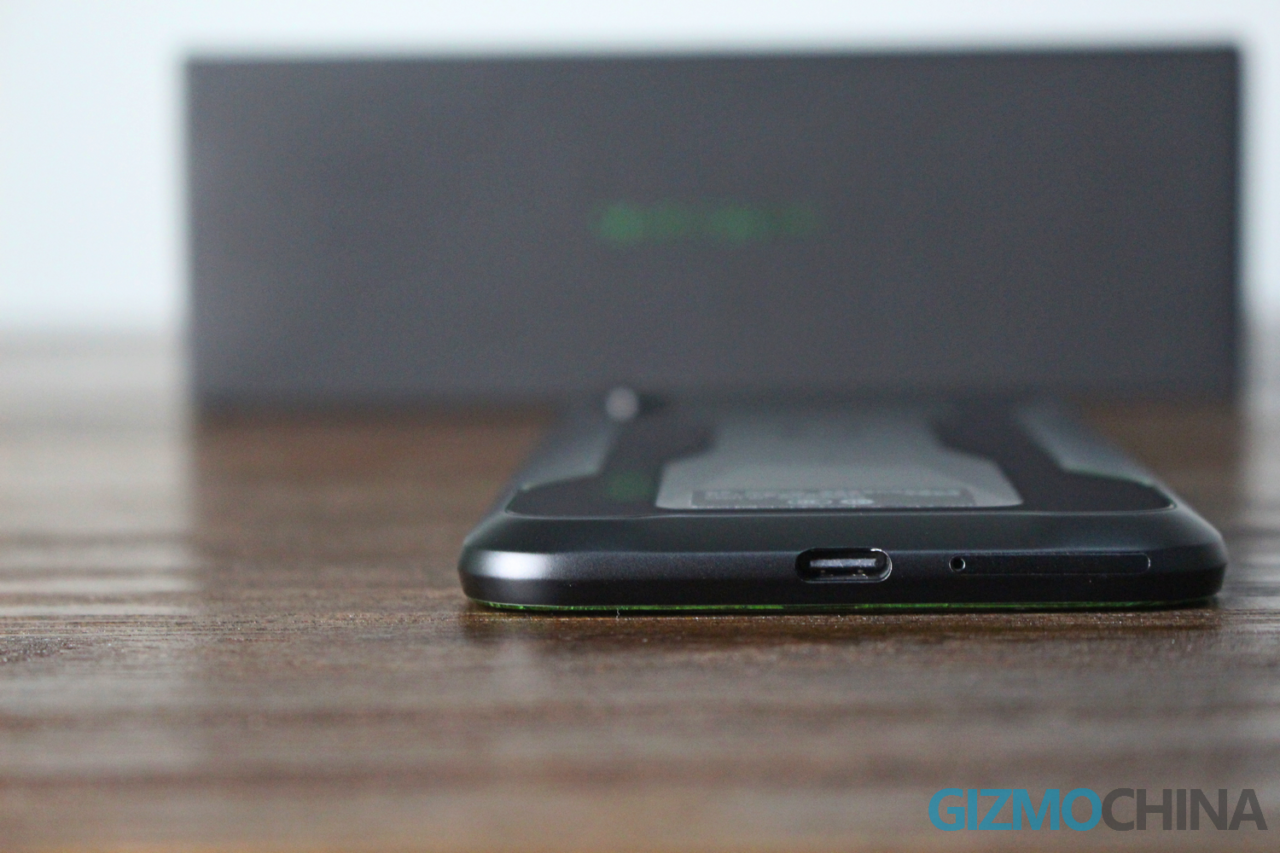
Black Shark 2 features two RGB light strips on the phone’s two sides gleaming when the phone is charging, receiving a message or winning a game, which is similar to the Halo light strip on Vivo iQOO. You can switch to the Game Mode by turning on the SHARK button which is set beside the power button on the phone’s right side, and the volume key is on the left side. The SIM card slot and the Type-C charging port is placed at the bottom. The Black Shark 2 lacks the 3.5mm earphone jack, but there is a Type-C-Audio adapter in the boxing which can solve this problem.

In general, the design of Black Shark 2 is cool that makes you think it’s a gaming console. If you like playing mobile games, the phone should be one of your top priorities.

The Black Shark 2 is powered by Snapdragon 855 processor and ships with 6.39-inch AMOLED screen having a resolution of 1080 x 2340 pixels, 19.5:9 ratio and 403PPI. It receives power from 4000mAh with 27W fast charging which has juice for you to enjoy your game. In the camera department, there are dual rear cameras – a 48MP main lens with f/1.75 aperture and a 12MP Tele-photo lens with f/2.2 aperture. The front-facing camera ships with a 20MP camera with f/2.2 aperture.

[envira-gallery id=”242769″]

The Black Shark 2 is priced around $549 for 6GB+128GB, $599 for 8GB+128GB, $649 for 8GB+256GB and $849 for 12GB+256GB.

Buy Links: Get Xiaomi Black Shark 2 on Giztop, GeekBuying, Aliexpress

Check out the Black Shark 2 Smartphone Silver variant images!

[envira-gallery id=”242794″]

Razer Phone 3 not coming anytime soon, suggests CEO while talking about its software ambitions

The Razer phone development is paused until networks and software catch up, reveals Razer Phone’s CEO, Min-Liang in an interview with Richard Lai of Engadget. Following the layoff in its mobile division, a report revealed that Razer could stop developing smartphones. However, today Razer’s CEO verified the claim while talking about the company’s software and network ambitions.

While bidding farewell to Razer Phones, at least for some years Tan stated that the devices “have done phenomenally well,” and the lineup “has delivered whatever we wanted it to deliver.”

He noted that the awkward phase of 5G transition has left customers in-between, “If I buy a phone this year as a gamer, I want to buy a 5G phone, but if I buy a 5G phone, there’s no network to use it on.”

Razer is now shifting its focus towards gaming software to improve the overall experience. The company is already working with Tencent, the maker of PUBG, Fortnite, and Valor, to optimize and enhance the gaming experience across software, hardware, and services. Tan explained they are also working to remove specific I/O “hacks” which allows gamers to get a hold over players using different input methods.

Razer is working with game developers to end any unauthorized way to boost performance during gameplay. He terms these “hacks” as giving an unfair advantage over other players and would end the competitive environment among gamers.

Mobile games should offer 120Hz frame rates to fully cap on the faster display hardware present in the gaming phones. Tan also wants standardization in the gaming industry to help fully utilize every resource available on the phone.

Although, Tan states that the company still has a large engineering team and the capability to build a smartphone, arising speculations about Razer Phone 3 launch later in the future. Razer will surely benefit by helping revolutionize the gaming industry. 

(source)
Buy Huawei Honor AM – H1C FlyPods Bluetooth Earbuds Wireless Earphone For Just $70.99 On Gearbest [Coupon]

If you’ve restlessly been looking for premium earphones that don’t cost a fortune, you might want to test drive the Huawei Honor AM – H1C FlyPods Bluetooth earbuds wireless earphone.


Loaded with an impressive array of features and top-end specifications, the Huawei Honor AM-H1C FlyPods earphones are now up for grabs bearing a heavily discounted price tag on Gearbest.

In addition to taking advantage of the aforesaid discount, Gearbest users can save extra money at checkout. We’ll delve into more details about that in just a bit.

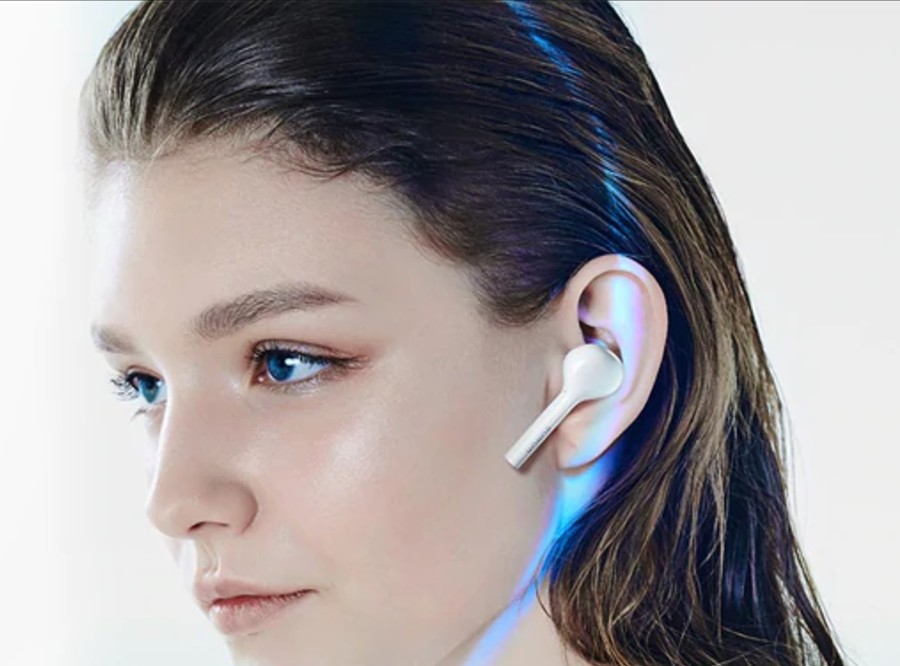
Devised to deliver pure, uninterrupted music, the Huawei FlyPods adopts a wireless design, giving music lovers freedom from hassles of wire. Moreover, its one-of-a-kind ID design ensures the best music experience anytime, anywhere.

All it requires is a simple Bluetooth pairing to automatically connect once you open the case. Aside from listening to your favorite audio, the Huawei FlyPods comes in handy for making phone calls. The earbuds come with infrared sensors that detect when you’ve worn them and when you take them out as well.


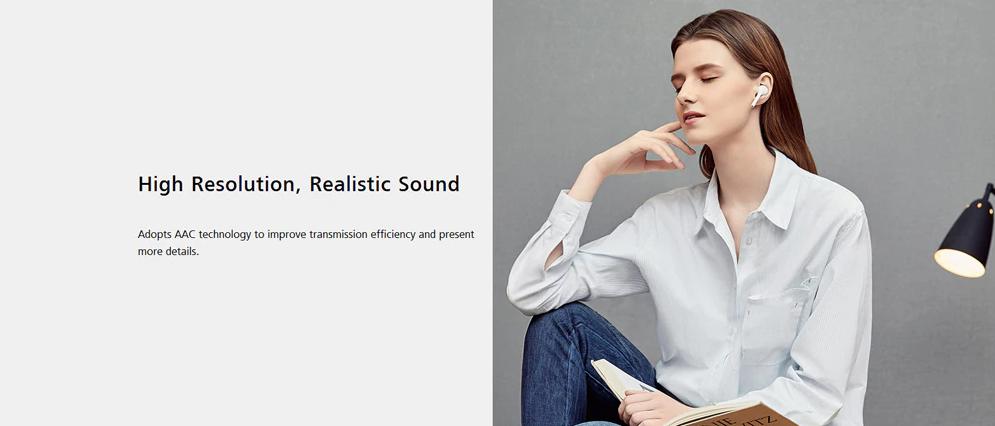
On top of that, the Huawei FlyPods utilizes balanced amatures+dynamic drivers, paired with EQ (independent equalization) adjustment in a bid to deliver deep bass, crisp treble, and natural alto. The earbuds also adopt AAC technology to boost transmission efficiency and offer more details.

What makes the Huawei FlyPods an easy-to-use earphone is its touch control feature. Its Bluetooth function allows you to do other chores using your hands while listening to music or answering a phone call. It comes with ENC noise reduction microphone for a crystal clear chat with friends and family.

While you are highly likely to come across several Bluetooth earbuds wireless earphones that claim to offer comparable features, these devices aren’t necessarily easy on the pocketbook. The Huawei FlyPods, on the other hand, would normally set you back $95.68.

If you are living on a tight budget and can’t spend that kind of money, Huawei’s got your back!

The Chinese consumer electronics manufacturer has teamed up with Gearbest to make the Huawei FlyPods available to cost-conscious buyers. Keeping in line with that, these Huawei-branded wireless earphones are now available bearing a reduced price of just $75.99.

Deemed as one of China’s best online stores for electronic items, Gearbest is now doling out a significant 21 percent discount on the Huawei FlyPods. It is worth mentioning here that new customers will be eligible for an extra PayPal discount, wherein they can avail an additional $3 off if their cart value exceeds $50.

Note that the aforesaid offer will specifically be valid for the first 4000 pieces daily. Gearbest is offering its loyal customers something to cheer about as well.

You can apply coupon code GIZMOGB01 during the checkout process and bring the already reduced retail price of the Huawei FlyPods further down to just $70.99 without breaking a sweat.

In order to take full advantage of the discount, all you need to do is to follow this link without wasting time. With only 94 pieces remaining, this promo is slated to end in just one day.

Get 21% Off On Huawei Honor AM – H1C FlyPods Bluetooth Earbuds Wireless Earphone

Meizu 16s leaked shots and renders appears to reveal new rear design

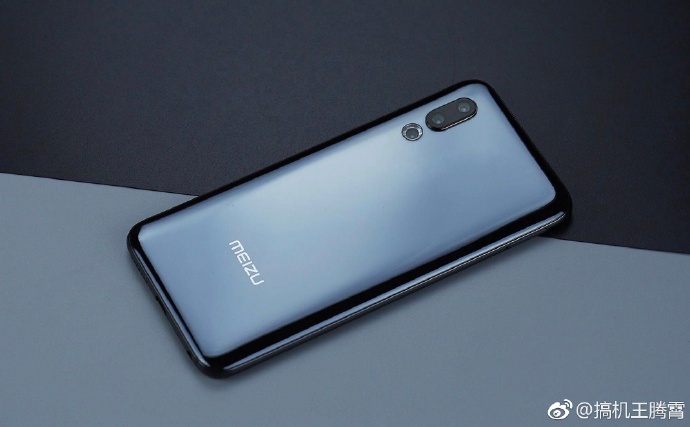
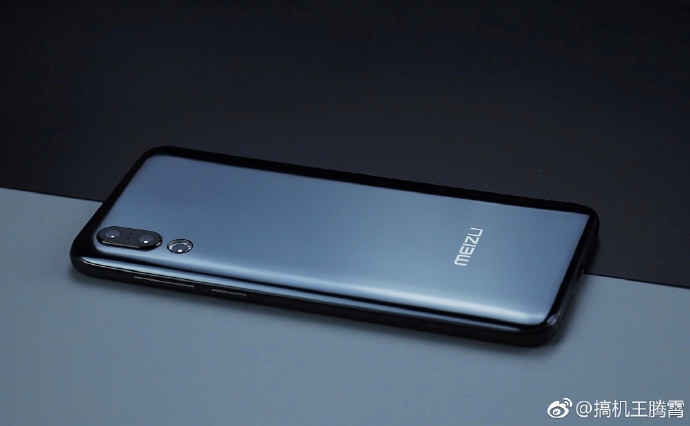
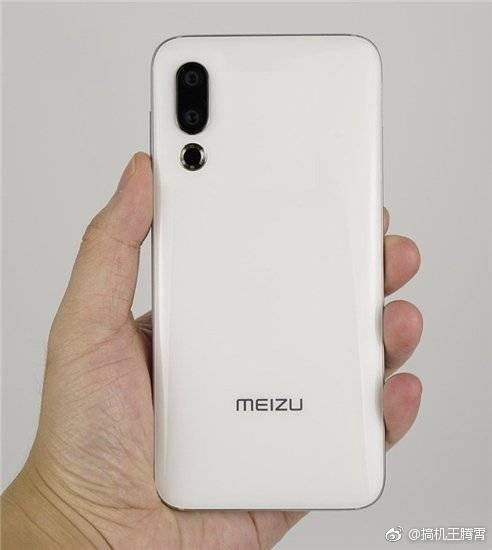
The Meizu 16s has recently bagged 3C certification in China. In the previous week, a leaked image had surfaced to reveal the front design of the phone. Today, a couple of leaked shots and renders of the Meizu 16s have appeared on Weibo to reveal its rear design. The new images show that the handset will be sporting a unique rear appeal compared to the Meizu 16th smartphone.

Meizu 16s Leaked Photos

The Meizu 16th features a vertical dual camera setup followed by a ring flash in the upper half of its back panel. The new images of the Meizu 16s show that it will be sporting a glass back like the Meizu 16th phone. Its vertical dual camera module and ring flash will be position in the top-left corner of its back panel.

Meizu 16s rear

The rear shell of the phone seems to be slightly curved towards the right and left edges. At the bottom side of the device is an external speaker, a USB-C port and a 3.5mm audio jack. The right edge of the smartphone features a volume rocker and a power key.

Meizu 16s rear

Meizu 16s rear

The front image of the Meizu 16s that had appeared in the previous week revealed that it will be featuring super-slim bezels around the screen. Like the Meizu 16th, the Meizu 16s is equipped with equalized upper and lower bezels.

Meizu 16s Specifications

Recent reports have revealed that the Meizu 16s will be equipped with a 6.2-inch display that will offer full HD+ resolution. The AMOLED display of the Meizu 16s will be embedded with a fingerprint sensor. The latest Snapdragon 855 mobile platform will be the driving force of the device. The SoC will be supported by 6 GB of RAM. It will be equipped with an internal storage of 128 GB.

Meizu 16s rear

The dual camera of the phone will be featuring a dual camera with 48-megapixel Sony IMX586 primary sensor with OIS. The Android 9 Pie OS will come preloaded on the device with the latest version of Flyme. It will be equipped with a 3,600mAh battery that will carry support for 24W fast charging.

Meizu 16s Price

The Meizu 16th is selling with a starting price of 2,698 Yuan in China. Meizu CEO Jack Wong had claimed in the recent past that the Meizu 16s will be priced 500 Yuan more than the Meizu 16th. Hence, the Meizu 16s is likely to be priced at 3,198 Yuan. The handset is expected to go official in the coming month. The Chinese manufacturer will be also launching the Meizu 16s Plus and Meizu 16T gaming smartphone alongside the Meizu 16s.

Vivo S1 goes official in China with 2,298 Yuan (~$342) price; Sales to begin on April 1

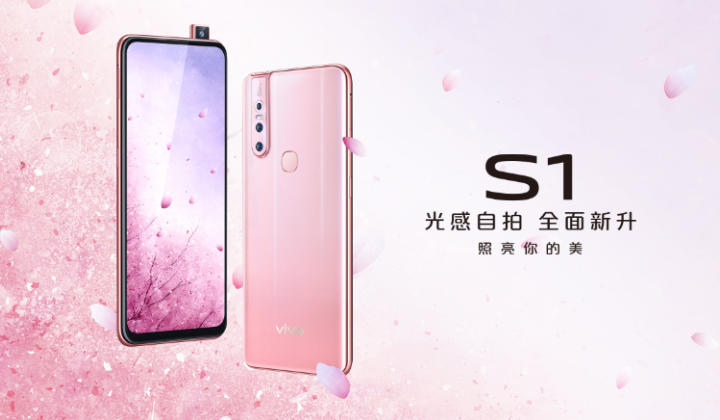
On March 19, Vivo had announced the Vivo X27 and X27 Pro smartphones. The Chinese manufacturer was also rumored to debut the Vivo S1 as its first S-series phone during the unveil event of the X27 series. However, the Vivo S1 wasn’t unveiled. The Vivo S1 is now listed on the official website of Vivo China. The smartphone is up for reservations and it will be available for buying starting from April 1.

Vivo S1

Vivo S1 Specifications and Features

The Vivo S1 that has a model number of Vivo 1831A/T measures 161.97 x 75.93 x 8.54mm and it weighs 189.5 grams. The smartphone is equipped with a notch-less 6.53-inch IPS LCD panel that produces full HD+ resolution of 1080 x 2340 pixels. The S1 offers a screen-to-body ratio of 90.95 percent and an aspect ratio of 19.5:9.

The MediaTek Helio P70 drives the phone with 6 GB of RAM. It features an inbuilt storage of 128 GB. For additional storage, it offers users with a microSD card slot. The FunTouch OS 9 based Android 9 Pie OS comes loaded on the device. There is an independent AI button for summoning the Jovi voice assistant. For enhanced gaming experience, the Vivo S1 is equipped with Game Turbo. There is a 3,940mAh battery inside the device to keep the lights on. The dual-engine flash charging brings support for 18W rapid charging on the device.

The Vivo S1 features a pop-up selfie camera of 24.8-megapixel. Placed on the rear side of the smartphone is a triple camera setup that includes an f/1.7 aperture 12-megapixel main sensor, an f/2.2 aperture wide-angle lens of 8-megapixel and an f/2.4 aperture 5-megapixel depth sensor. The AI face beauty function of the Vivo S1 can identity 103 basic facial features for capturing selfie shots. There is a Body Camera feature onboard that can automatically adjust the body proportions while shooting photos and videos.

The rear shell of the Vivo S1 is fitted with a fingerprint sensor. It is packed with other features such as 4G VoLTE, dual-SIM support, Wi-Fi 802.11ac, Bluetooth, microUSB 2.0, GPS and 3.5mm audio jack.

The Vivo S1 is nothing but a rebranded edition version of the Vivo V15 smartphone for China. Except for some differences in the camera configurations, both phones are packed with the same specifications. Instead of 24.8-megapixel front camera on the Vivo S1, the Vivo V15 is equipped with a selfie camera of 32-megapixel. Also, the triple camera setup of the V15 features 24-megapixel primary sensor instead of 12-megapixel camera found on the S1.

Vivo S1 Price and Release Date

The Vivo S1 will be hitting the Chinese markets on April 1 in two color choices such as Ice Lake Blue and Pink. The handset carries a price tag of 2,298 Yuan (~$342).

Huawei P30 Pro confirmed to have display panel from BOE

Huawei launched its latest flagship smartphone series — Huawei P30 series yesterday at a launch event in Paris, France. The company is still going with the dual devices strategy and launched two phones — Huawei P30 and Huawei P30 Pro.

While it’s known that Samsung is the supplier of the P30’s display, it remained unknown who provided the flexible display panel for the P30 Pro. Well, now it’s known from where the flexible screen panel for the P30 Pro comes.

Huawei P30 Pro BOE Display

When BOE Vice President Yuan Wei was asked if BOE provided the display panel for the P30 Pro, he confirmed that it’s indeed BOE. This also seems like a clever move from Huawei as the company won’t be dependent on a single vendor for the display panels and can easily scale up productions if required.

The Huawei P30 has a 6.1-inch FHD+ OLED DCI-P3 HDR display with a 19.5:9 aspect ratio while the P30 Pro comes with a larger 6.47-inch FHD+ curved OLED display. The phone doesn’t have an earpiece, instead, it uses Acoustic Display Technology.

Both the phones are powered by the Kirin 980 chipset with up to 8GB of RAM and 512GB of storage. There is support for storage expansion using Huawei’s NM Card. The P30 comes with a triple-camera setup while the Pro model features a quad-camera setup.


Read More: Huawei’s latest 12000mAh 40W SuperCharge Power Bank can charge all your gadgets including laptop


The P30 has a 3,650mAh battery with support for 22.5W fast charging while the P30 Pro has a 4,200mAh battery with support for 40W fast-charging and support for 15W wireless fast charging. Both phones run EMUI 9.1 based on Android Pie.