Advertisement

Samsung Galaxy S25 Series: Here’s Everything You Need to Know

Samsung Galaxy S25 Ultra render

Samsung’s Galaxy S series has long been the benchmark for Android flagship smartphones, and the upcoming Galaxy S25 series is shaping up to be no exception. We’re still a few weeks away from the launch, but most of the details are already out, thanks to leaks, which kept coming despite Samsung taking strict actions to stop them, including firing a bunch of its employees.

There will be hardware upgrades, like a new chipset, camera sensor, and more. But the software will also play a crucial part, as it’s undergoing significant improvements, probably the biggest in recent years. While we wait for the official unveiling, let’s look at what’s already known about the Galaxy S25 series so far.

Samsung Galaxy S25 Series Roundup: Everything You Need to Know

According to a leaked Galaxy Unpacked banner, the event may take place on January 22nd, where the much-anticipated Galaxy S25 series will be uncovered. One UI 7 will also be announced at the event, which will come preinstalled on the newest Galaxy flagships.

1. Rounded Corners, More Comfort

Samsung has been consistent with its design language for the Galaxy S series, and the S25 series will be no different. That means no major design changes. Leaked renders from reputed sources verify the same. However, there are notable upgrades to improve the look and feel.

Galaxy S25 Ultra vs S24 Ultra design

The Galaxy S25 Ultra may have rounded corners, not the sharp edges you see on the S24 Ultra. While sharp corners give the S24 Ultra a stylish look, they tend to dig into the palm, making it uncomfortable to hold for a longer duration. The rounded design of the S25 Ultra gives it a refined look while also making it comfortable to hold.

The Ultra will get the titanium backing, again, while other models will have to satisfy themselves with an aluminum frame. We also expect an S Pen slot at the bottom for the Ultra model, just like its predecessors.

2. Bigger and Brighter Screen

The Galaxy S25 series, at least the Ultra model, is getting display upgrades. According to prolific tipster Ice Universe, the S25 Ultra’s screen measures 6.86 inches, slightly bigger than the S24 Ultra’s 6.8 inches.

Notably, the new smartphone will be 77.6mm wide (less than S24 Ultra’s 79mm), but Samsung has somehow managed to shrink the bezels to 2.3mm to achieve a bigger display. So, the S25 Ultra will have a higher screen-to-body ratio that will certainly improve the visual experience. The base Galaxy S25 might also have a slightly bigger 6.36-inch screen that matches iPhone 16 Pro’s.

Smartphone brands are emphasizing on screen brightness as a key feature to attract customers, and Samsung wants to leave no stone unturned. The S25 Ultra will reportedly match Pixel 9 Pro’s 3000 nits peak brightness while handsomely beating the iPhone 16 Pro’s 2000 nits offering.

In addition to a bigger screen, the Galaxy S25 Ultra will reportedly feature a more powerful second-generation Corning Gorilla Armor Glass with anti-reflective properties. The rest of the display specs will largely remain the same: an LTPO panel, 120Hz refresh rate, and a 1440p resolution.

3. No Exynos Chip This Time

Yes, you read that right. All S25 models, including the vanilla and Plus, are tipped to get the Snapdragon 8 Elite chip for all markets, including India. While Samsung has not confirmed it, South Korean media reports believe the company has production issues with the Exynos 2500 chip, leaving Samsung no choice but to go for Snapdragon.

Qualcomm-Snapdragon-8-Elite-launched-specs-1

The Snapdragon 8 Elite is a powerful chip with strong CPU and GPU capabilities. It beats Apple’s fastest A18 Pro Bionic on popular benchmarking platforms, narrowing the performance gap between Android and iPhones.

Samsung is reportedly ditching the 8GB RAM version for the entire S25 lineup. All of them are likely to ship with 12GB RAM as standard, which would be a significant upgrade over the Galaxy S24.

4. Batter Cameras

Cameras are going to be better on the Galaxy S25 series as anyone would expect. According to a recent leak, the S25 Ultra would use the same 200MP sensor. The 12MP (with 3x optical zoom) and 50MP (5x optical zoom) are also identical to the Galaxy S24 Ultra.

Galaxy-S25-Ultra-2

The only notable camera upgrade on the spec sheet is the new 50MP ultrawide sensor, a jump from the 12MP on the S24 Ultra. The sensor size looks to have increased as well, which would allow more light to pass through it, resulting in better images.

There are not enough details about the S25 and S25+ cameras. However, if leaks are to be believed, they will not receive significant camera upgrades.

5. Battery and Charging

Samsung will reportedly make no changes to the battery capacity and charging speed for the S25 series, not even for the Ultra model. So, we’re likely going to see the same (4000mAh, 25W) on the S25, (4900mAh, 45W) on the S25+, and (5000mAh, 45W) on the S25 Ultra.

Galaxy-S25-Qi2

There’s one big change, though. The Galaxy S25 models will reportedly support the Qi2 wireless charging standard, which is lacking in the S24 series. Tipster @chunvn888 revealed that the phones will support the EPP Qi2 (without magnet) profile with up to 25W wireless charging speeds, which is a considerable upgrade over the 15W limit on the S24 series.

Samsung is also said to be working on a new Battery AI feature that can extend the battery life by limiting the processor and the 5G modem. 

5. A Slim Model on the Way

Samsung might unveil four Galaxy S25 models at the upcoming Galaxy Unpacked event. The fourth one is not the S25 FE but the Galaxy S24 Slim. While we’re still waiting for an official confirmation on this, industry experts believe that a Galaxy S25 Slim might be in the pipeline to compete with the yet-to-be-announced iPhone 17 Air.

If you look closely at the leaked Galaxy Unpacked banner, it shows four Galaxy smartphones, which further leads to believe that there might be a Slim model as well.

6. Launch Date and Pricing

Samsung has not announced the launch date for the Galaxy S25 series. However, a recently leaked banner suggests that the Galaxy Unpacked 2025 might happen on January 22nd. This is when new Galaxy flagships might be announced. They might go on sale starting February 7th.

While there are no concrete details around pricing, some reports suggest a price hike as Qualcomm is reportedly charging up to $190 for each Snapdragon 8 Elite application processor (AP).

Tech enthusiast? Get the latest news first! Follow our Telegram channel and subscribe to our free newsletter for your daily tech fix! ⚡

TCL launches Thunderbird U6 27″ 4K QD-MiniLED monitor with 98% DCI-P3 & 600 nits peak brightness

TCL’s subsidiary Ffalcon has introduced its latest QD-MiniLED office monitor, the Thunderbird U6, in the Chinese market. It is priced at 1,499 yuan ($204) and is now available for purchase on JD.com. Here’s a look at its key specifications.

Ffalcon Thunderbird U6

Ffalcon Thunderbird U6 Specifications

This 27-inch monitor features a stunning 4K UHD resolution (3840×2160) with a 60Hz refresh rate, delivering exceptional clarity and immersive visuals. It comes with Quantum Dot (QD) wide color gamut technology, offering an impressive 98% DCI-P3 and 99% sRGB color coverage for vivid and lifelike colors. Additionally, it sports PANTONE Validation and color accuracy of Delta E < 2, making it perfect for design and creative professionals.

It equips MiniLED backlighting technology with 180 local dimming zones, enhancing brightness and contrast for deeper blacks and brighter whites. The display features a peak brightness of 600 nits, certified by DisplayHDR 600, and a dynamic contrast ratio of 1,000,000:1, ensuring stunning visuals. Furthermore, it comes with Demura pixel-level calibration, ensuring uniform brightness and color consistency across the screen.

Ffalcon Thunderbird U6

For eye comfort, the monitor features TÜV Rheinland low blue light certification, reducing strain during extended usage. It also sports flicker-free 10KHz PWM dimming, ensuring a more comfortable viewing experience.

The monitor comes equipped with a comprehensive array of connectivity options, including 2 HDMI 2.1 ports, 1 DisplayPort 1.4, 1 USB Type-C with 65W power delivery, 2 USB-A ports, 1 USB-B upstream port, and a headphone jack. The Type-C port features high-speed data transfer and reverse charging capabilities, making it highly versatile for modern workflows.

It features an ergonomic stand that supports tilt (-5° to 15°), height adjustment (125mm), horizontal swivel (±20°), and vertical rotation (-90° to +90°), allowing users to find the ideal viewing angle. The monitor sports a minimalist design with a sleek white finish, perfectly blending into any professional workspace.

Additionally, it equips dual 3W speakers, providing clear audio for meetings and multimedia playback. Each monitor comes factory-calibrated, ensuring top-notch performance and accuracy right out of the box.

Last month, TCL unveiled the TCL C11K Lingxi QD-Mini LED TV, featuring 3000 nits of brightness, a 288Hz refresh rate, and advanced AI capabilities. Additionally, the company introduced the T6L 4K QD-Mini LED TVs, equipped with Fuxi AI, a 288Hz refresh rate, and XDR 1300 nits brightness.

Tech enthusiast? Get the latest news first! Follow our Telegram channel and subscribe to our free newsletter for your daily tech fix! ⚡

Xiaomi launches Sports Walkie-Talkie with 5000km communication, noise reduction & -30°C battery

Xiaomi has launched a new product, the Sports Walkie-Talkie, in the Chinese market. It is priced at 399 yuan ($54) and is now available for pre-order on Xiaomi Youpin. This isn’t the first time Xiaomi has ventured into the walkie-talkie market. In 2023, the company launched the Xiaomi Walkie Talkie 2S, featuring an impressive 120 hours of standby time.

Xiaomi Sports Walkie Talkie

Xiaomi Sports Walkie-Talkie Specifications

The Sports Walkie-Talkie offers a range of impressive features designed for outdoor enthusiasts and adventure seekers. It comes with TD-LTE wireless data technology, ensuring dependable communication across long distances.

It equips nationwide 4G network support from major carriers like China Mobile, China Unicom, and China Telecom. It also sports an exceptional communication range of up to 5000 kilometers, enabling seamless connectivity during outdoor adventures.

This walkie-talkie sports a compact and lightweight design, with a body measuring 54 x 55.6 x 22.3 mm and weighing just 67 grams (excluding accessories). Despite its small size, it packs a powerful 1030mAh lithium-ion polymer battery that delivers up to 24 hours of continuous usage or 36 hours of standby time. Its advanced low-temperature battery ensures operation in extreme conditions as low as -30°C, making it suitable for skiing, hiking, cycling, and more.

The device features an independent noise-canceling chip that minimizes wind noise, ensuring clear communication even at speeds of 60 km/h. It comes with a dedicated team button offering tactile feedback, enabling quick group formation even while wearing gloves. It equips IP65-rated water and dust resistance, providing durability in challenging environments.

The device features Xiaomi’s magnetic quick-detach system, providing versatile wearable and portable mounting options such as magnetic goggle clips, armbands, and lanyards. It comes with the flexibility to securely attach to various gear, offering hands-free convenience for users.

The device integrates seamlessly with the Xiaomi Walkie-Talkie app, offering features like team management, location sharing, and OTA updates. It also comes with Bluetooth connectivity, allowing it to double as a speaker or activate your smartphone’s voice assistant with a double press of the function button. Additionally, it features a “Lost Mode,” enabling users to trigger an alarm to locate misplaced devices remotely.

The Xiaomi Sports Walkie-Talkie features Type-C charging support and a robust design built for durability. It also comes with accessories such as magnetic clips and snow-lock clips, enhancing its functionality.

Xiaomi recently expanded its product lineup with the launch of the Xiaomi Mijia Top-Flow Pro Air Conditioner as well, featuring rapid cooling and heating capabilities along with HyperOS integration. Additionally, the company introduced the MK71 Pro mechanical keyboard, boasting a 71-key layout, triple-mode connectivity, and a powerful 7800mAh battery.

Stay ahead in tech! Join our Telegram community and sign up for our daily newsletter of top stories! 💡

Realme GT 7 May Have Surfaced in China’s TENAA: Key Specs and Design Revealed

The Realme GT 7 Pro was one of the cheapest flagship phones with the new Snapdragon 8 Elite chipset. But now, it seems like a base variant is also in the works. It seems that a Realme GT 7 was spotted on a major Chinese certification platform, revealing some of its key specs and design.

Is it really the Realme GT 7?

Unfortunately, the TENAA listing does not reveal the device’s name (Via TheTechoutlook). But it does confirm the RMX5090 model number. Some of its key specifications were also revealed in the online database. The Realme GT 7 sports a tall 6.78-inch AMOLED display that offers 2780 x 1264 resolution (1.5K). We can expect it to offer high brightness and high refresh rate as well. Apart from this, we also have some specs for the processor.

Realme GT 7

The chipset has an octa core chip with a clock speed of 4.3GHz. To recall, this seems quite close to the Snapdragon 8 Elite SoC, although this is just speculation at the moment. But if this is true, it might once again be the most affordable Snapdragon 8 Elite powered flagship in the market. The TENAA listing confirms that the processor is paired with 8GB, 12GB, 16GB, or 24GB of RAM along with 128GB, 256GB, 512GB, and 1TB of internal storage.

Lastly, the rear will reportedly have a 50MP + 8MP dual camera setup, while the front has a 16MP selfie camera. Under the hood, a massive 6,310mAh battery pack powers this device. Other notable features include Bluetooth, Infrared, an in-display fingerprint scanner, and a face unlock feature. One of the reasons why this might be the Realme GT 7 is also its design. The certification lists some pictures of the supposed Realme GT 7, which has a design reminiscent of the GT 7 Pro.

Don’t miss a thing! Join our Telegram community for instant updates and grab our free daily newsletter for the best tech stories!
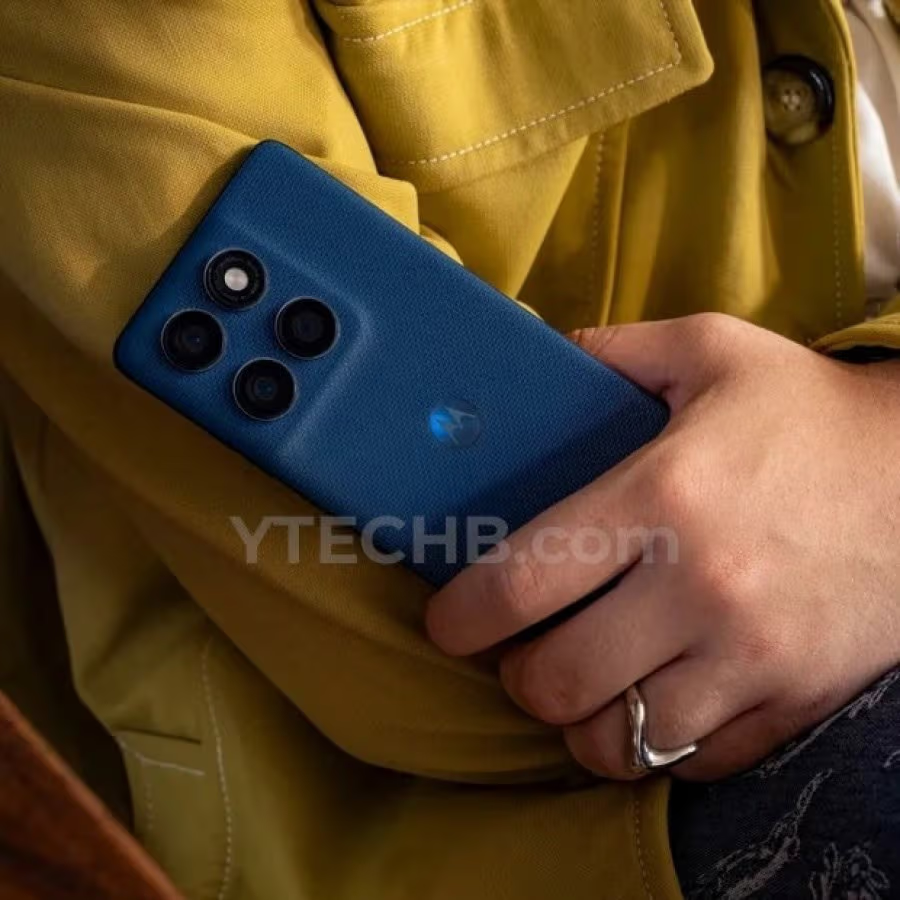
Samsung and Apple may switch to silicon-carbon batteries, claims report

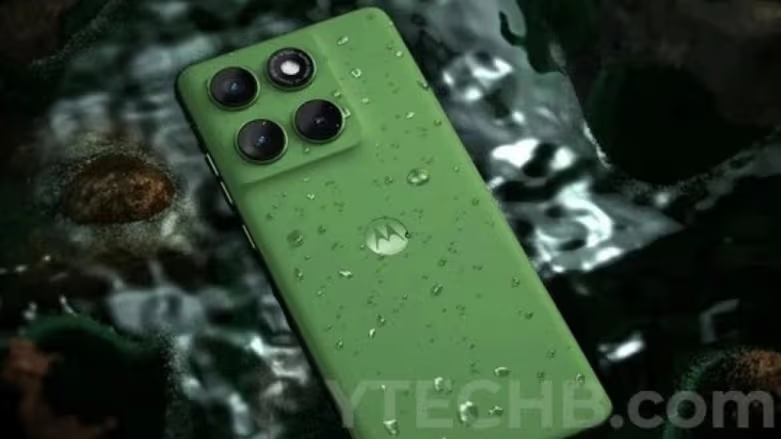
Looks like the dominance of Chinese smartphone manufacturers in adopting silicon-carbon (Si-C) batteries may have put global giants like Samsung and Apple under increasing pressure to innovate. 

As you might know, Chinese brands are already equipping their devices with batteries exceeding 6,000mAh. Samsung and Apple, on the other hand, remain capped at a 5,000mAh limit, even for their flagship models like the Galaxy S24 Ultra

However, a fresh rumor suggests that both companies may now be working to overcome this limitation by developing silicon-carbon battery technology.

A report from yeux1122 on the Korean blogging platform Naver claims that Samsung is directly involved in the material development of silicon-carbon batteries. However, there’s no clarity on when the technology might make its way into a commercial device. 

Apple, on the other hand, seems to be taking a cautious approach, consistent with its history of adopting new technologies at a slower pace.

Why Si-C batteries?

Silicon-carbon batteries have higher energy densities which means you can get bigger battery capacities within the same physical footprint. As a result, it addresses a key concern for premium smartphones—balancing battery life with performance and feature integration. 

Flagship devices like the iPhone 16 Pro Max and Galaxy S24 Ultra are stuffed with numerous components, leaving little room for batteries. Engineers must carefully manage this limited internal space to ensure larger batteries do not compromise performance, thermal management, or other essential features.

While Si-C batteries are a great solution to this problem, Samsung and Apple could still face hurdles in bringing this technology to their flagship lines. Beyond the engineering challenges of fitting larger batteries into slim designs, the cost of development and manufacturing is likely to be substantial.

Although software optimizations and power-efficient components have extended battery life, the limits of current lithium-ion technology are becoming more apparent. For Samsung and Apple, adopting silicon-carbon batteries seems like a much-needed step going forward, but whether this innovation materializes soon remains an open question.

Tech enthusiast? Get the latest news first! Follow our Telegram channel and subscribe to our free newsletter for your daily tech fix! ⚡

(Source)

Your Samsung Galaxy Phone may soon feature an AI powered weather changing wallpaper: Patent

Samsung might be working on a nifty feature for its Galaxy smartphones. A new patent sighting has revealed that the company might be using artificial intelligence to bring a new weather changing wallpaper feature. So here’s everything you need to know.

Samsung Galaxy AI Wallpaper With Weather Changing Effect

Samsung Galaxy AI Wallpaper 2

The patent was spotted by 91Mobiles at the United States Patent Application Publication. Looking at the patent filing, Samsung has a unique take on wallpapers that bring both form and function. The South Korean tech giant’s new AI powered wallpaper can apparently change the background design that changes based on the time and weather of the day. There are even sketches of this wallpaper that showcase the idea in practice.

Samsung Galaxy S24 Ultra 5G
Samsung Galaxy S24 Ultra

We can see the wallpaper change automatically based on the time of the day like dawn, morning, afternoon, evening, and night. Thanks to weather detection, this feature may change the background from sunny, foggy, cloudy, rainy, or snowy, based on the current weather in the users’ area. This function might likely include integration with a weather tracking platform. Notably, the patent images also revealed that the feature will push out an alert that suggests users to carry an umbrella if it detects rain.

Samsung Galaxy AI Wallpaper 2

Finally arriving at the AI bit, Samsung would employ Generative AI to read the image/wallpaper background to identify the area, its time, and the weather. It can then generate modified images to reflect the changes in time and weather on top of the original background. This is a pretty unique concept that might add an intuitive layer to wallpapers. Although, it is still in the patent phase so it’s still unclear if the company is actually working on such a feature.

Tech enthusiast? Get the latest news first! Follow our Telegram channel and subscribe to our free newsletter for your daily tech fix! ⚡

Snapdragon 8 Elite 2 and Dimensity 9500 could be on par with Apple M4 in single core performance

Apple‘s dominance in single-core performance may be coming to an end, if rumors about the upcoming Snapdragon 8 Elite 2 and Dimensity 9500 chipsets are true. 

These next-generation processors from Qualcomm and MediaTek could be on par with Apple’s M4 chip in terms of single-core performance, thanks to a combination of factors including the use of ARM’s Scalable Matrix Extension (SME) and production on TSMC’s improved 3nm ‘N3P’ process.

Apple has held the crown for single-core performance in smartphone chipsets for several generations. While Qualcomm and MediaTek have managed to close the gap in multi-core performance, Apple’s chips have consistently excelled in single-core tasks. This has given Apple devices an edge in responsiveness and handling intensive single-threaded workloads.

However, things could be changing with the rumored Snapdragon 8 Elite Gen 2 and Dimensity 9500. 

Snapdragon 8 Elite 2 and Dimensity 9500 Specs

According to a tipster on Weibo, both chipsets will support ARM’s SME, which is an instruction set that allows processors to tackle complex workloads more efficiently. This could significantly improve single-core performance, potentially bringing Qualcomm and MediaTek in line with Apple’s M4 chip.

In addition to SME support, both chipsets are rumored to be manufactured on TSMC’s 3nm N3P process. This will likely improve both performance and efficiency. Interestingly, Apple’s rumored A19 chip is also expected to use the same 3nm process.

The Snapdragon 8 Elite 2 is also rumored to have performance cores clocked at up to 5.00GHz, while the Dimensity 9500’s cores are said to reach 4.00GHz.

These claims remain speculative for now, as we can only confirm actual performance once these chipsets launch and undergo benchmarking. Even then, benchmark scores often fail to fully reflect real-world performance.

Still, the rumors are intriguing. Qualcomm and MediaTek have consistently narrowed the performance gap with Apple, and these next-generation chipsets might finally achieve parity. For Android users, this could mean more high-performance smartphone options.

Tech enthusiast? Get the latest news first! Follow our Telegram channel and subscribe to our free newsletter for your daily tech fix!

Blaupunkt’s Atomik Knightz and BB60 Boombox Speakers launched with up to 100 watts audio output

Blaupunkt has unveiled two new additions to its Boombox lineup in India: the Atomik Knightz and the Atomik BB60. Both models aim to provide dependable audio performance and practical features suited to various needs.

Blaupunkt Atomik Knightz features

Atomik Knightz 100W Boombox
Blaupunkt Atomik Knightz 100W Boombox

The Atomik Knightz is designed for outdoor and party use, delivering 100 watts of sound through four high-end drivers and two bass radiators. Its IPX6 rating ensures resistance to water and dust, making it a durable option for outdoor settings. The speaker also features nine light modes for customizable ambiance. With a 15,600mAh battery, it offers up to two days of playback and supports TurboVolt quick charging to minimize downtime. Additional features include a bass boost button for enhanced audio, a karaoke-ready wireless microphone, and a built-in shoulder strap for convenience.

Blaupunkt Atomik BB60 features

Atomik BB60 60W Party Boombox
Blaupunkt Atomik BB60 60W Party Boombox

The Atomik BB60 is a more compact and portable option, delivering 60 watts of sound through dual speakers and radiators. Its neon-accented design, cushioned premium grill, and carry handle make it easy to transport. The 6,000mAh battery provides up to 10 hours of playback and supports TurboVolt quick charging. Like the Knightz, it is IPX6-rated for splash resistance and includes a wireless karaoke microphone.

Pricing & availability

The Atomik Knightz is priced at ₹14,999 (~$175), while the Atomik BB60 is available for ₹7,999 (~$93). Both models are now available for purchase on Amazon.in and Blaupunkt’s official website.

Tech enthusiast? Get the latest news first! Follow our Telegram channel and subscribe to our free newsletter for your daily tech fix!

LG unveils CineBeam S PU615U compact 4K projector along with PF600U 3-in-1 projector ahead of CES 2025

LG Electronics has strengthened its position in the lifestyle projector market with the launch of two cutting-edge models at CES 2025. These projectors, the PF600U and the CineBeam S (PU615U) are designed to optimize space efficiency while delivering premium entertainment and ambiance solutions for modern consumers.

PF600U: Multifunctional Innovation

LG PF600U projector

The CES Innovation Award-winning PF600U is a versatile 3-in-1 device that combines a projector, Bluetooth speaker, and LED mood lamp. It features FHD resolution (1920 x 1080), 300 ANSI lumens brightness, and LG webOS for seamless OTT streaming. The PF600U’s stand-pole design mimics a floor lamp, ensuring easy integration into any space. Its LED mood lamp offers nine colors and five brightness levels, while its stereo speakers with passive radiators deliver immersive sound.

LG mood lamp

With an adjustable 110-degree tilting head and auto screen adjustment, the PF600U supports screen sizes from 30 to 120 inches. This multifunctional device caters to various activities, from movie nights to ambient music sessions, making it a unique lifestyle companion.

CineBeam S: Compact 4K Ultra Short Throw Projector

The CineBeam S is LG’s smallest 4K Ultra Short Throw (UST) projector, boasting 4K UHD resolution (3840 x 2160) and 500 ANSI lumens brightness. Its ultra-short throw capability projects images between 40 to 100 inches from minimal wall clearance, making it ideal for space-constrained environments.

LG CineBeam S
LG CineBeam S Projector

The CineBeam S features a sleek metallic finish, Dolby Atmos-enabled stereo sound, and 154% coverage of the DCI-P3 color space. Intuitive tools like Auto Screen Adjustment and Wall Color Adjustment simplify setup and enhance user experience. Its lightweight design and LG webOS platform offer portability and easy access to popular streaming services.

Don’t miss a thing! Join our Telegram community for instant updates and grab our free daily newsletter for the best tech stories!
(Source)

Comparing Oppo Reno 13 Pro and Redmi Note 14 Pro+: Which is Better?

Oppo Reno 13 Pro and Redmi Note 14 Pro+ are two flagship contenders vying for attention in the competitive smartphone market. Both brands bring cutting-edge features, innovative designs, and powerful performance, but choosing between them is tough for buyers. This comparison dives into key aspects like design, performance, cameras, and pricing to help you decide which device suits your needs better. As smartphones increasingly double as tools for work, creativity, and entertainment, understanding the nuances of these two models is crucial for making an informed purchase.

1. Design and Display

Oppo Reno 13 Pro
OPPO Reno 13 Pro

The Oppo Reno 13 Pro boasts a premium build with a glass front, aluminum alloy frame, and glass back, offering durability with IP68/IP69 ratings. Its 6.83-inch AMOLED display features HDR10+ and a peak brightness of 1200 nits. The Redmi Note 14 Pro+, while equally robust, ups the ante with Gorilla Glass Victus 2 on the front and either Gorilla Glass 7i or eco-leather on the back. Its 6.67-inch AMOLED screen showcases Dolby Vision and achieves an impressive 3000 nits of peak brightness.

While the Oppo offers a larger screen, the Redmi Note 14 Pro+ stands out with its superior brightness and advanced display protection, making it the better option for outdoor usage and long-term durability. Both devices cater to different priorities: Oppo for its immersive size and sleek aluminum frame, and Redmi for brightness and ruggedness.

2. Specifications 

Redmi Note 14 Pro Plus
Redmi Note 14 Pro+

Oppo Reno 13 Pro is powered by the MediaTek Dimensity 8350 chipset, offering robust performance and energy efficiency. It includes up to 1TB of storage and 16GB RAM. Its 5800mAh battery supports 80W wired and 50W wireless charging, making it versatile. On the other hand, the Redmi Note 14 Pro+ features the Snapdragon 7s Gen 3 processor, paired with up to 16GB RAM and 512GB storage. Its larger 6200mAh Si/C battery is backed by 90W wired charging.

The Redmi Note 14 Pro+ edges ahead with a slightly larger battery and faster charging, which is great for power users. However, Oppo’s wireless charging capability and massive storage options might appeal to users seeking versatility.

3. Camera

Oppo Reno 13 Pro
OPPO Reno 13 Pro

The Oppo Reno 13 Pro offers a triple-camera setup with dual 50 MP sensors, including a 3.5x optical zoom telephoto lens, complemented by an 8 MP ultrawide lens. Its selfie camera is an impressive 50 MP. Meanwhile, the Redmi Note 14 Pro+ matches the triple-camera setup with similar wide and telephoto specs but adds a slightly wider ultrawide lens and a 20 MP front camera.

Both phones excel in photography, but Oppo edges out in telephoto performance and selfie camera resolution. Redmi’s broader ultrawide lens is better for group shots or landscapes, making the choice hinge on individual needs.

4. Pricing

The Oppo Reno 13 Pro is approximately $470, while the Redmi Note 14 Pro+ comes in at $375. This makes Redmi notably more affordable for users seeking flagship features at a lower price point. Oppo, while costlier, justifies its price with wireless charging and premium build materials.


5. Conclusion

Redmi Note 14 Pro Plus
Redmi Note 14 Pro+

Unique to Oppo is its wireless charging and aluminum alloy frame, lending it a premium feel. Redmi counters with Dolby Vision, eco-leather options, and a massive 6200mAh battery. The Oppo’s telephoto zoom and selfie camera resolution are more advanced, whereas Redmi excels in brightness and protection.

For value-driven buyers, Redmi’s features at a lower price make it a compelling choice.

From 4K QD-OLED to 600Hz: MSI’s CES 2025 Gaming Monitor Lineup Unveiled

At CES 2025, MSI will introduce a new range of gaming monitors designed to deliver cutting-edge performance and future-ready features. Ahead of the tech show, the brand has revealed key details about these monitors which offer advanced AI technologies and industry-first innovations. Here’s an in-depth look at MSI’s latest offerings.

1. MPG 272URX QD-OLED: Industry-First 4K 240Hz QD-OLED Monitor

MSI MPG 272URX QD-OLED

The MPG 272URX QD-OLED is the world’s first 27-inch 4K 240Hz monitor featuring DisplayPort 2.1a (UHBR20). Its 5-layer tandem OLED panel with EL Gen 3 technology improves efficiency by up to 30%. The monitor offers a high 166 PPI, ensuring sharp text and reduced color fringing.

The monitor’s NVIDIA G-SYNC Compatible support eliminates screen tearing and lag for smoother gameplay. Designed for AAA titles, it delivers unmatched clarity and fluidity, earning the CES 2025 Innovation Award.

2. MPG 272QR QD-OLED X50: First 500Hz QHD QD-OLED Monitor

The MPG 272QR QD-OLED X50 is the first 27-inch QHD 500Hz monitor, combining ultra-fast refresh rates with a 0.03ms GtG response time. Equipped with DisplayPort 2.1a (UHBR20), it enhances performance for mainstream gamers, offering seamless visuals in fast-paced scenarios.

The monitor is certified for VESA DisplayHDR True Black 500 and VESA ClearMR 21000, providing exceptional brightness, vivid colors, and clear dynamic visuals. It sets a new benchmark for smooth, immersive gaming experiences.

3. MPG 322URX QD-OLED: 32-Inch 4K Monitor for Console Gamers

MSI MPG 322URX QD-OLED

The MPG 322URX QD-OLED is a 32-inch 4K 240Hz monitor designed specifically for console gaming. It uses DisplayPort 2.1a (UHBR20) for compatibility with future hardware. The monitor features NVIDIA G-SYNC Compatible technology, ensuring smooth, tear-free visuals with minimal input lag.

Its 0.03ms GtG response time and 4K resolution make it ideal for cinematic RPGs and fast-action games. This monitor delivers consistent high performance, meeting the demands of console gamers.

4. MPG 274URDFW E16M: Mini LED Technology for Precision Control

The MPG 274URDFW E16M features an 1152-zone Mini LED backlight, providing precise light control, deeper blacks, and minimized blooming. It supports dual-mode resolution and refresh rate settings: ‘4K UHD @160Hz’ and ‘1080p FHD @320Hz,’ allowing users to tailor the display to their needs.

AI Dual Mode adjusts refresh rates automatically based on the resolution. Users can further control these settings through MSI’s Gaming Intelligence software, enhancing flexibility for diverse gaming and productivity needs.

5. MPG 242R X60N Gaming Monitor: Incredible 600Hz Refresh Rate

MSI MPG 242R X60N

The MPG 242R X60N Gaming Monitor offers an impressive 600Hz refresh rate, delivering exceptional fluidity and responsiveness for competitive gaming. It is equipped with a Rapid TN panel, enabling blazing-fast refresh rates, and features a Full HD (FHD or 1080p) resolution, allowing modern graphics cards to achieve high frame rates with ease. Additionally, the monitor is VESA DisplayHDR 400 certified, ensuring enhanced visuals with improved contrast for a more immersive gaming experience.

6. MSI MPG 272QRF X36 Gaming Monitor:

The MPG 272QRF X36 Gaming Monitor is MSI’s first model to incorporate NVIDIA’s G-Sync Pulsar technology. This 27-inch monitor features a WQHD (1440p) Rapid IPS panel with a 0.5ms response time and a 360Hz refresh rate, designed to minimize motion blur and screen tearing. It offers a balance between competitive gaming performance and detailed visuals for open-world games. The monitor also includes versatile connectivity options, such as HDMI 2.1, DisplayPort 1.4a (HBR3), and USB Type-A ports, making it a versatile choice for a range of gaming needs.

More details about these monitors will be revealed at CES 2025, which kicks off on January 7, so stay tuned.

(Source)

POCO X7 and X7 Pro Global Pricing Leaks Ahead of January 7 Launch

POCO is getting ready to launch a bunch of new devices in the global market. While there is currently no official news on the POCO F7 series devices, the brand has confirmed January 9 as the official launch date for the POCO X7 and X7 Pro smartphones. Many details about these devices have already been confirmed, and now, tipster Sudhanshu Ambhore has leaked the price range of these devices.

POCO X7 Pro
POCO X7 Pro 5G

As per Sudhanshu, The POCO X7 5G will come in two configurations: the 8GB + 256GB model costing EUR 299 and the 12GB + 512GB model priced at EUR 349. Meanwhile, the X7 Pro will offer three configurations: 8GB + 256GB at EUR 369, 12GB + 256GB at EUR 399, and 12GB + 512GB at EUR 429.

Poco X7
Poco X7

As per previous reports, the POCO X7 Pro will be a rebrand of the recently launched Redmi Turbo 4 and will be powered by a Dimensity 8400 Ultra processor. Teasers have confirmed that the device is capable of achieving up to 1.7 million points on the AnTuTu benchmark. It will feature LPDDR5x RAM, UFS 4.0 storage, and Xiaomi HyperOS 2.0. The device will feature a 3D IceLoop System, integrating a 5000 mm² stainless steel vapor chamber and dual-channel diffusion path, managed by AI for precise temperature control during gaming.

Poco X7 Pro Iron Man Edition

Under the hood, the phone is said to come with a 6550 mAh battery for Indian markets while the global capacity will be 6,000mAh. It will be backed by 90W fast charging. The brand has also confirmed an Iron Man Edition of the X7 Pro will be launching globally alongside the standard model. Rumors hint that the device will feature a 6.67-inch 120Hz OLED display with 1.5K resolution and a 50-megapixel dual-camera setup.

The vanilla POCO X7 model is expected to be powered by MediaTek’s Dimensity 7300 Ultra processor, paired with LPDDR4X RAM and UFS 2.2 storage. It could offer a 5110mAh battery with 45W fast charging. The device could also feature a curved 6.67-inch AMOLED display with Gorilla Glass Victus 2 protection and HDR10+ certification. As for optics, the X7 is expected to feature a 50MP main camera with OIS, along with an 8MP Ultra Wide camera and a 2MP Macro sensor. On the front, it is said to offer a 20MP selfie snapper.

(Source)

Can the Honor GT Take On the Redmi K80 and Turbo 4? Let’s Compare

The Honor GT gaming smartphone was just launched in China last month. However, Xiaomi also unveiled the Redmi K80 and Redmi Turbo 4 recently with specs that are comparable to the Honor GT. So let’s see if the new gaming phone can take on Redmi’s latest devices.

1. Honor GT vs Redmi K80 & Redmi Turbo 4: Design and Display

Honor GT
Honor GT

Both the Redmi K80 and Turbo 4 weigh slightly over 200 grams and measure 8.1mm in thickness. But despite being a gaming smartphone, the Honor GT has a slimmer 7.7mm and a lighter 196 grams body. Although, the look is based on preference with the Turbo 4 bringing a design reminiscent of the iPhone 16.

But one aspect the Redmi phones lead is the higher IP68/IP69 rating for protection against water and dust (can survive water immersion up to 1 meter & high temperature water jet protection), against Honor GT’s IP65 rating (only offers protection against dust and jets of water).

Redmi Turbo 4
Redmi Turbo 4

On the front, the Honor GT sports a 6.7-inch AMOLED display with an FHD+ resolution, a 120Hz refresh rate, and 4000 nits of peak brightness. There are also various eye protection features like 3840Hz PWM dimming, low blue light emission, and adaptive dimming as well. Meanwhile, both the Redmi K80 and Turbo 4 feature a 6.67-inch OLED display with 3200 nits of peak brightness and 120Hz refresh rate. the Turbo gets a 1920Hz PWM dimming, while the K80 brings a higher 2K resolution.

2. Performance

Redmi K80
Redmi K80

In our Redmi K80 and Redmi Turbo 4 comparison, we noted how the Redmi Turbo 4 with the new Dimensity 8400 Ultra can match the Snapdragon 8 Gen 3 SoC in benchmark performance and gaming. So we can expect the duo to be on par with the Honor GT gaming phone as well since it also houses Snapdragon’s last gen flagship chip (8 Gen 3).

Similar to the K80, it brings up to 16GB of RAM and 1TB of internal storage. However, the Honor GT placed a great emphasis on cooling as it features a 3D natural circulation cooling system to ensure optimal performance even during long gaming sessions.

Unfortunately, the Honor GT lags behind on the battery side. It is powered by a notable 5,300mAh battery, but the K80 and Turbo 4 packs a massive 6,550mAh cell. While these Redmi phones offer 90W wired fast charging, the Honor GT brings slightly faster 100W fast charging rates.

3. Camera

Both Redmi models are nearly identical with their camera modules, bringing a 50MP main and an 8MP ultra wide angle lens on the rear. The front houses a 20MP sensor for selfies and video calls. Just like these two phones, the Honor GT also offers a 50MP primary shooter but with a 12MP ultra wide angle lens that brings 4K video recording support. The ultra wide sensor has a slightly higher resolution, but the selfie camera gets a 16MP resolution on the front. So only real world tests could determine which of these is better.

4. Pricing

The Honor GT was unveiled with a starting price tag of 2,199 Yuan or about $300. This makes it a budget flagship killer phone, sitting right between the Turbo 4 which costs 1,999 Yuan and Redmi K80 which is priced at 2,499 Yuan. So the best option might be based on your budget and whether you are into mobile gaming.

Tech enthusiast? Get the latest news first! Follow our Telegram channel and subscribe to our free newsletter for your daily tech fix! ⚡

Comparing Oppo Reno 13 and Huawei Nova 13: Which is Better ?

Choosing between the Oppo Reno 13 and Huawei Nova 13 can be challenging, as both offer premium features at competitive prices. With design, performance, and camera technology advancements, these smartphones cater to diverse user needs. This comparison highlights key differences and upgrades to help you decide which device aligns better with your lifestyle, whether you value durability, display quality, or innovative selfie capabilities. Understanding these distinctions is crucial for making an informed decision in today’s fast-evolving smartphone market.

1. Design and Display

OPPO Reno 13
OPPO Reno 13

The Oppo Reno 13 flaunts a premium glass-aluminum build and is IP68/IP69 certified for water and dust resistance, making it robust and durable. Its 6.59-inch AMOLED display boasts vivid colors, a 120Hz refresh rate, and excellent peak brightness, offering immersive visuals for everyday use and gaming.

Huawei Nova 13, while also offering splash resistance, uses a slightly larger 6.7-inch OLED display with HDR support and a similar 120Hz refresh rate. Its aluminosilicate glass protection adds durability. However, its lower pixel density at 395 PPI compared to Oppo’s 460 PPI may affect sharpness in finer details.

Oppo’s IP69 rating and superior pixel density give it a slight edge for those prioritizing durability and display quality. Huawei’s larger screen and HDR may appeal to users seeking a broader, cinematic viewing experience.

2. Specifications 

Huawei Nova 13
Huawei Nova 13

Oppo Reno 13 is powered by the Dimensity 8350 chipset, supported by up to 16GB RAM and 1TB storage, delivering exceptional performance for multitasking and gaming. Its 5600mAh battery ensures prolonged use, complemented by versatile 80W fast charging and reverse charging options.

Huawei Nova 13 relies on HarmonyOS 4.2, with storage options up to 1TB but lacks the ultra-high RAM configurations of the Oppo. Its 5000mAh battery, though smaller, supports rapid 100W charging, offering quicker top-ups, and making it convenient for users with busy schedules.

Oppo wins for power users needing extra battery life and heavy multitasking, while Huawei’s fast charging is ideal for on-the-go users who need quick recharges.

3. Camera

Huawei Nova 13
Huawei Nova 13

Oppo features a versatile 50MP dual rear camera setup with optical image stabilization (OIS) and advanced ultrawide capabilities. Its selfie camera also impresses with 50MP and autofocus, offering excellent results in various lighting conditions.

Huawei Nova 13’s cameras, while also dual-lens, lack OIS. However, its 60MP ultrawide selfie camera stands out, providing an unparalleled field of view for group selfies and landscapes. The inclusion of laser autofocus enhances clarity in challenging scenarios.

Oppo edges out for rear camera versatility and stabilization, whereas Huawei takes the crown for selfie enthusiasts with its superior front camera capabilities.

4. Pricing

Both phones are priced similarly, at approximately $380 USD. Despite the same price point, their features cater to different priorities, with Oppo focusing on durability and all-around performance, while Huawei leans towards fast charging and a selfie-centric experience.

The equal pricing makes the decision a matter of preference. Performance buffs will lean towards Oppo, while creative users may prefer Huawei.

5. Conclusion

OPPO Reno 13
OPPO Reno 13
  • Oppo Reno 13: IP68/IP69 certification, better battery capacity, OIS on the rear camera.
  • Huawei Nova 13: Lightning-fast 100W charging, 60MP ultrawide selfie camera, HarmonyOS 4.2 exclusivity.

Oppo’s durability and battery life make it better for rugged users, while Huawei’s software and unique selfie camera cater to innovative, creative use cases.

AnTuTu Top 10 Rankings December 2024: Red Magic 10 Pro+ Takes the Crown with OnePlus Ace 5 Pro Close Behind

Popular smartphone benchmarking platform AnTuTu has just revealed a list of the top 10 best-performing smartphones for December 2024. For those unaware, the platform tests various aspects of the device, including CPU, GPU, RAM, storage, and user experience. The app runs a series of tests that stress the device’s hardware and software and then assigns a score based on the results. The scores below are an average of multiple benchmark runs.

December 2024 AnTuTu Android Flagship Performance Rankings

Source: AnTuTu Benchmark V10 (December 1, 2024 – December 31, 2024)

  1. Red Magic 10 Pro+ (Snapdragon 8 Elite, 24GB + 1TB) – 2,924,229
  2. OnePlus Ace 5 Pro (Snapdragon Elite, 16GB + 1TB) – 2,918,301
  3. OPPO Find X8 Pro Satellite Communication Edition (Dimensity 9400, 16GB + 1TB) – 2,878,675
  4. Vivo X200 Pro Satellite Communication Edition (Dimensity 9400, 16GB + 1TB) – 2,875,848
  5. iQOO 13 (Snapdragon 8 Elite, 16GB + 1TB) – 2,846,279
  6. iQOO Neo 10 Pro (Dimensity 9400, 16GB + 1TB) – 2,832,907
  7. OPPO Find X8 (Dimensity 9400, 16GB + 1TB) – 2,820,330
  8. Vivo X200 (Dimensity 9400, 16GB + 1TB) – 2,808,116
  9. OnePlus 13 (Snapdragon 8 Elite, 24GB + 1TB) – 2,785,291
  10. Vivo X200 Pro Mini (Dimensity 9400, 16GB + 1TB) – 2,769,693

The Red Magic 10 Pro+ flagship gaming smartphone, powered by the Snapdragon 8 Elite chipset has taken the top spot in performance rankings, overtaking the ROG Phone 9 Pro, which is notably absent from this month’s list.

Red Magic 10 Pro+ vs Red Magic 10 Pro

Last month, the ROG Phone 9 Pro achieved a score of 2,932,124, slightly surpassing the Red Magic 10 Pro+’s leading score of 2,924,229 this month. Meanwhile, the newly launched OnePlus Ace 5 Pro, positioned as the brand’s performance-focused flagship, secured second place with a score of 2,918,301, narrowly missing the top spot.

The Satellite Communication Edition of both the Oppo Find X8 Pro and the Vivo X200 Pro have claimed the third and fourth spots on the list, both powered by MediaTek’s Dimensity 9400 processors. The number 6 entry, the iQOO Neo 10 Pro is quite interesting as it is the most affordable smartphone on this list, while still managing to score 2,832,907 points on average, making it a great choice for budget-conscious buyers looking for the most bang for their buck. It has a starting price of 3199 yuan (~$437) in China, and overseas customers can import the device to their doorstep for just $549.

(Source)

How does the Redmi Turbo 4 compare to the Redmi K80? Flagship Killer vs Mid-Range Phones

Xiaomi has officially unveiled a couple of new and anticipated smartphones. The first was the Redmi K80, which is a flagship killer model from the popular K80 series. A few days after the lineup’s release, the brand announced the Redmi Turbo 4 as a new mid-range smartphone as well. So how do these two models compare? Which one is better? Read on to find out.

1. Redmi Turbo 4 vs Redmi K80: Design & Display

Redmi K80
Redmi K80

The Redmi K80 is more expensive than the Redmi Turbo 4 and this price difference can be seen in a few areas. The most immediate difference is with the design. Xiaomi unveiled the Turbo 4 model with a glass rear but with a plastic frame. But the K80 pairs its glass rear panel with a metallic frame for a more premium design. Although, both models measure 8.1mm in thickness.

On the front, the Turbo 4 sports a 6.67-inch LTPS OLED display with an FHD+ resolution, a 120Hz refresh rate, 1920Hz PWM Dimming, Dolby Vision, and up to 3200 nits of peak brightness. This is a great display for its price, but the Redmi K80 takes things a step further with a higher 2K resolution. The rest of the specs remain the same with a 6.67-inch OLED panel with Dolby Vision, 3200 nits of peak brightness, and a 120Hz refresh rate.

2. Performance

Redmi Turbo 4
Redmi Turbo 4 with an iPhone 16 like design

While there are only slight differences in the design and display department, the differences become more apparent under the hood. Redmi Turbo 4 is the first to debut with the Dimensity 8400 Ultra SoC, which is paired with up to 16GB of RAM and 512GB of internal storage.

On the other hand, the Redmi K80 features Qualcomm’s last gen flagship chip, the Snapdragon 8 Gen 3, along with 16GB of RAM and 1TB of internal storage. While the Turbo 4 might appear to lag behind in performance, the Dimensity 8400 Ultra is a beefed up version of the regular Dimensity 8400 chip.

To recall, the latter is capable of matching the level of performance of the Snapdragon 8 Gen 3, and only trails behind by a few percent in most scenarios. So the two smartphones should offer similar levels of performance, at least on paper. Even in the battery department, both models are evenly matched. A massive 6,550mAh battery pack powers the duo with support for 90W wired fast charging.

3. Camera

REDMI-K80

One would expect the more expensive model to have a better camera setup, but once again, the Redmi K80 and Redmi Turbo 4 basically go toe to toe in photography as well. On the rear, the Turbo 4 packs a 50MP main Sony LYT600 camera along with an 8MP ultra wide angle lens.

Similarly, even the K80 has a 50MP primary camera (Light Fusion 800 sensor) and an 8MP ultra wide angle shooter. For selfies and video calls, these devices house a 20MP camera on the front. So the difference would likely come down to real world tests.

4. Pricing & Verdict

Redmi Turbo 4

While the design uses different materials and the resolution being the only difference on the display side, the performance, battery, and camera specs reveal that these are quite similar in many ways. But an aspect that clearly set them apart is the price. In China, the Redmi Turbo 4 has a 1,999 yuan or $274 starting price. This makes it over $70 more expensive than the price of the Redmi K80, which starts from 2,499 yuan or about $346.

So if you are in the market with a strict sub-$300 budget, the Turbo 4 is easily the better choice in more ways than one. But for those who want a phone with a more premium build and better display, the K80 is worth spending around $70 more. But keep in mind, the 2499 yuan variant on the Turb0 4 gets you the top end 16GB + 512GB variant, which is the best value when comparing the two phones.

Oppo Reno 13 series India Launch Date Finally Revealed, Flipkart Availability Confirmed

Oppo has officially confirmed the Indian launch date for the Reno 13 series. The lineup consists of the Reno 13 and Reno 13 Pro which are a pair of upper mid range smartphones. These devices offer notable specs with a sleek design. So here’s when it’s set to be announced in the region.

Oppo Reno 13 Series India Launch Date

The Chinese tech giant finally confirmed the launch date for the Reno 13 series on X (formerly Twitter). Looking at the tweet, Oppo revealed that the Reno 13 and Reno 13 Pro will be arriving in India next week. The launch is set for 5 PM IST on 9th January 2025. That’s not all, the company also shared a link for the Flipkart microsite, confirming its availability on the popular e-commerce platform.

Oppo Reno 13
Oppo Reno 13 Series India Launch Date

Although, you would be able to buy these models from the official Oppo Store and physical retail stores as well. Just recently, another teaser confirmed the Reno 13 along with the Oppo Pad 3 Matte Display Edition and Enco Air 4 will be launching in Malaysia soon. A report from last week also hinted that the Reno 13 and Reno 13 pro will launch in two storage configurations in India. To recall, the base model may include 8GB RAM + 128GB or 256GB storage variants. Meanwhile, the Pro version could offer 12GB of RAM with either 256GB or 512GB storage variants.

The Reno 13 5G may launch in an Ivory White and Luminous Blue (with a reflective glow effect), while the Reno 13 Pro is expected to launch in Mist Lavendar and Graphite Gray. This lineup is also bringing support for IP66, IP68, and IP69 rating for notable protection against water and dust. We will be covering the launch event, so stick around for more updates.

Stay ahead in tech! Join our Telegram community and sign up for our daily newsletter of top stories!

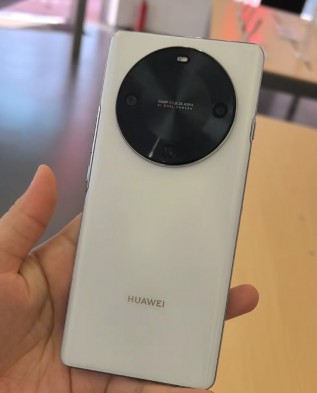
Huawei working on its tri-fold successor: could use the Kirin 9020

Huawei appears to be pushing the boundaries of foldable smartphone innovation once again. After debuting the world’s first tri-fold smartphone, the Huawei Mate XT (our review), last year, the company is reportedly preparing its successor. According to recent leaks, this new device could launch later this year, featuring upgraded internals, including the powerful Kirin 9020 chipset.

Successor to the groundbreaking tri-fold Mate XT

The Mate XT, unveiled on September 10 last year, took the industry by storm as the first commercially available tri-fold smartphone. It showcased Huawei’s ability to overcome significant challenges in design, engineering, and manufacturing despite the hurdles posed by US trade sanctions. Now, the company seems ready to follow up this achievement with a second-generation Mate XT, as reported by tipster Fixed Focus Digital on Weibo.

The new model is expected to retain its tri-fold form factor while improving its performance and functionality. The highlight of this upcoming device is its chipset upgrade to the Kirin 9020, which promises improved multi-core performance thanks to a 12-core cluster with hyperthreading.

While the Kirin 9020 powers Huawei’s latest Mate 70 series, its development is constrained by the lack of advanced EUV lithography machinery. As a result, Huawei relies on SMIC’s DUV equipment, limiting the chipset to a 7nm process. Although this hampers the Mate XT successor’s performance potential, Huawei has demonstrated remarkable resilience in navigating these restrictions.

The Mate XT’s groundbreaking design, which transforms from a compact 6.4-inch handset into a spacious 10.2-inch tablet, is unlikely to see drastic changes. Achieving this near-perfect folding mechanism took years of development, and Huawei will likely refine rather than reinvent the design in this year’s model.

What else to expect?

While specific details about the Mate XT successor remain scarce, there are speculations about notable enhancements. The display might see durability improvements to address one of the most critical aspects of foldable devices. Additionally, Huawei could introduce a larger battery to support the new hardware and extended functionality.

As the pioneer of tri-fold smartphones, Huawei has set a high standard for this emerging segment. The Mate XT’s successor could further solidify Huawei’s position as a leader in foldable technology, even as competitors work to catch up.

Tech enthusiast? Get the latest news first! Follow our Telegram channel and subscribe to our free newsletter for your daily tech fix! ⚡
(Source)

HMD Key debuts with Android 14 Go Edition as a New Budget Phone

HMD has just unveiled a new smartphone in a select few regions. The company’s latest device is the HMD Key with the Android 14 (Go Edition) and entry level specs to match the budget pricing. So here’s everything you need to know.

HMD Key Specs

The HMD Key sports a 6.52-inch LCD display with an HD+ resolution, 60Hz refresh rate, and 460 nits of peak brightness. Under the hood, it is equipped with the UNISOC SC9832E SoC, which is paired with Mali 820MP1 GPU. This processor arrives with 2GB of RAM and 32GB of internal storage. Buyers can also expand the story by up to 128GB via a microSD card slot. One can even bump up the RAM up to 2GB via virtual RAM expansion.

HMD Key
HMD Key

A 4,000mAh battery pack powers this device, which supports standard 10W charging. This model runs on the Android 14 Go Edition that is a lighter version of the regular Android operating system. For photography, the rear packs an 8MP camera with auto focus and LED flash, while the front has a 5MP shooter for selfies and video calls. You get access to Portrait, Night, and Pro mode, Slow Motion, and more. Other notable features include face unlock, a 3.5mm audio jack, FM Radio, and Dual SIM support.

Pricing and Availability

The HMD Key was announced in two color options, namely Icy Blue and Midnight Black. It has a 59 GBP price tag (roughly 73 US Dollars). This model is currently selling in the UK, New Zealand, and Australia. This model arrives just weeks after the HMD Arc, which is another affordable no-frills smartphone. The Blue Topaz edition of the HMD Skyline was also recently unveiled.

Tech enthusiast? Get the latest news first! Follow our Telegram channel and subscribe to our free newsletter for your daily tech fix! ⚡

Why Redmi Turbo 4 is better buy than Redmi Note 14 Pro+

Redmi recently took the wraps off its Turbo 4 smartphone. This is the second device under the Redmi Turbo series, a line that once belonged to the Redmi Note Turbo family. 

So spiritually, the Redmi Turbo 4 aligns closely with the Redmi Note 14 series, and its closest competitor within this lineup is the Redmi Note 14 Pro+. So, how do these smartphones stack up against each other? Let’s break it down.

Redmi Turbo 4 vs Redmi Note 14 Pro+

1. Design and Build

Redmi Turbo 4
Redmi Turbo 4

The Redmi Turbo 4 is slightly lighter at 203.5g compared to the Note 14 Pro+ (up to 210g). While the Turbo 4 sticks to a straightforward glass and metal build, the Note 14 Pro+ adds a bit of flair with its eco-leather option, alongside Gorilla Glass Victus 2 on the front. Both phones are IP68-rated for dust and water resistance.

Dimensionally, the Turbo 4 is slimmer at 8.1mm, whereas the Note 14 Pro+ is slightly thicker at 8.8mm. While neither device will feel cumbersome, the Turbo 4’s marginally thinner profile may appeal to those looking for a sleeker feel.


2. Display Quality

Redmi Note 14 Pro Plus
Redmi Note 14 Pro+

Both phones feature a 6.67-inch AMOLED display with a resolution of 1220 x 2712 pixels, offering crisp visuals with ~446 PPI. However, there are some distinctions in peak brightness. 

The Turbo 4 edges out with a staggering 3200 nits peak brightness, while the Note 14 Pro+ maxes out at 3000 nits. Both displays support Dolby Vision and HDR10+, ensuring vibrant colors and excellent contrast.

The Turbo 4’s focus on extreme brightness levels could be advantageous for outdoor use, while the Note 14 Pro+ offers the added durability of Gorilla Glass Victus 2.


3. Performance and Software

Here’s where things get interesting. The Turbo 4 is powered by the latest and more powerful MediaTek Dimensity 8400 Ultra chipset. The SoC is manufactured using a 4nm process and has a big-core Cortex-A725 architecture and a high-performance Immortalis-G720 MC7 GPU.

Meanwhile, the Note 14 Pro+ relies on Qualcomm’s Snapdragon 7s Gen 3, which is also built on a 4nm process but uses four Cortex-A720 cores and four Cortex-A520 cores. 

The Turbo 4’s chipset, with its powerful Cortex-A725 cores and a more advanced GPU, provides a significant edge in intensive tasks like gaming and multitasking. On the other hand, you can expect the Note 14 Pro+ to perform admirably in day-to-day use.

Both devices run Xiaomi’s HyperOS. The Turbo 4 debuts with the latest Android 15, while the Note 14 Pro+ starts with Android 14. While both are expected to receive software updates, the Turbo 4 will likely stay relevant for longer.


4. Camera Capabilities

The Turbo 4 opts for a dual rear-camera setup. It has a 50 MP wide sensor with OIS and an 8 MP ultrawide lens. The Note 14 Pro+ takes a more versatile approach with a triple-camera system: a 50 MP main sensor with OIS, a 50 MP telephoto lens offering 2.5x optical zoom, and an 8 MP ultrawide camera.

For photography enthusiasts, the Note 14 Pro+ is the clear winner. Its telephoto lens should churn out better portraits that Turbo 4 simply can’t match. However, the Turbo 4’s camera system shouldn’t be that far behind for basic point-and-shoot use. On the front, both phones feature a 20 MP selfie camera.


5. Battery, Connectivity, and Extras

Battery life is another critical area where these devices compete closely. The Turbo 4 packs a slightly larger 6550 mAh battery than the Note 14 Pro+’s 6200 mAh. Both devices support 90W wired charging and promise full charge in under an hour.

Both phones feature modern connectivity options, including Wi-Fi 6, NFC, and infrared ports. However, the Turbo 4 boasts Bluetooth 6.0 compared to the Note 14 Pro+’s Bluetooth 5.4. For audiophiles, both devices deliver Hi-Res audio, though neither offers a 3.5mm headphone jack.

One distinction is in the positioning systems. The Turbo 4 supports a more comprehensive set of satellite systems, including NavIC, which might be relevant for users in certain regions.


6. Storage and Pricing

The Turbo 4 offers configurations ranging from 256GB/12GB to 512GB/16GB with UFS 4.0 storage. The Note 14 Pro+, on the other hand, starts at 128GB/8GB and goes up to 512GB/16GB but uses UFS 2.2 or UFS 3.1, depending on the variant.

For power users, the Turbo 4’s storage performance could make a noticeable difference when loading apps or transferring files. However, casual users might find the Note 14 Pro+ perfectly adequate.


7. Verdict: Which Should You Choose?

The choice between the Redmi Turbo 4 and the Redmi Note 14 Pro+ comes down to your priorities. The Turbo 4 impresses with its performance-oriented Dimensity 8400 Ultra chipset, extreme brightness display, and larger battery. 

On the other hand, the Note 14 Pro+ offers a more versatile camera system, a stylish build with eco-leather options, and Gorilla Glass Victus 2 for added durability. It’s a better fit for those who value design and camera capabilities over raw performance.

Ultimately, both phones pack enough features to make them compelling choices in their respective segments. It boils down to whether you prioritize speed and endurance or photography and aesthetics. Either way, Xiaomi has ensured that you’ll get a capable device, no matter your choice.

Don’t miss a thing! Join our Telegram community for instant updates and grab our free daily newsletter for the best tech stories!