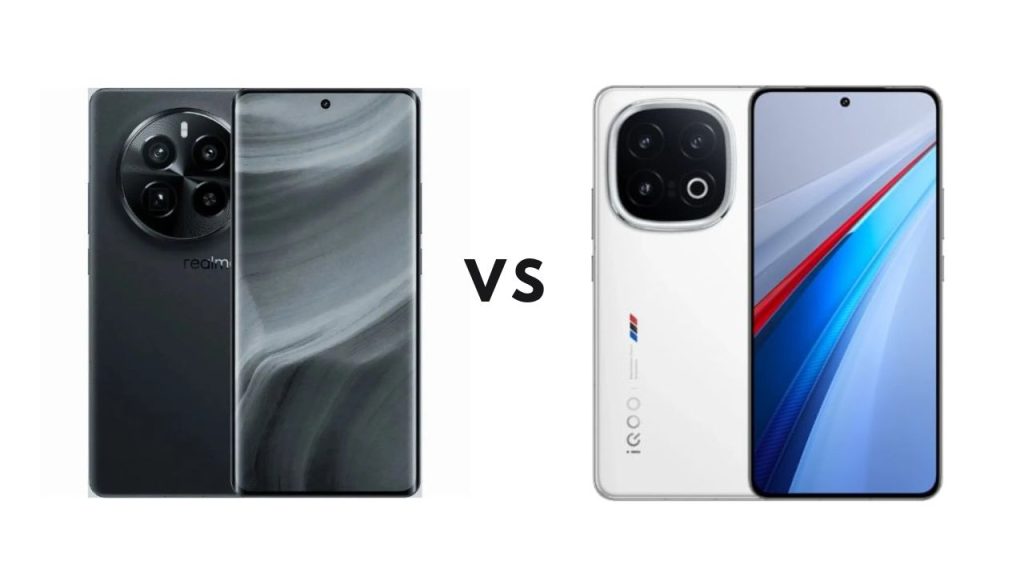
In the first half of this year, iQOO unveiled the iQOO Z9x, Z9, and Z9 Turbo in China. The Turbo model came equipped with the Snapdragon 8s Gen 3 chip and a 6,000mAh battery. In September, the brand announced the Z9 Turbo+ packed with the Dimensity 9300 Plus chip and a bigger 6,400mAh battery in China. A new development reveals that it may soon unveil a new iQOO Z9 Turbo variant.
iQOO Z9 Turbo’s new variant 3C certified
The above screenshot reveals that an upcoming Vivo phone with the model number V2352GA has been approved by China’s 3C authority. Since the existing Z9 Turbo has the model number V2352A, it appears that the V2352GA could be based on the Z9 Turbo.
The new device has been spotted with an 80W charger. With 3C certification under the belt, it seems that the handset may go official later this month in China.
Speaking of iQOO phones, the brand is expected to announce the iQOO Neo 10 and Neo 10 Pro by the end of November in China. The Neo 10 and 10 Pro are expected to feature the Snapdragon 8 Gen 3 and the Dimensity 9400 chipsets, respectively. Regarding the upcoming Z9 Turbo variant, it seems likely that it will utilize the same Snapdragon 8s Gen 3 chip as the Z9 Turbo.
According to a Chinese tipster, the Vivo V235GA phone could be called the iQOO Z9 Turbo Long-Life Version (machine-translated). He revealed in the comments section of the Weibo post that it could be packed with a 6,400mAh battery, which is available inside the Z9 Turbo+ phone. The rest of the specs of the phone are likely to be identical to the regular Z9 Turbo.
To recall, the iQOO Z9 Turbo features a 6.78-inch flat OLED panel that offers a 1.5K resolution and a 144Hz refresh rate. It has a 16-megapixel front camera and a 50-megapixel + 8-megapixel dual-camera system on the back. The device offers up to 16 GB of LPDDR5x RAM and up to 512 GB of UFS 4.0 storage. It also features a dedicated display for enhanced gaming experience and an in-screen fingerprint sensor.
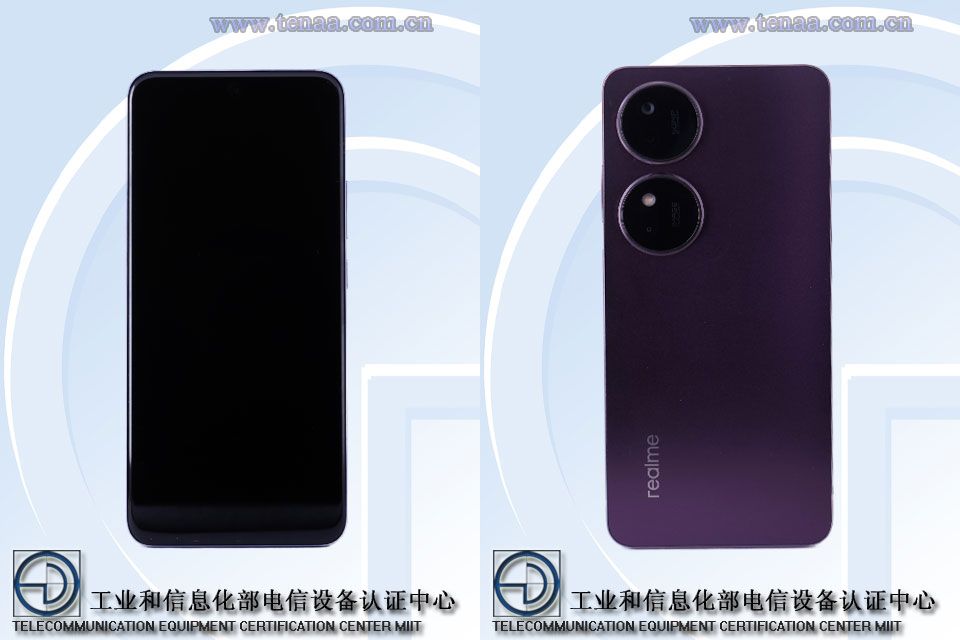
Last week, an upcoming Realme phone with the model number RMX3942 was approved by Chinese certification platforms such as 3C and TENAA. While TENAA revealed almost everything about the device, its images were not disclosed. However, the updated listing now includes the images of the phone. Unfortunately, there is still no information about the final name of the device. Until then, here is a look at what to expect from the smartphone.
Realme RMX3942 design
Realme RMX3942 TENAA images
The Realme RMX3942 handset seems to feature a regular punch-hole screen on the front. The back panel of the device has two round camera islands, with the company’s branding toward the bottom. The right edge of the phone features a volume rocker and a power button, which appear to be integrated with a fingerprint sensor.
Realme RMX3942 specifications
As per the TENAA certification, the Realme RMX3942 measures 165.7 x 76.22 x 8.16mm and weighs 197 grams. On the front, it has a 6.67-inch LCD panel that produces an HD+ resolution. It has an 8-megapixel camera on the front and a single 50-megapixel snapper with an LED flash on the back.
The RMX3942 is a 5G-enabled phone powered by a 2.3GHz chip. It is backed by a 5,465mAh (rated value) battery. In China, the phone may arrive in RAM options, such as 4 GB, 6 GB, 8 GB, and 12 GB. There could be a variety of storage options available, including 128 GB, 256 GB, 512 GB, and 1 TB. At present, there is no information on whether it is an upcoming Realme 14 series or a V-series phone for the Chinese market.
The 3C certification of the RMX3942 has revealed that it may ship with a 45W charger. Interestingly, the 3C listing also reveals the existence of an unknown RMX3953 phone. While it is also expected to ship with a 45W charger, there are no details about its other specifications.
Xiaomi, Honor, iQOO, and OnePlus announced their flagship offerings in China in the last three days of October. It appears that there could be a similar situation this month (November) in the home market. A recent leak by tipster Digtial Chat Station revealed that Oppo may unveil the Reno 13 series on Nov. 25. He also claimed that the Redmi K80 and Redmi K80 Pro will be announced by November end in China. Now, the same source has revealed the launch timeframe for the next offerings from iQOO and Vivo.
iQOO Neo 10, Vivo S20 series launch timeframe (rumored)
As can be seen above, DCS has claimed that the iQOO Neo 10 lineup and the Vivo S20 series are also scheduled to launch in China by the end of this month. Reports have revealed that the Neo series will include the iQOO Neo 10 and Neo 10 Pro equipped with the Snapdragon 8 Gen 3 and Dimensity 9400 chipsets, respectively. There’s a possibility that the series may include a third model, but there is no clarity on it yet.
According to recent reports, the Vivo S20 series is expected to feature the Snapdragon 7 Gen 3-powered Vivo S20 and the Vivo S20 Pro, which is expected to feature the Dimensity 9300 Plus chipset. This series is also expected to include the Vivo S20e, but the rumor mill is yet to leak details about it.
At the same time, Honor is also said to be working on the Honor 300 series for China. Reports suggest that the 300 lineup may also debut soon in China. Meanwhile, OnePlus is also gearing up to unveil the Ace 5 and Ace 5 Pro smartphones with the Snapdragon 8 Gen 3 Leading Version and 8 Elite chipsets, respectively.
The Chinese market is also expected to receive a new Honor GT series phone powered by a flagship Snapdragon chip and the Realme GT Neo 7 equipped with the Snapdragon 8 Gen 3 Leading Version.
HBADA E3 Ergonomic Office Chair combines innovative design and advanced ergonomic features to provide unmatched comfort and support for prolonged sitting. Whether working, gaming or resting, this chair offers functionality and luxury to ensure a comfortable user experience. The E3 is a key product of the collaboraiton between HBADA and the International Chiropractors Association (ICA), which makes its professional design stand out from the category. Let’s look closer at the key features that make this chair professional and reliable.
About Hbada:
A Leader in Ergonomic Technology
Founded in 2008, Hbada is a professional brand focused on creating healthy home solutions through innovative technology and ergonomic design. Whether for home, office, or entertainment, Hbada aims to enhance comfort and promote a healthy lifestyle.
Vision and Mission With a mission to become a global leader in healthy living, Hbada continuously innovates to improve human health by developing ergonomic products.
Key Milestones
2008: Hbada Group was founded, pioneering adjustable technology for chairs.
2011: Hbada began independent R&D, focusing on ergonomics.
2016: Expanded to overseas markets including Europe and the U.S.
2023: Launched the groundbreaking E3 Structural Master chair.
Global Recognition Hbada holds over 300 technical patents, including its unique T-shaped support system and three-zone lumbar support, and graint the German IGR Ergonomics Certification. The brand has won international awards like the London Design Award and holds certifications from organizations like TÜV and SGS. HBADA products have also won numerous design awards, including the London Design Award and the Gold Medal at the French Design Gold Awards.
EXCLUSIVE DEAL:
HBADA E3 Ergonomic Office Chair (with Footrest) is now on Sales of Black Friday! This premium ergonomic chair, designed for maximum comfort with features like a T-Shape Support System and 140° reclining function, is available at this discounted price on the official website. Don’t miss out on this limited -time deal.
T-Shape Support System
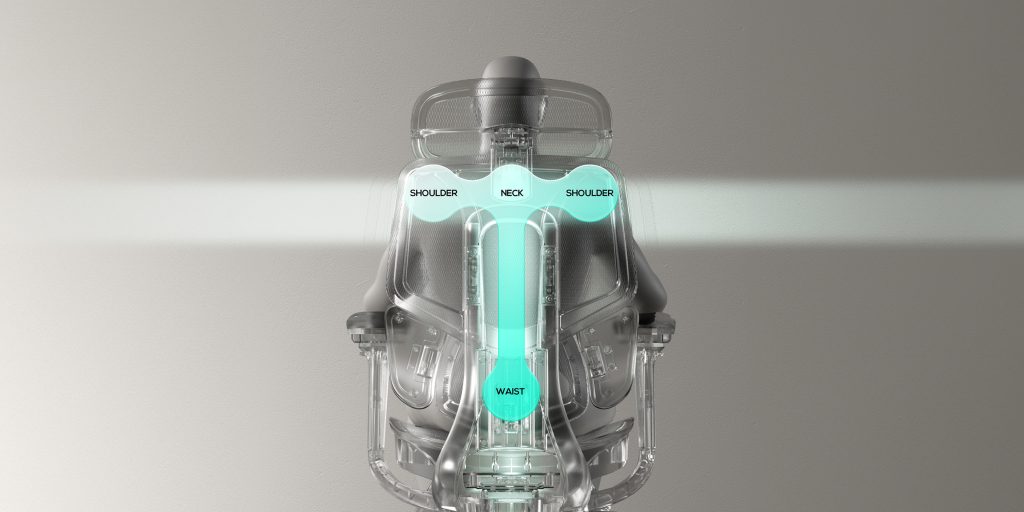
At the heart of the Hbada E3 is its T-Shape Support System, designed to alleviate the three common types of discomfort caused by long hours of sitting—neck, waist, and shoulder pain. This unique structure ensures full support for these critical areas, helping you maintain a healthy posture even during extended periods of use.
Three-Zone Elastic Lumbar Support
The Three-Zone Elastic Lumbar Support is a large waist wrap with 8-way adjustments, offering precise support for all body types.
Left and right floating wings rotate 40° both inward and outward, providing a snug fit for various body sizes.
Dynamic support allows for 14° of adjustment, ensuring that the lumbar region is supported no matter how you sit.
The lumbar system adjusts up and down by 1.6″ and front and back by 1”, offering customized support that follows your movements.
4D Headrest for Neck Relief
The 4D headrest of the Hbada E3 adapts to different sitting postures, whether you’re leaning forward, sitting upright, or reclining.
Adjusts up and down by 1.8” and front and back by 2.2”, with a dual-axis rotation of 70°, ensuring full support and relieving cervical vertebrae pressure. This headrest design is perfect for reducing neck pain caused by long hours of sitting.
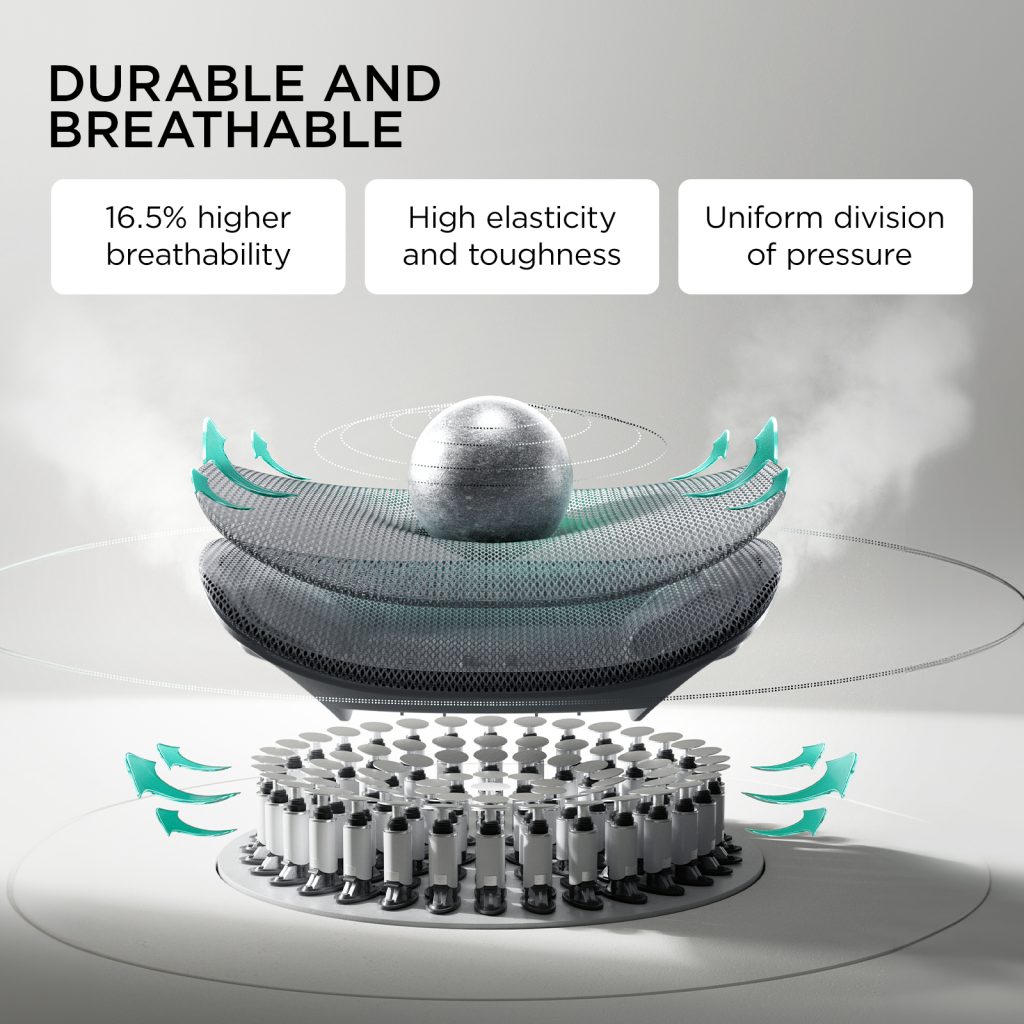
High Elasticity Cushion and Mesh
Sitting for long periods can often cause leg numbness, but the Hbada E3 counters this with a high elasticity cushion that provides full leg support.
The chair is covered in 16.5% breathable mesh, enhancing air circulation while offering a firm yet comfortable support.
The nylon and yarn mesh not only provide durability but also help you stay cool and comfortable throughout the day.
6D Mechanical Armrests
The 6D mechanical armrests are designed to support your arms in various positions, reducing shoulder strain.
They adjust front and back by 1.2”, up and down by 3”, and left and right by 1.2”, allowing for maximum flexibility.
The armrests also rotate left and right by 70° and can be flipped up by 40° for added convenience, ensuring that your arms are always supported, whether you’re working or relaxing.
Auto Gravity-Sensing Chassis
The auto gravity-sensing chassis detects changes in weight and posture to adjust the chair’s settings automatically. This advanced feature allows the chair to adapt to your body without manual adjustments, providing a seamless and intuitive sitting experience.
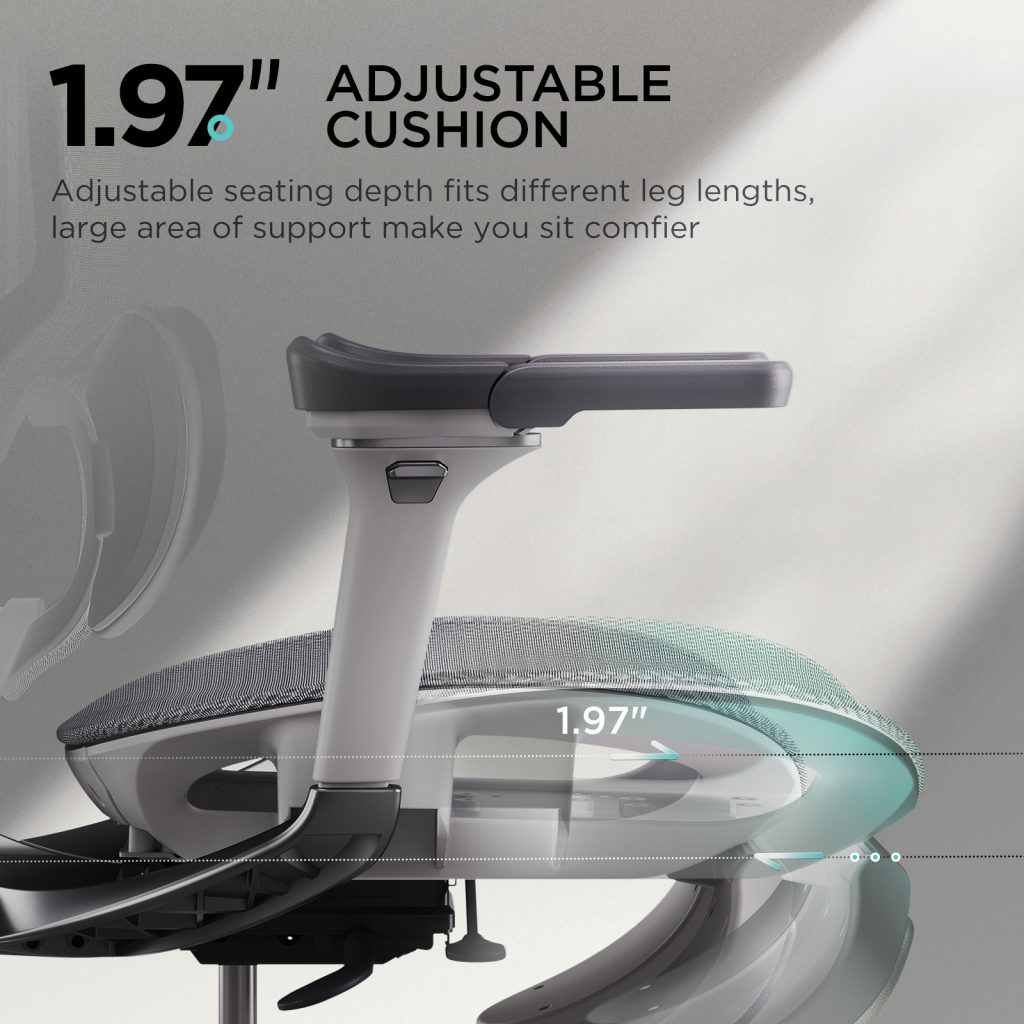
Adjustable Cushion for Personalized Comfort
The chair features a 1.97” adjustable cushion, making it suitable for users of different heights. The cushion’s adjustable seating depth ensures that your legs are properly supported, preventing discomfort during long hours of use.
140° Reclining Feature for Relaxation
When you need to take a break, the Hbada E3 offers a 140° reclining function that allows you to lean back and relax comfortably.
Whether you want to take a nap or simply unwind, the reclining feature ensures that you can rest in complete comfort.
Quality and Safety Standards
The Hbada E3 is built to last, featuring high-quality components that enhance both durability and safety.
It uses an SGS level 4 pneumatic rod that has passed over 120,000 cycles of safety tests, ensuring the chair’s safety for extended use.
The chair’s low-noise rollers and high-load-bearing five-pin base provide stability and long-term durability, without disturbing your environment.
The Hbada E3 Ergonomic Office Chair is the ideal solution for those who seek ergonomic excellence, whether in the office or at home. Its T-shape Support System, customizable lumbar support, advanced features like auto gravity-sensing technology, and a 140° reclining feature offer superior comfort and support. Designed with users’ well-being in mind, the Hbada E3 helps promote a healthier, more comfortable lifestyle. This Black Friday, HBADA brings consumers the ultimate seating experience with the E3 chair at a limited discount. Don’t miss out on this once-in-a-year opportunity to revamp your workspace or gaming setup with a chair that’s designed for comfort, support, and style.
The Vivo X200 series, unveiled last month in China, is set to launch globally soon. The confirmation comes from Vivo’s Malaysian branch, which has started teasing the phones on the country’s social media handles.
The X200 lineup comprises three models: the standard X200, the X200 Pro, and the X200 Pro mini. However, the teaser from Vivo Malaysia hints at the launch of only the X200 and X200 Pro in the country. This also aligns with their recent appearance in Malaysia’s SIRIM certification.
Meanwhile, rumors suggest Vivo may launch these phones in India later this month. Although Vivo hasn’t confirmed a date, X tipster Paras Guglani claims the phones could be unveiled on November 22nd.
Guglani, however, didn’t specify the target market for the launch, leaving the possibility open for Malaysia, India, or other regions.
Vivo X200, X200 Pro specifications
Moving to the technical details, the Vivo X200 features a 6.67-inch OLED display with a smooth 120Hz refresh rate and an impressive peak brightness of 4500 nits.
The Pro variant steps up with a slightly larger 6.78-inch display, retaining the same specs but adding an ultrasonic fingerprint sensor beneath the screen.
Both models rely on the powerful MediaTek Dimensity 9400 chipset, complemented by LPDDR5x RAM and UFS 4.0 storage.
Battery life shouldn’t be a concern either. The X200 packs a robust 5,800mAh battery, while the Pro model ups the ante with a 6,000mAh cell. Both models boast 90W wired charging, while the Pro version adds the convenience of 30W wireless charging.
In terms of cameras, both phones offer a 32-megapixel selfie camera. The standard X200 features a triple-lens rear setup with a 50-megapixel Sony IMX921 main sensor with OIS, a 50-megapixel Samsung JN1 ultra-wide sensor, and a 50-megapixel LYT-600 3x periscope lens with OIS for distant shots.
The X200 Pro elevates the camera experience even further with a 50-megapixel LYT-818 main sensor with OIS alongside a staggering 200-megapixel Samsung S5KHP9 3.7x periscope lens, also boasting OIS. Both models share the same 50-megapixel ultra-wide sensor for capturing expansive landscapes.
We look forward to Vivo’s official announcements on the X200 series’ launch date and target markets. Stay tuned for more updates.
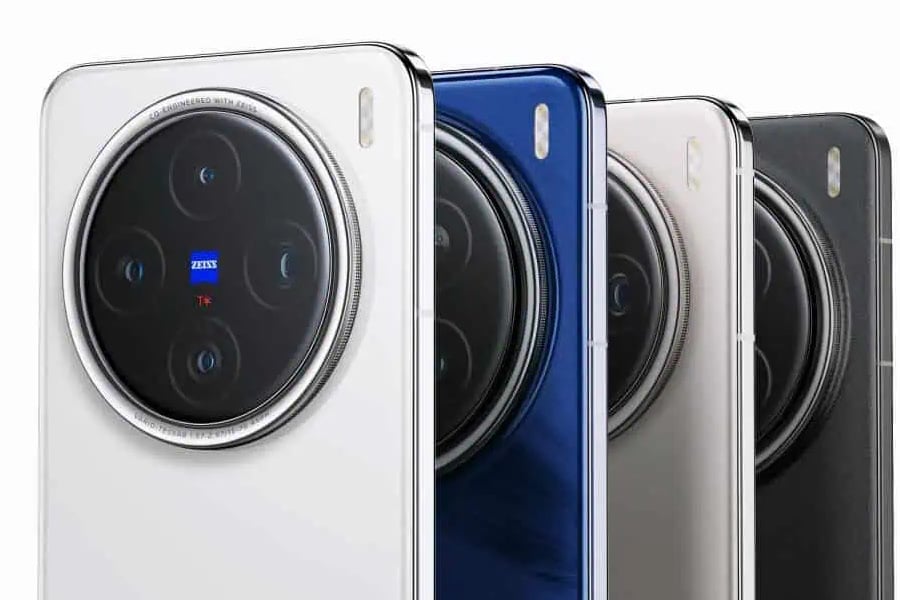
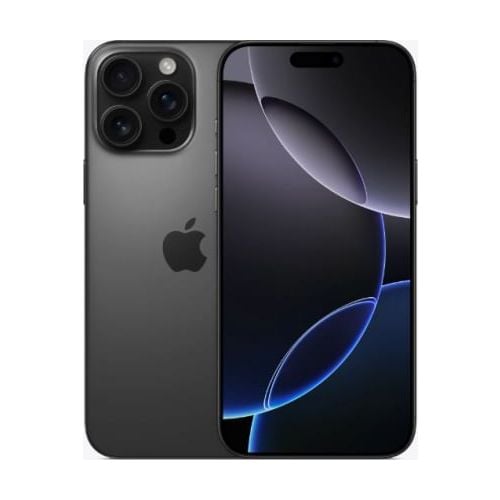
Apple seems set to join a trend started by several Android competitors. The iPhone 18 Pro, expected to go official in 2026, might come with a variable aperture camera system, according to analyst Ming-Chi Kuo.
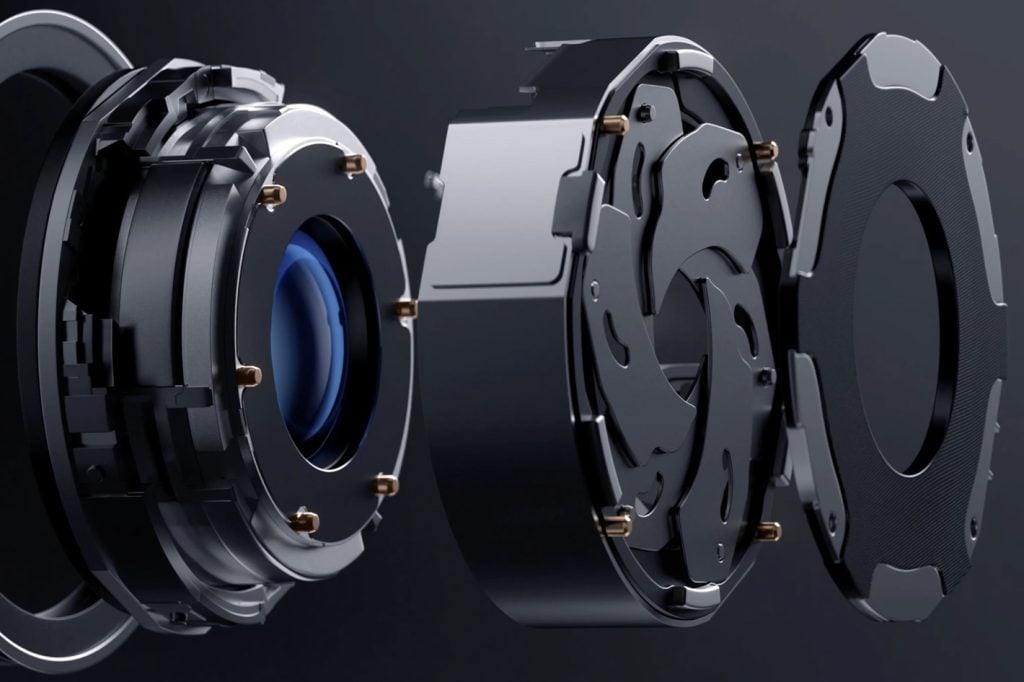
Android manufacturers have long experimented with variable aperture lenses to give users more control over light intake and depth of field. These lenses adjust their opening size, much like professional cameras.
In bright settings, a narrower aperture allows for sharper images and a deeper depth of field, where both foreground and background elements remain in focus.
Conversely, a wider aperture admits more light, ideal for capturing well-exposed photos in dimly lit environments, albeit with a shallower depth of field that blurs the background behind the subject.
It’s iPhone 18 if not the 17
The Information previously hinted that a variable aperture camera might debut on at least one iPhone 17 model, but Kuo’s latest report suggests this feature could be delayed until the 2026 iPhone 18 lineup.
Specifically, Kuo expects the iPhone 18 Pro’s primary rear camera to benefit from this technology.
His industry survey indicates that Sunny Optical will likely be the primary supplier for the camera’s shutter mechanism, with Luxshare as a secondary source. Notably, Sunny Optical is also expected to supply the variable aperture lens as a secondary provider, with Largan Precision remaining the primary source.
So far, all iPhone models rely on fixed aperture lenses, which limits the control over light intake and depth of field. Variable aperture technology, however, could give users finer control over these settings, allowing adjustments to suit their preferences.
It’s important to note that Kuo’s report is based on industry surveys and should be treated as an informed prediction rather than a confirmed fact. With the iPhone 18 launch still two years away, Apple has ample time to refine its plans and possibly change t its camera strategy.
Huawei‘s upcoming Mate 70 series could see a slight bump in price compared to its predecessor, the Mate 60.
Words for it come from a Weibo tipster, Fixed Focus Digital, who suggests the new flagship line will carry a premium due to advanced features and a possibly costly new Kirin chip. However, consumers may find some relief in that the increase is expected to be modest.
Looking at past launch trends, Huawei typically raises prices by 100-200 yuan for its new flagship phones. Following this pattern, the Mate 70 series could see a similar price adjustment. As a reference, the Mate 60 series launched at a starting price of 5499 yuan.
It’s important to note that this is just speculation based on past trends. The actual price increase for the Mate 70 series remains to be seen.
Kirin chip could drive up Mate 70’s cost
A separate leak suggests the new Kirin chip could be a significant factor in the price hike. This next-generation chip is rumored to be more expensive to produce than previous versions, which could translate to a higher cost for the phones themselves. Additionally, other advanced features and components could contribute to the price increase.
Users eager to get their hands on the Mate 70 series won’t have to wait much longer. Sales are expected to begin early next month.
Another tipster suggests online sales could kick off later this month, with offline availability following in December. The exact launch date for the flagship model is still unclear, although Huawei has confirmed a launch within this month.
The Mate 70 series launch is expected to be accompanied by a wave of other new products, potentially including a tablet, earbuds, and the Watch D2. While the price remains unconfirmed, it seems Huawei is focusing on high-end features for the Mate 70 series, with any price hike likely kept within Huawei’s typical range of adjustments.
Xiaomi ecosystem brand Xming has introduced its latest projector, the Q5 Neo, to the Chinese market. Following the release of the Xming Q5 earlier this year, the Q5 Neo is now available for pre-sale on JD.com at a price of 699 yuan ($97). Let’s take a closer look at its key specifications.
Xming Q5 Neo Specifications
The Xming Q5 Neo projector features a sleek and compact design, available in a unique pink-blue color scheme inspired by the 2024 Paris Games’ vibrant palette. It is powered by an LED light source with a native resolution of 1080p (1920×1080) and supports 4K decoding, delivering crisp, clear visuals up to 150 inches.
Its brightness reaches 300 CVIA lumens, with a contrast ratio of 2600:1, and it features the advanced PhotonX 2.0 fully enclosed optical engine, enhancing brightness and overall image quality. The projector sports an all-glass optical lens and is designed with high durability and heat resistance in mind.
It includes a 360-degree metal bracket, allowing for easy angle adjustment, including ceiling projection, so users can enjoy versatile viewing experiences. For eye comfort, the projector is certified by SGS for low blue light emissions, making it suitable for prolonged viewing by adults and children alike.
The Q5 Neo is equipped with an MT9 chipset and operates on a smart system based on Android 9.0. It supports Wi-Fi 6, Bluetooth 5.3, and various projection options, including DLNA, Miracast, AirPlay, Huawei Cast Engine, and Lebo.
It also features an intuitive iQIYI launcher, offering access to an extensive library of content. The device supports AI-driven image calibration, including automatic keystone correction, obstacle avoidance, and screen alignment.
The Q5 Neo integrates with Xiaomi Mi Home and also supports the Xiao Ai voice assistant for remote voice commands, and button operation.
In terms of sound, the Q5 Neo comes with a 3W speaker and a spacious 120cc sound chamber that delivers an immersive audio experience. It includes HDMI 2.0, USB 2.0, and a 3.5mm headphone jack for flexible connectivity options.
If you’re interested in compact projectors, we recently reviewed the Xgimi MoGo 3 Pro, which features Google TV support—check out our full review for more details.
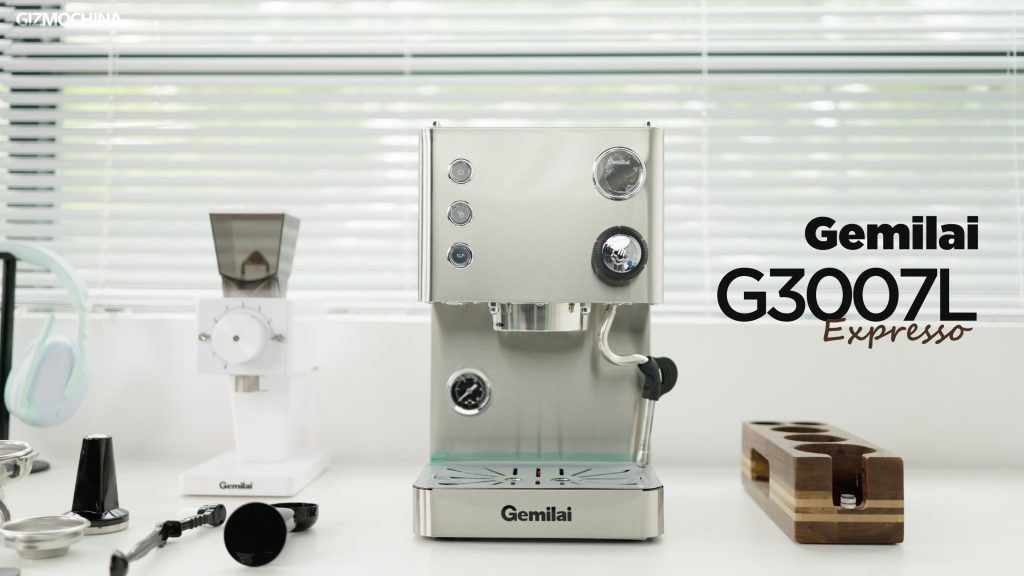
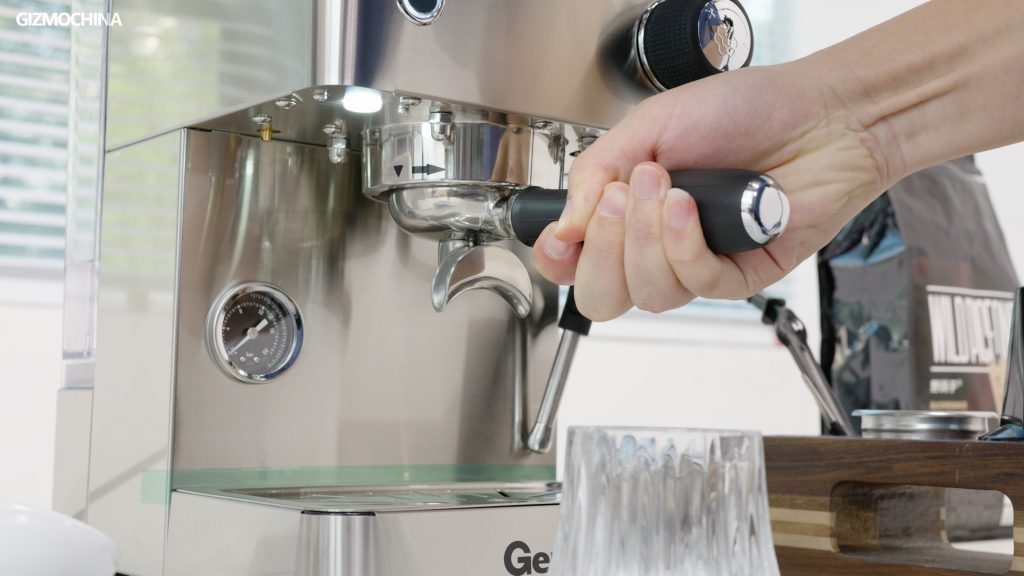
This is the Gemilai G3007L, one of the most popular compact espresso machines in the Chinese market. Now it’s available for multiple overseas markets. If you are a coffee enthusiast or even a professional barista, you really have to try it out. I’ve been making boutique coffee for a few years. Whether it’s hand-brewed, cold-brewed, or espresso, I’ve already tried. I’m fascinated by the aroma of coffee and the subtle differences in flavor that can be discerned between different brewed methods. Especially for espresso, it can be the quickest way to extract coffee liquid or the most expensive and creative fancy. The Gemilai machines always drive me excited, as the brand is good at developing the right coffee tools for individuals and families.
https://youtu.be/OeV2HwmFjMY
Home-Made Expresso Semi-automatic Machine
Well, a kind reminder here. If you are looking for a fully commercial espresso machine for a huge shop, the review probably is not for you as we only tested it in a home espresso scenario with the most convenient tools. However, I did see exquisite coffee stations using the Gemilai CRM3007L to do their business. And surprisingly, it tasted pretty good. So if you don’t mind, it can also save you money on equipment costs for your small business.
Anyway, if you are a novice barista or a person who loves coffee, and would like to experience homemade coffee, but have no ideas about those machines, then please watch the video to the end. I would try my best to share my experience. After all, with the Gemilai machine, you deserve better.
Packaging & Design
First of all, let’s check out what we got inside the package and the design as well. Some of you may be worried about whether I would need to buy additional accessories to complete my coffee-making journey with the machine. Well, the answer is ‘yes’ and ‘no’.
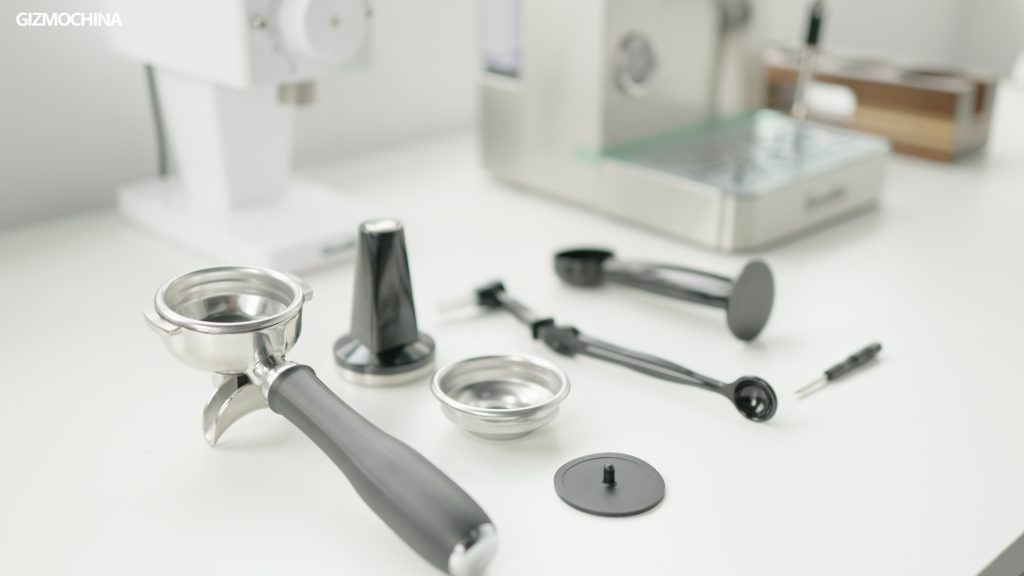
For most users, the necessary tools and accessories were already included, such as a two-cup portafilter, an additional single-cup filter, a tamper, a coffee spoon, a cleaning pad and brush, and a screwdriver. And I’m pretty happy with the well-designed Manuel, where you can find professional guides and informative figures. So for those who won’t buy any more accessories, I will suggest they buy the espresso powder directly. So you just need to prepare the water, powder, a coffee cup, and milk if you like milky coffee. Then the machine will help you figure all the things out although it’s just a semi-automatic machine. Later I will show you how it works for coffee brewing and milk frothing.
So why is the answer also a ‘no’? Because you probably won’t stop buying those fine accessories and tools, spending a lot of time experiencing the joy. For example, you might need a coffee scale, a tamper holder or station, a needle distributor, or even a small screen mesh. You’ll get hooked, which I’ve all been through, though that didn’t make a big difference in the coffee I made.
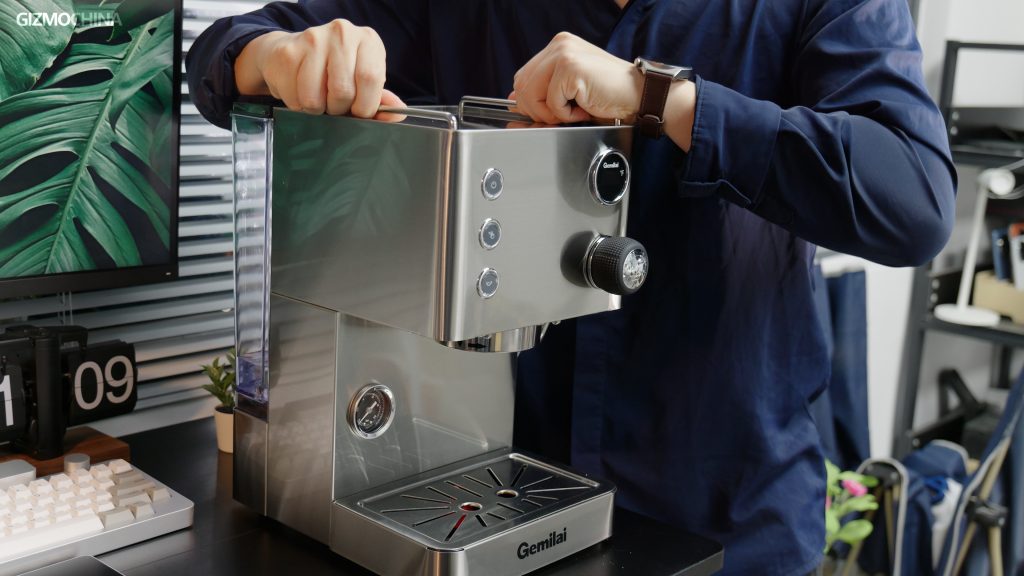
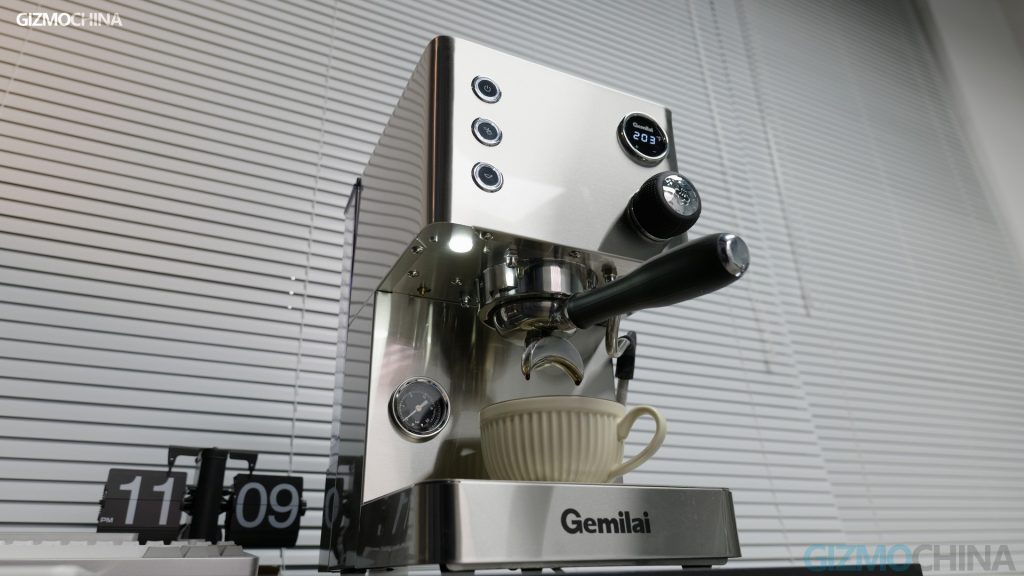
Okay back to the Gemilai machine. My favorite part is the design. It’s so elegant and compact built with a whole brushed metal shield. Although it’s a home machine, the texture feels like the big commercial models we’ve seen. It’s smaller than I imagined when I saw its picture.
It’s likely because they removed the hot water outlet from the body. So for those of you who like hot Americanos, it might be a problem, unless you don’t mind getting water from the brewing head.
But meanwhile, it’s truly heavier than I expected. Well, it’s actually a good point. It gave me a reliable feel with solid build quality. And in actual use, I can easily fix the handle with a single hand, without worrying about wobbling or shifting.
Space-Friendly with a Compact size
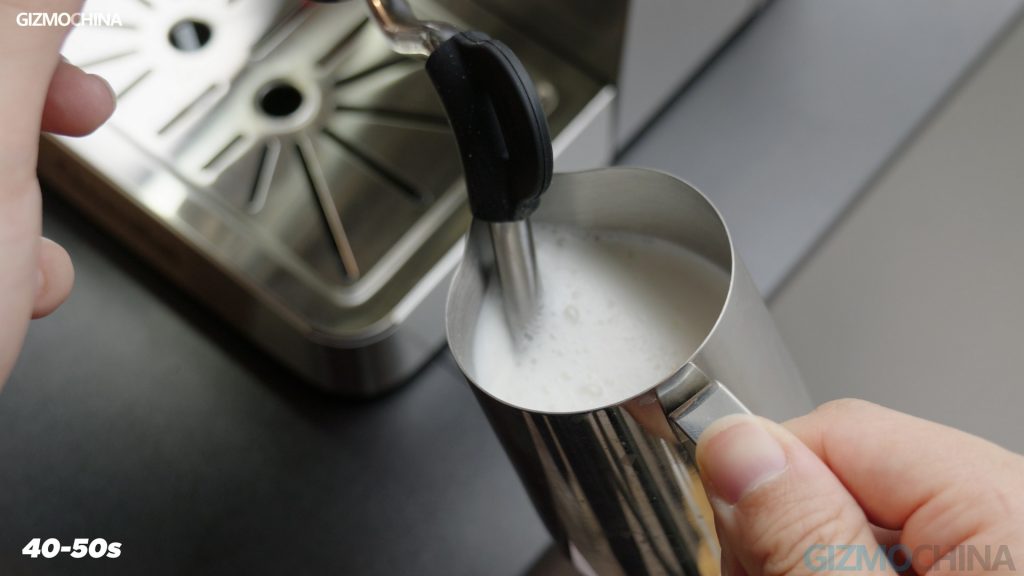
So on the other hand, its compact size also perfectly allows it to appear comfortably in bars, small stations, or kitchens. The control and info panel is surprisingly simple and intuitive. A power button on the top, followed by a manual and an automatic coffee button. On the right is the info screen and a steam knob. The screen shows the temperature and brew time. The steam pipe with a 3-hole steam wand is good, it takes about 40s to well froth the milk. It isn’t exactly fast overall, but as a home machine, it’s more than enough. The 1.7-liter water tank is good. At least for homemade coffee, you don’t need to frequently refill it.
Professional PID 58mm Group Head & Hybrid boiler system
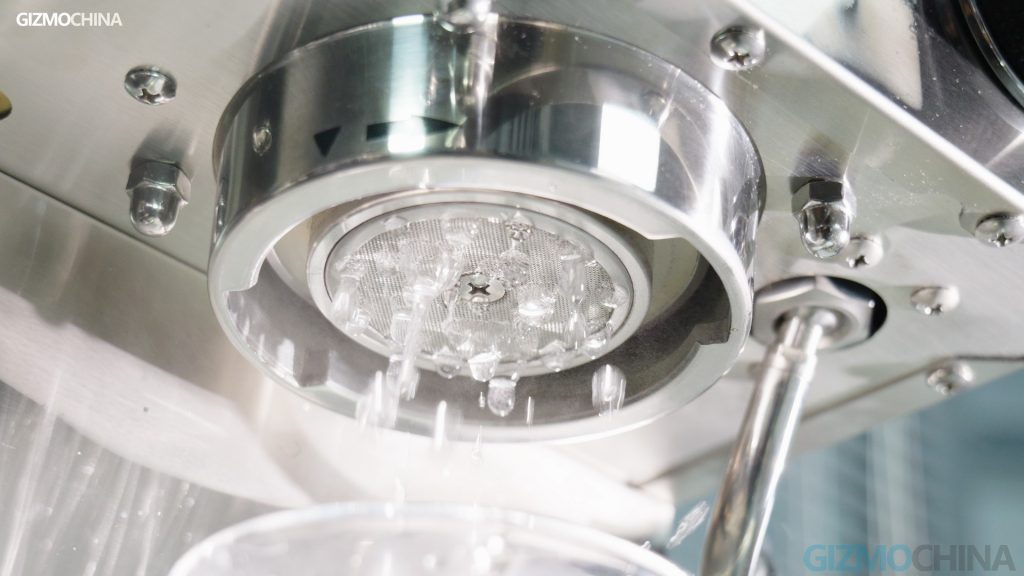
The best combination on the 3007L model is the professional PID 58mm group head with a dual boiler system. The big size of 58mm group head allows the hot water to come into full and even contact with the powder, which is widely used on most professional machines. The 58mm handle with fine filter holes also brings a balanced exhaust.
The dual boiler system separates the stainless-steel boiler for coffee brewing and the thermos block for milk frothing. So both of them achieve perfect temperature control in their own process. It cannot make both at the same time as it’s a single-pump design. But when you’re done brewing coffee at 200 degrees, the milk frothing can follow up seamlessly.
The machine applies a high-quality Italian ULKA pump inside. It can ensure a steady 15-bar pressure for ideal espresso extraction. To support the boiler heating and high-pressure pumping, the machine features a rated power of 1450W.
G3007L’s Upgrades For Golden Cup Standards
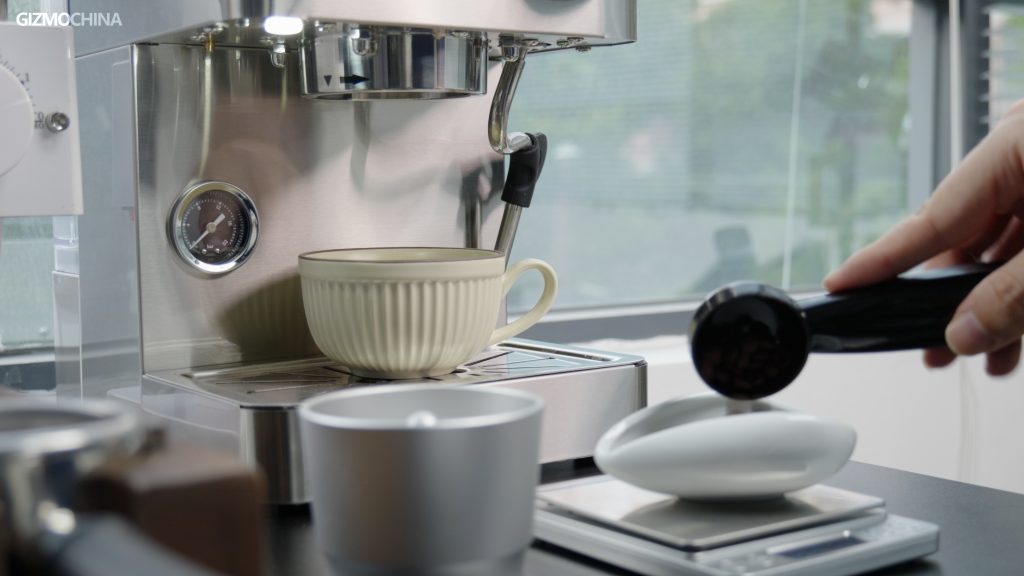
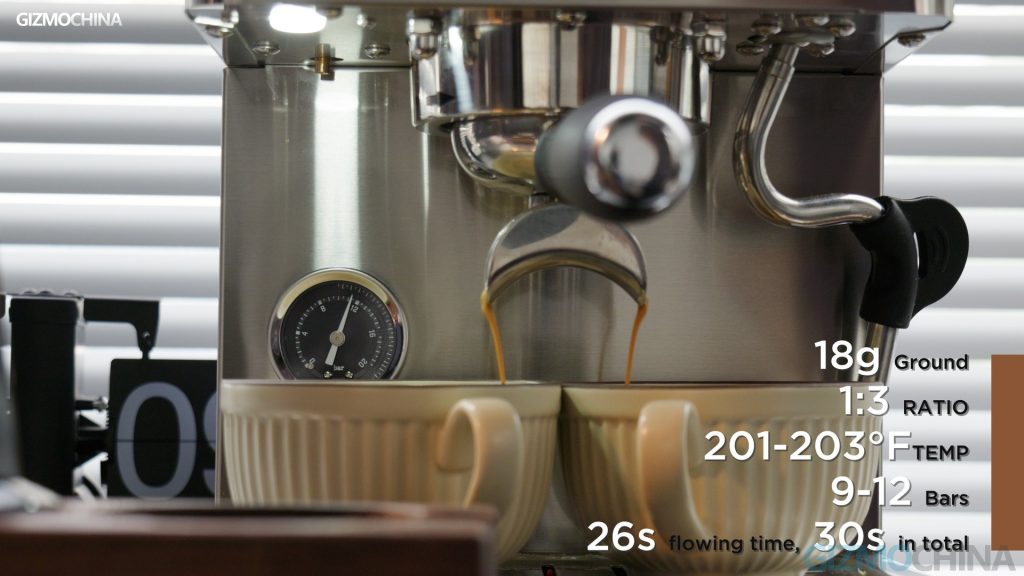
I’m quite sure some of you have noticed the pressure gauge. If you’re familiar with the baristas’ niche, you must know the Golden Cup Standards that have become popular in the last decade. The whole brewing process is just all related to all kinds of figures, such as temperature, contact time, input ratio, pressure, and so on. Although I’m no longer staring at the pressure gauge, it’s still a good reference to help understand your best brew. Specifically, it helps monitor your brewing process with precision and consistency, so there would be records to refer to when you get your favorite way. It’s the same reason to have the display showing temperature and brewing time. So if you need all these brewing figures, the Gemilai machine has taken care of most for you. What else you need to prepare is a coffee scale and grinder with scales.
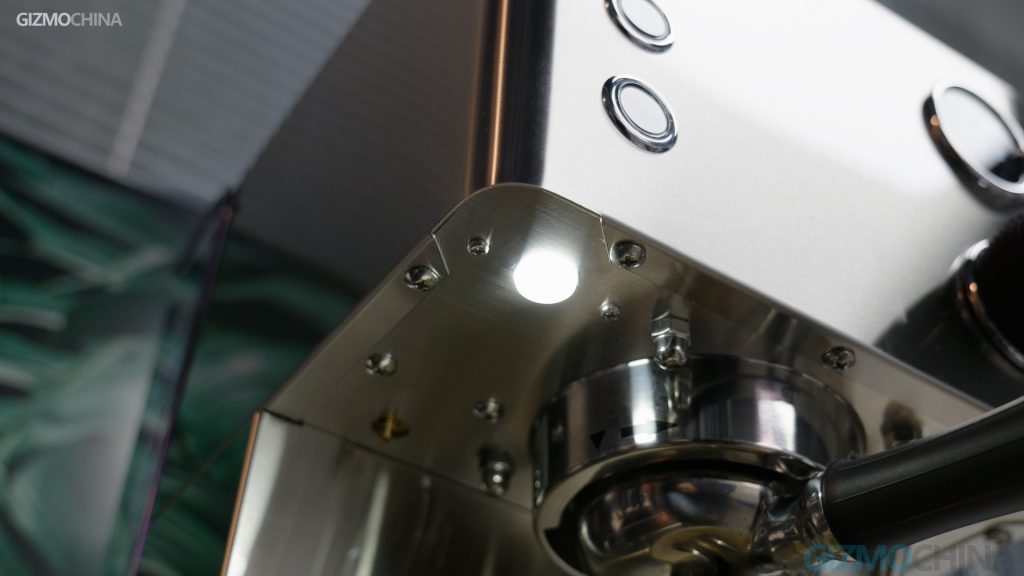
A warm surprise is that the machine features an LED spotlight here. This is a very useful feature, you can clearly see what’s happening under the brewing head.
Coffee Brewing & Milk Frothing With G3007L
Now let’s show you my complete brewing process with the Gemilai machine! The grinder I used here is also from Gemilai, which is an entry-level, so it’s not as finely graduated. The beans I used here are a blend from Africa and Asia. The default 58mm double-cup portafilter is good for me, so no need to change it here. By the way, the heated top of the machine is good for warming cups.
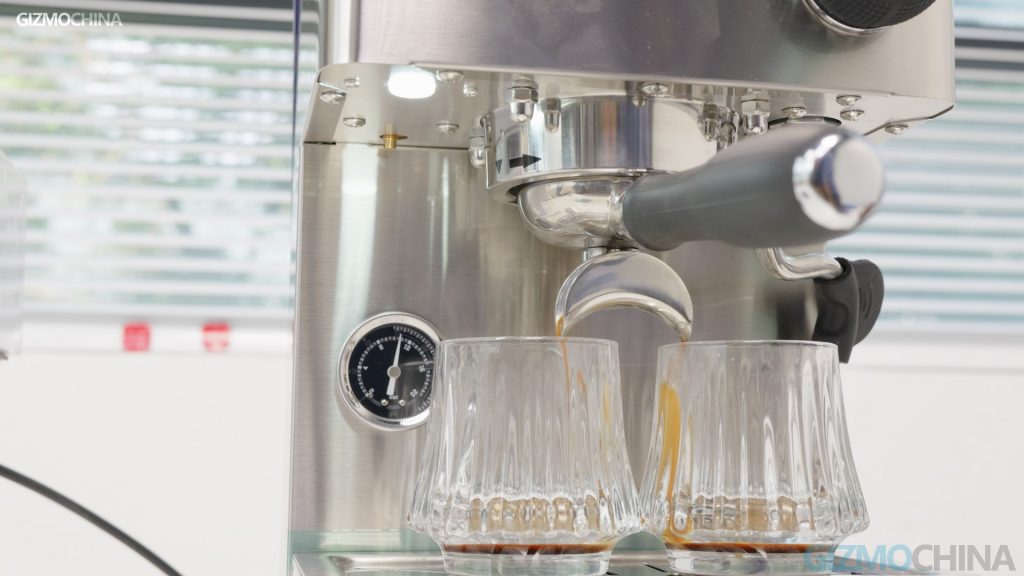
If you want to change the preset brewing time for the auto mode, just long-press the auto button until the time you want. Oh almost forgot, the auto brewing includes a short pre-brewing stage, lasting about 2 to 3 seconds, which is good. Here I manually brew it for 30s. As the pressure gauge showed, it was a steady brew, and the preset flow paired up with the golden pressure between 9 and 12 bar was just my preference. So everything looks perfect.
Even though you are unsatisfied with the flow, you can adjust the control valve to get the right water flow.
And now please watch the review video and check out how I frothed milk with the steam wand. To be honest, we’re not good at making the microfoam. Not to mention pouring them into the espresso and making latte art. Alright, that’s it. It’s not hard to make the microfoam, so the machine could work well for artist’s milk frothing.
Verdict
So overall, I really enjoy making espresso with the Gemilai machine. It does balance efficiency and production quality, which is my main concern in a cup of espresso. And if you are a believer in the Golden Cup Standard, the machine would definitely help you out with amazingly stable brews. The G3007L model probably would be sold under other names in regions like the US. Then its price might shock you out. But now you can check out the Amazon link down below, the price there should be really competitive.
With the rising cost of the Dimensity 9400 and Snapdragon 8 Elite, flagship phones are getting more expensive. There’s no way to get a flagship phone for less than $550 anymore.
But is there really no way we can get a cheap flagship phone? Realme has released the GT7 Pro, It helps with the dream of buying a flagship phone for $500. Even if the global version will be a bit more expensive, it’s still the cheapest Snapdragon 8 Elite phone available, I’m sure.
Design
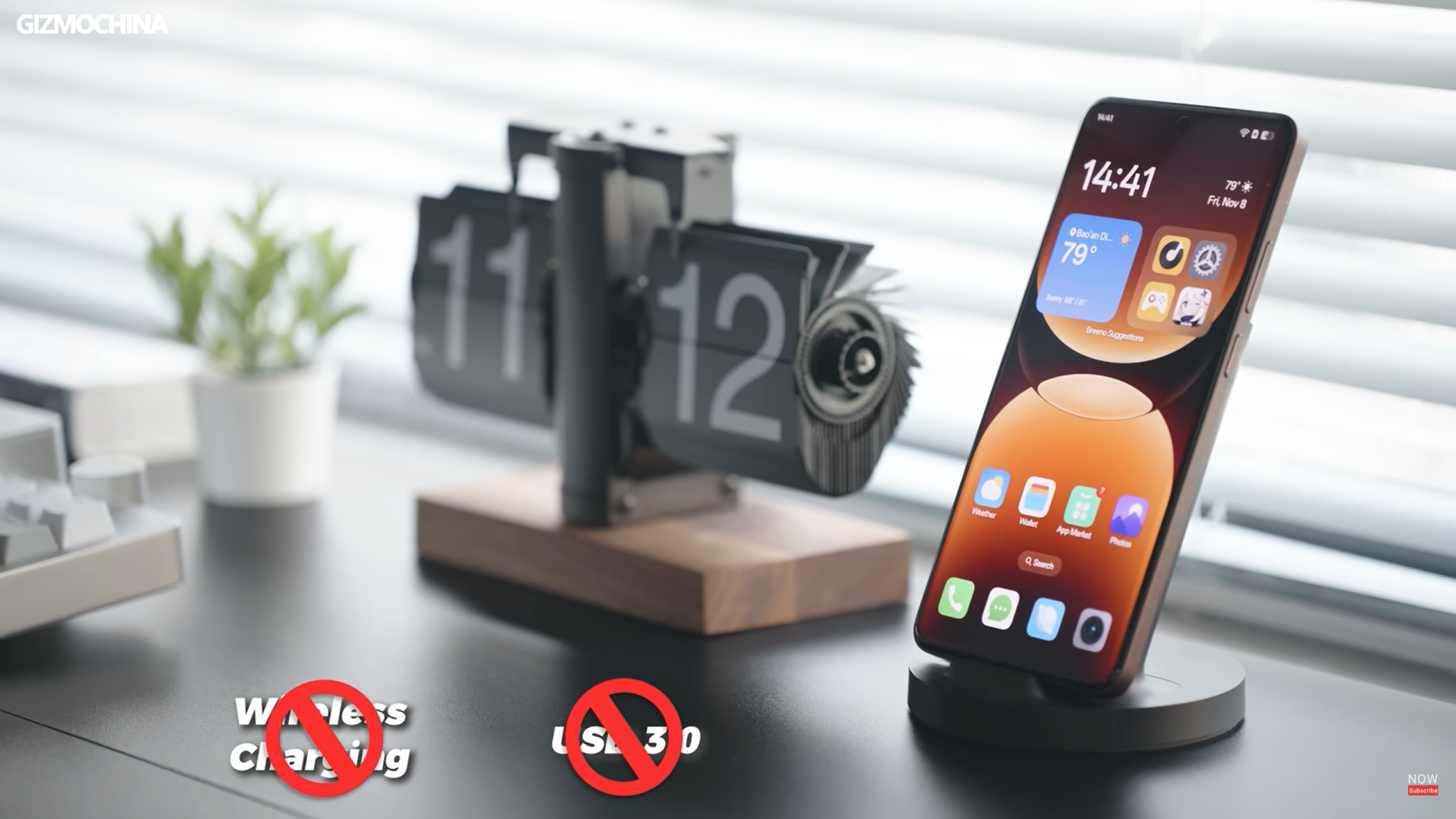
So is there a catch here? There must be a reason why the GT7 Pro is cheaper than others right? First of all, the camera, the telephoto camera is downgraded to IMX 882, and the ultra-wide camera is budget phone level. Then wireless charging disappeared, and USB is still 2.0. These are the things that make it not as good as other flagship phones.
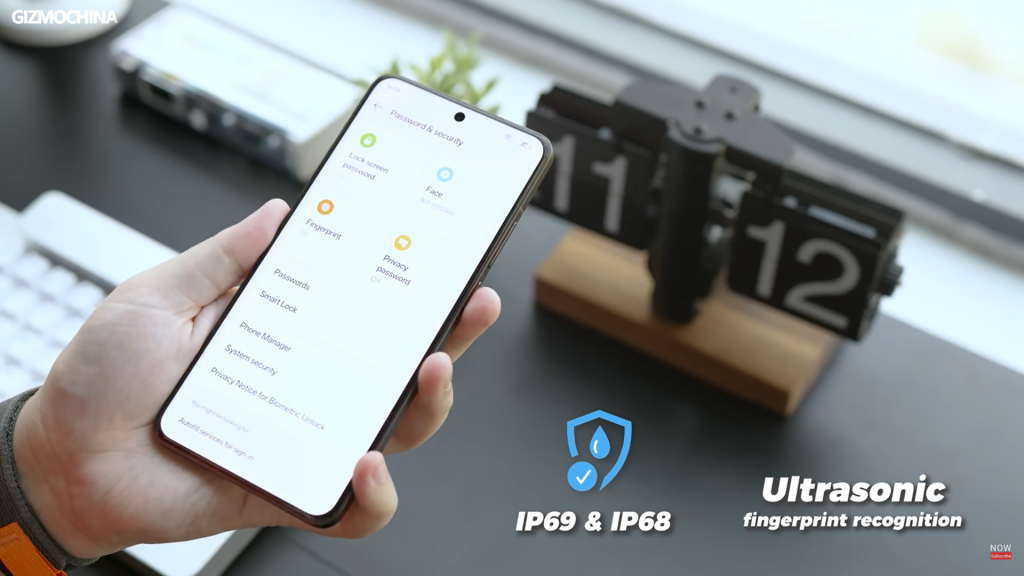
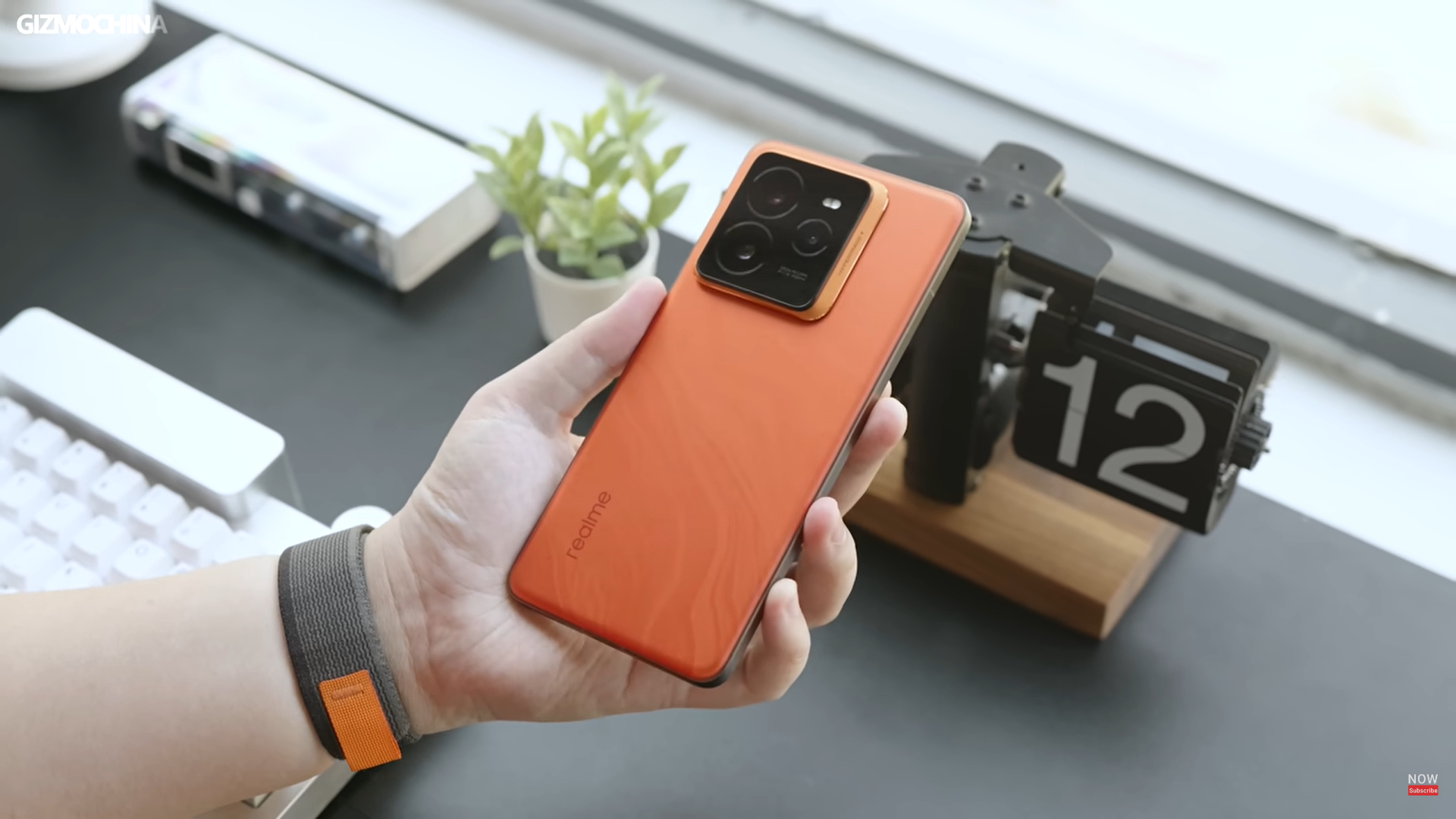
On the bright side, it has upgraded all the major features. For example, the fingerprint recognition has been upgraded to ultrasonic, the waterproof rating has been upgraded to IP68, and the camera module has been moved to the top left corner. Whether it looks good or not, it’s your call, but not blocking your finger does improve the experience.
Overall, the GT7 Pro is flawless. Realme understands how to keep costs under control to create a flagship killer. And this phone is their latest masterpiece.
Display
The GT7 Pro’s screen uses Samsung’s latest Eco² OLED Plus panel. This screen is usually used in foldable phones. Thanks to the Pol-less technology, the polarizer has been removed, the brightness has been increased dramatically, and the power consumption has been reduced as well.
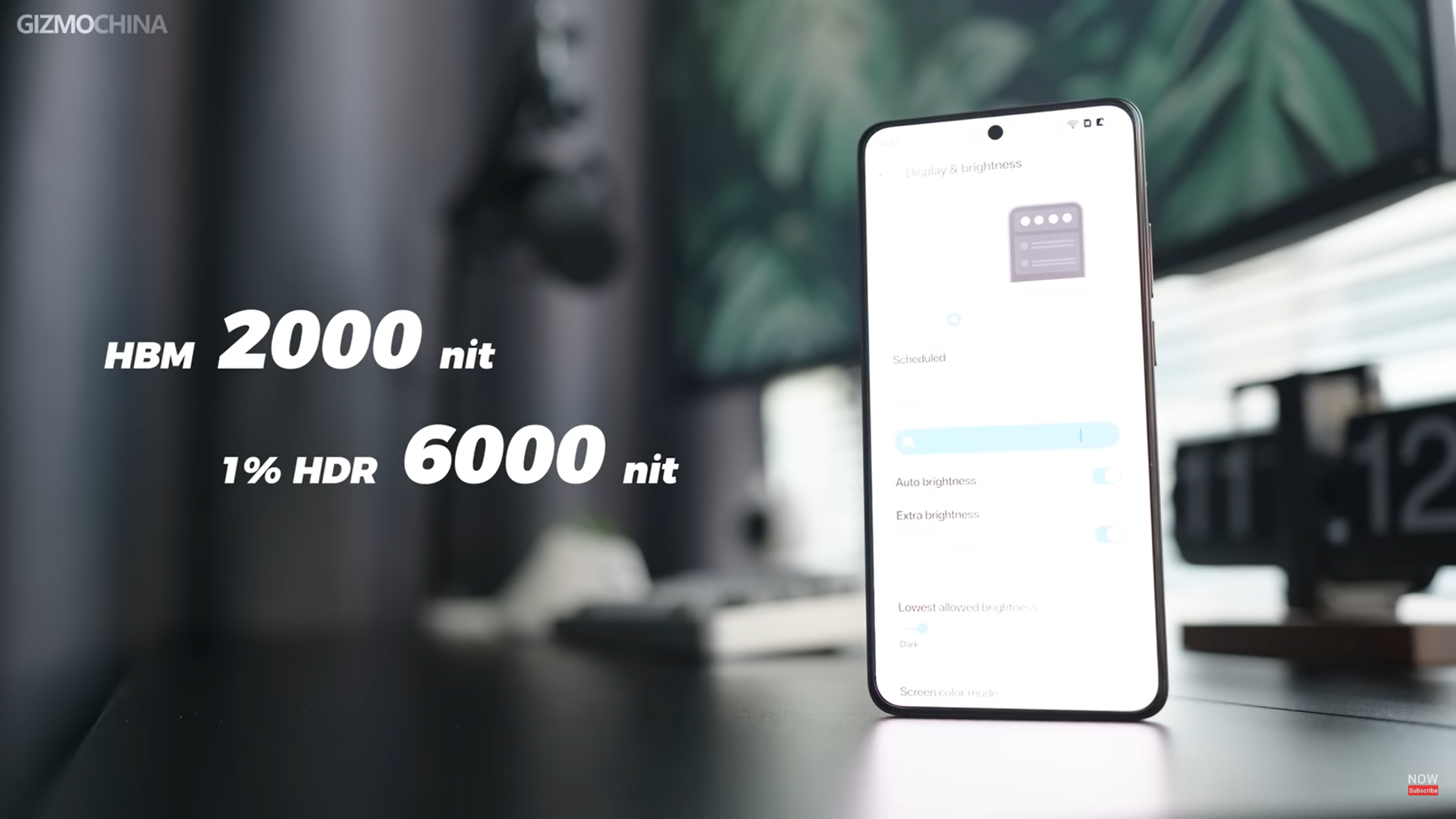
The GT7 Pro can now really be called a flashbang, with a high brightness mode that also reaches 2000 nit, which is outrageous. So what’s the price? The viewing angle has gotten worse. But I think it’s acceptable, as it doesn’t really affect daily experience that much.
Performance, Battery & Charging
High performance has always been the main selling point of the GT series. This year’s Snapdragon 8 Elite is particularly powerful, so the GT7 Pro has dipped its toe in the water. Both the benchmark scores and the gaming experience are much better than the previous gen.
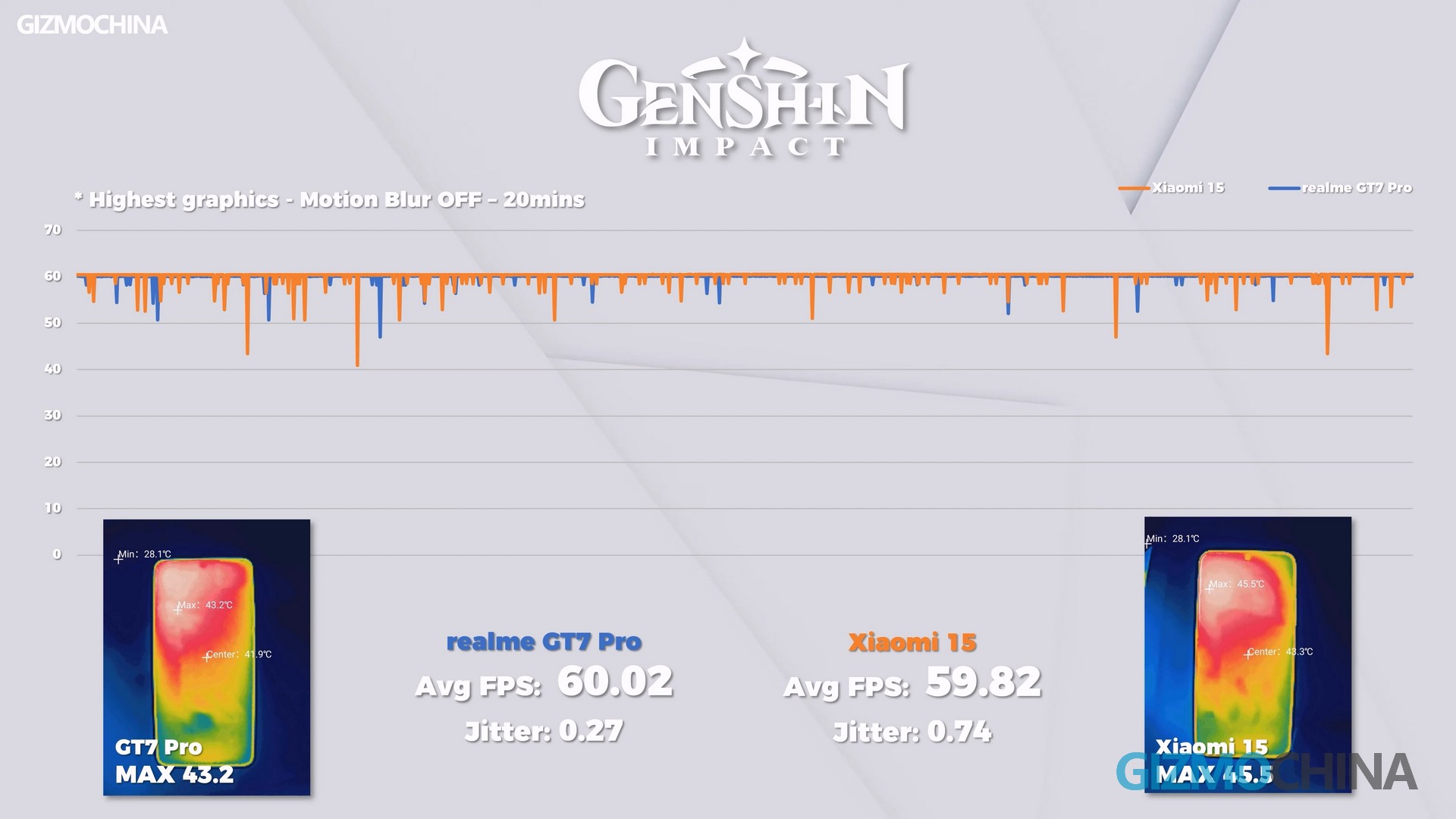
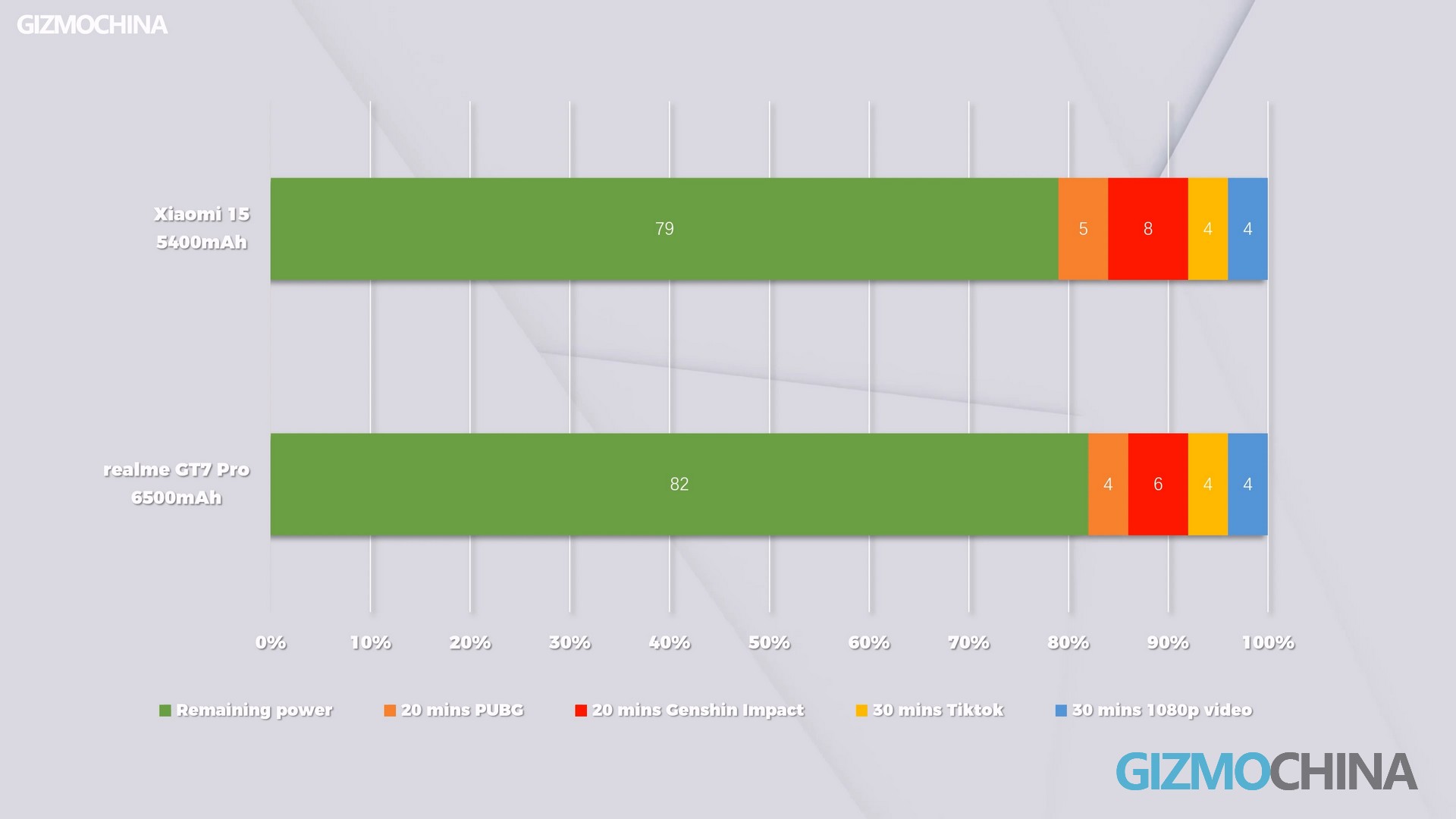
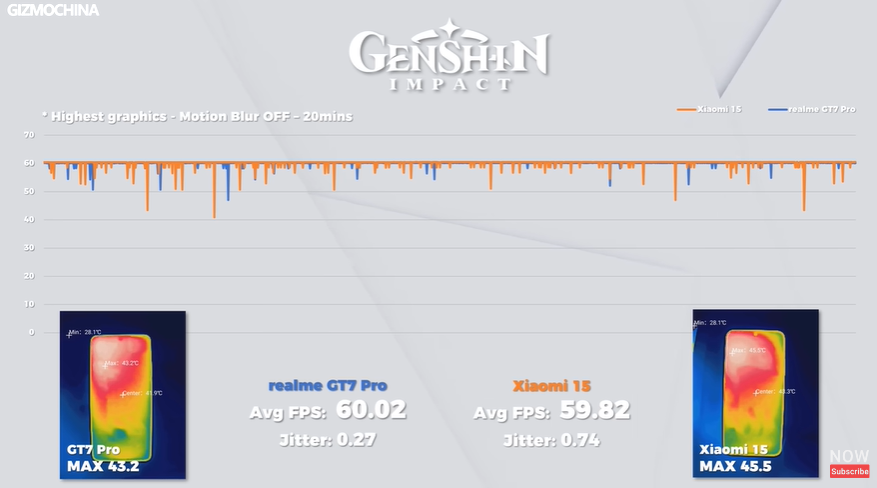
Using the Xiaomi 15 as a benchmark, the GT7 Pro surpasses it in many ways. For example, jitter and temperature control. Unfortunately, our monitoring program went wrong, there was no way to accurately measure its gaming power consumption. But estimating it based on the percentage of battery, the GT7 Pro also takes the lead.
the 6500mAh battery puts all phones so far behind. The longer it’s used, the bigger the gap between it and other phones will be. 120W of wired charging will get it to full battery in about half an hour. It’s not as fast as you’d expect, but there’s no phone faster than it, I mean the recently released phones.
GameSpace has all the features except Bypass charging as well. So gamers don’t need to get a gaming phone specifically, this phone has conquered all mobile games right now.
Camera
Photography is definitely not something the GT7 Pro excels at. As I just said, its telephoto camera, compared to the GT5 Pro, has also been downgraded. Not only is the sensor size smaller, but you can no longer take macro photos with this lens, sadly. But this new sensor is not really weak, and just by looking at the image quality, it doesn’t pull too far ahead compared to other flagships.
Telephoto capabilities are enhanced as the focal length has been changed from 65mm to 73mm. With the help of AI and In-sensor zoom, the image quality is acceptable even when zoomed 6 times. So just looking at the main and telephoto cameras, the GT7 Pro can really compete with flagship phones that cost more.
There’s not much to say about the 8 MP ultra-wide camera. Even powerful ISP and AI can’t save the poor image quality. Only when there is enough light the image quality is acceptable. So, that’s also one of the prices.
Both the main and telephoto cameras are capable of recording 4K video, except for the ultra wide-angle camera and the front camera. Switching between the two cameras is also smooth, except for one problem.
The noise control on the telephoto camera is sometimes terrible. For example, in this footage, the noise is sometimes bad, and sometimes it goes back to normal. I’m sure it’s just a bug, and a system upgrade should fix it right, realme?
(For samples, click on the video at the top of the article to watch)
realme UI
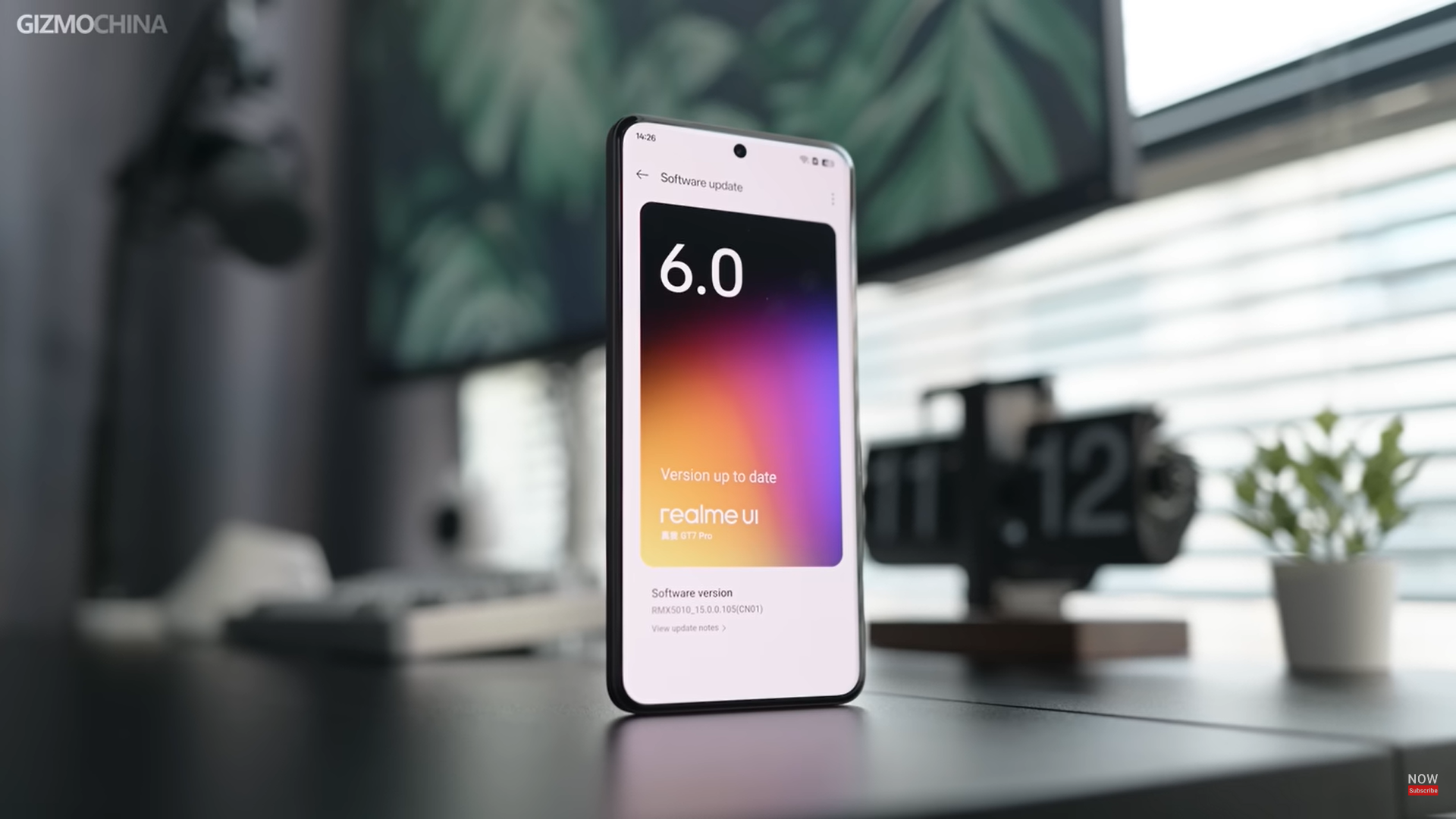
As we all know, realme UI is no different from ColorOS. So yes, it’s another Android phone with “iOS” on it. Actually, I don’t care. iOS has copied a lot of Android’s features, isn’t it? We’ll always get the latest and greatest features, and the ultimate beneficiary will always be us, so I think it’s a good thing that the features are similar. As for the legal issue, leave it to their lawyers.
Brovo Realme, the brand just made another flagship, easy like a snap. the GT7 Pro will undoubtedly be a very popular phone, not because of how perfect the specs are, but because of the perfect price. You know, it’s not easy to make money, only Realme always remembers us who want such phones, so that we can also use flagship phones that are not too expensive.
In a world where flagship smartphones often come with jaw-dropping price tags, Realme’s GT 7 Pro promises flagship-level power at a significantly lower cost. Prices starting from 3,599 Yuan (around $500), it brings high-end performance and standout features without breaking the bank. But does it deliver on all fronts? Here’s a detailed look.
While the Realme GT 7 Pro is priced affordably, there are a few cost-cutting measures to note. For instance, its camera configuration includes a downgraded IMX882 telephoto sensor (3x) and a basic 8MP ultra-wide lens. Additionally, wireless charging is absent, and it uses a USB 2.0 port.
Despite these limitations, the GT 7 Pro has made substantial upgrades, such as an ultrasonic fingerprint sensor, IP68 waterproofing, and a repositioned camera module in the top left corner for better usability.
Overall, Realme’s design choices keep costs manageable while delivering a polished, “flagship killer” look and feel.
2. Display: bright and efficient with Samsung’s Eco² OLED
The GT 7 Pro’s display is a standout feature, utilizing Samsung’s Eco² OLED panel—a technology commonly seen in foldable phones. By removing the polarizer, the display achieves higher brightness and reduced power consumption. With a peak brightness of up to 2,000 nits, this display performs exceptionally well in bright environments. Although viewing angles suffer slightly, this minor drawback doesn’t significantly impact everyday use.
3. Performance and battery: a Snapdragon 8 Elite powerhouse
Performance remains a top priority for Realme’s GT series, and the GT 7 Pro lives up to its reputation. Equipped with the Snapdragon 8 Elite processor, it excels in both benchmarks and real-world gaming, holding its own against competitors like the Xiaomi 15. Despite a small setback in accurately measuring power consumption, we found that the GT 7 Pro lasts longer than almost all of its competitors thanks to the massive 6500mAh battery.
4. Camera: mixed results, but good enough
The camera setup on the GT 7 Pro is functional, though not exceptional. While the primary and telephoto sensors deliver good results, especially with improved focal length and in-sensor zoom, the ultra-wide sensor struggles in low-light conditions. Noise control on the telephoto camera could also use some refinement, as occasional glitches appear in the footage. Despite these quirks, the GT 7 Pro’s main cameras hold up reasonably well against pricier alternatives, especially for everyday use.
5. Software experience: Realme UI 6 with visual refinements
Realme UI 6 offers an eye-pleasing experience, albeit with similarities to iOS. While this interface may feel familiar to some, it incorporates useful features without compromising on ease of use. Realme has focused on delivering new features and visual refinements that benefit end users.
6. Conclusion: affordable power with few compromises
With the GT 7 Pro, Realme once again proves that it can offer powerful, feature-rich smartphones without the premium price tag. By focusing on key features and making smart sacrifices, Realme has produced an affordable flagship option that meets the needs of many users. For anyone seeking flagship performance without spending top dollar, the GT 7 Pro is a compelling choice.
Whether you’re a gamer, a casual photographer, or simply someone who appreciates value, the Realme GT 7 Pro combines quality with affordability—leaving us excited for future budget-friendly options.
Currently exclusive to China, the device can still be imported by interested users through platforms like Giztop, where it is in stock for $619—significantly cheaper than the $799 price tag of the OnePlus 13 on the same platform.
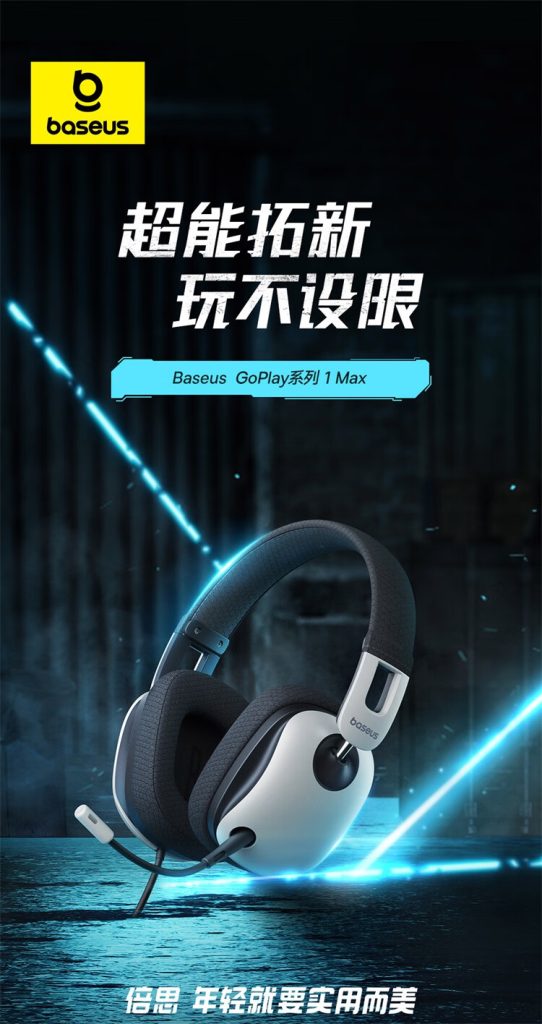
Baseus has launched new wired over-ear headphones called GoPlay 1 Max in the Chinese market. The headphones are priced at 149 yuan ($21) and are now available on JD.com. Let’s check out its key specs.
Baseus GoPlay 1 Max Specifications
The Baseus GoPlay 1 Max gaming headset is equipped with a 40mm dual dynamic driver unit, offering immersive audio with deep bass and clear vocals. Its low-frequency drivers deliver impactful sound with crisp highs and resonant lows, enhancing intense gaming experiences.
The headset equips high signal-to-noise ratio (SNR) technology, reducing background noise for improved sound clarity. This helps users pinpoint in-game audio cues precisely.
It also sports upgraded skin-friendly, breathable mesh ear cushions, designed for prolonged wear to minimize ear fatigue. These lightweight ear cushions pair with an adjustable headband and a durable metal frame, fitting various head shapes.
For communication, the headset features a fully adjustable, omnidirectional microphone for clear voice pick-up, enhancing in-game communication with teammates. The detachable microphone allows flexible positioning, giving users control over voice clarity.
The GoPlay 1 Max features user-friendly controls, including a volume adjustment wheel, a microphone mute switch, and an on-off toggle. It also sports a 3.5mm audio interface, ensuring compatibility with PCs, gaming consoles, and mobile devices.
Built from ABS, PC, and metal, this headset weighs approximately 258g, balancing comfort and durability. It sports a sensitivity of 102dB and a frequency range of 20Hz to 20kHz, ensuring balanced sound reproduction across a broad spectrum.
Additionally, Baseus integrates innovative technologies like Audic, BRC, and DCLL for spatial audio and instant charge. The headset also supports low-latency audio and precise spatial positioning, with global certifications verifying its safety and quality.
We recently reviewed the Baseus Bowie 30 Max headphones, and it’s one of the best ANC headphones we’ve tested so far in its price range. Check out our full review!
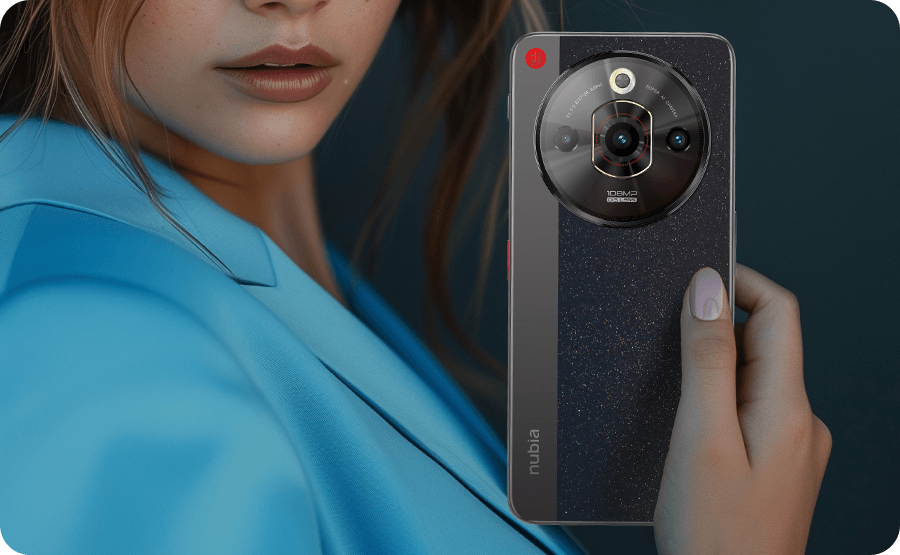
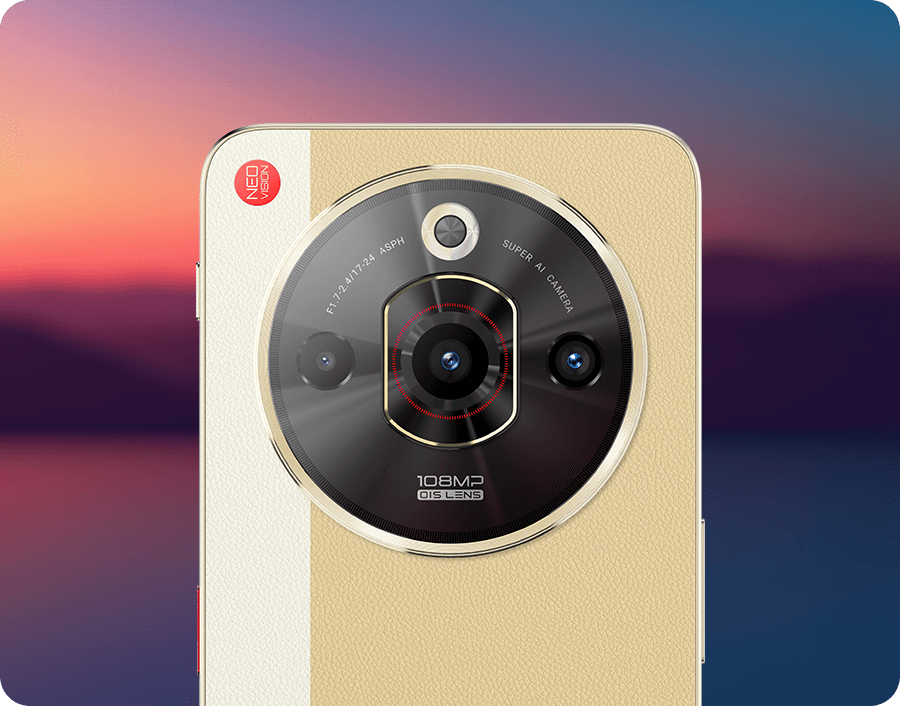
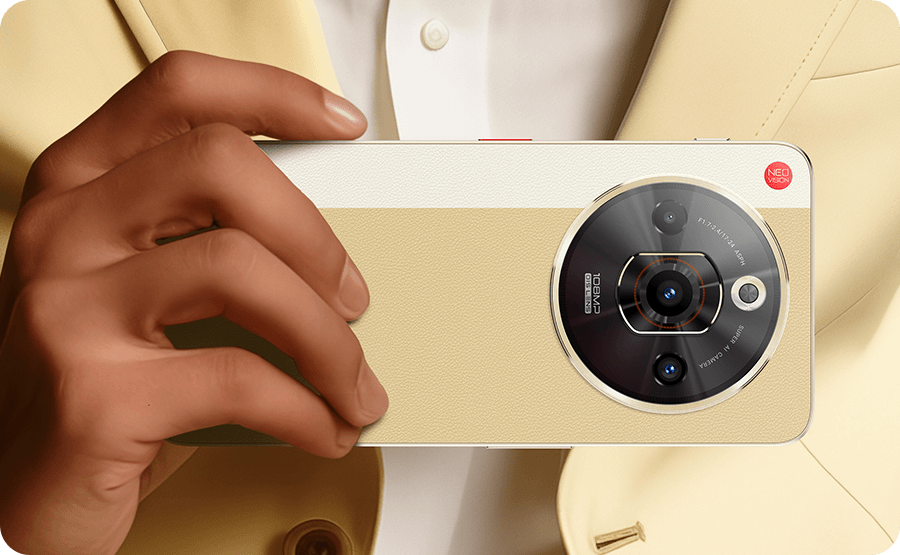
Nubia, the Chinese smartphone brand, has launched its Focus Pro 5G in Indonesia. First introduced at MWC 2024, this camera-focused device is now available to Indonesian consumers, offering an enhanced photography experience.
Design and Display
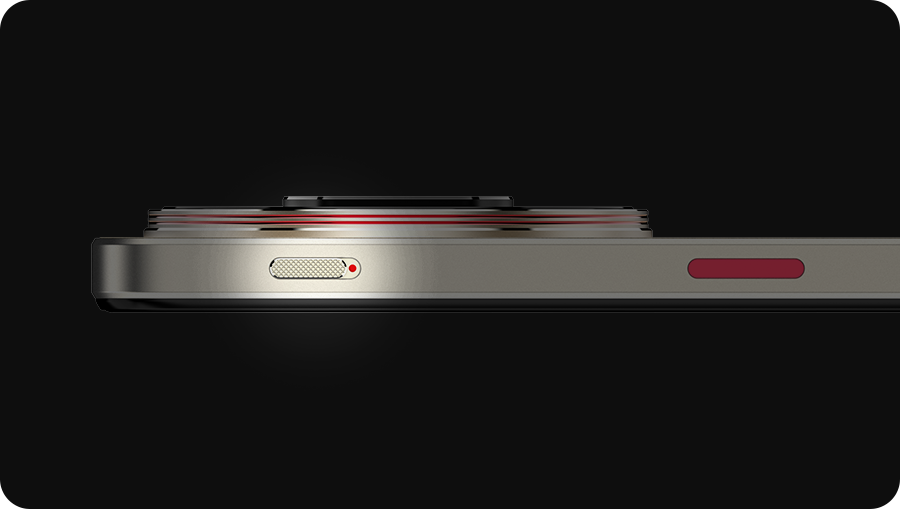
The Focus Pro 5G has a unique design with a sliding shortcut button for quick access to four customizable functions: camera, sound mode, voice recorder, and flashlight. The classic camera module highlights its photography focus.
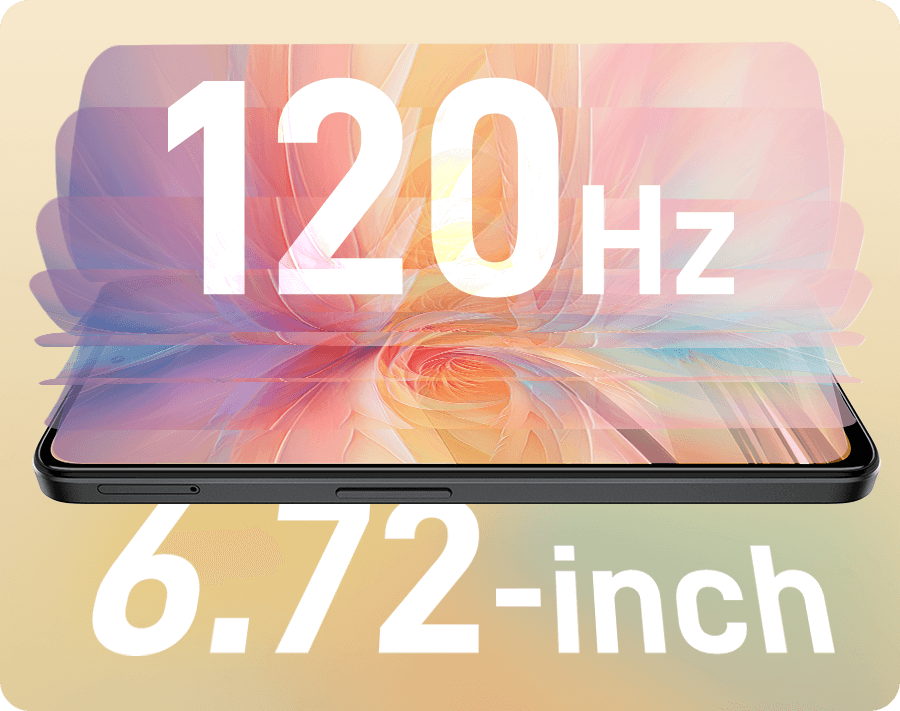
It also features a 6.72-inch FHD+ display with a 120Hz refresh rate for smooth visuals and a 92% screen-to-body ratio for an immersive experience. The interactive live island feature provides access to notifications and real-time updates.
Photography Features
The Focus Pro 5G comes with a 108MP AI main camera, equipped with Optical Image Stabilization (OIS) and Electronic Image Stabilization (EIS) to help capture steady shots, even in low light. With five focal lengths from 18mm to 72mm, users can photograph a range of scenes from landscapes to close-ups.
For video, the device supports 4K recording, allowing for high-quality footage. The RAW Super Night Mode boosts low-light photography, while a 32MP selfie camera captures detailed portraits.
Performance and Storage
While processor and battery details haven’t been disclosed, the Focus Pro 5G will come with a 2.2GHz 5G processor. It will be available in a 20GB RAM (combined physical and virtual) and 256GB internal storage configuration, offering ample space for apps, photos, and videos. The phone is equipped with a 5000mAh battery and offers 33W fast charging.
Pricing and Availability
The official price and release date for the Nubia Focus Pro 5G in Indonesia has not yet been announced. Interested consumers can stay updated through official channels and authorized retailers.
OnePlus has announced the release of a new software update, V10P02, for a wide range of its smartphones and tablets. This update brings several improvements, including optimized weather data refresh frequency, faster scrolling screenshot saving, and enhanced system stability.
The update is being rolled out in stages, starting from November 6th, and is expected to reach all eligible devices by December 9th.
Changelog Overview
Weather
• Optimizes the refresh frequency of weather data to improve the timeliness and accuracy.
Screenshot
• Optimizes the saving speed of scrolling screenshots.
System
• Improves system stability.
Eligible Devices for OxygenOS 14:
OnePlus 12 Series
OnePlus Open
OnePlus 11 Series
OnePlus 10 Series
OnePlus 9 Series
OnePlus 8T
OnePlus Nord 4 5G / OnePlus Nord 3 5G / OnePlus Nord 2T 5G
OnePlus Nord CE4 5G / OnePlus Nord CE3 5G / OnePlus Nord CE 3 Lite 5G / OnePlus Nord CE 2 Lite 5G
OnePlus Pad / OnePlus Pad Go
Eligible Devices for OxygenOS 13.1.0:
OnePlus 8 / OnePlus 8 Pro
Eligible Devices for OxygenOS 13.0.0:
OnePlus Nord 2 5G
OnePlus Nord CE 2 5G
OnePlus Nord CE 5G
OnePlus encourages users to keep an eye out for the update notification and install it as soon as possible. As usual, the update rollout is gradual and not all users will receive the notification immediately.
Users are advised to refer to the official channels for the latest information on the update and its features.
In other news, OnePlus has launched an early global rollout of OxygenOS 15 for the OnePlus 12, delivering smoother animations, revamped visuals, and improved customization options across themes, displays, and photo editing. The update also improves app compatibility with Fluid Cloud, introduces convenient Floating Window and Split View features, refines notifications, and adds battery protection settings.
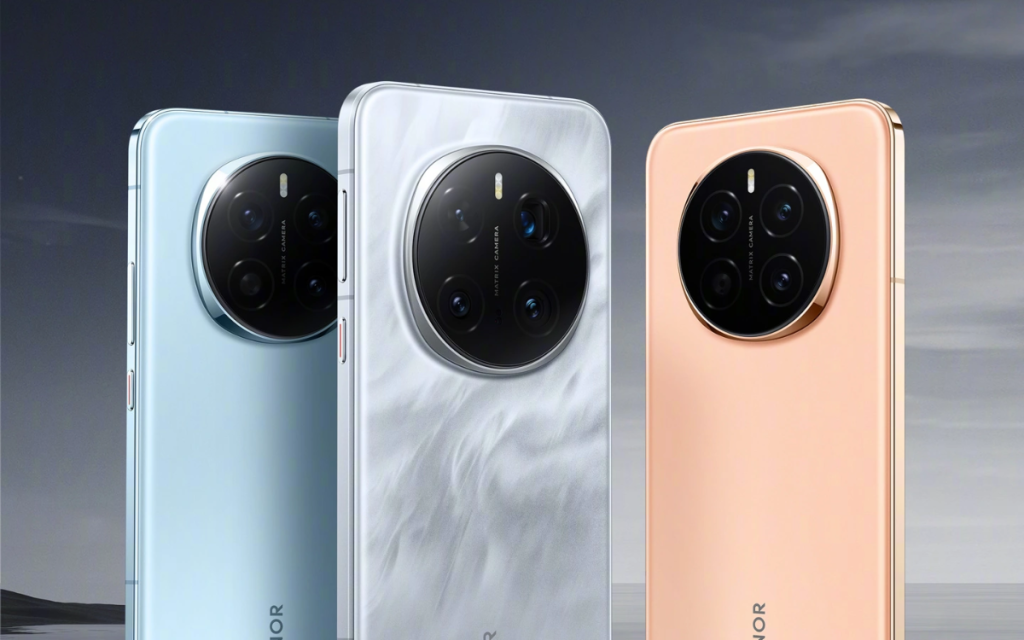
Last week, Honor launched its highly anticipated Magic 7 series in China, building on the success of the previous Magic 6 series. This new lineup features enhanced AI capabilities and the powerful Snapdragon 8 Elite chipset, making it a significant upgrade.
The series has already proven popular, as Honor announced that the Magic 7 series broke all previous first-day sales records for new Honor devices. It officially went on sale yesterday, November 8, at 10:08 AM, and quickly captured the attention of consumers.
The Honor Magic 7 is available in five vibrant colors: Sunrise Gold, Moon Shadow Grey, Snowy White, Sky Blue, and Velvet Black. Meanwhile, the Honor Magic 7 Pro offers four elegant color options: Moon Shadow Grey, Snowy White, Sky Blue, and Velvet Black.
The base variant starts at 4,499 yuan ($626) and goes up to 5,499 yuan ($765) for the top model with satellite communication, while the Pro variant starts at 5,699 yuan ($793), with the top model priced at 6,699 yuan ($933), also supporting satellite communication.
Coming to the specs, the Magic 7 has a 6.78-inch flat OLED display, while the Pro model has a 6.8-inch quad-curved OLED, both supporting 1-120Hz LTPO adaptive refresh rates and peak HDR brightness of 5000 nits.
Powered by the Snapdragon 8 Elite chipset with an Adreno 830 GPU, these devices offer strong performance, especially in gaming, aided by Honor’s liquid cooling system. They run MagicOS 9.0 based on Android 15, with AI features like the YOYO Smart Assistant and enhanced privacy controls.
The Magic 7 series features robust cameras: the Magic 7 includes a 50MP triple-lens setup, while the Pro model adds a 200MP periscope telephoto lens supporting 100x zoom. Both have advanced AI photography features, with a 50MP front camera and the Pro’s ToF sensor for 3D facial recognition.
The Magic 7 has a 5650mAh battery; the Pro offers 5850mAh. Both support 100W wired and 80W wireless charging and Honor’s Qinghai Lake battery tech enhances longevity. Additionally, they include IP68/69 ratings, 3D ultrasonic fingerprint sensors, 5G, Wi-Fi 7, satellite messaging, and 10x drop resistance.
With the release of Android 15, Google introduces a major enhancement for Android displays: true variable refresh rate (VRR) support. This adaptive refresh rate feature (ARR) allows displays to adjust their refresh rates dynamically, depending on the type of content, aiming to reduce power consumption and improve user experience.
Current situation with LTPO and limited VRR on Android Devices
For those wondering about the variable refresh rate functionality of 8T LTPO (Low-Temperature Polycrystalline Oxide) panels, it’s worth noting that these displays still toggle among a set of predefined refresh rates rather than offering a fully continuous range from 1Hz to 120Hz.
Manufacturers preconfigure these displays to switch among specific refresh rates like 1Hz, 10Hz, 30Hz, 60Hz, and up to 120Hz based on the content being displayed. For example, I’ve never seen the 8T LTPO panel on the iQOO Neo9 Pro refresh at any rate between those predefined values.
This is due to the limitations of Android’s software framework, which has, until Android 15, only supported discrete display modes.
This is different from the VRR technology on PCs, where the refresh rate can synchronize with the frame rate in real time, adjusting continuously to match the rendered frames. Such real-time sync allows for smoother transitions and improved responsiveness, especially in gaming. Android devices, on the other hand, have traditionally lacked this kind of flexibility.
Google’s implementation of Adaptive Refresh Rate in Android 15
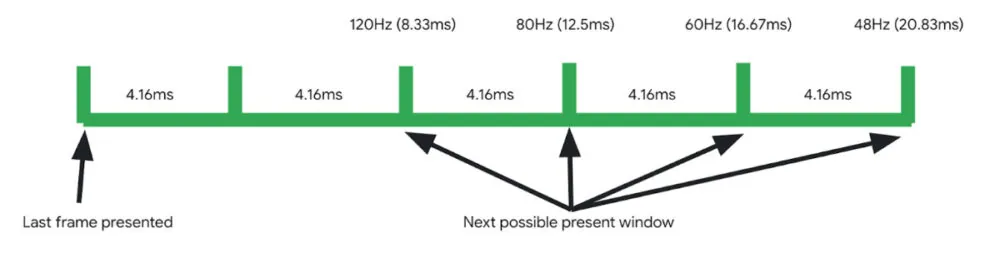
With Android 15, Google has reworked Android’s display framework by introducing true ARR (Adaptive Refresh Rate) support, which lets screens adjust refresh rates within a single display mode.
This improvement is made possible through updates to the Hardware Composer (HWC) hardware abstraction layer (HAL). The HWC HAL version 3 enables the system to optimize the refresh rate by analyzing content type and adjusting the refresh rate accordingly, without needing to switch between modes. This reduces instances of “jank,” or visual stuttering, which often resulted from changing display modes in previous Android versions.
Hardware compatibility?
However, enabling ARR requires hardware compatibility. Devices need support for HWC HAL version 3, which is available on select recent devices like smartphones powered by Qualcomm’s Snapdragon 8 Elite processor. Older devices, even if they receive Android 15, might not gain ARR due to missing hardware or kernel support.
Unfortunately, Google’s ARR approach won’t bring PC-like sync for gaming, as the feature only allows refresh rates that match “divisors of the panel’s tearing effect (TE).”
While this ARR upgrade is promising, widespread adoption will depend on hardware support and OEM willingness to adopt HWC HAL v3, which could limit the feature to newer flagship models. Still, Google’s addition of true VRR functionality represents a significant step toward a more dynamic and power-efficient display experience on Android.
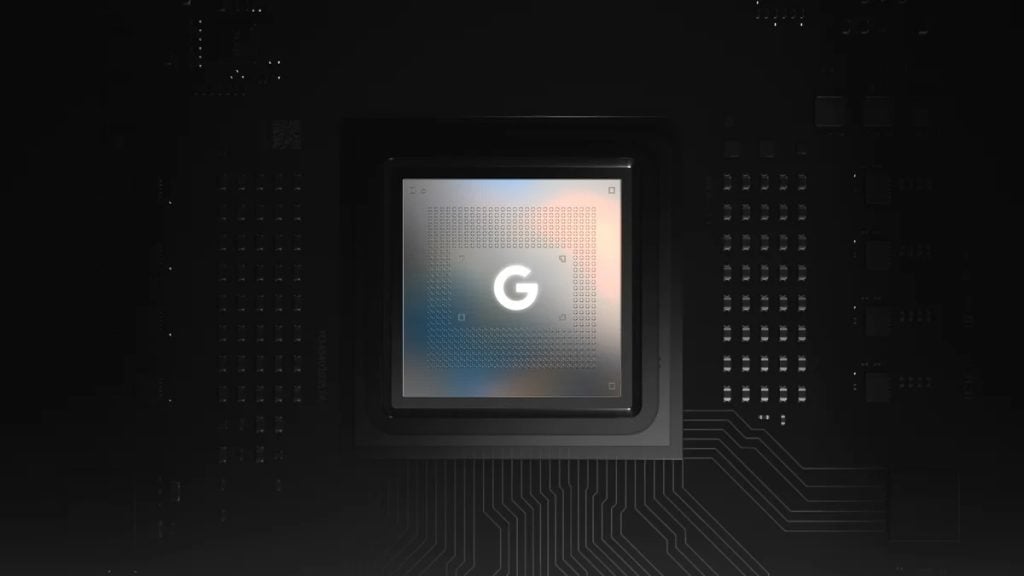
Google has used its custom-designed Tensor chips to power Pixel phones since the Pixel 6. But so far, these chips haven’t matched the performance or efficiency of their competitors.
This may change soon, as leaked internal documents obtained by Android Authority reveal Google’s plans to improve with its upcoming Tensor G6 chip, codenamed “Malibu.”
The changes for the Tensor G6 are expected to focus on thermals and efficiency gains. Major performance improvements are not in the cards, and even the Tensor G5 is only expected to offer a modest performance boost over the current chip.
So it looks like Google’s SoC strategy isn’t prioritizing performance gains for now. In fact, Android Authority reports that the Tensor G6 chip may even see some “downgrades” in certain areas.
Tensor G6 with improved efficiency?
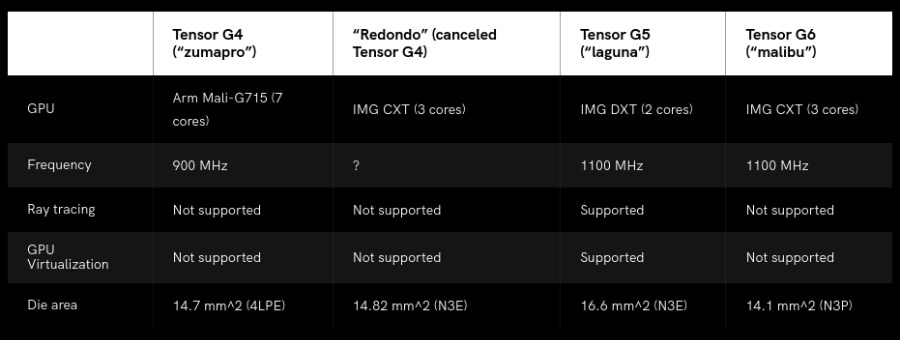
For instance, Google is reportedly forgoing a new GPU for the Tensor G6 and opting for an older design initially intended for the Tensor G4. If so, the Tensor G6 might lack ray tracing support, which the Tensor G5 is expected to have. So it’s a step backward in that regard.
Image: Android Authority
The decision to use the G4’s GPU in the G6 is reportedly driven by Google’s goal to reduce the chip’s die area. The Pixel 10’s chip is said to be quite large at 121 mm² when built using TSMC’s 3nm process node, while Apple’s A18 Pro, which uses the same process, measures just 105 mm².
Google’s target for the Tensor G6 is a 105 mm² die size, factoring in a 4% area saving from TSMC’s newer N3P process node (the G5 uses N3E).
To achieve this, using the G4’s GPU is said to reduce the die area by approximately 12%. Google is also reportedly cutting space by reducing the DSP (digital signal processor) by one core and halving the SLC (system-level cache) to 4MB. However, the report suggests there won’t be changes to the CPU size.
All in all, Google is trying to make smaller, more efficient chips, focusing on space-saving rather than performance improvements.
OxygenOS, based on Android 15, brings some great new features and essential improvements. From user experience to privacy, improvements have been made to almost every corner. If you’re wondering whether to upgrade to OxygenOS 15, dive into these 7 reasons to understand why it’s a far better choice than OxygenOS 14.
1. Faster, smoother, and more lightweight
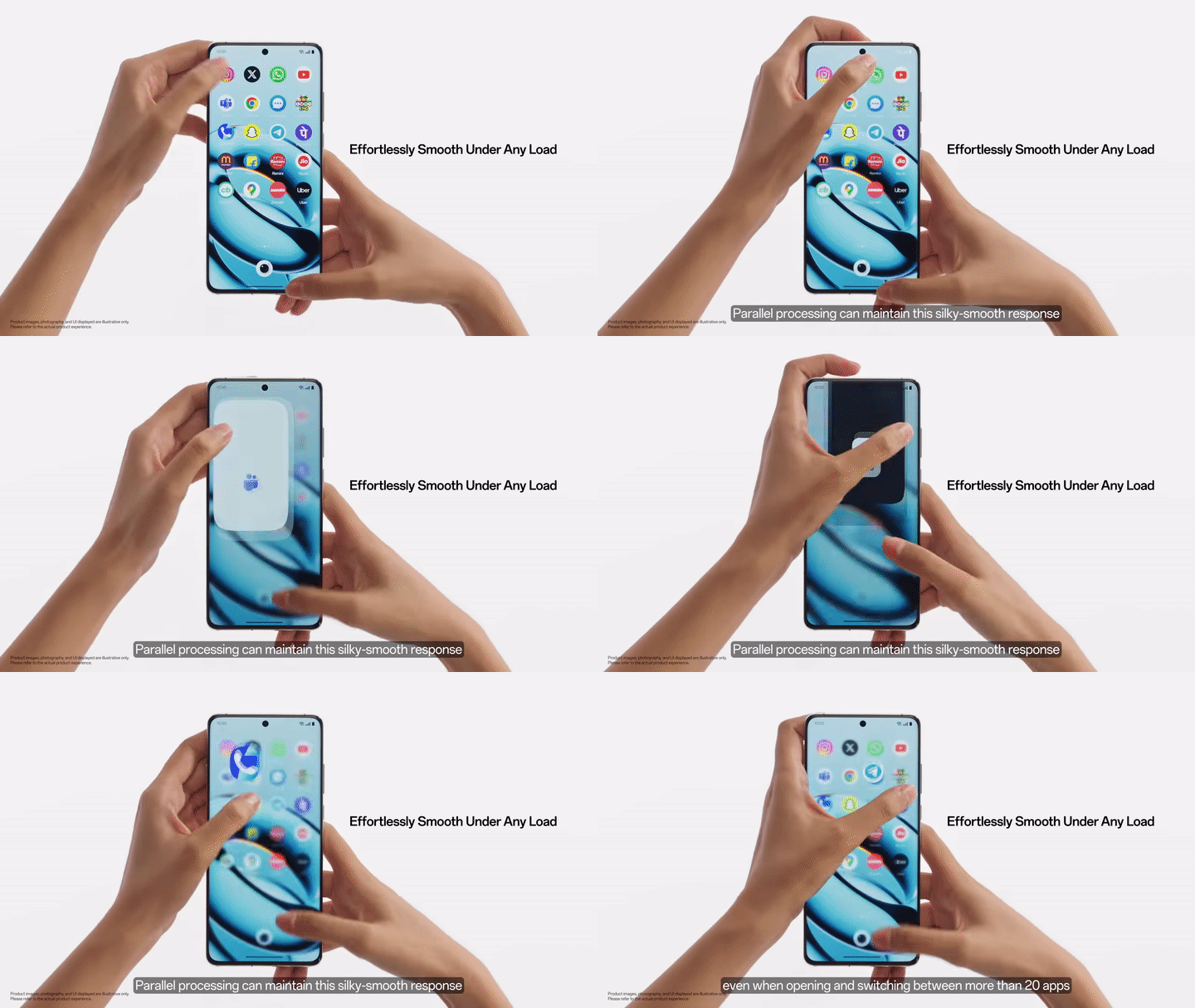
OxygenOS 15 introduces parallel processing, which addresses the laggy app switching problem on smartphones. This industry-first solution dramatically improves animation interactions, though it’s only noticeable when you open and close multiple apps in quick succession.
In OxygenOS 14 or earlier, an app has to execute a series of tasks to open, causing a little lag if another app is opened quickly. The latest version handles those tasks parallely, thus reducing that lag, even under heavy workloads.
OnePlus claims a significant reduction in system storage for OxygenOS 15. The OnePlus 12 running OxygenOS 15 saves nearly 20% of system storage by identifying and removing redundant features.
2. Circle to Search
Circle to Search, introduced initially on the Samsung Galaxy S24 series, is also coming to OnePlus phones with the OxygenOS 15 feature. It’s a quick way to search anything on your screen just by drawing a circle around it.
It’s an exciting feature that you’ll likely use a lot or not at all. It works well for me, though. I often use it to search tech products showing up in reels.
3. AI upgrades
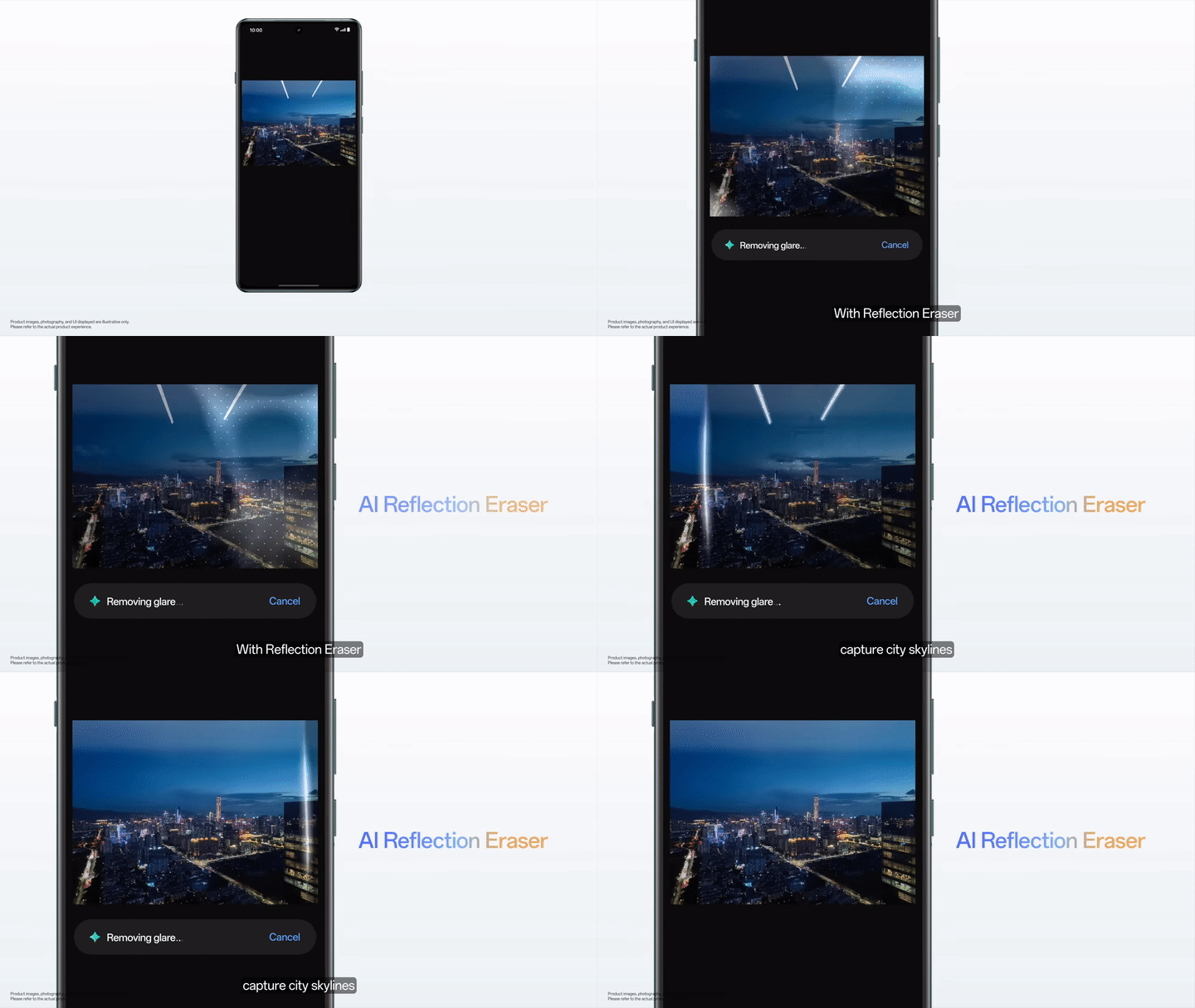
Image cleanup is now a lot easier, thanks to new AI tools in OxygenOS 15. First is the AI Detail Boost, which upscales images to 4K resolution so you can crop them without losing quality. There’s also AI Unblur (to improve blurred images) and AI Reflection Eraser (to remove all glares from your shots).
These AI features are not perfect, though. However, it’s far better than not having them.
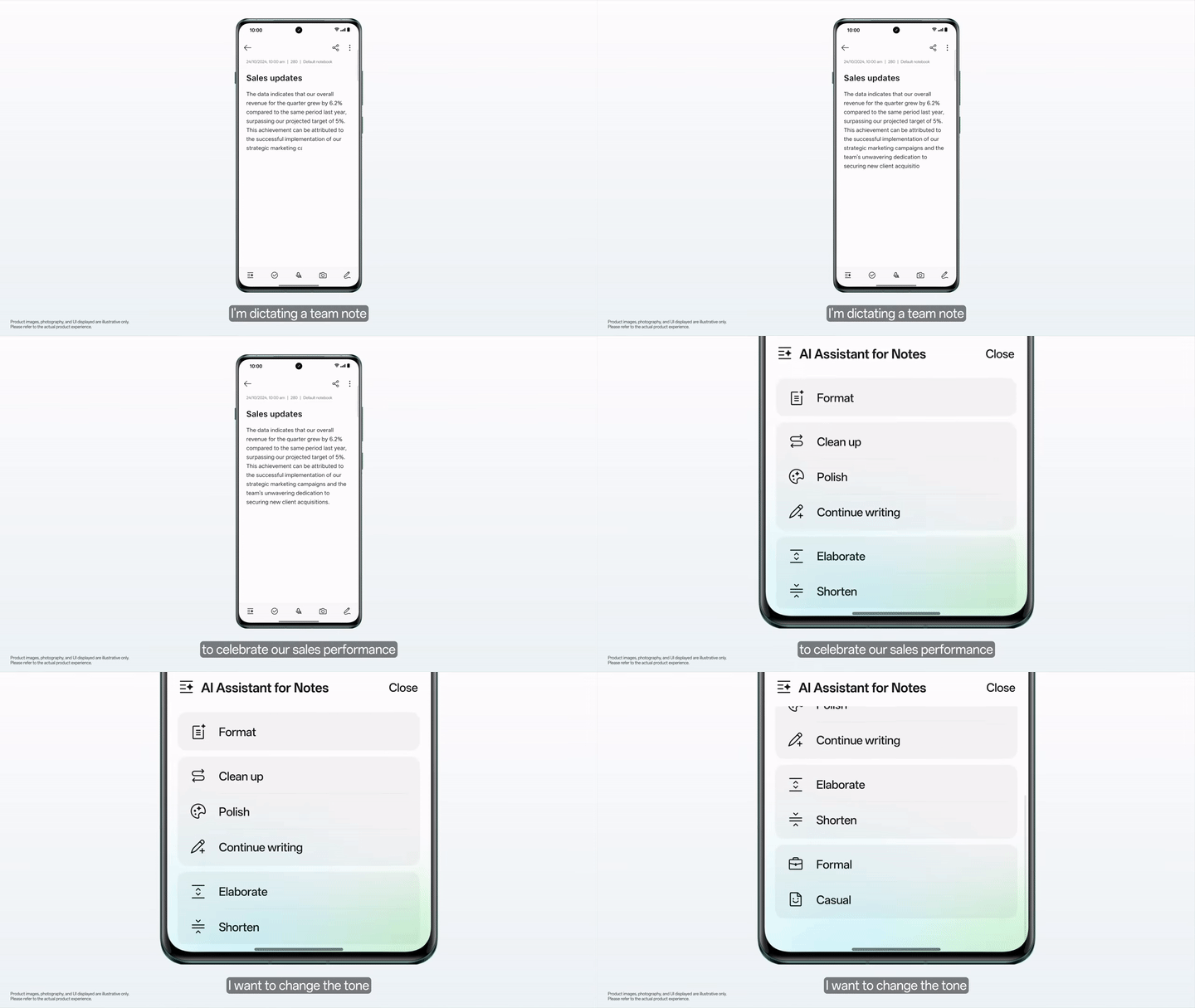
The Notes app is also getting smarter with AI upgrades. Among those include a Cleanup tool to remove pauses from a transcript, a Format for creating clean summaries, and a Tone Adjustment to change the writing tone. Using the Continue Writing feature, you can generate new content with the help of AI.
4. Intelligent search
Unlike traditional keyword-based searches, the intelligent search feature in OxygenOS 15 leverages natural language processing, allowing users to search across system apps using everyday language. It uses both the cloud and on-device AI capabilities.
This AI-enabled search feature reduces the need to open apps to find relevant answers. For example, you can ask, “how much is the electricity bill?” or “what’s the due date for credit card bill payment?” to get the required information on the screen without even opening the Message app. The Photos app currently supports in-app keyword searches, though.
5. OnePlus OneTake
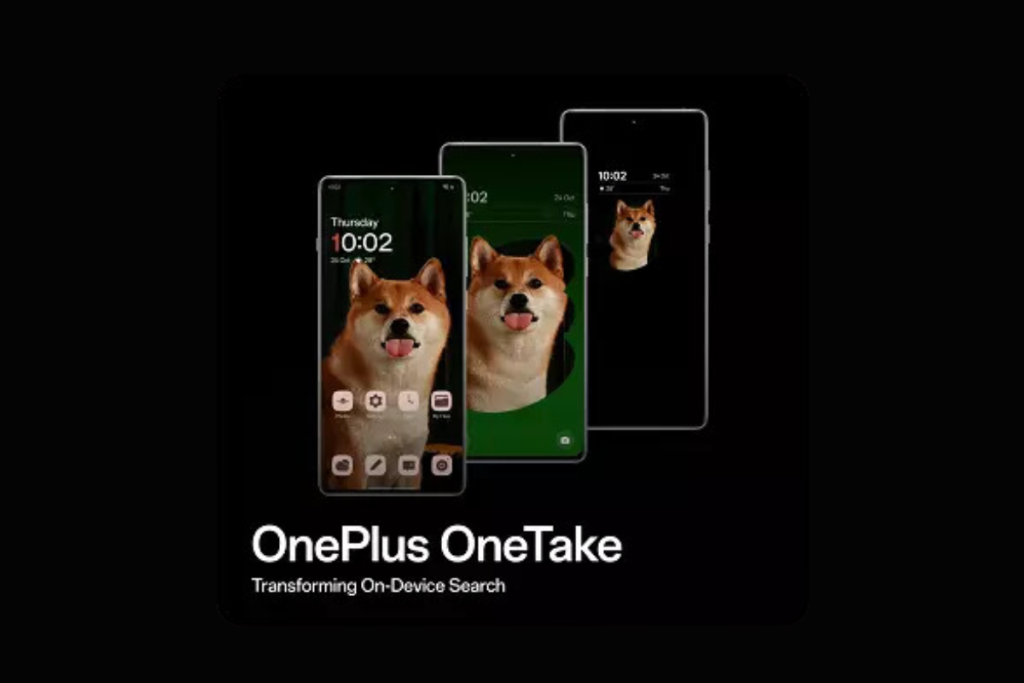
The OnePlus OneTake feature in OxygenOS 15 delivers a seamless visual experience. It ensures a seamless transition from Always-On Display to the lock screen and then to the main screen.
You can choose images from the camera or album to create a multilayered effect using the “Depth” feature. You can showcase the main focus throughout multiple screens, adding a personal touch to the device.
6. Live alerts
OxygenOS 14’s Smart suggestion now has a new name: Live Alerts. Previously, you had to tap and hold the icon in the notification panel to see them in the form of a card. Now, that’s just a tap away, similar to how it works on iPhones. It has also been improved to work with more system functions like hotspots, screen recording, music playback, and more.
7. Theft protection
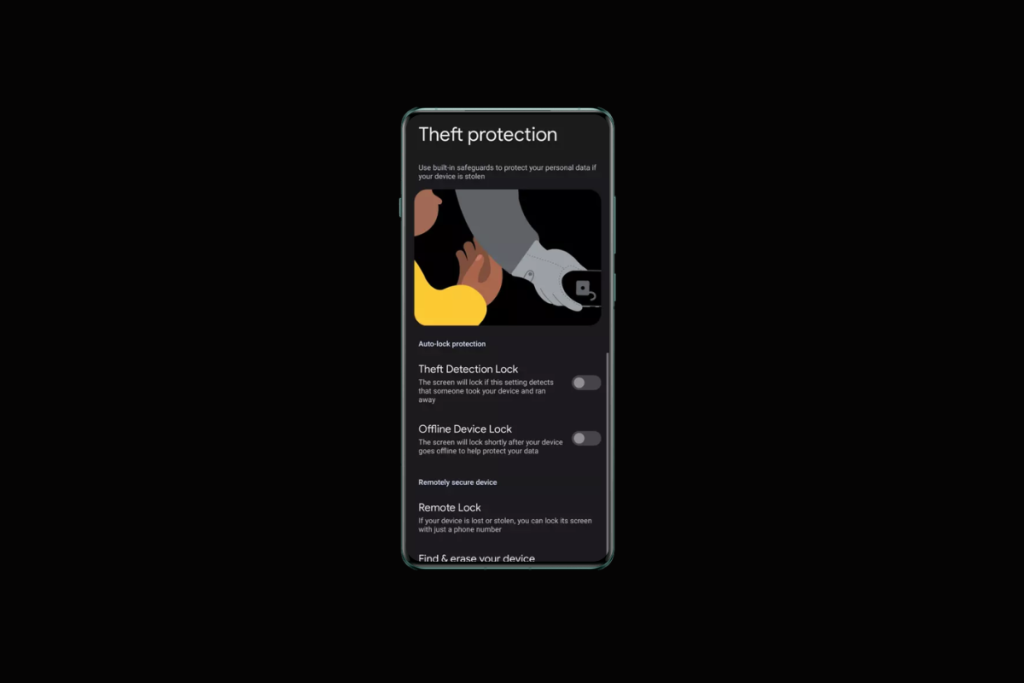
If privacy is a priority for you, OxygenOS 15 has another reason to grab your attention. It incorporates theft protection measures to safeguard your data in the event of theft. If someone snatches your device and runs away with it, the lock gets activated automatically to prevent unauthorized access.
If your device goes offline or the SIM card is removed, an offline lock is activated. You can also remotely lock the device using the FindMyDevice portal, even without logging into your Google account.
#Bonus
The OnePlus Easter Egg is back in the Calculator app. You’ll see the OnePlus’s Never Settle animation after tapping “1” and “+” followed by “=”. It’s a nice aesthetic element to OxygenOS 15 that old OnePlus fans would appreciate.
Which OxygenOS 15 feature(s) you like the most? Share your thoughts in the comments below.
The iQOO 13 has already been unveiled in China, and now it is planning on making its global debut in India soon. However, the Realme GT 7 Pro is another affordable Snapdragon 8 Elite powered flagship smartphone that is launching in India a week ahead of the iQOO 13. So let’s see how these models compare in the region.
1. iQOO 13 vs Realme GT 7 Pro: When are they launching in India & What’s the price?
In an official teaser, the Realme GT 7 Pro was confirmed to launch in India on 26th November 2024. In other words, it is arriving in the country a week earlier than the iQOO 13. To recall, the latter is set to launch in the market on 3rd December 2024.
When we first compared the two devices before, the Realme GT 7 Pro was the most affordable Snapdragon 8 Elite powered smartphone. Meanwhile, the iQOO 13 was the second most affordable model in China with the same flagship chipset. The Realme GT 7 Pro was announced in China for 3,699 Yuan, or roughly around 43,716 INR (515 US Dollars). iQOO unveiled its new flagship phone for 3,999 Yuan or about 47,262 INR (roughly 561 US Dollars). Both models will likely cost more outside of China, but we can expect a similar price gap between the two in India as well.
2. What’s the difference between the iQOO 13 & Realme GT 7 Pro?
The iQOO 13 was unveiled with a taller 6.83-inch LTPO OLED display that offers a higher 2K resolution and a smoother 144Hz refresh rate. However, the Realme GT 7 Pro has a 6.78-inch LTPO Samsung Eco² OLED Plus display that has an impressive 6000 nits of peak brightness, 1.5K resolution, a 120Hz refresh rate, and a 2600Hz touch sampling rate.
While both models are equipped with the Snapdragon 8 Elite SoC, the iQOO 13 houses an impressive 6,150mAh battery pack, but a larger 6,500mAh cell powers the Realme GT 7 Pro. Unfortunately, Realme GT 7 Pro does not support wireless charging but offers faster 120W wired charging. On the other hand, the iQOO 13 has 100W wired fast charging and 50W wireless fast charging.
One of the biggest differences between the iQOO 13 and Realme GT 7 Pro is the camera department. You get three 50MP sensors on the iQOO flagship for its main, ultra wide, and telephoto shooter. The premium new Realme phone only offers a 50MP main sensor, which is paired with an 8MP ultra wide angle lens and a 50MP telephoto shooter. For selfies and video calls, the Realme GT 7 Pro features a 16MP selfie shooter, while the iQOO 13 packs a 32MP camera.
If you’re looking for a powerful phone without the flagship price tag, the next few months are shaping up to be a great time to upgrade. According to a recent leak from tipster Digital Chat Station, a wave of sub-flagship devices is set to hit shelves before the end of the year.
Leading this wave are brands like Redmi and iQOO. Redmi will launch two phones in its K80 series, the K80 and K80 Pro, later this month. According to reports, the Redmi K80 and Redmi K80 Pro will feature the Snapdragon 8 Gen 3 and Snapdragon 8 Elite chipsets, respectively.
Redmi K70 Pro
The iQOO Neo 10 series is also expected to launch in November, with standard and Pro variants. The Neo 10 is likely to include the Snapdragon 8 Gen 3, while the Pro model may feature the Dimensity 9400 SoC.
OnePlus, known for its flagship killers, might be joining the party with the Ace 5 series. It will be the successor to the Ace 4 series from last year and rumors suggest the Ace 5 might launch with only a standard model initially, followed by a Pro version in mid-2025.
There’s more…
In addition to familiar names, the leak suggests that Honor will also release its new GT series by year’s end. Meanwhile, Realme, known for keeping pace with competitors, may launch the GT Neo 7.
For those seeking top-notch processing power at a lower price, the Redmi Turbo 4 could be worth a look. Redmi’s Turbo series focuses on bringing flagship-level processors to more affordable devices, making it a strong choice for gamers and power users.
Keep in mind that these details are still based on leaks, and manufacturers haven’t confirmed official specs or launch dates. However, with these devices expected by year’s end, keep a close eye on these upcoming sub-flagship launches. With a variety of options on the horizon, there’s likely to be a phone that meets both your needs and budget.
We use cookies on our website to give you the most relevant experience by remembering your preferences and repeat visits. By clicking “Accept”, you consent to the use of ALL the cookies.
This website uses cookies to improve your experience while you navigate through the website. Out of these, the cookies that are categorized as necessary are stored on your browser as they are essential for the working of basic functionalities of the website. We also use third-party cookies that help us analyze and understand how you use this website. These cookies will be stored in your browser only with your consent. You also have the option to opt-out of these cookies. But opting out of some of these cookies may affect your browsing experience.
Necessary cookies are absolutely essential for the website to function properly. This category only includes cookies that ensures basic functionalities and security features of the website. These cookies do not store any personal information.
Any cookies that may not be particularly necessary for the website to function and is used specifically to collect user personal data via analytics, ads, other embedded contents are termed as non-necessary cookies. It is mandatory to procure user consent prior to running these cookies on your website.