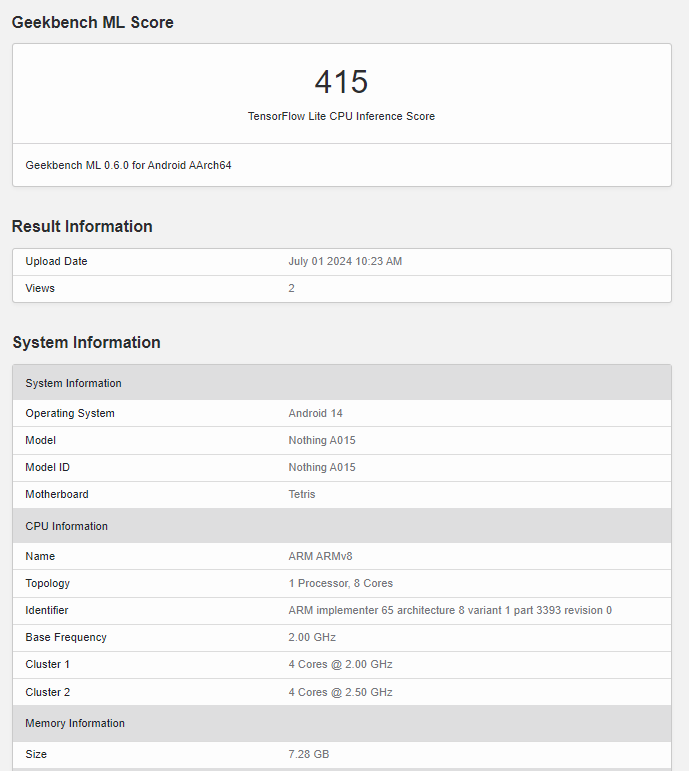
A recent leak on Chinese social media platform Weibo may have spilled the beans on Huawei‘s upcoming Kirin PC chip. If the information proves true, it looks like Huawei is gearing up to launch a processor that can go toe-to-toe with offerings from Apple and Intel in terms of performance.
The leak reveals the specs of the alleged Kirin PC chip suggesting that it will utilize Taishan v130 architecture and has an 8-core CPU setup with a clock (likely base) speed of 2.5 GHz. The graphics processing unit (GPU) is rumored to be a 10-core unit codenamed “Ma Liang 920.”
The leak also includes performance benchmarks of the chip. But it’s wise to take them with a grain of salt since their accuracy is up in the air.
Reportedly, the Kirin PC chip manages to score 11640 points on multi-core tests in Geekbench 6 while drawing 30W of power. The score puts it in a similar performance bracket as Apple’s M2 and the Intel’s i7-13700H processor, which has an average multi-core score of 10064 and 12203, respectively.
On Geekbench 5, it is said to achieve a single-core score of 1130 and a multi-core score of 8765. While on the 3D Mark Wild Life Extreme test it scored 6490 points while consuming 20W power.
Moreover, Cinebench R24, another benchmarking tool, focused on CPU rendering performance, is claimed to deliver a CPU score of 72 points, a single-core score of 680 points, and a multi-core score of 1695 points.
Additionally, the leak suggests that the upcoming Kirin PC chip could support up to 32GB of LPDDR5-6400 memory running in a 128-bit bus setup and offering a bandwidth of 100GB/s. It’s also rumored to support up to 2TB of solid-state storage (SSD) and include three USB-4 ports.
It’s worth noting that these details aren’t confirmed, and we’re not sure if the leak is genuine. So, it’s wise to be a bit skeptical about it.
Korean tech giant Samsung Music Frame HW-LS60D wireless speaker has been released. The new Samsung audio product is a 6-speaker system with Dolby Atmos, Spotify, and Tidal support amongst other features. The product was first displayed at the 2024 World of Samsung event and has the appearance of a picture frame. The speaker is capable of streaming audio content wirelessly from various input devices including TVs, smartphones, digital audio players, computers, and game consoles.
Features
The new Samsung Music Frame has a design that adds to the aesthetic appeal of the room. It can be easily mounted on a wall or placed on a table. The frame and its 8 x 8-inch matted photographs can be swapped by the user. The Music Frame features Adaptive Sound functionality that enables it to deliver clearer dialogue at all volume levels when connected to a TV. It can serve as the primary external speaker for the TV or as an additional speaker when combined with existing Samsung TV speakers and sound bars. The product also offers automatic room optimization for an immersive listening experience.
The Samsung HW-LS60D features Spotify and Tidal Hi-Fi connections for streaming audio content. It supports Hi-Res and MP3 to FLAC AV decoding. It also supports Bluetooth 5.2 connectivity and is well-integrated with Samsung phones for seamless and quick audio streaming. The speaker can also connect to home theater systems via an optical Toslink cable. Smart assistants like Alexa, Airplay, and Chromecast are also featured on the Music Frame wireless speaker.
Pricing & Availability
The Samsung HW-LS60D Music Frame wireless speaker has a retail price of $399. It can be purchased directly from retail platforms like Amazon and BestBuy.
Beelink has released the SEi14 mini PC and it is equipped with the Intel Core Ultra 5 chipset. The new Beelink mini PC offering is the first Beelink product that features the Intel Meteor Lake processor. It has a mid-range Intel Core Ultra 5 125H processor and an Arc iGPU with 7 cores.
Beelink SEi14 mini PC
Features
The Beelink SEi14 bears a close semblance to the Beelink SER8 model which was released recently. It has dimensions of 135 x 135 x 44.7mm, thus it can be snugly fit into the workspace without any problems. It has rounded corners similar to the Apple Mac Mini and comes with an efficient cooling system.
The Beelink SEi14 can be paired with an eGPU and it is equipped with a USB4 port that is capable of 40Gbps speed. It also features several other ports for enhanced versatility of the mini PC. The other ports include two USB 3.2 Type-A, two USB 2.0, one USB Type-C (10Gbps), one DisplayPort 1.4, one HDMI 2.1, and a 2.5G LAN. The mini PC can simultaneously handle three display outputs.
The Beelink SEi14 mini PC has a dust-proof design and its bottom has a high-density mesh. There are two SODIMM slots in the device, offering up to 96GB of RAM (DDR5). It also has two PCIe 4.0 slots that offer up to 1TB in storage. The model is equipped with a new cooling system, and vapor chamber (MSC2.0-VC). Other features of the new product are WiFi 6 and Bluetooth 5.2 connectivity, as well as low noise operation.
Pricing
Beelink is offering the SEi14 mini PC at a starting price of 2,699 yuan ($373) for the barebones model. Global availability and pricing details for the Beelink SEi14 are lacking at this time.
Xiaomi has likely wrapped up its major smartphone releases for the year. So we can now expect the company to focus on its next-gen tablet. Namely, the Xiaomi Pad 7 series.
The lineup is expected to include two models, Pad 7 and Pad 7 Pro, both of which we’ve been sharing leaks about time and again. Now a new leak by Smart Pikachu has revealed the tentative launch timeframe of these tablets.
According to the tipster, Xiaomi will launch the Pad 7 series in the third quarter of this year. It’s a considerable delay compared to the launch timing of its predecessors, the Pad 6 and Pad 6 Pro, which debuted in April last year.
Nonetheless, the tipster further suggests that the tablets will be suitable for “car use” in a Plug and Play manner. That is to be expected from Xiaomi who is also an EV maker now. Ensuring compatibility across its product ecosystem is what a company will want in the first place.
Xiaomi Pad 7 Series Specifications
Although details about the Pad 7 series are still scarce, tipster Digital Chat Station has revealed some of the key specifications of the Pad 7 Pro.
It’s expected to be equipped with the Snapdragon 8 Gen 3 SoC, a 12.45-inch display with a 144Hz refresh rate and a tall 16:10 aspect ratio, and keeping everything powered will be a 10,000mAh battery pack. The Pad 7 Pro’s 3C certification also revealed support for 120W fast charging.
The tablet is also said to have a dual 50MP camera setup on the back and quad speakers for audio.
In contrast, there’s very little we know about the vanilla Pad 7, except for a leak that suggests it might feature a Snapdragon 8 Gen 2 processor.
Back in July 2022, HTC announced HTC A101 tablet in markets like South Africa and Russia. Nearly two years later, the brand has unveiled the HTC A101 Plus Edition tablet in Russia. Here is a look at what the mid-range tablet offers in terms of specifications and price.
HTC A101 Plus Edition specifications and features
HTC A101 Plus Edition
The HTC A101 Plus Edition features a 10.95-inch WUXGA IPS display with a resolution of 1920 x 1200 pixels and a 16:10 aspect ratio. It is powered by a Unisoc T606 chipset, which clocks at 1.6GHz. Despite being a Plus model, its performance will be slightly lower than that of the Unisoc T618-powered HTC A101.
The A101 Plus Edition comes with 8 GB of RAM and 128 GB of internal storage, expandable up to 256GB via microSD card. The tablet houses a 7,000mAh battery with 10W charging support. Thankfully, the tablet runs on the latest Android 14.
The A101 Plus Edition boasts a 13-megapixel dual rear camera setup on the back and an 8-megapixel front camera. Other specifications include quad speakers, face unlock, Wi-Fi 802.11 dual-band support, Bluetooth 5.0, USB Type-C connectivity, and dual nanoSIM slots. The tablet measures 256.6 x 168.2 x 7.5mm and weighs 501 grams.
HTC A101 Plus Edition price and availability
In Russia, the HTC A101 Plus Edition costs RUB 15,990, which is approximately $170. It will be available color options, such as gray and silver. Currently, there is uncertainty regarding the tablet’s global market release.
The US Department of Justice’s (DoJ) ongoing antitrust lawsuit against Google has uncovered something quite interesting: a $20 billion payment made by Google to Apple in 2022. This hefty sum allegedly secured Google’s position as the default search engine on Apple’s Safari browser across iPhones, iPads, and Macs.
Google and Apple have previously chosen to keep this information under wraps
The revelation comes from a recently released court document. Interestingly, Google and Apple have historically kept the terms of this agreement under wraps, despite renegotiating it multiple times since 2002, when Google first became the default search engine on Apple devices.
The DoJ’s relentless pursuit of transparency has finally yielded results. A lawsuit filed last year indicated that Google’s payments to Apple constituted 36% of Apple’s total Safari revenue, hinting at a significant figure. Now, the exact amount – a staggering $20 billion – is confirmed.
This deal has drawn criticism from competitors like Microsoft. Microsoft CEO Satya Nadella claims the agreement stifles competition for search engines like Bing. He even revealed that Microsoft previously attempted, unsuccessfully, to have Apple adopt Bing as the default.
Apple, however, defends its choice. In court testimony, Apple’s Eddy Cue expressed concerns about Bing’s ability to match Google in “quality and functionality.” According to Cue, Apple simply believes Google delivers the “best” search experience for its users.


The future of this agreement is now resting on the DoJ lawsuit. Closing arguments are set for later this week, with a final decision from the judge expected sometime in 2024. If Google loses the case, the deal with Apple could be nullified. Stay tuned to Gizmochina for future coverage on the same.
Qualcomm chipsets power most Android phones available in the US, with the exception of a few that feature Samsung’s Exynos chip. On the other hand, many smartphone brands offer MediaTek powered smartphones at different price points. The landscape of Android phones in the US is set to shift soon, as MediaTek has confirmed during its Analyst Day event that a MediaTek-powered phone will make its debut in the US this year. What’s especially noteworthy is that this won’t be an entry-level or mid-range phone; instead, it will be a high-end device.
As can be seen above, a premium segment smartphone featuring MediaTek will be released later this year in the US. Unfortunately, the chipmaker did not disclose anything else about the device. Therefore, it remains uncertain which brand’s MediaTek-powered phone will be introduced in the US in 2024.
The most recent flagship chip from MediaTek is the Dimensity 9300, which debuted last year in November. The Vivo X100 and X100 Pro are the first phones to feature it. The Taiwanese chip maker will be announcing the Dimensity 9300 Plus, an overclocked edition of the D9300, on May 7 in China. It is speculated that the Vivo X100s and X100s Pro will be the first phones to feature it.
MediaTek is also expected to announce the Dimensity 9400 chip in October of this year. It could be a 3nm chip featuring ARM’s next-generation Cortex-X5 CPU core. The Vivo X200 series is likely to feature the new chip. The chip will also power an upcoming Oppo flagship phone, which seems to be the Oppo Find X8. It remains to be seen whether any of these devices make it to the US market this year.
In December 2023, iQOO unveiled the iQOO Neo 9 and Neo 9 Pro for the Chinese market. The standard model came equipped with the Snapdragon 8 Gen 2 chipset, whereas the Pro version featured the Dimensity 9300. The Neo 9 faced competition from the Snapdragon 8 Gen 2-powered OnePlus Ace 3, which debuted in January of this year. It appears that the upcoming iQOO and OnePlus will compete against each other with their next Neo and Ace branded phones.
OnePlus Ace 3 Pro specifications, launch timeframe (rumored)
According to reports, the OnePlus Ace 3 Pro will arrive with a 6.78-inch 8T BOE LTPO curved-edge screen with a 1.5K resolution and 120Hz refresh rate. Under the hood, the device will feature the Snapdragon 8 Gen 3 chipset, up to 16 GB of LPDDR5x RAM, 1 TB of UFS 4.0 storage, and a 5,800mAh battery supporting 100W charging.
The phone may sport a 16-megapixel front camera and a triple rear camera setup with an OIS-enabled 50-megapixel primary sensor. Its design is rumored to include a metal middle frame and a glass back. Reports claim that it will have a new design for the rear camera module, which suggests that its back panel may look similar to the OnePlus Ace 3V, which features a vertical camera setup. The device is anticipated to launch in the third quarter of this year in China.
iQOO Neo 9s Pro specifications, launch timeframe (rumored)
The iQOO Neo 9s Pro is expected to feature a 6.78-inch flat 8T LTPO OLED display that offers a 1.5K resolution and a 144Hz refresh rate. It is also said to feature the Snapdragon 8 Gen 3 chip, up to 16 GB of LPDDR5x RAM, and up to 1 TB of UFS 4.0 storage. There is no word about its battery capacity. However, it may offer a 5,160mAh battery with 120W fast charging support, like the Neo 9 Pro. The back panel of the phone is likely to feature an OIS-enabled 50-megapixel triple camera unit.
The iQOO Neo 9s Pro will make its debut immediately after the ongoing May Day holidays in China, according to tipster Smart Pikachu. The tipster suggests that the Neo 9s Pro will particularly appeal to buyers prioritizing cost-effectiveness and performance over imaging capabilities. Additionally, Smart Pikachu has reiterated some of the rumored specs of the OnePlus Ace 3 Pro. With the Neo 9s Pro expected to launch this month and the Ace 3 Pro anticipated to arrive in June or July, both phones are poised to rival each other, offering buyers a competitive market with more options to choose from.
Samsung continues to expand its product lineup. In line with this, the company’s next move is to add a new member to its popular F series, the Galaxy F55 5G.
But what will this phone’s design and features look like? Here’s a look at the expected specifications for the Samsung Galaxy F55 5G.
Samsung Galaxy F55: Expected Features and Specifications
The Samsung Galaxy F55 5G will be powered by Qualcomm’s Snapdragon 7 Gen 1 processor. This chipset, which has been previously used in models like the Honor 90, Xiaomi 13 Lite, and Galaxy M55 5G, offers excellent performance for daily tasks and is also well-suited for gaming, thanks to its Adreno 644 GPU.
It’s worth noting that this is an affordable smartphone, so it’s not fair to expect the same performance as a device using a Snapdragon 8 Gen 3 processor. Leaks also indicate that the phone will come with 8 GB of RAM. The storage capacity is expected to be 256 GB.
The Samsung Galaxy F55 5G will undoubtedly make a name for itself with its camera features. The device will have a 50 MP main camera with OIS support, an 8 MP ultra-wide-angle lens, and a 2 MP macro lens. On the front, there will be a 50 MP selfie camera.
Looking at the screen features, we’re likely to see a 6.7-inch Super AMOLED Plus panel with Full-HD+ resolution. Samsung is already one of the largest screen manufacturers in the world, so it’s no surprise that they offer better screens than most of their competitors.
The Samsung Galaxy F55 5G, which is expected to deliver standard battery performance, will come with a 5000 mAh battery. Users can charge this battery with 25W wired fast charging.
Out of the box, the phone will run on Samsung One UI 6.0 based on Android 14 and is likely to receive the 6.1 update soon. However, it’s worth noting that this information is currently based on leaks, so when the phone is released, there might be some differences from this content.
Display
6.7-inch Full-HD+ Super AMOLED Plus
120Hz refresh rate
Up to 1000 nits of peak brightness
Processor & Memory
Snapdragon 7 Gen 1
8 GB of RAM
Up to 256 GB of internal storage
Camera Setup
Rear Camera:
50MP main camera with Optical Image Stabilization (OIS)
8MP ultra-wide lens
2MP macro lens
Front Camera:
50MP selfie camera
Battery & Charging
5000 mAh battery
25W wired fast charging
Operating System
Samsung One UI 6.0 (based on Android 14)
Galaxy F55 Expected Design
The highly anticipated Samsung Galaxy F55 5G will undoubtedly be one of the standout models of 2024, thanks to its design. When we take a look at its leaked images, we will notice that it has an unconventional appearance.
As you know, most smartphones today have a rear panel made of glass or plastic designed to look like glass. The Samsung Galaxy F55 5G, on the other hand, comes with a leather back panel, a feature that’s quite rare in modern smartphones.
Moreover, its stitching details suggest it breaks away from ordinary designs. It’s refreshing to see a different design in a market where every model tends to look alike.
Additionally, it will provide natural protection for those who love using cases because it won’t have problems like scratching or breaking the skin.
While it’s not certain, it’s speculated that Samsung might be using synthetic leather in this model. Therefore, users with sensitivities like this shouldn’t have anything to worry about.
Several reports have claimed that Vivo will unveil the Vivo X100s series of smartphones later this month in China. A poster that surfaced on Weibo earlier this week revealed the designs of the upcoming Vivo X100 Ultra and the Vivo X100s. Now, a fresh set of images has emerged on Weibo, giving a good look at the design of the X100s.
Vivo X100s real-life images
The Vivo X100, which debuted in November 2023, came equipped with a curved-edge OLED panel. Rumors surrounding the X100s have claimed that it will have a flat display. As can be seen in the first image, the alleged X100s have a flat screen.
It appears that the edges of the Vivo X100s are flat, and it continues to sport a round camera deco. Inside, there are three cameras and a Zeiss logo. The top-right corner of the back panel displays a vertically positioned LED flash.
On May 7, MediaTek will unveil the Dimensity 9300 Plus chip at the MediaTek Dimensity Developers Conference (MDDC) in China. The D9300+ will be an overclocked version of the Dimensity 9300, which powers the Vivo X100 and X100.
Speculations are rife that, apart from the Vivo X100s, the company may also announce the Vivo X100s Pro. Both are expected to debut as the first phones powered by the Dimensity 9300 Plus. According to reports, the inclusion of the new chipset and a flat screen will be the only major upgrades as both phones are expected to inherit other specs from the X100 and X100 Pro. In addition to the X100s duo, the Vivo X100 Ultra (or X100s Ultra) equipped with the Snapdragon 8 Gen 3 chip may also go official along with the X100s and X100s Pro.
In July last year, Oppo launched the Enco Air 3 Pro TWS earbuds in the Indian market for ₹5,000. Now, these earbuds have been discounted by ₹1,000, making them the perfect pick for people looking to spend around ₹4,000 on a new pair of earbuds.
Oppo Enco Air 3 Pro TWS discount
The Oppo Enco Air 3 Pro earbuds are currently selling for ₹3,999 on Amazon, down from their original price of ₹4,999. Oppo has not confirmed whether this is a permanent or a temporary price cut. That being the price is quite attractive considering the premium features onboard.
Oppo Enco Air 3 Pro specs & features:
Oppo Enco Air 3 Pro (full review) adopts a design similar to Apple AirPods, with in-ear buds and a charging case shaped like a pebble. It features unique 12.4mm drivers made from bamboo fiber.
These wireless earphones support Bluetooth 5.3, LC3, AAC, SBC, and even LDAC audio codecs and are certified for Hi-Res audio. They also include Oppo’s spatial audio technology. With up to 49 decibels of Active Noise Cancellation (ANC) and low latency of 47ms, they’re suitable for gamers.
The Enco Air 3 Pro offers up to 30 hours of battery life on a single full charge, with the earbuds alone lasting 7 hours. They also come with IP55 water and dust resistance for added durability.
The Vivo V30e has been launched as the third V30 series phone, following the Vivo V30 and V30 Pro, in India. The V30e is also heading to other Asian markets like Malaysia and Indonesia. Like the standard and Pro models, the V30e comes with an attractive design and promises a stellar photography experience. Here is a look at our hands-on experience with the device.
Vivo V30e: What’s in the box?
The Vivo V30e’s retail box includes the following items: the V30e handset, a transparent case, a 44W charger, a USB-A to USB-C cable, a SIM ejector tool, a warranty card, and Quick Start Guide.
Design and Display
Vivo V30eVivo V30eVivo V30eVivo V30e
The Vivo V30e has a sleek and slim design, measuring around 7.99mm in thickness. Despite having a slim body, the phone packs a 5,500mAh battery, which is 500mAh larger than what most mid-range phones currently offer. Showcased in the images here is the Velvet Red edition of the V30e. It also comes in a Silk Blue variant.
The Velvet variant looks quite luxurious with a matte finish when there is less light and has a glittery appeal when viewed under sunlight. The textured ribbon strip on the right adds a unique touch to the device. Like the other V30 models, the V30e sports a curved-edge AMOLED display on the front with slim bezels around. Overall, the phone has a good in-hand feel. As far as durability is concerned, it offers IP64-rated water and dust resistance.
Vivo V30eVivo V30eVivo V30e
The Vivo V30e has a 6.78-inch curved-edge AMOLED display that delivers a 93.3 percent screen space. The display supports an FHD+ resolution, a 120Hz refresh rate, a P3 color gamut, and an in-screen fingerprint scanner. With a maximum brightness of 1,300 nits, which offers a good viewing experience under bright sunlight. For eye protection, the V30e is an SGS low blue light, low motion, and low flicker certified.
Camera Capabilities
It goes without saying that cameras are the major strengths of the Vivo V30e. The round camera module on the back has an OIS-enabled 50-megapixel Sony IMX882 primary camera, which is accompanied by an 8-megapixel ultra-wide lens. The main camera doubles up as a portrait lens with a 50mm focal length, and it also supports 2x in-sensor zoom. It also supports up to 4K 30fps video recording.
The dual-camera setup is coupled with Aura Light LED, which gives studio-like control over soft lighting with varying distances and color temperatures from 1000K to 9000+K. Shown below are some of the camera samples.
1xPortraitPortraitultrawide1x2x1x2x1xPortrait selfieSelfiePortrait Portrait shot with Aura LED (warm tone) – Shot taken in with almost no light in the room Portrait shot with Aura LED (warm tone) – Shot taken with almost no light in the room
On the front, the Vivo V30e has a 50-megapixel selfie camera with support for eye autofocus and 4K video recording. It uses advanced focusing algorithms to keep you in focus, delivering poster-quality images with clear details and a natural bokeh effect. The selfies in low light are also acceptable.
Performance
Vivo V30e on CPU ThrottleVivo V30e on AnTuTuVivo V30e on Geekbench
Under the hood, the Vivo V30e offers the Snapdragon 6 Gen 1, LPDDR4x RAM, and UFS 2.2 storage. The phone offers 8 GB of virtual RAM and a dedicated microSD card slot.
This combination of hardware ensures smooth performance and is sufficient for casual gaming. The 5,500mAh battery takes around 1 hour and 30 minutes to achieve a full charge using the 44W fast charger. The phone ships with Android 14 and FunTouch OS 13. It is confirmed to receive three generations of Android updates and four years of security updates.
Final Thoughts
Vivo V30e
Overall, the Vivo V30e appears to be a compelling option for those seeking a premium-looking smartphone experience with a good display, flagship-grade cameras, and performance, including a longer battery life. Additionally, it’s good to see Vivo offering a longer software update and raising the durability factor by offering an IP64-rated chassis.
While the Vivo V30e offers an impressive array of features, it’s notable that the device lacks dual speakers, which are increasingly common even in lower-priced smartphones. For example, the Vivo T3x 5G, a more budget-friendly option, includes dual speakers. Although the absence of a second speaker in the V30e is not a deal-breaker, it would have been a nice addition to enhance the audio experience. While there are a couple of competitors in the Vivo V30e’s price segment, the Realme 12 Pro series and the Oppo Reno 11 are the only camera-focused rival phones.
The Vivo V30e has been launched in India with two storage variants:
8GB+128GB: Rs 27,999 (~$335)
8GB+256GB: Rs 29,999 (~$360)
Colors: Silk Blue and Velvet Red
Pre-booking for the Vivo V30e is currently open in India. Starting May 9, the smartphone will be available for purchase through Flipkart, Vivo India’s e-store, and offline retail stores. Online buyers can enjoy a 10 percent discount through HDFC and SBI banks. Offline buyers can benefit from a flat 10 percent discount with ICICI, SBI, IndusInd, IDFC, and other banks. Additionally, offline buyers can also avail of a 12-month zero-downpayment option with select NBFC partners.
Disclaimer: All of the opinions in this Vivo V30e first impressions post are mine and based on my own experiences. There has been no editorial input from Vivo.
Here’s a sneak peek at the upcoming CORSAIR ONE i500, a compact gaming PC with high-performance potential. Thanks to a leak on the Newegg e-commerce platform (since removed), details about the machine’s design and specs have surfaced.
The 22-liter frame weighs in at a manageable 7.2 kg
Sporting a sleek wooden front panel with an illuminated Corsair logo, the i500 seems to prioritize both style and functionality. The bottom offers easy access to two USB-A ports, a USB-C port, and a 3.5mm headphone jack. For efficient cooling, a sizable vent dominates the left side of the machine.
Standing at 38.9 cm tall, the i500 packs a powerful punch within its compact 22-liter frame. It weighs in at a manageable 7.2 kg.
The leaked configuration boasts an impressive Intel Core i9-14900K processor paired with an Nvidia RTX 4080 Super graphics card. Continuing the tradition of its predecessor, the i500 utilizes a liquid cooling system to keep things running smoothly.
Other noteworthy specs include a 1000W SFX-L 80+ Gold certified power supply with modular cables, Wi-Fi 6E and Bluetooth 5.3 connectivity, and a 2.5 Gbps Ethernet port. The motherboard is a B760M.
Listed on the e-commerce platform for US$3,599.99 (approximately 26,064 yuan), the CORSAIR ONE i500 is positioned as a premium compact PC. Officially slated for release on May 6th, Corsair promises the new generation will “refresh industry standards again” by offering exceptional space utilization alongside cutting-edge components. We will find out in time!
Get ready for a fresh batch of free games for PlayStation Plus subscribers! Sony has revealed the exciting titles joining the service in May:
EA SPORTS FC 24 (PS4, PS5): Immerse yourself in the world of football with the latest edition of EA‘s beloved franchise. Featuring HyperMotionV technology, Opta-optimized gameplay, and a revamped Frostbite engine, this title boasts over 19,000 licensed players, 700+ teams, and 30+ leagues to explore. Plus, PS+ members get a bonus Ultimate Team Starter Pack. (Available May 7th – June 17th)
Ghostrunner 2 (PS5): Take on the role of a cyber ninja in this intense first-person hack-and-slash adventure. Set in a cyberpunk world, Ghostrunner 2 throws you into epic boss battles with an improved skill system, interactive story elements, new game modes, and a pulsating synthwave soundtrack. (Available May 7th – June 3rd)
TUNIC (PS4, PS5): Embark on a captivating journey in TUNIC, a 3D action game presented from a unique isometric perspective. Play as a curious fox exploring a forgotten land filled with ancient secrets, powerful artifacts, and fearsome foes. (Available May 7th – June 3rd)
Destiny 2: Fall of Light (PS4, PS5): The battle for humanity intensifies as the Witness descends upon Neptune. Guardians must unite and wield the new power of Strand, a Darkness subclass focused on grappling hook mobility and manipulation of reality. Explore the neon-drenched city of Neptune, confront the Cloud Walkers, and prevent the destruction of the mysterious city of Omna. (Available May 7th – June 3rd)
These exciting titles will be available for download starting on May 7th. Don’t miss out on this chance to expand your gaming library for free!
Crossbeats has officially launched the Sonic 3 earbuds in India. The Sonic 3 earbuds are designed to deliver high-quality audio performance at a competitive price point.
Crossbeats Sonic 3 earbuds specs:
The new earbuds are equipped with 13mm graphene drivers and feature Quad Mic MEMSensing technology that improves call quality through Environmental Noise Cancellation.
A notable feature of the Sonic 3 is its long battery life, offering up to 60 hours of total playback time. The earbuds also support fast charging, providing 100 minutes of playtime with just a 10-minute charge.
The Sonic 3 also includes up to 30db hybrid Active Noise Cancellation (ANC) for a distraction-free listening experience and a 40ms low latency mode, which improves the sync between audio and video playback.
The earbuds come with an IPX5 rating for splash and sweat resistance, making them ideal for workouts and outdoor activities. They also come with the latest Bluetooth v5.3 connectivity, supporting AAC/SBC codecs for seamless device pairing.
Pricing & availability
Available in black and white, the Sonic 3 earbuds are now on sale for an introductory launch price of Rs. 1999. They can be purchased through the Crossbeats website and major online retailers such as Amazon.in.
JBL has unveiled its latest lineup of speakers in India called the JBL Authentics series. This series, which pays homage to the iconic 1970s JBL L100 speaker, comes with three models: the Authentics 200, 300, and 500 models. These speakers sport a premium aluminum frame, synthetic leather enclosures, and the classic Quadrex grille.
The portable JBL Authentics 300 boasts an 8-hour battery life and 360-degree sound. It supports both Wi-Fi and Bluetooth connectivity, making it suitable for various indoor and outdoor audio experiences.
For a home audio setup, the JBL Authentics 500 comes equipped with Dolby Atmos technology, delivering 270 Watts of 3.1 channel sound. It incorporates three tweeters, three midrange woofers, and a down-firing subwoofer for crisp sound and deep bass.
The compact JBL Authentics 200 offers robust stereo sound through tweeters, a full-range woofer, and a passive radiator for enhanced bass. It provides multiple connectivity options, including Bluetooth, Wi-Fi, and Ethernet.
All models support Amazon and Google voice assistants and allow streaming via AirPlay, Spotify Connect, and other services. Additionally, they’re eco-friendly, constructed from recycled materials, and packaged using FSC-certified paper and soy ink.
Available in black, these speakers can be purchased from major retailers and JBL.com. The JBL Authentics 200 is priced at Rs. 39,999, the 300 at Rs. 49,999, and the 500 at Rs. 79,999. Special launch offers are available at select locations.
Last week, Oppo unveiled the OPPO A60, a new budget-friendly smartphone in the global market. Serving as the successor to the A59 5G, this device comes with a range of interesting features, all packaged in a stylish design. That being said, there are a few peculiar hardware choices by Oppo that have made that make this device quite an oddball. So let’s take a look at what the Oppo A60 has to offer.
Right off the bat, it is quite evident that this phone is a pretty-looking one. Oppo is one of the few brands that has been consistently providing good-looking budget-range devices, and the A60 is no exception. It comes with an in-fashion boxy design measuring just 7.68mm thick, with a pill-shaped camera island that houses two large cutouts for the camera sensors.
If the design is not enough to impress, its color options are also quite special. First, we have the the Ripple Blue color option, which as the name suggests, has a ripple-like design akin to ocean waves. These patterns are made with the use of Oppo’s Magnetic Particle Design, which shimmers when it catches light. Additionally, the back has a fingerprint-free finish, which means that you won’t have to worry about smudges.
The second color option is the elegant Midnight Purple, which also gives off a nice glow when it catches light. This color option comes with a frosted glass finish that makes it feel even more premium to hold.
2. A decent display
While the device looks quite good from the back, the front features a 6.67-inch 1604 x 720 pixels IPS-LCD display with thick bezels. While a lower-end phone featuring a 720p display isn’t unheard of, considering the price point at which Oppo is selling it (~$216), phones with FHD+ displays are easy to find. That being said, it does offer a 90Hz refresh rate and a peak brightness of 950 nits, so it’s not all bad.
3. No 5G connectivity
While the Oppo A59, the predecessor of the A60 debuted with a 5G-enabled Dimensity 6020 SoC, the Oppo A60 comes with the Snapdragon 680 4G processor. This is quite a head-scratcher as the SD680 is both weaker in performance and it also lacks the 5G connectivity of the Dimensity 6020. So what’s the deal here?
One of the reasons for this move could be that the demand for 5G smartphones has yet to explode in some markets like Vietnam, where Oppo has currently launched this smartphone. In exchange for the weaker chip, users get more RAM compared to last year’s A59 5G, as the A60 comes in two configurations: 8 GB RAM + 128 GB storage and 8 GB RAM + 256 GB storage.
4. A camera system made for vlogging
The phone comes with a standard 50MP (PDAF) primary camera, paired with a 2MP placeholder secondary lens, and an 8MP front camera. However, Oppo provides the option to record with the front and rear cameras at the same time, which is a feature targeted at content creators starting their vlogging journey.
Other than that the phone has an AI Retouching feature for the selfie camera that works like a beauty mode.
5. Other notable features
The Oppo A60 comes with a respectable 5,000mAh battery, which is paired with 45W fast charging support that promises to fill up half of the battery in 30 minutes.
Additionally, the phone has a side-mounted fingerprint sensor, as well as a face ID for security. It offers stereo audio via a dual speaker setup and has a 3.5mm jack. Users also get the option to expand its up to 1TB with memory via a microSD card, and it is certified with an IP54 rating, meaning it can withstand dust as well as water sprays from all directions.
It runs on Android 14-based ColorOS 14.0.1 out of the box and offers NFC, as well as dual-SIM 4G LTE connectivity.
Celebrating a decade of dominance in the gaming mouse market, Logitech marks the 10th anniversary of the “world’s best-selling gaming mouse,” the G502. To commemorate this milestone, they’re offering a special edition G640 mousepad to those who purchase designated G502 models.
The original G502 Proteus Core was launched in 2014
The G502’s legacy boasts over 21 million units sold across its various evolutions. The original G502 PROTEUS CORE launched in 2014, setting the stage for future iterations. In 2016, the G502 PROTEUS SPECTRUM brought vibrant RGB lighting effects to the table. The 2018 G502 HERO upped the performance ante with its high-performance HERO sensor. Offering both wireless connectivity and weight reduction, the G502 LIGHTSPEED arrived in 2019. Finally, the 2022 G502 X Series showcased a stylish redesign and introduced LIGHTFORCE hybrid optical-mechanical switches.
The celebratory offer goes beyond the free mousepad. Logitech is partnering with “PlayerUnknown’s Battlegrounds” (PUBG) for a global championship. The competition features prizes including a limited edition G502 mouse and in-game content. The ultimate winner will even take home a special edition mousepad and a custom-designed G502 mouse.
The US has already imposed trade sanctions on Huawei aiming to prevent the supply of cutting-edge chip-building equipment and technologies to the company. However, according to reports, Huawei is working on developing its own chip-building tools and technologies to overcome the chip supply issues and create a self-sufficient chip network.
FCC now focuses on the test labs and certification bodies
The Federal Communications Commission (FCC) is now planning to prevent Huawei, ZTE, and other foreign companies (that are considered potential threats to the US) from influencing the telecommunications certification bodies and test labs that are used to certify wireless devices heading to the US.
The FCC is reportedly planning to vote on a bipartisan proposal this month to ensure the above. It could prevent Huawei and other entities on an FCC list of companies from playing any role in the equipment authorization program.
FCC Chair Jessica Rosenworcel said in a statement the agency “must ensure that our equipment authorization program and those entrusted with administering it can rise to the challenge posed by persistent and ever-changing security and supply chain threats.”
Huawei was also recognized as an accredited lab by the US, which expired on Tuesday. The FCC has reportedly denied the request of the Huawei lab to extend the recognition. The FCC banned approvals of new telecommunications equipment from Huawei, ZTE, Hytera Communications, and some other Chinese companies.
Huawei and Hikvision were placed on a U.S. export control list in 2019. It restricted most U.S. suppliers from conducting business with them without obtaining licenses. Additionally, in 2020, the FCC designated Huawei and ZTE as national security threats to communications networks. It prevented US companies from accessing an $8.3 billion government fund for purchasing equipment from these companies.
The point of this development, according to FCC Commissioner Brendan Carr, is to “ensure that the test labs and certification bodies that review electronic devices for compliance with FCC requirements are themselves trustworthy actors that the FCC can rely on.”
The LG OLED evo C4 TV has now gone on sale in China barely three months after it was opened for pre-order. The LG OLED evo C4 TV is available in sizes ranging from 42 inches to 77 inches. In total, there are five size options available for the evo C4 TV.
The sizes available for the LG OLED evo C4 TV are 42”, 48”, 55”, 65” and 77 inches. The TV will also be available in future with an 83-inch version. The LG OLED C4 evo series of TVs have a 4K 120Hz OLED high-refresh screen. The screen has four professional certifications for low blue light, no flicker, low glare, and no reflection. The TV is a vision-friendly product and features four HDMI 2.1 interfaces.
The LG OLED evo C4 TV features AMD picture synchronization technology and supports Nvidia. It has a variable refresh rate (VRR) that reaches 144Hz while the audio supports 9.1.2 virtual surround sound, Dolby Vision, and Dolby Atmos. It is equipped with a game optimizer and you can customize your sound preferences via its sound quality settings menu.
The AI performance of the new LG OLED evo C4 TV is improved from its predecessor. It is equipped with the latest version of the α9 Gen7 decoding chip with significant improvements from the α5 processor of traditional TVs. The AI performance is improved by 1.5 times, image improvement is by 4.5 times, and the processing speed is 2.2 times higher. The TV features AI intelligent audio and video tuning for a more realistic viewing and listening experience. The dynamic tone mapping technology enhances the global contrast and image grayscale via frame-by-frame analysis.
The new LG OLED TVs have an HDR image performance enhancer and run on WebOS operating system. The operating system will get up to four upgrades within 5 years, according to LG.
Pricing & Availability
The 42-inch model is priced at 8,499 yuan ($1,174), while the 48-inch version retails for 9,499 yuan ($1,312). The 55-inch model is priced at 12,499 yuan ($1,726), the 65-inch model costs 17,999 yuan ($2,486), and the 77-inch model retails for 25,499 yuan ($3,522). Global availability information for the LG OLED evo C4 is lacking at this time.
We use cookies on our website to give you the most relevant experience by remembering your preferences and repeat visits. By clicking “Accept”, you consent to the use of ALL the cookies.
This website uses cookies to improve your experience while you navigate through the website. Out of these, the cookies that are categorized as necessary are stored on your browser as they are essential for the working of basic functionalities of the website. We also use third-party cookies that help us analyze and understand how you use this website. These cookies will be stored in your browser only with your consent. You also have the option to opt-out of these cookies. But opting out of some of these cookies may affect your browsing experience.
Necessary cookies are absolutely essential for the website to function properly. This category only includes cookies that ensures basic functionalities and security features of the website. These cookies do not store any personal information.
Any cookies that may not be particularly necessary for the website to function and is used specifically to collect user personal data via analytics, ads, other embedded contents are termed as non-necessary cookies. It is mandatory to procure user consent prior to running these cookies on your website.