Advertisement

Godawari EBLU Feo electric scooter with a top speed of 60km/h, 110km range & budget pricing unveiled in India

The Godawari EBLU Feo electric scooter has been unveiled with several features and a budget-friendly price. The new e-scooter is designed as a model that seeks to challenge the dominance of Ola in the Indian e-scooter market.

Godawari EBLU Feo electric scooter

Features

The EBLU Feo comes with a range of 110km, a 60km/h top speed, and a decent torque output from its motor. It has a 2.52 kW Li-ion battery which delivers a maximum range of 110km on a single charge. The model offers a greater range than even the premium Ola Electric’s models like the S1 Pro which peaks at 181km. The significant improvement in the range means the rider can have the freedom to move further without worrying about needing to recharge. The e-scooter comes with a 3,600Wh motor with a maximum torque of 110Nm, allowing it to easily navigate hilly terrains and inclines.

The top speed of the Godawari EBLU Feo e-scooter is slightly lower than Ola’s models but this is well compensated in other aspects. It comes with solid acceleration and smooth handling which trumps up any marginal gain in top speed. The scooter offers Bluetooth connectivity, GPS navigation, anti-theft features, and a digital instrument cluster. The scooter is being promoted as a complete gadget for a smooth, safe, and enjoyable ride always. It is equipped with an anti-lock braking system (ABS) for optimal stopping power in different scenarios. Visibility on the e-scooter is enhanced by the side-stand indicator and backlight.

Pricing

The Godawari EBLU Feo has an ex-showroom price of Rs. 99,999 ($1,205). This is as cheap as it can get and the price is far lower than Ola Electric’s offerings in the segment. It is expected that the budget-friendly price of the EBLU Feo, coupled with its exciting safety and performance features, would engender a greater demand for the model ahead of Ola Electric’s e-scooters.

Related:

AOOSTAR GEM12 Pro gaming mini PC delivers a built-in screen, fingerprint scanner & more on a compact body

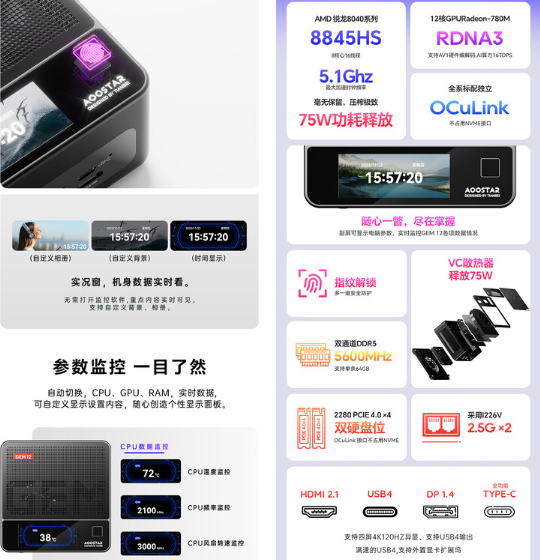
Chinese mini-PC manufacturer AOOSTAR has launched the GEM12 Pro gaming mini PC in its home market. The new gaming mini PC launch is coming not too long after the company released the GEM 10 gaming mini-PC. However, this model comes with some unique design touch. The mini PC is equipped with the AMD Ryzen 7 8845HS processor as well as a built-in screen, and a fingerprint scanner for biometric authentication of users.

AOOSTAR GEM12 Pro gaming mini PC

The AOOSTAR GEM132 Pro’s built-in screen provides CPU, GPU, RAM temperature, and speed information. Users can also put a custom album photo with a clock on the top. The fingerprint scanner is right beside the built-in screen and offers quick and secure Windows Hello fingerprint unlocks.

The AOOSTAR GEM12 Pro gaming mini PC is powered by the Ryzen 7 8845HS processor from the AMD Hawk Point series. It has 8 cores plus 16 threads and offers up to 32GB of RAM and 1TB of NVMe storage. The AOOSTAR GEM12 Pro is also available in Ryzen 7 7840HS and Ryzen 9 6900HX processors. It is also equipped with the Radeon 780M iGPU which is a premium component that supports modern games. There are also options for the GEM12 Pro with the same processors without the screen and fingerprint scanner.

The GEM12 Pro has an OCuLink port, making it easier to hook the mini PC with an external graphics dock and run with a desktop-grade GPU. Other connectivity options for the AOOSTAR GEM12 Pro gaming mini PC include USB4, USB 3.2 Gen 2, DPI 1.4, and HDMI 2.1. The gaming mini PC can be used for intensive games thanks to its elaborate cooling system. It has a Glacier 3.0 cooling system with a large vapor chamber. The mini PC can deliver 75W of performance, with the aid of the cooling system.

AOOSTAR GEM12 Pro gaming mini PC

Pricing & Availability

The AOOSTAR GEM12 Pro gaming mini PC is priced in China at 2,699 yuan ($375) for the barebone version of the Ryzen 7 8845HS model. The barebone Ryzen 7 7840HS model has a pre-sale price of 2,499 yuan ($347). There are no global release details for the new AOOSTAR gaming mini PC at this time.

Asus VivoWatch 6 receives Bluetooth SIG certification, launch expected soon

Asus seems to be gearing up for the release of a new smartwatch, possibly the VivoWatch 6, as a follow-up to the VivoWatch 5 from 2022. A hint towards this impending launch comes from the Bluetooth SIG certification obtained by the new device.

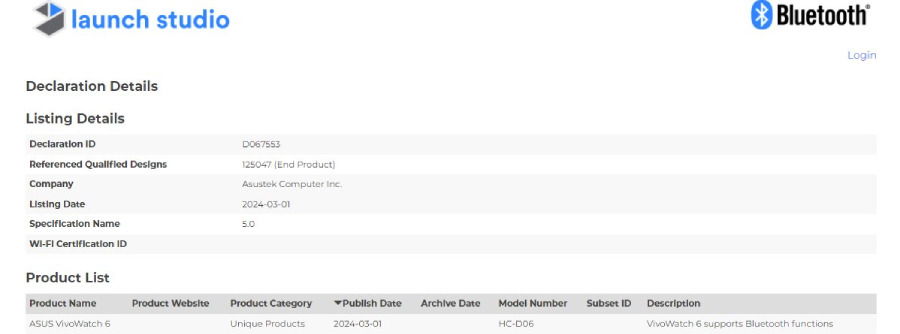
The next smartwatch from Asus has been spotted in the Bluetooth SIG database under the name “VivoWatch 6” and model number HC-D06. However, the listing doesn’t offer any insights into the specifications of the new Asus smartwatch. So, details about its features remain unknown for now.

For a quick recap, the Asus VivoWatch 5 features a 1.3-inch circular LCD display and offers customizable watch faces. The watch strap utilizes a quick-release design for convenient changes.

The VivoWatch 5 incorporates both ECG and PPG sensors for health and wellness. These sensors enable the watch to monitor various health metrics, including pulse-transit time (PTT), heart rate, body harmony index, de-stress level, sleep patterns, and activity levels. 

Asus VivoWatch 5.

It also has the capacity to measure blood-oxygen (SpO2) levels and skin temperature. ASUS claims the VivoWatch 5 has a battery life of up to 14 days. 

Additionally, it has a 5ATM water-resistance rating, indicating suitability for use in water up to a depth of 50 meters.

The ASUS HealthConnect app works in conjunction with the VivoWatch 5. This app allows users to manage data like blood pressure, heart rate, and female menstrual cycles. 

It’s speculated that the upcoming VivoWatch 6 might feature an AMOLED panel, potentially offering more options for customizing watch faces compared to the 1.3-inch LCD screen of its predecessor. With that said, we’ll be keeping an eye out for any updates on this new wearable from Asus.

Related:

Xiaomi SU7 car spotted in new colors, release date still a mystery

While the official launch date for Xiaomi cars remains under wraps, new information about the upcoming SU7 model continues to surface. Recently, leaked photos from the Xiaomi Car Beijing Factory revealed three new color options for the SU7, adding to the previously announced palette.

Xiaomi SU7’s New Colors Leaked

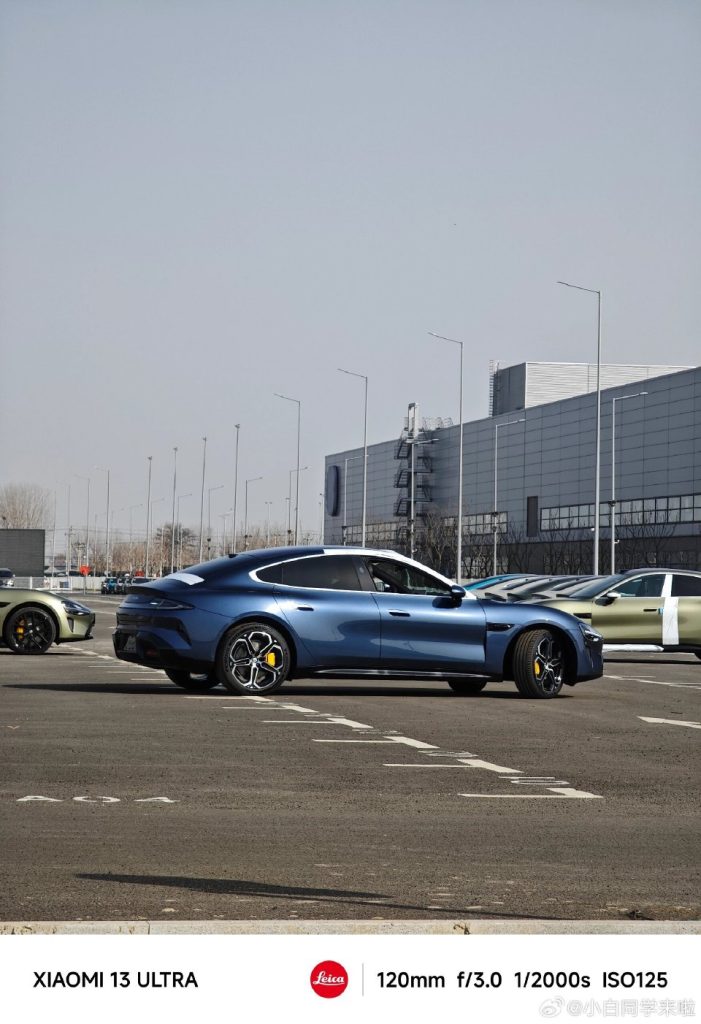
These new colors include a sophisticated blue-grey, a vibrant orange, and a sleek dark purple. Compared to the previously showcased “Gulf Blue,” the new additions offer a wider range of styles, catering to both those seeking a classic and understated look and those who prefer a sportier appearance.

Further adding to the speculation fire, a leaked research document circulated online earlier this week, suggesting a potential March launch for Xiaomi cars with deliveries starting in April. However, Xiaomi has promptly denied the accuracy of this information, including the production volume estimations for the first quarter.

According to the company’s president, Lu Weibing, the SU7 is set to begin deliveries in the second quarter of 2024. The SU7 was showcased at the Mobile World Congress in Barcelona, marking its international debut. Xiaomi aims to tap into its existing base of 20 million premium smartphone users in China to drive initial sales.

Despite Xiaomi‘s reputation for affordability, the SU7 is targeting the mid to high-end market. Pricing details are yet to be announced, but speculations suggest it could range between 250,000 Yuan and 370,000 Yuan ($35,176 – $52,061). Production is expected to ramp up to 2,000 units in March, with plans to exceed 10,000 units per month by July.

With the official release date still a mystery, these leaks offer a glimpse into the potential color options for the upcoming Xiaomi SU7. While the company remains tight-lipped about the launch timeframe, one thing is clear: excitement and anticipation surrounding Xiaomi’s entry into the electric vehicle market continue to grow.

RELATED:

(Source)

MSI Claw A1M handheld console with Intel Core Ultra i5 135H available for pre-order

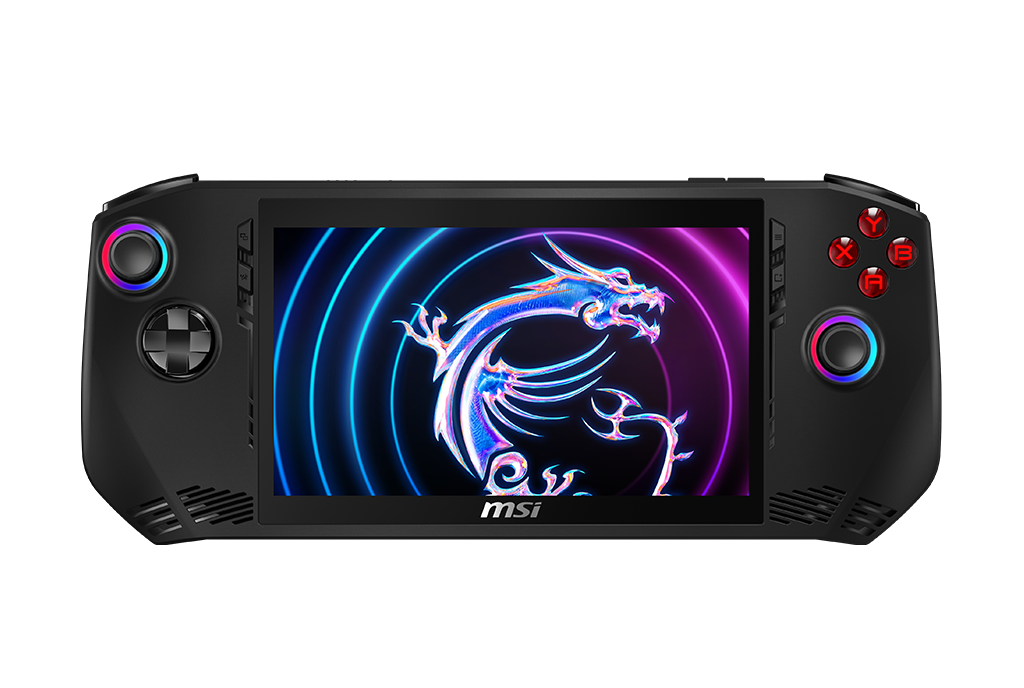
At CEW 2024, MSI stepped into the handheld gaming console arena with the launch of its MSI Claw A1M console. The console comes in two processor choices: the Intel Core Ultra i5 135H and the Core Ultra i7 155H.

MSI Claw

The base model, priced at $699, is already listed for pre-order on MSI’s website and is scheduled to ship on March 12, 2024. Details regarding the availability of the higher-tier models are yet to be announced, but with the shipping date close at hand, announcements are anticipated soon.

MSI Claw

Each Claw model boasts a 7-inch FHD (1920×1080) IPS touchscreen with a 120Hz refresh rate. The systems are uniform in memory, featuring 16GB of LPDDR5 RAM at 6400MHz. For connectivity, they include the latest Intel Killer BE Wi-Fi 7 and Bluetooth 5.4, ensuring high-speed wireless connections.

Storage options vary by model, with the higher-end featuring a 1TB NVMe SSD and the base model a 512GB NVMe SSD, both using the Gen4x4 2230 interface for fast data transfer. All models offer rich audio with 2 x 2W speakers and support a range of peripherals through a Type-C USB port with DisplayPort and Thunderbolt 4 capabilities, as well as a Micro SD card reader.

The devices are designed to be portable, measuring 11.57″ x 4.60″ x 0.83″ in dimensions and weighing in at just 1.44 lbs. They are powered by a 6-cell 53Whr battery and come with a 65W power adapter. MSI also provides a 1-year global warranty for the Claw series.

RELATED:

Infinix Note 40 Pro Plus appears on SDPPI and EEC certification, hinting imminent global launch

Infinix appears to be gearing up for the launch of its upcoming Note 40 series smartphones. This series is expected to include three models: the Note 40, Note 40 Pro, and Note 40 Pro Plus. The highest-tier model, the Infinix Note 40 Pro Plus, has recently surfaced on SPDDI and EEC certification, hinting at an imminent global release.

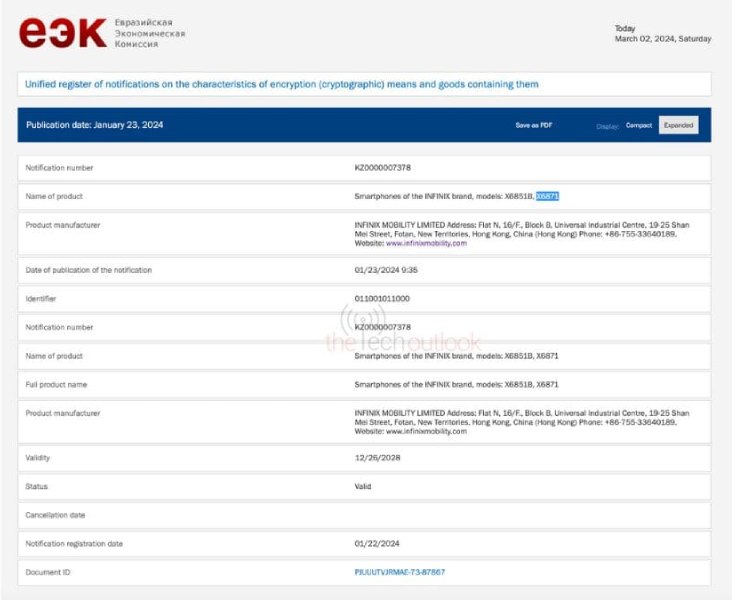
The smartphone has been listed on both the certification sites with model number “X6851B.” However, these listings don’t provide any new information about the device’s specifications or features. 

Additionally, a new model (X6871) has appeared on the EEC, although its specific name is yet to be confirmed.

While details about the Note 40 Pro Plus are still limited, previous listings on the Google Play Console have revealed key specifications for the Note 40 and Note 40 Pro. 

Both models are set to be powered by the MediaTek Helio G99 SoC, paired with an ARM Mali G57 GPU, and will feature at least 8GB of RAM.

These smartphones will come pre-installed with Android 14 and boast a display resolution of 2436×1080 pixels, offering a pixel density of 480 PPI. 

Apart from this, the Infinix Note 40 and Note 40 Pro variant were also spotted on the Declaration of Conformity website, which revealed that both phones will have a 5000mAh battery.

However, there will be differences in terms of charging speed. The Note 40 is said to support 45W charging, while the Note 40 Pro offers 70W fast charging.

At present, there isn’t much information available about the Infinix Note 40 series. Rest assured, we’ll keep you informed of any new developments as they arise.

Related:

(Via)

Google Pixel phones prepare to launch Satellite SOS feature

Satellite connectivity has already proven to be a valuable safety feature on the iPhone, and now Android phones are poised to follow suit. Google Pixel devices are showing signs of an upcoming “Satellite SOS” feature that will allow users to connect with emergency services even without cellular or Wi-Fi signals.

Although the feature isn’t fully operational yet, Pixel phone users can already spot a “Satellite SOS” option within the “Safety & Emergency” settings section. Further exploration by 9to5Google on rooted Pixel phone revealed a detailed menu explaining how Satellite SOS will work.

The Satellite SOS page explains, “With your Pixel, you can message with emergency services and share your location when you can’t connect to a mobile or Wi-Fi network.”

Google’s plan for Pixel’s Satellite SOS is to allow users to send messages to emergency services and share their location via Google Maps when conventional signals are unavailable. Users may also have the capability to provide details about the emergency situation.

For this service to work, Google will need to gather personal data such as the user’s name, phone number from their Google account, and up to three emergency contacts. 

Additionally, information including the user’s location, device details, and specifics about the emergency will be shared with both emergency responders and satellite service providers.

Although Google has not released a list of countries where Satellite SOS will be available, a link to a Garmin Search and Rescue Insurance plan suggests Garmin might be involved in the service. Demo features are present but not yet functional.

The exact timeline for when Google will roll out Satellite SOS as a fully operational feature remains unclear. Nonetheless, the widespread appearance of the setting across Pixel devices and the comprehensive menu behind it indicate that a launch could be imminent.

Related:

AnTuTu top 10 flagship killers February 2024: Redmi K70E retains the crown with a comfortable margin

AnTuTu’s latest report for February 2024 has just rolled out, showing us the top-performing “flagship killer” smartphones. We have separately covered the flagship tier, which the Oppo Find X7 leads.

Redmi K70E

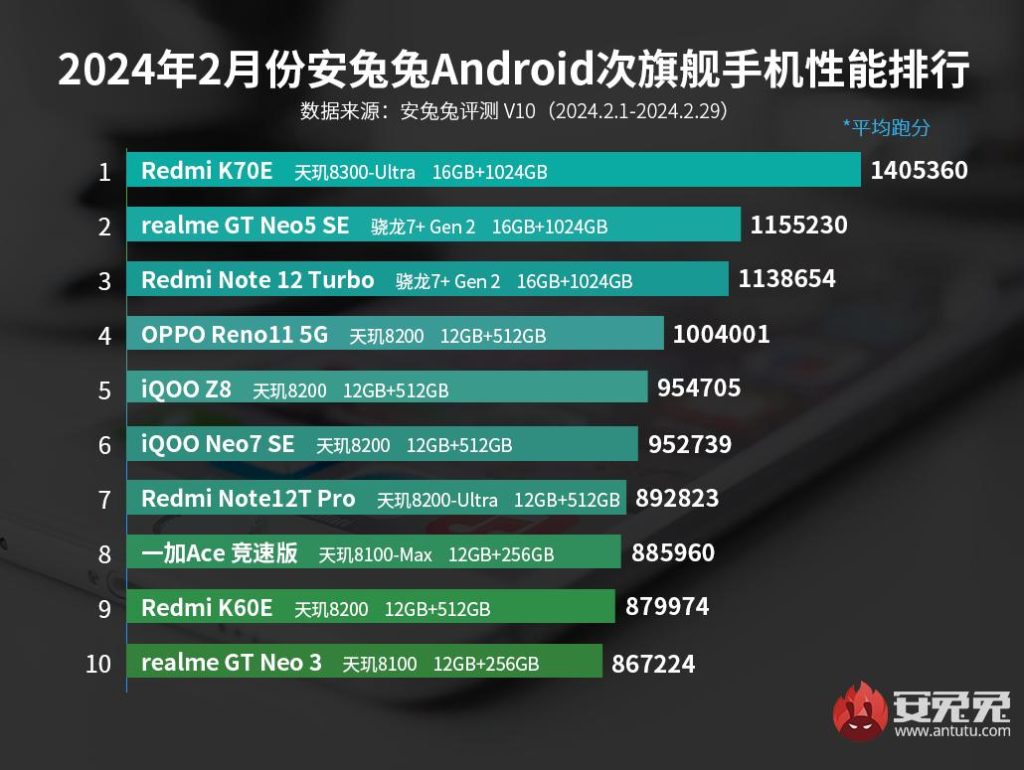
Again, at the top of the flagship killer list is the Redmi K70E. It’s been leading since its first appearance in December 2023, and this month, it scored 1,405,360 points, staying well ahead of the competition.

AnTuTu Benchmark Top Flagship Killer Smartphones January 2024

  1. Redmi K70E
    • Score: 1,405,360
    • Configuration: 16GB RAM + 1TB Storage
  2. realme GT Neo 5 SE
    • Score: 1,155,230
    • Configuration: 16GB RAM + 1TB Storage
  3. Redmi Note 12 Turbo
    • Score: 1,138,654
    • Configuration: 16GB RAM + 1TB Storage
  4. OPPO Reno11 5G
    • Score: 1,004,001
    • Configuration: 12GB RAM + 512GB Storage
  5. iQOO Z8
    • Score: 954,705
    • Configuration: 12GB RAM + 512GB Storage
  6. iQOO Neo7 SE
    • Score: 952,739
    • Configuration: 12GB RAM + 512GB Storage
  7. Redmi Note 12T Pro
    • Score: 892,823
    • Configuration: 12GB RAM + 512GB Storage
  8. OnePlus Ace Racing Edition
    • Score: 885,960
    • Configuration: 12GB RAM + 256GB Storage
  9. Redmi K60E
    • Score: 879,974
    • Configuration: 12GB RAM + 512GB Storage
  10. realme GT Neo 3
    • Score: 867,224
    • Configuration: 12GB RAM + 256GB Storage

There hasn’t been any change in the rankings from the previous month, which might be due to a lack of new mid-range models hitting the market recently. However, there’s some talk about the upcoming Xiaomi CIVI 4, which could bring some heat to the competition with its rumored top-end Snapdragon processors.

RELATED:

Rumor: Galaxy S25 Series May Use Exynos 2500 Exclusively

Rumors are already swirling online about the upcoming Galaxy S25, even though its release is likely a year away. One such rumor suggests that the Galaxy S25 series could exclusively feature Samsung’s in-house Exynos 2500 chip. However, this scenario is unlikely. Let’s delve into why.

Galaxy S25 Series to feature Exynos 2500 everywhere 

According to a new rumor from tipster Connor, the Samsung Galaxy S-series smartphone in 2025 may only use Exynos chipsets. Interestingly, the Galaxy Z series smartphones are rumored to stick with Snapdragon SoCs exclusively, while the Galaxy A series devices might utilize a mix of MediaTek and Exynos chips.

However, this rumor seems doubtful. Samsung recently entered a multi-year agreement with Qualcomm regarding the use of Snapdragon SoCs in its Galaxy flagship smartphones, starting from the Galaxy S24 series. This resulted in the customized “for Galaxy” chips seen in recent Samsung S-series devices.

Given this agreement, it’s reasonable to expect at least a couple more generations of Galaxy S series and Galaxy Z series smartphones to employ high-end Snapdragon processors.

Although early performance tests indicate that Samsung’s Exynos 2400 chip competes well with its Qualcomm counterpart, it’s highly likely that the Galaxy S25 series will include some models featuring the Snapdragon 8 Gen 4.

Both the Exynos 2500 and Snapdragon 8 Gen 4 chips are still in development, along with the Galaxy S25 phones themselves. Information is subject to change, so it’s too early to draw definitive conclusions about the final product’s specifications.

Related:

Realme 12 5G to introduce Apple-inspired ‘Dynamic Button’ feature

Realme is preparing to launch its Realme 12 5G and Realme 12+ 5G devices in India on March 6th. Ahead of the launch, Realme has teased a unique feature for the Realme 12 5G model – a “Dynamic Button” with customizable functionality.

While the exact nature of the button remains to be fully explained, teasers point to it likely being the phone’s power button. This button appears to be programmable for various quick actions. 

The teaser image hints at controlling functions like the camera shutter, flashlight, silent mode, airplane mode, and do-not-disturb settings.

This Dynamic Button concept draws parallels to Apple’s Action Button, a feature currently limited to the higher-end iPhone 15 Pro and Pro Max models. 

Realme’s adoption of a similar feature could introduce this type of functionality to more affordable smartphone segments.

Realme has a history of incorporating design cues and features seen in Apple iPhones. For instance, its budget-friendly Narzo N53 sports a camera module reminiscent of iPhones, while the Realme C53 introduced the “Mini Capsule” feature, visually akin to Apple’s Dynamic Island.

The smartphone surfaced on the Geekbench database a while ago. his listing revealed that the smartphone is equipped with the MediaTek Dimensity 6100+ SOC, which is paired with 8GB of RAM. 

Based on what we know so far, the vanilla version also offers a 5,000mAh battery pack and features a 108-megapixel primary sensor on the back.

Details about the Realme 12 5G are still scarce, but both it and the Realme 12+ 5G are already available for pre-order starting February 29th. Those interested can visit the official Realme website to secure their spot in line.

As the March 6th launch date approaches, Realme will gradually unveil more information about the Realme 12 5G and its intriguing Dynamic Button.

Related:

Vivo X Fold 3 3C certified, likely to support 80W charging

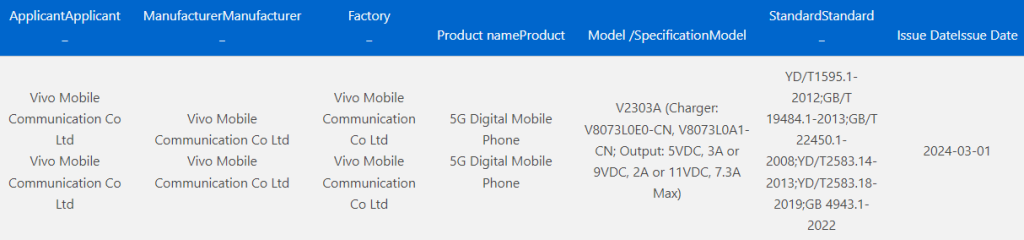
The 3C authority of China approved the Vivo X Fold 3 Pro with the model number V2337A last month. Now, the Vivo X Fold 3, which is identified by the V2303A model number, has received approval from the Chinese certification platform. Speculations are rife that the X Fold 3 series will debut later this month in the home market.

Vivo X Fold 3 3C certified

Vivo X Fold 3 3C certified

The Vivo X Fold 3’s 3C certifications reveal that it may ship with a V8073L0E0-CN power brick. The listing suggests that the device may support up to 80W charging.

To recall, the Vivo X Fold 3 Pro was spotted with a 120W charger at 3C certification. It is speculated that the Pro will support 50W wireless charging, whereas the standard model will lack support for it. Likely, the X Fold 3 will have a 5,600mAh battery, while the Pro variant may feature a 5,700mAh battery. Additionally, reports have revealed that the Snapdragon 8 Gen 2 and Snapdragon 8 Gen 3 chipsets will power the two foldable phones, respectively.

The Vivo X Fold 3 and X Fold 3 Pro display sizes are not known yet. However, the internal screens of both phones are expected to support 2480 x 2200 pixels, whereas the outer displays are likely to offer 1080 x 2520 pixels. The Pro variant is expected to feature ultrasonic in-screen fingerprint scanners on both displays. It is unclear whether the X Fold 3 being an affordable offering will have a side-mounted fingerprint scanner or feature ultrasonic in-screen fingerprint scanners.

The rear camera setup of both phones is expected to feature a 50-megapixel OmniVision OV50H main camera with OIS support and a 50-megapixel ultra-wide lens. While the X Fold 3 is expected to feature a 50-megapixel telephoto camera with support for up to 40x zoom as the third camera, the X Fold 3 Pro is likely to feature an OmniVision OV64B 64-megapixel periscope telephoto lens instead.

RELATED:

Vivo X100 Ultra’s launch reportedly pushed back

Vivo is expected to hold a launch event this month in China to unveil the Vivo X Fold 3 series of foldable phones and the Vivo Pad 3 lineup of flagship tablets. Recent reports have claimed that the brand may announce the much anticipated Vivo X100 Ultra by late April in China. However, a new update from tipster Digital Chat Station reveals that its arrival has been pushed back further.

Vivo X100 Ultra’s arrival further delayed

Vivo X100 Ultra launch reportedly delayed

The latest leak by DCS suggests that the Vivo X100 Ultra may not launch until May. This indicates that the device may potentially launch in May or later. Reports have claimed that it will offer the most powerful camera setup ever seen on an Android phone. 

It is speculated to feature a 50-megapixel LYT-900 main camera with OIS support and a 200-megapixel periscope telephoto camera, which may support up to 200x digital zoom. Other leaks have claimed that the camera setup may include a 50-megapixel IMX598 ultra-wide lens and an IMX758 telephoto camera. It is unclear why the brand has reportedly decided to push back the launch of the Vivo X100 Ultra.

While recent reports have dubbed the device the Vivo X100 Ultra, the company has yet to officially confirm the moniker. The existing Vivo X100 and X100 Pro smartphones are equipped with the Dimensity 9300 chipset, whereas the X100 Ultra is likely to have the Snapdragon 8 Gen 3 chip onboard.

In related news, Vivo is also said to be working on the Vivo X100s smartphone. A recent report claimed that it will have a flat display, the all-new Dimensity 9300 Plus chipset, and 120W fast charging support. It is speculated that the Vivo X100s may debut alongside the Vivo X100 Ultra.

RELATED:

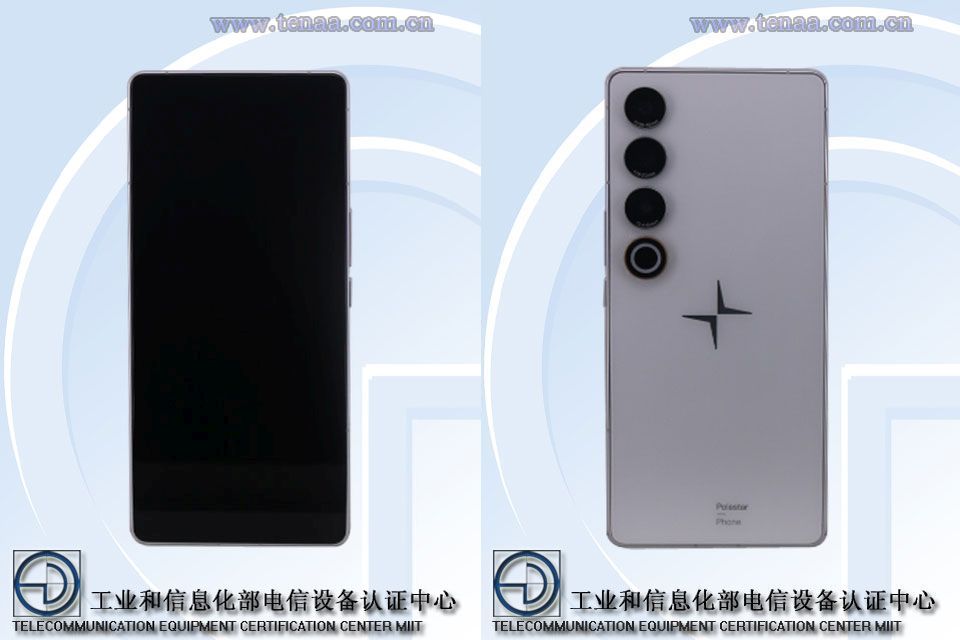
Polestar Phone coming soon, images appear via MIIT certification

Polestar Phone is said to be in the works for the Chinese market. A recent report claimed it could be a rebranded version of the Meizu 21 Pro, which recently debuted in China. It appears this is indeed true, as images of the Polestar Phone emerged through MIIT certification, revealing a design identical to the Meizu flagship.

Polestar Phone design revealed

Polestar Phone MIIT
Polestar Phone images via MIIT certification

Polestar Phone’s images from MIIT certification suggest that it looks exactly like the Meizu 21 Pro. Being a Polestar product, it has the company’s logo at the centre and the “Polestar Phone” text engraved at the bottom. The certification has no information about the specifications of the device yet. However, it may pack the same internals as the Meizu 21 Pro. Here is a look at the specs of the Meizu phone.

Meizu 21 Pro specifications

The Meizu 21 Pro features a 6.79-inch BOE Q9 OLED QHD+ display with a resolution of 3198 x 1368 pixels and LTPO 120Hz refresh rate, reaching a peak brightness of 1250 nits. It runs on a Snapdragon 8 Gen 3 processor and offers 12 GB / 16 GB of LPDDR5x RAM, coupled with 256 GB / 512 GB of UFS 4.0 storage.

Powering the Meizu 21 Pro is a 5,050mAh battery that supports 80W wired charging and 50W wireless charging. The front camera is a 32-megapixel shooter, while the rear setup includes a 50-megapixel main camera with OIS, a 13-megapixel ultra-wide and macro lens, and a 10-megapixel telephoto lens with OIS.

The 21 Pro also offers features such as an ultrasonic in-display fingerprint sensor, an Aicy smart RGB-LED ring, an IR blaster, and dual speakers. Connectivity options include Wi-Fi 802.11ax, Bluetooth 5.4, NFC, and an IP68 water and dust resistance rating. It has a starting price of 4,999 Yuan (~$703) in China.

RELATED:

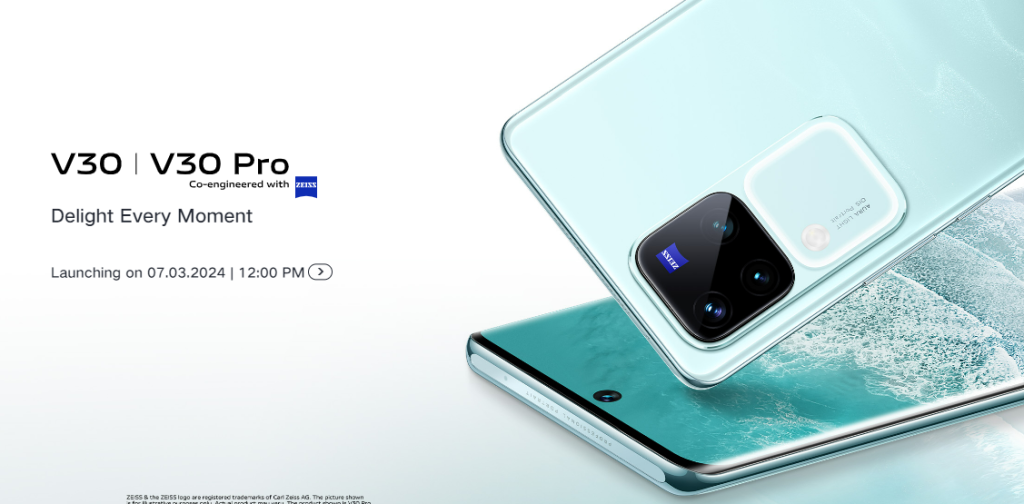
Vivo V30 series Indian pricing leaks ahead of March 7 launch

After the recent launch of the Vivo V30 and V30 Pro smartphones in India, these devices are now headed to the Indian market, scheduled for a March 7 launch. Ahead of the launch, Indian prices of these smartphones have leaked online.

Vivo V30 series launch date

The pricing for these new entries has been leaked by the tipster Abhishek Yadav (@yabhishekhd). The tipster claims that the Vivo V30 Pro will be available at a market operating price of Rs.41,999 for the 8GB/256GB variant, while the Vivo V30 will be priced at Rs.33,999.

Vivo V30 specs:

Vivo V30

The Vivo V30 features a 6.78-inch curved edge AMOLED display with FHD+ resolution, a 120 Hz refresh rate, and is powered by a Snapdragon 7 Gen 3 SoC. It comes with up to 12GB RAM and 512GB storage, runs on FuntouchOS based on Android 14, and includes a triple rear camera setup with a 50MP primary camera. The device also offers a 50MP front camera and a 5000mAh battery with 80W fast charging support.

Vivo V30 Pro specs:

Vivo V30 Pro

The V30 Pro model sports a similar 6.78-inch AMOLED display but with a higher 1.5k resolution. It is powered by a MediaTek Dimensity 8200 SoC, paired with up to 12GB LPDDR5X RAM and 512GB UFS 3.1 storage. Running on Android 14 OS, the V30 Pro also features a triple rear camera setup with a 50MP main camera. It includes a 50MP front camera and supports 80W fast charging with a 5000mAh battery.

RELATED:

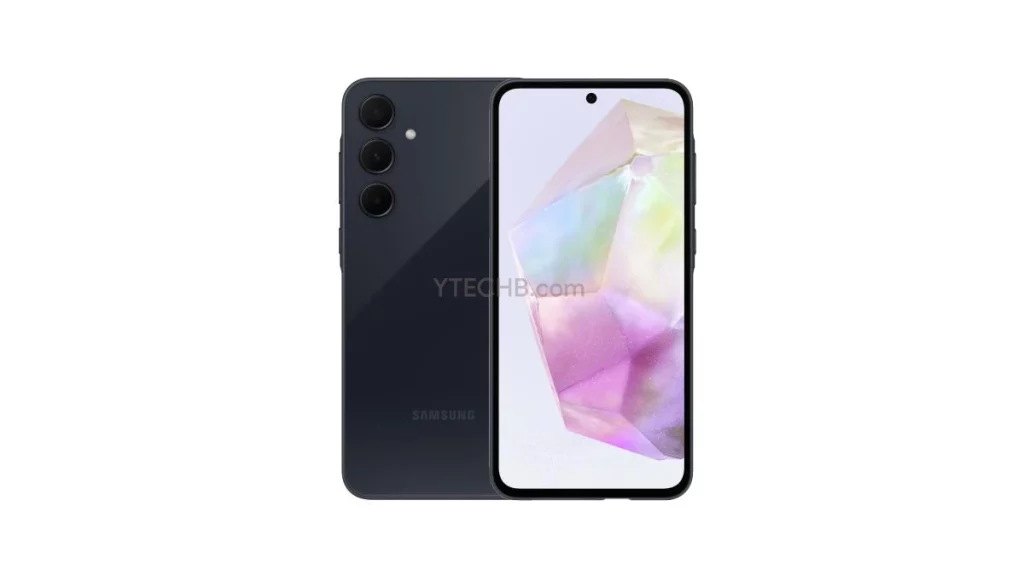
Galaxy A35 5G leaks in new colors with full specs

New details about the Galaxy A35 5G continue to emerge; previously, we shared some specs of Galaxy A35 5G with you, and now a new leak reveals the upcoming color options of the phone. Samsung Galaxy A35 5G is coming in 4 different colors – Awesome Lilac, Awesome Navy, Awesome Ice Blue, and Awesome Lemon. The A34 also was offered with 4 colors but Samsung seems to have opted for some pastel colors this year.

Galaxy A35 colors & specs

Galaxy A55 is expected to be unveiled in Germany in March, and its sibling Galaxy A35, will likely be introduced around a similar time frame. In a recent article shared by YTECHB, new render images of the Galaxy A35 have been leaked alongside some specs.

The phone is IP67 certified, weighs 209 grams, and has an 8.2 mm thickness. The device has a sleek 6.6-inch Super AMOLED screen with a 120Hz refresh rate, a punch-hole notch, and a 1080 x 2340 resolution. Exynos 1380 processor will be offered with either 6GB or 8GB of RAM with 128GB or 256GB storage, depending on the configuration and the phone packs a 5000 mAh battery. The phone will come pre-installed with One UI 6.1, which is based on Android 14.

The device has a triple-camera configuration on the back, featuring an f/1.8 50MP primary camera, an f/2.2 8MP ultra-wide-angle sensor, and an f/2.4 5MP macro camera. Unfortunately, the Galaxy A35’s 4K video recording capabilities are limited to 30 frames per second. You are also able to record FHD videos at 30 FPS with the selfie camera.

While the upcoming A35 lacks huge improvements in comparison to the A34, the Galaxy A35 5G is nonetheless a little but sweet upgrade. The introduction of the Galaxy A35 and Galaxy A55 is expected in the coming weeks, possibly in March. The starting price of Galaxy A35 might be around €379 in Europe.

Related:

Google testing a unified app store called “App Mall” for Chromebooks

Chromebooks have gained popularity due to their affordability and user-friendly interface. However, users have faced challenges in managing apps across different platforms, including web apps, Android apps, and Linux apps, due to the need to navigate through various sources like the Chrome browser, Google Play Store, and sometimes the command line for Linux apps. This creates a fragmented and often confusing experience, especially for new users.

Chrome Web Store

Streamlining Chromebook App Discovery

To address this issue, Google is introducing a new app store for ChromeOS called the “App Mall.” This initiative aims to simplify the app discovery and installation process by providing a centralized platform for users to find and install a wide variety of apps.

According to code snippets found in Chrome, the functionality is hidden behind a flag in Chrome settings, but it points to a website called “discover.apps.chrome.” While the website isn’t live yet, it hints at the upcoming online store.

While it’s still early days, and specific details about the types of apps that will be featured in the “App Mall” are not fully disclosed, it is anticipated that at least Android and web apps, including games, will make the cut. This speculation is buoyed by the current capability of Chromebooks to discover certain apps through the built-in “Explore” app, suggesting that the “App Mall” will likely expand on this foundation to offer a more comprehensive discovery experience.

This consolidation could significantly enhance the user experience, making it easier and more intuitive for Chromebook owners to uncover new apps and games, thereby maximizing the utility and versatility of their devices.

Google is also working on its Chrome browser as they have recently introduced three new generative AI features in its latest release (M121) for users in the U.S. on Mac and Windows PCs. These features include AI Tab Groups for organizing open tabs automatically, Custom Themes with AI for creating personalized themes using a text-to-image diffusion model, and “Help Me Write,” an AI-powered writing assistance tool set to launch in the next release.

RELATED:

(Via)

Adobe Unveiled a “Text-to-Music” Tool for AI-powered Music Generation

Adobe has unveiled a game-changing tool called Project Music GenAI Control. This experimental AI system allows you to not only generate music but also edit it directly within the same interface, all starting with simple text descriptions. Imagine needing an epic electronic intro – simply type “epic electronic” and let the AI work its magic. Yes, generative AI is becoming mainstream for real.

You can also edit your existing music files using the AI

But Project Music GenAI Control goes beyond just generating music. It allows you to refine your masterpiece by adjusting tempo, structure, repetition, and intensity to perfectly match your vision. You can even expand your canvas by extending the length, remixing sections, or creating seamless loops, all within the same tool. And if you have an existing piece of audio, you can even transform it based on a reference melody, unlocking even more creative possibilities.

Adobe

Unlike other AI music tools, Project Music GenAI Control empowers you with precise editing capabilities, offering you a level of control akin to working with pixels in Photoshop, but applied to the world of sound. This seamless workflow eliminates the need to jump between different applications, streamlining your creative process.

Adobe emphasizes responsible AI practices by ensuring the generated music is safe for commercial use. They also implement Content Credentials, acting like “nutrition labels” that disclose the AI-assisted nature of your creation.

Developed in collaboration with esteemed universities, Project Music GenAI Control is still in its experimental stage. While a user-friendly interface is still under development, this glimpse into the future of audio creation suggests a powerful and intuitive tool is on the horizon.

RELATED:

(Via)

NVIDIA CEO Makes Daring Prediction that AI will Reach “General Intelligence” in 5 Years

NVIDIA CEO Jensen Huang made a bold claim at a recent Stanford forum, suggesting that artificial general intelligence (AGI) might be closer than we think – potentially arriving in as little as five years. However, his statement comes with some crucial context.

NVIDIA’s confidence stems from the usage of its chips for primarily AI

Huang’s prediction hinges on the definition of AGI. If we define it as the ability to pass human-designed tests, then Huang believes AGI is on the horizon. He argues that within five years, AI systems could “do well on every single” test thrown at them. This confidence stems partly from NVIDIA’s leading role in developing the powerful AI chips used in systems like OpenAI‘s ChatGPT.

Nvidia Partners Tata

However, Huang acknowledges that a broader definition of AGI exists, one that encompasses truly understanding and replicating the complex workings of the human mind. This definition, he admits, remains elusive due to ongoing scientific debate on the nature of human intelligence. “It’s hard to achieve as an engineer” because of the lack of a clear target, Huang explains.

The discussion also touched on the infrastructure needed to support the growth of AI. While concerns have been raised about the need for additional chip factories (fabs) to meet future demand, Huang believes this might not be as critical as some fear. He points out that advancements in AI algorithms and processing efficiency will likely lead to a need for fewer chips overall, despite the anticipated growth in AI applications.

While Huang’s prediction is certainly attention-grabbing, it’s crucial to understand the nuances behind his statement. AI may indeed be rapidly advancing, with the potential to excel in specific tasks. However, the true essence of human intelligence, which involves much more than simply passing tests, might still be a significant way off due to the fundamental challenges in understanding and replicating it.

RELATED:

(Via)

Microsoft’s popular code-sharing platform GitHub under attack, potentially affecting millions

Millions of developers and users are on alert as the popular code-sharing platform GitHub faces a large-scale attack. Security researchers at Apiiro have identified a concerning trend where malicious actors are targeting GitHub repositories, potentially compromising over 100,000 projects.

Github
Credit: zbw mediatalk

Massive Malware Campaign Targets Over 100,000 GitHub Repositories

The attack involves a technique called “malicious repository obfuscation” where attackers clone legitimate repositories, inject harmful code, and re-upload them to the platform. These tampered repositories can then be downloaded by unsuspecting users, potentially compromising their systems or infecting them with malware.

The report by Apiiro highlights several factors making GitHub vulnerable to such attacks. The platform’s ease of use, readily available APIs, and the presence of numerous hidden repositories create an ideal environment for attackers to launch “watering hole attacks.”

In these attacks, attackers target popular and frequently downloaded repositories. They inject malicious code into these repositories and then re-upload them. To further amplify their reach, attackers create numerous fake forks of the compromised repositories using automated methods. These fake forks can then be spread through social media, online forums, and other channels, tricking users into downloading the malicious versions.

The report acknowledges that GitHub has been notified and has taken down most of the identified malicious repositories. However, the activity is ongoing, with attackers constantly attempting to inject harmful code. This ongoing struggle resembles a game of whack-a-mole, where GitHub plays catch-up, removing malicious code after it has already been uploaded, potentially putting users at risk.

The report further reveals that this attack campaign began in May 2023 and has been steadily growing. This continuous activity raises concerns that even more repositories and users could be compromised in the future. Developers and users are advised to exercise caution when downloading code from GitHub, especially from unfamiliar repositories. It’s crucial to verify the source and legitimacy of the code before integrating it into projects.

RELATED:

(Source)

Scott Voltage eRIDE electric mountain bike with a lightweight integrated motor unveiled

Scott Sports has unveiled its latest electric mountain bike (e-MTB), the Voltage eRIDE. The new Voltage eRIDE has a lightweight, integrated motor and is available in six versions. The Voltage eRIDE e-MTB also comes with a full suspension setup and up to q160mm front and 155mm rear travel. The Scott Voltage eRIDE is now available on the global market.

Scott Voltage eRIDE

Features

The versions of the Scott Voltage eRIDE e-MTB are the eRIDE 900 SL, the eRIDE 900 Tuned, the Scott Contessa Voltage eRIDE 900, the Scott Voltage eRIDE 910, the eRIDE 920, and the Scott Contessa Voltage eRIDE 910. The new electric mountain bike is equipped with a TQ-HPR50 drive unit with a maximum torque of 50Nm and a top speed of 25 km/h in the EU and 20mph (33km/h) in the US. The mid-mounted motor weights 1.8kg and combines with a 360Wh battery. Customers can get an optional range extender with a capacity of 160Wh, available as a standard with the eRIDE 900 SL.

Users can adjust the power output settings of the Voltage eRIDE via the TQ smartphone app. The phone can be connected to the bike via Bluetooth while in-ride controls are provided via a handlebar remote. You can view the remaining battery life, speed and range on the bike’s display integrated into the top tube. The cheaper 920 and Contessa 900 versions of the Voltage eRIDE have Marzocchi and Fox elements with 150/ 155 mm of front/ rear travel. The other models come with Fox suspension components with 160/ 155 mm of front/ rear travel. The transmission and disc brakes setup for the models highlight some of their differences. The 900 SL and 900 Tuned are equipped with SRAM models while the other versions come with Shimano equivalents.

Pricing & Availability

The Scott Voltage eRIDE models are all lightweight, with the 900 SL being the lightest (17.9kg). They all come with Maxxis tires but the types differ among the versions. The Scott Voltage eRIDE is available in the US, the UK, and the Netherlands, among other countries, and is priced from $6,599/ £6,099/ €6,699 for the eRIDE 920. The top model in the lineup is the Scott Voltage eRIDE 900 SL with a price tag of $12,999/ £11,899/ €12,999.

RELATED: